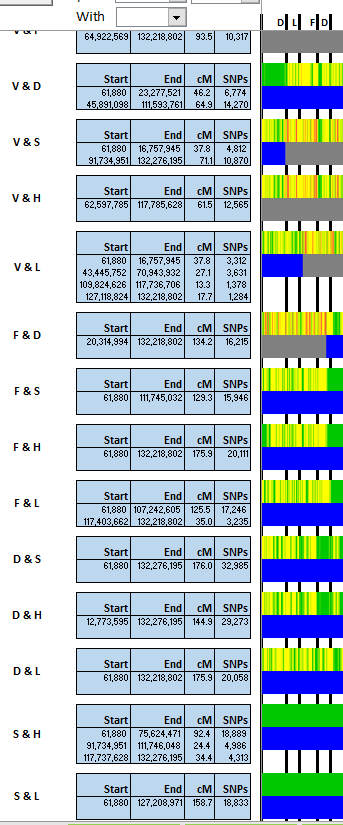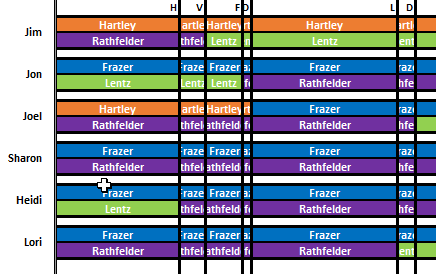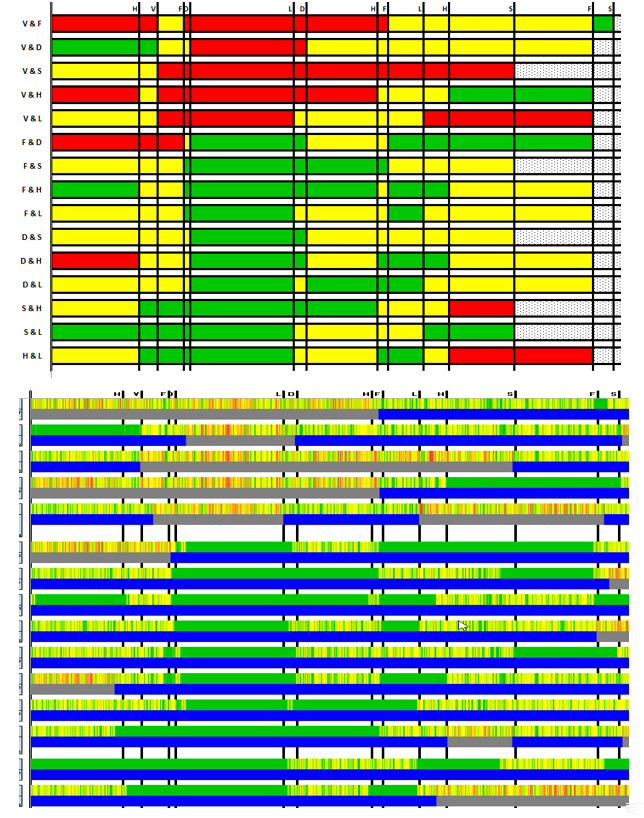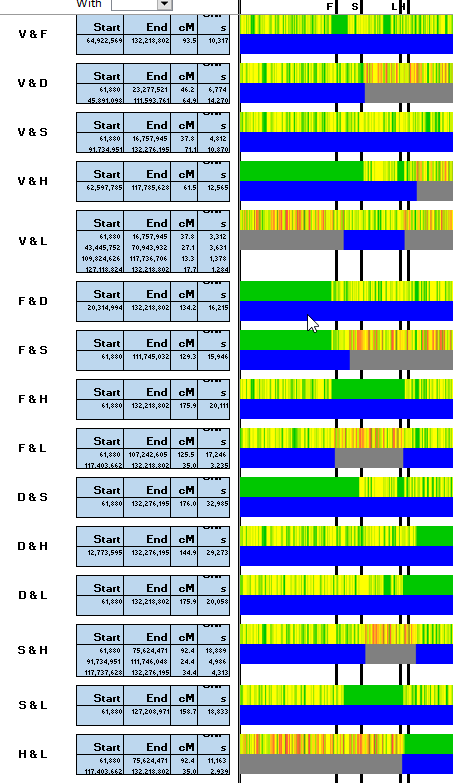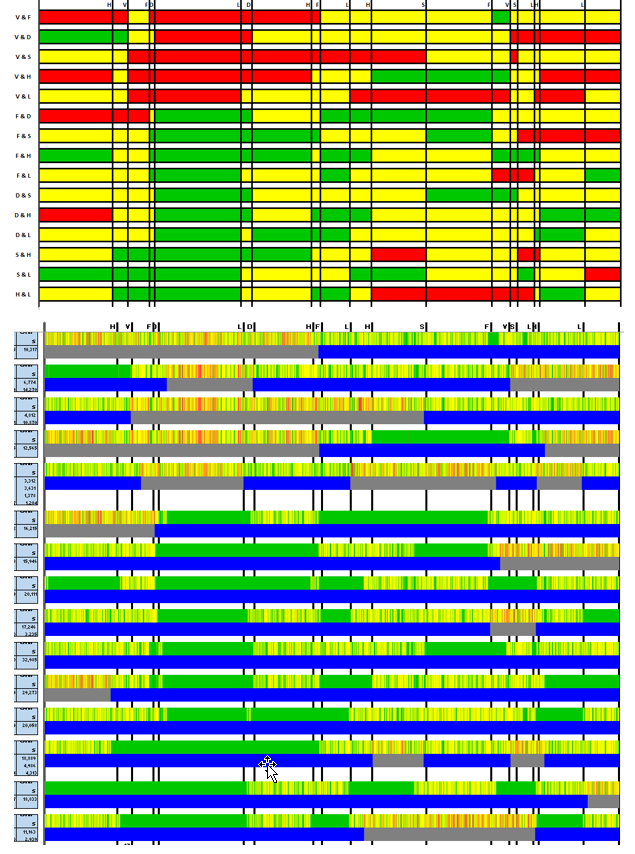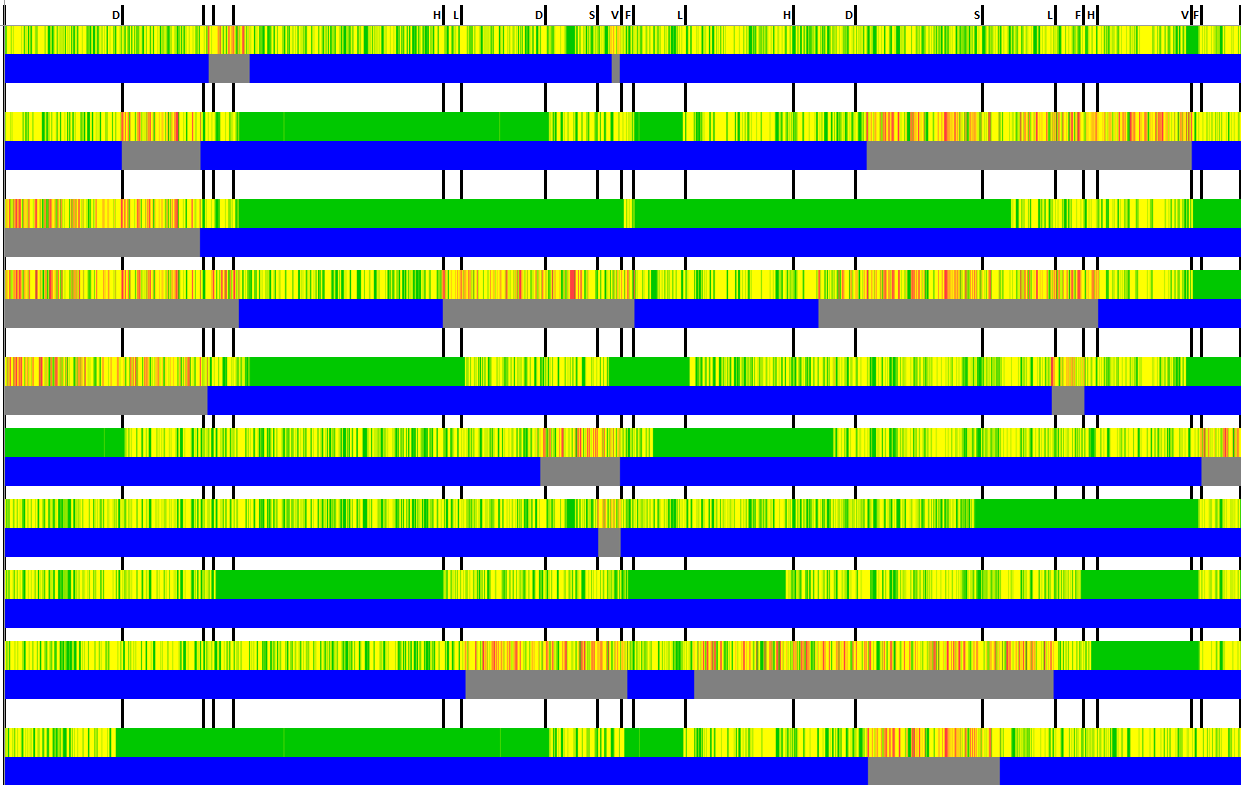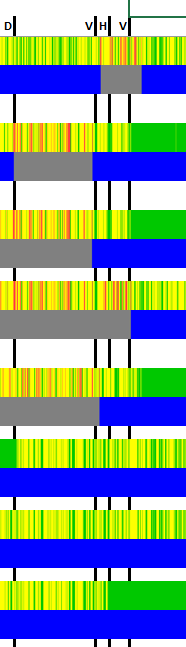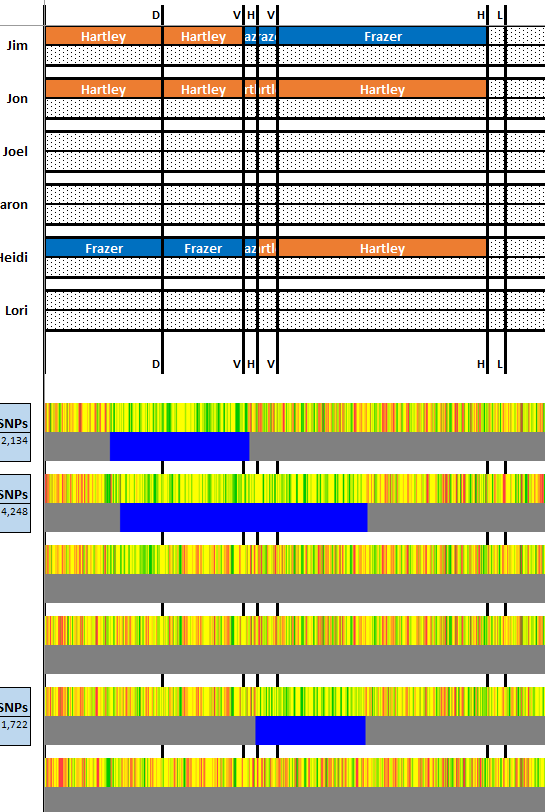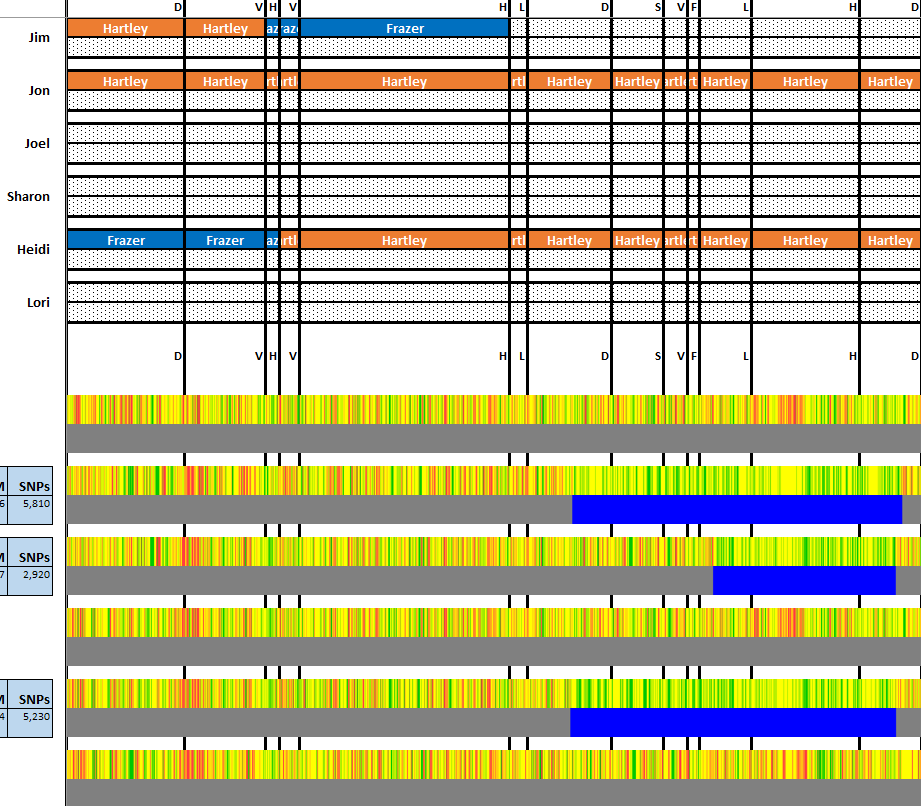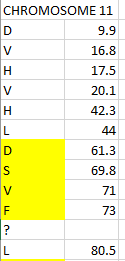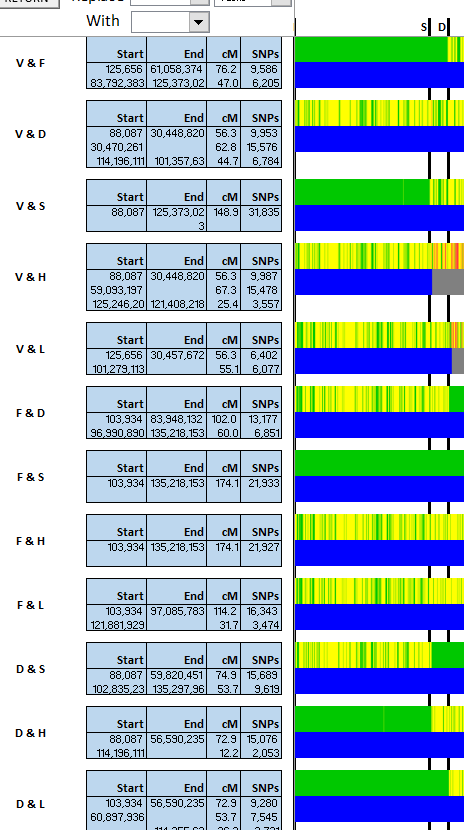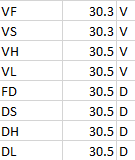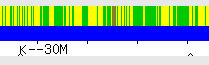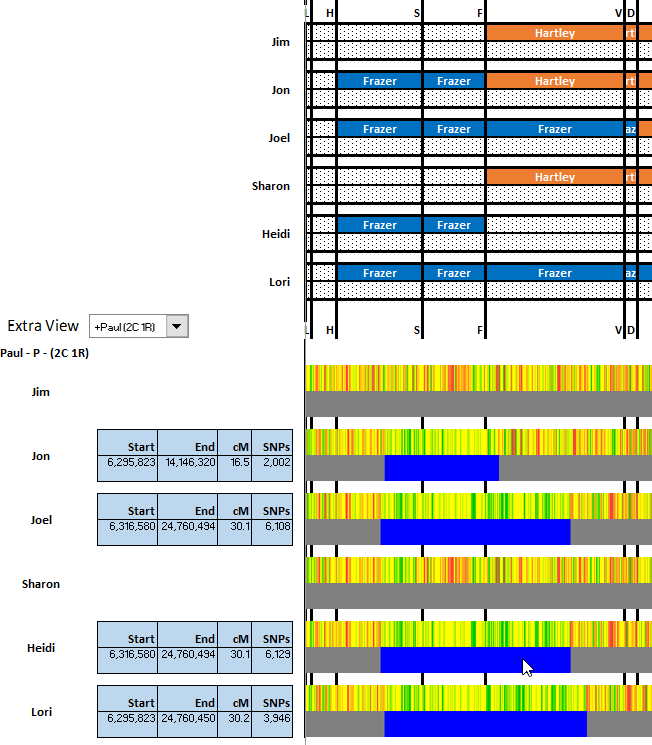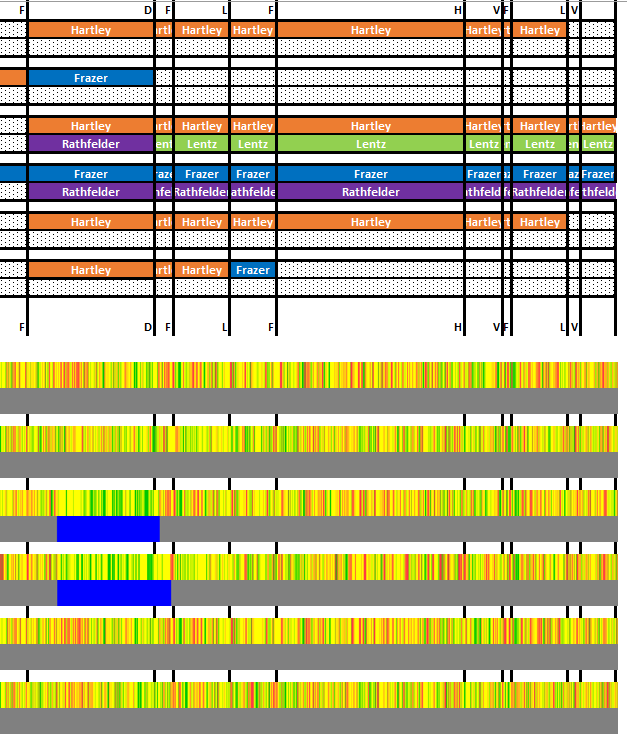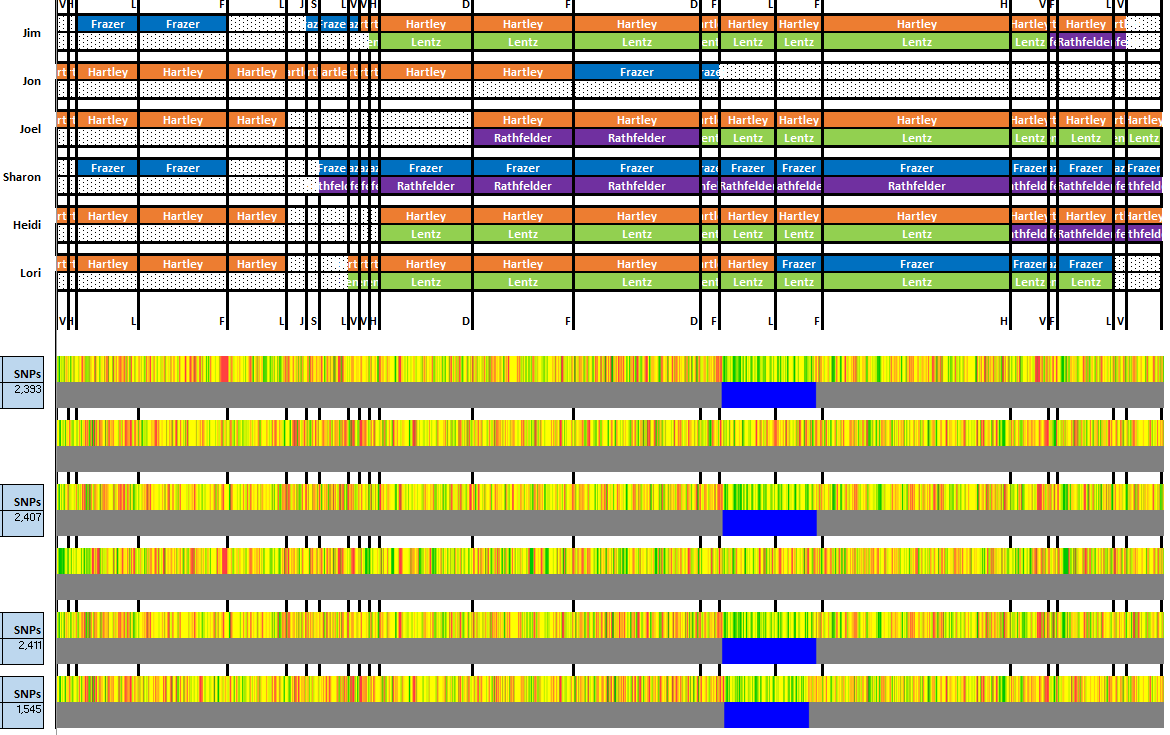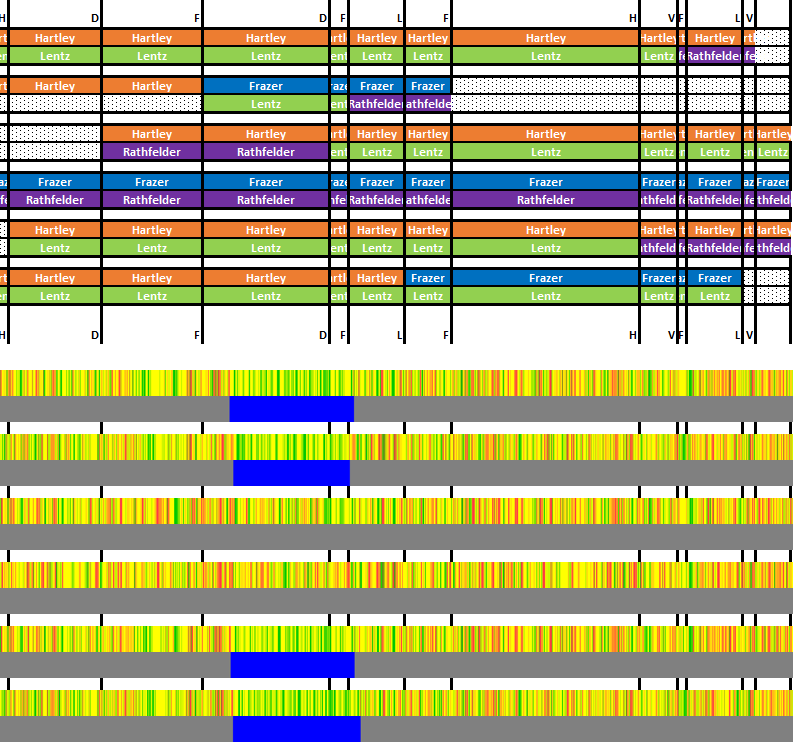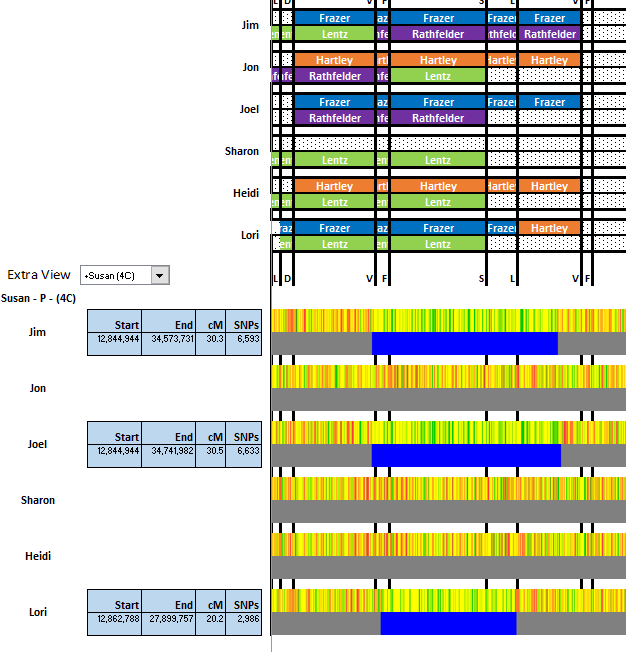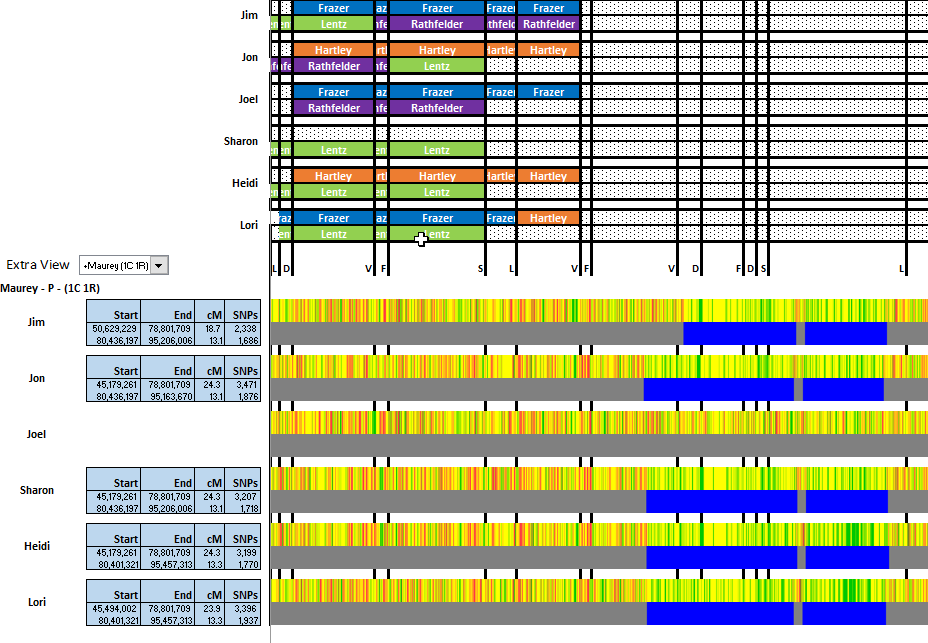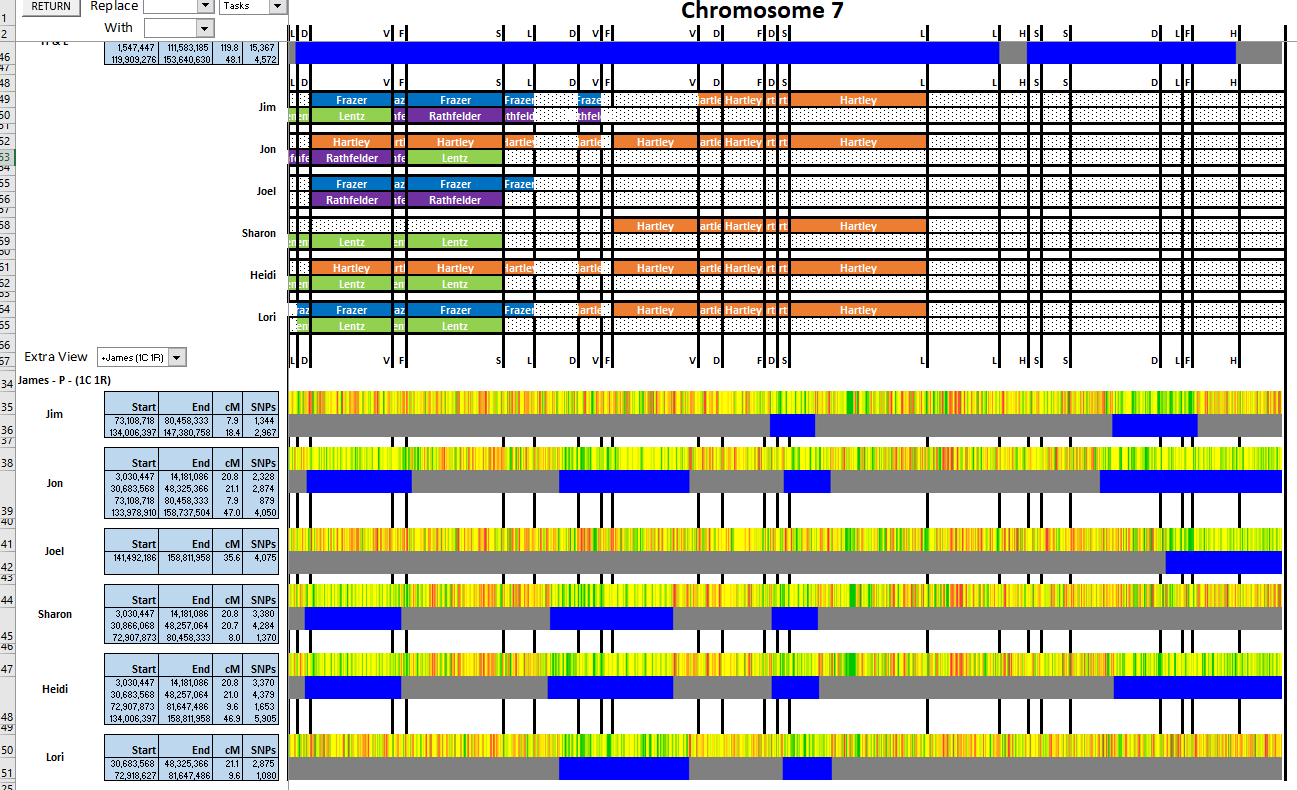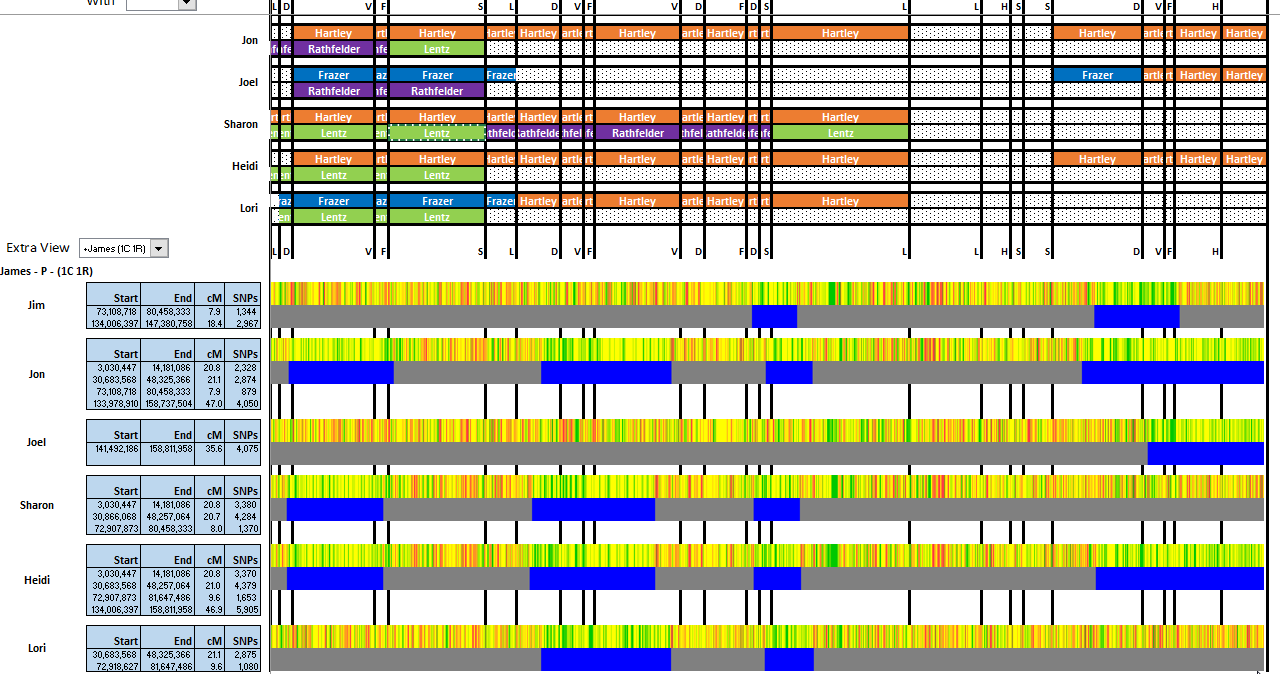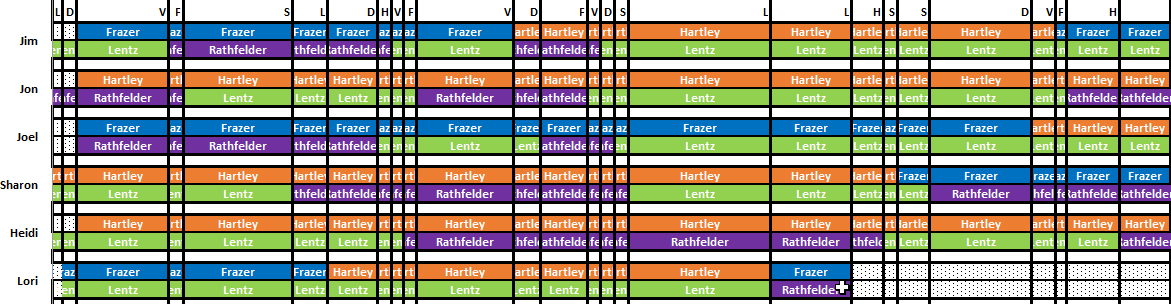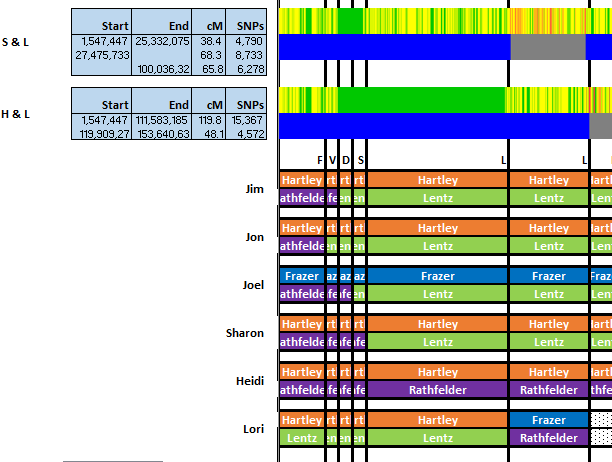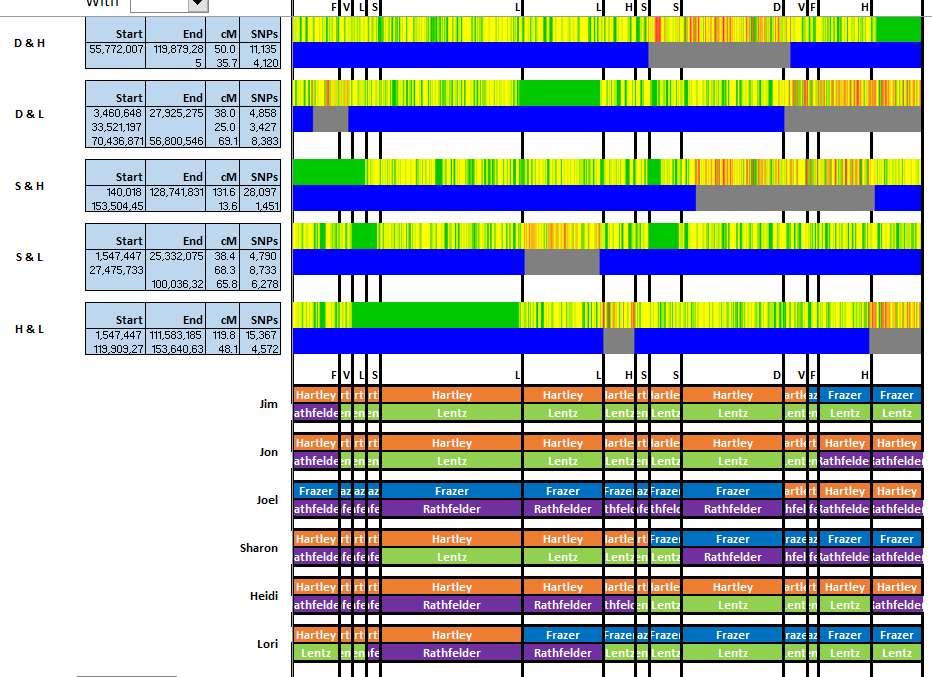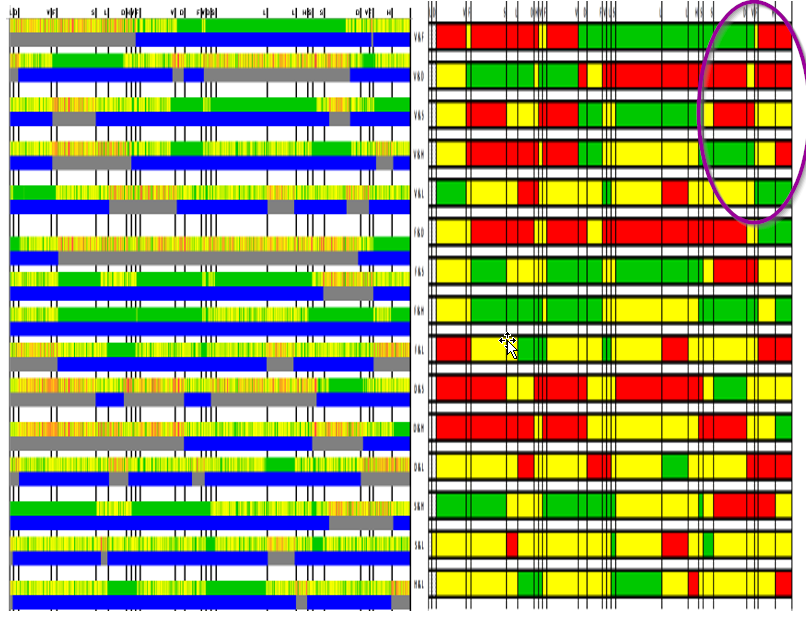
Visual Phasing Six Siblings with the Fox Spreadsheet: Part 5A: Chromosome 4

I’m working on Visually Phasing myself and my five siblings. In my previous Blog, I took Chromosome 20 out of order. Now I am back on track.

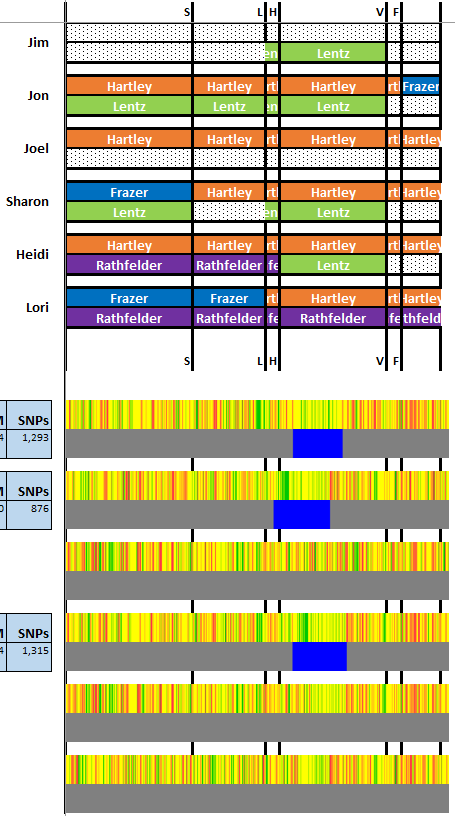
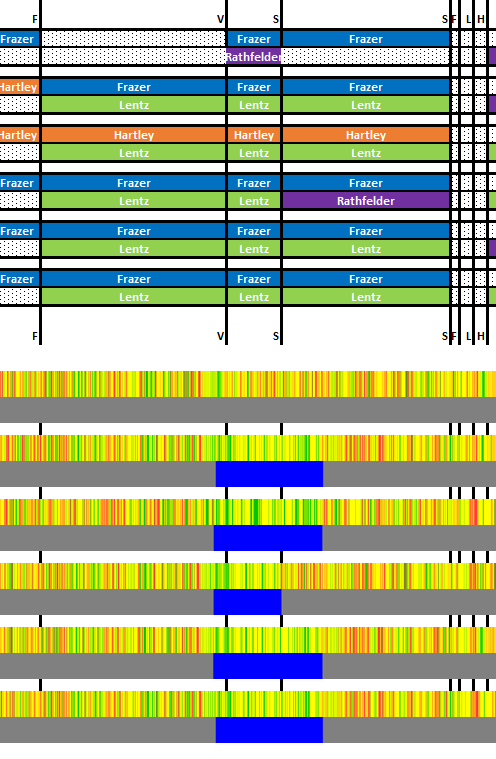
Setting the Boundaries for Chromosome 4

First I look for crossovers and try to assign a person to the crossover.

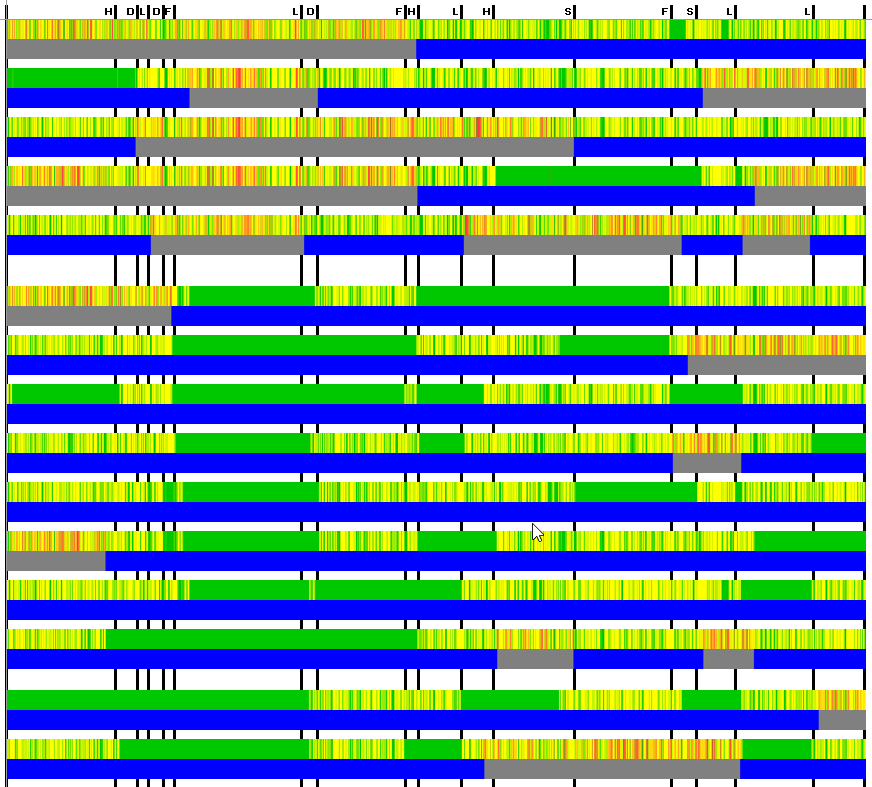
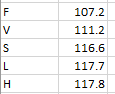
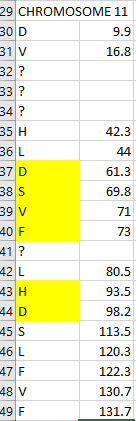
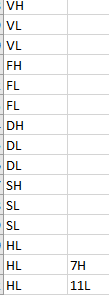
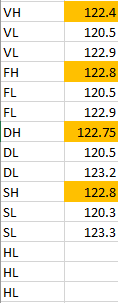
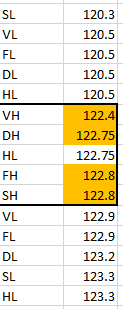
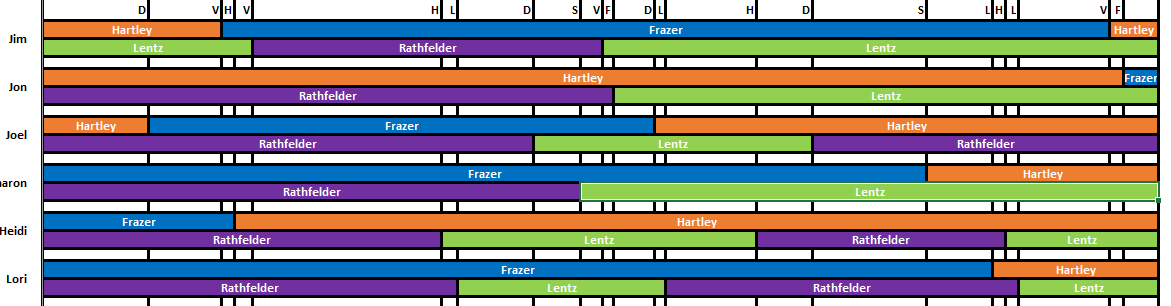
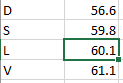
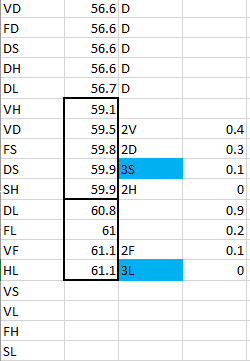
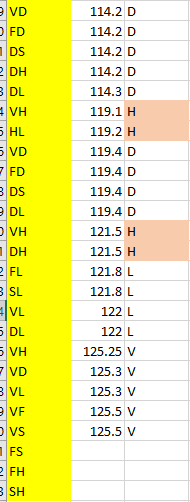
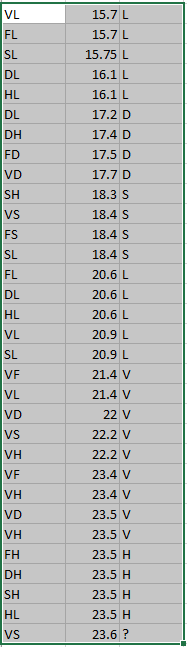
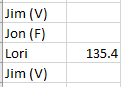
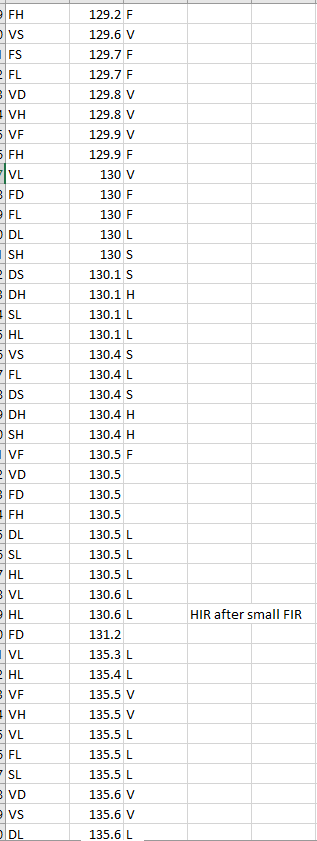
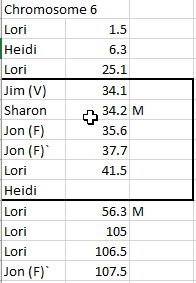
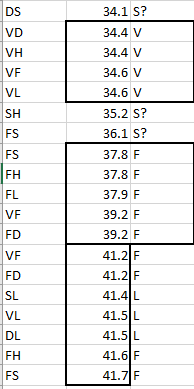
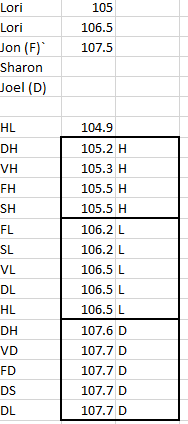
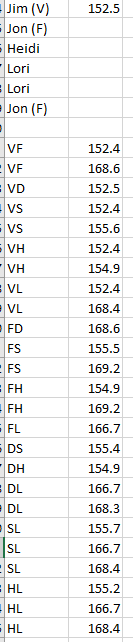
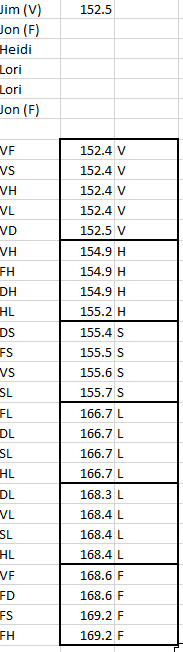
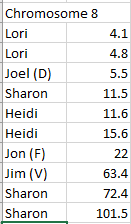
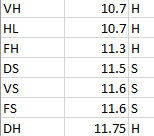
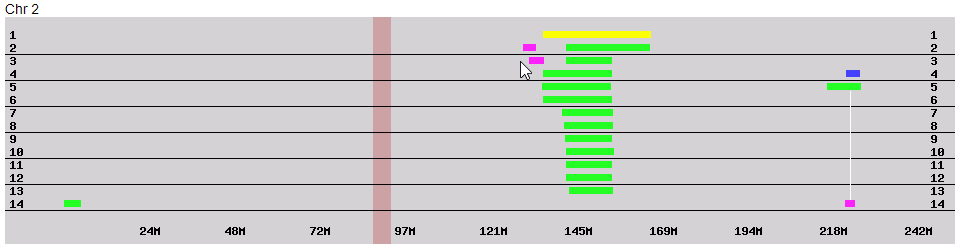
I do the best I can, but will likely need some adjustments as I go along. For this Chromosome, I made a chart to keep track of the crossovers:

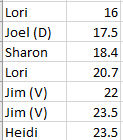
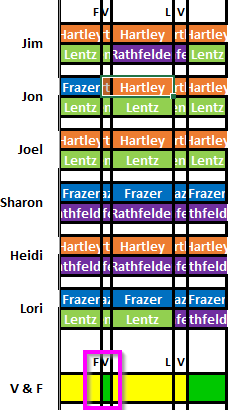
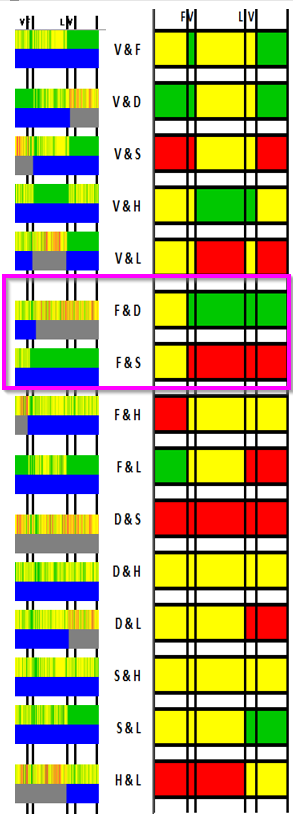
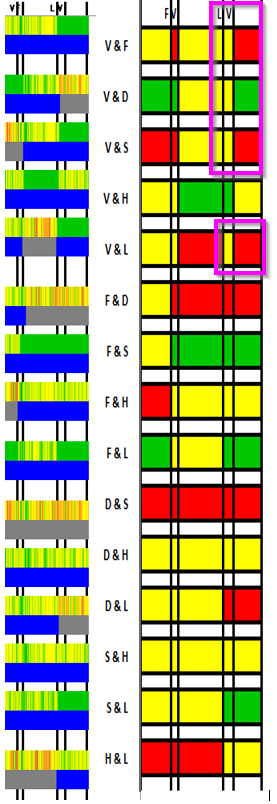
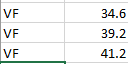
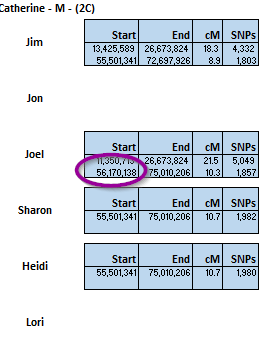
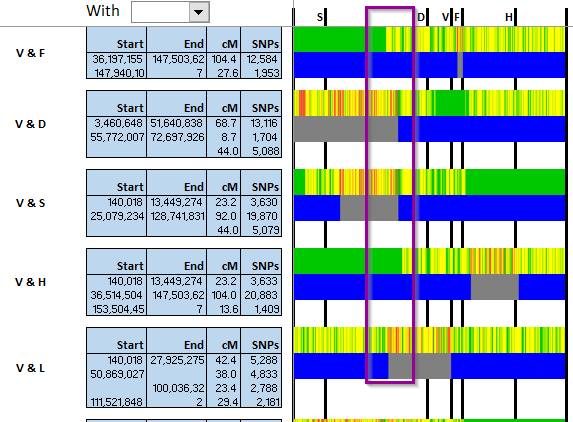
Here I had problems at positions 21.4 and 40.

Both these problem areas were in the comparison between Jim (V) and Lori. It didn’t seem like the ends of their first two matches lined up with changes in the other sibling comparisons. Undaunted, I shall continue. If I do everything else right, this will sort itself out.

Adding Cousin Matches

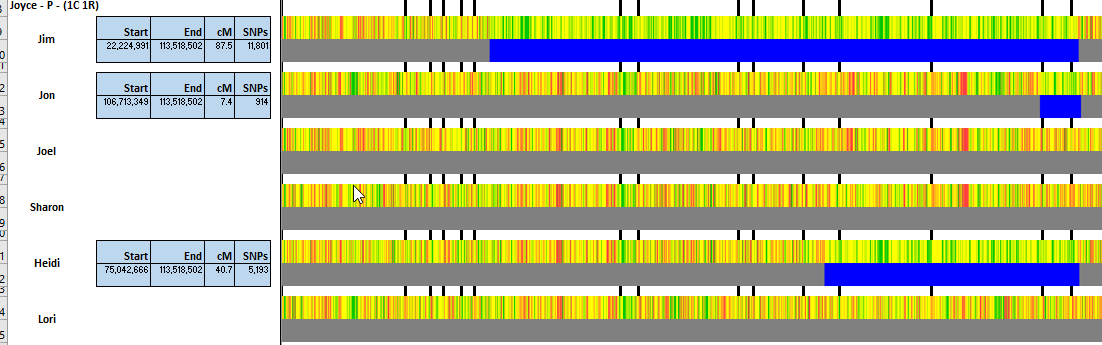
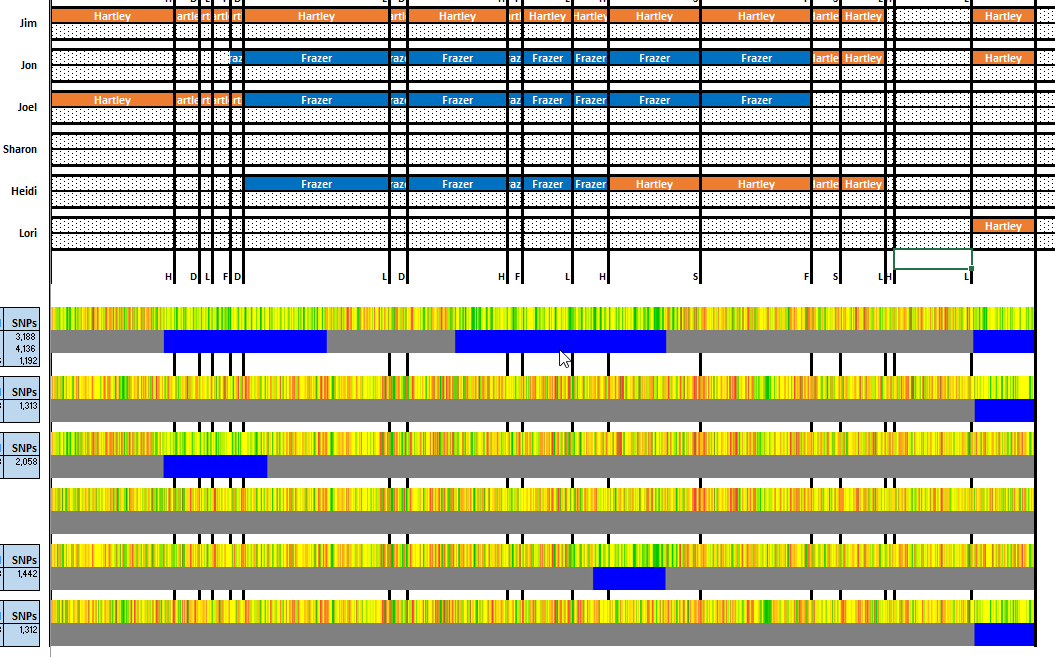
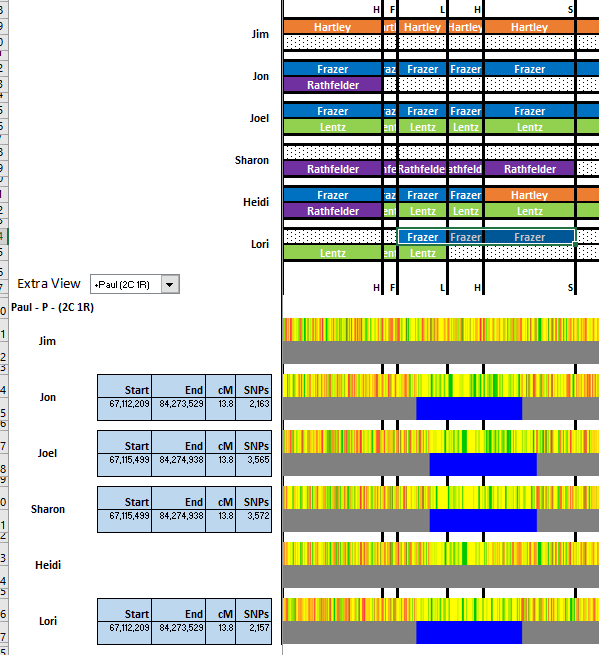
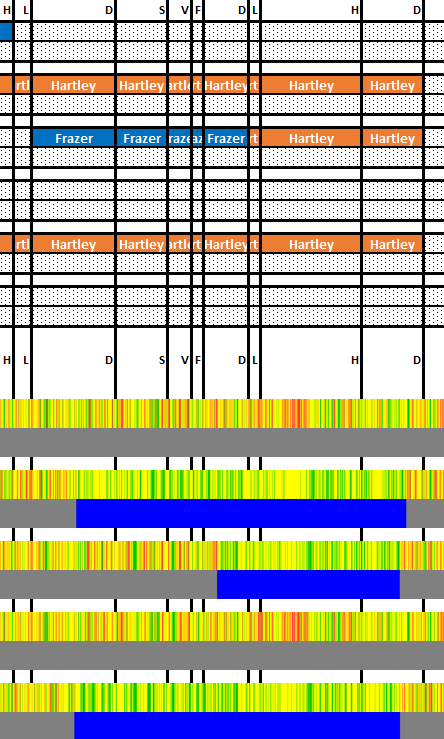
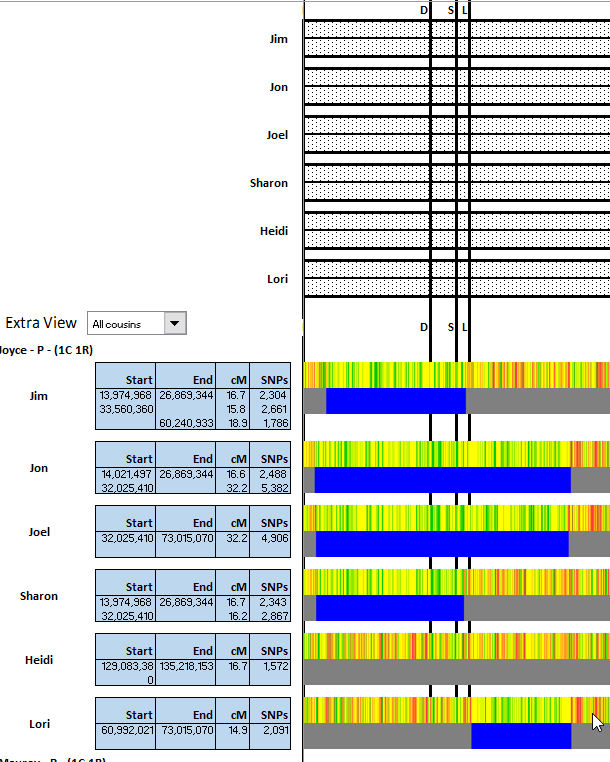
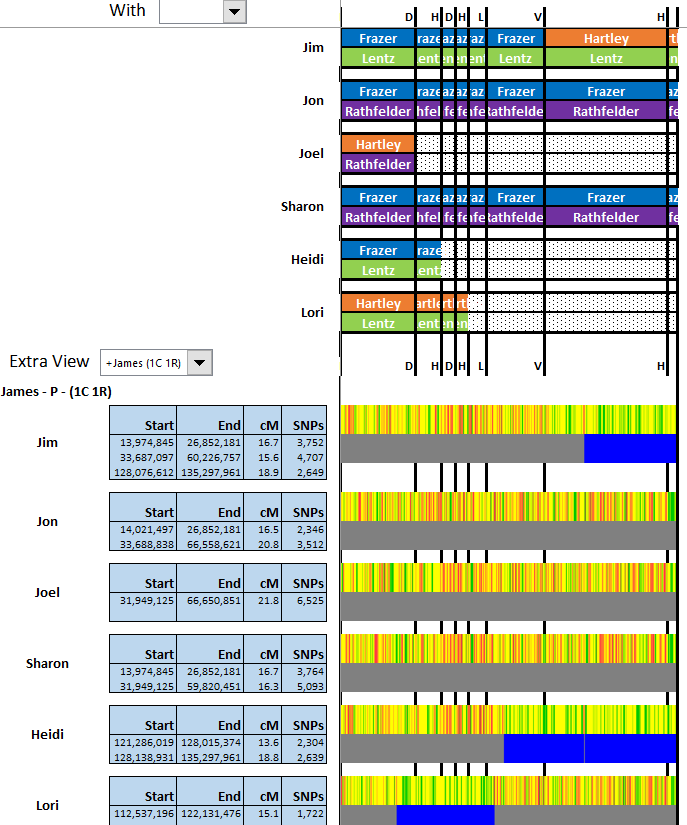
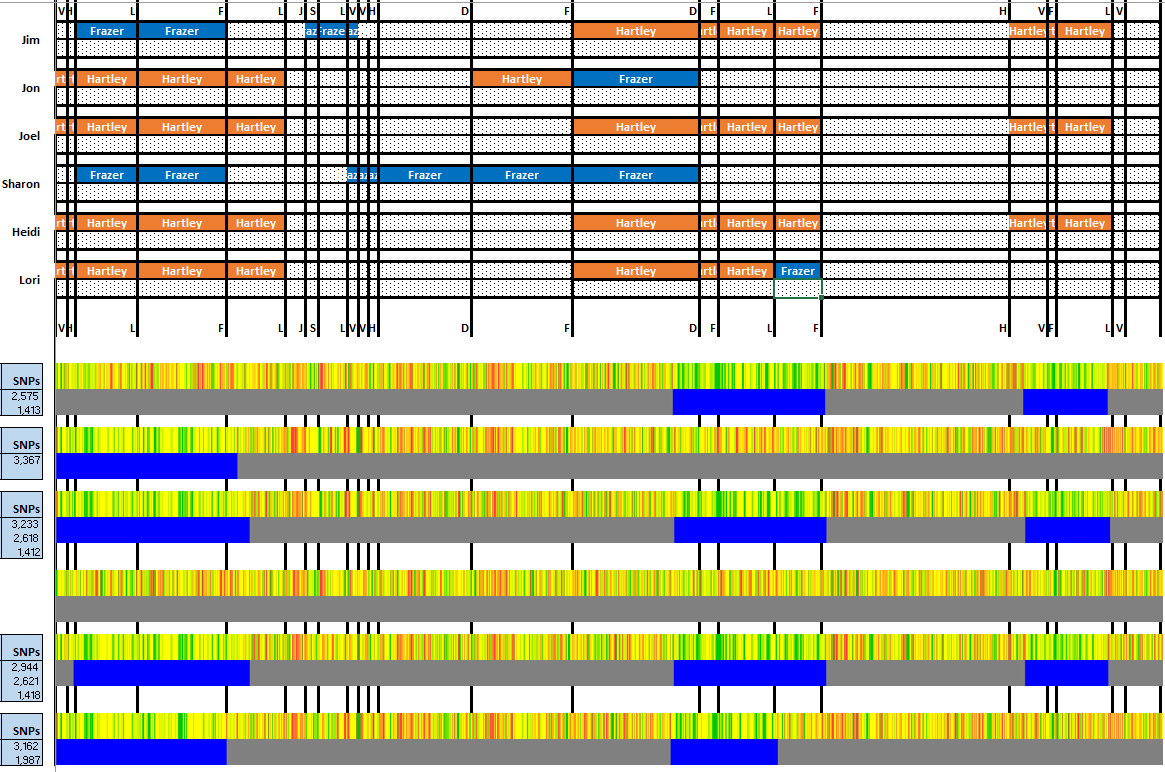
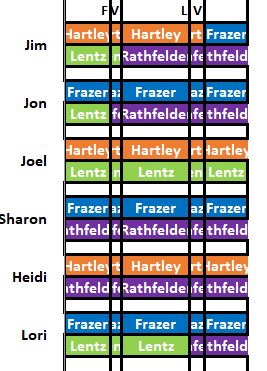
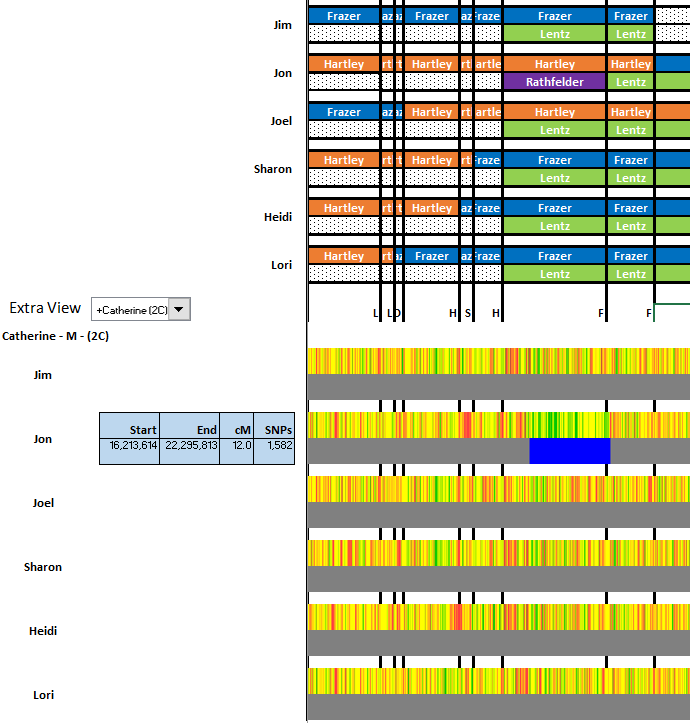
As I look down the cousin matches that I have in the Fox Spreadsheet, I see that I only have Hartley matches on the paternal side. I don’t see any maternal side matches. I can speed things up by looking at three Hartley cousin matches at once:

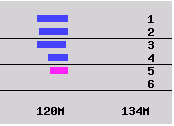
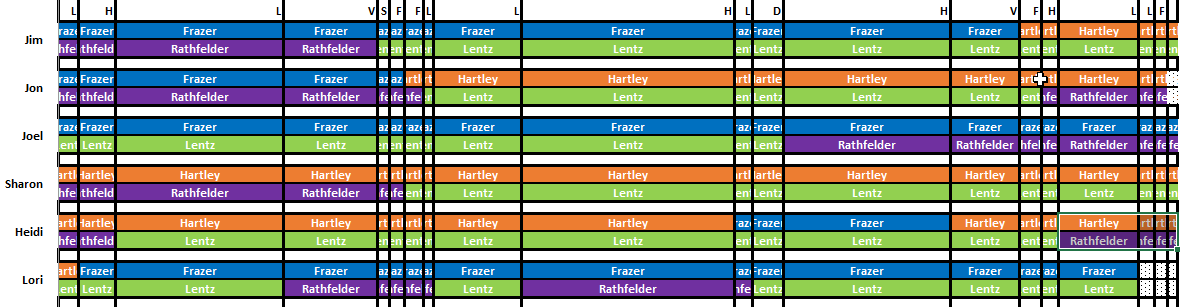
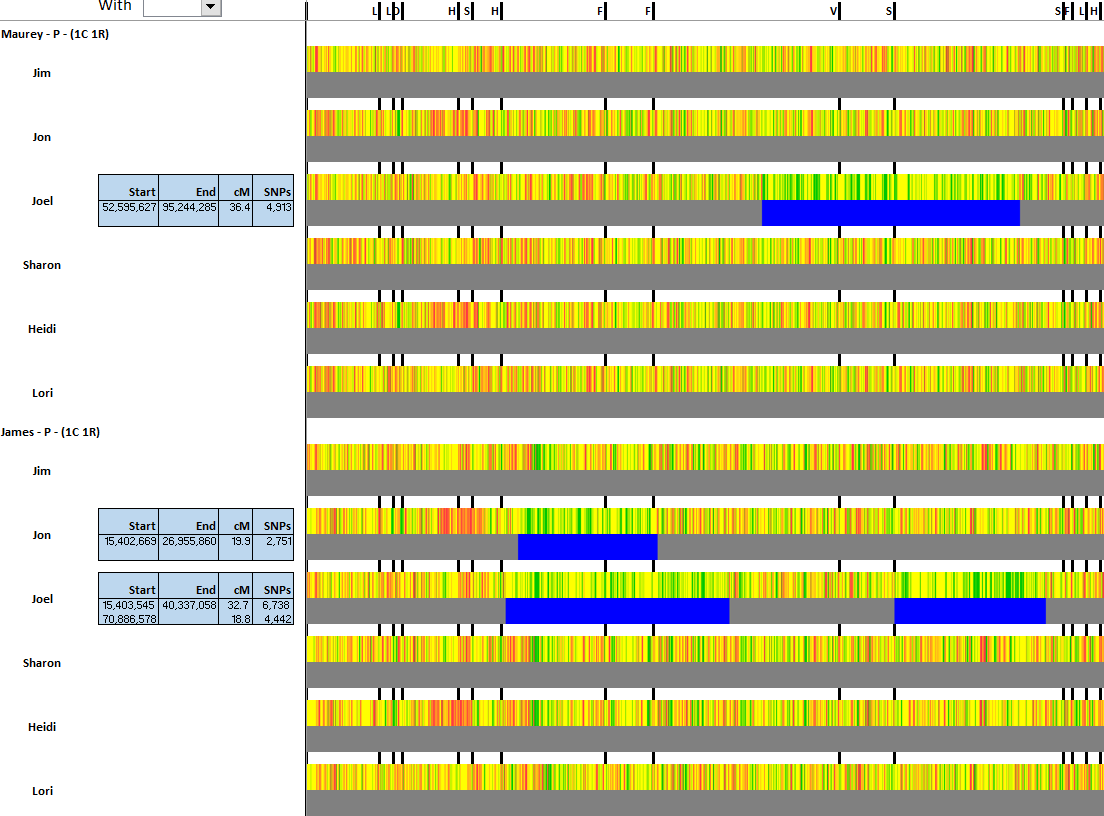
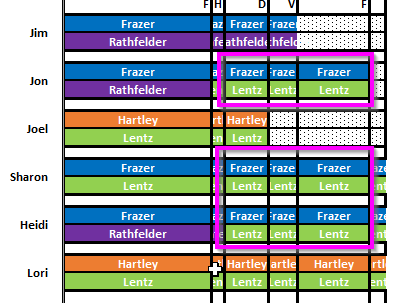
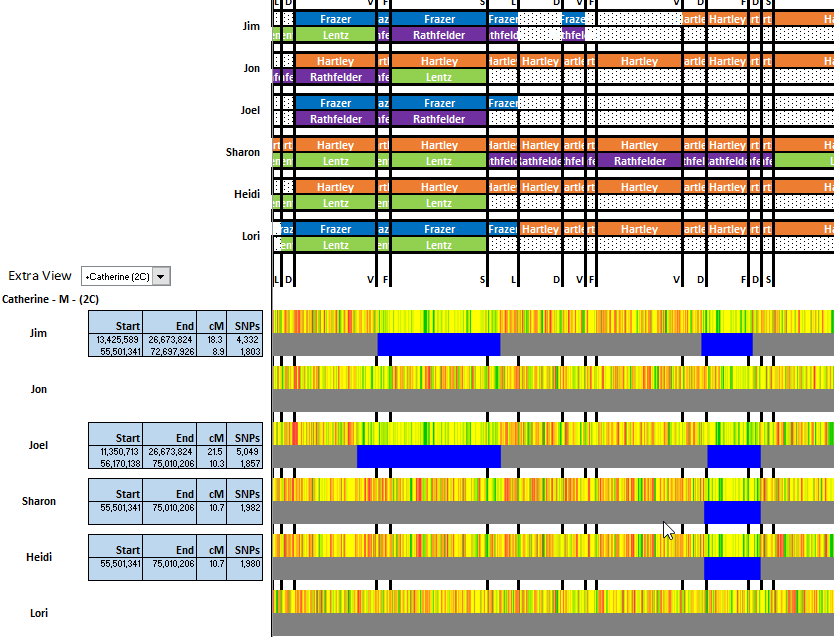
I have circled crossovers for (left to right) Joel, Jim, Heidi, Jim and Lori. The first crossover for Jim erases a question mark I had. I can see Jim’s crossover now zig zagging accross the ? Line:

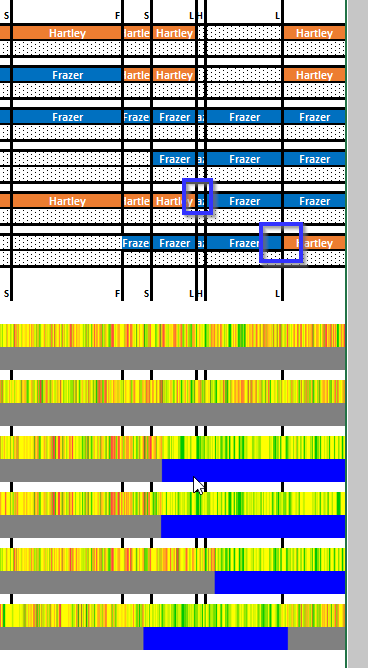
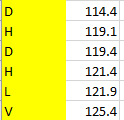
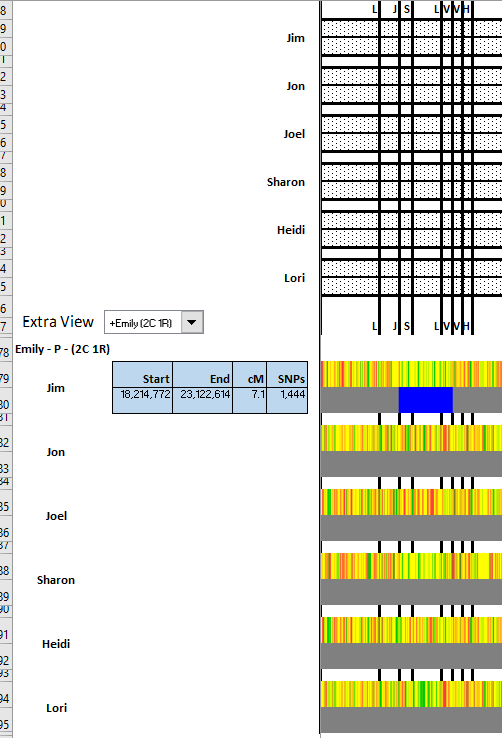
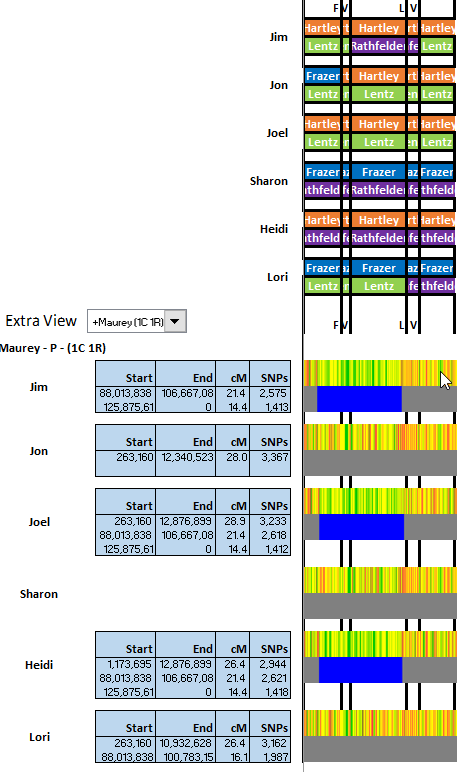
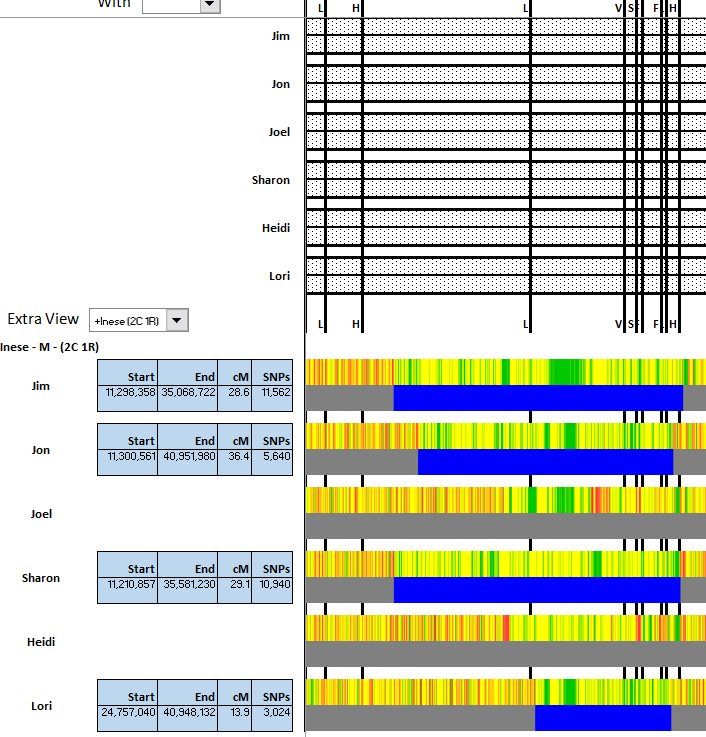
Jim’s crossover as shown by match with Hartley cousin Maury is interesting:

This shows that I need another crossover for Jim (V) or my Joel (D) crossover is wrong. Jim’s crossover is at 114.3M. I had my Joel crossover at 114.6M. I’ll say that they are separate crossovers. That means I solved a problem I knew I had and solved one I didn’t know I had. That leaves one other known problem.

Adding Paternal DNA to Chromosome 4

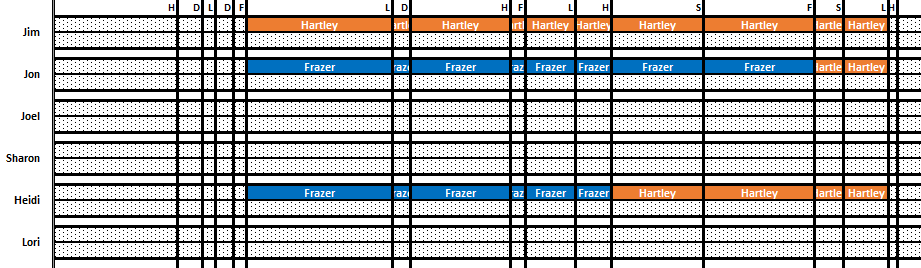
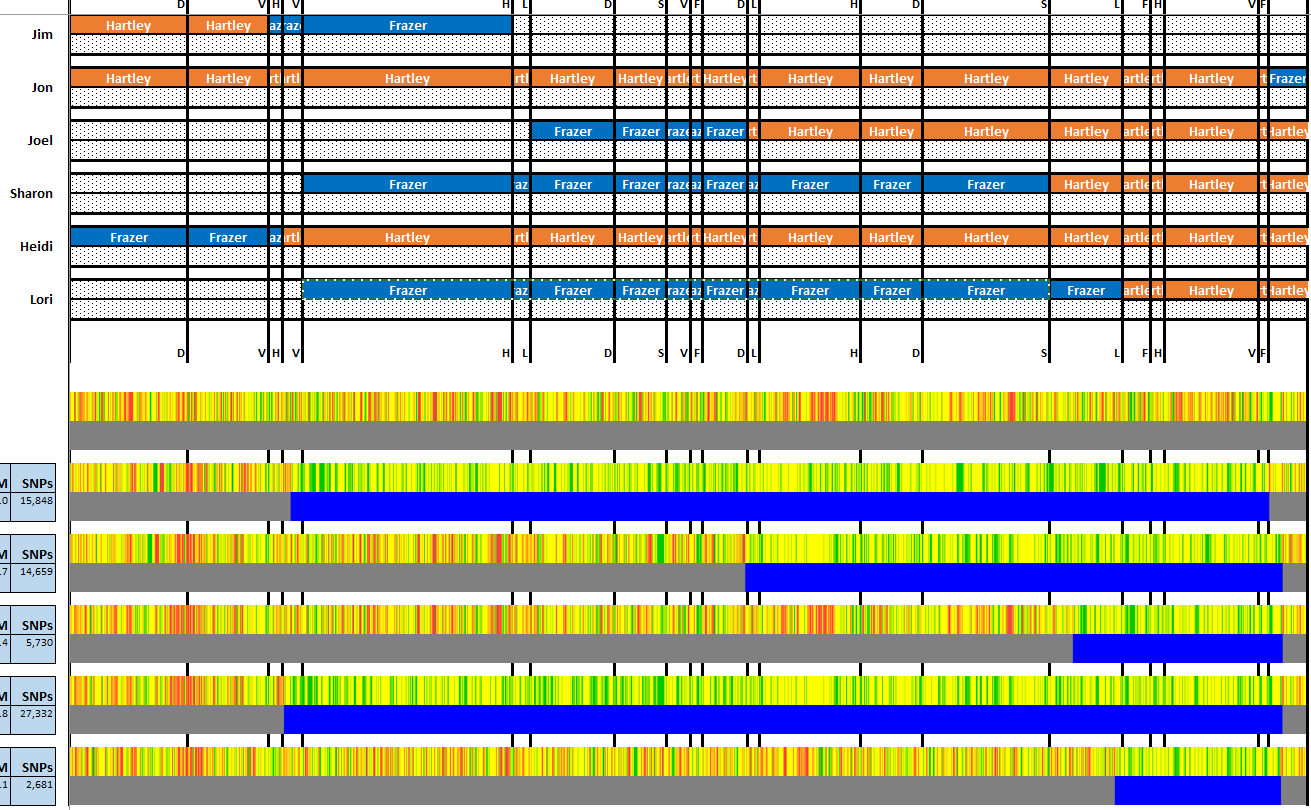
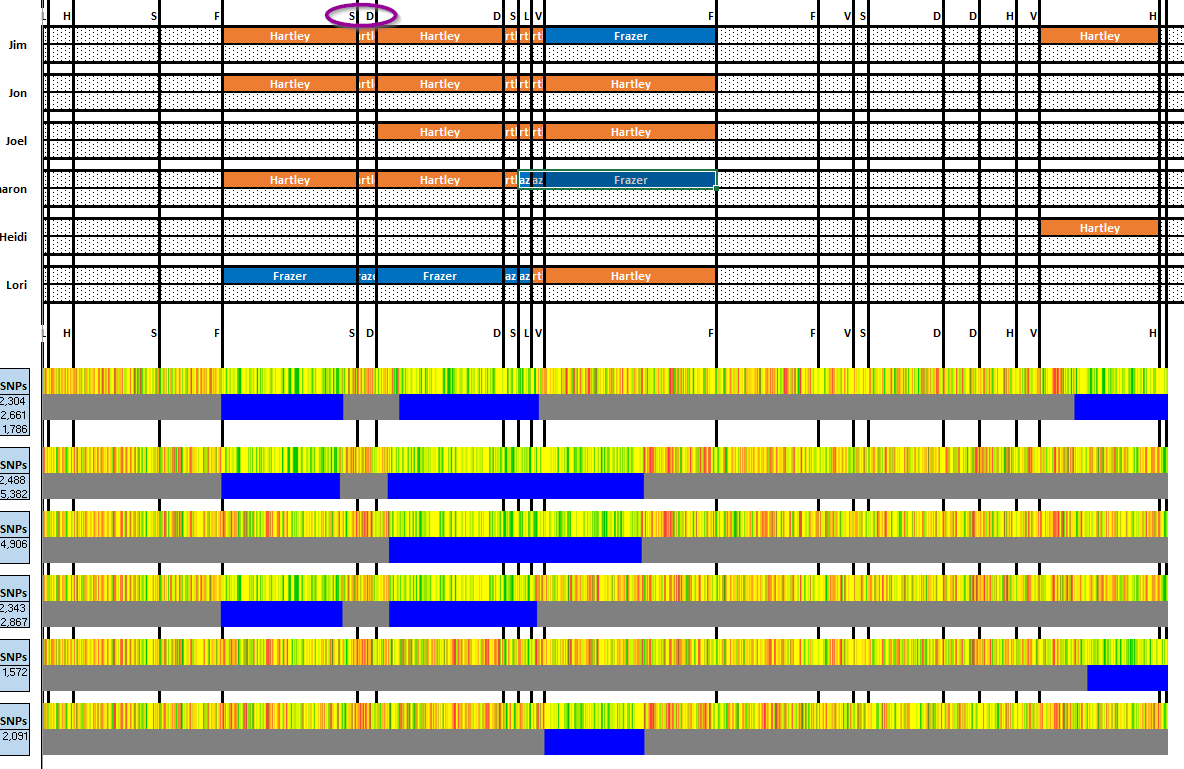
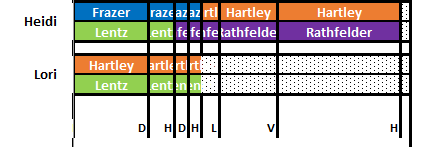
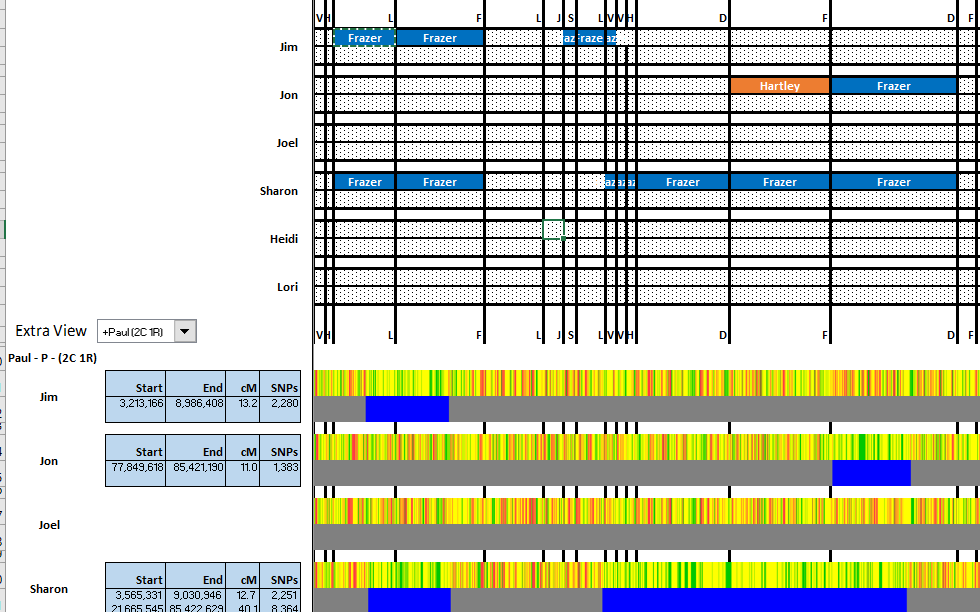
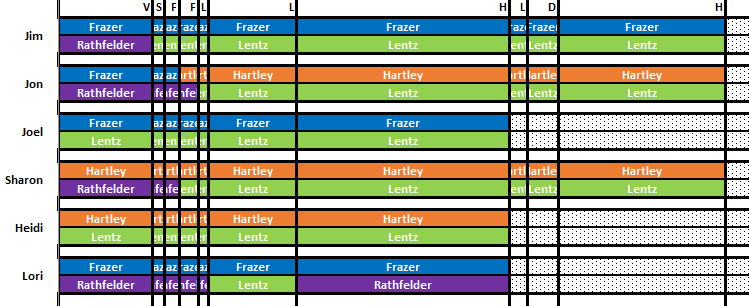
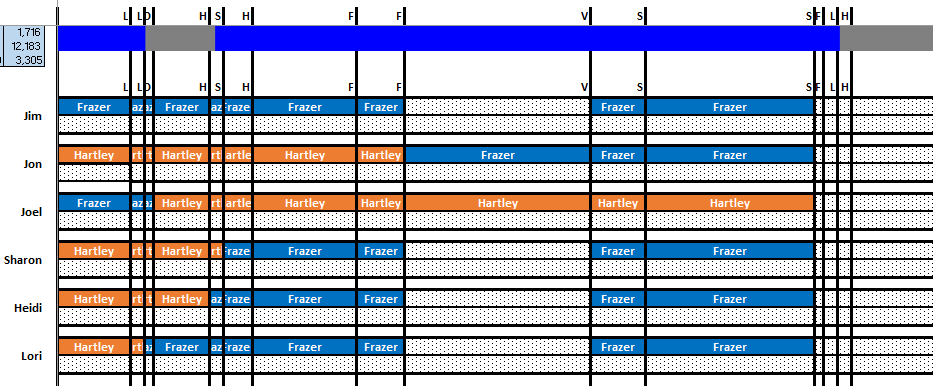
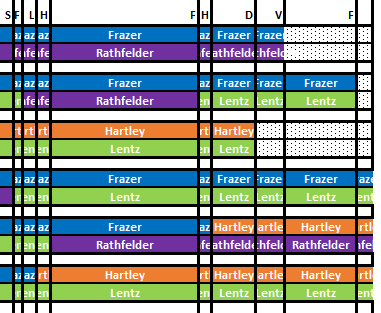
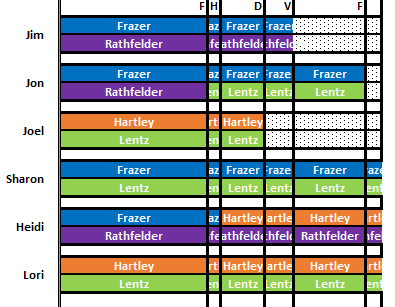
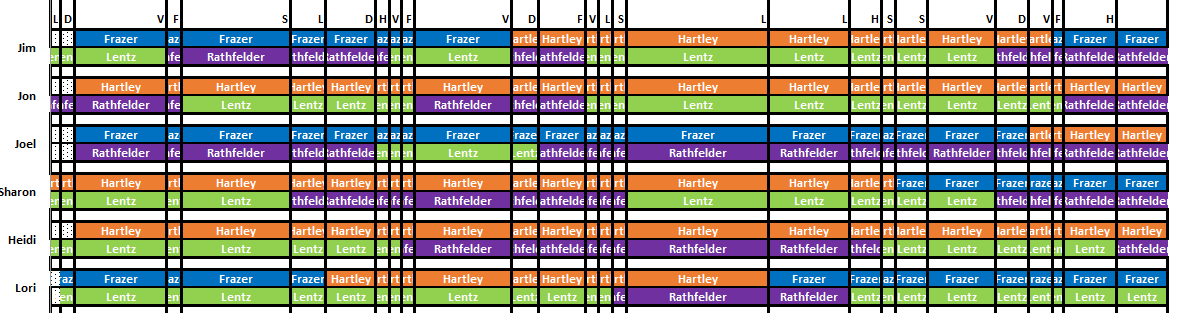
Based on the three Hartley cousin matches above, I get this:

I would put in Frazer to either side of the Hartley crossovers and above and below the orange segments.

In Need of Maternal Cousin Matches

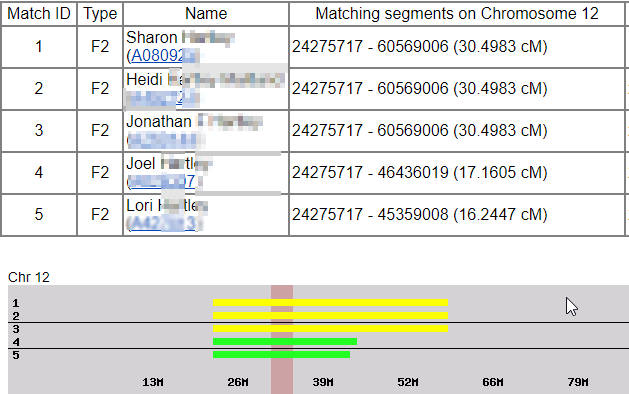
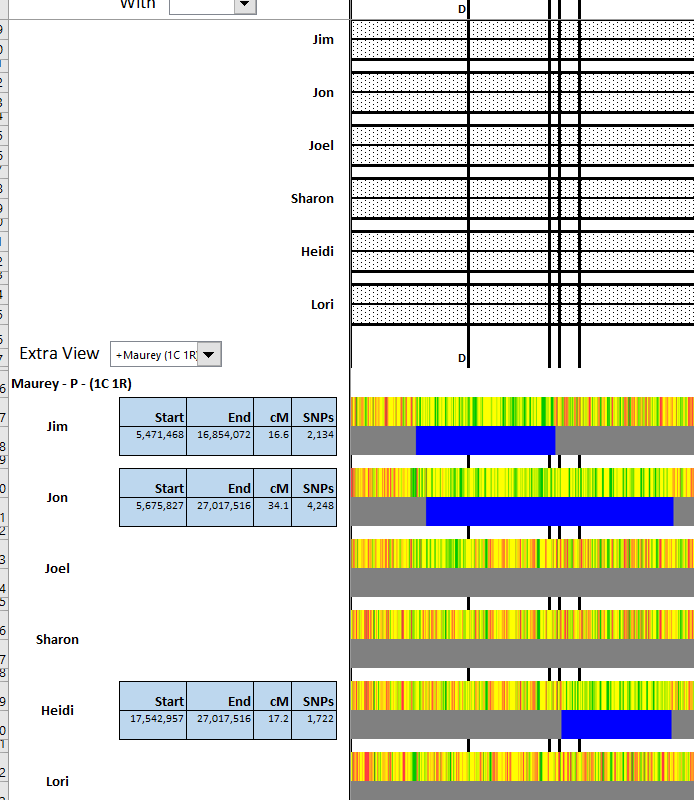
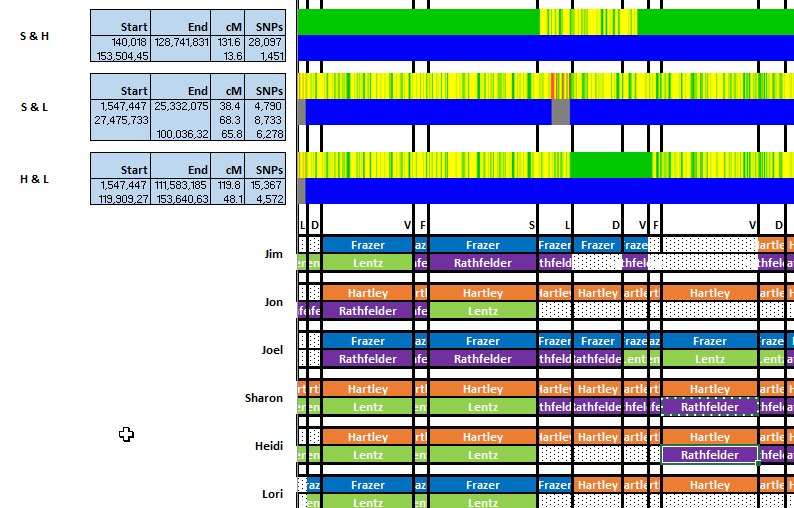
Seven out of seventeen of the cousin matches that I brought into the Fox spreadsheet are maternal. Time to search for more. I searched around on my mom’s one to many list at Gedmatch and found one match with Lentz cousin Joshua:

Chances are my mom sent down some of this Lentz DNA to at least one of her six children:

My mom’s segment only made it down to Heidi.

Add Joshua to the Fox Spreadsheet

Joshua is helpful, so I’ll add him to the Fox Spreadsheet. I went to the first tab and typed in his information at the bottom of the CousinTable:

Note that there is no box to the left of Joshua which means that he has not been incorporated into the Fox Spreadsheet yet. Under the Action drop-down menu, there is a place for Add which I assume is appropriate. The leads me to type in my Gedmatch password. This opens Internet Explorer and compares Joshua to me and my six siblings automatically. Joshua may be a help for other chromosomes, but he is critical for Chromosome 4.

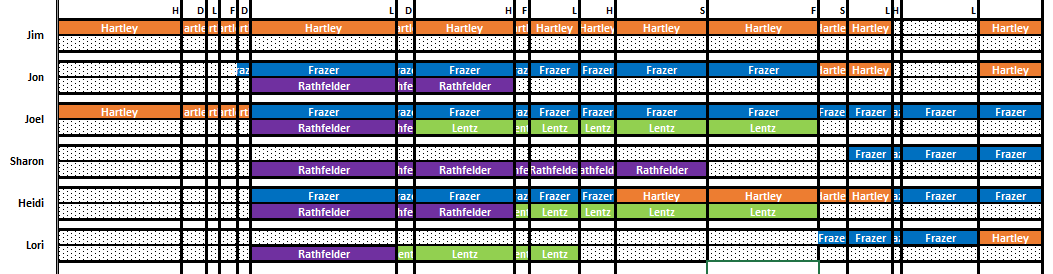
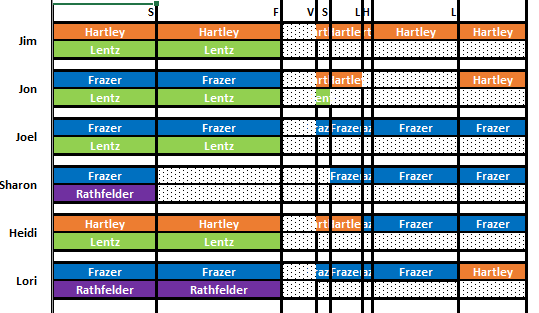
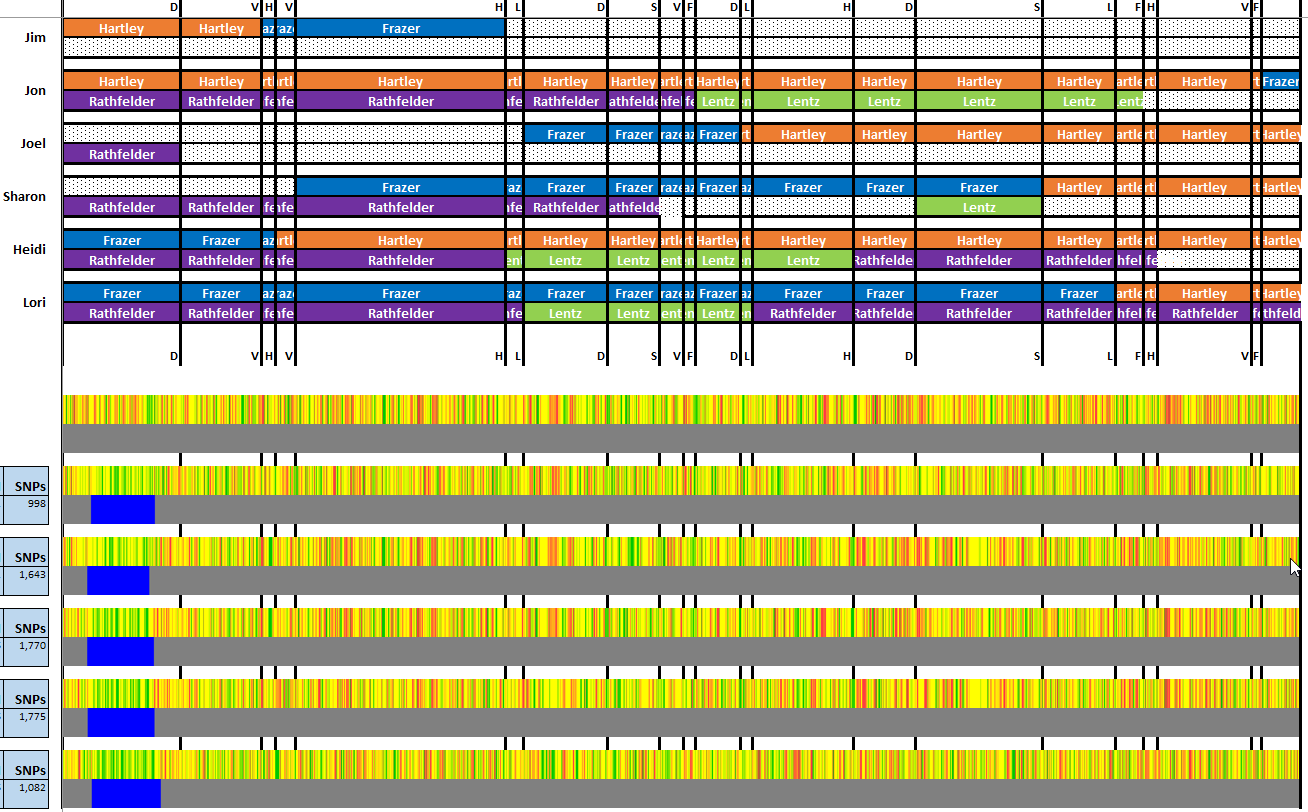
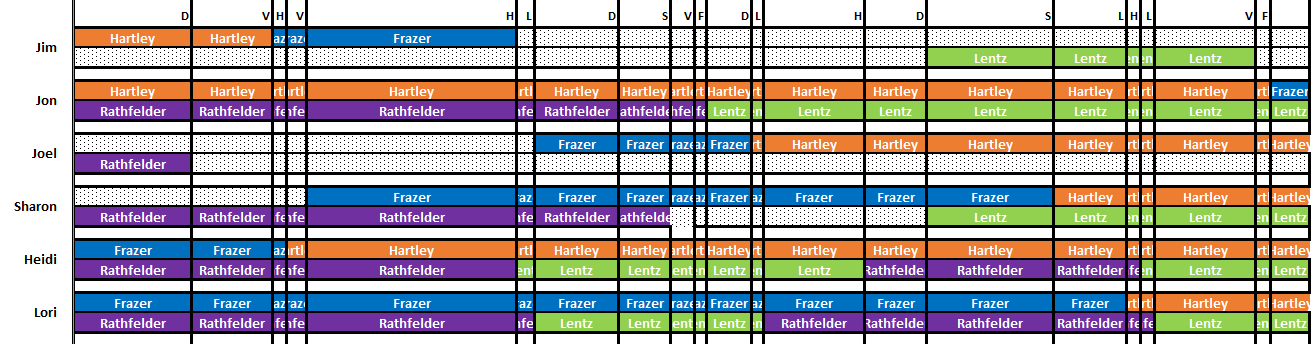
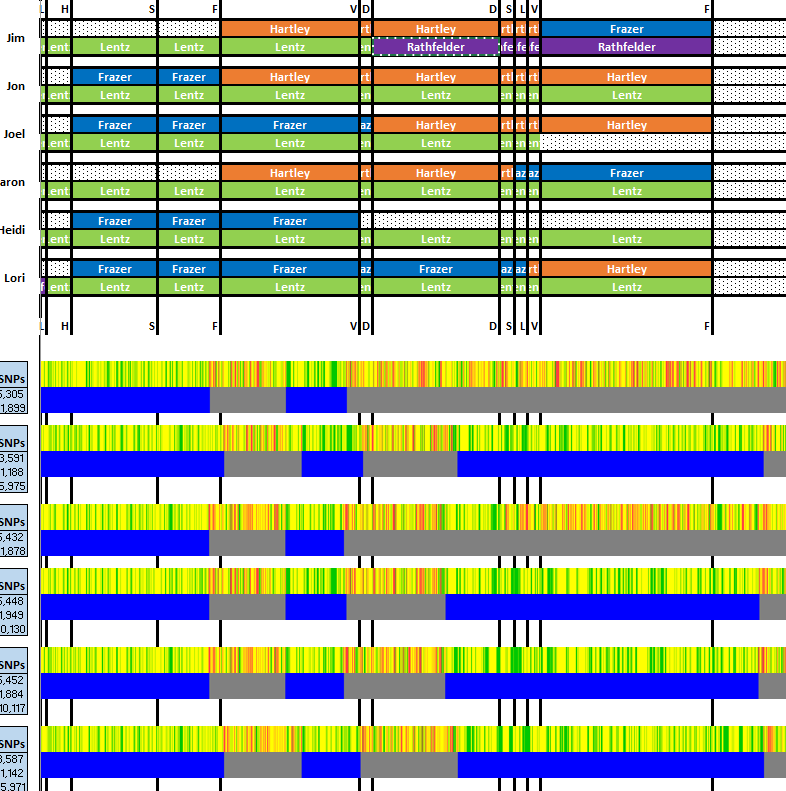
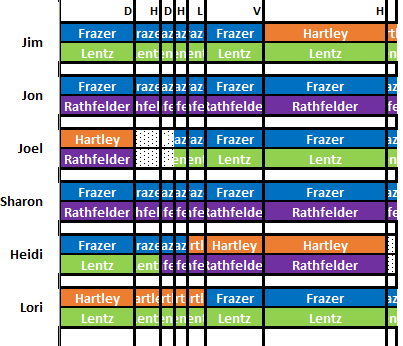
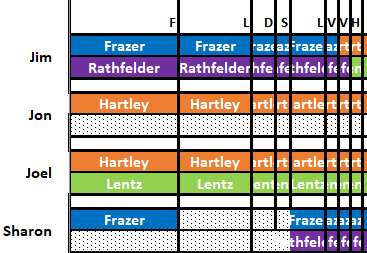
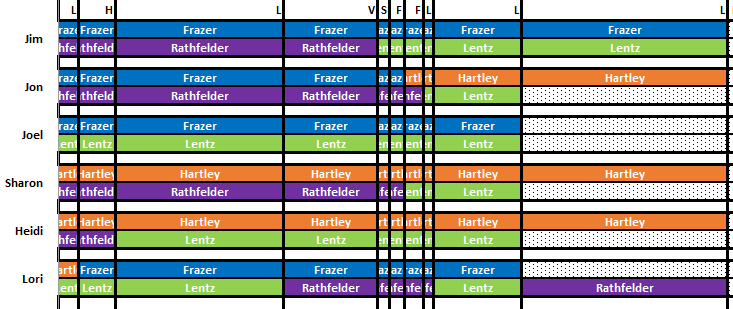
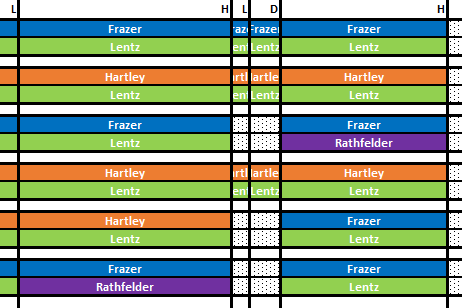
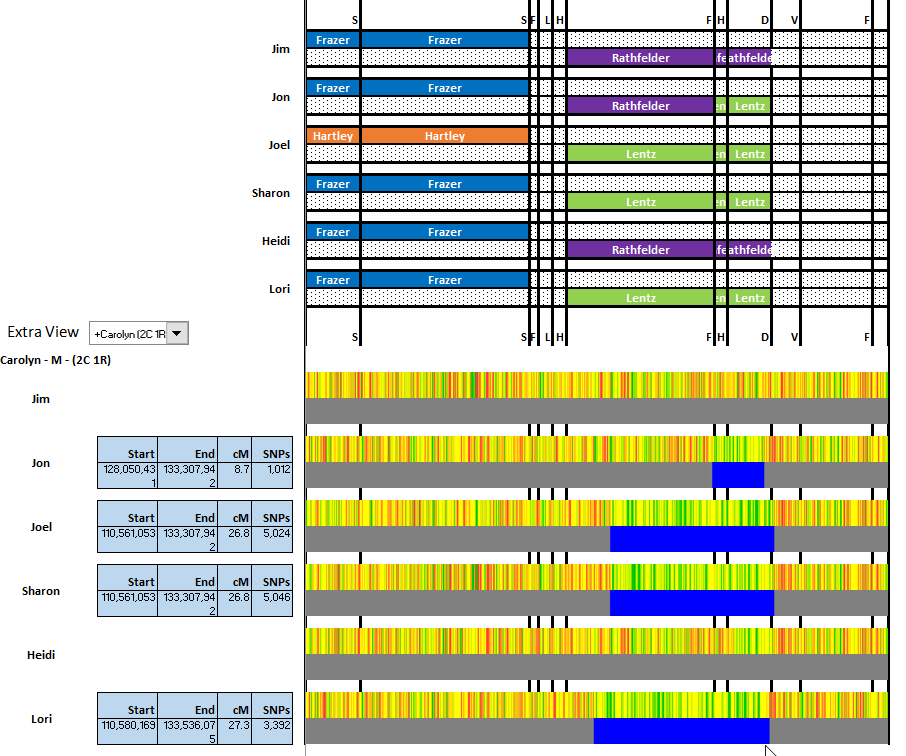
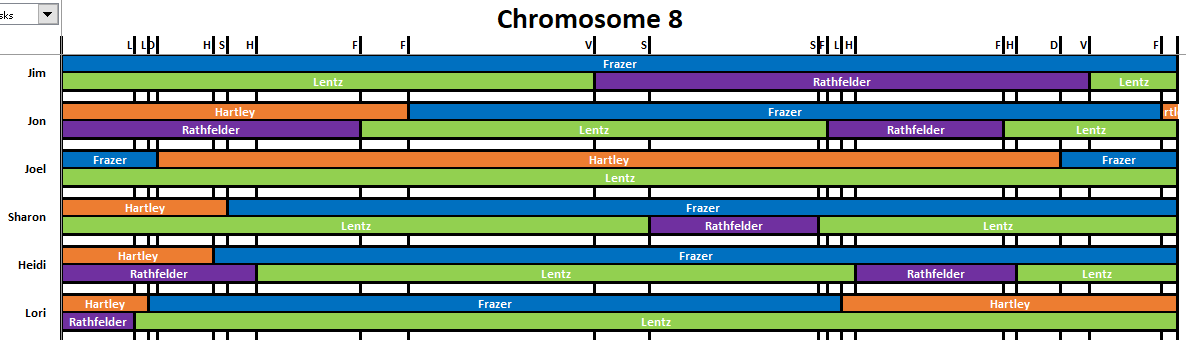
I had missed a Jim (V) crossover near the beginning of this Joshua match, so I added that in. Then I added Joshua’s Lentz shared DNA on Heidi’s maternal Chromosome 4 segment. Next, I filled in some Rathfelder DNA:

  • Jim did not have his first crossover above on the paternal side, so it must be on the maternal side
  • Jim’s second crossover was on the paternal side so the maternal purple Rathfelder will carry through there.
  • I didn’t carry the Rathfelder to the right on my maternal chromosome as I have a crossover there.

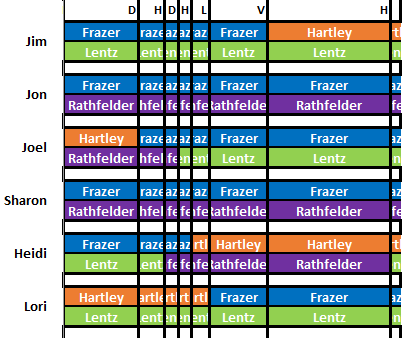
I’ll make other similar assumptions:

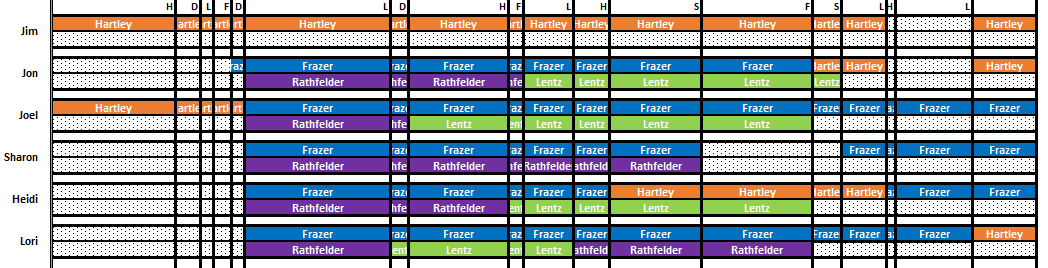
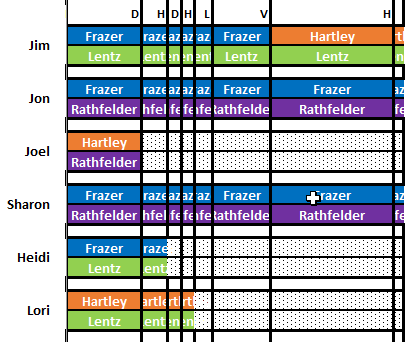
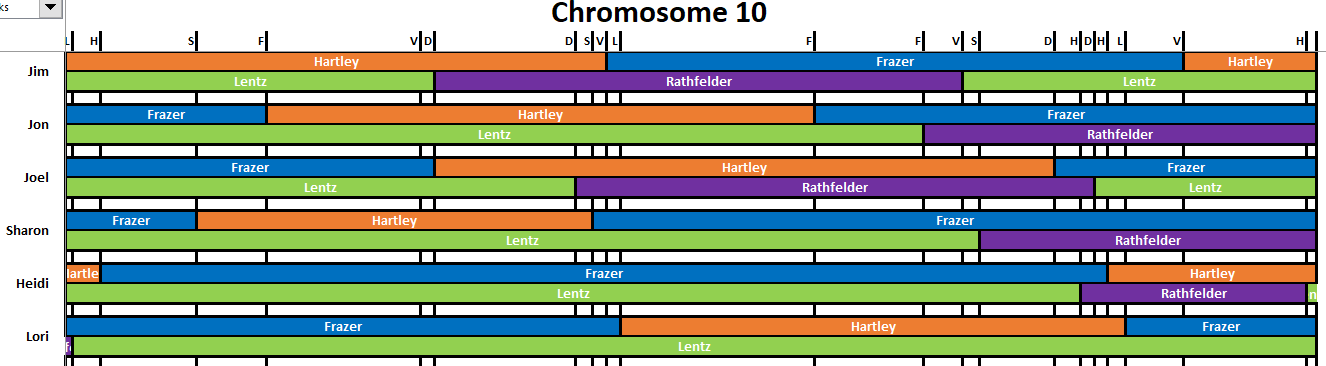
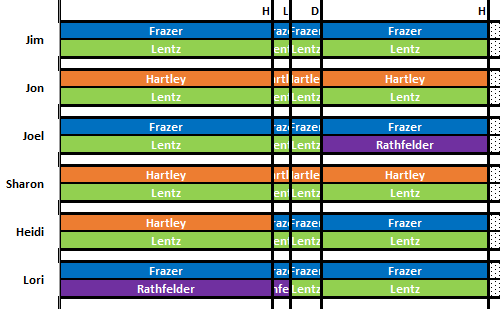
Thanks to one little match between Joshua and Heidi, I have the middle of Chromosome 4 mapped. I stopped extending to the left as I have a question mark there.

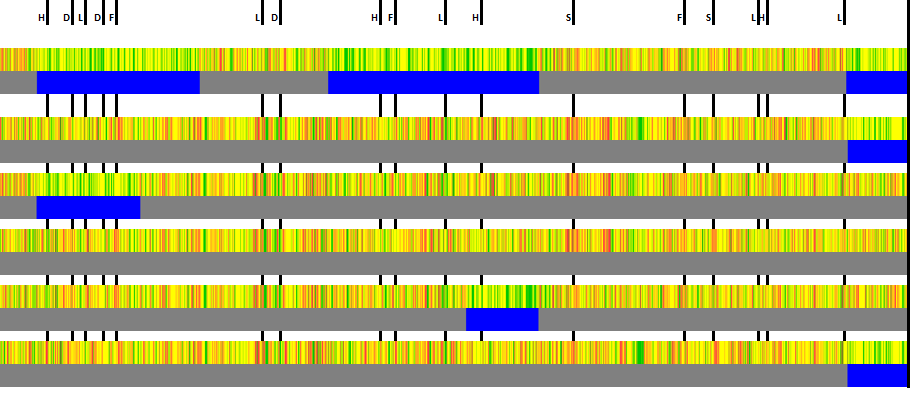
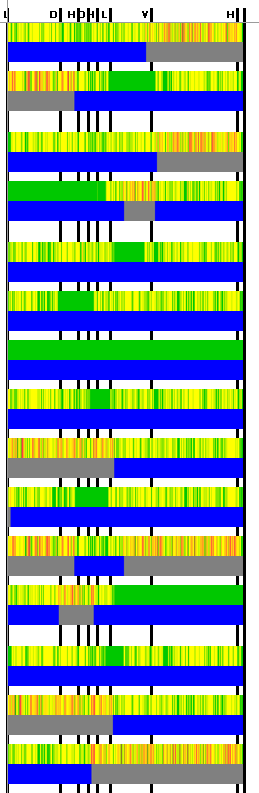
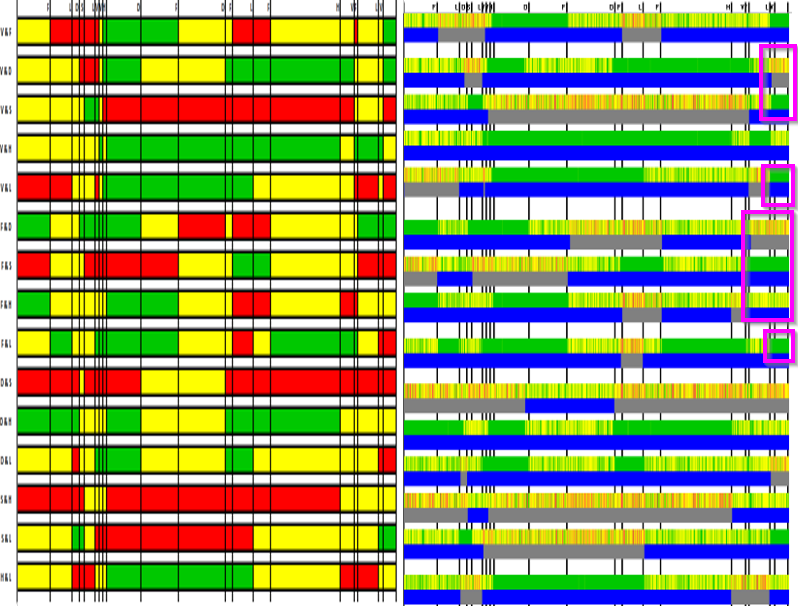
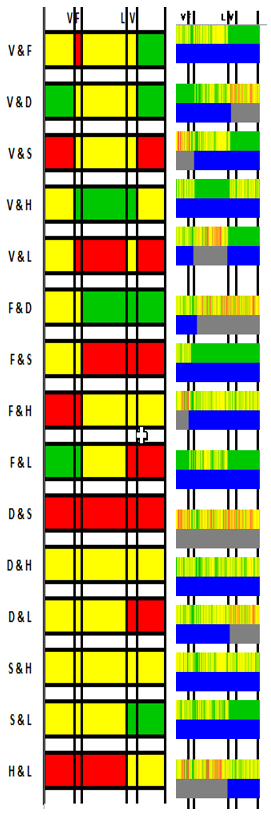
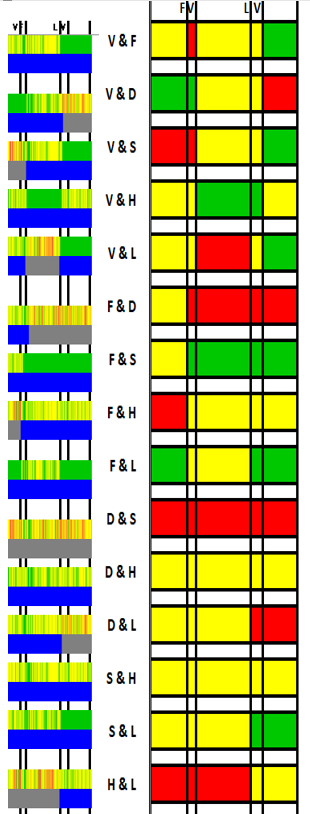
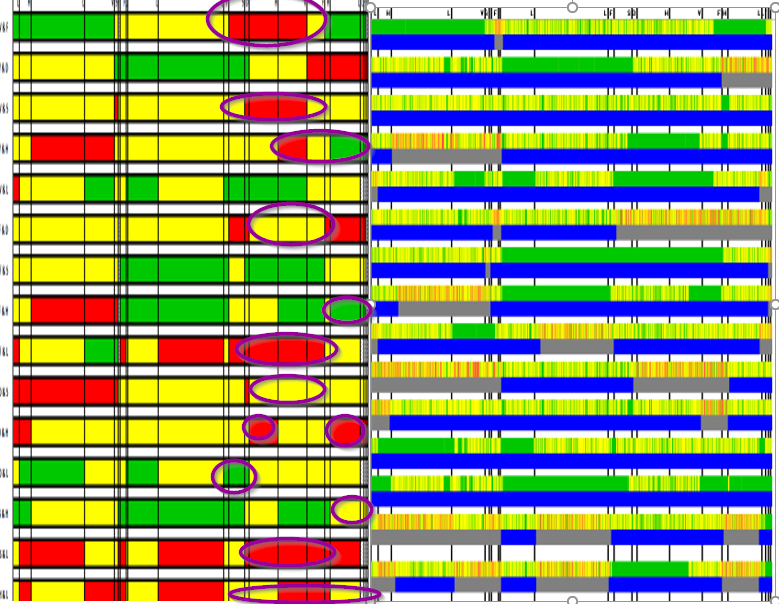
Checking the Segment Map

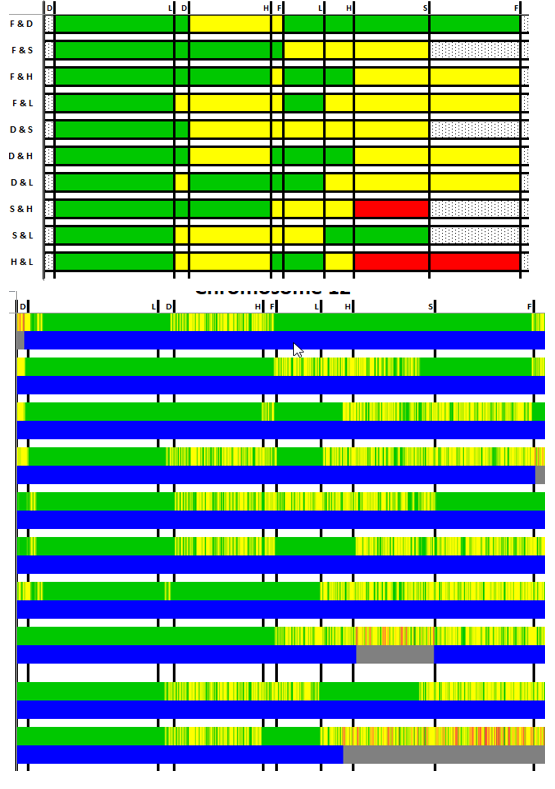
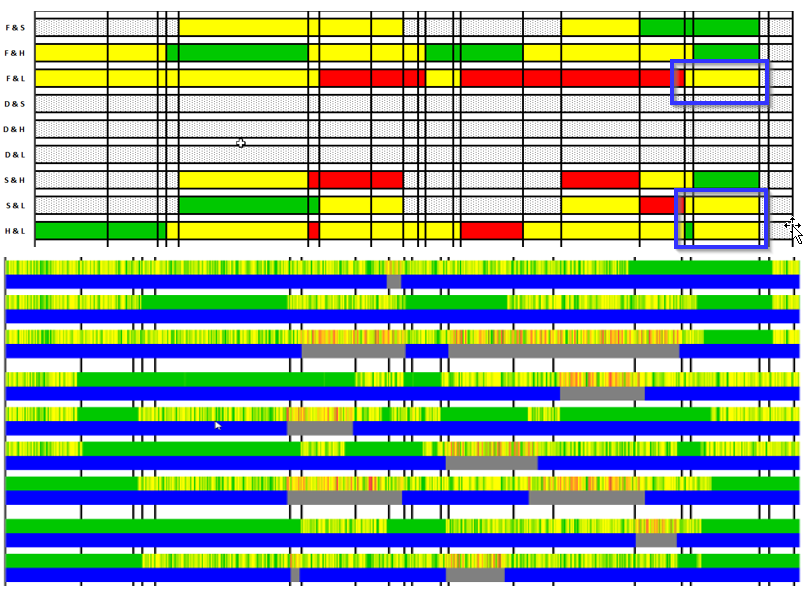
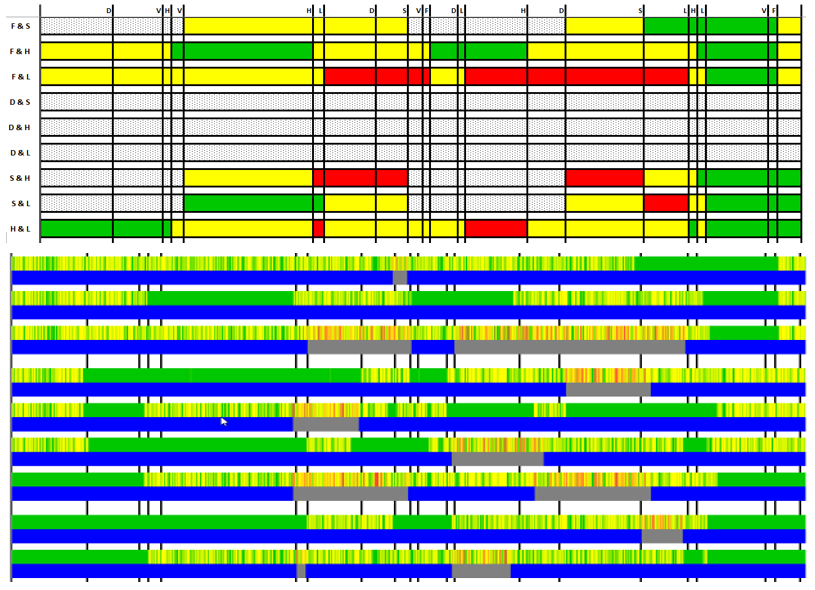
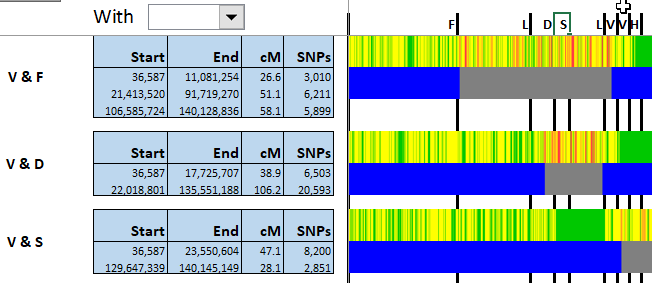
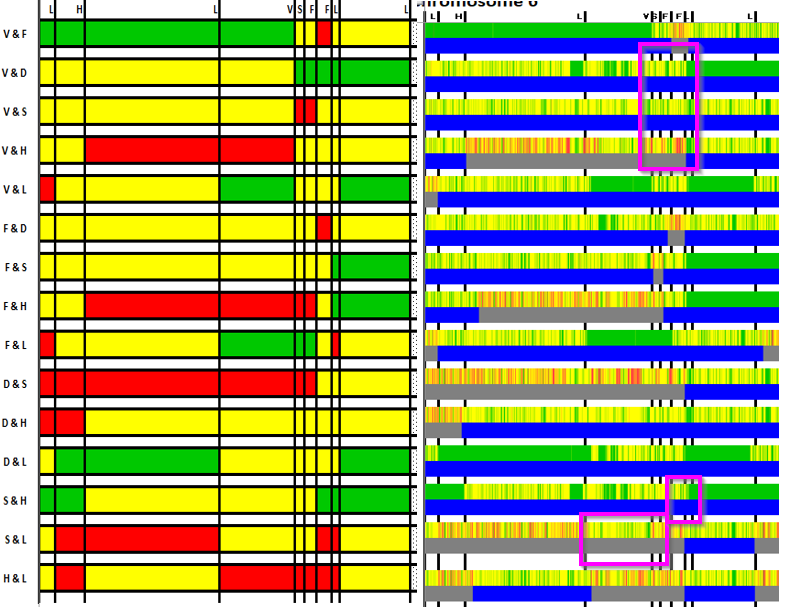
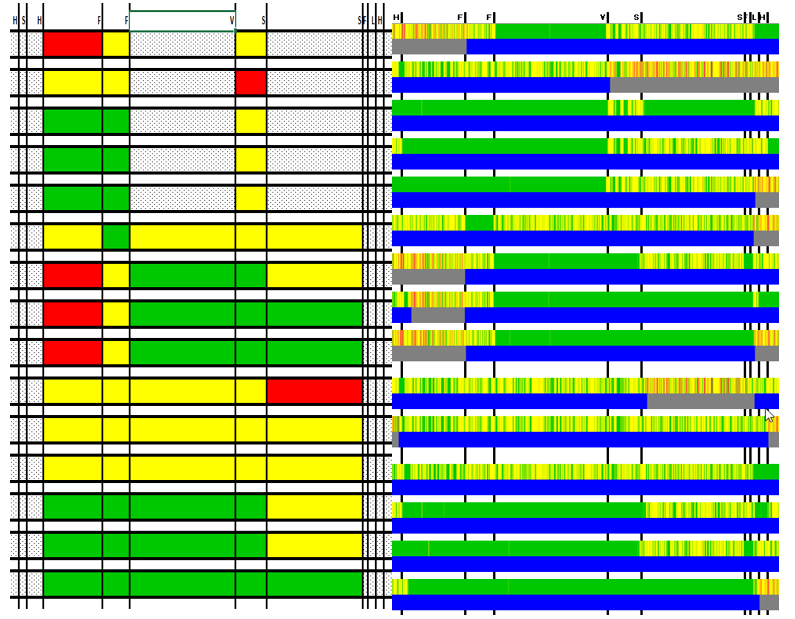
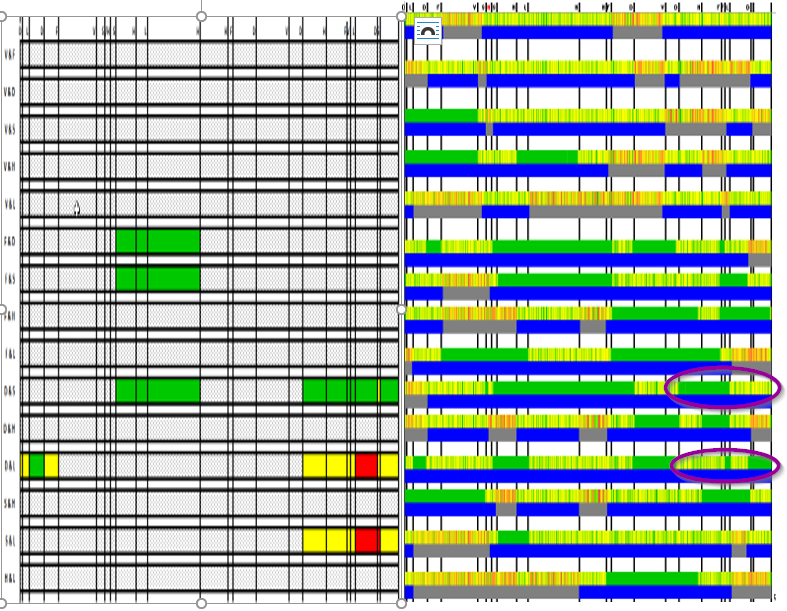
Before I go on, I’d like to know if this part is right:

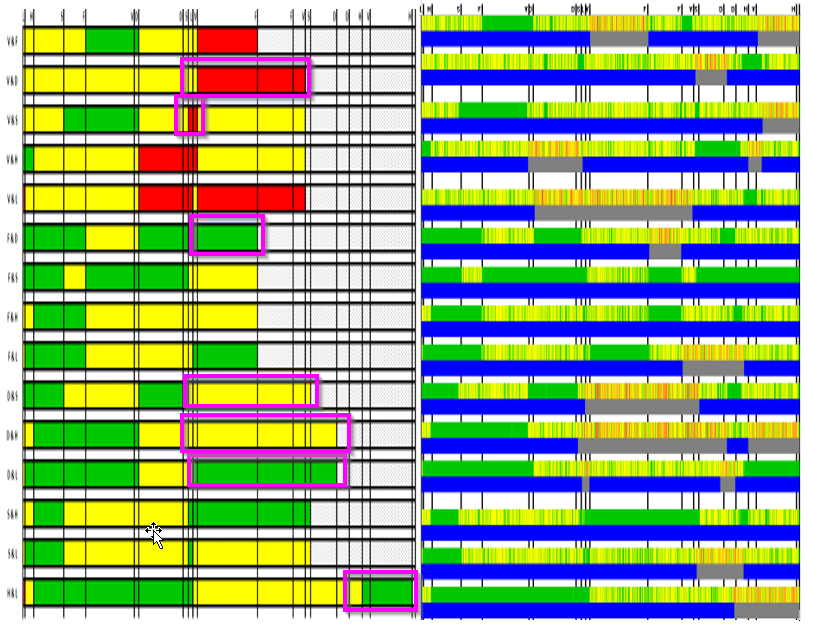
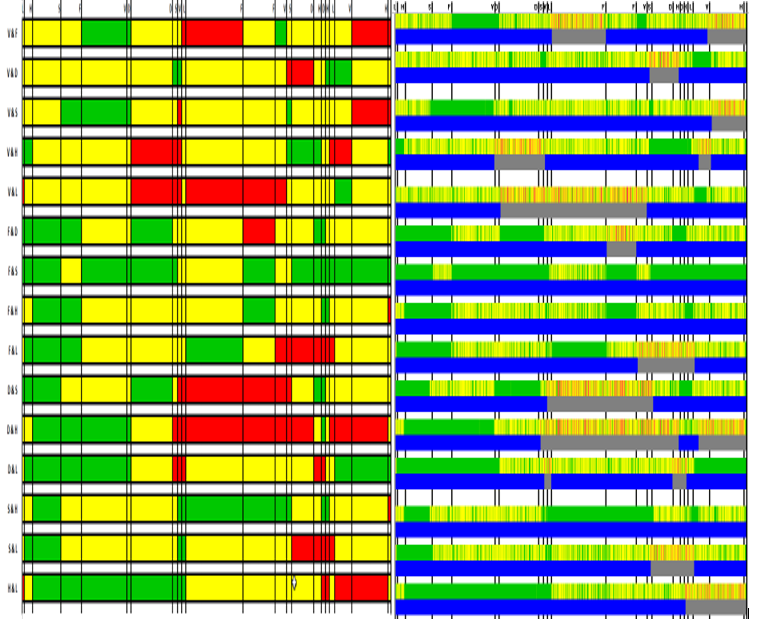
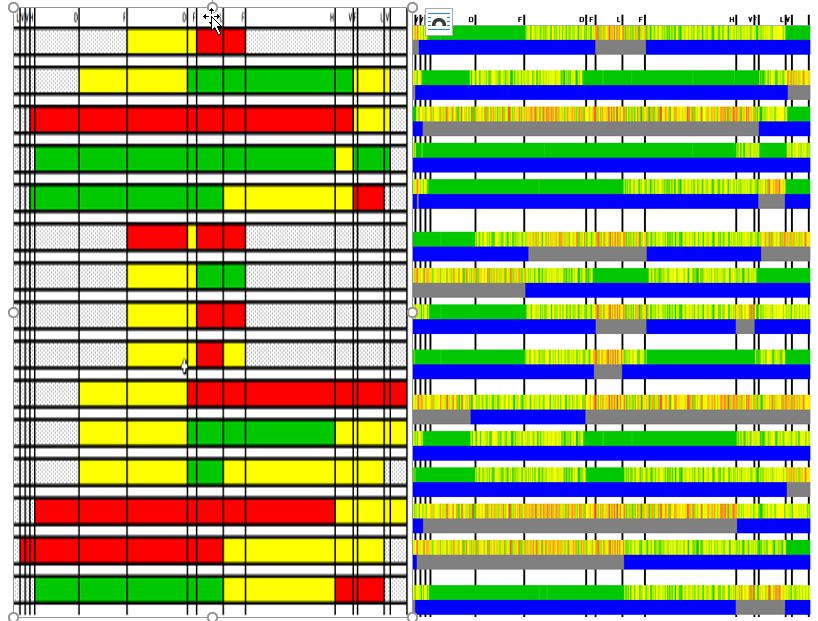
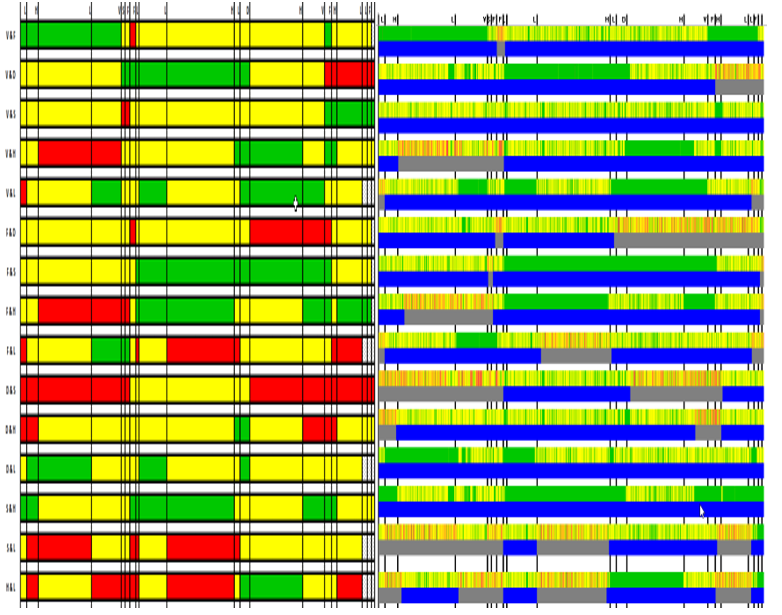
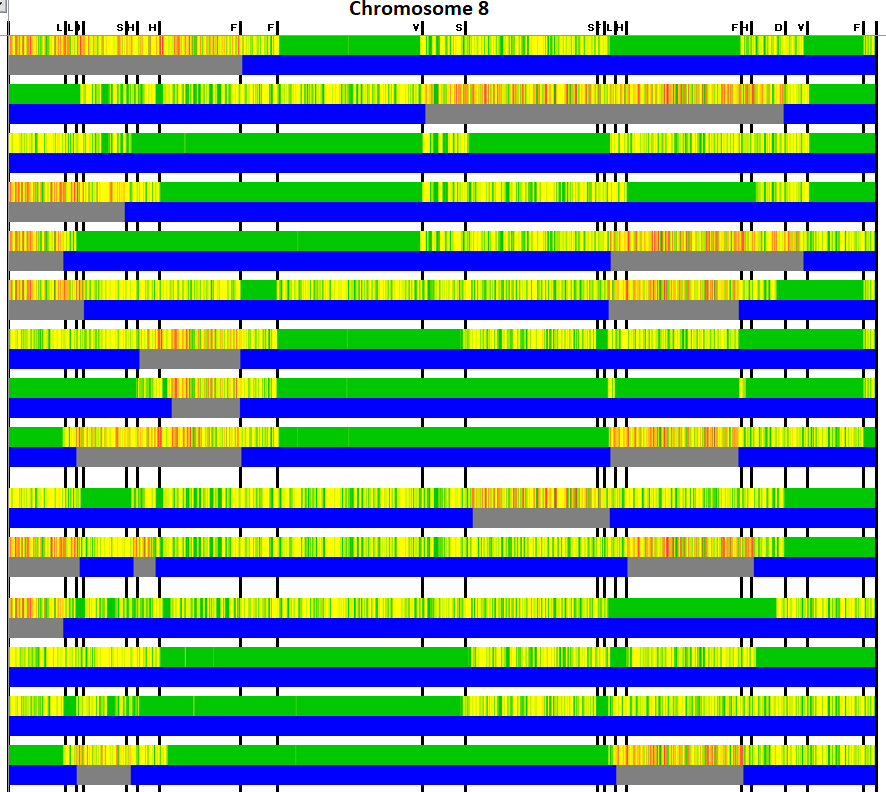
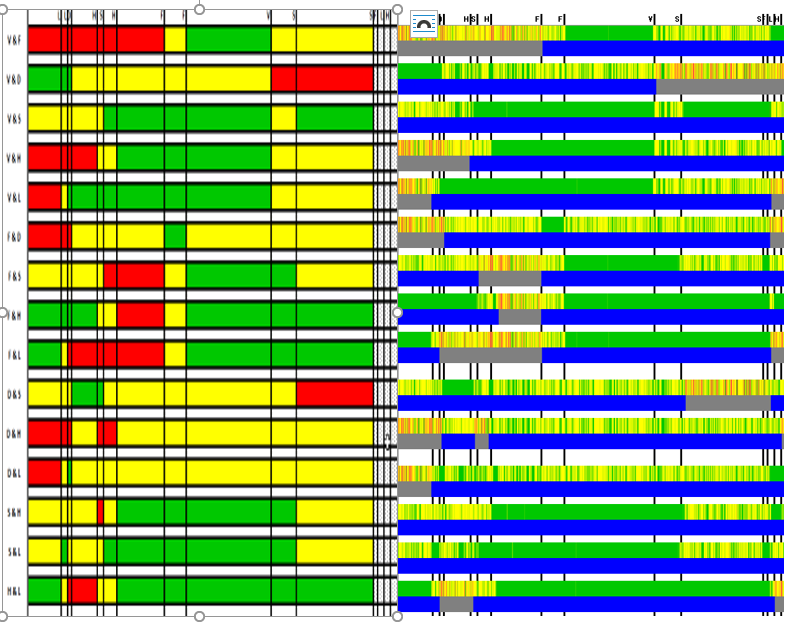
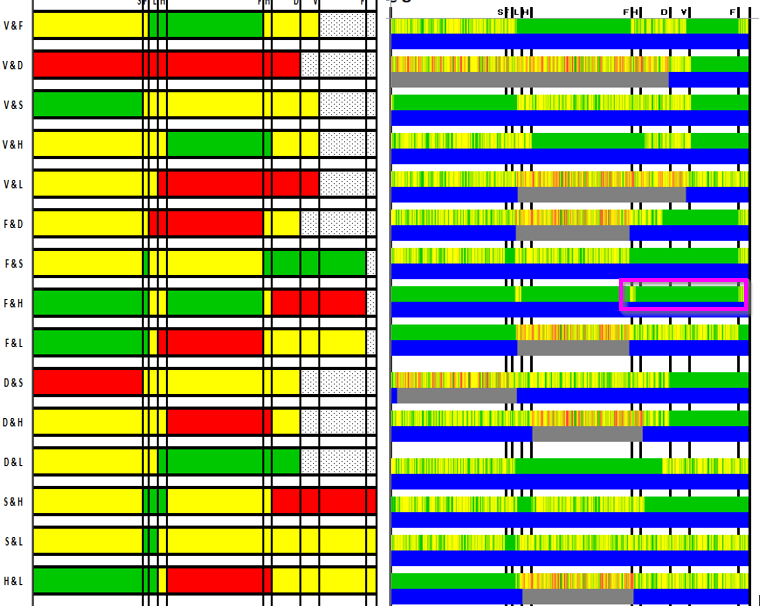
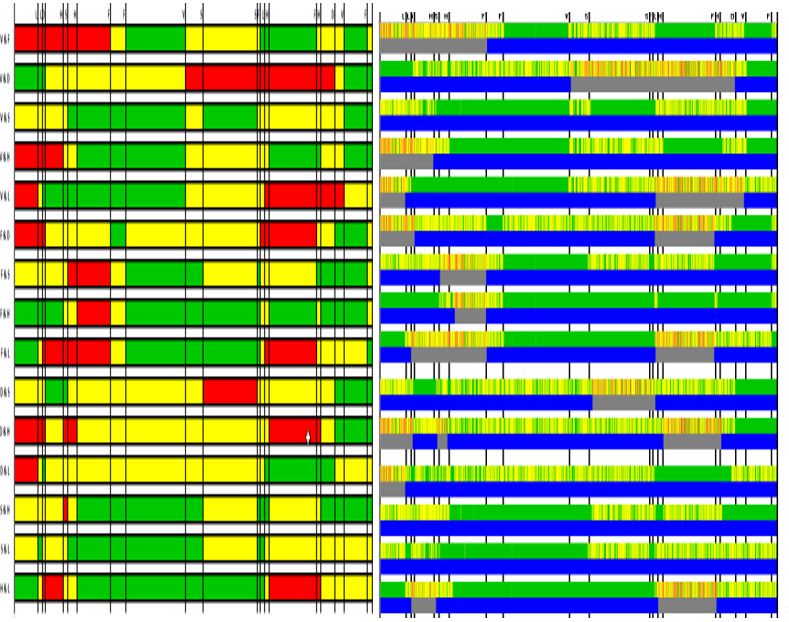
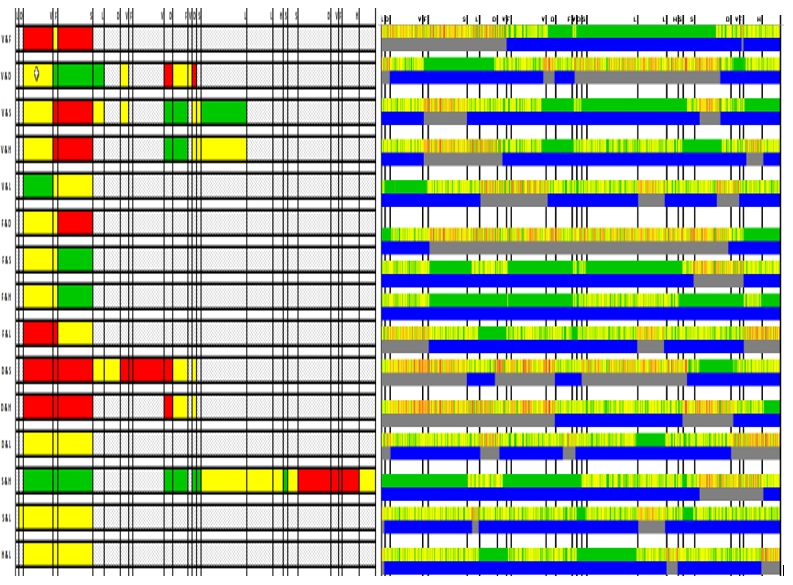
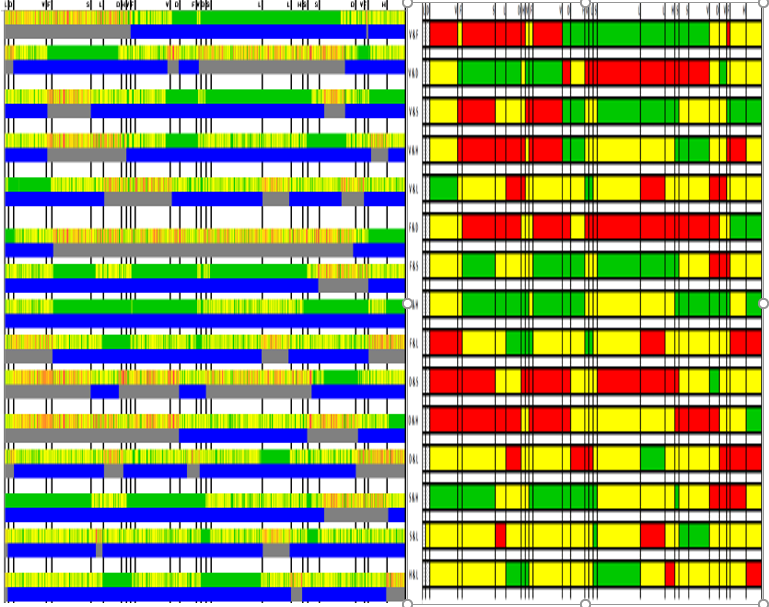
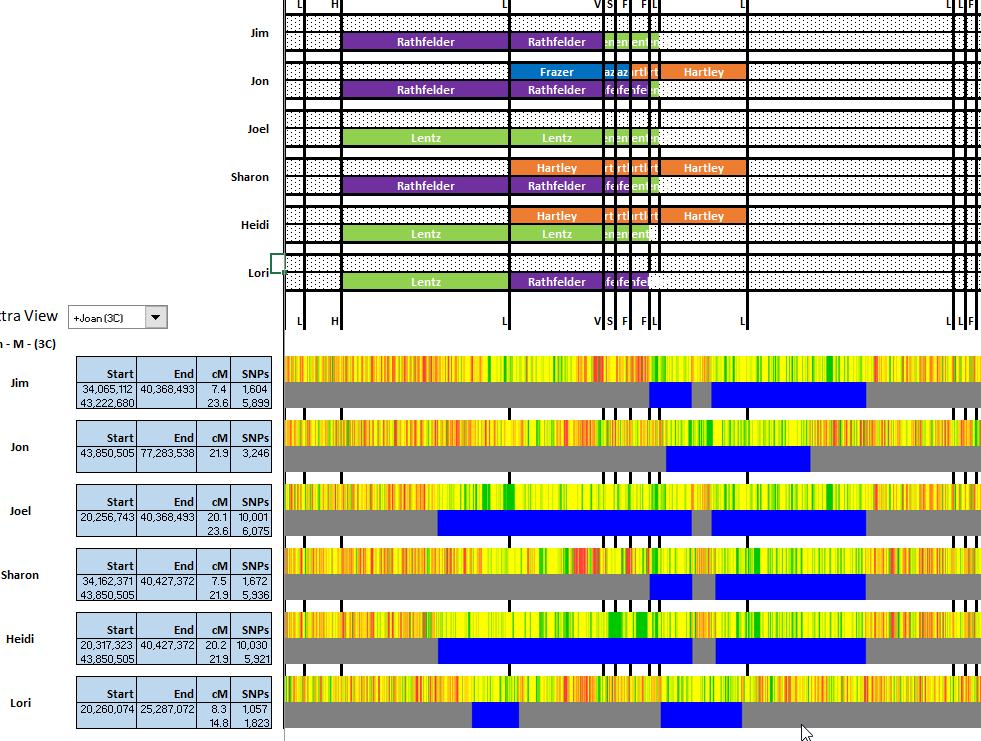
Here I have the images reversed. The left side represents the mapping I did. I want it to match the right side. The Gedmatch comparisons are on the right. The two sides look to match.

Chromosome 4 Right Side

I’ll continue on to the right, as I have no question mark on that side:

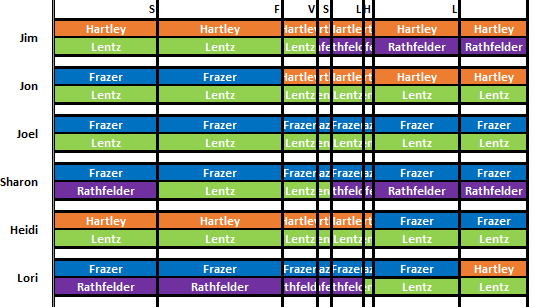
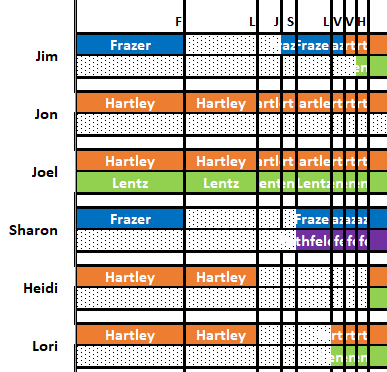
Jim, Heidi and Lori had no crossovers to the right, so I continued their segments to the right unchanged. Sharon and Heidi have a FIR. That means I can copy Heidi’s DNA to Sharon’s. That puts Sharon’s crossover on the paternal side. I have three crossovers.

I finished Sharon’s right hand side. She had another crossover before the end. After that she had an FIR with Lori which put Sharon’s last crossover on her maternal side.

I have FIRs with Heidi and Sharon in my first unmapped segment. That puts my first crossover on my maternal side:

I am opposite of Heidi on the right:

For the last segment, I match my brother Jim (V):

So close:

At this point, I would like to work the left side back to the question mark. I will also stay away from Lori and Jim as that is where the issue of the question mark was:

Progress Check

This tells me I am on the right track:

I’ll fill in from the left to right:

This is interesting as the top row shows that Jim needs another crossover. It also appears that there will be a Jim maternal crossover where the question mark is. Lori already has a crossover to get her from Lentz to Rathfelder.

Adding JIm’s First Crossover

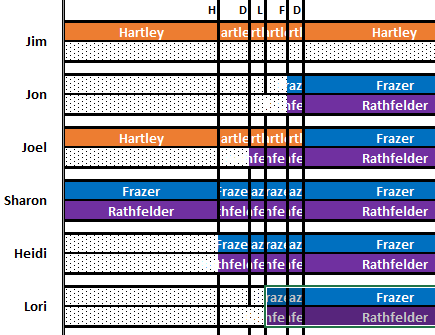
Jim’s first crossover is at 6.4M which is right after Sharon’s at 6M:

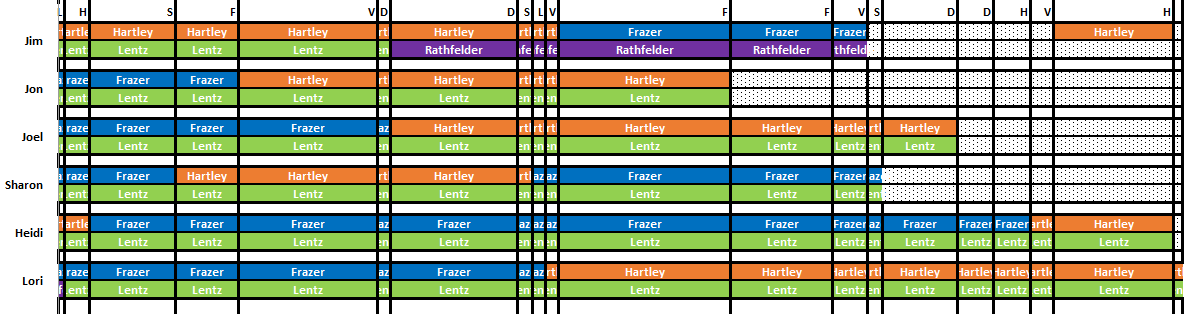
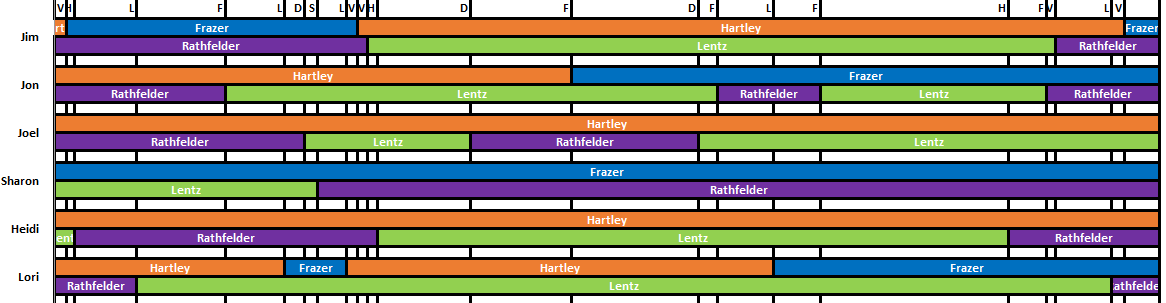
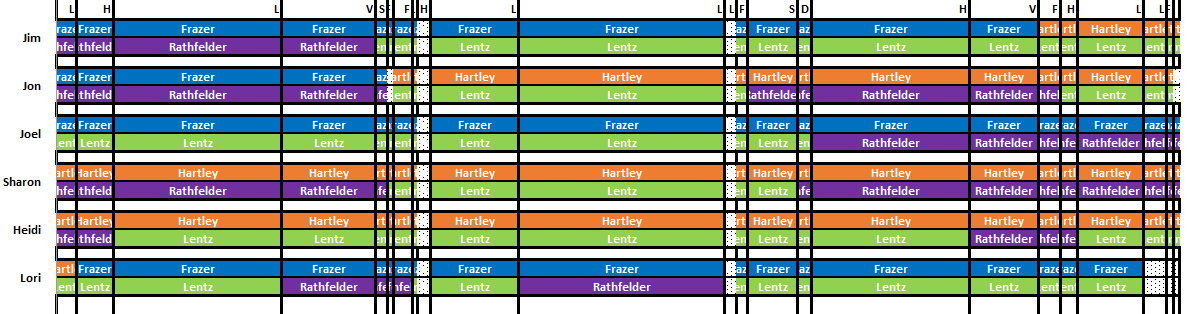
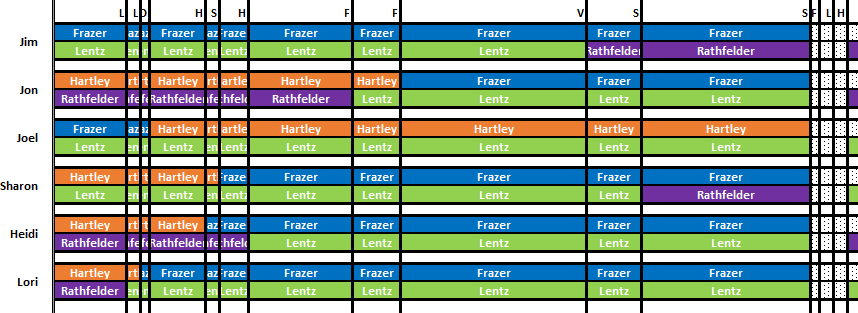
This gets us to a small segment for Lori at the beginning. However, I note that Heidi and Lori don’t match in the Gedmatch comparison. That puts Lori’s first crossover on her paternal side. I’m hoping this fully filled out Chromosome 20 will be the right answer:

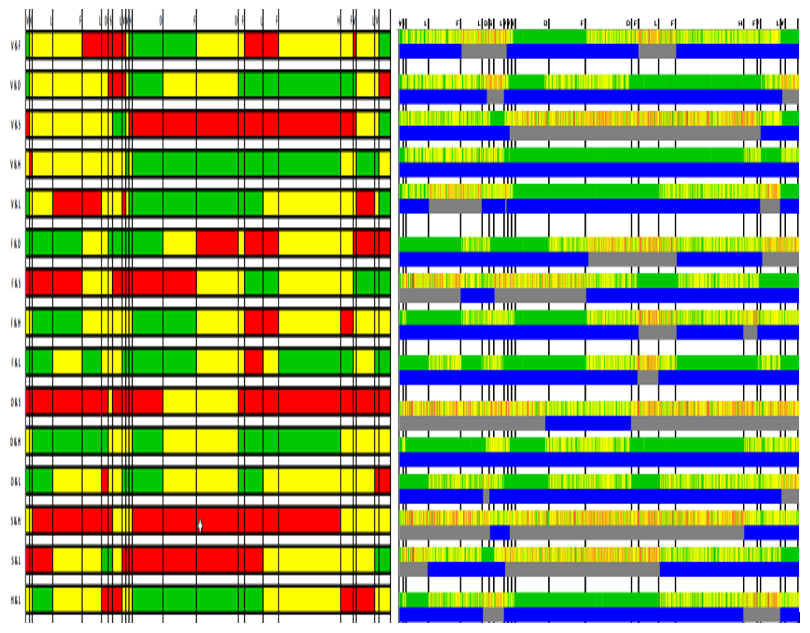
The Final Fact-Checker

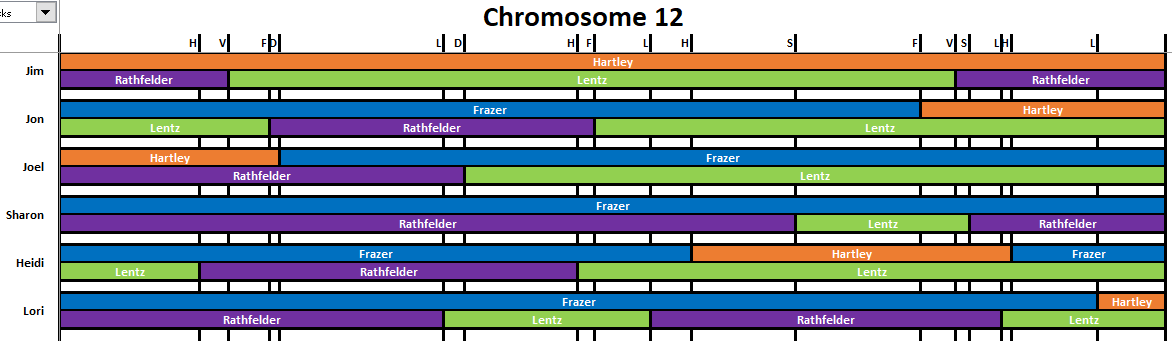
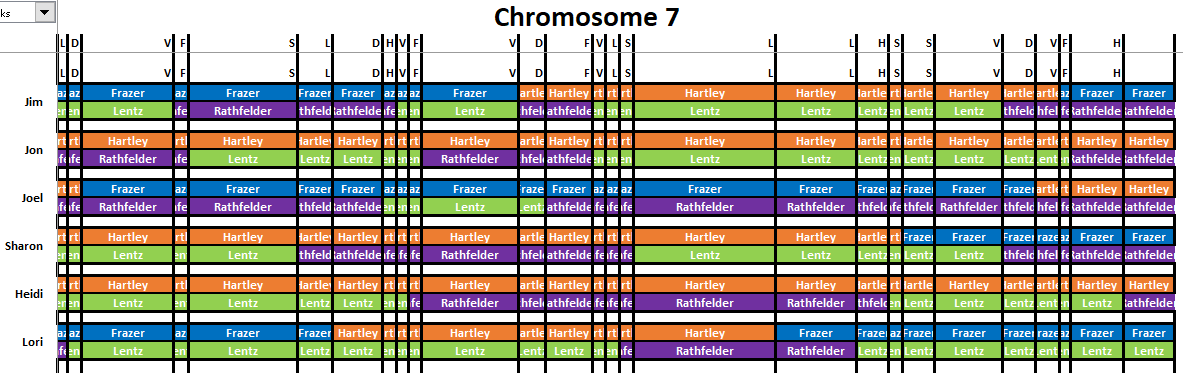
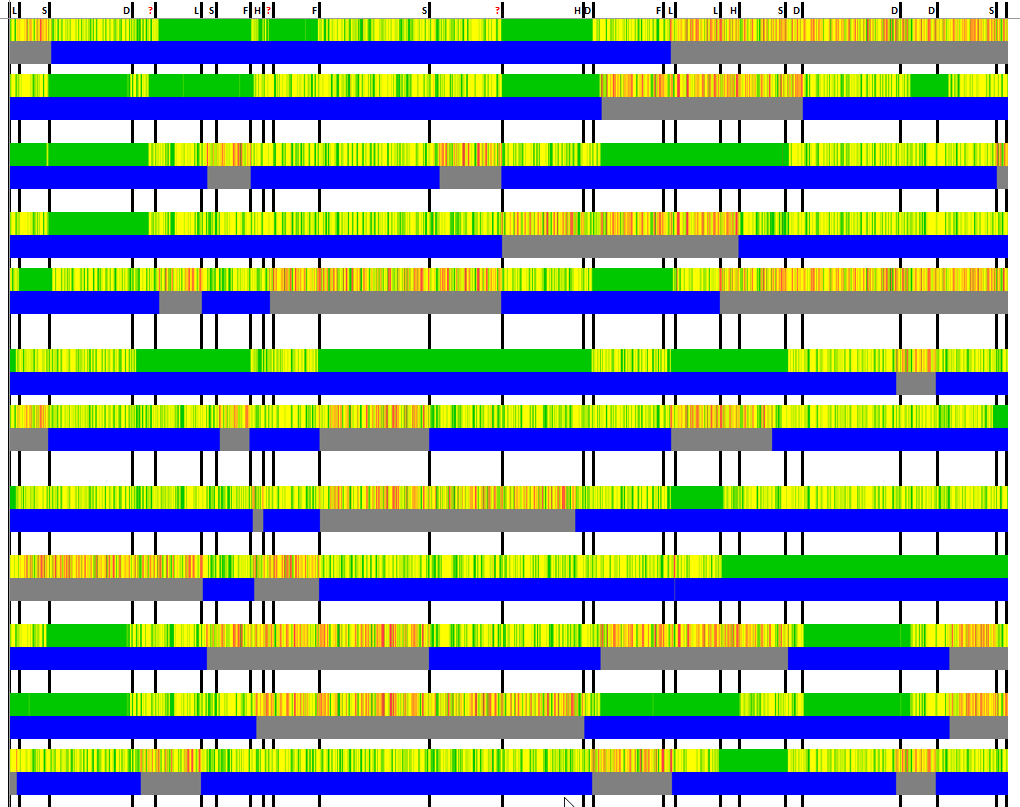
It’s difficult to see every tiny comparison at once, but this looks overall OK.

Summary and Conclusions

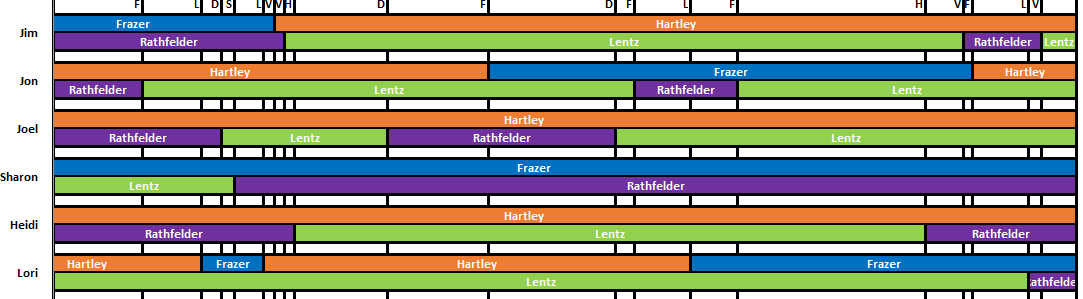
  • The maternal part of this map would not have been possible without one match between Heidi and Joshua. He is my 2nd cousin twice removed. I would have had to have put in just maternal grandparents one and two.
  • So far every chromosome has had one sibling  who has inherited a a full the length of the chromosome from one grandparent. These are cases where recombination does not take place. On this Chromosome, Jon has all Frazer on his paternal side. He appears to have the record for non-recombined Frazer DNA.
  • I tried to work the areas that I was more sure of first and then the unsure areas solved themselves with the good areas that were confirmed by the Segment Map from the Fox Spreadsheet.
  • I used a spreadsheet of crossover positions for each sibling to keep these straight and in the correct order.


Visual Phasing Six Siblings with the Fox Spreadsheet: Part 5 – Taking Chromosome 20 Out of Order

I’m taking Chromosome 20 out of order. This one has been a problem Chromosome in the past in that I have had so many matches. And they have all seemed to triangulate. Blaine Bettinger had a recent poll on Facebook on how many new matches people had at Gedmatch. I had 41, but my largest new match was on Chromosome 20. My previous free-hand mapping showed this:

However, my match spreadsheet seemed indicate I had Hartley DNA at the start of my Chromosome where the new match was:

Putting the Fox Spreadsheet to Work

I start with a blank slate on the Chromosome 20 tab and quickly go to the ‘all cousins’ option at the bottom left. I like this option as I can go from the known to the unknown. I’ll start with the first Hartley cousin on my list – Joyce. This view will immediately point out crossovers for five siblings:

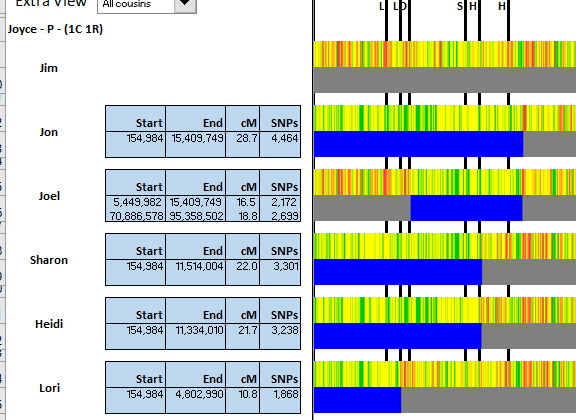
From this, it already appears that I either have no Hartley DNA at the beginning of the Chromosome or very little. Certainly not between 2 and 10M where Jon has Hartley DNA. I have circled crossovers for all siblings except for Lori. Based on my old mapping, Lori had all Frazer DNA on her paternal side of Chromosome 20.

Setting the Crossover Lines

I forgot to do this first. I made some lines, though I may have missed a few and they didn’t all line up perfectly:

Above, I put in orange Hartley above for Joyce’s Hartley matches in blue on the lower half of the image. Then on the other side of the Hartley crossovers, I put in Frazer as that is the only choice on the paternal side. Above and below where there was no Hartley match, I also put in Frazer. I’ve mapped quite a bit of the paternal side already. However, some quality control will be needed.

Maternal Lentz Cousin Carolyn Mapped

Carolyn’s match ends at 56.2M. Jon’s crossover is at about the same place, so I shouldn’t go past that crossover. I’ll add in Rathfelder above and below where there are no Lentz matches:

Next, I’ll carry some of these matches to the left and right based on the crossovers that I have:

Here I have a problem already. Lori is on the bottom row above. She shows a crossover, but no changes in her maternal or paternal side DNA.

Quality Check with the Segment Map

This shows I am off:

I went back and erased the extra maternal DNA I mapped. Then I focused on the sections from V to F:

Obviously the comparisons with Lori (L) in them were wrong. Next, I compared Lori with Joyce and Carolyn at Gedmatch and got this match with Carolyn:

This second match is right at Lori’s crossover: 53.7M. I take that to be more than a coincidence:

This solves the problem at Lori’s crossover.

Next, I’ll extend all siblings over to the right except for Jim and Jon – as they have crossovers to the right:

A glance at the segment map compared to the Gedmatch comparisons seems to show I am on the right track. Then I filled in JIm and Jon based on the Gedmatch comparisons:

Here is the check. It shows that the right side of Chromosome 20 was mapped correctly.

Finishing the Left Hand Side of Chromosome 20

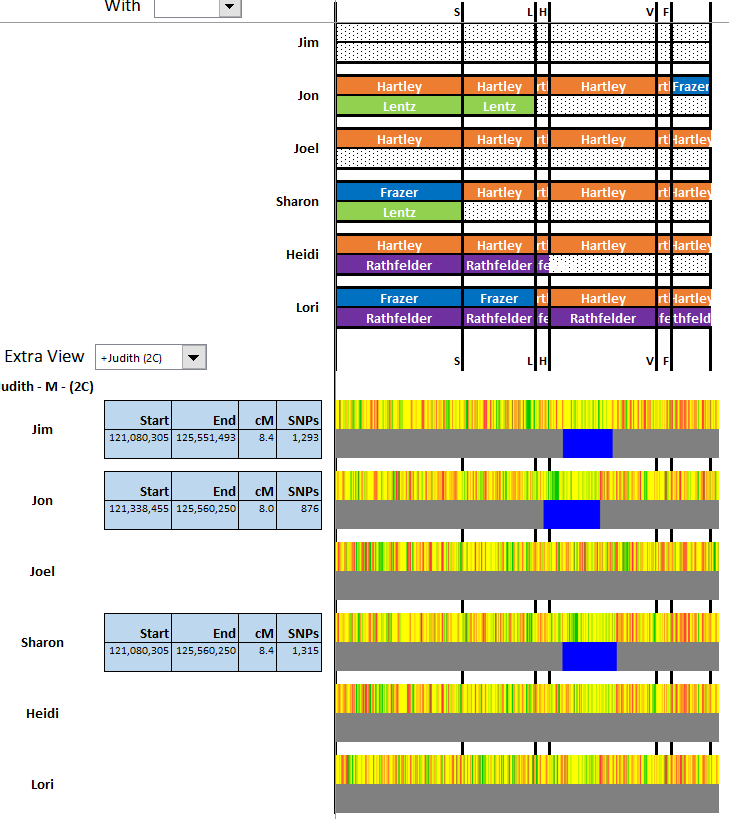
The above represents the right hand side of Chromsome 20 for the six siblings. Next, I can either go with the Gedmatch comparisons or look at more cousin matches. I’ll try cousin matches. Judith is another Lentz relative:

The blue lines don’t line up well, so it is best to look at the match numbers. Judith matches Sharon up to position 6.6M. She matches the others up to 8.4M. That means Sharon has a crossover from Lentz to Rathfelder at 6.6M.

That brings up a potential problem as I had it that Sharon had another crossover between purple and purple. However, as I look at the Gedmatch comparisons again, I see that the Sharon crossover should be a Lori (L) crossover. I’ll change this and try filling in the rest:

I got this far, but didn’t finish filling in Jim (V). He has three crossovers in the blank area and I only have need for two. If all the other segments are right, I can fill in Jim’s missing segments using the Gedmatch comparisons. Now I have it down to here:

[Note: In review, I see that here I should have just carried the Lentz through the first V crossover to the second V crossover. That would have saved time and made the corrections below unneccessary.]

That corresponds with these comparisons:

V&S is FIR, that would put Rathfelder in the narrow segment for Jim. That would mean that Jim (V) has no crossover after L. That gives me this:

Just looking at this, I see a mistake on Lori’s maternal bottom Chromosome 20. She goes from Lentz (green) to purple Rathfelder on Jim’s crossover, so I need to fix that. Next, I’ll do a final quality check:

This shows I still have Jim’s outlined segments wrong. That’s all right, because Jim is the last DNA tested sibling. I want to get his right. By Gedmatch, V-L should be all HIR. I have four no matches and one FIR. I see that there is a problem on the left side of the boxed area. I have green to red and red to green with no transition. There has to be a small HIR between a red no match and a green FIR. The other issue is here:

I show Jim having a double transition with only one transition or crossover line. I know from Jim’s match with Joyce that his crossover should be on the paternal top side. That means that there should not be a maternal change at V above. It also means that I should not have taken out the other Jim (V) crossover.

The Final Answer for Chromosome 20?

These two images below should now agree:

Summary and Conclusions

  • I was able to map Chromosome 20 using the Fox Spreadsheet after a few corrections.
  • It is easy to make mistakes with all the crossovers and segments.
  • Each of the four grandparents are fully covered between the six siblings.
  • I (Joel) have a full maternal Chromosome 20 of Lentz and no Rathfelder on Chromosome 20.
  • The comparisons don’t always line up visually. You have to look at the actual position numbers.
  • I was able to confirm earlier mapping I had done.
  • Using the Steven Fox Segment Map helps to correct any mistakes that I may have made.


Cousin Frank on the James Frazer Line and His DNA

Joanna is great at finding Frazer’s and getting them to upload their DNA to Gedmatch. That is where I do my analysis, to see how they compare to other Frazer’s in the Frazer DNA Project. Here is an old map of the general area where the Frazer’s came from in Ireland:

The early Frazer’s settled in the lands between Lough Arrow and Lough Key around the early 1700’s.

Frank’s Genealogy

Frank’s DNA will not make a lot of sense outside his genealogy. Here is Frank’s Ancestry Tree:

There are two sides to the Frazer DNA Project. There is the Archibald and the James Branches. Frank is from the James Branch.

This tree represents the James Line descendants in red who have had their DNA tested and uploaded to Gedmatch. There are two major branches above under the James Line: Archibald born 1751 and Michael born 1764. Frank is from the Michael Line. I’ll add him in there:


Here Frank sits comfortably with other Michael Frazer descendants. However, he is in the Fitzgerald Frazer Branch all by himself. Fitzgerald Frazer moved to New York from Ireland. I assume that he felt his prospects would be better there. He was living in Haverstraw, NY in 1850.

The Census indicates that he was in New York at least by 1835 when his eldest daughter was born. He apparently married in New York before that time.

Frank is 4th cousin to the other DNA-tested Michael Frazer descendants. Frank is 5th cousin or further out to other James Line descendants. My guess is that Mary Gordon, Fitzgerald’s wife, was not related to Fitzgerald. At least, if she was not related to him, that would make the DNA analysis easier.

Frank’s DNA

I would like to look at Frank’s DNA to see how he matches with other Frazer’s. First, I ran Frank’s matches against all in the Frazer project with no known genealogical link to the James Line and came up with this:

Paul is my 2nd cousin, once removed. Karen, Chris, and Charlene are from the McPartland Connection. I forget how Jenn fits in. I have written a lot about my family’s connection with the McPartlands and likely James Line connection. I hope to make some suggestions later in this Blog.

Here is how Frank matches the above and those from the James Line:

This Matrix is difficult to interpret.

  • The McPartland Group seems to match the Archibald Frazer/Peyton Group the best
  • Marilee has a large match with Bob from the McPartland Group. I have discussed Marilee in past Blogs.
  • Frank’s best match is with Betty from the Archibald/Peyton Group. He also has good matches with the McPartland Group. Frank matches one of the four Michael Frazer descendants above 7cM.

Triangulation to the Rescue?

I like to look at triangulated segments or Triangulation Groups (TGs). The theory is that when three or more people share the same DNA that indicates a unique shared ancestor for the group. If Frank triangulates with any of the above people, it could shed some light.

Chromosome 12


Here Frank is in a TG with Paul and Joanna. I find this interesting for a few reasons. First, I believe that this TG represents Paul’s McMaster/Frazer side. This is from my web page from about 15 years ago.


Here I speculate that Michael Frazer could have been Margaret Frazer’s father or brother. If Margaret was 20 when she married, she would have been born in 1793. I now have that Michael Frazer could have been born in 1764 which would have made him 29 at the time of Margaret’s birth – assuming I am on the right track.

Here I will try out my theory:

Here I have Paul and my family under the Michael Line, but we are one or two generations down from the others. I don’t know if we belong here or to the left under Archibald and Catherine Peyton. Here is what the triangulation would look like assuming that Paul and family descend from the Michael Line:

The common ancestor would be the same whether I put Margaret Frazer under Michael or his brother Archibald.

Not Being in TG12

Interestingly, Prudence, Karen and Chris could have been in this TG, but they were not.

A wild guess could be that Karen and Chris from the McPartland Line descend from Archibald born about 1792. Then it would have to be that Chris, Prudence and Karen were sharing the DNA from Archibald’s mother Catherine Peyton. That could explain some of the McPartland DNA matches here:

This is what the McPartlands would look like under this scenario:

They would be the green family on the left. I would be in the green family on the right. Nothing ventured, nothing gained. It doesn’t hurt to build these make-believe trees as it helps to see where these families could be. However, I would rather have the McPartlands and my green branch under the same side. I’ll explain why in the next section.

Chris and My Sisters Match on the X Chromosome

Here is how Chris from the McPartland Line matches my three sisters on the X Chromosome:

Those are pretty big matches. The only way for Chris to match Lori, Sharon, and Heidi on the Frazer Line is by going through the McMaster side. This is the scenario that I am proposing:

Under this scenario, the X Match would head up to Catherine Peyton. My second choice would be to have both green branches under the Michael Line. In that case, the X Chromosome matches would go back to Margaret Stewart. I’m sure I’ll do more analysis on this in the future. If we had more information on where all these people lived it may also make things more clear.

Usually X matches are not helpful in surname studies such as this. That is because the X Chromosome is not passed down from father to son. However, this case is different. On the McPartland side, the Frazer ancestor is deep in the ancestry on the maternal side. In my family’s case, I have Frazer on more than one line. One of those lines goes back on my grandmother’s father’s mother’s line which is McMaster. In fact, my three sisters got all their paternal side X Chromosome from their paternal grandmother. She in turn got all her paternal side X Chromosome from her paternal grandfather who was Margaret McMaster born 1846.

Back to Triangulation and Non-Triangulation

Above, I had mentioned how Paul, Frank and Joanna Triangulated, but Prudence, Karen and Chris did not even though they matched on the same segments. How can that be? Here is one possible explanation:

Prudence, Chris and Karen could be matching on Peyton DNA and Joanna, Paul and Frank could be triangulating on Frazer DNA. With DNA, at a certain level, there are only two choices. The DNA is either from the mother or the father. In this scenario, either Archibald Frazer or Catherine Peyton. Of course, there are other possibilities, but those would be based on different possible family histories.

I have more Triangulation Groups (TGs) in this Blog. However, some of them need to be updated based on the information from this Blog. It is interesting after that reading that Blog to see how I was heading in the right direction and see the answers starting to unfold. In this Blog, the answers are continuing to unfold as to how my family, the James Line and the McPartland Line all tie together.

Frank’s DNA Matches

Here’s a summary of Frank’s matches:

The facts of Frank’s DNA matches are simple. The interpretation is complicated as the genealogy is skimpy.

Summary and Conclusions

  • Frank’s DNA results are important as he provides a new Michael Line on the James Line.
  • That line is a bit isolated from other Michael Line descendants and Frank only matches Bonnie from that Line. Statistically, Frank should be matching 4th cousins on this line at greater than 50%. In reality, he matches one out of four of his fourth cousins on this line.
  • On the Archibald Line, Frank matches five out of about 15 tested descendants. That is better than the >10% reported for fifth cousins.
  • Frank is in a Triangulation Group with Paul and Joanna. For Paul, who is my cousin, that most probably on a line that goes from Frazer to McMaster to Frazer.
  • I proposed a scenario where Paul’s Line and the McPartland Line fits on the Archibald Frazer/Peyton Line.
  • This proposed tree includes that fact that Frank’s closest matches seemed to be with the McPartlands. The McPartland line and my sisters share a large block of X Chromosome. The pathway of X Chromosome inheritance narrows down many matching possibilities and therfor common ancestors. Paul, Frank and Joanna were in a TG which gives rise to certain possibilities for common ancestors.
  • As I look at the genealogy, I notice that Frank has a William and a Fitzgerald in his anestry. I see those names also on the Archibald Line. However, Fitzgerald also appears in Beverly’s Line on the Michael Frazer side.
  • As I look at previous Blogs, it seems like the answers are coming together slowly, though there is no definitive answer yet. I am not sure how much more definitive one can get with just DNA testing and minimal genealogy.

Visual Phasing Six Siblings with the Fox Spreadsheet: Part 4 – Chromosome 3

I’m ready to start visual phasing of Chromosome 3.

I’ll start with some rough crossover lines:

I try to look at the crossovers and names at the same time to make sure I have enough crossovers. One unusual thing is that on the right hand side, I have five crossovers for Jon (F) in relatively close proximity.

Putting Cousins on the Map

Next I look at the All Cousins function on the Fox Spreadsheet. The first best candidate is James, my father’s cousin. I’ll put some Hartley paternal grandfather DNA in the slots where James matches my family.

Here’s something I want to keep on top of. The right hand side of the matches (in blue) is wandering on each side of a crossover line. I need to start my crossover spreadsheet to keep track of where these crossovers are.

This shows that the Jim (V) crossover is at 39.8 and the Hartley cousin match goes up to 38.6, so we are OK to put Hartley up to the Jim crossover.

The three paternal crossovers on the left fell right into the spots that I had predicted, so I’m off to a good start.

Maternal Cousin Carolyn

Carolyn matches our family on our Lentz grandparent side. Here is my grandmother, speaking of Lentz:

She was born in 1900.

I started mapping Lentz DNA, but ran into a question on the right hand side of Chromosome 3:

Actually I may all right, as I show a crossover for Joel and Sharon on the very right and that is consistent with our match with Carolyn. Here is what Gedmatch -shows for Carolyn:

The right-hand crossovers for Sharon and Joel are really close. Sharon is at 195.80 and Joel’s crossover is at 195.82. I can go with these numbers, but I’ll have to change the crossover order. It also look like, from Gedmatch, that Jon has a crossover at 186M. I’ll write this into my spreadsheet:

Here is how the right hand side of Chromosome 3 mapped out:

Checking out the position numbers at Gedmatch helped me find the crossover for Jon (F).

This is what I get from looking at the first two cousin matches:

Rathfelder Line Cousin Inese

Inese is from Latvia. Here are her matches with my family:

Inese is picking up maternal crossovers for Joel and Lori:

Inese’s matches do not span the crossovers but the two crossovers are implied by the crossover lines above.

Joyce – Another Hartley Match

Here I add in some more orange Hartley based on Joyce’s matches:

Emily – A Frazer Side Match

Here the paternal Frazer match goes through a Lori crossover. That means Lori’s first crossover must be maternal.

I checked a few more cousins and came up with this:

What’s Next? Gedmatch Comparisons

Next, it would make sense to look at the FIRs at Gedmatch and the no-match sibling comparisons, to fill in some blanks above. I did that plus I extended the DNA to the easy looking crossovers. That means the crossovers I wasn’t expecting problems with.

I filled in all but this area on the right hand side of Chromosome 3:

This looks right for Jon as he has two crossovers in this area. However, I have none. I need to add one in there. At the top of the image above, it shows that the comparison between Heidi and Joel (D) shows no match on either side of the Chromosome in that little segment. That means that I would be Frazer (blue) and Lentz (green). That means that my crossover should be near Jon’s first F.

I need to look around 160.9 for my crossover.

This could be it at 156.7:

Here’s some more information from Gedmatch:

The first circled match is my match with Heidi and the next two circled matches are between me and Lori and Jim. I’ll call my crossover 156.2.

Here, I’ve added my paternal crossover:

Placing Jon’s Two Sequential Crossovers in the Right Order

Next, I’m curious as to Jon’s (F) two crossovers. Which is maternal and which is paternal? I ran Jon against 5 siblings and two maternal first cousins and got this:

#6 is Cousin Cindy. My guess is that her match is the maternal crossover for Jon (F). This is at 165.7M which is where I had Jon’s second crossover:

Of course, that makes Jon’s preceding crossover at 160.9M paternal:

Comparing My Work to Gedmatch with the Segment Map

I don’t see any obvious errors. The places on the right that are small and yellow indicate small HIR matches that didn’t show as blue matches on the left because the resolution was not low enough. Here is one example:

That was relatively painless. I tried to be careful with my work, so I wouldn’t have to fix a lot of things later.

The Final Result

I forgot to show my results:


This is the first time my brother Jim’s Chromosome 3 has been phased. I don’t think that I had phased Lori before on the Chromosome either. This time, Jim and Lori have full paternal side Frazer Chromosomes. That’s good for the Frazer DNA Project I am working on. Between the six siblings, there is full coverage for all the grandparents. Without Jim and Lori in the mix, I would be missing a lot of Frazer DNA on Chromosome 3.

Summary and Conclusions

  • I tried to be more methodical with my work this time and plan ahead for areas that could cause problems
  • One problem area is nailing down crossovers that are near other crossovers. A spreadsheet giving the position number of the crossovers helps.
  • I used a first cousin maternal match to find a maternal crossover for Jon. This was necessary because Jon had two crossovers in a row.
  • As in all Chromosome Maps, this information should be helpful in finding matches along one of four grandparent lines.

Visual Phasing Six Siblings with the Fox Spreadsheet: Part 3 – Chromosome 2

In Part 1, I downloaded the Steven Fox Spreadsheet and built up the information for six siblings and 17 cousins. Then I did the visual phasing on the X Chromosome. In Part 2, I finished Chromosome 1 for 6 siblings, with a heavy dependence on cousin matches.

Visual Phasing Chromosome 2

Here are the 15 comparisons for my six siblings. There are 5, 4, 3, 2, then 1 comparison. I think that is where the 15 comes from.

I don’t see too many odd things here.

Here I added a bunch of crossovers. I don’t know if it is better to put in too few and add later or too many and erase later. I’m not too worried if I have them perfect as I will be checking them against cousin matches.

I’ll start with cousin Maury. I think that’s how his name is spelled. Where we match represents the DNA I got from my paternal Hartley grandfather:

I need to stick the blue matches above for Jim, Joel, Heidi and Lori. I see one crossover for Heidi where her Hartley DNA stops and above and below her, Jim and Lori’s Hartley DNA continues on to the right. To the right of Heidi’s crossover, the only other choice on the paternal side is Frazer, so I’ll add that in.

I have the first crossover identified. It is for Heidi, it is paternal and it is at position 53.5M. I’ll put this into a spreadsheet as it is helpful information to have if you ever do raw data phasing or if you want to add your grandparents to Gedmatch:

[The M for Heidi is wrong. It should be a P.]

I could also infer that the segments above and below the Hartley matches would be Frazer matches. I’ll add those now. If I’m wrong, I can correct them later. However, again, on the paternal side, there are two choices from where the DNA came from.

Adding a Maternal Cousin Match to Chromosome 2

Cousin Anita is a Rathfelder cousin.

It looks like there are few crossovers here. However, the representations of where the relative positions of the matches are can be misleading. I think that I will try assign as many crossovers as I can. Here is what I get from Anita’s matches:

Here is a summary of the crossovers from the first two cousin matches:

I didn’t get a position number for Jim’s crossover as they are not displaying correctly on the spreadsheet.

Next, Check the Gedmatch Comparisons

Here is one issue I see right away:

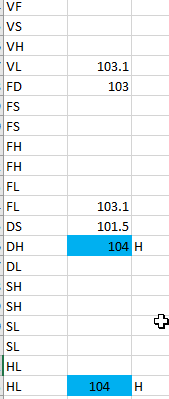
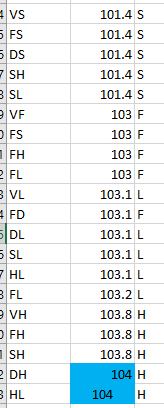
In the Gedmatch comparison between Heidi and Lori, there is a no match area between Segment H and F in red. The answer appears to be that Heidi has an additional crossover in the area of the L and F maternal crossovers at 103 and 105M. The Heidi crossover should be at about 104, based on the Heidi and Jim (V) comparison:

In Lori’s crossover, she went from Rathfelder to Lentz. In order for Heidi and Lori to continue not matching, Heidi needs to change from Lentz to Rathfelder.

The above gedmatch comparison is Lori compared to Heidi. Between crossovers L and H there is a very short segment where Lori and Heidi are HIR. They don’t match H to L. Then L to H they match on Lentz (green) only. Then Heidi and Lori go back quickly to not matching again.

Cousin Joyce on the Hartley Side

Cousin Joyce has some Hartley segments for the left side of my family’s Chromosome 2:

These matches start at about zero and go to 9M. That is at about the third vertical line above (crossover) belonging to D who is me (Joel). This causes a problem as it goes through Sharon’s crossover. When I look more closely, I see that Sharon’s crossover is at 9M and mine is at 12M:

That means I have to bring back the orange one small segment:


While I was working on this, I made a guess that I (D) had a paternal crossover right after Sharon. I put this into my spreadsheet:

At 7M, I have a crossover for Lori, but I don’t know if it is maternal or paternal yet. I also looked up the last crossover position for Jim at gedmatch.

It looks like Joyce could help clean up the right side of Chromosome 2:

The bottom blue bar is for Heidi and it shows her crossover. Heidi’s crossover is at 226M. Note that I show three crossovers in a row above, but only have two initials. I’ll say that the extra crossover is for Heidi:

The circled areas are in the comparison of Jim (V) to Heidi and Jon (F) to Heidi. Heidi is common in both. I had mentioned in a previous Blog that a change from no match to FIR or from FIR to no match could indicate a crossover for a person on a paternal and maternal side in close succession. That appears to be the case here.

The spreadsheet is important, because the visual part of visual phasing can throw you off. That means that the visuals don’t always line up well, so it is important to depend on the position numbers. This is especially important where the crossovers are close together.

Here are Heidi’s crossovers on the right:


This creates another problem as Heidi’s Lent in Green has to get back to purple Rathfelder on the left, and I don’t have any crossovers for Heidi between the two. This means that either Heidi doesn’t have a crossover on the left or she needs another in the middle. Confused? You bet I am. I’ll worry about this later.

Deciphering the Right End of Chromosome 2 – Paternal Side

Hartley cousin Beth helps figure out the right hand side of the Chromosome. Ends of Chromosomes can be difficult to interpret.

Lori’s match is off by about one half million positions from the other three matches. I don’t know if that is significant. It may indicate a crossover that I don’t have.

Here is how I started to fill in the right hand side of Chromosome 2:

  • JIm’s crossover was on the maternal side, so I filled in the rest of his Hartley DNA.
  • I show Sharon with a crossover. If she has one, it needs to be on the paternal side.
  • This leaves Lori. If her match with Beth is right, then Lori needs another crossover – probably at 239M.

Here is Lori’s crossover:

This shows that Lori’s crossover is right before Jim’s.

Tiny Segments at the Chromosome Ends Are Not That Important

First, thanks Beth. The tiny segments at the end for Sharon and Jim are not that important in practice. However, if you want to fill out your Chromosome Maps it is fun to figure them out. Note Sharon’s small Hartley segment at the right end. This does not show up on the cousin match. It is just too small. If I lowered the thresholds at Gedmatch, it should show.

As my mom would say, “So there”.

Paul’s Frazer DNA

Here I just show the right side of Chromosome 2, where Paul matches my brother and three sisters:

These segments don’t align well, but the numbers show that they are pretty close to each other vertically.


I filled in the Frazer segments and Hartley segments where Paul didn’t match:

Jim likely has a paternal crossover at V. He needs one to match the paternal Frazer at the left.

Cousin Linda’s Maternal Lentz Matches

Linda points out two crossovers on the maternal side:

These are at 222M for me and 228M for Heidi:

I already had Heidi’s crossover listed, but here is mine added.

Gedmatch Sibling Pair Comparisons and Reconciliations

Next, I want to compare my Sibling Chromosome Map with what Gedmatch shows:

For example the comparison between Sharon and Lori shows that they have an FIR that means that Sharon should have Lentz DNA on her maternal side. Lori has two crossovers in a row, so the second should be Frazer to Hartley. Because I am looking for a crossover for Heidi, somewhere in the middle, I’ll fill in the other siblings, but not Heidi:

As I fill in the blanks, I see that I have more problems:


  • Looks like Jim (V) needs another crossover. I believe that should be near the third V above.
  • Jon has two crossovers, but if I put in Rathfelder in the blank area on Jon’s maternal side, that would solve that.
  • Sharon needs to go from Rathfelder (purple) to Lentz (green) but has no crossover.
  • Heidi has the same issue.
  • Lori has a crossover but no apparent need for one. By looking at the Gedmatch comparisons, the L should be an H and S. This should solve the above two problems.

Jim’s Double V

Here Jim has crossovers on the maternal and paternal side:

These don’t line up that great visually. These two Jim Crossovers are at 191 and 192. I don’t know which crossover is maternal and which is paternal at this point.

Replacing One Lori Crossover with One Sharon and One Heidi Crossover (Or How to Solve Two Problems by Correcting One Crossover)

The problem in doing this is, which Crossover goes first? Here is the Lori Crossover I want to replace:

This shows where they both match with me (D). The Sharon crossover is at 173M and the Heidi crossover is at 172M, so Heidi goes first.

My list of crossovers is getting quite long:

These two crossovers need to be on the maternal side to make the map work. I don’t know if this is right, but it seemed to work:

Some Eye Excercise

This is a side by view of what it is from Gedmatch versus what I came up using the Fox Spreadsheet. I think they agree. All I have to do now is fill in Jim’s double crossover and some small segments on the left hand side of the Chromosome.

Jim’s Double Crossover

This should be easy.

In the little gap between 191 and 192M, Jim has no match with Jon (F), Sharon and Lori.

Jon, Sharon and Lori have a blue/purple combination, so I’ll give Jim a no-matching orange/green combo:

If everything else is right, this just falls into place.

The Left Side of Chromosome 2

This looks really confusing. I have five crossovers in short succession and one not assigned. I could give up now, but I would like to finish this Chromosome and move on to 3-22. First, I took out the unassigned crossover.

I’ve circled all the cases where there is a no match going to an FIR or FIR going to a no match. They include three V’s, three F’s, three H’s and three L’s. I think that means that I need to add an F and H crossover to what I already have. That includes all six siblings. The other question is whether these are all double crossovers. If that is the case, then I could need to add up to five crossovers.

I can start by filling in some paternal side in the first segment:

Next, I need to make use of my spreadsheet.

These are the crossovers I have already. Next, I’ll look for some more position numbers.

Here Jon has a 10.4 crossover. It seems to line up well with his other matches.

Jim and Heidi match here:

That looks to be about the place of Heidi’s crossover.

I’ll start filling out the map based on the above, but I feel like there is at least one double crossover somewhere:

I did a quick segment map check:

The resolution is off, but it looks to be not too bad a comparison.

Could This Be the Map?

I think it looks good for a wrap.

Comparing Chromosome 2 with Previous Analysis

Here is what M MacNeill did for me previously:

This was for three siblings. The interesting par is that this shows DNA that was missing on my father’s side. My mom has been tested, so is missing no DNA. DNA is missing for my paternal grandmother on both ends. DNA is missing for my paternal grandfather in the middle of Chromosome 2.

Now no Hartley DNA is missing (paternal grandfather). Also no paternal grandmother is missing thanks to Jon. He has a full Chromosome 2 of paternal grandmother. This is interesting because Jon also has a full Chromosome 1 of Frazer (paternal grandmother). That’s a lot of Frazer. Let’s say Jon was trying to prove he was related to a Hartley who had huge segments of Hartley DNA on Chromosomes 1 and 2 but nowhere else. Jon would show that he would not be related to this Hartley by DNA.

Summary and Conclusions

  • I continued on with the same method I used for Chromosome 1. That was to use cousin matches and to  identify crossovers by cousin matches. I map those matches and crossovers and what I can infer from the gedmatch comparisons. I then check the Segment Map to see if it agrees with the gedmatch comparisons.
  • I still like using the cousin matches first as it sets the maternal and paternal side right away. The crossovers from the cousin matches seem quite certain and give me a good start on visual phasing.
  • I make sure I keep at least the close crossovers in a spreadsheet, so I can know which crossover goes where. Special attention is given to the position numbers as they can give clues to how many crossovers there are.
  • At the end of my visual phasing, I was looking for double crossovers, but they were not there.
  • For Chromosome 1, I consulted with some of my previous work. For Chromosome 2, I did not look at any previous work I had done or had done for me.
  • Finally, I looked at my results compared with previous results.


Visual Phasing Six Siblings with the Fox Spreadsheet: Part 2 – Chromosome 1, the Most Difficult Chromosome?

In my previous Blog, I created a very useful spreadsheet thanks to Steven Fox. This spreadsheet has my five siblings plus me with comparisons to each other, cousins and all I need to visually phase six siblings. In that Blog, I started by mapping out the X Chromosome.

On to Chromosome 1

Chromosome 1 could be tough. This Chromosome has the potential for the most crossovers. I tried showing some crossovers, but it was a bit of a muddle:

I have worked on phasing my DNA using raw DNA and have had help from M MacNeill. MacNeill came up with this for three of the siblings in my family:

This shows a maternal and paternal crossover for me in close proximity at about 23M. MacNeill showed my maternal crossover at 23.1M and my paternal crossover at 23.3M at the left side of the top row. That is fairly close.

Here is a problem area on the right hand side of my sibling comparisons:

In the D&S comparison, see how quickly the comparison goes from FIR to no match. This is likely indicative of my maternal and paternal crossover. Above, the F&L comparison, there is a slightly more gradual change from no match to HIR to FIR. I don’t know if that indicates a maternal/paternal crossover for Lori or if my double change is giving Lori a double change.

Then, on the right side of the Chromosome, I see this:


At around position 204M, F&H goes from no match to a FIR fairly quickly and D&L goes from HIR to no match very quickly. It looks like I could have another Lori (L) crossover in that area.

Here I tried some visual phasing, but, it is not right:

Here is how the segment map compares:

The comparison is not bad in the middle of the Chromosome where I started the visual phasing, but it goes south quickly on the right.  The V&D comparison on the left side of the segment map is off also.

Using Cousin Matches

My though at this point was to use cousin matches to get this map into better shape.

At the bottom right, Lori’s last match with Joyce ends at 203M, Heidi’s ends at 205M and Sharon and Joel continue on. Sharon’s Match with Joyce starts at 190M and my match starts at 182M. That tells me that Sharon has a crossover at 190M, Lori at 203M and Heidi at 205M. This is just on the paternal side as Joyce is a paternal match.

A Cousin Match Spreadsheet

I like the idea of using cousin matches, so I copied this spreadsheet and made another called Cousin. The good thing about putting in matches based on cousins is that when you can see the crossovers, you can tell which side they are on. Then on the other side of the crossover, the DNA will come from the spouse of the match. For example, above when my siblings match Joyce, that is on the Hartley side. So to the left of Sharon’s Hartley match with Joyce, the DNA would be from Frazer (my paternal grandmother).

Here is how I mapped out my siblings’ Hartley match with Joyce. On the other side of the paternal crossovers, I can add in Frazer:

After comparing the paternal matches with the gedmatch comparisons, I can make some more deductions:

For example Sharon has no match with Lori in the middle segment. that means that Sharon must have a Frazer segment there where Lori has the orange Hartley segment.

Adding Maternal Cousins

My cousin Catherine represents my Rathfelder maternal grandfather. I’ll add in some Rathfelder from Catherine:

Where Jon does not match Catherine or Rathfelder, he must match Rathfelder’s wife who was Lentz. This is true for Joel also in the second set of matches. This change for Joel (D) must happen where I have his crossover.

This gives my family four grandparent segments by just two cousin matches.

Two Missing Paternal Crossovers for Lori and Heidi

Above, I had mentioned that Lori had a paternal crossover at 203M and Heidi at 205M, but I forgot to add them in.  Here are the ones I forgot along with the ones I didn’t:

This shows how crowded things can get with a six sibling comparison. This is what these crossovers result in on the map:

That configuration results in this Segment Map on the Fox Spreadsheet on the right versus the original gedmatch comparison:

Above, I am just comparing the segment that goes from L to L. All the differences are on the right hand side and they all have to do with Heidi. I suppose that could mean that I have too many crossovers for Heidi, not enough, or have deduced the wrong thing from the crossover I have. My guess is that Heidi has an additional maternal crossover.

Based on the Gedmatch comparisons, Jon (F) and Heidi should match on both grandparents. If Heidi had a Lentz in her last column, then she would match Jon.

Now the segment map agrees with Gedmatch:

The problem was the 5 crossovers in a row. I find it interesting how a comparison with the segment map and Gedmatch pointed right to Heidi as the place where the problem was.

A Lentz Cousin Should Fill Out the Right Hand Side of Chromosome 1

Here is how Judith matches my family:

I see three maternal crossovers on the right. One is with Jim (V), then Heidi, then Lori in the last row.

When I fill out the missing segments, I get this:

 Using the Fact-Checker Segment Map

The good news is that I have the area of discrepancy narrowed down to one person again:

I did something wrong with Jim (V). Jim is supposed to match Sharon in the Last segment. That means that Jim needs another paternal crossover from Frazer to Hartley. All I had to do was compare Jim to Frazer cousin Paul to find Jim’s crossover:

Actually I had to compare Paul to Jim and Jon to find Jim’s crossover. Here is my expanded list of crossovers:

Here is the extra Jim (V) crossover added before Lori’s last crossover:

There would have been a lot more trial and error without the cousin matches that I have. Now Gedmatch and the segment map appear to match:

Also, I am liking Steve Fox’s Segment Map.

The Most Difficult Chromosome

Chromosome 1 isn’t necessarily the most difficult Chromosme to visually phase but it has the most potential to be the most difficult one. Looks like this Blog will just be on Chromosome 1.

Here’s a Hartley cousin on the left side of the Chromosome:

This will take care of one of my crossovers and one for Lori. It looks like Lori’s crossover should be ahead of mine:

I also carried some of Jon’s segments over as he shows no crossovers. It looks like I need another crossover for Lori:

Jon (F) has no match with Lori in the first row comparison. Then he has a short HIR and then FIR. My assumption is that Jon has no crossovers on either side of his Chromosome 1. That means that Lori, must have two crossovers.

Final Fact Check with the Segment Map


Something is off in the V Section which is Jim’s. My solution so far, has been to add an extra crossover:

Now I have everything except a tiny little area for Jim:

If only I had a cousin match in that area. It looks like the first V is at 35M and the second is at 41M. Jim’s match with Joyce should work.

Joyce matches Jim (V) up to 38M which is past the area of his first crossover at 35M:

The Finished Product

Using the merge function beautifies the map:

Wait maybe not. Here is a global fact check using the Segment Map:

How did I miss this before? Again my fact-checking exercise has narrowed down the problem to one sibling. This time it is Sharon. I have also narrowed the area in which the problem is: between S and V.

I see the problem:

Sharon is third from the bottom. I have her bottom maternal crossover from Rathfelder (purple) to Lentz (green) at V instead of at S. This should fix things:

That should do it:

This shows that there are no gaps where any of the grandparents’ DNA is missing between all six siblings.

Summary and Conclusions

  • First I made some rough crossover lines and assigned them to four siblings
  • Second I went to the cousin match map and mapped a few cousins onto the spreadsheet
  • Using these cousin matches I could see where some of the crossovers were. The advantage of this is that I already knew which side (paternal or maternal) the crossovers were on. On the other side of the crossover, I knew that the person got their DNA from the corresponding spouse.
  • I extended these matches using the gedmatch sibling comparisons
  • I checked my results using the segment map and made corrections
  • I found where there was a quick change from no match to FIR or FIR to no match in a sibling comparison, that it often meant a person had a paternal and maternal crossover in close proximity.
  • The use of cousin matches greatly sped up the process of visual phasing.
  • By using cousin matches I skipped using the G1-G4 codes and went directly to actual grandparents. This method seems more intuitive to me. However, it only works with good cousin matches.
  • This also went quickly because I had done it before. Because of this, I already knew I had a double crossover near the beginning of the Chromosome. I also believed that my brother Jon had a full pair of DNA from his paternal grandmother and maternal grandfather. However, I basically recreated the map from the beginning.
  • It is satisfying to see the map for all six siblings and how they got their DNA from each of their four grandparents.
Visual Phasing Six Siblings with the Fox Spreadsheet: Part 1 – The X Chromosome and a Deceptive Cousin Match

My brother Jim was the last of six siblings to have his DNA tested. As a result, I am behind on phasing his DNA. The Visual Phasing process puts your DNA into four categories. Those four categories correspond to the DNA that you got from your four grandparents.
First I used the Steven Fox Visual Phasing Spreadsheet. I downloaded information from gedmatch using that spreadsheet. The program timed out, but it looks like I have enough to get started. Usually, Visual Phasing is just done with three siblings at a time, but I thought I’d try it with all six.

Starting with the X Chromosome

Some people like to start with the X Chromosome. Part of the reason is that it is already phased between maternal and paternal. Females get two X Chromosomes, but males get one. The one that males get is from the maternal side. I had already looked into Jim’s X Chromosome. I compared it without the Fox Spreadsheet and got this:

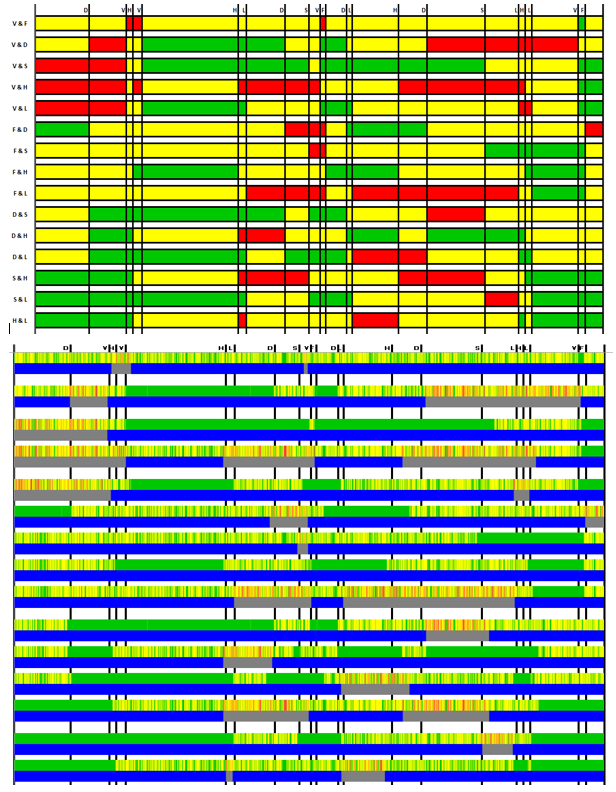
Here is the complicated six sibling comparison:

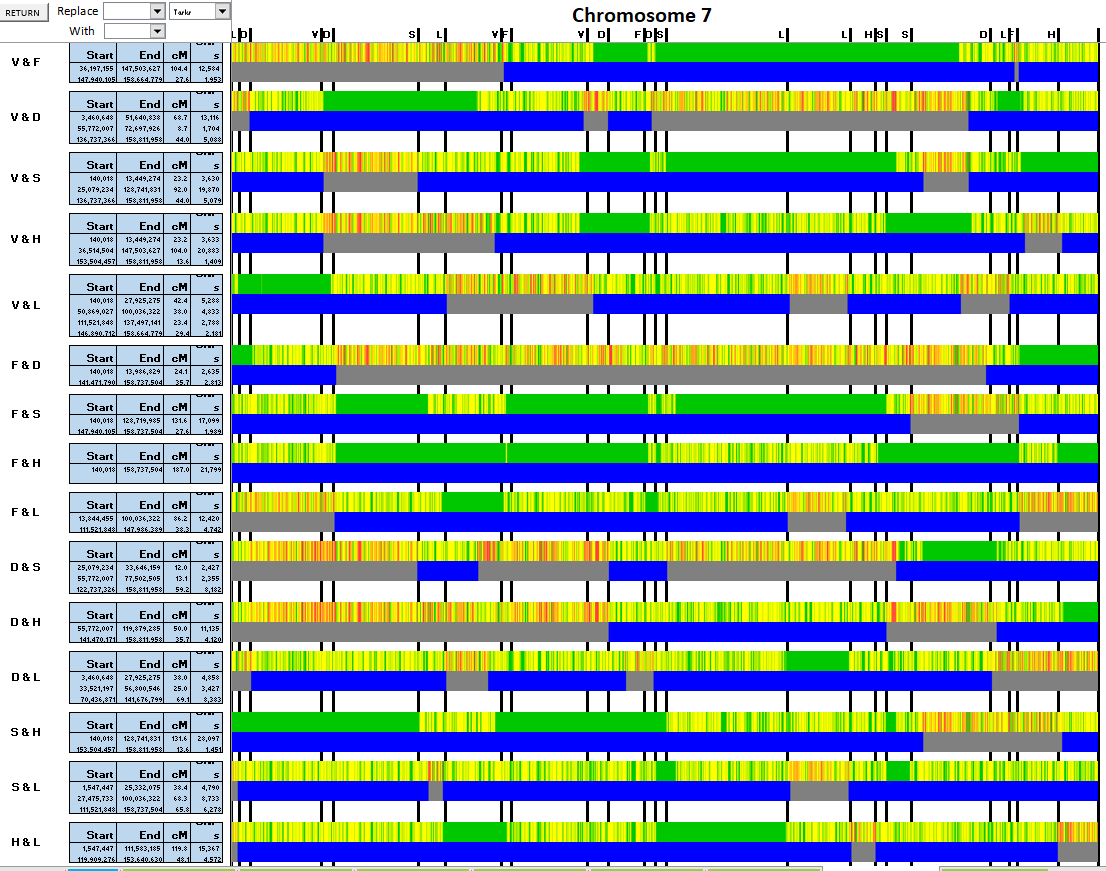
In this comparison, Jim is V, Jon is F, and Joel is D. V&F, V&D and F&D correspond to my three brother comparison above. My three sisters have two X Chromosomes, so they have a maternal and paternal side. The paternal side is the same for all three sisters, so they are at least half identical in all places. Yellow is the half identical areas. Red is no match and green means that my sisters match on both the maternal and paternal sides.

I have set the crossover points here:

Next I need to figure out who owns each crossover. It looks like the first one belongs to Heidi:

Every time there is a change in one of the comparisons, Heidi is involved. In three sibling visual phasing, Heidi would be involved in match changes with two other siblings. In six sibling visual phasing, she shows the changes with each of her five siblings. This gives more certainty to setting crossover lines.

Second Try at Building the Chromosomes

I tried to build the chromosomes a second time without all the added cousins as that was slowing the process down. The spreadsheet allows you to add them later. Here is the assuring message I got:

I can add the cousins in later.

An Apparent Jim Crossover That Is Not

Note that at about position 23, it appears that Jim should have a crossover, but it actually goes to his two brothers:

This is a little easier to see in the six sibling comparison:

Jon (F) is in purple and Joel (D) is in orange. These two crossovers are not in the same place but are very close to each other. Joel’s is first at about 23M and Jon is next at about 23.3M.

Another Close Set of Crossovers: Jim and Lori

Here Jim’s crossover is at 87.5M and Lori’s is at 87.7M. That means I need to add another Line for Lori. Now I have 13 crossovers for six siblings:

Adding Cousins

I would like to add cousins to the spreadsheet, as I took them out earlier to make the spreadsheet build run smoothly. Now I will add them back in. I went through Steve Fox’s instruction manual. I added back in cousins and hit the ‘add’ button. I had added my father’s cousin Jim and the program didn’t like that as my brother is also Jim, so I changed my father’s cousin’s name to James and the program was happy. I added 17 cousins, so it could take the spreadsheet a while to add in 17 cousins for 6 siblings. Based on the progress, this process should take about an hour if nothing times out. Actually, it did time out or Excel hung up and I wasn’t happy with the results. So I deleted the cousins and added them in in two batches after closing unneeded programs and Excel spreadsheets.

Here is another assuring announcement:

After this, I ran the other 9 cousins and I successfully completed the build. This build process took a while but should be well worth it.

Back to Visual Phasing of the X

Heidi, Sharon, and Lori will all have their X DNA from their paternal grandmother – Frazer.

I put Frazer on the bottom. That means the maternal side will go on top. For that, I just need to see a few cousin matches. When I choose ‘all cousins’, I see that Anita and her sister have the best X Chromosome matches with my family:

Anita matches Jim, Sharon, Heidi, and Lori on the right. Anita has smaller matches near the middle of the Chromosome with Sharon and Lori . By comparing the chromosomes on the right, it looks like I can see a crossover for Sharon (at 68M) and Lori. For some reason, the position numbers for the matching comparisons are not all showing at the left.

Remember, I said that Lori had a crossover on the right hand side? It shows as my crossover (D or Joel). That means I probably missed a crossover for Lori.

Here is a comparison between Lori and Jim that shows where Lori’s crossover is:

Every carat mark is one million, so Lori’s crossover is at 142M.

Anita above represents Rathfelder, so I just need to put in Rathfelder everwhere that Anita matches my family.

The spreadsheet has a function called Extend, but it didn’t work for the Rathfelder entries for some reason. I’ll just extend Rathfelder manually to the crossovers:

A Problem for Sharon

I extended Jim, but ran into a problem with Sharon:

If I extend Sharon to the right, it goes through a crossover line. A crossover line is where there should be a change from Rathfelder to Lentz. That means that something is wrong. I’ll just visually phase the brothers:

Then I will go segment by segment from Jim to his sisters to see where the change is needed.

It turns out that I was doing it right, but the two small matches with Anita and Inese were wrong. The common wisdom is to ignore X Chromosome matches under 15 or 20 cM. In my opinion, this is especially true between two females. I find this a bit confusing as three cousins match on those two segments of Sharon and Lori.

So that was supposed to be the ‘easy’ Chromosome!

Here is another way of looking at the X Chromosome and cousin match:

Jim (V) matches Lori and Sharon at segment S-F as shown by the blue bars above. Sharon and Lori match cousins Anita, Inese and Catherine at the same segment. However, James does not match cousins Anita, Inese or Catherine at the same segment. That is further confirmation that the X Chromosome match Anita has with Lori and Sharon is not good for use in Visual Phasing.

Checking the Segment Map

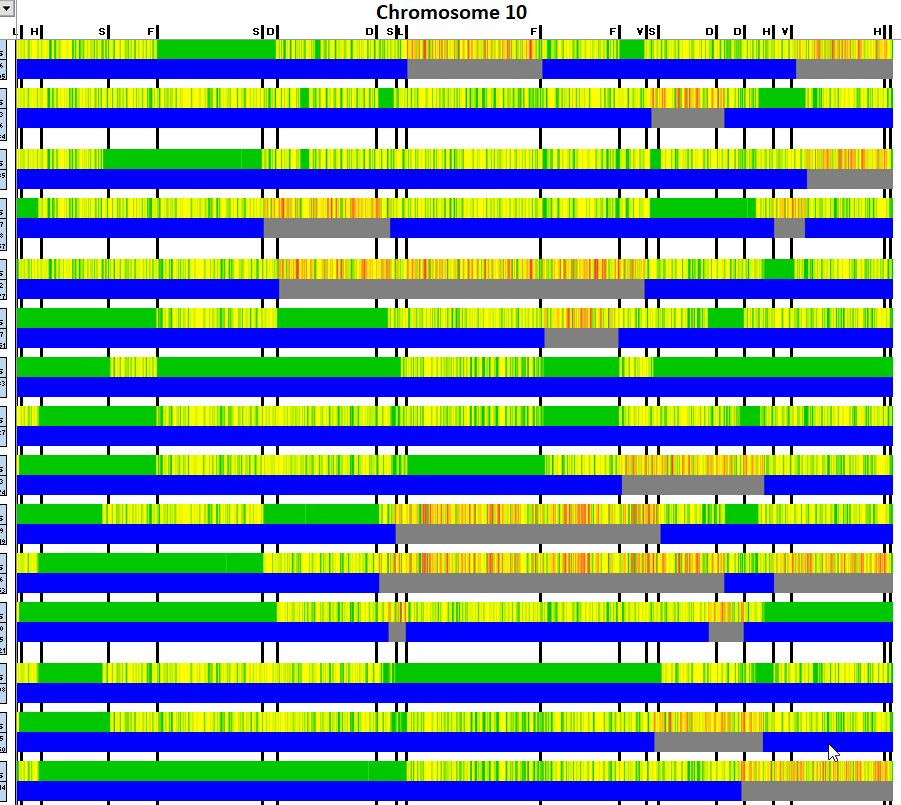
The Fox Spreadsheet also has a Segment Map. This is a check to see if your final results match up with the original Gedmatch comparison. It is not a proof that the visual phasing is right. However, if it does not match, it is pretty good proof that something went wrong.

For the X Chromosome, it only works for the three sisters.

The top part is the Gedmatch comparisons with my three sisters. The bottom spreadsheet part should mimic the topgedmatch comparisons if the Visual Phasing is done correctly. Also in Chromosomes other that the X, there will be red sections where there is no matching. When three sister always match on the paternal grandmother, there is no place on the X Chromosome where there is no match.

Summary and Conclusions

  • I had never visually phased my brother Jim except for the X Chromosome. I decided to start the process by working with the Steven Fox Visual Phasing Spreadsheet.
  • I had never clearly understood why a crossover that looked like it should belong to one sibling could belong to the other two. Using six siblings, it was visually clear how that could happen. The other two siblings have crossovers that are close to each other. In this example, Joel and Jon had crossovers near each other. As a result, they both matched Jim in those close crossovers. This made it look like Jim had one crossover when the three sisters were not considered.
  •  A match that three of my sisters had with three cousins made the visual phasing confusing. By re-checking the crossovers and the match between my brother Jim and my three sisters, it became clear that the X Chromosome matches with my sisters that was around 10 cM was either not valid or too ancient to be helpful. In order for these 10 cM cousin matches to be valid there would have had to have been a match with these cousins and my brother Jim also.
  • Visual Phasing of the X Chromosome is simple in that there are only three grandparents to consider and one grandparent is always the sisters’ paternal grandmother’s DNA unrecombined. However, there are other issues that can make the visual phasing of the X Chromosome complicated.
  • I used the segment map to check my work.
  • The Steven Fox Visual Phasing Spreadsheet is a great tool for Visual Phasing. It is time-saving and a great way to organize your work. For six siblings, it shows the results for those siblings all in one location.
  • I’m ready to Visually Phase Jim and the other 5 siblings for Chromosomes 1-22.


William’s Newfoundland DNA

I recently wrote a Blog about Brenda’s Newfoundland DNA and her DNA matches with my wife’s family. I had a response to that Blog requestingt that I check out the DNA of William. William is about #20 on Esther’s Gedmatch List. Aunt Esther is my mother-in-law’s 1/2 Aunt.

By Gedmatch, Joan and William could be about 2nd cousins once removed or similar. However, with Newfoundland genealogy, there can be many lines of family connections.

William at Ancestry

I see from William’s Gedmatch number that William has tested at Ancestry. I can now go down Esther’s match list and see how closely people match by DNA:

This William looks to be the same as the one at Gedmatch. Here is William’s tree at Ancestry:

There are some holes in the genealogy, but the common surname at William’s great grandparent level is Dicks. There are also some ancestors marked as ‘private’ at the lower right of William’s tree. This happens when the ancestor is not noted as deceased. I found out by an e email from Norma that this is the right William. Ancestry thinks that Joan and William are third cousins. If so, the common ancestor would be on the level that has three of Williams 2nd great-grandparents identified out of 16. This would also be at the same level as the parents of Esther Dicks.

A Quick and Dirty Tree for William

As some ancestors are missing on William’s tree, I’ll whip up what is called a quick and dirty tree.

Ancestry has suggested ancestors, so I just used their suggestions. Now we have 12 out of 16 potential 2nd great-grandparents for William. It appears that William favors the Collins. Senior, and Butler surnames. If I understand it correctly, my wife’s Great Aunt Esther should have the Butler name on her maternal side, but I have gotten around to fitting it into her genealogy.

Esther Dicks Born 1854

Norma tells me that William’s Esther Dicks may have come from Harbour Buffet where both sides of Esther’s family were from. The clue I got from Ancestry thought that Esther Dicks was from Flat Island where a lot of William’s ancestors were from. However, I don’t have a lot of evidence showing where Esther Dicks was born.

William’s DNA

It would be nice if we could figure out more about William’s ancestry by looking at his DNA and his matches. One problem with William’s match with Esther is that she has Dicks on her mother’s and father’s side:


My mother-in-law Joan only matches Esther on her paternal side, so matches that Esther, Joan and William share force the match to Esther’s paternal side. This is also true forJoan’s sister Elaine. Here is how Joan and William match at Gedmatch:

Joan and William match by only 31 cM which leaves an extra 150 cM for William to match Esther where she doesn’t match Joan. Part or all of this 150 cM could represent the [lower] maternal side of Esther’s tree. Well, it can’t be all of 150 cM, as this is how William matches Joan’s sister Elaine:

Comparing William to Other Dicks Descendants

The next logical step is to compare William to other Dicks descendants. These would be descendants of Christopher Dicks who was born about 1784 and Married Margaret. One problem with this is that I have not added Joseph Dicks to this Line. I probably should, but I’m only partially convinced that his is a son of Christopher Dicks.
This could explain why Esther has so many matches to other Dicks descendants.
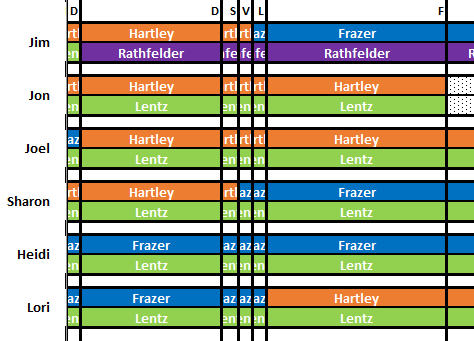
Here is the Dicks Matrix I get for William:

William is at the top, but I don’t see that he clearly matches any of the groups more than the groups match themselves. As Norma pointed out to me, William matches Esther the best followed by Anne and Brenda. I do notice that William also matches DIddie pretty well. Based on my last Blog on Brenda, a common ancestor could be Dicks and Crann. I also wonder about the Collins name as the common Crann Ancestor from England had a wife named Collens.
Here is the tree I’m pulling the results from. This is just a tree of Dicks descendants who have had their DNA tested (noted by the green boxes):

Esther and Anne are one generation up on most others except for Nelson in the Adams Line. Given that fact, and that William has good matches with Diddie and Brenda, I would tend to put William’s DNA match in with the Crann Line on the right. For William to have such a good match with Brenda who is two generations down from Esther and Anne seems significant to me.  Looking at Triangulation Groups may clarify things.

Getting More Specific With Triangulation Groups (TGs)

Triangulation Groups are when three or more people all match each other in three ways on the same segment of DNA. When this happens, those three people are supposed to have a unique common ancestor. In practice, it is difficult to narrow this down to one common ancestor, but often a common ancestral couple can be found.

This is not my favorite step as it involves comparing 31 people’s DNA with each other. Also I have to change all the names for privacy.

First, the Crann Test

In my previous Blog, I looked at four additional people. Three had Crann ancestry, but no specific Newfoundland ancestry. One person had Crann ancestry and Newfoundland ancestry, but no known Dicks ancestry.

Equally Confused and Illuminated

This is the Matrix I should have produced in my previous Blog:

In the bottom right of the matrix, I have a box around the Crann’s from New Zealand. They show to be matching clearly with the Christopher Dicks group. I had thought that it would be more clear that they would be matching with the Crann Group. However, they have a small match with Judy from the Joyce group. Then they match with Molly and Howie who are in both the Joyce and Crann Group. Finally, Heather has a respectable match with Brenda who is only in the Crann Group. Other than that there is an ambiguous match with Kirsten from the Burton group and no matches above 7 cM in the Adams Line descendants.
Richard from Newfoundland with Crann Ancestry But Not Dicks

Richard has Crann Ancestry, but not Dicks. That means his match with Cheryl is likely on a non-Crann non-Dicks Line. Richard matches William and others by a greater amount than he matches the New Zealand Crann descendants. That tells me he is matching these people on multiple lines. William matches the three New Zealand Crann descendants at levels right around the threshold of 7 cM. William matches Richard at 132 cM so must have other matches with Richard outside of the Crann and Dicks Lines. Hmm….
Triangulating Between the Dicks, Cranns, and Richard

Hey, why not? Let’s find out what happens.

TG01 With Richard

Richard is in the mix for quality control and for his Crann ancestry:

Normally, if I saw Anne, Randy and Forrest in a TG, I would assume that this would be a Dicks TG. However, I am told that Richard has no Dicks ancestry.  Here is Richard’s paternal Newfoundland side:

It seems like there could be room for some DIcks, but there are no Dicks in Richard’s known genealogy.

TG01 with William

Based on known genealogies, this TG probably represents a Dicks common ancestor going back to Christopher Dicks who was born 1784 or his wife Margaret.

TG03 with William

The DNA is telling me that William, Diddie, Sandi and Wallace have a common ancestor. However, I’m a little confused as to who that may be. It may be a Dicks as all these people have Dicks ancestors. However, it seems like there could be other possibilities.

Summary of William’s TGs

Rather than boringly going through each of William’s TGs, I will summarize them. There are quite a few:

  • Even though the TGs may not be based on Dicks ancestry, I have set up the headings for the different Dicks branches.
  • TGs that have Richard in them probably don’t include Dicks ancestry – though we are not totally certain of that. They are in salmon color
  • TGs with Elaine or Joan have to be on Esther’s paternal side.
  • William was in one TG with New Zealand Cranns.
  • I added up the people in William’s TGs at the bottom. The numbers seem to favor William coming from the Christopher Group that has Esther and Anne in it.

Is Esther Dicks from the Christopher Dicks Line?

I have Esther Dicks being born 1854. That would seem to fit the tree I have, but it would fit in other branches also:

I would go with Esther being in this branch of the Dicks, and wait to see if more information comes in to prove this or disprove it.

A Double TG for Esther – Chromosome 11

I wanted to mention an interesting double TG for Esther:

The question is, “How can Esther be in two overlapping TGs at the same time?” The answer is that one TG has to be on her maternal side and one has to be on the paternal side. Esther, like everyone else, has a full set of paternal and maternal chromosomes. The first TG is with Joan and Edward. I have mentioned that Joan only matches Esther on her paternal side. The next TG is with William, Anne and Richard. My assumption is that Richard has no Dicks ancestors. That means that William, Richard and Anne must share a non-Dicks ancestor on Esther’s maternal side. Here is Esther’s maternal side:

The matches are not large, so my guess is that the common ancestor goes back to the 1700’s. That would likely be in the last row of people. There are 4 people out of 16 possible in that row. There are only three surnames: Emberley, Tibbo and Dicks. We have ruled out Dicks for now. However, we could bring up Shave (or Sheave) and Kirby to that row. Also Griffith.

Summary and Conclusions

  • As requested, I looked at how William matched my wife’s relatives and some other people (mostly Dicks descendants) who I had been looking at.
  • I got a bit side-tracked by issues that I was already considering.
  • It helped that I included Cranns from New Zealand and Richard who had no known Dicks ancestry as a control.
  • Knowing that my mother-in-law and her sister only match their Aunt Esther on the paternal side aslo narrows down some DNA matching options.
  • William probably matches a lot of people with Newfoundland heritage, which makes DNA analysis difficult.
  • Based on my Dicks DNA project, William appears to match people from the Christopher Dicks Line more than others. This is after accounting for the fact that two of the people in that group are one generation closer to a common ancestor than most in the Project. This also accounts for the fact that there are some non-Dicks TGs included in that group.
  • I looked at a special case for my mother-in-law’s Aunt Esther where she was in two TGs at the same place on a Chromosome and explained how this could happen.


Frazer DNA Analysis for Martha (Richard’s 3rd Cousin)

I need to come up with catchier titles on these Blogs. I have already written two Blogs about Richard. They are here Part 1 and here Part 2. Richard tells me that Martha has little interest in DNA which is fine. She is glad to let Richard handle her DNA. That reminds me of when I drove my mom to Philadelphia to visit her sister. While there, I did some genealogical research on my mom’s side of the family. My Aunt Muriel was surprised that I was interested in dead people. Putting it that way, I do sound like a nut.

Martha’s Genealogy

I have this tree for Richard and Barry:

This reminds me that I had also written a Blog about Barry. This tree is put together with a combination of traditional genealogy, guesses, DNA matches, naming patterns, and research done by a Frazer relative about 70 years ago. Irish genealogical records tend to disappear for the most part before the early 1800’s. Note also that Richard and Barry’s green line is long and narrow. This is not always the best for DNA matching. The fact that two brothers tested is a help to this problem. Also adding a third cousin helps. Here is what I get from Richard’s e-mail:


As I have us all in a Philip branch, I like to see another Philip Frazer (albeit under the Johnston name).

Purpose of the Blog

I would like to see if the DNA supports the tree I have. This tree goes up to the Philip Line. The green line of Ann Frazer born 1832 who married Robert Johnston appears to be a good one. As far as we know, they have no other Frazer Lines to confuse things. [However, note later in the Blog we will find out differently.] The yellow line above is in two other Frazer Lines. The blue line is  also at least in one other Frazer line. Comparing the DNA of these three lines should tell us if these groups belong together or not. It will not tell us for sure if these three groups descend from the Philip born in the latter part of the 1700’s.

Looking at the DNA: Martha Matching Richard and Barry

When I look at Martha’s ‘One to Many’ match list at Gedmatch, I see that Richard and Barry are not her closest Frazer matches based on DNA. Here is how Martha matches her two third cousins, Richard and Barry:

They have a match of 17 cM on Chromosome 17. This is on the low side of reported matches for third cousins:

Martha and Barry also have an X Chromosome match:

The X Chromosome match is interesting as the X Chromosome is never inherited from father to son. That means that this match must be from Ann Frazer born 1832 and not her husband Robert Johnston. Ann Frazer could have gotten her DNA from her Frazer father or Taylor mother. It would be interesting to know which it was. If it was from Philip Frazer, then Philip Frazer would have had to have gotten this X Chromosome from his mother. This is the mother we know nothing of. I won’t follow up specifically on the X Chromosome, but it is an area of possible future research and something to keep in mind while looking at other matches.

Martha and the Archibald Frazer Line

When I plug Martha into the Archibald Line of Frazer, this is what I get for DNA matches:

These comparisons get a bit small. Martha is highlighted in blue. I see that she has a good match with Jamie on the Stinson line, but this may be due to a Johnston connection. It would be a good idea for me to look at some Johnston genealogy at some point to see how some of these people are connected to that family. The above chart is simplified in that many of these people match on different Frazer Lines. That would explain why Michael and Jane have large matches. Jane and Michael do not descend from the Phillip Line but they and my family both descend from the Richard Line of Frazers which explains the good matches that Michael and Jane have.

Martha’s top three matches are with Gladys, Jane and Michael. Assuming that Martha and Gladys both descend from Philip Frazer, that would explain that match. But how do I explain Martha’s match with Michael and Jane? [More on this later in the Blog.]

Some Background on Richard’s Johnston/Frazer Family History

Richard tells me his line is well-documented back to Ann Frazer who married Robert Johnston. I don’t know much about this line, so I’ll see what I can find. Here is the 1916 Census for Manitoba:

According to this Census, Richard’s grandmother, Gertrude was a young teacher in Souris.

Souris is about 150 miles West of Winnipeg.

Richard’s Great-Grandfather, William Archibald Johnston Born in Ontario

Here are the first two trees I found at Ancestry for Gertrude’s father:

Ancestry wanted to give me a hint that Mariette was William Archibald Johnston’s father. The second tree agrees with what I have from Richard. I ended up accepting the second tree for the tree I am working on. Once I did that, I got this hint from Ancestry:


This tells me that Philip F Johnston got married in 1888 at the age of 33. He was a widower at the time. So Philip would be Martha’s great-grandfather. Here is Philip’s first marriage in 1880:

Here, Philip’s birthplace is given as Blenheim:


Here is the 1871 Census for Blenheim, Ontario that pulls things together:

The enumerator got Johnston as Johnstone. Robert was 33. Ann was 22 and Rebecca was 24. Here Robert was listed as a cooper. Rebecca is an added bonus. She looks like she could be Ann’s sister. Based on this Census Ann would have been born 1849 and Rebecca 1847.

Ireland to Ontario

I note in my Frazer Web Page that there was a Philip Frazer family living in Plympton, Ontario in 1871.

From what I understand, Ireland was not a very good place to live during and around the Potato Famine. This Philip had a son born in Ontario around 1858, so that would put Philip Frazer and Jane in Ontario at least at that time. My guess is that the elder Philip above who was born about 1826 is the same as this Philip from my web page who I have born 14 January 1825:

That would mean that Philip’s [#10 above] second wife was probably Mary Taylor.

Putting the Philip Frazer Family Back Together Again

When I reassemble the Philip Frazer family, I get this:

I even have an explanation as to why Ann Frazer was not included in my web page. Here is a compilation of Frazer vital records that Michael from the Frazer DNA project put together:

There are no Frazer Vital Records at Kilmactranny between 1831 and 1841. For some reason, the records are missing at Kilmactranny for that period. A local genealogist, Arthur coined this period, the Maxwell Discontinuity. Maxwell was the parish priest for Kilmactranny. One could say that this period constituted the peak years for Ireland before people left due to the Potato Famine.

I’ll back this Frazer Line out another generation:

[Edit: Note I did not consider that the Philip who married Jane may have been the first son of James and Violet Frazer. This may be a more likely scenario.]

All we need to do next is to see if there are descendants of Philip W, Alfred, Mary, Emily and George and see if they would take a DNA test.

This appears to be Philip W and his mother Jane Frazer in the 1861 Census for East Oxford, Oxford County, Ontario:

I have not located the father Philip in this Census. Jane could have been living with her parents in 1861.

Here is a map of Oxford County:

I mentioned above that Philip Johnston was born in Blenheim.

More on the Johnston Family and the Archibald Frazer/Stinson Line

I found this marriage for Robert Johnston:

I assume that Ann Frazer died between the Census in 1871 and 1876. Here Robert marries Jane M Lindsay. This gets us back a generation on the Johnston line as it gives Robert’s parents as William and Mary Jane Johnston. I have a theory here based on my web page on the Frazers:

Here are Mary’s siblings:

This puts Mary in the Stinson line. If this is right, then Richard, Barry and Martha would be in the Philip Frazer and Archibald Frazer/Stinson Lines. This could also explain the DNA matches from Frazers in the Stinson Line. Here is a simple tree:


The Mary Jane Frazer above is from the Frazer/Stinson Line. Ann Frazer who married Robert is from the Philip Line based on my reckoning. I like this so much, I’ll add this to the big Archibald Frazer/Stinson Line:

Here Martha, Barry and Richard have joined John and Jamie in light blue on the Mary Frazer/William Johnston Line. John and Jamie are third cousins once removed to Martha, Richard and Barry by this tree. Jane is in the duller green and Michael is at the end of the salmon colored line. By this tree, Archibald Frazer and Ann Stinson had five children who had ancestors that had their DNA tested.

Here is my current thinking of who is in the major Frazer Lines:

I had previously thought that Martha, Richard and Barry would be just in the Philip Line. Now I see that they are in the Philip and Archibald Lines. The names in red are in all three lines. Note that I have no one that is just from the Philip or Richard Lines. I do have several that are just from the Archibald Frazer who married Ann Stinson Line.

This represents a shift in my thinking concerning Martha, Richard and Barry. I was so concerned about the effect of Johnston DNA between their line and the Frazer/Stinson Line and I missed the fact that they were related to the Frazer/Stinson Line on the Frazer side.

Some More Genealogy

Here is Robert Johnston’s death record:

Based on this record, he would have been born around 1828.

Checking the Philip Line and Archibald/Stinson Lines by DNA Matches

First, the Archibald/Stinson DNA

But before that, I will look at the common ancestors of Mary Frazer and William Johnston:

Here Martha matches John and Jamie a little better than Richard and Barry.

There is something interesting about this tree – assuming that is correct, of course.

  • If John or Jamie match Martha, Richard or Barry by DNA, the match will be from either one of the two common ancestors: Mary Frazer or William Johnston.
  • The next part has a twist to it. If Martha matches Richard or Barry by DNA, that match will represent either Robert Johnston or Ann Frazer. However, the part that matches Robert Johnston may also have Frazer DNA from Robert mother’s Mary Frazer.

The Archibald Frazer/Stinson Matrix

In this Matrix, I have separated DNA tested descendants into the five children of Archibald Frazer and Ann Stinson. Looking at the Mary Line, they will match the Ann Frazer Line either on that Line or in the Philip Line (not shown). This is because the Ann Frazer Line also descends from Philip. As far as I know, the Mary Line will match the John, Archibald and Alexander Lines on only those lines. If there is triangulation between the Mary Line and two of the other Lines, then that should represent DNA from either Archibald Frazer or Ann Stinson.

Looking for Frazer Triangulation Groups (TGs)

In looking for this TGs, I find it is best to spread the net widely. For example, if I limit the group I am looking at to just the Archibald Frazer/Stinson Line, I will miss those that are not in that group. The downside to this is that it is more work. I need to compare everyone in the Arcibald Frazer Line DNA project to everyone else.

TG Chromosome 1

Here is Martha in part of a large TG at Chromosome 1:

These matches are from position 233M to 237M on Chromosome 1. I had already shown a TG in this area:

I had assumed that this TG was in the Richard Frazer Branch. Assuming Martha’s TG is on the Frazer Line, then this would go back to Richard’s father Archibald. This is one way of portraying Martha’s TG:

Here I don’t show it, but Martha, Jane, and Michael are also in the Archibald Frazer/Ann Stinson Line on the right. In the Richard Frazer TG, we also had Emily, Gladys and Bill. Those matches dropped out about 231M. So it would be more accurate to say that TG01D in the table above should go from 203 to 231. This represents Richard Frazer DNA. Then TG01E should be from 233 to 237M and represent DNA from Archiabald Frazer born 1747 or his wife Mary Lilley.

I haven’t been maintaining this chart, but here is one update:

The reason I have TG01E going all the way up to Achibald who was born around 1747 is because:

  • I don’t have Michael and Jane in the Philip Line
  • I don’t have Heidi, Jon, Lori and Paul in the Frazer/Stinson Line
  • I don’t have Martha in the Richard Line which is where I had TG01D
  • That means the common ancestor must be Archibald Frazer and Mary Lilley

Martha’s TG Chromosome 9

This one appears a bit simpler:

In this TG, Doug and Rita match each other as nephew and Aunt. Also Martha matches Doug and Rita. This is the basic definition of a Triangulation Group.

This identifies this portion of DNA on Chromosome 9 for Martha, Rita and Doug as being from either Archibald Frazer or Ann Stinson.

TG Chromosome 12

I probably have found this before. I bring it up because it is similar to the TG above at Chromosome 1 in that appears to go back to Archibald of 1747:

I’m not sure what other connection there could be. It would be interesting if Philip Frazer born 1758 married a Johnston. I’m not sure how long the Johnstons have been in County Roscommon. It would be interesting to check out that possibility. Note that the birth dates are different on this chart. I’m not sure which version is right. I sort of favor this earlier version for the three brothers near the top of the chart. Even if Philip did marry a Johnston (and I don’t have any genealogical evidence to support that), the connection would be at the same level at the top. It would just mean a double connection for those involved.

A Frazer/Stinson TG on Chromosome 13

All TGs are good, but this is an especially good one due to the relational distance between Martha, Jamie and Caz. Think of it as a triangle with a large stable base. This also brings in the one of the Australian Frazers in the plum color. This, of course, assumes that we have the genealogy right. There is a chicken and the egg aspect as the DNA supports the genealogy, but is also dependent on it.

Unravelling Chromosome 17

I had mentioned near the start of the Blog that Martha matched Richard and Barry on Chromosome 17:

Martha also matches Jamie, Michael, Lori and me on Chromosome 17. This is a rolling TG. People are dropping out and adding in. Jamie drops out at 61M. Joel and Lori are added in at 66M. That means that if I lowered thresholds at Gedmatch.com, I would see a match between Jamie and Joel and Lori.

Here I compared myself to Jamie, lowering the threshold to 5 cM and 300 SNPs and got only one match:

As I predicted this match had to exist, I would say this is a valid match. For example, I share 3587 cM with my mom. The chance of this match being a coincidence woud be less than 0.2%. Here is one interpretation of this TG:

Again, it seems to be a pattern of my family or Paul’s with two with Johnston ancestry and Michael. It seems like there could be another explanation to these TGs, but I can’t think of one. We don’t know the wives for Philip or Richard above, so if they both married Johnstons, that would make things interesting for the DNA matches.

Martha’s TG 18: Philip or Archibald/Stinson Line?

Here Martha matches Bill, Gladys, Ken, Susan and Doreen. Bill, Gladys, Ken, Susan and Doreen are in both the Archibald and Philip Lines. However, my guess is this is the Philip Line as Martha goes on to match Emily and Mel

Emily is from the Philip and Richard Lines and not the Archibald/Stinson Line. It is likely that the match Martha has with Emily is from the same route as her match with those in yellow above.

Another Difficult to Explain TG on Chromosome 18

I had mentioned this TG in my last Blog about Barry:

Here is that familiar combination. Perhaps Emily has some Johnston ancestry?

TG20: Running Out of Chromosomes

Here Martha, Gladys, Jamie and Bill are in a TG. Bill and Gladys match each other by a large amount that isn’t shown in the spreadsheet. It is important to notice people that are not in the TG. Those are Emily, Joel, Jonathan and Mel. These four likely match on the McMaster side.

We had a chance to match on the Frazer or McMaster side. If we had matched on the Frazer side, we would be in the TG. Because we did not, that shows that our Chromosome 20 DNA was likely from the Frazer side.

Here is the TG:

This is my best guess. These people are all from the Archibald Frazer/Stinson Tree. That means that the matches with me, Lori, Jonathan, Heidi, Mel and Emily could also be from the Philip Line. The better guess would be the McMaster Line as shown above. Usually it is one or the other line, but in this case, there are multiple Frazer Lines.

That concludes the TGs. There are many more single matches, but the TGs are more significant.

Summary and Conclusions

  • After writing Blogs about Richard and Barry, I wrote one about Richard’s third cousin, Martha. I assumed that Richard and Barry were only in the Philip Frazer Line. After looking at Martha’s DNA results and genealogy, I realized that Richard, Barry, and Martha were also in the Archibald Frazer/Stinson Line.
  • I looked at TGs which fell into two categories. In one, the TGs went to either the Philip or Archibald/Stinson Line. Some went back to an earlier Archibald Line.
  • For the TGs that went back to the earlier Archibald Line, I couldn’t tell for sure if they were matching on another surname, or that they were actually going back to Archibald Frazer and Mary Lilley from the early 1700’s.
  • I made a guess that there may have been earlier marriages between the Frazer and Johnston families. However, I didn’t check the records to see how long the Johnston’s had been in the County Roscommon, Ireland area.
  • I also noted an X Chromosome match between Martha and Barry which would be worth following up on.
  • I was able to get Barry, Richard and Martha’s family history further back on their Frazer and Johnston Lines.

Matchmaker at the Newfoundland Gedmatch Facebook Page

I’ve been on the Newfoundland Gedmatch Facebook Page for a while. I have posted some of my Blogs there. But I have never used Matchmaker there. Matchmaker is a program written by Devon at the Newfoundland Gedmatch Facebook Page. I would like to figure out how to use it.

Matchmaker

Even though I have done a lot of complicated DNA analysis, I feel intimidated by Matchmaker. Like many things, I’m sure it is easy once you do it. I have read instructions in the past, but will need to find them again. Here is the Newfoundland Gedmatch Facebook Page:

On the left of the photo I see a menu. That seems to be a good place to look. Under Announcements, I see this post by Devon:

Now I am no longer floundering in the sea of the internet. I’m not a new member, but I will want to read about the Matchmaker.

Step 2 leads me to this form:

I administer many kits that would apply. However, at least three of those kits are for people who are not on Facebook. That means I’ll use my Facebook name. My Facebook name is my first name followed by my last. That is not difficult. The first kit I want to add is my wife’s 1/2 Great Aunt Esther. She has a boatload of matches as both her parents were from Newfoundland.

That was very easy. Once I did that, I got this response:

I will just add my mother-in-law, and her sister next. I won’t add my wife as she got all her DNA from her mom.

I Submitted My Forms, Now What?

Now there are three kits in the system. What is next?

I followed this Step 3 and got these instructions:

PLEASE NOTE: This tool will NOT work on Ipad, tablet, cellphone, Microsoft Edge or Internet Explorer. Therefore you need to use Chrome, Safari, Firefox etc.
After submitting your kit(s), you will need to navigate to this link:

https://docs.google.com/spreadsheets/d/11FSvtyRLpcfUz0FC7mo4RVrbiVUD5NZvlxxc1uoV2Dg/copy

Select “Make a copy” when the page loads.

This will open the matchmaker tool.

Instructions will be listed on the “Gedmatch Results” Page (the first tab at the bottom of the sheet).

They are as follows:
– Start by running “One-to-many Matches” on your kit within your gedmatch.com account.
– When the results load, click Ctrl A on your keyboard, then the whole page will select (turn blue). Then click Ctrl C. This copies it.
– Go back to the matchmaker tool, and click Ctrl V. That will paste it. Sometimes it will take a few minutes to load as they are large files.
– Go to the “Matches” Sheet on the bottom tab, and then your matches from the group should show.

This is like one of those games where you get one instruction and it leads you to one place. Then at the next place, you get more instructions. I followed the above link and the new instructions are to “Make a copy”. As that is the only possible option, that is not too difficult. My computer thought about this for a while.

Aah, more instructions after the Make a Copy step:

First there is a warning. OK. I suppose I should try this with Aunt Esther first. I ran the ‘One to many’ at Gedmatch and got 2,000 matches for Aunt Esther. I hope I don’t break the system. Ctrl A is choose all and Ctrl C is copy, so I did that.

Copying to Matchmaker 3

I copied my results as instructed.  This put all Esther’s matches into the spreadsheet but in red letters.

This is the tab at the bottom of the sheet. The next instructions want me to click on the Matches tab.

The Matches Tab – The Meat of the Matchmaker

Here is where the fun begins. Click the Matches Tab and it narrows Esther’s matches from 2,000 to the others that have posted at Matchmaker. Esther’s matches go down to Line 84 but they start on Line 4. That must be 81 matches. I wonder how many are in Matchmaker? I know there are three more than a few minutes ago. I’ll blur out the personal stuff, which is most everything on Esther’s list of matches:

My mother-in-law Joan and her sister Elaine are already in the system at the top of the list even though I haven’t run the program for them yet. Many of these Kit names and Facebook names are familiar to me, but it will be fun to follow up on the unfamiliar ones.

Next Steps to Matchmaker Success

The instructions say post a screen shot in Facebook. The shot I posted made it down to line 32. That means that I will need to post three screen shots. I do see a lot of people doing that at the Newfoundland Gedmatch Facebook Page. I did that in three screen shots. I looked at the last two tabs which included some suggestions for updating the results. Another suggestion said to bookmark your results. Instead of that I copied the page address for Aunt Esther and copied them on a contact spreadsheet I have. A further suggestion was to tag people on Facebook. That is a good idea for getting in touch with people that I haven’t been in touch with before. That would help if they have any family history information.

Adding Joan

Joan and Elaine are important as they narrow down Esther’s matches. Joan and Elaine match their half Aunt Esther only on her father’s Upshall side. Now that I know how to do this, it should be easy.

My first step was that Make a Copy step. I think I’ll close out Esther’s spreadsheet so I don’t get confused. I copied and pasted Joan’s ‘One to Many’ matches into the Matchmaker spreadsheet. Then I checked the match tab. Joan has 36 lines of matches or 33 matches. That makes sense. Joan is one generation more recent than Esther and matches her only on Esther’s paternal side. That narrows down Joan’s matches to Esther’s paternal – mostly. I say mostly because Esther’s parents were related to each other in some way. I know there were Dicks on either side of the equation for example.

Lastly, Elaine

Now that I am on my third Matchmaker entry, I am a pro. Elaine has 31 Newfoundland Gedmatch Matchmaker matches.

Summary and Conclusions

  • Matchmaker is a great tool. I wish there were more groups like Newfoundland Gedmatch using tools like Matchmaker.
  • With Matchmaker I could compare Esther’s matches with Joan and Elaine and somewhat phase her maternal and paternal sides.
  • Matchmaker is an easy tool to use. It requires a little maintenance to catch new arrivals at Gedmatch, but this should be quickly done.
  • Matchmaker is a good way to summarize people that are already in the system – those that likely see the importance of comparing DNA to family trees to find connections.