Painting My Mother-In-Law’s Chromosomes

DNAPainter is a good tool for assigning ancestors to segments of your chromosomes. I’ll use DNAPainter to see how many ancestors I can find for my mother-in-law Joan’s chromosomes.

Here, I start with a blank slate for Joan. The blue is where her paternal ancestors will go and the pink is where her maternal ancestors will go. Joan has two X Chromosomes like all women.

Joan’s 1/2 Aunt Esther

Joan has a 1/2 Aunt. They share the common ancestor of Fred Upshall who was born in Harbour Buffet, Newfoundland in 1879:

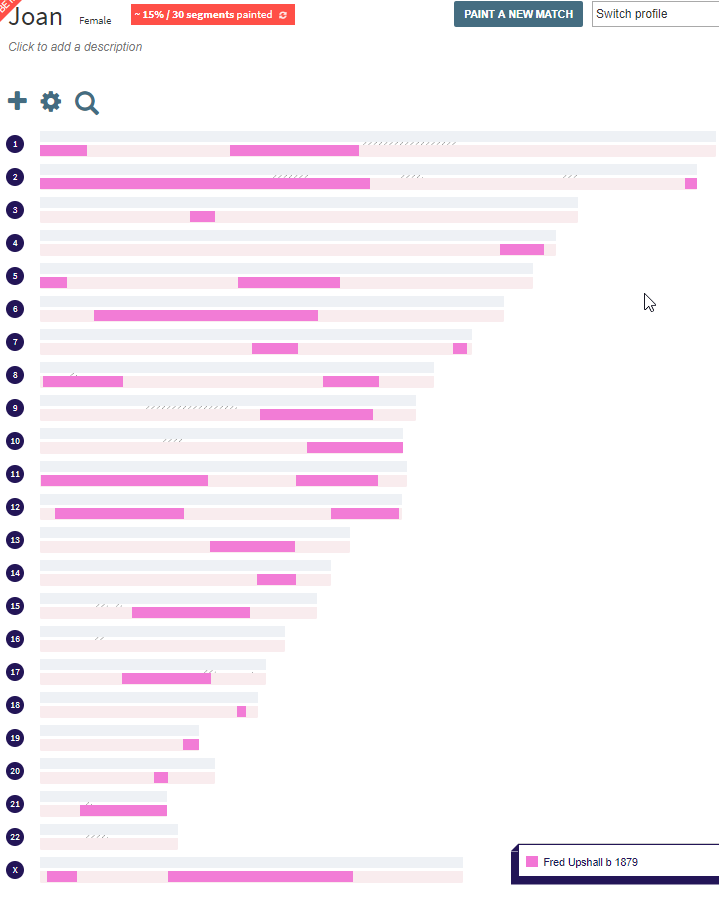
The DNA that Joan and Esther share is DNA that they got from Fred Upshall:

So with one DNA match, Joan has painted 15% of her chromosomes.

A Paternal Match for Joan at Gedmatch

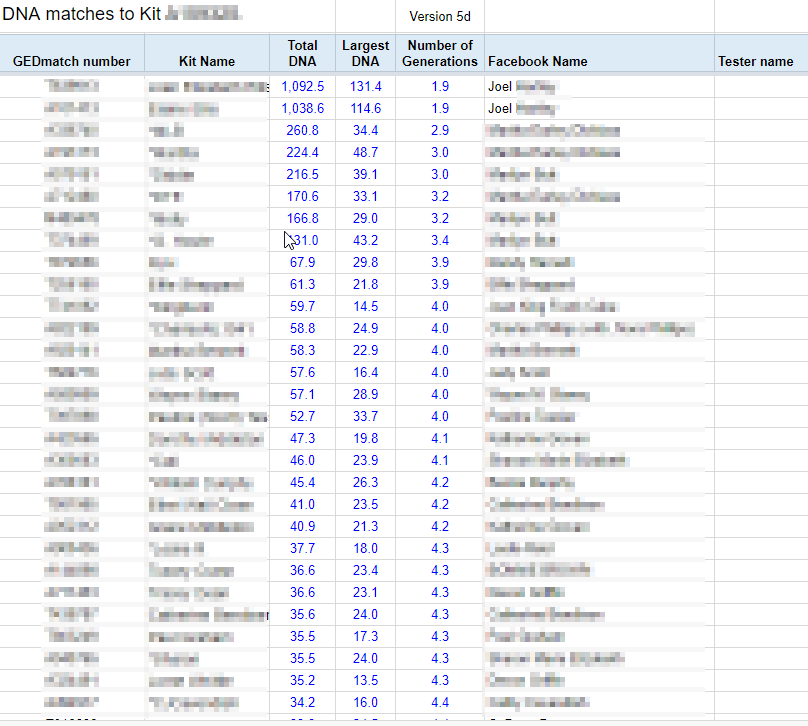
Gedmatch.com is a good place to find matches. Gedmatch has specific information on your matches that can be mapped or painted. Joan’s second match at Gedmatch is with Ken. However, the exact common ancestor is difficult to determine due to poor records in the area of Newfoundland where the Upshalls lived. Also there was some intermarrying between families. So I’ll look for one of Joan’s paternal matches so I can paint in on the blue side of Joan’s chromosomes.

Ronda is Joan’s 2nd cousin once removed. Ronda and Joan are also 3rd cousins once removed along the Ellis Line, but I’ll use this relationship. It looks like Joan and Ronda have one common ancestor, but like most people, they have two. James Ellis married Clarinda Gorrill. Ronda has her as Clarinda Gorrill Ellis. This confused AncestryDNA, so they didn’t show Clarinda as a common ancestor. I will, however, on DNAPainter:

Here is how Melissa and Joan match:

I’m not sure why Ronda and Joan had two Shared Ancestor Hints and Melissa and Joan only had one.

Melissa doesn’t bring a new color to the map, but does get Joan up to 19% painted.

A Third Color – On the Maternal Side

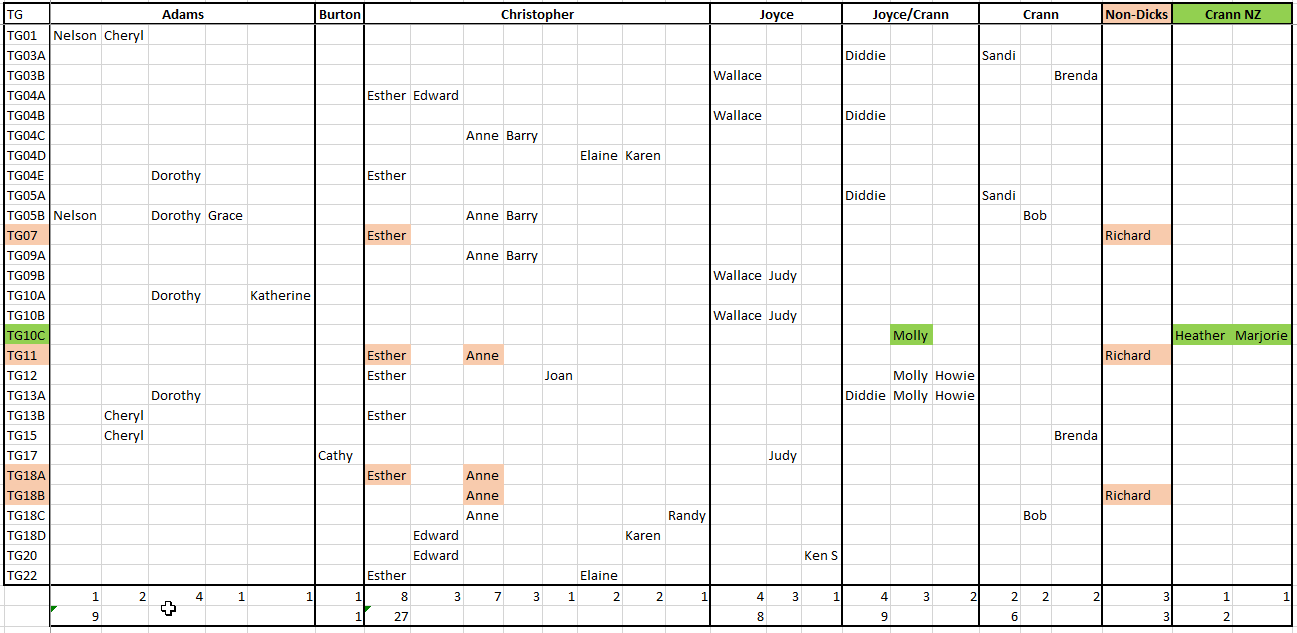
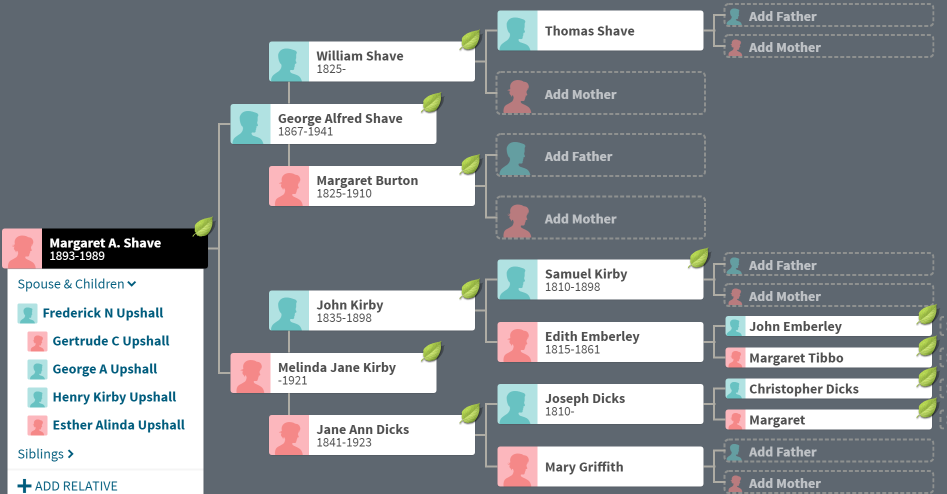
Joan has a lot of Dicks descendant relatives. The Dicks were also from Newfoundland along Joan’s Upshall grandfather’s line:

I mapped Barry because it was clear who Barry and Joan’s common ancestors were. However, we are not positive what Elizabeth’s last name was. I forgot to say that Barry was a maternal match and this is what DNAPainter does when that happens:

The match goes across the maternal and paternal side. Here I have fixed that problem:

In some places, Barry has supplied new DNA matches. In other places, they are in parts of areas already matched. Here is an expanded view of Chromosome 15:

Karen and Wallace – Upshall Relatives

I painted some of these on my wife’s Chromosomes

Jessie Kate was put in as a daughter of Henry Upshall and Catherine Dicks. I think that Wallace’s Line was better supported by a paper trail.

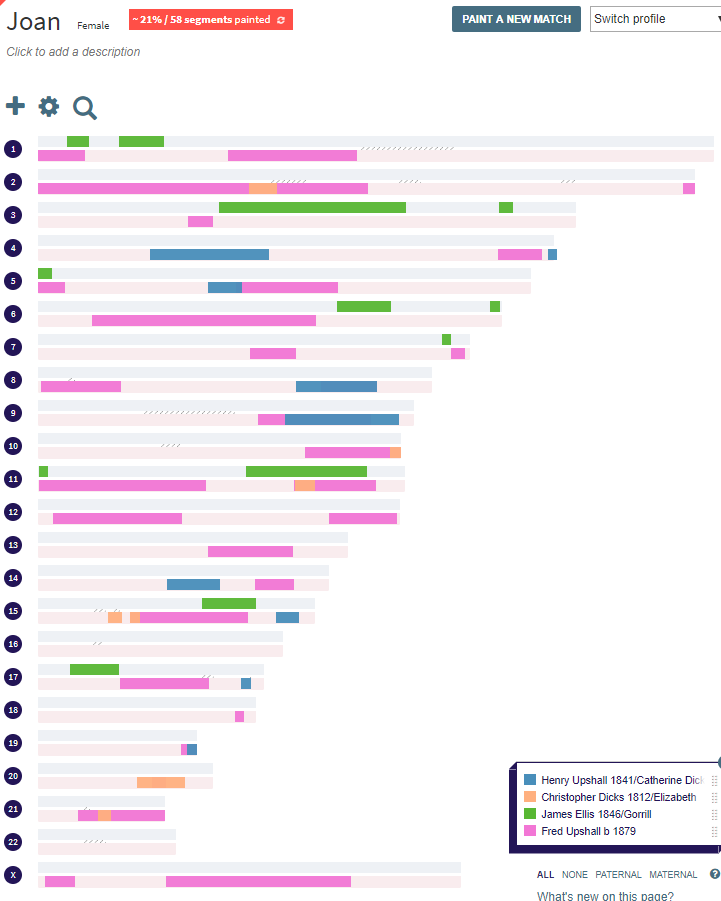
This brings Joan up to 21% painted, but is mostly on her maternal side.

Going Back in Time on the Ellis Line

Sarah adds some history to the Ellis Line:

Sarah’s match is easier to see by just showing the Joan’s paternal side:

This gets Joan’s paternal side up to 10% mapped.

More Ellis/Gorrill DNA: A Match with Mariann

Joan and Mariann are second cousins:

It helps drawing these out as I realize that Mariann’s father is Melissa’s grandfather. Mariann tested at FTDNA and Ancestry. I can show her FTDNA match with Joan:

One interesting thing is that Mariann and Joan have an X Chromosome match. This cannot be an Ellis match as the X Chromosome does not pass down from father to son. Some people ignore X Chromosome matches of less than 15 cM – especially between two women. This match is around 8 cM.

Now Joan is up to 24% painted. I also organized the key of ancestors into paternal and maternal.

Robert’s Ellis Ancestry

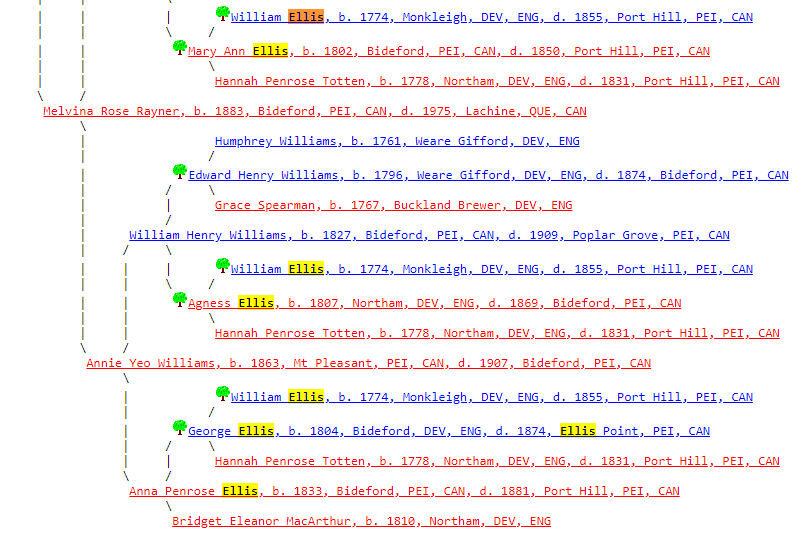
Robert and Joan also match on the Ellis side. Here is part of Robert’s tree from Gedmatch:

Robert descends from William Ellis and Hannah Totton in three ways. I think I’ll skip drawing that out. I note also that Robert also has Rayner ancestry.

Joan is a 4th cousin once removed on the Rayner Line. I said I wasn’t going to make an Ellis tree, but now I have to draw one of the three lines:

Oh my. Robert is a 4th cousin once removed on the Ellis Line. That means that Robert and Joan’s DNA matches have a 50/50 chance of being Ellis or Rayner. Isn’t that confusing.

My guess is that the Chromosome 4 match is Ellis and that the Chromosome 9 match is Rayner. It looks like Mariann and Robert should triangulate, that should mean that the Chromosome 4 match is Ellis. It would take more research to figure out the Chromosome 9 match.

Jane – A 1/2 Third Cousin

As I mentioned about Aunt Esther above, 1/2 relatives can come in handy when doing genetic genealogy. I went back and looked over information about Jane in a previous Blog I wrote about Ellis DNA and Genealogy. Here is how Jane and Joan look like at AncestryDNA:

However, both Joan and Jane descend from James Ellis. Here is the tree I drew:

Here Jane is actually a half 3rd cousin once removed to Joan. Jane descends from the Ramsay side and Joan descends from the MacArthur side. That means that any DNA that they share is from James Ellis born 1801.

Looking for Rayners and Daleys

So far, I have only found DNA on two out of four of Joan’s grandparents’ lines. I would like to find some Rayner and Daley ancestors. The Rayners were, like the Ellis’, from Prince Edward Island. The Daley’s were from Nova Scotia.

Jo-Ann and Joan: Many Common Ancestors

Jo-Ann is listed at AncestryDNA and MyHeritage. Her tree is better filled out at MyHeritage. Here is Jo-Ann’s paternal side starting with her four paternal great-grandparents:

I have circled the ancestors that are in common with Joan. I see that Jo-Ann also has an Agnes Ellis in her tree. She is probably the daughter of William Ellis and Hannah Tawton going back one more generation. That means that Joan and Jo-Ann share three sets of common ancestors in three different generations.

Here is a tree showing that Joan and Jo-Ann are third cousins:

Jo-Ann and Joan appear to also be 4th and 5th cousins. When I paint in Jo-Ann’s matches, this is the confusing picture I get:

It is confusing because on Chromosomes 2 and 4 Jo-Ann’s DNA overlaps with Sarah and Jane’s Ellis DNA. On Chromosome 6, Jo-Ann has a small overlap with Sarah. I take this to mean that on Chromosomes 2 and 4, this is Ellis DNA – even though the common ancestors are two generations away from the Hopgood match. There are segments on Chromosomes 2 and 16 that don’t match others. This could be Hopgood or Gorrill DNA. I’m not sure about Chromosome 6. I would have to compare this to other matches first.

Jo-Ann brings Joan’s chromosomes up to 25% painted.

One Last Match: Glenda

There are many avenues to follow for painting. However, some are easier than others. Glenda has her DNA at Family Tree DNA (FTDNA). I also wrote about her in my previous Blog on Joan’s DNA. Here are Glenda’s four maternal great-grandparents:

The two lines to watch are Ellis and Rayner. Here is the Ellis connection:

Like Jane, Glenda and Joan have one common ancestor: James Ellis.

Here is the Rayner connection:

Here Joan and Glenda are full third cousins once removed. They share both Commmon ancestors of John Rayner and Sarah Simmons. That means that theoretically, Joan and Glenda should share twice as much DNA on the Rayner Line compared to the Ellis Line. Here is what Glenda looks like mapped onto Joan’s map:


Here Glenda’s DNA which I have as Rayner/Simmons DNA is in red. I have only showed Joan’s paternal side for clarity. Here there is no overlap with Green or tan Ellis DNA. That means that it is not positive that this DNA is Ellis DNA. Perhaps this is mostly Rayner/Simmons DNA as I guessed.

Here are Joan’s 26% painted chromosomes:

  • The yellow James Ellis of 1801 doesn’t show as it is behind other Ellis colors.
  • I could have painted more Dicks DNA as I have a lot of information on that family.
  • This represents only 3/4 of Joan’s matches as there are no Daley side matches. There are Daley side matches at AncestryDNA, but AncestryDNA does not supply enough information for mapping DNA.
  • Joan has something mapped on every chromosome exept for #22. This is not unusual, as #22 is the shortest chromosome.

Summary and Conclusions

  • This exercise turned out to be more difficult than I expected. Three out of four of Joan’s grandparents were from Islands: PEI or Newfoundland. A lot of intermarrying went on between families within those islands.
  • I hope to find some Daley DNA eventually. One method is to ask a match from AncestryDNA to upload to gedmatch, FTDNA or MyHeritage.
  • The theoretical information I gave on DNA is on average of everyone. Individual DNA hardly ever complies with the averages – especially as the relationships go beyond second cousins.
  • Although I did find likely Rayner DNA, that has not been proven without a doubt
  • DNA matches that could be from one set of ancestors or another have to wait for other matches that are only from one set of ancestors to see if they match up on the chromosomal segments.

Caz: A DNA Tested Frazer

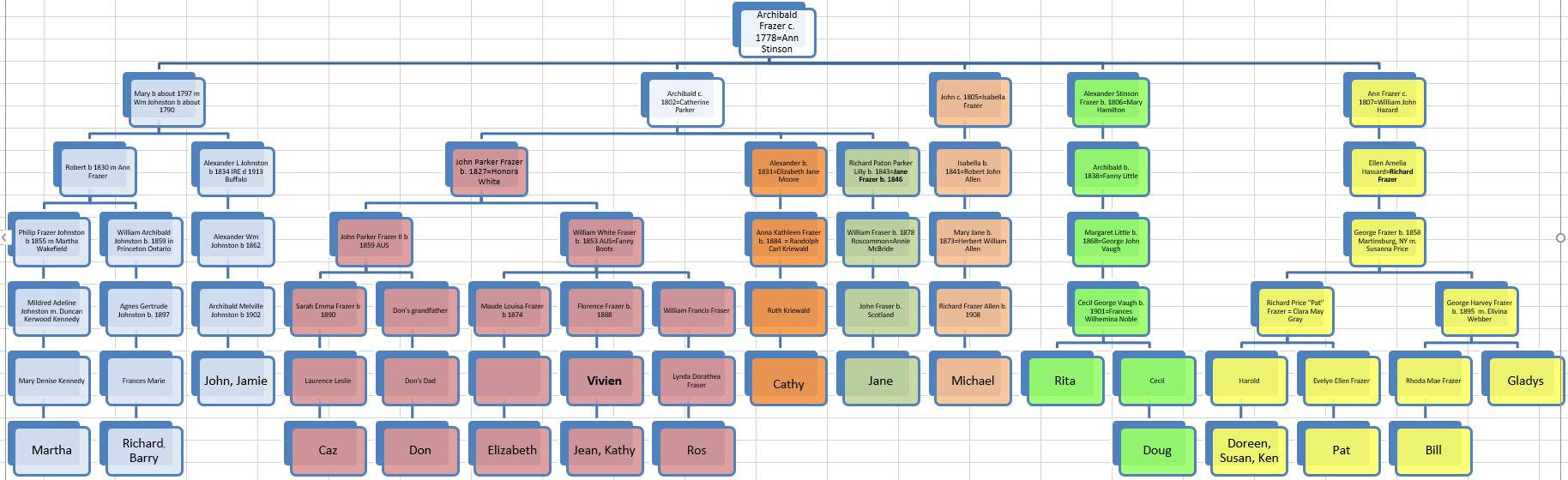
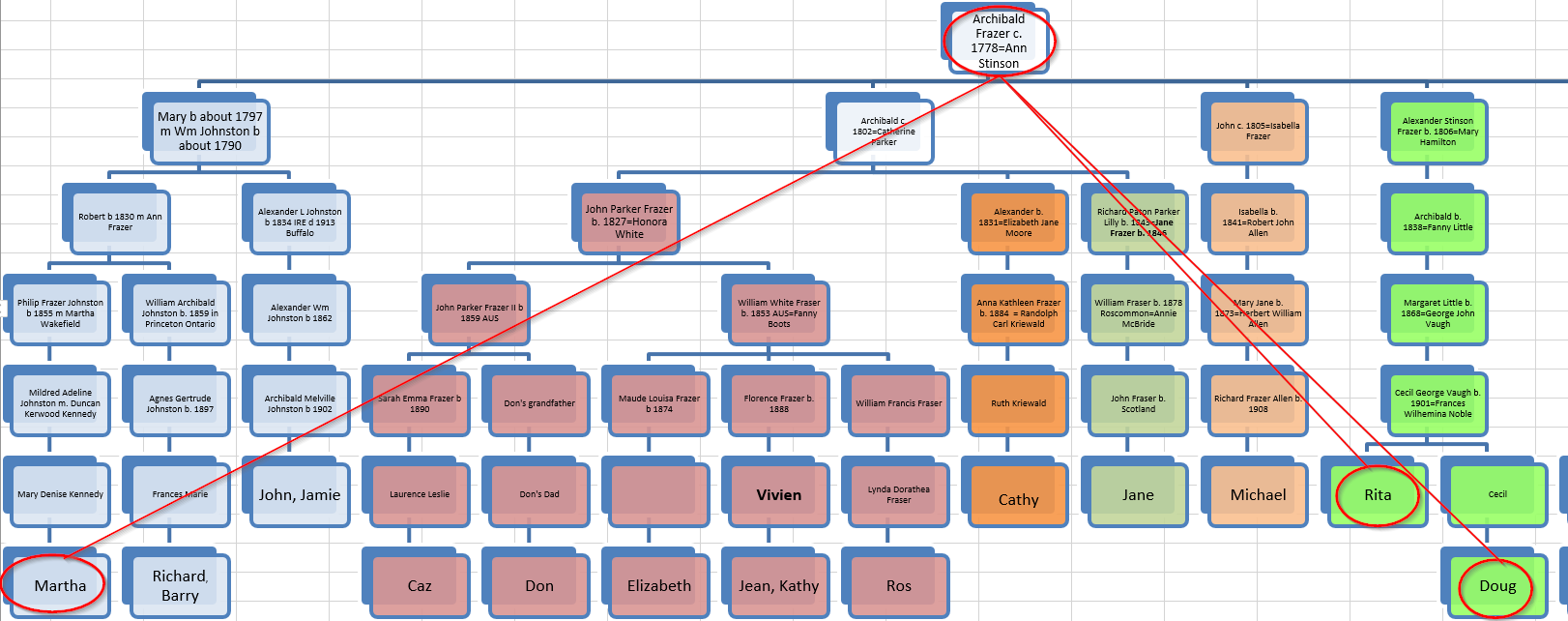
I heard from Caz recently who responded to one of my Frazer Blogs. Caz tells me that her grandmother was a Frazer. She also says that she is a third cousin to Ros. That would put her near here:

Here is a slightly bigger picture:

Fortunately, Jane gave me access to her matches and I found Caz as one of Jane’s Shared Ancestry Hints. I’ll add Caz to the Australian Line of Frazers:


This is becoming a good group.

Caz’ DNA

Here is Caz in what I call the Stinson Group:

The furthest out relationship on this branch is 5th cousin. Here are some guidelines for the chances of matching a specific cousin.

Here is what I get for the DNA for the above group:

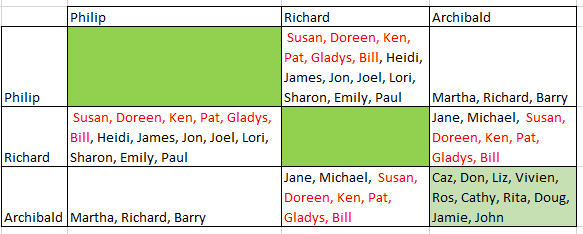
I left out the blue line as I am not as sure about them. The matrix shows how everyone matches everyone else in the group. It is a little complicated as some of the Frazers intermarried and some of these people are matching Frazers outside this specific group. Note that everyone matches each other within the Archibald Stinson/Catherine Parker Group. Everyone in that group is a third cousin once removed or closer.

Caz and Triangulation

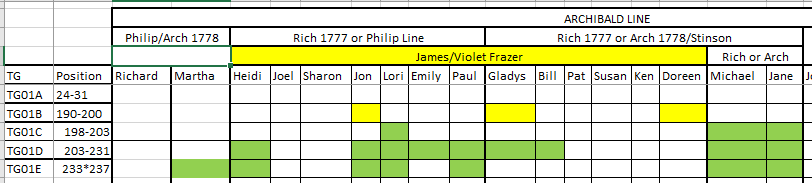
Triangulation is when three people match each other on the same segment of the chromosome. Here is one example:

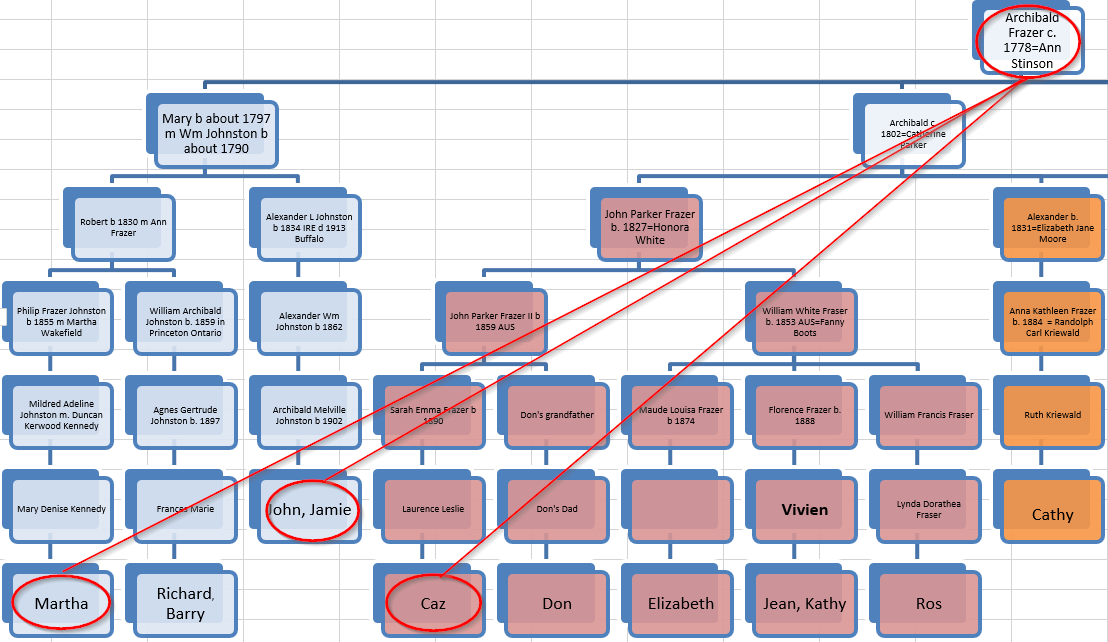
Here Caz matches Michael and Jane. For these segments to triangulate, Michael also has to match Jane which he does. Notice that Michael also matches Vivien. Vivien would be in the Triangulation Group (TG) also, but Vivien probably matches Caz below the match threshold of 7 cM.

Here is how I would show the TG on a tree:

This should be important information for Jane and Michael. That is because Jane and Michael also match on the Richard Frazer Line.

Although it is possible that the DNA is from the Richard Frazer Line, it is much more likely to be from the Frazer/Stinson Line. That is because a match between Caz and Jane or Michael would be an extra generation away.

A Closer TG

This TG is less ambiguous:

Caz, Don and Cathy are not known to be descended from other Frazer Lines.

A Frazer/White TG

When people are in a TG, they share a common ancestor.

For example these three may be sharing the DNA from either John Parker Frazer or Honora White. However, their children were Frazers, so we consider the DNA to be Frazer DNA.

This TG is similar to the second one I looked at:

In this case, Vivien replaced Don in the TG. These four TGs represent DNA from ancestors from three different generations of Frazers – from 1778 to 1827.

Caz Compared to All the Other Frazers

Here I will do a little fishing expedition to see who Caz matches and who she doesn’t. Here is what I get:

This brings up some interesting possibilities and may make me revise what I wrote above. First, let’s look at Charlene. She is on the McPartland Line. I have written many Blogs about this family. This is a small match that Caz has with Charlene, so it may or may not be valid.

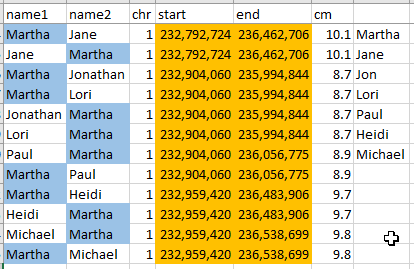
The more interesting match is on Chromosome 1. Here there are two possibilities. One is that Paul, my family (Heidi, Lori, James and Jon) and Emily all have McMaster ancestry. So the TG could be on that family. Another is that this is part of an older Frazer TG.

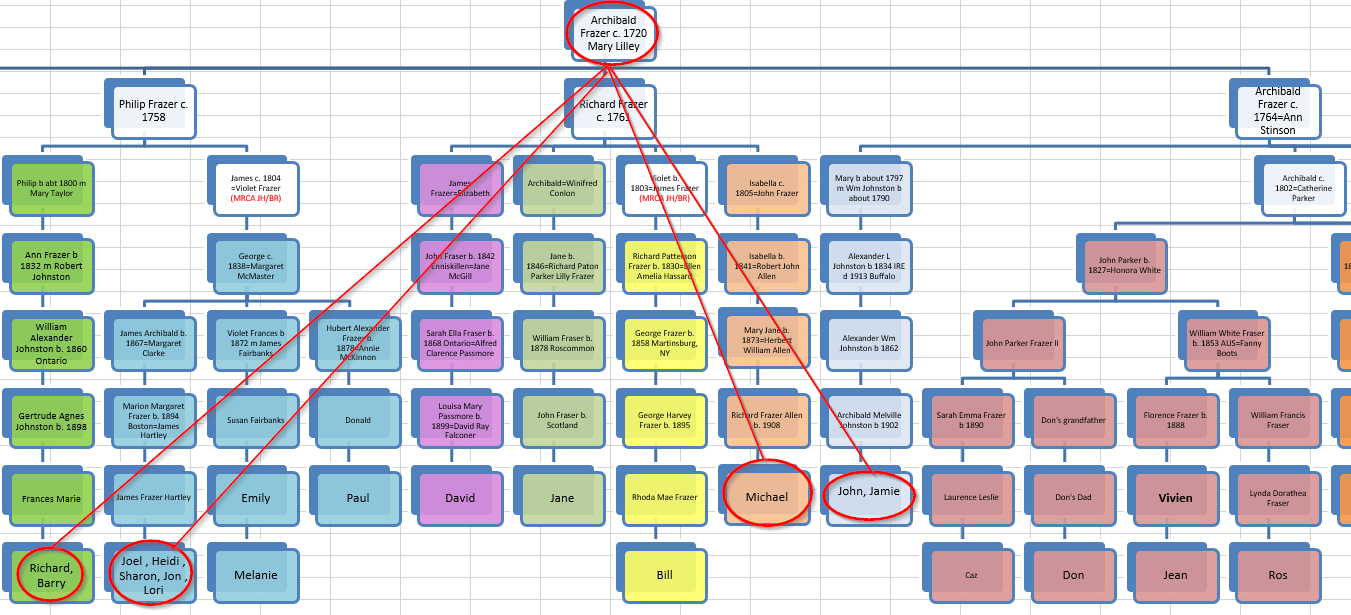
Here is what the TG with the older Frazers would look like:

Note that my blue family is also part of the Richard Frazer group. Michael and Jane are in the Richard and Stinson group. I circled Vivien because she matches some of these people but not all. I think that she would be in this TG if I lowered her match threshold levels. Probably what is happening is that Emily, Paul and my family are triangulating with each other from George Frazer. This in turn was probably DNA from George’s mother Violet who was the daughter of Richard Frazer born about 1761 (on this chart but 1777 on the other chart). The blue circled people then match Jane and Michael as part of the Richard line also. Then Caz matches everyone else through Archibald Frazer and Mary Lilly. This DNA would have come down to Caz by way of Archibald Frazer and Ann Stinson. That means that this is a multiple level TG and a rolling TG. What I mean by rolling is that others come into it at different parts of Chromosome 1.

More on the Chromosome 1 TG

Seeing as so many people triangulate at the right side of Chromosome 1, let’s take a closer look. Here is an old list of matches tha I have been tracking:

PF is my cousin Paul. MFA is Michael. MB is Mike. I don’t know who he is, but he is in the TG and is likely related. BR is Bill who is related to Gladys. LH, HHM and Jon are my siblings. VO is Vivien. At the time, the common ancestor seemed to be Richard Frazer, now with Caz in the mix, that seems to have changed.

Pre and Post-Caz TGs

I stared at the numbers for quite a while. I’ll go through the matches. They seem to sort into pre and post-Caz TGs. This will be a little in-depth, so I apologize in advance. I’ll take a tour of Chromosome 1 starting at about position 181 M. My cousin Paul is matching with Jonathan from England on some other line than the TG that Gladys, Jon (my brother), Jim and Doreen are in. I called this TG the Pre-Caz TG:


This is a fairly recent TG as it represents Frazers born in the early 1800’s:

Paul breaks away from the Jonathan from England and joins the Caz TG around position 202M.

The Caz TG is a large one consisting of ten people. I took out some of the matches as gedmatch doubles the matches and ten people all matching each other is a lot of matches. Vivien drops out of this TG at 203M. Paul joins in at 202M. My family joins in at 205M and Emily joins at 209M. This could be considered two TGs or what is called a rolling TG with people exiting and entering.

I originally had the Caz TG starting later, but Caz does match Vivien on Chromosome 1 if I lower the threshold:


Here is the much older Caz TG:


This is a more detailed description of the TG I discussed earlier in the Blog.

The Post-Caz TG

In the Post-Caz TG, Caz and Emily drop out and Bill joins the group:

However, Michael and Jane are still in the group, so that makes this Post-Caz TG a Richard Frazer TG. Here are some of Michael’s matches:


I went back and did a more detailed analysis. Caz dropped out of the above TG but dropped into another one.

Here she is with Don and Cathy:

My normal guess would be that they share Parker DNA because they are overlapping another Frazer TG.

However, with multiple Frazer Lines I wouldn’t want to say that for sure.

Summary and Conclusions

  • I’m glad that Caz got in touch and that I was able to look at her DNA results.
  • Caz added some good depth to the Frazer/White Line of Australian Frazer descendants.
  • Chromosome 1 has been a hotbed of activity for many Frazer matches. Caz added some clarity to those matches and TGs. That is probably because she only matches on one Frazer Line – The Archibald/Stinson Line.
  • Using Caz’ DNA results I was able to take a detailed look at the many matches on Chromosome 1 and sort out the different TGs. These TGs represent four sets of ancestors in three different generations. These Frazer relationships are complicated by the fact that it appears that two sets of Frazer first cousins married each other.

Painting My Wife’s Chromosomes

In this Blog I’ll paint my wife’s chromosomes. I use DNAPainter for this. This utility requires a subscription for over one painting, and I’m over that now, so I subscribed. Painting DNA is taking all your DNA matches and painting them onto your chromosomes. The match that you have shows that you have DNA from a common ancestor. So what I will be showing is where my wife, Marie, inherited her DNA on which chromosome and from which ancestor. Hopefully, it will become clear as I go along.

Right now I have profiles for my mother, myself and two siblings:

Next, I’ll create a profile for Marie. DNAPainter just needs to know her name and that she is a female. This makes a difference for the X Chromosome as women have two of those.

Which Matches Do I Paint for Marie?

I will look at painting no matches closer than those that represent Marie’s grandparents. That means that I don’t want to count matches from 1st cousins. Full 1st cousins share two grandparents. The first two people who I will paint will be Marie’s father’s 1st cousins Patricia and Joe. That makes them first cousins once removed to Marie.

Marie’s match with Patricia and Joe will show up on her map as DNA from Joseph LeFevre and Emma Pouliot. That is because we don’t know who the DNA came from. It should be part LeFevre and part Pouliot. Here is Marie’s match with Patricia from Gedmatch.com:

Here is what that looks at DNAPainter:

The DNA is on Marie’s paternal side, so that is on the blue bar. The key at the bottom says who the DNA is from. Now Marie has gone from zero to 7% of her chromosomes painted with adding just one cousin:

Marie also matches Patricia on her X Chromosome. So I added that. Next I need to add Patricia’s brother Joe. This time I’ll paste in his X Chromosome match along with the other matches. Gedmatch has you do a different query for the two. Adding Joe brings Marie’s painted DNA up to 10%. Now we can expand the Chromosomes to see the details:


The X Chromosome expands to this:

This shows that Joe shares more X Chromosome with Marie than Patricia does. Next I added RL who matches only on the LeFevre side as far as I know. This added 1% to Marie’s map and got her up to 11% mapped.

Here is Marie’s match with RL on Chromosome 12. Where RL matches Joe, that is likely all LeFevre DNA. On the right where RL does not overlap with Joe and Patricia, we don’t know if the DNA was from the LeFevre side or Pouliot side.

[Note: I have RL in the wrong color which I correct later in the Blog.]

Adding Some Pouliot DNA

Marie has some matches with Pouliot only DNA. These matches are with Fred, Don and Sleuth:

Now, wherever Marie has a match with Fred and Patricia and those matches overlap, that will show that the match with Patricia was on the Pouliot side and not the LeFevre side.

Here is a new color and this gets Marie’s painted chromosomes up to 13%. Here is Don on expanded view on Chromosome 1:

The green overtook the pink in the expanded view. This is OK as Pouliot is the more specific match and the older one. This tells us that Marie’s match with Patricia on Chromosome 1 is from the Pouliot side and not the LeFevre side. Next I added Don’s two siblings to bring Marie’s painted DNA up to 14%

So far, I have painted 6 matches to Marie’s paternal side. This represents only one of her grandparents – the LeFevre side. This 14% represents 27% of Marie’s paternal side DNA.

Starting Marie’s Maternal Side DNA Painting

Marie has Ellis and Upshall grandparents on her maternal side. Marie matches her half great Aunt Esther on the Upshall side. The half part is important as it narrows down the match to one of Marie’s great-grandparents.

This brings Marie’s mapped DNA up to 20%. So we are one fifth complete.

Here I wanted Frederick on the bottom as he is on the maternal side. I also added a line by choosing Joseph LeFevre/Emma Pouliot. I then chose Edit Group and I checked a box saying I wanted a line below this group.

More Painting

I don’t want to stop now. Marie’s next match at Gedmatch is a first cousin once removed, but he is a younger cousin. He shares two of Marie’s grandparents as common ancestors, so we won’t map him. After Nick is Gaby. Gaby is Marie’s second cousin on Marie’s paternal side. This match represents Marie’s Irish side.

This brings Marie to 23% mapped:

Next: More LeFevre DNA

Sandra has been a big help in uploading her DNA to Gedmatch. She tells me that she is a third cousin to Marie. Their common ancestors are  Edmond Lazare Lefevre and Leocadie Methot.

Sandra manages three DNA kits including her own that are close matches to Marie. I assume that they all have LeFevre and Methot common ancestors. I mentioned RL above but didn’t put in the correct common ancestor.

Here I will want to move RL to another group, but I haven’t set up that group yet, so I’ll add KK first.

Here I have added a new pair of ancestors for Marie on her maternal side with a splash of tangerine. I moved the ancestral pair down one on the key so they would be with the other LeFevre’s. Next I moved RL to the Edmond LeFevre Group. I see now that I could have created a new group before also.

I then added Sandra which brings the mapped number of segments up to 116.

Adding Anne to Marie’s Maternal Side

As I go down the list, it takes a little bit more to figure out where the people fit in. This looks to be the right tree for Anne:

Marie is Joan’s daughter, so that makes Marie a second cousin twice removed to Anne. So we are quickly back to about 1812 with Marie’s DNA.

This is only the second maternal ancestral pair. Unfortunately, I don’t have a last name for Elizabeth. Crann would be a guess. We still have no ancestors for Marie’s fourth grandparent: Ellis.

Ronda: An Ellis Match for Marie

Ronda is next on the list at Gedmatch:

Ronda is a third cousin to Marie. Note that there is another shared ancestor hint. However, it is further out and also on the Ellis line.

As this is a new grandparent match, it means that there will be no overlaps with any other matches and this brings Marie’s painted DNA up to 26%.

An Unknown Upshall Side Match

The next match going down the Gedmatch list is Leslie. Unfortunately, I can’t see an obvious common ancestor for Leslie and Marie. I’ll have to wait until I find one.

After the unknown is Sarah. I was able to find her at AncestryDNA. She has a Shared Ancestry Hint with Marie:

This is Marie’s first painted DNA from the 1700’s. The new matches are on the maternal sides of Chromosomes 2, 4, and 6.

On Chromosome 6, I circled one of Marie’s crossovers. That is where her DNA crossed over from her Upshall side in light blue to her Ellis side in teal and orange. The actual location of the crossover is where the blue changes to teal.

Next is another unknown match. This is with Bobby. I can tell that the match is on the Ellis side, but not exactly where. I do see that Bobby also has his DNA at FTDNA. However, the tree is not all filled out there either.

Next is Danielle. I can tell by Shared Matches at AncestryDNA that she is related on the LeFevre side, but the detailed tree is missing also.

Karen and Martha with Newfoundland Roots

Newfoundland Roots means the Upshall side for Marie. I don’t have a good tree for Karen, but I have blogged about her. Based on her DNA, I have theorized this tree:


We’ll say I’m right. I have that Henry Upshall married Catherine Dicks. I added Karen’s match on Chromosomes 8 and 9 in lilac:


For Martha, I have another best guess tree:

Actually, this is double made up as we cannot easily prove that Peter Upshall is the father of Henry Upshall. However, this is a best fit tree. Marie would be a third cousin once removed to Martha’s maternal aunt. I believe that M.B. is Martha’s maternal aunt.

The good news is that I’m getting more maternal side matches for Marie. The bad news is that paperwork in Newfoundland is missing and it is hard to verify the last two matches.

Michelle at FTDNA on the LeFevre Side

I mentioned FTDNA above. Marie has matches there also. Here is an interesting one with Michelle. Michelle is related to Marie only on the LeFevre side:

Michelle’s maternal grandparents were Martin LeFevre and Mabel Ford. Marie’s great-grandparents were Martin LeFevre and Emma Pouliot. Emma died and Martin remarried Mabel. Here is Marie’s match with Michelle at FTDNA:

Transferred to DNAPainter:

I now have an entry for Joseph Martin LeFevre by himself as well as the couple of Joseph LeFevre and Emma Pouliot.

More Maternal DNA for Marie on the Upshall Side: Edward

Edward and Marie have this common ancestor:

Here Marie and Edward are fourth cousins. They have a common ancestor of Christopher Dicks and Elizabeth Crann. I’m not positive about the Crann. Here I made a couple of mistakes:

First I forgot to assign this to the maternal side and secondly I already had an entry for Christopher Dicks. Fortunately, DNAPainter had a way for me to merge this group into the right one on Chomosomes 9 and 11 (Chistopher Dicks in purple).

This gets Marie up to 150 segments mapped.

Marie and Wallace at MyHeritage

Marie has a good match with Wallace at MyHeritage. I uploaded Marie’s results there while writing this Blog.

Here is where I have Wallace:

Wallace is a 2nd cousin once removed to Marie. At this point, Marie’s maternal chromosomes are 22% filled in and her paternal chromosomes are 36% filled in. A lot of paternal LeFevre relatives have tested. Here is Marie’s maternal side only:

That is what 22% filled in looks like.

Adding Cheryl and More of Martha’s family

Cheryl has Dicks ancestry. I have written many Blogs on this family and how their descendants match up by DNA.

Cheryl is on the bottom left. She is a fourth cousin once removed to Marie. As there are some missing lines in Marie’s Newfoundland genealogy, there may be other ways Marie is matching some of these Newfoundland descendants. Here is how Cheryl compares with some others on Chromosome 9:

The light blue represents Christopher Dicks born 1784 or his wife Margaret. Many people descend from this couple.

Next, I’ll add Martha’s brother and Martha. Some of these matches are not adding new DNA.

Back to LeFevre

Here is a match on the LeFevre side:

This is on the French Canadian side. Note that there are two other pairs of shared ancestors. However, this is the most recent.

This is Marie’s first mapped French Canadian DNA from the 1700’s (in red). It is interesting that Marie and Kbou also match by XDNA. In order for this X match to occur, there cannot be any two males in a row in Marie’s or Kbou’s ancestries. Looking at their trees above we see that is indeed true. This match brought Marie’s mapped chromosomes up to 30%.

I could keep on going, but I’ll stop here.

Summary and Conclusions

  • I mapped 30% of Marie’s chromosomes using DNAPainter and matches from Gedmatch, FTDNA and MyHeritage. AncestryDNA was helpful to provide trees but it does not provide the detailed DNA information needed to map the chromosomes.
  • I was able to paint 10% of Marie’s chromosomes with two of her first matches. After that, things went more slowly.
  • Of Marie’s four grandparents, Butler matches are the most rare. Marie had one Butler match.
  • I gave an example of a crossover.
  • Marie has DNA mapped on every chromosome. However, a paternal or maternal side may be missing.
  • It would be interesting to create a DNAPainter map for Marie’s mother and father and see how they compare to Marie’s map.

My Closest DNA Match at MyHeritage with Unknown Connection

Blaine Bettinger has a knack for posting polls at the Genetic Genealogy Tips & Techniques Facebook page. A recent one was:

TODAY’S POLL: how much DNA do you share with your closest ‘unknown’ match at MyHeritage? Unknown = you haven’t yet placed them in your tree. 

My Closest Unknown Match: Molly

It turns out my closest match is Molly. She also matches my mom which is a good hint. Here is how Molly matches my mom by DNA:

On interesting thing I just noticed about Molly is that she is age 20 or below. My mom is 96. I am guessing that there could be a two generation gap between Molly and my mom. Molly was born in 2003, so there could even be a three generation difference. Molly has a tree, but her parents and grandparents show as private. I assume that they are all still living. I have sent a message to Molly, so perhaps she will write back.

Shared Matches between Gladys and Molly

MyHeritage shows shared matches between my mom, Gladys, and Molly:

Beth is mom’s second closest unknown match and also matches Molly – though more distantly. Danielle and Bridget show icons which means that they have triangulating DNA. This is specific matching DNA that has come from a common ancestor.

Beth’s Family Tree

Beth has a pretty good family tree:

Here is my mom’s tree:


Beth’s Schroek side is from Pennsylvania. My mom’s mom was from Pennsylvania, so my theory right now is that the common ancestor is on my mom’s mom’s side on the bottom side of her above tree.

A Pote Connection

Looking a little more closely at Beth’s family tree, I see a Pote connection. My mom has no Pote in her ancestry, but she does have Nicholson and a collateral line married into the Pote family. That seems like a likely connection. Here is what I have at Ancestry:

This shows the Schroek/Pote/Nicholson connection differently than the tree Beth has.

Here Beth has Martha N. Schroek. Her maiden name by my tree should be Pote. Beth also has Sarah Pote whose maiden name should be Nicholson. So the issue is mainly one of maiden names. However, Beth has Sarah Pote’s father as Sampson Pote, where I believe her father should be William Nicholson who is my mother’s great-grandfather.

Beth must have already been on my radar as here she is in a Nicholson Tree:

Beth shows as a 2nd cousin once removed to my mother.

What About Molly?

I mentioned above that I don’t have Molly’s tree. However, I can make a good guess as to where she is on the tree. Molly is probably at the level of Joshua and has as her ancestor Annie Nicholson born 1865 in Sheffield, England. That would make Molly a 1st cousin, three times removed to my mom.

Here are some statistics:

Molly would be at the top end of a 1st cousin three times removed or in a more reasonable range for a 1st cousin twice removed from my mom.

Going Down Molly and Gladys’ Shared Match List: Annette

Annette is after Beth on Molly and Gladys’ shared match list. It looks like Annette has a good tree with some common ancestors.

This shows that Gladys and Annette share Baker, Faunce and Peol ancestors.

The Philadelphia Bakers

Annette and Gladys are third cousins:

From what I can tell, Conrad Baker was a successful fisherman in Kensington in present day Philadelphia:

Here we see in the 1850 Census: Catherine and Mary and even a Pote. If I have it right, this part of Kensington is called Fishtown today.

Painting the Baker/Faunce common ancestors.

I use DNA Painter to paint common ancestors. Here is what I have for my mom so far:


Here’s my mom’s “new” Baker/Faunce DNA in light blue on Chromosomes 3 and 11:

I don’t think this DNA got passed down to me as I didn’t see a match between Annette and me at MyHeritage. This brought my mom’s mapped DNA up from 22% to 23%. On Chromosome 3, the change from brown to blue represents a crossover my mom has from her Nicholson grandparent side to her Lentz grandparent side.

Molly’s Next Shared Match with Gladys: Danielle

The good thing about Danielle is that she triangulates with my mom and Molly:

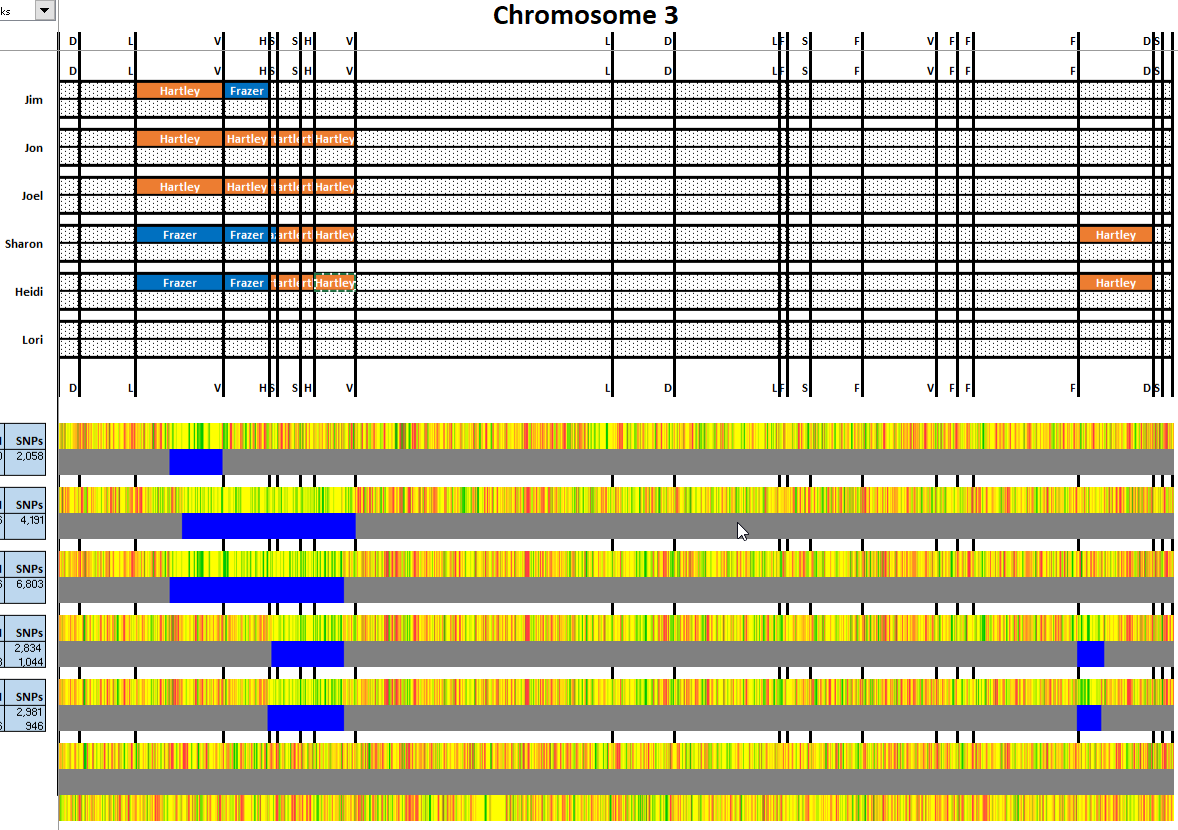
The area where the triangulation occurs is on Chromosome 3.

Here is Danielle’s tree:

Here is another tree I found at Ancestry:

This was more filled out but was missing Leon Edwards. Ancestry has Danielle and my mom as distant relatives. So it may be difficult to find common ancestors. However, I didn’t see any obvious family name matches to people in my mom’s known ancestry. I’ll just have to wait until later to solve this mystery. Danielle’s ancestors were from the same areas as my mom’s, so the potential is there for finding a common ancestor.


Summary and Conclusions

  • A question by Blaine Bettinger lead to some DNA and genealogical research at MyHeritage
  • I didn’t figure out how I am related to Molly but guessed at a relationship to my mom and a possible Nicholson or Lentz ancestry.
  • I re-found Beth with a shared Nicholson ancestry.
  • I found Annette who has an interesting connection to my mom on the Baker/Faunce line from early Kensington in current day Philadelphia. I was able to “paint” this DNA to my mom.
  • I found a person triangulating with Molly and my mom, but was not able to find a common ancestor.

A Kerivan Match to My Wife’s Aunts

I’ve had a few messages from Jack. He shows as a potential 2nd cousin match to my wife’s aunt Virginia. Here is Jack’s tree at Ancestry:


Here is Virginia’s tree:

Due to the dates, it could be that Jack’s great-grandfather George E Kerivan was the son of Virginia’s John Kerivan. If I expand Virginia’s tree, I get this:

That means that Jack and Virginia have the common ancestors of John Kerivan and Alice Rooney. That would make Virginia and Jack 2nd cousins, once removed. Here is a top down drawing of how Virginia and Jack are related:

When I run shared matches at AncestryDNA between Jack and Virginia, John and Gaby also show up.

More of Jack’s Relatives at AncestryDNA

I also see Donna and Dott at AncestryDNA. Here is Donna’s tree:

That would make Donna Jack’s mother or aunt.

Here is Dott’s tree:


How Does Sandra Fit In?

Sandra is a 2nd cousin once removed to my wife’s Aunt Lorraine (and her Aunt Virginia and her dad).

It turns out that Thomas was an older brother to George and Lillie. Thomas married Catherine Collins:

I had a message from Ancestry from Jack saying his mom is Donna. That means that the tree would look like this:

More Specific Information at Gedmatch.com

My wife’s family and Gaby have uploaded their DNA results to Gedmatch.com. John and Gaby have also. If Sandra, Jack, Dott and Donna uploaded their DNA to Gedmatch also, we would be able to see exactly where the Kerivan and Rooney DNA is coming from. We would be able to see on which chromosome they match.

Summary and Conclusions

  • My wife’s family has great matches with Jack, Dott, Donna, and Sandra on the Kerivan/Rooney side.
  • These matches are on the order of 2nd cousin. Second cousin is an important relationship as it defines a grandparent side.
  • If Sandra, Dott, Donna and Jack were to upload their DNA results to gedmatch.com, we would be able to see exactly where the Kerivan and Rooney DNA is coming from. It is possible that there would be more Kerivan matches found also at Gedmatch.


An Adoptee’s Match with My Wife’s Mother and Aunt

I recently had a message from an adoptee named Martha. Martha was understandably enthused about a match she had with my wife’s Aunt Elaine and mom, Joan.

Martha’s DNA Matches

Here is how Martha matches Aunt Elaine:

Based on the match, MyHeritage puts Martha and Aunt Elaine between 1st cousin twice removed and 2nd cousin twice removed.

Here is how Martha matches Elaine’s sister Joan:

The big difference is that Elaine had a match on Chromosome 19 with Martha that Joan did not. Joan and Martha are said to be between 3rd cousin and 5th cousin. I find it interesting that MyHeritage distinguishes between 2nd cousin twice removed and third cousin as from a DNA standpoint, I would think that they would be quite similar.

Martha and Joan at FTDNA

Martha and Joan are both at FTDNA. Martha mentioned that she and Joan match on the X Chromosome, but I don’t believe that the match is significant:

My understanding is that a match between two women of less than about 15 cM is not significant. These matches are all below 7 cM and are quite tiny. I suppose that the matches could represent some type of general ethnic similarity.

Where is the Common Ancestor between Joan, Elaine and Martha?

If Martha is a 3rd cousin with Joan and Elaine, that means that their common ancestor would be back 4 generations. MyHeritage shows Shared Matches which come in handy:

Joan and Martha’s first shared match is, of course, Elaine. After that, the next match is Vance. Let’s look at his tree:

The father’s side is missing. However, I did find this additional information on a Family Tree at Ancestry:

That gives me a better feeling about Vance’s family tree.

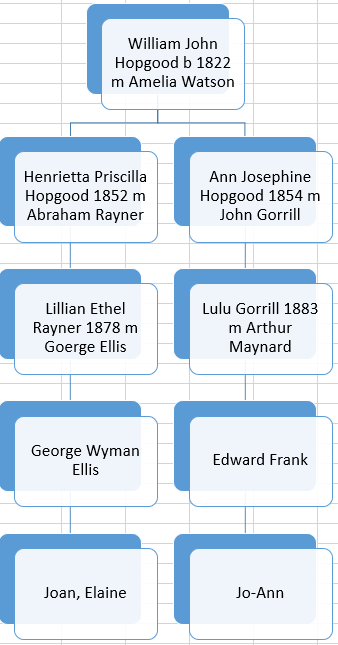
Here is Joan’s father’s tree. It seems like Martha and Joan must match in PEI:

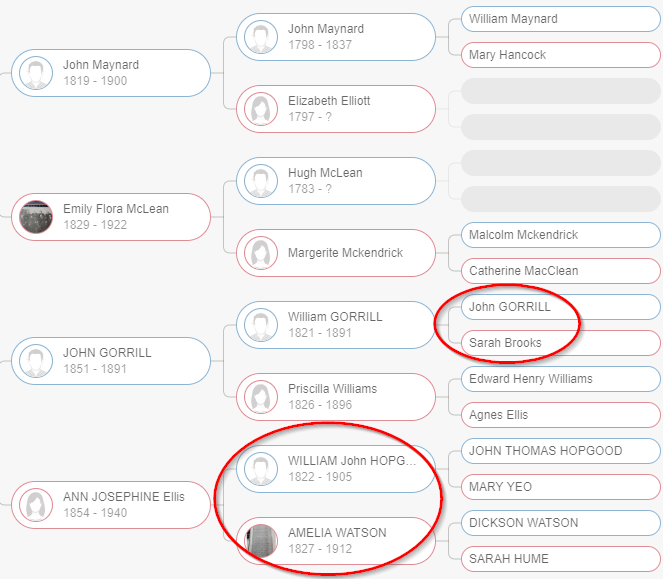
George Ellis and Lillian Rayner are Joan’s paternal grandparents. My guess is that Martha and Joan may match on more than one line. The two names I see in common in the tree of Vance and Joan are MacArthur and Yeo. However, MacArthur appears more recently in Joan’s tree than Yeo. So this may be the closer match.

Back to the DNA and Triangulation

Using Triangulation, we can know where Martha, Vance, Joan and Elaine have common DNA. This DNA should correspond to a specific common ancestor.

This shows that Joan, Martha and Vance triangulate on Chromosomes 4, 17 and 18. I checked between Elaine, Martha and Vance and the triangulated segments are the same.

Martha at Ancestry

Martha also tested at Ancestry. At AncestryDNA, Martha and Elaine are predicted as 4th cousins which is a big difference from what MyHeritage showed. Based on the color mapping of Elaine to her four grandparents, it seems like Martha matches on the Ellis side rather than the Rayner side.  This type of mapping is also known as the Leeds Method. Based on this, my best bet is that the match could be through the MacArthur side.


This seems to be confirmed by the spreadsheet that I have for Joan:

Based on past research I had found a common ancestor of MacArthur/MacDougall. This was for a DNA match that Joan and Barry had right at the spot where there were triangulated segments on Chromosome 4 between Vance, Joan, Elaine and Martha.

Summary and Conclusions

  • Different testing companies have different ways of representing what relationship the test results represent. AncestryDNA turns out to be fairly accurate.
  • I looked at common matches at Ancestry between Elaine and Martha. These seemed to put Martha and Elaine’s match along the Elaine’s Ellis ancestry Line.
  • Martha, Joan, Elaine and Vance triangulated at MyHeritage. Vance had Yeo and MacArthur in his ancestry which was shared with Joan and Elaine. However, the MacArthur ancestry occurs more recently in Joan and Elaine’s ancestry.
  • Joan’s worksheet shows that I had identified MacArthur as a common ancestor with another match on Chromosome 4. This was in the same place as the triangulated segments between Vance, Joan, Elaine and Martha. Right now, MacArthur seems like the best bet for a common ancestral surname between Martha and Elaine. Assuming that Malcolm MacArthur is the common ancestor, that would make Elaine and Martha about 4th cousins. The DNA matches could be higher due to matches on other more distant lines.


More on My DNA Matches with My Latvian Cousins

In my previous Blog on Anita and Inese, my Latvian cousins, I went answered some questions that they had on DNA. However, I didn’t get to look at other common matches that I have with Anita and Inese.

Latvian Matches from Different Testing Companies

Anita and Inese tested at MyHeritage. This is a good testing company. However, other people test at different companies, so different analyses are needed based on what the companies have to offer. One good solution is to upload your DNA results to Gedmatch.com where the results from different testing companies can be compared. Anita and Ines have done this.

Otis  with Schwechheimer and Gangnus Ancestry

One of my closest DNA matches is Otis. His ancestors are from Latvia. My Latvian ancestors are for the most part German and lived in the German colony of Hirschenhof. This is the somewhat complicated tree showing how I am doubly related to Otis:

Now I need to add some closer relatives:

Note the double relationship to Otis. I also notice an extra Gangnus connection:

This shows that Charlotte Gangnus married a Schwechheimer and had Rosine who married a Rathfelder and had my mother’s grandfather Heinrich Rathfelder. Heinrich married Maria Gangnus. Here is a Gangnus tree:

This shows that Heinrich Rathfelder married Maria Gangnus who was his 3rd cousin. On the Gangnus side, I am a 4th cousin and a distant 6th cousin to Otis. On the Schwechheimer side, I am the same 4th cousin and a 5th cousin. This tree could also be drawn out wider to include Rusty, Cindy, Catherine, Anita and Inese. However, it would be quite wide as much of the tree would be repeated twice.

Otis and Triangulation Groups (TGs)

Otis is in several triangulation groups (TGs). Here is one of the largest ones on Chromosome 3:

A triangulation group is where three or more people match each other. It means that they have common DNA that came down from a common ancestor. When there is only one pair of most common ancestors, this makes things easier. In this case where there are three sets of common ancestors, I assume that the match is on the most recent of the common ancestors. This represents DNA from the latter part of the 1700’s.

It is also less likely that the match represents Markus Schwechheiner or Georg Gangnus. However, Otis and Gladys (my mom) and Otis and Cindy have relatively large DNA matches which likely represents the closer relationship. I didn’t include myself or my siblings in this analysis as each sibling gets half the amount of DNA each parent has.

Astrid’s Rathfelder DNA

Here is a tree I worked out for Astrid:

This was a difficult tree. The strangest thing was that Hans Jerg Rathfelder had two children both by the name of Johann Georg. He must have really liked that name. Apparently one child went by Johann and the other by Georg. Here I should note that Hans Jerg married Juliane Bittenbinder. This is important because a DNA match to Astrid could be either from Hans Jerg or Juliane. The good news about this tree is that there aren’t any obvious double relationships like we had with Schwechheimer and Gangnus.

A Few Problems with the Rathfelder Tree and with Astrid’s DNA

The problem with Astrid’s tree is that there were two Adeline Wilhemine Rathfelders. One was born in 1838 and one was born in 1844. If the 1844 Wilhemine was the mother of Friedrich Spengel, she would have been 15 at his birth.

In my Blog on Anita, I pointed out that the DNA matches as reported at Gedmatch showed that there should be a closer relationship to Astrid based on the DNA:

Here is what the alternative (younger Wilhemine) tree looks like:

This changes Astrid from a 4th cousin to my mom Gladys to a 2nd cousin once removed. Using the same analysis as above, I get this:

Here, the young mother tree seems to be a better fit by the DNA as seen at Gedmatch. This was the original idea that I had. So for now, I will just put those two trees out there until more information comes to light. In summary, the first analysis showed that the actual DNA matches were one generation closer than shown by the tree. By the second analysis, the DNA suggested that the relationships were about 1/3 generation further away than the young mother tree.

Any Help from Ancestry on Astrid’s Tree?

Astrid’s sister Ingrid has been tested at AncestryDNA, but the results have not been posted to Gedmatch.com. Ancestry estimates that both Astrid and Ingrid are 4th cousins to Gladys. That would support the tree #1 theory.  Here is my mom’s match to Astrid at AncestryDNA:

Here is how that same match looks like at Gedmatch.com:

Gladys and Ingrid’s DNA at Ancestry DNA

This shows that my mom’s DNA match with Ingrid was 75% lower than my mom’s match with Astrid.

This table shows that AncestryDNA favors Tree 1:

Under Tree 1, my mom is a fourth cousin to Astrid. AncestryDNA estimates a fourth cousin by DNA. My siblings and my cousin Cindy are all fourth cousins, once removed under Tree 1. By AncestryDNA my siblings are a fourth cousin and Cindy would be a fifth cousin.

Another consideration is that if Tree 2 or the young Wilhemine Rathfelder tree were the correct one, perhaps Otis above would be more likely to be matching with Astrid by DNA on their Schwechheimer side. Under the young Wilhemine scenario, Otis and Astrid would be 4th cousins and would have a greater than 50% chance of matching each other. However, at Gedmatch, they don’t match each other. This is not proof that Tree 1 is right, but just possible supporting evidence. Unless, I think of another reason, I will stick to my original tree for Astrid and her sister Ingrid.

Triangulating with Astrid

On Chromosome 10, Astrid matches Catherine, Inese and Anita:

If we have the right tree, the TG would look like this:

Anita’s TG on Chromosome 17

Perhaps Alexander got the Chromosome 17 Rathfelder DNA and Leonhard got the Chromosome 10 Rathfelder DNA.

Wolf at MyHeritage

Wolf had his DNA tested at MyHeritage. This is the same place where Anita and Inese had their DNA tested. I wrote a Blog about him here. Like many others descending from the colony of Hirschenhof, it seems like I match Wolf on different lines. The closest match is through Schwechheimer, like with Otis above.
The difference is that I match Wolf a generation earlier than I match Otis. Here is how Gladys and Wolf match at MyHeritage:

Gladys’ Latvian Matches at AncestryDNA

It is possible to group matches by looking at shared matches at AncestryDNA. I have done that and tried to look at just my mother’s father’s side. He was the one from Latvia.

The point of this is that my mom has a lot of Schwechheimer matches, but only two matches that are on the Rathfelder line. Those two matches are sisters: Astrid and Ingrid. Some of these people fell easily into groups and some did not. I also see tha I have two columns for Schwechheimer in orange and blue. It could be that the blue line has Schwechheimer in it, but I am more closely related on another line. Someone named Valdis matches both the orange and blue group.

Summary and Conclusions

  • My grandfather was a Rathfelder, but I am not finding many DNA relatives with the Rathfelder name.
  • My great great grandmother was Rosine Schwechheimer from the German Colony of Hirschenhof. I am able to find many DNA matches with people who have Schwechheimer ancestors.
  • I took a second look at Otis. He is a close DNA match on the Schwechheimer side. However, we also share Gangnus ancestry.
  • I looked at one of my few Rathfelder DNA matches: Astrid. I compared two possible trees with two Wilhemine Rathfelders. One tree would have favored a Wilhemine giving birth at an early age. Based on a match I didn’t have with Otis on the early birth tree and suggestions by AncestryDNA matches, I favored my earlier tree which had Wilhemine giving birth at a more reasonable age.
  • I took another look at Wolf. He also matches on the Schwechheimer Line, but one generation further back than Otis.


A Question on YDNA Naming

Pete from the Whitson/Butler YDNA Group recently had this question:

Can you please help me to further understand the “Y” SNP nomenclature. If I have it correctly, the Alpa prefixing indicates the ‘lab’ in which that SNP was discovered. What does the numeric suffixing delineate? the base pair count placement along the ‘Y’ chromosome?

This is a good question. However, I find it easier to answer these questions in Blog format. Pete is R-S23139. The first R is the major YDNA group that Pete is in. The S is for the lab. According to this website, the S prefix was named by “James F. Wilson, D.Phil. at Edinburgh University”.  The number after the S is just a lab identification number. It has no significance other than the longer number is usually the more recently discovered SNP.

Every YDNA SNP Has a Number

To find out more, Ybrowse.org is a good reference. At that website, they have a browser, similar to the autosomal DNA browser, but this one is for YDNA:

The gray and white bar represents YDNA. Every SNP, such as R-S23139, has a reference number. This gives the location or address of the SNP along millions of locations along the YDNA. The reference number is a more logical designation. These numbers are sequential and lower on the left side of the browser and higher on the right side.

Here, I have put  S23139 into the search box at YBrowse. Conversely, I could have put the reference number in to see if there was a named SNP if I already knew what the number was. In the default browser image above, the red line is at about 14 million.

When I click the search button, I see that the location is here in the 19 million range:


In the above image, I cut off the right side of the Y Chromosome Browser.

When I click on the S23139, I get this further information at YBrowse:

Here we see that the mutation at this position went from T to G.

The BigY Test

Here is Pete and two others in his group that have tested for STRs:

Pete is in the middle row in this group of R-U106 people. Pete and the other two did not take the BigY test. However, if Pete did, he would likely get SNPs that are unnamed. They would just be identified with a number. Once someone else in the group BigY tested, they may match on the same numbered SNP. At that point the SNP would be named and they would have a SNP that is just for their Whitson Group. This new SNP could then be considered a family SNP – just for the R-U106 Whitsons. Any additional unnamed SNPs could have developed since the match with the other Whitson-tested person.

Many people upload their Big Y results to a service called YFull where there is further analysis. One important part of the analysis is the estimated date of the SNP and the estimated date of the common ancestor of the people that have tested for the particular SNP. This can be useful when looking for family connections in genealogical research.

Right now, Pete and his closer relatives are sharing R-S23139 with others with German heritage. Perhaps R-S23139 represents the Anglo-Saxons that came to England and those that stayed in what is now Germany.

This shows that R-S23139 represents a point in time before surnames were developed. It probably indicates a time prior to when the Anglo-Saxons came to England.

Here is a table of dates from McDonald.

My understanding of this table is that the tested people within the red above would have a common ancestor around 227 BC. BigY testing would get new SNPs that should be within the genealogical time frame or since the time of surnames.


Barry’s Irish Frazer DNA

I had a message from Richard that he had his brother Barry’s DNA tested. The last Blog I wrote on Richard was here.

A Summary of Richard’s Frazer Line and DNA

In summary, it seems clear from my earlier Blog, that Richard was related to the same Frazers that I was related to from the areas of South County Sligo and Northern County Roscommon. Based on guesses, family given names and DNA, I came up with this likely tree for Richard in green:

Here is a summary of Richard’s matches:

The Mystery of Michael

A second look at this list shows that Richard had a large match also with Michael who I don’t have as descending from the Philip Line. However, he could match on other lines. For example, we don’t know who the wives were of Philip and Richard Frazer born in the 1700’s. Just looking at Richard’s matches of Paul, Gladys and Michael, it would appear that Richard would come from the Richard Frazer Line (born about 1777). However, Richard did not have a known son named Philip.

Barry’s DNA Compared to His Brother Richard

Barry’s DNA results should even out his brother’s results. What that means is that Richard or Barry could have DNA matches that are on the high or low side. However, when taken together, their results should be indicative of the DNA that their Frazer side mother has. At Gedmatch, I have compared Richard’s and Barry’s matches using their ‘One to Many’ lists:

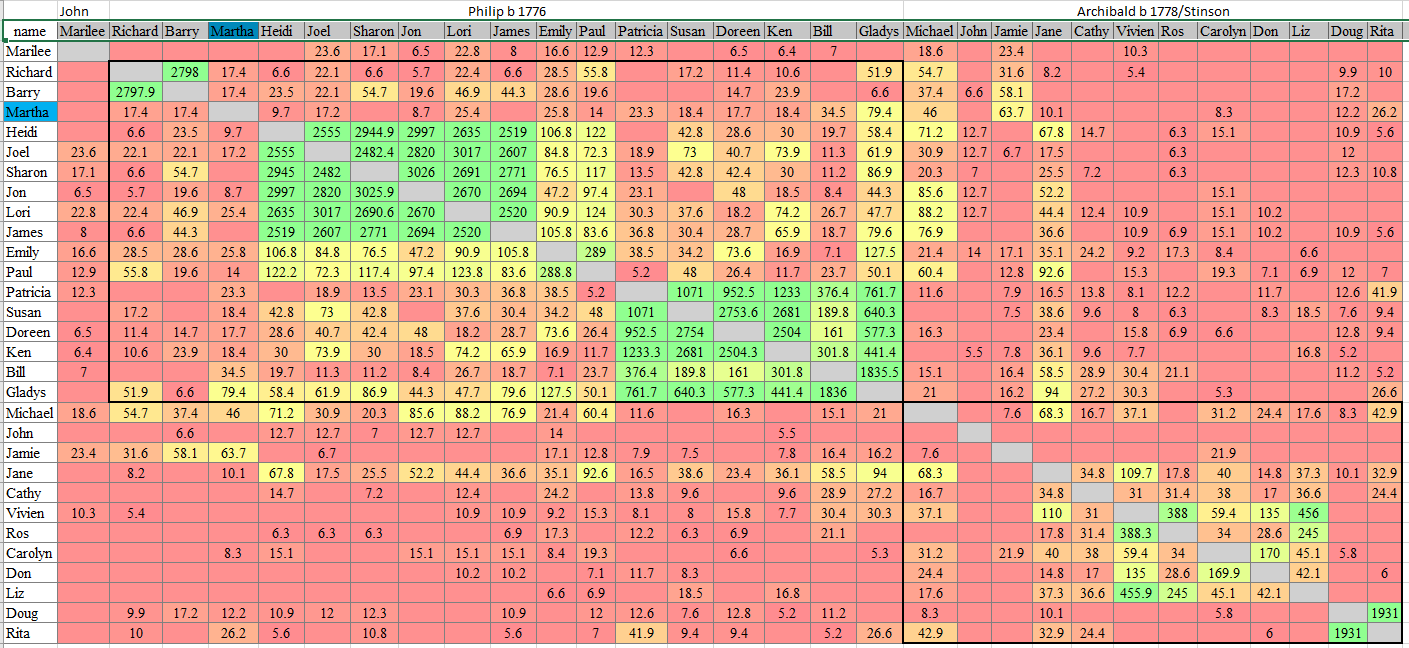
The purple results are from the line of George Frazer who was born about 1838. The yellow line is from George’s older brother Richard Frazer who was born in 1830. When I last wrote about Richard, I didn’t mention Emily. She is a new match. I have written about Gary, Brian and Karen in other Blogs. The McPartland connection is one that comes up a lot. This family has a Frazer ancestor. The main point in presenting the above chart was to show the differences in matches between Richard and Gary. For example, my sister Sharon does not show up as a match to Richard above the 7.0 cM threshold. However, Sharon matches Barry at 54.7 cM in his One to Many list.

Comparing Barry to Others in the Frazer DNA Project

I added in the McPartlands above. Richard matches that family but his brother doesn’t. That means that my purple and blue table above is wrong that shows Barry matching McPartlands.

A Surprise Off-Topic Discovery

Based on the chart above, I found something surprising. Marilee and Bob match. I wrote a Blog about Marilee here. She appears to descend from the John Line of Frazers. I have her as the only known descendant in the John Line. I actually did look at the match Marilee had with Bob in my previous Blog.

Here is Marilee’s line in pink. Assuming that I have the tree right, that could mean that the McPartlands descend from the John Frazer Line. Perhaps the Ann Frazer who married a McPartland was the daughter of Archibald Frazer and Jane White:

It is a theory based on the match between Marilee and Bob. Here is Bob’s tree with my previous guess that pulled three families together using triangulation.


Well, it looks like I had thought of this before. If this is right, then it means that I descend from the John Line as well as the Philip and Richard Lines of Frazers. One cannot have enough Frazers in their ancestry!

Back to Barry’s DNA

Sorry for the tangent. Here is Barry’s DNA grouped a little differently:

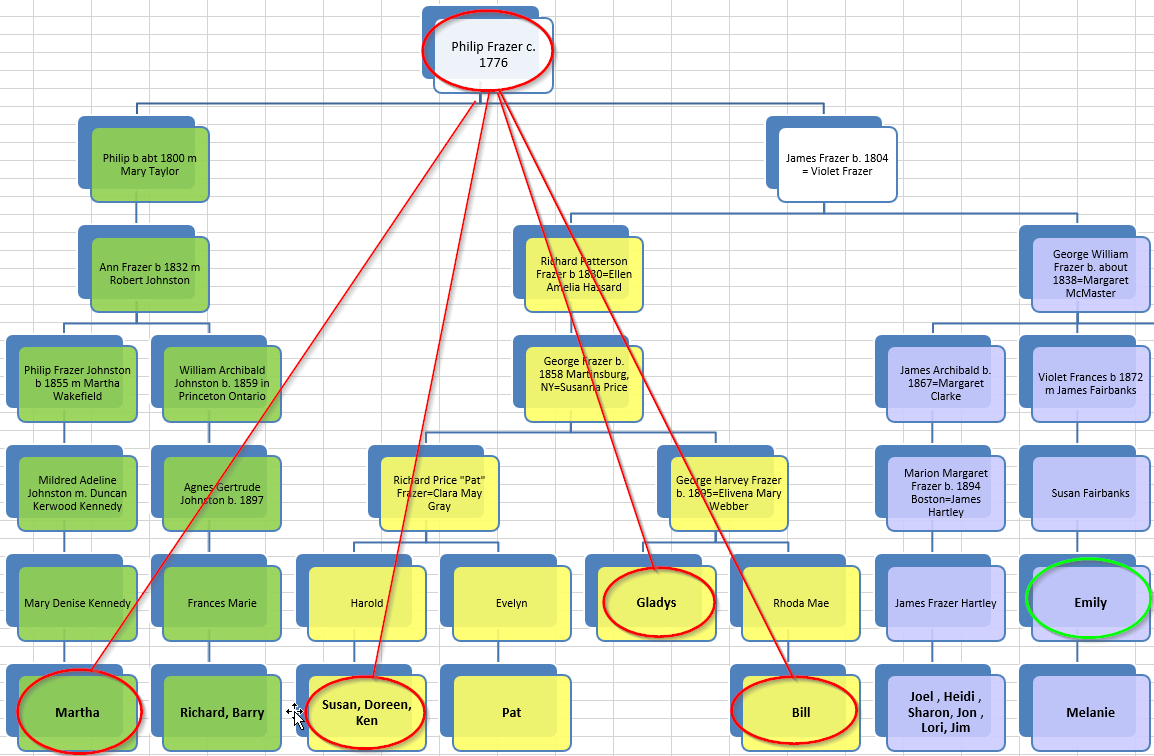
I had trouble grouping Michael and Jane. I should have put them in the Stinson Section. They also descend from Violet Frazer who was the husband of James Frazer and daughter of Richard Frazer. However the Chart above emphasizes James Frazer who was the son of Philip Frazer (if I have it right).

In general if I were to draw a box around all the people believed to be descended from Philip born about 1776, it seems like the matches would hold together.

It is a little difficult to see the distinction as Michael and Jane also have connections to the Richard Frazer Line as a mentioned above. Notice that the matches drop off for Jane when she gets to Richard and Barry, but they don’t drop off for Michael. That could mean that there is some ancestral connection that Michael has to Richard and Barry that Jane does not.

Barry and Jamie – A Johnston Connection?

I see that Barry and Jamie have a large match. I have that Jamie is in the Stinson Section. However, Jamie and John have no matches with the other Stinsons and a pretty good match with Richard and Barry. However, this match may be due to a Johnston connection. Both Barry and Jamie have Johnstons in their ancestry. Other connections are possible. Richard, Barry, Jamie and her brother John all have Johnston grandparents. Their Frazer ancestors go much further back.

Barry and DNA Triangulation Groups

If Barry has a match with two people by DNA and those two people also have a DNA match with each other, that is called a triangulation group. This is a strong DNA match that indicates a  common ancestor. I leave the triangulation step until the end as it takes a little bit of work. To triangulate, I need to compare the 28 people that are in the Archibald Frazer descendant group and compare them to each other.

Triangulation Group (TG) Chromosome 12

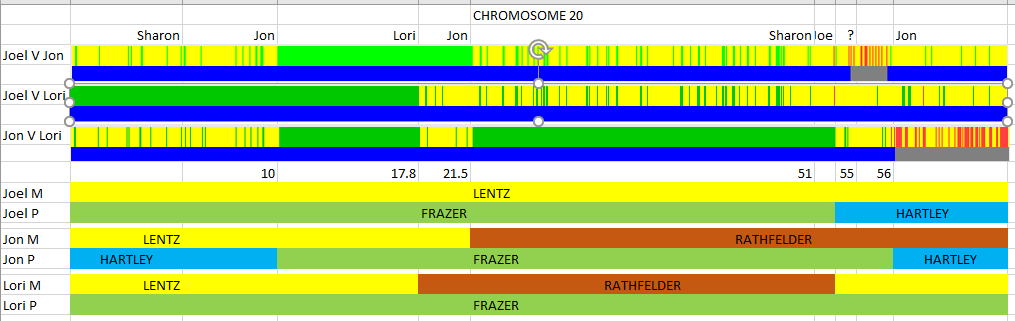
From my spreadsheet of matches, I see this group on Chromosome 12:

Here Barry matches Jamie and Paul. Paul also matches Jamie. That makes a TG. This means that this DNA on Chromosome 12 came down to these three people from one specific ancestor. Here are two possibilities for common ancestors:

Here at the top of the tree is Archibald Frazer born about 1720 and Mary Lilley.  If it wasn’t for the match with Paul, we might guess that Jamie and Barry were matching on a Johnston ancestor as they both have Johnston ancestors. Paul, however, has no known Johnston ancestors. That leaves the above possibility for the TG on Chromosome 12.

TG at Chromosome 17

I already described this TG in my Blog on Richard. However, now Barry has joined the TG. Also Jamie from the Stinson Line. I think that I found out about Jamie after I wrote the Blog on Richard.

These people could be represented with the same common ancestors as in TG 12 above.

This gets confusing, because Lori and I also descend from the Richard Frazer Line. In addition, Michael also descends from the Stinson Line. Also, note that Paul and Marilee have a small match. Perhaps these two would be in the TG if I lowered the DNA match thresholds.

Again, if this was just a match between Barrie and Jamie, I would suspect that it could be from a common Johnston ancestor. However, as Lori, Joel and Michael have no known Johnston ancestors, it appears more likely that this is a Frazer TG.

A New TG on Chromosome 18

Here is a new TG between Barry, Richard, Jamie and Emily.

Again, there seems to be something special about Jamie’s DNA or ancestry, that she has shown up in all three TGs.

I should note that Jamie has the same line as her brother John. That makes me think that Jamie got the Frazer DNA. I wrote a Blog about John here. I would like to write a Blog about his sister Jamie to look into some of the questions that were raised in this Blog.

Here is the match between Jamie and Barry:

Barry has no DNA match with Jamie’s brother John. Barry’s brother Richard has this match with Jamie:


Summary and Conclusions

  • I showed how two brothers could have different DNA matches.
  • I have put Barry and Richard in the Philip Line. This seems to be supported by the DNA, common first names, and the genealogy that we know of.
  • I looked at threeTriangulation Groups (TGs). All of these included Jamie from the Stinson Line. It may help to look more closely into Jamie’s family tree. Perhaps she has other connections to Frazers or to their collateral lines. Or perhaps Jamie has inherited more than the usual amount of Frazer DNA.
  • Given that we are not totally sure of the genealogy of many of these lines and that there was intermarriage of Frazers and perhaps other lines, the analysis of the DNA and genealogy is very complicated.
  • There is need for more analysis of the DNA matches (and the genealogy). I should look more closely into Jamie’s DNA.

Uncle Mike’s Jame’s Line Frazer DNA

The results of Kathy’s Uncle Mike’s DNA came in. This resulted in some interest from those Frazers from the James Line Branch. Here is where Mike is on the James Line DNA testing chart:

I stuck Mike in with his sister Madeline to save space.

Uncle Mike and Visual Phasing

It appears that there are three siblings that have tested. This means that it would be possible to do visual phasing on these three. This is a way to tell what portions of their grandparents’ DNA has been passed down to Madeline, Mike and Charlotte. For example, about one-quarter of Minnie Frazer’s DNA has been passed down to these three siblings in different ways. Put another way, about half of Mike’s maternal DNA would be from Minnie born in 1865. I give an example of Visual Phasing later in this Blog.

Uncle Mike and the Line of Archibald Frazer born 1792

Here is a closer up view of Mike in the left branch of the James Line:

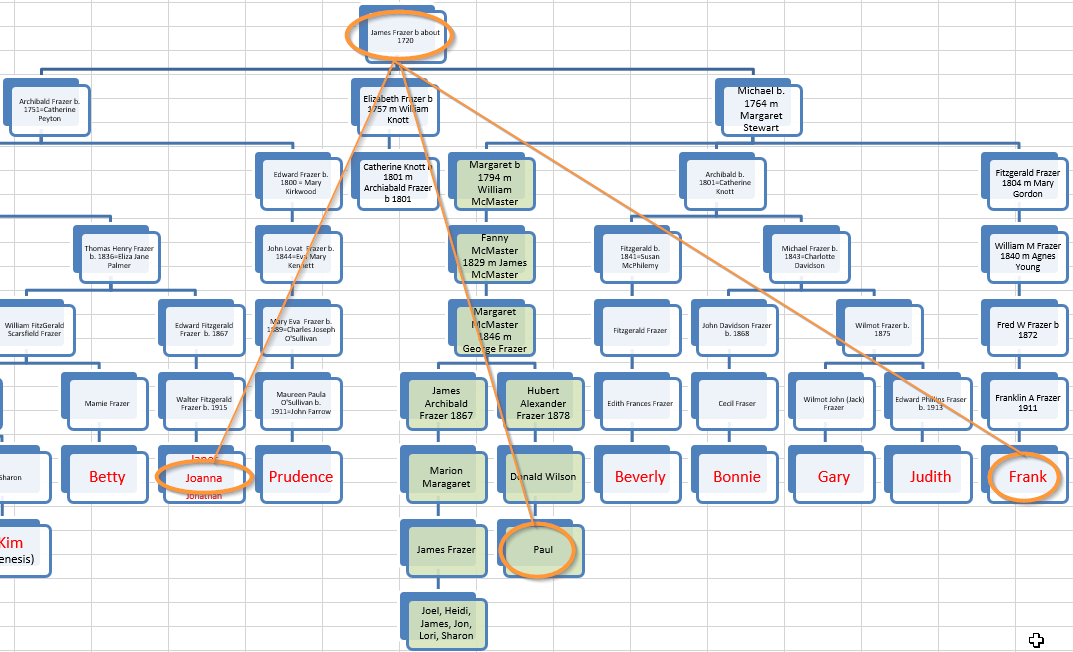
Here, Mike is a third cousin to Rodney, Betty, Janet, Joanna, and Jonathan. He is third cousin, once removed to most others in red above. This shows three DNA-tested branches: William, Edward and Thomas. Ancestry shows these branches as Circles:

I got the above figure from Joanna’s AncestryDNA results. The Walter group includes Joanna and family. They descend from Thomas. Uncle Mike is in the Frazer Emmet Group from Edward. The C.W Family is on the left descending from William. However, Ancestry does not have all the tested descendants.

The William, Edward and Thomas Frazer Branches at Gedmatch

Here is what the three Frazer Branches look like when the DNA of the tested descendants is compared at Gedmatch:

Mike matches everyone except for Penny. He also matches Joanna, but below the normal cutoff of 7 cM. Note that Penny doesn’t match anyone in the Edward Wynn Line, but her sister Toni does. This points out the importance of sibling testing.

Further Out in the James Line

If we have the genealogy right, Mike is a 4th cousin to Prudence and a 5th cousin to those in the Michael Frazer (born 1764) Branch.

Mike’s Interesting X DNA Match

This is how Mike matches Clyde at #3 and others of his close family on the X Chromosome. The interesting part is that this would have to be the DNA from the wife of Archibald born in 1792:


We can know this because the X Chromosome never travels from father to son. Going up from Clyde, we see females up to William. Going up from Mike, we see females up to Edward. William and Edward got no X Chromosome from their father, so that means that this match is from the their mother. This means that they had the same mother who would have been the wife of Archibald. There is a small chance that this X Match could be along another common line between Clyde and Mike. But I don’t think that is likely.

More on Visual Phasing

This Blog was sort of short, so why not try a little visual phasing? Here are some of Mike’s DNA matches (other than with his siblings or nieces):

It looks like a lot is going on at Chromosome 5. Mike matches Bonnie at 31.3 cM. By my chart above, Mike and Bonnie should be 5th cousins. Unless they match on another line, this would be DNA going all the way back to James Frazer born about 1720.

Visual Phasing of Chromosome 5 for Mike and His Two Siblings

Stephen Fox has an excellent spreadsheet that does a lot of the hard work in the visual phasing. I found his spreadsheet at The Visual Phasing Working Group on Facebook. It took a while to download the different matches but it is better than doing it by hand.

Here is Chromosome 5:

The first bar is Mike and Madeline Compared. The second is Mike and Charlotte. The third bar is Madeline compared to Charlotte. Next, I try to line up the crossovers:

Unfortunately, they are not lining up easily. Perhaps the X Chromosome would be easier

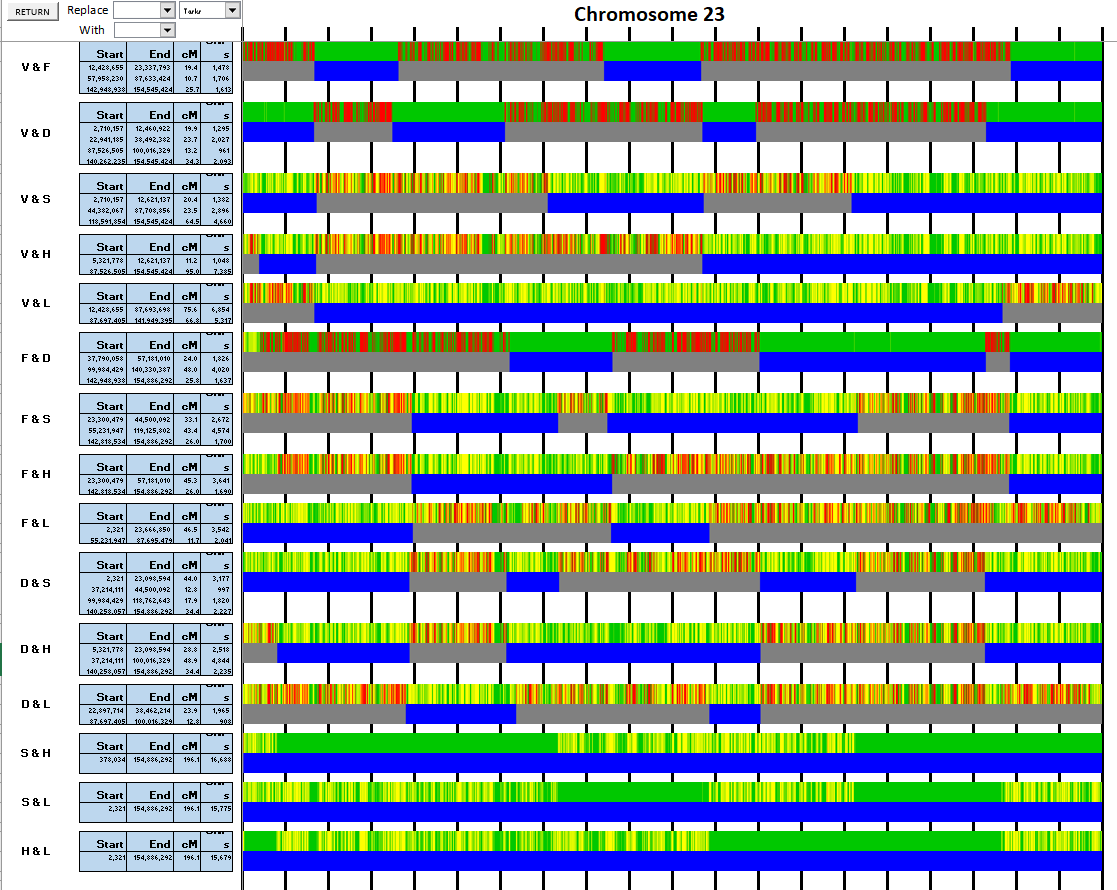
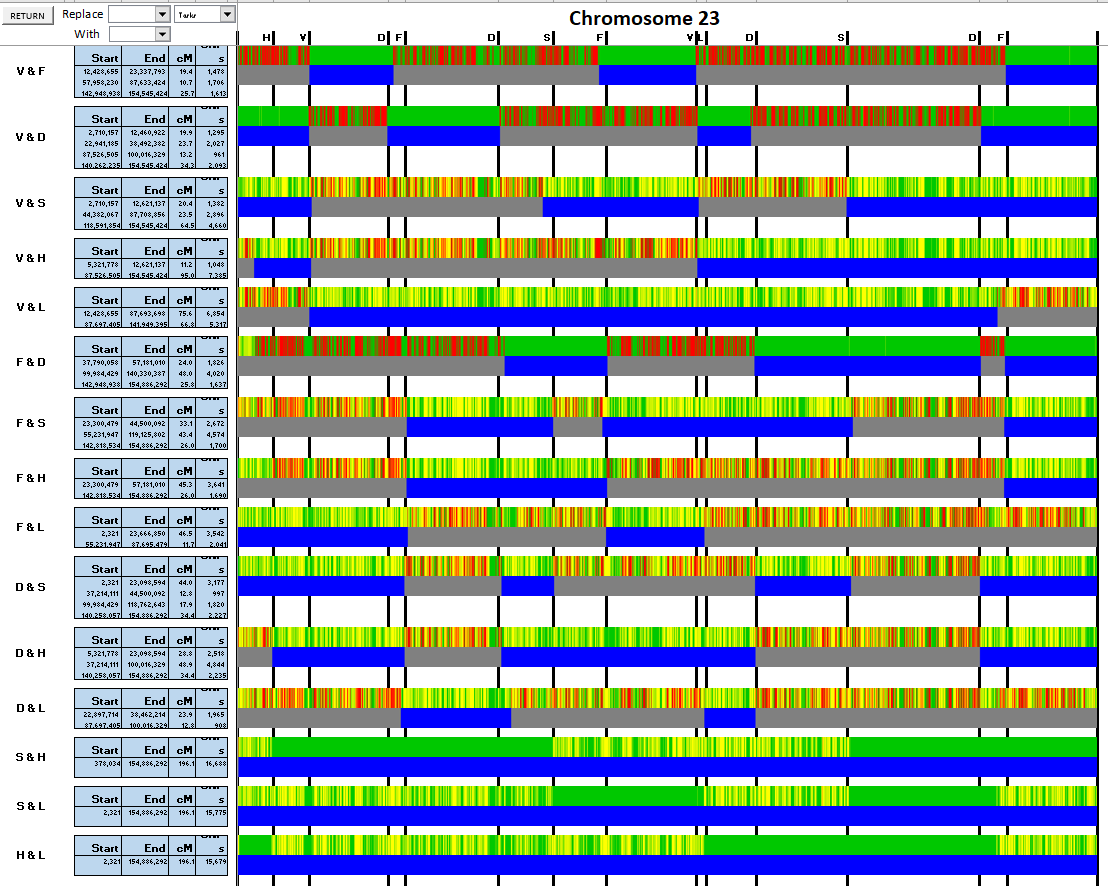
Chromosome 23

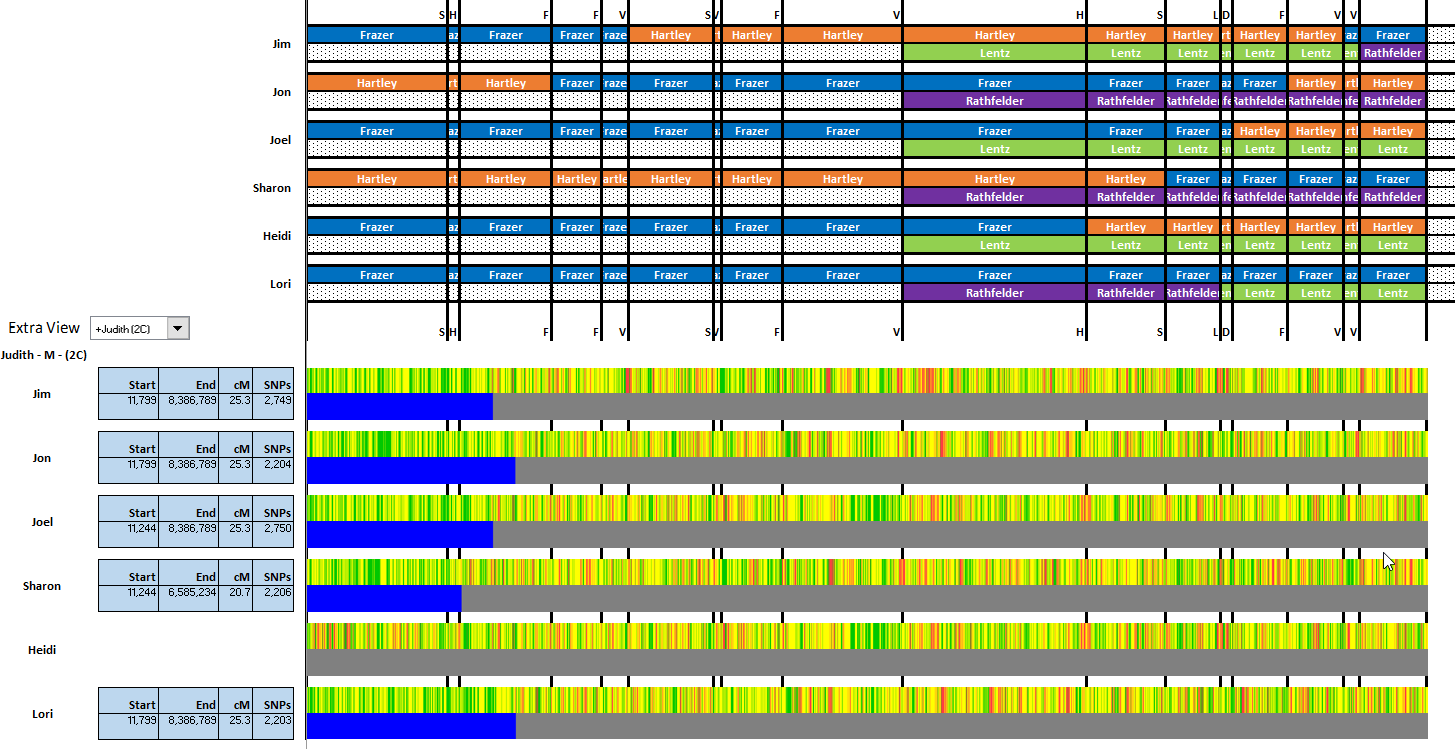
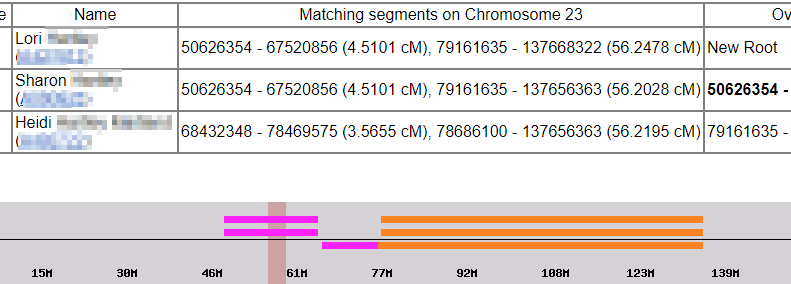
Here, I still have some problems. I only had crossovers for Mike and Charlotte. I didn’t see any obvious crossovers for Madeline. The first two bars are comparisons between Mike and Madeline and Mike and Charlotte. There are no solid blue sections because Mike gets no X Chromosome from his dad. Madeline and Charlotte in the last comparison have a solid green section as they both got an X from their dad. The green means that they have the same DNA from two grandparents – a maternal and paternal grandparent.

When I map out the Madeline and Charlotte’s green areas, I get this:


The green area is a Fully Identical Region or FIR. That means that the yellow and green grandparents sent down their DNA to the same places on Charlotte’s and Madeline’s X Chromosome. My simple view of the crossovers was that Madeline had no crossovers, so that means that she would be missing the DNA from one of her grandparents. The missing grandparent would have to be on her mother’s mother’s side. That is because she is already missing her paternal grandfather on the X. That is because he sent no DNA to Madeline’s father (or to Charlotte’s father). We know that Madeline and Charlotte match Clyde. That would be a Frazer match. The Frazer match maps to Madeline’s mother’s mother who was Minnie Frazer.

This is the view of the right side of Mike, Madeline and Charlotte’s X Chromosome. The bottom three blue bars represent where Clyde matches Mike, Madeline and Charlotte. Note that Charlotte has a shorter match with Clyde. That means that Charlotte’s crossover at the right side of the match is where her DNA goes from Frazer to Emmet. At this point we need to make a decision as to whether we want Frazer to be G1 or G4.

Here, by putting a G3 on Charlotte’s bottom part of her X Chromosome, I made that the maternal side. That means that G4 is Frazer and Emmet is G3. That also means that the bottom part of the X is set as the maternal side of the Chromosome. That then means that G1 is paternal.

The blue is the paternal grandmother who is Cronin. I must have made a mistake, because Mike should only have one side of his maternal Chromosome. Here is a probable map:

Mike only has a maternal side to his X Chromosome. That means that wherever he has a crossover, that means that the DNA he got goes either from Emmet to Frazer or Frazer to Emmet. This map assumes that I have the right crossovers. More matches with cousins could confirm or alter the map. I have some areas on the right and left of Charlotte’s map not filled in.

Note that Mike does not match Madeline, but does match Charlotte in the first section. As I have Mike with Emmet there, that means that Madeline has Frazer in that segment and Charlotte must have Emmet. Here is a filled-in map:

To do this right, I should have put numbers in for the locations of the crossovers.

Any Problems?

Yes, there are problems. Here is an X match with 5th cousin Bonnie:

Note that Bonnie matches Madeline on the middle bar but not Mike or Charlotte. It makes sense that she doesn’t match Mike as Mike has Emmet (purple) in that segment. This could be a false positive match for Madeline, or Charlotte could have a match there that did not show.

Summary and Conclusions

  • Mike’s testing brings interesting mapping possibilities with his two sisters. The mapping of these four grandparents goes back to about the 1860’s.
  • Mike’s DNA testing adds an important piece to the Archibald Frazer (born 1792) Line.
  • Mike also has interesting matches with James Line relatives that are further out.
  • Mike has an interesting X Chromosome match with Clyde that appears to represent DNA from the wife of Archibald Frazer born 1792. It is possible that other X Chromosome matches in common with Clyde and Mike could reveal other common ancestors that would lead to confirmation or clues to the identity of the wife of Archibald Frazer.