More Fun With Segments and Crossovers: Part 4

In this blog, I plan to look at the previous analysis I had done on my Chromosome 1 based on comparing my DNA to my 2 sisters. That was done in atDNA Under the Hood: Segments and Crossovers. I will break that down further using phased results. I have had my mother tested for her autosomal DNA. As a result on gedmatch.com, I have been able to produce 2 kits for each person. Those kits split out the results into the DNA I got from my mom and the DNA I got from my dad.

Recap On My Chromosome 1

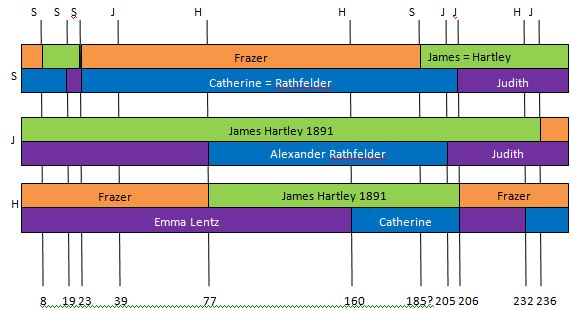
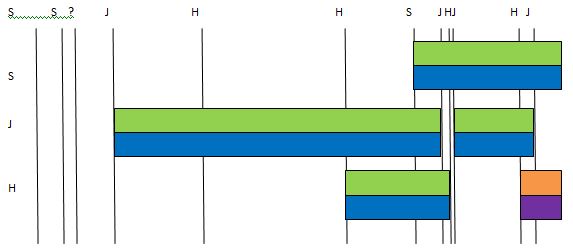
Before I wrote my blog, I tried using a technique proposed by Kathy Johnston to show where all my segments had come from. Gedmatch is used to compare 3 siblings. Vertical crossover lines are established and DNA segments from contributing grandparents are established. This was my preblog placement of crossover lines and who they were assigned to using initials.

Chromosome 1 preblog

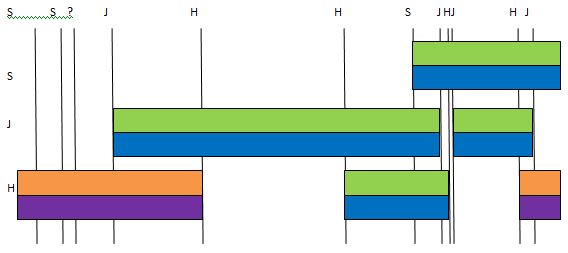
Note all the close crossover lines on the right side. This was a bit confusing. Here is my first try at assigning those segments to my two sisters and me.

Chr 1 Segments first try

In my blog, I simplified the crossovers a bit.

Chromosome 1 HJS

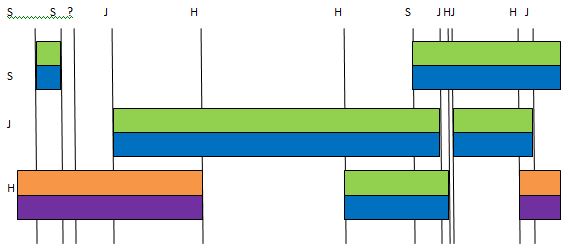
I came up with these segments.

Chr 1 Segments Adjusted again

However, in at least one way, I noted on my Chromosome (J), there was a mistake. I had a large known match with someone that was likely on my Hartley (green) line that went through the short orange segment I had. So I knew that had to be wrong.

Assigning Segments With Phased Results – Paternal Side

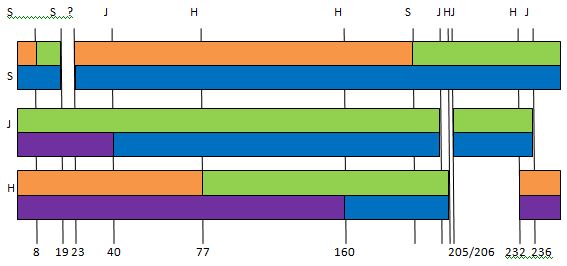
As mentioned above, I have 3 phased paternal kits for my 2 sisters and myself. These are based on the testing of my mother. A computer program essentially subtracts out the DNA I got from my mother and assigns the rest of my DNA to my father. I took the 3 paternally phased kits and compared them. So this will represent the precursor to the paternal orange and green segments that I developed (shown above).

Paternal Phased Chr 1

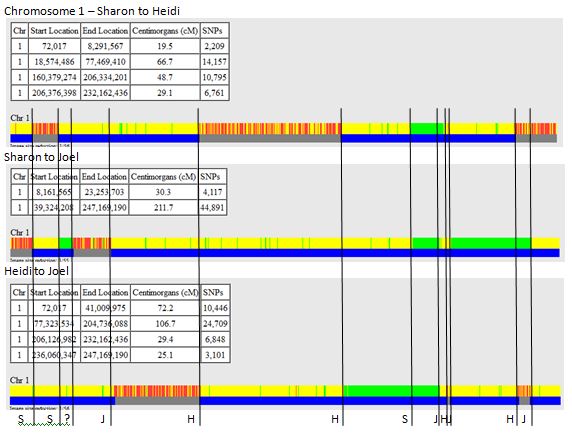
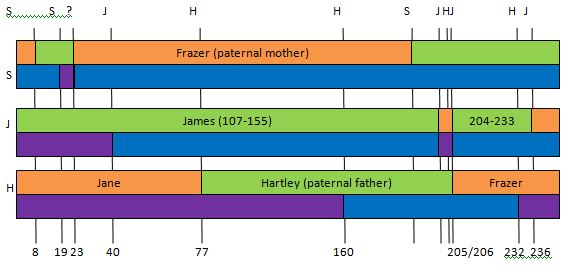
See how much simpler this is than comparing the whole DNA with the maternal and paternal side. This shows just the paternal side where the siblings do and do not match each other. Plus this clearly shows that these crossover points are specifically paternal crossover points. Sharon, Heidi and Joel each have 2 of them. This also points out mistakes I made in my previous analysis on the paternal side. Notice the 2 J’s at position 23 and 237. I take this to mean that I have a very large segment from one paternal grandparent in the middle and 2 short ones on the end. I’ll take the results from my previous blog and adjust that accordingly – taking out that tiny segment I already knew was wrong. I also added a ‘P’ after these 2 J’s at the top of these 2 vertical lines to show that they were my paternal crossover points.

Chr 1 Paternal adjustment1

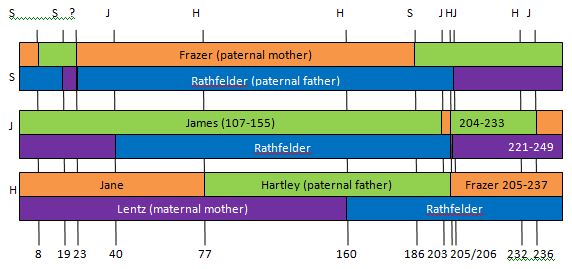
Aah, much better. Heidi is matching me between 77 and 205, so I got that right. Remember, I’m just looking at the top half/paternal part of the chromosome at this point. Also I had it right that Sharon and Joel match from 190 to 237. Except I had it as 186. That difference may be from the effect of phasing. Between 19 and 23 all three siblings match. So Sharon’s orange Frazer segment gets moved a little to the left there. Also in the 1st segment, we shouldn’t all match. I had guessed wrong there. Heidi and Joel match, but not Sharon.

Chr 1 Paternal adjustment2

Note the following:

  • On each paternal line (green and orange) there are 2 paternal cutoff points producing 3 segments
  • The original full comparison (maternal and paternal) had 12 crossover points vs. the 6 paternal ones here
  • These segments alternate between my 2 paternal grandparents.
  • Between the 3 siblings we could match a descendant of my grandmother Frazer’s ancestor at any point except between 186 and 205. Looking up and down at that point, there will be no orange representing Frazer
  • On the 3 spreadsheets of matches for these siblings, I can assign with confidence, Frazer ancestor or Hartley ancestor to each of the paternal matches in the regions indicated above. This is a huge step forward in DNA analysis.

At this point, I could go back to the original full comparison and adjust the maternal segments or look at the maternally phased sibling comparisons. I’ll do the latter, to complete the picture.

Assigning Segments With Phased Results – Maternal Side

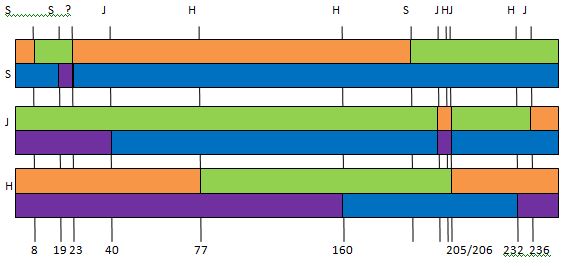
Maternal Phased Chr 1

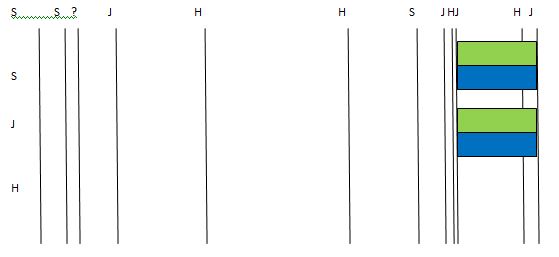
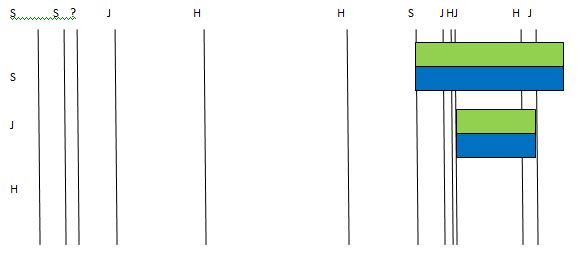
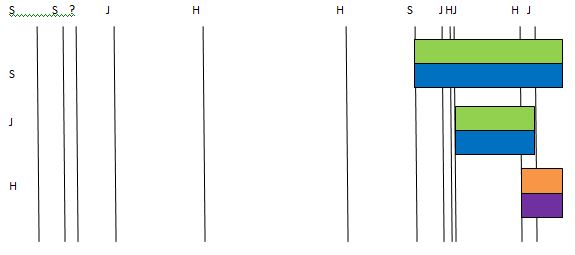
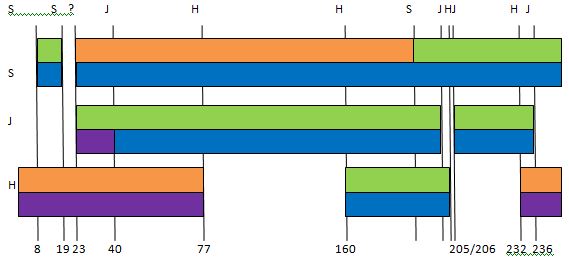
Here we have 10 maternal crossovers Vs. the 6 previous paternal ones. This is the complicated side. I had trouble assigning crossover points. These should be assigned to people who have 2 changing areas along the vertical line. For example, Sharon gets an ‘S’ for the first vertical line (crossover point) because of the defined segment she has in the comparison between her and Heidi in the first row and her and Joel in the second row. At the first question mark crossover point, there is one change shared by only Heidi and Sharon. Also there is a weird region between 204 and 206. I’ll ignore that section for now. I would like to start on the right, because I have a match with a known Lentz relative there (my maternal mother’s line). The very last segment doesn’t make sense because it shows that Sharon matches Joel and Heidi matches Joel but Sharon doesn’t match Heidi. We’ll ignore that and keep my segments the way they are as they make sense by the original gedmatch full comparison. Moving from the right to the left, the next segment in makes sense. On the third segment from the end, all 3 siblings should have the same maternal grandparent. I’ll have to change that to Lentz for Heidi. So I’ll put a purple section in the middle of my blue Rathfelder grandfather on the bottom right:

Chr 1 Maternal adjustment1

As I have mentioned previously, Chromosome 1 should be the hardest to analyze, as it is the longest. If I can get this one right, all the others should be a walk in the park. 160 to 204 is all the same maternally, so that makes sense. What doesn’t make sense is segment 77-160. Again the maternally phased comparison has Sharon matching Joel and Heidi matching Joel but Sharon and Heidi not matching. However, in the original full comparison Heidi and Sharon are opposites and the other matches are half matches, so we’ll stay with what we have. I note this non-sensical sequence 6 times on the maternal side. Not good.  Also notice that Heidi has a maternal crossover at 77. Some crossovers for Heidi and others are both maternal and paternal. This appears to be one of them. That means there should be a change from Lentz to Rathfelder here. But when I check the original full comparison, I see that Heidi Vs. Joel should be opposite, so I’m tempted to leave it the way it is here. Hopefully, this will get easier.

Segment 23-40: Here, I need a paternal correction as it shows the same paternal match for all three siblings. In my paternal phased gedmatch comparison, it shows that Sharon and Heidi match from 23-77, but I don’t match either of my sisters paternally. This is fixed by moving my green Hartley segment to the left (J Row).

Chr 1 Paternal adjustment3

This gives me even more Hartley segment in green. Next I notice in the 5th segment (40-77) that Heidi to Joel was supposed to be opposite in the full comparison. I can fix this by moving Heidi’s Lentz segment to the left. Talk about tedious.

Chr 1 Maternal adjustment2

At any rate, that’s a bit more aesthetically pleasing. Now there’s another problem at 23-40. The original full gedmatch comparison has Sharon to Joel as opposites which is now right, but Sharon to Heidi and Heidi to Joel as half matches and I have them as full. I don’t want to mess with the Sharon-Joel opposite match here, so I’ll skootch the Lentz a little more to the left.

Chr 1 Maternal adjustment3

Segment 19-23 – Only 3 more segments to go (hopefully). The full comparison has Sharon and Joel as full matches (FIRs) and the other 2 as half matches. That looks good.

8-19: Sharon to Heidi are opposites and the others are half matches. Giving Sharon a bit more purple will fix that. Plus Sharon has a maternal crossover there, so it makes sense.

Chr 1 Maternal adjustment4

Home Stretch. Sharon to Joel needs to be opposite in the first segment. No correction needed here. This is as good as I can get Chromosome 1 right now.

The Frazer DNA Project Connection

Here is where the Richard Frazer Triangulation Group is:

Chr 1 Maternal adjustment4 w TG

Here was my earlier attempt at chromosome 1 without phased DNA. This was from last week when I was younger and more foolish. It’s off, but not totally.

Chr 1 Segments Adjusted again

Summary

  • It was a long blog, but who wants short blogs with wrong answers?
  • Using phased DNA (paternal and maternal) made the answer more clear, but the process was no easier.
  • My paternally phased comparison behaved better than the maternal. However, if you knew my mom, you would understand why.
  • It took a combination of the full sibling comparison plus the phased paternal and maternal comparisons plus known relative matches to complete the diagram
  • For anyone that matches me or my siblings on Chromosome 1, I should now be able to tell which grandparent they match
  • This blog has been approved by the FDA as a cure for insomnia


More James Line Segments

In the last 2 blogs, I wrote about segments and crossovers. In this one I am continuing on with James Line Segments. The James Line is from James Frazer b. in the early 1700’s  from North Roscommon, Ireland. I am looking at Chromosome 14, because there seems to be a lot going on there. Here are some of the Frazer matches from my master list of matches from testers in the Frazer DNA Project:

Chr 14 James Line

Not all of these matches will come into play, because we are looking at the family of Jonathan, Janet and Joanna. Here Jonathan matches JFS on the Michael Frazer Line b. 1764 (a branch of the James Line). Janet matches the same person at 2 different places. Janet and Jonathan match BZ their 2nd cousin at differing levels. Also Jonathan matches BR from the Archibald line (brother of James Frazer) at a smaller amount. This may or may not hold up.

Remember, we can do this analysis because siblings have what are called Fully Identical Regions (FIRs). This means that they match their same paternal and maternal grandparents (but we don’t know which initially). Then by comparing the Half Identical Regions (HIRs) and places they don’t match, it is possible to map out all 4 grandparents. With matches to known people, it is possible to fill in which grandparent is which.

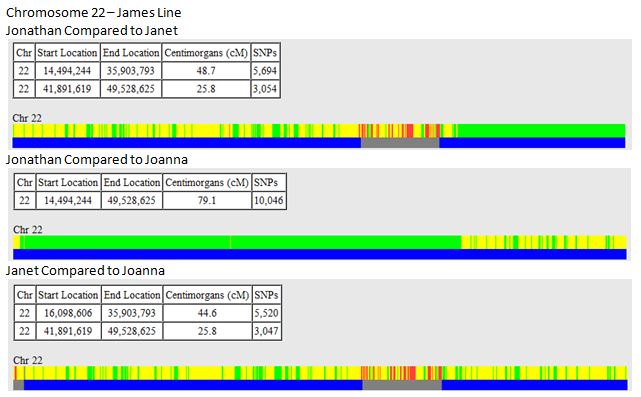
Chromosome 14 appears to be more simpler than my earlier examples:

Chr 14 James Line Gedmatch

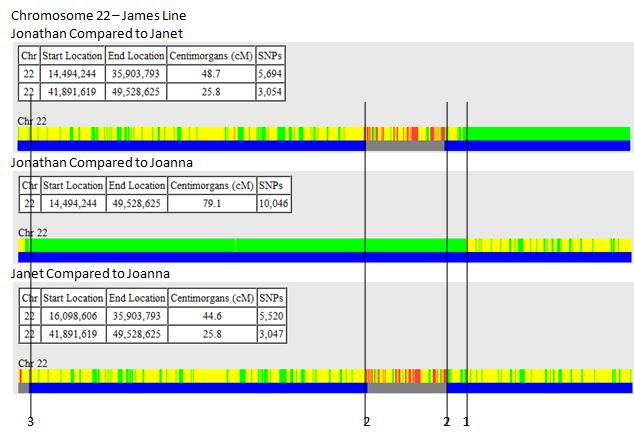
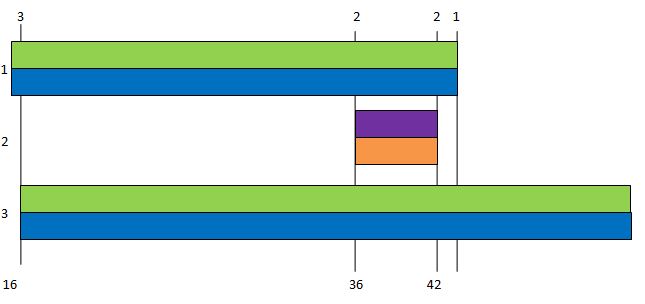
Here, there are only 5 crossover points. The crossover is where the DNA recombines. Janet has only one crossover point and Jonathan and Joanna each have 2. Note above that Jonathan (1) and Joanna (3) have a FIR in the first segment indicated by the green bar in the middle row. That means they have the same Paternal and Maternal grandparents. I’ll give those grandparents a green and blue color for both Jonathan’s (1) and Joanna’s (3) DNA segment below. Chr 14 1

The crossover point is where something is going to change due to DNA that got recombined from Joanna’s family’s grandparents via their parents. I suppose you might say we are recreating how this family was formed by the different combinations of their grandparents’ DNA. I can’t extend Jonathan’s grandparents at this point (at crossover 1). I can extend Joanna’s as her crossover point doesn’t occur until line 3 (which is her crossover or recombination point).

Chr 14 2

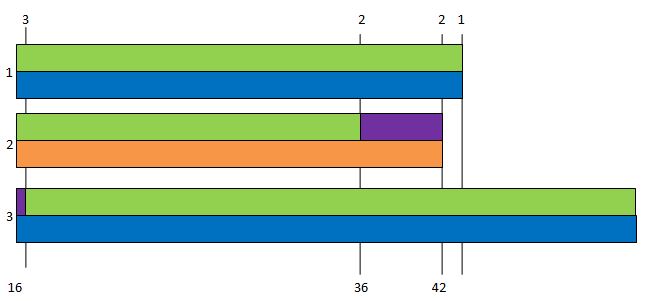
Now note in the gedmatch browser comparison above that Janet and Joanna have no match in the first 2 segments. That means that Janet will have the opposite grandparents in those segments shown as being orange and purple.

Chr 14 3

Next, I see that in the 3rd segment, Joanna matches Janet perfectly (FIR). We will note that and extend Janet’s segments to the right hand side as she only has one crossover point.

Chr 14 4

Next I filled in some opposite regions between Janet and Joanna and Jonathan to Janet.

Chr 14 5

However, note that in the comparison between Jonathan and Janet, there is something odd.

Jonathan to Janet 2

In the third segment, there is no match as shown by a grey underneath (no blue). However, on the top there are no red marks. I though that it was too easy. Next, I will add an HIR from Jonathan to Janet in the last 2 segments.

Chr 14 6

Next Jonathan and Joanna have a no match on the last chromosome, so they are opposites. There seems to be no easy solution for the middle part of Jonathan’s Chromosome 14 – or rather there could be more than one solution, so I’ll just pick one for now and see how it fits with the matches.

Chr 14 v1

And there you have my version 1 of Jonathan and his sisters’ Chromosome 14. It doesn’t look that great. Janet’s chromosome looks too symmetrical. Also Jonathan has one of his crossovers on Joanna’s crossover point (3).

Now for the Frazer DNA Project matches to Jonathan and family.

Frazer matches Chr 14

Here’s where the puzzle begins. We don’t know which of the 4 colors that the Frazer could be. That could be either

Janet has matches from 32-50; 59-100; and 92-101. This means I drew Janet wrong. I have her with a break in the middle of these. That is, unless, the match with JFS is a false match.

Jonathan has matches from 80-99; 92-101; and 99-102. That could either be green or purple, but his first match at 80 would make it look like the green. I’ll give it another try with Janet having her green be the Frazer for the whole length. This is what I came up with:

Joanna and Family Version 2 Chromosome 14

That looks better. Now Janet’s segments are not so symmetrical and Jonathan’s crossovers are at his own crossover points. Joanna has a crossover on Janet’s crossover point, so maybe she should have solid orange, but that would cause other inconsistencies.

Now I’ll add the Frazer to the green areas and Seymour grandparents in orange showing where some of our Frazer DNA testers match.

With Names

I know that Joanna is looking for other relatives to test on her mother’s side. So once those DNA results are in, that will further confirm which maternal grandparents the blue and purple segments belong to.

This was not as easy as I thought it would be.

Segments and Crossovers: Part 2

In my last blog I took a look at the DNA my 2 sisters and I inherited from our grandparents. This was based on how we matched each other, where our crossover points were and whether we match by Half Identical Region (HIR) or Fully Identical Region (FIR), or not at all. I wasn’t totally satisfied with the result but noted that Chromosome 1 was probably the most difficult to analyze as it is the longest Chromosome. I still need to tweak this Chromosome a bit. Another way to figure out where the segments are is by looking at Triangulation Groups. On my Hartley (green) line below (horizontal line J), I have a TG going through the little orange segment at position 203, so the orange is likely not correct there.

Part of my reason for choosing this Chromosome was to show how my sister Heidi was in a Triangulation Group (TG) for Richard Frazer b. 1777 starting at position 205 and my other sister and I were not. My best shot at splitting up Chromosome 1 looked like this:

Chr 1 Segments Adjusted

James above is my father’s 1st cousin and represents the Hartley line. Jane is Jane from the Frazer DNA Project and represents the Frazers. This is the segment where Jane matches my sister Heidi.

And here is what the Frazer TG looks like:

TG Chr 1

Note that the TG for Heidi’s matches starts at position 205 million. That is where Heidi’s Frazer segment starts above. MFA and Jane’s match with each other start earlier than that, but they have a different segment map than my family does, so that is OK.

Chromosome 12

Chromosome 12 is where all my siblings are in another TG for Richard Frazer b. 1777. The map for that is a bit cleaner and more simple. As Chromosome 12 is shorter than #1, there are fewer segments and crossover points.

Chromosome 12 Segments
  • Note that Sharon has all Frazer on this Chromosome. That means that on her paternal side, she only inherited DNA from her Frazer grandmother, Marion Frazer
  • The TG representing Richard Frazer b. 1777 was again on the right hand side where my 2 sisters and I have Frazer (blue) segments
  • This TG is from position 124 to 129 and includes myself, both my sisters, and David, Bill, and Jane from this DNA Project among others.
  • The colors are reversed from what I had on Chromosome #1 as those colors are only relative until we find the grandparent that matches the color. At that matching time, we discover which side of the line is maternal and which side is paternal. For Chromosome 12 my paternal side is on the bottom.

I got the relative colors of the segments from these sibling comparisons:

Chromosome 12 Gedmatch Siblings

The procedure I used was in my previous blog. The names I got from looking at my matches to cousin Paul. I didn’t have enough matches on my mother’s side to nail those grandparents down. Those were the orange and green colors.

On To the James Line

Joanna and I wisely (or more likely luckily) had 2 of our siblings tested for autosomal DNA. This means that I am able to do the same analysis for her. As we know in the Frazer DNA project, her line starts with James Frazer as opposed to my side which starts with Archibald Frazer. They were both born in the early 1700’s as they had families and farms in North Roscommon, Ireland in 1749.

Chromosome 2

My 2 sisters match Joanna’s brother on Chromosome 2

Chr 2 Jonathan SH HHM

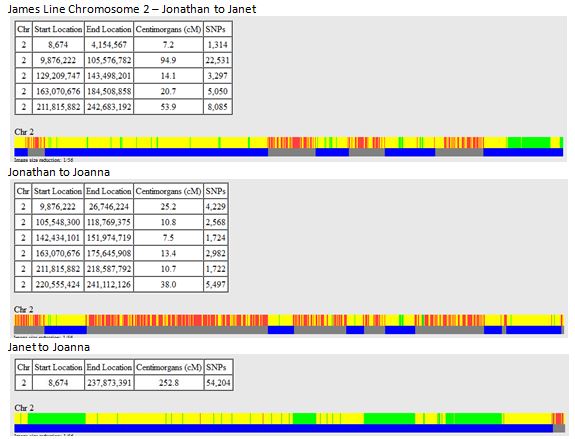
Here is how Joanna’s family lines up compared at gedmatch.com

Joanna Family Compared Gedmatch

Jonathan has more than the usual matches with his sisters. Janet and Joanna have only one long match made up of HIRs and FIRs. This is looking complicated already! Now lets see where all the crossover points are and who owns them. I had to give numbers to the family due to overuse of the initial ‘J’ in that family.

Joanna Family Crossovers

As we might’ve suspected by the number of matches between the family, there are a lot of segments and crossover points. I had a little trouble with Janet’s (who I have as #2) third crossover point, but moved the line a little to the right (judgement call). This could be challenging. I’ll start by adding the bottom left FIR match between Janet and Joanna and see where that leads:

Chr 2 Segments JF Line

I got this far, but I got a lot of position numbers due to all the little matches between the family. I’m really interested more in the right side of the Chromosome, so I’ll start over on the 3rd FIR match between Janet and Joanna:

Chr 2 Segments JF Line2

That’s not even as good. I think I’ll try the upper right Jonathan to Janet FIR match, as that is the only FIR match Jonathan has. Plus this is even closer to the area of the Chromosome I’m interested in.

Chr 2 Segments JF Line3

Now here comes the critical move to the right of the orange-purple area. Jonathan has a half match in that area with Janet. So I’ll extend the purple and green to that area to create the half match. It’s critical, because way back I said that Jonathan had a match with my 2 sisters from 205 to 222. Once I extend the purple that has to be the Frazer area as the match wouldn’t go through two different grandparent segments (i.e. orange and green at the top right).

Chr 2 Segments JF Line5

Here I added Edward Frazer who is Joanna’s paternal grandfather (actually b. in 1867). Because we identified Edward through a match between Jonathan and my sisters, the other person on that line in blue has to be Joanna’s paternal grandmother Seymour. In order to figure out Joanna’s maternal grandparents we would need to have matches through known relatives on those lines.

Now I’m stuck as the segments are HIR and I would have to guess. Here’s my guess for Jonathan, Janet and Joanna on Chromosome #2

James Line Segments Guess

This means if I am right and Jonathan, Janet and Joanna are looking for Frazer matches on Chromosome #2:

  • Jonathan should look between 9 and 129; 142 and 219 and 241 and over (these are positions all in millions)
  • Janet would look for any thing under 119 and over 238
  • Joanna would look before 27 and between 129 and 152

However, the catch is to make sure the match isn’t on the maternal side. However, it should be possible to double check this using Triangulation Groups (TGs). These TGs will fall within the segments as shown above.

How My Family Compares to Joanna’s Family On Chromosome 2

Hartley Chromosome 2 Segments

Unfortunately, the colors don’t match up. Joanna’s Frazers are purple and mine are green.  As can be seen above, my sisters got their Frazer DNA in the area of around 200 where I got Hartley DNA as shown in orange. This explains the matches between Sharon, Heidi and Jonathan.


atDNA Under the Hood: Segments and Crossovers

In this blog, I would like to look at segments and crossover points. Kathy Johnston has a method in which she compares the DNA matches between 3 siblings. These matches are then used to show how the 4 grandparents contributed DNA to each of these 3 siblings. She states in her directions:

The goal is to use crossover lines in PowerPoint to determine segment matches with grandparents among siblings when no parents are alive.

In this blog, I will use Chromosomes 1 as an example. I would like to use this Chromosome because of the Frazer DNA project I am working on. In this project, there is a very clear Triangulation Group at Chromosome 1 that leads back to Richard Frazer, b. about 1777 in North Roscommon, Ireland.

The Technique Depends on Gedmatch

Gedmatch is used because gedmatch.com comparisons show not only matches, but which matches have Fully Identical Regions (FIRs) and those with Half Identical Regions (HIRs). HIRs are the normal matches that we have with everyone except our siblings. Half Identical means we match either on our mother’s side or our father’s side. According to the ISOGG Wiki,

Identical twins are fully identical at every point in their DNA. Other full siblings, including non-identical twins, share around 50% of their DNA, and have both half-identical regions and completely identical regions. The expected percentages for full siblings are 50% half-identical, 25% completely identical, and 25% not identical for an overall average of 50%.

Me and My Two Sisters

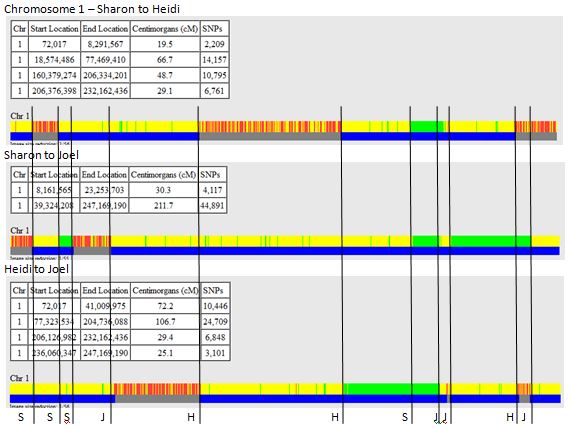
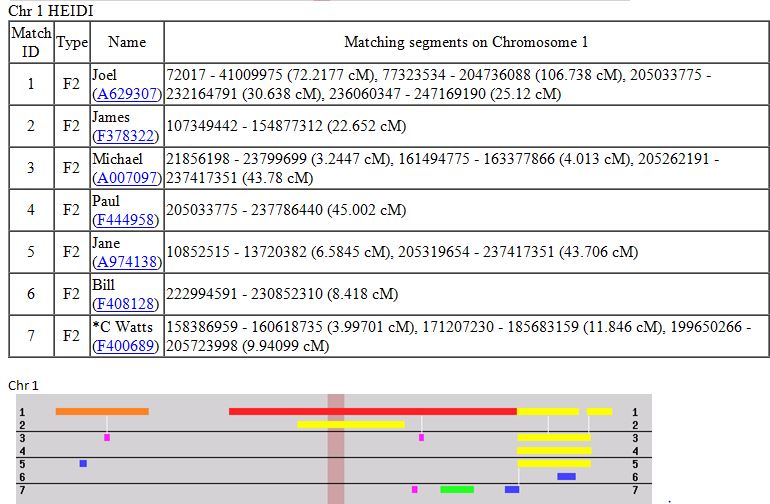
This is how I look compared to my two sisters and how they compare to each other at Gedmatch. The green indicates FIR, the yellow area is HIR and the red is no match. The blue is FIR or HIR match and is also represented in the table above the graph with start and end points. Vertical lines are drawn through each crossover where there is any change from HIR to FIR to no match.

Chromosome 1 HJS

According to Kathy Johnston,

Only one sibling can own a crossover point (with few exceptions); identify that sibling. The owner of the crossover is the one who is in-common with
that point for two comparisons.

For the first vertical line, I have an ‘S’ for Sharon as the owner of that crossover point. She has a crossover, from a HIR match to no match in the comparison of Sharon to Heidi and a crossover from no match to a HIR in the comparison between Sharon to Joel. Note that the 3rd ‘S’ should be a’?’ as Sharon has only one crossover out the the 3 comparisons. I had originally left it as an ‘S’ for simplicity. The segments between the lines will represent the DNA the 3 siblings got from our 4 grandparents.

How Do We Get 4 Grandparents’ DNA Out Of This?

Let’s look at the next to the last segment and the one before it. Sharon and Joel have a green area there. This means that Sharon and Joel got their DNA from both their mother and father. However, this DNA was from one of the mother’s parents and one of the father’s parents. These 2 Fully Identical matches are represented by green and blue. These are 2 of our 4 grandparents, but we don’t know which ones they are yet – except that one is a maternal grandparent and one is a paternal grandparent. They are put on Sharon and Joel’s horizontal lines (represented by an ‘S’ and a ‘J’) as Sharon and Joel match each other on both parent’s sides represented here by green and blue.

Phase 1

By the way, I picked the most difficult Chromosome to look at. Chromosome #1 is the longest chromosome and has the most crossovers. Note that the green and blue are bounded by 2 J’s on my line. However, the green and blue are not bounded by an ‘S’ on Sharon’s line. So I will extend her DNA match to where it is likely to change (either at Sharon’s crossover point or at the end of the Chromosome – whichever comes first).

Phase 2

Looking For Two More Grandparents

This is starting to fill out, but Heidi has no DNA and we only have 2 grandparents. Now look again at the Gedmatch chart. Heidi has no match with Sharon or Joel on the next to last segment as indicated by grey in the bottom part and red in the top. We know that she does have DNA at all parts on her chromosomes, so she must have gotten her DNA from neither of the green or blue grandparents on her paternal and maternal side.

Chromosome 1 HJS

Our new grandparents are going to be orange and purple. I hope they don’t mind.

Phase 3

I extended the colors to the right as Heidi has no crossover point in that direction. Also note as a check that in the last segment Sharon and Heidi have no match, so they have to have opposite grandparents contributing to their DNA there. Now in my 3 Gedmatch comparisons, there is a spot where all 3 siblings have a FIR shown in green. These means all 3 siblings got their DNA from the same 2 blue and green grandparents. I’ll extend the blue and green down and to the right and left to the appropriate crossover points.

Phase 4

Looking good for my green and blue grandparents. In the first J-H segment, Heidi and Joel have no match. This means opposite colors/grandparents. I blasted through the ? crossover as it doesn’t involve Heidi.

Phase 5

Next, I’ll fill in the rest of the no match areas with opposite colors/grandparents. I only see one more segment to add.

Phase 6

Time for the HIR’s

So  far, we have only added opposites. Now it is time for the Half Identical Regions (HIRs). That would be a green on the top with a purple on the bottom or orange on the top with blue on the bottom. On the Sharon to Joel comparison below there is a long yellow HIR. I will give that a shot.

Chromosome 1 HJS

That means that I need to keep one color the same between Sharon and Joel and change the other. I randomly extended the blue and put the orange on top. I don’t know what to do at the ?, so I stop there. Up until now all the colors have been relative. However, once a half identical color is chosen, it locks in where the grandparents are (even though we don’t know which grandparents go on which segments yet).

Phase 7

Also notice that I put numbers on the bottom. Those are the positions of some of the crossover points. Sharon’s first match with Heidi stops at about 8 million. Sharon’s first match with Joel starts at the same spot.

Now Sharon to Heidi has no match in the large middle segment. That means I need to add the opposite colors/grandparents. Joel to Heidi is HIR, so we can continue Joel’s colors to the left. Sharon to Joel needs to be opposite in the first segment.

PHase 8

That seems to be all the easy segments. Actually, the upper left space can be filled in as Sharon and Joel match with a FIR. That leaves the lower right hand side. I’m not supposed to guess here, but I’m tempted to go with orange/blue to fill in my missing middle segment. The tiny segment below that is opposite. I guess again and pull the orange to the left and the blue to the right to fill the larger segment. My last guess is on my own segment where I extended the blue and added some orange.

Phase 9

That fills everything in, but with a bit of guessing. Note that the tiny crossover point at 205 has not been used, but that is a fine point.

Now For the Reality Check

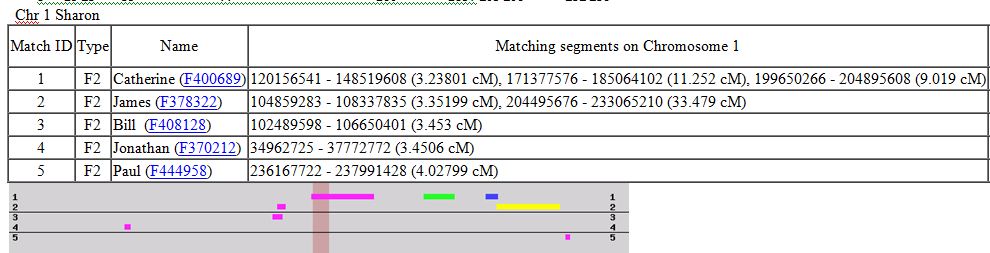
I would be nice to put some names on these grandparents and check to see if I got these segments straight. Here are some of my sister real life Sharon’s matches.

Sharon to All Chr 1

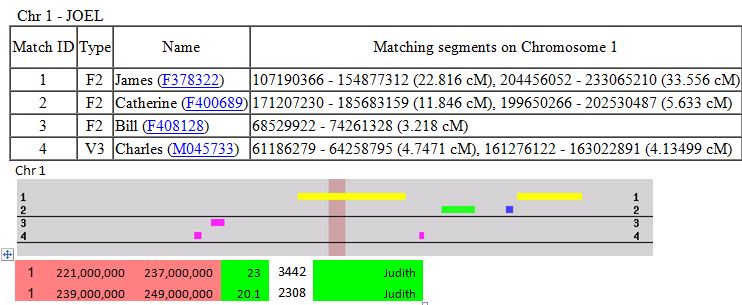
Catherine is on my mother’s father’s side and James is on my father’s father’s side. The rest are Frazer relatives, but the matches are small. My results are somewhat similar to my sister Sharon’s. The difference is that I tested at 23andme and found a relative on my mother’s mother’s side (Judith).

Joel to All Chr 1

Let’s see if Heidi’s matches shed any further light.

Heidi to All Chr 1

Now we are getting somewhere. We see the Triangulation Group that I was interested in. This is on the right between Frazer relatives Michael, Paul, Jane and Bill. This is good because the Frazers are on my paternal mother’s side and James is on my Hartley side which is my paternal father’s side. Heidi matches James between the locations of 107 and 155 million. And she matches the Frazers from about 205 to 237 million.  Now all I have to do is find an open segment on Heidi’s line from 205 to 237 that is a different color on Joel and Sharon’s line. That is orange.

Will the Real Grandparents Please Step Forward?

Here is my first shot. I can already see it will need adjustments.

Frazer Segments

My paternal Frazer/Hartley Frazer side isn’t too bad. The bottom right in orange is where the Triangulation Group is that indicates the Richard Frazer family (b. 1777). This explains why Heidi was in the triangulation group and Sharon and I weren’t. We inherited the opposite set of DNA on the paternal side. Also note on my line I have James who represents my Hartley side. I match him from 204-233. So that green segment needs to move to the left a smidgen. I had trouble the first time I tried to figure this out also. After a little fiddling, this is what I come up with:

Chr 1 Segments Adjusted again

In a future blog, I’d like to try the same technique with the DNA results of Joanna and her 2 siblings on the James Frazer line.

Observations:

  • Kathy Johnston has developed an excellent tool for seeing where all your grandparents’ DNA ended up in you and your 2 siblings.
  • Phasing can determine whether a match is on your paternal or maternal side, but requires that you have a tested parent. This technique does not require a parent and goes one step further – to the grandparents.
  • If the procedure is done right, I will know which grandparent all my matches match and which grandparent all my siblings’ matches will match. This is a big help when looking at 3-4,000 matches.
  • The procedure requires other relatives be tested to put names on the 4 grandparents. I am glad to have at least one relative tested to represent each of my 4 grandparents.
  • The technique takes a bit of practice and can be a bit of a puzzle. However, the results are interesting, instructive and informative.
  • The results show the need for additional DNA testing. If I had only tested my sister Sharon and myself, I would not have proof of being in this particular Frazer Triangulation Group on Chromosome 1 going back to the late 1700’s.

December 2016 Update to my January 2016 Blog

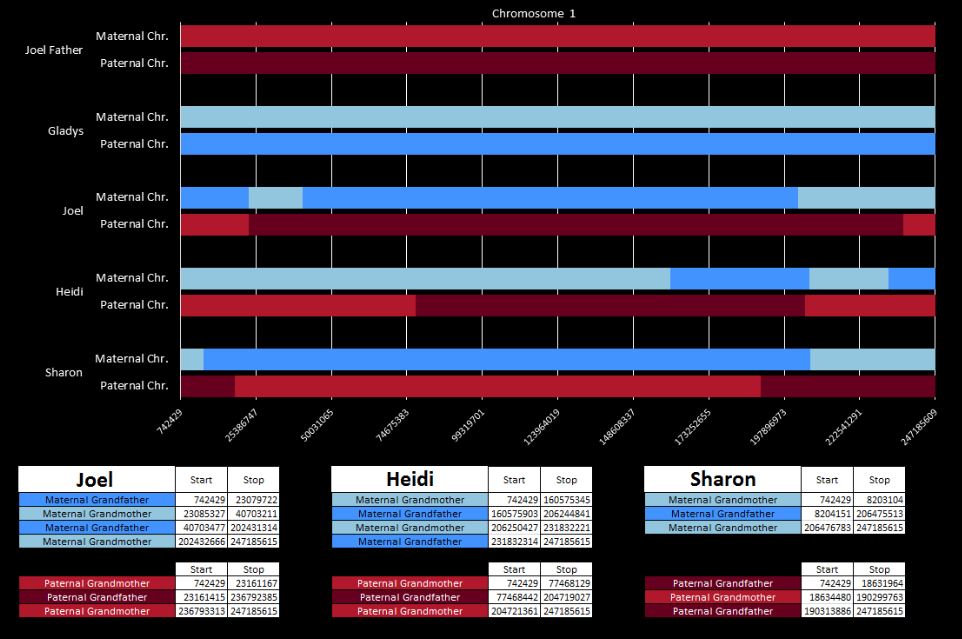
The above attempt was an early try at visual phasing. Chromosome 1 is the longest Chromosome and therefore one of the most difficult ones to try to visually phase. Since then, I have had more experience at doing this. M MacNeill [prairielad_genealogy@hotmail.com] also has done some raw data phasing which is more accurate. Here is his result for Chromosome 1:

chr1rawphase

By comparing the two images, you can see the mistakes I made in my early try at visual phasing. There are some things that I see now on my initial try that scream out at me that they are wrong. The major mistake is the small segments that are internal to the Chromosome (i.e. not right at either end).


More On Frazer DNA

In this blog, I’d like to finish a few thoughts on Frazer YDNA and look at some new Frazer autosomal DNA Results.

YDNA Thoughts and Summaries

  1. The 2 Frazer Lines have now successfully tested their YDNA. The YDNA test Jonathan and Paul took is called a 37 STR (Short Tandem Repeat) test. This test has indicated a common SNP Haplogroup for the 2 lines called R1a-L664.
  2. As the 2 Frazer Lines indicate a match, this gives us confidence in our genealogy and in the autosomal DNA matches testers have between the Archibald and James Frazer Lines.
  3. These 2 tests have resulted in a unique STR signature for each line. This STR signature is called a Haplotype.
  4. The difference in the STR values between the 2 Frazer Line YDNA test results is called the Genetic Distance (GD). The GD between the 2 lines is 3 by FTDNA.
  5. When I count the GD by hand, I get a difference of 4, but FTDNA tells me this about the CDY marker: “CDY is counted using the infinite allele method.  Basically this marker is so volatile we can see multiple numeric value jumps in a single mutation.  So even if it is off by five it would still only be counted as a genetic distance of 1.” So that explains the anomaly.
  6. I had expected the GD to be lower between the 2 lines. The 2 testers should have a common ancestor 7 generations from present if our genealogy is correct. This person is believed to be Archibald Frazer b. about 1690.
  7. Some STRs have a rate of change much faster than others. The markers that have changed between the 2 lines are the faster moving markers.
  8. The haplotype for the YDNA test representing the James line appears to me to be more likely to be the haplotype of the Archibald Frazer b. about 1690. This is difficult to determine based on only 2 YDNA tests. However, I base my theory partly on the fact that the haplotype representing the Archibald line has many fewer matches to other testers than the one representing the James Line. My theory is that the Archibald Line YDNA has mutated to a more distinct state from that of the original YDNA and thus has fewer matches.
  9. More STR testing has been ordered to further refine the 2 Frazer Line Haplotypes. These results should be out by the latter part of January 2016.

I hope that makes sense. Please email me if you need further clarification.

You Gotta Lovat

All this YDNA testing has created renewed interest in some of the Project Members concerning family lore of descent from the Lord Lovat Branch of the Frasers. YDNA can certainly reach to that era and beyond.

Part of Jonathan's YDNA Match Map
Part of Jonathan’s YDNA Match Map

These striking results show that 3 out of 4 of Jonathan’s YDNA mapped matches have their most distant ancestors located in NE Scotland. At least one part of the family lore has the earliest Frazers at Keith. Notice on the map above that Keith is located to the East of the middle marker. To me, this supports traditions of the Frazers being in NE Scotland at some time before being located in Stirling and Ayrshire to the SW of Scotland. The leap of faith part is believing that both these families were in that area about 500 years or more before our respective families’ earliest verifiable ancestors.

Back to the Autosomal DNA

While we’ve been pondering our Frazer YDNA results, the autosomal testing has been moving on apace. Patricia (or Pat’s) results have come in. I was interested in her results for the following reasons:

  • Her second cousin Bill had many matches. Some of these were also with the James Line Testers
  • Pat, Bill, Paul and I also share a pair of Frazer cousin ancestors who married. These were James Frazer and Violet Frazer. DNA representing Violet’s father has already been found by triangulation. However, James’ DNA and certain genealogy have been more difficult to nail down.

Pat’s Genealogy

In an earlier Blog, I touched on Pat’s second cousin Bill’s genealogy. I’d like to expand on that here. Bill and Pat have as their common ancestors, George Frazer b. 1858 in Martinsburg, New York and his wife Susan or Susanna Price. According to one Ancestry tree, the handsome family looked like this:

Frazer Price

I mention this, because half of the autosomal DNA that Pat and Bill share would be from Susan Price. Now, again, according to Ancestry, Susan Price’s parents were John Price and Margaret Stinson both born in or around Enniskillen, Ireland. Perhaps this Margaret Stinson was related to this George’s mother’s grandmother Ann Stinson. If so, do you think that will complicate the DNA results?

Here is the DNA that Pat and Bill share in orange (representing George Frazer and Susan Price) as seen on FTDNA’s Chromosome Browser:

Pat and Bill's Shared DNA

Frazers in Martinsburg, New York in the 1850s

Here on the bottom 3 lines of the New York State 1855 Census are George Frazer’s parents: Richard Frazer and Ellen Hassard or Hazard. As mentioned above, Ellen is also the granddaughter of Archibald Frazer and Ann Stinson.

Richard Frazer 1855 Census

I have included the Johnston family above because the father William Johnston was married to Mary Frazer, daughter of Archibald Frazer and Ann Stinson. So you are perhaps seeing a Stinson pattern here as well as a Frazer pattern. In fact, in the 1901 Census for Clanwilliam, Marquette, Manitoba, we see a William Stinson b. in Ireland living near the George Frazer family. Also living in the Frazer house was George’s mother, the (by 1901) widowed Ellen (Hassard) Frazer.

Then on the previous census page of the 1855 New York Census for Martinsburg:

Hazards 1855

Here is yet another Frazer. Ann Frazer is the younger sister of Mary Frazer Johnston. I have that Ann married a John Hazard on 24 Dec 1824 at Ardcarne, Roscommon, Ireland; by licence. John tried to confuse me by going by William in the US, but apparently he is one and the same.

Let’s go back 5 years to the US Federal Census of 1850 in Martinsburg:

Patrick Frazer 1850

and on the next page:

Patrick Frazer 1850a

Here is a James Line Frazer. Patrick Frazer would be a second cousin once removed to Mary Frazer Johnston and Ann Frazer Hazard. We have this Patrick married to a Jane Lacy. However, other Ancestry trees have him married to a Jane Mostown. In the 1855 census, Jane appears to have a middle initial of M. However, the 2 Janes are either the same, or Patrick remarried a second Jane. Or, less likely, there was more than one Patrick Frazer! This sidetrack shouldn’t effect the DNA results, but it is interesting to see how these Irish families stayed together in the US.

Two Side by Side Triangulation Groups

When I started looking at Pat’s results, I noticed a new Triangulation Group (TG) right near an existing one.

2 TGs with Jane

The existing TG has Jane, Doug and Michael and clearly indicates that the DNA represents that of Archibald Frazer and Ann Stinson. We know this because Doug does not to his knowledge have multiple Frazer lines – that is, Frazer ancestors marrying Frazer ancestors.

The newer TG is on the top and includes Bill, Pat and Jane. Note that Jane is in both groups. Also note that this could indicate the common ancestor the 3 have in Richard Frazer b. about 1777. Frankly, I’m quite puzzled and stumped as to who this TG represents. I have ordered a book on Endogamy by Israel Pickholtz. Perhaps that will help. Note also that Bill and Pat match each other to location 170,00,000 (say 170) This is the area where Jane, Doug and Michael match each other, but they don’t show a match with those 3 in that area. This will take some thought to decipher.

DNA Going Two Different Ways

In a previous blog, I noted difficulty in finding the DNA from my Frazer ancestor James Frazer. He was married to a Violet Frazer who I could find due to triangulation with her father Richard. Some matches with Pat may indicate additional DNA Pat and my family share that came down from this Frazer couple.

Pat Chr 4

Here, I have Pat’s match with me (JH) on Chromosome 6. I included above that, Pat’s cousin Bill’s match with Cathy. See they are at similar locations. However, these 2 sets of matches indicate different ancestors. The Bill and Cathy match represent DNA from the Archibald Frazer Line. I am not related on that line. So even though this segments overlaps, it could never triangulate. The match I have with Pat is most likely with James Frazer and Violet Frazer. This is what I think the above means. Remember George Frazer who was born in Martinsburg. Also remember, on each Chromosome we get DNA from both our parents or rather 2 sets of Chromosomes (one Paternal set and one maternal set). George had on one Chromosome #6 DNA from his father Richard Frazer and and on the other Chromosome #6, DNA from his mother Ellen Hazard.

George and Pat Frazer Tree

It looks like George passed on his father’s Richard Frazer DNA to Richard Price “Pat” Frazer. This is easy to remember because “Pat” is the ancestor of our Frazer DNA tester Pat. This is the line that would match with me, as Richard is the son of James Frazer and Violet Frazer. The maternal Hassard Line carrying the Archibald Frazer/Ann Stinson DNA went to George Harvey on our tester Bill’s line. This is the line that matches with Cathy. So in these 2 set of matches, we appear to be splitting out the related ancestors. Complicated. But at least I have an explanation for it, unlike the previous triangulation case.

Finally, here’s a match on Chromosome 9 between Pat and Sharon for about 11 cM. I take this to represent the DNA of my kissing cousin ancestors James and Violet Frazer.

Pat Sharon Match

A Triangulation Group with a Genetic Genealogist: But Who Are the Common Ancestors?

The next Triangulation group is with a genetic genealogist named Jennifer (JZ below). I mentioned that she was in a TG with Cathy and Jane in a previous blog about Cathy’s DNA results written August 2015.

Pat Jenn TG

This TG has Pat, Cathy, Jane and Jennifer. But wait. I don’t see a match between Pat and Jane. I lowered the levels a bit at Gedmatch.com and see that all four women match each other on Chromosome 5 and that they do indeed match and triangulate:

Pat and Jane Gedmatch

We know that Cathy and Jane have a Frazer ancestor born about 1802. Cathy and Pat share a Frazer ancestor b. about 1778. There is still a mystery as to how Jennifer fits in. She had a J. Frazer ancestor, that I guessed was a Jane Frazer. I further guessed that this Jane was a sister of the Archibald that married Catherine Parker. This theory still makes sense. Jennifer has subsequently found out that her ancestor was indeed named Jane Frazer/Frazier.

Summary on Pat’s Autosomal DNA Results

  • Pat didn’t seem to have as many matches as her second cousin Bill. This means that Bill just seemed to get extra Frazer DNA including from the more distant James Line.
  • Pat did shed some light on the common cousin Frazer ancestors that her family and my family share: James and Violet
  • Pat’s DNA resulted in a new TG. This will need more analysis as to where that TG is pointing to as far as in common Frazer ancestors
  • A comparison of Pat and her 2nd cousin Bill’s matches on Chromosome 6 helped to untangle some endogamy in the family (multiple Frazer lines due to marriages of relatives).
  • Pat’s DNA solidified a TG with a genetic genealogist who didn’t originally test to show any specific Frazer ancestry

Phasing the X Chromosome

This is my 3rd Blog on the X Chromosome. In my first blog, I wrote about a large match my sister Sharon had with a previously unknown woman named Karen and where it likely came from along the lines of my Irish Frazer ancestors. In the next Blog I wrote more about that match and how Charlotte who was already in the Frazer DNA project matched and triangulated with my sister Sharon and Karen. My earlier posts:

The Nexus of X’s

The X Factor – Part 2

What is DNA Phasing?

DNA phasing is determining which side your DNA matches are on. According to ISOGG which is generally my standard reference source:

…it is the process of trying to determine which DNA came from the mother, and which came from the father. The term is usually applied to types of DNA that recombine, such as autosomal DNA or the X-chromosome. The benefit of phasing is being able to identify which ancestor a segment was inherited from.

In this blog I’ll just be writing about the X-chromosome phasing.

My Easy Male X Phasing

For males, the phasing is easy. I got all my only X-chromosome from my mother. That means my X is already phased. That’s the good news. The bad news is that I have hardly any X matches. I have 8 X matches at Gedmatch above 10 cM. This is not counting my mom and 2 sisters. However 4 of those 8 have the same email address. That means that it is likely that they are related to each other. Here are my top 8 non-immediate family X matches from Gedmatch.com:

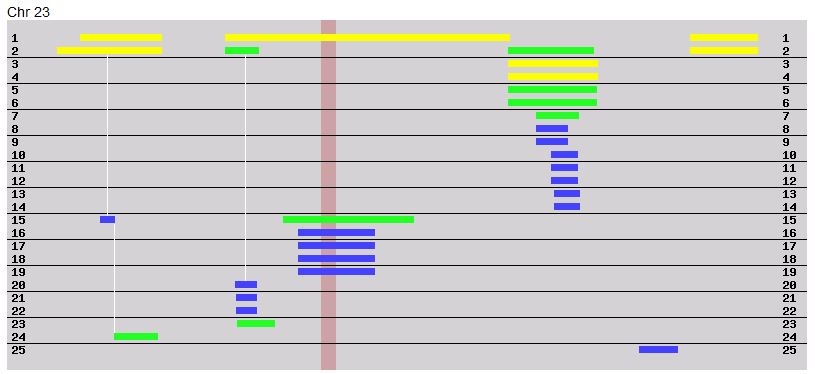
Joel X Match Gedmatch

As I mentioned they are already phased as they are all from my mom. Here are a few observation on my few X matches (which Gedmatch labels Chr 23):

  • It appears that matches 3-7 match each other. This may be verified by performing a ‘one to one’ analysis at gedmatch. If they match each other, that would mean they triangulate and come from a common set of ancestors. When I checked match 3 against match 4, it appears that they are closely related as I expected. When I checked match 3 against the shorter match 7, I show a match. That means, as expected, I appear to be in a triangulation group with the 4 in the same family plus match #7.
  • From the details which are not shown, 7 of the 8 of these are from Ancestry. I am able to email these people and if they respond I may be able to see their Ancestry Trees and determine where these matches may be.
  • Matches 1, 2, and 8 show little to no overlap with each other and show no overlap with the larger group of matches.

Phasing My Sister’s DNA

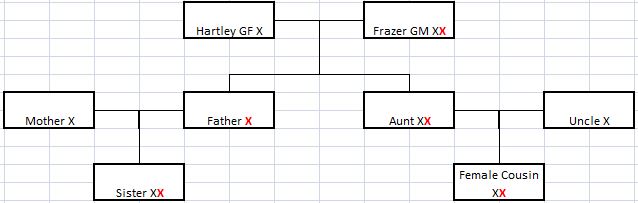
In order to see any Paternal X matches, I will have to go to my sisters’ results. Each of my sisters got an X Chromosome from my dad. In fact, what they got from my dad was the same X that he got from his mom unchanged. But before, we get to my sisters’ paternal X, we’ll look at the maternal. My sisters also each received an X Chromosome from our mother.

My Sister’s X Maternally Phased

Wherever I match my sisters, this would also have to represent their maternal matches. So in a sense I am being used to maternally phase my sisters. Here is how I match them using the same gedmatch browser.

Joel's matches with Heidi and Sharon

Here, my #1 and #2 matches are my sisters Heidi and Sharon. Matches 3-10 are the same as my old matches 1-8 above. A few notes:

  • The colored segments in #1 and #2 represent the maternal X matches I share with my 2 sisters.
  • This shows how my sisters match my numbers 8, 9, and 10 matches.
  • Remember my cluster of matches that I thought should triangulate? Heidi (#1) doesn’t clearly match that group, but my sister Sharon (#2) does.
  • On the top right, I match my sisters, but we match none of my other matches below. I suspect that has to do with my mother’s father. He immigrated to the U.S. from Latvia in the early 1900’s and has very few DNA matches that I have found so far. When I search for Rathfelder or Gangnus in my DNA matches, I haven’t found anything so far. Some of the more distant German ancestors names come up, but not these.
  • Just looking at the groupings with my sisters, there are 4 different groupings. These represent segments my mother inherited from some of her ancestors. I say some, because she inherited no X from her father’s father. X is never passed down from father to son.

How Is This Helpful?

It is always helpful to know whether a match is on the maternal or paternal side. This eliminates half of your matches. DNA analysis can be looked at as a narrowing down process. Narrowing down 1/2 of many thousand autosomal matches can save a lot of time. However X Chromosome matches narrow down further. If there is a maternal X match, I know that it has to be in the following blue or pink areas of my mother’s ancestors.

Mom's X Inheritance

These matches are even narrowed down further. That is because in order to have a true X match you have to show that the person you are matching is also matching on the X Inheritance portion (pink or blue) of their own chart.

Finally, here are all my X matches from Gedmatch (except for my mom). There is a reason I’m showing you this.

X Match Joel All

Now I see 5 groupings.

  • In the second grouping under my longest match with #1 (Heidi), there are 2 subgroupings. These likely represent older families beneath the more recent family above them.
  • The 4th group (of one) #25 only matches me and no one else – not even my sisters.
  • Now look at my mother’s pink and blue chart above. At her great grandparent level, there are 5 people she could have gotten her X Chromosomes from. These are Gangnus, Lütke, Baker, Nicholson, and Ellis. It is possible that these 5 segments represent those families.
  • As I mentioned above, I have not come up with the surname Gangnus in any of my DNA searches so far. That tells me that Group 5 or the top right match with only my 2 sisters and no one else could represent the X Chromosome portion that we received from my mother’s great grandfather. He was Johann Philipp Gangnus born on 22 May 1829 at Hirschenhof, Latvia.

One of the reasons that I’m looking at my X results in such detail is that I don’t have many of them. The male X matches can be more significant that the female X matches. This is because the male’s matches are already phased. At a lower cM level, they are more likely to be real matches.

A Second Look: Phasing by Ancestry Composition

In my 5 grouping theory above, I guessed that I may have inherited all 5 of my mother’s possible X match families. Unfortunately, I have reason to doubt that. One reason is, that in my limited reading on the subject, the X Chromosome can be quirky and come down as an all or nothing thing. In other words, it would be unlikely that I would inherit all of these families’ X Chromosomes.

Not many companies look at the ancestry composition of the X Chromosome. I’m not sure why. I’ve tested at 23andme and they do. 23andme shows me as the following, taking into consideration all Chromosomes (1-22) and the X Chromosome:

23andme joel ancestry composition

This information is put on a chromosome browser. Note that there is a maternal and paternal section of the browser. Unfortunately, not having my mom tested at 23andme, I can’t tell which half is maternal and which is paternal. Also note there is just one line for the X Chromosome which for me is the only possible maternally matched X Chromosome.

joel 23andme chromosome browser ancestry

It is difficult to make out the differences in the blues, but when I look at the French and German side, I get the entire X Chromosome as well as some other chromosomes. As far as I know, my Nicholson and Ellis ancestors were from deep within England. If 23andme is right, it seems to indicate that I didn’t get any Nicholson or Ellis X Chromosome or it would show some X Ancestry as being British & Irish. My mother’s other X ancestors were German – either of late or from around colonial Philadelphia.

This means that I would have to go back another generation on the pink and blue chart above. This represents my mother’s 2nd great grandparents. When I take out the Nicholson and Ellis families, that still leaves me with 5 German families: Biedermann, Luetke, Fuhrmann, Baker and Faunce. My suspicions seem to be confirmed by my second cousin. Judy has tested at 23andme.

Judy, Where’s Our X Match?

Judy and I have many matches, but none on the X Chromosome. Based on the X Chromosome inheritance, I’m in line to share an X with her from our Nicholson ancestors. There are 3 possible reasons we may not share an X match: 1) my Nicholson X dropped out; 2) her Nicholson X dropped out; or 3) both of our Nicholson X’s dropped out! Perhaps Judy will upload her results to Gedmatch.com and we will be able to figure out more on how we match or don’t match based on my 2 sisters’ matches with her.

Judy and Me X

Above is the chart showing that Judy and I could share an X, but according to 23andme, we don’t. A few notes on this chart:

  • Judy and I have the potential to share Annie Nicholson’s X chromosome.
  • Jacob Lentz’ X makes it down to me (through Emma), but not down to Judy.
  • Wm Nicholson Lentz got his only X from his Nicholson mother
  • My grandmother Emma had a recombined X from her parents. Likewise my mom had a recombined X from her parents.
  • Likewise Judy’s mother had recombined X from her grandparents, and Judy had recombined X from her parents.
  • That means between Judy and me, Annie Nicholson’s X chromosome could have recombined at total of 4 times (2 on each side).
  • When I say recombined, I mean potentially recombined. The X sometimes ‘decides’ not to combine. Apparently that happened on one or both sides as Judy and I don’t share any or Annie’s red X Chromosome.

On To the Male Phasing of the X Chromosome

This is where I drop out. As a male I’m pretty useless. (I left that one wide open.) I’ll have to switch to my sisters’ matches now. One way to find out my sisters’ male phased X Chromosomes would be to compare their matches to a cousin. Unfortunately, I didn’t get my paternal cousin to test. I emailed, but got no response. Here’s how it would’ve worked out:

X from Paternal Cousin

The red shows that my sister and her paternal 1st cousin would share my father’s mother’s X Chromosome inheritance. But how would we ever find the X for my father’s father? The answer is that we couldn’t for my sisters because they only got my father’s X that he got from his mother which is unrecombined Frazer DNA. However, I have had my father’s 1st male cousin tested. He inherited an X from his mother who was a Hartley (my grandfather’s sister). So his X Chromosome should match with my paternal first cousin’s X Chromosome. This is because my Aunt got her Hartley X Chromosome from her father. And he got his from his mother who was a Snell. So it still doesn’t get at the Hartley Chromosome so much but gets closer to that side.

I think this is what ISOGG means when it simply says:

To phase your X-chromosome, all you need is knowledge of your ancestry.

It seems you need knowledge of your ancestry plus a lot of testing.

Any Other Ideas?

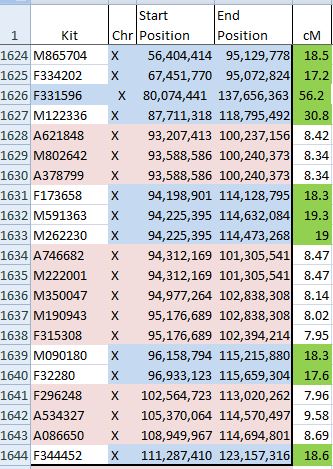
As I look at my spreadsheet for Heidi, her results from gedmatch are phased. How did this happen? Here is a portion of the chart:

Heidi's Phased X

Here the blue would be paternal X and the pink is maternal for Heidi’s matches. The large 56.2 match was discussed in my previous blogs and was believed to be from the Frazer side (which is my family’s paternal side). When I got my sister’s raw DNA results and uploaded them to gedmatch, I had them phased. Gedmatch has a program that takes your results and one of your parents and based on those results puts your results into a paternal file and a maternal file. I took the maternal side and ran all the matches at gedmatch. Then I took the paternal side of Heidi’s matches and ran all the matches. I combined the 2 and voilà got one file showing paternal and maternal matches for Heidi. This worked for Chromosomes 1-22 as well as the X Chromosome.

Sharon’s X Matches

Sharon's X Matchs

Here the matches to my sister Sharon with a Kit # are from Gedmatch. The other matches are from FTDNA. For some reason I didn’t get around to adding Heidi’s FTDNA matches. The 96.4 cM match is between Sharon and our mom. Blue shaded matches are Paternal and pink are Maternal.

Check Your Work

When I was in school, I was told to ‘check your work’. Here under Sharon’s match with A111074, I have a note on my spreadsheet that something doesn’t seem to add up. In this case, there are 2 ways to check if a particular match should be a paternal or maternal match.

  1. If I have the same match, as a male, that would have to be a maternal match for Sharon.
  2. I have Sharon phased. I can check Sharon’s maternal and paternal phased kits and see which one matches A111074.

From my spreadsheet, here is my X match with A111074

Joel's X match with Alice

Oops, A111074 matches me. That means she has to match Sharon on my mom’s side. When I check A111074 against Sharon’s phased kits, she matches Sharon’s maternal phased kit and not the paternal phased kit. So I need to correct this match of Sharon from paternal to maternal.

What If You Don’t Have a Parent to Test?

Having a parent to test can make the phasing part easy. If you don’t have a parent to test there are some other options:

  • Test cousins that would have shared X matches as mentioned above
  • Women may test a brother to find maternal only X matches
  • Triangulate to find groups. These groups will be either maternal or paternal – however your won’t know which. If you determine on maternal or paternal match in the group, the others will be the same.
  • If your parents are from different backgrounds the paternal or maternal aspect may sort out by matching others of those backgrounds. The fact that my X Chromosome seems to be all German as shown above is one example of how to do this. Another example would be my mother in law. Her mother’s side of the family was from Newfoundland. Her father’s side was from Prince Edward Island. She has a lot of matches with people with ancestors from these 2 places. In most cases that sorts out her matches into maternal or paternal – depending from which island they were from.

In summary:

  • All autosomal DNA has a maternal and paternal side. The one exception is the male tester’s X Chromosome. His is all maternal.
  • Knowing if your matches are maternal or paternal takes away a lot of guesswork in your matches.
  • Knowing your own X inheritance pattern as well as your match’s X inheritance pattern will give clues to where that match could be.

Starting to Map My DNA

One of my goals is to map my DNA. The human genome has been mapped. I just want to see where my DNA matches with my ancestors. Kitty Cooper has developed a tool for this. The idea is to associate as much of your DNA as you can to ancestors. Then these portions of the DNA associated to your ancestors are mapped with different colors. My paternal grandmother was a Frazer, so her DNA should account for about 25% of my DNA. The map splits up each Chromosome between Paternal and Maternal, so my DNA from my Frazer grandmother would take up about half of my Paternal side.

One way to determine DNA ancestors is by triangulation. I did this in an early [misnamed] blog called, “The DNA of Archibald Frazer and Mary Lilly”. I say misnamed, because at the time those were the 2 ancestors I thought my triangulation group was pointing to. In a subsequent blog, How I Added 2 Frazer Lines by DNA, I realized that this group more likely pointed to a couple a generation later: That was Richard Frazer and his wife. He was b. around 1777.

Based on the fact that I was in one of the 2 triangulation groups that pointed to Richard Frazer (and unknown wife) I could create a chromosome map. It wouldn’t be too interesting, but it would be a start.

1st Chromosome Map

This chromosome is all blank except for Chromosome #12. There, I put my triangulated matches into a spreadsheet. The matches were to David and Bill from Canada and Jane from Colorado. My 2 sisters also matched these Frazer descendants. It would have been more interesting if I had mapped my sister, Heidi as she at least had triangulated with the same couple at Chomosome #1. Plus she had higher matches with other Frazer descendants in general. Speaking of Heidi, in my previous misnamed blog I showed this graphic from Gedmatch:

Frazer Chr12

Theses are Heidi’s matches on Chromosome #12. She had the same matches as me. She has David (#2), Jane (#3) and Bill, (#4). I am showing as Heidi’s long segment match at #1. This red segment is what I have in common with my sister and is the DNA we both received from our father, though he is long gone and hasn’t been tested for DNA. I know that it must be from him, because he is the one that I get my Frazer DNA from. In fact, that DNA must be from his mother, who was a Frazer. Remember, I should have 25% of my DNA from her. So it stands to reason that the unbroken red match I have with my sister represents my Frazer Grandmother’s DNA.

By the way, this is the backwards way of doing things. The more standard way to map your DNA takes a lot more testing. First you test your parents to get maternal and paternal sides. Then test 2nd cousins on both sides. This will isolate your 4 grandparents. What I have done is tested my mother. I phased her at Gedmatch to get my maternal and paternal matches. I had my father’s first cousin tested. This is similar, but better than testing a 2nd cousin. He represents my father’s father’s side. But not all of it. Many Frazers have tested in the DNA project, but my closest relative in that testing project appears to be a 4th cousin, once removed. On my mother’s side, I’m having trouble getting people to test and/or upload to Gedmatch. So I will go with my current reasoning until I’m proven wrong.

I’ll put a face on that Frazer DNA. Here’s my grandma, nee Frazer.

Marion Frazer Photo

Here’s another Chromosome (10) where my 2 sisters match a Frazer descendant, MFA. We don’t triangulate, but based on genealogy, we’ll say there is a common Frazer ancestor or collateral line there somewhere.

The spreadsheet match looks like this:

Hartley MFA match Chr 10

The Chromosome browser version looks like this:

Sharonn Heidi MFA Chr 10 Gedmatch Browser

Here Line 1 and 2 are my 2 sisters Sharon and Heidi shown as they match to me. #3 is MFA, my 4th cousin, once removed. Using the same reasoning as above, I’ll say that the orange segment, top right, should also represent my Frazer grandmother. The orange on the left doesn’t. I actually match there to a cousin on my Hartley (non-Frazer) side. When I map this, I can map this to my father’s Hartley father.

Back to Chromosome Mapping Basics

The instructions for Chromosome mapping are to:

  • Test relatives or find relatives who have tested at Gedmatch, FTDNA or 23andme. Unfortunately AncestryDNA won’t work as they don’t tell you where you match on the chromosome. Thus no chromosome mapping for these AncestryDNA matches unless they upload their results to Gedmatch.com
  • Figure out if those relatives are from your maternal or paternal side
  • Figure out who the common ancestors are for your matches
  • Put this information in a file
  • Use the Kitty Munson application to make a map

The relatives I used for this chromosome map

  • My father’s cousin Jim – his mom was a Hartley. Our common ancestors are my Hartley great grandparents. He shows in the dark blue below
  •  I found cousin Judy at 23andme. It pays to have DNA tested at different places. Our Most Recent Common Ancestors (MRCAs) are also great grandparent – this time on the maternal side. They will show as red – my Philadelphia ancestors. Up until recently I had virtually nothing on the maternal side of this map.
  • Various more distant Frazer relatives. The sure ancestors are the ones triangulated. Others are less sure. Once results come back for my 2nd cousin once removed, the chromosome map will look better.

2nd Chromosome Map

As you can see, most of my map is paternal. Chromosome #12 in dark green is the one I mentioned earlier where my grandmother’s Frazer’s DNA probably goes the length of that chromosome. I didn’t map her, as technically, I don’t have her as a most common ancestor based on people that I have tested.

Other things to notice:

  • Chromosome #1 shows where there are overlaps in paternal and maternal matches. Sorting your matches into maternal and paternal is one of the most important things in DNA matching. If you get that wrong, everything else is off track.
  • I mapped as the Archibald Frazer line those matches I had with MFA where I’m not positive on the MRCA between us.
  • I mapped as the James Frazer line, the match I have with Bonnie who is related on that line.
  • Some people use these maps to show all matches they have to a certain location – French Canadian, for example where they aren’t sure of all the details.
  • This is my own personal map. Everyone’s map would look different.
  • It would be possible to create a chromosome map for my father. This could be based on his Lazarus file. In that map, his Frazer ancestors would be on his maternal (mother’s) side. This map would show more matches as it would include the matches from my 2 sisters.
  • Chromosome mapping is a way to show a lot of complicated information in a simple way.

So all I have to do now is fill in the rest of the blanks!

Why Test the Y?

In this blog, I want to look at YDNA. This is different from the previous blogs where we were looking at the autosomal DNA or the atDNA. The autosomal DNA is good for going back about 200-250 years. If you are lucky, it may go back some more. Also the atDNA is for both your parents and all of the parents of those parents. When you take the Family Finder test or AncestryDNA test or similar this is what you are taking. And when you get matches, you are getting matches to all of your ancestors. These are matching with everyone else’s ancestors. Not only that, these matches may represent matches with the descendants of those ancestors that not many people even know about. It is like finding a needle in a haystack.

The YDNA is much different. It just follows the father’s father’s father’s line. All the way back. Back to genetic Adam. I look at it like a LASER type of test vs. the scatter gun approach of the atDNA test.

There has been only one tester so far for YDNA in the Frazer DNA project. There is a reason that we only have one tester so far. In order for the YDNA test to be significant for the Frazer DNA project, you have to be a male Frazer. It turns out that there are relatively few of these male line Frazers around that are available and willing to test their DNA. My second cousin once removed, who is a Frazer, has recently agreed to test his DNA. His grandfather followed my great grandfather’s lead in coming to Boston, Massachusetts from Ballindoon, County Sligo, Ireland. So I’m anxious to see how his YDNA matches with our first tester and whether this proves an unbroken line between the 2 branches of our Irish Frazers back to the early 1700’s.

STRs, Genetic Distance, SNPs and Haplotypes

Our first tester tested for 37 STRs. STRs are Short Tandem Repeats. This is now the basic test at Family Tree DNA (FTDNA). However, at one time they were testing down to 12 or 25. These results are listed on the Fraser and Septs web page. According to that page, there are 1875 members. Our Frazer YDNA tester STR results are listed here.

Fraser YDNA Results

As you see, there are a lot of numbers. Everything seems to be reduced to numbers nowadays! These are the results for the R1a1 people in the Frazer group. There are only 3 people out of what I can only assume are 1,000 or more Frazer YDNA testers. The first R1a1 person is our tester. You see he has put down Archibald Frazer b. 1690 as his ancestor. The next tester also tested 37 STRs and the 3rd tested only 25 STRs. Note that all the testers spell their Frazer with a Z.

Each number in the chart stands for a different location on the YDNA. Taken together, these numbers create a YDNA type of fingerprint. The more STRs tested, the more specific the fingerprint. These locations were chosen as areas that are likely to change. The difference between the numbers of any 2 people is called the GD or Genetic Distance. This is a rough estimate of relationship. It is also a bit relative. Say someone has a GD of one when comparing two 111 STR tests vs. two 37 STR test. The GD of one for the 111 STR test comparison represents a much closer match. Here’s a closer look at the first 25 STRs of the R1a1 Frazers:

STR Locations

Frazer YDNA 25

The heading I put in doesn’t quite line up but are the locations of the STRs being tested. The first row below the heading is the maximum number for the STR. The second row is the minimum. The third row is the mode or the typical number. The purple numbers are below the mode and the pink numbers are above the mode. So our Frazer can be said to be a GD of 7 from the mode. This is because in the 7th column there is a difference of 2. All the other differences are one. For a GD of one in a 37 STR test, Family Tree gives the following chances of having a common ancestor:

Tip Chart GD1

Our current YDNA Frazer tester’s closest match is a GD of 1 match with a Frizelle. Perhaps this Frizelle was once a Frazer that changed his name to Frizelle. Or perhaps our Frazer name was once Frizelle. For comparison, his generations to the James of the James line would be 6 or 7 to the parents of the James and Archibald Lines.

Now all these STR numbers are used to estimate the Haplogroup. The estimated haplogroup is R1a1. This is the old name. The new name for R1a1 is R-M512 and  based on the test for that SNP. In the first screen shot there is a red R-M512 next to the 3 YDNA testing Frazers in the group. The SNP is red because it is estimated based on the STRs. If the SNP was tested, the color would be green. However, there is no need to test for R-M512 as the STRs already indicate that the SNP is R-M512. A SNP is a Single Nucleotide Polymorphism. In other words, it is a specific test aimed at finding a haplogroup or haplotype. So one might say that a STR test is a general description of the YDNA based on specific markers. The aggregation of these markers result in a profile that can be used to compare with other profiles. It may also be used to estimate a haplotype. The SNP test is a very specific test looking for a specific crucial spot in the YDNA that proves a specific haplotype.

One of the goals for this Frazer DNA project is to show by YDNA that the James line and the Archibald lines are related. We are pretty sure they are. However, over the years, things can happen, so it’s good to be sure. This YDNA could be used to trace our Frazer back to other Frazers in Scotland.

What is R1a1?

I’m glad I asked. When our first Frazer tested, I was expecting the results to be R1b. This is quite a common haplogroup. This is what my Hartley YDNA came back as. Some people associate the R1b with the old Celtic peoples of the area. My Hartleys were supposed to come from the NW England which is near SW Scotland where our Irish Frazer supposedly came from. So it made sense for me to guess that the Frazers would also be R1b. As I scroll down the Fraser and Septs – YDNA Colorized Chart,  I see that many of the Fraser/Frazer names are under R1b.

The difference between R1a and R1b is quite large. I would guess that these 2 haplogroups split from each other 10,000 years ago or more. The R1a people took the Northern route out of Asia accross Scandinavia perhaps and ended up in the Northern part of the British Isles. The R1b’s took the Southern route, generally, around Spain or possibly shortcutting through France and up into the British Isles.

There are also internet groups just for R1a1a people of any surname. Here is a map from one of those groups showing the migration and peoples descending from R1a.

R1a-ch

Notice that the Scots are near the Vikings. It would be interesting to see if our Frazers are positive for the L448 and L176 tests. That was the 2012 chart. There has been an explosion of testing over the last few years which has been difficult to keep up with and new branches are being discovered on a regular basis. Here is the 2015 chart:

r1a chart 2015

See all the extra branches at the bottom. Many of these are based on the Big Y DNA tests, that basically tests you for anything Y. You can see many more Scots branches near the 3rd little figure on the bottom. Unfortunately, our STR testing only gets us to about 6,000 B.C. This is caveman days, when our ancestors were still in Asia perhaps. However, as R1a is rarer than R1b the test should be good enough to show a male line match. Plus, the STR profile should be very similar.

Why Are So Few of our Irish Frazers R1a1?

There could be many answers to this question.

  • The Frasers/Frazers are apparently a large clan with many branches. Ours could be a separate one.
  • An early adoption of a Frazer could have created a different branch of the Frazers
  • DNA testing predates the adoption of surnames, septs, and clans. More than one group of people could have adopted the same surname, or become part of the same sept or clan. A review or our YDNA testing Frazer shows that his closest matches are with a Frizelle (GD=1) and a Grant and a Stuart (GD=2). This could indicate that the Frizelles, Grants and Stuarts could be related a point that predated surnames.

What Will it Mean if the Two YDNA Tests Do Not Match Each Other?

I am hoping they will match. If they clearly don’t match, then there will need to be additional testing to determine why and where that lack of matching occured. However, based on the autosomal DNA analyses done so far, I think there will be a match. There are many autosomal DNA matches between the Archibald Line descendants and the James Line Descendants. Here are the matches between the 2 lines. There are about twice as many matches since I wrote about this before in Frazer DNA – Celebrity Edition!

Matches Archibald James Lines

However, I can think of 3 ways to interpret these matches:

  1. This could be due to the fact that there were common collateral lines and these  matches are picking up the Frazer spouses common ancestors;
  2. this could be due to the fact that autosomal test is picking up this old Frazer connection that goes back to the early 1700’s or;
  3. the matches could be due to intermarrying between the 2 Archibald and James Frazer Lines subsequent to the early 1700’s.

So for now, we will sit back and wait for the new YDNA testing to come in. Then, as they say on TV, we will have our YDNA reveal.

The X Factor – Part 2

In the last Blog, I marveled at the amount of X chromosome my sister Sharon shared with karen. Part of my amazement was that I have not had one X Chromosome match at FTDNA out of over 1,000 matches until recently. One of the reasons for that is that FTDNA doesn’t report your X matches unless you also have an autosomal match. At any rate, women tend to have more of these X Chromosome matches with other people. One obvious reason is that they have twice as many X Chromosomes to start with.

Karen has uploaded her FTDNA results to Gedmatch. Here are my sister’s top matches on the X Chromosome.

Top X Matches for Sharon

To put into perspective the size of Sharon and karen’s match, the entire X Chromosome has a size of 196 cM. 56.2 cM appears to be over 25% of that amount. This is the X Inheritance Chart for my father. My sister got one of her X Chromosomes from him and I suspect this is the source of karen and Sharon’s match. Also note that Sharon shares more of the X Chromosome with karen than she shares with her brother (me). Karen also shares more of her X with Sharon than her own brother. And as we’ll see below, this large X Chromosome segment has stayed intact and traveled down through 2 different families from at least the last part of the 1700’s!

Dad's X Inheritance

My guess was that this X match went through my ancestor Fanny McMaster b. 1829 (in pink above) to Margaret Frazer. Margaret was born around 1800. Margaret is my father’s 3rd great grandmother and my 4th great grandmother.

What I did today was to look at Karen’s tree at FTDNA.

karen's ftdna tree

For some reason, FTDNA trees use a very large font for last names. This doesn’t work out well for longer last names. At any rate, karen’s father is Walter Wanama(ker) I believe. Karen got one of her X Chromosomes from her dad, like my sister got from my dad. Karen’s dad had to get his X from his mom Agnes Higgins. She got one of her X’es from Maryann McPartland. She got one of her X’es from Ann Fraizer of Derreenargan, Boyle, Ireland. Now Boyle is in the heart of my Frazer research area where I have my Frazer DNA project. These 2 graphics above appear to show that a large chunk of X Chromosome has traveled from the late 1700’s from a Frazer family through at least 2 other fairly distantly related families to today.

Karen’s family tree showed that her Ann Fraizer married a McPartland. Our Australian Frazer DNA project member Ros pointed out this entry from the Irish Court of Petty Sessions showing the interaction between one Frazer and one McPartland:

Archibald Frazer of Ballyfarnon Defendant  Feb 1883:  That on 16 Oct 1882 at Aughnafinigan, a nuisance took place on the defendant’s premises occupied by James McPartland to wit the dwelling house so dilapidated and dirty as to be unfit for human habitation and that said nuisance is caused by the act or default of the defendant.  “Nuisance to be abated by the 8th March and house put in proper repair and to pay costs 3/6”.  The Complainants were the Guardians of the Poor of Boyle Union as Sanitary Authority.

Where Did the X Come From?

From correspondence with Karen’s family, I see they have their Ann Fraizer b. about 1823. Here’s where I get into a bit of educated guesswork. 1823 is probably the generation of my ancestor Fanny McMaster, daughter of Margaret Frazer. It is possible that Margaret had a brother who had Ann Fraizer in 1829 or so. Now Margaret’s brother would have only had one X Chromosome from his mother. That means that under my educated guess scenario, the X Chromosome match between karen and Sharon would be from Margaret Frazer’s mother.  This would be the pink box in my father’s X Inheritance Chart to the right of Margaret Frazer. That would be my 5th great grandmother. She would’ve been born in the latter part of the 1700’s.

By the way, Karen is the about the 3rd person that has been found to be related to the Frazers of North Roscommon. They have all been found to be related by DNA. Each of their ancestors has been a single Frazer that is the end of that person’s research line.

Triangulation, Anyone?

Another person in the Frazer DNA Research Project, Kathy, was quick to note that her mom also matched Karen on the X. Here is Sharon’s match with karen (in pink and orange) and Sharon’s match with Kathy’s mom in blue, pink and yellow.

Sharons X match with Karen and CJK

As these three people overlap on their matches and all match each other, this closes the loop on triangulation. So this gives us double proof of a common ancestor between karen, Sharon and Kathy.  One is by the X triangulation and second is through the X Inheritance Pattern. This is another case where the DNA is clearer than our paper research!

Kathy’s X Match Ancestor

So now that we have narrowed down karen’s and Sharon’s X match ancestors, where is Kathy’s? She should have the same ancestor as the same X Chromosome segment was passed down to her mom. Here is Kathy’s mom’s X Inheritance chart but it won’t be pretty. It was supplied by Kathy starting with Kathy’s mother’s mother:

CJK's X Inheritance

Who the X Match Cannot Be

As vague as this chart is, it tells us who the X match cannot be. We may rule out the top half of the chart (not shown). This is Kathy’s mother’s father’s X Chromosome. This is ruled out due lack of Frazer ancestry. For the same reason, we can rule out the top part of the chart that is shown. That is the Emmet family which was not even known to be from Ireland. Then we can rule out any of the people in the white boxes. This includes the male Frazer line and ancestors before Edward Wynn Frazer.

Now look in the right hand column. Under the pink and blue which is the only place where the X match could be I don’t see a lot of entries. Even in the next to the last column there is maybe a Bonis. I’m ending with this example, because this is what most people see in their own genealogy. Karen and Sharon were fortunate to both have good family trees showing where a likely match would be. Even with our better than average paper trail, my educated guess was that the our X Chromosome was coming from the mother of an unknown Frazer. That means we don’t even know the surname of this person. So the X match could be anybody – though likely limited to the North Roscommon area. I suppose this is why many people don’t use the X Chromosome much. It is fascinating and gives clues, but is difficult to use.

The Nexus of X’s

This post is about the X Chromosome. As you likely know, we all have 2 sets of Chromosomes – one from each of our parents. These Chromosomes are numbered 1 though 23. 1 though 22 are the Autosomal Chromosomes. The 23rd is sometimes called the sex chromosome. Women get 2 X chromosomes: one from their mother and one from their father. Men get an X chromosome from their mother and an Y from their father. And it is important to note that the man does not pass down any X chromosome to his son.

There is some good information out there on the X Chromosome. One blog is called That Unruly X by Roberta Estes at DNAExplained.

I have had questions on what the X chromosome matches mean. In one way, the matches are like any other autosomal match. In another way, they are different. The way they are the same is that they should indicate a common ancestor at some point.

A Real Life Situation with My Sister Sharon

Let’s look at a real life situation. My sister Sharon tested recently. If I go to Gedmatch.com, I can run her DNA in a utility called ‘One to many’ matches.

One to Many

I entered Sharon’s kit # and checked the X radio button so I would get her largest X match. This gave me Sharon’s matches at Gedmatch. Unfortunately, these are sorted by ‘Gen’

X DNA Sort

Gen is the number of Generations that Gedmatch thinks your match is from you. I can tell this by the red arrow (triangle) pointing up under Autosomal. This means the smallest number of Generations are sorted first, which are the closest or most important matches. I want to sort by by X-DNA ‘largest cM’. I did that and got this for my sister’s top 4 matches:

Top X Matches for Sharon

Karen and Sharon’s Big X Match

3 of the 4 people I know. Heidi is my other sister and Gladys is my mom. They share all their X Chromosome with Sharon. Joel is me. But who is karen? And why does she share more X Chromosome with my sister than I do? Let’s figure it out together. On discussion groups I have been challenged by the fact that it is impossible to tell where a match comes from by an X Chromosome match and no other autosomal match. Let’s assume that this is true. However, in this case, karen matches Sharon on an autosomal Chromosome also. These 2 matches may represent different ancestors shared by karen and Sharon. However, these 2 matches should both be on Sharon’s maternal side or paternal side.

Which Side are You On?

As with all matches it is important to know if these matches are Maternal or Paternal. All of your autosomal matches will be one of the 2. For example, my father’s mother is a Frazer. That means I should be looking for Frazers on my paternal matches. If I find someone who matches my mother and has a Frazer in their ancestry, that match is likely coincidental and not where the DNA match is. So is karen a paternal match or maternal? If these were my matches, my guess right away would be that karen would be a maternal match. How would I know? I only have the X Chromosome from my mother. Sharon on the other hand has 2 X Chromosomes: one from our mom and one from our dad.

Here is how karen and I look on Sharon’s FTDNA Chromosome browser.

Sharon Karen Joel X

The orange is my match with Sharon. The blue is karen’s 56 cM match with Sharon. There is a chunk of orange overlap above the blue. Does this mean that Sharon, karen and I match on the X Chromosome? No. Remember that I only got my X Chromosome from my mother. Karen is related on my father’s side where I didn’t get any X Chromosome. So while it may look like a match on the browser, it is not, as the orange represents my Maternal match with my sister and the blue represents my sister’s Paternal match with karen.

Where Does Karen Fit In?

In some of my other blogs, I have been able to fit in people into the Frazer Project I have been working on. Let see if karen also fits in. First, I’ll look at her autosomal match with Sharon. To do this, I click on the ‘A’ to get the details of the autosomal match between karen and Sharon. When I do that, I get this:

Karen and Sharon Chr9

Fortunately I have had my mom tested for DNA. With these results, I was able to phase her DNA using a gedmatch utility. This results in Sharon having 2 additional kits: a paternal and a maternal kit. I ran Sharon’s Paternal Phased Kit against karen and got a match slightly smaller than the one above. This proves that the match is on the paternal side.

Then I checked karen against other testers in the Frazer project. She matches Jane and Prudence who are both known Frazer descendants. Interestingly, Jane had been in touch with this person prior to DNA testing concerning karen’s genealogy through more traditional methods. Jane and Prudence represent 2 different old related Frazer lines going back to the early 1700’s. In addition, I noted that karen had an ancestral tree at FTDNA with an Ann ‘Fraizer’ in it. Now there is no triangulation between karen, Jane and Prudence meaning no proof by the DNA that there is a common Frazer. However, the evidence of karen matching 3 Frazer descendants from by DNA and having a Fraizer in the same general area of Ireland is good circumstantial evidence.

Back to the X

All of this is interesting, but what does it tell us about the X match? To me, it says that the X match is in the same general area as the autosomal match. That means in the area of Frazers – so this could be from a Frazer or Frazer spouse. We know that the X Match is from the Sharon’s Paternal Side. I also double checked that by running an X ‘one to one’ match with Sharon’s paternally phased kit and got the same X match with karen. Sharon’s maternally phased kit did not match karen.

Here is what my dad’s X inheritance looks like:

Dad's X Inheritance

Here the pink and blue areas are the only areas Sharon could have an X match through my dad who is James Frazer Hartley. Unfortunately, these pink and blue areas go to places where it is difficult to find ancestors. In general, that would be on the maternal sides of lines where historically not as much information is not always available. Some notes from the above X Inheritance chart:

  • Sharon’s X match with karen could not be through our 2nd Great Grandfather George William Frazer.
  • The match could be through George Frazer’s wife who was Margaret McMaster
  • Margaret McMaster had a Frazer grandmother. It is possible that an X match could be through her.
  • The X chromosome does not recombine as much as autosomal DNA. This means a larger intact segment can travel down through the ages. This helps explain the large X match between karen and Sharon.
  • The percentages shown above are theoretical averages. The real amounts could be much larger or much smaller. In our example, Sharon got 25% of her X Chromosome from a part of the chart that shows that the theoretical amount she would’ve gotten would be perhaps 6-12% or less.
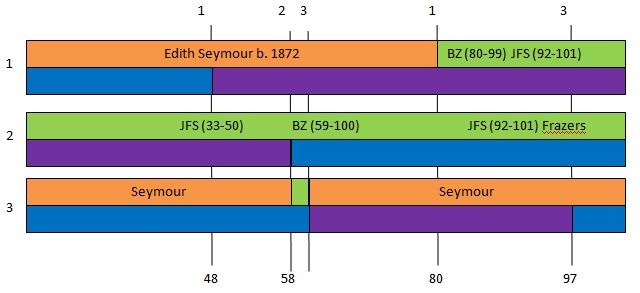
  • Also, the X Chromosome that my sisters got from my dad was the same that he got from his mom. It doesn’t even have a chance to recombine.
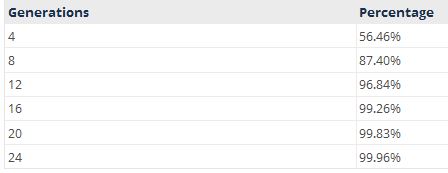
  • The match could be through the Clarke line as they were in the same general part of Ireland, but I would tend to think that it is more likely that the match would be on the McMaster/Frazer part of the chart.
  • My guess is that the autosomal portion of the match would be in the same general area as the X Chromosome match. Even though the shared ancestors represented by the autosomal match are probably not the same as the shared ancestors represented by the X Chromosome match, it would make sense to me that they would be nearby each other on the chart.