My Father In Law’s Grandparents’ DNA

In this Blog I will use a technique described by Kathy Johnston to look at some of my father in law Richard’s DNA. I will map out his 4 grandparents on Chromosome 15. These would be 4 of my wife’s great grandparents. Then I will try to figure out which grandparent goes with each segment of the mapped Chromosome.

My Father In Law and His Two Sisters

The mapping technique requires 3 siblings. My father in law tested at FTDNA and his two sisters tested at AncestryDNA. I have those results and have uploaded them to gedmatch.com.

fully identical and half identical

In the first step, I compare the 3 siblings to each other using gedmatch.com using their chromosome browser. Here is how Lorraine and his brother Richard (my father in law) match each other at gedmatch.com on Chromosome 15. I chose this chromosome because it is one of the smaller chromosomes, hence easier to map. Also I already knew there were some other cousins on Richard’s maternal side that had tested and had fairly good results with Richard on this Chromosome.
Lorraine V Richard
Lorraine V Richard

As shown in the above, Lorraine and Richard have one long match on Chromosome 15. I will use locations in millions, so I’ll say the match was from 18 to 94. This is represented by a sold blue line. According to FTDNA, the area before 18 is a SNP poor area not used for comparisons. The solid green sections are where Lorraine and Richard share the same DNA from 2 of their grandparents. These would be one maternal grandparent and one paternal grandparent. The green is also called a Fully Identical Region or FIR. The yellow area is called a half identical region. This means that Richard and Lorraine share the DNA from one maternal or paternal grandparent. The red area with no blue line below it is the area where Richard and Lorraine don’t share any DNA. However, this information is actually quite helpful. This would mean that if Richard got his DNA in this segment from his Paternal Grandfather and Maternal Grandmother, that Lorraine’s DNA would have to be from her Paternal Grandmother and Maternal Grandfather, for example. There are only 4 choices, so process of elimination can be used.

Comparing three siblings at a time

Next I line up the results of the three siblings.

Chr 15 3 siblings

I am now looking for crossovers. This is where Richard’s DNA, for example, switched from being inherited from one grandparent to being inherited from another grandparent.

Chr 15 with crossovers

Next I look down every line to see who owns each crossover. Let’s just look at the first vertical crossover line. In comparing Lorraine V Richard, nothing is changing there as there is green on either side of the line. At Lorraine V Virginia, and at Richard V Virginia, there is a change from no match to an HIR. The one in common in those 2 changes is Virginia. So she is the one that owns the first crossover point. That means at that point (to give a number would be 27) she received her DNA from one grandparent to the left of that point and she received her DNA from another grandparent to the right of that point. We don’t know which grandparent, or whether it was on her maternal or paternal side. We do know that both grandparents on either side of the crossover are either maternal or paternal grandparents. That fact will help me as I try to figure out which grandparent Virginia got her DNA from.

Assigning crossover points

Here we will give a name to each crossover point. We are building a DNA skeleton or frame for each person so to speak. These are assigned by each persons’ initial at the bottom of each vertical crossover line below.

Assign Names to Crossovers

This tells us that there are 7 crossovers for the 3 siblings. Virginia has 3 and Lorraine and Richard have 2 each.

The chromosome map

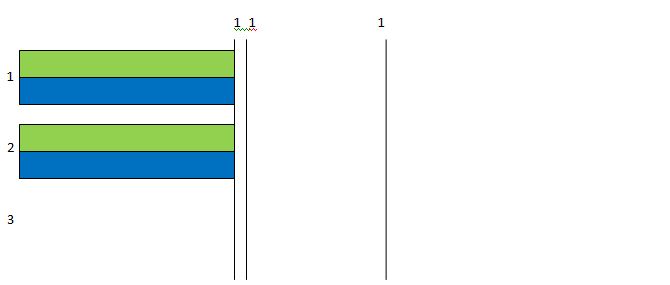
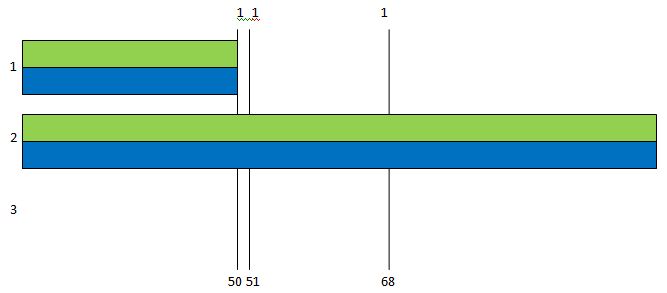
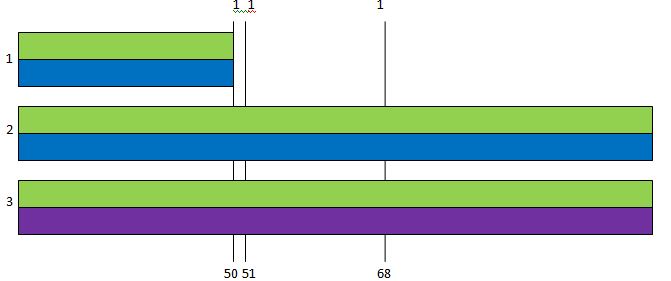
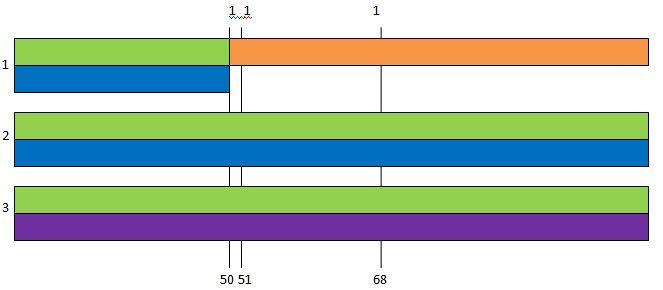
Next I will build a Chromosome Map based on the above information. This map will be for the 3 siblings and have a maternal and paternal side with 2 grandparents on each side. [That should make sense as you think about your own family situation.] To begin with, these grandparents will be represented by 4 different colors as we won’t know which grandparent is which. Here is the bare bones skeleton:

Skeleton

I kept the crossover designations on each of the vertical lines. I’ll add the 3 chromosome maps to the right of the L, R, and V on the left side for Lorraine, Richard, and Virginia. On the bottom, I have the locations on the chromosome for each crossover point. I am missing a location for the next to the last crossover line. This could be guessed or estimated based on where Virginia’s actual crossovers are later. By eye it would be about 90.

Let’s map it

Assign Names to Crossovers

I could start with any area, but I’ll start with the top left. This is the green FIR match between Lorraine and Richard. Fully identical means they both received the same DNA from the same 2 grandparents. Those 2 grandparents were one from the mother’s side and one from the father’s side. Those will be represented by green and blue.

Chr 15 First FIR

Lorraine will have one crossover preventing one of her lines (colors) from extending beyond her crossover further to the right. Richard has no crossover at this point, so his two grandparents’ DNA can extend to his ‘R’ crossover line. Meanwhile Virginia doesn’t match at either grandparent in this area, so we need to give her 2 different colors representing the DNA she got from her 2 other grandparents.

Chr 15 part 2

Due to the place I started, I’m stuck already – at least on the FIRs and no matches (green and red sections of the chromosome map).

Assign Names to Crossovers

The next step is to map an HIR. As HIRs are more ambiguous (one matches and one doesn’t) I only get one shot at guessing. Once I make one guess, then this locks in the grandparents and no further HIR guessing is allowed. Our choices for HIRs are between 27 and 35. I’ll choose Lorraine V Virginia. They are HIR between 27 and 31.

Chr 15 part 3

Now comparing L and V from 27-31, I see that their 2 green segments match and their blue and purple segments do not match. This was my one chance at guessing. I could have guessed the other way around and it wouldn’t have mattered, but at this point the colors are locked in and no more guessing is allowed. Next, Virginia has no crossovers for a while, so I’ll extend the DNA she got from her green and purple grandparents to the right to her next crossover point.

Chr 15 part 4

Next I notice that Virginia has no match with Lorraine from 31-46 and no match with Richard from 35-60. That means that Lorraine and Richard got their DNA from the opposite grandparent on their maternal or paternal side. So far, everything is relative, so the top orange and green may be maternal or paternal. We don’t know yet.

Chr 15 part 5

Scanning up from Virginia’s Chromosome 15 map from location 35 to the right, we see that Richard and Lorraine have the opposite colors. That corresponds with the no match comparisons we had in the gedmatch comparisons. We would be stuck here except for the fact that on Richard’s bar, he has no crossover at location 60. [That crossover at 60 belongs to his sister Virginia.] That means that the DNA that he got from his orange and blue grandparents can extend to his next crossover at 95.

Chr 15 part 6

Assign Names to Crossovers

Now we again are almost stuck, except that Richard and Virginia have a green FIR from 90 to 95.

Chr 15 part 7

We can then extend Virginia’s grandparents’ DNA to the right.

Chr 15 part 8

Assign Names to Crossovers

Now we truly are stuck. We only have HIRs left and I already used my one guess for those. There is a no match between Lorraine and Richard on the right hand side, as we have no DNA to go against after 95 for those 2.

Cousins to the Rescue

There is one more way to fill in these segments. That is with the matches from actual cousins. We will want to figure out which grandparents these segments go to if we can anyway by using cousin matches. First, let’s look a little at the genealogy of the cousins that have tested.

Pouliot LeFevre Diagram

In the bottom box is Richard, but I should have included his sisters Lorraine and Virginia there also. These siblings have 4 cousins that have tested on the maternal LeFevre side. Here I got a snapshot of Estelle LeFevre (b. 1905) while getting DNA from Virginia:

0306161846

There are 2 testers descended from the Pouliot Grandfather. The other 2 testers are descended from Pouliot and LeFevre. I discussed the issues in separating the DNA from those two ancestors in my previous Blog.

Pouliot LeFevre Diagram rev

Here are the 3 siblings as they match their reference cousins. The more important cousin, in a way, is Fred as he descends from the Pouliots and not the LeFevres. Note that there is no overlap between Fred versus Patricia and her brother Joseph in each comparison. That is where the crossover is occurring between the Pouliot grandparent and the LeFevre grandparent. Now for each sibling (Lorraine, Richard and Virginia) that crossover is at a different location. For Lorraine, it is at 31. For Richard, it is at 35. For Virginia, it is at 28. Now refer to the second image below. The place where all those maternal crossovers occur is on the top row of each bar between the orange and green segments.

3 sibs on Chromosome Browser to All

Chr 15 part 8

So for this try, the green represents the DNA that the siblings Lorraine, Richard and Virginia got from their Pouliot grandmother and the orange represents the DNA that each sibling got from their LeFevre grandfather.

Just to confuse things – a completed chromosome 15 map

Here is a completed Chromosome 15 that I did previously. In the version below, I started more on the right and worked my way to the left. That left blanks on the left that I was able to fill in by the actual cousins. Note that the colors are relative and are reversed for the Pouliot and LeFevre grandparents which I have labelled on this Chromosome Map:

Completed Chromosome 15 Map for 3 Siblings
what about the paternal side of the map?

The paternal side is mapped out, but I have no reference testers. These testers would ideally be 2nd cousins that are related on only one paternal line. I only need one of these 2nd cousins to identify one grandparent. Then the leftover grandparent belongs to the other side due to process of elimination. There are already likely people that have tested at AncestryDNA, but due to lack of a chromosome browser there, I don’t have where the matches are. For now I will leave them as colors or I can call them paternal grandparents 1 and 2. The actual paternal grandparents are Edward Butler (b. 1875) and Lillie Kerivan (b. 1874).

My Wife’s DNA

The DNA represented in the map above comes from my father in law’s grandparents. However, for my wife, this represents the DNA that she got from 4 of her paternal great grandparents. How could I map that out for her?

Recombination

The short and simple answer is this: My wife got her DNA from her 2 parents. That is a given. So she, like her father, Richard, has a maternal and paternal side. She will have a similar map as her father. However, now her paternal side will have her father’s 4 (or in this case 3) grandparents all on one chromosome. To make room, something has to give.

Completed Chromosome 15 Map for 3 Siblings

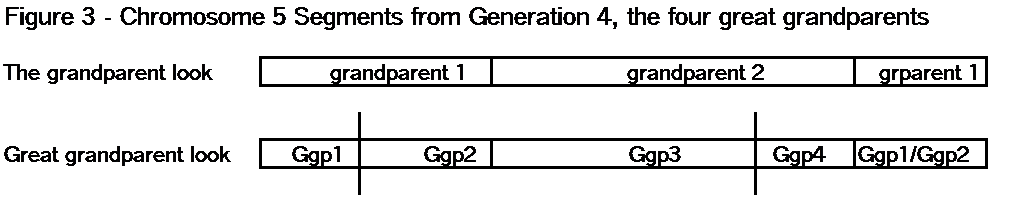
Here is Richard on the middle line. Note that he only received DNA from one of his paternal grandparents. As my wife got all her paternal DNA from her father (sounds obvious, but still worth stating), she will potentially only get DNA from 3 out of 4 of her great grandparents. Here I am borrowing a Figure from a very helpful blog called Segments: Bottom-Up:

segments greatgrandparents

In that Segmentology Blog, Chromosome 5 is used as an example. Here all the great grandparents are represented. Unfortunately, I have not tested 2 of my wife’s siblings. If I had, then I would have the first line which indicates her grandparents (in this case on her paternal side). The second line of the image above, shows in a generic way, the new crossovers that my wife could have for her great grandparent level.

My wife and her 2 aunts

Here is how my wife looks compared to her 2 aunts at gedmatch compared to those Aunts’ Chromosome 15 map. I won’t show the match to her father as she matches him in all places.

Marie Chr 15

Completed Chromosome 15 Map for 3 Siblings

From this, I take away that my wife matches her 2 Aunts on their maternal side. The gedmatch match between my wife and her Aunt Lorraine shows a break at 31 which corresponds to Aunt Lorraine’s maternal side. Likewise my wife’s second match with her Aunt Virginia starts at 60 which corresponds with Aunt Virginia’s maternal start of her switch from Pouliot DNA to LeFevre DNA. When I merge these 2 results together, it looks like the Chromosome map for Richard, above with a crossover break at 35. This makes sense, as my wife got her paternal DNA from her dad. If I was making a Chromosome map for my wife, it would include her 2 great grandparents: Martin LeFevre b. 1872 and Emma Pouliot b. 1874. Her Chromosome 15 Map would look like her father’s up to location 95. After that point it may also be the same as her father’s, but I don’t believe that I can prove that.

It is beginning to look like there may have been no recombination for my wife on Chromosome 15. So far, we have not seen any room in Marie’s DNA for the purple paternal DNA that I mapped out for Richard above.

Enter cousin John

Recently, my wife and I contacted her cousin John at AncestryDNA. He kindly uploaded his DNA to gedmatch. I said that I would use his DNA for research. Then I thought, “Now how am I going to use his DNA for research?” Here is one way. We will look to see how cousin John matches his Uncle and 2 Aunts at Chromosome 15.

John Chr 15

These red and yellow show us that Cousin John likes to eat at MacDonalds. Not really. It does show:

  • coverage of the entire Chromosome 15 from position 18 to 100.
  • one large match with Richard. This would correspond to Richard’s paternal (Irish) side
  • the match with Lorraine could correspond with her paternal side also in the purple area on my Chromosome 15 map above.
  • The 2 matches with Virginia could also be on her Paternal (Irish) side in the blue and purple segments
  • If I were to make a Chromosome 15 map for cousin John, it would be more complete than my wife’s. It would be filled in with 2 great grandparents on his father’s father’s side.

I think I will make a great grandparent Chromosome 15 Map for my wife and her cousin John, but only because this is my 50th genetic genealogy blog. This map will just be for my wife and cousin John’s Paternal side of their Chromosome 15.

Map John Marie

It is a somewhat unusual chromosome map as there are only 2 great grandparents mapped for each cousin. My wife inherited the DNA from her dad’s maternal grandparents  Her cousin John inherited his DNA from his dad’s paternal grandparents. The part in the upper right corner should probably been left blank as I have only implied Pouliot DNA there.

further deductions

I have shown that it looks like my wife matches her dad on his Maternal Side. It looks like my wife’s cousin John matches his Uncle and 2 Aunts on their Paternal sides. Remember, I am talking about great grandparent matches, so I am going back a bit. The question is, should my wife match her cousin John on Chromosome 15? I would say no. Let’s look. Here is my wife’s matches in the area of Chromosome 15 down to a level of 3 cMs:

Marie and John

As you can see, there is no Chromosome 15 match. From that I can imply, but not prove, that my wife’s Chromosome 15 after position 95 is the same as her father’s and that she inherited her father’s mother’s Chromosome 15 intact.

To Recombine or not to recombine?

The smaller Chromosomes have less of a chance of recombining.  Chromosome 15 has 100 cMs which means on average there should be exactly one crossover per Chromosome 15. Lorraine had one crossover on each of her Chromosomes 15 (maternal and paternal). Richard had 2 maternal crossovers and no paternal crossover so he meets the average. Virginia was an overachiever with 2 maternal and one paternal crossover for an average of 1.5 crossovers. My wife’s father inherited his father’s Chromosome 15 intact, so had no recombination there. Likewise there may have been no recombination from Richard down to my wife on this chromosome.

Summary and Conclusions

  • Kathy Johnston’s method of DNA analysis worked well on my father in law and 2 siblings to find the DNA they inherited from their grandparents who were born between 1872 and 1875.
  • This method worked especially well for the maternal side as there were reference points aka my father in law’s maternal cousins who had tested for DNA. For these segments with matching cousins, I could assign specific grandparents which contributed to my father in law and 2 siblings’ DNA.
  • The segments that my father in law’s family inherited from their grandparents’ Paternal Irish side is defined and in place. However, those segments are awaiting specific names. Once further testing is done or existing testing is uploaded to gedmatch.com, then these names should be made clear.
  • This exercise on Chromosome 15 may be repeated for the other chromosomes.
  • This exercise showed two instances where recombination did not take place and another instance where it probably did not take place.
  • I would know more about my wife’s DNA if I had 2 more siblings’ DNA results.
  • I have been neglecting my wife’s DNA results as I had other test results from her older relatives. I need to update her FTDNA and gedmatch.com matches. This may give more clues on how she inherited her great grandparents’ DNA from her father.
  • A cousin who has tested was used to triangulate between the 3 siblings and my wife to check the work.
  • Based on the results of the 3 siblings Chromosome Mapping, maps can also be made for the children of these siblings. For the children, the mapping would show which great grandparents they received their DNA from.

Slimming Down My Big Fat Chromosome 20

In a previous Blog, I mentioned My Big Fat Chromosome 20. I had discovered, for some reason, that more than one half of all my matches were on this Chromosome. This can be seen visually using a Swedish web site called dnagen.net.

dnagen circle chart

Here the default setting is at 200%. That means that only the matches that are twice as large as the median are shown. This program uses FTDNA matches. The match names are on the outside of the circle and the lines going between the names are what FTDNA calls ICW or (In Common With). I just noted today that there is a group on this circle that doesn’t connect with others at about 9 o’clock on the circle. These matches like to stay in their own Chromosome apparently. They are in a dark color which I take to be Chromosome 3. However, that is an aside.

The real point is to show Chromosome 20 in the dark green in the lower right half of the circle. Chromosome 20 is the Hong Kong of Chromosomes. In a little space, I have  lot of matches. Remember that Chromosome 20 is one of the smaller Chromosomes. If I have about 4,000 matches, that means that over 2,000 of them are on Chromosome 20. In my previous Blog on Chromosome 20, I determined that these matches were on my Frazer grandmother’s side. Her 2 parents were born in Ireland. That means that these matches represented Irish matches and not Colonial American matches as I had previously assumed.

The Progression of Sorting Matches

Autosomal DNA matches may be grouped in different ways. When I first tested, I got a bunch of matches at FTDNA. I didn’t know who any of them were. FTDNA had suggested some relationships which were mostly optimistic. Here is some of the progression of how I have sorted my matches:

  1. Sorted by projected relationship or match level (cMs)
  2. Sorted by actual relationship if known
  3. Sorted by Chromosome. This option is not available at AncestryDNA. One has to upload the AncestryDNA results to gedmatch for this option. This is when I discovered all my Chromosome 20 matches.
  4. Sorted by Triangulation Groups. By using a Tier 1 option at Gedmatch or by finding by hand all the matches that match each other at a particular segment, I was able to find many Triangulation Groups (TGs)
  5. Sorted by Maternal or Paternal. All our valid DNA matches should match on either the maternal or paternal side. Once I tested my mother, I was able to phase my results at gedmatch and find out whether I matched other testers on my mother’s side or my father’s side. This was a big breakthrough for me. This cut down a lot of frustrating searches. For example, there are a lot of people that match my mother that have Frazer or Fraser ancestors. My Frazer ancestors are on my father’s side. Therefor, I knew that when looking for Frazers, I could eliminate all my mother’s matches who had them as ancestors and not worry about them.
  6. Sorted by other known matches. I had my father’s 1st cousin tested. This got to the level of my great grandparents on my Hartley side. However, it didn’t tell me which great grandparent. My Hartley great grandparent was a relatively recent immigrant from England. My non-Hartley great grandparent had ancestors going back tot he Pilgrims in Massachusetts. I also had other relatives tested and found other matches that I knew I was related to.
  7. Another breakthrough happened after I had my 2 sisters tested. I used a method by Kathy Johnston to find out where you got all your DNA from your 4 grandparents by comparing your DNA results to 2 siblings. This method worked pretty well on most of my chromosomes. Now I knew where the DNA was coming from at my grandparent level for most of my matches. When I had a match, I could check my map to see which grandparent that match belonged to.

That is about where I left it at my last Blog on Chromosome 20. I looked at my crossover points for Chromosome 20. Here are my sisters compared to each other and to me:

Chr 20 Crossovers

Here is how I used the above comparison to map my grandparents that gave me my Chromosome 20 segments. The blank parts are half identical and ambiguous, so rather than guessing, I left them blank. For example, on Sharon’s row on the top, either the orange goes to the left and blue starts at the lower half or the opposite: the purple continues to the left and the green starts at the crossover line.

Chr 20 Final Segment

My chromosome 20 is on the bottom. At the time I wrote my previous Blog on Chromosome 20, I discovered that the vast majority of my matches were due to my Frazer side (green) and not my Hartley side (orange). This was a surprise as my Hartley grandfather had a mother with American Colonial roots. The final point of my previous blog on the subject was:

The fact that all these matches are on my Frazer line doesn’t necessarily mean that they are Frazer matches. They could be McMaster, Clarke, Spratt or any other known or unknown ancestor of my Frazer grandmother.

It’s great that I now know that most of my Chromsome 20 matches are Paternal and that they are on my Frazer grandmother’s line. But I am still curious as to where they are coming from. Can I find out more? I would like to try.

Chromosome 20: Beyond Grandparents

One advantage I have is that I am working on a Frazer DNA project with 27 testers. There are 2 lines of Frazers. I am on the Archibald Line and there is another line called the James Line. These 2 lines are somewhat distantly related as these 2 brothers were born in the early 1700’s. Here are the matches for the project on Chromosome 20:

Chr 20 Matches

All of these matches involve at least one James Line tester which I am not on. The 2 major matches between the Archibald Line and James line are between myself (JH) and my sister (SH) on the Archibald Line and Bonnie (BN) on the James Line. As I show below, even my McMaster Line has Frazers in it, which could be the source of that match. Sharon had very few Chromosome 20 matches compared to her siblings Heidi and myself. The 1,000 plus matches I had were before the 47 million mark where I match Bonnie above. My mega-matches mostly occur on Chromosome at 44,000,000 (End Location) or before. This tells me that my mega-matches are not of the Frazer surname. If they were, I would have seen some of my closer Archibald Line matches on Chromosome 20 from the Frazer DNA Project.

Enter cousin paul

Paul is my second cousin once removed who tested for DNA. His great grandparents are my 2nd great grandparents: George Frazer and Margaret McMaster.

George Frazer Tree

When I compare myself to Paul, I get to either the Frazer or McMaster Lines. This will eliminate the Clarke line of my great grandmother and her Spratt mother as they are not in Paul’s line – only mine.

My McMasters: It’s a Bit Complicated

Here is my McMaster Line going back from my Frazer grandmother.

McMaster Ancestry

Not only did 2 McMasters marry each other, one of them had a Frazer mother! Marion Frazer is my grandmother, so she is 2 generations from me. Margaret McMaster is at 4 generations. James and Fanny McMaster are at 5 generations to me. Their parents (the left-most McMasters above) are at 5 generations out from my cousin Paul and six generations from me. This is useful to know in the Generations Estimate I have below.

Here is where the Frazer/McMaster split is.

Frazer Buggy

George Frazer b. 1838 is on the left and Margaret McMaster b. 1846 is on the right. The photo was taken in Ballindoon, Ireland in front of the Frazer family home.

At Gedmatch.com, I compared Paul and myself at:

People who match one
or both of 2 kits
Updated

I chose most of those that matched both Paul and me. I left out an apparent duplicate and one who is anonymous for now. I also left out my 2 siblings. With those results, I chose the Traceability option and got this chart:

Generations Paul Joel

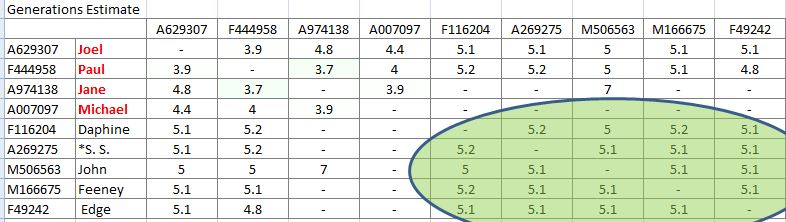
Those in red are in the Frazer DNA Project. We know their genealogy. Gladys descends from the couple above George Frazer and Margaret McMaster. Michael and Jane descend from one level above that. The circle above are those that are related to Paul and me, but not to others in the Frazer DNA Project. [One exception is Jane, but she matches at generation 7 which is about as far out as Gedmatch goes. This may or may not be a real match.] If those in the circle are not Frazer, then the apparent conclusion is that they are McMaster relatives.

Back to chromosome 20

See all the Chromosome 20 matches on my Gedmatch Traceability Report:

TG Chart Chr 20

Remember I said that my 1,000 plus matches on Chromosome 20 ended around 44M? This is what the above shows. It also shows a triangulation of matches. This triangulation is also implied by the cluster of matches within the circle of the Generations Estimate Chart above. The Chromosome 20 Triangulation Group (TG) includes:

  • Myself
  • *S. S.
  • Daphine
  • Feeney
  • Gladys

Now Gladys should not be in this list as she is in the Frazer DNA Project and has no known McMaster ancestors. In fact, when I run the ‘one to one’ at Gedmatch, she doesn’t match the others in the above list. There are glitches in the Traceability Report, so caution is needed. I will take out the last 3 names in the Generations Estimate to simplify the results. Unfortunately, that didn’t fix the problem, so I had to take out Gladys from the Frazer Project (sorry Gladys).

Gen Est Paul Joel

Now my presumed McMaster relatives are in the green circle. Here are the improved and simplified matches:

TG Chart Chr 20

I note now that the 2 ‘M’ kits (indicating 23andme testers) are now matching each other which is what I had expected previously. Note that I left my previous Traceability results in the blog as a warning that the Traceability utility is glitchy. Actually the new report is not indeed improved as now Michael from the Frazer project is matching my presumed non-Frazer McMasters. I took out Michael, and then Jane from the Frazer Project developed similar bogus matches with those she is not related to!

I’ll have to take out all the other Frazer Project people out for this Traceability to work. This was supposed to have worked so smoothly. Here below Joel and Paul should be the remaining McMaster relatives:

Joel Paul R3

Here is the Chromosome 20 TG. Note that Paul is not in it, but he matches others from the TG in other Chromosomes:

TG Chart Chr 20

This chart is only mostly right. Paul’s green match is actually on Chromosome 19 rather than 15:

Paul's Actual Match with Edge
Paul’s Actual Match with Edge

Here is the globe view of my proposed McMaster relative TG:

McMaster Globe

The colors in the lines correspond to the colors in the chart above. The light blue lines are the Chromosome 20 TG from my “big fat” area. The blue lines indicate a TG as they go from each of six people to the other 5. The gray lines represent multiple matches. I am at the bottom of the globe and my cousin Paul is to my right. He is not in the blue TG on Chromosome 20, but matches all my matches on other chromosomes at least once.

Conclusions and Further Research

From what I have shown above, I feel like I have found my McMaster relatives through DNA. However, these would have to be verified by genealogy. None of my proposed ‘McMasters’ have any gedcoms at gedmatch.

  • Daphine – she is on FTDNA but with no tree and no ancestors mentioned. An ICW search reveals 59 pages of matches – likely mostly on Chromosome 20.
  • Edge – He is at FTDNA. He has a limited tree. His paternal grandmother may be a lead. He has only 52 pages of in common matches at FTDNA
  • John – A search at 23andme showed nothing. Perhaps he is anonymous there.
  • Feeney – Same result – or perhaps these people are using different names?
  • *S.S – I see an S.S at Ancestry, but it is difficult to tell if it is the same person.

I have McMaster connections through DNA and genealogy at AncestryDNA, but there is no way to tell if the connection is on Chromosome 20 without a chromosome browser. My Mcmaster matches at AncestryDNA either don’t know how to upload their DNA to gedmatch, aren’t interested or haven’t gotten to it.

Opposition to TGs

Of late, on Facebook, there has been questioning as to the validity of  TGs – especially large TGs like I have at Chromosome 20. The thought is that no common ancestors will be found as there are just too many common ancestors in these large TGs. I have not explained the 100’s of matches in my Chromosome 20 TG, but I have shown 5 people that match both myself and my cousin Paul. These 5 by DNA do not have obvious Frazer ancestry and appear to be in my McMaster Line. So I suppose we have a stalemate. I cannot prove at this time (except to myself) that my Chromosome 20 TG matches are McMaster relatives and those who are not in favor of large TGs cannot prove that these matches are not McMaster relatives.


Mapping My DNA To My Four Grandparents

I was thinking of calling this Blog “Kathy Meet Kitty“. Kathy is Kathy Johnston who taught me how to map my ancestral segments by comparing my DNA to two of my siblings’ DNA results and determining our crossover points. The crossover points can then be used to map out which grandparent you got your DNA from without having to physically test those grandparents. This is quite convenient as all my grandparents have been gone for quite a while. Kitty is Kitty Munson who has developed a Chromosome Mapper here. I have not seen a blog using Kitty’s Chromosome Mapper to map ancestral DNA segments via Kathy Johnston’s method, so I thought that I would write one. Kathy’s method is posted here.

Two Types of Segments

There are two types of segments, thus at least two types of segment mapping. This concept is best explained at the Segmentology Blog in an article appropriately called, What is a Segment?

ancestral segments

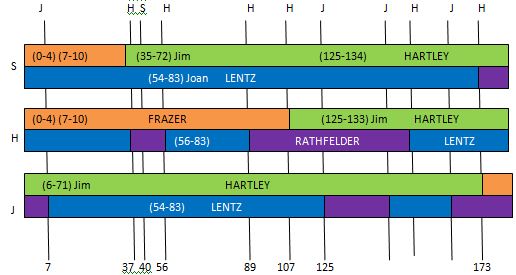
That Segmentology article first mentions ancestral segments. These are the segments that Kathy Johnston knows how to map. I have written many blogs about mapping my ancestral segments using her method. Ancestral Segments are the segments that you actually get from your ancestors. They fill up all your DNA. Here is an example of the ancestral segments that I have mapped to my four grandparents.

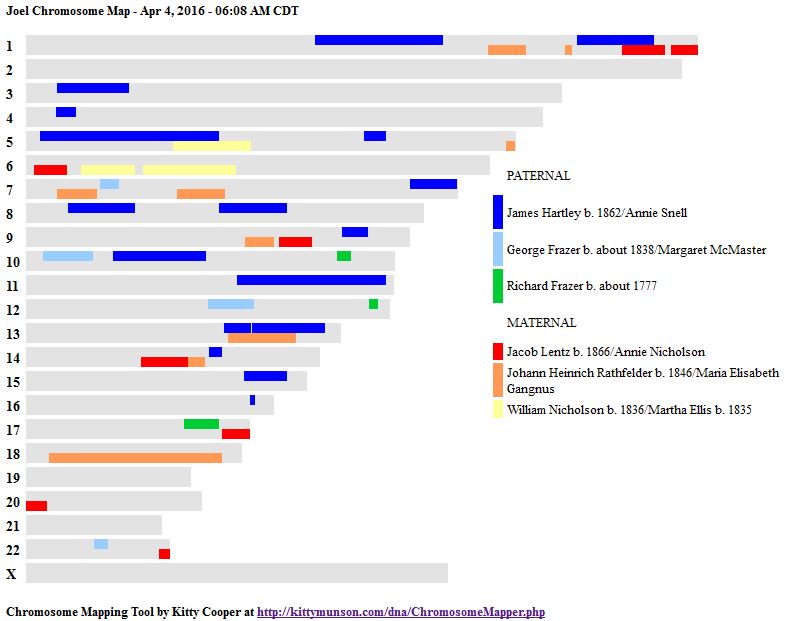
Joel Segment Map

Look at Chromosomes 1, 5, 6 and 7 for starters. This shows all my DNA filled in. The 2 paternal grandparents are on the top half of the chromosomes in blue and grean and the maternal two grandparents are on the bottom in red and peach color. The DNA I received alternates between one grandparent and another and fills in all the area. In fact, that is the process of recombination and can be seen in the Ancestral Segment Maps.

shared segments

These are segments that you find at gedmatch.com for example. These are our DNA matches. These matches may have a proposed relationship based on how much DNA you and your match share. Here is an example of some of my matches using Kitty’s Chromosome Mapper.

Chromosome map 4 Apr 2016

The best way to fill in a map like this is by testing as many relatives as possible. Now look at chromosome 1, 5, 6, and 7 on the shared segment map compared to the ancestral segment map above. The ancestral segment map on Chromosome 1, for example,  shows how much DNA I actually got from my Hartley grandfather. The blue in the Shared Segment Map shows how much I matched my father’s cousin. Next look at the maternal (bottom) part of Chromosome 1. Here the Rathfelder and Lentz matches on the right hand side are filled in on the Ancestral Segment Map. However, there is an additional section of Lentz on the left hand side of the Ancestral Segment Map where I don’t even have a match. I can tell I got my DNA there from my Lentz maternal grandmother. That is due to the crossover points I have and the fact that the DNA you get from your grandparents alternates between grandparent. On the maternal side, the alternation is between Rathfelder and Lentz.

If you find any inconsistencies between my Ancestral Segment Map and my Shared Segment Map, that means I messed up somehow.

More Ancestral Segment Mapping: Sister Heidi

In order to map my ancestral segments, I needed two siblings, so I used my two sisters, Heidi and Sharon. Here is Heidi’s ancestral DNA mapped out:

Heidi Segment Map

A few observations:

  • The areas of pale blue are where I had trouble figuring out how to map the ancestral segments, so nothing is mapped in these areas. I may have mapped out some of the segments, but then had difficulty telling whether they were maternal or paternal due to lack of known cousins that had tested. So I left these areas blank
  • The maternal areas shown as MG1 and MG2 – For these areas, I knew I had two maternal grandparents but I wasn’t sure which was which. Again based on lack of known cousins that had tested. I could perhaps guess, based on actual matches I had in these segments or where those matches were from, but I noted where the crossovers were and left these grandparents un-named.
  • These unknown grandparents are consistent within each chromosome and each sibling within each chromosome, but they are not consistent between chromosomes. So the unknown MG2 in Chromosome 8 may not be the same MG2 in Chromosome 11.
  • In my (Joel’s) Ancestral Segment Map, I don’t show any DNA on my paternal side for the X Chromosome. That is because males don’t get an X Chromosome from their father.
  • Heidi shows that she got her paternal X from her dad’s mom – a Frazer. Further, that chromosome did not appear to recombine. That means that she got that whole chunk from one of her great grandparents on the Frazer side.

How Do You Know What You Are Finding If You Don’t Know Where To Look?

These maps are very helpful in showing you where to look for DNA. Many people have matches that have ancestral names that are common to us but are not related. For example, my mother has matches with people that have Fraser or Frazer ancestors. I am related to Frazer on my father’s side. That means that I can forget about following up on maternal Frazer matches.

  • If I do want to look for Frazers, I need to look in my green areas (or my sister’s green areas) which is on her paternal side.
  • My sister Heidi is in an important Frazer Triangulation Group on her Chromosome 1 on the right hand side. She triangulates with others in a Frazer DNA Project I am working on. I am not in that group. Look at my Chromosome 1. It is nearly all covered by Hartley DNA. That explains why I don’t match these other Frazers at standard thresholds.
  • What if we were to want to look for Lentz ancestors of Heidi? We need to look at the red areas. Chromosomes 1, 6, 9. 14, 20, and 22 would be a good place to look. Fortunately, I also have Heidi’s matches on a spreadsheet. They are mostly divided by maternal and paternal matches. My mother has been tested for DNA. Based on that, I have Heidi’s phased maternal and paternal results and her matches to each of those results using Gedmatch.com.

Finally Sharon

My sister Sharon completes the Ancestral Segment Mapping:

Sharon Segment Map

  • The autosomal DNA that is missing on Sharon’s Map is the same for her 2 siblings. This is because Kathy Johnson’s ancestral segment mapping technique compares the siblings to each other using the Gedmatch.com chromosome browser.
  • Sharon has a lot of Frazer DNA match potential at Chromosomes 1, 8-12, 15, and 22.
  • However, Sharon is also not in the Frazer Triangulation Group in Chromosome 1 on the right hand side. In that particular section, she got her DNA from her Hartley paternal side.
  • The above point shows why it is important to test siblings.
  • Heidi and Sharon both have a large match (50+ cM) with someone on their X Chromosome. This person also has autosomal matches with my sisters and others in the Frazer DNA project.
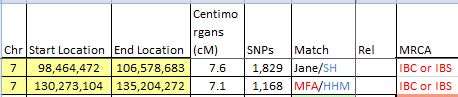
Summary and Observations:

  • Ancestral Segment Mapping can be useful in determining which grandparent your matches match.
  • I know already whether my matches are on my maternal or paternal side. However, this goes back one more generation and further sorts my matches to grandparents. This cuts down the guessing by another half.
  • The maps also point out the areas where you can’t be as sure as to which grandparent your matches match as those areas are not mapped yet.
  • Ancestral Segments should line up with Triangulation Groups
  • Ancestral Segment Mapping can show matches that are Identical by Chance (IBC) or false matches.


Mapping All My Frazer DNA

Thanks to a technique pioneered by Kathy Johnston, I have been able to map my DNA to my 4 grandparents. In the process of doing this, I can see where my 2 sisters got their DNA from also. One of those 4 grandparents is my father’s mother who was a Frazer. Both her parents were born in Ireland, so that helps in finding matches. I thought that it would be interesting to look at each of the Frazer DNA Project member’s matches to my family to see where they are on my family’s DNA maps.

The larger Chromosomes are the most difficult to map, as there are more potential segments and crossovers. The segments are the chunks of DNA we got from each grandparent. The crossovers are the vertical lines between the segments where the DNA we got crosses over from one grandparent to another.

Chromosome 1

I’ll spend a little more time on Chromosome 1 as it is the first.

Chr1 Frazer

  • The colors will not be consistent to a name between chromosomes. Also the position of the my and my sister’s chromosomes may not be the same
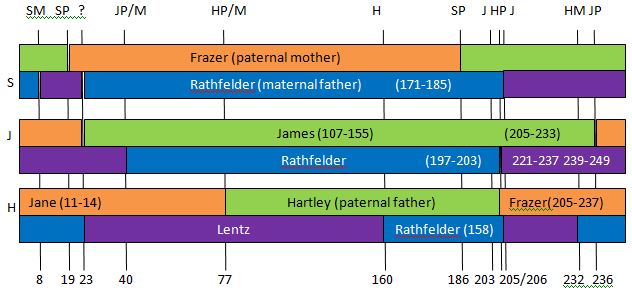
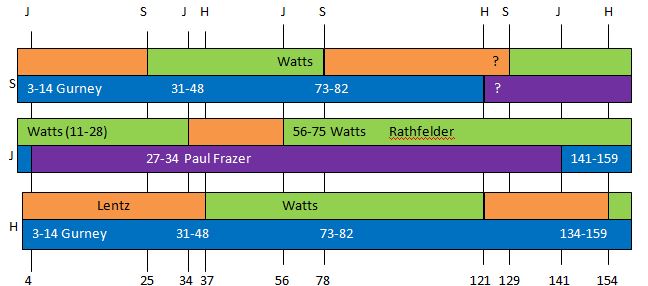
  • S and H are my sisters Sharon and Heidi. My bar is in the middle here (J)
  • The orange in this Chromosome is Frazer and represents my Frazer grandmother.
  • The numbers in the bars represent reference people. For Frazer, my reference is usually Paul, my 2nd cousin, once removed. However, I also used Jane above in this example
  • Note that if I had not tested my sisters, my chances for matching other Frazers would be very low for Chromosome 1. I couldn’t match a Frazer for most of this Chromosome. I would only be able to match another Frazer at either end.
  • When the 3 orange Frazer segments in my family are put together, we can potentially match a Frazer for the whole length of the Chromosome – except between 186 and 205.

The Triangulation Group (TG) in Chromosome 1

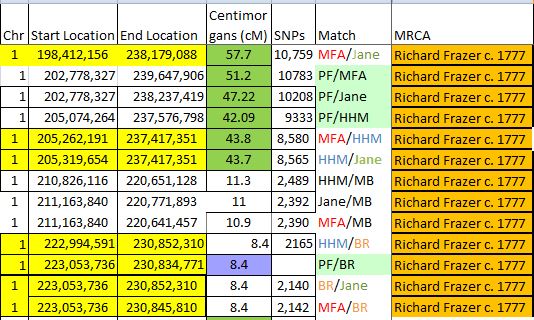
I’ve pointed this out before. The TG is to the right of the Chromosome and only my sister Heidi is in this TG.

TG Chr1 Frazer

Note that the first match in the TG above between MFA and Jane goes beyond where my sister Heidi could match a Frazer (198-205). This is fine as MFA and Jane have their own crossover points that are different than those in my family.

Chromosome 2

Here I’ll start with my spreadsheet matches.

Chr 2 Frazer

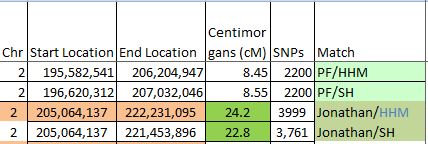
What might I expect here? Note that the matches are only with my 2 sisters. My guess is that I won’t have Frazer mapped on my Chromosome in these 2 areas (196-222). Also note a match with Jonathan who is on the more distant James Line of the Frazer Project. In addition, my sister’s matches with PF overlap by a small amount her match with Jonathan. This could be significant if this forms a Triangulation Group.

Here’s my family’s Chromosome 2

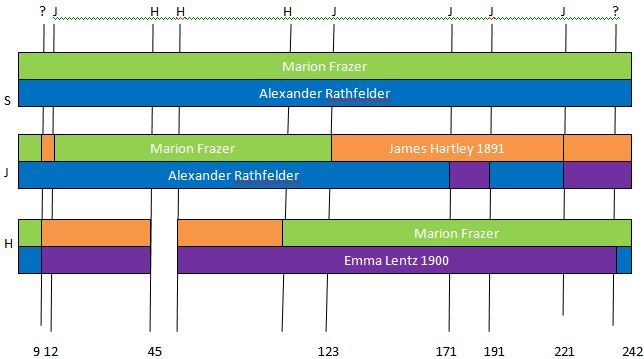
Chr 2 Frazer Feb

I had a little problem with this one, but it’s mostly right. Here the colors are switched, so Frazer is now green.

  • Notice that my 2 sisters, S and H have Frazer segments from at least half way through their Chromosomes to the end. This is where the matches are (195-221).
  • Notice that between me and my sisters, we should have good coverage for Frazer ancestor matches.
  • I (J row) cannot match any Frazer where my sisters matched as I have orange Hartley DNA in the area of 195-221.

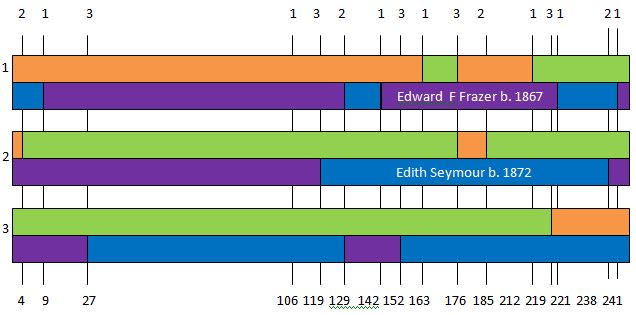
Here is Jonathan’s family mapped out. He is on the horizontal line 1. Only Jonathan can match my 2 sisters from 142 to 221. His 2 sisters are on rows 2 and 3.

Chr 2 Jonathan

Any Triangulation Group?

It would be interesting if there was a triangulation group between these 2 distant lines. So far, we have not had much luck in finding one for Jonathan’s James Line. Perhaps we have one here. This is what Gedmatch shows for Sharon’s match with Jonathan in yellow and Paul in blue:

Sharon Chr 2 Gedmatch Browser Paul Jonathan

In numbers, Gedmatch also shows where the small overlap is with these 2 segments:

Chr 2 Sharon Paul Jonathan

The overlap is shown in the last column. The yellow (Sharon’s match with Jonathan) and blue (Sharon’s match with Paul overlap from 205 to 207. Let’s see what Heidi’s matches show:

Chr 2 Heidi Paul Jonathan

Here the overlap is pretty much the same, but is a bit shorter for Heidi.

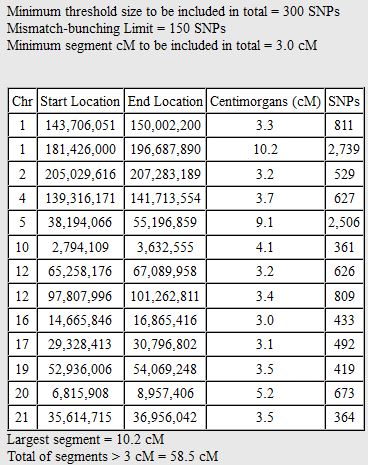
So for a Triangulation Group, Jonathan would also have to match Paul. I would expect this to be a small match, so I bring down the gedmatch numbers. This is a bit controversial, by the way, but I think I’m on fairly solid footing here. I took the limits way down to 3 cM. Here are all the results of the match between Jonathan and Paul, but I’m really interested in Chromosome 2:

Jonathan V Paul 3cM

To me, it is more than mere coincidence that Jonathan and Paul match at the exact place where they have an overlap in my 2 sisters’ matches. In all 3 cases, the match is between 205 and 207 on Chromosome 2.

Is This the First James Line Triangulation Group (TG)?

Yes and no. What I mean is that this is not strictly a James line TG but a TG between the James Line and the Archibald Line of the Frazer DNA Project. We have what we need for a Triangulation group. Paul matches Sharon and Heidi. Jonathan matches Sharon and Heidi, and Paul matches Jonathan on the small segment where he needs to match him in order for there to be a TG.

A triangulation group should represent a common ancestor. But who is the common ancestor? I can think of 3 possibilities:

  • The common ancestor of the Archibald and James Lines. This is based on the known genealogies. This common ancestor probably goes back to the late 1600’s.
  • A more recent unknown James Line ancestor. I have an additional line of Frazers that I haven’t placed that may be part of the James Line. This would be a good candidate.
  • A common collateral family. That is, a common family that married into both of our families with a common ancestor. This would be the least known option.

Chromosome 3

Chromosome 3 should be simpler. There is one Frazer match with my family. That is between Heidi and Cathy. Cathy is a a descendant of Archibald Frazer b. 1802 and Catherine Parker.

Chr 3 Heidi CR

This is a small single match, so possibly not even a valid match. Let’s look to see if  this match is in a spot where Heidi got Frazer DNA from her grandmother:

Chr 3 Heidi

It looks like this match is in the about the only area where Heidi (row H) could’ve gotten any Frazer DNA match. Recall the match is from 15-21. But shouldn’t Sharon in the S Row also match Cathy in her purple Frazer segment? Actually, she does. I’m working from 2 spreadsheets and only had Sharon’s match on one of the 2 spreadsheets.

Chr 3 CR Heidi Sharon

See, the DNA corrected my oversight!

Chromosome 5

There weren’t any Frazer Project matches to my family on Chromosome 4 that I had recorded. Here is the match between my sister Heidi and our 2nd cousin once removed Paul. He also matches my sister Sharon at the same spots.

Chr 5 Paul Heidi

My prediction is that the map should look like the one for Chromosome 3 in the first part of the Chromosome. Chromosome 5 is another Chromosome that I found difficult to map:

Chr 5 Heidi Sharon Paul

Note that I didn’t get a lot of Frazer in my Chromosome 5 (last row J). There is also a section from 107 to 173 where there would be no Frazer matches with me or my sisters. Perhaps if I tested another sibling….?

Chromosome 7

Here I see a smattering of matches. I included my fairly close Frazer relative Paul as a reference even though he doesn’t match my family on this Chromosome.

Chr 7

Here, none of these matches come together. What does the Chromosome map show?

Chr 7 map

As with many of my maps, I have different version as I have tried to perfect them. But something looks wrong here. Either the map is wrong or my matches above are wrong. Sharon should have a Frazer match with Jane at 99 to 107, but that is showing as blue which in this case is my non-Frazer Hartley side. I had one other case where one of the Frazers matched on my mother’s side. After lowering the thresholds a bit, I got this match between my non-Frazer mother and Jane:

Chr 7 Jane Gladys+

That means that Jane either matches one of my mother’s ancestors way back or is identical by state or by chance in this area. But what about the match between my sister Heidi and MFA of the Frazer DNA Project? I lowered the thresholds a bit again at Gedmatch and checked to see if MFA also matched my mother.

Chr 7 MFA and Gladys

Oh, my. It seems like everyone is related to everyone! Welcome to the family. Actually, if MFA and Jane were to be related to my mom, it would make more sense on her orange Lentz side (which is where they do indeed match). That is the side where my mom has a grandmother from Sheffield, England. The green side would make less sense at that is primarily German and specifically Germans that lived for many years in a colony in Latvia. Well, at least I don’t have to revise my Chromosome 7 map.

Chromosome 9

I see one lone match between my sister Sharon and my cousin Paul.

Chr 9 Sharon Paul

Chr 8

That makes sense. Sharon is the only one with Chromosome 9 Frazer DNA in my family. As no other Frazers in the Project appear to match here, I can assume that this match is on my McMaster side. Paul and Sharon share a Frazer ancestor that married a McMaster, so half our shared DNA could be on the McMaster side coming down through our respective Frazer lines.

Chromosome 10

Chr 10

Chr 10 Map

Out of curiosity, I checked to see if my sister Sharon would match Paul on the first bar (S) if I lowered the Thresholds. She did between 6 and 9 (top left green segment). Again, this could be McMaster DNA.

Chr 10 Sharon Paul

Chromosome 12

This Chromosome has been discussed before as it is part of a TG.

Chr 12 TG

Chr 12 TG Map

Here are few more [probably McMaster] segments that are matches between cousin Paul and my family:

Chr 12 Paul matches

Chromosome 14

My sister Heidi has a small match with Charlotte of the James Line.

Heidi Charlotte Match

I don’t know if it is a valid match, but it falls in the right area of Heidi’s chromosome.

Chr 14 map

Chromosome 17

Here I have a lone match with MFA

Chr 17

Chr 17 map

Looks like I’m the only hope for Frazer matches in this Chromosome. As the chromosomes get higher in number, they get shorter. The shorter chromosomes have fewer segments and are simpler than the longer lowered numbered chromosomes.

Chromosome 20

Here I am again with Bonnie from the James Line:

Chr 20

I wrote a whole blog on this Chromosome on January 12, 2016.

Chr 20 Map

I have a bit to finish on this Chromosome. Note that Bonnie’s match with me on the bottom bar fits in from 47 to 54. It seemed like Sharon should match Bonnie also. I looked more closely at my spreadsheet and she was there. Here is what gedmatch shows.

Sharon Bonnie

Chromosome 21

My sister Heidi matches Cathy. These 2 also matched at Chromosome 3 above.

Chr 21

Here I have a problem.

Chr 21 map

I have some nice colors but no grandparents named. I don’t have enough cousins that match me on this short Chromosome to identify which grandparent is which. But maybe that’s OK. When I check to see if Cathy matches with Heidi’s paternally phased DNA (that is, her Frazer side) there is no match. Cathy matches Heidi’s maternal, non-Frazer side (or is Identical by Chance).

Heidi Cathy Maternal

So either way, this is not a good match for the Frazer project. However, this is a good thing to know. This does not invalidate the match Cathy did have with Heidi at Chromosome 3.

Chromosome 22 (Last One)

There are just a few small matches in our family with cousin Paul left. They are small, and likely to represent the McMaster side of our ancestors. These McMasters apparently lived parallel lives to the Frazers in bordering County Sligo. Perhaps they came to their particular area of Ireland for the same reasons as the Frazers and stayed or left for the same reasons.
Chr 22

Finally, the last map.

Chr 22 Map

Summary

  • I have listed every known Frazer match to myself and my 2 sisters in the Frazer DNA Project
  • These matches were checked against my Chromosome maps to make sure they mapped to the correct Frazer grandparent
  • In some cases, the Frazer matches were found not be Frazer matches at all because they matched my non-Frazer mother
  • One pleasant surprise was finding an additional Triangulation Group at Chromosome 2. This TG was between the 2 main Frazer Lines in the DNA Project: The Archibald and James Lines.


All My Mother’s DNA

A lot of my writing has been on the Frazer DNA Project. That Project involves DNA on my Father’s side. I’d like to focus on my mother’s DNA in this Blog.

Mitochondrial DNA

I have had my mitochondrial DNA tested in myself, so it would be the same as  my mother’s. mtDNA is interesting as one can trace the mutations down from genetic Eve. My haplotype (and my mom’s) is H5’36. I like the fact that there is a prime [‘] in the designation. I think this is because they ran out of room in the place where it belonged among the other haplotypes. I have 2 exact mtDNA matches. Both of their ancestries trace to Ireland. This is interesting as I have not traced my mother’s maternal line back to Ireland. As far as I know, her maternal line went back to the Sheffield, ENG area or just outside of it. However, the focus of this blog is not mitochondrial DNA.

Autosomal DNA Testers

Unlike mtDNA, which goes up the mother’s mother’s mother’s line, atDNA can go in any and all directions up the ancestral ladder. It is much less focused. Sort of like Attention Deficit Disorder (ADD). In analyzing atDNA, it is best to have known testers that can be used as a reference point to sort the scattered matches into the right families. The testers I have with known genealogies are:

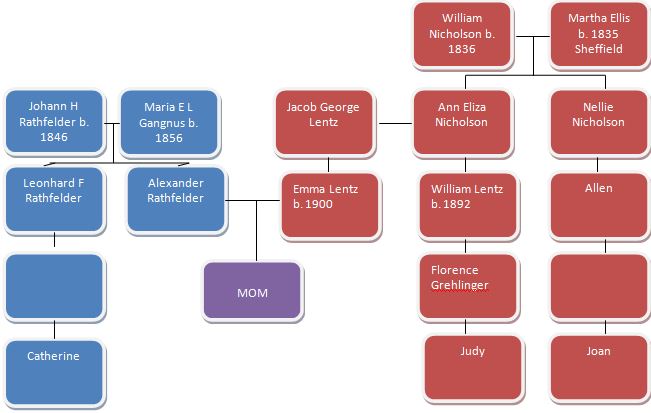
  • Catherine – She is the lone 1st cousin once removed representing my mother’s father’s Rathfelder/Gangnus side.
  • Judy – She is also a 1st cousin once removed representing my mother’s mother’s ancestral grandparents: Jacob Lentz and Annie Nicholson. Judy is my 2nd cousin. She tested at 23andme and matches me there but has not uploaded to Gedmatch yet for more comparisons.
  • Joan – She tested at Ancestry and is my mother’s second cousin once removed. Her common ancestors with my mom are William Nicholson b. 1836 and Martha Ellis b. 1835. Joan is also 3rd cousin with me and my 2 sisters which I have had tested. She is 3rd cousin to Judy through the Nicholson line but not the Lentz line as she has no Lentz ancestors.

Here is how the relationships look in a chart:

Glady's Cousin Chart

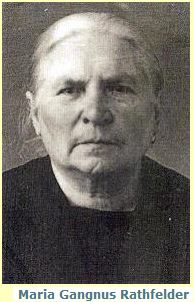
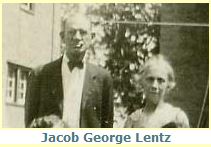
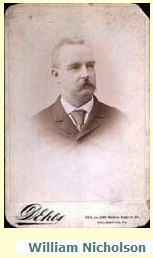
Here are 3 of my mom’s grandparents: Maria Gangnus; Jacob Lentz and Annie Nicholson. The last is her great grandfather, William Nicholson.

Maria GangnusJacob LentzWilliam Nicholson

Ancestor Chromosome Mapper – Kitty Cooper

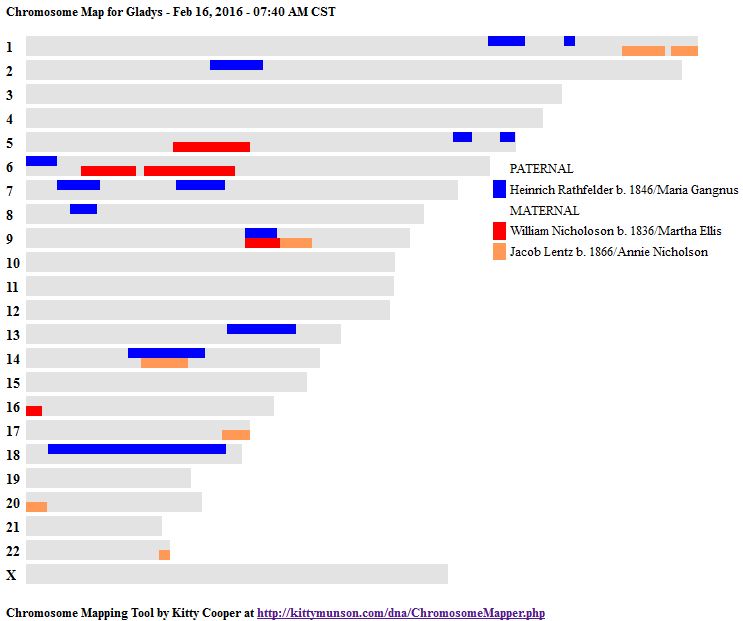
Kitty Cooper has developed a popular Chromosome Mapper. We should be able to map my mom’s paternal side from her DNA matches with Catherine and her maternal side from her matches with Judy and Joan. Judy has not uploaded to gedmatch, so I just used her match results with me at 23andme to represent her DNA matches with my mom. The actual DNA Judy shares with my mom is much more than shown for Jacob Lentz and Annie Nicholson.

Gladys Chromosome Map

Some observations:

  • There are 8 autosomal chromosomes with no matches from these 3 cousins
  • The map phases the results into paternal (top part of the bar shown in blue) and maternal results (bottom part of the bar shown in red and peach)
  • Chromosome 9 –  On the maternal (bottom) side the 2 close segments indicate where my mom, Gladys, has a crossover point. the color goes from red (the DNA she got from her Nicholson grandmother) to peach (the DNA she got from her Lentz grandfather)
  • Chromosome 9 and 14 – Here we see results stacked up on top of each other. Without our testers, we would not know which side the results my mom’s matches came from. In these areas, at least, we will know for sure whether the matches are on the paternal or maternal side
  • All other matches – We will know if the matches between mom and anyone in these areas are maternal or paternal.
  • If anyone matches my mom in the red areas (and also matches Joan), we will know it is not with an ancestor of the Nicholson family.
  • Anyone who doesn’t match the people mapped out above in the area where they should match probably represent a match from the other side. For example, a large match along the area of Chromosome 18 that doesn’t match Catherine (who is on the paternal side) would likely be a maternal side match. The only other option would be a false match (Identical by State IBS or Identical by Chance IBC).
  • In the areas where there are no matches, it is a guess as to whether those are paternal or maternal matches. If someone has a tree showing that all their ancestors have been in Germany, that would be a hint that the match should be on my mother’s father’s side. He was German and born in Europe.

More on Joan and the Nicholson Matches

I have already written about Rathfelder matches in a previous blog. I haven’t yet addressed Joan’s Nicholson matches. I’d like to do that now. One way to look at how my mom and Joan match is through Gedmatch. They have a utility that will show the people that match 2 other people. I ran that and came up with myself and my 3 sisters as well as several others. One spot that looks like a Triangulation Group is found on Chromosome 5:

Joan Chromosome 5

#1 is Joan. I didn’t include myself and my 2 sisters, but I know they match Joan here. In fact, here is Joan’s match with me, my younger sister, my mother and my older sister on the same Chromosome:

Joan Chr 5 match w Hartleys

Now, back to the previous image. In order for my mother’s green matches above to be in a triangulation group (TG), they have to match Joan and each other. I’ll check:

  • Joan matches green #2 above at around 11 cM
  • Green #2 matches green #3 at about 10
  • Green #3 matches green #4 at about 15 cM
  • For comparison Joan and my mom match each other at about 30 cM

I didn’t do all the comparisons, but did enough to suppose that this is a TG. Technically, I’m supposed to do every comparison. I didn’t check the pink match as it was small and didn’t line up with the other matches.

What Do the Green TG Matches Mean?

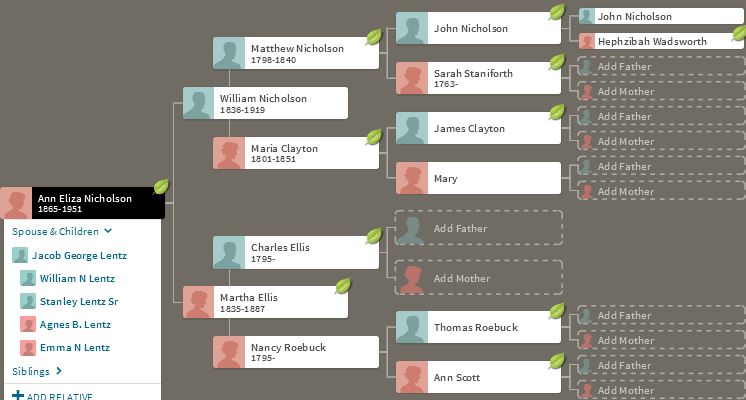
A TG should indicate a common ancestors. Likely this common ancestor will be one of the ancestors of Annie Nicholson:

Nicholson Ancestors

All I have to do now is write to the 3 green matches. Then hope that the common ancestor isn’t too far back and that they have good family trees. Hey, it could happen.


Butler YDNA

This blog is not about all Butler YDNA, but about my father in law Richard’s YDNA. His results came in this week, so I thought I’d write a little about them. As he had 10 children, I thought that they might be interested.

Butler Genealogy

The Butlers are Irish. They are believed to come from the Kilkenny area. However, the documentation for that is not the best. Michael Butler was b. in Ireland around 1810. His son, Edward was b. in the 1830’s and made his way to the New World. He likely arrived in St. John, New Brunswick where he married Mary Crowley in 1855. I mention more details in my Blog on the Butler Brick Wall.

Deep Roots of the Butlers and Family Lore

My wife says that Butler is a Norman French name. She says the Butler name came from the fact that they were wine tasters. According to Ancestry.com:

Butler Name Meaning

English and Irish: from a word that originally denoted a wine steward, usually the chief servant of a medieval household, from Norman French butuiller (Old French bouteillier, Latin buticularius, from buticula ‘bottle’). In the large households of royalty and the most powerful nobility, the title came to denote an officer of high rank and responsibility, only nominally concerned with the supply of wine, if at all.

I had been a little skeptical about the family lore and figured that the Butler YDNA would be typically Irish which is R1b. According to Family Tree DNA:

R1b, which originated in western Europe, is the most common Y-DNA haplogroup among Irish men, at a frequency of about 81.5%. I1 is the second most common with 6%, followed by I2b at 5%, R1a at 2.5%, and E1b1b at 2%. G2a is found in only about 1%. Also rare are I2a (1%) and J2 (1%).

So What Did the Results Show?

I was wrong. According to FTDNA my father in law is I-M223. According to FTDNA:

I-M223 was known as I2b1 and is now known as I2a2a by ISOGG

ISOGG is the International Society of Genetic Genealogists. I’m not sure if that means that our Butler is in the 5% or 1% group in Ireland. However, they are either quite rare or very rare there. So I signed up my father in law for the Butler YDNA project and also the I-M223 Project at FTDNA. At the I-M223 project, they put him in the group with others that are fairly close matches. Three have the name Butler and one has the name Whitson. That makes me feel like we are on the right track. It is not unusual to have other surnames match on the YDNA line. However, it is better to not be in the minority.  The FTDNA group further put my father in law Richard into this curious category:

1.2.1.2.1.1.1.1- M223>…>L701>P78>S25733>A427: test I-M223 SNP Pack or I-M223 SNP Pack or S23612

This is a group with a lot of numbers. These first numbers probably went back to when someone could tell there was a certain signature in the YDNA results, but all the SNP tests weren’t developed yet. The second numbers are the SNP tests that the administrator thinks Richard would pass if he were to take them all. That is good, because it puts him several steps down the SNP tree. The last part is what the administrator wants the tester to do. One is to take a test that will test several SNPs. The other is to test for a specific SNP. In this case, the SNP is S23612.

Origins of the I-M223 Haplogroup

The I-M223 Haplogroup came into existence about around 17,600 years before present (ybp). Give or take a few thousand. The A427 branch is much more recent at 5,200 ybp. According to one YDNA Butler match to Richard, he feels that the origin of this branch of Butler that didn’t test positive for S23612 was in England and before that Germany. Some information from the Eupedia website also mentions that the L701 branch may have arisen from the Goths. I can imagine a stimulating dinner conversation with the Butler family: “So, I hear that the Butlers are descended from the Goths.” “What…???? I thought that we were descended from the Normans”. Who knows, maybe the Goths moved into France at some point and mixed with the Normans. Or they could’ve moved from Germany to England where the Normans were and then made their way to Ireland. I’m sure that there are many possible scenarios.

More Recent Connections

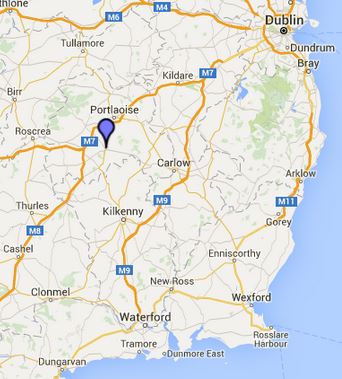
Two of the more recent Butler YDNA  matches to Richard had roots in Ireland, so that makes sense. One had his earliest known Butler ancestor from the border of Laois and Kilkenny County.  That is shown by a blue balloon below. That match had a GD or Genetic Distance of 4. The other was from Wexford and had a GD of 2 with Richard.

Kilkenny Wexford

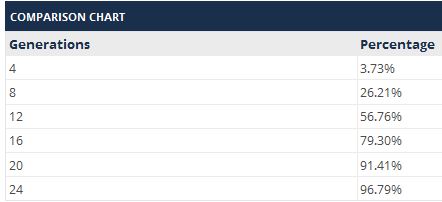
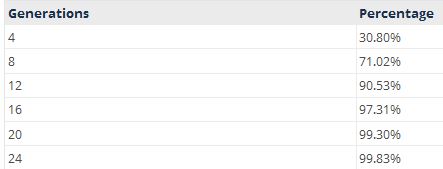
This shows some likelihood of having a common ancestor within a certain number of generations when your match has a GD of 4:

4 GD Butler

Here is a match with a GD of 2. Note the differences in Percentages.

2 GD Butler

Kilkenny or Wexford?

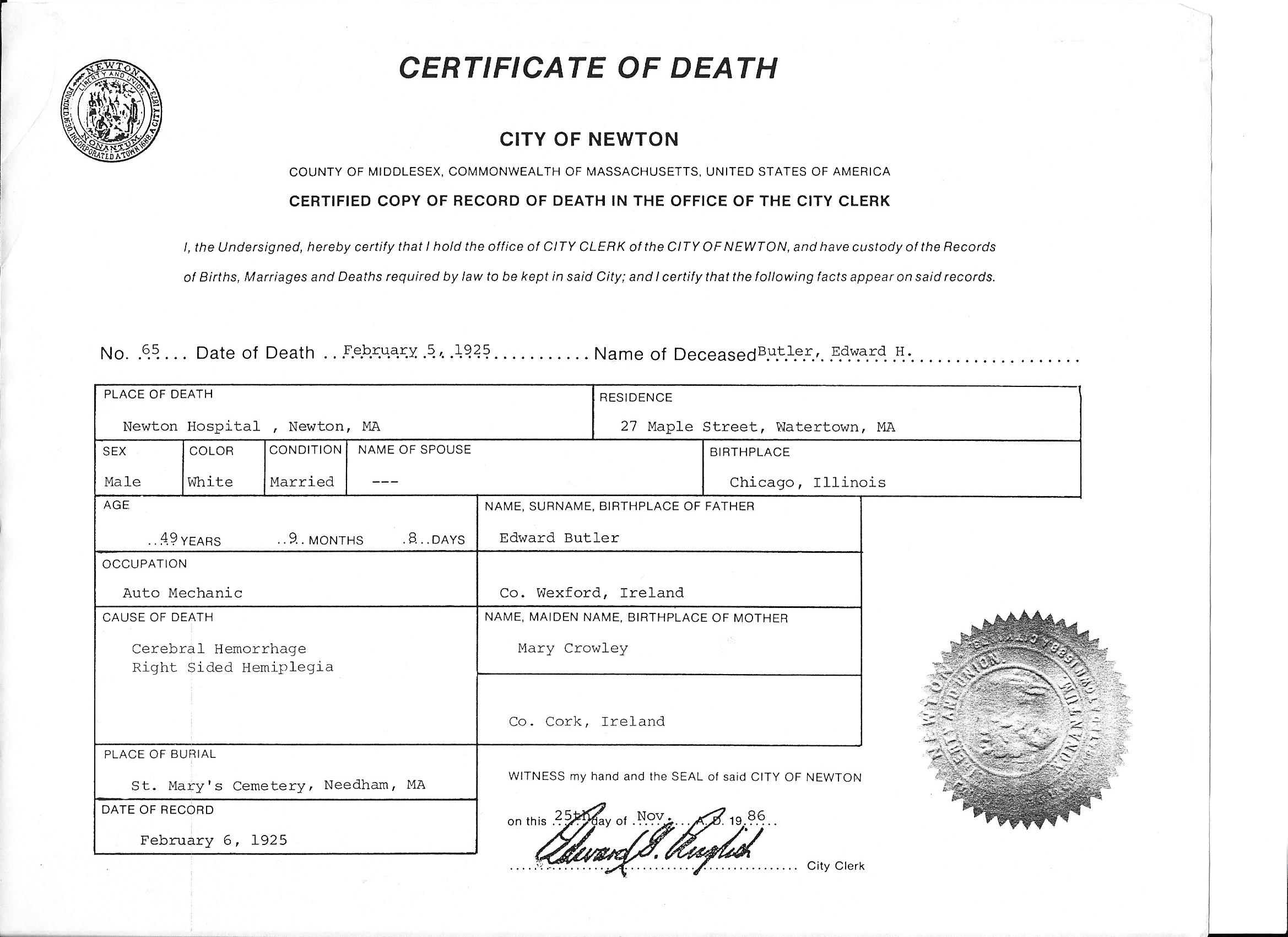
The 2 GD match who had a mariner Butler ancestor in Wexford is interesting for 2 reasons. When Edward H Butler, the son of Edward Butler, the immigrant ancestor died in 1925, he listed his father as being born in County Wexford, Ireland. The second reason is that the photo we have of the immigrant Edward Butler shows him in a sailor outfit.

edwardh

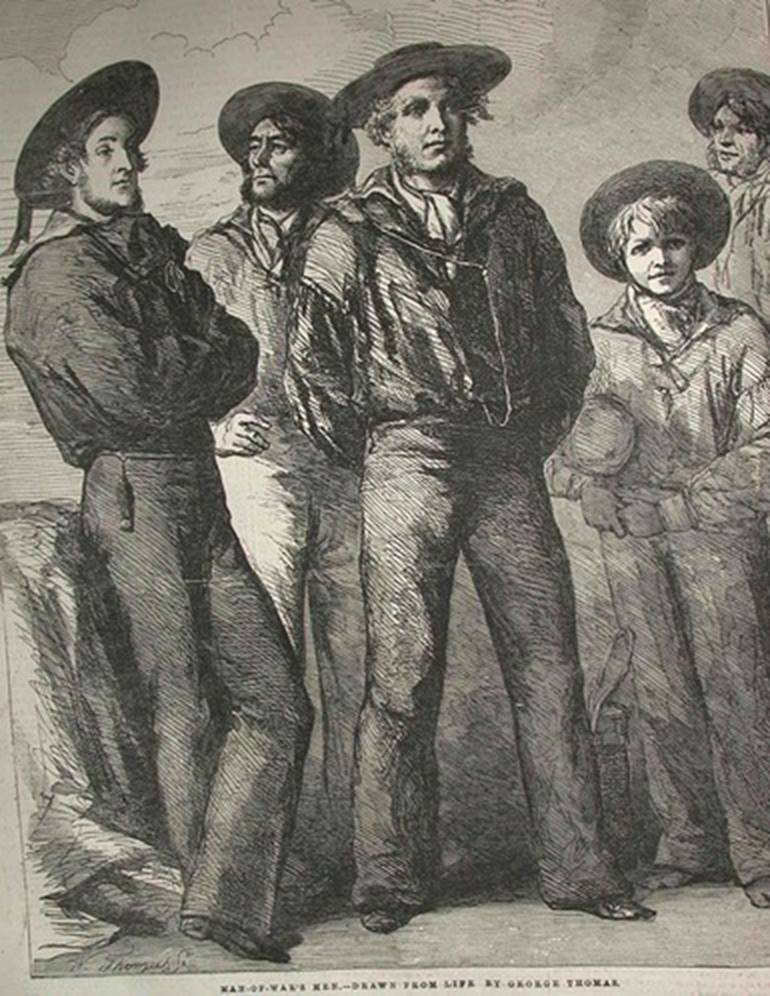
Compare the above with the image of sailors our helpful YDNA Butler relative sent:

Sailor Outfit

Perhaps Edward Butler had mariner background in Ireland or perhaps he was in the Navy in the American Civil War.

Two Death Certificates

Here is Edward Butler’s Death Certificate from 1915 showing that he and his two parents were born in Kilkenny

Edward Butler Death 1915

Ten years later in 1925, his son, Edward H Butler died and recorded that his father was born in County Wexford, Ireland. Why had his birthplace changed in 10 years?

Edward H Death 1925

So although the YDNA results don’t clarify the death certificates, they are consistent with where the death certificates say the Butlers were from!


Beware the False DNA Match

In this blog, I’ll write about false DNA matches: what they are; how to find them; examples – some from the Frazer DNA Project I am working on.

What Are False Autosomal DNA Matches?

False DNA matches are those that are not Identical By Descent (IBD). Perhaps you have heard the term. It basically means that the match is not from a person that is your ancestor. That sounds like defining something by what it is already. And it kind of is. A false match is also called Identical By State (IBS) or Identical By Chance (IBC). These are two different names for pretty much the same thing. It basically means that when the computer generated your match it wasn’t from an ancestor. ISOGG has a good article on the subject.

How Can I Tell If I Have a False Match?

There are several ways. I’ll list a few. I will give examples later in the Blog. The first list is more sure fire, but involves additional testing of parents or other relatives.

FINDING FALSE MATCHES BASED ON ADDITIONAL DNA TESTING

  1. If  a person matches you but doesn’t match your mother or father’s DNA results, that is a false match. As you got all your DNA from your parents, this has to be a false match.
  2. Conversely, if you match someone else but don’t match their mother or father’s results, you have a false match.
  3. This is similar to the above. There is a way to phase your own results if you have had one or both of your parents tested. If you do not match on the phased (that is maternal or paternal) portion of your results, then it is most likely a false match.
  4. The last method has to do with chromosome mapping. I have written some about this in the past. If you have mapped your DNA to one grandparent, and the match is in the same area of your chromosome, from a different grandparent, then that has to be a false match. I’ll give an example later. There are 2 ways to do this mapping. One way is to test a lot of relatives and map their results to a common ancestor. Another way is if you have 2 siblings tested in addition to yourself, it is possible to figure out from which of your 4 grandparents your DNA came from. This method has been pioneered by Kathy Johnston.

WHAT IF I DON’T HAVE PARENTS OR OTHER RELATIVES TESTED?

  1. Testing parents is the best way. Then it is good to test other relatives. If that is not possible, then one may look at statistics. Many of the statistics are at the ISOGG article I mentioned above
  2. 15 cM or greater match – these are considered to be all good matches
  3. less than 5 cM – very few at this level will be considered true matches. ISOGG reports that about 85% of matches at this level are false. So it’s better not to go there.
  4. Triangulation – this is a way to determine true matches (or IBD). I have read that any match 5 cM or greater that triangulates will likely be a true match. In my experience only the larger cM matches tend to triangulate, so for me, this is a self-fulfilling prophecy. I won’t get into the triangulation aspect much in this blog.

My False Match With Deb

Deb was one of the first false matches that I was in touch with. I had thought that perhaps we had colonial ancestry. We shared many colonial ancestors including some of the Pilgrims from Plymouth, Massachusetts. She mentioned that she had her parents tested also. This would have been helpful to find out which side we were related on. However, I matched neither her mother’s nor father’s results. So it had to be a false match. Here is how we show to match at Ancestry:

Deb Ancestry Leaf Match

It looks legit. It even says that Deb and I have a Shared Ancestor Hint. But in this case it is a bad hint. Another clue that this might be a false match is that the match is fairly low. At Ancestry, they use a filter and the match was only 6.0 cM. Here she is on my spreadsheet.

Deb spreadsheet

The matches in my spreadsheet are above the thresholds for FTDNA and Gedmatch. The lower number is phased to my father’s side, so one would think that the match would be good. However, my paternal phasing is based on a test with my mother. These phasings are not 100% accurate apparently. Deb also matches with my 2 sisters. In addition, she matches my two sisters on the X Chromosome. Apparently, these are all false matches. I have also read that many female X Chromosome matches are false. I suppose these are two examples. The bottom line is that I don’t match Deb’s parents and my sisters don’t. So these cannot be real matches.

Another False Ancestry Match

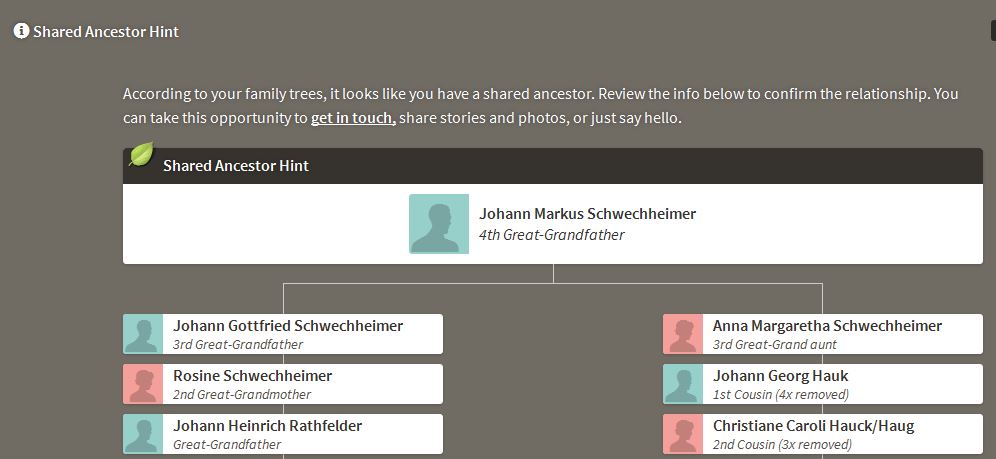
I have another example that I just thought of. I have another Shared Ancestor Hint. This one is on my mother’s side. It is based on an AncestryDNA match between Kay and myself. Kay also matches my sister Heidi but not my sister Sharon. So Heidi shows this same False Shared Ancestor Hint.

Shared Ancestor Hint Rathfelder

This match is down to 5.4 cM at Ancestry with their fancy filtering methodology. Unfortunately, Ancestry apparently doesn’t have the technology to check that even though my mother tested with AncestryDNA, my mother doesn’t also match Kay – at least not by DNA. However, Ancestry clearly shows that Kay and my hint’s line to me is through my mother. So this is a false match. Ancestry is wrong again. However, they do have a lot more money than I do.

Frazer False Matches

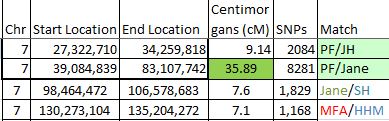
I have perhaps more experience with the Frazer side of my DNA than other DNA having worked on the Frazer DNA Project for a while. There are also false matches within that project. Here are a few false matches on Chromosome 7 between my two sisters and Frazer DNA Project Members. My sisters are SH and HHM.

Frazer False Matches

HERE’S HOW I FIGURED OUT HOW THESE 2 FRAZER MATCHES WERE FALSE

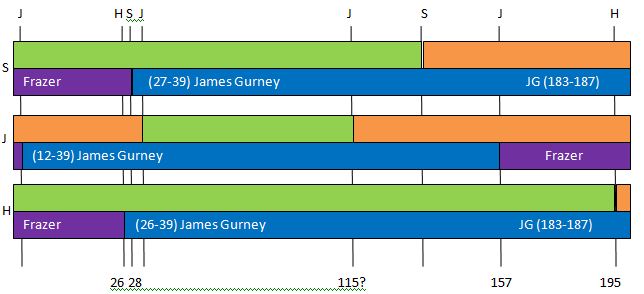
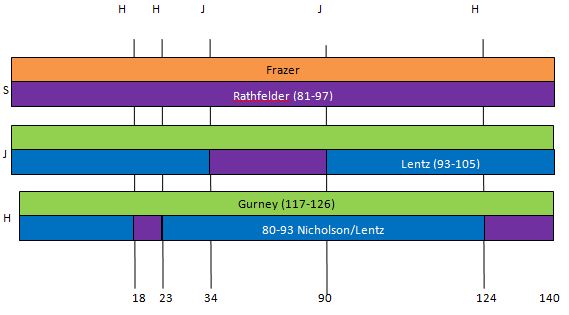
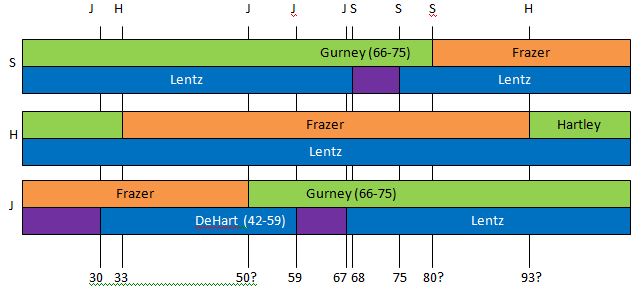
Jane and MFA are in the Frazer DNA Project. In fact they have great matches elsewhere and even triangulate. So why am I calling these matches false? The main reason is the Chromosome Mapping I have done. This was done by a method I have described in previous posts. Three siblings are compared (my 2 sisters and me). Crossover points are determined. Here is what my Chromosome 7 looks like.

Chromosome 7 Crossovers

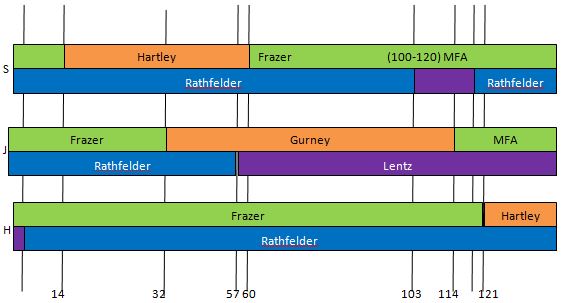
I have a cousin on my mom’s side who tested (in green). Her match at 56-75 with my 2 sisters and me ensures that the maternal side is on the top of the 3 DNA bars. This is because at that location (56-75), there is only one color that all the siblings share (green).  That means blue and purple represent DNA from my paternal side. Blue is from our Hartley grandfather and purple in this case represents my Frazer grandmother. The numbers represent matches with relatives who I have had tested that are related to two of my four grandparents. In this case, the relatives matched my mother’s father (green) and my father’s father (blue).

SHARON’S FALSE FRAZER MATCH

My sister Sharon’s DNA is represented by the first horizontal bar. She has blue Hartley DNA from the beginning to point 129,000,000 (or 129 for short). At that point from 129 to the right end, the DNA from Sharon’s Frazer grandmother takes over. 129 is the crossover between where she gets her Hartley DNA to where she gets her Frazer DNA on Chromosome 7.

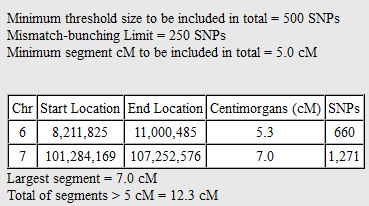
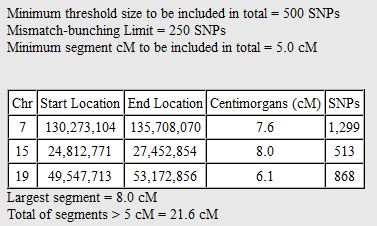
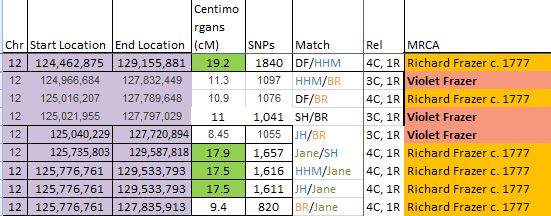
I have that Sharon matched Jane from the Frazer DNA Project from 98 to 107 for 7.6 cM. However, this cannot be a Frazer match as Sharon got all her DNA from the beginning of her paternal side to point 129 from her Hartley (non-Frazer) grandfather.

Frazer False Matches

HEIDI’S FALSE FRAZER MATCH

Likewise, my sister’s match with MFA of the Frazer DNA Project is also false. Her bottom bar is all blue which means she has all [non-Frazer] Hartley DNA. There is no room for her to match MFA from the Frazer DNA Project from 130 to 135. In fact, Heidi has a match with her reference Hartley relative from 134 to 139. What the map shows above is that you cannot get DNA from 2 different paternal (or maternal) grandparents at the same location. It has to be either one or the other.

Interestingly, these false matches happened in the places where they could not have happened. If they were to have been real matches, they could’ve happened with me (Joel) as I have more purple area on my bar above. Or MFA could’ve had a true match with Sharon where she had some purple room, rather than with Heidi – which is a false match.

So Are False Matches Good Or Bad?

They are neither good nor bad. However, if you have a match that is false and you think it is true, then that could be bad. That would lead to wrong conclusions.  Notice that in the above example, both the matches were just above the Gedmatch 7.0 cM cutoff. Just because a match is above the cutoff, doesn’t mean it is a real match. That level was chosen because there are probably more true matches than false matches at that level, but there are still a lot of false matches around 7 cM. Gedmatch and testing companies don’t generally like to filter out matches that could be true.

Summary

  • It is good to be aware of (and wary of) false matches
  • Just because a match is above a threshold doesn’t mean that it is a true match
  • Matches below a threshold could be true also, but the odds are against that
  • False matches do not triangulate
  • False matches do not match either of your parents’ DNA
  • Neither do they match either of your matches’ parents’ DNA
  • False matches may match a phased kit of your own DNA as phasing a parent based on another parent’s testing is not 100% accurate
  • If a match doesn’t match your paternally or maternally phased kit, it can be considered false
  • A low match level means high likelihood of false matches; a high match level means a high likelihood of true matches
  • At about 15 cM there should be no false matches
  • Don’t blindly accept AncestryDNA Shared Ancestor Hints.


Analyzing Chromosome 15 of a James Frazer Line Family

This is part of the Frazer DNA Project. For those descending from 2 brothers who were in North Roscommon in the early 1700’s. The younger brother was James and the older was Archibald. Joanna has 2 of her siblings tested for autosomal DNA. That means we should be able to figure from which of her 4 grandparents most or all of her family’s DNA comes from. This is using a methodology developed by Kathy Johnston. I previously looked at Joanna’s family’s Chromosome 22 in How a Maternal DNA Match May Shed Light On a Paternal Match. These Chromosomes were chosen for 2 reasons:

  1. They are Chromosomes where Joanna recently got a known relative’s matches on one of her non-Frazer grandparent’s side.
  2. They are Chromosomes where there were already matches in the Frazer DNA Project to at least one known Frazer relaive.

Rather than do this analysis and email the results to Joanna, I thought that I would do the analysis in a blog.

Joanna’s Chromosome 15: Three Siblings Compared

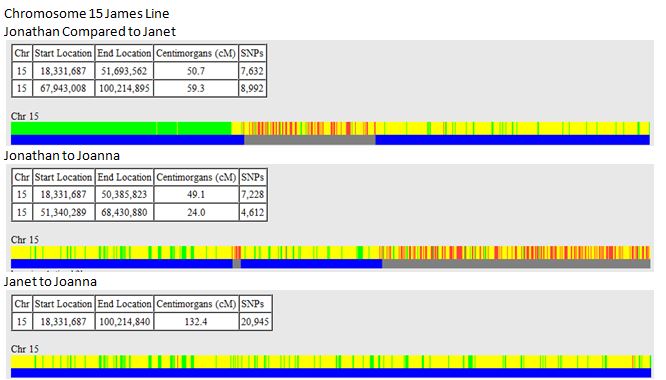
First, I go to gedmatch and compare Joanna’s three siblings to each other: Jonathan (1), Janet (2) and Joanna (3).James Line Chr 15

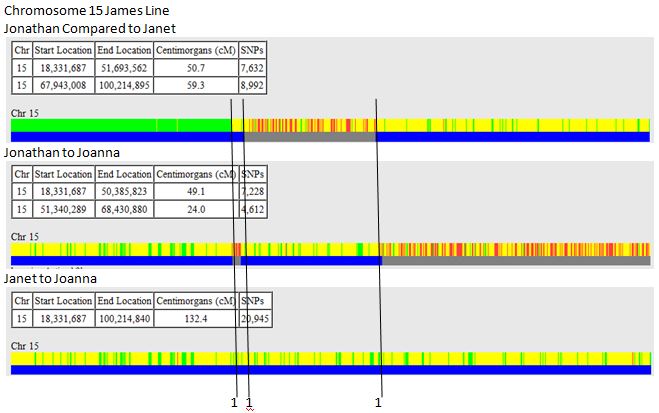
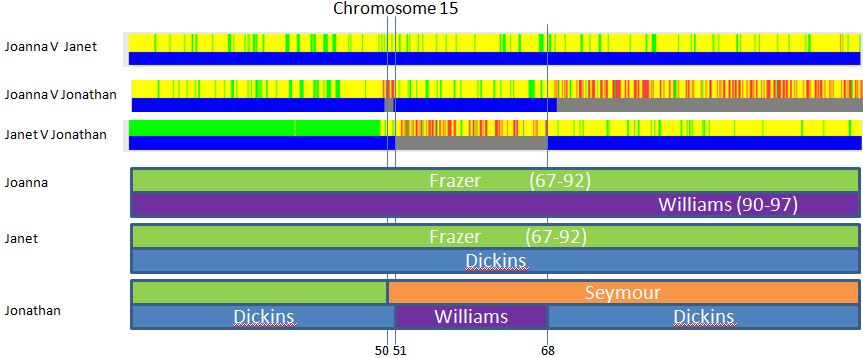
Here green is a Fully Identical Region (HIR), red is no match, and yellow is a Half Identical Region (HIR). Janet and Joanna match as a HIR for the whole length of Chromosome 15 That means they will share one granparent’s DNA for the whole Chromosome 15. Next I add the crossover points for all 3 and assign one person to each. This is the person that appears in 2 out of 3 of the crossovers. Well, here is something I haven’t run into before. All the crossovers belong to Jonathan (1):James Line Chr 15 Crossovers

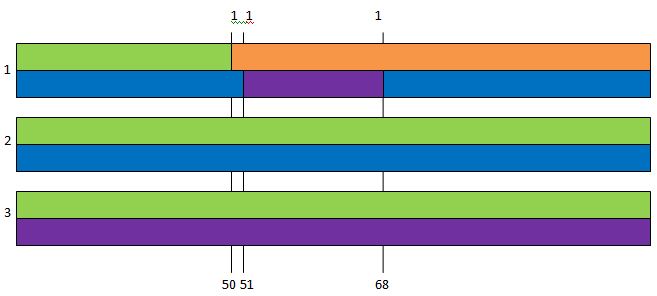
There are 3 crossover points. They are between Jonathan and Janet and Jonathan and Joanna. The one in common with those crossover comparisons is Jonathan. That is complementary to the fact that there are no crossovers in the comparison between Janet and Joanna. Next we change this comparison into a Chromosome 15 map where we will look at the 4 grandparents that contributed DNA to this family. The 1, 2, and 3 below on the left stand for Jonathan, Janet, and Joanna. Jonathan and Janet have an FIR in the first segment. That means that they both got the same DNA from the same 2 grandparents – one on each side of the maternal/paternal split. That split is represented by the horizontal line between the 2 colors. So for Jonathan’s Line 1 and Janet’s Line 2 we add two colors representing these same 2 grandparents’ DNA that Jonathan and Janet inherited:

JL Chr 15 Seg 1

Jonathan has all the crossovers here. Janet and Joanna don’t have any. The crossovers are where the grandparents change. As Janet has no change (crossover), we’ll say she got her DNA from the same 2 grandparents along her whole Chromosome 15. Then I added numbers at the bottom. These are where the matches start and stop (rounded to the nearest million) between the 3 siblings as shown in the gedmatch comparisons above:JL Chr 15 Seg 2

Joanna (3) will be feeling left out by now, so let’s see what we can do. Janet and Joanna have that HIR that we talked about. That means they will match on one grandparent and not the other. Let’s pick one for them to match. It doesn’t matter whether it is the green or blue grandparent at this point, because the colors are only relative now and not locked in. I pick green as their match and purple will be the grandparent that Joanna has that doesn’t match Janet’s blue DNA-contributing grandparent. All these decisions!

JL Chr 15 Seg 3

Now we can try to fill Jonathan in. This should be easy:

  • Jonathan and Joanna have no match in segment 2 and 4
  • Jonathan and Janet have no match in segment 3

Joanna and Janet both have green grandparents the whole way. For Jonathan to not match them in all those places, there has to be a different color. I have been using orange for the 4th color representing the 4th grandparent’s DNA.

JL Chr 15 Seg 4

Next, I said that Jonathan and Joanna (1 & 3) have no match in the second and fourth segments. The non-purple in the lower half is blue. Jonathan and Janet are non-blue in the 3rd segment as they don’t match, so that is purple.

JL Chr 15 Seg 5

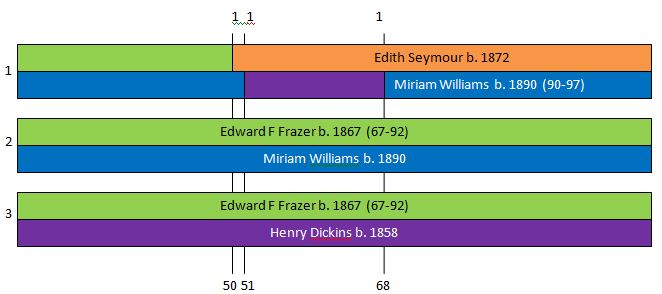
And that was probably the easiest chromosome I’ve ever looked at! Now to add real life actual grandparents. The new matches that Joanna’s family got in were with their maternal grandmother – Miriam Williams. Jonathan matched her, but Joanna and Janet did not. This match rounded in millions is between 90 and 97. I like how gedmatch has the commas; it makes life easier.

Jonathan match William Chr 15

This is on the right side of the Chromosome 15 segment map. I will say that Grandmother Williams is orange, as that is the one that is different from the 2 sisters on the right. Next we will look at Frazer DNA Project matches that Joanna’s family has. I have good matches and sketchy ones that are small.

Chr 15 matches

We decided above that Williams (Maternal Grandmother) should be orange on the top of the maternal/paternal split. That means that Frazer (Paternal side) will be below that maternal/paternal split line. Janet and Joanna have a large Frazer match on the right hand region, so that would be – uh oh, it looks like I made a mistake. Note in the above spreadsheet that Joanna and Janet both have large matches with BZ. BZ is a Frazer (paternal grandfather) relative. The only places that Joanna and Janet (2 & 3) can have the same grandparent (color) on the right hand side last segment is at the green location. That boots Granny Williams down to blue.

JL Chr 15 Seg 6

Where Did I Go Wrong?

I went wrong above when I assigned Miriam to orange. This was based on Jonathan having a match with a Miriam relative and Janet (2) having no match with that same relative. I did have a little qualm about doing this but reasoned thusly: “If Jonathan had a match and Janet didn’t, then it had to be orange.” Also why wouldn’t Janet have a Williams relative match? She has all that blue area to match. So I’ll have to take note not to make that assumption again. I suppose it’s one of those situations where absence of proof is not proof of absence. Fortunately, the Frazer matches bailed me out of my bad assumption.

Adding the Other Grandparents

JL Chr 15 Seg 7

One More Correction

After coming back to look at this after many months, I see a mistake I made. It was Joanna (3) that had a match with a Williams relative not Jonathan. This version is done in Powerpoint which is easier to use. I now have Joanna at the top and Jonathan at the bottom.

chr15frazermaprev

This has to be right. Purple is Joanna’s only unique color in the 90-97 area. And only Joanna had a Williams relative match. Likewise, Joanna and Janet had Frazer matches from 67-92. Green is the only color those two sister have in common in that area.

Summary and Conclusions

  • Powerpoint is a better software for visual phasing
  • It is best to use names for identification, not numbers
  • With just one maternal grandparent and one paternal grandparent, I was able to fill in the missing grandparents.


My Big Fat Chromosome 20

I never would have guessed 10 years ago that I would be blogging about my Chromosome 20. 10 Years ago I was definitely interested in genealogy, but knew virtually nothing about DNA. Even if I did know anything about DNA I would not have guessed that it would have anything to do with genealogy.

My Chromosome 20

My Chromosome 20 actually isn’t that big and fat. Actually it is one of my smallest chromosomes. However, I have more matches there than on any other chromosome. In fact, over 1,000 – more than a quarter of my matches – are on Chromosome 20. This is pretty amazing considering I have 23 chromosomes counting my X Chromosome. If my matches were spread out evenly over these 23 chromosomes, I would expect each chromosome to have about 4% of my matches. This representation shows the ridiculous number of matches I have on Chromosome 20. They are on the bottom of the image in light blue.Joel Hartley Circle Chart

This particular representation is for just my FTDNA Family Finder matches. I believe the threshold was set relatively high and this was done a while ago. However, at the time and threshold, it appears that more than half of all my matches were at Chromosome 20.

How To Explain All the Matches? Colonial Massachusetts?

I had a difficult time explaining all the matches I had on Chromosome 20. Most were on my paternal side as that is where most of my matches are. I had guessed that these may have been due to a colonial effect as that had been suggested in various places. My great grandmother’s mother was a Bradford and was descended from the Mayflower Bradfords. A lot of those early Pilgrims married other related Pilgrims. In fact, some of my Chromosome 20 matches were descended from a Brewster who was one of the Pilgrims that I am also descended from. Then there were a few who seemed to be related on my Irish Frazer side. Finally I had a match with Bonnie from the Frazer DNA Project I am working on. She matched on Chromosome 20 but was outside my large triangulation groups.

Chromosome 20 Triangulation Groups

I also have Triangulation Groups (TGs) for Chromosome 20 – very large ones. In fact, gedmatch would overload when I tried to run an analysis I had so many. I have 2 paternal TGs and one maternal TG. There also may be sub-TGs within those.  I have roughly 650 matches in these combined TGs. So now, based on testing my mother, I knew if my matches were maternal or paternal and if they were in TGs, but I still didn’t know much about where the common ancestors could be other than a vague guess about colonial Massachusetts. What I did was ignore Chromosome 20. I gave up even adding matches to my spreadsheet because I had so many. These matches tended to be around 13 cM with some higher and some lower.

Sticky Segments Or Pileup Areas?

While looking for a Chromosome 20 explanation, I read about sticky segments and pileup areas. Sticky segments are those that came down intact for many generations. They don’t want to go away. However, a few sticky segments wouldn’t explain over 1,000 matches. It seemed like I had a pileup, so I looked into those. Pileup areas are areas are described by Jim Bartlett in his comment on one of his blogs:

I do find that each person tends to have two kinds of pileup areas: 1) are fairly narrow, are widespread, and are outlined in this ISOGG article: http://isogg.org/wiki/IBD#Excess_IBD_sharing; and 2) are also fairly compact (7-9cM) and are unique to each person. I believe these are caused by a unique set of markers in our personal DNA that makes it easy to form matches with others in that region. These are characterized by many segments in a narrow range, which do not generally Triangulate, and the Matches don’t see this as a pile-up area, only you do.

However, my case didn’t seem to match some of the explanations of sticky segments or pileup areas. My matches were larger and did triangulate. Furthermore, they were not in areas of the chromosomes described in the ISOGG article above.

Enter Kathy Johnston and Her Crossover/Segment Analysis

At the beginning of 2015, Kathy posted her instructions on an FTDNA Forum for analyzing DNA based on the 3 siblings. She showed how to determine the 4 grandparents’ contributing DNA for each of these siblings.  I discovered her post at the end of 2015. Could this help me figure out my Chromosome 20? I tried Kathy’s method and got some surprising results.

Finding Chromosome 20 Crossover Points

Finding crossover points in Chromosome 20 was not as easy as it has been in other chromosomes. According to Kathy, usually there will be one owner of a crossover point. This owner will appear in 2 out of the 3 comparisons at a crossover point. In this one, I found only one clear owner. That was my sister Heidi at position 47. For the other ambiguous crossover points, I gave a double initial separated by a slash.

Chr 20 Crossovers

Below, the gedmatch comparison is transformed into a maternal/paternal Chromosome 20 map. The green area means that Heidi matches Joel on the 3rd segment. This match is a Fully Identical Region (FIR). This means they match the same maternal grandparent and the same paternal grandparent. For Joel, I move those grandparent to the right as I have no crossovers until the last crossover point.

Chr 1 Segment 1

Sharon has no match with her 2 siblings in the same area, so that will mean she shares the complementary grandparent on her maternal and paternal DNA. This will be represented by 2 different colors. I again extend that double segment to Sharon’s crossover points.

Chr 1 Segment 2

Looking at the earlier gedmatch comparison, in the 2 segments to the right of Heidi’s existing mapped segment, there is a Half Identical Region (HIR). That means a grandparent matches on one chromosome and doesn’t match on the other. This will be shown as 2 different colors in this area when comparing Heidi to Joel. This first HIR choice is chosen randomly as no names or side (maternal/paternal) have yet been assigned to the grandparents.

Chr 1 Segment 3

Next, we have an illogical situation.

Chr 20 Crossovers

In the next to last segment, the smaller one, Sharon is no match with Heidi or Joel and Heidi and Joel have a half match. That is illogical because if Sharon doesn’t match with Joel, that is the same orange/purple scheme continued in the small segment for Sharon. Then if Sharon and Heidi are opposites, it goes back to green/blue for Heidi in that small segment. Those are the same colors that Joel already has, so that means that Heidi and Joel can’t be HIR which means they should have one matching color and one non-matching color. However, look at that small segment again in the first two rows. The red is strong in the first row. In the second row, I hardly see any red – with red indicating no match at gedmatch. Therefor, I’m going with the first comparison of Heidi and Sharon. Plus this goes with the matches that I will mention soon that Sharon has. I make Sharon and Heidi opposite in Sharon’s little segment and extend that segment to the end.

Chr 1 Segment 4

I filled in some of the no matches and FIRs on the right. On the left, I was left with 2 illogical no matches again, so I chose the redder of the 2. This left me with having to guess a HIR on the left. I am only allowed one guess, so I left this blank for now.

Chr 1 Segment 5

Adding Real Grandparents

It would be nice to add actual grandparents here and not just speak of my orange grandparent, for example. I can do this using two of Sharon’s matches.

Sharon's Chr 20 Matches

These 2 important matches Sharon has are both on the paternal side. James is related to my grandfather and Bonnie is in the Frazer DNA Project on my Frazer grandmother’s side. Coincidentally, the orange match above goes with the orange on my chromosome map. That would make my paternal grandfather Hartley orange and paternal grandmother Frazer green.

Joel’s Matches

Here’s my Frazer match with Bonnie. 47 to 54 is in my green Frazer region on my map. So that is a relief.

Joel's Frazer 20 Match

Below is my only maternal match. It is with a cousin on my maternal grandmother’s line. She matches only with me because she tested at 23andme and hasn’t uploaded to gedmatch yet.

Joel match Judith 20

However, Judy gets me unstuck on my maternal side. Her match is telling me that from zero to 8, I can identify my grandparent. I already have blue from 6 to 8 (from using my brighter red logic). So I just need to extend the blue all the way to the left on my maternal segment line. That gives me a solid blue on Chromosome 20 on my maternal side.

Chr 20 Final Segment

This is as far as I can figure out now without further guessing. Perhaps when cousin Judy gets her DNA uploaded to Gedmatch, I will know more. So what does this tell me about my 1,000 plus Chromosome 20 matches and 600 plus matches that appear to be in Triangulation Groups?

Mystery Solved?

I think it is. These matches correspond to the area on the map above between 16 and 49. By the above mapping these massive amount of matches are solidly in Frazer territory for me. Instead of my huge block of matches being in colonial Massachusetts, I see that they are on my Frazer line. That came as quite a surprise. These ancestors were in Ireland mostly. I assume that many of these ancestors got out of Ireland. Perhaps they moved to the United States and married people who were descended from colonial Americans. That would explain some of the other colonial matches.

Summary, Application and Conclusions

  • When you are looking for DNA matches, it helps to know where you are looking
  • While I was looking at my largest group of matches, I was looking in the wrong place even though I had some reasonable assumptions
  • Kathy Johnston’s method cuts through bad assumptions and replaces them with sound logic
  • Phasing by parents cuts the looking in half but didn’t help me with identifying a huge block of Chromosome 20 matches. However, Kathy Johnston’s method is twice as good as phasing as it separates all matches to areas of 4 grandparents.
  • This method needs 3 siblings and some known tested relatives.
  • If I have this mapped correctly, any maternal match after 6 million for Sharon will be on the Rathfelder line and any maternal match for me will be on the Lentz line.
  • Interestingly, I have only about 42 matches for my sister Sharon on this Chromosome. Given that the makeup of her Chromosome 20 is mostly opposite of her 2 sibling, this makes a lot of sense.
  • I forgot to mention that my sister Heidi has almost as many matches as I do on Chromosome 20. Her shorter Frazer segment compared to mine would explain the slightly fewer matches.
  • The fact that all these matches are on my Frazer line doesn’t necessarily mean that they are Frazer matches. They could be McMaster, Clarke, Spratt or any other known or unknown ancestor of my Frazer grandmother.


How a Maternal DNA Match May Shed Light On a Paternal Match

Uh oh, this sounds like a boring topic. I have been blogging about Frazer Segments and Crossovers, and this is a continuation on the subject.

How To Find Frazer DNA Using Non-Frazer DNA

I suppose this is another way to say it. Joanna has just gotten in a match from her non-Frazer maternal side. How could this possibly give information on her Paternal Frazer side?

My Understanding of the DNA Facts of Life

When your (or my) parents procreated you, those 2 parent’s DNA combined to form your 2 sets of 22 Chromosomes. [We’ll leave the X and Y out of it for now.] But remember, your parents already had 2 sets of chromosome from their parents – your grandparents. When the DNA combined it was really the four grandparent’s DNA that was twisting and combining in different ways to form you and give your your maternal and paternal pair of chromosomes. When the twisting and recombining sorted itself out there were alternating segments of your 2 maternal grandparents on your maternal chromosome and alternating segments of your 2 paternal grandparents on the other paternal chromosome. The places where the segments changed from the DNA of one grandparent to the other is called the crossover point. This can be seen when the DNA of 3 siblings are compared.

The Gedmatch.com Comparison – One to One

Let’s take a peek at Joanna’s family’s Chromosome 22. This is the shortest of the chromosomes, so theoretically, it will have the fewest amount of segments and crossovers. Here we have 3 comparisons from gedmatch.com of Joanna’s family. The comparisons are stacked up on top of each other.

Chr 22 James Line

Now we need to know how Joanna’s grandparents’ DNA combined in her and her 2 sibs. The matches are in dark blue, but we want to know more than that. Let’s start with the comparison of Jonathan to Janet in the first row. From about 14 or 15 million to 36 million there is a half match also called a Half Identical Region (HIR). Then there is no match. After that there is a full match – technically called a Fully Identical Region. Now look at Jonathan compared to Joanna. Those two match the whole length. But there are still crossover points. From about 14 to 16 there is an HIR. Then there is an FIR in solid green. At the point where the HIR changes to a FIR is called a crossover point. That is where there is a change from one grandparent to the other.

Adding Crossover Points as Lines

Now I put in the crossover points as vertical lines. The person who has 2 crossovers in a line gets to own that crossover point. So along the first vertical line, there is a change from Jonathan to Joanna and from Janet to Joanna. Joanna is the one I see most often there, so she owns the first crossover. Here, I assign Jonathan a 1, Janet a 2 and Joanna 3 as having 3 J’s would be too confusing.

Chr 22 Crossovers

Maternal and Paternal Split In Joanna’s Family

Next we take what is shown above, and make it look more like a chromosome browser, except one that shows both maternal and paternal sides. It will look like a chromosome map. Let’s look at Jonathan compared to Joanna above. There is a FIR for segment 2-4. That means Jonathan and Joanna match on both their maternal and paternal side. That further means that they share the same maternal and paternal grandparent’s DNA at those locations. Seeing as we may not know which grandparents they are at this time, we give them a color. In this case, we’ll say that those matching grandparents are green and blue. Blue will be either a maternal or paternal grandparent and green will be the opposite. We don’t know this yet either. The green on Jonathan’s chromosome matches Joanna’s green and his blue matches Joanna’s blue on the other chromosome:

Chr 22 Seg 1

Above is the DNA from Jonathan’s and Joanna’s grandparents. One maternal and one paternal. Next according to Kathy Johnston, we can move 1 (Jonathan’s) grandparents to the left and 3 (Joanna’s) to the left. That is because there is no crossover point blocking them.

Chr 22 Seg 2

Note that from my first image above from gedmatch, Jonathan and Janet have no match in the third segment. This means Janet has to have the opposite 2 grandparents at this segment.

Chr 22 Seg 3

Unfortunately Janet’s segment (i.e. grandparent’s DNA) is trapped between her two (#2) vertical crossover points, so we can’t expand those segments. Next, we need to add the HIRs. But should we go the right, or to the left? Here is where I’m tempted to cheat a little. Joanna and family have Frazer cousin matches here:

BZ Matches

So in what we are doing, that would be the paternal grandfather’s side.

On the maternal grandmother’s side there are 3 new matches.

Joanna maternal Gmother matches

As we don’t have anything for Janet in this area (15-25), I’ll choose to go that way, to see if it helps us at all. Jonathan and Janet are HIR for the 1st two segments, so on Janet’s bar (#2), we will extend one segment (randomly orange) to the left and change the other (from purple to green). Now you can see between bar #1 and #2 on the first 2 segments, they match on the top and not on the bottom. That is a HIR or half match. This meets what our gedmatch comparison was telling us was happening between this 2 siblings.Chr 22 Seg 4

Then Janet and Joanna had no match in the lower left, so I made the Joanna (3) opposite to Janet (2). Choosing Janet’s half identical region sets a few things in motion. Recall that Joanna and her siblings each had a match to a maternal grandmother relative on this Chromosome 22. They were all around 15 or 16 to 25. Looking up and down to the right of the #3 crossover, the only color in common in that area is green. This gives us 3 important new pieces of information:

  • Green has to represent Joanna’s family’s maternal grandmother.
  • That also sets purple as the maternal grandfather (Henry Dickins)
  • blue and orange now have to be Joanna’s family’s paternal grandparents.

Chr 22 Seg 5

Now we have gone from relative grandparents to actual maternal grandparents. But there is still more to fill in. We know from the Frazer DNA Project that Joanna’s family has 3 paternal grandfather (Frazer) matches here:

BZ Matches

Too bad I don’t have them in the same order as the segment chart above. I think that the Frazer will be blue. Let’s guess that the last vertical crossover line is at position 45. From the area of 42-45, there are 3 of Joanna’s family who have matches with a Frazer. We already have 2 out of 3 blues available for these Frazer matches, so Frazer has to be blue. The last blue can be added on Janet’s row #3 in the small segment area of 42-45. We know from our first gedmatch comparison that Janet and Joanna have HIRs for the last 2 segments. I made Janet (2) have her paternal side blue so it matched with the other 2 Frazer matches. Then I made sure that between Janet and Joanna (2 and 3) their last segments didn’t match maternally on both sides. They had to match only one side. That was the Frazer side. Then the maternal side had to be purple for it to be a half match. Here is where Joanna’s family got their DNA from each grandparent. This was the beginning of Joanna and her siblings for Chromosome #22. It is pretty interesting that we can find out their grandparents’ contributing DNA considering these grandparents were all born in the 1800’s.

Chr 22 Seg 6

Now back to the original comparison:

Chr 22 Crossovers

I think everything holds together. Note that Joanna had only one crossover near the beginning. Janet has 2 in the middle and Jonathan has one at the end. This is portrayed in our Chromosome map in 4 colors also.

I had mentioned how some of my earlier analyses were using the longest and most difficult chromosomes. This should be a more simple and clearer example.

One Side Helps the Other

These 4 grandparents were determined using just 2 known matches to Joanna and her 2 siblings. One match was on the maternal side and one was on the paternal side. Once the maternal side was set, that made it easier to determine where the paternal match went.  This process works because: 1) Joanna and her 2 siblings all tested their DNA and they can compare to each other using gedmatch.com;  2) There are known matches to Joanna and her siblings – one on the maternal side and one on the paternal side. These act as a reference to set where the 4 grandparents fit in for this analysis. It also helped that these matches matched all three siblings.

Applications

  • Jonathan and Joanna cannot have any matches on their Seymour Line on Chromosome 22.
  • Likewise, Janet cannot have a Seymour match above the region of about 42 million.
  • Joanna will probably not have any meaningful matches with her Dickins Line on Chromosome 22.
  • The family does not have parents available for DNA testing, so a match at any point for each of these siblings will still have to be checked to determine whether it is on the maternal or paternal side.
  • Triangulation Groups will also follow the segment lines for each sibling
  • Each of these 4 grandparent segments are made up of other smaller segments from their ancestors.