Elizabeth’s DNA from the Australian Line of Frazers

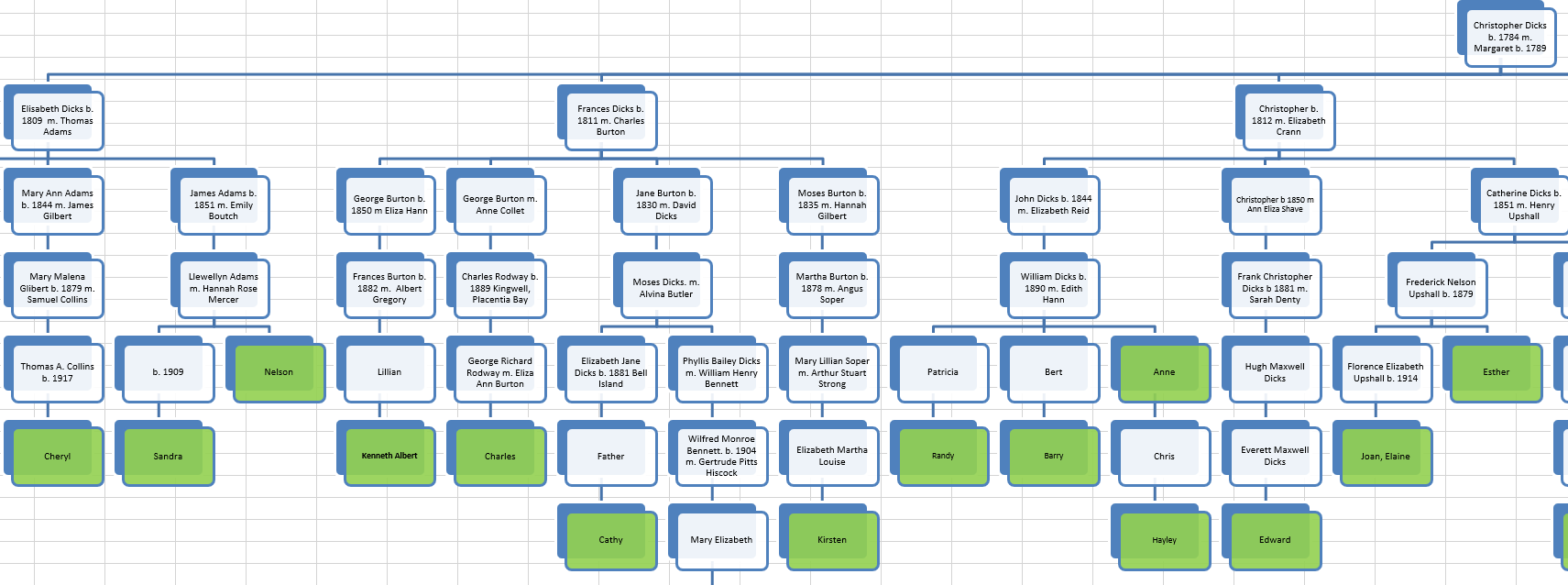
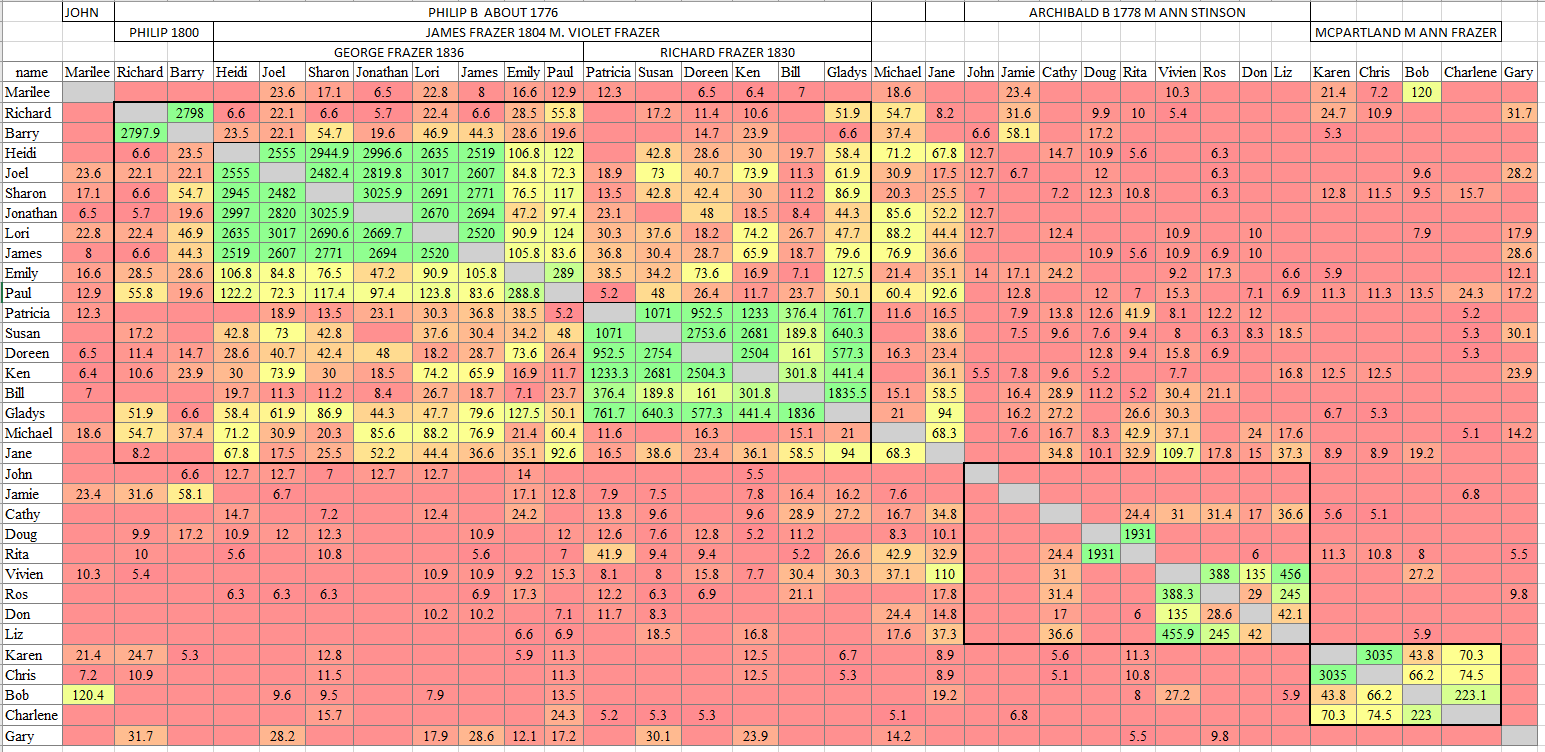
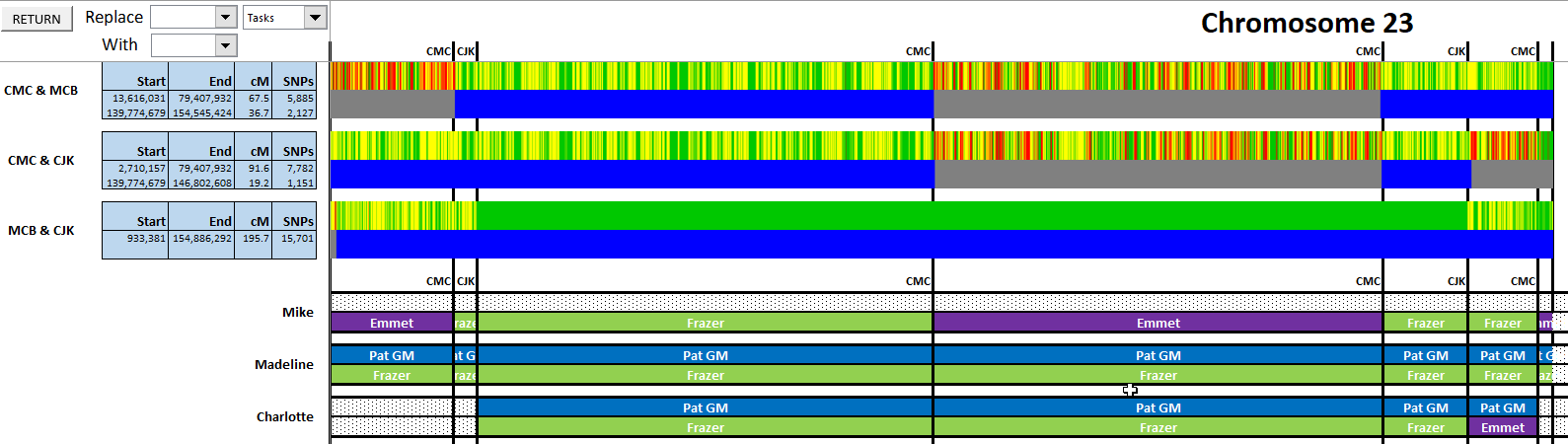
I recently had an email from my Austrian cousin Ros. Her 2nd cousin Elizabeth had taken a DNA test. Here is how Elizabeth fits in with the Australian group of Frazers:

I wrote a Blog about Don here. While looking at Elizabeth’s DNA matches, I noticed that Jean had a sister Kathy that had tested, so I added her to the tree. This brings us back to 1827. Here is one generation earlier:

That brings us back to 1802 and adds in Cathy and Jane. John Parker Frazer and Honora White were the ancestors of the Australian Frazer Line in purple above. Elizabeth is related to Vivien as a 1st cousin once removed. She is a 2nd cousin to Ros, Jean and Kathy and a 3rd cousin to Don. Elizabeth is a 3rd cousin once removed to her non-Australian cousins Cathy and Jane.

The Archibald/Stinson Line

Going back one more generation gets us the Archibald/Stinson Line:

Unfortunately, even at this level, I am not on the tree. My Frazers descended from two of the siblings of the Archibald that married a Stinson at the top of the tree. I suppose that would make me a double 6th cousin to Elizabeth.

Elizabeth’s Australian DNA

To simplify things, I’ll compare Elizabeth to Don, Vivien and Ros. I’ll skip Jean and Kathy because Vivien’s children got all their maternal DNA from Vivien. So Vivien’s children could not match Elizabeth any more than Vivien does.

When I compare Elizabeth to Vivien and Ros, there will roughly half a chance that some of the DNA will be from the Boots family. However, when Don matches Elizabeth, that DNA would have to be from either John Parker Frazer or Honora White.

Here is an example from Chromosome 1:

Here Elizabeth matches Don and Vivien in green in the same area. This represents DNA from John Frazer or Honora White. This match stops at about position 4M. Then Elizabeth matches Ros. One likely possibility is that the yellow match between Ros and Elizabeth above is from the Boots side.

Here is a summary of Elizabeth’s Australian Frazer DNA matches:

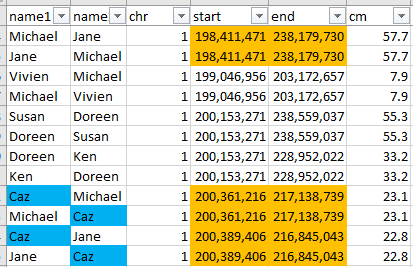
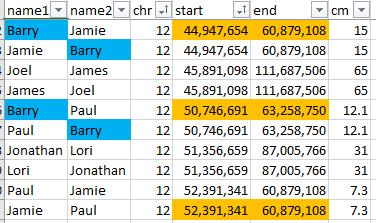
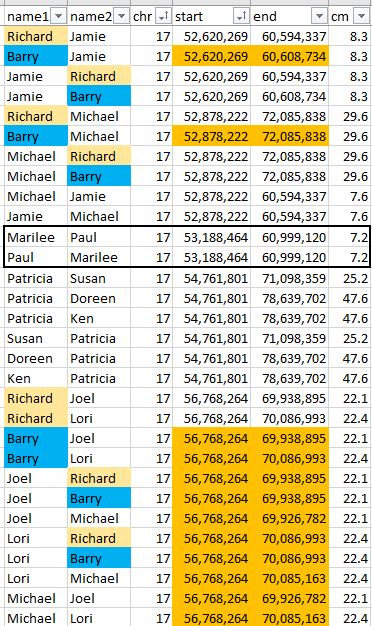
Here are some DNA match ranges for Elizabeth compared to Vivien, Ros and Don:

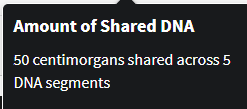
Elizabeth and Vivien share 455.9 cM which is about average for a 1st cousin once removed. Ros and Elizabeth are also about average for 2nd cousins. However, Elizabeth and Don are below average for third cousins. As, I mentioned above,  the DNA ranges start to vary more the further out the relationship is.

Elizabeth’s DNA One Step Beyond Australia


Here I added Cathy and Jane who don’t have Australian ancestors. I wrote a Blog about Cathy nearly three years ago, back in the early days of Frazer DNA Blogs. From what I can tell, Cathy is from North Carolina and Jane is from Colorado.

In the darker box, I have the Elizabeth’s Australian cousins. Elizabeth is a 3rd cousin once removed to Jane and Cathy. An average or typical amount of DNA shared for a 3rd cousin once removed is about 48 cM. As can be seen for the amounts of DNA shared with Elizabeth’s cousins, the amounts go down from right to left on the top row in the above chart. Any DNA that Elizabeth shares with Cathy and Jane would likely be from Archibald Frazer born in 1802 or his wife Catherine Parker.

Pushing Back Elizabeth’s DNA to the 1700’s

The next logical step is to look at the generation before Archibald Frazer and Catherine Parker.

This adds 11 people to the 6 we have already looked at. We are not sure when this Archibald was born, but a guess was put at 1778. This is sometimes referred to as the Stinson Line as Archibald married Ann Stinson. The light blue line on the left was put in by DNA as a likely guess. Elizabeth should be a 4th cousin once removed or 5th cousin to most of these new people.

Here is how Elizabeth matches by DNA to her more distant cousins:

Unfortunately, I didn’t list these cousins in the best order. Out of the 11 more distant cousins, Elizabeth has a DNA match with three: Michael, Ken and Susan. The chances that Elizabeth will match a 4th or 5th cousin get smaller.

Elizabeth and More Distant Frazer Cousin

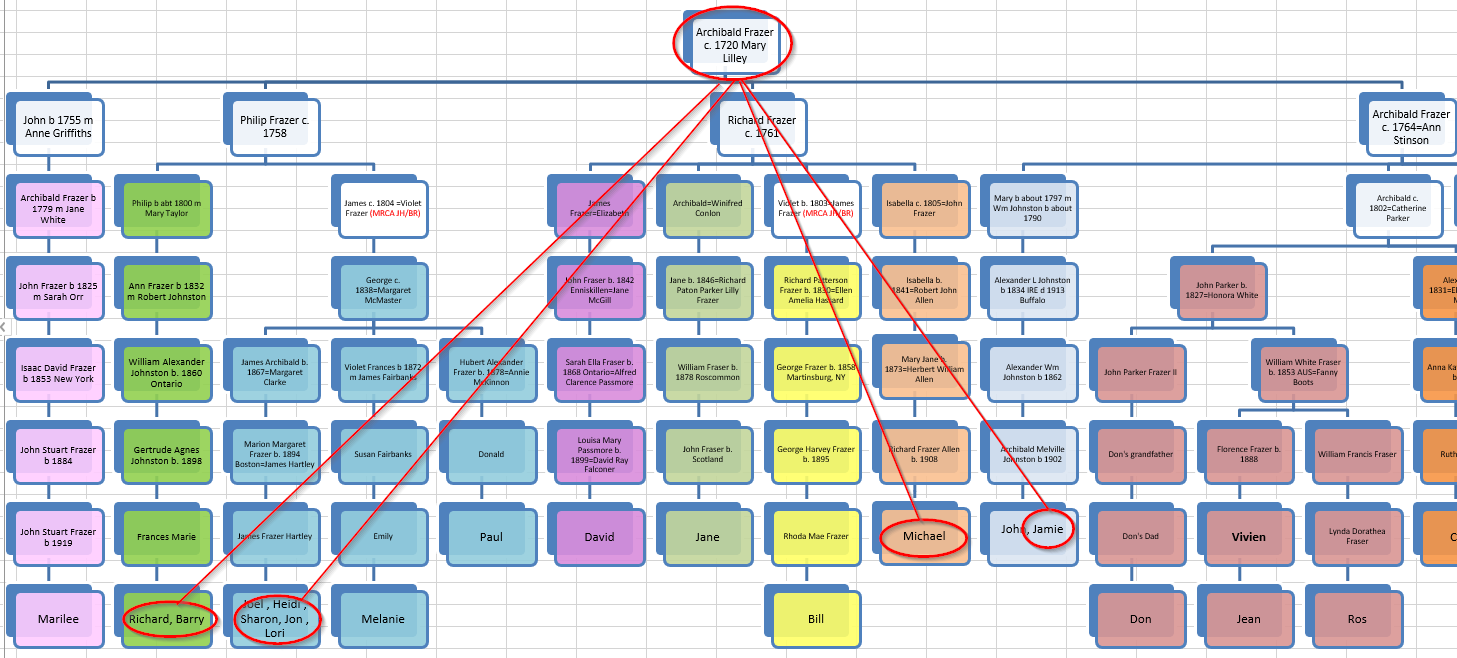
The next step up for Jane goes to Archibald Frazer and Mary Lilly

This couple had four sons that had descendants with tested DNA. I am in the blue line descended from Philip and Marilee is in the pink line descended from John. The descendants of Richard are also in the Archibald/Stinson line, so they are accounted for. Here Elizabeth would be 5th cousin once removed or 6th cousins to her more distant Frazer cousins. Based on the Chances of Finding a Match Chart above, her chances of having a DNA match with these people are very small.

Here is the Philip Line:

Those in yellow are already in the Archibald/Stinson LIne. Richard in green was added due to a DNA match as a likely Philip descendant.

Here is how Elizabeth matches her more distant cousins:

Elizabeth only matches Emily and Paul. And she matches them at below the normal cutoff of 7 cM.

Elizabeth and the James Line: The Final Frontier

Here the James Line is shown in white boxes:

Elizabeth would be typically a 6th cousin once removed to a 7th cousin to these people. From the list above, Elizabeth matches two people: Mary and Janet in the 5 cM range.

Summary and Conclusions

Elizabeth’s DNA behaves in an expected manner. I traced her matches from her closest Australian cousins down to her most distant James Line Frazer cousins. At each step further out, those DNA match levels go down. Elizabeth’s DNA testing confirms the genealogy we have. It also reminded me of others that had tested that I had forgotten about.

A review of the testing of Frazer DNA over the past three years, shows how the project has grown and come together.


A Third Frazer Big Y 500: Part 2

Last month, I took a first look at Rodney’s Big Y 500 results. At that time, I was looking for unnamed SNPs that Rodney and Jonathan shared on the James Line. I was unable to find any. It looks like FTDNA and YFull were unable to find any also. When I wrote my first Blog, Rodney’s results were not at YFull yet. YFull is a popular service for interpreting Big Y results. I’ll take a look at Rodney’s YFull Results in this Blog. Before I do that, here is where Rodney fits into the Frazer YDNA testing tree:

Paul, Rodney and Jonathan have taken the Big Y test and Rick has taken the YDNA STR test.

Rodney at YFull

Before Rodney’s results were in, this was the YTree:

Jonathan and Paul were the last two id’s. Here is the present YTree:

YTree Changes

I see two major changes to the YTree. One is that there is a new non-Frazer Branch. The second is that the Frazer branch common ancestor is refined from 475 ybp to 375 ybp. From what we can tell, at the tree above, Archibald was born around 1690. That is roughly 325 years ago. So 375 years ago by YDNA is pretty close. I was expecting a new SNP for the James Line of the Frazers. These SNPs form about every 144 years. Note that at 375 years ago, that should represent 2 or three new SNPs. From my work on the STR side of the YDNA testing, it has seemed like the STR differences have been primarily on the Archibald Branch of the Frazer tree and not on the James side. It seems like this must be true for the SNPs also. This would have to be verified by Big Y testing of someone else in the Archibald Line. The only other possibility is that there is indeed another SNP for the James Line, but the testing results were not clear enough to determine that.

A New Parallel SNP Line to the Frazers

Here is the new line of R-BY26344:

While I’m thinking of it, there is another interesting point. The YTree shows that YP6488 was formed 1100 years ago. [The date that the SNP was formed is earlier than the common ancestor dates listed above. For the formed dates, see the YTree above.] The two branches below YP6488 were formed 700 years ago. However, the Frazer branch of YP6489 consists of six total SNPs listed here:

From 1100 to 700 years ago is 400 years. SNPs are formed on average every 144 years but in 400 years somehow the Frazer seemed to get 6 SNPs. On the other hand, BY26344 has is only represented by two SNPs over 400 years. That could mean that the Frazer line had all it’s SNP mutations between 1100 and 700 years ago, so now they are just coasting, so to speak.

Who Does BY26344 Represent?

YFull uses ID’s, so it can be difficult to tell who these people are. In the past, I have been tracking the Grants as their YDNA STRs have had similarities to the Frazers. That appears to be the case. However, there is also a Stuart as well as a grant in the YP6488 Group.

Here Grant and Stuart are still listed as YP6488, so that means that FTDNA may be a bit behind YFull for Grant and Stuart.

This is interesting as it shows us that Grant and Frazer had a common ancestor about 1300 A.D. To me, this would be before the time that surnames were in common use. However, by 225-375 years ago, surnames should have been in common use. This should mean that the two SNPs at the bottom of the tree should represent Grant and Frazer respectively. This also has interesting parallels to my wife’s line. A surname that was related to hers was also found to be a common ancestor about 700 years ago.

As a reminder, here is a map showing how close the Frasers and Grants lived in 1587:

My assumption is that this is where the common ancestors of the Grants, Stuarts and Frazers lived around the year 1300. This is to the Southwest and West of Inverness. The Frazers had the Grants surrounded. Also the Grants and Frazers surrounded Loch Ness.

I also note that one of the YDNA Grants testers mentions Carron. If I have the right Carron, it is to the Northeast of Glasgow. The Frazers were believed to be from the area of Ayr. I have also added dates to the various areas that the Grants and Frazers may have lived these areas.

Note where I have Grant above, I should have also included Stuart.

Further Questions on the Grant/Stuart Line

Assuming that the two IDs at YFull on the YTree are indeed Stuart and Grant, that poses additional questions for those two lines:

  • A common ancestor of 225 years ago is within the surname era. That means that there was some mixing of the two surnames due to adoption or other event.
  • Stuart appears to have been in Virginia before 225 years ago and Grant in Carron before that time. If this is correct, then the 225 years for a common ancestors may not be right.

I point this out partly, because it shows some common issues that could arise in a surname project. Fortunately, the testing of the Frazers so far has not resutled in similar issues.

Big Y 500 STRs

YFull looks at STRs deduced from the Big Y test. Here is how Rodney matches Jonathan and Paul:

This shows that, by STRs, Rodney is much more closely related to Jonathan than Paul. I think that there is a way to convert the distance to years, but I can’t find it right now. However, it appears to show that Rodney is more than twice as closely related to Jonathan as Paul is. This makes sense based on the genealogical tree at the top of the Blog.

Rodney is Running Out of SNPs

Here are Rodney’s novel SNPs at YFull:

Note that Rodney has no best or acceptable quality Novel SNPs. Novel SNPs are the ones that don’t match others. That means that all of Rodney’s good SNPs are already matched up with Paul and Jonathan as they should be. This makes sense as the time between the birth of Rodney, Jonathan and their common ancestor of Thomas Henry Frazer is likely less than 144 years.

For comparison, here are Paul’s Novel SNPs:

Paul has 10 Best or Acceptable Quality novel or private SNPs. It is likely that one or more of these SNPs could become an Archibald Line SNP if another Archibald Line Frazer descendant tests for the Big Y.

Perhaps a better comparison would be with Jonathan’s novel SNPs:

Jonathan is really out of Novel SNPs. He has no novel SNPs of any kind of quality.

Summary and Conclusions


  • Rodney’s Big Y 500 test has refined the YTree and dates of common ancestors
  • Many new SNPs prior to about the year 1300 may account for no identified SNPs after that date for the James Line
  • Another Big Y tester on the Archibald Line may create a new SNP for that branch
  • Assuming that the new Branch of BY26344 was for Stuart and Grant, that raises questions about the origin of those lines and about the date of the common ancestor for those two surnames.
  • The common ancestors for the Frazer distant relatives of Stuart and Grant has been moved up from 800 years ago to 700 years ago.
  • The common ancestor for the three Frazer testers has also been moved up 100 years: from 475 to 375 years ago.
  • The STR testing confirms the relative DNA closeness of Rodney and Jonathan who are in the James Line. This is also confirmed by autosomal DNA test results.

A Second Butler Big Y Results Are In

I am thankful that Peter agreed to take the Big Y test, also known as the Big Y – 500. It is important when taking the Big Y test to have two people with the same surname. That is because results are achieved in tandem. That means, that to have new SNPs named there has to be someone else that matches you on that SNP. Otherwise, the SNPs that don’t match anyone else remain private.

Previously, I was also happy that Rick tested. He is not a Butler, but previous Y DNA tested indicated that his family and the Butlers were related at some time in the past. Based on YFull calculations that time would be 700 years ago. Even though, that seems like a long time ago, the common ancestor that my father in law, Richard, had before Rick tested was 3500 years ago. I wrote about Rick’s results here.

Peter’s YDNA SNPs at FTDNA

Peter tested at FTDNA. It took a little while to get his results, but when they came in, things happened quickly. Peter’s first results looked like this:

This showed that Peter matched Rick and Richard. This was expected. Not too much later, FTDNA showed that Peter actually formed a new branch with just himself and Richard.

In my opinion, this new SNP of I-Y128364 is likely a Butler-only SNP. This is one of the goals of the Big Y: to get a family surname level SNP. Here is how I see the Butler tree with SNPs:

The age of these common ancestors are from YFull.

Peter’s YDNA SNPs at YFull

Peter uploaded his FTNDA Big Y results to YFull. One would think the results would be the same between the two companies, but not quite so. For one thing, YFull gives age estimates. One is for the formation of the SNP and the other is for the common ancestors of the matches that share that SNP.

Above, Peter is YF14375. His number is faint as the results have not yet been finalized. I am expecting that YFull’s analysis will have Peter and Richard sharing a common SNP, once their analysis is done. Rick has the USA flag and Richard is the last person in the image above.

Some Differences Between FTDNA and YFull: Y128315 Vs Y128591

Under YFull, Y128315 shows three SNPs plus 17 others. One of the 17 others is Y128591:

That means that there were a bunch of SNPs in this group. FTDNA chose one SNP to be representative of the group (Y128591) and YFull picked a different one (Y1285315).

What About I-Y136556?

YFull has an extra SNP between I-S17511 and I-Y128315. This is I-S136556. . This may be because there is an ERS sample at YFull that I believe was taken from a study. This test result would not be included in the FTDNA information. This I-S136556 fills in some information that FTDNA did not have, but the dates are still ancient history as they are in the range of 4,000 to 3,500 years ago. Note above in the YFull Tree that Y136556 is also called BY37214. FTDNA has this listed under S17511:

The bottom line is that YFull shows slightly more detailed branching than FTDNA.

What’s Next?

Next we wait for YFull to finish their analysis. The interesting thing that YFull does that FTDNA does not do are age estimates. It will be interesting to see what YFull has for a date for the common ancestor between Peter and Richard. Also YFull will likely come to the conclusion, as FTDNA did, that Richard and Peter need to share their own Butler SNP.


My Latvian Cousins Inese and Anita

Back in March of this year I wrote a Blog about my Latvian cousin Anita and how we matched by DNA. Since then, her sister Inese also tested at MyHeritage. Anita sent me a photo of her sister on the left and herself on the right:

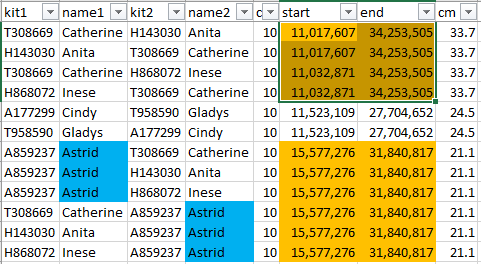
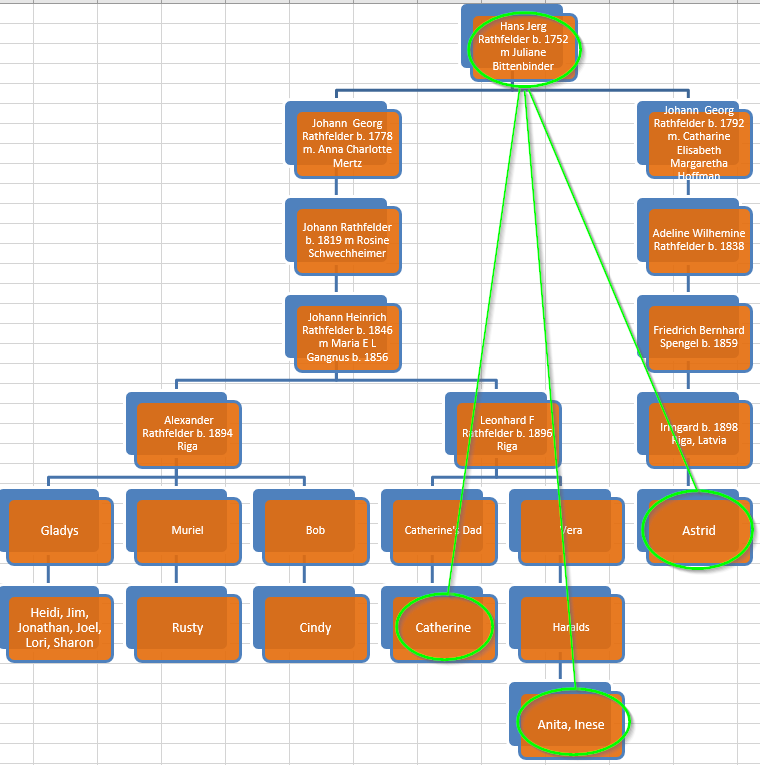
Here is how we match on our Rathfelder side:

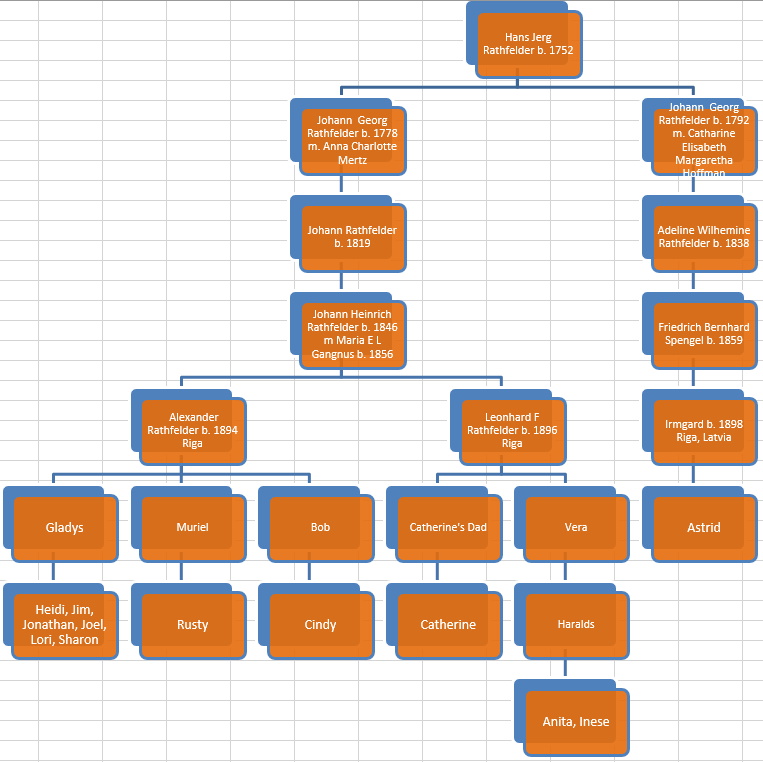
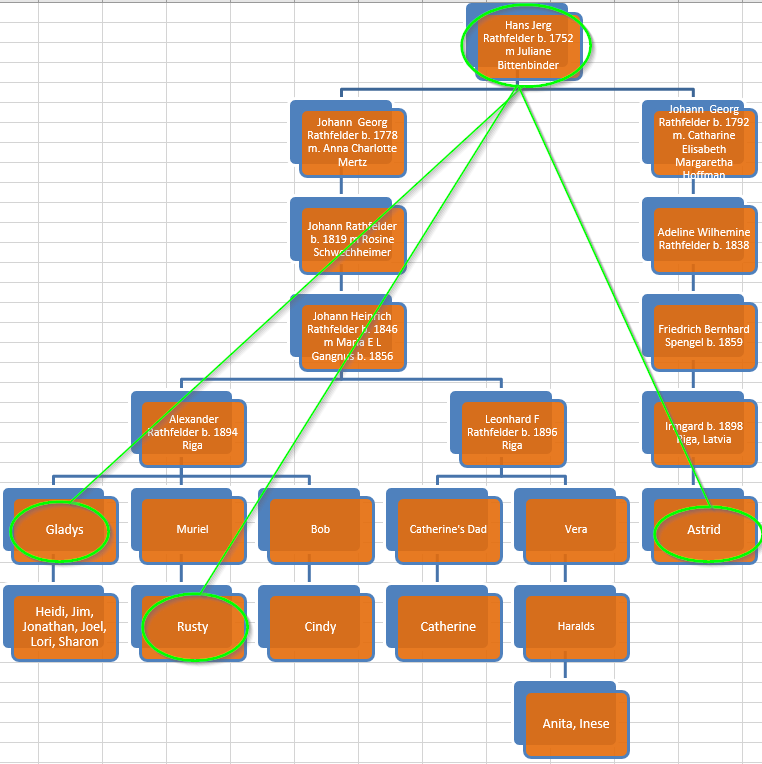
I am in the bottom left box and Anita and Inese are in the lowest box. We both have the common ancestors of Heinrich Rathfelder and Maria Gangnus. I am a second cousin once removed to Inese and Anita and my mother is a 1st cousin twice removed.

My Mother’s DNA Matches with Inese and Anita

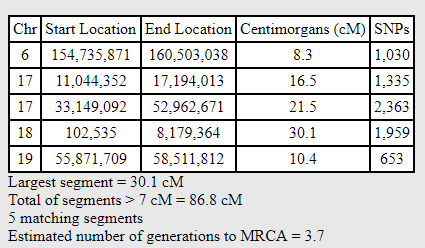
Here is how Inese matches with my mother as shown at MyHeritage:

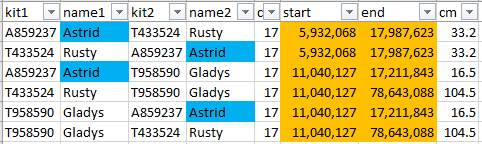
Here is how my mom, Gladys, matches with Inese and Anita:

The most important matches are where Inese matches my mother where Anita doesn’t. That is because this is newly identified DNA areas where we match.

Anita’s Questions

Anita had this question for me:

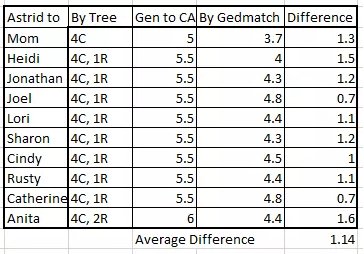
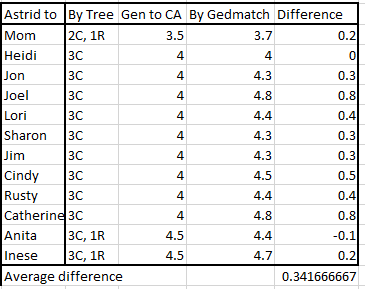
Me and your mother have 5,1% shared DNA, but my sister has 4,1% shared DNA with Glagys. Does it means that I have more DNA from Rathfelders than my sister has? Or 1% isn’t such a big difference?

That is a good question. I think that it does mean that Anita has more Rathfelder DNA than Inese. Anita and Inese got half their DNA from their father Haralds. They got 25% from Vera. They got on average 12.5% from Leo. My mother is Leo’s brother’s daughter. However Leo and his brother Alexander shared about half of their DNA with each other. That means that if all of Inese’s DNA matched all of Gladys’ DNA they could be up around 6.25% theoretically.

We Get Our DNA From Our Grandparents, But Not Equally

Looking at the image above, Anita matches my mom Gladys on Chromosome 19, but Inese does not. Why is that? That is because we all have a maternal and paternal chromosome. However, on each of those chromosomes we only have room for one grandparent. On Anita’s paternal Chromosome 19, she got her DNA from her grandmother Vera. However, Inese got her paternal Chromosome 19 DNA from Vera’s husband. That is why she doesn’t match Gladys on her Chromosome 19.

In order to answer Anita’s question definitively, we would have to map out all of Anita’s and Inese’s DNA to see exactly how much Rathfelder DNA they got on each Chromosome. They should both have about 25% of their DNA from their grandmother Vera who was a Rathfelder. However, it is possible that Anita has 26% and Inese could have 24% Rathfelder, for example.

That gets to another of Anita’s good questions:

Why me and my sister have only 39,3% shared DNA (44 segments)? I thought that close relatives should share more than 50%, no? Does it means that she for example took more DNA from our mother and me from father? Or almost 40% is a high share?

Here was my answer to Anita:

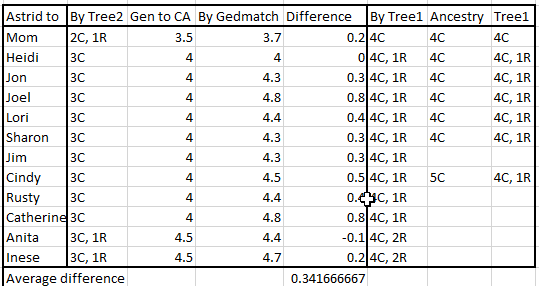
Siblings are a special case as they share what is called fully identical regions. That means that they can share DNA from the same location from the mother and the father on a specific Chromosome. Perhaps this makes it seem like less DNA is shared. I have 5 siblings tested, so I have plenty to look at! I have 4 of my 5 tested siblings at MyHeritage. They show:

  1. 40.0% (2,898.9‎ cM)
  2. 37.8% (2,738.1‎ cM)
  3. 35.0% (2,534.9‎ cM)
  4. 34.0% (2,462.8‎ cM)

Based on this 40% is pretty high. I share 48.6% with my mother. With my mom, I am only sharing on the maternal side, so there isn’t the same situation as sharing with siblings.

My Match with Inese and Anita

I only got half of my mother’s DNA. Here is how I match with Inese and Anita:

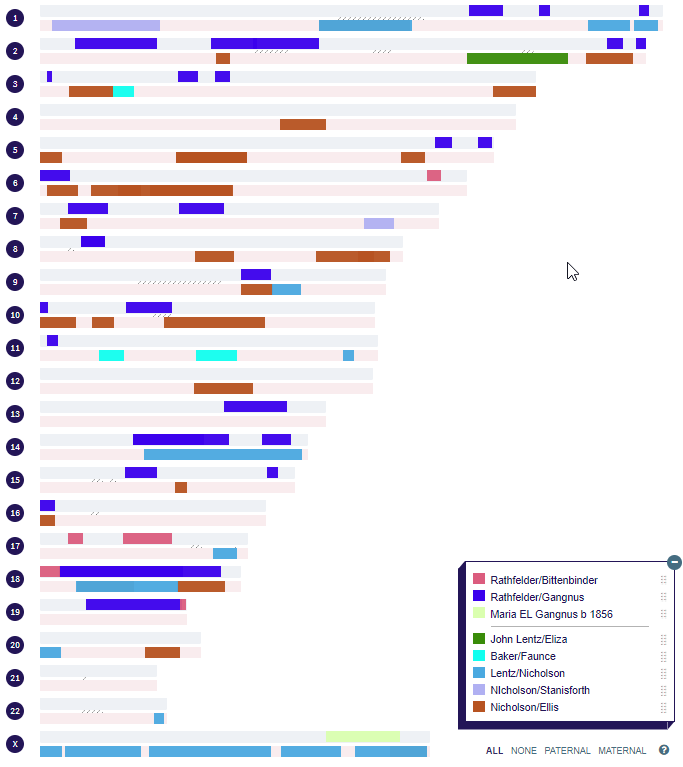
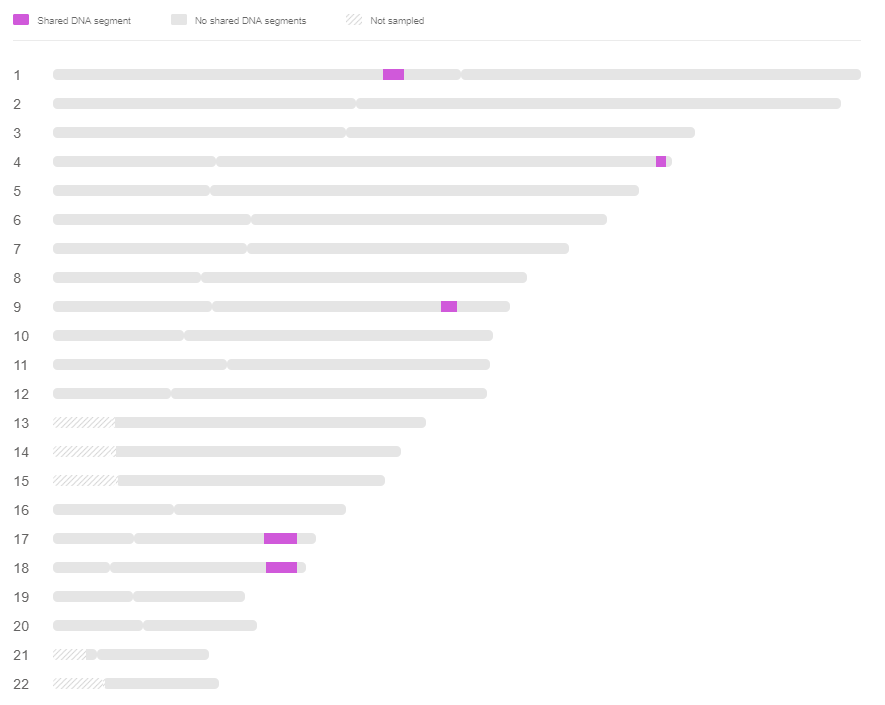
Even though I get half of my mom’s DNA, that doesn’t mean I get exactly half of the DNA that she got from her grandparents. I may get more from some and less from others. Here I didn’t get the DNA that my mom got from her Rathfelder and Gangnus grandparents on her Chromosome 2 and 6 as well as in other places.  However, Inese and I share Rathfelder/Gangnus DNA on part of Chromosome 15 and 17 that I don’t share with her sister Anita.

Painting My DNA

There is a DNA painting utility on the internet that is fun to play with. Using this I can add the extra DNA on my maternal side on Chromosomes 15 and 17.

The addition on Chromosome 17 is difficult to see as it merges with or is covered up by Schweccheimer/Gangnus. On Chromosome 15 the Rathfelder/Gangnus DNA that we share merges into Nicholson/Ellis. These are ancestors that my mom has that are not shared with Anita or Inese. The point where the color changes is called a crossover. That means that is the spot where the DNA that you have crossed over from one ancestor to another.

Inese, Anita and Ethnicity

I usually don’t write about ethnicity. That is because there are a lot of variations in the results. I have tested with different companies and there are some differences in what I have been told. However, Anita had some questions about her and her sister. I know that the ethnicity or where you came from based on your DNA is a very popular part of the DNA testing and people enjoy looking into this area.

Anita has some good questions:

By MyHeritage results I have 28,5% of Balkan region. My mother says that her parents and grand parents came from Russia and EasternAsia, no one she knows from Balkan. From my father side, Vera comes from Rathfelders, also not Balkan. I don’t know nothing about my father’s father, but almost 30% for me sounds a big part. What does it means? 

Here is Inese and my mom compared at MyHeritage:


Inese comes out as 9% Balkan. Note at the top that it says that Gladys and Inese do not have ethnicities in common, but they do share common areas. This is a bit of a surprise. So, for example, Inese and Gladys share a general North and West Europe DNA but Gladys’ is interpreted as English and North  and West European while Inese comes out Irish, Scottish, Welsh and Finnish.

I note that the 10.8% my mom has of North and West Europe is in the area including Germany.

I should note that Germany is a difficult area to determine by DNA. It could be because Germany was a bit of an ancient crossroads. A lot of people lived and passed through there. The Anglo Saxons that came to England, for example, were from Germany. German people also moved up to Scandinavia and other places. My mother also has other German ancestry on her mother’s side that is not related to Anita and Inese.

How Does Anita compare with Gladys?

The results are similar, except for the Balkan. Here Anita shows as 28.5% Balkan. Let’s take the average of Anita and Inese and call them 18.7% Balkan. My guess is that Anita’s father’s father had some Balkan background based on the MyHeritage analysis. However, I also like to look at Gedmatch.

Inese and Me

Even though Inese and my mom share no ethnicities, I do.

We share some Irish, Scottish and Welsh. How is this possible? We share this by coincidence. The 34.5%  Irish, Scottish and Welsh I have was from my father’s side. So this is just a coincidence that we share that heritage. This could not be from DNA I got from my mother as my mother and Inese have no shared ethnicities.

Anita and Inese’s Heritage at Gedmatch

Gedmatch has a lot of tools for looking at what they call ‘Admixture’. However, the documentation of how to interpret the results are often difficult to find. At Gedmatch, I choose admixture and use the Eurogenes program. Here is what Anita looks like:

I see the Baltic agrees with MyHeritage. However, Anita has about 48% North Atlantic. The above uses the K13 model. Apparently the K15 is newer and gives this results for Anita:

This basically broke Anita down onto four quarters with some miscellaneous heritage under 4% each. Atlantic seems a bit vague to me but the North Sea is quite specific. Note that there has been no mention of Balkan at Gedmatch for Anita.

A Look at Oracle

Oracle looks at various other possibilities. It is a bit more interesting as it adds some more specific areas based on an interpretation of the general areas in the pie chart above. Here are the Oracle results for the K15 analysis:

The single population sharing means that if four of Anita’s grandparents were from the same place, where would that place be? Here are the top 20 places. Some of the bottom choices are in the area of the Balkans.

The next option is the top 20 choices if Anita has two different heritages:

In this model, Southwest Russian comes out strongly with some other secondary choices. Now there are some German choices in there. If I were to do the same thing with the K13 Analysis, the results would be different. Also note that Anita’s great-grandfather was German. A great-grandfather represents 1/8 of one’s heritage. That is 12.5%.

Chromosome Painting Anita and Gladys

This is where things could get really wild. I chose the K15 analysis and then I compared Anita with my mom, Gladys on Chromosome 18. This should show what they have in common. Here is how Gladys matches Anita and Inese on Chromosome 18:

Gladys matches Anita between about 7.6M and 57.1M. That makes up a large part of Chromosome 18. Here is the Chromosome Painting:

This is an expanded view of Chromosome 18. Anita’s results are in the first row. Gladys is the second row. The third row is how Anita and Gladys compare with each other. I have an arrow at about 7.5M where Anita and Gladys start to match each other. The third row has blacked out where Anita and Gladys do not match. Where Anita and Gladys match each other represents DNA that they got from Heinrich Rathfelder and Maria Gangnus. Here is the right side of Chromosome 18 up to about 57.1M. After that point Gladys and Anita no longer match each other.

This is difficult to interpret, but it tells me that the ‘German’ match between my Mom and Anita is seen in the DNA in the last row is a mixture of North Sea, Atlantic, West Asian, Eastern European and a bit of Baltic.

Also by comparing Anita to the bottom row, we can see how Anita and my mom do not match. It seems they don’t match on Siberian and East and West Mediterranean among others.

Inese and Gladys Painted on Chromosome 18

Next I want to make the same comparison between Inese and Gladys. I am wondering if I will get the same results.


This image corresponds to the previous image where I compared Anita with my mom. It looks the same. It makes sense as all three match along this part of Chromosome 18. However, the more I look, I see a few subtle differences. In the area before 40, the black part in the bottom row is thinner between Inese and Gladys. That means that in this area, my mom and Inese have a closer match by ‘admixture’ than my mom and Anita. As Anita, Inese and Gladys match each other between 8 and 58, there could be other subtle differences.

Anita’s Question on Germany

In my and sister’s MyHeritage results 60% is Baltic, but nothing from Germany. It means MyHeritage takes into account that Rathfelders were from Baltic region not Germany? Or how?

Admixture questions can be complicated. There are a few reasons for this. Although the Rathfelders were considered German, they had many other ancestors that made up their ancestry that could have been from other areas. The second reason is this. Germany was a bit of a crossroads. Many other people came into what is now the Country of Germany. What I showed above was that the ‘German’ that Anita, Inese and Gladys share shows in DNA form as East Europe, Atlantic, North Sea, Baltic and some other areas in very small amounts. The United States is considered a melting pot where different nationalities have inter-married. This is true also of England which has had different conquerors and different populations moving to that Country. Likewise many people moved into Germany before staying there or moving on to other places.

Summary and Conclusions

  • A comparison between me Inese and Anita shows where I match them both by DNA. It also shows where I match on and not the other.
  • I was able to map the extra DNA where I match Inese and not Anita. Everywhere I match Anita or Inese it represents DNA that we both have from Heinrich Rathfelder or Maria Gangnus.
  • There are many variables in trying to tie DNA to your own heritage or ethnicity. There are also a lot of models and interpretations. As a result there can be different results. In general the DNA is accurate. However, when applied to a specific modern-day country, the results can be erratic.
  • The ethnicity results were accurate for the greater part of Anita’s and Inese’s heritage. However, when it got down to the 12.5% German, the results were confusing. Part of the answer could be in what makes up a Rathfelder or a German.
  • It is a good idea to look at more than one model when interpreting heritage by DNA.

My Brother Jimmy’s DNA

Jimmy is the my last brother to have his DNA tested. I cornered him on his recent trip with his wife to visit my 96-year-old mom. I had an FTDNA kit, so that is the test he took.

Is Our DNA the Same?

This is a common question that Jimmy had when testing siblings. Siblings get 50% of their DNA from each parent, but it is a different 50%. I believe that we also share 50% of the same DNA with each sibling. Here is how Jimmy compares to his five siblings in a chromosome browser:

Each color represents one of Jimmy’s five siblings. From the browser, it looks like Jimmy shares more than 50% with each sibling. That is because the browser combines our maternal and paternal DNA. We actually have two copies of each chromosome. However the DNA cannot discern between the maternal and paternal side. I have had my mom tested for DNA. If my father had been alive for DNA testing, Jimmy’s DNA would not have been as important. Even with six siblings tested, it is possible that some of my father’s DNA did not get passed down. One child gets 50% of the father’s DNA. With the second child tested, that goes up to a theoretical 75%. Third child is 87.5%. A fourth is 93.75%. A fifth is about 97% and a sixth is about 98.5%. That still leaves out about 1.5%. That may not seem like a lot. I match my mother at 3,587.0 cM. 1.5% of that amount is about 54 cM. Most of my matches are less than that amount. With a math of 50 cM, the relationship should be fairly easy to figure out. Below that amount, it may be more difficult.

The fact that Jim matches half of each sibling is shown best on the X Chromosome. The X Chromosome for a man is just on the mother’s side. Here is how Jim compares to Jon and Joel:

Jim’s match with Jon is in orange. He matches at about half of the X Chromosome but in different places until the end. There, Jim, Jon and Joel match each other near the end of the  X Chromosome. This will be more fully explained later in the Blog.

Jimmy’s Ethnicity

The map seems fairly reasonable. There is 3% Middle Eastern which is difficult to explain. My mom has a lot of German, so perhaps, some Middle Easterners made their way up to Germany at some point.

Jim’s Ethnicity at Gedmatch

Depending on which testing company or which model, Jim’s results could come out differently. Here is Jim at Gedmatch’s Eurogenes K13 Admixture Proportions:

Jim noted that Heidi had no Middle Eastern at FTDNA. Here is Heidi at Gedmatch:

Here Heidi has more East_Med than Jim and has Oeanian instead of Amerindian. Heidi also has no Red_Sea which I take to be Middle Eastern.

Jim’s Unique Frazer DNA

Emily is Jim’s second cousin once removed.

This is an old tree, so I need to add Jimmy to the lower left box.

Emily’s grandparents are in the middle of the photo. The two on the left are our common ancestors: George Frazer and Margaret McMaster. I uploaded Jimmy’s DNA to Gedmatch. Then I ran checked to see how Emily matched me and my 5 siblings. Surprisingly, on Chromosome 5, Emily matches Jimmy and none of the other 5 siblings:

This shows that Jimmy and Emily have a large math on Chromosome 5 for 57 cM between positions 109M and 166M.

For comparison, here is how Emily matches Joel, Lori, Jon and Heidi on Chromosome 20:

Emily doesn’t match Jim or Sharon here as they probably got their DNA from the Hartley rather than the Frazer side at this part of their Chromosome 20.

A Map of Chromosome 5

This map will give an explanation of how out of six siblings, it was only Jim hat matched Emily on Chromosome 5.

This map has me and my two sisters. The light red is our Frazer side and the dark red is the Hartley side. The top line shows my father’s Hartley and Frazer side. Note that there is a cross-hatched section in the lighter red in the top line. That is where there was Frazer DNA missing that was not passed down to these three siblings. However, JImmy has made up for this by having Frazer DNA in this segment of his Chromosome 5.

Mapping Jim’s X Chromosome

Men only get one X Chromosome from their mother. That means it should be fairly easy to map Jim’s X Chromosome. Here is how the three brothers compare on the X Chromosome:

The green with blue underneath is where there is a match. The red where there is no blue underneath is where there is no match. Next, I added position numbers and crossovers. Crossovers are where are DNA crosses to what we got from one grandparent to what we got from another. In this case, these are maternal grandparents, so that would be either Rathfelder or Lentz.

Jim gets the first crossover. This is because at position 12, Jim is in the first two changes. He goes from non-match to match with Jon and from match to non-mathc with Joel at position 12.

In the next step, I color in the DNA Fomr Jim, Jon, and Joel. Jon and Joel match from 100 to 140, so I’ll color that one color. Jim does not match Joel or Jon in that area, so he will get a different color.

These colors will stand for Rathfelder or Lentz, but we don’t know which is which yet. However, I’m curious, so I’ll check. I notice that Jim has an X match with Anita from Latvia. She is a Rathfelder-descended cousin that I found out about recently through DNA. Here is her match with Jim:

That means that Jim’s orange is Rathfelder. These colors can be expanded to the crossovers. Jim has a crossover one segment to the left and none to the right. So I can extand the orange.

Blue has to be Lentz, and this can also be extended.

Note that Joel had crossovers on both side, so the blue could not be extended. However, on the other side of the crossover, I have to go toi Rathfelder as that is the only other choice. In this way, the map can be filled out. Here is a quick X Chromosome map for Jim:

It is possible to check the matches and non-matches above to make sure that they and the map agree. This is quick, but it is accurate? I had someone map my X Chromosome by a different method and he got this:

Based on this, my mapping is accurate on the right side of the Chromosome, but not on the left. This shows that I have a crossover at 23. Sometimes what looks like a crossover for one sibling is actually a crossover for the other two siblings. That is what appears to have happened at position 23. The crossover was probably for Jon and Joel.

So, under the above, Jim has three X segments, Jon has four and Joel has five.

Splitting JIm’s DNA

Because I had my mom’s DNA tested, I can split JIm’s DNA into two. Gedmatch has a utility called a Phased Data Generator:

I put Jim’s kit in and Mom’s and out pops two new DNA kits. One is Jim’s maternal side and the other is Jim’s paternal side. This represents most of the half of the DNA he got from mom and the half from dad. These are useful, because now we can tell when there is a DNA match whether it is on the maternal or paternal side. The matches that are on neither side are most likely not good matches. Here is an example:

Jim’s paternal matches are in blue and the maternal in red. The ones with no color are from FTDNA, so I haven’t figured those out yet. The green matches are the matches of 15 cM or more.

Next Steps

By further DNA mapping, I would be able to tell on which grandparent side each of Jim’s matches are on. I will already know that for Jim’s X Chromosome matches. Here an example. Jim matches Richard here:

We know that Jim is mapped to Lentz in this segment from the mapping above.

I’ll also see how Jim matches those in the Frazer DNA Project I have been working on. In addition, we’ll see how he matches different paternal matches. I’m currently stuck on the Hartley and Spratt side of our genealogy, so perhaps Jim’s DNA results will help there.


A First Look at Rodney’s BigY500 Results – a Third Frazer BigY

I had some good news recently. Rodney’s BigY500 results were in ahead of schedule.

Rodney’s Genealogy

Here is Rodney with other Frazer that have had YDNA testing. Paul, Rodney and Jonathan have taken the BigY test and Rick has taken the STR test.

Frazer SNPs

Currently, the SNP that defines this whole Frazer line is R-YP6489. This is part of the R1a group. With the addition of Rodney to BigY testing, we should be able to get a new SNP that defines the James Line Branch and more specifically, the Thomas Henry Frazer Branch. This testing is bringing us into relatively modern times.

Paul Compared to Rodney and Jonathan

When I compare my cousin Paul to Rodney and Jonathan I see this:

Paul has these Non-Matching Variants compared to Rodney and Jonathan:

  • 7947875
  • 8162400
  • 16784516
  • 20957961
  • 21457649

These are likely Variants on Paul’s side (the Archibald Line) which are not on the James Line side of the Frazer tree. The problem with these Variants is that they will not be named as SNPs unless someone else tests positive for them. There are two ways that this could happen. One would be that Rick (from the Archibald Line) takes a BigY test. Or, tests could be requested for each of the variants above and Rick (or another Archibald direct line male descendant) could test for the individual SNPs once there is a test protocol.

Looking for the James Line Variant

Where is the Variant or Variants that will define the James Line? Here is what Rodney’s niece Kim sent me. This is how Rodney compares to Jonathan and Paul. The comparison is by non-matching variants which is a bit confusing. The non-match could be on Rodney’s side, Joanathan’s or Paul’s sides:


What I am looking for is where Rodney does not match Paul. I want these to not include the Variants that I have listed above representing the Archibald Line. That leaves:

  • ZS3186
  • 20102008

These would be potential candidates for the James Line

Here are Jonathan’s matches:

These appear to be unique to Jonathan:

  • BY26998
  • BY28746
  • BY28749
  • BY28761
  • F4038
  • ZS3186
  • 11718822
  • 11720223

I was hoping that these lists would match up better. Rodney’s results have been uploaded to YFull for analysis, but the analysis is not yet done. It could be that there is an issue on how these variants were reported. The only Variant in common is ZS3186. However, this is a named variant which would probably not be used for a new branch.

Further, Jonathan has this list of Unnamed Variants:

Here it seems we are dealing with a lot of double negatives. Jonathan’s results report Variant 11103209. As this is not on Jonathan’s list of Non-matching Variants, should I assume that Jonathan has this variant in common with Rodney and Paul? I’m confused.

Here is Paul’s list of unnamed variants:

This matches pretty well with my original list for Paul, but it does not include 20957961.

ZS3186

ZS3186 was shared by Rodney and Jonathan but not Paul. However, this is already named. The YBrowse website has this information:

This was found in 2014 but never added to a YTree. It is in the J1 Haplogroup. For this reason, this SNP may be not considered good. Or, it may be determined that the original sample was in error(?) Again, we need some help from FTDNA or YFull in figuring this one out.

Variant 20102008

I had listed this Variant above. Is this the defining James Line Variant? This is not on Paul’s list of unnamed variants. This is good as Paul is from the Archibald LIne. 20102008 is shown as a non-matching variant between Paul and Rodney, so that leads me to believe that Rodney has this variant. However, 20102008 is not a non-matching variant between Paul and Jonathan. This would lead me to believe that Jonathan does not have this variant.

Frazer Variant Summary

This left me a bit confused, so I found out Rodney’s Unnamed Variants. Here is a summary of the three tested Frazers:

Hopefully, I can explain the inconsistencies in blue. The first row is YP6489. All the Frazers have this SNP and it currently defines the project.

Variant 1103209

The second row shows that Jonathan has Variant 11103209. This is actually a double discrepancy. Rodney and Paul do not show this Variant listed on their results but neither do they show this as an non-matching variant with Jonathan. Here is what I believe happened. The results for Rodney and Paul were inconclusive. As a result, the first go at looking at this variant was not enough to list this variant for Rodney and Paul. However, due to the uncertainty, it could not be clearly said that this was a non-matching variant between Jonathan and Rodney and Jonathan and Paul. By looking at the raw test data, it may be better to come up with a better analysis. Right now, this does not look like a defining Variant for the James line if there is some question as to whether Paul has this Variant.

Variants 11718822 and 11720223

These Variants appear to be Jonathan’s private SNPs. Jonathan is positive for them, but Paul and Rodney are not. That means that these likely formed in Jonathan, his father or grandfather after the time of Rodney and Jonathan’s common ancestor Thomas Henry Frazer born 1836. Once YFull has done their analysis, they will give an estimated date of SNP formation and an estimated date of common ancestor. The SNP formation is always the older date. In this case, we know the date of the common ancestor: 1836.

More on Dating

While I’m on the subject of dating. Here is the present Frazer tree going back over 3,000 years:

Jonathan and Paul are at the bottom of this YFull YTree. Based on their BigY testing alone, it was estimated that the SNP YP6489 was formed 800 years ago and that Paul and Jonathan had a common ancestor 475 years ago. This is to illustrate that the SNP formation is before the common ancestor. Going up one step is YP6488. This was formed 1050 years ago. There was a common ancestor there 800 years ago. I assume that this date fits into the formation date of YP6489 800 years ago.

Paul’s Private Variants – The Archibald Line

Paul has four private variants. These formed in the Archibald line between the time of Archibald Frazer born around 1690. The Archibald Line needs another person to test to have some of these Variants named as defining SNPs for the Archibald Line.

Rodney’s Variants

Rodney’s first Variant 2012008 has a question mark under Jonathan. That means that there is some question on Jonathan’s read. However, the fact that Paul was negative for this Variant makes it looks like this could be the new defining Variant that gets named as the SNP for the James Line. Rodney’s second Variant is common to only him at this time. Like Jonathan, this variant formed in either Rodney, his father or grandfather.

This appears to be Rodney’s only Private Variant:

What’s Next?

Kim has uploaded Rodney’s BigY500 to YFull for further analysis. YFull will get this information onto their tree. They will give age estimations and produce 500 STRs from the results. FTDNA will also be doing further analysis on the results. In addition, the R1a administrators will take a look at the results. However, they will like be interested in seeing what FTDNA and YFull have to say.

Summary and Conclusions

  • Rodney’s results show that there are some clear SNPs that could be added to define the Archibald Line. However, as Paul is the only Archibald LIne BigY500 tested person right now, these SNPs will not be named.
  • The James Line results are not as clear. Interpretaion of the results are needed. It is likely that Variant 2012008 will be a new defining SNP for the James Line for the Frazer DNA Project. It appears that this SNP occured between James Frazer born about 1720 and Thomas Henry Frazer born 1836.
  • We need to wait and see if FTDNA and YFull come up with further analysis.

BigY Moves Whitson/Butler Project 2,850 Years Toward the Present

Rick noticed recently that his SNP had changed at FTDNA where he had his BigY tested. His most recent SNP went from Y136556 to Y128591. This SNP change was based on FTDNA’s comparison of Rick’s results with my late father-in-law Richard’s BigY results.

New SNP Y128591

Here is how Richard and Rick now match at FTDNA:

This is added a new branch to the human race. This branch includes Rick with Whitson ancestry and Richard with Butler ancestry. Previously the branch ended at I-Y136556.

YFull Dating: a 2,850 Year Improvement

Here is the new YFull Tree:

Before Rick tested, Richard matched at I-Y136556. Richard had and has a common ancestor with a person with Russian heritage. The estimated date of Richard and the Russian person was 3900 ybp (years before present). Now Richard and Rick have a common ancestor estimated at 1050 ybp.

How did this change? Ricard and Rick match on 20 SNPs. These are 20 SNPs that they do not match with the Russian person. YFull estimates that a SNP is formed about every 144 years. 144 X 20 is 2,880 years. That is the simple match. That should mean also that in the past 1050 years, Rick and Richard should have about 7 SNPs that do not match.

The FTDNA Haplotree

The FTDNA Haplotree is equivalent to YFull’s YTree:

This points out some areas of difference. FTDNA has 22 SNPs that Rick and Richard share versus YFull’s 20.

Y128315 or Y128591?

Also YFull shows a SNP of Y128315 while FTDNA shows Y128591. This is because out of the 20 or 22 SNPs that Rick and Richard match on, one had to be chosen to represent the group. FTDNA chose Y128591 and YFull chose Y128315. FTDNA does have that Y128315 listed three from the end in the box of SNPs above.

Implications of a TMRCA of 1050 Years

1050 years ago most people had no surname. According to Wikipedia, “By 1400, most English and some Scottish people used surnames.” That means that the common ancestor that Rick and Richard had would have been about 450 years before surnames were commonly used – depending on the area. That means that based, just on Rick’s and Richard’s testing, the Whitson and Butler name could have arisen independently. Prior to Rick’s BigY results, there was some indication that there was some confusion between the two surnames due to adoption or other issues over the years.

It would be interesting to know where the Whitson/Butler ancestor lived 1050 years ago. That is something that is not possible to know just based on the comparison of these two BigY tests. However, as more people test within the Y128315/Y128592  Group, it may be possible to find this out.

A Whitson/Butler SNP Tree

It was not too long ago when all we knew was that Whitson/Butler was A427.


At that time, I had predicted that there would be a parallel branch to S23612 that the Butlers and Whitsons would be in. That parallel branch was S17511. The next SNP that came along was Y136556 which includes Russia and Ireland. The I2 Whitsons are possibly from England. Thanks to Rick’s testing we now have a Butler/Whitson SNP – Y128591. Additional testing may reveal other surnames under this SNP. Once Peter’s results are in, I am hoping for a Butler-only SNP that will define the I2 branch of that family. That SNP would be one step down from on the left branch above.

One Other Difference Between FTDNA and YFull

On FTDNA’s Haplotree, I see no Y136556 branch. It appears that FTDNA have incorporated that SNP into S17511 as BY37214.

It is a fairly small distinction, but I like YFull’s YTree configuration better.

Summary and Conclusions

  • My biggest takeaway is that Butler and Whitson do not appear to be as closely related as previously thought. The common ancestor between the Butler and Whitson based on this comparison was 1050 years before present. That would be in the year 968 or about in the middle of the Middle Ages.
  • Thanks to YFull, the common ancestor for Butler and Whitson was pushed forward 2,850 years. That is a dramatic difference.
  • It is likely that Peter’s pending BigY results will produce a new SNP for the Butler family.
  • It would be helpful for the Whitson side to have another I2 Whitson test for the BigY. This would likely result in a Whitson-only I2 SNP below Y128591.


More Schwechheimer Genealogy

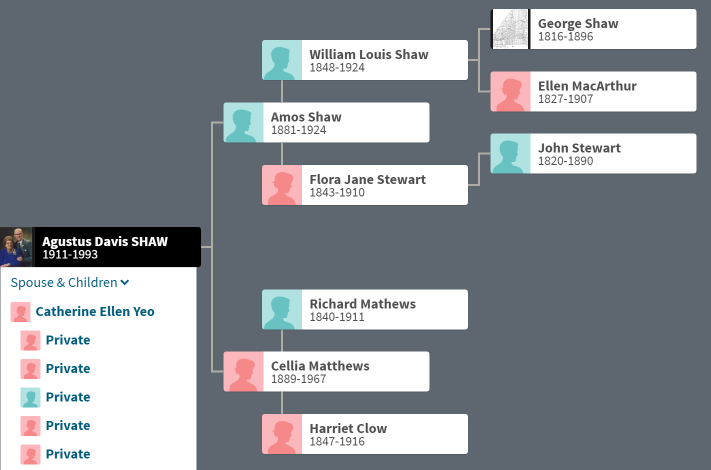
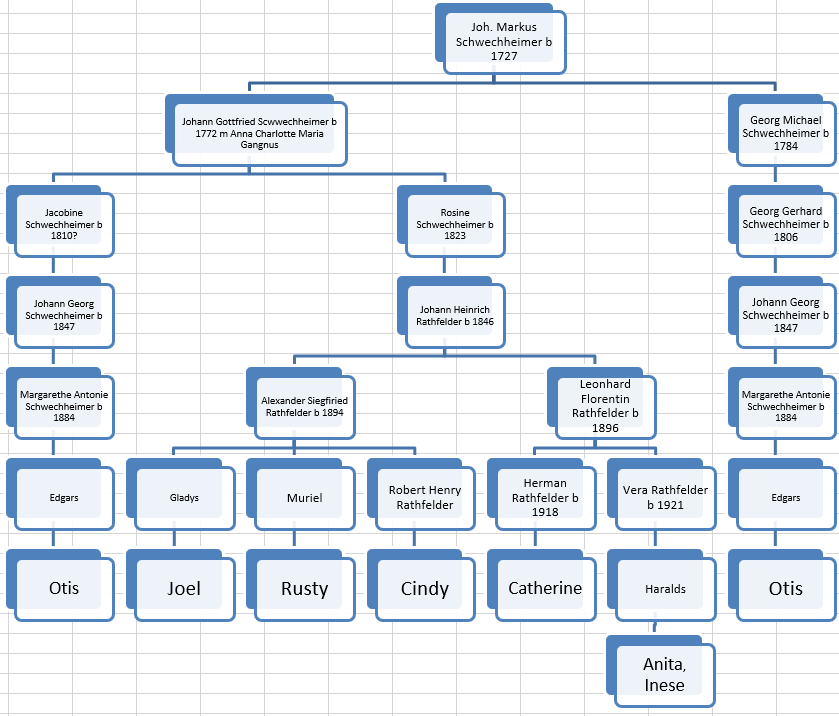
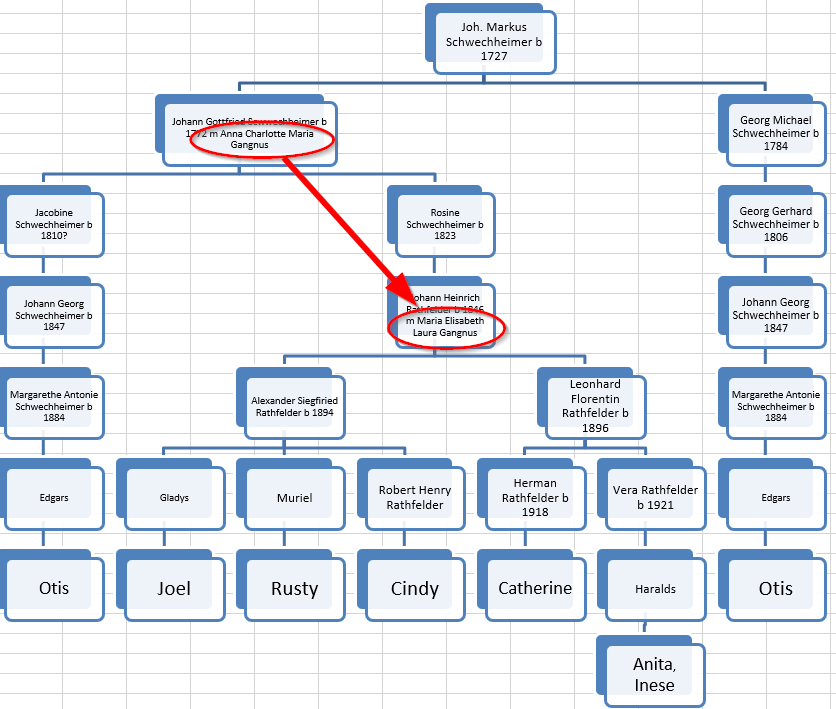
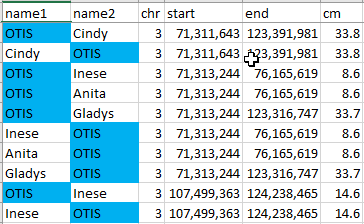
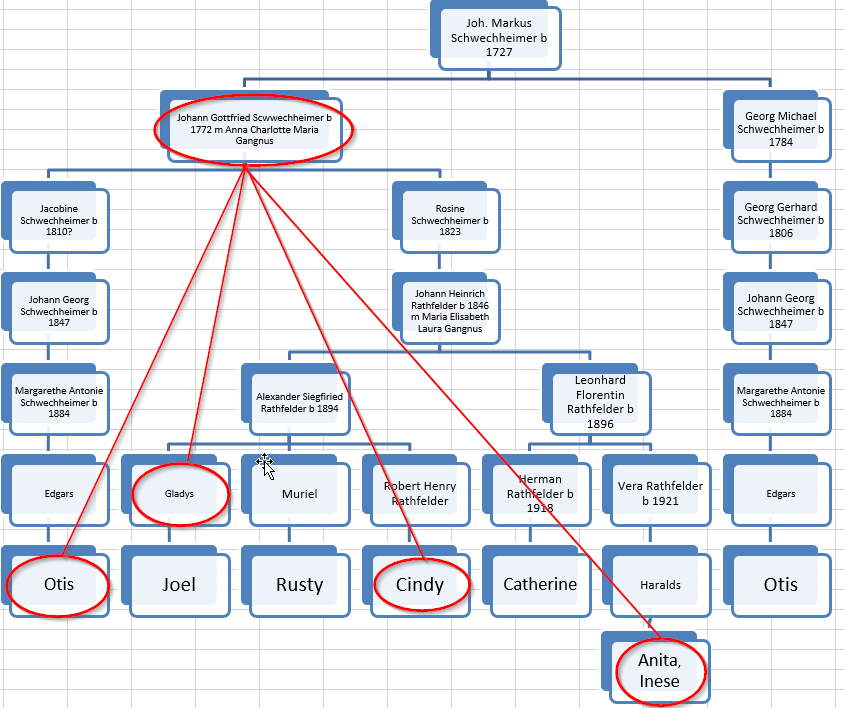
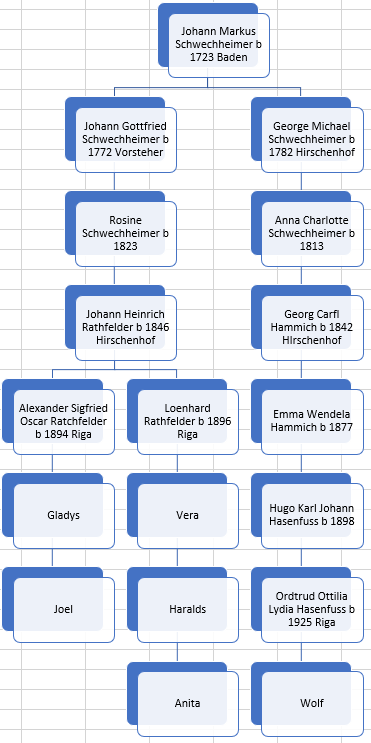
My interest in Schwechheimer Genealogy was renewed this year when I found my mother had a good DNA match with Otis. It turns out that Otis and my mother have Scwechheimer ancestry. These Schwechheimers lived for over 100 years in the German Colony of Hirschenhof in present day Latvia. Through some quick genealogy, I came up with this connection:

Unfortunately, there seems to be a problem on Otis’ side at the point of the circle.

More Than One Gerhard Schwechheimer?

Here is the 1847 birth record I found for Johann Georg Scwechheimer.

Johann Georg’s father was Gerhard Schwechheimer. Before Gerhad, there is either a name or an occupation. I can’t make it out. This Gerhard was married to Jacobine Schwechheimer. This is where I likely went wrong. I had this reference:

This is from a book on the Gangnus family. The next to the last born in this large family was Rosine – my ancestor. I assumed that Johann Gerhard was the same as the Gerhard who was the father of the Johann Georg Schwechheimer above.

Then I came upon this Geni tree:

This tree shows that Gerhard’s father was Georg Michael (Ludvig) Schweccheiner. The profile manager, Lāsma, had the following further information about Gerhard:

I am not able to read Latvian, but I do get the impression that this person was from Helfreichshof which was the Colony to the North of HIrschenhof.

However, a spreadsheet I have created based on an online interactive map of the two colonies indicates that Gerhard’s father, Georg Michael Schwechheimer lived in Hirschenhof on farm # 48:

It looks like the Schwechheimers were neighbors to each other.

Jacobine Schwechheimer

That means that if Otis’ ancestor Gerhard Schwechhemer is not the brother of my ancestor Rosine Schwechheimer, then perhaps Jacobine is Rosine’s sister. The Gangnus genealogy above had Jacobine born in 1807. The problem with this date is that it is between two siblings. Those two siblings were born July 20, 1806 and March 18, 1808. That leaves a slim margin for Jacobine to be born. The Jacobine in the Geni web site was born 1810. This would put her between two siblings born in 1809 and 1813, so that gives a little more leeway. I looked in the Linden Church records and did not see a Jacobine Schweccheimer born in 1807.

A New Tree

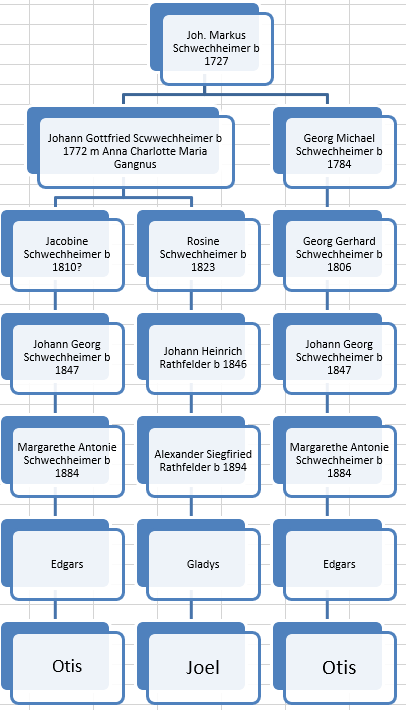
Here is the new tree:


In this scenario, I am a 4th and 5th cousin to Otis. This would mean that Rosine and Georg Gerhard were married 1st cousins. First cousins marriages were much more common at that time. This tree is an improvement over my previous one as it accounts for both Rosine and Gerhard Schwechheimer the parents of Johann Georg Schwechheimer. I would like to create a web page concerning my Schwechheimer ancestry. I am 1/16th Schwechheimer or 6.25%. It is interesting to think about how little has been known about this part of my heritage. Or put another way, my Hirschenhof ancestors represent one quarter of my ancestry and Schwechheimer would be one quarter of that Hirschenhof ancestry.

Summary and Conclusions

  • Thanks to Lāsma’s Geni Web Site work on the Schwechheimer family, I have a better tree for Otis who I match by DNA
  • More work could be done nailing down marriage and birth records for Otis’ line
  • I am also grateful to the creator of the Hirschenhof interactive map. This map is useful in tracing where colonists lived and the succession of holders of the different farms. This succession results in a geographical genealogy.
  • Next step is to brush up on my internet and genealogical skills and put up a web page on my Schwechheimer ancestors.

Rick’s Whitson/Butler Big Y YDNA Results

The co-administrator for the Whitson/Butler YDNA Project, Peter notified me recently that Rick had a new SNP designation. This was a hint that Rick’s Big Y results were almost done. Soon after, I saw that Rick’s Big Y results were completed.

What Does the BigY Do?

According to FTDNA, which does the test:

The Big Y-500 is a Y-chromosome direct paternal lineage test. We have designed it to explore deep ancestral links on our common paternal tree. This test examines thousands of known branch markers as well as millions of places where there may be new branch markers. 

On average, YDNA changes about once every 144 years. That means that someone between me and my third great-grandfather probably had a new marker or SNP.

Named and Numbered SNPs

When the SNPs are tested, the results are shown in one of two ways. They are either named SNPs or numbered SNPs. The named SNPs are, for the most part, ones that are common to other people. In the Whitson/Butler YDNA Project, there are six tested men within the Haplogroup of I2.

Each of these six men have a SNP which is M438 or the equivalent P21 or S31. The letter before the number stands for the testing company that discovered the SNP.  The SNP named M438 designates that these men are I2 and not I1 or R1a or R1b. Further, these six men also have the SNP named M436. This used to be called I2a2, but now the branches are named for the SNP test name rather than the branch of I2.

M436 in the above three has its own tree. All the men in the Whitson/Butler Project that are I2 are also M426 and M223:

Here are the I2 men from the Whitson/Butler Project:

Rick’s results are at the top in green. William Whitson is Rick’s ancestor. A green SNP in the last column means that there was a test for the SNP. The red SNP results means that these three men did not have their SNPs tested, but from the STR results, FTDNA is quite sure they are in that branch and would be positive for M223 if they tested for it. In the list above, the first person Rick and the last person, Richard, have their BigY results. Peter has ordered the BigY test, but his results are not yet in. He has previously tested for A427. A427 is to the bottom right of the above tree on the next to the last line.

Why is A427 Germanic and North Slavic?

According to the YFull YTree (see below), A427 formed about 5,000 years ago. That means in the last 5,000 years, A427 descendants had plenty of time to move around. War and famine would be two reasons I coiuld think of to relocate. Climate change must factor in also. That gave time for id FY12481 from the YFull Tree to make his way to Russia and the Whitsons and Butlers time to make their way to Ireland and England.

Here is a portion of a map that Pete sent me today. Pete is in a non-I2 part of the Whitson/Butler DNA Project:

Around 117 A.D., according to the creators of the map, I2a2 centered around a place called Lombardy. It also included the Teutons. However, my understanding is that it could have included the Goths and the Baltic Tribes. So, that general area of the map.

Whitson/Butler and the A427 Branch

Probably all the Whitsons and Butlers that are I2 are also A427. Note above in the Eupdedia I2a2 Tree, that there is a SNP below A427 called Y4884. However that is not the Whitson/Butler Branch. Here is what YFull shows:

The YFull tree shows that quite a few people tested positive for Y4884. However, Richard and Rick are in S17511. This is probably a newer discovered branch since the 2016 Eupedia Tree above. YFull is a bit ahead of FTDNA at this point as it also has Richard in Y136556 which is one step below S17511. Richard is designated with an Irish Flag. There is someone with a Russian heritage that is also positive for Y136556. For that reason, I don’t think that Richard and the Russian will be grouped together for long. I think that Richard and Rick and then Richard, Rick and Peter will form at least one new haplogroup.

Here is a tree I made for a previous Blog. It showed where I expected the new Butler/Whitson Branch to be. We now know that parallel branch is S17511. However, the actual Whitson/Butler branch will be a few levels below that.

The good news is that without doing anything, my father-in-law’s SNP went down the ladder two more steps. This was just based on people who we didn’t know who had Big Y tests. Now we have people testing for Big Y like Rick,  who we expect are related. I would think that the results would be more relevant and bring us into the genealogical time frame.

Naming Problems: Y136556/BY37214

I did not find Y136556 on Rick’s list of SNPs from his BigY test. However, he is positive for BY37214 which is the same SNP with a different name:

Fortunately, the YTree by YFull lists both names:

I think that the BY prefix is the BigY designation, so that may be what will show up eventually at FTDNA.

Numbered SNPs

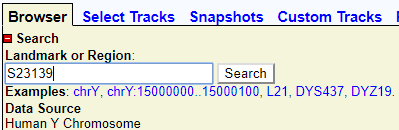
Numbered SNPs are those that are not yet named SNPs. This is most likely because they are not yet shared with anyone else. Or else, they are shared and no one has gotten around to naming them yet. For example, as I mentioned above, Richard is positive for Y136556. It is possible to go to a website called YBrowse and look this SNP up by name or location:

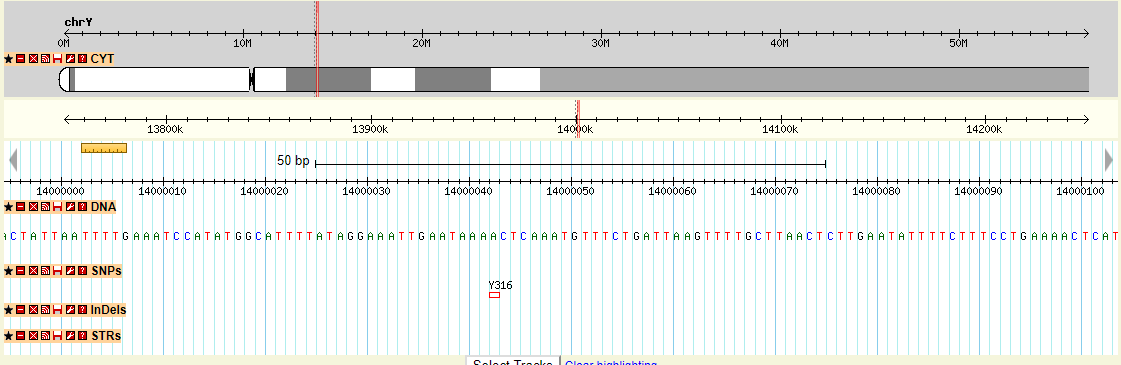
At the top, I find out that Y136556 is also at position 14,628,410 on the Y Chromosome. Before this SNP was named, it would have been reported by the position number. I also note that this SNP has two other names: Y41633 and BY37214. I’m not sure why there are two Y names.
Acording to YBrowse, Y136556 is not on the YFull Tree. However, I know that it is on the YFull Tree, so they are perhaps having trouble keeping up with all the new SNPs.

A Third Category – Novel Variants

There is actually a third category of SNPs. These are called Novel Variants. I put in a question to the I-M223 Y Haplogroup at FTDNA about Richard’s Y136556 SNP and got the following answer:

The blurred out name is Rick. I was asking why Richard didn’t show as Y136556. The answer is that FTDNA is getting to it. And as I guessed, there will be at least one new branch based on Rick’s results.

One of the ‘Novel SNPs’ that Richard and Rick share is Y128591. I looked up Y128591 at YBrowse and it is at position 2786469. Under Rick’s FTDNA BigY list of downloaded Novel Variants, Rick has 2786469 which FTDNA does not yet show as a named SNP.

With all the testing going on, these haplotrees and SNPs are in a constant state of change.

Rick Matches Richard at FTDNA

FTDNA has specific requirements for who can and cannot match under the Big Y results. Assuming the guy with Russian heritage tested at FTDNA, he did not meet the FTDNA requirements as he does not show as a match to Rick or Richard:

A person is considered a match if they have 30 or fewer differences in SNPs with you, and their haplogroup is downstream from your haplogroup or downstream from your four closest parent haplogroups.

Here is how Rick shows up on my late father in law’s results:

Note that Rick and Richard have 324,704 Shared Variants. Rick and Richard also share Unnamed Variants:


I copied Rick’s and Richard’s Novel Variants and then lined them up to see where they matched and did not match. The matches are in yellow. The Novel Variants that did not match are in green. Perhaps these yellow SNPs are the ones that bring us from 4200 years ago to a more reasonable time frame.

I looked up every SNP location at YBrowse to see if there was a name for the SNP yet. There are no names for Rick’s unique SNPs as he has not uploaded to YFull yet. That is, with one exception. All these new SNP names appear to have been created by YFull. Rick has one SNP that does not match Richard’s which is Y40359. This appears to be an older SNP. Perhaps Richard did not have a good read for that SNP.

One final note is that the above are all from FTDNA’s Unnamed Variants list. That means that FTDNA has not named them. However, in many cases, YFull has named these variants.

Non-Matching Variants

FTDNA has this to say about non-matching variants:

This column displays the known variants (SNPs) within your subclade that you and the specified match do not share.

That means that the Non-Matching Variants could be on Rick’s or Richard’s side. Here are the non-matching variants that Rick has:

  1. A8346
  2. BY31782
  3. 12200779
  4. 15405895
  5. 18999479
  6. 19550845
  7. 19714191

Here are the non-matching variants that Richard has:

  1. 15649019
  2. 20968182

From the above, I see this configuration:

The SNPs that Rick and Richard have in the two bottom boxes are called Private SNPs. That means that they are not at this time shared with anyone else. FTDNA or YFull would not show a tree this way as they only show branching where there is a match in the SNP. When Peter’s BigY results are in, he may form a branch with Rick or Richard. Say that Peter tests positive for all the SNPs in the box above Rick and Richard. Then he also shares some of Rick’s private SNPs. That would put Rick and Peter in a new branch where Rick is now and Richard would go to the box above where I have him now as he would only share those SNPs. One of the SNPs in the box above Rick and Richard would be chosen to describe that branch. My guess is that Peter will be positive for all the SNPs in the box above Rick and Richard, but if he isn’t, then that will also form a new branch under the box that says Russia.

It is interesting that Richard only has two private SNPs. To me, this would indicate that his time to a shared ancestor should be within the genealogical time frame. Going from 5,000 years ago to the genealogical time frame is a big jump. That is part of the allure of the BigY test.

I am fortunate to have two other BigY testers from the Whitson/Butler YDNA Project. Without their results, I would only know that Richard is distantly related to someone with Russian heritage.

A Guess On Future SNP Branching

I checked my old notes on STR trees. STR trees are not as accurate as SNP trees. Here is one I drew a while back:

Assuming that I drew this right,  it appears that 6 Butler (my father in law Richard) would be in the first new SNP group. Below that Rick (1 Batt) and Peter (4 Butler) would be in a SNP group with the common ancestor of BA2 as shown above.

Summary and Conclusions

  • The results are just in and are interesting. However, some waiting is still required while the dust settles
  • FTDNA is working on finalizing a shared haplogroup between Rick and Richard
  • YFull will also come to its own conclusion and come up with some dating estimates once they get the BAM files from the Big Y results.
  • Once the branching has settled out, I expect that there will be some answers and some more new questions.


Some of My Hirschenhof, Latvia Genealogy

In my last Blog, I looked at Otis’ DNA and genealogy and how it related to my family. In that Blog, I came up with this for our shared ancestry.

[Note: See update to the above here.]

In this Blog, I’ll take a further look at the Schwechheimer and Gangnus families.

Johann Markus Schwechheimer born 1723 Germany

Johann Markus was the first of the Schwechheimer family to leave Germany for Hirschenhof, Latvia. He was born in Altlußheim bei Hockenheim Kraichgau Baden.

Here is Altlußheim:

Altlußheim is on the Rhine River between Strasbourg, Stuttgart and Frankfurt.

According to http://wolgadeutsche.net/lang/Hirschenhof_Liste.htm, Johann Markus had three wives:

From one web page I read, the colonists were for the most part craftsmen, so did not do so well at farming. However, some lived in Jutland for 5 years where they tried to learn farming, but the farming conditions were not good there.

It looks like Johann Markus had Farm 55:

These lists are important as they trace who lived on the land. Usually, the land would be passed down from father to son. Lot 55 was near the middle of Hirschenhof. It looks like there was a bit of a village to the West of Lot 55. Gottfried Scwhechheimer was a schmied which is a smith.

Here are some other Schwechheimers:

Erbe 101 is in the Colony to the North of Hirschenhof. Jacob Schwechheimer came to own this property around 1880.

Three farms to the West was this family:

The Colony to the North was Helfreichshof:

Here is one more Schwechheimer family in Hirschenhof:

A search for Schwechheimer shows some more:

Georg Philipp was from Erbe 55, so he was probably the son of Johann Gottfried.

This Georg Philipp came from Erbe 55 so I assume that he was a son of Johann Markus. All the above came from a useful interactive map referenced here.

I started to extract some of the information from the occupants of the various Lots:

It appears that Erbe 55 was the original Schwechheimer location, so I started there. I didn’t extract the newer information. From this Lot. I gather that the first three listed were three generations of Schwechheimer living at the same location. This is consistent with what I have in my genealogy program:

The question comes after Gerhard. Why did the land not go to a son of Gerhard? Instead the land went to a cousin from Erbe 98. Here is some more information from Erbe 98 in Helfreichshof:

Johann Gerhard Schwechheimer Born 1809

I have above that Gerhard married Anna Charlotte Marz. This information was from a book “Vom Elsass Hinaus in Die Welt” by Gustav Gangnus published in 2003. In my previous Blog, I had Gerhard married to Jacobine Schwechheimer:

Of course, both of these could be true. Gerhard also had a sister named Jacobine. I have their son as Johann Georg. He would have been 11 when his relative Johann Peter took over the farm in 1858. I am interested in Georg and Gerhard as they are the likely ancestors of Otis who I mentioned at the beginning of this Blog. Gerhard was the brother of my ancestor Rosine Schwechheimer born in 1823 and matches my family by DNA.

Anna Charlotte Maria Gangnus Born 1780

Gerhard and Rosine’s mother was Anna Charlotte Maria Gangnus. She married around 1794 at the age of 14! Was this normal in Hirschenhof? She had her first child when she was 15 and her last daughter when she was 44. That is 29 years of childbirth. That also means that I am related to Otis twice on my Gangnus side.

This means that I am a fourth and sixth cousin to Otis on the Gangnus side. That is because I descend from two Gangnus brothers.

[Note: See update to the above here.]

Summary and Conclusions

  • Finding an interactive map of HIrschenhof and her sister Colony Helfreichshof gave some structure to where the Schwechheimer and Gangnus families lived.
  • There is a lot of information on Hirschenhof. However, the parish records are not indexed for the most part and are sometimes difficult to read.
  • These were large families. That means that sorting them out can be a bit of a problem. First names were also reused a lot. In addition, I learned that when someone was baptized they usually took one of the names of their godparent.
  • As shown in the last figure, there was intermarrying in this isolated German Colony.
  • I still haven’ found out who were the parents of the Jacobine Schwechheimer who married Gerhard Schwechheimer (born 1809).