Making Sense of My FTDNA AutoClustering with a Leeds Color Analysis

AutoClustering is a new approach to looking at DNA matches. The progamming was created by Evert-Jan Blom. Right now the analysis is working better for FTDNA than it is for AncestryDNA. In a previous Blog, I looked at my 23andMe and FTDNA clusters, but had some trouble identifying many of the clusters. I was hoping that a Leeds Color Analysis would shed some light on my Clusters.

FTDNA AutoClusters

These are the 33 Clusters I came up with at FTDNA. I decided that FTDNA pads their DNA a bit. This padding problem blew up my orange Cluster 1 where there are a ton of matches on my Chromosome 20. These are on my Frazer grandmother’s side.

Here is a summary of some of my AutoClustering that I did previously:

The FTDNA results are in the middle column. It looks like I figured out 6 of the 33 Clusters.

Can the Leeds Color Analysis Help Figure Out More Clusters?

The Leeds Color Analysis also creates clusters, though not as graphically as the AutoCluster method. The good thing about the Leeds method is that it doesn’t rely on a  computer program and it requires some interpretation from the user. These could also be considered negatives.

Here is what I came up with using a Leeds Color Analysis of my FTDNA matches:

  • The first time a name came up as a match I gave them the color over their name.
  • If someone matched someone who matched someone up higher in the Cluster, I noted this on the spreadsheet.
  • I went out as far as FTDNA’s predicted 2nd to 4th cousin matches. This was 88 matches.
  • This represents 21 Clusters. Some are not technically clusters as there is only one person in the cluster. I assume that if I went to lower cM matches, I would get more matches in these one person ‘clusters’.
  • I identified three out of four of my grandparents

Starting with Hartley

In the Leeds Analysis, I used my father’s cousin as the lead Hartley person. He did not show up in the AutoClustering as he was too close a DNA match compared to the thresholds I used. However, the second person in the Blue column is Benjamin. He matches my father’s cousin Jim and becomes the lead person in the AutoClustering. A search for Benjamin in the AutoCluster shows that he is in Cluster #10.

Cluster 10

The problem is that Cluster 10 only has three people in it:

In the Leeds Color Analysis, there were 20 in the Blue column. When I go to my match with Benjamin at FTDNA and choose ICW, I get three people. So that makes sense. This is just one flavor of Hartley. A look at the ancestral names of these matches makes me think that this could be a Colonial SE Massachusetts branch. I’ll call this a Snell/Bradford Line as that covers all my Colonial ancestors:

I could be wrong, but that is my best guess right now. Next, I filtered for Hartley (blue on the Color Analysis) and added a column for the AutoCluster number to keep track of the Cluster number:

The other two people in AutoCluster #10 were not in the Leeds Color Analysis.

Going Down the Blue List

It would seem logical to go down the Blue list and put an AutoCluster numbers in for each person. I find the results interesting:

I would trust the Clusters except for #6 as that shows more than one color. I was a bit surprised that they didn’t all relate to AutoCluster numbers. I’m not sure why that is. Part of the reason is that I went by FTDNA predicted relationship and AutoCluster probably goes by total DNA match in cM.

I plugged these number back into my AutoCluster Summary:
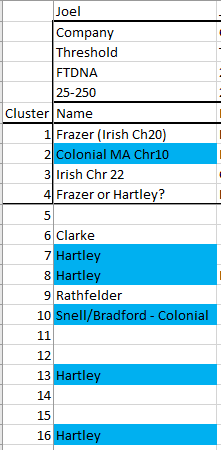
Notice that I had one Hartley in Cluster 4 which I previously had as Frazer. Turns out that was a mistake and she should have been in Cluster 2. It all works out. It turns out I made another mistake and there is no obvious Hartley Cluster 8.

Corrected FTDNA Cluster Summary

I suppose it would be possible to further break down the Hartley into Colonial or non-colonial, but I’ll hold off on that for now. The Hartley List worked well, so I’ll move on to Frazer.

Plugging Leeds Frazer Colors Into AutoCluster

Here is what I get:

Again, I’m unsure why the people at the bottom of the list are not in clusters. The Clusters I found were not shared with other colors, so that was good. Now I feel like I am getting somewhere:


These are different flavors of Frazer in green. I also have Clarke who was my Frazer grandmother’s mother from my last look at AutoCluster. Frazer’s married Frazer’s. Frazer’s married McMaster’s who married McMaster’s. It gets complicated.

I now have 13 out of 33 Clusters identified. That is a good start. I have other ideas on how to identify other clusters, but that can wait for now.

Summary and Conclusions

  • I got stuck trying to identify many of my AutoCluster results from FTDNA.
  • Using the Leeds Color Analysis, I was able to put many matches into two major grandparent categories. I was able to cross-reference these matches to the AutoCluster.
  • My next idea is to use chromosomal analysis to identify the clusters. By this, I mean that I will compare the matches to my visual phasing results. This should get the clusters into the correct grandparent area.


Mom’s DNA AutoClustered

AutoClustering was down for AncestryDNA today, but now it appears to be working again. This time I wanted to try to autocluster my mom’s DNA. I meant to lower the threshold from 50 to 15, but apparently did not. I’ll take a look at what I got.

Mom only got three clusters. This could be a lesson in what not to do. The first cluster is Nicholson.

Cluster 3 – Rathfelder

I have blogged about this match. The common ancestor is at the level of Hans Jerg Rathfelder and Juliana Biedenbinder:

Green Cluster #2

I am less certain of Cluster 2. These two people don’t have trees and I have not been able to get in touch with them. I was in touch with a shared match who had Schwechheimer ancestry. This ancestry is also from Latvia, so that would be my best guess for this Cluster.

That’s as far as I get with this small autocluster. The orange is a maternal cluster. Clusters 2 and 3 are paternal for my mom as far as I can tell.

Here is my AutoCluster at Ancestry using the same default settings:


I had one maternal cluster (Nicholson) and four paternal clusters. My mom’s cluster of 7 Nicholson’s translated to a cluster of three for me at the preset thresholds. This makes sense as I got about half of my mother’s Nicholsn DNA.

AutoClustering My 23andMe Matches and More FTDNA

In my previous Blog, I looked at AutoClustering my AncestryDNA and FTDNA matches. In this Blog, I’ll look at 23andMe. I have to confess, that I have never had a good feel at working the DNA matches at 23andMe. I was hoping that AutoCluster would give me a boost in figuring out what I have there.

Here is my AutoCluster at 23andMe:

Now I am up to 45 Clusters. I used a slightly lower threshold than I used at FTDNA, and got different results (20 cM at 23andMe vs. 25 cM at FTDNA). At FTDNA, the first two clusters had 108 members and Cluster 2 had 10 members. At 23andMe, the first two Clusters are a bit more even at 66 and 65 members. Also I note that the green Cluster 2 is quite closely related. All 65 members match each other.

Identifying the 23andME Clusters

My first thought is to figure out what these clusters represent. Which line is which? I do have a few known cousins at 23andMe.

Cluster 8: The Lentz/Nicholson Line

My mom has a cousin Judith who is on the Lentz Line. She is on Cluster  8.

Judith also descends from the Nicholson family as does at least one other person in Cluster 8.

My Cousin Jennifer: Hartley Side

Another point of reference is Jennifer who is my 2nd cousin, once removed.


This corresponds with my Hartley’s at AncestryDNA:

Steve with Clarke Ancestry


I’ve blogged about Steve who is a 23andMe match. He has Clarke ancestry and is in Cluster 19:

Cluster 19 is quite a ways down on the list.

Cluster 2 and Chromosome 20

I have written a few Blogs on my Chromosome 20. I have many matches there on my Frazer grandmother’s Irish side. These Chromosome 20 matches appear to correspond with my Cluster 2. Here is one Blog I wrote on my Chromoosme 20 about 2-1/2 years ago. In that Blog, I reasoned that the matches may be on my McMaster side:

In my previous request for an AutoCluster at FTDNA, I had set the lower threshold at 25 cM and that had filtered out a lot of the Frazer side matches. At 23andMe, I lowered the threshold to 20 cM which would explain the larger cluster.

Deciphering FTDNA Cluster 1

If FTDNA is like Ancestry and 23andMe, then the yellow Cluster should be a Hartley Cluster. First I checked the top match. It turns out that FTDNA over-reports these matches:

Roger shows a match of 67.3 cM with me, but his top segment is 12.3. Here is what the FTDNA Browser shows:

The browser shows one small match at Chromosome 20. This is where I have a lot of Frazer matches as described above. Theresa is also in FTDNA Cluster 1:

Thesesa also has a relatively small match corresponding with her 13.1 cM largest segment on Chromosome 20. That means that even though I tried to avoid my Chromosome 20 overmatching problem by raising the cM threshold to 25 cM, FTDNA managed to add in tiny cM’s and up the totals for these matches.

It is unfortunate that FTDNA has small matches that come out as large. I don’t know if this is as big a problem for others as it is for me. Basically I have a large group of distant relatives that I can’t connect with in Cluster 1.

A Comparative View: Three Companies

Here is a comparison of the three AutoCluster runs I have done with three companies. A better comparison would be for me to rerun the Ancestry results with a lower threshold:

  • I changed the Ancestry Cluster 1 name from Hartley to Snell. That is because the cluster goes back to Snell and beyond my Hartley ancestors for some of the matches.
  • In the three analyses Clarke went from Cluster 2 to 6 to 19.
  • I noted a special Chromosome 20 issue that I had. This didn’t come up at Ancestry as the threshold was set low. I may be able to identify this group later at Ancestry when I am able to run an AutoCluster at a lower cM threshold.
  • The Ancestry AutoCluster analysis only went up to 5 Clusters based on the strandard set AutoCluster thresholds.

FTDNA Cluster 2

The above summary points out that I have not yet figured out FTDNA Cluster 2. So far, I don’t have a definitive answer for this Cluster. The people tend to match me on my Chromosome 10. I have tended to associate their ancestors with Colonial Massachusetts.

FTDNA Cluster 3

This Cluster appears to match on Chromosome 22. I think that they are Irish in background. My Chromosome 22 (Joel) is all Irish Frazer on the paternal side:

At least one of my matches from Cluster 3 is also listed at Gedmatch. I have a paternally phased kit which she matches. That is how I can tell that the match must be on my Irish Frazer side.

Back to 23andMe: Cluster 4

Cluster 4 has 17 people in it (or items according to AutoCluster).


Two of these “items” are listed as unknown. Next I need to identify one or more of these people in the list. John listed 8 surnames, but none of them sounded familiar. So far, these matches are matching me on Chromosome 3. Here is the match with Kris at the top of the Cluster 4 list:

From visual phasing, I know that has to be either Hartley or Rathfelder DNA (at the level of my grandparents).

I recognize some Hartley names in that area of the match and they aren’t in Cluster 4. That means that this has to be a Rathfelder side match.

I’m not getting very specific with these Clusters. Part of the reason is that 23andMe does not emphasize ancestral trees. So if I ever meet these cousins, I can introduce them as my Rathfelder Line Chromosome 3 cousins. From one of my other maternal Chromosome 3 matches, I see that I have traced one of these families to a German Colony in Saratov, Russia. I have not yet made the connection between them and to my ancestors who lived in a German Colony in Latvia.

So, Where Are We?

Here is a summary of some of the clusters:

I had the best luck with AncestryDNA. This is partly because I having been working with them more. Also partly because I used lower thresholds, I had the more obvious clusters and only five clusters. Ancestry also has the most matches and best genealogical trees.

FTDNA came in next as they do have some genealogical trees. This is where I tested first, so I have some familiarity with how they work. Their matching algorithm causes a perfect storm for my Irish Chromosome 20 matches showing that they match much more closely than they should. I expect that this is true to a lesser degree with some of my other matches.

23andMe was the most difficult as they focus the least on genealogical trees. It would take a bit of time to contact some of the critical matches there. I believe that 23andMe have more test results than FTDNA, so they have that going for them.

Summary and Conclusions

  • So far, it has been easiest to interpret the AncestryDNA clusters. I would like to take the cM levels down once some of the bugs have been worked out.
  • I got many more clusters at FTDNA and 23andMe, but some of the clusters descriptions are more vague than I would like.
  • I would like to look more into the Hartley/Snell clusters. I am interested in Hartley’s that don’t match Snell’s as my genealogical brick wall goes back on my Hartley line – pre-Snell.
  • It would seem that I should be able to cross-reference the clusters. Even though the matches are different at the different companies, the common ancestors are the same.
  • This utility is new, so people are still experimenting with it. For example, is there a cluster sweet spot that isn’t too high or too low. Obviously, I have 32 third great-grandparents representing fourth cousins. This may be a good number of clusters to shoot for. There may be those in the 3rd great-grandparent level that may be too obscure to have clusters. However, this could be off-set by 4th great-grandparents with a lot of descendants that would make good clusters.
  • A lot of the clusters have two people in them. Is it worthwhile looking at such small clusters?
  • The AutoCluster utility has given me a fresh look at my DNA matches. I have also been entering some of the larger matches into my match spreasheet.


The AutoCluster Craze

It seems all the cool genetic genealogists are using AutoCluster at geneticaffairs.com. Here is the welcome page for this new DNA analytical tool:

I have decided to try it. I have seen some screen shots. Autocluster appears to be a way of easily clustering your DNA matches to see which ones go with which.

I registered and first tried Ancestry where most of my matches are. I added Ancestry and it showed all the people that I am linked to through Ancestry. There is a blue  autocluster button to select:

The second button is for my profile and I chose that. Then there are three choices:

I chose A. I see now that if I was in doubt, I should have chosen A so that was good. In not too long a time, I got an email giving my 20 closest DNA matches. I knew this already. I also got a spreadsheet and the important graph:


On the top and sides of the graph are names of my matches and how they match each other. The Key above shows 28 matches. This is based on the default values:

This forces my matches into a fairly narrow range.

What Do the Clusters Mean?

The clusters are on the idea of “birds of a feather flock together”. These are matches who match each other. The first orange cluster would be people who descend from my Hartley great-grandparents. This couple had 13 children. That means that I have a lot of 2nd cousins and some remaining 1st cousins once removed, then 2nd cousins once removed.

The Snell Side

As I look at the Hartley cluster more closely, I see that there is also a Snell subcluster within it that is not Hartley:

That is an important distinction as I try to separate  Hartley and Snell DNA.

A Small Maternal Red Cluster: Lentz

Hartley is on my paternal side. The only cluster on my maternal side is the red one. Here is my tree up to my 2nd great-grandparents;

The orange box is around my Hartley/Snell ancestors. The red box is around my Nicholson ancestors. This corresponds to the red cluster in the chart.

The Purple Frazer Cluster

Gladys is the third person in the purple cluster. She is in my Frazer DNA project. Here is how we match:

What is also interesting is that Gladys does not match the first person in the purple cluster. However, Gladys matches possible Frazer relative #2 who matches possible Frazer relative #1. Now what is very interesting is that I had that the match [that I am calling Frazer relative #1] has a McMaster ancestor. I have tried to show in the past, that “Frazer relative #1” has this ancestry through Marriainne below:

Although the “Cluster” is not proof that I was right, it seems that it provides strong evidence that I was right. It appears that Match #1 has Frazer DNA even though she doesn’t know she has Frazer ancestry. Even though I did a simple cluster, it appears that the results are quite powerful.

The Green Clarke Cluster

I have written quite a bit on this line. The people I match with are aware of their McMaster ancestry. I match these people on their McMaster Line but more closely on their Clarke line.

Actually, the last person in the cluster isn’t sure how his Aunt fits into the picture. However, I have not seen the family tree.

The Last Cluster

This last cluster is a little harder to nail down with only two people. Note that there is a link to the Clarke Cluster above. I had originally thought that this might be a McMaster Cluster, but the last person in the cluster has Spratt ancestry. The reason that I thought that this might be a McMaster Cluster is because the person matching from the Clarke Cluster had McMaster and Clarke ancestry.

I’ll keep an open mind and put both names into the mix.

Cluster Summary

I am very happy with this new tool as are other genetic genealogists.

These are the lines above that I have identifed using a simple threshold cluster technique. I have Hartley/Snell, then the earlier Snell. I have Frazer and Clarke. Then I have either Spratt or McMaster for the very small cluster. For my maternal side, so far, I only have Nicholson.

Trying FTDNA

Next, I added the FTDNA website to the AutoCluster Program. This time I lowered the lower threshold to 25 cM. Perhaps this will take longer to run. This will be a good chance to look at my FTDNA matches as I haven’t checked them out in a while.

This time, instead of 5 clusters, I have 33. My first Cluster has 108 members instead of 16. I assume that Cluster 1 at Ancestry is the same as Cluster 1 at FTDNA, but there are not a lot of people that have tested at both places. I would need to lower the threshold at Ancestry and then see if I saw any common names.

Frazer Cluster

The Frazer Cluster below in purple is Cluster 4:

I recognize my 2nd cousin once removed who is the first match. These Frazers tended to intermarry. This clusters carries an overlapping look that I also saw at Ancestry – even though there are different Frazer ancestors in the Ancestry Cluster versus the FTDNA Cluster.

Rathfelder Cluster

Beneath the Chart is an analysis part:

The first cluster to come up there is Cluster 9. That is likely due to the large match with my 2nd cousin Catherine. She is on the Rathfelder side which was missing in the high threshold Ancestry Cluster Analysis.

Cluster 9 is the Blue Cluster on the lower right above. It would be worthwhile pursuing the other two in the cluster. According to the tabular analysis above, Pamely has a tree. The link brings me right to Pamela’s tree. It goes back to her grandparents. So if I were to expand Pamela’s tree, I might see where the match is. The Rathfelder’s were from Latvia, so that is an easy place to notice.

Cluster 6 – Clarke

I could recognize this Cluster by one person who had Clarke as his middle name.

FTDNA Clusters

With 33 Clusters, it would take to long to look at all of them in this Blog. However, I am curious as to the 33 Clusters that came up.

Summary and Next Steps

  • The AutoCluster Tool is very helpful with AncestryDNA. This is because AncestryDNA doesn’t have the Chromosome Browser to check matches.
  • I would like to figure out why I have one large cluster at FTDNA versus all the small clusters
  • I would like to try this at 23andMe to see how it works there.
  • If nothing else, this tool should help focus my DNA research.
  • I would like to be able to cross-reference the clusters. For example, between AncestryDNA and FTDNA.
  • I would also like it if there would be a way to combine the clusters from the three companies.
  • Further, it would be great to add MyHeritage to the mix.


A Possible Hartley Match at MyHeritage and Visual Phasing

I recently had a message from Julie at MyHeritage. She matched my brother Jim’s DNA. We also both had Hartley’s in our ancestry. She wanted to know if any of her Hartley’s sounded familiar to me. According to Julie, “…2 Hartley sisters married 2 soldiers in the House of His Excellency British Ambassador at the Court of France, ” This didn’t sound familiar to me. I don’t know of any of my Hartley ancestors marrying in France.

Julie’s DNA Hartley Match

Here is Julie’s DNA match with my brother Jim:

Julie also matches my sister Lori here:

This was Julie and Lori’s only DNA match and corresponded with Julie and Jim’s largest match on Chromosome 7. However, none of these DNA matches were very large.

Visual Phasing of Hartley DNA

I have visually phased all my sibling’s DNA as well as mine. Here is Chromosome 7:

Here in the beginning of Chromosome 7, Jim and Lori both start off with Frazer DNA shown in blue. Those areas correspond with the matches with Julie at the start of Chromosome 7. That means that the match on Chromosome 7 cannot be a match with Hartley DNA. This is a case where the visual phasing came in handy. If Jim and Lori matched Julie on Hartley DNA, it would be worthwhile looking further to see if there was a common ancestor.

Frazer DNA?

As I mentioned above, these DNA matches are quite small. That indicates that these matches could go back quite a way. My known Frazer ancestors were from Ireland. I notice that Julie has ancestors from Ireland. I suspect that that is where the common ancestors could be.

Here is my grandmother’s Frazer tree:

I have some missing ancestors in the bottom right part of the tree. It is possible that is where the match is.


My Children’s Maternal Genealogy: Part 3

In Part 1, I got started on Heather and JJ’s maternal genealogy. In Part 2, I went deeper on the Jarek side. Heather and JJ’s mother’s tree now looks like this:

Next, I will look into the Cavanaugh branch. This branch is 1/4 Irish, 1/4 English and half French Canadian. I am curious about the French Canadian side. I’m also suspicious that Morrow may actually be Moreau or something similar. Also Tacy may be Tessier, though that may not be as obvious. The Canadians have good genealogical records, but the problem is in making the link between the US and Canada when names get Americanized.

Morrow

Leona Morrow is the most recent of my children’s direct ancestors:

I didn’t find a birth record for her, but found one for her three siblings. Leona’s parents married in Lowell on October 30, 1889.

Joseph F Morrow’s Naturalization

This looks like an application for Naturalization:

This gives some details of Joseph’s life. He was a shipper in 1900. He was living in Portland, Maine at the age of 3. He now lives at 444 Gorham Street in Lowell. This should be in the circled area of the map below:

Joseph F. Morrow from 1866 to 1889

If Joseph was in Portland, Maine, where are the records? If I could find a birth record for John Morrow, I would be happy. I did find a record for 1888:

These are all the Morrow’s in Lowell in the 1888 Directory.

Joseph Morrow Going Forward

Here is Joseph in the 1910 Census:

Here there is a distinction between Canadian English and Canadian French. Joseph’s birthplace was English. His father’s birthplace was Canadian French and his mother’s birthplace was English. The family has also added two new children.

Joseph in 1920

This is a little different than the 1910 Census as here Joseph speaks French as well as his mother and father. Now his wife is Helen H. – which may come in handy later. Also Joseph’s arrival date to the US is now listed as 1887 rather than 1866. That is quite a difference if it is accurate.

I’m stuck on the mysterious Morrow family for now.

Tacy or Tacey

I was able to find out more about Helen or Nellie H. Tacy’s family. Here are Nellie’s parents in 1860.

Nellie grew up in Fort Covington which is a border town:

Here is Nellie in Lowell, right before she married:

Here is where Nellie lived on a current Lowell map:

I wonder how and why Nellie made her way from Fort Covington to Lowell, MA.

Joseph Tacy in the Civil War

These were the people from Fort Covington who were subject to do service in the Civil War:

I’m not sure if Joseph served in the Civil War or not.

Phoebe – Joseph’s Wife

This is possibly Phoebe:

So, I didn’t find much new about the Tacy side either.

Summary and Conclusions

  • I turned over some stones on the Morrow and Tacy French Canadian sides.
  • I found out more of what I don’t know.
  • It is possible that the DNA testing for Heather and JJ will turn up something on the French Canadian side.
  • Next, on to Cavanaugh and Hulme.


My Children’s Maternal Genealogy: Part 2 -More Poland and Jarek

Here is Part 1. In Part 1 I started a framework to my children’s maternal genealogy and came up with some things to check on.

The Jarek Side

I only got as far as my children’s great grandparents on their Jarek side. In 1920, Francis was living with his younger brother John in Lowell. My idea was to see if I could find anything about John.

One good source of information is from naturalization papers. This says that John arrived in 1902 and was naturalized in 1908. Francis was one year behind John.

Here is John’s marriage record for 1904:

Here are John and Marya’s parents:

Now I had that Francis married a Wosniac. Perhaps they were sisters.

Here is John’s WWII Registration Card:

This gives a birthplace, if I can read it. The transcription says, “Odrzykoy, Poland”. This is possibly in Southeastern Poland:

Now we have a place in Poland for Heather and JJ to visit. I cut off the Ukraine which is to the east of Odrzykoń. Here is a castle in Odrzykoń

I didn’t find Naturalization records for John or Frank, but I did find some interesting things.

After searching for Antonina Wozniak, I found her marriage record:

The couple married in 1905 in Lowell with Francis now listed as Frank. Antonina’s parents are similar to Frank’s brother’s wife Marya’s, but not quite the same:

I added the Priest’s name as a bonus. I assume that Jacenty may be the same as Jacynty. However, if he is, he had a different wife when Antonina was born. Here Josef’s wife looks to be Agnes Letkowiez (or Letkowicz?). I guess I can keep Jacenty and Jacynty separate for now.

Now Heather and JJ have some new, mysterious 2nd great-grandparents on the Jarek side:

I did a Google search and came up with this 1999 genealogical post:

I am looking for anyone that may have information on the following surnames:
Franciszek JAREK b. 3/27/1879 Odrzykon, Poland (nr. Krosno) Came to the US in 1903 and settled in Lowell, MA.
His parents’ names: Jozef & Mary Ras
His grandparents’ names: Antoni Jarek & Marii Such/Antoni Ras & Reginy Grzybala

Franciszek married Antonina WOZNIAK 11/4/1905 in Lowell, MA. Antonina was born 5/9/1889 in Mecinka, Poland.
Her parents’ names: Jacenty & Agnieszka Letkowicz
I would love to hear from anyone with a connection.
Thank you, Laurie

I think Męcinka is here:

Laurie’s message was from 1999, but still quite interesting. Laurie appears to have found another generation somehow. Assuming Laurie is right, I now have this:

Searching Ancestry Trees

Next, I looked for Jarek’s on Ancestry Trees. I found this interesting WWI Registration:

This gives a birth date for Frank Jarek. It also tells us he was a milk dealer in 1918.

Frank’s Passport

Frank’s passport is interesting as it gives some description:

Here is his passport photo:

Here is more information about Frank:

This confirms where Frank was born. This also gives information on his Naturalization.

It looks like Frank was visiting Poland on business. At the time of the passport application he was working in a mill.  It appears that he was to visit France and perhaps other countries. I am not sure why. I would think that there would be shipping records to follow up on.

Information from Linda

My daughter forwarded my previous Blog to her mom, Linda, who sent me this:

This is a tree that she got from a Jarek family reunion. This Wozniak part was helpful:

I had that Antonina was from Męcinka. I wonder if they are the same? I had also read that there was more than one Męcinka in Poland. Here is Podkarpackie:

This is the same Province that Odrzykoń is in.  In fact, these two places are a few miles from each other:

It appears that Męcinka is the correct spelling. This place is called Jedlicze Męcinka on the map. The other Męcinka I had earlier in the Blog was about 300 miles Northwest of Odrzykoń. My guess is that the Wozniaks were from the Męcinka in the map above.

Ship Records and Antonina

I had mentioned ship records above. I think that I have found Antonina:

She arrived in New York City on March 28, 1905 from Brussels on the Ship Kroonland. Here is where Antonina listed that she was from and where she was going:

She was fron Modersowka and was going to Redwood or Bedwood – looks like Mass. I know that there is a Bedford, but I’m a bit stumped. Here is some more information on where and who she was to stay with:

It appears that she had a brother named John Kalesiuk. Perhaps he was a brother in law?

It turns out that Moderowka is close to Męcinka and Odrzykoń.

I would imagine that it was quite a trip for a single girl of 16. She was listed as 18 on the ship but I don’t think that was quite right. Antonina traveled from Moderwoka to Brussels to New York City. Then she made her way to Massachusetts. Less than nine monts from getting off the ship, she married Frank or Francis Jarek.

Summary and Conclusions

  • I was able to get back another generation on the Jarek side by initally looking at records for Frank’s brother John.
  • I also found a birthplace for John and Frank Jarek. This can be very difficult to find.
  • A simple Google search got me back even one more generation on the Jarek side. The message I found in the search also confirms the work I have done.
  • An Ancestry Tree search got me some more interesting information about Frank Jarek.
  • I find the Ras name interesting as it does not appear to be obviously Polish. Such does not come across to me as Polish either.
  • Some information from a Jarek reunion may have cleared up an issue dealing with two Męcinka’s – where the Wozniaks were from.  This was further confirmed by ship records.
  • I found out a lot more than I thought I would about the Jarek line.


Visual Phasing Six Siblings with the Fox Spreadsheet: Part 22: Chromosome 22

This is the last Chromosome to visually phase. I have solved the previous 21 chromosomes and the X Chromosome. I need to solve this Chromosome to have a full set of phased chromosome for me and my five siblings.

Chromosome 22

Here is my first cut at assigning crossovers for Chromosome 22:

The first two crossovers (F and D) are very close together. I am not sure I have the right order. It looks like Joel (D) could have two crossovers in the circled areas but in the F&D and D&H comparisons, I don’t see the same changes, so I left those out.

Position Numbers

I’m not sure of the position numbers or the order of the first two crossovers.

Here is Jim compared to Jon (F) at full resolution:

This HIR starts at about 18.25M.

Here is Jim compared to Joel (D):

This FIR start is roughly at 18.6M, so my guess for the order of crossover seems to be right. These two positions should define the first two crossovers for Jon (F) and Joel (D).

Cousin Matches

First I check the Fox Spreadsheet to see if I have cousin matches. It looks like I have at least one paternal and one maternal match. Here is Frazer cousin Paul’s matches:

The shorter match with Heidi points out her crossover from Frazer to Hartley. Then a match with cousin Lentz cousin Judith adds some maternal DNA:

This is probably enough to solve the Chromosome, but I’ll add in some more Hartley DNA from cousin James:

Heidi’s one crossover is already defined, so I’ll spread her DNA to either end of the Chromosome:

I solved most of the Chromosome and the comparisons look pretty good:

I still want to describe Jon’s double crossover near the beginning.

Jon and Lori have an FIR in the larger of the two unfilled segments. That means that Jon needs a Frazer/Lentz combo there. That puts Jon’s second crossover as a paternal one. Here is the final product:

That concludes the solving of all chromosomes for six siblings. That is a lot of DNA. I just need to go back an re-create the chromosomes that I didn’t save on the spreadsheet.

Summary and Conclusions

  • I was able to visually phase six siblings for all 22 chromosomes plus the X Chromosome. Counting maternal and paternal copies that is 276 Chromosomes.
  • The DNA of all four grandparents are covered on Chromosome 22.
  • Jim, Joel and Sharon had full Frazer Chromosomes.
  • Heidi had a full Lentz Chromosome.
  • For any match, for any sibling, I should be able to tell along which grandparent line that match lies.


Visual Phasing Six Siblings with the Fox Spreadsheet: Part 21: Chromosome 21

There is a certain rhythm about performing visual phasing. I look at the crossovers, then assign siblings to the crossovers and position numbers. Then I look at cousin matches. I check the Segment Map agains the sibling pairs, solve any problems that come up and then solve the chromosome.

It looks like I took Chromosome 20 out of order, so now I’ll look at Chromosome 21

Chromosome 21

Here is my first shot at finding crossovers on this Chromosome:

It is best to ignore small changes in these small chromosomes. That is because the changes are magnified in scale compared to the larger chromosomes. One exception to this is at either end of the chromosome. There may be small changes there that are valid. For example Joel (D) has a crossover near the right end of Chromosome 21.

If I did the crossovers right, Lori will have no crossovers.

The Position Numbers

There are only 7 crossovers for six siblings who have two copies of each Chromosome 21.

Cousin Matches

I am dependent on at least one maternal and one paternal cousin match to solve each chromosome. Scrolling down through the cousin matches that I have in the Fox Spreadsheet, I see I have no cousin matches at all. Now what?

I could go with generic grandparents or look for more cousin matches. I’ll start by looking for more cousin matches.

Martin with Latvian Ancestors

I match Martin who has ancestors from Latvia. My Rathfelder grandfather was from Latvia. That is either a huge coincidence, or Martin matches me on my Rathfelder side. In addition, Martin matches my mother and two of my Rathfelder cousins by DNA at MyHeritage. Here is the DNA match I have with Martin at MyHeritage:

If Martin matches me (Joel) on my Rathfelder side at Chromosome 1 and 3, that would be further evidence that he is a Rathfelder match. I’m convinced already, but I’ll take a look.

On Chromosome 1, I have maternal Rathfelder DNA from about 54 to 202.5M. As expected, my match with Martin is within my Rathfelder area on Chromosome 1:

Here are the position numbers of my match with Martin on Chromosome 21:

Martin also matches my siblings Jon, Jim and Sharon. But does he match them on Chromosome 21?

Here is Jon’s DNA match with Martin:

This is about the same match that I had:

Jim has about the same match. Here is Sharon’s match:

40.1 is near the 39.7M crossover that I had for Sharon. That gives me this:

Looking for a Paternal Cousin

Here, I’ll have to get creative. I went to MyHeritage and found people in common with my sister Heidi and Joyce. One who came up was Brianna. I don’t know exactly how we match, but Brianna has her mom as a Hartley. Further, Brianna, Heidi and Joyce triangulate here:

My Chromosome 3 map shows that Heidi has plenty of Hartley DNA where she can match with Joyce and Brianna on Chromosome 3:

It looks like Jon, Joel and Sharon do also.

Here is the match between Brianna and Heidi:


Here is Jon’s match with Brianna:

I don’t match Brianna on Chromosome 21. Jim has a similar match to Jon.

Sharon has a similar match to Brianna:


Here I see that I don’t have a DNA change for Sharon’s second crossover. For now, I’ll fix that by erasing her DNA after the second S crossover. Lori also does not match Brianna, so she must have Frazer DNA on her paternal side.

This comparison shows my visual phasing to be on track:

Here is what I get:

My Previous Attempt at Chromosome 21

Here is my shot at Chromosome 21 from January 2017:

I was unable to assign the segments. I was able to figure out the maternal and paternal sides. It turns out that the purple was Lentz. Blue was Rathfelder. Green was Hartley and orange was Frazer. I was J in the above chromosome map.

Summary and Conclusions

  • As the chromosomes get small, there are fewer crossovers, but also fewer cousin matches
  • I had to get creative to find maternal and paternal cousin matches. I didn’t have the genealogy to connect these cousins, but the DNA showed which line they were on. Actually, there was limited genealogy. Martin had a tree up to his Latvian father and Brianna had a tree up to her Hartley mother.
  • I have full coverage for all four grandparents on this Chromosome.
  • Jon has a full Hartley Chromosome 21. Jim has a full Rathfelder Chromosome. Lori has a full Frazer and Lentz Chromosome. Heidi also has a full Lentz Chromosome.
  • With this information, it is easy to fill in the match spreadsheets for each sibling. I have a column for grandparent. So I will know for every match which grandparent side they match on.


Visual Phasing Six Siblings with the Fox Spreadsheet: Part 20: Chromosome 19

I feel like I’m getting near the end of this series. So far, I have been able to solve the first 18 Chromosomes plus the X Chromosome.

Chromosome 19

Here is my first cut at crossover lines assigned to me and my five siblings:

The crossovers seemed straightforward. Actually, I think that there is an additional crossover for Jon (F) at the very end.

Adding Position Numbers to the Crossovers

Next I add the position numbers to the crossovers:

I didn’t have any easy position answer for the first and last crossovers. I could get this from Gedmatch.

Cousin Matches

I hope that I have enough cousin matches to solve Chromosome 19. I need at least one paternal match and one maternal match to solve the Chromosome. It looks like I should have one of each, so that is good. One of the best cousin matches is with Rathfelder cousin Anita:

This is a conservative rendition of her match. Jim, Jon and Sharon will also have Lentz DNA where they do not match Anita (in the area where Anita matches Heidi).

Here is Hartley cousin James’ matches with my family:

This may be enough to solve Chromosome 19:

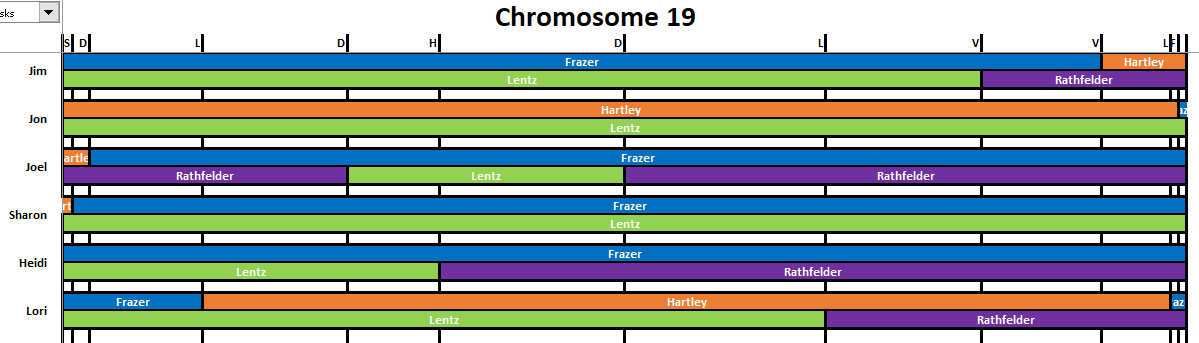
Note that Jon and Sharon have a HIR for most of the Chromosome:

This is true except for the very ends of the Chromosome where Sharon has a crossover on the left and Jon has one on the right. Here is how that works out:

To be HIR, that means that two siblings have the same DNA from one grandparent and that they have different grandparent DNA on the other side. It turns out that Sharon and Jon share the same Lentz DNA but Jon has Hartley DNA and Sharon has Frazer DNA on the paternal side.

I got this far:

I don’t think that Jon really has a crossover on the right. Here is a close-up of the comparison of Jon (F) and Sharon on the right side of the Chromosome:

Jon and Sharon were HIR for most of the Chromosome. If Jon has a crossover, then their comparison would have to to either FIR or NIR. If this is a NIR, then I should see some red and I don’t. Now, I’m changing my mind back. Perhaps Jon does has a small FIR. If Jon has a Fully Identical Region with Sharon, then he would have a HIR with his other siblings:


The F & S comparison looks greener on the end compared to the other F comparisons.

This image doesn’t give enough detail to see the small crossovers, but shows that overall, I had the right idea with the visual phasing:

Summary and Conclusions

  • Heidi had a full Frazer Chromosome.
  • Jon and Sharon both had a full Lentz Chromosome.
  • Jon either had a full Hartley Chromosome or nearly full Hartley Chromosome.
  • I spent some time figuring out whether or not Jon had a crossover near the end. It was a judgement call and amounts to bug dust as it is such a small inconsequential piece of DNA.
  • Anita was our only maternal match, so she was very important for the solving of this Chromosome.