Keith’s McMaster DNA and Genealogy

From what I can tell, Keith is my best DNA match on the McMaster side. Here is how Keith appears at AncestryDNA:

Keith is a Shared Ancestor Hint. That means we have common ancestors and shared DNA. Here, Keith shows as my 3rd cousin once removed. Keith is an especially good match because he doesn’t show any recent Frazer ancestor that could confuse the DNA match. Also, Keith uploaded his DNA results to Gedmatch.com which means that we can compare more specific DNA matches and figure out how they relate to our shared ancestors.

McMaster Genealogy

My McMaster Genealogy for this Blog focuses on those who have taken a DNA test. Here is Keith’s Tree as seen at Ancestry:

Note that our shared McMaster Line also includes a Margaret Frazer. However, this match is further back and will be less likely to show up in a DNA match.

Here are the McMasters that I know of that have had their DNA tested:

Any DNA matches that Keith has with my family (Joel) or with Emily, and Paul will represent the DNA from James or Fanny McMaster.

A Summary of My McMaster Genetic Genealogy Research So Far

John

John is in the lower left of the chart above. I wrote about him here. John tested at MyHeritage which is good, but I don’t think he has uploaded to Gedmatch.com. If he did, that would show how he matches others with McMaster ancestry that haven’t tested at MyHeritage.

Stephen and Ron

I have these two as descending from Thomas Leroy McMasters. However, I have Edward as the son of Abraham. This seems unlikely has Abraham was born about 1764 and Edward was born in 1851. Here is my correction based on my Blog of Stephen and Ron here.
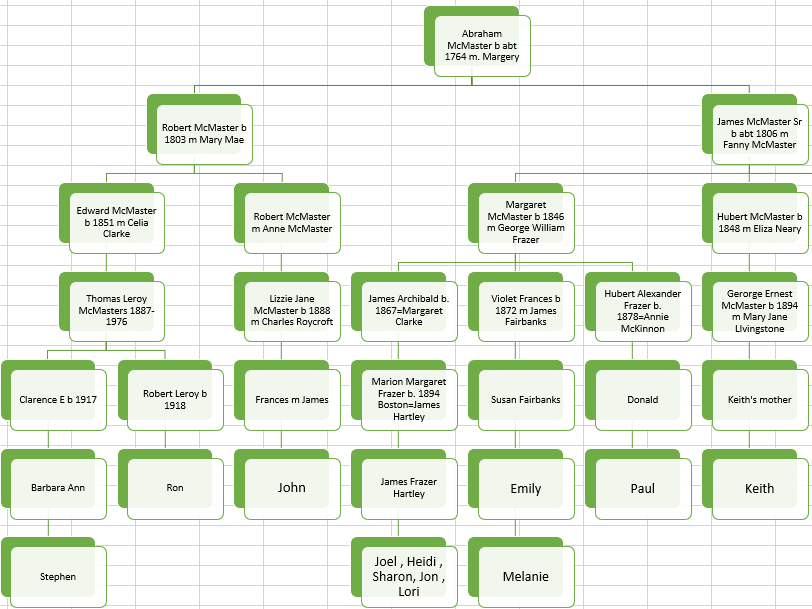
What I found out about Stephen and Ron was that I am more closely related to them on my Clarke side than on my McMaster side. Stephen tested at 23andme. 23andme is not compatible with Gedmatch with their current testing method. I believe that Ron has tested at MyHeritage and AncestryDNA, but has not uploaded his results to Gedmatch.com which makes DNA comparison more difficult.

Emily and Paul

Emily, Paul and my family have common Frazer and McMaster ancestors. That means that I can’t tell which of our shared DNA is Frazer or McMaster without independent Frazer or McMaster matches on the same segment of the Chromosome.

My Match with Keith at Gedmatch

Here is how I match Keith at Gedmatch:

Based on the amount of DNA we share, Gedmatch estimates that our common ancestors are 4.7 generations away. Keith and I are 3rd cousins once removed, which means that our common ancestors are 3.5 generations away. The once removed accounts for the half generation. However, these numbers are based on averages and I share less than the average amount of DNA with Keith. For example, my brother Jim shares about twice the amount of DNA with Keith compared to me:

Painting My DNA

There is an on-line utility called DNA Painter. That is a fun way to figure out what DNA you got from whom. This match with Keith shows DNA that we both got from James and Fanny McMaster. Here is what I have so far:

The top bar of each chromosome is my paternal side. That is where I am related to the McMasters. I match Keith from position 3 to 10 million. That is at the beginning of Chromosome 19 which is currently blank. At the right side of Chromosome 19, I have DNA from George Frazer and Margaret McMaster (the daughter of James and Fanny McMaster).

Here is the update at the beginning of Chromosome 19 in a light shade of blue:

In the key, I now have James and Fanny McMaster. James was born about 1806. This couple is in a section which represents my father’s mother’s side. This is the largest of my four grandparent groups in the key above.

A Triangulation Group (TG) for Keith

A Triangulation Group is when three or more people match each other by DNA. When this happens, this is almost certain proof that the DNA came down from the same ancestor.  Here is Keith’s match with Emily and Paul on Chromosome 12:

In order to make sure this is a true TG, we need to see if Paul and Emily also match each other on Chromosome 12 around position 92M:

Yes, it looks like they do.

We were already pretty sure by genealogy that Keith, Emily and Paul had the same two McMaster 2nd great grandparents, but the DNA also confirms it.

The fact that no one in my family is in the TG does not mean that we do not also descend from James and Fanny. It just means that we didn’t share the same exact portion of DNA that Emily, Paul and Keith did.

Shared Matches at AncestryDNA

AncestryDNA does not show specific Chromosome matching information, but it does show shared matches. These shared matches tend to indicate that I match Ron on the Clarke side and Keith on the McMaster side. I have 12 shared matches with Keith at AncestryDNA. Three of those 12 are my sisters. The remaining 9 are guessed to be 4th cousins by DNA. Ancestry only looks at Shared Matches out to the 4th cousin level.

Here is the comparison:

I have my comparison with Keith in the right hand box above. I also included Keith’s comparison with two of my sisters. These matches should represent those with McMaster ancestry. On the left box, I have my AncestryDNA Shared Matches with Ron. These people should represent those on my Clarke side. The point is, that these are two different groups. The only Shared Match was GG. This could mean that GG has Clarke and McMaster ancestry, or she is matching both Ron and Keith with McMaster ancestry.

I also note that BV is a strong Shared Match between Keith and my family. BV has a Maryann McMaster born 1819 in her tree as a direct ancestor. Here is Maryann’s photo from Ancestry:

MaryAnn McMaster – But Which McMaster?

BV at Ancestry doesn’t have information on MaryAnn’s parents. By DNA, Maryann could be related to me on my James McMaster side or my Fanny McMaster side. That makes things a little more complicated. I have that James’ father was Abraham McMaster. Here is what I have on my McMaster Web Page:

Note that I have a Marrianne, daughter of William McMaster and Margaret Frazer baptized 9 January 1820. This must be the same as BV’s Maryanne. Here is how I show I’m related to BV:

This shows that I am a 3rd cousin, twice removed to BV. That is equivalent, by DNA, to a 4th cousin. Now I just need to add some other McMasters:

This shows that BV is a 3rd cousin once removed to Emily, Paul and Keith. If BV uploads her DNA to Gedmatch, that could give clues on our common McMaster and Frazer ancestors. This tree also shows that BV is related to those on the right side of the chart on the Fanny McMaster and not the James McMaster side.

Putting the Two McMaster Lines Together

This comes out a bit small. The McMaster/Frazer Line is on the left. The Abraham Line is on the right. Note that Abraham as shown is about 26 years older than William McMaster. That means he could be an uncle to William or even a father to William. However, I doubt that William was the son of Abraham as that was not mentioned in William’s Lease of land:

I assume that the William and elder Abraham are the two lines I have above. In the lease above, it is stated that Abraham had a son named Abraham, but does not mention William as Abraham’s son.

Summary and Conclusions

  • Keith is the first good McMaster match who has also uploaded his DNA results to Gedmatch for comparison.
  • Keith tested at Ancestry. As a result, shared matches between Keith and my family are likely along the McMaster Line.
  • B.V. is a good shared match between my family’s AncestryDNA results and Keith’s AncestryDNA results. She also has a McMaster ancestor from Ireland that fits into research I had previously done on the McMaster family.
  • Finally, I combined the Abraham McMaster Tree and William McMaster/Margaret Frazer tree to see how they fit together. I have them lined up by the current generation at the bottom. However, that might not be the way they should be lined up.


Kim’s (Irish?) Match to My Family

I recently had a message from Kim at AncestryDNA. Kim wrote:

Hello… I am trying to figure out how we are related because you don’t match any of my closest relatives well there’s not that many that have tested anyway. My relatives are from England Scotland Ireland and Sicily.

Kim matched my sister Sharon at AncestryDNA. I wrote back saying that she didn’t match my mom. My guess was that Kim matched my Clarke side.  My father’s maternal grandmother was a Clarke. They lived in County Sligo, Ireland but I don’t know much about that family. Before Ireland they may have lived in England or Scotland. I said that I would know more if Kim uploaded to Gedmatch. Kim wrote back to say that her DNA results were already at Gedmatch. Kim’s tree is private as she doesn’t want people copying any mistakes. She also wrote:

I’m pretty new at the DNA stuff and it’s so confusing how some people can match more with other people in the same family.

Kim at Gedmatch

I had told Kim I would know more based on Gedmatch. That is because my family’s DNA is mapped out by chromosome to each of our grandparents. Here is Chromosome 5 for me and two of my sisters:

Below is Kim’s match with my sister Sharon. Kim matches on our paternal side. That is the bottom red bar. The lighter red is from my grandmother. Both her parents were born in Ireland (Frazer and Clarke). Here is the detailed information of how Kim and Sharon match at Gedmatch.com:

This means that Sharon and Kim match on Chromosome 5 between about position 11 and 35 million. At Sharon’s red bar, her lighter red goes to darker red right where she stops matching Kim. That is because Kim and Sharon match on Sharon’s paternal grandmother’s side. Sharon got her DNA from her paternal grandmother up until position 35 million. After that point, the DNA that she got was from her paternal grandfather. If you look at my red bar at the top, I got almost all my Chromosome 5 paternal DNA from my dad’s dad. This is the dark red side where Kim and our family don’t match. That explains why Sharon matches Kim up to 35M and I don’t.

Why Doesn’t Kim Match Heidi at AncestryDNA?

It appears from the map above that Kim should match Heidi more than Sharon as Heidi has more light red on her paternal side. Here is how Heidi and Kim match at Gedmatch:

These matches are pretty close. Note however, that Kim and Heidi match up to 36M. This is just a little way past Kim and Sharon’s match at 35. That is the point where Sharon’s Frazer DNA stopped and her Hartley DNA started on Chromosome 5. My guess is that Gedmatch’s information is more precise than AncestryDNA’s. Even Kim’s ‘One to Many’ list Sharon match shows as being closer than Heidi’s. It is only when the One to One analysis is done, that we see that Heidi is a closer match.

Here is Kim’s ‘One to Many’ List at Gedmatch:

Sharon is at the top of this portion of Kim’s match list. My brother James is next, but I tested him at FTDNA. That means he would not show as a match at AncestryDNA. Heidi is at the bottom of the portion of the list that I copied.

Where Do Kim and Sharon Match Genealogically?

Here is my grandmother’s tree at Ancestry:

Based on Gedmatch, Kim and Sharon could be 3rd cousins, once removed. Let’s round that up to 4th cousins. If they are in the same generation from a common ancestor and they are 4th cousins, then they would have a common ancestor in the column starting with James Frazer above. Note that I have two Spratt ancestors missing. That means that one of my missing ancestors is a Spratt and the wife’s surname is unknown. If the common ancestor is further out, the news gets worse. I have only 6 ancestors at that level out of a potential 16.

As I mentioned, I have not seen Kim’s tree. It is private. However, if we were to look for a common ancestor, a good place to look would be in the area of the last two rows above. The people I have identified lived in Ireland. So that would be a good starting place to look for a common ancestor.

One Last Gedmatch Trick

Gedmatch has a useful utility with a clumsy name: “People who match one or both of 2 kits”. I want to find other people that match both Kim and Heidi. I picked Heidi as she matched Kim slightly higher than Sharon at Gedmatch. Here are some people that match Kim and Heidi on Chromosome 5:

The reference point is Heidi. Heidi’s match with Kim is #2. A yellow match is higher than a green match. #1 above is Catherine. I recognize her at AncestryDNA. In my Ancestry notes for Catherine at Ancestry, I have that Catherine is Heidi and Sharon’s largest match with an unknown connection. Here is one of Catherine’s Sligo ancestors. Sligo is where the Clarke’s lived:

Summary and Conclusions

  • I explained by Chromosome mapping how one sibling could match someone and another one would not.
  • I confirmed a guess that Kim matched my sisters on their paternal grandmother’s side. This grandmother’s parents were both from Ireland. Searching in Ireland for a common ancestor between Kim and my family would be a good start.
  • I made a guess as to why Ancestry showed Kim matching Sharon and not Heidi.
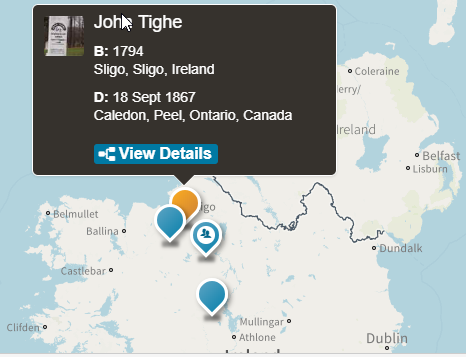
  • I found another person who was on Ancestry and Gedmatch. Catherine has a Tighe ancestor in Sligo. This person lived not too far from where my grandmother’s Clarke mother came from.  Perhaps my grandmother’s grandmother Jane Spratt was related to the Tighes.

A Question on YDNA Naming

Pete from the Whitson/Butler YDNA Group recently had this question:

Can you please help me to further understand the “Y” SNP nomenclature. If I have it correctly, the Alpa prefixing indicates the ‘lab’ in which that SNP was discovered. What does the numeric suffixing delineate? the base pair count placement along the ‘Y’ chromosome?

This is a good question. However, I find it easier to answer these questions in Blog format. Pete is R-S23139. The first R is the major YDNA group that Pete is in. The S is for the lab. According to this website, the S prefix was named by “James F. Wilson, D.Phil. at Edinburgh University”.  The number after the S is just a lab identification number. It has no significance other than the longer number is usually the more recently discovered SNP.

Every YDNA SNP Has a Number

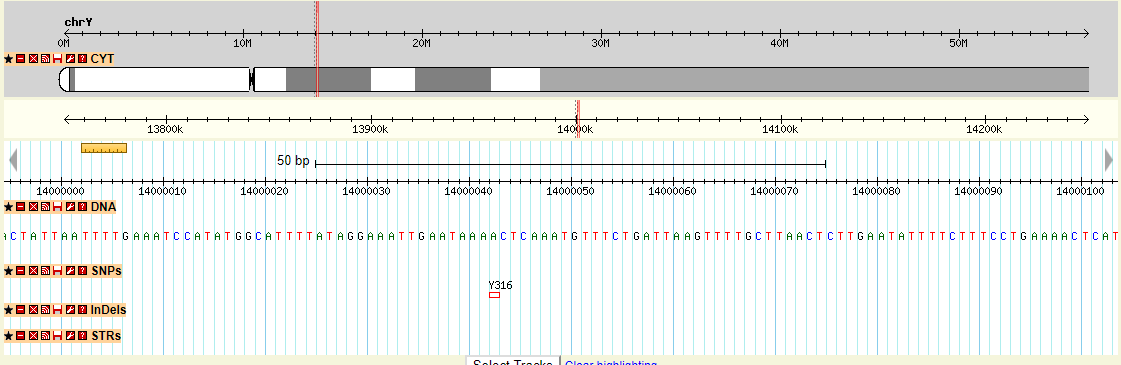
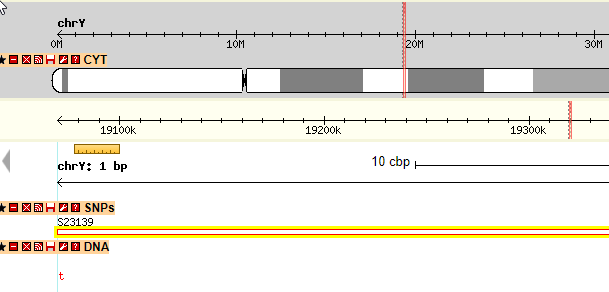
To find out more, Ybrowse.org is a good reference. At that website, they have a browser, similar to the autosomal DNA browser, but this one is for YDNA:

The gray and white bar represents YDNA. Every SNP, such as R-S23139, has a reference number. This gives the location or address of the SNP along millions of locations along the YDNA. The reference number is a more logical designation. These numbers are sequential and lower on the left side of the browser and higher on the right side.

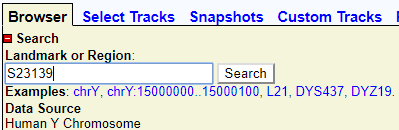
Here, I have put  S23139 into the search box at YBrowse. Conversely, I could have put the reference number in to see if there was a named SNP if I already knew what the number was. In the default browser image above, the red line is at about 14 million.

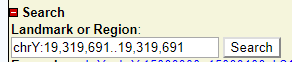
When I click the search button, I see that the location is here in the 19 million range:


In the above image, I cut off the right side of the Y Chromosome Browser.

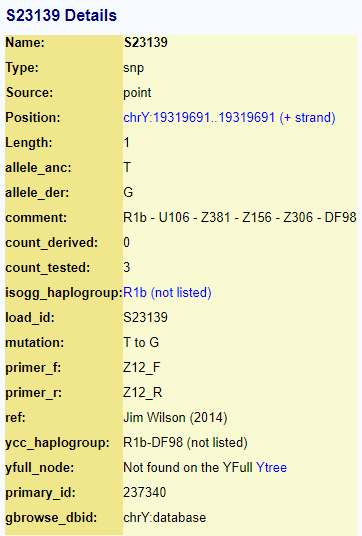
When I click on the S23139, I get this further information at YBrowse:

Here we see that the mutation at this position went from T to G.

The BigY Test

Here is Pete and two others in his group that have tested for STRs:

Pete is in the middle row in this group of R-U106 people. Pete and the other two did not take the BigY test. However, if Pete did, he would likely get SNPs that are unnamed. They would just be identified with a number. Once someone else in the group BigY tested, they may match on the same numbered SNP. At that point the SNP would be named and they would have a SNP that is just for their Whitson Group. This new SNP could then be considered a family SNP – just for the R-U106 Whitsons. Any additional unnamed SNPs could have developed since the match with the other Whitson-tested person.

Many people upload their Big Y results to a service called YFull where there is further analysis. One important part of the analysis is the estimated date of the SNP and the estimated date of the common ancestor of the people that have tested for the particular SNP. This can be useful when looking for family connections in genealogical research.

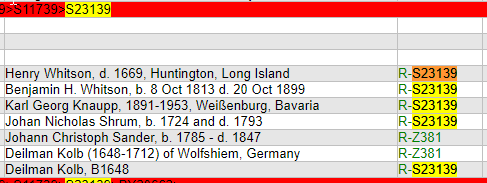
Right now, Pete and his closer relatives are sharing R-S23139 with others with German heritage. Perhaps R-S23139 represents the Anglo-Saxons that came to England and those that stayed in what is now Germany.

This shows that R-S23139 represents a point in time before surnames were developed. It probably indicates a time prior to when the Anglo-Saxons came to England.

Here is a table of dates from McDonald.

My understanding of this table is that the tested people within the red above would have a common ancestor around 227 BC. BigY testing would get new SNPs that should be within the genealogical time frame or since the time of surnames.


Barry’s Irish Frazer DNA

I had a message from Richard that he had his brother Barry’s DNA tested. The last Blog I wrote on Richard was here.

A Summary of Richard’s Frazer Line and DNA

In summary, it seems clear from my earlier Blog, that Richard was related to the same Frazers that I was related to from the areas of South County Sligo and Northern County Roscommon. Based on guesses, family given names and DNA, I came up with this likely tree for Richard in green:

Here is a summary of Richard’s matches:

The Mystery of Michael

A second look at this list shows that Richard had a large match also with Michael who I don’t have as descending from the Philip Line. However, he could match on other lines. For example, we don’t know who the wives were of Philip and Richard Frazer born in the 1700’s. Just looking at Richard’s matches of Paul, Gladys and Michael, it would appear that Richard would come from the Richard Frazer Line (born about 1777). However, Richard did not have a known son named Philip.

Barry’s DNA Compared to His Brother Richard

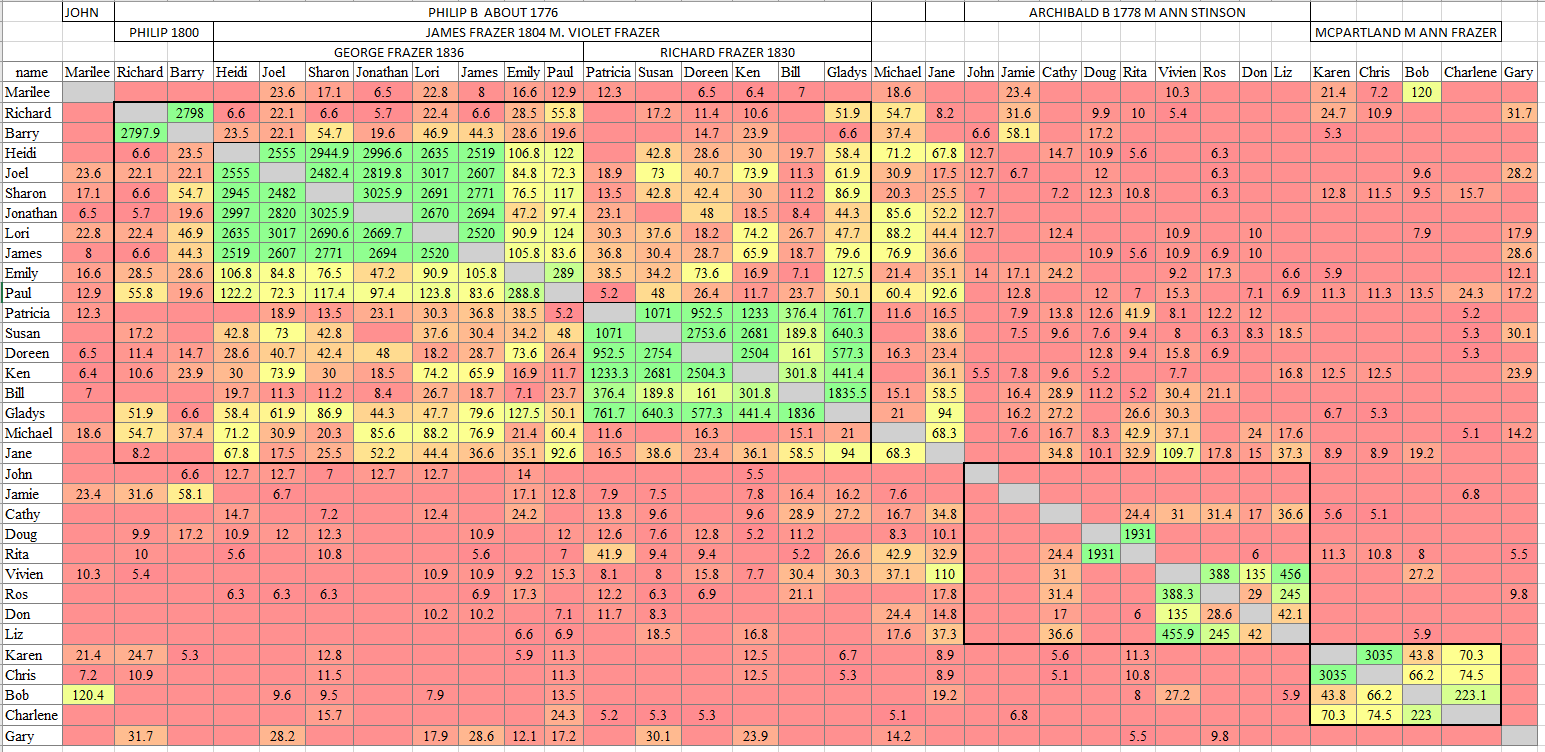
Barry’s DNA results should even out his brother’s results. What that means is that Richard or Barry could have DNA matches that are on the high or low side. However, when taken together, their results should be indicative of the DNA that their Frazer side mother has. At Gedmatch, I have compared Richard’s and Barry’s matches using their ‘One to Many’ lists:

The purple results are from the line of George Frazer who was born about 1838. The yellow line is from George’s older brother Richard Frazer who was born in 1830. When I last wrote about Richard, I didn’t mention Emily. She is a new match. I have written about Gary, Brian and Karen in other Blogs. The McPartland connection is one that comes up a lot. This family has a Frazer ancestor. The main point in presenting the above chart was to show the differences in matches between Richard and Gary. For example, my sister Sharon does not show up as a match to Richard above the 7.0 cM threshold. However, Sharon matches Barry at 54.7 cM in his One to Many list.

Comparing Barry to Others in the Frazer DNA Project

I added in the McPartlands above. Richard matches that family but his brother doesn’t. That means that my purple and blue table above is wrong that shows Barry matching McPartlands.

A Surprise Off-Topic Discovery

Based on the chart above, I found something surprising. Marilee and Bob match. I wrote a Blog about Marilee here. She appears to descend from the John Line of Frazers. I have her as the only known descendant in the John Line. I actually did look at the match Marilee had with Bob in my previous Blog.

Here is Marilee’s line in pink. Assuming that I have the tree right, that could mean that the McPartlands descend from the John Frazer Line. Perhaps the Ann Frazer who married a McPartland was the daughter of Archibald Frazer and Jane White:

It is a theory based on the match between Marilee and Bob. Here is Bob’s tree with my previous guess that pulled three families together using triangulation.


Well, it looks like I had thought of this before. If this is right, then it means that I descend from the John Line as well as the Philip and Richard Lines of Frazers. One cannot have enough Frazers in their ancestry!

Back to Barry’s DNA

Sorry for the tangent. Here is Barry’s DNA grouped a little differently:

I had trouble grouping Michael and Jane. I should have put them in the Stinson Section. They also descend from Violet Frazer who was the husband of James Frazer and daughter of Richard Frazer. However the Chart above emphasizes James Frazer who was the son of Philip Frazer (if I have it right).

In general if I were to draw a box around all the people believed to be descended from Philip born about 1776, it seems like the matches would hold together.

It is a little difficult to see the distinction as Michael and Jane also have connections to the Richard Frazer Line as a mentioned above. Notice that the matches drop off for Jane when she gets to Richard and Barry, but they don’t drop off for Michael. That could mean that there is some ancestral connection that Michael has to Richard and Barry that Jane does not.

Barry and Jamie – A Johnston Connection?

I see that Barry and Jamie have a large match. I have that Jamie is in the Stinson Section. However, Jamie and John have no matches with the other Stinsons and a pretty good match with Richard and Barry. However, this match may be due to a Johnston connection. Both Barry and Jamie have Johnstons in their ancestry. Other connections are possible. Richard, Barry, Jamie and her brother John all have Johnston grandparents. Their Frazer ancestors go much further back.

Barry and DNA Triangulation Groups

If Barry has a match with two people by DNA and those two people also have a DNA match with each other, that is called a triangulation group. This is a strong DNA match that indicates a  common ancestor. I leave the triangulation step until the end as it takes a little bit of work. To triangulate, I need to compare the 28 people that are in the Archibald Frazer descendant group and compare them to each other.

Triangulation Group (TG) Chromosome 12

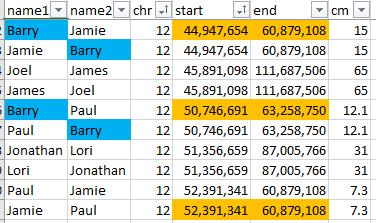
From my spreadsheet of matches, I see this group on Chromosome 12:

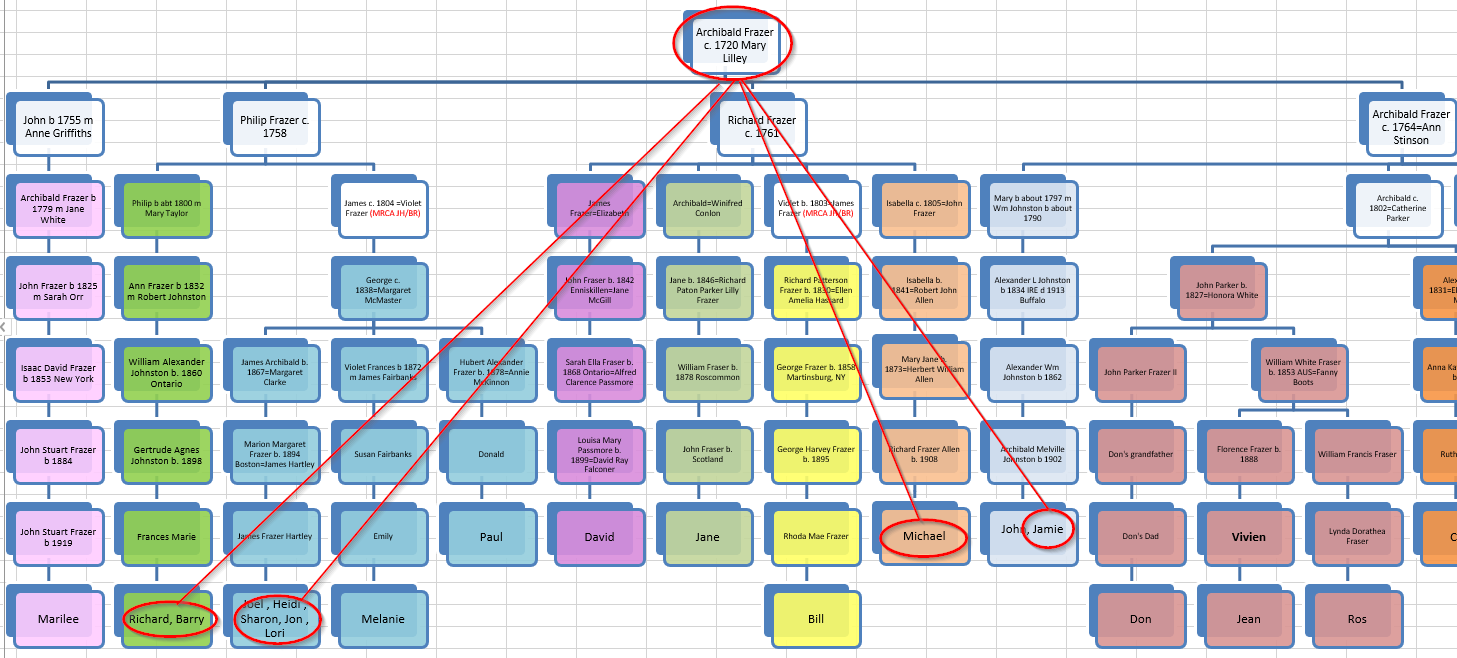
Here Barry matches Jamie and Paul. Paul also matches Jamie. That makes a TG. This means that this DNA on Chromosome 12 came down to these three people from one specific ancestor. Here are two possibilities for common ancestors:

Here at the top of the tree is Archibald Frazer born about 1720 and Mary Lilley.  If it wasn’t for the match with Paul, we might guess that Jamie and Barry were matching on a Johnston ancestor as they both have Johnston ancestors. Paul, however, has no known Johnston ancestors. That leaves the above possibility for the TG on Chromosome 12.

TG at Chromosome 17

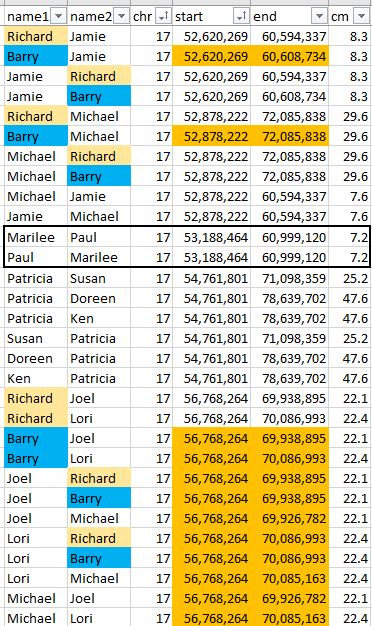
I already described this TG in my Blog on Richard. However, now Barry has joined the TG. Also Jamie from the Stinson Line. I think that I found out about Jamie after I wrote the Blog on Richard.

These people could be represented with the same common ancestors as in TG 12 above.

This gets confusing, because Lori and I also descend from the Richard Frazer Line. In addition, Michael also descends from the Stinson Line. Also, note that Paul and Marilee have a small match. Perhaps these two would be in the TG if I lowered the DNA match thresholds.

Again, if this was just a match between Barrie and Jamie, I would suspect that it could be from a common Johnston ancestor. However, as Lori, Joel and Michael have no known Johnston ancestors, it appears more likely that this is a Frazer TG.

A New TG on Chromosome 18

Here is a new TG between Barry, Richard, Jamie and Emily.

Again, there seems to be something special about Jamie’s DNA or ancestry, that she has shown up in all three TGs.

I should note that Jamie has the same line as her brother John. That makes me think that Jamie got the Frazer DNA. I wrote a Blog about John here. I would like to write a Blog about his sister Jamie to look into some of the questions that were raised in this Blog.

Here is the match between Jamie and Barry:

Barry has no DNA match with Jamie’s brother John. Barry’s brother Richard has this match with Jamie:


Summary and Conclusions

  • I showed how two brothers could have different DNA matches.
  • I have put Barry and Richard in the Philip Line. This seems to be supported by the DNA, common first names, and the genealogy that we know of.
  • I looked at threeTriangulation Groups (TGs). All of these included Jamie from the Stinson Line. It may help to look more closely into Jamie’s family tree. Perhaps she has other connections to Frazers or to their collateral lines. Or perhaps Jamie has inherited more than the usual amount of Frazer DNA.
  • Given that we are not totally sure of the genealogy of many of these lines and that there was intermarriage of Frazers and perhaps other lines, the analysis of the DNA and genealogy is very complicated.
  • There is need for more analysis of the DNA matches (and the genealogy). I should look more closely into Jamie’s DNA.

Uncle Mike’s Jame’s Line Frazer DNA

The results of Kathy’s Uncle Mike’s DNA came in. This resulted in some interest from those Frazers from the James Line Branch. Here is where Mike is on the James Line DNA testing chart:

I stuck Mike in with his sister Madeline to save space.

Uncle Mike and Visual Phasing

It appears that there are three siblings that have tested. This means that it would be possible to do visual phasing on these three. This is a way to tell what portions of their grandparents’ DNA has been passed down to Madeline, Mike and Charlotte. For example, about one-quarter of Minnie Frazer’s DNA has been passed down to these three siblings in different ways. Put another way, about half of Mike’s maternal DNA would be from Minnie born in 1865. I give an example of Visual Phasing later in this Blog.

Uncle Mike and the Line of Archibald Frazer born 1792

Here is a closer up view of Mike in the left branch of the James Line:

Here, Mike is a third cousin to Rodney, Betty, Janet, Joanna, and Jonathan. He is third cousin, once removed to most others in red above. This shows three DNA-tested branches: William, Edward and Thomas. Ancestry shows these branches as Circles:

I got the above figure from Joanna’s AncestryDNA results. The Walter group includes Joanna and family. They descend from Thomas. Uncle Mike is in the Frazer Emmet Group from Edward. The C.W Family is on the left descending from William. However, Ancestry does not have all the tested descendants.

The William, Edward and Thomas Frazer Branches at Gedmatch

Here is what the three Frazer Branches look like when the DNA of the tested descendants is compared at Gedmatch:

Mike matches everyone except for Penny. He also matches Joanna, but below the normal cutoff of 7 cM. Note that Penny doesn’t match anyone in the Edward Wynn Line, but her sister Toni does. This points out the importance of sibling testing.

Further Out in the James Line

If we have the genealogy right, Mike is a 4th cousin to Prudence and a 5th cousin to those in the Michael Frazer (born 1764) Branch.

Mike’s Interesting X DNA Match

This is how Mike matches Clyde at #3 and others of his close family on the X Chromosome. The interesting part is that this would have to be the DNA from the wife of Archibald born in 1792:


We can know this because the X Chromosome never travels from father to son. Going up from Clyde, we see females up to William. Going up from Mike, we see females up to Edward. William and Edward got no X Chromosome from their father, so that means that this match is from the their mother. This means that they had the same mother who would have been the wife of Archibald. There is a small chance that this X Match could be along another common line between Clyde and Mike. But I don’t think that is likely.

More on Visual Phasing

This Blog was sort of short, so why not try a little visual phasing? Here are some of Mike’s DNA matches (other than with his siblings or nieces):

It looks like a lot is going on at Chromosome 5. Mike matches Bonnie at 31.3 cM. By my chart above, Mike and Bonnie should be 5th cousins. Unless they match on another line, this would be DNA going all the way back to James Frazer born about 1720.

Visual Phasing of Chromosome 5 for Mike and His Two Siblings

Stephen Fox has an excellent spreadsheet that does a lot of the hard work in the visual phasing. I found his spreadsheet at The Visual Phasing Working Group on Facebook. It took a while to download the different matches but it is better than doing it by hand.

Here is Chromosome 5:

The first bar is Mike and Madeline Compared. The second is Mike and Charlotte. The third bar is Madeline compared to Charlotte. Next, I try to line up the crossovers:

Unfortunately, they are not lining up easily. Perhaps the X Chromosome would be easier

Chromosome 23

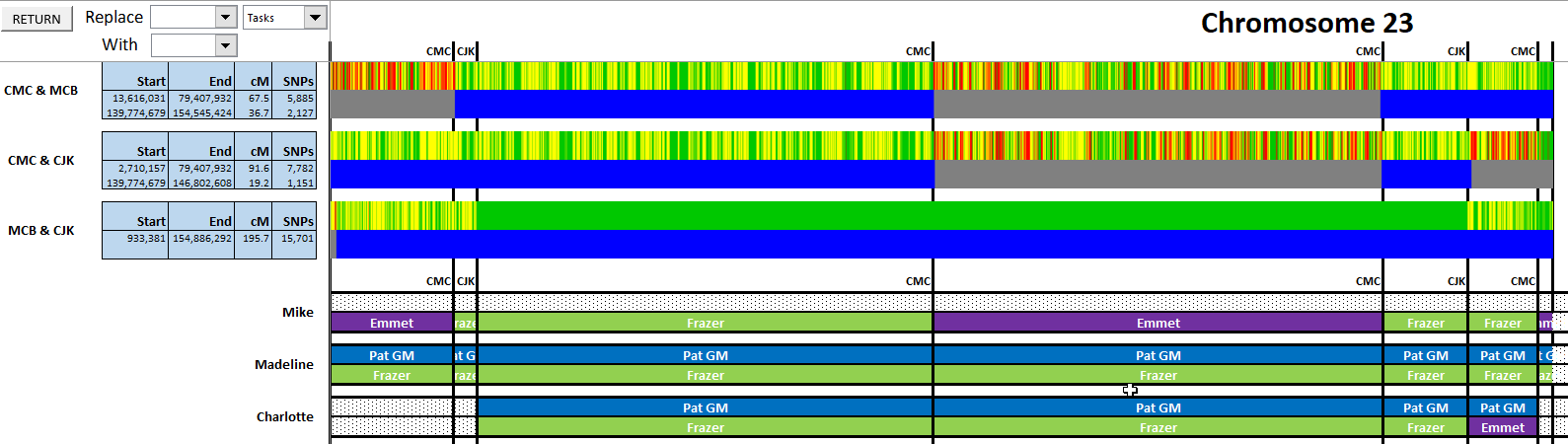
Here, I still have some problems. I only had crossovers for Mike and Charlotte. I didn’t see any obvious crossovers for Madeline. The first two bars are comparisons between Mike and Madeline and Mike and Charlotte. There are no solid blue sections because Mike gets no X Chromosome from his dad. Madeline and Charlotte in the last comparison have a solid green section as they both got an X from their dad. The green means that they have the same DNA from two grandparents – a maternal and paternal grandparent.

When I map out the Madeline and Charlotte’s green areas, I get this:


The green area is a Fully Identical Region or FIR. That means that the yellow and green grandparents sent down their DNA to the same places on Charlotte’s and Madeline’s X Chromosome. My simple view of the crossovers was that Madeline had no crossovers, so that means that she would be missing the DNA from one of her grandparents. The missing grandparent would have to be on her mother’s mother’s side. That is because she is already missing her paternal grandfather on the X. That is because he sent no DNA to Madeline’s father (or to Charlotte’s father). We know that Madeline and Charlotte match Clyde. That would be a Frazer match. The Frazer match maps to Madeline’s mother’s mother who was Minnie Frazer.

This is the view of the right side of Mike, Madeline and Charlotte’s X Chromosome. The bottom three blue bars represent where Clyde matches Mike, Madeline and Charlotte. Note that Charlotte has a shorter match with Clyde. That means that Charlotte’s crossover at the right side of the match is where her DNA goes from Frazer to Emmet. At this point we need to make a decision as to whether we want Frazer to be G1 or G4.

Here, by putting a G3 on Charlotte’s bottom part of her X Chromosome, I made that the maternal side. That means that G4 is Frazer and Emmet is G3. That also means that the bottom part of the X is set as the maternal side of the Chromosome. That then means that G1 is paternal.

The blue is the paternal grandmother who is Cronin. I must have made a mistake, because Mike should only have one side of his maternal Chromosome. Here is a probable map:

Mike only has a maternal side to his X Chromosome. That means that wherever he has a crossover, that means that the DNA he got goes either from Emmet to Frazer or Frazer to Emmet. This map assumes that I have the right crossovers. More matches with cousins could confirm or alter the map. I have some areas on the right and left of Charlotte’s map not filled in.

Note that Mike does not match Madeline, but does match Charlotte in the first section. As I have Mike with Emmet there, that means that Madeline has Frazer in that segment and Charlotte must have Emmet. Here is a filled-in map:

To do this right, I should have put numbers in for the locations of the crossovers.

Any Problems?

Yes, there are problems. Here is an X match with 5th cousin Bonnie:

Note that Bonnie matches Madeline on the middle bar but not Mike or Charlotte. It makes sense that she doesn’t match Mike as Mike has Emmet (purple) in that segment. This could be a false positive match for Madeline, or Charlotte could have a match there that did not show.

Summary and Conclusions

  • Mike’s testing brings interesting mapping possibilities with his two sisters. The mapping of these four grandparents goes back to about the 1860’s.
  • Mike’s DNA testing adds an important piece to the Archibald Frazer (born 1792) Line.
  • Mike also has interesting matches with James Line relatives that are further out.
  • Mike has an interesting X Chromosome match with Clyde that appears to represent DNA from the wife of Archibald Frazer born 1792. It is possible that other X Chromosome matches in common with Clyde and Mike could reveal other common ancestors that would lead to confirmation or clues to the identity of the wife of Archibald Frazer.


Elizabeth’s DNA from the Australian Line of Frazers

I recently had an email from my Austrian cousin Ros. Her 2nd cousin Elizabeth had taken a DNA test. Here is how Elizabeth fits in with the Australian group of Frazers:

I wrote a Blog about Don here. While looking at Elizabeth’s DNA matches, I noticed that Jean had a sister Kathy that had tested, so I added her to the tree. This brings us back to 1827. Here is one generation earlier:

That brings us back to 1802 and adds in Cathy and Jane. John Parker Frazer and Honora White were the ancestors of the Australian Frazer Line in purple above. Elizabeth is related to Vivien as a 1st cousin once removed. She is a 2nd cousin to Ros, Jean and Kathy and a 3rd cousin to Don. Elizabeth is a 3rd cousin once removed to her non-Australian cousins Cathy and Jane.

The Archibald/Stinson Line

Going back one more generation gets us the Archibald/Stinson Line:

Unfortunately, even at this level, I am not on the tree. My Frazers descended from two of the siblings of the Archibald that married a Stinson at the top of the tree. I suppose that would make me a double 6th cousin to Elizabeth.

Elizabeth’s Australian DNA

To simplify things, I’ll compare Elizabeth to Don, Vivien and Ros. I’ll skip Jean and Kathy because Vivien’s children got all their maternal DNA from Vivien. So Vivien’s children could not match Elizabeth any more than Vivien does.

When I compare Elizabeth to Vivien and Ros, there will roughly half a chance that some of the DNA will be from the Boots family. However, when Don matches Elizabeth, that DNA would have to be from either John Parker Frazer or Honora White.

Here is an example from Chromosome 1:

Here Elizabeth matches Don and Vivien in green in the same area. This represents DNA from John Frazer or Honora White. This match stops at about position 4M. Then Elizabeth matches Ros. One likely possibility is that the yellow match between Ros and Elizabeth above is from the Boots side.

Here is a summary of Elizabeth’s Australian Frazer DNA matches:

Here are some DNA match ranges for Elizabeth compared to Vivien, Ros and Don:

Elizabeth and Vivien share 455.9 cM which is about average for a 1st cousin once removed. Ros and Elizabeth are also about average for 2nd cousins. However, Elizabeth and Don are below average for third cousins. As, I mentioned above,  the DNA ranges start to vary more the further out the relationship is.

Elizabeth’s DNA One Step Beyond Australia


Here I added Cathy and Jane who don’t have Australian ancestors. I wrote a Blog about Cathy nearly three years ago, back in the early days of Frazer DNA Blogs. From what I can tell, Cathy is from North Carolina and Jane is from Colorado.

In the darker box, I have the Elizabeth’s Australian cousins. Elizabeth is a 3rd cousin once removed to Jane and Cathy. An average or typical amount of DNA shared for a 3rd cousin once removed is about 48 cM. As can be seen for the amounts of DNA shared with Elizabeth’s cousins, the amounts go down from right to left on the top row in the above chart. Any DNA that Elizabeth shares with Cathy and Jane would likely be from Archibald Frazer born in 1802 or his wife Catherine Parker.

Pushing Back Elizabeth’s DNA to the 1700’s

The next logical step is to look at the generation before Archibald Frazer and Catherine Parker.

This adds 11 people to the 6 we have already looked at. We are not sure when this Archibald was born, but a guess was put at 1778. This is sometimes referred to as the Stinson Line as Archibald married Ann Stinson. The light blue line on the left was put in by DNA as a likely guess. Elizabeth should be a 4th cousin once removed or 5th cousin to most of these new people.

Here is how Elizabeth matches by DNA to her more distant cousins:

Unfortunately, I didn’t list these cousins in the best order. Out of the 11 more distant cousins, Elizabeth has a DNA match with three: Michael, Ken and Susan. The chances that Elizabeth will match a 4th or 5th cousin get smaller.

Elizabeth and More Distant Frazer Cousin

The next step up for Jane goes to Archibald Frazer and Mary Lilly

This couple had four sons that had descendants with tested DNA. I am in the blue line descended from Philip and Marilee is in the pink line descended from John. The descendants of Richard are also in the Archibald/Stinson line, so they are accounted for. Here Elizabeth would be 5th cousin once removed or 6th cousins to her more distant Frazer cousins. Based on the Chances of Finding a Match Chart above, her chances of having a DNA match with these people are very small.

Here is the Philip Line:

Those in yellow are already in the Archibald/Stinson LIne. Richard in green was added due to a DNA match as a likely Philip descendant.

Here is how Elizabeth matches her more distant cousins:

Elizabeth only matches Emily and Paul. And she matches them at below the normal cutoff of 7 cM.

Elizabeth and the James Line: The Final Frontier

Here the James Line is shown in white boxes:

Elizabeth would be typically a 6th cousin once removed to a 7th cousin to these people. From the list above, Elizabeth matches two people: Mary and Janet in the 5 cM range.

Summary and Conclusions

Elizabeth’s DNA behaves in an expected manner. I traced her matches from her closest Australian cousins down to her most distant James Line Frazer cousins. At each step further out, those DNA match levels go down. Elizabeth’s DNA testing confirms the genealogy we have. It also reminded me of others that had tested that I had forgotten about.

A review of the testing of Frazer DNA over the past three years, shows how the project has grown and come together.


A Third Frazer Big Y 500: Part 2

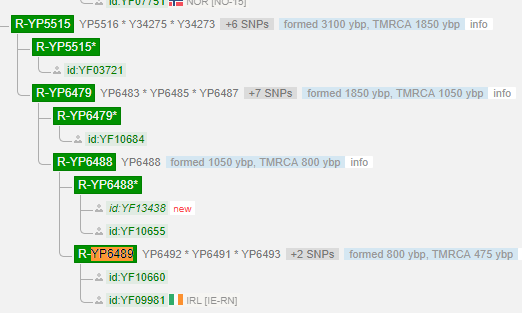
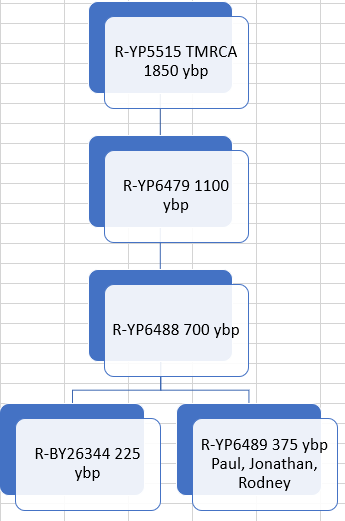
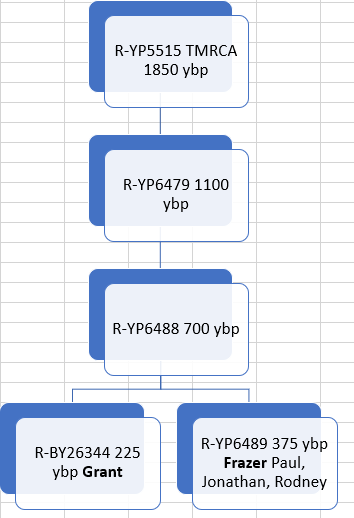
Last month, I took a first look at Rodney’s Big Y 500 results. At that time, I was looking for unnamed SNPs that Rodney and Jonathan shared on the James Line. I was unable to find any. It looks like FTDNA and YFull were unable to find any also. When I wrote my first Blog, Rodney’s results were not at YFull yet. YFull is a popular service for interpreting Big Y results. I’ll take a look at Rodney’s YFull Results in this Blog. Before I do that, here is where Rodney fits into the Frazer YDNA testing tree:

Paul, Rodney and Jonathan have taken the Big Y test and Rick has taken the YDNA STR test.

Rodney at YFull

Before Rodney’s results were in, this was the YTree:

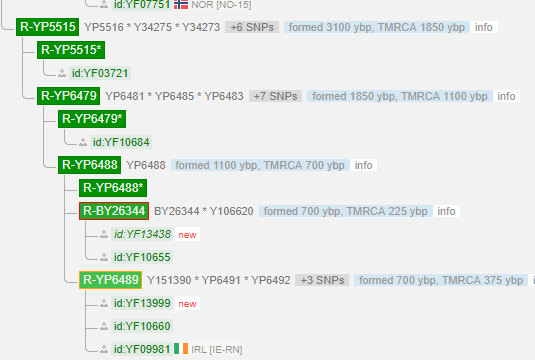
Jonathan and Paul were the last two id’s. Here is the present YTree:

YTree Changes

I see two major changes to the YTree. One is that there is a new non-Frazer Branch. The second is that the Frazer branch common ancestor is refined from 475 ybp to 375 ybp. From what we can tell, at the tree above, Archibald was born around 1690. That is roughly 325 years ago. So 375 years ago by YDNA is pretty close. I was expecting a new SNP for the James Line of the Frazers. These SNPs form about every 144 years. Note that at 375 years ago, that should represent 2 or three new SNPs. From my work on the STR side of the YDNA testing, it has seemed like the STR differences have been primarily on the Archibald Branch of the Frazer tree and not on the James side. It seems like this must be true for the SNPs also. This would have to be verified by Big Y testing of someone else in the Archibald Line. The only other possibility is that there is indeed another SNP for the James Line, but the testing results were not clear enough to determine that.

A New Parallel SNP Line to the Frazers

Here is the new line of R-BY26344:

While I’m thinking of it, there is another interesting point. The YTree shows that YP6488 was formed 1100 years ago. [The date that the SNP was formed is earlier than the common ancestor dates listed above. For the formed dates, see the YTree above.] The two branches below YP6488 were formed 700 years ago. However, the Frazer branch of YP6489 consists of six total SNPs listed here:

From 1100 to 700 years ago is 400 years. SNPs are formed on average every 144 years but in 400 years somehow the Frazer seemed to get 6 SNPs. On the other hand, BY26344 has is only represented by two SNPs over 400 years. That could mean that the Frazer line had all it’s SNP mutations between 1100 and 700 years ago, so now they are just coasting, so to speak.

Who Does BY26344 Represent?

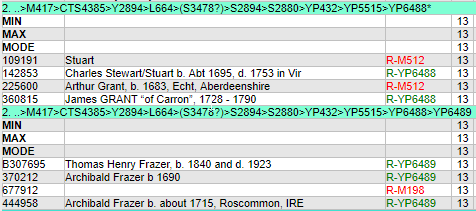
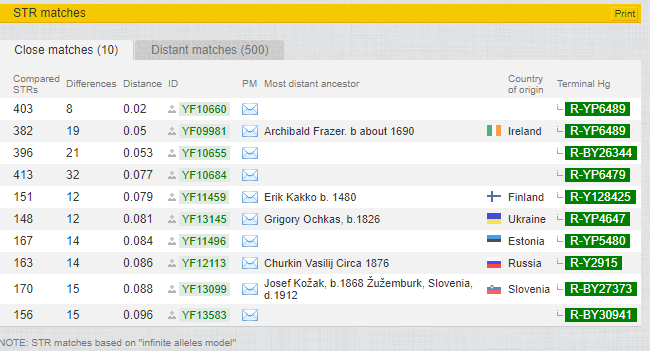
YFull uses ID’s, so it can be difficult to tell who these people are. In the past, I have been tracking the Grants as their YDNA STRs have had similarities to the Frazers. That appears to be the case. However, there is also a Stuart as well as a grant in the YP6488 Group.

Here Grant and Stuart are still listed as YP6488, so that means that FTDNA may be a bit behind YFull for Grant and Stuart.

This is interesting as it shows us that Grant and Frazer had a common ancestor about 1300 A.D. To me, this would be before the time that surnames were in common use. However, by 225-375 years ago, surnames should have been in common use. This should mean that the two SNPs at the bottom of the tree should represent Grant and Frazer respectively. This also has interesting parallels to my wife’s line. A surname that was related to hers was also found to be a common ancestor about 700 years ago.

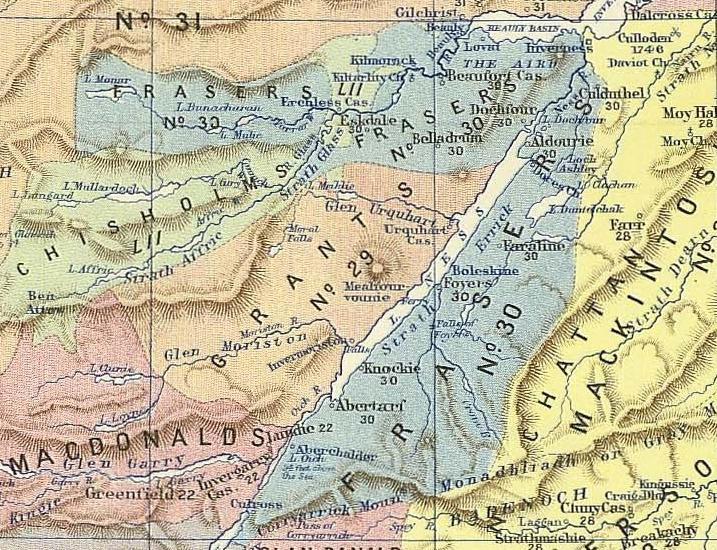
As a reminder, here is a map showing how close the Frasers and Grants lived in 1587:

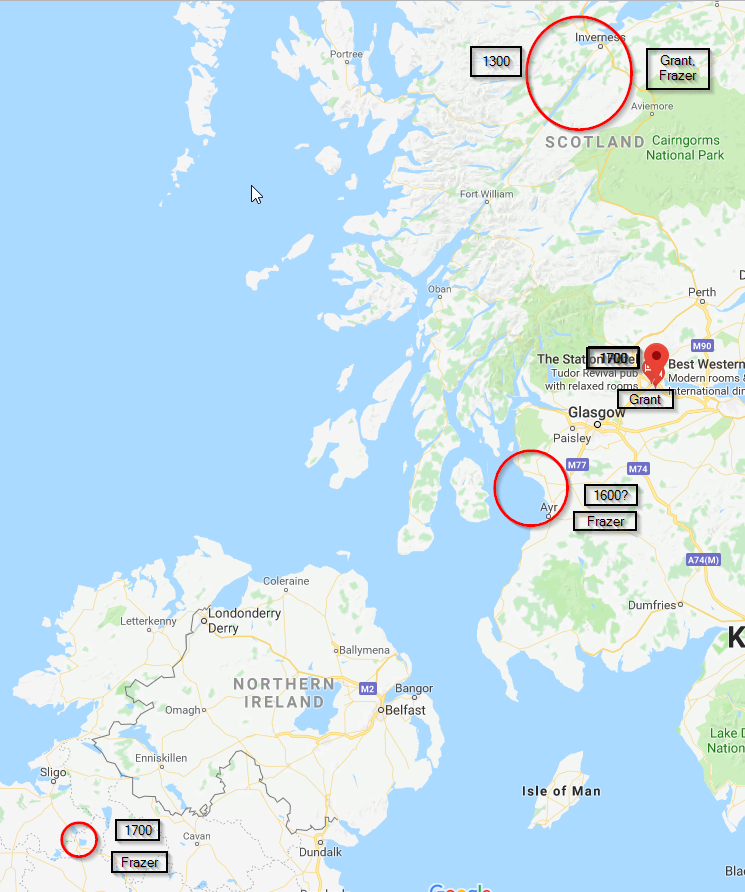
My assumption is that this is where the common ancestors of the Grants, Stuarts and Frazers lived around the year 1300. This is to the Southwest and West of Inverness. The Frazers had the Grants surrounded. Also the Grants and Frazers surrounded Loch Ness.

I also note that one of the YDNA Grants testers mentions Carron. If I have the right Carron, it is to the Northeast of Glasgow. The Frazers were believed to be from the area of Ayr. I have also added dates to the various areas that the Grants and Frazers may have lived these areas.

Note where I have Grant above, I should have also included Stuart.

Further Questions on the Grant/Stuart Line

Assuming that the two IDs at YFull on the YTree are indeed Stuart and Grant, that poses additional questions for those two lines:

  • A common ancestor of 225 years ago is within the surname era. That means that there was some mixing of the two surnames due to adoption or other event.
  • Stuart appears to have been in Virginia before 225 years ago and Grant in Carron before that time. If this is correct, then the 225 years for a common ancestors may not be right.

I point this out partly, because it shows some common issues that could arise in a surname project. Fortunately, the testing of the Frazers so far has not resutled in similar issues.

Big Y 500 STRs

YFull looks at STRs deduced from the Big Y test. Here is how Rodney matches Jonathan and Paul:

This shows that, by STRs, Rodney is much more closely related to Jonathan than Paul. I think that there is a way to convert the distance to years, but I can’t find it right now. However, it appears to show that Rodney is more than twice as closely related to Jonathan as Paul is. This makes sense based on the genealogical tree at the top of the Blog.

Rodney is Running Out of SNPs

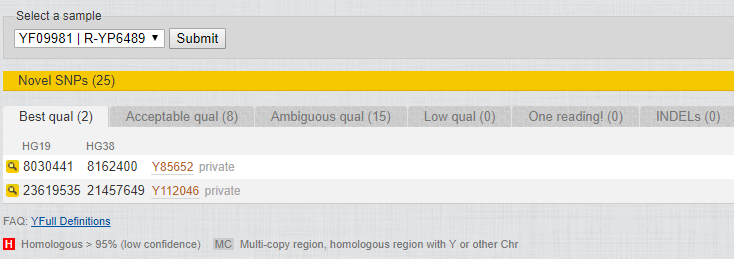
Here are Rodney’s novel SNPs at YFull:

Note that Rodney has no best or acceptable quality Novel SNPs. Novel SNPs are the ones that don’t match others. That means that all of Rodney’s good SNPs are already matched up with Paul and Jonathan as they should be. This makes sense as the time between the birth of Rodney, Jonathan and their common ancestor of Thomas Henry Frazer is likely less than 144 years.

For comparison, here are Paul’s Novel SNPs:

Paul has 10 Best or Acceptable Quality novel or private SNPs. It is likely that one or more of these SNPs could become an Archibald Line SNP if another Archibald Line Frazer descendant tests for the Big Y.

Perhaps a better comparison would be with Jonathan’s novel SNPs:

Jonathan is really out of Novel SNPs. He has no novel SNPs of any kind of quality.

Summary and Conclusions


  • Rodney’s Big Y 500 test has refined the YTree and dates of common ancestors
  • Many new SNPs prior to about the year 1300 may account for no identified SNPs after that date for the James Line
  • Another Big Y tester on the Archibald Line may create a new SNP for that branch
  • Assuming that the new Branch of BY26344 was for Stuart and Grant, that raises questions about the origin of those lines and about the date of the common ancestor for those two surnames.
  • The common ancestors for the Frazer distant relatives of Stuart and Grant has been moved up from 800 years ago to 700 years ago.
  • The common ancestor for the three Frazer testers has also been moved up 100 years: from 475 to 375 years ago.
  • The STR testing confirms the relative DNA closeness of Rodney and Jonathan who are in the James Line. This is also confirmed by autosomal DNA test results.

A Second Butler Big Y Results Are In

I am thankful that Peter agreed to take the Big Y test, also known as the Big Y – 500. It is important when taking the Big Y test to have two people with the same surname. That is because results are achieved in tandem. That means, that to have new SNPs named there has to be someone else that matches you on that SNP. Otherwise, the SNPs that don’t match anyone else remain private.

Previously, I was also happy that Rick tested. He is not a Butler, but previous Y DNA tested indicated that his family and the Butlers were related at some time in the past. Based on YFull calculations that time would be 700 years ago. Even though, that seems like a long time ago, the common ancestor that my father in law, Richard, had before Rick tested was 3500 years ago. I wrote about Rick’s results here.

Peter’s YDNA SNPs at FTDNA

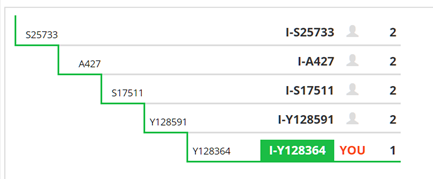
Peter tested at FTDNA. It took a little while to get his results, but when they came in, things happened quickly. Peter’s first results looked like this:

This showed that Peter matched Rick and Richard. This was expected. Not too much later, FTDNA showed that Peter actually formed a new branch with just himself and Richard.

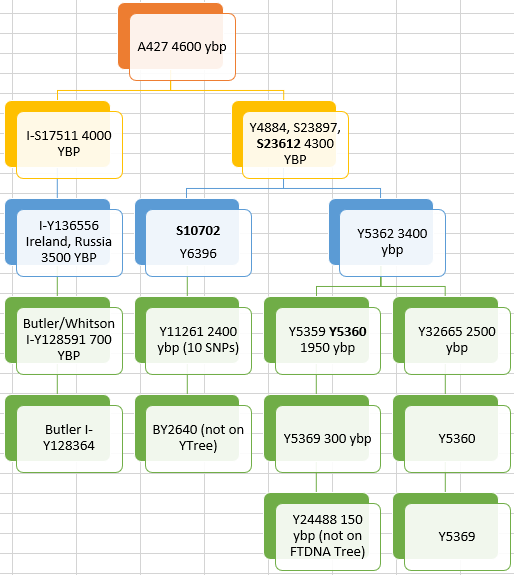
In my opinion, this new SNP of I-Y128364 is likely a Butler-only SNP. This is one of the goals of the Big Y: to get a family surname level SNP. Here is how I see the Butler tree with SNPs:

The age of these common ancestors are from YFull.

Peter’s YDNA SNPs at YFull

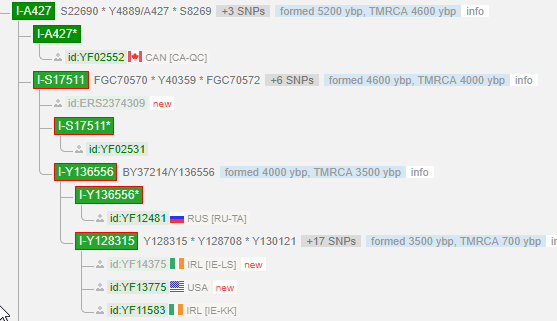
Peter uploaded his FTNDA Big Y results to YFull. One would think the results would be the same between the two companies, but not quite so. For one thing, YFull gives age estimates. One is for the formation of the SNP and the other is for the common ancestors of the matches that share that SNP.

Above, Peter is YF14375. His number is faint as the results have not yet been finalized. I am expecting that YFull’s analysis will have Peter and Richard sharing a common SNP, once their analysis is done. Rick has the USA flag and Richard is the last person in the image above.

Some Differences Between FTDNA and YFull: Y128315 Vs Y128591

Under YFull, Y128315 shows three SNPs plus 17 others. One of the 17 others is Y128591:

That means that there were a bunch of SNPs in this group. FTDNA chose one SNP to be representative of the group (Y128591) and YFull picked a different one (Y1285315).

What About I-Y136556?

YFull has an extra SNP between I-S17511 and I-Y128315. This is I-S136556. . This may be because there is an ERS sample at YFull that I believe was taken from a study. This test result would not be included in the FTDNA information. This I-S136556 fills in some information that FTDNA did not have, but the dates are still ancient history as they are in the range of 4,000 to 3,500 years ago. Note above in the YFull Tree that Y136556 is also called BY37214. FTDNA has this listed under S17511:

The bottom line is that YFull shows slightly more detailed branching than FTDNA.

What’s Next?

Next we wait for YFull to finish their analysis. The interesting thing that YFull does that FTDNA does not do are age estimates. It will be interesting to see what YFull has for a date for the common ancestor between Peter and Richard. Also YFull will likely come to the conclusion, as FTDNA did, that Richard and Peter need to share their own Butler SNP.


My Latvian Cousins Inese and Anita

Back in March of this year I wrote a Blog about my Latvian cousin Anita and how we matched by DNA. Since then, her sister Inese also tested at MyHeritage. Anita sent me a photo of her sister on the left and herself on the right:

Here is how we match on our Rathfelder side:

I am in the bottom left box and Anita and Inese are in the lowest box. We both have the common ancestors of Heinrich Rathfelder and Maria Gangnus. I am a second cousin once removed to Inese and Anita and my mother is a 1st cousin twice removed.

My Mother’s DNA Matches with Inese and Anita

Here is how Inese matches with my mother as shown at MyHeritage:

Here is how my mom, Gladys, matches with Inese and Anita:

The most important matches are where Inese matches my mother where Anita doesn’t. That is because this is newly identified DNA areas where we match.

Anita’s Questions

Anita had this question for me:

Me and your mother have 5,1% shared DNA, but my sister has 4,1% shared DNA with Glagys. Does it means that I have more DNA from Rathfelders than my sister has? Or 1% isn’t such a big difference?

That is a good question. I think that it does mean that Anita has more Rathfelder DNA than Inese. Anita and Inese got half their DNA from their father Haralds. They got 25% from Vera. They got on average 12.5% from Leo. My mother is Leo’s brother’s daughter. However Leo and his brother Alexander shared about half of their DNA with each other. That means that if all of Inese’s DNA matched all of Gladys’ DNA they could be up around 6.25% theoretically.

We Get Our DNA From Our Grandparents, But Not Equally

Looking at the image above, Anita matches my mom Gladys on Chromosome 19, but Inese does not. Why is that? That is because we all have a maternal and paternal chromosome. However, on each of those chromosomes we only have room for one grandparent. On Anita’s paternal Chromosome 19, she got her DNA from her grandmother Vera. However, Inese got her paternal Chromosome 19 DNA from Vera’s husband. That is why she doesn’t match Gladys on her Chromosome 19.

In order to answer Anita’s question definitively, we would have to map out all of Anita’s and Inese’s DNA to see exactly how much Rathfelder DNA they got on each Chromosome. They should both have about 25% of their DNA from their grandmother Vera who was a Rathfelder. However, it is possible that Anita has 26% and Inese could have 24% Rathfelder, for example.

That gets to another of Anita’s good questions:

Why me and my sister have only 39,3% shared DNA (44 segments)? I thought that close relatives should share more than 50%, no? Does it means that she for example took more DNA from our mother and me from father? Or almost 40% is a high share?

Here was my answer to Anita:

Siblings are a special case as they share what is called fully identical regions. That means that they can share DNA from the same location from the mother and the father on a specific Chromosome. Perhaps this makes it seem like less DNA is shared. I have 5 siblings tested, so I have plenty to look at! I have 4 of my 5 tested siblings at MyHeritage. They show:

  1. 40.0% (2,898.9‎ cM)
  2. 37.8% (2,738.1‎ cM)
  3. 35.0% (2,534.9‎ cM)
  4. 34.0% (2,462.8‎ cM)

Based on this 40% is pretty high. I share 48.6% with my mother. With my mom, I am only sharing on the maternal side, so there isn’t the same situation as sharing with siblings.

My Match with Inese and Anita

I only got half of my mother’s DNA. Here is how I match with Inese and Anita:

Even though I get half of my mom’s DNA, that doesn’t mean I get exactly half of the DNA that she got from her grandparents. I may get more from some and less from others. Here I didn’t get the DNA that my mom got from her Rathfelder and Gangnus grandparents on her Chromosome 2 and 6 as well as in other places.  However, Inese and I share Rathfelder/Gangnus DNA on part of Chromosome 15 and 17 that I don’t share with her sister Anita.

Painting My DNA

There is a DNA painting utility on the internet that is fun to play with. Using this I can add the extra DNA on my maternal side on Chromosomes 15 and 17.

The addition on Chromosome 17 is difficult to see as it merges with or is covered up by Schweccheimer/Gangnus. On Chromosome 15 the Rathfelder/Gangnus DNA that we share merges into Nicholson/Ellis. These are ancestors that my mom has that are not shared with Anita or Inese. The point where the color changes is called a crossover. That means that is the spot where the DNA that you have crossed over from one ancestor to another.

Inese, Anita and Ethnicity

I usually don’t write about ethnicity. That is because there are a lot of variations in the results. I have tested with different companies and there are some differences in what I have been told. However, Anita had some questions about her and her sister. I know that the ethnicity or where you came from based on your DNA is a very popular part of the DNA testing and people enjoy looking into this area.

Anita has some good questions:

By MyHeritage results I have 28,5% of Balkan region. My mother says that her parents and grand parents came from Russia and EasternAsia, no one she knows from Balkan. From my father side, Vera comes from Rathfelders, also not Balkan. I don’t know nothing about my father’s father, but almost 30% for me sounds a big part. What does it means? 

Here is Inese and my mom compared at MyHeritage:


Inese comes out as 9% Balkan. Note at the top that it says that Gladys and Inese do not have ethnicities in common, but they do share common areas. This is a bit of a surprise. So, for example, Inese and Gladys share a general North and West Europe DNA but Gladys’ is interpreted as English and North  and West European while Inese comes out Irish, Scottish, Welsh and Finnish.

I note that the 10.8% my mom has of North and West Europe is in the area including Germany.

I should note that Germany is a difficult area to determine by DNA. It could be because Germany was a bit of an ancient crossroads. A lot of people lived and passed through there. The Anglo Saxons that came to England, for example, were from Germany. German people also moved up to Scandinavia and other places. My mother also has other German ancestry on her mother’s side that is not related to Anita and Inese.

How Does Anita compare with Gladys?

The results are similar, except for the Balkan. Here Anita shows as 28.5% Balkan. Let’s take the average of Anita and Inese and call them 18.7% Balkan. My guess is that Anita’s father’s father had some Balkan background based on the MyHeritage analysis. However, I also like to look at Gedmatch.

Inese and Me

Even though Inese and my mom share no ethnicities, I do.

We share some Irish, Scottish and Welsh. How is this possible? We share this by coincidence. The 34.5%  Irish, Scottish and Welsh I have was from my father’s side. So this is just a coincidence that we share that heritage. This could not be from DNA I got from my mother as my mother and Inese have no shared ethnicities.

Anita and Inese’s Heritage at Gedmatch

Gedmatch has a lot of tools for looking at what they call ‘Admixture’. However, the documentation of how to interpret the results are often difficult to find. At Gedmatch, I choose admixture and use the Eurogenes program. Here is what Anita looks like:

I see the Baltic agrees with MyHeritage. However, Anita has about 48% North Atlantic. The above uses the K13 model. Apparently the K15 is newer and gives this results for Anita:

This basically broke Anita down onto four quarters with some miscellaneous heritage under 4% each. Atlantic seems a bit vague to me but the North Sea is quite specific. Note that there has been no mention of Balkan at Gedmatch for Anita.

A Look at Oracle

Oracle looks at various other possibilities. It is a bit more interesting as it adds some more specific areas based on an interpretation of the general areas in the pie chart above. Here are the Oracle results for the K15 analysis:

The single population sharing means that if four of Anita’s grandparents were from the same place, where would that place be? Here are the top 20 places. Some of the bottom choices are in the area of the Balkans.

The next option is the top 20 choices if Anita has two different heritages:

In this model, Southwest Russian comes out strongly with some other secondary choices. Now there are some German choices in there. If I were to do the same thing with the K13 Analysis, the results would be different. Also note that Anita’s great-grandfather was German. A great-grandfather represents 1/8 of one’s heritage. That is 12.5%.

Chromosome Painting Anita and Gladys

This is where things could get really wild. I chose the K15 analysis and then I compared Anita with my mom, Gladys on Chromosome 18. This should show what they have in common. Here is how Gladys matches Anita and Inese on Chromosome 18:

Gladys matches Anita between about 7.6M and 57.1M. That makes up a large part of Chromosome 18. Here is the Chromosome Painting:

This is an expanded view of Chromosome 18. Anita’s results are in the first row. Gladys is the second row. The third row is how Anita and Gladys compare with each other. I have an arrow at about 7.5M where Anita and Gladys start to match each other. The third row has blacked out where Anita and Gladys do not match. Where Anita and Gladys match each other represents DNA that they got from Heinrich Rathfelder and Maria Gangnus. Here is the right side of Chromosome 18 up to about 57.1M. After that point Gladys and Anita no longer match each other.

This is difficult to interpret, but it tells me that the ‘German’ match between my Mom and Anita is seen in the DNA in the last row is a mixture of North Sea, Atlantic, West Asian, Eastern European and a bit of Baltic.

Also by comparing Anita to the bottom row, we can see how Anita and my mom do not match. It seems they don’t match on Siberian and East and West Mediterranean among others.

Inese and Gladys Painted on Chromosome 18

Next I want to make the same comparison between Inese and Gladys. I am wondering if I will get the same results.


This image corresponds to the previous image where I compared Anita with my mom. It looks the same. It makes sense as all three match along this part of Chromosome 18. However, the more I look, I see a few subtle differences. In the area before 40, the black part in the bottom row is thinner between Inese and Gladys. That means that in this area, my mom and Inese have a closer match by ‘admixture’ than my mom and Anita. As Anita, Inese and Gladys match each other between 8 and 58, there could be other subtle differences.

Anita’s Question on Germany

In my and sister’s MyHeritage results 60% is Baltic, but nothing from Germany. It means MyHeritage takes into account that Rathfelders were from Baltic region not Germany? Or how?

Admixture questions can be complicated. There are a few reasons for this. Although the Rathfelders were considered German, they had many other ancestors that made up their ancestry that could have been from other areas. The second reason is this. Germany was a bit of a crossroads. Many other people came into what is now the Country of Germany. What I showed above was that the ‘German’ that Anita, Inese and Gladys share shows in DNA form as East Europe, Atlantic, North Sea, Baltic and some other areas in very small amounts. The United States is considered a melting pot where different nationalities have inter-married. This is true also of England which has had different conquerors and different populations moving to that Country. Likewise many people moved into Germany before staying there or moving on to other places.

Summary and Conclusions

  • A comparison between me Inese and Anita shows where I match them both by DNA. It also shows where I match on and not the other.
  • I was able to map the extra DNA where I match Inese and not Anita. Everywhere I match Anita or Inese it represents DNA that we both have from Heinrich Rathfelder or Maria Gangnus.
  • There are many variables in trying to tie DNA to your own heritage or ethnicity. There are also a lot of models and interpretations. As a result there can be different results. In general the DNA is accurate. However, when applied to a specific modern-day country, the results can be erratic.
  • The ethnicity results were accurate for the greater part of Anita’s and Inese’s heritage. However, when it got down to the 12.5% German, the results were confusing. Part of the answer could be in what makes up a Rathfelder or a German.
  • It is a good idea to look at more than one model when interpreting heritage by DNA.

The Butlers of Poulrone, County Kilkenny

I recently got an email from Peter. Peter is helping me research my wife’s Butler ancestry. Peter pointed out that we were a little off in our geography.

The Case of Two Poulrones

Here is what Peter writes:

Our Polrone is not associated with Mooncoin but with Tullahought in the Barony of Kells which is in Windgap, in the Carrick on Suir Union, sometimes the diocese overlap the Civil boundaries but not in this case. The two Polroanes are only about 6 miles apart!!!!!

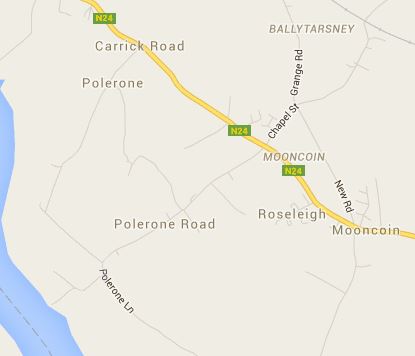
From my website on the Butlers, I had this incorrect location for the Butler’s Poulrone:

The Right Poulrone for the Butlers Is In Tullahought

Tullahought would be called a Civil Parish – an administrative district. According to Wikipedia:

Tullahought (IrishTulach Dhocht, meaning “eight hills”) is a small village in south Kilkenny. Tullahought, also a townsland in the area, is located approximately 8 miles north of Carrick on Suir and 25 miles south of Kilkenny City. The village, itself located in the towns land of Kilmacoliver and Poulrone is best known for its association with the Ormonde Slate Quarries which is situated at the foot of the Booly Hills, on which Tullahought is situated.

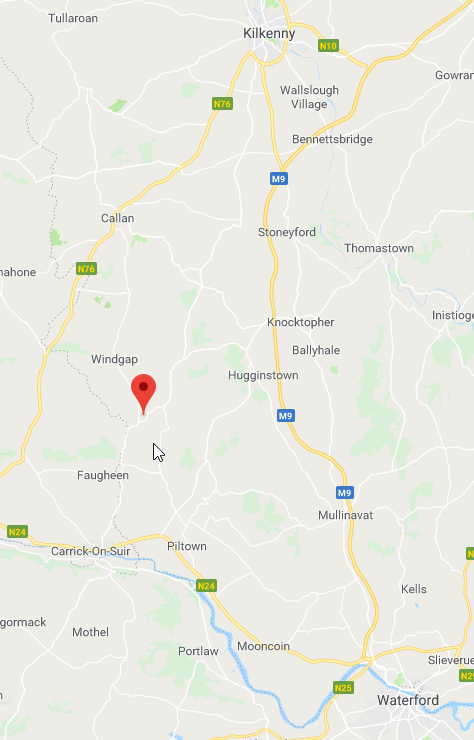
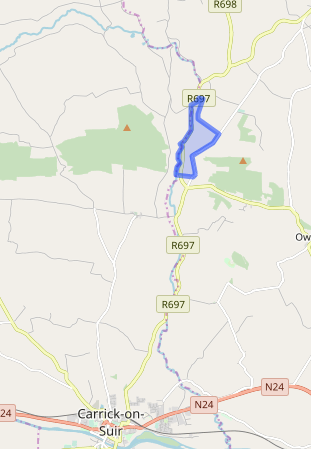
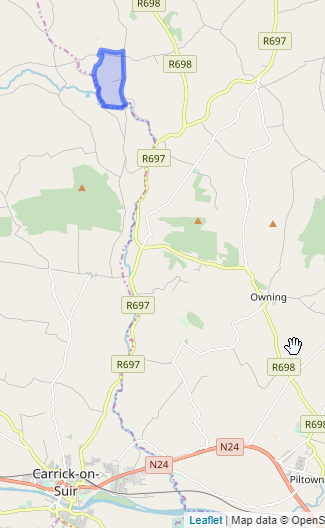
This entry came in handy as I had trouble locating the Townland of Poulrone on a Google Map. Here is the location of Tullahought:

The correct Poulrone is to the North of Mooncoin in the Roman Catholic Parish of Windgap.

More Details of the Right Poulrone

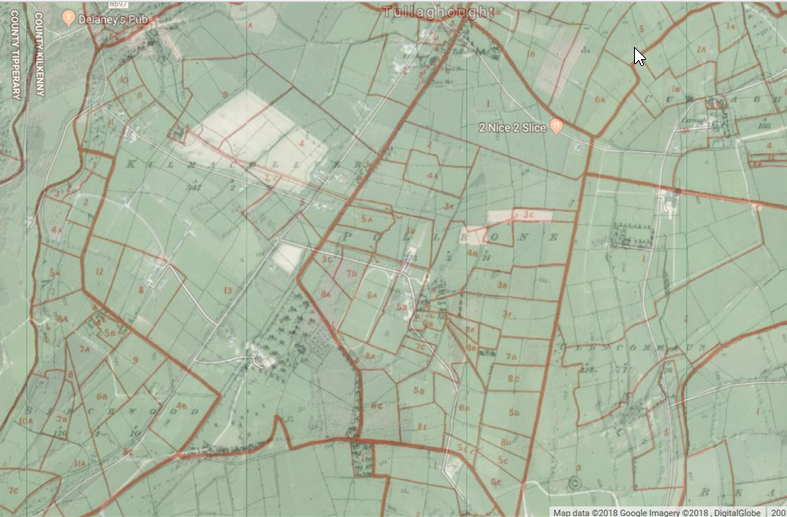
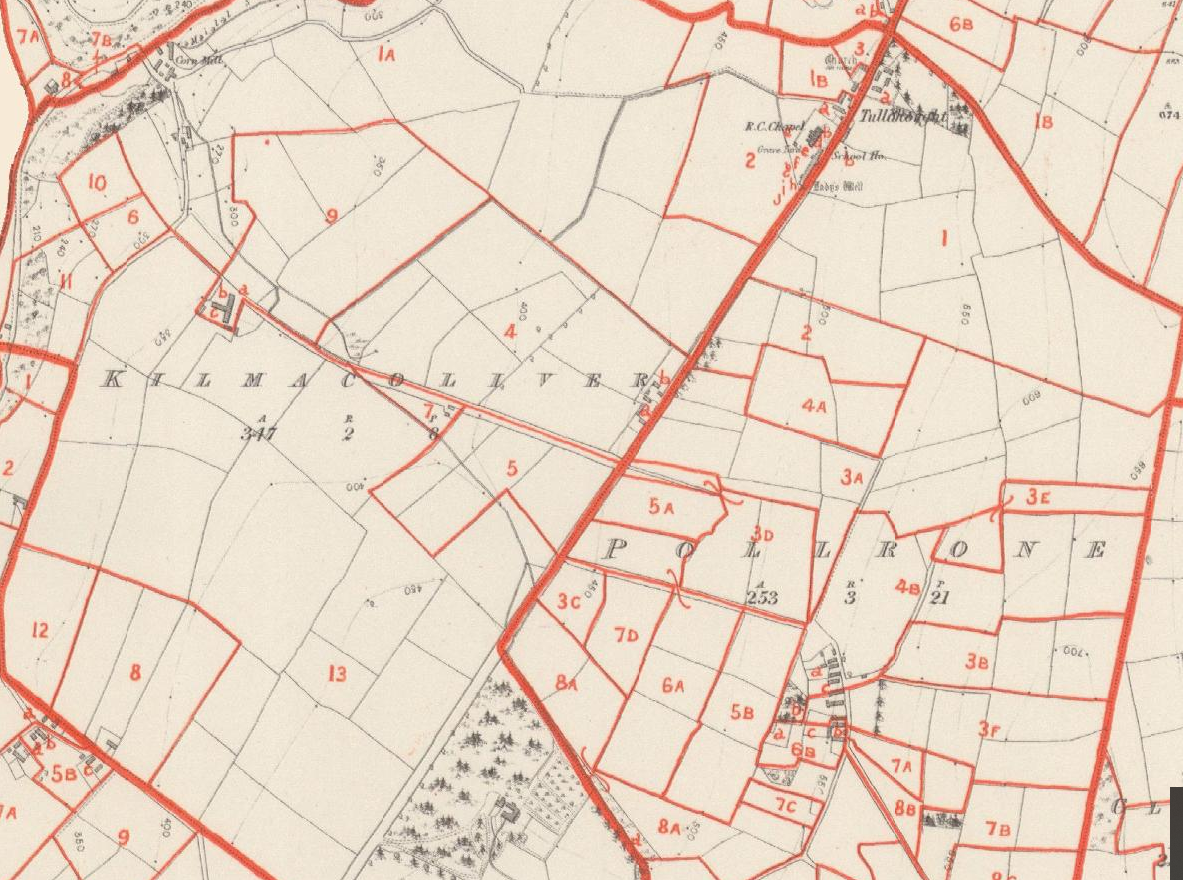
Peter supplied me with this map:

Tullahought is named at the top center of the map at the intersection of heavy red lines indicating Townlands. The upper left of the map shows the boundary between County Kilkenny and County Tipperary. The Butler’s Poulrone is the Townland in the middle of the map. The Butler’s farm would have been one of the numbered lots within Poulrone.

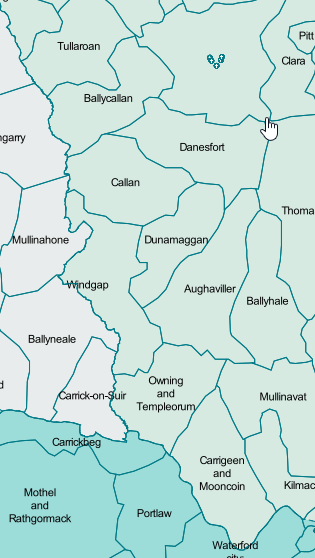
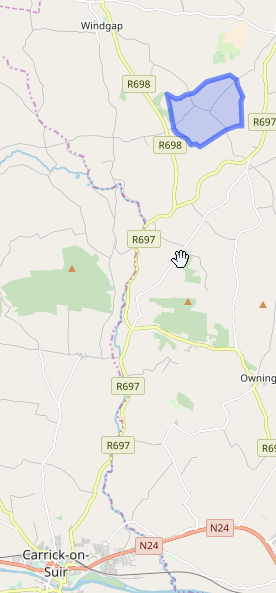
Windgap Parish Map

Here is the Parish of Windgap on the Western border of County Kilkenny:

Records Linking Butlers to Poulrone

I’ve given the geography, but what are the records linking the Butlers to Poulrone?

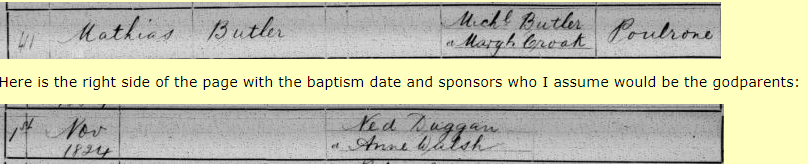
The first record is from 1824:

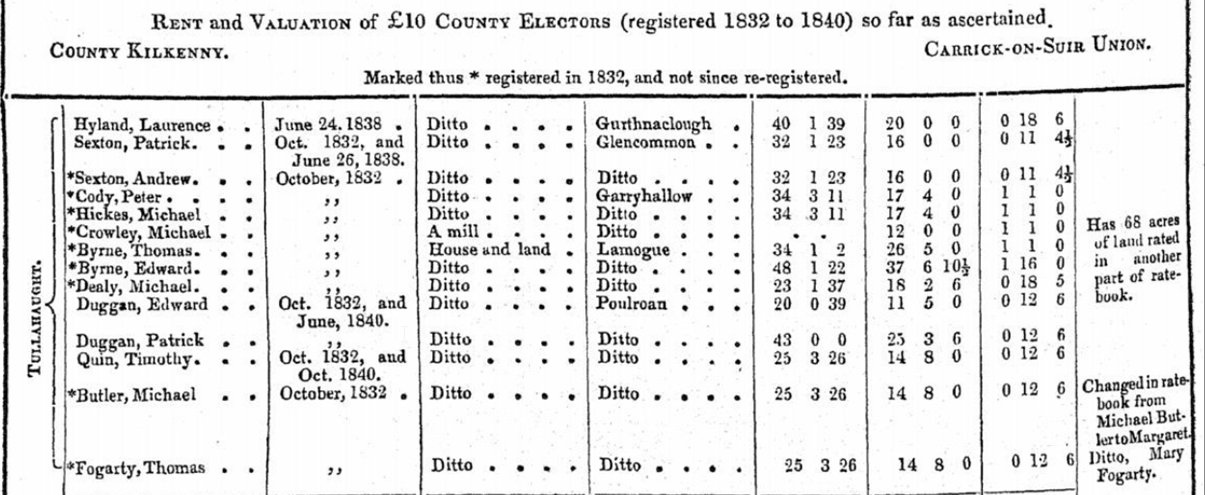
Eight years later, here is some information from 1832:

The bottom right note indicates that Michael likely died and Margaret was in charge of the farm in Poulrone. There is an * by Michael Butler’s name which indicates that he did not re-register after 1832.

The Tithe Applotment

The Tithe Applotment has two listings for Michael Butler in the Civil Parish of Tullahaught:

Unfortunately, the Townlands are not transcribed well. Poocrown should be Poolrown and Birchwaad should be Birchwood. Here are the listings for Poulroan:

  1. Thomas Croke
  2. Edward Duggan
  3. Patrick Duggan
  4. Michael Butler
  5. David Fogarty
  6. Edmund Quinn
  7. Johanna Quinn, widow
  8. Thomas Broderick

Butler in Birchwood?

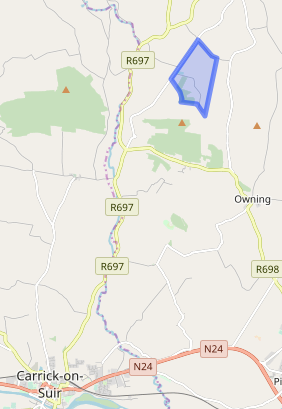
The Tithe Applotment also lists a Michael Butler in Birchwood. Is this the same as the Michael Butler from Poulrone?? If the Birchwood is adjacent to Poolroan, then I would say so. Here is Birchwood:

It looks to be on the River that separates County Tipperary from County Kilkenny. At www.townlands.ie, Poulrone is listed as Pollrone.

Using the map triangles as a reference, it appears that Birchwood is separated from Pollrone by a Townland. It looks like the two Townlands are separated by Kilmacoliver . That means that I can’t tell if this is the same Michael Butler.  Here are the heads of families in Birchwood:

  1. James Moore
  2. Patrick Moore
  3. Thomas Moore
  4. Patrick Kearins
  5. Michael Butler

Birchwood is transcribed as Birchwaad or Burchwad at the National Archives website. I would say that this is the same Michael or a relative.

Griffith’s Valuation

The next records to look at are Griffith’s Valuation. This was published 1849-1850 for County Kilkenny. Here is the Valuation in Pollrone:

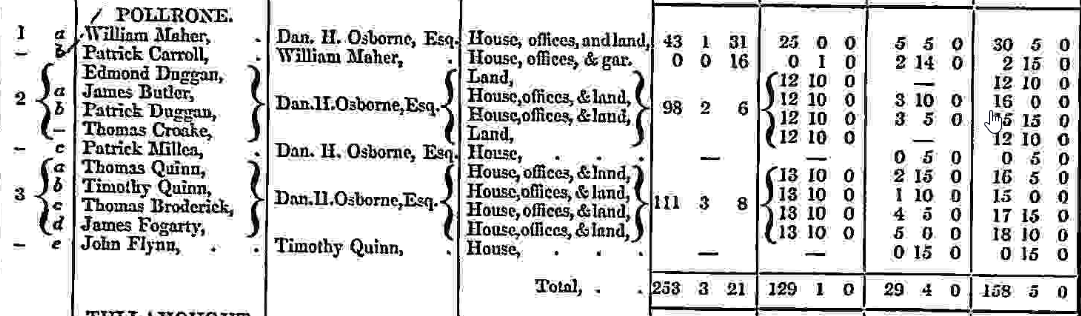
The presumption is that James Butler is the son of Michael Butler and Margaret Croke and that he is living in the same house he was brought up in. He is on a 98 acre farm, but it is shared with Patrick Duggan who also has a house on the property. Further Edmond Duggan and Thomas Croke own some of the land. It is possible that all these people are related.

Here is another view of Poulrone, with the Village of Tullahought. James Butler also owned some land in Kilmacoliver. The Roman Catholic Church was in the Northeast corner of this Townland.

More Butlers in Tullahought

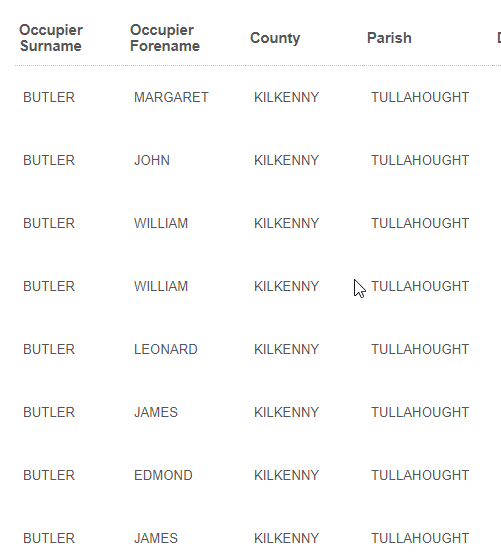
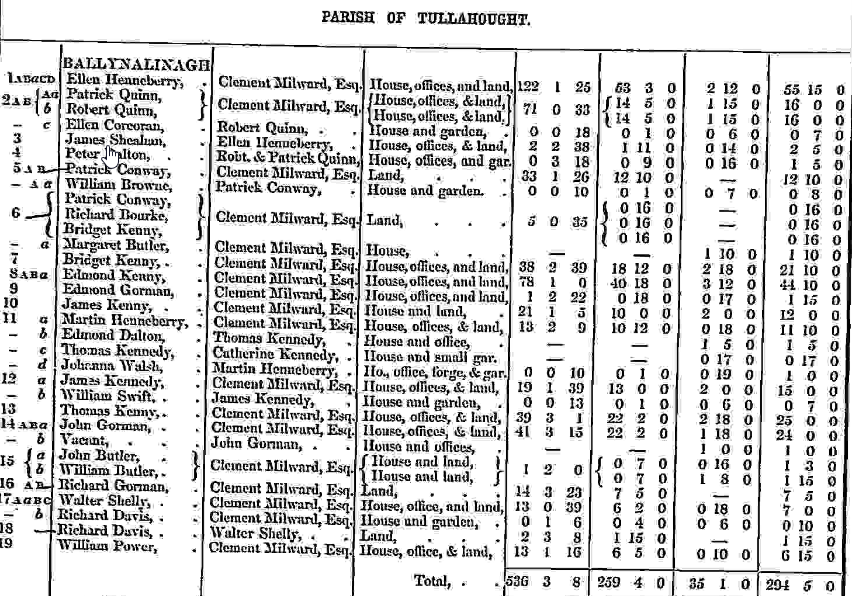
Tullahought is the Civil Parish. These civil parishes were usually in line with the Church of Irleand Parishes, but not the Roman Catholic Parish. So Poulrone would be in the Roman Catholic Parish of Windgap and the Civil Parish of Tullahought. A search for Butlers in Griffith’s Valuation in Tullahought brought this up:

I wonder if the Margaret above was Margaret Croke Butler?

This Margaret is presumed to be a widow. She is on Lot 6a where the land is owned by Conway, Bourke and Kenny.

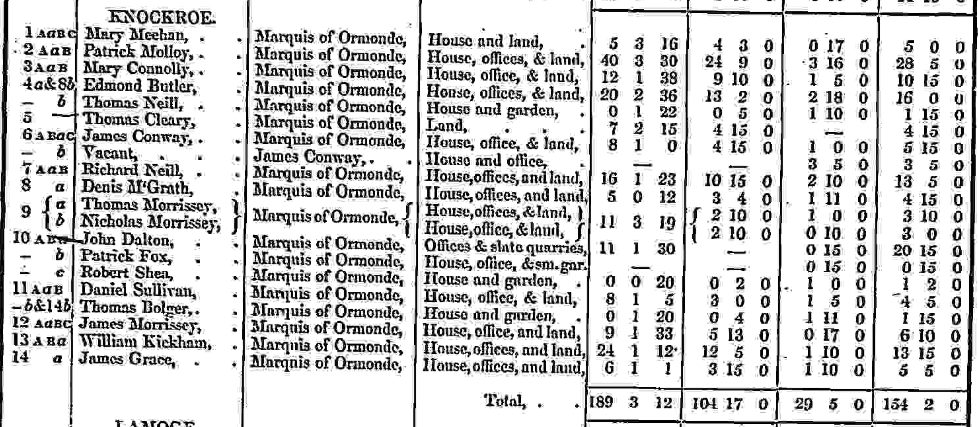
There was an Edmund Butler in Knockroe:

My research helper, Peter, suspects that the immigrant Butler Edward was originally an Edmond. Here is Knockroe:

Poulron in 1901

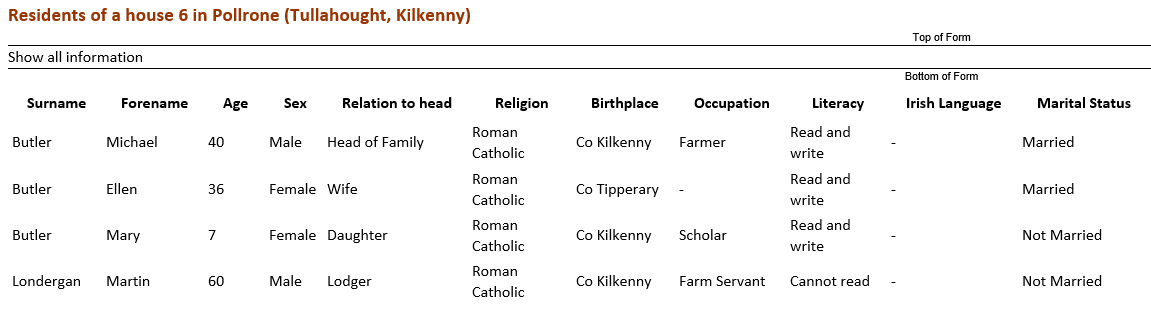
My research doppelgänger from England, Peter, went on to the next logical step. He looked at the 1901 Census:

This is very likely the same Michael:

His sponsors were Patt and Mary Duggan. Michael was likely named for James father Michael. These Census ages were not always dependable. Michael, who is listed as 40 in 1911 would have actually been 52,

Michael has a wife Ellen born in Tipperary, which was only a few Townlands away. Michael died between 1901 and 1911. Here Elllen is a widow in the 1911 Census of Pollrone:

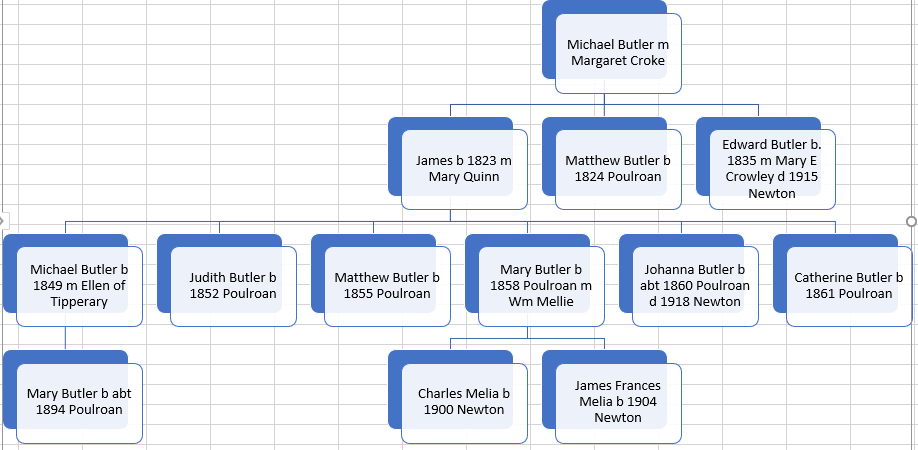
A Butler Tree

From this, I get a tree of the Poulroan Butlers:

Any Other Butlers? One or Two Michael and Ellen Butler?

Maybe. Here is an Edmond from Knockroe:

Not likely a good candidate as the James Butler I’m interested in would have only been 16 in 1867 at the time of this birth. A Knockroe James Butler born in 1869 is also problematic:

I see also a Margaret born to this couple in 1873. Then Ellen born 1876 and Bridget born 1878.

Peter’s Latest Find; a Lamogue Wedding

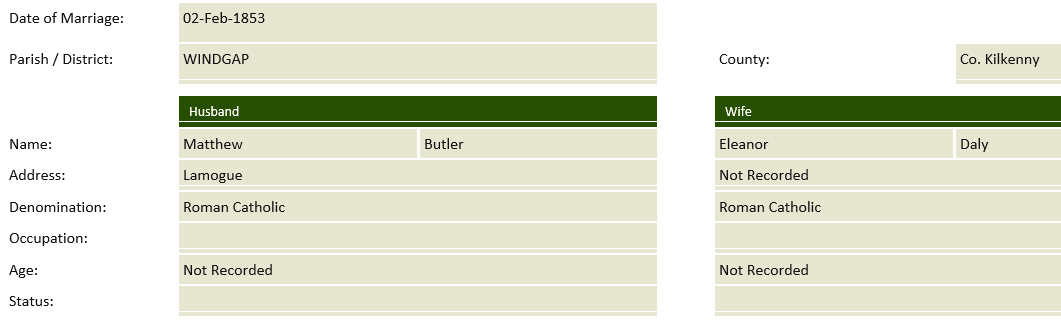
While I was pondering whether there were one or two Michael and Ellen Butlers, Peter sent me this information from Lamogue:

This appears to be the wedding of Mathias/Matthew Butler with his brother Edward as witness.  If this is the same Matthew, he would have been 28 at the time of his marriage. I checked my wedding date for Edward Butler. I have that he got married in St. John, New Brunswick on 1 May 1855. So that could be.  I don’t get from looking at the Windgap Parish records that the Parish was a large one nor that there were too many Butlers in this particular Parish.

Here is Lamogue:


Summary and Conclusions

The discovery of the Butlers in Poulrone has come as a slow development rather than an all at once discovery. The Butler family has long believed that they were from Kilkenny. However, the assumption was that they were from the County Town rather than the rural area of Poulrone. The first record of a Butler in Poulrone was from 1824, but the Butlers could have been in the same area for quite some time. It is possible that there are some lease or rental records for the land they lived on.  I only see a record of one Butler daughter in the 1901 Census. Was this the last of the Poulrone Butlers, or were there others in the area?

Peter found a Matthew Butler who appears to be the other brother of James and Edward Butler. He married in 1852 in Lamogue. A lot of information has been added to the Butler research. The trick will be to further analyze and verify the information. Were there one or two Michael and Ellen Butlers? Was the Margaret Butler in Griffith’s Valuation Edward’s mother, Margaret Croke?

Addendum

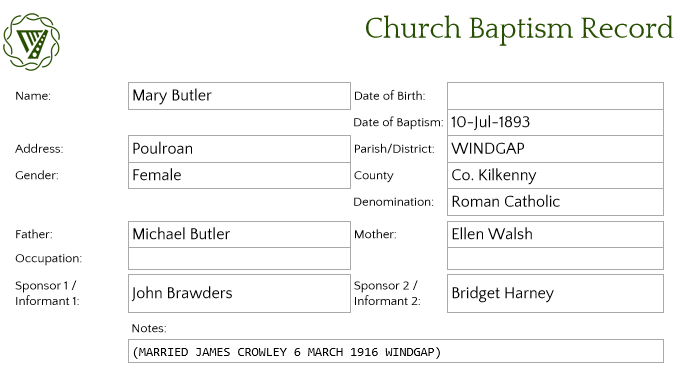
After I wrote this, Peter found some more information:

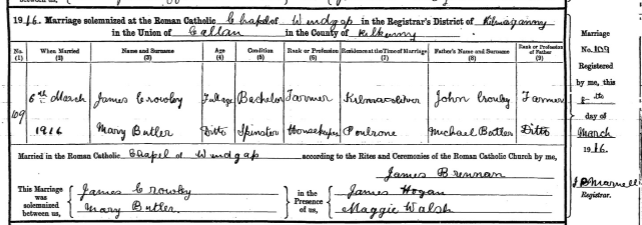
Michael was married to Ellen Walsh. There was apparently another Michael Butler who married an Ellen Shea. This Mary Butler married James Crowley.