More on Emily’s Frazer DNA

In March, I wrote my first Blog about Emily. She is a 2nd cousin, once removed who tested her DNA at MyHeritage. Emily and her daughter Mel who are related to me on my Frazer Line have also uploaded their DNA results to Gedmatch. MyHeritage does not show X Chromosome results but Gedmatch does.

The X Chromosome

The X Chromosome is interesting as it is not inherited from father to son. As a result, when there is an X Chromosome match with someone, it is possible to narrow down where that DNA came from.

Here is how my sisters and I are related to Emily:

Note that cousin Paul got no X Chromosome on his father’s Frazer side. Also Joel, Jon and Jim got no Frazer X Chromosome. That Leaves Emily, Melanie, Heidi, Sharon and Lori.

McMaster DNA from the X Chromosome

A further interesting point is that if Heidi, Sharon, or Lori match Emily by the X Chromosome, then it would have to be from Margaret McMaster, born 1846. How do I know that? Emily got her X from Susan Fairbanks. Susan got hers from Violet Frazer. Violet Frazer got an X from George Frazer and Margaret McMaster. However, my sisters got their Frazer X from their dad. He got his only from his mother. Marion Frazer got her Frazer X DNA from her dad. James Frazer got his X DNA only from his mom Margaret McMaster. Therefore if Emily matches Heidi, Sharon, or Lori by X Chromosome, it has to be from Margaret McMaster.

Emily’s X Chromosome Matches with My Sisters

I will just be considering Emily as Melanie got half her DNA from her mother. Here is how Emily matches Lori, Sharon and Heidi on the X:

That means that Lori, Sharon and Heidi each have about 38 cM of DNA from their 2nd great grandmother.

Painting Lori

It is possible to paint or map Lori’s match using a great utility called DNAPainter:

While I’m at it, I’ll map Lori and Emily’s other non-X matches:

The blue side represents Lori’s paternal side and red is her maternal side. The greenis segments represent either George Frazer or Margaret McMaster. We can’t tell which right now. The blue indicates that we know that particular DNA is from Margaret McMaster.

Emily and My Brother Jim

I mentioned Emily and my brother JIm in my previous Blog. Even though Jim was the sixth of six siblings tested in my family, his DNA test showed he had some Frazer DNA that the other five siblings did not have. Jim’s unique Frazer segment is on Chromosome 5 as shown with his match with Emily below:

As shown in the lower left key, Jim’s matches with Emily represent DNA they both have from George Frazer and Margaret McMaster.

Going Back a Generation

Jim also matches Gladys. She is a third cousin once removed. Jim and Gladys’ common ancestors are James Frazer and Violet Frazer. From what I can figure out, these were first cousins that married each other.

This couple in yellow were the parents of George Frazer. What is interesting to note is that the match with Gladys and Jim overlaps the match with Emily and Jim on Chromosome 5. That would be considered triangulation. This indicates that this match is actually from older Frazer DNA. This also tells me that the blue DNA that Jim matched with Emily is actually Frazer and not McMaster DNA.

In theory, the DNA segments that are older should be smaller and more broken up and the DNA segments representing more recent ancestors should be larger. However, the DNA didn’t read that section on DNA theory. In practice, larger segments sometimes get passed down from many generations ago.

Next up: more painting or mapping of Lori and Jimmy’s DNA.

My Brother Jimmy’s DNA

Jimmy is the my last brother to have his DNA tested. I cornered him on his recent trip with his wife to visit my 96-year-old mom. I had an FTDNA kit, so that is the test he took.

Is Our DNA the Same?

This is a common question that Jimmy had when testing siblings. Siblings get 50% of their DNA from each parent, but it is a different 50%. I believe that we also share 50% of the same DNA with each sibling. Here is how Jimmy compares to his five siblings in a chromosome browser:

Each color represents one of Jimmy’s five siblings. From the browser, it looks like Jimmy shares more than 50% with each sibling. That is because the browser combines our maternal and paternal DNA. We actually have two copies of each chromosome. However the DNA cannot discern between the maternal and paternal side. I have had my mom tested for DNA. If my father had been alive for DNA testing, Jimmy’s DNA would not have been as important. Even with six siblings tested, it is possible that some of my father’s DNA did not get passed down. One child gets 50% of the father’s DNA. With the second child tested, that goes up to a theoretical 75%. Third child is 87.5%. A fourth is 93.75%. A fifth is about 97% and a sixth is about 98.5%. That still leaves out about 1.5%. That may not seem like a lot. I match my mother at 3,587.0 cM. 1.5% of that amount is about 54 cM. Most of my matches are less than that amount. With a math of 50 cM, the relationship should be fairly easy to figure out. Below that amount, it may be more difficult.

The fact that Jim matches half of each sibling is shown best on the X Chromosome. The X Chromosome for a man is just on the mother’s side. Here is how Jim compares to Jon and Joel:

Jim’s match with Jon is in orange. He matches at about half of the X Chromosome but in different places until the end. There, Jim, Jon and Joel match each other near the end of the  X Chromosome. This will be more fully explained later in the Blog.

Jimmy’s Ethnicity

The map seems fairly reasonable. There is 3% Middle Eastern which is difficult to explain. My mom has a lot of German, so perhaps, some Middle Easterners made their way up to Germany at some point.

Jim’s Ethnicity at Gedmatch

Depending on which testing company or which model, Jim’s results could come out differently. Here is Jim at Gedmatch’s Eurogenes K13 Admixture Proportions:

Jim noted that Heidi had no Middle Eastern at FTDNA. Here is Heidi at Gedmatch:

Here Heidi has more East_Med than Jim and has Oeanian instead of Amerindian. Heidi also has no Red_Sea which I take to be Middle Eastern.

Jim’s Unique Frazer DNA

Emily is Jim’s second cousin once removed.

This is an old tree, so I need to add Jimmy to the lower left box.

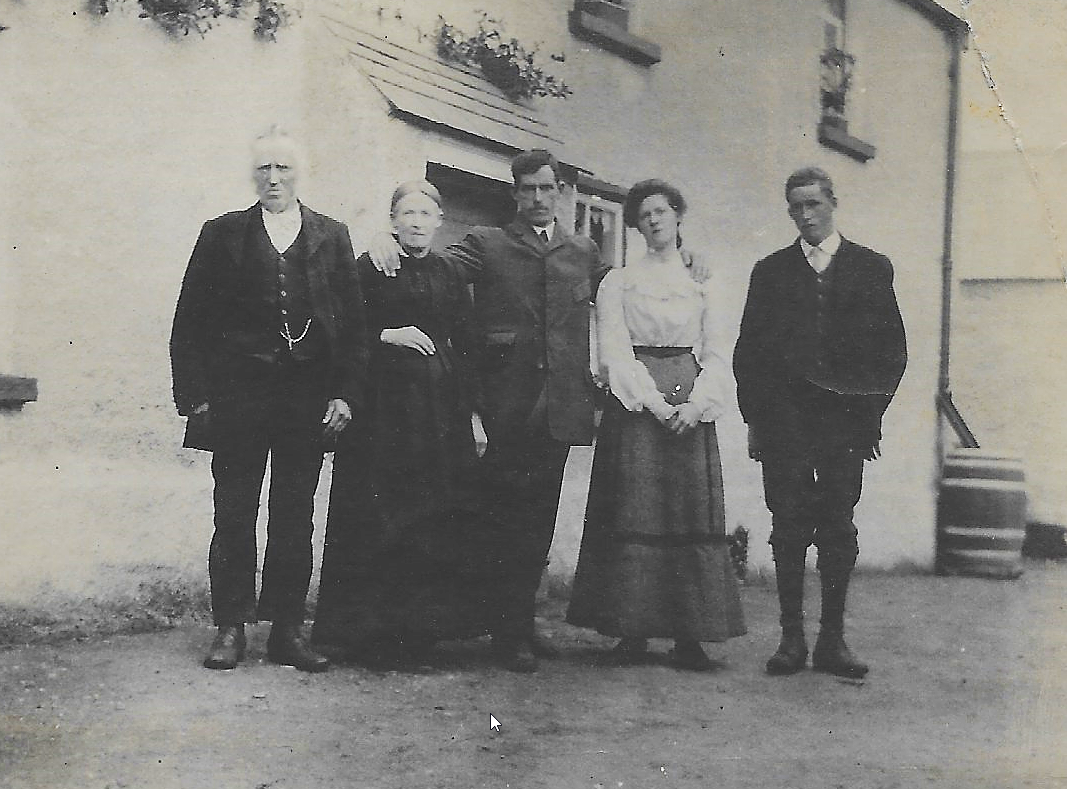
Emily’s grandparents are in the middle of the photo. The two on the left are our common ancestors: George Frazer and Margaret McMaster. I uploaded Jimmy’s DNA to Gedmatch. Then I ran checked to see how Emily matched me and my 5 siblings. Surprisingly, on Chromosome 5, Emily matches Jimmy and none of the other 5 siblings:

This shows that Jimmy and Emily have a large math on Chromosome 5 for 57 cM between positions 109M and 166M.

For comparison, here is how Emily matches Joel, Lori, Jon and Heidi on Chromosome 20:

Emily doesn’t match Jim or Sharon here as they probably got their DNA from the Hartley rather than the Frazer side at this part of their Chromosome 20.

A Map of Chromosome 5

This map will give an explanation of how out of six siblings, it was only Jim hat matched Emily on Chromosome 5.

This map has me and my two sisters. The light red is our Frazer side and the dark red is the Hartley side. The top line shows my father’s Hartley and Frazer side. Note that there is a cross-hatched section in the lighter red in the top line. That is where there was Frazer DNA missing that was not passed down to these three siblings. However, JImmy has made up for this by having Frazer DNA in this segment of his Chromosome 5.

Mapping Jim’s X Chromosome

Men only get one X Chromosome from their mother. That means it should be fairly easy to map Jim’s X Chromosome. Here is how the three brothers compare on the X Chromosome:

The green with blue underneath is where there is a match. The red where there is no blue underneath is where there is no match. Next, I added position numbers and crossovers. Crossovers are where are DNA crosses to what we got from one grandparent to what we got from another. In this case, these are maternal grandparents, so that would be either Rathfelder or Lentz.

Jim gets the first crossover. This is because at position 12, Jim is in the first two changes. He goes from non-match to match with Jon and from match to non-mathc with Joel at position 12.

In the next step, I color in the DNA Fomr Jim, Jon, and Joel. Jon and Joel match from 100 to 140, so I’ll color that one color. Jim does not match Joel or Jon in that area, so he will get a different color.

These colors will stand for Rathfelder or Lentz, but we don’t know which is which yet. However, I’m curious, so I’ll check. I notice that Jim has an X match with Anita from Latvia. She is a Rathfelder-descended cousin that I found out about recently through DNA. Here is her match with Jim:

That means that Jim’s orange is Rathfelder. These colors can be expanded to the crossovers. Jim has a crossover one segment to the left and none to the right. So I can extand the orange.

Blue has to be Lentz, and this can also be extended.

Note that Joel had crossovers on both side, so the blue could not be extended. However, on the other side of the crossover, I have to go toi Rathfelder as that is the only other choice. In this way, the map can be filled out. Here is a quick X Chromosome map for Jim:

It is possible to check the matches and non-matches above to make sure that they and the map agree. This is quick, but it is accurate? I had someone map my X Chromosome by a different method and he got this:

Based on this, my mapping is accurate on the right side of the Chromosome, but not on the left. This shows that I have a crossover at 23. Sometimes what looks like a crossover for one sibling is actually a crossover for the other two siblings. That is what appears to have happened at position 23. The crossover was probably for Jon and Joel.

So, under the above, Jim has three X segments, Jon has four and Joel has five.

Splitting JIm’s DNA

Because I had my mom’s DNA tested, I can split JIm’s DNA into two. Gedmatch has a utility called a Phased Data Generator:

I put Jim’s kit in and Mom’s and out pops two new DNA kits. One is Jim’s maternal side and the other is Jim’s paternal side. This represents most of the half of the DNA he got from mom and the half from dad. These are useful, because now we can tell when there is a DNA match whether it is on the maternal or paternal side. The matches that are on neither side are most likely not good matches. Here is an example:

Jim’s paternal matches are in blue and the maternal in red. The ones with no color are from FTDNA, so I haven’t figured those out yet. The green matches are the matches of 15 cM or more.

Next Steps

By further DNA mapping, I would be able to tell on which grandparent side each of Jim’s matches are on. I will already know that for Jim’s X Chromosome matches. Here an example. Jim matches Richard here:

We know that Jim is mapped to Lentz in this segment from the mapping above.

I’ll also see how Jim matches those in the Frazer DNA Project I have been working on. In addition, we’ll see how he matches different paternal matches. I’m currently stuck on the Hartley and Spratt side of our genealogy, so perhaps Jim’s DNA results will help there.


A First Look at Rodney’s BigY500 Results – a Third Frazer BigY

I had some good news recently. Rodney’s BigY500 results were in ahead of schedule.

Rodney’s Genealogy

Here is Rodney with other Frazer that have had YDNA testing. Paul, Rodney and Jonathan have taken the BigY test and Rick has taken the STR test.

Frazer SNPs

Currently, the SNP that defines this whole Frazer line is R-YP6489. This is part of the R1a group. With the addition of Rodney to BigY testing, we should be able to get a new SNP that defines the James Line Branch and more specifically, the Thomas Henry Frazer Branch. This testing is bringing us into relatively modern times.

Paul Compared to Rodney and Jonathan

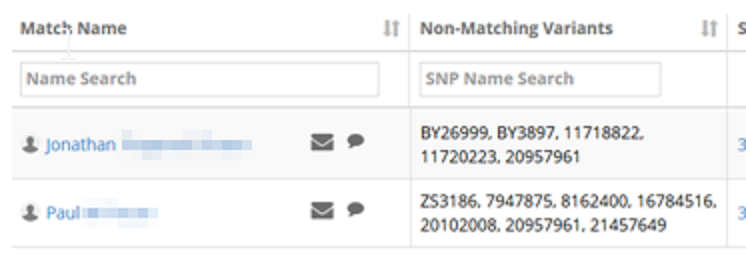
When I compare my cousin Paul to Rodney and Jonathan I see this:

Paul has these Non-Matching Variants compared to Rodney and Jonathan:

  • 7947875
  • 8162400
  • 16784516
  • 20957961
  • 21457649

These are likely Variants on Paul’s side (the Archibald Line) which are not on the James Line side of the Frazer tree. The problem with these Variants is that they will not be named as SNPs unless someone else tests positive for them. There are two ways that this could happen. One would be that Rick (from the Archibald Line) takes a BigY test. Or, tests could be requested for each of the variants above and Rick (or another Archibald direct line male descendant) could test for the individual SNPs once there is a test protocol.

Looking for the James Line Variant

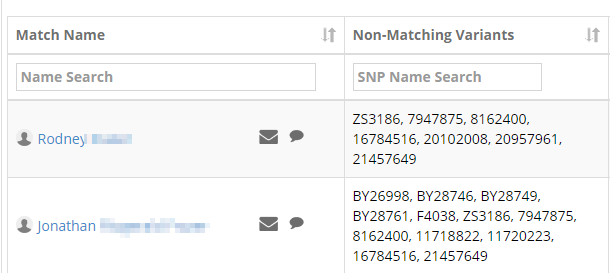
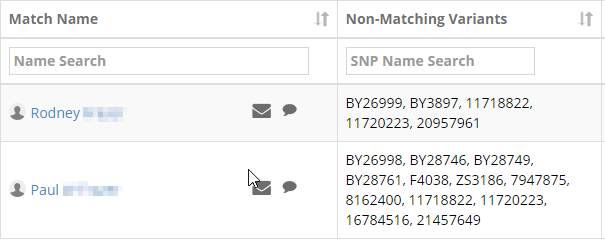
Where is the Variant or Variants that will define the James Line? Here is what Rodney’s niece Kim sent me. This is how Rodney compares to Jonathan and Paul. The comparison is by non-matching variants which is a bit confusing. The non-match could be on Rodney’s side, Joanathan’s or Paul’s sides:


What I am looking for is where Rodney does not match Paul. I want these to not include the Variants that I have listed above representing the Archibald Line. That leaves:

  • ZS3186
  • 20102008

These would be potential candidates for the James Line

Here are Jonathan’s matches:

These appear to be unique to Jonathan:

  • BY26998
  • BY28746
  • BY28749
  • BY28761
  • F4038
  • ZS3186
  • 11718822
  • 11720223

I was hoping that these lists would match up better. Rodney’s results have been uploaded to YFull for analysis, but the analysis is not yet done. It could be that there is an issue on how these variants were reported. The only Variant in common is ZS3186. However, this is a named variant which would probably not be used for a new branch.

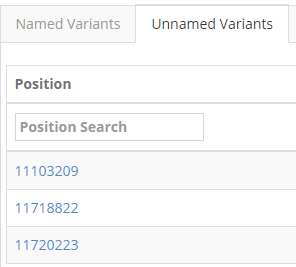
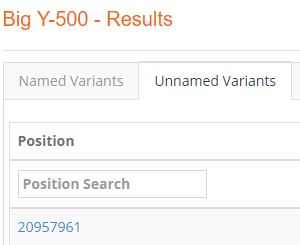
Further, Jonathan has this list of Unnamed Variants:

Here it seems we are dealing with a lot of double negatives. Jonathan’s results report Variant 11103209. As this is not on Jonathan’s list of Non-matching Variants, should I assume that Jonathan has this variant in common with Rodney and Paul? I’m confused.

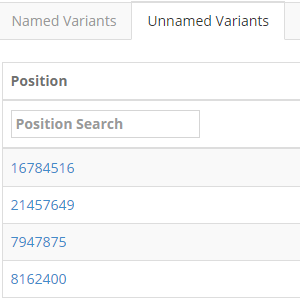
Here is Paul’s list of unnamed variants:

This matches pretty well with my original list for Paul, but it does not include 20957961.

ZS3186

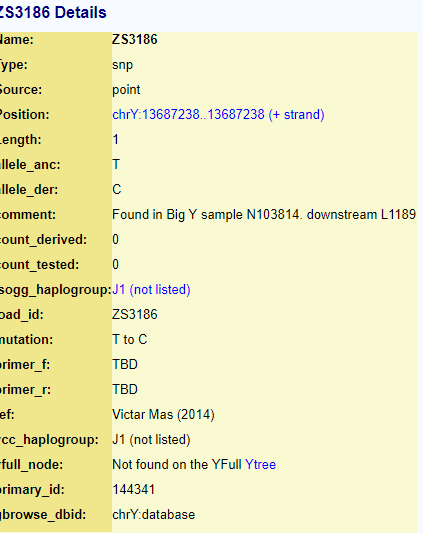
ZS3186 was shared by Rodney and Jonathan but not Paul. However, this is already named. The YBrowse website has this information:

This was found in 2014 but never added to a YTree. It is in the J1 Haplogroup. For this reason, this SNP may be not considered good. Or, it may be determined that the original sample was in error(?) Again, we need some help from FTDNA or YFull in figuring this one out.

Variant 20102008

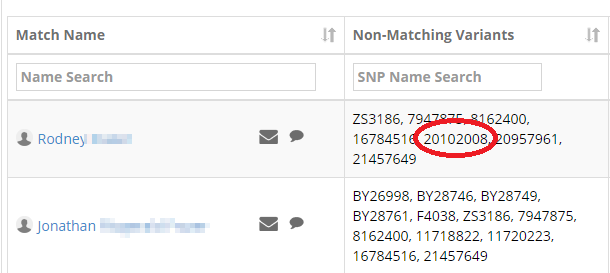
I had listed this Variant above. Is this the defining James Line Variant? This is not on Paul’s list of unnamed variants. This is good as Paul is from the Archibald LIne. 20102008 is shown as a non-matching variant between Paul and Rodney, so that leads me to believe that Rodney has this variant. However, 20102008 is not a non-matching variant between Paul and Jonathan. This would lead me to believe that Jonathan does not have this variant.

Frazer Variant Summary

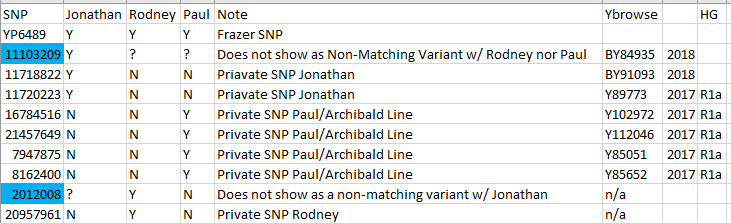
This left me a bit confused, so I found out Rodney’s Unnamed Variants. Here is a summary of the three tested Frazers:

Hopefully, I can explain the inconsistencies in blue. The first row is YP6489. All the Frazers have this SNP and it currently defines the project.

Variant 1103209

The second row shows that Jonathan has Variant 11103209. This is actually a double discrepancy. Rodney and Paul do not show this Variant listed on their results but neither do they show this as an non-matching variant with Jonathan. Here is what I believe happened. The results for Rodney and Paul were inconclusive. As a result, the first go at looking at this variant was not enough to list this variant for Rodney and Paul. However, due to the uncertainty, it could not be clearly said that this was a non-matching variant between Jonathan and Rodney and Jonathan and Paul. By looking at the raw test data, it may be better to come up with a better analysis. Right now, this does not look like a defining Variant for the James line if there is some question as to whether Paul has this Variant.

Variants 11718822 and 11720223

These Variants appear to be Jonathan’s private SNPs. Jonathan is positive for them, but Paul and Rodney are not. That means that these likely formed in Jonathan, his father or grandfather after the time of Rodney and Jonathan’s common ancestor Thomas Henry Frazer born 1836. Once YFull has done their analysis, they will give an estimated date of SNP formation and an estimated date of common ancestor. The SNP formation is always the older date. In this case, we know the date of the common ancestor: 1836.

More on Dating

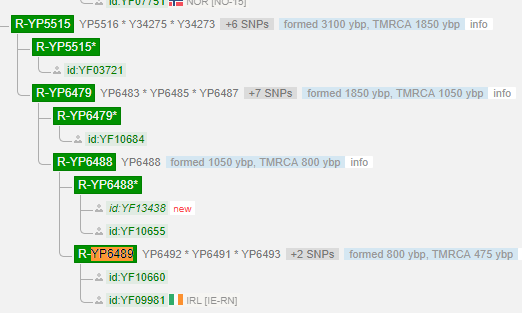
While I’m on the subject of dating. Here is the present Frazer tree going back over 3,000 years:

Jonathan and Paul are at the bottom of this YFull YTree. Based on their BigY testing alone, it was estimated that the SNP YP6489 was formed 800 years ago and that Paul and Jonathan had a common ancestor 475 years ago. This is to illustrate that the SNP formation is before the common ancestor. Going up one step is YP6488. This was formed 1050 years ago. There was a common ancestor there 800 years ago. I assume that this date fits into the formation date of YP6489 800 years ago.

Paul’s Private Variants – The Archibald Line

Paul has four private variants. These formed in the Archibald line between the time of Archibald Frazer born around 1690. The Archibald Line needs another person to test to have some of these Variants named as defining SNPs for the Archibald Line.

Rodney’s Variants

Rodney’s first Variant 2012008 has a question mark under Jonathan. That means that there is some question on Jonathan’s read. However, the fact that Paul was negative for this Variant makes it looks like this could be the new defining Variant that gets named as the SNP for the James Line. Rodney’s second Variant is common to only him at this time. Like Jonathan, this variant formed in either Rodney, his father or grandfather.

This appears to be Rodney’s only Private Variant:

What’s Next?

Kim has uploaded Rodney’s BigY500 to YFull for further analysis. YFull will get this information onto their tree. They will give age estimations and produce 500 STRs from the results. FTDNA will also be doing further analysis on the results. In addition, the R1a administrators will take a look at the results. However, they will like be interested in seeing what FTDNA and YFull have to say.

Summary and Conclusions

  • Rodney’s results show that there are some clear SNPs that could be added to define the Archibald Line. However, as Paul is the only Archibald LIne BigY500 tested person right now, these SNPs will not be named.
  • The James Line results are not as clear. Interpretaion of the results are needed. It is likely that Variant 2012008 will be a new defining SNP for the James Line for the Frazer DNA Project. It appears that this SNP occured between James Frazer born about 1720 and Thomas Henry Frazer born 1836.
  • We need to wait and see if FTDNA and YFull come up with further analysis.

BigY Moves Whitson/Butler Project 2,850 Years Toward the Present

Rick noticed recently that his SNP had changed at FTDNA where he had his BigY tested. His most recent SNP went from Y136556 to Y128591. This SNP change was based on FTDNA’s comparison of Rick’s results with my late father-in-law Richard’s BigY results.

New SNP Y128591

Here is how Richard and Rick now match at FTDNA:

This is added a new branch to the human race. This branch includes Rick with Whitson ancestry and Richard with Butler ancestry. Previously the branch ended at I-Y136556.

YFull Dating: a 2,850 Year Improvement

Here is the new YFull Tree:

Before Rick tested, Richard matched at I-Y136556. Richard had and has a common ancestor with a person with Russian heritage. The estimated date of Richard and the Russian person was 3900 ybp (years before present). Now Richard and Rick have a common ancestor estimated at 1050 ybp.

How did this change? Ricard and Rick match on 20 SNPs. These are 20 SNPs that they do not match with the Russian person. YFull estimates that a SNP is formed about every 144 years. 144 X 20 is 2,880 years. That is the simple match. That should mean also that in the past 1050 years, Rick and Richard should have about 7 SNPs that do not match.

The FTDNA Haplotree

The FTDNA Haplotree is equivalent to YFull’s YTree:

This points out some areas of difference. FTDNA has 22 SNPs that Rick and Richard share versus YFull’s 20.

Y128315 or Y128591?

Also YFull shows a SNP of Y128315 while FTDNA shows Y128591. This is because out of the 20 or 22 SNPs that Rick and Richard match on, one had to be chosen to represent the group. FTDNA chose Y128591 and YFull chose Y128315. FTDNA does have that Y128315 listed three from the end in the box of SNPs above.

Implications of a TMRCA of 1050 Years

1050 years ago most people had no surname. According to Wikipedia, “By 1400, most English and some Scottish people used surnames.” That means that the common ancestor that Rick and Richard had would have been about 450 years before surnames were commonly used – depending on the area. That means that based, just on Rick’s and Richard’s testing, the Whitson and Butler name could have arisen independently. Prior to Rick’s BigY results, there was some indication that there was some confusion between the two surnames due to adoption or other issues over the years.

It would be interesting to know where the Whitson/Butler ancestor lived 1050 years ago. That is something that is not possible to know just based on the comparison of these two BigY tests. However, as more people test within the Y128315/Y128592  Group, it may be possible to find this out.

A Whitson/Butler SNP Tree

It was not too long ago when all we knew was that Whitson/Butler was A427.


At that time, I had predicted that there would be a parallel branch to S23612 that the Butlers and Whitsons would be in. That parallel branch was S17511. The next SNP that came along was Y136556 which includes Russia and Ireland. The I2 Whitsons are possibly from England. Thanks to Rick’s testing we now have a Butler/Whitson SNP – Y128591. Additional testing may reveal other surnames under this SNP. Once Peter’s results are in, I am hoping for a Butler-only SNP that will define the I2 branch of that family. That SNP would be one step down from on the left branch above.

One Other Difference Between FTDNA and YFull

On FTDNA’s Haplotree, I see no Y136556 branch. It appears that FTDNA have incorporated that SNP into S17511 as BY37214.

It is a fairly small distinction, but I like YFull’s YTree configuration better.

Summary and Conclusions

  • My biggest takeaway is that Butler and Whitson do not appear to be as closely related as previously thought. The common ancestor between the Butler and Whitson based on this comparison was 1050 years before present. That would be in the year 968 or about in the middle of the Middle Ages.
  • Thanks to YFull, the common ancestor for Butler and Whitson was pushed forward 2,850 years. That is a dramatic difference.
  • It is likely that Peter’s pending BigY results will produce a new SNP for the Butler family.
  • It would be helpful for the Whitson side to have another I2 Whitson test for the BigY. This would likely result in a Whitson-only I2 SNP below Y128591.


More Schwechheimer Genealogy

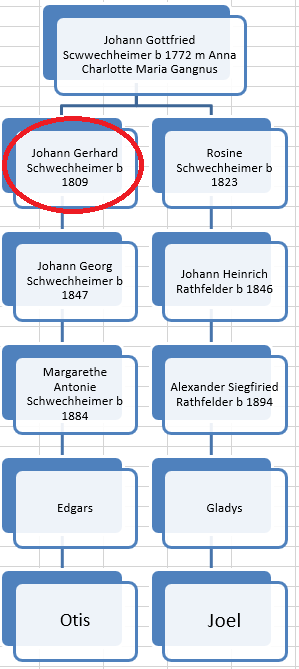
My interest in Schwechheimer Genealogy was renewed this year when I found my mother had a good DNA match with Otis. It turns out that Otis and my mother have Scwechheimer ancestry. These Schwechheimers lived for over 100 years in the German Colony of Hirschenhof in present day Latvia. Through some quick genealogy, I came up with this connection:

Unfortunately, there seems to be a problem on Otis’ side at the point of the circle.

More Than One Gerhard Schwechheimer?

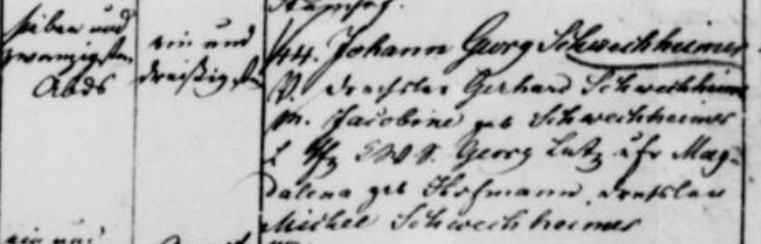
Here is the 1847 birth record I found for Johann Georg Scwechheimer.

Johann Georg’s father was Gerhard Schwechheimer. Before Gerhad, there is either a name or an occupation. I can’t make it out. This Gerhard was married to Jacobine Schwechheimer. This is where I likely went wrong. I had this reference:

This is from a book on the Gangnus family. The next to the last born in this large family was Rosine – my ancestor. I assumed that Johann Gerhard was the same as the Gerhard who was the father of the Johann Georg Schwechheimer above.

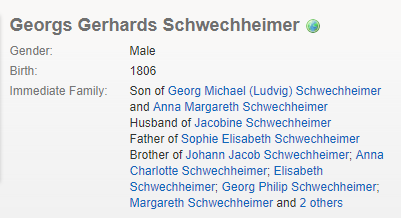
Then I came upon this Geni tree:

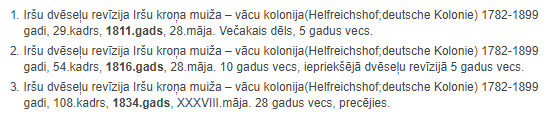
This tree shows that Gerhard’s father was Georg Michael (Ludvig) Schweccheiner. The profile manager, Lāsma, had the following further information about Gerhard:

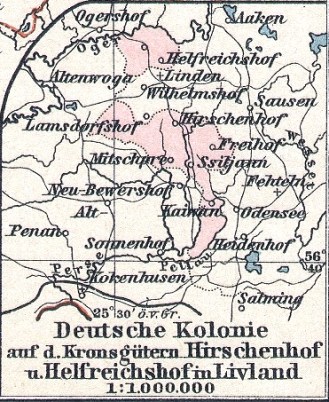
I am not able to read Latvian, but I do get the impression that this person was from Helfreichshof which was the Colony to the North of HIrschenhof.

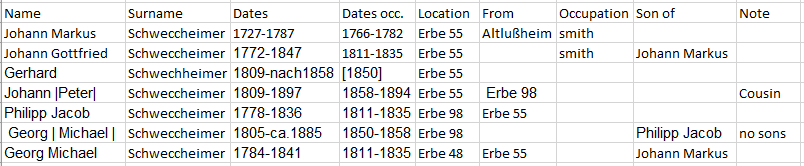
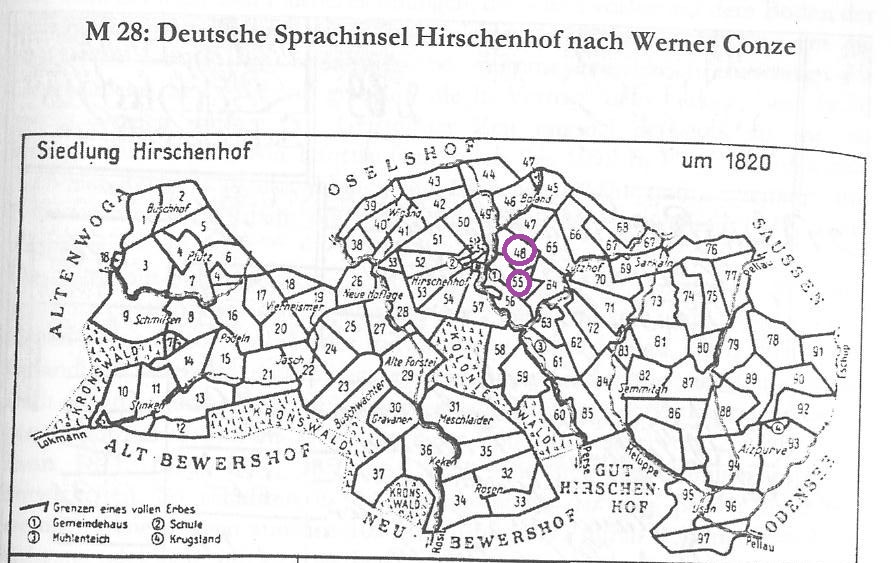
However, a spreadsheet I have created based on an online interactive map of the two colonies indicates that Gerhard’s father, Georg Michael Schwechheimer lived in Hirschenhof on farm # 48:

It looks like the Schwechheimers were neighbors to each other.

Jacobine Schwechheimer

That means that if Otis’ ancestor Gerhard Schwechhemer is not the brother of my ancestor Rosine Schwechheimer, then perhaps Jacobine is Rosine’s sister. The Gangnus genealogy above had Jacobine born in 1807. The problem with this date is that it is between two siblings. Those two siblings were born July 20, 1806 and March 18, 1808. That leaves a slim margin for Jacobine to be born. The Jacobine in the Geni web site was born 1810. This would put her between two siblings born in 1809 and 1813, so that gives a little more leeway. I looked in the Linden Church records and did not see a Jacobine Schweccheimer born in 1807.

A New Tree

Here is the new tree:


In this scenario, I am a 4th and 5th cousin to Otis. This would mean that Rosine and Georg Gerhard were married 1st cousins. First cousins marriages were much more common at that time. This tree is an improvement over my previous one as it accounts for both Rosine and Gerhard Schwechheimer the parents of Johann Georg Schwechheimer. I would like to create a web page concerning my Schwechheimer ancestry. I am 1/16th Schwechheimer or 6.25%. It is interesting to think about how little has been known about this part of my heritage. Or put another way, my Hirschenhof ancestors represent one quarter of my ancestry and Schwechheimer would be one quarter of that Hirschenhof ancestry.

Summary and Conclusions

  • Thanks to Lāsma’s Geni Web Site work on the Schwechheimer family, I have a better tree for Otis who I match by DNA
  • More work could be done nailing down marriage and birth records for Otis’ line
  • I am also grateful to the creator of the Hirschenhof interactive map. This map is useful in tracing where colonists lived and the succession of holders of the different farms. This succession results in a geographical genealogy.
  • Next step is to brush up on my internet and genealogical skills and put up a web page on my Schwechheimer ancestors.

Rick’s Whitson/Butler Big Y YDNA Results

The co-administrator for the Whitson/Butler YDNA Project, Peter notified me recently that Rick had a new SNP designation. This was a hint that Rick’s Big Y results were almost done. Soon after, I saw that Rick’s Big Y results were completed.

What Does the BigY Do?

According to FTDNA, which does the test:

The Big Y-500 is a Y-chromosome direct paternal lineage test. We have designed it to explore deep ancestral links on our common paternal tree. This test examines thousands of known branch markers as well as millions of places where there may be new branch markers. 

On average, YDNA changes about once every 144 years. That means that someone between me and my third great-grandfather probably had a new marker or SNP.

Named and Numbered SNPs

When the SNPs are tested, the results are shown in one of two ways. They are either named SNPs or numbered SNPs. The named SNPs are, for the most part, ones that are common to other people. In the Whitson/Butler YDNA Project, there are six tested men within the Haplogroup of I2.

Each of these six men have a SNP which is M438 or the equivalent P21 or S31. The letter before the number stands for the testing company that discovered the SNP.  The SNP named M438 designates that these men are I2 and not I1 or R1a or R1b. Further, these six men also have the SNP named M436. This used to be called I2a2, but now the branches are named for the SNP test name rather than the branch of I2.

M436 in the above three has its own tree. All the men in the Whitson/Butler Project that are I2 are also M426 and M223:

Here are the I2 men from the Whitson/Butler Project:

Rick’s results are at the top in green. William Whitson is Rick’s ancestor. A green SNP in the last column means that there was a test for the SNP. The red SNP results means that these three men did not have their SNPs tested, but from the STR results, FTDNA is quite sure they are in that branch and would be positive for M223 if they tested for it. In the list above, the first person Rick and the last person, Richard, have their BigY results. Peter has ordered the BigY test, but his results are not yet in. He has previously tested for A427. A427 is to the bottom right of the above tree on the next to the last line.

Why is A427 Germanic and North Slavic?

According to the YFull YTree (see below), A427 formed about 5,000 years ago. That means in the last 5,000 years, A427 descendants had plenty of time to move around. War and famine would be two reasons I coiuld think of to relocate. Climate change must factor in also. That gave time for id FY12481 from the YFull Tree to make his way to Russia and the Whitsons and Butlers time to make their way to Ireland and England.

Here is a portion of a map that Pete sent me today. Pete is in a non-I2 part of the Whitson/Butler DNA Project:

Around 117 A.D., according to the creators of the map, I2a2 centered around a place called Lombardy. It also included the Teutons. However, my understanding is that it could have included the Goths and the Baltic Tribes. So, that general area of the map.

Whitson/Butler and the A427 Branch

Probably all the Whitsons and Butlers that are I2 are also A427. Note above in the Eupdedia I2a2 Tree, that there is a SNP below A427 called Y4884. However that is not the Whitson/Butler Branch. Here is what YFull shows:

The YFull tree shows that quite a few people tested positive for Y4884. However, Richard and Rick are in S17511. This is probably a newer discovered branch since the 2016 Eupedia Tree above. YFull is a bit ahead of FTDNA at this point as it also has Richard in Y136556 which is one step below S17511. Richard is designated with an Irish Flag. There is someone with a Russian heritage that is also positive for Y136556. For that reason, I don’t think that Richard and the Russian will be grouped together for long. I think that Richard and Rick and then Richard, Rick and Peter will form at least one new haplogroup.

Here is a tree I made for a previous Blog. It showed where I expected the new Butler/Whitson Branch to be. We now know that parallel branch is S17511. However, the actual Whitson/Butler branch will be a few levels below that.

The good news is that without doing anything, my father-in-law’s SNP went down the ladder two more steps. This was just based on people who we didn’t know who had Big Y tests. Now we have people testing for Big Y like Rick,  who we expect are related. I would think that the results would be more relevant and bring us into the genealogical time frame.

Naming Problems: Y136556/BY37214

I did not find Y136556 on Rick’s list of SNPs from his BigY test. However, he is positive for BY37214 which is the same SNP with a different name:

Fortunately, the YTree by YFull lists both names:

I think that the BY prefix is the BigY designation, so that may be what will show up eventually at FTDNA.

Numbered SNPs

Numbered SNPs are those that are not yet named SNPs. This is most likely because they are not yet shared with anyone else. Or else, they are shared and no one has gotten around to naming them yet. For example, as I mentioned above, Richard is positive for Y136556. It is possible to go to a website called YBrowse and look this SNP up by name or location:

At the top, I find out that Y136556 is also at position 14,628,410 on the Y Chromosome. Before this SNP was named, it would have been reported by the position number. I also note that this SNP has two other names: Y41633 and BY37214. I’m not sure why there are two Y names.

Acording to YBrowse, Y136556 is not on the YFull Tree. However, I know that it is on the YFull Tree, so they are perhaps having trouble keeping up with all the new SNPs.

A Third Category – Novel Variants

There is actually a third category of SNPs. These are called Novel Variants. I put in a question to the I-M223 Y Haplogroup at FTDNA about Richard’s Y136556 SNP and got the following answer:

The blurred out name is Rick. I was asking why Richard didn’t show as Y136556. The answer is that FTDNA is getting to it. And as I guessed, there will be at least one new branch based on Rick’s results.

One of the ‘Novel SNPs’ that Richard and Rick share is Y128591. I looked up Y128591 at YBrowse and it is at position 2786469. Under Rick’s FTDNA BigY list of downloaded Novel Variants, Rick has 2786469 which FTDNA does not yet show as a named SNP.

With all the testing going on, these haplotrees and SNPs are in a constant state of change.

Rick Matches Richard at FTDNA

FTDNA has specific requirements for who can and cannot match under the Big Y results. Assuming the guy with Russian heritage tested at FTDNA, he did not meet the FTDNA requirements as he does not show as a match to Rick or Richard:

A person is considered a match if they have 30 or fewer differences in SNPs with you, and their haplogroup is downstream from your haplogroup or downstream from your four closest parent haplogroups.

Here is how Rick shows up on my late father in law’s results:

Note that Rick and Richard have 324,704 Shared Variants. Rick and Richard also share Unnamed Variants:


I copied Rick’s and Richard’s Novel Variants and then lined them up to see where they matched and did not match. The matches are in yellow. The Novel Variants that did not match are in green. Perhaps these yellow SNPs are the ones that bring us from 4200 years ago to a more reasonable time frame.

I looked up every SNP location at YBrowse to see if there was a name for the SNP yet. There are no names for Rick’s unique SNPs as he has not uploaded to YFull yet. That is, with one exception. All these new SNP names appear to have been created by YFull. Rick has one SNP that does not match Richard’s which is Y40359. This appears to be an older SNP. Perhaps Richard did not have a good read for that SNP.

One final note is that the above are all from FTDNA’s Unnamed Variants list. That means that FTDNA has not named them. However, in many cases, YFull has named these variants.

Non-Matching Variants

FTDNA has this to say about non-matching variants:

This column displays the known variants (SNPs) within your subclade that you and the specified match do not share.

That means that the Non-Matching Variants could be on Rick’s or Richard’s side. Here are the non-matching variants that Rick has:

  1. A8346
  2. BY31782
  3. 12200779
  4. 15405895
  5. 18999479
  6. 19550845
  7. 19714191

Here are the non-matching variants that Richard has:

  1. 15649019
  2. 20968182

From the above, I see this configuration:

The SNPs that Rick and Richard have in the two bottom boxes are called Private SNPs. That means that they are not at this time shared with anyone else. FTDNA or YFull would not show a tree this way as they only show branching where there is a match in the SNP. When Peter’s BigY results are in, he may form a branch with Rick or Richard. Say that Peter tests positive for all the SNPs in the box above Rick and Richard. Then he also shares some of Rick’s private SNPs. That would put Rick and Peter in a new branch where Rick is now and Richard would go to the box above where I have him now as he would only share those SNPs. One of the SNPs in the box above Rick and Richard would be chosen to describe that branch. My guess is that Peter will be positive for all the SNPs in the box above Rick and Richard, but if he isn’t, then that will also form a new branch under the box that says Russia.

It is interesting that Richard only has two private SNPs. To me, this would indicate that his time to a shared ancestor should be within the genealogical time frame. Going from 5,000 years ago to the genealogical time frame is a big jump. That is part of the allure of the BigY test.

I am fortunate to have two other BigY testers from the Whitson/Butler YDNA Project. Without their results, I would only know that Richard is distantly related to someone with Russian heritage.

A Guess On Future SNP Branching

I checked my old notes on STR trees. STR trees are not as accurate as SNP trees. Here is one I drew a while back:

Assuming that I drew this right,  it appears that 6 Butler (my father in law Richard) would be in the first new SNP group. Below that Rick (1 Batt) and Peter (4 Butler) would be in a SNP group with the common ancestor of BA2 as shown above.

Summary and Conclusions

  • The results are just in and are interesting. However, some waiting is still required while the dust settles
  • FTDNA is working on finalizing a shared haplogroup between Rick and Richard
  • YFull will also come to its own conclusion and come up with some dating estimates once they get the BAM files from the Big Y results.
  • Once the branching has settled out, I expect that there will be some answers and some more new questions.
 

Some of My Hirschenhof, Latvia Genealogy

In my last Blog, I looked at Otis’ DNA and genealogy and how it related to my family. In that Blog, I came up with this for our shared ancestry.

[Note: See update to the above here.]

In this Blog, I’ll take a further look at the Schwechheimer and Gangnus families.

Johann Markus Schwechheimer born 1723 Germany

Johann Markus was the first of the Schwechheimer family to leave Germany for Hirschenhof, Latvia. He was born in Altlußheim bei Hockenheim Kraichgau Baden.

Here is Altlußheim:

Altlußheim is on the Rhine River between Strasbourg, Stuttgart and Frankfurt.

According to http://wolgadeutsche.net/lang/Hirschenhof_Liste.htm, Johann Markus had three wives:

From one web page I read, the colonists were for the most part craftsmen, so did not do so well at farming. However, some lived in Jutland for 5 years where they tried to learn farming, but the farming conditions were not good there.

It looks like Johann Markus had Farm 55:

These lists are important as they trace who lived on the land. Usually, the land would be passed down from father to son. Lot 55 was near the middle of Hirschenhof. It looks like there was a bit of a village to the West of Lot 55. Gottfried Scwhechheimer was a schmied which is a smith.

Here are some other Schwechheimers:

Erbe 101 is in the Colony to the North of Hirschenhof. Jacob Schwechheimer came to own this property around 1880.

Three farms to the West was this family:

The Colony to the North was Helfreichshof:

Here is one more Schwechheimer family in Hirschenhof:

A search for Schwechheimer shows some more:

Georg Philipp was from Erbe 55, so he was probably the son of Johann Gottfried.

This Georg Philipp came from Erbe 55 so I assume that he was a son of Johann Markus. All the above came from a useful interactive map referenced here.

I started to extract some of the information from the occupants of the various Lots:

It appears that Erbe 55 was the original Schwechheimer location, so I started there. I didn’t extract the newer information. From this Lot. I gather that the first three listed were three generations of Schwechheimer living at the same location. This is consistent with what I have in my genealogy program:

The question comes after Gerhard. Why did the land not go to a son of Gerhard? Instead the land went to a cousin from Erbe 98. Here is some more information from Erbe 98 in Helfreichshof:

Johann Gerhard Schwechheimer Born 1809

I have above that Gerhard married Anna Charlotte Marz. This information was from a book “Vom Elsass Hinaus in Die Welt” by Gustav Gangnus published in 2003. In my previous Blog, I had Gerhard married to Jacobine Schwechheimer:

Of course, both of these could be true. Gerhard also had a sister named Jacobine. I have their son as Johann Georg. He would have been 11 when his relative Johann Peter took over the farm in 1858. I am interested in Georg and Gerhard as they are the likely ancestors of Otis who I mentioned at the beginning of this Blog. Gerhard was the brother of my ancestor Rosine Schwechheimer born in 1823 and matches my family by DNA.

Anna Charlotte Maria Gangnus Born 1780

Gerhard and Rosine’s mother was Anna Charlotte Maria Gangnus. She married around 1794 at the age of 14! Was this normal in Hirschenhof? She had her first child when she was 15 and her last daughter when she was 44. That is 29 years of childbirth. That also means that I am related to Otis twice on my Gangnus side.

This means that I am a fourth and sixth cousin to Otis on the Gangnus side. That is because I descend from two Gangnus brothers.

[Note: See update to the above here.]

Summary and Conclusions

  • Finding an interactive map of HIrschenhof and her sister Colony Helfreichshof gave some structure to where the Schwechheimer and Gangnus families lived.
  • There is a lot of information on Hirschenhof. However, the parish records are not indexed for the most part and are sometimes difficult to read.
  • These were large families. That means that sorting them out can be a bit of a problem. First names were also reused a lot. In addition, I learned that when someone was baptized they usually took one of the names of their godparent.
  • As shown in the last figure, there was intermarrying in this isolated German Colony.
  • I still haven’ found out who were the parents of the Jacobine Schwechheimer who married Gerhard Schwechheimer (born 1809).


A New Latvian DNA Match – Otis with Schwechheimer Ancestry

Otis, as well as my mom, has Latvian ancestors. He also shows as a match to my mom and other family memebers at AncestryDNA where he tested. At AncestryDNA, Otis shows as the first in the list of probable third cousins by DNA. That means that Otis and my mom could have shared 2nd great-grandparents.

The Known Genealogy

Here is the genealogy of my mother’s dad who was born in Latvia:

Otis tells me that he has Schwechheimer in his ancestry. One of my mother’s great grandparents was Rosine Schwechheimer. Rosine’s dad, my mom’s 2nd great-grandfather was Johann Gottfried Schwechheimer born 1772. However, Johann was married to a Gangnus, so it is possible that Otis and my family are related on more than one line.

Otis’ Schwechheimer Line

Otis has recently looked into his ancestry and updated his tree. Here is his paternal grandfather’s Schwechheimer Line:

In order to get back to Johann Schwechheimer, on my mom’s tree, I need to go back over 100 years from Otis’ grandmother Antonija. That could be difficult.

Otis’ DNA

I’ll look at Otis’ DNA and then get back to the genealogy. Otis kindly uploaded his DNA to gedmatch.com. There I can see his first 8 matches are with my family:

  1. First Otis matches my mom
  2. Then my two first cousins
  3. Then me and my four tested siblings

This is how Otis matches my mom at Gedmatch:

Otis also matches my 2nd cousin Catherine:

Otis matches my newly discovered (through DNA) 2nd cousin, Anita from Latvia:

Otis, my mom and Anita all match on Chromosome three, which is a likely triangulation of DNA. Triangulation by DNA is strong evidence of a common ancestor.

AncestryDNA’s Shared Matches

AncestryDNA has a helpful utility called Shared Matches. The first unknown shared DNA match between Otis and my mom is Valdis. Valdis’ mom was Klara Schwechheimer born in Hirschenhof. That is where my mom’s father’s side was from.

This adds evidence that the match between my family and Otis’ is on our Schwechheimer lines. My mom and Otis have about 29 Shared DNA Matches at AncestryDNA. I note that my mom’s great-grandmother Rosine Schwechheimer was one of 15 children, so this may help explain some of the matches.

Back to the Genealogy

My favorite source for Latvian genealogical research is:

http://www.lvva-raduraksti.lv

It would make sense to try to find Antonija Schwechheimer:

Otis has her born 3 Mar 1884 in Latvia. I looked through the HIrschenhof Parish records of Lipkalnes for that time period and did not see Antonija.

From there I went to the Raduraksti List of Latvian Inhabitants. There I found two Antonija’s but they had the wrong birth years:

The elder Antonija had a father named Georgs. Perhaps this Georgs was a brother of Otis’ Antonija. The elder Antonija did not have a birth place listed, but her place of origin was listed as Irsu which is another name for Hirschenhof. I also found different spellings for Schwechheimer. On a different page of records I found two children of Georgs Schwechheimer:

They would have been born in Hirschenhof around the time that Antonija would have been born.

Here is the record for Alexander:

I must say the handwriting is quite impressive. It looks like Alexander’s father was Johann Georg married to Anna Charlotte Müller. These are the prime suspects for Antonija’s parents at this point.

I did find another version of the birth records and found this:

That means that Antonija was baptized Margarethe Antonie on 26th (sechsundzwanzigste) February 1884 and born on the 20th (zwanzigste) of the same month. That means that I was on the right track with the parents.

Finding Antonie’s Grandparents

Now that we have Antonie’s parents, we need to find her grandparents. The best way to find this is through a marriage record for Antonie’s parents. Fromholds was born in 1878 according to Raduraksti’s List of Latvian Inhabitants. That means that I should start looking for a marriage before this time.

It appears that Antonie’s parents married in 1871:

I found this in an index a few times, but I couldn’t find the actual wedding record. The full records apparently are not available online.

Anna Charlotte Muller

Anna Charlotte was born in 1850. Her father was Ludgwig Muller. He may have had another first name. Anna Charlotte’s mother was Margaretha Hormann.

Johann Georg Schwechheimer

This is probably Otis’ Johann Georg:

I say probably, because there was another Johann Georg born in 1853. This is where a marriage record would come in handy.

This Georg had two Schwechheimer parents: Gerhard and Jacobine. [However, see below where a different wife to Gerhard is proposed.]

The tree is looking better:

Under this scenario there is a double chance of matching Otis on the Schwechheimer Lines.

More Schwechheimer Research

My next step is to look at Gerhard and Jacobine Schwechheimer. I didn’t see their marriage record at Raduraksti. I would expect Gerhard to be born in the 1800-1827 era. Turns out I have a Gerhard in my own tree at Ancestry.

That is enough to get me back to where I wanted to be. Gerhard’s parents were Johann Gottfried Schwechheimer born 31 January 1772 and Anna Charlotte Maria Gangnus born 1 April 1780. This reference was from a book written by Gustav Gangnus in 2003.

A Schwechheimer/Gangnus Tree

I had called this a Schwechheimer Tree but the common ancestors to the tree are actually Schwechheimer and Gangnus:

Here Otis and I are fourth cousins. Otis is a 3rd cousin once removed to my mother. The reason that it is important to have Schwechheimer and Gangnus in this tree is that the DNA that Otis and my family share could be either from one or the other.

[Note: See update to the above here.]

A Few Discrepancies

I should note that I am not 100% sure that I have the right Johann Georg Schwechheimer born in 1847. However, he does appear to be the most likely candidate. For some reason, Johann Georg Schwechheimer was a popular name.

Secondly, my Gustav Gangnus book mentions that Johann Gerhard Schweccheimer married Anna Charlotte März. That means that the record I was looking at may have been wrong or I may have read it wrong. It is also possible that the reference that I have may have gotten the different Johann Georg’s mixed up. Or there may be a third possibility.

Thirdly, as this was a colony, there were only so many families to marry into. There will likely be a matrix of further out relationships which I have not tracked.

Mapping Schwechheimer/Gangnus

Here is my DNA match with Otis:

From what I showed above, it is likely that all or some of this DNA is DNA that Otis and I got from Gottfried Schwechheimer or Charlotte Gangnus. For now, I will assume that all this DNA is from that couple.

I have a profile at dnapainter.com. There I choose ‘paint a new match’. I copy in the above DNA locations and put in the common ancestors:

Schwechheimer/Gangus shows at the top of the key and the DNA is ‘painted’ in on my maternal side. Those new segments show up on the bottom side of Chromosomes 3, 12 and 17. The color for Schwechheimer/Gangnus is what I would call perriwinkle.

Expanding Chromosome 3

On Chromosome 3, the blue segment overlaps an orange segment. That is fine. The orange segment is my match with my Latvian 2nd cousin Anita. I had mentioned a while ago that we probably triangulated on Chromosome 3. That means that the DNA that Anita and I share, we also share with Otis on that part of Chromosome 3. That means that the three of us get our DNA from that spot from further back in time going to Schwechheimer/Gangnus. Here is an expanded view of the middle of Chromosome 3:

Getting the Numbers Up

I like to look at how much DNA I have mapped. Before Otis, my DNA was 34% mapped overall and 22% mapped on the maternal side. Now I am 35% mapped overall and 24% mapped on the maternal side. For reference, my paternal side is 46% mapped. Here is the whole map:

I now have Schwechheimer in the right section in the key.

Summary and Conclusions

  • There is room for further research. There is some confusion as to who was the wife of Gerhard Schwechheimer born in 1809.
  • I haven’t focused on Schwechheimer Genealogy in the past. This seems to be an area which could use some attention.
  • At some point, it would be interesting to sort out the more distant relationships. I know that I descend from two different Gangnus Lines. Otis like has multiple lines that match mine.
  • I was able to paint in Otis’ match on my chromosome map. This ‘painting’ showed a predicted triangulation between Otis, Anita and myself.
  • Due to some prolific Schwechheimers in the past, there appear to be other matches out there and room for more DNA analysis which will help the genealogical research.
  • I was able to expand Otis’ genealogy and put him firmly in the Hirschenhof Colony in Latvia.

Here is a map of the Hirschenhof Colony:

Another Frazer Joins YDNA Testing

Joanna, who has had her brother tested for the BigY. informed me of a new YDNA match for the Frazer family. This is big news when a new Frazer match appears. The new match is Richard.

Some of Richard’s YDNA Matches

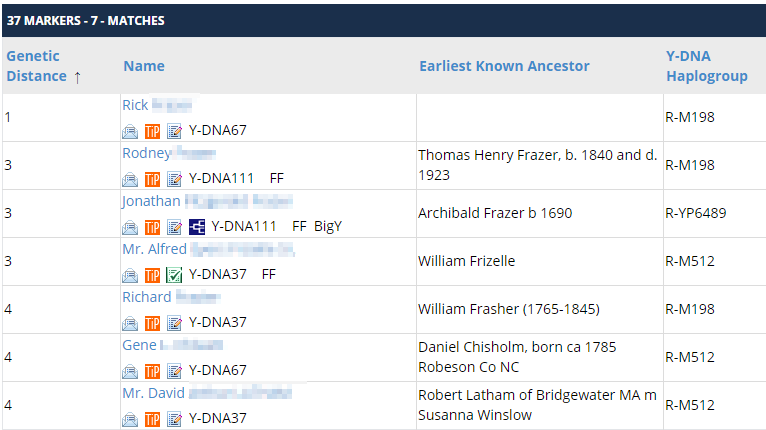
Here Richard shows up as the fifth match to my cousin Paul:

The new tester, Richard, has tested for 37 STRs. The first three on the list are known to be related to each other by genealogy. Those three and Paul all have ancestors from Northern County Roscommon by the early 1700’s.  Here is how they are related as best we can figure:

How Richard Shows Up on Jonathan’s List

Richard shows up as a Genetic Distance (GD) of 2 on Jonathan’s list. On Paul’s list, Richard has a GD of 4.

More YDNA Comparisons – YDNA TIP Report

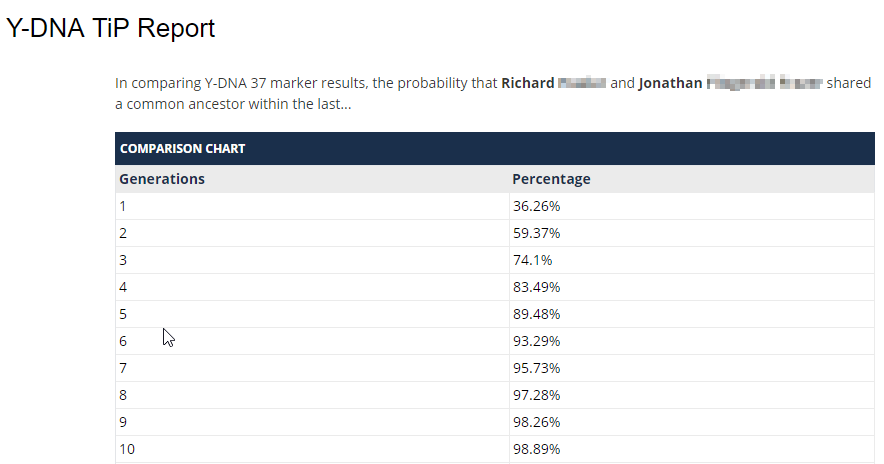
On Jonathan’s match list, I ran the ‘TIP’ report. This is an estimation of how far away Richard and Jonathan’s common ancestor is:

This report makes it look like Jonathan and Richard are related in the not too distant past. The likelihood that Jonathan and Richard have a common ancestor in the last 5 generations is close to 90%. A 67 STR test would give better results as it is possible that Jonathan and Richard have more STR differences in the second tier of STRs. If these results are born out, there would be a good chance that Richard’s ancestors were from North County Roscommon Ireland.

TIP Report for Richard and Paul

If Richard is from the James Line of the Frazer Tree, then I would expect that Paul would be 6 generations to the common ancestor of James.

Looking at Richard’s STRs

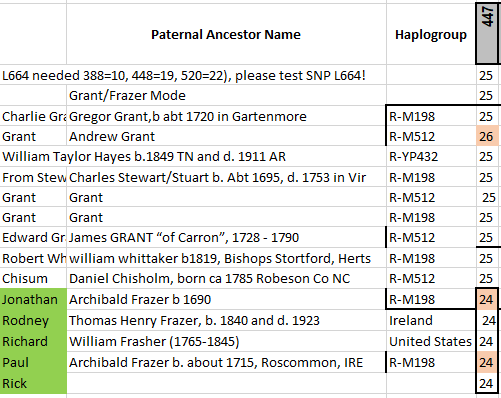
One thing that jumped out at me was STR 447:

Those in green have a Frazer or Frasher ancestor. They also have a 447 STR of 24. All those above are Grant, Chisum, Hayes or Whittaker and have a STR value of 25 or higher. That could mean that among families that are closely related to the Frazers, the Frazers alone have a STR of 24 at this location. This gives me some confidence that Richard is related to our line of Frazers. The question then becomes whether his ancestors were in North County Roscommon or whether our common ancestor goes further back to Scotland.

STR 391

Another interesting STR is 391. Rick and Paul are both on the Archibald Line and have a STR value of 11:

Jonathan and Rodney are known to be on the James Line and have a STR value of 10.

This shows that the first Frazer known to be in North County Roscommon had a STR value of 10 at location 391. Somewhere on the Archibald Line on the left between the first Archibald and James born around 1804, the value of that STR changed from 10 to 11. This doesn’t prove that Richard is from the James Line as Grants, Chisum, Whittaker and Hayes also have a 391 value of 10,

Frasher and Frizelle

Jonathan also matches a Frizelle at 37 STRs at a GD of 1. Putting Jonathan and Frizelle into the TIP report also shows a probable close relationship. The Frizelle that Jonathan matches by YDNA has an ancestor of William Frizelle. I wonder if there is a connection between this William Frizelle and Richard’s William Frasher.

Further Options for Richard

Richard may want to upgrade to the 67 STR test. An autosomal DNA test would also be interesting to see if he matches anyone in the Frazer DNA Project. The autosomal test would be the less expensive option. If Richard is from the James Line, it is likely that the autosomal test would reveal that. If no matches with the Frazer DNA Project show up in the autosomal DNA test, then further YDNA testing may be of further use.

Summary and Conclusions

  • Richard’s recent YDNA test appears to show a pretty close relationship to Frazers from North Roscommon County, Ireland
  • Autosomal DNA testing, if taken, could reveal more matches to those already in the Frazer DNA Project for descendants of those Frazers from North Roscommon
  • Richard shares a STR that has been found to be unique to the Frazers up to this point
  • There is also a Frizelle who has found to be fairly closely related by YDNA to the North Roscommon Frazers, however his results have not been posted to my knowledge
  • It will be interesting to see what additional genealogy or DNA testing will reveal

My Mitochondrial DNA

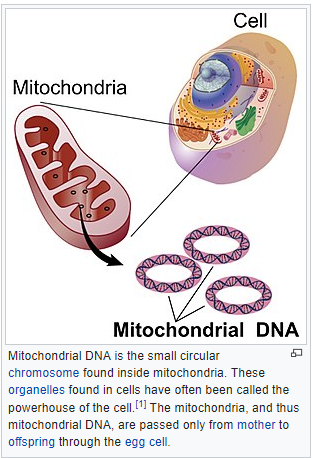
This is my 233rd Blog and the first I have devoted entirely to mitochondrial DNA (mtDNA). This is about as technical as I’ll get with mitochondrial DNA:

The above is from Wikipedia. I had heard that Darwin understood a cell to be just a blob as it was one of the most basic elements known at the time. Perhaps he would be surprised to know that so much is going on in a cell. Mitochondrial DNA is passed down only from a mother to her children. YDNA passes only from father to son. However, Mitochondrial DNA passes down from mother to daughter and from mother to son.

My Line of Mitochondrial DNA

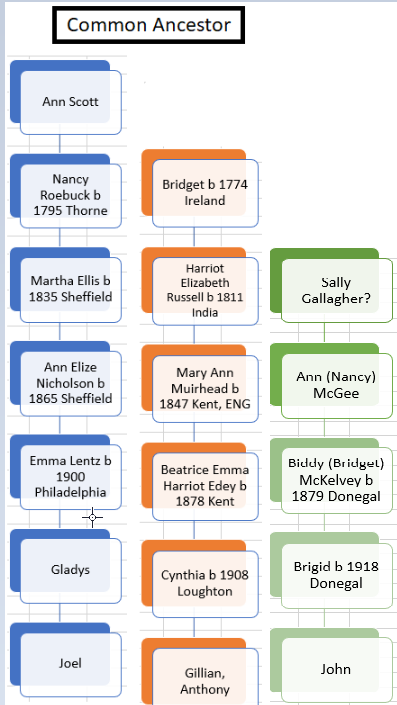
This is my line of inheritance of mitochondrial DNA is from mother to daughter going back as far as I can:

I’m sure of Martha Ellis. Her mom, Nancy Roebuck is not 100% certain, but as sure as I can be right now. Before that, Ann Scott would be a little less sure.

My MtDNA Matches

I have four perfect matches. They are:

  • Nancy
  • Terrence
  • John
  • Anthony

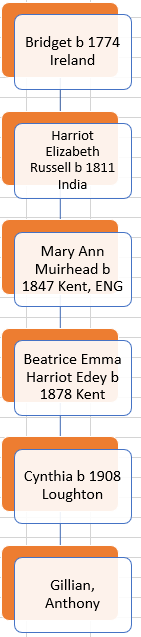
My most recent mtDNA match was with Anthony. I have been in touch with his sister Gillian. Here is their maternal line:

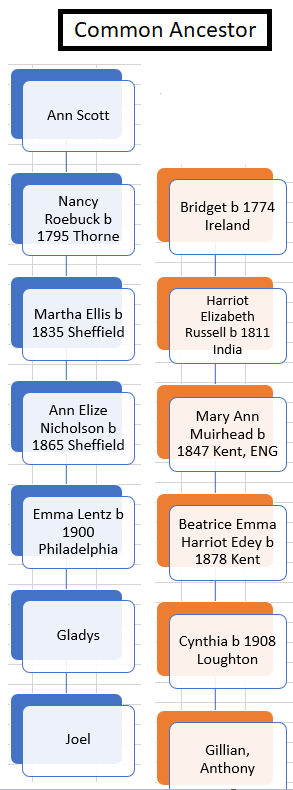
When I put the two trees together, I get this:

It is possible that Ann Scott and Bridget are sisters. However, the common ancestor is more likely further back.

More About the MtDNA – H5’36


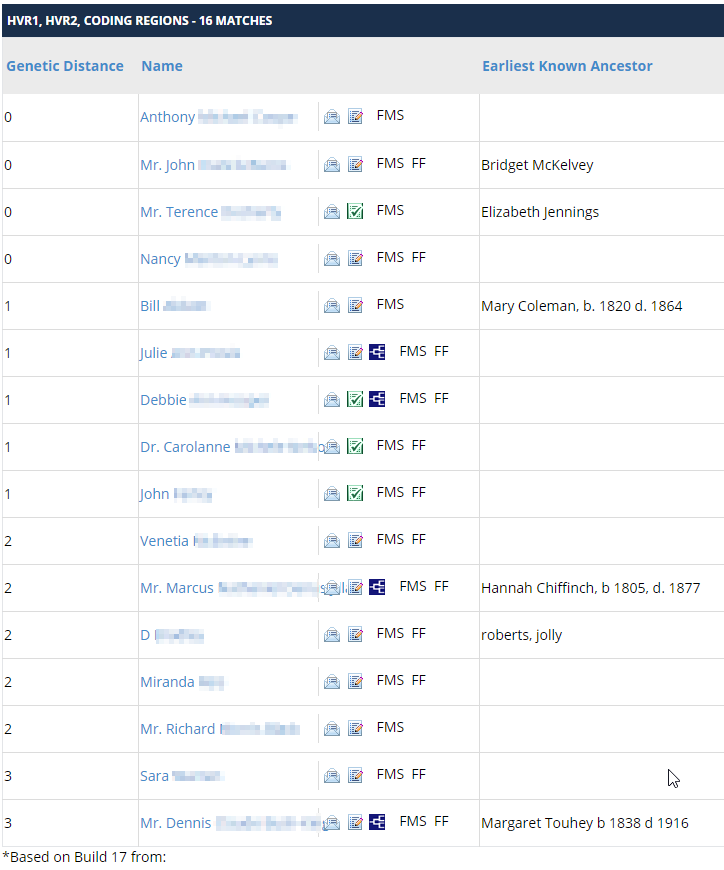
Here are my H5’36 matches at FTDNA:

The Genetic Distance (GD) is listed on the left. I have been in touch with the first four matches. I should also look into the matches that have a GD of 1. It occurs to me that a line could have had a mutation in the 1800’s or 1900’s and have a closer common ancestor with me than someone with a GD of 0.

FTDNA’s mtDNA Haplogroup Project

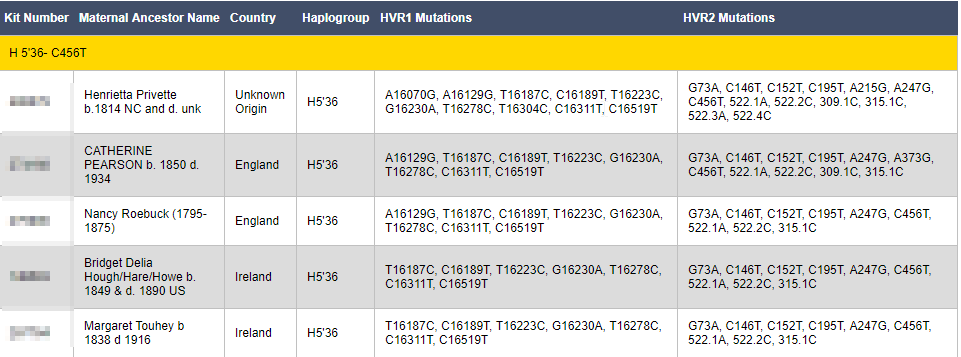
My mtDNA Haplogroup and that of my matches is H5’36. The H Haplogroup is very popular in the area of Europe and the British Isles. Here are those that have joined the H5 Haplogroup Project at FTDNA:

H5’36 is listed first on the H5 Project page. That is because I believe that this group is the oldest. H5’36 is listed before H5 as it was discovered after H5, but found to be older. The oldest maternal ancestors listed above were found to be from England or Ireland.

More About Genetic Distance

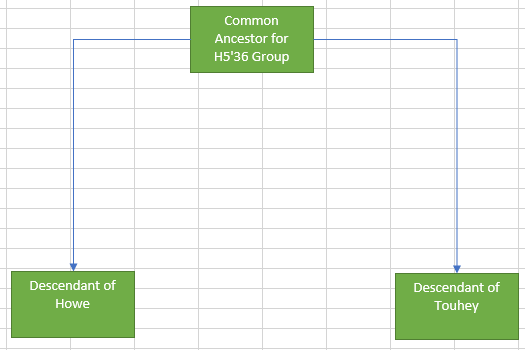
In the image above, there are five people that have tested positive for H5’36. Yet they have different HVR1 and HVR2 Mutations. It would make sense to assume that those with the fewest mutations would be from an older branch and those with the most mutations from a newer branch of H5’36. The last two people listed have the same and fewest mutations:
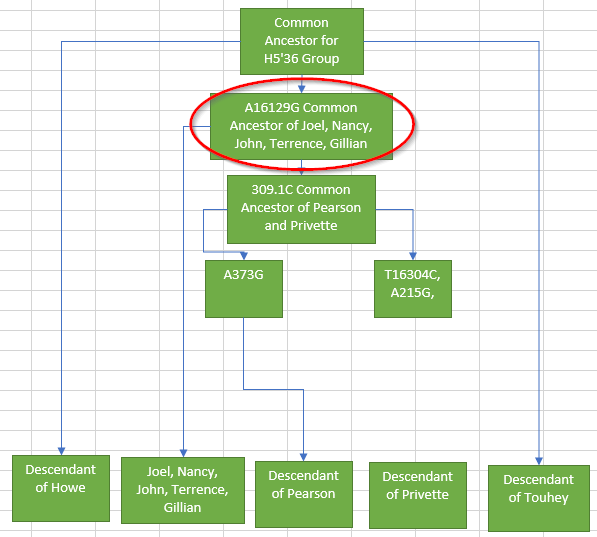
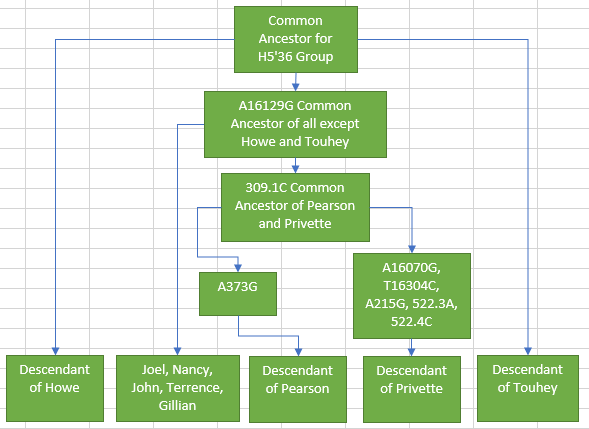
In the next step, I have one mutation that is different from the descendants of Howe and Touhey. This mutation has been named A16129G:

Because I have zero GD with Nancy, John, Terrence and Gillian, I can add them into this group.

Next, I just have to fit in the descendants of Pearson and Privette. These two testers have mutation 309.1C in common. But I see that Pearson and Privette also A16129G. The tree is still correct, but the second box from the top should say common ancestors of all except for Howe and Touhey.

Here is what I get for the H5’36 Tree based on those that belong to the H5 FTDNA Project.

The descendant of Privette has a lot of mutations which could mean that there could be more branching going on there. The branch of the tree that I am in with the other four is defined by being positive for A16129G but negative for 309.1C.

One question I have is that from my tree, I appear to be a GD of one from the descendant of Touhey. Yet on my match list I am listed at a GD of three from this person.

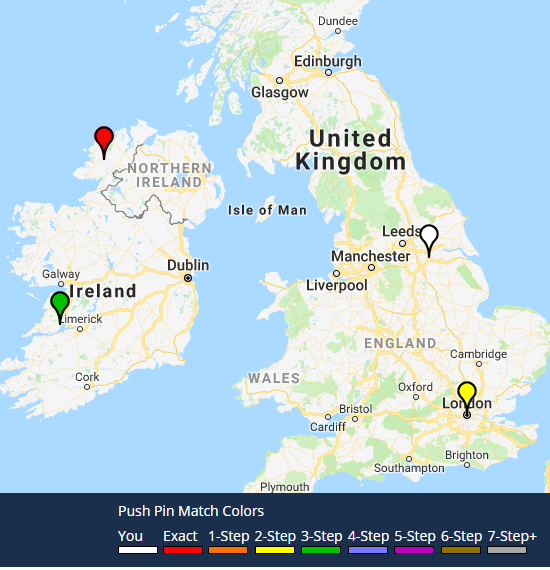
The Matches Map

FTDNA also has a helpful Matches Map:

This shows me in white – or rather, my mother’s mother’s mother’s, etc. location. The most important balloon after that is the red one. That is for John’s mother’s mother’s mother’s, etc.

Here is John’s mtDNA tree added in:

From the above:

  • The female common ancestor that John, Gillian, Anthony, Nancy, Terrence and I have has a Haplogroup of H5’36 and a perfect match in the coding regions.
  • As far as I know, my four perfect mtDNA matches have ancestors in Ireland. That means that it is most likely that my maternal line also goes back to Ireland.
  • I had previously proposed that perhaps a common ancestor lived in Scotland and one group went to Ireland and another to the Sheffield area. However, the mounting evidence of matching with people who have ancestors in Ireland makes it look like Ireland could be where the common ancestor came from.
  • It appears that Gillian’s ancestor Bridget was not afraid to travel. Gillian has her ancestor born in Ireland, giving birth in India and later living in Kent, England.

Summary and Conclusions

  • The mtDNA test shows that there are five people who have a common genetic ancestor that is H5’36 with the same coding.
  • I have been getting 0 GD (that is, perfect) mtDNA matches for four years. That is an average of one match per year. I had one match in 2014, one in 2015 and two in 2018.
  • The mtDNA matches suggest that one strand of my mother’s line came from Ireland.
  • I drew an mtDNA Tree to show who is aligned with who and to who whose mtDNA has mutated more or less from the original H5’36 Haplogroup.