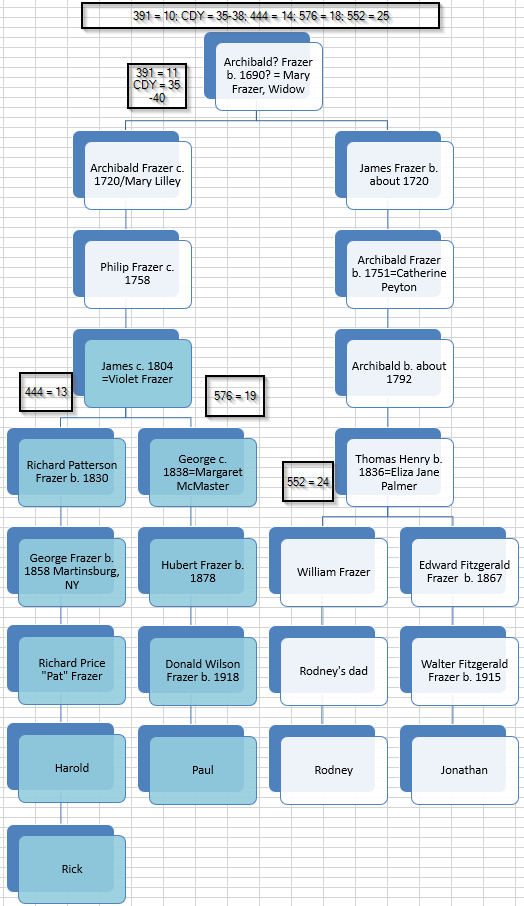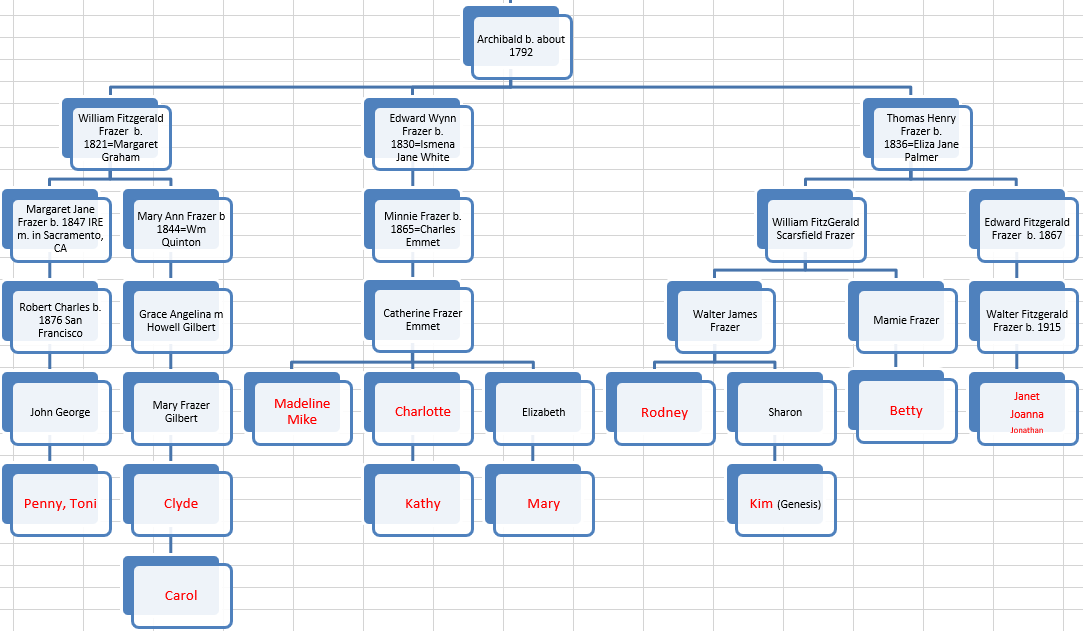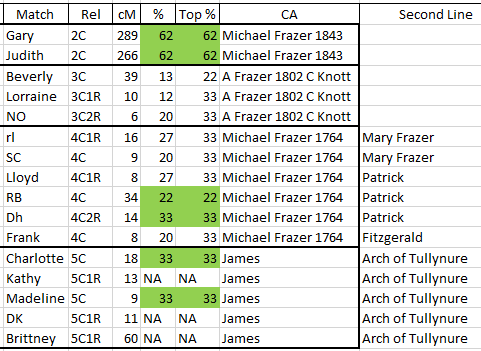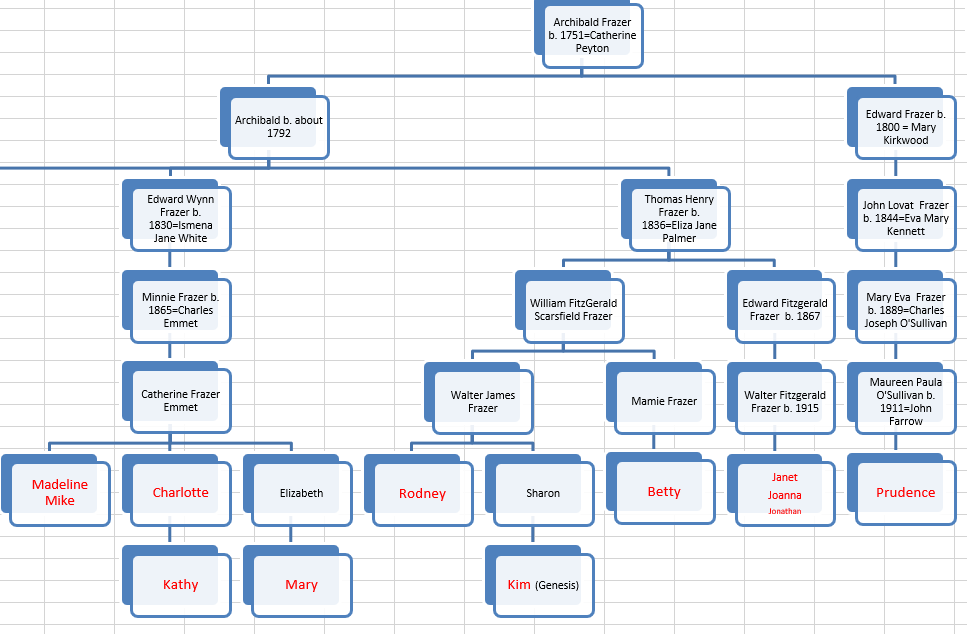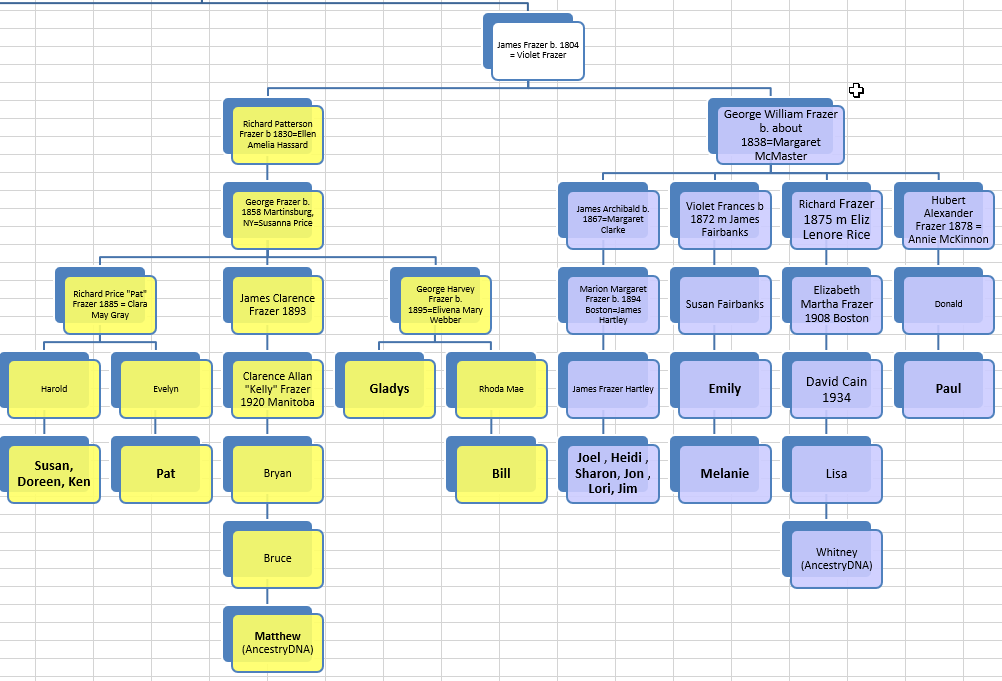
In my previous Blog, I looked at Frazer STRs and came up with a STR Tree. It is a bit of a mess, but it tries to show where the STR mutations are:

I like one explanation I read about STRs. STRs are short for Short Tandem Repeats. This excerpt is from an FTDNA article called Understanding YDNA Matches:
Our bodies work as copy machines when it comes to the Y-DNA. You can have a copy machine doing 1,000 copies without a problem, and then, the 1,001 copy may have an “o” that looks more like an “e”. And when we use this copy to make additional ones, all the new ones will now have an “e” instead of an “o”. This is a simple way to explain how mutations occur in our Y-DNA when it’s transferred (copied) from father to son. Mutations don’t happen frequently, on the contrary, very seldom, but they can happen randomly in time, which means that I could be one mutation off of my father. That is why all those matches or close matches on 12 markers will in most of the cases go away when they happen between different surnames, and we increased the numbered of markers that are compared: more mutations showing up, which means way back in time when the common ancestor lived.
Ancestral and Derived – What’s the Big Deal?
STRs are either ancestral or derived. That means that they are older or newer. Older or newer is important if you are trying to figure out timelines. It is also important in creating trees and figuring out who belongs in which branch of the tree.
Grant YDNA
In my previous Blog, I noted that the Frazer marker of DYS710 with a value of 34 was probably ancestral:

Assuming that to be the case, that meant that DYS710 = 33 would define the James Line of the Frazers above.
I wrote to Grant to get the STR values from his Grant BigY test. However, it appears that the Grant STR value for DYS710 is missing along with the STRs from 68-111. I don’t know if this is a mistake by FTDNA or not:

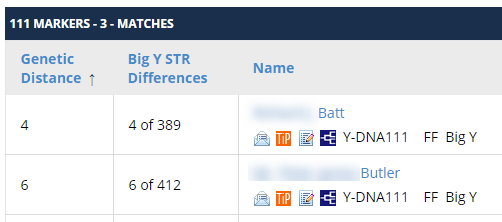
Grant Matches Paul by BigY but Not by STRs
Another surprise is that Grant matches one Frazer by the BigY and not by STR matching. Here is my cousin Paul’s matches by BigY:

Here are Paul’s 67 STR matches:

Here Paul matches a Grant, but not the same one who took the BigY test. Note that the Grant above doesn’t show that he had Big Y tested.
How Does Grant Match Jonathan?
Jonathan had fewer STR mutations, so perhaps he matches Grant. Below, we see Jonathan matches many Grants, including the one who took the BigY test:

There is one interesting thing to note here. Look at Jonathan’s match with Stuart who took the big Y. At 67 markers, there is a Genetic Difference (GD) of 3. With Grant the GD is twice as much at 6. However, when the BigY markers are added in, the differences between Jonathan and Stuart are 12 and only 11 with our BigY Grant.
Comparing Grants Extra 435 STRs with Jonathan
Thanks to the Grant family sending me the Grant BigY STRs, I can now compare them. In my previous Blog, I noted these differences between the Frazer Archibald Line and the James Line:

Paul is from the Archibald Line and Jonathan and Rodney are both from the James Line. Grant could be the tie-breaker to tell which values are older for these markers.
FTY299

What do you think? Based on the above, and knowing nothing else, I would say that 12 is ancestral and 13 is derived. That puts FTY299 as a marker for the Archibald Line. I’ll add that to my STR tree after I look at the other two markers.
DYS523 and Good Old FTY269

Here we go again. The mutations seem to be skewed more toward the Archibald Line. However, recall that these are mutations that Paul has, so they could have taken place any time between Archibald in 1715 and Paul:

If Rick had taken the BigY test, we could have narrowed that down a bit.
A New BigY 500 STR Tree
With this new information, I can build a New BigY STR Tree:

Here I wrote Paul’s results a little differently as I didn’t have room at the top. The first number is ancestral and should apply to Archibald Frazer born around 1690. The second is Paul’s value. This mutation could have happened between about 1715 and when Paul was born.
Any Other Differences?
It seems that there must be. Jonathan had 5 additional differences in the BigY STRs. However, these may be differences between Grant and Frazer in general.

Here in DYS514, we see a difference between Frazer and Grant. We can’t tell which one is older, because we need a tie-breaker.
Parallel Mutation or Back-Mutation
Let’s consider DYS516. I had said that the value of 18 for STR DYS516 represented the overall Frazer line because it was shared by Paul and Jonathan whose common ancestor was the original known Irish Frazer from about 1690. However, Grant has a value of 17 shared with Rodney. In other cases, we had considered the value to be shared by Grant and Frazer to be the older one. What happened? This is a case of back mutation or parallel mutation. It could be that the old value shared by Grant and Frazer was 17. Then sometime before 1690 it went up to 18 for Frazer. Then Rodney’s branch went back down to 17. That would be a back mutation. For a parallel mutation, the original value that Grant and Frazer shared would have been 18. Then at some time Grant mutated down to 17. In an unrelated (or parallel) way, Rodney’s branch also went down to 17. By getting more information on other people’s BigY results, it might be possible to figure out which happened.
There is a less likely scenario where 17 would be ancestral. That would have to mean that Jonathan and Paul had independent or parallel mutations. As this would have happened over a shorter period of time, it is less likely that this happened.
DYS542
Here is another of Jonathan’s 5 of 435 STR mismatches with Grant:

Note that Grant and Frazer have a difference of two. Again, we don’t know if 12, 13 or 14 was the ancestral value. It could be 13. In that case Frazer would have mutated up and Grant mutated down.
FTY289

This should be the 4th out of 5 differences between Jonathan and Grant.
FTY510

This should be the 5th difference or GD.
Grant Vs Rodney
I would suspect that Grant and Rodney’s results should be similar to Grant and Jonathan’s results.

They are the same except the number of BigY STR results tested are slightly lower.
FTDNA Block Tree Vs YFull’s YTree
Both FTDNA and YFull have SNP trees. Sometime one gets ahead of the other. Here is the FTDNA Block tree from Jonathan’s perspective:

Jonathan matches two Frazers at YP6489. Further out he matchs Grant at YP6488. At at more distant level he matches Hayes at YP6479. That doesn’t mean that Frazer descends from Grant and Stuart who descends from Hayes. It just means that these families descend from a common ancestor.
Another point to note is that the Frazer SNP of R-YP6489 is probably a family SNP. That means that this SNP probably applies to just our Frazer branch. YP3189 is one step below YP6488. That means that it is more recent. YP6488 is older and represents Frazer, Grant and Stuart. Because there is more than one family that shares this SNP, it would not be considered a family or surname SNP.
Here is the YTree version:

R-BY26344 Is for Grant and Stuart
This tree goes back one more level and includes dates. Then there is one important detail I missed previously. It appears that Grant and Stuart have a new SNP called R-BY26344. YFull uses IDs, but it appears that those IDs are for Grant and Stuart. This is the part where YFull’s YTree goes ahead of FTDNA.
My interpretation of the YFull YTree above:

Again, this does not show that Stuart, Grant and Frazer descend from Hayes, but that all four surnames descend from a common ancestor born around 900 AD. This shows that the tested Stuart, Grant and Frazer had a common ancestor from around 1300 AD. I assume at that time, surnames may not have been settled or commonly used in Scotland. According to scottish-at-heart.com:
The use of ‘fixed’ (or recognized) Scottish surnames appeared occasionally as early as the 10th or 12th centuries, but didn’t begin to be used with any sort of consistency until the 16th century.
Even this, this practice was slow to ‘catch on’, and it took until the late 18th and early 19th century to spread to the Highlands and northern isles.
A New Terminal SNP for Grant and Stuart and a New Mystery
In my previous Blog, I had missed that Grant and Stuart have a new Terminal SNP. They are now BY26344. However, YFull gives a common ancestor for Grant and Stuart at 225 years before present. I roughly called that 1775. The problem is that if Stuart and Grant had a common ancestor in 1775, was it Grant or Stuart? Also, it appears that the Grant and Stuart genealogies don’t match up as to where these families lived at that time.
Grant and Stuart Genealogies
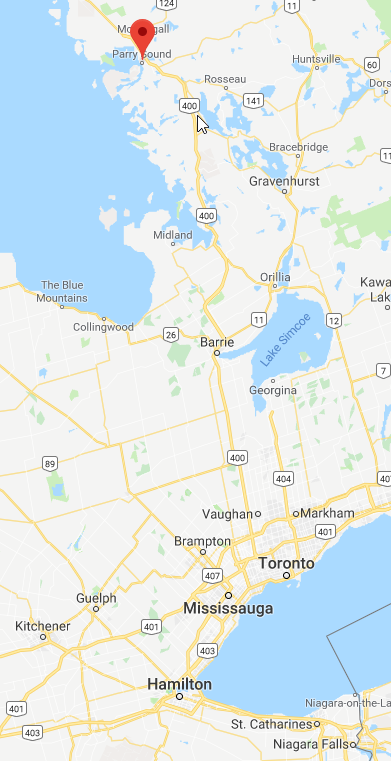
This is an area where I have very little knowledge. I have that the Grant BigY tester’s earliest verifiable ancestor was James GRANT “of Carron”, 1728 – 1790. From a quick Google search, this appears to be Carron:

The Stuart tester has this information:
Charles Stewart/Stuart b. abt 1695 d. 1753 Virginia
This is the problem. If Stuart and Grant had a common ancestor around 1775, then how could Stewart have been in Virginia in the early 1700’s and Grant been in Scotland in the early 1700’s? This suggests that one of the genealogies is wrong or that the common ancestor dating is wrong. The closest reconciliation that I could make up is that Charles Stewart was actually Charles Grant. He had James Grant in Scotland, then came to Virginia and changed his name. I feel uncomfortable making wild guesses for others’ genealogies that I know little about, so I will not go further in this direction.
TMRCA By YFull and FTDNA
What if YFull is wrong with their date of most recent common ancestor? Here is the 6488 Branch:

I don’t totally understand YFull’s dating. However, the reasoning is that the more SNPs in your branch, the older your branch. That makes sense to me. For example, the Frazer R-YP6489 includes 6 other SNPs. The Grant/Stuart branch of R-BY26344 has only two other SNPs. It stands to reason that BY26344 would have a more recent common ancestor than YP6489. The Frazer date checks out well, but three people tested. We think our common ancestor was born in the vicinity of 1690 which is about 329 years ago. YFull gives 375 years as a date. That seems pretty close to me.
A scroll-over of the 375 years before present for the Frazer common ancestor shows this:

This gives a pretty wide margin of error.
For BY26344, there is a larger margin of error:

I assume that the reason is that only two people tested for BY26344.
FTDNA is not as helpful with dates. In addition, FTDNA does not have Stuart and Grant as BY26344. Perhaps if they update their tree, they will and there may be a way to estimate a common ancestor then. However, having said that, the a YDNA project administrator has made this prediction for Grant and Stuart in an email to Stuart:
You had 19 Unnamed variants and now you have 19 – 2 = 17 left over.
Out of these 17 SNP’s there was 1 SNP which you share with Grant.
So both of you create a new Subclade BY26344 downstream YP6488
(btw. FTDNA has not identified this new subclade yet)
Now my best estimate for your MRCA with Grant is about 1200 AD.
This is interesting because this is an earlier date than what YFull has. The discrepancy may be due to the fact that Stuart did the Big Y 700 and other testers have only done the Big Y 500. Also, I don’t think that Stuart has uploaded his Big Y 700 results to YFull. It will be interesting to see if that makes a difference with YFull’s common ancestor calculations.
The FTDNA administrator further writes to Stuart:
Up to now you are the only one in subclade YP432 with a BigY-700, thus we will only know where these SNP’s are exactly located when they are willing to upgrade from BigY-500 to BigY-700.
Summary and Conclusions
- Grant and Stuart are the closest YDNA matches to the Frazer family
- I used some of the Grant and Stuart STR results to find out which of the STR vaules were older or newer for the two Frazer Lines.
- Grant and Stuart are in a new Branch of R-BY26344
- There are discrepancies for the date of the common ancestor between Grant and Stuart. These calculations were done by YFull and an FTDNA administrator. These dates may be fine tuned by Stuart adding his Big Y 700 results to YFull and/or by others in the YP432 Group doing Big Y 700 testing.