Tracking Down Shadlock Genealogy on My Hartley Side

I have a DNA match with a few people with some Shadlock genealogy. These matches are important because they have shared matches with people that appear to go deep into my Hartley ancestry. Here is one of the matches with my father’s cousin Joyce:

Shadlock Genealogy

This is the tree of the match on her maternal side where Lillian Jess is the match’s maternal grandmother:

I had started my own Shadlock research and would like to look further.

Elizabeth Ellen Shadlock Born 1875

Here is Elizabeth:

My possible relative. She married Manuel Jesse in New Bedford, MA in 1894. That record gave her parents names:

In 1900, Elizabeth was living on Belleville Ave in New Bedford with her family.

We see that her mother was living with them also at the time.

Alice died in 1903 in New Bedford:

Here her maiden name is given as Alice Walker and her husband as William Shadlock. This is a bit of conflict with the Mariiage record where Alice’s father is given as John Shadlock. This is further confused where her death record gives her father’s name as Shadlock:

I believe that her Father’s name would likely have been Robert Walker and her mother’s name Elizabeth Fouler (or Fowler).

[Edit: After looking at other entries of the New Bedford Death records, I see that the name in quotes is actually the maiden name and the first name is the married name. However as Elizabeth and her daughter went by Shadlock, it is possible that Elizabeth never married her daughter’s father – or if she did, she kept her maiden name for some reason.]

Here is the record showing mother and daughter traveling to Boston in 1887:

Ancestry gives this 1861 Census hint for Mary Shadlock:

If Mary was a Shadlock, that would likely mean that she was single mother. This record appears to apply to Elizabeth Ellen Shadlock:

This means that Elizabeth Ellen was born later than thought or that she was baptized at about age 4 and that her death record in New Bedford would be correct. Another possibility would be that Mary Alice was a single mother and that she later married William Walker Shadlock?

Here is the actual record showing she was born earlier:

I suppose that one interpretation would be that Mary Alice was a single mother and that William Walker was the father that she is naming in the baptismal record..

A Marriage Record for Mary Alice Shadlock?

The records for civil registrations of marriages for January through March 1875 show this entry:

Following the Robert Shadlock Line

Let’s assume that the Robert Shadlock in the 1861 Census is the same as the one mentioned in Alice’s death record. I now have this tree:

The potential parents in green do not sound familiar. That means that the Hartley connection could be with William Walker – assuming that he is really the father of Elizabeth Shadlock. Here are a few possibilities for William:

The Accrington Connection and Ashton-under-Lyne

Here is Accrington:

My Emmet ancestors were from Bacup in the SE portion of the above map. My Hartley ancestors were from Trawden in the NE portion of the above map. Perhaps I was looking in the wrong place as the later location for the Shadlocks was in Ashton-under-Lyne:

Here is William Walker in the 1871 Census:

Note that in the top right, the Parish is St. James which is where Elizabeth Ellen Shadlock was baptized. That puts this William as the best guess for Elizabeth’s father. He is a coal miner and his father (also William) works for a butcher.

Playing Out William Walker’s Genealogy

Here is the 1861 Census:

William’s mother was Jane, but I can’t make out where she was born. The transcription has it as “On the Sea of Kent”.

Here is the 1851 Census:

Again, I can’t make out where Jane was born. The second part seems to say “Irish Channel”.

Here is a possible marriage for the elder William:

Unfortunately, there were many Janes who married William Walkers in the Manchester area.

Here is my best guess for a family tree for Elizabeth:

More on Shaerd Matches

My father’s cousin has a shared match with this Shadlock descendant:

Here the connection is through Pilling only as Wilkinson was a second marriage after Hartley (my connection). That means that the Shadlock descendant genealogical match is likely going back to Pilling at some point. Mary Pilling was from Trawden Lancashire. So that likely places where the connection is.

Summary and Conclusions

Although I have not found a genealogical connection corresponding to my DNA match, I have a better understanding of why I cannot find the connection. It appears that Elizabeth’s father was William Walker. However, Elizabeth did not take the family name. Further, Walker is a farily common name, so difficult to trace. If more could be found on the birthplace of Jane Walker, that could shed some light on the genealogy. It seems that the census records are saying that she was born on board a vessel at sea.

In summary, it seems that there was no father in life of Elizabeth Shadlock and no husband around for her mother Mary Alice Shadlock. This perhaps caused economic hardships. My guess is that Mary Alice thought that she and her daughter would do better in New Bedford, so they moved there in 1887.


Some of My Bradford DNA Connections

My autosomal DNA connections to my Bradford side are intersting as they lead back to the Mayflower in Plymouth, Massachusetts. Here are my ThruLines at Ancestry going back to Harvey Bradford:

Harvey was the most recent male Bradford in my ancestry. Patricia on the left is also my 2nd cousin through the Hartleys. Here is how that tree looks on my own family tree at Ancestry:

This shows that Harvey and his wife had two children: Henry and Hannah. I descend from Hannah and my other matches above descend from Henry. That is, except for Patricia who also descends from Hannah.

Henry Clay Bradford

I’m descended from Henry’s sister Hannah. Let’s see what the Henry Line was up to. Here is Henry in 1850:

Henry was a ‘Nailor’. I believe that he made nails. One famous nail company in Wareham was Tremont Nail. I believe that there could have been others. It is possible that Harvey worked at the same location as his son Henry. Here are some possible places where Henry worked from an 1830 map:

Confusingly, a nailor could have also worked at a cotton carding works. Perhaps Henry worked at the factory on the bottom right which was near the old Horseshoe pond.  However, there are other possibilities.The family was living on High Street in Rochester which was approximately to the left of the ‘T’ in Rochester in the map above. Walter was born apparently in East Taunton, so the family was apparently there for a little while.

In 1860, Henry was living in Acushnet, MA:

It is not clear why his wife Rhoda appears to be living next door with her parents. Perhaps these were two houses side by side or one house with two units. Walter is the one shown in my ThruLines above.

In 1870, the family was also living in Acushntet, though the Post Office is Mattapoisett, so apparently close to that Town.

Here is something I did not know about:

The couple divorces in 1876. Rhoda comes back to Massachusetts and remarries. .Henry C also remarries and dies in Maine.

Here is a summary from one tree at Ancestry:

In 1910, Henry’s second wife has died and he is living with his son in Norway, Maine:

Walter B Bradford Born 1857

Walter marries Olive A Collins in Acushnet in 1882:

The family appears to be living with Olive’s brother in 1900:

In 1910, the family moved to Rochester:

Walter was a “Teamer”. He presumably drove a team of horses which carried heavy loads. Walter’s burial stone is in the Sherman Cemetery in Rochester, MA.

Flora Bradford

My ThruLines would have me evaluate Flora Bradford’s children:

I have two DNA matches from two of her children. Ancestry has this photo:

Flora married in Marion in 1920:

Olive was born the same year:

I am also related to the Hathway family. However, I assume  that the connection is not with this line of Hathaway. So Olive was the mother of one of my matches. I assume that the match knew who his mother was.

My guess is that my other match Terry knew who her father was (John below):

Olive Bradford Born 1893

Here is a photo of Olive from Ancestry:

Olive marries Charles Henry Savaria in Rochester in 1909. Here is the family in 1910 in Rochester:

Charles was listed as doing odd jobs. Henry was listed as a teamster in the 1920 Rochester Census:

My DNA match and otherwise 2nd cousin had as her father Charles H Savaria Jr. Here is the family in 1950:

They lived on Rounesville Road in Rochester where Charles was a sawmill winch operator.

Dorothy Bradford Born 1904

I have a small DNA Match to Phillip who descends from Dorothy Bradford:

Dorothy married Ernest Gosson and lived on Main Street, Acushnet, MA in 1940:

Ernest was a truck driver for an interstate commerce. Here is 155 Main Street:

So far these ThruLines seem to check out.

Looking at Joyce’s ThruLines

Joyce is my father’s first cousin, so she is a generation closer to the Bradfords. Here are her ThruLines via Henry Bradford:

Common to my ThruLines are Patricia and Terry. Then Joyce additionally matches Shane and Cynthia under Olive Bradford thorugh Olive’s daughters Ariel and Agnes.

Ariel Savaria Born 1918

In 1940, Ariel lived on New Bedford Road, Rochester, MA with her family:

George was a highway and construction surveyor. In 1950, the family was living in Little Compton, RI:

Agnes Savaria Born 1922

Agnes also married a Lawrence. The couple was living on Marion Road, Rochester in 1950:

They were the 8th house on the left proceding West. I remember a Ray Lawrence in elementary school. Perhaps he was the son of this Raymond. Apparently he was a distant Bradford relative.

My Brother Jon’s Bradford ThruLines Adds Alice Bradford Born 1891

These are all ThruLines via Harvey Bradford and his son Henry. Jon adds offspring from Alice Bradford:

Based on the ThruLines, Alice married a Morse. This tree at Ancestry fills in some more information:

I see Evelyn and Hazel on the list above. In 1940, Alice and her family lived on East Central Avenue, Wareham:

So these must be my Onset Bradford cousins.

My sister Lori has a match to another grandchild of Alice:

In 1950, Hazel lived at Brown Street, Wareham:

Hazel’s husband worked in the cranberry business.

That covers the DNA matches that Ancestry identifies as going back to Harvey Bradford through his son Henry. I have many other Bradford relatives.

Summary and Conclusions

  • Based on Ancestry ThruLines, I have many relatives around the 4th cousin level who descend from Harvey Bradford.
  • Many of these cousins seem to have stayed in the SE Massachusetts area – or at least their parents or grandparents have.
  • I have been able to fill in some of the details for some of the descendants of Henry Bradford. He was the only sibling of my ancestor Hannah Bradford.


A Nutter-Hartley Connection by YDNA

In a previous Blog, I wrote about Michael who has Nutter ancestry and tested his YDNA with a non-FTDNA company. Those results were uploaded to YFull which showed that he was A11134 on the male YDNA Tree. I also noted that so far, all the FTDNA BigY testers who are at the A11134 level have been Hartleys.

I have also noticed that there are two other people who have had 37 STRs tests taken at FTDNA. They have matches to some of the Hartleys in the Hartley project. They have that their ancestry goes back to Ireland.

Here is the list of people in the Hartley FTDNA YDNA Project that are grouped together:

The last two on the list are my brother and me.  The first person has Mawdsely ancestry and is in the slightly more distant Haplogroup of A11132. The next two who have Richard and Roger Hartley as ancestors only tested to 12 STRs, so that information is not very useful.

The estermated Yorkshire tester matches the two Nutter testers. When I use the FTDNA TiP Report, there is a 90% chance that this Hartley and the two Nutters are related within 15 generations. If I take a generation to be 30 years for a male, then that would be about 450 years ago. If we take that to be from 1950, then that would be around the year 1500.

It would be interesting if one of these Nutter testers upgraded to the BigY 700 test. Due to the way the Nutter testers match the Hartleys, it appears that they could be close relatives to each other.

Nutter Genealogy

One of the two Nutter 37 STR testers has genealogy going back to Ireland. Here is his tree:

Here I am just interested in the father to father Nutter line. I can try to build a Nutter tree myself, to see if there are other connections to England. The more recent family was from Lowell, Massachusetts, so that is easy to trace as I live in Massachusetts.

I am interested in finding out more about Robert J Nutter as he immigrated to Lowell, MA. The 1910 Census has Robert arriving around 1860:

If my caculations are right, then he would have been about 10 years old when he moved from Ireland to the US. Robert’s wedding record shows that his parents were James and Mary:

I suspect that James P could be James R. I also believe that Robert’s real first name was James:

This also gives a place of birth for James Robert in Ireland:

This place is in County Kildare:

Here is the family in 1870:

It would take a lot of research to try to get this family back to England. The next step would be to try to find a marriage record for James Nutter and Mary.

The Census records give more clues. Here the family in 1880:

The family was living on Water Street in Lowell. Youngest son was Elias. Here is the Baptismal record for Elias from St Peter Roman Catholic Church in Lowell:

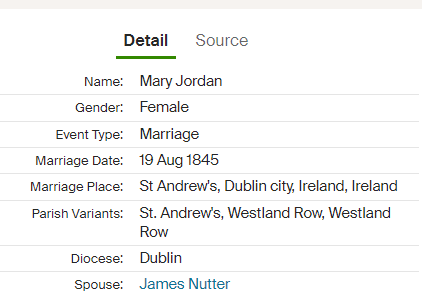
This gives his mother’s name as Mary Jordan. Mary died in a railroad accident. Her parents were John and Mary. The couple appear to have married in Dublin:

Unfortunately, the marriage and death records for for James gives no parents:

That puts this line of Nutter genealogy at a dead end for now.

More Nutter YDNA STR matches to Hartleys

The person who has David Hartley as an ancestor also matches Nutters with a genealogical difference (GD) of 3.

My recollection of this David is that he was from Yorkshire. The TiP Report between the David Hartley descendant and Nutter is also 15 generations at a 90% confidence, so also probably in the early 1500’s.

Descendant of William Shephard Hartley

The descendant of William Shephard Hartley also matches the two Nutter testers but with a GD of 4. Here is the TiP Report between these two:

Interestingly, even though the GD is greater, the number of generations at the 90% confidence level is fewer at 12 generations. Assuming 30 years per generation, this comes out to 360 years. For an easy calculation, I’ll subtract that from 1960 to get around the year 1600.

Comparing STR Matches in a Spreadsheet

Here is what I have so far:

Here is an interesting thing in that the GD of 3 results in a predicted 15 generation commona ancestor. That is compared to a GD of 2 and 4 with 12 generations to a common ancestor. That is no doubt due to the variance in the mutability of the different STRs. Some STRs change very slowly while others change relatively more quickly.

Here is the finished table:

The first tester is a Mawdsley and an earlier Haplogroup than the other Hartleys, so probably the connection to him goes back before the time that surnames were used. #2 and #3 on the list only tested for 12 STRs, so I wouldn’t include them either right now. Out of the other 11 testers, 7 had a GD of 4 or less to the two Nutter testers.

Based just on the 37 STR test (which is difficult to interpret and a low level of STR testing), I would say that there is a connection between Nutter and Hartley. The three possibilities being:

  • There is an early Nutter line that descended from a Hartley line and branched out
  • There is a Nutter line separate from the Hartley line and the connection between Hartley and Nutter is before the time of surnames
  • Our branch of Hartleys descended from an earlier branch of Nutters. Based on the number of Hartleys compared to Nutters, I would find this to be the least likely scenario.

Summary and Conclusions

  • Michael who has Nutter ancestry has recently sent out for a BigY700 test
  • He has an existing Haplogroup from previous testing of A11134. Previously, only Hartleys have tested positive for A11134.
  • There are two Nutters who have taken the 37 STR YDNA test at FTDNA. They appear to be closely related.
  • I have looked at the genealoyg of of one of the 37 STR Nutter testers. I got stuck in Dublin, Ireland for the earliest known ancestor. However, the YDNA strongly suggests ancestry in the Lancashire/Yorkshire area of England.
  • 7 of 11 Hartleys in my group of Hartleys at the FTDNA Hartley YDNA Project match these two Nutter STR testers
  • It would be helpful if one of the Nutter 37 STR testers were to take the BigY700 test to compare with Michael’s upcomng results.


Another McMaster Connection at Ancestry

Morgan is a DNA match to me at Ancestry. We match at 20 cM. Here is what Morgan has for a tree at Ancestry:

The connection to my tree is likely through Francis McMaster. Here is the tree that I have for Francis (or Frances):

Frances descends from at least 5 McMaster lines. Plus, the hint for Mary Johnston has as her mother Esther McMaster. This is truly a complicated genealogy. However, the closest place that Morgan and I connect are through James McMaster and Fanny McMaster.

A Partial DNA/Genealogy McMaster Tree

Here is part of one of the trees that I have of McMasters that match by DNA:

Note that I have a space for Jane who Married Archie McMaster. I believe that Morgan would fill in under this line:

This shows that Morgan is my 4th cousin. However, I suspect that we are related as 5th cousins also or more distantly on other McMaster lines.

My Shared DNA Matches with Morgan

Matthew is a DNA match that Morgan and I share:

I did not put Matthew on my McMaster tree to keep it simpler. Matthew must be on my Frazer DNA/genealogy tree.

Trudy with Johnston/McMaster Ancestry

Trudy is also a share match with Morgan and me. Here is the maternal side of Trudy’s tree:

This must be the Esther McMaster that I mentioned above as a hint in my tree. I’ll assume that the hint is correct, and add it in to my tree as an ancestor to Frances McMaster:

I think that Esther may be a daughter of Abraham McMaster.

Tammy – Another Shared Match

Tammy matches Morgan and me. She also has a Johnston in her ancestry which suggests a connection on the McMaster side. Here is Tammy’s tree on her paternal side:

Someone else’s tree at Ancestry has this person for John Johnston’s father:

This suggests that Thomas could be a son of Robert Johnston and Esther McMaster.

Summary and Conclusions:

  • The McMaster tree is often complicated with McMasters marrying into other McMaster lines.
  • My Match with Morgan is defined at the 4th cousin level, but there are other McMaster connections at a more distant level
  • Shared DNA matches help confirm that the genealogy is on the right track.
  • Two shared DNA matches between Morgan and me seem to confirm a  connection with Eshter McMaster born in or around 1793


A New A11134 Tester

I recently realized that there was a new A11134 tester. I had been in touch with a person named Michael who had tested. He had tested at Nebula Genomics. I am not familiar with that company as I have had tested with FTDNA. Michael uploaded his results to YFull where he is on the YFull Tree as A11132.

A11132 at YFull

Here is how Michael matches me at YFull:

YFull has Michael and me as A11132, but FTDNA has me as A11134 which is one level below A11132. Why is that?

Here is a what my Block Tree looked like in March 2021:

My brother and I are on the left. Then there were two other Hartley testers. So, at that time all Hartley testers were under A11132. In January 2022, there were two new BigY Testers. One was a Hartley and one was a Mawdsley. Mawdsley tested positive for A11132 as well as the other SNPs under the current A11132, but did not test positive for  A11134 and A11135. That resulted in the breaking up of othe old A11132 block into A11132 and A11134. This resulted in the way the tree is today:

Michael is planning on doing the BigY test at FTDNA. That means that he will be A11134 when he takes that test. Mawdsley did not post at YFull, so their tree structure is more like FTNDA’s tree prior to 2022.

Michael on FTDNA’s Time Tree

FTDNA has a new Time Tree. I was glad that I realized that Michael was actually under A11134:

That makes a difference, because as shown, A11132 would probably before the time when surnames were in general use and A11134 would be more in the time frame when surnames were coming into general use. In fact up until the time of Michael’s testing, all A11134 testers were Hartleys.

Checking Private Variants

The first place to check for possible new branches is with private variants. Michael sent me this information:

The Y designation is for YFull where Michael posted his results.

Here is a comparison I had been working on for Hartley Private Variants:

I hadn’t added John R and John N previously, so I did so now. I don’t have the full list for ‘Nutter’ above. That means that Michael cannot currently access the full list of all the SNPs that he tested for. I was surprised that none of the Hartleys that I looked at had tested for Michael’s Private Variants. That means that there may be a connection between the Hartley lines, but that connection is not known if the same locations are not sampled.

The fact that Michael’s Private Variants are likely newly discovered is shown by the date on the right. According to YBrowse, these are newly found variations as of 2022. I did not check with the Quaker Hartleys as these left Lancashire, England around the year 1700.

When I checked John N’s Private Variants, I found that Jim, Joel and Steve were not tested at those locations. That could mean that John N could have a closer connection to Jim, Joel and/or Steve. It’s a little frustrating to not know the results, because a position was not tested. One exception was with location 20674535. My brother Jim and I were not tested at this location but Steve was and tested negative.

A Different Way of Showing Results at FTDNA

I used to be able to download a ‘csv’ file from FTDNA with all the results. Those Those results have now been split up to these files:

I will cover those changes in an upcoming Blog. Here is the summary of Hartley (and Nutter) Private Variants:

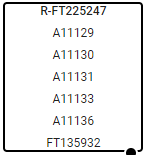
John R’s results are in the new format, so I didn’t check his results agaings the other tests. Also, John R is in the Quaker Hartley group. I don’t think that there is overlap with the other groups, but it is possible. In the above chart, I took out my former Private Variants which are now named under FT225247.

Summary and Conclusions

  • I was pleased to find out by checking YFull, that a non-FTDNA tester with Nutter genealogy tested positive for A11134
  • Previously, all A11134 BigY testers have had Hartley genealogy. That means that this test is a departure or that the tester could have Hartley ancestry at some point.
  • I checked Michael’s test against some of the other Hartleys BigY tests and saw that there was no overlap between his results and Hartley results. In other words, Michael’s Private Variants were not tested in other Hartleys as far as I looked.
  • Hopefully, more will be learned as Michael has agreed to take the BigY test.
  • FTDNA now reports its results in its csv file as four csv files. This is likely because the files were so large. I will look at that in an upcoming Blog.


A New Hartley BigY Test

A New Hartley BigY test results are in:

John R is the 7th BigY Hartley tester in the group of Hartleys that I am related to. There are other Hartley branches in the world, but they are not at all closely related by YDNA. I did an initial analysis of John Roberts STR results last week  here.

The A16717 Branch of Hartleys

So far all the Hartleys that are related to me by YDNA are under the branch A11134. John R is further under the A16717 branch. This is an important branch of Hartleys as the genealogy is well known:

Ross has not taken the BigY test, but John R, Lawrence and Michael have. Michael has taken the older BigY 500 test. Before Lawrence tested for BigY, Michael was designated as A11134. Lawrence further designated the branch as A16717. John Robert and Lawrence could potentially form a new branch separate from Michael.

Comparing BigY Matches

I have compared John R, Lawrence and Michael to my results:

Here are the first two on my list of Non-Matching Variants. This list can be confusing because it could be a non-match because I have the variant and John R does not, for example. Or, it could be that John R has the Variant and I do not. I put those variants that do not match my results into a table:

Here I have color coded the non-matching variants.

The Yellow Variants

These are the variants that are in my brother’s and my Branch (FT225247) . These are the SNPs in my Branch:

There are 7 SNPs in this group. The yellow SNPs above account for 6 of the 7 SNPs. But where is FT135932? When I check John R’s results I see that he is not positive for this SNP:

I’m guessing that my brother had this SNP and I didn’t or didn’t have really good results for this tested SNP. Here is my brother Jim’s comparison with John Robert:


This implies that my brother James tested positive for FT135932.

Blue and Orange Variants

We know about the blue variants. This is the SNP label used to define the Quaker Hartley Line. The orange SNP is BY26739. This SNP is more difficult to explain. For one reason, a comparison between my brother and me show that is also a non-matching Variant.

BY26739

If I have BY26739 and Jim and John R do not, that would explain things. Here are my results for that SNP:

It looks like the reads were not great, but the  best reads they did have showed that I was positive for BY26739 two out of three times. I see from a previous blog that this was Jim’s results:

This was considered to be not derived, probably because there were 6 good reads which were all negative for this SNP. Here are John R’s results:

These results are even worse than my brother Jim’s. I see that the 4 best reads show no mutation at that location for John R.

The Green Non-Matching Variants

These are SNPs that my brother and/or I have. Here is an expanded view:

I don’t have a good explanation why these SNPs are not in my Block tree. One guess is that they may be from regions which are considered unreliable.

Private Variants

The Private Variants for the Quaker Hartleys should be the numbered variants shown in the chart above. These variants formed in the Thomas Line in the generations following Thomas Hartley born 1700. John R has three, Lawrence has 6 and Michael has two. That should mean an average of about 4 under the Quaker Hartley group of A16717. I’m not sure why the current Block Tree shows an average of three Private Variants. I notice that the old Block Tree before John R tested had an average of two Private Variants:

If these private variants matched between John R and Lawrence, then there would be a new Quaker Hartley Branch of SNPs. However, for that to have happened, Thomas Hartley born 1700 would have had to have had a new mutation that his brother Roger did not have:

Summary and Conclusions

  • The recent BigY testing for John Robert put him solidly in the Hartley Quaker Line and confirms common ancestry as shown in the chart above.
  • Differentiation between the two lines: Thomas Hartley and Roger Hartley were difficult as Thomas would have had to have had a SNP mutation to show up between John Robert and Lawerence.
  • Differentiation was made in my previous Blog based on STRs which was useful.
  • The BigY may undergo a manual review, but I don’t see any obvious changes that would be made.
  • The Quaker Hartleys now have the largest group of BigY tested Hartleys in the A11134 Hartley group.


New 111 STR Hartley YDNA Test Results and the SAPP Tree

New results are in for a Hartley YDNA 111 STR test. These STR tests were in included in a BigY test. The BigY test results are not in yet. There are different Hartley YDNA lines, but this is the line that my Hartleys are on (and several other Hartleys). Here are the new results:

This image is from the Hartley YDNA Project page at FTDNA. The new tester is the one at the top. The tester has ancestry in common with Roger Hartley born 1628 and died 1714. This is an important line as it represents the oldest verifiable Hartley line in this group of Hartleys. This group of Hartleys were originally Quakers. They were persecuted, so they left Lancashire County England for Pennsylvania where Quakers were welcome. That doesn’t mean that the other lines descended from this line, but that this line is closer to a Hartley common ancestor. The two tests on the bottom are for myself and my brother, so R-FT225247 represents a newer YDNA Branch.

Some Hartley Genealogy

Here is a tree I worked out for the Quaker Branch of the Hartley family:

John Robert is the new tester. Assuming I have the tree right, he shows as 6th cousin to Lawrence and Ross and 7th cousin to Michael. At the 111 STR level, John’s two closest matches are with Lawrence and Ross. John shows as a three step difference to these two. Michael does not show up. He took the older BigY 500 test which did not include the 111 STR test at the time. Lawrence took the newer BigY 700 test. Ross took the 111 STR test without the BigY test. The above tree shows Lawrence and Ross to be third cousins to each other.

John’s YDNA STR Matches at the 111 Level

Here are John’s matches of those Hartleys who have tested to the 111 STR Level:

Lawrence and Ross are at the top of the list. Interstingly, I am on the list but my brother Jimmy is not. He must have one more difference which put him over the top of what is reported. All the above have the Hartley surname except for Wolka. This likely means that this Wolka line was at one time a Hartley line.

A 111 STR Tree for Hartleys

Again, these are for the Hartleys in my group. These are the 9 people that are in the Hartley YDNA Project at FTDNA. Ross and Wolka are not in that project, so they are not represented below. When I look at the STRs that have changed within the Hartley group, they are these:

When creating a tree, the easiest way is to assume that the mode is the oldest value of the STR. When I color the outliers, they look like this:

This chart represents 8 Hartleys and one Mawdsley. The bottom two lines are myself and my brother. I moved John Robert next to Lawrence. These two are above my brother and me. They descend from the older Quaker Hartley Line.

Looking at just the Quaker Line of Hartleys, I see this:

These are the three differences between John and Lawrence in that line. John has a DYS390 value of 24 and a DYS549 value of 12. Lawrence has a DYS641 value of 11. As these are unique to the Quaker Line, they are most likely mutations within that line:

This image is meant to show that somewhere along the Anthony Hartley line, these two STRs appeared which are unique to that line. Likewise, sometime along the Joseph Hartley line a unique value for one STR occurred which describes that line. Unfortunately, I don’t have Ross’ results as he is not in the Hartey FTDNA YDNA Project.

STR Structure within SNP Structure

There are two aspects to YDNA testing. One is STRs and the other is SNP testing. The SNP testing is less subject to interpretation. This is because STR values can go up and/or down whereas a SNP mutation is a single mutation. As such, the SNP is more useful for creating trees.

Here is the reliable SNP tree from my perspective:

John Robert’s BigY results have not yet completed, but his results should be within R-A16717 based on genealogy. So far all Hartleys in this Line are under A11134. The connection for Mawdsley goes further back in time – probably before the time when surnames were finalized.

Two Models for Hartley STRs

In a Blog I wrote earlier this year, I considered two different models to explain the STRs:

and,
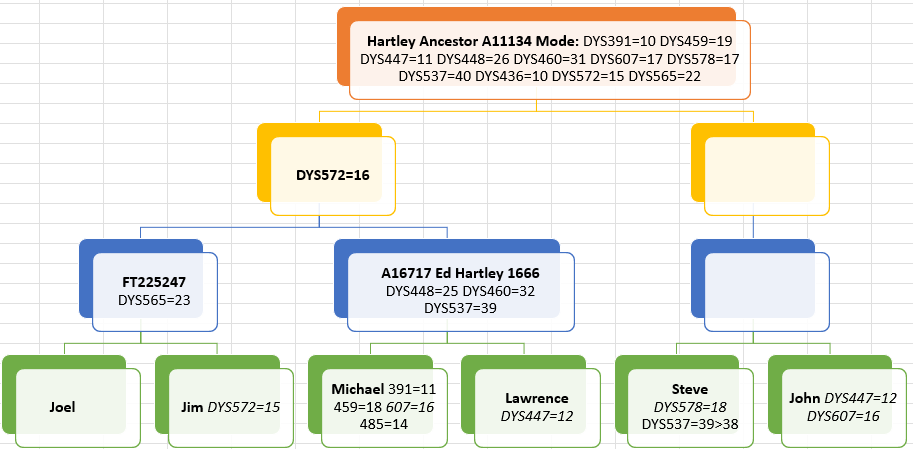
In these depictions, I didn’t mean to show that Steve and John have a more recent common ancestor. They should have their own separate lines from the early Hartley ancestor. The boxes were added place them on an equal footing with the other Hartleys. Here is a better representation:
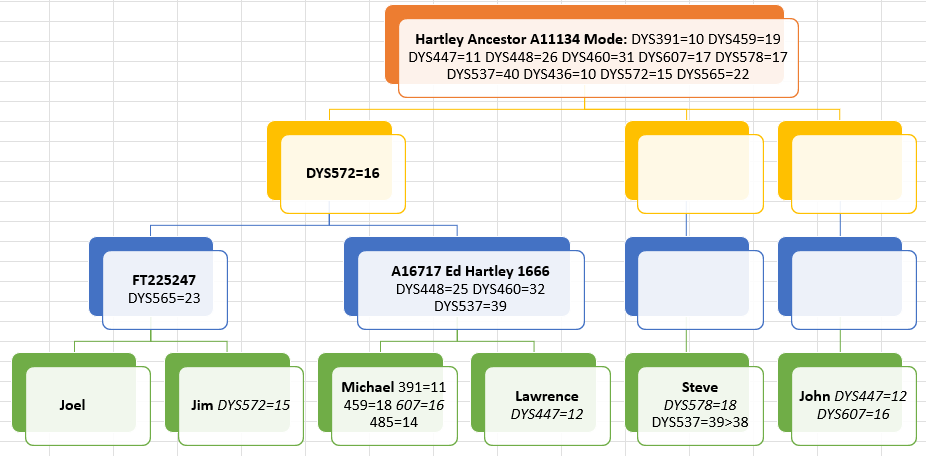
It also appears that what I had as DYS572 should actually be DYS534:

It is easy to get confused with 111 STRs. Here is a corrected version of the first tree:

FTDNA’s New Time Tree

FTDNA has a new representation for those who have taken the BigY test:

The person at the top right is a Smith. The common ancestor between Smith and our Hartleys was around the year 500. This was certainly before the time of surnames in England. The next person going down the column is Mawdsley. The common ancestor between Mawdsely and the Hartleys was some time around the year 1100, though the dashed line gives a larger range. Assuming the year of 1100 is correct, I would say that common ancestor lived before the age of surnames also.

The next 6 are Hartleys who have taken the BigY test. From the Time Tree above, we see that all Hartleys are R-A11134. These Hartleys had a common ancestor who lived probably in the 1400’s. Actually, it looks like these had a common ancestor, but they really had a common SNP. This SNP could have occurred within, say three generations on average. However, there was a Hartley who originally developed this particular mutation which was carried down all other Hartleys.

The two that are still R-A11134 are John and Steve. They have not had other matches yet which further define their lines. Chronologically, the next group is R-A16717. These are the Quaker Hartleys shown in my genealogical chart above. R-A16717 dates from the Time Tree from around 1550. By genealogy, the common ancestor from the group was born in 1666. That means that either the Time Tree is a bit early, or an ancestor of Edward Hartley born 1666 first had the mutation of R-A16717 (or a combination of both). Finally, I tested my brother and myself, so R-FT225247 represents my father who born in 1918.

Using SAPP to Generate a Hartley Tree

David Vance developed a software to analyze STRs. I’ll use this for the Hartleys in my group who are also in the Hartley YDNA Project at FTDNA:

This is the first time that I have used this tool. It uses STR testing of any length which is interesting. Also I did not put in information about SNPs. That would have been helpful to refine the tool. Here is the top box of the chart:

This is in line with the start of the Hartley surname. Here the year 1350 is given. The Time Tree based on SNPs gave a date about 75 years later. This method is a lot easier than trying to create a tree by hand. Next, I’ll look at my section:

I am on the right side of the tree. My brother and I are in the last two boxes on the bottom of the tree. Our common ancestor (our father) has a date of 1900 which is close to his birth year of 1918. The next one up on our branch is John Nicholas. He took the BigY test. I had thought that he would have formed a new Hartley SNP branch, but that did not happen.

The two other boxes are for Tim and Steve. Steve has also taken the BigY test. My guess is that Tim is Steve’s brother as the common ancestor date given is around 1950.

A Second Run of SAPP

My first run showed that I had 112 STRs for some testers, so I ran the program again using the Notepad software for the results as suggested in the instructional video. This time I came out with 111 STRs:

Above, the number of STRs are shown in bold blue on the diagonal.

Here is the corrected SAPP Tree:

This tree now shows five brances from the top instead of four and now the STR names are correct:

This now shows that the difference between my brother and me is STR 534. The program interprets that it was I that had the mutation to 16 from the ancestral value of 15. This new tree also has my brother and I having a common ancestor with John Nicholas in the year 1700.

The Quaker Hartley STR Testers and One Other Hartley Tester

These four are on the left side of the newer tree:


Here the bottom middle person is John Robert. That means that this is the Quaker Line of Hartleys. An older date of 1450 AD is given for the common ancestor. Michael, John Robert and Lawrence are in the bottom row. Because Michael has so many mutations, I believe that they set the common ancestor date back to 1450.

Confusingly, the person in the top left is another John Robert (not the subject of this Blog). He only tested for 37 STRs and is shown in a branch by himself.

Mawdsley

I cut the first number off of Mawdsley’s ID by mistake. He was grouped with Gary. This probably should not be so as I presume that Gary is A11134 and Mawdsley is A11132

A Hartley SAPP Tree with SNPs Added

Before I go too far with the current SAPP tree, I would like to add some SNP information to the current tree, to see if that refines the tree at all. I added these SNPs:

473291 A11132*
372104 A11134*
293533 A11134*
117349 A16717*
617805 A16717*
757486 FT225247*
275990 FT225247*

The astierix indicates that the named SNP is the current terminal SNP for the tester.

Here is how SAPP interpreted my input:

This looks correct to me. Here is the new SAPP Tree:

Here we are back to four branches. However, the second branch is quite large and includes all those known to be in A11134. The first branch is the John Robert who is not in the Quaker Line. The box at the top represents A11132 which includes Mawdsley. This tree assumes that for the non-BigY tested Hartleys, we don’t know whether or not they are A11134.

The Quaker Line

I like the branching better with the new configuration:

This puts John Robert and Lawrence in one branch and Michael in another which parallels what we have for the genealogy:

This puts Thomas Hartley born 1700 at Node #19 and Edward Hartley born 1666 at Node #20.

My Hartley Group

This SAPP Tree puts me in a new group:

Again, my closest match by the SAPP Tree is with John Nicholas. Based on the Tree, we have a common ancestor born around 1700. If that is correct, then there is a chance we could find a common ancestor using genealogical research. Also on this branch are Steve and Tim. According to this tree, our common ancestor would be further back (around the year 1600). I tend to think that a common ancestor with John Nicholas and myself in 1700 is unlikely.

This is because my SNP which is FT225247 includes a total of 7 SNPs and the beginning of that SNP group should start about the same time as A16717. The SAPP Tree has A16717 starting around the year 1550.

An Unlikely Node #23

Here Node #23 is dated at 1950. However, there are 6 STR changes beneath it for Mervin. Normally one person would only have one STR change. Beneath Node #15 are Joseph and Robert. These two appear to be brothers, but they have only tested to 12 STRs. That means that they could actually be dsitantly related.

The Mawdsley Group

As before, Mawdsley and Gary are grouped together for some reason.

One More SAPP Tree without Mawdsley

I’ll take out Mawdsley as he is from a SNP group which is further back in time:

This gives a slightly different variation.

Comparisons with a 2021 Analysis

At the end of last year, Robert Casey did an analysis of Z16343. This is the parent SNP group of the Hartleys:

I added arrows to where the Hartleys are. Here is a closeup:

Casey uses a designation of A11132>. I assume that means he believes that all Hartleys should be A11132 at the top of their tree. He also has a designation of <FT225247. This is my terminal Haplogroup. I assume that designiation means that these should be upstream of FT225247. Finally, my brother and I are at FT225247 which I assume means our terminal Haplogroup. Note that this analysis was done before the Haplogroup of A16717 came out for the Quaker Hartleys of Lancashire and Pennsylvania.

Michael is in the branch at the top left. That is now A16717. Several Hartleys are missing from the analysis. Under Node #91 is John Nicholas. Under Node #85 are Gary and Lawrence. That is probably not right as I have that Gary is not part of the Quaker Hartley group. Steve is under Node #94. Then my brother Jim and I are bottom right.

Summary and  Conclusions

  • While waiting for the BigY results of John Robert of the Hartley Quaker Line, I looked at his 111 STR results
  • Ross from the Quaker Line and a Wolka are not in the Hartley FTDNA YDNA project, so I didn’t include them in the anlysis
  • On the Quaker Line, it is farily easy to see which STR mutations go with which branch of that Line
  • I looked at the SAPP Program which analyzes STRs
  • When I added SNP information, the program gave a more accurate rendering of the Hartley Quaker Line for some reason
  • There were some parts of the program which didn’t make sense, so even though the SAPP Program is very easy to use, there is still a need for manual construction of STR Trees
  • SNPs are much more accurate than STRs. However, not all Hartleys have taken the BigY test
  • Further BigY testing of Mervyn, Gary, John Robert and Wolka would be helpful in understanding the history of this branch of the Hartley family


Another Frazer Descendant and DNA Match: Christine

One of the good thing of having a network of Frazer relatives who have had their DNA tested is that I get notified when there is a new match. That happened when Jane told me about a new match she had. Here is what Jane sent me:

Jane has a match to Christine as a 3rd cousin once removed. I have access to Jane’s matches and see that Christine matches Jane at 127 cM. That is actually quite a large match for a third cousin once removed:

Ancestry gives that relationship a 2% chance.

Christine and Me

I match Christine at 18 cM:

Ancestry has Christine and me as half 6th cousins. Actually, I think we must be full cousins. I see that from a previous Blog I wrote, I had identified this line:

This line is from Australia.

My ThruLines at Ancestry

My ThruLines show Christine:

This image also has Jane and Suzanne who I don’t have on my chart. I don’t have Alan on my ThruLines, but he is probably there due to a match to someone else on the Chart.

Christine’s Genealogy

I don’t have any reason to doubt Christine’s genealogy, but I will take a look at it. All the Ancestry trees have Beatrice Frazer as Christine’s grandmother:

I have not done thorough research on this line, but Beatrice’s middle name Honora could come from her grandmother Honora White. Here is a gravestone inscription:

This inscription is from Boroondara, near Melbourne:

Here is Christine added to my Chart:

I have four of my siblings tested at Ancestry. Only one of the four matches Christine. This makes sense as a 6th cousin is quite a distant relationship.

My Match with Suzzanne

It turns out I already wrote a Blog on Suzzanne about a year and a half ago.  The reason I didn’t see her is that I had placed Suzzanne here – on the Richard Frazer Line:

This diagram is meant to indicate that Suzzanne and I have a common ancestor in Rebecca above. This shows that Suzzanne and I are actually 5th cousins – not 6th cousins. I am on the Richard Line because of Violet Frazer. I have that she married her first cousin James Frazer. James Frazer is on the ThruLines but that puts us out another generation. I suppose that I am related to Suzzanne as both 5th and 6th cousin – due to my 1st cousin ancestors: James and Violet Frazer.

Summary and Conclusions

  • Christine is my 6th cousin, so a DNA match at level is somewhat rare. According to FTDNA, I should have a less than 2% chance of matching Christine by DNA.
  • Some of our ancestors married each other’s families which may account for the match.
  • As this is such a distant match, it would be interesting to see on which chromosome Christine and I (and other Frazers) match.
  • I didn’t do a full genealogical analysis of Christine’s tree, but it seems clear that due to a large DNA match with cousin Jane (127 cM), that the genealogy is correct.


Three New Latvian Matches at MyHeritage

I was pleasantly surprised recently to get three rather close DNA matches to myself and my family on my mother’s side. The three Latvian matches are Normunds, Elina and Zanda. Normunds is the father and Elina and Zanda are the daughters. These three matches are on my Rathfelder side.

Adding the New Matches to My Rathfelder Tree

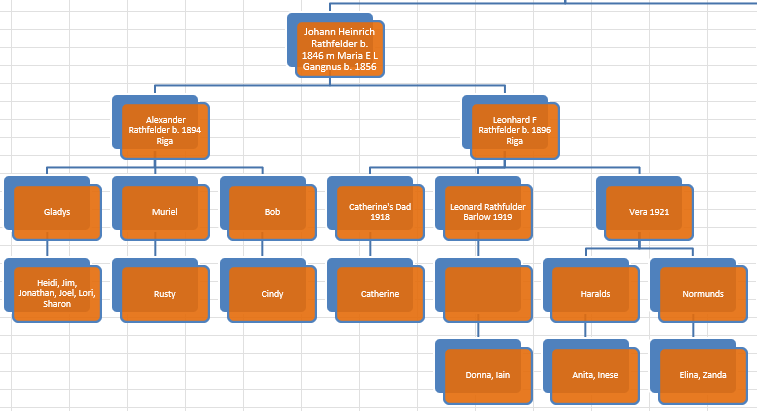
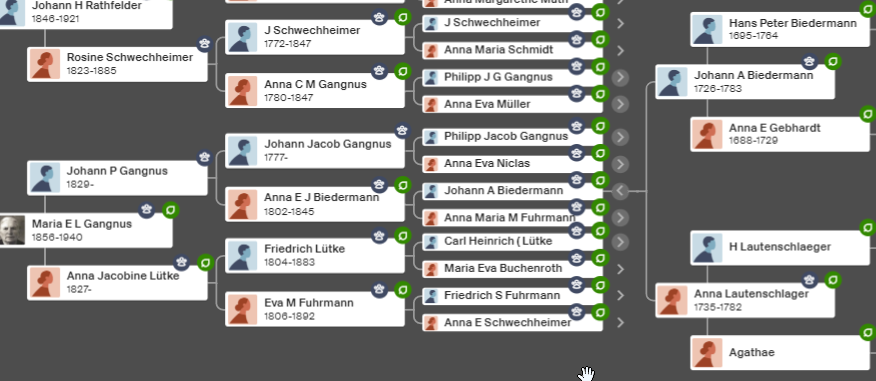
I keep a combination genealogy/DNA match tree. This is what I have so far for the Rathfelder tree:

I need to add the three matches under Vera:

this shows that my mother and Vera are first cousins. that means that my siblings and I are 2nd cousins with Normunds and 2nd cousins once removed with Elina and Zanda. I have this photo of Vera from my cousin Anita:

How We Match by DNA

For some reason, I can’t see the detailed DNA results for Normunds or Zanda. I do see results for Elina:

DNA Painter

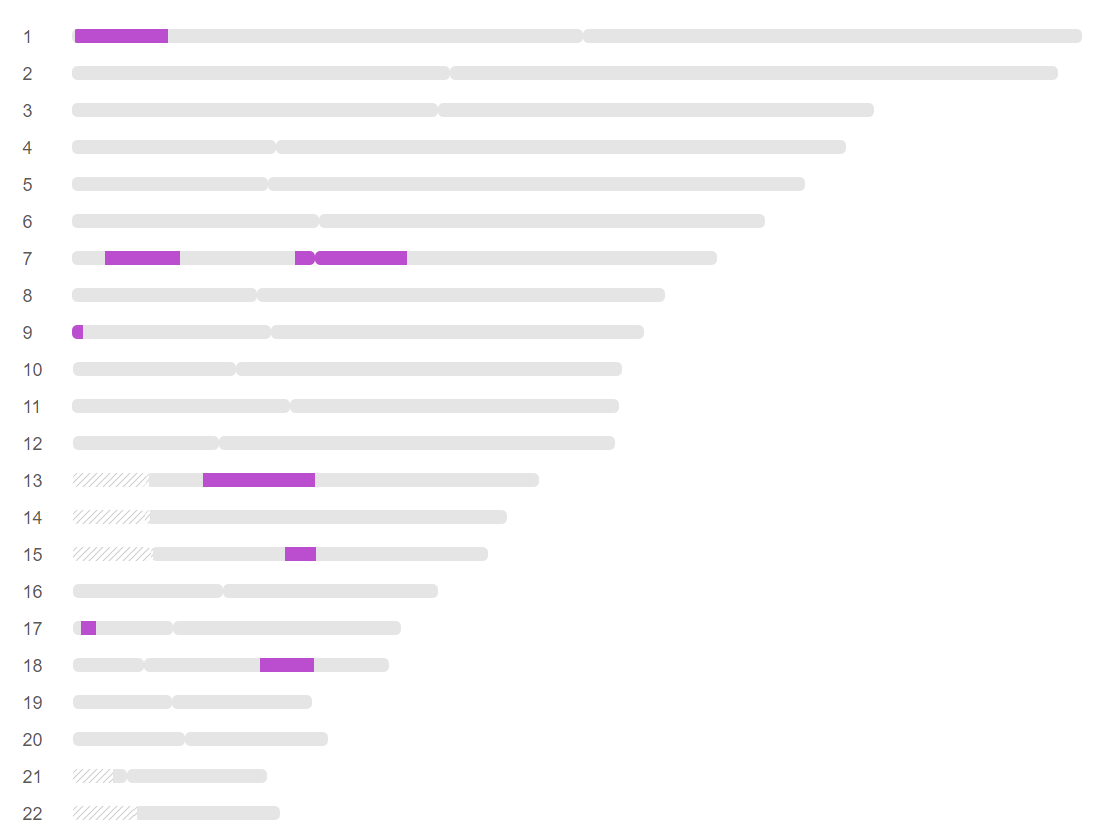
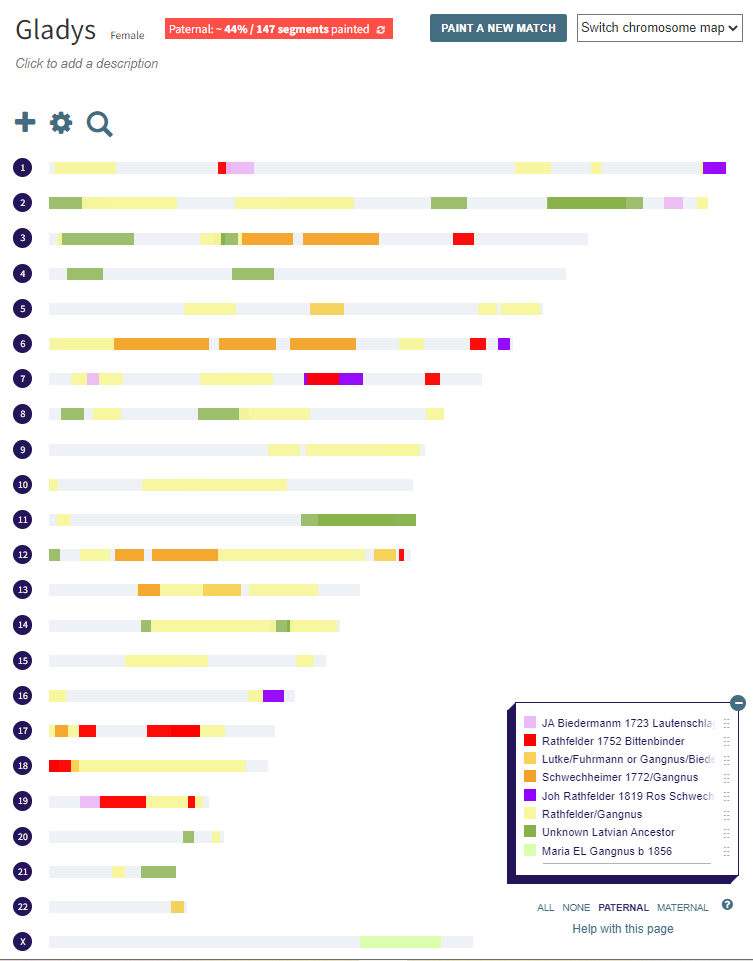
This information can be added on to my DNA Painter profile. This is how it looks now:

This shows that I am ‘painted’ overal 52%. This means that I have identified 52% of my DNA by known matches. On the representation above, the paterrnal side is the top part of each chromosome and the maternal part is the bottom of each chromosome. Here is just my maternal side:

This shows that I am painted 45% on my maternal side or a little less than half.

When I add Elina, this gets my maternal side up to 47%:

That also raised my overall ‘painted’ level to 53%.

Normunds DNA

At first I couldn’t see the specific matches for Normunds’ DNA but Zanda made the corrections, so I can now see his results. Here they are:

I’m interested to see how this will have an effect on my DNA Painter Profile. A second cousin is usually the best person to have for a match because they represent the DNA of one grandparent  – in this case, my grandfather Alexander Rathfelder. It turns out that there is no overall effect for Normunds. This is perhaps because he overlaps with other Rathfelder matches. There was a difference, but not enough to bring the painted percentage up overall or on the maternal side.

Here is Chromosome 15:

This would indicate that Carolyn’s match is spurious. She matches at 8 cM and a certain percent of small matches are inaccurate or false matches. The other orange matches all have Henry [Heinrich] Rathfelder and Maria Gangnus as common ancestors.

Here is what MyHeritage shows between myself and Normands:

This turns out to be more than average DNA for 2nd cousins to share:

This study shows that 229 cM would be average.

Normunds and Gladys Rathfelder

As Normands has as much or more Rathfelder DNA than his daughters and as my mother has more than her children, I’ll look at the match between Gladys and Normunds:


Normally, I don’t paint my own first cousins’ matches. This is because a first cousin normally just distinguishes between paternal and maternal side. However, for my mother, it looks like I painted hers:

Here the blue color is Rathfelder/Gangnus (1st cousins). This is just my mom’s paternal Rathfelder side. Also I usually have a lighter color for closer relatives, so the more distant, darker color relatives can shine through. My mom is currently at 40% painted on her paternal side and 35% painted overall. Let’s see if Normunds makes a difference.

Here I changed Rathfelder/Gangnus DNA to a more subtle yellow. This got my mom painted up to 44% on her paternal side and 37% painted overall.

Normunds adds some new DNA to my mother’s profile on Chromosome 1:

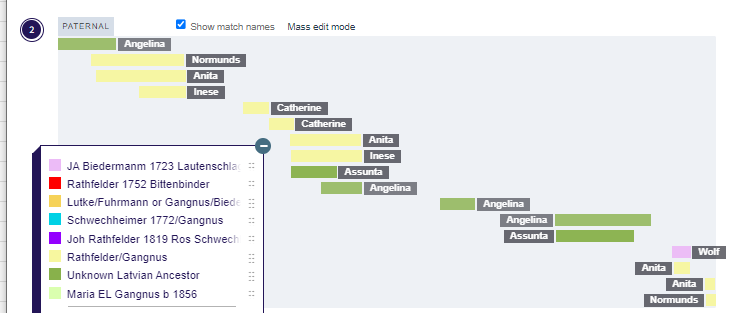
On Chomosome 2, Normunds overlaps with Angelina. I am not sure of her ancestry, but from her DNA, it is clear that she had ancestors from Latvia::

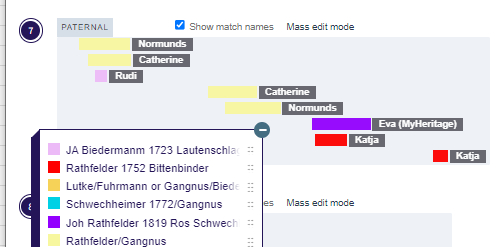
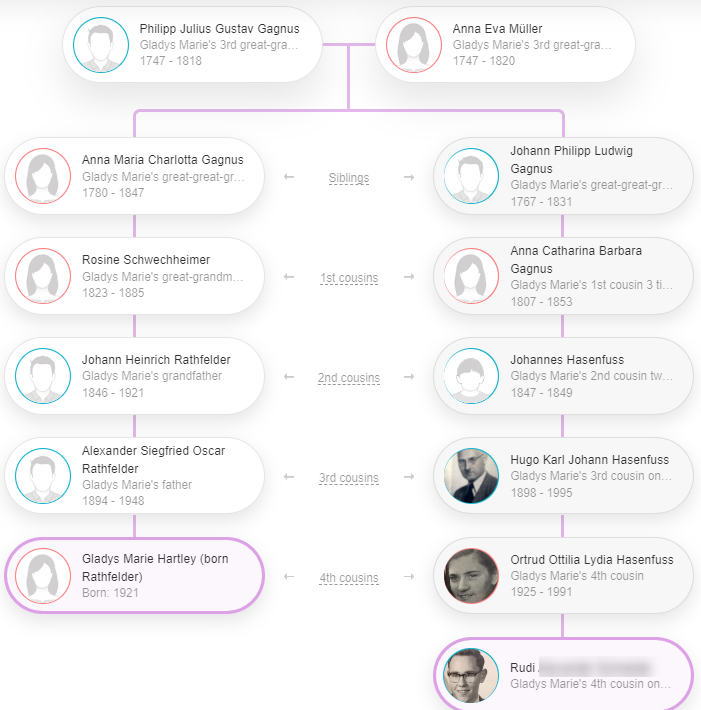
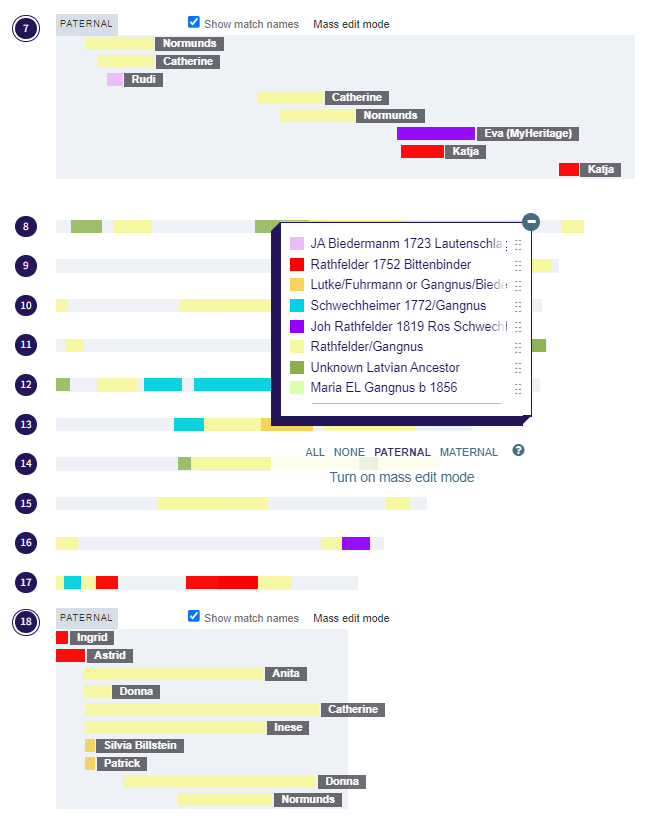
On Chromosome 7, Normunds has an overlap with Rudi:

Rudi has ancestry going back to 1723.

However, when I check MyHeritage, there are other possible relationships to Rudi. This one is called Theory 1:

This relationship would be on my mother’s paternal grandfather’s side, whereas the previous relationship would be on my mother’s  paternal gramdmother’s side.  Plus, I don’t know if I have checked out these different relationships. Altogether, MyHeritage has 4 Theories. It would be beyond the scope of this Blog to check them all out. The bottom line is that I thought that the match with Rudi on Chromosome 7 would give me more definition as to where the match that my mom had with Nornunds came from. However, in this case, due to intermarriage in the Colony of Hirschenhof, it is not clear.

Perhaps Normunds match with my mom on Chromosome 17 will tell us something:

Normunds has a partial overlap with Astrid and a complete overlap with Otis. This is giving a mixed message perhaps also:

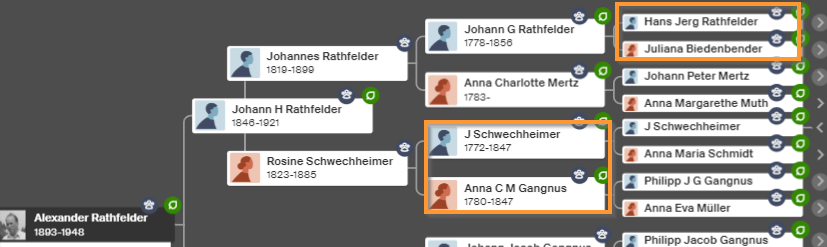
Otis’ ancesetry goes back to Schwechheimer (1772) and Gangnus (1780). Astrid goes back to Rathfelder and Biedenbender. Otis has uploaded his DNA results to Gedmatch. If Normunds uploads his results there, perhaps this will reveal something.

Meanwhile, Astrid shows triangulation with my mom and Normunds at MyHeritage on Chromosomes 17 and 19:

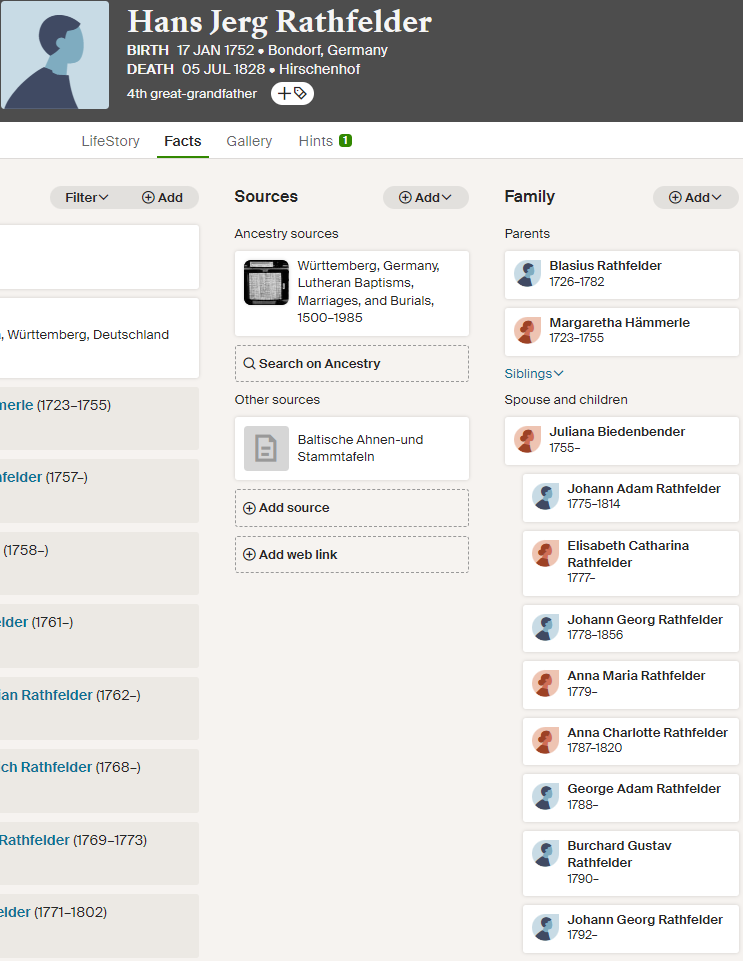
Triangulation means that these people all match each other. That means that I would tend to think that the DNA matches between the three of us represent DNA from Johann Jerg Rathfelder born 1752 and his wife Juliana Biedenbender born 1755. Here is Gladys’ DNA profile on Chromosome 19:

Astrid’s Genealogy

In order to sort this all out, I will need to take a closer look at Astrid’s genealogy. Here is what MyHeritage shows:

Ancestry shows this relationship, which I have assumed was right:

The W Rathfelder is Wilhemina Rathfelder. As I recall in other research, there was more than one Wilhemena Rathfelder. I think that the custom was to name the godchild after the godparent, so that may be the source of the duplicate names. Another confusing thing is that Hans Jerg had two children named Johann Georg:

These two Johann Georg’s were born about 15 years apart. That in formation was from this publication:

Based on the underlining, the first Johann went by Johann and the second went by Georg. The father Hans Jerg was also a Johann Georg.

Checking Astrid’s Tree

The best way to check Astrid’s tree is to build my own tree for her. Astrid has that her mother was baptized here:

At the Raduraksti website, I see this Church:

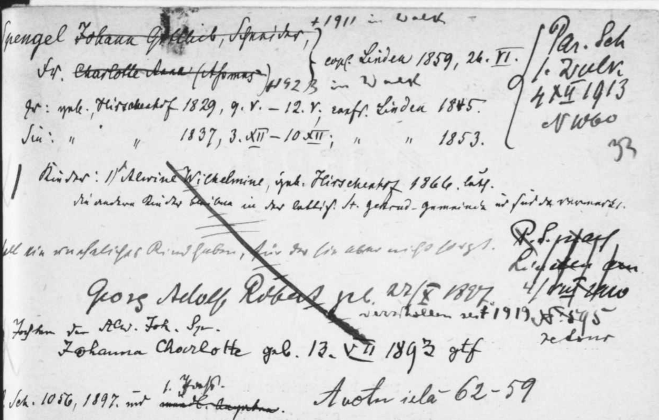
At this site, I found some information on the Spengle family, but I didn’t see Astrid’s mother or grandmother:

This would take a long time to check, so I’ll just assume the connection is right. My suspicion is that there are other connections than just the obvious ones.

Normunds, Gladys and Eva

I wrote a Blog about Eva here. She is my third cousin. Here is where Normunds, Gladys and Eva triangulate on Chromosome 1:

The theory is that shared amount of DNA comes from either Johann Rathfelder or Rosine Schwechheimer:

In that Blog about Eva, I mentioned this family chart:

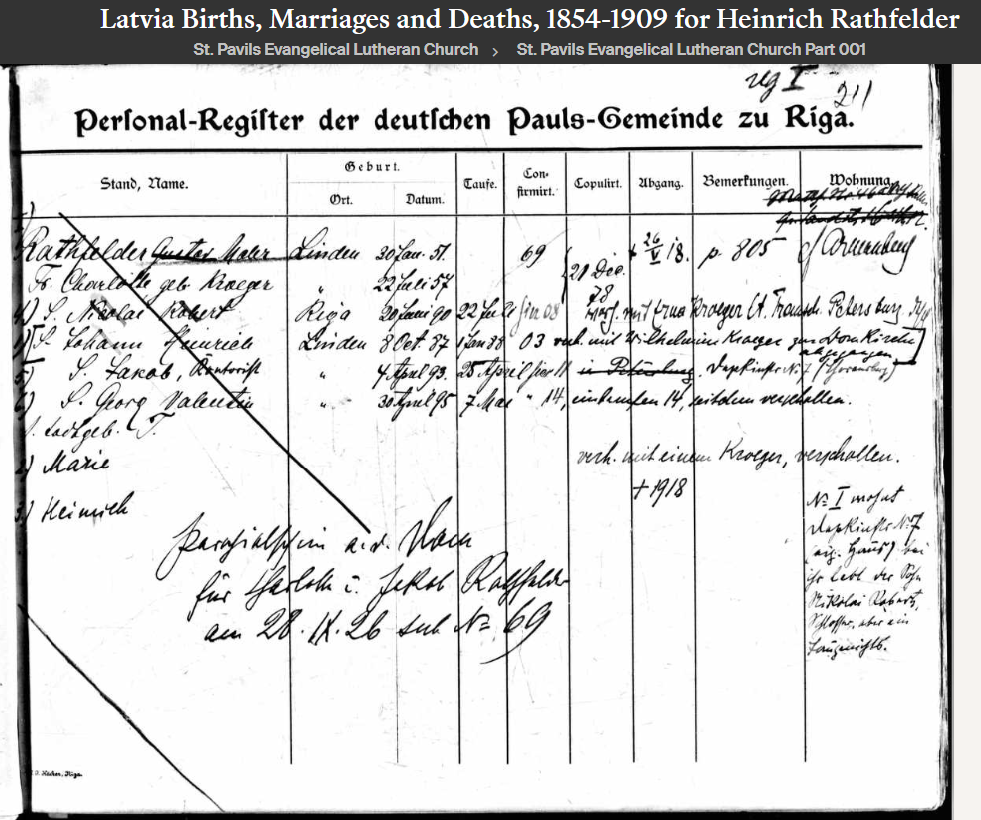
Did My Great-Grandmother Have a Second Husband Who Ran Away?

The Gustav Rathfelder family lived in Riga and attended St. Paul’s Lutheran Church. I wonder if the +1918 means that my great-grandfather Heinrich died in 1918. I have that he died before 1921. I put this image out to the Latvian Genealogy Facebook page and got these two responses:
“Abgang” is essentially departure — e.g. the +1918 means that Heinrich died in 1918 (and therefore “departed from” the church congregation). I’ll try to take another look at the rest later.

The note next to Marie’s name (above the +1918) says, “married to a Kroeger, missing”. Her husband (first husband? second husband?) is presumably the one who’s missing.
The fact that one of Gustav’s sons is also named Heinrich doesn’t necessarily mean that he was named after Heinrich, though it’s possible. It was a pretty common name, and names often appeared multiple times in the same family without being namesakes in the sense that we’d think of it.

It sounds like Maria Gangnus Rathfelder had a second husband which would make sense if the first one died. He apparently deserted her if I understand the record correctly.

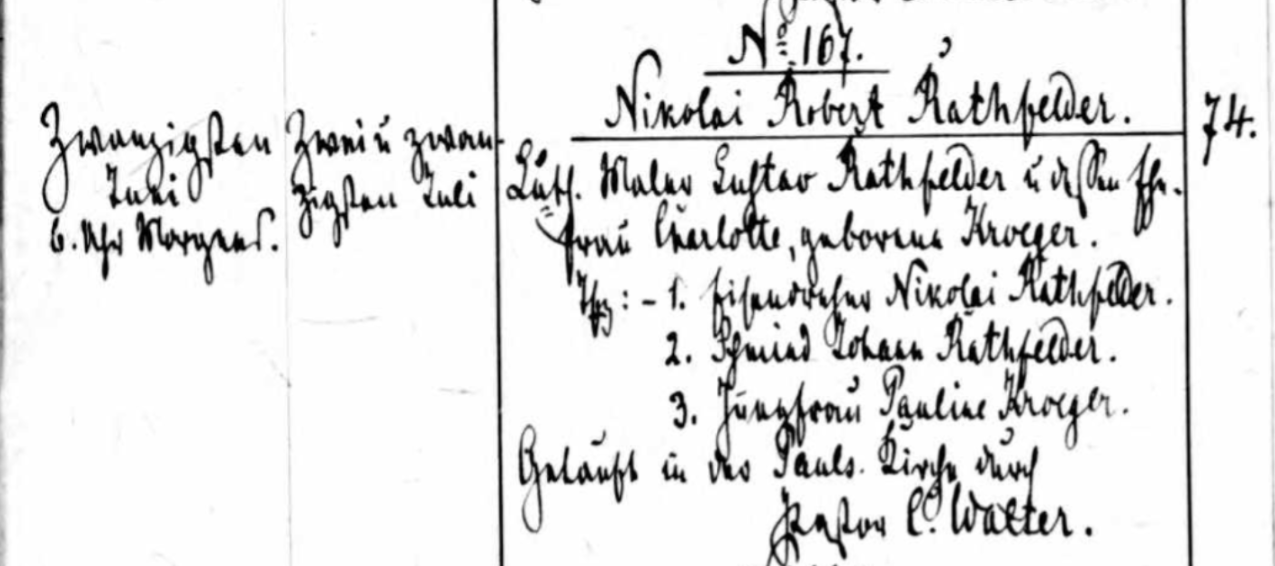
Concerning the comment on naming, I have seen that a child often had the same name as the Godparent. Here is the birth record for Robert Nicolai:

I take #1 above to be the godfather, Nicolai Rathfelder. Further, I believe him to be Johann Philip Nicolai Rathfelder born 1874 to my great-grandfather Heinrich Rathfelder.

Here is a photo of Marie. I assume that it is during Christmas and that she is with some of her relatives:

Marie is second from the left. She was born in 1856, so she would be quite old here.

Gladys, Normunds and Peter

These three people also triangulate at MyHeritage. That means that they all have common ancestors:

This triangulation happens on Chromosomes 7 and 18. Here is my mom’s DNA profile for those two areas:

These two areas represent ambiguous genealogies. Remember Rudi had about 4 ways that he could match. Also Silvia and Patrick could match on two different lines.

Peter’s Genealogy

MyHeritage shows this:

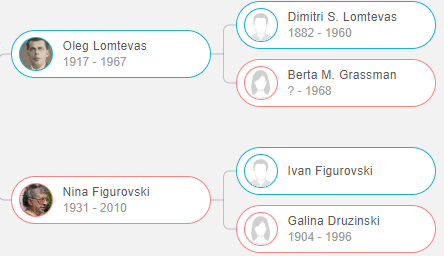
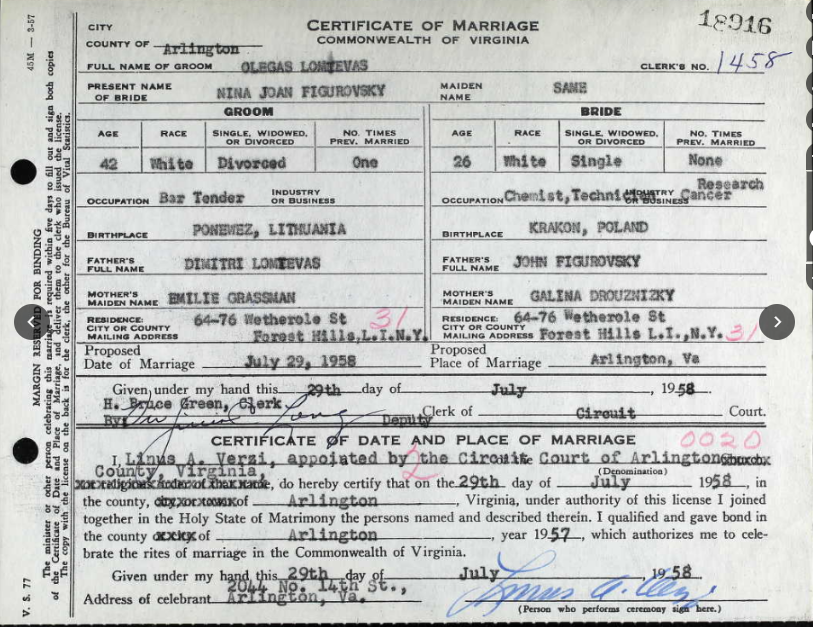
I can try to build a tree to see if I can get any further. I’ll start out on the paternal side. This marriage record is helpful:

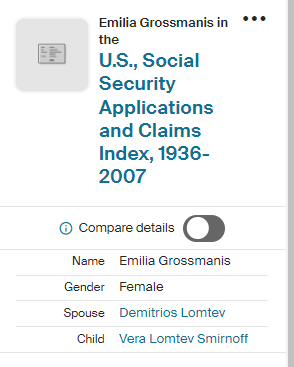
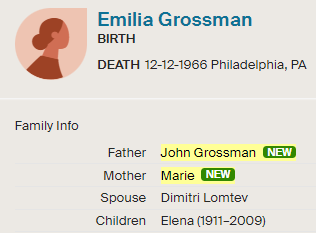
However, this has Oleg’s mother as Emilie Grassman rather than Berta. Social Security has this information:

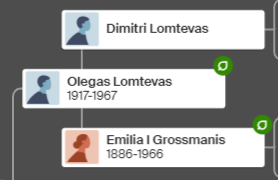
It seems like Oleg has a sister Vera. Find a Grave has more on Emilia:

My tree so far:

Here we see that Emelia was born in Riga:

This could be the connection that I was looking for.  This is likely Emilie traveling from Lithuania to New York in 1955:

That’s as far as I can get now. The connection appears to be with Emilie Grossman or Grassman. One tree at Ancestry has her parents:

Normunds, Gladys and Deborah

Perhaps I don’t know when to give up, but I’ll look at Deborah. These three triangualte on Chromosomes 1 and 9:

Deborah has a meager tree at MyHeritage:

It turns out that I already started a tree for Deborah. However, I couldn’t easily find anything new. Aparently Brigitta was born in Riga.

Summary and Conclusions

  • I was happy to find out about another branch of Rathfelder relatives in Latvia through DNA matching.
  • Normunds is my mother’s first cousin once removed.
  • I was able to ‘paint’ Normunds on to my DNA profile as well as my mother’s. It would be possible to add him also to my siblings’ profiles
  • In some cases, due to matches with more distant relatives, it is possible to tell where certain portions of DNA matches between my mother and Normunds come from
  • In other cases, it is difficult to tell for certain to intermarriage in the Colony of Hirschenhof where the Rathfelders and their ancestors lived long ago.
  • I looked at some common matches that Normunds and my mother Gladys have at MyHeritage
  • I relooked at the match of Eva. I found the family record kept by the Lutheran Church for Eva’s great-grandparents. He great-grandfather was the younger brother of my great-grandfather. This record gave the death date for my great-grandfather Heinrich Rathfelder. It also suggests that my great-grandmother remarried a Kroeger who went missing.
  • It appears that there could be more research of the DNA and genealogy to pull these families together.


FTDNA’s Time Tree for YDNA BigY Testers

FTDNA has a new Time Tree which is interesting. I have three trees that I am interested: Frazer from my father’s mother’s side, Hartley from my side and Butler from my wife’s side

Frazer Time Tree

The Time Tree is under Discover More:

Then there is a menu on the left:

Here is the Frazer Time Tree:

I didn’t take the tree all the way back. I thought that back to the time of Christ was probably far enough.

A Closer View

Here we can related more and focus in on the genealogical timeframe. I assume that between the years 1200 and 1400, the clans were forming as the top 6 BigY testers are five Frazers and on Frazier/Frasher. The Frazier tester has an American Flag as the genealogy is colonial and cannot be traced back – though it likely goes back to Ireland or Scotland. This branch of Frazers is called R-YP6489. Down from Frazier on Time Tree above is Dingman. Then there are Rick and my by cousin Paul. Then there are Rodney and Jonathan.

Here is how I have the North Roscommon Branch of BigY-tested Frazers:

Dingman on the left has the generic North Roscommon Frazer Haplogroup of R-FT421618 because no one else on his branch has tested.

This is how the ‘Block Tree” at FTDNA looks like:

Here I have Frazier also in the image. By comparing the two previous images, there are some interesting things:

  • Jonathan and Rodney share an average of 5 private branches. That would seem to indicate the potential for some branching below R-Y151390 which is the branch for Thomas Henry Frazer born 1836. There is also a spare SNP which is FT421607. This is available for branching between James Frazer born about 1720 and Archibald Frazer born about 1792.
  • Rick and Paul show an average of three Private Variants. These would be for branches below James Frazer born 1804. The Private Variants in this case and for Rodney and Jonathan are not as important as the genealogy is better known in these two lines where these Variants would be applicable.
  • Perhaps what seem unexplainable at this time is why R-Y85652 has two additional equivalents. That would imply that, if my tree is right, that Philip Frazer would have had two mutations. I don’t think that is very likely. As these are equivalent SNPs, the other potential, given the above tree would be that Philip had one mutation and James had two mutations. I posed the question to the BigY Facebook Page as to whether one man could have two variants or SNPs. Some thought that two mutations in one person was possible.
  • Dingman’s line has four Private Variants. They would have ocurred in the seven generations since Archibald Frazer born about 1743.

Hartley Time Tree

This is from my own family.

The man in red represents my father as he is the one my brother and I have as a common ancestor. The man with the blue cross is a Smith. We have a common ancestor around 500. It is not clear as to whether our ancestors were from Scotland or if his branch moved North. Going up a branch, it would seem that most of the people from this line were in the area of England. A few testers in the branch above had ancestors from Wales:

For reference, the blue circle three from the bottom of the above image is Smith.

Hartley and Mawdsley

The top tester above is a Mawdsley. There had been some question as to whether this person should have been a Hartley. If we go with this timing with a common ancestor between Hartley and Mawdsley of around 1100 AD/CE, then there would be no need to group the two as surnames were not common at that time for the average person. I like to quote FamilySearch on this topic:

The custom of applying a man’s by-name to all his children began in the late 12th century and spread slowly, with the manorial classes and the south of England leading the way. The first legal recognition of an hereditary surname is found in 1267; it was de Cantebrigg meaning ‘of Canterbury.’ By 1400 three-quarters of the population are reckoned to have borne hereditary family names, and the process was complete by about 1450 in England. Wales is an exception, in that although they had surnames they were patronymics (derived from the father’s first name) and thus changed each generation.

The Hartleys seem to fit this general statement as the first Hartley common ancestor (if FTDNA’s estimate is correct) is shown to be:

In general terms, the Hartley “Time Tree” shows two major branches of Hartleys. The first group branches off from R-A11134 and the second group branches off from R-A16717:

This branch is about 140 years more recent than R-A11134. The common ancestor of this branch was born, according to the tree in 1572. This date is about 90 years off from the to the actual genealogy. However, it could be that A16717 first ocurred in the grandfather or great-grandfather of Edward Hartley:

I call this the Quaker Branch of Hartleys. Edward Hartley from Little Marsden came to Pennslyvania and started the US branch of this Hartley family. There is another YDNA tester who is considering the BigY test who descends from the Thomas Line above. This is the line from the Hartley researcher I have corresponded with:

>Edward Hartley born 16 May 1666 married? Sarah Midgley
>Thomas Hartley b. 29 Dec. 1700 Solebury, Bucks County Pa. married Elizabeth Paxon
>Anthony Hartley b. 3 Dec. 1730 married Elizabeth Smith
>Jonathan Hartley b. 221 Octoner 1761 married Elizabeth Bunting
>David Bunting Hartley b. 28 Sep. 1786 married Phoebe Park
>Hiram J. Hartley b. 27 March 1824 NJ married Rebecca Church Lee
>Harry Lee Hartley b. 9 June 1864 married Emma Bell Leach
>Robert Hartley b. 17 June 1896 married Grace Maloney Roberts
>John Robert Hartley b. 4 August 1922 married Alice Buren Wrighy

One way to look at it, is if the Quaker Line is about 90 years too old on the tree, then perhaps we could move the other branches ahead 90 years. That wouldn’t work for my father’s branch as the timing on that is so close. Here is my tree with the John Robert line added:

Butler Time Tree

My wife is a Butler and there are a few Butlers who have taken the BigY test:

On this line, it doesn’t take much to get back to over 3,000 years ago. The Frazer lines were R1a, The Hartley lines were R1b. This line is in the I Haplogroup. Let’s start with the red Haplogroup I-FT241245. The two testers are my brother-in-law and father-in-law. In this case, my father-in-law is the common ancestor who has FY241245. The estimated date for that Haplogroup is 1907 or close enough to 1932 when my father-in-law was born.

The next person up on the tree is Butler researcher Peter:

This tree is showing that Peter and my in-law’s have a common ancestor born around 1557. In a Blog I wrote on 1 March 2021, I came up with these dates:

That’s a difference of about 125 years.

Next Branch Up

The next Branch going back in time includes a Whitson and a Batt.

The date that FTDNA gives for the common ancestor at I-BY50783 is 1449. This is interesting as it seems like only one SNP separates these two ancestors. That comes up with 108 years per SNP in this case. That is about what I was using in my guess – 100 years per SNP.  But I came up with a different result somehow.

Comparing the Three Time Trees

I am impressed with the regular branching on the Time Tree that the Frazers are on:

This is true especially starting after 900 CE with some sort of branching in every 200 year period following. This may be a result of the fact that many people with Scottish origins tend to have their YDNA tested. Another explanation would be lines that were successful and prospered.

The Hartley Time Tree does not have the same regularity in its branching:

Here we see no branching between around the years of 500 and 1100 CE. This could be due to fewer testers and/or lines that were not doing as well. Intermediary lines may have died out. This could be due to wars, famine, disease or simply famiilies have no males born.

The Butler Time Tree has even less branching:

There are two main branches that ocurred before 1,000 BCE. After that there was no addition branching until almost 1500 CE. That is about 2,500 years without branching. This line is probably severely undertested and/or went through very tough times. This is picked up somewhat at the SNP Tracker Website:

Notice that whole eras are skipped. Medieval and Iron Ages are missing.

Summary and Conclusions

  • FTDNA has a new helpful representation of a timeline for BigY testers. This is not the final say, but a helpful tool to compare with other estimates and with genealogy where available.
  • I looked at the trees that I have looked into. Those are Frazer, Hartley and Butler
  • I compared the three trees to each other. I noted that the Frazer Time Tree has the most consistent and regular branching going back in time. The Butler Time Tree has the sparsesest branching going back before the time of Christ.
  • As a result, I would ten to have the most faith in the Frazer timelines. There is good branching and somewhat of a check as we believe that common Rocscommon Frazer ancestor represented by R-FT521618 was born around 1690. I feel the Hartley Time Tree is slightly less reliable due to fewer branches but we have the genealogy for the common ancestor for the ‘Quaker Line’ born in 1666. In my opinion, the Butler Time Tree could be the least reliable of the three due to no ancient genealogy to check and the fact that branching in the line is sparse – especially before the genealogical timefrane.
  • FTDNA is continuing to calibrate its age estimates. One good example of how FTDNA’s Time Tree can be calibrated is with Edward Hartley born 1666. If this person is reported to FTDNA, they will be able to use that information to correct their current estimate of a common ancestor of 1572.