Cousin Cindy’s DNA: Part Two

In my last Blog, I looked at some of Cindy’s Rathfelder matches and at her X Chromosome matches. In this Blog, I’ll look at some matches on Cindy’s Lentz and Nicholson Lines.

Another Classic Photo

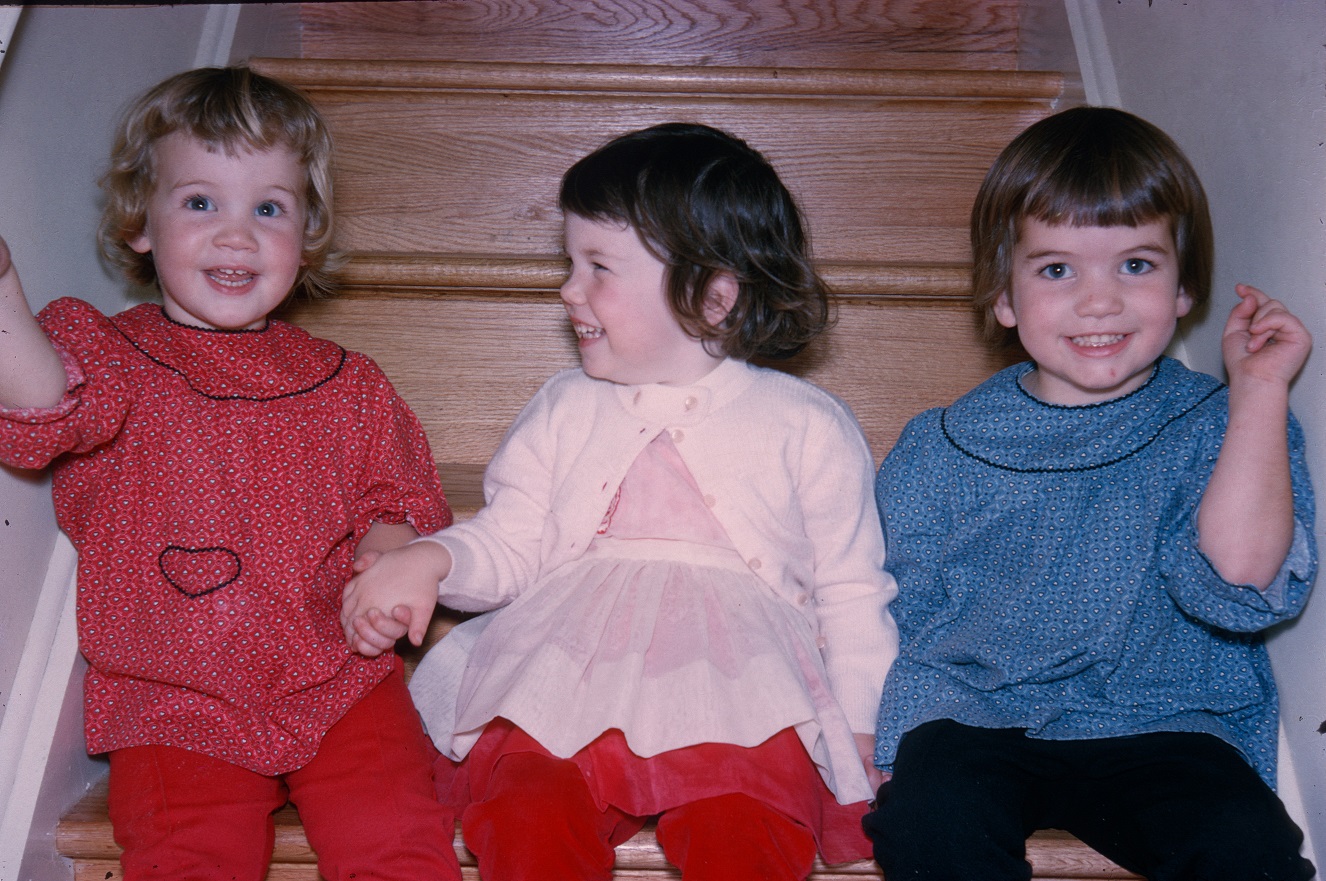
Here is Cindy in profile inbetween my two sisters, ‘back in the day’:
More on Ethnicity

Here is what Gedmatch.com shows for Cindy’s ethnicity:
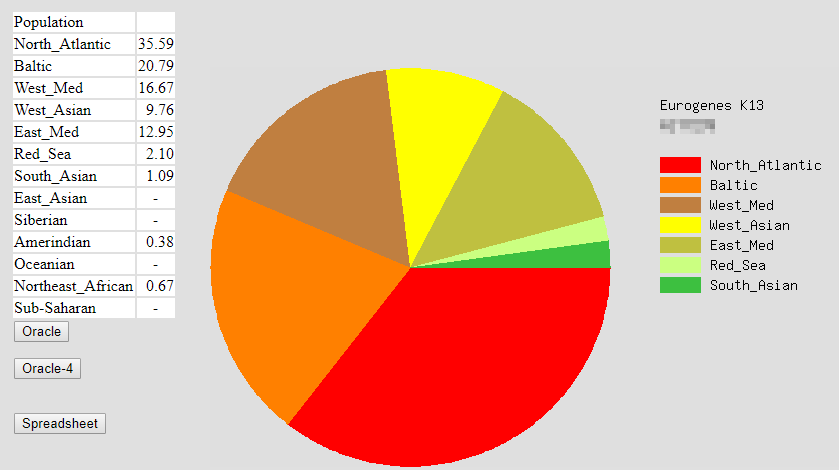
This should be more accurate than what Ancestry shows. The down side is that specific country names are not given. However, that is rectified by the two Oracle buttons. When I push the first button, I also get a list of Single Population Sharing. According to the Genalogical Musings Blogspot:

Single Population Sharing attempts to pinpoint a specific, single population that your DNA most closely matches, with a list of the top 20. The distance will tell you how closely you match each group, so the smaller the distance number is, the more closely you match. It is assuming your ancestors all came from the same area/population.

For Cindy, her top choice is West German:
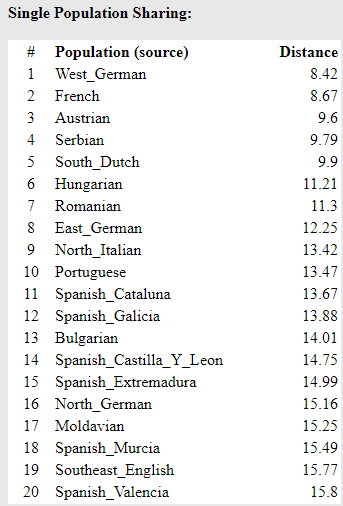
Cindy wanted to know if she was German by genealogy, why didn’t her Ancestry results show that? Gedmatch Single Population Sharing does show that her first choice is German. The second guess is French. This makes sense considering how close the two coutries are. Or, this French part could be more from Cindy’s mom. There is also a Mixed Mode Population Sharing, but that is more complicated, so I won’t go there.

By comparison, here is how my mom’s admixture shows up at Gedmatch. These results should be comparable to Cindy’s dad:
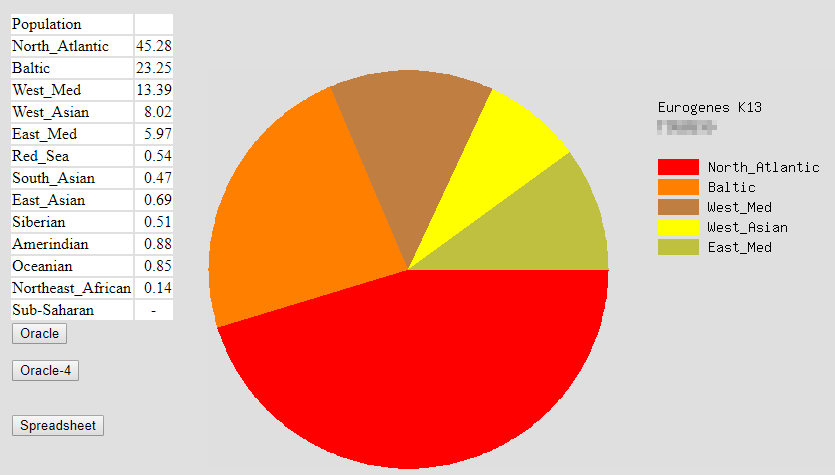
The difference is that my mom has more North Atlantic and none of the small green wedges that Cindy has. I would expect that my mom should come out German also in the Single Population Sharing:
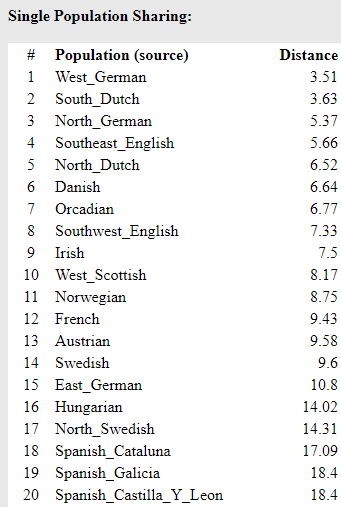
Good guess. However, look at the West German distance compared to Cindy. My mom Gladys’ distance to West German is a lot closer than Cindy’s distance to West German. I suppose that means that Cindy has more mixing of heritages than my mom. Also Cindy has Serbian as her #4 choice and my mom doesn’t have that on her list. That could be related to Cindy’s mom. That is not to say that Cindy’s mom is necessarily Serbian, but perhaps there is something in Cindy’s DNA that is similar to Serbian DNA. There are other Admixture toys to play with at Gedmatch such as the Oracle4 Button.

Now I’m curious to see how I show by comparison to Cindy and my mom.
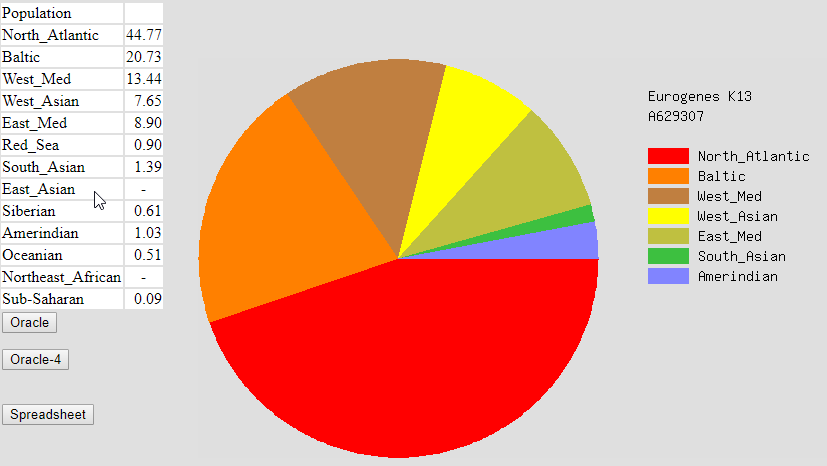
This looks similar to my mom, except that I have some South Asian and Amerindian. How did that get these? From what I can tell, my mom is 3/4 German and 1/4 English. My dad is 1/2 English and 1/2 Scot from Ireland. That should make me roughly 3/8 German, 3/8 English and 1/4 Scot. How will Gedmatch figure that one out? It looks like a tie.
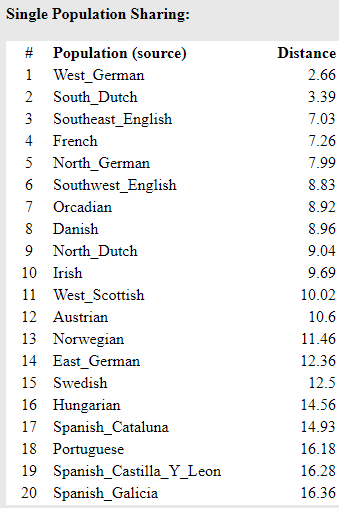
It has me as West German. The Scots gets lost in the Shuffle. I have Orcadian which is from the Orkney Islands at the very Northern part of Scotland at #7. Actually, my grandmother’s Irish mom was Clarke, so perhaps English and not Scots. The Germans came into England as the Anglo Saxons and England got its name from Anglo. Also come to find out from YDNA testing that my Scots ancestors the Frazers a few thousand years ago traveled from Scandinavia to Scotland. When you go back far enough, there is a lot that could have happened. I wa s a bit surprised that this showed me as closer in distance to West German than my mom.

Here I also have French where my mom does not. This could go back to my paternal Pilgrim heritage or it could be due to the fact that a lot of French DNA is similar to English DNA also.

As I alluded to above, there are a lot of other crazy things you can do with Gedmatch and Admixture such as a very detailed chromosome by chromosome comparison, including detailed chromosome painting. For example, I could track down the specific area of the specific chromosome where Gedmatch thinks I have Amerindian background. Using this, I could even make a guess as to which ancestor this segment came from.

Back to the DNA – Nicholson Matches

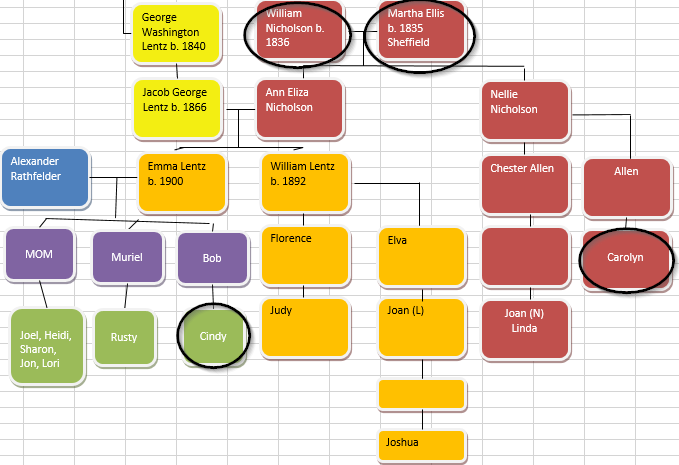
I drew a new tree for the Nicholsons:
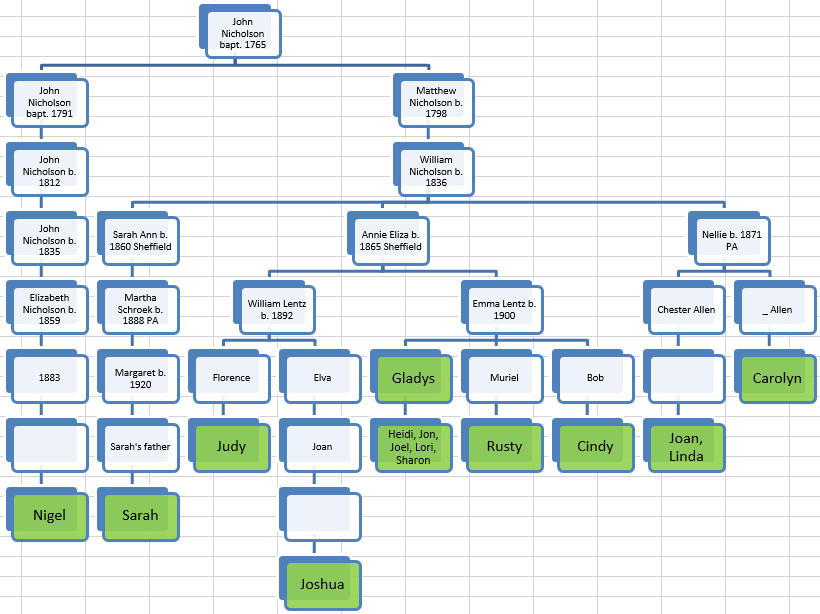
These are some of the descendants of John Nicholson. The people in green have taken a DNA test. First, Cindy does not match Nigel. This is not surprising as they are 5th cousins once removed. Nigel had some surprising matches with my family considering the relationship.

Nicholson or Lentz DNA Matches?

One problem that I’ve had is finding good Lentz only matches. In situations where Cindy matches Judy or Joshua, the match could be either Lentz or Nicholson. When Cindy matches Sarah, Joan, Linda or Carolyn, those must be Nicholson only matches. When Cindy matches my family or Rusty, she could be matching also by Rathfelder.

Autosomal Matrix

First, I’ll put the Nicholson descendants into a matrix to see how they match each other in general:
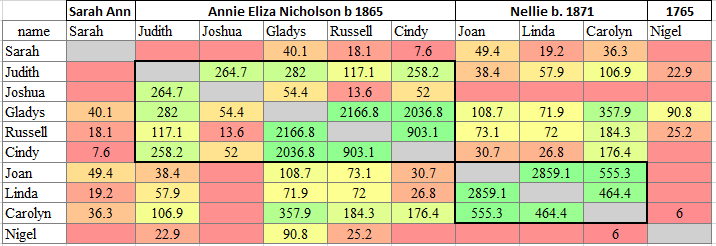
Here I have the DNA tested Nicholson descendants sorted into the three sisters: Sarah Ann; Annie Eliza and; Nellie Nicholson. Then I have Nigel descending from John Nicholson from 100 years earlier than Annie. The places where Cindy match Sarah, Joan, Linda or Carolyn are matches of DNA that she got from the Nicholson only side. Where Cindy matches Judith or Joshua, those matches may be from the Lentz or Nicholson side. Where Cindy matches Gladys or her cousin Russell, those matches could be Rathfelder orLentz (including Nicholson).

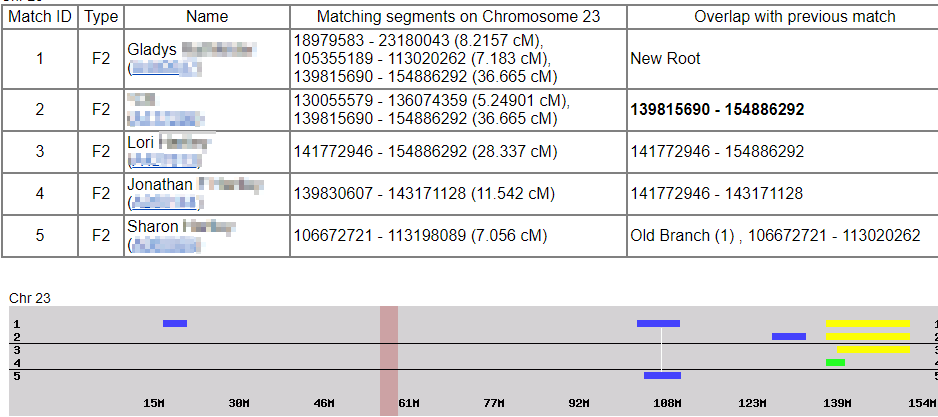
Here is how Judith matches my mom, Cindy and Carolyn on Chromosome 18:

If this was just Judith matching Cindy and Russell, we wouldn’t know if this was a Lentz or a Nicholson match. However, the fact that Judith also matches Carolyn in the same area of Chromosome 18, makes it look like a Nicholson match. Just to make sure, I will look to see how Carolyn matches Gladys, Cindy, Judith and Russell:

This view shows more of Chromosome 18 than the previous one. What this shows is that:

  • From about 14 to 38M, Carolyn, Gladys, Cindy and Judy share Nicholson DNA
  • From anout 55-70M, Carolyn, Gladys, Cindy and Rusty share Nicholson DNA
  • Between 38 and 55M, I am not sure. It could mean that this is Lentz DNA as Carolyn drops out. However, she may be dropping out for for another reason.

Here is the Triangulation Group (TG) between Judy, Gladys, Cindy and Carolyn between 14 and 38M:
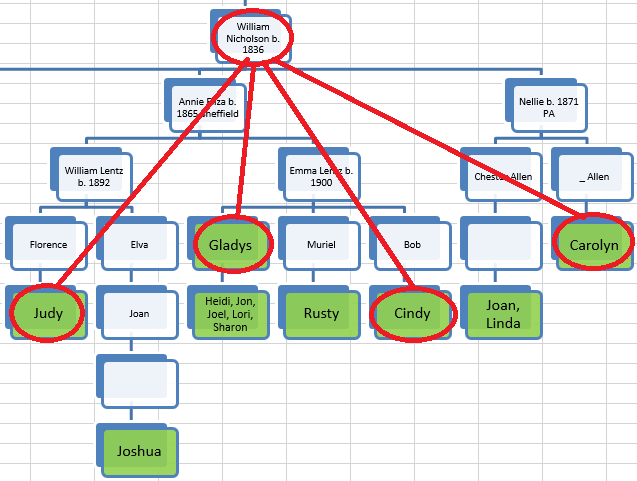
In the second TG, Cindy jumps out of the group and Rusty joins in.

Cindy’s Top Unknown Match at Gedmatch

Cindy’s top unknown match at Gedmatch is Dorothy. Let’s see if we can figure out how Dorothy fits in. Here is how Dorothy matches Cindy and my mom:
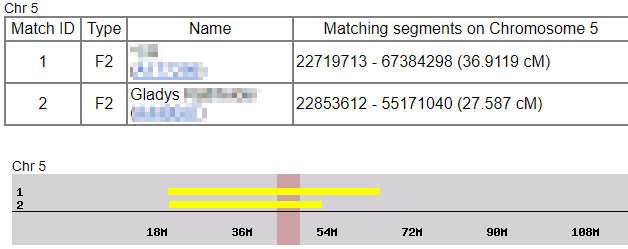
Dorothy tested at FTDNA where my mom tested. Maybe there is some more information there. Dorothy has a tree there, but I don’t see any shared surnames.

Here is some more information:
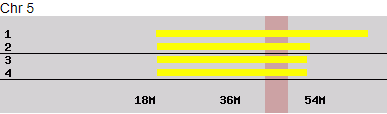
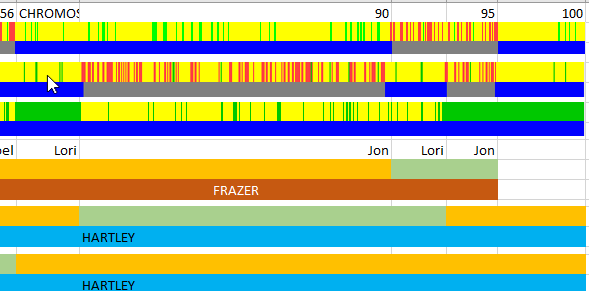
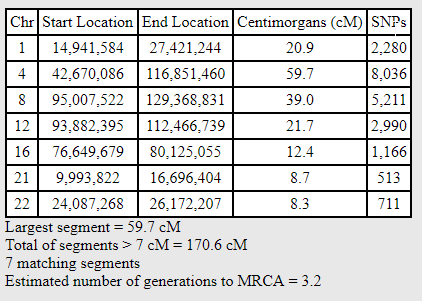
Dorothy has two additional matches: Lori and Jon. I know from previous Chromosme mapping that Lori and Jon map to their grandmother Lentz in this area of Chromosome 5. One of Dorothy’s ‘In Common With’ (or ICW) matches at Family Tree DNA (FTDNA) seemed to be on the Nicholson side by DNA. So we would give Dorothy more of a chance of being related on the NIcholson side than on the Lentz side. However, at this point, it would take too much work to figure out the match, so I’m giving up for now.

Cindy’s Other Gedmatch Top Matches

Cindy’s match after Barbara is DD. I don’t see DD on my mom’s match list, so I’ll guess that DD may be a match on Cindy’s mom’s side. After that is Derek. Perhaps I will have better luck with Derek than I did with Barbara. Derek matches my mom, Cindy, me and Lori in a pretty unified block of DNA on Chromosome 3:
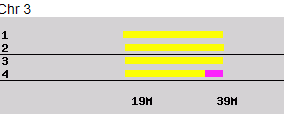
 

This looks interesting. The match goes from about 18-41M. I have a map for my Chromosome 3:

This shows that I have Rathfelder grandparent DNA in this area (darker blue). Carolyn (our Nicholson cousin) matched my mom, Heidi and Sharon in this same area. So how can my mom match both Carolyn and a Rathfelder in this spot? My mom matches Carolyn on her materal side and Derek on her paternal (Rathfelder) side. The interesting part is that I don’t get too many good matches on the Rathfelder side.

I didn’t find much on Derek on Ancestry. I added Derek to my match spreadsheet and noted that he also matched a Carol – a nearby match on the spreadsheet. I did find Carol at AncestryDNA and she has a tree there:
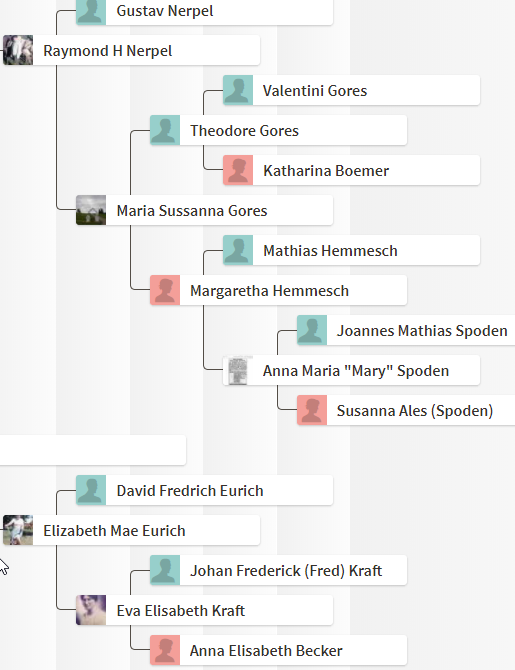
For some strange reason when I select ‘view full tree’ it goes to a different tree. When I choose shared matches for Carol, I get an AncestryDNA match with this tree:
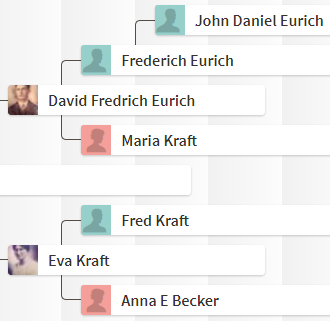
That means that Carol’s maternal grandfather is the same as this tester’s father. This also appears to show that I should be looking at the Eurich/Kraft part of the tree.  I have been in touch with the son of the above-tested woman. He says Eurich and Kraft were from a German Colony in Russia called Saratov. I had thoiught that I had written a Blog on this, but maybe not.

Saratov and Hirschenhof

The Rathfelder and Gangnus families were from Hirschenhof, Latvia. The Eurich and Kraft families were from Saratov, Russia. Other than these both being German colonies in then Russia, I am not sure of the connection.
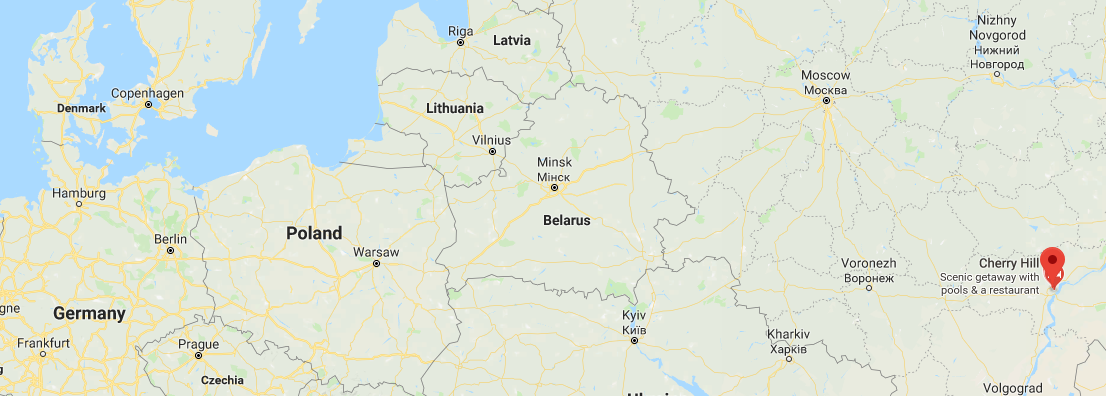
I have a pin by Saratov. Hirshchenhof is to the SE of Riga. They are both quite a way from Germany. I would say the distance would be in the range of 1,000 miles.

I did begin a Eurich Family Tree:
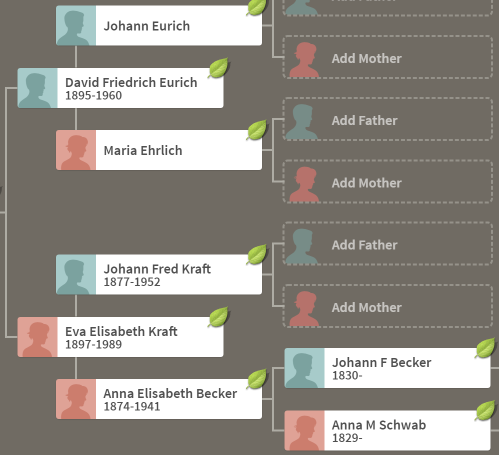
I just added the couple in the lower right today. The problem is, that if my mother is a 4th cousin to this person, I will have to move the tree out three more generations. That would be out to 32 thrid great grandparents.

It looks like this is a dead end right now also, unless I hear from some of the researchers working on these lines. It appears that getting genealogical informaiton from Russia is quite difficult.  It is interesting that the Rathfelders who were from a German Colony in Latvia have a connection in some way with this family that is from a German Colony in Saratov, Russia. Perhaps the connection goes back to before the time these people were in their colonies.

Another Thought on the X Chromosome

In my last Blog on Cindy, I mentioned her X Chromosome. Her X Chromosome pattern is different than mine and cousin Rusty’s in that her Rathfelder parent was a male. That means that Cindy’s dad only passed on Lentz X Chromosome to Cindy. I mentioned, that as a result, wherever I match Cindy, I would match her on the Lentz and not the Rathfelder side for my X Chromosome. I used that information to update my X Chromosome Map.

This mapping program was developed by Kitty Munson Cooper and is available on her web site. On the bottom line (the X Chromosome), I have the places I match Cindy in yellow. I left the matches with Rusty as purple indicating Rathfelder. The bottom part of each chromosome represents my maternal (Rathfelder) side. I had already mapped my X Chromosome using two other methods, but Cindy’s X Chromosome matches with me confirms that work.

Summary and Conclusions

  • I had not planned on looking into the admixture or heredity of Cindy, my mom and myself. However, when I did, I had a good time doing it and came up with good results.
  • It is fairly easy to find Nicholson relatives. However, it is difficult to find DNA – tested Lentz relatives. The closer Lentz relatives we know about also descend from the Nicholson family, so that makes it difficult to know if we are matching on the Lentz or Nicholson side.
  • I didn’t get very far trying to identify some of Cindy’s unknown matches. I did at least figure out if they were on the Rathfelder or Lentz side.
  • I noted how Cindy’s actual X Chromosome matches with me mapped to the segments that were created using Visual Phasing and Raw Data Phasing
  • Working on Cindy’s DNA reminds me of the family connections we have and the times the families have spent time with each other


DNA Results for My Cousin Cindy: Part One

On a regular basis, I go to AncestryDNA to check my new 4th cousin matches. I was surprised not too long ago to find a first cousin match. This match was with my cousin Cindy. When I was younger, Cindy lived in Cherry Hill, NJ. The family moved to Florida and we lost touch a bit. We have been in touch though on and off since then. If I looked around long enough, I’m sure I could find some photos of Cindy as a child. My mom also used to take home movies.

Here is a classic couch photo from the archives:

This looks like Cindy’s brother Rob, Cindy, my sisters Sharon and Lori and me. I was the old one in the group. The four on the right have been DNA tested. We need to get Rob’s YDNA for the male Rathfelder line.

Cindy’s Genealogy

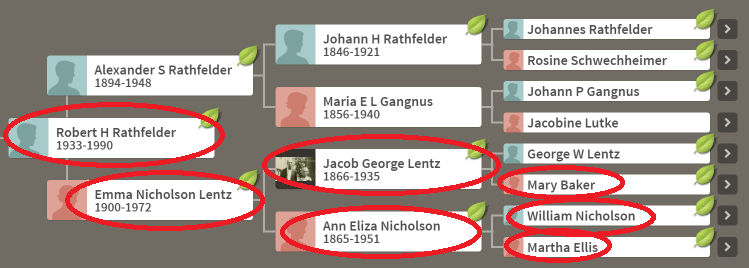
Cindy and I share two grandparents and her dad was my mom’s youngest brother.

I don’t know much about Cindy’s mom’s side. Here is a picture of Cindy’s dad Bob on the left with his two older brothers:

Bob as well as my mom were about 3/4 German and 1/4 English from what I can tell. Rathfelder and Gangnus were from Latvia but of German origin. Lentz goes back to colonial Philadelphia, but before that they were in Germany. Nicholson was from Sheffield, England before moving to Philadelphia around 1870. I won’t get into the DNA ethnicity estimates as they are complicated and not very accurate beyond broad areas of the continent.

Surveying the Previously DNA Tested Landscape

I have a chart showing some of the people that have tested and match on my mom’s side:

I squeezed Cindy into a green box. Yellow is Lentz. Blue is Rathfelder. Red is Nicholson. Orange is for those who descend from Nicholson and Lentz. I also had a DNA match with a Rathfelder descendant. I wrote a Blog on that match here. Eventually, I will split off the Rathfelder Line to make this chart more clear. So I need to check Cindy against all these people. That may be more than one Blog.

Cindy and the Rathfelder Connection

I already mentioned the Rathfelders, so I may as well start there. It turns out I already had a tree. I just had to add Cindy:

Since I did this tree, my sister Lori also had her DNA tested. When I did this tree, I was having a lot of confusion. According to my records, Hans Jerg Rathfelder had two sons named Johann Georg. I also found two Wilhemine Rathfelders. Here is Cindy’s match to Astrid:

For some reason, Cindy matches Astrid on a different Chromosome than my mom, Rusty, and Catherine. As my siblings and I got all our DNA from our mom, I didn’t add our duplicate or less results. So if Cindy were mapping her DNA, that segment on her Chromosome 16 would map to her Rathfelder side. It appears to be DNA that came down from the 1750’s. So Cindy adds another piece to the puzzle of ancient Rathfelder DNA.

More of Cindy’s Rathfelder DNA

To get more of Cindy’s Rathfelder DNA, I just need to compare her to 2nd cousin Catherine:

This is not all of Cindy’s Rathfelder DNA. This is just the DNA that she shares with cousin Catherine. Even though I am calling this Rathfelder DNA, some of it is actually Rathfelder and some should be from Maria Gangnus. Cindy’s number of generations to the Rathfelder/Gangnus connection is 3.3 based on DNA alone. The actual should be 3.0, so she shares a little less DNA with Catherine than average. Actually of Cindy’s 1st cousins, her match to Catherine is about average. Cindy is listed as 4th out of seven on Catherine’s list of 2nd cousins. Cousin Rusty had the highest match, but even his estimate to a common ancestor was 3.1.

Cindy’s X Chromosome

Cindy technically has no Rathfelder X Chromosome. She did get one X Chromosome from her dad, Bob, which you would think would be Rathfelder, but it was actually Lentz DNA from his mom. That is because an X Chromosome is not passed down from father to son. So Bob never got an X Chromosome from his Rathfelder dad. In fact, one interesting thing is that if Cindy’s sister gets her DNA tested, they will have a perfect X Chromosome match with each other on their father’s side.
Here is where CIndy could have gotten her X Chromosome from:

That means that whenever Cindy matches Rusty or my family, it has to be in these circled areas and not on the top part of her father’s tree.

Here are some of Cindy’s X Chromosome matches with:

  1. my mom
  2. Jon
  3. Sharon
  4. Lori
  5. Joel
  6. Carolyn
  7. Heidi

Cousin Carolyn’s X Chromosome Match with Cindy

I haven’t mentioned Carolyn yet. Carolyn shares more X Chromosome with Cindy than my sister Heidi does with Cindy.

Carolyn is my mom’s 2nd cousin and Cindy’s 2nd cousin once removed.  From Carolyn’s point of view, here is how she matches us. #2 is Cindy.

This shows that Carolyn does not match me or my sister Heidi on the X Chromosme. Here is a somewhat messy map I made of the X Chromosome for my family showing from which grandparent we got our DNA:

I am J on the map. S and H are repeated for Sharon and Heidi. I don’t match Carolyn on the X, because I have Rathfelder X on the right side of the Chromosome. That means I cannot match Carolyn there as she would be on my Lentz side. Cindy only has Lentz grandparent on her Chromosome X, so she matches my siblings only where they have Lentz DNA and not Rathfelder DNA. So for example, my sister Heidi had the smallest X Chromosome match with Cindy. That is because at the time of recombination, Heidi only got a tiny bit of Lentz DNA (shown in orange above) at the beginning of her X Chromosome.

Summary of Cindy’s DNA: Part One

  • So far I looked at Cindy’s genealogy and how she fits in to others that are related to her and have had their DNA tested
  • I looked into a match that Cindy had with Astrid that appears to go back to a 1700’s Rathfelder ancestor. Cindy has a different match than other close relatives have with Astrid.
  • Cindy matches Carolyn on their X Chromosome. This represents DNA from Sheffield ancestors Nicholson or Ellis.
  • Cindy’s dad gave her the same X Chromosome that he got from his Lentz mom. That means that Cindy’s paternal X Chromosome is all Lentz. As Rusty and my family are related through our moms, we get both Rathfelder and Lentz X Chromosome. As a result, Cindy only matches us on the parts of our X Chromosome where we have Lentz and not Rathfelder DNA.
  • Cindy matches my mom all along her X Chromosome as my mom got a full X Chromosome from her Lentz mom.
  • In the next Blog, I’ll look at Cindy’s matches with her Nicholson relatives.
  • I may have another photo of Cindy from the archives for the next Blog.


Two Person Hartley Visual Phasing

I’ve had a FTDNA kit hanging around for my father’s elderly cousin. I’ve had it since last Summer, but haven’t gotten in touch with my second cousin Lisa to see if I could get her uncle tested. This would be important, because I have test results for Lisa’s dad Jim and her Aunt Joyce. The third sibling Ralph would make it easier to perform Visual Phasing.

Visual Phasing

Visual Phasing is comparing siblings’ DNA results in a Chromosome Browser. By looking at changes and comparisons in the Browser as well as matches to known cousins, it is possible to find out what portions of the siblings’ DNA came from which grandparent. For me, this is important as I am interested in separating out matches between my great grandparents Hartley and Snell. Jim and Joyce’s maternal grandparents were James Hartley and Annie Snell. Annie’s ancestors went back to SE Massachusetts Colonial times. James ancestors were from NE Lancashire. I’m stuck on Hartley genealogy in Trawden, Lancashire around 1800. This is due to the fact that there were too many Hartleys in the area at the time to tell one from another based on vital records. Finding Lancashire Hartley ancestor DNA matches may help me break down my Hartley genealogical brick wall.

Joyce and Jim’s Genealogy

The goal of visual phasing is to figure out what parts of Gurney, Rounesville, Harltey and Snell contributed to Jim and Joyce’s DNA. In doing this, it would help to have matches from fairly close (but not too close) relatives on all four lines.

Comparing Jim to Joyce on Chromosome 11

I’ll just jump in and start with Chromosome 11. This is midway between 1 and 22. Here is the comparison between Jim and Joyce:

  • The blue line is where Jim and Joyce match each other
  • Within the blue line there are two types of matches
  • The yellow area is a single match. This is also called a Half Identical Region (HIR). This means that Joyce and Jim get their DNA from one shared grandparent A, but don’t match on grandparent B, C or D. We don’t know now if granparent A is on the maternal or paternal side.
  • The green is a double match. That is called a Fully Identifal Region or FIR. In that area they got the same DNA on their maternal and paternal side of Chromosome 11. That also means that they share the DNA from the same maternal grandparent and the same paternal grandparent
  • The grey, non-blue area (below) and the red area above is where Joyce and Jim do not match. That means that Joyce gets DNA from Maternal grandparent A and Paternal grandparent C while Jim gets his DNA in that area from Maternal grandparent B and Paternal grandparent D
  • At each vertical line above, there is a crossover where Jim or Joyce’s DNA goes from one grandparent to another.

Let’s Start Two Person Visual Phasing

Here is a start. In about the middle of the Chromosome there is a green FIR. That means that Jim and Joyce got their DNA from the same maternal and paternal grandparents. Those grandparents are represented by blue and orange segments. There are crossovers on the right and left of these segments, but we don’t know if the crossovers are for Jim or Joyce (or one for Joyce and one for Jim).

It would be nice to know where the changes take place, so I go to gedmatch.com for that. At gedmatch I compare Joyce to Jim in the chromosome browser at full resolution.

The pink area is the centromere of Chromosome 11. Every ^ is one million places. The start of the green HIR counting back from 60M is 57M.

Here I added the 57 before ‘Chromosome 11’ above. I also added some other crossover locations.

Cousin Matches

I am stuck already in my analysis, so I need some cousin matches. These would ideally be at the level of second cousin matches. At the level of second cousin, you match on only one grandparent. Most known matches matches share Hartley and Snell grandparents, so that is a problem.

Shared Ancestor Hints (SAHs) at AncestryDNA

Joyce’s results are at AncestryDNA. There, she has Shared Ancestor Hints. Those Hints are where Joyce has a family tree match and a tree match. Here is an SAH that Joyce has with Chuck:

Chuck is at the perfect level as he is a 2nd cousin. However, he has not uploaded his DNA to gedmatch for comparison. Ancestry does not show on what Chromosomes you match, so that is a problem. We need chromosome match information for DNA mapping.

Back to Gedmatch

Because many at AncestryDNA don’t upload to Gedmatch, I’ll go back to Gedmatch and look for matches there.

Here is a very interesting match that Sumner and Heather have with Joyce at Gedmatch. This shows that Joyce has an estimated by DNA common ancestor between 3.7 and 3.9 generations away. They also share autosomal DNA and X Chromosome DNA. These two are also at Ancestry and show up on Joyce’s Shared Ancestor Hints.

Here, Joyce and Sumner are 4th cousins by shared trees. However, note that this is only hint 1 of 3. HInt two also goes back to Joyce’s Rounseville grandparent at firth cousin twice removed. Here is Hint 3:

This Snell connection is at 7th cousin once removed. There has to be a very low chance of a DNA match that far out – especially compared to a 4th cousin match . However, this is interesting as it shows that Joyce has two paternal matches with this person and one more distant maternal match.

Here are the important details of the match between Joyce and Sumner:

This shows that Joyce and Sumner match on four different chromosomes, but not Chromosome 11. OK, back to the drawing board. I’ll start over with Chromosome 7. Sumner and Joyce have a pretty good match there.

Chromosome 7 Visual Phase Two Person Map

Note that Joyce’s Chromosome 7 match is from 149 to 158M. That is at the right side of Chromosome 7. It is possible that the 149M could mark Joyce’s paternal crossover. I am going to start from the right of the Chromosome and give Jim and Joyce four different colors there. This will represent all four of their grandparents. I can do that because Jim and Joyce don’t match each other at all in that segment.

Here I have put Joyce in for a possible to likely crossover at 149. Remember that Joyce and Jim don’t match each other at all after 149M. That means that Jim won’t match Sumner either. I checked gedmatch and he doesn’t as expected. Next, I’ll assign Sumner’s match to Joyce on either her green or brown side. I’ll randomly choose green. That puts the paternal side on the top for Jim and Joyce:

Becuase Joyce’s green paternal segment is Rounesville, that means that Jim’s orange segment must be the paternal husband, Gurney.

Next, I would like to check the paternal crossover for Joyce. The recommendation at the Facebook Visual Phasing side is to look for ‘stranger matches’.

Stranger Matches

If I see that Jim has a match or matches that go across the 149 crossover line, then I can assume that he has no crossover there. The hitch is that the match going over the 149 line needs to be on Jim’s paternal side on the top of his Chromosome 7.

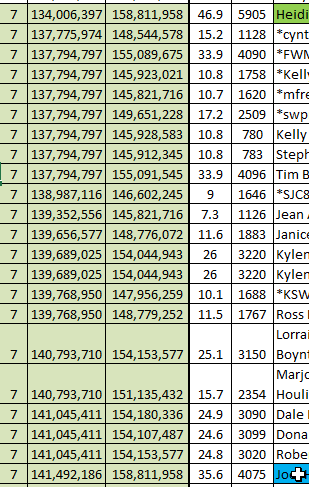
Here is a spreadsheet of Jim’s matches on Chromosome 7. Jim’s match with Tim goes clearly from 138-155M. That meets one requirement. Is this a paternal or maternal match for Jim? My thought was that if this match was maternal, then Tim should match my sister Heidi at the top and me at the bottom of the list in blue. I checked and Tim only matched Jim. That means that the crossover belongs to Joyce and is likely on her paternal side. The only thing I didn’t rule out is that the crossover could possibly be on Joyce’s maternal side.

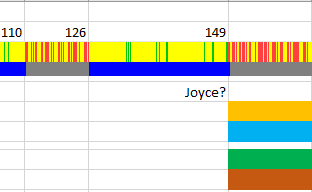
Here I went with my original guess that Joyce’s crossover was on her paternal Gurney/Rounesville side. Because I gave the crossover to Joyce’s paternal side, that meant that there was no other crossover at 149 and I moved the maternal segments to the left. I still have figured out whether Hartley or Snell is blue or brown. Next note that the segment from 110 to 126M is a no-match segment. That means that there must be a maternal crossover next. The reason for that is that no-match means four different colors. Jim and Joyce already have different colors on the maternal side. If we change one of those colors with a maternal crossover, there will be a match between 110 and 126M.

In order to get a no-match from 110-126M, Jim or Joyce’s DNA must be Rounseville from 110 to 126M.

Stranger Match or More Cousin Matches?

I really should go with both, but I’ll start with the stranger match. Jim has matches between 105 and 134 showing no crossover there. When I look at one of those matches and run those that are in common, I get this:

#1 is Jim’s sister Joyce. 2-6 are the strangers and #7 is actually a 2nd cousi of mine, but it could be from a match on another line. So Jim is matching the strangers in that 105 to 134M area. However, he is matching Joyce starting at 126. That gives me the impression that it is Joyce that has the crossover. On the other hand, I don’t see any of Joyce’s matches on her match list that go through 126M.

i am moving slowly from right to left on Chromosome 7. The segments that I am really interested in, I have no information on – except that one is Snell and one is Hartley and they appear to be relatively large segments, so far.

Phasing by Geography

I had mentioned that Snell’s ancestors were from SE Massachusetts going way back. The Hartleys came to the US from Lancashire in the last half of the 1800’s. As far as I know, the Gurneys and Rounesvilles have been around SE Massachusetts for several hundreds of years also. When I look at Joyce’s matches at Chromosome 7, I see some interesting emails. Between 155M and the end of Chromosome 7, Joyce has three small matches with people three people that have nz, au or uk in their email addresses. That gives me the opinion that at least from 154M to the Joyce could have Hartley DNA. That also brings up the question as to whether Joyce has a maternal or paternal crossover at 149M. If I go with what we had already, I would get this:

Starting to Visually Phase Chromosome 8

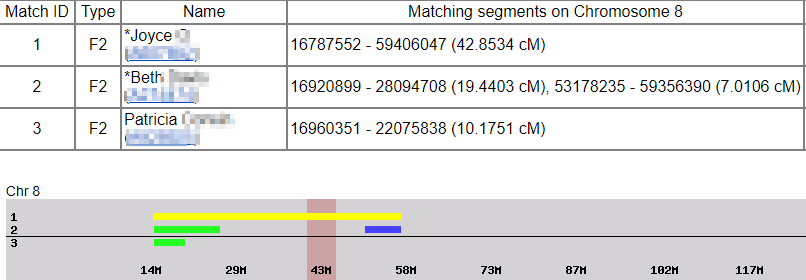
I can come back to Chromosome 7 at some time. I’m looking at Chromosome 8 as I wrote a Blog about a Lancashire matcher here. Here is how Anne matched Joyce and two of my second cousins:

The important part is that Anne matches Joyce from about 17 to 59M. That is a pretty good match. Here is the common ancestor:

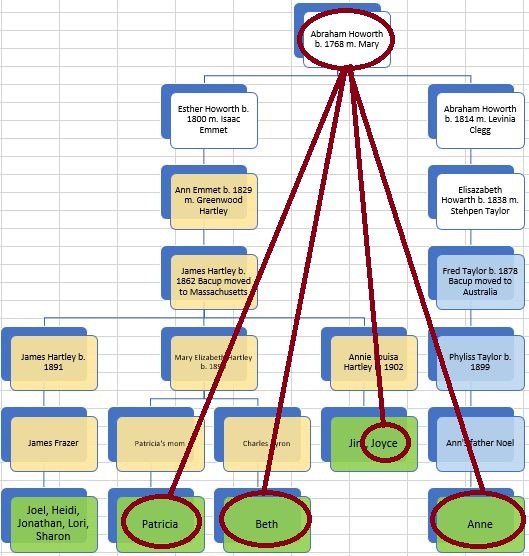
The other important thing is that even though the match points back to Howorth, this is on Joyce and Jim’s Hartley grandparent line.

Here is how Jim and Joyce match each other:

Here I did something different. I started by mapping a HIR or Half Identical Region. That means that one grandparent matched and the other two did not. We know that Joyce matched on the Hartley segment and Jim did not.

That means that the maternal Hartley/Snell side is on the bottom of their Chromosome 8. From here, we can logic a few more segments. Going from HIR to the no-match left, that means the top part will have to change for there to be no match at the beginning of Chromosome 8. Using similar logic, for all to match (in the HIR region), the crossover will have to be on the bottom of Chromosome 8.

Next, on Joyce’s match list, I picked someone who she matched that went through the 70.7M crossover.

I picked the 18 cM match. Then I picked people that matched both Joyce and the stranger’s 18 cM match.

#1 is Jocye’s match to her brother Jim. The next three matches go up to 74, so they go through the crossover. #5 is our stranger, Sheila with the 18 cM match. There is another interesting thing about Match #2. That is Jo who is on Ancestry with a private tree. However, when I click on her name, it says she is from Lancashire, England. Someone with a tree at Ancestry and DNA at gedmatch is good news to me, so I wrote an email to her.

Here is another piece of the puzzle:

I don’t know what the orange represents, but I don’t match Joyce and Jim on that side, so it isn’t as important to me. I was interested in separating the green DNA from the blue – or the Snell from the Harltey DNA. I was able to do that thanks to visual phasing and a match with Anne.

Wrapping It Up

  • It is possible to do some visual phasing with only two siblings. However, cousin matches, and stranger matches are needed.
  • Geographical phasing is also important. I like the use of email extensions to identify non-US matches.
  • Mapping my father’s two cousins is important in separating my Lanchashire ancestors from my colonial Massachusetts ancestors.
  • Work is needed to get AncestryDNA testers to upload their results to gedmatch.com
  • More matches could be found by checking FTDNA
  • More work is needed in tracking down genealogies of gedmatch mathes. This would help identify segmens of visually mapped chromosomes.
  • Attention to mapped segments of interest (in this case Hartley) can lead to matches to follow-up with.

Some Lancashire DNA and Genealogy on My Hartley Line

It’s been a while since I’ve written on my Hartley autosomal DNA and Lancashire connections. Part of the reason is that there haven’t been any or many clear DNA connections on the Hartley side. Perhaps my Hartley lines were not that prolific or the descendants that were there haven’t taken DNA tests. I have found at least one documented Howarth/Howorth connection that I wrote about here.

My Hartley Lancashire Genealogy

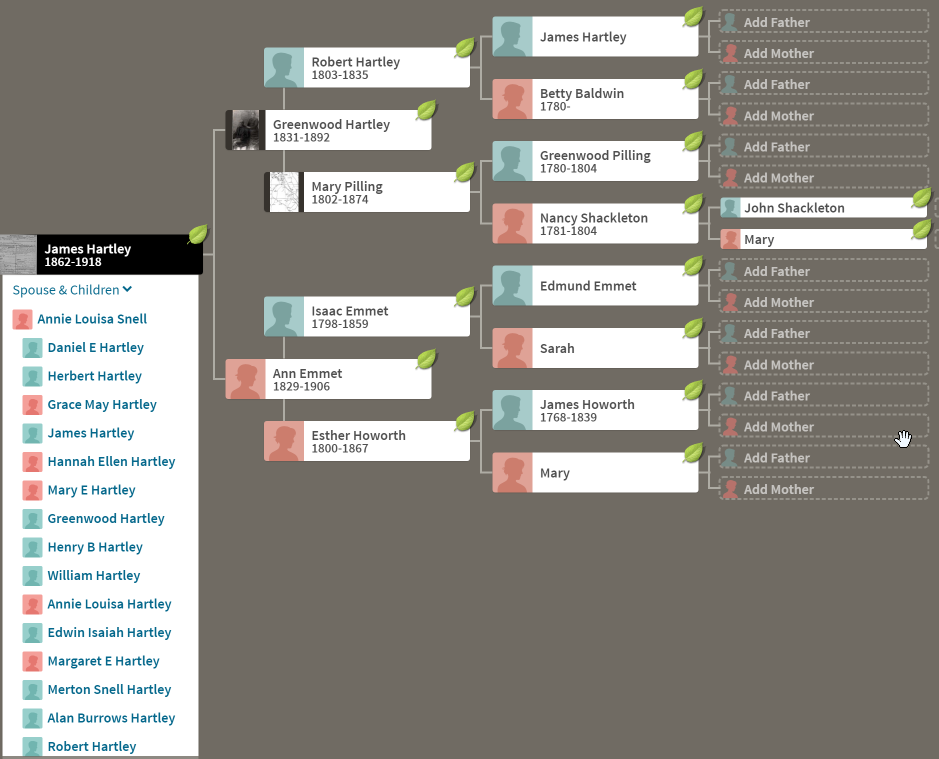
My great grandfather James Hartley was born in Bacup, Lancashire. His father lived in Trawden, Lancashire.

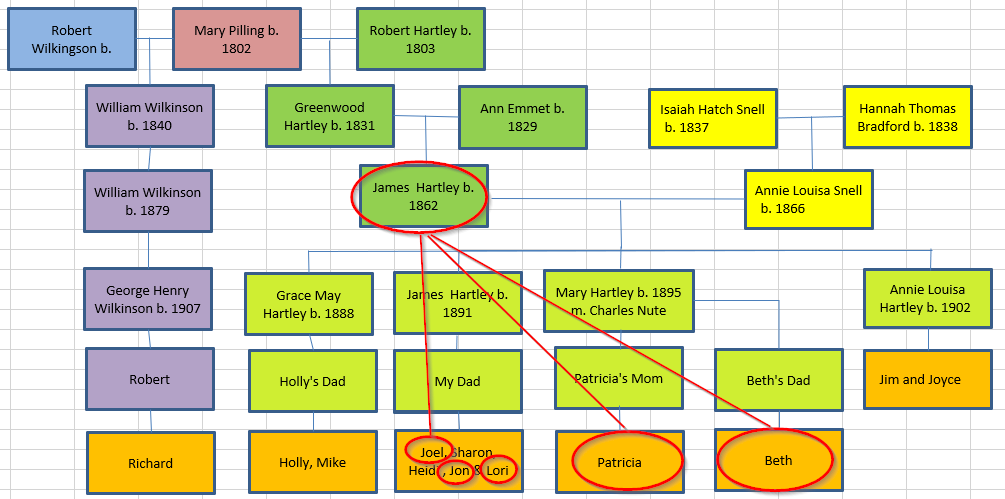
James had about as many children as I have identified ancestors for him. All his and his wife’s descendants of my generation are my 2nd cousins. The problem is separating their DNA from his wife’s Snell side. I am stuck at James’ grandfather’s level. I have James’ grandparents as Robert Hartley and Mary Pilling. Before that, on the Harltey side, I have an educated guess for the parents.

Finding an Old EMail of a Hartley DNA Match

While I was looking for an email, I came upon an email from Cai. Hehad his grandmother Jane tested and I was a match with his grandmother Susan.

The part of Jane’s genealogy that Cai and I focused in on was the Hartley part:

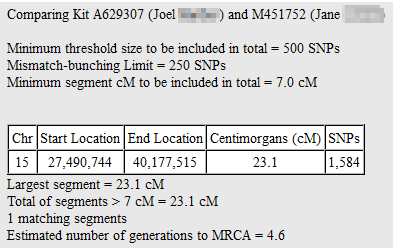
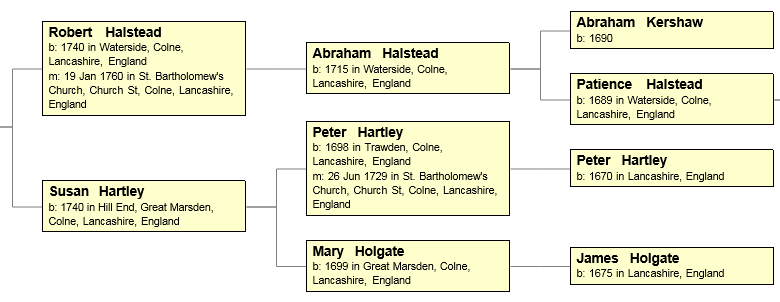
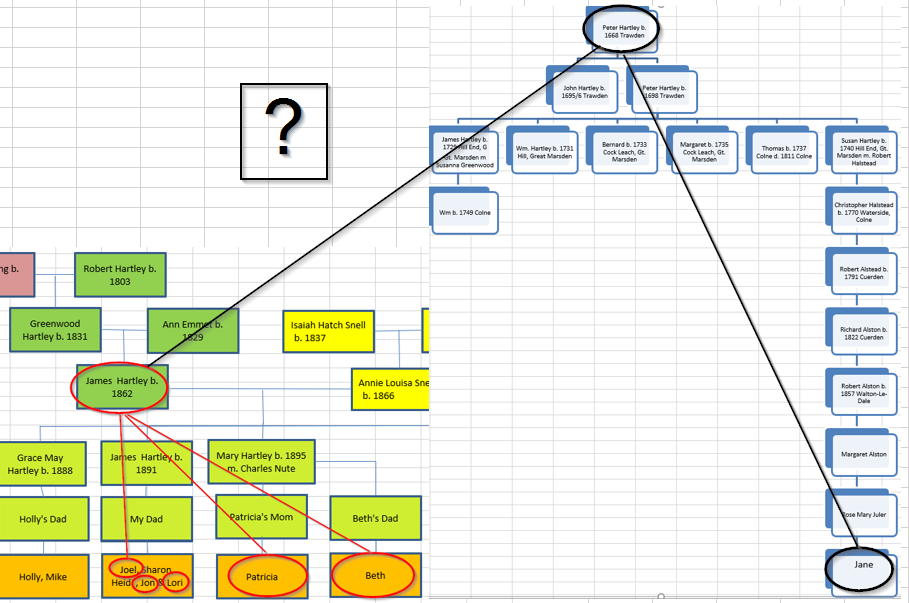
Notice that the first male Hartley in Jane’s line was Peter Hartley, born quite a while ago in 1698. However, the name and the place Trawden, Colne were hopeful. Peter is Jane’s mother’s mother’s father’s father’s father’s father’s mother’s father if I have it right. Put another way, Peter Hartley is Jane’s 6th great grandfather. Assuming that Jane and I both descend from Peter (a big assumption as we have no documentation) and that we are both at the same generation from Peter, that would make us 7th cousins. Note that at Gedmatch, the estimated number of generations to a common ancestor between Jane and me is 4.6. That appears to be wildly optimistic or Jane and I just share more than the average DNA given our distant relationship. Peter Hartley is 8 generations from Jane. This seems to be some DNA that has stayed around for a while. There are studies that show that if you are going to match someone distantly, that DNA may hang around for quite a while.

More on Jane and Chromosome 15

I have some other known Hartley descendants and I checked to see if they matched Jane.

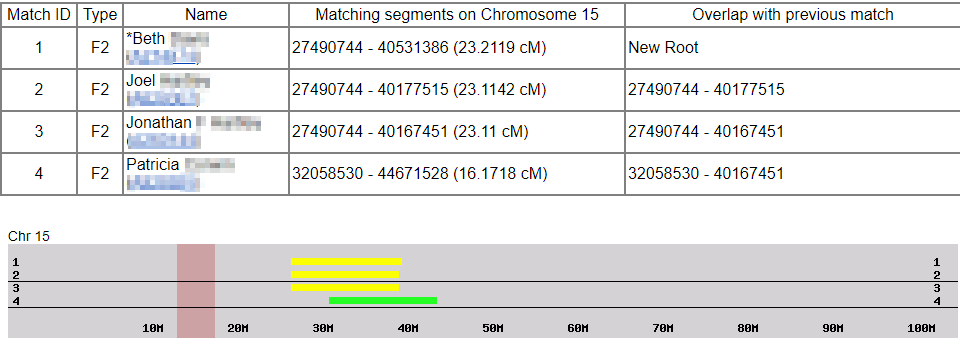
Here is Jane’s match to my 2nd cousin Beth, me, my brother Jon and another 2nd cousin Patricia. Actually, my sister Lori should be in there also.

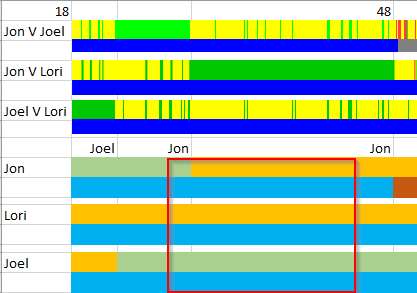
Mapping Chromosome 15 for Joel, Jon and Lori

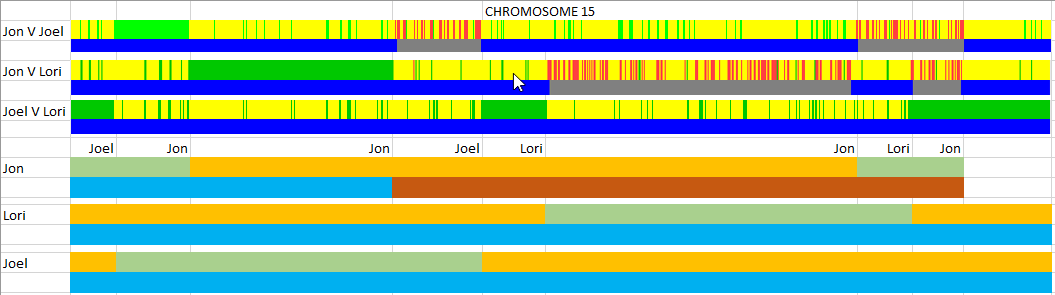
By knowing how Jon and Lori compare to me and each other, I can map out the DNA that we got from our four grandparents For Chromosome 15, it looks like this:

This shows the DNA we each got from our four grandparents in relative colors. I don’t know which color represents which grandparent or whether the top of the Chromosme is maternal or paternal. To figure that out, I have to look for matches with a known person. In this case, I will look at how my father’s cousin Jim matches the three of us:

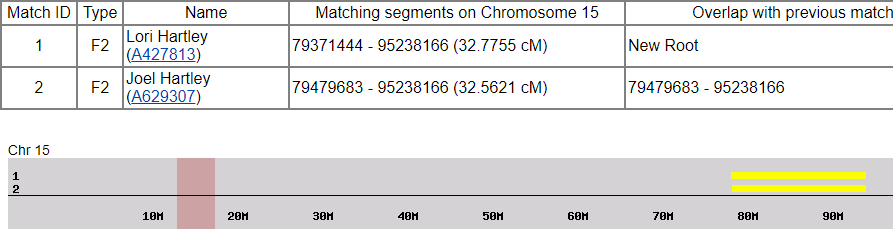
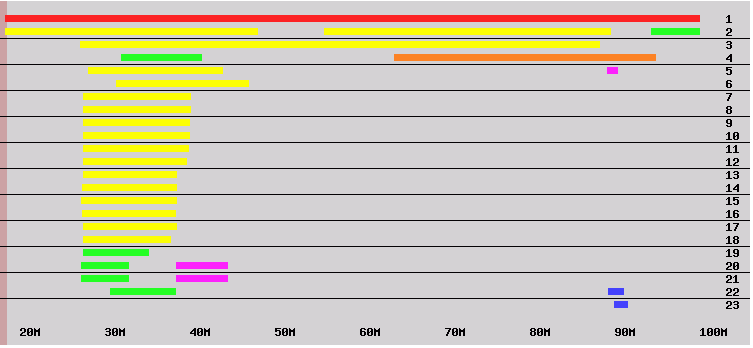
On Chromosome 15, Jim matches Lori and me but not Jon from 80 to 95M.

The only place between 80 and 95M where the colors are the same are blue. That means that Hartley is blue as Jim matches us on our Hartley side. That also means that the top of the Chromosome (orange and green) is maternal. Here is where Jane matches Jon, Lori and Joel on the blue Hartley segment near the beginnig of Chromosome 15:

Theoretically, the match could represent the DNA from James Hartley wife Annie Snell. However, all of Annie’s ancestors were from around SE Massachusetts back to colonial times. As I am not aware that Jane has any Massachusetts ancestors, we can assume that the connection is in Lancashire.

More on Jane’s Hartleys in Lancashire

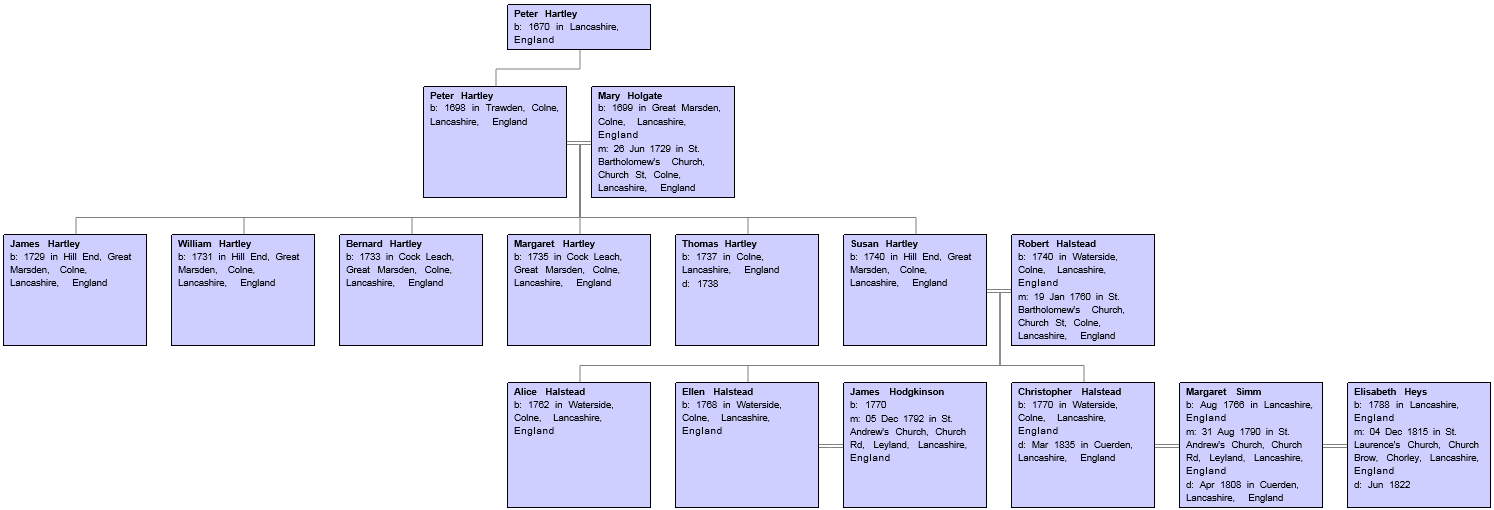
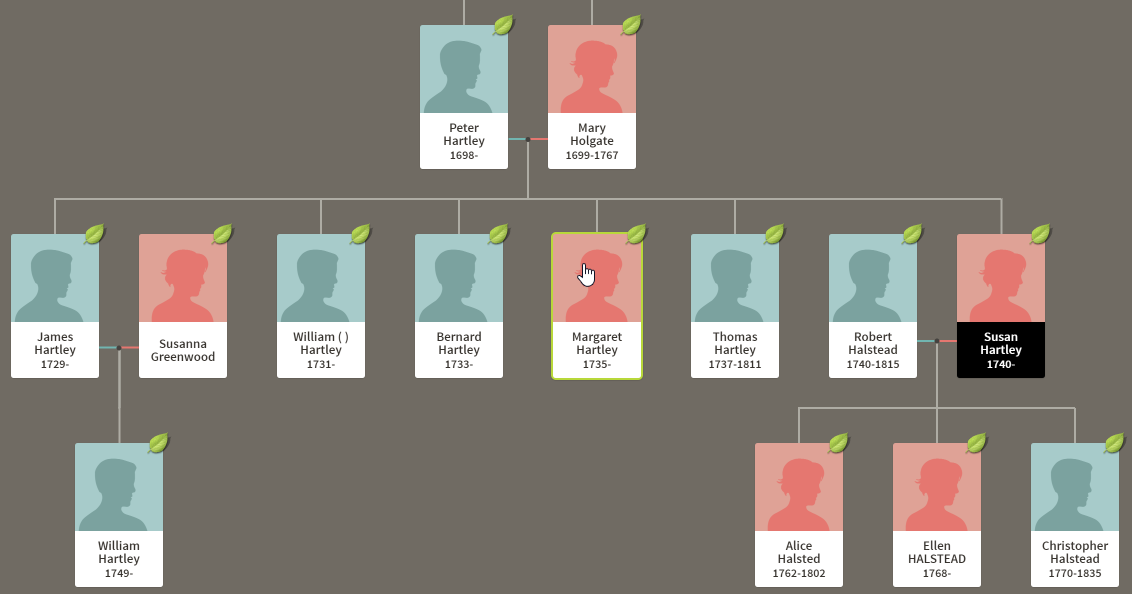
Cai kindly sent me some ideas to go on. He showed me who he had for the children of Peter Hartley b. 1698:

Here are six children of the Peter born in 1698. If we assume that the relation was on Peter’s male Hartley children, that narrows the possibilities down to four. It looks like I had started my own tree based on Cai’s:

I had also found another apparent brother of Peter. Here is what I wrote to Cai in 2016:

I assume that these are the first Peters you mention. However, I note that they lived in Trawden. My guess is that at some time they moved from Trawden to Great Marsden. It looks like Peter had a brother John:

Baptism: 24 Jan 1694/5 St Bartholomew, Colne, Lancashire, England
Johannes Hartley – fil Petri Hartley
Abode: Trawden

    Register: Baptisms 1679 – 1697, Page B37, Entry 9
    Source: LDS Film 1471023

Baptism: 14 Mar 1695/6 St Bartholomew, Colne, Lancashire, England
Joannes Hartley – fil Petri Hartley
Abode: Trawden

    Register: Baptisms 1679 – 1697, Page B39, Entry 17
    Source: LDS Film 1471023

I’m not sure why this is in twice. Perhaps a baby died and they named another son for him, or it was recorded twice or there were 2 different families!

At any rate, this is the difficult part of genetic genealogy. To do this right, I would need to build down all the trees. This is much more difficult without a census to show you where the family units were.

Back to the DNA on Chromosome 15

Above I showed how Jane matched me, my brother and sister and two 2nd cousins on the same segment of Chromosome 15. As my 2nd cousins and my siblings all match each other, that would be a Triangulation Group or TG. A TG indicates a common ancestor or ancestral couple.

Here is the match with my family and my two second cousins:

Triangulation really isn’t needed here as we know that James Hartley is our shared common ancestor. However, normally I wouldn’t know if the common ancestor would be James or his wife Annie. As I mention above, in this case it does appear to be James and not Annie based on Jane’s matches at Chromosome 15 to my family and 2nd cousins. We know that Jane descends from some Hartleys in the area where my Hartley were from, but her Hartleys were from about 100 years earlier. This is the situation I have drawn out schematically below:

I have a line going from James Hartley to Peter Hartley, but really, it is just pointing in the general direction of Peter. That seems to be as accurate as I can get with the DNA right now. I do have other DNA matches, but it is not likely that their trees are as complete as Jane’s tree. One good thing about the combined trees that I drew above is that the dates seem to match up. Greenwood Hartley was born in 1831 and Jane’s Richard Alston was born 1822. Robert Harrtley was born 1803 and Robert Alstead was born 1791. All I have to do is fill in the gaps between the ? Line.

People That Match Jane and Me

At Gedmatch, I plugged in my kit number and Jane’s to see who our common matches are. I went down to a match of 20 cM and got this group that matched my and Jane on Chromosome 15:

It is likely that these people also have ancestors in Lancashire. Nunber 1-4 are Lori, Jon, Beth and Patricia already discussed above. Jane is #7. Lori matches me on the whole Chromosome. Remeber in my chromosome map above, Lori and I both had a full Hartley Chromsome on #15.The others matches are difficult to track down.

#6 is Shannon from Australia and has a tree at FTDNA. Hargreaves in Shannon’s tree sounded familiar. I checked him out on her tree. Shannon has a John Hargreaves born 1826 in Lancashire. Turns out that was the best lead of the bunch above (other than Jane).

Summary and Conclusions

I am basically stuck genealogically going back on my Hartley Line. Due to where the Hartleys lived, there is a jungle of similar names which makes the Hartley genealogy difficult. Jane’s DNA results gave some possibility of going down from her Peter Hartley Line of 1698 to see if there is a match-up with my line. That seems to be my best bet right now.

Did Christopher Dicks of Newfoundland b. 1812 Marry Elizabeth Crann?

This Blog is a follow-up on my previous Blog. Anne had tested her DNA and uploaded to Gedmatch.com which is great for DNA analysis. I posted my previous Blog at the Newfoundland Gedmatch Facebook Page. At that Facebook Page, I had this interesting comment from Karin,

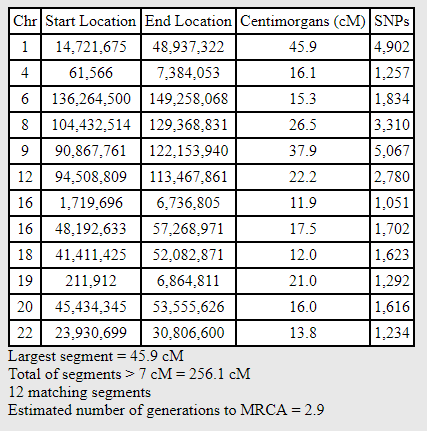
Anne is Richard’s closest match on GEDMatch at 2.9 generations and 258 cM, and yet there is no apparent connection… unless of course Christopher Dicks married Elizabeth Crann, which is looking more and more likely. 

That comment sent me off to Richard’s results at Gedmatch and his Gedcom. Richard’s great grandfather was Samuel Crann:

Richard had this further interesting information on his second great grandfather John Crann:

Perhaps this Elizabeth Crann, daughter of John Crann could be the one that married Christopher Dicks born around 1812:


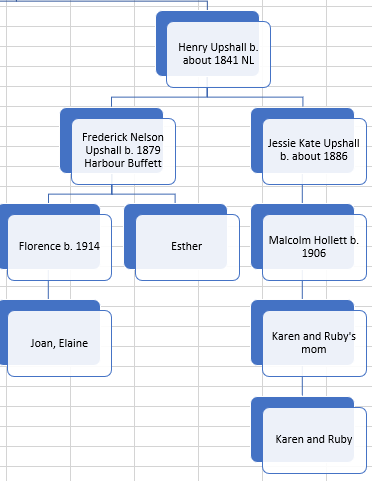
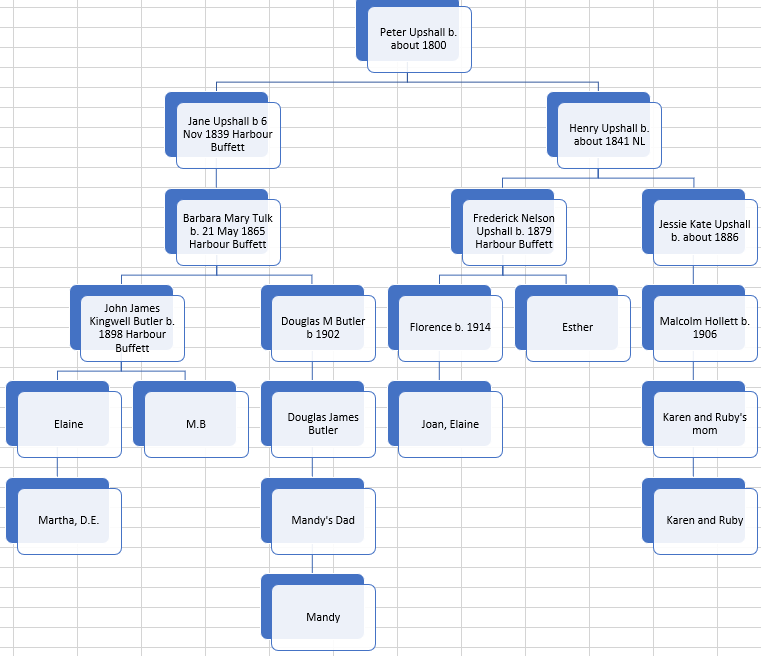
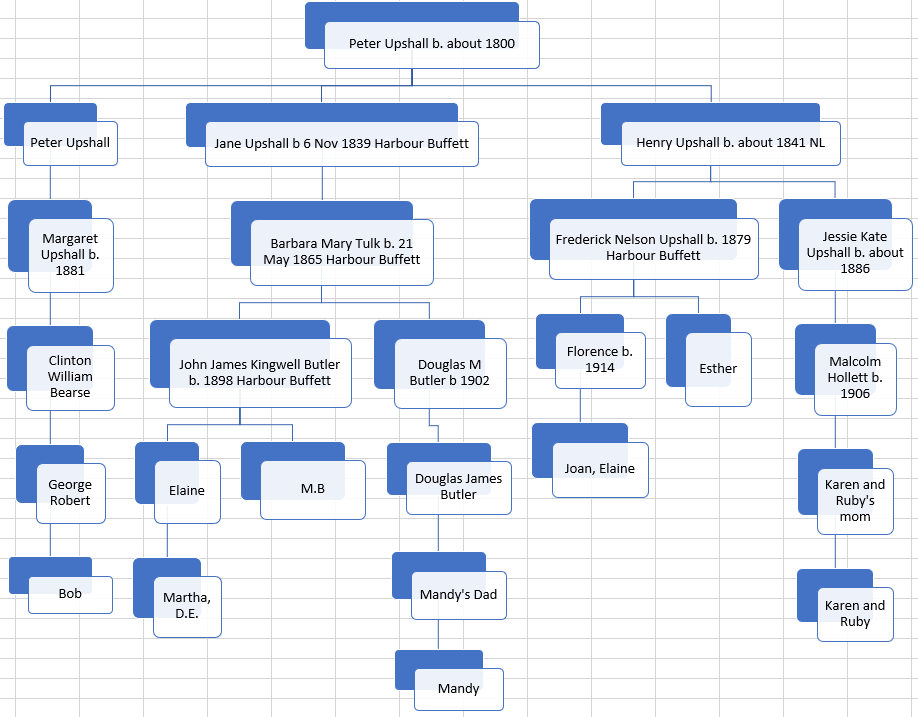
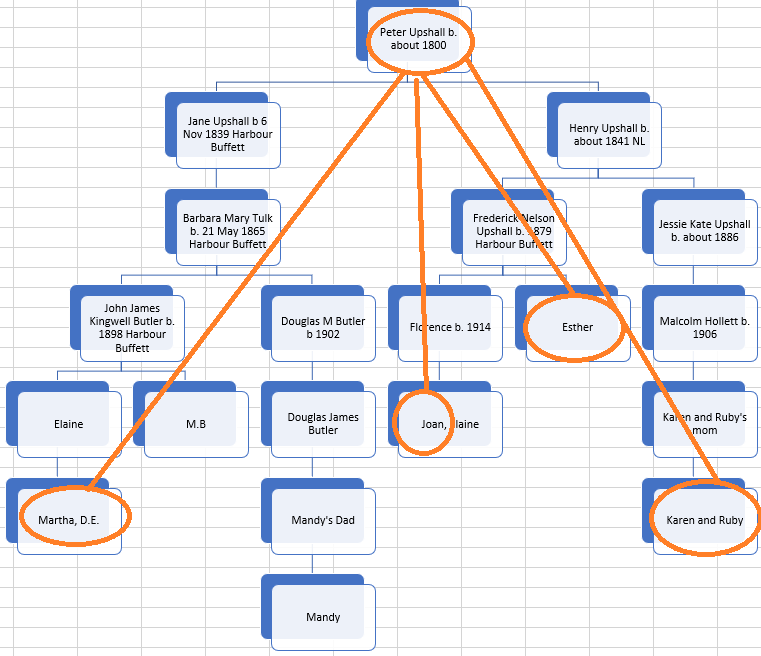
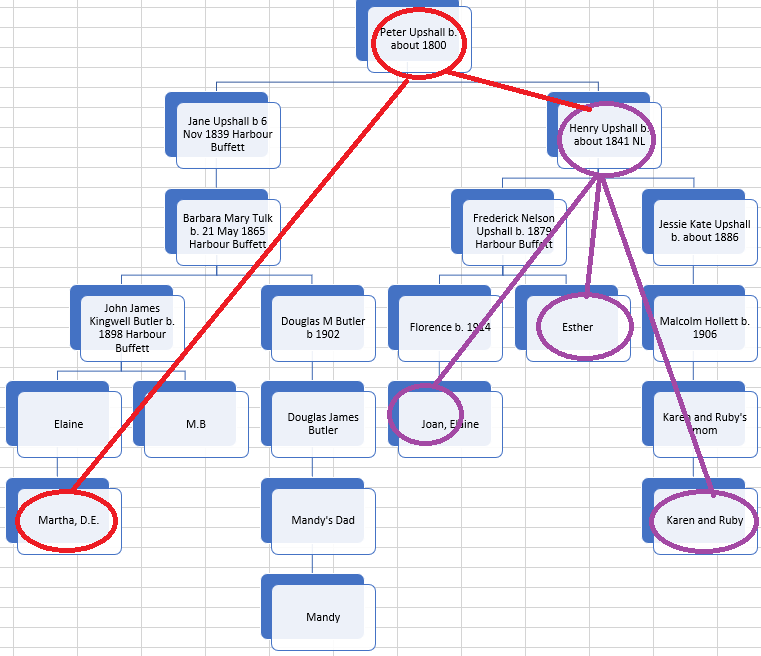
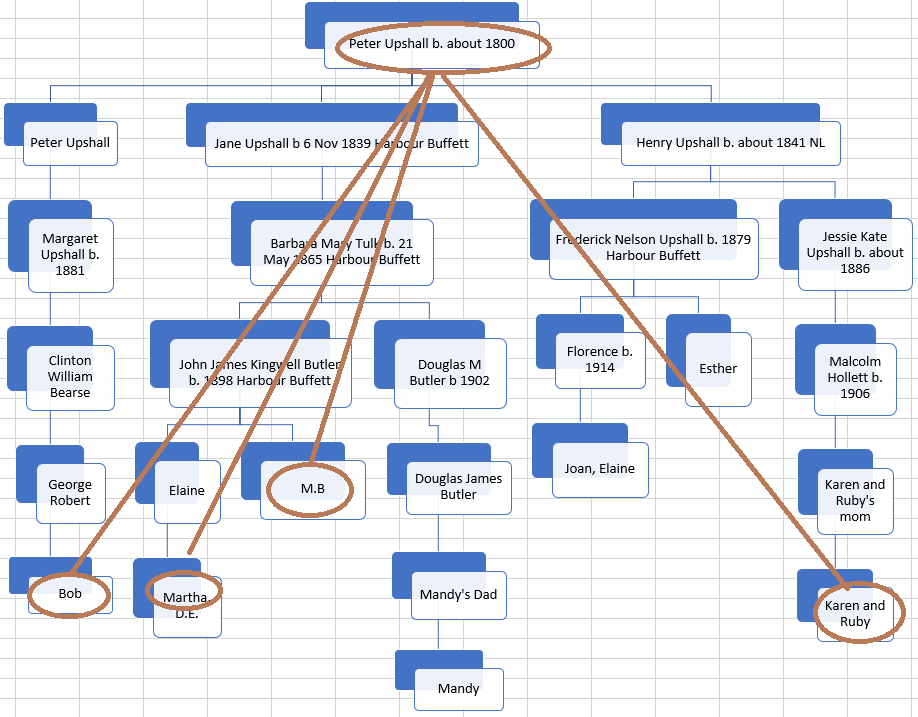
In March 2017, I had theorized that there should be a Crann in one of these two places on Esther’s Tree:


At that point, the two choices were on the Upshall Line or the Dicks Line. Karin is suggesting that it should be on the Dicks Line. In the above diagram, the green boxes are significant as they represent New Zealand Crann Lines with no other Newfoundland contribution. This branch moved from England to New Zealand.

Some Possible Crann Genealogy

My next step is to draw a tree with some of the proposed Crann connections and see if it makes sense by DNA matches. I already had this tree on my computer that had Richard on it:

As a point of interest, Forrest came up when I was looking at some of Anne’s DNA matches. Now I just add the Christopher Dicks Line through his putative wife Elizabeth Crann:


It looks like I’ve created a bit of a monster, but this is good in DNA terms. The wider the tree is, the more opportunities for DNA matching. Richard plays a pivotal role here. He is to the left of the Dicks/Crann Line, but he doesn’t descend from the Dicks of the Robert Dicks/Crann Line. He is to the right of the Christopher Dicks/[possible Eliazabeth Crann] Line but doesn’t descend from Christopher Dicks. Hence, Karin’s comment at the top of this Blog which got me going on this line of thinking.

Looking at DNA Matches

In my plan, the Frank Dicks and John Dicks lines are also important as they don’t descend from Upshalls as far as they know. Remember above, that one of my earlier ideas was that an Upshall could have married a Crann. If they also match Crann, which it appears they may, that would show that the Crann  DNA matches are through the Dicks marriage to Elizabeth Crann that we are considering here.

The Autosomal Matrix

Here I found a few others that were also in Crann Lines. Anne has good matches to our three New Zealand Crann descendants. Some testers that I haven’t looked at yet, Randy and Elaine as well as Karen all match with the New Zealand Crann descendants. Ken is still a mystery and appears to match on a different line. Notice he has huge matches until he gets to the NZ Group. Then basically nothing. This also holds true for Forrest and Sandi.

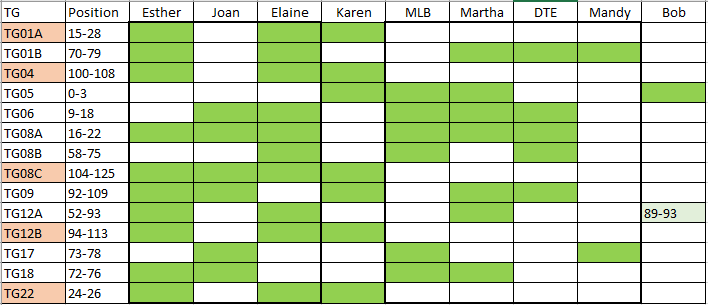
Looking for Crann Triangulation Groups (TGs)

Triangulation Groups are where three or more people match each other on the same segment of the same Chromosome. This is an indication of a common ancestor. In this case we are looking for a common Crann Ancestor.

Starting From the Bottom: Chromosome 22 TG

This was the big TG, so I’ll start here:

It seems ironic that the biggest TG is on the smalled chromosome. Here we have Heather, Margorie, Wayne, Randy, Elaine, Esther and Karen. If we go down a little more, Anne is also in there:

This shows that Anne has something called a crossover at about 35M. That is why she doesn’t start matching Heather, Elaine and Esther until then. Marjorie, Wayne and Heather are our tested and proven NZ Crann descendants. I have them highlighted in green on my spreadsheet.

This turns into quite the criss-cross:

[Edit: Edward in the bottom left is placed wrong in this tree and the next. For the correct tree see previous trees. He should be on the same level as Hayley. I am missing his female Shave ancestor here.]

Karen actually plays an interesting part in all this. She is in a TG with Randy and Esther. Because Karen is 7 generations away from Henry Crann, the match is just not there with the New Zealand Cranns. However, she triangulates on Elizabeth (now more apparently Crann). Randy, Anne, Elaine, Esther, Marjorie, Wayne and Heather triangulate on the same area of Chromosome 22 with Henry Crann born 1757. The confusing part is why Anne and Elaine don’t also match Karen in that same segment. It turns out that Elaine and Karen do match from 24 to 26M. And as I mentioned above Anne’s Crann DNA doesn’t kick in until later at 35M.

I just didn’t have enough orange lines:

So I added an orange line from Elaine to Elisabeth [most likely born Crann] Dicks. The point that I was trying to make above is that there is a TG focusing in on Elisabeth and a TG focusing in on Henry Crann. Both those TGs are using the same segments, so they represent the same Crann DNA. Technically, the DNA could be from Collens who was the wife of Henry Crann above, but by the time it made it’s way down to the two different lines, it could be considered Crann DNA. It looks like I had identified this TG back in March, 2017, but at that time, I only had Esther, Heather, Wayne and Marjorie in it. The fact that we have so many more testers now, including three that don’t appear to be descending from Upshall should put Elizabeth as Christopher Dicks’ husband.

TG On Chromosome 18

This one is less complicated:

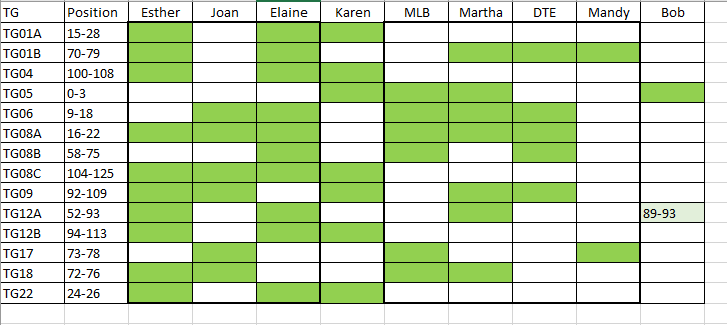
This has just NZ Marjorie and Elaine and Esther. Note that Elaine matches her sister Joan here but Joan matches neither Marjorie nor Esther. How is that? The answer is that Elaine and Joan as sisters may match on their maternal and/or paternal sides. Elaine is matching Margorie on her maternal [Upshall] side. Joan is matching Elaine on her paternal [Ellis] non-Newfoundland side. It’s good to keep in mind with DNA that we all have a paternal and a maternal side.

Just to be confusing, it looks like Richard, Ken and Barry are in a TG with each other in the same area. This would most likely be a Dicks TG – unless they have some other non-Crann common ancestor.

A TG on Chromosome 10 with Molly, Howie, Marjorie, Wayne and Heather has been pointed out in my previous Blog.

Richard’s TG: Chromosome 8

This TG has Heather, Wayne and Richard.

The Last NZ TG On Chromosome 2

This is the last TG going up from Chromosome 22 where I started:


Summary and Conclusions

  • I was able to test out Karin’s perceptive theory with DNA
  • The DNA seems to show that Karin was right and that Christopher Dick’s wife should be Elizabeth Crann
  • Chromosome 22 gave the best evidence of Crann DNA in the Christopher Dicks b. 1812 Line. That showed a double TG going through Elizabeth. This double TG was apparently Crann DNA. Ironically Karen, who was part of one of these TGs, was recently added to the Upshall/Dicks Line via DNA matching.
  • The testers have reached a critical match for this Crann project with Crann descendants in New Zealand and in three Newfoundland Crann Lines.
  • It’s nice to have found some non-Dicks TGs after working quite a while on the Dicks Newfoundland DNA Project.


Hayley’s Grandmother’s DNA at Gedmatch

Hayley recently told me she had uploaded her grandmother’s DNA results to Gedmatch. Hayley is in the Dicks DNA Project which looks at the DIcks family of Newfoundland and their many descendants. Hayley’s grandmother is Anne and being Hayley’s grandmother she is already on a family chart of those that have had their DNA tested and uploaded to Gedmatch.

This is just one of the branches of the Dicks DNA project. Barry who is Anne’s nephew also pointed out to me that Anne is Esther’s second cousin. I checked on Esther’s list of matches and sure enough, Anne is Esther’s closest relative other than to her two half neices, Joan and Elaine and my wife (Joan’s daughter).

To the right, I have added in Karen and her ancestors. I haven’t proved that her ancestor was Esther’s Aunt, but it seems likely based on looking at her DNA matches.

Hayley was wise to get a DNA test for her grandmother. Anne gave half of her DNA to Chris who gave half of his DNA to Hayley. That should mean that Anne would have four times the Dicks DNA that Hayley does.

Let’s Get To the DNA

Here are the details:

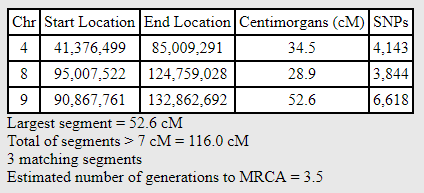
The bottom line is the MRCA. Note that Anne and Esther are three generations from their common ancestors: Christopher Dicks and his wife Elizabeth. Esther and Anne may have some other common ancestors.

Are Your Parents Related?

There is a utility at Gedmatch called “Are Your Parents Related?” When I run Anne’s kit through that I get this:

This is what genetic genealogist David Pike (also from Newfoundland) calls Runs of Homozygosity. Anyway, Anne gets an MRCA of 3.4. That means that she is something like a 2nd cousin once removed to herself.

When I run the report for Esther, she gets an MRCA of 4.0, meaning her common ancestors are about 4 generations back. The way David PIke explains it, the Runs of Homozygosity (ROHs) is where the DNA lines up in your DNA due to those common ancestors.  Anne’s ROHs are on Chromosomes 1, 2, 4, 7, 13 and 20. Esther’s are on Chromosomes 2, 11. 15, and 20

Do Esther’s and Anne’s ROHs Match?

Here is Anne on Chromosome 2 vs. Esther

This makes it look like Anne’s common ancestors and Esther’s common ancestors are also common to Anne and Esther. Or put another way, this could be a quadrouple match between Anne and Esther. However, look at the match above.

It looks like there is no match specifically where Anne and Esther have ROHs. I’m not sure what that means. Probably an area for future research. Maybe Anne and Esther are messing with the Gedmatch matching algorythms. Or it could just mean that Anne’s common ancestors and Esther’s common ancestors are different people.

Here is Anne on Chromosome 20 vs. Esther

Here Anne and Esther’s ROHs don’t overlap. These two sets of DNA could be from the same couple and they could have sent different segments down to Esther and Anne, but we can’t be sure of it just from this comparison.

Back To the Dicks Project

I’ll start by comparing Anne to Edward, Randy, Barry, Joan, Elaine, Esther and Karen. I’ll skip Hayley as Anne will have the same Newfoundland DNA as Hayley, but a whole lot more.

The Autosomal Matrix

First I’ll sort people by the sublines that they seem to be in:

This is to see if it looks like these people are in the right groups. One thing I notice is that Edward and Esther have a pretty high match that doesn’t seem to be explained by a 2nd cousin once removed relationship. The match numbers go down when Edward gets to Joan, Elaine, and Karen. Perhaps Edward is related to Esther on her maternal side as well as the paternal. Esther matches Joan, Esther and Karen on her paternal side.

Here are some autosomal statistics to go with the Autosomal Matrix:

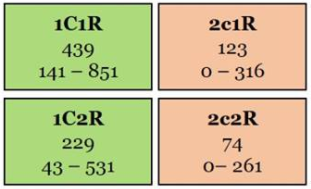
Esther is a half Aunt to Joan and Elaine. They are higher than average but within range. Edward at 2nd cousin once removed to Esther should have a match between 0-316, but he matches at 392.8.

More On Anne’s Family Tree

Before I jump into the DNA, I would like to look more into Anne’s family tree, to see what I may be getting into. In other words, what if I think Esther is matching Anne on her paternal side, but she is actually matching Esther on her maternal Hann side? That would get me all messed up.

Here is what I see at Ancestry:

That is actually not a lot to go on. Anne is missing the surname for a maternal grandmother. That is about 25% of Anne’s DNA. Also, as discussed above, Anne has the same person or couple in her ancestry on her paternal side and maternal side. This would be back about three and a half generations. That would mean back four generations on one line and three generations on the other.

Here ‘s a photo of Anne’s dad William Dicks:

William was living in Little Harbour in 1935:

William was living in an $800 8 room house with wife Edith and children Patricia and Bertram. Compare that to Peter Upshall sho had 8 people living in a 4 room $60 house.

William Dicks in 1921

This appears to be the same William in 1921 at Little Harbour East:

This census gives more detail about William’s place and date of birth. William’s occupation was “coasting” on a local schooner. This raises a few questions: Who was watching the girls while Willliam was coasting and Who was William’s first wife?

William Dicks’ First Wife

This is my guess for William’s first wife:

Notice that William was living at Little Harbour East at the time of his marriage. He got married at Harbour Buffett. If he was born February 1890, he wouldn’t quite be 22 at the time of his marriage. Also if the timing is right, his first daughter Ethel M came one year later in December of 1912.

Here is the connection between Harbour Buffett and Little Harbour:


William Dicks’ Father and Mother

John Dicks Born About 1844, Harbour Buffett

Anne’s tree shows that William’s father was John. I found a death record for a John Dicks in 1913:

The heading on the next to the last column seems to be mis-labled. It has ‘place of death’. As the second column is already place of death I think that the last column should read place of birth. That seems consistent with other death lists I’ve seen. At any rate, this would indicate that John Dicks was born about 1844 in Harbour Buffett. That connects Anne to Esther geographically.

Edith Reid

Anne’s tree has Edith dieing in 1909. I couldn’t find a death record for Edith, but found one for Elizabeth Dicks here:

Note that this Elizabeth also died  and was buried in Little Harbour East, but was born in Harbour Buffett about 1846.

Anne’s Mother’s Side: Edith Hann

Anne’s tree shows that Edith was born 1909. The logical place to look for Edith is in the 1921 Census. Here she is on the same page as William Dicks when he was widowed with two young girls:

This is the Census I liked because it gave birth month, year and place. I’m sure all of William’s descendants have gone through this before, but it’s new to me. This tells me that Chirs Dicks was born in Little Harbour East. Edith Dicks was born in Harbour Buffett. Richard Hann was born in PInch cove in 1899 and what appears to be his sister was born in 1909 in Little Harbour East. 12 year old Edith likely had no clue that she was to marry the then 31 year old widowed William Dicks. Perhaps it was young Edith that took care of William’s girls.

Little Harbour East in 1945

Could this be our Anne? She is listed on page XIV of the Little Harbour East 1945 Census. Anne’s tree says that her dad died the year that she was born:

The other question would be how 41 year old Thomas C Dicks would be Anne’s first cousin. That would mean that Thomas’s father would have to be John Dicks’ brother?

This looks to be Edith Hann’s older brother on Page XI of the Census:

He is living next to his adopted mother, Edith Dicks.

I didn’t see Edith Hann Dicks in the 1945 Census. Perhaps she remarried.

Edith Hann’s Parents

I started out wondering about Edith’s parents. Anne’s tree has John Henry Hann and Anastasia as her parents. We know that Edith was born at Little Harbour East. Her older brother was born at Pinch Cove. Pinch cove is 6 km North of Fair Haven. That should be directly South of Little Harbour. From a short look on the internet, Pinch Cove was abandoned after 1921.

As Richard Hann was born Sep 1899, I will look for a marriage between John Henry Hamm and Anastasia before that time. Here is a John Hann, widower who married in 1894

These two were listed as ‘RC’, Roman Catholic. I also noted that the name Anastasia came up frequently in the Roman Catholic Parish Registers.

Here is Mussell Harbour:

This looks promising geographically. The downside is this Jane would have been 45 in 1909 at the birth of Edith.

Here is perhaps a more promising entry. First I give the parents:

This Robert kept coming up as I was searching marriage records. Note that both Robert and John Henry are living in Pinch Gut. The date to the left is the birth of the child.

Here are their children with their Roman Catholic Baptism dates:


My guess is that Robert and John Henry were brothers. Note that their two children were baptized on the same day in 1894. The date on  the right is for registration. So I have linked John Henry to Pinch Cove via the birth of his son Richard in 1899. Here John Henry is in Pinch Gut with his wife Clara who gave birth to Margaret Jane five years later.

In 1896, Robert and John Henry had another synchronized birth and and baptism even:

This time, the baptism was listed under the Church of England. Here are their children and the baptsim date:


Did Clara Hann Die Young?

So far, there was a John Hann who married a Jane Whelan at Mussel Cove. I don’t know if that was the same as the John Henry Hann who married a Clara and had two children at Pinch Gut. Then John Henry Hann had two children – Richard and Edith at Pinch Cove and Little Harbour East. I have not found birth records for these two yet. I have a record of a Cara Hann dieing at Ping Gut in 1903:

Based on Clara’s age of 28 at death, she would have been 19 at the birth of her daughter Margaret Jane, so that sounds reasonable. A 10 year difference between Richard and Edith Hann would explain her death and John Henry’s marriage to Anastasia. So I have built a house of cards from the incomplete records that I have.

Back To the DNA

With Anne’s DNA results, it will be important to try to filter the DNA as much as possible as there could be potentially so many matches. In a recent Blog I wrote on Martha and her family, Martha was found to have more Upshall ancestors and fewer Dicks ancestors. So that should mean that if I compare Martha’s family with Esther’s and Anne, that may show an Upshall connection (or not).

Eliminating an Upshall Connection

When I did this exercise, it appears that Anne’s matches do not line up with those places that Martha and Esther’s families line up. I take that to mean that there are no obvious Upshall shared ancestors. The one place that Annes’ matches lined up with Martha’s family, they did not line up with Elaine and Joan. Elaine and Joan match Esther on her paternal side, so that match could be on Esther’s maternal non-Upshall (Shave) side:

Here, Joan is #1, MLB (Martha’s Aunt) is #2. DTE (Martha’s brother) is #3 and Anne is #4. Esther is the person that these people are matching.

Narrowing Down Anne’s Matches To the Dicks Line


When I look at shared matches between Elaine, Joan and Esther, those DNA matches eliminate Esther’s maternal side because Elaine and Joan are only related to Esther on the Upshall side. I had trouble figuring out more about Anne’s family history, but by DNA, it seems that she didn’t have an obvious Upshall influence in her DNA. That means that if I compare Esther, Joan, Elaine, and Anne, I should get mostly Dicks DNA. Now according to Martha, Henry Upshall’s father was Peter Upshall b. about 1800 and she has him married to a Margaret Burton. So there is the potential to have some Burton come through there assuming Martha is right. However, Anne could likely match Esther also on her maternal Dicks Line, so this method would elimiate that line of Dicks.


Comparing Ann’s DNA to Joan’s

As I mention above, Anne and Joan’s DNA should be specifically on the Dicks Line (and their ancestors). Here is how Joan and Anne match:


Comparing Anne to the Dicks DNA Project

Next, I’ll compare Anne to those who are in the main area of the Dicks DNA Project. Here is how the big Dicks Matrix looks:

Actually the Christopher branch is shaping up as one of the biggest branches and one with a lot of people that match each other. There are some, notably Nelson, Ken, Charles and a few others that match outside their branches. This could be on other Dicks Lines or other Newfoundland surnames. Based on a recent Blog, I added Karen to Esther’s family based on an Upshall connection. It appears that she fits quite well in the Christopher Dicks Line also.

Summary and Conclusion

  • As Anne has good DNA matching results, I found it a bit overwhelming looking at all her matches.
  • More work is needed in comparing Anne’s shared matches and the the Triangulation Groups she is in.
  • It is possible to narrow down the scope of Anne’s shared DNA by looking at certain testers with known genealogy. However, this could also fileter out matches that we do want. In this example, I looked at Anne’s matches with Joan, my mother in law to narrow down her matches. I could have also used Joan’s Elaine sister for this.
  • I tried to fill out Anne’s maternal side genealogy. This was to see if there could be other shared DNA matches that we didn’t know about. I found this to be a bit difficult to do. If Anne’s maternal genealogy were obvious, it would already likely be on her tree.
  • I’ll likely be following up with another Blog on Anne’s DNA results
  • I like how the Christoper Dicks (b. 1812) Line is filling in and how the DNA matches comirm the genealogy that we have for that line. Knowing the surname of Christopher’s wife Elizabeth would be a big help.

Mapping James Frazer born 1804 and Violet Frazer born 1803

In my last Blog, I wrote about Doreen’s results. Doreen and I have the common ancestors of likely first cousins, James Frazer b. 1804 and Violet Frazer born 1803. For some reason, I don’t believe that I have ever mapped this couple out using Kitty Munson’s Chromosome Mapper.

Descendants of James and Violet Frazer

The people in bold have all taken autosomal DNA tests. That is, except for Rick who took the YDNA test. If I compare myself to Susan, Doreen, Pat, Gladys and Bill, the DNA that we share would represent either James or Violet Frazer.

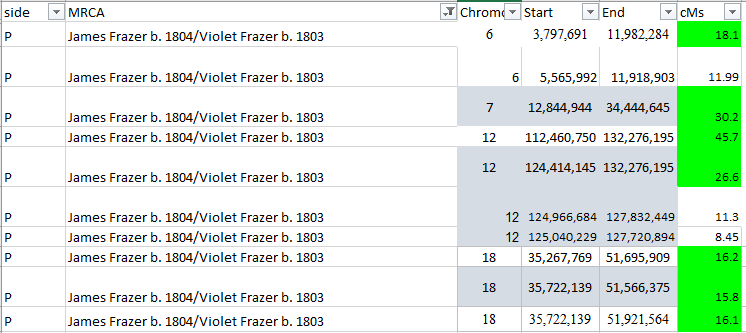
Kitty Munson’s Utility requires the information be put into a CSV File like this:

I share the first and last segments with Doreen. The second I share with Pat. I share rows 3, 5, and 9 with Susan. I share rows 4 and 8 with Gladys. I share rows 6 and 7 with Bill. However, they are the same segment. One is as reported at FTDNA and one is as reported at Gedmatch.

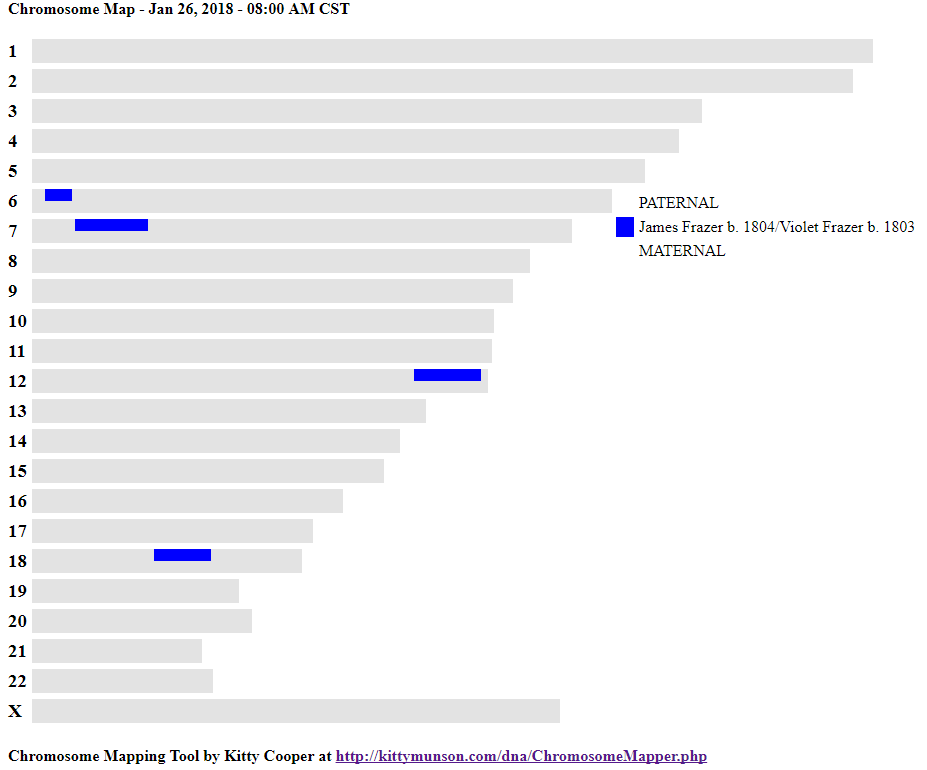
Here is my map of just these two ancestors:

This is just my map. The map for each of my siblings and my cousin Paul would look different. Also The map for each of the people in the yellow part of the James/Violet Tree would also look different.

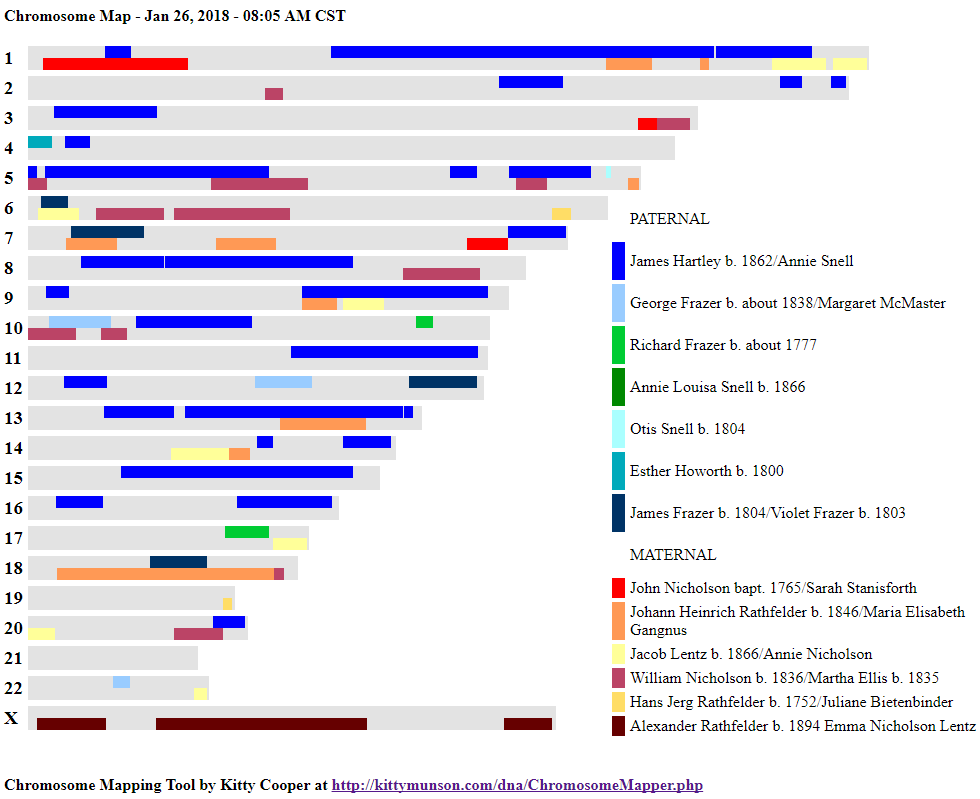
Here is the blue James/Violet segments  (now showing as navy blue or black) with other segments I have identified:

Next, I would like to put the ancestors in a better order. They appear randomly, but I am guessing that the first chromosome gets the first color, etc. as I have my table sorted by chromosome. My four grandparents are Hartley, Frazer, Rathfelder and Lentz. So I would like to sort them by these four grandparents. Then I would like the older ancestors in each line first. That is, except for Annie Snell. I have her listed separately as I must have figured out some of my DNA was from her. However, her dark green is overshadowed by the blue Hartley/Snell segments.

My new order will be:

Hartley:

  • Esther Howorth
  • Otis Snell
  • Annie Louisa Snell
  • Hartley/SNell

Frazer:

  • Richard Frazer
  • James/Violet Frazer
  • George Frazer/Margaret McMaster

Rathfelder

  • Hans Jerg Rathfelder/Juliane Bietenbinder
  • Rathfelder/Gangnus
  • Rathfelder/Lentz

Lentz

  • Nicholson/Stanisforth
  • Nicholson/Ellis
  • Lentz/Nicholson

That configuration gives me this:

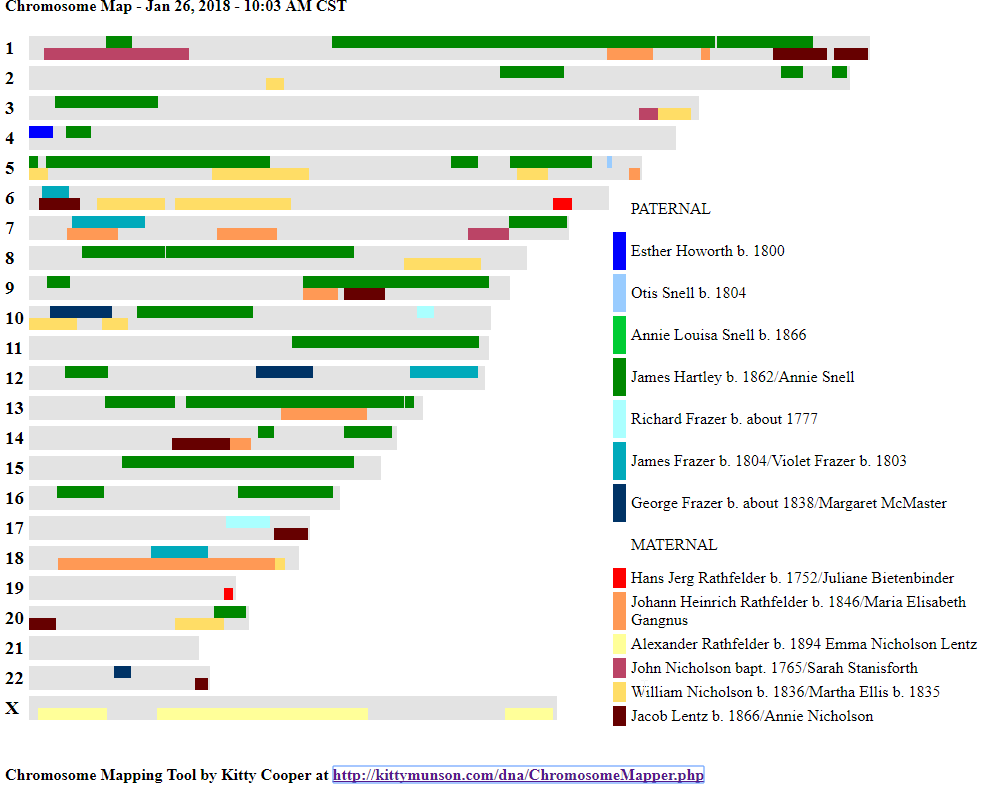
I like the colors better. However, Annie at the first part of Chromosome 16 is still subsumed in Hartley/Snell in dark green. Also Otis Snell is a tiny segment at about 4cM. I think I’ll take out Otis and Annie:

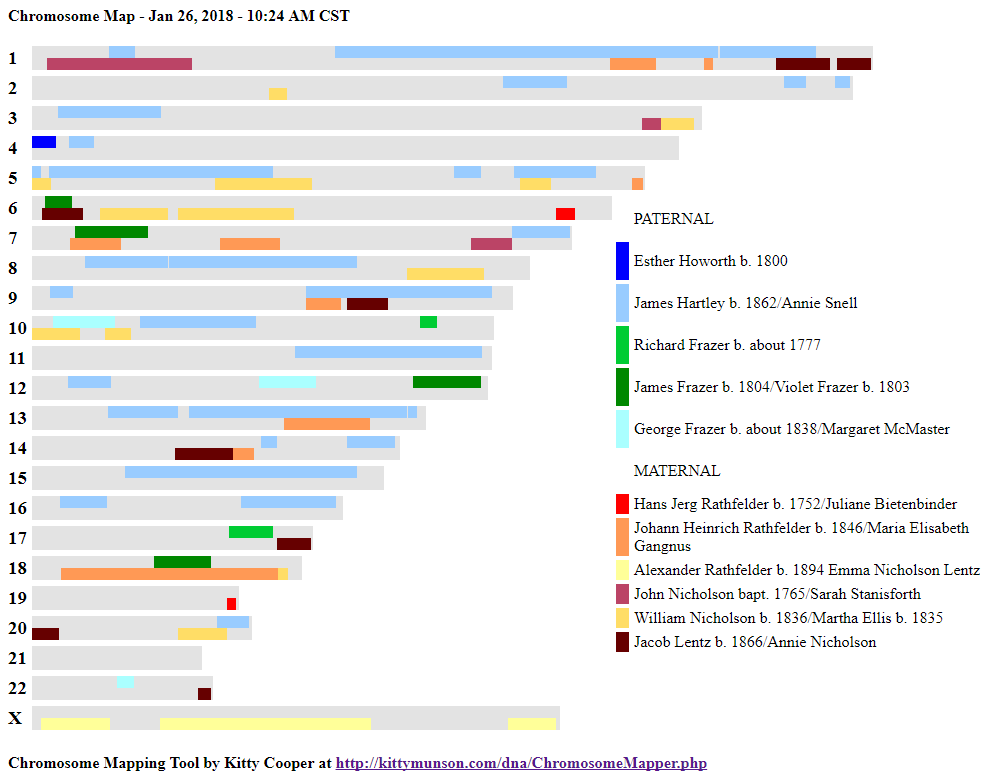
I like this version the best. I have a lot of Hartley/Snell as this couple had 13 surviving children. As a result, I have a lot of 2nd cousins with matches. Hartley/Snell is now light blue. James/Violet Frazer is now dark green. My goal is to split up the light blue into Hartley and Snell.

Summary and Conclusions

  • I added some important James Frazer/Violet Frazer segments to my Chromosome Map
  • This couple was born in 1803/4.
  • Mapping points out where you have cousin matches and where those matches are missing
  • I hope I haven’t missed any other important ancestor segments on my map

Doreen’s Frazer DNA

I was glad to hear from Doreen’s cousin Pat that Doreen’s DNA results were in. Doreen can now join her DNA results with many Frazers descending from North Roscommon County, Ireland.

Doreen’s Frazer Genealogy

It’s a bit complicated, but here is one section of Doreen’s Frazer Tree:

This is a section that I’m partial to as I’m in it. Notice at the top there are two Frazers. From what I can tell, these two were first cousins. Violet descended from Richard Frazer and as far as I can tell or guess, James came from his brother Phillip Frazer.

The Bigger Picture

Here’s a somewhat outdated tree of lines of Frazers that have had their DNA tested. I cut off the bottom two generations for privacy. James from Philip is in first blue line. However, Doreen with several others also descend from a third Frazer brother named Archibald who married Ann Stinson. That means that Doreen descends from her 5th great grandfather Archibald Frazer three different ways.

Doreen’s DNA

I would like to look at Doreen’s DNA and try to figure out if her DNA supports the trees we have or not. Doreen’s sister Susan has also had her DNA tested. Doreen’s brother Rick has had his YDNA tested. This is important as a direct male Frazer descedant is needed for that. Doreen has another brother and we are waiting for his results. That is because with the results of three siblings, it is possible to map out your the DNA you got from each grandparent. That makes it a lot easier to identify your matches.

Doreen and the Archichald Frazer/Ann Stinson Line

I’ll start with this Line as it is less complicated.

The only ones that complicate this tree are Jane and Michael. They both share the Richard Frazer Line with the yellow group. However, the good news is that the other lines are only in the Frazer/Stinson group. When I compare these people in a matrix, this is what I get:

I highlighted Jane and Michael as they have other Frazer ancestors. The close relationships between the poeple in the yellow George Frazer Line show up in green in the bottom right of the matrix.

Looking for James and Philip Frazer

When I did my genealogy, I knew that a James Frazer was married to a Violet Frazer. Violet was the son of Richard Frazer born about 1777. However, I have a lot less information on James Frazer.

According to the list of references compiled by Michael of this project:

This compilation of the records say that James was the son of Philip, but my guess is that the actual records don’t say that. They likely just say that James Frazer married Violet Frazer on 23 Jan 1828 and that James and Violet had a son Philip born not too long after on 28 May 1828. It was my assumption that James was the son of Philip as he named his first son after his father as per a common tradition of the day.

Here is some research that was done many years ago by one of Doug’s relatives:

This shows Violet married to James, but doesn’t show that James was the son of Philip. This appears to indicate that Richard also had a son named James.

How To Design a DNA Plan To Find James and Philip

First, it would be helpful to have other descendants of Philip, but I am not aware of any. Here are some ancestors of Richard that have had their DNA tested:

Of these people, I am the least sure about David on the bottom left. He has an ancestor James from Enniskillen that I added in because the dates mathced up and David matches by DNA. Jane was also added in but she has a lot of matches. Michael is quite sure his ancestry goes back to Richard.

Another Look at David

I haven’t looked at David for quite a while. He is in a Triangulation Group on Chromosome 12 with these people:

All these people descend from Richard Frazer b. 1777, so that adds some weight to where I put David in the tree above.

The Philip Frazer Line

The Philip Line should be very similar to the Richard Frazer b. 1777 Line, but simpler:

So a DNA plan should try to determine:

  • Were James and Violet first cousins? This may be a little difficult to determine as they are four generations back from Gladys and Paul and 5 generations back from the other testers.
  • Is there a way to separate the DNA identified as being from Violet from that DNA from James Frazer b. 1804. This would seem to be even more difficult. Michael and Jane, inasmuch as they match my family or Paul would match at the Richard level for Violet. Matches through Phillip would be at one level higher at the level of Archibald Frazer b. about 1743 married to Mary Lilley. Again, the levels of DNA matches out that far are pretty variable, but I may be able to do something with all the testers we have.

The Effect On DNA Of First Cousins Marrying

This effect can be important for certain Frazer descendants. For example, Michael in the project also descends from two first cousin Frazers. I wrote a Blog in 2016 on Frazer Cousin Marriages here. Take the James Frazer/Violet Frazer marriage for example. You would think that The purple line and the yellow lines would have higher than normal matches with each other. However, those matches should be at the same level regardless of the fact that they are 1st cousins. The effect of the cousin marriage is not that great and takes place two generations prior to James and Violet. That means that the third cousin match between Gladys and Paul will overshadow any effect of an additional common ancestor at the 5th cousin level. Where the effect makes a difference is for others that only match on that common ancestor of Archibald Frazer b. 1743 (and his wife Mary Lilley).

James Frazer/Violet Frazer Matches

There are 11 people tested that descend from James Frazer and Violet Frazer b. 1803. Here is how they look in an autosomal matrix:

The people in the top left box all descend from George Frazer b. 1838. The people in the bottom right box descend from his brother Richard Patterson Frazer b. 1830. The matches in the bottom left and top right betwen the two Lines represent James Frazer and Violet Frazer. Gladys has the most matches in that category. About half of the DNA from these matches should be from James Frazer b. 1804 and half from his 1st cousin wife Violet Frazer b. 1803.

Detailed James/Violet DNA

Here is what I see on Chromosome 1:

I have the Richard Patterson Frazer Line in yellow above and the George Frazer Line in blue. It turns out that Chromosome 1 has a lot of matches for the Archibald Line of Frazers. From above, Gladys, Doreen and Jonathan (my brother) match from about 190M to 200M. To complete the Triangulation Group (TG), Gladys and Dorreen have to match each other. They do in that same area.

Here I have added in the new TG:

However, to do these TGs justice I will need to compare Doreen to everyone in the group. However, the way it looks now is that there is a TG in yellow for James and Violet Frazer. Then from 198 to 200M there is a TG representing the Archibald Frazer/Stinson Line.  At 203-241 there is a TG which appears to represent the Richard Frazer b. 1777 Line. There is quite a bit going on.

On Chromosome 6 there is another apparent James/Violet TG:

Here is a quick update for Doreen on the TG Summary Sheet:

However, recall that I didn’t look into Michael or Jane’s results or any of the other Frazer DNA tested members.

Doreen’s DNA Compared To All DNA Tested Frazers in the Project

First I filtered out Doreen’s closer Richard Patterson Frazer Line matches to see which more distant relatives Doreen matched:

Doreen matches Janet from the James Line on Chromosome 14. Doreen also matches Vivien and Rita from the Archibald/Stinson Line. Michael and Jane could be from the Archibald or Richard Frazer Line. The Jonathan she matches is my brother, not Joanna and Janet’s brother. You can see some of the DNA inheritance patterns if you look at how Doreen matches my family. She matches me and my brother and sister Jonathan and Lori on Chromosome 6. She matches Jonathan and Sharon on Chromosome 9 and she matches me and my two sisters Heidi and Sharon on Chromosome 18. Doreen matches all of us on our paternal side. However, the DNA we got on our paternal side is switching from Hartley to Frazer and back again. It would be unusual for Doreen to match all five siblings on the Frazer side at a particular segment of a chromosome. Likewise, Doreen matches my family on her paternal side, but the DNA she got on paternal chromosomes are switching back and forth between her grandparents Frazer and Gray.

Back to Chromosome One – James and Violet Identified?

[This was a late-breaking edit I added after writing this Blog.]

I mentioned Chromosome One above. It appears that Doreen is in a new James/Violet TG there from 190M to 200M. However, right before that point, Doreen matches Michael from about 178-191M:

It is possible that Doreen has a crossover right around 190M. If this is right, then this could be the crossover passed down from her great grandfather George Frazer of his grandparents James and Violet Frazer. Here is my reasoning. The match Doreen has with Michael could represent their common ancestor of Richard Frazer b. about 1777. Richard had Violet and Isabella. Doreen descends from Violet and Michael descends from Isabella. This match between Doreen and Michael ended at about 190M. Starting at 190M, Doreen begins to match with Gladys and Jonathan. That was the TG that represents either James or Violet Frazer. As Doreen appears to have a change at this location, this could be the change or crossover from Violet Frazer to James Frazer in her ancestry. I don’t know if I have proven that these two segments represent Violet and James Frazer, but I think that I have made a good case. To me, this helps explain all the DNA matchingis going on in Chromosome 1 between the different Frazer Lines.

Doreen Shows an Ancient Crossover in Vivien?

Here is an interesting match in Chromosome 2:

Doreen matches Vivien from 75M to 81M. However, Vivien matches Jane right up to 75M then goes on to match Doreen. That looks like a crossover.

This could be the match between Vivien and Jane:

This could be the match between Vivien and Doreen:

My thought was that at 75M Vivien has a crossover. That means that Vivien’s DNA crossed over from Catherine Parker to her husband Archibald Parker at 75M. Doreen does not descend from this couple, so her match must be coming from further up. That would be either Archibald Frazer b. 1778 or Ann Stinson. The three matching people pointing out this crossover are from Australia, Colorado and Canada.

Sorting Out Doreen’s Chromosome 9

Doreen has a TG in yellow which may represent James and Violet. Then Doreen has a green TG with Doug and Rita which would indicate an Archibald/Stinson TG.

However, between those TGs, Doreen has a single match with Jane:

At first, I thought that this match with Jane may indicate a crossover for Doreen. However, it may also indicate a false match between Jane and Doreen. Note that sisters Susan and Doreen match each other between 155 and 140M. Why wouldn’t Jane also match Susan if it was a true match?

Doreen’s TG on Chromosome 16

Here we see a TG between Patricia, Susan, Doreen and Vivien:

Doreen, Susan and Pat are 4th cousins, once removed with Vivien.

Here is the TG Summary Sheet:

Vivien looks far away in the chart but that is because many are in the Richard Frazer b. 1777 Line as well as the Archibald/Stinson Line.

Summary and Conclusions

  • Some of Doreen’s matches on Chromosome 1 appear to define separate segments for married first cousins James Frazer b. 1804 and Violet Frazer b. 1803
  • Doreen’s DNA results have revealed some new Triangulation Groups
  • Doreen’s TGs appear to represent James and Violet Frazer ancestors or Archibald Frazer/Ann Stinson Ancestors
  • Doreen’s results brought out some matches with Vivien
  • Two matches with Vivien appeared to show a crossover in Vivien’s DNA from Parker to Frazer
  • One single match with between Doreen and Jane could be false
  • A look at David’s TG appears to have him more solidly in the Richard Frazer Line (b. 1777)
  • When Doreen’s brother’s DNA results come in, it will be possible to look at visual phasing of three siblings’ DNA. This will show where they got their DNA from each of their four grandparents.

An Update on an Irish Butler’s Big Y

Not too long ago I wrote about my Butler father in law’s Big Y results here. I found it a bit frustratinng that FTDNA changed their matching criteria. Richared is I2 on the YDNA nomenclature and his terminal SNP is now I-A427. Here are the matches shown at FTDNA:

However, there was a catch to the matching. Now Richard has a match if:

A person is considered a match if they have 30 or fewer differences in SNPs with you, and their haplogroup is downstream from your haplogroup or downstream from your four closest parent haplogroups.

Since my last Blog, I uploaded Richard’s VCF file to YFull.

I made sure to show that his ancestor was from Ireland, as I didn’t see any other Irish Flags. Now Richard is in an I-A427 group with no further branching along with two other YFull people. I’m hoping that once the next Y Tree comes out, that Richard will be on a new branch of the Y Tree. But back to the matching. If I count the id’s above, I get 17 other than Richard that are positive for I-A427. Yet Richard has no A427 matches by the FTDNA criteria. And that holds true for the four branches above A427 even though there are likely many more people that are positive for those SNPs.

Once Richard was on YFull, I joined him to the I-M223 Group. That way, group adminsters can see his results there and do any needed analysis.

FTDNA’s SNP Tree

I was unable to get FTDNA’s SNP tree working for my last blog. Here is how it looks for Richard:

I have a little trouble reading the FTDNA tree. I went two levels above A427 to P78. It looks like the two branches under P78 are the larger S25733 and the smaller Y7219. Under S25733 there is A427 and PH2670.  This leads me to modify the tree I had drawn in my previous Blog:

This was drawn to show that FTDNA may be ahead of YFull in some aspects and YFull may be ahead of FTDNA in others. The yellow level and down don’t  apply to the Butler/Whitson I-M223 Branches. Peter from the Project and Richard have both tested negative for S23612. That means that they are awaiting to be put in a  new branch below A427 that is parallel to S23612.

Here is where I expect the new branch to be:

Eventually, there should be additional branching below this yellow level. I would expect there to be more than just Butlers and Whitsons in this branch as this branch could still be over 4,000 years old. Note that probabably due to planned family testing, the Y24488 Branch got down to as recent as 150 years ago for their common ancestor.

VCF and BAM files

The two files that are generated when your Big Y results come in are the VCF and BAM files. FTDNA has not been generating the BAM files due to their conversion from HG19 to HG38. Due to a better understanding of YDNA a new standard was needed as new locations were found on the Y Chromosome. Thus the new HG38. For example, here is a list of some of Richard’s Novel SNPs:

YFull shows the HG19 position and the HG38 position.

The BAM Files are much larger than the VCF files. Other than that I don’t know a lot about them. YFull used to only accept the BAM files, but now that BAM files are held up, they wisely decided to accept VCF files. They get their money ($49) and we get most of the analysis. The rest of the analysis is done for free once the BAM file is available. Here is YFull’s ad:

Note they state that they only get about 50-70% of what they need from the VCF file. Also note that no age estimation is done without the BAM file. That is one of the most popular features of YFull. So I will definitely send YFull my BAM link once it is available.

Any Shared SNPs at YFull?

Again, no. YFull doesn’t do SNP sharing on old SNPs. Isn’t that age discimination? This is from the YFull site:

Q: What is YFull’s “SNP matches” methodology?

A: The methodology is reflected in the SNP matches table, which provides information about Shared SNPs and Assumed Shared SNPs of compared samples. The table is limited to SNPs having an estimated age of 3500 ybp or younger (using TMRCA from the YTree), with a maximum of 100 lines of information.

I-A427 has a TMRCA of 4700 years before present. That is ancient. Richard is only off by 1200 years.

Are the Novel SNPs At YFull the Same As the Unnamed Variants At FTDNA?

I think so. From my last Blog, FTDNA showed that Richard had 33 Unnamed Variants of High Quality. YFull shows 18 Novel SNPs of best quality and 11 of acceptable quality. That adds up to 29 which is two off from FTDNA’s 33 Novel SNPs and Unnamed Variants appear to be the same thing. However, based on differing interpretations different Novel SNPs were reported at different reported qualities:

This is a partial listing of all of Richard’s Variants. YFull is on the left and Big Y is on the right. I lined everthing up by the position numbers. YFull reports two Novel SNPs as ‘Ambiguous Quality’ that FTDNA reports as High Quality. Then FTDNA has 7 Novel SNPs rated at High that YFull does not even report. Again, it’s good to have a second opinion.

Any Shared Novel SNPs at YFull?

I think so. I copied all the Noved SNPs into Excel and filtererd all the ones that said ‘shared’ on them:

Here is what I gather:

  • Even though these 14 Novel SNPs are shared, I can’t tell who they are shared with
  • There are an equal amount of low quality Novel SNPs shared as well as Best Quality Novel SNPs
  • One Novel SNP is new as there was no HG19 Position given
  • All these Novel SNPs have been named except for two. The YF designation is a YFull numbering system, but as far as I know, not a SNP naming designation.
  • I expect these Best quality and acceptable quality shared Nove SNPs to form a new branch or branches.

Summary and Conclusions

  • The Big Y Results have gotten tbe ball rolling for the I-M223 Group of the Whitson/Butler YDNA Project
  • Once the BAM file is available from FTDNA it will be uploaded to YFull
  • Richard’s Big Y VCF file has been uploaded to YFull. I expect new branching once a new Y Tree comes out. These seem to come out about every two months. The last one came out at the beginning of January.
  • FTDNA’s I-M223 administrators will also be looking at the Big Y results and the Y Full results for Richard, to see if further branching of A427 is warranted.
  • One or two others from the Witson/Buter I-M223 Branch have expressed interest in taking the Big Y test. These tests could get to how the Butlers and Witsons are related. This may also give some geographic information on common ancestors. The Butlers were known to be in Ireland? Were the Whitsons also there? If so, when?


A Harbour Buffett Upshall Found Through DNA

In a previous Blog, I looked at Martha and her family’s DNA and the connection that had to my wife’s family through the Upshall Line. Martha had a great great grandmother Jane Upshall. I found that by comparing Martha’s family to my wife’s mother Joan and Aunt Elaine, I could narrow down DNA the connections to the Upshall line. This also worked when I compared my wife’s Aunt Elaine to her great Aunt Esther at AncestryDNA.

When I did that I came up with some shared matches. The first relevant Shared Match to Elaine and Esther was Karen. Karen shows as a potential 3rd cousin to my wife’s Aunt Elaine. She also shows up as a potential 2nd cousin to my wife’s great Aunt Esther by DNA at Ancestry. That is pretty close. That means that Karen and Aunt Esther could have shared great grandparents.

Here is the tree Karen has at Ancestry:

This was not a lot to work on, but the names of Hollett and Gilbert sounded like Newfoundland names that I had heard before in my research on my wife’s Great Aunt Esther’s Lines. I tried building a new tree of my own tree for Karen at Ancestry.com. I found a father for Clyde, but got stuck and sent a message out to Karen. Karen was very friendly and wanted me to get in touch with her sister Ruby who knew more about the family history. As a result of getting in touch with Ruby, this family tree went from a flat, dead-end tree to a living three dimensional family history that jumped off the page.

More on Karen and Ruby’s Genealogy

Ruby wrote back and gave me some important information. Her mom was born at Haystack where she was raised by her mom Minnie Gilbert. Ruby’s mom’s dad was probably Malcolm Hollett from Marasheen Island. I’m not an expert on Newfoundland geography, so I looked up these places:

The red indicator is Haystack. Great Aunt Esther’s parents were both from Harbour Buffett and Merasheen Island was nearby. Here is a photo of Haystack in 1915:


Minnie Gilbert

I then set out to look for Minnie. The first Minnie I found was in Harbour Buffett on the same Census page as a Hollett and Upshall family. This sounded promising, but was the wrong Minnie. It turned out that Ruby’s tip on Haystack was important. Here is Ruby and Karen’s grandmother Minnie in Haystack in 1921:

This shows that Minnie was living with:

  • Her grandfather Samuel Gilbert
  • Samuel’s wife
  • Her sister Norah
  • Melanda Upshall who I guess would be Minnie’s Aunt. I assume Melanda was originally Melanda Gilbert. She must have married an Upshall who died. By 1921, she was a young widow.

Here is a photo of Minnie at age 93 a year before she passed away, sent to my by Ruby her granddaughter Ruby:


Malcolm Hollett

I should have looked further down on the 1921 Census of Haystack. If I had, then I would have found this entry:

Here was Malcolm Hollett who was Karen and Ruby’s mother’s purported father. He was living just a few houses away. Malcolm and his sister Effie were adopted by George Pike and his wife. George was listed on the census as a ‘genl’ merchant. I’m not sure what that meant. Perhaps he was the owner of the local general store.

Ruby had initially told me she thought that the Upshall connection could be through Malcolm Hollett. At first I doubted how she could know that the connection would be Hollett rather than Gilbert. But after seeing that Malcolm and Effie were born in Harbour Buffett, I came around to Ruby’s way of thinking.

I had trouble finding information on Malcolm, so I decided to try to look for his sister Effie. That was another breakthrough:

Apparently Effie needed a birth certificate and one was missing. Malcolm had a delayed Registration made up in 1969.  This was great as it gave a lot more information on names and dates. The important name I found was Jessie Upshall. I had now found the Upshall connection that was suggested by the Karen’ws DNA matches with Esther and Elaine at AncestryDNA.

I had actually found an Upshall marriage earlier, but had no way of knowing if it was the right marriage. I had found this at a great web site called Newfoundland’s Grand Banks:

This couple got married at Harbour Buffett and were both living there at the time of their marriage in 1903. As Ruby had known, this couple died which is why their children Malcolm and Effie were adopted. Albert Chesley died in 1909 of pulmonary tuberculosis. Jessie died in 1913 of Tuberculosis. It looks like from the death records that both Chesley and Jessie were born in Harbour Buffett. At the time of her death, Jessie was listed as Katie.

Who Was Jessie Katie Upshall?

The records are not so good in Harbour Buffett around the time when Jessie Kate was born around 1886. One thought I had was that Katie could have even been an Aunt of Esther. Here is the genealogy that I have for Esther’s grandfather Henry Upshall’s family:

Perhaps Jessie was the youngest daugther of this family. I have seen Catherine Dicks name recorded as Kate. If this guess were right, that would make Karen and Esther… Well I have to chart it out.

There it is. They would be 1st cousins, twice removed. This would be equivalent to the potential 2nd cousins that Ancestry shows them as by DNA.

Speaking of DNA, let’s see if Karen’s DNA matches shed any light on the topic.

Karen’s Upshall DNA

I had asked Karen to upload her AncestryDNA results to Gedmatch for comparison and she kindly did that. Karen shows up as match #6 on Esther’s list of DNA matches at Gedmatch. That is pretty good as Esther has a lot of close DNA matches due to the fact that her dad was borm in 1879. Also due to the fact of intermarriage in Harbour Buffett. On Karen’s DNA match list. Esther is her 1st match. Elaine is her 3rd match and Joan is her fourth. So far, the DNA evidence seems to support my guess that Karen and Esther could be 1st cousins twice removed.

Karen’s Match with Esther

The MRCA or Most Recent Common Ancestor estimate by Gedmatch is 2.9. That would be equivalent to a 2nd cousin (or what I proposed, a 1st cousin, twice removed). One thing that is intersting is that there are not any matches under 10 cM. The lowest match is 11.9. This would tend to represent a closer relationship. If the relationship were with several different distant ancestors, there could be more small cM matches.

Here are some statistics for cousin matching from the International Society of Genetetic Genealogy (ISOGG) web page:

An average for 1C2R is 229M. Esther and Karen are above average for that relationship.

Karen and Joan’s Matching DNA Segments from Gedmatch

Here Joan is a litttle below average of the above report. However, she is right on at 3.5 MRCA which whould be equivalent to second cousin once removed to Karen.

Karen and Elaine’s Matching DNA Segments from Gedmatch

Due to the randomness of DNA, Elaine apparently inherited more Upshall DNA. This puts Karen and Elaine’s DNA match at above average for 2nd cousins once removed.

Upshall Triangulation Groups (TGs)

Triangulation Groups are groups of three people or more. All three people match each other on the same segment of the same chromosome. A TG indicates a common ancestor.  Rather than go through each TG, I have summarized them in a table:

This table is interesting as it shows that Karen is in most (5/7) of her TGs with Esther’s side of the family. The other side is Martha’s side that I blogged about here. Then Karen is in another TG with Bob who I wrote about here. His tree comes up later in the Blog.

The proposed relationships are below:

Somehow, I lost Bob’s line. I wasn’t so sure about him before, but he does apear to be in two small TGs.

TG09 was the one that pulled the two families together:

In TG09, Karen matches Joan, Esther, DTE and Martha. She matches Mandy also, but Mandy (5) doesn’t line up with the other matches. Here is how the TG would look graphically:

Assuming that I drew the family tree correctly, this could be considered two TGs. One would be between Joan, Esther and Karen and the second would be all five people:

Note in the browser above that Karen’s matches with Joan and Esther are larger than her matches with Martha and D.E. The would be consistent with the way the tree is drawn above. Karen would be a 1st cousin twice removed to Esther but a 4th cousin to Martha and D.E.
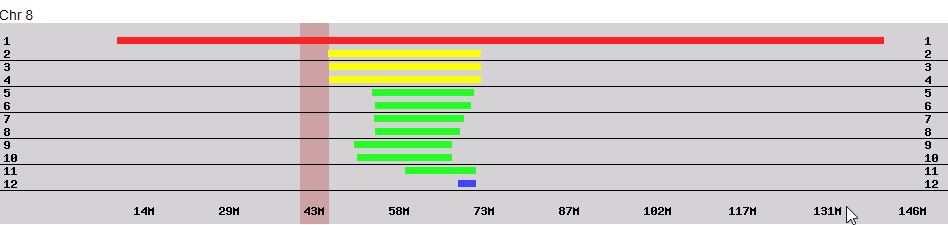
TG05 with Karen and Bob


The above representation of this TG assumes that these people don’t also have another common ancestor. However, I would rather go with what I know than what I don’t know. This is an interesting TG as it includes what would appear to be three children of Peter Upshall b. around 1800.

Upshall or Dicks DNA?

The way I drew the Upshall tree above, Karen’s common ancestor with Esther, Elaine, and Joan would be Henry Upshall. However, Henry was married to Catherine Dicks. That means that the common ancestor would be either Henry or Catherine. Fortunately, I have been working on a Dicks DNA Project for quite a whilte. I should be able to sort out the Upshalls form the Dicks in a future Blog. Also the presence of Dicks DNA in Karen would further solidify my proposed tree. Here are the TGs (in pink) where Karen could have Dicks DNA:

The pink TGs are those where the members of the TG are just Karen, Elaine, Joan and/or Esther. I’m not aware of Dicks ancestry with MLB, Martha, DTE, Mandy or Bob, so those TGs likely represent just Upshall DNA (or the unknown wife of Peter Upshall).

Summary and Conclusions

  • Karen was a great find
  • It has been fun looking at Karen and her sister Ruby’s family history and getting to know them a bit in the process
  • Karen and Ruby most likely descend from Malcolm Hollett, son of Jessie Kate Upshall b. about 1886
  • The DNA, genealogical evidence and information that Ruby has support this
  • Jessie Kate Upshall who is Malcolm Hollett’s mom is most likely Esther’s Aunt. Jessie’s birth year of 1886 would fit into the family of Henry Upshall b. about 1841 and his wife Catherine Dicks. The proposed Upshall Tree also fits well with DNA averages for relationships. Further, the Triangulation Groups appear to support the Upshall connections between Karen’s family and my wife’s family.
  • It would be nice now to find some genealogical evidence that the Jessie Kate Upshall who died at the young age of 27 was part of the Upshall family that I have been researching. Perhaps the family Bible will show up somewhere.
  • Assuming my Upshall Tree is correct, then Karen should have a good deal of Dicks DNA as well as Upshall DNA. Identifying Karen’s Dicks DNA will further solidlfy the proposed tree where I have Karen as Esther’s 1st cousin twice removed.