Upshall DNA Update: Barry From New Zealand

In a previous Blog, I looked at Mervyn’s DNA. He matched my wife’s family on the Newfoundland side where many Upshall’s lived. Upshall DNA and genealogy is a difficult subject. Many families intermarried in the small community of Harbour Buffett where many of these families lived.

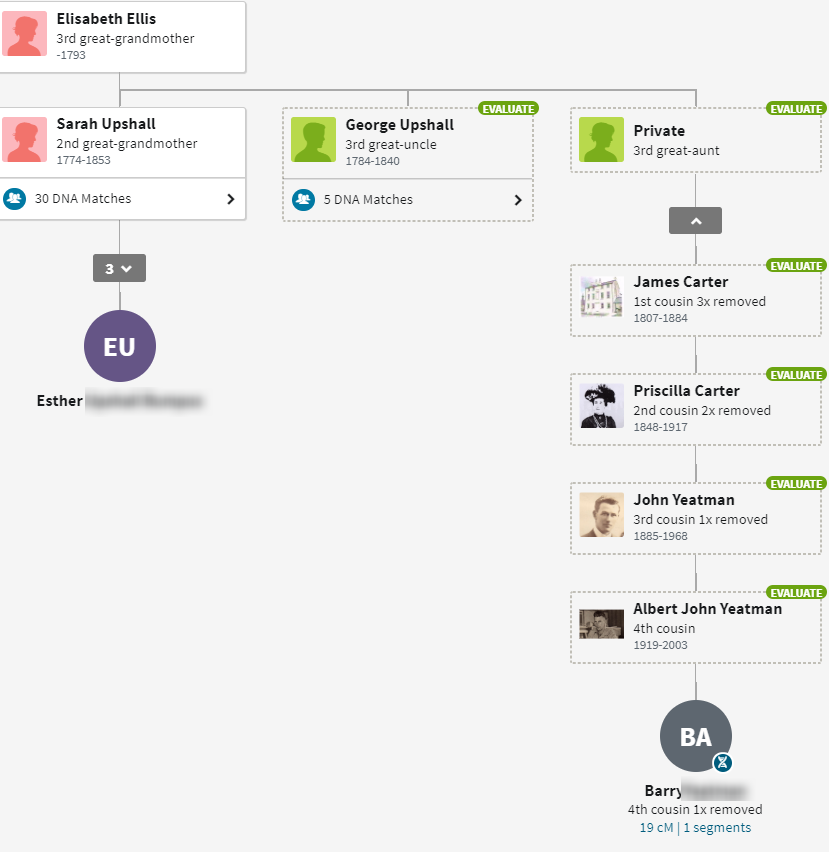
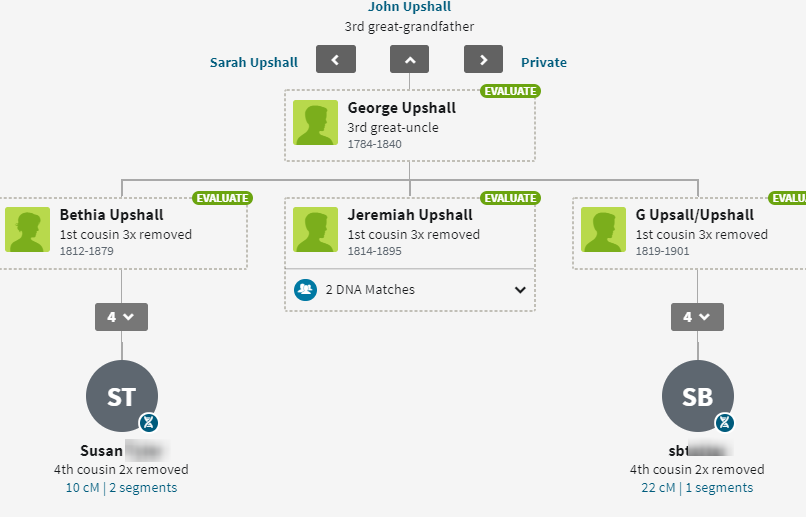
Esther’s Early Upshall ThruLines

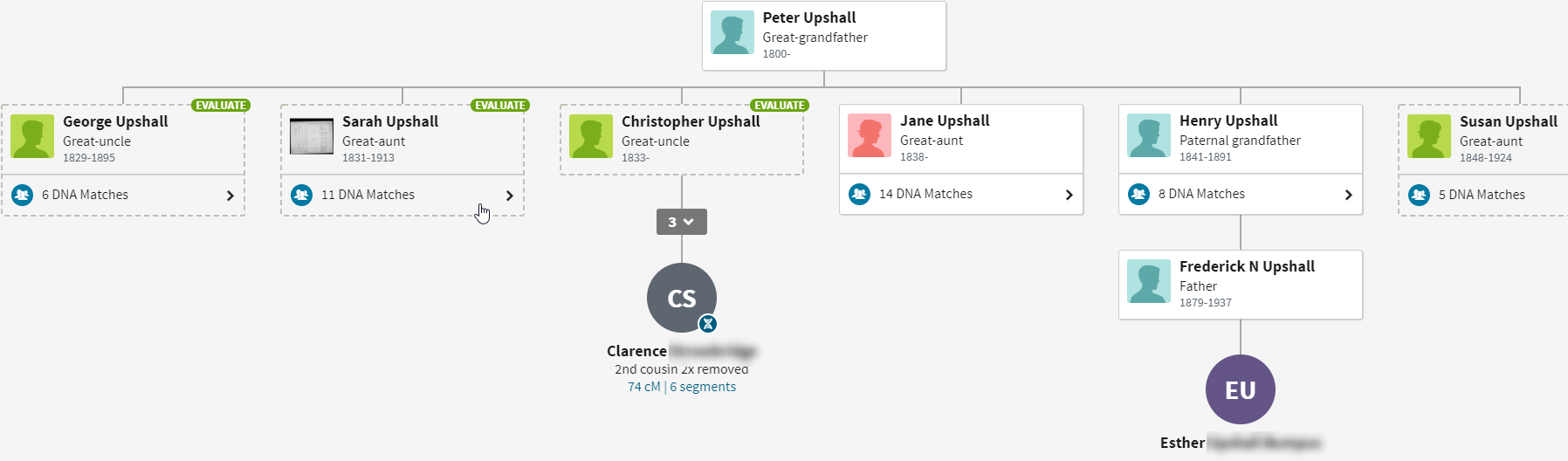
Esther is my wife’s 1/2 great Aunt. Here are her early Upshall ThruLines:

Here, the working theory is that Sarah Upshall (above left) was the daughter of John Upshall and that she was the single mother of Peter who moved to Newfoundland. This theory seems to be born out by the above ThruLines.

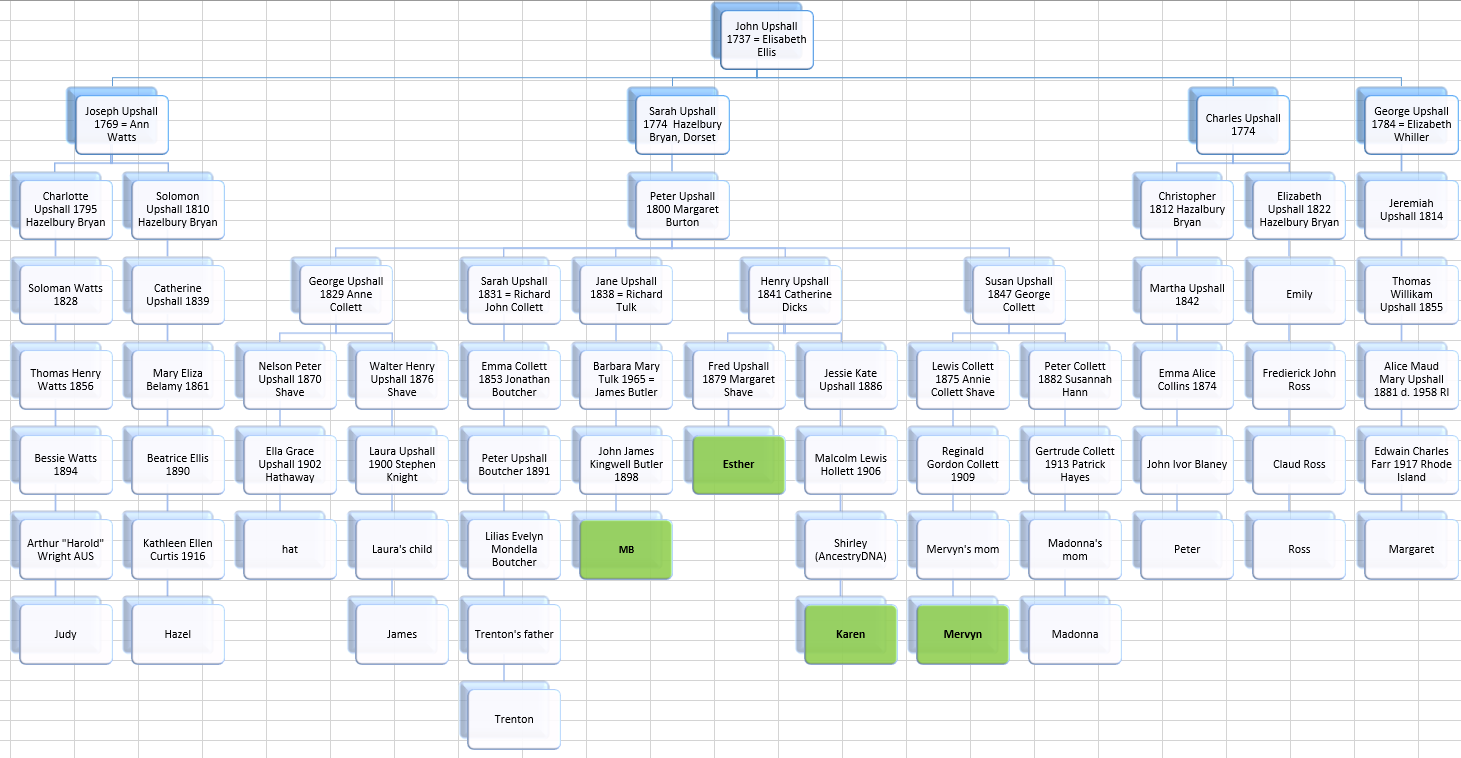
I have also come up with my own tree that mixes ancestry and DNA:

This tree has George in the right columns as one of four children of John Upshall. Sarah is in the middle with many Newfoundland descendants. Interestingly, there is no overlap between Ancestry’s ThruLines and my chart.

The John at the top of the chart was married to an Elizabeth Ellis. The ThruLines for Elizabeth give me one more line to look at:

All the ThruLines have a note that they want me to evaluate the lines. That sounds like a lot of work. The thing that I like about these early ThruLines is that they represent the family before they moved to Newfoundland, so there would be less intermarriage with these lines. That means that these lines should more likely have Upshall common ancestor rather than another name.

Evaluating Esther’s Early Upshall ThruLines

The Upshall/Carter Line

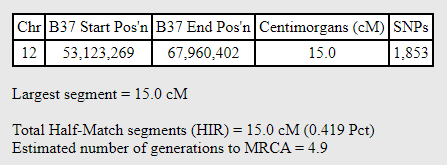
I’ll first look at the additional ThruLine that Elisabeth Ellis has. Barry shows a 19 cM match with Esther. Fortunately, Barry also has uploaded his DNA results to Gedmatch:

Before I look at Barry’s genealogy, I note that Martha also matches Esther at this location. Here is Esther’s Chromosome 12:

This is roughly the area where Barry matches Esther in red. If Barry also matches Martha, then we would have triangulation and indication of a common ancestor:

This shows that Esther, Barry and Martha triangulate. This gives me confidence that the Ancestry ThruLine between Barry and John Upshall is correct.

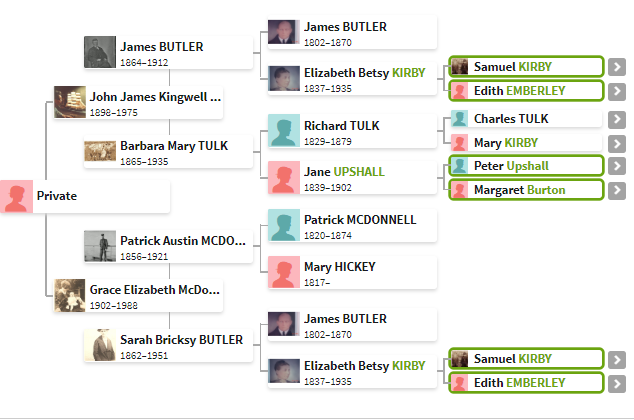
Here is Martha’s tree. Ancestry has put green rectangles around common ancestors:

This shows that Esther and Martha also match twice on the Kirby/Emberley lines. Barry has 28,000 people in his tree but no Kirby or Emberley. That means that the common ancestor for Esther, Martha and Barry should be Upshall/Ellis.

Barry’s Genealogy

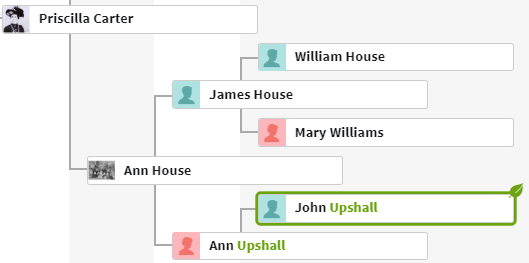
I’ll do a quick tree for Barry to figure out who the private person is in the tree. I got back as far as Priscilla Carter and noticed an Ann Upshall in Barry’s tree:

This appears to be Ann’s birth record:

Here is Winterborne-Stickland, about 6 miles from Hazelbury Bryan:

Triangulating With Barry

Now we have a match by DNA, Triangulation and genealogy:

The people in the green boxes have their DNA at Gedmatch.

DNA Painter

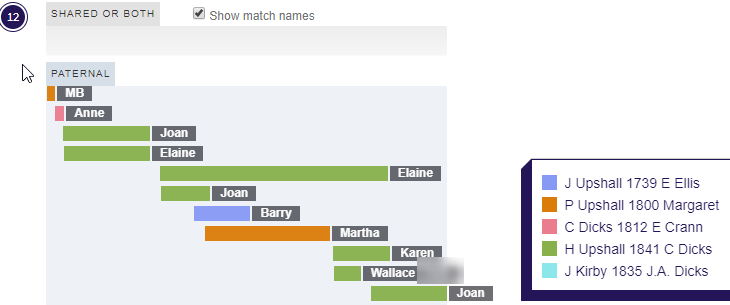
All that is left to do is to paint in these ancestors on Esther’s Chromosome 12:

This shows more precisely where Barry’s match is on Esther’s paternal side Chromosome 12. It appears that Joan’s sister Elaine and Martha have DNA from either John Upshall born 1739 or his wife Elisabeth Ellis.

Summary and Conclusions

  • In updating my wife’s side Upshall DNA matches, I came across Barry
  • Because Barry had his genealogy at Ancestry and his DNA at Gedmatch, he was the perfect example to show and Upshall match that was outside of Newfoundland.
  • A match outside of Newfoundland is important as other Newfoundland matches have confounding DNA matches and genealogy.
  • I was able to show genetic triangulation with Barry, my wife’s Aunt Esther and at least one other match. That triangulation in conjunction with the genealogy seemed to confirm that Esther’s DNA match with Barry was from an Upshall born in the 1700’s.
  • In areas where there is intermarriage, it helps to go to earlier matches outside the area of intermarriage if possible. In this case the Upshall matches go back to the area of Hazelbury Bryan in Dorset, England.


Update On My Hartley YDNA

There are many Hartleys in the world. Not all of them are related which shows up in the YDNA testing. This is my first update in over 2 years on my Hartley YDNA.

My Hartley Branch is R-A11132

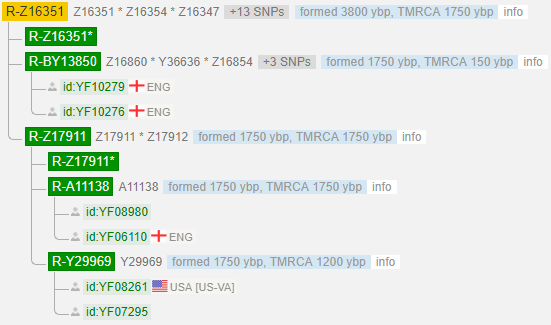
This branch may be shown many different ways. This view is from the Big Tree:

My Hartley overall group is R1b and further L21. R1b is mostly European and L21 can be loosely associated what is called Celtic background. In my case this could be considered perhaps early British as opposed to the later arriving Anglo Saxons. This designation is based on SNP testing.

From the chart above, our branch of Hartleys are associated with the Z17911 Branch of Bennett, Phillips, Merrick, Thomas and Smith and more distantly associated with the Z16854 Branch of Pillsbury, Hayes and Hays.

Why Is My Hartley Branch R-A11138 at YFull?

Here I am under A11138 at YFull’s YTree:

Under R-A1138, there are two people. It is difficult to tell who they are due to only id’s being used. I had assumed that these two were me and the other Hartley BigY tester. But, based on the the A11138 designation, I think that the other person in this group must be Smith:

So now I hope that my BigY Hartley match uploads his results to YFull.

Dating Hartley YDNA

YDNA can be dated by SNPs or by STRs

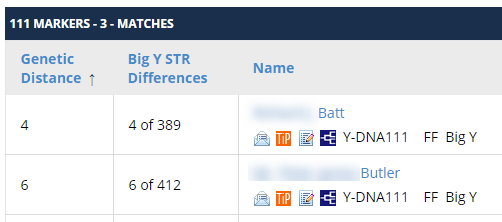
I recently posted information on a Facebook page noting that I had 9 BIgY matches and only one 111 STR match. One informed responder noted that:

It’s pretty unusual to have one Y111 match and 9 Big Y matches certainly! Actually though that would normally mean the STRs have mutated faster than usual and the SNPs have mutated more slowly than usual, so that enough STRs have changed that only one match is left within the STR matching threshold (10 at Y11) while fewer than 30 SNPs have changed between yourself and the 9 matches so they show up on the Big Y matching report. 

Unless there is some other reporting error at work, I highly suspect that 8 of those Big Y matches are off on their own branch where their common ancestors had a lot of STR mutations and pulled them all out of reach of your STR matching threshold!

The person above, David Vance also produced a STR Mutation History for the group I am in. Here is the Hartley/Smith portion:

This shows that the common ancestor between Smith and Hartley is around 900 AD. The common ancestor between my Hartley match is 1400 AD. David further notes:

The age estimates in green are based on the STRs, not the SNPs; but are overall pretty consistent with the Big Tree estimates although note they align with the END of each block, not the start (since they refer to when the branching underneath each node first started).

This dating is helpful as it is the only one that I have right now. However, it is possible to roughly date the FTDNA Block tree by using 144 years times the average private variants under A11132. As there are an average of three private variants, that comes out to 432 years. I could add another 63 years for my age to get roughly 500 years or about 1500 AD. So if this is right, I find it pretty amazing that my match and I have both kept the Hartley surname for between 500 and 600 years!

Summary and Conclusion

  • By comparing my FTDNA Block Tree with the YFull YTree, I saw that YTree was missing some information. That missing information was my other Hartley Big Y Hartley match
  • David Vance performed a STR Mutation History for me. This gave a Hartley common ancestor date of about 1400 AD.
  • I did a rough estimate based on SNPs. The two Hartley’s have an average of three private variants. This would put our common ancestors at roughly 1500 AD.


Mervyn’s Newfoundland DNA: Proceed With Caution

I don’t mean to single out Mervyn for proceeding with caution. You need to proceed with caution with most people from Newfoundland who have had their DNA tested. Due to the small isolated locations in Newfoundland, some re-intermarrying of families happened.

Mervyn got in touch with me because he matched my wife’s 1/2 great Aunt Esther. Esther’s parents were both from Harbour Buffett, so Esther matches most people by DNA who have Harbour Buffett Roots.

Mervyn and Esther Show Common Ancestors at Ancestry

Here is what AncestryDNA shows:

Ancestry thinks that based on the DNA match Mervyn and Esther have a 2% chance of being second cousins twice removed:

Mervyn and Esther appear to be related at least three different ways. Here is the ancestry of Mervyn’s maternal grandfather:

Peter Upshall is a shared ancestor twice. William Shave and Margaret Burton are also shared ancestors.`

Here are the AncestryDNA Thrulines for Peter Upshall from Esther’s viewpoint:

These add up to a lot of Upshall matches for Esther. I counted 45 matches above for Esther. But as I suggest above, how do we know that they are for Upshall or Shave? Or they could be for Burton.

Joan To the Rescue

Joan is my mother-in-law. She is Esther’s 1/2 niece. That means that Joan is related to Esther only on Ether’s paternal side. Here is Esther’s tree:

Esther matches Mervyn on Esther’s paternal and maternal sides. However, Esther matches Joan on Esther’s paternal side only. One complicating factor is that Esther has Dicks on her paternal and maternal sides. Mervyn has Upshall, Shave, Burton and Dicks on his maternal side. This is where my title comes in: Proceed with Caution.

Joan’s Peter Upshall ThruLines

Here is how Joan matches Mervyn:

Joan matches Mervyn at 30 cm.

The Upshall Genetic Genealogy Tree

I created this tree that mixes Upshall genealogy and DNA matches:

This is a work in process. The ideal people on this tree would also have their DNA uploaded to Gedmatch. Fortunately, Mervyn has done that.

Here Esther and Mervyn are in green as their DNA is at Gedmatch. I have pretty much the same problem, in that there is the potential to match on different lines.

After some more finessing:

Above, MB is important as I don’t see any Dicks in her ancestry. Karen is a special case as the tree followed the DNA testing rather than the genealogy. We have no record that Jessie Kate was the daughter of Henry Upshall, but she fits in well there. Also I haven’t added in my mother-in-law Joan or her sister Elaine.

Looking At Gedmatch

Let’s look at how Mervyn matches MB, Esther, Joan and Karen.

Here are the DNA matches between Mervyn and Esther:

Mervyn and MB

Mervyn and Joan

Mervyn and Elaine

I also had Joan’s sister Elaine tested:

Mervyn and Karen

Esther’s Matches

Esther and MB

From this, I deduce that Mervyn’s match with Esther on Chromosome 17 is an Upshall match.

Esther and Joan

This one almost goes off my computer screen:

This brings up an interesting point. The common ancestor for Joan and Esther is Esther’s father. However, this also represents the DNA of Esther’s maternal grandparents Henry Upshall and Catherine Dicks. I had painted this so far onto Esther’s Chromosomes using a web tool called DNA Painter:

Here Esther is 17% painted and 25% paternally painted. Let’s add in Joan’s DNA matches:

Now Esther is 45% paternally painted and 26% painted overall:


While I’m at it, I can add in the matches between Esther and Elaine:

This gets Esther up to 29% painted and 50% paternally painted.

A Side Trip to Esther’s X Chromosome

I note that above, I have nothing mapped for Esther’s X Chromosome. According to Gedmatch, this is her largest match:

This Fran seems to be this person at Ancestry:

This Ancestry page has that Caroline is the daughter of Moses Burton Dicks:

The Dicks Genetic Genealogy Chart I have shows this:

I’ll add in Fran:

A Snag On Esther’s Side

Here is Esther’s tree:

The interesting thing is that the X match could be on Esther’s paternal or maternal side. It seems like the match has eliminated a Dicks common ancestor. That is because the elder Christopher Dicks did not pass down an X Chromosome to either son Christopher or Joseph – assuming I have the genealogy right. That means that this match likely represents Burton or some sort – again assuming that the Margaret who married Christopher Dicks was a Burton. So, although I still have not painted in any of Esther’s X Chromosome, i did learn something about this match.

Mervyn’s Dicks Side

Mervyn says his genealogy is a work in progress and aren’t they all? I had some questions about Mervyn’s Dicks side. Ancestry shows these possible connections between Mervyn and Esther:

It turns out that Ancestry found some connections and a possible connection. Here is how Ancestry shows the Dicks connection:

One problem is that Frances Dicks show that she gave birth to Margaret at about the age 14.

This match-up seems more likely:

However, as my wife and mother-in-law are not related on this side, I am not looking so much at these matches.

Mervyn and Joan’s Unlikely Shave Connection

Here is a new one on me from AncestryDNA:

I’m not sure how Ancestry came up with this. My best guess is that Elizabeth could be Elizabeth Crann. Look at the ThruLines:

For one thing this shows that Joan’s ancestor Elizabeth was born in 1820 and was a sister to George Alfred Shave born 47 years later! Also Elizabeth would have been born when her father was negative 5 years old. Further, Joan and Esther have the same Newfoundland genealogy, so how could they descend from siblings? Let’s forget about this screwed-up line. I hope that Ancestry didn’t deduce this from anything I have on my Tree at Ancestry.

Summary and Conclusions

  • I was all over the place with Mervyn’s genealogy and DNA matches. However, as I said, Newfoundland genealogy and DNA matches are confusing.
  • Even Ancestry seemed confused with its genealogy. Perhaps it is pulling from something in my tree or someone else’s tree that is off.
  • Overall, I did a brief summary of Mervyn’s genealogy and DNA matches. There is a lot there.
  • There would be more room for doing analysis at Gedmatch to try to parse out the different lines from Mervyn’s ancestry. It looks like it could be a lot of work to do this.
  • I was glad to improve my Uphall genetic genealogy tree and use my existing Dicks genetic genealogy trree. I see that I need to spruce up the Upshall Tree.
  • I took a diversion to ‘paint’ some more of Esther’s DNA and look at her top X Chromosome match.
  • Esther is Mervyn’s top match. However, Mervyn is number 17 on Esther’s Geadmatch match list. That is because Esther is of an older generation. Also because other of her closer relatives have tested their DNA.

An Update on Jean’s McMaster/Frazer DNA

Here is a short chronology of what has happened so far.

  1. Jean got in touch with me because she wanted to figure out the ancestry of her great-grandmother Effie McMaster who was born in Ontario in 1861. She found that she had a DNA match to Keith who recommended she get in touch with me. Keith like me and others descend from William McMaster and Margaret Frazer.
  2. I looked at Jean’s genealogy and found a connection to my ancestors William McMaster and Margaret Frazer. Effie lived with her Aunt Susan McMaster Beckett in 1871 and with an Isabel McMaster. In the 1861 Beckett household Isabel McMaster was already there as well as a George A. McMaster. George A. McMaster was the son of George McMaster and Jane McMaster. Jane McMaster was the daughter of William McMaster and Margaret Frazer. Jean’s tradition was that William McMaster and Margaret Frazer were the parents of Effie. However, given the time-frame, that would be physically impossible. I believe that William and Margaret McMaster were Effie’s grandparents. Isabel could have been Effie’s mother.
  3. I asked Jean if she would upload her DNA to Gedmatch for comparison. Based on comparisons with other descendants of William and Margaret McMaster, it seemed probable that William and Margaret McMaster were Effie’s grandparents. Jean also matched other people from a Frazer DNA project that I manage. I noted that Jean had an ancestry that could result in an X DNA match with other descendants of William McMaster and Margaret Frazer. However, Jean’s DNA upload to Gedmatch did not include her X Chromosome.

Jean’s Surprising Lack of X Chromosome Matches on the McMaster/Frazer Line

That brings us up to present. Jean did upload her X Chromosome results, but I could find no matches with known descendants from the McMaster/Frazer couple that we have been looking at. I can think of three possible reasons:

  1. The first would be that Jean does not descend from William McMaster and Margaret Frazer. However, all other evidence seems to lead to the conclusion that Jean does descend from that couple. There are other explanations.
  2. It could be that Effie’s parent was a male McMaster. However, that would only eliminate the William McMaster as a possible X Chromosome donor to his son. This possibility seems less likely.
  3. Isabel or a female McMaster is still the parent of Effie, but the X Chromosome representing William McMaster and Margaret Frazer were not passed down to Jean. This is the option that I am favoring.

How To Explain Jean’s Lack of X Chromosome Match

First of all, it is possible for relatives to match or not match on any Chromosome. For example, here is Jean’s match with Keith. Jean and Keith match each other on two of their 23 Chromosomes: 

Here is how Jean inherited her two X Chromosomes. She got one from her dad which is the same as the X Chromosome he got from his mom. However, we are not interested in that line in this Blog.

It is Jean’s mother who descends from Effie. Etta gave Jean her X Chromosome which was some combination of the DNA from Paul Swayze and his Adams wife. However, we don’t know what that combination was. It could have been half Swayze and half Adams or all one or the other. I have mapped out my three sisters’ X Chromosomes and it looks like this:

My three sisters are Sharon, Heidi and Lori. They all got the same DNA from their dad. That was the Frazer DNA that he got from his mom. The mother’s side is what we are looking at. Sharon got about 1/3 of her mother’s father’s purple DNA followed by about a third of her mother’s mother’s DNA, then back to her mother’s father’s DNA. On the bottom row, Lori, got a variation of that theme but in reverse order and in different amounts. Heidi got a tiny bit of her mom’s mother’s DNA followed by the rest being all her maternal grandfather’s DNA. My guess is that Jean’s X Chromosome could be all of her paternal grandmother Adams DNA and little or no Swayze DNA. That would explain why she wouldn’t match other McMaster/Frazer descendants on the X Chromosome as her McMaster and Frazer X Chromosome DNA would come i on the Swayze side.

It is possible that if Jean has siblings that had their DNA tested, they would likely have a different combination of X DNA that may show the descent from McMaster and Frazer. The reason I say this is that when Paul Swayze passed down his X DNA to his daughter Etta, it was the same X Chromosome that he got from his mother Effie. Effie had two X Chromosomes that she got from what we are saying was her McMaster mother. Her McMaster mother who we are initially guessing was Isabell passed down some combination of X DNA from William McMaster and Margaret Frazer. That is why, if our genealogy is right, the main reason that Jean doesn’t match other McMaster/Frazer descendants on the X Chromosome is the reason I explained above. Actually, there is another possinbility. That is that the inherited X McMaster/Frazer Chromosome that Jean inherited isn’t lining up with the X McMaster/Frazer DNA that the other McMaster/Frazer descendants inherited.

Summary and Conclusions:

  • Some previous large X DNA matches lead me to suppose that I was matching some people on my McMaster/Frazer Line. This came to be true as I was able to line up genealogy and DNA matches. As it turns out, I am still finding descendants of William McMaster and Margaret Frazer.
  • Jean found me and I was able to connect her genealogy with my McMaster/Frazer ancestry.
  • As a result, I thought that the reverse would be true, that she would match certain McMaster/Frazer descendants on the X Chromosome.
  • I was reminded that just because there can be a match doesn’t mean that there has to be a DNA X Chromosome match.
  • I discussed some ways in which Jean would not match other McMaster/Frazer descendants on the X Chromosome.


The DNA of Effie Jean (Jane) McMaster Born Ontario 1861

In my previous Blog on Effie, I looked at some possible parentage. In this Blog, I’ll get into some genetic genealogy, looking at the DNA of Effie’s great-granddaughter, Jean. Jean recently uploaded her Ancestry results to Gedmatch for comparison.

Effie’s Possible Ancestry

Based on reasons I presented in my previous Blog, it seems like Effie’s grandparents should be William McMaster and Margaret Frazer. Here is a pre-Effie tree that combines DNA-tested descendants of William and Margaret McMaster with an ancestry chart:

I had guessed that Effie was the daughter of Isabel McMaster who should fit in on the second row above. I note that Jean told me that she matches Keith by DNA. So that is further evidence that Jean and Effie may belong on this chart.

Here I entered Jean’s line in a different color as we are still figuring this out.

Jean and Keith

It turns out that Jean is Keith’s fourth highest DNA match and my brother Jim is Keith’s fifth highest DNA match at Gedmatch. Here is how Jean and Keith match:

The DNA doesn’t tell who the common ancestor is, but suggests that Jean and Keith have a common ancestor. On the chart above, Keith and Jean’s common ancestors are 5 generations away. Gedmatch is guessing that the common ancestor could be as close as 4 generations away. By the chart above, if I am right, Keith and Jean would be 4th cousins.

By comparison, here is where Keith and my brother Jim match:

If Jim, Keith and Jean all matched on overlapping areas, then we could say that the three triangulate and share the same common ancestors. However, the fact that they don’t all match on the same segments doesn’t mean that they don’t share common ancestors. Sounds confusing, I know.

Jean and Emily

The next person I recognize on Jean’s DNA match list is Emily. Here is how they match:

Jean and Paul

Jean has a smaller match with my cousin Paul:


None of my family has DNA matches with Jean but that is not unusual for a 4th cousin once removed. However, one could say that we are related in the sense that Paul and Emily are related to Jean as my siblings and I are 2nd cousins once removed to Paul and Emily.

BV – Descendant of Mary Ann McMaster

BV had uploaded her results to Gedmatch, but now I don’t see them. It could be that there was a problem with the results or a private button was turned on. I wrote a Blog about BV’s DNA here. It’s too bad that those are missing as I would have liked to have seen how Jean matched BV. Right now the only DNA uploaded to Gedmatch is from Jean and descendants of Fanny McMaster. [However, see below in the Blog.]

Jean and the X Chromosome

Jean probably would be a good X Chromosome match with others, but her X Chromosome DNA did not get uploaded to Gedmatch. The reason that she would be a good match is that the X Chromosome is never inherited by a son from the father. So for example,

The places that I have red boxes, show where there cannot be an X Chromosome passed down. This means that BV can match Jean, my sisters,  or Emily by the X Chromosome. In order to show this, we would need to get BV’s DNA back up on Gedmatch and get Jean’s X Chromosome results to Gedmatch.

Jean’s Matches with Frazers

I have a Frazer DNA project, so I’ll check some of these people to see if Jean mathes any of them. Here Jean matches Cathy:

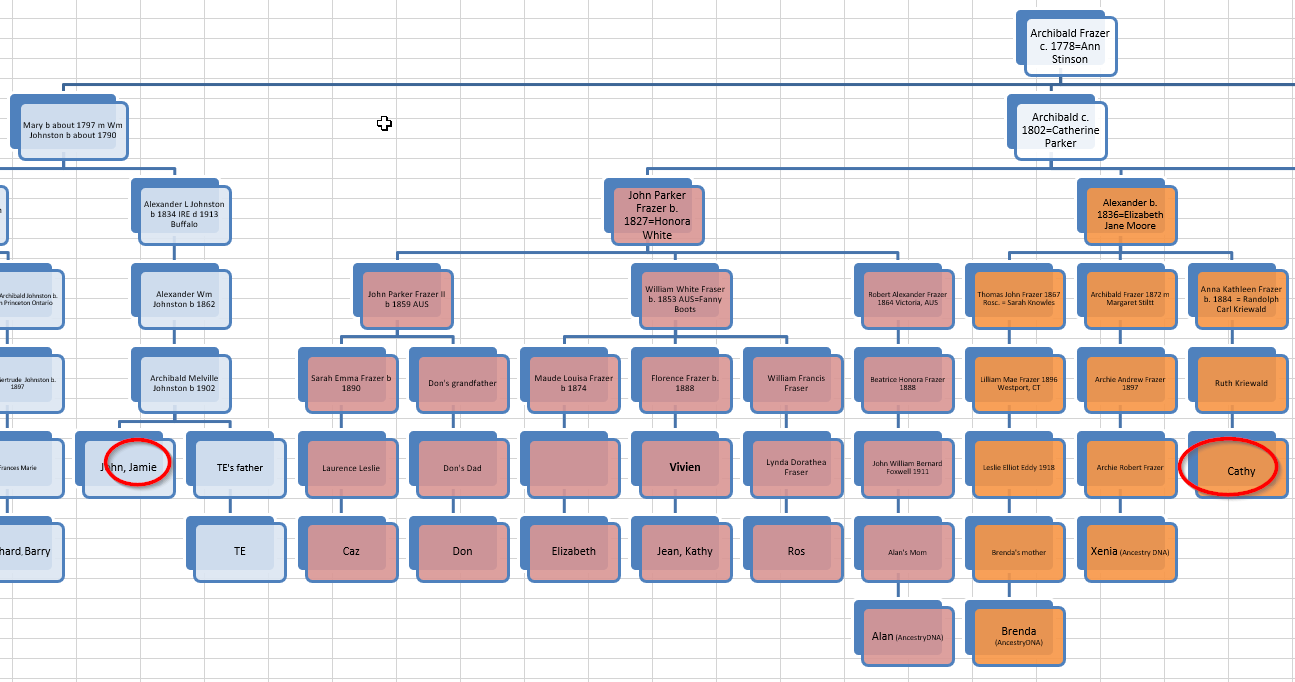
Here is Cathy’s tree as it relates to the Frazer family:

Jean and Cathy’s common ancestors could be Frazer, Stinson, Parker, Moore, or someone not even on this chart. Cathy is on the Archibald Line of the Frazer family. The best guess for Jean’s ancestor Margaret Frazer is that Margaret is on the James Line of the Frazer family.

Jean and Jamie

I found a small match here:

Jean and the James Line of the Frazers

Here Jean matches Toni:

Here is where Toni is on the DNA/genealogy chart for the James Frazer Line:

This means that if I Margaret Frazer placed right and Toni placed right, they would be on opposite sides of the James Line Chart. That means that Toni and Jean would be about 6th cousins, or something may be wrong in the chart. The other possibility is that they match on a  different line.

Rodney and Jean’s DNA Match

Here is Rodney on the Chart:

All the same caveats are in effect for this match that were in effect for Jean’s match with Toni above.

Frank and Jean

I’m looking for trends here. So far the trend is that Jean is matching more Frazers on the James Line side as compared to the Archibald LIne.

Here Frank shows as a closer relative to descendants of Margaret Frazer based on where I have her placed in the tree.

Keith and Jean

I already mentioned Keith above.

However, above, I was thinking about the McMaster side. The assumption is that Keith and Jean match on the McMaster and Frazer sides, so we wouldn’t know which side the matches above are on.

Barbara and Jean

It’s a good thing that I went through my list twice, as I missed Barbara the first time:

Finding BV

It turns out that the Barbara above is actually the BV I was looking for. If I search for BV at Gedmatch by her kit#, Gedmatch tells me that there is no such kit. But if I put in her kit number into Gedmatch for comparison, I can find matches. This is the missing information that I was looking for.

Based on the proposed tree, BV and Jean are third cousins, once removed.  Based on Gedmatch’s best guess, BV and Jean have a common ancestor 4.4 generations away. William McMaster and Margaret McMaster are 4 generations from BV and 5 generations from Jean. That averages out to 4.5 generations. Seeing as a common ancestor would never be 4.4 generations away, that is pretty close.

Triangulation, Crossovers and Chromosome 8

If BV, Jean and Emily each matched each other on Chromosome 8, that would be a strong indication that they each received that DNA from the same ancestor. However, look at what happened. BV and Jean match each other on Chromosome 8 between positions 57M and 71.  Emily and Jean match each other between positions 71 and 104M:

This could indicate a crossover. A crossover is where the DNA we inherited from one ancestor cross over to the DNA we inherited from the spouse of that ancestor. In this case, the crossover could be between William McMaster and Margaret Frazer. Our crossovers are inherited from our grandparents. So, if this is a crossover between William McMaster and Margaret Frazer it would be a crossover that came down to BV or Jean either through Elizabeth Shannon or Effie McMaster.

Here is Elizabeth:

Here is Effie:

Summary and Conclusions

  • Jean uploaded her DNA to Gedmatch for comparison. That comparison shows that she matches BV, Emily and Paul. These four descend from William McMaster and Margaret Frazer.
  • By a proposed chart, Jean would be third cousin once removed to BV. She would be fourth cousin to Keith, Emily and Paul. She would be 4th cousin once removed to me and my five siblings. Jean and my direct family do not show shared DNA, but that is not uncommon for that level of relationship. However, our family has matches to BV, Keith, Emily and Paul and the genealogical connection is more secure.
  • Jean’s X Chromosome results did not get uploaded to Gedmatch. A comparison of those results should give further evidence that Jean shares the common ancestors of William McMaster and Margaret Frazer with BV, Keith, Emily, and my direct family.
  • I was not able to triangulate Jean’s DNA matches. Triangulation would indicate a specific common ancestor. However, the fact that Jean’s matches didn’t triangulate does not mean that the proposed genealogy is wrong. I also looked at a possible crossover between DNA inherited from William McMaster and DNA inherited from Margaret Frazer.
  • In general, the DNA results support the assumption that Jean descends from William McMaster and Margaret Frazer. In order for that to be the case, Effie McMaster would have to have been the child of one of William and Margaret’s children. I had proposed Isabel as that child. However, I have no direct proof that Isabel is the child of William and Margaret and no proof that Effie is the daughter of Isabel. Having said that, there is a likelihood that Isabel could be the daughter of William and Margaret and that Effie could be Isabel’s daughter.
  • So what I am saying is that the DNA gives more evidence that William and Margaret are the grandparents of Effie, but do not supply additional evidence that Isabel is the mother of Effie. The evidence that Isabel may be the mother of Effie has to do with the fact that Isabel was in the right place at the right time and had the last name of McMaster.


A Short Teagarden Genealogy

I recently visited the State of Washington for the birth of my first grandchild Elora Pearl and had the pleasure of staying at a Pam’s house who had the last name of Teagarden. She felt that the name was German. I said that I could do some genealogy for her.

Nine Generations of Teagardens

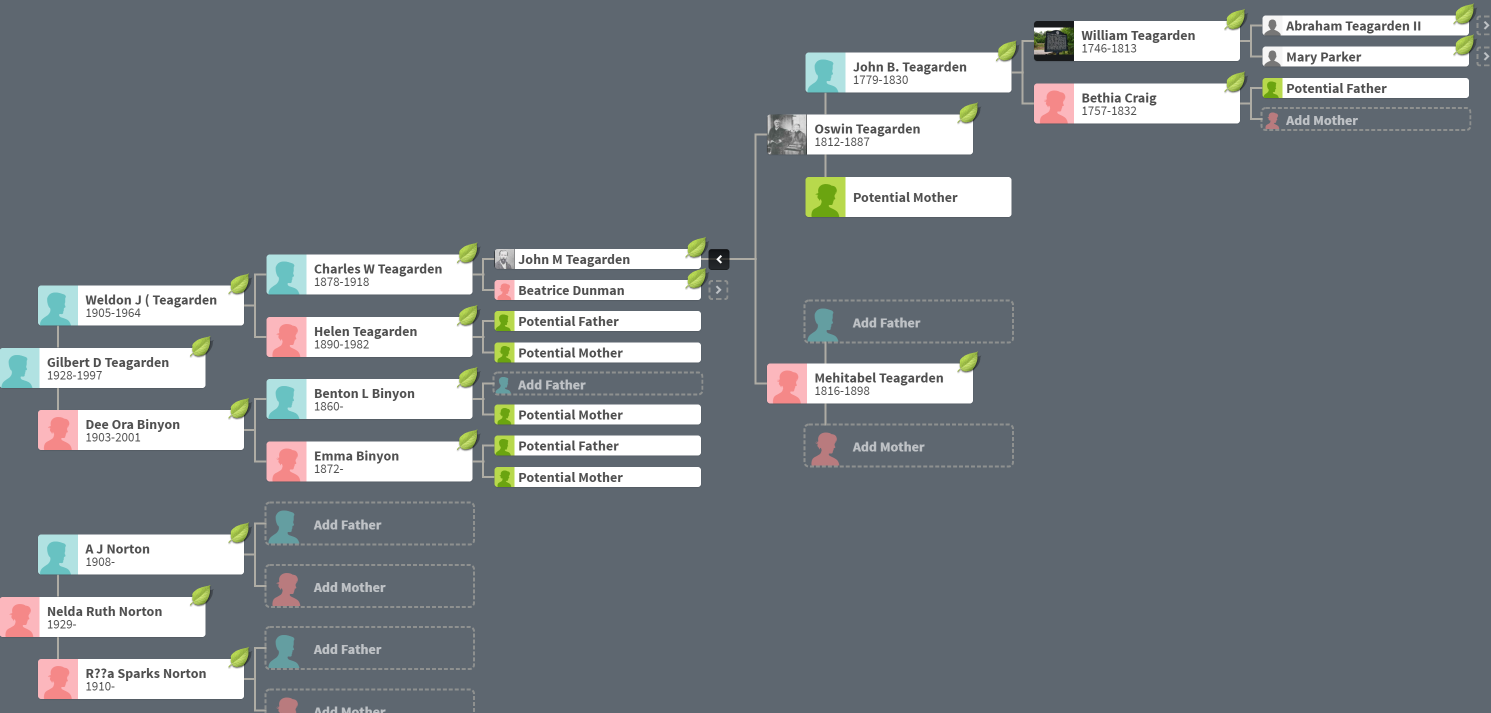
In not too long, on my cell phone, I was able to find (including my host) nine generations of Teagardens:

I’ll call Pam generation 1 and go back from her.

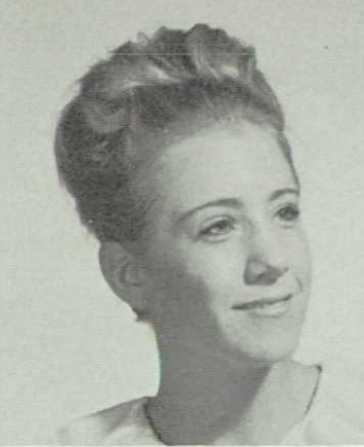
Generation One – Pam

Here is Pam’s Senior High School photo from San Antonio, Texas:

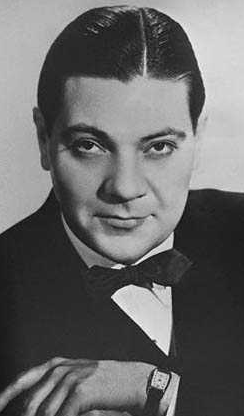
Generation Two – Pam’s Father

Here is Gilbert Darwood’s photo a little cut off on the left:

The photo was from a Teacher’s college in Alpine, Texas, though Pam says her dad did not pursue teaching as a career.

Generation Three – Weldon John (Jack) Leo Teagarden (1905-1964)

Pam surprised me by pulling out a phonograph collection that featured her grandfather:

Jack Teagarden was a famous jazz trombone player. I found this short bio at Ancestry:

Born in 1905 in Vernon, Texas, Jack Teagarden was an influential jazz trombonist and singer, regarded as the “Father of Jazz Trombone.” His musical abilities were largely self-taught and for that reason, unrestricted. He developed innovative positions and effects on the instrument, and was known for his bluesy-style. He recorded with Louis Armstrong, among other notable jazz players.

Here is a snapshot of Weldon Leo (Jack) in 1920:

Jack is the oldest son. His father died in 1918, so when he was about 12. At this time, they were living in Nebraska.

Pam’s grandmother was Dee Ora Binyon. In 1930, she was living in her sister’s house in Rankin, Texas with her two children and working as a telephone operator while Jack pursued his musical career. Ora married Jack in 1924. At the time of the 1930 Census, Ora was listed as not married.

Generation Four – Charles Woodbury Teagarden (1878-1918)

The Wikipedia biography for Charles’ famous son Jack says:

His father was an amateur brass band trumpeter and started him on baritone horn; by age seven he had switched to trombone. His first public performances were in movie theaters, where he accompanied his mother, a pianist.

Here is Charles in 1910:

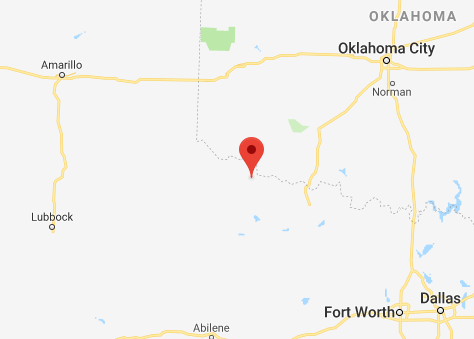
If my Google Map is right, Vernon is between Amarillo and Dallas:

In 1910, Charles’ occupation was listed as a ginner in the cotton gin industry. I was able to find an extensive biography of Charles at Ancestry:

Birth: Dec. 12, 1878 Grapeland Houston County Texas, USA Death: Nov. 3, 1918 Vernon Wilbarger County Texas, USA Son of John McGuire Teagarden and Sarah Beatrice Durham. Married Helen Giengar. Together they had four children. All of their children were top flight Jazz musicians. The most noted was Jack Teagarden. Charles was a “cotton gin man” – an outstanding oil mill engineer and mechanic; Chief Engineer for the Vernon Cotton Oil Co. Some say he was also a musician down in the Red River Country on the Texas-Oklahoma boarder, where they lived. It was “Woodie” who gave Jack a baritone horn when he was seven. Helen was a musician who used to play the piano in theatres in the days of silent movies. Abour her, Jack said, “I guess I was luckier than most fellows – my mother’s a teacher, a piano teacher, and still is (1963). She is only 16 years older than I am…she’s a very talented girl…she taught me how to read music and the first training I had was the right training.” From Teagarden Book – Vogt – 1988 “Woodie” died in the flu epidemic on 1918.

Generation Five – John Maguire Teagarden (1851-1928)

I found this photo of John at Ancestry:

This information is from findagrave.com:

John was the son Oswin Teagarden and Mehitable Baker.

John married Sarah Beatrice Durhan, Jan 10, 1878 in Floyd, Texas.
Together they had seven children
Charles Woodbury(twin), Mary Francis(twin) Lula Rose , William Albert (b. Sept 3, 1898 d. 1954), Minnie BerniceJoseph Moore, and John Bailey.

Sarah died Nov 10, 1898 in Elctra, Texas and is buried there.

The oldest son, Charles Woodbury married and had 4 children before his early death in 1918. These children, Weldon, Norma, Charles and Eugene would become noted Jazz musicians. Weldon is known today as Jack Teagarden.

In 1900, John was a widowed farmer in Wilbarger County, Texas:

Vernon was also in Wilbarger County. This shows that John was born in Louisiana. However, by 1860, the family was living in Sumpter, Texas:

Generation Six – (1812-1887)

Here is Oswin and his wife Mehitabel Baker:

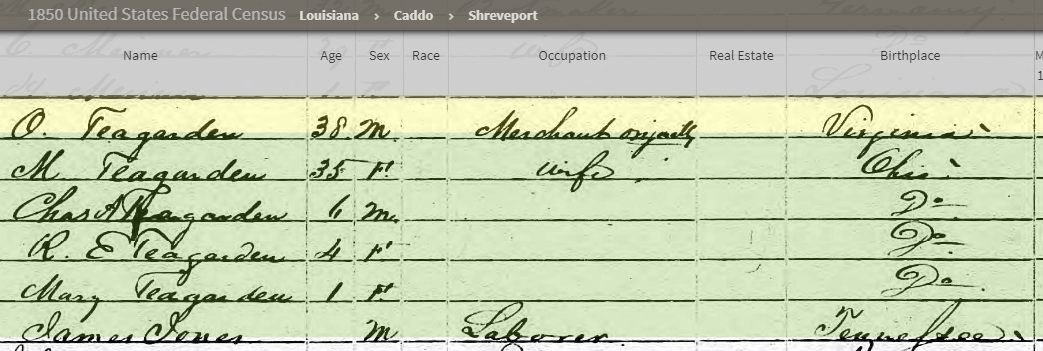
This couple got around a bit. The first useful US Census was in 1850:

Here, Oswin and Mehitabel and their young family are in Shrevesport, Louisiana. A Laborer was living in the house also but no age is given. I found this biography at Ancestry:

Son of John B Teagarden and Rosanna McGuire; husband of Mehitable Baker; Father of 11 including Joseph Oswin Teagarden.
Oswin was apprenticed to a boootmaker in Hebron, Ohio at an early age and for four years, experienced ill treatment. He did not follow this trade but engaged in the livestock business and drove herds as far east as Philadelphia. He then entered the mercantile business, first settling in Martinsburg, West Virginia. After their marriage, Oswin and his father-in-law, Artemas Baker (member of Congress from Ohio in 1825) ordered a flat-boat constructed in one of the boat yards on the Ohio River. They loaded on their families, a number of friends, their possessions and proceeded down the Mississippi River to New Orleans where they sold the boat. Then up the Red River by steamboat to Shreveport, Louisiana where Oswin spent the next three years as a merchant.

Artemas Baker and family continued overland to Dallas County, Texas and Oswin followed later to settle at Rusk in Cherokee County. His wanderings were in 3 year cycles and he next went to Dayton in Polk County. These trips were by wagon and eventually they moved to Sumpter in Trinity County where he had a large general store with a drug department.

As a druggist and homeopathic physician, Oswin was assigned as a Medical Purchasing Agent by the Confederate States of America for the Army of the Mississippi. He often made trips to New Orleans disguised as a Dutch peddler. On one occasion when he had $4000 in gold on his person (his own money) intending to buy scarce goods for his store, he was arrested but a squad of Federal soldiers. Realizing he would be searched and his money taken, he clamored to be sent to General Butler. The squad agreed to take him to the General but Oswin managed to lose himself in the crowded street. He had four years of service in the Army.

Early in the war between the states, two companies of volunteers were orgainzed in Trintiy county for the Confederate Army and Charles(Oswin’s son) enlisted in one of them. Although over the conscription age, his father (Oswin) enlisted and took his sons place; as a druggist, the son would be exempt and with the help of clerks could conduct their large store. – Teagarden Book

Joseph Teagarden’s memories of his father writen 1953 when he (Joe) was in his 70’s.
“I have said very little about my father and I shall try to record what I can remember of the best man I ever knew. A man who had no enemies and like my mother was revered by all in the little town.
He was an indulgent father, never even scolded me but once, which I deserved. I am unable to place the time on the all these few memories of my patents, but one occasion, I think it was during the war, he came home during the Christmas Holidays and on horseback and in riding by the house on the way to the stables in the rear, he tapped on the windows of the dinning room with his riding whip. The house being built on a corner lot and to the property line, had no fence on the front and sides. He rode along the side of the house on which the dinning room windows opened. So when he tapped on the window the larger children cried out that there was Dad and all was excitement. 
Another time some years later, possibly 1870, in the spring, when all six of us sons of the family and my father went fishing. Walking to Piney Creek nearly two miles away, when the older ones, impatient at our progress were walking too fast for me. My father called a halt saying they were walking too fast for him. Which surprised me as I was the littlest one and hadn’t thought he was getting tired. 
I remember I caught the second best string of fish, Sam beating me by one or two. 
Another time when only four of us boys with Mother and Father went to the same creek bottom to gather backberries, where they were in great profusion in the cane brakes. On this occasion we went in conveyances, possibly the old folks and myself in a buggy and the others on horseback. 
Another vivid memory was when my father had taken a long trip to Austin attending the legislature lobbying for some northern capitalists seeking charter for two railroads – He succeeded in securing both charters, but on his way home he was taken sick and for some time, possibly two or three weeks we had no word from him. Mother becoming alarmed wrote to several prominent masons in that section. Soon after this he returned home barely able to travel. I rememeber that he was very sick for some time. One reason for my mother’s uneasiness was the fact that at the time there were many murders and robberies on the roads and my father was driving a very beautiful span of matched bay horses, very valuable ar the time.”
From Joe Teagardens “Life of an Ordinary Man” 


Family Members

Parents

John B Teagarden

1779 – unknown

Rosanna McGuire Teagarden

1780–1817

Spouse

Mehitabel Baker Teagarden

1816–1898

Siblings

John Marion Teagarden

1810–1870

James Ulysses Teagarden

1813–1853

Half Siblings

William Teagarden

1819–1888

Children

Louisa Teagarden

1842–1843

Charles Artemas Teagarden

1843–1888

Rose Ellen Teagarden Evans

1846–1889

Mary Oconasta Teagarden Adams

1849–1941

John McGuire Teagarden

1851–1928

William Baker Teagarden

1854–1933

Samuel Teagarden

1856–1940

Timothy Oliver Teagarden

1858–1942

Joseph Oswin Teagarden

1861–1954

That covers a lot. The Census lists Oswin’s birthplace as Virginia, but the findagrave index lists his birth as Pennsylvania:

This web site on the Teagarden family refers to Oswin as a confederate smuggler.

Generation Seven – John B Teagarden (1779-1830)

I don’t have quite as much on John B Teagarden:

I did find this short account:

From Find A Grave:

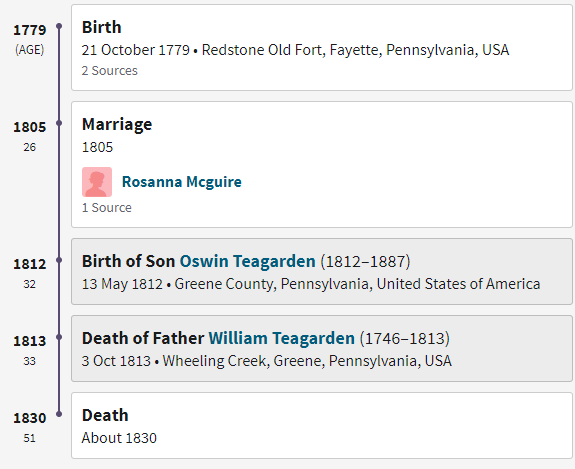
John was born near Old Redstone Fort. His parents are William Teagarden and Bethia Craig. He married twice. First marriage was to Rosanna McGuire in 1805. They had 6 children; Louisa, George, Bethia, John Marion, Oswin, and James U. 
After Rosanna’s death in 1817, John remarried Sarah Ripley Hartwell. Together, Sarah and John had one child, a son, William.
John died about 1830 

Generation Eight – William Teagarden (1746-1814)

Here we are in the Revolutionary period. Again, I rely on the findagrave.com website:

Private Pennsylvania Militia, Revolutionary War
William Teagarden, son of Abraham and Mary (Parker) Tegarden, was born in 1746, probably at “Tecart’s Delight” near Hagerstown, Maryland. He inherited land along the Monongahela River, near present-day Fredericktown, Pennsylvania. In addition to farming, he operated the Monongahela ferry at Tenmile Creek.

During the War for Independence, he served as a private in Captain James Mc Lean’s Company of the “Invalid Regiment,” Pennsylvania Militia, in 1783, and saw action in the defense of Washington County. Such resistance on the part of the frontiersmen in the rear helped make possible the Continental Army’s success on the front. He served also as a Frontier Ranger in the Pennsylvania Militia under Captain James Seals 1793-94, the unit responsible for the defense of Greene County against the Indians.

Family lore tells that William, intending to follow his friend John Hardin to new settlements opening in Kentucky after Independence, sold the Monongahela property and received payment in Continental currency, which soon thereafter became worthless. In a state of near-bankruptcy, he was forced to abandon his plans, and instead settled on land he claimed on Wheeling Creek in the West Finley Township, Greene County, Pennsylvania, where he remained until his death.

William married Bethia Craig, daughter of John Craig of Harford County, Maryland, and had 13 children.

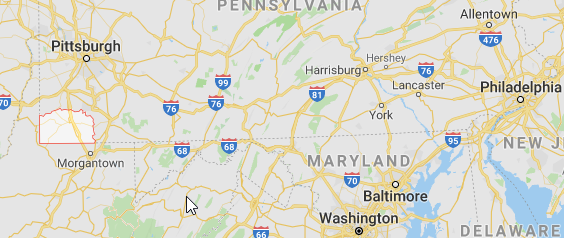
Here is Greene County in the SW part of Pennsylvania:

Here is the Wheeling Creek in West Finley:

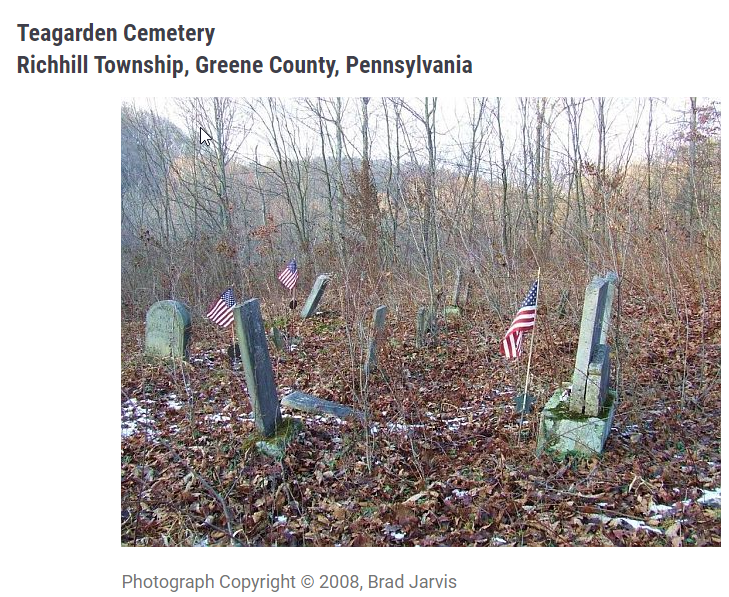
According to this website, William was buried in the Teagarden Cemetery in Richhill, PA:

Here is the family cemetery, not far from West Finley:

Generation Nine – Abraham Teagarden Born 1718 Germany

Pam knew that her ancestors went back to Germany, but perhaps didn’t realize that it was such a long time ago. I see this entry in Ancestry for Abraham Teagarden:

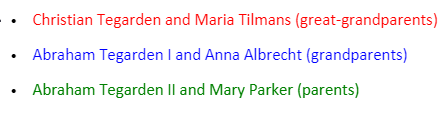
The question here is whether the Senior or Junior Teagarden is the father of William Teagarden. A Teagard Early History posted at Ancestry indicates that it was Abraham Teagarden II who married Mary Parker:

That gives us two more generations back to Christian Tegarden. I have a reference to the website here. The author was interested in an Elizabeth Teagarden who was the sister of William Teagarden. The parents through great-grandparents listed above were for Elizabeth Teagarden.

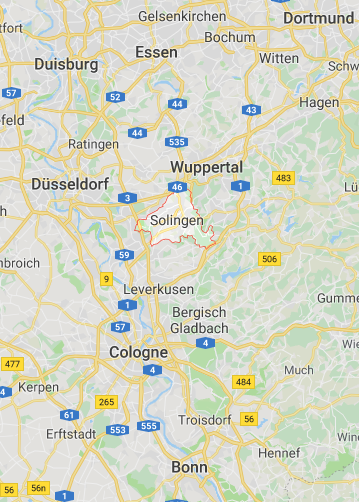
The Tegarden family was from the area of Solingen, Germany:

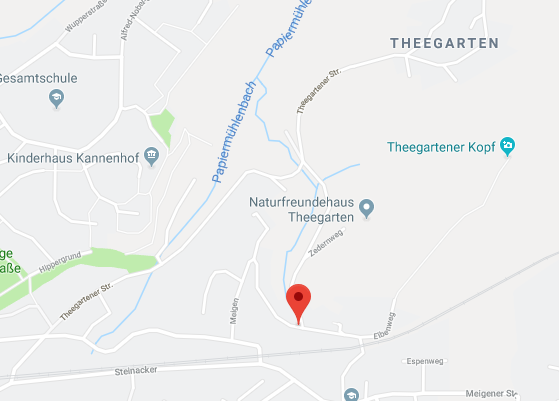
Solingen was famous for the making of blades or swords. The above genealogy notes that some of these Tegardens were from Meigen and associates Meigen with Meissen, Germany. However, I believe that Meigen was a part of Solingen. There is currently a Meigen and Meigener Street to the East of the City of Solingen:

These Streets are also near an area called Theegarten.

That finished my brief genealogy of the Teagardens. I actually went back 11 generations. Christian Tegarden was born in 1650.


The Mystery of Effie Jean (Jane) McMaster Born 1861 Ontario

I recently had an email from the great-granddaughter of Effie Jean McMaster whose name was also Jean. She has been trying to find out more about her mother’s favorite grandmother. Here if Effie’s photo at age 18:

The Mystery of Effie McMaster

Effie’s great-granddaughter states:

Family oral history and limited documentation indicate that the McMaster’s immigrated to Toronto, Canada in 1845 from Sligo. My great-grandmother, Effie Jean (Jane) McMaster, b. 1861, Effingham, Ontario, Canada was born to William McMaster and Margaret Frazer. He is said to have died before she was born and that her mother, Margaret, was unable to care for her and she was “adopted” by a Susan McMaster, b. 1834, Sligo, Ireland, and her husband, John Beckett, b. 1806, Ontario, Canada. In family oral and written history, Susan and Margaret were ‘sisters’ but both belonged to the Religious Society of Friends (Quakers) who referred to each other as ‘sisters’ by religious tradition, casting doubt on any biological connection.  

Then in a follow-up email:

I started my genealogy journey because I wanted to find out more about the woman my mother adored, my great-grandmother Effie Jean (Jane) McMaster. Ironically, I’ve never been able to unlock the mystery of her parentage. I have been through the Canadian Census’s, the Quaker Meeting notes, read notes in autograph books and the back of pictures and queried family members when they were alive but still no answers. The family oral history says her father, William McMaster, died before she was born in 1961 and her mother, Margaret Frazer, died when she was 16, about 1877, indicating she probably knew her mother. Effie does show up in the 1871 Census as the ‘adopted’ daughter of Susan McMaster and John Beckett but I’ve been unable to find any death certificates, gravesites or mention in church records of William McMaster/Margaret Frazer. I’ve looked at Canadian immigration records and have found a Margaret McMaster traveling with a child but it is before my g-grandmother was born. Again, dates and ages do not match.

Effie in 1871

Here is Effie in 1871:

Effie shows as adopted at age 9, but either with a line through adopted (or underlined?). She goes by the name Effie J Beckett. Her father is a miller. Also living in the house is Alfred Beckett and his family:

The location of this Census is Pelham, Ontario:

The John Beckett Household

Isabel McMaster

I assume that John’s wife Susan was a McMaster. I assume that the 40 year old single “Esibel” is Susan’s sister. That would put her birth at about 1831 in Ireland. She is likely Isabel. Effie is said to be short for Euphemia.

Here is Isabel in 1861:

Now Isabel is 35 which means she was born about 1826. Now there is also a George A McMaster living in the house. Perhaps he is a younger brother to Susan and Isabel. George appears to have been born in Canada in about 1847. John and Susan are listed as Quakers. Isabel and George however are W M which I take to be Wesleyan Methodists.

The 1851 Census didn’t come out until 1852. There, we see Isabella living with Mary Ann McMaster Shannon in Vaughan, York County:

That puts Isabella born in 1827. A working theory is that Isabella is a daughter of William McMaster and Margaret Frazer.

A Clue With George McMaster?

A search for George brings up this birth in the Wesleyan Methodist Baptism Register:

This is where you need to read the fine print. The George A McMaster of the 1861 Census is very likely George Arthur McMaster, son of George and Jane McMaster from Vaughan, Ontario (where other McMaster relatives lived). This George fits in with the George from my Blog on the four McMaster sisters:

Jane McMaster was the daughter of William McMaster and Margaret Frazer. George was her youngest son with George McMaster. Susan McMaster, above was 28 in 1861, so that would mean she was born about 1833. In 1871, Susan listed her age as 36, making her a bit younger.  Now we have a few possibilities for Susan (McMaster) Beckett. Was she the daughter of Jane McMaster or Jane McMaster’s sister? Also how does Effie fit in? As George, born 1847, was the youngest son of George and Jane McMaster, he could not be the full brother of Effie who was born about 1861.

Part of the mystery of Effie is that there are lot of similarities between the family stories about her and my McMaster relatives. I mention those relatives in a Blog about four McMaster sisters and their brother. One of those sisters, Catherine McMaster lived in Burford, Ontario. Her husband, Henry Bennett was also a miller. Family lore has William McMaster and Margaret Frazer as Effie’s parents. My ancestors were also William McMaster and Margaret Frazer, though they were born much too early to be Effie’s parents. In 1852, Catherine Bennett, the miller’s wife was living with her mother Margaret Frazer McMaster who put her age at 63. That means that Margaret was probably born around 1789. The miller connection may be a coincidence, but I mention it in case it isn’t.

Summing Up the 1871 Census

We learned that Effie was living in a house where George A McMaster used to live. George was the son of George McMaster and Jane McMaster. Jane was the daughter of William McMaster and Margaret Frazer (my ancestors). Also sharing the Beckett house with Effie was Isabel McMaster. Isabel was single and in 1852 lived in the household of Mary Ann McMaster Shannon. Mary Ann, Jane and my sister Fannie McMaster were all sisters originally from Kilmactranny Parish in the Southern part of County Sligo. Sometime between 1852 and 1861 Isabel moved from the Shannon household to the Beckett household. We can deduce that Effie was not a full sibling of George Arthur McMaster as George was the last child of George and Jane McMaster.

Effie in Antioch, California

In 1880, the Census shows that the Beckett family had moved to California:

Here Effie is shown as a niece. That would normally mean the daughter of a brother or sister of the John or Susan. The birthplace of Effie’s parents is interesting:

This has Effie’s father born in Ontario and mother born in Ireland. That brings up the possibility that Effie’s mother may have been a McMaster. If that is the case, then her birth name may not have been McMaster. My reasoning goes like this: Jean has the McMaster family immigrating to Canada in 1845. My previous guess was 1844, so pretty close. Effie’s father could not be from the McMaster family that came to Canada in 1844 if he was born in Ontario 1841 or earlier. I’m guessing that if Effie was born in 1861, then her father should have been at least 20 in 1861. That means that if the 1880 California Census is correct, then Effie’s mother would more likely be a McMaster. A scenario would be that Effie’s mother is a McMaster born in Ireland. She comes to Canada and marries and has Effie. For some reason, possibly the death of both parents or the remarriage of one of the parents, she comes to live with the Beckett family.

Susan Beckett

One question is whether Susan Beckett is the same as Susan McMaster, daughter of George McMaster and Jane McMaster. If this were the case, that would mean that George Arthur McMaster would be Susan’s brother and it would make sense perhaps that he would live with her for a while.

I don’t have much information on Susan McMaster in my tree. I just have that she was born in Dromore, Sligo in 1841. I’m not sure where I got this information. It may actually not be right. Jean has that Susan Beckett was 19 in the 1851 Census:

The 1951 census wasn’t taken until 1852. So that would put this Susan Beckett’s birth at about 1833. This seems too early for her to be Susan McMaster, daughter of George and Jane McMaster. I have that George McMaster was born around 1820 and married Jane McMaster in 1839. Here is Jean’s photo of Susan McMaster Beckett:

Was Susan Beckett the Daughter of William McMaster and Margaret Frazer?

Margaret Frazer McMaster was born about 1789. That means that in 1834, she would have been 45. This is not an impossible age to have a baby. Here are the known children I have of Margaret Frazer McMaster:

Jean asked me if any of her photos looked like any of my photos. I don’t have a photo of Fanny, my ancestor. Here is Jane in the middle of the photo:

Susan McMaster Beckett (from Jean):

I’m not good at comparing photos.

Under this scenario, if Susan was the younger sister of Jane McMaster Thompson, then George Arthur McMaster would be her nephew. My working theory is that Isabel McMaster is one of Jane’s sisters. That would make her Susan’s sister also. That doesn’t directly help us figure out who Effie was but it helps define who she may have been related to.

More On Effie

Effie was born in 1861 according to Jean. That means that she could not have been the daughter of Margaret Frazer McMaster who was born about 1789. Margaret would have been alive at Effie’s birth but would have been about 72 years old. Let’s assume that Susan McMaster was the Aunt of Effie. That would mean that Effie would be the daughter of one of Susan’s siblings. I’ll go through those quickly:

  • Jane McMaster b. 1816 – She had two families. The first by George McMaster. When she married her second Thompson husband, the children of the first marriage were sent out to different families. It is unlikely that Effie was a Thompson as that family seemed to stay together.
  • Mary Ann McMaster b. 1820 – She married in 1849 and had two children around 1864. She was taking in other family earlier. I don’t see any reason why she would give her daughter to a sister.
  • James McMaster b. 1822 – James was living in Michigan in 1861. I don’t see any reason why he would give a daughter to a sister in Canada.
  • Catherine McMaster b. 1827 – She was living in Wisconsin in 1861. I don’t see any reason why she would give a daughter to a sister in Canada.
  • Fanny McMaster b. 1829 – She is my ancestor and stayed in County Sligo. The records of baptisms were fairly good at this time. If Effie was a daughter of Fanny, I would probably already know that.

Any other candidates for parents of Effie?

  •  Isabel McMaster b. about 1827 – She would have been about 35 when Effie was born. Isabel was single  in 1861. If Isabel was Effie’s mother, she was either a single mother or got married quickly and had a baby the same year. However, in the 1871 Census, Isabel is not listed as married or widowed.
  • John McMaster b. about 1841 – I mention John in my previous Blog. He was living in the household of Mary Ann McMaster Shannon in 1852 along with Isabel. I don’t know much about this John. If he was Effie’s father, he would have been about 20 at the time of her birth. Also if the 1880 Census is correct, Effie’s father was born in Ontario. According to the 1851 Census, this John was born in Ireland.
  • Other – There may have been other descendants of William McMaster and Margaret Frazer living in Ontario that I don’t know about.

Based on the above, it appears that Isabel would be the best known candidate to be Effie’s mother.  That choice is followed by ‘other’. In fact, take another look at the 1871 Census:

Effie is listed directly under “Esibel”. Sometimes in a Census, this could indicate that Effie may be the child of the person directly above. It would be interesting to find out what happened to Isabel McMaster whether or not she was Effie’s mother. I think that if Isabel was Effie’s mother, it would answer more questions than it would raise. For example, if Isabel was Effie’s mother, then it is improbably that would become the family story. There would be another more palatable story made up. In this case, it appears that the story of  Effie’s parentage was borrowed from her Aunt’s parentage.

Based on Ontario Quaker records provided by Jean, the following six Becketts left the area by January 1, 1879:

One interesting point in the above minutes is that there is no mention of Effie. Why would Alfred’s children be mention and there be no mention of Effie? In addition, Alfred has another daughter Ruth who isn’t mentioned in the minutes.

Here is Alfred’s family in 1880:

Alfred continued to live next to his brother John in California.

An obituary for Alfred indicates that he was married to Mercy Ward in 1857:

Jean’s DNA

Jean doesn’t match me or my four siblings who have tested at AncestryDNA. If she uploaded her DNA to Gedmatch, she may see more DNA connections with other McMaster/Frazer descendants who tested at different companies. Jean tells me she matches Keith by DNA. I match Keith also and wrote a Blog about that match here.

I show as a 3rd cousin, once removed to Keith. Our common ancestor is Fanny McMaster. Of course, this gets confusing as Fanny married a McMaster. Assuming that Isabel is the mother of Effie and that Isabel is the sister of Fanny and Susan, one may see how Jean would be a DNA match to Keith. However, that is a lot of assuming.

Summary

  • I first made a connection with George A McMaster who was living in the household of Susan Beckett in 1861. I further identified him as the son of George McMaster and Jane McMaster born in Vaughan, Ontario in 1847. Jane McMaster was the daughter of my ancestors William McMaster and Margaret Frazer born around 1789.
  • From there, I made an assumption that Susan Beckett was the sister of Jane McMaster. I note that Jane also had her daughter Anna living with Jane’s sister Catherine McMaster Bennett based on the 1860 Census. Apparently the children of Jane’s first marriage were not welcomed by her second husband, so they were sent out to Jane’s sisters.
  • I then looked at possible McMaster parents for Effie Jean Beckett. By the process of elimination and based on the 1871 Census, it seemed like Isabel McMaster could be a candidate to be Effie’s mother. Isabel was in the right place at the right age.
  • If Jean uploads her AncestryDNA results to Gedmatch, it would be possible to check other matches that would give more evidence to support or detract from the Isabel McMaster theory.


Comparing Grant, Stuart and Frazer by YDNA


In my previous Blog, I looked at Frazer STRs and came up with a STR Tree. It is a bit of a mess, but it tries to show where the STR mutations are:

I like one explanation I read about STRs. STRs are short for Short Tandem Repeats. This excerpt is from an FTDNA article called Understanding YDNA Matches:

Our bodies work as copy machines when it comes to the Y-DNA. You can have a copy machine doing 1,000 copies without a problem, and then, the 1,001 copy may have an “o” that looks more like an “e”. And when we use this copy to make additional ones, all the new ones will now have an “e” instead of an “o”. This is a simple way to explain how mutations occur in our Y-DNA when it’s transferred (copied) from father to son. Mutations don’t happen frequently, on the contrary, very seldom, but they can happen randomly in time, which means that I could be one mutation off of my father. That is why all those matches or close matches on 12 markers will in most of the cases go away when they happen between different surnames, and we increased the numbered of markers that are compared: more mutations showing up, which means way back in time when the common ancestor lived.

Ancestral and Derived – What’s the Big Deal?

STRs are either ancestral or derived. That means that they are older or newer. Older or newer is important if you are trying to figure out timelines. It is also important in creating trees and figuring out who belongs in which branch of the tree.

Grant YDNA

In my previous Blog, I noted that the Frazer marker of DYS710 with a value of 34 was probably ancestral:

Assuming that to be the case, that meant that DYS710 = 33 would define the James Line of the Frazers above.

I wrote to Grant to get the STR values from his Grant BigY test. However, it appears that the Grant STR value for DYS710 is missing along with the STRs from 68-111. I don’t know if this is a mistake by FTDNA or not:

Grant Matches Paul by BigY but Not by STRs

Another surprise is that Grant matches one Frazer by the BigY and not by STR matching. Here is my cousin Paul’s matches by BigY:

Here are Paul’s 67 STR matches:

Here Paul matches a Grant, but not the same one who took the BigY test. Note that the Grant above doesn’t show that he had Big Y tested.

How Does Grant Match Jonathan?

Jonathan had fewer STR mutations, so perhaps he matches Grant. Below, we see Jonathan matches many Grants, including the one who took the BigY test:

There is one interesting thing to note here. Look at Jonathan’s match with Stuart who took the big Y. At 67 markers, there is a Genetic Difference (GD) of 3. With Grant the GD is twice as much at 6. However, when the BigY markers are added in, the differences between Jonathan and Stuart are 12 and only 11 with our BigY Grant.

Comparing Grants Extra 435 STRs with Jonathan

Thanks to the Grant family sending me the Grant BigY STRs, I can now compare them. In my previous Blog, I noted these differences between the Frazer Archibald Line and the James Line:

Paul is from the Archibald Line and Jonathan and Rodney are both from the James Line. Grant could be the tie-breaker to tell which values are older for these markers.

FTY299

What do you think? Based on the above, and knowing nothing else, I would say that 12 is ancestral and 13 is derived. That puts FTY299 as a marker for the Archibald Line. I’ll add that to my STR tree after I look at the other two markers.

DYS523 and Good Old FTY269


Here we go again. The mutations seem to be skewed more toward the Archibald Line. However, recall that these are mutations that Paul has, so they could have taken place any time between Archibald in 1715 and Paul:

If Rick had taken the BigY test, we could have narrowed that down a bit.

A New BigY 500 STR Tree

With this new information, I can build a New BigY STR Tree:

Here I wrote Paul’s results a little differently as I didn’t have room at the top. The first number is ancestral and should apply to Archibald Frazer born around 1690. The second is Paul’s value. This mutation could have happened between about 1715 and when Paul was born.

Any Other Differences?

It seems that there must be. Jonathan had 5 additional differences in the BigY STRs. However, these may be differences between Grant and Frazer in general.

Here in DYS514, we see a difference between Frazer and Grant. We can’t tell which one is older, because we need a tie-breaker.

Parallel Mutation or Back-Mutation

Let’s consider DYS516. I had said that the value of 18 for STR DYS516 represented the overall Frazer line because it was shared by Paul and Jonathan whose common ancestor was the original known Irish Frazer from about 1690. However, Grant has a value of 17 shared with Rodney. In other cases, we had considered the value to be shared by Grant and Frazer to be the older one. What happened? This is a case of back mutation or parallel mutation. It could be that the old value shared by Grant and Frazer was 17. Then sometime before 1690 it went up to 18 for Frazer. Then Rodney’s branch went back down to 17. That would be a back mutation. For a parallel mutation, the original value that Grant and Frazer shared would have been 18. Then at some time Grant mutated down to 17. In an unrelated (or parallel) way, Rodney’s branch also went down to 17. By getting more information on other people’s BigY results, it might be possible to figure out which happened.

There is a less likely scenario where 17 would be ancestral. That would have to mean that Jonathan and Paul had independent or parallel mutations. As this would have happened over a shorter period of time, it is less likely that this happened.

DYS542

Here is another of Jonathan’s 5 of 435 STR mismatches with Grant:

Note that Grant and Frazer have a difference of two. Again, we don’t know if 12, 13 or 14 was the ancestral value. It could be 13. In that case Frazer would have mutated up and Grant mutated down.

FTY289

This should be the 4th out of 5 differences between Jonathan and Grant.

FTY510

This should be the 5th difference or GD.

Grant Vs Rodney

I would suspect that Grant and Rodney’s results should be similar to Grant and Jonathan’s results.

They are the same except the number of BigY STR results tested are slightly lower.

FTDNA Block Tree Vs YFull’s YTree

Both FTDNA and YFull have SNP trees. Sometime one gets ahead of the other. Here is the FTDNA Block tree from Jonathan’s perspective:

Jonathan matches two Frazers at YP6489. Further out he matchs Grant at YP6488. At at more distant level he matches Hayes at YP6479. That doesn’t mean that Frazer descends from Grant and Stuart who descends from Hayes. It just means that these families descend from a common ancestor.

Another point to note is that the Frazer SNP of R-YP6489 is probably a family SNP. That means that this SNP probably applies to just our Frazer branch. YP3189 is one step below YP6488. That means that it is more recent. YP6488 is older and represents Frazer, Grant and Stuart. Because there is more than one family that shares this SNP, it would not be considered a family or surname SNP.

Here is the YTree version:

R-BY26344 Is for Grant and Stuart

This tree goes back one more level and includes dates. Then there is one important detail I missed previously. It appears that Grant and Stuart have a new SNP called R-BY26344. YFull uses IDs, but it appears that those IDs are for Grant and Stuart. This is the part where YFull’s YTree goes ahead of FTDNA.

My interpretation of the YFull YTree above:

Again, this does not show that Stuart, Grant and Frazer descend from Hayes, but that all four surnames descend from a common ancestor born around 900 AD. This shows that the tested Stuart, Grant and Frazer had a common ancestor from around 1300 AD. I assume at that time, surnames may not have been settled or commonly used in Scotland. According to scottish-at-heart.com:

The use of  ‘fixed’ (or recognized) Scottish surnames appeared occasionally as early as the 10th or 12th centuries, but didn’t begin to be used with any sort of consistency until the 16th century.

Even this, this practice was slow to ‘catch on’, and it took until the late 18th and early 19th century to spread to the Highlands and northern isles.

A New Terminal SNP for Grant and Stuart and a New Mystery

In my previous Blog, I had missed that Grant and Stuart have a new Terminal SNP. They are now BY26344. However, YFull gives a common ancestor for Grant and Stuart at 225 years before present. I roughly called that 1775. The problem is that if Stuart and Grant had a common ancestor in 1775, was it Grant or Stuart? Also, it appears that the Grant and Stuart genealogies don’t match up as to where these families lived at that time.

Grant and Stuart Genealogies

This is an area where I have very little knowledge. I have that the Grant BigY tester’s earliest verifiable ancestor was James GRANT “of Carron”, 1728 – 1790. From a quick Google search, this appears to be Carron:

The Stuart tester has this information:

Charles Stewart/Stuart b. abt 1695 d. 1753 Virginia

This is the problem. If Stuart and Grant had a common ancestor around 1775, then how could Stewart have been in Virginia in the early 1700’s and Grant been in Scotland in the early 1700’s? This suggests that one of the genealogies is wrong or that the common ancestor dating is wrong. The closest reconciliation that I could make up is that Charles Stewart was actually Charles Grant. He had James Grant in Scotland, then came to Virginia and changed his name. I feel uncomfortable making wild guesses for others’ genealogies that I know little about, so I will not go further in this direction.

TMRCA By YFull and FTDNA

What if YFull is wrong with their date of most recent common ancestor? Here is the 6488 Branch:

I don’t totally understand YFull’s dating. However, the reasoning is that the more SNPs in your branch, the older your branch. That makes sense to me. For example, the Frazer R-YP6489 includes 6 other SNPs. The Grant/Stuart branch of R-BY26344 has only two other SNPs. It stands to reason that BY26344 would have a more recent common ancestor than YP6489. The Frazer date checks out well, but three people tested. We think our common ancestor was born in the vicinity of 1690 which is about 329 years ago. YFull gives 375 years as a date. That seems pretty close to me.

A scroll-over of the 375 years before present for the Frazer common ancestor shows this:

This gives a pretty wide margin of error.

For BY26344, there is a larger margin of error:

I assume that the reason is that only two people tested for BY26344.

FTDNA is not as helpful with dates. In addition, FTDNA does not have Stuart and Grant as BY26344. Perhaps if they update their tree, they will and there may be a way to estimate a common ancestor then. However, having said that, the a YDNA project administrator has made this prediction for Grant and Stuart in an email to Stuart:

You had 19 Unnamed variants and now you have 19 – 2 = 17 left over. 

Out of these 17 SNP’s there was 1 SNP which you share with Grant.

So both of you create a new Subclade BY26344 downstream YP6488

(btw. FTDNA has not identified this new subclade yet)

Now my best estimate for your MRCA with Grant is about 1200 AD. 

This is interesting because this is an earlier date than what YFull has. The discrepancy may be due to the fact that Stuart did the Big Y 700 and other testers have only done the Big Y 500. Also, I don’t think that Stuart has uploaded his Big Y 700 results to YFull. It will be interesting to see if that makes a difference with YFull’s common ancestor calculations.

The FTDNA administrator further writes to Stuart:

Up to now you are the only one in subclade YP432 with a BigY-700, thus we will only know where these SNP’s are exactly located when they are willing to upgrade from BigY-500 to BigY-700.

Summary and Conclusions

  • Grant and Stuart are the closest YDNA matches to the Frazer family
  • I used some of the Grant and Stuart STR results to find out which of the STR vaules were older or newer for the two Frazer Lines.
  • Grant and Stuart are in a new Branch of R-BY26344
  • There are discrepancies for the date of the common ancestor between Grant and Stuart. These calculations were done by YFull and an FTDNA administrator. These dates may be fine tuned by Stuart adding his Big Y 700 results to YFull and/or by others in the YP432 Group doing Big Y 700 testing.


Frazer YDNA STRs Compared

Blaine Bettinger recently has started a project comparing STR differences to known relationships. It turns out in our Frazers of Roscommon DNA Project, we have four people who have tested where we know their relationships. Here are those relationships:

Rick has tested 67 STRs and Paul, Rodney and Jonathan have tested for the BigY 500. Here is how the numbers look:

Generally, what we see is that going from top to bottom, the further out the relationship is, the more differences there are in the STRs. The numbers between 0-5 above are the genetic differences. Then as the test gets higher there should be more differences going from left to right as more STRs are being tested.

Paul’s Odd Results

However, Paul’s number goes down when he is compared to Jonathan between the 111 STR test and the BigY 500 test. Why is that? My assumption is that the Big Y test missed one of the STRs tested in the 111 STR test. It should be possible to find this STR looking at the results.

DYS710

Checking Paul’s result, he has a different result from Rodney and Jonathan for marker DYS710. DYS710 is the first marker tested in the 111 STR test. Paul has 34 and Rodney and Jonathan have 33.

Here is Paul’s BigY STR result for DYS710:

Here is Jonathan’s result:

So that is not the answer. I can’t explain how FTDNA came up with a lower genetic distance for the BigY 500 STR results.

A Frazer STR Tree

Over a year ago, I came up with this tree:

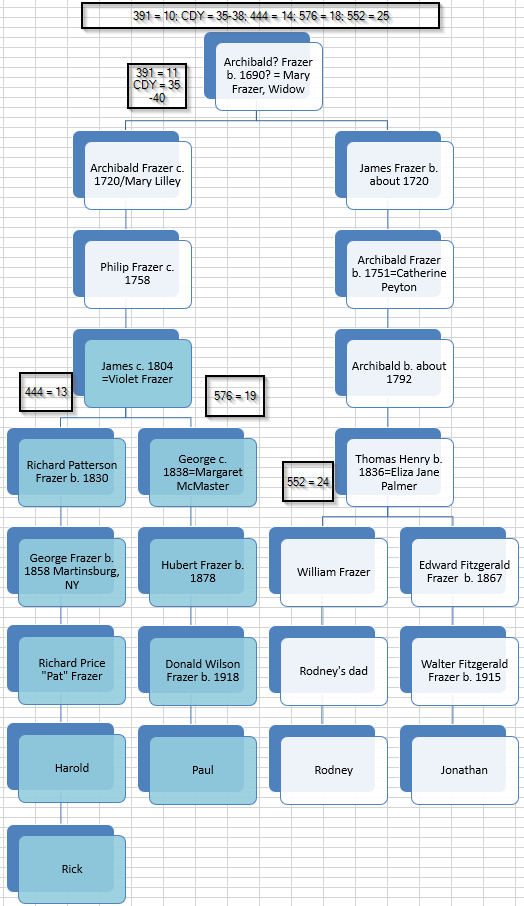
This shows the genetic differences. It basically shows that there is a difference of three between the two Frazer lines of Archibald and James. In general, the two lines differ over DYS391 and CDY. At some point between Archibald Frazer of 1720 and James Frazer of 1804, there were two mutations that defined the Archibald Line from the original ancestral Frazer DNA. Then under the James branch of 1804, there are two branches. Rick’s branch is defined by DYS444 and Paul’s branch is defined by DYS576 being 19. However, we don’t know when these mutations occured. For Rick’s branch it could be anyone starting at Richard Patterson Frazer down to Rick. For Paul’s branch it could be anyone between Paul and George Frazer.

An Updated Frazer STR Tree with DYS710

However, the above Frazer STR tree doesn’t explain all the differences. Paul and Rodney have a difference of 5 STRs at 111 markers. I need to add in DYS710. Recall that Paul had a value of 34 for DYS710 and Rodney and Jonatham had 33. But which is ancestral? Or which came first?

The last time I looked for ancestral STRs, I looked at the Frazers more distant relatives: the Grants and Stuarts:

Note that their SNP is R-YP6488. FTDNA now has a block tree:

This block tree was taken from Jonathan’s perspective. However, it shows that R-YP6488 represented by matches with Grant and Stuart is an older SNP. Hayes is from an even older group represented by SNP R-YP6479. I had originally thought that 33 was the older STR for DYS710 but Stuart has a value of 34. Hayes would make a good tie-breaker but he only tested out to 67 STRs.

Checking YFull

Perhaps Hayes has uploaded his results to YFull.

Under Paul’s distant STR matches I see someone who shows as R-YP6479. This is likely Hayes. However, it doesn’t tell me what his value was for DYS710.

Back to the Updated Frazer STR Tree

Assuming that there were no parallel mutations, I’ll try this:

This shows a value of 34 for DYS710 as ancestral. Then on the James line, somewhere between James and Thomas Henry Frazer DYS710 changed from 34 to 33. That means that at least the Thomas Henry Frazer branch is characterized by a value of 33 for for DYS710.

In order to check my tree, I look at Paul and Rodney:

They have a Genetic DIstance (GD) of 5 at 111 STRs. Looking at the tree, we see that the STR differences add up to 5.

  • The Archibald Line has 381 = 11 and CDY = 35-40
  • The George McMaster branch has 576 = 19
  • The James Line has DYS710 = 33
  • The William Frazer branch has 552 = 24

The Mystery of Paul and Jonathan Solved

I posted my question to the Genetic Genealogy – Tips & Techniques Facebook Page. Skip tells me that the 3 of 425 differences are additional differences. That adds up to 7 of 536 STRs. That leads to this observation. Rodney and Jonathan have a GD of 2 of 427. Paul has a GD o f 3 of 425 with Jonathan and 5 of 415 with Rodney. That seems to indicate, if my logic is right, that the extra two mutations are on Rodney’s side.

A BIgY 500 Frazer STR Tree

This leads to another change in the Frazer STR tree. In order to find the GDs between Rodney and Jonathan, I downloaded all the results. These appear to be the two extra differences:

These were on Lines 425 and 475 of my Excel Spreadsheet. This shows that the mutations belong to Rodney. The mismatch column was just to point out any differences between Jonathan’s and Rodney’s STR results.

Here I ran out of room to describe Rodney’s branch at the top of his branch, so the extra descriptors went on the bottom. Keep in mind that STRs can mutate up or down in number. These last two mutations that Rodney had went down in number. In fact, it appears that all the STR mutations on the James Line are going down.

Any Other STR Differences?

Yes. There are a few more differences between the Archibald and James Branches of the Frazers:

Here, Paul represents the Archibald Line and Jonathan and Rodney represent the James Line. Unfortunately, as the newer STR results are not posted on-line, I would not know how to figure out which values are ancestral and which are the newer values.

The Big Picture: SNPs and Haplogroups

The Big Picture is that our Frazers have the haplogroup of R1a:

Most Frazers in general are R1b and not even closely related by DNA. However, before Frazers became Frazers, some of our Scandinavian R1a’s made their way to Scotland and became Frazers when the R1b Frazers were also becoming Frazers.

The R1a Tree

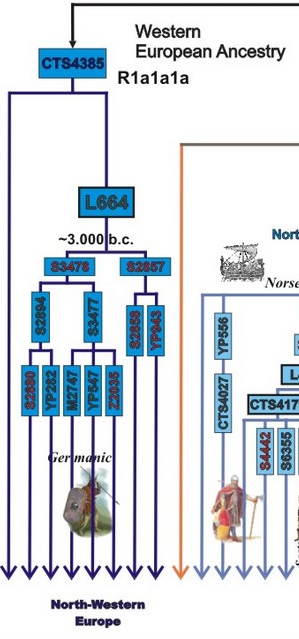
Here is an outdated R1a Tree. It is still nice as it has images on it:

Here is another shot of our Frazer Block Tree:

The trick is connecting the two trees. The Block tree listing at the top mentions R-M198. The “picture’ tree has that at about 6,000 BC, so that is a start.

R-M417 shows as 4800 BC on the picture tree. Next is R-CTS4385:

This shows that before our Frazers were Scots, they were Germanic. Next were the L664 Group:

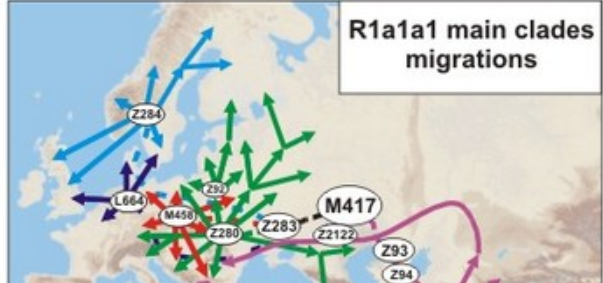
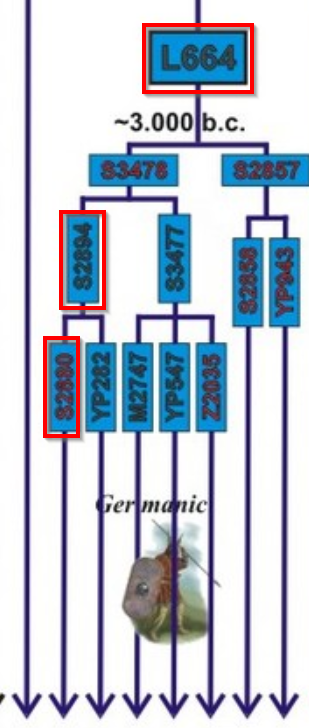
Our L664 ancestors entered the scene about around 3,000 BC. They still have plenty of time to make it to Scotland. They could have hopped over to England around then, but likely made their way up to Western Scandinavia first.

From there, our ancestors kept branching as families do:

That brings us down to the bottom of the picture chart. S2880. S2880 is right above R-YP432 where the Frazer Block Chart starts:

This shows flags. My interpretation is that during the time of R-YP432 our ancestors were living in Scandinavia. The flag on the right that connects to YP432 is the Swedish flag.

The YFull YTree dates YP432 at 3100 years before present.

Between looking at the Block Tree, the YTree and the R1a Administrator’s Tree, it could be that our ancestors could have made their way to Scotland around the time of Christ. At the time the Frazer Clan was formed, our ancestors were in the area of what is now Inverness, Scotland.

Summary and Conclusions

  • Getting data to a project which compares YDNA STR matches to known relationships gave me a chance to look at our Frazer YDNA STR matches.
  • This lead to a better understanding of what the BigY 500 STR results mean.
  • For the four people who have taken the YDNA test and especially the three Frazers who have taken the Big Y test, I was able to refine the YDNA differences between the different lines and branches.
  • After that I gave a rough overview of how our Frazer ancestors made their way to Scotland from Scandinavia perhaps around the time of Christ.
  • Based on the YTree and other DNA sources, our own Frazer branch of R-YP6489 began around the early 1300’s, but our common ancestor in that branch was from the early 1600’s.


Updates to Butler YDNA

I see my last Blog on Butler YDNA was about a year ago.  A little or a lot can happen in a year. Turns out some things have happened.

Three Big Y Testers: 2 Butlers and a Batt

There are three Big Y testers that show that they have a common ancestor in the past 700 years. Here is the simplest way to show how these three are related:

Note that while Batt’s SNP is I-Y238315, I didn’t put Batt in that box. That is because Batt and Butler both descend from I-128315. In other words, Butler does not descend from Batt, but both names descend from a common ancestor. This shows that the three testers have a common ancestor who was born 700 years ago. This also shows that the two Butlers who have tested for the Big Y have a common (likely Butler) ancestor from about 225 years ago. Here is how the YTree shows it:

These are the dates that I didn’t have as of my previous Blog. Previously, we were just up to 700 years ago. This new information thanks to the new Big Y Butler tester brings us 475 years closer to the present date.

However, there is a catch to these dates.

SNPs Vs. STRs

The above trees are based on SNPs. FTDNA also tests for STRs. The STRs show that Batt is more closely related to my late father in law Richard Butler than to the other Butler. So which is right? Whenever there is a conflict between SNPs and STRs, SNPs are always right.

Here is how my father in law Richard matches Batt and the other Butler by STRs:

Based on STRs, it looks like Batt is a closer match than Butler. However, by SNPs my father in law matches Batt 700 years ago and Butler 225 years ago. This is due to the variability of STRs or back mutations. Also the Butler above could have had more STR mutations than usual and/or the 225 year estimate for common Butler ancestors could be on the low side

A New Butler STR Match

I was notified recently that there was a new Bulter 37 STR match. That is good news. Also this Butler has ancestors from County Wexford. Peter, who has been researching Butlers feels that Wexford is a likely origin for the Butlers. Here is my father in law’s match list at the 37 STR level:

The new Butler match at the top is a perfect match with my father in law at the 37 level. However, that could change as more STRs are tested. My guess is that the three Butlers on the list are I-Y128364 and the non-Butlers on the list are not. Also notice that the first two Butlers matching my father in law have Wexford roots.

Here is a partial map of Wexford:

I believe that my father in law’s family came from County Kilkenny just North of Waterford. However the distance from that area to Wexford is not far. At any rate, this new YDNA Butler match seems to suggest that a common Butler ancestor could be from Wexford.

What’s Next?

The new Butler match may want to take an Autosomal DNA test. This could be done at FTDNA or at AncestryDNA. The advantage of AncestryDNA is that they have more people who have taken that test. That means a bigger chance of finding matches. The DNA matches will be looking for genealogical connections. The new match could do further YDNA testing, but that is a bit more expensive than the autosomal DNA test.