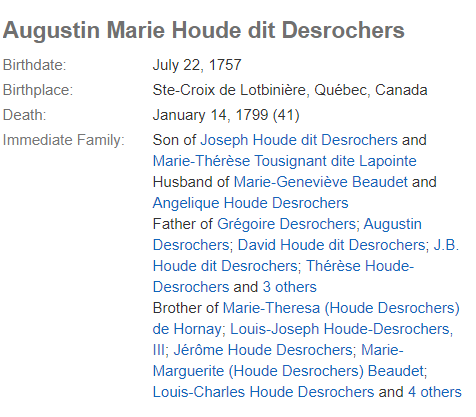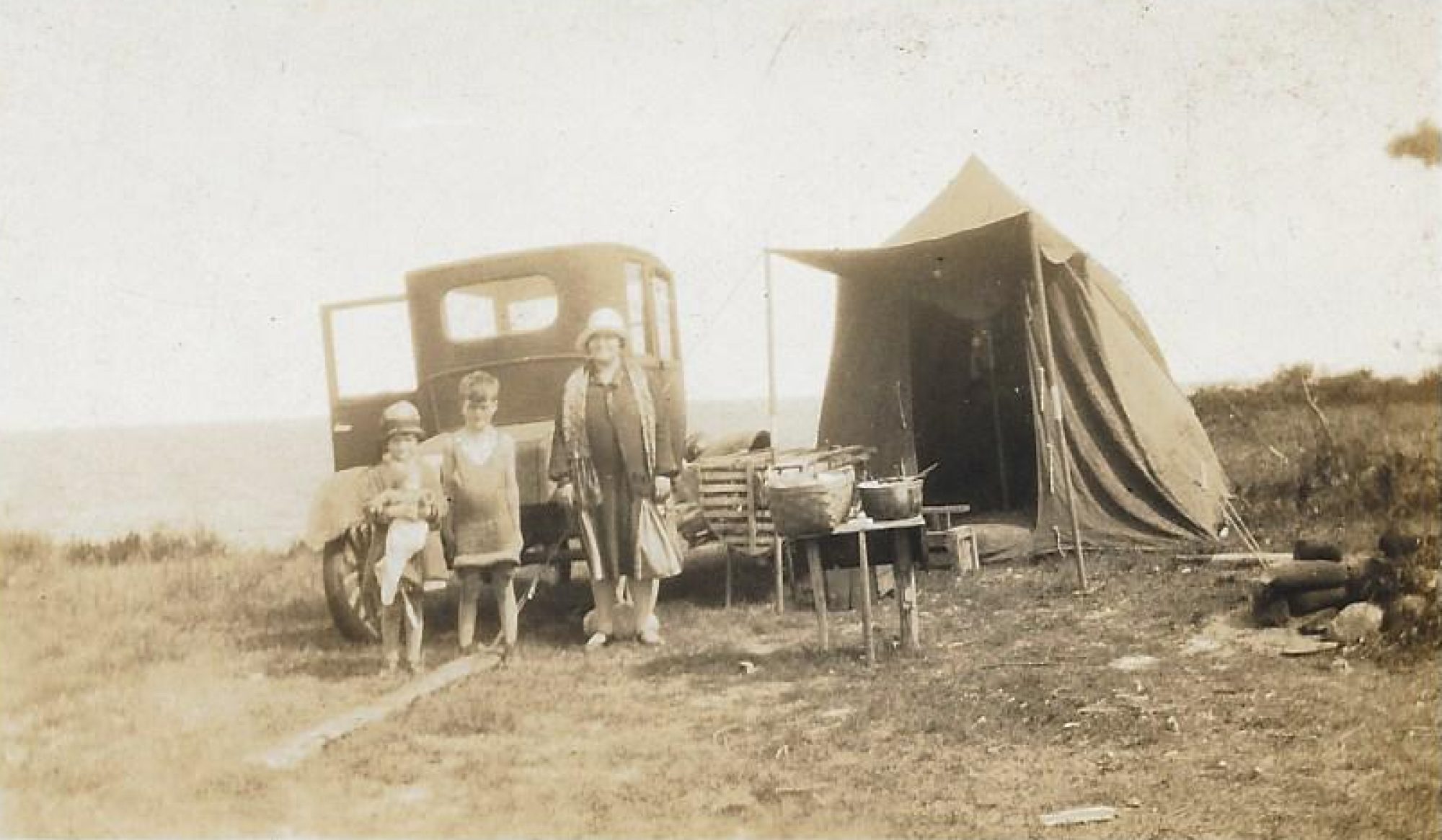
My Daughter-In-Law’s French Canadian Ancestry: Houde Dit Desrochers

I last looked at my daughter-in-law Sarah’s  French Canadian Vezina heritage in this Blog. I was able to trace her family back to La Rochelle, France. However, that was only one line. In this Blog, I’ll take a look at some of her other French Canadian Lines.

Sarah’s Existing Tree

Here is where I am now with Sarah’s four French Canadian great-grandparents:

McGee doesn’t sound French Canadian. I’m assuming that Ethel’s maiden name was not Chapdelaine and that Lydia’s maiden name was not Vezina. Otherwise, Ancestry has some hints for me for potential 2nd great-grandparents.

Beatrice B McGee

I’ll start with Sarah’s non-French Canadian sounding great-grandmother. According to the 1940 Census, Beatrice was born in Massachusetts. That same Census has her in New Bedford in 1940, but in Fall River in 1935.

It appears that Beatrice was a Mary at birth in 1907 in Fall River:

The family lived at 272 William Street. Mary’s father was a weaver born in Canada and Mary aka Beatrice’s mother was Eliza Lafleur born in Massachusetts. Beatrice was part of a large family as seen in the Fall River 1910 Census:

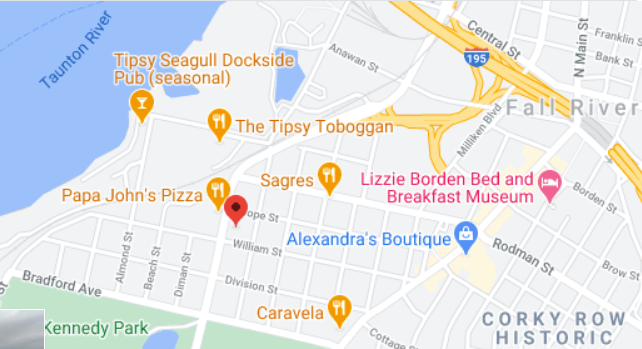
Here is 272 William Street:
Arthur McGee

Here is Arthur’s Marriage record from Fall River from 16 June 1884:

Eliza’s birthplace appears to be the US, but I am not sure. Arthur and his wife were quite young at the time. Arthur’s parents were Edward and Anne or Annie. This puts Arthur’s birth at about 1864. Here is Arthur and family in Fall River in 1900:

Arthur reports that he immigrated in 1865. That means that he should have been with his parents at that time:
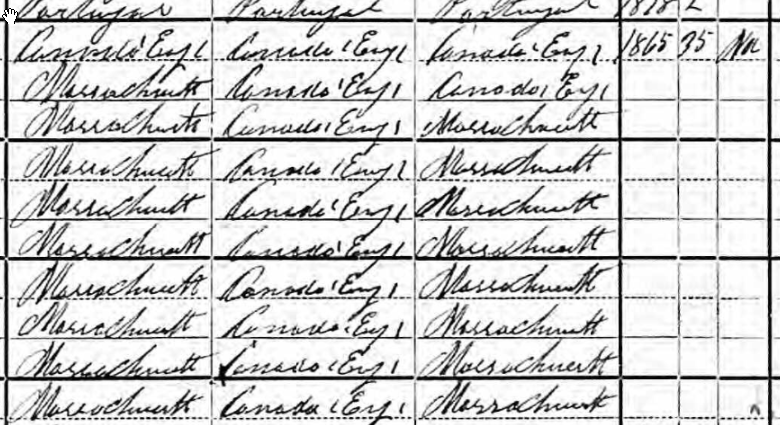
Arthur also states that he was a citizen. The Na means naturalized. I’m having trouble finding out more about Arthur, so I’ll go on to another line.

Eliza Lafleur

Eliza was Arthur’s wife. Let’s see what we can find out about her.
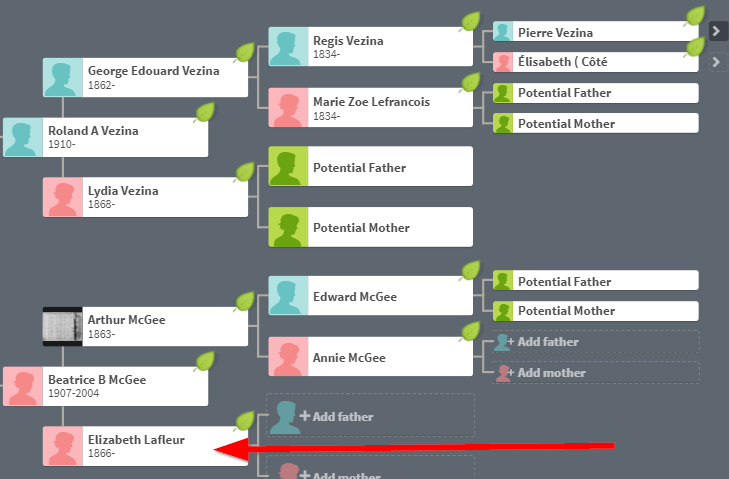
According to the death record of Eliza’s son Louis, Eliza was born in Millbury, MA:

The 1930 Census gives a different story:

The couple now state they were a year younger at marriage.

Elizabeth now says she was born in Canada. She arrived in 1880 and her husband in 1882. Also Arthur is no longer naturalized, but has only applied for Naturalization ‘Al’. Both Arthur and Elizabeth are French speaking.

That means that I am getting stuck on Sarah’s Lafleur Line also. There are generally difficulties in traciing one’s ancestors back to another country. Even when that Country is Canada.

Lydia Wife of George Edouard Vezina
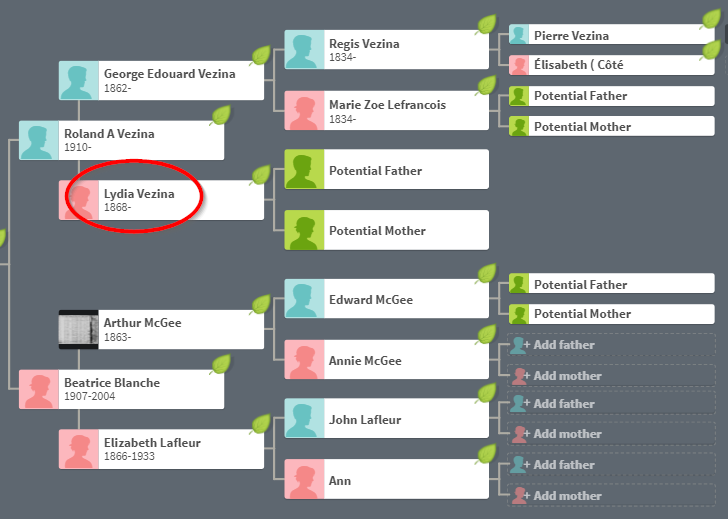
Ancestry already thinks that it has parents for Lydia who was born aout 1868. Ancestry has some hints for me as to George E’s marriage:

I’ll try the second one. Unfortunately, that is only an index.

However, in 1914, George and Lydia’s son married. In that record, Hector gives his mother’s name as Lydia Derochers:

Some Desrochers Genealogy

Now we know we have a Desrocher Line to follow. Here is Lydia’s marriage record from 7 January 1890 in Fall River:

Lydia’s parents were Peter and Cedulie. Both George and Lydia were born in Canada. Lydia would have been born about 1868. This appears to be Lydia in 1868:

Pierre and Cedulie were listed as:

A charerretier is a carter. According to one genealogy forum, a carter was a:

Driver of (horse-drawn) vehicles for transporting goods. A Carter typically drove a light two wheeled carriage.

Here is Warwick:

According to Wikipedia:

Warwick is a small town north east of Montreal, located in Arthabaska county, Quebec, Canada. The town was incorporated in 1861 and named after a city of the same name in England. Up until 2014 the town hosted Quebec’s annual summer cheese festival, which showcases many of the locally produced artisanal cheeses.

One researcher posted this:
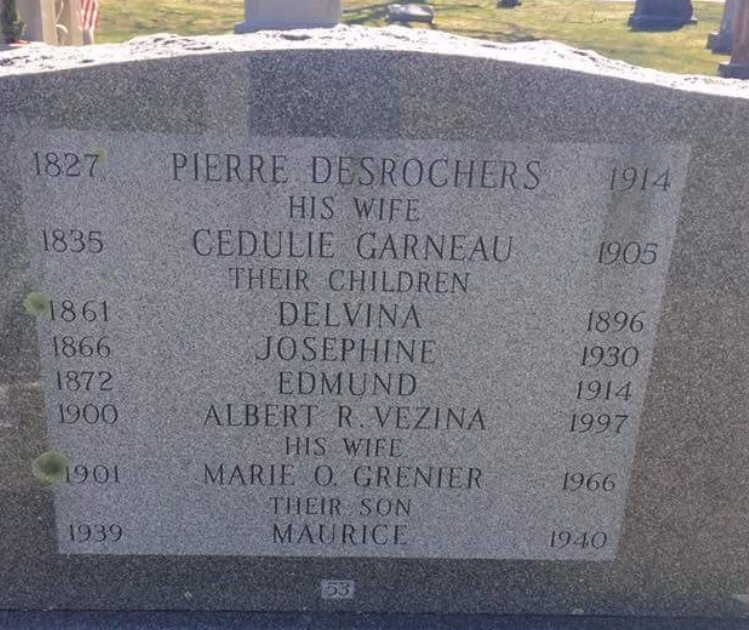
The relationships are a bit confusing on the stone. Here are Pierre and Cedulie in Fall River in 1900:

Pierre is listed as retired. Cedulie shows that she she had 5 children and 2 are now alive. That does not appear to be correct as Lydia, at least, was still alive along with Josephine and Edmund.

Pierre lived a long life:

Here is Cedulie’s death record:

Her parents were Augustin Garneau and Marguerite Morisette.

This information brings us close to the end of the 1700’s:

Here is the marriage record for Cedulie:

Next page:

Here the names of the parents of Pierre and Cedulie match up with what I have above.

The next step would be to look for a Desrocher/Martel marriage. This source looks hopeful:

This website does not give much more information:

However, I like the fact that the names line up and the date lines up. The next record is from this book:

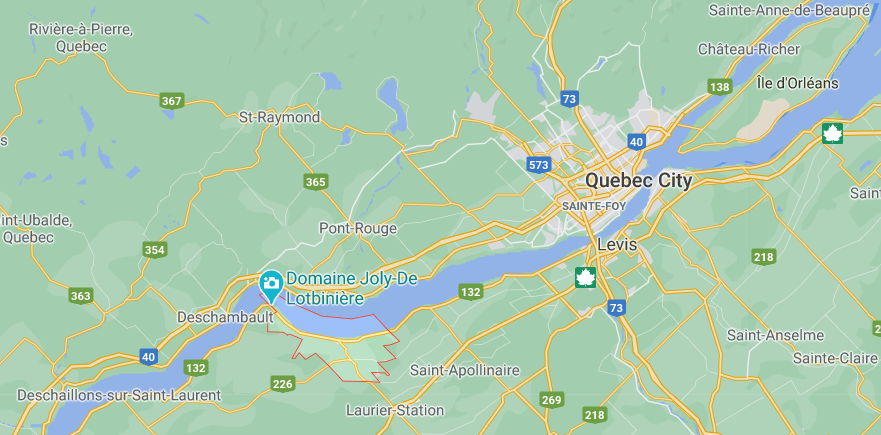
This place is closer to Quebec City:
Here is the marriage record:

Now the spelling of Desrochers is Derocher.

Dit Names

The marriage record brings up the issue of dit names. Here Augustin is Houde or Houdes dit Derocher. His father has the same name. Dit names are a French thing.

Here is part of an article from thoughtco.com:

dit name is essentially an alias, or alternate name, tacked on to a family name or surname. Dit (pronounced “dee”) is a French form of the word dire, which means “to say,” and in the case of dit names is translated loosely as “that is to say,” or “called.” Therefore, the first name is the family’s original surname, passed down to them by an ancestor, while the “dit” name is the name the person/family is actually “called” or known as.

Dit names are found primarily in New France (French-Canada, Louisiana, etc.), France, and sometimes Scotland. They are used by families, not specific individuals, and are usually passed down to future generations, either in place of the original surname, or in addition to it. After several generations, many families eventually settled on one surname or the other, although it isn’t uncommon to see some siblings within the same family using the original surname, while others carried on the dit name. The use of dit names slowed dramatically during the mid- to late-1800s, although they could still be found used by some families into the early twentieth century.

Why a Dit Name?

Dit names were often adopted by families to distinguish them from another branch of the same family. The specific dit name may also have been chosen for many of the same reasons as the original surname – as a nickname based on trade or physical characteristics, or to identify the ancestral place of origin (e.g. Andre Jarret de Beauregard, where Beauregard refers to the ancestral home in the French province of Dauphine). The mother’s surname, or even the father’s first name, may also have been adopted as a dit name.

Augustine’s mother appears to be Genevieve Baudet. Angelique’s parents appear to be Francois Martel and Angelique Tangrelle:
This is probably a transcription:
Here is what I have so far for Lydia’s paternal side:
I need to fill in some dates here. Augustin father of Pierre must have been born in the 1700’s. I can cheat a little by googling the name. Here is Augustin’s father:

The other Augustin was born in a time where it was a little more difficult to find his birth year. He was before published genealogies. This is probably his baptism:

In the left margin, it appears to say that this is the Baptism of Augustin Houde Desrochers. And it appears that his father’s name is given as Augustin Derochershoude. The date is difficult to decipher. It may be 1777 which would be when his father was only 20. Also the record appears to say tha the mother was Marie Marguerite(?):

I had his mother as Genevieve.

Here is another possibility from 1803:

This record is even more difficult to read. However, according to the Geni record, the father died in 1799. Also I had that this Augustin married in 1813, so he could not have been born in 1803.

The Tanguay Genealogical Dictionary

Fortunately, there is a book with most of the French Canadian families in it up to a certain point. Here is Sarah’s Line:

As I recall, the 1752 would be the marriage. At least that would make sense. The (2) footnote refers to dit Desrochers. This record says that Joseph, son of Joseph was born in 1728 and married Marie-Therese Tousignan. They had three children.

Next I go to page 518 of Volume 4 of Tanguay:

At this point I don’t see the dit Desrochers name, so that can go away. It looks like this marriage took place at St-Nicolas – closer to Quebec City:

The Joseph above was born in 1700 and was the son of Louis.

This Louis was born in 1675 and buried in 1729 at Ste-Croix. Here is a progress update:

This starts on the left with Pierre Desrochers who died in Fall River in 1914 and starts on the right with Louis Houde who was born in 1675.

Louis Houde France to Quebec

That brings us to the first Louis Houde in Quebec:

I was able to find a web page at geni.com on Louis in French. I used the translate feature on the web page:

This tells some more of the history of Louis and how the two branches of the family got their names. Here are some cliffs in Ste-Croix:

Here is some more from geni:

I did notice the difference in age of about 24 years between Louis and Madeleine but I didn’t realize that she was just 13 years old when they married.

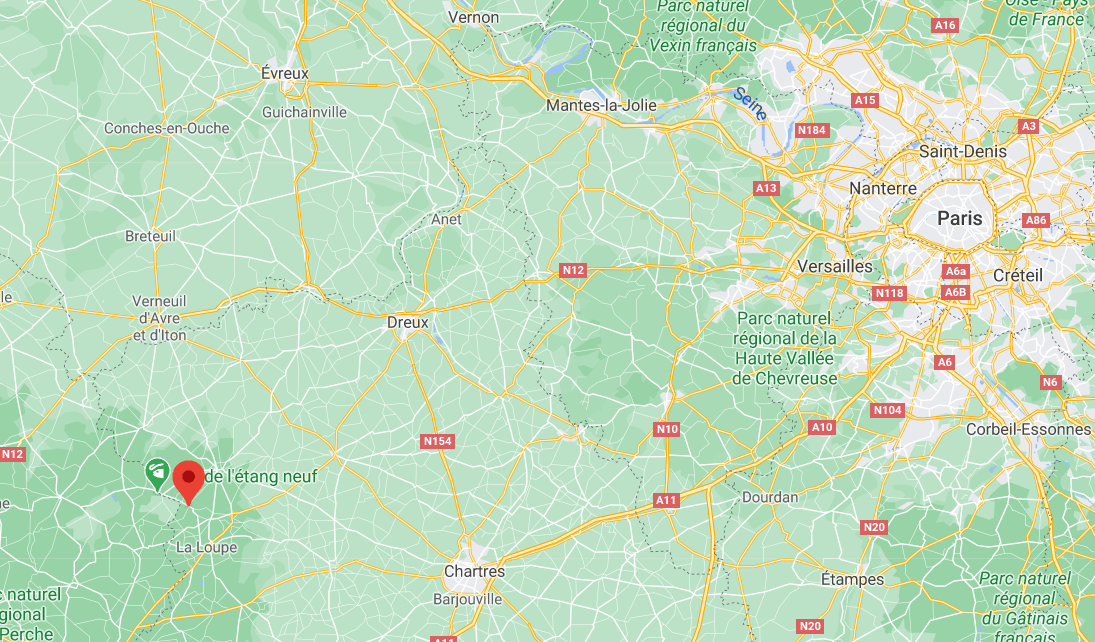
Here is Manou:
Summary and Conclusions

  • I started out looking at Sarah’s McGee and Lafleur ancestry.
  • Both these lines were from Quebec, but I had trouble tracking those families back to Quebec
  • I then looked at the wife of George Vezina. Her name was Lydia Desrochers – Sarah’s 2nd great-grandmother
  • Lydia was born 1868. She moved with her family to Fall River some time before 1890 when Lydia married there. I was able to trace her line back to her immigrant ancestor Louis Houde who was born in Manou, France in 1617.
  • Louis had a son also named Louis. The son inherited the father’s land by the cliffs and rocks of Ste-Croix, Quebec. This branch of the family picked up the name Desrochers. Roche means rock.


The First Frasher/Frazier BigY Results

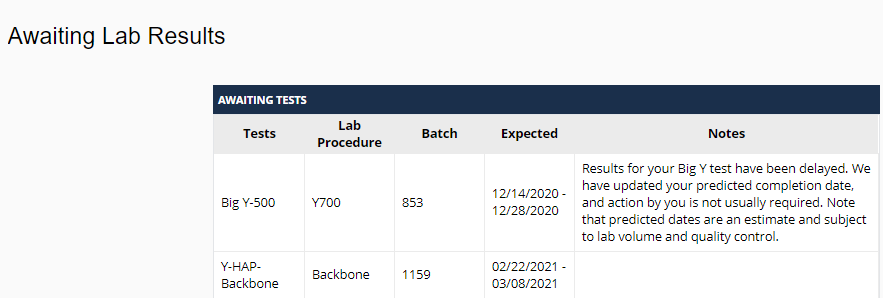
The long-awaited Frasher/Frazer BigY results are starting to come in. This test was ordered around the time Rick from the Roscommon Frazer group ordered his test last August. However, the Frasher/Frazier test was delayed due to quality issues.

The Status of the Frazer BigY Project

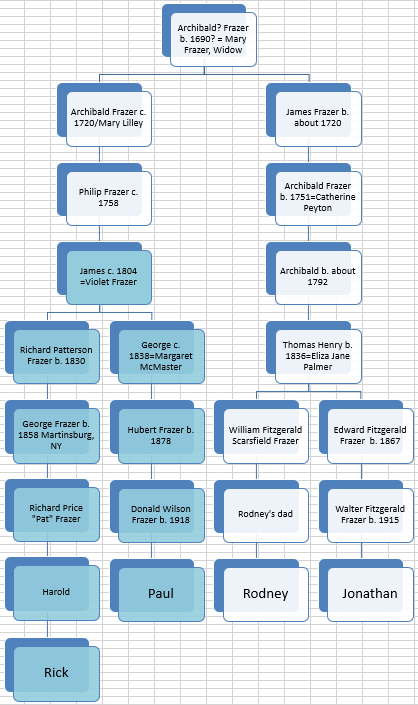
Prior to the Frasher/Frazier test results, there were four Frazer BigY testers. They all had pretty well-defined relationships based on genealogy:

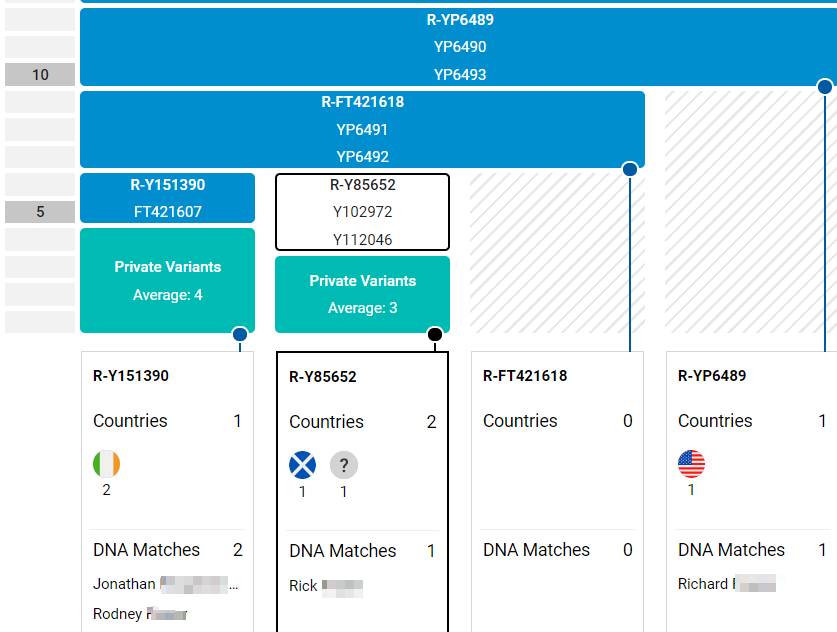
Rick was the one who ordered a new BigY test. Also around the same time, Rodney upgraded his BigY 500 to a BigY 700. That means that now Rick and Rodney have BigY 700 results and Paul and Jonathan have the older BigY 500 results. Here is the Block Tree pre Frasher/Frazier:

My second cousin once removed Paul is R-Y85652. This is called in general the Archibald Branch. Rodney and Jonathan are in R-Y151390. This is called the James Branch of the Frazer Line. These two lines were previously under R-YP6489. For some reason, another group formed between YP6489 and the two Frazer Branches. This is R-FT421618. As it is usually necessary for a new tester to form a new group, I had assumed that the new Frasher/Frazier test would end up as FT421618.

New Frazier/Frasher Results

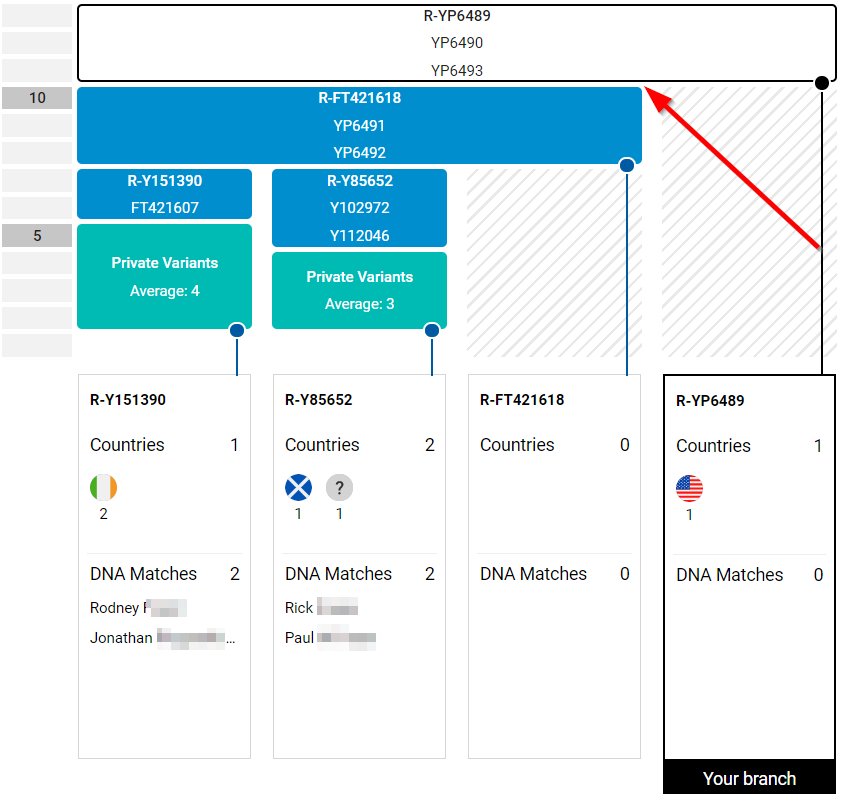
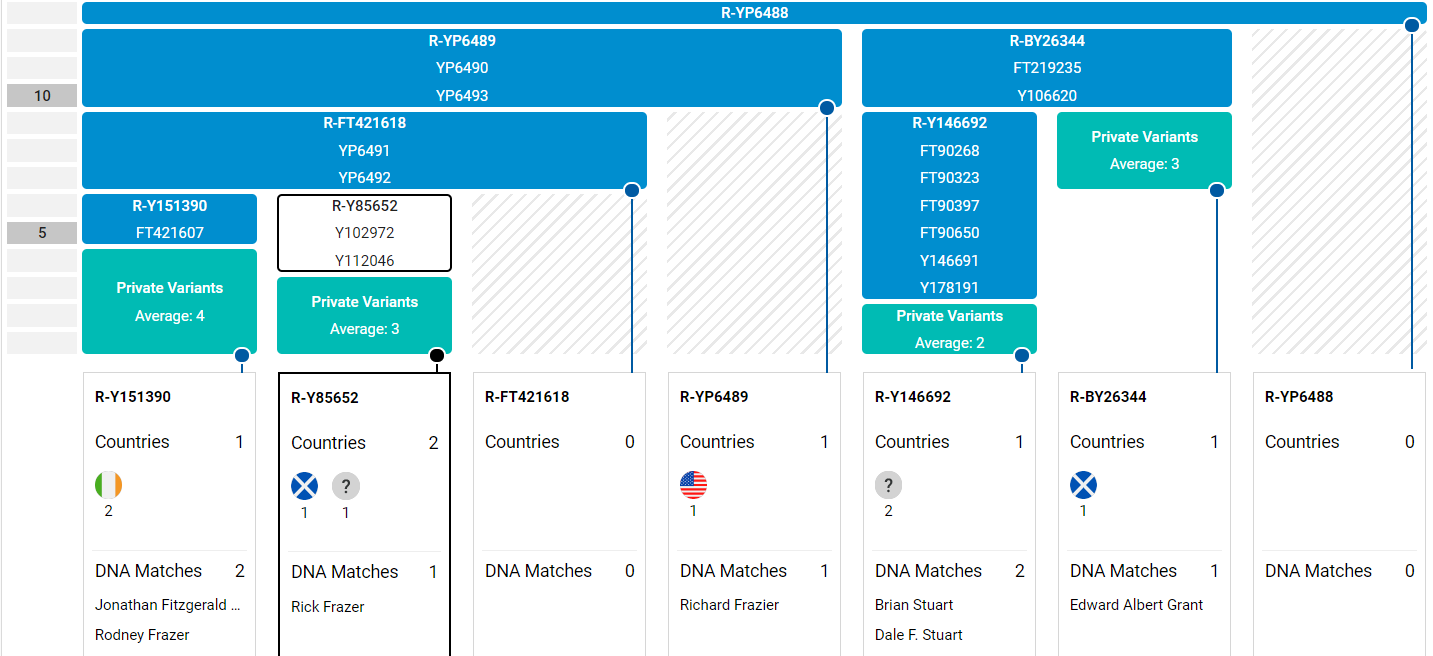
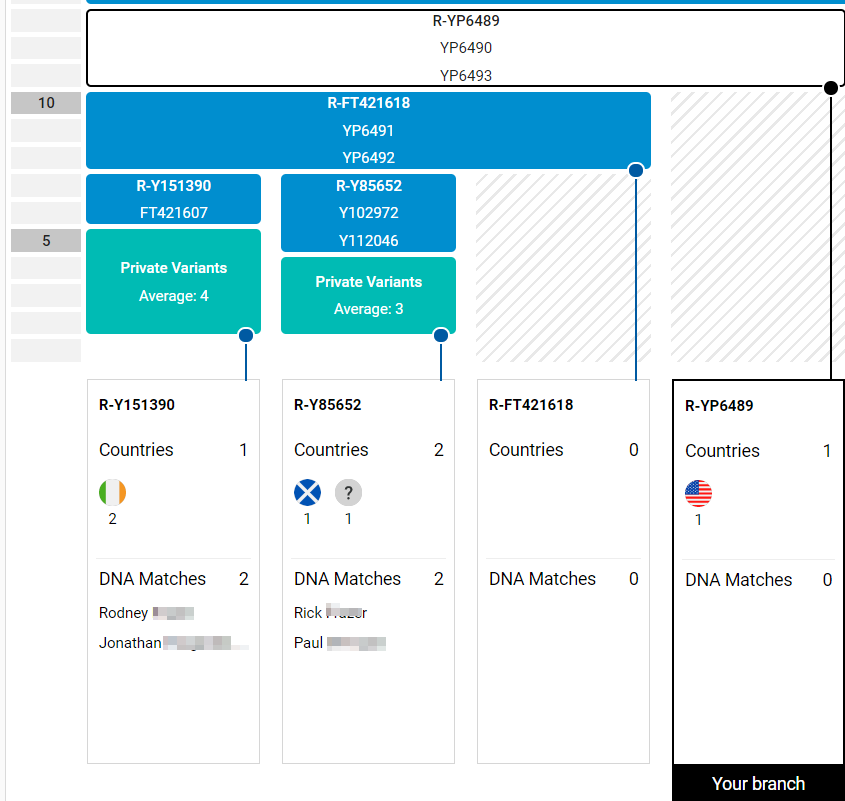
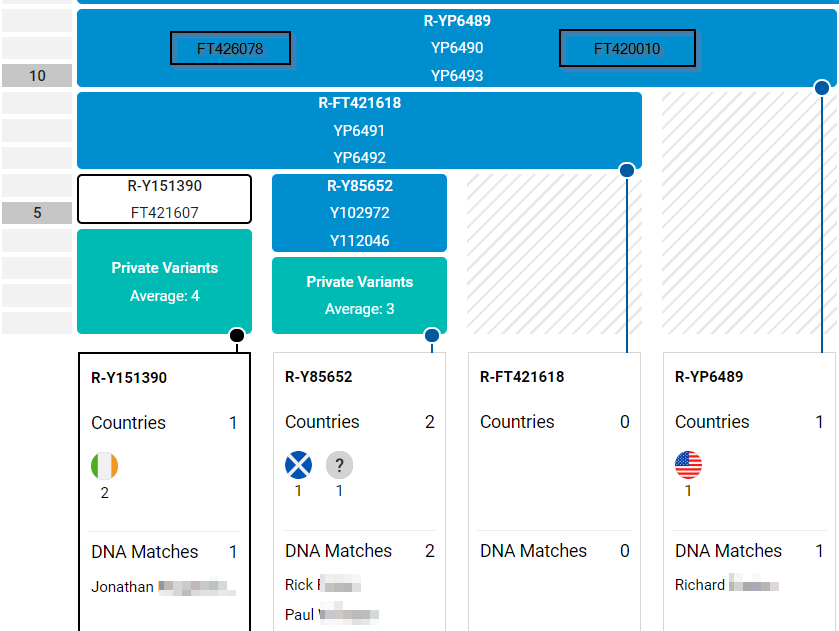
Here is the new Block tree from my cousin Paul’s perspective:

The new tester, Richard is listed as R-YP6489 and not FT421618. That means that it is likely that it was Richard that split the YP6489 Block into two. The YP6489 Block must have previously had had six SNPs. Now there are two blocks with three SNPs each.

FT421618 and YP6489

R-FT421618 is the newest SNP and represents the Haplogroup of the Frazers from Roscommon, Ireland. This is the SNP in common with the four BigY Frazers whose roots go back to Archibald Frazer who apparently lived in Roscommon Ireland sometime before 1749. The new Frazier/Frasher tester does not share these SNPs.

Based on the Block tree, it appears that Richard, the newest BigY tester shares three SNPs with the Roscommon, Ireland Frazers. These SNPs are YP6489, YP6490 and YP6493. Collectively, these are called YP6489.

Where and When is YP6489?

When Did YP6489 Form?

This is the big question. We can date FT421618 to about 1690 to when we believe that the first Frazer lived in Roscommon Ireland. That means that the oldest SNP in the Block of YP6489 formed three SNPs before 1690. The question then is, how often does a SNP form? I have seen a number as low as 86 years per SNP as I recall. However, the scale on the left is showing 9 SNPs up to FT421618. If we take that time from very recently then 2020 minus 1690 is 530 years. That means that it looks like a SNP formed about every 59 years.  Let’s use 86 years for the three SNPs in the YP6489 Block. That gives us 258 years before 1690 or 1432 for the formation of the oldest SNP in the YP6489 Block. However, see further down in the Blog as I surmise that there should be more SNPs in this Block which would make YP6489 even older.
When was the Common Ancestor Between Richard and the Roscommon Frazers?

This is a different question. It appears from the Block tree that Richard and the Roscommon Frazers share the top three SNPs in YP6489. That means that the common ancestor would be closer to 1690 than to 1432:

In the image above, “Your branch” is Frasher/Frazier. We know that Richard does not descend from Archibald Frazer probably born in 1690, but he could have descended from Archibald’s father or grandfather. Let’s say that the common ancestor between Richard and the Frazers of Roscommon was 1600. My reasoning is that the most recent common ancestor would have to have a SNP shared by Richard and the other Frazers. That would be the most recent SNP in the group of YP6489. That most recent SNP probably formed about 86 years or so before FT421618.

SNP Tracker

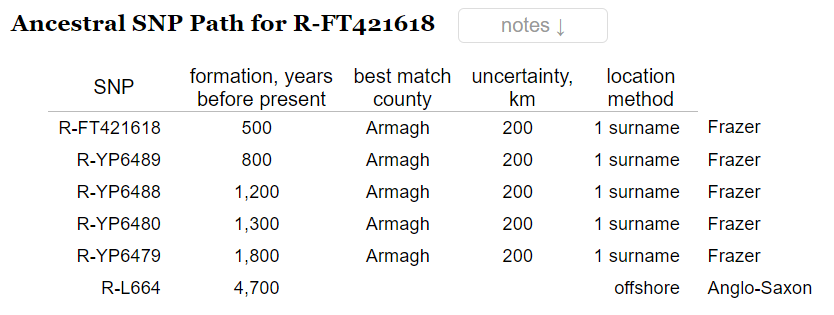
This is a program that gives a rough estimate of dates of and locations of SNPs. Here is what SNP Tracker shows for FT421618:

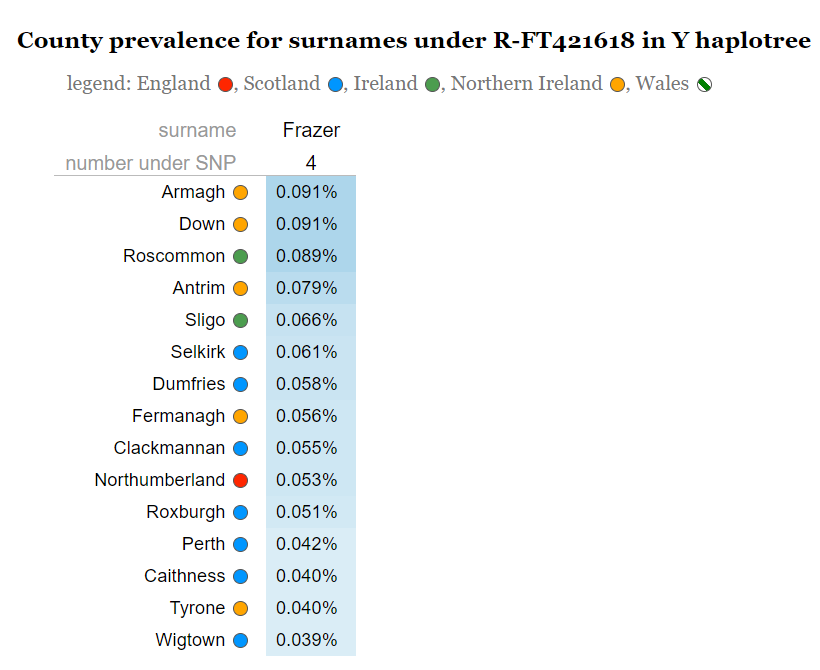
SNP Tracker has that SNP in Ireland in Medieval times. That is probably based on the 9 SNPs I mentioned above. I think that FT421618 should be 1690. Here is more from SNP Tracker:

Roscommon is in the top three here and the numbers are pretty similar for Armagh, Down and Roscommon. Here is some more information, though I don’t agree with these SNP Tracker results either:

Offshore means continental Europe. That part would be quite certain.

Back Before Frazer with the Stuarts and Grants – YP6488

Whereas YP6489 is the umbrella group for the Frazer/Frasher/Frazier group, YP6488 is the umbrella group for Frazer, Stuart and Grant. The explanation for these relationships is not clear. I can come up with a few guesses:

  • This could represent the period when surnames were adopted. One group adopted Frazer, one Stuart and one Grant.
  • There could have been a Frazer/Stuart marriage and the children of one group could have taken on the Stuart name rather than Frazer for some reason.

Whatever the reason, the YDNA is sorting out the matches between Frazer on the one side and Stuart/Grant on the other.

The Block Tree makes it look like Grant is one SNP away from being a Frazier/Frasher and vica versa. However, that is only because there are not other close matches for Grant and Frazier/Frasher. If there were, that would put their groups further down on the Block tree similar to Frazer and Stuart.

Grant

It is interesting to note that Grant only has three variants bringing him to an equal level with FT421618. I had dated this as 1690. My guess is that Grant had the BigY 500 which did not discover as many SNPs or Variants. If we use the older 144 years per SNP based on the BigY 500 test that would date Grant at 432 years ago or about 1590. This is still early for my proposed 1690 date for FT421618.

Where Was the Common Ancestor for Frazer and Frazier/Frasher – YP6489?

This depends partly on the dating of Richard’s common ancestor with the Roscommon Frazers and partly on genealogy and Frazer history. Perhaps other could speculate better than I. Did the same events that resulted in the Roscommon Frazers moving to Ireland result in Richard’s ancestors move to the New World? Did a common ancestor move to Northern Ireland and then one brother moved to Roscommon and another brother or relative move to Virginia? It is even possible that Richard’s ancestor moved to Roscommon, Ireland and then to America.

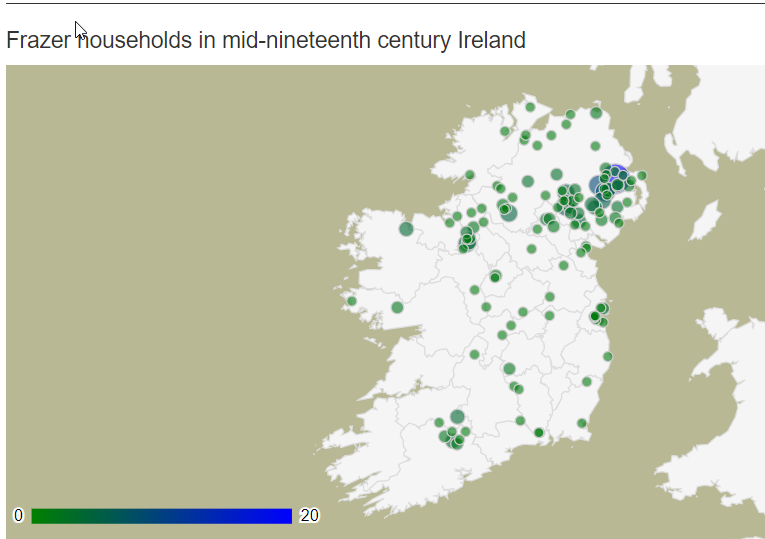
Here is a map from Irish Ancestors:

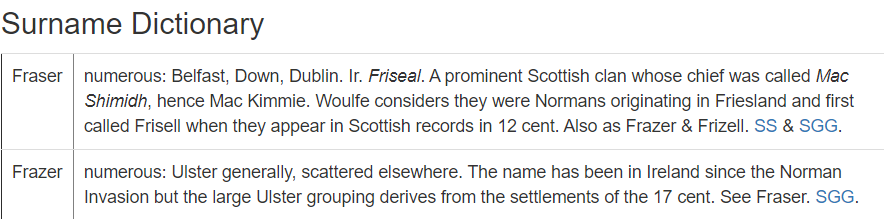
Here is some more information:

Richard’s DNA Testing

FTDNA will do a manual review if a new YDNA branch is formed. Technically, the new branch formed before Richard’s test results were completed. However, this new branch of FT421618 seems to have formed based on Richard’s results.

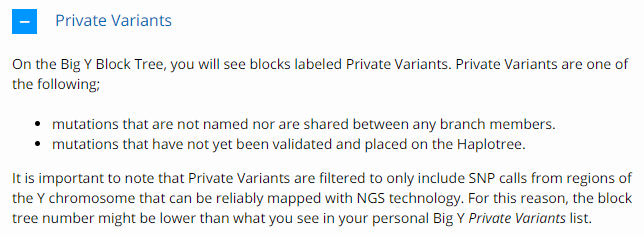
Richard shows under “Your branch”. What appear to be missing are Richard’s Private Variants.

Richard’s Private Variants

These are the Richard’s SNPs that have no matches at this time called Private Variants. They form Richard’s personal line since the three SNPs in the Block that form YP6489:

This is some of the most important information from the BigY test as these are for the most part new variants that have been discovered in Richard that have never been discovered in anyone else in the World. I haven’t checked Richard’s Private Variants to see if they are all truly Private. However, the number of Private Variants seem to be a reasonable number at six. Above, I gave a possible date of 1600 for a common ancestor between Richard and the Roscommon Frazers. That means that, since 1600, six Variants formed as opposed to the approximately 9 that formed in the Roscommon Frazer Line.

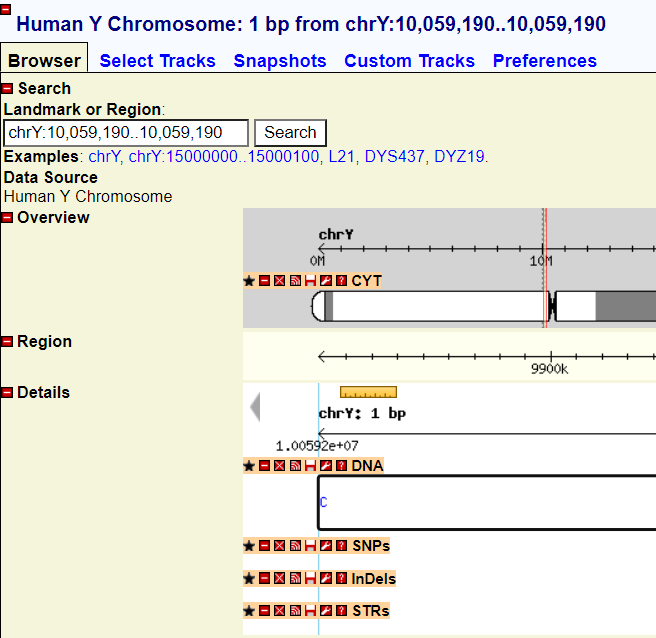
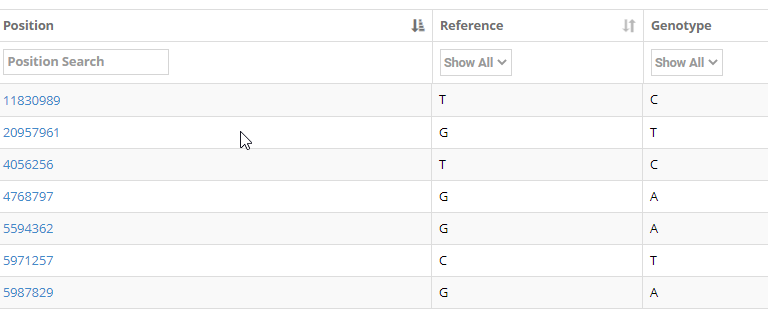
I can look up these positions in YBrowse. 10059190 is too new and does not appear there yet as a Variant:

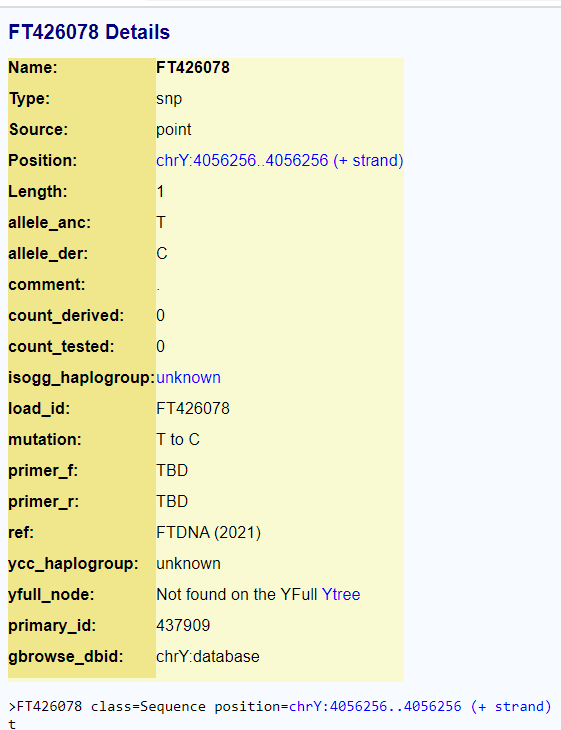
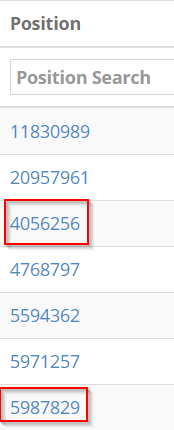
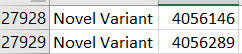
The same is true for Richard’s next three Private Variants. I found some information on 4056256:

This is a new SNP as of 2021. My guess is that that this “Private Variant” may have come about from Rick or Rodney’s BigY 700 tests.

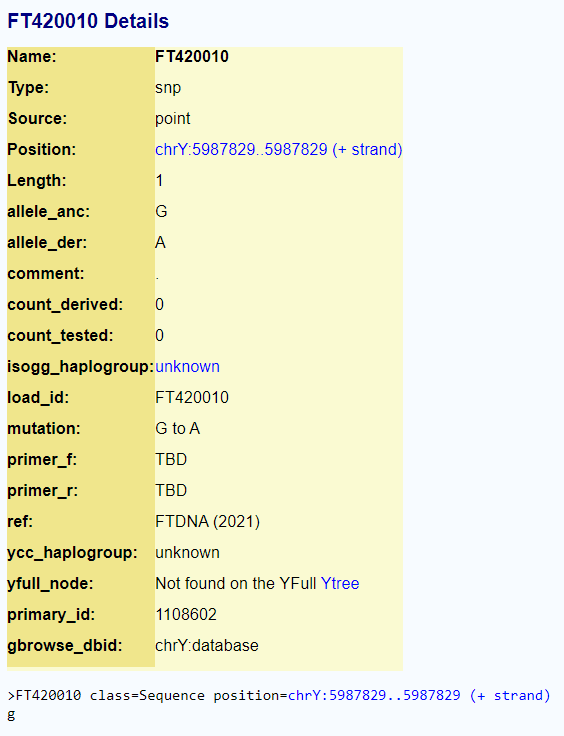
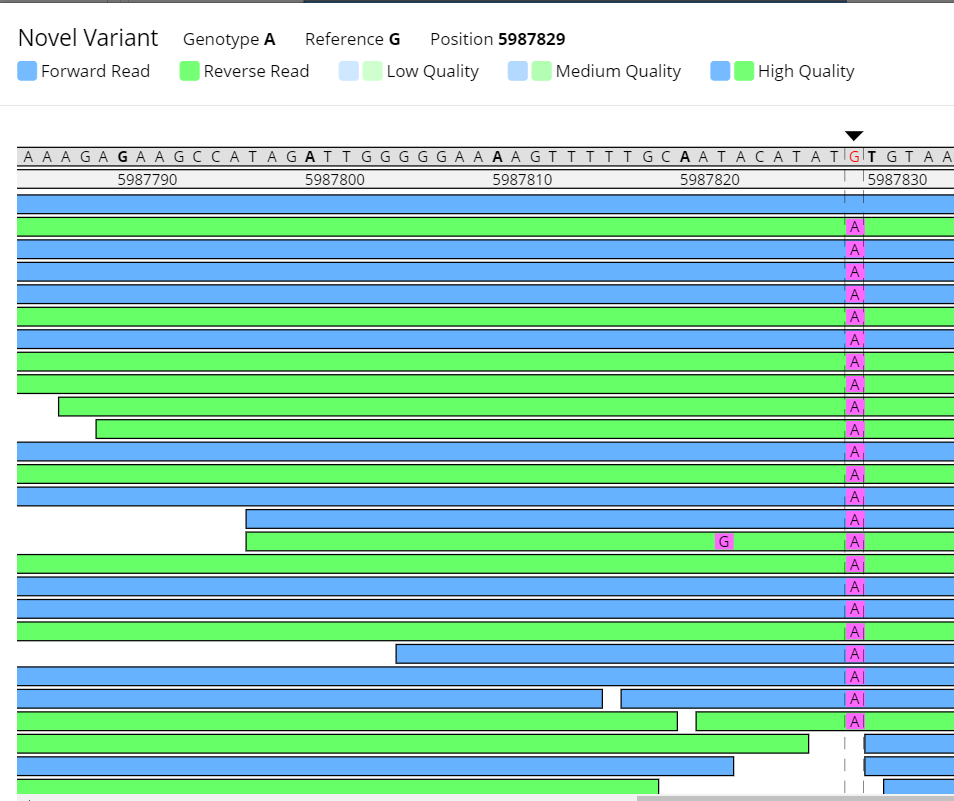
That leaves one more Private Variant for Richard. Position 5987829 has been named also:

Next, I need to check Rick and Rodney for these two positions. Rick has one of the two:

Rodney has both of these ‘Private Variants’:

Here is my guess of what should happen:

It seems like these two SNPs should go up into the YP6489 Group. Also Rick should lose one of his Private Variants and Rodney and Richard should lose two each. It could be partially due to these discrepancies that FTDNA ordered additional testing for Paul and Jonathan. The other question is, why didn’t Rick show that he had position #4056256? Here are Rick’s results:

It appears that Rick’s BigY 700 testing missed that position number.

For Jonathan and Paul, the results seemed inconclusive for these two positions. Here is what Jonathan’s results looked like for Position #4056256:

Summary and Conclusions

  • Richard’s BigY test represents the first BigY test for a Frazer/Frazier who doesn’t descend from Archibald Frazer of Roscommon Ireland
  • Richard’s BigY test benefits from the prior testing of four Frazers. Without this he would have shown that he is related to two Stuarts and a Grant.
  • Due to the Frazer testing and genealogy, the common ancestor between Frazer and Frazier/Frasher should be about 1600
  • I made some guesses as to where this common ancestor lived, but I don’t know. Finding a Frazer with Scotland-only genealogy who has tested for YDNA would help.
  • I made some guesses as to where Richard’s Private Variants would end up.

More Painting of My Wife’s DNA

I call this painting my wife’s DNA because I use a program called DNA Painter. But really, it is a DNA map of my wife’s identified DNA matches. Here is what I have so far for Marie:

The top row of every one of Marie’s chromosomes is what she got from her father and the bottom row is what she got from her mother. Likewise on the key to the bottom right of the image, the top part shows the shared paternal ancestors represented in different colors on Marie’s map. The bottom part of the key has Marie’s maternal ancestors represented as colors that she got from her DNA matches.

Marie is About One Third Painted

Actually a little less:

Marie is actually doing the best as far as DNA matches go, on her paternal side:

Now that I think of it, that makes sense as there a lot of French Canadian matches on that side. That must mean that Marie is less painted on her maternal side:

Marie only has 57 DNA segments painted on her maternal side. My goal in this Blog is to get Marie’s numbers up somehow. It is not easy as there has to be a link to a common ancestor and they have to have had their DNA tested at a place that gives detailed DNA match information. AncestryDNA is the biggest tester and they don’t give detailed information on their DNA matches.

Searching for More DNA Matches for Marie

The easiest place to search would be at MyHeritage. They have an option called Theories of Relativity where they match up DNA matches and common ancestors. One of the first matches I see at MyHeritage that I haven’t mapped yet is with Ivan:

Ivan has two paths to Marie and Ivan’s proposed common ancestors of Peter Upshall and Margaret Burton.

Here is the DNA that Marie and Ivan share:

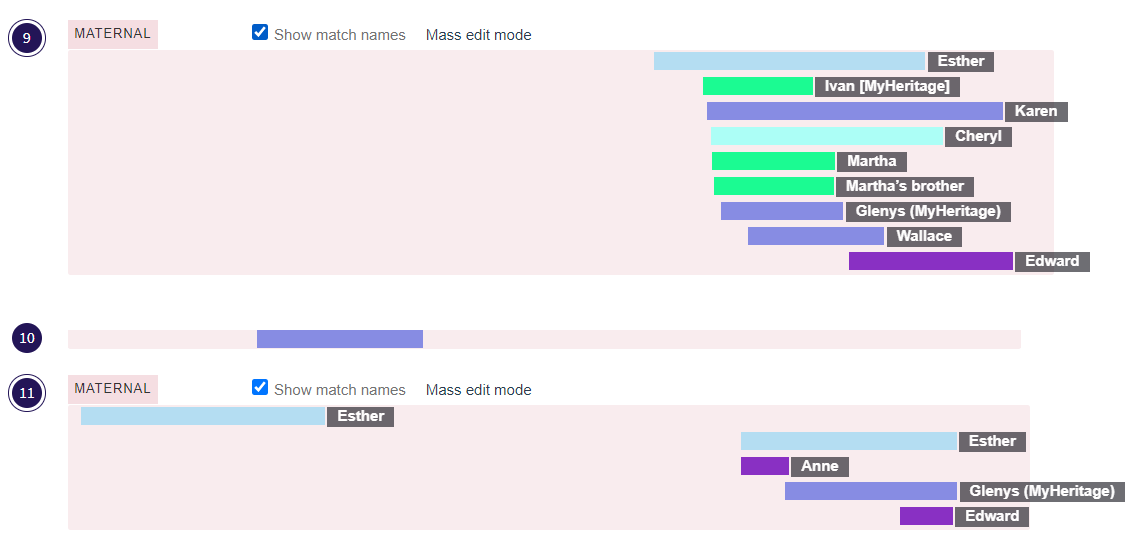
By default, I don’t think that DNA Painter will map Chromosome 11 as the match is 6.9 cM and DNA Painter has a 7.0 cutoff. That is sort of too bad because here is Marie’s Chromosome 11:

Marie’s matches with Esther, Anne and Edward are with ancestors on the Upshall side. But I don’t want to change the default either. Here is what the data looks like that will go into DNA Painter:

Unfortunately, Ivan’s areas of matches were already taken up with others for the most part. There was a small exception on Chromosome 1:

Here Ivan’s match with Marie in green was a little longer than Marie’s match with her half great Aunt Esther.

Marie’s Theory with James

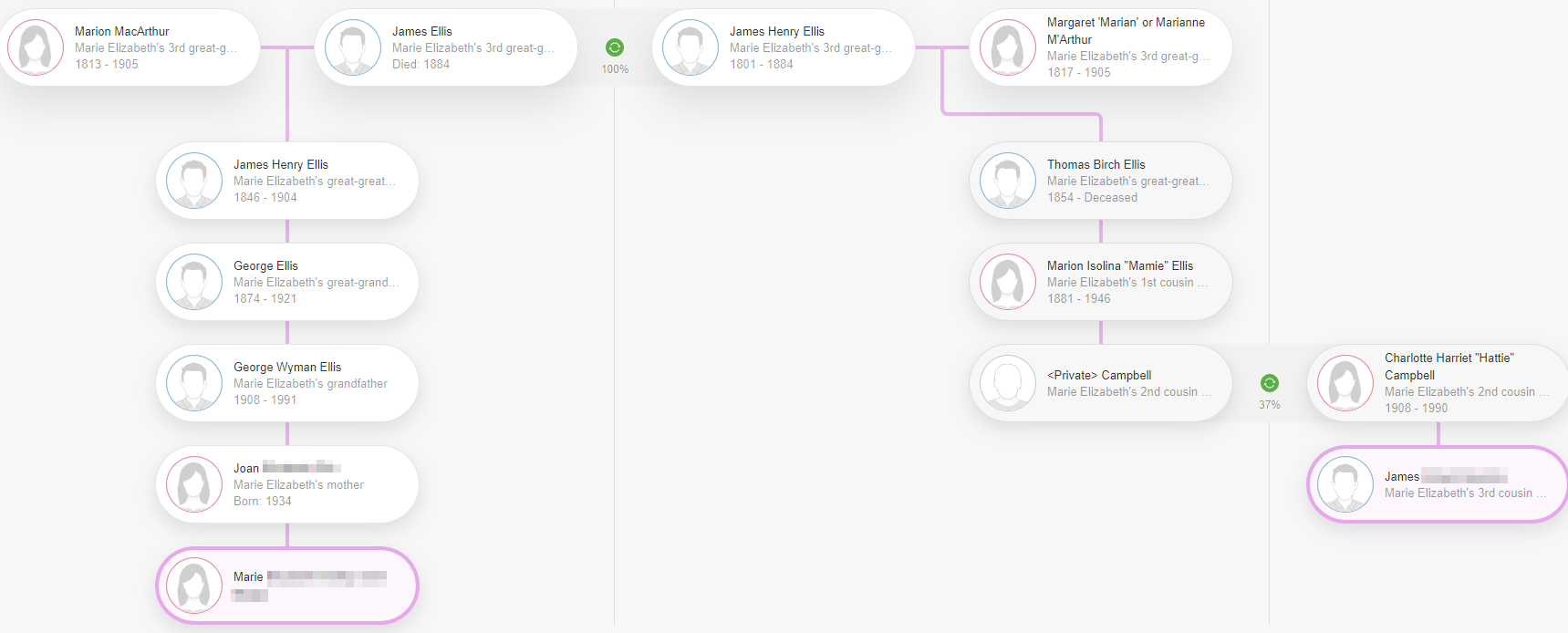
Here is what MyHeritage shows:

James Ellis and Marion (with variations) MacArthur (or McArthur) are Marie’s third great-grandparents. Marion MacArthur was James Ellis’ second wife:

I show Thomas Birch Ellis as James Heny Ellis’ brother so that is good.

I’ll paint this match onto Marie’s map:

The parts of James’ DNA matches that were over 7 cM were on Chromosomes 1 and 2. They are in Ellis regions. There is no overlap, so they constitute new unmapped areas for Marie. This gets Marie up a percent overall from 31% to 32% mapped. On Marie’s Maternal side, she went from 24% to 25% mapped. Progress. I see that Marie also matches Stephen who may be James’ brother. However, Stephen does not appear to add any more DNA than James added.

Marie and Glenys

Glenys shows as a third cousin to Marie:

MyHeritage has her descended from Alexander Upshall. The record I have for him says he died at a lunatic assylum:

Let’s map this match out using DNA Painter. DNA Painter gives a hint:

I’m not sure if this is helpful or not, but it seems like the bottom hint is right. Glenys’ matches with Marie on Chromosomes 9 and 11 are already taken up:

The match on Chromosome 22 is Marie’s first on her maternal side:

This small match is not enough to increase Marie’s percantages, but it helps.

Keep Going with Marie’s DNA Match Caroline?

Caroline is supposed to match Marie on the LeFevre/LeFebre Line:

The connection looks legit. LeFebvre is the older way of spelling LeFevre. Someone left out the b along the way. Hopefully the 1891 for the Charles in Caroline’s line isn’t for his birth as that would to make sense. 1841 would make more sense. At this point, I can either assume that Caroline has the right tree or check on it myself. As I’m feeling lazy today, I’ll just check the DNA to see if it is in the right vicinity.

Turns out I already have Caroline mapped. Here is her bigger connection to Marie on Chromosome 12:

That match is solidly in LeFevre territory, so the connection is likely right.

Marie and Alan

This time I’ll go right to the DNA:

Alan overlaps other DNA Matches except for Chromosome 13:

Alan also adds a new French Canadian common ancestor to Marie’s DNA match who are Joseph Methot and Marguerite Anger.

Marie and Edna

This could be a long Blog. I see that Marie has at least five pages of Theories of Relativity. Edna is Marie’s first Theory on Page 2.

Edna adds some old Christopher Dicks DNA from 1784 on Chromosomes 1, 9 and 12. Here is the connection:

I’m not sure if Planter is the right last name for Margaret. One problem is a DNA overlap on the Ellis side at the end of Chromosome 1:

It could be that Edna’s small match with Marie there is a false positive.

Marie and Marilyn

I think that I have been in touch with Marilyn before as I have done some work on the Dick’s Line:

Marilyn doesn’t add new DNA, but shows that the match Marie has with Esther and Anne goes further back than the 1870’s or 1812. I’m still trying to get Marie’s painted DNA up to 33% but I’m not there yet.

Marie and Andre

Now we are up the 5th cousin level for Marie. As you might expect, the match levels are smaller:

Andre adds a little DNA to Chromosome 15 at the end and gives older DNA bac to 1773 on the LeFevre Line. I’m still not up to 33% painted for Marie:

However, we have 200 segments painted.

Marie and David

This match goes back to Gorrill:

As I don’t see this couple in my DNA Painter Key, this must be a non-painted match.

David provided Marie’s first maternal mapped DNA match on Chromosome 14:

This match got Marie up to 1/3 painted or 33% overall:

That got Marie from 25% to 27% painted on her maternal side.

Reorganizing Marie’s Key

At this point, it would make sense to reorganize the Key in Marie’s DNA Painter Map. Right now I have a line separating Marie’s paternal and maternal matches. Marie’s four grandparents are Butler, LeFevre, Ellis and Upshall. I can organize Marie’s key that way. Unfortunately, I only see one Butler match right now.

The LeFevre matches I just organized by date.

Marie’s Ellis and Upshall matches split out more evenly:

I see a mistake as I left Richard Gorrill up with the LeFevre’s.

Marie’s match with Robert on the Ellis Line


Robert adds some new DNA on Chromosome 3 and gives corroborating evidence on Chromosome 4.

Nathalie: A Fifth Cousin Match on the LeFevre Line

I’ll paint in Nathalie’s DNA as I don’t want to take the time to check every tree:

Nathalie provides new DNA mapping for Marie on her Chromosomes 14 and 19. Now Marie is 40% mapped paternally:

Marie’s Progress Update

Marie has DNA mapped on every chromosome. However, she is missing paternal DNA on Chromosome 5 and 17 and she is missing maternal DNA mapped on Chromosome 16.

Marie and Charolette

I am a little suspicious of this match as there may be a connection on Charolette’s MacArthur side also.

So whether Marie and Charolette connect on the William Ellis Line, MacArthur line or both is a fine point. This could be resolved possibly by further looking into Charolette’s ancestry. Marie is now 34% mapped or painted overall.

Marie and Agnes

Marie and Agnes have several potential connections:

This is the closest theory, so I would go with this one. The other theories are further out:

I don’t show an Edward Rayner in my tree, but I do show that the John Rayner at the top of the tree was the son of Edward John Rayner, so it would make sense if he named a son after his father. Here is where Agnes sorts out on Marie’s map:


Marie and Barbara – Still at MyHeritage

I made a mistake with Barbara at DNA Painter. I put down that she descended from Ellis/MacArthur:

She actually descends from Ellis/Ramsay. That should be easy to fix in DNA Painter. I can edit Barbara in DNA Painter:

I thought that I had an entry for just James Ellis 1801, but I don’t. So I’ll create a new group.

I’m getting there, but it says that James Ellis is not a known ancestor. I need to change that. I go back to the edit section for Barbara and check the known ancestor box:

Barbara fills in some new areas on three chromosomes:

This is turniing out to be a long Blog, but I am getting a lot of mapping done.

Marie and Gilles

As expected, Gilles matches Marie on her French Canadian side. This is on her Fortin/Tremblay side where Nathalie matched earlier in the Blog:

Under Nathalie, the common ancestors were Eustache Jacquies and Marie Judith, but these must be the same ancestors. Gilles adds some more DNA on Chromosome 1. His matches on other segments were below the 7 cM threshold.

I changed the Fortin/Tremblay mapped color to light blue as the previous color was too close to the pink LeFevre color. This match with Gilles maps some older DNA from the latter part of the 1700’s.

Two Possibilities for Jason

I am leaning away from Theory 1:

My tree shows that Marie descends from John Rayner, not James Rayner. However, Jason and Agnes triangulate on Chromosome 4:

I had mapped Agnes to Rayner. I think I’ll skip Jason for now.

Let’s Try Richard

Richard is on Marie’s MacArthur/MacDougall Line.

Richard added DNA to Marie’s map in previously unmapped areas on Chromosome 1, 9 andd 17:

This finally gets Marie mapped overall up to 35%. If I mapped this right, Richard’s match to Marie on Chromosome 17 points out a crossover. The green and light blue are from Marie’s Upshall side and the dark blue is from Marie’s Ellis side. This shows about where Marie’s maternal DNA went from Upshall, then to Ellis and Back to Upshall.

Marie’s X Chromosome

I don’t think that MyHeritage covers the X Chromosome. That is covered at Gedmatch and FTDNA. Here are Marie’s X Chromosome matches at Gedmatch:

Marie’s top two matches are her Aunts. They would be too closely related to map. The third match has a large X Chromosome match, but no autosomal match, so I would not be able to locate that match at Ancestry.

Marie and Lise

The fourth match is with Lise at Ancestry. Perhaps I can find her. I found someone who looks like Lise at Ancestry, but she does not have a maternal line given.

Marie and Muriel

After some dead ends, I came across Muriel. She is at Ancestry and Gedmatch and shows a common ancestor:

Here is where Gedmatch shows the X Chromosome (or 23) match:

This mapping was in a previously mapped area with Marie’s 2nd cousin. It does show that this is old DNA going back to the early 1700’s if Ancestry is right:

I also added Muriel’s matches on Chromosome 14:

Although I didn’t add much new information, I did show that I could add X Chromosome information.

Marie’s New Chromosome Mapped Update


Summary and Conclusions

  • My primary goal for this Blog was to update Marie’s Chromosome Map which I did.
  • The secondary goal was to get Marie at least 33% mapped and I did that also. I was able to get Marie mapped overall from 31% up to 35%
  • I also looked into Marie’s X Chromosome but that was more difficult as MyHeritage does not include information on the X Chromosome.
  • I also improved Marie’s Key and changed some of the colors on Marie’s map

Updates to My Children’s Polish Jarek Genealogy and Beyond

Recently I have in touch with a few people over a previous Blog I wrote. Actually there was more than one Blog:

  1. NOVEMBER 26, 2018 – Some Genealogy for my Children’s Maternal Side: Jarek and Cavanaugh
  2. NOVEMBER 26, 2018 – My Children’s Maternal Genealogy: Part 2 -More Poland and Jarek
  3. JANUARY 18, 2019 – Heather’s Jarek LIne At AncestryDNA
  4. NOVEMBER 18, 2019 – My Childrens’ Polish DNA and Genealogy

The first contact I had was from Laurie. She commented on my Blog #2 above. She is apparently a second cousin of my children. I see that my son JJ is a 2nd cousin by genealogy and DNA to a Roger:

Laurie is also on the Walter Jarek Line. Laurie has done a lot of research and has found that the marriage record for Francis’ wife at the top of the tree may be wrong concerning Antonina. According to Antonina’s marriage record from 1905 in Lowell:

This shows that Francis (or Frank) and Antonina were both born in Austria (today’s Poland). Antonina’s mother is listed as Agnes Letkowicz. Here are Frank and Antonina presumably on their wedding day:

I have that Antonina was 16 when she married. Frank was 26. The photo is quite interesting. It is likely that there are other Jarek and Wozniak relatives in the photo.

This is the 2001 letter that Laurie got from the Polish archives concerning Antonina:

I thank Laurie for taking the time to get this information. There is actually quite a bit of information in this documet. For example, the Godfather was Marcin Lekiewicz. Same surname given as Antonina’s mother in her marriage record. As Laurie pointed out in her email to me, this record also gives the parents of Antonina’s parents. It turns out that this information will correct a mistake I have in the Jarek tree and fill in some blanks. This is what I have now:

Here is my interpretation of Laurie’s letter from the Polish Archives:

My guess is that Polish is one of those languages that the female surname and male surname could be spelled differently. Hence the Dziuria for Weronika and Diuria for her father. I see I have the wrong birth date for Weronika. I’ll have to fix that later.

More on the Jarek Family in Poland from Laurie

Laurie also sent me this document:

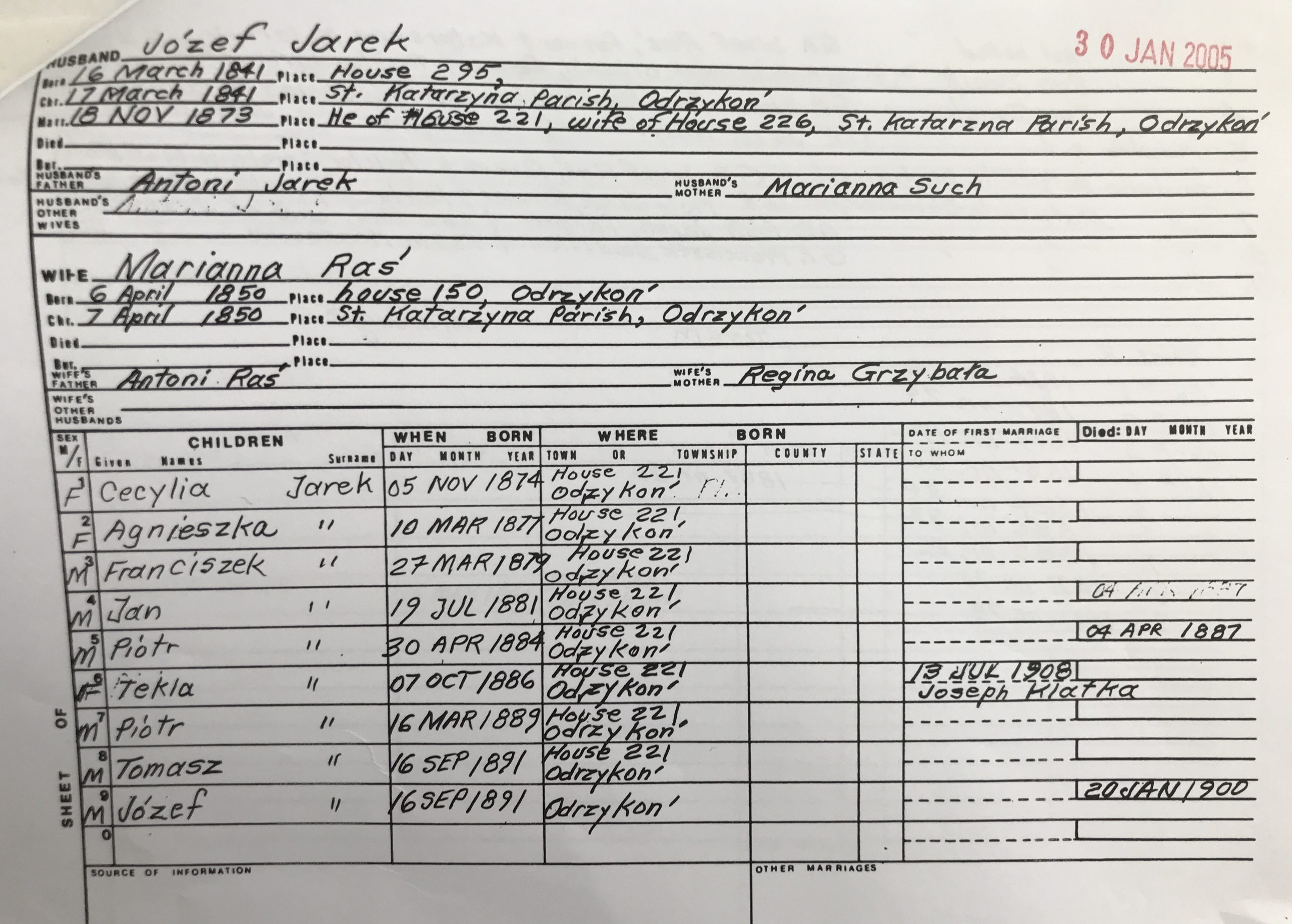
This fills in some of the blanks on the Jarek family. This appears to be a church record or a type of census. I know about Cecylia as she was also in Lowell:

This is my daughter’s DNA match to the Matusik Line through Cecylia. The Jarek family in Poland had 9 children. It appears that 3 died young leaving 6. One married in Poland. However, the death date written for Jan is lighter, so I don’t know if that is right.

Back to the Wozniac Family

Laurie also sent me this:

Here Jacek is back to Jacenty. At the top, there is even a Jacentego. This probably all makes more sense if you are from Poland. This appears to be the marriage of Jacenty Wozniak and Weronia Dziura and includes their children. It looks like Jacenty had all girls. Perhaps other immigrated to the US. I wonder what the j.w. means after Antonina. The note appears to indicate that the records they were looking at ended in August 1889. However, I already have the detailed sheet on Antonina from Laurie earlier in the Blog.

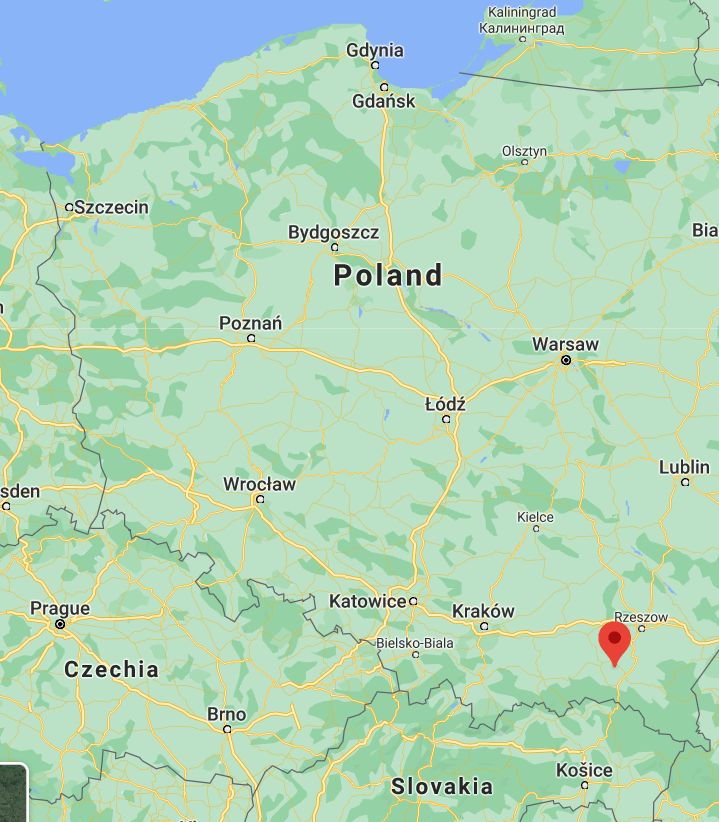
Jedlicze is about three miles from Odrzykon:

The general area of these places is Southeast Poland:

I’ll add the information to my Ancestry tree from the paper above. I see that Jacenty was 24 and Weronika was 21 at the time of their marriage. As they married in January, I’ll assume that they turned 25 and 22 in 1883. That means that Jacenty was born about 1858 and Weronika 1861. This family apparently lived in the Northwestern part of Jedlicze:

Francis Jarek’s Baptismal Record

Finally, I have this from Laurie:

This is a detailed baptismal record as it gives Franciszek’s parents and grandparents.

My Childrens’ Polish Connections with Bill at Ancestry

I tested my childrens’ DNA at Ancestry and have been in touch with Bill. Bill and I have been corresponding since June 2009. In January 2020, Bill wrote:

I found our link!! After recording baptism, marriage and death I found at least on match! Blecharczyk, Valentine 1762-14 NOV 1820 married Sobon, Regina 1763-18 OCT 1821 Regina the daughter of Michael Sobon dom 142, 1729-27 JUL 1821. Their daughter Catharina married Jacob Was, Matusik line Their daughter Maria married Stanislaus Dudek, Wolfendale line

I got back to Bill and found out that the Was above was an autocorrected Ras as I had guessed. Unfortunately, Bill is a bit beyond me in his Polish genealogy. I’m not sure how this fits in with what I have. As a hint, Bill wrote:

so the Ras-Blecharczyk, their son Ras-Grzybala, their son Ras-Jarek,

Then most recently in January 2021, Bill wrote me:

You have an incorrect marriage in your tree 1843 November 21, dom51 150 Antonius Ras Jacobi et Catharina de Blecharczyki conj. cmethonum in Odrzykon filius catholic 23 single Regina Grzybala, Thoma et Anna de Galuszki conj. cmethonum in Odrzykon filia catholic 18 single

This must be where I went wrong. This message from Bill seems to indicate that Antonius Ras was the son of Jacobi and Catharina Blecharczyki.

Ras/Gryzbala

Here is what I have in my tree now:

If Antonius was 23 and the end of 1843, I’ll say he was probably born about 1820. I previously had this for Antoni:

However as I don’t know where I got that, I’ll go with what Bill has. Or, Antonius’ age at marriage could have been off also. Here is my correction:

I’ll keep the parents I had for Regina Grzybala as it seems like I was on the right track there.

Putting it Together

Normally I would put a tree together in Excel to see how these all fit together. But apparently I have already done that. Let’s see if it is still right:

That’s odd that I had created a tree about a year ago, but never made the correction on my Ancestry Family Tree. This is interesting because it shows how far back the connection is with Bill. I would not be surprised if there were other ways my children might connect with Bill. For example, the Such name sounds familiar:

The immigrant Francis Jarek’s mother was Marii Such. Perhaps there is also a connection with Bill through his 2nd great-grandmother Katarzyna Such.

It would be possible to expand the Francis Jarek Line on this tree. Here is what Ancestry shows for ThruLines:

ThruLines show DNA connections where there are also genealogical connections on paper. This is the view from my daughter Heather’s perspective. She has 6 matches on the Walter Jarek Line where Laurie is. One good thing in my improving my children’s tree is that Ancestry should be able to make better ThruLine connections similar to the ones above. Ancestry hasn’t figured out the connection that Bill has found yet.

Summary and Conclusions

  • Due to my ignorance in matters of Polish genealogy, I have depended on Laurie and Bill to correct and augment my children’s trees. As Blanche Dubois once said, “I have always depended on the kindness of strangers”.
  • I’m sure life was difficult in Poland. People don’t leave their homeland when times are good. A more thorough review would have looked at the history of Poland at the time.
  • By filling out the Jarek Line with their ancestors and relatives, I should be able to make more DNA and genealogical connections at AncestryDNA and elsewhere.


A Tale of Two Mayflower Descendant Applications

For quite some time I have been of two minds as far as applying to the Mayflower Society. On the one hand, I already know I descend from several travelers on the Mayflower, so why should I pay someone to affirm what I already know is true. On the other hand, my friend Gary was thinking of joining, so that sort of tipped the scale for me. I wrote about Gary’s descent from the Mayflower last about a year ago. As you may guess, Gary is the second application referred to in the title of this Blog.

My Application

From what I read, approval of you being in the Mayflower Society is through the State Association. In my case, that is Massachusetts. The State Society is in Hingham and the National Mayflower Society is in Plymouth. I’ve been to the Plymouth Mayflower Library and bought books there, but I’ve never been to the Hingham Office. I called Hingham and the woman there wanted to know if I was sure of my Mayflower ancestry. I said I was. My White ancestor came to Rochester MA in the late 1600’s and my ancestors have lived there since. Plus, Rochester has tended to have pretty good records.

The woman emailed me an application and reminded me that I needed to send in a check with my application. Here is the relevant part of the application with some blurring of the living people:

I would have cost me $75 more for a Mayflower Lineage Match, so I skipped that step. I didn’t hire a genealogist, but I have my genealogical information at Ancestry and I have my own web site.

What Happens Next?

Here is what I found at the Massachusetts Society of Mayflower Descendants web page:

Application Process

This page describes the procedure for adult members. For Junior Members click here.

If you have identified a lineage from a Mayflower passenger to you, and have some evidence that it is correct, we invite you to proceed with a Preliminary Application Form. To make your application process as efficient as possible, and reduce the potential of unnecessary expense we recommend waiting until you receive your personalized worksheet and instruction guide before obtaining additional documentation.

Your application goes through a process on the journey for you to become a member. The average time for candidates is eleven months, but it can be as short as six from this office’s receipt of your application to your being mailed the acceptance of your membership.

First you obtain your preliminary application form. It can be mailed to you, emailed to you, or downloaded from this website. Fill it out completely and return it with a check for the appropriate amount for the options you have chosen for membership. Don’t forget to sign the application. Please do not submit documentation at this stage.

During the application process, the Historian will return a worksheet that details what is known about your lineage after researching in our library and membership files in the Massachusetts Society, and the General Society. If further primary documentation is needed, there will be bolded comment in the references section of the worksheet. This indicates that you will need to provide more documents to support that claim (of birth, marriage, or death).

This says that to become a member, it takes an average of 11 months. I assume that means that review of my Preliminary Application will be within a month or so. The last paragraph above is interesting. The Historian will send me what is known about my line already. I do have probably over 100 2nd cousins. Maybe one of them has already applied. I like the idea of finding out what research has been done on my line so I don’t have to duplicate the effort.

Once I hear from the Historian:

This is the time when you will personally research any gaps remaining on your application. When you are ready to return your documentation to support the items in bold, you do not need to send in a copy of the worksheet as we will have one here. Legible, unmarked copies of the requested documentation should be submitted via postal mail at this stage of the process. You also have the option of scanning your documents, and sending the digital images as attachments. Please remember to include your name in either a mailing or an email.

The Historian will review all the documents you have supplied. If further documentation is needed, the Historian will email a revised worksheet with the remaining issues highlighted. There may be an explanation of the different steps you can take to solve the problem areas. Please feel free to call or email with any questions you might have (anytime during this process). Just remember that the Historian is only in the office two days a week.

Once all the documentation has been received to the satisfaction of the Historian, you will be mailed a copy of your “final” application form on acid-free paper. At this point you are allowed to jump up and down for a few minutes of course keeping your fingers crossed. Please sign the form in black ink on the first page. Do review the document one last time to make sure there are no typographical errors. If you find one, on a separate piece of paper, (do not write on these final forms other than your signature), write out the correction you feel needs to be made and the Historian will deal with it when your final papers are returned. Include any fees outstanding as noted on the letter accompanying your final application.

When your signed final application is returned, it will be forwarded to the Historian General in Plymouth, Massachusetts, where the application will be reviewed one last time. The Historian General has the final say over what is approved. This review process takes about thirteen to fifteen weeks.

When it is approved and returned to the office, our Historian will mail you a certificate, a membership card, and a copy of your final application as approved by the Historian General. Congratulations! 

I suppose that this is what takes the six to eleven months. Fortunately, I do not live far from the Rochester Town Hall. Also, hopefully the person in charge of the records there will be understanding.

Why I Chose White for My Mayflower Application

I am descended from many of the original Mayflower travelers. My more recent line is Bradford. My great-grandmother’s mother was a Bradford. However, the records are not so good for that line. Many of these early Bradfords lived in Plymouth up to Harvey Bradford. He moved to Wareham, and then apparently to Rochester. My connection is through land records rather than vital records. It is possible that should I join the Mayflower Society, I could submit a Supplemental Application for my Bradford Line for a mere one-time fee of $200.

The records down from White on my line are pretty complete. I even know about where many of these ancestors lived within the Town of Rochester, Massachusetts where I grew up.

Mayflower Database

Here is something I didn’t realize. A lot of the Mayflower Descendant Applications are supposed to be online.

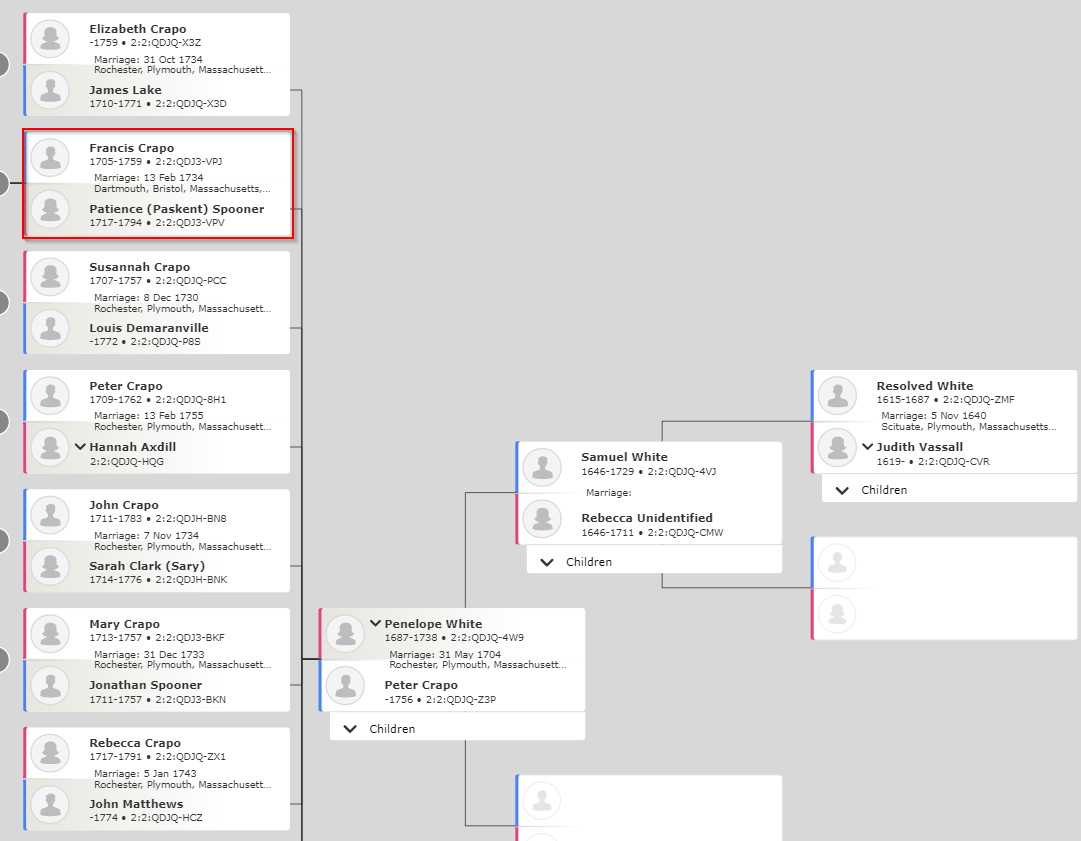
This is a FamilySearch article. I looked up Penelope White and found a tree:

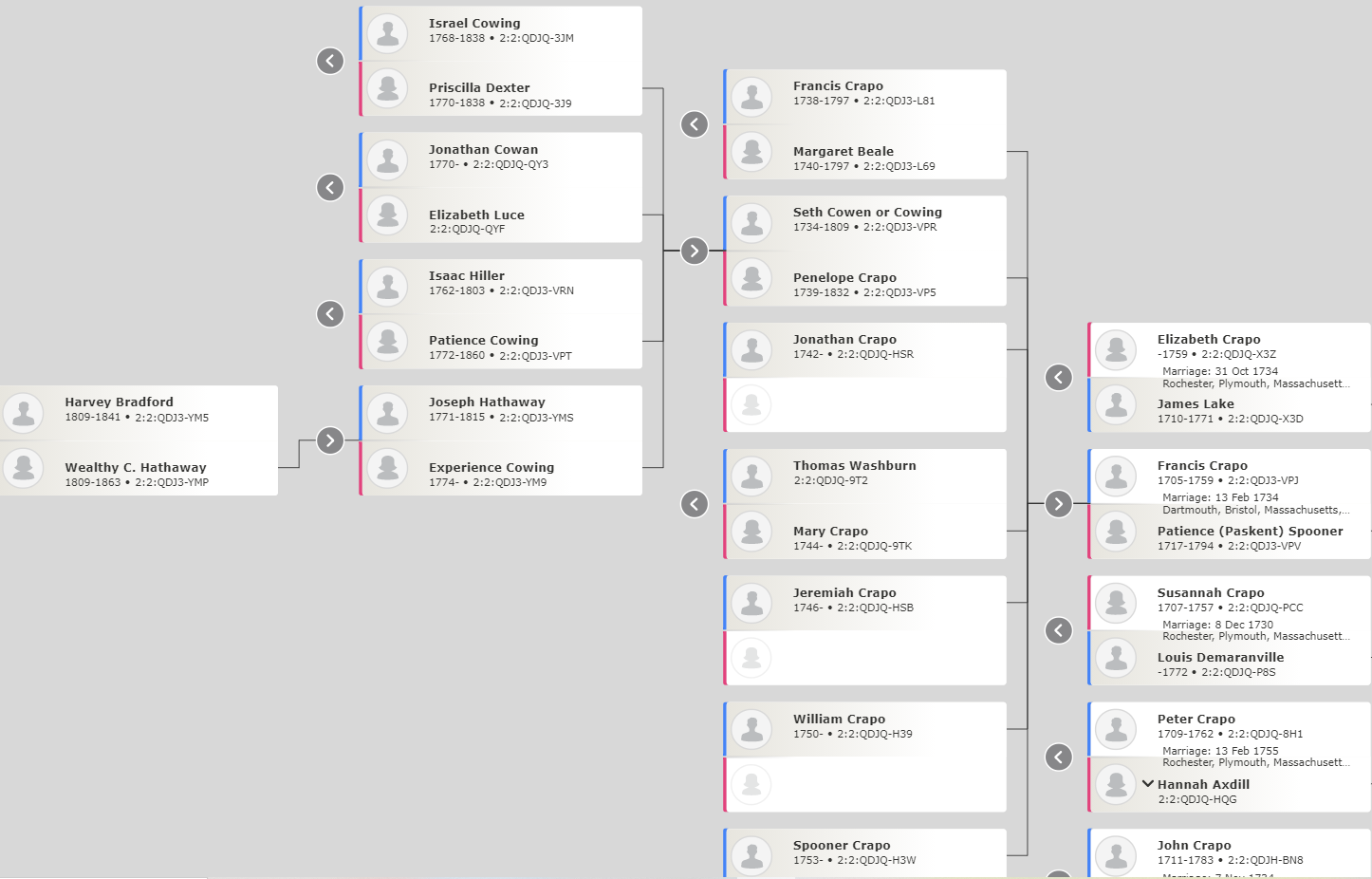
I put a box around Francis Crapo, my ancestor. I don’t know what all the letters and numbers are for. I suppose they are numbers from the Mayflower Society. From there I can get out to Harvey Bradford:

Let’s take this all the way out:

This ends at Ralph Gurney and Annie Hartley. These are people I remember, so that is interesting. Their children were/are my father’s 1st cousins. So I assume that there is someone in the Gurney family who is/was in the Mayflower Society. I called my Gurney 2nd cousin who used to work at Plimouth Plantation, but she did not know of any of her relatives who were members of the Mayflower Society.

Update from the Massachusetts Society of Mayflower Descendants (MSMD)

I received this email today as I was writing this Blog:

We have received your check and application for the William White line, and have entered both in our process. Due to the back-log caused by the quarantine, it is taking a little longer, but you will receive a worksheet from our  State Historian with instructions for the submission of your documentation.

In the meantime, you could gather two COPIES of your birth certificate- long form showing parentage; 2 copies of your marriage certificate [if applicable] and two copies of your spouse’s birth. The General Society also requires these same documents for your parents, and death certificates [if applicable].

We look forward to working with you.

That is something to think about. My mother was born in Philadelphia and married in Pennsylvania. This could be more work than I thought. I suppose my marriage certiicate has to do with if I want to include my children.

Gary’s Application

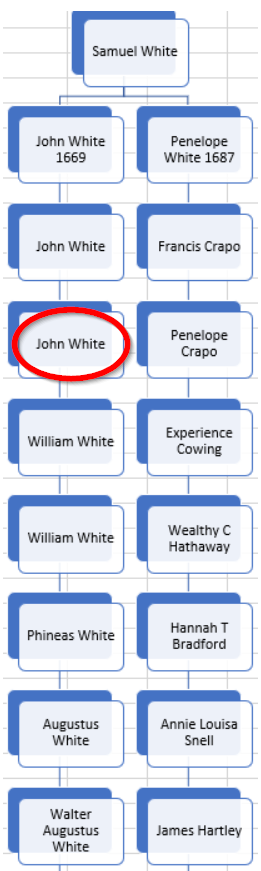
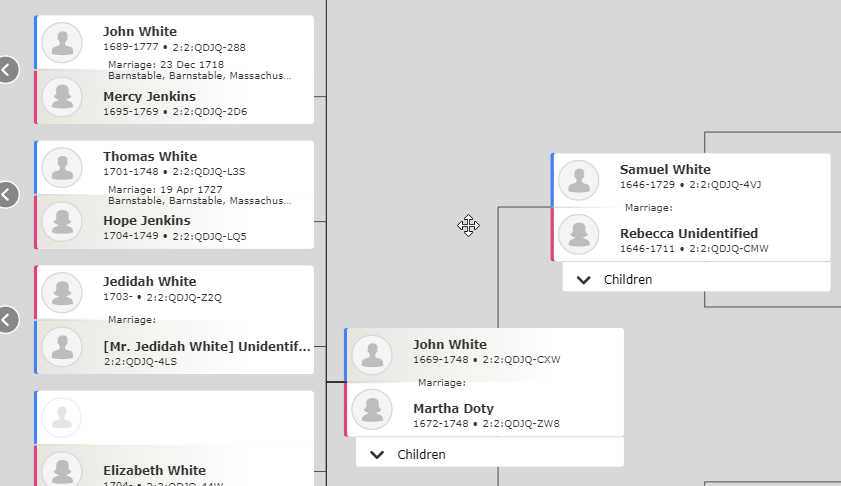
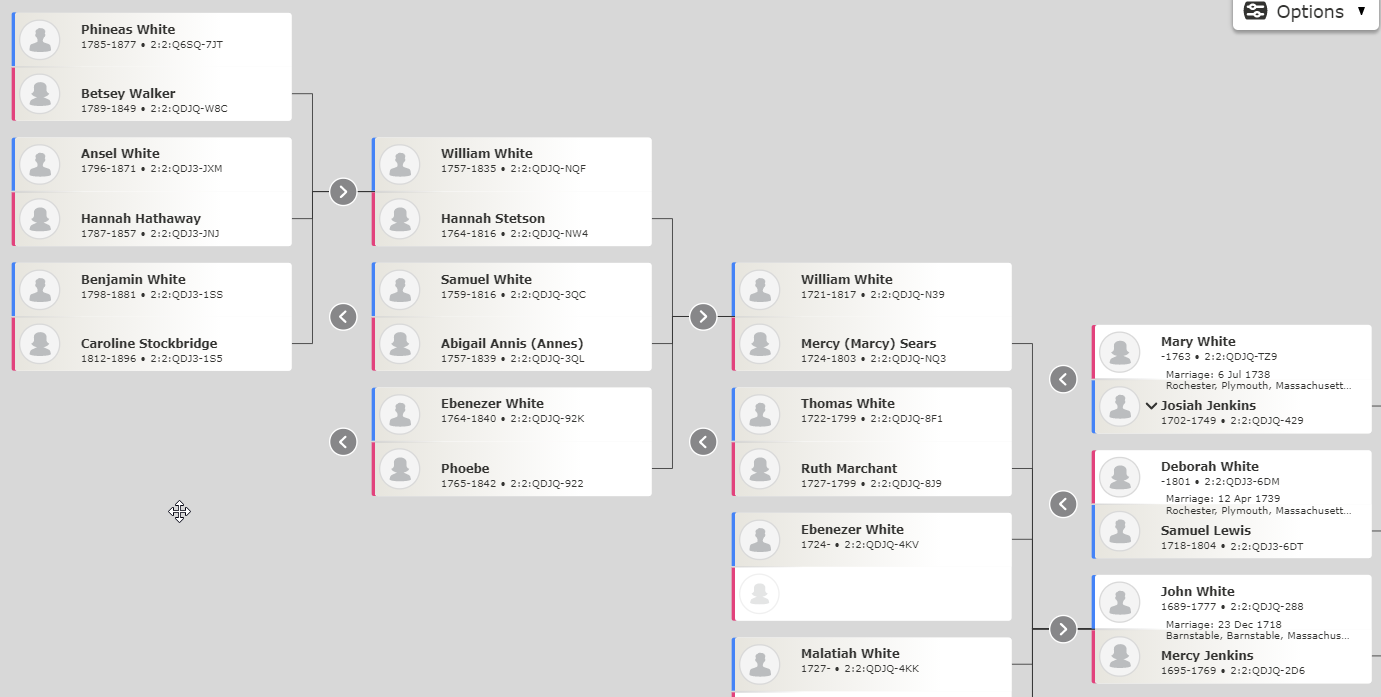
Gary’s application hit a snag. Even though he is descended from William White, the research since about 1996 has brought this into question. Here are our two White lines:

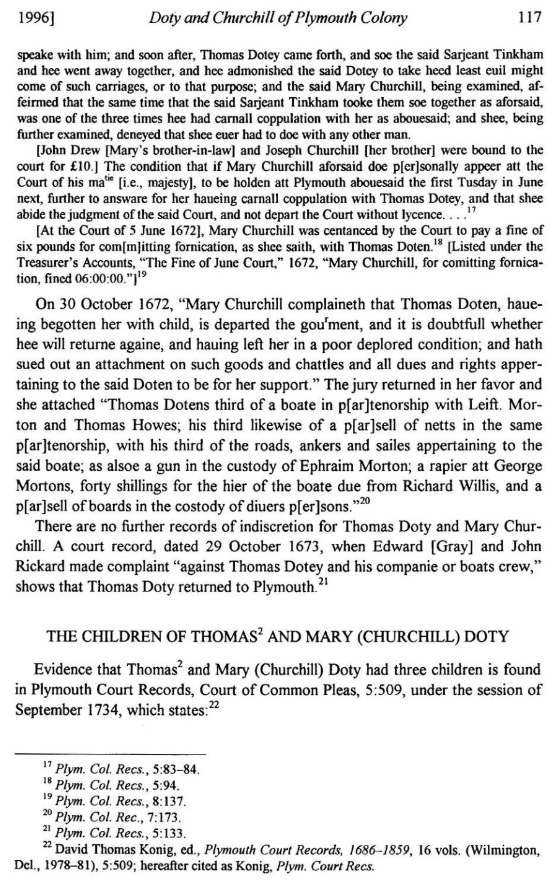
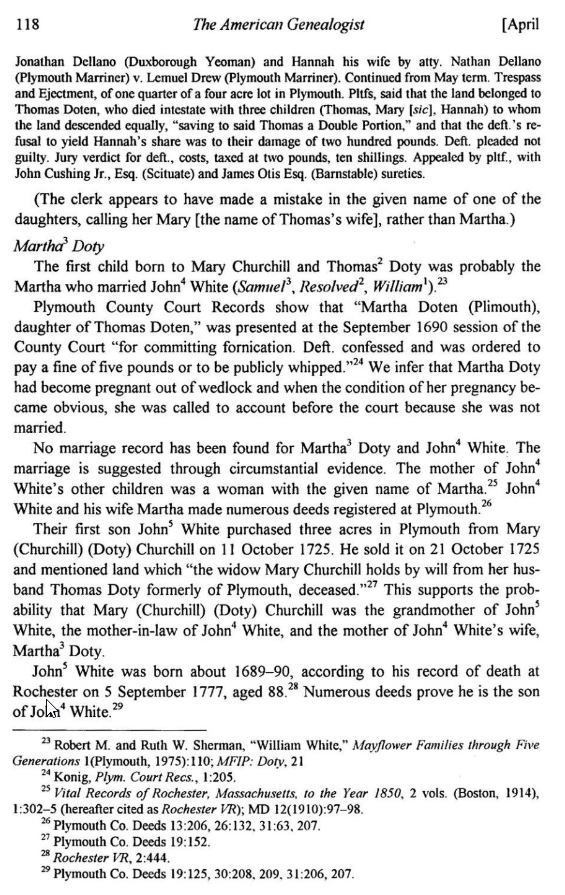
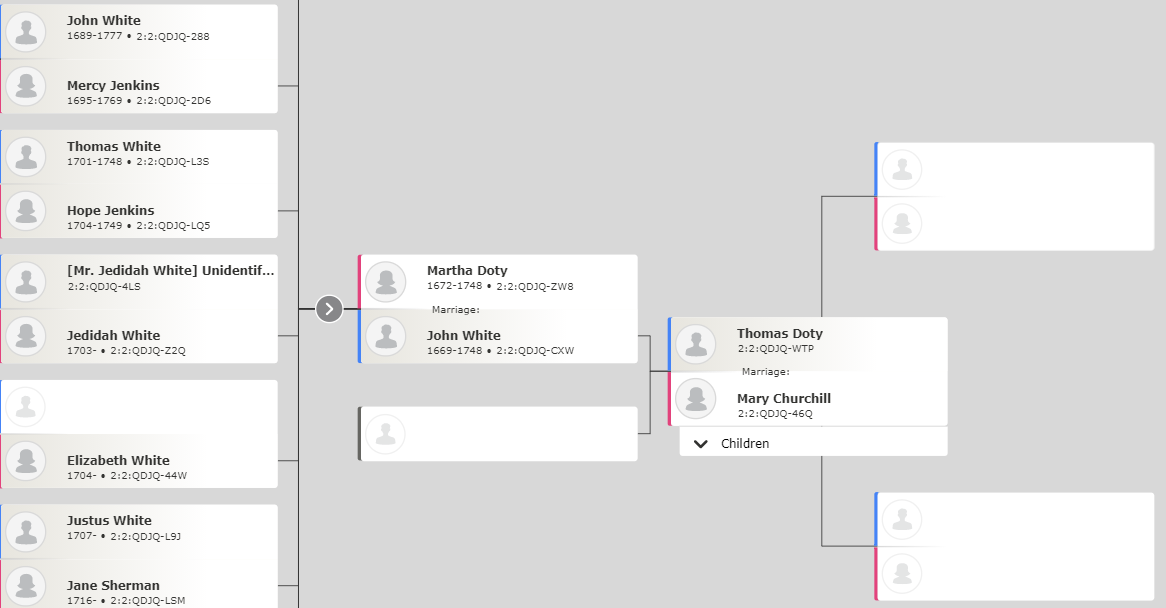
The John on the left who is on Gary’s line is now thought to be illegitimate. John’s mother was likely Martha Doty. Here is a record from 1690:

Usually someone confronted with fornication had given birth. In this case, as the father was not named, it is assumed that Martha Doty/Doten did not offer that information. Further, it appears that Martha herself was born outside of marriage. According to the April, 1996 edition of The American Genealogist,

That makes me wonder if there were those who were admitted to the Mayflower Descendant Society before 1996 on the John White Line who were later found to not be from the William White Line.

That means that this appears to be Gary’s Mayflower LIne:

Mayflower Records at FamilySearch

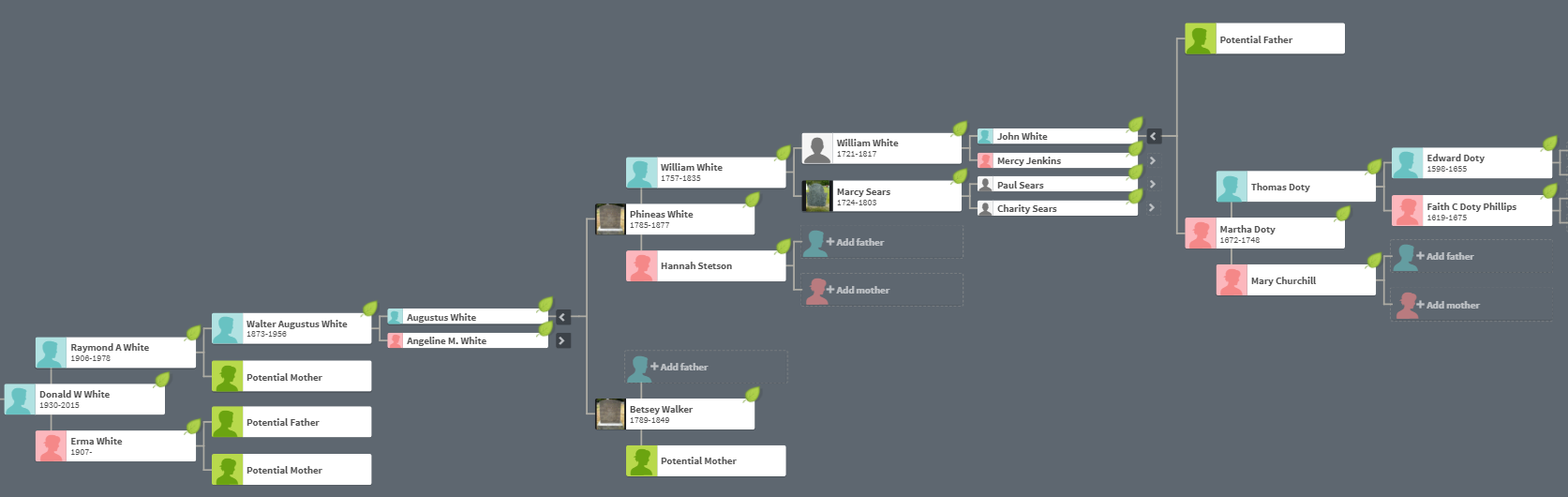
Above, I traced a line that was close to mine. Are there Mayflower Lines that are close to Gary’s? First, I’ll check through Gary’s ancestor John White:

This does show that John White born in 1689 was the son of John White and Martha Doty. However, if this was right, John White Sr would have been 20 and Martha 17. Plus, the arguments against this being the case are pretty good. I assume that this was from an old tree before it was discredited. I’ll take this down Gary’s line:

This brings us from right to left over to Phineas born 1785.

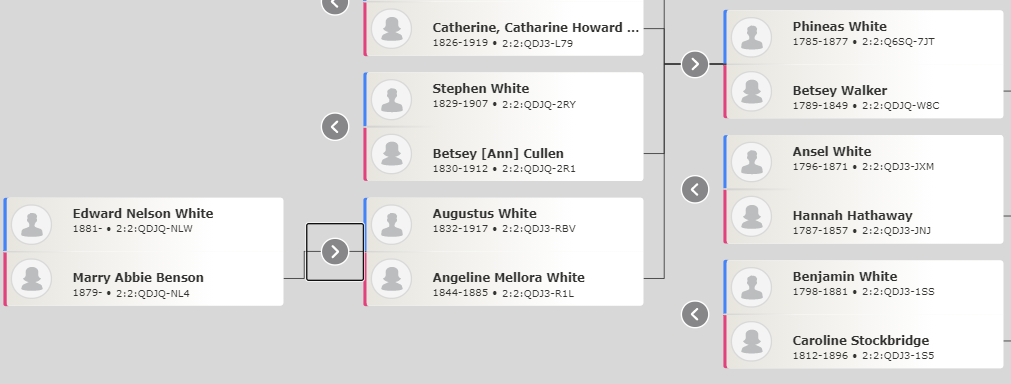
Gary’s line goes through Augustus White to Walter White. Walter must be the brother of Edward Nelson White where the tree ends. These trees end at 1910, so it makes sense that the tree ends with Edward White born in 1881.

I could try Martha Doty, but that line would end at the same place.

Gary’s Doty Line

The Mayflower Database has some blanks when I do a search for Thomas Doty:

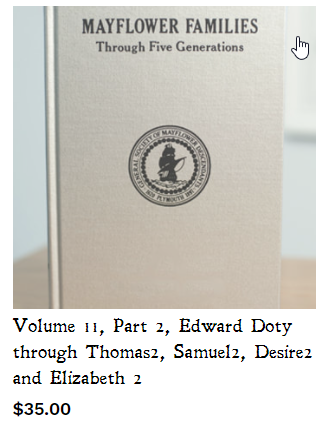
I’m not sure what a blank box means. It appears that there are three parts to the Edward Doty Mayflower Families. Thomas would be in Part 2:

It would be interesting to see what this book says. This book came out in 1996 – the same year The American Genealogist article came out that I mention above. The online book at American Ancestors does not show all pages. It starts with page 72 at the fifth generation. Page 73 has one of Gary’s ancestors:

It could be that these books are available at libraries that are not too far away.

Gary’s YDNA

If Gary has an unbroken line to William White from the Mayflower, then a YDNA test should show that. YDNA tests changes on the male line only. That is, father to father to father all the way back.

The Mayflower Society Project is one of Family Tree DNA’s (FTDNA’s) projects:

The White portion of the project is small:

However, the first tester has proven lineage to William White, Mayflower Passenger. It would have been better if this person had taken the BigY test, but they did take the STR test. The STR test is less definitive than the BigY test, but comparison to the combination of the tester’s STRs should be able to prove or disprove relationship to William White. It is easier to prove than to disprove with the STRs. The R-M269 is a very broad Haplogroup. It’s age is from 4,000 to 10,000 years old according to Wikipedia.

Apparently, whoever runs the project felt that the other two Whites beneath the proven White had a close enough match to the proven White to also descend from William White of the Mayflower.

Here are some of the comparisons of White markers:

The third row is the mode of the three testers. Changes from the mode are highlighted in pink or blue.

Summary and Conclusions

  • I don’t foresee any issues with my line to Mayflower William White. I’ll keep plugging away with my birth, marriage and death certificates until I hear further from the Massachusetts Mayflower Historian
  • Gary had a bump in the road with his direct line to William White. He could apply to the Mayflower Society under Doty, but he would rather apply under White
  • Gary has ordered a YDNA test which could prove or disprove that his ancestor John White was the illegitimate son of Martha Doty.


A 23andMe DNA Match with My Daughter’s Namesake

I recently was contacted by a DNA match at 23andMe and she had the same name as my daughter. As 23andMe gives birth dates, I knew it was not my daughter but a second cousin of mine who was born before my daughter. As my great grandparents had 13 surviving children, I have a lot of 2nd cousins.

Heather’s DNA Match

Heather and I have a large DNA match. Heather shot to the top of my 23andMe match list:

Heather shares more than twice the amount of DNA with me compared to my other 2nd cousins at 23andMe. This had me concerned at first as I originally thought that Heather was a 2nd cousin once removed. At that level, her DNA match with me would have been off the scale. This had me going back to my online genealogy to check where Heather was on the family tree:

This tree shows my Hartley second cousins who have tested for DNA at different companies. I am missing some testers. I know there are more under Grace Hartley and I didn’t include my children or nieces and nephews. There are also other lines I have missed, so I should update this tree.

Heather is on the Greenwood line:

That brings me to a match with Heather who is two generations closer to Greenwood Hartley compared to Charles.

Heather Shares About as Much as DNA with Me as Possible:

The 7.84% DNA that we share is 584 cM. Blaine Bettinger has a shared DNA project. He gets people to tell him how much DNA they share with each relationship and he puts that in a chart:

When I thought that Heather was my 2nd cousin, once removed, I thought that something was wrong as our match would be off that chart. As it is, our match of 584 cM is very near the top reported 2nd cousin match.

23andMe Thought That Heather and I Were 1st Cousins

That was a bit of surprise. I suppose that was based on average shared DNA. But your mileage may vary as the saying goes. Here are some more numbers from the Shared cM Project:

Based on that study, our DNA match would indicate that we would be closer to 1st cousins once removed. Here are my two first cousins and three first cousins once removed at Gedmatch.com:

The first two in the orange box are 1st cousins on my mother’s side. The second three are 1st cousins once removed on my father’s (Hartley) side. The last is the highest 2nd cousin match at Gedmatch. That means that Heather at 584 cM has a higher match than my three 1st Hartley cousins once removed. These are my father’s cousins. I find that interesting.

The DNA that Heather and I share is from our two great grandparents. They are James Hartley and Annie Snell. Here they are with some of their children:

In fact, roughly half  of Heather and my shared DNA is from James Hartley and half is from Annie Snell. It is possible to figure out exactly which is which, but it takes matches with descendants of older common ancestors to figure that out. I’ll give a few examples later in the Blog.

23andMe Family Tree

23andMe has a Family Tree. They try to figure out your tree by the DNA, but that isn’t always precise. So they want you to add known relatives to that tree. Here is my tree:

Normally a family tree would have the paternal ancestors on the left, but this one does not. My Hartley ancestors are in blue on the right. Here is more of a close-up of the Hartley side:

One, person, DL, I don’t have matched up to a named line. Heather is on the Greenwood line and her father is Sonny’s brother. You don’t know the players without a program. My line goes off to the left where it matches up with my mother’s ancestors. It took a bit of trial and error to get Heather into the tree correctly at 23andMe, but I have her now:

This shows that Heather is 1st cousin to my 2nd cousin Woody.

DNA Painter

I have my Chromosomes painted or mapped by my various matches. I’d like to see if Heather adds any new information to that map. I already have a lot of Hartley 2nd cousins mapped. Here is what I have mapped so far:

My paternal DNA is on the top row of every chromosome and my maternal DNA is on the bottom row of each chromosome. The predominant green is where I would match Heather as that color represents James Hartley and Annie Snell our common 2nd great grandparents.

This shows up better when I choose my paternal-only side on the Painter:

It would be easier to say which chromosomes that Heather and I share no Hartley matches on. Those are Chromosomes:

  • 6
  • 17
  • 18
  • 19
  • 21
  • 22
  • X

Part of the reason that I may not have Hartley on a chromosome is that my chromosomes may have recombined or not recombined more likely to exclude Hartley on a certain Chromosome. The only two choices on my paternal side are Hartley or my father’s mother who was a Frazer. So if I got all Frazer DNA on a particular Chromosome, I will not have any Hartley matches on that Chromosome. I would not match Heather on the X Chromosome because men only recieve one copy of that Chromosome from their mother. That means I have no Hartley X Chromosome DNA. Heather doesn’t really have any Hartley X Chromosome DNA either. She did get an X Chromosome from her father, but that X Chromosome was the same that he got from his Gifford mother. So she got Gifford DNA from her father on the X Chromosome, not Hartley.

Right now I am 45% painted overall and 53% painted on my paternal side. I’ll see if Heather adds anything or if I am already maxed out. Here is the data I need for DNA Painter:

One interesting thing I see already is that my match with Heather starts at position 1 for Chromosomes 2, 4, 13 and 15. That would be right at the start of these chromosomes. I already have a match painted at or close to the beginning of Chromosome 2, but not at the beginnings of Chromosome 4, 13, and 15. That is encouraging.

I choose, “Paint a New Match”.

I refreshed my percent painted:

This shows that I am up to 47% painted now overall or an increase of 2%. I also added 17 segments from my match with Heather. However, I’m sure a lot of those segements are overlapping other Hartley/Snell matches.

On my paternal side I am now at 56%. That is a increase of 3 percentage points or quite a bit at this point in my mapping.

Here is my new green Hartley/Snell mapped DNA:

One interesting thing is that the Hartley side is filled up now on Chromosome 13. Here are my second cousin matches on Chromosome 13:

I kept the names out for privacy, but Heather is the match at the top. I have also mapped my DNA to my 4 grandparents. My guess is that my Chromosome 13 is all Hartley. I need to find my Blog on Chromosome 13. Back in November 2018, I mapped out my Chromosome 13 and that of my 5 siblings:

This was one of the easiest chromosomes to map because there were not many crossovers. The crossovers are when you change in your chromosome from the DNA you got from one grandparent to the spouse of that grandparent. I am in the third row above and I have all the same paternal grandparent (Hartley) and the same maternal grandparent (Rathfelder). That means that it was not unexpected to have my Chromosome filled in with green Hartley DNA on the DNA Painter that I mentioned earllier.

So in the example above, if Heather uploaded her DNA to gedmatch where I have my siblings’ DNA, she would not match my brother Jim on Chromosome 13. That is because Jim got Frazer DNA in the first part of his Chromosome 13 where Heather matched me. Heather would match Jon and Heidi as much as she matches me. For Lori and Sharon, Heather would match on Chromosome 13, but not as much as she matches me as she would be matching in different/fewer regions.

Heather’s Older DNA

The DNA that Heather and I share came down from James Hartley born in 1862 and Annie Snell born in 1866. I mentioned earlier in the Blog that it should be possible to identify some older DNA. That can be seen at DNA Painter. The first example I see of this is in Chromosome 4:

On this Chromosome, Heather matches me at the beginning and end of the Chromosome. In the middle, I have some matches from my Frazer side. In yellow, I have a match with Anne whose ancestry goes all the way back to Abraham Howorth (or so we believe). This DNA goes all the way back to 1768. The Howorth family lived in Bacup, Lancahsire, England:


Beth, Jim and Joyce didn’t match Ann on Chromosome 4, but they did on Chromosome 8. When that happens, we call that triangulation which is a sort of check that the DNA really did come from where we think it did. In this case, Heather would extend that triangulation to Chromosome 4. If Heather  uploads her DNA to Gedmatch, she would likely match Ann through their common 4th great-grandparents.

Chromosome 9

An example of identified Snell DNA is on Chromosome 9:

I left out the names, but my match in blue is Celeste. Her ancestors were Otis Snell and Mary Parker. My match with Heather is right above the blue match. That means that Heather likely matches Celelste also.

Here are Mary and Otis:

Those are the only two examples I have right now of older DNA. I would like to find more examples. This would require getting some of my AncestryDNA matches to upload to Gedmatch. AncestryDNA has a lot of matches but they do not use a Chromosome Browser. That means I can tell how much DNA I share with a match there, but I cannot tell on what chromosomes I match them nor can I tell on what portion of the chromosome I match them.

Summary and Conclusions

  • I was glad to hear from Heather
  • I was surprised at how much DNA we shared with each other. The amount is right near the top of the scale of likely DNA matching
  • Because Heather and I share so much common DNA that came down from James Hartley and Annie Snell born in the 1860’s, I was able to add a lot of DNA to my DNA Map using DNA Painter.
  • I showed a few cases where I could identify older DNA matches that Heather and I shared going back to Howorth, Snell and Parker.

Frazer YDNA Loose Ends and Private Variants

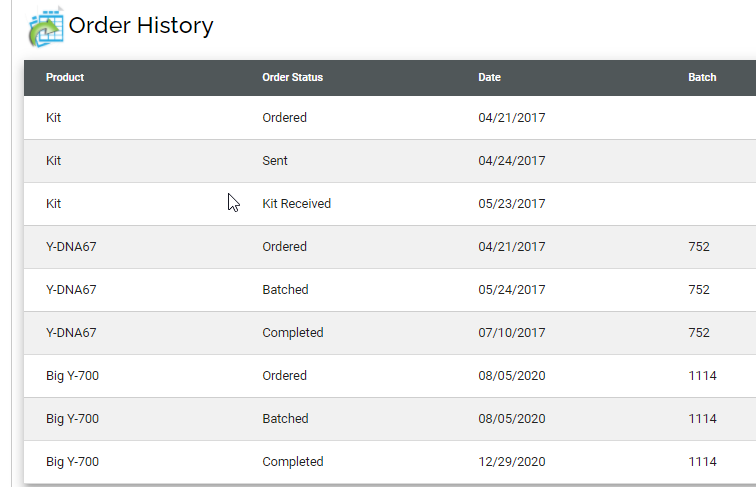
In my previous Blog, I was caught a little off guard as I didn’t know that Rodney had tested for the BigY 700. However, that was good news as now we have a BigY 700 in both the James and Archibald Lines of the Frazer YDNA Tree. One confusing thing about FTDNA is that it is difficult to know when your BigY test has been completed. Here is Rodney’s order history:

This seems to indicate that his BigY was completed on January 14. However there are still more tests ordered by FTDNA. Another way to check is if Rodney’s Private Variants match up with the average Private Variants shown on the Block Tree. [Note: Later in the Blog I show that is not a good way to see if your BigY has completed.]

Here are Rodney’s Private Variants:

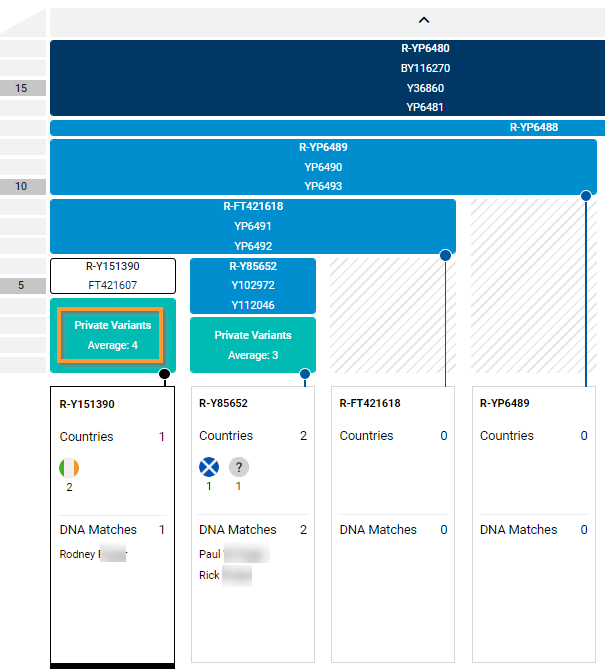
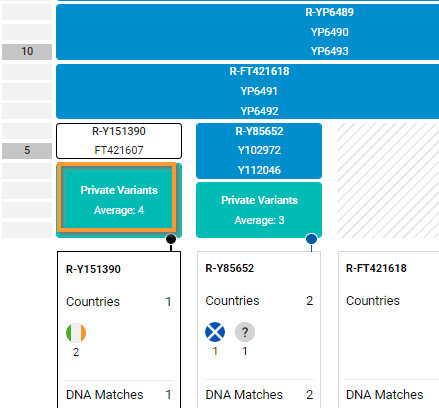
Rodney now has 7 Private Variants. These are described by their position numbers to distinguish them from SNP which need to have a match with someone. To get the average number of Private Variants for the James Frazer Line, we need to know the number of Jonathan’s Private Variants:

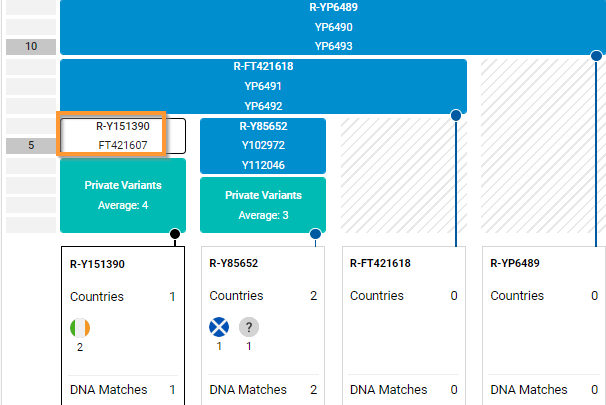
Jonathan has two. This averages out to 4.5. The Block tree shows an average of 4:

4 is close to 4.5, so I would say that the BigY analysis is complete – except for the Backbone Tests. The number of Average Private Variants went up from 2 to four probably on January 11th when the backbone test was ordered or on on January 14th when FTDNA shows the BigY was completed.

Rick’s Results

Rick shows that his BigY completed in December:

However, Rick has nine Private Variants:

Paul who is on Rick’s Branch has one Private Variant.

That is a total of 10 for Rick and Paul’s Frazer Branch for an average of five Private Variants. The Rick and Paul Branch of the Block Tree shows an average of three Private Variants. That means that FTDNA’s manual review must not be completed yet.

The James Line Private Variants

These should be the variants that have formed since Rodney’s and Jonathan’s common ancestor.

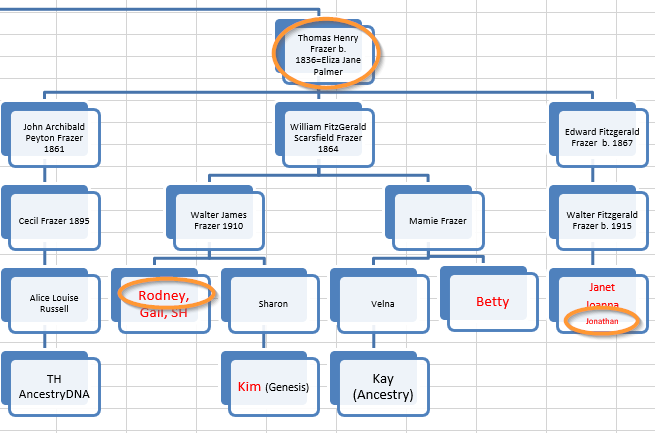
That common ancestor was Thomas Henry Frazer. Thomas Henry Frazer had, for sure, these two SNPs – Y151390 and FT421607:

I say, for sure, but the backbone tests seem to be confirming these. The point is that Rodney and Jonathan’s Private SNPs formed after Thomas Henry Frazer in 1836. By the way, I made a mistake in dating the Block Tree in a previous Blog, so I’l correct that here:

The slightly confusing part is that the 1836 is higher on the tree than the 1804. I think that could change as the average number of Private Variants right now appears to be 5 between Paul and Rick under the R-Y85652 part of the Tree. Say that some of the testers were born around 1950. That would mean that this Tree represents 750 years of Frazer YDNA history.

Jonathan’s Private Variants

Here is Martin’s take on Rick’s initial results. Martin is the FTNDA administrator for the portion of the R1a YDNA Tree that our Frazers are on. These have since changed since Rodney’s BigY 700 upgrade came in.

This shows Rick with a BigY-700, but doesn’t show Rodney in that category yet. I mention above, that Rodney has 7 Private Variants. The BigY 700 is more comprehensive and finds more variants. Before Rodney’s BigY 700 results came in, he only had one Private Variant. Jonathan has two Private Variants. They are the last two in the yellow box aove.

Jonathan’s first formerly Private SNP became part of the new James Line Haplogroup:

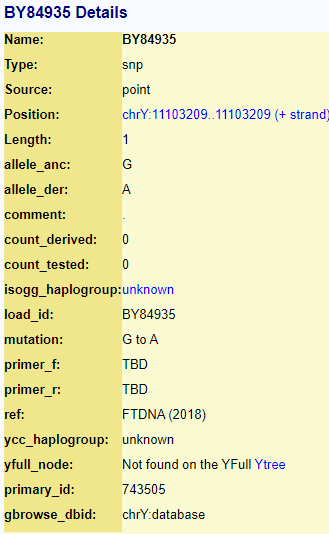
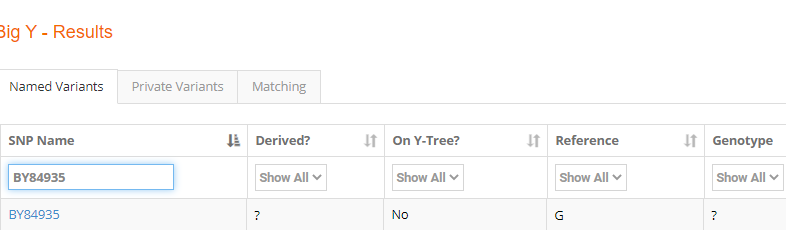
I don’t see BY84935 on the Block Tree, so if it isn’t there and isn’t on Jonathan’s Private Variant list, where did it go?

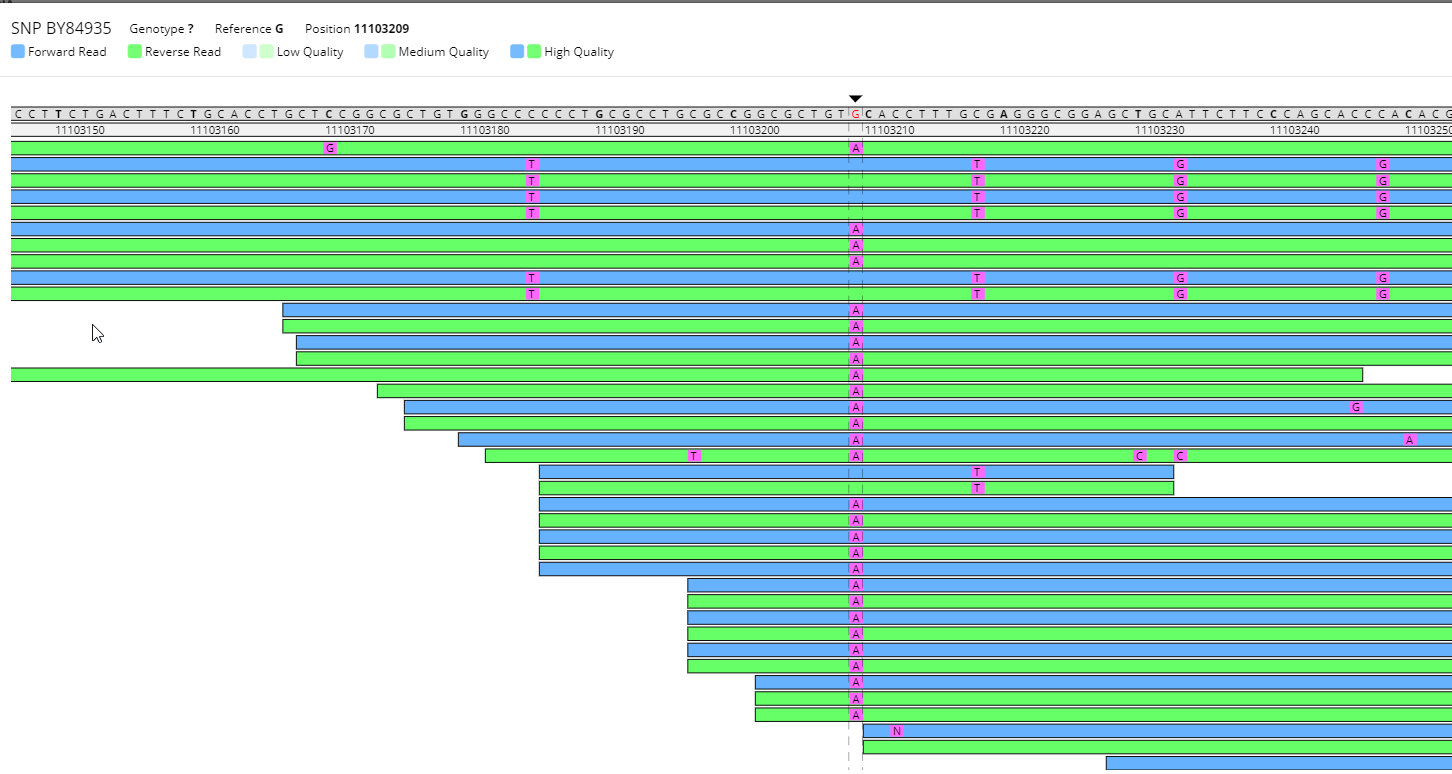
Here are Jonathan’t test results:

The mutation should be G to A, but Jonathan shows at least two reads that are G to T.

Let’s see how Rodney tested for this. This is now a named SNP, so no longer a Private Variant for Jonathan. I don’t see Rodney having BY84935:

Based on these two test results, this should still be a Private SNP for Jonathan.

Rick and Paul Have a ? for BY84935

Rick is sometimes positive for this SNP and sometimes not. Also, he seems to have a lot of similar results in this region of the Y Chromosome. Now I see why they took away this Private Variant from Jonathan.

Let’s check out Paul’s results:

Very similar to Rick’s results:

Based on these results, I’m a bit surprised that Jonathan ever had a Private Variant at this position. For Jonathan’s other two Private Variants, I will assume that they are correct. The bottom line is that Jonathan has two Private Variants. These are:

  • 11718822 and
  • 11720223

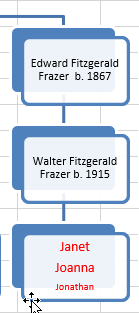
These had to have formed in Jonathan’s line in either Edward, Walter, or Jonathan:

In a sense, these Private Variants are not important from a genealogical point of view. Jonathan already knew he was a second cousin to Rodney. However, if anyone else ever tests positive for these Variants in the future, it will show that they are from this same Edward Fitzgerald Frazer Line.

Rodney’s Seven Private Variants

There is another use of Private Variants. These can be used to date the common ancestor between two people. A number between 83 and 144 years is generally used. However, that time-frame does not work well in the case of Rodney and Jonathan. Their ancestor is believed to be Thomas Henry Frazer born 1836. Even if we take that date from 2021, that is 185 years ago. That means that, at most, there should have been an average of three private variants between Jonathan and Rodney where there are 4 (and actually 4.5). That means that these Variants were forming about every 40 years or about twice as fast as would be expected, on average.

Here are Jonathan and Rodney’s average of 4 Private Variants:

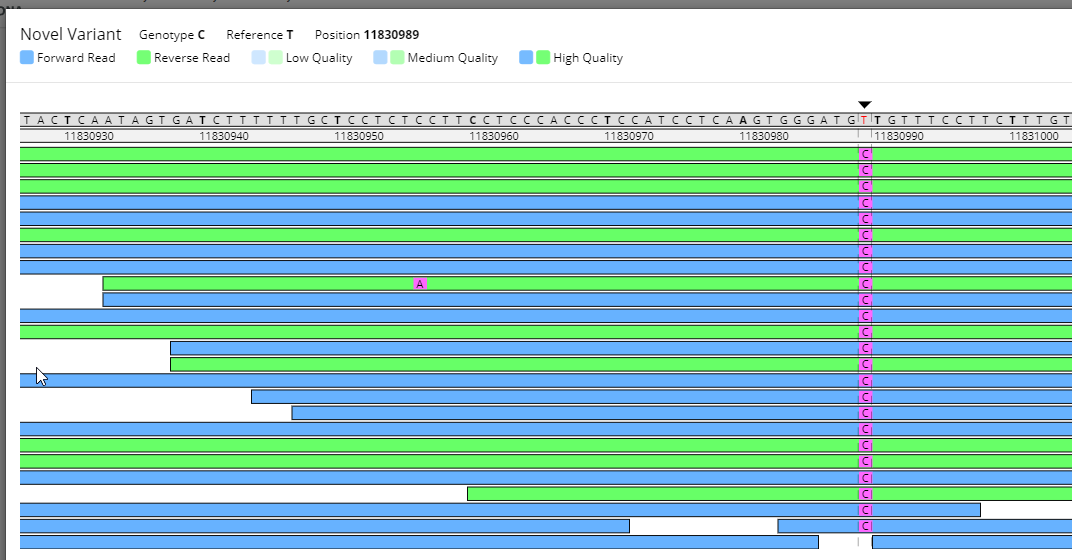
Rodney’s Private Variant at Position # 11830989

I don’t want to go through each of Rodney’s Private Variants, but I will at least look at one:

I don’t think that FTDNA shows test results in the browser for Private Variants if you are not positive for them. Here is Jonathan’s downloaded results for this position:

It looks like Jonathan’s results were less than conclusive.

Next, I’ll look at Paul’s results:

Paul was not tested at that position.

Let’s see what Rick has. I need to download his ‘csv’ file. I would expect that Rick would have good results as he has tested for the BigY700:

Here is a surprise. This shows that Rick has this Private Variant. That means that it can no longer be Private. That is good because it means that Rodney has one less Private Variant. I don’t know why FTDNA didn’t pick this up:

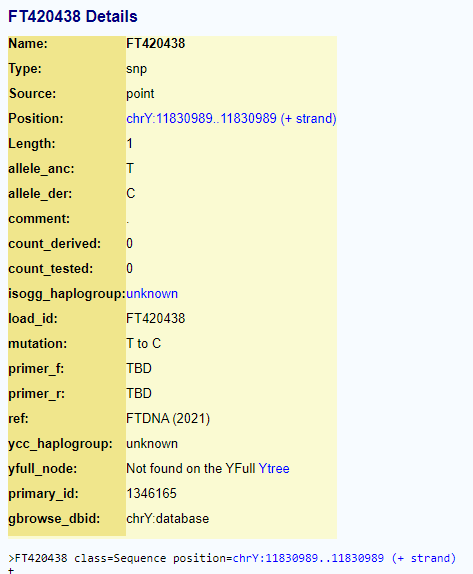
That means that this should be a new SNP included in the umbrella SNP group of Frazer. At YBrowse Position # 11830989 is FT420438:

The good news is that this will take away one of Rick’s Private Variants as he has too many already.

Rodney’s Private Variant at Position # 5987829

I did a comparison of Rodney’s and Rick’s Private Variants and found one more match:

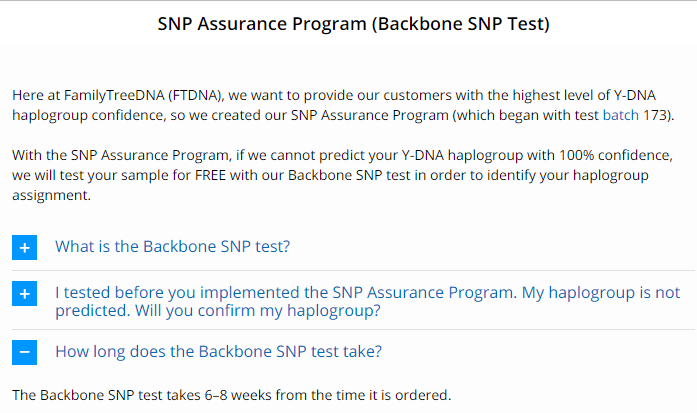
This brings up another reason that Private Variants are important. If they match with someone else’s Private Variant, they form a new SNP. Usually FTDNA will catch that. In this case, they are still in the middle of some of their reviews and have ordered backbone tests for Rodney and Jonathan. It is possible that FTDNA is not sure where to put these new SNPs. This seems to indicate that they are Frazer SNPs, but perhaps they go back even further?

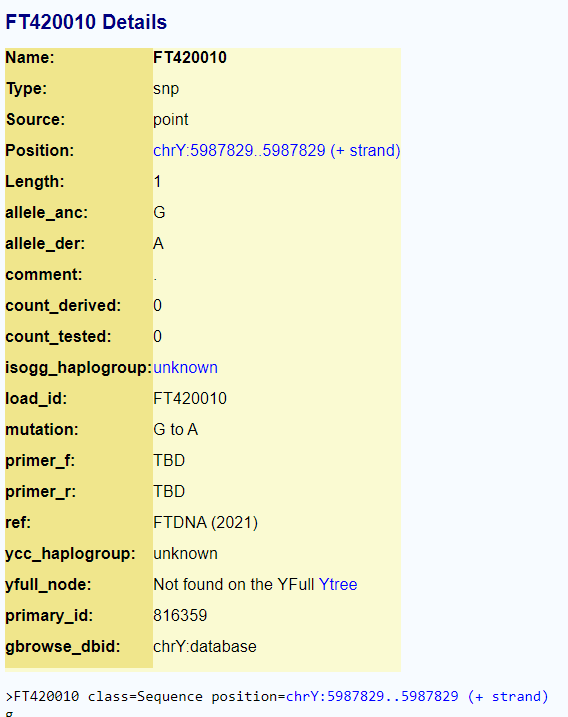
Here is what YBrowse shows:

These two SNPs are interesting as YBrowse shows that they are from an unknown Haplogroup. That seems to support my theory that FTDNA doesn’t know where these SNPs belong. Here are Rodney’s test results for the position:

Here are Rick’s results:

If Rodney and Rick are positive at this Position, then Paul and Jonathan should also be positive.

Paul’s results above were inconclusive.

How about Jonathan’s?

Jonathan’s test results were also inconclusive.

FT420438 and FT420010 Frazer SNPs?

If it was up to me, I would add these two SNPs to this area:

That means that there would be 8 SNPs in this area instead of the current six. So far, everyone how has tested for these SNPs have been Frazers. However, the six or eight SNPs represent four or five hundred years of history. It would be great to fill in some of the blanks for this time period. It may be that FTDNA hasn’t finished their review or are awaiting the results of the two backbone tests they are doing.

Changes to Frazer Testers’ Private Variants

The other change that should be happening is that Rick and Paul’s Average Private variants under R-Y85652 should be going up. They show 3 currently. Rick has 9 but two of these are shared with Rodney. Rick should have 7 Private Variants and Paul has one Private Variant. That should result in an average of four Private Variants under the Archibald Frazer LIne of R-Y85652.

Rodney currently has 7 Private Variants, but two of those are shared with Rick. That should results in 5 Private Variants for Rodney. Jonathan has two Private Variants. If FTDNA rounds down, that will result in an average of 3 Private Variants for the James Line Branch under R-Y151390.

Further, I note this under FTDNA:

This says it could be that the two matches I found between Rodney and Rick could be there because they haven’t properly been properly validated yet. Hence the backbone test which is in process.

Summary and Conclusions

  • I started out trying to figure out if Rodney and Rick’s BigY reviews were done or not.
  • I thought that perhaps Rodney’s review was done because the Block tree average number of Private Variants matched with his and Jonathan’s Private Variants.
  • Then, when I started comparing Rodney and Rick’s Private Variants, I saw that they had two in common. That means that if Rodney’s review was over, there was still two SNPs to be assigned to the Frazer Block Tree.
  • I guessed that perhaps FTDNA had trouble placing these new SNPs and that is why they ordered the Backbone tests for Rodney and Jonathan
  • I had thought that if your Private Variants matched with what the average Private Variants were on the Block Tree, then that meant that your BigY manual review was over. But then I found something at FTDNA that said that may not be true.
  • I had thought that the Backbone tests ordered for Rodney and Jonathan were to confirm their new Haplogroup of R-Y151390. Now it appears more likely that the Backbone test is for the two matching Private Variants that Rodney and Rick have with each other.
  • It could be a month or more before the dust settles for Rick’s new BigY 700 test and Rodney’s upgrade from BigY 500 to BigY 700. By then, we will probably have the results from the new Frazier/Frasher BigY 700 test which has been delayed.

Update on Frazer YDNA: Rodney’s Upgrade from BigY 500 to BigY 700

I have been writing quite a bit lately on Frazer YDNA. There are few reasons for this. One is that the information has been changing gradually as the two new Frazer Haplogroups are rolling out. The second is because the discovery of these two new Haplogroups is important. It is important not only for the four testers, but also for all the hundreds of the Frazer “Clan” who descend from Archibald Frazer who lived in Roscommon, Ireland in the early 1700’s. These new YDNA developments are equivalent to a major genealogical find. However, YDNA results are more written in stone than genealogifcal finds. Once you have your YDNA results, it is very clear that if you have these SNPs you are from these Frazer Lines and if you don’t, you are not from thse Lines.

Dating the New Frazer Haplogroups

There are a few ways to date a YDNA tree. I’ll use the dates that we think are right with Frazer genealogy where we know that.

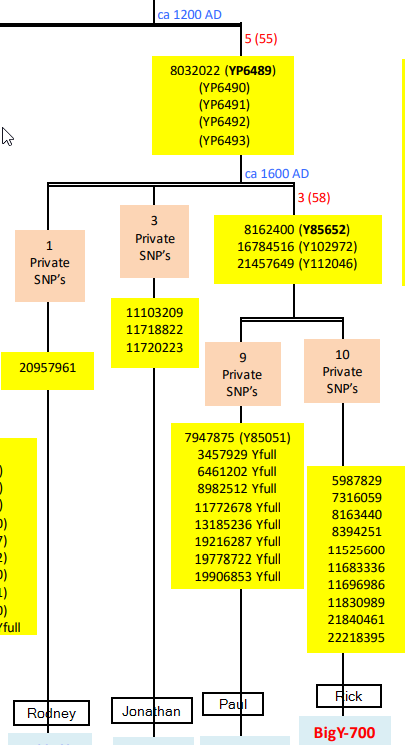
The important dates are for the common ancestors of the four YDNA testers shown at the bottom of the tree above. Those dates are 1690, 1804 and 1836. Here I’ve put the dates on Rick’s Block Tree:

[Edit: The 1792 in the image above should be 1836.]

The tree is reversed from the genealogical tree. Rick is on the right Branch with Paul. From what we can tell, YP6489 was formed about 1200 AD. YP6489 is representative of the three SNPs in the Block. We don’t know which SNP was formed first, but we may assume that these three SNPs formed equally between the time period of 1200 and 1545. Next is the new subgroup of FT421618. This Haplogroup seems to be explained by the Frazier/Frasher test results that we are waiting for. There were quality issues, so his sample is being retested. Perhaps FTDNA had enough information to say he would be FT421618. Again, we don’t know when these three SNPs formed – just that they formed between around 1545 and 1690.

1690 is an important date as that is the date we are using for the birth of our common Roscommon Ireland Frazer ancestor – Archibald Frazer. On the James Frazer Branch, SNPs Y151390 and FT421607 had to form between Archibald Frazer born 1690 and Rodney and Jonathan’s common ancestor. That common ancestor was Thomas Henry Frazer born about 1792. On the Archibald Line, three SNPs in the Haplogroup Y85652 formed between 1690 and 1804. The bottom of the chart brings us down to the birth dates of the three testers. The private variants were formed in the James line between 1792 and the birth dates of the Rodney and Jonathan. The private variants in the Archibald line were formed between 1804 and the birth dates of Paul and Rick.

R-Y85652 – The Archibald Line

Y85652 consists of a group of three SNPs. These were previously Private Variants for Paul. In order for Paul’s three Private Variants to become SNPs, Rick had to test positive for these Private Variants and Rodney and Jonathan had to be negative for these.

Y85652

Here are Rick’s results for Y85652:

The pink column is at the position on the Y Chromosome of 8162400 which is now Y85652. The T in that column shows that Rick had the mutation from A to T.

Paul had similar results:

Every horizontal line is called a read. Paul’s results go off the screen. That means that he had more reads than Rick which just means he had a higher confirmation than Rick of Y85652.

Next, I’ll look at Jonathan’s results. We expect the results to be negative:

Right at the position of 8162400, Jonathan shows no mutations from T to C. That means that he doesn’t have SNP Y85652. To satify curiosity, here are Rodney’s results:

Rodney had fewer reads, but is clearly negative for Y85652 at the position in the middle of the image above under the down arrow. If I went through this exercise for Y102792 and Y112046, I should get the same results.

Y151390 – The James Line

Here are Rodney’s test results:

He is clearly positive. Jonathan has a question mark for this position:

Jonathan didn’t have enough reads at this location. However, for all of his 7 reads, he shos the mutation from C to T at this position.

Paul aslo had a question mark at this position. Here are Paul’s results:

This was a bit of surprise. Let’s look at Rick’s results. He will have to be negative for this position for the James Line to get the Haplogroup of Y151390:

Fortunately, Rick has good results showing that he is negative for Y151390. Because Paul is in a group with Rick, Paul is presumed negative for Y151390 also.

FT421607 on the James Frazer Line

I’m curious about this SNP also. Rodney has good results:

Jonathan has only one read at this position:

But it is positive. That makes it important for Paul and Rodney to be negative for FT421607. Here are Paul’s results:

Paul’s read didn’t make it over to position #7788709.

Rick has much better results:

That means that Paul is again presumed negative based on Rick’s negative results and we end up with the James Line SNP of FT421607. FT421607 is based on only one good positive test and one good negative test. But because the negative test was already in a sold group consisting of Paul and Rick, that meant that Rodney and Jonathan had to be in the other group. The bottom line is that the James Line and Archibald Line Haplogroup results are dependent on each other.

Here is FT421607 which now appears at YBrowse listed as a new 2021 SNP:

This gives the location of FT421607 on the Y Chromosome and what the mutation was (G to T). It also gives the location of the SNP under the Frazer Haplogroup of YP6489 and the James Line Haplogroup of Y151390.

Private Variants

If it weren’t for the Private Variants, I would think that FTDNA’s manual review has been completed. However, the numer of Private Variants of the testers don’t match up with the Private Variants shown on the Block Tree. For example, Rick shows that he has nine Private Variants:

Paul shows one Private Variant:

I’m not sure why Rick has so many Private Variants. It may be because his BigY 700 covered more than the older BigY 500 tests. Their average numer of SNPs should be five. The average number of Private Variants shows three:

Rodney and Jonathan’s Private Variants (James Frazer Line)

The Block Tree above shows that Jonthan and Rodney have an average of 4 Private Variants. Jonathan shows that he has two Private Variants:

Rodney has 7 Private Variants:

This makes me wonder if Rodney actually had the BigY 700. A review of Rodney’s FTNDA history is interesting:

Rodney did have the BigY 700 done. This makes sense. However, it says that his BigY-700 was ordered 8/26/2020 and completed just 1/14/2021. I talked to Rodney’s niece who said that she did order the BigY 700. Mystery solved.

Y-HAP-Backbone Tests for Rodney and Jonathan

In addition, it looks like two Y-HAP-Backbone tests were ordered and one was completed. The one ordered on 1/11/2021 has not yet completed. Here is Rodney’s Order Status:

Here is Jonathan’s order history:

I’m not sure how to interpret what FTDNA is saying. It appears that more tests were ordered for Rodney than for Jonathan. Here is some information from FTDNA. I don’t know if itis up to date:

I checked Paul and Rick’s order history and no backbone SNP Tests were ordered there. That is interesting because it tells me a few things:

  • FTDNA is sure of Paul and Rick’s new Haplogroup of Y85652
  • FTDNA came up with Rodney and Jonathan’s Haplogroup based on one positive test from the James Line and one negative test from the Archibald Line
  • FTDNA would like more positive testing for Rodney and Jonathan to confirm their Haplogroup of Y151390, so they ordered Y-HAP-Backbone tests.

This should mean that we will have a pretty good Haplogroup for Rodney and Jonathan, that will be proven once the backbone tests have been completed.

This shows Jonathan’s pending results:

Here are Rodney’s pending results:

This seems to indicate that Rodney’s BigY700 is not yet complete. However, these are Rodney’s matches:

This seems to indicate that as Rodney matches Rick (who has taken the BigY 700) in the 800,000 level (under Shared Variants above) and Jonathan (who has taken the BigY 500) at the 600,000 level that perhaps Rodney’s BigY 700 is completed except for the Backbone test.

Another Thought on the Backbone Test and the Frazier/Frasher Results

It is possible that the need for these backbone tests came about due to the pending results of the Frazier/Frasher BigY 700 tests. At least, the tests were ordered around the time that a new Haplogroup appeared on the Frazer Tree:

This new Haplogroup which seems to be a result of the pending
Frazier/Frasher BigY results. This new Haplogroup appeared around the time of the backbone tests were ordered for Rodney and Jonathan. So these backbone tests may have been ordered to back up the new Frazier/Frasher results, to verify the James Line Haplogroup of Y151390, or both.

Summary and Conclusions

  • While looking at Rick’s new test results and the resulting new Haplogroups for the James and Archibald Frazer Lines, I was surprised to see that backbone tests had been ordered for Jonathan and Rodney from the James Line
  • Also I was surprised that Rodney had a BigY test that was only recently completed (or is being completed).
  • Now that I can see the SNP test results and the SNP results at YBrowse, it makes it easier to see how FTDNA has made/is making their decisions.
  • I can probably see the results of the testing because Rodney’s BigY 700 seems to be completed. That testing in conjunction with Rick’s recent BigY 700 testing is likely the reason why there is a new James Frazer Line Haplogroup.
  • It appears that the results of Jonathan’s and Rodney’s backbone tests should come out around the time that the Frasher/Frazier BigY 700 test results are due.
  • The result of all this testing is that we will have a really good Frazer YDNA Tree solidly documented by BigY testing.


A New Proposed James Frazer Line YDNA Haplogroup

In my previous Blog, I mentioned how Rick’s new BigY 700 test results created a sort of tipping point. His test in conjunction with the previous three BigY tests resulted in three changes in the Frazer YDNA Tree. One of those changes was the likely creation of a new James Line YDNA Haplogroup of R-Y151390. I say likely, because FTDNA’s manual review has not yet been completed.

However, when I look at the Frazer Block Tree today, I see that there is already another change from yesterday:

For some reason, FTDNA has split the old Frazer umbrella group of R-YP6489 into two. YP6489 is now the older group with a younger group of R-FT421618 under it. This is very unusual, because without an additional tester, there should be no way to know that FT421618 is younger than Y6489.

Some Speculation on R-FT421618

This is another mystery, as I don’t know how FTDNA could know that there were two groups unless someone else has tested. The only thing I can think of is that they may have access to other information such as the initial Frazier/Frasher BigY results that we have been waiting for. This test had quality issues and the results are now due around the end of February.

Let’s assume that FTDNA is looking at initial Frasher/Frazier results. Previous dating by the FTDNA YDNA administrator for our Frazer group had set YP6489 at around 1200 AD. The two Frazer Lines (Archibald and James) had to have started around 1720. This is about the date we are guessing Archibald and James were born, though we believe that Archibald was older. From looking at the two groups of Y6489 and FT421618, they both have three SNPs in each. That means that FT421618 could have formed about halfway between between Y6489 and the James Frazer and Archibald Frazer Haplogroups. 1200 to 1720 is 520 years. That means hat we should be able to date FT421618 at the halfway point between 1200 and 1720 or at 1460.

R-Y151390: The New James Frazer Line YDNA Haplogroup

This is what I set out to look at but got side-tracked. In my previous Blog, I was struggling to see how FTDNA had arrived at the conclusion that this would be the new Haplogroup for the James Frazer Line based on my inability to find test results for certain SNPs or Private Variants. I brought my questions to the FTDNA – BigY Facebook Group and got some great results. This was the bottom line answer after much discussion from David Vance who is very accomplished and respected in the field of YDNA:

ok so YFull thinks Paul is positive for Y151390; FTDNA thinks not. That’s something you’d probably have to delve into the BAM file to figure out, but the only difference would be that Y151390 might belong above as an equivalent in the R-YP6489 block rather than only above Rodney and Jonathan. Based on their negative results for the R-Y85652 block and equivalents, the basic branching structure either way is still as shown on the Block Tree.

Here is some more background. Here is Jonathan’s results show in the non-block tree diagram:

FT421618, which I discussed above, is in yellow because Jonathan was Presumed Positive for this SNP. That means that his test results were not as thorough as needed for Jonathan to be positive for this SNP. However, based on others being positive for this SNP, he had to be positive for it also. Although I can’t find Jonathan’s detailed test results for Y151390 (the new James Frazer Line Haplogroup), the green dot means that Jonathan tested positive for this SNP. FT421607 is much more confusing as the grey dot means Presumed Negative. If Jonathan is showing as having this SNP, why wouldn’t he be Presumed Positive for it? Furthermore Jonathan is showing Presumed Negative for Y85652, Y102972 and Y112046. I know that is not the case, as I have looked at his results for these three SNPs and he shows as Tested Negative. Here is Jonathan’s results for Y85652:

I had to shrink my screen to show all of Jonathan’s reads that show he tested negative for Y85652. If he had tested positive, there would be a letter T in the column under the tiny arrow above. That tells me that, despite what the grey dots say, that Jonathan tested negative for this SNP and the other two under Y85652. This negative testing by Jonathan and Rodney made it very clear that Paul and Rick were in Y85652 and that they were not.

Is Paul Presumed Negative for Y151390?

That appears to be the case, but I showed above that these dots are not always right:

Here Paul shows as Presumed Negative for Y151390 and FT421607. I looked up FTDNA’s definition of Presumed Negative:

Presumed Negative – You are presumed negative for the primary SNP or variant. A person is presumed negative for sibling branches of SNPs for which you have tested positive.

It seems like the definition could have been stated more clearly. David Vance wrote to me:

so presumed negative, but not confirmed negative.
Are Rodney and Jonathan confirmed negative for R-Y5652 and the other two equivalent SNPs in that block? I’m starting to think those are the driving force for this split, and Paul and Rick are presumed negative for Y151390 because they’re positive for those three SNPs and Rodney and Jonathan are negative so that drives the branching decision rather than Y151390.
It seems that what FTDNA is saying is that Rick and Paul are clearly in Y85682 and that Rodney and Jonathan are clearly out of that group. That means that if Jonathan and Rodney are in FT151390, then Paul and Rodney have to be out of that group even though Paul had some indications on his test that he might be positive for FT151390. At least I think that is what happened.
Let’s see what Rick shows for his newer BigY 700:
The results are similar to Paul’s except that Rich test positive for the new Frazer SNP FT421618.

Another help at Facebook was that someone found Y151690 at YBrowse when I could not. I was doing the search wrong. Here it is:

This seemed like an older SNP based on the Y prefix and it is dated at 2018. The Y prefix on the SNP means YFull.

Summary and Conclusions

  • By reaching out to the BigY community on Facebook, I was able to find more resources to answer my Frazer YDNA questions.
  • At the very least, I am documenting the changes as they are happening with the Frazer YDNA tree
  • I tried to explain how the James Frazer Line was formed. However, without seeing the testing data for some of the SNPs, it is difficult to accurately describe the process
  • There was an unusual split in the umbrella Frazer Haplogroup of Y6489. This seems to be only explained by FTDNA using the partial results of the Frazier/Frasher results for which we are waiting.


Two New Frazer YDNA Haplogroups: R-Y151390 and R-Y85652

Family Tree DNA has issued the Frazer family two new Haplogroups as seen in Rick’s block tree below:

R-Y151390 and R-Y85652

I was only expecting one new Haplogroup for the Archibald Frazer Branch (shown as “Your branch” above. Previously, I was disapointed that Rodney’s previous test did not form a new branch for the James Frazer Line. Apparently Rick’s BigY test also gave FTDNA the confidence to create a James Frazer Branch shown in the bottom left portion of the Block Tree above.

The James Line and the Archibald Lines were previoiusly under R-YP6489 which is now an umbrella group over the two new Frazer subgroups.

R-Y85652

This Archibald Frazer Branch came out as predicted by the R1a – L664 FTDNA Project Administrator Martin. The Archibald Frazer Branch is the one below near the date 1804:

I added the dates in black above from my previous Blog. Apparently the manual review has not completed (or started?) yet. My understanding is that there is a mechanical/automated review first before the manual review. Note that the Private Variants do not line up. Martin has Rick with 10 Private SNPs. The Block tree shows an average number of three private variants between Paul and Rick. Rick’s Private Variant List at FTDNA has gone down to nine pressently:
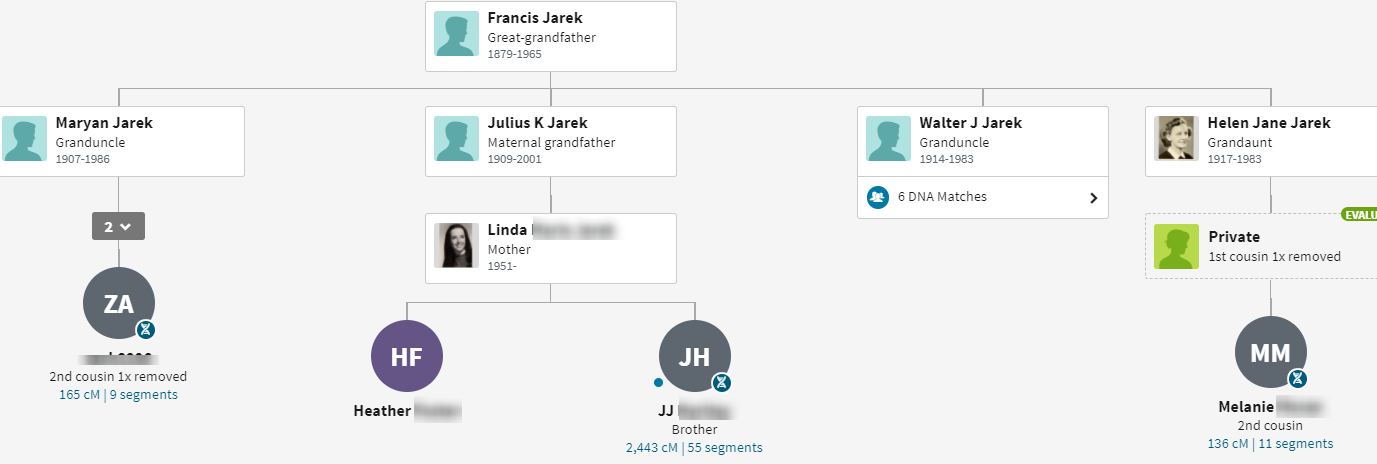
It’s a puzzle trying to find the difference between Martin’s list and FTDNA’s. Martin has the additional Private Variant numer of 11683336. If Rick had 13 private variants and three went to the new Archibald Frazer Line, then he should have 10 left.
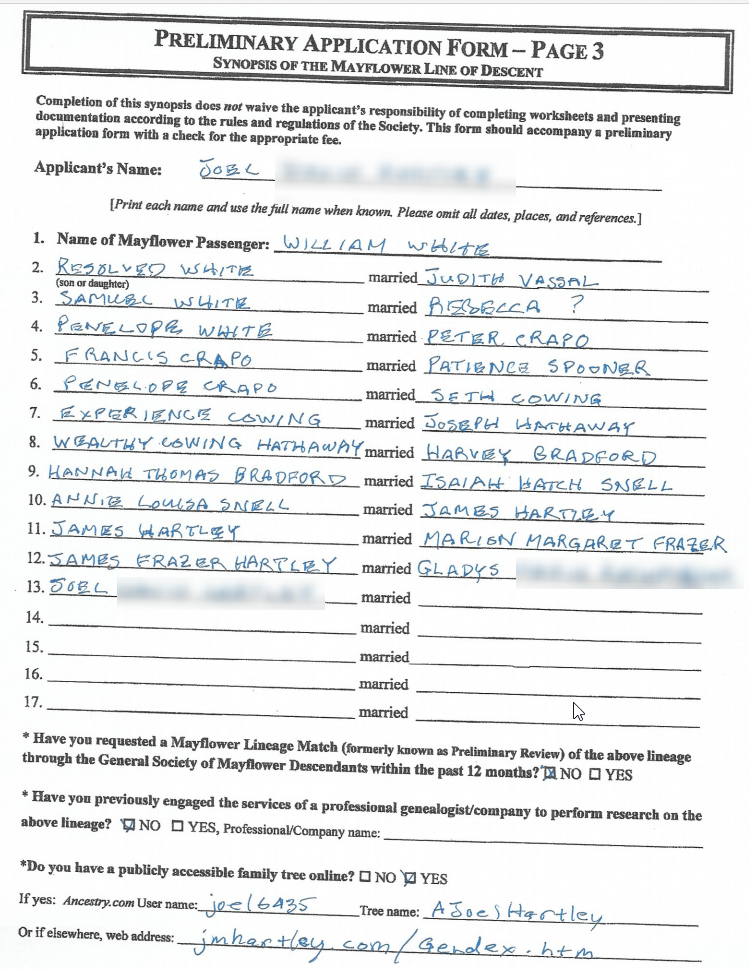
11683336

Here is 11683336 at YBrowse:

This must be a new Private Variant as it has no name yeat at YBrowse. This Private Variant may have gone up to the umbrella group of YP6489. Here is Rick’s previous Block Tree:

The old YP6489 had five SNPs. The new group has six:

FT421618 is the new SNP in that group. That means that Rick’s BigY results ended up changing the umbrella Frazer group of YP6489 as well as creating two new groups (for Archibald and James Frazer) under that group.

More on FT421618

The FT series is FTDNA’s newer SNPs. As seen by the fact that YBrowse is not yet aware of this SNP, this must be a brand new SNP. In order for this position to be a true Private Variant for Rick, it has to show as negative in Rodney, Jonathan and Paul. FTDNA probably looked at their results and saw that Rodney, Jonathan  and Paul tested for this posisiton and it wasn’t clear that they didn’t test positive for this position.

Here is Rick’s results:

What this shows is that Rick is very positive for this SNP. 10 good reads is usually OK. He has many more than 10 good reads.

Here are Paul’s results:

There is a little arrow where the results should be, but there is nothing there. That is probably what is called a no-call.

Here are Jonathan’s results:

Jonathan has four good reads. Remember that for Rick to have this position as a Private Variant, the others have to be negative for this position. Jonathan didn’t have enough reads to give him this SNP on his own, but because Rick tested really well for it, then Rick and Jonathan must both have this SNP. That is how it got added to the Frazer Umbrella Haplogroup.

Finally, we look at Rodney:

Rodney has only one good read for this SNP, so Rick confirms this single read.

Where Does R-Y151390 Come From?

This is the new James Frazer Line Haplogroup that FTDNA is showing on their Block Tree, I am having trouble finding this SNP perhaps because it has not been on a tree before. When I search on YBrowse:

When I search for Y151390 at FTDN, BY151390 shows up which is a different SNP. Without knowing what position Y151390 is, I cannot do further analysis on it. I have one more place to look. Here is Jonathan’s non-Block Tree at FTDNA:

When I hover over the SNPs under R-Y151390:

The first is Positive and the second is presumed negative. However, I still don’t know what position that Y151390 is at. That means that I can’t figure out how FTDNA arrived at their decision.

A Google search for this SNP revealed that I had mentioned Y151390 in at least one of my old Blogs:

The answer appears to be at YFull. After clicking around a while at YFull, this appears to be the position of Y151390:

For some reason, this named SNP was perhaps never uploaded to YBrowse:

So it appears that FTDNA got the name of its SNP for the James Frazer Branch from YFull. I believe that the Y prefix is from YFull. Further it is unclear how my cousin Paul was listed under Y151390 at YFull and is now not in that group at FTDNA.

FT421607

This is the other SNP in the new YDNA Tree for the James Frazer Line. I can’t find it right now listed as being tested for either Jonathan or Rick. That means that it must be still listed under the position number. As I don’t know what the position number was, I can’t find the test results for the position. An FT prefix refers to a new SNP by FTDNA. Here are the search results for Jonathan:


Summary and Conclusions

  • Recently FTDNA came out with three important developments for our Frazer group. One was expected and two were not.
  • What was expected was that there would be a new Haplogroup for the Archibald Frazer Line based on three different SNPs
  • The first unexpected thing was that there would be a new SNP added to the now umbrella of R-YP6489. This group is now over the two Frazer Lines of Archibald and James. This new SNP could theoretically make the age of YP6489 older by about 100 years.
  • The second unexpected thing was that a new Haplogroup formed for the James Line. I had expected this to happen when Rodney did a BigY test but it didn’t happen. This new Haplogroup is R-Y151390. I was unable to see how FTDNA arrived at this conclusion. I think that it will be clear as the manual review progresses.
  • Hopefully, subsequent review will confirm this new James Line Haplogroup
  • Rick’s new test results in conjunction with the previous three Frazer BigY tests has resulted in a quantum leap in the Frazer YDNA Tree. These results are helpful in a quite recent timeframe. They cover the time from ancient history up to the 1800’s when the genealogical records became more reliable.