Swapping Out Butler Ancestors

Ever since I have been working on my wife’s Butler genealogy, I have been assuming that the parents of her Irish immigrant ancestor, Edward Butler were:

  • Michael Butler and
  • Margaret Croke

Now due to recent events I believe that Edward’s parents were:

  • Henry Butler and
  • Ann Russell

Here is Edward, now believed to son of Henry Butler from Wexford:

The Catalyst for the Change

The catalyst for this is that my wife’s niece and recently my wife’s sister have been looking into the genealogy. They convince me that, based on Mary Crowley’s death certificate of 1905, that she was a widow at the time. This means that Edward, son of Michael Butler and Margaret Croke who died in 1915 could not have been Mary Crowley’s husband. Mary Crowley was the husband of immigrant Edward Butler.

Major Reasons for the Swap

  • None of Edward’s children had the names of Michael or Margaret
  • A Blog I wrote in 2019 showed that Michael Butler and Margaret Croke were probably not the parents of Edward Butler based on DNA analysis. They were more likely in the Henry Butler and Ann Russell family
  • Immigrant Edward Butler lived in Cincinnatti during the 1860 and 1870 Census. Also living in Cincinnati was a George Butler, son of Henry Butler and Ann Russell.
  • George Butler had a brother named Edward (born Adam) who died in Boston in 1891.
  • There have been many autosomal DNA matches between the Edward Butler and George Butler family descendants.

Correcting the Genealogy

In my past research, I have a lot of information on Edward Butler. However, a lot of this is from the Edward Butler born in Poulrone, County Kilkenny and who died in Newton in 1915. I need to separate the two Edward Butlers and replace the wrong ancestral couple with the correct one. Once I do that, I believe that Ancetry ThruLines will begin to populate for Henry Butler and Ann Russell. Right now, my wife’s late Aunt Lorraine has no Michael Butler ThruLines (nor should she if I am right):

Downsides to Swapping the Edward Butlers

  1. I was used to researching the Edward from Poulrone
  2. Edward Adam would have been quite young when he married Mary Crowley

This is from my Butler researching friend Peter from England:

If Edward Adam Butler was born 24 July 1839 he would have been a few months shy of 16 when he married in St. John, New Brunswick in 1855.

Taking the Plunge

The first step is changing my records at Ancestry.

I also had to remove records that were associated with Edward Butler of Poulrone. Here I have that George of Cincinnati and Edward are brothers:

So there is a bit of sorting out to do.

Summary and Conclusions

  • It is difficult to swap out one ancestor for another. This is especially true as I have been researching this ancestor for so long. It is sort of like saying goodby to a family friend who is no longer family.
  •  There is also the nagging questiion of, did I get the right guy this time? Most signs point to adding in Edward (Adam) Butler of Wexford. The major problem right now is that he was born a bit later than I would have thought he should have been. The possible explanation is that he padded his age to sound older.
  • However, overall, there were many reasons to remove Edward Butler of Poulrone, County Kilkenny with Edward (Adam) Butler of Wexford.
  • One reason why Edward (Adam) was added in was due to DNA matches between the one who I now believe is his brother (George Butler of Cincinnati) and my wife’s Butler family.
  • I am looking forward to exploring more of these DNA matches in a subsequent Blog.


Looking for Butler Records in St. John, New Brunswick

The Marriage of Edward Butler and Mary Crowley

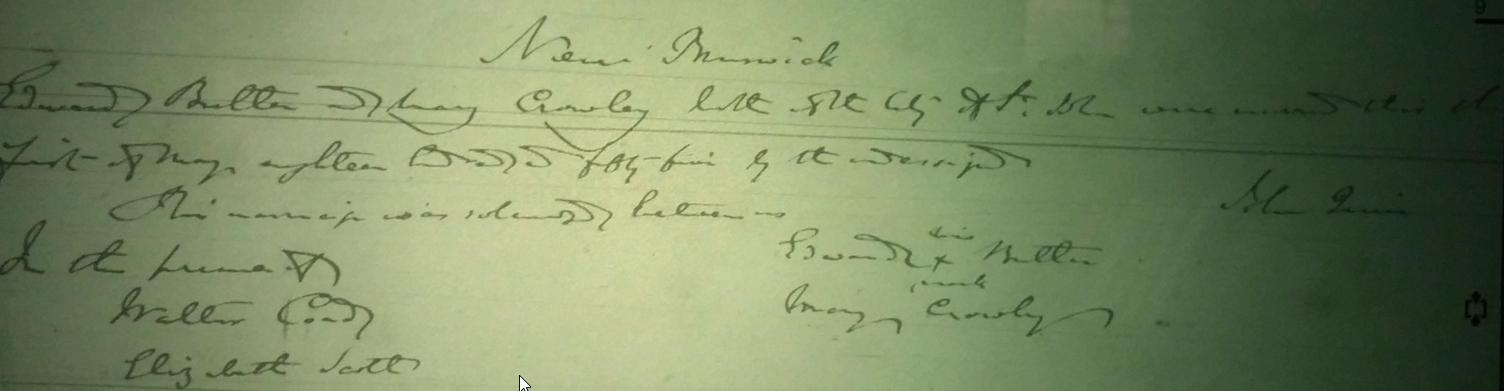
In the past, I had found this record at the NEHGS Library:

I had this as 1 May 1855. I looked at FamilySearch.org in May 1855 for marriages at the Church of the Imaculate Conception in St. John, New Brunswick and found this:

I assume that the first image was the original and that the one I just found was the transcription. It is more clear and the date of the marriage is more clearly the 31st of May 1855. It appears that Elizabeth Scott was at two weddings in the same day in this entry directly below:

This is on Film # 008127870, Image 1002 of 1146:

A Look at the Immaculate Conception Cathedral Index

I have that Julia Ann Butler was born on 11 June 1857. It would make sense to look for her baptism at the same Church. I checked around this date and could find no baptismal record for a Butler. However, in the index, I found a Julia A Butler on page 222:

Here is the index image reference:

Here is the index cover page:

While I am in the index, I will look for Ellen Butler. I’ll note other Butlers as I go along:

Unfortunately, I found no page number. Probably close to or after page 297.

I cannot make out this name. Again no page number, but it would be in the 300’s.

Here is a William and the marriage of Edward:

This appears to be a second Catherine Butler:

And yet another Catherine:

This could be our Ellen:

This appears to be the last Butler in the index for 1855-1861:

Julia A Butler

Here is Julia Ann:

Julia Ann was baptized on the 26th of April 1857:

The godparents appear to be Michael Cody and Julia Kennedy. I assume that Cody is the same surname that Walter Coody had in the Butler/Crowley marriage. Julia Ann appears to have been named for Julia Kennedy. Julia is listed as twelve days old, so that would put her birth at about the 14th of April 1857.

Ellen Butler

Unfortunately, the records do not appear to be online for Ellen:

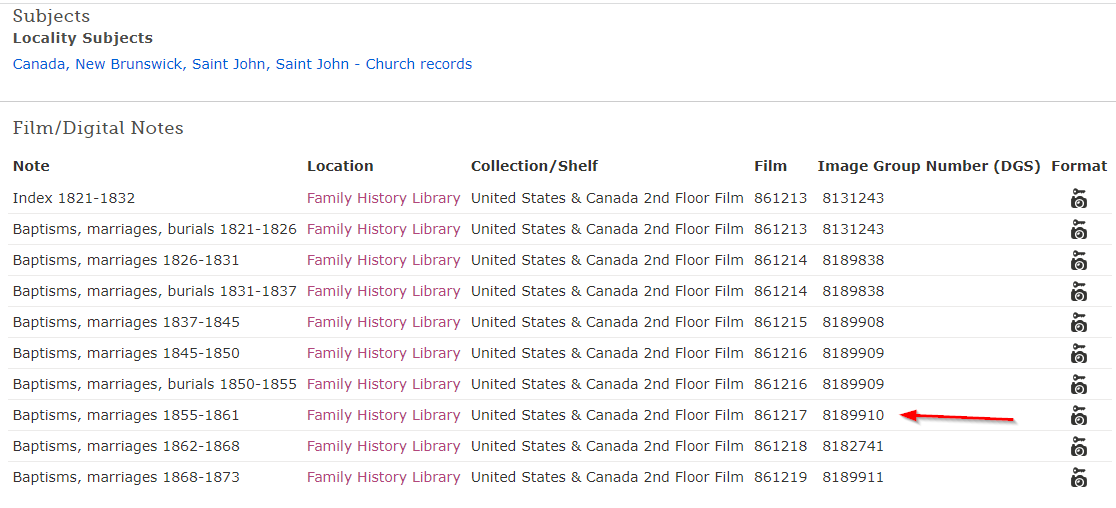
The records only go up to 1858. Here is more information:

Possibly this microfilm would have Ellen:

This record may be helpful:

Other Butlers from the Index

Page 300 is the last page I can see online:

This baptism was January 24, 1858. Catherine was the daughter of Thomas Butler and Mary Mahoney.

Here is the page 60 Catherine:

This baptism was on October 28, 1855.

Here is the baptism of William Butler:

He was baptized May 27, 1855 and was the brother of Catherine.

Summary and Conclusions

It was helpful going through the online records of FamilySearch.org for the Church of the Immaculate Conception in St. John, New Brunswick. From this I was able to find a more accurate marriage date for Edward Butler and Mary Crowley. I also found a more accurate birth date for Julia Ann Butler.

  • A more extensive review would have looked more at witnesses and godparents. It appears that the Coady family was close to this Butler family. Whether this family was friend or family relation to the bride or groom is not clear.
  • A look at the records for other names in the index would be interesting. That would take looking at the films in a library.


Summarizing Butler Genealogy and Connections to Ireland

I have been working on Butler genealogy for some time. My brother-in-law is working with a professional genealogist who could use the information that has been found to date to not duplicate efforts. Here is my attempt at doing that.

Edward Butler Immigrant Ancestor Born 1825

The death record for immigrant Edward Bulter has his birthplace as Kilkenny, Ireland and gives his parents’ names:

Interestingly, Edward H Butler, his son, shows his father born in County Wexford:

Michael Butler and Margaret Croke/Croak

The death certificate for Edward Butler gives his parents as Michael Butler and Margaret Croke. Windgap Parish Registers for County Kilkenny, Ireland show that this couple baptized a son, Mathias Butler on 1 November 1824:

Here is a map of Poulrone:

Here the Townland is spelled Pollrone. Here is a current map showing Pollrone:

Here is a record of Michael Butler from 1832:

Michael apparently died around this time (1832) as his wife Margaret shows as the occupier in the note to the right. This list was important at the time as it showed who was able to vote. The Ned Duggan listed as a sponsor for Mathias above could be the Edward Duggan shown as listed in “Poulroan” above.

One guess would be that Edward Butler went to live with cousins in Wexford (the family of Henry Butler) after his father died. Perhaps that is why he knew that family well.

Here are the sons I have of Michael Butler:

Here are the children I have for James Butler:

Edward Butler Immigration

This is most likely our Edward Butler from Poulrone, County Kilkenny. A birth date is given and an immigration date is given. This may be his passenger record:

However, in 1843, Edward would have been 2-1/2 months shy of 18. I suppose that age 21 is not a far stretch. In 1910, Edward states that he immigrated in the year 1850:

This part of the petition for Naturalization has Edward living in Boston since 1843:

Here is an Edward Butler with an assumed spouse Bridget in 1850 in Boston. Ward 8:

However, is this the same couple in 1855? This is from the Boston Census Ward 7:

This Edward Butler cannot be our Edward as the Census was taken on 1 May 1855, the day that Edward was marrying Mary Crowley in St. John, New Brunswick:

Edward Butler and Hugh Gray

Looking back to one of my Blogs, I see that I had made a connection between Edward Butler and Hugh Gray. Hugh Gray was living next to Edward and Bridget Butler in the 1850 Census:

In this Blog, I have the following character witnesses for Edward Butler on Edward’s naturalization record:

This is from the second page of Edward’s Naturalization Petition.

The above information is a bit confusing, but from the records, I assume the following:

  • Edward’s parents from his death certificate were Michael Butler and Margaret Croke from County Kilkenny
  • This couple lived in Poulrone, Windgap Parish based on the birth of Mathias Butler and land records.
  • There is an Edward Butler from Poulrone who had a Naturalization Petition in Boston in 1851.
  • A Hugh Gray vouched for Edward Butler
  • There is a Hugh Gray living next to an Edward and Bridget Butler in the 1850 Census for Boston.
  • There is an Edward and Bridget Butler in the 1855 Census for Boston. However, at this time our Edward was marrying Mary Crowley in St. John, New Brunswick. That means that the 1855 Butlers in Boston were a different couple.
  • I know nothing further of Bridget Butler. She was presumably Edward’s wife or sister.

Questions:

  • Did Edward have other relatives who came to the US before he did?
  • Why did Edward live in Boston for a while, then go to St. John, New Brunswick to marry?
  • Why did Edward’s son have on his death certificate that his father was from County Wexford? I believe that the answer to this is that earlier Butlers may have lived in Wexford. At least Edward’s relatived George Butler and his father Henry Butler were from Wexford.

Edward Butler’s Irish Connection in Cincinnati, Ohio

Edward moved to Cincinatti with his family. Here is the 1860 Census:

Based on the age of Ellen, the family must have moved from St. John in 1859 or 1860. Edward’s Ireland connectiion in Cincinnati is George Butler. Descendants of George Butler match descendants of Edward Butler by DNA. Here is George and family in 1860 in Cincinnati:

This Census suggests that this family was living in Ireland as late as 1850. George’s daughter, Mary A. ends up moving to St. John. Here is her death certificate:

It is unclear to me why Mary moved to St. John or what connection was there. Obviously, her relative Edward Butler was no longer living there. Were there other relatives there? The Murphy descendants are one of the families that match the Edward Butler descendants.

This appears to be George Butler’s baptismal record from 1826:

His baptismal name was Adam or George. His parents were Henry Buitler and Anne Russel. Here is Ferns in County Wexford:

My guess is that Ferns is about 25 miles from Poulrone in County Kilkenny. Here is a marriage record for a George Butler and Mary Whitty in Mountaingate, County Wexford:

George’s first wife died and he married secondly Margaret Sinnott on November 11, 1866 at All Saints Roman Catholic Church in the Fulton area of Cincinnati. This couple had children also that match Edward’s descendants by DNA.

Edward Butler’s Irish Connections in the Boston Area

Edward moves to the Chicago area where his two sons are born. Following that, Edward and his two sons move to the Boston area. While in the Boston area, he had two connections with Irish Butler relatives.

Edward Butler (1839-1891)

The first connection was with another Edward Butler (Edward’s namesake?). Researcher Peter Butler found the newpaper notice:

This notice was from a Boston Newpaper in 1891. Here is the State record:

Here is my version of the family of Henry Butler and Ann Russell – made with the help of Peter Butler:

“Adam” Edward Butler was the brother of George Butler who lived in Cincinnati. Also note the connection to 220 California Street where our Edward Butler lived at the time and the connection to St. John, New Brunswick.

Here is the 1893 Street Directory for Newton (California Street):

Connection #2: Mary Butler Mellie (1858-1938)

Here is the summary I have for Mary Butler:

Notice that I have the children as Melia rather than Mellie. Mary was the daughter of James who was the brother of our Edward Butler. I don’t have a birth record for James, but I have that Mary was born in Windgap Parish, County Kilkenny. Here is half of Mary’s baptismal record:

This shows that James apparently was still on the family farm in 1858. I did some further research into Griffith’s Valuation for the Townland of Pollrone:

Interestingly, I see the names Butler, Croake and Millea (Mellie?)

Possibly all the people in Reference #2 could be related: Duggan, Butler, Croake and possibly Millea. However, Mary’s husband was from County Meath according to their marriage record:

Here is Edward living in the Mellie household in 1910:

Edward is listed as William’s father-in-law. This is not quite correct as Mary’s father was James Butler based on this marriage record:

Perhaps James had died by now and Edward was acting as Mary and Johanna’s father. Johanna was Mary’s sister.

Summary and Conclusions

  • From the land records, it appears that there was a Michael and Margaret Butler in Poulrone, Kilkenny aka Pollrone around 1832.
  • This land went to Margaret Butler after the presumed death of Michael Butler
  • Later, the land went to James Butler, the presumed son of Michael Butler and Margaret Croake.
  • Edward Butler born probably 1825 in Poulrone (baptismal record not found) to Michael Butler and Margaret Croake. He moves to Boston where he is naturalized. He is living in Boston with a Bridget Butler in 1850. He marries in 1855 in St. John, New Brunswick. He has two daughters born there and moves to Cincinnati
  • In Cincinnati, Edward lives near George Butler, son on Henry Butler and Ann Russell of Wexford, Ireland. The descendants of these two families have DNA matches. It is possible that Michael and Henry Butler were brothers.
  • One of George Butler’s daughters moves to St. John and marries there and has children.
  • Edward Butler moves to the Chicago area and has two sons there.
  • Edward and sons move to the Boston area around 1890 or so. Edward is listed in the 1890 Veteran Census in Newton, MA.
  • Edward hosts the funeral for “Adam” Edward Butler in 1891. “Adam” Edward is the son of Henry Butler of Wexford. “Adam” Edward’s death notice in the Boston paper mentions that St. John, New Brunswick should be notified of his death.
  • In 1910, Edward is living in the house of William Mellie. William married Mary Butler, daughter of James Butler who took over the family farm apparently in Poulrone, Kilkenny.
  • Thanks to Peter Butler for his help in researching many of these facts.


FTDNA’s Time Tree for YDNA BigY Testers

FTDNA has a new Time Tree which is interesting. I have three trees that I am interested: Frazer from my father’s mother’s side, Hartley from my side and Butler from my wife’s side

Frazer Time Tree

The Time Tree is under Discover More:

Then there is a menu on the left:

Here is the Frazer Time Tree:

I didn’t take the tree all the way back. I thought that back to the time of Christ was probably far enough.

A Closer View

Here we can related more and focus in on the genealogical timeframe. I assume that between the years 1200 and 1400, the clans were forming as the top 6 BigY testers are five Frazers and on Frazier/Frasher. The Frazier tester has an American Flag as the genealogy is colonial and cannot be traced back – though it likely goes back to Ireland or Scotland. This branch of Frazers is called R-YP6489. Down from Frazier on Time Tree above is Dingman. Then there are Rick and my by cousin Paul. Then there are Rodney and Jonathan.

Here is how I have the North Roscommon Branch of BigY-tested Frazers:

Dingman on the left has the generic North Roscommon Frazer Haplogroup of R-FT421618 because no one else on his branch has tested.

This is how the ‘Block Tree” at FTDNA looks like:

Here I have Frazier also in the image. By comparing the two previous images, there are some interesting things:

  • Jonathan and Rodney share an average of 5 private branches. That would seem to indicate the potential for some branching below R-Y151390 which is the branch for Thomas Henry Frazer born 1836. There is also a spare SNP which is FT421607. This is available for branching between James Frazer born about 1720 and Archibald Frazer born about 1792.
  • Rick and Paul show an average of three Private Variants. These would be for branches below James Frazer born 1804. The Private Variants in this case and for Rodney and Jonathan are not as important as the genealogy is better known in these two lines where these Variants would be applicable.
  • Perhaps what seem unexplainable at this time is why R-Y85652 has two additional equivalents. That would imply that, if my tree is right, that Philip Frazer would have had two mutations. I don’t think that is very likely. As these are equivalent SNPs, the other potential, given the above tree would be that Philip had one mutation and James had two mutations. I posed the question to the BigY Facebook Page as to whether one man could have two variants or SNPs. Some thought that two mutations in one person was possible.
  • Dingman’s line has four Private Variants. They would have ocurred in the seven generations since Archibald Frazer born about 1743.

Hartley Time Tree

This is from my own family.

The man in red represents my father as he is the one my brother and I have as a common ancestor. The man with the blue cross is a Smith. We have a common ancestor around 500. It is not clear as to whether our ancestors were from Scotland or if his branch moved North. Going up a branch, it would seem that most of the people from this line were in the area of England. A few testers in the branch above had ancestors from Wales:

For reference, the blue circle three from the bottom of the above image is Smith.

Hartley and Mawdsley

The top tester above is a Mawdsley. There had been some question as to whether this person should have been a Hartley. If we go with this timing with a common ancestor between Hartley and Mawdsley of around 1100 AD/CE, then there would be no need to group the two as surnames were not common at that time for the average person. I like to quote FamilySearch on this topic:

The custom of applying a man’s by-name to all his children began in the late 12th century and spread slowly, with the manorial classes and the south of England leading the way. The first legal recognition of an hereditary surname is found in 1267; it was de Cantebrigg meaning ‘of Canterbury.’ By 1400 three-quarters of the population are reckoned to have borne hereditary family names, and the process was complete by about 1450 in England. Wales is an exception, in that although they had surnames they were patronymics (derived from the father’s first name) and thus changed each generation.

The Hartleys seem to fit this general statement as the first Hartley common ancestor (if FTDNA’s estimate is correct) is shown to be:

In general terms, the Hartley “Time Tree” shows two major branches of Hartleys. The first group branches off from R-A11134 and the second group branches off from R-A16717:

This branch is about 140 years more recent than R-A11134. The common ancestor of this branch was born, according to the tree in 1572. This date is about 90 years off from the to the actual genealogy. However, it could be that A16717 first ocurred in the grandfather or great-grandfather of Edward Hartley:

I call this the Quaker Branch of Hartleys. Edward Hartley from Little Marsden came to Pennslyvania and started the US branch of this Hartley family. There is another YDNA tester who is considering the BigY test who descends from the Thomas Line above. This is the line from the Hartley researcher I have corresponded with:

>Edward Hartley born 16 May 1666 married? Sarah Midgley
>Thomas Hartley b. 29 Dec. 1700 Solebury, Bucks County Pa. married Elizabeth Paxon
>Anthony Hartley b. 3 Dec. 1730 married Elizabeth Smith
>Jonathan Hartley b. 221 Octoner 1761 married Elizabeth Bunting
>David Bunting Hartley b. 28 Sep. 1786 married Phoebe Park
>Hiram J. Hartley b. 27 March 1824 NJ married Rebecca Church Lee
>Harry Lee Hartley b. 9 June 1864 married Emma Bell Leach
>Robert Hartley b. 17 June 1896 married Grace Maloney Roberts
>John Robert Hartley b. 4 August 1922 married Alice Buren Wrighy

One way to look at it, is if the Quaker Line is about 90 years too old on the tree, then perhaps we could move the other branches ahead 90 years. That wouldn’t work for my father’s branch as the timing on that is so close. Here is my tree with the John Robert line added:

Butler Time Tree

My wife is a Butler and there are a few Butlers who have taken the BigY test:

On this line, it doesn’t take much to get back to over 3,000 years ago. The Frazer lines were R1a, The Hartley lines were R1b. This line is in the I Haplogroup. Let’s start with the red Haplogroup I-FT241245. The two testers are my brother-in-law and father-in-law. In this case, my father-in-law is the common ancestor who has FY241245. The estimated date for that Haplogroup is 1907 or close enough to 1932 when my father-in-law was born.

The next person up on the tree is Butler researcher Peter:

This tree is showing that Peter and my in-law’s have a common ancestor born around 1557. In a Blog I wrote on 1 March 2021, I came up with these dates:

That’s a difference of about 125 years.

Next Branch Up

The next Branch going back in time includes a Whitson and a Batt.

The date that FTDNA gives for the common ancestor at I-BY50783 is 1449. This is interesting as it seems like only one SNP separates these two ancestors. That comes up with 108 years per SNP in this case. That is about what I was using in my guess – 100 years per SNP.  But I came up with a different result somehow.

Comparing the Three Time Trees

I am impressed with the regular branching on the Time Tree that the Frazers are on:

This is true especially starting after 900 CE with some sort of branching in every 200 year period following. This may be a result of the fact that many people with Scottish origins tend to have their YDNA tested. Another explanation would be lines that were successful and prospered.

The Hartley Time Tree does not have the same regularity in its branching:

Here we see no branching between around the years of 500 and 1100 CE. This could be due to fewer testers and/or lines that were not doing as well. Intermediary lines may have died out. This could be due to wars, famine, disease or simply famiilies have no males born.

The Butler Time Tree has even less branching:

There are two main branches that ocurred before 1,000 BCE. After that there was no addition branching until almost 1500 CE. That is about 2,500 years without branching. This line is probably severely undertested and/or went through very tough times. This is picked up somewhat at the SNP Tracker Website:

Notice that whole eras are skipped. Medieval and Iron Ages are missing.

Summary and Conclusions

  • FTDNA has a new helpful representation of a timeline for BigY testers. This is not the final say, but a helpful tool to compare with other estimates and with genealogy where available.
  • I looked at the trees that I have looked into. Those are Frazer, Hartley and Butler
  • I compared the three trees to each other. I noted that the Frazer Time Tree has the most consistent and regular branching going back in time. The Butler Time Tree has the sparsesest branching going back before the time of Christ.
  • As a result, I would ten to have the most faith in the Frazer timelines. There is good branching and somewhat of a check as we believe that common Rocscommon Frazer ancestor represented by R-FT521618 was born around 1690. I feel the Hartley Time Tree is slightly less reliable due to fewer branches but we have the genealogy for the common ancestor for the ‘Quaker Line’ born in 1666. In my opinion, the Butler Time Tree could be the least reliable of the three due to no ancient genealogy to check and the fact that branching in the line is sparse – especially before the genealogical timefrane.
  • FTDNA is continuing to calibrate its age estimates. One good example of how FTDNA’s Time Tree can be calibrated is with Edward Hartley born 1666. If this person is reported to FTDNA, they will be able to use that information to correct their current estimate of a common ancestor of 1572.


Adding DNA to My Butler In-Law’s Map Using DNAPainter

My late father-in-law was Richard Butler. Richard is 24% ‘painted’ overall:

Most of that is on the maternal side. Richard is 8% painted on his Irish paternal side and 39% painted on his French Canadian maternal side. First, I’ll look at Gedmatch. I see a Melanie there that I don’t see mapped. She is also at Ancestry.  Here is how Melanie and Richard match at Gedmatch:

By Melanie’s last name, I am guessing that the connection is on the French Canadian side. Richard did not test at Ancestry, but his two sisters did. Here is how Richard’s sister Lorraine matches Melainie:

This relationship is quite distant. Richard’s sister Lorraine has a large amount of DNA shared for a 5th cousin, once removed relationship. Richard’s amount of shared DNA is considerably higher at 88.7 cM.  I’ll just go ahead and paint Melanie’s DNA match onto Richard’s map and assume that the common ancestors are correct.

Painting Melanie’s DNA Match to Richard

I see that Richard already has Louis Girard mapped by others, so I don’t have to add the Girard/Tremblay couple.

I see that the previous Girard/Tremblay DNA that I had added to Richard’s map was from Doris:

I might have expected some of these matches to overlap, but they did not. The only place there was overlap was on Chromosome 14:

That overlap was with Doris who had Delisle/Lanouette shared ancestors back in 1715. Melanie raises Richard’s mapped percentages to 40% maternal and 25% overall.

Richard and Benoit – Same Girard/Tremblay Ancestors from MyHeritage

Richard has this “Theory of Relativity” at MyHeritage:

Let’s paint in Benoit:

Benoit’s DNA makes sense compared to Doris and Sleuth as Girard and Tremblay go back from the Pouliot Line. Above, Melanie had an overlap with Charlotte. Charlotte goes back to Delisle who is on the LeFevre Line, so this made less sense. It shows that there may be other connections or the genealogy may be off. Other connections would be my first guess. Benoit raises Richard another percent on his maternal side:

Richard and Alan at MyHeritage

Richard has a Theory with Pierre, but there are two possible pairs of common ancestors. I’ll skip Pierre for now. Alan and Richard only have one pair of common ancestors shown:

These common ancestors are on the Bulter’s Lefevre side.

Alan overlaps on Chromosome 2 matches who have Lefevre ancestors.

The overlap with the brown DNA represents Edmond Lefevre and Leocadie Methot. That means that, if these matches are accurate and the genealogy is accurate, then the green DNA on Chromosome 2 that overlaps with yellow would be from Leocadie Methot and not Edmond Lefevre. It further means that  the brown DNA that overlaps with yellow would be from Joseph Martin Lefevre and not Emma Pouliot. Richard’s match with Alan gets him up to 42% painted on his maternal side.

Reina at Gedmatch and Ancestry

Here is how Reina matches Richard:

Reina represents a new set of common ancestors:

Reina brings Richard up to 44% painted maternally and 26% painted overall.

Richard and Germain at Gedmatch and Ancestry

An Ancestry/Gedmatch combination is good for painting Richard’s DNA map. Here is how Ancestry shows Richard’s sister Lorraine and Germain connectiing:

the connection is so far out (back to 1690), it makes me wonder if there are other connections. Germain matches on Richard’s Pouliot side. Germain’s match is on the Pouliot side also in DNAPainter:

On Chromosome 9, Germain’s match overlaps with Benoit’s.

Here is Chromosome 17:

The area between Michelle and Germain would define a crossover. Michelle represents Richard’s Lefevre side and Germain (and the purple matches) represents Richard’s Pouliot side.

Richard is now 27% painted overall. Progress.

Richard and DR

Here is DR and Richard’s DNA match at Gedmatch:

Here is DR’s paternal tree:

The connection appears to be on the Rooney side which is Richard’s paternal side. That is where a lot of Richard’s DNA mapping is missing.

Here is a Rooney tree which I had built previously:

I’m not sure why I put the green as a different color. It could be because Daniel disagreed with the way I came up with the genealogy. Also I now see that I had two wives for Timothy Rooney. That first I have as Margaret Ann Gorman. If that is true that Richard and DR are half third cousins once removed. I just need to add in DR:

I note that in DR’s tree, his marriage record for John Rooney has Terence and Ann Rooney as his parents, but his death record has Timothy and Margaret Rooney.

Painting DR (Daniel at Gedmatch) to Richard’s Map

As it appears that Daniel and Richard are 1/2 cousins, that would mean that their only common ancestor is Timother Rooney.

This brings Richard up to 10% painted on his paternal side (from 8%).

More Painting of Daniel to Richard’s SIster Lorraine

Lorraine has a match similar to Richard’s with Daniel, but slighter larger on Chromosome 14:

My colors are not consistent between siblings.

Visual Phasing Butler DNA

I had visually phased Richard, Lorraine and Virginia:

This means that Virginia should not match with Daniel as Rooney is on the Butler’s Kerivan side. Virginia only recieved Butler DNA on her Chromosome 13.

Here is how I had visually phased Chromosome 14:

Again, Virginia has no Kerivan DNA on Chromosome 14, so has no match with Daniel. Lorraine has all Kerivan DNA, which explains her larger match with Daniel on Chromosome 14.

When I was doing the phasing, I also show why my wife Marie did not recieve any Kerivan DNA from her father:

Where Marie would have gotten green Kerivan DNA from her father, it was replaced by Richard’s maternal side Pouliot and Lefevre DNA.

Shared AncestryDNA Matches with Daniel

The largest shared match that Lorraine and Daniel have at Ancestry is with FG. Here is her tree:

I hope that, if I build out FGs tree, I will bump into a Rooney.

Here is a Rooney three generations out from FG. It turns out I already had Frances in my tree:

As Frances has a common DNA match with DH and Lorraine, the above connections are suggested.

People Who Match Richard and Daniel at Gedmatch: Jeanette

Gedmatch also has a utility to look for common matches. Jeanette matcches Richard and Daniel and also has a family tree:

Surprisingly Rooney is the first name on Jeanette’s tree. I have looked at a lot of Gedmatch trees and it is unusual to find what you are looking for. Now I need to check out Jeanette’s tree.

According to Findagrave.com, John H Rooney is John Henry Rooney. That means that I can add Jeanette to my tree:

My thinking is that Jeanette is a 1/2 third cousin once removed to Richard.

Adding Jeanette’s Match to DNAPainter

First, I’ll go with Richard:

The blue DNA in Chromosome 11 represents Tim or Terence Rooney’s DNA that came down to both Jeanette and Richard.

Jeanette and Virginia

Virginia is Richard’s sister:

So far, that is Virginia’s only match going back to Tim Rooney (in pink here).

Summary and Conclusions

  • I was able to paint some extra DNA onto Richard’s map and some onto his two sisters.
  • I was happy to find some Rooney matches as they are on Richard’s mostly unpainted paternal side
  • Many Rooney families had large families which is good for DNA matching
  • To me the DNA matches tie together two branches of the Rooney famiiy.
  • I didn’t mention the genealogy here, but I have looked at the genealogy in older Blogs.  I also mentioned a Jenny there which is the Jeanette in this Blog.
 

Denis’ DNA Match On My Wife’s French Canadian Side

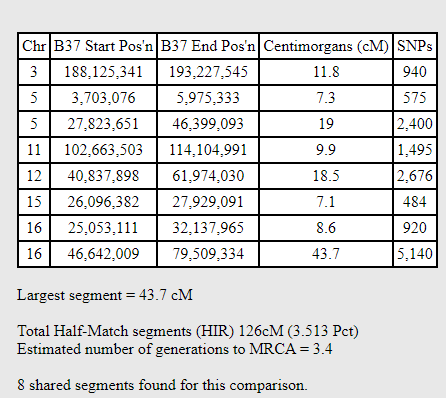
I was looking at my wife’s Aunt Lorraine’s DNA matches at Gedmatch recently. I found that she matched Denis:

I was also able to find Denis at Ancestry:

His tree was modest, but was something that I could work with.

Finding a Common Ancestor Between Denis and My Wife’s Family

The next step is to build my own tree for Denis. My assumption is that the match is on the Lefevre side as my wife’s aunt’s mother was a LeFevre. As soon as I enter Denis’ parents into my tree, I start getting hints.

I see that my wife’s second great grandfather was Edmond Lefevre born in Saint-Antoine-de-Tilly, so I feel I am on the right track.

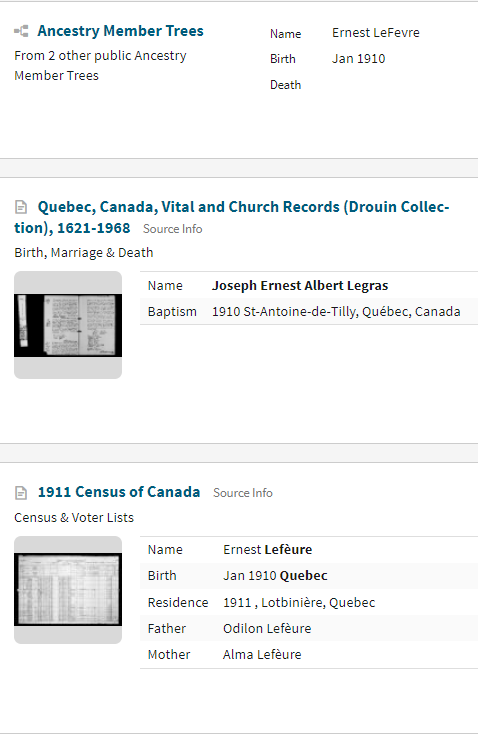
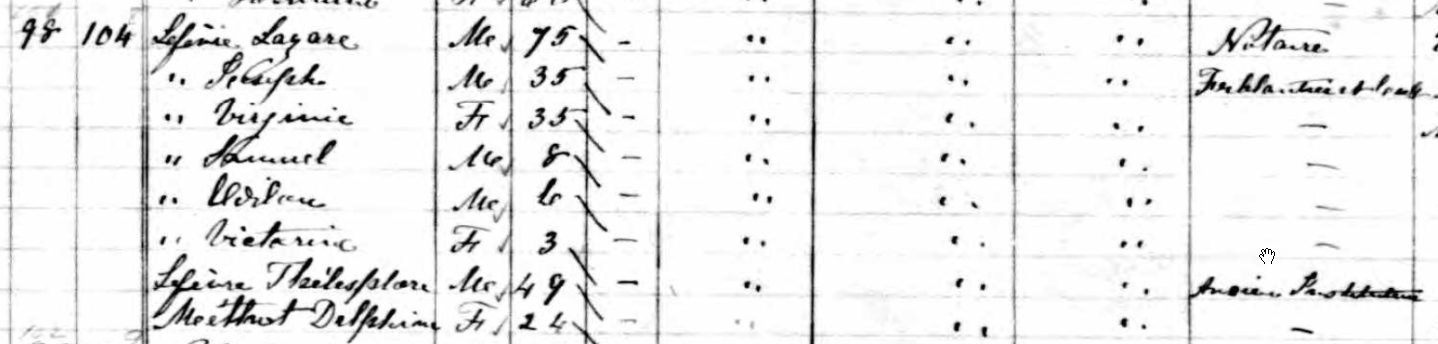
Here is the baptismal record for Denis’ father Ernest:

Ernest’s father was Odilon. We further learn that Ernest’s mother’s name was Alma LeFleur.

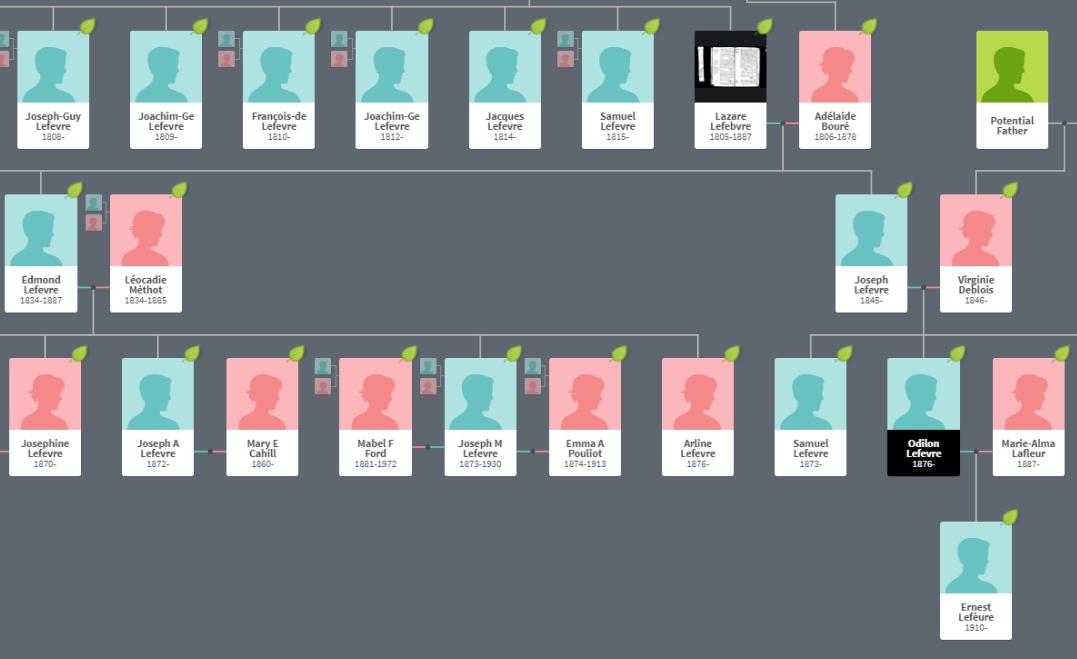
Odilon LeFevre Born 1874

Next I would like to focus in on Odilon:

Here he is in 1881:

This appears to be three generations of LeFevre’s: Lazare, Joseph and Odilon. Here is Lazare from my wife’s grandmother’s tree:

Linking Joseph to Lazare

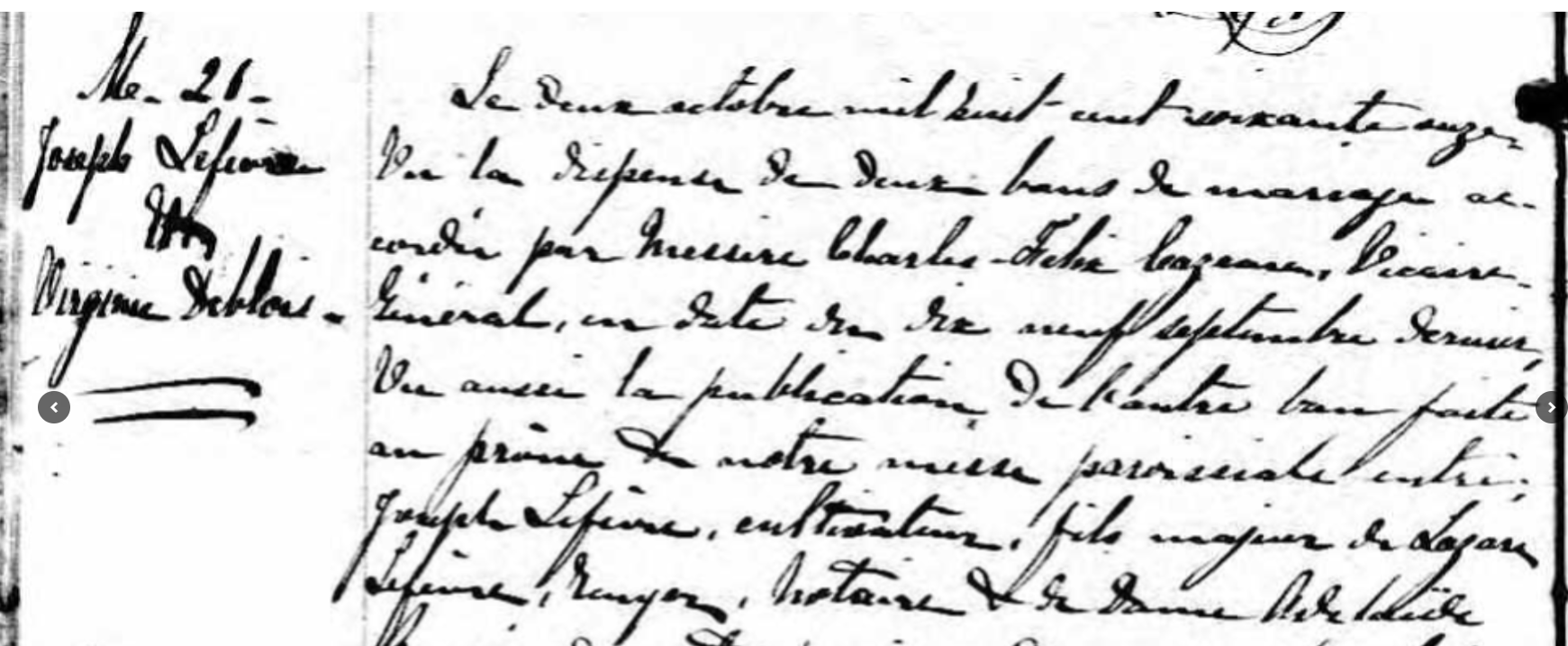
I next just need to show that Joseph was the son of Lazare. Here is a portion of Joseph’s marriage record:

This establishes that Joseph was the son of Lazare, “Notaire”. From what I understand, a notaire would be a sort of paralegal.

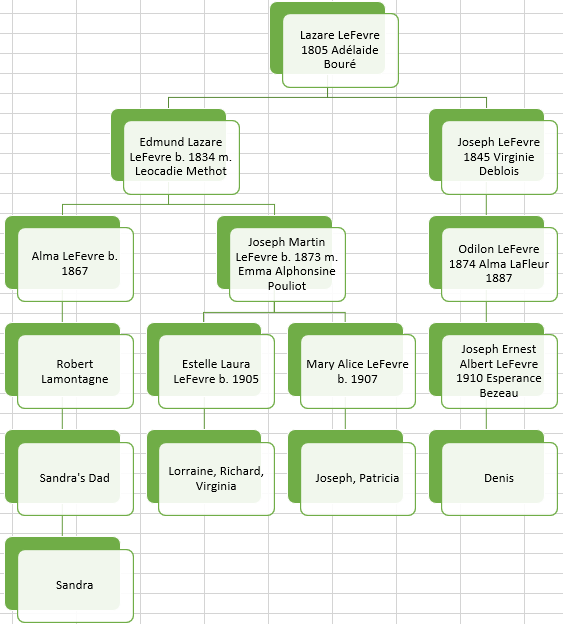
That means that we have a connection. I have a small LeFevre tree already, but it needs updating:

Let’s add Lazare and Denis:

According to this tree, Lorraine and Denis are third cousins. There may be other connections further back, but I will disregard those connections for the time being.

Mapping Denis’ DNA to My Wife’s Aunt Lorraine

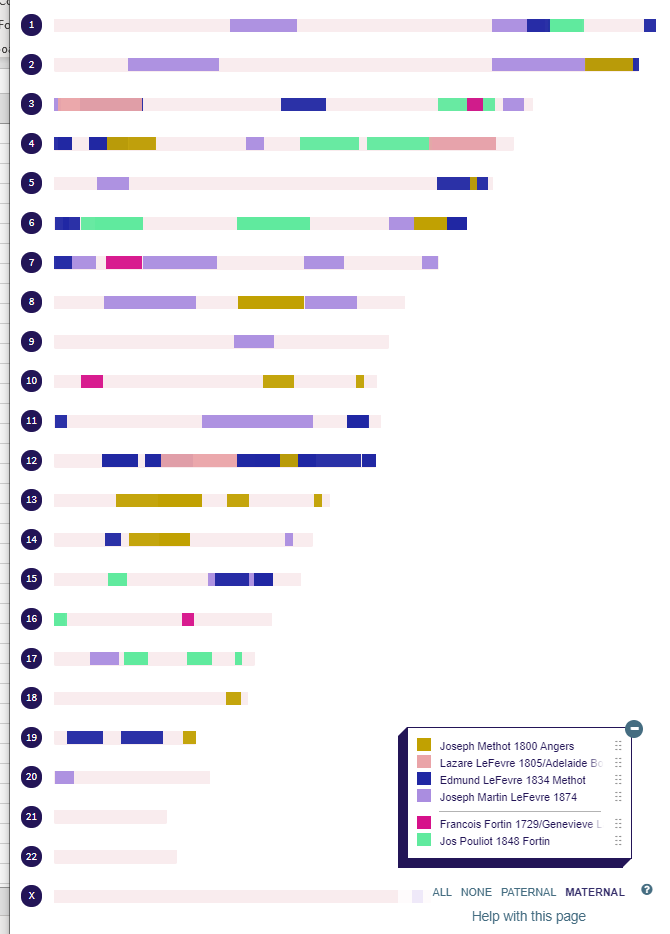
The match between Denis and my wife’s Aunt Lorraine is either from Lazare LeFevre or Adelaide Bouré. We don’t know which without further DNA analysis. Here is what I have for Lorraine on her maternal side so far:

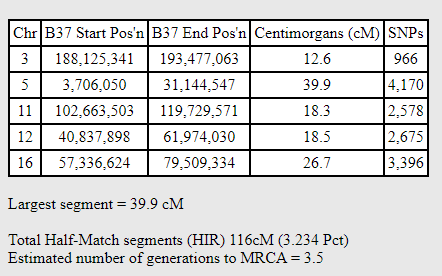
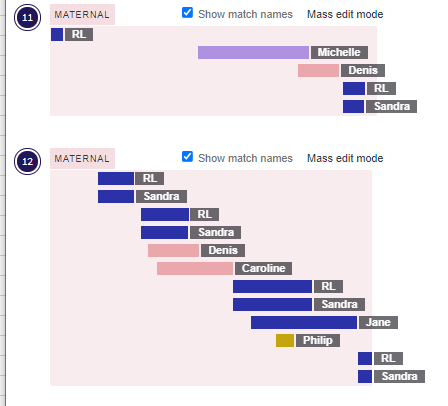
Lorraine’s DNA is 37% mapped out on her maternal side and 22% totally mapped (maternal and paternal). This would show as pink above. Denis bumped up Lorraine to 38% mapped maternally. Here is Denis’ contribution highlighted in gray:

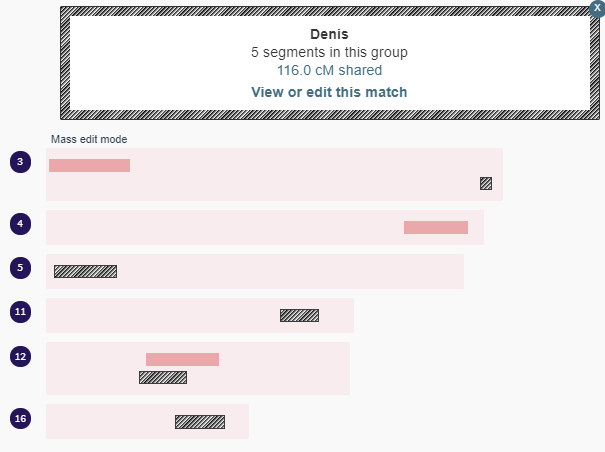
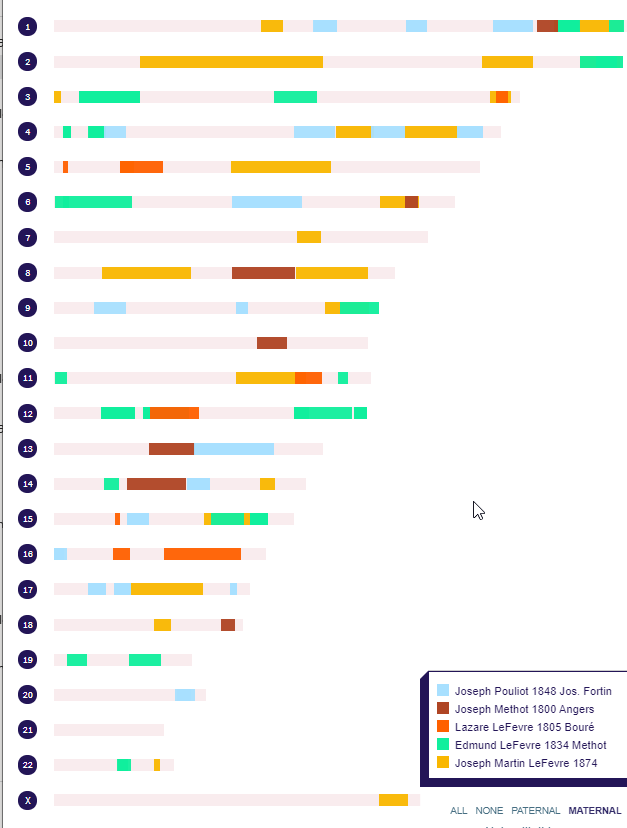
He brings new information on Chromosomes 3, 5, 11, 12 and 16.

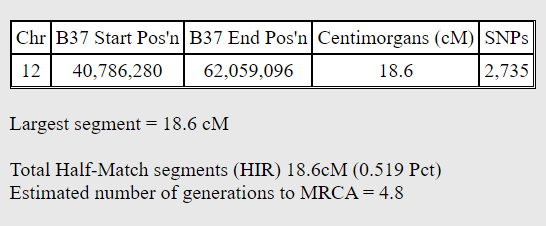
On Chromosome 11, it is truly new information. On Chromosome 12, it is already covered by RL, Sandra and Caroline.

Painting On My Father-in-law

I’m a bit behind on Richard as I don’t have a category for Lazare LeFevre and Adelaide Bouré. Richard has a more modest match with Denis:

When I paint this on to Richard’s DNA map, I see something interresting on Chromosome 5:

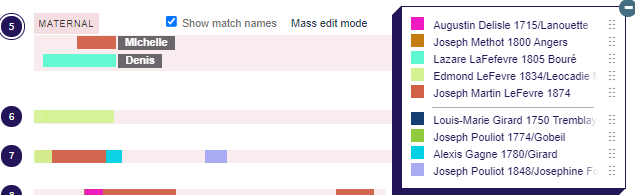
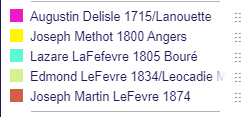
This shows that Richard’s DNA match with Denis is overlapping with Richard’s DNA match with Michelle. This is where I have a problem with my key. I had thought that Michelle’s common ancestor was Methot, but it is actually with Joseph Martin LeFevre born 1874. I need to differentiate my colors better. I changed Methot to yellow, so that it will be less confusing in the future;

Adjusting My Tree

Now that I know where Denis belongs in my tree, I can add him in:

That should help AncestryDNA figure out the ThruLines.

Speaking of ThruLines

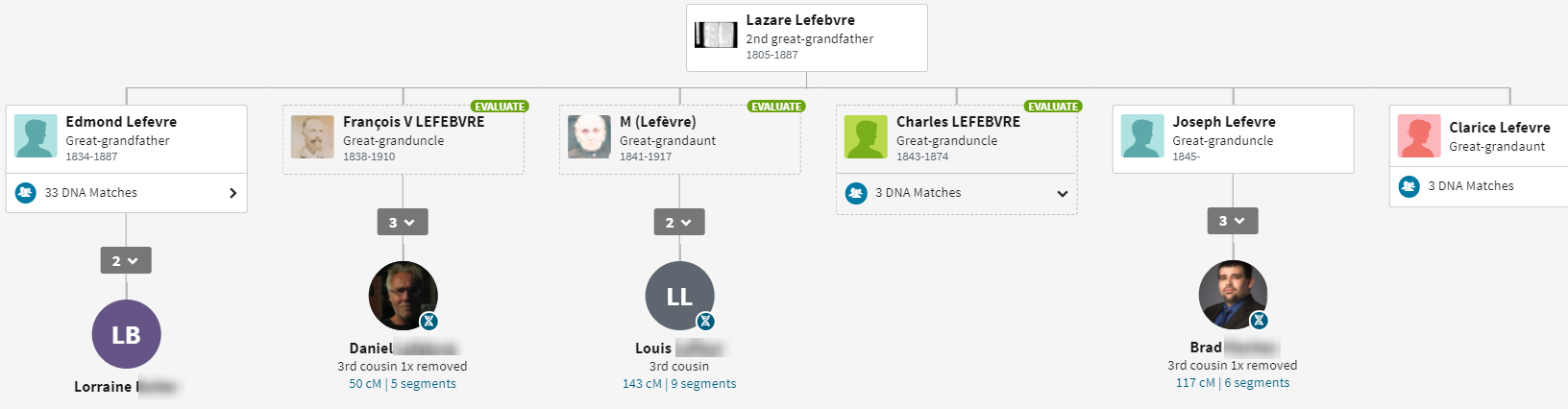
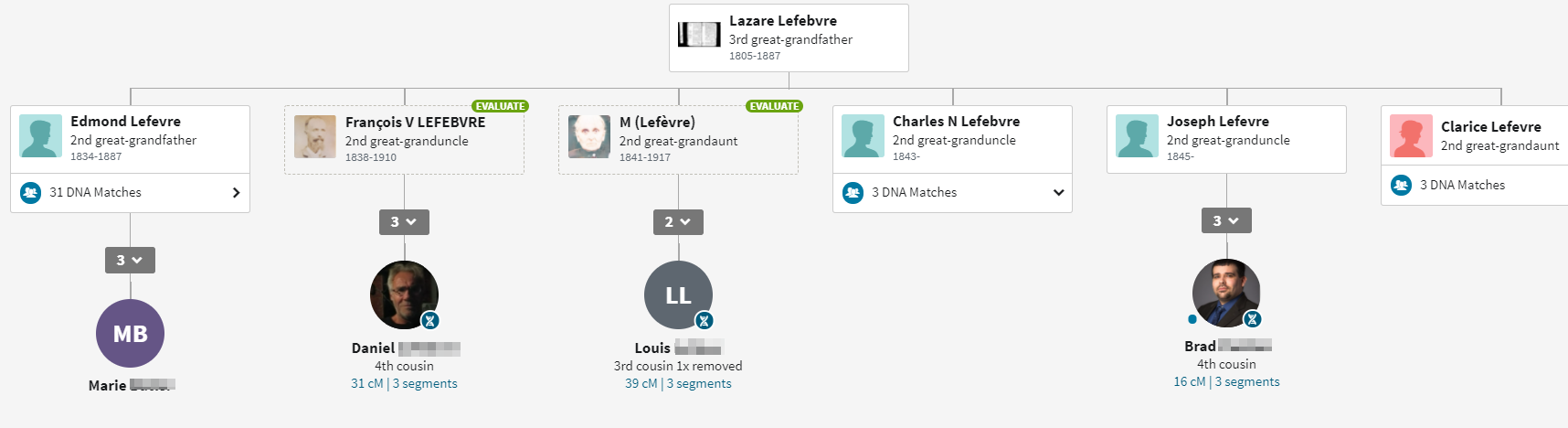
Here are Lorraine’s ThruLines for Lazare LeFevre:

There is one match on the Joseph Line with Brad.

More Painting for My Wife’s Aunt Susy

I haven’t been paying as much attention to Aunt Susy’s DNA Map:

However, she has nice colors. Here is her match with Denis at Gedmatch:

I’ll need to add Lazare in to DNAPainter. Here is Aunt Susy’s maternal side:

DNA Painter gave me a boring color, but a chose a brighter color for Lazare and his wife. Susy was 33% painted maternally and 21% overall. Denis bumped these numbers up to 36% on the maternal side and 22% overall.

Denis and My Wife

Unfortunately, my wife and Denis do not share a lot of DNA.

Denis and Marie are third cousins once removed. That should translate to 4.5 generations to their common ancestors. That means that Denis and Marie share a little less than average for that relationship.

Painting this on to Marie’s map does not add any missing areas:

However, it does confirm the match with Caroline and others.

More on Caroline

I should have added Caroline to my LeFevre DNA tree. Caroline is at MyHeritage:

Charles Lefebvre shows as 1891. I checked my old blogs and see that the tree had “before 1891. Here is Lazare in 1851:

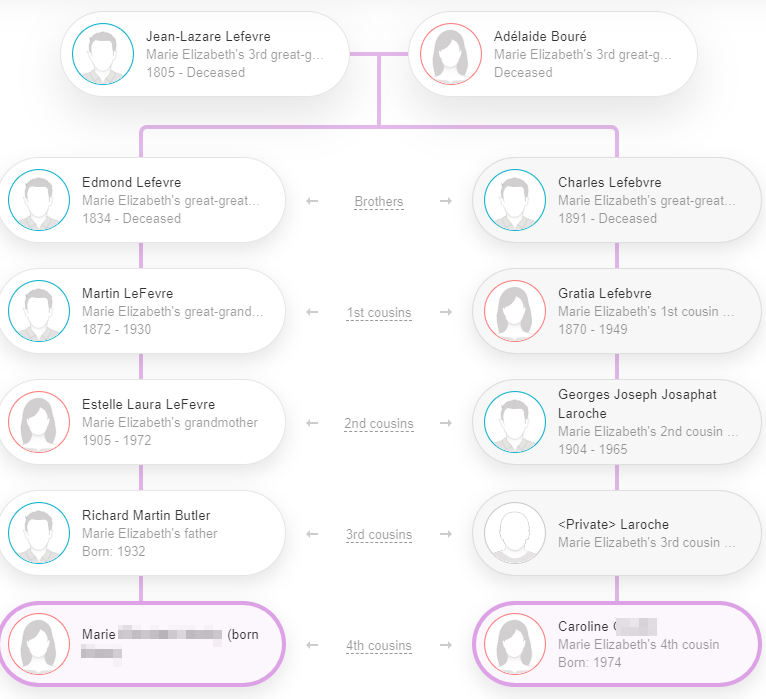
Charles is 9, so was born around 1842. The birthplace for all is Ville Quebec which I take to be Quebec City. I made a new tree with Caroline in it:

I’m sure that this tree could get quite big. This is what Marie has for ThruLines at AncestryDNA:

Outside of the Edmond Lefevre Line, Marie has 9 matches from 5 siblings of Edmond. And when I expand the Charles Line, I find Caroline in the photo:

Marie J G above is Marie Josephine Gratia who went by Gratia.

Summary and Conclusions

  • I started by looking at the DNA of Denis. I painted his DNA onto my wife’s map as well as my wife’s father’s and two aunts’ maps.
  • Marie’s father had a smaller match with Denis compared to the matches of his two sisters. Marie’s match was even smaller.
  • I made a DNA tree for LeFevre/Lefebvre
  • This tree included Caroline who I had mapped previously. She also appears on my wife’s ThruLines at Ancestry.
  • I was able to map Marie’s family’s DNA connection to Caroline because she also has her DNA at MyHeritage.

Elizabeth: A DNA Match from the Cincinnati Butlers; Lisa’s Butler Connections

I recently discovered that Elizabeth was a match to my late father-in-law Richard. I found her by doing a Tier 1 Cluster Analysis at Gedmatch. Richard’s clusters look like this:

All the gray squares connected to the colored squares probably indicate Richard’s French Canadian side. The last two small clusters likely represent Richard’s Irish side as they are not connected to the other clusters. The last two people in the last cluster are Elizabeth and Nathan. I wrote to Elizabeth and she confirmed that she was from the Cincinnati Branch of Butlers. I probably would not have known about Elizabeth if she had not uploaded her DNA to Gedmatch as Richard did not test at Ancestry. His two sisters tested there, but they don’t match Elizabeth by DNA.

Here are Nathan and Elizabeth on a tree:

The green boxes are for people who have detailed information on their chromosomes. They have tested at FTDNA, MyHeritage or 23andMe or uploaded their AncestryDNA results to Gedmatch.  The people in the bottom white boxes are connected by DNA and genealogy at Ancestry, but don’t have detailed information on their DNA.  This is what I call the Cincinnati Branch of Butlers. Nathan descends from the first wife of George Butler and Elizabeth descends from a second wife. Nathan’s ancestors moved to Nova Scotia where my wife’s ancestor married. Because of the genealogy, any DNA that Nathan and Elizabeth share have to come from George Butler but not either of his wives.

Here is the whole tree:

Because there are so many DNA connections between these two lines, I have proposed a Butler father to Michael Butler the earliest known ancestor of Richard and Henry Butler, the earliest known Butler ancestor of Elizabeth.  There are other possibilities.

Lisa with Possible Butler Ancestry

I wrote to Lisa about a year ago, because she had a large match with my wife’s two Aunts. Lisa would like to know how she fits in. Here is my wife’s side of the tree:

If I put up some DNA match numers for Lisa, it should tell where Lisa fits in on this tree:

That means that Lisa most likely descends from Marguerite Butler born in 1912. Here are some possible relationships between Amanda and Lisa:

My guess would be that Amanda and Lisa could be 1/2 first cousins or first cousins once removed. When I look at shared matches between Lisa and Amanda, I see a Herman in there which means that Lisa may have Herman and Butler ancestry somehow. This should give Lisa something to work on.

Lisa and Elizabeth

I bring Lisa up here because she also has a small match with Elizabeth:

That means that Lisa also has ancient Butler DNA links going back to Ireland.

Summary and Conclusions

  • I was fortunate to find Elizabeth through Gedmatch’s Cluster Program
  • Elizabeth is from the Cincinnati Butlers which link my wife’s Butlers back to Ireland
  • Lisa, who I had corresponded with previously also has a small match with Elizabeth
  • Lisa was unsure of her ancestry
  • Lisa gave me access to her DNA results at Ancestry. I compared her results to my wife’s Butler lines and she matched best with the Marguerite Butler Line.
  • Lisa and Marguerite’s granddaughter Amanda also have a shared match with a Herman which means that Lisa and Amanda could be as close as first cousins once removed.


Butler Visual Phasing: Part 4

In my previous Blog, I worked on updating the visual phasing for my late father-in-law and his two sisters. While doing this, I updated their DNA Painter Maps. I made an interesting discovery based on an old Cincinnati Butler descendant match that I had found back in 2015. The old spreadsheet that I had on Richard was helpful, so I updated that for him and one of his sisters. I will next update Virginia’s spreadsheet from Gedmatch.

Chromosome 17

My note says that this is done but  the paternal side needs to be idendified:

On Chromosome 17, I was trying to figure out what DNA my wife inherited from her father based on the Chromosome Mapping.

The key to Chromosome 17 is finding paternal matches. Not unlike the key to all the chromosomes. I’ll run Virginia against Jack, who is a top Kerivan match. I’ll look for the matches in common at Gedmatch and then run a Matching Segment Search. I come up with one match on Chromosome 17:

It looks like Virginia’s paternal crossover is around 6. That would mean that paternal GP1 would be Kerivan. I see that Richard has a match with Jane also:

I don’t see a DNA match between Jane and Lorraine.

I’m ready to declare victory over Chromosome 17 and move on to the next battle.

Chromosome 18

Assuming my previous work was correct, I first need to identify the easier maternal side:

Next, I’ll add DNA Painter information:

This works well, except for Richard’s purple match with Fortin/Tremblay. Based on my visual phasing, there should be no crossovers in that purple area. My guess is that orange is LeFevre and that the purple match that Richard has with Gerry is not right.

Here is Gerry’s tree at MyHeritage:

MyHeritage was not able to figure out our common ancestor. I’m not sure how I came up with what I did. I would say now that it is not right or that there is a closer common ancestor. I decided to delete Gerry from Richard’s map until I can figure out how he belongs.

The remaining question is the location of Virgina’s maternal crossover. That can be found at the Gedmatch full resolution image of the match between Richard and Virginia:


That happens here at about 42.5. That fits in with Virginia’s Lefevre match on Chromosome 18:

Next, I need to find a paternal match to identify the paternal side of Chromosome 18.

It appears that the salmon colored paternal side is predominately all Kerivan or all Butler. An in common match between Jack (who represents Kerivan) and Virginia didn’t show any matches on Chromosome 18. That means that I should run an in-common match for one of the Butler matches. Lorraine has a pretty good match with Kim at Gedmatch:

I haven’t connected these two families by genealogy but they are connected by DNA and many circumstantial incidences. I had no luck finding Chromosome 18 matches with this comparison either.

Chromosome 19

I’ll add the DNA Painter map to the bottom of the work I had done previously:

It looks like Lorraine should have a maternal crossover where her match ends, but Richard’s Lefevre green is actually two matches:

The problem is that I have not mapped Jane to Lorraine’s map. Mapping Jane onto Virginia’s map helps show Virginia’s Pouliot segment between the two Lefevre segments:

It looks like there should be a crossover for Lorraine on the right side of her match with Jane. However, it appears that the match between Jane and Richard was larger previously. Now it is in line with the matches between Lorraine and Virginia:

I guess the algorhythm changed at Gedmatch. I don’t feel like changing Richard’s results right now.

A Paternal Match for Chromosome 19?

Using my previous in-common analyses, I have this Kerivan-type match for Lorraine:

I have this Butler-type match – also for Lorraine:

Unfortunately, that does not fit in with the way I have Lorraine mapped, unless I change the visual phasing. Due to uncertainties, I’ll leave Chromosome 19 for now.

Chromosome 20

Here is what I had done previously for Chromosome 20:

I’ll convert this to Excel from Powerpoint. I also want to look at the DNA Painter maps for these three siblings. Here is Lorraine:

She has LeFevre DNA at the beginning and Kerivan DNA at the right end of Chromosome 20. Lorraine’s matches appear to define Paternal GP1 as Kerivan.

Virginia shows Pouliot up to position 60:

Here is what Richard has:

When I re-do this Chromosome, I’ll start from the righ hand side as the left-hand first crossover is not as important. I did this but got the same results:

However, now I know the paternal side. At some time, I need to look at Virginia’s match list to see where her matches are falling out after position 60.

Chromosome 21

Here is what I had done previously in Powerpoint:

I’ll start by looking at the three DNA Painter maps. Only Richard has one match so far. That is for Pouliot between 10 and 22:

When I bring this into Excel, I need to see the left-hand side:

With the left side completed, I see the only color that Richard has uniquely there is blue, so that has to be Pouliot. That defines the maternal side of the three siblings’ Chromosome 21 and defines the maternal grandparents. However, it leaves a gap in Lorraine’s Chromosome 21.

Chromosome 22

Here is the work I did previously:

All l need to do is identify the two paternal grandparents. I checked the three DNA Painter maps and saw no paternal matches that would help me.

Summary and Conclusions

My list of completed chromosomes is getting larger:

I now have only 8 chromosomes that are not completed. If I do some more work on these, I may be able to complete one or two more.

  • It was helpful referring to the DNA Painter maps for these three siblings.
  • Looking at in common matches was helpful at Gedmatch
  • I will likely continue working on these unfinished chromosomes and follow up on some of the paternal in common DNA matches – especially on the Butler side.

Visual Phasing My Father-in-law’s Butler Side: Part 3

Here is where I am with visual phasing of my father-in-law’s Butler side:

I started about four or five years ago and recently have been updating their visual phasing. Visual Phasing maps out in what way three siblings got their DNA from their four grandparents.

I’ll look at the chromosomes that I haven’t completed and see if I can complete or improve on any of them.

Chromosome 1

I’ll update this to Excel and start over. The crossovers seem straightforward until we get to the right end. Then there are three in a row:

Here is my attempt at visual phasing:

When there are two crossovers in a row for the same person, it means that there is usually a Half Identical Region (HIR) which goes unidentified.

If I add some more Pouliot to Virginia’s DNAPainter map, it will help. I will also add more LeFevre:

This brings Virginia up to 18% painted.

Next, I’ll add the LeFevre matches to Lorraine’s map:

This doesn’t add any new LeFevre information for Lorraine, but may be helpful for other chromosomes. Next, I put the DNAPainter maps below the Visual Phasing Chart. This will tell if the theoretical and actual matches agree:

The scales may not match here. For Lorraine, it is clear that there is a crossover from LeFevre (blues) to Pouliot at 205:

:

I checked Richard vs. Virginia and that crossover is actually 204, not 202.

Virginia has a crossover from Pouliot to LeFevre at the same location:

That likely means that Richard does not have a crossover at 204. That is good to know.

Now Chromosome 1 is starting to come into it’s own. I see that Richard has a crossover here:

At 217, the crossover goes from Pouliot to LeFevre. I also see that Richard matches a LeFevre here:

I now have Richard and Virginia’s maternal sides finished and identified:

I think that this is as far as I can get, unless I find more matches between 0 and 70:

Chromosome 5

I had that this Chromosome was not started.

I recopied these comparisons from Gedmatch as he previous ones didn’t seem right. This is what I get without looking at Half Identical Regions (HIRs):

When I add my one allowed HIR, I get this:

Next I added in matches from DNAPainter:

Virginia has a large match that Lorraine and Richard do not have. This match is from 75 to 118. Michelle represents LeFevre, so green must represent Lefevre. Dark blue on Lorraines bar is also Lefevre, so that would support salmon being Lefevre.  Then there are the three Michelle matches near the beginning of Chromosome 5.

  • Lorraine: 18-31
  • Virginia: 28-34
  • Richard: 18-34

This suggests that Lorrain has Lefevre to Pouliot crossover at 31 and that Virginia has a Pouliot to Lefevre crossover at 28. That is good, but it means that I have to adjust my crossovers. Instead of two Richard crossovers, there is a Virginia crossover and then a Lorraine crossover. I think the problem is that I didn’t add enough detail to the comparisons. For that, I will need to lower the match level to 3 cM:

This shows another segment from 35 to 38. I may have to come back to this Chromosome as it seems quite complicated – especially in the region around the 30’s.

Chromosome 8

Here is the work I had done in 2016:

I redid Chromosome 8 in Excel:

This time I saw an R and L crossover where I saw a V crossover previously on the right side of the Chromosome. This is what I get this time:

The small blue segment on Lorraine’s top bar looks ridiculous, so I will take that out. Next, I add information from DNAPainter. However, these matches are Lefevre only:

This tells me that Lefevre is salmon and Pouliot is green.  This completes the mapping for Lorraine and Richard, but it does not identify and paternal segments. The arrows point out where the crossovers were for Richard and Lorraine, that I had previously identified as a Virgininia crossover:

It may look like Virginia should have a maternal crossover, but that is only because I did not map one of her segments. I just did that and here is here extra segment:

Joseph Methot was the father-in-law of Edmund LeFevre, so on the LeFevre side.

Chromosome 13

Here is what I had done with Chromosome 13 in 2017:

An identifying match for Virginia would help between 39 and 59.


It turns out that Virginia’s match with Philip that I just added is helpful. The match was between 40 and 60:

It appears that there was a match to a Rooney descendant which is on the Kerivan side. That helped identify the maternal side of Chromosome 13. While I’m at it, I’ll add Philip to Richard’s DNA Painter Map:

Richard’s match with Philip starts at 36, so it defines Virginia’s crossover from Pouliot to Lefevre at 39 or 40.

Chromosome 16

I had origingally worked on this Chromosome in Word. I redid the work in Excel and came up with the same basic results:

Next, I look at DNA Painter. Here is what I have for Richard:

He shows Pouliot at the start and near the end. then in the middle, there is some really old Lefevre DNA going back to 1715. This is from a match from Christine, that I found at Gedmatch. She had uploaded from Ancestry, but I can’t find her at Ancestry right now. However, I assume that I had the common ancestors correct. I see that Richard also has a match to Doris at MyHeritage. This common ancestor is on the Pouliot side:

This should define a Pouliot to Lefevre crossover at about 50. The problem is that I haven’t identified a crossover for Richard or any crossover at the 50 location on Chromosome 16.

One thing that I do know is that all three Butler siblings match on the Pouliot side at the beginning of the Chromosome:


Virginia and Lorraine do not match on the Pouliot side near the end of the Chromosome, so I came up with the above map. I think that French Canadian intermarriage may have messed with the middle of the Chromosome, so I may have to change this at some point.

Looking for Paternal Matches

I went to Gedmatch to download 1,000 of Richard’s newest matches. Most of these should be from Ancestry. As Richard tested at FTDNA, I would be better off downloading VIrginia and Lorraine’s results. They tested at Ancestry. However, I did find something interesting on Richard’s old spreadsheet:

Here is a match James who I have on Richard’s maternal side. My note says he has Cincinnati roots. Here is  the maternal side of his tree at FTDNA:

The least documented side is Branch where I think the connection is. Alma’s mother was Rebecca Butler based on Alma’s marriage record:

Here is Rebecca in the 1870 Ward 17 Cincinnati Census:

My working theory is that my wife’s Butlers are related to these Butlers. That helps me solve Chromosme 16:

Here is how Richard and James match:

This is how I have connected the two trees, but I don’t have the genealogy to do it at the top level.

Lorraine Matches James Also

Lorraine matches James here on Chromosomes 4 and 16:

Virginia  matches James on Chromosome 4 only.

Summary and Conclusions

  • 9 out of the Butler sibling’s chromosomes are believed to be completed
  • While looking for paternal matches for Visual Phasing, I found one that I had discovered in 2015. It turns out that this match was a descendant of the Cincinnati Butlers who are related to my wife’s Butlers by DNA.
  • DNA Painter has been helpful in identifying matches also and I have been adding to these three Butler siblings’ maps
  • The only cousins on the Butler grandparent side used to check the visual phasing are those that have not been proved by genealogy, but are certainly cousins by DNA.
  • I will continue on with Chromosomes 17 through 22 in a subsequent Blog


Updating the Visual Phasing of My Father-in-law’s Butlers: Part 2

In my previous Blog, I was successful in updating the visual phasing for the four grandparents of my father-in-law. I was able to complete several of the 23 chromosomes. This was my previous summary:

Chromosome 11

It appaears that I should be able to find some maternal matches to complete Chromosome 11. This is what I had come up with in 2016:

Here is what I have for Richard on his Chromosome 11 in DNAPainter:

I found this match for my wife from a previous Blog:

This indicates that Kbou would be on the Pouliot side for my father-in-law. From the key for Richard’s DNAPainter map, it appeared that Gagne/Girard was improperly put in a group with LeFevres, so I will move that down:

That means that Richard’s crossover at position 117 is his change from Pouliot to LeFevre:

Here is the finished Chromosome 11:

Kbou is also an X Chromosome match.

Marie Girard was my father-in-law’s mother’s mother’s mother’s mother’s mother’s mother. If Richard or one of his sisters were to have the mitochondrial DNA test, that would pass to the mother’s only side also.

Chromosome 17

This was some of my early work in Visual Phasing as it is in Word:

As paternal matches are very scarce, it is difficult to identify whether blue or purple is Butler or Kerivan.

Chromosome 22

Unfortunately, I could find no paternal matches on Chromosome 22.

Chromosome 5

The crossovers were complicated in this Chromosome which is perhaps why I did not pursue this Chromosome previously:

I’ll give this a shot now. I’ll start in the middle:

Things seem clearer there. The confusing par is around 30 to 40. I’ll work on solving the right side and hope for good matches on the left side. Here is a partial solution:

Lorraine and Alan have a small match on Chromosome 5:

Lorraine has a better match with Yvonne:

This would be a good match to compare with Richard and Virginia. Here is Richard’s match with Yvonne:

I don’t see a match for Virginia.

Unfortunately, Richard and Lorraine have a Fully Identical Region from 77 to 116:

That means that this hint does not help.

Back to Alan

Virginia and Richard show no match with Alan on Chromosome 5. If Lorraine’s match is valid, I show this:

That match identifies the top bar as maternal and the bottom as paternal. That would also meanj that Lorraine and Richard would have LeFevre DNA between 77 and 116 which corroborates with the Yvonne match. I’ll leave Chromosome like this for now:

Chromosome 1

I worked on this Chromosome in 2016:

On Richard’s DNAPainter map, he has this second green match with KK:

Thjat match represents LeFevre which I have a purple:

Chromosome 2

This Chromosome is interesting as it has some Butler DNA from an unidentified Butler ancestor. I will re-do this Chromosome in Excel. Richard’s DNAPainter map shows that he has Kerivan DNA on the right side of his paternal copy of Chromosome 2:

Light blue represents Kerivan and dark blue is unknown Butler DNA.

It would be helpful to ‘paint’ Lorraine’s paternal Chromosome 2 as well as Virginia’s.

Here is Lorraine:

As a bonus, Lorraine’s match with Kim shows a bonusk segment of unknown Butler in Chromosome 4.

I don’t have anything mapped for Virginia yet. I’m not showing a match between Virginia and Kim. Here is Virginia’s matches with Jack who has Kerivan ancestry:

This mapping is not necessary, but it is helpful to see where Virginia’s Kerivan matches are. At the right side of Chromosome 2, I also see the possibility of a double crossover:

Instead of two Virginia crossovers, the last Virginia may be a Richard and Lorraine crossover. Here is what I get for the right side of Chromosome 2:

Next, I need some more maternal side for Lorraine. I unlocked something at FTDNA so I could get a good match. This is with Michelle – on Lorraine’s LeFevre side:

Next I unlock Virginia’s FTNDA results. Here is how she matches Michelle:

I have not been consistent with the colors between siblings. From just cousin matches, the Chromosome 2 Map looks like this:

I can expand some of the segments like this:

That leaves the left side of the chromosome undone. I can pretend I don’t know the results for the right side, solve the left side and then add in the right side.

The bottom three pairs of bars were visually phased.

Michelle’s DNA Matches with Richard, Lorraine and Virginia

I am hoping that key to solving Chromosome 2 lies in Michelle. Michelle matches:

  • Lorraine 31-69
  • Virginia 37-115
  • Richard 38-75

The key appears to be in the beginning of the matches. My guess is that Michelle who represents LeFevre is the salmon color:

That also means that the map would be the same except that the colors for LeFevre and Pouliot are switched. Virginia will still have the blue Kerivan on her paternal side. Green will be Butler and orange will be Pouliot.

And the answer is:

The key to solving this Chromosome:

  • Matches with Michelle and Jack
  • Solving the left side as if I didn’t know about the other DNA matches and then adding them in.
  • A double crossover for Richard and Lorraine at position 227.6.

The Importance of Chromosome 2 for Butler Genealogy

The green Butler segments of Chromosome 2 are where Richard and Lorraine match Kim and Nathan. This is my best guess of how the Butler families tie together:

Kim and Nathan descend from George Butler who lived in Cincinnati . My wife’s 2nd great-grandfather Edward Butler also lived in Cincinnati for a while – not too far from George Butler. Here is how Nathan and Kim match each other:

This is the DNA that Kim and Nathan share that came down from George Butler who was born in 1826 in Ireland.

Summary and Conclusions

  • 12 of the chromosomes have been completed.
  • It takes time to get matches to confirm and improve the work
  • As Butler matches are scarce, it would be better to try to get some Butler matches from AncestryDNA to upload to Gedmatch, MyHeritage or FTDNA.
  • It takes a long time to figure out who matches you on a specific chromosome. If you have a profile on DNAPainter, that makes the job easier.