Two Cincinnati Butler Families

One of my Butler genealogy breakthroughs happened with a DNA match between my father in law and someone I called Uncle Naffy. I wrote a Blog on that in 2015.

Prior to that breakthrough, I had trouble tracking my wife’s immigrant ancestor Edward Butler. Uncle Naffy was from St. John, New Brunswick and told me his great great grandmother was Mary A Butler. She was living in Cincinnati and moved to St. John. There she married. Armed with that information, I was able to find the marriage record between my wife’s ancestors, Edward Butler and Mary Crowley in St. John. The record was found in scrawly handwriting on a microfilm that was in the New England Historical and Genealogical Society Library in Boston.

This St. John/Cincinnati connection confirmed the research that I had done that had located Edward Butler and family in Cincinnati in the 1860 and 1870 censuses.

Uncle Naffy’s Great Great Grandmother Mary A Butler

Recently it occurred to me that it would be a good idea to create a tree for Mary A Butler to see if we could match up the two Cincinnati Butler families (George and Edward).
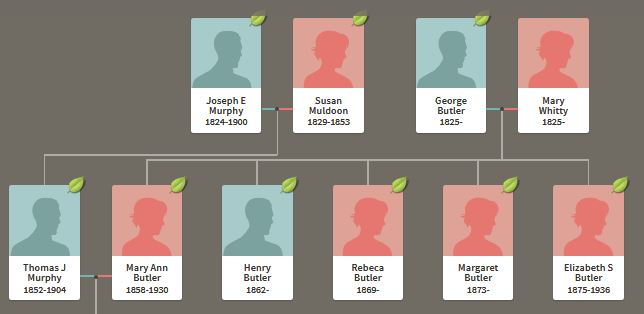
This was my first attempt. As I show later, the older children of George Butler would be from a second wife. My hope was that I would find that the George Butler above was the brother of my wife’s ancestor Edward Butler. One good thing is that I have that George Butler above, married Mary Whitty. Whitty is a less common name than Butler. A search for George Butler at Ancestry turned up this as a clue:
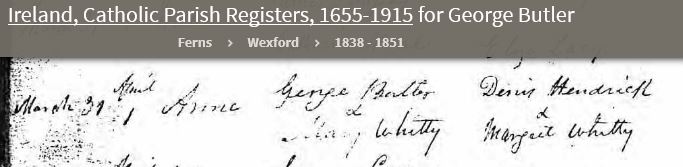
Here is a George Butler and Mary Whitty that gave birth to an Anne Butler on March 31st 1850 in the Parish of Ferns, Wexford. The good news is that the George Butler Family in 1860 in Cincinnati also had a daughter named Ann born about 1850 in Ireland. This is a good match.
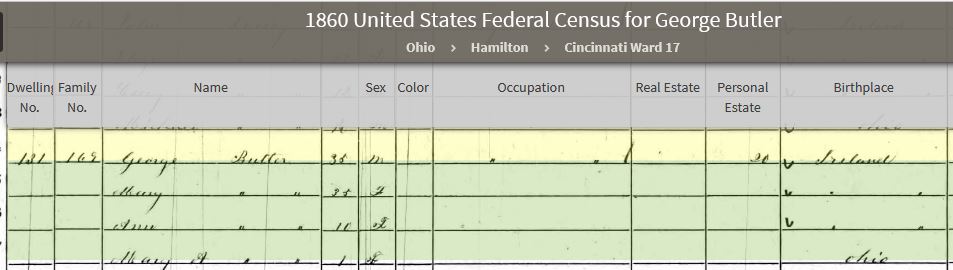
A little more searching revealed a marriage between George “Butta” and Mary Whitty:

The transcriber saw Butta, but I can also see Butler there. I doubt that Butta is a very common name! As in the birth of Anne above, there is a Whitty and Hendricks as witness. The additional information is that they lived in Mountain Gate. I was curious as to where Mountain Gate is and was able to find a Mountaingate:
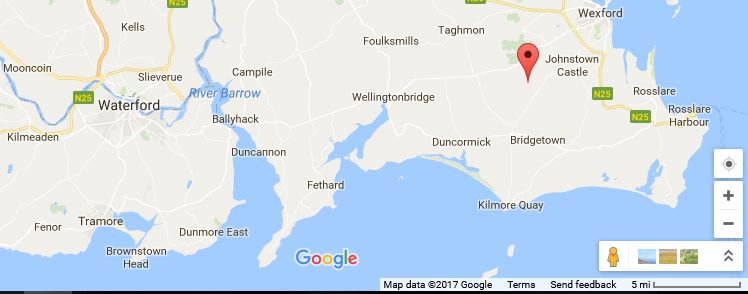
I have panned the map out a bit to show the relationship between Mountaingate and Mooncoin. They appear to be about 25 miles from each other. In one of my previous Blogs, I pointed out the my wife’s ancestor Edward Butler is listed as being from Wexford on one of his son’s death certificate.

Another Wife for George Butler?

There is also a tree at Ancestry that has Margaret Sinnett as George Butler’s wife. It appears to me that Mary Whitty died sometime between 1860 and 1870 and that George remarried.
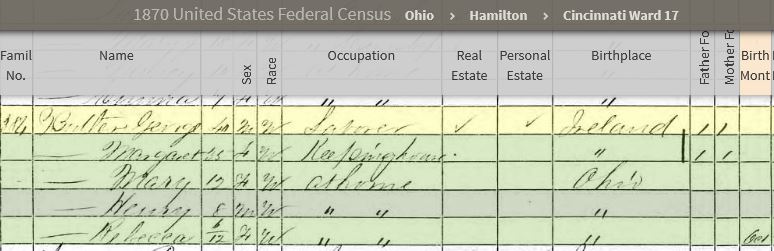
Here is it clear that Mary must be from the first marriage as she was born before 1860 when Mary Whitty was still around. I could guess that Henry would be the son of Mary Whitty as there are 7-1/2 years between him and Rebecca. However, I cannot be sure just from the Censuses. So my basic take is like this:

I’m missing some children from George’s second marriage to Margaret Sinnett. I was having a hard time making this family come out right on the Ancestry Tree.

One last point about Margaret is that Pat has her mother Catherine as being from Killaspy, County Kilkenny. Here is a map showing an arrow where Killaspy is:
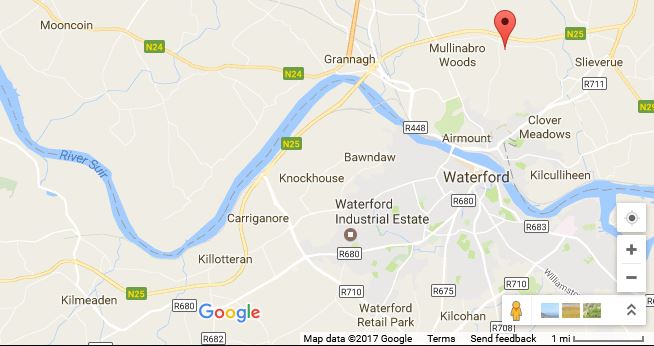
This was interesting to me because with the help of a Butler researcher in England, my wife’s Butler family has been located near Mooncoin on the top left of the map above. Mooncoin appears to be about 5 miles away from Killaspy.

Another Cincinnati Butler DNA Match

The previous image brings up another interesting point. My wife’s two Aunts have had their DNA tested at Ancestry. They both match Pat who descends from Rebecca Butler b. 1869 above. My father in law matches Uncle Naffy at Gedmatch. That makes a good case that George Butler is related to Edward Butler, my wife’s ancestor who also lived in Cincinnati.

Here is Rebecca Butler’s Certificate of Death showing her two parents.
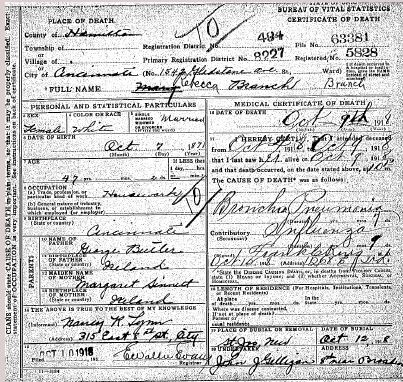
This could be a case where the death record is not the best source of a birth date as Rebecca was shown as being 6 months old in the 1870 Census and born in October. So the day and month only are probably right in the death certificate.

Here is how my wife’s Aunt Lorraine matches Pat:
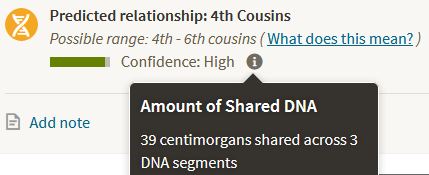
Pat matches my wife’s Aunt Virginia a little less: 29.9 cM across two segments.

Another Shared DNA Match At Ancestry

Pat and my wife’s two Aunts also have two shared DNA matches. These matches have this tree:
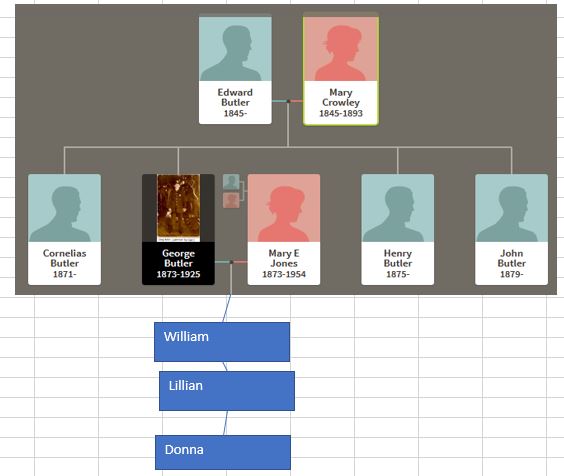
I’m not sure if it was Donna that took the AncestryDNA test. It appears that more than one in the family did. At any rate, the match is much higher. It is now at 183 cM across 9 segments. The average amount of DNA shared between a 2nd cousin once removed is 129 cM.

In comparison, here is Lorraine and Virginia’s tree next to the previous tree:

In the above scenario, Lorraine, Richard and Virginia would be 2nd cousins once removed to Donna and family. I’m not sure if Cornelias and John in Donna’s tree are right. Also, Donna’s tree has Henry, where I have Edward Henry. They are apparently the same person.

So Where Does That Leave the Butlers?

Here is a partially combined tree:
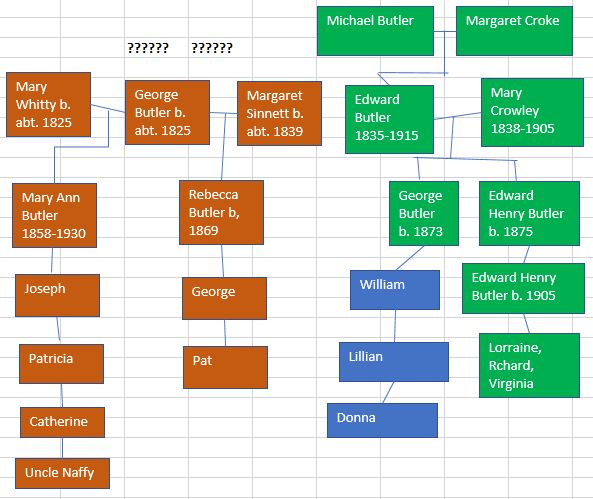
I say partially combined, because I haven’t connected the orange with the green side by genealogical research. I slimmed the tree down to just include the direct lines of those who have had their DNA tested. Uncle Naffy matches Richard at Gedmatch. Pat and Donna’s lines have not uploaded their results to Gedmatch. Pat and Donna’s line have shared DNA matches at AncestryDNA where they tested. Pat also matches Lorraine and Virginia at AncestryDNA. In addition, Donna matches Lorraine and Virginia. Richard and Uncle Naffy have tested at FTDNA, so unless Donna’s line and Pat upload to Gedmatch, those matches won’t be made known.

Summary and Conclusions

  • The George and Edward Butler families are linked by new and old world locations and DNA
  • More work is needed to link the George and Edward Butler families by paper research.


Chasing Down More Rooney Connections

In my previous Blog on the Rooneys, I looked at how my wife’s Rooney ancestors may be connected to another Rooney line by DNA and genealogy. I came up with a proposed genealogy/dna chart that looked like this:

Triangulation With the Rooney DNA Match

Triangulation is when three or more people all match each other on an overlapping segment of the Chromosome. This happens on Chromosome 14. Here are the Rooney DNA match’s matches with my father in law Richard (1), his sister Lorraine (2) and Gaby (3):

A Triangulation Group (TG) indicates a common ancestor. In this case, I believe the common ancestor to be Timothy Rooney:

Jenny’s Rooney Connection

There is another Rooney connection. Jenny doesn’t match my wife’s family as strongly as the Rooney match in purple above does.

It looks like Jenny has also tested her brother. The above chart shows that Jenny is a second cousin to the Rooney match discussed in my previous Blog.

Virginia and Richard match Jenny on Chromosome 11 from about 118 to 124M on the Chromosome Browser:

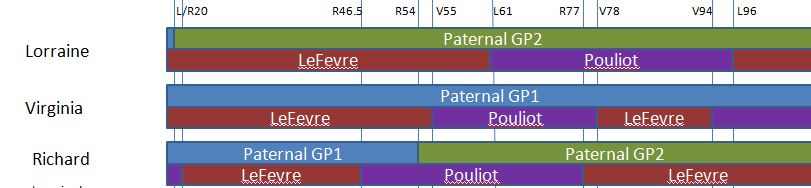
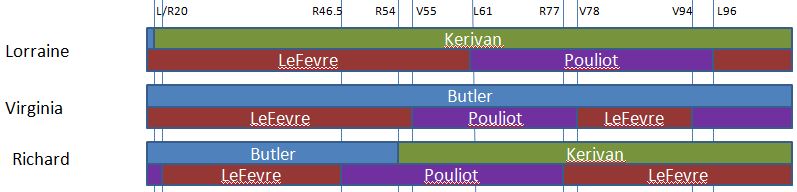
The DNA I have mapped for Virginia and Richard corresponds to their Kerivan grandparent:

This Kerivan mapped grandparent is the same one shown in green on the genealogy/dna chart above. It represents Lilly Kerivan, daughter of Alice Rooney.

Just so we don’t leave out Jenny’s brother, here are some of his matches with my wife’s family on Chromosome 3:

These matches are with Richard, Virginia and John. In my opinion, each match between my wife’s side and Jenny would represent DNA from Timothy Rooney born about 1807.

Here is Richard and Virginia’s Chromosome 3 mapped out.

The Rooney match would be in a Kerivan segment. That means that the dark red segment is probably Kerivan. The blue and purple above are on my father in law’s mother’s French Canadian side.

More Rooney Genealogy: Are Timothy and Terrence the Same?

Jenny and and her 2nd cousin Daniel have in their trees as their first Rooney ancestor Terrence Rooney. That is not surprising considering the marriage record of their great great grandfather, John Rooney:

Above are the listed parents for John Rooney and his wife. The date of the record is May 19, 1851. The record is for the Intentions of Marriage, so this would have been soon before the couple was married. Here is a marriage record for a John A and Mary Rooney:

The date of marriage was listed as May 9, 1851. Here quite a few things seem off. The wife is now Mary Rooney rather than McDermott and both parents are Patrick. They are listed as being in Boston rather than Dorchester although both places are very close. Note that John is a mason here. After a bit of digging, it appears that there were two John Rooneys of about the same age that married two Mary’s of about the same age. Isn’t that confusing!

A proposed sketch of Timothy Rooney

My thought is that Timothy Rooney, son of John Rooney and Ann was born in County Leitrim around 1807. He married Margaret Ann Gorman around 1828. Around 1830, he had a son that he named after his father John. Timothy’s first wife likely died and he then married Ann Nancy Lilly probably around 1832. She had about 10 children between 1834 and 1851.  John took off for Boston not too long before he married in 1851. Timothy landed in Boston in 1858 with his wife and some of his children in June 1858:

The 1860 Census shows Tim and family in Waltham:

Timothy died in Newton at the age of 74 in 1881. His occupation was listed as mason.

Summary and Conclusion

  • The DNA leads me to think that Terence and Timothy Rooney are the same person.
  • If they were the same person, the timing would seem to fit in. He would have had time to have two wives giving birth to the children that we know of.
  • The fact that Jenny, John and Gaby have matches seem to reinforce that the DNA that these two families share focus in on Timothy or Terrence Rooney.
  • I can’t prove that Terrence and Timothy Rooney by either the genealogy or the DNA. However, the DNA does point to a common ancestor. Why couldn’t that ancestor be Timothy or Terrence?


Chasing Down My Wife’s Rooney Connections

My wife’s father is half Irish and half French Canadian. On the French Canadian side there seems to be  a lot of genealogy and a lot of DNA matches. On the Irish side, there is a not so much genealogy and a lot less identified DNA matches.

Mapping the French Canadian and Irish In Laws

I have used a method to map out my father in law’s DNA that he got from his four grandparents. To do this, I compared him to his two sisters, Lorraine and Virginia. Here is their Chromosome 14.

The good news was that I could map the Chromosomes by looking at the DNA results of the three siblings compared to each other. Then I could find many matches to reference the French Canadian side. That got me the LeFevre and Pouliot grandparents above. The problem was that I couldn’t find enough matches to reference the Irish side.

Gaby to the rescue

However, on AncestryDNA I found my wife’s 2nd cousin on the Irish side. Because of Gaby, I can now tell which of my father in law’s grandparents are Irish.

Any DNA matches that Gaby has in common with Lorraine, Richard or Virginia are Irish. Gaby and my wife Marie, share the same Butler and Kerivan Irish ancestors. The next problem is that we can’t tell whether these matches are Kerivan or Butler.

Working Gedmatch To Get Kerivan and/or Butler Matches

In order to separate the Butlers from the Kerivans, we need to find matches that are further out. To find these I looked at DNA matches at Gedmatch that matched both Gaby and Lorraine. I used Lorraine because she was tested at AncestryDNA. The matches would be on the Irish side. That was the first cut. Next, I hoped that some of these matches would have trees at Ancestry that would match my in-law’s tree.

For example, here is someone that matched both Lorraine and Gaby on our example Chromosome 14.

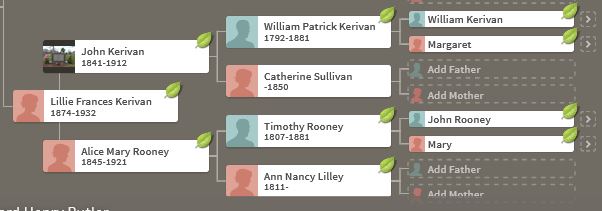
The above image shows how Lorraine matches someone with a Rooney name (#1) and Gaby (#2). This tells me that this Rooney match is on the paternal side or Irish side, so that is also good. The other good thing is that my father in law’s grandmother’s mother was a Rooney:

All I have to show is that the match indicated in yellow above with the Rooney name is related to Alice Mary Rooney above. There were other common surnames, so the match didn’t have to be a Rooney. However, I noticed that there were some Rooneys in Massachusetts which is where my wife’s Rooney ancestors lived. Based on that, I thought that it would be a good idea to start with Rooney.

Doing the Rooney Genealogy

Lorraine’s Rooney AncestryDNA match that is also at Gedmatch and matches with Gaby at Chromosome has a Rooney Tree:

However, these two trees seem a little out of whack. Maybe Timothy Rooney in my wife’s tree could be a brother of Terrance Rooney in the Rooney tree?

A third Rooney Tree

I found another Rooney tree as an Ancestry Hint. It looks like this in a different view:

This tree shows that Timothy Rooney had two wives. It appears that Margaret Gorman was the first wife and had a John Rooney born 1827. Apparently Ann Nancy Lilley was the second wife and had Alice Mary Rooney. That could explain why the two trees didn’t match up. This tree shows the Terrence Rooney from the Rooney Tree as the same Timothy Rooney from my tree.

Putting the rooney trees together

Assuming that the Rooney Tree reconciliation was correct, the Rooney DNA match on the bottom right in purple would be a 1/2 third cousin once removed to my father in law Richard and his two sisters.

Back to the Chromosome 14 Map

That looks better. We now have the paternal side thanks to Gaby and a Rooney match. When I check the Rooney match, he matches Lorraine and Richard, but not Virginia.

The yellow matches on the Gedmatch Chromosome browser correspond with the green in the Chromosome 14 map above. The crossover for Richard at 54M also shows up.

The other good thing about the new Chromosome map is that it shows where the Butler matches would be. This is like a spy glass looking into the past. A match on the Butler side is like a match with Virginia’s grandfather who was born in 1875. Matches to these grandparents should be helpful in straightening out my wife’s Irish genealogy.

Summary

  • Use a paternal cousin to find other paternal cousin matches that are more distant
  • Connect that further out cousin to a known ancestor
  • Use that further out cousin match to complete a Chromosome map
  • Use that completed Chromosome map to identify other cousins as they match in identified areas of the Chromosome map representing grandparents of my father in law.
  • Use those identified matches to focus on further genealogy and break down former research barriers.
  • This method works best with people that have DNA testing results at both Gedmatch and Ancestry.

Gaby’s Butler and Kerivan DNA

My wife’s cousin Gaby recently uploaded her AncestryDNA results to gedmatch. That is good news for my Butler and Kerivan research. My wife’s father is a Butler and a Kerivan on his father’s side. However, because he is also half French Canadian on his mother’s side, he gets a lot of French Canadian matches. Those matches make if difficult to find the Irish Butler and Kerivan DNA matches.

Gaby’s Overall DNA Matches at Gedmatch

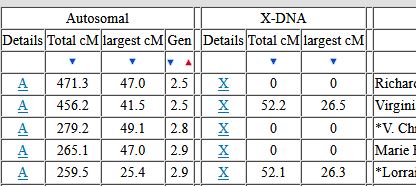
Here are Gaby’s top DNA matches at Gedmatch:

  • Already, there are a few interesting things. One is that Gaby has some X Chromosome matches with Virginia and Lorraine. Virginia and Lorraine are my wife’s aunts. We will look at that later.
  • The next point is that Gaby shares about the same amount of DNA with my wife Marie as she does with Marie’s Aunt Lorraine. Such is the randomness of DNA inheritance. Gen in the Chart above means generations to a common ancestor. For example, first cousins have 2 generations to their common or shared grandparents. Marie’s ‘Gen’ amount should be 3.0 (on average) to Gaby as those two are second cousins. Aunt Lorraine should be 2.5 from Gaby as they are 1st cousins once removed.

Butler/Kerivan Genealogy

Here is a brief genealogy as it relates to those close relatives DNA tested and uploaded to Gematch:

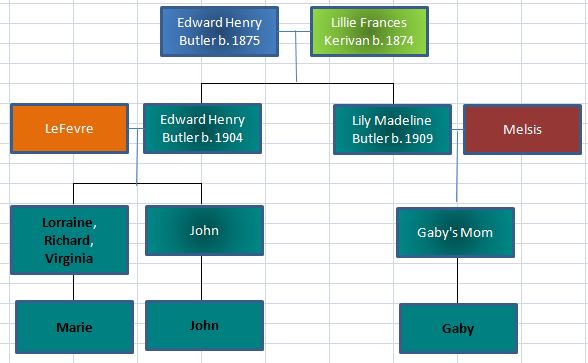
Those that have DNA tested and are listed at Gedmatch are in dark bold. Marie, John and Gaby are each 2nd cousins to each other. The 5 testers on the left will share French Canadian LeFevre DNA with each other. However, now with Gaby, the left hand side above will share only Butler and Kerivan DNA. Likewise from Gaby’s point of view, her matches take her Melsis ancestors out of the matching.

Kerivan X Chromosome Matches

I mentioned above that Gaby matches Lorraine and Virginia by X Chromosome. My guess is those matches are Kerivan and not Butler matches. Why do I think that? The important thing to note about the X Chromosome is that the son inherits no X Chromosome from the father. However, Lorraine and Virginia inherited an X Chromosome from their father, Edward Butler b. 1904. That Edward inherited no X from his dad, but did inherit X from his mother Lillie Frances Kerivan, born 1874.

Here is Lily Kerivan’s X DNA that is shared between Gaby, Lorraine, and Virginia:

gaby’s additional X Chromosome DNA

But there is more. Gaby gets more X Chromosome DNA than those on the left side of the Butler/Kerivan genealogy chart. Gaby gets some Crowley X Chromosome DNA.

Following up the tree from Gaby, she got X DNA from her mom, who got it from her mom Lily Butler. Lily got her X DNA from her mom and dad Edward Henry Butler. Edward got all of his X Chromosome from his mom Mary Crowley, b. 1838 in St Johns, New Brunswick. So Gaby may have some of  this old X Chromosome DNA. I say she may as we don’t know for sure. Perhaps it dropped out along the way. However, the potential is there.

Finding other Butlers and kerivans

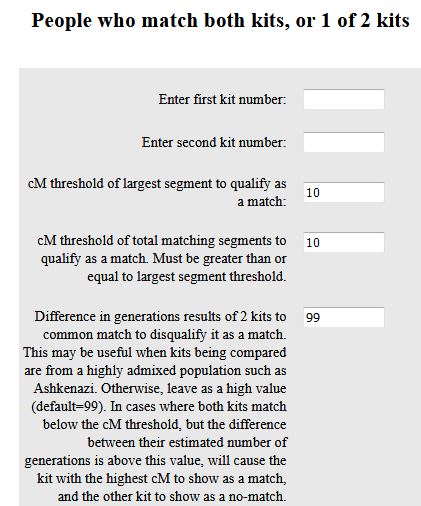
One way to find other matches on the  Butler and Kerivan sides is to run a utility at Gedmatch. The utility is called ‘People who match one or both of 2 kits’. We are interested in those who match both my father in law Richard and Gaby.

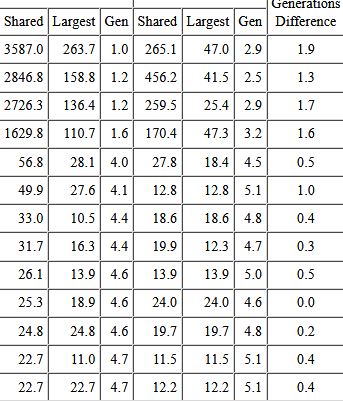
If I choose Richard’s kit number first, I’ll get those in common with Gaby that match Richard. If I choose Gaby’s kit number first, I’ll get her matches that are in common with Richard. I’ll choose Richard’s kit number first as I already have a spreadsheet of a lot of his matches. Here are the results:

I left out the kit numbers on the left and the emails on the right. Also on the right is a check box to choose all the matches where they can be compared. The first three columns are for Richard and the second three are for Gaby. When I pick a lot of the check boxes, I can then compare them in a Chromosome browser.

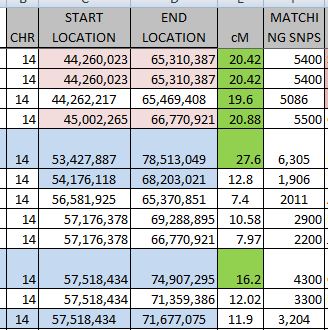
This is an example of one of the Chromosome’s results. #1 on the browser is a Rooney. There are Rooney’s on the Kerivan side, so this is a good sign. #2 is Gaby. It looks like she is related to #3 also. Now I can go to Richard’s match spreadsheet. I can make an educated guess that both these matches are on his Paternal side.

The first entry in blue above is the Rooney person. The second in blue is Gaby. Others in blue are likely related along that Kerivan or likely Rooney line. The blue means a paternal match. Notice that there are a few other matches with known relatives above that are maternal matches in the same area of the Chromosome. I have them in pink for maternal. Knowing if your matches are paternal or maternal is one of the most important things to know about autosomal DNA matching. If you get that wrong, you will be chasing DNA down the wrong road.

Double Visual Phasing

Many articles have been written lately about visual phasing. This is a method developed by Kathy Johnston. I would like to write about double visual phasing. Previously, I had tested my father in law and his two sisters and tried visually phasing them. Here is the result of my attempt to visually phase their Chromosome 15:

Chromosome 15 – Richard and Sisters

I can tell that I did this a while ago as it was done in MS Word which I don’t use now for visual phasing. L is Lorraine, R is Richard and V is Virginia.

What is Double Visual Phasing?

This is a term I made up. I’m guessing that others have tried this, but I have not seen any Blogs on the subject. Richard has a second cousin named Fred. He is related on the Pouliot side (in orange above). Fred has had his sister Sleuth tested and his brother Don. If I phase Fred and his two siblings who are related to Richard and his two siblings, I’ll have double phasing. As they both share a Pouliot grandparent, it will be interesting to compare the results.

A Brief Genealogy

For the purposes of this Double Visual Phasing, here are the people involved:

Let’s Visually Phase Fred and His Two Siblings on Chromosome 15

The first step is to compare the three siblings to each other at Gedmatch.com using the Chromosome Browser:

I used MS Excel for this and I adjust the columns to the segment changes. Note that all the segments don’t line up perfectly, but I’ll say they are close enough. Next I add locations in millions:

I also put in darker vertical markers. I’m hoping that the places where the segments don’t align perfectly do not indicate additional crossovers.

Next I need to show who the crossovers belong to:

From this, it looks like Fred has four crossovers, Sleuth has two and Don has only one. Fred’s first crossover is at position 22M.

Next, I can assign colors based on Fully Identical Regions (FIRs). In these regions, there will be a match on both one maternal and one paternal grandparent. These grandparents will be represented by two of the same colors in that region extending to the person’s next crossover.

Where there is no match, I can assign two different colors and extend those to each persons’ crossover.

I make sure that the boundaries for each person line up with their crossovers. So on Fred’s map his first FIR with Don is short as it is within Fred’s two crossovers.

Mapping Half Identical Regions (HIRs)

Here I get one chance to map an HIR. My inclination is to map the HIR on the right between Sleuth and Don. My reasoning is that Sleuth is already at her last crossover at that point, so I’ll extend her segments all the way to the right. I already know from my previous map for my father in law’s family that Fred has some matches with my father in law and his two sisters on the left side of Chromosome 15 shown in Orange. So that information may help me map the left side of Chromosome 15:

Chromosome 15 – Richard and Sisters

Here is Fred and family’s partially completed Chromosome 15 with the HIR added for Sleuth:

However, there are blanks. Also we haven’t figured out which side is maternal and which side is paternal.

Two other testers

There are also two other testers: Patricia and Joe. They are my father in law’s first cousins. They are related like this:

The next thing I do is to compare all these eight people in gedmatch.com to each other. I download the results into a spreadsheet. Here are the matches on Chromosome 15:

I have the matches between siblings filtered out so they don’t show. I have Fred, Don, and Sleuth in the first column and the others in the second column. Every match represents DNA from Joseph Pouliot (or his wife Josephine Fortin – let’s not forget her). The way I have it mapped right now, the most important match is Joseph to Don and Sleuth. The only place that match could be is on the blue portion:

This is good news, because this sets the paternal and maternal sides for Fred, Sleuth and Don. It also sets where their paternal grandparents are. Here are Fred’s grandparents:

That means that blue is Pouliot and pink is Ford. Like my father in law’s family, Fred has a French Canadian side and an Irish side.

Next, we should be able to fill in the left side of the puzzle using the other matches:

A few observations:

  • The same match that Fred had with my father in law’s family helped finish my father in law’s visual phasing and Fred’s visual phasing.
  • All four of Fred’s grandparents DNA is represented between the three siblings. The one exception is a small portion of green from 22 – 27 M on the maternal side
  • The purple segment that Fred has from 22 – 27 seems quite small. It is a little unusual to have a small internal segment like that. By internal, I mean a segment that is not right on either end of the chromosome
  • Without the match between Joe, Sleuth and Don, I don’t know if I would have been able to complete this Chromosome
  • I don’t know about Fred’s maternal [Irish] side. He may already have matches that would identify the Halloran and Drennan DNA.

Comparison of the Double Visual Phasing

  • Unlike Fred’s results, my father in law’s family does not have good Pouliot coverage (in orange) between the three siblings.
  • This explains why Richard’s family matches Fred’s family in the beginning of the Chromosome and not the end. Pouliot DNA is missing between 60 and 95M.
  • It appears that Sleuth and Richard could have matched between 95 and 100, but I didn’t find a match over 3cM. Could this be because one received DNA from Joseph Pouliot and one received DNA from his wife, Josephine Fortin? Perhaps this is also an explanation of why the match between Don and Viginia (V) stops at position 38M.

Summary

  • Double visual phasing has benefits in that there are at least six people to compare matching DNA results with each other.
  • Double visual phasing should result in a crosscheck for the visual phasing of each family and better Chromosome maps of contributing grandparent DNA.
  • There are benefits in noting which group has the better coverage of DNA of a shared ancestor.
  • Comparison of results appear to indicate deeper crossovers between ancestors

Next Up

There are matches between Fred and his two siblings and the other five tested people on every chromosome except for 18, 19 and 22. That should make mapping the chromosomes with matches relatively easy.

I would like to try double visual phasing between two sets of siblings where the siblings are from different generations. However, it may take a while to get the additional samples done.

Determining Whether a Match Is Irish Or French Canadian By Visual Phasing

In this Blog I will look at a DNA match that my in-laws have. I would like to know whether the match is Irish or French Canadian. I will use Visual Phasing of my father in law and his two sisters’ DNA match to try to figure that out.

Irish at First Look

Something caught my attention with one of my father in law’s matches at FTDNA. My father in law Richard’s match Ann had this tantalizing detail under her Ancestral Surnames:

White (County Waterford Ireland to New Brunswick Canada)

I had recently found out, with the help of DNA and DNA researchers, that my father in law’s immigrant ancestor had shipped out from Waterford to New Brunswick. I have very few DNA matches for my father in law on this Irish side that I have identified. Most of the matches are French Canadian.

Irish or French Canadian?

At first, I didn’t notice other French Canadian names in Ann’s ancestry. However, after finding out she was listed at Gedmatch and Ancestry, I looked at her Tree and did see some French Canadians.

Visual Phasing

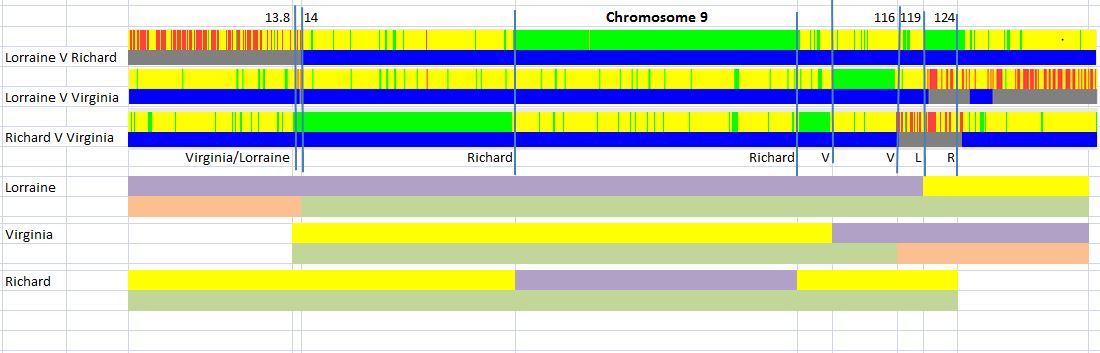
I do have DNA from my father in law Richard and his two sisters Lorraine and Virginia. So perhaps Visual Phasing will give and answer to the question whether the match with Ann is French Canadian or Irish. Ann’s best match to Richard, Lorraine and Virginia is on Chromosome 9:

Lorraine has the largest match above followed by Richard and Virginia. It looks like Richard and Virginia have crossovers at about position 107M.

I have used MS Word for phasing, but it wasn’t the best. PowerPoint worked well, but lately I have preferred using Excel. First I cut and paste the comparison of the my 3 in-laws into Excel.

Then I add the crossover points for the three siblings:

At first I thought that the first crossover belonged to Richard. however, there is a short break in the Lorraine V. Virginia comparison, so that adds an additional first crossover for Virginia. Actually the Virginia/Richard should be Virginia/Lorraine. There are likely 2 close crossovers there. I ignored the last small match between Lorraine and Virginia as there wasn’t anything going on in the comparisons above and below that match. Next I add the locations of the crossovers:

Lorraine and Richard have the largest Fully Identical Region (FIR) shown in green. I map that with the same two colors for Lorraine and Richard:

Lorraine only has two crossovers, so we extend her colors all the way to her left crossover and on the right to her crossover (L):

As Lorraine only had two crossovers, this perhaps explains why she had the largest match with Ann on Chromosome 9. Next, I fill in FIRs and Regions that don’t match (shown as red in the Gedmatch comparisons) with corresponding colors:

Unfortunately, that lead to a bit of a dead end. Instead, I’ll try starting with the Richard and Virginia FIR on the bottom comparison:

This version looks better. Next we choose a Half Identical Region (HIR) shown as yellow above. The longest one starts at position 14 between Lorraine and Virginia. A HIR maps as matching only one color and not matching the other.

Above, I chose for Lorraine and Virginia to match on the green and not match on purple and yellow. That is how the HIR is represented. I can then extend Lorraine’s purple and green to her crossover (L) on the right and fill in more FIRs and non-matching areas:

Now, except for the two ends of Virginia and Richard, I have a four grandparent map represented by four colors. Next, we have to identify the grandparents.

The Pouliot French Canadian Connection

One of my in-laws’ grandparents is a French Canadian Pouliot. Fortunately, my in-laws have a Pouliot cousin named Fred. Fred’s sister has also tested. Here is Fred’s matches with Virginia (78-83.5 and 107-110) and Richard (107-115).

Here is Fred’s sister’s matches with Virginia, Richard, and Lorraine.

Note that Lorraine only has one small match with Fred’s Pouliot sister. This is leading me to believe that the match with Ann is on the Irish side. Can we use these Pouliot matches to identify our blank map above? I think we can. The 2 green matches above are for Virginia and Richard at 17-31M. The only place between 17 and 31 where Fred’s sister could match Virginia and Richard, but not Lorraine is on the yellow. If the match were on the green segments, Fred’s sister would have had to have matched all three siblings at that location. Note that mapping out the smaller matches should also be on the yellow segments.

I should point out that my in-law’s had a father of Irish descent and mother of French Canadian descent. This means that both their paternal grandparents were Irish and both their maternal grandparents were French Canadian. As Pouliot is the maternal grandfather, that sets the maternal side of the map as yellow and purple. That also sets purple as the other maternal grandparent: LeFevre. Further, salmon and green now represent the paternal Irish grandparents.

So Is Ann a French Canadian or Irish Match?

Although I was leaning toward the Irish earlier, I now think that the match is French Canadian. Take another look at the match between Ann and Lorraine, Richard and Virginia:

The pattern looks a lot like the purple LeFevre segments. Lorraine’s larger match is on top. Richard’s green match stops where the purple LeFevre segment stops. Virginia’s smaller blue match starts where the purple Lefevre segment starts again. I’ll put the matches in the same order as Gedmatch to make it easier to see:

If Ann were to have matched on the green paternal grandparent area, there would have have to have been three equal matches in that region shown on the Gedmatch browser.

The fact that Ann did not match with the French Canadian Pouliot grandparent did not mean that she was an Irish match. In this case, it meant that she matched the other French Canadian Grandparent.

Summary and Conclusions

  • Visual Phasing can help map an unknown match to a grandparent.
  • That phasing needs to be in conjunction with at least one known cousin to identify a grandparent.
  • These results help to know where to invest genealogical research time. There is no sense in barking up the wrong tree.

Using Three DNA Tools Synergistically

In this post, I would like to look at using three DNA tools in conjunction with each other. Those tools are AncestryDNA’s Shared Ancestor Hints (SAH’s), Visual DNA Mapping, and Triangulation. This will be a triangulation of DNA tools, so to speak.

The above diagram is meant to show Shared Ancestry Hints at the top. The lower left is the visual mapping and the lower right is a symbol for triangulation. In my last blog, I looked at an SAH and visual mapping example. This blog will bring in another tool: triangulation.

Shared Ancestry Hints (SAH’s)

SAH’s are probably the least reliable of the three DNA analysis tools, but they are like the front man or salesman. They are the first easy introduction to a possible shared ancestor based on a DNA match. They are also the least intelligent. Ancestry takes a tree and takes a DNA match and blindly puts them together. Here is my wife’s aunt Lorraine’s  SAH that I looked at in my previous Blog:

Fortunately, Ann uploaded her DNA to Gedmatch. Here is how the match looks between Ann and Lorraine:

This is a huge amount of DNA shared for the proposed 8th cousin relationship. This Charles Pouliot at the SAH was born in 1631.

Visual Mapping

This method, developed by Kathy Johnston, compares three siblings and draws a map showing the DNA that the three siblings received from their four grandparents. Here is the map I made in my previous Blog for my wife’s Aunt Lorraine and her two siblings:

After looking at the map for Lorraine and comparing it to the SAH, I determined that the Chromosome 4 DNA match between Ann and Lorraine could not be on the Pouliot side as hinted at by the SAH. Lorraine’s match with Ann was squarely in the largest maroon LeFevre segment between 33 and 40 above. As the goal of the previous Blog was to compare the SAH with visual mapping I did no further analysis. I could not prove that the match indicated LeFevre or LeFevre ancestor DNA. I also could not prove that it did not represent LeFevre or LeFevre ancestor DNA.

As the above analysis was limited by the goal of that Blog, I wanted to look further into the DNA match between Lorraine and Ann in this Blog.

Triangulation

Triangulation is the matching of three or more people with each other on the same segment of the same chromosome. This specific DNA matching suggests a common ancestor that sent his or her DNA down to the three or more matching people. Further the matching would in most cases rule out spurious, false or Identical by Chance (IBC) matches.

candidates for triangulation

The people that I am looking to triangulate are:

  • Ann and Lorraine
  • Lorraine’s siblings Richard and Virginia
  • Lorraine’s Pouliot second cousins. A Pouliot DNA match on Chromosome 4 has been ruled out by Visual Mapping, but there could be a match on the other 3 Chromosome matches.
  • Lorraine’s 1st maternal cousins. These two match on the LeFevre and Pouliot sides.

Of the three siblings, only Lorraine matched Ann on Chromosome 4. Ann did not match the two Pouliot 2nd cousins at standard Gedmatch thresholds. Ann also did not match one of Lorraine’s first cousins, but matched the other one – Joseph:

Here is a graphic of the testers. I forgot to mention John above. He also did not match Ann.

This graphic shows Pouliot at the top, but the mapping showed that the Chromosome 4 match came from the LeFevre side. Here is Martin LeFevre courtesy of cousin Patricia:

back to the triangulation

Lorraine matches Ann and Ann matches Lorraine’s 1st cousin Joseph between 32 and 40 on Chromosome 4. Do you think that Lorraine matches her first cousin at this location? The answer can be seen at Joseph’s matches on the Gedmatch Chromosome Browser:

These are Joseph’s matches to:

  1. Lorraine
  2. Virginia
  3. Richard

Joseph and Lorraine have a large match between 13 and 65M. That means that Triangulation has been established between SAH Ann, Lorraine and Joseph.

What Have I Shown?

I have shown that:

  • The match between Ann and Lorraine on Chromosome 4 is real.
  • That match indicates that Ann, Lorraine and Joseph have a common ancestor

What I don’t know:

  • Right now I have not determined the common ancestor indicated by the Triangulation. AncestryDNA indicates a choice of 15 ancestors shared between Ann and Lorraine. One of those, the Pouliot ancestor shown on the SAH has been ruled out. That leaves 14 other French Canadian names to look at!
  • I don’t know which segments were considered in the AncestryDNA match as Ancestry does not choose to share that information. Gedmatch showed matches in 4 segments on 4 chromosomes. AncestryDNA only showed two matching segments.
Looking at Lorraine and Ann’s genealogy: Shared Ancestral Names and Shared Matches

Here are the shared ancestral names between Lorraine and Ann:

Further, Ann and Lorraine have shared AncestryDNA matches. Here are the shared ancestral names with one of those shared DNA matches that has a tree:

A good place to start looking would be at Bergeron, Bouchard, Fortin, Girard, and Paradis.

Here is another Shared Match with a smaller tree:

This seems to limit the look to Bouchard, Fortin and Girard. Just to make life interesting, all these names are also in the better documented Pouliot tree. Yes, that is the same Pouliot where the DNA between our matches did not come from.

Here is the Tree I have for LeFevre:

See, I have a few blanks. On this tree, it appears that Bergeron (shown twice) could be a good bet to pursue. Perhaps Lorraine got Bergeron DNA from Martin LeFevre’s paternal and maternal sides. Under that scenario, she could have shared one of those 4 segments with both Ann and Joseph on Chromosome 4.

some late breaking news

Since starting this Blog, I decided I needed to spruce up the French Canadian side of my wife’s Ancestry Tree. I’ve worked on that a little and see there is at least one Bergeron common ancestor between Ann and Lorraine on the LeFevre side:

The SAH Anne’s ancestry is on the left and my wife’s LeFevre’s ancestry is on the right. I checked some other possible common names and found no obvious matches. Perhaps the above Jean-Baptiste Bergeron is the one who sent down his DNA to three of his descendants.

Here is what the shared genealogy looks like on a chart:

I would expect a new Shared Ancestor Hint at AncestryDNA based on the updated genealogy I filled in.

Summary and Conclusions

  • The Shared Ancestor Hint was like the salesman that got his foot in the door. His sales pitch, however, was based on shaky information. That shaky information is the ancestor trees as many others have pointed out. There is also an inclination by some to extend the trees of the names that they are more familiar with rather than extending all the family names back in time. For example, my wife’s grandmother was a LeFevre. When I was researching, I didn’t take the time to follow every line back to France via Quebec. Instead, I researched the familiar LeFevre line.
  • The visual mapping showed that the Shared Ancestor Hint could not indicate a match between the DNA and the common ancestor shown (Pouliot). This was a tearing down phase that showed something to be wrong, but did not show what was right
  • The triangulation was a re-building. It showed that the Chromosome 4 match was indeed valid and pointed to a common ancestor.
  • As a result of the Chromosome 4 triangulation, it showed that it would be worthwhile to further pursue who the common ancestor may be between Ann, Lorraine and Joseph. My initial shot at that indicated a possible Bergeron common ancestor.


A Shared Ancestry Hint of a French Canadian 8th Cousin and Visual Mapping

Recently I have been looking at my wife’s French Canadian Pouliot ancestry and DNA. My thought has been to find a Shared Ancestor Hint (SAH) at AncestryDNA. Then if the person in the Ancestry hint has uploaded their results to Gedmatch, I would be able to analyze those results. In this case, I would like to check using visual phasing to determine whether the match is on the Pouliot line or another line.

Here is the SAH:

Lorraine is my wife’s paternal Aunt. Here is what the DNA looks like at AncestryDNA:

Here is how the match looks like at At Gedmatch,

Actually, based on this person’s email, there are 2 matches. This is the Ancestry one. The other test was at 23andme. They are likely the same person. This AncestryDNA match got higher results perhaps due to the comparison within the same company.

The Goal: Compare Gedmatch, AncestryDNA and Visual Mapping

My goal as stated above is to map one or more of the matching Chromosomes to see if the match along the Pouliot line is likely. I do have two Pouliot 2nd cousins to Aunt Lorraine which will help. It would make sense to map the Chromosomes where they match Aunt Lorraine. Here is how Fred, who is a Pouliot 2nd cousin to Lorraine matches Lorraine on Chromosomes 4:

  1. Richard, my father in law
  2. Richard’s sister Lorraine
  3. Richard’s sister Virginia

Now To Visually Map Richard, Lorraine and Virginia On Chromosome 4

The good news is that there is a lot of Pouliot DNA for mapping this Chromosome. The bad news is that the original Chromosome match between Ann and Lorraine was fairly small.

First I compare the 3 siblings using the Gedmatch Chromosome Browser:

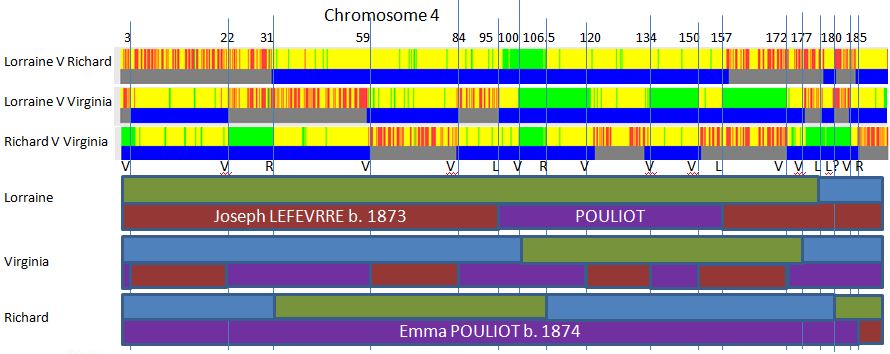
In the image above, I’ve added the crossovers and the approximate locations on the Chromosome where they occur. There are a lot of crossovers bunched up on the right side. Next I assign the crossovers to a particular sibling. Note that I added two crossovers that I missed in the previous image:

  • Virginia has 109 crossovers
  • Richard has 3
  • Lorraine has 4 for a total of 17 crossovers. I have a question mark my Lorraine’s last crossover as I’m not sure if there is one there or not.

Next I map the 3 siblings based on crossover, Fully Identical Regions (FIRs in green), Half Identical Regions (HIRs in yellow) and the places where the siblings don’t match in red.

I’ll start in the middle of the Chromosome where Lorraine and Virginia have a FIR going over two segments (before positions 120):

This gets us started. The DNA that these 3 siblings inherited from two of their same grandparents are represented by green and purple and extend to each of their crossover lines. Next, I look for other FIRs or places where the siblings don’t match. For example, Richard and Virginia don’t match between 59 and 84, so I’ll add two new colors to Virginia, to show the DNA she got from the other two grandparents.

Here it looks like I’m stuck for now:

Now I add a HIR. Our Gedmatch match between Lorraine and Ann was between 33 and 40, so I’ll add one for Lorraine there.

I did this by arbitrarily extending one of Lorraine’s colors to the left and choosing another color to add so Lorraine and Richard would be HIR between 31 and 84. Then I extended those colors to the left as Lorraine had no crossovers on the left side of the Chromosome. Based on this HIR, I can fill in some more on the left had side:

Now I have a lot of the left side of Chromosome 4 mapped out. I also have Fred who is a second cousin on the Pouliot side. I’ll mush all the information together and then try to figure out what color Pouliot is:

Here I’m leaning toward a purple Pouliot. The reason is that Richard has a purple segment (and Pouliot match) from 4 to 14. Richard, Lorraine and Virginia match Fred from 102-126, but Richard may not be mapped in that area yet. However, Lorraine and Virginia have purple in that segment. In addition, I don’t have positions for the two crossovers between 95 and 120. I can get those from Gedmatch by comparing Richard and Virginia’s FIR at full resolution:

The FIR starts a little after 100M and ends at about 106.5. Those two positions numbers define the two crossovers between 95 and 120. That also confirms that Pouliot is purple. This defines a grandparent and the maternal and paternal sides of the Chromosome as Pouliot is on the maternal side for these three siblings. It also defines the other maternal grandparent (LeFevre) as being the red or maroon color.

Next, I can fill in all the other Pouliot sections provided by these 3 siblings’ Pouliot cousin Fred:

A few notes on the mapping:

  • Virginia didn’t match Pouliot from 4-14 where Richard did so she gets a LeFevre segment there.
  • Virginia also does not match Pouliot from 120 to 135 where her siblings do match Pouliot. So I give her another LeFevre segment there.
  • Virginia starts matching Pouliot again at 172. This points out a crossover location that I mislabeled previously as 177. Corrected above.
  • There is still a few small segments on the right that I haven’t filled in for Virginia and Richard.
Some additional adjustments

A close look shows that between 180 and 185, Lorraine and Richard don’t match. In order to meet the FIRs, HIRs, and no-matches on the right hand side, I came up with this:

I’m not sure if this is totally right on the right hand side, but it seems close. I show Virginia as having nine maternal segments which seems quite unusual. I would like to point out that the match on Chromomse 4 between Lorraine and Ann. Ann did not match Virginia or Richard on Chromosome 4. Those results (and lack of results) are consistent with the mapping above.

Back to the Original Match Between Lorraine and Ann

A big part of this Blog was to determine whether Lorraine’s small Chromosome 4 match with Ann was on a Pouliot segment. After all that mapping, I would say that the match could not have come through Lorraine’s Pouliot side. The largest LeFevre segment between the three siblings belongs to Lorraine between 0 and 95M.

From the above analysis, I made conclude:

  • The 8.6 cM match between Ann and Lorraine is did not come down to Lorraine through the Pouliot side
  • The match is either by chance or on the LeFevre side. There are 15 names in common between Ann and Lorraine. They are all French Canadian names. My assumption would be that I could rule out a DNA match on the paternal (Irish) side.
  • Ann and Lorraine still have matches on 3 other chromosomes.

Summary and Conclusion

  • I was not surprised that this match did not match on the Pouliot side given the inter-relatedness of French Canadian genealogy
  • It was possible that this shared match on Chromosome 4 could have been from the Pouliot side, but it wasn’t.
  • It is best to not assume that a Shared Ancestor Hint and the shared DNA match go back to the same shared ancestor(s)
  • I need to build out these French Canadian lines more at Ancestry
  • The best match between Ann and Lorraine was on Chromosome 19. However, there were no 2nd cousin Pouliot matches on that Chromosome.
  • This Blog satisfied my curiosity on at least one part of the match between Lorraine and Ann and got me to map out Chromosome 4 for these 3 siblings


Visual Mapping of Butler Chromosome 5 Reveals an Identical By Chance (IBC) AKA False Match

I would like to try to map my in law’s Butler DNA on Chromosome 5. This is based on a rare paternal match that was found at AncestryDNA and cross-referenced at Gedmatch based on similar names and matches.

I have already mapped Chromosome 11 here. I would now like to map Chromosome 5 with the help of one match that my father in law Richard has with a Rooney descendant named Jeanette. That Rooney match is on Richard’s paternal grandmother’s side (Kerivan)

Mapping Chromosome 5

Chromosome 5 is one of the larger chromosomes with 1 being the largest. Now I compare the three Butler siblings: Lorraine; Richard; and Virginia and I add in crossover lines.

I have the locations of the proposed crossovers at the top. Note the smallest match between Lorraine and Virginia. I think that I have the resolution too low for that match, so I will take it out as there is no indication of a change from HIR to FIR (Half Identical Region to Fully Identical Region) or match to non match status in the other sibling comparisons. That will simplify things in the area of 35/38.

Just pretend the match between Lorraine and Virginia at 34 is not there. I will now assign the crossovers to the siblings. The first crossover goes to Richard as he is represented in a FIR (green) to HIR (yellow) change in the 1st comparison and in the HIR to FIR in the 3rd comparison.

The crossover tallies are in:

  • Richard (R) – 5
  • Virginia (V) – 4
  • Lorraine (L) – 2

Actually, I would not be surprised if Lorraine had an additional crossover at the very far right end of the Chromosome, but as it is so small, I am ignoring it for now.

Recall that Richard’s Kerivan Line match was 66-75M. That is probably within the segment R-V ending at 75.5M above. When I compare Lorraine and Richard at full resolution at Gedmatch I get this for Chromosome 5:

This defines Richard’s crossover (from HIR to FIR) and is at about 61M as every ^ is 1M. That means that my assumption about the Rooney/Kerivan match was correct. I am curious to see if I will be able to map the Butler paternal side with just one match.

time to map based on no match, HIR’s and Fir’s

I’ll just start with the large FIR between Lorraine and Richard.

The green FIR above translates to the same blue grandparent DNA on one side and the same green grandparent DNA on the other side for Lorraine and Richard. Then we need to expand these regions of DNA to the crossover lines for Lorraine and Richard:

Lorraine had no crossover to the left to keep her 2 grandparents’ DNA from expanding there. Richard goes to the right to his last crossover. Then we can add in other FIRs and put in opposite colors for the areas where siblings don’t match (red on the chromosome browser above).

This is what I call the Swiss Cheese phase of visual mapping.

comparing gedmatch cousin matches

At this point I would like to compare Gedmatch matches. There is one thing already that doesn’t make sense. According to Gedmatch, Richard has a Kerivan match between 66 and 75M. However, the mapping shows that Lorraine and Richard are in a FIR there. That means that if Richard has this match, then Lorraine should also. Let’s check Lorraine again. I still get no match. When I lower Lorraine’s threshold to 5 cM, I only get a small match with Jeanette on Chromosome 20. That could mean that Richard’s match with Jeanette on Chromosome 5 is by chance. That was disappointing, but informative.

That leaves us the maternal side. Are there matches there?

Here are the matches that I show for our 3 Butler siblings on Chromosome 5. Virginia shows a match on the maternal side with her 1st  cousins Patricia and Joseph (in pink). This could be helpful. But in this case, it appears that it isn’t. That is because in this segment, Virginia doesn’t match her two siblings. Should I give up? I have one more idea. As I mentioned above, Virginia has a maternal match from 88 to 118. However, John matches Richard and Lorraine in that same area. That means that John’s match in that area has to be paternal. John is a nephew, so he shares maternal and paternal matches. Unfortunately, as Richard and Lorraine are FIR in this segment, it tells us no more.

update based on reader comment

I had a comment questioning my apparently too hasty assertion that the John match above (from 81-115M) to Richard and Lorraine was paternal. I did put a little thought into that comment. M MacNeill has kindly phased John’s raw DNA on a different chromosome (Chromosome 1) and came up with this result.

This gets to the old adage about a picture being worth 1,000 words. As John is in a different generation (as is Marie, my wife – his cousin) it gets confusing. However, the above image shows the DNA John got from his four great grandparents on his paternal side.

The segment we are looking at above is between 75.5 and 117. In that stretch all 4 grandparents are represented by four different colors. This is part of what makes the analysis difficult. If there was an HIR in that region, the analysis would have been easier as there would have been only 3 grandparents to consider in that segment.

We know that John matches Virginia on a maternal match, but we don’t know which grandparent it represents. That leaves one other maternal grandparent and two paternal grandparents (from the viewpoint of the above map). John’s match with Richard and Lorraine from 88 to 115M could therefor be with one of Richard and Lorraine’s maternal grandparents or with either of the two paternal grandparents. This tells me that there is a bigger chance of the match being on the paternal side, but that the maternal side is not ruled out.

Updates on the Update

Since my update, I had a few important responses on the ISOGG Facebook Page that I would like to preserve in this Blog. Kathy Johnston, from whom I learned the visual mapping technique responded with a possible visual mapping:

I liked how she put in the Patricia and Joseph match suggesting that the purple could be the maternal side. I also received a response from M MacNeill who has been so helpful in working on the raw phasing of the Hartley and Butler families:

Here is a screenshot of comments relating to the image above:

Summary and Conclusions

  • I could map out one further HIR, but I won’t at this point
  • I had high hopes in mapping some paternal segments to specific grandparents on Chromosome 5, but it didn’t work out
  • I did find an apparent Identical by Chance (IBC) or what I call a false match between Richard and Jeanette at Chromosome 5. It appeared to be real before I mapped it out.
  • Future identified cousin matches may resolve the mapping of Chromosome 5
  • I appreciate comments from readers that help me to re-think my conclusions


A Toehold On the Paternal Side Butler DNA

In my last Blog, I visually mapped my father in law and his two sisters on their Chromosome 2. I was happy with the results as I got all their segments mapped on the maternal and paternal sides. I mentioned the difficulty in finding matches on the paternal side. The paternal match that I did have was not set in stone. It was somewhat inferred by email correspondence. I think of it as a construction job. The first few pieces of wood put in are a bit shaky until the rest of the structure is built around those first few pieces.

The Problem

The problem can be seen well at AncestryDNA. I have my Butler father in law tested at FTDNA, but his two sisters are tested at AncestryDNA. Here are Lorraine and Virginia’s Shared Ancestor Hints (SAHs):

Lorraine and Virginia Share 38 SAHs. I can tell this on my laptop that has Chrome as there is a icon for the shared Shared Ancestor Hints. All of Lorraine’s SAHs are on the maternal side (or locked). Of those maternal SAHs all but 2 or three matched on the Pouliot grandparent side. The other 2 or 3 were on the LeFevre grandparent side. An additional problem is linking those SAHs to gedmatch.

For Virginia, all her matches but one were maternal or locked. The one that was paternal was on the Kerivan side. No matches were found on the Butler side.

Following Virginia’s AncestryDNA Paternal SAH

Here is Virginia’s lone paternal SAH:

As can be seen above, this match is on Virginia’s Kerivan line.

the gedmatch connection: good and bad news

The good news is that Virginia matches someone at Gedmatch that seems to have a very similar name to the match at Ancestry.com. The bad news is that I have been unable to confirm that the two people are the same. However, I did think of an additional check. Lorraine did not match this AncestryDNA person. I opened up Gedmatch, found Virginia’s match. I ran the ‘One to Many’ utility for the match above who I will call Jeanette. On Jeanette’s ‘One to Many’ match list I saw Virginia and Richard but not Lorraine. That makes me feel 95% confident that I have the right person.

Jeanette’s matches with my butler in-laws

Here is the AncestryDNA match. It must be less than expected as the SAH shows third cousin once removed and the relationship predicted by the DNA is 5th to 8th cousin.

Jeanette and Virginia at Gedmatch:

Finally, Jeanette and Richard at Gedmatch:

Visual Phasing of Butler Chromosome 11

Based on the above results I would like to map Chromosome 11 for the Butlers using a method pioneered by Kathy Johnston. In the first step, I compare the three siblings, add approximate Chromosome locations for the crossovers and assign the crossovers to siblings:

I guessed at the 112 position as this was the border between a Fully Identical Region (FIR) shown in green and a Half Identical Region (HIR) shown in yellow. I can check this using the Full Resolution option at Gedmatch when comparing Lorraine to Virginia:

Each ^ is 1M, so the actual crossover from FIR to HIR is about 113. 4. It is close to the next crossover which is at 114.5M. For the assigned crossovers above, Virginia gets 6, Lorraine gets three and Richard gets one.

phasing strategy

While performing visual phasing, it is good to have a strategy. My strategy will be to include Richard in the first segment as he only has one crossover. By the way, one crossover means that Richard will have a complete unrecombined maternal or paternal Chromosome 11 from one of his grandparents. I could start where Richard and Virginia have their first FIR together, but instead I’ll choose the first place where Lorraine and Richard don’t match as there is more coverage in that lack of match stretch. The other thing to keep in mind is that the Rooney/Kerivan match is from 118 to 124M, so we will need to work our way to that side – likely by choosing a HIR in that area.

  • It looks like I could have chosen the first FIR and gotten the same results. A FIR (green) with two ‘no matches’ (red areas) over it like we have here is a good combination for mapping.
  • The Butlers have good coverage on this Chromosome.
  • I can already see that in the area of 118 to 124M Virginia and Lorraine have opposite grandparent matches. This shows why Virginia matched Jeanette and Lorraine did not.
Maternal matches

Before I continue mapping, I would like to see what this Butler DNA-tested trio have for maternal matches. They have two 1st cousins and two 2nd cousins that have tested. I entered all the cousins into Gedmatch, sorted them and took out everything except for how Richard, Lorraine and Virginia matched the cousins:

John is a nephew, so could match on the maternal or paternal side. Patricia and Joseph are maternal 1st cousins. However, that would not identify a specific maternal grandparent segment. The three siblings did not have appreciable matches with either of their 2nd cousins.

More Mapping

As the paternal Kerivan match is on the right hand side of this Chromosome, I’ll add a HIR between Lorraine and Richard. I did that by moving the blue for Richard to the right for the match with Virginia and for the part that didn’t match I put in green (opposite of red).

Once I set the HIR on the right, that meant that the blue area had to be Kerivan. That is the only place that Virginia and Richard have a matching color in the area of the Jeanette Kerivan/Rooney match (118-124). That leaves the purple to be Butler – the only other paternal grandparent.

This map leaves me with that ‘Swiss Cheese’ feeling. Before I scrap this map, let’s look at the 1st cousin matches to see if they can help fill in anything. They are the pink matches – signifying maternal.

Lorraine and Patricia match from 2 to 91. I take that to be the green match. I also assume that as they are first cousins, that their match length also represents the same grandparent. I’ll go out on a limb and say that I can extend the green to position 92.

This makes sense because Patricia starts matching Virginia at 77M. Before that she doesn’t match Virginia, so the maternal segment must be red for Virginia there. Actually, Lorraine’s green should extend further (to 114M) as she has no crossover until that point.

Here I moved Virginia’s red maternal segment to the right. Because the crossover was not on the maternal side it had to be on the paternal side. That gave her a crossover from Kerivan (blue) to Butler (purple) at 27M. The Chromosome is starting to fill in. Next, in the are from 39 to 77, Lorraine and Virginia don’t match. That means that Lorraine must have a blue Kerivan segment filling in at the top. Once I fill in Lorraine’s blue Kerivan segment, Lorraine and Virginia have a FIR (from 92-112M). That means I can fill in Virginia.

Now I’m almost done. I just have the last ever-difficult HIR to complete. Here my inclination is to check Patricia and Virginia at a lower threshold. If Patricia doesn’t match Virginia at the beginning of the Chromosome, then the red must carry through to the beginning for Virginia.

I was a bit surprised that the two cousins fit a match in the beginning of the Chromosome. I shouldn’t be surprised, because small matches are typically at either end of the Chromosome. That means the half match of the HIR is on the maternal side between Virginia and Lorraine. And the crossover is also on the maternal side.

How do I identify the maternal segments for chromosome 11?

I thought of a few things. One would be ICW which is an “in common with” feature that FTDNA uses. Or I could use the feature at Gedmatch which takes two people and finds people that are in common with them. I would be more satisfied with triangulated matches. The best way I know of to find these would be to start a surname study. Pouliot would be a good choice based on all the AncestryDNA Pouliot Shared Ancestor Hints that I mentioned at the beginning of the Blog.