My Father In Law’s Autosomal DNA: Separating the LeFevres from the Pouliots

It’s been a while since I’ve looked at my Butler father in law’s autosomal DNA, so it’s time to look at it in a blog. Richard descends from an Irish father and a French Canadian mother. Richard has many large matches with many with French Canadian ancestry. In comparison, he seems to have smaller and fewer matches on his Irish side. This is probably due to several reasons:

  • The French Canadians have been around for many hundreds of years in North America.
  • Their descendants have spread throughout the region and many migrated to Massachusetts where Richard is from.
  • Many of these early French Canadians were intermarried. This tends to increase the amount of shared DNA among cousins.
  • The numerous French Canadian descendants perhaps were more likely to take DNA tests.
  • Conversely, the Irish relatives tended to emigrate later in time.
  • These Irish descendants seem less likely to have taken DNA tests.

Richard’s Known Matches – French Canadian

Richard has 2 pairs of known matches with cousins of French Canadian ancestry (other than my wife). They are:

  • 2 First cousins – They are on his mother’s (LeFevre) side
  • 2 Second cousins – They are also on the mother’s side but one generation up. The common ancestor is Pouliot. Here is a diagram of Richard’s mother’s side:

Pouliot LeFevre Diagram

My Confusion

I looked at these matches and wondered how I would be able to sort out the LeFevres and the Pouliots. This was confusing as the LeFevre line had Pouliot in it.

The Easy Answer

The easy answer is there is no easy way to pull the 2 apart with what I had. This is because at the first cousin level, it is not easy to pull out one family. If you think about it, your first cousins share 2 grandparents with you. This was the case with Richard’s 2 first cousins also. As they are on the mother’s side, they are useful for determining whether matches are on the Butler or LeFevre (Paternal or Maternal) side, but not a whole lot more. But that is quite a bit. This is a way of phasing your results. This also separates the French Canadian matches from the Irish matches.

Looking for more than can be found in a relationship can be frustrating and confusing and that was where I was a while back. I have found that it is usually good to keep it simple – especially when figuring these things out. The problem was I was comparing apples and oranges. Or in this case 1st cousins and 2nd cousins. This is why it is sometimes suggested that a second cousin is a good choice for testing.

The Pouliot Second Cousins

As mentioned above, the Pouliot second cousins represent all the Pouliot DNA shared. On the FTDNA Chromosome Browser Richard’s DNA shared with his 2 Pouliot 2nd cousins looks like this:

Butler Pouliot Chromosome Browser

From the image above, I gather a few things:

  • This is a map of the DNA that Richard received from his Pouliot great grandfather (and Fortin great grandmother) down from his Pouliot grandmother.
  • As this represents the DNA from Richard’s grandmother, it would theoretically cover about one half of his chromosome browser. This would be the amount of DNA that he actually did get from his grandmother as compared to how he matches his two 2nd cousins.
  • Richard’s theoretical amount of DNA he got from his grandmother would cover half of the browser because the browser contains both paternal and maternal matches.

Add in the 1st Cousin

I’m only adding in one LeFevre 1st cousin as the other one didn’t test at FTDNA. Here the first cousin will be in green.

French Canadian to Richard in Browswer

From looking at the above, I observe the following:

  • The green area represents Richard’s maternal side as shown through a match with a maternal cousin.
  • This green represents LeFevre on Richard’s parent level.
  • About one half of his green match represents LeFevre and one half represents Pouliot on the grandparent level.
  • Going further up the ancestor line the green represents every other ancestor of Richard’s mother. This would be French Canadians.
  • Richard got a full chromosome from his mother, so all the DNA received from his mother would fill the above chromosome browser.
  • There are areas on Chromosomes 1, 13 and 16 where Richard’s green LeFevre cousins matches overlaps with his matches from his Pouliot cousins. These areas likely represent where the LeFevre cousins match the Pouliots. This would mean that in this area of the LeFevre cousins’ chromosomes they got their DNA from the Pouliot side. I know that I said above that it was not possible to sort out what part of the LeFevre DNA was from Pouliot, but from looking at the Chromosome Browser above, it appears that it is possible. More on this later.
  • Areas where there are breaks in the matches or where the matches go from the LeFevre cousin to the Pouliot cousins likely indicate Richard’s crossover points. These are the points where the DNA he received changed from one [maternal in this case] grandparent to another. That is, the DNA he actually received went from his LeFevre grandfather to his Pouliot grandmother.
  • As the LeFevre cousins and Richard both descend from LeFevre sisters, they share X Chromosome matches. Both those sisters got their X Chromosomes from their 2 parents. Those 2 parents were LeFevre and Pouliot.
  • Due to the X inheritance patterns there can be no X Chromosome matches between Richard and his Pouliot 2nd cousins. Richard did receive Pouliot X Chromosomes from his mother’s mother. But Richard’s cousin did not as there is no X Chromosome passed down from father to son.

Triangulation – Thinking In Three Dimensions

Triangulation is when 3 or more people all get their DNA from the same ancestor and all match each other. Our best shot at finding this is at the right hand side of Chromosome 1. It looks like these 3 people who match Richard should match each other. Two are siblings, so that is a given. Here is how Richard’s 4 cousin matches look like at Gedmatch.com:

Richard Gedmatch Chr 1

You will have to switch gears a bit here from the FTDNA browser. In this browser, the different colors stand for the size of the match. Here, #1 and #2 are the Pouliot 2nd cousins. #3 and #4 are the LeFevere 1st cousins. #4 was the cousin that didn’t test at FTDNA. As expected, in the area where the 4 cousin matches are stacked on top of each other, they also match each other. At this close of a match, they almost have to. The only other option would be if they matched somehow on Richard’s paternal Irish side, which would be unlikely. This means that the 5 cousins triangulate and they have as a common ancestor their great grandfather Pouliot. Another interesting thing about Richard’s Chromosome 1 is that with just 4 maternal cousins, he has much of his chromosome mapped out – at least the maternal side of it.


Butler YDNA

This blog is not about all Butler YDNA, but about my father in law Richard’s YDNA. His results came in this week, so I thought I’d write a little about them. As he had 10 children, I thought that they might be interested.

Butler Genealogy

The Butlers are Irish. They are believed to come from the Kilkenny area. However, the documentation for that is not the best. Michael Butler was b. in Ireland around 1810. His son, Edward was b. in the 1830’s and made his way to the New World. He likely arrived in St. John, New Brunswick where he married Mary Crowley in 1855. I mention more details in my Blog on the Butler Brick Wall.

Deep Roots of the Butlers and Family Lore

My wife says that Butler is a Norman French name. She says the Butler name came from the fact that they were wine tasters. According to Ancestry.com:

Butler Name Meaning

English and Irish: from a word that originally denoted a wine steward, usually the chief servant of a medieval household, from Norman French butuiller (Old French bouteillier, Latin buticularius, from buticula ‘bottle’). In the large households of royalty and the most powerful nobility, the title came to denote an officer of high rank and responsibility, only nominally concerned with the supply of wine, if at all.

I had been a little skeptical about the family lore and figured that the Butler YDNA would be typically Irish which is R1b. According to Family Tree DNA:

R1b, which originated in western Europe, is the most common Y-DNA haplogroup among Irish men, at a frequency of about 81.5%. I1 is the second most common with 6%, followed by I2b at 5%, R1a at 2.5%, and E1b1b at 2%. G2a is found in only about 1%. Also rare are I2a (1%) and J2 (1%).

So What Did the Results Show?

I was wrong. According to FTDNA my father in law is I-M223. According to FTDNA:

I-M223 was known as I2b1 and is now known as I2a2a by ISOGG

ISOGG is the International Society of Genetic Genealogists. I’m not sure if that means that our Butler is in the 5% or 1% group in Ireland. However, they are either quite rare or very rare there. So I signed up my father in law for the Butler YDNA project and also the I-M223 Project at FTDNA. At the I-M223 project, they put him in the group with others that are fairly close matches. Three have the name Butler and one has the name Whitson. That makes me feel like we are on the right track. It is not unusual to have other surnames match on the YDNA line. However, it is better to not be in the minority.  The FTDNA group further put my father in law Richard into this curious category:

1.2.1.2.1.1.1.1- M223>…>L701>P78>S25733>A427: test I-M223 SNP Pack or I-M223 SNP Pack or S23612

This is a group with a lot of numbers. These first numbers probably went back to when someone could tell there was a certain signature in the YDNA results, but all the SNP tests weren’t developed yet. The second numbers are the SNP tests that the administrator thinks Richard would pass if he were to take them all. That is good, because it puts him several steps down the SNP tree. The last part is what the administrator wants the tester to do. One is to take a test that will test several SNPs. The other is to test for a specific SNP. In this case, the SNP is S23612.

Origins of the I-M223 Haplogroup

The I-M223 Haplogroup came into existence about around 17,600 years before present (ybp). Give or take a few thousand. The A427 branch is much more recent at 5,200 ybp. According to one YDNA Butler match to Richard, he feels that the origin of this branch of Butler that didn’t test positive for S23612 was in England and before that Germany. Some information from the Eupedia website also mentions that the L701 branch may have arisen from the Goths. I can imagine a stimulating dinner conversation with the Butler family: “So, I hear that the Butlers are descended from the Goths.” “What…???? I thought that we were descended from the Normans”. Who knows, maybe the Goths moved into France at some point and mixed with the Normans. Or they could’ve moved from Germany to England where the Normans were and then made their way to Ireland. I’m sure that there are many possible scenarios.

More Recent Connections

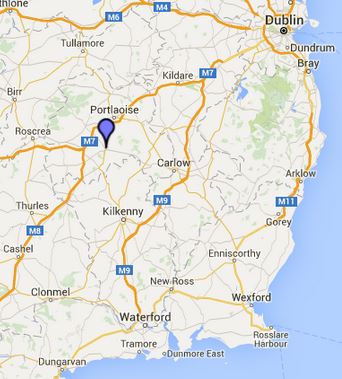
Two of the more recent Butler YDNA  matches to Richard had roots in Ireland, so that makes sense. One had his earliest known Butler ancestor from the border of Laois and Kilkenny County.  That is shown by a blue balloon below. That match had a GD or Genetic Distance of 4. The other was from Wexford and had a GD of 2 with Richard.

Kilkenny Wexford

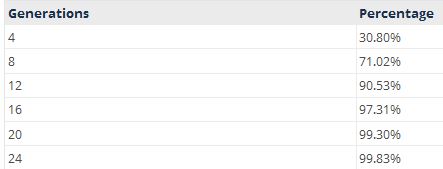
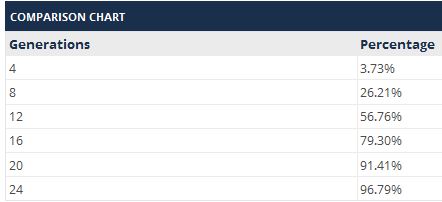
This shows some likelihood of having a common ancestor within a certain number of generations when your match has a GD of 4:

4 GD Butler

Here is a match with a GD of 2. Note the differences in Percentages.

2 GD Butler

Kilkenny or Wexford?

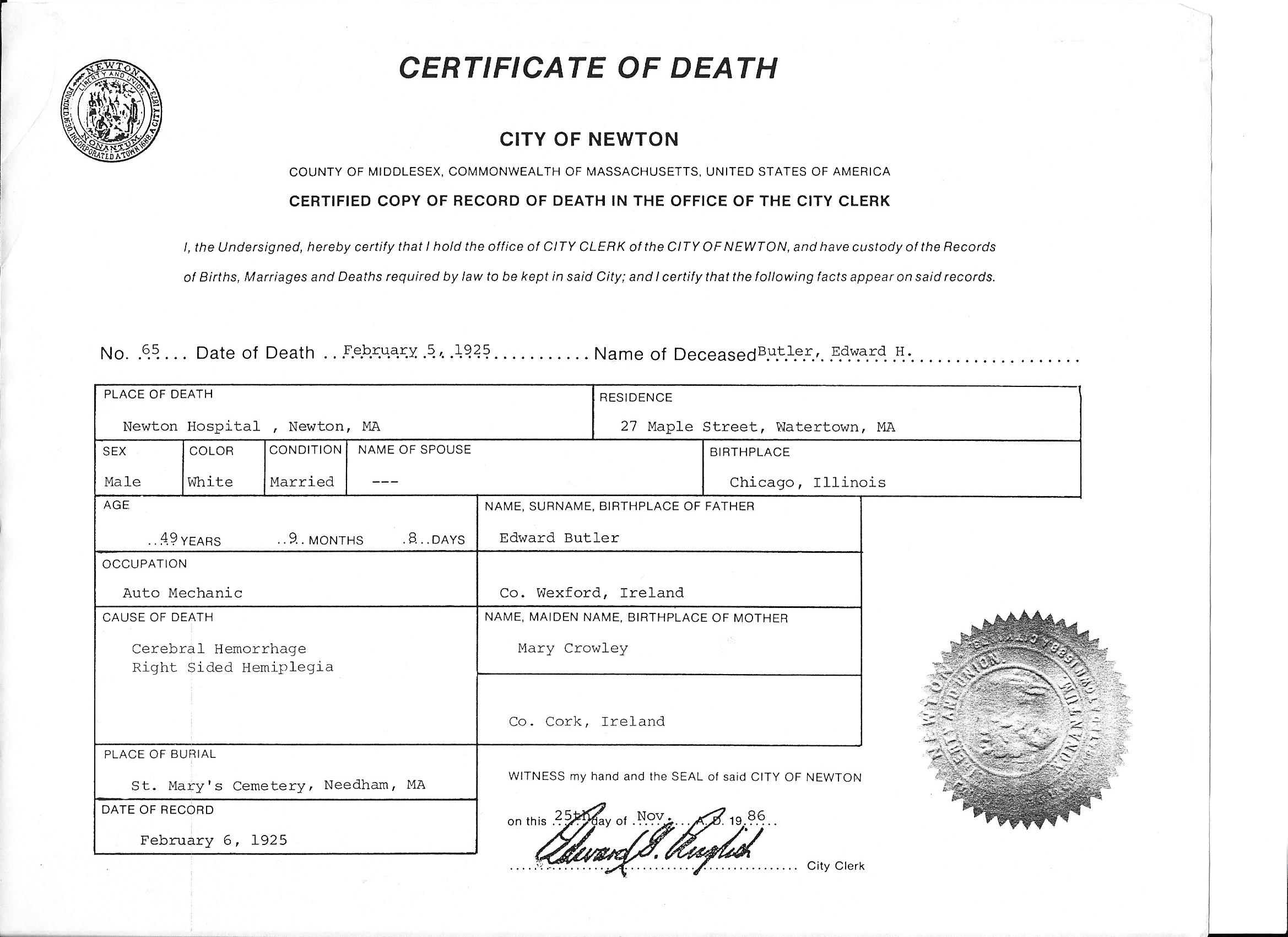
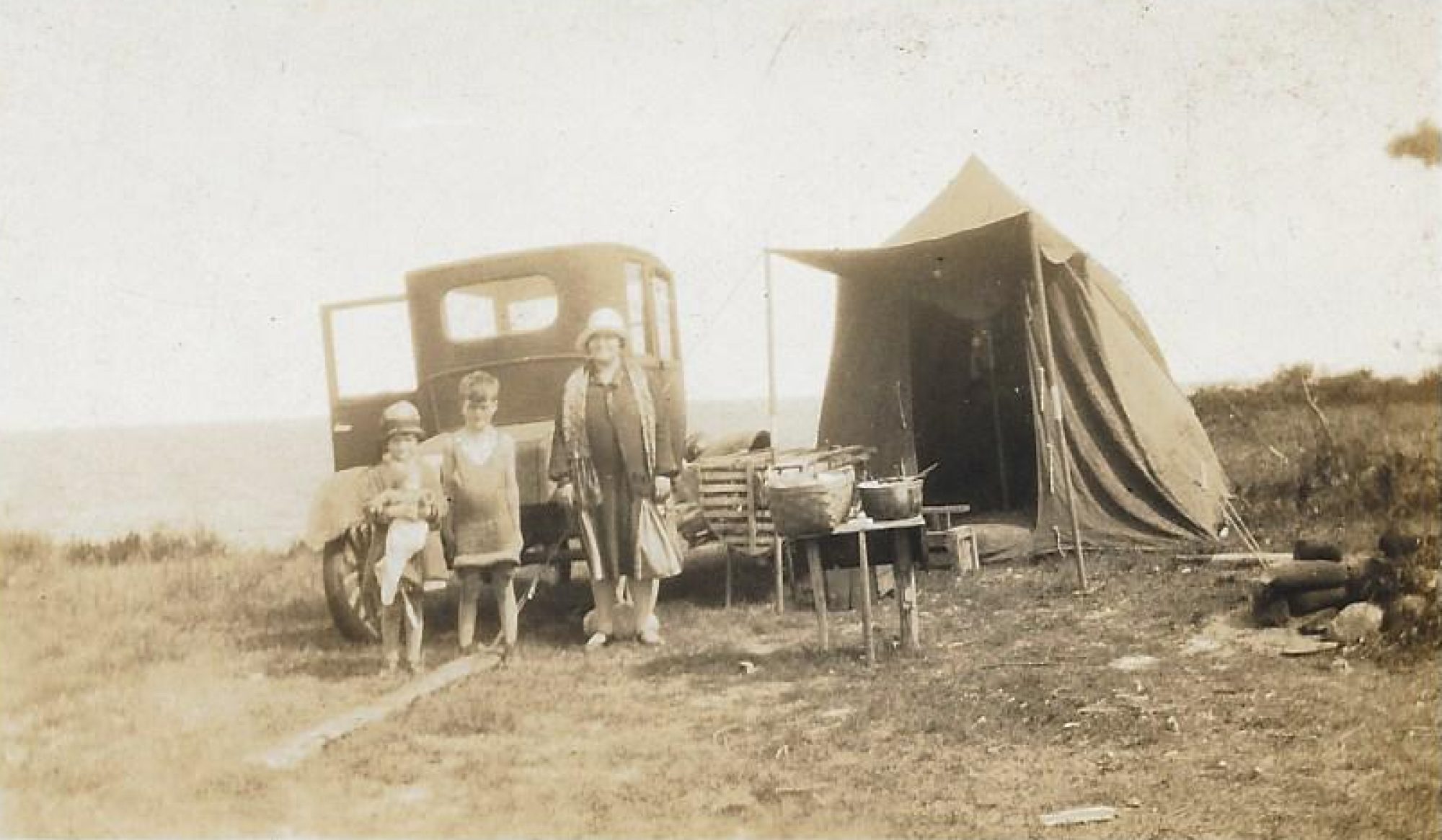
The 2 GD match who had a mariner Butler ancestor in Wexford is interesting for 2 reasons. When Edward H Butler, the son of Edward Butler, the immigrant ancestor died in 1925, he listed his father as being born in County Wexford, Ireland. The second reason is that the photo we have of the immigrant Edward Butler shows him in a sailor outfit.

edwardh

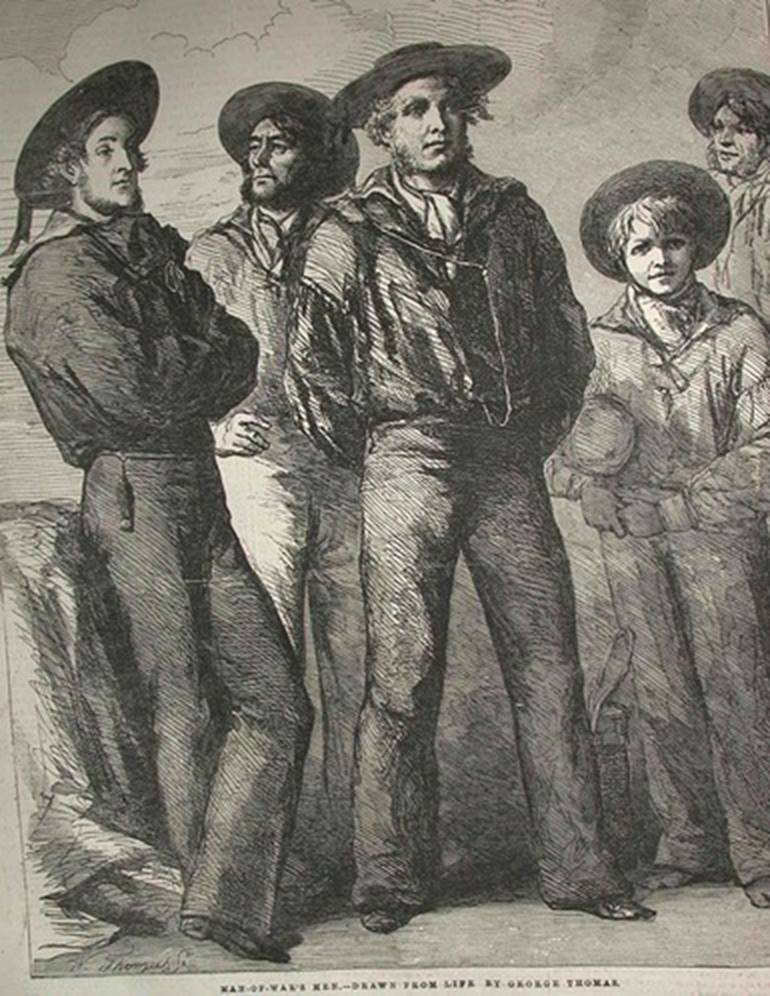
Compare the above with the image of sailors our helpful YDNA Butler relative sent:

Sailor Outfit

Perhaps Edward Butler had mariner background in Ireland or perhaps he was in the Navy in the American Civil War.

Two Death Certificates

Here is Edward Butler’s Death Certificate from 1915 showing that he and his two parents were born in Kilkenny

Edward Butler Death 1915

Ten years later in 1925, his son, Edward H Butler died and recorded that his father was born in County Wexford, Ireland. Why had his birthplace changed in 10 years?

Edward H Death 1925

So although the YDNA results don’t clarify the death certificates, they are consistent with where the death certificates say the Butlers were from!


Uncle Naffy, DNA, and the Butler Brick Wall

This blog will be a departure from my usual Frazer DNA Blogs. This is about my father in law’s Butler line. I plan to add some genealogy also. I have been working on the Butler line since about 18 B.D. That is 18 years before I got involved with DNA. This line has been a mystery. As far as we know, the first Butler of the family to come to the US was Edward Butler.

What Did I Know About Edward Butler?

edwardh

Here is a photo, believed to be Edward himself. I’m not familiar with the type of clothes he is wearing or when this may have been taken. My wife’s Aunt had done some research on the Butlers, so that was helpful. This research was done back in the day before computers. According to a Death Certificate Aunt Lorraine had from 1986, Edward Butler died 1915 and was aged 80. His parents were Michael Butler and Margaret Croke. They were all said to have been born in Kilkenny, Ireland. His wife was Mary E. Crowley. She died in 1905 at age 51. She was born in St. John, New Brunswick. Her father was Florence Crowley and her mom was Ellen Donavan. I had never heard of Florence as a man’s name before. Based on the death certificates, Edward would’ve been born about 1835 and Mary about 1854.

The Chicago Connection

This family had at least 2 sons: George and Edward Henry Butler. Both of these sons moved to Massachusetts with the parents and were said to have been born in Chicago. However, I could not find any record of the family in Chicago. Perhaps some will show up eventually.

A Possible Cincinnati Connection?

I had found some census information for families that looked similar to the family I was looking for, but something was always a bit off. The best census I could find was in Cincinnati. Here is the 1860 Census for the 17 Ward of Cincinnati taken on June 6th.

Cincinnati 1860

Here we have a young Butler family. The husband and wife were 25 and 23. The family’s net worth appeared to be $20 and the father was a laborer who couldn’t read or write. What I especially liked was the the father was born in Ireland and the wife was born in New Brunswick. New Brunswick was pretty specific. The enumerator could’ve written Canada but didn’t. I knew from Mary Butler’s death certificate that she was from St. John, New Brunswick. However, there were many problems. I had never heard of the family living in Cincinnati. I had never heard of the family having daughters. From this census Mary would’ve been born around 1837. Based on her death certificate, she should’ve been born around 1854. So I considered what I had found, but kept other options open.

Here is the same family in 1870 in the 3rd Ward of Cincinnati (taken from the FamilySearch website).

Cincinnati 1870

Now Mary and Julia are said to be born in Mass. Ellen is not in the house. Edward is said to be a citizen.

The Mellie Connection

After his wife, Mary (Crowley) Butler, died in 1905, Edward went to live with the Mellies on Clinton Street in Newton. Here is the 1910 Census.

1910 Census Mellie

Mary was actually Mary Butler. Her parents were James Butler and Mary and she was born in County Kilkenny. She married William Mellie in 1898 in West Newton. That could mean that James Butler was Edward Butler’s brother and seems to confirm the Kilkenny connection for the Butlers. Although this gave me more Butler family and a possible reason the family moved from Chicago to Boston, it didn’t answer many other questions. I was determined to find out more about Edward Butler, but it seemed like he was just as determined to keep his family history hidden.

The Crowley Family

At this point, I gave up on the Butlers and decided to focus on the Crowley family. They had been in North America apparently longer than the Butler family. Very often the female side keeps the family connections and history more than the male side.  Turns out the male name of Florence was not as unusual as I had originally thought. Also I found out that many of the Crowleys from Mary’s generation made their way to Boston. As I read about their lives, it is as if I was  seeing their lives in fast motion. This is because often I find their births, marriages and deaths in a short period of time. Sometimes I see their young children dieing. I see their lives in the Census in 10 year snapshots. I picture where they may have lived in Boston. Sometimes family invited other families to live with them in crowded conditions. One Crowley family member spent quite a bit of time at the Danvers hospital and apparently suffered from mental illness. I’m sure this put a strain on the family.

The DNA Phase

Late in 2014, I sent a Family Tree DNA (FTDNA) kit down to Florida for my father in law to take. This particular test is called the Family Finder. It actually tests your chromosomes and shows resulting matches to other people. The catch is that you don’t know how you are related to these other people. It could be on any branch of your ancestors and then any branch coming down in any direction. Many of those directions you may not even know about. Some of my father in law’s cousins had tested already which I was to find out. These were on his mother’s French Canadian side and not the father’s Butler side. If you are related to one French Canadian, you are related to many. So many of these matches crowded out the Butler matches which seemed few and far between.

I uploaded my father in law’s results to gedmatch.com. This is a place where you can find other matches from other testing companies. I took the results and put them in a spreadsheet. I grouped these by segments of the 22 Chromosomes. Further I grouped these matching segments into Triangulation Groups. These are groups where matches match each other. When this happens there is most likely a common set of ancestors in the group. Then I had to update the results when new matches came in.

Uncle Naffy

On April 14, 2015, I emailed “unclenaffy” (his email name). I noticed a few days previously he had a large match to Richard, my father in law at FTDNA. I included Richard’s ancestry chart. Uncle Naffy got back to me right away, “I dont have a family tree yet but i can tell you that Crowleys are related to me. I am living in Saint John where they had lived and still do live. My Aunt Mary Lou Reid knows the family connections so ill tell you later more.…” Well this had me interested. Then on April 16 Uncle Naffy wrote, “I have more news for you. I have chatted with my aunt mary lou reid and she has info on how i might be related to Butler. My GGgrandmother was a Butler from Cincinnati in 1870s and moved to New Brunswick to live with family” This was even more interesting as I never recalled mentioning Cincinnati to Uncle Naffy. Uncle Naffy further told me that his grandmother’s father was Thomas Joseph Murphy. He married a Mary A Butler. She was the one that moved from Cincinnati to live with family. Uncle Naffy filled me in further, “Rumour has it that when they were due to marry at a church in saint john, well it was during the Great Saint John fire of 1877 and the church burnt down .” I was able to find that marriage in the French Canadian Druin records. I wrote back:

Murphy Butler Marriage St. John

So that was enough to break down one of the Butler brick walls. Uncle Naffy had mentioned St. John, Cincinnati, Crowley and Butler. I also had the name of a Church in St. John where at least some Irish married. I no longer felt like I was searching for a needle in a haystack. Now it was more like looking for a pitchfork.

Finally this Summer, I made it up to the New England Historical and Genealogical Society (NEHGS) Library in Boston to look up marriages. There, I went winding through microfilm. Fortunately, there was an index on the film. Once I figured it out, I found an entry for Butler/Crowley. That was encouraging. Then I found the entry which, although it was legible as to quality, contained some of the worst 19th century handwriting I had ever seen. I took a photo of it on my phone. Here it is.

butler crowley marriage st john

It’s a good thing there was an index. In case you can’t decipher it, I gather that Edward Butler and Mary Crowley were both from St. John and got married May 1, 1855. It appears that someone named Quinn performed the ceremony. Edward Butler gave his mark – remember he couldn’t read or write. There were 2 witnesses: a Walter (someone) and Elizabeth Scott.

So DNA pushed our written record knowledge back 50 years from when Mary Crowley Butler died in 1905. She was considerably older than her stated 51 years when she died. This had thrown me off considerably also.

What I’ve Learned

  • Don’t trust death records. I knew this before but had to relearn it.
  • St. John had a large Irish immigrant population. I didn’t know this before.
  • The Butler/Crowley wedding did in fact take place in St. John. It is likely that Edward Butler came to shore here or nearby.
  • The Butler family was quite mobile moving from St. John, to Cincinnati. Then apparently to the Chicago area and finally to the Boston area.
  • DNA does not solve the problems directly but gives good clues and confidence for areas to look. This is especially true if DNA matches help out a bit and give family information. (Thanks Uncle Naffy.)