Part 3 – Raw DNA From 5 Siblings and a Mother – Patterns

In my previous Blog, I looked at Whit Athey’s Principle 3 for my mom, my 4 siblings and myself. Based on that Priniciple and the previous 2, I phased our DNA up to a point. The next step in the phasing has to do with patterns.

Patterns

The patterns I am talking about are the patterns that the five siblings receive from either their mother or father.  For example, an AAAAB pattern means that the first 4 siblings received the same allele and the fifth sibling received a different one. I had mentioned previously that the patterns should be in this form:

  • AAAAA
  • AAAAB
  • AAABA
  • AAABB
  • AABAA
  • AABAB
  • AABBB
  • ABAAA
  • ABAAB
  • ABABB
  • ABBBB

The first situation is a special case as this situation can happen within the other patterns ‘by accident’ as Athey puts it.

AAAAB Dad pattern

First I’ll look at a query to find an AAAAB pattern.

That Query results in this:

Except there are actually over 8,000 lines. I summarized the rough starts and stops in an Excel Spreadsheet:

This part can get a bit tedious. In Chromosome 2, I noted a possible break between 89 and 96M, so I’ll need to keep an eye on that. Highlighted in yellow are single patterns which may or may not be significant.

quality check

I took my AAAAB Query results and put them into an Excel spreadsheet. Then I subtracted the previous position number from the current position number to see where there were gaps. Then I filtered the gap to 1,000,000 or more positions:


This is my gap analysis. I highlighted the 7 million position gap where I put in an extra segment on the AAAAB pattern. This points out some of the single AAAAB patterns also.

mapping the initial results

Let’s look at Chromosome 13 between 28 and 87M. With an AAAAB pattern, that means that Joel, Sharon, Heidi and Jon match the same paternal grandparent. Lori matches a different one. However, we don’t know which paternal grandparent without a reference cousin. Fortunately, I have one. He is my dad’s first cousin. He would match on my paternal grandfather’s side. That grandfather is James Hartley, b. 1891:

Paternal cousin Jim matches the 5 siblings here:

As you may guess, Lori is on the bottom (#5). She has a crossover at about 85.5M according to Gedmatch. That means that before 85.5M she is matching on my father’s mother’s side: Marion Frazer. So, if I wanted to, I could start to map Chromosome 13. From 28 to 87M, I could say that 4 siblings got their DNA from their paternal Hartley grandfather and one sibling, Lori got hers from her paternal Frazer grandmother.

Further, I would expect an AAAAA pattern starting at 87M based on the gedmatch browser results above. The bad thing about an AAAAA pattern is that there is some missing DNA for the other grandparent. In this case, the Frazer DNA is lost on the right side of the map below. Another point is that these patterns change one letter at a time. So it makes sense that an AAAAB would go to an AAAAA. For example, an AAAAA would never go directly to an ABABA.

Here is a paternal only map of Chromosome 13 based on our very initial results:

aaaab Mom pattern

I notice that the formula that I used to find the AAAAB Dad pattern, I can move over to the mom side. So I might as well do this while I’m thinking of AAAAB pattenrs and put the results in Excel.

I randomly used Heidi as the ‘A’. So Lori not matching Heidi becomes the ‘B’. The results for this maternal query was much smaller with only 189 lines.


This was a lot easier. The Mom and Dad Patterns don’t interrelate with each other, so I have them on separate worksheets. Note that there is the same AAAAB pattern in the same starting place on Chromosome 13 as there was on the paternal side. This is a coincidence and the starting spot is a coincidence. This is just a rough number now and may be refined later. I could make a map of this also.

Here is a cousin on my mom’s father’s side:

Here she matches Joel, Sharon, Heidi and Lori from about 74-99M. Here is a map drawn on the Gedmatch browser and raw data phasing:


This shows what a AAAAB pattern looks like that is both paternal and maternal between 28 and 45M. I also show two crossovers for Lori: (Frazer to Hartley) and (Rathfelder to Lentz). In addition, Jon has to have a crossover from Rathfelder to Lentz and Lori has to have another crossover from Lentz to Rathfelder somewhere in the white spaces. There is a reason that I could tell the maternal A’s of the AAAAB pattern were Rathfelder even though our cousin match did not overlap that area. It is because the patterns do not change that fast as I explained above.

Now that I know which sibling has one of the paternal crossovers I can mark it on the Dad Pattern Spreadsheet:

I name the crossover column in the spreadsheet for the end of the pattern position, so it will be clear where it is. This is the ultimate goal of the process: to find the crossover locations and assign them to the siblings. Once this is done a map may be drawn for all the siblings.

The Next Step

In the next step, I could fill in the missing alleles between the Start and End positions of the AAAAB patterns. Here is how that will be done:

The highlighted row is where the AAAAB Pattern starts. Basically, what will happen is if there is at least one Allele in the first four positions, I will be able to fill in any of the other alleles in those first four positions with the same allele. However, in the last row, for example, there is just one G in the last position. We don’t know if the other four alleles will be a G or another letter. The row that has TTT??. We know that we can fill in the fourth T to TTTT?. However, the last allele we don’t know if it will be a T again or a different alelle. So we also need to leave that space blank.

However, I want to make sure I have all my patterns right, so I will look at all the patterns first and reconcile them.

AAABA Pattern

If I drew my map correctly above, I will be expecting Lori to have a maternal AAABA pattern on Chromosome 13. This should change to an AAABB pattern at about position 95M. I’m already on a maternal query, so I’ll start there.


I used Heidi again as the A. Now Jon is the B that is different than Heidi. I was surprised with the results as I only had this maternal pattern in Chromosome 1 and 23:

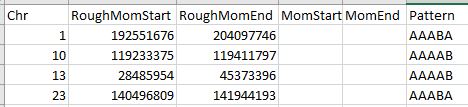
 

My prediction of a Chromosome 13 AAABA Pattern did not come true. I wonder what went wrong?

Paternal AAABA Pattern

Here is a partial summary of the Paternal AAABA Pattern:


On Chromosome 11, we see the AAABA pattern twice with an AAAAB pattern in-between. To go from an AAAAB to AAABA there has to be a transition pattern: either AAAAA or AAABB. Hopefully this prediction will be correct! That leads me to the AAABB pattern.

AAABB

This pattern requires a slight modification of my previous query:


This pattern is adjacent to the AAABA Pattern, so I will be able to assign some crossovers:


These crossovers belong to Jon and Lori as Jon is in the next to the last position of the patterns and Lori is in the last position of the patterns. Note that in Chromosome 19, Lori goes from an AAABA to an AAABB at about 5M. However, there is a rogue AAABB in the AAABA pattern at around 3M. That could be due to a misread or a mutation. I’m not sure. Jon has a crossover on Chromosome 8. These are all Lori and Jon crossovers, due to the positions of the pattern changes we are looking at. The changes are all in the last two positions.

AAABB Maternal

I’m still getting very few crossovers here. I’m not sure why:


I’m not sure why the maternal side is not keeping up with the paternal. I have no crossovers here yet.

AABAA

Following my alphabetical reasoning, AABAA is my next pattern. I’ll start with the maternal:


I changed to having my [Joel’s] allele the ‘A’ in the Pattern. The results look right:


It seemed like there was a break in Chromosome 5 between 46 and 50M.

AABAA Paternal


On Chromosome 5, there was a gap similar to the one on the Maternal side.

Centromeres

According to ISOGG, these are the Build 37 Centromeres:

This is good information to have. I assume that the Centromere is not counted, so I will ignore the Chromosome 5 missing area and make a note that the centromere is there. This also makes a difference on all the results.

AABAB: Are We There Yet?


Here are Heidi’s first crossovers. I’ve also heard of crossovers referred to as cut points. I am noting where the centromere is – though not quite spelling it correctly above.

Here is the Maternal AABAB. I am still annoyed that there are so few patterns. They seem to be missing for some reason:


I suppose, if this trend continues, I could do the project over and add in my mother’s and my FTDNA raw DNA results.

AABBA

I didn’t find any AABBA Patterns on the maternal side. However, that was with a query using my results as A. However, from my previous Blog, I recall this chart:


This showed that on the Mom side, Jon and Lori had the most alleles. I’ll run the query again this way:


Still no patterns.

Here are some more Dad Patterns:


However, there are a few problems. Chromosome 17 is missing a pattern. I can solve this by looking at the original table.


Here the pattern is AABAA.

The next problem is that there are two patterns in one spot on Chromosome 22. I ran pattern AAABA again and see it should have ended earlier:


Here is the right answer below that also shows a Heidi crossover at that location:


AABBB

Paternal


Maternal side

Still nothing.

ABAAA

Maternal side


Paternal

This side had more patterns.

ABAAB

Had several of ABAAB Patterns on the dad side, but only one on the mom side. I think that there is a fill-in step that fills in the mom side from the dad side that may correct this later.

ABABA, ABABB, ABBAA

I did notice a Dad Pattern discrepancy on Chromosome 6:


There are three single patterns, I figured were discrepancies. However, there appeared to be a longer AAABB Pattern within the ABBAA Pattern. This is where it helps to look at the raw data.


The blue section is the start of the AAABB rogue pattern that I had. However, a closer examination reveals that this pattern is not continuous from position 30514810 to 30594827. Between those two there are a lot of ABBAA patterns. This is clear at position 30544401. However, this is also clear wherever the first 2 alleles are different. For example, on the last line, I see GT???. This will be filled in with GTTAA as this is within the ABBAA Pattern area. So what happened was that there were two single AAABB patterns. When I did the query for these, it looked like the pattern was continuous, but it was not. Based on the above, I’ve modified my Dad Pattern Spreadsheet to show two single discrepancies:


I won’t overwrite this information, but I will keep it in mind for later in case it is important. If this was a real crossover, it would be mine. However, crossovers in the middle of a chromosome don’t change that fast for one person on one copy of their chromosome.

Some of the Dad Pattern Crossovers are starting to fill in:


Starts and Ends of Chromosomes

At some point, it is important to know where the Chromosomes start and end. The testing companies don’t always start at the beginning positions of each chromosome. The ends are different also based on the lengths of the chromosomes.

I was able to find what I was looking for using a min/max Query in Access. I took my table with the 900,000 plus alleles and made a query that looks like this:


When I run the Query, I get this helpful table:

This tells me the start and end locations for each of the chromosomes that I am looking at.

I put this into Excel and highlighted the information in purple. Then I sorted it into my mom and dad pattern spreadsheets:


Now, I can tell that I am near the beginning and the end of Chromosome 20 with the pattern locations. However, on Chromosomes 21 and 22, there is still room for more at the beginning of those Chromosomes. As the Chromosome 20 patterns are complete, this also tells me that my sister Lori has no paternal crossover on Chromosome 20.

ABBAB, ABBBA, and ABBBB

These are the last three patterns, not counting AAAAA. I finally have one crossover on the maternal side. It is on the X Chromosome:


I have a mess to clean up on Paternal Chromosome 2 :


There appear to be two patterns occupying the same space between 123 and 128M, which is not good. I’ll take a look at my Table: It appears that the AAAAB at 127,841,390 is a one-time occurrence. Here is my correction:


Note that there is still a gap at AAAAB. There may be an AAAAA Pattern stuck in there.

Lessons Learned and Next Up

  • It is good to document the process in case something goes wrong
  • The start and end points are needed for each chromosome
  • The start and end for each centromere is needed also
  • Attention is needed for the location of each crossover and who it goes to as this is a main point of all the work.
  • Changes along each copy of the chromosome are gradual. They happen one at a time and those one at a time changes correspond to siblings.
  • Next up is filling in the blanks. That was discussed briefly in this Blog.

Raw DNA From 5 Siblings and a Mother: Part 2

In my previous Blog, I started to phase 5 siblings based on their raw data and the raw DNA data from their mom. I looked at homozygous results. That is, when each sibling had the same allele, it meant that they got one of each of those same alleles from each parent. Also when my Mom had homozygous results, say GG, she had to have given one of those G’s to each of her children in that location.

I am using an Athey paper on Phasing from 2010. I looked at his first 2 principles in my previous Blog. Here is Principle 3:

Principle 3 — A final phasing principle is almost trivial, but it is normally not useful because there is usually no way to satisfy its conditions: If a child is heter
ozygous at a particular SNP, and if it is possible to determine which parent contributed one of the bases, then the other parent necessarily contributed the other (or alternate) base.
Heterozygous is a fancy term meaning two different alleles. This principle also lends itself to MS Access, but it requires a few more steps. In my case, the known contributor is my Mom. So in the case where my Allele 1 is different from my Allele 2 and I have an allele from mom. My allele from dad will be my other allele. I just have to make a formula out of that. It sounds like a high school math word problem.
First, I copy my homozyous allele from mom table to a new table. This is in case I make a mistake and have to go back to my previous table. I’ll call my new table, ‘tbl5SiblsHeteroMomtoDad’. Again, I’ll use an Update Query, to update the table with the new ‘from Dad’ alleles. There shouldn’t be an allele from Dad in any of these situations, as we have only put those in where the children were homozygous.
I used the Access Expression Builder to get my heterozygous results:
Here is the second part of the criteria:
This part says that where I’m heterozygous, and my allele from mom was allele1, put allele2 in as from Dad. Before I run this, I presently have 485,834 alleles from Dad. When I go to run the Update Query, I get this message:
After I run the Update Query, I now have 533,517 results. This is the same as 485,834 plus 47,683, so I assume that I am on the right track. I next have to run this one more time for myself for the case when my allele from Mom is allele2 and my allele from Dad would then be allele1. Then I will run this eight times for my four siblings.
5 Phased Sibs Update: V1 and V2

I did all my Principle 3 phasing and here is the update:

What is a little surprising is that Jon and Lori who were tested as AncestryDNA V2 had more Mom-phased alleles. I did mention above that they were getting extra phasing on SNPs that they hadn’t tested from their mom, but I didn’t realize how much.

I mentioned in my previous blog that the combined number of SNPs tested between V1 and V2 is 942,269. That number represents the merging of V1 and V2.

Also some of the specifics are a bit off. For example, my numbers include phased results for myself from my dad (16,536) on the X Chromosome. Well, I didn’t get an X from my dad. This means that the JoelfromDad and JonfromDad numbers above are a bit high.

Next up: DNA patterns


Playing With Raw DNA Data From 5 Siblings and a Mother: Part 1

In many past Blogs, I have written about the raw DNA data of my siblings and my mother. They can be searched in my Blogs under “Raw DNA Data”. First, I looked at three siblings compared with our mom. Next I looked at the results of four siblings. Now I have a 5th sibling tested.

Phasing With Raw DNA Data

The reference I use is Whit Athey’s 2010 paper called, Phasing the Chromosomes of a Family Group When One Parent is Missing.

Basically, Whit uses certain rules and iterative processes to fill in blanks of what the parent’s alleles would be as passed down to their children. From these lists of alleles one can see patterns. From the patterns, one can see where the maternal and paternal crossovers would be. The process is similar to the visual phasing process developed by Kathy Johnston. However, Kathy’s version does not require the use of a parent. Also Kathy’s version does not require looking at hundreds of thousands of alleles.

Lori’s raw data

The fifth sibling in my family to have an autosomal DNA test is Lori. She tested at Ancestry DNA. First I unzipped her results. They open in notepad. I then opened those results in Excel, so all the data would align in columns.


The columns are a SNP ID, the Chromosome, the position on the Chromosome in Build 37 and allele 1 and 2. I added Lori to the allele columns, so I could distinguish between siblings when comparing. One quirk is that when I convert from text to Excel, the blanks in the allele columns go to zeros. I then have to search for all zero’s in those columns and replace them with blanks. The blanks are no-calls.

This data shows Lori’s alleles unsorted. We do know that where she has a C and a C, that one is from her dad and one from her mom. However, where she has an A and G on Line 380436, we don’t know which is from her dad and which is from her mom.

Lori’s DNA in MS Access

I didn’t realize I could upgrade my old computer to Windows 10. It was just new enough to do that. When I did that, I rented Office 365 which includes Access. Access is good for comparing large amounts of data. Lori has 666,531 lines of data. There are 2 alleles for each position. So with six sets of data, that is a lot of alleles. I figure about 8 million. However, the crossovers occur at a distinct point. Finding crossovers is like finding a needle in a haystack.

First I import Lori’s Excel File into Access. It looks pretty much the same there. Except that Access adds an extra ID to keep track of things. Next I want to make an Access Query based on Athey’s Principal 1:

Principle 1If a person is “homozygous” at a location that is, having the same base on each of the two chromosomes of a pair, then obviously at that location it is possible to know with certainty that both chromosomes of the pair have that base at that location, but this is an almost trivial form of phasing.

Principle 1 in Access Query form

Here is Lori’s first query in design view:

It’s a bit small. All I did is put all of Lori’s imported raw data into a query. Then in the last columns I created a field called Lorifromdad. Then there is a formula that says if Lori’s allele1 is the same as her allele2, then put in allele 2. When I run that query, I get this:

Next, I want Lori from mom, which will look the same as Lori from dad. This is easy. I can just copy the same formula and give it a different name:

Also, I forgot that Ancestry has other DNA information in the raw data that I don’t need so I need to restrict the data to Chromosomes 1-23:

It’s nice to check the results to make sure you are getting what you want. This looks pretty simple, but Access does this operation over 600,000 times, so it saves a lot of time.

Next I add Jon:

I have the same kind of formula to Jon’s homozygous results from his mom and dad. I made an equal join in the query above. Note that Jon and Lori both tested with AncestryDNA V2. That means that they have the same SNPs tested. My 2 sisters, my mom and I all tested with V1. So we have to be careful with these joins. If I was to have used an equal join between a V1 and a V2 test, I would only get the results which were common to both.

When I view the query above, it looks like this:

Note that on the third line, Lori has homozyzous results and Jon does not.

Adding AncestryDNA V1 and V2 raw results

The next step is that I would like to carefully add the V1 homozgous results to the V2 homozygous results. Also I would like to make a large table out of what I get.

  • On my existing V1 Homozygous Table, I have 700,153 rows
  • On my new V2 Homozygous Table, I have 666,153 rows
  • The V1 SNPs that are the same as the V2 SNPs are 424037 rows or results

That means that I would like to have a table that has the V1 results plus the V2 results, minus the results in common, so that should be 942269 rows. Somehow I ended up with such a table. I know that’s not very scientifically reproducible, but that is what happened. I’m not sure how important it is to have the V2 results as they won’t phase with my mom. However, I’ll have them in case I need them.

The results of the query left the two V2 siblings’ results on the bottom of the table, but they can easily be sorted:

Principle 2

According to the Athey paper:

Principle 2 — If data from one of the parents are available, and that parent is homozygous at a SNP location, then another almost trivial phasing is possible
since obviously that parent had to send the only type of base s/he had at that location to the child.


This principle lends itself to Access. Basically, I want to tell Access that if Mom has the same two alleles, then show that each child got that allele from her. However, there are a few considerations. If mom has no-reads and the child doesn’t, then we don’t want to overwrite a good read with a bad one. The other consideration is, if mom had an incorrect read and the children had a correct one, we wouldn’t want to overwrite that either. However, I don’t know how rare that is. I guess it is pretty rare. I did a query to check and didn’t find any such instance. So that is one less thing to worry about.

Principle 2 in access

I want to say if mom has two non-null alleles that are the same, put that allele in as from her for all her children. Looking at my old queries, it looks like I need an Update Query. First, I copy my previous table of results to a new table called tbl5sibsMomHomozygous. I’ll try this query:

Before I update, I’ll take a view:


If I take out the ‘And is not null’ statement, I get the same results. I then changed the syntax to ‘Is not Null’ first and got one less record: 481977. It makes me wonder what that record is? I’ll use my second wording as it may be more accurate. Next I hit the !Run button and it updates the table I recently made.

This will give V1 mom alleles to Lori and Jon even when they weren’t tested for them. Here is an updated table view of just the alleles from Dad and the alleles from Mom:

I picked these results at random about halfway down the table. It looks like about half the alleles are filled in already. So now my siblings are more than half phased. The first 5 rows are alleles from Dad for each of the 5 siblings. The 2nd five rows are alleles from Mom for those same siblings.

a pattern preview

The highlighted row shows a pattern from Dad and one from Mom. The first row also shows the same pattern. This is what we will be looking at later in more detail to determine crossovers on the maternal and paternal side. This is what I’ll call the ABABA pattern for both. Here it is coincidental that both the Dad and Mom patterns are the same. Obviously with 5 siblings, there will be a lot of different types of patterns:

  • AAAAA
  • AAAAB
  • AAABA
  • AAABB
  • AABAA
  • AABAB
  • AABBB
  • ABAAA
  • ABAAB
  • ABABB
  • ABBBB

Those are the combinations that I can think of right now. AAAAA is a special case. This could mean that all five siblings could share the same grandparent or sometimes an AAAAA pattern is that way by coincidence. Where the maternal or paternal pattern changes is where the crossover is. This pattern should be gradual. That is, only one letter should change in a pattern change. For example, ABABA may change to ABABB or AAABB. There are many possibilities but only one letter will change. The placement of the letter represents one sibling. So that sibling will own that crossover. For example, a maternal ABABA to ABABB change would represent a maternal crossover for Lori as she is in the last position on my table. The place where the A goes to a B is the location of the crossover.

Next Up

Next up is Athey’s Principal 3 as it applies to 5 siblings and a Mom.


Chasing Down More Rooney Connections

In my previous Blog on the Rooneys, I looked at how my wife’s Rooney ancestors may be connected to another Rooney line by DNA and genealogy. I came up with a proposed genealogy/dna chart that looked like this:

Triangulation With the Rooney DNA Match

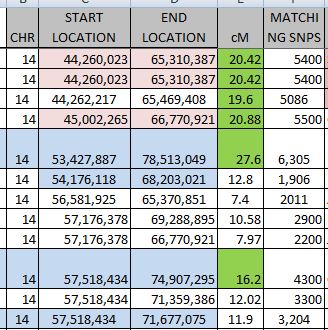
Triangulation is when three or more people all match each other on an overlapping segment of the Chromosome. This happens on Chromosome 14. Here are the Rooney DNA match’s matches with my father in law Richard (1), his sister Lorraine (2) and Gaby (3):

A Triangulation Group (TG) indicates a common ancestor. In this case, I believe the common ancestor to be Timothy Rooney:

Jenny’s Rooney Connection

There is another Rooney connection. Jenny doesn’t match my wife’s family as strongly as the Rooney match in purple above does.

It looks like Jenny has also tested her brother. The above chart shows that Jenny is a second cousin to the Rooney match discussed in my previous Blog.

Virginia and Richard match Jenny on Chromosome 11 from about 118 to 124M on the Chromosome Browser:

The DNA I have mapped for Virginia and Richard corresponds to their Kerivan grandparent:

This Kerivan mapped grandparent is the same one shown in green on the genealogy/dna chart above. It represents Lilly Kerivan, daughter of Alice Rooney.

Just so we don’t leave out Jenny’s brother, here are some of his matches with my wife’s family on Chromosome 3:

These matches are with Richard, Virginia and John. In my opinion, each match between my wife’s side and Jenny would represent DNA from Timothy Rooney born about 1807.

Here is Richard and Virginia’s Chromosome 3 mapped out.

The Rooney match would be in a Kerivan segment. That means that the dark red segment is probably Kerivan. The blue and purple above are on my father in law’s mother’s French Canadian side.

More Rooney Genealogy: Are Timothy and Terrence the Same?

Jenny and and her 2nd cousin Daniel have in their trees as their first Rooney ancestor Terrence Rooney. That is not surprising considering the marriage record of their great great grandfather, John Rooney:

Above are the listed parents for John Rooney and his wife. The date of the record is May 19, 1851. The record is for the Intentions of Marriage, so this would have been soon before the couple was married. Here is a marriage record for a John A and Mary Rooney:

The date of marriage was listed as May 9, 1851. Here quite a few things seem off. The wife is now Mary Rooney rather than McDermott and both parents are Patrick. They are listed as being in Boston rather than Dorchester although both places are very close. Note that John is a mason here. After a bit of digging, it appears that there were two John Rooneys of about the same age that married two Mary’s of about the same age. Isn’t that confusing!

A proposed sketch of Timothy Rooney

My thought is that Timothy Rooney, son of John Rooney and Ann was born in County Leitrim around 1807. He married Margaret Ann Gorman around 1828. Around 1830, he had a son that he named after his father John. Timothy’s first wife likely died and he then married Ann Nancy Lilly probably around 1832. She had about 10 children between 1834 and 1851.  John took off for Boston not too long before he married in 1851. Timothy landed in Boston in 1858 with his wife and some of his children in June 1858:

The 1860 Census shows Tim and family in Waltham:

Timothy died in Newton at the age of 74 in 1881. His occupation was listed as mason.

Summary and Conclusion

  • The DNA leads me to think that Terence and Timothy Rooney are the same person.
  • If they were the same person, the timing would seem to fit in. He would have had time to have two wives giving birth to the children that we know of.
  • The fact that Jenny, John and Gaby have matches seem to reinforce that the DNA that these two families share focus in on Timothy or Terrence Rooney.
  • I can’t prove that Terrence and Timothy Rooney by either the genealogy or the DNA. However, the DNA does point to a common ancestor. Why couldn’t that ancestor be Timothy or Terrence?


Hartley YDNA and STR Tree: New Results

This Blog follows on my previous Blog on the subject.  In that Blog, I drew a two person 111 STR Hartley Z17911 Tree. Hartleys that are fairly close to me are assumed to be positive for the SNP Z17911 which was my terminal SNP.

When I look at the new Hartley results, I get the following Hartley Z17911 111 STR signature:

A few points from this new signature:

  • Previously, I was not able to have a 111 STR Hartley Mode. Now with three testers, that is possible. I fudged the mode for 576 as there were three different results: 17, 18 and 19.
  • The first Hartley on the list above is what I was calling the Bradford, West Yorkshire Hartley in the previous Blog
  • The second is the new tester with ancestor William Shepherd Hartley from Manchester, England.
  • The third on the list is me.

A New Hartley SNP

Previously, my terminal SNP was Z17911. Now there is a new shared Hartley SNP called A11132. Here is the SNP tree from the R-Z16357 Project web site:

Thanks to testing by another Hartley with Quaker Pennsylvania and NE Lancashire roots, I have moved down the tree past A11138 to A11132. I am guessing that other Hartleys that am related to by STRs will share this SNP. That means that the Hartley STR Mode I mention above, will also likely be the A11132 Mode.

Some Genealogy For the Newly Tested Hartley

This is part of what I was given for the ancestors of the New Hartley:

William was born in about 1851 in England. (1), Lancashire to be exact (2). His parents were Thomas Hartley and Hannah Shepherd (2).
I was able to find William’s Birth:
From there I found the 1851 Census:
This was a big deal as it shows that the father Thomas was born in the little village of Wray, Lancashire in the Northwest of Lancashire. Thomas’ wedding record was helpful in giving a middle name.
Name: Thomas Townson Hartley
Gender: Male
Marriage Date: 27 Mar 1826
Marriage Place: Manchester, Lancashire, England
Spouse: Hannah Shepherd
FHL Film Number: 1545585
Reference ID: pg152 ln456
From there I searched using the Lancashire Online Parish Search:
Baptism: 26 Aug 1804 St Margaret, Hornby, Lancashire, England
Thos. Townson Heartley – Son of Christopr. Smith Heartley & Mary
Born: 11 Aug
Abode: Wray
Occupation: Hatter
Register: Baptisms 1790 – 1805, Page 47, Entry 5
Source: LDS Film 1526204
Further searching lead to another Christopher Hartley ancestor:
Baptism: 3 Jul 1774 St Wilfrid, Melling, Lancashire, England
Christopher Smith Hartley – Son of Christopher Hartley & Alice
Abode: Wray
Performed at: Hornby Chapel
Register: Baptisms 1752 – 1781, Page 49, Entry 5
Source: LDS Film 1849660
Here is Wray and Hornby in NW Lancashire:

Here is where the Smith name comes in:

Marriage: 16 Dec 1752 St Wilfrid, Melling in Lonsdale, Lancashire, England
Christopher Hartley – Wray in this Parish
Ann Smith – Hornby in this Parish
Notes: X [in left margin]
Register: Marriages 1752 – 1754, Page 1, Entry 6
Source: LDS Film 1849660

Actually, the Bishop’s Transcripts show that Ann may have been Alice:

This is where my easy searching stopped. I did get further than I did on my own Hartley line. We now have a Christopher Hartley for our new YDNA tester probably born around 1725 who lived in Wray, Lancashire in 1752

The reason I go through all the genealogy is that it is interesting to match up the historic Hartley homelands with the DNA. Here is a map with our three testers:

To the upper left of the map shows a circle around Hornby for our new tester. My ancestors were just south of Colne and the other 111 Hartley STR tester had ancestors in Thornton, near Bradford. The distance between Thornton and Wray is probably no more than 35 miles as the crow flies.

Back To the DNA

With my new Hartley 111 STR Signature, I get this tree:

  • Again, it seems obvious to split the two groups by the 455 STR. 455 mutates 0.16 times every one thousand generations. I don’t know about you, but to me that seems like a pretty rare thing. My thinking it that this just happened once.
  • The next three slowest STRs are 540, 1B07 and 445. I had all those mutations, so that puts me by myself. Those three STRs are in the 111 panel, so I won’t be able to check those against other Hartleys until more Z17911 Hartleys test to 111 markers.
  • This groups Thornton and Wray together even though they are further away from each other geographically.
  • How could this tree be dated? If we take the Hartley Mode date to be the beginning of surnames, this could be around 1300 or 1400. A wild guess would be the that the Wray/Thornton ancestor could be about 100 years after that.

A New 67 STR Z179111 Hartley Tree

I say Z17911 Hartley Tree, because there are other Hartleys in other SNP groups that would not be closely enough related to be in a STR tree. First, we need a new 67 STR signature. This signature should be more accurate than the STR signature up to 67 STRs that was done for the 111 STR Tree. This is because there are more Hartleys that have tested 67 STRs.

  • I kept the Hartley mode for 455 as 11 even though it is technically 12. This is because at the low mutation rate, I didn’t think that it could have mutated up and down again in the time frame we are looking at. If I am interpreting the mutation rate correctly, there would be a 16% chance of this STR mutating in about 3,000 years.
  • In the previous analysis, I was the furthest away from the Hartley 111 STR mode. Here, I am the closest. This is because a lot of my differences were in the 111 STR Panel.
  • My inclination is still to separate the two groups of Hartleys by the slow moving 455 STR.

Here is the new 67 STR Hartley Tree:

  • What I was calling the Lancashire and West Yorkshire Hartleys, I’m now calling the Hartley 1 Line and the Hartley 2 Line.
  • I had already grouped Bradford, West Yorkshire and Hartley #3 by 449 and 576. Now I’m grouping our new tester with the West Yorkshire, William based on 389b and CDYb.
  • The Wray, Lancs Hartley and the W Yorks Hartley would be quite a ways apart from each other geographically. Yet they seem to be related by YDNA. Perhaps the Wray, Lancs Hartleys had their roots in West Yorkshire.
  • Joel and Quaker Hartley are the two that have taken the big Y tests. They are both also identified by the A11132 SNP.

Summary and Conclusions

  • Hartley YDNA has been in its infancy but is starting to grow. This is thanks to those Hartleys that have had Big Y tests and STR tests.
  • It would be interesting to see if all the Hartleys in this study have the Z11132 SNP. It is possible that this could be the Hartley SNP. However, this is based on only two Hartleys testing positive for it so far.
  • The 455 STR marker seems to be important in splitting the two Hartley branches. It will be interesting to see if that marker also corresponds to a specific SNP.


Sadie’s Nicholson DNA

Recently, I’ve been in touch with a new DNA relative on my mom’s Nicholson side. Sadie showed up at AncestryDNA as many matches do. Sadie, however, also showed up as a Shared Ancestor Hint. These are good. As long as the genealogy on both sides is good, this shows how you connect to your DNA match by common ancestors.

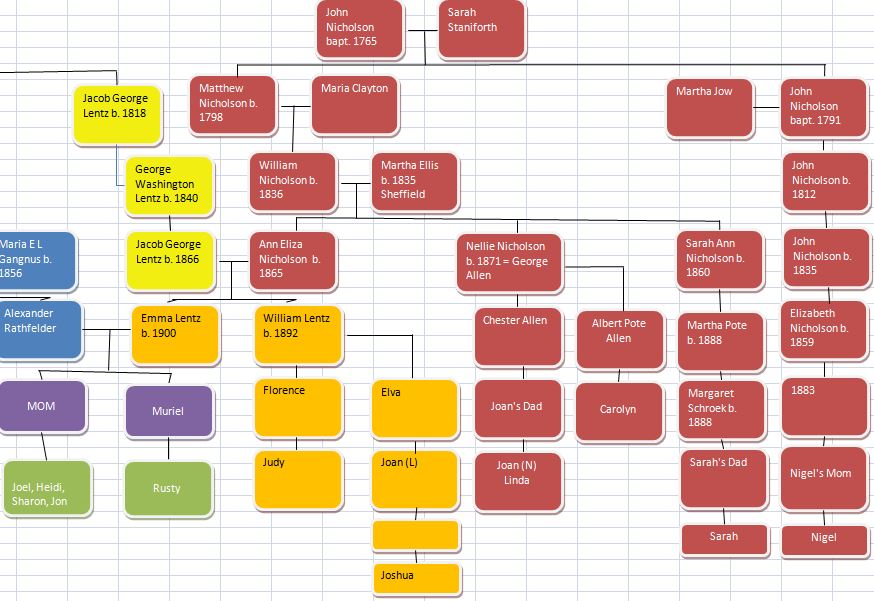
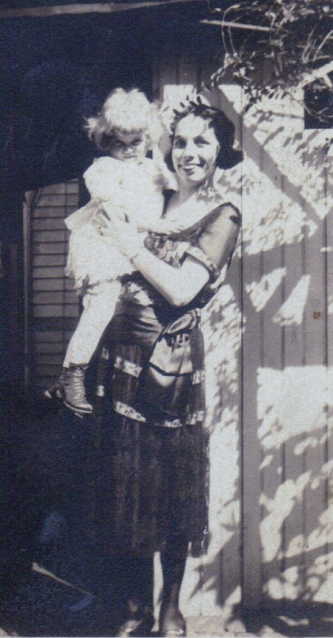
Emma above is my grandmother and Martha is Sadie’s great grandmother. That makes us third cousins once removed to each other. Speaking of Emma, I found a photo of her online that I hadn’t seen before. My cousin Judy in the chart below had posted it:

Emma is holding her Lentz niece. However, they are both Nicholson descendants. The niece was born in 1918.

Here is how Sadie fits in with some of the other Nicholson DNA-tested relatives:

I’ve chopped off some of my unrelated Rathfelder ancestors on the left. Sadie descends from Sarah who represents a new daughter of William Nicholson and Martha Ellis. Actually Sarah Nicholson is new to this DNA project and the eldest child of William and Martha Nicholson.

Sadie’s Nicholson DNA

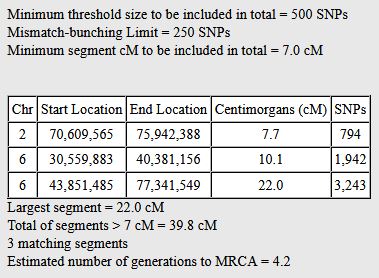
Sadie matches me and my 4 siblings as well as my mom by DNA. She matches my cousin Rusty. She doesn’t match Judy and Joshua. She matches Joan and Joan’s sister Linda. She matches Carolyn but not Nigel. The largest Nicholson match that Sadie has is on Chromosome 6:

Here she matches:

  1. Joan
  2. Me
  3. My mom
  4. My sister Heidi
  5. My sister Sharon
  6. My Brother Jonathan
  7. Another Nicholson relative that hasn’t gotten back to me
  8. My cousin Rusty
  9. My sister Lori

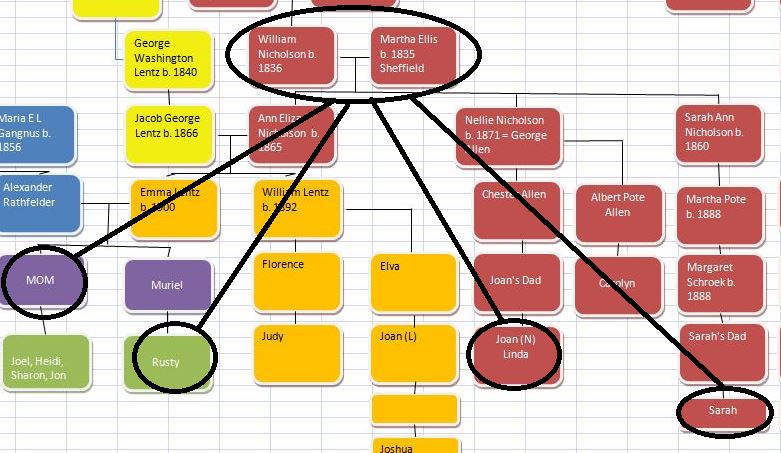
It looks like a lot of people, but it could be reduced to Joan, my mom, the other Nicholson relative and my cousin Rusty. That is because my siblings and I got all our Nicholson DNA from our mom. These matches form a Triangulation Group:

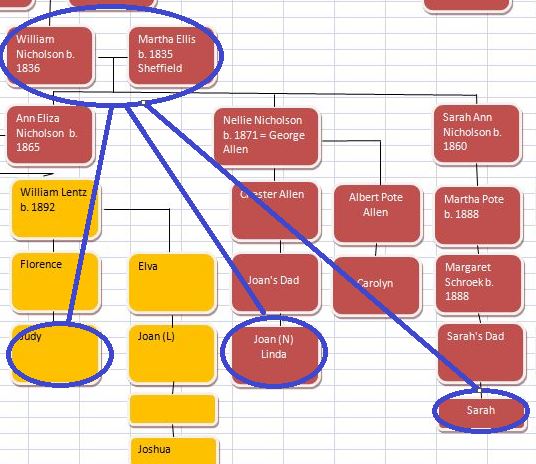
The theory says that these four people got their specific matching DNA from either William Nicholson or Martha Ellis. However, because we don’t know which, I’ve circled them both. This doesn’t mean that the other people that didn’t match on Chromosome 6 don’t descend from William and Martha. However, it does give solid evidence that the ones that do match do descend from the couple.

A Chromosome Mapping Side Trip

In Sadie’s matches, I noticed that Sadie had a shorter match with my sister Lori who is #9

This means that Lori likely has a crossover where her match stops around 56M. Here is Lori’s match with Sadie:

It looks like chromosome mapping would go beyond the scope of this Blog, so I’ll address this later. My assumption is that Lori’s maternal Chromosome 6 switches from her Lentz grandmother (whose mother was a Nicholson) to her Rathfelder grandfather at about position 56M.

Sadie’s Nicholson X Chromosome Matches

The important rule about the X Chromosome is that it doesn’t travel down from father to son. That means if there are two males in a line going up from a DNA tester to a common ancestor, then there can’t be an X Chromosome match there. This applies to only Nigel in my chart. Nigel is from a long line of Nicholson males.

Here are Sadie’s top three X matches:

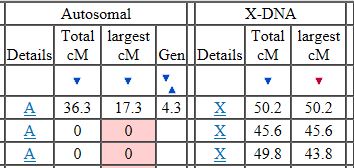
The first match is Joan. I don’t know who the second match is. Probably a non-Nicholson match. The third match is to Judy in the chart above. The pink zero means that Judy shares no autosomal DNA (Chromosomes 1-22) with Sadie but does share a sizeable X Chromosome match. Here are Sadie’s X matches with these two Nicholson cousins on the Gedmatch Chromosome Browser:

#1 is Sadie’s match with Joan and #2 is her match with Judy. Again, we can’t know if this DNA is from William Nicholson or Martha Ellis. This is because Sadie, Joan and Judy descend from daughters of William and Martha. If one of them had descended from a son, then we would know that the X Chromosome they got would have to be from Martha Ellis.

My Chromosome Map

I almost forgot to update my Chromosome Map based on Sadie. This is the one based on all my identified cousins that match by DNA. Kitty Munson developed the software for this:

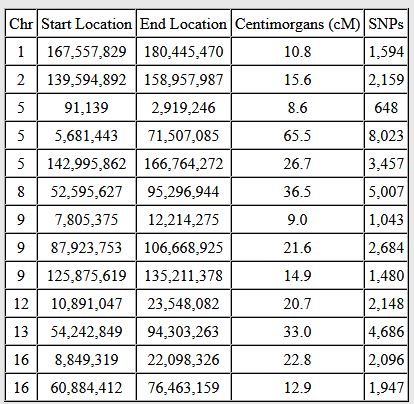
Sadie shows up on my map as maroon on Chromosome 2 and 6. The 2 is important as I had no maternal match on that large Chromosome prior to the match with Sadie. Here are the specifics of my match with Sadie:


Chasing Down My Wife’s Rooney Connections

My wife’s father is half Irish and half French Canadian. On the French Canadian side there seems to be  a lot of genealogy and a lot of DNA matches. On the Irish side, there is a not so much genealogy and a lot less identified DNA matches.

Mapping the French Canadian and Irish In Laws

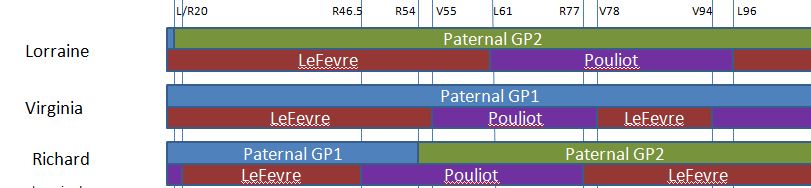
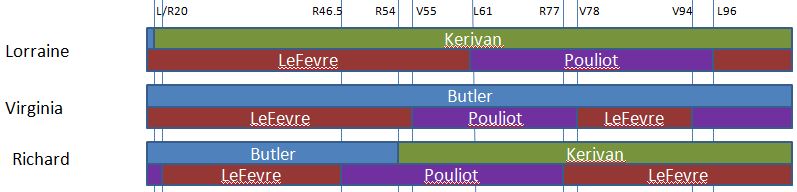
I have used a method to map out my father in law’s DNA that he got from his four grandparents. To do this, I compared him to his two sisters, Lorraine and Virginia. Here is their Chromosome 14.

The good news was that I could map the Chromosomes by looking at the DNA results of the three siblings compared to each other. Then I could find many matches to reference the French Canadian side. That got me the LeFevre and Pouliot grandparents above. The problem was that I couldn’t find enough matches to reference the Irish side.

Gaby to the rescue

However, on AncestryDNA I found my wife’s 2nd cousin on the Irish side. Because of Gaby, I can now tell which of my father in law’s grandparents are Irish.

Any DNA matches that Gaby has in common with Lorraine, Richard or Virginia are Irish. Gaby and my wife Marie, share the same Butler and Kerivan Irish ancestors. The next problem is that we can’t tell whether these matches are Kerivan or Butler.

Working Gedmatch To Get Kerivan and/or Butler Matches

In order to separate the Butlers from the Kerivans, we need to find matches that are further out. To find these I looked at DNA matches at Gedmatch that matched both Gaby and Lorraine. I used Lorraine because she was tested at AncestryDNA. The matches would be on the Irish side. That was the first cut. Next, I hoped that some of these matches would have trees at Ancestry that would match my in-law’s tree.

For example, here is someone that matched both Lorraine and Gaby on our example Chromosome 14.

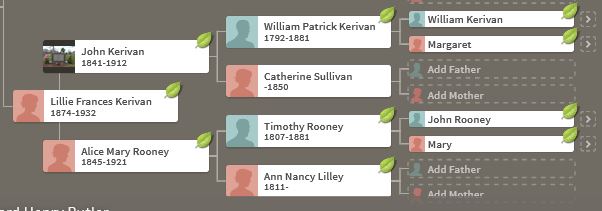
The above image shows how Lorraine matches someone with a Rooney name (#1) and Gaby (#2). This tells me that this Rooney match is on the paternal side or Irish side, so that is also good. The other good thing is that my father in law’s grandmother’s mother was a Rooney:

All I have to show is that the match indicated in yellow above with the Rooney name is related to Alice Mary Rooney above. There were other common surnames, so the match didn’t have to be a Rooney. However, I noticed that there were some Rooneys in Massachusetts which is where my wife’s Rooney ancestors lived. Based on that, I thought that it would be a good idea to start with Rooney.

Doing the Rooney Genealogy

Lorraine’s Rooney AncestryDNA match that is also at Gedmatch and matches with Gaby at Chromosome has a Rooney Tree:

However, these two trees seem a little out of whack. Maybe Timothy Rooney in my wife’s tree could be a brother of Terrance Rooney in the Rooney tree?

A third Rooney Tree

I found another Rooney tree as an Ancestry Hint. It looks like this in a different view:

This tree shows that Timothy Rooney had two wives. It appears that Margaret Gorman was the first wife and had a John Rooney born 1827. Apparently Ann Nancy Lilley was the second wife and had Alice Mary Rooney. That could explain why the two trees didn’t match up. This tree shows the Terrence Rooney from the Rooney Tree as the same Timothy Rooney from my tree.

Putting the rooney trees together

Assuming that the Rooney Tree reconciliation was correct, the Rooney DNA match on the bottom right in purple would be a 1/2 third cousin once removed to my father in law Richard and his two sisters.

Back to the Chromosome 14 Map

That looks better. We now have the paternal side thanks to Gaby and a Rooney match. When I check the Rooney match, he matches Lorraine and Richard, but not Virginia.

The yellow matches on the Gedmatch Chromosome browser correspond with the green in the Chromosome 14 map above. The crossover for Richard at 54M also shows up.

The other good thing about the new Chromosome map is that it shows where the Butler matches would be. This is like a spy glass looking into the past. A match on the Butler side is like a match with Virginia’s grandfather who was born in 1875. Matches to these grandparents should be helpful in straightening out my wife’s Irish genealogy.

Summary

  • Use a paternal cousin to find other paternal cousin matches that are more distant
  • Connect that further out cousin to a known ancestor
  • Use that further out cousin match to complete a Chromosome map
  • Use that completed Chromosome map to identify other cousins as they match in identified areas of the Chromosome map representing grandparents of my father in law.
  • Use those identified matches to focus on further genealogy and break down former research barriers.
  • This method works best with people that have DNA testing results at both Gedmatch and Ancestry.

The Frazers of North Roscommon, Ireland: STR Tree and Signature STRs

Now that a DNA sale is on at Family Tree DNA, my mind has turned to Frazer YDNA. I had thought that I had mentioned STR Trees and signature STRs for the Frazer family before. But after looking at my old Blogs, apparently I have not. I have talked about STR signatures, but will go into more detail here.

Present YDNA Testing of North Roscommon Frazer Descendants

At this time two male Frazer descendants have tested for YDNA. They are Paul and Jonathan.

Paul is two generations below on the left side and Jonathan is one generation below on the right side. If I have this chart right, that would mean that Paul and Jonathan are 6th cousins once removed. Their common ancestor was probably another Archibald Frazer born around 1690 who married a Mary. Both Paul and Jonathan have tested their YDNA for 67 STRs. YDNA tests male only lines – in this case if focuses on the Frazer Line .

A Signature STR

It would be interesting to know what the signature STR is for this Frazer ancestor born in 1690. How could we discover that? If we had  many Frazer testers, we would like take the most common STR values and assume that those would be the oldest values. However, we only have two testers, so that would be difficult.

The problem with STRs is that they could go up or down. We would like the older STR signature to go to our 1690 Frazer. That means we have to go back in time a step to try to see which way the STRs are moving. The other thing is that we hope that they are moving in one direction only!

Jonathan represents the older Frazer line

In my past Blogs on the subject, I have assumed that Jonathan’s STRs represented the common Frazer ancestor more than Paul’s STRs. My reasoning was that Paul had very few matches at all levels. Usually at a lower STR level one has more matches. That said to me that Paul’s line’s STRs had mutated away from the ancestral signature. Here are the three differences between Jonathan’s and Paul’s STRs:

Jonathan’s results are on the top and Paul on the bottom. None of these STRs are very slow moving STRs. CDYa is a very fast moving STR. So fast, that some genetic genealogists don’t like to use this STR in their analyses.

The L664 Mode

It is my assumption that our Frazers are part of the R1a-L664 Haplogroup. That is based on the fact that usually this group has a value of the 388 STR of 10. That is the case for Paul and Jonathan. The mode is the STR value that is the most common. The mode is also assumed to the be representative of the oldest values. The L664 mode for the 391 STR is 10 and the mode for 576 STR is 18. That confirms my hunch that Jonathan has the oldest STRs. The mode for the CDYa STR is 33-39, which is a little more like Jonathan than Paul. However, as I’ve noted that STR can be unreliable – especially over long time frames.

Here are some of the other SNPs under the L664 Haplogroup:

This is to give the reader an idea that there are many SNPs under this Haplogroup. It looks like there are 4-7 levels below L664. More SNPs could be discovered by the Big Y test.

How old is L664

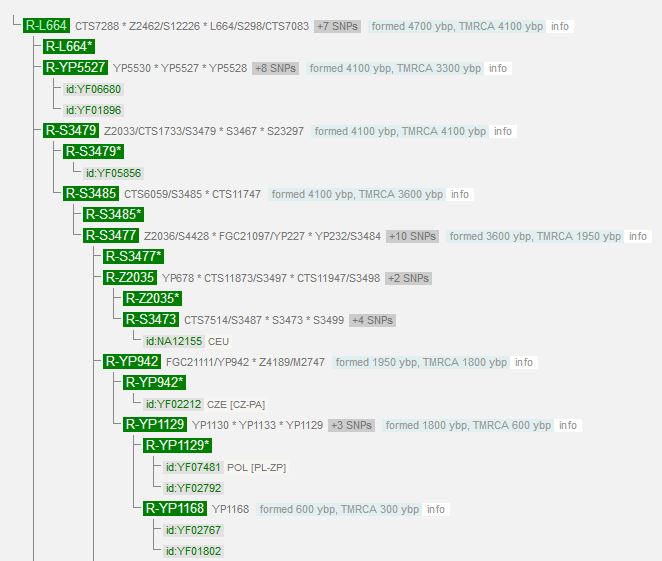
It’s quite old. Here is the YFull Tree with dates:

Note that a common ancestor with another L664 person could go back 4100 years. That’s a long time. And our Frazer testers are not even confirmed to be L664. That means that their Frazer SNPs are still in the cave man ages. That is one reason why Big Y tests are needed. This YFull Tree above follows one branch down to where the common ancestors are 300 years ago. That is closer to where I would like to see our Frazer SNPs. Note that the YP1168 is also shown on the pink tree above. So while these SNP trees look quite innocent, it is not always obvious that they could represent close to 4,000 years.

The North Roscommon Frazer mode based on the l664 mode

In order to get our Frazer mode, I would just have to look at the STRs that the Frazer have that are different than the L664 Mode. The L664 is the going back in time Haplogroup that I mentioned above.

Above, I left out those Frazer STRs that were the same as the L664 mode. Of these STRs, the 450 is likely the most significant as it has the lowest likelihood of mutating. That is shown in orange with a value of 0.200.

Putting It All Together In a Simple Frazer Tree

Here is a simple tree:

A few comments:

  • There may be some refinements to this Frazer Ancestor Signature STR, but this is the main idea.
  • It seems odd that Jonathan would have no STR mutations between 1690 and when he was born. It is likely that he has had mutations – probably with one of the faster mutating STRs
  • A new Frazer descendant has ordered a 67 STR test. He is on the Archibald line, so that should clarify things there as far as where the mutations happened.

Keep an Eye on the Grants

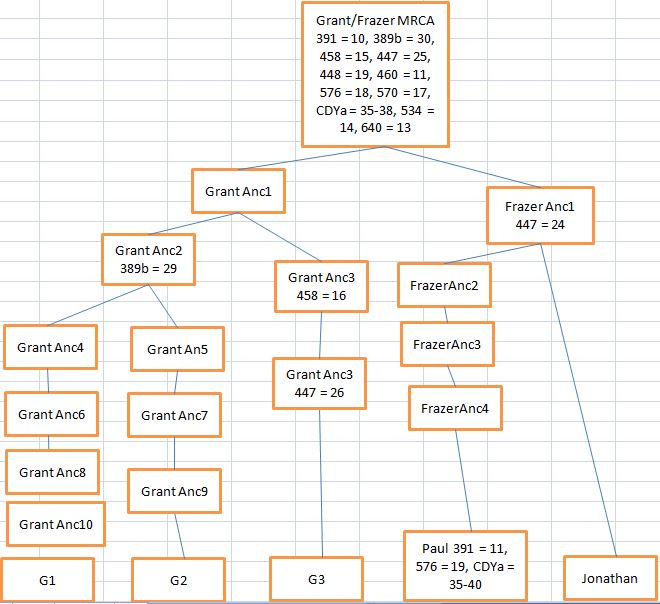
By YDNA, the Grants seem related to Frazers. I am assuming the relation goes back in time in Scotland. I don’t know if this break happened before the adoption of surnames or after. Here is a Grant/Frazer Tree I had made some time ago:

  • The Frazers could be related to other Scots Lines. However, this one seemed to stand out.
  • I took the STR signature concept I brought up in this blog and applied it further back in time and have a Grant/Frazer Ancestor signature at the top.
  • In this scenario, the only genetic difference between a common Grant/Frazer ancestor and a Frazer ancestor is the 447 STR.

Things to Come

  • Pat has ordered a 67 STR test for her male cousin and a Family Finder test for his sister
  • Joanna and I have ordered BigY tests for Jonathan and Paul.
  • With all this YDNA testing we are coming from the distant past into the less distant path. The goal is to confirm our Frazer Lines and connect with some as yet unknown Frazer Lines.
  • The three pronged attack is: genealogy, autosomal DNA testing for the last 250 years, and the Big Y to cover from perhaps 2,000 years ago to as recent as we can get. We will wait and see.
  • The advantage of having two Big Y tests is that we should discover new SNPs that are unique to our branch of Frazers.
  • I plan to use YFull to analyze Paul’s BigY results to get dates for the SNPs.

Gaby’s Butler and Kerivan DNA

My wife’s cousin Gaby recently uploaded her AncestryDNA results to gedmatch. That is good news for my Butler and Kerivan research. My wife’s father is a Butler and a Kerivan on his father’s side. However, because he is also half French Canadian on his mother’s side, he gets a lot of French Canadian matches. Those matches make if difficult to find the Irish Butler and Kerivan DNA matches.

Gaby’s Overall DNA Matches at Gedmatch

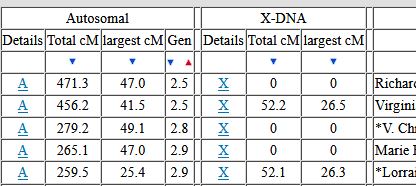
Here are Gaby’s top DNA matches at Gedmatch:

  • Already, there are a few interesting things. One is that Gaby has some X Chromosome matches with Virginia and Lorraine. Virginia and Lorraine are my wife’s aunts. We will look at that later.
  • The next point is that Gaby shares about the same amount of DNA with my wife Marie as she does with Marie’s Aunt Lorraine. Such is the randomness of DNA inheritance. Gen in the Chart above means generations to a common ancestor. For example, first cousins have 2 generations to their common or shared grandparents. Marie’s ‘Gen’ amount should be 3.0 (on average) to Gaby as those two are second cousins. Aunt Lorraine should be 2.5 from Gaby as they are 1st cousins once removed.

Butler/Kerivan Genealogy

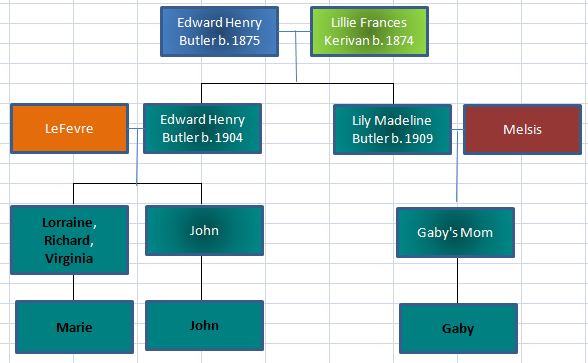
Here is a brief genealogy as it relates to those close relatives DNA tested and uploaded to Gematch:

Those that have DNA tested and are listed at Gedmatch are in dark bold. Marie, John and Gaby are each 2nd cousins to each other. The 5 testers on the left will share French Canadian LeFevre DNA with each other. However, now with Gaby, the left hand side above will share only Butler and Kerivan DNA. Likewise from Gaby’s point of view, her matches take her Melsis ancestors out of the matching.

Kerivan X Chromosome Matches

I mentioned above that Gaby matches Lorraine and Virginia by X Chromosome. My guess is those matches are Kerivan and not Butler matches. Why do I think that? The important thing to note about the X Chromosome is that the son inherits no X Chromosome from the father. However, Lorraine and Virginia inherited an X Chromosome from their father, Edward Butler b. 1904. That Edward inherited no X from his dad, but did inherit X from his mother Lillie Frances Kerivan, born 1874.

Here is Lily Kerivan’s X DNA that is shared between Gaby, Lorraine, and Virginia:

gaby’s additional X Chromosome DNA

But there is more. Gaby gets more X Chromosome DNA than those on the left side of the Butler/Kerivan genealogy chart. Gaby gets some Crowley X Chromosome DNA.

Following up the tree from Gaby, she got X DNA from her mom, who got it from her mom Lily Butler. Lily got her X DNA from her mom and dad Edward Henry Butler. Edward got all of his X Chromosome from his mom Mary Crowley, b. 1838 in St Johns, New Brunswick. So Gaby may have some of  this old X Chromosome DNA. I say she may as we don’t know for sure. Perhaps it dropped out along the way. However, the potential is there.

Finding other Butlers and kerivans

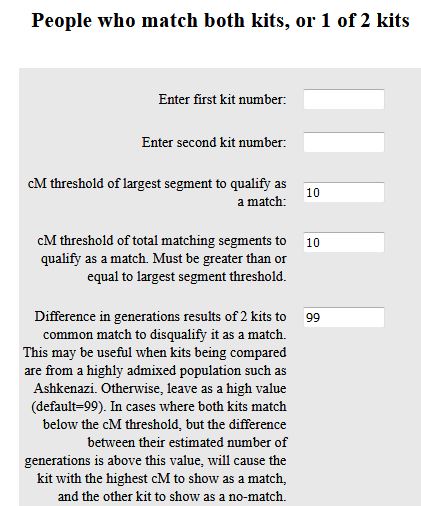
One way to find other matches on the  Butler and Kerivan sides is to run a utility at Gedmatch. The utility is called ‘People who match one or both of 2 kits’. We are interested in those who match both my father in law Richard and Gaby.

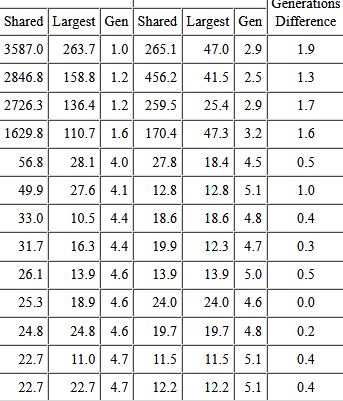
If I choose Richard’s kit number first, I’ll get those in common with Gaby that match Richard. If I choose Gaby’s kit number first, I’ll get her matches that are in common with Richard. I’ll choose Richard’s kit number first as I already have a spreadsheet of a lot of his matches. Here are the results:

I left out the kit numbers on the left and the emails on the right. Also on the right is a check box to choose all the matches where they can be compared. The first three columns are for Richard and the second three are for Gaby. When I pick a lot of the check boxes, I can then compare them in a Chromosome browser.

This is an example of one of the Chromosome’s results. #1 on the browser is a Rooney. There are Rooney’s on the Kerivan side, so this is a good sign. #2 is Gaby. It looks like she is related to #3 also. Now I can go to Richard’s match spreadsheet. I can make an educated guess that both these matches are on his Paternal side.

The first entry in blue above is the Rooney person. The second in blue is Gaby. Others in blue are likely related along that Kerivan or likely Rooney line. The blue means a paternal match. Notice that there are a few other matches with known relatives above that are maternal matches in the same area of the Chromosome. I have them in pink for maternal. Knowing if your matches are paternal or maternal is one of the most important things to know about autosomal DNA matching. If you get that wrong, you will be chasing DNA down the wrong road.

Cousin Holly’s Hartley DNA Results

I have many 2nd cousins. Over 100 I’m sure. My Hartley great grandparents had 13 children. All their descendants in my generation are 2nd cousins.Holly is one of those 2nd cousins. My first recollection of Holly is that she was creating a bit of commotion at our Town’s ball field. I was probably about 5 years old at the time. I had an impression that she may have been a relative but I wasn’t sure. Holly was challenging the local boys in a foot race and beating them. I was thinking that she was one cool girl.

So far on my Hartley side, those in gold below have tested and uploaded and uploaded to Gedmatch.com:

Note that Patricia and Beth are also first cousins to each other.

Here’s Holly’s grandmother Grace Hartley. I borrowed the photo from Holly’s Ancestry Tree:

Does she look like Holly? I think so. Except I don’t picture Holly as looking as serious.

All the Hartley cousins in the chart above have James Hartley and Annis Louisa Snell in common. But we won’t know which – easily. Another point is that everyone has eight great grandparents. So all the second cousins get 2/8 or 1/4 of their DNA from these two great grandparents. That is, on average. Here are the numbers of how Holly matches the tested Hartleys:

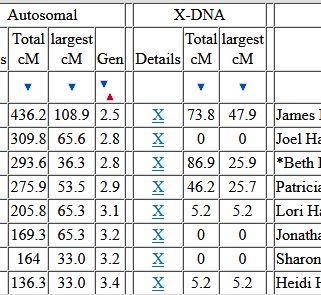
The Gen is how far it seems that the common ancestors are away based on the DNA match. James, my dad’s 1st cousin seems 2.5 away. That is just right for a 1st cousin once removed. Holly should match her 2nd cousins on average at a level of three. That is because our great grandparents are 3 generations away from us. Because of the random way we get our DNA, however, Holly is more closely matching Joel, Beth and Patricia and is further away matching on my four siblings.

The X Chromosome Rule

There is a rule that the X Chromosome does not pass down from father to son.

That means that no X Chromosome from Greenwood Hartley got passed down to any of us. That also means that no Hartley X Chromosome got passed down to anyone in my family. That is why Holly matches James, Beth and Patricia on the X Chromosome and only incidentally matches Lori and Heidi from my family.

Here is how Holly matches James, Beth, Patricia and incidentally my 2 sisters.

Holly and Jim have a longer match as they are more closely related (1st cousin, once removed). As a rule, the more closely you are related, the longer the segments.

Shared Autosomal DNA

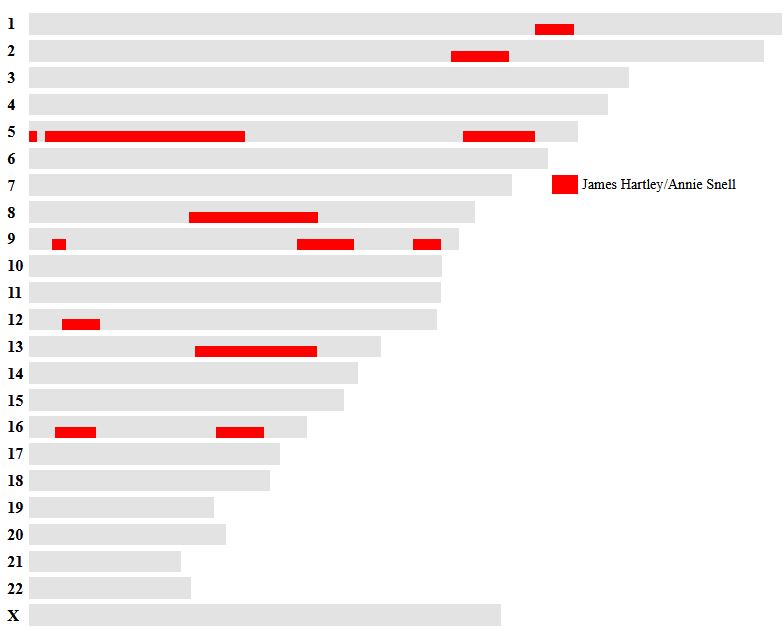
Holly and I share this much DNA:

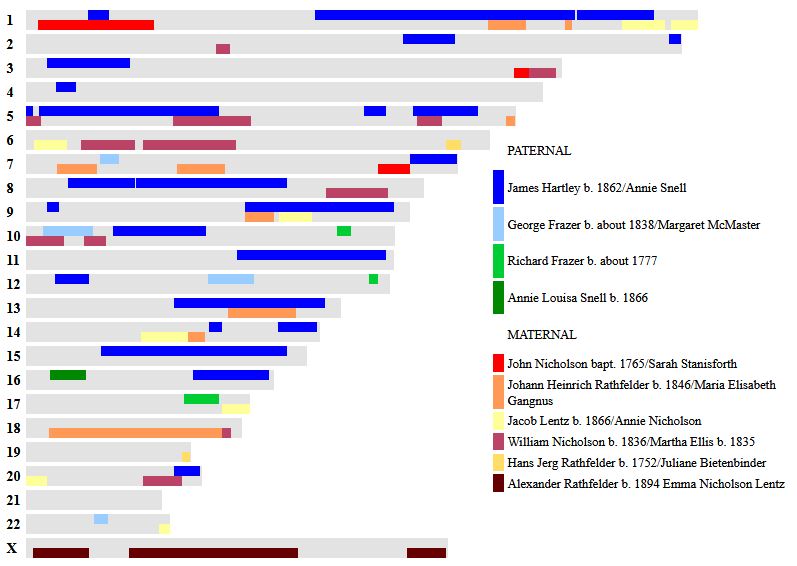
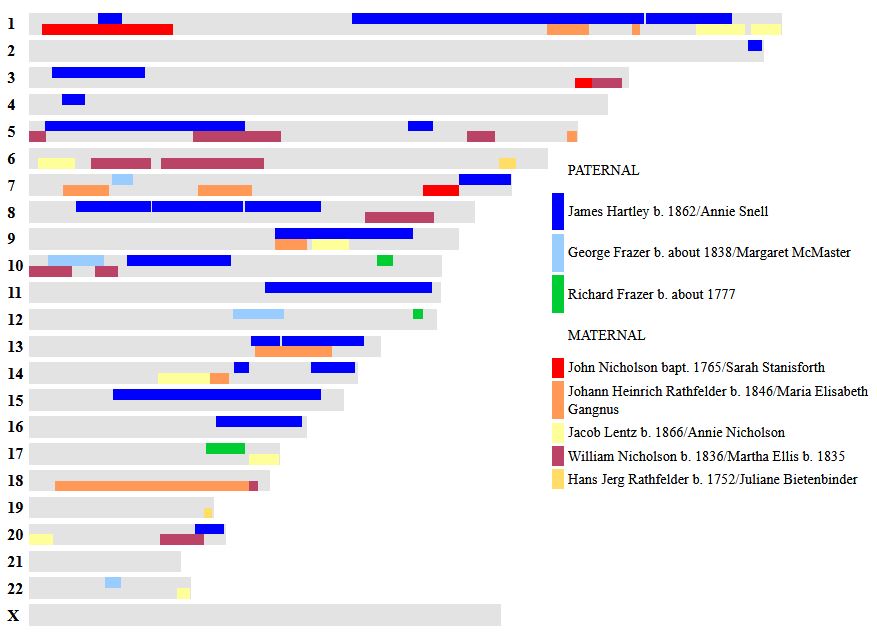
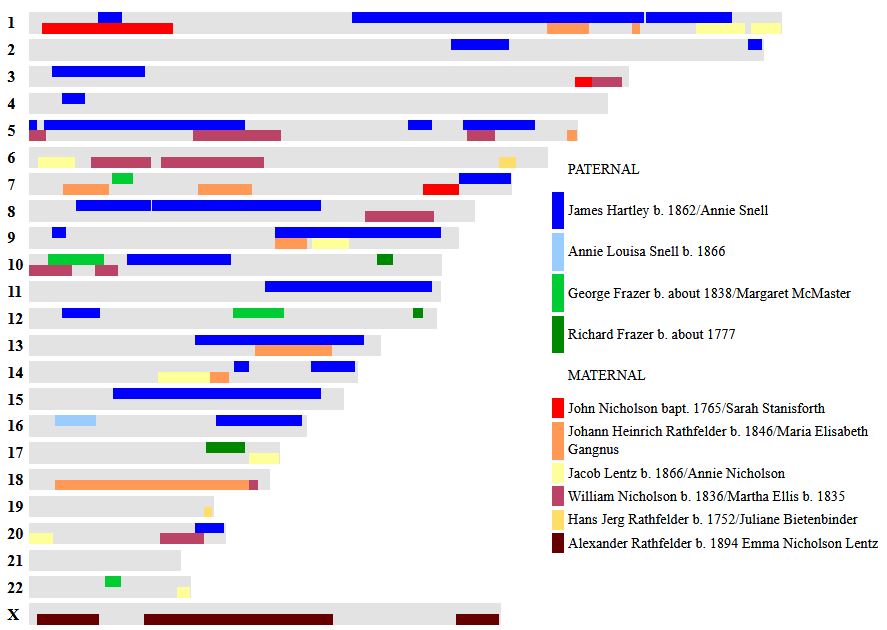
By comparison, here is my overall Chromosome map before I add in my DNA matches with Holly:

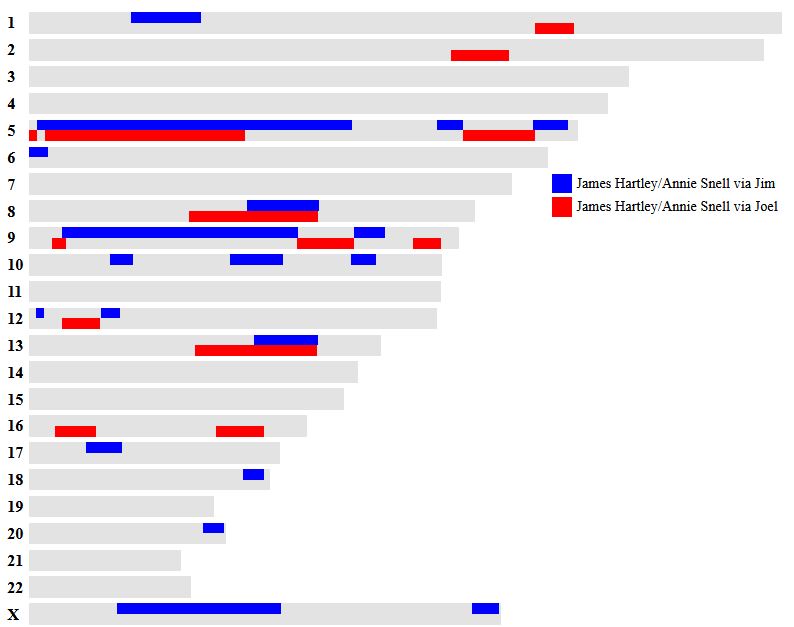
On my map, the James Hartley/Annie Snell part is shown in darker blue. It looks like Holly’s DNA could add quite a bit to my map. Ideally, if I could test enough relatives, the dark blue whould fill up 1/2 of my paternal chromosome. The other half should be from my paternal grandmother who was a Frazer.

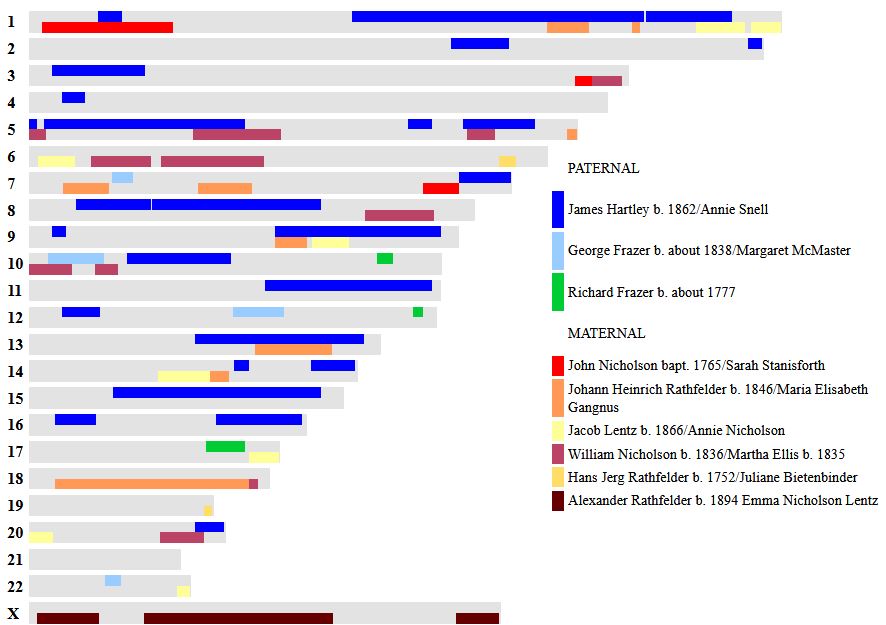
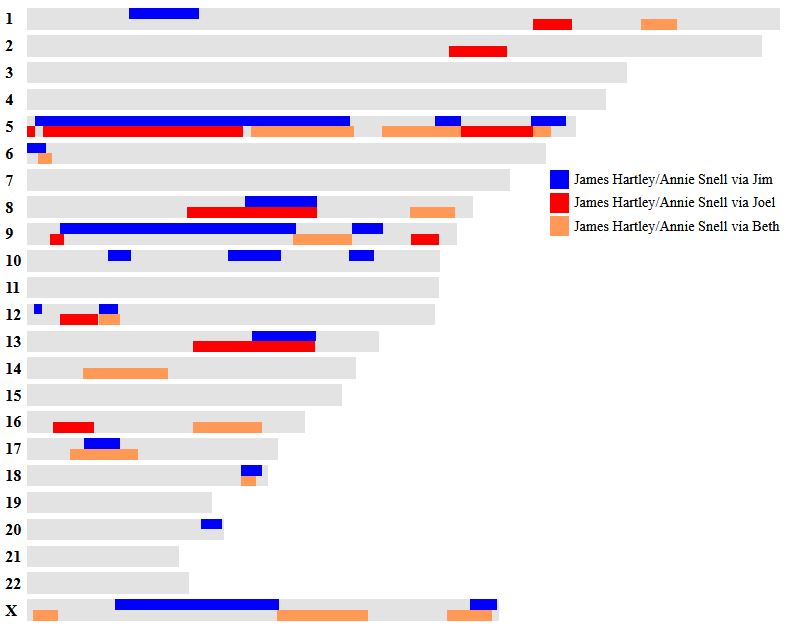
Here is Holly’s DNA added in. I also added a maternal first cousin who contributed to my first substantial X Chromosome match:

Remember I get no X Chromosome from my dad (top part of each line). So that has to be blank on the X Chromosome.

Next I’ll add in 1st cousin once removed Jim to Holly’s map:

Jim’s contribution to our great grandparents is in blue. Notice that now the X Chromosome is kicking in.

Adding beth’s DNA to Joel and Jim

Here is the addition of Beth’s DNA:

Note that Holly has a lot of matches on Chromosomes 5 and 9. That must mean that Holly got most or all of her paternal DNA on that Chromosome from her Hartley grandmother, Grace May.

Kicking it up a notch

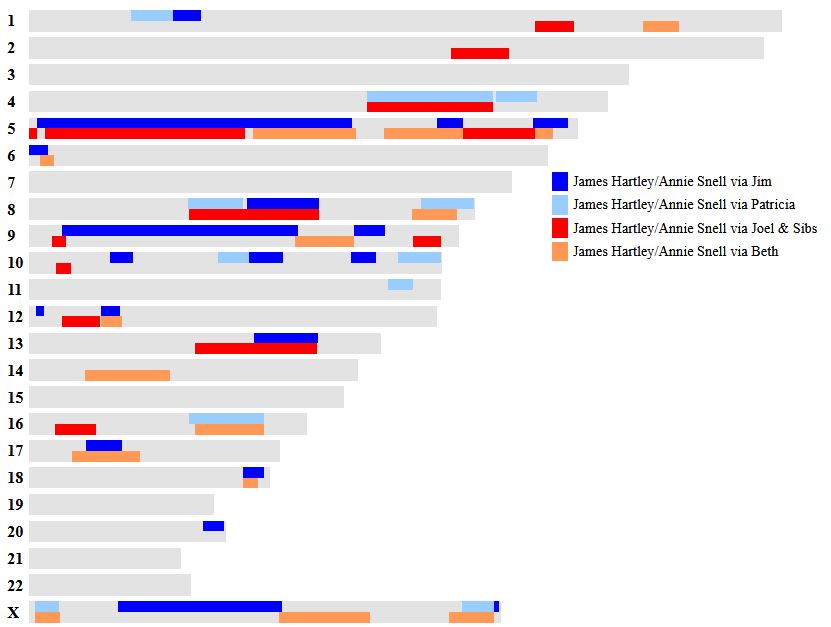
Next I’d like to add my siblings’ results to ‘the other matches on Holly’s Chromosome map. My siblings’ results plus mine should be similar in size to Holly’s matches with Jim, my dad’s first cousin. It takes 5 siblings to get about the same DNA as you would have for one parent. While I’m at it, I’ll add Patricia.

This is all Holly’s DNA that she got from James Hartley and Annie Snell, her great grandparents based on the matches that we’ve looked at so far. I probably should have lumped Beth and Patricia together as they have the same Hartley grandmother [Mary], but I didn’t.

Separating the Hartley and Snell DNA

One thing I would like to do would be to separate the Snell DNA from the Hartley DNA. If I could do this I could find matches that were just Snell or just Hartley. The DNA matching is about narrowing down the possibilities. The best way to do this would be to have a match that is known to be a Snell but not Hartley or a Hartley but not Snell. Unfortunately, I don’t know of any such people. The next best thing to do is to guess. One way to guess is called phasing by location. So, say I have a match with a lot of ancestors from colonial New England, but not Lancashire. And I would need to know that I match this person on my Hartley side (not my mother’s side). I would say that this would likely indicate DNA from the Snell Line. That is because the Snell ancestors go back to Colonial New England and the Hartleys came later from Lancashire, England.

My Chromosome 16

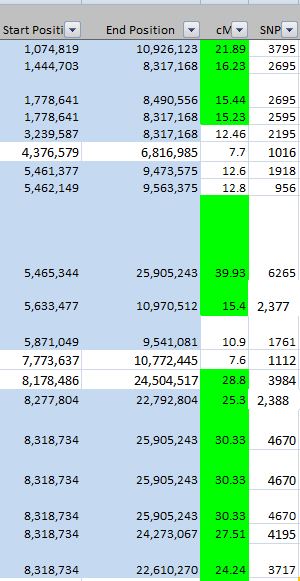
Here is a section of the first part of my Chromosome 16 matches (without the matches’ names) in spreadsheet form:

Each line represents a different match with someone. About half way down this list I have a match with Ned at 39.93 cM. I don’t know who our common ancestor is, but Ned has a lot of colonial New England ancestors, including the Warren Pilgrim family. I also am descended from the Pilgrim Warrens, but it is generally thought that a DNA match that large would be likely to last that long.

Triangulating with ned

Triangulation shows what common ancestors unknown DNA matches may have. Triangulation is when you match someone’s DNA, they match another person’s and you and the other person all match. Successful triangulation shows that all the DNA came from the same ancestor.

Here is my match with Ned:

Here is Holly’s match with Ned:

To close the loop, I have to match Holly in the same area of Chromosome 16:

No problem. This shows that Holly, Ned and I share an ancestor. By Ned’s Ancestry Tree, we think this is a New England Colonial ancestor, but we aren’t sure which New England Colonial ancestor it is. However, as Annie Snell has New England Colonial ancestors and James Hartley doesn’t I am pretty sure I can assign this segment to Annie instead of James.

This means I can update my Chromosome map with my first New England Colonial piece of DNA represented by Annie Louisa Snell on Chromosome 16. This is shown in light blue:

The other interesting thing about this piece of DNA, is that it not only is from Annie Louisa Snell, it is also from some New England Colonial person – the one I haven’t figured out yet that we have in common with Ned.

Other New England Colonial Connections Between Holly and Me

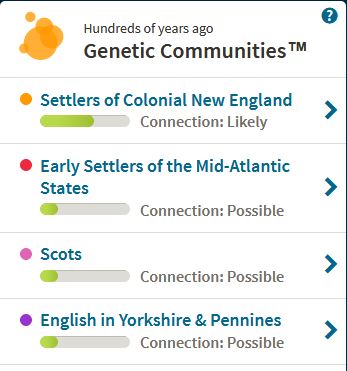
AncestryDNA recently came out with a new feature called Genetic Community. That feature lumps you into a group with a bunch of other people based on your DNA testing. One of those groups is called Settlers of Colonial New England. Here are my Genetic Communities (or GCs).

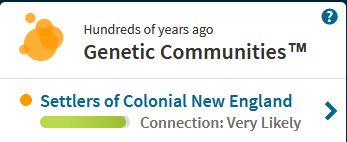
Notice I get a Likely rating for those Colonial Settlers. Holly, on the other hand, has one Genetic Community:

She gets a Very Likely. That means she is super Colonial New England. Holly has a Connection Link under her Settlers of Colonial New England. Under that link is another link that leads to “…a list of all 238 of your DNA matches who also belong to this Genetic Community.” Under my similar link I have 110 DNA matches. However, Ned that I mentioned above matches me under Settlers of Colonial New England. He doesn’t match Holly in her list for some reason – even though I showed that we triangulate. In addition, Holly and I match each other on our lists of DNA matches under Settlers of Colonial New England.

Summary

There’s plenty more I could have written about, but I’m a gonna wrap it up:

  • Holly is more Colonial than I. I expect her other non-Snell ancestors contributed more in this area
  • I looked at a way to separate out ancestral DNA when other reference matches are missing
  • We are getting a good group of Hartley/Snell descendants that have had their DNA tested and have uploaded to Gedmatch.com for comparison
  • I never knew Holly looked so much like her Hartley/Snell grandmother.