Double Visual Phasing

Many articles have been written lately about visual phasing. This is a method developed by Kathy Johnston. I would like to write about double visual phasing. Previously, I had tested my father in law and his two sisters and tried visually phasing them. Here is the result of my attempt to visually phase their Chromosome 15:

Chromosome 15 – Richard and Sisters

I can tell that I did this a while ago as it was done in MS Word which I don’t use now for visual phasing. L is Lorraine, R is Richard and V is Virginia.

What is Double Visual Phasing?

This is a term I made up. I’m guessing that others have tried this, but I have not seen any Blogs on the subject. Richard has a second cousin named Fred. He is related on the Pouliot side (in orange above). Fred has had his sister Sleuth tested and his brother Don. If I phase Fred and his two siblings who are related to Richard and his two siblings, I’ll have double phasing. As they both share a Pouliot grandparent, it will be interesting to compare the results.

A Brief Genealogy

For the purposes of this Double Visual Phasing, here are the people involved:

Let’s Visually Phase Fred and His Two Siblings on Chromosome 15

The first step is to compare the three siblings to each other at Gedmatch.com using the Chromosome Browser:

I used MS Excel for this and I adjust the columns to the segment changes. Note that all the segments don’t line up perfectly, but I’ll say they are close enough. Next I add locations in millions:

I also put in darker vertical markers. I’m hoping that the places where the segments don’t align perfectly do not indicate additional crossovers.

Next I need to show who the crossovers belong to:

From this, it looks like Fred has four crossovers, Sleuth has two and Don has only one. Fred’s first crossover is at position 22M.

Next, I can assign colors based on Fully Identical Regions (FIRs). In these regions, there will be a match on both one maternal and one paternal grandparent. These grandparents will be represented by two of the same colors in that region extending to the person’s next crossover.

Where there is no match, I can assign two different colors and extend those to each persons’ crossover.

I make sure that the boundaries for each person line up with their crossovers. So on Fred’s map his first FIR with Don is short as it is within Fred’s two crossovers.

Mapping Half Identical Regions (HIRs)

Here I get one chance to map an HIR. My inclination is to map the HIR on the right between Sleuth and Don. My reasoning is that Sleuth is already at her last crossover at that point, so I’ll extend her segments all the way to the right. I already know from my previous map for my father in law’s family that Fred has some matches with my father in law and his two sisters on the left side of Chromosome 15 shown in Orange. So that information may help me map the left side of Chromosome 15:

Chromosome 15 – Richard and Sisters

Here is Fred and family’s partially completed Chromosome 15 with the HIR added for Sleuth:

However, there are blanks. Also we haven’t figured out which side is maternal and which side is paternal.

Two other testers

There are also two other testers: Patricia and Joe. They are my father in law’s first cousins. They are related like this:

The next thing I do is to compare all these eight people in gedmatch.com to each other. I download the results into a spreadsheet. Here are the matches on Chromosome 15:

I have the matches between siblings filtered out so they don’t show. I have Fred, Don, and Sleuth in the first column and the others in the second column. Every match represents DNA from Joseph Pouliot (or his wife Josephine Fortin – let’s not forget her). The way I have it mapped right now, the most important match is Joseph to Don and Sleuth. The only place that match could be is on the blue portion:

This is good news, because this sets the paternal and maternal sides for Fred, Sleuth and Don. It also sets where their paternal grandparents are. Here are Fred’s grandparents:

That means that blue is Pouliot and pink is Ford. Like my father in law’s family, Fred has a French Canadian side and an Irish side.

Next, we should be able to fill in the left side of the puzzle using the other matches:

A few observations:

  • The same match that Fred had with my father in law’s family helped finish my father in law’s visual phasing and Fred’s visual phasing.
  • All four of Fred’s grandparents DNA is represented between the three siblings. The one exception is a small portion of green from 22 – 27 M on the maternal side
  • The purple segment that Fred has from 22 – 27 seems quite small. It is a little unusual to have a small internal segment like that. By internal, I mean a segment that is not right on either end of the chromosome
  • Without the match between Joe, Sleuth and Don, I don’t know if I would have been able to complete this Chromosome
  • I don’t know about Fred’s maternal [Irish] side. He may already have matches that would identify the Halloran and Drennan DNA.

Comparison of the Double Visual Phasing

  • Unlike Fred’s results, my father in law’s family does not have good Pouliot coverage (in orange) between the three siblings.
  • This explains why Richard’s family matches Fred’s family in the beginning of the Chromosome and not the end. Pouliot DNA is missing between 60 and 95M.
  • It appears that Sleuth and Richard could have matched between 95 and 100, but I didn’t find a match over 3cM. Could this be because one received DNA from Joseph Pouliot and one received DNA from his wife, Josephine Fortin? Perhaps this is also an explanation of why the match between Don and Viginia (V) stops at position 38M.

Summary

  • Double visual phasing has benefits in that there are at least six people to compare matching DNA results with each other.
  • Double visual phasing should result in a crosscheck for the visual phasing of each family and better Chromosome maps of contributing grandparent DNA.
  • There are benefits in noting which group has the better coverage of DNA of a shared ancestor.
  • Comparison of results appear to indicate deeper crossovers between ancestors

Next Up

There are matches between Fred and his two siblings and the other five tested people on every chromosome except for 18, 19 and 22. That should make mapping the chromosomes with matches relatively easy.

I would like to try double visual phasing between two sets of siblings where the siblings are from different generations. However, it may take a while to get the additional samples done.

Breen Genealogy: Part 3

In my last Blog, I corrected some mistakes I made in my first Blog on my cousin’s genealogy. In this Blog, I’ll follow up on some Breen genealogy issues.

Too Many John Breens

A search at RootsIreland for births of John Breen from County Tyrone shows this:

It turns out that none of these are the my cousin’s grandfather John Breen. He shows up as Alexander Breen. However, the next to the last John Breen appears to be one shown as in the military in Hong Kong:

Here’s Tattyreagh

Our Hong Kong John Breen in 1911 said he was born in Drumragh:

This looks like basically the same place to me. However, I am guessing due to similar names and closeness geographically that this John could have been a cousin to our John Alexander Breen.

More On John Breen and Mary Quin(n)

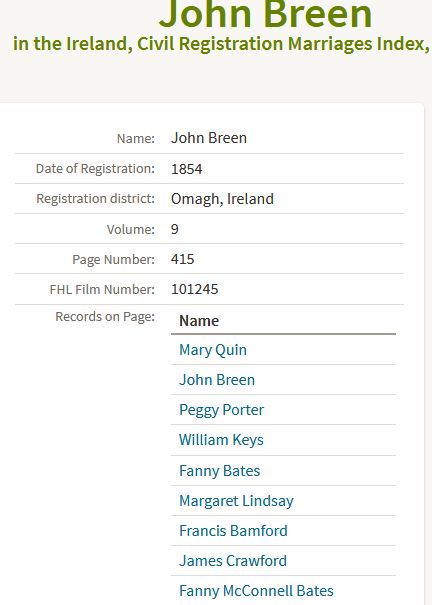
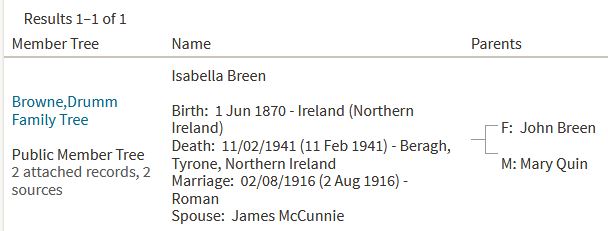
In my previous Blog, I had surmised that John Breen and Mary Quin(n) were the grandparents of John Alexander Breen. This was based on the fact that the 1911 Census for Recarson showed that John Breen had an Aunt Isabella:

RootsIreland showed one Isabella Breen born in that time period in County Tyrone:

Here is her birthplace of Kilgort:

a marriage for John Breen and Mary quin(N)

I have found a marriage for this couple. Let’s see if the dates fit. In Ancestry.com, the marriage looks like this:

At RootsIreland, the marriage looks like this:

If this information is right, this will push the genealogy back another generation. Based on the above, we would expect that John was born about 1831 and Mary was born about 1832. The first thing I would fact-check would be the age of Mary when her last child was born. I have this child to be Joseph Wilson Breen:

Joseph was born January 1876, so perhaps Mary was 44 when he was born. This is surely possible. Also note that in 1911, Mary gave her age on the Census as 76. Based on her age at marriage, she was probably a few years older. All the dates seem to be within reason. This is a good record to have, because the older the record, the more I trust the dates. Now I can update my Ancestry Tree and push back this couple’s birth dates yet again:

This is starting to look like a proper tree. At the top, I added rough birth dates in the early 1800’s for our new John Breen and Andrew Quin – Rusty’s third great grandparents.

Still, no parish records

I have still not found any Catholic Parish records for the Breens. I find the RootsIreland Civil Marriage record interesting. It shows that John Breen lived in Creevan, Parish of Donacavey. However, Mary Quin lived in Creevan, Parish of Drumragh. The note at the bottom of the record says “Fintona C.O.I Parish of Donacavey”. C.O.I means Church of Ireland which was the established Protestant Church. This leads to a few possibilities:

  • Is the record trying to say that Breen was from the Church of Ireland and Mary was Roman Catholic?
  • Is the record just giving the two different Parish boundaries (Church of Ireland and Catholic?)

Here is one reason there is no Donacavey Catholic Parish record for this marriage:

The National Library of Ireland Parish records begin in 1857 and this couple married in 1854. I also checked the Drumragh Parish, but there were no entries between February and May of 1854. So either there were no marriages during that time, or there was some sort of omission.

Fast Forward to 1912

In a recent email, Rusty tells me that his grandfather met his grandmother for the first time on the ship to New York.

One thing I don’t think I mentioned to you involves the ship passage.  According to Margie, my grandfather met my grandmother on the California.  They were from the same area, but had never met before.  She was traveling with her sister.  Apparently the two sisters had been to the United States before, and may of had family here already. 

Here is the outbound ship record for the two McCullough sisters:

I imagine that a long trip to the US would be good time to get to know someone and swap stories. Here is Anna returning to New York on about page 726:

I’m guessing that Anna wasn’t really a machinist.

Here is their nearest relative:

From what I can tell, here is where the McCulloghs lived in Ireland:

For reference, as I recall, I had that John Breen’s Aunt Isabella died in Beragh. At townlands.ie, this place is called Altdrumman:

This is where Anna and her sister were born.

More on the McColloughs

Here is Anna’s civil birth record:

But wait, there’s more:

From this, it looks like Anna was baptized before she was born. How could this be? From what I understand, there was a penalty for late registration of births. That resulted in some births being recorded later than they actually happened! In this case, obviously, trust the baptismal record.

I expanded my search at RootsIreland and came up with this extended family from Altdrumman sometimes known as Streefe (but apparently not Streffe).

Michael McCullough and Ann Henry

I couldn’t easily find a marriage for this couple. A search for Michael McCullough resulted in two people born closely together. One was from the parish of Ardboe or Arboe which seemed further away. So I went with this one:

This appears to be Fernagh:

IF first you don’t succeed….

I tried another marriage search for just Ann Henry and came up with this:

Silly me, I was looking for a McCullough marriage instead of a McMullaw marriage. Even though I entered McCull in my search, this didn’t show up. So, good thing I found this as I may have had Michael’s birth wrong. This time I searched with the father as John and found the Michael from Ardboe Parish again. So I expanded the dates and found an older Michael here:

Here the places sound more familiar and even the spelling of the last name is similar. However, I wouldn’t trust the spelling of McSoarly. I believe that McSorley is a more standard spelling.

I had given up finding Ann Henry’s birth record, but now that we have her marriage record, it should be easy to find.

Actually, I was leaning toward this record as the Parish sounded most familiar. Here is a new McCullough family tree:

Here is a summary of Rusty’s dad’s Breen ancestors as far as I can tell now:

Breen Genealogy: Part 2

In my last Blog, I went over my cousin’s YDNA results and some of his genealogy. The genealogy focused in on Rusty’s grandfather John Alexander Breen. A key document I found lead me to believe that John Breen was in the Royal Innishkilling Fusilliers in 1911:

Here was a John Breen who was the right age and was born about the right place. I then supposed that this was the same as a John O’Brien who enlisted twice. However, at the end of my elaborate story I found a document showing John Breen in the 1911 Irish Census that contradicted the above Census:

Here was apparently another John Breen, the same age, in the same census who was living in Recarson. This was significant as John’s ship records from the following year said that he and his mother Mary Breen were from Deverney. According to townlands.ie, “Deverney is in the townland of Recarson.” Now a Townland is usually a fairly small area. So a portion of a Townland is very specific.

That means that I have to prefer this Census above over the Military Census. There is a clear chain of custody. John Breen ended up in Philadelphia. His ship records say he was born in Deverney (part of Recarson). So we have to go with Recarson. The good news is that now we have extra relatives that we didn’t have before.

From Rusty’s YDNA test, we are pretty sure that he is not of the male line of Breen. However, now with a Breen grandmother, we cannot tell where the line was broken. Before I was assuming that it was Rusty’s grandfather John Breen’s mother that was the Breen. However, that is not as clear now. The family story was that John Breen was orphaned. This could very well be the case, as his mother and father are not in this Census.

Isabella Breen, 39 in 1911 – Born in County Tyrone

I would like to find the grandmother, but finding a Mary that married a Breen would be difficult. Isabella should have been born around 1872. Perhaps she can be found in a Parish Register. I was able to find Isabella in one Ancestry Tree from an Irish researcher:

From the above tree, the parents of Isabella, are referenced in this 1901 Camowen Census:

Here is a map depiction of Camowen Townland:

Here is part of a Cappagh Parish Map showing Recarson and Camowen at the Southeast part of the Parish:

It appears that Isabella was working in Beagh in 1901:

This is likely Beagh:

Assuming my fellow Irish researcher got Isabella right, I searched RootsIreland for siblings:

This is putting a lot of pressure on Isabella to be Rusty’s relative. Fortunately, she has a less common name than John or Mary. It looks like the family of John Breen and Mary Quinn had at least five children. The first four were born South of Omagh and the last one was born to the North of Omagh. Here is Tullyvally:

A Breen Breakthrough

After coming up short several times searching for John Breen, I decided to search for Alexander Breen. Here is what I found at RootsIreland. This one document should straighten out a few things:

For one thing, it shows John aka Alexander being born in 1889 – not 1888. This is likely the place where the male McFarlane line comes into the picture. On John’s ship record to New York, he named his mother as Susan and here she is.  Now we have John’s birth name, his mother, grandparents and likely Aunts and Uncles. Thanks to the YDNA test, we likely had the last name of John’s father, before we didn’t know that we didn’t know his last name! This means that Rusty is still descended from the Breens – just not the male line of Breens.

Here is the picture I get of the family so far. I had to push back the birth dates that I had for John Breen and Mary Quin. I would guess that they were born around 1845. And I also pushed John Alexander’s birthday ahead a year.

Questions to Follow Up On and Other Items

  • I couldn’t find a birth record for Susan Breen. Could she be the same person as either Mary Jane, Isabella, or Margaret?
  • What happened to Susan? Isabella seemed to hang around. Is this because she was the same as Susan?
  • I haven’t yet found Parish Register entries for any Breen family births or for the marriage of John Breen and Mary Quinn.
  • I’m still not sure if John Breen was in the British Army
  • The John O’Brien of my last blog cannot be the same as John Breen as John O’Brien’s mom was Annie and I have shown that John Breen’s mom was Susan
  • It doesn’t appear that John was orphaned. In 1901 when he was 12, he was with his grandparents. However, he may have lived with another family before this time that I didn’t know about.


Cousin Rusty’s Surprise YDNA Results

First, my first cousin Rusty surprised me by ordering an autosomal DNA test. I saw his results and it was the first, first cousin autosomal match that I’ve had. Next, Rusty decided to order a YDNA test of 37 STRs. His results surprised us both a bit. He found out that he had no matches to the last name he grew up with. Instead, his matches were predominantly variations of the MacFarlane surname. Since the test results came in, Rusty tells me his grandfather was adopted which could account for the surprise.

In this Blog, we’ll look at Rusty’s YDNA results and some of his genealogy.

YDNA – The Male Lineage Indicator

YDNA is good for surname studies. It follows the DNA that the father passes down to the son. This passing down has been going on since genetic Adam. Little changes in this YDNA account for the various YDNA branches that are in the world today. In addition, there are other branches that have just died out.

R1b – The Common YDNA for europe

Rusty and I share an R1b heritage. We are both on a branch of the R1B tree called L21. I was glad when I was first testing my YDNA to find out that I was part of the L21 group. This represents a group of people that aren’t identical to, but are associated with what has commonly been called the Celts. These would be the older people of the British Isles prior to invasions by the Danes, Vikings and Anglo-Saxons. The dark red indicates the older L21 people being moved over to the Northeast by the later invaders.

This map shows the highest concentration of R-L21 in the NW of Europe. The map shows the association with the Celtic cultures of Ireland, Scotland, Wales and Normandy.

The R-L21 Tree

Here is an outdated R-L21 Tree

The main reason that the tree is outdated is that the tree grew so much, there was not room to put all the branches on it. There are two main branches under L21. I believe that Rusty is on the smaller branch of DF63 at the top right of the image above. I am on the larger DF13 Branch. Below that I am in the L513 Branch with a rectangle around it.

R-DF63

Why do I think that Rusty is DF63? Let’s take a look. Rusty recently upgraded his 37 STR test to a 67 STR test. The STRs are markers that can change in two different directions. These STRs are used to estimate how close someone else may be related. They are also used to estimate SNPs. DF63 is an SNP. This is a more marker that is more stable than an STR that indicates a specific branch of mankind.

Here are Rusty’s two closest STR matches.

Both these matches are a Genetic Distance (GD) of 3 from Rusty. That means that out of the 67 STRs compared, there is a difference of three for both of these men to Rusty. Both these men have McFarland ancestors. Note that the first one had an ancestor that was born in Northern Ireland and died in PA. Rusty is from PA, but his grandfather was from Ireland. This means that this particular person could not be Rusty’s ancestor, unless he left children in Ireland.

Here is the TIP report for these two as they compare to Rusty. This report shows the probability of how long ago Rusty and Rusty’s match had a common ancestor:

This is showing that it should be pretty likely that either or both of these matches should predict a common ancestor in the last 8 generations. When I check 8 generations in my tree, that brings me to about 1680. So that is in the range of the first ancestor shown in the list above.

This is interesting, but I still haven’t shown how Rusty could be DF63. Let’s look at Rusty’s top two matches again. On the right are their Terminal SNPs. The first Terminal SNP is R-CTS6919. The second is BY674. These are both under (or children of) DF63 as shown by the FTDNA Haplotree:

So it stands to reason if Rusty matches two people who have SNPs that are below DF63, then he would surely be DF63.

BY674 – Mostly McFarlanes

A lot of McFarlane descendants have taken the BigY test. This is a test that discovers new SNPs and helps to build new branches of the SNP tree (or Haplotree as FTDNA calls it). Those that have taken the BigY test, have been put into something called the Big Tree, created by Alex Williamson. Here are the McFarlanes in that Big Tree:

Note that there is a McFarlane or similar name in every branch of BY674. The one exception is the McAfee/Givens branch. Based on this, I could argue that Rusty is not only DF63, but also BY674. Rusty plans to take the DF63 panel. With that test, he should be able to tell which branch of McFarlanes he is in. Here is what the DF63 Panel looks like:

So if Rusty takes the SNP pack, it should tell him that he is positive for DF63, CTS6919, A92, Z16506, and BY674. From there, Rusty could be in 7 different branches. One of those branches could be that he would remain in BY674 with McFarland and McKinnon. If he is in one of the other 6 branches, there may or may not be branching below that.

The MacFarlane family ydna project

Rusty also joined the MacFarlene Family YDNA Project. He was placed in this group:

I think that the Cadet Lineage refers to the idea that the MacFarlane Clan may be an offshoot of the House of Lennox. That sounds like a big deal.

So that covers Rusty’s YDNA pretty well. He is related to McFarlanes by STRs and SNPs. Next, I’ll look at Rusty’s genealogy and see how he is now apparently a Scotsman where before he thought he was an Irishman.

Rusty’s Paternal Genealogy

Rusty is related to me on his mother’s side. I’ll be looking at his dad’s side. And specifically, I’ll be looking at his dad’s dad’s side. We are interested in how the Breen turned into a McFarlane going from now to then. Or how the McFarlane went to a Breen. So far the tree looks like this:

However, I won’t be following the McCullough line. Rusty says that his dad told him that his father was orphaned young and joined the British Army at age 14. Rusty further got in touch with his cousin and found this out:

She thinks it is probably due to my grandfather being adopted.  I knew this, but always assumed he was older and retained he biological fathers name.  Actually I knew he was orphaned.  Margie says he was brought up by a Other than Catholic minister, but that there was some sort of agreement that he was to be raised Catholic.  Maybe he never knew his biological fathers name.

What an interesting story. It looks like Rusty’s grandfather may have been brought up by a non-Catholic Minister that raised him as a Catholic. How did that work out? What was the minister’s name?

Barriers of distance and time

Distance and time tend to erode family stories. Traveling from Ireland to the United states as well as the loss of parents results in the loss of a lot of family history. Where did John Alexander Breen come from?

Naturalization records

John left some paperwork behind when he came to the U.S.

In this document, John said in 1917 that he was 29 and wanted to become a citizen. It shows he was 1/2 inch short of six foot tall. His residence in Ireland was what looks like Omagh, County Tyrone. At the time of the application, he was a steel worker in Philadelphia. He came into the port of New York on the Ship California in what looks to be September 29th, 1910. This document from Ellis Island on the Declaration appears to correct his arrival time:

According to his 1923 Petition, he was born in County Armagh:

Here’s a simple map of Northern Ireland:
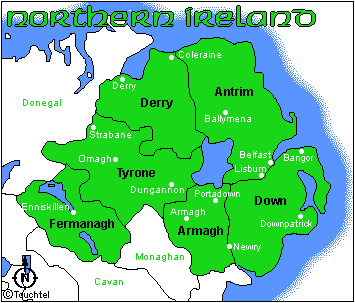
From the Naturalization records, it appears that John Alexander Breen was born in County Armagh and later lived in Omagh in County Tyrone before coming to live in Philadelphia. However, based on the research that follows, perhaps Count Armagh got mixed up with Omagh. I’m not seeing other evidence of County Armagh.

Sailing on the s.s. california

I have the an image of the ship records when John sailed to the US from Londonderry. Here is some information from the top of the ship record:

I included last address and nearest relative for John Breen on the bottom. Then I included three other people near him as they had an Omagh/Philadelphia connection. Here are the names, in case there is any connections:

Of course, this raises a few questions. Who is Susan Breen if John was orphaned and adopted? Was that her maiden name? Was that her married name, and if so might she have been married before? From what I can tell, Susan was living in Deverney:

According to Townlands.ie, Deverney is a part of the Townland of Recarson.

The second page of the shipping record says that John was also born in Deverney. Also that he planned to stay with a friend, rather than a relative in Philadelphia:

Here ‘s the shipping record from the UK side showing that folks kept the same order. Now John is a mechanic.

1911 British census

One year before John sailed to New York, he was indeed in the military.  He was a private with the 1st Battalion Royal Innishkilling Fusiliers.

I highlighted his birthplace. It would be nice to know where this is. I am not getting Deverney out of it. Apparently, this is Drumragh, which is both a Civil Parish and Townland near Omagh. Here is where townlands.ie shows the Townland to be:

This looks to be fairly close to Deverney.

Other Irish census results?

I am having trouble finding John Breen in the 1901 Census. I am also having trouble finding Jane Breen. So I will look at the women that were traveling with John on the Ship to New York.

The first I’ll look at is Mary McGinn. I see her in 1911:

Her story holds together as she is a seamstress. She was likely closer to 29 than 25 when she sailed to Philadelphia. Let’s say that John was watching over these women on the way to Philadelphia. After all, he appears to have been a world travels already from his British Army experience.

Here’s Tattyreagh where Mary McGinn lived:

Next is Mary McGaughey:

Here is the seamstress connection. She is shown in 1911 in Aughtermoy (Ballyneaner, Tyrone). On the ship, she gives her cousin Charles McGinn as the closest relative for some reason. I’m not positive I have the right person above as on her ship record, she says her last address was Philadelphia. Also this family was Presbyterian.

John in the 1st Battalion Royal Innishkilling Fusiliers

Rusty mentioned his grandfather’s military service. From the census, I found John in Hong Kong in 1911 with the 1st Battalion Royal Innishkilling Fusiliers. After some searching I found an enlistment record dated June 29, 1908 for a John O’Brien:

This could explain why it was so difficult to find John Breen in the 1901 Census. Now, when I look up the Breen surname online, I learn that the name comes from O’Brien if I understand it correctly. This military record is interesting as we found out in the 1911 Census that John was with the Fusiliers. The age of this person is very close to the John we are looking at.  20 years and 4 months from this time would put us at February or March of 1888 and John was born March 1888.

Are John Alexander Breen and John O’Brien the same Person?

The enlistment paper above shows that O’Brien was born near Drumquin, Parish Longfield, County Tyrone. If nothing else, I’m learning a bit about Northern Ireland geography.

The 1901 Census shows a John O’Brien as a servant in Doogary:

Here is townlands.ie rendition of Doogary near Omagh.

Under the scenario, John O’Brien would have been orphaned and became a servant. Probably soon after 1901, he joined the army. Note that when O’Brien signed in 1908, he was already part of the armed services.

O’Brien’s re-enlistment showed that he was already part of the Innishkilling Fusiliers. I am guessing that at some point in the Fusiliers, O’Brien changed his name to Breen.

More military papers for O’Brien

Under O’Brien’s 1908 enlistment papers, I found other military records. This is O’Brien’s initial enlistment from [February?] 1905:

Assuming O’Brien and Breen were the same, the age would be very close, as he would have been 17 within a month. Interesting that in 1905 they asked about O’Brien’s present (or former) Master. This appears to be M. McNulty in or near Dromore.I’m a little curious as to the term Master. I assume that this means that under a certain age, you were under the control of a Master, be it your father or someone else.

Dromore is shown on the previous Drumquin map:


On O’Brien’s Military History Sheet, I find this:

So if Breen and O’Brien are the same, then I have to work out why the mother was Susan Breen for one and Annie O’Brien for the other.

Annie O’Brien

Going with my Breen/O’Brien theory, it would make sense to look for Annie O’Brien in the Census. The oldest Annie O’Brien I found in the 1911 census in County Tyrone is here:

She is listed as 37 which would make her 14 in 1888. However, ages are quite unreliable in the Census. She could have been much older in 1888. I find it odd that a single woman would be the head of household, by herself and a dairymaid. Here is the Townland of Ballyard where she is shown as living:

Let’s try 1901. Now there are a lot of people listed with Annie. She is in the same Townland of Ballyard, though perhaps not the same house.

Look at all the company she has now. Annie’s age is consistent with the 1911 census as she is now 27. Following out on my house of cards theory. What if this was the family that raised John Breen/O’Brien? Annie is the only Catholic in the house.

Summing It Up

I could tell a story about what I’ve found so far. I’m not sure it’s right yet, but it’s a start.

Annie O’Brien was born in County Cork and made her way as a teenager to County Tyrone. While there [probably Deverney], she had a child John Alexander O’Brien. She was apparently a single mother and was taken in by a protestant family. Perhaps this is the same family of Funstons in Ballyard where she was a dairymaid in 1901. Perhaps the father was a McFarlane. John went to work as a farm servant in Doogary. John enlisted twice in the Royal Ennishkilling Fusiliers where he apparently traveled to Hong Kong as he was there in 1911. In 1912, he sailed from Londonderry, Ireland to New York. From there he made his way to a friend’s house. The rest, is history.

Postscript: 1920

However, there is a little more. There always seem to be with genealogy. Fast forward 8 years to when John Alexander Breen is married with two children. Here they are on 1208 Eleventh Street, Philadelphia:

I notice a boarder named Felix McAnulty. This reminds me of John O’Brien’s Master M. McNulty when John first enlisted in 1905. Also next door is John Cassidy. Remember, John was going to stay with an Eliza Cassidy in Philadelphia when he sailed from Londonderry to New York.

I wasn’t able to find Felix in the Irish 1901 Census, but I did find a Falix:

This place is very close to Deverney which is one of the places where John was supposed to have been born:

Actually, it seems like I’ve covered almost everywhere around Omagh. So that seems to be it for now. If my story is right, Rusty is still a Breen, or rather an O’Brien through Annie. And he is a MacFarlane.

Late Breaking News

I just checked the 1911 Census again. This time, I see that there is a John Breen listed there in Recarson. This is quite confusing but may be good news.

This will certainly change the story. It is not now clear if the John O’Brien in the military is the same one as the one in the Hong Kong Census or the one here (or neither). The interesting thing about the document above is that this is for Recarson. Recall that Deverney where John was from is part of Recarson. My understanding is that the Census was to be taken at the same day for everyone, so unless there was some mistake, John Breen could not have been in Recarson and Hong Kong at the same time.

My, this is embarrassing. Now I have two competing stories for Rusty. Let’s say that this should be more accurate. The best part about the census above is that there is a grandmother. That means three generations are represented as well as other relationships. That is always good. I’ll leave it to the reader to adjust the story based on the Census above. I’ll continue this story in a subsequent Blog.
 

More Crann DNA

In my previous Blog, I looked at creating genealogical trees using proposed Crann DNA matches. The matches I looked at were primarily at AncestryDNA. The advantage of Ancestry is that if the matches have trees, they are easy to find. Since that Blog, I had a question from Molly in my Newfoundland Dicks DNA Study Group. Molly would like to know if the DNA shows that she is descended from the Cranns. Molly has two lines of Dicks ancestry. One of them leads back to an early Crann connection.

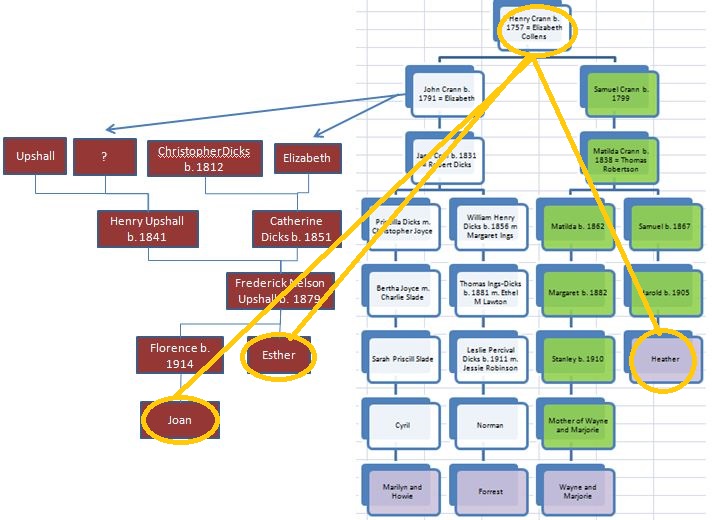
Molly (or Marilyn) and her brother Howie are on a Dicks/Crann line on the right. They are also on a Dicks/Joyce line. My wife’s mom Joan and Joan’s half Aunt Esther are on another Dicks line. In my previous two Blogs, I got around a lot of the non-Crann common ancestors by finding a Crann descendant who moved from England to New Zealand. This tended to isolate matches to just Cranns and made things simpler. In the chart above, a lot of these people are related to each other in multiple ways due to living in isolated areas. Also Joan, Marilyn, Howie and Forrest did not test at AncestryDNA. Fortunately, they are all at Gedmatch.

Here was the match list at AncestryDNA:

These were presumed to have Crann ancestors. I know that Esther, Heather and Ninky are listed at Gedmatch. There are also others.

People Who Match One or Both of Two Kits

Getmatch has a utility where you put in two matching people and others show up that match both those people. This is sort of what AncestryDNA does with their matching feature. I did that for Esther and Heather. From that list, I found some people that match Heather and also match Esther.

Wayne and Marjorie

Wayne and Marjorie show up first on this list. Marjorie is probably the M.R. listed at AncestryDNA with the large tree. Wayne and Marjorie are siblings. If I’m interpreting Marjorie’s tree correctly, I get this:

This adds another New Zealand line in green to compare with the Newfoundlers. Also on that list of common matches are my mother in law, Joan and Molly who asked about her Crann connections. Forrest, who was listed as a Crann/Dicks descendant was not an obvious match to the New Zealand DNA testers. However, she did show a tree match to John Crann. Based on that, I’ll add Forrest, Molly and Howie:

Forrest also had that John Crann’s wife was Elizabeth, so I added that in. Under this tree, it would not be surprising for Forrest to not have a DNA match as Forrest and Heather would be 4th cousins twice removed. Next, I’ll add my mother in law and her half Aunt Esther:

Note that I just corrected Wayne and Marjorie and moved them up one step after getting in touch with Marjorie’s daughter Donna. In all subsequent diagrams, they should be shown as here.

My next step is to take all the tested people in the Tree above and compare their DNA in a spreadsheet, to look for Triangulation Groups (TGs).

Chromosome 10 TG

Here Heather, Wayne, Marjorie, Molly and Howie match each other. Joan and Esther match each other but not the rest of the group, so they are not in the same TG.

Based on the above, this appears to show a common ancestor of Crann for Marilyn. It’s a little surprising as Marilyn and Howie are 6th cousins to Wayne and Marjorie.

TG11: Heather, Esther, and Joan

I suppose Esther and Joan do not want to miss out on this TG which seems to point to Crann in Netherbury, Dorset, England:

This shows that the DNA that Joan and Esther match with Heather got to them somehow. That path had to be through the Upshall or Dicks wife (or both).

TG22: Esther, Heather, Wayne and Marjorie

Here, the match between Marjorie and Wayne are not highlighted as siblings are usually counted as one person in a TG.

It is interesting that after 250 years, the DNA still points to the Dorset, England home of the Cranns via Newfoundland and New Zealand.

These were only a few TGs. I only picked the DNA matches where there were pretty good New Zealand trees. There are probably other New Zealand DNA tested people that triangulate with Newfoundlanders who descend from the Crann family of Dorset.

If Heather wanted to map her Crann DNA based on these four testers, it would look like this:


A Dorset, Newfoundland and New Zealand Connection by DNA: Part 2

In my previous Blog I created a proposed tree based on AncestryDNA matches, Gedmatch matches and family trees. First, I created a more solid Crann tree by patching together existing trees. This would be the backbone of the study as there were pretty clear relationships. It looked like this:

One family had Newfoundland roots (Matson). Heather had New Zealand roots. They both matched by DNA and both had an ancestor in Netherbury, Dorset, England. Based on that tree, I added two other trees based on matching DNA:

One was another Crann tree. The other had no know Crann ancestors but a likely Crann DNA match. I felt comfortable doing that for a few reasons. The first reason was the AncestryDNA matches of the people in the proposed tree:

The 2nd and 3rd columns above showed how each person matched my wife’s great Aunt Esther and Heather. Further, Matson was related to Terence. This created a sort of circle. This is my interpretation of how Ancestry does their circles. The fact that there was this circular matching is in my opinion like what many do with Triangulation of DNA matches. This tends to insure that there is a common ancestor. This could also insure that the match of a match is not going far afield.

The other reason why Heather is an important match is that she is from New Zealand. I assume that her Crann ancestors went directly there. That means that I wouldn’t have to take into consideration Newfoundland intermarriages when considering DNA matches with Heather. In other words, I could assume that Heather was related on one line only. Or at least it would be more likely.

The  Elsie Connection

In the last Blog, I looked at the Terrence – Matson connection. They matched each other by DNA. They also matched Esther and Heather at AncestryDNA. In the same way, I would like to look at the Elsie connection. I mentioned in my last Blog that Elsie had 4 people in her tree. That was not totally right. She has 3 people and one is listed twice. I’ll ignore her grandmother as it is the same person she has down as her mother. Perhaps it was at that point that she gave up on her Ancestry Tree.

As before, I create a new tree for Elsie at Ancestry. I called it the Chafe/Hann Tree because at this time, we know of no Cranns in her ancestry. The problem with that is that we will need to build out both sides of Elsie’s ancestry. As I worked back her ancestry I looked at the Ancestry leaf hints. One hint surprised me as it was the first time I’d come across an Upshall in my genetic research. The fact that an Upshall popped up unannounced while I was chasing a probably Crann DNA lead seemed significant to me.

I already knew that there was at least one Hann family living in Harbour Buffet where some of my wife’s ancestor came from. From the Newfoundland’s Grand Banks web site, I find this family in the 1921 census for Little Harbour East:

This gives a month and year for each person’s birth and tells us where they were born. Little Harbour East is not far from Harbour Buffet. Actually, it is even closer than I had now that I have some good information from Devon Griffin:

Unlike the other wrong Little Harbour East I had, the right one is across the bay from Harbour Buffet. Here is the marriage record:

It looks like Jessie was quite young. I wonder who Malinda was. Esther’s middle name is Alinda. A little over a month after this, it looks like the two witnesses wed:

Now it looks like the groom for the previous wedding was a witness. Hmm…

George Upshall

From an Ancestry tree, I did get that Jesse (or Jessie) Upshall’s father was George Upshall. Of course, I don’t see that Ancestry Tree at the moment. I had trouble finding George at Ancestry also, but I appear to have found him at FamilySearch. There, he is shown as marrying in 1896. This only works if this was a second marriage as his proposed daughter Jessie was born about 1890.

This shows that the marriage took place in Little Harbour East and that George was a widower. Both the groom and bride were living in Little Harbour East at the time of the wedding.

Another tree gives George as the father of Melinda Upshall. That leaves me with this tree:

Based on this, I’d like to make a guess as to a new proposed Crann/Upshall Tree:

A New Guess for a Crann/Upshall Tree

This tree supposes that a daughter of John Crann b. 1791 married an Upshall. That Upshall then had at least two sons. One was Henry b. 1841 and one was George b. 1857 shown in purple above. Henry and George could have carried down that Crann DNA to Esther and Elsie. I took out the arrow going from John Crann b. 1791 to the Elizabeth that married Christopher Dicks in red above. However, it now occurs to me that it would be possible that that arrow could still be there as there could be a Crann daughter in both slots – on the Upshall and Dicks side.

Let’s look at my AncestryDNA relationship chart again:

Ancestry thinks by the DNA that Elsie and Esther should be 3rd cousins. My chart has them as 3rd cousins, once removed. Ancestry has Elsie and Heather as 4th cousins. I show them as 5th cousins by the chart. The problem with what I did was that I didn’t follow the Chafe and Hann lines up to eliminate other possible Crann connections. However, I think that my chart gives a plausible solution to the DNA matches. It is satisfying to be able to propose some possible relationships based on logical assumptions after so many years of dealing with genealogical records that just don’t seem to exist in many cases.

Summary and Conclusions

  • This method works well with larger DNA matches
  • I started with a large match where there appeared to be a known common ancestor.
  • Based on that match and known ancestor, I developed trees based on other common DNA matches and common ancestries.
  • This method was helped by a non-Newfoundland match. This resulted in narrowing down the search to one surname.
  • Problems could result if I didn’t get the right surname to begin with
  • Other problems could result by not eliminating other possible genealogical connections
  • I drew a proposed tree to make sure the proposed relationships make sense time-wise. The tree also makes sure the proposed genealogical relationships match the ones proposed by the DNA relationships


A Dorset, Newfoundland and New Zealand Connection by DNA

Heather first contacted me through AncestryDNA. This was in December 2015. She lived in New Zealand and matched my wife’s great Aunt Esther. What I know about Esther was that all her ancestors came by way of Newfoundland and her line came from Harbour Buffet. I took a look at Heather’s Ancestry Tree and didn’t see any Newfoundland ancestors. I did see a Crann ancestor she had from Dorset, England. I had heard from someone who thought that Aunt Esther should have some Crann relatives (at least that was my memory – Hann is also a Harbour Buffet name). So I thought that this was interesting. Perhaps we could find an English connection for a Newfoundlander and a New Zealander.

Since that time, I recommended that Heather upload her results to Gedmatch and also join the Newfoundland Gedmatch Facebook group. She did that and I’d like to take a look at the DNA to see what may be found.

Genetic Relatives and Family Trees

First, here is the match between Heather and Esther:

The estimated number of generations to a common ancestor is 3.7. That could mean a few things. However, someone in the 3rd cousin range may be suggested. Here are Heather’s Crann ancestors:

Harold is Heather’s dad, so Samuel Crann would be out 4 generations from Heather.

Here are Esther’s ancestors:

Frederick and Margaret were Esther’s parents. Even at three generations back from Esther, there are a few gaps. Interestingly, looking up the Upshall name on the internet appears to link it to Dorset. The early records of Harbour Buffet mention a Peter and a Thomas Upshall. As a wild stab, I notice these two transcribed Upshall births from the Hazelbury Bryan Parish records in Dorset.

In the original records, Peter is referred to as ‘base-born’. Here is a map of Hazelbury Bryan showing proximity to nearby ports:

Below is Netherbury, where Heather’s ancestor Samuel Crann lived in the early 1800’s. He was a bit to the Southwest of my stab in the dark Upshalls.

Esther and My Mother in Law

My mother in law is Esther’s half niece. She is related through Esther’s paternal side only – barring intermarriage issues.

Here is how Heather matches my mother in law Joan:

This tells us that for these matches, Heather and Joan are matching more on the Upshall side rather than Esther’s Shave side. A slight point of confusion is that Esther has the Dicks family on her father’s and mother’s side.

A Triangulation Group?

It appears that Heather, Esther and Joan are in a Triangulation Group on Chromosome 1. That would mean that Heather, Esther and Joan should have a shared ancestor based on the DNA.

Heather to Esther:

Heather to Joan:

Esther to Joan to complete the triangle:

For some reason, there is a break in the Esther to Joan match. However, clearly there is a triangulation group (TG). That means that at least 2 out of 6 segment matches that Heather has with Esther and Joan are on the Upshall side.

AncestryDNA Shared Matches

So far, I have shown that at least part of the DNA match could be on the Upshall line. I have also shown that some Upshalls lived not too far from some of Heather’s ancestors in Dorset. The next step is to see if there are any Dicks family related to Heather. I have headed up quite a large Newfoundland Dicks family project. If Heather is related to Newfoundland Dicks, perhaps we would have already known that. One easy way to check is to check the Shared Matches at AncestryDNA.

This list shows two 3rd cousins and nine 4th cousins. Even though these are shared matches between Heather and Esther, the relationship shown here is to Esther.  The first person on the list comes up as a probable 3rd cousin to Esther. His name is Terence. When I choose him and then choose his shared matches, I see Heather on Terence’s Shared Match list as a possible 4th cousin. The bad news about Terence’s Ancestry Tree is that there are 4 people on it. The good news is that one of those four, his mother, is listed as a Crann.

Now I feel like I am getting somewhere. I feel like I should be focusing on the Upshall side of Esther’s tree. This, of course, is the side least known:

Esther and heather’s 2nd Shared match

Esther and Heather’s second shared match at AncestryDNA is Elsie. She is a possible 3rd cousin to Esther. Like Terence, Elsie is a possible 4th cousin to Heather. Like Terence she has an Ancestry Tree of 4 people. Her names are Chafe and Hann. Hann is a name that was known to be in Harbour Buffet, Newfoundland where Esther’s parents came from. Elsie also notes some ancestry from Placentia, Newfoundland. Harbour Buffet is in Placentia Bay. The Chafe name sounds familiar to me also.

So far, I have two interesting connections with the first two Shared Matches between Heather and Esther. Too bad my mother in law, Joan, is not also on AncestryDNA. At this point, I could try to work Terence’s and Elsie’s genealogy back up the Crann Line. However, I’ll keep looking at more Shared Matches. Now I’m down to Esther’s 4th cousins.

Fourth Cousin shared matches between Heather and esther

Now we are getting a bit further out. Rather than detailing each Shared Match, I have summarized my findings in a table.

My conclusion from all this is that there is a Crann/Netherbury, Dorset connection between Heather and Esther.

Building a Crann Tree

From here, I could look at the matches of the matches. This could get further out results that I don’t want. So instead, I’ll look to build out Terence’s four person tree. First, I will start a tree with the one Crann that he has in the tree. I find the one Crann in the 1930 Census:

This is helpful as it shows Arline’s parents, their ages, where they were born (Newfoundland) and where their parents were born (also Newfoundland).

Connecting the dots

Hopefully, I’m connecting the right dots. Here is John Crann’s World War II Registration:

This was helpful as it gives his John’s date and place. Here is Trinny Cove about 7 miles across the Bay from Harbour Buffet:

Here is a 1921 Census of Trinny Cove from a Newfoundland Genealogy website:

It looks like there were three houses in Trinny Bay and two of those were Crann houses. The two eldest Cranns were born in Harbor Buffett. I now have two potential sets of parents for John Crann, with my first choice being Richard. I do note that John’s first son was named Richard, so that adds weight to my assumption. In addition, his first daughter was named Julia.

Here’s John and Anastacia’s marriage on 8 Oct 1911, thanks to FamilySearch:

Bell Island is on the NE side of Newfoundland. At about this time I got stuck finding out the parents of John from the bottom up.

Richard crann b. 1856 b. harbour buffet

I thought why not check to see if there is a tree for Richard Crann from the Trinny Cove Census of 1921? I went on to Ancestry and found a familiar sounding Crann. Here was a Samuel Crann. His grandfather was listed as being from Netherbury, Dorset.

The Henry who had all the children was shown as being born in Jean de Baie, Placentia Bay, Newfoundland and dieing at Flat Islands, Newfoundland. Now I have made at least one connection between one Crann who was from Netherbury and moved to Newfoundland.

A Google search helped me find a Crann Families of Newfoundland Web Page:

RICHARD2 CRANN (CRANN1) was born December 1856 in Harbour Buffett, NF, and died December 13, 1941 in Fair Haven, NF.   He married JULIA REID  She was born September 1858 in Little Harbour, NF, and died October 20, 1940 in Fair Haven, NF.

Children of RICHARD CRANN and JULIA REID are:

JOHN BENJAMEN3CRANN

ELIZA CRANN , b.December 1877, Harbour Buffett, NF

ELIZABETH CRANN , b. November 1898, Trinny Cove, NF; m. JOHN PEDDLE; b. Corner Brook NF

What I’ve done:

  • I’ve connected Terrence to Esther and Heather by DNA.
  • I have also connected Terrence’s mom to the Newfoundland Cranns and more specifically a Crann born in Harbour Buffet.
  • I have also found a Crann family showing ancestry to Netherbury, Dorset, England.

What I haven’t done:

  • Haven’t connected the Newfoundland Cranns to Heather’s Cranns in Netherbury
  • Haven’t connected Esther’s family to the Cranns other than by location
  • Haven’t connected Terrence’s ancestor Richard Crann to earlier Cranns

So I’m about halfway there. Let’s look to see if we can connect Heather’s Cranns to this John Crann from Netherbury, Dorset.

John Crann Born 1791

This appears to be the record of John’s baptism in Netherbury:

Here is Heather’s Tree:

Here is a more fleshed out tree I found at Ancestry:

This tree shows that the Newfoundlander John Crann and New Zealander Samuel Crann were brothers. Talk about going different ways! This seems to make Henry Crann b. 1757 the common ancestor of Esther and Heather.

Wild Guessing Time

That’s about it for the research. Now I get to wildly guess and make assumptions. Assumption one is that John Crann’s brothers did not also move to Newfoundland. I have the William above died in England, the first John died young and Samuel went to New Zealand. I’m not sure what happened to the other Robert.

Another Crann Tree

While poking around Ancestry, I found yet another Crann Tree called Henwood. This tree seems to fill in a few blanks:

There are a few things I like about this tree. One thing is that it gives the spread of John Crann’s children from 1817 to 1836. Secondly, it shows a likely tie-in with one of Esther’s matches. Way up above in my Blog I mentioned that Heather, Esther and Terrence had a match with someone named Matson. Part of Matson’s tree looks like this:

It ended with one of Matson’s great grandmothers who was Marina Irene Crann b. 1877. It showed her husband as having died in Harbour Buffet. If I stitch the two trees together at Marina, I get a tree for Matson. While I’m at it, I’ll add Heather in. She’s in green for New Zealand.

Heather and Matson show up at AncestryDNA as 4th cousins with a possible range between 4th and 6th cousins. This tree shows them as 4th cousins, once removed. I’ll now add Terence’s Line and Esther’s Line.

A Proposed Crann Tree

At first, I had Esther’s tree up a generation, but that didn’t give any room for John Crann to have a daughter that could fit into Esther’s tree. Esther has two places where a Crann daughter could fit. One is the wife of an Upshall. The other is Elizabeth, wife of Christopher Dicks. From my diagram above, it looks like Terrence’s missing ancestor would have to be a son of John Crann. Under the above scenario, Esther would be a 4th cousin to Heather and a third cousin once removed to Terrence and Matson.

For a few reasons, I’m favoring the theory that a Crann married an Upshall. I suppose that Catherine Crann who I have in one tree as being born 1821, could have married Upshall in 1840 and had Henry Upshall in 1841.

Summary and Conclusions

  • Comparison of Crann Trees and Crann DNA matches lead to a suggested new Crann Tree
  • By carefully placing the separate trees together, it indicates where the missing Crann in the tree would likely go.
  • If more Crann descendants upload their DNA to Gedmatch, it could help verify these lines through triangulation.
  • It appears that there is more room for analysis. In my Excel spreadsheet of compared matches, there were multiple matches between Ninky, Elsie, Heather and Esther. However, that would make the blog too long.


A New Frazer DNA Test on the Stinson Line

It has been a while since there has been a new Frazer test. With the results of Doug’s Aunt Rita in on the Stinson Line, the Frazer DNA Project has roared back into life. Here is the Stinson Line of the Frazers:

I tried to air brush out some of the last names for privacy. Doug and Aunt Rita are on the green line. They share 1,894.6 cM of DNA which is a bit higher than the average posted on the ISOGG Web page:

Note that in comparing those in the chart above, that they may match on the Frazer Line or the Stinson Line. However, in matching those outside this chart, they would be more likely to match on the Frazer Line.

The Numbers, Please

Now it’s time to run the numbers. I found a cool new tool at Gedmatch for doing this. First I added all the Frazers to a group.

Then I just had to choose that group for different analyses. Here is the Autosomal Matrix. This is like ordering the “everything” pizza. This Matrix has ALL the Frazers:

This is also known as the Frazer eye test. I have the Frazer/Stinson group in yellow. These Frazers are only in the Frazer/Stinson Line. Then, there is the green group. They are in the Stinson Line but also in at least one other Frazer Line. There are some good matches where green and yellow intersect, notably with Jane. These are more likely to be Frazer/Stinson Line matches. Where the green intersects with green, it will be difficult to tell if the DNA is from the Frazer/Stinson Line or from another line. The names in white are from my family. I recently had my sister Lori tested. Now there are 5 siblings tested in my family. Paul is a second cousin, once removed. Purple represents the James Line of the Frazers. There is a purple Jonathan and a white Jonathan. Scanning the yellow names from left to right, they match my family a bit more than the James Line Frazers in purple. There are a few exceptions where there are higher matches. This may be due to a match on a collateral line. Or this may be due to the effect that if a match is going to break through a distant relationship it can just as well break through as a somewhat larger match than as a smaller one.

Triangulation Groups

I like to use Triangulation Groups to sort out some of these families. A Triangulation Group points to a particular ancestor which should point to a particular Line of Frazers. The problem in this was alluded to above. That is, what if some Frazers are from more than one line? In order to somewhat get around this, I’ll make special note of the Frazers that are known to be only in the Frazer/Stinson Line. Namely, Rita, Cathy, Ros, Doug and Vivien.

Chromosome 1

In Chromosome 1, I see a Frazer/Stinson  Line Triangulation Group (TG). I previously had my brother Jon in that group, but that appears to have been a mistake:

Here is the what the TG likely looks like:

I say likely, as Jane and Michael also descend from the Richard Frazer Line. However, that would put the common ancestor as Archibald the father of this Archibald Frazer which would be a less likely match.

Chromosome 3

The next TG is also difficult to explain:

Here we have Michael and Rita, both in the Frazer/Stinson Line. They both match Prudence from the somewhat distant James Line of Frazers. I had to double check to find the match between Michael and Rita to finalize the TG. Here is a possible rendering of that TG:

I pulled Michael (pink box) off the Richard Line as he wasn’t put into the Frazer/Stinson Line on this chart to save room. This particular representation forces our attention to the parents of the James (on the right) and Archibald Lines (on the left above). However, a slightly later unknown common collateral line would also be possible. For example, Prudence has a Peyton ancestor. If Michael and Rita also had the father of Prudence’s Peyton ancestor as their ancestor, that would put the top circle one level down. The TG is sure. The interpretation of who the TG represents is not as sure due to holes in the genealogy near the top of the chart.

Chromosome 4

Here is a new TG with Jane, Cathy and Rita:

This TG is important because it is most certainly a Frazer/Stinson Line TG. I had to take down the Gedmatch levels to get the match between Jane and Cathy. If I were to map out the Frazer side grandparents for Rita, Cathy and Jane, they might look something like this:

As you compare Cathy and Jane’s green sections with each other, you can see that the Frazer overlap is relatively small.

Chromosome 5

In Chromosome 5, there is a similar situation with Pat, Cathy and Jane:

Again, I had from my Gedmatch download that Cathy matched Patricia and Cathy matched Jane. What was missing was the Cathy to Jane match. I lowered the Gedmatch thresholds and found a Cathy to Jane match right in the expected area between 73 and 76. Note that the Patricia to Cathy match ended at about 77M. The Jane and Cathy match started about 73.

73 is the crossover for Jane from McBride to Frazer. It is the number that Jane has in common with both her matches. Likewise, Patricia’s crossover from her Frazer grandparent to her Gray grandparent is at 77M. It is the number that she has in common with both her matches. So that tells me something is going on there (i.e. a crossover). The area between 73 and 77 is where Patricia and Jane match.

In reviewing my past work, I see that I had shown a TG with Gladys, Pat and Cathy in this area. To see that, I need to go further up my spreadsheet:

So let’s map out Gladys’ DNA from her grandparents. It looks like her match with Cathy and Patricia tell me that she has Frazer DNA from 54M to 134M. But where is her match with Jane? When I run a one to one match at Gedmatch between Gladys and Jane, I get this:

5 73,514,449 76,680,718 5.3 842

With this information, I’ll draw a revised Chromosome 5 Map:

It was a little tricky to draw this map. I think that what happened was that Patricia and Gladys share the common ancestors: George Frazer and Susannah Price. Notice that Patricia and Gladys have a large match. I think that match is picking up the older crossover in Patricia of George Frazer and Susannah Price at position 77M. Well, you can see I’m still working these things out!

Chromosome 9

Here is a new Frazer/Stinson TG at the end of Chromosome 9:

In it, we have Doug, Rita and Patricia. Interestingly, Ros, Vivien, Gladys and Bill don’t appear to be in this TG. They seem to be busy being related to each other on their non-Frazer sides.

Anything Else, Summary, Conclusions?

  • I found it interesting that Rita matched Prudence. Rita’s match with Prudence was a little larger than any found so far and Rita and Prudence are on the two most distant Frazer Lines of Archibald and James.
  • It is interesting to look at the autosomal matrix for the Frazers as the higher number indicate family groupings. Overlaps in the families where Frazer cousins married cause even higher cMs in the matches.
  • A focus on the Frazer/Stinson TGs helped shore up that line of the Frazers. In cases where a TG could be from one line or the other, the addition of a Frazer/Stinson only Line tester gave more evidence that those TGs were more clearly in the Frazer/Stinson Line.
  • I did some Chromosome mapping based on the TGs. The TGs gave clear indications of crossovers. However, it was not always clear as to which generation we were mapping to as far as specific ancestors.
  • Here is an update of the Frazer TG Matrix:

More Frazer/McPartland DNA and the Mush Move

Since my last post on the Frazer/McPartland connection, one of the McPartland descendants, Charlene, has uploaded her DNA to Gedmatch. Basically, the McPartlands have in their genealogy that they had a Frazer ancestor. This Frazer ancestor is thought to be related to the Frazers that lived in North Roscommon, Ireland. This relationship has been made more sure by the fact that the McPartlands lived near the Frazers and that McPartlands and Frazers have matching DNA.

Here are some of the McPartlands:

I am focusing on the green part as those are the ones that have had their DNA tested and uploaded the results to Gedmatch. The McPartland/Frazer connection is seen at the top where Owen McPartland married Ann Frazer. From this chart, we can also see that Charlene is a 3rd cousin to Karen and Chris.

Charlene’s X Chromosome

When I look at Charlene’s X matches at Gedmatch, I see something very interesting. Her top match is to my sister Heidi:

And here is how Charlene matches her 3rd cousin, Karen:

Notice how close these two matches are. Just to close the loop, here is the huge X match between Heidi and Karen:

The above comparison shows an X triangulation. This, to me, is proof that the three are related.

Here is a possible Frazer McPartland tree which could explain the above X matches:

For this to work well, the Frazer at the top would most likely have two wives. Margaret would have been born from the first wife and from the second wife. The other solution would be to have another generation between Ann and the top Frazer. However, that also introduces problems as the X Chromosome does not travel from father to son. That scenario would require Ann Frazer’s mother to be a Frazer which would mean Ann’s father would also be a Frazer.

Here is a late breaking update on Ann Frazer from a McPartland researcher:

Hi Joel,
Ann was born between 1818 and 1823 (1901 census age 78, and her death registration, also 1901, age 85).
The 1823 date seems likelier, since her last child was born in 1866, and she might well have personally given her age to the census taker, while with the death registration, we’re depending on her son John, with whom she lived, to give the correct date.
All the best,
Sandy
This is good news as it would now not require the Frazer at the top of the tree to have had two wives. If the top Frazer’s wife was born in 1780, she could have had Margaret around 1800 when she was 20 and Ann in 1823 when she was 43. I could narrow that down even a bit further. She could have been born in 1783, had Margaret in 1803 when she was 20 and Ann in 1823 when she was 40.

Who Is the Unknown Frazer? By James Line Genealogy

One way to look at this is through the existing Frazer genealogy. There is the Archibald Line and the James Line. My past assumption has been that this unknown Frazer is in the James Line. But what James Line Frazer would fit the bill? If our genealogy is right, then the sons of James were born to soon to fit the bill of someone born around 1780
JAMES1 FRAZER was born circa 1717 at Aghrafinigan, Ardcarne, Roscommon. He married Katherine Fitzgerald in 1745.
He was a farmer.
Children of James1 Frazer and Katherine Fitzgerald were as follows:

  •       i.   (–?–)2 was born circa 1746.
  •       ii.   ELIZABETH was born circa 1748. She married William Knott.
  •     2.  iii.   ARCHIBALD was born circa 1751. He married Catherine Peyton, daughter of John Peyton and Hannah Wynne, in 1780. He was buried on 13 Aug 1835 at Ardcarne.
  •       iv.   PATRICK was born circa 1755 at Aghrafinigan, Ardcarne, Roscommon. He died in 1831 at Aghnasurn.
  •     3.  v.   MICHAEL was born circa 1764. He married Margaret (–?–). He died on 17 Mar 1837 at Ardcarne.

The children of the above were born too late. The only one who could have fit the bill is John Peyton, son of Archiald But he doesn’t have known Frazer descendants:

JOHN PEYTON3 FRAZER (Archibald2, James1) was born circa 1781. He married Frances Carlton. He died on 22 Nov 1865; aged 84.
Children of John Peyton3 Frazer and Frances Carlton both born at Ardcarne Parish Church, Roscommon, were as follows:

  •       i.   FRANCIS CARLTON4 was baptized on 10 Jun 1824.
  •       ii.   KATHERINE PEYTON was baptized on 20 Dec 1829. She married David Burns, son of Stephen Burns, on 8 Oct 1849.

The Unknown Frazer By Archibald Line Genealogy

By genealogy, it appears that the Archibald Line has more potential for our mysterious link between the Frazers and McPartlands.

Our genealogy has these four Archibald Line brothers born around 1780. That could put any of them as potential candidate to be Ann and/or Margaret’s father.

A Little McPartland Genealogy

Here is the 27 October 1860 Baptismal record that Joanna (a Frazer researcher) found in the Aghanah Catholic Parish record:

This is a record of the birth of Cath. Janam (Jane) [Mc]Partland daughter of Eugene and Ann Frazer. It appears that a Patrick Partland and a Healy were there and that the family lived in Annagh. Annagh is a very popular place name in Ireland. However, the closest Annagh to Dereenagan appears to be here on the shores of Lough Key:

Annagh is in the lower left of the map above. This is a bit confusing as one branch of the Frazer family had an Annagh House (or Lodge) in the Townland of Aughnacloy in County Sligo. To further confuse things, an Ireland Townlands website has Annagh further to the East and North:

It looks like my first choice may have been the better one. Here is a Roman Catholic Parish map of Ballinafad which historically was Aghanagh. This map was taken from the Leitrim-Roscommon Genealogy web page.

Still, I wouldn’t be surprised if there was another explanation! It gets confusing with overlapping parishes. I think that the Civil Parishes are equivalent to the Church of Ireland Parishes. The NLI website has Aughanagh Parish in County Sligo.

Back to the DNA

Above, I established that Heidi, Charlene and Karen all matched on the X Chromosome. It looks like my sister Sharon also matches. Here is how Charlene matches Heidi, Karen, and Sharon on the X Chromosome:

Back to Autosomal dna

Charlene matches Karen autosomally. They are known 3rd cousins. Charlene and Heidi don’t match autosomally. Charlene and my sister Sharon do match on Chromosome 9 from position 22-36M:

Here is Sharon’s Chromosome 9 map showing why she matches Charlene and Heidi and I don’t:

Lighter red is Frazer DNA. Sharon got a full load of that on her Chromosome 9. Heidi and I got nearly all Hartley DNA (darker red) on this Chromosome.

triangulation groups

With the McPartland/Frazer matches, I would like to focus on triangulation groups as they have a good chance of indicating a common ancestor.

Here are Charlene’s matches with my cousin Paul and my sister Sharon on Chromosome 9:

According to my last Blog, Karen and Chris also had matches in the same area. This indicates a common ancestor:

I have the Frazer at the top with a question mark as we are not sure which Frazer this is. It is quite likely to be a correct scenario. I base that on the combination of X Pattern matches and the triangulation. Although the match shows with Heidi, the actual match in this case was with my sister Sharon. Also note that Paul had no X match as he has two male Frazers above him and X does not travel from male to male.

The prudence triangulation group (TG)

Here Charlene matches Prudence, Chris and Karen:

#4 is Betty who is a cousin of Joanna’s family. From my last Blog, Prudence also matched Karen and Chris to complete the triangle. Here is Prudence’s tree.

How can we fit the McPartlands in here? Prudence is on the James line. Earlier in the Blog, I had mentioned John Peyton Frazer as a not likely person of interest. I’ll re-consider him here:

What if John had two other daughters: Margaret and Ann? They would fit in. The problem with this is that I have a baptism of and Ann and a Hannah already in 1823 that may fit the bill. They were born to an Archibald and a James Frazer respectively. There are many possibilities. One would be that the match is through the Peyton side.

The Anne above had a White mother. Perhaps Catherine Peyton had a sister than married a White and had Anne? What if the James above was an unknown James Line descendant? He would fit the bill also.

Here is the simple portrayal of my first scenario:

Here I just mushed the two trees together where this could be seen. In this scenario, The Frazer on the McPartland part would be John Peyton Frazer (or perhaps the James that I know little about). That would make Prudence, Charlene, Karen and Chris 4th cousins, once removed. Under this scenario, Paul and my family fall out from DNA matching as we are a generation or two below the McPartlands.

Joanna’s TG – Chromosome 15

This figure shows Charlene’s matches with Joanna and her sister Janet. After that is Joanna’s cousin Betty. Finally is my cousin Paul. The green section is not a TG as Janet and her sister only count as one in a TG. The yellow section is a TG. Paul does not appear to be in the TG. Is this showing us that Paul’s match with Charlene is on a different line than Joanna’s TG?

Time for my two family mush move (again for illustration purposes only):

This would be a scenario similar to the Prudence TG above (except I forgot to add the ?????). In this scenario the relationship would be 3rd cousin twice removed. This is slightly closer than the 4th cousin once removed Prudence TG scenario.

Summary and Conclusions

  • The addition of Charlene’s McPartland/Frazer DNA to gedmatch has resulted in some interesting comparisons
  • The X match between the McPartlands and my family gives a strong indication of a match along the Frazer line.
  • This X match has also been backed up by a four way Triangulation group between two McPartland families and two Frazer families (my family and my cousin Paul)
  • I used a new (to me) technique called the mush move. This is where in a TG I mush the two trees together.
  • Even thought the connection was not proven, it gives an indication of where the connection likely is.
  • In the comparison between the Prudence TG and the Joanna TG, it shows that Joanna’s higher level of DNA matches are the result of a likely closer relationship with the McPartlands.
  • The mush move technique is helpful in seeing possible links between families as well as possible problems of links between families.
  • In the beginning of the Blog, I was favoring an Archibald link between the McPartlands and the Frazers. At the end of the Blog, I was favoring the James Line. It seems like the existing paper genealogy favors Archibald Line and that the DNA seems to favor a James Line connection. One possible way to reconcile the two would be to have James (wife of Margaret) be the missing James Line Frazer. In that scenario James’ eldest daughter Margaret (my ancestor) would have been named after her mother which would have been traditional.
  • Perhaps more research will bring something to light concerning James Frazer who married Margaret and had Hannah in 1823.

Determining Whether a Match Is Irish Or French Canadian By Visual Phasing

In this Blog I will look at a DNA match that my in-laws have. I would like to know whether the match is Irish or French Canadian. I will use Visual Phasing of my father in law and his two sisters’ DNA match to try to figure that out.

Irish at First Look

Something caught my attention with one of my father in law’s matches at FTDNA. My father in law Richard’s match Ann had this tantalizing detail under her Ancestral Surnames:

White (County Waterford Ireland to New Brunswick Canada)

I had recently found out, with the help of DNA and DNA researchers, that my father in law’s immigrant ancestor had shipped out from Waterford to New Brunswick. I have very few DNA matches for my father in law on this Irish side that I have identified. Most of the matches are French Canadian.

Irish or French Canadian?

At first, I didn’t notice other French Canadian names in Ann’s ancestry. However, after finding out she was listed at Gedmatch and Ancestry, I looked at her Tree and did see some French Canadians.

Visual Phasing

I do have DNA from my father in law Richard and his two sisters Lorraine and Virginia. So perhaps Visual Phasing will give and answer to the question whether the match with Ann is French Canadian or Irish. Ann’s best match to Richard, Lorraine and Virginia is on Chromosome 9:

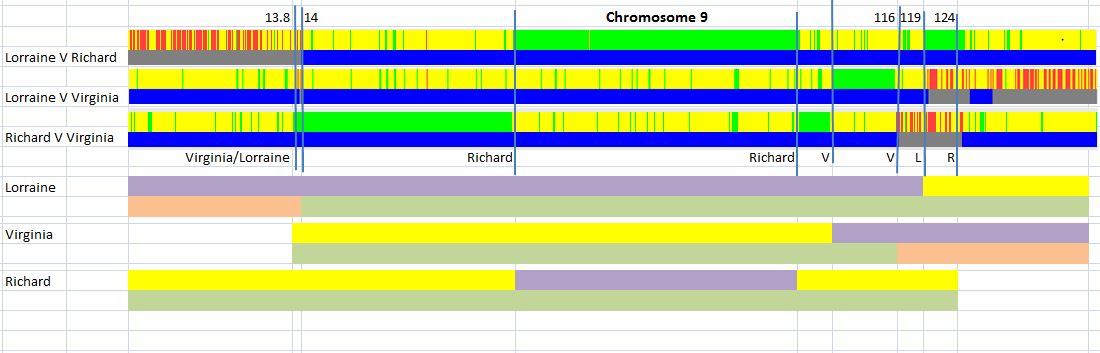
Lorraine has the largest match above followed by Richard and Virginia. It looks like Richard and Virginia have crossovers at about position 107M.

I have used MS Word for phasing, but it wasn’t the best. PowerPoint worked well, but lately I have preferred using Excel. First I cut and paste the comparison of the my 3 in-laws into Excel.

Then I add the crossover points for the three siblings:

At first I thought that the first crossover belonged to Richard. however, there is a short break in the Lorraine V. Virginia comparison, so that adds an additional first crossover for Virginia. Actually the Virginia/Richard should be Virginia/Lorraine. There are likely 2 close crossovers there. I ignored the last small match between Lorraine and Virginia as there wasn’t anything going on in the comparisons above and below that match. Next I add the locations of the crossovers:

Lorraine and Richard have the largest Fully Identical Region (FIR) shown in green. I map that with the same two colors for Lorraine and Richard:

Lorraine only has two crossovers, so we extend her colors all the way to her left crossover and on the right to her crossover (L):

As Lorraine only had two crossovers, this perhaps explains why she had the largest match with Ann on Chromosome 9. Next, I fill in FIRs and Regions that don’t match (shown as red in the Gedmatch comparisons) with corresponding colors:

Unfortunately, that lead to a bit of a dead end. Instead, I’ll try starting with the Richard and Virginia FIR on the bottom comparison:

This version looks better. Next we choose a Half Identical Region (HIR) shown as yellow above. The longest one starts at position 14 between Lorraine and Virginia. A HIR maps as matching only one color and not matching the other.

Above, I chose for Lorraine and Virginia to match on the green and not match on purple and yellow. That is how the HIR is represented. I can then extend Lorraine’s purple and green to her crossover (L) on the right and fill in more FIRs and non-matching areas:

Now, except for the two ends of Virginia and Richard, I have a four grandparent map represented by four colors. Next, we have to identify the grandparents.

The Pouliot French Canadian Connection

One of my in-laws’ grandparents is a French Canadian Pouliot. Fortunately, my in-laws have a Pouliot cousin named Fred. Fred’s sister has also tested. Here is Fred’s matches with Virginia (78-83.5 and 107-110) and Richard (107-115).

Here is Fred’s sister’s matches with Virginia, Richard, and Lorraine.

Note that Lorraine only has one small match with Fred’s Pouliot sister. This is leading me to believe that the match with Ann is on the Irish side. Can we use these Pouliot matches to identify our blank map above? I think we can. The 2 green matches above are for Virginia and Richard at 17-31M. The only place between 17 and 31 where Fred’s sister could match Virginia and Richard, but not Lorraine is on the yellow. If the match were on the green segments, Fred’s sister would have had to have matched all three siblings at that location. Note that mapping out the smaller matches should also be on the yellow segments.

I should point out that my in-law’s had a father of Irish descent and mother of French Canadian descent. This means that both their paternal grandparents were Irish and both their maternal grandparents were French Canadian. As Pouliot is the maternal grandfather, that sets the maternal side of the map as yellow and purple. That also sets purple as the other maternal grandparent: LeFevre. Further, salmon and green now represent the paternal Irish grandparents.

So Is Ann a French Canadian or Irish Match?

Although I was leaning toward the Irish earlier, I now think that the match is French Canadian. Take another look at the match between Ann and Lorraine, Richard and Virginia:

The pattern looks a lot like the purple LeFevre segments. Lorraine’s larger match is on top. Richard’s green match stops where the purple LeFevre segment stops. Virginia’s smaller blue match starts where the purple Lefevre segment starts again. I’ll put the matches in the same order as Gedmatch to make it easier to see:

If Ann were to have matched on the green paternal grandparent area, there would have have to have been three equal matches in that region shown on the Gedmatch browser.

The fact that Ann did not match with the French Canadian Pouliot grandparent did not mean that she was an Irish match. In this case, it meant that she matched the other French Canadian Grandparent.

Summary and Conclusions

  • Visual Phasing can help map an unknown match to a grandparent.
  • That phasing needs to be in conjunction with at least one known cousin to identify a grandparent.
  • These results help to know where to invest genealogical research time. There is no sense in barking up the wrong tree.