Leeds Color Analysis on My MyHeritage Matches

I have had good luck with MyHeritage matches. I have matches there that I don’t have at other places.

Adding Color to My MyHeritage Matches

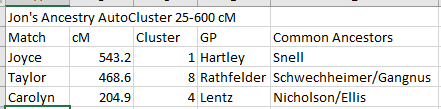
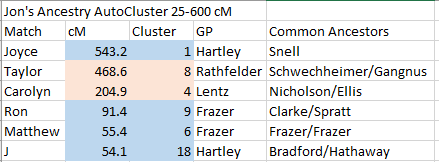
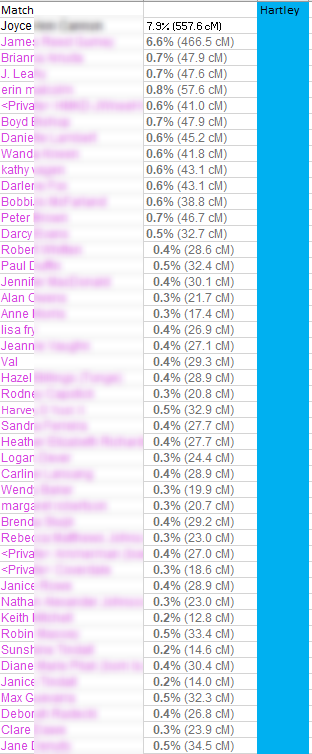
I’ll start with my father’s first cousin Joyce. She will represent my Harltey side. Actually, her brother Jim will also represent the Hartley side. I went down a ways on people who matched Joyce and me like this:

Technically, I think that I’m supposed to look at each of these matches and see who their top match is. Next, I went through some shared matches between Joyce’s brother Jim and me. This added a few people and got me up to 50 Hartley shared matches.

Two Sisters on my Rathfelder Side

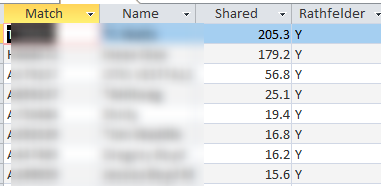
I have the same situation on my Rathfelder side. I’ll start with Anita and then add in some of Inese’s matches that Anita didn’t have with me:

If I want, I can sort these by the DNA match amount to get them back into order.

Ronald on the Clarke and McMaster Side

Ronald is the next match out. He is at the level of third cousin on the Clarke side and fourth cousin on the McMaster side, so he is doubly related. A lot of DNA analysis has to do with putting matches into groups.

I’m surprised by all the matches. I have only looked at three groups and I already have 121 matches. I did include Ronald’s two children, which I didn’t really need. I kind of like doing the color analysis this way, as I am starting out with people I already know about.

Molly – I Know, But I Don’t Know

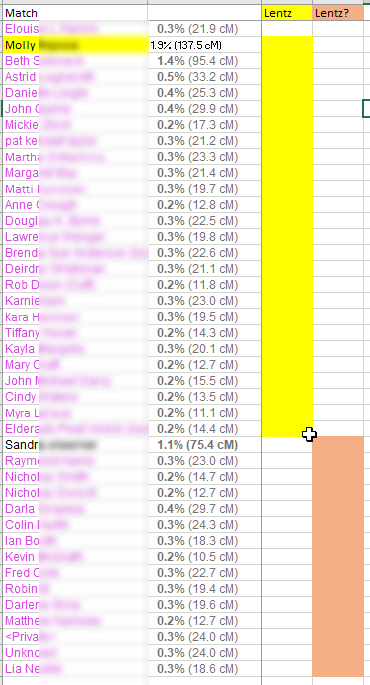
I know that Molly matches on my mother’s maternal side. However, I do not have a tree for Molly, so I don’t know exactly where she fits in. Molly triangulates with Danielle at MyHeritage. Danielle also has a tree which I will look at. In fact, I’d like to try to build out Danielle’s tree. I built her tree out, but didn’t find the connection. One of the problems is that her match level is lower than that of Molly’s. This just confirms that I need to keep this match at a generic Lentz grandparent level for me. I feel like this match cluster is very mysterious. The match with Beth indicates a Lentz/Nicholson connection, but I didn’t see this connection with the other matches.

Sandra – From the Netherlands

I need to get to Sandra from the Netherlands, because I have a cousin that I tested after her. Her relative (Great Aunt?) married someone after WWII and moved to the US, if I remember correctly. I think that these last two groups are Lentz:

Cousin Paul on the Frazer Line

Emily matched Paul but was already taken by Ron above. That is OK because the Ron lighter green group is Clarke/McMaster. The darker green group is Frazer/McMaster. Both Paul and Emily descend from Frazer and McMaster. Emily has to match Ron on the McMaster side, because Emily is not related to the Clarke family.

Kathleen and a Hartley England Cluster

Part of the reason I look at DNA is to break down a brick wall on my English Hartley side. Kathleen appears to match the English ancestors of my Hartley’s, though perhaps not the Hartley’s themselves.

Here is a respectable 192 matches in colored clusters:

  • The Lentz group tends to be mysterious. I don’t know a lot about that group.
  • The first Hartley group and the last Hartley group don’t match each other. That is probably because the first group has Colonial Massachusetts roots and the last one represents Hartley ancestors in England. My Hartley line came to the United States after the US Civil War.
  • One good thing about this method is that it starts with a match that is somewhat known or well-known and then drills down to the matches of that match.

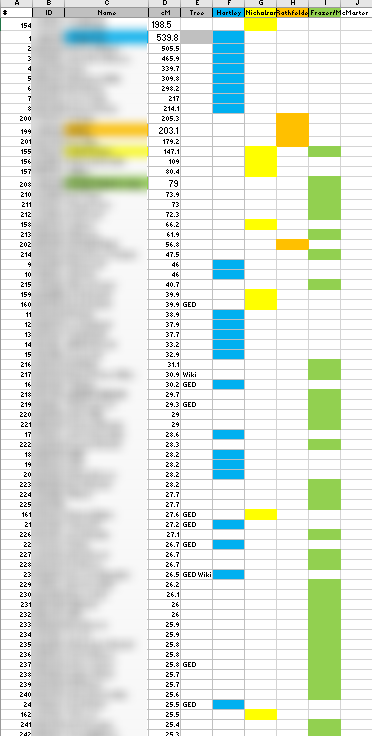
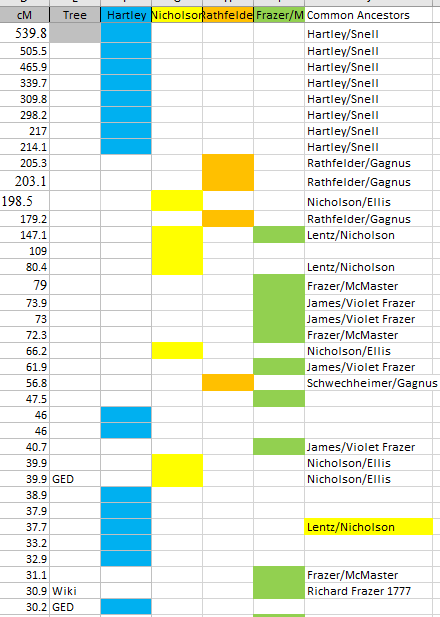
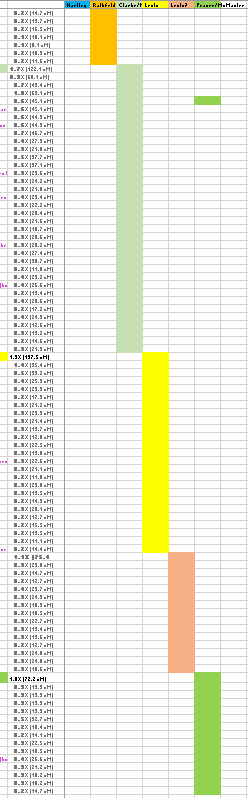
I can sort the matches by the highest matches to lowest matches to get a more traditional looking Leeds Color Chart:

There are more Rathfelder matches in orange at the bottom because I brought those matches out a little further than the other groups.

Summary and Conclusions

  • Performing a Leeds Color Analysis on my MyHeritage matches showed some interesting results. It appears that the matches were more evenly spread out among my four grandparent groups. I don’t know if this is because MyHeritage matches are more representative of my four grandparents or because of the way I performed the Leeds Method.
  • This Leeds Color Analysis was inspired by the AutoCluster Method that recently came out. The AutoCluster method does not cover MyHeritage at this time, so it is worthwhile to perform a Leeds Color analysis at MyHeritage.
  • The analysis brings up questions and avenues of research to further pursue. The method shows what I don’t know, but it also seems to bunch ancestors together. For example, it seems to separate out my paternal grandfather’s colonial ancestors from his Lancashire, England ancestors. Likewise, it appears to separate out two Lentz Lines, but the distinction there is less clear right now. The distinction may between the Lentz/Nicholson line (the Nicholson’s came to the US from Sheffield, ENG in the late 1800’s) and the older US Colonial Lentz and collateral lines.
  • Next – A Leeds Color Analysis at Gedmatch


Making Sense of My FTDNA AutoClustering with a Leeds Color Analysis

AutoClustering is a new approach to looking at DNA matches. The progamming was created by Evert-Jan Blom. Right now the analysis is working better for FTDNA than it is for AncestryDNA. In a previous Blog, I looked at my 23andMe and FTDNA clusters, but had some trouble identifying many of the clusters. I was hoping that a Leeds Color Analysis would shed some light on my Clusters.

FTDNA AutoClusters

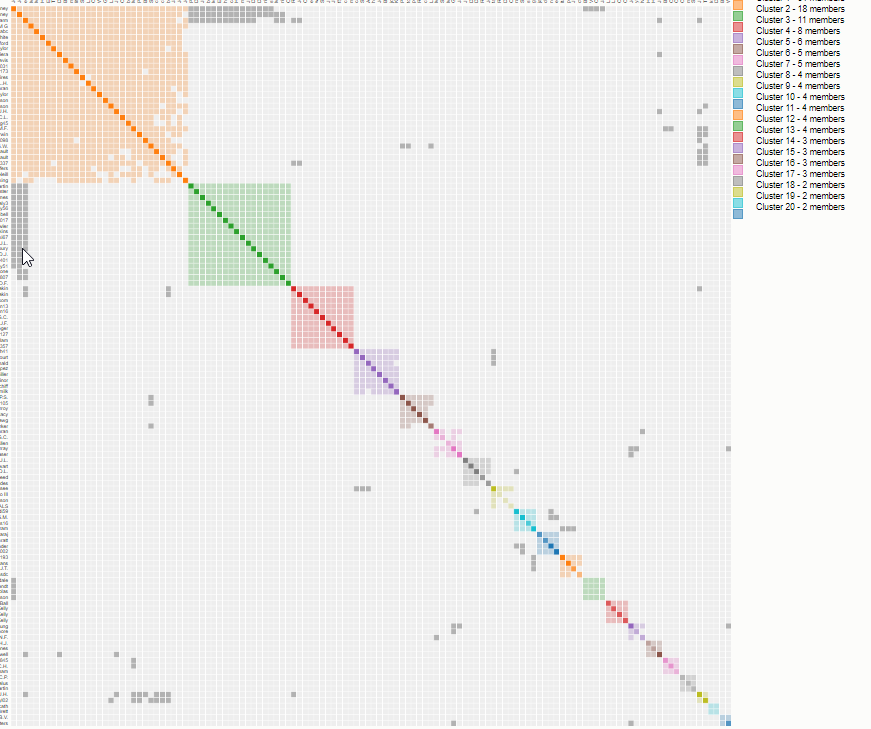
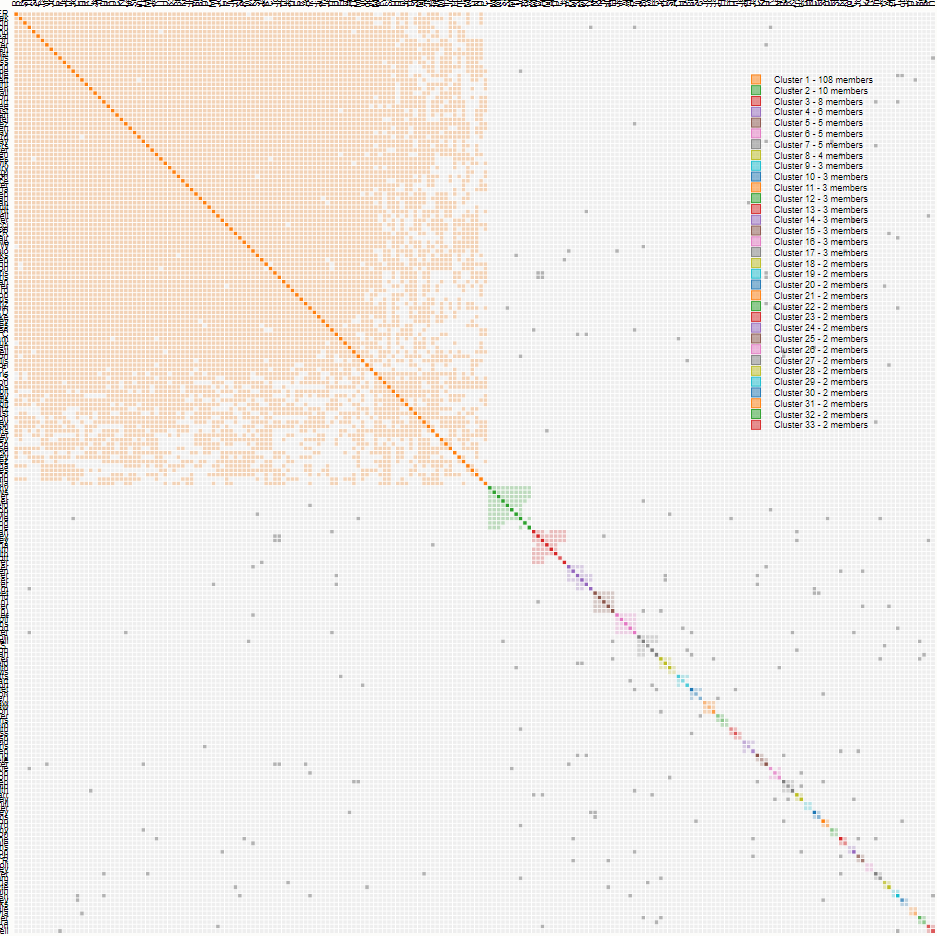
These are the 33 Clusters I came up with at FTDNA. I decided that FTDNA pads their DNA a bit. This padding problem blew up my orange Cluster 1 where there are a ton of matches on my Chromosome 20. These are on my Frazer grandmother’s side.

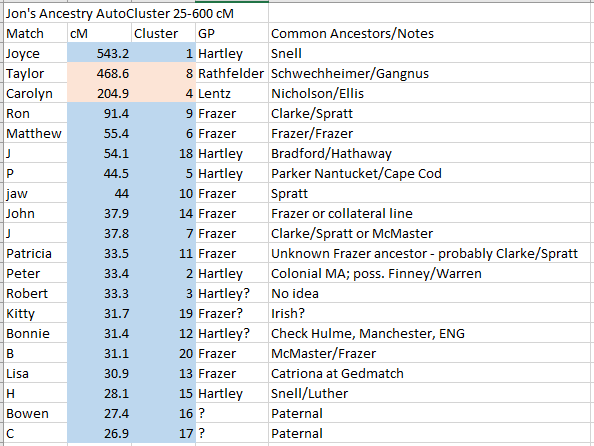
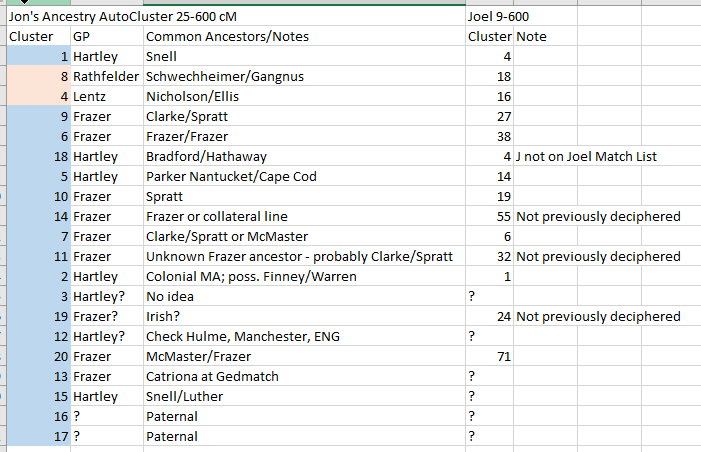
Here is a summary of some of my AutoClustering that I did previously:

The FTDNA results are in the middle column. It looks like I figured out 6 of the 33 Clusters.

Can the Leeds Color Analysis Help Figure Out More Clusters?

The Leeds Color Analysis also creates clusters, though not as graphically as the AutoCluster method. The good thing about the Leeds method is that it doesn’t rely on a  computer program and it requires some interpretation from the user. These could also be considered negatives.

Here is what I came up with using a Leeds Color Analysis of my FTDNA matches:

  • The first time a name came up as a match I gave them the color over their name.
  • If someone matched someone who matched someone up higher in the Cluster, I noted this on the spreadsheet.
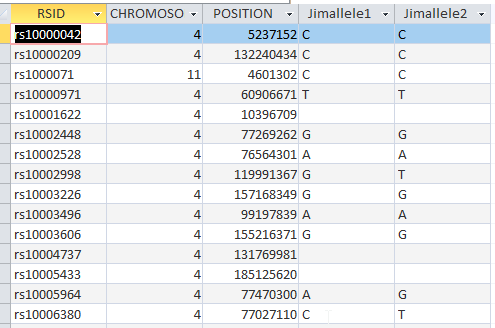
  • I went out as far as FTDNA’s predicted 2nd to 4th cousin matches. This was 88 matches.
  • This represents 21 Clusters. Some are not technically clusters as there is only one person in the cluster. I assume that if I went to lower cM matches, I would get more matches in these one person ‘clusters’.
  • I identified three out of four of my grandparents

Starting with Hartley

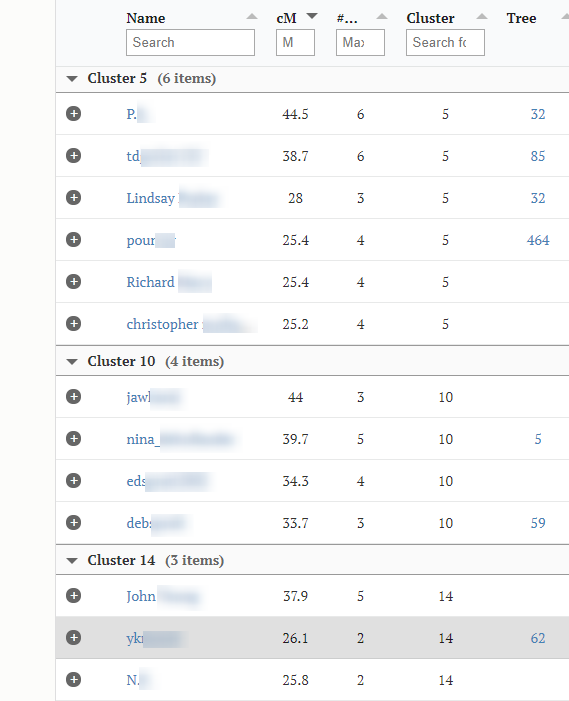
In the Leeds Analysis, I used my father’s cousin as the lead Hartley person. He did not show up in the AutoClustering as he was too close a DNA match compared to the thresholds I used. However, the second person in the Blue column is Benjamin. He matches my father’s cousin Jim and becomes the lead person in the AutoClustering. A search for Benjamin in the AutoCluster shows that he is in Cluster #10.

Cluster 10

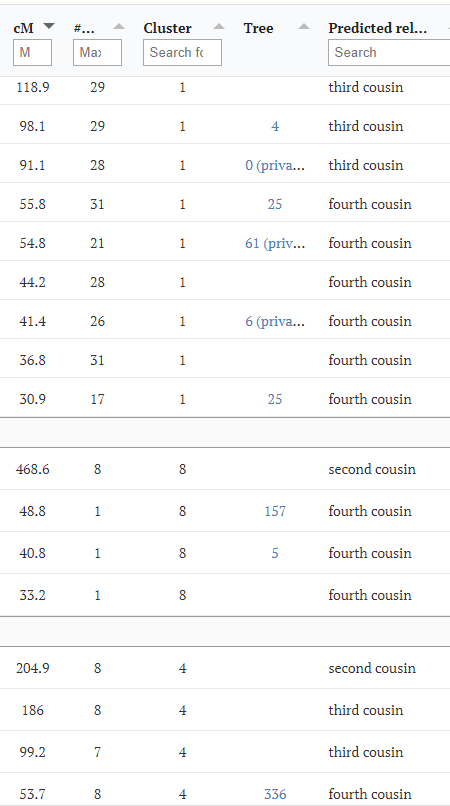
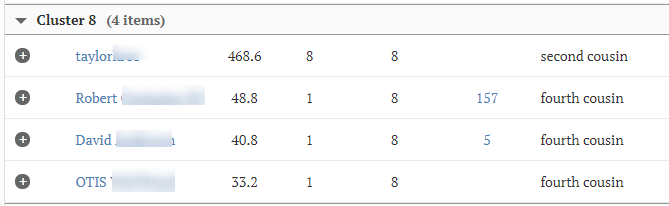
The problem is that Cluster 10 only has three people in it:

In the Leeds Color Analysis, there were 20 in the Blue column. When I go to my match with Benjamin at FTDNA and choose ICW, I get three people. So that makes sense. This is just one flavor of Hartley. A look at the ancestral names of these matches makes me think that this could be a Colonial SE Massachusetts branch. I’ll call this a Snell/Bradford Line as that covers all my Colonial ancestors:

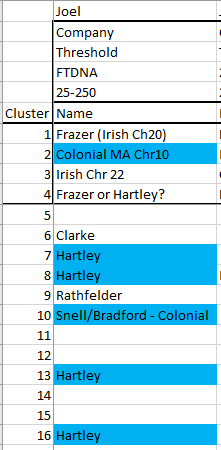
I could be wrong, but that is my best guess right now. Next, I filtered for Hartley (blue on the Color Analysis) and added a column for the AutoCluster number to keep track of the Cluster number:

The other two people in AutoCluster #10 were not in the Leeds Color Analysis.

Going Down the Blue List

It would seem logical to go down the Blue list and put an AutoCluster numbers in for each person. I find the results interesting:

I would trust the Clusters except for #6 as that shows more than one color. I was a bit surprised that they didn’t all relate to AutoCluster numbers. I’m not sure why that is. Part of the reason is that I went by FTDNA predicted relationship and AutoCluster probably goes by total DNA match in cM.

I plugged these number back into my AutoCluster Summary:

Notice that I had one Hartley in Cluster 4 which I previously had as Frazer. Turns out that was a mistake and she should have been in Cluster 2. It all works out. It turns out I made another mistake and there is no obvious Hartley Cluster 8.

Corrected FTDNA Cluster Summary

I suppose it would be possible to further break down the Hartley into Colonial or non-colonial, but I’ll hold off on that for now. The Hartley List worked well, so I’ll move on to Frazer.

Plugging Leeds Frazer Colors Into AutoCluster

Here is what I get:

Again, I’m unsure why the people at the bottom of the list are not in clusters. The Clusters I found were not shared with other colors, so that was good. Now I feel like I am getting somewhere:


These are different flavors of Frazer in green. I also have Clarke who was my Frazer grandmother’s mother from my last look at AutoCluster. Frazer’s married Frazer’s. Frazer’s married McMaster’s who married McMaster’s. It gets complicated.

I now have 13 out of 33 Clusters identified. That is a good start. I have other ideas on how to identify other clusters, but that can wait for now.

Summary and Conclusions

  • I got stuck trying to identify many of my AutoCluster results from FTDNA.
  • Using the Leeds Color Analysis, I was able to put many matches into two major grandparent categories. I was able to cross-reference these matches to the AutoCluster.
  • My next idea is to use chromosomal analysis to identify the clusters. By this, I mean that I will compare the matches to my visual phasing results. This should get the clusters into the correct grandparent area.


My Mother-In-Law and Her FTDNA AutoClustering

Joan’s Genealogy

I find Joan’s DNA fun to work with. Even though Joan has Canadian background, she has no French Canadian which can muck up the works. I don’t mean to sound prejudice in a DNA sort of way. Joan is 1/4 Newfoundland, 1/4 Daley which is from Nova Scotia and the other half is from Prince Edward Island. Out of Joan’s four grandparents, the Daley side seems to be most obscure. However, the Newfoundland side is problematic due to poor records there. The Church in Harbour Buffet burned down at one point.

  • Ellis and Rayner – PEI
  • Upshall – Newfoundland
  • Daley – Nova Scotia

AutoClustering Joan

For some reason, Joan’s results came through as untitled text files:

I was able to change the first two files to csv files and the last one to an html file and that solved the problem. I chose a range between 12 and 400 cM.

How Many Clusters?

Joan had so many clusters that they ran off the graph:

I’ll say Joan has over 80 clusters. 

This represents about the first 25 of Joan’s clusters. Here is the total at the bottom of the report:

I forgot that FTDNA add small segments to make the matches larger, so I should have had a higher bottom cutoff point.

Joan’s Cluster #1 – Newfoundland

A journey of 1,000 miles starts with one step. Joan’s top match is Ken. I’ve looked at his DNA before and had trouble figuring out where all of his DNA came from. If you look real close, you will see Ken’s grey dots going toward other clusters. Those are other places where he is related to Joan. I mentioned that French Canadians mucked up the works with intermarriage. This would be true of islands also – like Newfoundland and Prince Edward Island.

Joan’s #1 AutoCluster Match: Ken

Ken and Joan both descend from Christopher Dicks born in the 1780’s and his wife Margaret. I have run a DIcks DNA project and I recognize a lot of people in this Cluster.

Joan and Nancy

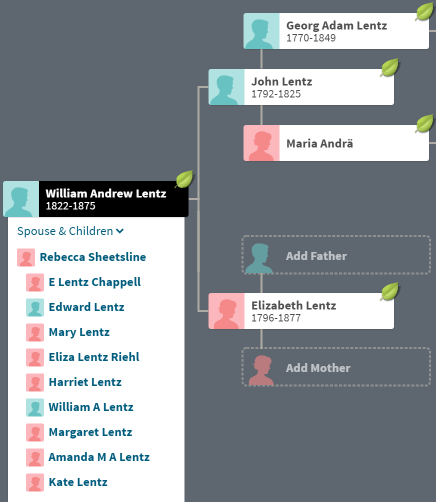
I didn’t recognize Nancy’s name in the group. Here is her tree:

I don’t get a lot of Upshall leads, so this is interesting. I assume that Nancy also has Dicks ancestry at some point. See, AutoClustering leads to good things.
That was quite easy. Here is the spreadsheet I use to keep track:

Cluster 2: PEI

I recognize some PEI descendants in Cluster 2. I have written about Glenda. She descends from Elllis and Rayner and matches Joan equally on those lines. That means I need to look at other Cluster 2 people and their trees.

Barbara and Lee

Barbara and Lee from Cluster 2 both have McArthur or MacArthur in their trees. That would seem to favor the Ellis side over the Rayner side:

However, I am just matching surnames, I am not matching actual shared ancestors. That would take more work.

Agnes’ Tree

It seems that there a lot of good trees at FTNDA. Agnes matches on the Rayner side.

Agnes’ maternal side has an Edward Rayner. His parent are the Edward John Rayner and Mary Watson in Joan’s tree. Of course, that favors the Rayner side. However, I note that there is an Ellis on Agnes’ Rayner side also.

Jane’s Tree

Here is where I need Ancestry to pull the trees together for me:

Jane has McArthur and Ellis on her paternal side.

I guess I’ll call this cluster Ellis/McArthur for now.

I spent a bit of time on this cluster, but it is Joan’s second largest cluster.

Joan’s Cluster Three People Don’t Look Familiar

Unlike the first two clusters, I don’t recognize these matches. There were four trees for the 13 people in this cluster. I think I’ll skip this one. By the little dots to the left and above this cluster, I would say there is some connection to the previous PEI cluster. It seems like an odd group. At least one tree was from New Zealand and one was from Ireland.

Skipping on to Cluster 4

As I look at the names and trees, it appears that this Cluster is from Newfoundland. I’ll just call this a Newfoundland Cluster:

That also gave me an idea for a name for Cluster 3.

DNAPainter to the Rescue?

I’m getting stuck on these Clusters, so I’ll take a look at what I have already painted for Joan. Here is the key to Joan’s painted Chromsomes:

One problem I see with this is that DNAPainter takes from many places – not just FTDNA.

Melissa in Cluster 34

Melissa has a common ancestor of Ellis/Gorrill with Joan.

I’m not so sure about the other two matches in the group. So I didn’t find a lot by that method.

The Clicking on Trees Method

Next, I’ll just click on trees to see if anything shows up. This resulted in a few general discoveries. I then clicked on the highest cM button to try to overcome FTDNA’s over-counting of their DNA matches.

Here are some of the clusters partly identified:

Summary and Conclusions

  • I had trouble finding specific ancestors for many of these clusters. I think it may be related to FTDNA having higher cM matching than is warranted. This may be partially fixed by raising the lower threshold to 20 cM when running an AutoCluster Report at FTDNA.
  • At Joan’s 2nd great-granparent level, I can identify 16 ancestors. In this analysis, I got 92 clusters. That is too many. 
  • Even though the cluster identification was difficult, it was good to take a fresh look at Joan’s FTDNA through the eyes of AutoClustering. I have at least one new lead to follow up on.
  • Another issue that makes Joan’s cluster identification difficult is that her ancestors come from two islands: PEI and Newfoundland. There was some intermarriage going on there. Joan is also once quarter from Nova Scotia. I’m not aware of intermarriage there, but matches with these relatives are relatively rare (no pun intended). 

AutoClustering My Wife’s Aunt’s Ancestry DNA

My wife’s father had his DNA tested at FTDNA before he passed away. I also had his two sisters’ DNA tested at Ancestry. I’ll use his sister Virginia’s AncestryDNA results for Autoclustering as a stand-in for my later father-in-law Richard.

AutoClustering Virginia

I could have picked either sister, so I picked Virginia for no special reason. Actually, my thought was to pick Lorraine, as she is closer in age to Richard, but I picked Virginia. I chose a low threshold of 12 cM for the AutoClustering.

First the Genealogy

Virginia and siblings have half French Canadian and half Irish DNA. In my experience, the French Canadian DNA tends to take over. This is due to the common ancestry of French Canadians, and many descendants who have tested.

The top part of the tree is Irish and the bottom is French Canadian. I am more interested in the top because there are some missing black arrows. Those are the places where there are missing ancestors. The ancestry is filled in to the level of 2nd great-grandparents. The column on the right represents third cousin, but in many matches this should show as third cousin, once removed.

Looking at Virginia’s AutoCluster

Here is the key for Virginia’s Clusters:

The Key is on the Chart, so there are grey dots representing those that didn’t fit well into the clusters. Cluster 1 is no doubt French Canadian. Between Cluster 18 and 19, the cluster size goes down from three to 2. These numbers do not include Virginia who is in every cluster.

Name That Cluster

The game is to name the clusters. Before I do that, I notice that there are not too many grey dots between the first and second Cluster. I take that to mean that these two groups are not closely related. Perhaps the green Cluster is Irish and the orange is French Canadian.

Identifying Cluster #1

This should be easy as there are so many people. First I go to the list of people below the chart and search for Virginia’s second cousin Fred who is an avid genealogist. He is there in Cluster #1.

Fred’s shared ancestors with Virginia are here:

However, there are 120 members in Cluster #1. Next, I went down the list of people in Cluster #1. The last person I had notes for was Girard. Here is Michel’s Shared Ancestor Hint (SAH) with Virginia:

Michel has 72 people in his tree. The problem with that is that Michel and Virginia could have shared ancestors on other lines. Here is Louis Marie Henri Girard and his wife on Virginia’s tree:

I would say that Louis Girard is a hint as to where the cluster is going. I’ll try another SAH. The next person going up the list has six SAH’s and a large tree. Here is the most likely source of the DNA that is shared between Virginia and this match:

These matches so far tend to be around the bottom of Virginia’s French Canadian Tree:

I’ll try one more. The next SAH has over 1,000 people in his tree and his common ancestor with Virginia is Francoise Gagne:

So far, I would say that these are all ancestors of Elizee Fortin and Rosalie Gagne. It is even possible that I could name this Gagne/Girard if the person with six SAH’s has an ancestor there. It turns out our six-matcher has these ancestors also:

That means I would tend to call this a Gagne/Girard Cluster. I like to get the name as far back as possible to be the most specific name for the cluster.

I’ll look at one more SAH to make sure. Lucie has a good tree, but six SAH’s. For some reason her first hint puts her at 6th cousin once removed to Virginia and her second hint puts her at 6th cousin to Virginia. I’ll choose the 6th cousin which goes to Pierre Girard and Marie Anne Vesina. This ancestral couple is also on the Gagne/Girard Line. This is not a life or death decision, so I’ll go with the Gagne/Girard Label for Cluster #1:

That’s one down and 33 to go. I like to keep track of these clusters in a spreadsheet:

This way I can expand to the right for Richard at FTDNA eventually.

I’m Guessing Cluster #2 Is Irish

However, as I look at my notes nicely displayed by AutoCluster, I see that this cannot be:

This means that the LeFevre side is not as closely matched to the Pouliot side as the Pouliot side matches some other names. This makes sense also.

Name That Cluster #2

It is obvious that Cluster #2 is on the LeFevere side. However, I want to be more specific as in Cluster #1 above. The match at the bottom of the list shows a SAH of Maguerite Anger. The husband is not shown as he is shown as marrying her three times. However, I assume that the husband should be there also:

The husband is Joseph Methot. I am now just showing the line of Virginia’s LeFevre grandfather Joseph Martin as we know that this cluster is along the LeFevre Line. If I were to name this Cluster based on a sample size of one, it would be Methot/Anger. However, I want to be more sure and it is easy to look at these SAH’s by just clicking on a link from the AutoCluster list of matches in Cluster #2.

Going up the Cluster 2 Match List from the bottom, the next SAH is here:

This brings the name of this cluster one generation towards the present:

Based on a sample size of two, I would name this cluster LeFevre/Methot.

I’ll call in Jane for a tie-breaker:

I can see that Jane adds evidence to my previous guess:

Cluster #3 – French Canadian?

By looking at the Cluster Graph above, it appears that the red cluster will be more closely allied to the Pouliot side. There are not as many linked trees for Cluster #3:

Judy has an unlinked tree:

Cousin Fred is not in this Cluster even though he is closely related. This could be a case that he is too closely related to Judy. Judy’s tree shows that she is a second cousin to Virginia on the Pouliot/Fortin Line. This seems to be the best name for this Cluster:

Cluster 4 – Slim Pickings on Trees

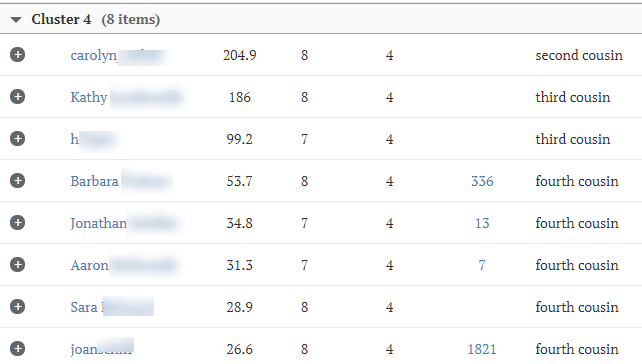
Cluster 4 has very few linked trees:

The match names appear to be French Canadian, so that is a hint. The largest tree above is private. From the above three clusters, it appears that I am getting different flavors of French Canadians. Match #3 has a small unlinked tree:

I really don’t want to build out this tree, though I could. I see Gobeil in Virginia’s tree here:

Alexandre is Virginia’s match #6 on Cluster 4. He also has an unlinked tree:

Here is another small tree from Match #8:

Again, I’m not willing to build out his tree. Match #9 had an unlinked tree and Match #10 had a small tree, but they were not helpful. I’ll go with Pouliot/Gobeil for now.

Cut to the Irish Side

This is going slowly, so I’ll start looking for Irish matches. Here is a Leeds color analysis that I did for Virginia about three months ago:

I need to pick out some of these green and blue matches and see where they cluster. The first match is Donna. She matches at 417.5 cM, so this is a case where I set the upper limit too low. The four in a row green Kerivan matches are also all too high for the upper match limit that I picked. Here is part of the tree of the first Butler match that didn’t get filtered out:

The common ancestors are Edward Butler and Mary Crowley. This match is in Cluster 12:

Based on the notes, I can see that I have been tracking three out of four of these matches. I wrote a message to John to see if he has any family history. It may be that he pre-dates the Butler/Crowley connection by one generation.

This Butler/Crowley Cluster is small, but important.

Is There a Kerivan in the House?

The green in the Leeds Color Analysis above stands for Kerivan. Here are some Kerivan descendants in Cluster 11:

I have written about Gaby already as a Kerivan relative. She is Thomas’  Aunt. Here is the tree showing how Virginia and Gaby connect:

Virginia is a second cousin once removed to Gaby and 2nd cousin twice removed to Thomas. Here are the common ancestors on Virginia’s tree:

David: Match #2 in Cluster 11

Here is David’s tree on his maternal side:

I am interested in David’s tree enough that I will build it out a bit. I’m curious to find the common ancestors. I start with David and mark the tree private at Ancestry.  Here is David’s maternal grandmother Joan Kerivan in 1940 Newton, Massachusetts:

Here I use a split screen for working on David’s tree. The tree I am making is on the left and David’s tree is on the right:

I accepted Ancestry’s Joseph Edward Kerivan hint but not his wife as it was different than what David had. It seems like it should be an easy tree. I have the DNA match, the Kerivan name and the right area (Newton, MA).

Here’s David’s great-grandfather in 1910:

Next, Joseph’s birth record comes in handy:

I see on George E Kerivan’s marriage record, that his parents are John Kerivan and Alice. These are the couple that I am looking for. Here is part of my selective tree for David:

Alice is no doubt my wife’s ancestor Alice Rooney.

As an added bonus, I color-coded the Clusters in my summary spreadsheet based on my wife’s Aunt’s grandparents. These are the same colors I used in the Leeds Color Analysis.

The clusters are now taking shape. The magnitude of the French Canadian matches compared to the two Irish clusters is obvious.

Comparison with the Leeds Color Method

Next, I put the cluster names by the appropriate names from the previous Leeds Analysis I did:

I see that one of the people from the Butler Cluster was not in this analysis, so he must have gotten his test results since I did this analysis three months ago. The first green block that doesn’t have an assigned cluster represents Russel. Russel is in Cluster 7.

Cluster 7 – Kerivan?

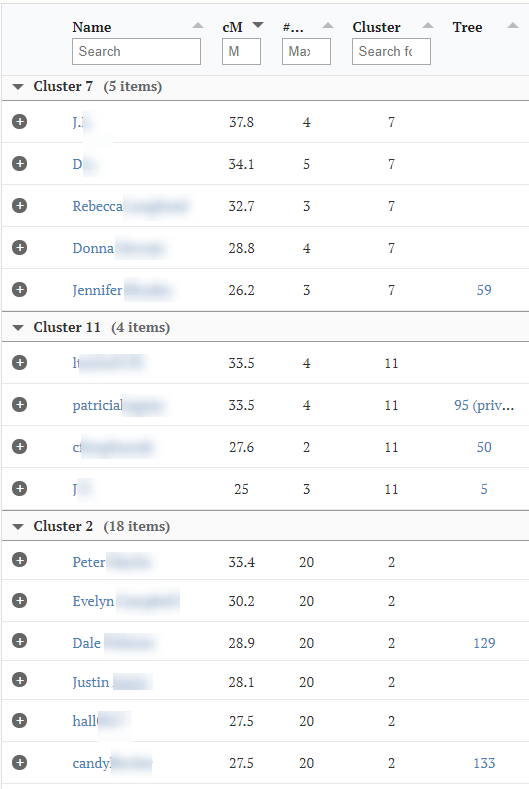
Here are Virginia’s seven Cluster 7 relatives:

Here is Russell’s tree on his mother’s side:

Time for a Quick Tree for Russell

I found this hint at Ancestry for Thomas Kerivan:

This gets me to where I want to be. Here is my quick tree for Russell:

One might wonder why there is another Cluster for this same couple. It could be that one Cluster is Kerivan and one is Rooney.

Here is Sandra. She has the same mother as Russel, so I could have saved myself some time:

Actually, there is a Rooney in this cluster, so I’ll call this the Rooney/Kerivan Cluster.

There are a few new people in the Rooney/Kerivan Cluster that I should get in touch with.

Cluster 19 – A Butler Cluster on the Outskirts

Here are Brian and Michael:

I associated Brian with the Butler family due to a shared match with Patty. Neither Brian nor Michael have family trees, but it would be worthwhile to follow up with these two.

My guess is that the Cluster 19 Butler predates the Cluster 12 Butler/Crowley families. This is a good place to be as I am trying to pin down a place in Ireland where the Butlers came from.

Where is Patty?

One Butler DNA match I have been tracking is Patty. I couldn’t find her in the AutoCluster. Based on her shared matches at AncestryDNA, I would have expected her to be in Cluster #12. AutoCluster provides a list of names that didn’t match other people. I didn’t see her in that list either.

Summary and Conclusions

  • AutoCluster by Genetic Affairs continues to be a fun and useful tool to use to sort through your DNA matches.
  • The program is similar to the Leeds method but is more useful and takes the guesswork and human error out of the equation for the most part.
  • AutoCluster gives a visual as to where the bulk of the DNA matches are
  • In this Blog AutoCluster highlighted some important new matches. It would be worthwhile to contact these new matches.
  • The list of people in the Ancestry Clusters is especially helpful. I can click on each name and quickly go to their AncestryDNA match and see if they have a SAH or linked or unlinked tree.
  • Even though AutoCluster is one of the best things since sliced bread, it is not perfect. I could not find Patty in the clusters. Also the runs that I get are spotty. It seems to work about half the time for me. I would like to get better results at Ancestry for myself and my mother, but am not able to get results at the thresholds that I want. It may be that these glitches will be fixed as this is such a new tool.


Mom’s DNA AutoClustered

AutoClustering was down for AncestryDNA today, but now it appears to be working again. This time I wanted to try to autocluster my mom’s DNA. I meant to lower the threshold from 50 to 15, but apparently did not. I’ll take a look at what I got.

Mom only got three clusters. This could be a lesson in what not to do. The first cluster is Nicholson.

Cluster 3 – Rathfelder

I have blogged about this match. The common ancestor is at the level of Hans Jerg Rathfelder and Juliana Biedenbinder:

Green Cluster #2

I am less certain of Cluster 2. These two people don’t have trees and I have not been able to get in touch with them. I was in touch with a shared match who had Schwechheimer ancestry. This ancestry is also from Latvia, so that would be my best guess for this Cluster.

That’s as far as I get with this small autocluster. The orange is a maternal cluster. Clusters 2 and 3 are paternal for my mom as far as I can tell.

Here is my AutoCluster at Ancestry using the same default settings:


I had one maternal cluster (Nicholson) and four paternal clusters. My mom’s cluster of 7 Nicholson’s translated to a cluster of three for me at the preset thresholds. This makes sense as I got about half of my mother’s Nicholsn DNA.

AutoClustering My 23andMe Matches and More FTDNA

In my previous Blog, I looked at AutoClustering my AncestryDNA and FTDNA matches. In this Blog, I’ll look at 23andMe. I have to confess, that I have never had a good feel at working the DNA matches at 23andMe. I was hoping that AutoCluster would give me a boost in figuring out what I have there.

Here is my AutoCluster at 23andMe:

Now I am up to 45 Clusters. I used a slightly lower threshold than I used at FTDNA, and got different results (20 cM at 23andMe vs. 25 cM at FTDNA). At FTDNA, the first two clusters had 108 members and Cluster 2 had 10 members. At 23andMe, the first two Clusters are a bit more even at 66 and 65 members. Also I note that the green Cluster 2 is quite closely related. All 65 members match each other.

Identifying the 23andME Clusters

My first thought is to figure out what these clusters represent. Which line is which? I do have a few known cousins at 23andMe.

Cluster 8: The Lentz/Nicholson Line

My mom has a cousin Judith who is on the Lentz Line. She is on Cluster  8.

Judith also descends from the Nicholson family as does at least one other person in Cluster 8.

My Cousin Jennifer: Hartley Side

Another point of reference is Jennifer who is my 2nd cousin, once removed.


This corresponds with my Hartley’s at AncestryDNA:

Steve with Clarke Ancestry


I’ve blogged about Steve who is a 23andMe match. He has Clarke ancestry and is in Cluster 19:

Cluster 19 is quite a ways down on the list.

Cluster 2 and Chromosome 20

I have written a few Blogs on my Chromosome 20. I have many matches there on my Frazer grandmother’s Irish side. These Chromosome 20 matches appear to correspond with my Cluster 2. Here is one Blog I wrote on my Chromoosme 20 about 2-1/2 years ago. In that Blog, I reasoned that the matches may be on my McMaster side:

In my previous request for an AutoCluster at FTDNA, I had set the lower threshold at 25 cM and that had filtered out a lot of the Frazer side matches. At 23andMe, I lowered the threshold to 20 cM which would explain the larger cluster.

Deciphering FTDNA Cluster 1

If FTDNA is like Ancestry and 23andMe, then the yellow Cluster should be a Hartley Cluster. First I checked the top match. It turns out that FTDNA over-reports these matches:

Roger shows a match of 67.3 cM with me, but his top segment is 12.3. Here is what the FTDNA Browser shows:

The browser shows one small match at Chromosome 20. This is where I have a lot of Frazer matches as described above. Theresa is also in FTDNA Cluster 1:

Thesesa also has a relatively small match corresponding with her 13.1 cM largest segment on Chromosome 20. That means that even though I tried to avoid my Chromosome 20 overmatching problem by raising the cM threshold to 25 cM, FTDNA managed to add in tiny cM’s and up the totals for these matches.

It is unfortunate that FTDNA has small matches that come out as large. I don’t know if this is as big a problem for others as it is for me. Basically I have a large group of distant relatives that I can’t connect with in Cluster 1.

A Comparative View: Three Companies

Here is a comparison of the three AutoCluster runs I have done with three companies. A better comparison would be for me to rerun the Ancestry results with a lower threshold:

  • I changed the Ancestry Cluster 1 name from Hartley to Snell. That is because the cluster goes back to Snell and beyond my Hartley ancestors for some of the matches.
  • In the three analyses Clarke went from Cluster 2 to 6 to 19.
  • I noted a special Chromosome 20 issue that I had. This didn’t come up at Ancestry as the threshold was set low. I may be able to identify this group later at Ancestry when I am able to run an AutoCluster at a lower cM threshold.
  • The Ancestry AutoCluster analysis only went up to 5 Clusters based on the strandard set AutoCluster thresholds.

FTDNA Cluster 2

The above summary points out that I have not yet figured out FTDNA Cluster 2. So far, I don’t have a definitive answer for this Cluster. The people tend to match me on my Chromosome 10. I have tended to associate their ancestors with Colonial Massachusetts.

FTDNA Cluster 3

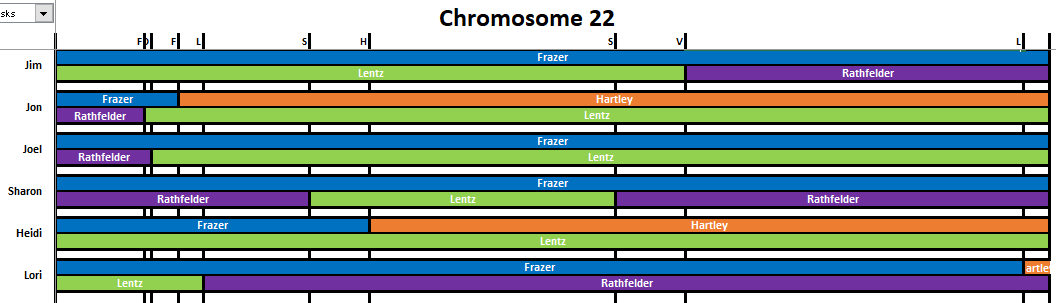
This Cluster appears to match on Chromosome 22. I think that they are Irish in background. My Chromosome 22 (Joel) is all Irish Frazer on the paternal side:

At least one of my matches from Cluster 3 is also listed at Gedmatch. I have a paternally phased kit which she matches. That is how I can tell that the match must be on my Irish Frazer side.

Back to 23andMe: Cluster 4

Cluster 4 has 17 people in it (or items according to AutoCluster).


Two of these “items” are listed as unknown. Next I need to identify one or more of these people in the list. John listed 8 surnames, but none of them sounded familiar. So far, these matches are matching me on Chromosome 3. Here is the match with Kris at the top of the Cluster 4 list:

From visual phasing, I know that has to be either Hartley or Rathfelder DNA (at the level of my grandparents).

I recognize some Hartley names in that area of the match and they aren’t in Cluster 4. That means that this has to be a Rathfelder side match.

I’m not getting very specific with these Clusters. Part of the reason is that 23andMe does not emphasize ancestral trees. So if I ever meet these cousins, I can introduce them as my Rathfelder Line Chromosome 3 cousins. From one of my other maternal Chromosome 3 matches, I see that I have traced one of these families to a German Colony in Saratov, Russia. I have not yet made the connection between them and to my ancestors who lived in a German Colony in Latvia.

So, Where Are We?

Here is a summary of some of the clusters:

I had the best luck with AncestryDNA. This is partly because I having been working with them more. Also partly because I used lower thresholds, I had the more obvious clusters and only five clusters. Ancestry also has the most matches and best genealogical trees.

FTDNA came in next as they do have some genealogical trees. This is where I tested first, so I have some familiarity with how they work. Their matching algorithm causes a perfect storm for my Irish Chromosome 20 matches showing that they match much more closely than they should. I expect that this is true to a lesser degree with some of my other matches.

23andMe was the most difficult as they focus the least on genealogical trees. It would take a bit of time to contact some of the critical matches there. I believe that 23andMe have more test results than FTDNA, so they have that going for them.

Summary and Conclusions

  • So far, it has been easiest to interpret the AncestryDNA clusters. I would like to take the cM levels down once some of the bugs have been worked out.
  • I got many more clusters at FTDNA and 23andMe, but some of the clusters descriptions are more vague than I would like.
  • I would like to look more into the Hartley/Snell clusters. I am interested in Hartley’s that don’t match Snell’s as my genealogical brick wall goes back on my Hartley line – pre-Snell.
  • It would seem that I should be able to cross-reference the clusters. Even though the matches are different at the different companies, the common ancestors are the same.
  • This utility is new, so people are still experimenting with it. For example, is there a cluster sweet spot that isn’t too high or too low. Obviously, I have 32 third great-grandparents representing fourth cousins. This may be a good number of clusters to shoot for. There may be those in the 3rd great-grandparent level that may be too obscure to have clusters. However, this could be off-set by 4th great-grandparents with a lot of descendants that would make good clusters.
  • A lot of the clusters have two people in them. Is it worthwhile looking at such small clusters?
  • The AutoCluster utility has given me a fresh look at my DNA matches. I have also been entering some of the larger matches into my match spreasheet.


The AutoCluster Craze

It seems all the cool genetic genealogists are using AutoCluster at geneticaffairs.com. Here is the welcome page for this new DNA analytical tool:

I have decided to try it. I have seen some screen shots. Autocluster appears to be a way of easily clustering your DNA matches to see which ones go with which.

I registered and first tried Ancestry where most of my matches are. I added Ancestry and it showed all the people that I am linked to through Ancestry. There is a blue  autocluster button to select:

The second button is for my profile and I chose that. Then there are three choices:

I chose A. I see now that if I was in doubt, I should have chosen A so that was good. In not too long a time, I got an email giving my 20 closest DNA matches. I knew this already. I also got a spreadsheet and the important graph:


On the top and sides of the graph are names of my matches and how they match each other. The Key above shows 28 matches. This is based on the default values:

This forces my matches into a fairly narrow range.

What Do the Clusters Mean?

The clusters are on the idea of “birds of a feather flock together”. These are matches who match each other. The first orange cluster would be people who descend from my Hartley great-grandparents. This couple had 13 children. That means that I have a lot of 2nd cousins and some remaining 1st cousins once removed, then 2nd cousins once removed.

The Snell Side

As I look at the Hartley cluster more closely, I see that there is also a Snell subcluster within it that is not Hartley:

That is an important distinction as I try to separate  Hartley and Snell DNA.

A Small Maternal Red Cluster: Lentz

Hartley is on my paternal side. The only cluster on my maternal side is the red one. Here is my tree up to my 2nd great-grandparents;

The orange box is around my Hartley/Snell ancestors. The red box is around my Nicholson ancestors. This corresponds to the red cluster in the chart.

The Purple Frazer Cluster

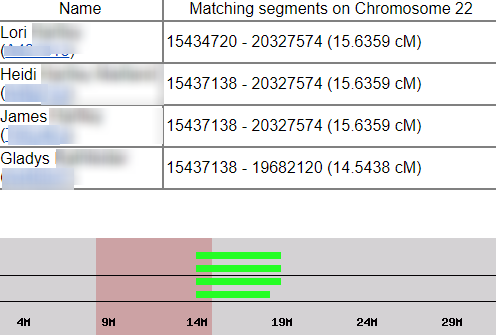
Gladys is the third person in the purple cluster. She is in my Frazer DNA project. Here is how we match:

What is also interesting is that Gladys does not match the first person in the purple cluster. However, Gladys matches possible Frazer relative #2 who matches possible Frazer relative #1. Now what is very interesting is that I had that the match [that I am calling Frazer relative #1] has a McMaster ancestor. I have tried to show in the past, that “Frazer relative #1” has this ancestry through Marriainne below:

Although the “Cluster” is not proof that I was right, it seems that it provides strong evidence that I was right. It appears that Match #1 has Frazer DNA even though she doesn’t know she has Frazer ancestry. Even though I did a simple cluster, it appears that the results are quite powerful.

The Green Clarke Cluster

I have written quite a bit on this line. The people I match with are aware of their McMaster ancestry. I match these people on their McMaster Line but more closely on their Clarke line.

Actually, the last person in the cluster isn’t sure how his Aunt fits into the picture. However, I have not seen the family tree.

The Last Cluster

This last cluster is a little harder to nail down with only two people. Note that there is a link to the Clarke Cluster above. I had originally thought that this might be a McMaster Cluster, but the last person in the cluster has Spratt ancestry. The reason that I thought that this might be a McMaster Cluster is because the person matching from the Clarke Cluster had McMaster and Clarke ancestry.

I’ll keep an open mind and put both names into the mix.

Cluster Summary

I am very happy with this new tool as are other genetic genealogists.

These are the lines above that I have identifed using a simple threshold cluster technique. I have Hartley/Snell, then the earlier Snell. I have Frazer and Clarke. Then I have either Spratt or McMaster for the very small cluster. For my maternal side, so far, I only have Nicholson.

Trying FTDNA

Next, I added the FTDNA website to the AutoCluster Program. This time I lowered the lower threshold to 25 cM. Perhaps this will take longer to run. This will be a good chance to look at my FTDNA matches as I haven’t checked them out in a while.

This time, instead of 5 clusters, I have 33. My first Cluster has 108 members instead of 16. I assume that Cluster 1 at Ancestry is the same as Cluster 1 at FTDNA, but there are not a lot of people that have tested at both places. I would need to lower the threshold at Ancestry and then see if I saw any common names.

Frazer Cluster

The Frazer Cluster below in purple is Cluster 4:

I recognize my 2nd cousin once removed who is the first match. These Frazers tended to intermarry. This clusters carries an overlapping look that I also saw at Ancestry – even though there are different Frazer ancestors in the Ancestry Cluster versus the FTDNA Cluster.

Rathfelder Cluster

Beneath the Chart is an analysis part:

The first cluster to come up there is Cluster 9. That is likely due to the large match with my 2nd cousin Catherine. She is on the Rathfelder side which was missing in the high threshold Ancestry Cluster Analysis.

Cluster 9 is the Blue Cluster on the lower right above. It would be worthwhile pursuing the other two in the cluster. According to the tabular analysis above, Pamely has a tree. The link brings me right to Pamela’s tree. It goes back to her grandparents. So if I were to expand Pamela’s tree, I might see where the match is. The Rathfelder’s were from Latvia, so that is an easy place to notice.

Cluster 6 – Clarke

I could recognize this Cluster by one person who had Clarke as his middle name.

FTDNA Clusters

With 33 Clusters, it would take to long to look at all of them in this Blog. However, I am curious as to the 33 Clusters that came up.

Summary and Next Steps

  • The AutoCluster Tool is very helpful with AncestryDNA. This is because AncestryDNA doesn’t have the Chromosome Browser to check matches.
  • I would like to figure out why I have one large cluster at FTDNA versus all the small clusters
  • I would like to try this at 23andMe to see how it works there.
  • If nothing else, this tool should help focus my DNA research.
  • I would like to be able to cross-reference the clusters. For example, between AncestryDNA and FTDNA.
  • I would also like it if there would be a way to combine the clusters from the three companies.
  • Further, it would be great to add MyHeritage to the mix.


A Possible Hartley Match at MyHeritage and Visual Phasing

I recently had a message from Julie at MyHeritage. She matched my brother Jim’s DNA. We also both had Hartley’s in our ancestry. She wanted to know if any of her Hartley’s sounded familiar to me. According to Julie, “…2 Hartley sisters married 2 soldiers in the House of His Excellency British Ambassador at the Court of France, ” This didn’t sound familiar to me. I don’t know of any of my Hartley ancestors marrying in France.

Julie’s DNA Hartley Match

Here is Julie’s DNA match with my brother Jim:

Julie also matches my sister Lori here:

This was Julie and Lori’s only DNA match and corresponded with Julie and Jim’s largest match on Chromosome 7. However, none of these DNA matches were very large.

Visual Phasing of Hartley DNA

I have visually phased all my sibling’s DNA as well as mine. Here is Chromosome 7:

Here in the beginning of Chromosome 7, Jim and Lori both start off with Frazer DNA shown in blue. Those areas correspond with the matches with Julie at the start of Chromosome 7. That means that the match on Chromosome 7 cannot be a match with Hartley DNA. This is a case where the visual phasing came in handy. If Jim and Lori matched Julie on Hartley DNA, it would be worthwhile looking further to see if there was a common ancestor.

Frazer DNA?

As I mentioned above, these DNA matches are quite small. That indicates that these matches could go back quite a way. My known Frazer ancestors were from Ireland. I notice that Julie has ancestors from Ireland. I suspect that that is where the common ancestors could be.

Here is my grandmother’s Frazer tree:

I have some missing ancestors in the bottom right part of the tree. It is possible that is where the match is.


My Children’s Maternal Genealogy: Part 4 – Cavanaugh

So far in looking into my children’s Jarek genealogy, I had good results on the Jarek side, and then I got stuck on the Morrow French Canadian side. In this Blog, I’ll see if I can discover more about the Cavanaugh side.

The Mystery of John Cavanaugh

Agnes Cavanaugh Jarek’s father was John:

Here is apparently a different John Cavanaugh with a wife and daughter Agnes in 1930 Providence:

John was listed as a mechanical engineer. His father is listed as being born in the Irish Free State. This is to distinguish it from Northern Ireland. Here is the area of 40 Dover Street today:

Actually, it looks like there were two John Cavanaugh families. Here is John with “Laoner” in 1920 Providence, RI:

The family lived at 3 Hospital Road:

So where was the other John Cavanaugh family in 1920?

Here is John F Cavanaugh again at 40 Dover Street:

Checking Ancestry Trees

There is one tree with a John Edward Cavanaugh. However, that tree has a reference to John being 3 months old in 1870. The other John Cavanaugh’s were born around 1881.

Mystery Solved

I solved the mystery by searching for WWI Draft Registrations:

Here is the real John Cavanaugh with real signature. Now we have a birth date and a middle name. From the 1920 Census, John and his father were born in Massachusetts. His mother was born in England. Here is the rest of the Draft Registration:

So now it looks like all my previous research based on the wrong John Cavanaugh was also wrong.

I took out the top paternal part of the Cavanaugh Line. Now the bottom maternal part has to go also.

Here is my clean start:

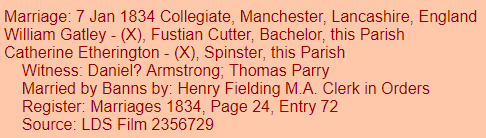
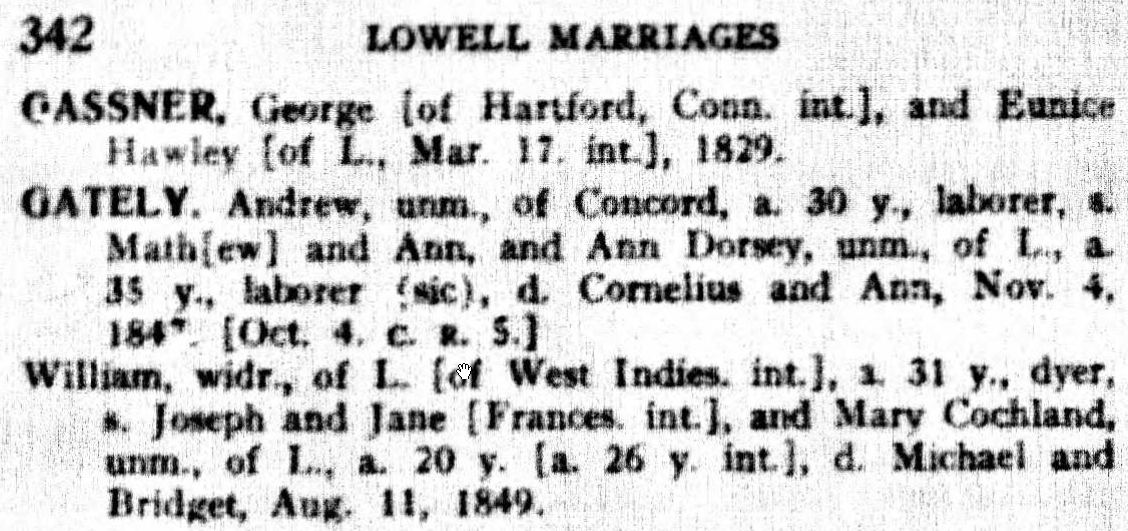
Now I am left with three records. The first record says that John is John E. Warren. This is Leona’s marriage record. It also says that John E was born in Lowell to John and Louisa Gately. The big three records in genealogy are birth, marriage and death. So far, I have no birth or death record for John Cavanaugh. In addition, the marriage record where I would have expected him to be, had someone with the last name Warren.

A Short Sketch of John Edward Cavanaugh

John was born 1880 in possibly Lowell to possibly a John Cavanaugh and Louisa Gately. However, his marriage record has him as John E. Warren.

He was a wool sorter and had four daughters. The last we hear of John is in the 1920 Census.

This is possibly John in 1900 Lowell:

John was listed as a day laborer. If this is him, he has a brother Thomas and sister Mary. This looks to be the same family living on River Street, Lowell in 1880:

This John was born in October 1879.

Below, this is more clearly John, as he was listed as a wool sorter in 1910:

John was living on 16 State Street. If I can connect the 1910 John to the 1900 John, I will know his parents.

Looking at the Details

Here is a Lowell Directory for 1906:


John E may be John Edward. I don’t know who John J is. The other John could be the John E’s father. Maggie, Mary and Thomas were also mentioned in the 1900 Census, but we can’t be sure if they are the same. John J and Thomas F are boarding in the same place.

Cavanagh/Cavanaugh in Lowell in 1900

Here I see no John’s, but I do see a Louisa. Remember Louisa Gately came up in John Edward’s mother on Leona’s wedding record. I also see Louisa in the 1906 Directory. Here is Louisa in 1900 with her daughter Ellen at 24 Crowley Street:

Note that in the 1906 Lowell City Directory, John E was also living at 24 Crowley. This suggests that Louisa and not Maggie could be his mother.

1911 Directory

Here is Louisa Cavanaugh. This Directory gives the name of her deceased husband, Michael. Her home is at 24 Crowley still and a Nellie A Cavanaugh lives with her. There seems to be a connection with Cavanaugh, US Bunting Co. and 24 Crowley Street.

More On Louisa Gately Cavanaugh

Louisa is mentioned in the Veteran’s Schedule of 1890:

This shows that Michael served in the Civil War and that Louisa was a widow in 1890.

Here is Louisa’s marriage to Michael Cavanaugh:

This was in 1864, so before the Civil War was over.

In 1880, Louisa lived at 38 Bleachery Street, Lowell:

Here she is with her daughter Ellen. The Census was taken June 8, 1880. If John Edward was born August 24, 1880 he wouldn’t be in this Census. However, Louisa was already a widow at the time. For MIchael to be the father of John, he would have had to have died while Louisa was pregnant. Possible, but not likely.

Louisa in 1870

There are trees at Ancestry which use this Census to show that John Edward’s parents are Michael and Louisa. This Census was taken in July of 1870. This John Cavanaugh was born about April, 1870. This raises some questions as John Edward gave his birthday as August 24, 1880. Perhaps he was off 10 years. But then I don’t see this John in the 1880 Census with Louisa, so where did he go? Perhaps this John passed away.

Here is a record from May 13, 1871:

Lizzie is close enough to Louisa for me. Based on his age at death, this John would have been born about April 3, 1870 which is the same month the John in the 1870 Census was born.

Here is this short-lived John’s birth record on April 3, 1870:

This means that the clue that Ancestry is giving me for John Edward Cavanaugh’s father is not looking good:

Before I put Michael to bed, I wonder when he died. Michael died July 13, 1872 of consumption:

This means that MIchael is ruled out as a father for John Edward Cavanaugh. Assuming that John Edward was born in 1880 or close to it, that was 8 years after Michael Cavanaugh died.

Who Are John Edward Cavanaugh’s Parents?

Right now, I have two top contenders:

  • Louisa Gately Cavanaugh and an unknown father. Louisa was 38 in 1880, so she was of child-bearing age. This theory is supported by the confusing marriage record listing her as the mother of John E. Warren, the husband of Leona Morrow.
  • John and Margaret Cavanaugh. They had a son named John born around the time that John Edward was supposed to have been born. This is supported by the dates. The marriage record for “Leoner” Morrow gave her husband’s father’s name as John.

Who do you vote for? There is always a third alternative, but let’s focus on these two first. If the first option is true, there should be a birth record.

Going Down the Rabbit Hole – John and Margaret

This appears to be the birth of John and Margaret’s son:

Sometimes you need to be creative on the spelling. This corresponds to the 1880 Census:

I would like to browse the Lowell Birth Records for Aughust 24, 1880 as that is when John Edward Cavanaugh stated that he was born. I looked and I couldn’t find anything that looked like a John Cavanaugh’s birth.

Next Steps

One way to do this is to wait until Heather and JJ’s DNA tests come in and see if this sorts anything out. I think that those DNA results will be helpful. Another strategy would be to build two trees. One would be with Louisa Gately Cavanaugh as the mother of John Edward. The other would be to build a competing tree with John and Maggie Cavanaugh as competing parents. Another possibility is that John Edward Cavanaugh could have been adopted.

Back to the City Directory

It occurs to me that if I could find a death record for John Edward Cavanaugh, that might clear some things up. Here is the 1927 Directory:

Laoner is at 263 Thorndike and I don’t see John Edward Cavanaugh. The latest John Edward sighting I had was for the 1920 Providence Census.

Here is the 1931 Directory:

Here Leona is not called a widow, but also there is no sign of John Edward. There are other Cavanaugh widows listed. Agnes is now working where her mom used to work. Louise and Helen are also listed but not the other Leona.

1936 Lowell

This is similar to the 1931 Directory except that the daughter, Leoner, is listed separately. I don’t see Louise this year. I didn’t see a Leoner or Leona in the 1946 Lowell Directory.

Here is a different look at the 1940 Census:

From this, I might infer that John Edward died between 1936 and 1940.

Here is a John Cavanaugh in 1930 in Providence County, Rhode Island:

This John is working and living at the race track. He is married and married at an older age (33). He is also the right age.

Here is Burrilville, Rhode Island where this John was living:


William and Maggie Cavanaugh

Perhaps a further look at William and Maggie will reveal something. It appears that William and Maggie Cavanaugh had a son John Kavaney but he died in 1908:

Michael Cavanaugh and Louisa Gately

So far I have shown that Michael and Louisa Cavanaugh had a son John but that he died young. They also had a daughter Ellen. According to the 1900 Census, she was born in 1865.

Ellen Cavanaugh Born 1865

So far, I have not found a birth record for Ellen. Here she is in 1865:


Ellen is assumed to be the daughter of Michael and Louisa above. Ellen McNabb is perhaps a relative of Louisa as they were both born in England. Fast forward to 1920. Ellen is with her mom and her mom’s niece (Ellen Ryden):

Ellen lived at 24 Crowley Street with her mother:

The two Ellens were book keepers at a Bunting Mill.

Here is Ellen in 1940:

Now her mother Louisa is dead. Ellen lives at 22 Crowley Street. She is now a payroll clerk at the bunting company. This is likely US Bunting which made bunting for the US Flag.

Bleachery Street, Lowell in 1880

Here is Ellen when she was in school in 1880:

Ellen and her mother lived on Bleachery Street in Lowell. Louisa is listed as being born in England. However Louisa’s father is listed as born in Jamaica and her mother is born in Ireland. Here is Bleachery Street in 1881:

Finally, this is from the Find A Grave Website:

A Brief Summary of John Edward Cavanaugh

  • I haven’t found a birth record for John
  • John’s marriage record gives his own name as John E Warren. It gives his father’s name as John [Warren] and his mother as Louisa Gately
  • I don’t have a death record for John
  • John was listed as boarding at the same house as his Louisa Gately Cavanaugh in 1906

I am beginning to think that perhaps John Cavanaugh was really John Warren but was raised as a Cavanaugh.

John Warren Father of John Edward Cavanaugh?

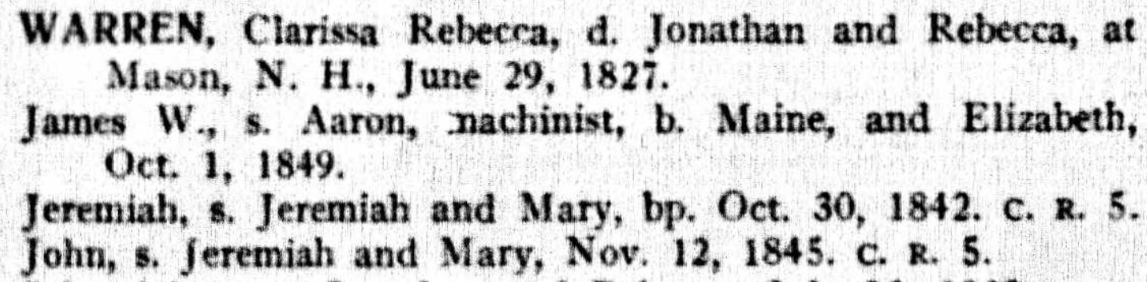
Next I will look at the possibility that John Warren was John Cavanaugh’s father. Here is a John J Warren on Bleachery Street in 1880:

He is widowed and has four children. In 1880 Louisa Gately was living at 38 Bleachery Street and John J Warren lived at 7 Bleachery Street. Seem like John J. is at least a possible father. At least he seems like a better candidate than Michael Cavanaugh who died 8 years before John Edward Cavanaugh was born.

Here is John J’s marriage in Lowell in 1866:

This is probably John’s birth record:

This means that I have come full circle. I originally thought that Leona Morrow’s marriage record was mistaken in saying that she married John E Warren. Now I see that it was probably the truth in who John Edward really was.

Summary and Conclusions

  • Initially, I was having trouble figuring out who the correct John Cavanaugh was. A WWI Draft Registion card straightened that out.
  • I was able to eliminate two potential Cavanaugh father’s for John Edward Cavanaugh.
  • It appears that the marriage record for Leona Morrow that had her husband as John E Warren was actually right.
  • I chose John J Warren as a father for John Edward Cavanaugh. John J Warren lived on the same street as John Edward’s mother who was Louisa Gately Cavanaugh
  • If I am right, John Edward and Nellie Cavanaugh were half siblings. John would have had Warren family half siblings also.
  • I would assume that John Edward was raised by Louisa Cavanaugh and her daughter Nellie. Nellie would have been about 15 when John Edward was born.
  • The records have Louisa Gately born in England and that her father was born in Jamaica and mother in Ireland.
  • Of course, I have been wrong before and would accept any corrections.


My Children’s Maternal Genealogy: Part 3

In Part 1, I got started on Heather and JJ’s maternal genealogy. In Part 2, I went deeper on the Jarek side. Heather and JJ’s mother’s tree now looks like this:

Next, I will look into the Cavanaugh branch. This branch is 1/4 Irish, 1/4 English and half French Canadian. I am curious about the French Canadian side. I’m also suspicious that Morrow may actually be Moreau or something similar. Also Tacy may be Tessier, though that may not be as obvious. The Canadians have good genealogical records, but the problem is in making the link between the US and Canada when names get Americanized.

Morrow

Leona Morrow is the most recent of my children’s direct ancestors:

I didn’t find a birth record for her, but found one for her three siblings. Leona’s parents married in Lowell on October 30, 1889.

Joseph F Morrow’s Naturalization

This looks like an application for Naturalization:

This gives some details of Joseph’s life. He was a shipper in 1900. He was living in Portland, Maine at the age of 3. He now lives at 444 Gorham Street in Lowell. This should be in the circled area of the map below:

Joseph F. Morrow from 1866 to 1889

If Joseph was in Portland, Maine, where are the records? If I could find a birth record for John Morrow, I would be happy. I did find a record for 1888:

These are all the Morrow’s in Lowell in the 1888 Directory.

Joseph Morrow Going Forward

Here is Joseph in the 1910 Census:

Here there is a distinction between Canadian English and Canadian French. Joseph’s birthplace was English. His father’s birthplace was Canadian French and his mother’s birthplace was English. The family has also added two new children.

Joseph in 1920

This is a little different than the 1910 Census as here Joseph speaks French as well as his mother and father. Now his wife is Helen H. – which may come in handy later. Also Joseph’s arrival date to the US is now listed as 1887 rather than 1866. That is quite a difference if it is accurate.

I’m stuck on the mysterious Morrow family for now.

Tacy or Tacey

I was able to find out more about Helen or Nellie H. Tacy’s family. Here are Nellie’s parents in 1860.

Nellie grew up in Fort Covington which is a border town:

Here is Nellie in Lowell, right before she married:

Here is where Nellie lived on a current Lowell map:

I wonder how and why Nellie made her way from Fort Covington to Lowell, MA.

Joseph Tacy in the Civil War

These were the people from Fort Covington who were subject to do service in the Civil War:

I’m not sure if Joseph served in the Civil War or not.

Phoebe – Joseph’s Wife

This is possibly Phoebe:

So, I didn’t find much new about the Tacy side either.

Summary and Conclusions

  • I turned over some stones on the Morrow and Tacy French Canadian sides.
  • I found out more of what I don’t know.
  • It is possible that the DNA testing for Heather and JJ will turn up something on the French Canadian side.
  • Next, on to Cavanaugh and Hulme.