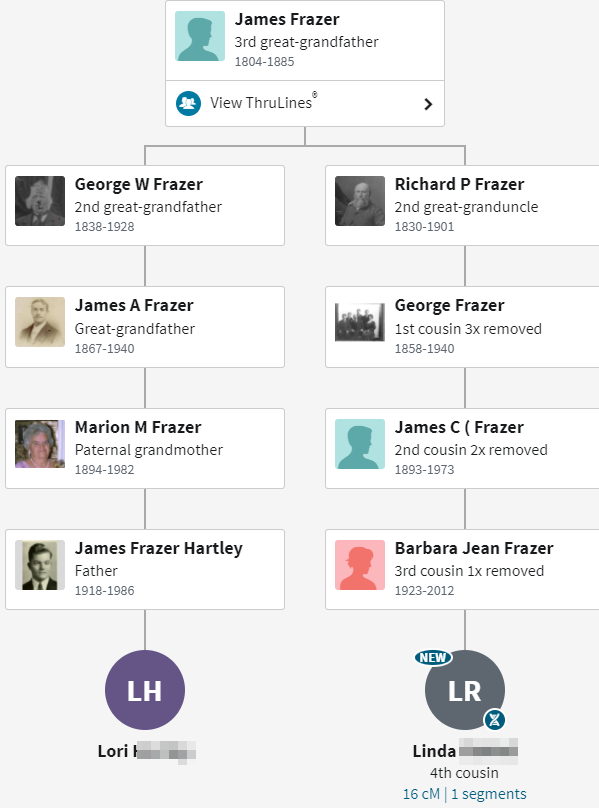
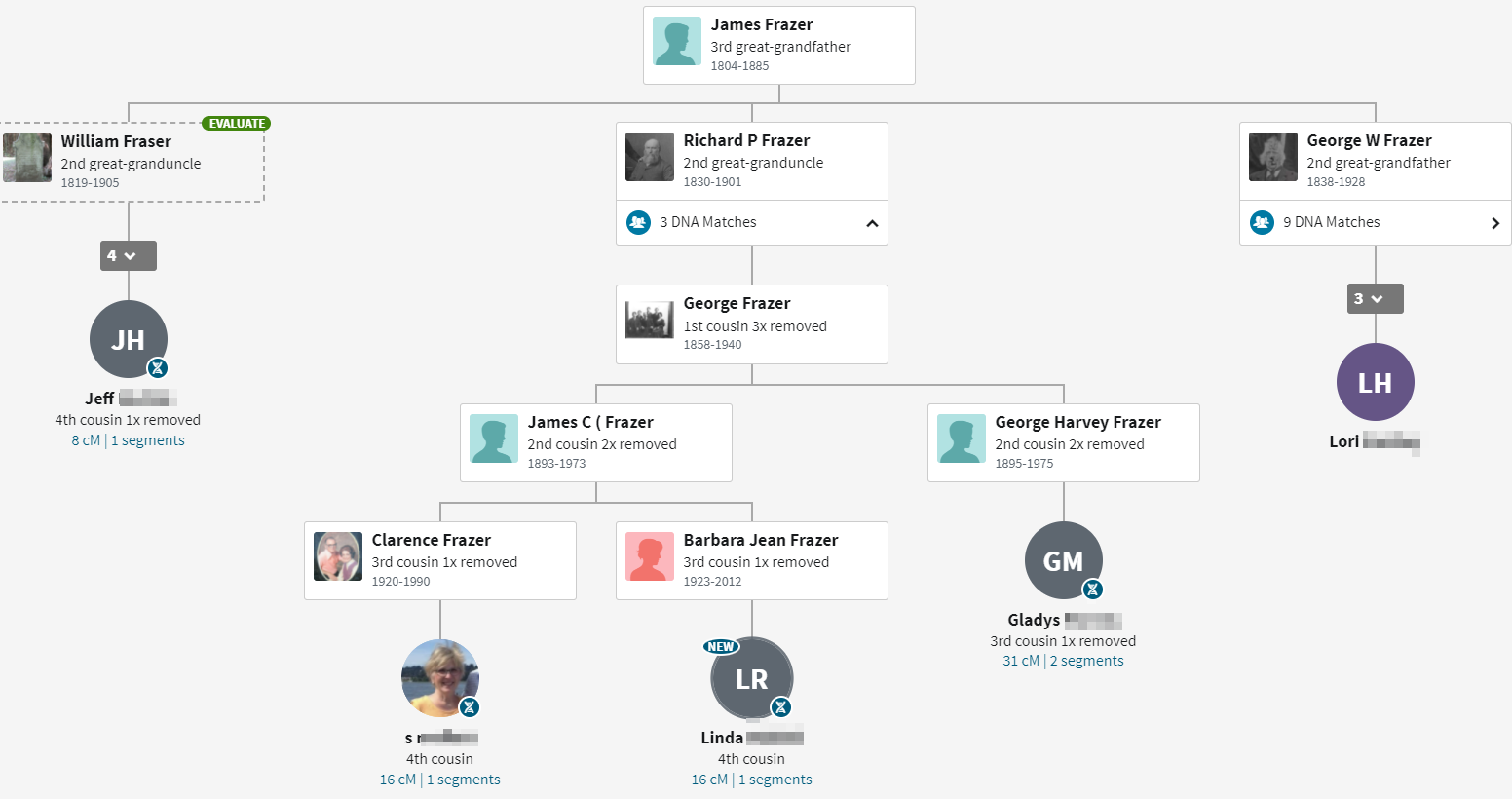
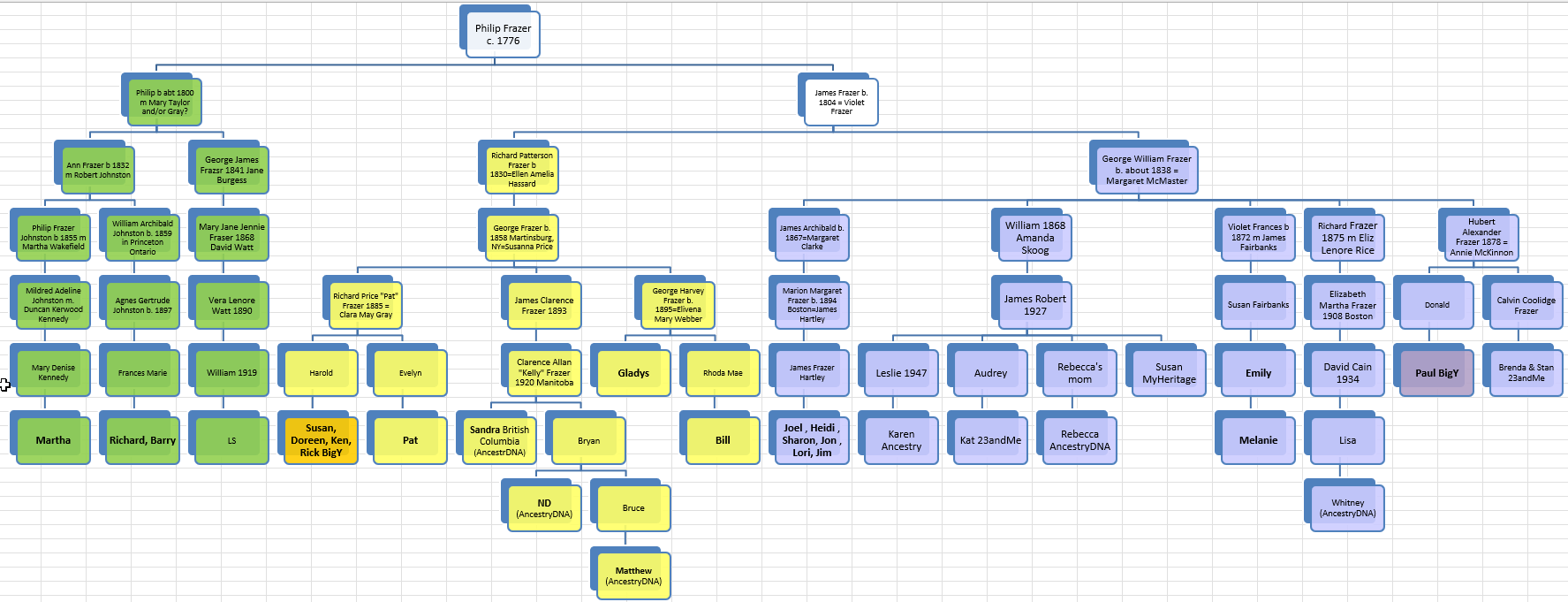
A New Addition to the R1a Frazer BigY Tree

I wa s surprised to find a 111 STR match to our R1a Frazers of Roscommon last Summer. I wrote one Blog which wrongly supposed that Dingman’s common ancestor with our Frazers predated our common Frazer ancestor who we believe to be Archibald Frazer born in 1690 and probably lived in North Roscomon County, Ireland. Working with Frazer genealogist Joanna, we put together a tree for Dingman. I wrote another Blog on August 4, 2021.

Part of the reason (aside from the apparent genealogy) that I put Dingman in the Archibald Frazer Branch was his value of DYS710. I made a STR tree in that same Blog:

Here, I supposed that DYS710 = 33 was ancestral and that a value of 34 defined the Archibald Line and that a value of 32 defined the Frazier Line. Here are some values for DYS710 at the FTDNA R1a Project near the Frazers within a green grouping:

.The values in the boxes are Max, Mode, Minimum numbers. It looks like I went too far as the last three numbers are under an orange group.

  • 31 – 2
  • 32 – 2
  • 33 – 5
  • 34 – 6

This shows that the value of 34 appears most often, so would be the mode. However, I still like my STR tree. I believe that there is something called the rule of parsimony when building these trees. That means that you shouldn’t build these trees in a more complicated way than you have to.

Dingman and the Current R1a Roscommon Frazer BigY Block Tree

That is quite a mouthful. I am represented by my 2nd cousin once removed Paul, so I will look at the Frazer Block tree from his viewpoint:

My Previous Prediction for DIngman

In my previous Blog on DIngman, I wrote:

Assuming the chart above is correct, Dingman will be positive for FT421618 as he descends from Archibald Frazer born 1690. He will be negative for Y151390 which is in the James Frazer Line.  We don’t know if  Dingman will be positive for Y58652 even though he is from the Archibald Frazer Line

In the reference above to the chart, I meant my STR tree. It’s fun to predict how BigY testers will turn out. My prediction was right. Dingman was neither Y151390 (James Frazer Line) nor Y85652.

What Else May We Gather from the Frazer Block Tree?

One thing that I gather by the placement of the Frazier tester is that the Frazer name is old and that our Frazer name has likely come down through the ages relatively unaltered. Assuming that the line above the five Frazer testers is 1690, the connection to Frazier goes back an additional three SNPs. If we take a SNP to represent 83 years, then that would go back to the year 1441. Then there are three SNPs above Frazier. At that time, there are many different surnames that match our Frazers. However, these surnames seem to be located around Inverness in Scotland. This brings us back to around the year 1192. At that time most people only went by their first name. That means that our match with Frazier is fortunate as it could represent close to the beginning of the use by our ancestors of the Frazer surname.

One way to check my dates is by using SNP Tracker:

This is the map for the James Frazer Line. Here are some of the dates from SNP Tracker:

These are close to the dates I came up with.

How Does Dingman Fit In?

I can re-draw the genealogical chart with the SNPs added on:

Here is what I gather from this tree:

  • Although it appeard that Y85652 defined the Archibald Line of the Frazers, it only really defines the Philip Frazer or James Frazer Line (born abut 1804).
  • In this case, the Archibald Frazer Line is better defined by the STR DYS710 = 34. This STR mutation must have first appeared in Archibald Frazer born about 1715 or his son Archibald born about 1743.
  • Dingman’s line is defined by his four Private Variants. These formed in his line between John or Richard Frazer and Dingman. These could be defined if Dingman tests a close relative for the BigY. It would interesting information. However, it is probably not necessary.
  • On the James Line, R-151390 formed sometime between James Frazer born about 1720 and Thomas Henry Frazer born 1836
  • Dingman is a welcome addition to the Frazer of Roscommon BigY tree and provides the earlies branching so far on the Archibald Line of North Roscommon Frazers.


A New Study on the STR signature of Z16343

I was happy to see recently that Robert Casey has done a study on Z16343. He was primarily looking at YDNA STRs which are better tested but less predictable than SNPs. Z16343 is important for my branch of Hartleys as it is under that branch.

Where is Z16343?

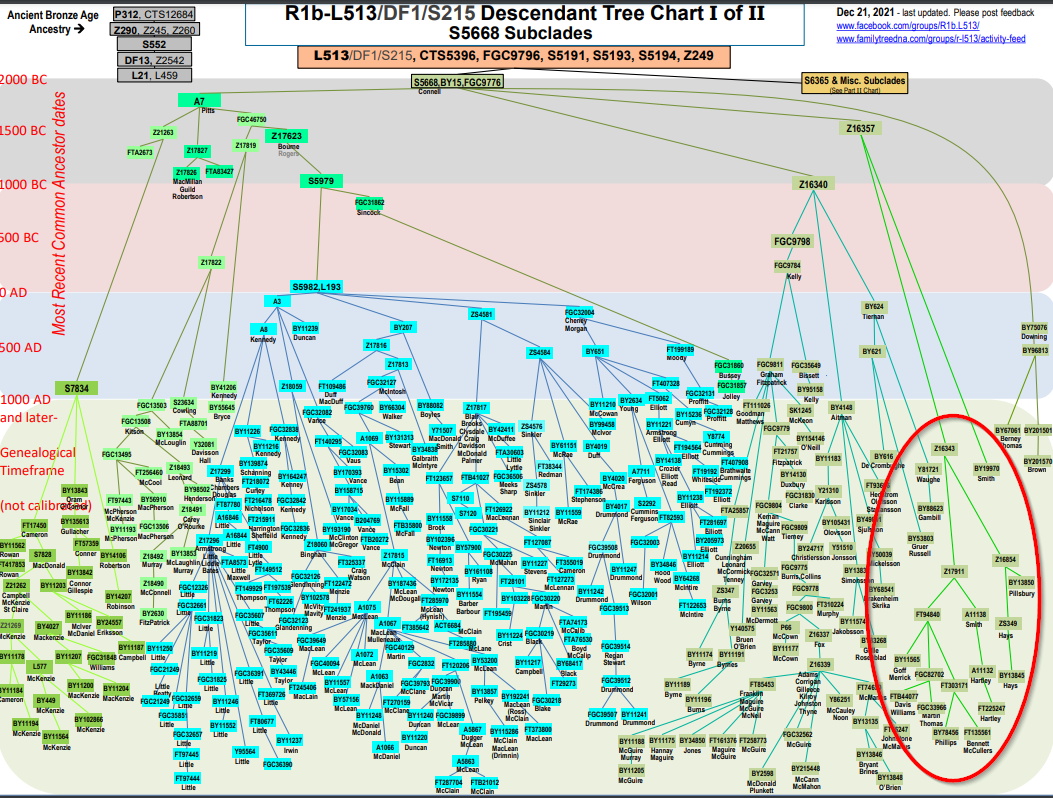
Z16343 is under R-L513, which is under L21 which is under R1b. Here is page 1 of 2 of R-L513:

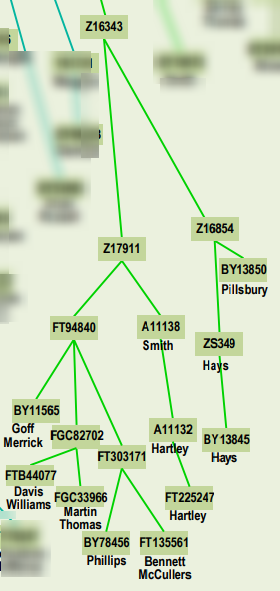
If the two pages were to be put together, Z16343 would be in about the middle of L513. The circle indicates where Z16343 is. It is a fairly small branch. The names circled represent only the branches tested by the BigY SNP test. Here is a closer look at Z16343:

Here I see only the following 13 surnames:

  1. Pilsbury
  2. Smith
  3. Hays
  4. Goff
  5. Merrick
  6. Hartley
  7. Hays
  8. Davis
  9. Williams
  10. Martin
  11. Thomas
  12. Philips Bennett
  13. McCullers

These surnames are in 11 Haplogroups.  Four Haplogroups contain two surnames:

  1. BY11565 – Goff and Merrick
  2. FTB44077 – Davis and Willliams
  3. FGC33966 – Martin and Thomas
  4. FT135561 – Bennett and McCullers

There are two likely reasons that there would be more than one surname per haplogroup. One is that the haplogroup formed before the time of surnames. When surnames were adopted, different surnames would have been used for people in the same haplogroup.  The other reason is due to a NPE, a non-paternal event. This would be due to an adoption or single mother situation for example where the male surname would have changed over the years.

Due to additional testing, two Surnames have additional branching:

  1. Hayes – ZS349 and BY13845
  2. Hartley – A11132 and FT225247

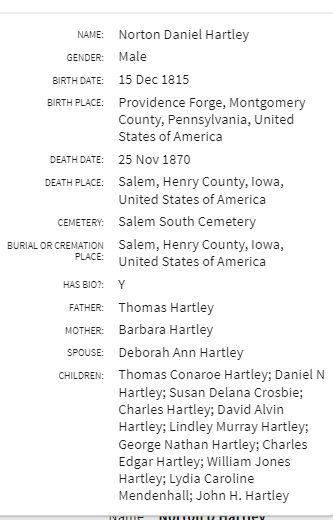
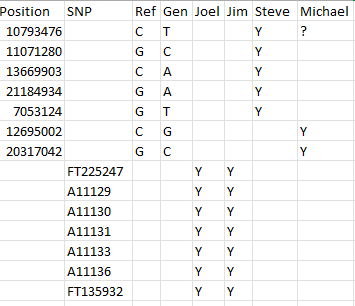
Under Hartley, where I have particular interest, there were four testers. I tested my brother to get a terminal haplogroup named. There are two other Hartleys that are under A11132.

There are three empty haplogroups. These are at branching points:

  1. Z16343
  2. Z16854 (the side with Pilsbury and Hays)
  3. Z17911 (the side with all but Pilsbury and Hays)
  4. FT9480 (a branch with all but Pilsbury, Hays, Smith and Hartley)

SAPP

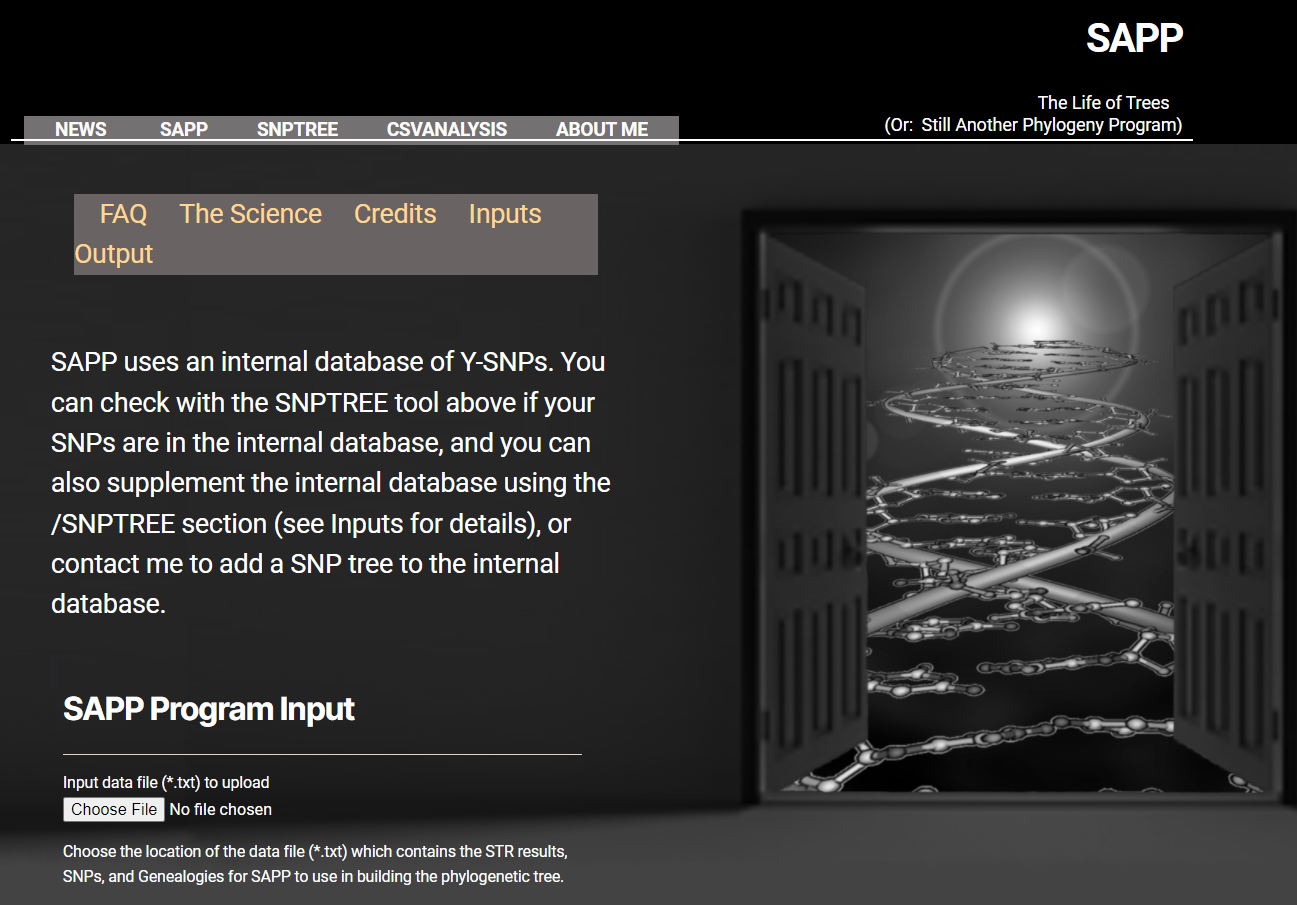
Robert Casey uses the SAPP program for his analysis. Here is the SAPP web page:

The program is by David Vance. Here is Casey’s results for Z16343:

This tree is larger than the BigY SNP tree, because it includes more testers. Casey’s report says:

Z16343 has 19 testers that were confirmed to be Z16343 via YSNP testing. Another 59 testers were predicted for a total of 75 testers. 

I have not used the SAPP program myself. I notice that it has a SNP Tree function, so I tried that for Z16343 and came what looks to me to be an upside down tree:

I’m used to having the older branches at the top, but this one has the older branch at the bottom. When I add names, I get this:

When I compare this tree to the L513 Tree, I see that Davis and Williams are missing in a parallel branch to Martin and Thomas in the above tree. Also Hays at ZS352 is ZS349 in the L513 Tree. The thing I don’t like about this tree (and other trees) is that it seems to imply that Hartley descends from Smith. In actuality, Hartley and Smith descend from a common ancestor who lived before the time of surnames. According to YFull, A11138 formed 1750 years before present or around the year 272! However, YFull does not have the full results of those who have completed the BigY test.

More on Casey’s SAPP Tree

Casey mentions the signature for Z16343 and I think I can pull it off the tree:

I will ignore the ReclOH as I don’t understand that very well (sorry McCullers). One problem with the SAPP tree is that is seems to imply that the McCullers Branch is directly under Z16343. However, by the SNP tree it is really Z16343 > Z17911 > FT94840 and so on. Jared Smith has recently drawn his own tree which includes the parent SNP to Z16343 which I have copied below:

The first branch after the McCullers Branch has Pilsbury (shown above) and Hays (not shown). I’ll put the STRs from above Node #99 (or BY13850} into a small spreadsheet:

Not counting the ReclOH, there are 7 main branches under Z16343 on the SAPP generated YDNA Tree. Node #150 is one of those 7 major branches, but it has no STR deviations from the signature for Z16343. However, it’s two sub-branches have deviations

I’ll show them like this in my spreadsheet:

So far I have 9 STRs in the Z16343 Signature. Casey said that there were only 8 STRs in the signature:

The signature of Z16343 includes eight markers which is acceptable. But this signature does not include slow mutating markers or multi-step mutations and is not the strongest signature.

Here is my spreadsheet for the seven main branches under Z16343:

This shows 12 STRs in the signature. I added in dates for the branches. Pilsbury has the latest date for BY13850, but also the most variations from the signature Z16343 STR. I highlighted the two 12’s under 439. That could normally be a problem, but these were apparently determined to be parallel mutations as the SNPs showed that they were in a different branch.

The Hartley Branch of the SAPP Tree

As I know most about the Hartleys, I will look at what Casey’s SAPP Tree did for them:

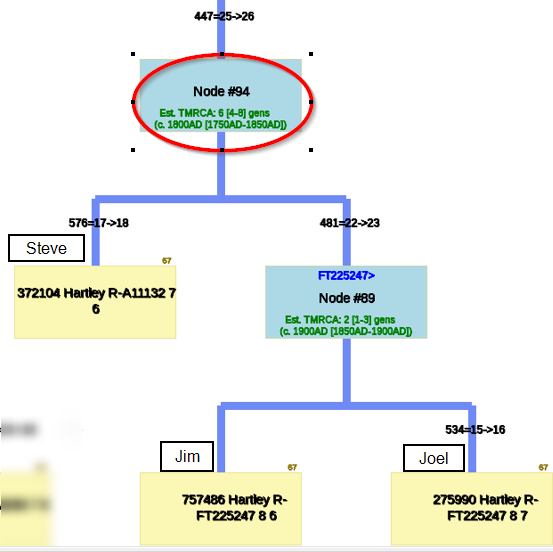
I have started by highlighting my branch which I feel cannot be right. My brother and I have the obviious ancestor of my father. He was born in 1918. The date given is 1900 which is not far off. The 1-3 generations is right. However, it is the relationship with Steve that seems off.  Here is my brother Jim’s block tree:

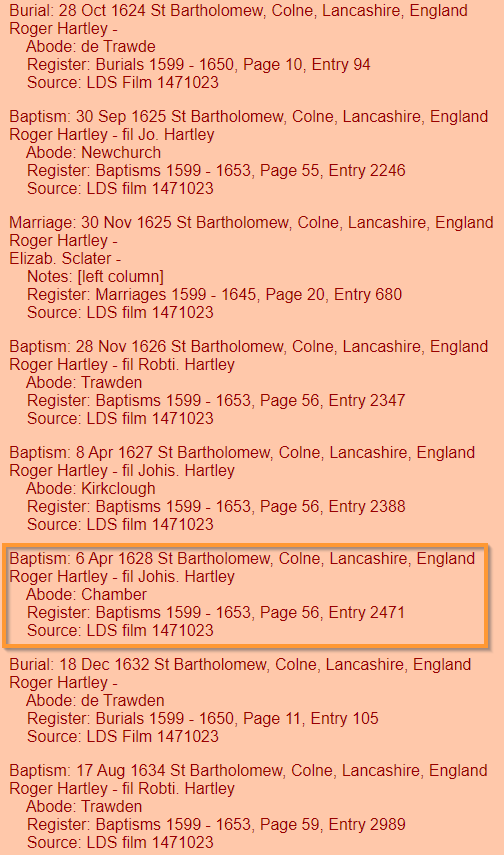
This shows that Jim and I have 7 SNPs up to our common ancestor. Steve has 5 Private SNPs but only 2 average SNPs. If I say there are about 5 SNPs up to our common ancestor and I use 83 years per SNP, then that is 415 years. If I take that time from 1960, then that goes back to the year 1545. Another check is Michael’s genealogy. His ancestor Edmund Hartley was born in 1666 in Lancashire County, England and came to Pennsylvania around the year 1700. His father Roger Hartley was born in 1628. I don’t think that I descend from Roger, but if I did, that would mean if the block tree is right, I couldn’t have a common ancestor with Steve and Michael any later than 1628.

The SAPP Tree and Steve

The SAPP Tree shows a much later date for the common ancestor between me, my brother and Steve. By this I mean much later than seems to be warranted given the YDNA SNPs:

That shows a range between 1750 and 1850. That could be off by 3-400 years. Both the SNPs and our genealogy suggest that 1800 cannot be right.

The SAPP Tree and Michael

However, the SAPP Tree for Michael shows a common ancestor which appearst to be too far away.:

Node #121 shows a date between 1200 and 1550. The SNPs seem to suggest that both Michael and Steve and I should have a common ancestor around Node #101 or around the year 1500.

The Other Three Hartleys on the SAPP Tree

I’m curious as to how the SAPP Tree would have come out with John’s new 111 STR results. Here, he is shown as further from me compared to Steve. John is my closest match other than my brother at the 111 STR level:

The TiP report gives a date to a common ancestor with John at about 1530, so that part is not so far off. It is more that Steve is shown as matching more closely than he should be. The SAPP tree also gives a common ancestor between me and John at the year 1500 which seems reasonable:

Lawrence has recently put in for a BigY 700 test, so he is a very important YDNA tester.

My Previous Attempts at Hartley STR Trees

I have made a few attempts at drawing my own Hartley STR trees. Here is one that I built:

This looks somewhat similar to the SAPP tree. This reminds me of my frustration at having Steve test and finding out that he was not related as closely to me by SNPs compared to what the STRs seemed to show. The common answer to the discrepancy lies in back mutations and parallel mutations which are difficult to detect. In my tree, Michael is on the right and in the SAPP tree, Michael is on the left. However, the tree is basically similar. In the tree above, I tested as well as my brother. Interestingly, I had a new STR mutation in 1956 when I was born at STR 534. Steve has completed his BigY test. Lawrence ordered a BigY recently as did John. However, I don’t see John on my chart. That may be because he tested to 67 STRs and this could be a 111 STR chart.

John is on the SAPP Tree:

The tree shows our common ancestor at Node #101. However, once Steve’s BigY information comes in, it will clear up the tree.

This is the SNP working model I am using:

In this model, with the information I now have, we are about at the same level for a common ancestor. My guess is that our common ancestor is around 1500. Actually, that is true for all but John. John and Lawrence are new testers, but Lawrence’s dating should be tied to Michael’s.

More on John’s STRs

John’s STRs were updated recently as part of his BigY order. I wrote a short Blog on those results here. My best guess using FTNA’s TiP Report is that John and I should have a common ancestor around the date of 1565 (although I also have a 1530 estimate above). The interesting this is, that by STRs John is related most closely to my brother Jim and then me. This is because I had an extra STR mutation that my brother Jim did not have. Then after that, John shows a more distant match with Steve. There are more Hartleys out there that have tested and are related to us by YDNA, but the STR test does not show a match with them because they are beyond the FTDNA matching limit. That includes Michael who has taken the BigY test.

Summary and Conclusions

  • In my Blog above, I took a rambling look at Casey’s SAPP tree analysis of Z16343
  • I don’t believe that the SAPP Report that Casey did was meant to supersede work already done with trees based on SNPs
  • Casey’s main point was that STRs should be used to increase the pool of predicted families under Z16343. Based on his study, he went from 19 testers under BigY testing who would be under Z16343 to 75 who should be under Z16343 by STRs.
  • The tree works out overall, but in the details where there are discrepancies between the SAPP STR tree and the SNP tree, the SNP tree should be used.
  • Every study and analysis that is done on the exisitng YDNA testing brings a little more understanding and light to the architecture of the Z16343 tree.

The STR Part of a New Hartley BigY Test

I was glad when John decided to take a new BigY test. I see that the first part of John’s BigY test is in. That is his 111 STR results. Previously, John was tied as the closest with Steve to my brother Jim at 67 STRs:

Jim matches Steve and John at a GD of 3. Michael doesn’t show perhaps due to his match settings or the Genetic Distance was too far.

At 111 STRs, Jim matches John a little more closely than Steve by STRs:

Here John is seen as matching more closely by STRs.  However, in the past, Steve seemed to match me better by STRs, but when Steve took the BigY SNP test, it appeared that Michael, Steve, my brother and I all matched at about the same level.

The TiP Report

My brother Jim has this TiP Report with John:

I’ll use 90% confidence and I get 10 generations. I’ll use 35 years per generation and get 350 years. I’ll use 1950 for the present generation which comes out neatly at the year 1600. That comes out closer to the present than the year of 1500 I was using for the common ancestor of Michael, Steve and myself.

The TiP Report with Steve

By comparison, here is Jim’s TiP Report with Steve:

This brings us back another 2 generations or another 70 years to 1530. This seems consistant with the SNP analysis that I did previously. The reason that I am using Jim’s results is that I have an extra STR mutation that Jim does not have. Now the fact that I have this mutation could mean that one was due, or that because two brothers tested, there was more chance of getting that mutation.

I suppose that it would be more accurate to do the calculations from my viewpoint also and to average the two dates.

TiP for Joel

With Steve and myself I get an estimated common ancestor at 14 generations with a 91% probability. That averages out to one more generation or to 1495 or even closer to the year of 1500 I was using with the SNPs.  Between John and me, it is 12 generations at 91% . If I were to average the estimated date of the common ancestor between John and myself and with John and Jim, I would subtract another generation to get the year 1565.

STRs from John’s Point of View

From John’s viewpoint, the difference is greater:

The difference between John and my family is that I have that extra mutation that Jim did not have. I already looked at the TiP report between John and Jim and John and myself. Here is the TiP report between John and Steve:

Here I will use 1950 – (16 X 35) or 1390. That is a long time ago to have a common ancestor if that is right. Those must have been some early Hartleys. Based on STRs alone, it would appear that My family is slightly more closely matched to John than to Steve and that Steve is more closely matched to our family than to Steve’s Branch of Hartleys.

John’s 67 STR Results

The 111 STR test is more accurate. Mervin fell off the list at 111 STRs as the matching was more distant. Lawrence has ordered the BigY test, so it will be interesting to see how the different Hartley YDNA tests compare with each other.

I will be looking forward to see how the rest of John’s BigY test turns out. I could try to draw a STR tree, but my past attempts have been a lesson in futility, so I will forego that exercise at this time.

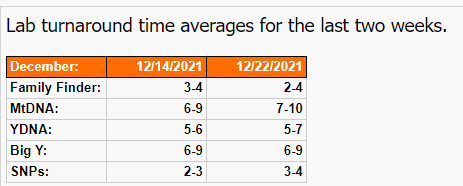
Here are current lab times:

Summary and Conclusions

  • The first step of John’s BigY test is completed. However, the significance of the STRs should pale compared to the results of John’s BigY SNP testing
  • Based on the TiP report John should be related more closely to my line than other Hartleys who have done the 111 STR test
  • Based on the same report John has only three 111 STR matches. Those are all Hartleys, but two of those matches are my brother and me. The other is with Steve. The TiP Report implies that John’s match with Steve is more distant than with my line of Hartleys.
  • Time to wait another month or so for the rest of John’s results

My New Clarke/McMaster DNA Match at 23andMe

I get notifications from time to time from 23andMe about new DNA matches and I don’t usually know how we match up. Recently I had such a notice of a potential 3rd cousin and I did know how we match.

How Zoë and I Match by Genealogy on the Clarke Side

Zoë and I match by McMaster and I later found out Clarke. I’ll start with the Clarke side. This is the tree that I have so far of DNA relatives on my Clarke side:

Zoë descends from Catherine Clarke and William McMaster on the right side of the tree where I am. It turns out that this is an important DNA match, as I have one DNA match on that side who is Melissa. However, she tested at Ancestry which does not show detailed DNA information like 23andMe does. Zoë  tells me that Violet McMaster is a many times great grandmother to her, so I’ll build down her tree from there.

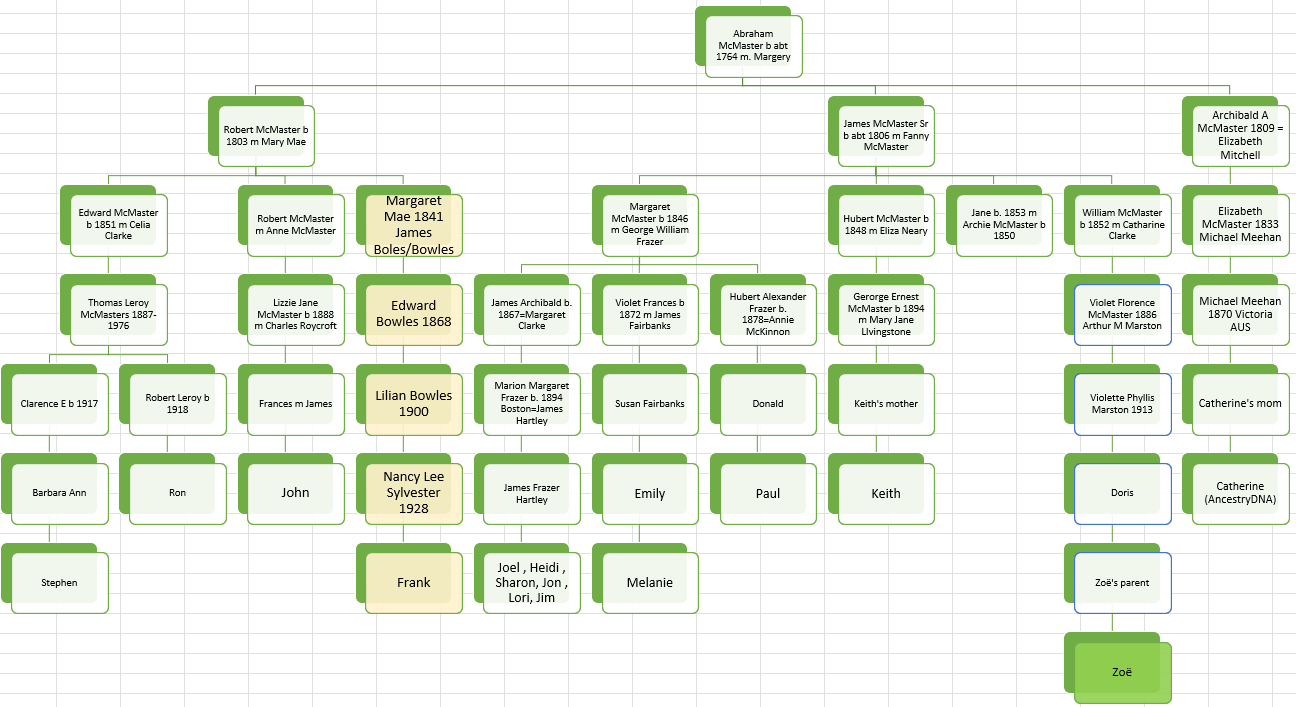
From what I can figure out this is how we connect:

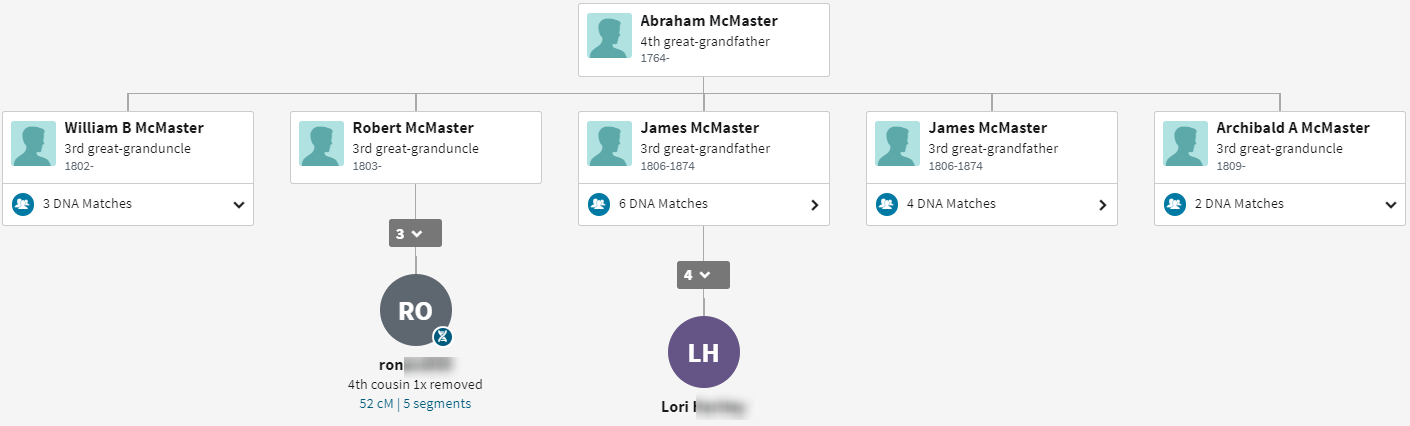
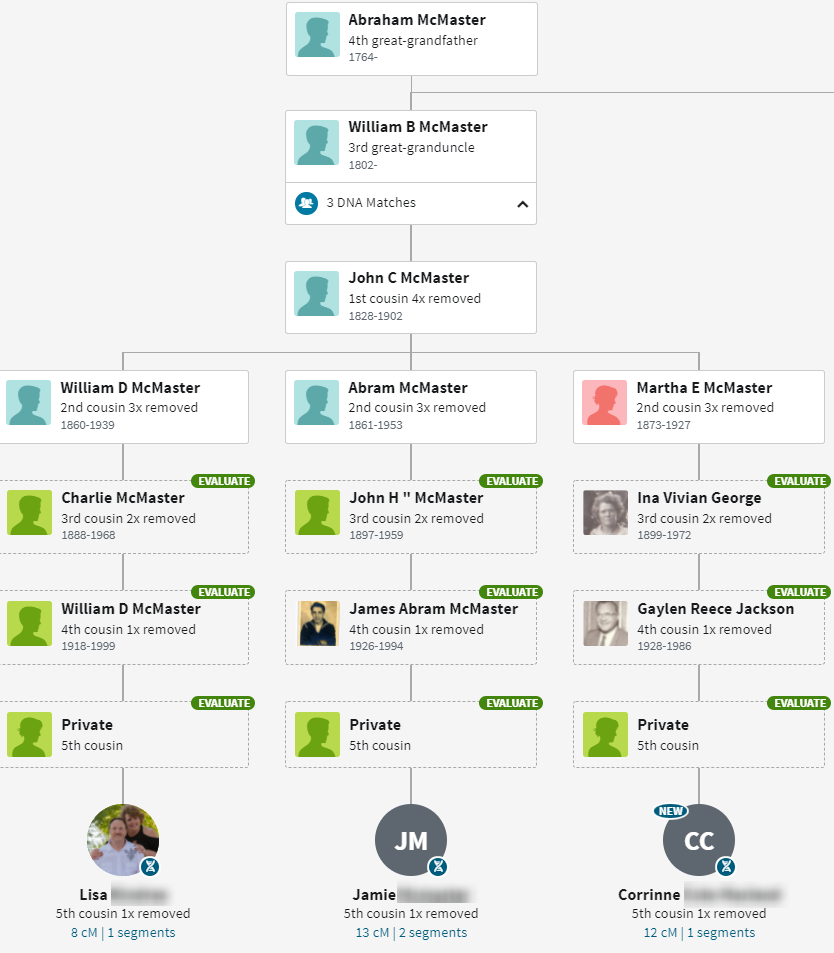
So it turns out that we are third cousins, but it looks like third cousins twice removed. Our common ancestors are Thomas Clarke and Jane Spratt. When I look at my common DNA relatives with Zoë, Stephen shows up from the left side of the tree. He tested at 23andMe also. Ron from the left side of the tree shows up at MyHeritage.

These two are Zoë’s ancestors William McMaster and Catherine Clarke:

Probably taken around 1882. Reverse of picture indicates that they were engaged “about 1881” and married October 5, 1882.

How Zoë and I Match by McMaster Tree

Here is my existing McMaster DNA Tree:

This tree is larger and needs a road map. I don’t need the left side of this tree for Zoë. The left side of the tree is for a branch of the McMaster family that ended up in Canada. The down arrow is where I need to add Zoë’s ancestor William McMaster.

Zoë and I are at opposite ends of this DNA McMaster tree. We appear to be 4th cousins once removed. Our common ancestors are Fanny McMaster and James McMaster. That means that I am related to Zoë by four ancestors and three out of those four ancestors are McMasters.

Adding Zoë to My DNA Painter Profile

This is my DNA map of known matches:

This shows that I have identified 51% of the available spaces on the two copies of my chromosomes (paternal and maternal). Here is my paternal side where I match Zoë:

On this side I am 57% painted or identified. I’ve checked ahead and saw that Zoë adds new information to this map. That is probably because she represents a new relative on my family trees also.

Here is how I match Zoë at 23andMe:

We match on Chromosomes 3 and 17 and twice on Chromosome 7. the question now is which DNA goes with which pair of ancestors? Chances are slightly higher that I match Zoë by Clarke and McMaster than the second McMaster and McMaster relationship. It is also possible that each of the four DNA segments could represent one of our four common ancestors. The easiest way to identify all the DNA would be to create a new category on my DNA map called Clarke 1823 or Mcmaster 1829.

Here is how Zoë shows up on my Chromosome Map on Chromosomes 3 and 7:

On Chromosome 3, Zoë is a new match. On Chromosome 7, she overlaps with Ron. On Chromosome 3, my match with Zoë has no overlap with other matches. Here is my phased map of Chromosome 3:

This is the portion of my Chromosome I got from my Frazer grandmother shown by the red arrow above. She is the one with Clarke and McMaster ancestors. So it would make sense that I would match Zoë on the right side of the paternal copy of Chromosome 3.

On Chromosome 7, I match Zoë in two areas that are close to each other. The first segment overlaps with a match with Ron. Ron also has Clarke and McMaster Ancestry. It is my guess that that segment triangulates between Zoë, Ron and me:

One More Scenario and Another McMaster Tree

Ron is also related to Zoë and me on the McMaster side, but that brings up another McMaster tree:

I must have planned on meeting Zoë or one of her relatives as I left a space (outlined in an orange box). Here I have added in Zoë:

This connection goes back 7 generations for Zoë. So while this connection is less likely than the Clarke connection, it is still a possible connection. I have a quick fix:

I added 1764 to the possible place that this DNA could have come from. Even that designation is not totally correct as the triangulated  match with Ron could not be from the McMaster born in 1829. Even these designations are simplifications as the DNA could have come from the wives of these two McMasters and one Clarke.

Finally Chromosome 17

Zoë’s match is interesting here:


The place where the DNA changes from Barry to Zoe appears to indicate an old crossover from Barry. A crossover is where your DNA changes from one family to another. The simple explanation woudl be that this is a crossover from the Frazer DNA I got from Barry to the Clarke DNA that I got represented from the match with Zoë.

Here is where that split appears in my tree (see above). With the addition of Zoë’s matches:

That put me up 1% on the paternal side. Overall, I am still at 51% ‘painted’.

Summary and Conclusions

  • The ancestors that Zoë and I share belonged to the minority Church of Ireland in  Roman Catholic Ireland. They tended to marry within their faith, but that resulted in the intermarriage of lines.
  • The Clarke line was not related to McMaster as far as I know in Ireland. However, one Clarke sister married a McMaster in Boston (Zoë’s ancestors) and another Clarke sister married that McMaster’s nephew who was a Frazer (my ancestors).
  • I mapped out the different relationships in one Clarke tree and two McMaster trees
  • Due to the relationships involved, the assigning of the DNA to a patricular couple was not easy. There were a possible three couples that this DNA could represent except for the case where the DNA overlapped with Ron. In that case, the DNA could only be from a possible two couples.


Some More Thoughts on A11132 Hartley YDNA Dates

The good news is that two more people in my Hartley A1132 Branch have ordered the BigY 700 test. This is the current state of BigY testing for my Branch of Hartleys:

There have been four BigY testers. This simple tree is a mixed tree as my branch (Joel and Jim) should go back to Robert Hartley born about 1803 probably in Trawden, Lancashire, England. Here is an updated tree to include the new testers:

Here I ordered the different Hartley Branches by ages of oldest Hartley ancestor. We are still working on pushing these dates back on these genealogies. There are candidates for older ancestors, but it is difficult to be sure the further back we go. The new testers are Lawrence and John. It will be a while before their results are in. My branch is the only one with a new SNP. That is because I had my brother tested using the BigY 700 test.

Dating FT225247

There are many ways to date SNPs. One simple way is to use SNP tracker. SNP Tracker is a website and has Hartley ancestors going back to genetic Adam:

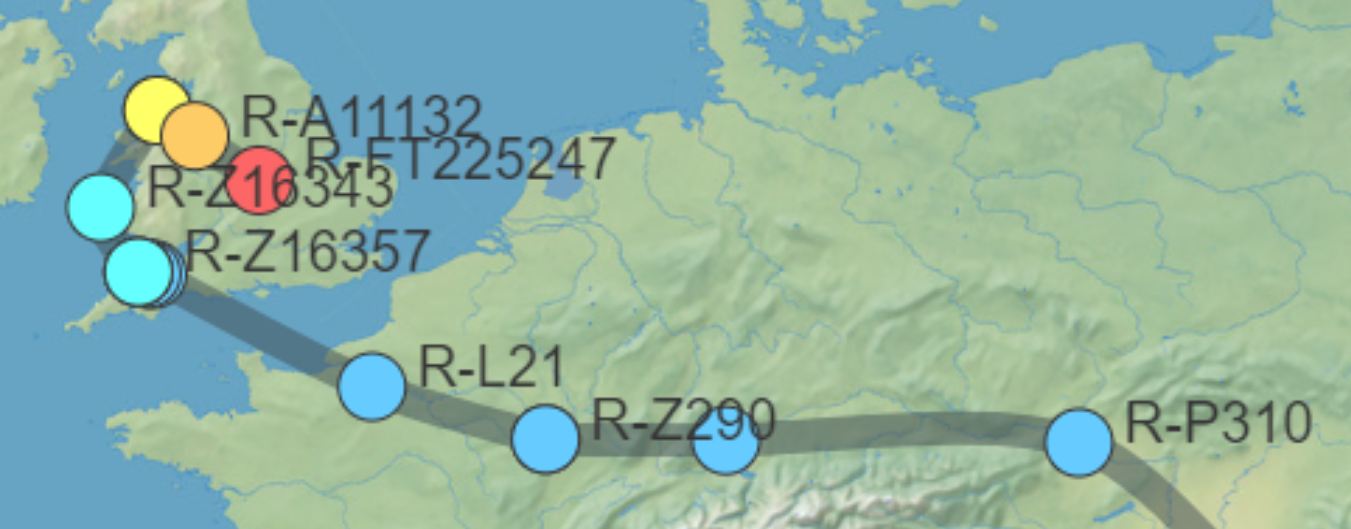
I cut off the scale on the bottom. The purple color goes back to the Paleolithic Age. Here is a more close-up view:

I expect that the FT225247 red dot would be more accurately further North in Lancashire. Here is some more information from SNP Tracker:

The little skull indicates that there is some verification from an archeolgical site. The blue cross to the right of R-A11138 is for Scotland. This match is with a Smith and goes back before the time of surnames. A11132 is dated at 850 CE. This should also be before surnames. That means that, unless all the other surnames died out, there could be other surnames associated with A11132. So far only Hartleys have been tested and have been found to have this SNP. FT225247 is intersting because SNP tracker gives a date of 1500 CE for this SNP. I don’t totally understand this date because the number before that is 440 years before present. As it is now close to 2022, that should be 1582. I don’t understand the difference of 82 years. One thought is that if both my brother and I have this SNP, then my father must have had it also and he was born in 1918.

The YDNA Block Tree

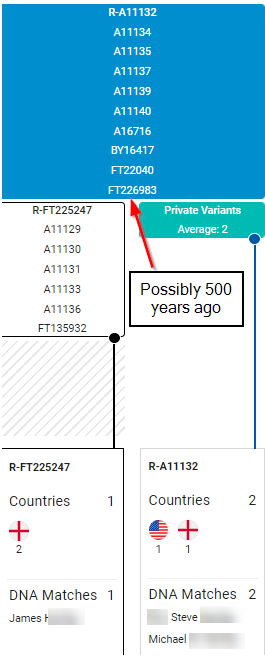
My Block Tree shows those who have taken the BigY test:

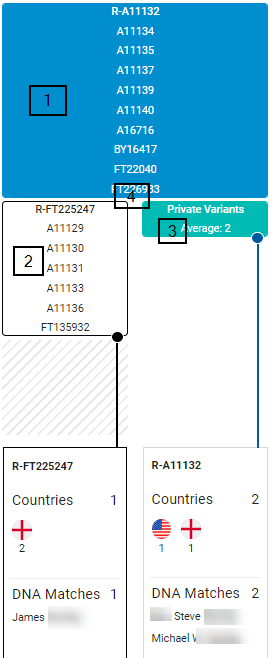
The specific area that I am interested in is where the arrow is. Above that space, all A11132 Hartleys have those 10 SNPs in common. Below that space, Jim and I have 7 SNPs in common. The 10 SNP block is represented by A11132 and the 7 SNP block is represented by FT225247. That means that the specific SNP FT225247 (my Hartley Line) may be as old as 1500 (assuming SNP Tracker is right) or as recent as 1918 when my father was born.

Likewise, the specific SNP A11132 may be as old as 850 CE (using the SNP Tracker number) or as recent as one generation before FT225247 or say, 1465.

The Iain McDonald SNP/STR Method

A specialist in the field of YDNA came up with this chart for TMRCA or time to most recent common ancestor:

The SNPs are in the vertical column and the STRs are in the horizontal row.

My Brother Jim and Me

Between my brother and myself, for example, there are no SNP differences, but there is one STR difference. That puts the time to most recent ancestor (our father) at 5-141 years ago. One of the instructions says:

- To convert these to date of your MRCA's birth, subtract these numbers from your averaged birth dates. If this is not
  known, a good approximation is 1956 AD/CE. Hence, a genetic distance of 2/111 with 3 mis-matching SNPS should be read as
  48-313 years. This becomes 1643-1908 AD at 95% confidence.

I was born in 1956 and my brother was born 1949, so say 1953. That means the ranges are between 1812 and 1948. As I mentioned above, my father was born in 1918. I was a bit surprised to have a STR difference with my brother.

Steve and Me

I think that Steve is a bit younger than me, so I’ll say our average birth age is 1960. Another instruction for the chart says:


- SNPs should be counted consistently with coverage of the test. There is no one-to-one correspondence possible here for
  any company without going heavily into the raw data. For Family Tree DNA customers, the number of SNPs that is
  appropriate will normally be somewhere between the number of non-matching variants and the sum of both sets of private
  variants.

You may have to scroll to see all the instructions. It says the number is between the non-mathcing variants and the sum of both sets of private variants.

This shows that I have 15 non-matching variants with Steve. Interestingly, I have one with my brother Jim.

By sum of Private Variants, I’ll add my SNPs (7) to Steve’s Private Variants and get 12. That means that between the two is 13 or 14. As far as STRs go, Steve and I are 7 steps apart. If I am interpreting the instructions correctly, I get this:

I suppose that I could average these numbers and come up with 308-837. That is quite a spread. That means that our common ancestor lived between 1123 and 1652.

Steve and Jim

I’ll check to see if there are any differences. Jim also has 15 non-matching variants compared to Steve. However, Jim and Steve differ by 6 steps on their STRs. That makes them a little more closely related by DNA (though in reality, there should be no difference). In the chart above, that shifts the numbers overto the left by one column. So 280-812 years from 1960 or 1148-1680.

Counting Block Tree SNPs

Tiger Walsh says on the same Facebook site where he introduces the above chart:

The problem with this is that my Block Tree shows 7 mutations in my line and only 2 average mutations between Steve and Michael. I believe that part of that problem is that Michael had the BigY 500 test and missed some of his variants. My best guess is that there should be about 5 variants between us. If I take 5 variants at 83 years each, that comes out to 415 years. That compares well to the SNP Tracker number of 440 years ago.

If I apply the 83 years to the top part of the block tree, that is an additional 830 years.

This is what I end up with. However, I don’t know what to use for a starting date. I’ll use 1960. That gets the common ancestor between me and Steve at 1545. That puts the top of the chart another 830 years back or at the year 715. Compare this to the SNP Tracker which had:

Mushing all that information together I get:

That would put the horizontal space inbetween the upper block and two lower blocks at about 1500. Based on the incomplete testing to date, that is probably the best date that I can come tofor the common ancestor of the existing three groups of Hartleys. Fortunately, all this information will be updated once we get the results of the two new BigY A11132 Hartley tests. The top block predates the use of the Hartley name and represents the time when the Hartley surname developed.

Dating the Roger Hartley Line

Once Lawrence’s BigY results are in we will have some genealogical correlation with the BigY:

The branch that Lawrence forms with Michael should date to their common ancestor Edward Hartley born in 1666.

Summary and Conclusions

  • The existing BigY Tree of A11132 Hartleys had 3 branches. The new tree will have four testers plus an upgraded branch for Roger Hartley whose genealogy of all the Hartley branches goes back the furtherst (to 1628)
  • I reviewed the SNP Tracker dating of the A11132 and FT225247 Hartley Branches
  • I looked at a new Iain McDonald method of dating TMRCAs by using SNPs and STRs
  • I looked at using existing SNPs and Variants at the rate of 83 years per SNP for comparing the existing Harltey BigY 700 tests. This method compared well with the SNP tracker dates
  • I came up with dates on the Block tree for the different Hartley SNP blocks
  • I noted the Hartley common ancestor date of 1666 for new BigY 700 tester Lawrence and existing BigY 500 tester Michael
  • The A111132 Hartley YDNA Tree should be in much better shape when the two new Hartley BigY tests are completed


Another Detailed Look at R-A11132 Hartley YDNA

This Blog is a follow-up on my previous Blog. That Blog was about a new A11132 Hartley BigY tester. It was also about his genealogy and the genealogy of the other three existing A11132 Hartley BigY tester groups. I had this simple graphic for the existing situation of A11132 Hartleys:

The new tester was not included in this graphic as his test will take six to ten weeks to finalize according to FTDNA.

Finding Answers As To Why the Roger Hartley Branch Has No Private Variants

That is one of the questions that I am  trying to answer. Here is my Block Tree:

I have 7 SNPs. Steve has 5 Private Variants and Michael has no Private Variants. I would like to know why in around 500 years, Michael shows no Private Variants.

Test Coverage

My understanding is that Michael took the BigY 500 test. That seems to be true based on this comparison:

Michael has about half as many Named Variants compared to Steve, Joel and Jim. That seems to confirm that he had the earlier BigY 500 test. There are 10 Named Variants per page.

Comparing Private Variants

First, one of my assumptions seems to be wrong. Michael shows two Private Variants:

This does not make sense as Steve has 5 private Variants. The average of 7 Private Variants should be three of four, not two. I asked about this in the FTDNA – BigY Facebook page and got this answer:

My takeaway is that all the Private Variants are used in the individual lists. However, when they average the Private Variants, they only use the best variants to be consistant with the variants used for calling SNPs.

I have started a Private Variant comparison Chart:

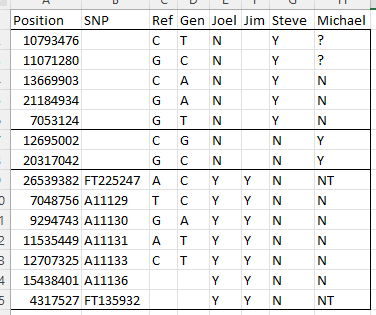
In the chart above, Steve has five Private Variants and Michael has two. I checked Steve’s first PV against Michael and Michael’s results were inconclusive. That means that Micjael and Steve may share a SNP in that location.

My brother and I have no Private Variants, but we have SNPs during the time Steve and Michael were having Private Variants:

Hopefully, these SNPs have been checked out, but I will put them in to see for myself.

Comparing Steve’s 5 PVs with Michael;s Results

For Steve’s first two PVs, Michael had a ? in his results. I am not looking at the detailed results, just a summary table. However, that tells me that there is a possibility that Steve and Michael could share results which would mean that they would share a SNP and a new Hartley Branch.

Comparing Steve and Michael’s PVs with My Results

These results were unambiguous:

I clearly had none of the PVs that Steve and Michael Show.

Comparing Michael’s Two PVs with Steve’s Results

In this case also, the results leave no doubt:

It is also possible that one position may be covered in on test and not in the other. However, that has not happened so far, the A11132 Hartleys.

Comparing My Hartley Branch SNPs with Steve and Michael

I’m curious.

The results with Steve are clear:

My Hartleys and Michael

Here are the results for my first Hartley Branch SNP:

Here is my Chart:

I didn’t check my brother’s results as they would likely be the same as mine. I gave Michael an NT twice in the last column for ‘not tested’. I assume that ‘no reads found’ means that FTDNA didn’t cover that position.

By each tester:

  • Steve’s Line has had five Private Variants found since the common ancestor of these three lines. However, two are possibly not private as when Michael’s BigY tested two of those positions, the results were inconclusive
  • Michael – His test only found two private variants since probably around the year 1500. He should have more, so his test probably missed some. The two PVs that he did have were valid as they were negative in the other two testers
  • Joel (and Jim) – They show 7 SNPs since the A11132 common ancestor of the three groups of Hartleys. However, two of those SNPs were not covered by Michael’s BigY test

My initial conclusions are the Michael is the wild card as far as the YDNA testing goes. There are two variants where Michael could forn a branch with Steve and two where he could form a branch with my line. That doesn’t mean that he would form a branch with either, but he couldn’t form a branch with both. That is because Steve and my branch would have to match each other and we don’t. If Michael matched me on the two SNPs marked as NT, that would reduce my Hartleys’ PV from 7 to 5 and match what Steve has. That is to say that if Michael matches either Steve or my Hartley Branch, then it would seem more likely that he would match my branch.

It appears that more testing is needed on the Roger Hartley Line:

I checked with two people on the Roger Hartley Line and one got back to me and said he would look into the test, so that is good news. If the new tester adds his results to John’s then we should get an interesting Hartley tree that will extend back to before what we are to figure out from the Hartley genealogy. The YDNA should fill in some of the blanks that we have in the Hartley genealogy.

Summary and Conclusions

  • Michael’s genealogy is most important for an understanding of how the different A11132 Hartley branches fit together
  • However, Michael took the BigY 500 test unlike the other A11132 Hartleys who took the newer BigY 700 test. Because of this Michael has some ambiguity in four of his important variants. These variants have the potential to have an effect on the two other Harltey Lines (Joel’s and Steve’s).
  • Michael had ambiguous results for two out of the five Private Variants that he shares with Steve
  • Joel and Jim are brothers who both tested with the BigY. Their testing resulted in the naming of alll their 7 shared variants.  Michael clearly did not have 5 of those shared SNPs. However, for another two, Michael did not have any reads. That means that we don’t know if he shares those SNPs with Joel and Jim’s new Hartley Branch or not.
  • If the Roger Hartley descendant that I have contacted takes the BigY 700 test, he should clarify Michael’s 4 ambiguous Variants. These 4 ambiguous variants have an effect on my line and Steve’s line
  • I am looking forward to new A11132 Hartley BigY 700 results.

A New Hartley BigY Tester

I recenly saw an interesting post from Tiger Walsh. Tiger is an expert in the YDNA line that my Hartleys are on and posted two interesting images at the R1b-L21 Facebook site. Here is the first:

This image is meant to show that BigY testing is no longer just for pre-surname branches of mankind and that it is useful for genealogy. Here is the second image:

It took me a while to find the larger list of surnames. I was disappointed to see that the Hartley name was not on the list. The reason is stated in the middle of the image above. The Hartleys need three subclades and we only have two. Here is my BigY block tree at FTDNA:

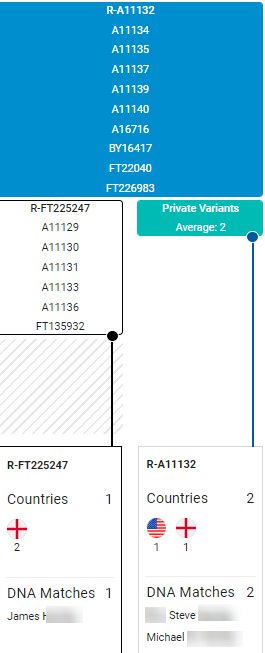
This view is taken from my perspective. James is my brother, so the R-FT225247 brach has as many SNPs as we are likely to find right now. Steve and Michael are R-A11132. They only show an average of 2 Private Variants below the line of the common ancestor of the four testers. This could be partially because Michael took the older BigY 500 test which did not cover as many SNP as the new test. That seems to be the case, as when I look in my old emails, I have that Steve has 5 Private Variants. That must mean that Michael has zero and that they averaged the 5 Variants down to 2 between Steve and Michael.

John the New BigY Tester

After seeing the Surname Hall of Fame, I decided to get over my aversion of asking people things and ask John if he would take a BigY test. John is a good candidate for at least three reasons:

  1. John has already taken the 67 STR test (where he matches me at a GD of 4), so he can upgrade to the BigY test for less money.
  2. John is from England, unlike the other four testers who are from the US
  3. because there are two testers under R-FT225247 and two under A11132, John should break one of these ties and create at least one new Hartley descendant subclades (using the Hall of Fame terminology above).

Lots of Hartleys in the World

I’m looking forward to John’s results. His ordering the BigY test is big news among the A11132 Hartleys. According to forebears.io there are over 87,000 Hartleys worldwide:

I don’t know how many Hartleys are represented by A11132. I see that the Hartley YDNA Project webiste shows 9 branches of Hartleys, so it is possible that there are 10,000 A11132 Hartleys. My bias is that A11132 is one of the larger Hartley groups, so 10,000 A111132 Hartleys could be on the low side. On the Hartley Family Tree Genealogy Facebook Page, Administrator Wiliam Hartley says that the two main Hartley groups are A11132 and A21269.

Breaking the Tie

There are four possiblel outcomes that I would expect from John’s BigY testing:

First, I should say something about the position of #4. It is controlled by the genealogy of Michael at this time. He has the oldest known genealogy. His ancestor Edward Hartley was born in 1666. He came to the US around 1700 or before. That means that Edward cannot be the common ancestor between me and Michael. That is because my Hartley ancestor was in England up until about 1869. The earliest common ancestor that I should have with Michael (assuming Edward left no children in England) would be with Edward’s father Roger John Hartley:

He was born in 1628. Therefore, I would put the number four in the block tree at 1628 at the latest.

The Four Choices on the Block Tree

  1. If John tests and ends up in this area, it means that his connection to the other BigY tested Hartleys is really old. By really old, I would say some time around the 1400’s
  2. If John tests in this area that means that he is more closely related to my Hartley line than to Steve and Michael.
  3. If John tests in this area, then he is more closely related to Steve and/or Michael than to me.
  4. If John’s BigY test puts him here, it could mean that there are three equal lines that descend from a common or near common Hartley ancestor

We will know more when John’s results come in.

Hartley BigY Geneaology and Triangulation

My own genealogy is the simplest as it doesn’t go back very far. I’ll start with my great-grandfather:

James Hartley, Greenwood Hartley and Mary Pilling all came to the US from Lancashire, England. I am certain of Robert Hartley born about 1803. However, I am not so sure about James Hartley. Someone added another ancestor of John Hartley and Anne Bracewell. I seem to get a lot of DNA matches with people who have Bracewell ancestors, but that may be coincidence.

The triangulating part comes in with the YDNA testing and with locations. The location of my Hartley ancestor was Trawden, Lancashire.

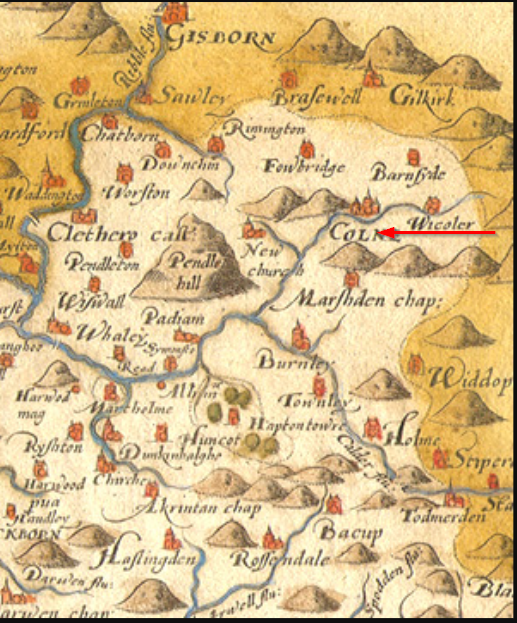
Trawden would be about where I have the red arrow in the 1577 map above. Trawden was part of the Parish of Colne.

Steve’s Genealogy

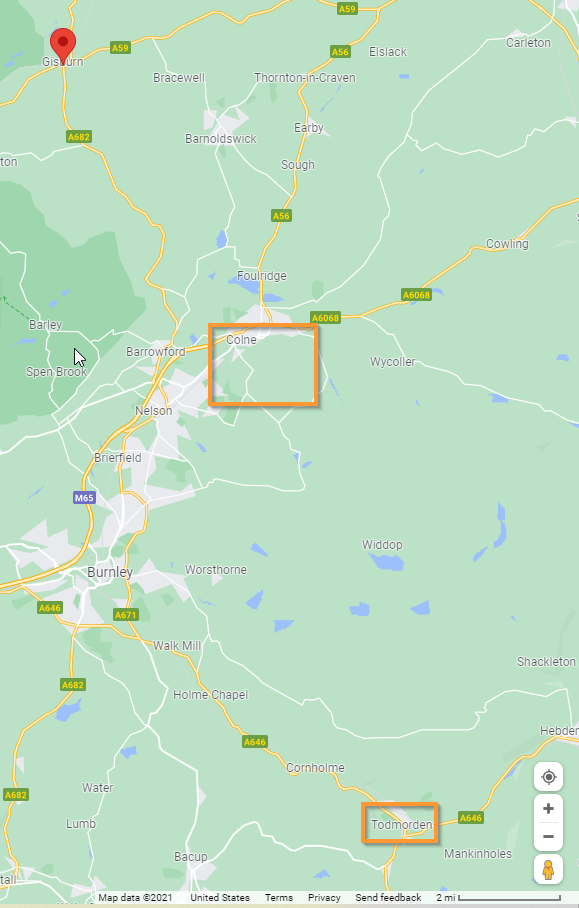
I’ll look at Steve next in order of most recent to most distant Hartley ancestor. I’ll start with Steve’s great-grandfather who was born in Todmorden, England> Todmorden appears in the lower right hand part of othe old map above.

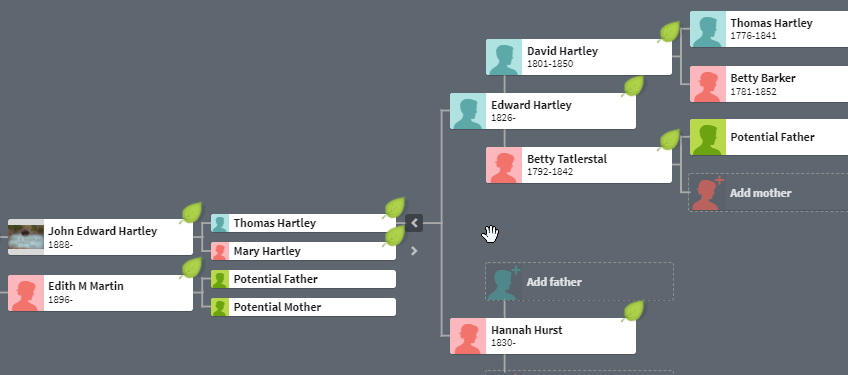
If Steve and I have the genealogy right, then Thomas Hartley was also born in Todmorden:

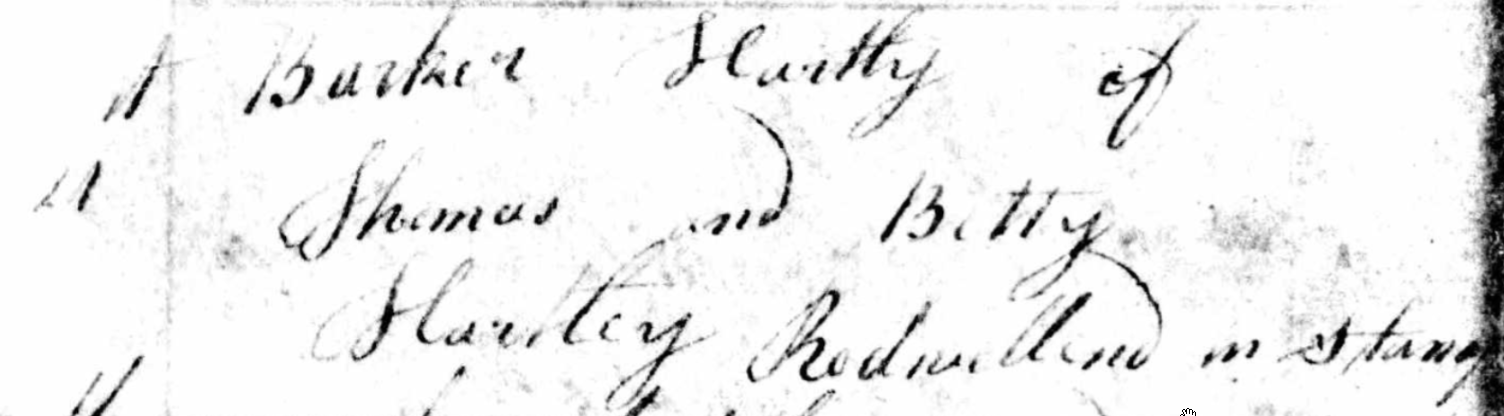
Steve and I have that Thomas’ wife was Betty Barker. This couple lived in this place at the time of the birth of their son Barker in 1805:

It looks something like Rodmillend in Stang. I’m not sure where this is. This is probably Thomas in 1841:

However, Birtall is about 16 miles from where he was supposed to have died in the Todmorden area:

Steve has this burial record from Christ Church in Todmorden:

Steve has John and Ann as the parents of Thomas. That information is from this record:

That record is from 17 Mar 1766 from St. Chad in Rochdale. We further see that John was a weaver and that they were of Weurdle. If I have the right place, it seems possible:

This does not seem very far from the area of Todmorden. I”m not sure if I’m ready to accept these parents for Thomas. I don’t see any of Thomas’ children having the names of John or Ann and it would have been normal practice to name your children after your parents.

In summary, here is where my ancestors lived around 1800 and where Steve’s ancestor’s lived around 1766 as far as we can tell:

John’s Genealogy

John is in the process of having his YDNA tested with the BigY 700 test. Based on that, we may be able to find out more about our Hartley shared genealogy.

This is the tree I have built for John. John tells me he is confident of the tree up to William Hartley who was born in 1745. Ancestry want me to pick William’s parents.

William Hartley Born 1745

I have William Hartley as being from Tadcaster in North Yorkshire:

Here is the hint that Ancestry wants me to take for the father of William Hartley:

Gisburn fits in with my assumption that our earliest Hartley ancestors were from the Colne area:

However, I cannot accept the hint based on a location that I like. One of the best documented trees at Ancestry shows Thomas Hartley marrying Grace Lee in 1741:

Here is Healaugh near Tadcaster:

That same tree has that Thomas Hartley was born in Healaugh (but without reference) and has this Thomas Hartley will from October 1766:

I’m not seeing right now that Thomas was necessarily born in Gisburn. I wonder who arrived at that conclusion and why?

Michael’s Genealogy

Of the four Hartley families I am looking at, Michael has the oldest genealogy. Michael’s ancestor Edward or Samuel Edward Hartley emigrated at an early date to Pennsylvania. One account from the Geni website has this:

Edward and his brother Henry emigrated to Pennsylvania sometime between 1693 when Edward married in Yorkshire, or perhaps after the birth of a first child in England, and 1700 when he purchased land in Solebury. John M. Freund wrote that Edward was “said to have come to Solebury from Maryland” but neither of us have any documentation for this. Edward was apparently not a Friend at the time, although two of his sons later joined, and his mother was a Vipont, a family that became well-known in British Quaker circles. One source claims, without any primary source justification, that Edward was a Friends’ minister.

Roger Hartley from Trawden or Marsden?

The connection from Roger Hartley to Edward Hartley is based on history more than records. Although Edward Hartley did not appear to be active in the Quaker movement in Pennsylvania, he does appear to be one of the early Quakers in this record:

Geoge Fox who began the Quaker faith had a vision on Pendle Hill in 1652, so this was only 11 years after Fox’s vision. This record is from the Monthly Meeting of Marsden:

Here Roger at the time of his death was said to be of the Forest of Trawden. That is interesting as the Quaker Meeting was at Marsden. If Roger was from Marsden, I think that would have been recorded at the time of his death. From what I understand, Marsden is not included within Trawden. Trawden may just refer to the area of Trawden or it may include Winewall and Wycoller, but I don’t believe that it includes Marsden.

I found three trees for Roger Hartley at Ancestry. They all show a birth date of 1628. I am not sure why that Roger was chosen as there are many other Roger Hartleys in the area at the time:

I also don’t know where Chamber is.

Summary of the Genealogy and Geography

Obviously, in order to have a common ancestor of the Hartley Line, the genealogies have to come together in one person and in one place. We have:

  1. From Michael’s Line – Roger Hartley 1628-1715 – Marsden or Trawden
  2. from John’s Line William Hartley born 1745 – Healaugh near Tadcaster, Yorkshire
  3. from Steve’s Line  – Thomas Hartley born 1774 – Todmorden
  4. from my line – Robert Hartley born 1806 – Hollin Hall, Trawden

This shows that Michael has by far the best Hartley genealogy as he goes back to over 100 years before and of the other Hartley genealogies.

Next I gave Roger Hartley a score of 4 as his is the oldest genealogy and Robert a score of one. I added these two together as they are pretty much from the same area. I gave William Hartley a 3 and Thomas Hartley a 2:

Obviously Trawden/Marsden gets the highest score. John’s genealogy (of the BigY testers) is the outlier at this point.

Back to the YDNA

Here is another way to show the Block Tree:

I wasn’t consistent in my chart above. For it to be consistent, I should have had Robert Hartley 1803 in the first box. However, it is accurate as Robert Hartley may not have had this SNP. It may have formed after his time. Earlier in the Blog, I mentioned 4 different possible outcomes for John’s BigY testing. Option 4 would be the easiest to represent. In that scenario, John’s ancestor would be another equal branch coming down from A11132. I would be a little surprised if that happened. That would mean that there could be four 500 year old branches of Hartleys with no common ancestors more recent than 500 years ago.

The question is, what is the date of the line between all the testers and A11132 based on the BigY testing? I’m thinking of a rough number of about 500 years ago:

It seems like I come up with a different number each time I do this. The outlier is Michael’s test. I believe that Michael has no Private Variants.  I feel like his BigY 500 test may not have covered some of the SNPs or variants that the other BigY 700 tests covered. Assuming 500 years is correct, it would be unusual for Michael to have no Private Variants in that time. For BigY500 testers, 144 years has been used for the formation of a Private Variant or SNP. That means that Michael should have had 3 or 4 Private Variants during that time.

I just looked at the BigY 700 testers. Jim and I had 7 SNPs. I believe Steve had 5 Private Variants. That averages to 6 Private Variants or SNPs. A number of 83 years per BigY 700 SNP has been used. 83 X 6 = 498 or about 500 years. The YDNA is suggesting that the three lines shown in my simplified view have not had a common ancestor in less or more than 500 years or since the year 1500. While that seems like a long time ago, the interesting thing is, if that number holds up, is how many Hartley Lines have remained intact for that period of time and longer. Interesting.

Summary and Conclusions

  • I took a skeptical look at the genealogy of three current branches of A11132 Hartley BigY testers. I am not an expert on these lines, but I did the best I could with the time that I had.
  • The oldest genealogy is for Michael who I believe took the BigY 500 test. His ancestors were early Quakers who emmigrated to Pennsylvania around the year 1700 or before.
  • The date for the common ancestor of the three Hartley families by genealogy cannot any more recent than 1628. The place of that Hartley ancestor was likely in Trawden. Many genealogies have Roger Hartley from Marsden. I found one record showing that he was in the “Forest of Trawden” at the time of his death. These two places are close but different.
  • The date for the common ancestor by YDNA could go back to 1500
  • John is a new BigY tester who is awaiting his BigY 700 results. These results will further clarify relationships between the three existing Harltey BigY branches. In addition, they will put John’s genealogy into context of those three Hartley branches
  • John’s genealogy could use further clarification. One suggestion is that his genealogy goes back to Gisburn which would be closer to Trawden, Lancashire where my genealogy and Michael’s genealogy starts. However, another suggestion is that one generation back from where John has researched could be in the same area which is Healaugh to the North of Tadcaster, Yorkshire.
  • I estimated that there could be about 10,000 A11132 Hartleys in the World today.
  • I will be eagerly awaiting John’s BigY 700 results.


My Sister Heidi’s AutoSegments

In my previous Blog, I looked at my own autosegments. I had 6 maternal and 20 paternal segments. I’ll look at my sister Heidi’s AutoSegments and try to unlock her clusters

My Sister Heidi’s AutoSegments

My sister received a different combination of DNA from our parents than I did. Here are her autosegment clusters:

Heidi has 33 clusters or 7 more than me given the same input parameters. This is a sort of a fingerprint of her Gedmatch DNA matches.

By comparison, here are mine:

Heidi and I have a similar profile on our Chromosome 20 where our large clusters are. Heidi’s large red Frazer Cluster corresponds with my large purple Frazer Cluster.

Heidi’s Clusters One by One

I filled in a spreadsheet for my clusters. I can do the same for Heidi. Cluster 1 is easy as it goes back to Richard Frazer who was born around 1777:

Here is how that looks in my spreadsheet:

Cluster 2

Cluster 2 is interesting as there are known and unknown people in this Cluster:

I know all the matches and how we connect except for Brian and Elizabeth.  This cluster also goes back to Richard Frazer from around 1777. It is possible that one cluster is for Richard and one for his unidentified wife.

Large Cluster 3

There is one fairly close cousin in this cluster (Emily) and many unidentified DNA matches. Emily matches on my Frazer/McMaster side.  The connection between Cluster 2 and three is with Emily:

Emily matches with the last three in Cluster 2:

However, as Jane is not in this Cluster and her connection would be on the Violet Frazer side (Violet is the daughter of Richard Frazer), this Cluster may be on the James Frazer side who goes back to Philip Frazer.

Cluster 4

The connection between this cluster and the previous Cluster 3 is through Marguerite. Unfortunately, I wasn’t able to figure out the trees of anyone in Cluster 4. Cluster 4 has matches on Chromosome 5:

These matches are near where I put the red lines:

Heidi and my brother Jim map to Frazer in this area of Chromosome 5.

Clusters 5-11

I recognize Joshua in Cluster 5:

Joshua is connected by either Lentz or Nicholson. I found the other two matches from this cluster at Ancestry, but I didn’t see any obvious connection by genealogy.

Cluster 6 and a Confusing Connection

Here Joshua in Cluster 5 matches three people I’m related to on my paternal Hartley side in Cluster 6:

These three are Hartley/Gifford matches. I suppose that Joshua may be related on the Gifford side where I am not related.

Cluster 7

This is the gray cluster above. My cousin Pat is there. We are related through Hartley, Snell and more distantly on our Bradford sides.

Cluster 8

Cluster 8 in green is interesting because of the connections. Heather has a connection to Cluster 10 where Lee is. Lee is interesting because he is from England and has Hartley ancestors from the same area of Lancashire as my Hartley ancestors.

Cluster 9 and Beth

Interestingly, Beth was on my large Hartley Cluster, but with Heidi, she is in a cluster of only three.

These connections are on Chromosome 17.

Cluster 10 and Lee

These matches are on Chromosome 13. I’m not sure why they are broken into two sections. Geoff shows up twice and tested at FTDNA. He doesn’t have a tree there. Sandra is a new match at Gedmatch and has a UK email address. She also has a GED at Gedmatch. Interestingly, Sandra has two ancestors from Hartley:

It may be possible to compare Lee and Sandra’s trees to see if there are any similarities. I tried doing that and didn’t notice any obvious similarities. However, I did notice that Lee had a Baldwin in his line and my guess for one of my ancestors was Betty Baldwin:

Cluster 11

There were only two in this Cluster. Sandra from Cluster 10 matches both these people. That makes this an English Hartley ancestor cluster.

More of Heidi’s Clusters

Heidi’s Cluster 12 is on Chromosome 22. I don’t have anything mapped for Heidi on Chromosome 22. There are only two in this Cluster making it difficult to map. I have Heidi phased and one of the matches is on her paternal side. From there I go to my visual phasing map. But first, here is part of the AutoSegment results:

LL matches between 36 and 46M.

36M is about hwere I put the arrow on the chart above. That maps to Hartley.

Cluster 13 – Frazer

I can tell by the match names that this is a Frazer match on Chromosome 2:

Heidi’s matches end at 221 which is around where I put the red arrow and in Heidi’s Frazer area. In this Cluster. There are two matches that I know and one that I don’t named Fay. Fay tested at 23andMe where Heidi didn’t test.

The AutoSegment connection is on Chromosome 2. However, Faye also matches Heidi on the X Chromosome also called Chromosome 23.

The X Chromosome connection likely follows this specific path:

This is my paternal grandmother’s line. Heidi as a female, got an X Chromosome from her father. That was the same X Chromosome that he got from his mother Marion Frazer. Likewise, Marion got her X Chromosme passed down from Margaret McMaster via her father. Margaret got an X Chromosome passed down intact from Margaret Frazer via her father James McMaster. From Margaret, the DNA could have come from either Michael Frazer or Margaret Stewart.

Fay’s third largest match is from Beverly who I have as descending from Michael Frazer and Margaret Stewart:

I have written to Fay and I hope that I hear back.

Cluster 14 and 15

This Cluster is at the beginning of Chromosome 2:

I’ll look at Heidi’s paternally phased DNA to see if that is where the matches are. I found Charlie and Jonathan there, so I’ll say these are paternal matches.  Heidi’s matches are between 9 and 29M on Chromosome 2:

That is roughly in this area of Heidi’s paternal Chromosome 2. Heidi has the most orange Hartley DNA of these 6 siblings in that area with Jim coming in second. I couldn’t tell anything else out about this Cluster.

Cluster 15 is on Chromosome 6:

This is also a Hartley Cluster:

I’m about halfway done and only have one maternal cluster:

Cluster 16

Bonnie is found on Heidi’s maternally phased match list at Gedmatch. That turns out to be on Heidi’s Lentz side:

I couldn’t figure out the link between these two matches and Ancestry.


Cluster 17

I’m about half way through. Cluster 17 only has two people at the beginning of Chromosome 20:

Margaret is on Heidi’s paternal side. That is on Heidi’s Frazer side:

I checked Ancestry and one tree that apparently corresponds to H E T has a Spratt and Armstrong in her tree and Irish connections. Spratt is my line I know least about.

Cluster 18 on Chromosome 7

This is a maternal match.

I haven’t been able to get Kathy’s genealogy, but the connection with Nigel goes way back on the Nicholson Line.


I haven’t gotten to any of Heidi’s Rathfelder ancestors yet but we still have many clusters to go.

Revealing Cluster 19

There are 6 people in this Cluster. One match is on her paternal side, so I’ll go with that:

When I scroll over Chromosome 12 at AutoSegment, I see the range where the match is: between 10 and 25M.

I was expecting this to be on Heidi’s Hartley side, but it is on her Frazer side. The James above may be a famous DNA Blogger.

Cluster 20 and 21 on the Rathfelder Side

Inese and Donna are my second cousins. I know how I am related to Otis but not how I am related to Daniel.

Here is Cluster 20 and 21:

Otis in Cluster 20 matches two of my 2nd cousins in Cluster 21. All the matches in Cluster 21 are known except for one who tested at 23andMe.

Cluster 22 – Back to Paternal

That puts these two triangualted matches on Heidi’s Frazer side:

I wouldn’t have these two matches as I inherited Hartley DNA in that region of my paterrnal Chromosome 1.

Clusters 23 and 24

These go back to my Nicholson and Ellis ancestors:

Cluster 25

These matches are on Heidi’s side – at least Gloria is and I assume the others are also. The matches are from about 56 to 81M. When I mapped Heidi a long time ago, she came out as Frazer in that area:

Cluster 26

There are two in this Cluster. The match on Heidi’s paternal side on Chromosome 2:

That is in Heidi’s blue Frazer portion of her Paternal Chromosome 2:

Other than that, I don’t know a whole lot about these matches.

A Recognizable Cluster 27

Steve is related to me on my Clarke/Spratt side and more distantly on my McMaster side:

Cluster 28

Cluster 28 is on the larger side:

Catherine is in the light green group. She is on Ancestry and has a Tighe ancestor from Sligo:

Catherine matches on Heidi’s Frazer side as expected:

My guess is that Catherine is related somewhere along my Clarke/Spratt ancestors as that family lived in County Sligo.

Cluster 29

Cluster 29 is also a paternal one for Heidi:

Cluster 30 on the Rathfelder Side

Astrid is in Cluster 30. Here is how she is related:

This gets Heidi up to 8 maternal clusters out of 30:

Unlocking Cluster 31

That is a fancy way of saying identifying Cluster 31. There are only two matches there:

The second match, Brad, is at Ancestry and matches my Mom. These matches land on Heidi’s Lentz side on the maternal copy of her Chromsome 2:

Cluster 32 – Back to Paternal

Jacqueline is at Ancestry and has an ancestor named James Savage from Ireland:

Here we have two separate triangulations, but David, Jacqueline and Ron are in both on Chromosome 19:

I’m not sure about this Cluster, but my guess goes back to my unknown Clarke and Spratt ancestors from County Sligo. Having said that, I see that David, who tested at FTDNA, has a match in cousin with my Frazer 2nd cousin Paul who is not known to be related on the Clarke/Spratt side.

Heidi’s Laster Cluster: 33

This last group of trianulated matches is on Chromosome 20.

I don’t see Ann on Heidi’s paternal match list at Gedmatch, so that leaves the maternal side:

All Heidi’s Segments

Here is the summary:

Summary and Conclusions

  • Less that 1/3 of Heidi’s clusters were on her maternal side
  • Heidi had only three maternal Rathfelder Clusters out of a total of 33 clusters, but they were all well defined
  • Clarke/Spratt continue to be a mystery
  • I continue to have few matches on the Lentz side
  • Likewise, I have few matches on my Hartley side which is from Lancashire England as opposed to the Snell side which is Colonial Massachusetts



My AutoSegment Report

There is a new report on Gedmatch called AutoSegment. From my understanding it clumps together triangulated matches into clusters. If I were creating this report, I might have called it AutoTriangulator or something similar. I figured it was worthwhile putting down $10 to get one month’s worth of Tier 1 Subscription at Gedmatch

Running My AutoSegment Report

I ran it and was not sure if I was supposed to get an email back with the results. The first time I didn’t get any results, so I ran the report again and got results on the same page where I ran the report. I was asked to download files, so I did. My downloaded file looked like this:

I opened up the file and got this:


The first html file is the one to open:

That gave me 26 clusters of triangulated matches. I am quite sure that the purple cluster is my Chromosome 20 matches. That chromsosome is out of control for some reason. I have written about this before in 2016.

Chromosome 20

There is a more detailed report below:

The purple Cluster is # 24. This Cluster involves three chromosomes. Chromosome 20 has a part to play in four clusters. That makes sense as Chromosome 20 has a paternal component and maternal component.

Identifying My Triangulated Clusters

I recognize the first two matches in Cluster 1. They are two of my Hartley second cousins: Beth and Mike. That relationship goes back to my Hartley/Snell great grandparents. It looks possible that those connections could carry down through Cluster 11.

The other matches are:

  • Charles – He shows up twice and tested at 23andMe
  • Lori and Phyllis – These two are at Ancestry and are administered by the same person.
  • Edith – Administered by the same person who administers Lori and Phyllis but Edith tested at FTDNA.

Lori has the best tree at Ancestry, but I don’t see any obvious connctions. It is possible that building out her tree would give some clues as to the connection.

Pat in Cluster 4

Pat is related to me in two ways. One is as a second cousin in my Hartley/Snell side. The other is Bradford/Hathaway as 4th cousins:

So from Pat’s point of view, she is related to me as a 2nd cousin on her mother’s side and 4th cousin on her father’s side.

A Cluster Spreadsheet

Here I put some of the information into a spreadsheet:

The matches are 2nd cousins except for Jim. These matches go back to Hartley. This family was from England. Or they go back to Snell who were Colonial Massachusetts. Cluster 5 is interesting as at least one match (Matt) is recently from England.

An Out of Place Cluster 8

Cluster 8 is between my paternal clusters but I believe that it is a maternal cluster:

Joshua is the first person in the light green Cluster 8. He matches with Mike in Cluster 1 and his sister Tracy in Cluster 6. Here is where I have Joshua on my mother’s side:

That fact that Joshua matches Mike and Tracy was a bit misleading. The other person in Cluster 8 is Brittany. It is possible that if I built out her tree, I would get back to Nicholson or Lentz.

Lee in Cluster 11

I would like to connect to Lee in Cluster 11:

Lee has Hartley ancestors from the same part of England where my Hartleys are from. That does not necessarily mean that the connection is through those Hartleys, but may be through another set of ancestors. This appears to be the end of the Hartley Clusters for now:

Martin in Cluster 12

Martin is on my mother’s side. His ancestry is from Latvia, so that goes to my mother’s father who was also from Latvia. The connection is on Martin’s paternal side, but his genealogy stops with his father who was born in Latvia.

Cluster 17 – Rathfelder

Cluster 17 is easy as I can identify all Rathfelder relatives there:

Martin was in the green cluster above. I find it interesting that this group contains triangulation in the X Chromosome:

Clusters 18 an 19 – Nicholson

The light green and light blue clusters above are both Nicholson Clusters. I am not sure why they are separated:

Without getting into the specifics, my guess is as follows. Matches and triangulated matches go back to one of the two common ancestors. That means that for each segment where I match any of these people, the DNA we share is actually either from William Nicholson or Martha Ellis. Let’s say that my match with Carolyn favors the Nicholson side. That would mean that the other matches might favor the Ellis side. That would also mean that one cluster is a Nicholson Cluster and the other one an Ellis Cluster.

More on Cluster 19

Cluster 19 has Carolyn, Joan and Iain. Iain has contacted me and I told him the general direction of where the DNA was leading (to Nicholson in Sheffield). The other match tested at FTDNA and appears to be Joan. Joan has a tree at FTDNA. However, it is very basic. I can build this out to see if there is a connection. Joan’s roots are in Alabama mostly:

I make my trees at Ancestry, and here is how Joan’s tree is shaping up:

According to the 1910 Census, Tilden’s father was from North Carolina:

My attempt to make a connection by building out Joan’s tree failed:

This is not unusual. If the connection with Joan is at the fourt cousin level, then the connection would be out one level beyond what I have above. If it is at the 5th cousin or perhaps 4th once removed, it would be out two levels from what I show. The other problem is that the female line identifications become more scarce the further out you go.

Steve in Cluster 22

The next person I recognize is Steve:

Steve (or Stephen in my chart above) is important, because his primary connection with me is on the Clarke Line. I’m a bit stuck on this line beyond John Clarke. Unfortunately, Steve connects on my McMaster side also further back. Steve is a fifth cousin on that line. When I hover over Cluster 22, I see this:

It looks like Susan is the next largest match to Steve.

Finishing the Clusters with Known Names

I mentioned Cluster 24 as the large cluster. Cluster 25 is on my Frazer side also:

Susan, Doreen and Ken are in the orange square and G is Gladys in the yellow area. Our common ancestors are James Frazer and Violet Frazer. Gary is from an area near the Frazers and Shelly has not shared her ancestry to my knowledge. This is what I have so far:

I have 7 clusters on the paternal side and three on the maternal side. I have Lee who seems to be on my paternal side.

Checking by Phased Results

I have some phased kits that a genetic genealogist Martin made for me, so I can tell by the matches at least what grandparent side these clusters should be in.

Joshua’s Confusing Match on Cluster 8

My phased Hartley grandfather kit shows to match Joshua. However, the genealogy shows that he matches my mother’s mother’s side. Here is some more detailed AutoSegment information for Joshua in Cluster 8:

This indicates that the two triangulate with each other and me. Next, I’ll check my paternally and maternally phased kits. These were generated at Gedmatch based on my mother’s DNA test. Joshua matches me there on my maternal kit. When I recheck, it appears that Joshua does indeed match on my mother’s mother’s phased kit. So I don’t know what I was seeing before. I keep these mistakes and corrections in my Blogs to remind myself how easy it is to get off track with all the information out there.

Here is a continuation of my spreadsheet:

Here I have also color coded the grandparents. Haretly and Snell are blue, Frazer/Clarke is green. Lentz/Nicholson is orange and Rathfelder/Gangnus is yellow.

Clusters 14-16: Frazer Side

Cluster 14 seems to favor the McMaster side:

The first blue line in each case is Marshall and the second is Craig.

The key is with Keith. My common ancestor with him is with James and Fanny Mcmaster. My common ancestor with Susan and Katherine are Frazer/McMaster. However, their overlap with Keith seems to mean that the connection is on the McMaster side. Marshall and Craig have a match overlapping with Katherine but starting at 15M, a little later than Katherine’s which starts at 7M.

Margaret is in Cluster 16. She has some ancestors near Enniskillen:

This location comes up a lot. This may be on my Clarke side or from an unidentified Frazer wife’s family. She also has a Henderson and MacGregor in her tree:

Henerson was a second wife of Clarke (though not known to be related to me). McGregor comes up as a possible ancestor on my ThruLines at Ancestry:

From what I can tell, the MacGregor name comes from a George MacGregor Frazer who is in some people’s Ancestry Trees:

Filling in the Rest of My Spreadsheet

Here I have under the GP column, blue for Hartley, green for Frazer, yellow for Rathfelder and orange for Lentz. It looks like I only have four clusters to go.

Cluster 20

Cluster 20 is on Chromosome 4. Another way to check on these clusters is by DNAPainter or Visual Phasing.

The match seems to go through a maternal crossover, so my guess is that this match is on my paternal Frazer side. The last of the trhee matches in Cluster 20 is Gabrielle. She tested at Ancestry. At Ancestry, her match is reduced to 18 cM. She shows no shared DNA matches, probably due to the low match level.

From DNAPainter, these Cluster 20 matches are probably from my Clarke side:

This is a side with a brick wall.

Cluster 21

Cluster 21 is from Chromosome 22.

That area between the two arrows is not well mapped on my Chromosome 22. Orange Cluster 21 is medium sized:

Although the are of Chromosome 22 is not well identified, I can identify that the connection is through my Frazer grandmother.

Cluster 23

This Cluster has two triangulated matches at the beginning of Chormosome 18:

The matches are with Patricia and Carl.

I’m leaning toward Patricia and Carl being in the Clarke/Spratt section of my DNA. I have Patricia on my paternal side so that means I must be right.

Cluster 26

That leaves one last cluster.

The first three matches are from Ann and her close relatives. From my spreadsheet of matches, Ann is on my Lentz side:

That match is around the red arrows and would be more specifically on my Nicholson/Ellis side.

The Completed Key

Based on Visual Phasing, my match spreadsheet and DNAPainter, I was able to identify all my clusters at least back to one grandparent.

Summary and Conclusions

  • Out of the 26 clusters, 6 were maternal clusters.
  • Of the remaining 20 clusters, they were split fairly evenly between Hartley and Frazer
  • It seems like I could have differentiated my Hartley clusters more.
  • Every tool seems to give some new understanding to my DNA matches
  • It would be interesting to look at other of my 5 siblings’ AutoSegments to see how they differ from mine

An Updated Look at Hartley and Related Theories

In this Blog, I would like to update my Hartley Theories and beyond. I have about 10 DNA results that I have uploaded to MyHeritage. MyHeritage has Theories based on DNA matches that also have possible genealogical matches. Here is a chart I made and updated last August:

I highlighted 2 because of similar names that showed up. I also made a dstinction between paternal and maternal theories. I see that I did not include my cousin Paul’s results. This may be better sorted by common ancestors:

Looking for New Theories

Next, I need to add to the list. For me, that appears to be Jane. Jane shows a possible connection with Clarke and Bachelour:

The problem with this connection is that I have that the father of Thomase Clarke was John Clarke. That makes two matches that I have that show this apparently wrong common ancestors.

Heidi and Wolf

I previously had Wolf on my Biedermann tree and not my Gangnus tree:

This is more in line with Wolf’s tree:

The question is, which is the right Theory: MyHeritage’s or mine? I tend to want to go with my own analysis. I wrote a Blog on Wolf here.

Sharon’s Theories

My sister Sharon has the most Theories so far:

Go Sharon. I didn’t see any new Theories for Sharon.

Brother Jon’s Theories

Here is a new one:

Although the Theory seems wrong, I should double check MyHeritage’s reasoning. Also this could be a case of where there is smoke, there is fire.

I need to check the genealogy for Leonie, Jane and Susan. If they all truly go back to the same ancestors, then either:

  • Their genealogy is right and mine is wrong
  • Mine is right and theirs is wrong
  • We have a different common ancestor but near the place where it seems like our common ancestors are showing in this Theory

I think I’ll wait to analyze this later.

Lori and Jim’s Theories

I either missed Lori or had her mis-labeled as Jon. I deleted the extra Jon, so now I need to add in Lori’s Theories.

This Theory looks new for Jim. It is his last:

Ashley is from New Zealand and adds to the Clarke mystery.

Checking the DNA on Jim’s Clarke Match

Jim has 2 small DNA matches with Ashley:

These are Chromosomes 9 and 18. If these are truly Clarke or related DNA matches, then these DNA matches should be in areas mapped for Jim under his Frazer grandparent side. Here is Jim’s Chromosome 9:

Jim’s match with Ashley on Chromosome 9 is between 80 and 85M. I put an arrow where that would be. Jim’s map shows that he should have Hartley DNA in that area – assuming the match is on Jim’s paternal side.  That means that this match cannot be a Clarke match.

That match is consistent with Chromosome 18 where Jim has his paternal side mapped as all Hartley shown in orange:

Jim and Leonie

While I have Jim’s visual phasing maps out, I’ll look at his match with Leonie:

Jim shows a lot of Frazer in blue on his Chromosome 1:

On Chromosome 7, the formatting is off, but Leonie’s DNA maps to Jim’s Frazer side:

Checking Jon and Lori against Leonie

I checked Jon and he had no Theory with Leonie. That means that I had to redo Jon’s list. He has the fewest Theories of any of my siblings at 6 now:

Lori matches on the Frazer side on Chromosome 7:

Lori doesn’t match on Chromosome 1 even though that portion of her Chromosome maps to Frazer.

At this point, I’ll move on to people other than my siblings. Between my siblings, the average number of Theories we have is 12 if I have it right.


My Mom’s Theories

Right now, I have that my mom has 11 Theories based on my spreadsheet. When I check MyHeritage, she has 10. The issue is with matches with mulitple theories:

Wolf and Patrick have multiple Theories. It is possible that others do also. Here my mom’s theories are all on her father’s side. There are two with Lentz, but they seem off. There is another issue in that 5 Theories that my Mom does not have that at least one of her children do have. This seems a bit off. Also, it seems like my mom is the only one who seems to have the theory that I verified with Biedermann and Lautenschlager. I am not sure why her children didn’t include this theory, but they did include the Gangnus Biedermann connection that I have not been able to substantiate.

My Father’s First Cousins: Joyce and Jim

These two should help to push back further on my Hartley side. These two have many theories, but I will only look at the ones on their Hartley side. When I check Joyce, I see that I had three mentioned on my spreadsheet, but two of these I no longer see as theories. When I reviewed Jim’s results, he still had the one Theory on his Hartley side. Here is the chart so far:

Summary and Conclusions

  • MyHeritage’s Theories are worth looking at
  • The Theories seem to be in four categories:
    1. Those are obvious,
    2. those that are close to be being right, but the actual common ancestors are nearby,
    3. those that I can’t prove are right are wrong
    4. those that are obviously wrong
  • I think that some Theories have disappeared
  • I’ll keep looking at MyHeritage’s Theorys. Ancestry’s ThruLines seem better but Ancestry doesn’t show DNA segment information
  • Using other tools to test the Theories is a good idea. I used visual phasing in this Blog to show one Theory could not be right based on the DNA.