Nine Years of My Hartley Branch YDNA Testing

According to my FTDNA Order History, I ordered my first DNA kit on 02/24/2013. This was about 9 years ago. I took the YDNA 12 marker kit. Those results came in on 03/18/2013. At that time, I would have had many matches. A few of these would have been Hartley matches. Most were other matches with ancestry mostly in England, Scotland and Ireland. I ordered the 37 STR test on April 25, 2013.

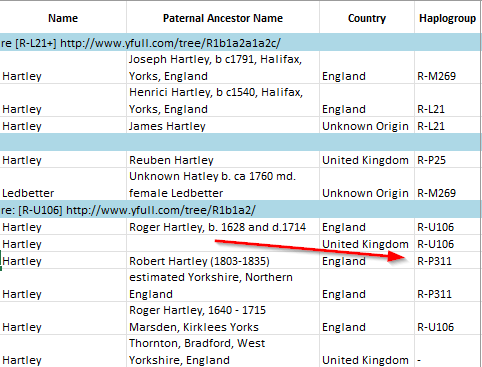
My understanding was at this point was that I was R1b which was a pretty generic Northwestern European Haplogroup. The Hartley YDNA Project had me as R-P311:

I think that P311 is equivalent to L151.

As I  recall, the STR results were ambiguous and it was suggested that I should take the U152 test:

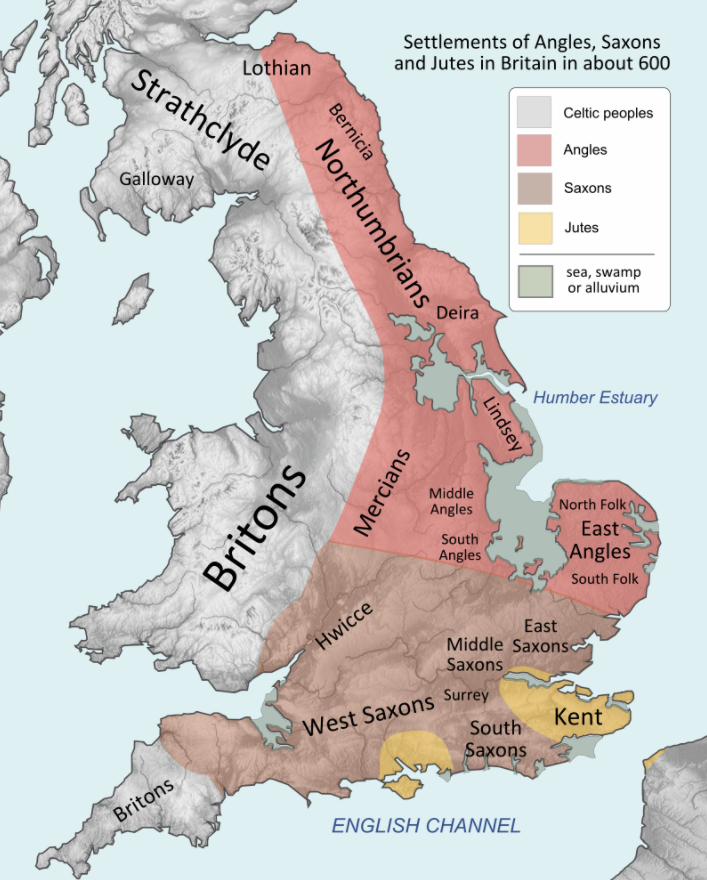
U152 was an important distinction. U152 as I understood it represented the Anglo Saxon portion of England. These were people that came to England after the Roman period:

For reasons I cannot explain, I did not want to be positive for U152. I wanted to be part of the earlier Celtic Britons shown in the above map. The map explained to me the confusion of names. For example why was there a Great Britain and England? I was relieved to find out in June 2013 that I was negative for U152.

My Hartley YDNA 2014 – S5668

2013 and 2014 was a time for me to learn about the world of YDNA. At this time the stress was on YDNA. Autosomal testing was not as popular. I did my first SNP testing in 2014 with a company called Briton’s DNA. This company cost less than FTDNA. I got the results in about August of 2014. As I recall, I was listed as S5668. I believe that Briton’s DNA gave a name to this group and even had a fanciful drawing of what they believed a person from this Haplogroup may have looked like.

Here was the Chromo2 version of where I was:

Chromo SNPs tended to use an S designation. I should have used FTDNA, but used BritainsDNA as an interim measure to find out where I belonged. Even though the drawing of my ancestral tribe was laughable, I was happy to know where I fit in on the tree of mankind. I had traced my Hartley ancestry back to a certain point in time and place in Trawden, Lancashire. Now I was able to tracke my lineage down from genetic Adam more towards modern times. However, there was still a big gap between S5668 and my Trawden Hartleys.

Later in the year 2014, FTNDA and Mike Walsh were developing this L513 Tree:

I did get honorable mention in this tree, but my name was listed below the line for individual SNP testing as I had not taken the BigY test.

67 STR Test

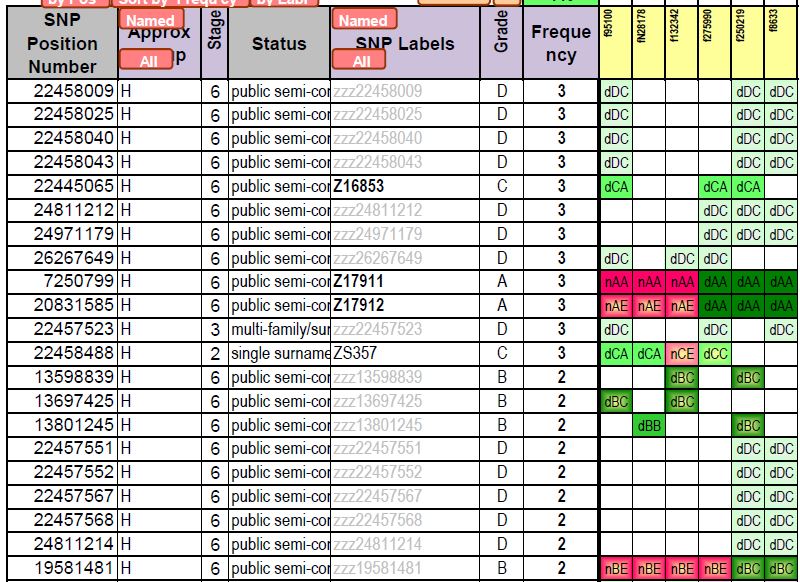
Meanwhile, I had ordered the 67 STR test. My analysis of my 67 STR data lead me to believe that I should also be positive for Z17911. I tested positive for this SNP at YSEQ, but that made no difference at FTDNA, so then I tested positive for an equivalent to Z17911 which was Z17912 – also at FTDNA:

That means that in 2014, I went (in the eyes of FTDNA) from R-P311 (or L151) to Z17911. That was a big jump.

Here is a closeup of the L513 Tree from October 2014:

I was not on this tree because I had not paid for the more expensive BigY test. However, I now saw that if I did, I would be most closely related to Merrick and Thomas. I also kept up with an enthusiastic group on an L513 newsgroup.

My Hartley BigY500 in 2016

I had no further YDNA testing in 2015. I kept up with updates on L513. I became increasingly frustrated that others were being added to the L513 Tree, but I was not allowed as I had not done BigY testing – even though I knew where I should belong on that tree. I ordered the BigY in April 2016. At that time, the Hartley part of the L513 had not changed much:

there was now a Smith, two Haplogroups up from Z17911. The Yahoo L513 group was trying to figure out who should be in the Z17911 group by STRs. The initial June 2016 BigY results got me onto the L513 Tree:

Of course, it discovered my variants which would be useful in future branching. Now a Goff had also joined our group. At this time, I also uploaded my BigY results to YFull.

Mike Walsh pointed out that my BigY test would result in a new branch. Not for me, but for Merrick and Thomas:

The last line shows that I was red for that SNP location (Column 4), but that Thomas and Merrick have green showing that they are positive.

In September 2016, a new L513 tree came out:

As predicted, Merrick formed a new branch, though notice that it was not yet named.

2017 and SmithPlanet

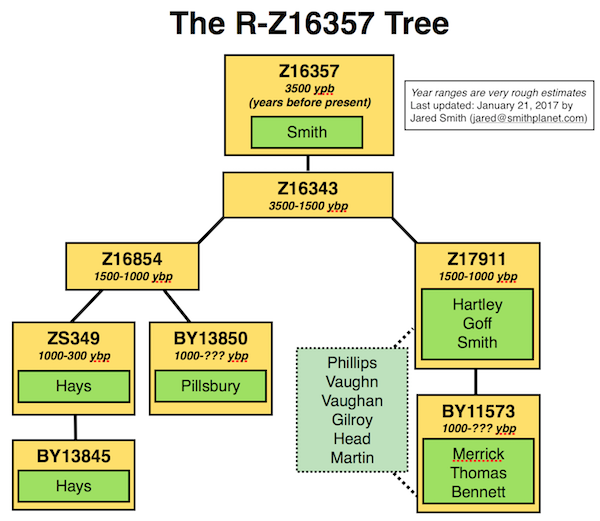
In 2017, Jared Smith got more involved with SNP testing. He also created a website and his own tree for R-Z16357:

The interesting part of this tree that Jared built is that it included estimates for the dates of the SNPs. Now the Branch for Merrick, Thomas and Bennett have the name of BY11573. These dates were for the most part before the time of surnames.

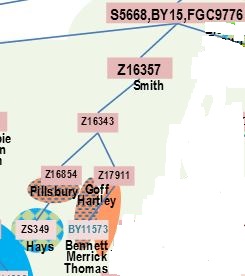
Here is my Hartley section of the L513 Tree dated January 2016 but it must be from January 2017:

The new branch is now named BY11573 and includes Bennett. I believe that the Smith at the top of this section of the tree at Z16357 is different than Jared.

More Detail from Jared

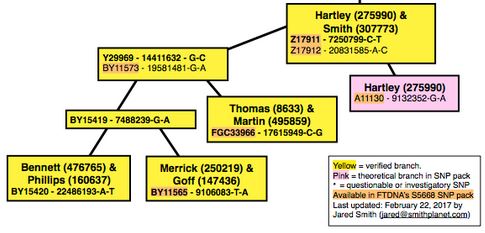
Jared looked at the individual SNPs or Variants and came up with this portion of the Hartley Tree:

Here, based on A11130, Jared shows Hartley branching off. This was true for my branch of Hartleys. However, future testing would show that A11130 was not a SNP that Hartleys other than in my specific branch tested positive for. FTDNA’s practice is to not name a branch unless more than one person tests positive for it. However I appreciated Jared’s tree that went ahead and created a branch for me. This branch would later be called A111132. It seemed like I had been at Z17911 for a long time. This was my first change in over two years since 2014 when I discovered that I was Z17911.

At this time, I was also trying to build STR trees for my branch of Hartleys but found that they were difficult to build and often in opposition to the non-ambiguous SNPs.

More Updates

We are now up to about 5 years ago. Here is what Jared has near the end of February 2017:

This put everyone on the left side of the Z17911 tree and Hartley on the right side of the tree.

A New Hartley Tester in 2017

My May 2017 Blog notes the results from a new Hartley tester. This was what was needed to create a new Haplogroup for the Hartleys:

This tree is dated March 25, 2017. I noted in that Blog that the new tester moved us down the tree past A11138 to A11132.  So after a long time at Z17911, I had a double change.  This was due to two major changes. The new tester and I are now at A11132 and Jared is now at A11138. That means that Jared’s BigY results and the new Hartley’s test results must have come out at about the same time. Here Jared also has a dotted line to two boxes that are in lighter green. I assume that these are people who tested STRs but not SNPs.

The FTDNA Block Tree in 2019

In a Blog I wrote in September 2019, I have this early Hartley Block Tree from FTDNA:

According to Roberta Estes, this Block Tree came out in January of 2019. At this time, A11132 had 7 SNPs in it. This was later to change to 10 and then go down to 8 when it split. Also, Jared now has 11 Private Variants (down from his then 13 Private Variants.

In that same Blog, I posted an analysis Dave Vance did with dates:

Vance has the common ancestor for Smith and Hartley at 900 AD and the common ancestor between the two Hartleys at 1400 AD. The analysis was based on STRs. Based on SNPs, I made an estimate that our common Hartley ancestors may be in the year 1500 AD.

In November 2019, I posted a Blog trying to triangulate the genealogy of the Hartleys who either tested as A11132 or likely were due to STR testing. Here is a portion of the L513 Tree from that Blog:


At this time the FTDNA L513 Administrator was trying to show by colors where the ancestors of the SNP groups came from.

In December of 2019, I noted that there was a new Hartley tester named Steve. I had convinced him to take the BigY test. At this point, only the 111 STR portion of his test had come in, but he was my closest match at 111 STRs:

This screen shot was from December 2019, but it shows that I lost a Private Variant somehow. Perhaps it was decided that these this Variant was in a location that was not reliable:


My Hartley YDNA Updates for 2020

The first big news of 2020 was Steve and his new BigY. I ordered an upgrade for myself also at this time to make sure that our results were compatible. In January, I noticed that the L513 tree had changed. Now there were two pages of tree and the country of origin designation was removed. I was on the S5668 side.

Recall, that when I firsted tested at BritainsDNA S5668 was the extent of my testing. The test went down deeper but not on my Z16357 branch of S5668 which is a smaller branch.

Here is SNP Tracker at that time:

In the proceses of Steve’s BigY, he is now my closest match at 111 STRs. Michael did not upgrade to 111 STRs in his BigY500 test:

The Start of Two Hartley BigY Tests – January 2020

My test was an upgrade from BigY500 to BigY700. Steve’s was new.

The obvious difference other than I now match Steve is that we share 12 Private Variants between the three of us. Michael and I previously shared 2 Private Variants. It seems that I had 17 Private Variants and Steve had 19 Private Variants. I found this confusing, because I had some named SNPs from previous testing which were also Private, that is, not shared. I didn’t ask Michael how many Private Variants he had.

February 2020

In my Blog from this Month, I mention the Rule of Three as recommended by Bill Wood at the Facebook BigY Page. I realized that I should have tested my brother instead of upgrading my own BigY. That would have saved me some money. At this time, I also posted my BigY upgrade results to Alex Williamson’s Big Tree. I noted that my Private Variants went down from 10 to six:

That means that the 17 Private Variants I mentioned above could have included named SNPs. At this point, I still assumed that Steve and I would form a new Hartley Branch.

April 2020 – More Changes in the Hartley Block Tree

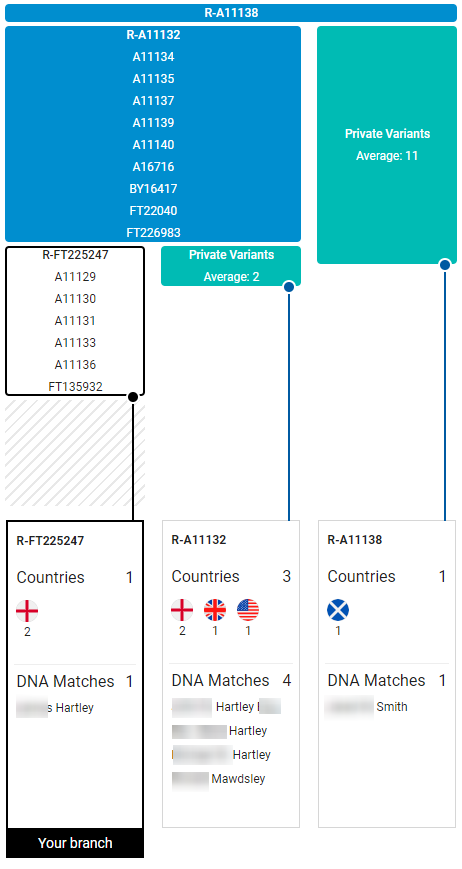
Here is what the Block Tree looks like now:

The Private Variants have gone from an average of 12 to an average of 4. Two new SNPs have been added to the A11132 Block based on Steve’s testing and my upgrade. I contacted FTDNA and they said that all reviews were done. That means that Steve and I did not form a new branch. That also means that the common ancestor between Steve, Michael and myself is within a specific range of years.

The Rule of Three mentioned above recommends you test yourself of course for the BigY. One of the 2 others is a close relative that needs testing. I ordered a test for my brother, Jim later in April. I was curious to see our Private Variants named and have a branch for our own particular tribe of Hartleys. Here is what I was expecting:

I had six Private Variants which I assumed would be named when my brother tested and that block of newly named SNPs would form a new Hartley Branch.

May and June 2020 – Jim’s New BigY Results

The first part of the BigY results is the 111 STR test results. I wrote about those in May 2020. The news from this test was that I had a one STR difference from my brother Jim. It turned out that I had a mutation at DYS534 that the other Hartleys did not have:

At this time, I wrote out a genealogy chart connecting three YDNA testers:


Michael tested for BigY500 and Lawrence and Ross tested STRs. I find these trees to be useful for reference during YDNA testing. Based on this tree, it would seem that if Lawrence or Ross were to test the BigY, they would form a new branch of Hartleys.

June 2020

When Jim’s BigY results were first posted, he was listed as A11132. I also found a new STR on the extended testing where Jim and I did not match:

I didn’t know if I had the mutation at DYS548 or if Jim did. I could now probably figure that out, but have not done this yet. New tester Lawrence has a value of 12 for DYS548. For some reason, when I check my results, I don’t show a value for DYS548:

So I can’t explain this discrepancy right now.

My June 8, 2020 Blog showed this new Hartley Branch and Block Tree:

I noted that this was my first change from A11132 since 2017. The new R-FT225247 branch has 7 SNPs. After Jim and I split off from A11132, Michael and Lawrence now have an average of 2 Private Variants. This created a discrepancy between the new FT225247 Branch and the A11132 Branch. Part of this was due to the fact that Michael took the older BigY500 test.

My Hartley YDNA Branches in 2021

My next Hartley YDNA Blog was not until March 2021. At that time, there were a few changes in the Block Tree:

Some time between June 2020 and March 2021, A11132 went from 9 SNPs to 10 and the Smith Branch went from 13 Private Variants to 11. It looks like the new SNP for A11132 was FT22040. This is something I did not look at previously.

FT22040

Here is what YBrowse shows:

This SNP was discovered in 2019. Here is what the Big Tree Page shows:

For some mutations, their exact position on the tree is uncertain. The mutation may belong further upstream or all downstream branches may not be positive for it. This is often the case for SNPs/INDELs found in FGC kits or 1kG kits in regions not covered by BigY tests.

This note indicates that FT22040 has an uncertain position. Here are my results for this SNP:

I suppose that explains FT22040, but not the timing of when it was added. Also, I cannot explain Smith’s Private Variant drop from 13 to 11.

December 2021

I wrote a Blog which mentions John who agreed to take the BigY test. I am hoping to find a new Hartley Branch and get listed on the R1b Hall of Fame:

To do this requires our Hartley group to have three of more descendant subclades and we had only two (A11132 and FT225247). John was my closest match by STRs, so seemed a good candidate. In that Blog, I estimated that there should be at least 10,000 A11132 Hartley descendants in the World.

I also triangulated the earliest known ancestors for the four BigY testers plus the new BigY tester.

I gave a weighted score. My family and the Quaker family were from Trawden. So they got a 5. The Roger Hartley family is widely believed to be from Marsden. However, my understanding of the genealogy is that the Quaker place of meeting was in Marsden and his death record from there shows that he was from the “Forest of Trawden”. This is an older or fuller name for Trawden. Steve’s ancestors were below that in the Todmorden area. The new BigY tester John’s ancestors were from Healaugh near Tadcaster in Yorkshire County to the East. My analysis favored Trawden, but I am predisposed to that area as that is where my Hartleys were from (though about 175 years after the Roger Hartley Family).

Michael’s Private Variants

I had assumed that Michael had no Private Variants. I found out that this was not true. I had assumed that based on the average and number of Variants that Steve and Michael had, that Michael would have no Private Variants. I discoverd that the average was not based on the total list of Private Variants, but only the Private Variants that FTDNA deemed to be in reliable areas. Michael actually had two Private Variants. I compared the Variants of those who had tested and got this table:

At this point, I was reinforced in my feeling that someone else on the Roger Hartley Line needed to be tested to make up for deficiencies in Michael’s BigY500 test.

SNP Tracker is now tracking my new SNP family SNP of FT225247:

This brings our SNP from Medieval to Modern times.

2022 and Three Important BigY Tests: John, Lawrence and Mawdsley

John’s 111 STR results came in at the first of the year. They showed that John was more closely related to my brother and me at 111 STRs than to other Hartleys. However, the STR results can be misleading. In this Month also Robert Casey did a STR study for the Z16343 Group. This is important in finding other STR testers who may be part of the Z16343 Group. Dating was also included, but some of the dating seemed to go against the more consistant dating by using SNPs and SNP structure.

Here is an updated Z16343 Tree from the SmithPlanet web site:

It also includes the SNP above which is Z16357.

Lawrence and Mawdsley

I asked Lawrence from the Roger Hartley Line if he would take the BigY test and he agreed to take it. When Lawrence’s 111 STR test came in a new tester named Mawdsley also took the BigY test and his 111 STR test came in. Both Lawrence’s and Mawdsley’s BigY results were finalized (minus the manual review) at the end of January 2022.

A New Hartley Haplogroup – A11134

I got Steve, John and Lawrence to test for BigY hoping for a new Harltey Haplogroup. It took the testing of a non-Hartley (Mawdsley) to split up the existing A11132 Haplogroup and form a new Hartley A11134 Haplogroup.

February 2022 Lawrence’s BigY Results

I was disappointed to see that Lawrence’s 6 Private Variants did not produce a new Branch with Michael. This could be because Michael’s BigY500 test did not cover the positions where Lawrence’s Private Variants were located.

A16717

However, I was encouraged by the fact that both Lawrence and Michael tested positive for A16717 and the other Hartleys tested negative. The only problem is that this SNP is also used in the J Haplogroup. After 2 weeks from when Lawrence’s BigY results came in, I wrote to the FTDNA Help Desk to see if they would create a branch of A16717 for Michael and Lawrence.

Here is the new Block Tree as of the end of February 2022:

Here is the branching that I was hoping for:

Summary and Conclusions

  • It has been a wild ride looking into the YDNA of my Hartley Line
  • I have gone with STR testing, Chromo2 testing (BritainsDNA), single SNP testing at FTDNA and YSEQ and finally BigY testing.
  • Along the way I have learned a lot about YDNA ‘deep ancestry’.
  • Recently, two Hartley only surname branches have been discovered. These are A11134 and FT225247
  • I have also discovered the closest name to our Hartley Surname which is Mawdsley
  • I am now awaiting to see if FTDNA will create a A16717 Branch of Hartleys. This would be an important branch as it includes genealogy back to the early 1600s. Also many US Hartleys descend from this branch of early immigrants to Pennsylvania.


My Frazer Relative and DNA Match Faye

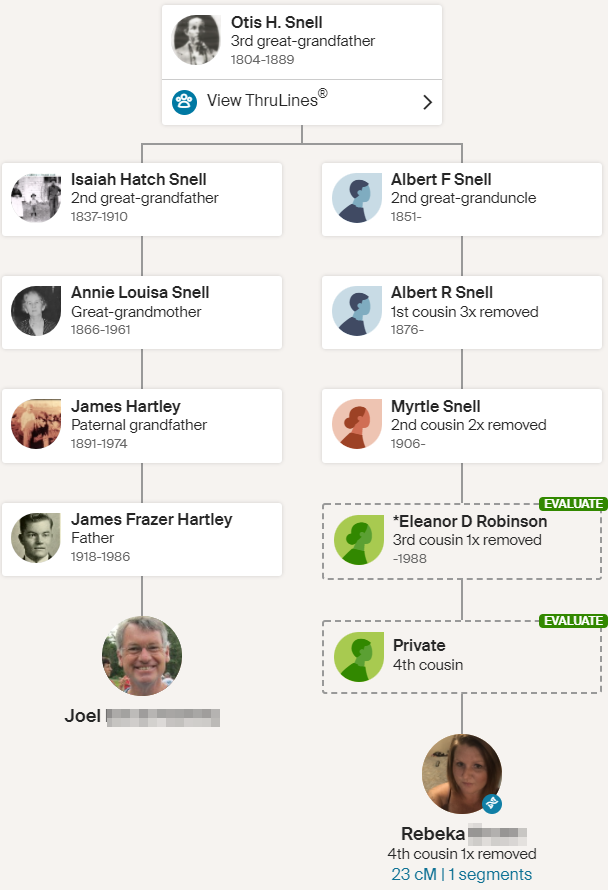
I check my AncestryDNA matches from time to time and find a lot of matches, but not a lot of matches where I can connect the genealogy. With Faye, I was able to do both. Faye matches me on 5 segments and 59 cM at AncestryDNA. Faye was nice enough to answer my message at Ancestry and it was not too long before we figured out the connection. Here is how the connection looks like at Ancestry:

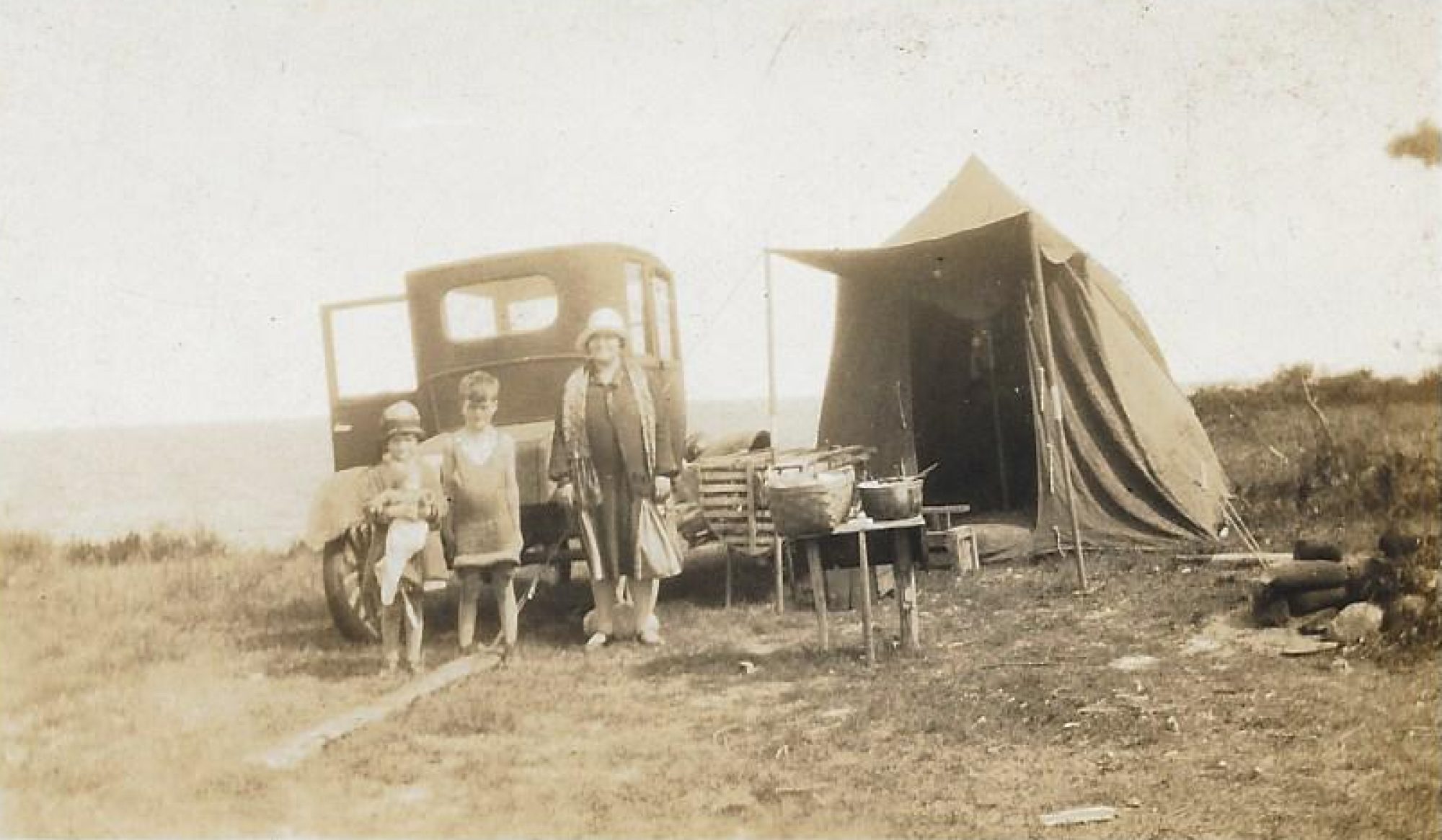
Here is Faye’s great-grandmother Susan:

Susan is the one with the light colored dress on the right. My great-grandfather James Archibald Frazer had gone to Boston by this time with some of his brothers. In fact, if I have my dates right, James came to Boston on  October 8, 1887 and Susan was born October 27, 1887. I don’t know if the two ever met.

Faye’s DNA Matches at Ancestry

Faye has shared matches with my four siblings who have tested at AncestryDNA. She also matches my daughter but not my son as a shared match. In order to have a shared match, you must have a match of at least 20cM. My son matches Faye by 16cM.

Rebecca

Rebecca matches both me and Faye. Rebecca is also a third cousin with Faye and myself:

This is a tree of people who descend from George Frazer and Margaret McMaster who have taken DNA tests. I recently added Faye to the chart as the first match that I know about who descends from Susan Jane Frazer. Also, I wrote a Blog on Rebecca here and she has different ways that she descends from the McMaster family.

Whitney and Stephen

Whitney descends from Richard Frazer and is a 3rd cousin once removed. There is also a Stephen who must be from the same line aslo, but he doesn’t have his family tree at Ancestry, so I’m not sure exactly how he fits in.

Michael

Michael is a shared match between Faye and some of my siblings at Ancestry. Michael is a Frazer relative going back two generations:


Michael is a 4th cousin once removed to Faye and my family. I haven’t added Faye onto this tree yet. The relationships are complicated as Violet Frazer above married James Frazer from what I can figure out.

Faye and Gedmatch

Faye uploaded her DNA results from AncestryDNA to Gedmatch. This is important because AncestryDNA, unlike most other DNA testing companies, does not provide a Chromosome Browser. Here is how Faye matches me at Gedmatch:

This may not look too exciting, but it shows on which Chromosomes Faye and I match, where on each chromosome we match (by position) and gives an amount that we match in Centimorgans.

My Match with Faye at DNAPainter

It is easier to see the matches using DNA Painter. Here is what my DNA Painter map looks like right now:

The paternal copy of each chromosome is on the top and maternal on the bottom. The matches with Frazer/McMaster are in a sort of maroon color. I was able to split the DNA out for this couple in a few cases, so I have individual listings for the couple also. Overall, I am 51% painted or mapped.

Here is my paternal side where I am 58% mapped:

Note that I have nothing mapped on the X Chromosome as men don’t get any X Chromosome from their paternal side.

I can drill down one more layer to the maroon Frazer/McMaster level:

This shows I have some DNA matches on 10 of my 22 Chromosomes. These are from 6 third cousin level matches. Now recall above, that Faye matched me on Chromosomes 1, 6, 18 and 19. That means that her match with me on Chromosome 18 is new.

Next, I’ll add Faye to the mix. Faye brings up my mapped percentages by 1% on my paternal side and overall.

Chromosome 1

I don’t have much room for Frazer DNA due to my inheritance of a lot of Hartley DNA on this Chromosome. Faye ovelaps with Susan and Katherine here. These matches can also be represented this way:

This represents triangulated matches. That means that the DNA from this portion of our Chromosomes 1 came from either George Frazer or Margaret McMaster. However, without other matches further back, we don’t know from which person the DNA came from.

Chromosome 6

Chromosome 6 gives some more information:

Because Brenda overlapped with Doreen and Ken and the match with Doreen and Ken go back to the Frazer side one generation before George Frazer, that means that the DNA from Brenda and Stan came from George Frazer. I changed the color for Brenda’s match, but didn’t bother for Stan. Faye’s DNA match with me doesn’t appear to overlap my match with Doreen and Ken, but it overlaps with Brenda’s match, so that DNA is probably from George Frazer also.

Chromosome 18

Here is where Faye adds the most to where I had missing information:

Faye adds a chunk of DNA to the right of Emily, Gladys, Doreen and Susan. Again, I assigned Emily’s match to George Frazer due to the blue matches of a generation earlier. Faye may represent what I call a crossover here. That is what I give to the phenomenon when ancestral DNA crossover over from one ancestor to the spouse of that ancestor. We know the yellow match represents George Frazer, so Faye’s match with me may represent Margaret McMaster. This could be confirmed if we find more McMaster matches with Faye in that region where I match her.

Chromosome 19

Chromosome 19 is also a little difficult to interpret for Faye’s match with me:

Keith has McMaster DNA, so the match with Susan is for Magaret McMaster. The match with BV is complicated as there is a McMaster and Frazer side. However, I know where the McMaster side fits in, so the match with Emily is probably Margaret Mcmaster. I can’t tell which side Faye’s match is on.

Faye and Heidi

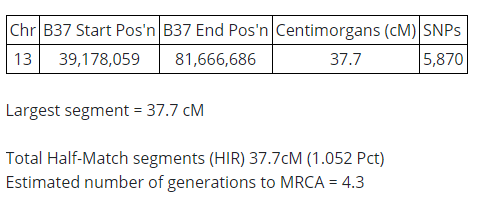
I administer different DNA kits at Gedmatch. One is for my sister Heidi. Here is how Faye matches Heidi:

Faye’s estimated number of generations to MRCA is 3.8. The actual is 4.0 generations, so she shares a bit more DNA with Heidi than average. I’ll add Faye onto Heidi’s DNAPainter Map:

I haven’t been as diligent in mapping Heidi’s DNA as I have with my own. Faye upped Heidi’s over all and paternal percentages by 1% also to 36 and 43%. Faye adds new information to Chromosomes 15, 18 and 19:

On Chromosome 15, Faye points out a crossover in Heidi’s DNA:

This is the crossover between yellow Frazer and blue Hartley or the crossover between my Frazer grandmother and Hartley grandfather.

Faye and Paul

Faye’s third largest match at Gedmatch is with her (and my) 2nd cousin once removed Paul. I also manage Paul’s DNA kit. Here is the match:

The estimated number of generations to Paul and Faye’s common ancestors are 3.6. That means that Faye and Paul share slightly less DNA than expected for 2nd cousins once removed. I have only mapped out Paul’s paternal side. And I am only interested in half of his paternal side:

Paul is 23% mapped right now. George Frazer and Margaret McMaster are in green on his map. Adding Faye brings Paul up to 25% mapped on his paternal side:

Faye’s contributions to new Frazer DNA matching for Paul are on their Chromosomes 6 and 8. Faye’s DNA under Susan and Doreen is from George Frazer. Faye’s other Chromosome 8 match to Paul may be McMaster DNA due to the crossover effect I mentioned earlier.

Faye and Michael

One chunk of DNA came down from one of the common ancestors between Michael and Faye:

Here is the connection from the viewpoint of Michael:

We don’t really know when Richard Frazer was born, but we think that it was around the year 1777. We also don’t know the name of his wife. One guess from Ancestry is Mary Patterson.

Faye and Stephen – McMaster Side

I match Stephen who tested at 23andMe. He also uploaded to Gedmatch at my request.

I am related to Stephen as a 5th cousin – which is quite distant. I am more closely related to Keith, but I think that his results are no longer at Gedmatch. Faye would be in the same bottom row as Stephen and me, but I have not added her in yet. Here is Stephen’s match with Faye:

On my Paternal side Chromosome 13, I inherited Hartley DNA and not Frazer. However, my sister Lori inherited some Frazer DNA on her Chromosome 13:

Here Lori has Hartley DNA in blue, then Frazer side in green and pink, then more Hartley hidden by the Key. Now Lori and my family are related to Stephen and Ronald more closely on the Clarke side, but more distantly on the McMaster side. I should have changed Lori’s pink matches to red. Also Emily is not related on the Clarke side. The area where Ronald and Stephen match Lori and the area where Faye matches Stephen start at about the same location.

I’ll just change Ronald and Stephen to red on Lori’s Chromosome 13 and add Faye to Lori’s map.

Also, technically, I could change the green matches for Emily and Faye, as I now know that DNA came specifically from Margaret McMaster. I note that there is something stopping the matches for Lori on the right side of Faye, Ronald and Stephen. This could be a crossover where her inherited DNA goes from Frazer to Hartley.

Emily and Faye

Gedmatch has a free uitility called People who match both kits, or 1 of 2 kits. When I run this between Emily and Faye I get a list of common matches:

Heather at the bottom of the list that I copied didn’t sound familiar. That is because she is a match on Chromosome 13 where I don’t have Frazer DNA, but my sister Lori does.

Margery is the one I have as the wiffe of Abraham McMaster. This match goes back to the 1700’s. Faye has a good match with Heather at Gedmatch:

Here is how the ThruLines look at Ancestry:

It’s a little messed up as it has James McMaster twice. Faye is under the second James for Lori’s ThruLines:

There are many more comparisons that could have been made. Here is a list of Frazer relatives I am tracking (mostly) at Gedmatch:

Summary and Conclusions

  • I could have done much more analysis on Faye’s DNA using Tier One Tools, but I would have to sign up at $10 a month.
  • Between AncestryDNA and Gedmatch, you can do a lot with your DNA test.
  • Ancestry’s ThruLines are not always perfect as they are based on imperfect trees. However, they often give confirmation of tree that you may not be sure of due to the age of the genealogy and scarceness of records.
  • I was glad to hear from Faye and find out why her family left County Roscommon

A Case for a New A16717 Branch of Hartleys

In my previous Blog on Lawrence’s new BigY test, I mentioned how Lawrence matched Michael on A16717. This was a named SNP that Michael has tested positive for since he took the older BigY500 test.

A16717 at YBrowse

I had shown this graphic in my previou Blog:

The confusing part of this graphic is that even though William Hartley named the SNP as part of R1b, it is also used by YFull in the J-HU209 Branch. If I follow the hyperlink for J-HU209, it brings me to the YFull Tree:

A16717 is shown as a 3/5 star SNP defining J-HU209. I’m not sure how FTDNA deals with SNPs that are in different Haplogroups.

Hartley Testing for A16717

Here is my Block Tree:

The Hartley testers are me and my brother James, then John, Steve, Michael and Lawrence.

As I mentioned Michael tested positive for A16717:

Here are Lawrence’s recent results for the same SNP:

These results go down another page.

Next, I just have to show that the other Hartley testers tested negative for this SNP. Here are John’s results:

His results keep going also.

Here are Steve’s results:

He is also clearly not positive for A16717.

Next, I just need to show that my brother and I are negative for A16717. Here are my brother’s results:

There are no pink A’s under the position for A16717 which indicates that my brother Jim is not positie for A6717.

Lastly, my results:

As expected, the results are the same. I already knew this, but wanted to put the proof out in a Blog.

Blog Update: The Big Tree

I should have checked Alex Williamson’s Big Tree. Michael has his results there. Here is a partial list of Michael’s Unique Mutations:

Here is the explanantion for the codes:

In the table above, the meaning of the confidence field depends on whether the data comes from an FTDNA kit or an FGC kit. For FTDNA kits, + implies a “PASS” result with just one possible variant, * indicates a “PASS” but with multiple variants, ** indicates “REJECTED” with just a single variant, and *** indicates “REJECTED” with multiple possible variants. ‘A*’ are heterozygous variants not called by FTDNA, but still pulled from the VCF file. For FGC kits, + indicates over 99% likely genuine (95% for INDELs); * over 95% likely genuine (90% for INDELs); ** about 40% likely genuine; *** about 10% likely genuine. Manual entries read directly from a BAM file will be either + indicating positive, or * indicating that the data show a mixture of possible variants.

For the FTDNA kits, the BED data is encoded in the background color of the cells. Those cells with a white background have coverage, those with a grey background indicate no coverage in the BED file, and those with a pink background indicate the mutation is on the edge of a coverage region. These pink regions often indicate that the individual may be positive for a SNP even if there is no corresponding entry in the vcf file.

The combBED column indicates whether or not the mutation is a SNP and falls in the combBED region defined in Defining a New Rate Constant for Y-Chromosome SNPs based on Full Sequencing Data by Dmitry Adamov, Vladimir Guryanov, Sergey Karzhavin, Vladimir Tagankin, Vadim Urasin.

The McDonald BED column indicates whether or not the mutation is a SNP and falls in the BED region used by Dr. Iain McDonald in the age analysis he does for R-U106 men.

The CombBED Region

Thanks to the link that Alex Williamson has on his Big Tree page (highlighted above), I now see where this Region is:

This is from Table 1 in the Supplement portion of the article by Adamov. A16717 is between two pages. Here is the Title of the Table:

The HG19 Position for A16717 is 7222463 which is between CombBED Regions 82 and 83. In the Adamov Paper, the CombBED Regions is where Adamov expected his samples to have SNP Variants. However, it appears that Michael and Lawrence had variants in a non-CombBED Region. I don’t know what this means.

Summary and Conclusions

  • This Blog is written to show that clearly Michael and Lawrence are positive for the SNP A16717 and the four other Hartleys are not positive for that SNP
  • I believe that FTDNA should put Michael and Lawrence into their own branch called A16717. This would also support the genealogy which shows Michael and Lawrence as 7th cousins.
  • The only confusing part is that it seems like YFull is using SNP A16717 in a branch of the J Haplogroup.
  • I finally figured out how to figure out where the CombBED Region, thanks to Alex Williamson’s Big Tree Web Site.


A New A11134 Hartley Tester Results Are Coming In


It has been a busy year for my branch of Hartleys. In January, a new Hartley test came in at A11132. This is where other Hartleys from the same branch had been testing. Shortly after that Hartley BigY results, a Mawdsley tested who was two SNPs removed from the other Hartley A11132 test results. That put Mawdsley at A11132 and the Hartleys at A11134.

Lawrence and Michael

The new tester is Lawrence. Here is how Lawrence and Michael show as being related by genealogy:

That would make them 7th cousins if the genealogy is right. Hopefully, the BigY test will support the genealogy. So far, it the STR results between Lawrence and Michael make the genealogy seem off. However, when there is a discrepancy between SNPs from the BigY test and STRs, the SNPs are far more reliable.

The New BigY700 Results

Michael did the BigY500 test, so the comparisons may not be exact, but let’s take a look. This morning, it was clear that FTDNA decided that Lawrence was now A11134. However, that could change. Here is Lawrence’s Block Tree as of today:

Here Lawrence is just added in under A11134. This tree will likely change in some way – especially and at least in the area of Private Variants.

Lawrence’s Private Variants

Lawrence has 6 Private Variants:

These are important as they can show either places where Lawrence may match with other BigY tester’s Private Variants and they can show how long Lawrence’s tree is from his closest tested common ancestor.

Lawrence’s Private Variants do not match up with Michael’s two Private Variants:

That means that Michael and Lawrence will not form an obvious new branch based on these Private Variants.

Checking Deeper Into Michael’s Private Variants

Unfortunately, Michael was not tested for 11503251:

Michael is missing 12197124:

Michael is missing 13636160:

Michael is missing 19708663:

Michael is missing 26634402:

Michael is missing 5742283:

That means that Michael was not tested for any of Lawrence’s Private Variants. That also means that we don’t know if Michael and Lawrence would form a new Hartley Branch based on any of Lawrence’s Private Variants.

Checking Michael’s Two Private Variants on Lawrence’s Results

Lawrence tested for 12695002 but was not positive for this Variant:

Lawrence tested for 20317042 but was not positive for this Variant either:

That means that, as far as the BigY testing goes for Private Variants, it seems as Michael and Lawrence are like ships passing in the night.

Implications of Lawrence’s Private Variants Vs Michael’s

The following implications are based on the fact, further along in the Blog, that Lawrence and Michael are positive for A16717. The further implication from this is that Lawrence and Michael are related as shown in the genealogy chart near the beginning of this Blog:

  • As Lawrence tested negative for Michael’s Private Variants, I would consider Michael’s two Private Variants to be true Private Variants
  • Lawrence has six Private Variants, but Michael’s BigY testing did not appear to cover any of Lawrence’s Private Variant locations.
  • It is possible that Michael, had he had more coverage in his BigY test, could have tested negative for all of Lawrence’s Private Variants. In this case all of Lawrence’s Private Variants would be true Private Variants.
  • It is also possible that had Michael’s BigY test covered all of Lawrence’s Private Variant Locations, that Michael could have been found positive for one or more of those variants. In that case a new Branch would have formed (those SNPs would be added to A16717 Branch).

More Variants Compared

In a previous Blog, I had compared Variants:

These Variants are Steve’s Private Variants, Michael’s Private Variants and my brother and my SNPs shared. I  should have added John to the list. Part of my reasoning for having Lawrence test the BigY was to fill in the yellow areas of Michael’s test. I may do further filling in of this chart in a subsequent Blog.

A16717

It appears that Michael and Lawrence may share A16717. Let’s take a look. I noticed that in the list of non-matching variants, A16717 showed up with Lawrence’s matches except for with Michael. That means that Lawrence and Michael must share that SNP:

I checked and both Michael and Lawrence are positive for this SNP. This SNP was named by William Hartley in 2017 – probably when Michael first tested:

Today, FTDNA does not name these until there is a match, but back then they were named sometimes.

Here is my initial idea of how the new Hartley Branch should look:

Day 2 of Lawrence’s BigY Results

A day after the Lawrence’s BigY results started coming out and the average number of Private Variants went up for the A11134 Hartley group from 2 to 3:

Now it is time to wait to see if FTDNA comes to the same conclusions. Jared Smith had this to say about the new developments:

It will be interesting to see if they create a new A16717 branch. This SNP is not in the BED region, but with them both having it I’d suspect they will form a new branch. If they don’t do so after manual review, I’ll take a closer look and see if we can make a case via Mike W. for FTDNA to give it consider forming this branch. In the past we’ve identified SNPs like this that they’ve created branches on after our request for another closer review.

Summary and Conclusions

  • After a less than patient wait on my part for Lawrence’s BigY results, the initial results are now in.
  • I wanted Lawrence to test his YDNA because of his important Hartley genealogy that goes back at least to the early 1600’s and because of his relationship with Michael who has that same genealogy.
  • I was disappointed that Lawrence’s Private Variants did not match up with areas of YDNA that Michael had tested.
  • Fortunately, Michael and Lawrence match on a previously named Private SNP that Michael had. We need to wait and see if FTDNA figures that out and puts them in a new A16717 Hartley Branch.
  • The location for A16717 is not in the most reliable area, but Michael and Lawrence are clearly positive for this SNP.

An Update on a New Hartley YDNA Test

It appears that one of the two new Hartley BigYs is starting to change. I noticed on 24 January 2022 that the Haplogroup designation has changed from L21 to A11132. However, the BigY does not yet show as completed:

This preliminary determination confirms that this tester is in the A111132 Hartley group:

This is the tester with the ancestor of Wiliam Hartley from 1745. The other BigY tester who ordered a little later is the one with the ancestor of Roger Hartley b. 1628 in the 4th row of named ancestors in the image above.

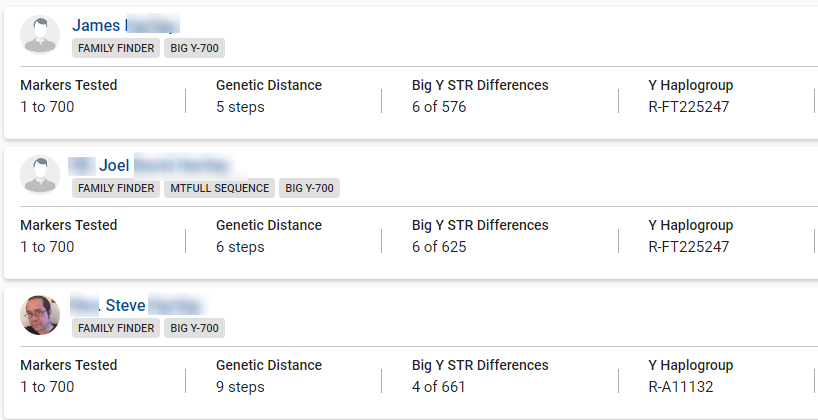
The new A111132 Hartley has as his closest matches my brother James and me by STRs:

The Existing Hartley Block Tree

The new tester does not show up on my block three yet which represents four existing Hartley testers (me plus three matches). I am hoping that the new tester will break up the blue block of 7 SNPs represented by R-FT225247. In this blog, Basically if this tester is positive for all 10 SNPs in the A11132 Block, and negative for the 7 SNPs in the FT225247 Block, then there will be no changes. If he is negative for one or more in the FT225247 Block, that should result in a splitting of the Block. That would also show that the new tester is more closely related to my brother James and me than he is to Steve and Michael.

I am hoping to document the changes that take place as this Hartley tester’s BigY results progress from the initial phase through hopefully a manual review. A manual review takes place if there is a change in the Block Tree.

The New Hartley Tester and a New Mawdsley Tester

I am a little surprised that the Hartley BigY tester results seem to be coming out prior to a Mawdsley tester. Mawdsley is a new YDNA tester who took the BigY test. Based on the the Mawdsley STR results, he has many matches to Hartleys. My feeling is that Mawdsley could break up the the A11132 Block. This Block is old enough that it should predate surnames.

Here is the larger picture:

The Hartley Branch is in green.

25 January and the New BigY Results Are In

Here is John’s new Block Tree:

Although the BigY results are in for John, my experience is that things could still change while the dust settles. It could take a few weeks – especially if there is a manual review.

Looking at John’s Test Results In More Detail

I had mentioned above that if John was negative for all the SNPs in the FT225247 Block, then that Block would not be split. I can try to speed up the review and look at John’s results for the 7 SNPs in the FT225247 Block.

John’s Non-Matching Variants

John’s results will either be positive, negative, not tested or inconclusive, so the real life situation may not be all or nothing. Here are the first two people on John’s Match List:

John has 12 Non-Matching Variants with Steve and 14 Non-Matching Variants with me. It appears that all 7 SNPs that are in my branch of FT225247 are in John’s list of Non-matching Variants. That makes it look like John is negative for those 7 SNPs.

FT225247

It is possible to look at John’s test results for each SNP.  One way is through his csv file. The other more detailed way is through FTDNA’s  Y-Chromosome Browsing Tool. I’ll use the Browsing Tool:

This shows as not derived. The reference value of A is the same as the Genotype. I can’t get the Chromosome Browser to work right now, so I may come back to that later.

Another New A11132 Determination

This probably should have been in a separate Blog, but I just checked on a Mawdsley BigY test and that came in as A11132. This was the test that I hoped would split the A11132 Block.  Actually, this may come in soon. I see that Mawdsley is where the Hartley tester was yesterday:

However, it is exciting that Mawdsley has been found to be A11132. That implies to me that Mawdsley will be splitting the A11132 Block.

Back to John’s BigY Results

I am seeing the results now for the Chromosome browser for FT225247:

John was clearly negative for this SNP with many reads.

Other SNPs Under FT225247

The quick way to check is by John’s csv file. I suspect that he is negative for all 7 SNPs under FT225247:

  • A11129 – not derived
  • A11130 – not derived
  • A11131 – not derived
  • A11133 – not derived
  • A11136 – not derived
  • FT135932 – not derived

That means that John as well as Steve and Michael all appear to stem from A11132. That means also that so far, my model of how the different Hartley lines seem to be shaking out looks like what I had shown in a previous Blog:

SNPs have been said to form every 80 or 83 years. Jared Smith estimated that this number may be closer to 70 years for the Hartley part of the YDNA tree. To me, I wonder that it appears that these four Hartley lines descended from Hartleys that were born within a 70 to 80 year period. As I recall, my best guess for a common ancestor date for these lines was around 1550. That means that these four Hartley lines could be from 1550 give or take 35-40 years. Say 1510 to 1590.

John’s Private Variants

John has

These are the variants in John’s line that formed since about 1550. These variants are reported as position numbers until someone else matches them, then they are reported as named SNPs. These positions are given names pretty much right away, but those names are not reported until there is another match.

These variants show up in John’s list of Non-matching Variants:

Other Non-Matching Variants with My Family

So far, I have accounted for 7 SNPs from my family and 4 Private Variants from John. That leaves 3 Non-Matching Variant not accounted for.

FGC6800

John does not show this SNP:

I clearly have it:

Also my brother Jim:

It is not clear to me why this SNP is not noted in the Hartley Line that my brother and I are in. However, I do note that this SNP is listed in the I2 Haplogroup at YBrowse:

BY80068

This is a SNP that John has:

I don’t think that I tested for this SNP.  My brother clearly does not have this SNP.

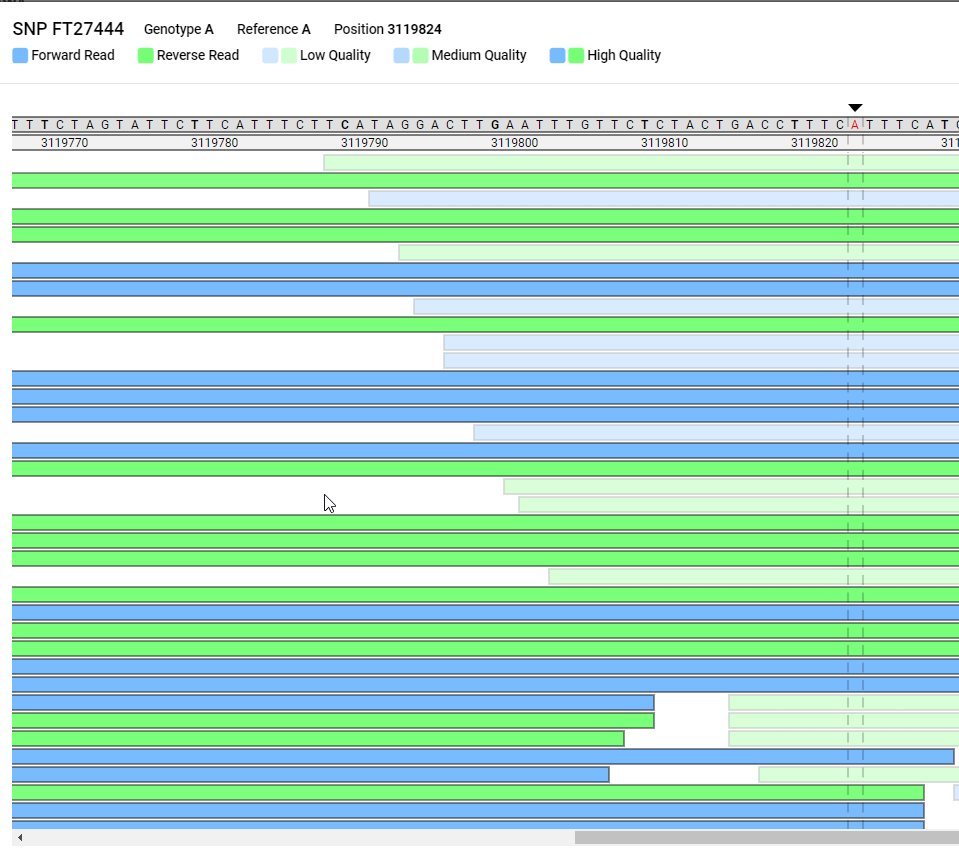
FT27444

John shows as not derived for this SNP:

It turns out I have this SNP:

The results do not look the best, but they do seem to show I have this SNP.

Now I am curious as to my brother Jim’s results. If he was positive for this SNP, then it should have shown up. Jim’s results show as inconclusive:

I wonder if this SNP was from a low-quality area of the Y Chromosome. This is one of those cases where the deeper you get into the details, the more confusing it gets.

John and Steve’s Non-Matching Variants

Steve has 5 Private Variants. Those are the five starting with 7053124. The last four in the orange box are John’s Private Variants. That leaves three Non-Matching SNPs.

BY80068

I already discussed this SNP above. John has it. That must mean that Steve does not have it.

Y51250

My assumption is that Steve must have this SNP and he does:

FT35996

The same must be true that Steve has the SNP FT35996:

Finally, John and Michael

This is a little trickier as Michael only took the BigY500. This has less coverage than the BigY700 that the rest of us took:

That means that Michael is only negative for two of the four Private Variants that John does have (underlined above). Michael has two Private Variants which start with 203 and 126. That leaves 11 Non-Matching Private Variants.

BY80068

BY80068 is the third to last Non-Matching Variant. That means that Michael did not test positive for that SNP:

That leaves 11 SNP unaccounted for.

ZS1551

It seems odd that this is a Non-Matching Variant between John and Michael as it seems that they both are not positive for this SNP. However, as I look at Michael’s Chromsome Browser, he does show that he is positive for the SNP:

This is what Michael’s csv file showed as of last month:

YBrowse has this SNP in the J Tree:

Y30173

Michael is clearly positive for this SNP also:

But again, Michael’s csv file does not show positive for this SNP. I think I’ll skip the other Non-Matching SNPs between John and Michael as I don’t seem to be getting anywhere with them. It may be that Lawrence’s pending BigY700 test will clear this up. Lawrence is believed to be distantly related to Michael.

From L21 to A11132

John asked me if there was much difference between L21 where he was previously and A11132 where he is now. Here is an L21 map from 2011:

The map shows that there a lot of L21 people the further you go to the Northwest. Of course with those who have emmigrated to other countries, this would account for Millions of people. L21 has been associated with the Celtic people.

Here is what SNP Tracker shows:

A11132 is shown as a Medieval SNP and L21 shows as a Bronze Age SNP. Here are some SNP dates:

L21 dates to 2600 BCE and A11132 to 850 CE. Actually, I should add in my own Hartley Branch SNP:

My Hartley Branch dates to about 1500 CE which is the aprroximate common ancestor date between John and the rest of the BigY tested Hartleys. The date I mentioned that I had come up with was about 1550 CE.

New Results Due to the Mawdsley BigY Test

Here is the way Mawdsley’s Block Tree looks at the time of my writing:

This tree is in flux. In my last Blog, I predicted that John would become A11134 or A11135 as Mawdsley was negative. Here, Mawdsley has lost his other matches of the three former A11132 Hartleys. However, the three Hartleys are now showing as A11134 at least in their general YDNA listings (see below), so the change is in progress. John must have one of the fastest changes of a haplogroup after BigY testing:

I couldn’t get the other former A11132 Hartley Block Trees to display.

John and Mawdsley Common Ancestor

I have estimated the common ancestor for John and the other Hartleys to be around 1550. That would put the common ancestor between John and Mawdsley at about the year 1400. This bumps into the time when surnames were being finalized. Based on locality, social status and other factors, surnames may or may not have been finalized or were in the process of being finalized around the year 1400. It could be that the year 1400 was very close to the beginning of our Branch of Hartleys and the beginning of the Mawdsley surname.

Summary and Conclusions

  • John’s BigY Test recently came out which confirmed he was A11132 along with four other Hartley BigY testers
  • Two of those testers (my brother and I) are in a group downstream of A11132
  • I then looked at the results of a very recent Mawdsley test. Mawdsley tested close to Hartleys by STRs. The BigY test showed that Mawdsley was positive for 8 out of 10 of the A11132 SNPs
  • The two SNPs that Mawdsley tested negative for further defined the existing five Hartley BigY testers (including John). This put those Hartleys into a new SNP group called A11134. This group is most likely a Hartley-only SNP.
  • Hartley common ancestors for A11134 date to about the year 1550. The common ancestor year between Mawdsley and Hartley is around the year 1400. This year may be about the start of the (now) A11134 Hartley and A11132 Mawdsley surnames
  • FTDNA is catching up with the new information and is likely in the process of a manual review.

A New Mawdsley BigY Test Also Defines a Hartley Haplogroup

I have been eagerly awaiting a new Mawdsley BigY test. The results just came in on 26 January 2022. I had expected that the new test would break up the A11132 Block. Previously, only Hartleys had tested positive for A11132.

Here is the current A11132 Block as seen in my view:

Above the A11132 Block is A11138. A Smith has tested positive for that SNP. The dates for the A11132 Block are approximately 900-1500 AD. Because it was believed that the connection to Mawdsley was before the time of surnames, it seemed like this test would break up the A11132 Block. That has not happened yet as FTDNA is still analyzing the test.

Breaking Up the A11132 Block

If Mawdsley is positive for one or more of the SNPs in the A11132 Block AND negative for one or more of the SNPs in the A11132 Block, then the Block will be broken up. Let’s look at Mawdsley’s results:

  • A11132 – Positive
  • A11134 – Negative
  • A11135 – Negative
  • A11137 – Positive
  • A11139 – Positive
  • A11140 – Positive
  • A16716 – Positive
  • FT22040 – Positive
  • FT226983 – Positive

Because Mawdsley is negative for two of the SNP (A11134 and A11135), then the old A11132 Block is broken up. I was expecting the Block to be broken near the top of the Block, but it appears to be broken near the bottom of the Block. There are other things that could happen, but the above is the simple explanation.

Hartleys Will No Longer Be A11132

Here is a simplified view of pre-Mawdsley BigY testing:

Here is a simplified view of what should happen soon:

Here I have started to add more SNP information. Mawdsley will take on the A11132 SNP designation which will now represent 8 SNPs as opposed to a previous 10 SNPs. Hartleys other than my branch will be given the name of either A11134 or A11135. The yellow box above represents three branches of BigY-tested Hartleys not including my branch.

Dating the Common Ancestor of Hartley and Mawdsley

I had previously estimated the common ancestor of the Hartley BigY testers at about 1550 AD. Jared Smith has estimated that in general, the SNPs in this region of the YDNA Tree could form at about once every 71 years. That would put the common ancestor of Mawdsley and Hartley at about 1408 or rounded to the year 1400.

The Adoption of Surnames

I have read different things about the adoption of surnames. Here is a quote from https://www.historic-uk.com/CultureUK/Surnames/

The introduction of parish registers in 1538 helped establish the idea of hereditary surnames. However it was still common in some parts of the country to find a person entered under one surname at baptism, married under another name and then buried under a third.

According to Wikipedia:

By 1400, most English and some Scottish people used surnames, but many Scottish and Welsh people did not adopt surnames until the 17th century, or later.

For a third opinion, I will quote FamilySearch:

Learning about the possible origin or origins of your surname is fascinating, but as surnames were established in England by 1450 and their parish registers only go back to 1538 at the earliest, most of us cannot establish our surname origin with certainty.

At any rate, at the possible time of the common ancestor between Mawdsley and Hartley surnames could have been when surnames were still in flux. It is interesting that the YDNA dating for the Mawdsley/Harltey common ancestor seems to point to that very time when surnames were likely used but perhaps not consistently.

Summary and Conclusions

  • A New Mawdsley BigY tester has broken the existing A11132 Block
  • BigY testing has nestled Mawdsley between Smith and Hartley on the YDNA Tree
  • A11132 formerly held by only Hartley testers will now become a Mawdsely SNP
  • The Mawdsley tester moves the Hartleys down the SNP tree about 8 SNPs.
  • The new Hartley SNP is narrowed down from a block of 10 SNPs to a block of two. The new Hartley SNP name will be A11134 or A11135
  • The common ancestor between Hartley and Mawdsley could be around the year 1400 AD

An Updated Look at Hartley STRs

Presently, I am waitng for two Hartley BigYs to complete. One is for John and one is for Lawrence. The BigY for John so far has resulted in an upgrade from his previous 67 STRs to 111 STRs.

Summary of A11132 Hartley YDNA Testing

One of the best places to look at YDNA testing for Hartleys is at the FTDNA Hartley Project YDNA Results Page. The Hartleys on that page that are grouped as A11132 are under blue headers:

The last two on the list are my brother James and my results. We have both taken the BigY700 test. The other two that have a green A11132 under Haplogroup have taken the BigY test. Michael has for his ancestor Samuel Edward Hartley born 1666. Michael took the older BigY 500 test. The other three testers have taken the BigY700 test.

Looking for STR Alliances or Patterns

I shuffled the STR results around a bit and then took a look at them:

When there were multiple markers, I didn’t separate them out totally. For example, for CDY, most of the differences were on the second number, so I did separate that out. Also for DYS464, only the last of the four values changed, so I made a separate column for that last value.

This image adds in some relative speeds of mutations:

Red indicates slower mutating and green indicates faster mutation STRs. I didn’t color the last columns as FTDNA doesn’t make a distinction for these STRs. I put boxes around the values where I think that there are groupings.

The Michael and Lawrence Group (Edward Hartley Born 1666)

The first group that seems to be allied consists of Lawrence and Michael. They share the same markers for 449 and 534. I have 534 as a slow marker. I have that marker of 16, but that apparently happened in my birth as my brother does not have that marker. When two not closely related people have the same STR mutation, it is called a parallel mutation. I am prejudiced a little for these two as they show a common ancestor going back to Edward or Samuel Edward Hartley born in 1666:

This also seems to show that Michael had 6 mutations in his line since Roger Hartley born 1703. That would be 6 mutations in 8 generations which is unusually high. Lawrences line only shows one mutation during his 8 generation descent from Thomas Hartley. Ross also had his STRs tested and is a close match to Lawrence. However, I don’t have his detailed results as he is not in the Hartley YDNA Project.

The Second Cluster: John, James and Joel

This cluster is of interest to me because I am in it. It seems more than coincidental that these three share the same values for four different STRs. It is obvious that my brother and I would be in the same grouping, but it seems like John should be added also.

A Possible Third Cluster: Tim and Steve

After much gazing, it appears that Tim and Steve may be in a group also:

This connection is shown in the blue values of STRs. There is also a possible connection between Tim and Steve and John, James and Joel. Perhaps the branching of Tim and Steve occurred earlier than the branching of Steve, James and Joel.

What Do the SNPs Say?

The SNPs should be much less ambiguous than the STRs.  Here is the simple interpretation:

This shows that these four people are all A11132. Roger Hartley is the ancestor of Michael. Thomas Hartley is the ancestor of Steve. As shown, if I draw I STR tree, it should have the ability to show that there is some equality going back to A11132 for these three groups.

Building a A11132 Hartley STR Tree

This is what I was thinking for a Hartley STR Tree:

  • It looked to me like Tim and Steve were associated with John, James and Joel, but not as closesly as John, James and Joel seemed to be associated with each other.
  • Also it appeared that additional branching occurred in the John, James and Joel group after the pre-branching that Tim and Steve were in
  • In order to keep what appears to be the genealogical connetion between Lawrence and Michael and to keep the grouping of the two STRs they had in common, I put these two in a separate branch
  • The second blue row is meant to indicate, that it seems like we are all A11132 at this point.
  • Mervyn and Gary don’t appear to have close connections with each other or the other two groups, so I have them each in their own separate lines
  • I kept Tim in, even though he only tested to 37 STRs as he seemed to have a connection with Steve. I left out the two other Hartley 37 STR testers to simplify the tree.

Adding the STR Values

For simplicity, I’ll leave out the multi-value markers of DYS464 and CDY:

Here I have just added what appear to be the ancestral Hartley STR values. I didn’t indicate those ancestral or modal values for the multi-marker STRs:

A Problem with DYS455

In my scheme, I saw Tim and Steve being ancestral to my line and the Samuel Edward Hartleys as being parallel with TIm and Steve. However, for this to happen would mean thatLawrence had a parralel mutation and that John would have a back mutation from 11 to 12. This could have happened, but it would not be the simplest of scenarios. One method in creating STR trees is to try to come up with the most direct solution. However, that is with all else being equal and not knowing other information such as genealogy and SNPs.

Here is the STR Tree I have:

I have bolded the 445 STR. Michael would have a parallel mutation with the Tim and Steve Group. Then John would have a back mutation to 12. This seems to be asking a lot of this slow mutating STR. Under this scenario, John and Michael have a lot of STR mutations. If the genealogical connection between Michael and Lawrence is correct, then I think that what I have is a good solution to the STR tree – at least for Michael and Lawrence.

New 111 STR Results Just in for Lawrence

While I am pondering the above tree, I notice that Lawrence’s 111 STR results are just in.  Here are Lawrence’s new results:


I don’t see anything earth shattering here. If Michael had his 111 STR results, this may have made more sense. Lawrence has new STR mutations at the point of the arrow that others don’t have (DYS504). He also shares a STR of 36 with John, James and Joel at DYS710.

I won’t bother updating my SNP tree based on these new results. It will be more important to see how the SNP results come in before refining the STR tree. Unfortunately, the STR results come in first, but it would make more sense if the SNPs came in first as far as interpreting the STR results.

Another Look at STRs with Mawdsley Added

This may be in slightly different order than before. I also used conditional formatting which should be more accurate. Mawdsley is a new BigY tester awaiting results. Mawdsley believes that the connection to the Hartleys is before the time of surnames. That appears to me to be correct. Another thought is that I had linked Steve with Tim based on an 11-26 combination. That is a sort of flimsy connection as Tim has only tested with 37 STRs. I also see a possible connection of 35-21 with Mervyn and Steve. I have a lighter box around this pair as not many of the other STRs seem to match between Mervyn and Steve.

Another interesting thing is that with the addition of Lawrence and Mawdsley, the mode for DYS710 has changed from 35 to 36. This would be an improvement as more testers will improve the modal values.

GDs

The GDs are the STR differences from the Hartley Mode:

All the GDs are fairly distant from the Hartley Mode. This means to me that this Hartley tree is ancient. Mawdsley has the highest 111 STR GD from the Hartley Mode which would be expected as they don’t believe that they descend from the Hartleys. Michael has a high 8 out of 67 GD. This either indicates that he and Lawrence are not related as believed on the Samuel Edward Line or that Michael has had more than the average mutations in the 1 to 67 STR test.

Summary and Conclusions

  • While awaiting John’s BigY results, I took a look at a revised STR using his upgreaded 111 STR results, genealogy and existing SNP results
  • I looked at a possible STR tree which included a Tim and Steve group. The problem with this grouping is that TIm only tested to 37 STRs, so all the information is not there.
  • Steve also has a possible connection with Mervyn, though they also have many differences. I didn’t make a tree for that possibility
  • The tree also included a Samuel Edward Hartley branch based on what appears to be a genealogical connection. There was justification for the connection also based on the same values that Lawrence and Michael had for two STRs. The connection is confusing as it appears that Michael has had more than the average number of STR mutations.
  • While I was writing the Blog, Lawrence’s STRs were upgraded from 67 to 111 markers. This made no difference in the analysis other than a change in the mode of Hartley ancestral value from 36 to 35 for DYS710. If Michael had tested to 111 STRs, I may have been able to see more connections between the two.
  • I added in the 111 STR results for Mawdsley as he has many Hartley STR matches. The results appear to confirm that Mawdsley does not descend from Hartley, but the families may be closely related prior to the time of surnames.

Updating My DNA Match Spreadsheet

It has been a while since I have updated my match spreadsheet with FTDNA matches. To see what I have on my exising match spreadsheet in Excel, I sorted by match date:

Where there is a blank in the Kit# column, that usually means FTDNA. The newest date I have on my list is 11/21/2019.

Sorting My FTDNA Matches

I’ll try this option:

Under the Export CSV, there is a filtered option, but that is grayed out. That means I must have to filter my matches first. I’ll choose filter by match date:

I’ll choose 11/22/2019. It turns out that these dates don’t work as all the match dates at FTDNA have been updated. For example, FTDNA shows that I match my mother as of April 18, 2021. I know that I have matched her for much longer than that. If I download my FTDNA match list, I will have many duplicates. In addition, I will be missing email contacts. Also I will be missing detailed Chromosome information:

As I recall, I need to go to the Chromosome browser to get the detailed information. On the Chromosome Browser screen, I didn’t choose a particular person, but chose Download All Segments:

That gave me a spreadsheet like this:

I guess that FTDNA decided to make it not so easy to get people’s emails at some point. Next I need to brush up on my MS Access skills and combine these two tables.

Combining the Two Downloaded Tables with MS Access

First I save the two tables and open Access. I have a lot of databases, but the one called AutosomalDNA looks good:

I need to get my new tables into the Tables section above. I can’t remember if Access is OK with csv files. When I looked for Excel tables, I couldn’t find the csv files, so I’ll convert the files. That involved opening the csv files and saving them as Excel files. Before I could import these files into Access, I had to close them in Excel.

It appears that I am having trouble telling if I imported correctly due to the truncated Table names. I deleted my old files and used the help feature to import the new files. I let Access choose a unique number for each row:

Next I choose Create>Quesry Design and add the two tables to my new Query:

I would like the ouput to look somewhat like my master spreadsheet. Here is my first shot at a query:

This query was not very good:

It looks like there could be more than one person with the initials ‘AB’. Also the query gave me 8168 rows. The Chromosome Browser results gave me 9126 rows. Also I need a total cM column. It appears that FTDNA has taken too much information away, making it difficult to reconstruct a spreadsheet.

My easy fix is to create a right hand join:


When I hit the view button, I get 9,528 rows which is about right. Actually there are 9,326 rows in the Chromosome Browser spreadsheet, so I have some extra rows. This is likely due to ambiguous names or initials in the database.

Second Try

I will try to use just the new Chromosome file and match it with my existing master spreadsheet. Actually, I want the names that are in Chromosome Browser file that are not in my master file. As I recall, there is not a simple way to do that in Access. I think that it takes two queries. Actually, according to Google, there is an easier way:

I tried that and got this query:

This gives me 6898 lines, so it will have to do. Some names seem to be repeats of what I have.  I copied the results of this query to the bottom of my spreadsheet:

I added today’s date for the match date. Then I sorted by Chromosome and Start Position.

Maternal or Paternal Matches?

It would have been nice if I could have combined the two tables from FTDNA because there is information on some of the matches as to whether they are maternal or paternal matches. I can go through the new matches one by one and add them to my master match list, but that will take a while.

23andMe Matches

At the bottom of the DNA Relatives list, there is a blue button that says “Download DNA Relatives Data”. After pushing that button I get an email with options:

There are many more options, but I chose “Download DNA Relatives Data”. That gave me a large spreadsheet with a lot of good information. Here are some of the fields I added to my spreadsheet:

Then I re-sorted to integrate the data. I needed to add two new headers at the right of the spreadsheet. These were for Sharing Status and Family Tree. These two items seemed important.

I had been adding a few matches at a time from 23andMe. Now I have the whole list. My spreadsheet now has over 19,000 lines. Some of this information is not important or duplicative, but still it is an improvement.

Adding MyHeritage DNA Matches

While I am at it, I might as well try to add MyHeritage Matches. I made a request to MyHeritages and got my matches. The information from MyHeritage is pretty basic:

The above is for my mother. It gives her ID#, my name, her name, and Chromosome information. I don’t think that I need the RSID numbers. Also, I don’t need the information for my close relatives as they are already on my spreadsheet.

I tried this to copy large amounts of information from this spreadsheet to mine:

I also added test company and the match date (though this would be the download date). My spreadsheet now has over 58,000 rows.

Some Applications

By looking anew at my 23andMe list, I was able to add a person to my Hartley DNA Tree:

Simone is on the Robert Hartley branch which I didn’t have on my tree before.

Lee is a person that I am interested in. He has at least one Hartley in his ancestry and some of his ancestors are from the area that my Hartleys were from.

If I can triangulate his genealogy with other matches on my paternal side near where I match Lee, I may figure out where our common ancestry is.

Summary and Conclusions

  • I downloaded detailed Chromosome match information for my DNA matches from FTDNA, 23andMe and MyHeritage
  • I had not downloaded 23andMe and MyHeritage matches in the past
  • I wish that I had downloaded information on maternal and paternal matches from FTDNA
  • I found that FTDNA matches had less information than previously
  • I need a way of mining the information that I have.
  • The MyHeritage downloads were interesting as they often will have trees attached to the matches.
  • I now have over 58,000 rows of DNA matches – though many are duplicates or small matches.


Updating Some Hartley ThruLines and AncestryDNA

Although Ancestry is a bit expensive and does not provide a chromosome browswer, it is still one of the most user-friendly platforms to review DNA matches and genealogical connections. I like to go through the kits I manage to see if there and any connections. When I am looking for matching, my two favorite filters are ‘Unviewed’ and ‘Common ancestors’.

My Sister Lori’s Match with Linda

Here I have chosen those two filters for my sister Lori:

If there is anything under this category, it could mean a new match on a ThruLine:

Normally, there would be a blue dot near Linda’s name showing that she is a new match, but I just clicked on her name and once I did that, the blue dot goes away. Here is how Ancestry thinks we connect:

Here there is a new designation on Linda. When I go back an do a sort for Linda, I see that her results came out in the last 7 days. I also see that the two lines seem pretty sure. In other words, Ancestry is not asking me to evaluate Linda’s line. I have my own spreadsheet of Frazers and how they match by DNA at Gedmatch. Let’s see how Ancestry matches up those who have tested there:

Ancestry’s ThruLines tells me that this couple has been updated which is helpful:

It turns out that Linda is an important match on Lori’s ThruLines for James and Violet Frazer. Lori has now four matches, but I don’t think that Jess was placed in the correct tree. I suppose it is possible, but if William Frazer was born in 1819, it would have been when Violet Frazer was about 16 years old. I have five siblings (including myself) who have tested at Ancestry and all but Sharon have ThruLines for Linda.

My Frazer DNA Tree

Here is one of many trees I am maintaining for Frazer DNA matches:

The yellow line is Richard Frazer’s line:

Linda was fairly easy to add in. I only added her in under my Philip Tree. Technically, she belongs under my Richard Frazer Tree aslo as Violet Frazer was the son of Richard Frazer.

Hargreaves ThruLines

I’ll start with my sister Sharon:

This couple shows up as potential ancestors. Here are some of the matches:

If I agree that our genealogy matches up, this would be one way to extend my known ancestry. These matches are shown as half cousins, but they may be full cousins.  Here is the collapsed version:

The questions would be: why would there be two daughters named Mary 21 years apart. That could account for the assumption of the half cousin relationship.

Sharon’s match Arthur has an extensive tree:

All four matches go back to Jane Creer.

As far as my ancestor James Howorth, there would be my top candidates for his wife:

My selection is based on the spelling of the Howorth name, where the family lived and the 31 January 1789 birth of their daughter Betty.  Right now I see no clear connection to this Hargrea ThruLine.

Lori’s Other Updated ThruLines

Here is one for McMaster:

The upper level view isn’t perfect asa James McMaster is listed twice.

William McMaster Branch

For some reason, I have that William was born in Scotland, but I don’t think that is right. I’ll change that to the more likely Kilmactranny Parish, County Sligo in my Ancestry Tree. Corrinne is the new match here. I can’t verify the ThruLines from her tree, but I assume that the ThruLines are right

This is probably William McMaster in Griffith’s Valuation:

Here is Cloghmne:

I have not added the William Branch to my McMaster DNA Tree:


Here I added the William Branch on the left:

I put my family in gold. It would be nice to have more detailed chromosome information on this line. I see that I can spruce up the right side of the tree using Lori’s MyHeritage results:

Now there is a proper tree. I have the two matches from the Archibald Line on the right in green because MyHeritage supplies detailed information on the DNA matches.
Here is how Lori matches Warwick on Chromosome 11:

Warwick represents older DNA from the 1760’s and the green matches represent DNA from the 1830’s.  Here is John added in to Lori’s DNA Painter map:

On my own Chromosome 12, I have a more complex picture:

That configuration appears to support this theory:

I have had trouble connecting the McMaster families by genealogy. This is my best attempt using DNA and guesswork.

Summary and Conclusions

  • I looked at a few paternal ThruLines
  • One potential Hargraves/Hargreaves Line seems wrong or at least not the best choice by far
  • I was glad to find a new match on my double Frazer Line
  • I spruced up my McMaster DNA Tree and solidified genealogical connections with DNA connections there.


Some Thoughts on a New BigY Test for a Descendant of Samuel Hartley Born 1666

Not too long ago, I got in touch with Lawrence to ask him if he would be willing to complete a BigY test. I was interested in Lawrence because I match two other Hartleys (other than my brother) who have done the BigY. One of the intersting matches was Michael who believes that his ancestry goes back to Samuel Hartley born in 1666. In doing BigY or other DNA testing, it is important if one of those testers has genealogy that goes back many years.

A Possible Genealogy for Lawrence and Michael

Here is the connection that seemed to be right between Lawrence and Michael:

Michael has taken the BigY 500 test which is 50% less comprehensive compared to the newer BigY 700 test. My brother, Steve and I have all taken the BigY 700 test. Because some areas of Michael’s test were missing, I thought that Lawrence would fill in the missing SNPs.

Based on the Current YDNA Testing, Is the Genealogy Right?

After looking a lot a the YDNA matches, I am wondering if the connection above is correctly displayed. Right now, Ross has tested to 111 STRs. Michael has tested to 67 STRs – even though he has taken the BigY test. Lawrence has tested to 67 STRs, but his pending BigY test will upgrade him to 111 STRs and more.

Here is Lawrence’s match with Ross by 67 STRs:

This shows that Lawrence and Ross have a perfect match of 67 STRs. This seems to validate the tree above between Lawrence and Ross up to Elisha Hartley. That would make me believe that Lawrence should have a close match also with Michael. However, Lawrence matches Michael at 7 steps. In addition, if the tree above was right, I would think that Lawrence’s next match by STRs would be Michael. However, there are four people more closely matched to Lawrence than Michael. Ronald, at 5 steps is not a Hartley. The other matches are Hartleys

Here is the TiP report between Lawrence and Michael:

I generally use the 90% results which would imply a connection between Lawrence and Michael 19 generations ago. By this chart, the connection should be 8 generations ago:

Here is the TiP Report between Lawrence and Ross:

Using the 90% range, I get the common ancestor should be 4 generations away. In this case, Elisha Hartley born 1801 is 4 genrations back from Lawrence and Ross.

This does not prove that the above genealogy is wrong. It just suggests that it may be wrong. I can look at this tree the lazy way by looking at trees that other people have made.

The Edward Hartley 1666 Tree at Geni

This tree does not have mention on Michael’s line of Thomas Hartley son of Norton Daniel Hartley:

However, it is possible that the person creating this tree was not interested in this branch and didn’t include all the details. A Findagrave.com record seems to fill in the blanks:

I did find this interesting Quaker record for Roger, son of Roger on Michael’s side:

After searching around, I don’t see any obvious holes in the tree connecting Lawrence, Ross, and Michael.

Summary and Conclusions

  • My assumption had been that Lawrence’s BigY 700 test would augment some of the missing SNPs in Michael’s BigY 500 test.
  • My further assumption was that Lawrence and Michael had the common ancestor of Edward or Samuel Edward Hartley born 1666
  • Some of the STR matches make it look like Michael and Lawrence may not have a common ancestor in 1666.
  • A quick review of the genealogies didn’t show any glaring errors.
  • I will want to keep my mind open concerning Lawrence’s BigY results when they come in.