The good news is that two more people in my Hartley A1132 Branch have ordered the BigY 700 test. This is the current state of BigY testing for my Branch of Hartleys:

There have been four BigY testers. This simple tree is a mixed tree as my branch (Joel and Jim) should go back to Robert Hartley born about 1803 probably in Trawden, Lancashire, England. Here is an updated tree to include the new testers:

Here I ordered the different Hartley Branches by ages of oldest Hartley ancestor. We are still working on pushing these dates back on these genealogies. There are candidates for older ancestors, but it is difficult to be sure the further back we go. The new testers are Lawrence and John. It will be a while before their results are in. My branch is the only one with a new SNP. That is because I had my brother tested using the BigY 700 test.
Dating FT225247
There are many ways to date SNPs. One simple way is to use SNP tracker. SNP Tracker is a website and has Hartley ancestors going back to genetic Adam:

I cut off the scale on the bottom. The purple color goes back to the Paleolithic Age. Here is a more close-up view:
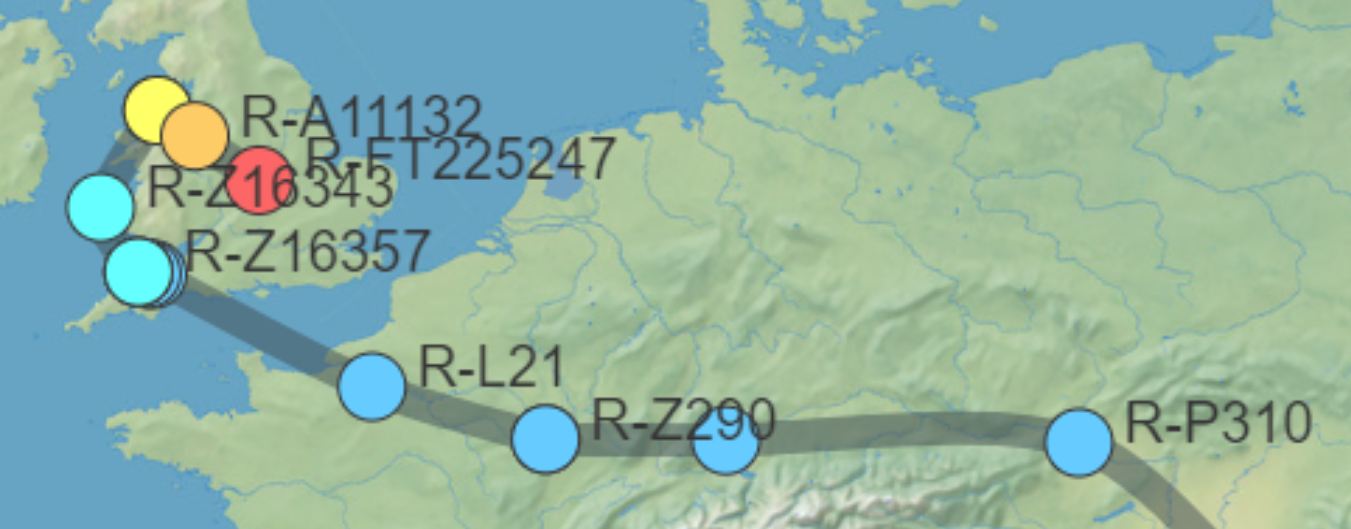
I expect that the FT225247 red dot would be more accurately further North in Lancashire. Here is some more information from SNP Tracker:

The little skull indicates that there is some verification from an archeolgical site. The blue cross to the right of R-A11138 is for Scotland. This match is with a Smith and goes back before the time of surnames. A11132 is dated at 850 CE. This should also be before surnames. That means that, unless all the other surnames died out, there could be other surnames associated with A11132. So far only Hartleys have been tested and have been found to have this SNP. FT225247 is intersting because SNP tracker gives a date of 1500 CE for this SNP. I don’t totally understand this date because the number before that is 440 years before present. As it is now close to 2022, that should be 1582. I don’t understand the difference of 82 years. One thought is that if both my brother and I have this SNP, then my father must have had it also and he was born in 1918.
The YDNA Block Tree
My Block Tree shows those who have taken the BigY test:

The specific area that I am interested in is where the arrow is. Above that space, all A11132 Hartleys have those 10 SNPs in common. Below that space, Jim and I have 7 SNPs in common. The 10 SNP block is represented by A11132 and the 7 SNP block is represented by FT225247. That means that the specific SNP FT225247 (my Hartley Line) may be as old as 1500 (assuming SNP Tracker is right) or as recent as 1918 when my father was born.
Likewise, the specific SNP A11132 may be as old as 850 CE (using the SNP Tracker number) or as recent as one generation before FT225247 or say, 1465.
The Iain McDonald SNP/STR Method
A specialist in the field of YDNA came up with this chart for TMRCA or time to most recent common ancestor:

The SNPs are in the vertical column and the STRs are in the horizontal row.
My Brother Jim and Me
Between my brother and myself, for example, there are no SNP differences, but there is one STR difference. That puts the time to most recent ancestor (our father) at 5-141 years ago. One of the instructions says:
- To convert these to date of your MRCA's birth, subtract these numbers from your averaged birth dates. If this is not
  known, a good approximation is 1956 AD/CE. Hence, a genetic distance of 2/111 with 3 mis-matching SNPS should be read as
  48-313 years. This becomes 1643-1908 AD at 95% confidence.
I was born in 1956 and my brother was born 1949, so say 1953. That means the ranges are between 1812 and 1948. As I mentioned above, my father was born in 1918. I was a bit surprised to have a STR difference with my brother.
Steve and Me
I think that Steve is a bit younger than me, so I’ll say our average birth age is 1960. Another instruction for the chart says:
- SNPs should be counted consistently with coverage of the test. There is no one-to-one correspondence possible here for
  any company without going heavily into the raw data. For Family Tree DNA customers, the number of SNPs that is
  appropriate will normally be somewhere between the number of non-matching variants and the sum of both sets of private
  variants.
You may have to scroll to see all the instructions. It says the number is between the non-mathcing variants and the sum of both sets of private variants.

This shows that I have 15 non-matching variants with Steve. Interestingly, I have one with my brother Jim.
By sum of Private Variants, I’ll add my SNPs (7) to Steve’s Private Variants and get 12. That means that between the two is 13 or 14. As far as STRs go, Steve and I are 7 steps apart. If I am interpreting the instructions correctly, I get this:

I suppose that I could average these numbers and come up with 308-837. That is quite a spread. That means that our common ancestor lived between 1123 and 1652.
Steve and Jim
I’ll check to see if there are any differences. Jim also has 15 non-matching variants compared to Steve. However, Jim and Steve differ by 6 steps on their STRs. That makes them a little more closely related by DNA (though in reality, there should be no difference). In the chart above, that shifts the numbers overto the left by one column. So 280-812 years from 1960 or 1148-1680.
Counting Block Tree SNPs
Tiger Walsh says on the same Facebook site where he introduces the above chart:

The problem with this is that my Block Tree shows 7 mutations in my line and only 2 average mutations between Steve and Michael. I believe that part of that problem is that Michael had the BigY 500 test and missed some of his variants. My best guess is that there should be about 5 variants between us. If I take 5 variants at 83 years each, that comes out to 415 years. That compares well to the SNP Tracker number of 440 years ago.
If I apply the 83 years to the top part of the block tree, that is an additional 830 years.

This is what I end up with. However, I don’t know what to use for a starting date. I’ll use 1960. That gets the common ancestor between me and Steve at 1545. That puts the top of the chart another 830 years back or at the year 715. Compare this to the SNP Tracker which had:

Mushing all that information together I get:

That would put the horizontal space inbetween the upper block and two lower blocks at about 1500. Based on the incomplete testing to date, that is probably the best date that I can come tofor the common ancestor of the existing three groups of Hartleys. Fortunately, all this information will be updated once we get the results of the two new BigY A11132 Hartley tests. The top block predates the use of the Hartley name and represents the time when the Hartley surname developed.
Dating the Roger Hartley Line
Once Lawrence’s BigY results are in we will have some genealogical correlation with the BigY:

The branch that Lawrence forms with Michael should date to their common ancestor Edward Hartley born in 1666.
Summary and Conclusions
- The existing BigY Tree of A11132 Hartleys had 3 branches. The new tree will have four testers plus an upgraded branch for Roger Hartley whose genealogy of all the Hartley branches goes back the furtherst (to 1628)
- I reviewed the SNP Tracker dating of the A11132 and FT225247 Hartley Branches
- I looked at a new Iain McDonald method of dating TMRCAs by using SNPs and STRs
- I looked at using existing SNPs and Variants at the rate of 83 years per SNP for comparing the existing Harltey BigY 700 tests. This method compared well with the SNP tracker dates
- I came up with dates on the Block tree for the different Hartley SNP blocks
- I noted the Hartley common ancestor date of 1666 for new BigY 700 tester Lawrence and existing BigY 500 tester Michael
- The A111132 Hartley YDNA Tree should be in much better shape when the two new Hartley BigY tests are completed
“Before Present” or “BP” references a fixed date – 1 Jan 1950
https://en.wikipedia.org/wiki/Before_Present
It comes from the dawn of radiocarbon dating, when they needed a fixed point to refer to.
The expression you thought it should be is “years ago” abbreviated to “ya” as in 25kya = 25,000 years ago, and so on.
If a TMRCA is close to now, stating a range of specific years, as you did here, if probably the best thing.
(My own Big Y700 nearest match is 97 SNPs away, so the difference between BP and ya is not worth worrying about.)
Thanks for your input. I have had some confusion around these terms, but am slowly coming to a better understanding of what is meant by them.
Joel