I was pleasantly surprised recently to get three rather close DNA matches to myself and my family on my mother’s side. The three Latvian matches are Normunds, Elina and Zanda. Normunds is the father and Elina and Zanda are the daughters. These three matches are on my Rathfelder side.
Adding the New Matches to My Rathfelder Tree
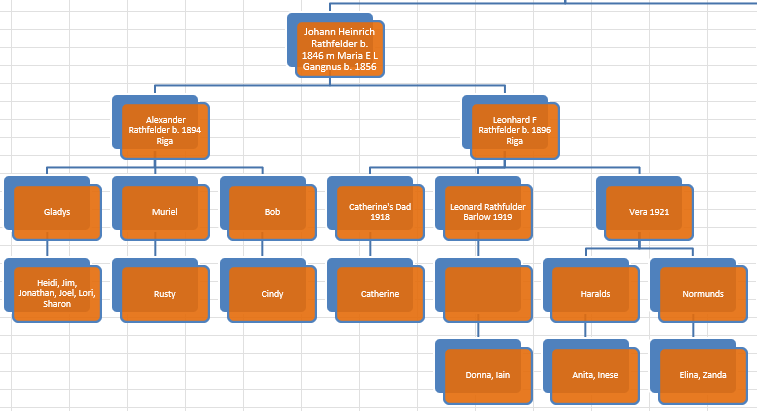
I keep a combination genealogy/DNA match tree. This is what I have so far for the Rathfelder tree:

I need to add the three matches under Vera:
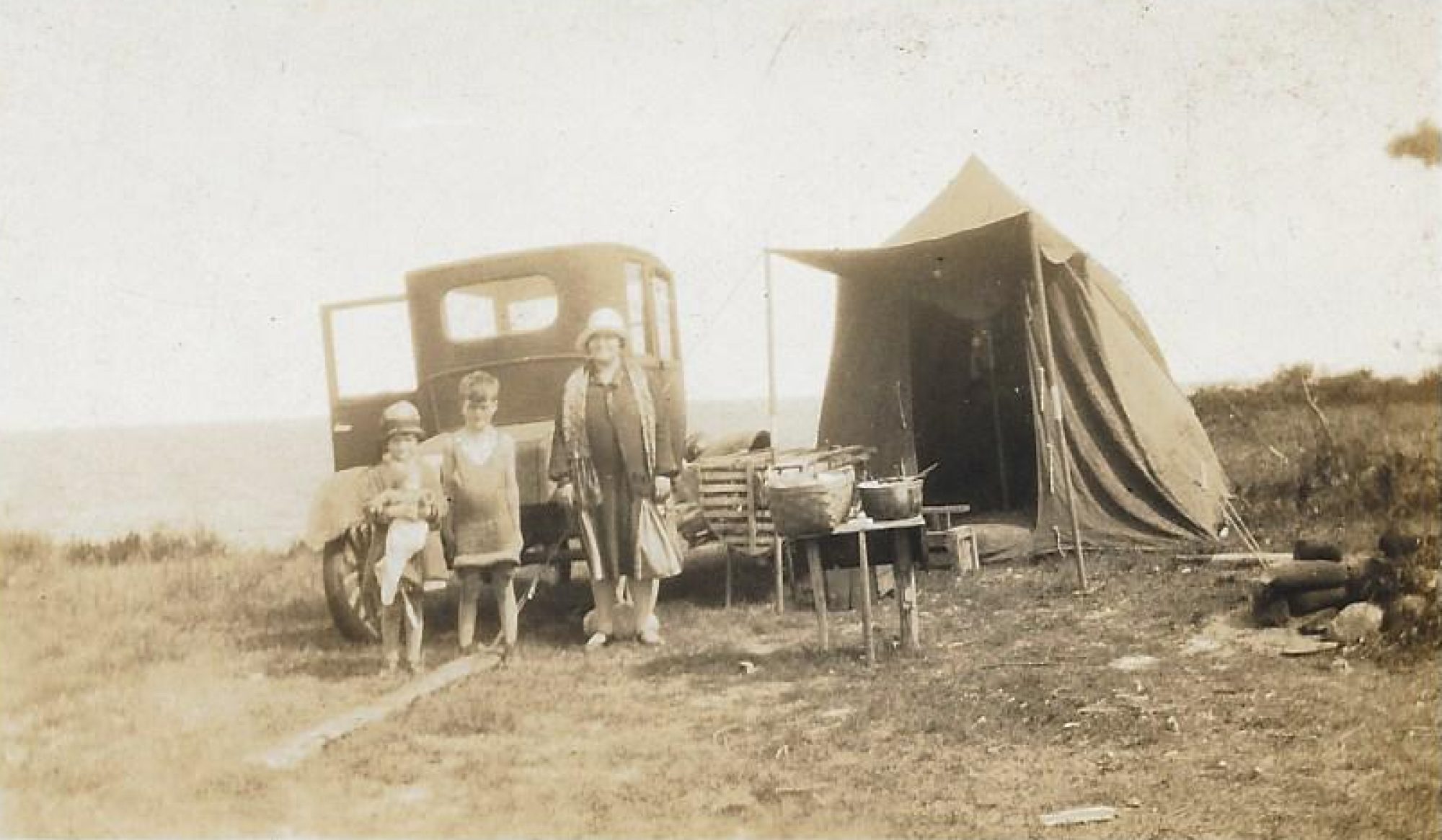
this shows that my mother and Vera are first cousins. that means that my siblings and I are 2nd cousins with Normunds and 2nd cousins once removed with Elina and Zanda. I have this photo of Vera from my cousin Anita:

How We Match by DNA
For some reason, I can’t see the detailed DNA results for Normunds or Zanda. I do see results for Elina:
DNA Painter
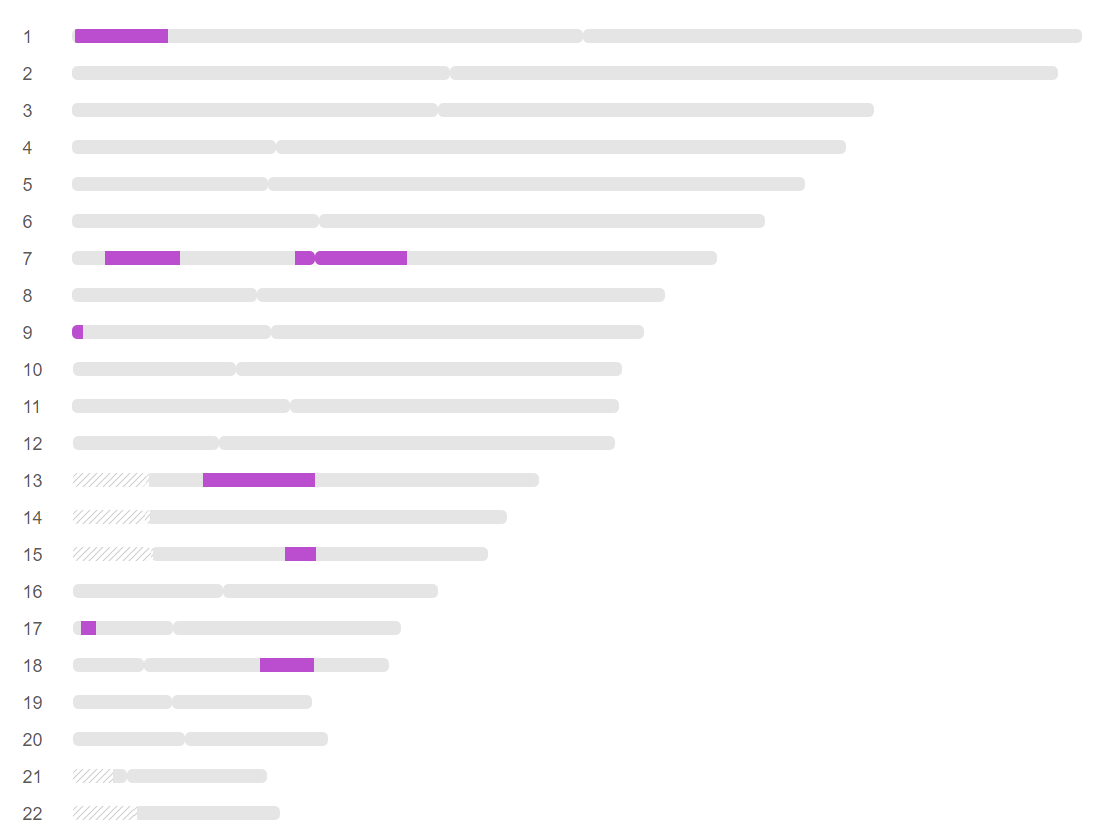
This information can be added on to my DNA Painter profile. This is how it looks now:

This shows that I am ‘painted’ overal 52%. This means that I have identified 52% of my DNA by known matches. On the representation above, the paterrnal side is the top part of each chromosome and the maternal part is the bottom of each chromosome. Here is just my maternal side:

This shows that I am painted 45% on my maternal side or a little less than half.
When I add Elina, this gets my maternal side up to 47%:

That also raised my overall ‘painted’ level to 53%.
Normunds DNA
At first I couldn’t see the specific matches for Normunds’ DNA but Zanda made the corrections, so I can now see his results. Here they are:

I’m interested to see how this will have an effect on my DNA Painter Profile. A second cousin is usually the best person to have for a match because they represent the DNA of one grandparent – in this case, my grandfather Alexander Rathfelder. It turns out that there is no overall effect for Normunds. This is perhaps because he overlaps with other Rathfelder matches. There was a difference, but not enough to bring the painted percentage up overall or on the maternal side.
Here is Chromosome 15:

This would indicate that Carolyn’s match is spurious. She matches at 8 cM and a certain percent of small matches are inaccurate or false matches. The other orange matches all have Henry [Heinrich] Rathfelder and Maria Gangnus as common ancestors.
Here is what MyHeritage shows between myself and Normands:

This turns out to be more than average DNA for 2nd cousins to share:

This study shows that 229 cM would be average.
Normunds and Gladys Rathfelder
As Normands has as much or more Rathfelder DNA than his daughters and as my mother has more than her children, I’ll look at the match between Gladys and Normunds:

Normally, I don’t paint my own first cousins’ matches. This is because a first cousin normally just distinguishes between paternal and maternal side. However, for my mother, it looks like I painted hers:

Here the blue color is Rathfelder/Gangnus (1st cousins). This is just my mom’s paternal Rathfelder side. Also I usually have a lighter color for closer relatives, so the more distant, darker color relatives can shine through. My mom is currently at 40% painted on her paternal side and 35% painted overall. Let’s see if Normunds makes a difference.
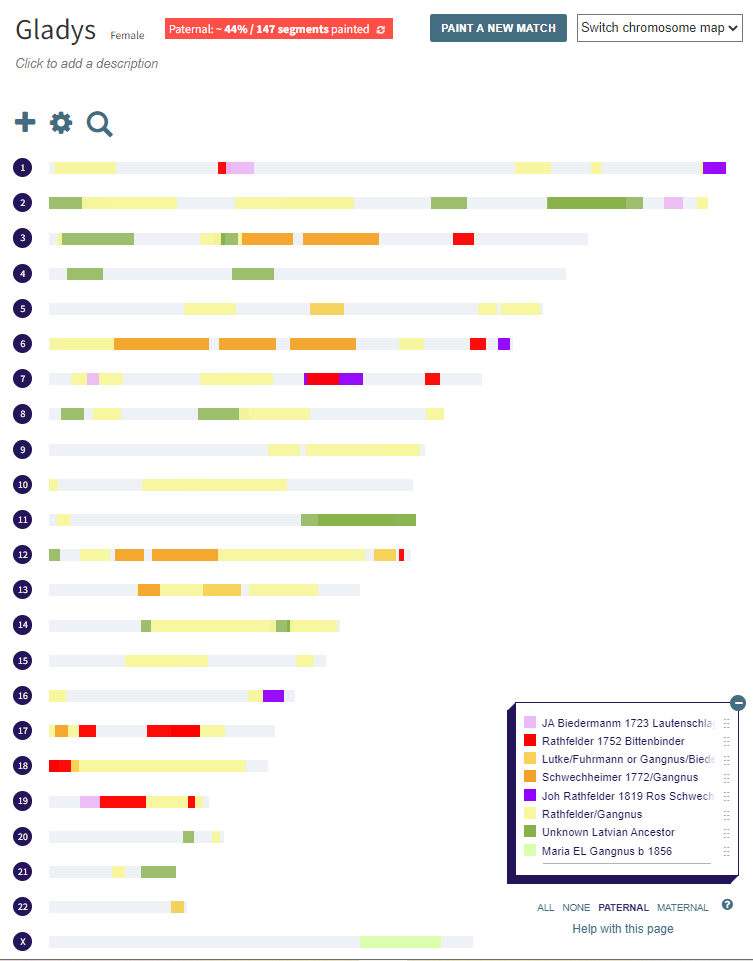
Here I changed Rathfelder/Gangnus DNA to a more subtle yellow. This got my mom painted up to 44% on her paternal side and 37% painted overall.
Normunds adds some new DNA to my mother’s profile on Chromosome 1:

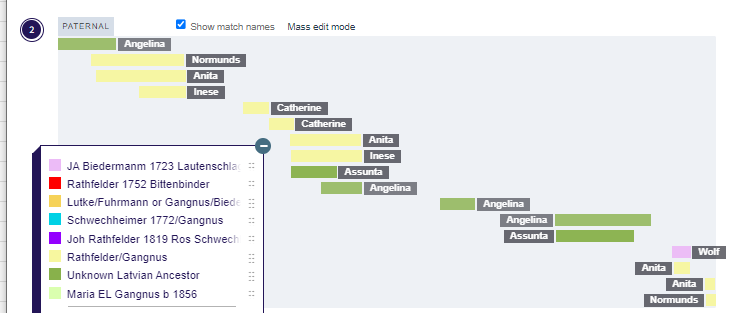
On Chomosome 2, Normunds overlaps with Angelina. I am not sure of her ancestry, but from her DNA, it is clear that she had ancestors from Latvia::
On Chromosome 7, Normunds has an overlap with Rudi:
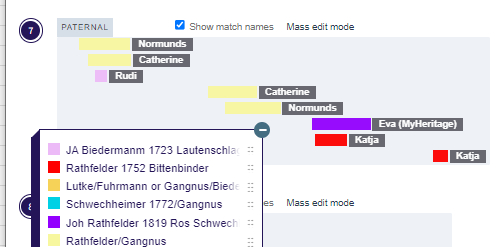
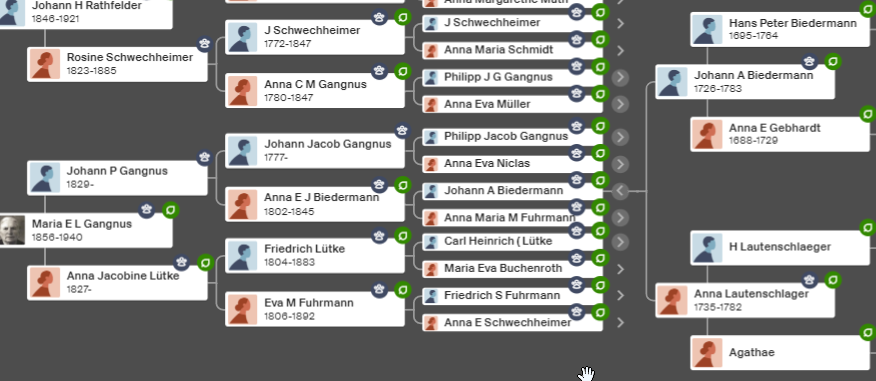
Rudi has ancestry going back to 1723.
However, when I check MyHeritage, there are other possible relationships to Rudi. This one is called Theory 1:
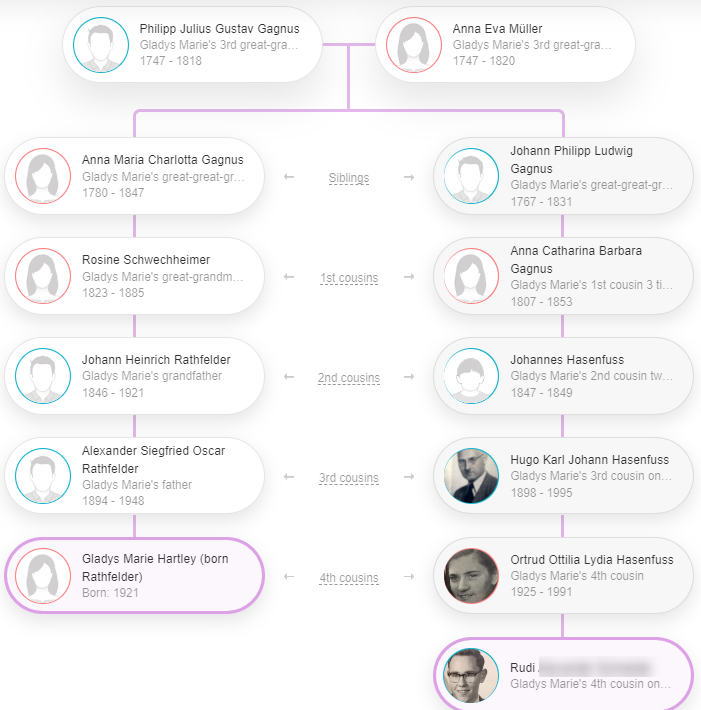
This relationship would be on my mother’s paternal grandfather’s side, whereas the previous relationship would be on my mother’s paternal gramdmother’s side. Plus, I don’t know if I have checked out these different relationships. Altogether, MyHeritage has 4 Theories. It would be beyond the scope of this Blog to check them all out. The bottom line is that I thought that the match with Rudi on Chromosome 7 would give me more definition as to where the match that my mom had with Nornunds came from. However, in this case, due to intermarriage in the Colony of Hirschenhof, it is not clear.
Perhaps Normunds match with my mom on Chromosome 17 will tell us something:

Normunds has a partial overlap with Astrid and a complete overlap with Otis. This is giving a mixed message perhaps also:
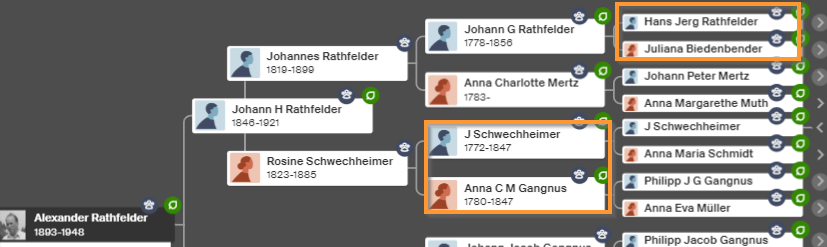
Otis’ ancesetry goes back to Schwechheimer (1772) and Gangnus (1780). Astrid goes back to Rathfelder and Biedenbender. Otis has uploaded his DNA results to Gedmatch. If Normunds uploads his results there, perhaps this will reveal something.
Meanwhile, Astrid shows triangulation with my mom and Normunds at MyHeritage on Chromosomes 17 and 19:

Triangulation means that these people all match each other. That means that I would tend to think that the DNA matches between the three of us represent DNA from Johann Jerg Rathfelder born 1752 and his wife Juliana Biedenbender born 1755. Here is Gladys’ DNA profile on Chromosome 19:

Astrid’s Genealogy
In order to sort this all out, I will need to take a closer look at Astrid’s genealogy. Here is what MyHeritage shows:

Ancestry shows this relationship, which I have assumed was right:

The W Rathfelder is Wilhemina Rathfelder. As I recall in other research, there was more than one Wilhemena Rathfelder. I think that the custom was to name the godchild after the godparent, so that may be the source of the duplicate names. Another confusing thing is that Hans Jerg had two children named Johann Georg:
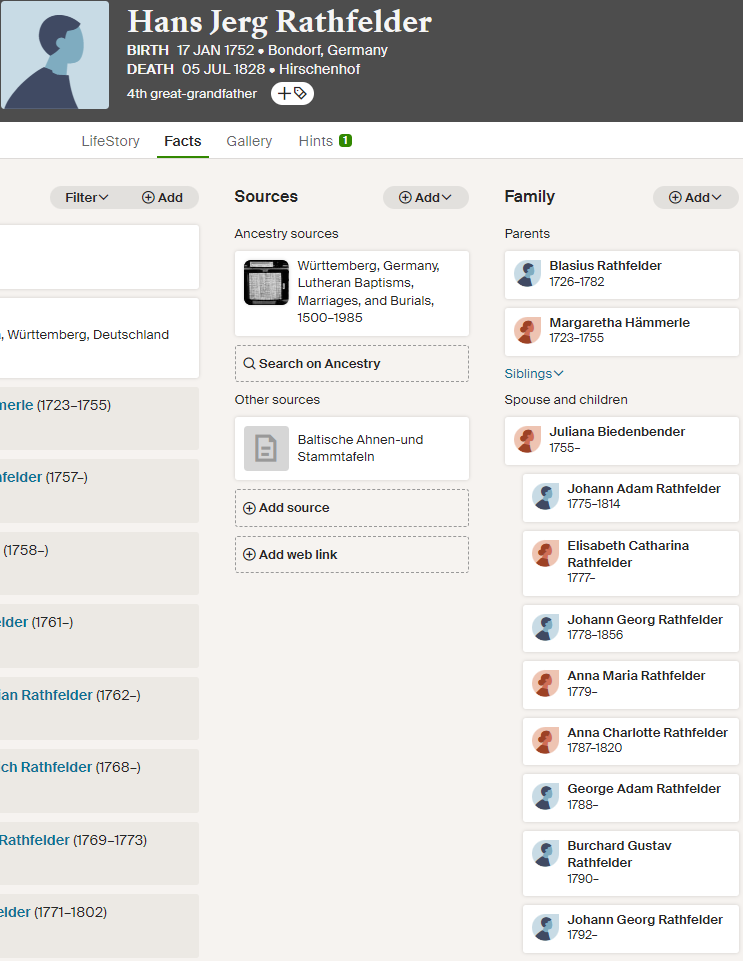
These two Johann Georg’s were born about 15 years apart. That in formation was from this publication:

Based on the underlining, the first Johann went by Johann and the second went by Georg. The father Hans Jerg was also a Johann Georg.
Checking Astrid’s Tree
The best way to check Astrid’s tree is to build my own tree for her. Astrid has that her mother was baptized here:

At the Raduraksti website, I see this Church:
At this site, I found some information on the Spengle family, but I didn’t see Astrid’s mother or grandmother:
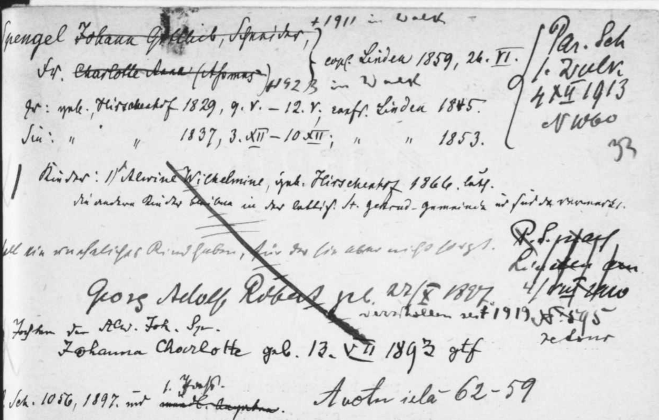
This would take a long time to check, so I’ll just assume the connection is right. My suspicion is that there are other connections than just the obvious ones.
Normunds, Gladys and Eva
I wrote a Blog about Eva here. She is my third cousin. Here is where Normunds, Gladys and Eva triangulate on Chromosome 1:

The theory is that shared amount of DNA comes from either Johann Rathfelder or Rosine Schwechheimer:

In that Blog about Eva, I mentioned this family chart:
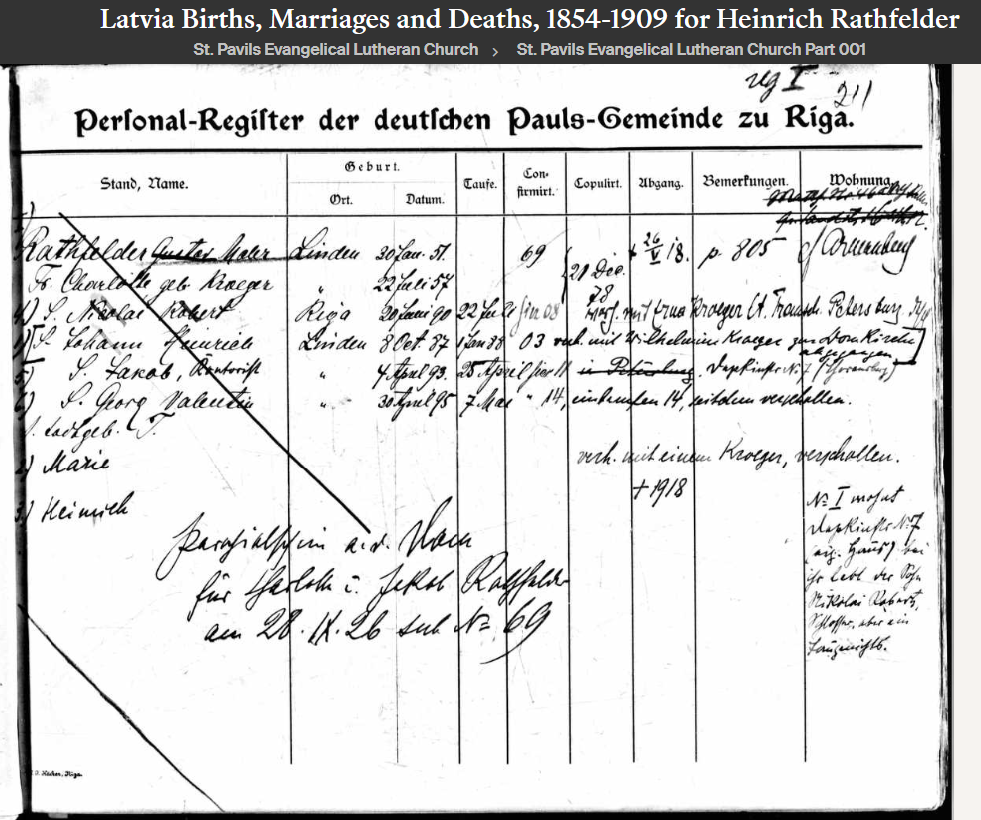
Did My Great-Grandmother Have a Second Husband Who Ran Away?
The Gustav Rathfelder family lived in Riga and attended St. Paul’s Lutheran Church. I wonder if the +1918 means that my great-grandfather Heinrich died in 1918. I have that he died before 1921. I put this image out to the Latvian Genealogy Facebook page and got these two responses:
“Abgang” is essentially departure — e.g. the +1918 means that Heinrich died in 1918 (and therefore “departed from” the church congregation). I’ll try to take another look at the rest later.
It sounds like Maria Gangnus Rathfelder had a second husband which would make sense if the first one died. He apparently deserted her if I understand the record correctly.
Concerning the comment on naming, I have seen that a child often had the same name as the Godparent. Here is the birth record for Robert Nicolai:
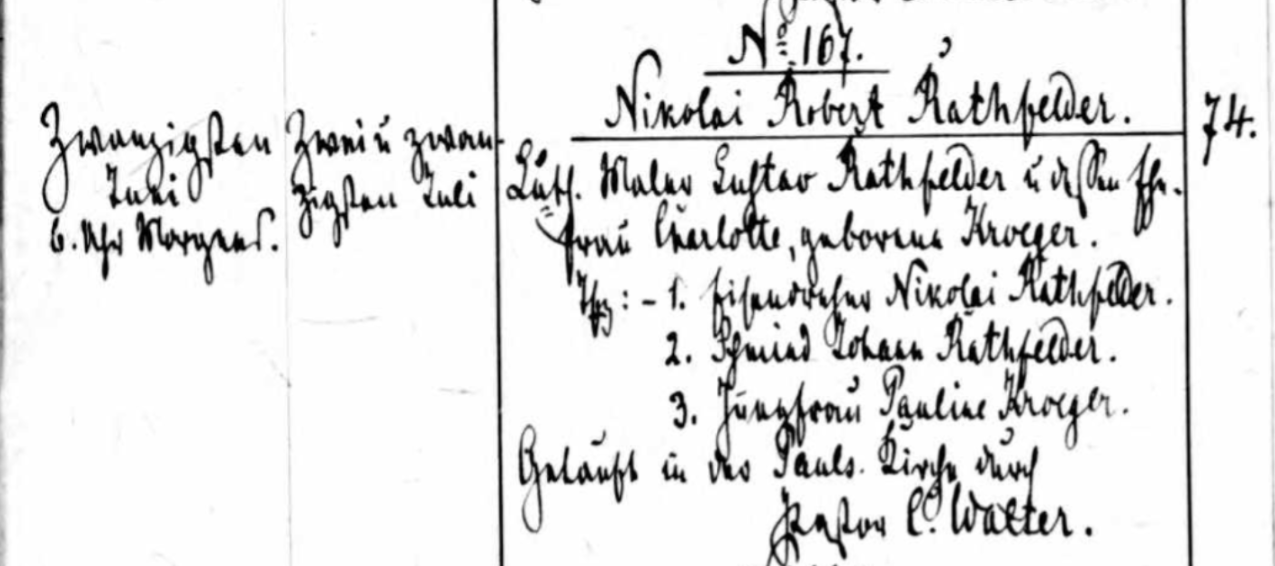
I take #1 above to be the godfather, Nicolai Rathfelder. Further, I believe him to be Johann Philip Nicolai Rathfelder born 1874 to my great-grandfather Heinrich Rathfelder.
Here is a photo of Marie. I assume that it is during Christmas and that she is with some of her relatives:

Marie is second from the left. She was born in 1856, so she would be quite old here.
Gladys, Normunds and Peter
These three people also triangulate at MyHeritage. That means that they all have common ancestors:

This triangulation happens on Chromosomes 7 and 18. Here is my mom’s DNA profile for those two areas:
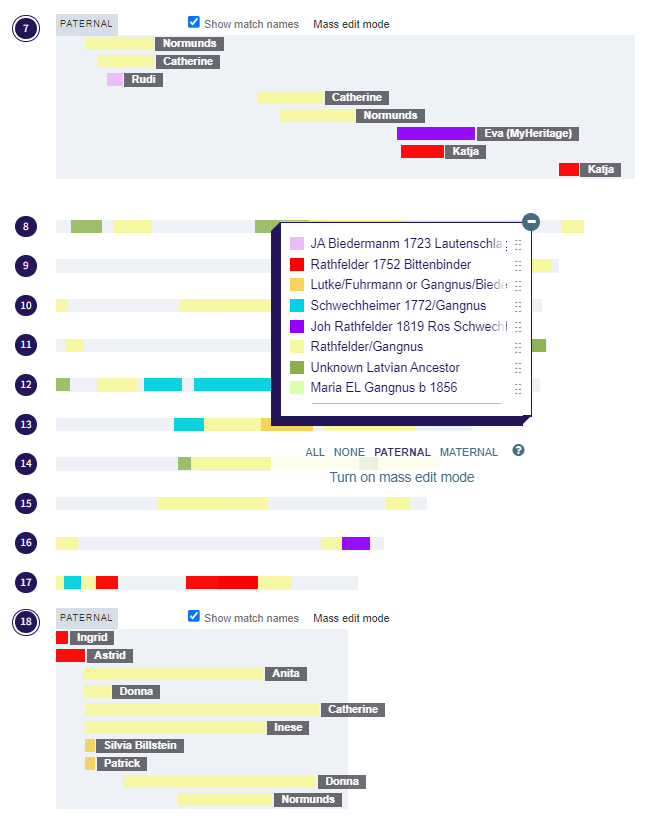
These two areas represent ambiguous genealogies. Remember Rudi had about 4 ways that he could match. Also Silvia and Patrick could match on two different lines.
Peter’s Genealogy
MyHeritage shows this:
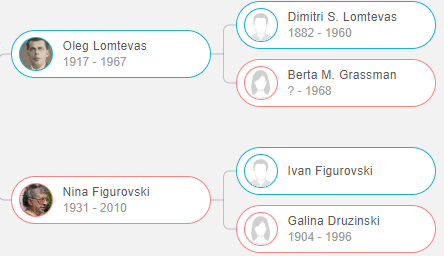
I can try to build a tree to see if I can get any further. I’ll start out on the paternal side. This marriage record is helpful:
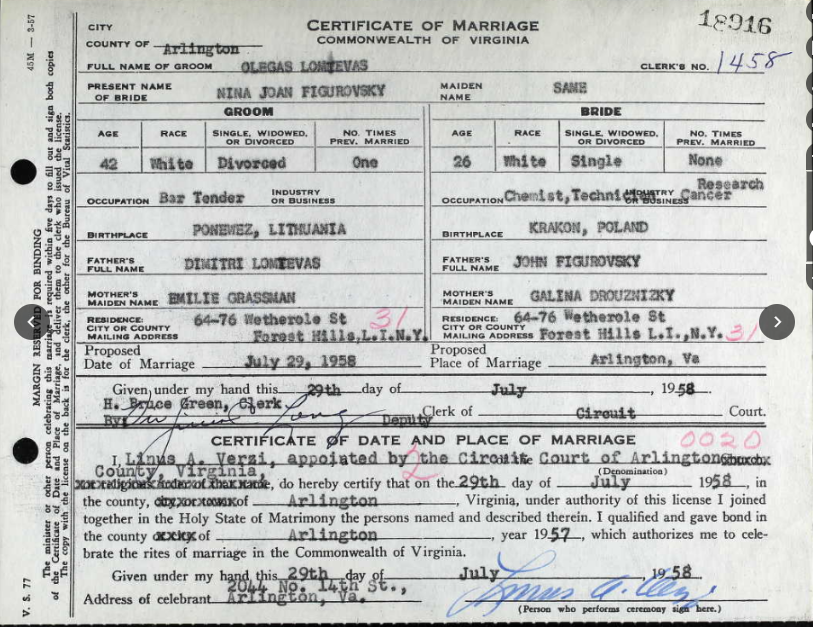
However, this has Oleg’s mother as Emilie Grassman rather than Berta. Social Security has this information:
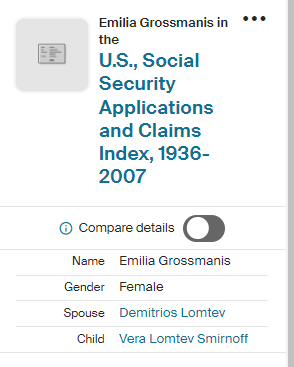
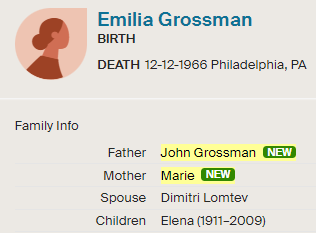
It seems like Oleg has a sister Vera. Find a Grave has more on Emilia:

My tree so far:
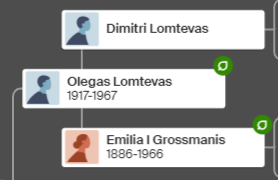
Here we see that Emelia was born in Riga:

This could be the connection that I was looking for. This is likely Emilie traveling from Lithuania to New York in 1955:

That’s as far as I can get now. The connection appears to be with Emilie Grossman or Grassman. One tree at Ancestry has her parents:
Normunds, Gladys and Deborah
Perhaps I don’t know when to give up, but I’ll look at Deborah. These three triangualte on Chromosomes 1 and 9:

Deborah has a meager tree at MyHeritage:

It turns out that I already started a tree for Deborah. However, I couldn’t easily find anything new. Aparently Brigitta was born in Riga.
Summary and Conclusions
- I was happy to find out about another branch of Rathfelder relatives in Latvia through DNA matching.
- Normunds is my mother’s first cousin once removed.
- I was able to ‘paint’ Normunds on to my DNA profile as well as my mother’s. It would be possible to add him also to my siblings’ profiles
- In some cases, due to matches with more distant relatives, it is possible to tell where certain portions of DNA matches between my mother and Normunds come from
- In other cases, it is difficult to tell for certain to intermarriage in the Colony of Hirschenhof where the Rathfelders and their ancestors lived long ago.
- I looked at some common matches that Normunds and my mother Gladys have at MyHeritage
- I relooked at the match of Eva. I found the family record kept by the Lutheran Church for Eva’s great-grandparents. He great-grandfather was the younger brother of my great-grandfather. This record gave the death date for my great-grandfather Heinrich Rathfelder. It also suggests that my great-grandmother remarried a Kroeger who went missing.
- It appears that there could be more research of the DNA and genealogy to pull these families together.