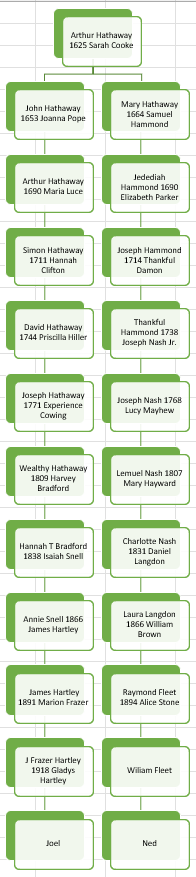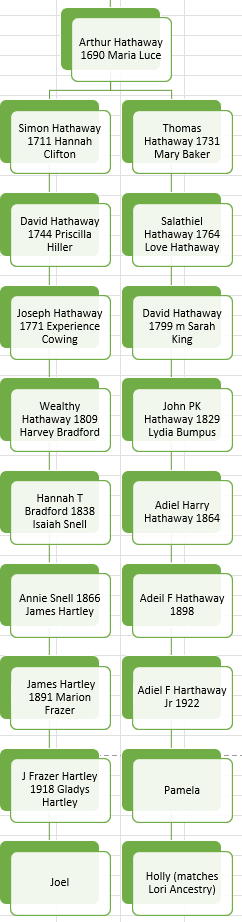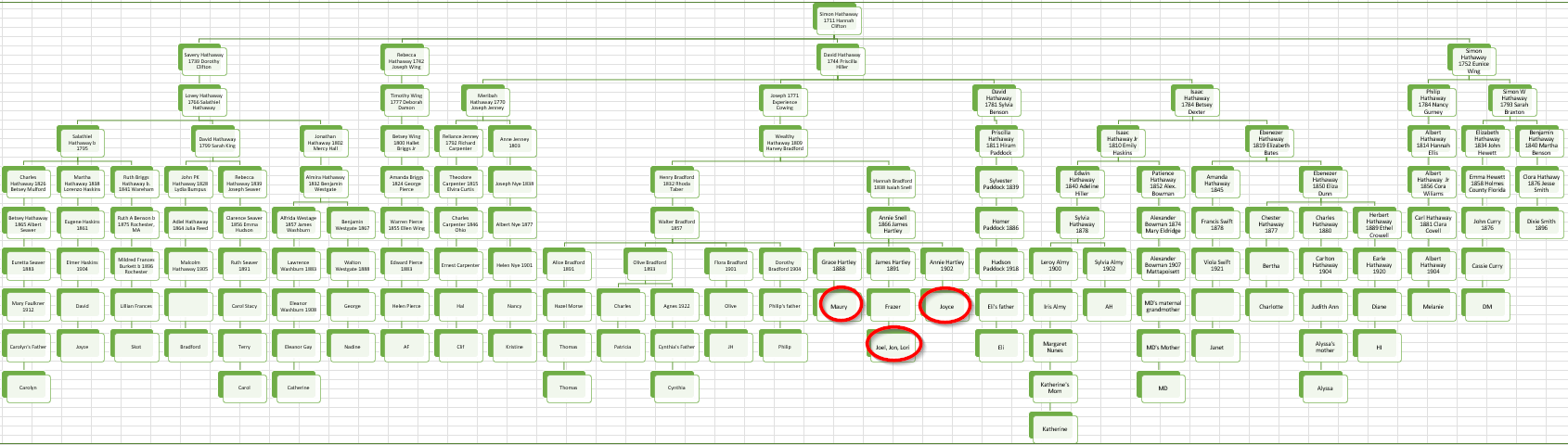
Reviewing a Lentz ThruLine

My DNA evidence for my Lentz ancestry has seemed scant. Here is one ThruLine worth looking at:

This depiction shows that I match the descendants of two children of Anna Eliza Glenn. Anna is shown as the daughter of Eliza Lentz, the daughter of our proposed Common Ancestor John A Lentz.

My Mother’s Lentz ThruLines

Before I check the Ancestry, I’ll look at some other ThruLines. It would make sense to look at my mother’s first:

She has better ThruLines from Eliza plus she shows a William Andrew Lentz Line.

Glenn Genealogy

Three Glenn matches support the genealogy of this Thruline through Eliza Lentz. I doubt that the DNA test taken was really for the daughter of Lydia King about as that person died in 2011. This was before Ancestry was doing DNA tests:

Usually, I start from the present and work back. In this case, I’ll start with my tree and work down to the present. This is because the DNA matches look good and the genealogy looks likely. Right now, I don’t have a spouse for Eliza Lentz:

This hint at Ancestry appears to be correct:

The marriage took place 16 February 1840 in Kensington, PA. Here is Eliza in Kensington in 1850 with her boat builder husband:

Here is Eliza’s burial information:

She died three years after my ancestor Jacob Lentz. Here is his marker – also at the Palmer Burying Ground:

This record shows where Eliza was living at the time of her death:

I believe that her brother lived on Frankford Ave.

Anna Eliza Glenn

ThruLines indicates that Anna Eliza Glenn was in the ancestry of my mother’s three DNA matches. Anna Eliza shows as plain Eliza in the 1850 Census above. Here is Ann E Glenn in 1870:

It appears that the census taker missed a lot of information. Also Frances hasn’t married at age 30 at this time.

Here is Elizabeth Glenn Williams’ Death Certificate:

This gets us one step further down the tree.

Starting Back with the King Family Tree

Really, the right way is to start in the present and work back. Here is the tree I am looking at:

I just have to verify that Dolores goes beack to Eliza Lentz. First I am looking at Lydia M (Lottie) King. Here she is in the 1900 Census in Philadelphia:

She is a waitress and her father is a carpenter. That gets my tree looking like this:

The name Liza King is from the Census – though that was not her maiden name of course. Here is a death record from Clara Gavin that names her parents as Sidney King and Anna E Glenn:

Here is some information from the findagrave website:

The next step is connecting Ann Eliza Glenn to her mother who we expect is Eliza Lentz. I believe that I already made the connection with the marriage record I mentioned at the top of the Blog. This record gives no parents for the bride or groom, but I assume that they have the right Eliza Lentz. The location of where she lived compared to her Lentz family as well as to her age at time at marriage seem to say we have the right Eliza Lentz.

Ella, Clara and Lydia

The ThruLines mention Ella, Clara and Lydia:

Lydia was the line I looked at above.

I mentioned Clara in a death certificate above (Clara Virginia Gavin).

Ella is seen on the 1880 Census for Philadelphia:

Ella’s father is on the previous page of the Census.

The William Lentz Connection

Here are my mother’s small DNA matches to descendants of William Lentz:

I will look at Debbie’s connection as she is a fourth cousin. The other matches are fourth cousins once removed. Here is Debbie’s tree:

The tree is small, but goes back to Lentz. I don’t have much information on Harriet Lentz on my Ancestry Tree:

It turns out that I made a tree for Debbie years ago:

This was made before Ancestry had ThruLines. At the time, they were using a concept called ‘Circles’. All I need to do is to add to my Ancestry Tree. Here are Emma and Harriet from my Ancestry Tree information:

Mary and William Davenport

The two William ThruLine Lines above are for William and Mary Davenport. Here they are in the 1900 Census for Philadelphia:

Harriet’s husband Claudius was a saw maker. These children were born in New York according to the Census.

Comparing Lentz ThruLines to Nicholson ThruLines

My mom is part Lentz and part Nicholson on her maternal side. Here is a comparible Nicholson Thruline with a match in the 4th cousin range:

I never doubted my mom’s NIcholson heritage, yet there is only one match going to her comparible 3rd great-grandfather on that Line. It shows that my feeling of not enough Lentz DNA matches was irrational.

Summary and Conclusions

  • All my mother’s ThruLines under John A Lentz born 1792 appear to check out
  • This is satisfying as I thought that there were very few Lentz DNA matches
  • Altogether my mother has 7 DNA matches descending from the John A Lentz Line
  • It appears that the ThruLines are effective at the 3rd great-grandfather level which compares to a match of a 4th cousin.
  • It would be interesting to see how many 3rd great-grandparents even have ThruLines

A Small DNA Match at AncestryDNA Leads Back to Potential Ancestor Mary Fielding Born 1739

I and some of my siblings recently had a match with Brian. That match suggested a common ancestor of Mary Fielding Born 1739. I thought that it would be interesting to try to figure out if this connection seems likely or not. Herre is the connection:

This is the connectioin with my sister Lori. She matches Brian at 9 cM. I match him at 8 cM, so these matches are quite small. Brian’s main tree is private, but he has this tree on the Hargreaves side:

This tree is consistent with the Ancestry connected genealogy above except that Brian’s tree stops with John Hargreaves. I do see this tree at Ancestry:

However, I see many other trees with different parents for John Hargreaves.

Slogging Through Some Hargreaves Genealogy

Brian’s genealogy is quite thorough. He has the wedding certificate for Elizabeth Hargreaves:

She was married in a Methodist Church in Nottingham. Her father was Alfred Hargreaves. Here is Alfred’s baptismala record from Burnley in 1880:

Alfred’s father was a mason.

I’ll move on quickly to Richard Hargreaves. The 1881 Census indicates that Richard was born in Brierfield, Lancashire.

In 1871, we see Richard is in Bacup:

Here is Brierfield:

This seems to be a good guess for a baptismal record for Richard Hargreaves:

A Collier is a coal miner. It appears that the younger Richard was a Miner in 1861:

This appears to be a likely marriage record for the elder Richard Hargreaves:

The elder Richard is listed as being from Roughlee in the 1861 Census. In the 1861 Census, he is from Pendle Forest:

Here is Roughlee and Newchurch in Pendle:

I believe that Pendle Forest or the Forest of Pendle would be to the North of Newchurch-in-Pendle.  This marriage differs a little from Brian’s as he has Richard marrying Ann Isherwood:

The problem with this is that this marriage takes place in Bolton and both parties are shown as being from Bolton which I feel is less likely than the Forest of Pendle scenario above. Also Ann would have been on the older side – about 31 at the time of her marriage – which may have been unusual.

Here are Richard and Ann in 1841:

They apparently have a son, John who was 12. That would mean that John was born in about 1829 – before the 1833 wedding of Anne Isherwood.

It is beginning to seem possible that the connection may be more from Colne than from Bacup:

The Hargreaves, from what I can tell were from the area of Brierfield which is closer to Colne than Bacup. I have ancstors from both the Bacup and Colne area.

Who Was the Younger Richard’s Wife?

I never established this:

The 1871 Census says she was from Sabden:

In 1871:

Ann has a daughter who is 4, so they may have married 1867 or before:

Here, Richard is a mason and his father a collier. This agrees with Brian’s tree.

Genealogy Before 1800 is Difficult – A Different Hargreaves Connection

Beforeee 1841, we don’t have the advantage of the Census. I have another ThruLines connection here:

I match Anne and Louise whose ancestry goes back to George Hargreaves.

My ancestry James Howorth married a Mary and had several children. Their first known child was Betty:

If we back up 9 months, that brings us into the end of April 1788 for a marriage:

Based on spelling of Howorth and date, James appears to have married either Mary Holt or Mary Eastwood. In a previous Blog, I favored Mary Holt as the mother.

Summary and Conclusions

  • I didn’t follow the genealogy as far as I could, but it seemed like neither line was leading me to the same common ancestor the way Ancestry showed it
  • It seemed like Brian’s ancestry may have been closer to my Colne ancestry than to my Bacup ancestry
  • I would like to check out other ThruLine ancestors for ancestry
  • The small the DNA match and the further away the common ancestor, the less likely it is of being accurate.
  • Even though these ThruLines may be innacurrate, there is still the effect of ‘where there’s smoke there may be fire’. That means that there may be another meaningful connection.


New YTree Changes at YFull for Hartley, Smith and Nutter at A11138

I was informed recently by a person with Nutter surname heritage that there were some changes at YFull in my area of the YDNA Tree. Here is the current YTree:

YF00890 is Smith. YF106096 is Nutter and the last two ID numbers are my brother and me.  When I press the live button on the tree, I get this:

This is how the YTree looked for A11132 late last year:

This just included Nutter and myself. This must have changed when I added my brother’s kit. Notice that this had a formed date and a TMRCA. Last year’s formed date of 1700 ybp seems way off as that would be roughly the year 300 AD. Here is what FTDNA has:

Changes under A11132

First, I will look at changes under my branch. It makes sense that I would be under a new branch by adding my brother. At FTDNA, that branch is called FT225247. At YFull it is called A11136. What the A11132 tree is telling me that my brother and I share all the SNPs under A11132. They are:

  • A11132
  • A11134
  • A16716
  • A11135
  • A11137
  • A11140

It also tells me that we don’t share:

  • A11133
  • A11136
  • A11129
  • A11130

This is consistant with Variants that my brother and I have under FT225247:


The difference is that the Mawdsley BigY tester does not have his results posted at YFull. He is the one that split the previous A11132 into A11132 and A11134. As Nutter tested positive for A11134 and A11135, he would be A11134 also.

A11138 to Y82274

Mr. Smith who was in the former A11138 group would be better positioned to do this analysis, but I’ll see what I can see from my viewpoint. Here is the present (non-Live) view of the YTree:

This shows that Mr. Smith with the low ID# shares his group now with two new memebers. One member appears to be from Australia or have ancestors from Australia. The Tree shows that A11138 has three SNPs:

  • A11138
  • FT22040
  • MF205420

This is interesting because A11138 used to be in it’s own group of one.

Here is the new designation under the ‘Live’ Tree:

Now Mr. Smith is under Y82274 (which is under A11138) and the new testers are under Y82274 at Y445810. Mr. Smith’s Y82274 appears to have 19 SNPs, so would be quite old. Y445810 is in a group of 4 SNPs, so would be younger. These new testers must have not tested at FTDNA as they do not show up there. So, as I was writing this Blog, Mr. Smith who was previously A11138, got pulled down to Y82274, then the two new testers were more closely relataed to each other. They left Mr. Smith at Y82274 and moved down to the newer Y445810. The next step is for YFull to come up with TMRCA numbers. Most people greatly appreciate having those dates. This is one case where YFull has more testers directly under this branch of A11138 than FTDNA has, so their estimates should be more acccurate.

As there are four SNPs in Y445810, that could indicate that SNP is from around the 1600’s. However, it may be earlier if the two new testers have private variants. My guess is that there will be little difference between the date of A11138 and Y82274. YFull previously had A11138 around the 350AD and FTDNA has it at around the year 500AD.

Why So Many SNPs for Y82274?

Or, the question could be, why does Smith have so many SNPs now? My guess is that is because he took the older BigY500 test. This test covered less of the Y Chromosome compared to the newer testing. When the new testers tested, it was clear that they shared many of their SNPs with Smith. Under the older testing at FTDNA, Smith had 11 Private Variants since A11138:

Now, he is showing 20 SNPs at YFull:

In addition, Mr Smith likely has Private Variants in parallel with the 4 extra variants that the new testers have. That means that as a result of the new testing, Mr. Smith’s Variants have about doubled.

Summary and Conclusions

  • R-A11138 is under a state of flux due to two new testers
  • A11138 used to be held by Mr. Smith. He is now at one level down at Y82274.
  • The two new testers are one level below Y82274 at SNP Y445810.
  • YFull has not come out with new date estimates for A11138, Y82274 and Y445810. This will be important as the new testers are not at FTDNA.
  • My brother and I are now shown as A11138. However, FTDNA has many more teseters in this area. That means that their tree and dating should be much more accurate than what YFull has.


111 STR YDNA Results with Nutter-Hartley Connection

I wasn’t sure what to call this Blog. I have been following the YDNA test results of a Nutter descendant with interest. His YDNA results have been showing a connection to my general branch of the Hartley Family. The results of other Hartleys who have taken the BigY test show like this:

All those so far under R-A11134 are Hartleys. One tester who is A11132 is a Mawdsley. The connection between Mawdsley and Hartley could be right around the time that surnames were coming into use.

Nutter’s 111 STR results

While we are awaiting Nutter’s BigY results, I will look at his 111 STR results. STR results are much more difficult to interpret compared to the BigY SNP results. That is because STRs can mutate backwards or forwards. In other words, the mutations can increase or decrease.

Here are the STR results of those Hartleys in my general line who have taken the test and have joined the Hartley YDNA Project at FTDNA:

My brother and I are in the last group. The group above us are Hartleys with a Quaker ancestor who left England to move to Pennsylvania in colonial days. The top person is Mawdsley who is closely associated with the Hartleys at R-A11132. The rest are Hartleys in the R-A11134 category. The first two in the A11134 group have only tested to 12 STRs which is not very helpful. Note that many of the genealogies get stuck in the 1700’s. It is very difficult to do the genealogy in England at that point due to the number of Hartleys in the Colne, Lacnashire area. This is where many of the Hartleys came from.

I have an arrow in the column where the new Nutter results are. The person above Nutter tested to 111 STRs. The person on the list below Nutter tested to 37 STRs. Nutter and the Hartley below him have a match on this STR:

They both have a value of 20 for DYS458. Of the 12 Hartleys who have tested to this level, only these two have a value of 20 for the STR named DYS458.

Here is a comparison between Nutter and the Hartley tester listed above him:

At STR DYS710, both these two have a value of 36. This may be more difficult to interpret as two of the Quaker Hartleys and the more distantly related Mawdsley tester have this value.

Building a STR Tree

These trees are difficult to build and interpret, but I will give it a shot. These trees are easier to build when the BigY SNP results are in, because those results are so much easier to interpret. Previously I have considered two models to intepret the STR results. Here is the first:

This tree only has six people in it, so I think that some are missing. I count 9 Hartleys who at the FTDNA Hartley YDNA Project who have tested to 111 STRs. I see also that other changes will be needed as I don’t see DYS710 listed in the tree. Also I don’t see DYS458 listed.

Here was my second model:

It looks like a major overhaul of this tree is needed. It looks like I only did the tree for those who took the BigY test.

111 STR YDNA Hartley Tree Overhaul

This appears to be the raw data involved:

I had trouble matching the STR names to the columns. Previously, I had used a program called SAPP to try to analyze these STRs. I’ll try that again. I downloaded the information for all testers in my Hartley group except for the two that tested for only 12 markers. This goes into a text file where the first line is /STRDATA.

Here is what pops out:

The program comes up with four main branches. Here is some further identification:

It seems like the results are generally accurate. Nutter is near the middle of the chart. He is with the other Hartley I mentioned earlier with a DYS458 value of 20 (red arrow). My brother and I are on the bottom row. I would say that the depiction is generally correct. Between Nutter and his closest match on the tree, the Time to Most Recent Common Ancestor is 1750. Here is what FTDNA shows for the GD of 2 between Nutter and his closest Hartley 37-tested STR match:

The third line indicates a GD of 2. FTDNA estimates a aTMRCA of 1650 for that GD. However, whether this is more or less accurate than the SAPP tool, I don’t know.

For the Quaker Hartley group, the TMRCA is 1550 according to SAPP. The known common ancestor is from 1666. However, it is within the SAPP Tree range of 1350-1700. There are more than the usual mutations for this line which make the TMRCA seem older.

The TMCRA for this group of Hartleys is shown by SAPP to be 1550. This does not seem unreasonable to me. I did not include the Mawdsley STRs in this analysis as he is from an earlier SNP group of A11132.

One other point is that there are other adjustments that can be made on the SAPP Tree. One would be to add SNP values where known. Another interesting feature is the thickness of the lines on the tree are meant to indicate confidence of relationship. For example, the thickest line is between me and my brother. The program does not know that we are brothers, but it does know that we both tested to 111 STRs and have a close match.

SAPP Tree with SNP Data

For the kits, I have added this insformation:

This reflects the BigY testing. Here is how the SAPP interprets my input:

Here is the tree that it produces:

Notice that many of the lines are now in darker blue showing more certainty. One somewhat surprising result is that it projects that two of the Hartley kits are outside of A11134. Those are the two yellow kits on the second row above. I had assumed that all Hartleys that were in this group were A11134. Based on SAPP these two kits may not be A11134.

Here is some further output from SAPP:

I watched a video explaining the program. The red numbers in the second chart show the adjusted genetic distance due to parallel STR mutations. So for example, it shows me at kit 275990 as being a GD of 12 from Quaker descendant 617805 instead of the GD of 9 that FTDNA shows. That is because the Quaker descendant had some of the same mutations that I had but they happened in a parallel manner on different branches.

Once Nutter’s BigY results are in, the SAPP Tree could change also as we will have more SNP information. The only further modification would be to add Mawdsley to the tree.

SAPP Tree with A11132 Mawdsley Added

  • Now the Quaker Hartleys are on the bottom left. Oddly, the tree now shows the correct sub-branching for the three Quaker Hartley descendants.
  • Now there are four Hartley testers showing outside the A11134 realm on the third row from the top. These four are in groups of two each.
  • I did not add any genealogical information for the chart. I could have added some for the Quaker Branch, but the program sorted that out before I did that.
  • This seems to be as good as I can get the SAPP Tree with the information that I now have.

Actually, I do have a refinement I could make to the chart as the Nutter descendant is A11134. This is from previous testing at another company. Here is the results:

This pulls Nutter with the ‘B’ kit back into the A11134 realm (both circled). This should be now the best SAPP Tree I can come up with given the information I have.

Nutter Genealogy

I have covered Nutter Genealogy in past Blogs. It appears from the STRs, that Nutter’s closest STR match has Hartley genealogy:

The SAPP tree predicts a common ancestor around the year 1750 which is interesting. That means that either the Nutter genealogy or the SAPP Tree prediction for a TMRCA could be wrong. The Hartley tester who has James Hartley as his ancestor has not posted a further Hartley Ancestry Tree at FTDNA.

Summary and Conclusions

  • The Nutter 111 STR results add important information to a part of the YDNA tree of mankind
  • If correct, the STR results link Nutter with a kit who traces his genealogy back to James hartley born 1788.
  • Running the SAPP Tree with different inputs gave interesting results. One result was that it showed a possibility that not all tested Hartleys are neccesarily A11134 as I had previously supposed.
  • I await Mr. Nutter’s further BigY testing results


My Father’s Cousins’ New Ancestry DNA Hartley Match

Two of my father’s cousins have tested at AncestryDNA. One I had tested (Joyce), and another was tested by his daugther who is Maury. I will look  at Joyce’s new Hartley DNA match.

Match with a Descendant of a Potential Hartley Ancestor

What this means is that Joyce has a match with Sarah who has a Hartley ancestor which has not been previously identified as a Hartley ancestor. Let’s look at Joyce’s ThruLines Match:

Sarah shows as Joyce’s 6th cousin which is pretty distant. It is interesting that Sarah shows all Hartley relatives going way back. Here is what Sarah shows for her tree at Ancestry:

Ancestry connected other trees to get the connection from 1778 to 1707. Ancestry suggests that I evaluate Sarah’s tree, so I will do that.

Sarah’s Genealogy

I’ll do my own version of Sarah’s tree. This tree will be private at Ancestry. Sarah has her father from Ilkley:

Ilkley is not too far from Trawden where my ancestors lived. So that is a good sign. Right now, I’ll follow the Hartley line.  Ancestry gives me hints for Peter’s parent. I’ll assume that they are consistent with what Sarah had and that Sarah knew about her grandparents. Here is the next in line of the Hartley side:

Unfortunately, we are getting away from the Colne area, but let’s keep going.

Arthur Milligan Hartley

Here is the marriage record for the couple:

This shows that Arthur’s father was an Auctioneer named Thomas Arthur Hartley, but that he was deceased at the time of the marriage in 1929. That is consistant with Sarah’s tree.

Thomas Arthur Hartley

I see some good news in the 1911 Census:

This document indicates that Thomas was born in Carleton, Yorkshire. If I have it right, Carleton is part of Skipton:

Apparently Thomas’ son Arthur was born in Nottinghamshire and the family moved back to West Yorkshire. In 1881, Thomas was living in Colne with a retired Saddler:

I assume that Luke was his older brother. We find Thomas’ parents in this document:

Joseph Hartley

So far, Sarah’s tree checks out:

It would be nice to find Joseph and Thomas in a Census together. Sarah shows that Joseph was born in Colne and that he married Hannah Lund of Carleton. I see what happened:

Joseph died young, and thomas was raised by his mother who was an Innkeeper. We see Luke here also as Thomas’ brother as I guessed.  Joseph must have died between about 1866 and 1870 based on the age of his daughter Hannah.

Here is Joseph in 1861 with a large family:

All the pieces fit together. Joseph was born in Colne.

The 1851 Census is even more interesting.

Joseph was an Innkeeper and also a farmer of 50 acres. He was born specifically in Laneshawbridge.

This area is close to Trawden where my ancestors lived. His wife was from Lothersdale:

These places were all close to each other. A house servant named Elizabeth Wilkinson worked for Joseph and she was from Trawden. I make note of this as my ancestor Mary Pilling who married Robert Pilling married secondly Robert Wilkinson. They had a daughter named Elizabeth Wilkinson, but she was born in 1850 and was living in Bacup in 1861. There was also a William Hartley who was a farm laborer. Perhaps he was related to Joseph. He was from Shawhead.

A Marriage Record for Joseph Hartley?

From the 1851 Census, it appears that Joseph’s eldest child, Elizabeth was born about 1843 in Carlton. That could put a marriage at about 1841 or 1842. Again, Sarah’s tree is correct:

Joseph’s father was an Innkeeper named Robert Hartley. That would mean that Joseph was single during the 1841 Census. From this information, I can find Joseph’s baptismal record:

Now I can find Joseph in the 1841 Census:

The ‘do’ on the left refers to Laneshawbridge. Robert may have been older at this time:

The census takers were instructed to give the exact ages of children but to round the ages of those older than 15 down to a lower multiple of 5. For example, a 59-year-old person would be listed as 55. Not all census enumerators followed these instructions.

As Joseph was born in 1816, he was about 25 at the time of the Census. Here is Margaret’s baptismal record:

Here are some more baptism:

Robert Hartley and Susan Crabtree

It appears that this couple had eight children altogether. Also notice that Robert’s occupation went from farmer in 1802 to Innkeeper in 1803. I would be looking for a marriage record for this couple around 1801 or before. Here is a good guess:

Unfortunately, parents names were not given in these marriage records. At this point, the genealogy gets much more difficult.

Here is a candidate for the baptism of Susan Crabtree. I had noted that she is listed as age 60 in 1841. That means that she should be born in 1781 or within 5 years before that time. That narrows down Susan to this baptism:

Here is the area of Salter Syke:

It is to the NW of Laneshaw Bridge.

Here I accepted the suggested parents for Susan Crabtree. This appears to be Susan in 1851:

Two of her daughters are living with her and it appears that her son Robert is in a nearby dwelling.

Here is my guess for Robert Hartley’s baptism:

The date of the birth looks about right and here is a place called Robert Laith on a modern map which I take to be the same as Roblaith on the 1776 baptism above:

Here are some other Robert Hartley candidates:

At this point, my research departs from the ThruLines suggested by Ancestry:

Where I have the arrow, I would have another Robert Hartley. However, this does not dampen my enthusiasm for the match as I am not very sure of right side of the tree above for James Hartley born 1763 and above.

James Vs Robert Hartley

Here is the support that Ancestry uses to include James in the tree:

That’s a lot of trees. However, I was not impressed with the first tree cited. That tree has the younger Robert born about 1779 serving in the military, living in Great Marsden and dying in Preston. I don’t think that any of that information is correct. The next tree does not have a spouse for the younger Robert born 1779. The third tree on the list does not show the elder James Hartley having a son Robert. The fourth tree is no better than the others. I suspect that there are not many good examples in the 52 trees cited. However, I am not inclined to review all of the trees.

Robert Hartley and Nanny

Perhaps I could find a marriage record for Robert Hartley and Nanny. Here is more information on the Robert and Nanny Hartley family:

Of interest we see that the family moved from Robert Laith to Laneshaw Bridge some time before 1784 when Susanna was born. Laneshaw Bridge was on the main road, so would be a good place for a business. As ‘Pillis’ was baptized in 1773, let’s look for a wedding around 1772. I see two good choices:

I am favoring the second choice with Ann Emmott (last above). My thinking is that this man was an educated man. He signed as well as his wife where the 1769 Robert and Ann did not. While I am on thin ice, I will look for that parents of this Robert Hartley. If he married in 1773, he would have been born around 1752 assuming he married at age 21. Here are some candidates:

Unfortunately, there are more Roberts here than I am willing to research. Part of the problem is that I am unfamiliar with many of these locations. If I knew where all these places were, I would likely lean toward the one closest to Robert Laith. Having said that, my assumption is that Robert and Nanny’s son Robert born in 1776 was the eldest son. That means that he may have named his first-born son after his father Robert. I’ll assume that to be the case and say that the family was the last one above from Cock Leach.

However, if this is Cock Leach, then we are on the wrong side of Town:

That means that I am stuck for now on this line of genealogy.

Back to the DNA

My father’s cousin Joyce has a match with Sarah. However, it is not known whether the match is on the Hartley side or on a collateral line. For example, Sarah has a Susan Crabtree in her ancestry. The match could be on the Crabtree side.

One sure-fire way to figure out how we are related on the Hartley side would be if Sarah had one of her male Hartley relatives test for YDNA. The YDNA tests just the male to male line all the way back to early man and would show how we are related on the Hartley line.

Here is a tree of those on my Hartley Line who have taken the BigY YDNA test at FTDNA:

I believe that all those unde R-A11134 are or should be Hartleys. A11132 is a Mawdsley surname. This connection may be just before the time of surnames. R-A16717 is from a Quaker Hartley Branch that moved in colonial days to Pennsylvania. I and my brother are at R-FT225247

Summary and Conclusions

  • I have shown that the Hartley genealogical connection between Sarah and my cousin Joyce is wrong – at least as shown at Ancestry
  • However, Sarah and my father’s cousin Joyce may match on another Hartley line or a collateral line where our lineages appear to converge in the Colne area of Lancashire
  • A sure way to tell how we are matched on the Hartley side is for Sarah to have one of her male Hartley relatives test for YDNA at FTDNA.


A New Rathfelder Side DNA Match at MyHeritage

I check my DNA matches at MyHeritage almost every week, but rarely find a match that I recognize. This week I found  a DNA match there who has Rathfelder ancestry. The match’s name is Alans. Here is how we match genealogically:

This is a view of Alan’s genealogy on MyHeritage. The person listed as Private is Alan’s paternal grandmother. The couple in the box are our common ancestors.

My Rathfelder DNA Testing Chart

I have a genealogical chart for those Rathfelder descendants who have had their DNA tested. This is part of it:

Alans descends from Nina Rathfelder who is a sister to Vera. Here is a photo of Nina:

It seems like Alans’ genealogy matches up with mine, so I won’t check what he has. Here I have added Alans to my chart:

Alans is my second cousin twice removed.

Alans’ DNA

Here is where I match Alans by DNA:

The matches are on Chromosomes 3, 5, 7 and 11. I can ‘paint’ those using DNAPainter. These are my maternal matches so far:

My mother was a Rathfelder, so that is why I am looking on the maternal side. My maternal side is 47% painted and I am 53% painted overall. Alans will add more orange Rathfelder DNA to my profile.

Here is Chromosome 3 where Alans has the biggest match:

The orange matches are on my mother’s father’s Rathfelder side. The gree and purple are on my mother’s mother’s side. Otis matches on the Gangnus side. As Alans match align’s with Otis’ match, it appears that the DNA is coming from Schweccheimer and Gangnus. Here is how I match Otis by genealogy:

Assuming I have the genealogy right, this DNA goes back to the late 1700’s. Because the match I have with Alans on Chromosome 7 is just below 7.0 cM, DNAPainter did not use the match. The default cutoff at DNAPainter is 7.0 cM and I match Alans at 6.5 cM on Chromosome 7

Painting Alans’ Match to My Mom

Alans has a slightly larger match to my mom than to me. Alans matches my mom at 68.8 cM. Here is my mother’s paternal side Chromosome 3:


My intention was to use a lighter color for the more recent matches. That is why I used pale yellow for my mom’s first cousins. My mom is painted at 37% overall and 44% on her paternal side, so a little less than me. Here is my mom’s current paternal side:

I changed the colors of my mom’s profile as the yellow did not show up well:

I highlighted Chromosome 3 above where Alans has the largest match.

Summary and Conclusions

  • Alans adds another piece to the genetic genealogical puzzle
  • Alans is the first DNA match relative who descends from Nina Rathfelder, daugther of Leo Rathfelder.
  • Alans does not add a lot of new DNA to my mother’s or my profile, but fills in areas on the chromosome map.


Mr. Barker and His Frazer DNA Connections

I have not spent much time looking at Mr. Barker as his YDNA results have not been posted on a FTDNA YDNA Project until recently. I was informed by fellow researcher Joanna of Mr. Barker’s results in early August 2022. Mr. Barker tested 111 STRs and was a perfect match to Joanna’s Frazer brother. That would put Mr. Barker squarely in the Frazer camp, but where?

Mr. Barker’s YDNA Results

Many Frazers have taken YDNA tests, so we have a fairly good baseline. The best test is the BigY Test. Here is the chart that I have for those Frazer who have taken the BigY Test:

One more Frazier has tested, but his genealogy goes beyond what is currently known. In other words, the Frazer common ancestor could be as early as the 1400’s. I may have Dingman on the wrong side of the chart. New STR testing seems to suggest that Dingman could be on the “James Line” or right side of this chart. By STR testing, Mr. Barker has a GD of:

  • 0 to Jonathan
  • 1 to Rodney
  • 4 to Rick and Paul

This tells me that Mr Barker descends from the James Line Branch or the right side of the tree above.

Frazer STRs

Even though Mr. Barker shows as a 0 or perfect match to Jonathan, this cannot be. The reason is that that Jonathan and Rodney are second cousins. If Mr. Barker were to be a perfect match to Jonathan, that would make him a first cousin to Jonathan. This cannot be based on autosomal DNA testing and known genealogy.

Here is Barker’s STR results, now in the Fraser and Septs Project at FTDNA:

Barker is listed right below Rodney’s results. Here is my chart of the Frazer STRs listing only those STRs which vary from the Mode:

The Mode is the value that occurs most often in a group and is generally considered to be the oldest value for the group. On this chart, I have Barker above Rodney’s results. The places that they have different STR values than the Mode are at CDY, DYS710 and DYS552. It could be that Barker has parallel mutations with Rodney and Jonathan at these three locations. I would say for sure that DYS552 is a parallel mutation. That is because, Rodney appeared to have gotten it after the common ancestor that he he shares with Jonathan (Thomas Henry Frazer born 1840). As the connection between Rodney and Barker go back before that time, Mr. Barker’s mutation must have happened separately from the one that Rodney has.

Mr. Barker’s Autosomal Results

I have a list of Frazer desdendants who have uploaded their results to Gedmatch. I can compare these to each other. I upgraded to Tier 1 at Gedmatch to do some fancy matchings.

Here is the Matching Segment Search for Mr. Barker:

By looking at this, it appears that the largest match is Barbara on Chromosone 8 . She has a 15.3 and 27.1 cM match with Mr. Barker for a total of 42.4 cM. Mr. Barker’s second largest match appears to be with Jonathan on Chromosomes 1 and 20 for a total of 31.5 cM.

Barbara and Jonathan

I have shown Jonathan’s genealogy above. He is from the James Line. Here is a portion of my autosomal DNA match/Genealogy Chart from the James Line:

Jonathan is on the third row from the bottom and four from the left. I have him descending from Archibald, born 1751, son of James Frazer. Mr. Barker’s match Barbara should be in the green area. I fit her in based mostly on DNA matching. I’ll add her in now.

Another match along with Barbara on Chromosome 8 is Sunny. Sunny also descends from the McMaster/Frazer lines in grey and green.

Here I have added in Jean aka ‘Sunny’ and circled Judith who also matched Mr. Barker on Chromosome 8. Based on this short analysis of the people in this group, it would look like Mr. Barker could best belong in the Michael Frazer group.

What About WG?

My Frazer researcher friend Joanna says that she cannot explain a 108 cM match that our Mr. Barker has with WG at AncestryDNA. I don’t have access to Mr. Barker’s results.

It may be that he has other non-Frazer matches with Mr. Barker?

WG’s Genealogy Tree

I’m interested in taking a peek at WG’s genealogical tree. Here is what WG shows:

I have no reason to doubt his tree, but the large DNA match that Barker has with WG makes me curious. It looks like WG’s maternal grandfather was a Frazer.

I already had a tree started for WG:

So things seem to check out. I also now have access to Mr. Barker’s matches. At 108 cM, his match to WG has to be considered:

WG’s tree is lacking on the Kelly side;

Here is Wappingers Falls:

Here is the family in 1920:

I wonder if this is Joseph in 1870:

Here there is a John Frazier from Scotland living in the same house. The father Edward Kelly was a railroad foreman and Frazier was a Rail Road Laborer. This seems to be a coincidental reference to Frazier. We know that Joseph was born in Ireland. Here is Pleasant Valley:

The 1900 Census has Joseph immigrating in 1868. That seems to fit in with the 1870 Census. Here I have some more of the male Kellys, but not much on their wives:

My thought was that if there is a DNA match, perhaps there is an unknown relative that connects the match. As WG has some unknown genealogy on the Kelly/Kelley side, I thought that perhaps that could be the connection to Mr. Barker.

A Frazer STR Tree

A while back, I had taken a stab at a STR tree for our Frazer Clan. These trees are difficult to build. Here is what I had:

Since that time, I have come to think that Dingman should be on the James Line side and not as shown above on the Archibald Line. We also have a tester named Gary whose genealogy is from the James Frazer side. Then there is Mr. Barker to add.

I’ll take another shot using the new Modes as the Frazer Ancestor values.

This tree appears to make more sense. Notice in the old tree, it required DIngman to have three mutations to be in the Archibald Line. Here, it takes him only two mutations to be in the James Frazer Line. There is a rule of parsimony in creating these trees. That rule states that the simpler solutions are usually the better ones. I had trouble fittling Barker in as he is believed to be a close match to Jonathan and Rodney, but the genealogy shows that their common ancestor must be before Thomas Henry Frazer. I mentioned above that DYS552 must be a parallel mutation, so the above tree reflects that.

Dingman has taken the BigY test, but because his Haplogroup was the same as Archibald Frazer born in 1690, it was difficult to place him in either of the sons’ lines. Now that we see that Dingman has a DYS570 value of 18 in common with Gary, that is a clue that he is likely in the James Frazer Line.

Summary and Conclusions

  • Further DNA testing seems to be adding clarity to the Frazer genealogical tree
  • Mr. Barker shows a perfect 111 STR match with Jonathan, which could indicate a closer relationship than Jonathan has with his second cousin Rodney. However, this cannot be due to known genealogy and autosomal DNA testing. That means that Mr. Barker must have at least one parallel mutation.
  • Dingman shows an affinity with 111 STR tester Gary. Gary is known to be in the James Frazer Line. This strongly suggests that Dingman should be in the James Line and not in the Archibal Frazer Line as previously supposed.
  • I drew up an improved STR tree for the North Roscommon Frazer descendants to reflect new testing
  • I compared Mr. Barker’s autosomal DNA at Gedmatch with other known Frazer matches whose DNA has been uploaded to Gedmatch. Based on that information, it appears that Dingman could be under the Michael Frazer Line. However, Mr. Dingman has other DNA matches with Frazers from other Lines at AncestryDNA that have not yet been explained.


An Update on My Mitochondrial DNA

Previously, for my Blogs, I had no category to sort my Blogs by Mitochondrial DNA. Now I have. I have also published two of my previous Blogs on Mitochondrial DNA. Here is the link to the more recent of the two Blogs.

One interesting  comment I wrote in my first Blog on Mitochondrial DNA from 2018 was that I was getting about one zero “Genetic Distance” mitochondrial DNA match per year. This seems to still hold true:

It looks like my first ‘perfect’ match was in 2014 and I have a total of 10 matches. I had one zero genetic distance match each year from 2019 through 2022.  My 2019 match was my cousin Rusty.

The Questions I am Trying to Answer

When writing, it is a good idea to have a purpose. I have these questions:

  • How old is H5’36?
  • How old are my zero matches likely to be?
  • Where does the maternal genealogy for my matches lead me?
  • Are there new developments for H5’36?

I don’t expect that I will answer all these questions definitively, but hope to get closer to answering these questions.

How Old is H5’36?

This should be an easy question, but I have a feeling that the answer is not easy. In my previous Blog, one answer I had was that a zero match with coding region would go back about 2200 years. I also uploaded my results to YFull and get this information:

If I interpret this correctly, then H5’36 goes back to about 6,000 BC. Based on those pieces of information, here is my interpretation. First, here are my matches:

Or, perhaps these are my matches with information on where there earliest maternal ancestor is from. Perhaps I could say:

  • My genetic distance matches of three go back to 6,000 BC
  • My exact matches go back to about 200 BC
  • The other genetic distance matches would be spread out between. 8000 minus 2200 is 5800 years.  If I divide that by three I get roughly 1900 years. That means I could put the genetic distance of 1 at 2100 BC and a genetic distance of 2 at about 4,000 BC.

Having said that, here is a view of YFull’s MTree:

This indicates that H5’36 was formed 16,200 years ago and that my common ancestor 13,400 years ago. I will also hazard an explanation for this also. The way the tree shows, H5’36 is the paren Haplogroup to many, many other H5 Haplogroups. As the parent to those other groups, the age is 16,200 years old. However, where I am which is apparently under none of that branching, I am at 8,000 years old. Hey, what’s 8,000 years, give or take?

My sample is the one without the flag, so I’ll need to add England when I figure out to do that. I think that I read there is a way to do this but you have to set YFull to female. Now I’ve figured it out:

I was not seeing the tab here under My settings. I pushed the mtDNA tab and now can add my information. Hopefully I fixed that problem.

New Developments for H5’36

Seeing as I have looked at the MTree already, I’ll look at this issue next. It appears that new branching has taken place on the MTree which is maintained by YFull. YFull may be ahead of FTDNA or behing FTDNA depending on how much time FTDNA has been spending on a certain area. It appears that FTDNA has not done much with the mitochondrial DNA tree lately.

YFull’s MTree

YFull appears to be ahead of FTDNA in creating a mitochondrial DNA Tree. Here is the H5’36 Tree:

I had alluded to this earlier. Notice that my flag of England is now included. However, when I scrolled to the bottom of this tree, I see my H5’36 branches:

There is now an H5’36a, b, and c. It is difficult for me to see all this tree, so I will create a two level tree to see the structure:

This was actually quite simple. Most of the testers come in under H5. My understanding is that historically, H5’36 was discovered after H5 which is why it has a strange name.  Apparently, even though there are new branches under H5’36, I am still under the original branch.

Further, YFull’s MTree gives the mutation which identifies each of these branches:

[However, see later in the Blog for a corrected tree.]

My assumption is that I have mutation C456T and that I do not have the other four mutations. Here are my results:

Mutation C456T is in my HVR2 results. I don’t see the other mutations in my results.

SNP Tracker

SNP Tracker looks at both location and dates, so perhaps this online program will be helpful:

Based on SNP tracker, the location for H5’36 is around present day NW Germany. However, the date for this Haplogroup is very old:

However, this seems to be somewhat consistent with YFull – but YFull’s more recent date. Note that between England and Ireland, England barely edges out Ireland by 10 to 9. I am interested in the skull icon in the bottom row. So I click on that and get:

I then chose the United Kingdom sample from 3500 years ago and get this location:

This is possible a female ancestor or certainly a relative of a female ancestor. A sample of one is difficult to make assumptions from, but my feeling prior to this blog was that my mother’s maternal ancestors came from Scotland and that descendant went to both England and Ireland. This sample of one would appear to support my previous assumption.

FTDNA Haplotree

After much searching, I was able to find the FTDNA Haplotree:

Here is a slightly expanded view:

I don’t understand the difference between the light blue and the dark blue and I don’t understand the significance of the numbers. Also notice that the structure is somewhat different than YFull’s MTree. On the MTree, H36 is under H5’36-b:

This tells me that technically my depiction of the MTree is not corrrect. The MTree has a H5’36b and an H5’36-b:

Here I added H36 to reconcile YFull’s MTree with FTDNA’s Haplotree.

Where does the maternal genealogy for my matches lead me?

This is the final question and I have already touched upon it. SNP Tracker appears to take all the H5’36 results and averages out a location which is NW Germany. I believe that FTDNA is more precise in that it takes into account the Coding Region which is more specific.

Here is the Matches Map from FTDNA:

Of interest to me is that all matches are from the British Isles. The map is based on those who have reported an earliest maternal ancestor. There are 6 locations. Of these matches, the most interesting to me are the two red balloons in County Donegal. I wonder if these two are related to each other. Here are these two matches from my Match List:

Russell is my cousin Rusty. His ancestors are the same as my maternally and go back to the area North of Sheffield, York, England. Including my self, that accounts for four out of the 11 tests.

In addition, there is a tree icon in the above list. Steve, Russell, and Ann have family trees in addtion to the two perfect matches from the Matches Map.

Here is a spreadsheet that I would like to fill out:

Steve and His Maternal Genealogy

As Steve is the newest match, I would like to look at his genealogy. Here is how Steve reports his maternal ancestry at FTDNA:

Here are the details for Mary Chickey:

This would be more in general area of the British Isles that my maternal ancestry goes back to. It should be easy for me to recreate Steve’s tree:

Here is Florence in 1911:

Here is Hunslet outside of Leeds:

Florence was 2 in 1881. Her father was from Ireland, but I am tracing the mother’s side:

Florence’s mother Theresa was from Leeds. Here is where she was buried:

According to the 1861 Census, Theresa’s mother was born in Ireland:

Also of interest, Theresa’s younger sister was born in Birminham:

More on Maria

This appears to be Maria’s marriage in 1857 in Birmingham:

The transcription is Lamler, but I see the name as Lawler. Aslo this is a Church of England marriage, but I had thought that the family was Roman Catholic. Here is Maria in 1851:

This corroborates her birth in Ireland and her father as Martin as per the Marriage record above. So Steve’s maternal tree does lead to Ireland:

I would guess that the Lawler family moved from Ireland to England around 1841. In fact, here is the family in 1841 living in Leeds – though the last name is a bit mangled:

Who Was Fanny Lawler?

The hints on Ancestry lead me to believe that she was Frances Elina Green and that she was buried in Eau Claire, Wisconsin. Let’s see if that seems reasonable. Here is the family in 1861:

Mary (or Maria) had left the home by now as she married in 1857. Here is the 1870 Census for Sumner, Wisconsin:

It appears that Dennis would be the son of Martin and Frances. At any rate, Dennis would have been born around 1824. The story is holding together as Dennis shows up in the 1841 as being 15. This would have him born around 1826. However ages over 15 were rounded.

The 1880 Census gives a middle name:

She is Frances Elina.

Here is a marriage record from Rathfarnham, South of Dublin, that appears to apply:

One issue with this marriage is that Frances would have been about 15 when she married if she was born in 1807. However, Frances was probably born before 1807:

One tree at Ancestry shows this:

Frances’ mother’s name is give as Mary Kenny. It would make sense for Frances’ father to be Richard as it would be traditional for Frances to name her second son after her father (and her first daughter after her mother).  Suffice it to say that Steve’s maternal line was in Ireland probably before the year 1800.

Ann and Her Maternal Genealogy

Here is my updated spreadsheet:

I have that Ann has a maternal ancestor of Helen McLaughlin, but where did she live? Ann has a three person tree at FTDNA and shows this person as her mother:

It turns out that I had already built out this tree:

I had gotten back to Ann Campbell born 1867 in County Tyrone, Ireland. A name like Campbell suggests a Scottish background. However, her mother may not have been Scottish.

At this point, at least in the early 1800’s mitochondrial matches’ DNA lead back to Ireland.

Summary and Conclusions

  • I continue to get about one zero step mitochondrial DNA match per year.
  • When I trace my closest matches, their genealogy goes back to Ireland – at least in the early 1800’s.
  • However, I trace my own maternal line to 1795 or before in Thorne, Yorkshire County, England.
  • One early archaelogical sample of H5’36 was found in Edinburgh. Perhaps descendants set out from there to Ireland and England.
  • The dating of H5’36 was confusing. It appears to go back to 6,000 BC or before, but my matches with zero genetic distance may be around 2,000 BC or sooner.
  • YFull’s MTree seems to be more precise under H5’36 compared to FTDNA’s Haplotree.


Some Nutter Genealogy

I have been in touch with Michael who has ordered a BigY test. He has Nutter genealogy, but he appears to have a male YDNA Haplogroup that only Hartleys have held so far. I am interested how closely he is related to the Hartleys.

I see that Michael has this genealogy posted. I hope he doesn’t mind me taking a look at it.

I’ll start a Nutter tree at Anestry, to see if we come to the same conclusions.

Here is Albert or James A in the 1901 Census:

He lived in Hindley but was born in Tyldesley.

James Nutter 1847

Here is a tree from Ancestry:

Here is Abram – a village in Wigan:

James had two wives and James Albert was from the second wife. Here is a young James in the 1851 Census:

John Nutter 1817

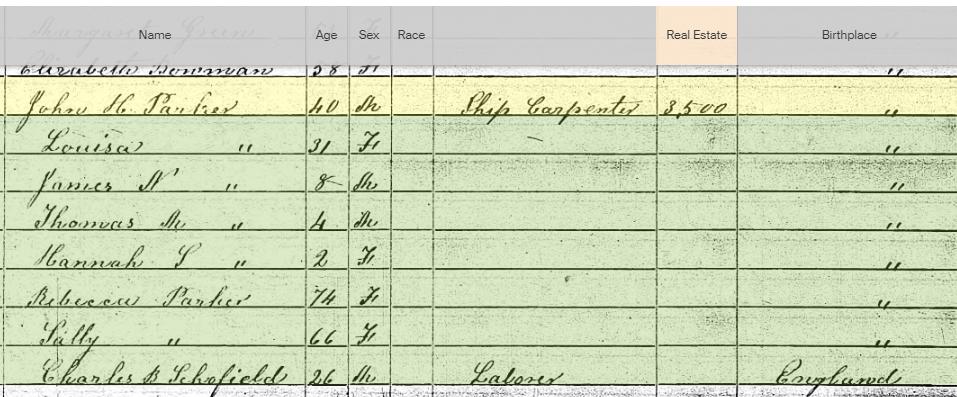
James father John was a Boat Builder in Bedford in 1851. While snooping around Ancestry, I found a better Nutter tree from Michael – the one taking the BigY 700 test:

Interestingly for me, there is a Hartley Line there from 1749.

Here is John Nutter and family in 1861:

All these places were close to each other:

This appears to be the transcription for John’s marriage:

He was a ship carpenter which fits in to the Census records. Here is Haigh to the NE of Wigan:

This appears to be John’s baptismal record:

Here is some more local geography:

Richard Nutter

Here are a few choices for Richard Nutter:

Assuming these are the two best choices, let’s see which is the best choice.

Richard number one is a husbandman from Brindle. I think a husbandman is someone who takes care of animals. I looked it up and a quick result said farmer. I’m not sure of the difference between a yeoman and a husbandman. I looked yeoman up also and got:

a man holding and cultivating a small landed estate; a freeholder.

Here is Brindle:

Richard Nutter #2

This Richard was a house carpenter. This would seem more in line with his son John’s occupation of ship carpenter – though at the time of John’s birth, Richard was apparently a weaver.

This appears to be the Parish of Burton in Kendal:

By location, it appears that Richard #1 is better. Let’s see where they married:


This is what I get for Warton (above) though Lancaster seems further north. That makes the decision more difficult. Do we go by occupation or location?

I need to find Richard in the Census if possible. My thinking is that the Richard Nutter who had John Nutter in 1816 in Chanock hung around the area. His Census should have where he was born. Unfortunately, I could not find Richard easily in this area.

Taking a Look at Michael’s Tree

I see that Michael has this information for Richard Nutter:

If this is right, then Richard and Jane should appear in the Rivington Census of 1841 and Richard should appear in the 1851 Rivington Census. I also see that Michael has this Bishop’s Transcript marriage record:

Here Richard is a Servant rather than a husbandman.

This appears to be a record for Richard’s death:

Here is the burial record for Jane:

Here are some other records from Rivington:

Assuming this is the same couple (and they appear to be), this would represent perhaps moving out of the area for a while? Here is Adlington:

Actually Adlington is near Rivington. Here is Oswaldtwistle:

So not too far away if right.

Nutter Baptisms at Rivington Church

I don’t see a corresponding birth record for Jane Nutter who died in 1826. I see one record for ‘Margrit’s’ baptism as Jennett as the mother.

When James was born, Richard was a farmer:

Here is an early baptism at Rivington Church:

Here is another Nutter Burial:

If this Coln is Colne, then here is a connection to the area where my Hartleys came from. Here is a guess for the baptism of Mary:

I couldn’t easily find a marriage record for Henry Nutter around this time.  Here are three marriages with the last being in Colne witnessed by a Hartley:

Also I see this baptismal record with a Henry and a Richard:

Here is a better connection:

Notice that even the abode of Coln is the same spelling as the abode of Coln in the burial record for Mary Nutter in Rivington, daughter of Henry Nutter. It would seem od for there to be two misspellings of Colne in twon different records relating to Nutter.

Here is one more record with that spelling:

If I put the three ‘Colns’ together, it looks like perhaps Henry and Sally Nutter had John Nutter in 1782 in Colne, Richard Nutter in 1787, then moved to Rivington at some point where they buried daughter Mary in 1802.

An Interesting Record for Richard Nutter

Here is the reference for the above document:

To me, it would be a coincidence if this is not the same Richard Nutter. Basically, Margaret Eccles had a male “bastard” child which had to be supported by the government. She calls out Richard Nutter who is required to give some support for the raising of the child.

Here is Yate and Pickup Bank:

So, I am learning a bit about local geography through this exercise.

Here is a baptism for a daughter of Peggy Eccles:

Here is another legal document concerning Richard:

Actually, I am not sure this is the same Richard as here is the location referred to in the 1830 document:

I’m spending a lot of time on Richard because he seems to be a crucial link to going further back in time in Nutter genealogy.

Richard Nutter in the Census

This appears to be the wrong Richard in 1841 Preston:

This appears to be the house carpenter who married Jane Nuttal. Here is the same family in 1851:

This Richard was born in Wennington.

I found this Jane in the 1841 Census, but I don’t know if she is the right person:

This Jane shows that she was not born in Lancashire.

Richard’s Father was Henry, John or Richard?

Ancestry suggests Richard as  the father of Henry as their ‘hint’. Michael has John Nutter as the father of Richard:

As mentioned above, I am leaning toward Henry being the father of Richard. I’ll try putting Henry in the Private Ancestry Tree that I have made.

This appears to put me in the minority. I found three trees for Richard Nutter at Ancestry and they all show Richard for the father. Here is the couple I am going with:

I am guessing that this Henry could have been born around 1760. Here are some Baptisms from around that time:

My best guess for Henry is the last one. He was born in 1754, so would have been 27 when he married. The other two Henrys are from Burnley or Barrowford. Barrowford is outside of current Colne. Here is Colne Edge:

Apparently, I am in the minority with this Henry also. I looked at three trees for Henry and they show him having a son Richard, but the son who was born in Wennington. So, I am going in circles a bit. Even though I am going against other Ancestry trees, I think my logic in my connection between Rivington and Colne is sound.

Why Not Richard as the father of Richard?

I had mentioned above that there was a Richard Nutter in the Rivington Parish who lived in Rivington. He had a daughter Mary baptized there in 1768:

Could he have been the father of the Richard who lived in the Rivington area? It would seem possible, however, under that scenario, this Richard would have had Mary in Rivington and then gone back to Colne to have Richard and then somehow Richard would have made his way back to Rivington Parish. Plus, this birth was in 1768. I believe that Michael’s ancestor Richard was born in 1787 which was 20 years later.

Here is one Richard born to a Richard, but he appears to have died soon after his birth:

Here is the best guess for the Richard son of Richard scenario:

Unfortunately, the Rivington baptismal record for Mary did not mention the name of the mother.

Here are some marriages for Richard Nutter and Mary:

The first marriage would have been too early to have Richard in 1788. The second marriage would probably be too early to have Richard in 1788. Assuming this Mary was 20 at the time of marriage, 29 years later she would be 49 having Richard. I suppose this is a possible scenario, but not likely. Finally, the last Richard Nutter would be a good candidate to have the Richard Nutter born at Lawn in 1788, but not as likely to have Mary baptized in 1768 in Rivington.

Richard Nutter Born 1719

Ancestry has three trees which all look somewhat like this one:

As there were three Richard Nutters baptized in Colne in 1719, I wonder how they knew they had the right one?

The 24 January 1719/20 from Greater Marsden above is probably the one mentioned in the Ancestry Trees – though Ancestry has the birth in Trawden.

Here are a few more Richard Nutters in Lancashire:

If I had to guess I would probably go with the one from ‘Coln’ based on the spelling mentioned earlier. However, that is a guess. The name is spelled differently, but I’m sure there were spelling variations in the early 1700’s. I was hoping that there would be fewer Richard Nutters the further back I went, but there were more. So this would seem to be a good time to end this Blog. This is my best guess based on my limited research:

Summary and Conclusions

  • I am interested in Michael’s ancestry because he has ordered a BigY Test which indentifies the male line. Michael’s past YDNA testing has put him in a branch of the male tree  of mankind that has been reserved for Hartleys up to this point. Michael’s male only line ancestry is Nutter.
  • The Nutter genealogy gets more difficult at the point of Richard Nutter. This is because it is difficult to find this Richard in the Census. According to the Quarter Sessions, this Richard appears to have fathered a boy with Margaret Eccles and was required to come up with support for the boy. There was also a Richard and Margaret Nutter mentioned in the Quarter Sessions. But I don’t know if this is Margaret Eccles above.
  • Based on connections that Henry Nutter and his wife Sally had between Colne and Rivington Parish, it seemed like Henry would be a likely candidate to be the father of Richard. I went on that assumption which lead me to another Richard as Henry’s father. However, there were too many Richard’s born in the early 1700’s to identify which Richard he was.


Tracking Down Shadlock Genealogy on My Hartley Side

I have a DNA match with a few people with some Shadlock genealogy. These matches are important because they have shared matches with people that appear to go deep into my Hartley ancestry. Here is one of the matches with my father’s cousin Joyce:

Shadlock Genealogy

This is the tree of the match on her maternal side where Lillian Jess is the match’s maternal grandmother:

I had started my own Shadlock research and would like to look further.

Elizabeth Ellen Shadlock Born 1875

Here is Elizabeth:

My possible relative. She married Manuel Jesse in New Bedford, MA in 1894. That record gave her parents names:

In 1900, Elizabeth was living on Belleville Ave in New Bedford with her family.

We see that her mother was living with them also at the time.

Alice died in 1903 in New Bedford:

Here her maiden name is given as Alice Walker and her husband as William Shadlock. This is a bit of conflict with the Mariiage record where Alice’s father is given as John Shadlock. This is further confused where her death record gives her father’s name as Shadlock:

I believe that her Father’s name would likely have been Robert Walker and her mother’s name Elizabeth Fouler (or Fowler).

[Edit: After looking at other entries of the New Bedford Death records, I see that the name in quotes is actually the maiden name and the first name is the married name. However as Elizabeth and her daughter went by Shadlock, it is possible that Elizabeth never married her daughter’s father – or if she did, she kept her maiden name for some reason.]

Here is the record showing mother and daughter traveling to Boston in 1887:

Ancestry gives this 1861 Census hint for Mary Shadlock:

If Mary was a Shadlock, that would likely mean that she was single mother. This record appears to apply to Elizabeth Ellen Shadlock:

This means that Elizabeth Ellen was born later than thought or that she was baptized at about age 4 and that her death record in New Bedford would be correct. Another possibility would be that Mary Alice was a single mother and that she later married William Walker Shadlock?

Here is the actual record showing she was born earlier:

I suppose that one interpretation would be that Mary Alice was a single mother and that William Walker was the father that she is naming in the baptismal record..

A Marriage Record for Mary Alice Shadlock?

The records for civil registrations of marriages for January through March 1875 show this entry:

Following the Robert Shadlock Line

Let’s assume that the Robert Shadlock in the 1861 Census is the same as the one mentioned in Alice’s death record. I now have this tree:

The potential parents in green do not sound familiar. That means that the Hartley connection could be with William Walker – assuming that he is really the father of Elizabeth Shadlock. Here are a few possibilities for William:

The Accrington Connection and Ashton-under-Lyne

Here is Accrington:

My Emmet ancestors were from Bacup in the SE portion of the above map. My Hartley ancestors were from Trawden in the NE portion of the above map. Perhaps I was looking in the wrong place as the later location for the Shadlocks was in Ashton-under-Lyne:

Here is William Walker in the 1871 Census:

Note that in the top right, the Parish is St. James which is where Elizabeth Ellen Shadlock was baptized. That puts this William as the best guess for Elizabeth’s father. He is a coal miner and his father (also William) works for a butcher.

Playing Out William Walker’s Genealogy

Here is the 1861 Census:

William’s mother was Jane, but I can’t make out where she was born. The transcription has it as “On the Sea of Kent”.

Here is the 1851 Census:

Again, I can’t make out where Jane was born. The second part seems to say “Irish Channel”.

Here is a possible marriage for the elder William:

Unfortunately, there were many Janes who married William Walkers in the Manchester area.

Here is my best guess for a family tree for Elizabeth:

More on Shaerd Matches

My father’s cousin has a shared match with this Shadlock descendant:

Here the connection is through Pilling only as Wilkinson was a second marriage after Hartley (my connection). That means that the Shadlock descendant genealogical match is likely going back to Pilling at some point. Mary Pilling was from Trawden Lancashire. So that likely places where the connection is.

Summary and Conclusions

Although I have not found a genealogical connection corresponding to my DNA match, I have a better understanding of why I cannot find the connection. It appears that Elizabeth’s father was William Walker. However, Elizabeth did not take the family name. Further, Walker is a farily common name, so difficult to trace. If more could be found on the birthplace of Jane Walker, that could shed some light on the genealogy. It seems that the census records are saying that she was born on board a vessel at sea.

In summary, it seems that there was no father in life of Elizabeth Shadlock and no husband around for her mother Mary Alice Shadlock. This perhaps caused economic hardships. My guess is that Mary Alice thought that she and her daughter would do better in New Bedford, so they moved there in 1887.