A McMaster from Ireland

I was quite excited recently to hear from John. He saw that I had posted my cousin Paul’s DNA results at MyHeritage. John knew of no Frazer ancestry in his , but did mention McMaster ancestry in Sligo. I wrote back and asked John about his ancestry. Here is his letter:

Joel,

My Grandmother (on my mother’s side) was Elizabeth McMaster married to Charles Roycroft. I was aware of Arthur McMaster as a relative when growing up in Sligo but I never met him. The additional information regarding her siblings, parents and grandparent I got from the 1901 and 1911 census where Arthur, Archie and Catherine McMaster were listed as farmers at Dromore, Kilmactranny. The attached Roycroft family tree is on Excel (from left to right instead of from top down) with some additional information included as comments in the cells with a little red triangle in the top right hand corner. Hoping you can bridge the gap!


B 26/11/1871 Charles Roycroft
D 13/01/1925
M –/–/1910
B –/–/1888 Elizabeth McMaster
D 19/12/1965
Siblings
B –/–/1883 Arthur William McMaster
B –/–/—- 4th McMaster
B –/–/1892 Lily Margaret McMaster
Parents
B –/–/1850 Archie McMaster
B –/–/1854 Jane …………..
Grand-Parent  
B –/–/1829 Catherine ………….

Regards,

John

Now, I have a few McMaster Web Pages that I can dust off. All I have to do is find an Archie who married a Jane. I was able to find this family, but I had to look at two of my web pages. I have one web page on the McMasters where I mention different lines of McMasters in the Kilmactranny Parish area of County Sligo. I was not able to tie them all together.

McMasters Everywhere

Here is Archie from my McMasters of Dromore Web Page:

I am more related on Jane’s side. Jane was also a McMaster. To complicate things, I have that both of Jane’s  and Archibald’s parents were McMasters! Talk about being related. So John’s Elizabeth must be the Ann Elizabeth that I have.

McMaster DNA Tree

I already have a tree for some McMasters that have had their DNA tested. I’ll just add John in on my James McMaster Sr/Fanny McMaster side. But…

Uh Oh, Problems

While looking at my references, I found one that goes against what John and I had. Here is a wedding that someone I know transcribed from the Kimactranny Church:

This throws a wrench in the works. John had that Elizabeth was the daughter of Archie McMaster and Jane. That seemed to correspond with my records that had Ann Elizabeth as the daughter of Achibald McMaster and Jane McMaster.

Going back to my web page, I see a Lizzie Jane here that seems to match the marriage record:

I guess it could be confusing having an Ann Elizabeth born in 1887 and a Lizzie Jane born in 1888. I hope John doesn’t mind me swapping out his grandmother. My guess is that the person doing the wedding got Lizzie’s dad right. Also Mary Kate, who was a witness at the wedding, was a younger sister of Lizzie Jane. There was an Arthur in this McMaster family also.  Perhaps it was this Arthur that John had heard about.

Here is Lizzie Jane 1901:

It looks like the father Robert had died four years prior to this time. However, that brings up a question as to Helena. When I look at the Census, she shows as 5 months old.

Here is the tree I come up with:

The record for Edward McMaster’s birth in 1851 is missing. That could be because he was born during a time when the records at Kilmactranny Church were either not recorded or lost.

John’s DNA

That was a bit of a complicated introduction to John’s genealogy. What about the DNA?

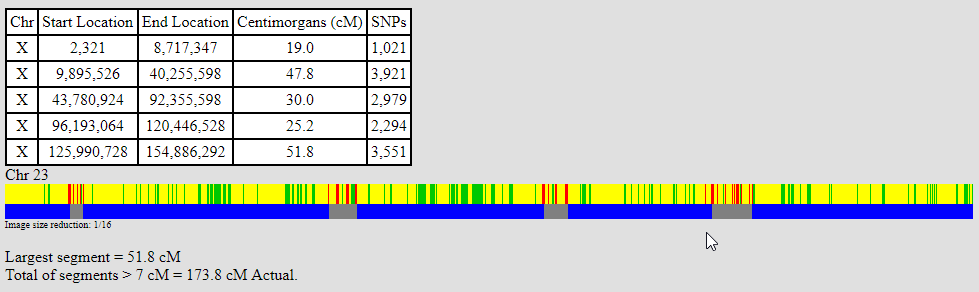
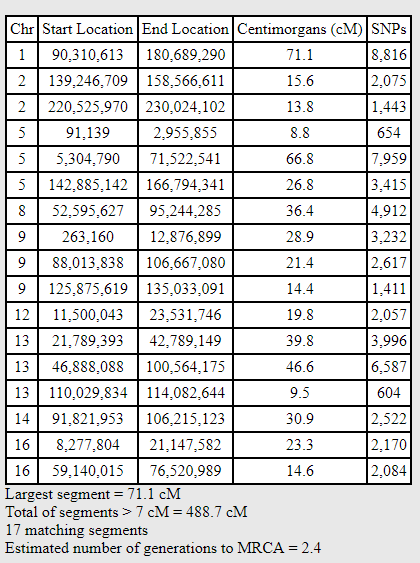
First, I looked at how my cousin Paul matched John. I noted that Paul and John’s shared DNA Match was Emily. I also noted that there was a triangulation icon next to Emily. That means that Paul, John and Emily share one or more common segments. Triangulation means that Paul, Emily and John should also share common ancestors.

MyHeritage circles the segments that are in common and triangulate. The red matches are Paul’s matches with John. The yellow matches are Paul’s matches with Emily.

These circled areas are on Chromosome 3 and 18.

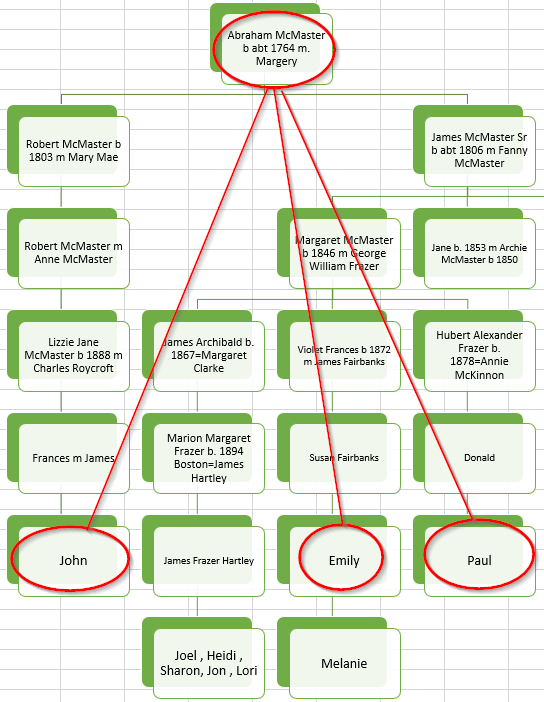
If I have it right, Abraham McMaster and his wife Margery would be the common ancestors between John, Emily and Paul. In this scenario, John is a fourth cousin to Emily and Paul. Emily and Paul are 2nd cousins to each other.  This fits in with MyHeritage’s prediction that Paul and John are 3rd-5th cousins by the amount of DNA that they share.

I also note that four of my siblings have shared DNA matches with Paul and John, but not me.  However, my siblings don’t have the triangulation sign.

Now in a previous Blog on the subject, I was able to infer triangulation between Ron, Steve, Lori and Emily:

The above triangulation was on Chromosome 13. So perhaps Stephen, Ron, and John all descend from Robert McMaster. Emily is a key person as she is in both Triangulation Groups.

Summary and Conclusions

  • McMaster Genealogy is confusing. In addition, the DNA can be confusing due to intermarriages.
  • John is the first DNA match to my family that matches primarily on the McMaster side. Ron and Stephen also share McMaster DNA with me, but their primary match is on another line (Clarke).
  • I think that I have Ron, Stephen and John in the right tree descending from Roibert McMaster. There could be other McMaster connections, but I just looked at the closest ones.
  • John’s paper trail is clearer than Ron and Stephen’s. John has a good marriage record for his grandparents that ties Lizzie Jane to the Robert and Anne McMaster family. The 1901 Census also makes the relationships clear.
  • The birth record for Edward McMaster is missing. However, many other records for many years were missing from the Kilmactranny Church. Edward’s wedding record gives his Father’s name as Robert and his mother as Mary which would fit into the tree as I have it.
  • Triangulation appears to put Stephen and Ron in the Sligo McMaster family.
  • Triangulation also confirms the genealogical evidence for John’s grandmother.
  • I am happy to find a McMaster relative through DNA matching. It would be helpful if John and Ron uploaded their DNA results to Gedmatch.com for more DNA analysis.
  • There must be a lot of McMaster descendants, so I must have a lot more McMaster relatives.


Playing with DNAPainter

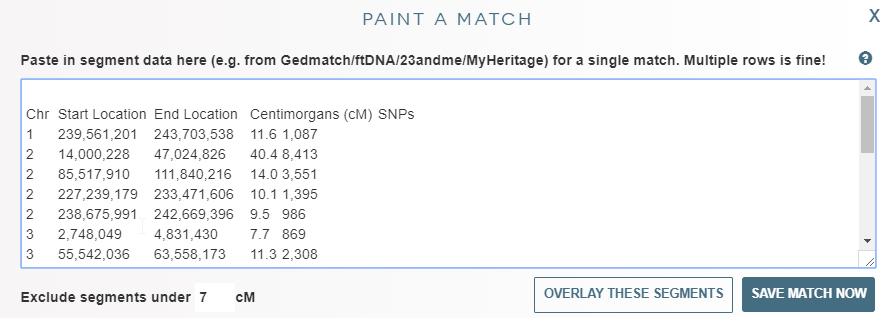
i have been hearing a lot of rave reviews about DNAPainter, an award-winning DNA analytical tool. So I thought that I would try it. Before I tried it, I had to finish my taxes. Now my State Taxes are in the mail and my Federal Taxes are e-filed, so I’m raring to go.

Using DNA Painter

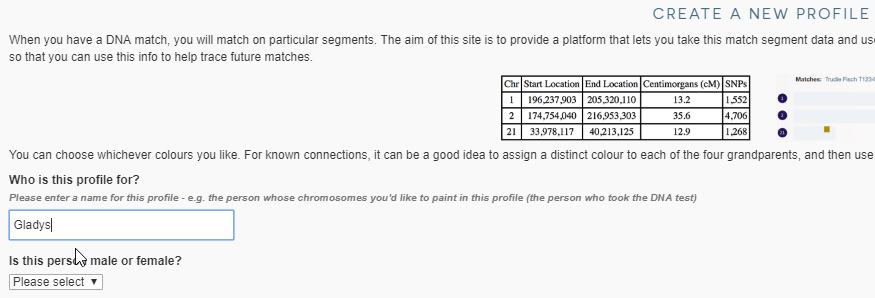
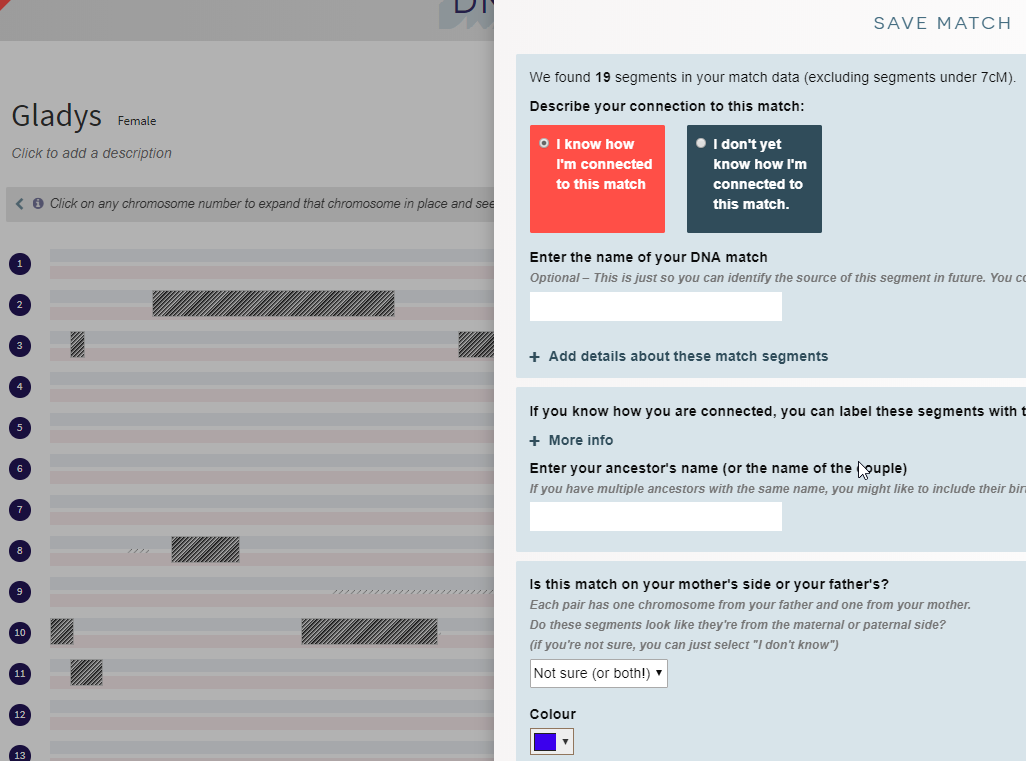
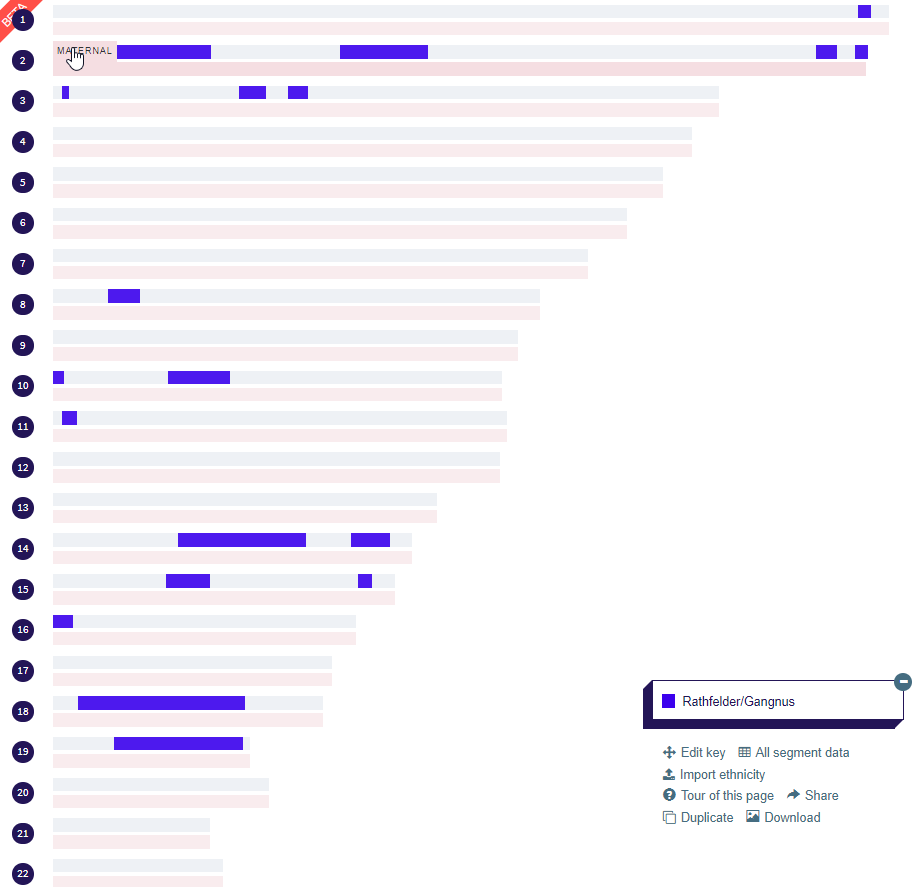
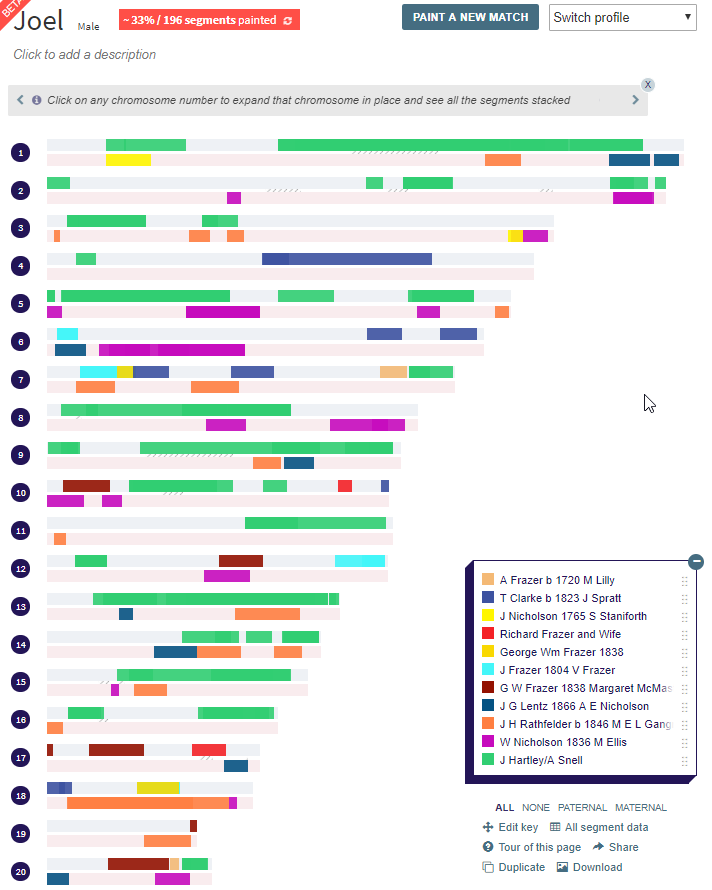
The instructions seemed pretty straight-forward and intuitive. In short time, I went through a lot of my Gedmatch top matches and painted into the program.

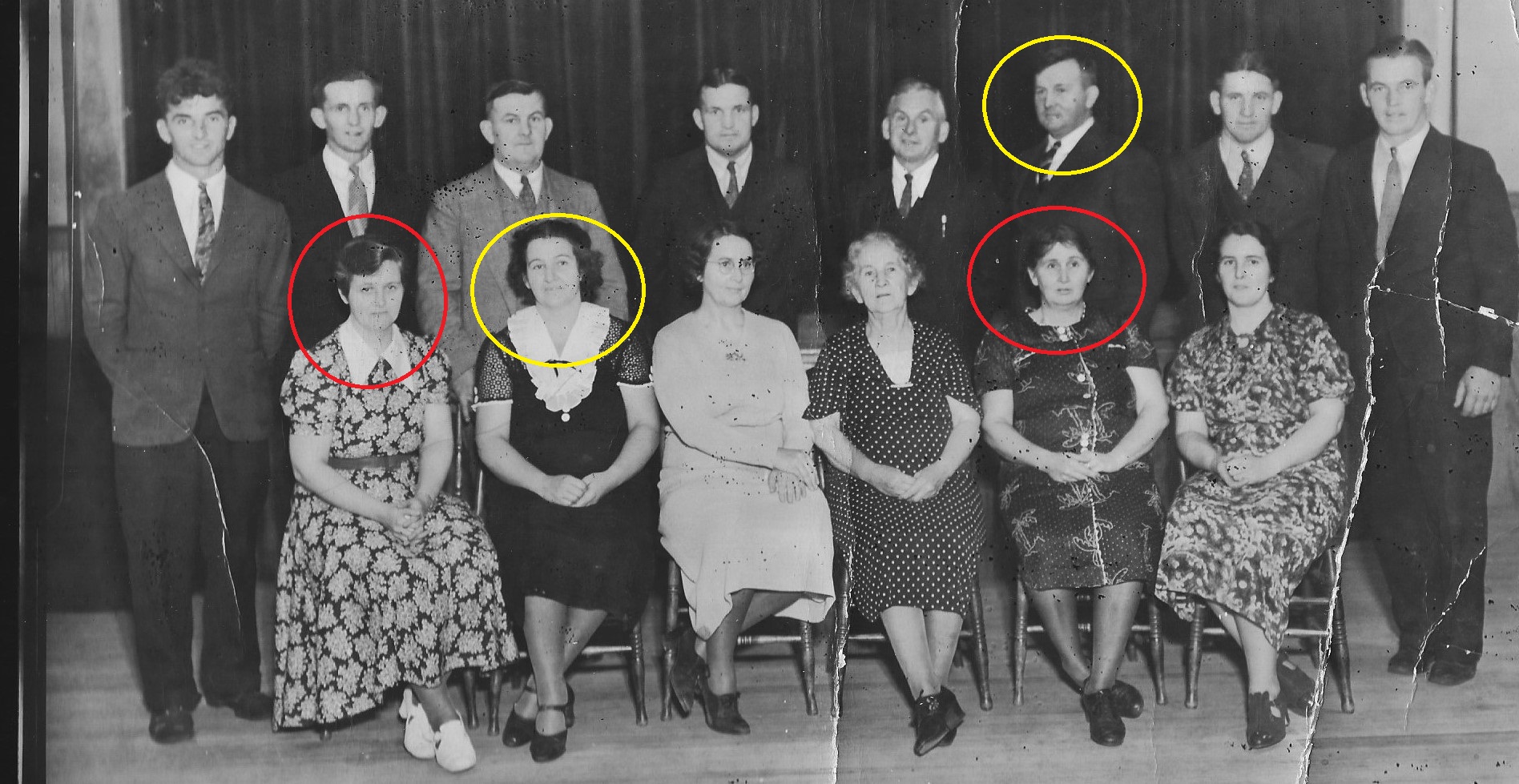
I have a lot of 2nd cousins as my Hartley great grandparents (represented in green above on the DNAPainter) had 13 children that made it past infancy.

My grandfather is third from the right with his 12 siblings and mom. I”m told this photo was from 1938.

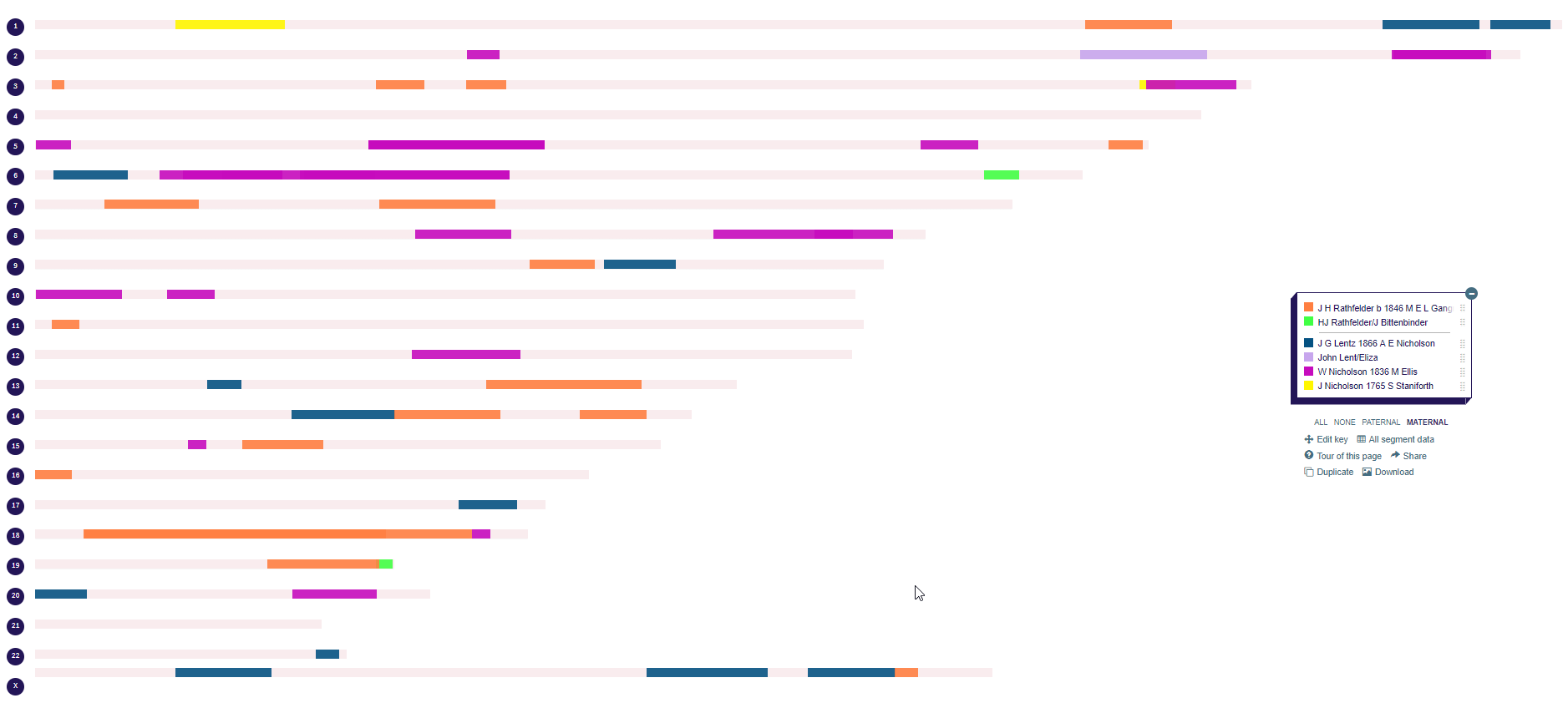
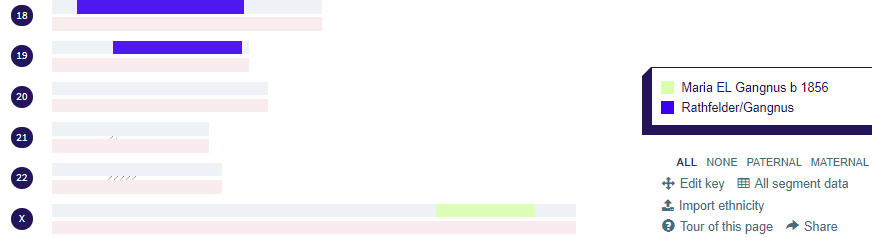
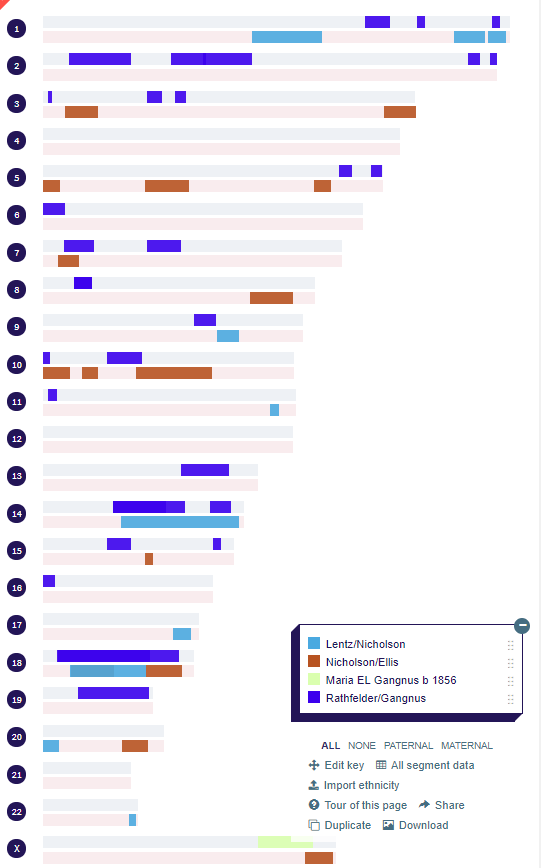
The DNAPainter shows that I have painted 28% of my chromosome. So far I have not started on my X Chromosome and still have some more to map.

The Matches Behind the Matches – Under the Hood

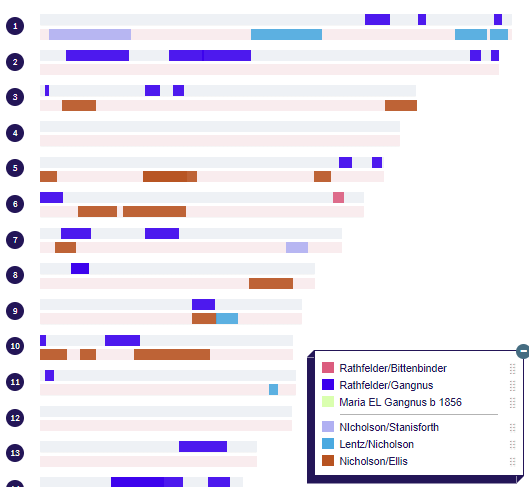
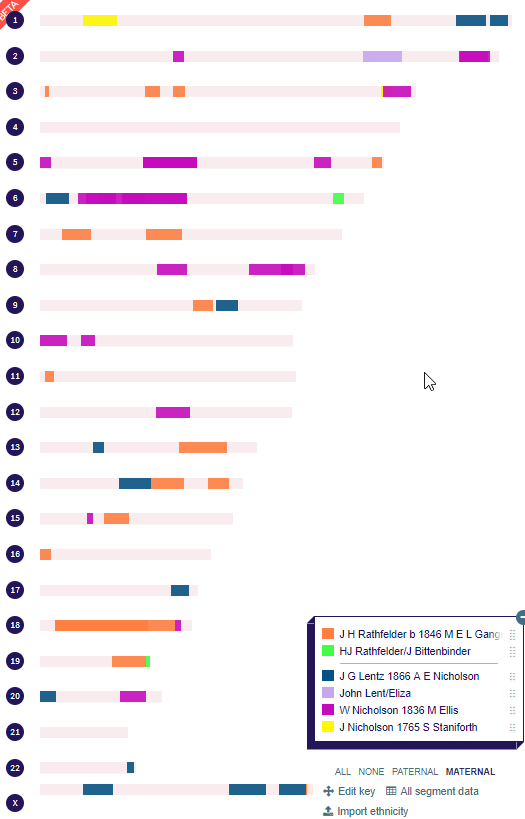
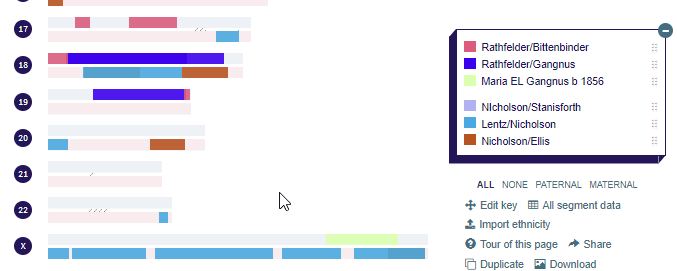
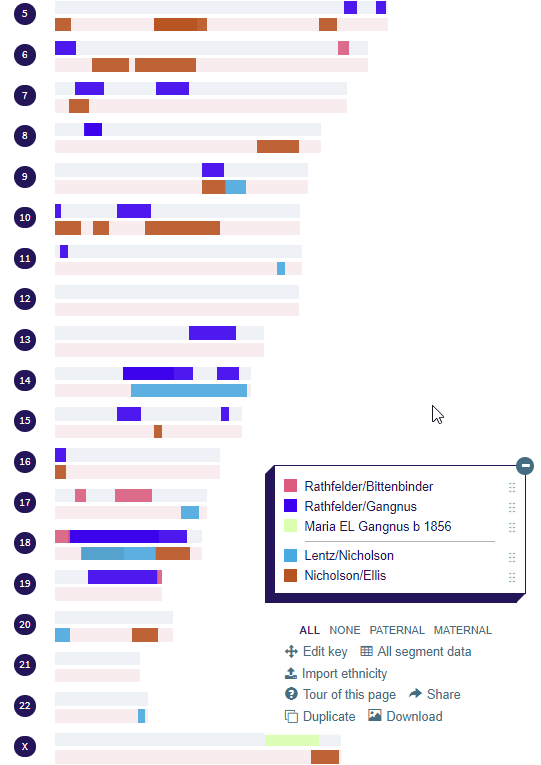
This is one of the cool features of DNAPainter. Here is Chromosome 18, for example:

This shows that on the top paternal side, I have a blue match mapped to James Frazer and Violet Frazer. They were born around 1804. When I select the Chromosome, it opens up, so I can see the matches that make this up:

The Maternal side splits out also, but I am just looking at the Paternal side for now. These four bars represent four people that I match and two sets of common ancestors. The brown represents my Frazer and McMaster great-grandparents. The blue represents my Frazer 2nd great-grandparents.

Separating the DNA and the Ancestors

A lot of genetic genealogy is about separating out the DNA. For example, if I have a match on the brown segment above, I would like to know if it is specifically Frazer or McMaster DNA. My guess is the brown match with Emily above is a Frazer and not a McMaster match. Emily in brown above should match Gladys, Susan, and Doreen in blue.

It seems like Emily has to match the blue matches, but I’ll check to make sure:

These are Emily’s matches with Doreen, Susan and Gladys (in that order). Emily’s matches with these three women go from about 26M to 53M. Emily matches me from 35M to 52M. Now on my Chromosome 18, I got all my paternal DNA from my Frazer grandmother. I can now know two things:

  • The match with Emily is a George Frazer match and not a McMaster match
  • The segment right before 35M and after 52M on my Chromosome is not from George Frazer. This could be DNA I got from McMaster or even my grandmother’s mother Clarke.

Because I know that my match with Emily is with George William Frazer, I can map that DNA more specifically. In order to do that I click on the brown Emily segment on Chromosome 18:

Then I choose Edit Segment.

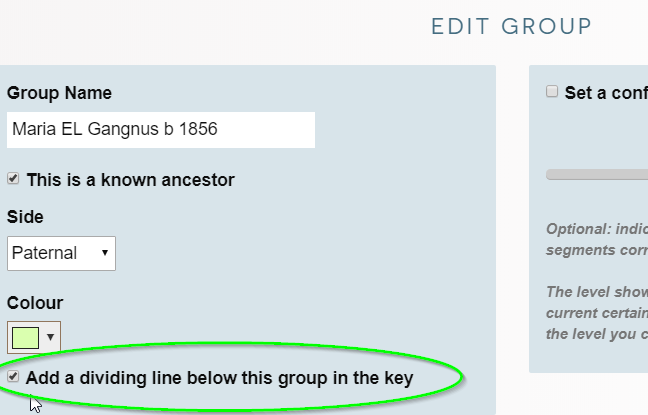
Under the drop-down menu for Group/ancestor, there is an option for ‘Create a new group’. This looks like a good option.


Now the match with Emily is yellow and represents just George Wm Frazer 1838. This means in a practical way, I will not be looking for McMaster matches in this segment, but Frazer matches.

More George on Chromosome 7

By the way, here is George Frazer and his wife Margaret McMaster:

Again, the light blue goes back to James and Violet Frazer in the early 1800’s. On the end of the blue segment, it gets a little darker, indicating that something is going  on. That is when I look under the hood:

Again, here is a match in brown (indicating Frazer/McMaster.  However, this time it is a match with my cousin Paul and not with Emily. This has to be just George Frazer as it is overlapping with a match going back to the parents of George. The two blue matches represent Ken and his sister Susan. Ken does not show up on Paul’s match list, as the match would be too small. However, Paul does show a match with Susan.

This match that Paul has with Susan is at about the same location as the match I have with Paul. That is triangulation and shows that the DNA that Paul and I share in brown should be in yellow for George McMaster.

I went in and edited the segment that I share with Paul:

It doesn’t look llke a big change, but I would rather have a short specifically identified segment than a longer more vague segment.

Splitting Out My Hartley/Snell Great-Grandparents

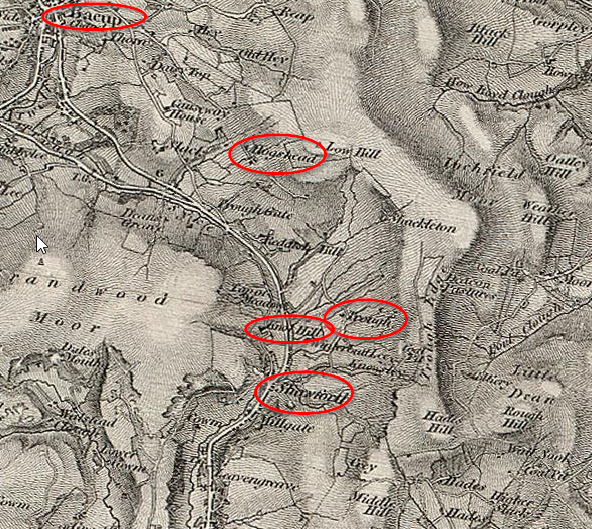
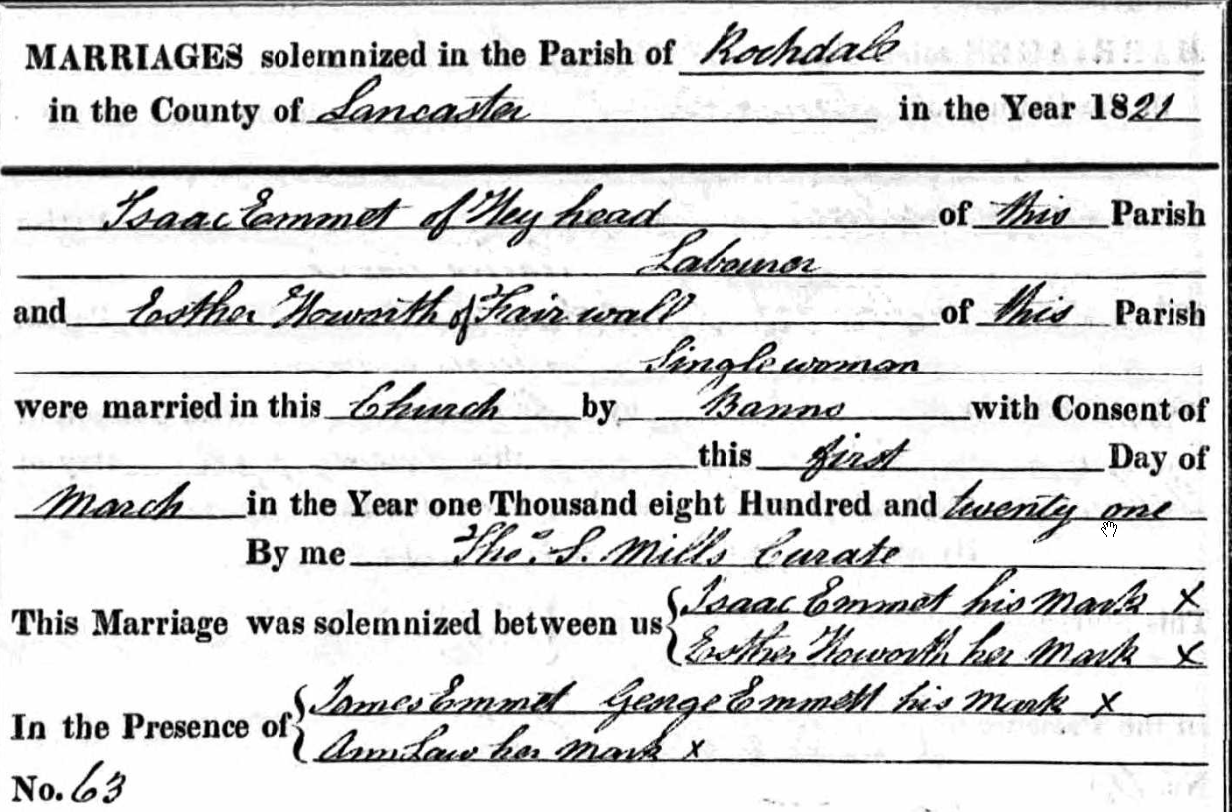
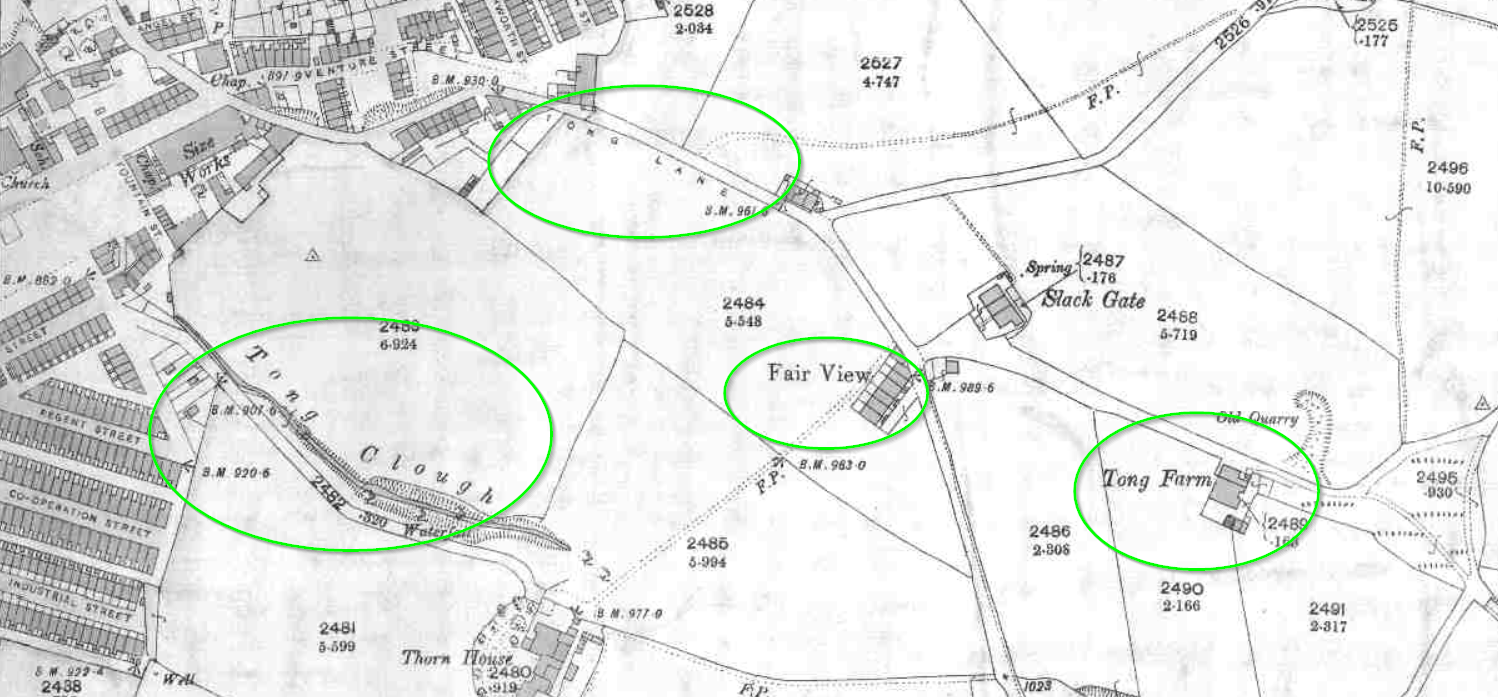
I have a lot of interest in splitting out my Hartley and Snell great-grandparents. That is because my Hartley great-grandfather was born in Bacup, Lancashire and my Snell great-grandmother has ancestry going back to SE Massachusetts in Colonial times. I have brick wall issues on the Hartley family in Lancashire.

Here is my Chromosome 9 from DNAPainter. I got all my paternal DNA from my paternal Hartley grandfather on Chromosome 9. Here are my second cousin (and 1C1R) matches that I have mapped so far:

These two areas look suspiciously like crossovers:

These are likely areas where my DNA switched from Snell to Hartley, or from Hartley to Snell. The first circle is at 81M. The second circle is at 126M. If I were to look at all my Chromosome 9 paternal matches, I may be able to figure out which ones have Colonial Massachusetts ancestry and which ones have Lancashire ancestry.

Adding More Matches to DNAPainter

I’ll add Michael. We have a common ancestor going back to the 1700’s.

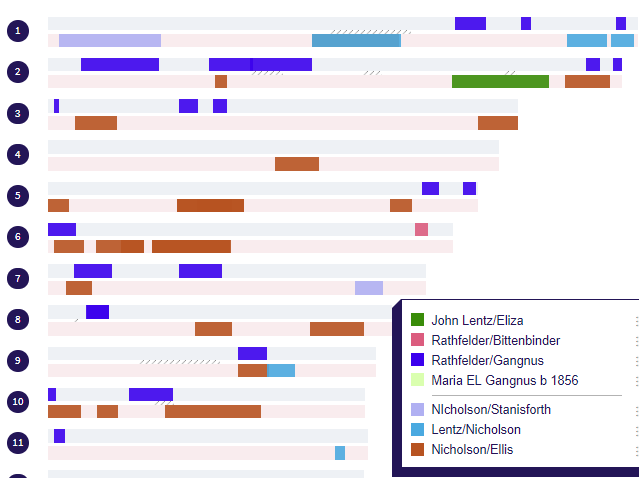
Our common ancestor is Richard Frazer. I don’t know his exact birth year or his wife’s name. However, the red DNA that we share could be from Richard Frazer or his wife. So I indicated that in the key. I also notice that on Chromosome 17, there are a few hash marks. This indicates a common pile-up area within the area of the match that I have with Michael.

Adding Nigel

Nigel is a maternal match and our common ancestors also go way back to Sheffield, England.

This yellow match on Chromosomes 1 and 3 goes back to 1765. When I hit the orange refresh button, I see that my mapping has increased from 28% to 29%:

It also shows that I added 4 segments.

Summary and Conclusions

  • I was most impressed with the individual segment look underneath the map. This is what Roberta Estes calls the self-triangulating feature. I think of it as the under the hood look.
  • Using the under the hood look and known cousins, I was able to assign DNA to a specific ancestor in two cases. This requires multiple known matches in overlapping segments.
  • I’m sure that this feature will have more applications for me with unknown matches in the future.
  • I would like to try to use DNAPainter to separate out my Hartley and Snell sides going back to my great-grandparents.
  • Next up, I’ll map more DNA from MyHeritage, FTDNA and/or 23andme.


Fun with Photos: Clarke, Frazer, McMaster and ? in the 1890’s

In my previous post, I published a book of photos that was in my grandmother’s possession. They were photos taken around the time of my great-grandmother’s short time of being in the US. Margaret Clarke arrived in the US about 1884 at about age 18. She died in 1902 at age 35.

Statistics: Known and Unknown

The photos that I posted can be put into two categories: those that I know and those that I don’t. Most of the known photos were of James Archibald Frazer, born 1867 and his wife Margaret Clarke, born 1866.

  • Known photos – 15
  • Unknown photos – 31
  • Both known and unknown – 2
  • Repeats – 5
  • Missing slot – 1

That means there should be 54 places in the book. There are more than two times the photos that are unknown compared to the recognizable photos. Sometimes there is more than one person that is unknown on a photo.

Known and Unknown

A photo with a known and an unknown should be helpful.

This man in the tintype above also has his own photo here:

My previous guess was that he could have been the best man at my great-grandparents’ wedding.

A Woman with Margaret

This picture appears twice – both in tintype. A guess could be Margaret Clarke’s bridesmaid?

This photo is in the book right after the previous photo. The woman on the right looks to be the same woman as the one with Margaret in the previous photo. In addition, I wonder if these two are sisters as they have similarly shaped faces.

Face Recognition Software

I don’t know how good the software is, but it should be fun to play around with it. I first tried Pictriev. It seemed like photo 33B were two brothers:

These two got an 86% rating:

These two from the same photo that I thought were sisters get a similar rating:

While I was changing over, I still had the man above on the right and the woman on the left. The two got a 0% rating, for comparison.

Here the woman on the left is the one holding the black back with Margaret Clarke.

I thought that these two would be the same, but they got a lower rating. The woman on the left is at a little angle. I don’t know if that is enough to make a difference.

Here is a different combination:

This at least gives a bit of a subjective meter, rather than “I think they look like the same person”.

This woman is still in the 50’s for similarity:

These two did slightly better:

These two women at least scored over 70%:

Tricking PicTriev

Here are two that I am quite sure are both my great grandmother Margaret Clarke:

When I click the identity button, it says that they are not the same person.

Both these photos are straight on, but the score is even worse.

Above is a different score, but PicTriev still says that they are different people.

Here is the highest match so far:

PicTriev still has them as different people. I hadn’t realized that I have three photos of James Frazer without a mustache. I will assume that those are the earliest photos: 3, 6, and 33C.

My conclusion is that PicTriev is fun to play with, but not very accurate.

Photos by Studio

Here is a summary sorted by studio:

CE Beane wins the prize with 9 photographs. Following that are Elmer Chickering and Gray with four each. However, Gray has two different addresses. Perhaps they moved at a certain point. There were two photos taken at Gendron. The rest of the Studios took one photo each.

James Frazer 1892

Here is James in the 1892 directory:

This was the same entry as the year before, so I suppose where he lived while single:


Here I mention the James above my James A. as he appears in earlier Directories also as living and working in East Boston. I show this to indicate that it was not my James living in East Boston and working as a steward.

Here is James in 1893, showing his married address:

Here his place of work is not mentioned. Was he out of work or in transition?

Here is how that area looked on the 1888 Directory Map:

To the left of Gainsborough is Northeastern University. It is interesting that my father and I both graduated from this University. 1961 Washington Street is just below the corner of Thorndike Street. Thorndike is one Street to the SW of Newcomb.

Add in the CE Deane Studio

The Street to the bottom of the lower part of the lower circle was Warren Street. Cousin Fred did some research on C.E. Beane:


Gray Studio

The Gray Studio was fairly close by also:

I have circled it in purple. Here is some more from Fred:

The Frazer Family 1894

In 1894, now James is not merely boarding as he was in 1892, but has a house:

A peek down below at a later Directory shows that the Wharton Tea House was at 1971 Washington Street.

1895 showed the same entry:

Here is where an old map of Boston comes in handy.

There is no longer a Westminster Street in this area. It appears that when my grandmother was born, the Frazers were living between two photo studios and James’ place of work on Washington Street. I would imagine that 1971 Washington Street where James was either a clerk or a salesman would have been about one building away from 1961 Washington Street.

Oddly the birth record for my grandmother mentions that the family was living at the Hotel Westminster at the time:

With Hotel Westminster in quotes. There was a famous Hotel Westminster at Copley Square:

I can’t imagine that the Frazers were living there.

Elmer Chickering Studio

I would not want to leave out any studio. Elmer Chickering is listed at 21 West Street.

Perhaps while in downtown Boston, the Frazers would have their photos taken. I also circled Temple Place as Ritz Portraits was there. In addition, Margaret Clarke had a photo taken at The Ideal Photo Studio on Washington across from Temple Place. I am familiar with the area as I worked at 1 Winter Street for many years.

21 West Street appears to be vacant but I have eatenat Fajitas and Ritas which is the building on the left.

Gendron – 13 Tremont Row

I had wrongly read this as 13 Tremont, Rox(bury). Interestingly, this was a female photographer, Miss Addie M. Gendron.  Tremont Row also no longer exists. Here is where it was:

This area is in the Sculley Square area that was removed for Government Center. A portion of Boston Common and the State House can be seen in the top left of the map for reference.

The Frazers in 1896

This was the year that George William Frazer was born. At this time, James was listed as a grocer. I would think that the 1997 Directory would better reflect what James was doing in 1996. There are two entries:

My guess is that James A had two jobs. The first one just appears to list the work place. The second entry lists his house. I do think that I recall James being called a tea dealer. Perhaps he bought and sold tea at 1971 Washington Street.

Looks like my guess was wrong. Here is the 1896 Directory:

This shows that there were two James A Frazers. Thankfully, the Boston Athenaeum web site has many Boston City Directories. I wonder if these two James A Frazers knew each other?

Summary and Conclusions

  • I have taken a look at some of the early years of my Frazer and Clarke great-grandparents.
  • I had trouble using one facial recognition program. It didn’t seem very accurate.
  • I looked at the studios where my great-grandparents had their photos taken.
  • I also looked at City Directories locating where James Archibald Frazer lived right before and after he married Margaret Clarke in 1892.
  • Using street maps, I was able to virtually walk the streets of 1890’s Boston with my ancestors.

Using Visual Phasing

I did some visual phasing for Jane and her two siblings. Now Jane wants to see how the visual phasing can be used.

Mr Gray’s 8.5 cM Match

Jane’s first question came from a Mr Gray. He matched Jane and her two siblings at about 8.5 cM. Jane had this conundrum:

For me the match points to Beckham, for Heather it points to Beckham but for Alex it points to Hamilton. Unless it is on Mum’s side as indicated by Jackson for all three of us, but then why wouldn’t Mum share DNA with Mr. Gray?

Here is the right side of Jane’s Chromosome 2 Map. Jane is in the middle bar and her maternal side is on the top bar.

Here is where Jane matches Mr. Gray:

The answer for this one is that this is not a real match. Jane’s mother has tested and Jane has two sets of phased results based on her mother’s results. I ran Mr. Gray against Jane’s paternal and maternal kit and got no results. This means that the match is not real. Different analyses have been done for the chances of a certain size match being real or not. Here is one from Roberta Estes:

These studies seem to show that there is about a 50% chance of a 7 cM match being real. This goes up to a 66% chance of being real for an 8.5 cM match. It looks like Mr Gray fell into that 34% range. The only other possibility is that Jane’s mother could have had a false negative match with Mr. Gray. All in all, I would say that these results would be inconclusive. For me, I tend to say if there is no match on the two phased kits, then there is no match.

Second Example: An Adoptee at 23andme

Only Jane and her mom tested at 23andme. Here is how the adoptee matched Jane:

Chromosome 1:     108 to 151     26 cM

Chromosome 2:     225 to 230     8 cM

Chromosome 3:     104 to 145     41 cM

Chromosome 17     5.7 to 9.3      9 cM

By looking at the Visual Phasing Spreadsheet, Jane deduced that this was on her Beckham Line:

Jane is in the middle bar. The bottom of that bar is her paternal side where Bekham is in blue. I assume that Jane’s mother did not match this adoptee at 23andme.

I have Jane’s Chromosome 2 above where she matches Beckham between 225 and 230 on her paternal side.

The match is significant for Jane as the  match between 104 and 155 goes through her maternal crossover at position 110M. That would confirm that this is a paternal side match on Beckham.

Here is Chromosome 17:

It looks like I had trouble identifying the maternal grandparents, but Jane matches this adoptee in her paternal Beckham region. So I would agree with Jane that this match is on her Beckham side. It would help if this adoptee uploads his/her DNA results to gedmatch.com.

Peggy’s Maternal Match on Chromosome 13

Jane reports these results for Peggy’s matches to her and her siblings:

Heather     74 to 103     31.5 cM

Jane          74 to 91       14 cM

Alex – no DNA

Without looking at Jane’s map, it appears that Jane should have a maternal crossover at around 91M.

Jane has a maternal crossover at 90 on the map where her DNA goes from Adair to Jackson. Alex is on the top row. He has a large maternal Jackson segment which explains why he has no match with Peggy. Jane has determined correctly that this match is along the line of her maternal Adair grandmother.

A Paternal Hillock Match on Chromosome 2

This match has a similar pattern to the previous one. Here Hillock matches:

Jane     40 to 79         41 cM

Alex      119 to 208      8.4 cM

Heather – no DNA

Two siblings match Hillock and one does not. However, in this case, the two siblings match at different locations on Chromosome 2.

Jane again is shown on the middle bar. The paternal side is on the bottom where she matches on her Hamilton grandfather. The match with Alex on the top shows that he should be matching on the Beckham paternal grandmother. However, this is a small match. It is time to check Alex’ paternal phased kit against Hillock.

I forgot that I had lowered the threshold and was surprised to come up with this result:

The location of this match is within the orange Hamilton segment for Alex’ top bar. The match that Jane reported for Alex should have been 199-208 (unphased). That means that my red circle above on Alex’ bar above is not correct.

Summary and Conclusions

  • Jane is fortunate to have a mother whose DNA could be tested. This gives her paternal and maternal matches for Jane and her two siblings.
  • It is important to know first whether the match is on the maternal or paternal side.
  • If there is no maternal or paternal match, I consider that to not be a match.
  • Jane’s conclusions appear to be correct as far as on which grandparent line her matches are on. However, it is important to make sure that the position numbers of the matches are correct to match up with the right grandparent.


Ronda’s Ellis DNA

I noted a new match for my mother in law, Joan and her sister Elaine at Gedmatch recently. Here is the match between Ronda and Joan:

Here is how Ronda and Elaine match:

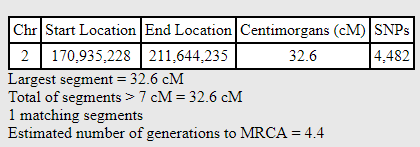
This shows 3.5 generations to a common ancestor. That would typically mean that Elaine and Ronda are 2nd cousins, once removed. Ronda tested at Ancestry, so I looked for a 2nd or third cousin there and couldn’t find Ronda. Ancestry has Elaine and Ronda as 4th cousins by DNA for some reason.

Ronda clearly shows at Ancestry as a 2nd cousin once removed to Elaine. Elaine tested at Ancestry, but Joan did not. Here is a record of the common ancestors:

This photo was from Ronda’s tree but originally posted by someone named Richard.

Ronda is a Great Match

Ronda makes a great DNA match for several reasons:

  1. She comes from a line that is very prolific. James Henry Ellis had 12 children if I counted them right. Imagine if he had two children and one of those had two children through the generations down to today. If there was just one descendant left today, there wouldn’t be other 2nd cousins that had their DNA tested, so there would be no 2nd cousin matches on that line. However, there were a lot of children and a lot of those children had a lot of children. Out of those descendants, some had their DNA tested.
  2. Ronda has a tree at Ancestry and tested there.
  3. Ronda uploaded her results to Gedmatch.com, so I can tell how and where the matches are.
  4. Ronda only descends from one Ellis Line. Descending from more than one line can make things complicated. She also does not appear to match Elaine on other ancestral lines which could make things tricky. One exception is the MacArthur Line which I discuss later on.

A Few Mistakes at AncestryDNA

Ancestry made a few mistakes. The first one was that they have Elaine and Ronda as 4th cousins by DNA. This is a good reason to upload your DNA to gedmatch to get a second opinion. Ancestry has a program that removes some of the DNA matches that are too “matchy”. This works sometimes, but I don’t think it worked so well in this case.

The second mistake had to do with the program that Ancestry used to interpret the family trees. Ronda wrote down that James Henry Ellis married Clarinda Gorrill Ellis. In the tree I had for Elaine, I had that she married Clarinda Gorrill. Ancestry’s computer program was not smart enough to figure out that these two women were the same person. As a result, Ancestry has that Ronda and Elaine are 3rd cousins once removed based on the parents of Clarinda Gorrill. Technically, that is not correct, they are just 2nd cousins once removed.

The Ellis DNA Project

Here is what I have for the existing Ellis DNA Project:

These are people that descend from William Ellis born 1771. Robert and Agnes are there twice because they descend from two different children of William Ellis. Elaine, Joan and Melissa are in green currently on the James Henry Ellis Line. That is where I will add Ronda.

Ships Passing in the Night

However, when I compare Ronda to Melissa at Gedmatch, I get a very small match:

It looks like they are 6th cousins, once removed by DNA. That made me think I had the wrong Ronda. However, it may be that Ronda and Melissa don’t match very well. AncestryDNA seems to show the same issue in their DNA Circle (shown below).

Here is Elaine at the top. Ronda is bottom left and Melissa is on the bottom right with one other person. There is no line connecting Ronda and Melissa at AncestryDNA. That helps confirm that I am on the right track and that I have the right Ronda. Ronda had DNA that matched with Elaine and Joan and Melissa had different DNA that matched with Elaine and Joan.

Here is how Ronda, Elaine and Melissa are related:

Note that Eva Ellis was born in 1895 – 21 years after George. This is one case where triangulation of the DNA matches would not work well. Elaine matches Melissa and Ronda, but Melissa and Ronda don’t match very well and not in the same area that Elaine matches Melissa and Ronda.

Let’s Work the DNA at Gedmatch

Ellis Autosomal Matrix

Here is how all the Ellis descendants match each other:

Here the distinction of the different branches are not as clear as one would like. That could be due to matches on different family lines. Also, I didn’t really need Robert as he is the son of Agnes. Agnes and Robert are in both the Mary Ann and Agnes Lines of Ellis.

Ronda and DNA Triangulation

I noted that Ronda would not triangulate within the James Henry Ellis Line, but I did run everyone against everyone else at Gedmatch:

I found one triangulation group (TG) there. Elaine matches Ronda, Ronda matches Margaret and Margaret matches Elaine. It looks like that hunk of DNA is pointing back to William Ellis from the 1700’s:

I do have a line in blue of the MacArthurs. However, I think that the common ancestor for that line goes back even further than the generation of William Ellis and Hannah Tawton, so I’ll say that this is Ellis DNA rather than MacArthur DNA. In the diagram above, Ronda is a third cousin twice removed to Margaret.

Summary and Conclusions

  • Ronda was a great Ellis match for Joan, my mother-in-law and her sister Elaine.
  • Ronda is a second cousin once removed to Elaine and Joan
  • Ronda is a third cousin with Melissa, but their shared DNA dropped off very quickly from their matches with Joan and Elaine.
  • Ronda triangulated with Elaine and Margaret. This appears to identify the DNA of William Ellis and Hannah Tawton from the late 1700’s

My Grandmother’s Picture Book: Frazer, Clarke, McMaster and ?

This should be a different Blog as it will be more on the genealogical side. This is photo book that I recall from my childhood that my grandmother had. It has thick pages, a sort of velour cover with a fancy spring clasp on the right.

I got the idea for this Blog after hearing from Fred. Fred is third cousin on my Clarke Line. My grandmother’s mother was a Clarke. We have the same 2nd great grandparents by the name of Clarke and Spratt. Fred sent me this photo recently.

This was from a small tin type photo that Fred had enlarged and enhanced. According to Fred, “…that appears to me to be a picture of Catherine Clark McMaster, Violet McMaster, George McMaster and Margaret Clark”. This reminded me of the photo book my grandmother had. It had larger photos in the back, but the smaller tin types in the back. I believe that Violet is Fred’s grandmother. He supposed that the photo was taken about 1888. That is interesting, because that would be about four years before Margaret Clarke married my great-grandfather. Margaret probably arrived in the Boston area around 1884 from Ireland at about the age of 18. It would be interesting to find out where she lived before she got married.
The Photo Book

Although I said that this book was my grandmother’s, it has people in it that lived before she was born. The photos seem to favor the Clarke side of the family. My grandmother lost her mother in 1902 when my grandmother was about 8 years old. I’ll try to reproduce the photo book as well as I can.

Page 1

I almost missed the first photo. This photo slipped out of the page easily. Under the photo on the page were the initials Raa. I don’t know if this is random or significant. I might assume that this person was important, being on page 1 of the book. A wild guess would be William McMaster, but I would have to compare this with a known photo.

Here is a photo of William from Fred’s sister’s tree:

This photo is a 3/4 view, so it is difficult to compare. I can’t tell for sure that the two are not the same person.

[Edit: January 2020. I believe that this man is William McMaster 1859-1899. He married Catherine Clarke, the sister of my great-grandmother. This was sent to me by Fred who is a descendant.]

Probably taken around 1882. Reverse of picture indicates that they were engaged “about 1881” and married October 5, 1882.

I take by the note that this is Catherine Clarke in the photo also. This may help in identifying other photos.

Fred also sent me this photo:

This is a better version of the photo above. Fred also sent me a photo I show later in the Blog:

These are William’s children: George, Bert, Fanny and Violet.

While I am off my grandmother’s book, I should bring up this photo which perhaps was in the book:

This is a photo of James Archibald Frazer. I had previously had thought that this was taken after his wife had died and Catherine Clarke’s husband William McMaster had died. However, I now see that James looks too young for that. Also this doesn’t look like the Catherine in the photo above.

Here is a side by side look:

Maybe? Another cosideration is that Catherine married in 1882. James married in 1892. Perhaps the photo on the left is how Catherine looked 10 years later when James married?

Page 2


The pages are about 8 inches by 10 inches and the photos are smaller. I’ll try to scan a smaller area.

This is my grandmother’s mother. I am not sure if this would be before, during or after she was married.

Page 3

My guess is that the first two photos could be wedding photos.

PAGE 4

I’m not sure if this is the same woman as the one in the photo from Fred. It looks like I caught a thread of the book in the scan. I know that there was an older Aunt Celia in the area, a sister Celia, Catherine and Margaret. I also thought that there may have been a sister Jane.

Page 5

Margaret again.

Page 6

James Archibald Frazer again. Looks like this could use sume touching up. I haven’t enhanced any of these photos.

Page 7

I’m guessing one of the Clarkes.

Page 8

Margaret Clarke Frazer

Page 9

George William Frazer and her sister ( my grandmother) Marion Margaret Frazer. I seem to remember a large colorized version of this or a similar photo. I don’t know where it ended up.

Page 10

I did enhance this a bit. Another shot of Margaret. My grandmother lost her mother at about age 8, so I’m sure these photos were important to her.

Page 11

I was able to slip this photo out and add a little constrast. My mother’s brother George William was born 1896, so that would put this photo at 1897.

Page 12

This photo was taken at the Elmer Chickering Studio at 21 West St., Boston. I think the original is a bit clearer.

Page 13

Great grandma is stylin’ in this photo.

Page 14

My guess is that these are the same two children that Fred sent me in his tintype picture. If Fred’s photo was 1888, perhaps this was 1889.

Page 15

If I had to guess, I would say another one of the Clarke sisters or Aunt Celia? I quite like the composition whoever it is. It reminds me somewhat of a colonial painting.

Page 16

Again, I am going with my standard Clarke female guess. The man to the left is perhaps a husband? He looks as if he could be a brother, but I have no record of a brother visiting or living here.

Page 17

I’m tempted to call this one the serious baby. I can only assume that this was the baby of one of the Clarke sisters.

Page 18

.

Here is an unusual photo. I might guess that she would have been a maid or nanny for my great grandfather James Frazer. I note that the photo was taken at a different studio. This woman has what appears to be a wedding ring. She is holding a book and has her finger inside the pages as if to say that she is educated. I can’t make out the name of the book except for the word, “power”.

Page 19

I am a bit past halfway in the book.

My guess for this person is Richard Frazer born 1875. According to my web page, ” He married Elizabeth Lenore Rice, daughter of Ivory Fogg Rice and Mary McCartee, on 12 May 1902 at Portsmouth, New Hampshire.” Note that the photo was taken in Portsmout, NH. This could have possibly been a wedding photo.

Page 20 and 21

Page 20 is the same as page 3. Page 21 is the same as page 2. These are the two photos that I supposed to be wedding photos.

Page 22

Can’t have too many photos of one’s great grandfather.

Page 23

Here I’m leaning toward business associate. Here are a few guesses from James’ Naturalization papers dated 18 October 1905:

Page 24

This person is a bit of a mystery. The best clue is that he had the photo taken in Franklin, MA. He also appears a bit older than some of the men in the other photos.

Page 25

Page 25 is the same as page 6.

Page 26

No idea. This person bears no resemblance to some of the others. He appears to be wearing a military uniform.

Page 27

Here there is a clue. The photo was not taken in Boston, but Gorham, NH. All we have to do is search in Gorham, NH for a relative. A search for Gorham shows it to be just North of Mount Washington.

Page 28

I’m hoping that someone will come accross this Blog and tell me who some of these people are. This is the studio where the black woman had her photo taken.

Page 29

I am associating the curley hair with the Clarkes.

Page 30

I think this is a boy? The light hair could go with the guy in the military suit, but there was some light hair in the Frazer family also. I can see a cross on this little person. I also have a photo of George McMaster (brother of Violet) that looks a little similar to this person. I believe that Violet’s granddaughter sent this to me.

I suppose that it might even be possible to look at where each of these studios were to see if that made a difference compared to where some of these people may have lived.

[Edit: January 2020] I see in my McMaster File, I have this photo labeled: George, Herbert, Violet McMaster. I also have the following photo in my McMaster file:]

This photo is named George, Bert, Fanny, Violet. These were all children of William McMaster and Catherine Clarke.

That was the last of the larger photos. Following this are six pages with four smaller photos each in them.

Page 31A

Do I have relatives in Taylorville, Il?

Page 31B

This photo appears to be trimmed down. I can’t tell where the photo was taken.

Page 31C

This is the first tintype. These tintypes give an older look to the photos.

Page 31D

At first, I thought these two were my great grandfather James Archibald Frazer, but now I’m not so sure. I’ll say it is him with his hair part inversed by the tintype

Page 32A

This photo appeared to have been trimmed down from something else. Also a tintype.

Page 32B

Apparently these tintypes are a reverse image. Here is the flip side:

So apparently a Toronto relative. Could this be a Frazer relative?

Page 32C

Another trimmed-down tintype of 2 cute girls – assumed sisters.

Page 32D

Here is a non-tinype among the tintypes. A distinguished self-assured looking couple in Belfast. I’m not aware of any Belfast connection in my ancestry which makes me wonder who these two are.

Page 33

Here is what a typical tintype page looks like in the book:


Page 33A

I just need a program with facial recognition.

Page 33B

Page 33C

The guy bottom left looks like the same person that was on P 23. My guess is the best man at the wedding. I would need to find Parish records to find out that type of information.The other two appear to be Margaret Clarke and my great-grandfather, James Frazer.

Page 33D

This appears to be my great-grandmother on the left wearing a Wonder Woman belt. I had thought the woman on the right looked familiar, but now I’m not sure.

Page 34A

These look to me to be two sisters.

Page 34C

34B is missing.

Does she look like the woman on the left above?

Page 34D

Page 35A

Page 35B

Photos like this and the Belfast and Toronto photos raise quite a few questions. In a record I saw recently, my great-grandfather was a tea dealer. Could this photo have something to do with that? This was another non-tintype photo.

Page 35C

Looks to me like Margaret Clarke.

Page 35D

The same as 31C

Page 36A

Is this the same woman as 34A? Perhaps with her husband?

Page 36B

Somebody’s pride and joy.

Page 36C

Same as 33D

Page 36D

Summary and Conclusions

  • A major reason for me putting these photos out there is that I hope that some people will recognize who these are
  • These photos can spur research or direct research. For example, what are my Illinois, Belfast and Edinburgh connections?
  • Taking the photos out and looking at where they were taken was helpful
  • My guess is that most of the photos were from around the time when my great-grandmother Margaret Clarke was in the US. This would have been between about 1884 and 1902 when she died.
  • I have definitely increased the number of photos of people that I know and that I do not know.
  • The photos help to give a picture of the people that my great grandparents knew, even if I don’t know who they are.
  • A next step may be to sort the unknown people by those that look most like each other.
  • I also want to look into facial recognition software.

Jennifer, a Top DNA Match at 23andme

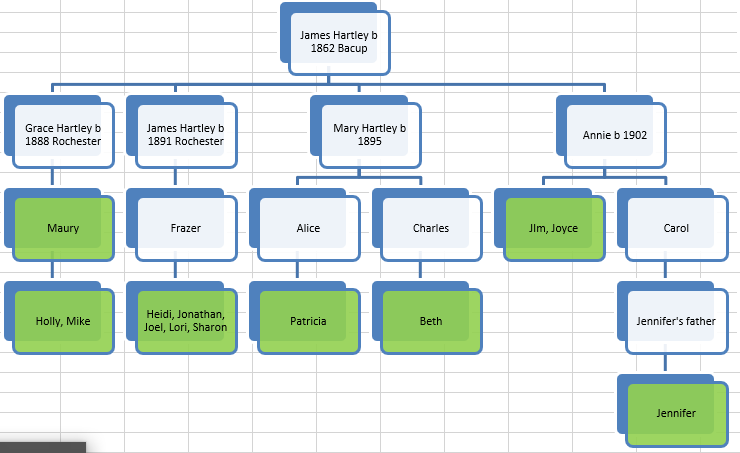
I was in touch with Jennifer at 23andme recently as I wondered how we were related. Jennifer wrote back to me and said that her grandmother was a Gurney. From there, I could tell how we were related.


The green boxes have people in them that have had their DNA tested. Jennifer is in the bottom right. All these people descend from James Hartley and Annie Snell who had 13 children. Colleen is Joyce’s granddaughter. She also tested at 23andme and we have been in touch recently.

Jennifer’s DNA

The DNA that Jennifer and I share is from either James Hartley or Annie Snell. We can’t tell which. In order to figure that out we would need to have a match with a Hartley that isn’t related to a Snell or a Snell that isn’t related to a Hartley.

Here is what that DNA looks like on a Chromosome Browser at 23andme:


My Chromosome Map

I have been mapping my Chromosomes. That means that I have been keeping track of where my DNA comes from. Here is what I have so far:

The second to the lightest blue is the DNA that I know is from James Hartley or Annie Snell. This would be from all the other people in the green boxes that have had their DNA tested. This appears on the male side of my Chromosomes shown as the top side above. About half of my paternal side DNA should be from the Hartley/Snell side. The other half is Frazer from my father’s mother.

If I superimpose my match with Jennifer with my chromosome map above, there will be places that Jenneifer matches with DNA that I have already gotten from other cousins. There are also places that I haven’t had a match yet. I think that Jennifer will add new Hartley/Snell DNA to my map on Chromosomes 3 and 10.

I have circled the new parts of Hartley/Snell DNA that Jennifer and I share.

Comparing Jennifer with Others at 23andme

The view above is how my DNA compares to:

  • Jennifer in purple
  • Colleen in orange
  • Brian in yellow

I know how I am related to Jennifer and Colleen, but I don’t know how I am related to Brian. Brian is a shared match with Jennifer. That means he probably has a common ancestor somewhere in the ancestry of James Hartley and Annie Snell. I would like to know which ancestor the yellow bar on Chromosome 10 represents but Brian has no ancestry tree.

Chromosome 10 Ancestor, Where Art Thou?

Emily at 23andme also shares DNA with Jennifer and me. She has a bit of a tree at MyHeritage:

The bottom line would be Emily’s parents. The way our DNA is matching, 23andme estimates our relationship to be at 4th cousins. Emily shows all four grandparents. However, that would be the 1st cousin level. The level we may be matching at may be three generations or so beyond that level. The Lee Line appears to be in Scotland, so I would rule that out. That leaves three grandparents at the 1st cousin level:

  • 6 great grandparents – 2nd cousins
  • 12 2nd great grandparents – 3rd cousins
  • 24 3rd great grandparents – 4th cousins

That means that I would need to build out Emily’s line to 24 3rd great grandparents before I might find a common ancestor. I’m too busy, so I’ll look at another matching person.

Shamus’ Tree

I match Shamus at about the same segment that I match Jennifer, Brian, and Emily on Chromosome 10. However, Shamus has a tree at FTDNA. Shamus’ paternal side is Irish, and my Hartley side has no known Irish ancestors. So I’ll look at Shamus’ maternal side:

The first two people are Shamus’ maternal grandparents. So that would be 1st cousin level. Assuming that I am 4th cousin with Shamus, that would be the last column of 16 ancestors. Actually, there are 15 as one is missing. This means that Shamus has done a lot of the work on his tree that I would have had to have done on Emily’s tree and that I couldn’t do on Brian’s tree because I had nowhere to start. Unfortunately, I don’t recognize any of these names as being in my tree.

FTDNA does identify these surnames that are both of our trees:

These are names that go way back to colonial times.

Any Inman Connection?

I did notice that Shamus was missing a mother for Earle Inman. According to one ancestry tree, his mother was Lydia Wheelock born 1812. That same tree has her father as Avis Handy which doesn’t make sense unless Lydia was married more than once.

I did notice that Townsend should not be on my list. For some reason my ancestry tree had Townsend as the father of the Almy family. That wasn’t right, so I changed it.

The Wing Connection

There is a connection between Shamus and me, but it goes back to the 1500’s. That is a long time ago:

John Wing born in 1584 had Daniel Wing who I descend from and Stephen Wing who Shamus descends from. John Wing is my 10th great grandfather. So that would make Shamus and me approximately 11th cousins. I wouldn’t be ready to assign the DNA to the Wing family just yet. However, the DNA seems to come from a colonial Massachusetts source.

My Shared DNA Matches with Shamus

Here are some other people that share DNA at Chromosome 10 from Gedmatch:

All that shared DNA and I can’t figure out where it comes from. The match between me and Shamus is at the top. Then other matches appear to have gotten their DNA from the same place that Shamus and I have.

The other people are:

  • Randy – no tree
  • Don – no tree found
  • Valarie – no tree found
  • Kathy – She had a good tree, but I couldn’t find good matches by both place and name
  • Jessica – no tree found
  • Michelle – can’t find tree
  • Cheyenne – She has a large tree at Ancestry, but no obvious match
  • Sean – no tree

At this point, I’m ready to call it quits.

More DNA Mapping

As I went back and looked at Colleen’s DNA compared to me, I see we have some DNA that I haven’t mapped on Chromosome 9. This would have had to have come from Colleen’s grandmother Joyce. That means that I must have not mapped Joyce’s DNA to my Chromosome Map:

Here is my match with Joyce:

Here is what I had:

Here is the new map:

This filled in some more Hartley/Snell DNA on my Chromosome 9 and in some other areas – most notably Chromosomes 2 and 14.

Summary and Conclusions

  • I looked at Jennifer’s DNA. We are 2nd cousins once removed and we both tested at 23andme
  • Jennifer added new DNA from my great-grandparents that I didn’t know about before.
  • I tried to track down the common ancestors for a shared match on Chromosome 10 but had no luck.
  • I noticed from comparison with Colleen, that I had missed her grandmother Joyce when making my Chromosome map, so I added her results.


Visual Phasing of My Canadian Frazer Relatives

One of the Canadian Line of Frazers descends from my 2nd great-grandfather’s brother. His name was Richard Frazer born 1830 in Roscommon County, Ireland:

My 2nd great-grandfather was George William Frazer, born about 1838. Here are the two lines as shown with their descendants that have taken a DNA test:

Visual Phasing

Visual Phasing is comparing the DNA results of three siblings (or more) and figuring out from which of their four grandparents they got their DNA from on each of their chromosomes. I did that with myself and my four tested siblings. Now on the yellow line we have Susan, Doreen and Ken who have all had their DNA tested. I am 4th cousins to Susan, Doreen and Ken. However, by figuring out where we got our DNA from, it will be almost like comparing our grandparents to each other. Richard Price “Pat” Frazer will be compared with my grandmother, Marion Margaret Hartley. These grandparents would have been second cousins to each other. Now we didn’t get all our grandparents’ DNA, but what we did get, we will be able to identify and compare.

Steven Fox’s Excel Spreadsheet for Visual Phasing.

If you do a Google search for Steven Fox and Visual Phasing, you will find a lot of information and blogs of other’s that have used his spreadsheet. It is possible to do Visual Phasing without his spreadsheet, but his spreadsheet makes it easier, more organized and more standardized.

Jumping in with Chromosome 22

Chromosome 22 is the shortest, so some people start with that one. There should be fewer crossovers on this Chromosome. The downside is that there are also usually fewer cousin matches on this short Chromosome.

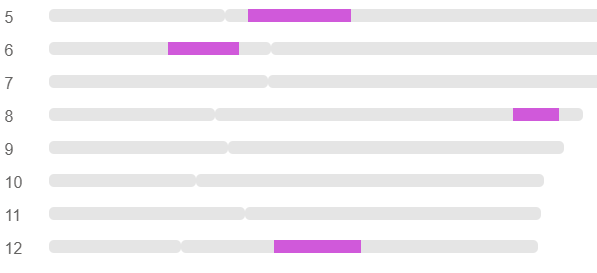
This image is small but if you click on it, it should get larger. The top bar compares Ken (K) and Susan (S). The vertical lines represent crossovers where DNA received changes from one grandparent to another. The location of these changes or crossovers are important. It is also important to know to which sibling these crossovers get assigned to. The first crossover is found where the match between Ken and Susan goes from HIR or FIR. HIR is Half Identical Region. That means that Ken and Susan both got the DNA from one of their 4 grandparents at that segment. The problem is, we don’t know which grandparent. After the crossover, represented by the first vertical line, Ken and Susan have an FIR. This is a Fully Identical Region. That means that Ken and Susan both got their DNA in that segment from two of the same grandparents. One matching grandparent was on the maternal side and one was on the paternal side.

Finding the Location for the First Crossover

The second crossover is easy to find, because it is at the same place where Susan and Doreen go from no match to a match. This spot is recorded by Gedmatch at 23,564,890. I could call that 24M or 23.6 depending on how exact I want to be. In the case above, I called it 23.6. To get the first crossover, we have to look at the comparison between Ken and Susan at full resolution at Gedmatch.

Here is the first part of Ken and Susan’s comparison at Chromosome 22:

This says that the beginning of Chromosome 22 doesn’t even start until position 14.5M where M is million. Every little ^ is one million. So counting back from 20M, Ken and Susan go from HIR to FIR between 15 and 16M. I’ll call it 15.7M. The pink part is a centromere. Usually this would be at the center of the chromosome, but there must be information at the very start of Chromosome 22 that isn’t used.

One Crossover or Two on the Right Side of Chr22?

Here is a blowup of the last two crossovers. On the top bar, there is a spot where Ken and Susan go from HIR to FIR. However, this does not line up with position 45.4M where Ken and Doreen go from no match to an FIR. However, to be sure, I need to know where Ken and Susan go from an HIR to an FIR.

According to Gedmatch, the end of Ken and Susan’s match is at 49.5M. That means the last ^ is 49M. That means that Ken and Susan’s change from HIR to FIR is between 45 and 46. I’ll say 45.7. This is pretty close to 45.4, so a judgement call. I’ll just leave it as I had it.

Assigning the Crossovers

The crossover usually gets assigned to the person that is in two of the changes. This is easier to see in the second crossover. There is a change in the top and bottom comparisons. The first comparison is Ken and Susan. The last comparison is between Susan and Doreen. Susan is the common denominator, so she gets the crossover.

I gave the first crossover to Ken:

I had forgotten why. Now I remember. I think that there is actually a very small match that doesn’t show up between Ken and Doreen at the beginning of the Chromosome. It is very subtle, but I’d say that there is more green in the beginning of the K&D comparison compared to the S&D comparison. These crossover assignments can be a bit of an art. If I had lowered the match resolution it should have shown up as a blue match there.

The last two crossovers were not easy either:

These changes have to come in pairs. That means that I had to treat the little segment between D and S as an FIR on the bottom comparison. That means that there are two changes for Doreen first making that her crossover. Then there are two changes for Susan (top and bottom comparisons).

Working on the Segments

This image is the end result, but I will say how I got there. First I started with K&S. They have a FIR for the second segment. This shows as dark green. In the image above, that means that Ken and Susan have two of the same colors. They match with one maternal grandparent and one paternal grandparent. Because Ken has no crossover to the right of the second segment, I can extend that DNA all the way to the right end of the Chromosome on both Ken’s maternal and paternal sides. Also in the second segment, Doreen has no matches with Ken or Susan. That means she has the spouse of the other two grandparents in that slot. So instead of orange and purple, she gets blue and green there. She has no crossover to the left and none on the right until near the end of the Chromosome.

At some point I have to deal with a HIR. I did that with Susan after the second segment. Susan has a HIR to Ken and Doreen. I made Susan match Ken’s purple but not his orange. We already knew that Ken and Doreen had no match in the third segment, so Doreen got the opposite colors there.

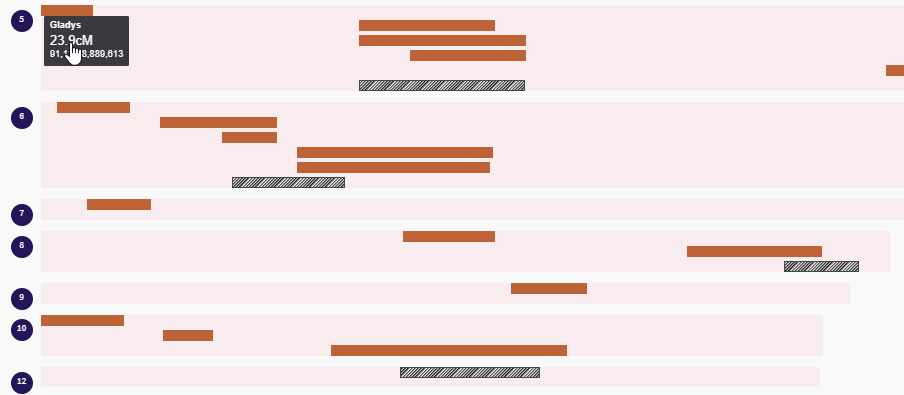
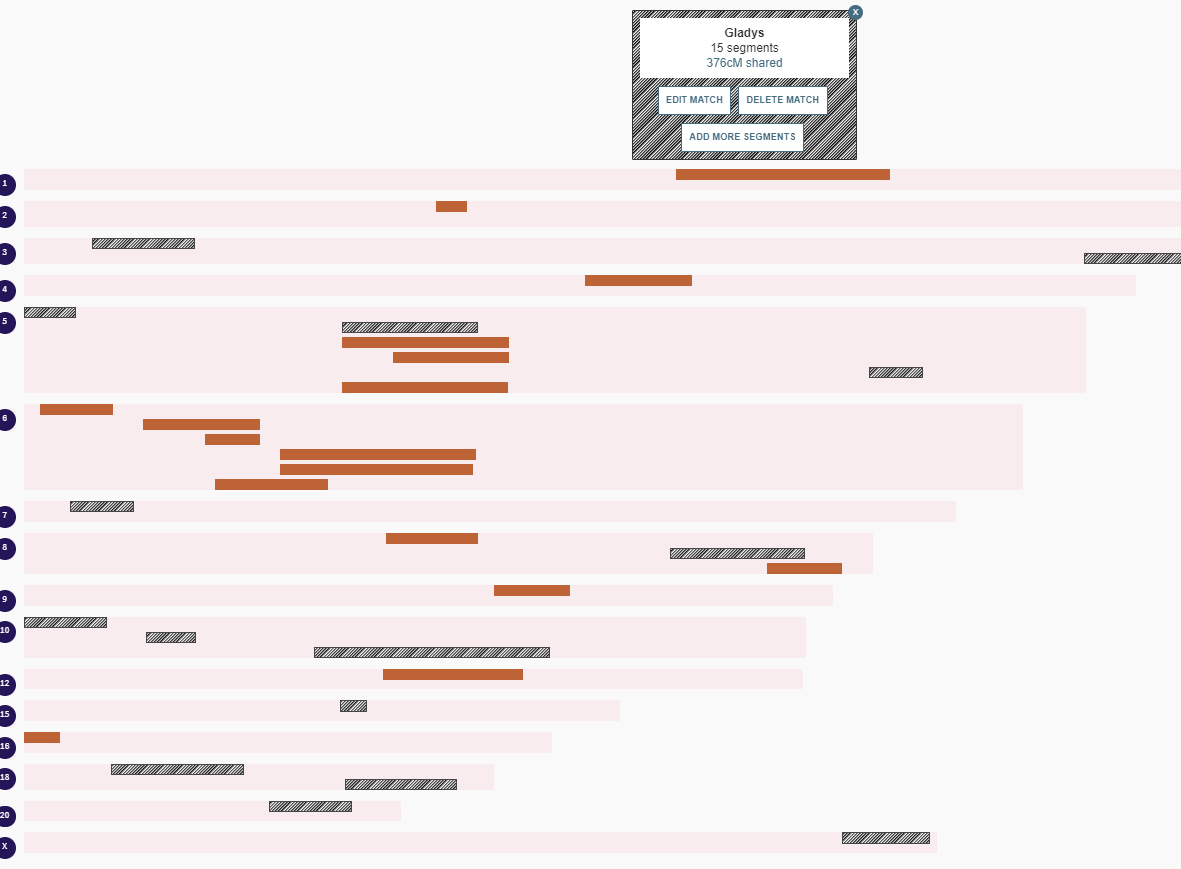
The last three bars in the image above represent Gladys’ match with Ken, Susan and Doreen. She shows a match with only Ken and not Doreen nor Susan. This has to be in Ken’s orange section as that is the only place along the match with Gladys that one of his segments is different than Doreen’s or Susan’s.

Gladys and Ken only match on the Frazer Line. Gladys has no Gray DNA. That means orange has to be Frazer. The only other paternal side is Gray so blue has to be Gray. I don’t have specific information on Ken, Susan and Doreen’s maternal side, so those are just labeled G3 and G4 for now. Actually, they should be M1 and M2 for maternal grandparents:

Ken and siblings’ father’s name is Stefansson and their mother’s surname is Gudmundsdottir.

How to Use Visual Phasing

Now that we know where Ken, Susan and Doreen got their DNA from on most of their Chromosome 22, what can we do with this information?

Part of the information is educational. Knowing how our DNA recombined by way of our grandparents is interesting. It is a kind of snapshot of what went into our makeup at conception.

Another part has to do with DNA matches. This focus us as to where our matches are. However, there is still one hitch. We still need to know if our matches are on our maternal or paternal side. If we don’t have a parent to compare our matches with, then it is possible to compare matches with known relatives.

Use of Crossovers

The exception to this is if Susan were to have a match that started before her crossover at 23.6 and continued beyond it. For a match that goes through a crossover, it has to be on the other side. So for such a match for Susan, this could not be a Frazer match but must be on her mother’s side.

These visual phasing maps work best when you have downloaded all your matches. Then you will know for every Chromosome which grandparent they will match depending where in the Chromosome your match is. If you have a lot of matches that end at a certain place and then other matches that start up again at that spot, that could be indicative of a crossover.

Separating Real Matches from Far Away or False Matches

Another way to use these results is to tell if a match is real or not. Here is part of mapped Chromosome 22 showing a small match between Doreen and Michael of the Frazer Project:

It shows that Michael only matches Doreen and not Susan nor Ken. Michael’s match is indicated by a blue bar at the bottome right of the image above. However, Doreen has no Frazer DNA in that segment. She only has Gray DNA on her paternal side. So, it may mean that Doreen matches Michael on the Gray line going way back or less likely on the Icelandic Line. But Michael could not be matching on the Frazer Line assuming I have mapped this correctly. As I mentioned, this is a small match of 5.6 cM. Matches under 7 cM have more than a 50% chance of not being real matches.

Comparison with My Visual Phasing

Here is my Chromosome 22. It is mapped along with three of my siblings. I didn’t get around to mapping Lori.

When I compare the two maps, I can see where my siblings have the potential to match with Ken, Doreen and Susan along the Frazer Line. It doesn’t mean we have to match there. For example, my Frazer grandparent DNA also has Clarke and McMaster DNA that Ken, Doreen and Susan don’t have. Likewise, Ken, Susan and Doreen have other DNA in their Frazer line that I would not share.

Extra Chromosome Mapped

While I was at it, I mapped Chromosome 12:

This was a little easier, because more cousins matched on this Chromosome. One interesting thing about this Chromosome is that between about 88 and 104M, there is no Frazer DNA. That means that if any of these siblings have a match in that area, it could not be a Frazer match.

This map had three spots that appeared to go from a no-match to a FIR or from a FIR to a no-match. This is impossible, so there needs to be a HIR transition. That is why there are three places where the crossovers are close.

Summary and Conclusions

  • Visual Mapping shows the process of our makeup based on how our grandparents’ DNA combined to form us
  • This mapping can be helpful in identifying DNA matches
  • Special attention should be made to crossovers. That is where DNA on one side of our Chromosome changed from one grandparent to the other.
  • If a match goes through a maternal crossover, for example, it means that match must be on the paternal side.
  • A lot of genetic genealogy is about separating out the DNA and visual phasing goes a long way in doing this.
  • Other sorting can be done by names or location of matches. As Ken, Doreen and Susan’s mom is Icelandic a clue as to the matches’ names, locations or genealogy can be a hint as far as placing them.
  • Visual Phasing works best when there are good cousin matches on all four grandparent sides.


Frazer-Johnston DNA and Genealogy: Part Two

In my previous Blog on the Frazer-Johnston connection, I looked at John’s DNA results. Recently John told me he had uploaded his sister Jamie’s DNA results to Gedmatch.

The Frazer-Johnston Connection on the Frazer/Stinson Line

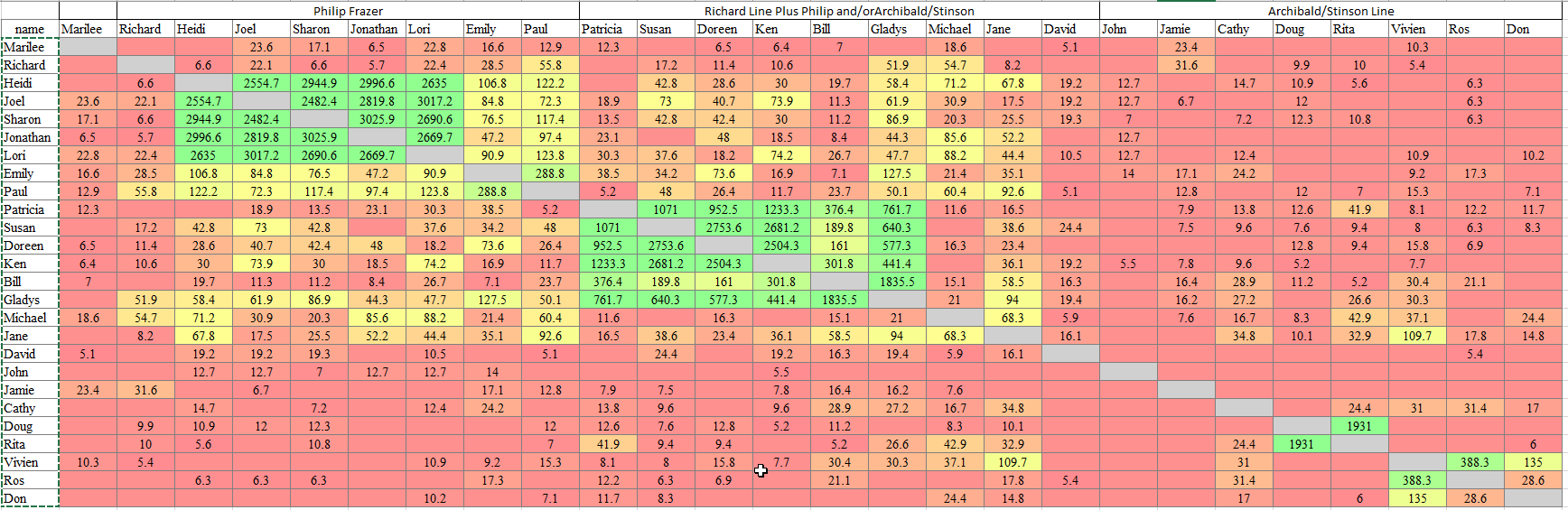
John and Jamie are in the light blue. This is a good Frazer line as there are some on the line that are in other Frazer lines such as Jane, Michael and the yellow group. John and Jamie as well as the purplish line, Cathy and the bright green line are represent people that are believed to be in the Archibald/Stinson Line only. That gives some surety in what the DNA matches might mean. However, it could result in smaller DNA matches. There is a tradeoff.

The Johnston-Frazer connection is quite old. At the top of the blue line is a Mary Frazer born at the end of the 1700’s. She married William Johnston born about 1790. Having any information from Irish records before 1800 is considered great. I have more detailed genealogical information in my previous Blog.

Let’s Jump Into Jamie’s DNA

Well, not literally. The results are a little surprising:

Jamie is on the row below the top of the solid box in the bottom right. That box represents those that are only in the Archibald Frazer/Stinson Line. This shows that Jamie does not match anyone that is just in that line other than her brother John.  Jamie’s largest match is with Richard who I believe to be the only one that is only in the Philip Line.

We can look at the Jamie/Richard match when I look at the specific matches later. However, there are a few explanations for the match as I see it now:

  • Jamie and Richard would be 5th cousins, once removed through the Frazer side. That is pretty far out. The further out the relationship is, the more random the match is. That is likely why Richard and Jamie have a 31.6 cM match as 5th cousin once removed and why Jamie wouldn’t have a match with some of her 4th cousins that are in the Archibald Frazer/Stinson Line.
  • A second reason would be that Jamie could be matching on a line we don’t know about. We don’t know who the wife of Philip was. Also Jamie doesn’t know the name of the mother of the William Johnston that married Jane Frazer in 1815. I noted in a previous blog that a later Philip Frazer, married a Jane Johnston also in 1815.

Moving across, we see that Jamie matches Emily and Paul who would not be in the Frazer/Stinson Line. However the same reasons apply for them as applied to Richard. Note also that Emily and Paul are of the same generation as Richard, so more likely to match. Here is the whole Archibald Line:

Paul is at the bottom of the third blue column. Emily is shown to the left of Paul in the above image.

Dancing with DNA

Here are Jamie’s specific matches with those in the Archibald Line of the Frazer DNA Project:


I tried to put the matches into the appropriate Frazer Lines. Jamie has more matches with those in the Stinson Line. However, Jamie has higher matches with those that are not in the Stinson Line. Anywhere Jamie matches more than one person on a segment, there is a possibility of triangulation. Ir looks like Jamie could triangulate on every chromosome above except for Chromosome 12 with Paul.

Frazer Triangulation

Triangulation should mean common ancestors. This trouble is figuring out who those common ancestors are. As this is a Frazer project, and we all have Frazer ancestry, the assumption is that the common ancestor is a Frazer. However, there are other possibilities.

TG03

This TG can be shown like this:

The theory is that this TG points to either Archibald Frazer or Ann Stinson. Not both. However, we don’t know which unless there is a match to a Frazer that is not related to a Stinson or a Stinson that is not related to a Frazer. I have a spreadsheet that has a compilation of TGs and the triangualtion above I have previously named TG03C. So I added Jamie to that group.

TG17

This is a TG I had found when I looked at Richard’s results. Unless there is some other connection, this TG appears to go all the way back to Archibald born about 1743 or his wife Mary Lilley.

Note that my sister Lori and I are in the Philip Line as well as the Richard LIne. I didn’t put us in the Richard Line to save space. The same with Michael. Only his first ancestor in the Stinson Line is showing in peach color. It is tempting to think that I am matching Richard on the Philip Line and Michael is matching Jamie on the Stinson Line, but that is only one possibility.

More About Chromosome 17

Here is my TG Spreadsheet for Chromosome 17.

I’ve squished it together a bit so it would show better. Note that Doug is in a purple TG with Bonnie and Beverly. Bonnie and Beverly are on the more distant James Line. I also note that Richard matches Doug from 70-74M on Chromosome 17. So something is going on here between the Frazer Lines.

Let’s look at this from Richard’s viewpoint. Here are his matches on Chromosome 17:

This shows that Richard has a large match with Michael. Interesting, but confusing.

A New TG Chromosome 18

This is a little like the previous TG. Is the DNA trying to tell us something? It seems to be saying that there may be a connection the Philip and Archibald/Stinson Lines that we don’t know about. Or, it is just a good match up to the Archibald born in the 1740’s and his wife Mary Lilley.

TG20

Here Jamie is added to an existing TG.

Triangulation Group Summary for Jamie


This spreadsheet accentuates what I have been trying to explain in this Blog. It seems like John and Emily have an affinity for the left side of the spreadsheet and not so much for the Stinson side. This could be by chance. However, there could be other explanations. What if Philip who we think may have been born in 1776 married a Johnston? That would tie these families together – I think.


Here I tried out my theory. I had a feeling that Michael would not fit in to this cinfiguration. However, his match with Jamie was small at 7.6 cM and could be the one that goes up to the Archibald born in the 1740’s. The tree above seems to fit the DNA. However, I’m sure there could be another explanation.

Here is another, simpler explanation. Under this scenario, Philip did not have to marry a Johnston. This would have Mary as Philip’s daughter instead of Archibald’s. This would require some rejiggering of the genealogy.

The above seems to fit the DNA better, but remember that DNA can be fickle.

My Two Laws of Genetic Genealogy

After looking at genetic genealogy for several years, I have come up with two laws:

  1. The DNA is trying to outsmart you. The matches you have are generally not on the ancestors that you were expecting.
  2. Your ancestors are messing with you. They married relatives and did other things to intentionally confuse us to keep us from figuring out their genealogy.

Summary and Conclusions

  • Jamie’s results gave some different results from her brother John. This is normal and is one reason why we test siblings.
  • Jamie’s DNA results showed no clear affinity for the Archibald/Stinson Line. This could be due to chance DNA inheritance or other reasons
  • I gave two guesses as to the other reasons. One was that Philip born about 1776 may have married a Johnston. The other reason is that the Mary Frazer that married William Johnston could have been a daughter of Philip Frazer rather than Archibald Frazer. I like this option as it seems to explain the DNA matches.
  • There may be other explanations. As always, more DNA testing could bring in more answers.


Adding 300 Years of Upshalls by DNA and Genealogy

In my last sprawling Blog, I wrote an Upshall update and had a breakthrough as to the English origins of the Upshalls. In this Blog, I’d like to summarize some areas and expand on some areas of that Blog.

The Key to the Breakthrough: Peter, Sarah, and John Upshall

Martha is an Upshall relative by DNA and genealogy. I have been in touch with her by various avenues. She has suggested a father for Henry Upshall. His name is Peter. She also suggested a mother of Peter named Sarah and a father of Sarah named John.

In the Hazelbury Bryan, Dorset Parish Registers Peter was ‘base-born’ to Sarah in 1800:

Base-born is such a heavy term. It seems like it could be used in some 1800’s English novel. The story seemed to go that Peter, being base-born, likely had no inheritance or much of a future in Hazelbury Bryan, so sought his fortune in Newfoundland. When life gives you lemons, make lemonade. But how could this theory be verified?

Confirming Henry Upshall’s (born about 1841) Ancestry by DNA

First I looked at my wife’s Aunt Elaine’s DNA matches at Ancestry. I used her matches because she has fewer Newfoundland matches than my wife’s great Aunt Esther. That narrows down the matches to Esther’s Upshall and Dicks ancestry. I checked for Elaine’s Upshall DNA matches.

Things got interesting when I started looking at Elaine’s more distant Upshall DNA matches at Ancestry. One was with Allen. Allen descended from Bethia Upshall who was the grandson of John Upshall born in 1739. Assuming that was the same John that Martha had as Sarah Upshall’s dad, I drew this tree:

From what I can tell, Allen lives in England and has no Dicks relatives. Next, I found Barry from New Zealand. Barry also has the same John Upshall in his tree and is also a DNA match to Elaine.

However, another important thing about Barry from New Zealand’s tree: it shows Sarah Upshall and Allen’s George Upshall as siblings.


Here I have circled Ann, Sarah and George Upshall. I also circled their father John. I note that Aunt Esther also matches Allen and Barry by DNA. That means that the person in common by DNA and genealogy with Allen, Barry, Elaine and Esther is John Upshall born 1739. Descendants of these three children apparently ended up in England, New Zealand and Newfoundland. However, the DNA and genealogy ties them back together to Hazelbury Bryan, Dorset, England.

A Ninth Upshall Great-Grandfather for Esther

Previously, Esther had her grandfather Henry Upshall documented and no Upshall before that. Now, thanks to work done by Allen and Barry, she has Upshalls going back to the 1500’s:

The first Upshall in the line is William Upshall born in 1543 – about 300 years before Henry Upshall of Newfoundland. William also lived in Hazelbury Bryan (spelled Haslebury at the time).

300 Years of Upshalls in Hazelbury Bryan

What do we know about Hazelbury Bryan, Dorset? Here is the Church:

I imagine that this is where the Upshalls were born, got married and were buried. Here is some more information from the internet:

Hazelbury Bryan is situated in the Blackmore Vale five miles south west of Sturminster Newton. The Parish was formerly in the hundred of Pimperne and has an area of 2359 acres. Today the village has a population of 800 (2001) slightly more than the 761 recorded in the 1861 census. The village consists of seven hamlets, namely DroopKingstonParkgatePidneyPleckWonston and Woodrow.

In 1201 the village name was spelled Hasebere. The name is derived from the Old English hæsel bearu, meaning a hazel grove or wood, plus the manorial name of the Bryene or de Bryan family; Sir Guy de Bryan, of Woodsford Castle, gave his surname to the village in the 14th century when he married the daughter of the First Earl of Salisbury.

The original settlement in the village is the hamlet of Droop, which is the location of the parish church. The 14th century church dedicated to St Mary and St James is a handsome edifice with a fine square tower. The north aisle is considered a good specimen of the Perpendicular style. Beside the church are dwellings some 400 years old. Miss Violet Cross from the Manor House, a benefactor of the church, gave these dwellings to provide homes for widows and daughters of the clergy.

The parish was also home to a Primitive Methodist Chapel built in 1863 which remains in use to this day, part of the North Dorset Circuit.

That gives some general information. Hazelbury Bryan is old and small is the message I am getting. I suppose that makes it a good place for tracking Upshalls. Here is the 1841 Census with what appears to be Sarah’s brother Benjamin Upshall:

He is living in the Hamlet of Droop. He appears to be an agricultural laborer. The person above Benjamin was listed as a Farmer. I suppose that meant that Benjamin worked on someone elses’ farm. Living with Benjamin was Elizabeth Upshall. She could have been Benjamin’s wife or George’s widow Elizabeth Whiller Upshall or some other relative.

Here is a Droop Farm Cottage for rent. Perfect for Upshall descendants looking to visit their roots:

Summary and Conclusions

  • DNA matches compared with associated trees has pushed the knowledge of my wife’s Upshall line back about 300 years.
  • Base-born Peter Upshall appears to be the first in my wife’s line of Upshalls to travel to Newfoundland.
  • Before relocating to Newfoundland, Peter’s ancestors lived in Hazebury Bryan as long as the Parish records have existed.
  • Tracing ancestors from Newfoundland back to England can be nearly impossible due to the lack of records in Newfoundland. However, the use of DNA matching paired with good on-line Upshall records from Hazelbury Bryan has resulted in a breakthrough in Upshall genealogy.