A Latvian Match at MyHeritage – Patrick

I recently was pleasantly surprised to get a message from Patrick from Berlin. He says that we are connected through his great-grandmother Wilma Pfeiff.

Wilma Pfeiff

Here is a photo of Wilma from an article written in 2010:

I enjoyed reading about Wilma’s history [translated on-line]:

Wilma Pfeiff was born in Riga, Latvia. She experienced the First World War in Russia in a city on the Volga. There her father had to work in a machine factory. She was allowed to herd cows and learned fluent Russian. “I always went to the other girls and talked to them.” After the war, they went back to Riga. There she married. “My husband was supposed to marry my older sister, but she did not want to,” remembers Wilma Pfeiff. The girls had hardly any say in the election of the groom. In 1929 she got her first child, nine more followed. In 1939, the German-descended family was relocated to the Polish Wartheland. Her husband later went to war and did not return home. Then the day came Wilma Pfeiff had to flee from Poland with her ten children. In open wagons, actually coal cars, the families were penned. “Mother was always smart. She had a blanket, “says her sonErich Pfeiff (71). And his brother Edwin adds: “We still got straw to keep us warm.” The family was stranded in Brandenburg, on detours, it went on to Lemwerder. That’s where the Pfeiffs lived in the refugee barracks, that was in 1947. “That was a very difficult time,” says the 104-year-old. She had to fight for her children, they wanted to take her away. “‘Young dogs are distributed, but no children,’ I told them then.” She was allowed to keep the children, the elders were apprenticed. “The children were all very nice, they helped a lot,” says Wilma Pfeiff. She never married again: “I could have found a husband, but no father for my children.”

I have found DNA relatives to people in the US who have had ancestors from Saratov. I have wondered how they could be connected to Latvia and this article may explain it. Saratov was about 1,000 miles away from Riga, Latvia. I know that my great grandmother was also moved around a lot in WWII like Wilma was.

The DNA Match – My Mom and Patrick

Here are the DNA matches between Patrick and my mom, Gladys:

There are five matches that are fairly small. This could mean that our common ancestors go back several generations. I have a cousin who has not uploaded her DNA to MyHeritage. I have other Latvian cousins at MyHeritage but they do not show DNA triangulation with Patrick.

Wilma Pfeiff’s Genealogy

A good resource for Latvian Genealogy is a website called Raduraksti. They have a page with 10,000 Latvian names that could be helpful to find Wilma Pfeiff. One problem with using this list is that the Latvians like to spell German names their own way. Another problem could be that Wilma was not in Latvia when they took the survey or if she was, she may have gone by her maiden name. This appears to be the Latvian spelling:

Another Hint from Patrick

Patrick messaged me at MyHeritage:

My Family lived in a German enclave with 3 other Families: Pfeiff (my one), Schmidt, Gangnus, Wolde. They all married each other. For Example my Great Grandma was firstly Schmidt and married Johann Otto Pfeiff. 

This is a big help as I didn’t know Patrick’s great-grandmother’s maiden name. There are two Johans in the list above:

The second Johans seems to be born in the right time.

Wilma Schmidt

Next, is Wilma listed on the Latvian database? This must be her:

She was born in Riga. This also gives a name for Vilma’s father. However, there were many churches in Riga. Here are some Oskars’ from the Latvia database:

My top choice is the Oskars born in the Irsu pag. as that is another name for Hirschenhof where my ancestors came from.

Patrick’s New Finds

Since I started writing this Blog, Patrick has found a lot more information on his Hirchenhof ancestors. I built out part of Patrick’s tree that I had started based some of Patrick’s new research and got this:

I put a green box around the common ancestors Patrick and I have. It looks like Patrick and I are double 4th cousins once removed.

The Lutke Connection

Lutke is interesting because I was previously stuck on Friedrich Lutke as well as Eva Fuhrmann. Patrick’s research helped me fill in this whole lower right side of my Latvian tree:

This added a new Buchenroth surname that I had not heard of and an additional Schwechheimer. Here is how Patrick connects with me on the Lutke side:

A Gangnus – Biedermann Tree

This tree is more complicated because I already match some other people there by DNA:

This is complicated because I descend from from Gangnus ancestors on my grandfather’s mother’s and father’s side. Robert above also has a double connection.

Patrick’s Pfeiff Side

I can’t see the ancestors of Johann Otto Pfeiff on Patrick’s MyHeritage Tree:

Patrick has Johann Otto Pfeiff born in Riga on 23 May 1906. I have Johann Karl Pfeiff born in Hirschenhof on 6 August 1906. I wonder if they are the same person? I did find a birth record for Johann Otto Pfeiff in the HIrchenhof Church records.

The record goes onto the next page. At this time, the Church records were in what appears to be Russian. Fortunately, the names are also in German. I did find a Russian Genealogical Wiki. The first column must be birth and the second baptism. My guess is that Patrick’s 23 May was right.

I don’t know when to give up, so I looked for a marriage for Georg and Ottilie:

This marriage appears to be in 1902 or 1903. The German translations of the names are in parentheses. I think that the second name after the first name must be the father’s name of the groom and bride. I see those names as Johann and Georg.

Painting Patrick

I would like to paint Patrick’s DNA matches using DNAPainter. The problem is that we match three different ways. I’ll work around this by just naming the common ancestors by the two closest pairs of common ancestors. That would be Lutke/Fuhrmann or Gangnus/Biedermann.

Here is where I match Patrick:

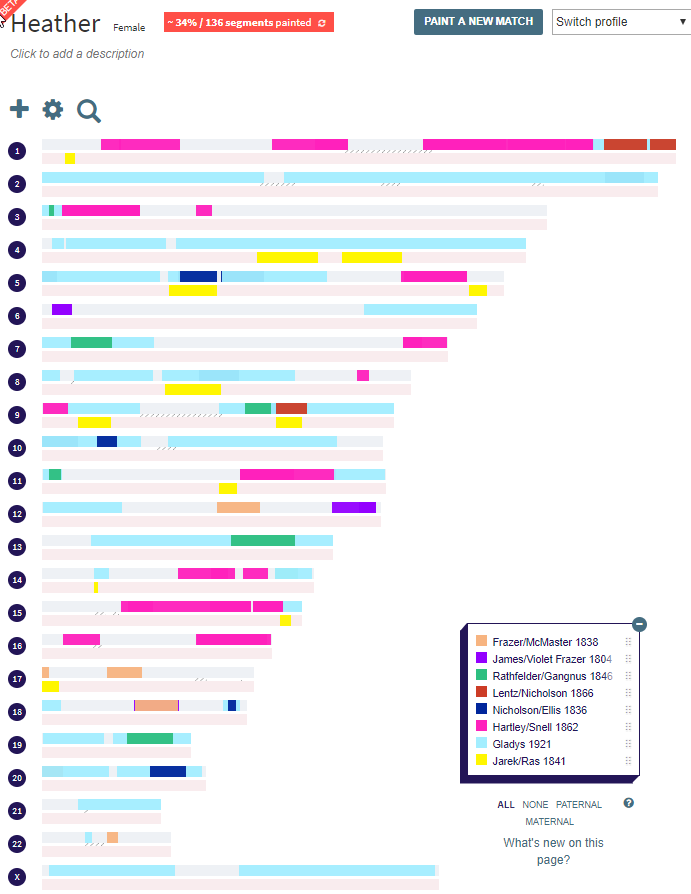
Here is my already maternal side that is painted:

One problem here is that Chromosome 20 is already taken up by the wrong side. My Lentz ancestors mostly lived in Philadelphia. Also matches under 7cM are not likely to be valid.

There also seems to be a problem with the match at Chromosome 18:

The MyHeritage Chromosome Browser shows no triangulation on Chromosome 18. My match with Patrick is in red and my matches with my two Latvian 2nd cousins are in orange and yellow. That means I am skeptical of this match also, but I don’t want to just toss it out.

Here is the new DNA painted in light blue.

I made a note under the match in DNAPainter that the Chromosome 18 segment did not triangulate. Here is a portion of DNAPainter with my paternal side included:

My Latvian maternal matches are on the bottom bar of the Chromosome.

My Mom and Patrick

Here is my mom’s currently painted matches:

Here is my Mom’s map where Patrick’s matches were added:

DNAPainter doesn’t add the matches under 7cM. The match on Chromosome 18 doesn’t show as it is under other matches:

My mother didn’t match Patrick on Chromosome 20.

Summary and Conclusions

  • I’m glad Patrick contacted me. It has been fun working with this enthusiastic and talented German genealogist.
  • Patrick and I both have an interest in German/Latvian genealogy and we are working well together.
  • Thanks to Patrick, I have added some ancestors where I was stuck on our shared Lutke and Fuhrmann Lines.
  • Painting my matches and my mother’s matches with Patrick gave some more insight on the shared matches.
  • I’m hoping to find out more about Patrick’s genealogy and meet other DNA matches with an interest in genealogy like Patrick.

Sorting My Mom’s DNA with AutoCluster

I already sorted my mom’s DNA with AutoCluster last week. However, since that time, Genetic Affairs has changed the look of their AutoCluster Chart. They now cluster the clusters which makes it easier to tell which ancestral groups go with which

My Mom’s Ancestry

Mom, Gladys’, father is German but his German ancestors lived for quite a while in a German colony in Latvia. His parents were Rathfelder and Gangnus. My mom’s maternal grandfather Lentz was also German but his ancestors had been in Philadelphia since the American Revolution. Gladys’ maternal grandmother was Nicholson. Her family moved to Philadelphia from Sheffield, England.

The First AutoCluster

My first AncestryDNA AutoCluster for my mom looked like this:

  • Thresholds: 20-600 cM
  • Matches: 323
  • Matches not used in clusters: 29
  • Clusters: 48

I started writing a Blog on the results, but didn’t finish. Here is a spreadsheet for the above chart:

These clusters were sorted by the size of the cluster and I didn’t identify the first three clusters.

Mom’s New AutoCluster Results

I expect the new results to be more organized and show where the groups of matches belong compared to the other groups of matches:

  • Thresholds: 20-600 cM
  • Matches: 330
  • Matches not used in clusters: 28
  • Clusters: 49

I used the same thresholds in the new AutoCluster run. The results were similar but now the clusters are organized. Here is the new spreadsheet:


I note that Elise and Rowena are in twice. I don’t know if that messes up the results. I didn’t show all the clusters as they go off the page.

Elise shows as being in Clusters 5 and 6 which doesn’t make sense. She doesn’t show in Cluster 5 but shows as a dark gray row to the left and above Cluster 6. Rowena shows as being in her own Cluster 15 which I don’t show above.

Unraveling the Mystery of Mom’s DNA

The unraveling the mystery of mom’s DNA involves trying to figure out which parts of her DNA go with which common ancestors. The common ancestors are the common ancestors of her common matches. Her common matches are grouped together and those groups are grouped together, so let’s get started.

Here are mom’s four grandparent lines:

These shown are the first and 2nd great-grandparent levels. By location, the top two grandparent are Latvia and the bottom two grandparent lines are Philadelphia and Sheffield, England.

Cluster 1: Nicholson/Ellis

Cluster 1 is easy. It is headed up by mom’s 2nd cousin Carolyn on the Nicholson/Ellis Line:

Cluster 38 – Rathfelder

Next, I’ll go all the way down to Cluster 38. I believe that this is a Rathfelder Cluster:

I may only have one Rathfelder Cluster with the two sisters, Astrid and Ingrid.

Mom’s Maternal and Paternal Clusters

The above two Clusters may have set the edge for Mom’s Clusters, but I’ll check in more detail later. Here is my assumption so far:

Again, this is a guess based on two clusters. I will need to check this out. I also will want to try to identify Lentz and Gangnus matches, if possible.

Finding Lentz

Lentz matches have been difficult to find. Here is the Lentz tree with some of the descendant who have had their DNA tested:

The left branch has the closer matches, but they are also half Nicholson. Here is Radelle’s mom at Ancestry:

This is a little confusing because Radelle took the test and her mom, Delores shows in the tree. I became suspicious when I saw that Delores died in 2011. Radelle is in Cluster 32:


I now have three of my mom’s grandparents. However, does that mean that Nicholson has 31 Clusters?

More Nicholson

I can fill in one Cluster with Nigel. He has a large match with my mom going back to 1765 in Sheffield, England.

I should have John Nicholson’s wife as my mom could just as easily be sharing her DNA. Here she is:

I’m getting stuck on my mom’s maternal side, so time to switch to paternal:

Otis and Cluster 39

Here is Otis:

Here Otis is 3rd cousin once removed and 4th cousin once removed on my mother’s Rathfelder side. This Chart describes Otis’ relationship to my mom as 5th cousin, once removed on the Gangnus side:

That means the Rathfelder side wins out (I think).

Otis and the Colony Effect

The Colony is effect is this. You put a bunch of Germans in a Colony in Latvia and they want to marry other Germans:

Here is Otis’ Cluster 39 in blue highlighted. Astrid is in the cluster above and to the left of Cluster 39. Otis is the top left match of the blue cluster. He also has shared matches with mom in other clusters below and to the right.

Doing Some Latvian Genealogy

I did a search for Latvia at my mother’s AncestryDNA match page:

Robert shows his maternal grandparents coming from Latvia. That means I could try to do some genealogy on Roberts tree if I want. Robert is also in Mom’s Cluster 45.

The All-Latvia Database

I was able to find the Resch family at:

http://www.lvva-raduraksti.lv

This is a good web site for Latvian research.

The Latvians like to Latvianize names. So I don’t know if Retsch is a German name changed to Recs or if Recs changed to Retsch. I also found Zamuels birthplace and birth date. The last column is place of origin. This shows as Riga for father and son. I usually look for Irsu Pag. which is Hirschenhof. That would link with my ancestors.

Robert has that Alma was born in Dresden, Germany, so I’ll look to Mazur and Rosenbach. I couldn’t find Rosenbach in the list. I did find some Martin’s in the Latvia Inhabitant list:

The closest Martin has his dad as Jēkabs.

A Latvian Secret Weapon

I was ready to give up but remembered I had a book on the Gangnus family. If Robert is related to me through that family, perhaps I could make a connection there.

I left out the bottom where it says Darmstadt 2003.

I looked up Retsch in this book and found one reference:

This reference says that Samual was born March 22, 1872 which is close to the April 3, 1872 I had above. Now all I have to do is make the connections. I have a feeling that the connections go back a way. What the above says is that Samuel married Charlotte Alma who was born 2 March 1867. Her parents were Johann Georg Gangnus and Marie Jacobine Schilling.

I see what happened. Robert had Charlotte Alma Gangnus as Alma Magnus. That makes sense. When I first saw my mother’s grandmother’s name written, I think it was written as Youganis.

Gangnus Production Update

Now I have two Gangnus/Gagnus families:

The good news is that I was about to give up on the Robert tree and then I remembered my Gangnus book. The bad news is that I’m getting lost in all these Gangnus families. However, I am starting to see our trees coming together in a confusing and interesting way.

If I understand this correctly, Robert and I are double 5th cousins. Robert and my mother are double fourth cousins, once removed. The other thing is that Robert is related on my mother’s paternal grandfather’s and grandmother’s side.

In order to display this on my spreadsheet, I added another row for Cluster 45:

Summary and Conclusions

  • The new autoclustering look helped show where the clusters grouped with each other. I wasn’t able to identify many more clusters specifically, but now I know in what area they should belong.
  • I was able to make a guess where my mother’s shared matches went from maternal to paternal
  • I looked at some paternal clusters. However, intermarriage in Hirschenhof, Latvia made it difficult to nail down DNA to a specific grandfather in at least one case.
  • I was able to build out Robert’s tree. Robert was in my mother’s Latvian Cluster 45. I used the All Latvia on-line Directory and a book I had on the Gangnus family in Latvia. However, after all that work, Robert appears to be equally related to my mom on both my mom’s paternal grandfather and grandmother’s sides.


AutoClustering My Mother-In-Law Joan’s AncestryDNA

I’m excited about looking at my mother-in-law’s DNA. I tried autoclustering her FTDNA results but had a difficult time identifying many of her clusters.

Making Joan’s DNA Fun Again

When I first started looking at Joan’s DNA several years ago, it seemed like a lot of her matches resulted in common ancestors. Then later, I saw that there was a lot of inter-marriage going on in Prince Edward Island (PEI) where Joan’s two paternal grandparents came from. Let’s take a look at the Geneticaffairs AutoCluster for Joan:

That’s not very clear, is it? My previous autocluster reports were in the range of three or four hundred matches. This report is quite large, with about 650 matches. Large is good, but it makes the chart difficult to view. To get the Chart above, I used thresholds between 25 and 600cM.

Joan’s Ancestry

Joan’s ancestry is one-half PEI, 1/4 Newfoundland and 1/4 Nova Scotia. The records are poor for Newfoundland and the Nova Scotia relatives are a bit obscure.

The first column has Joan’s great-grandparents. Ellis through Hopgood are PEI. Upshall and Dicks are Newfoundland. Daley and Rhynold are Nova Scotia. Here is a guess on how Joan’s autocluster will look:

It would be nice to sort the Ellis from the Rayner in the top square. However, there is some crossovers in the families as you go back in time. I’m also curious to look into Joan’s Newfoundland and more obscure Nova Scotia ancestry.

Let’s Get to the Clusters

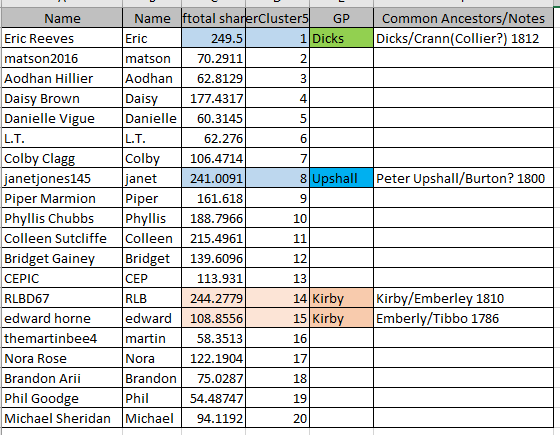
First I start with the Identifying Spreadsheet. This is to identify Joan’s 66 clusters – or to at least get a start on them.

This goes down to Cluster 42, because the results went off my screen. However Brian at Cluster 41 is important.

Brian’s Upshall Match

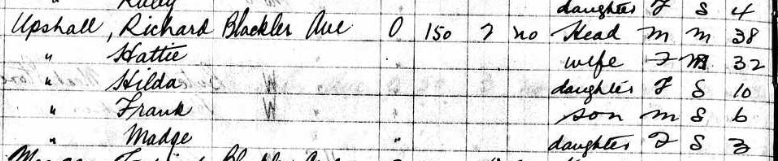
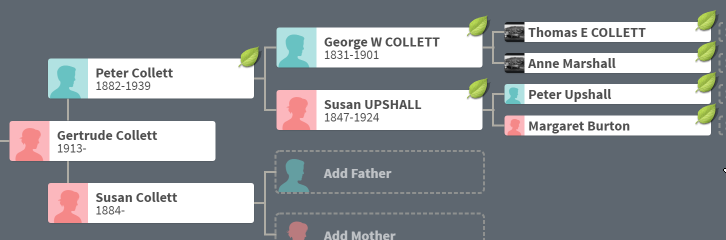
Here is an Upshall Tree. I think I have it right:

Brian is Joan’s 1st cousin once removed. However, they are only related on the Upshall side because Fred Upshall’s first wife died and he remarried and had Gertrude and Esther. I drew my big green box starting with Brian in Cluster 41 in my initial guess.

Joan’s Ellis Side

Joan’s Cluster Chart is headed up by E.E. Here is E.E.’s Shared Ancestor Hint (SAH) with Joan at AncestryDNA:

E.E. is in Joan’s Cluster 1 and is a second cousin to Joan. E.E. is the top left square in this cluster.

The higher matches are on the top left and the lower matches are on the lower right. The Shared Matches fade out a bit from the top left to the lower right. Most of Joan’s matches with Newfoundland ancestry can be found in this cluster. That should include more of the Dicks relatives than Upshalls.

Now I have two out of 66 clusters:

These might not be the best names for these clusters, but that is what I am calling them right now. Cluster 1 has 105 members and Cluster 41 has 101 members, so those two matches represent clusters that total to over 200 matches.

Joan’s AncestryDNA Circles and Her Clusters

Joan has 22 Circles at AncestryDNA. These Circles point to common ancestors and should help to identify Joan’s clusters. One of the more obscure clusters leads me to Gordon with Rhynold ancestry:

Gordon and many others are in Cluster 61. This probably represents the start of Joan’s Daley maternal grandmother’s side:

Cluster 61 has been bolded and the Upshall Cluster is shown in the upper right of the image above. These may be other Newfoundland Clusters between Upshall and Daley/Rhynold.

Daley represents 1/4 of Joan’s DNA but a smaller percentage of her actual matches. I have now defined the three main areas of Joan’s ancestry on the clusters. They are: PEI, Newfoundland and Nova Scotia.

Separating Ellis from Rayner

I have distinguished three areas of Joan’s ancestry. I have Joan’s Ellis, Upshall and Daley ancestry. Now I would like to separate the Ellis DNA from the Rayner DNA. This is a little difficult due to crisscrossing of Rayner and Ellis ancestry. Here is some of Joan’s paternal ancestry:

Back to the Circles

Here is a Rayner Circle from Ancestry:

There are 21 in this circle. Hazel is a match with strong confidence. Yet, she appears in Joan’s Cluster 1:

I do see that while Hazel has two Rayner Lines, she also has an Ellis ancestor:

It looks like Joan may be matching on this Ellis Line rather than the Rayner side. Confusing, isn’t it?

The Mary Watson Circle

Mary Watson was the wife of Edward John Rayner. If Edward was in Cluster 1, shouldn’t Mary be also? Or can AncestryDNA somehow separate the two?:

Joan’s first non-close family relative in the Mary Watson Circle is Esther. Turns out Esther is in Cluster 13. Hence, my question above.


Looking at Esther’s tree, I don’t see Mary Watson:

Perhaps it is more obvious through other trees.

One of the next matches to Joan in the Mary Watson tree is Mary-Ann. Mary-Ann is in Cluster 12. Mary-Ann has one non-private person in her tree who is not a Rayner and not a Watson. At this point, I can choose to trust Ancestry’s Circles or trust them. I’ll assume that there is something to the Circles and add Cluster 12 as a Mary Watson Cluster.

Here is Joan’s green Cluster 12 highlighted:

Let’s Try a Mary Yeo Circle

Here is Mary Yeo.

Mary is Joan’s third great-grandmother on her paternal Rayner side.

Wanda is a top match in the Mary Yeo Circe, but she is in Cluster 1. Wanda also has at least one Ellis ancestor. I am beginning to question some of these Ancestry Circles. However, to be fair, I have had trouble separating out Ellis and Rayner by hand, so I’m sure a computer program would have the same problems.

One More Rayner Side Circle: Amelia Watson

Ronald is a top match in the Amelia Watson Circle. He has Gorrill, Hopgood and Watson ancestors. He is also in Cluster 7. Hmm…

An Additional Ellis Cluster

Kath is in Cluster 4:

However, Kath is in the Pring Circle. The Circles are confusing me right now, so I’ll have to ignore them. Note that Kath has two Shared Ancestor Hints (SAHs). Here is the second:

I suppose that is how Kath got into the Pring Circle. Fortunately both these ancestors are on the Ellis side. From the above, it appears that Richard Gorrill Married two Newcombe sisters. I’ll record this in my spreadsheet like this:

This shows that I have five PEI Clusters identified out of what appears to be a total of 40 PEI Clusters.

One More Cluster – #19

There is always one more Cluster to Identify. My next strategy is to look down the list of clusters from my AutoCluster Report:

I have a few notes for Heather and L.M. that indicate that they should be on the Rayner side.

More on Newfoundland DNA

I have written many Blogs about Dicks and other Newfoundland DNA. I will look into those matches now.

Crann DNA

Joan matches other with Crann DNA. Heather is from New Zealand and Joan and Heather’s common ancestors are likely Henry Crann born 1757 in Netherbury, Dorset, England and his wife Elizabeth Collens. This is a case where the DNA gets ahead of the genealogy. Heather is in Joan’s Cluster 46

Building Out Terrence’s Tree

Terrence is also in Cluster 46 and has a tree with four people. I am curious about his tree as his mother is a Crann. I have avoided building out any trees in this Blog, so I will build one out now:

This is Terrence’s mother’s grandfather’s line going right back to Jenry Crann and Elizabeth Collens. One interesting thing about this tree is that I have Richard Crann being born in Harbour Buffett where Joan’s Newfoundland ancestors lived.

Tyler Also from Cluster 46

In addition to Terrence is Tyler. I don’t have to build out his tree. His tree also goes back to John Crann. When I put Heather, Terrence, and Tyler in a tree, I get this Cluster 46 Crann Tree:

R.N. From Cluster 46

R.N. is Joan’s last match at Cluster 46 (at the threshold that I set). Turns out R.N. also has a tree on the New Zealand Branch:

Now Joan has symmetry in her Cluster 46 between Newfoundland on the left and New Zealand on the right.

Where is Joan in Cluster 46?

That is the problem. I don’t have good records for the match. I had proposed that John Crann had a daughter named Elizabeth who married Christopher Dicks.

The problem with this theory is that I don’t have any paper evidence. I already had Tyler in this tree, but I am missing Terrence. He needs to be added in. I note that at Ancestry all the trees that have a name for Christopher Dicks wife have Elizabeth Collier. There is one researcher who has Christopher’s wife as Elizabeth Crann but has no parents for her.

Summary and Conclusions

  • With the AutoClustering technique, I was able to break down Joan’s DNA into her three ancestral regions.
  • I had some difficulty in splitting Joan’s PEI Ellis and Rayner grandparent clusters. This may be partly due to a fairly high 600cM top limit for the clusters.
  • I wonder if I lower the top number will I get more clusters. There were a lot of people in the two main Ellis and Upshall Clusters.
  • I focused on one small Crann cluster with small matches but good trees. This cluster added to my previous work where I propose the Elizabeth Crann is the wife of the Christopher Dicks born about 1812.


AutoClustering My Wife’s Aunt Lorraine’s AncestryDNA Results

AutoClustering is working well. I have previously run an autocluster report for Lorraine’s sister Virginia:

Here are some comparisons:

Virginia’s number of 4th cousins or closer and her SAHs are as of today and I did her autocluster about a month ago. I changed the upper limit for Lorraine to 600 cM because I was having trouble identifying some of the clusters. I had set the lower limit down to 12 because I was looking for distant Butler relatives.

Lorraine’s AutoCluster

Since the time I ran Virginia’s autocluster, the clusters have been arranged differently to show connections between the clusters. This has been a very helpful innovation.

Adding Names to Lorraine’s Clusters

I’ll start with a table:

This table starts with each of Lorraine’s clusters. That is followed by the top match name in the cluster and the amount that top match has in cMs. I just need to fill in which grandparent side each cluster belongs to and which common ancestors the cluster seems to point to,

Lorraine’s Ancestors

These are some of the ancestors that I will pick from:

I am interested mostly in the top part of the tree. The bottom part is where most of the matches will be. The bottom represents the maternal French Canadian side.

Name Those Clusters

To get the ball rolling, I’ll start with Fred. I have have been in touch with Fred who a second cousin on Lorraine’s Pouliot maternal grandparent side:

Turns out that is Lorraine’s largest Cluster:

That’s a lot of Pouliot’s. These could be all descended from a certain common ancestor along the Pouliot or Fortin Lines.

The Second Largest Cluster: LeFevre

Sandra shows up a lot in my analyses. Here she is:

Sandra is also in Lorraine’s Cluster 1:

Skipping Down to Clusters 34 and 35: Kerivan and Butler

These are the Clusters I am more interested in.

Clusters 34 and 35 are the purple and tan Clusters. They show a lot of connections between those two Clusters.

Cluster 34 – Kerivan

Amanda is the first person in Cluster 34, but she has no tree. Donna is the third match in Cluster 34. Here is the paternal side of her tree:

Turns out Donna is a second cousin to Lorraine also:

Cluster 35 – Butler

The top match for Lorraine in her Cluster 35 is Barbara. Barbara has a short tree:

Here is Barbara in a tree with other Butlers:


She shows up as Lorraine’s 2nd cousin. What is interesting about Cluster 35 is that it includes Butlers from Cincinnati. My guess is that they are related this way:

There is a branch on the left of Cincinnati Butlers headed by a George Butler born about 1826. My wife’s ancestor Edward Butler was also living in Cincinnati for a while. His first son was named George – perhaps after the Cincinnati Georg Butler. I haven’t worked out all the details yet, but the DNA is showing a definite connection.

Lorraine’s Cluster Summary

Here are the bones of Lorraine’s clusters:

It is possible that there are 33 French Canadian Clusters and 3 Irish Clusters. I would have to look at all the clusters to be sure. However, as I scan the clusters, it looks like that could be the case. Here is my best guess:

That means that finding the 1/2 Irish side among the French Canadian half, is like looking for a needle in a haystack.

Comparing Lorraine’s Clusters to Virginia’s Clusters

Here is a comparison of the two sisters’ clusters:

This shows that Virginia split in two both of Lorraine’s Clusters 34 and 35. Here are some of the clusters that I tried to identify for Virginia:

So with that comparison and looking at some of Lorraine’s Shared Ancestor HInts at AncestryNDA give me this cluster chart for Lorraine:

It is possible that Cluster 16 is wrong based on the placement within Pouliot’s.

Summary and Conclusions

  • Lorraine’s AutoCluster Chart looked like a mess at first but seemed to sort out between her four grandparents.
  • I didn’t look at why there were so many matches between the Kerivan and Butler Lines.
  • I compared Lorraine’s Clusters to her sister Virginia’s Clusters
  • The new ordering of clusters makes a lot of sense and makes the identification and organization of clusters much clearer.


AutoClustering My First Cousin Once Removed

I’m excited about the new changes in AutoClustering by GeneticAffairs. They have clustered their clusters which help take some of the guesswork out of analyzing the clusters. Clusters are DNA matches that match each other. The new mega-clustering put the clusters together that are most like each other.

My First Cousin, Once Removed Joyce: Setting the Limits

Joyce is important because she goes one more generation back with DNA matches. Joyce matches me on my two great-grandparent lines of Snell and Hartley. The Snell lines are pretty well-defined, going back to Colonial Massachusetts. The Hartley Line comes from Lancashire, England and has a brick wall around the year 1800. I was hoping that clustering Joyce would separate her many Massachusetts Colonial matches with her Lancashire, England matches. Because we are one generation apart, my great-grandparents are Joyce’s grandparents. She also has two grandparent lines that I am, for the most part, not related. These also have many Massachusetts roots. That means that Joyce has three-quarters old-time Massachusetts DNA and 1/4 Lancashire DNA. However, I suspect that Joyce will have very few Lancashire matches.

I put some thought into Joyce’s limits for her matches. I wanted the upper limit high enough to include some matches I knew about but not so high that they would include many matches that were on two of her grandparent sides. Then I wanted the lower limit low enough to find Lancashire, ENG matches but not so low that there would be too many clusters. I set the upper limit at 250 cM and the lower limit at 25 cM. I wasn’t sure what to expect as Joyce has over 1,000 4th cousin or closer matches. Joyce also has 249 Shared Ancestor Hints.

Jocye’s AutoCluster Results

Joyce has 61 clusters which is a lot:

The more clusters there are, the more difficult it is to see all the clusters.

Identifying Joyce’s Clusters

Here are Joyce’s four grandparents:

I am interested in Joyce’s two maternal grandparents. However, I will try to identify some of her paternal side also.

Joyce’s First 16 Clusters

Cluster 1 is easy. I should be in this group as these are Joyce’s closest relatives. I’m not in the group because I cut off the upper limit of matches at 250cM. The first match is my sister’s son. His results just came in last week. It seems like my Hartley clusters should go as far as the blue Cluster 9 and then Cluster 10 may be a new group of clusters.

Speeding Up the Process

I can speed up the process by taking the Autocluster data file and compare it with my own clusters.

This tells me that I match Joyce at her Clusters 1, 3, 4, 32, and 37.

Here I put a box around Joyce’s Clusters 1-4, 32 and 37. I checked with my other 4 tested siblings and one sibling added another Cluster 57 for Joyce.

Checking Joyce’s Shared Ancestor Hints (SAHs)

This should be a quick way to identify a few clusters. The first SAH I found for Joyce below the threshold was C.L. However, he is a 1st cousiin twice removed to Joyce. That means he could match on the Snell or Hartley side. However, he is in Joyce’s Cluster 1.

The second SAH is A.M.

He is on Joyce’s Cluster 16

Mixed Messages from K.R.

K.R. looks like he matches on my Hartley/Snell side. However, he has a Chace in his ancestry that is not built out. AutoCluster has K.R. in Cluster 19 which is probably not a Hartley/Snell Clusrter. K.R’s shared matches confirm this. I found quite a few other trees that appeared to be on Joyce’s Hartley side, but by shared matches appeared to be not on the Hartley side that match me and my family.

Some Massachusetts Colonial Clusters

Louisa is a SAH but she has a private tree. She tells me we match by a common ancestor born in 1711. At this point, I’m just looking for Joyce’s Hartley side SAHs.

An Old Snell Cluster

Joyce’s SAH match with John shows this:

However, not all of John’s lines are built out:

That means that the SAH could be off. However, John is in Cluster 8. I will say that Cluster is on Joyce’s Snell grandparent’s line.

O.T. in Cluster 8

O.T. is Joyce’s top match in Custer 8. I was surprised to find a common ancestor there.

Ancestry didn’t pick this up as a SAH due to the way the names were recorded in O.T.’s tree. I even have a photo of Mary and Otis:

That makes O.T. and Joyce third cousins.

Here is the spreadsheet I am working on for Joyce:

When I first looked at the Joyce’s clusters, I thought that Clusters 1-9 would be on the Hartley/Snell side and then there would be a change. That seems to be what is happening.

Anne From Australia

Anne has shared Hartley grandparent ancestry with Joyce:

Unfortunately, Anne was in a singleton match and didn’t make the criteria to be in a cluster.

AutoCluster Vs. Ancestry Circles

For what I was looking to do (i.e. separate my Hartley and Snell ancestors) it turns out that Ancestry Circles do a better job. Or at least an easier job. Here are Joyce’s Circles:

The two families in the green box are the ones I’m trying to separate. Joyce has nine circles on her paternal side and four on the side that matches my Hartley family. Of the four that match my family, one goes back to England and three are Colonial Massachusetts.

The reason why the Circles are easier than clusters is that the Circles use lower thresholds and make use of Ancestry Trees. Here is Joyce’s Pilling Circle:

Joyce and my family and my 2nd cousins are at the top of the circle. Then there is ce and the Robert family of two on the bottom. Joyce matches ce at 6.8 cM and one of the two in the Robert group. The one she does match in the Robert group Joyce matches at 9.6 cM. So this is far below the 25 cM lower threshold that I set for Joyce’s clusters.

Joyce’s First Clusters – More Detail and a Discovery!

Having said that Circles work well, I still want to look into Joyce’s Hartley/Snell side clusters in more detail to see what I can find. I don’t know if Joyce has any English Hartley Clusters, but if she does, I suspect that they will be small clusters.

Here are Joyce’s first nine clusters which I suspect relate to my family.

Cluster 2 – Jennifer and Emily

Cluster 2 has only two people in it. That means that these two are in an obscure Massachusetts colonial cluster or they could have roots back in England. Jennifer has the larger match, but Emily has a tree. I see by Emily’s tree that she has ancestors both in England and in the area of Massachusetts that I live in. I don’t like building out trees, but I will.

Emily’s tree is built out to her 16 2nd great-grandparents.

As I look more closely, I see an Elizabeth Burrows 5 from the bottom in the last row. It turns out that this is a line that I have been looking for for a very long time:

The Pilling/Hartley Tree

This gets to my Pilling/Hartley story. Mary Pilling was a single mother in Trawden, England. She had a son named John Pilling who moved to Fall River. That is one line. Mary then married Robert Hartley and had two children. That is my line. Robert died and she then married a Wilkinson. The Hartley and Wilkinson family moved to New Bedford. That is another line.

This tree is missing the Pilling Line:

However, it shows some of the people who have had their DNA tested. Now I can add Emily:

That means that Emily isJoyce’s 2nd cousin three times removed. The other good news is that I don’t have to build out Emily’s tree. This completes the other half of the missing Hartley Line. Banner day. That means that I need to try to get in touch with Emily and Jennifer. It is big news to find a whole half of a Hartley family that I have been looking for.

Here are Greenwood Hartley and Ann Emmet:

Joyce’s Cluster 3

Cluster 3 is like Cluster 2 in that the two members match many second cousins, the Shared Matches quickly die out to only one other. However, the match to Joyce is much smaller. The first match is to Howard who has no tree. The second match is to Philip. He has a tree going back to his eight great- grandgrandparents. I need to stretch this out at least another generation. It looks like Philip’s ancestors are mostly from England, so that is a good start. I filled out Philip’s tree and didn’t see an obvious connection. Perhaps one of his Yorkshire ancestors crossed over to Lancashire to become one of my ancestors.

 Joyce’s Other Clusters

Here is what I came up with. There were some trees where Joyce must have Colonial Massachusetts ancestors on both sides, so it gets confusing. Note the trend in the table above. The largest match is at the top, then there are associated clusters of reducing match size. Then there is another large match which indicates a shift in families then again associated clusters in descending order.

Summary and Conclusions

  • I went into this exercise wanting to separate my Snell and Hartley DNA between Colonial Massachusetts and Lancashire, England.
  • At first I was skeptical and wondered whether autocluster could do this.
  • I found an important Snell/Parker common ancestor DNA match that was missed by AncestryDNA due to the way the ancestors were recorded.
  • I looked at Ancestry Circles and how Ancestry does a lot of the work combining DNA and trees that makes Circles easier than identiftying Clusters.
  • In Joyce’s Cluster 2 I found a match identifying a branch of the Lancashire, England Hartley family that I had been looking for for a long time. It would be helpful if this match uploads their DNA results to a site that has a Chromosome Browser for comparison.

A New Look for AutoClusters

I ran an AutoCluster and was surprised by the new look. I ran autocluster for my sister Lori:

The old look organized the clusters by how many were in the cluster. This newer, more logical approach organizes the clusters better to take into account the little gray dots.

Lori’s First 6 Clusters

It seems like these clusters could be related. There are four gray boxes connecting the small Cluster 2 to Cluster 1. There is one gray cluster connecting the red Cluster 3 to the green Cluster 2. And so on. I can tell that Lori’s orange Cluster 1 contains many 2nd cousins on my Hartley side and slightly more distant Snell relatives.

Lori’s Irish Clusters 8 Through 18

This has taken a lot of the guesswork away. I like that.

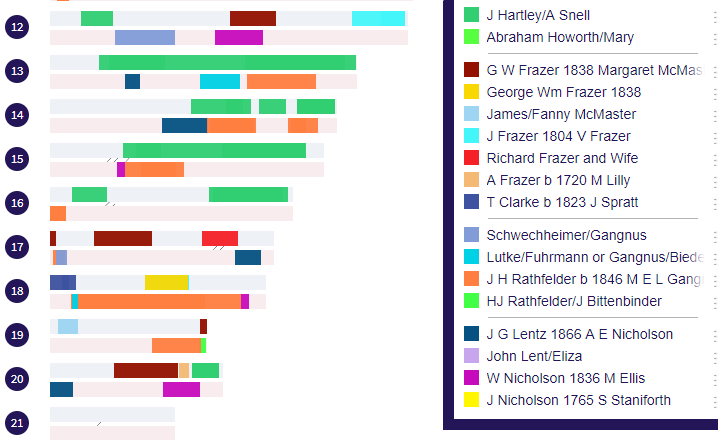
  • The top left Clusters 8 and 9 (green and blue) contain some of my matches with Frazer ancestry.
  • Green Cluster 12 has someone who I believe matches on a McMaster/Frazer Line.
  • Cluster 15 between purple and pink is an important match that goes to my Clarke/Spratt Lines. They also match on McMaster. They are swimming in a sea of what I believe to be other Irish matches.
  • The last lower right cluster contains the Spratt name where I have a brick wall.

Here is my Irish portion of my tree:

The clusters virtually mimic my tree which has Frazer at the top and Spratt at the bottom.

Lori’s Known and Unknown Clusters

Just by looking at Lori’s clusters I can tell the following:

  • Clusters 1-6: Paternal Hartley 2nd cousins back to Massachusetts Colonial times
  • Cluster 7: Maternal Nicholson/Ellis [Sheffield, England to Philadelphia]
  • Clusters 8-18: Frazer, McMaster, Clarke and Spratt from Ireland
  • Cluster 27: Maternal Lentz/Nicholson
  • Clusters 28 and 29: Maternal Rathfelder ancestors back to Latvia

That leaves just Clusters 19 through 26 which are not obvious. That leaves only 8 unknown clusters.

Comparing Lori’s Clusters to My Mom’s and My Siblings’ Clusters

Here is how Lori’s clusters compare to her mom’s:

Cluster 3 was a surprise as that was in Lori’s paternal Hartley grouping above and it matches one of my mother’s clusters. I’ll won’t assign that as a maternal or paternal cluster for now.

Here is what I get when I compare Lori’s four other siblings who have tested at AncestryDNA:


  • I gave Lori’s paternal Massachusetts grouping a blue color and her paternal Irish grouping a green color.
  • Lori has two new clusters where she doesn’t match anyone else’s clusters. These are Clusters 19 and 25. I assume that they are paternal clusters as they don’t match with her mother’s clusters.
  • My ancestors from Ireland were Protestant and married Protestants for the most part. This resulted in some inter-marriage of families. I assume that this is why Jon’s Cluster 6 is reflected in Lori’s Clusters 8, 9 and 10. Sharon’s Clusters 11 and 18 each show up in more than one of Lori’s clusters, etc.

Fleshing Out Lori’s Hartley and Frazer Mega-Clusters

Hartley – Colonial Massachusetts

The Hartley Clusters in blue seem to go quickly from 2nd cousins to Colonial Massachusetts. I still haven’t looked at Cluster 3 which is oddly shared with my mother. I suspect that it is indeed a paternal cluster as it is a lower numbered cluster for my sister and Jon than for my mother. Also there is a connection between Lori’s Cluster 3 and her Cluster 2.

Frazer – Ireland

Cluster 17 is interesting as the match with Keith goes back to two McMaster common ancestors:

With this information, I could go back to Sharon’s Cluster 15. I see that Keith is not Sharon’s largest match in her Cluster 15, but he is in that Cluster, so I can fine tune Sharon’s Cluster 15 to McMaster.

Lori’s New Clusters 19 and 25

There are only two people in Cluster 19. Their trees are not extensive and the match numbers are not impressive. I will just call this cluster paternal for now.

Cluster 25 and Peter

Peter is interesting as he shows one of his grandparents from Australia. If this match is on my Hartley side, that could go back to my English Hartley’s. I am interested in Peter’s Howarth ancestry as it could be linked to my Howorth ancestry from Lancashire, England. I just need to build out Peter’s tree

Peter’s Howarth Line goes back from Australia then to Ireland then to Rochdale, England where my Howorths were from. However, he also has an Irish Whiteside in there. I may be related to the Whiteside family. At this point, I’m leaning toward Howarth/Howorth in Rochdale, but I’ll just say it’s a paternal match for now.

Done with Lori’s Clusters – For Now

This is about as much as I have patience for right now. I had originally thought that Sue at Lori’s Cluster 26 was Massachusetts Colonial, but Sue uploaded her results to gedmatch and that showed that she matched us on our Frazer side.

Summary and Conclusions

  • Lori was the first autocluster that I have looked at with the new mega-clustering feature. This put our birds of a feather ancestors together.
  • This new rendering of the clusters helped me to see how my paternal Hartley and Frazer ancestors related to each other.
  • Two small maternal clusters showed relationships which confirmed a suspected Latvian ancestor cluster.
  • Cross-referencing Lori’s clusters to my mom’s and her siblings’ clusters helped to fine-tune these clusters.
  • Lori had two unique clusters. However, they were difficult to nail down past being paternal clusters.


AutoClustering My Sister’s AncestryDNA

It seems like AncestryDNA is best suited for AutoClustering. Which is good, because many people have tested at AncestryDNA. In my previous Blog, I autoclustered my brother Jon. I was able to cross-reference his clusters to ones I had found for myself. In some cases there was no cross-reference. In some cases, my brother’s clusters helped identify my own clusters. In this Blog, I’ll look at my sister Heidi’s clusters at Ancestry.

Heidi’s Clusters look like this:

I have left out the names on the top and left for privacy. I like using 600 cM for a top limit and 25 cM for a bottom limit. For Heidi, this gives her 23 clusters. Heidi has 403 4th cousins or closer. My brother Jon has 381 4th cousins or closer at AncestryDNA and he had 20 clusters using the same upper and lower match limits that I used for Heidi.

Nigel – a Non-Clustered Match

First, I’ll mention Nigel. He is the first one on the AutoCluster Report who is mentioned as not being clustered. I think that this is significant. Nigel matches Heidi at 66 cM. This is a very high match for a 5th cousin once removed. Here is the Shared Ancestry Hint between Nigel and Heidi:

The match is high for our family, but not with other descendants of this couple. As a result, Nigel and Heidi are not in a cluster.

Clusters By the Numbers

By this, I mean that I like to look at the highest matched clusters first. These are easiest to identify. Cluster 1 has the most people in it and the closest matches. This is because I have a lot of second cousins from my prolific Hartley/Snell great grandparents.

Heidi’s Clusters 1, 14 and 7

Here Heidi’s results are below and my brother Jon’s are above. What is interesting is that the top matches in Heidi’s and Jon’s first clusters are the same. However, for the Taylor match, the clusters point to different grandparent lines. This could partially be because Taylor is the daughter of our first cousin. Taylor matches us on both maternal grandparent lines.

Here is a tree with Nigel who I mentioned above:

Taylor is Cindy’s daughter. I find it interesting that there is a Cluster 14 and 7. Cluster 7 is Nicholson, but not Lentz. Cluster 14 is Nicholson and Lentz, but as Cluster 7 is already Nicholson, does this mean that Cluster 14 favors the Lentz side?

Heidi’s Clusters 10, 5 and 2

Heidi already has more maternal clusters than my brother Jon. Gladys is an interesting match. The common ancestors between Gladys and me were both Frazer’s. From what I can tell two first cousin Frazer’s married each other.

Heidi’s Next Three Clusters – More Obscure?

One would expect the clusters to represent more obscure common ancestors as the match levels go down.

Here are the common ancestors for one of the people in Cluster 15 (William McMaster and Margaret Frazer):

This goes back to about 1790, so back to my 4th great-grandparents.

Here are my Parker/Hatch 4th great-grandparents:

They lived in Nantucket and Isaac had a whaling boat repair business there.

Cluster 9 goes into a black hole where I am stuck. This is likely on my Clarke or Spratt Line. Cluster 9 is also Heidi’s 9th cluster by size and already I am getting stuck identifying the ancestors.

That makes sense, though, because Jane Spratt above is my 2nd great-grandmother and I don’t know who her parents were. Two more generations out from Spratt would result in 3 new surnames that I don’t know about (or could only make guesses at).

Heidi’s Clusters 16, 17 and 18

These next three clusters came in order:

Anthony Snell is interesting as he fought in the US Revolutionary War. I don’t have specific common ancestors for Clusters 17 and 18. This brings us past the halfway point for Heidi’s clusters.

More Clusters for Heidi – The Brick Wall Zone

The bottom clusters for Heidi should be in the area where I am stuck on the genealogical paper trail side.

The question marks show that I am not sure who the common ancestors are for the above clusters. I have done some work on Heidi’s Cluster 21 matches. Here is my best shot at finding common ancestors at Cluster 21:


Here are the rest of the clusters:

In my brother Jon’s clusters, I only saw two maternal clusters out of his 20. Here Heidi has 7 maternal clusters out of her 23.

Here is how Heidi’s clusters compare with my brother Jon’s:

10 out of Heidi’s 23 Clusters had no corresponding cluster with her brother Jon. Two other of Heidi’s clusters (14 and 11) were not a perfect match with one of Jon’s clusters.

Summary and Conclustions

  • Heidi had about 30% maternal clusters compared to her brother Jon’s 10% maternal clusters
  • It was interesting to look at the specific ancestors that were in the clusters (when I was able to identify them). I was able to identify 10 ancestral couples
  • Many of Heidi’s clusters were not equivalent to her brother Jon’s clusters. This means that it is helpful to look at the different results for the different siblings.
  • Heidi’s clusters offer another piece of the puzzle in breaking down some of my family’s genalogical brick walls.


Back to the 1700’s With Joyce’s DNA

I was looking at Joyce’s Shared Ancestor Hints today at AncestryDNA. Joyce is my father’s first cousin. Here is an interesting match that Joyce had with Skylar:

This shows that 7 generations ago, Joyce and Skyler had the common ancestors of Samuel Snell and Mary Head. Samuel was born in 1708 and lived most of his life in colonial times. Samuel’s father was also a Samuel. He ran a tavern in Newport and is mentioned in many court cases. Here is a court case where the younger Samuel is also mentioned:

Samuel Snell of Newport, vintner, vs. Thomas Huxham of Newport, butcher, in the custody of the sheriff, for £17:2:9 due by book for money paid, wood, and drink sold and delivered and work done by book for money paid, wood, and drink sold and delivered and work done by the plaintiff’s son and servant Sam at sundry times beginning 16 October 1725 and ending 14 September 1726. Writ dated 16 February 1726[/7]. Accounting dated 8 March 1726/7 included a cord of walnut wood at 12s, money “paid John Platts on your account … my son Samuel helping you,” etc. Credit: mutton, veal, beef, etc. Several bills in the file.

The son and servant Samuel would have been 17 or 18 at the time of incidents mentioned above.

Colonial DNA

Along with the genealogical match there is also a DNA match to Skylar. I found Skylar also posted at Gedmatch. He and Joyce have this match:

Painting Joyce

This DNA can be painted to Joyce with a web tool called DNA Painter.

This is what Joyce’s colonial DNA looks like. This DNA is from Joyce’s Maternal side, so it is painted on the pink part of her Chromosomes 7 and 12. This is less than 1% of Joyce’s DNA. The further back in time the matches are, the smaller the matches are.

Some of Joyce’s English DNA To Go With the Colonial

Here is another of Joyce’s matches. I am more interested in her maternal side as that is where I am related.

This is a closer relationship. James Howorth was born about 1768 and lived in Bacup, Lancashire County, England. Anne is from New South Wales and is a 4th cousin once removed to Joyce.

This gets Joyce up to 1% painted:

Joyce’s Paternal Side

This is the side I’m not related on:

Here is Joyce’s 4th cousin. They appear to be related three different ways, but i’ll just pick the closest relationship. This appears to be Sumner at Gedmatch. Here is the DNA that Joyce and Sumner share at Gedmatch.com:

Now Joyce is all the way up to 2% painted:

The light green didn’t show up well, but it is on Joyce’s paternal side. It is possible that some of these segments could go to Joyce’s other common ancestors with Summer, but that would have to be sorted out later.

Sumner and Joyce Have an X Chromosome Match

Summer and Joyce also match here:

The X Chromosome is interesting as it can only be inherited certain ways. Here is Sumner’s maternal side:

I have circled the likely path of X Chromosome inheritance for Sumner. The X could not be from Philip Winslow as the father does not pass down an X Chromosome to the son. Therefor, it is likely that this match comes from Lucy Chase.

This gets Joyce up to 3% painted. However, I have made a mistake as Lucy is on Joyce’s paternal side.

Summary and Conclusions

  • I started painting Joyce’s DNA
  • I painted two maternal matches and one paternal match
  • The paternal match (Sumner) also had an X Chromosome match with Joyce. This made it possible to trace that match to one likely ancestor instead of an ancestral couple.
  • All this DNA is from people who were born in the 1700’s.

AutoClustering My Brother at Ancestry

AutoClustering fans are happy that Genetic Affairs has the AncestryDNA autoclustering working again. I ran a report this morning for my brother Jon. I used an upper limit of 600 cM and lower limit of 25 cM. This gave me a manageable 20 Clusters.

I had been trying to get a similar autocluster for myself, but had trouble getting it work for me. First, I notice that there appears to be a connection between Clusters 1 and 2 based on the grey squares.

Clustering By Size

I like to cluster by match size. That means that I sort my cluster list by largest match:

I push the cM arrow twice. This should put the arrow pointing down which will put the larger matches on the top. The highest match in this case is also Cluster 1 with the most people in it. Many of these people are my Hartley/Snell relatives who have tested at AncestryDNA.

After that, I see my Clusters 8 and 4.

Clusters 1, 8 and 4

Cluster 1 is easy. This has many of my Hartley 2nd cousins. They descend from Hartley and Snell. I know one of the more distant relatives in this group descends from the Snell side only. The Snell side gets back to Colonial Massachusetts. My second great grandfather Isaiah Hatch Snell was born in 1837.

The top match in Cluster 8 is my 1st cousin’s daughter:

That would normally only identify this Cluster as maternal. However, in this case, I know that I am related to Otis on the Schwechheimer and Gangnus Lines. These two families lived in a German Colony in Latvia, where some of the families intermingled. Our common Schwechheimer ancestor was born in 1772.

Cluster 4: Nicholson/Ellis

This Cluster is lead by Carolyn. I have been in touch with Carolyn and Joan and know that they both descend from Nicholson and Ellis. They were both from Sheffield, England on my mother’s side. William Nicholson was born in 1836.

Here is a summary so far:

This is good news. Out of the top three clusters, I have three out of my four grandparents represented. I know common ancestors.

The Next Three Clusters: 9, 6 and 18

Cluster 9 gives me my fourth grandparent side. The match is with Ron. Our common ancestors are Clarke and Spratt on my Frazer grandparent side. Our common ancestor Thomas Clarke was born about 1823.

Cluster 6 is on my Frazer/Frazer side. Clarke/Spratt is from the mother of my Frazer grandmother’s side. Frazer is from her paternal side. This line goes back a ways, but it has been well researched.

Cluster 18 has only two people in it, but it is a great cluster as it represents my Pilgrim ancestry. The first match in the Cluster and I descend from Harvey Bradford, who is a descendant of William Bradford from the Mayflower. Harvey Bradford was born in 1809.

Here is a summary of Jon’s top six Clusters:

The pink represents maternal and blue is paternal. Frazer/Frazer means that I had two Frazer ancestors who married each other.

Clusters 5, 10 and 14

At some point these Clusters will be more difficult to nail down.

Cluster 5 appears to center in on my Parker ancestors who lived on Cape Cod and Nantucket.

Cluster 10 has some Spratt names. This name is my biggest brick wall. My Spratt ancestor died young in County Sligo, Ireland and I can’t find much information about her.

Cluster 14 is not obvious to me. YK and John have a shared match with Gladys from Cluster 6. The third person has a Frazer tree. I would say that Cluster 14 is another flavor of my intermarried Frazer Lines.

So while Cluster 14 was not obvious at first, I was able to figure it out through Shared Matches.

Clusters 7, 11, and 2

I am now getting deeper into the less obvious clusters.

Some people in Cluster 7 match Ron. Ron and I share Clarke, Spratt and McMaster heritage back in Ireland.

I have been in touch with Patricia from Cluster 11. She has uploaded to Gedmatch. The match is definitely on my Frazer side and that should hark back to Ireland. My guess is the Clarke/Spratt Lines.

Cluster 2

Cluster 2 is a large one with connection to my Hartley 2nd cousins in Cluster #1 based on the gray squares. Just because there are many in a cluster does not mean that the cluster is easy to identify. This is the 12th cluster by size of match. There are 18 members in the Cluster. Peter has the highest match to Jon. Peter also has 62 Shared Matches at AncestryDNA.

Next, I’ll look at some of the trees from Cluster 2 Members. Candy has this ancestor in her tree:

This is her only listed ancestor in the area where my colonial Massachusetts ancestors lived. Looking at another Ancestry Tree, I find these parents for Betsey:

I see only one Swift in my genealogical list, but many Wing’s. So that is a possibility.

Another Cluster 2 person has Wing in his ancestry and other surnames from the area around SE Massachusetts where my ancestors lived.

Cross-referencing Jon’s Cluster 2

Next, I’ll look at my Clusters to see where Jon’s Cluster 2 people are. Peter is Jon’s top match in Cluster 2. Peter is in my Cluster 1. In my previous Blog, I identified my Cluster 1 as my Colonial Massachusetts matches. In fact, the first 12 in Jon’s Cluster 2 are in my Cluster 1.

William is in my Cluster 1, but falls below the 25 cM level for Jon. William also has a Wareham ancestor:

There are other possibilities.

Here is my 8th cousin Linda from my Cluster 1:

According to Ancestry, Linda and I match at 23.8 cM and we are 8th cousins with common ancestors in the 1660’s. Right now, this couple is as good a guess as any other.  However, this couple is out nine generations from Linda and me. At that level, I would have 32 couples that would be possibilities. These 32 are just my Massachusetts Colonial ancestors who lived around that time.  All I have to do is disprove the other 31 couples or link my Cluster 1 members or Jon’s Cluster 2 to Finney and Warren.

Here is a summary of my top 12 Clusters:

At this point, I could give up or forge on into the unknown.

Forging On Into the Unknown with Clusters 3, 19 and 12

I’m at a loss for Cluster 3. For one thing, this is my brother Jon’s Cluster and I don’t have many notes on his matches. Perhaps a cross-reference to my clusters would help. Unfortunately, none of the people in Jon’s Cluster 3 are in any of my clusters. It’s a mystery. I suppose autoclustering more siblings may help.

Kitty from Jon’s Cluster 19 is in my Cluster 24

Bonnie is in Jon’s Cluster 12. Again I don’t see any of Jon’s Cluster 12 members in any of my clusters. Bonnie has a Hulme ancestor from Manchester, England that might be worth pursuing.

Jon’s Last Five Clusters

I recognize Jon’s Cluster 20. One member has a McMaster ancestor that I believe is related on McMaster and Frazer sides. If I am right, our common ancestor William McMaster was born about 1790.

Cluster 13

None of Jon’s Cluster 13 members match my clusters. Fortunately Catriona who has a private tree is on Gedmatch and I can tell she is related on my Frazer grandparent side.

Cluster 15

Jon has a Shared Ancestor Hint here, so that makes things easier:

This match is also part of a Snell and a Luther Circle at AncestryDNA. This is another of Jon’s Clusters where I have no members in my clusters.

Cluster 16

I don’t see anyone in Jon’s Cluster 16 that is in any of my clusters.

Jon’s 20 Cluster Summary

By Cluster:

Comparing Jon’s Clusters To MIne

I was able to cross-reference Jon’s clusters to mine in most cases. However, 30% of the time, Jon’s clusters were not found among my clusters. Also some of Jon’s clusters that I was able to decipher more or less, I had not figured out on my clusters. Finally, Jon has a match with someone who goes back to our most recent male Bradford. This is a match that I don’t have, but the cluster is one that has been identified.

Summary and Conclusions

  • I autoclustered my brother Jon’s matches at a lower level of 25 cM and upper level of 600 cM. That was a good level for Jon and resulted in 20 Clusters
  • I looked at Jon’s clusters starting with the largest matches. The higher match clusters were easy to figure out. At about halfway down the list, the common ancestors began to get more difficult to figure out.
  • I was able to find many common ancestors. I tried finding common ancestors for one of my Colonial Massachusetts clusters, but that was difficult.
  • Many of Jon’s clusters with matches near the last half of Jon’s list had no corresponding cluster for my matches. I found this to be interesting. This would lead me to look at more of my sibling clusters.
  • 18 of 20 (90%) of Jon’s clusters were on his paternal side.
  • Finally, I cross-referenced Jon’s clusters to many of my own clusters. This showed where Jon’s clusters did or did not match mine. In some cases, Jon’s clusters identified some of my own clusters that I had not figured out yet.


Ancestry AutoClustering Back in Action

I noticed that the Genetic Affairs Facebook site had a recent post. They said that as a Christmas present Ancestry AutoClustering was back in operation with some new controls to limit problems with the autoclustering. Ancestry AutoClustering has been popular. That is because AncestryDNA has the largest database of DNA-tested people but they are lacking in analytical tools.

My AncestryDNA AutoCluster

When AutoCluster first came out, I tried it at the low default settings. I wrote a Blog about those results here. Here are my annotated results:


I was impressed with the results and even though my clusters were small based on the default parameters, I liked the simplicity of the five clusters.

Here is my latest try at autoclustering. Now I used defaults that were 600 cM on the high end and 9 cM on the low end:

Now I have gone from five clusters to 76.

My Genealogy and Deciphering Some of the 76 Clusters

This tree goes to 16 branches. I suspect that 76 branches could go back at least two or three more generations than above. I have a lot of Hartley relatives as my great-grandparents had 13 children. My great-grandmother Snell had colonial Massachusetts ancestry. That means that I have a lot of 2nd cousins.

My Hartley 2nd Cousins

My Hartley 2nd cousins are not found in Cluster 1, but in Cluster 4:

These are my top 13 clusters. In my previous analysis, the present Cluster 4 was #1. By expanding the matches out to more distant matches, the new Clusters 1-3 beat out my former #1 Hartley 2nd cousin Cluster. Along with my 2nd cousins in Cluster 4 above are a few more distant cousins.

Massachusetts Colonial Ancestors – Cluster 1

Cluster 1 appears to include many of my more distant Colonial Massachusetts ancestors going back past my Hartley side. My closest match in Cluster 4 is my father’s cousin Joyce. My closest match on Cluster 1 is Jonathan – a relative of Joyce. Previously, Jonathan was in my old Cluster 1 also. Now he is a ringleader for my Colonial matches.

Other than Jonathan, I cannot pinpoint exact common ancestors for matches in Cluster 1 at this point.

My Largest Matching Clusters

Next, I am going to change my strategy. I will now sort by match on my Cluster List:

I clicked on the cM button until the arrow was pointing down. This gives me the clusters with the largest matches. Hence, the matches that I am likely to know about. The highest matching cluster is #4. #12 is the 2nd highest match. That is because it includes my 1st cousin’s daughter (on my mother’s side). That means that Cluster #12 could be either on my mother’s mother’s side or my mother’s father’s side.

The next Cluster by size is #1 with Jonathan.

Cluster 16 – Nicholson

The next cluster by size goes off my present image, so I will need to ratchet down the image. Cluster 16 has only nine people in it, but I have been in touch with many of them. The known people in this group descend from William Nicholson and Martha Ellis:

Cluster 27 – Clarke

Cluster 27 is important to me. Clarke is my largest brick wall. I will have to go down yet another level for Cluster 27.

I’m starting to use the Key for these higher number clusters.

My Top 23 Clusters by DNA Match Level

Here are my top clusters by match level in a spreadsheet:

This shows that the highest matches are on the paternal sides and on that paternal side, most of the matches are on my Frazer grandparent side.

I can also sort by cluster:

This shows that I am missing Cluster 3 even after looking at my top 23 clusters.

Cluster 3 – Mom’s Side

That makes me curious about Cluster 3. From the match list, I see that the top match is at 27.1 cM. This person has a large private tree, but hasn’t logged in to Ancestry for over a year. This group of matches is a bit of a mystery. I know that this cluster is maternal and probably the Lentz rather than the Rathfelder side as the Rathfelder matches are on the rare side.

Old Cluster and New Cluster

My original AutoCluster was done at conservative default levels and resulted in five clusters.

The old Cluster 1 is found in new Clusters 1 and 4. 2 is now 6 and 27. 3 is now 11. 4 is now 17 and 71. 5 is 19.

AncestryDNA Circles

It occurs to me that it would be helpful to compare clusters to the AncestryDNA circles. Here are my circles:

Nicholson, Ellis and Lentz are maternal and the rest are paternal. Nicholson and Ellis are both in Cluster 16. This points out an error I made on my spreadsheet:

I previously had my Nicholson Cluster as 11 and it should have been 16. My mother’s Lentz circle was emerging and the few matches were either not matching me or too low to be in a cluster.

The Mary Pilling Circle is interesting as this goes back to England. However, those in the circle who are not my 2nd cousins are a match to the circle and not to me.

Descendants of Anthony Snell Circle

I have a similar problem here. There are two people who are not second cousins to me that match me by DNA, but they match at levels below 20 cM. If I check the shared matches of one of these matches, I see that he matches Fred from Cluster 30. That is perhaps a hint as where I may find a common ancestor with Fred. Shared matches with another person in this circle also lead me to a three people who are in Cluster 30.

I believe that the Betsey Luther circle is somewhat redundant. She was the wife of Anthony Snell. Finally, the Churchill Circle. I match second cousins and others in the circle match those second cousins or closer matches. If I run clusters for others in my family, these relationships may be helpful.

This shows that three of my circles are associated with my second cousins in Cluster 4. Shared matches from the Snell circle brought me down to Cluster 30. The two circles for my mother’s side were the husband and wife Nicholson and Ellis. My mother had another Lentz circle but the matches were too low for me. When I look at my mother’s matches, I may find closer matches.

NADs and AutoCluster

NADs are New Ancestor Discoveries. Here are my NADs:

I have no idea who these people are.

The Long NAD

Here are some of the people in the Long NAD:

The orange indicates a match to me. So these are like circles or clusters also. The only difference is that these NADs are pointing to ancestors that I don’t know about. I may not know about them because they may not be my ancestors or the ancestors may be further back than the ones Ancestry is pointing to.

Brenda is in Cluster 7. I didn’t try to identify Cluster 7 above as it wasn’t in the top 23 clusters. This means that I can associate Cluster 7 with my Long NAD. I associate the Long name with Ireland. However, this family was from North and South Carolina. Angela is also in the NAD and in Cluster 7. She also matches Ron who is on my biggest brick wall – the Clarke/Spratt Line. Ron is in Cluster 27. Perhaps that indicates a relationship between these two Clusters. I did find one person who is in Cluster 7 who is not in the Long NAD. I’m not sure why. There are 21 in Cluster 7 and 31 in the Long NAD.

The Weems NAD

John Weems was from Tennessee. I see his connection even less than with Seymore Long. My matches to people in this group, when they do match, are below 20 cM. That means that I don’t have an analogous Cluster to this NAD.

Summary and Conclusions

  • I’m not done playing with AutoCluster yet. There is still more to explore.
  • My original AutoCluster looked at matches between 50 and 250 cM. In this AutoCluster run, I chose limits between 9 cM and 600 cM. The spreadsheet showed matches as low as 9 cM, but the html cluster chart showed matches only down to about 20 cM.
  • As I had so many clusters, I found it useful to look at the clusters with the highest DNA matches. These are the clusters that were, for the most part, easy to identify.
  • I compared the 76 cluster analysis with the 5 cluster analysis I did.
  • AutoCluster does a great job of condensing huge numbers of AncestryDNSA matches and putting those matches into categories.
  • AutoCluster gave me a sense of how many matches I had that were maternal or paternal and from which grandparent side those matches came from.
  • Next, I would like to look at a lower threshold of 25 cM to narrow down the number of clusters that I get.
  • I looked at how AncestryDNA circles related to Clusters.
  • Next I looked at my two NADs. One NAD had an analogous Cluster. The second NAD had matches that were two small and didn’t have an analogous cluster.