Hartley BigY 700 Update: Part 3

I tend to write Blogs to figure out what is going on with my DNA results.

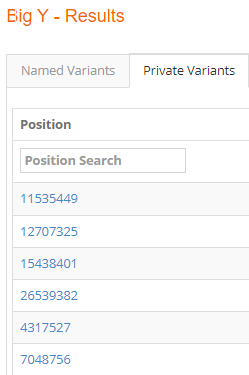
Private Variants

The main purpose of the BigY tests are to find and identify SNPs. SNPs are excellent markers to place you in the YDNA tree and hopefully identify family surname groups like Hartley. The Private Variants are those SNPs that don’t (yet) match other testers, so would not be included in the YDNA tree.

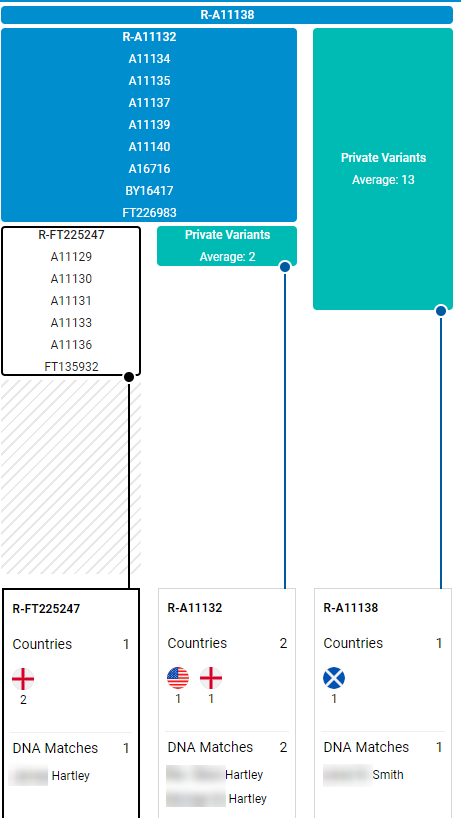
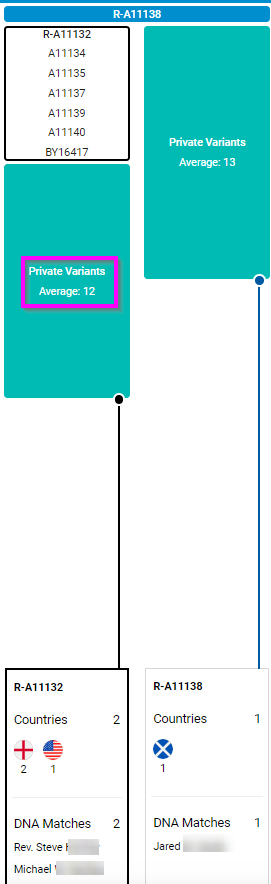
In my first Blog posted on January 28th, there were 12 an average of “private variants” shown between me and the other two A11132 testers:

However, these were not really private variants as FTDNA was still matching these SNPs with other testers. While I was writing my first Blog, the number of private variants went down to 10.

In my second Blog posted on February 17th, I noted that my number of private variants for the three A11132 testers had gone from 10 to 6. I wish that I had posted a screen shot of the average number of private variants. However, I did show that these were my own list of private variants:

Presently, I still have these 6 private variants. In order for there to be an average of 4 private variants between me and the other two testers, the other two testers must have a total of 6 private variants between them.

The A11132 Block

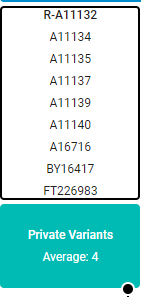
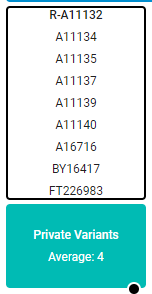
The three Hartley BigY testers are all in the A11132 Block. Here is what it looks like presently:

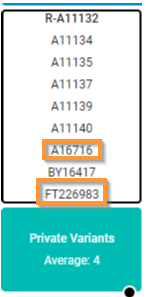
In the first image at the top of the Blog, this A11132 Block had 7 SNPs. Now it has 9. Here are the two new SNPs:

In order for these two SNPs to be added to the A11132 Block, they must be shared by all three testers.

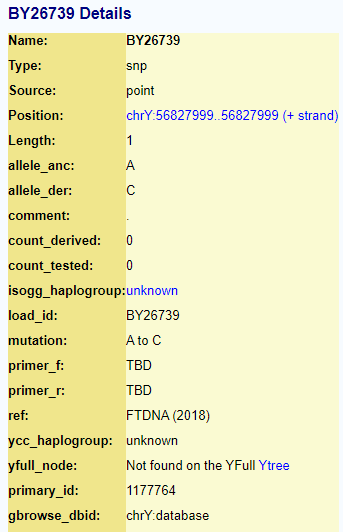
A16716 and FT226983

In a previous Blog, I had noted that I shared this with the new BigY 700 Hartley tester and that the position number was 13658297.

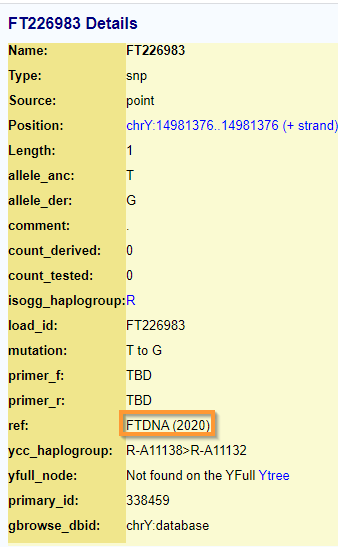
However, I don’t see FT226983 on the list. This must be a newly named SNP. When I search at YBrowse for this SNP, I get this:

It does show as a new SNP from this year:

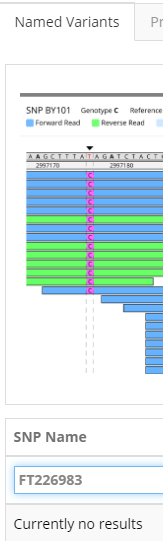
This is a little confusing, because in a previous Blog, I had that the new BigY tester had a private variant at position 14981376 but that I didn’t. Also here is what I get when I search for this SNP under my named variants:

So what that tells me is that FTDNA’s manual review is still in process or that something is not right. I dove in a little deeper and downloaded my BigY csv file. That showed this:

I assume that from this they couldn’t tell if I was FT226983 or not. This was probably a new position that was tested as it is listed in YBrowse under 2020. That means that the other Hartley tester who had the older BigY test wouldn’t have been tested for this.

My Private Haplotree

Bob Tipton from the FTDNA – BigY Facebook group had some more tips for me. He showed me how to get to my reads.

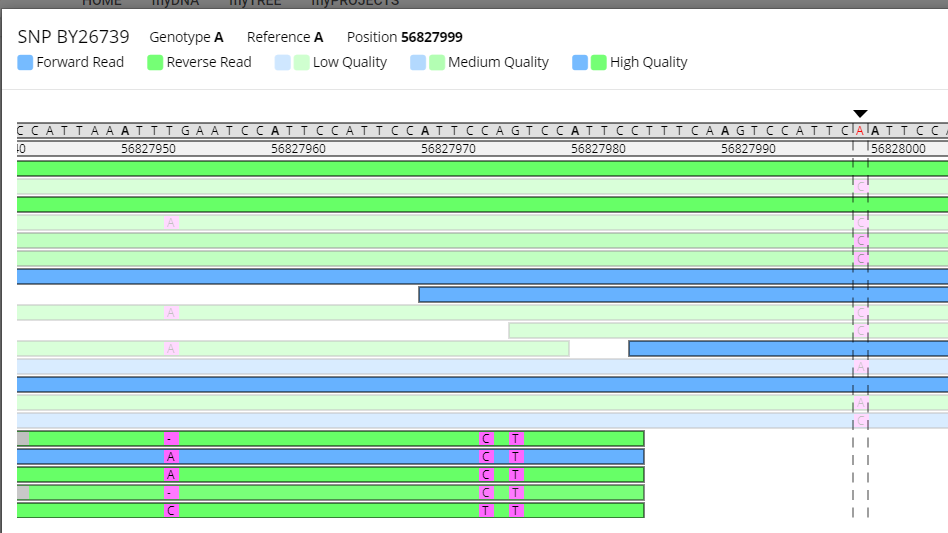
This shows only one read for FT226983. Usually, they want many reads for me to be positive (around 10?).

Here is another Bob Tipton tip. If you click on your confirmed Haplogroup badge you get to your private haplotree:

According to Bob:

The one for FT226983 should be yellow for Presumed Positive, but currently is probably gray for Presumed Negative. This is a bug in their system that has been reported, but not yet fixed.

The system highlights the line, so it is difficult to tell the color of the dots, but they appear to be gray. Another surprise is that BY16416 is also in gray. This SNP has been around since there were only two Hartley BigY testers.

BY16417

I have had this since before the new Hartley tester. Bob Tipton from the BigY Facebook Group points out that this is actually an indel. Bob explains that an indel is an insertion or deletion rather than a mutation. In the case of BY16417 it was the insertion of an A in the DNA.

Has the Manual Review Been Completed?

After the BigY results come out FTDNA does a manual review. One of the frustrating parts of this review is that FTDNA does not tell you if the review is in progress or if it has been completed. I have tried to figure this out by posting at the FTDNA – BigY Face Group, but have gotten mixed opinions. I wrote an e-mail to Dave Vance who is a co-administrator to my Haplogroup and he said that I could check with FTDNA to see if my manual review had been completed. He also gave some suggestions on how to do my own manual review. This involves checking on the Private Variants for the other Big Y testers and comparing them.

I wrote to FTDNA and they said that my kit has been reviewed and there are no further changes to be made. That means that none of the men below A11132 have any private variants in common. Based on this, I get the impression that there was no manual review. Manual reviews are for when there FTDNA believes that a new branch should be formed.

The Implications of No Change of Haplogroup for the Three Hartley BigY Testers

Assuming that FTDNA came to the right conclusions and we are still A11132, there are implications. The obvious implication is that the three of us have a Hartley ancestor within a certain period of time. That period of time has been quoted as 144 years. However, with the newer BigY testing, that period of time could be as low as 87 years. Previously I had an average of two private variants between myself and the other Hartley Big Y tester. That should have meant a common ancestor about 288 years ago. I was born in 1956, so that would be going back to the year 1688. This date was off because the person I matched with had an ancestor named Samuel and/or  Edward Hartley born in 1666. He married in 1693 and moved to Pennsylvania in the early 1700’s. Assuming he brought his children with him, that means that the latest common ancestor probably would have been that Hartley’s father presumably born around 1640.

Now with the addition of an additional tester there are an average of 4 private variants between the 3 of us. If we use 144 years per variant, that is up to 576 years. That would bring us back to the year 1380. I think that date is too far back. That seems to support using a lower number of years per variant.

Non-Matching Variants

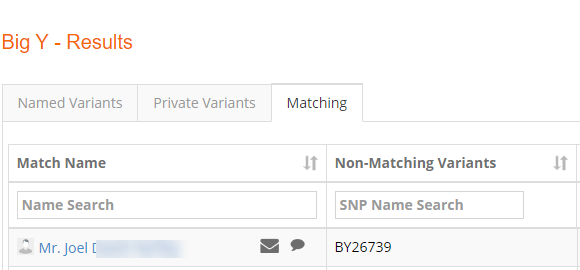
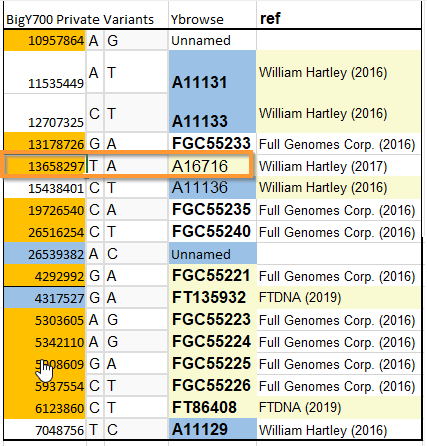
I thought that I would take another look at my Non-Matching Variants to see if they revealed anything. Here are my non-matching variants with the new tester and the previous tester:

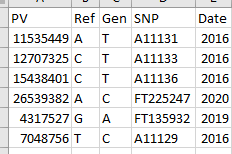
This stuff gets tricky. With the newer tester, I have highlighted all my present 6 private variants. However, notice that only 4 of the 6 are non-matches with the older tester. The ones that are missing from the older tester are at positions 4317527 and 26539382. Now the tricky part. Just because I am not a non-match to the older tester does not mean I match him. He may not have been tested either way for those two positions. According to YBrowse 4317527 was named in 2019 and 26539382 in 2020.

Checking the New BigY Tester’s Private Variants

I asked the new tester to see his private variants now that the review has been done and got this:

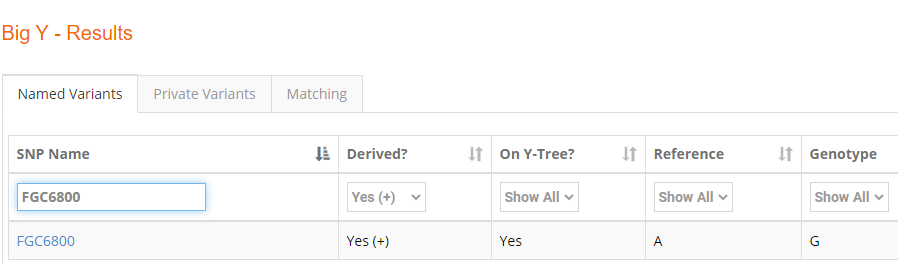
FGC6800 and A11130

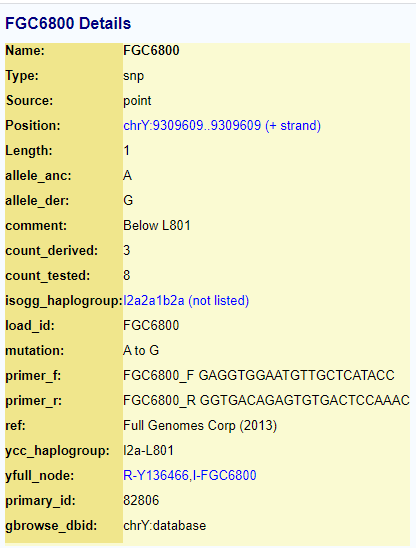
These are two more SNPs that I have that the other two BigY Hartley testers don’t have. FGC6800 is a strange one as it is listed under I2 and I am R1b. I think there is a name for this phenomenon, but I don’t know what it is. I guess that this SNP got ignored by FTDNA due to the weird result.

The next SNP is A11130. This was named by the Hartley YDNA administrator in 2016. As no one else has claimed this, I will say it belongs to me under A11132. I plan to have my brother tested for the BigY, so that should confirm it.

What Is Left?

For the other two testers, there are 7 non-named private variants. It is my understanding that FTDNA uses these unnamed variants when they do their averaging. I have 6 private variants and the other two testers have a total of 7 for a grand total of 13 private variants. Divide these by 4 to get the 12 average private variants under A11132.

Summary and Conclusions

  • The BIgY is simple in theory but complicated in application
  • I had thought that, based on looking at the somewhat unreliable STRs and more reliable SNPs, that the new tester and I would form a newer YDNA branch.
  • It is likely that I was anticipating that the two new SNPs in the A11132 Block could have formed a new branch between the new tester and myself. However, I don’t have enough information to evaluate how it was determined that the previous Hartley BigY tested had A16716 and FT226983.
  • David Vance has a program to compare BigY csv files. However, I would have to get the BigY csv files from the two other testers to do this.
  • When a sale comes up, I would like to get a BigY test for my brother. This would probably force a manual review from FTDNA.


Comparing My Family’s Common Ancestor Results at AncestryDNA: Part 1

Recently, I was looking at my sister Heidi’s Common Ancestor results at AncestryDNA and noticed that she had a lot of new ones that I wasn’t aware of. In order to find these, I go to DNA matches, then I filter for common ancestors. Because I like to count things, I’ll put the results in a table. It will be interesting to compare the results for me and my 4 siblings who have tested at AncestryDNA. Here is a chart starting with me:

Also The numbers are good, but it is the actual common ancestors that are interesting. I guess I should add the mother’s side also. Ironically, my mother isn’t listed as being on my mother’s side, but my siblings are. That’s OK. Also, I don’t know if the mother’s side works for distant cousins:

Here is the filled out chart:

The comparison is interesting:

  • I have the fewest DNA matches with common ancestors.
  • My sister Lori has the most DNA matches with common ancestors
  • Maternal side matches are not given for Distant Cousins
  • My mother’s 4th cousin matches and Distant Cousin Matches are important ones. Many of these would not be covered by my and my siblings’ matches.

Looking At My Mother’s Common Ancestors

First, I went through my mother’s 4th cousin and Distant Relative Common Ancestor matches and put a colored dot with the ancestor to designate the branch. I have had trouble identifying Lentz ancestors previously, but now I notice quite a few, so I would like to take a look at those matches.

Shoring Up the Lentz Common Ancestors

Here is the Lentz DNA matching chart I have so far:

The left part of the chart has Nicholson matches and there are a lot of them, so I would like to augment the right-hand side of the chart. Green means that the DNA match is listed in a place where I can tell where on the chromosome the match is. This is usually at Gedmatch.com. My mom’s top non-Nicholson match is Radelle. She linked her DNA results at Ancestry to her mother, so that is a little confusing. What that means is that Radelle is actually a 4th cousin to my mom instead of the 3rd cousin once removed that AncestryDNA shows. Radelle and my mom have one shared DNA match, so I sent a message to that match. The match had no Ancestry Tree.

My mom’s next match is with Deborah. She is also on the chart, though she has a lower DNA match. Deborah is on a branch with more connections. However, I didn’t see that Deborah and my Mom have any shared DNA matches.

Now that I have a purple dot for Lentz, I am able to filter by that dot:

Radelle and Deborah were the first two matches with Lentz common ancestors out of eight.

The next match is another Deborah and appears to be the mother of the previous Deborah. She also has no shared matches with my Mom.

Back to George Adam Lentz Born 1770

I’ll need to add an extra level on my chart for the next match. Here is what AncestryDNA shows for the connection:

Of course Ancestry wants me to evaluate the connection. I notice that TL’s tree goes up to a Lantz instead of a Lentz, so that is a little suspicious. The other suspicious part is that by this tree, George would have been 13 years old when Sarah was born. I’ll leave TL off my chart for now. From another tree at Ancestry, here are Sarah’s parents:

There is a probably a connection somewhere, but it doesn’t appear to be here.

John to John

This tree seems more reasonable as it goes up to Eliza Lentz. I’ll be a bit lazy and I won’t evaluate this tree. It is consistent with my chart with the Glenn surname. Here is John added in:

So if this is right, John is Radelle’s second cousin twice removed. It’s nice to have some company on the Eliza Lentz line.

Betty on the William Lentz Line

Betty appears to be related to the two Deborahs:

Another Bogus George Adam Lentz Connection

I had hope for these connections, but they didn’t pan out:

Mary Lantz was born when my ancestor George was 7 years old.

The last person on my list is Al who is already on my Lentz DNA match tree. So of the eight people I identified, 4 were already on the Tree. Two didn’t match by the AncestryDNA suggested genealogy and two were added.

My Mom’s Baker and Faunce Lines

Here is my chart so far:

In a sense my siblings and I are not as important as my mom should have more DNA than we do for these matches. Here is my mom’s top DNA match on that line:

The Baker family was large, so that means many descendants with DNA matches.

Adding Peter and Justin to the Baker DNA Tree

Now I’m up to four Baker Lines. Justin adds another generation going down.

FL On the Catherine Baker Slater Line

I just looked up Annette. She was a match on MyHeritage. FL at AncestryDNA is on that Line also.

This is beginning to look like a real surname DNA project now.

An Older Faunce Match with Lauren

Now I need to figure out how to get Lauren onto this tree. Actually, I need to build a new Faunce Tree:

I just didn’t add all the others under Catherine Faunce from above. Hopefully, I’ll find more matches here also.

Summary and Conclusions

  • I started by comparing my siblings’ common ancestor DNA matches with mine and my mother’s common ancestor DNA matches.
  • This comparison showed that I should look at my siblings’ results.
  • I then saw that my mother must have more common ancestor matches to look at.
  • I looked at two different Philadelphia lines and matches that my mom had showing common ancestors.
  • The two matches my mom had with common ancestors going back to George Adam Lentz didn’t pan out. I would still like to find some matches there – though this is going back to about as far as a DNA match would be expected.

Butler DNA and Genealogy Update

Butler researchers Peter and Neil in England have been working hard to tie together the George and Edward Butler families. Both these families lived in Cincinnati for a while. There are genetic ties between the two families as well as circumstantial ties. Neil believes that he descends from (I think) either George’s father or grandfather. Below is my attempt to connect the two families:

I have Henry Butler’s family on the left and Michael Butler’s family on the right. I don’t know the father of either, so this is speculation based on DNA matches between the two families. The DNA matches between the two sides seem to support the tree above. The main family under Henry is George Butler who moved to Cincinnati from Wexford, Ireland. The main family under Michael is Edward (Henry) Butler. He lived in Cincinnati for a while but moved around a bit.

Circumstantial Connections Between the George Butler and Edward Henry Butler Families

Mary A Butler Born 1858 in Cincinnati

My wife’s ancestor Edward Henry Butler married Mary E Crowley in 1855 in St. John, New Brunswick. The family moved after that to Cincinnati. George Butler had a daughter Mary A Butler born in Cincinnati in 1858. She moved to St. John and married Thomas Joseph Murphy in 1878.

Murphy descendants match my wife’s Edward Henry Butler side of the family

Edward Butler, Son of Henry Born 1839 Wexford

Peter found this announcement:

Peter’s research shows Edward as the 7th child of Henry Butler:

Above, the newspaper funeral notice mentioned that the funeral was at 220 California Street, Newton. Here is the Newton Directory for 1893:

I had rejected that my wife’s ancestor Edward could have been a clerk as I thought that he could not read or write. However, he must have picked up reading and writing as the 1910 census says that he could do both.

The Veteran’s Census has Edward H in Newtonville in 1890:

There must have been a connection between Edward H Butler and Edward Butler of Wexford, in order for Edward H to host Edward’s funeral.

A New Holman Connection

Peter has been bringing the Cincinnati George Butler family forward:

Peter asked Neil and  me to check for DNA matches to Grogan, Holman and Middendorf. I was able to find a Holman match:

He matched with my wife’s Aunt Lorraine at AncestryDNA. He also matched my wife’s Aunt Virginia. This couple had three boys. The Holman above must descend from one of these three. Here is the new branch on the right:

More on the Holman/Butler Match

The match I will call Holman has shared matches with my wife’s two Aunts at Ancestry DNA. Here are the results:

The two in yellow are also matches to Neil’s nephew who tested at AncestryDNA. In the last column above EHB stands for Edward H Butler and GB stands for George Butler. These are the two lines that are connected by DNA.

It would make sense to do this same exercise with at least Patty and Michael.

I don’t think that gave me any more information. I looked at Michael’s shared matches and didn’t see anything helpful there either.

One Side Benefit

I did put a few close Butler DNA matches on the Butler DNA tree here:

I added in Deborah and Chester on the Alice Mary Butler line.

Summary and Conclusion

  • I like to summarize and conclude because while I’m blogging I sometimes get off the subject.
  • The main point here is to secure the connection between the George Butler and Edward H Butler Lines.
  • The other point is to secure Neil from England by DNA as he appears to be connected to the George Butler Line.
  • We were able to make DNA connections between Neil’s nephew who tested at AncestryDNA and one match confirmed to be on the George Butler Line. Neil’s nephew also matches another common match who has no listed tree.
  • Through Peter’s research a new George Butler descendant line has been found. A person from the Holman family was found to be a shared match across with Neil’s nephew and my wife’s Aunts. This further solidified the Butler family connections.


Painting the DNA of My Irish Relatives Emily and Susan

In my previous Blog, I finished painting in my second cousin once removed Paul and painted my more distant third cousin once removed Gladys. Gladys’ ancestry does not share my McMaster ancestry, but does share my Frazer ancestry. Emily shares the same McMaster ancestry that Paul and I have. Susan does also with the twist that she has extra McMaster ancestry as her mother is a McMaster. Here are Susan and Emily:

As Susan has tested at MyHeritage and not uploaded her results to Gedmatch, her results will be limited to those who tested at MyHeritage or uploaded their DNA results there.

Painting Emily

I’ve already started painting Emily.

I only have two of her ancestral couples painted. I only have painted Paul and Gladys onto Emily’s profile. Emily’s Frazer matches are on her maternal side. Emily is 14% painted now, but I hope to get that number up.

Painting Me and My Siblings Onto Emily

These should be the blue segments. The interesting places are where the blue and red segments overlap:

Here Emily’s match with Gladys overlaps with her match with my brother James but not with Paul. As Gladys does not have McMaster ancestry, my guess is that the place where she overlaps with James indicates that the DNA that James and Emily got there was from George Frazer and not Margaret McMaster. The fact that Gladys’ match above stops short of Paul’s match could mean that Paul’s match is McMaster.

Doreen and Pat

Next on Emily’s Gedmatch list of DNA matches I see Gladys’ relatives, Doreen, Ken, Susan and Pat. Some information was added for Emily here:

However on the other chromosomes, their matches were the same as Gladys’.

Jean, a McMaster Match

At least I think she is.

Here Jean is a 4th cousin to Emily. The common ancestors are technically McMaster and Frazer, but due to the children taking on the McMaster name, we tend to think of this as a McMaster match.

This gets us back to the 1700’s and tells Paul and Emily where that bit of DNA came from. For Paul, this DNA would have come down through Fanny McMaster to Margaret McMaster.

Emily and Jane

Jane is Emily’s fourth cousin:

Jane is also a 5th cousin to Emily, but hopefully most of the DNA sharing is at the 4th cousin level.

In the key, I have put both possibilities in for Jane’s match. However, the most obvious is for Richard Frazer. In Chromosome 6, the DNA for Gladys, Jane, Ken, Susan and Doreen is probably from Richard (or his unknown wife).

Emily and McMaster Relatives

Keith has McMaster ancestry:

Keith adds some new information for Emily on Chromosomes 12 and 14, but no overlap with any of Emily’s matches.

Here is Stephen:

Here, if I have it right, Stephen shows that my siblings James and Lori,  as well as Emily,have old McMaster DNA on Chromosome 13.

Emily and the Philip Line

These matches to Emily are on the green side.

On Chromosome 18, Richard appears to fill in a blank for Emily. On Chromosome 21, Emily’s match with Martha tells me that Paul’s match is on his James vs his Violet Frazer side.

Emily and Marilee from the John Frazer Line

Marilee shows on this chart as a 5th cousin once removed to Emily:

I notice the birth date for Philip is earlier on this chart. These dates seem to make more sense based on the John Line in pink.

Here is how Marilee shows up on Emily’s painted DNA palette:

Emily is helping to show that Paul’s DNA in this area is very old. It comes down from either Archibald Frazer or Mary Lilly to Philip Frazer to Paul and Emily.

For some reason, I don’t get that same distinction in Paul’s view of his Chromosome 5:

Quality Check

As this doesn’t make sense, I need to check my information. So forget what I said about Paul. I need to correct his matches on Emily’s profile. I’ll delete Paul from Emily’s profile and then add the correct information back in for Emily’s matches with Paul. Here is what it should be:

Note that Paul has no match with Emily on Chromosome 5:

The takeaway from this corrected view is about James. James or Jim was the last of 6 siblings (including me) to be tested for DNA. Gladys is the other one who had already been painted to Emily. I checked her results and they seem right.

Any More Matches for Emily?

I’m sure there are plenty. I have written three Blogs about Emily. This Blog from 2018 mentions some more matches. Those matches are on the Archibald Frazer/Stinson Line and also go back to Archibald Frazer of 1720 who married Mary Lilly.

Here are a few examples from that Line:

Here is part of the Archibald/Stinson Line:

Fishing for a New Match for Emily

I used a facility at Gedmatch that will find people that match two people. In this case, I used Emily and Keith who matches on the McMaster Line. One of the better matches was Rainah:

Rainah matches Emily by about 46.7 cM and Keith by about 17.3 cM. Rainah tested at FTDNA where I have also tested and I also have a small match to Rainah. Maybe I can figure out how we are all related.

She has a blue tree icon which means she has a tree, so that is good. Unfortunately, I can’t make sense enough of her tree to bring it back to where we might match:

This is why it is difficult to figure out new matches. Everything has to align perfectly.

Painting Susan

The painting for Susan will be very basic as it will just include those kits that I administer at MyHeritage. Those are me and my siblings, my cousin Paul and Gladys. I’ll start with Paul as he should be her most important match. I expect Susan will only have two colors on her map. Paul and Susan don’t have DNA matches after Chromosome 15:


I’ll go with Gladys next. Actually, I don’t see Susan on Gladys’ DNA match list. Gladys and Susan are 3rd cousins. According to FTDNA, there is a 90% chance that these two should match by DNA. Unless I missed something, then Gladys and Susan are in the 10% range. That means that Susan’s DNA map will just be one colored for now.

Summary and Conclusions

I was able to get some interesting results looking at the painted DNA for Emily. I had painted Paul, my second cousin once removed and Emily is at the same relative distance to me that Paul is. Emily’s matches fit in as expected and helped pull in the relevant matches from the other Frazer and McMaster Branches.

I was hoping to make a basic DNA map for Susan also. Susan is at the same relative relationship with me as Paul and Emily with the twist that he mother is a McMaster, so she should have more McMaster DNA than Paul or Emily. If Susan decides to upload her DNA to Gedmatch, then I will be able to match her DNA with many other Frazer and McMaster descendants.

Continue reading “Painting the DNA of My Irish Relatives Emily and Susan”

Painting Two of My Irish Frazer Relatives Paul and Gladys

In the early days of my DNA research, I had a lot of DNA matches with my Frazer relatives, but not as many with my more distant McMaster relatives. Here is the Frazer side of my family from my paternal grandmother:

I’m doing better with the top right of the tree than with the bottom right. There is an extra Frazer and McMaster at my 3rd great grandparent level. At the 4th great grandparent level, there is an extra Frazer and three unknown surnames on the upper half of the tree.

My Cousin Paul

I had my cousin Paul tested. We share the ancestors of George William Frazer and Margaret McMaster.  Paul’s results are at FTDNA, MyHeritage and Gedmatch. I have also painted some of Paul’s matches at DNA Painter.  Here is what I have painted for Paul so far on his paternal side:

From here I could try to find some more matches for Paul. the places to look would be FTDNA, MyHeritage and Gedmatch. Paul is not listed at Ancestry, and AncestryDNA does not provide the information to paint chromosomes.

Paul at Gedmatch

I see that Paul matches Michael at Gedmatch. He is related on the Frazer side:

Paul is in the same generation as my father, so I will show him:

Paul and Michael are 4th cousins. Here it says half 4th cousin once removed, but that is actually for me. Also, it probably isn’t half fourth, we just don’t know who the wife of Richard Frazer was at the top of the tree. Here is how Michael matches Paul on Chromosome 1;

What this tells us is that the matches Paul has with Susan, Lori, Emily and Gladys are actually with Violet. This is because Richard is the father of Violet Frazer born 1803.

Paul and Jane

Here is how Paul and Jane match at Gedmatch:

Here is a better view of how Paul, Jane and Michael are fourth cousins to each other:

I figured out I can share files on my home computers, so that helps.

Jane doesn’t add any new DNA to Paul’s profile, but adds some insight. It appears that the light pink DNA that Susan shares with Paul is actually from Richard’s daughter Violet Frazer.

Paul and Richard from the Philip Frazer Line

Out at the level of Philip, the records get sketchy as does the genealogy. Here is how Richard and Philip line up:

Too bad I don’t know who the wife of Philip was. I have this record from the Kilmictranny Church:

Nov 22, 1818    Philip Frazer  of Ardcarne parish

Jane Johnston  of Kilmactranny

Witnesses:  Edw. Johnston,   Edw. Johnston

If my tree is right, this was probably the elder Philip’s second wife. Perhaps his first wife was a Johnston also? If the birth date of 1802 is right for the younger Philip, then he would likely be too young to be marrying in 1818.

Here is how Paul and Richard match at Gedmatch:

This is getting interesting, because if I have my tree right, then part of this DNA may be from Philip Frazer born around 1776 and part may be from his unknown wife. I say may be because the genealogy isn’t certain and even if it is, it is possible though not as likely that all the DNA may be from the husband or the wife.

Next, I’ll paint Richard’s DNA match on to Paul. Here is Chromosome 5:

This is interesting as I have no other overlapping Frazer matches here. That could mean that this represents Philip’s wife.

Here is Chromosome 7:

This appears to show the location of the split from where Paul went from inheriting DNA from James Frazer to where he went from inheriting Violet Frazer’s DNA if I am interpreting this correctly. That is because Richard represents Philip Frazer the father of James and Jane Represents Richard Frazer, the father of James’ wife Violet Frazer.

Here is Chromosome 17:

Here this tells me that the DNA that Emily, Richard and Paul share is from James and not Violet Frazer.

Paul and Barry

I have that Barry is Richard’s brother, so let’s look at him also. Barry matches Paul on Chromosomes 12 and 15. Here is the already complicated Chromosome 12:

John in Blue represents McMaster, so Barry would represent Frazer. This is probably the split between George Frazer and Margaret McMaster.

Here is Chromosome 15:

This just shows that Susan has some old Frazer DNA here from the James Frazer side (born about 1804).

Adding My Other Siblings to Paul’s Chromosome Map

Here is how Paul matches my sister Heidi:

Heidi doesn’t add much new Frazer DNA for Paul, but my sister Sharon adds some new DNA on Chromosome 9:

This is interesting as Sharon is filling in blanks on Chromosome 9. These changes could be where Paul has crossovers. Crossovers are where the DNA changes from coming from one ancestor to coming from another. For example, they may represent where Paul was getting DNA from George Frazer vs. his wife Margaret McMaster.

What Did I Learn from Painting Paul?

Part of what I am interested in doing is separating out the Frazer and McMaster DNA. This is somewhat difficult due to intermarriage and unknown spouses in the late 1700’s. I have re-organized Paul’s key:

This points out some problems. I don’t have wives for Philip and Richard Frazer. The green for George Frazer/ Margaret McMaster could be Frazer or McMaster. William McMaster who was the father of Fanny McMaster had a wife Margaret Frazer, so they could technically be on the Frazer side.

There are three other fairly close relatives who are at the same generational level as Paul. These are Gladys, Emily and Susan:

Gladys is good, because she has no known McMaster ancestry. That means that most of her matches should be on the Frazer side. Emily is a good match because she has tested at MyHeritage. I have Paul’s results at MyHeritage also. Susan tested at MyHeritage also. However, Susan has potential to have more McMaster DNA and matches because her mother is also a McMaster.

Painting Gladys

I like the idea of painting Gladys as we should be looking at Frazer matches and not McMaster matches. That means that where Gladys’ DNA matches overlap with McMaster heavy descendants of George Frazer and Margaret McMaster, those matches should be on the Frazer side.

First I go to the DNA painter profile page. I see that I haven’t already painted Gladys there. I have my mother Gladys painted, so I’ll have to distinguish this Gladys somehow. Here is Gladys starting with a clean slate:

Back to Paul Briefly

Before I start on Gladys’ DNA Painter, I see a few relatives I missed for Paul:

I painted Doreen, Gladys and Susan, but I missed Ken, Pat and Bill. When I searched for these three, I didn’t see them on Paul’s match list down to about 11 cM, so Paul either doesn’t match these three or they fell off the bottom of his list.

Back to Gladys

First, I need to decide whether to include Bill’s results. This will give Gladys’ paternal side, so I guess I will. This brought Gladys up to 20% painted, so that must mean 40% of Gladys’ paternal side:

Next, I’ll add in Pat to get to Gladys’ paternal grandparent level:

I’m walking the DNA up Gladys’ Frazer tree. Now we are up to 48% painted on Gladys’ paternal side. I then added the tree siblings Susan, Doreen, and Ken:

This brought Gladys up to 58% painted on her paternal Frazer side.

The Next Step: Up to James and Violet Frazer 1803

This is actually two steps up the ladder. Gladys’ matches with Emily represent the shared DNA they bother received from James and/or Violet Frazer:

Now the places where Emily’s matches overlap Gladys’ family’s’ DNA will represent Richard Patterson Frazer on Gladys’ side.Here is Chromosome 2:

Emily’s match is on the right in the greenish yellow color. There is no overlap there, so the blue could represent Richard’s Hassard wife.

Chromosomes 5 and 9 have overlap:

Also on Chromosome 18:

Gladys and Jane

The next match for Gladys that comes up at Gedmatch is with Jane:

Now my simple plan is out the window. Jane is a double fourth cousin to Gladys. I circled Bill’s mother as she is at Gladys’ level. However, if Jane is matching Gladys on her Hassard side, that shouldn’t make a difference for my side of the Frazer family.

Here is how Jane matches Gladys. There are a lot of matches, but none of them are too high. That makes sense as the connections are distant but in more than one way.

Here Jane is in a brighter color. I had to put an or in the key as the  connection could be in one of two ways. This may resolve somewhat after I add some more DNA matches.

Gladys and the Descendants of George Frazer and Margaret McMaster

Here are the next 10 in Gladys’ DNA match list at Gedmatch:

Of these, all but Martha and Richard are descendants of George Frazer and Margaret McMaster. However, my assumption is that these matches with Gladys will be on the Frazer side. I don’t need to map Heather as she is my daughter and Mel as she is Emily’s daughter.

So I better get mapping. I am surprised that Gladys matches Richard and Martha at the same apparent level as my family as the common ancestor Philip Frazer is one generation further away. I say apparent because sometimes the lists above are not accurate. They need to be checked by the one to one matches.

Gladys and My Sister Sharon

Sharon seems to answer some questions on Chromosome 12:

Before we were unsure about Jane’s matches. However, here the match is likely on the Richard Frazer side. That is because Sharon descends from Violet Frazer the daughter of Richard. This also tells us that Sharon’s DNA here is from her Violet Frazer side and not James Frazer. Further, it tells us that for Gladys, Ken, Susan and Bill, the DNA is from their Richard Patterson Frazer side and not their Amelia Hassard side.

James and Gladys

My brother James also straightens out Chromosome 1:

He does what Sharon did at the right side of the Chromosome where he overlaps with Bill and Jane. In James’ next to the last segment, it is not as specific. We just know that the common ancestor shared between Gladys, Bill, James and Doreen at that location is from either James or Violet Frazer from around 1803.

Paul and Gladys

Paul Shows Bill and Gladys that they are getting Frazer DNA on that segment on Chromosome 8 from James or Violet Frazer. Paul finds out that this DNA is likely Frazer DNA on his side from George Frazer and not from Margaret McMaster.

Gladys and My Sister Lori

On Chromosome 4, just Lori and Gladys match. However, that defines bother Gladys and Lori have Frazer DNA at that location.

Lori does the same thing on Chromosome 14, but this time it applies to Gladys’ nephew Bill also.

Gladys’ Matches on the Philip Frazer Line

Let’s Paint Martha and Richard:

I have Philip Frazer in a darker blue. The matches were between Chromosomes 3 and 20.

Chromosomes 3 and 4

This is interesting because Richard filled in for Gladys what appears to be some ancient Frazer DNA from Philip Frazer in the late 1700’s or his wife.

Richard does something similar on Chromosome 4:

Richard supplies information that his sister Martha did not and Martha supplies information that Richard does not.

Chromosome 18 and 20

I won’t do all the chromosomes:

This shows that Martha and Gladys matches don’t have any places where my family and Gladys matches overlap. That would result in triangulation. That doesn’t mean that Richard and Martha don’t match my family – just that they don’t match n the same areas.

Gladys’ Matches with Jean and Vivien

It looks like Jean is the daughter of Vivien, so I’ll skip Jean. Here is how Vivien matches Gladys, Bill and Paul on Chromosome 8:

This is interesting because Paul does not descend from the Stinson line where Vivien is. Vivien is in the purple group and Gladys in yellow:

That means that this match goes further back on the Frazer line:

The common ancestors are Archibald Frazer and Mary Lilly. However, I don’t know if the DNA goes through James or Violet Frazer. Chances are it is Violet as Bill and Gladys are on the Richard Frazer Line. Confusing.

Summary and Conclusion

  • I started out thinking I would be looking for new matches for Paul. Instead, I decided to paint in the existing matches.
  • I then decided to paint in Gladys’ DNA. I picked her because she didn’t have any known McMaster DNA.
  • Painting in Gladys was fairly straightforward. However, it shed more light on her Frazer line than on mine.
  • Next, I will try to tackle Painting of Emily and Susan. Emily is at the same level as Paul. Susan is also at the same relative generational level but she has more McMaster DNA due to her McMaster mother. This next Blog will likely shed some more light on McMaster connections.


Finding My Latvian Cousin Raimonds at 23andMe

Occasionally, I check 23andMe to see if I have any matches. The last time I checked I was happy to find Raimonds. Raimonds lists his location as Riga, Latvia. That got my attention as my mother’s father was from Riga.

How Raimonds and I Match By DNA

Here is how we match by DNA:

Under 23andMe’s advanced DNA comparisons, I see this:

Another thing that jumped out at me was the X Chromosome match that Raimonds and I have. This seemed significant. Here are the places on my tree that Raimonds and I could have an X Chromosome match:

This is the tree of my grandfather who was Alexander Rathfelder. As both Raimonds and Alexander were from Riga, it makes sense to start with Alexander’s tree. X DNA is not passed down from father to son, so that rules out the Rathfelder line. As we go back it eliminates the Gangnus and Lutke Lines. However, with intermarriage, these could possibly be added in later back in time.

Raimonds’ Genealogy

I wrote to Raimonds at 23andMe and he was nice enough to write back. Here is what Raimonds told me:

I do see a Carl Heinrich Lutke in my tree. However, based on the X Chromosome inheritance, I don’t think that our DNA match reflects that ancestor. In addition, Raimonds’ maternal Lutke grandfather would have not gotten any X Chromosome from his father. That means that the X Chromosome match could as easily be on Raimonds’ maternal grandmother’s side.

So How Am I Related to Raimonds?

The answer appears to be at the Raduraksti Web Page that has a lot of the Latvian Church records. I think that the records are listed under the Linden Church at that web page. Here is the Linden Church:

Here are two links that are in the right time period:

Unfortunately, I don’ t know what the L (l, v) means. Also the more recent records are in Russian. I also checked the Linden Church in 1890 for Lutke. Here is one entry:

However, this is not Johann.

I then went back a year to 1899:

This appears to be the birth and baptismal dates for Johannes Ernst Lutke. He was the son of Johann Marcus Lutke and Wilhemine Catharine Schwechheimer. I left out the sponsors names from the next page:

Here is a Lutke marriage from 1910:

It seems like this Johann is different than the one above. I read Johann Jacob Lutke married to Emma Maria Apollonia Gempfer.

Here is an 1891 birth to Johann Marcus Lutke:

That is what I found looking through 1889 – 1891 births and baptisms.

Things Are Moving Fast

I got another message from Raimonds:

That means that I can draw a Lutke DNA tree. Here is what I have so far:

I just need to add Raimonds. He has told me who his grandfather’s grandparents were, but who were his grandfather’s parents? Based on what Raimonds says, we should be third cousins once removed.

MyHeritage has an Instant Discovery for me:

Ironically, the hint they want me to use has a photo that I have on my Gangnus web page:

I think MyHeritage wants me to pay them money before I can use their “discovery”.

I did find a tree on Ancestry with a Johann Otto Lutke:

He was born 1879. Raimonds thinks his Johann was born around 1885.

Painting in Raimonds’ DNA Match

I use a utility called DNA Painter to track my identified DNA. I don’t have all the documentation, but Raimonds says that our common ancestors are Lutke and Fuhrmann. Here is part of what I have so far on my maternal side:

This shows that I am 34% painted maternally. Overall (paternally and maternally combined), I am 43% painted. In the key above, I have a color for Lutke/Fuhrmann already, but also one where I wasn’t sure, because I was related to the person both ways. For some reason, Patrick is in the second category and his mother is in the first. I’m not sure if this is a mistake or not on my part. I don’t know enough about Raimonds’ genealogy to know which category he will be in. For now, I’ll put him in the first category also.

Here are the segments that Raimonds has added. These matches don’t currently overlap with existing DNA matches, so Raimonds is in uncharted territory. I didn’t add Raimonds’ X Chromosome match as that is unlikely to be on the Lutke side. It looks like I need to change some colors due to the similarity of the blues of Schwechheimer and Lutke. Once I find out how Raimonds and I are related on our X Chromosome, I will paint that in also.

Here I made the color change and moved Silvia to the more ambiguous Common Ancestor Group:

Overall, this upped my overall painted percentage to 44%:

An Update from Raimonds’ Granddaughter

Raimonds’ granddaughter sent me a family tree showing how our Lutke Lines connect. This information was from someone that Raimonds had gotten in touch with through MyHeritage. This person apparently has done a lot of work with Hirschenhof genealogies. Here are Raimonds’ maternal grandparents:

All I have to do is find Johann Peter Woldemar’s birth in 1881. Fortunately for me, he is on the first page of the Linden Church Register:

Actually this may be the 5th page of the Register for the year. I didn’t see pages 2-4. There is a lot of information here. For some reason the last name is given as Lütken. Before the father’s name is the occupation. But I’m not sure what it is.

Going Back a Generation

This connects with the tree I have for Silvia and Patrick.

I re-typed the Lutke DNA tree:

So it turns out that Raimonds is more closely related to Silvia and Patrick than me. Silvia and Patrick tested at MyHeritage. That also means that some of what I wrote in my Blog about Patrick applies to Raimonds. This also means that I am doubly related to Raimonds like I am to Patrick.

Raimonds and the Gangnus Connection

I don’t want to re-type this tree, but here are two more ways I am related to Raimonds:

The first way is through Johann Jacob Gangnus and Biedermann. This is important because it is at the same level as my Lutke/Fuhrmann match with Raimonds. The second way we are connected is two generations further back, so that connection is not as important as far as the DNA matching goes.

Back to the X Chromosome

Now that I see how we are related on the Gangnus side, I can see how the X Chromosome match between Raimonds and me may have happened:

It actually worked out quite well. Note that between me and Biedermann above, I go male, female, male, female, male female. That is the way I would get the most X Chromosome DNA from the furthest back. Normally autosomal DNA will recombine. However, when a father gives his X Chromosome to his daughter, he only has one Chromosome to begin with. So when Johann Philip Gangnus gave his one X Chromosome to his daughter Maria Elisabeth Laura Gangnus, it was the same one that his Biedermann mother gave him. Also, it is important that I descend from the male Johann Philip Gangnus. Because of that we know that the X Chromosome that he got could only be from his Biedermann mother. That means that the X Chromosome that Raimonds and I share is likely from the Biedermann side. I say likely, because there is a small possibility that it may come from an ancestor of Antonie Elise Marie Schiller. I haven’t looked into that line and Raimonds doesn’t know about that side.

Fixing DNA Painter

Here is some more information on Biedermann:

I took out the entry for Lutke/Fuhrmann at DNA Painter. Now I just have Lutke/Fuhrmann or Gangnus/Biedermann. Now I will need an entry for Anna to paint the X Chromosome match that Raimonds and I have.

Unfortunately, I have pink on pink for Biedermann, but I have painted Biedermann onto the X Chromosome. Notice that this segment overlaps with my maternal first cousin Rusty. That means that this part of Rusty’s X Chromosome must also be from Anna Biedermann. Here is a better color:

Summary and Conclusions

  • I was happy about finding this DNA match with Raimonds
  • It is rare that a X Chromosome match works out so well. So many things have to align correctly in both my ancestry and Raimonds.
  • It is also rare that I am able to figure out who our common ancestors are so quickly – especially with Latvian genealogy. This was due to information I already had plus genealogies that Raimonds was able to get through MyHeritage.
  • I am glad to see that a lot of the Linden Church records are back on-line. These are the records for Hirschenhof residents.
  • If Raimonds uploads his DNA results to Gedmatch.com and MyHeritage, he will find more DNA matches.


New DNA Results for My Frazer Cousin Susan

I recently heard via the Frazer Facebook Page that my cousin Susan had her DNA tested at MyHeritage. That was good news for me as I am interested in DNA – how it shows where we are related and how we share parts of our common ancestors.

How Susan Fits In On the Frazer DNA Tree

I create trees of people who have had their DNA tested. Here is a partial Frazer Tree:

Earlier this year I wrote a Blog about Brenda.  She, like Susan and Paul, is my second cousin once removed. She tested at 23andMe. Brenda is also Paul’s first cousin. Susan descends from William Frazer and James Robert Frazer. That section of the Frazer DNA tree is spreading out:

This part of the Frazer tree is interesting to me because I have met many of these people. They would be most familiar with the farm where my great-grandfather James Archibald was raised.

Here is a photo of the family in front of the old family house in Ballindoon. MyHeritage has a new program that colorizes old photos. My great-grandfather James Archibald, Susan’s grandfather William and another brother Richard were in Massachusetts at the time this photo was taken. Brenda’s grandfather Hubert is probably the first one in the back row in the photo above. The girl on the right is Susan Frazer. I wonder if the Susan of this Blog was named after her?

Here are five Frazer Brothers in Boston, Massachusetts:

Susan’s grandfather William is sitting on the right next to my great-grandfather James Archibald Frazer. James was a year and a month older than William.

My DNA Match with Susan

Here is where I match Susan:

I should note that MyHeritage has some matches that are under 7 cM. The first match on Chromosome 1 and the match on Chromosome 5 are in this category. Matches under 7 cM can have a lower probability of being actual matches.

Painting Susan’s DNA

I use an online program called DNA Painter to map out my DNA matches when I can identify the common ancestors. DNA Painter has a default of 7 cM for what it paints, so these two segments would not be painted under normal circumstances. Here is the paternal side of my existing Chromosome 1:


The green part is already taken up by Hartley matches. That means that the small match that I have with Susan on Chromosome 1 cannot be real. The maroon section is a match I have with Kat, so that represents Frazer/McMaster.

Here is my existing mapped Chromosome 5:

Again, my Chromosome map didn’t leave much room for Frazer matching. My siblings have different configurations, so they probably have better matches on Chromosomes 1 and 5. The small maroon match I have at the end of Chromosome 5 is with Brenda from position 173 M to 175 M. My match with Susan above is between 175 M and 177 M. I take that to mean that the match I have with Susan is real, but the reason that it is small is that it is clipped off on the end of the Chromosome. That means that I will want to add this match in.

In order to paint Susan’s results onto my tree, I first download the matches. They look like this:

The Location numbers are important. This shows what I was calling the position numbers above. So rounding off, Chromosome 5 starts off at 175 million and ends at 178 million.

At DNA Painter, I choose paint a new match. Then I am changing the default from 7 to 6 cM:

I copy the results into the blank space and save the information. I choose Frazer/McMaster for the common ancestors.

Next I have to delete the Chromosome 1 match as that doesn’t fit.


Percent Painted

One thing I like to look at is my percent painted. This is overall:

This is just my paternal side:

My numbers are creeping up. In my Blog about Brenda, my overall percent painted went up from 41% to 42%. Now I am at 43%. When I was mapping Kat, she brought be up from 50% paternally mapped to 51%. Now I am at 52%.

More About Susan’s DNA

There are a lot of different directions I could go from her. I could look at my siblings’ DNA matches to Susan. Or I could look at my cousin Paul’s matches to Susan. Or I could look at shared matches to Susan.

My Siblings and Susan

Here is how I matched Susan at MyHeritage:

This is a pretty good match for a second cousin once removed. Actually, there is a new report out:

122 cM is typical for a second cousin once removed. In my previous Blog, I mentioned my Frazer third cousin Karen. I didn’t match her at all which is within the possibilities but below the average of 73 cM.

Here are how my other siblings match Susan:

  • Heidi – 202 cM
  • Sharon – 143.5 cM
  • Jon – 113.0 cM
  • Lori – 154.0 cM
  • Jim – 139.7

These are all above average – except for Jon.

My Second Cousin Once Removed Paul

I manage my cousin Paul’s DNA also. He has a huge match with Susan:

This is about 200 cM above average. Susan is Paul’s top match at MyHeritage. As this is as good as it gets, let’s take a look:

All of Susan and Paul’s matches are between Chromosomes 1 and 15.

Painting Paul

Here is what I have for Paul so far:

I was only interested in Paul’s paternal side as that is where we match. Paul is about 12% painted on his paternal side. The key shows that George Frazer and Margaret McMaster DNA are in green. That is the DNA that Susan and Paul share.

After I paint Susan’s matches to Paul’s profile, this is what I get:

That is quite a jump.

Here is Paul’s new profile:

Some More DNA Detail

Susan and Paul have a huge match on Chromosome 7. Here is the detail:

There is another Susan who matches Paul there also, but a smaller match. Here is what happened:

Susan, Susan and Paul (sorry left out Paul in the diagram above), get their Chromosome 7 DNA from James and Violet Frazer. However, because Paul and the Susan of this Blog share overlapping Chromosome 7 DNA, that DNA must have come from George Frazer and not Margaret McMaster. The one catch is that the three must triangulate. That means that the Susan in the yellow box needs to match the Susan in the blue box. I assume that to be true, but because these two Susans tested at different companies, I don’t know for sure.

I’ll do that in DNA Painter:

A Complicated Chromosome 12 for Paul

On the left, Paul matches Emily and John. John has McMaster ancestry:

Paul and John from Australia show as 4th cousins.

MyHeritage shows that Paul, Emily and John triangulate:

The yellow match is between John and Paul. The red match is between Paul and Emily. The circle around the two indicates triangulation, so John must match Emily. That also means that the DNA match that Emily and Paul share must have come from the McMaster side:

Even more speificially, the DNA came from James McMaster as opposed to his wife Fanny McMaster.

Joanna, Susan and BV

Here is another case where it would be helpful if Susan was to upload her DNA results to Gedmatch:

I have written many Blogs about BV as the match is very interesting.

BV and Paul have the common ancestors of William McMaster and Margaret Frazer. This couple left Ireland for Canada with their children. Except for Fanny McMaster. She stayed back in Kilmactranny Parish, County Sligo and married James McMaster.

So where does Joanna fit in? It appears that she could triangulate with BV. Unfortunately, I don’t see BV at Gedmatch anymore, so she may not have re-signed when the ownership changed hands. My previous note says that Joanna does not triangulate with BV:

That would probably make sense as Joanna has no known McMaster ancestors.

John, Keith and Susan

Here is an even more confusing situation on Chromosome 12:

Susan overlaps with both John and Keith. John and Keith both have McMaster ancestry, but from different lines. The other problem is that I have never figured out how the two McMaster Lines fit together. I did make a guess here:

Probably the confusion is on the McMaster side. The matches John and Keith above are both McMaster matches.

Summary and Conclusion

  • I have been hoping for quite a while that one of my Irish Frazer relatives would have their tested. Susan did this and I am glad to see the results.
  • Susan matches most of my family above average as well as my cousin Paul. This may partly be due to the extra McMaster connections
  • I was able to narrow down from which of our ancestors our DNA matches come from based on matches with other Frazer or McMaster relatives.
  • Some aspects of the DNA matching was confusing. This is probably due to the fact that we don’t know who all our ancestors were and the ones that we do know tended to marry relatives in several cases.
  • If Susan uploads her DNA to Gedmatch, it would be possible to compare her matches with other Frazer relatives who tested at different companies.
  • I like seeing how the old Frazer photos look with added color.

Looking for the Father of Blake Through DNA

I recently received a message from Stephanie at AncestryDNA. She is interested in finding out who her father’s father is. Stephanie was able to trace her paternal grandfather’s ancestry to Newfoundland through DNA matches. Stephanie also uploaded her dad’s DNA to Gedmatch, which should help. Both Stephanie and I understand that Newfoundland ancestry is complicated. I’m also a bit handicapped working on my laptop.

Blake and Esther

Esther is my wife’s half great Aunt. Here are Esther’s grandparents’ surnames:

  • Upshall
  • Dicks
  • Shave
  • Kirby

These four grandparents go back to when genealogical records were scarce. My understanding is that they were all from Harbour Buffet in Newfoundland and that the Church burned down there which resulted in the loss of early vital records. Stephanie thought that her father could be associated with the names of Brown, Hodder, Faith, Reid and Worrell. However, I see none of those names in Esther’s ancestry.

Looking at Blake’s DNA

I asked Stephanie if her father’s DNA was at Gedmatch and she surprised me by saying yes. She had been in touch with Marilyn who had suggested that she upload her father’s DNA to that web site. This should help in analyzing the DNA. Esther is Blake’s first match at Gedmatch, so I can see why Stephanie would be interested in this match.

The X Chromosome

I’ll get this out of the way. Blake is believed to be related to Esther on his paternal side. The father does not pass down the X Chromosome to his son. Therefore, I would not expect Blake to match Esther on the X Chromosome. Looking at Gedmatch, I see that to be the case. This is not a proof, but supporting evidence that Blake matches Esther on his paternal side.

Diving Into Gedmatch

Let’s look at how Blake and Esther match at Gedmatch:

This looks impressive. Gedmatch thinks that Blake and Esther could have a common ancestor 3 generations ago. That would be at Esther’s great-grandparent level. The good news is that I have all the surnames for Esther filled in at this level, except for Elizabeth and I believe that she should be a Crann. The bad news is that if Blake and Esther are related on several lines, the relationships could be further back in time.

Gedmatch and Triangulation

The classic way to find unknown ancestry is through triangulation. The theory is that if A matches B by DNA, B matches C and A matches C, then the DNA from that match if it is from the same segment of the same Chromosome should point to a common ancestor. That means that if Blake is C and we have A and B with known ancestry, then their ancestry can be applied to C – or Blake in this case. However, the problem is finding out how far back in time this common ancestry is.

Common Matches at Gedmatch

First I’ll look at Blake and Esther’s common matches at Gedmatch. To do that I use a utility called “People who match both, or one of two kits”.

I’ve never watched the video mentioned above. I’ll put in Blake’s Gedmatch number first as I want to see his closest shared matches with Esther. I took the top 15 matches on that list and then chose the triangulation option at Gedmatch.

The checklist above lists Blake’s 15 top shared matches with Esther. By the way, Esther may not be the best person to do this shared analysis with. I chose her because she was Blake’s closest match and because I already know something about her genealogy. Esther is a special case as her father was born in 1879. That means that Esther will have closer than normal DNA matches to most people.

Let’s Triangulate

I am able to do this at Gedmatch because I am on Tier 1 at least for a few more days. I assume that this saves me a huge amount of time. Here were my options for Blake’s 15 matches:

I chose Triangulation.

Blake’s first triangulation is on his Chromosome 1 between Blake, M.W. and djm. Here I am a bit out of my element as I don’t know much about the genealogy of M.W. and djm. However, I like this triangulation as it is a large one of 47 cM:

This triangulation features two people who Esther is not closely matched to by DNA, so I would suspect that this match represents a set of common ancestors for Blake outside of Esther’s known ancestry. I was able to find M.W. at Ancestry, but M.W. had no tree. I believe that djm would have tested originally at FTDNA.

Another large triangulation is on Chromosome 20:

Anne appears in many of these triangulations. Each green segment represents a triangulation between Blake and two others. The largest segment represents triangulation between Blake, Anne and Joan, my mother-in-law. Let’s see if we can now triangulate the genealogy.

Fortunately, I found Anne in one of my charts that mixes DNA matches and genealogy:

This shows that Joan and Anne have the common ancestors of Christopher Dicks and Elizabeth. I have guessed based on DNA matches that she could be a Crann. This could mean a few things. It could mean that Blake’s ancestors are Christopher Dicks and Elizabeth Crann. Or it could mean that Blake’s ancestors are one generation back from Christopher Dicks and his wife Elizabeth.

Adding Brenda to the Mix

These two triangulated segments on Chromosome 20 represent matches with Brenda:

The first highlighted segmented is the triangulation between Blake, Anne and Brenda. The second is the triangulation between Blake, Joan and Brenda. Here is Brenda in my DNA tree:

Here is an analogous Crann tree. However, this one is more speculative especially on the part where my mother-in-law Joan is:

From this exercise, I gather that Blake descends from the Dicks family and probably the Crann family, though the genealogy is shaky with the Crann family.

I note that Stephanie has these potential ancestors at Ancestry on a speculative tree:

I am not tracking Sarah Ann Dicks on my Dicks tree. However, I may not have run across her yet as the descendant of a DNA match. Here is a Dicks/Reid connection I have on my tree:

Blake probably does not descend from this couple as that would make Anne and Blake first cousins once removed and this would be obvious from the DNA matches.

Anything Else?

There are more analyses that could be done. I like to do an autosomal DNA matrix match at Gedmatch, but I couldn’t get that to work today. That could give a hint as to which Dicks line Blake is most affiliated with. Another helpful tool is clustering. There are two programs for this. One is Auto Clusters which has a small fee. The other is Shared Clustering which is free. These tools could also give hints as to Blake’s Newfoundland ancestry.

Summary and Conclusions

  • Stephanie’s dad Blake has a large DNA match with my wife’s half great Aunt Esther. This places Blake’s unknown paternal ancestry solidly in Newfoundland and Esther’s parents were both from Harbour Buffet, Newfoundland.
  • Unfortunately, Newfoundland genetics is confusing due to the amount of intermarriage.
  • In addition, early vital records from Harbour Buffet are missing.
  • Blake’s DNA results have been uploaded to Gedmatch. This makes DNA triangulation possible. Using triangulation, it seems clear that Blake has Dicks and possibly Crann ancestry. This fits well with the direction that Stephanie has been heading in finding paternal ancestors for her father.

Will’s Newfoundland DNA and Matches to My Wife’s Family

I recently had an email from Will’s 1/2 niece Marilyn. She had uploaded her Uncle’s DNA results to DNA. In the past, I have looked at DNA matches for the Dicks family of Newfoundland and Marilyn is in that project. I am interested in Newfoundland as my wife has some of her ancestry from Harbour Buffet in Placentia Bay, Newfoundland.

Will’s Genealogy

In the tree, Will looks like he must be Marilyn’s 1/2 Great Uncle.

That is interesting, because Will should be a third cousin to Esther who is my wife’s 1/2 Great Aunt. However, Esther and Will have a large DNA match:

Gedmatch guesses that Will and Esther have a common ancestor that is 2.7 generation away. That would be closer to a 1st cousin once removed or a 2nd cousin. Also note that Will and Esther have a lot of matches on different chromosomes that are on the smaller side. My guess is that means that these two are related on several different lines further in the past. Here is how the DNA match looks at FTDNA:

This version includes the X Chromosome. Marilyn had a question about that that I can look at later.

Going Back Further in Will and Esther’s Genealogy

Here is Esther’s genealogy, such as I have it:

I have circled Esther and Will’s known connection. My guess is that there are other connections at the level of Christopher Dicks and Margaret. The problem is that I have eight missing 2nd grandparents for Esther in that row.

It would be good to take a look at Will’s other ancestors also. Will doesn’t have a tree at FTDNA. Apparently, Marilyn’s grandmother remarried and had Will. That means that I know half of Will’s ancestry through Marilyn. Here is the portion of Marilyn’s tree that relates to Will:

I forgot to mention above that Esther is doubly (at least) related to Will as a third cousin:

Will descends from a Joyce line and a Dicks line. I left out Will’s Dick’s connection on the right to save space. As I don’t have a tree for Will, I will try to make a private one at Ancestry. I am also tempted to ‘borrow’ from this tree I found at Ancestry:

Here Uncle Will is listed as Willis Clarke. That same tree has this record:

This shows Zacharias Clarke of Baine Harbour marrying Bertha Slade nee Joyce in 1906. However, the math is a bit off for Bertha’s age if she was born 1871.

This leaves me with a lop-sided tree for Willis:

Willis and Esther and the Crann Connection

Based on some guessing and some DNA matches, I have this Crann connection for Willis and Esther:

Under this scenario, Esther’s great grandfather Christopher Dicks married Elizabeth Crann. Based on the above, Esther and Willis would be 3rd cousins three different ways – two on the Dicks line and one on the Crann Line. If I have this tree right, it may account for all the DNA matches between Esther and Willis.

Crann DNA

One way to isolate the Crann DNA is to go outside of Newfoundland.

This tree shows Henry Crann from Netherbury, Dorset, England. One son, John Crann, ends up in Newfoundland. Another son, Samuel, ends up in New Zealand. That means that if Willis matches Heather, Wayne or Marjorie from New Zealand, it is more than likely that that DNA match will represent Crann ancestry (or Collins).

Here is Willis’ match to Marjorie:

Willis matches Wayne here:

I couldn’t find Heather at Gedmatch, so she may no longer be listed there.

Uncle Will’s X Chromosome

Marilyn wrote to me concerning her Uncle:

He shares DNA with my brother on X Chromosome so that is a mystery to me. 

X DNA inheritance follows a specific pattern. This pattern is more restricted for men as they only inherit an X Chromosome from their parents. By comparing Marilyn’s brother’s tree with Marilyn’s Uncle tree, we will be able to see where recent shared X Chromosome inheritance comes from.

I had started a tree for Uncle Willis, but didnt’ get too far:

After looking at Marilyn’s brother’s tree, I see where Marilyn’s question comes from:

The obvious match between Marilyn’s brother Howie and Uncle Willis is on the paternal side. However, Howie got no X Chromosome from his father. Here is Howie’s X inheritance taken out one more generation:

X Chromosome matches are tricky as they can travel further back in time than other autosomal DNA matches.

Uncle Willis has an X match with Marilyn:

Also with Marilyn’s Aunt DIddie:

Here is Uncle Willis and Howie:


Here I can see what happened. Howie only has a small X match with Uncle Willis. As such, I would not bother following this. Assuming that this is a valid match, I would say that this could be a very ancient match. This tells me that Marilyn and Aunt DIddie match Uncle Willis on their paternal side. Howie matches his Uncle Willis on his maternal side, but it is too small of a match to be of much consequence.

Summary and Conclusions

  • I was interested in following Marilyn’s Uncle Will’s Crann connections based on my previous research into this line.
  • Some Crann DNA matches can be traced to lines that have never lived in Newfoundland. That makes it easier to identify the DNA from these matches as being from Crann descendants.

  • I stayed away from the Dicks connections in this Blog. It would be helpful to find more DIcks matches that are outside of Newfoundland, so that the DNA for those matches could be determined with more certainty.
  • I looked at Uncle Willis’ X Chromosome matches. The one he had with Howie was confusing at first. That was because Uncle Willis is related to Howie on Howie’s paternal line and Howie got no X DNA from his father. However, as the match was small compared to his sister Marilyn, it was clear that the X DNA match  between Howie and Willis was either a false match or one that goes back many, many generations.

Hartley’s Pork Pies of Fall River

I have been asked occasionally if there is any connection between my Hartleys and the Hartleys of Hartley’s Pork Pies of Fall River, Massachusetts. Most recently my son asked me the same question. As far as I know there isn’t, but I am curious if these Pork Pie Hartleys came from the same area of England that my Hartleys came from.

Hartley Pork Pies

There have been many articles written about Hartley’s Pork Pies. Boston.com has an article from 2006 that is informative:

The three establishments are descended from a store established by Thomas Hartley, an Englishman who came to the United States in the late 1800s to work in Fall River’s textile mills. Finding factory work not to his liking, he opened a pork pie shop on South Main Street around 1900.

The business was a huge success, as factory workers — mainly immigrants, including many from the British Isles — would pay a nickel and grab a pie for lunch or a snack when their shifts ended. Their popularity gave rise to a Fall River slogan: “The city of mills, hills, and pork pies.”

The business later would fracture.

After his first wife died, Hartley remarried. He had children by both wives, and after his death, the child of one wife took over the Fall River store. The child of the other wife set up three of his children with stores in Somerset, Lincoln, and New Bedford.

Eventually, the New Bedford store closed, while the other three were sold to non family members.

The surviving establishments say they use authentic recipes from Hartley’s kitchen. The Fall River store has one exclusive claim to history, in that it is in the same building where Hartley ran his business.

The historic Hartley’s Pork Pie location is listed at 1729 South Main Street in Fall River.

Thomas Hartley

I was able to find this Thomas Hartley in the 1910 Fall River Census:

In 1910Thomas is living close to South Main Street and is Elizabeth is his second wife. Thomas is listed as a 51 year old restaurant keeper who immigrated in 1890:

This is likely Thomas’ arrival in Philadelphia in 1891:

Here is Thomas in 1900 when he was still a loom fixer:

Here we also have Albert as per the above Philadelphia shipping record and Mary Thornley who was likely Elizabeth’s daughter from her first marriage.

Where Did Thomas Live in England?

These questions are sometimes difficult to determine. Perhaps there is a clue in Thomas’ son Albert. Here is a World War II Draft Card for an Albert Hartley:

If this is the right Albert, then Thomas would have been from Burnley, England. I think that this is a good guess. I also see an Albert Hartley marrying Amy Deakin in 1908 in New Bedford:
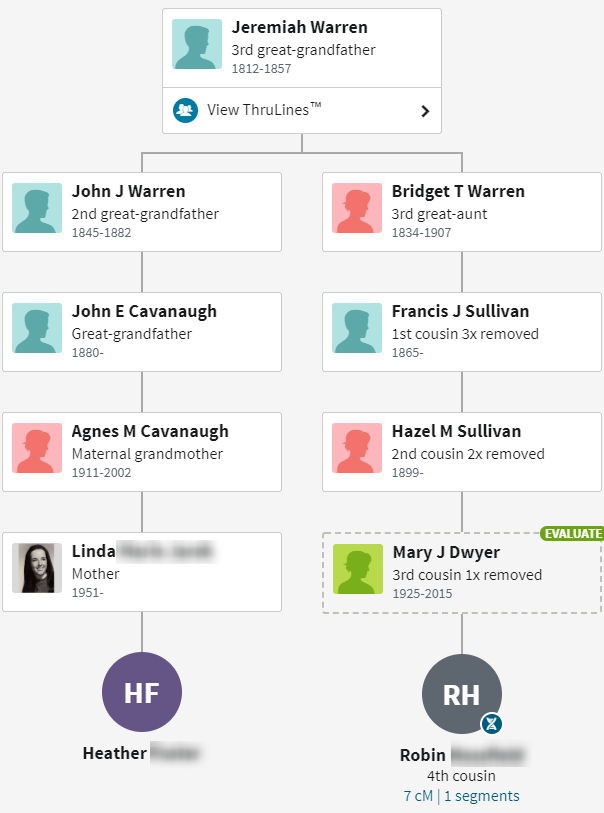
This Albert was the son of Thomas Hartley and Nellie Brown. I assume that Nellie died and Thomas remarried before coming to Fall River.

Thomas’ son Clement’s World War I draft card has him born in Burnley also:

Burnley is not too far from where my ancestors lived in Trawden:

Thomas Hartley’s Parents

Above, I had assumed that Thomas married Elizabeth before coming to the Fall River. Based on the marriage record below from 1897, I was wrong:

This is a good record as it gives Elizabeth’s maiden name and former married name which I assume to be Flint and Thornley. Also we have Thomas’ parents who were John Hartley and Martha Hardacre. These could be good clues. I see what happened. It was Ellen on the ship with Thomas from Liverpool to Philadelphia. Ellen died in Fall River in 1896.

Thomas Alvin Hartley

Thomas had a son by his second wife in 1900. Here is Thomas Alvin’s World War I draft card:

From this, it appears that father and son were both Thomas Alvin Hartley.

Thomas Hartley’s First Marriage

This places Thomas and Ellen in Blackburn:

This may be Thomas in 1861 in Blackburn:

He was born in Blackburn, but his older sister Sarah was born in Colne. Here is the rest of the family on the previous page – all born in Colne:

That is not unusual. Many roads lead back to Colne for Hartleys.

Here is the family in 1851 in Colne:

John was born in Trawden, but the rest of the family was born in Colne. At this point, I better quit, knowing that there are hundreds of Hartley families in the area at this time.

Summary and Conclusions

I was curious as to where the Hartley’s Pork Pies Hartleys came from. I looked at Thomas Hartley who was the founder of Hartley’s Pork Pies. I found him in the 1910-1930 Census records in Fall River. I also found his departure shipping records from Liverpool and arrival records in Philadelphia. Thomas had children said to be born in Burnley by his first wife. However, it appears that Thomas was born in Blackburn, Lancashire. Thomas’ other siblings and mother were born in Colne from what I can tell and Thomas’ father was born in Trawden. So based on what appears to be the case, this Hartley family had its roots in the same small Town of Trawden that my Hartley family did. Research in Trawden is difficult as that is where the mother-lode of Hartleys were in the 1800’s.  I could do more research, but it would probably result in diminishing returns. Plus I set out what I wanted to do.

Now I will have to try a Hartley Pork Pie.