Visual Phasing Six Siblings with the Fox Spreadsheet: Part 4 – Chromosome 3

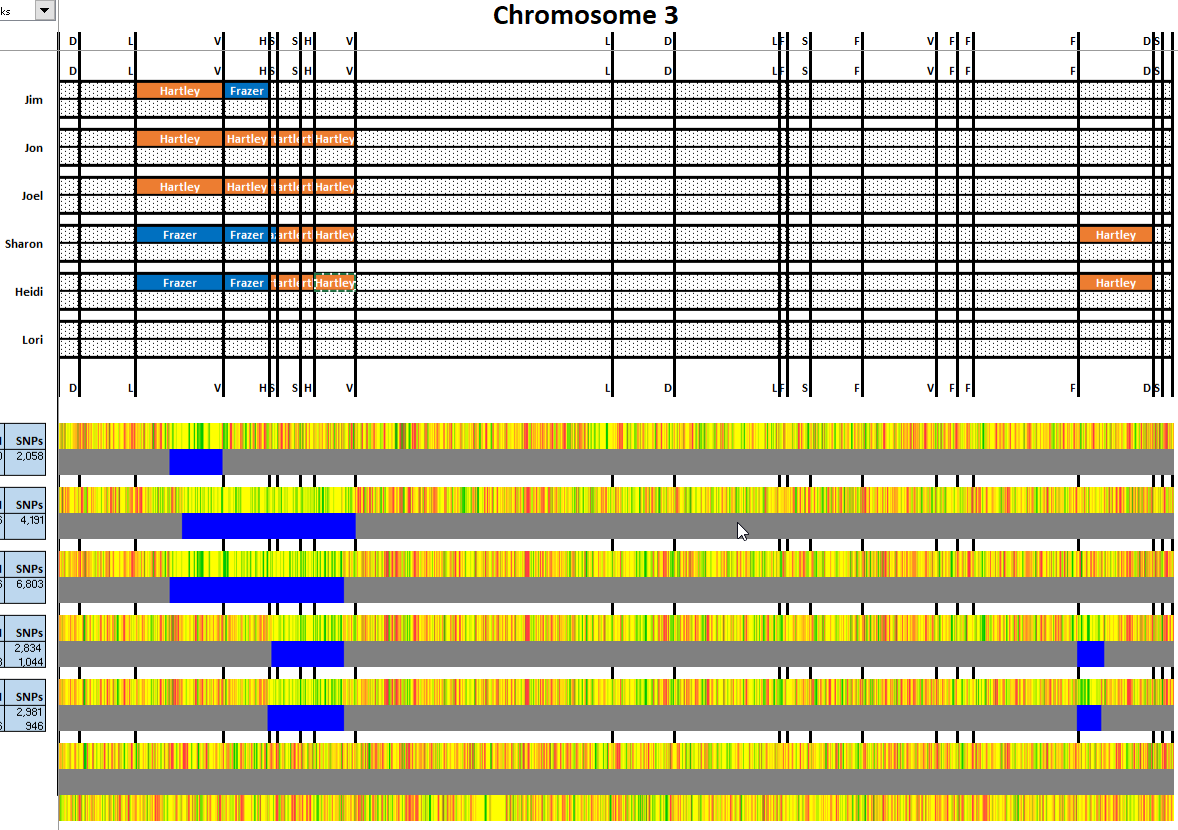
I’m ready to start visual phasing of Chromosome 3.

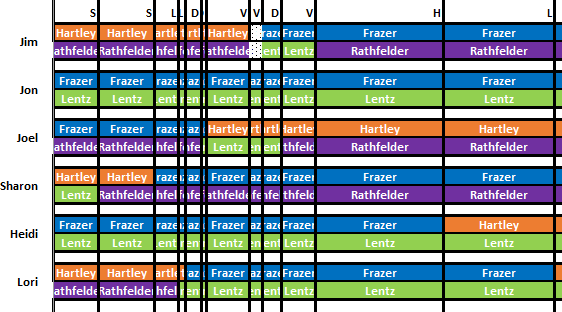
I’ll start with some rough crossover lines:

I try to look at the crossovers and names at the same time to make sure I have enough crossovers. One unusual thing is that on the right hand side, I have five crossovers for Jon (F) in relatively close proximity.

Putting Cousins on the Map

Next I look at the All Cousins function on the Fox Spreadsheet. The first best candidate is James, my father’s cousin. I’ll put some Hartley paternal grandfather DNA in the slots where James matches my family.

Here’s something I want to keep on top of. The right hand side of the matches (in blue) is wandering on each side of a crossover line. I need to start my crossover spreadsheet to keep track of where these crossovers are.

This shows that the Jim (V) crossover is at 39.8 and the Hartley cousin match goes up to 38.6, so we are OK to put Hartley up to the Jim crossover.

The three paternal crossovers on the left fell right into the spots that I had predicted, so I’m off to a good start.

Maternal Cousin Carolyn

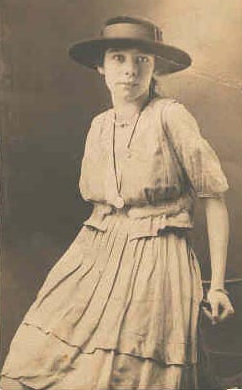
Carolyn matches our family on our Lentz grandparent side. Here is my grandmother, speaking of Lentz:

She was born in 1900.

I started mapping Lentz DNA, but ran into a question on the right hand side of Chromosome 3:

Actually I may all right, as I show a crossover for Joel and Sharon on the very right and that is consistent with our match with Carolyn. Here is what Gedmatch -shows for Carolyn:

The right-hand crossovers for Sharon and Joel are really close. Sharon is at 195.80 and Joel’s crossover is at 195.82. I can go with these numbers, but I’ll have to change the crossover order. It also look like, from Gedmatch, that Jon has a crossover at 186M. I’ll write this into my spreadsheet:

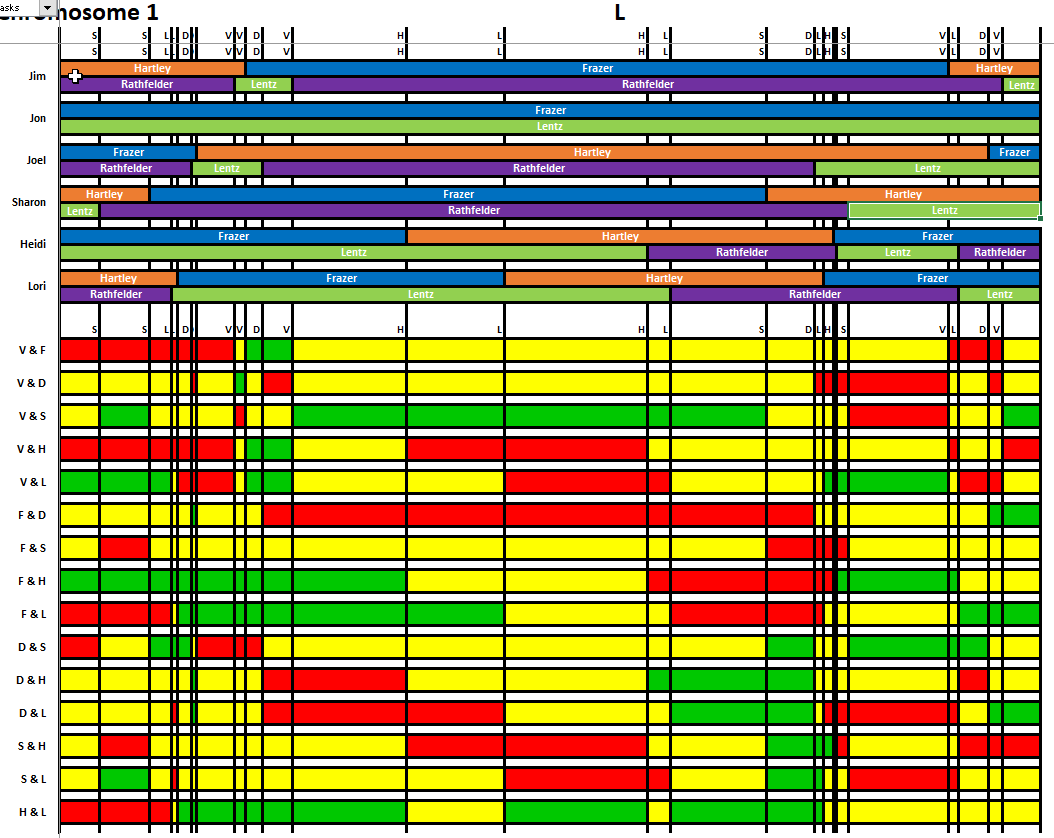
Here is how the right hand side of Chromosome 3 mapped out:

Checking out the position numbers at Gedmatch helped me find the crossover for Jon (F).

This is what I get from looking at the first two cousin matches:

Rathfelder Line Cousin Inese

Inese is from Latvia. Here are her matches with my family:

Inese is picking up maternal crossovers for Joel and Lori:

Inese’s matches do not span the crossovers but the two crossovers are implied by the crossover lines above.

Joyce – Another Hartley Match

Here I add in some more orange Hartley based on Joyce’s matches:

Emily – A Frazer Side Match

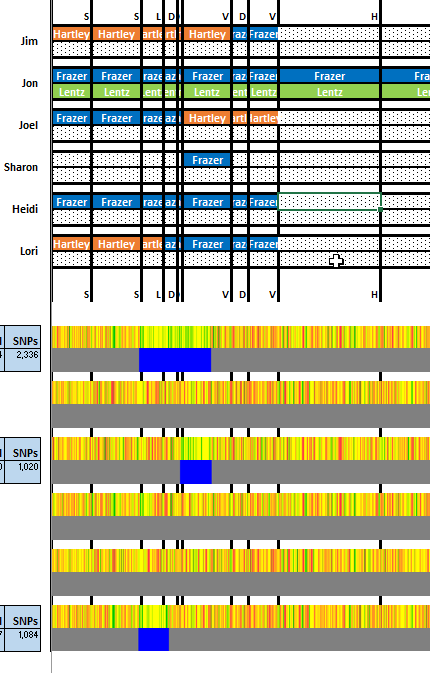
Here the paternal Frazer match goes through a Lori crossover. That means Lori’s first crossover must be maternal.

I checked a few more cousins and came up with this:

What’s Next? Gedmatch Comparisons

Next, it would make sense to look at the FIRs at Gedmatch and the no-match sibling comparisons, to fill in some blanks above. I did that plus I extended the DNA to the easy looking crossovers. That means the crossovers I wasn’t expecting problems with.

I filled in all but this area on the right hand side of Chromosome 3:

This looks right for Jon as he has two crossovers in this area. However, I have none. I need to add one in there. At the top of the image above, it shows that the comparison between Heidi and Joel (D) shows no match on either side of the Chromosome in that little segment. That means that I would be Frazer (blue) and Lentz (green). That means that my crossover should be near Jon’s first F.

I need to look around 160.9 for my crossover.

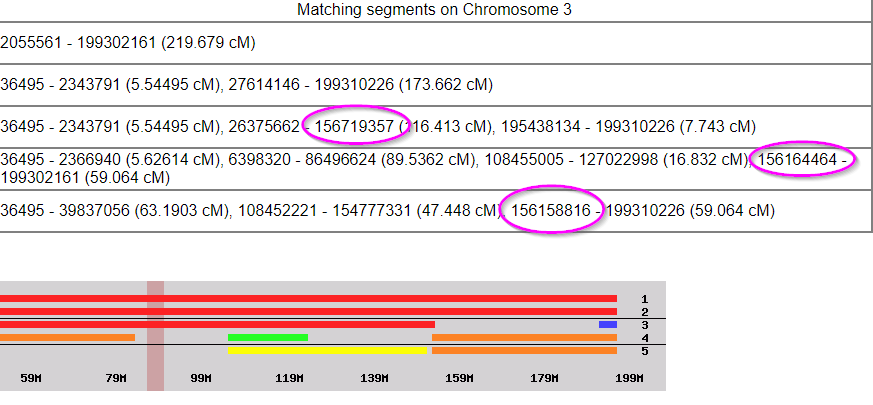
This could be it at 156.7:

Here’s some more information from Gedmatch:

The first circled match is my match with Heidi and the next two circled matches are between me and Lori and Jim. I’ll call my crossover 156.2.

Here, I’ve added my paternal crossover:

Placing Jon’s Two Sequential Crossovers in the Right Order

Next, I’m curious as to Jon’s (F) two crossovers. Which is maternal and which is paternal? I ran Jon against 5 siblings and two maternal first cousins and got this:

#6 is Cousin Cindy. My guess is that her match is the maternal crossover for Jon (F). This is at 165.7M which is where I had Jon’s second crossover:

Of course, that makes Jon’s preceding crossover at 160.9M paternal:

Comparing My Work to Gedmatch with the Segment Map

I don’t see any obvious errors. The places on the right that are small and yellow indicate small HIR matches that didn’t show as blue matches on the left because the resolution was not low enough. Here is one example:

That was relatively painless. I tried to be careful with my work, so I wouldn’t have to fix a lot of things later.

The Final Result

I forgot to show my results:


This is the first time my brother Jim’s Chromosome 3 has been phased. I don’t think that I had phased Lori before on the Chromosome either. This time, Jim and Lori have full paternal side Frazer Chromosomes. That’s good for the Frazer DNA Project I am working on. Between the six siblings, there is full coverage for all the grandparents. Without Jim and Lori in the mix, I would be missing a lot of Frazer DNA on Chromosome 3.

Summary and Conclusions

  • I tried to be more methodical with my work this time and plan ahead for areas that could cause problems
  • One problem area is nailing down crossovers that are near other crossovers. A spreadsheet giving the position number of the crossovers helps.
  • I used a first cousin maternal match to find a maternal crossover for Jon. This was necessary because Jon had two crossovers in a row.
  • As in all Chromosome Maps, this information should be helpful in finding matches along one of four grandparent lines.

Visual Phasing Six Siblings with the Fox Spreadsheet: Part 3 – Chromosome 2

In Part 1, I downloaded the Steven Fox Spreadsheet and built up the information for six siblings and 17 cousins. Then I did the visual phasing on the X Chromosome. In Part 2, I finished Chromosome 1 for 6 siblings, with a heavy dependence on cousin matches.

Visual Phasing Chromosome 2

Here are the 15 comparisons for my six siblings. There are 5, 4, 3, 2, then 1 comparison. I think that is where the 15 comes from.

I don’t see too many odd things here.

Here I added a bunch of crossovers. I don’t know if it is better to put in too few and add later or too many and erase later. I’m not too worried if I have them perfect as I will be checking them against cousin matches.

I’ll start with cousin Maury. I think that’s how his name is spelled. Where we match represents the DNA I got from my paternal Hartley grandfather:

I need to stick the blue matches above for Jim, Joel, Heidi and Lori. I see one crossover for Heidi where her Hartley DNA stops and above and below her, Jim and Lori’s Hartley DNA continues on to the right. To the right of Heidi’s crossover, the only other choice on the paternal side is Frazer, so I’ll add that in.

I have the first crossover identified. It is for Heidi, it is paternal and it is at position 53.5M. I’ll put this into a spreadsheet as it is helpful information to have if you ever do raw data phasing or if you want to add your grandparents to Gedmatch:

[The M for Heidi is wrong. It should be a P.]

I could also infer that the segments above and below the Hartley matches would be Frazer matches. I’ll add those now. If I’m wrong, I can correct them later. However, again, on the paternal side, there are two choices from where the DNA came from.

Adding a Maternal Cousin Match to Chromosome 2

Cousin Anita is a Rathfelder cousin.

It looks like there are few crossovers here. However, the representations of where the relative positions of the matches are can be misleading. I think that I will try assign as many crossovers as I can. Here is what I get from Anita’s matches:

Here is a summary of the crossovers from the first two cousin matches:

I didn’t get a position number for Jim’s crossover as they are not displaying correctly on the spreadsheet.

Next, Check the Gedmatch Comparisons

Here is one issue I see right away:

In the Gedmatch comparison between Heidi and Lori, there is a no match area between Segment H and F in red. The answer appears to be that Heidi has an additional crossover in the area of the L and F maternal crossovers at 103 and 105M. The Heidi crossover should be at about 104, based on the Heidi and Jim (V) comparison:

In Lori’s crossover, she went from Rathfelder to Lentz. In order for Heidi and Lori to continue not matching, Heidi needs to change from Lentz to Rathfelder.

The above gedmatch comparison is Lori compared to Heidi. Between crossovers L and H there is a very short segment where Lori and Heidi are HIR. They don’t match H to L. Then L to H they match on Lentz (green) only. Then Heidi and Lori go back quickly to not matching again.

Cousin Joyce on the Hartley Side

Cousin Joyce has some Hartley segments for the left side of my family’s Chromosome 2:

These matches start at about zero and go to 9M. That is at about the third vertical line above (crossover) belonging to D who is me (Joel). This causes a problem as it goes through Sharon’s crossover. When I look more closely, I see that Sharon’s crossover is at 9M and mine is at 12M:

That means I have to bring back the orange one small segment:


While I was working on this, I made a guess that I (D) had a paternal crossover right after Sharon. I put this into my spreadsheet:

At 7M, I have a crossover for Lori, but I don’t know if it is maternal or paternal yet. I also looked up the last crossover position for Jim at gedmatch.

It looks like Joyce could help clean up the right side of Chromosome 2:

The bottom blue bar is for Heidi and it shows her crossover. Heidi’s crossover is at 226M. Note that I show three crossovers in a row above, but only have two initials. I’ll say that the extra crossover is for Heidi:

The circled areas are in the comparison of Jim (V) to Heidi and Jon (F) to Heidi. Heidi is common in both. I had mentioned in a previous Blog that a change from no match to FIR or from FIR to no match could indicate a crossover for a person on a paternal and maternal side in close succession. That appears to be the case here.

The spreadsheet is important, because the visual part of visual phasing can throw you off. That means that the visuals don’t always line up well, so it is important to depend on the position numbers. This is especially important where the crossovers are close together.

Here are Heidi’s crossovers on the right:


This creates another problem as Heidi’s Lent in Green has to get back to purple Rathfelder on the left, and I don’t have any crossovers for Heidi between the two. This means that either Heidi doesn’t have a crossover on the left or she needs another in the middle. Confused? You bet I am. I’ll worry about this later.

Deciphering the Right End of Chromosome 2 – Paternal Side

Hartley cousin Beth helps figure out the right hand side of the Chromosome. Ends of Chromosomes can be difficult to interpret.

Lori’s match is off by about one half million positions from the other three matches. I don’t know if that is significant. It may indicate a crossover that I don’t have.

Here is how I started to fill in the right hand side of Chromosome 2:

  • JIm’s crossover was on the maternal side, so I filled in the rest of his Hartley DNA.
  • I show Sharon with a crossover. If she has one, it needs to be on the paternal side.
  • This leaves Lori. If her match with Beth is right, then Lori needs another crossover – probably at 239M.

Here is Lori’s crossover:

This shows that Lori’s crossover is right before Jim’s.

Tiny Segments at the Chromosome Ends Are Not That Important

First, thanks Beth. The tiny segments at the end for Sharon and Jim are not that important in practice. However, if you want to fill out your Chromosome Maps it is fun to figure them out. Note Sharon’s small Hartley segment at the right end. This does not show up on the cousin match. It is just too small. If I lowered the thresholds at Gedmatch, it should show.

As my mom would say, “So there”.

Paul’s Frazer DNA

Here I just show the right side of Chromosome 2, where Paul matches my brother and three sisters:

These segments don’t align well, but the numbers show that they are pretty close to each other vertically.


I filled in the Frazer segments and Hartley segments where Paul didn’t match:

Jim likely has a paternal crossover at V. He needs one to match the paternal Frazer at the left.

Cousin Linda’s Maternal Lentz Matches

Linda points out two crossovers on the maternal side:

These are at 222M for me and 228M for Heidi:

I already had Heidi’s crossover listed, but here is mine added.

Gedmatch Sibling Pair Comparisons and Reconciliations

Next, I want to compare my Sibling Chromosome Map with what Gedmatch shows:

For example the comparison between Sharon and Lori shows that they have an FIR that means that Sharon should have Lentz DNA on her maternal side. Lori has two crossovers in a row, so the second should be Frazer to Hartley. Because I am looking for a crossover for Heidi, somewhere in the middle, I’ll fill in the other siblings, but not Heidi:

As I fill in the blanks, I see that I have more problems:


  • Looks like Jim (V) needs another crossover. I believe that should be near the third V above.
  • Jon has two crossovers, but if I put in Rathfelder in the blank area on Jon’s maternal side, that would solve that.
  • Sharon needs to go from Rathfelder (purple) to Lentz (green) but has no crossover.
  • Heidi has the same issue.
  • Lori has a crossover but no apparent need for one. By looking at the Gedmatch comparisons, the L should be an H and S. This should solve the above two problems.

Jim’s Double V

Here Jim has crossovers on the maternal and paternal side:

These don’t line up that great visually. These two Jim Crossovers are at 191 and 192. I don’t know which crossover is maternal and which is paternal at this point.

Replacing One Lori Crossover with One Sharon and One Heidi Crossover (Or How to Solve Two Problems by Correcting One Crossover)

The problem in doing this is, which Crossover goes first? Here is the Lori Crossover I want to replace:

This shows where they both match with me (D). The Sharon crossover is at 173M and the Heidi crossover is at 172M, so Heidi goes first.

My list of crossovers is getting quite long:

These two crossovers need to be on the maternal side to make the map work. I don’t know if this is right, but it seemed to work:

Some Eye Excercise

This is a side by view of what it is from Gedmatch versus what I came up using the Fox Spreadsheet. I think they agree. All I have to do now is fill in Jim’s double crossover and some small segments on the left hand side of the Chromosome.

Jim’s Double Crossover

This should be easy.

In the little gap between 191 and 192M, Jim has no match with Jon (F), Sharon and Lori.

Jon, Sharon and Lori have a blue/purple combination, so I’ll give Jim a no-matching orange/green combo:

If everything else is right, this just falls into place.

The Left Side of Chromosome 2

This looks really confusing. I have five crossovers in short succession and one not assigned. I could give up now, but I would like to finish this Chromosome and move on to 3-22. First, I took out the unassigned crossover.

I’ve circled all the cases where there is a no match going to an FIR or FIR going to a no match. They include three V’s, three F’s, three H’s and three L’s. I think that means that I need to add an F and H crossover to what I already have. That includes all six siblings. The other question is whether these are all double crossovers. If that is the case, then I could need to add up to five crossovers.

I can start by filling in some paternal side in the first segment:

Next, I need to make use of my spreadsheet.

These are the crossovers I have already. Next, I’ll look for some more position numbers.

Here Jon has a 10.4 crossover. It seems to line up well with his other matches.

Jim and Heidi match here:

That looks to be about the place of Heidi’s crossover.

I’ll start filling out the map based on the above, but I feel like there is at least one double crossover somewhere:

I did a quick segment map check:

The resolution is off, but it looks to be not too bad a comparison.

Could This Be the Map?

I think it looks good for a wrap.

Comparing Chromosome 2 with Previous Analysis

Here is what M MacNeill did for me previously:

This was for three siblings. The interesting par is that this shows DNA that was missing on my father’s side. My mom has been tested, so is missing no DNA. DNA is missing for my paternal grandmother on both ends. DNA is missing for my paternal grandfather in the middle of Chromosome 2.

Now no Hartley DNA is missing (paternal grandfather). Also no paternal grandmother is missing thanks to Jon. He has a full Chromosome 2 of paternal grandmother. This is interesting because Jon also has a full Chromosome 1 of Frazer (paternal grandmother). That’s a lot of Frazer. Let’s say Jon was trying to prove he was related to a Hartley who had huge segments of Hartley DNA on Chromosomes 1 and 2 but nowhere else. Jon would show that he would not be related to this Hartley by DNA.

Summary and Conclusions

  • I continued on with the same method I used for Chromosome 1. That was to use cousin matches and to  identify crossovers by cousin matches. I map those matches and crossovers and what I can infer from the gedmatch comparisons. I then check the Segment Map to see if it agrees with the gedmatch comparisons.
  • I still like using the cousin matches first as it sets the maternal and paternal side right away. The crossovers from the cousin matches seem quite certain and give me a good start on visual phasing.
  • I make sure I keep at least the close crossovers in a spreadsheet, so I can know which crossover goes where. Special attention is given to the position numbers as they can give clues to how many crossovers there are.
  • At the end of my visual phasing, I was looking for double crossovers, but they were not there.
  • For Chromosome 1, I consulted with some of my previous work. For Chromosome 2, I did not look at any previous work I had done or had done for me.
  • Finally, I looked at my results compared with previous results.


Visual Phasing Six Siblings with the Fox Spreadsheet: Part 2 – Chromosome 1, the Most Difficult Chromosome?

In my previous Blog, I created a very useful spreadsheet thanks to Steven Fox. This spreadsheet has my five siblings plus me with comparisons to each other, cousins and all I need to visually phase six siblings. In that Blog, I started by mapping out the X Chromosome.

On to Chromosome 1

Chromosome 1 could be tough. This Chromosome has the potential for the most crossovers. I tried showing some crossovers, but it was a bit of a muddle:

I have worked on phasing my DNA using raw DNA and have had help from M MacNeill. MacNeill came up with this for three of the siblings in my family:

This shows a maternal and paternal crossover for me in close proximity at about 23M. MacNeill showed my maternal crossover at 23.1M and my paternal crossover at 23.3M at the left side of the top row. That is fairly close.

Here is a problem area on the right hand side of my sibling comparisons:

In the D&S comparison, see how quickly the comparison goes from FIR to no match. This is likely indicative of my maternal and paternal crossover. Above, the F&L comparison, there is a slightly more gradual change from no match to HIR to FIR. I don’t know if that indicates a maternal/paternal crossover for Lori or if my double change is giving Lori a double change.

Then, on the right side of the Chromosome, I see this:


At around position 204M, F&H goes from no match to a FIR fairly quickly and D&L goes from HIR to no match very quickly. It looks like I could have another Lori (L) crossover in that area.

Here I tried some visual phasing, but, it is not right:

Here is how the segment map compares:

The comparison is not bad in the middle of the Chromosome where I started the visual phasing, but it goes south quickly on the right.  The V&D comparison on the left side of the segment map is off also.

Using Cousin Matches

My though at this point was to use cousin matches to get this map into better shape.

At the bottom right, Lori’s last match with Joyce ends at 203M, Heidi’s ends at 205M and Sharon and Joel continue on. Sharon’s Match with Joyce starts at 190M and my match starts at 182M. That tells me that Sharon has a crossover at 190M, Lori at 203M and Heidi at 205M. This is just on the paternal side as Joyce is a paternal match.

A Cousin Match Spreadsheet

I like the idea of using cousin matches, so I copied this spreadsheet and made another called Cousin. The good thing about putting in matches based on cousins is that when you can see the crossovers, you can tell which side they are on. Then on the other side of the crossover, the DNA will come from the spouse of the match. For example, above when my siblings match Joyce, that is on the Hartley side. So to the left of Sharon’s Hartley match with Joyce, the DNA would be from Frazer (my paternal grandmother).

Here is how I mapped out my siblings’ Hartley match with Joyce. On the other side of the paternal crossovers, I can add in Frazer:

After comparing the paternal matches with the gedmatch comparisons, I can make some more deductions:

For example Sharon has no match with Lori in the middle segment. that means that Sharon must have a Frazer segment there where Lori has the orange Hartley segment.

Adding Maternal Cousins

My cousin Catherine represents my Rathfelder maternal grandfather. I’ll add in some Rathfelder from Catherine:

Where Jon does not match Catherine or Rathfelder, he must match Rathfelder’s wife who was Lentz. This is true for Joel also in the second set of matches. This change for Joel (D) must happen where I have his crossover.

This gives my family four grandparent segments by just two cousin matches.

Two Missing Paternal Crossovers for Lori and Heidi

Above, I had mentioned that Lori had a paternal crossover at 203M and Heidi at 205M, but I forgot to add them in.  Here are the ones I forgot along with the ones I didn’t:

This shows how crowded things can get with a six sibling comparison. This is what these crossovers result in on the map:

That configuration results in this Segment Map on the Fox Spreadsheet on the right versus the original gedmatch comparison:

Above, I am just comparing the segment that goes from L to L. All the differences are on the right hand side and they all have to do with Heidi. I suppose that could mean that I have too many crossovers for Heidi, not enough, or have deduced the wrong thing from the crossover I have. My guess is that Heidi has an additional maternal crossover.

Based on the Gedmatch comparisons, Jon (F) and Heidi should match on both grandparents. If Heidi had a Lentz in her last column, then she would match Jon.

Now the segment map agrees with Gedmatch:

The problem was the 5 crossovers in a row. I find it interesting how a comparison with the segment map and Gedmatch pointed right to Heidi as the place where the problem was.

A Lentz Cousin Should Fill Out the Right Hand Side of Chromosome 1

Here is how Judith matches my family:

I see three maternal crossovers on the right. One is with Jim (V), then Heidi, then Lori in the last row.

When I fill out the missing segments, I get this:

 Using the Fact-Checker Segment Map

The good news is that I have the area of discrepancy narrowed down to one person again:

I did something wrong with Jim (V). Jim is supposed to match Sharon in the Last segment. That means that Jim needs another paternal crossover from Frazer to Hartley. All I had to do was compare Jim to Frazer cousin Paul to find Jim’s crossover:

Actually I had to compare Paul to Jim and Jon to find Jim’s crossover. Here is my expanded list of crossovers:

Here is the extra Jim (V) crossover added before Lori’s last crossover:

There would have been a lot more trial and error without the cousin matches that I have. Now Gedmatch and the segment map appear to match:

Also, I am liking Steve Fox’s Segment Map.

The Most Difficult Chromosome

Chromosome 1 isn’t necessarily the most difficult Chromosme to visually phase but it has the most potential to be the most difficult one. Looks like this Blog will just be on Chromosome 1.

Here’s a Hartley cousin on the left side of the Chromosome:

This will take care of one of my crossovers and one for Lori. It looks like Lori’s crossover should be ahead of mine:

I also carried some of Jon’s segments over as he shows no crossovers. It looks like I need another crossover for Lori:

Jon (F) has no match with Lori in the first row comparison. Then he has a short HIR and then FIR. My assumption is that Jon has no crossovers on either side of his Chromosome 1. That means that Lori, must have two crossovers.

Final Fact Check with the Segment Map


Something is off in the V Section which is Jim’s. My solution so far, has been to add an extra crossover:

Now I have everything except a tiny little area for Jim:

If only I had a cousin match in that area. It looks like the first V is at 35M and the second is at 41M. Jim’s match with Joyce should work.

Joyce matches Jim (V) up to 38M which is past the area of his first crossover at 35M:

The Finished Product

Using the merge function beautifies the map:

Wait maybe not. Here is a global fact check using the Segment Map:

How did I miss this before? Again my fact-checking exercise has narrowed down the problem to one sibling. This time it is Sharon. I have also narrowed the area in which the problem is: between S and V.

I see the problem:

Sharon is third from the bottom. I have her bottom maternal crossover from Rathfelder (purple) to Lentz (green) at V instead of at S. This should fix things:

That should do it:

This shows that there are no gaps where any of the grandparents’ DNA is missing between all six siblings.

Summary and Conclusions

  • First I made some rough crossover lines and assigned them to four siblings
  • Second I went to the cousin match map and mapped a few cousins onto the spreadsheet
  • Using these cousin matches I could see where some of the crossovers were. The advantage of this is that I already knew which side (paternal or maternal) the crossovers were on. On the other side of the crossover, I knew that the person got their DNA from the corresponding spouse.
  • I extended these matches using the gedmatch sibling comparisons
  • I checked my results using the segment map and made corrections
  • I found where there was a quick change from no match to FIR or FIR to no match in a sibling comparison, that it often meant a person had a paternal and maternal crossover in close proximity.
  • The use of cousin matches greatly sped up the process of visual phasing.
  • By using cousin matches I skipped using the G1-G4 codes and went directly to actual grandparents. This method seems more intuitive to me. However, it only works with good cousin matches.
  • This also went quickly because I had done it before. Because of this, I already knew I had a double crossover near the beginning of the Chromosome. I also believed that my brother Jon had a full pair of DNA from his paternal grandmother and maternal grandfather. However, I basically recreated the map from the beginning.
  • It is satisfying to see the map for all six siblings and how they got their DNA from each of their four grandparents.

Painting My Wife’s Chromosomes

In this Blog I’ll paint my wife’s chromosomes. I use DNAPainter for this. This utility requires a subscription for over one painting, and I’m over that now, so I subscribed. Painting DNA is taking all your DNA matches and painting them onto your chromosomes. The match that you have shows that you have DNA from a common ancestor. So what I will be showing is where my wife, Marie, inherited her DNA on which chromosome and from which ancestor. Hopefully, it will become clear as I go along.

Right now I have profiles for my mother, myself and two siblings:

Next, I’ll create a profile for Marie. DNAPainter just needs to know her name and that she is a female. This makes a difference for the X Chromosome as women have two of those.

Which Matches Do I Paint for Marie?

I will look at painting no matches closer than those that represent Marie’s grandparents. That means that I don’t want to count matches from 1st cousins. Full 1st cousins share two grandparents. The first two people who I will paint will be Marie’s father’s 1st cousins Patricia and Joe. That makes them first cousins once removed to Marie.

Marie’s match with Patricia and Joe will show up on her map as DNA from Joseph LeFevre and Emma Pouliot. That is because we don’t know who the DNA came from. It should be part LeFevre and part Pouliot. Here is Marie’s match with Patricia from Gedmatch.com:

Here is what that looks at DNAPainter:

The DNA is on Marie’s paternal side, so that is on the blue bar. The key at the bottom says who the DNA is from. Now Marie has gone from zero to 7% of her chromosomes painted with adding just one cousin:

Marie also matches Patricia on her X Chromosome. So I added that. Next I need to add Patricia’s brother Joe. This time I’ll paste in his X Chromosome match along with the other matches. Gedmatch has you do a different query for the two. Adding Joe brings Marie’s painted DNA up to 10%. Now we can expand the Chromosomes to see the details:


The X Chromosome expands to this:

This shows that Joe shares more X Chromosome with Marie than Patricia does. Next I added RL who matches only on the LeFevre side as far as I know. This added 1% to Marie’s map and got her up to 11% mapped.

Here is Marie’s match with RL on Chromosome 12. Where RL matches Joe, that is likely all LeFevre DNA. On the right where RL does not overlap with Joe and Patricia, we don’t know if the DNA was from the LeFevre side or Pouliot side.

[Note: I have RL in the wrong color which I correct later in the Blog.]

Adding Some Pouliot DNA

Marie has some matches with Pouliot only DNA. These matches are with Fred, Don and Sleuth:

Now, wherever Marie has a match with Fred and Patricia and those matches overlap, that will show that the match with Patricia was on the Pouliot side and not the LeFevre side.

Here is a new color and this gets Marie’s painted chromosomes up to 13%. Here is Don on expanded view on Chromosome 1:

The green overtook the pink in the expanded view. This is OK as Pouliot is the more specific match and the older one. This tells us that Marie’s match with Patricia on Chromosome 1 is from the Pouliot side and not the LeFevre side. Next I added Don’s two siblings to bring Marie’s painted DNA up to 14%

So far, I have painted 6 matches to Marie’s paternal side. This represents only one of her grandparents – the LeFevre side. This 14% represents 27% of Marie’s paternal side DNA.

Starting Marie’s Maternal Side DNA Painting

Marie has Ellis and Upshall grandparents on her maternal side. Marie matches her half great Aunt Esther on the Upshall side. The half part is important as it narrows down the match to one of Marie’s great-grandparents.

This brings Marie’s mapped DNA up to 20%. So we are one fifth complete.

Here I wanted Frederick on the bottom as he is on the maternal side. I also added a line by choosing Joseph LeFevre/Emma Pouliot. I then chose Edit Group and I checked a box saying I wanted a line below this group.

More Painting

I don’t want to stop now. Marie’s next match at Gedmatch is a first cousin once removed, but he is a younger cousin. He shares two of Marie’s grandparents as common ancestors, so we won’t map him. After Nick is Gaby. Gaby is Marie’s second cousin on Marie’s paternal side. This match represents Marie’s Irish side.

This brings Marie to 23% mapped:

Next: More LeFevre DNA

Sandra has been a big help in uploading her DNA to Gedmatch. She tells me that she is a third cousin to Marie. Their common ancestors are  Edmond Lazare Lefevre and Leocadie Methot.

Sandra manages three DNA kits including her own that are close matches to Marie. I assume that they all have LeFevre and Methot common ancestors. I mentioned RL above but didn’t put in the correct common ancestor.

Here I will want to move RL to another group, but I haven’t set up that group yet, so I’ll add KK first.

Here I have added a new pair of ancestors for Marie on her maternal side with a splash of tangerine. I moved the ancestral pair down one on the key so they would be with the other LeFevre’s. Next I moved RL to the Edmond LeFevre Group. I see now that I could have created a new group before also.

I then added Sandra which brings the mapped number of segments up to 116.

Adding Anne to Marie’s Maternal Side

As I go down the list, it takes a little bit more to figure out where the people fit in. This looks to be the right tree for Anne:

Marie is Joan’s daughter, so that makes Marie a second cousin twice removed to Anne. So we are quickly back to about 1812 with Marie’s DNA.

This is only the second maternal ancestral pair. Unfortunately, I don’t have a last name for Elizabeth. Crann would be a guess. We still have no ancestors for Marie’s fourth grandparent: Ellis.

Ronda: An Ellis Match for Marie

Ronda is next on the list at Gedmatch:

Ronda is a third cousin to Marie. Note that there is another shared ancestor hint. However, it is further out and also on the Ellis line.

As this is a new grandparent match, it means that there will be no overlaps with any other matches and this brings Marie’s painted DNA up to 26%.

An Unknown Upshall Side Match

The next match going down the Gedmatch list is Leslie. Unfortunately, I can’t see an obvious common ancestor for Leslie and Marie. I’ll have to wait until I find one.

After the unknown is Sarah. I was able to find her at AncestryDNA. She has a Shared Ancestry Hint with Marie:

This is Marie’s first painted DNA from the 1700’s. The new matches are on the maternal sides of Chromosomes 2, 4, and 6.

On Chromosome 6, I circled one of Marie’s crossovers. That is where her DNA crossed over from her Upshall side in light blue to her Ellis side in teal and orange. The actual location of the crossover is where the blue changes to teal.

Next is another unknown match. This is with Bobby. I can tell that the match is on the Ellis side, but not exactly where. I do see that Bobby also has his DNA at FTDNA. However, the tree is not all filled out there either.

Next is Danielle. I can tell by Shared Matches at AncestryDNA that she is related on the LeFevre side, but the detailed tree is missing also.

Karen and Martha with Newfoundland Roots

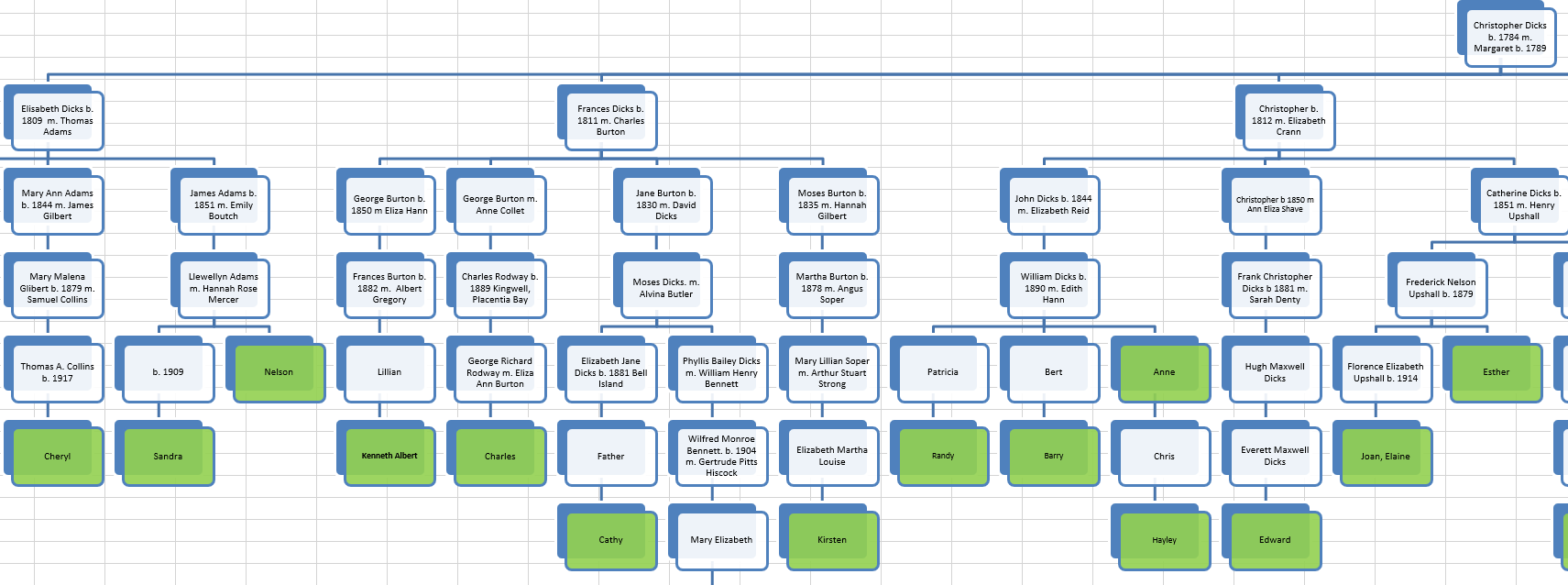
Newfoundland Roots means the Upshall side for Marie. I don’t have a good tree for Karen, but I have blogged about her. Based on her DNA, I have theorized this tree:


We’ll say I’m right. I have that Henry Upshall married Catherine Dicks. I added Karen’s match on Chromosomes 8 and 9 in lilac:


For Martha, I have another best guess tree:

Actually, this is double made up as we cannot easily prove that Peter Upshall is the father of Henry Upshall. However, this is a best fit tree. Marie would be a third cousin once removed to Martha’s maternal aunt. I believe that M.B. is Martha’s maternal aunt.

The good news is that I’m getting more maternal side matches for Marie. The bad news is that paperwork in Newfoundland is missing and it is hard to verify the last two matches.

Michelle at FTDNA on the LeFevre Side

I mentioned FTDNA above. Marie has matches there also. Here is an interesting one with Michelle. Michelle is related to Marie only on the LeFevre side:

Michelle’s maternal grandparents were Martin LeFevre and Mabel Ford. Marie’s great-grandparents were Martin LeFevre and Emma Pouliot. Emma died and Martin remarried Mabel. Here is Marie’s match with Michelle at FTDNA:

Transferred to DNAPainter:

I now have an entry for Joseph Martin LeFevre by himself as well as the couple of Joseph LeFevre and Emma Pouliot.

More Maternal DNA for Marie on the Upshall Side: Edward

Edward and Marie have this common ancestor:

Here Marie and Edward are fourth cousins. They have a common ancestor of Christopher Dicks and Elizabeth Crann. I’m not positive about the Crann. Here I made a couple of mistakes:

First I forgot to assign this to the maternal side and secondly I already had an entry for Christopher Dicks. Fortunately, DNAPainter had a way for me to merge this group into the right one on Chomosomes 9 and 11 (Chistopher Dicks in purple).

This gets Marie up to 150 segments mapped.

Marie and Wallace at MyHeritage

Marie has a good match with Wallace at MyHeritage. I uploaded Marie’s results there while writing this Blog.

Here is where I have Wallace:

Wallace is a 2nd cousin once removed to Marie. At this point, Marie’s maternal chromosomes are 22% filled in and her paternal chromosomes are 36% filled in. A lot of paternal LeFevre relatives have tested. Here is Marie’s maternal side only:

That is what 22% filled in looks like.

Adding Cheryl and More of Martha’s family

Cheryl has Dicks ancestry. I have written many Blogs on this family and how their descendants match up by DNA.

Cheryl is on the bottom left. She is a fourth cousin once removed to Marie. As there are some missing lines in Marie’s Newfoundland genealogy, there may be other ways Marie is matching some of these Newfoundland descendants. Here is how Cheryl compares with some others on Chromosome 9:

The light blue represents Christopher Dicks born 1784 or his wife Margaret. Many people descend from this couple.

Next, I’ll add Martha’s brother and Martha. Some of these matches are not adding new DNA.

Back to LeFevre

Here is a match on the LeFevre side:

This is on the French Canadian side. Note that there are two other pairs of shared ancestors. However, this is the most recent.

This is Marie’s first mapped French Canadian DNA from the 1700’s (in red). It is interesting that Marie and Kbou also match by XDNA. In order for this X match to occur, there cannot be any two males in a row in Marie’s or Kbou’s ancestries. Looking at their trees above we see that is indeed true. This match brought Marie’s mapped chromosomes up to 30%.

I could keep on going, but I’ll stop here.

Summary and Conclusions

  • I mapped 30% of Marie’s chromosomes using DNAPainter and matches from Gedmatch, FTDNA and MyHeritage. AncestryDNA was helpful to provide trees but it does not provide the detailed DNA information needed to map the chromosomes.
  • I was able to paint 10% of Marie’s chromosomes with two of her first matches. After that, things went more slowly.
  • Of Marie’s four grandparents, Butler matches are the most rare. Marie had one Butler match.
  • I gave an example of a crossover.
  • Marie has DNA mapped on every chromosome. However, a paternal or maternal side may be missing.
  • It would be interesting to create a DNAPainter map for Marie’s mother and father and see how they compare to Marie’s map.

Adding Some Ancestors to DNAPainter

DNA Painter is a fun and helpful tool created by Jonny Perl. I discussed DNA Painter in a previous Blog. Since then, DNA Painter has come out with a new dividing line in the key. At the time I started using DNA Painter, I was so happy with the software, that I didn’t care about the key. However, now I have organized my key.

The Key to the Key

Here is the way I had my key:

By choosing the area to the right of the ancestral name, these names can be dragged up or down. Here is my new key:

I have sorted the names into paternal and maternal. Then within paternal and maternal, I have sorted the names in a way that makes sense to me – basically by grandparent line. In order to add the above line, I chose T Clarke:

Then I choose Edit Group:

In that screen, I have circled where there is an option to add a dividing line below the group. I have checked this option.

Mining My Blogs for More DNA to Paint

Here is what the DNA Painter shows for me right now:

I recall Blogs tha I have written where I found other ancestors.

Adding Abraham Howorth, Born 1768

Old Abraham goes back a ways. He lived in the Bacup area of Lancashire with his wife Mary. I was able to Identify his DNA thanks to a match with Anne on Chromosome 4. Now I have to remember how to add Anne’s DNA to DNA PainterFirst I find the match at Gedmatch. Here is my match with Anne:

Now to get this on to the Painter. At the top right of the software is a software that says “Paint a new match”. This sounds like a good choice:

Above, I copied Anne’s matching chromosome information into the box provided. I then click on the blue box [save match now] to get this screen:

In the top blank box I put the match’s name and Gedmatch number. In the bottom, I’ll put in Abraham Howorth and Mary. This is on my paternal side. Here is the new painted segment on Chromosome 4 in blue:

I’m not totally happy with the color as it is not too distinctive from my paternal T Clarke:

So I chose Abraham in the Key above and then chose Edit:

There I chose a different color for Abraham. I didn’t like that either, so I chose a brighter green:

This will do for now. Next, I want to move Abraham down one slot on the key:

When I choose the area to the right of the name, I get a double arrow and I can move the name down one space.  Howorth is the second surname on my paternal grandfather’s side.

Adding a Maternal Rathfelder Segment

I discuss this Rathfelder find in more detail in a set of Blogs called My German Success Story. The DNA match was with Astrid, and I was able to trace the match back to Hans Jerg Rathfelder born in 1752.

I wonder if Hans Jerg had a sense of humor as he named two of his sons Johann Georg that were born four years apart. His own name was a bit similar to these two sons. One son went by Johann and the other went by Georg.

Here is my match with Astrid:

Here is where these Astrid/Rathfelder segments show up on my maternal chromosome:

I used the same color as Howorth as it is OK to repeat colors as long as the last time I used this color on Chromosome 4, it was on the paternal side.

Next, I moved Han Jerg down on the key to where I want him:

Here is the Linden Church in Latvia where Hans Jerg and Juliana got married:

The odd thing is that it looks like it could be a New England scene with children sledding on the hill of the church. However, this is in the middle of Latvia.

Part of my impetus to paint is the header at the top of the DNA Painter. It shows how much of my chromosome is mapped. Right now it shows:

  • 33% mapped – 166 segments
  • Paternal: 46% mapped – 109 segments
  • Maternal: 20% mapped – 57 segments

This exercise hasn’t raised the overall mapping from 33%. It takes quite a bit of DNA to go up one percent.

A Maternal Lentz Add

This is a match I have with Radelle that goes back to John Lentz, born in Philadelphia in 1792. Here is my share of John Lentz:

Oops, I forgot to tell DNA Painter that this match was on my maternal side, so it put the lilac color across the maternal and paternal side. This is easily fixed.

There, that looks better.

DNA Painter puts the new ancestral couple at the top of the key, so I’ll move them down to where they belong:

There is some confusion as to who Eliza was and whether John had one or two wives, so I’ll just leave it as Eliza for now. John and Radelle got me up another percent on my maternal side:

It like a game trying to get these numbers up.

The X Chromosome and My Cousin Cindy

I am only mapping my great grandparents and further out. Right now, I only have a small segment mapped. However, there may be a way to get further back on the X Chromosome. My plan involves my first cousin Cindy. Here is how I match Cindy on the X Chromosome:

On Chromosome 1-22, we would match on either Alexander Rathfelder or Emma Lentz. However, on the X Chromosome, we only match on Emma Lentz. That is becuase Cindy’s father Bob only got and X Chromosome from his mother.

Emma in turn, got her X Chromosomes from her two parents: Jacob George Lentz and Ann Eliza Nicholson. This only works for a female cousin where I am also related to her father.

Now I will map my matches with Cindy to J.G. Lentz and A.E. Nicholson:

Perhaps this will get my percentages up. I click the refresh button for my statistics and get this:

I’m looking for more than one perent increase on my maternal side:

There. I got a 2% increase thanks to my cousin Cindy. Actually it was two percent from before I started the Blog.

Cindy is the 2nd from the left and I am on the right.

The Big Picture

Next, I add two more lines to the key:

The four divisions are paternal grandfather, paternal grandmother, maternal grandfather and maternal grandmother. A few observations:

  • I have only identified two ancestors each on my paternal and maternal grandfather sides so far.
  • The darker green Hartley/Snell DNA represents 17% of my DNA. This is half of all my identified DNA. This is due to the fact that I have a lot of relatives on the Hartley side of the family. The theoretical average amount of DNA I would get on my Hartley/Snell side would be 25%. By identififed, I mean DNA that I can put ancestral names to.
  • I don’t have any 2nd cousins tested on my paternal grandmother side (Frazer). I do have a Frazer DNA Project which partially makes up for that.
  • Two second cousins on the Rathfelder side account for 4% of my DNA.
  • DNA for Lentz/Nicholson acounts for 3% of my DNA. This includes my X Chromosome match with my 1st cousin Cindy.
  • My Nicholson/Ellis matches account for another 4% of my DNA. This is a case where a more distant ancestral couple is more accounted for than a closer ancestral couple. This number could get higher as I have run into quite a few DNA-tested descendants from this Nicholson/Ellis line.
  • That leaves 6% for the identified DNA I got from the other ancestors listed above.

Summary and Conclusions

  • Jonny Perl’s DNA Painter remains a highly respected and useful tool for DNA analysis
  • I enjoy looking a the percentage statistics
  • I can see where the mapped DNA is relatively complete and where it is lacking
  • The DNA Painter gives insight into my DNA’s origins and spurs me on to further discovery


Using Visual Phasing

I did some visual phasing for Jane and her two siblings. Now Jane wants to see how the visual phasing can be used.

Mr Gray’s 8.5 cM Match

Jane’s first question came from a Mr Gray. He matched Jane and her two siblings at about 8.5 cM. Jane had this conundrum:

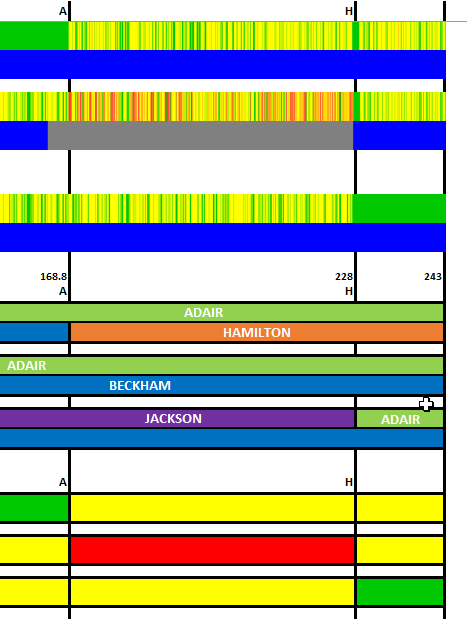
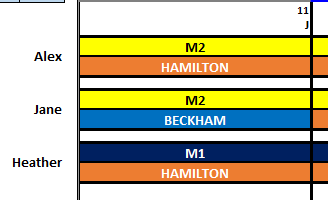
For me the match points to Beckham, for Heather it points to Beckham but for Alex it points to Hamilton. Unless it is on Mum’s side as indicated by Jackson for all three of us, but then why wouldn’t Mum share DNA with Mr. Gray?

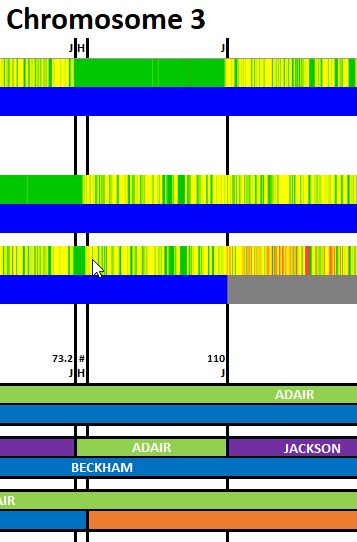
Here is the right side of Jane’s Chromosome 2 Map. Jane is in the middle bar and her maternal side is on the top bar.

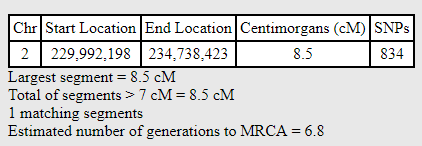
Here is where Jane matches Mr. Gray:

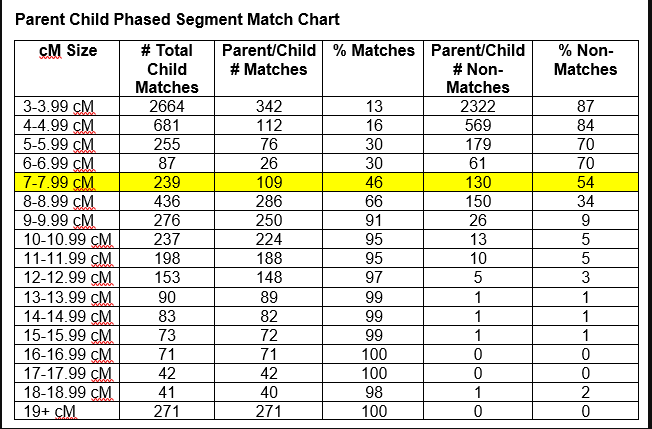
The answer for this one is that this is not a real match. Jane’s mother has tested and Jane has two sets of phased results based on her mother’s results. I ran Mr. Gray against Jane’s paternal and maternal kit and got no results. This means that the match is not real. Different analyses have been done for the chances of a certain size match being real or not. Here is one from Roberta Estes:

These studies seem to show that there is about a 50% chance of a 7 cM match being real. This goes up to a 66% chance of being real for an 8.5 cM match. It looks like Mr Gray fell into that 34% range. The only other possibility is that Jane’s mother could have had a false negative match with Mr. Gray. All in all, I would say that these results would be inconclusive. For me, I tend to say if there is no match on the two phased kits, then there is no match.

Second Example: An Adoptee at 23andme

Only Jane and her mom tested at 23andme. Here is how the adoptee matched Jane:

Chromosome 1:     108 to 151     26 cM

Chromosome 2:     225 to 230     8 cM

Chromosome 3:     104 to 145     41 cM

Chromosome 17     5.7 to 9.3      9 cM

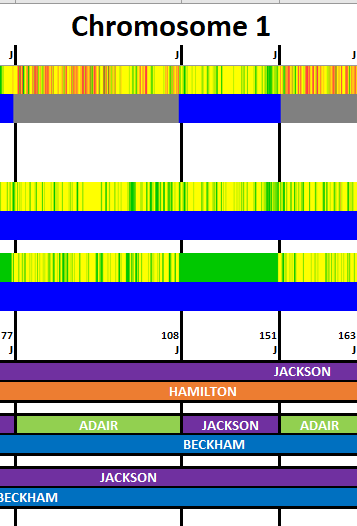
By looking at the Visual Phasing Spreadsheet, Jane deduced that this was on her Beckham Line:

Jane is in the middle bar. The bottom of that bar is her paternal side where Bekham is in blue. I assume that Jane’s mother did not match this adoptee at 23andme.

I have Jane’s Chromosome 2 above where she matches Beckham between 225 and 230 on her paternal side.

The match is significant for Jane as the  match between 104 and 155 goes through her maternal crossover at position 110M. That would confirm that this is a paternal side match on Beckham.

Here is Chromosome 17:

It looks like I had trouble identifying the maternal grandparents, but Jane matches this adoptee in her paternal Beckham region. So I would agree with Jane that this match is on her Beckham side. It would help if this adoptee uploads his/her DNA results to gedmatch.com.

Peggy’s Maternal Match on Chromosome 13

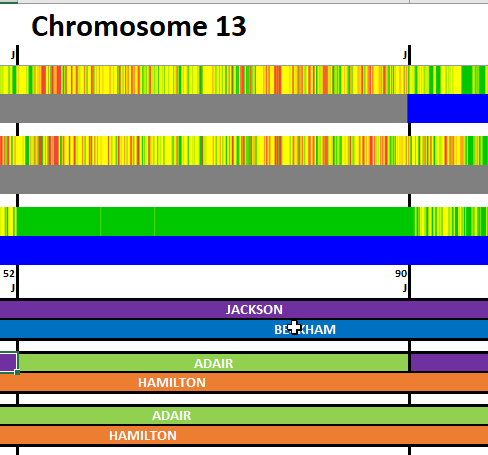
Jane reports these results for Peggy’s matches to her and her siblings:

Heather     74 to 103     31.5 cM

Jane          74 to 91       14 cM

Alex – no DNA

Without looking at Jane’s map, it appears that Jane should have a maternal crossover at around 91M.

Jane has a maternal crossover at 90 on the map where her DNA goes from Adair to Jackson. Alex is on the top row. He has a large maternal Jackson segment which explains why he has no match with Peggy. Jane has determined correctly that this match is along the line of her maternal Adair grandmother.

A Paternal Hillock Match on Chromosome 2

This match has a similar pattern to the previous one. Here Hillock matches:

Jane     40 to 79         41 cM

Alex      119 to 208      8.4 cM

Heather – no DNA

Two siblings match Hillock and one does not. However, in this case, the two siblings match at different locations on Chromosome 2.

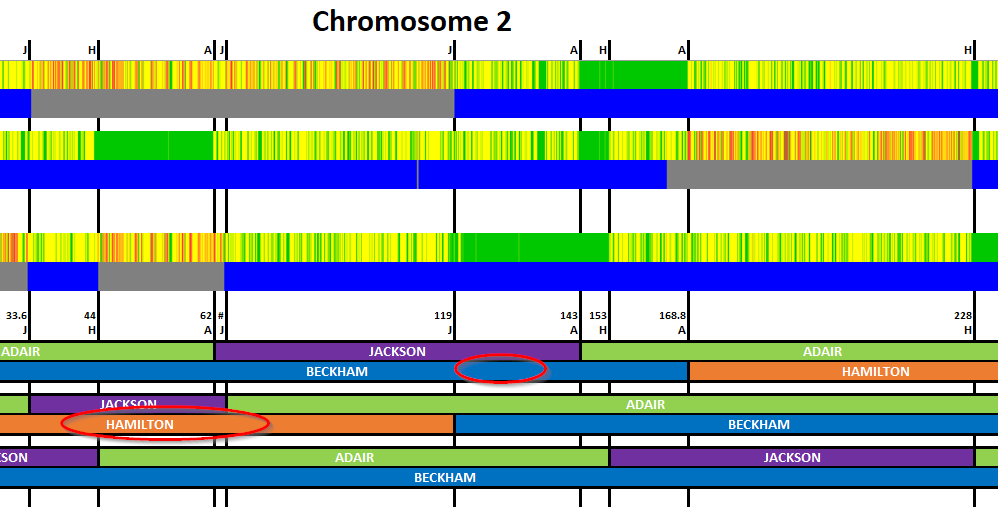
Jane again is shown on the middle bar. The paternal side is on the bottom where she matches on her Hamilton grandfather. The match with Alex on the top shows that he should be matching on the Beckham paternal grandmother. However, this is a small match. It is time to check Alex’ paternal phased kit against Hillock.

I forgot that I had lowered the threshold and was surprised to come up with this result:

The location of this match is within the orange Hamilton segment for Alex’ top bar. The match that Jane reported for Alex should have been 199-208 (unphased). That means that my red circle above on Alex’ bar above is not correct.

Summary and Conclusions

  • Jane is fortunate to have a mother whose DNA could be tested. This gives her paternal and maternal matches for Jane and her two siblings.
  • It is important to know first whether the match is on the maternal or paternal side.
  • If there is no maternal or paternal match, I consider that to not be a match.
  • Jane’s conclusions appear to be correct as far as on which grandparent line her matches are on. However, it is important to make sure that the position numbers of the matches are correct to match up with the right grandparent.


Visual Phasing of My Canadian Frazer Relatives

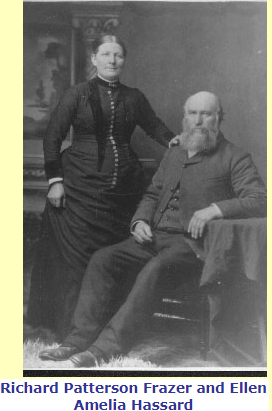
One of the Canadian Line of Frazers descends from my 2nd great-grandfather’s brother. His name was Richard Frazer born 1830 in Roscommon County, Ireland:

My 2nd great-grandfather was George William Frazer, born about 1838. Here are the two lines as shown with their descendants that have taken a DNA test:

Visual Phasing

Visual Phasing is comparing the DNA results of three siblings (or more) and figuring out from which of their four grandparents they got their DNA from on each of their chromosomes. I did that with myself and my four tested siblings. Now on the yellow line we have Susan, Doreen and Ken who have all had their DNA tested. I am 4th cousins to Susan, Doreen and Ken. However, by figuring out where we got our DNA from, it will be almost like comparing our grandparents to each other. Richard Price “Pat” Frazer will be compared with my grandmother, Marion Margaret Hartley. These grandparents would have been second cousins to each other. Now we didn’t get all our grandparents’ DNA, but what we did get, we will be able to identify and compare.

Steven Fox’s Excel Spreadsheet for Visual Phasing.

If you do a Google search for Steven Fox and Visual Phasing, you will find a lot of information and blogs of other’s that have used his spreadsheet. It is possible to do Visual Phasing without his spreadsheet, but his spreadsheet makes it easier, more organized and more standardized.

Jumping in with Chromosome 22

Chromosome 22 is the shortest, so some people start with that one. There should be fewer crossovers on this Chromosome. The downside is that there are also usually fewer cousin matches on this short Chromosome.

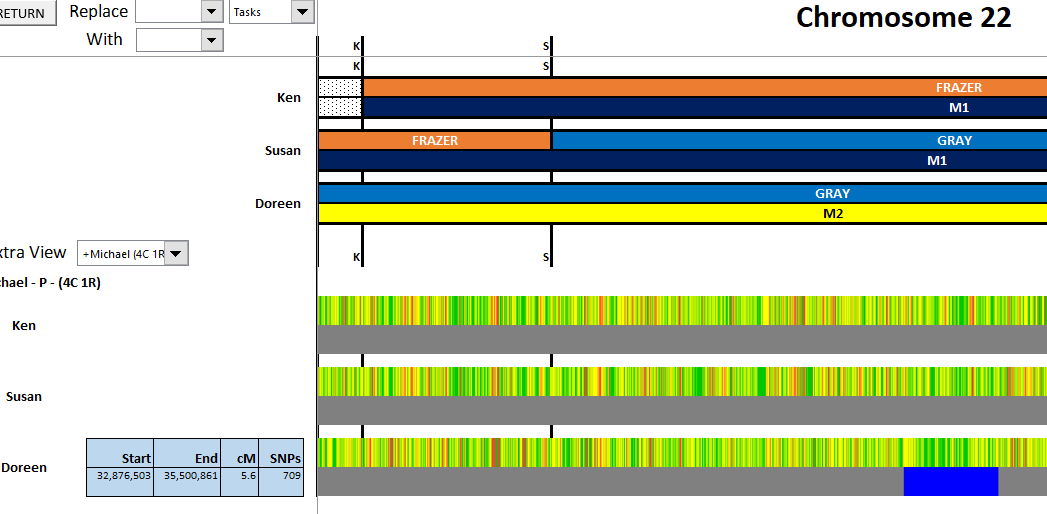
This image is small but if you click on it, it should get larger. The top bar compares Ken (K) and Susan (S). The vertical lines represent crossovers where DNA received changes from one grandparent to another. The location of these changes or crossovers are important. It is also important to know to which sibling these crossovers get assigned to. The first crossover is found where the match between Ken and Susan goes from HIR or FIR. HIR is Half Identical Region. That means that Ken and Susan both got the DNA from one of their 4 grandparents at that segment. The problem is, we don’t know which grandparent. After the crossover, represented by the first vertical line, Ken and Susan have an FIR. This is a Fully Identical Region. That means that Ken and Susan both got their DNA in that segment from two of the same grandparents. One matching grandparent was on the maternal side and one was on the paternal side.

Finding the Location for the First Crossover

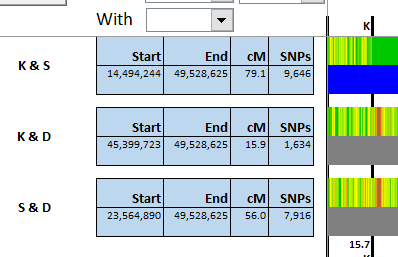
The second crossover is easy to find, because it is at the same place where Susan and Doreen go from no match to a match. This spot is recorded by Gedmatch at 23,564,890. I could call that 24M or 23.6 depending on how exact I want to be. In the case above, I called it 23.6. To get the first crossover, we have to look at the comparison between Ken and Susan at full resolution at Gedmatch.

Here is the first part of Ken and Susan’s comparison at Chromosome 22:

This says that the beginning of Chromosome 22 doesn’t even start until position 14.5M where M is million. Every little ^ is one million. So counting back from 20M, Ken and Susan go from HIR to FIR between 15 and 16M. I’ll call it 15.7M. The pink part is a centromere. Usually this would be at the center of the chromosome, but there must be information at the very start of Chromosome 22 that isn’t used.

One Crossover or Two on the Right Side of Chr22?

Here is a blowup of the last two crossovers. On the top bar, there is a spot where Ken and Susan go from HIR to FIR. However, this does not line up with position 45.4M where Ken and Doreen go from no match to an FIR. However, to be sure, I need to know where Ken and Susan go from an HIR to an FIR.

According to Gedmatch, the end of Ken and Susan’s match is at 49.5M. That means the last ^ is 49M. That means that Ken and Susan’s change from HIR to FIR is between 45 and 46. I’ll say 45.7. This is pretty close to 45.4, so a judgement call. I’ll just leave it as I had it.

Assigning the Crossovers

The crossover usually gets assigned to the person that is in two of the changes. This is easier to see in the second crossover. There is a change in the top and bottom comparisons. The first comparison is Ken and Susan. The last comparison is between Susan and Doreen. Susan is the common denominator, so she gets the crossover.

I gave the first crossover to Ken:

I had forgotten why. Now I remember. I think that there is actually a very small match that doesn’t show up between Ken and Doreen at the beginning of the Chromosome. It is very subtle, but I’d say that there is more green in the beginning of the K&D comparison compared to the S&D comparison. These crossover assignments can be a bit of an art. If I had lowered the match resolution it should have shown up as a blue match there.

The last two crossovers were not easy either:

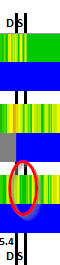
These changes have to come in pairs. That means that I had to treat the little segment between D and S as an FIR on the bottom comparison. That means that there are two changes for Doreen first making that her crossover. Then there are two changes for Susan (top and bottom comparisons).

Working on the Segments

This image is the end result, but I will say how I got there. First I started with K&S. They have a FIR for the second segment. This shows as dark green. In the image above, that means that Ken and Susan have two of the same colors. They match with one maternal grandparent and one paternal grandparent. Because Ken has no crossover to the right of the second segment, I can extend that DNA all the way to the right end of the Chromosome on both Ken’s maternal and paternal sides. Also in the second segment, Doreen has no matches with Ken or Susan. That means she has the spouse of the other two grandparents in that slot. So instead of orange and purple, she gets blue and green there. She has no crossover to the left and none on the right until near the end of the Chromosome.

At some point I have to deal with a HIR. I did that with Susan after the second segment. Susan has a HIR to Ken and Doreen. I made Susan match Ken’s purple but not his orange. We already knew that Ken and Doreen had no match in the third segment, so Doreen got the opposite colors there.

The last three bars in the image above represent Gladys’ match with Ken, Susan and Doreen. She shows a match with only Ken and not Doreen nor Susan. This has to be in Ken’s orange section as that is the only place along the match with Gladys that one of his segments is different than Doreen’s or Susan’s.

Gladys and Ken only match on the Frazer Line. Gladys has no Gray DNA. That means orange has to be Frazer. The only other paternal side is Gray so blue has to be Gray. I don’t have specific information on Ken, Susan and Doreen’s maternal side, so those are just labeled G3 and G4 for now. Actually, they should be M1 and M2 for maternal grandparents:

Ken and siblings’ father’s name is Stefansson and their mother’s surname is Gudmundsdottir.

How to Use Visual Phasing

Now that we know where Ken, Susan and Doreen got their DNA from on most of their Chromosome 22, what can we do with this information?

Part of the information is educational. Knowing how our DNA recombined by way of our grandparents is interesting. It is a kind of snapshot of what went into our makeup at conception.

Another part has to do with DNA matches. This focus us as to where our matches are. However, there is still one hitch. We still need to know if our matches are on our maternal or paternal side. If we don’t have a parent to compare our matches with, then it is possible to compare matches with known relatives.

Use of Crossovers

The exception to this is if Susan were to have a match that started before her crossover at 23.6 and continued beyond it. For a match that goes through a crossover, it has to be on the other side. So for such a match for Susan, this could not be a Frazer match but must be on her mother’s side.

These visual phasing maps work best when you have downloaded all your matches. Then you will know for every Chromosome which grandparent they will match depending where in the Chromosome your match is. If you have a lot of matches that end at a certain place and then other matches that start up again at that spot, that could be indicative of a crossover.

Separating Real Matches from Far Away or False Matches

Another way to use these results is to tell if a match is real or not. Here is part of mapped Chromosome 22 showing a small match between Doreen and Michael of the Frazer Project:

It shows that Michael only matches Doreen and not Susan nor Ken. Michael’s match is indicated by a blue bar at the bottome right of the image above. However, Doreen has no Frazer DNA in that segment. She only has Gray DNA on her paternal side. So, it may mean that Doreen matches Michael on the Gray line going way back or less likely on the Icelandic Line. But Michael could not be matching on the Frazer Line assuming I have mapped this correctly. As I mentioned, this is a small match of 5.6 cM. Matches under 7 cM have more than a 50% chance of not being real matches.

Comparison with My Visual Phasing

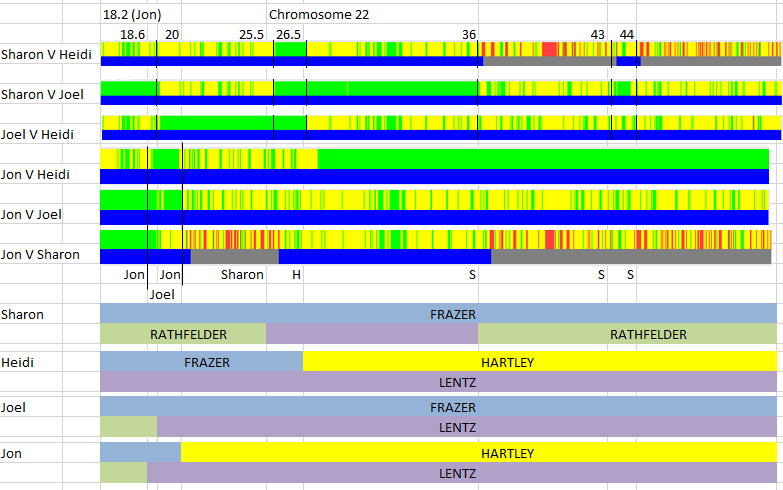
Here is my Chromosome 22. It is mapped along with three of my siblings. I didn’t get around to mapping Lori.

When I compare the two maps, I can see where my siblings have the potential to match with Ken, Doreen and Susan along the Frazer Line. It doesn’t mean we have to match there. For example, my Frazer grandparent DNA also has Clarke and McMaster DNA that Ken, Doreen and Susan don’t have. Likewise, Ken, Susan and Doreen have other DNA in their Frazer line that I would not share.

Extra Chromosome Mapped

While I was at it, I mapped Chromosome 12:

This was a little easier, because more cousins matched on this Chromosome. One interesting thing about this Chromosome is that between about 88 and 104M, there is no Frazer DNA. That means that if any of these siblings have a match in that area, it could not be a Frazer match.

This map had three spots that appeared to go from a no-match to a FIR or from a FIR to a no-match. This is impossible, so there needs to be a HIR transition. That is why there are three places where the crossovers are close.

Summary and Conclusions

  • Visual Mapping shows the process of our makeup based on how our grandparents’ DNA combined to form us
  • This mapping can be helpful in identifying DNA matches
  • Special attention should be made to crossovers. That is where DNA on one side of our Chromosome changed from one grandparent to the other.
  • If a match goes through a maternal crossover, for example, it means that match must be on the paternal side.
  • A lot of genetic genealogy is about separating out the DNA and visual phasing goes a long way in doing this.
  • Other sorting can be done by names or location of matches. As Ken, Doreen and Susan’s mom is Icelandic a clue as to the matches’ names, locations or genealogy can be a hint as far as placing them.
  • Visual Phasing works best when there are good cousin matches on all four grandparent sides.


My Mother’s Best Lentz DNA Match

I’ve been in touch with Radelle for a while. First, we were in touch over Lentz genealogy without the DNA part. Some of the Lentz genealogy that I had done in the past was helpful in Radelle finding parents for her ancestor Eliza Lentz. Radelle later took the AncestryDNA test and recently uploaded those results to Gedmatch.com.

Lentz Genealogy

I have made a Lentz tree for those that have had their DNA tested and uploaded the results to Gedmatch. There would be a bigger tree of those who haven’t had their DNA tested.

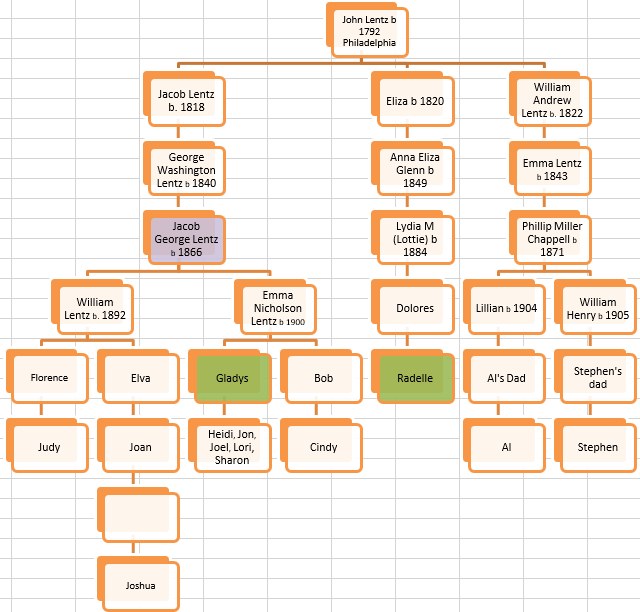
I’m on the left side of the chart. Radelle is on the right side of the chart. Radelle, Al, and Stephen descend from Eliza and William Andrew Lentz. Note that Al and Stephen’s great grandfather is Phillip Miller Chappell. Phillip Miller is discussed below as the 2nd husband of Eliza who married John Lentz at the top of the chart. Phillip Miller most likely raised the young Lentz family. Judy, Joshua, my mom and her children and my 1st cousin Cindy descend from Jacob Lentz b. 1818. Because Jacob George Lentz b. 1866 married Annie Nicholson, I can’t tell for sure if the matches with Judy, Joshua and Cindy are on the Lentz side or Nicholson side. Radelle and my mom are 4th cousins. Radelle is 4th cousin once removed to everyone else except for Joshua. Radelle is 4th cousin, 3 times removed to Joshua.

I had a difficult time nailing down John Lentz years ago when I was working on Lentz genealogy. I wasn’t sure if there were one or two John Lentz’s in the area at the time. From what I could tell, John died and his wife Eliza married Phillip Miller. Here is an 1877 death notice for Eliza:

Notice that the funeral reception was at Eliza’s daughter in law’s house. Mary A Lentz was my 3rd great grandmother, the wife of Jacob Lentz b. 1818. Eliza was Jacob Lentz’s (b. 1818) mom, so Mary A Lentz his wife was Eliza’s daughter in law. Based on the above death notice, Eliza would have been born about 1796.

Who Was the Eliza Lentz Married to John Lentz and Phillip Miller?

I see that Radelle has a possible name for Eliza:


This record was from Trinity Church, Oxford. According to Wikipedia:

Old Trinity Church, also known as Trinity Church, Oxford, is a historic Episcopal church founded in 1698 in Oxford Township, Pennsylvania, which is now part of Philadelphia

Here is another hint that came up for me at Ancestry. This is from Kensington

This may fit in better as far as the date goes. This would mean that Eliza was married at about age 26. The first marriage, Eliza would have been married at about age 17.

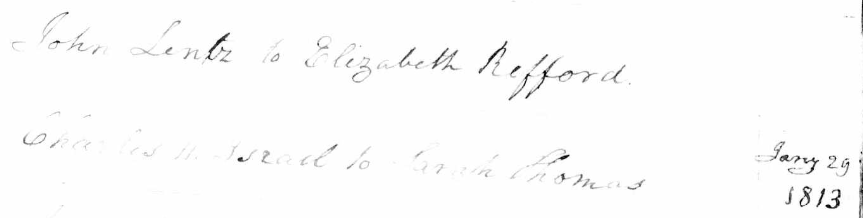
However, having said that, it does appear that Radelle is right as I have that the three sons of John were born before December 1st 1822. Perhaps Elizabeth Refford died in childbirth at the birth of Wiliam Andrew Lentz who was born 13 May 1822. John would have had no one to take care of his young family. So perhaps he remarried Eliza Rihl later that same year. Something to think about. However, then John Lentz died in 1823. Eliza marries Phillip Miller in 1825. If I have my facts right, then the Lentz children were raised by a step mother and a step father.

The DNA Part

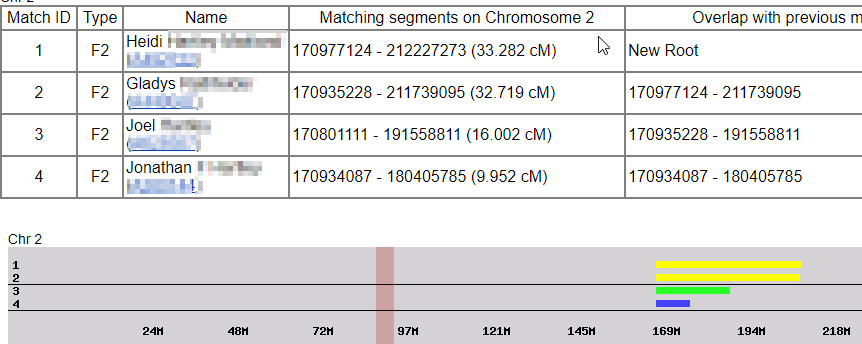
I said that Radelle was my mom’s largest Lentz DNA match. Here is how they match at gedmatch:

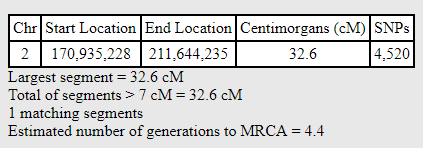
Their estimated common ancestors are at 4.4 generations based on the DNA match. Their actual ancestors are 5 generations back, so that is a bit more than average DNA that they share. Here are some more matches Radelle has with my family:

Heidi and Jon are my siblings. Gladys is my mom. Heidi got the same match with Radelle that my mom had. Jon and I got less. My two sisters Lori and Sharon don’t match Radelle.

Mapping My Family’s DNA onChromosome 2

I have my DNA mapped. That mapping shows where my siblings and I got our DNA based on how our four grandparents contributed. Any match with Radelle should be on the Lentz grandparent side.

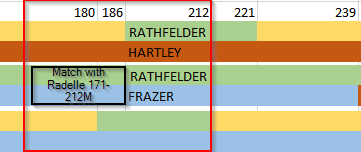
This shows why Jon and I had less than a fuill dose of Lentz DNA from our mom. My mom matches Radelle between 171 and 212M. I have a crossover at 186. That means on maternal Chromosome 2, my Lentz DNA ends at 186M and the Rathfelder DNA takes over. Lori is has all Rathfelder DNA in that area (from my mom’s dad) so she doesn’t match Radellether. Jon has a Crossover at 180M, so he matches Radelle’s Lentz DNA less than I do. Here is a close-up of the area where Radelle matches me and my brother Jon:

We match Radelle only in the yellow Lentz segments. I didn’t show Heidi, but she has a longer Lentz segment than Jon or me in this area of Chromosome 2.

DNA Matches to My Mom and Radelle

At Gedmatch, there is a way to find common matches to two people. I did this for my mom and Radelle. When those matches are on the same segment, that tells me that these people should share the same ancestors. Here is how my mom matches Radelle and four others on Chromosome 2:

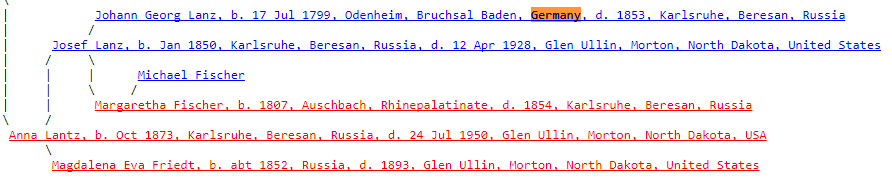
#3 had a tree at Gedmatch.

A Lanz/Lantz family may be a link to the Lentz family.

Another Chromosome Map

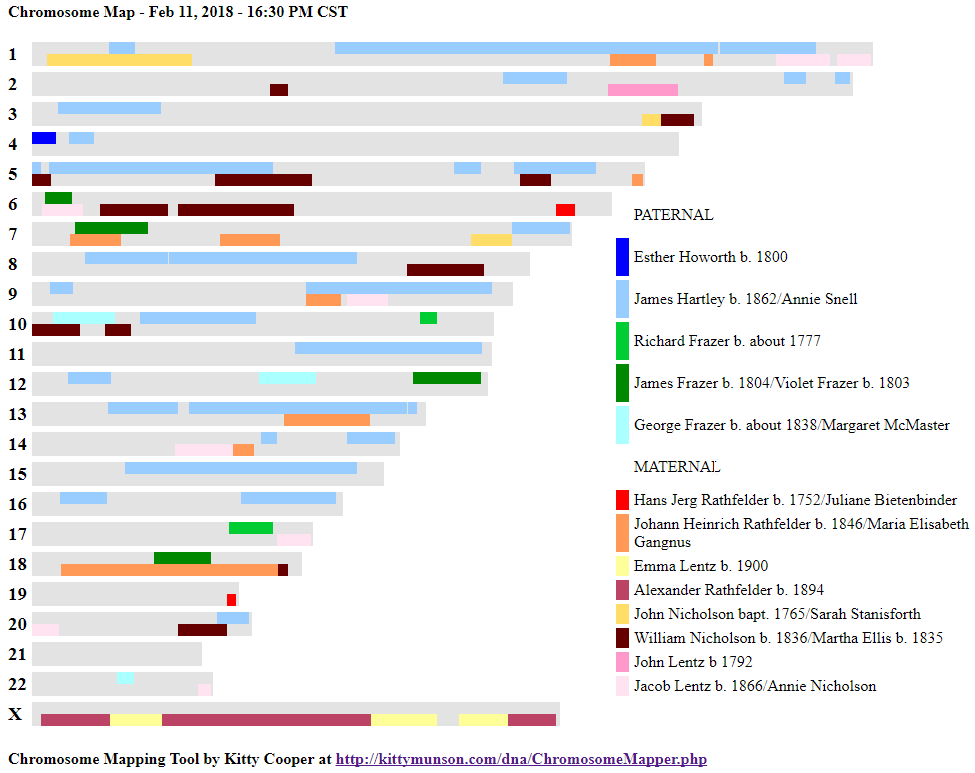
Kitty Munson has a chromosome mapping utility at her web site. Using my new match with Radelle, I get this:

The new match with Radelle translates to the DNA I got from John Lentz b. 1792 (or his wife who appears to be Elisabeth). That new piece of DNA appears in pink on my maternal side Chromosome 2. This map is different from the mapping I did with Chromosome 2 above that only has my grandparents. This map uses matches from actual people with known ancestry. The DNA match with Radelle pushed back what I had on the Lentz family over 70 years.

Other Matches?

Unfortunately, I didn’t see other matches between Radelle and other Lentz descendants. It may be that the relationships are too distant and the DNA dropped out. However, Radelle matches my mom and three out of five of her children. My mom matches others on the Jacob George Lentz branch. That implies that the DNA match between my mom and Radelle also applies to them:

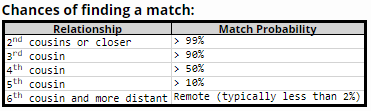
Here are the chances of matching a specific level of cousin:

Summary and Conclusions

  • Radelle is my mom’s biggest identified Lentz DNA match. This helps solidify the genealogy that Radelle and I have done.
  • With previous Jacob George Lentz descendants matches, I couldn’t tell if the DNA represented Lentz or Nicholson. The match with Radelle would be the first Lentz-only identified DNA match.
  • I was able to add a late 1700’s Lentz DNA segment to my Chromosome map
  • Radelle got me thinking again about John Lentz, Elisabeth and Eliza. I came up with a possible scenario for this family which had the children being raised by two step-parents.
  • Radelle does not match other Lentz desendants by DNA. This may be due to the distance of the relationships. After fourth cousin level, the chances of matching by DNA drops off.
  • I’ll be waiting to see if we find other Lentz DNA matches. These matches seem to be a bit rare.


Two Person Hartley Visual Phasing

I’ve had a FTDNA kit hanging around for my father’s elderly cousin. I’ve had it since last Summer, but haven’t gotten in touch with my second cousin Lisa to see if I could get her uncle tested. This would be important, because I have test results for Lisa’s dad Jim and her Aunt Joyce. The third sibling Ralph would make it easier to perform Visual Phasing.

Visual Phasing

Visual Phasing is comparing siblings’ DNA results in a Chromosome Browser. By looking at changes and comparisons in the Browser as well as matches to known cousins, it is possible to find out what portions of the siblings’ DNA came from which grandparent. For me, this is important as I am interested in separating out matches between my great grandparents Hartley and Snell. Jim and Joyce’s maternal grandparents were James Hartley and Annie Snell. Annie’s ancestors went back to SE Massachusetts Colonial times. James ancestors were from NE Lancashire. I’m stuck on Hartley genealogy in Trawden, Lancashire around 1800. This is due to the fact that there were too many Hartleys in the area at the time to tell one from another based on vital records. Finding Lancashire Hartley ancestor DNA matches may help me break down my Hartley genealogical brick wall.

Joyce and Jim’s Genealogy

The goal of visual phasing is to figure out what parts of Gurney, Rounesville, Harltey and Snell contributed to Jim and Joyce’s DNA. In doing this, it would help to have matches from fairly close (but not too close) relatives on all four lines.

Comparing Jim to Joyce on Chromosome 11

I’ll just jump in and start with Chromosome 11. This is midway between 1 and 22. Here is the comparison between Jim and Joyce:

  • The blue line is where Jim and Joyce match each other
  • Within the blue line there are two types of matches
  • The yellow area is a single match. This is also called a Half Identical Region (HIR). This means that Joyce and Jim get their DNA from one shared grandparent A, but don’t match on grandparent B, C or D. We don’t know now if granparent A is on the maternal or paternal side.
  • The green is a double match. That is called a Fully Identifal Region or FIR. In that area they got the same DNA on their maternal and paternal side of Chromosome 11. That also means that they share the DNA from the same maternal grandparent and the same paternal grandparent
  • The grey, non-blue area (below) and the red area above is where Joyce and Jim do not match. That means that Joyce gets DNA from Maternal grandparent A and Paternal grandparent C while Jim gets his DNA in that area from Maternal grandparent B and Paternal grandparent D
  • At each vertical line above, there is a crossover where Jim or Joyce’s DNA goes from one grandparent to another.

Let’s Start Two Person Visual Phasing

Here is a start. In about the middle of the Chromosome there is a green FIR. That means that Jim and Joyce got their DNA from the same maternal and paternal grandparents. Those grandparents are represented by blue and orange segments. There are crossovers on the right and left of these segments, but we don’t know if the crossovers are for Jim or Joyce (or one for Joyce and one for Jim).

It would be nice to know where the changes take place, so I go to gedmatch.com for that. At gedmatch I compare Joyce to Jim in the chromosome browser at full resolution.

The pink area is the centromere of Chromosome 11. Every ^ is one million places. The start of the green HIR counting back from 60M is 57M.

Here I added the 57 before ‘Chromosome 11’ above. I also added some other crossover locations.

Cousin Matches

I am stuck already in my analysis, so I need some cousin matches. These would ideally be at the level of second cousin matches. At the level of second cousin, you match on only one grandparent. Most known matches matches share Hartley and Snell grandparents, so that is a problem.

Shared Ancestor Hints (SAHs) at AncestryDNA

Joyce’s results are at AncestryDNA. There, she has Shared Ancestor Hints. Those Hints are where Joyce has a family tree match and a tree match. Here is an SAH that Joyce has with Chuck:

Chuck is at the perfect level as he is a 2nd cousin. However, he has not uploaded his DNA to gedmatch for comparison. Ancestry does not show on what Chromosomes you match, so that is a problem. We need chromosome match information for DNA mapping.

Back to Gedmatch

Because many at AncestryDNA don’t upload to Gedmatch, I’ll go back to Gedmatch and look for matches there.

Here is a very interesting match that Sumner and Heather have with Joyce at Gedmatch. This shows that Joyce has an estimated by DNA common ancestor between 3.7 and 3.9 generations away. They also share autosomal DNA and X Chromosome DNA. These two are also at Ancestry and show up on Joyce’s Shared Ancestor Hints.

Here, Joyce and Sumner are 4th cousins by shared trees. However, note that this is only hint 1 of 3. HInt two also goes back to Joyce’s Rounseville grandparent at firth cousin twice removed. Here is Hint 3:

This Snell connection is at 7th cousin once removed. There has to be a very low chance of a DNA match that far out – especially compared to a 4th cousin match . However, this is interesting as it shows that Joyce has two paternal matches with this person and one more distant maternal match.

Here are the important details of the match between Joyce and Sumner:

This shows that Joyce and Sumner match on four different chromosomes, but not Chromosome 11. OK, back to the drawing board. I’ll start over with Chromosome 7. Sumner and Joyce have a pretty good match there.

Chromosome 7 Visual Phase Two Person Map

Note that Joyce’s Chromosome 7 match is from 149 to 158M. That is at the right side of Chromosome 7. It is possible that the 149M could mark Joyce’s paternal crossover. I am going to start from the right of the Chromosome and give Jim and Joyce four different colors there. This will represent all four of their grandparents. I can do that because Jim and Joyce don’t match each other at all in that segment.

Here I have put Joyce in for a possible to likely crossover at 149. Remember that Joyce and Jim don’t match each other at all after 149M. That means that Jim won’t match Sumner either. I checked gedmatch and he doesn’t as expected. Next, I’ll assign Sumner’s match to Joyce on either her green or brown side. I’ll randomly choose green. That puts the paternal side on the top for Jim and Joyce:

Becuase Joyce’s green paternal segment is Rounesville, that means that Jim’s orange segment must be the paternal husband, Gurney.

Next, I would like to check the paternal crossover for Joyce. The recommendation at the Facebook Visual Phasing side is to look for ‘stranger matches’.

Stranger Matches

If I see that Jim has a match or matches that go across the 149 crossover line, then I can assume that he has no crossover there. The hitch is that the match going over the 149 line needs to be on Jim’s paternal side on the top of his Chromosome 7.

Here is a spreadsheet of Jim’s matches on Chromosome 7. Jim’s match with Tim goes clearly from 138-155M. That meets one requirement. Is this a paternal or maternal match for Jim? My thought was that if this match was maternal, then Tim should match my sister Heidi at the top and me at the bottom of the list in blue. I checked and Tim only matched Jim. That means that the crossover belongs to Joyce and is likely on her paternal side. The only thing I didn’t rule out is that the crossover could possibly be on Joyce’s maternal side.

Here I went with my original guess that Joyce’s crossover was on her paternal Gurney/Rounesville side. Because I gave the crossover to Joyce’s paternal side, that meant that there was no other crossover at 149 and I moved the maternal segments to the left. I still have figured out whether Hartley or Snell is blue or brown. Next note that the segment from 110 to 126M is a no-match segment. That means that there must be a maternal crossover next. The reason for that is that no-match means four different colors. Jim and Joyce already have different colors on the maternal side. If we change one of those colors with a maternal crossover, there will be a match between 110 and 126M.

In order to get a no-match from 110-126M, Jim or Joyce’s DNA must be Rounseville from 110 to 126M.

Stranger Match or More Cousin Matches?

I really should go with both, but I’ll start with the stranger match. Jim has matches between 105 and 134 showing no crossover there. When I look at one of those matches and run those that are in common, I get this:

#1 is Jim’s sister Joyce. 2-6 are the strangers and #7 is actually a 2nd cousi of mine, but it could be from a match on another line. So Jim is matching the strangers in that 105 to 134M area. However, he is matching Joyce starting at 126. That gives me the impression that it is Joyce that has the crossover. On the other hand, I don’t see any of Joyce’s matches on her match list that go through 126M.

i am moving slowly from right to left on Chromosome 7. The segments that I am really interested in, I have no information on – except that one is Snell and one is Hartley and they appear to be relatively large segments, so far.

Phasing by Geography

I had mentioned that Snell’s ancestors were from SE Massachusetts going way back. The Hartleys came to the US from Lancashire in the last half of the 1800’s. As far as I know, the Gurneys and Rounesvilles have been around SE Massachusetts for several hundreds of years also. When I look at Joyce’s matches at Chromosome 7, I see some interesting emails. Between 155M and the end of Chromosome 7, Joyce has three small matches with people three people that have nz, au or uk in their email addresses. That gives me the opinion that at least from 154M to the Joyce could have Hartley DNA. That also brings up the question as to whether Joyce has a maternal or paternal crossover at 149M. If I go with what we had already, I would get this:

Starting to Visually Phase Chromosome 8

I can come back to Chromosome 7 at some time. I’m looking at Chromosome 8 as I wrote a Blog about a Lancashire matcher here. Here is how Anne matched Joyce and two of my second cousins:

The important part is that Anne matches Joyce from about 17 to 59M. That is a pretty good match. Here is the common ancestor:

The other important thing is that even though the match points back to Howorth, this is on Joyce and Jim’s Hartley grandparent line.

Here is how Jim and Joyce match each other:

Here I did something different. I started by mapping a HIR or Half Identical Region. That means that one grandparent matched and the other two did not. We know that Joyce matched on the Hartley segment and Jim did not.

That means that the maternal Hartley/Snell side is on the bottom of their Chromosome 8. From here, we can logic a few more segments. Going from HIR to the no-match left, that means the top part will have to change for there to be no match at the beginning of Chromosome 8. Using similar logic, for all to match (in the HIR region), the crossover will have to be on the bottom of Chromosome 8.

Next, on Joyce’s match list, I picked someone who she matched that went through the 70.7M crossover.

I picked the 18 cM match. Then I picked people that matched both Joyce and the stranger’s 18 cM match.

#1 is Jocye’s match to her brother Jim. The next three matches go up to 74, so they go through the crossover. #5 is our stranger, Sheila with the 18 cM match. There is another interesting thing about Match #2. That is Jo who is on Ancestry with a private tree. However, when I click on her name, it says she is from Lancashire, England. Someone with a tree at Ancestry and DNA at gedmatch is good news to me, so I wrote an email to her.

Here is another piece of the puzzle:

I don’t know what the orange represents, but I don’t match Joyce and Jim on that side, so it isn’t as important to me. I was interested in separating the green DNA from the blue – or the Snell from the Harltey DNA. I was able to do that thanks to visual phasing and a match with Anne.

Wrapping It Up

  • It is possible to do some visual phasing with only two siblings. However, cousin matches, and stranger matches are needed.
  • Geographical phasing is also important. I like the use of email extensions to identify non-US matches.
  • Mapping my father’s two cousins is important in separating my Lanchashire ancestors from my colonial Massachusetts ancestors.
  • Work is needed to get AncestryDNA testers to upload their results to gedmatch.com
  • More matches could be found by checking FTDNA
  • More work is needed in tracking down genealogies of gedmatch mathes. This would help identify segmens of visually mapped chromosomes.
  • Attention to mapped segments of interest (in this case Hartley) can lead to matches to follow-up with.

Mapping James Frazer born 1804 and Violet Frazer born 1803

In my last Blog, I wrote about Doreen’s results. Doreen and I have the common ancestors of likely first cousins, James Frazer b. 1804 and Violet Frazer born 1803. For some reason, I don’t believe that I have ever mapped this couple out using Kitty Munson’s Chromosome Mapper.

Descendants of James and Violet Frazer

The people in bold have all taken autosomal DNA tests. That is, except for Rick who took the YDNA test. If I compare myself to Susan, Doreen, Pat, Gladys and Bill, the DNA that we share would represent either James or Violet Frazer.

Kitty Munson’s Utility requires the information be put into a CSV File like this:

I share the first and last segments with Doreen. The second I share with Pat. I share rows 3, 5, and 9 with Susan. I share rows 4 and 8 with Gladys. I share rows 6 and 7 with Bill. However, they are the same segment. One is as reported at FTDNA and one is as reported at Gedmatch.

Here is my map of just these two ancestors:

This is just my map. The map for each of my siblings and my cousin Paul would look different. Also The map for each of the people in the yellow part of the James/Violet Tree would also look different.

Here is the blue James/Violet segments  (now showing as navy blue or black) with other segments I have identified:

Next, I would like to put the ancestors in a better order. They appear randomly, but I am guessing that the first chromosome gets the first color, etc. as I have my table sorted by chromosome. My four grandparents are Hartley, Frazer, Rathfelder and Lentz. So I would like to sort them by these four grandparents. Then I would like the older ancestors in each line first. That is, except for Annie Snell. I have her listed separately as I must have figured out some of my DNA was from her. However, her dark green is overshadowed by the blue Hartley/Snell segments.

My new order will be:

Hartley:

  • Esther Howorth
  • Otis Snell
  • Annie Louisa Snell
  • Hartley/SNell

Frazer:

  • Richard Frazer
  • James/Violet Frazer
  • George Frazer/Margaret McMaster

Rathfelder

  • Hans Jerg Rathfelder/Juliane Bietenbinder
  • Rathfelder/Gangnus
  • Rathfelder/Lentz

Lentz

  • Nicholson/Stanisforth
  • Nicholson/Ellis
  • Lentz/Nicholson

That configuration gives me this:

I like the colors better. However, Annie at the first part of Chromosome 16 is still subsumed in Hartley/Snell in dark green. Also Otis Snell is a tiny segment at about 4cM. I think I’ll take out Otis and Annie:

I like this version the best. I have a lot of Hartley/Snell as this couple had 13 surviving children. As a result, I have a lot of 2nd cousins with matches. Hartley/Snell is now light blue. James/Violet Frazer is now dark green. My goal is to split up the light blue into Hartley and Snell.

Summary and Conclusions

  • I added some important James Frazer/Violet Frazer segments to my Chromosome Map
  • This couple was born in 1803/4.
  • Mapping points out where you have cousin matches and where those matches are missing
  • I hope I haven’t missed any other important ancestor segments on my map