My Big Fat Chromosome 20

I never would have guessed 10 years ago that I would be blogging about my Chromosome 20. 10 Years ago I was definitely interested in genealogy, but knew virtually nothing about DNA. Even if I did know anything about DNA I would not have guessed that it would have anything to do with genealogy.

My Chromosome 20

My Chromosome 20 actually isn’t that big and fat. Actually it is one of my smallest chromosomes. However, I have more matches there than on any other chromosome. In fact, over 1,000 – more than a quarter of my matches – are on Chromosome 20. This is pretty amazing considering I have 23 chromosomes counting my X Chromosome. If my matches were spread out evenly over these 23 chromosomes, I would expect each chromosome to have about 4% of my matches. This representation shows the ridiculous number of matches I have on Chromosome 20. They are on the bottom of the image in light blue.Joel Hartley Circle Chart

This particular representation is for just my FTDNA Family Finder matches. I believe the threshold was set relatively high and this was done a while ago. However, at the time and threshold, it appears that more than half of all my matches were at Chromosome 20.

How To Explain All the Matches? Colonial Massachusetts?

I had a difficult time explaining all the matches I had on Chromosome 20. Most were on my paternal side as that is where most of my matches are. I had guessed that these may have been due to a colonial effect as that had been suggested in various places. My great grandmother’s mother was a Bradford and was descended from the Mayflower Bradfords. A lot of those early Pilgrims married other related Pilgrims. In fact, some of my Chromosome 20 matches were descended from a Brewster who was one of the Pilgrims that I am also descended from. Then there were a few who seemed to be related on my Irish Frazer side. Finally I had a match with Bonnie from the Frazer DNA Project I am working on. She matched on Chromosome 20 but was outside my large triangulation groups.

Chromosome 20 Triangulation Groups

I also have Triangulation Groups (TGs) for Chromosome 20 – very large ones. In fact, gedmatch would overload when I tried to run an analysis I had so many. I have 2 paternal TGs and one maternal TG. There also may be sub-TGs within those.  I have roughly 650 matches in these combined TGs. So now, based on testing my mother, I knew if my matches were maternal or paternal and if they were in TGs, but I still didn’t know much about where the common ancestors could be other than a vague guess about colonial Massachusetts. What I did was ignore Chromosome 20. I gave up even adding matches to my spreadsheet because I had so many. These matches tended to be around 13 cM with some higher and some lower.

Sticky Segments Or Pileup Areas?

While looking for a Chromosome 20 explanation, I read about sticky segments and pileup areas. Sticky segments are those that came down intact for many generations. They don’t want to go away. However, a few sticky segments wouldn’t explain over 1,000 matches. It seemed like I had a pileup, so I looked into those. Pileup areas are areas are described by Jim Bartlett in his comment on one of his blogs:

I do find that each person tends to have two kinds of pileup areas: 1) are fairly narrow, are widespread, and are outlined in this ISOGG article: http://isogg.org/wiki/IBD#Excess_IBD_sharing; and 2) are also fairly compact (7-9cM) and are unique to each person. I believe these are caused by a unique set of markers in our personal DNA that makes it easy to form matches with others in that region. These are characterized by many segments in a narrow range, which do not generally Triangulate, and the Matches don’t see this as a pile-up area, only you do.

However, my case didn’t seem to match some of the explanations of sticky segments or pileup areas. My matches were larger and did triangulate. Furthermore, they were not in areas of the chromosomes described in the ISOGG article above.

Enter Kathy Johnston and Her Crossover/Segment Analysis

At the beginning of 2015, Kathy posted her instructions on an FTDNA Forum for analyzing DNA based on the 3 siblings. She showed how to determine the 4 grandparents’ contributing DNA for each of these siblings.  I discovered her post at the end of 2015. Could this help me figure out my Chromosome 20? I tried Kathy’s method and got some surprising results.

Finding Chromosome 20 Crossover Points

Finding crossover points in Chromosome 20 was not as easy as it has been in other chromosomes. According to Kathy, usually there will be one owner of a crossover point. This owner will appear in 2 out of the 3 comparisons at a crossover point. In this one, I found only one clear owner. That was my sister Heidi at position 47. For the other ambiguous crossover points, I gave a double initial separated by a slash.

Chr 20 Crossovers

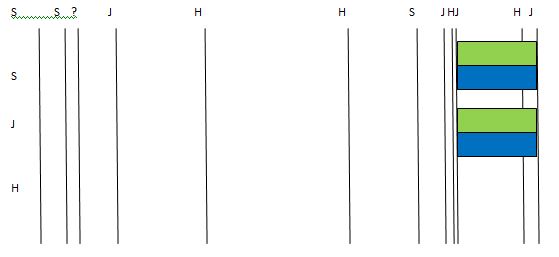
Below, the gedmatch comparison is transformed into a maternal/paternal Chromosome 20 map. The green area means that Heidi matches Joel on the 3rd segment. This match is a Fully Identical Region (FIR). This means they match the same maternal grandparent and the same paternal grandparent. For Joel, I move those grandparent to the right as I have no crossovers until the last crossover point.

Chr 1 Segment 1

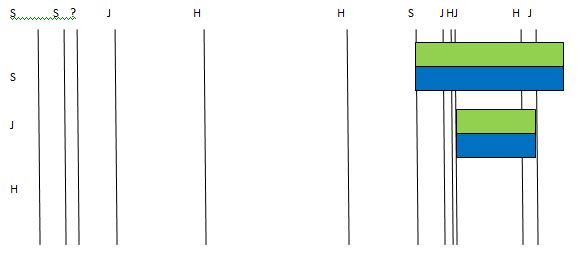
Sharon has no match with her 2 siblings in the same area, so that will mean she shares the complementary grandparent on her maternal and paternal DNA. This will be represented by 2 different colors. I again extend that double segment to Sharon’s crossover points.

Chr 1 Segment 2

Looking at the earlier gedmatch comparison, in the 2 segments to the right of Heidi’s existing mapped segment, there is a Half Identical Region (HIR). That means a grandparent matches on one chromosome and doesn’t match on the other. This will be shown as 2 different colors in this area when comparing Heidi to Joel. This first HIR choice is chosen randomly as no names or side (maternal/paternal) have yet been assigned to the grandparents.

Chr 1 Segment 3

Next, we have an illogical situation.

Chr 20 Crossovers

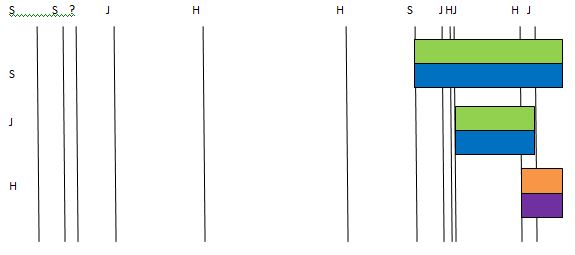
In the next to last segment, the smaller one, Sharon is no match with Heidi or Joel and Heidi and Joel have a half match. That is illogical because if Sharon doesn’t match with Joel, that is the same orange/purple scheme continued in the small segment for Sharon. Then if Sharon and Heidi are opposites, it goes back to green/blue for Heidi in that small segment. Those are the same colors that Joel already has, so that means that Heidi and Joel can’t be HIR which means they should have one matching color and one non-matching color. However, look at that small segment again in the first two rows. The red is strong in the first row. In the second row, I hardly see any red – with red indicating no match at gedmatch. Therefor, I’m going with the first comparison of Heidi and Sharon. Plus this goes with the matches that I will mention soon that Sharon has. I make Sharon and Heidi opposite in Sharon’s little segment and extend that segment to the end.

Chr 1 Segment 4

I filled in some of the no matches and FIRs on the right. On the left, I was left with 2 illogical no matches again, so I chose the redder of the 2. This left me with having to guess a HIR on the left. I am only allowed one guess, so I left this blank for now.

Chr 1 Segment 5

Adding Real Grandparents

It would be nice to add actual grandparents here and not just speak of my orange grandparent, for example. I can do this using two of Sharon’s matches.

Sharon's Chr 20 Matches

These 2 important matches Sharon has are both on the paternal side. James is related to my grandfather and Bonnie is in the Frazer DNA Project on my Frazer grandmother’s side. Coincidentally, the orange match above goes with the orange on my chromosome map. That would make my paternal grandfather Hartley orange and paternal grandmother Frazer green.

Joel’s Matches

Here’s my Frazer match with Bonnie. 47 to 54 is in my green Frazer region on my map. So that is a relief.

Joel's Frazer 20 Match

Below is my only maternal match. It is with a cousin on my maternal grandmother’s line. She matches only with me because she tested at 23andme and hasn’t uploaded to gedmatch yet.

Joel match Judith 20

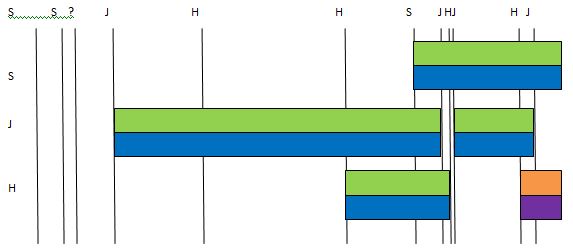
However, Judy gets me unstuck on my maternal side. Her match is telling me that from zero to 8, I can identify my grandparent. I already have blue from 6 to 8 (from using my brighter red logic). So I just need to extend the blue all the way to the left on my maternal segment line. That gives me a solid blue on Chromosome 20 on my maternal side.

Chr 20 Final Segment

This is as far as I can figure out now without further guessing. Perhaps when cousin Judy gets her DNA uploaded to Gedmatch, I will know more. So what does this tell me about my 1,000 plus Chromosome 20 matches and 600 plus matches that appear to be in Triangulation Groups?

Mystery Solved?

I think it is. These matches correspond to the area on the map above between 16 and 49. By the above mapping these massive amount of matches are solidly in Frazer territory for me. Instead of my huge block of matches being in colonial Massachusetts, I see that they are on my Frazer line. That came as quite a surprise. These ancestors were in Ireland mostly. I assume that many of these ancestors got out of Ireland. Perhaps they moved to the United States and married people who were descended from colonial Americans. That would explain some of the other colonial matches.

Summary, Application and Conclusions

  • When you are looking for DNA matches, it helps to know where you are looking
  • While I was looking at my largest group of matches, I was looking in the wrong place even though I had some reasonable assumptions
  • Kathy Johnston’s method cuts through bad assumptions and replaces them with sound logic
  • Phasing by parents cuts the looking in half but didn’t help me with identifying a huge block of Chromosome 20 matches. However, Kathy Johnston’s method is twice as good as phasing as it separates all matches to areas of 4 grandparents.
  • This method needs 3 siblings and some known tested relatives.
  • If I have this mapped correctly, any maternal match after 6 million for Sharon will be on the Rathfelder line and any maternal match for me will be on the Lentz line.
  • Interestingly, I have only about 42 matches for my sister Sharon on this Chromosome. Given that the makeup of her Chromosome 20 is mostly opposite of her 2 sibling, this makes a lot of sense.
  • I forgot to mention that my sister Heidi has almost as many matches as I do on Chromosome 20. Her shorter Frazer segment compared to mine would explain the slightly fewer matches.
  • The fact that all these matches are on my Frazer line doesn’t necessarily mean that they are Frazer matches. They could be McMaster, Clarke, Spratt or any other known or unknown ancestor of my Frazer grandmother.
 

How a Maternal DNA Match May Shed Light On a Paternal Match

Uh oh, this sounds like a boring topic. I have been blogging about Frazer Segments and Crossovers, and this is a continuation on the subject.

How To Find Frazer DNA Using Non-Frazer DNA

I suppose this is another way to say it. Joanna has just gotten in a match from her non-Frazer maternal side. How could this possibly give information on her Paternal Frazer side?

My Understanding of the DNA Facts of Life

When your (or my) parents procreated you, those 2 parent’s DNA combined to form your 2 sets of 22 Chromosomes. [We’ll leave the X and Y out of it for now.] But remember, your parents already had 2 sets of chromosome from their parents – your grandparents. When the DNA combined it was really the four grandparent’s DNA that was twisting and combining in different ways to form you and give your your maternal and paternal pair of chromosomes. When the twisting and recombining sorted itself out there were alternating segments of your 2 maternal grandparents on your maternal chromosome and alternating segments of your 2 paternal grandparents on the other paternal chromosome. The places where the segments changed from the DNA of one grandparent to the other is called the crossover point. This can be seen when the DNA of 3 siblings are compared.

The Gedmatch.com Comparison – One to One

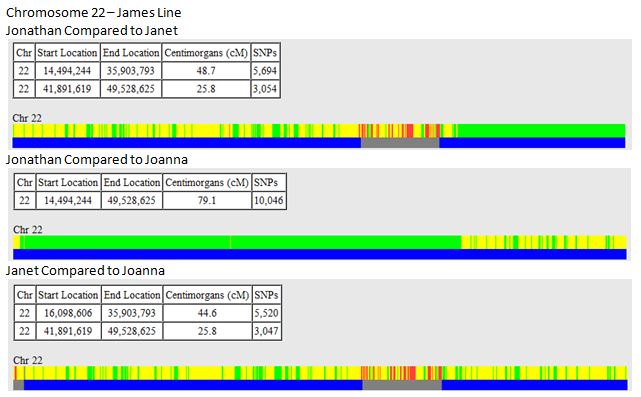
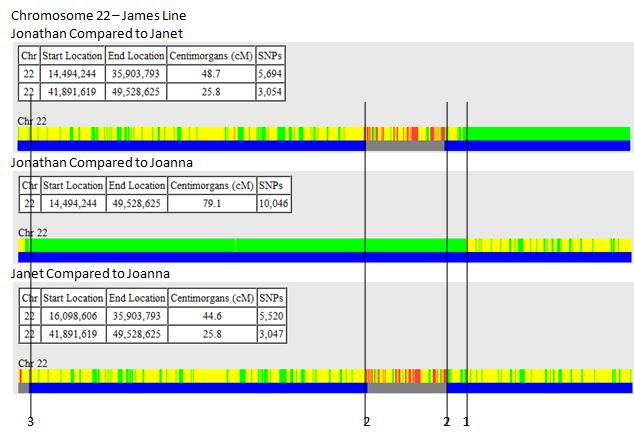
Let’s take a peek at Joanna’s family’s Chromosome 22. This is the shortest of the chromosomes, so theoretically, it will have the fewest amount of segments and crossovers. Here we have 3 comparisons from gedmatch.com of Joanna’s family. The comparisons are stacked up on top of each other.

Chr 22 James Line

Now we need to know how Joanna’s grandparents’ DNA combined in her and her 2 sibs. The matches are in dark blue, but we want to know more than that. Let’s start with the comparison of Jonathan to Janet in the first row. From about 14 or 15 million to 36 million there is a half match also called a Half Identical Region (HIR). Then there is no match. After that there is a full match – technically called a Fully Identical Region. Now look at Jonathan compared to Joanna. Those two match the whole length. But there are still crossover points. From about 14 to 16 there is an HIR. Then there is an FIR in solid green. At the point where the HIR changes to a FIR is called a crossover point. That is where there is a change from one grandparent to the other.

Adding Crossover Points as Lines

Now I put in the crossover points as vertical lines. The person who has 2 crossovers in a line gets to own that crossover point. So along the first vertical line, there is a change from Jonathan to Joanna and from Janet to Joanna. Joanna is the one I see most often there, so she owns the first crossover. Here, I assign Jonathan a 1, Janet a 2 and Joanna 3 as having 3 J’s would be too confusing.

Chr 22 Crossovers

Maternal and Paternal Split In Joanna’s Family

Next we take what is shown above, and make it look more like a chromosome browser, except one that shows both maternal and paternal sides. It will look like a chromosome map. Let’s look at Jonathan compared to Joanna above. There is a FIR for segment 2-4. That means Jonathan and Joanna match on both their maternal and paternal side. That further means that they share the same maternal and paternal grandparent’s DNA at those locations. Seeing as we may not know which grandparents they are at this time, we give them a color. In this case, we’ll say that those matching grandparents are green and blue. Blue will be either a maternal or paternal grandparent and green will be the opposite. We don’t know this yet either. The green on Jonathan’s chromosome matches Joanna’s green and his blue matches Joanna’s blue on the other chromosome:

Chr 22 Seg 1

Above is the DNA from Jonathan’s and Joanna’s grandparents. One maternal and one paternal. Next according to Kathy Johnston, we can move 1 (Jonathan’s) grandparents to the left and 3 (Joanna’s) to the left. That is because there is no crossover point blocking them.

Chr 22 Seg 2

Note that from my first image above from gedmatch, Jonathan and Janet have no match in the third segment. This means Janet has to have the opposite 2 grandparents at this segment.

Chr 22 Seg 3

Unfortunately Janet’s segment (i.e. grandparent’s DNA) is trapped between her two (#2) vertical crossover points, so we can’t expand those segments. Next, we need to add the HIRs. But should we go the right, or to the left? Here is where I’m tempted to cheat a little. Joanna and family have Frazer cousin matches here:

BZ Matches

So in what we are doing, that would be the paternal grandfather’s side.

On the maternal grandmother’s side there are 3 new matches.

Joanna maternal Gmother matches

As we don’t have anything for Janet in this area (15-25), I’ll choose to go that way, to see if it helps us at all. Jonathan and Janet are HIR for the 1st two segments, so on Janet’s bar (#2), we will extend one segment (randomly orange) to the left and change the other (from purple to green). Now you can see between bar #1 and #2 on the first 2 segments, they match on the top and not on the bottom. That is a HIR or half match. This meets what our gedmatch comparison was telling us was happening between this 2 siblings.Chr 22 Seg 4

Then Janet and Joanna had no match in the lower left, so I made the Joanna (3) opposite to Janet (2). Choosing Janet’s half identical region sets a few things in motion. Recall that Joanna and her siblings each had a match to a maternal grandmother relative on this Chromosome 22. They were all around 15 or 16 to 25. Looking up and down to the right of the #3 crossover, the only color in common in that area is green. This gives us 3 important new pieces of information:

  • Green has to represent Joanna’s family’s maternal grandmother.
  • That also sets purple as the maternal grandfather (Henry Dickins)
  • blue and orange now have to be Joanna’s family’s paternal grandparents.

Chr 22 Seg 5

Now we have gone from relative grandparents to actual maternal grandparents. But there is still more to fill in. We know from the Frazer DNA Project that Joanna’s family has 3 paternal grandfather (Frazer) matches here:

BZ Matches

Too bad I don’t have them in the same order as the segment chart above. I think that the Frazer will be blue. Let’s guess that the last vertical crossover line is at position 45. From the area of 42-45, there are 3 of Joanna’s family who have matches with a Frazer. We already have 2 out of 3 blues available for these Frazer matches, so Frazer has to be blue. The last blue can be added on Janet’s row #3 in the small segment area of 42-45. We know from our first gedmatch comparison that Janet and Joanna have HIRs for the last 2 segments. I made Janet (2) have her paternal side blue so it matched with the other 2 Frazer matches. Then I made sure that between Janet and Joanna (2 and 3) their last segments didn’t match maternally on both sides. They had to match only one side. That was the Frazer side. Then the maternal side had to be purple for it to be a half match. Here is where Joanna’s family got their DNA from each grandparent. This was the beginning of Joanna and her siblings for Chromosome #22. It is pretty interesting that we can find out their grandparents’ contributing DNA considering these grandparents were all born in the 1800’s.

Chr 22 Seg 6

Now back to the original comparison:

Chr 22 Crossovers

I think everything holds together. Note that Joanna had only one crossover near the beginning. Janet has 2 in the middle and Jonathan has one at the end. This is portrayed in our Chromosome map in 4 colors also.

I had mentioned how some of my earlier analyses were using the longest and most difficult chromosomes. This should be a more simple and clearer example.

One Side Helps the Other

These 4 grandparents were determined using just 2 known matches to Joanna and her 2 siblings. One match was on the maternal side and one was on the paternal side. Once the maternal side was set, that made it easier to determine where the paternal match went.  This process works because: 1) Joanna and her 2 siblings all tested their DNA and they can compare to each other using gedmatch.com;  2) There are known matches to Joanna and her siblings – one on the maternal side and one on the paternal side. These act as a reference to set where the 4 grandparents fit in for this analysis. It also helped that these matches matched all three siblings.

Applications

  • Jonathan and Joanna cannot have any matches on their Seymour Line on Chromosome 22.
  • Likewise, Janet cannot have a Seymour match above the region of about 42 million.
  • Joanna will probably not have any meaningful matches with her Dickins Line on Chromosome 22.
  • The family does not have parents available for DNA testing, so a match at any point for each of these siblings will still have to be checked to determine whether it is on the maternal or paternal side.
  • Triangulation Groups will also follow the segment lines for each sibling
  • Each of these 4 grandparent segments are made up of other smaller segments from their ancestors.


More Fun With Segments and Crossovers: Part 4

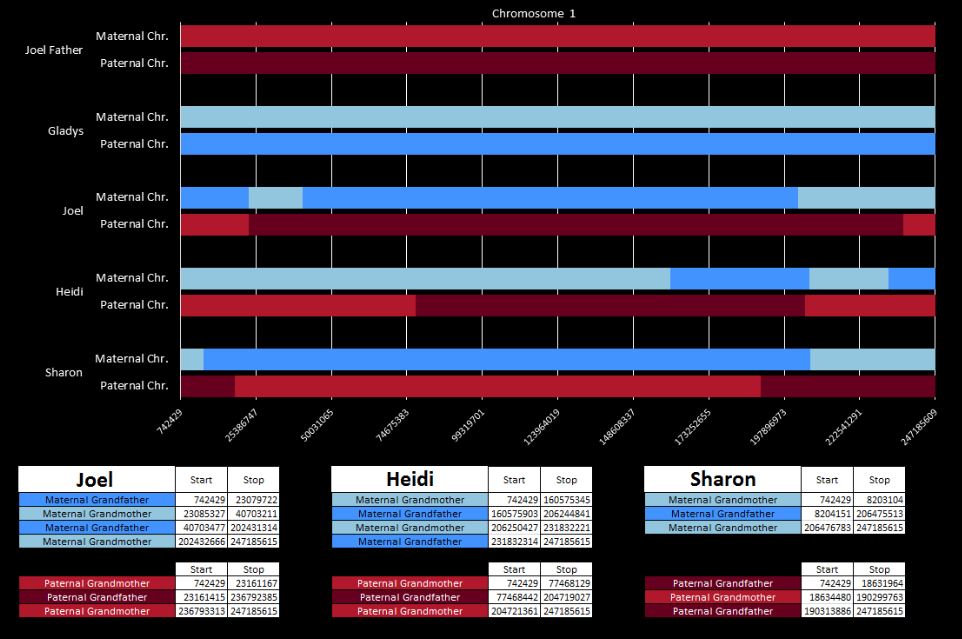
In this blog, I plan to look at the previous analysis I had done on my Chromosome 1 based on comparing my DNA to my 2 sisters. That was done in atDNA Under the Hood: Segments and Crossovers. I will break that down further using phased results. I have had my mother tested for her autosomal DNA. As a result on gedmatch.com, I have been able to produce 2 kits for each person. Those kits split out the results into the DNA I got from my mom and the DNA I got from my dad.

Recap On My Chromosome 1

Before I wrote my blog, I tried using a technique proposed by Kathy Johnston to show where all my segments had come from. Gedmatch is used to compare 3 siblings. Vertical crossover lines are established and DNA segments from contributing grandparents are established. This was my preblog placement of crossover lines and who they were assigned to using initials.

Chromosome 1 preblog

Note all the close crossover lines on the right side. This was a bit confusing. Here is my first try at assigning those segments to my two sisters and me.

Chr 1 Segments first try

In my blog, I simplified the crossovers a bit.

Chromosome 1 HJS

I came up with these segments.

Chr 1 Segments Adjusted again

However, in at least one way, I noted on my Chromosome (J), there was a mistake. I had a large known match with someone that was likely on my Hartley (green) line that went through the short orange segment I had. So I knew that had to be wrong.

Assigning Segments With Phased Results – Paternal Side

As mentioned above, I have 3 phased paternal kits for my 2 sisters and myself. These are based on the testing of my mother. A computer program essentially subtracts out the DNA I got from my mother and assigns the rest of my DNA to my father. I took the 3 paternally phased kits and compared them. So this will represent the precursor to the paternal orange and green segments that I developed (shown above).

Paternal Phased Chr 1

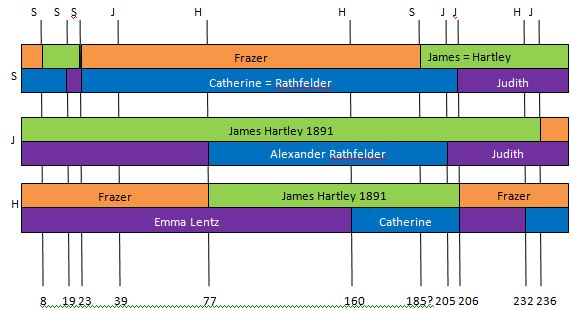
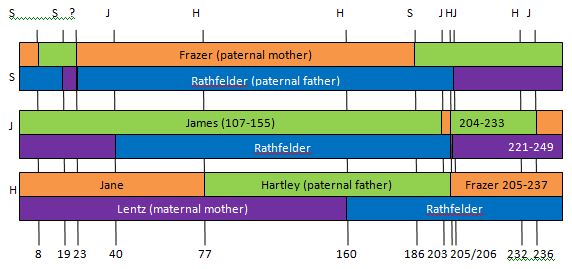
See how much simpler this is than comparing the whole DNA with the maternal and paternal side. This shows just the paternal side where the siblings do and do not match each other. Plus this clearly shows that these crossover points are specifically paternal crossover points. Sharon, Heidi and Joel each have 2 of them. This also points out mistakes I made in my previous analysis on the paternal side. Notice the 2 J’s at position 23 and 237. I take this to mean that I have a very large segment from one paternal grandparent in the middle and 2 short ones on the end. I’ll take the results from my previous blog and adjust that accordingly – taking out that tiny segment I already knew was wrong. I also added a ‘P’ after these 2 J’s at the top of these 2 vertical lines to show that they were my paternal crossover points.

Chr 1 Paternal adjustment1

Aah, much better. Heidi is matching me between 77 and 205, so I got that right. Remember, I’m just looking at the top half/paternal part of the chromosome at this point. Also I had it right that Sharon and Joel match from 190 to 237. Except I had it as 186. That difference may be from the effect of phasing. Between 19 and 23 all three siblings match. So Sharon’s orange Frazer segment gets moved a little to the left there. Also in the 1st segment, we shouldn’t all match. I had guessed wrong there. Heidi and Joel match, but not Sharon.

Chr 1 Paternal adjustment2

Note the following:

  • On each paternal line (green and orange) there are 2 paternal cutoff points producing 3 segments
  • The original full comparison (maternal and paternal) had 12 crossover points vs. the 6 paternal ones here
  • These segments alternate between my 2 paternal grandparents.
  • Between the 3 siblings we could match a descendant of my grandmother Frazer’s ancestor at any point except between 186 and 205. Looking up and down at that point, there will be no orange representing Frazer
  • On the 3 spreadsheets of matches for these siblings, I can assign with confidence, Frazer ancestor or Hartley ancestor to each of the paternal matches in the regions indicated above. This is a huge step forward in DNA analysis.

At this point, I could go back to the original full comparison and adjust the maternal segments or look at the maternally phased sibling comparisons. I’ll do the latter, to complete the picture.

Assigning Segments With Phased Results – Maternal Side

Maternal Phased Chr 1

Here we have 10 maternal crossovers Vs. the 6 previous paternal ones. This is the complicated side. I had trouble assigning crossover points. These should be assigned to people who have 2 changing areas along the vertical line. For example, Sharon gets an ‘S’ for the first vertical line (crossover point) because of the defined segment she has in the comparison between her and Heidi in the first row and her and Joel in the second row. At the first question mark crossover point, there is one change shared by only Heidi and Sharon. Also there is a weird region between 204 and 206. I’ll ignore that section for now. I would like to start on the right, because I have a match with a known Lentz relative there (my maternal mother’s line). The very last segment doesn’t make sense because it shows that Sharon matches Joel and Heidi matches Joel but Sharon doesn’t match Heidi. We’ll ignore that and keep my segments the way they are as they make sense by the original gedmatch full comparison. Moving from the right to the left, the next segment in makes sense. On the third segment from the end, all 3 siblings should have the same maternal grandparent. I’ll have to change that to Lentz for Heidi. So I’ll put a purple section in the middle of my blue Rathfelder grandfather on the bottom right:

Chr 1 Maternal adjustment1

As I have mentioned previously, Chromosome 1 should be the hardest to analyze, as it is the longest. If I can get this one right, all the others should be a walk in the park. 160 to 204 is all the same maternally, so that makes sense. What doesn’t make sense is segment 77-160. Again the maternally phased comparison has Sharon matching Joel and Heidi matching Joel but Sharon and Heidi not matching. However, in the original full comparison Heidi and Sharon are opposites and the other matches are half matches, so we’ll stay with what we have. I note this non-sensical sequence 6 times on the maternal side. Not good.  Also notice that Heidi has a maternal crossover at 77. Some crossovers for Heidi and others are both maternal and paternal. This appears to be one of them. That means there should be a change from Lentz to Rathfelder here. But when I check the original full comparison, I see that Heidi Vs. Joel should be opposite, so I’m tempted to leave it the way it is here. Hopefully, this will get easier.

Segment 23-40: Here, I need a paternal correction as it shows the same paternal match for all three siblings. In my paternal phased gedmatch comparison, it shows that Sharon and Heidi match from 23-77, but I don’t match either of my sisters paternally. This is fixed by moving my green Hartley segment to the left (J Row).

Chr 1 Paternal adjustment3

This gives me even more Hartley segment in green. Next I notice in the 5th segment (40-77) that Heidi to Joel was supposed to be opposite in the full comparison. I can fix this by moving Heidi’s Lentz segment to the left. Talk about tedious.

Chr 1 Maternal adjustment2

At any rate, that’s a bit more aesthetically pleasing. Now there’s another problem at 23-40. The original full gedmatch comparison has Sharon to Joel as opposites which is now right, but Sharon to Heidi and Heidi to Joel as half matches and I have them as full. I don’t want to mess with the Sharon-Joel opposite match here, so I’ll skootch the Lentz a little more to the left.

Chr 1 Maternal adjustment3

Segment 19-23 – Only 3 more segments to go (hopefully). The full comparison has Sharon and Joel as full matches (FIRs) and the other 2 as half matches. That looks good.

8-19: Sharon to Heidi are opposites and the others are half matches. Giving Sharon a bit more purple will fix that. Plus Sharon has a maternal crossover there, so it makes sense.

Chr 1 Maternal adjustment4

Home Stretch. Sharon to Joel needs to be opposite in the first segment. No correction needed here. This is as good as I can get Chromosome 1 right now.

The Frazer DNA Project Connection

Here is where the Richard Frazer Triangulation Group is:

Chr 1 Maternal adjustment4 w TG

Here was my earlier attempt at chromosome 1 without phased DNA. This was from last week when I was younger and more foolish. It’s off, but not totally.

Chr 1 Segments Adjusted again

Summary

  • It was a long blog, but who wants short blogs with wrong answers?
  • Using phased DNA (paternal and maternal) made the answer more clear, but the process was no easier.
  • My paternally phased comparison behaved better than the maternal. However, if you knew my mom, you would understand why.
  • It took a combination of the full sibling comparison plus the phased paternal and maternal comparisons plus known relative matches to complete the diagram
  • For anyone that matches me or my siblings on Chromosome 1, I should now be able to tell which grandparent they match
  • This blog has been approved by the FDA as a cure for insomnia


More James Line Segments

In the last 2 blogs, I wrote about segments and crossovers. In this one I am continuing on with James Line Segments. The James Line is from James Frazer b. in the early 1700’s  from North Roscommon, Ireland. I am looking at Chromosome 14, because there seems to be a lot going on there. Here are some of the Frazer matches from my master list of matches from testers in the Frazer DNA Project:

Chr 14 James Line

Not all of these matches will come into play, because we are looking at the family of Jonathan, Janet and Joanna. Here Jonathan matches JFS on the Michael Frazer Line b. 1764 (a branch of the James Line). Janet matches the same person at 2 different places. Janet and Jonathan match BZ their 2nd cousin at differing levels. Also Jonathan matches BR from the Archibald line (brother of James Frazer) at a smaller amount. This may or may not hold up.

Remember, we can do this analysis because siblings have what are called Fully Identical Regions (FIRs). This means that they match their same paternal and maternal grandparents (but we don’t know which initially). Then by comparing the Half Identical Regions (HIRs) and places they don’t match, it is possible to map out all 4 grandparents. With matches to known people, it is possible to fill in which grandparent is which.

Chromosome 14 appears to be more simpler than my earlier examples:

Chr 14 James Line Gedmatch

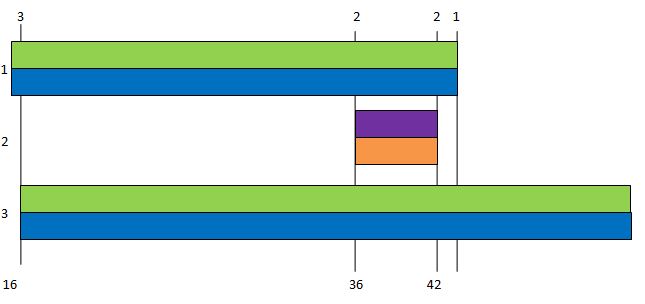
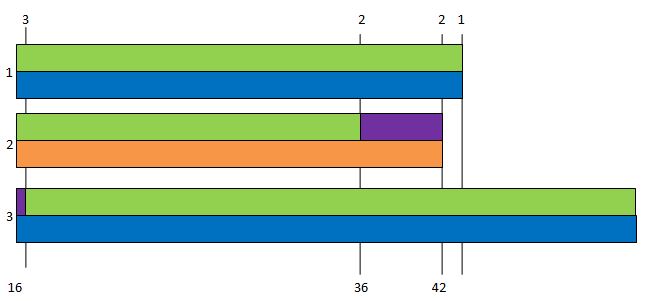
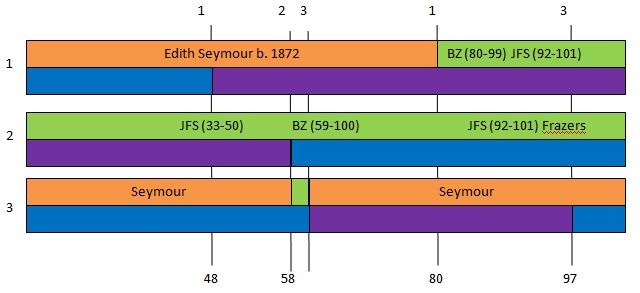
Here, there are only 5 crossover points. The crossover is where the DNA recombines. Janet has only one crossover point and Jonathan and Joanna each have 2. Note above that Jonathan (1) and Joanna (3) have a FIR in the first segment indicated by the green bar in the middle row. That means they have the same Paternal and Maternal grandparents. I’ll give those grandparents a green and blue color for both Jonathan’s (1) and Joanna’s (3) DNA segment below. Chr 14 1

The crossover point is where something is going to change due to DNA that got recombined from Joanna’s family’s grandparents via their parents. I suppose you might say we are recreating how this family was formed by the different combinations of their grandparents’ DNA. I can’t extend Jonathan’s grandparents at this point (at crossover 1). I can extend Joanna’s as her crossover point doesn’t occur until line 3 (which is her crossover or recombination point).

Chr 14 2

Now note in the gedmatch browser comparison above that Janet and Joanna have no match in the first 2 segments. That means that Janet will have the opposite grandparents in those segments shown as being orange and purple.

Chr 14 3

Next, I see that in the 3rd segment, Joanna matches Janet perfectly (FIR). We will note that and extend Janet’s segments to the right hand side as she only has one crossover point.

Chr 14 4

Next I filled in some opposite regions between Janet and Joanna and Jonathan to Janet.

Chr 14 5

However, note that in the comparison between Jonathan and Janet, there is something odd.

Jonathan to Janet 2

In the third segment, there is no match as shown by a grey underneath (no blue). However, on the top there are no red marks. I though that it was too easy. Next, I will add an HIR from Jonathan to Janet in the last 2 segments.

Chr 14 6

Next Jonathan and Joanna have a no match on the last chromosome, so they are opposites. There seems to be no easy solution for the middle part of Jonathan’s Chromosome 14 – or rather there could be more than one solution, so I’ll just pick one for now and see how it fits with the matches.

Chr 14 v1

And there you have my version 1 of Jonathan and his sisters’ Chromosome 14. It doesn’t look that great. Janet’s chromosome looks too symmetrical. Also Jonathan has one of his crossovers on Joanna’s crossover point (3).

Now for the Frazer DNA Project matches to Jonathan and family.

Frazer matches Chr 14

Here’s where the puzzle begins. We don’t know which of the 4 colors that the Frazer could be. That could be either

Janet has matches from 32-50; 59-100; and 92-101. This means I drew Janet wrong. I have her with a break in the middle of these. That is, unless, the match with JFS is a false match.

Jonathan has matches from 80-99; 92-101; and 99-102. That could either be green or purple, but his first match at 80 would make it look like the green. I’ll give it another try with Janet having her green be the Frazer for the whole length. This is what I came up with:

Joanna and Family Version 2 Chromosome 14

That looks better. Now Janet’s segments are not so symmetrical and Jonathan’s crossovers are at his own crossover points. Joanna has a crossover on Janet’s crossover point, so maybe she should have solid orange, but that would cause other inconsistencies.

Now I’ll add the Frazer to the green areas and Seymour grandparents in orange showing where some of our Frazer DNA testers match.

With Names

I know that Joanna is looking for other relatives to test on her mother’s side. So once those DNA results are in, that will further confirm which maternal grandparents the blue and purple segments belong to.

This was not as easy as I thought it would be.

Segments and Crossovers: Part 2

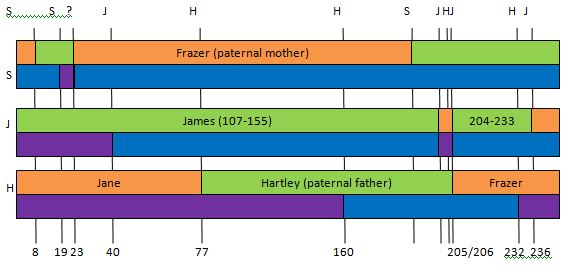
In my last blog I took a look at the DNA my 2 sisters and I inherited from our grandparents. This was based on how we matched each other, where our crossover points were and whether we match by Half Identical Region (HIR) or Fully Identical Region (FIR), or not at all. I wasn’t totally satisfied with the result but noted that Chromosome 1 was probably the most difficult to analyze as it is the longest Chromosome. I still need to tweak this Chromosome a bit. Another way to figure out where the segments are is by looking at Triangulation Groups. On my Hartley (green) line below (horizontal line J), I have a TG going through the little orange segment at position 203, so the orange is likely not correct there.

Part of my reason for choosing this Chromosome was to show how my sister Heidi was in a Triangulation Group (TG) for Richard Frazer b. 1777 starting at position 205 and my other sister and I were not. My best shot at splitting up Chromosome 1 looked like this:

Chr 1 Segments Adjusted

James above is my father’s 1st cousin and represents the Hartley line. Jane is Jane from the Frazer DNA Project and represents the Frazers. This is the segment where Jane matches my sister Heidi.

And here is what the Frazer TG looks like:

TG Chr 1

Note that the TG for Heidi’s matches starts at position 205 million. That is where Heidi’s Frazer segment starts above. MFA and Jane’s match with each other start earlier than that, but they have a different segment map than my family does, so that is OK.

Chromosome 12

Chromosome 12 is where all my siblings are in another TG for Richard Frazer b. 1777. The map for that is a bit cleaner and more simple. As Chromosome 12 is shorter than #1, there are fewer segments and crossover points.

Chromosome 12 Segments
  • Note that Sharon has all Frazer on this Chromosome. That means that on her paternal side, she only inherited DNA from her Frazer grandmother, Marion Frazer
  • The TG representing Richard Frazer b. 1777 was again on the right hand side where my 2 sisters and I have Frazer (blue) segments
  • This TG is from position 124 to 129 and includes myself, both my sisters, and David, Bill, and Jane from this DNA Project among others.
  • The colors are reversed from what I had on Chromosome #1 as those colors are only relative until we find the grandparent that matches the color. At that matching time, we discover which side of the line is maternal and which side is paternal. For Chromosome 12 my paternal side is on the bottom.

I got the relative colors of the segments from these sibling comparisons:

Chromosome 12 Gedmatch Siblings

The procedure I used was in my previous blog. The names I got from looking at my matches to cousin Paul. I didn’t have enough matches on my mother’s side to nail those grandparents down. Those were the orange and green colors.

On To the James Line

Joanna and I wisely (or more likely luckily) had 2 of our siblings tested for autosomal DNA. This means that I am able to do the same analysis for her. As we know in the Frazer DNA project, her line starts with James Frazer as opposed to my side which starts with Archibald Frazer. They were both born in the early 1700’s as they had families and farms in North Roscommon, Ireland in 1749.

Chromosome 2

My 2 sisters match Joanna’s brother on Chromosome 2

Chr 2 Jonathan SH HHM

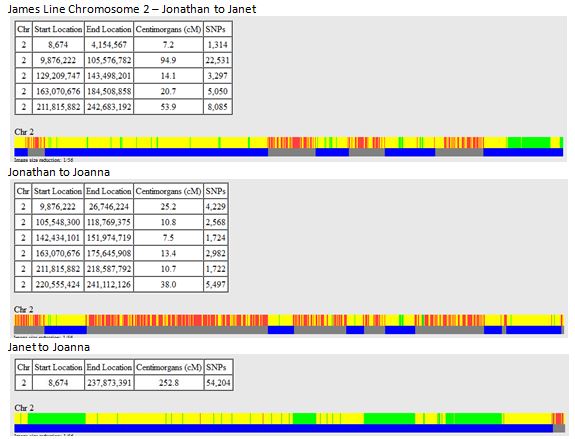
Here is how Joanna’s family lines up compared at gedmatch.com

Joanna Family Compared Gedmatch

Jonathan has more than the usual matches with his sisters. Janet and Joanna have only one long match made up of HIRs and FIRs. This is looking complicated already! Now lets see where all the crossover points are and who owns them. I had to give numbers to the family due to overuse of the initial ‘J’ in that family.

Joanna Family Crossovers

As we might’ve suspected by the number of matches between the family, there are a lot of segments and crossover points. I had a little trouble with Janet’s (who I have as #2) third crossover point, but moved the line a little to the right (judgement call). This could be challenging. I’ll start by adding the bottom left FIR match between Janet and Joanna and see where that leads:

Chr 2 Segments JF Line

I got this far, but I got a lot of position numbers due to all the little matches between the family. I’m really interested more in the right side of the Chromosome, so I’ll start over on the 3rd FIR match between Janet and Joanna:

Chr 2 Segments JF Line2

That’s not even as good. I think I’ll try the upper right Jonathan to Janet FIR match, as that is the only FIR match Jonathan has. Plus this is even closer to the area of the Chromosome I’m interested in.

Chr 2 Segments JF Line3

Now here comes the critical move to the right of the orange-purple area. Jonathan has a half match in that area with Janet. So I’ll extend the purple and green to that area to create the half match. It’s critical, because way back I said that Jonathan had a match with my 2 sisters from 205 to 222. Once I extend the purple that has to be the Frazer area as the match wouldn’t go through two different grandparent segments (i.e. orange and green at the top right).

Chr 2 Segments JF Line5

Here I added Edward Frazer who is Joanna’s paternal grandfather (actually b. in 1867). Because we identified Edward through a match between Jonathan and my sisters, the other person on that line in blue has to be Joanna’s paternal grandmother Seymour. In order to figure out Joanna’s maternal grandparents we would need to have matches through known relatives on those lines.

Now I’m stuck as the segments are HIR and I would have to guess. Here’s my guess for Jonathan, Janet and Joanna on Chromosome #2

James Line Segments Guess

This means if I am right and Jonathan, Janet and Joanna are looking for Frazer matches on Chromosome #2:

  • Jonathan should look between 9 and 129; 142 and 219 and 241 and over (these are positions all in millions)
  • Janet would look for any thing under 119 and over 238
  • Joanna would look before 27 and between 129 and 152

However, the catch is to make sure the match isn’t on the maternal side. However, it should be possible to double check this using Triangulation Groups (TGs). These TGs will fall within the segments as shown above.

How My Family Compares to Joanna’s Family On Chromosome 2

Hartley Chromosome 2 Segments

Unfortunately, the colors don’t match up. Joanna’s Frazers are purple and mine are green.  As can be seen above, my sisters got their Frazer DNA in the area of around 200 where I got Hartley DNA as shown in orange. This explains the matches between Sharon, Heidi and Jonathan.


atDNA Under the Hood: Segments and Crossovers

In this blog, I would like to look at segments and crossover points. Kathy Johnston has a method in which she compares the DNA matches between 3 siblings. These matches are then used to show how the 4 grandparents contributed DNA to each of these 3 siblings. She states in her directions:

The goal is to use crossover lines in PowerPoint to determine segment matches with grandparents among siblings when no parents are alive.

In this blog, I will use Chromosomes 1 as an example. I would like to use this Chromosome because of the Frazer DNA project I am working on. In this project, there is a very clear Triangulation Group at Chromosome 1 that leads back to Richard Frazer, b. about 1777 in North Roscommon, Ireland.

The Technique Depends on Gedmatch

Gedmatch is used because gedmatch.com comparisons show not only matches, but which matches have Fully Identical Regions (FIRs) and those with Half Identical Regions (HIRs). HIRs are the normal matches that we have with everyone except our siblings. Half Identical means we match either on our mother’s side or our father’s side. According to the ISOGG Wiki,

Identical twins are fully identical at every point in their DNA. Other full siblings, including non-identical twins, share around 50% of their DNA, and have both half-identical regions and completely identical regions. The expected percentages for full siblings are 50% half-identical, 25% completely identical, and 25% not identical for an overall average of 50%.

Me and My Two Sisters

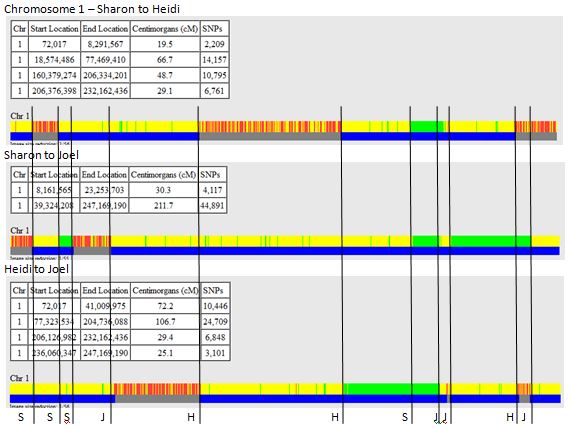
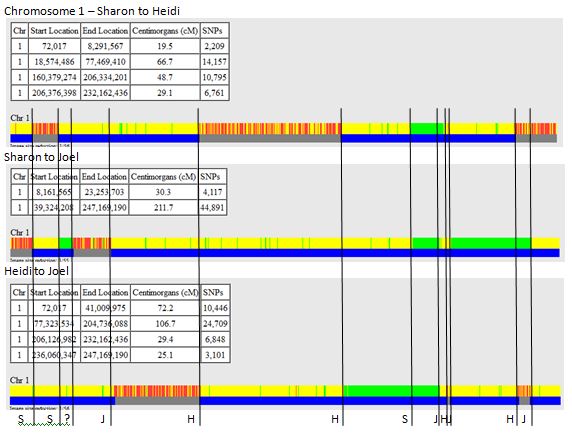
This is how I look compared to my two sisters and how they compare to each other at Gedmatch. The green indicates FIR, the yellow area is HIR and the red is no match. The blue is FIR or HIR match and is also represented in the table above the graph with start and end points. Vertical lines are drawn through each crossover where there is any change from HIR to FIR to no match.

Chromosome 1 HJS

According to Kathy Johnston,

Only one sibling can own a crossover point (with few exceptions); identify that sibling. The owner of the crossover is the one who is in-common with
that point for two comparisons.

For the first vertical line, I have an ‘S’ for Sharon as the owner of that crossover point. She has a crossover, from a HIR match to no match in the comparison of Sharon to Heidi and a crossover from no match to a HIR in the comparison between Sharon to Joel. Note that the 3rd ‘S’ should be a’?’ as Sharon has only one crossover out the the 3 comparisons. I had originally left it as an ‘S’ for simplicity. The segments between the lines will represent the DNA the 3 siblings got from our 4 grandparents.

How Do We Get 4 Grandparents’ DNA Out Of This?

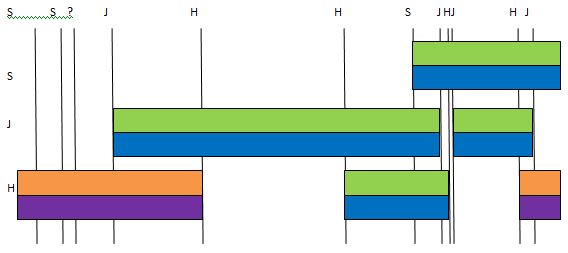
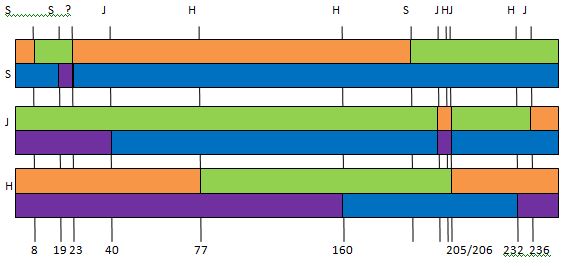
Let’s look at the next to the last segment and the one before it. Sharon and Joel have a green area there. This means that Sharon and Joel got their DNA from both their mother and father. However, this DNA was from one of the mother’s parents and one of the father’s parents. These 2 Fully Identical matches are represented by green and blue. These are 2 of our 4 grandparents, but we don’t know which ones they are yet – except that one is a maternal grandparent and one is a paternal grandparent. They are put on Sharon and Joel’s horizontal lines (represented by an ‘S’ and a ‘J’) as Sharon and Joel match each other on both parent’s sides represented here by green and blue.

Phase 1

By the way, I picked the most difficult Chromosome to look at. Chromosome #1 is the longest chromosome and has the most crossovers. Note that the green and blue are bounded by 2 J’s on my line. However, the green and blue are not bounded by an ‘S’ on Sharon’s line. So I will extend her DNA match to where it is likely to change (either at Sharon’s crossover point or at the end of the Chromosome – whichever comes first).

Phase 2

Looking For Two More Grandparents

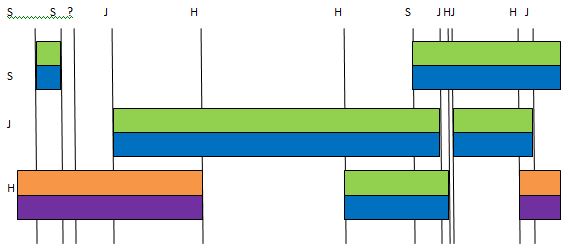
This is starting to fill out, but Heidi has no DNA and we only have 2 grandparents. Now look again at the Gedmatch chart. Heidi has no match with Sharon or Joel on the next to last segment as indicated by grey in the bottom part and red in the top. We know that she does have DNA at all parts on her chromosomes, so she must have gotten her DNA from neither of the green or blue grandparents on her paternal and maternal side.

Chromosome 1 HJS

Our new grandparents are going to be orange and purple. I hope they don’t mind.

Phase 3

I extended the colors to the right as Heidi has no crossover point in that direction. Also note as a check that in the last segment Sharon and Heidi have no match, so they have to have opposite grandparents contributing to their DNA there. Now in my 3 Gedmatch comparisons, there is a spot where all 3 siblings have a FIR shown in green. These means all 3 siblings got their DNA from the same 2 blue and green grandparents. I’ll extend the blue and green down and to the right and left to the appropriate crossover points.

Phase 4

Looking good for my green and blue grandparents. In the first J-H segment, Heidi and Joel have no match. This means opposite colors/grandparents. I blasted through the ? crossover as it doesn’t involve Heidi.

Phase 5

Next, I’ll fill in the rest of the no match areas with opposite colors/grandparents. I only see one more segment to add.

Phase 6

Time for the HIR’s

So  far, we have only added opposites. Now it is time for the Half Identical Regions (HIRs). That would be a green on the top with a purple on the bottom or orange on the top with blue on the bottom. On the Sharon to Joel comparison below there is a long yellow HIR. I will give that a shot.

Chromosome 1 HJS

That means that I need to keep one color the same between Sharon and Joel and change the other. I randomly extended the blue and put the orange on top. I don’t know what to do at the ?, so I stop there. Up until now all the colors have been relative. However, once a half identical color is chosen, it locks in where the grandparents are (even though we don’t know which grandparents go on which segments yet).

Phase 7

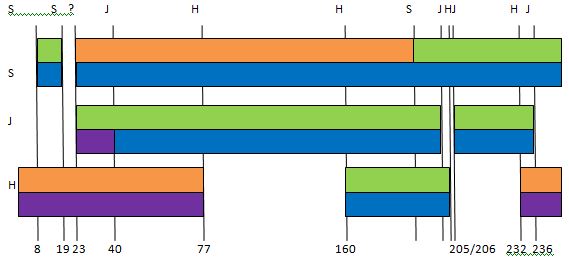
Also notice that I put numbers on the bottom. Those are the positions of some of the crossover points. Sharon’s first match with Heidi stops at about 8 million. Sharon’s first match with Joel starts at the same spot.

Now Sharon to Heidi has no match in the large middle segment. That means I need to add the opposite colors/grandparents. Joel to Heidi is HIR, so we can continue Joel’s colors to the left. Sharon to Joel needs to be opposite in the first segment.

PHase 8

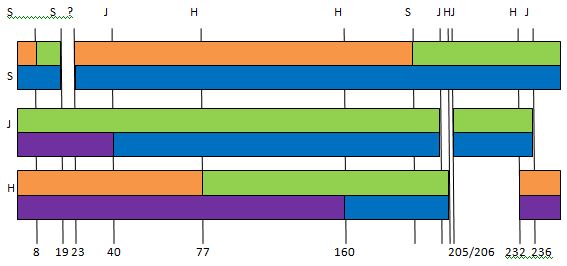
That seems to be all the easy segments. Actually, the upper left space can be filled in as Sharon and Joel match with a FIR. That leaves the lower right hand side. I’m not supposed to guess here, but I’m tempted to go with orange/blue to fill in my missing middle segment. The tiny segment below that is opposite. I guess again and pull the orange to the left and the blue to the right to fill the larger segment. My last guess is on my own segment where I extended the blue and added some orange.

Phase 9

That fills everything in, but with a bit of guessing. Note that the tiny crossover point at 205 has not been used, but that is a fine point.

Now For the Reality Check

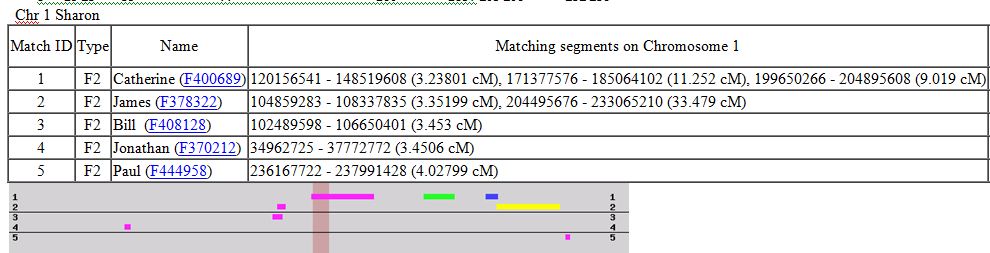
I would be nice to put some names on these grandparents and check to see if I got these segments straight. Here are some of my sister real life Sharon’s matches.

Sharon to All Chr 1

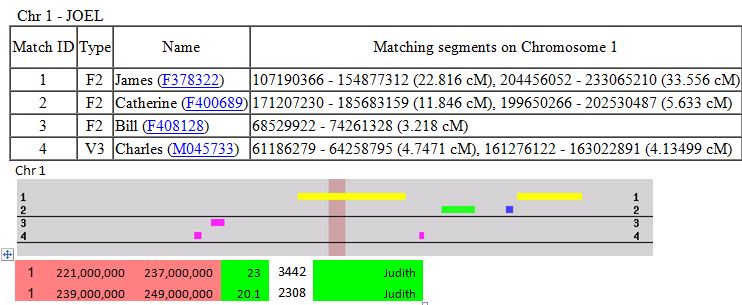
Catherine is on my mother’s father’s side and James is on my father’s father’s side. The rest are Frazer relatives, but the matches are small. My results are somewhat similar to my sister Sharon’s. The difference is that I tested at 23andme and found a relative on my mother’s mother’s side (Judith).

Joel to All Chr 1

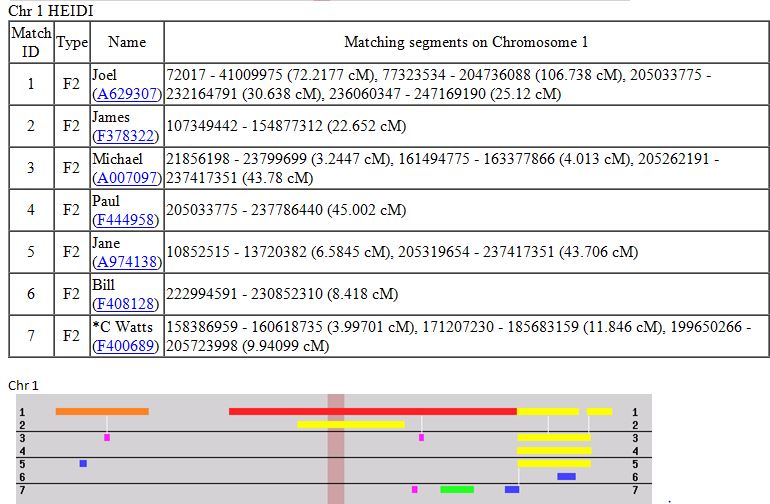
Let’s see if Heidi’s matches shed any further light.

Heidi to All Chr 1

Now we are getting somewhere. We see the Triangulation Group that I was interested in. This is on the right between Frazer relatives Michael, Paul, Jane and Bill. This is good because the Frazers are on my paternal mother’s side and James is on my Hartley side which is my paternal father’s side. Heidi matches James between the locations of 107 and 155 million. And she matches the Frazers from about 205 to 237 million.  Now all I have to do is find an open segment on Heidi’s line from 205 to 237 that is a different color on Joel and Sharon’s line. That is orange.

Will the Real Grandparents Please Step Forward?

Here is my first shot. I can already see it will need adjustments.

Frazer Segments

My paternal Frazer/Hartley Frazer side isn’t too bad. The bottom right in orange is where the Triangulation Group is that indicates the Richard Frazer family (b. 1777). This explains why Heidi was in the triangulation group and Sharon and I weren’t. We inherited the opposite set of DNA on the paternal side. Also note on my line I have James who represents my Hartley side. I match him from 204-233. So that green segment needs to move to the left a smidgen. I had trouble the first time I tried to figure this out also. After a little fiddling, this is what I come up with:

Chr 1 Segments Adjusted again

In a future blog, I’d like to try the same technique with the DNA results of Joanna and her 2 siblings on the James Frazer line.

Observations:

  • Kathy Johnston has developed an excellent tool for seeing where all your grandparents’ DNA ended up in you and your 2 siblings.
  • Phasing can determine whether a match is on your paternal or maternal side, but requires that you have a tested parent. This technique does not require a parent and goes one step further – to the grandparents.
  • If the procedure is done right, I will know which grandparent all my matches match and which grandparent all my siblings’ matches will match. This is a big help when looking at 3-4,000 matches.
  • The procedure requires other relatives be tested to put names on the 4 grandparents. I am glad to have at least one relative tested to represent each of my 4 grandparents.
  • The technique takes a bit of practice and can be a bit of a puzzle. However, the results are interesting, instructive and informative.
  • The results show the need for additional DNA testing. If I had only tested my sister Sharon and myself, I would not have proof of being in this particular Frazer Triangulation Group on Chromosome 1 going back to the late 1700’s.

December 2016 Update to my January 2016 Blog

The above attempt was an early try at visual phasing. Chromosome 1 is the longest Chromosome and therefore one of the most difficult ones to try to visually phase. Since then, I have had more experience at doing this. M MacNeill [prairielad_genealogy@hotmail.com] also has done some raw data phasing which is more accurate. Here is his result for Chromosome 1:

chr1rawphase

By comparing the two images, you can see the mistakes I made in my early try at visual phasing. There are some things that I see now on my initial try that scream out at me that they are wrong. The major mistake is the small segments that are internal to the Chromosome (i.e. not right at either end).


Starting to Map My DNA

One of my goals is to map my DNA. The human genome has been mapped. I just want to see where my DNA matches with my ancestors. Kitty Cooper has developed a tool for this. The idea is to associate as much of your DNA as you can to ancestors. Then these portions of the DNA associated to your ancestors are mapped with different colors. My paternal grandmother was a Frazer, so her DNA should account for about 25% of my DNA. The map splits up each Chromosome between Paternal and Maternal, so my DNA from my Frazer grandmother would take up about half of my Paternal side.

One way to determine DNA ancestors is by triangulation. I did this in an early [misnamed] blog called, “The DNA of Archibald Frazer and Mary Lilly”. I say misnamed, because at the time those were the 2 ancestors I thought my triangulation group was pointing to. In a subsequent blog, How I Added 2 Frazer Lines by DNA, I realized that this group more likely pointed to a couple a generation later: That was Richard Frazer and his wife. He was b. around 1777.

Based on the fact that I was in one of the 2 triangulation groups that pointed to Richard Frazer (and unknown wife) I could create a chromosome map. It wouldn’t be too interesting, but it would be a start.

1st Chromosome Map

This chromosome is all blank except for Chromosome #12. There, I put my triangulated matches into a spreadsheet. The matches were to David and Bill from Canada and Jane from Colorado. My 2 sisters also matched these Frazer descendants. It would have been more interesting if I had mapped my sister, Heidi as she at least had triangulated with the same couple at Chomosome #1. Plus she had higher matches with other Frazer descendants in general. Speaking of Heidi, in my previous misnamed blog I showed this graphic from Gedmatch:

Frazer Chr12

Theses are Heidi’s matches on Chromosome #12. She had the same matches as me. She has David (#2), Jane (#3) and Bill, (#4). I am showing as Heidi’s long segment match at #1. This red segment is what I have in common with my sister and is the DNA we both received from our father, though he is long gone and hasn’t been tested for DNA. I know that it must be from him, because he is the one that I get my Frazer DNA from. In fact, that DNA must be from his mother, who was a Frazer. Remember, I should have 25% of my DNA from her. So it stands to reason that the unbroken red match I have with my sister represents my Frazer Grandmother’s DNA.

By the way, this is the backwards way of doing things. The more standard way to map your DNA takes a lot more testing. First you test your parents to get maternal and paternal sides. Then test 2nd cousins on both sides. This will isolate your 4 grandparents. What I have done is tested my mother. I phased her at Gedmatch to get my maternal and paternal matches. I had my father’s first cousin tested. This is similar, but better than testing a 2nd cousin. He represents my father’s father’s side. But not all of it. Many Frazers have tested in the DNA project, but my closest relative in that testing project appears to be a 4th cousin, once removed. On my mother’s side, I’m having trouble getting people to test and/or upload to Gedmatch. So I will go with my current reasoning until I’m proven wrong.

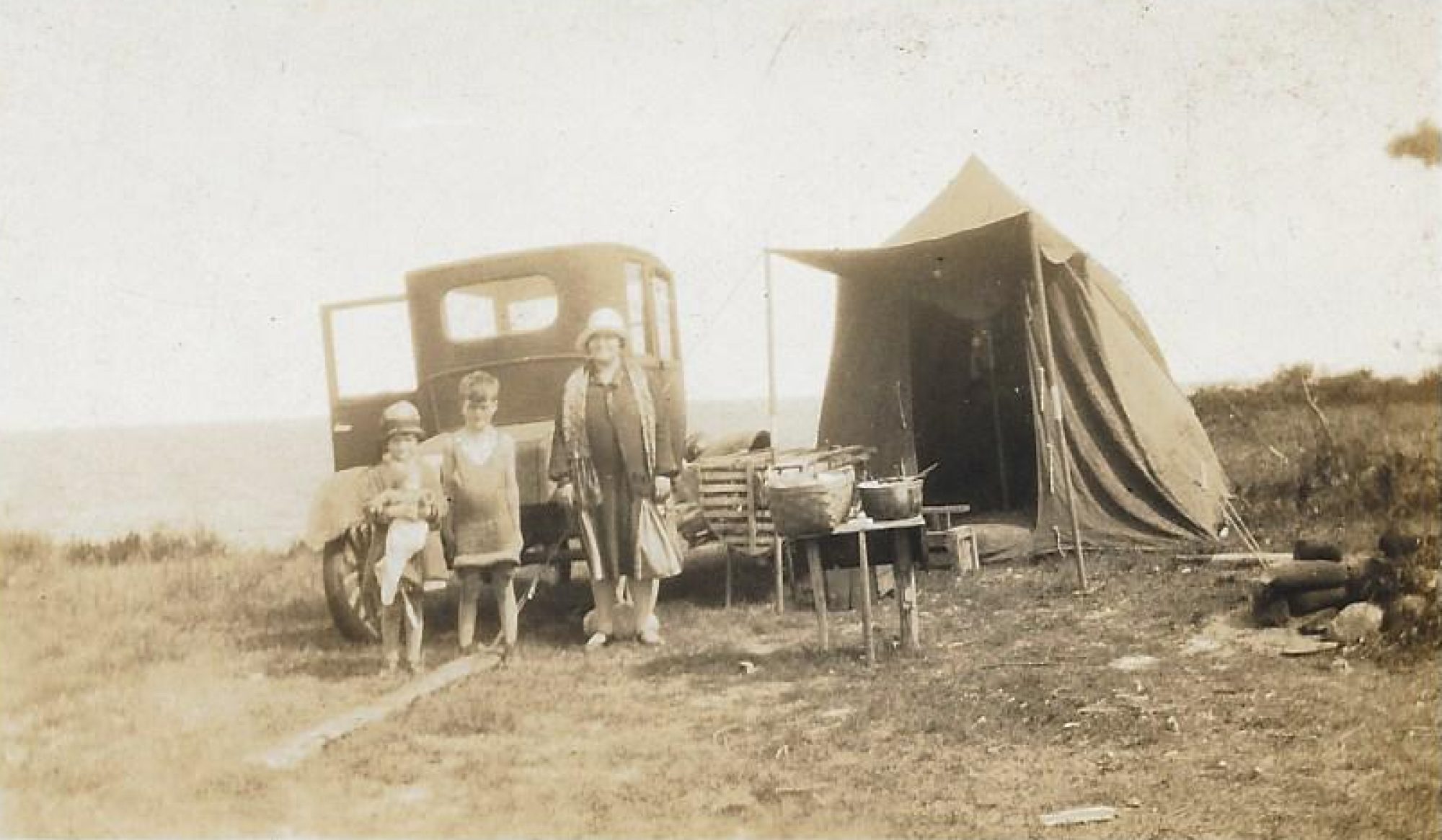
I’ll put a face on that Frazer DNA. Here’s my grandma, nee Frazer.

Marion Frazer Photo

Here’s another Chromosome (10) where my 2 sisters match a Frazer descendant, MFA. We don’t triangulate, but based on genealogy, we’ll say there is a common Frazer ancestor or collateral line there somewhere.

The spreadsheet match looks like this:

Hartley MFA match Chr 10

The Chromosome browser version looks like this:

Sharonn Heidi MFA Chr 10 Gedmatch Browser

Here Line 1 and 2 are my 2 sisters Sharon and Heidi shown as they match to me. #3 is MFA, my 4th cousin, once removed. Using the same reasoning as above, I’ll say that the orange segment, top right, should also represent my Frazer grandmother. The orange on the left doesn’t. I actually match there to a cousin on my Hartley (non-Frazer) side. When I map this, I can map this to my father’s Hartley father.

Back to Chromosome Mapping Basics

The instructions for Chromosome mapping are to:

  • Test relatives or find relatives who have tested at Gedmatch, FTDNA or 23andme. Unfortunately AncestryDNA won’t work as they don’t tell you where you match on the chromosome. Thus no chromosome mapping for these AncestryDNA matches unless they upload their results to Gedmatch.com
  • Figure out if those relatives are from your maternal or paternal side
  • Figure out who the common ancestors are for your matches
  • Put this information in a file
  • Use the Kitty Munson application to make a map

The relatives I used for this chromosome map

  • My father’s cousin Jim – his mom was a Hartley. Our common ancestors are my Hartley great grandparents. He shows in the dark blue below
  •  I found cousin Judy at 23andme. It pays to have DNA tested at different places. Our Most Recent Common Ancestors (MRCAs) are also great grandparent – this time on the maternal side. They will show as red – my Philadelphia ancestors. Up until recently I had virtually nothing on the maternal side of this map.
  • Various more distant Frazer relatives. The sure ancestors are the ones triangulated. Others are less sure. Once results come back for my 2nd cousin once removed, the chromosome map will look better.

2nd Chromosome Map

As you can see, most of my map is paternal. Chromosome #12 in dark green is the one I mentioned earlier where my grandmother’s Frazer’s DNA probably goes the length of that chromosome. I didn’t map her, as technically, I don’t have her as a most common ancestor based on people that I have tested.

Other things to notice:

  • Chromosome #1 shows where there are overlaps in paternal and maternal matches. Sorting your matches into maternal and paternal is one of the most important things in DNA matching. If you get that wrong, everything else is off track.
  • I mapped as the Archibald Frazer line those matches I had with MFA where I’m not positive on the MRCA between us.
  • I mapped as the James Frazer line, the match I have with Bonnie who is related on that line.
  • Some people use these maps to show all matches they have to a certain location – French Canadian, for example where they aren’t sure of all the details.
  • This is my own personal map. Everyone’s map would look different.
  • It would be possible to create a chromosome map for my father. This could be based on his Lazarus file. In that map, his Frazer ancestors would be on his maternal (mother’s) side. This map would show more matches as it would include the matches from my 2 sisters.
  • Chromosome mapping is a way to show a lot of complicated information in a simple way.

So all I have to do now is fill in the rest of the blanks!