A Different Look at the I2 Butler/Whitson BigY Results

In my previous Blog, I set out to look at the finalized results of my brother-in-law’s BigY test. While doing that, I saw that a Whitson in the I2 section of the Whitson/Butler Project had also taken a BigY Test. That test apparently helped to place a lot of my brother-in-law’s previous Private Variants onto the YDNA Tree. Here is a summary of the overall Whitson Project:

The part that I am looking at in this Blog is the green area. This is on the YDNA tree in the general area of I2. Those who have taken the BigY test are in green. My brother-in-law is the next to the last tester on the list and my father-in-law is the last. Batt, Butler tester with James Butler as ancestor and my father-in-law Richard, had the older BigY500 tests. The new Whitson tester who doesn’t show an ancestor and my brother-in-law had the new BigY 700 tests.

The BigY Block Tree for Whitson/Butler at I2

Here is the Block Tree:

The Butlers are under I-Y128364. Batt has Whitson ancestry. that means that I-BY115420 is the Whitson side. Above this is a large Block of SNPs from position 7 to position 45 (not shown) collectively named for one of the SNPs in the Block: I-Y128591. The Block tree is from my brother-in-law Ken’s perspective, so he is not shown but is in the left column under I-FT241245. Because the older tests of BigY 500 did not cover a lot of the SNPs, the two new testers (one Butler and one Whitson) have greatly helped to improve the tree. However, I think that the tree could be better. I will likely discuss that later in the Blog.

The Different Look

Here is the different look from FTDNA. I’ll start with Ken. This just focuses on the individual, where the Block tree represents 5 testers. Here are the headings for the tree:

The detail will be in the five categories of tested SNPs.

There is no need to go too far up this tree. As I mentioned above, I-Y128591 has 39 SNPs in it. This could represent about 3900 years. I-Y128364 represents the Butler with the James Butler ancestor. I-BY115420 is the Whitson group. Ken only has two colors of the dots representing ‘tested positive’ or ‘presumed negative’. I would think that he should have some yellow dots for ‘presumed positive’. For example, Ken should be presumed positive for BY48499 under A427, then he should be presumed positive for FGC70597, etc.

Here are Ken’s results for BY48499:

This shows four out of five runs came up with a mutation at this location.

My Father-In-Law’s Version of the Tree

This view is pretty much the same except that, as he had the older BigY 500 test, he has more gray dots (which I believe should be yellow dots).

Tester with James Butler Ancestor

These results introduce a few more colored dots. FT241245 has a blue dot for downstream. He also has a red dot for S23897. That confirms that he tested negative for this SNP and was not just presumed negative. Again, I believe that all the gray dots above the highlighted row should be yellow dots.

New Whitson Tester

Here I highlighted a SNP with a red shopping basket. It is noted that this SNP is part of a SNP Pack.

Batt

I would expect to see more gray dots for Batt’s BigY 500 test:

Back to Private Variants

I spend a lot of time on Private Variants as they are on the cutting edge of the BigY tests. If these are really private variants, then they should describe a future branch of the tree. If they are not, then they should be describing an upstream branch of the YDNA tree.

Ken and His Dad

Due to the closeness of the relationship, Ken’s dad should not have any SNPs that Ken does not have. Richard has no Private Variants, but he also took a less comprehensive test. As these SNPs form about every 100 years on average, it would be rare also for Ken to have Private Variants. Yet he has three:

I have Ken’s Private Variants (PVs) in yellow above. These positions were not tested for in his father, but if they were, he would most likely test positive for them. The next to test is Eng Butler or the Butler with James as his ancestor. I have that he has a ? by his results for 17140468:

Batt has the same ambiguous results and Whitson has a definite no. That means that we don’t know if Ken’s ‘Private Variants’ should show up under FT241245 or Y128364:

Ken’s PVs probably would not show up under Y128591 as Whitson tested negative for these PVs.

James Butler Ancestor Private Variants

The tester with James Butler as an ancestor has these Private Variants:

If we can trust these are truly Private Variants, then we can say that they define the James Butler Line down to the present day tester.

Here, Ken tested negative for these two positions. So the two Private Variants for the James Butler ancestor are valid. There may be other positions that were not tested for under the BigY 500 test that could be private variants also.

Whitson Private Variants

These are from the newest tester in the group:

Whitson has three Private Variants. I’ll check Whitson’s closest match who is Batt. Batt is actually negative for 12984909:

The other two positions are unclear:

That means that it is possible that the second two positions could actually be SNPs for Batt and Whitson under BY115420.

Batt Private Variants

Batt has two PVs:

My guess is that these two should be valid. Again, I’ll check Batt’s closest match who is Whitson:

Whitson does not have the first position.

Whitson has a clear ‘no’ for 19550845 also. This means that Batt has two unambiguous Private Variants.

Common Ancestor Dating

This is easier to see in the Block Tree view:


The places where the common ancestors are dated are in the ewhite space btween the SNPs. The common ancestor between Butler and Whitson is in the white space where the second arrow is. The common ancestor between the two Butler families is in the white space where the first arrow is.

Common Butler Ancestor

In order to get to the date for the Butler ancestor we need to assume a number of years per SNPs or Private Variant. I will use 100 as a round figure. I know that Ken has three private variants, so I will say that he shares 1.5 private variants with his father. That is assuming that FTDNA is right with the analysis. It is also possible that Ken actually shares his Private Variant with the other Butler Branch. That would put those SNPs in a Block under Y128364.

I’ll add those 1.5 private variants to the the two SNPs under FT241245 to get 3.5 SNPs. Then I’ll average those with the other Butler’s two Private Variants to get 2.75. Based on the assumption of 100 years per SNP, that would results in a common ancestor for the two Butler Lines of 275 years ago or the year 1745. That sounds pretty recent.

Common Butler/Whitson Ancestor

There are many more SNPs on the Whitson side compared to the Butler side. This means that it is possible that the Whitson SNPs came about more often than the Butler SNPs. However, the end point has to be the same for the common ancestor for these two groups. that is where the second red arrow is above. Average 2.75 with 6 to get 4.375 or 438 years. That puts the common ancestor for Butler and Whitson at the year 1582. If I come back down on the Butler side and add 100 years for Y128364, I get 1682 compared to the 1745 I previously had.

I used the 1682 date above because it was based on averaging more SNPs. For the second Butler Line, that means that a SNP was formed about once every 130 years assuming that tester was born around 1940. Also, that tester may actually find more Private Variants if the test was upgraded to BigY 700. If we use the present date, then there would be a SNP every 170 years.

On the Whitson side, there were 6 SNPs in about 440 years to present. That is a new SNP every 73 years.

Summary and Conclusions

  • I took a look at 5 BigY tests from the point of view of their individual Y-DNA Haplotrees. This look gives some extra imformation on the testing results for testers’ individual SNPs.
  • I took another stab at estimating dates to common ancestors based on the way that FTDNA has the SNPs and Private Variants for the five Butler/Whitson BigY testers. These results were very similar to what I came up with in a previous Blog.

The Finalized Butler BigY Results for My Brother-In-Law and a New Whitson BigY

I last looked at my brother-in-law’s BigY 700 results in April of 2020. That was quite a while ago. At that time, Ken had 17 Private Variants. That was odd as his father had also tested and he shouldn’t have had that many Private Variants. He should only have one if any. The problem was that FTDNA had not yet finished their manual review and dealt with all of Ken’s Private Variants. The other problem was that Ken had done the BigY 700 and his father had taken the BigY 500 which does not have as good of coverage in identifying SNPs on the Y Chromosome. That means that Ken had extra SNPs identified that his father’s test did not cover.

Here is a look at Ken’s Private Variants now:

Ken is now down to 3 Private Variants from a previous 17. That is a big difference. Here is Ken’s Block Tree:

Ken;’s three Private Variants are averaging out to 1 Private Variant on the Block Tree. Ken’s late father had no Private Variants.

Dating the Block Tree

Now that the tree is finalized with respect to Ken’s results, let’s try to date it. SNPs form between about every 83 and 144 years. I’ll use 100 years as a round number. The common ancestor of the two Butlers, Whitson and Batt should be at the level just above what is shown on the image above. To get to that level Ken’s branch has four SNPs and the next Butler branch has three SNPs. I’ll average that at 3.5 SNPs. The Whitson/Batt Line has 6 SNPs to get to the same level. 6 averaged with 3.5 SNPs is 4.75 SNPs or 475 years. 475 years ago is about the year 1545. That is quite a while ago.

From there we can work forward. We had 3.5 SNPs on average on the Butler Lines. 475/3.5 is 135 years. That means that the common ancestor on the Butler Lines could be around 1680.

More on Dates

1680 is a possible date for a common ancestor between the two Butler Lines. Both these lines are from Ireland, so that would also be a top candidate for the location of the common ancestor of the Butler side of the Block Tree. Butler researcher Peter thinks that my wife’s branch of Butler originates in Wexford County, Ireland.

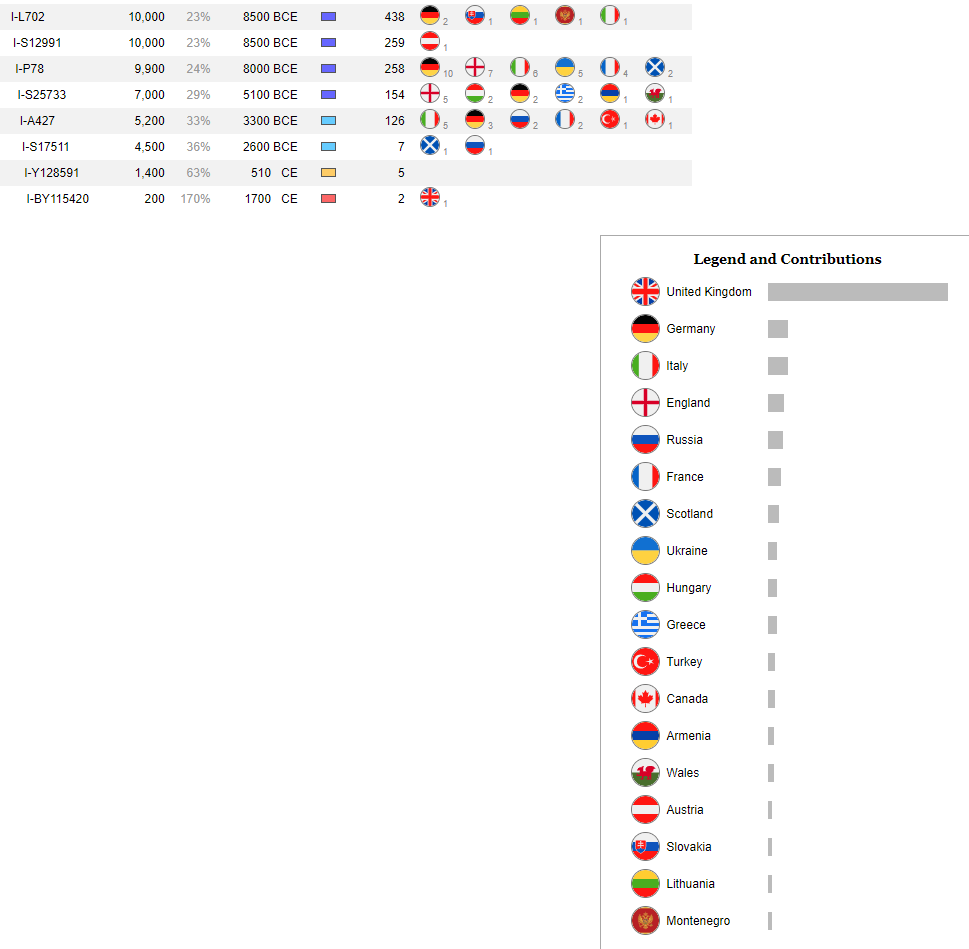
The 1545 date is more complicated. My understanding is that the Whitson side is said to be from England. Here is some information from the Batt tester’s tree:

Assuming that this information is right, then the Butler family could have been in England in 1545. So far, the Butler genealogy stalls out in Ireland in the early 1800’s. Then the other question is why there is a Butler Line and a Whitson Line. Did one Whitson Branch move to Ireland and change the name to Butler? Was the English Whitson Branch originally Butler and change the name to Whitson in England?

YDNA and SNP Tracker

There is a website called SNP Tracker that makes some guesses as to dates and places also. Here is the SNP for Whitson – BY115420:

This map misses the Roman and Iron periods. That must be the big Block of SNPs where there are no matches. So between the blue dot and orange dot on the map there is a great unknown. Here is a timeline going back 10,000 years:

SNP Tracker for the Butler SNPs

This should be a little more refined as there are three testers and one father-son pair:

This shows Butler as going through England in Medieval times.  Here is the timeline:

Here I don’t agree with the timelines – especially for FT241245. This is a SNP that both Ken and his father share. However, it was formed much earlier. In my own dating I had the date of 1680 above this SNP. That means that this SNP could have formed around 1700 – so I am  not too far off from SNP Tracker. However, before that SNP Tracker has Y128364 at 1300 CE. That should only be one SNP older than FT241245, so I don’t agree with the 300 year period between these two SNPs. As a reality check, Y128364 appears to be at the same level as the Whitson BY115420 which is dated at 1700 CE by SNP tracker. Bottom line: I like my own dates better.

SNP Tracker also has a new mapper just for Great Britain and Ireland:

This shows Butler going to County Kilkenny. I’m not sure I agree with that. I think that many of the Kilkenny Butlers may be R1b, instead of my wife’s Butlers who are in the I Haplogroup. I’m not sure if SNP Tracker accounts for that. Here is some more detail from SNP Tracker:

Where DId Ken’s Other Private Variants Go?

In my previous Blog, I had suggested that most of Ken’s Private Variants should end up here:

However, I notice another change since this image. Before the right column was just Batt. Now there are Whitson results.

A New Whitson BigY

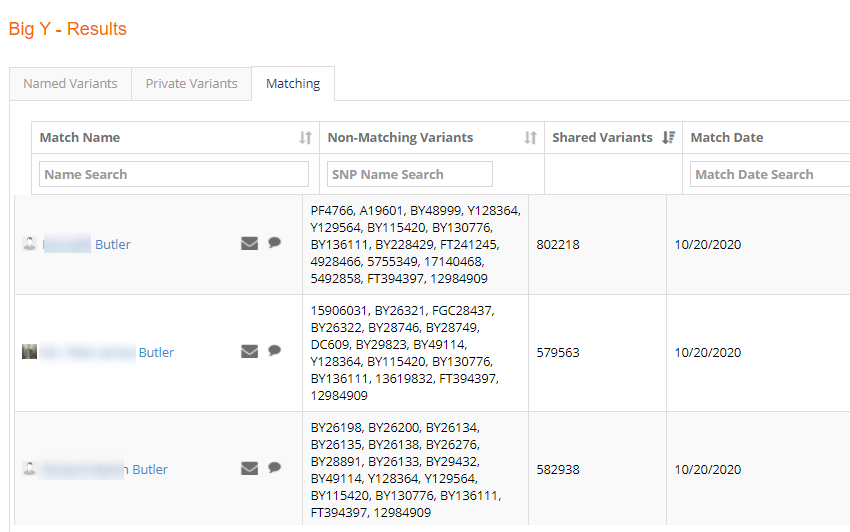
I see by the new Whitson match list, that his test must have been finalized last October:

Here is the new Whitson Block Tree:

Here I have highlighted some of the new SNPs that have appeared in the block above since my brother-in-law Ken tested. There are now 15 new SNPs in that Block potentially representing about 1500 years of time. Also of interest is that the Batt match on the Block Tree has Whitson ancestry. That means that we can simplify this tree somewhat between Butler on the left and Whitson on the right.

The new Whitson tester had a good result for Batt. Previously, Batt’s defining SNP was I-Y128591. That was 35 SNPs from present based on the previous image with the pink arrow. That could be from around 3500 years ago or roughly 1500 BC. Now Whitson and Batt have a defining SNP of I-BY115240 which I have dated at approximately a little later than 1545. That is an improvement of 3,000 years.

Back to Ken’s Private Variants

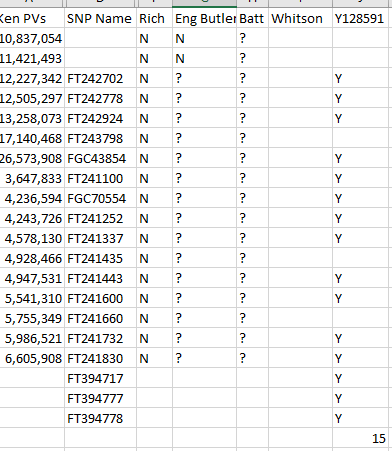
Most of Ken’s Private Variants turned into older SNPs. These in effect moved back the I-Y128591 Block 1500 years to about 4500 years ago or 2500 BC. Here is my comparison spreadsheet of Ken’s old 17 Private Variants:

My guess is that the new Whitson BigY test was the one that moved these SNPs up to the I-Y158591 Block. In the chart above, N means that the SNP was not tested. Rich is Ken’s dad above. A question mark means that the SNP was tested but the results were inconclusive.

Comparing Ken’s Old Private Variants (PVs) to the new SNPs in the I-Y158591 Block.

As I had named 15 of Ken’s old PVs and there were 15 new SNPs in the I-Y158591, it seems like there could be a one to one match. But there wasn’t:

Three of Ken’s old PVs didn’t make it up to the Y158591 Block and three of Ken’s SNPs not previously named made it there. First, I’ll see if Ken’s first two PVs have names yet:

Ken’s first PV is the newer FT394377. I would say newer, due to the higher number of the SNP. Ken’s second previously unnamed SNP is now also named:

This gets us close to reconciling Ken’s list. Here are Ken’s present Private Variants:

I have put Ken’s current Private Variants on the table as PVs. That leaves one extra SNP not previously accounted for. Right now, of Ken’s previous 17 PVs, 14 made it up to the Y128591 Block and three remained as PVs. That leaves FT394717.

FT394717

Here are Ken’s results for FT394717:

The reason that this position or SNP did not appear previously is that the results were ambiguous. Here are the detailed test results:

Ken shows that he did have FT394717. However, he had only one read and usually 10 positive reads would be acceptable. Next, I’ll check the new Whitson BigY results.

The New Whitson Tester and the New SNPs in Y128591

It appears that the new Whitson tester matched with many of Ken’s previously Private Variants. That resulted in FTDNA adding these as SNPs to the already large block of Y128591. Here is one that the new Whitson tester tested positive for:

This is FT394777:

The new Whitson tester must have been positive for the other SNPs in the orange box also.

Ken’s New Private Variants

In order for Ken to have new Private Variants, the new Whitson tester should have tested negative for those Variants. This is a little more difficult to determine. However, partial results are in the new Whitson tester’s csv file. Here are Ken’s Private Variants;

Let’s look at the Whitson tester at position 17140468:

The reference and the genotype are both T for Whitson. For Ken, there is a mutation from T to A. However, I would question whether this is a true PV for Ken as his father did not have that position tested. It is more likely that Ken’s father is also positive for that position:

Ken’s dad’s results clearly did not have position 17,140,468 tested. It would be likely that there would be no Private Variants when a father and son test.

New Whitson Private Variants

The new Whitson tester also has three Private Variants:

I’ll check Ken to see if he has no variant at position 12984909. I will have to download his csv file to find this out:

Ken is not positive for this variant.

What about Batt?

Batt is questionable for this position. That means that the Whitson Private Variant is also questionable. Whitson has it, but it may be a shared SNP with Batt and not just a Private Variant. In fact, all the Whitson Private Variants are in the same category:

Summary and Conclusions

  • When I checked on the 17 Private Variants my brother-in-law had, I was glad to see that these have been resolved.
  • I was also glad to see that there is now another Whitson BigY tester.
  • It was probably the new Whitson BigY tester that resolved my brother-in-law’s Private Variants
  • These Private Variants became older SNPs going back to the period between about 2500 BC and 1550 AD. They increased the age of the I-Y128591 Block by about 1500 years. This period is somewhat mysterious as
  • The new Whitson tester matched with the Batt tester who has Whitson ancestry and gave them both a much more recent SNP than Batt already had. Batt’s defining SNP moved up from 1500 BC to about 1550 AD.
  • I made a guess on the time and place for the common ancestors of the Butler BigY testers: about 1680 in County Wexford, Ireland
  • I also made a guess for the date common ancestors of the Butler and Whitson Lines. This was the same 1550 date mentioned above. The place could be England. However, was the original name Whitson or Butler. Which branch changed and why is unclear. A single mother could have giver her name to her child, or there could have been an adoption. Those are two possibilities.
  • I looked at the SNP Tracker to see what results were there for Butler and Whitson
  • I looked at the Butler and Whitson Private Variants. It is unlikely that Ken should have any Private Variants. Also the Whitson Private Variants are questionable. The result, if Batt and Ken’s father upgraded to the BigY 700, is that these Private Variants could turn into Butler and Whitson shared SNPs.


More Newspaper Entries for My Wife’s Family

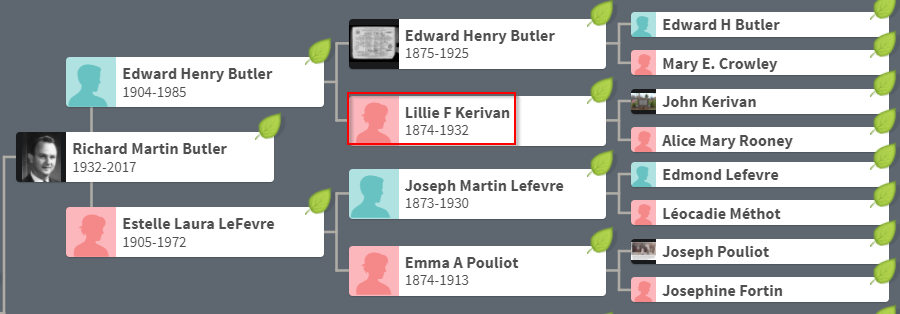
In my previous Blog on my wife’s family in the Newspapers, I looked at some of the members of her Upshall, Butler and Ellis ancestors. In this Blog, I’ll start with Edward Henry Butler (born 1904) and Estelle LeFevre (born 1905):

Estelle LeFevre

14 September 1972

From the Boston Globe:

Here is another entry from the same day:

Not the best condition, but has more information on the LeFevre side.

Edward Henry Butler (born 1904)

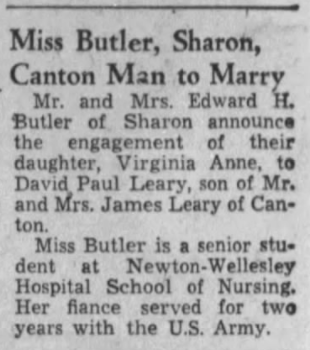
This one could be confusing as there was more than one Edward Henry Butler. Here is one mention under the heading of marriages:

6 December 1959

This was from the Boston Globe.

Here is Edward’s Obituary:

17 April 1985

Kerivan

It occurs to me that I have not looked at the Kerivan famiy. One of my wife’s paternal great-granmothers was Lillie Kerivan:

Lillie Kerivan Born 1874 Needham, MA

There was a Lillie Kerivan at the Nantasket Poice Ball reported on 21 August 1896:

I can’t prove this was the same Lillie.

Obituary for Lillian in the 18 January 1932 Boston Globe. The heading will describe why this was difficult to find:

I can see how the program would interpret the L of Lillian as a T.

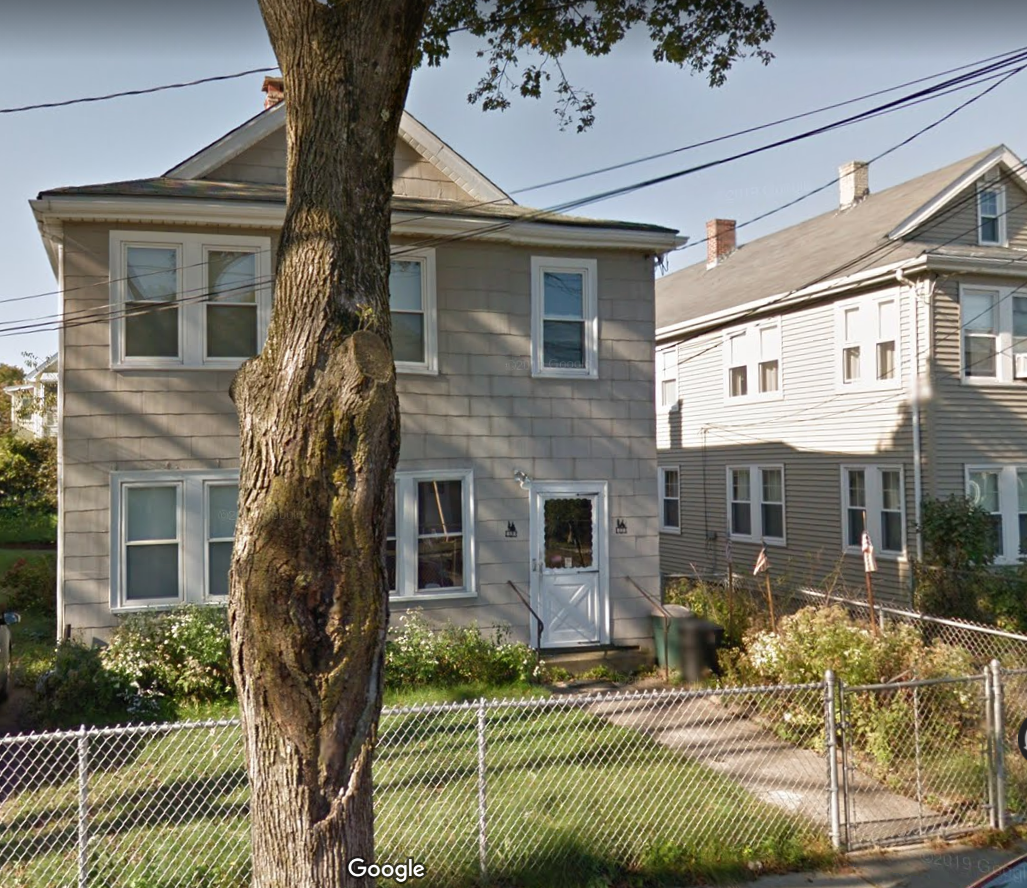
Here is 19 Derby Road:

I think that is a 19 to the left of the door:


More Painting of My Wife’s DNA

I call this painting my wife’s DNA because I use a program called DNA Painter. But really, it is a DNA map of my wife’s identified DNA matches. Here is what I have so far for Marie:

The top row of every one of Marie’s chromosomes is what she got from her father and the bottom row is what she got from her mother. Likewise on the key to the bottom right of the image, the top part shows the shared paternal ancestors represented in different colors on Marie’s map. The bottom part of the key has Marie’s maternal ancestors represented as colors that she got from her DNA matches.

Marie is About One Third Painted

Actually a little less:

Marie is actually doing the best as far as DNA matches go, on her paternal side:

Now that I think of it, that makes sense as there a lot of French Canadian matches on that side. That must mean that Marie is less painted on her maternal side:

Marie only has 57 DNA segments painted on her maternal side. My goal in this Blog is to get Marie’s numbers up somehow. It is not easy as there has to be a link to a common ancestor and they have to have had their DNA tested at a place that gives detailed DNA match information. AncestryDNA is the biggest tester and they don’t give detailed information on their DNA matches.

Searching for More DNA Matches for Marie

The easiest place to search would be at MyHeritage. They have an option called Theories of Relativity where they match up DNA matches and common ancestors. One of the first matches I see at MyHeritage that I haven’t mapped yet is with Ivan:

Ivan has two paths to Marie and Ivan’s proposed common ancestors of Peter Upshall and Margaret Burton.

Here is the DNA that Marie and Ivan share:

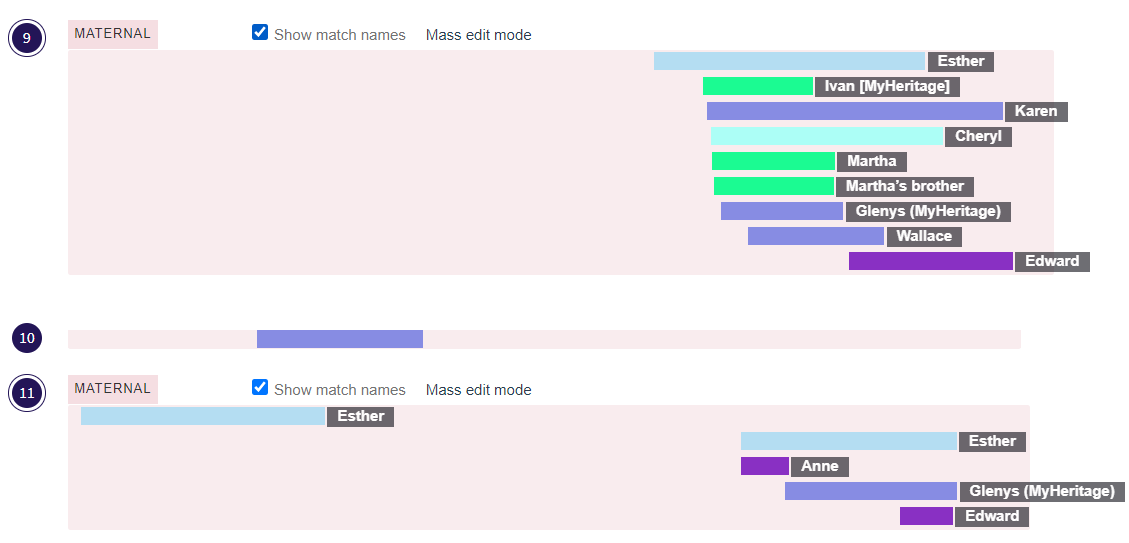
By default, I don’t think that DNA Painter will map Chromosome 11 as the match is 6.9 cM and DNA Painter has a 7.0 cutoff. That is sort of too bad because here is Marie’s Chromosome 11:

Marie’s matches with Esther, Anne and Edward are with ancestors on the Upshall side. But I don’t want to change the default either. Here is what the data looks like that will go into DNA Painter:

Unfortunately, Ivan’s areas of matches were already taken up with others for the most part. There was a small exception on Chromosome 1:

Here Ivan’s match with Marie in green was a little longer than Marie’s match with her half great Aunt Esther.

Marie’s Theory with James

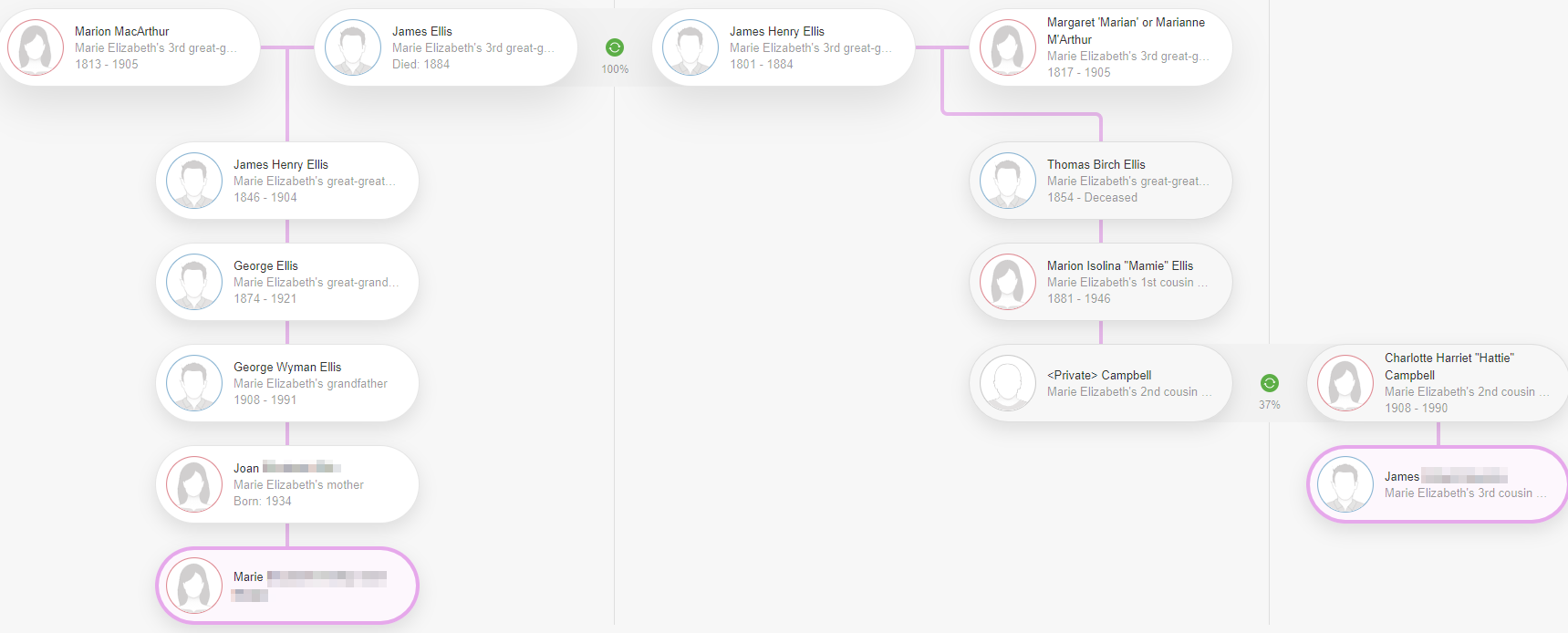
Here is what MyHeritage shows:

James Ellis and Marion (with variations) MacArthur (or McArthur) are Marie’s third great-grandparents. Marion MacArthur was James Ellis’ second wife:

I show Thomas Birch Ellis as James Heny Ellis’ brother so that is good.

I’ll paint this match onto Marie’s map:

The parts of James’ DNA matches that were over 7 cM were on Chromosomes 1 and 2. They are in Ellis regions. There is no overlap, so they constitute new unmapped areas for Marie. This gets Marie up a percent overall from 31% to 32% mapped. On Marie’s Maternal side, she went from 24% to 25% mapped. Progress. I see that Marie also matches Stephen who may be James’ brother. However, Stephen does not appear to add any more DNA than James added.

Marie and Glenys

Glenys shows as a third cousin to Marie:

MyHeritage has her descended from Alexander Upshall. The record I have for him says he died at a lunatic assylum:

Let’s map this match out using DNA Painter. DNA Painter gives a hint:

I’m not sure if this is helpful or not, but it seems like the bottom hint is right. Glenys’ matches with Marie on Chromosomes 9 and 11 are already taken up:

The match on Chromosome 22 is Marie’s first on her maternal side:

This small match is not enough to increase Marie’s percantages, but it helps.

Keep Going with Marie’s DNA Match Caroline?

Caroline is supposed to match Marie on the LeFevre/LeFebre Line:

The connection looks legit. LeFebvre is the older way of spelling LeFevre. Someone left out the b along the way. Hopefully the 1891 for the Charles in Caroline’s line isn’t for his birth as that would to make sense. 1841 would make more sense. At this point, I can either assume that Caroline has the right tree or check on it myself. As I’m feeling lazy today, I’ll just check the DNA to see if it is in the right vicinity.

Turns out I already have Caroline mapped. Here is her bigger connection to Marie on Chromosome 12:

That match is solidly in LeFevre territory, so the connection is likely right.

Marie and Alan

This time I’ll go right to the DNA:

Alan overlaps other DNA Matches except for Chromosome 13:

Alan also adds a new French Canadian common ancestor to Marie’s DNA match who are Joseph Methot and Marguerite Anger.

Marie and Edna

This could be a long Blog. I see that Marie has at least five pages of Theories of Relativity. Edna is Marie’s first Theory on Page 2.

Edna adds some old Christopher Dicks DNA from 1784 on Chromosomes 1, 9 and 12. Here is the connection:

I’m not sure if Planter is the right last name for Margaret. One problem is a DNA overlap on the Ellis side at the end of Chromosome 1:

It could be that Edna’s small match with Marie there is a false positive.

Marie and Marilyn

I think that I have been in touch with Marilyn before as I have done some work on the Dick’s Line:

Marilyn doesn’t add new DNA, but shows that the match Marie has with Esther and Anne goes further back than the 1870’s or 1812. I’m still trying to get Marie’s painted DNA up to 33% but I’m not there yet.

Marie and Andre

Now we are up the 5th cousin level for Marie. As you might expect, the match levels are smaller:

Andre adds a little DNA to Chromosome 15 at the end and gives older DNA bac to 1773 on the LeFevre Line. I’m still not up to 33% painted for Marie:

However, we have 200 segments painted.

Marie and David

This match goes back to Gorrill:

As I don’t see this couple in my DNA Painter Key, this must be a non-painted match.

David provided Marie’s first maternal mapped DNA match on Chromosome 14:

This match got Marie up to 1/3 painted or 33% overall:

That got Marie from 25% to 27% painted on her maternal side.

Reorganizing Marie’s Key

At this point, it would make sense to reorganize the Key in Marie’s DNA Painter Map. Right now I have a line separating Marie’s paternal and maternal matches. Marie’s four grandparents are Butler, LeFevre, Ellis and Upshall. I can organize Marie’s key that way. Unfortunately, I only see one Butler match right now.

The LeFevre matches I just organized by date.

Marie’s Ellis and Upshall matches split out more evenly:

I see a mistake as I left Richard Gorrill up with the LeFevre’s.

Marie’s match with Robert on the Ellis Line


Robert adds some new DNA on Chromosome 3 and gives corroborating evidence on Chromosome 4.

Nathalie: A Fifth Cousin Match on the LeFevre Line

I’ll paint in Nathalie’s DNA as I don’t want to take the time to check every tree:

Nathalie provides new DNA mapping for Marie on her Chromosomes 14 and 19. Now Marie is 40% mapped paternally:

Marie’s Progress Update

Marie has DNA mapped on every chromosome. However, she is missing paternal DNA on Chromosome 5 and 17 and she is missing maternal DNA mapped on Chromosome 16.

Marie and Charolette

I am a little suspicious of this match as there may be a connection on Charolette’s MacArthur side also.

So whether Marie and Charolette connect on the William Ellis Line, MacArthur line or both is a fine point. This could be resolved possibly by further looking into Charolette’s ancestry. Marie is now 34% mapped or painted overall.

Marie and Agnes

Marie and Agnes have several potential connections:

This is the closest theory, so I would go with this one. The other theories are further out:

I don’t show an Edward Rayner in my tree, but I do show that the John Rayner at the top of the tree was the son of Edward John Rayner, so it would make sense if he named a son after his father. Here is where Agnes sorts out on Marie’s map:


Marie and Barbara – Still at MyHeritage

I made a mistake with Barbara at DNA Painter. I put down that she descended from Ellis/MacArthur:

She actually descends from Ellis/Ramsay. That should be easy to fix in DNA Painter. I can edit Barbara in DNA Painter:

I thought that I had an entry for just James Ellis 1801, but I don’t. So I’ll create a new group.

I’m getting there, but it says that James Ellis is not a known ancestor. I need to change that. I go back to the edit section for Barbara and check the known ancestor box:

Barbara fills in some new areas on three chromosomes:

This is turniing out to be a long Blog, but I am getting a lot of mapping done.

Marie and Gilles

As expected, Gilles matches Marie on her French Canadian side. This is on her Fortin/Tremblay side where Nathalie matched earlier in the Blog:

Under Nathalie, the common ancestors were Eustache Jacquies and Marie Judith, but these must be the same ancestors. Gilles adds some more DNA on Chromosome 1. His matches on other segments were below the 7 cM threshold.

I changed the Fortin/Tremblay mapped color to light blue as the previous color was too close to the pink LeFevre color. This match with Gilles maps some older DNA from the latter part of the 1700’s.

Two Possibilities for Jason

I am leaning away from Theory 1:

My tree shows that Marie descends from John Rayner, not James Rayner. However, Jason and Agnes triangulate on Chromosome 4:

I had mapped Agnes to Rayner. I think I’ll skip Jason for now.

Let’s Try Richard

Richard is on Marie’s MacArthur/MacDougall Line.

Richard added DNA to Marie’s map in previously unmapped areas on Chromosome 1, 9 andd 17:

This finally gets Marie mapped overall up to 35%. If I mapped this right, Richard’s match to Marie on Chromosome 17 points out a crossover. The green and light blue are from Marie’s Upshall side and the dark blue is from Marie’s Ellis side. This shows about where Marie’s maternal DNA went from Upshall, then to Ellis and Back to Upshall.

Marie’s X Chromosome

I don’t think that MyHeritage covers the X Chromosome. That is covered at Gedmatch and FTDNA. Here are Marie’s X Chromosome matches at Gedmatch:

Marie’s top two matches are her Aunts. They would be too closely related to map. The third match has a large X Chromosome match, but no autosomal match, so I would not be able to locate that match at Ancestry.

Marie and Lise

The fourth match is with Lise at Ancestry. Perhaps I can find her. I found someone who looks like Lise at Ancestry, but she does not have a maternal line given.

Marie and Muriel

After some dead ends, I came across Muriel. She is at Ancestry and Gedmatch and shows a common ancestor:

Here is where Gedmatch shows the X Chromosome (or 23) match:

This mapping was in a previously mapped area with Marie’s 2nd cousin. It does show that this is old DNA going back to the early 1700’s if Ancestry is right:

I also added Muriel’s matches on Chromosome 14:

Although I didn’t add much new information, I did show that I could add X Chromosome information.

Marie’s New Chromosome Mapped Update


Summary and Conclusions

  • My primary goal for this Blog was to update Marie’s Chromosome Map which I did.
  • The secondary goal was to get Marie at least 33% mapped and I did that also. I was able to get Marie mapped overall from 31% up to 35%
  • I also looked into Marie’s X Chromosome but that was more difficult as MyHeritage does not include information on the X Chromosome.
  • I also improved Marie’s Key and changed some of the colors on Marie’s map

Looking in Newspapers for My Wife’s Ancestors in the Boston Area

Some of wife’s ancestors were Butler, Ellis and Upshall. I have already found some interesting information from newspapers. I have a trial at newspapers.com, so I’ll take a look

Upshall

This name should be fairly easy to find as it is unusual. I have found an article previously on my wife’s great-grandfather Fred Upshall. Let’s see if I can find it again.

Fred Upshall was a ship captain. He was mentioned in the paper several times. Here is a random entry from the Boston Globe on Monday 22 September 1913:

Here we learn what Fred was up to in 1913. Here is another article from the Globe on 27 October 1911:

This article involved a race and bets.

In 1910 Captain Upshall was sailing the Schooner Romance:

This is from a 2 September 1910 article in the Boston Globe.

Here is a scary article from 21 Mar 1911:

Here is an engagement notice for Fred’s daughter Esther dated 16 May 1948:

Fred had died by this point and the Mrs was his second wife.

I found this notice by entering the year of Fred Upshall’s death:

All these articles are from the Boston Globe. This one is dated 8 January 1937. Here is an article from the day before:

My wife says that Fred actually died when the boat was fumigated.

I assume that this is the same Fred Upshall in a 21 February 1928 article:

This was about a month before the birth of his daughter Esther.

Wensley Street is South of the McLaughlin Playground on the map above. Here is where the accident occured:

Here is an article about the death of George Upshall from 1945:

Butler

I found quite a bit on the Upshall family. I think that it will be more diffiult to find articles on the Butler family. Here is the death record for my wife’s 2nd great-grandfather:

This was published in the Globe on October 18, 1915.

Here are Edward’s wife and children:

This may be one reason I am having trouble finding women in newspapers.

Julia Ann Butler is listed as Mrs. Silas Deshon. I didn’t find this entry. Someone else had put this image in Ancestry.

Here is an entry for an Ellen Butler from the Cincinnati Enquirer 11 October 1867:

As Edward’s daughter would have been about 8 years old at this time it would not be her. The mother is a possibility as she was probably Mary Ellen. Who knows?

George Butler

This appears to be the death record for George Butler:

This Boston Globe ariticle was from March 28, 1925. Here is George’s death notice:

Here is a 27 August 1912 article about the unfortunate death of Geoge’s son Edward:

Edward Butler Born 1875

This was published Friday, February 6, 1925.

Ellis Family

My wife’s Ellis family was from Prince Edward Island, but moved to the Boston area.

George, like Fred above, met an unfortunate death.

George’s first wife Lillian Rayner died in New York City in 1910. George apparently remarried:

Here is some more on George Ellis:

Here is some more on Marion:

Willard Ellis

Here is Willard’s WWII Registion Card:

I get the impression that Willard was single as he gives his sister as his contact.

This may be Willard in the 1930 Census in Boston:

I wonder who Willard’s cousin was.


More On My Butler Brother-In-Law’s BigY 700 17 Private Mutations

My brother-in-law’s BigY 700 test results came in on February 14th this year. One thing that seems strange to me is that he has 17 private variants. This leads me to believe that FTDNA has not yet finished it’s manual review. In my previous Blog, I didn’t have access to my brother-in-law’s results. Now I do.

Private Variants

Normally there should not be any private variants or perhaps one at the most between a father and son. So where did these come from? My guess is that they could be from earlier YDNA branching. Private variants show as position numbers on the Y Chromosome. Here are the first 10 belonging to my brother-in-law:
I’ll check the first position at YBrowse, to see if there is any more information there:

This is interesting, because this appears to be a new, unnamed SNP. Here are my brother-in-law’s test results:

They look like good results. I’m starting to guess now, but perhaps my brother-in-law picked up a new SNP that no one has ever tested for before.

Let’s try the next position:

This looks new also.

12,227,342

This position at least gave me a SNP number:

Here are some more details:

This tells me that this is a named SNP, but it is a new one as of 2020. This SNP was probably named as a result of my brother-in-law’s BigY test.

I’m beginning to see a trend here. Here is Richard’s csv file for that position:

Richard’s test didn’t cover as many YDNA locations as it was an older test. So the position that his son tested for is new.

Here is a spreadsheet for looking at my brother-in-law’s new private variants:

I’m going down the list. The private SNP at 26M was discovered earlier by a different company:

Summary of My Brother-In-Law’s New 17 Private Variants

Notice the last column. That is the one that says that Richard’s test never covered the position or new SNP that his son has. That explains the 17 new private variants.

Spreading the Net Wider to England

The next logical step is to check my brother-in-law’s private variants against the other BigY Butler tester in England.

Now I’m getting somewhere. The question mark means that EB was tested for the position number but that the results were inconclusive. EB was not tested for the first two position numbers, so they remain without a SNP name. I assume this is where my brother-in-law could match his father or theoretically have a new private variant. That means that my brother-in-law could end up with two private variants down from 17.

In a previous Blog, I had predicted that these new SNPs may go in the Block above Batt under I-Y128591 or even above that. This is still a good place for these 15 SNPs.

Going Up a Level To Batt

I can go one level further. This sheds some further light:

The question marks mean that there was not enough information to say that the tester was positive or negative for a mutation at the location. However, the fact that Batt had a possible mutation at every position of my brother-in-law’s private variants suggests that my brother-in-law will end up with zero private mutations. Mystery solved.

Summary and Conclusions

  • A comparison between my brother-in-law and his father showed that my brother-in-law had 17 private variants. However, that was because those 17 locations were not covered in my father-in-law Richard’s BigY test.
  • A comparison between my brother-in-law and his next closest Butler match showed that match had been tested at 15 of those locations, but the results were inconclusive.
  • I then went out another level and found that Batt had been tested at every location of my brother-in-law’s private variants, but the results were inconclusive at all of those locations.
  • It is likely that my brother-in-law’s test results will confirm each questionable test and that he will end up with no private variants.
  • I guessed where the extra 17 SNPs will end up, but I don’t have enough information to be sure that they will be in the I-Y128591 Block or above that.


Update on the New Butler Haplogroup

In my previous Blog, I looked at the new Butler Haplogroup. It turned out that these were actually two new haplogroups.

The two new SNPs are both in the I2 Haplogroup. They are I-Y129564 and I-FT241564. Here is what the genealogy looks like on the Richard Butler side.

I’m not sure I did the tree right, as technically, Richard’s son should be below Richard. I just meant to show that they both had the two SNPs shown above.

These two SNPs formed between the time of birth of the common ancestor between Richard and the Butler from England. I don’t know when that common ancestor was born. I’ll say it was 1700 to be conservative. Richard was born in 1932. The means that these two SNPs formed in about 200 to 232 years. As SNPs form on average between 83 and 144 years, this time period makes sense.

English Butler Private SNPs

The English Butler who is I-Y128364 has 2 private variants:

Here they are:

If the English Butler has a close relative who does the BigY test, these two Private Variants would form their YDNA Branch.

13619832

I’ll use YBrowse to find out more about the English Butler’s private variants:

Thiss position number shows up as BY122010

This SNP was discovered when the English Butler did his BigY test in 2018:

15906031

For some reason, this SNP was discovered a year earlier:

I retyped the tree for what is a likely outcome for the English Branch of Butlers:

At the top is the Butler/Whitson ancestor. The Butler tree is on the left. Now I have Richard’s son below Richard. This shows four BigY testers. Notice, sometimes I put an I before the SNP name and sometimes not. Either way is OK. All these are within the I2 Haplogroup. There is a 30,000 year difference between I1 and I2:

The above depiction is from the Eupedia website.

Batt

The Batt Line from I-Y128591 has 5 Private Variants:

I could do the same exercise that I did for the English Butler, but I won’t. If a close relative of Batt were to take a BigY test, that would likely name the 5 SNPs that have formed in the previous 700 years.

My Brother-In-Law’s Private Variants

My Brother-in-law still has apparently about 16 private variants. I haven’t seen them yet, but his father Richard has 0 private variants and the average private variants between father and son is 8.  From Richard’s Non-Matching Variants:

These are Richard’s non-matching variants compared to his son, the Butler living in England and Batt. The fact that both my brother-in-law and EB (English Butler) have BY28891 and BY29432 seems significant. The fact that Richard doesn’t share these SNPs with his son or EB suggests that his son and EB share these SNPs with each other.

Here is Richard’s results for this SNP:

This shows Richard had only one positive read out of about 10 for this SNP. EB, on the other hand, had about 13 good reads:

Let’s take this SNP up a step to Batt:

Batt actually had 9 good reads, but because Richard had a lousy test, it was not originally included. That means that this SNP should be added to the Butler/Whitson Block:

The SNP could even be further upstream, but it is likely where I show. Putting a new SNP in this Block would not increase the distance between Butler and Batt, but would increase the number of years between Butler, Batt/Whitson and the next closest YDNA relative on the tree. These next matches are quite distantly related and have ancestors from Scotland and the Russian Federation:

BY29432

I’ll check this SNP, to see if it follows the same pattern. In this case, Richard has a much better read:

There is a little arrow at the location of the read.

EB has a bit of a wild read:

I say wild because the Genotype is C and the mutation shows as changing first to A and then to G, but mostly to G like Richard’s results.

Next, I’ll check Batt:

This shows some confusion in the test:

Batt’s faded reads were low quality and the mutation apparently also called the genotype came out as T. There were more than 10 reads of C > G. There is also tow more pages of results for Batt:

Above is the last page. The second page had some more faded T’s. This last page has a good read for a C > A which appears to correspond to EB’s C > A reads, though I think EB’s reads were lower quality. Bottom line is that I think that FTDNA should also add this SNP to the Butler/Whitson Block, but I don’t know all of FTDNA’s standards. If they do, my brother-in-law’s results would be the tippng point.

This is the kind of manual review that FTDNA will be doing with my brother-in-law’s new BigY 700 results. This, in addition to looking at his Private Variants.

Looking At the Butler YDNA Project and Ancestry

There are 599 members of the Butler YDNA Project. There are 5 members who mention Wexford in their ancestry:

  • Two Butlers are I1,
  • two are I2 and
  • one is R1b. R1b is traditionally Irish, though more detail would be needed as this could include England or other parts of Europe also.

Richard is not included in the Wexford Butlers, even though his ancestry probably goes back there. I have him in the YDNA Butler Project as having Kilkenny ancestry as that is as far back as I’ve gotten in the genealogy.

Butlers with Kilkenny Ancestry

I also see five Butlers who show Kilkenny Ancestry:

  • One I2 – This is Richard, but he probably will end up being listed as from Wexford.
  • One R1a – R1a could indicate Scandinatvian origin.
  • Three R1b’s – However, two of these have the Fitzpatrick name

That means that, in this unscientific survey, Wexford Butlers are more likely to be I2 or I1 but less likely R1b. Due to the results including Fitzpatricks, the results for KIlkenny seem inconclusive.

All-Ireland YDNA

When I expand the list to Ireland, I get this:

This seems to indicate that the further away from Wexford you get, the more likely it is that your Butler ancestor will be from the R1b group. There is only one R1a which I would associate more with the I1 and I2 Groups. The R1a ancestor is from Glenmore which is interesting as it seems to be in the area where my wife’s Butlers were from:

Glenmore is in the area of Kilkenny that is near Counties Waterford and Wexford.

Summary and Conclusions

  • I looked at the Private Variants for a BigY Butler tester from England. He is the closest BigY match to the two American Butler testers.
  • It is believed that the common Butler ancestor for these three BigY testers is in Wexford. I drew a BigY tree for what would likely happen if the a close relative of the English Butler BigY tester was to also do the BigY test.
  • The next closest BigY tester has the Batt surname, but can trace his ancestry back to England under the Whitson surname.
  • I looked at some non-matching Variants between my brother-in-law, father-in-law, the other Butler Tester and a Batt BigY tester and showed where they may fit in.
  • I looked at the YDNA data for the FTDNA Butler Project. This suggests that the Wexford Butlers are more likely to the I1, I2, or R1a as compared to R1b. R1b is considered a more native Irish YDNA type. I1, I2, and R1b came later in Irish history – perhaps as part of a Norman conquest.
  • I’m still waiting for FTDNA to finish their manual review of my brother-in-law’s Private Variants.


A New Terminal YDNA Subclade for My Wife’s Butler Family

I have been testing my late father-in-law’s YDNA since 2015, so this has been a long journey. Recently my brother-in-law also had his YDNA tested. He went all out and got the BigY-700 test. This was good because once two people who are closely related both have this test done, then it defines the terminal subclade for that specific family.

So, What is the New Subclade?

The new Subclade is:

Here is how it looks in FTDNA’s Block Tree:

Previously my father-in-law, Richard was I-128364. The odd part about this is that the figure still shows 8 Private Variants between Richard and his son. I don’t see any private variants for Richard. That must mean that his son has about 16 private variants as this is an average of the two. My guess is that FTDNA has not updated the Private Variants yet.

SNP Tracker

The SNP Tracker has not yet tracked I-FT241245. However, this is what it now shows for I-Y128364:

This tracks the migration that the Butler family took since the dawn of time. Note that the Roman period is skipped over and this just brings us up to Medieval times. The Roman period must be bound up in the block of 23 SNPs that are listed here under I-Y128591:

I-FT241245 Is Not the Terminal SNP I Was Expecting

David Vance from the Big Y Facebook Page points out that:

By the way this also says that the father and son both share two variants that are unique to their line, FT241245 and Y129564. Those are two separate SNPs that apparently occurred on the father’s line after his most recent common ancestor with the Butler in England. FT241245 is at position 4195963 and Y129564 is at position 20968182.

This surprised me a bit as previously, I thought that Richard would have one SNP. This is based on the fact that Richard previously had one private variant. My guess is that either the manual review is not finished yet, or Richard’s son had a SNP at position 4195963 resulting in and that Richard had that also, though perhaps they weren’t sure before that Richard had it

I have found that YDNA can be full of surprises.

FT241245

I looked at Richard’s CSV file and found this:

This shows that Richard already tested for this SNP but that there was a question. this is shown as a known SNP because this is a new CSV file. I assume that the original file only showed this as a position number.

The FTDNA Y Chromosome Browsing Tool shows this for Richard:

Richard had only two reads for this SNP and several more reads are needed before they are accepted.

This was accepted based on his son being positive for this SNP:

The other question I can’t answer is why they chose this SNP to name the branch and not Y129564.  I might have chosen Y129564 due to the testing problems for Richard of FT241245.

Y129564

Here is how Richard tested for Y129564:


Why Do Richard and His Son Have Two Terminal Subclades?

Here is the tree I had before Richard’s son tested:

I-Y128364 appears to represent the Wexford Butlers. At least that is the opinion of the Butler researcher from England. That makes sense because my wife’s ancestor, though he was probably born in Kilkenny, was born near the Wexford border. The George Butler family from Cincinnati who my wife’s family is related to by autosomal DNA was originally from Wexford. Also the English researcher’s family was from Wexford.

Above, the 225 years before present date is important. Here is the new tree:

The English Butler and the American Butlers shared a common ancestor around 225 years ago. This date could be earlier based on known research. However, since that time, the American branch of Butlers has had 225 years or so for new SNPs to form. New SNPs form at about the rate of every 83 to 144 years depending on the coverage of the BigY test taken. So in those 225 years or more, there was time for two SNPs to develop in the American Butler Line. Unfortunately, without further testing, we don’t know which SNP formed first.

This would be a good place to look for additional BigY testers:

Richard had a Great Uncle George born about 1873. This George had 8 sons. We just need to find a surviving male Butler from that line to test. This descendant of George Butler would probably be either I-FT241245, Y129564 or less likely neither. If he was neither, that would mean that the two new SNPs happened only on the line of George’s brother Edward Henry Butler born 1875.

Private Variants

Here is the Block Tree again:

Richard

Richard’s Private Variants do not show. However, he presently has 0 private variants. Before Richard’s son tested, Richard had one private variant. However, we now know that he should have had 2 private variants. One of those private variants had ambiguous results. Those 2 private variants formed I-FT241245 and Y129564.

Richard’s Son

I can only assume that Richard’s son has about 16 Private Variants as Richard has 0 and the average private variants between the two is 8. I have asked Richard’s son for his private variants. I assume that these may be bad readings or false readings or matches with Batt or the England Butler or new SNPs from up the tree. The other issue is that Richard’s son has taken the BigY 700 which has more coverage than the other BigY testers. That means that Richard’s son may have new SNPs that were not previously discovered.

Butler (England)

This Butler has two private variants which is consistent with Richard’s two New SNPs. If this tester finds a close relative to test the BigY, he will likely have his branch named with two new SNPs. If he finds a more distant relative, he may define one out of two of his now private variants.

Batt

Batt has 5 private variants. He shows his ancestry going back to Joseph Whitson in England in 1615. If we say that the SNPs were formed every 144 years for this older BigY test, that gets us back 720 years. That is roughly the year 1300, so quite a while ago. That suggests that the common ancestor between Butler and Whitson was in England at this time. Perhaps one line stayed in England and became Whitson, while another line went to Ireland and became Butler.

Next Steps

  • FTDNA is likely looking at Ken’s private variants. These should get down to one or zero for Ken.
  • We will want to check the SNP Tracker to see if it picks up the new SNPs for Richard’s line. I don’t know if they wait until FTDNA’s manual review is over or not.
  • It would be nice to have additional BigY testers.


Butler DNA and Genealogy Update

Butler researchers Peter and Neil in England have been working hard to tie together the George and Edward Butler families. Both these families lived in Cincinnati for a while. There are genetic ties between the two families as well as circumstantial ties. Neil believes that he descends from (I think) either George’s father or grandfather. Below is my attempt to connect the two families:

I have Henry Butler’s family on the left and Michael Butler’s family on the right. I don’t know the father of either, so this is speculation based on DNA matches between the two families. The DNA matches between the two sides seem to support the tree above. The main family under Henry is George Butler who moved to Cincinnati from Wexford, Ireland. The main family under Michael is Edward (Henry) Butler. He lived in Cincinnati for a while but moved around a bit.

Circumstantial Connections Between the George Butler and Edward Henry Butler Families

Mary A Butler Born 1858 in Cincinnati

My wife’s ancestor Edward Henry Butler married Mary E Crowley in 1855 in St. John, New Brunswick. The family moved after that to Cincinnati. George Butler had a daughter Mary A Butler born in Cincinnati in 1858. She moved to St. John and married Thomas Joseph Murphy in 1878.

Murphy descendants match my wife’s Edward Henry Butler side of the family

Edward Butler, Son of Henry Born 1839 Wexford

Peter found this announcement:

Peter’s research shows Edward as the 7th child of Henry Butler:

Above, the newspaper funeral notice mentioned that the funeral was at 220 California Street, Newton. Here is the Newton Directory for 1893:

I had rejected that my wife’s ancestor Edward could have been a clerk as I thought that he could not read or write. However, he must have picked up reading and writing as the 1910 census says that he could do both.

The Veteran’s Census has Edward H in Newtonville in 1890:

There must have been a connection between Edward H Butler and Edward Butler of Wexford, in order for Edward H to host Edward’s funeral.

A New Holman Connection

Peter has been bringing the Cincinnati George Butler family forward:

Peter asked Neil and  me to check for DNA matches to Grogan, Holman and Middendorf. I was able to find a Holman match:

He matched with my wife’s Aunt Lorraine at AncestryDNA. He also matched my wife’s Aunt Virginia. This couple had three boys. The Holman above must descend from one of these three. Here is the new branch on the right:

More on the Holman/Butler Match

The match I will call Holman has shared matches with my wife’s two Aunts at Ancestry DNA. Here are the results:

The two in yellow are also matches to Neil’s nephew who tested at AncestryDNA. In the last column above EHB stands for Edward H Butler and GB stands for George Butler. These are the two lines that are connected by DNA.

It would make sense to do this same exercise with at least Patty and Michael.

I don’t think that gave me any more information. I looked at Michael’s shared matches and didn’t see anything helpful there either.

One Side Benefit

I did put a few close Butler DNA matches on the Butler DNA tree here:

I added in Deborah and Chester on the Alice Mary Butler line.

Summary and Conclusion

  • I like to summarize and conclude because while I’m blogging I sometimes get off the subject.
  • The main point here is to secure the connection between the George Butler and Edward H Butler Lines.
  • The other point is to secure Neil from England by DNA as he appears to be connected to the George Butler Line.
  • We were able to make DNA connections between Neil’s nephew who tested at AncestryDNA and one match confirmed to be on the George Butler Line. Neil’s nephew also matches another common match who has no listed tree.
  • Through Peter’s research a new George Butler descendant line has been found. A person from the Holman family was found to be a shared match across with Neil’s nephew and my wife’s Aunts. This further solidified the Butler family connections.


My Butler Brother-In-Law’s New BigY 700 Results Are In

I had been looking for my brother-in-law’s new BigY 700 results. Finally I got a note from a more distant relative Peter in England that Ken’s results were in. Here is the image that Peter shared from his perspective:

The first Richard on the list above is my father-in-law. I manage his results. The second Richard is a more distant relative in a different haplogroup (I-Y128591). I’m not sure why Ken is listed third on Peter’s match list. Peter and Ken have the most Shared Variants. It looks like the list is sorted by Non-Matching Variants. Peter and Ken have more of these because Peter, and the two Richard’s took the BigY 500 test. Ken’s BigY 700 tested for 50 percent more variants than the older BigY 500 test..

Peter’s Non-Matching Variants

From looking at Peter’s list of Non-Matching Variants, I think that I can learn a few things. Non-Matching Variants are a little confusing because they could not only be a variant that Peter has and Ken does not. It could also be a variant that Ken has and that Peter does not have.

15906031 and 13619832

I note that the variants at position numbers 15906031 and 13619832 are common to all three of Peter’s matches. That likely means that Peter has these variants and the other three do not. That means that if Peter has a close relative with the same last name tested, that relative should also have 15906031 and/or 13619832 and that probably one of these two would be Peter’s terminal haplogroup.

20968182

Both Richard and Ken have 20968182. This is likely the position for the variant that will become Richard and Ken’s terminal haplogroup. I can look up this position at YBrowse:

Here is what the position looks like:

My further guess is that Richard and Ken will have the terminal haplogroup of Y129564:

This haplogroup was ‘discovered’ by YFull in 2018. That was when I tested my father-in-law Richard and uploaded the results to YFull. Here are Richard’s results at YFull:

Richard had no Novel SNP’s in the Best quality category. But he did have one in the Acceptable category which is Y129564.

What’s Next?

FTDNA will do a manual review on the results. It could take a while for them to get to the Butler results. However, I don’t see any possible outcome than the one I outlined above. Ken’s father Richard previously had one private variant. Ken matched this variant, which has the position number 20968182. It also has the name Y129564. This should be the new branch for what I would call the American Butlers. That means that Peter should remain in the now older branch of I-Y128364:

I-Y128364 should represent the now older Kilkenny/Wexford Branch of Butlers.