AutoClustering My Wife’s Aunt’s Ancestry DNA

My wife’s father had his DNA tested at FTDNA before he passed away. I also had his two sisters’ DNA tested at Ancestry. I’ll use his sister Virginia’s AncestryDNA results for Autoclustering as a stand-in for my later father-in-law Richard.

AutoClustering Virginia

I could have picked either sister, so I picked Virginia for no special reason. Actually, my thought was to pick Lorraine, as she is closer in age to Richard, but I picked Virginia. I chose a low threshold of 12 cM for the AutoClustering.

First the Genealogy

Virginia and siblings have half French Canadian and half Irish DNA. In my experience, the French Canadian DNA tends to take over. This is due to the common ancestry of French Canadians, and many descendants who have tested.

The top part of the tree is Irish and the bottom is French Canadian. I am more interested in the top because there are some missing black arrows. Those are the places where there are missing ancestors. The ancestry is filled in to the level of 2nd great-grandparents. The column on the right represents third cousin, but in many matches this should show as third cousin, once removed.

Looking at Virginia’s AutoCluster

Here is the key for Virginia’s Clusters:

The Key is on the Chart, so there are grey dots representing those that didn’t fit well into the clusters. Cluster 1 is no doubt French Canadian. Between Cluster 18 and 19, the cluster size goes down from three to 2. These numbers do not include Virginia who is in every cluster.

Name That Cluster

The game is to name the clusters. Before I do that, I notice that there are not too many grey dots between the first and second Cluster. I take that to mean that these two groups are not closely related. Perhaps the green Cluster is Irish and the orange is French Canadian.

Identifying Cluster #1

This should be easy as there are so many people. First I go to the list of people below the chart and search for Virginia’s second cousin Fred who is an avid genealogist. He is there in Cluster #1.

Fred’s shared ancestors with Virginia are here:

However, there are 120 members in Cluster #1. Next, I went down the list of people in Cluster #1. The last person I had notes for was Girard. Here is Michel’s Shared Ancestor Hint (SAH) with Virginia:

Michel has 72 people in his tree. The problem with that is that Michel and Virginia could have shared ancestors on other lines. Here is Louis Marie Henri Girard and his wife on Virginia’s tree:

I would say that Louis Girard is a hint as to where the cluster is going. I’ll try another SAH. The next person going up the list has six SAH’s and a large tree. Here is the most likely source of the DNA that is shared between Virginia and this match:

These matches so far tend to be around the bottom of Virginia’s French Canadian Tree:

I’ll try one more. The next SAH has over 1,000 people in his tree and his common ancestor with Virginia is Francoise Gagne:

So far, I would say that these are all ancestors of Elizee Fortin and Rosalie Gagne. It is even possible that I could name this Gagne/Girard if the person with six SAH’s has an ancestor there. It turns out our six-matcher has these ancestors also:

That means I would tend to call this a Gagne/Girard Cluster. I like to get the name as far back as possible to be the most specific name for the cluster.

I’ll look at one more SAH to make sure. Lucie has a good tree, but six SAH’s. For some reason her first hint puts her at 6th cousin once removed to Virginia and her second hint puts her at 6th cousin to Virginia. I’ll choose the 6th cousin which goes to Pierre Girard and Marie Anne Vesina. This ancestral couple is also on the Gagne/Girard Line. This is not a life or death decision, so I’ll go with the Gagne/Girard Label for Cluster #1:

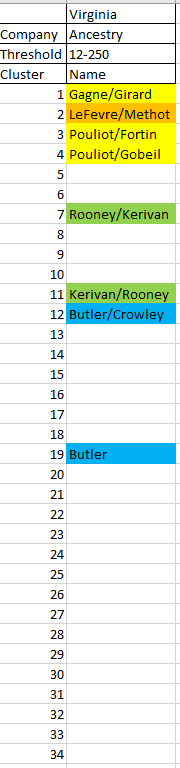
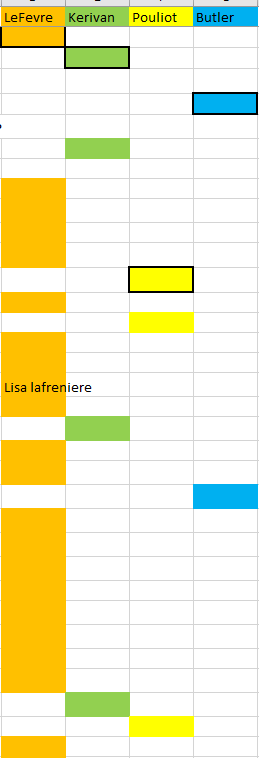
That’s one down and 33 to go. I like to keep track of these clusters in a spreadsheet:

This way I can expand to the right for Richard at FTDNA eventually.

I’m Guessing Cluster #2 Is Irish

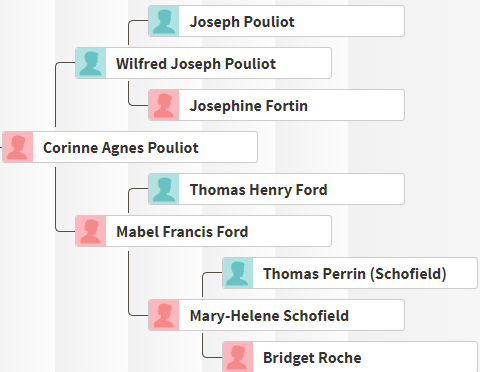
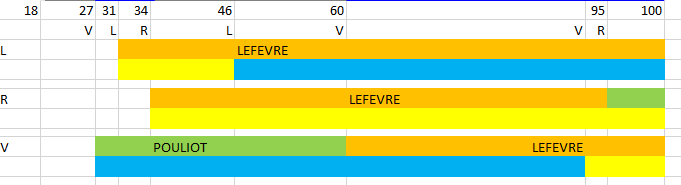
However, as I look at my notes nicely displayed by AutoCluster, I see that this cannot be:

This means that the LeFevre side is not as closely matched to the Pouliot side as the Pouliot side matches some other names. This makes sense also.

Name That Cluster #2

It is obvious that Cluster #2 is on the LeFevere side. However, I want to be more specific as in Cluster #1 above. The match at the bottom of the list shows a SAH of Maguerite Anger. The husband is not shown as he is shown as marrying her three times. However, I assume that the husband should be there also:

The husband is Joseph Methot. I am now just showing the line of Virginia’s LeFevre grandfather Joseph Martin as we know that this cluster is along the LeFevre Line. If I were to name this Cluster based on a sample size of one, it would be Methot/Anger. However, I want to be more sure and it is easy to look at these SAH’s by just clicking on a link from the AutoCluster list of matches in Cluster #2.

Going up the Cluster 2 Match List from the bottom, the next SAH is here:

This brings the name of this cluster one generation towards the present:

Based on a sample size of two, I would name this cluster LeFevre/Methot.

I’ll call in Jane for a tie-breaker:

I can see that Jane adds evidence to my previous guess:

Cluster #3 – French Canadian?

By looking at the Cluster Graph above, it appears that the red cluster will be more closely allied to the Pouliot side. There are not as many linked trees for Cluster #3:

Judy has an unlinked tree:

Cousin Fred is not in this Cluster even though he is closely related. This could be a case that he is too closely related to Judy. Judy’s tree shows that she is a second cousin to Virginia on the Pouliot/Fortin Line. This seems to be the best name for this Cluster:

Cluster 4 – Slim Pickings on Trees

Cluster 4 has very few linked trees:

The match names appear to be French Canadian, so that is a hint. The largest tree above is private. From the above three clusters, it appears that I am getting different flavors of French Canadians. Match #3 has a small unlinked tree:

I really don’t want to build out this tree, though I could. I see Gobeil in Virginia’s tree here:

Alexandre is Virginia’s match #6 on Cluster 4. He also has an unlinked tree:

Here is another small tree from Match #8:

Again, I’m not willing to build out his tree. Match #9 had an unlinked tree and Match #10 had a small tree, but they were not helpful. I’ll go with Pouliot/Gobeil for now.

Cut to the Irish Side

This is going slowly, so I’ll start looking for Irish matches. Here is a Leeds color analysis that I did for Virginia about three months ago:

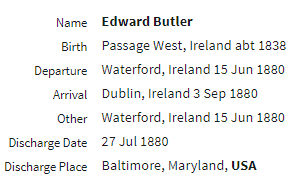
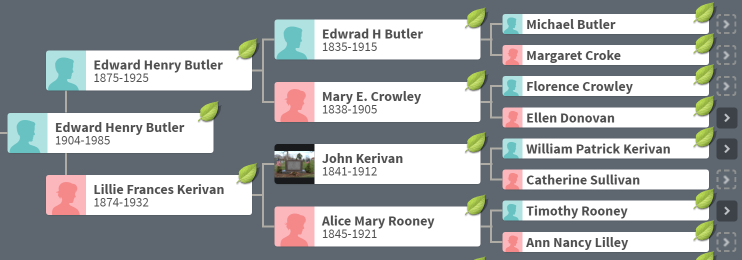
I need to pick out some of these green and blue matches and see where they cluster. The first match is Donna. She matches at 417.5 cM, so this is a case where I set the upper limit too low. The four in a row green Kerivan matches are also all too high for the upper match limit that I picked. Here is part of the tree of the first Butler match that didn’t get filtered out:

The common ancestors are Edward Butler and Mary Crowley. This match is in Cluster 12:

Based on the notes, I can see that I have been tracking three out of four of these matches. I wrote a message to John to see if he has any family history. It may be that he pre-dates the Butler/Crowley connection by one generation.

This Butler/Crowley Cluster is small, but important.

Is There a Kerivan in the House?

The green in the Leeds Color Analysis above stands for Kerivan. Here are some Kerivan descendants in Cluster 11:

I have written about Gaby already as a Kerivan relative. She is Thomas’  Aunt. Here is the tree showing how Virginia and Gaby connect:

Virginia is a second cousin once removed to Gaby and 2nd cousin twice removed to Thomas. Here are the common ancestors on Virginia’s tree:

David: Match #2 in Cluster 11

Here is David’s tree on his maternal side:

I am interested in David’s tree enough that I will build it out a bit. I’m curious to find the common ancestors. I start with David and mark the tree private at Ancestry.  Here is David’s maternal grandmother Joan Kerivan in 1940 Newton, Massachusetts:

Here I use a split screen for working on David’s tree. The tree I am making is on the left and David’s tree is on the right:

I accepted Ancestry’s Joseph Edward Kerivan hint but not his wife as it was different than what David had. It seems like it should be an easy tree. I have the DNA match, the Kerivan name and the right area (Newton, MA).

Here’s David’s great-grandfather in 1910:

Next, Joseph’s birth record comes in handy:

I see on George E Kerivan’s marriage record, that his parents are John Kerivan and Alice. These are the couple that I am looking for. Here is part of my selective tree for David:

Alice is no doubt my wife’s ancestor Alice Rooney.

As an added bonus, I color-coded the Clusters in my summary spreadsheet based on my wife’s Aunt’s grandparents. These are the same colors I used in the Leeds Color Analysis.

The clusters are now taking shape. The magnitude of the French Canadian matches compared to the two Irish clusters is obvious.

Comparison with the Leeds Color Method

Next, I put the cluster names by the appropriate names from the previous Leeds Analysis I did:

I see that one of the people from the Butler Cluster was not in this analysis, so he must have gotten his test results since I did this analysis three months ago. The first green block that doesn’t have an assigned cluster represents Russel. Russel is in Cluster 7.

Cluster 7 – Kerivan?

Here are Virginia’s seven Cluster 7 relatives:

Here is Russell’s tree on his mother’s side:

Time for a Quick Tree for Russell

I found this hint at Ancestry for Thomas Kerivan:

This gets me to where I want to be. Here is my quick tree for Russell:

One might wonder why there is another Cluster for this same couple. It could be that one Cluster is Kerivan and one is Rooney.

Here is Sandra. She has the same mother as Russel, so I could have saved myself some time:

Actually, there is a Rooney in this cluster, so I’ll call this the Rooney/Kerivan Cluster.

There are a few new people in the Rooney/Kerivan Cluster that I should get in touch with.

Cluster 19 – A Butler Cluster on the Outskirts

Here are Brian and Michael:

I associated Brian with the Butler family due to a shared match with Patty. Neither Brian nor Michael have family trees, but it would be worthwhile to follow up with these two.

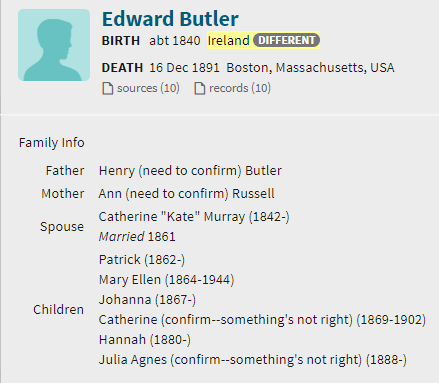
My guess is that the Cluster 19 Butler predates the Cluster 12 Butler/Crowley families. This is a good place to be as I am trying to pin down a place in Ireland where the Butlers came from.

Where is Patty?

One Butler DNA match I have been tracking is Patty. I couldn’t find her in the AutoCluster. Based on her shared matches at AncestryDNA, I would have expected her to be in Cluster #12. AutoCluster provides a list of names that didn’t match other people. I didn’t see her in that list either.

Summary and Conclusions

  • AutoCluster by Genetic Affairs continues to be a fun and useful tool to use to sort through your DNA matches.
  • The program is similar to the Leeds method but is more useful and takes the guesswork and human error out of the equation for the most part.
  • AutoCluster gives a visual as to where the bulk of the DNA matches are
  • In this Blog AutoCluster highlighted some important new matches. It would be worthwhile to contact these new matches.
  • The list of people in the Ancestry Clusters is especially helpful. I can click on each name and quickly go to their AncestryDNA match and see if they have a SAH or linked or unlinked tree.
  • Even though AutoCluster is one of the best things since sliced bread, it is not perfect. I could not find Patty in the clusters. Also the runs that I get are spotty. It seems to work about half the time for me. I would like to get better results at Ancestry for myself and my mother, but am not able to get results at the thresholds that I want. It may be that these glitches will be fixed as this is such a new tool.


Painting My Wife’s Chromosomes

In this Blog I’ll paint my wife’s chromosomes. I use DNAPainter for this. This utility requires a subscription for over one painting, and I’m over that now, so I subscribed. Painting DNA is taking all your DNA matches and painting them onto your chromosomes. The match that you have shows that you have DNA from a common ancestor. So what I will be showing is where my wife, Marie, inherited her DNA on which chromosome and from which ancestor. Hopefully, it will become clear as I go along.

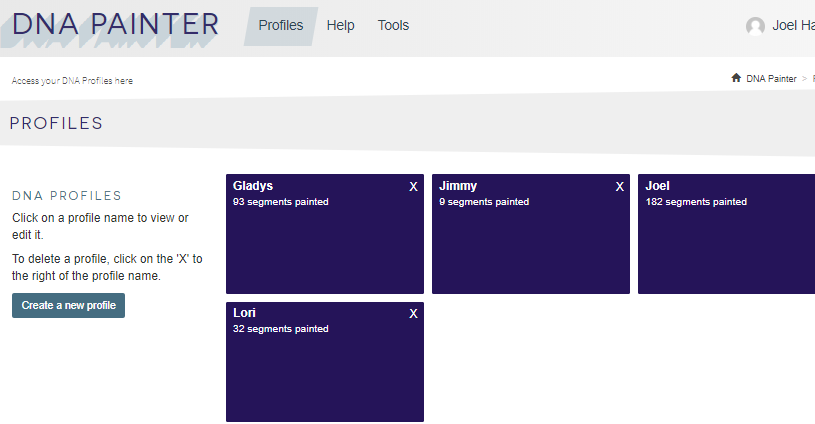
Right now I have profiles for my mother, myself and two siblings:

Next, I’ll create a profile for Marie. DNAPainter just needs to know her name and that she is a female. This makes a difference for the X Chromosome as women have two of those.

Which Matches Do I Paint for Marie?

I will look at painting no matches closer than those that represent Marie’s grandparents. That means that I don’t want to count matches from 1st cousins. Full 1st cousins share two grandparents. The first two people who I will paint will be Marie’s father’s 1st cousins Patricia and Joe. That makes them first cousins once removed to Marie.

Marie’s match with Patricia and Joe will show up on her map as DNA from Joseph LeFevre and Emma Pouliot. That is because we don’t know who the DNA came from. It should be part LeFevre and part Pouliot. Here is Marie’s match with Patricia from Gedmatch.com:

Here is what that looks at DNAPainter:

The DNA is on Marie’s paternal side, so that is on the blue bar. The key at the bottom says who the DNA is from. Now Marie has gone from zero to 7% of her chromosomes painted with adding just one cousin:

Marie also matches Patricia on her X Chromosome. So I added that. Next I need to add Patricia’s brother Joe. This time I’ll paste in his X Chromosome match along with the other matches. Gedmatch has you do a different query for the two. Adding Joe brings Marie’s painted DNA up to 10%. Now we can expand the Chromosomes to see the details:


The X Chromosome expands to this:

This shows that Joe shares more X Chromosome with Marie than Patricia does. Next I added RL who matches only on the LeFevre side as far as I know. This added 1% to Marie’s map and got her up to 11% mapped.

Here is Marie’s match with RL on Chromosome 12. Where RL matches Joe, that is likely all LeFevre DNA. On the right where RL does not overlap with Joe and Patricia, we don’t know if the DNA was from the LeFevre side or Pouliot side.

[Note: I have RL in the wrong color which I correct later in the Blog.]

Adding Some Pouliot DNA

Marie has some matches with Pouliot only DNA. These matches are with Fred, Don and Sleuth:

Now, wherever Marie has a match with Fred and Patricia and those matches overlap, that will show that the match with Patricia was on the Pouliot side and not the LeFevre side.

Here is a new color and this gets Marie’s painted chromosomes up to 13%. Here is Don on expanded view on Chromosome 1:

The green overtook the pink in the expanded view. This is OK as Pouliot is the more specific match and the older one. This tells us that Marie’s match with Patricia on Chromosome 1 is from the Pouliot side and not the LeFevre side. Next I added Don’s two siblings to bring Marie’s painted DNA up to 14%

So far, I have painted 6 matches to Marie’s paternal side. This represents only one of her grandparents – the LeFevre side. This 14% represents 27% of Marie’s paternal side DNA.

Starting Marie’s Maternal Side DNA Painting

Marie has Ellis and Upshall grandparents on her maternal side. Marie matches her half great Aunt Esther on the Upshall side. The half part is important as it narrows down the match to one of Marie’s great-grandparents.

This brings Marie’s mapped DNA up to 20%. So we are one fifth complete.

Here I wanted Frederick on the bottom as he is on the maternal side. I also added a line by choosing Joseph LeFevre/Emma Pouliot. I then chose Edit Group and I checked a box saying I wanted a line below this group.

More Painting

I don’t want to stop now. Marie’s next match at Gedmatch is a first cousin once removed, but he is a younger cousin. He shares two of Marie’s grandparents as common ancestors, so we won’t map him. After Nick is Gaby. Gaby is Marie’s second cousin on Marie’s paternal side. This match represents Marie’s Irish side.

This brings Marie to 23% mapped:

Next: More LeFevre DNA

Sandra has been a big help in uploading her DNA to Gedmatch. She tells me that she is a third cousin to Marie. Their common ancestors are  Edmond Lazare Lefevre and Leocadie Methot.

Sandra manages three DNA kits including her own that are close matches to Marie. I assume that they all have LeFevre and Methot common ancestors. I mentioned RL above but didn’t put in the correct common ancestor.

Here I will want to move RL to another group, but I haven’t set up that group yet, so I’ll add KK first.

Here I have added a new pair of ancestors for Marie on her maternal side with a splash of tangerine. I moved the ancestral pair down one on the key so they would be with the other LeFevre’s. Next I moved RL to the Edmond LeFevre Group. I see now that I could have created a new group before also.

I then added Sandra which brings the mapped number of segments up to 116.

Adding Anne to Marie’s Maternal Side

As I go down the list, it takes a little bit more to figure out where the people fit in. This looks to be the right tree for Anne:

Marie is Joan’s daughter, so that makes Marie a second cousin twice removed to Anne. So we are quickly back to about 1812 with Marie’s DNA.

This is only the second maternal ancestral pair. Unfortunately, I don’t have a last name for Elizabeth. Crann would be a guess. We still have no ancestors for Marie’s fourth grandparent: Ellis.

Ronda: An Ellis Match for Marie

Ronda is next on the list at Gedmatch:

Ronda is a third cousin to Marie. Note that there is another shared ancestor hint. However, it is further out and also on the Ellis line.

As this is a new grandparent match, it means that there will be no overlaps with any other matches and this brings Marie’s painted DNA up to 26%.

An Unknown Upshall Side Match

The next match going down the Gedmatch list is Leslie. Unfortunately, I can’t see an obvious common ancestor for Leslie and Marie. I’ll have to wait until I find one.

After the unknown is Sarah. I was able to find her at AncestryDNA. She has a Shared Ancestry Hint with Marie:

This is Marie’s first painted DNA from the 1700’s. The new matches are on the maternal sides of Chromosomes 2, 4, and 6.

On Chromosome 6, I circled one of Marie’s crossovers. That is where her DNA crossed over from her Upshall side in light blue to her Ellis side in teal and orange. The actual location of the crossover is where the blue changes to teal.

Next is another unknown match. This is with Bobby. I can tell that the match is on the Ellis side, but not exactly where. I do see that Bobby also has his DNA at FTDNA. However, the tree is not all filled out there either.

Next is Danielle. I can tell by Shared Matches at AncestryDNA that she is related on the LeFevre side, but the detailed tree is missing also.

Karen and Martha with Newfoundland Roots

Newfoundland Roots means the Upshall side for Marie. I don’t have a good tree for Karen, but I have blogged about her. Based on her DNA, I have theorized this tree:


We’ll say I’m right. I have that Henry Upshall married Catherine Dicks. I added Karen’s match on Chromosomes 8 and 9 in lilac:


For Martha, I have another best guess tree:

Actually, this is double made up as we cannot easily prove that Peter Upshall is the father of Henry Upshall. However, this is a best fit tree. Marie would be a third cousin once removed to Martha’s maternal aunt. I believe that M.B. is Martha’s maternal aunt.

The good news is that I’m getting more maternal side matches for Marie. The bad news is that paperwork in Newfoundland is missing and it is hard to verify the last two matches.

Michelle at FTDNA on the LeFevre Side

I mentioned FTDNA above. Marie has matches there also. Here is an interesting one with Michelle. Michelle is related to Marie only on the LeFevre side:

Michelle’s maternal grandparents were Martin LeFevre and Mabel Ford. Marie’s great-grandparents were Martin LeFevre and Emma Pouliot. Emma died and Martin remarried Mabel. Here is Marie’s match with Michelle at FTDNA:

Transferred to DNAPainter:

I now have an entry for Joseph Martin LeFevre by himself as well as the couple of Joseph LeFevre and Emma Pouliot.

More Maternal DNA for Marie on the Upshall Side: Edward

Edward and Marie have this common ancestor:

Here Marie and Edward are fourth cousins. They have a common ancestor of Christopher Dicks and Elizabeth Crann. I’m not positive about the Crann. Here I made a couple of mistakes:

First I forgot to assign this to the maternal side and secondly I already had an entry for Christopher Dicks. Fortunately, DNAPainter had a way for me to merge this group into the right one on Chomosomes 9 and 11 (Chistopher Dicks in purple).

This gets Marie up to 150 segments mapped.

Marie and Wallace at MyHeritage

Marie has a good match with Wallace at MyHeritage. I uploaded Marie’s results there while writing this Blog.

Here is where I have Wallace:

Wallace is a 2nd cousin once removed to Marie. At this point, Marie’s maternal chromosomes are 22% filled in and her paternal chromosomes are 36% filled in. A lot of paternal LeFevre relatives have tested. Here is Marie’s maternal side only:

That is what 22% filled in looks like.

Adding Cheryl and More of Martha’s family

Cheryl has Dicks ancestry. I have written many Blogs on this family and how their descendants match up by DNA.

Cheryl is on the bottom left. She is a fourth cousin once removed to Marie. As there are some missing lines in Marie’s Newfoundland genealogy, there may be other ways Marie is matching some of these Newfoundland descendants. Here is how Cheryl compares with some others on Chromosome 9:

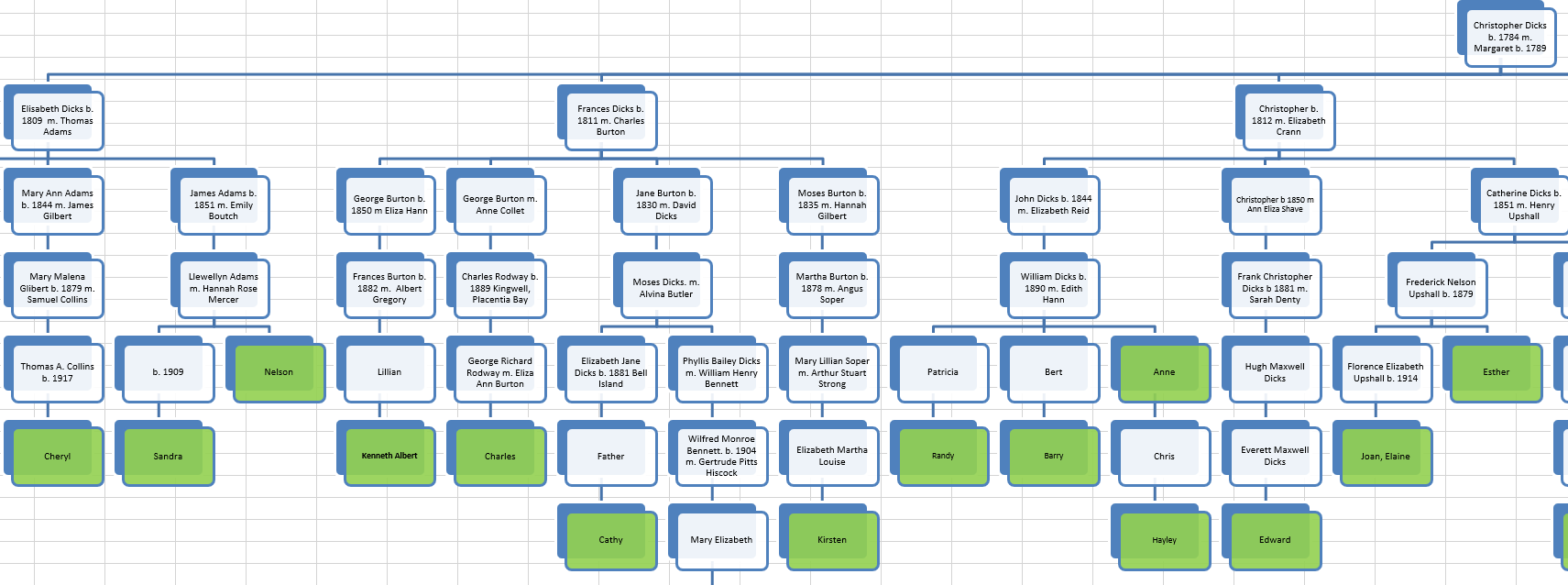
The light blue represents Christopher Dicks born 1784 or his wife Margaret. Many people descend from this couple.

Next, I’ll add Martha’s brother and Martha. Some of these matches are not adding new DNA.

Back to LeFevre

Here is a match on the LeFevre side:

This is on the French Canadian side. Note that there are two other pairs of shared ancestors. However, this is the most recent.

This is Marie’s first mapped French Canadian DNA from the 1700’s (in red). It is interesting that Marie and Kbou also match by XDNA. In order for this X match to occur, there cannot be any two males in a row in Marie’s or Kbou’s ancestries. Looking at their trees above we see that is indeed true. This match brought Marie’s mapped chromosomes up to 30%.

I could keep on going, but I’ll stop here.

Summary and Conclusions

  • I mapped 30% of Marie’s chromosomes using DNAPainter and matches from Gedmatch, FTDNA and MyHeritage. AncestryDNA was helpful to provide trees but it does not provide the detailed DNA information needed to map the chromosomes.
  • I was able to paint 10% of Marie’s chromosomes with two of her first matches. After that, things went more slowly.
  • Of Marie’s four grandparents, Butler matches are the most rare. Marie had one Butler match.
  • I gave an example of a crossover.
  • Marie has DNA mapped on every chromosome. However, a paternal or maternal side may be missing.
  • It would be interesting to create a DNAPainter map for Marie’s mother and father and see how they compare to Marie’s map.

A Butler Kerivan Match with Lindsey

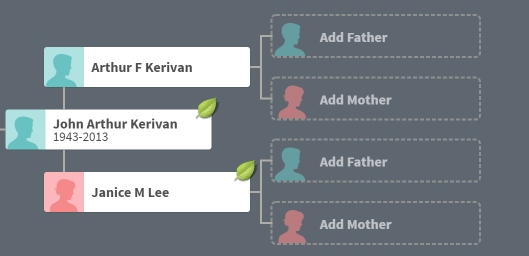
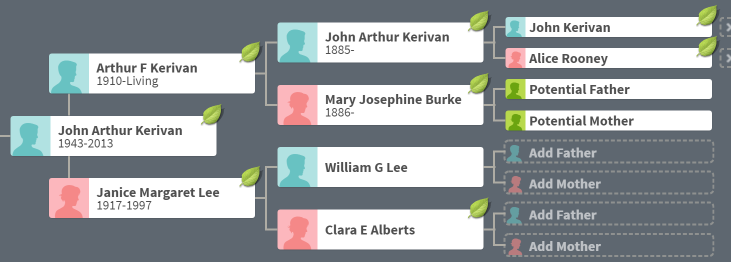
I just uploaded my father’s DNA results to MyHeritage. He has a pretty good match at MyHeritage with Lindsey. Lindsey has this tree:

My father-in-law’s grandmother was a Kerivan. As Kerivan is not a common name, I am hoping that is where the match is.

Richard’s great-grandfather was also John Kerivan, but born 100 years before Lindsey’s John:

Connecting John and John Kerivan

The next step would be to try to connect the two Kerivans. I can do this by trying to build out Lindsey’s tree. First I start one at Ancestry. From a Duxbury Church record, I see that Arthur was born in Waltham, MA:

Here is the connection on Lindsey’s paternal side:

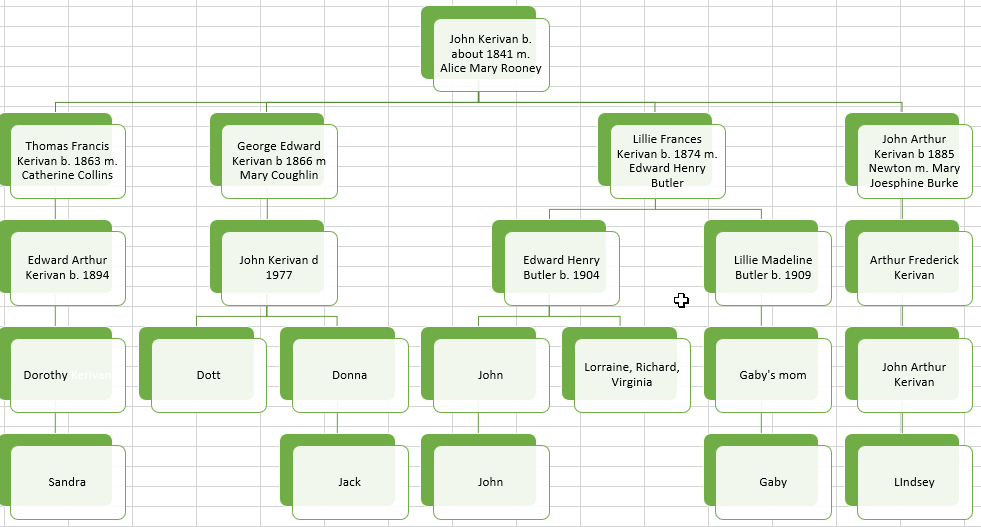
At this point, I like to put Lindsey into a top down Kerivan tree:

This tree shows how Lindsey is related to other Kerivan descendants who have had their DNA tested. It turns out the Kerivans had a big family. Lindsey’s great-grandfather John Arthur was a late arriver as he was born 22 years after Thomas Francis Kerivan. My last update on Kerivan DNA was here. The people at the bottom of this tree have all tested at AncestryDNA except for Richard and Lindsey. John, Lorraine, Richard, Virginia, and Gaby have their DNA also at Gedmatch. I put Lorraine, Richard’s and VIrginia’s DNA at MyHeritage, where I found the match to Lindsey. Gedmatch and MyHeritage have chromosome information, so we can compare the results of those on the right hand side of the chart.

Kerivan DNA

This shows where Richard and Lindsey match at MyHeritage:

The purple sections represent the DNA of John Kerivan and Alice Rooney that Richard and Lindsey share.

Here is how Lindsey compares with Richard’s sister Virginia:

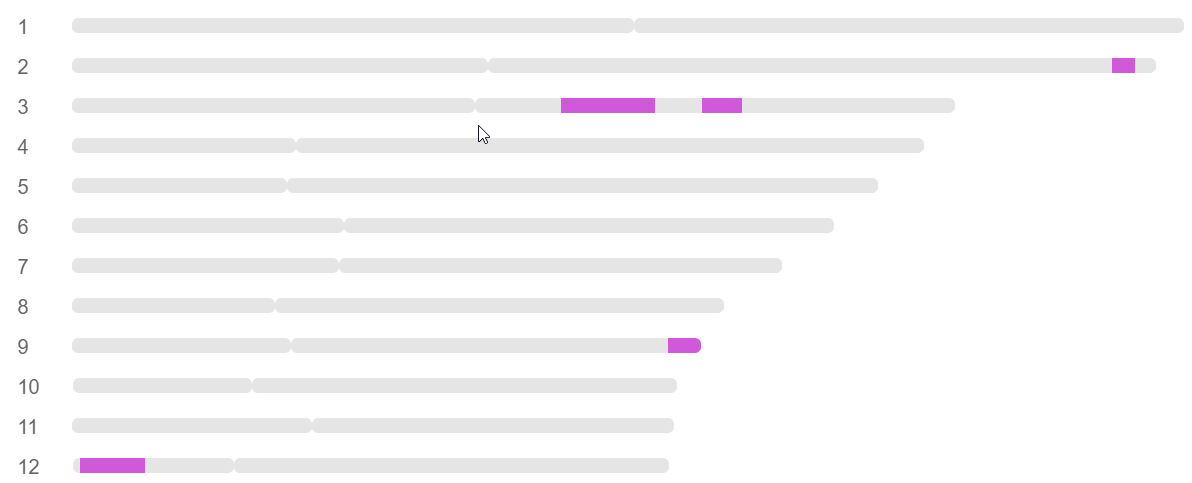
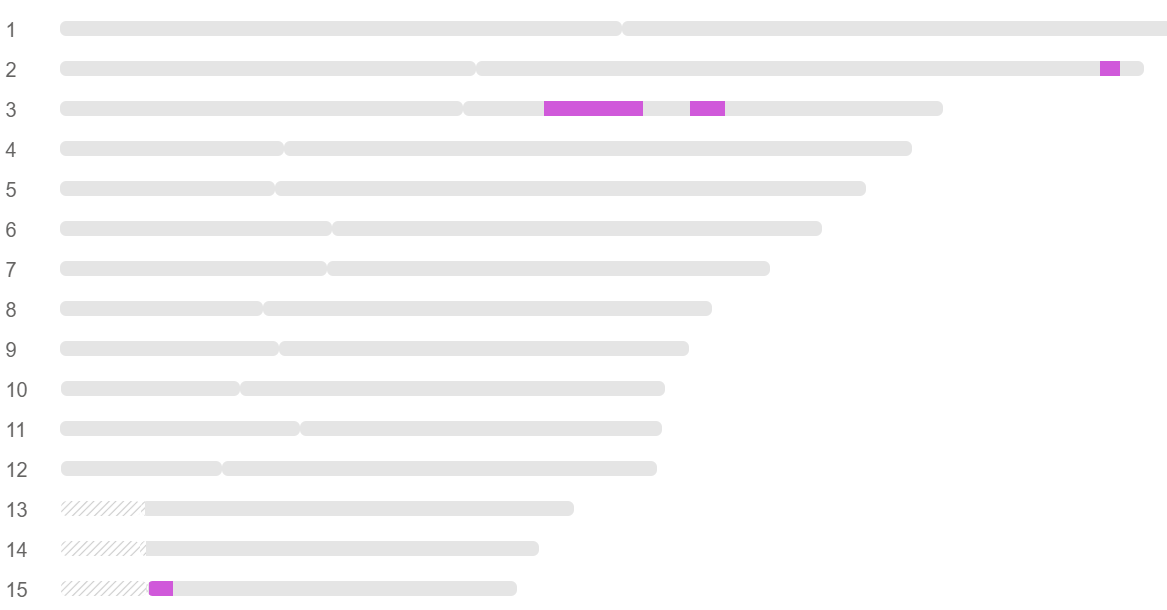
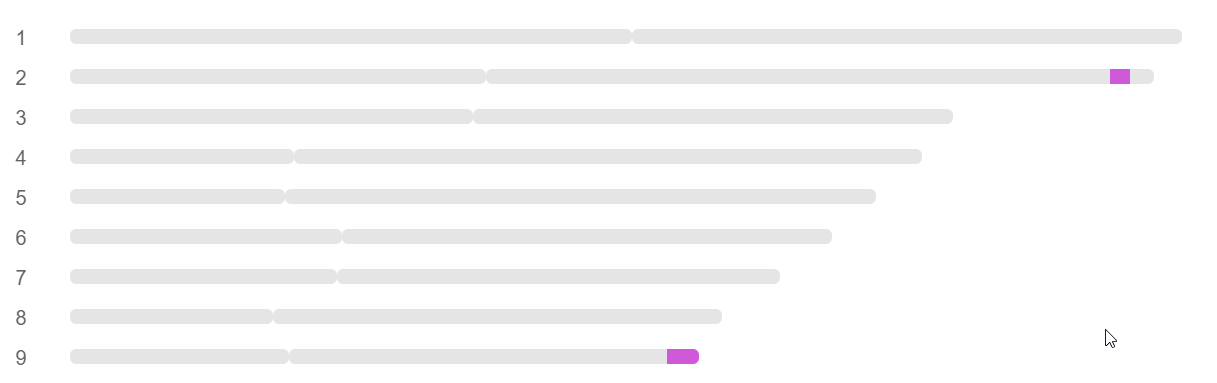
Virginia doesn’t have the same DNA at Chromosomes 9 and 12 but does have a match on Chromosomen 15 that Richard doesn’t have.

Here is Lindsey’s match with Richard’s other sister Lorraine:

It looks like Lorraine got less Kerivan DNA compared to Lindsey when the DNA dice rolled.

Lindsey and Chromosome Mapping

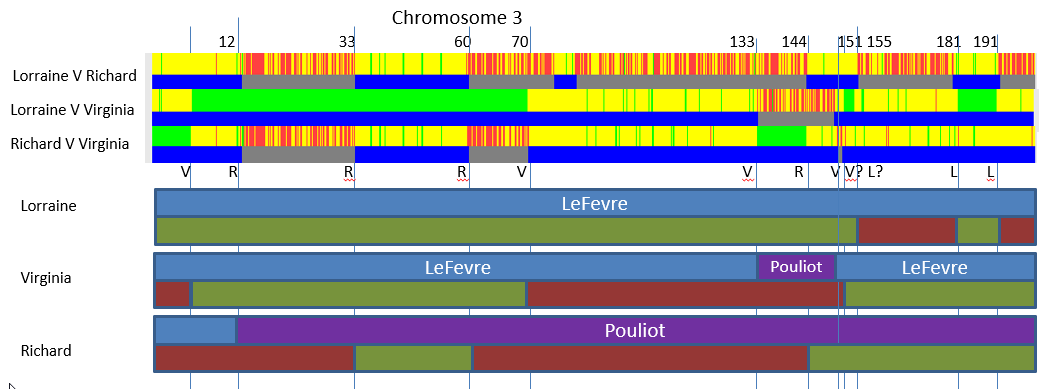
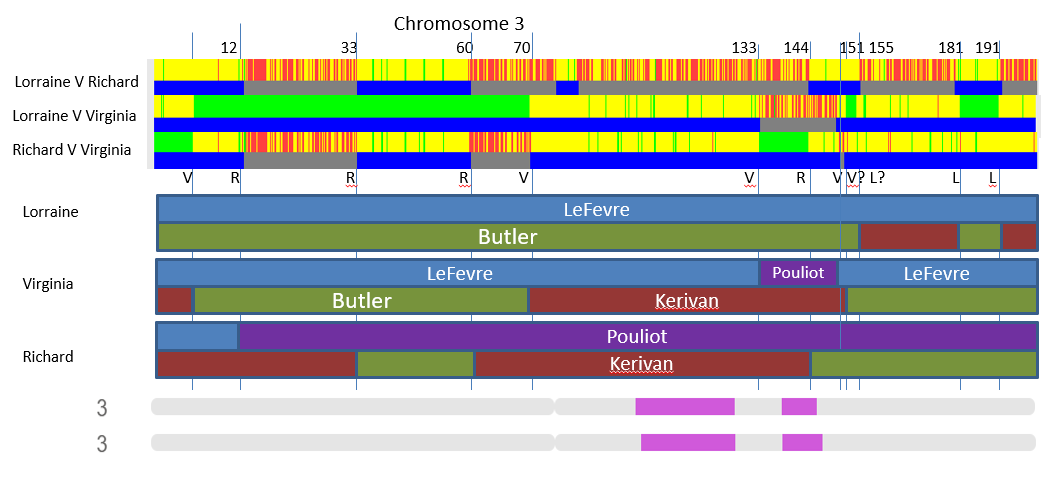
In 2016, I mapped Chromosome 3 for my father-in-law Richard and his two sisters:

This shows where Lorraine, Virginia and Richard got their DNA on Chromosome 3 from their three grandparents. Their maternal side is on the top of the Chromsome. The paternal side is on the bottom but was not identified as I had no known Kerivan or Butler matches on Chromosome 3. Now it is clear that the maroon is Kerivan and the green if Butler DNA.

Here is the Chromosome map with Linsey’s match with Virginia and Richard:

The resean why Lorraine didn’t match with Lindsey on Chromosome 3 is that she had Butler DNA in that region and not Kerivan. This shows the way we inherit our DNA. We get it from our parents, but our parents are actually giving us their parents’ DNA.

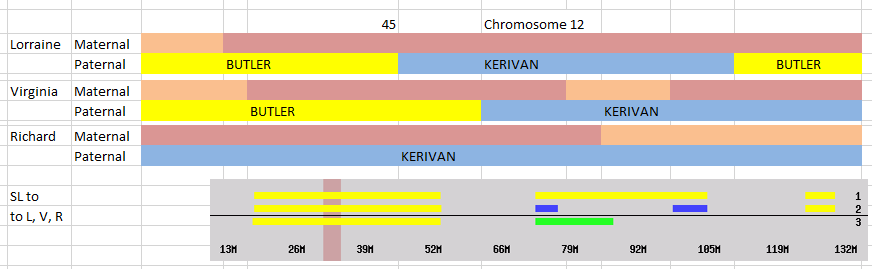
Mapping My In-Law’s Chromosome 12

I have even less on my in-law’s Chromosome 12:

I notice that Lindsey matches for the first part of the Chromosome. It looks like I figured out previously from a cousin match which side would be maternal and which side would be paternal. That means that the Kerivan DNA should be blue and the Butler DNA is yellow.

My in-laws also have more matches at Gedmatch.com compared to when I first did this mapping. Here is SL who matches on the LeFevre side:

By comparing SL’s matches to Lorraine, Virginia and Richard, it is clear that LeFevre is the raspberry color. That leaves orange to Pouliot:

Now when these three siblings have a DNA match, it should be possible to figure out on what grandparent side they match. Also note that between the three siblings, they have recreated all their mother’s LeFevre DNA. On their father’s side they have shown all the Kerivan DNA that their father had. Some Butler and Pouliot is missing and was not brought down to any of these three siblings.

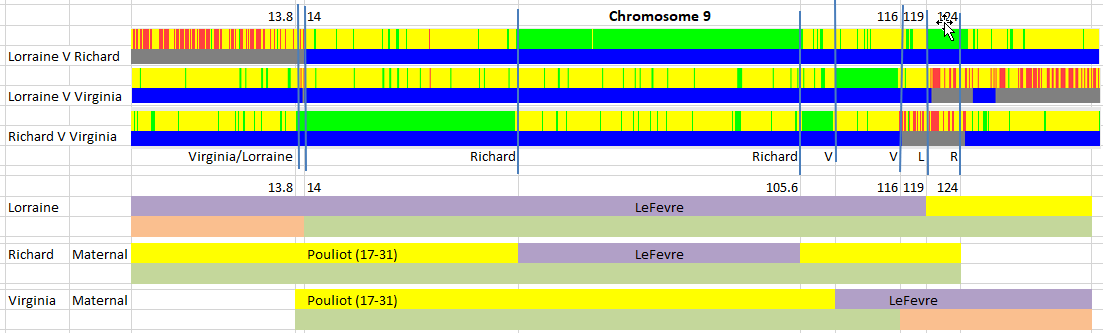
Solving the Chromosome 9 Map with Lindsey

Lindsey matched Richard and Lorraine at the right ends of their Chromosome 9. Here is what I had:

I was stuck on the right end of Richard’s Chromosome 9. Now I know that green is Kerivan.

That means that Richard got a full dose of Kerivan and no Butler on his Chromosome 9. Richard had a crossover at position 124M. That means that it has to be on his maternal side as Lindsey proved that he has a Kerivan DNA where she matched him on the right end of the Chromosome.

The left side of Virginia’s Chromosome 9 can be solved with results from SL who shares LeFevre DNA with these three siblings:

Here #3 is Lorraine. This shows that only Lorraine has LeFevre DNA at the left side of their Chromosome 9. Here is the completed Chromosome 9:

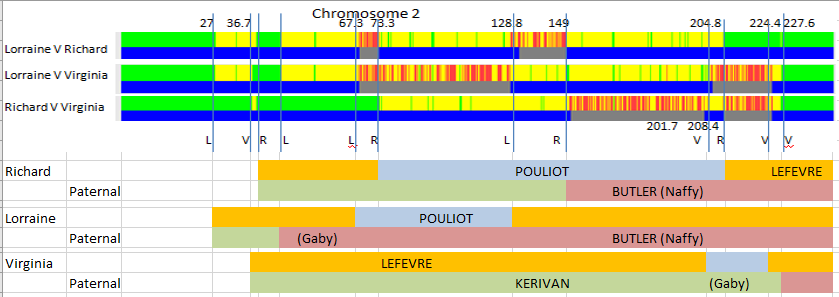
Chromosome 2

By the number of versions of Chromosome 2 that I have save, I can tell that I had a hard time figuring this one out. This is one version of what I had:

This shows Butler DNA on the right hand side for each sibling. However, Lindsey shows a match with each sibling from 233 to 238 M. That means that Lindsey either has a false match or I made the map wrong. I’ll have to figure this one out later and look for more matches. The lower number, longer chromosomes canbe more difficult to map than the shorter ones.

Lindsey and Triangulation

Triangulation is when three people match each other on the same segment of the chromosome. That means A = B, B = C and A = C. Most would consider triangulation more useful when it is between people that are more distant that parent/child or siblings. Lindsey, Virginia, and John triangulate, but as John is a nephew of Virginia, it is like having a triangulation of a sibling. Here is how that triangulation looks like at MyHeritage:

Here the yellow is where Virginia matches her newphew John. Red is where Virginia matches Lindsey. The circled parts are where Lorraine, Lindsey and John have triangulated segmets. That means that they all match each other. What is interesting is that Virginia, Lindsey, and John don’t triangulate on Chromosome 2. That is where I was having trouble fitting in that match on the Chromosome 2 Map. What does it mean when there is not triangulation? It means that there is no common ancestor between all three people. I look at it this way: I match my father’s sister, my Aunt and my mother’s brother, my Uncle. However that Aunt and Uncle do not match each other and the three of us do not have a common ancestor. It is a matter of a match between your maternal and paternal sides where those sides do not match each other by DNA. So, above, the circled parts indicate Kerivan ancestry and the non-circled match represents something else. The uncircled part is probably part Kerivan match and part something else.

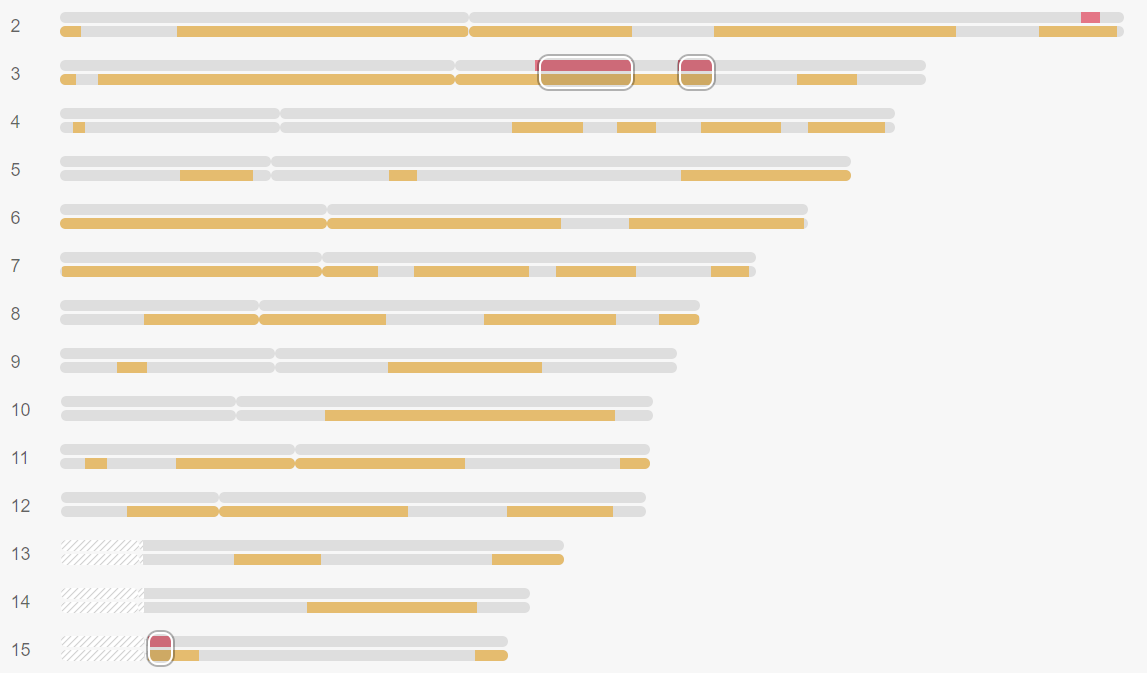
Back to Mapping Chromosome 15

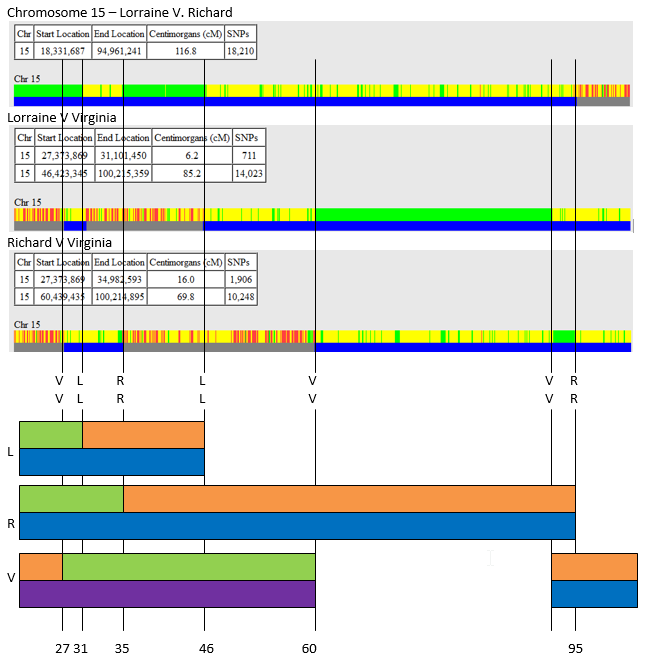
I see that I didn’t use Lindsey’s match to help map my in-law’s Chromosome 15. It has been over two years since I mapped this and was having difficulties:

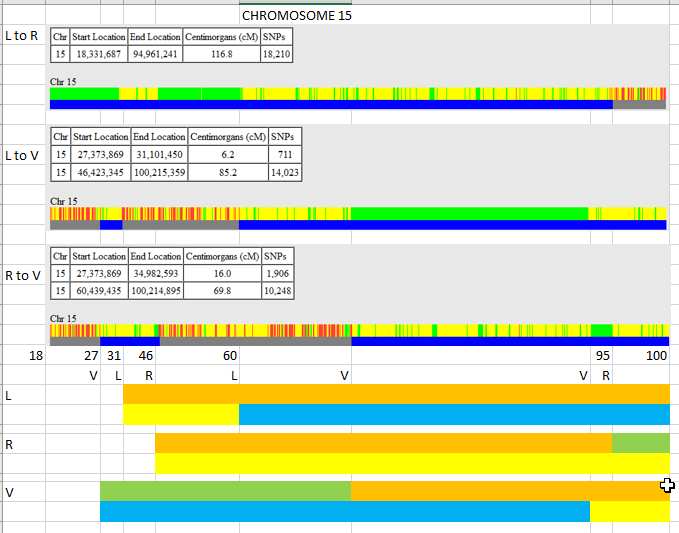
At MyHeritage, only Virginia out of the three siblings matched Lindsey at the beginning of Chromosome 15. I’ll give this a second try:

This looks better. This time I started more in the middle of Chromosome 15 and worked my way out.

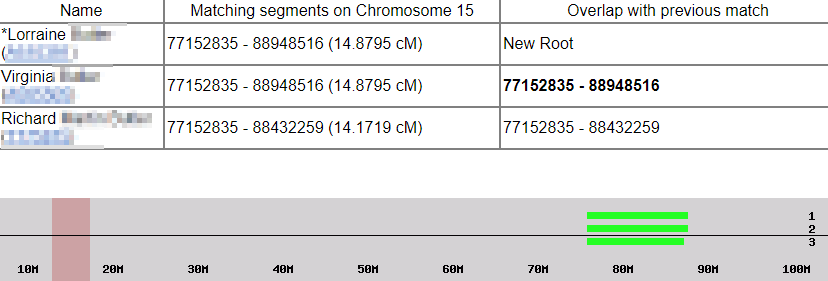
Here is the match with RL who is on the maternal LeFevre side:

I notice that there are three LeFevre matches from about position 77M to 88 or 90M. The only place that this could occur on the map would be in the orange. So orange must be LeFevre.

This map looks better. However, I still don’t know if Lindsey’s match with Virginia is blue or yellow. I would have to know more about the maternal or paternal side at the left-hand part of the Chromosome.

Summary and Conclusions

  • Lindsey is the only non-close relative that I have found that descends from John Kerivan and Alice Rooney and has specific information on her DNA. That DNA information is found at MyHeritage.
  • Lindsey’s matches with my father-in-law and his sisters helped me fill out their chromosome maps.
  • Lindsey has shared matches with my in-laws and triangulated segments with some of these shared matches. That means that those people would likely share common ancestors. I didn’t look into these shared triangulated matches.
  • One of Lindsey’s matches went against what I had for my in-law’s Chromosome 2 Map. However, this match segment didn’t triangulate which means that it was likely not a Kerivan only match.


Another Butler DNA Connection

Recently, I’ve been playing around with the Leeds Color Method. That is a method where you should be able to put a person’s AncestryDNA matches into four bins or colors. These colors represent your four grandparents. Here are part of the results for my wife’s Aunt Lorraine:

The trick is to get matches that are no closer than 2nd cousins. That is because with 1st cousins, you will match on more than one grandparent. In this Blog, I will be looking at Lorraine’s blue Butler matches. These are the most rare matches – especially compared to all the LeFevre matches.

The First Butler Match: Barbara

I wrote to Barbara this past March, but didn’t hear back. Barbara doesn’t have a tree connected to her DNA, but does have a simple tree at Ancestry:

This tree is good enough to get back to Butler.

Barbara is at the perfect level for a DNA match. She is at the second cousin level. At this level the DNA match is very high and we can isolate the match to one grandparent – in this case Butler. Barbara shows as a potential 2nd cousin by DNA at Ancestry. In fact, she is a 2nd cousin to Lorraine.

The Second Butler Match: Brian

I wrote to Brian, who also has a good DNA match. His sister Mary Lou has an active account with Ancestry, so was kind enough to respond and show me where her family tree was:

This is Brian and Mary Lou’s paternal side of the tree. Lorraine and Brian show as potential  third cousins by DNA, so I would think that the connection would be one level higher. However, AncestryDNA does say that the range could be 3rd to 4th cousin. Here is Brian and Mary Lou’s tree with the Butler Line isolated.

Lorraine’s sister Virginia has also tested at AncestryDNA. She shows as a 4th cousin to Brian.

Stitching the Two Butler Families Together

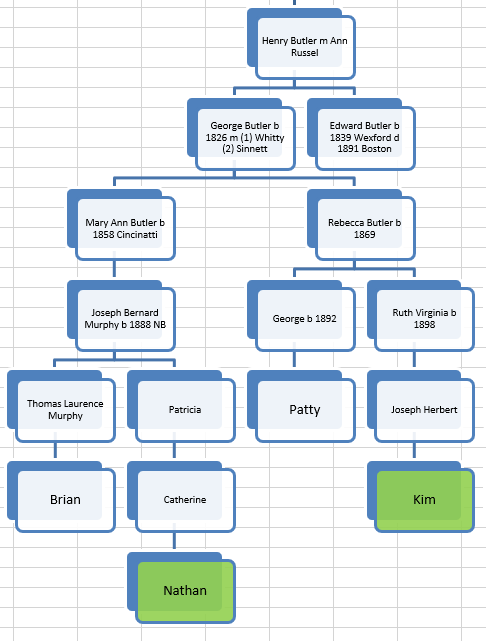
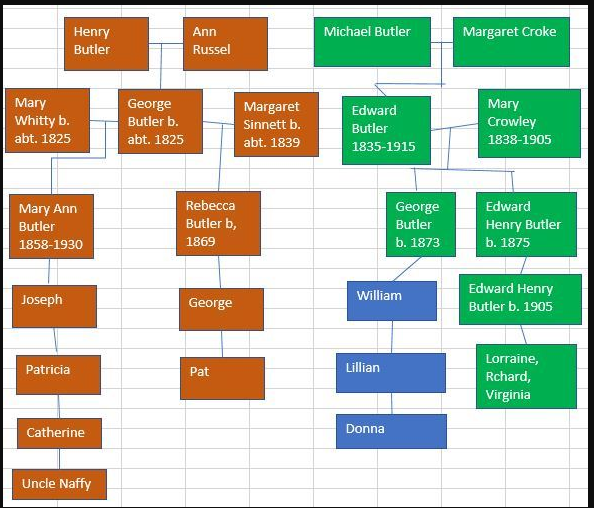
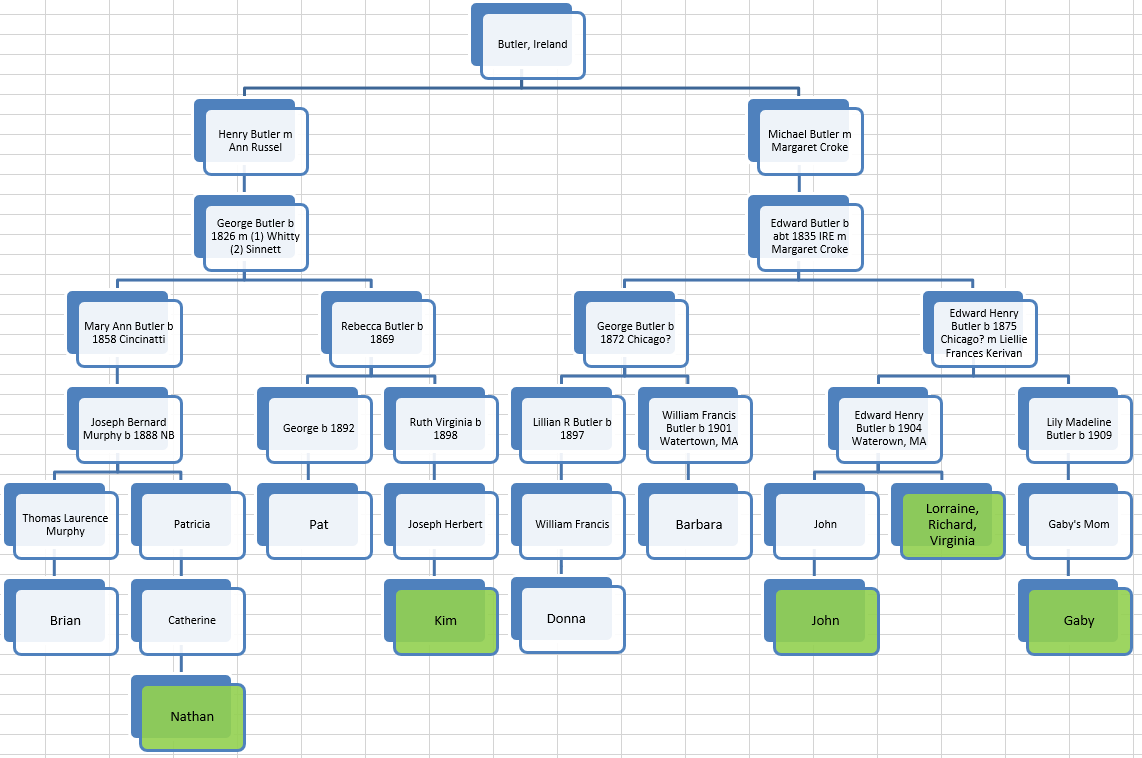
In my Blog from over a year ago I showed this figure:

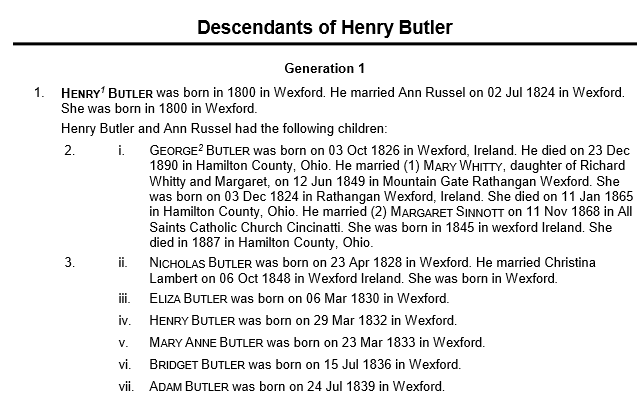
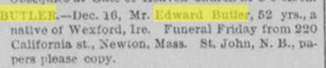
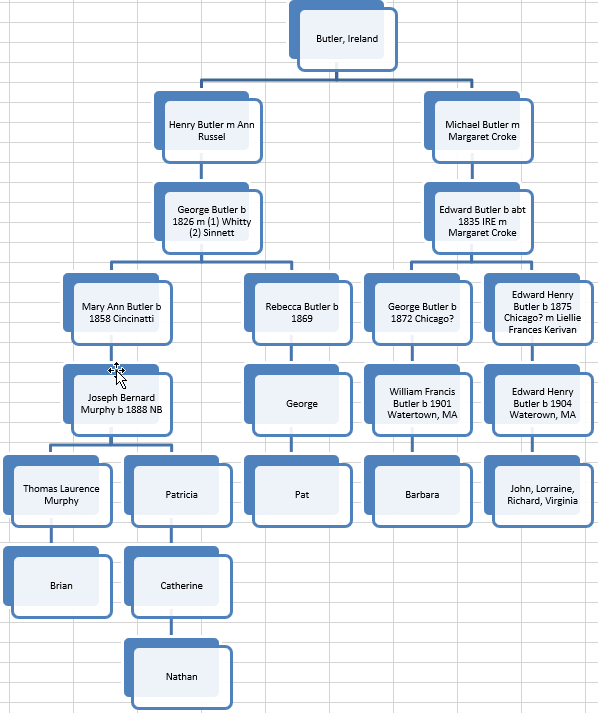
I was originally hoping that George Butler born 1825 and Edward Butler born 1835 were brothers. However, as George’s parents are believed to be Henry Butler and Ann Russel, they could have been first cousins. This scenario would have Henry and Michael Butler brothers at the top.

This is the best unified tree that I can come up with:

An interesting point from the DNA standpoint is that Pat and Brian only match by DNA on the Butler side.

Do the DNA Results Support the Unified Butler Tree?

Ideally, all of these people would have uploaded their DNA results to Gedmatch.com for comparison. Here are the ones that have their results at Gedmatch:

They are highlighted in green. Nathan is the only one from the George Branch. On the Edward Branch, there are five people at Gedmatch: John, Lorraine, Richard, Virginia and Gaby.

Here is how those six compare to each other at Gedmatch:

Nathan matches Lorraine, Richard and John but not Virginia nor Gaby.

Based on my made up ‘unified’ chart above Nathan would be a fourth cousin twice removed to Lorraine, Richard and Virginia and a fifth cousin once removed to John and Gaby.

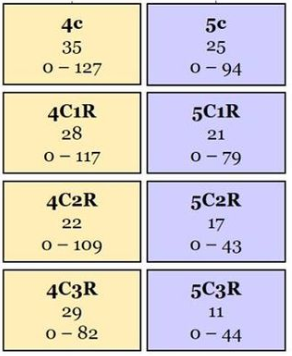
Here I have put some statistics in to look at:

This shows average DNA matches and ranges of matches. These numbers seem about right compared to Nathan’s matches. The chances of even matching a 4th cousin are better than 50% and the chances of matching 5th cousin is better than 10% according to FTDNA.

DNA Matching at AncestryDNA

DNA Matching at AncestryDNA is different. They use shared matches and don’t give information on how you match on a specific chromosome. The catch is that AncestryDNA only gives shared matches when it thinks the shared match would be a possible 4th cousin match.

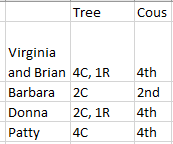
Virginia and Brian’s Shared Matches

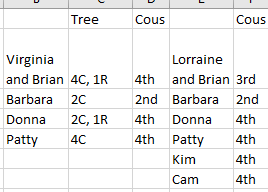
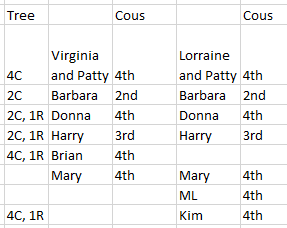
Here I show Barbara, Donna and Patty as shared matches to Virginia and Brian along the Butler Line. In the Tree column, that is the relationship they would have in the tree I made that tries to bring the two families together. The ‘Cous’ column is what Ancestry predicts the relationship to be by DNA. The DNA and actualy relationships are pretty close except for Donna. Here is Donna added to the tree:

I should note that not all on the tree have tested at AncestryDNA. However, many have. Nathan and Richard have not to my knowledge.

Lorraine and Brian’s Shared Matches

Here things get a bit more interesting. Lorraine and Brian have the same shared matches as Virginia and Brian, but have two additional shared matches:

They are Kim and Cam. I don’t know who Cam is, but I have been in touch with Kim. I had mentioned Gedmatch to Kim and it looks like she uploaded her results there. Kim is on the George Line, so I’ll add her.

Now I should be able to match Kim with Nathan and the Edward Butler side at Gedmatch.

Kim at Gedmatch and Butler DNA

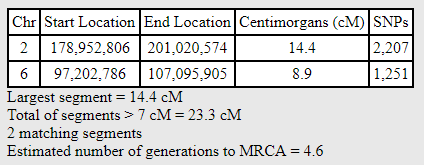
From the chart above it is clear that Kim and Nathan match only on the Butler side. This is because Nathan is from the Whitty side and Kim is from the Sinnott side. We may say that they are half third cousins once removed. That sounds a bit obscure. Here is their match:

This is the shared DNA that Kim and Nathan both have from George Butler who was born in 1826 in Ireland.

Butler Triangulation on Chromosome 2

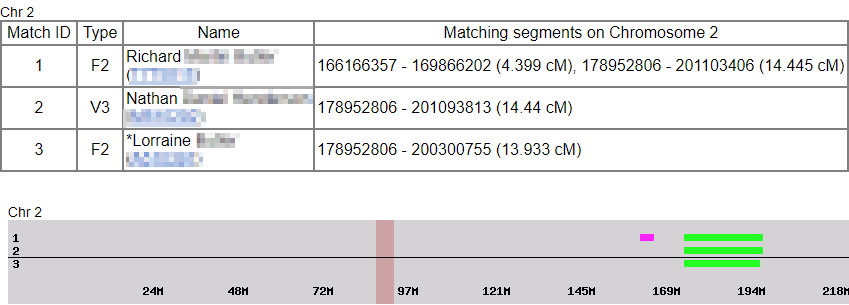
Further, Kim matches Richard and Lorraine at about the same place on Chromosome 2:

A triangulation occurs here because Nathan and Kim match here. Also Kim matches Richard and Lorraine here. When this happens, it is most likely that those in the Triangulation Group share a common ancestor.

Here is how I show the Triangulation Group (TG) on the family tree:

This doesn’t prove the configuration that I have above, but it does prove that these families have a common ancestor. Above, if I have drawn the tree correctly, Kim would be a 4th cousin once removed to Lorraine and Richard. It possible to tie families together just using AncestryDNA Shared Matches, but I find using Triangulation at Gedmatch.com to be more precise.

Shared Matches Between Patty, Lorraine and Virginia

Patty is the highest up on the George Butler Line. She should be the best comparison with Lorraine and Virginia who have tested at AncestryDNA.

This adds Harry as a Shared Match who I believe is Donna’s brother on the Edward Butler Line. In addition, we have Mary and ML. They don’t have trees posted at Ancestry, but would appear to have Butler heritage based on the fact that they have shared matches with Lorraine and Patty.

Summary and Conclusions

  • I was happy to hear from Brian’s sister who told me that their heritage went back to the George Butler Line from Cincinatti. I had been tracking this line for a while.
  • While looking at shared matches I came upon Kim also from the George Butler Line. I found that she had uploaded her DNA to Gedmatch.com.
  • When I compared Kim and Nathan at Gedmatch, I get just the DNA from George Butler born 1826. This is because Kim and Nathan descend from two different wives of George. If both Kim and Nathan had descended from the same wife of George, they would share about twice the amount of DNA, but we wouldn’t know if the DNA was from the Butler side or the wife’s side.
  • I made a proposed tree that connected the George and Edward Butler Lines.
  • This tree seems reasonable given the relationships and level of DNA matches at Gedmatch and AncestryDNA.
  • The addition of Kim’s DNA to Gedmatch resulted in a Triangulation Group between Kim, Richard, Lorraine, and Nathan. This TG is a strong indication of a common ancestor. As these four all share Butler ancestry, it would be reasonable to say that the common ancestor is a Butler.


A Second Butler Big Y Results Are In

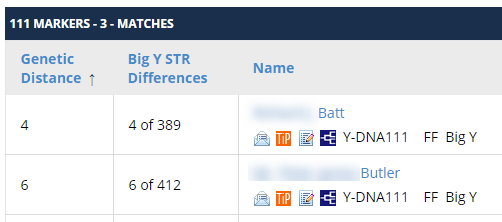
I am thankful that Peter agreed to take the Big Y test, also known as the Big Y – 500. It is important when taking the Big Y test to have two people with the same surname. That is because results are achieved in tandem. That means, that to have new SNPs named there has to be someone else that matches you on that SNP. Otherwise, the SNPs that don’t match anyone else remain private.

Previously, I was also happy that Rick tested. He is not a Butler, but previous Y DNA tested indicated that his family and the Butlers were related at some time in the past. Based on YFull calculations that time would be 700 years ago. Even though, that seems like a long time ago, the common ancestor that my father in law, Richard, had before Rick tested was 3500 years ago. I wrote about Rick’s results here.

Peter’s YDNA SNPs at FTDNA

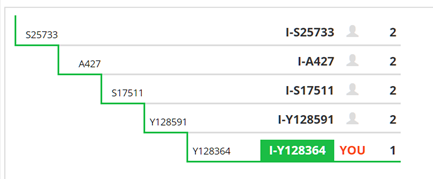
Peter tested at FTDNA. It took a little while to get his results, but when they came in, things happened quickly. Peter’s first results looked like this:

This showed that Peter matched Rick and Richard. This was expected. Not too much later, FTDNA showed that Peter actually formed a new branch with just himself and Richard.

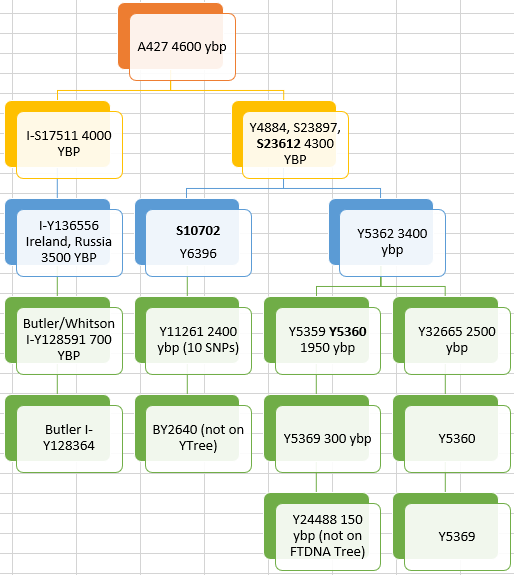
In my opinion, this new SNP of I-Y128364 is likely a Butler-only SNP. This is one of the goals of the Big Y: to get a family surname level SNP. Here is how I see the Butler tree with SNPs:

The age of these common ancestors are from YFull.

Peter’s YDNA SNPs at YFull

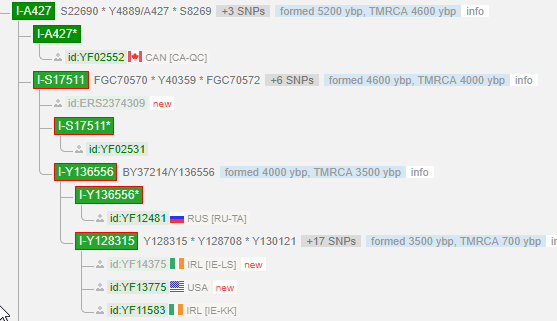
Peter uploaded his FTNDA Big Y results to YFull. One would think the results would be the same between the two companies, but not quite so. For one thing, YFull gives age estimates. One is for the formation of the SNP and the other is for the common ancestors of the matches that share that SNP.

Above, Peter is YF14375. His number is faint as the results have not yet been finalized. I am expecting that YFull’s analysis will have Peter and Richard sharing a common SNP, once their analysis is done. Rick has the USA flag and Richard is the last person in the image above.

Some Differences Between FTDNA and YFull: Y128315 Vs Y128591

Under YFull, Y128315 shows three SNPs plus 17 others. One of the 17 others is Y128591:

That means that there were a bunch of SNPs in this group. FTDNA chose one SNP to be representative of the group (Y128591) and YFull picked a different one (Y1285315).

What About I-Y136556?

YFull has an extra SNP between I-S17511 and I-Y128315. This is I-S136556. . This may be because there is an ERS sample at YFull that I believe was taken from a study. This test result would not be included in the FTDNA information. This I-S136556 fills in some information that FTDNA did not have, but the dates are still ancient history as they are in the range of 4,000 to 3,500 years ago. Note above in the YFull Tree that Y136556 is also called BY37214. FTDNA has this listed under S17511:

The bottom line is that YFull shows slightly more detailed branching than FTDNA.

What’s Next?

Next we wait for YFull to finish their analysis. The interesting thing that YFull does that FTDNA does not do are age estimates. It will be interesting to see what YFull has for a date for the common ancestor between Peter and Richard. Also YFull will likely come to the conclusion, as FTDNA did, that Richard and Peter need to share their own Butler SNP.


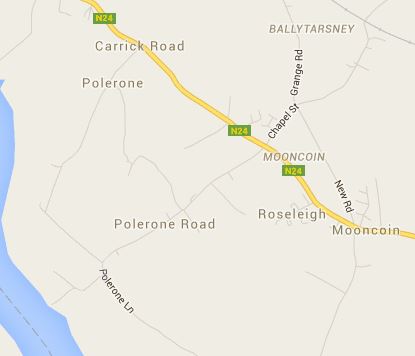
The Butlers of Poulrone, County Kilkenny

I recently got an email from Peter. Peter is helping me research my wife’s Butler ancestry. Peter pointed out that we were a little off in our geography.

The Case of Two Poulrones

Here is what Peter writes:

Our Polrone is not associated with Mooncoin but with Tullahought in the Barony of Kells which is in Windgap, in the Carrick on Suir Union, sometimes the diocese overlap the Civil boundaries but not in this case. The two Polroanes are only about 6 miles apart!!!!!

From my website on the Butlers, I had this incorrect location for the Butler’s Poulrone:

The Right Poulrone for the Butlers Is In Tullahought

Tullahought would be called a Civil Parish – an administrative district. According to Wikipedia:

Tullahought (IrishTulach Dhocht, meaning “eight hills”) is a small village in south Kilkenny. Tullahought, also a townsland in the area, is located approximately 8 miles north of Carrick on Suir and 25 miles south of Kilkenny City. The village, itself located in the towns land of Kilmacoliver and Poulrone is best known for its association with the Ormonde Slate Quarries which is situated at the foot of the Booly Hills, on which Tullahought is situated.

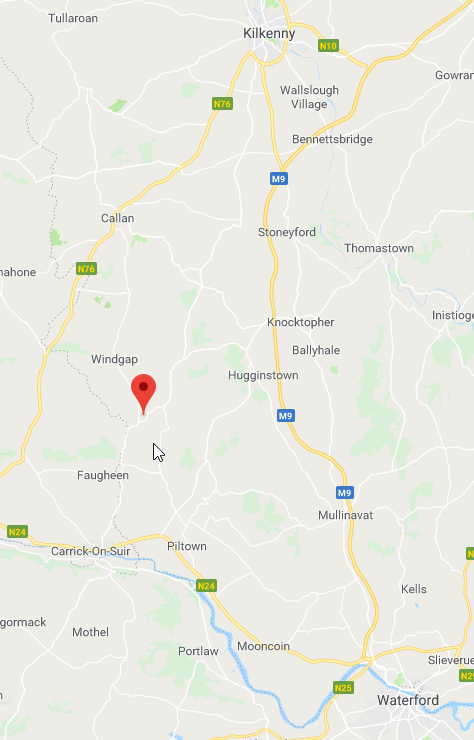
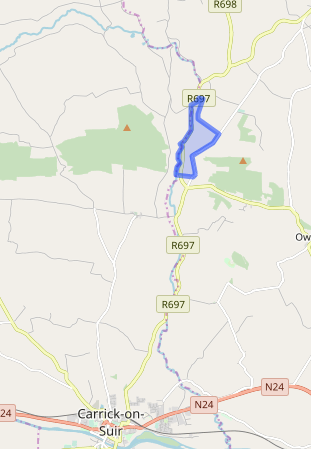
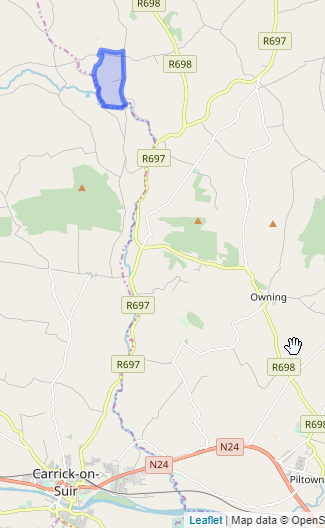
This entry came in handy as I had trouble locating the Townland of Poulrone on a Google Map. Here is the location of Tullahought:

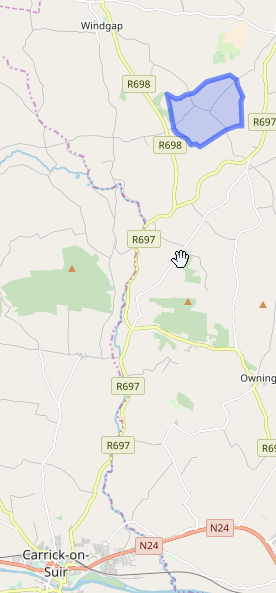
The correct Poulrone is to the North of Mooncoin in the Roman Catholic Parish of Windgap.

More Details of the Right Poulrone

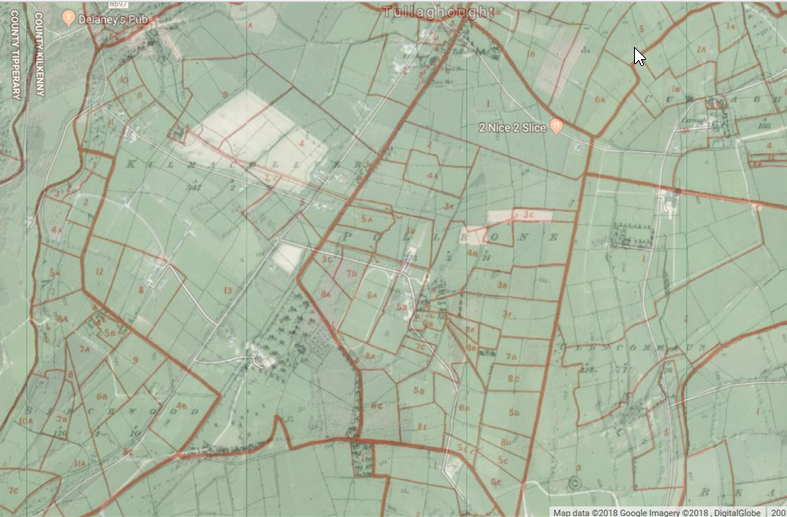
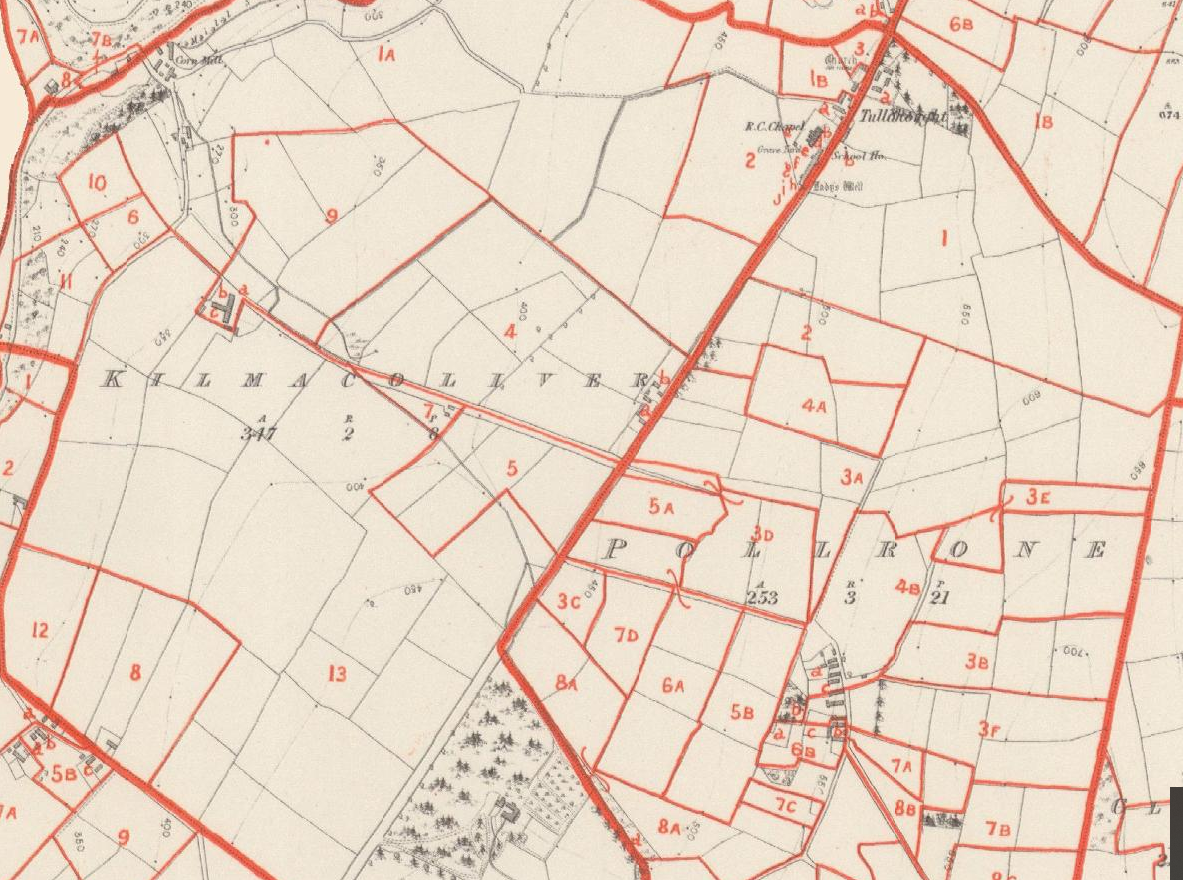
Peter supplied me with this map:

Tullahought is named at the top center of the map at the intersection of heavy red lines indicating Townlands. The upper left of the map shows the boundary between County Kilkenny and County Tipperary. The Butler’s Poulrone is the Townland in the middle of the map. The Butler’s farm would have been one of the numbered lots within Poulrone.

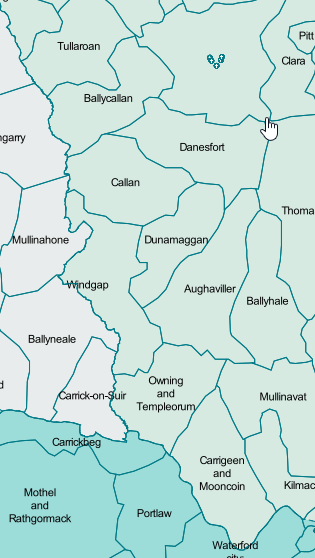
Windgap Parish Map

Here is the Parish of Windgap on the Western border of County Kilkenny:

Records Linking Butlers to Poulrone

I’ve given the geography, but what are the records linking the Butlers to Poulrone?

The first record is from 1824:

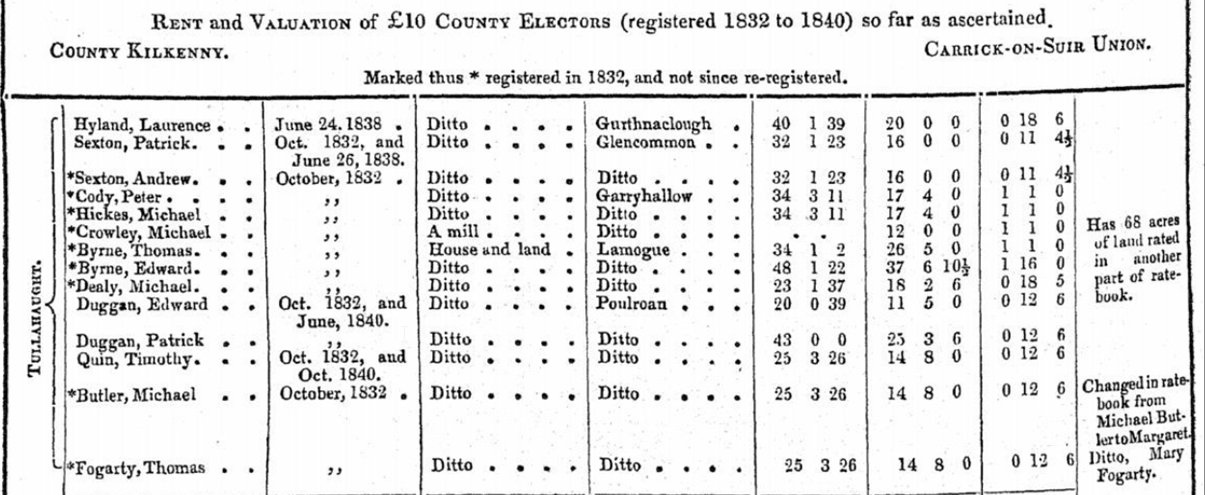
Eight years later, here is some information from 1832:

The bottom right note indicates that Michael likely died and Margaret was in charge of the farm in Poulrone. There is an * by Michael Butler’s name which indicates that he did not re-register after 1832.

The Tithe Applotment

The Tithe Applotment has two listings for Michael Butler in the Civil Parish of Tullahaught:

Unfortunately, the Townlands are not transcribed well. Poocrown should be Poolrown and Birchwaad should be Birchwood. Here are the listings for Poulroan:

  1. Thomas Croke
  2. Edward Duggan
  3. Patrick Duggan
  4. Michael Butler
  5. David Fogarty
  6. Edmund Quinn
  7. Johanna Quinn, widow
  8. Thomas Broderick

Butler in Birchwood?

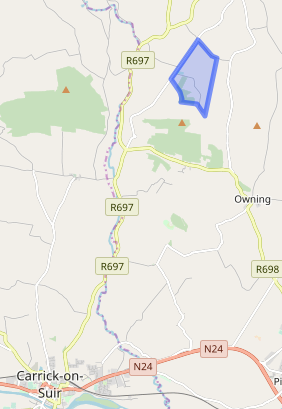
The Tithe Applotment also lists a Michael Butler in Birchwood. Is this the same as the Michael Butler from Poulrone?? If the Birchwood is adjacent to Poolroan, then I would say so. Here is Birchwood:

It looks to be on the River that separates County Tipperary from County Kilkenny. At www.townlands.ie, Poulrone is listed as Pollrone.

Using the map triangles as a reference, it appears that Birchwood is separated from Pollrone by a Townland. It looks like the two Townlands are separated by Kilmacoliver . That means that I can’t tell if this is the same Michael Butler.  Here are the heads of families in Birchwood:

  1. James Moore
  2. Patrick Moore
  3. Thomas Moore
  4. Patrick Kearins
  5. Michael Butler

Birchwood is transcribed as Birchwaad or Burchwad at the National Archives website. I would say that this is the same Michael or a relative.

Griffith’s Valuation

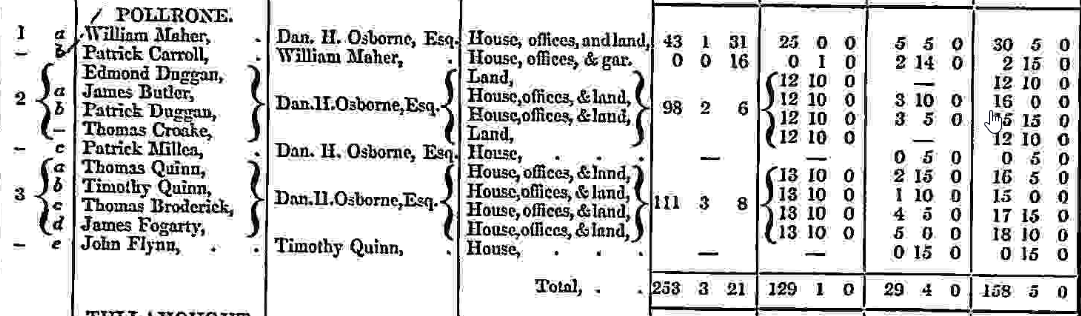
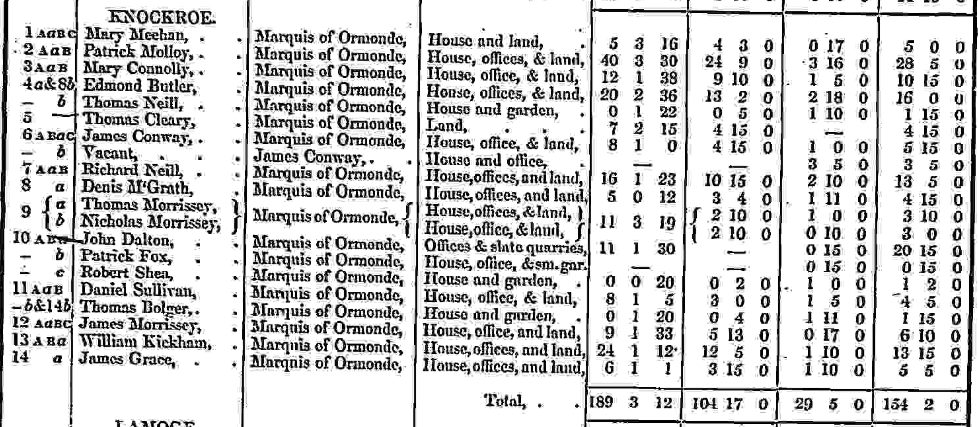
The next records to look at are Griffith’s Valuation. This was published 1849-1850 for County Kilkenny. Here is the Valuation in Pollrone:

The presumption is that James Butler is the son of Michael Butler and Margaret Croke and that he is living in the same house he was brought up in. He is on a 98 acre farm, but it is shared with Patrick Duggan who also has a house on the property. Further Edmond Duggan and Thomas Croke own some of the land. It is possible that all these people are related.

Here is another view of Poulrone, with the Village of Tullahought. James Butler also owned some land in Kilmacoliver. The Roman Catholic Church was in the Northeast corner of this Townland.

More Butlers in Tullahought

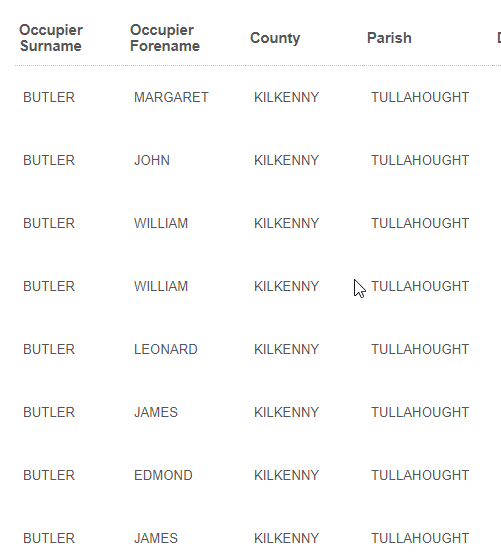
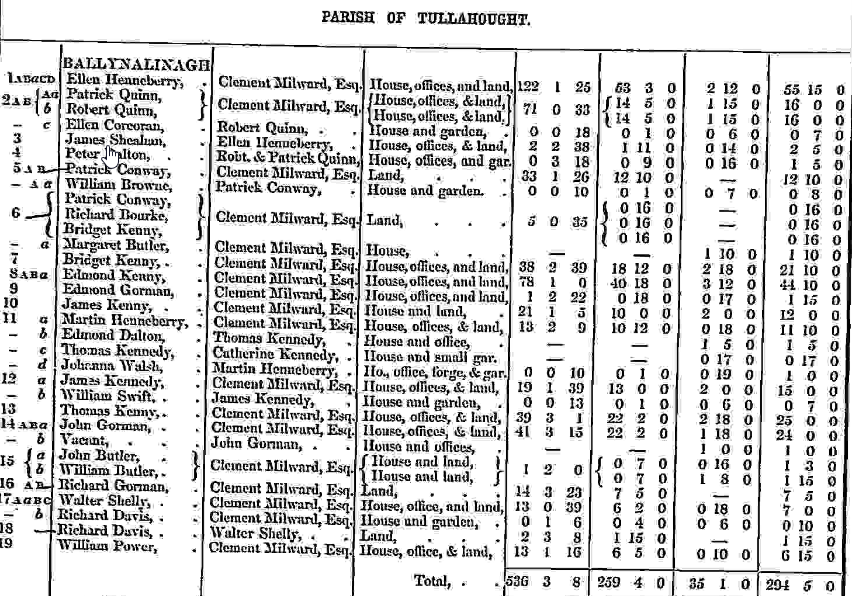
Tullahought is the Civil Parish. These civil parishes were usually in line with the Church of Irleand Parishes, but not the Roman Catholic Parish. So Poulrone would be in the Roman Catholic Parish of Windgap and the Civil Parish of Tullahought. A search for Butlers in Griffith’s Valuation in Tullahought brought this up:

I wonder if the Margaret above was Margaret Croke Butler?

This Margaret is presumed to be a widow. She is on Lot 6a where the land is owned by Conway, Bourke and Kenny.

There was an Edmund Butler in Knockroe:

My research helper, Peter, suspects that the immigrant Butler Edward was originally an Edmond. Here is Knockroe:

Poulron in 1901

My research doppelgänger from England, Peter, went on to the next logical step. He looked at the 1901 Census:

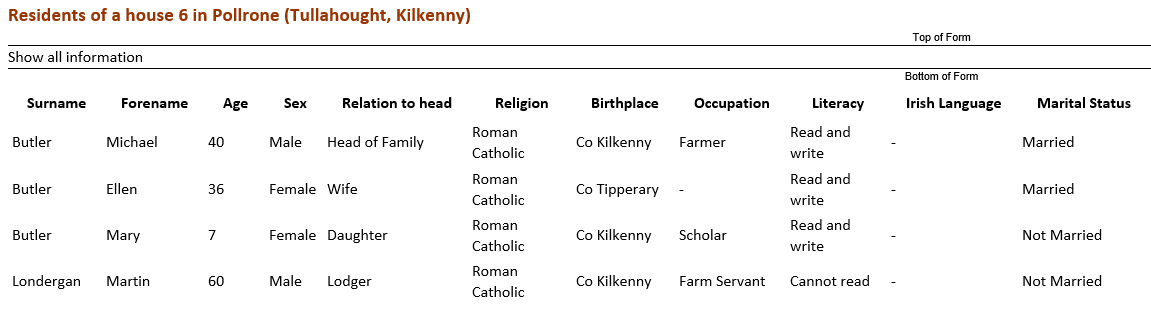
This is very likely the same Michael:

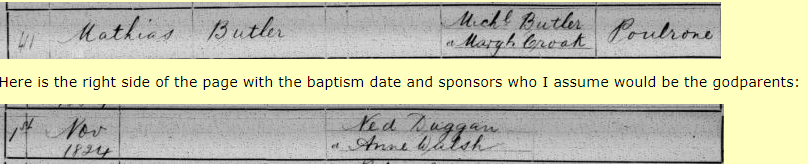
His sponsors were Patt and Mary Duggan. Michael was likely named for James father Michael. These Census ages were not always dependable. Michael, who is listed as 40 in 1911 would have actually been 52,

Michael has a wife Ellen born in Tipperary, which was only a few Townlands away. Michael died between 1901 and 1911. Here Elllen is a widow in the 1911 Census of Pollrone:

A Butler Tree

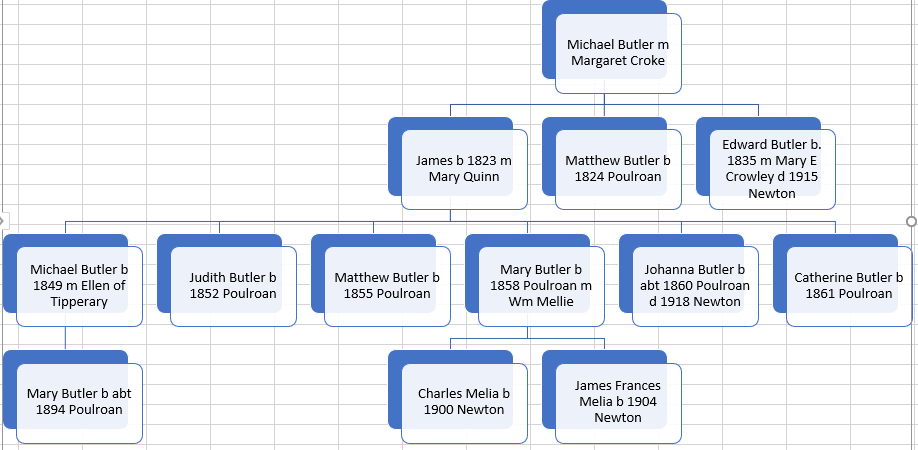
From this, I get a tree of the Poulroan Butlers:

Any Other Butlers? One or Two Michael and Ellen Butler?

Maybe. Here is an Edmond from Knockroe:

Not likely a good candidate as the James Butler I’m interested in would have only been 16 in 1867 at the time of this birth. A Knockroe James Butler born in 1869 is also problematic:

I see also a Margaret born to this couple in 1873. Then Ellen born 1876 and Bridget born 1878.

Peter’s Latest Find; a Lamogue Wedding

While I was pondering whether there were one or two Michael and Ellen Butlers, Peter sent me this information from Lamogue:

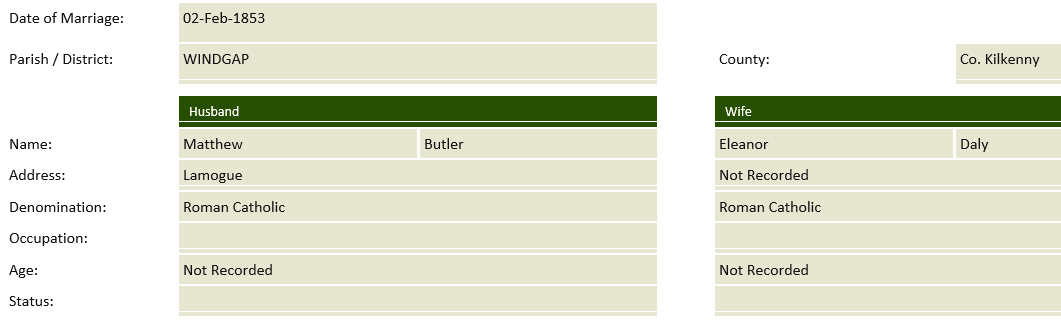
This appears to be the wedding of Mathias/Matthew Butler with his brother Edward as witness.  If this is the same Matthew, he would have been 28 at the time of his marriage. I checked my wedding date for Edward Butler. I have that he got married in St. John, New Brunswick on 1 May 1855. So that could be.  I don’t get from looking at the Windgap Parish records that the Parish was a large one nor that there were too many Butlers in this particular Parish.

Here is Lamogue:


Summary and Conclusions

The discovery of the Butlers in Poulrone has come as a slow development rather than an all at once discovery. The Butler family has long believed that they were from Kilkenny. However, the assumption was that they were from the County Town rather than the rural area of Poulrone. The first record of a Butler in Poulrone was from 1824, but the Butlers could have been in the same area for quite some time. It is possible that there are some lease or rental records for the land they lived on.  I only see a record of one Butler daughter in the 1901 Census. Was this the last of the Poulrone Butlers, or were there others in the area?

Peter found a Matthew Butler who appears to be the other brother of James and Edward Butler. He married in 1852 in Lamogue. A lot of information has been added to the Butler research. The trick will be to further analyze and verify the information. Were there one or two Michael and Ellen Butlers? Was the Margaret Butler in Griffith’s Valuation Edward’s mother, Margaret Croke?

Addendum

After I wrote this, Peter found some more information:

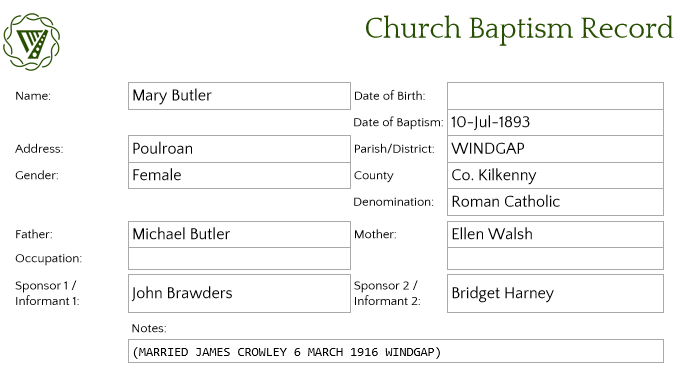
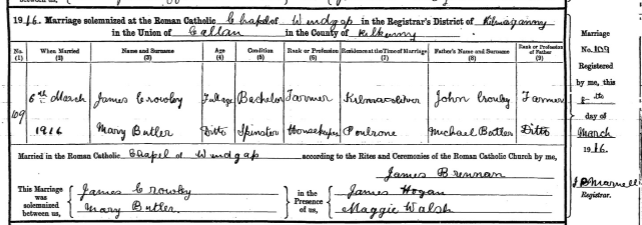
Michael was married to Ellen Walsh. There was apparently another Michael Butler who married an Ellen Shea. This Mary Butler married James Crowley.

BigY Moves Whitson/Butler Project 2,850 Years Toward the Present

Rick noticed recently that his SNP had changed at FTDNA where he had his BigY tested. His most recent SNP went from Y136556 to Y128591. This SNP change was based on FTDNA’s comparison of Rick’s results with my late father-in-law Richard’s BigY results.

New SNP Y128591

Here is how Richard and Rick now match at FTDNA:

This is added a new branch to the human race. This branch includes Rick with Whitson ancestry and Richard with Butler ancestry. Previously the branch ended at I-Y136556.

YFull Dating: a 2,850 Year Improvement

Here is the new YFull Tree:

Before Rick tested, Richard matched at I-Y136556. Richard had and has a common ancestor with a person with Russian heritage. The estimated date of Richard and the Russian person was 3900 ybp (years before present). Now Richard and Rick have a common ancestor estimated at 1050 ybp.

How did this change? Ricard and Rick match on 20 SNPs. These are 20 SNPs that they do not match with the Russian person. YFull estimates that a SNP is formed about every 144 years. 144 X 20 is 2,880 years. That is the simple match. That should mean also that in the past 1050 years, Rick and Richard should have about 7 SNPs that do not match.

The FTDNA Haplotree

The FTDNA Haplotree is equivalent to YFull’s YTree:

This points out some areas of difference. FTDNA has 22 SNPs that Rick and Richard share versus YFull’s 20.

Y128315 or Y128591?

Also YFull shows a SNP of Y128315 while FTDNA shows Y128591. This is because out of the 20 or 22 SNPs that Rick and Richard match on, one had to be chosen to represent the group. FTDNA chose Y128591 and YFull chose Y128315. FTDNA does have that Y128315 listed three from the end in the box of SNPs above.

Implications of a TMRCA of 1050 Years

1050 years ago most people had no surname. According to Wikipedia, “By 1400, most English and some Scottish people used surnames.” That means that the common ancestor that Rick and Richard had would have been about 450 years before surnames were commonly used – depending on the area. That means that based, just on Rick’s and Richard’s testing, the Whitson and Butler name could have arisen independently. Prior to Rick’s BigY results, there was some indication that there was some confusion between the two surnames due to adoption or other issues over the years.

It would be interesting to know where the Whitson/Butler ancestor lived 1050 years ago. That is something that is not possible to know just based on the comparison of these two BigY tests. However, as more people test within the Y128315/Y128592  Group, it may be possible to find this out.

A Whitson/Butler SNP Tree

It was not too long ago when all we knew was that Whitson/Butler was A427.


At that time, I had predicted that there would be a parallel branch to S23612 that the Butlers and Whitsons would be in. That parallel branch was S17511. The next SNP that came along was Y136556 which includes Russia and Ireland. The I2 Whitsons are possibly from England. Thanks to Rick’s testing we now have a Butler/Whitson SNP – Y128591. Additional testing may reveal other surnames under this SNP. Once Peter’s results are in, I am hoping for a Butler-only SNP that will define the I2 branch of that family. That SNP would be one step down from on the left branch above.

One Other Difference Between FTDNA and YFull

On FTDNA’s Haplotree, I see no Y136556 branch. It appears that FTDNA have incorporated that SNP into S17511 as BY37214.

It is a fairly small distinction, but I like YFull’s YTree configuration better.

Summary and Conclusions

  • My biggest takeaway is that Butler and Whitson do not appear to be as closely related as previously thought. The common ancestor between the Butler and Whitson based on this comparison was 1050 years before present. That would be in the year 968 or about in the middle of the Middle Ages.
  • Thanks to YFull, the common ancestor for Butler and Whitson was pushed forward 2,850 years. That is a dramatic difference.
  • It is likely that Peter’s pending BigY results will produce a new SNP for the Butler family.
  • It would be helpful for the Whitson side to have another I2 Whitson test for the BigY. This would likely result in a Whitson-only I2 SNP below Y128591.


Rick’s Whitson/Butler Big Y YDNA Results

The co-administrator for the Whitson/Butler YDNA Project, Peter notified me recently that Rick had a new SNP designation. This was a hint that Rick’s Big Y results were almost done. Soon after, I saw that Rick’s Big Y results were completed.

What Does the BigY Do?

According to FTDNA, which does the test:

The Big Y-500 is a Y-chromosome direct paternal lineage test. We have designed it to explore deep ancestral links on our common paternal tree. This test examines thousands of known branch markers as well as millions of places where there may be new branch markers. 

On average, YDNA changes about once every 144 years. That means that someone between me and my third great-grandfather probably had a new marker or SNP.

Named and Numbered SNPs

When the SNPs are tested, the results are shown in one of two ways. They are either named SNPs or numbered SNPs. The named SNPs are, for the most part, ones that are common to other people. In the Whitson/Butler YDNA Project, there are six tested men within the Haplogroup of I2.

Each of these six men have a SNP which is M438 or the equivalent P21 or S31. The letter before the number stands for the testing company that discovered the SNP.  The SNP named M438 designates that these men are I2 and not I1 or R1a or R1b. Further, these six men also have the SNP named M436. This used to be called I2a2, but now the branches are named for the SNP test name rather than the branch of I2.

M436 in the above three has its own tree. All the men in the Whitson/Butler Project that are I2 are also M426 and M223:

Here are the I2 men from the Whitson/Butler Project:

Rick’s results are at the top in green. William Whitson is Rick’s ancestor. A green SNP in the last column means that there was a test for the SNP. The red SNP results means that these three men did not have their SNPs tested, but from the STR results, FTDNA is quite sure they are in that branch and would be positive for M223 if they tested for it. In the list above, the first person Rick and the last person, Richard, have their BigY results. Peter has ordered the BigY test, but his results are not yet in. He has previously tested for A427. A427 is to the bottom right of the above tree on the next to the last line.

Why is A427 Germanic and North Slavic?

According to the YFull YTree (see below), A427 formed about 5,000 years ago. That means in the last 5,000 years, A427 descendants had plenty of time to move around. War and famine would be two reasons I coiuld think of to relocate. Climate change must factor in also. That gave time for id FY12481 from the YFull Tree to make his way to Russia and the Whitsons and Butlers time to make their way to Ireland and England.

Here is a portion of a map that Pete sent me today. Pete is in a non-I2 part of the Whitson/Butler DNA Project:

Around 117 A.D., according to the creators of the map, I2a2 centered around a place called Lombardy. It also included the Teutons. However, my understanding is that it could have included the Goths and the Baltic Tribes. So, that general area of the map.

Whitson/Butler and the A427 Branch

Probably all the Whitsons and Butlers that are I2 are also A427. Note above in the Eupdedia I2a2 Tree, that there is a SNP below A427 called Y4884. However that is not the Whitson/Butler Branch. Here is what YFull shows:

The YFull tree shows that quite a few people tested positive for Y4884. However, Richard and Rick are in S17511. This is probably a newer discovered branch since the 2016 Eupedia Tree above. YFull is a bit ahead of FTDNA at this point as it also has Richard in Y136556 which is one step below S17511. Richard is designated with an Irish Flag. There is someone with a Russian heritage that is also positive for Y136556. For that reason, I don’t think that Richard and the Russian will be grouped together for long. I think that Richard and Rick and then Richard, Rick and Peter will form at least one new haplogroup.

Here is a tree I made for a previous Blog. It showed where I expected the new Butler/Whitson Branch to be. We now know that parallel branch is S17511. However, the actual Whitson/Butler branch will be a few levels below that.

The good news is that without doing anything, my father-in-law’s SNP went down the ladder two more steps. This was just based on people who we didn’t know who had Big Y tests. Now we have people testing for Big Y like Rick,  who we expect are related. I would think that the results would be more relevant and bring us into the genealogical time frame.

Naming Problems: Y136556/BY37214

I did not find Y136556 on Rick’s list of SNPs from his BigY test. However, he is positive for BY37214 which is the same SNP with a different name:

Fortunately, the YTree by YFull lists both names:

I think that the BY prefix is the BigY designation, so that may be what will show up eventually at FTDNA.

Numbered SNPs

Numbered SNPs are those that are not yet named SNPs. This is most likely because they are not yet shared with anyone else. Or else, they are shared and no one has gotten around to naming them yet. For example, as I mentioned above, Richard is positive for Y136556. It is possible to go to a website called YBrowse and look this SNP up by name or location:

At the top, I find out that Y136556 is also at position 14,628,410 on the Y Chromosome. Before this SNP was named, it would have been reported by the position number. I also note that this SNP has two other names: Y41633 and BY37214. I’m not sure why there are two Y names.

Acording to YBrowse, Y136556 is not on the YFull Tree. However, I know that it is on the YFull Tree, so they are perhaps having trouble keeping up with all the new SNPs.

A Third Category – Novel Variants

There is actually a third category of SNPs. These are called Novel Variants. I put in a question to the I-M223 Y Haplogroup at FTDNA about Richard’s Y136556 SNP and got the following answer:

The blurred out name is Rick. I was asking why Richard didn’t show as Y136556. The answer is that FTDNA is getting to it. And as I guessed, there will be at least one new branch based on Rick’s results.

One of the ‘Novel SNPs’ that Richard and Rick share is Y128591. I looked up Y128591 at YBrowse and it is at position 2786469. Under Rick’s FTDNA BigY list of downloaded Novel Variants, Rick has 2786469 which FTDNA does not yet show as a named SNP.

With all the testing going on, these haplotrees and SNPs are in a constant state of change.

Rick Matches Richard at FTDNA

FTDNA has specific requirements for who can and cannot match under the Big Y results. Assuming the guy with Russian heritage tested at FTDNA, he did not meet the FTDNA requirements as he does not show as a match to Rick or Richard:

A person is considered a match if they have 30 or fewer differences in SNPs with you, and their haplogroup is downstream from your haplogroup or downstream from your four closest parent haplogroups.

Here is how Rick shows up on my late father in law’s results:

Note that Rick and Richard have 324,704 Shared Variants. Rick and Richard also share Unnamed Variants:


I copied Rick’s and Richard’s Novel Variants and then lined them up to see where they matched and did not match. The matches are in yellow. The Novel Variants that did not match are in green. Perhaps these yellow SNPs are the ones that bring us from 4200 years ago to a more reasonable time frame.

I looked up every SNP location at YBrowse to see if there was a name for the SNP yet. There are no names for Rick’s unique SNPs as he has not uploaded to YFull yet. That is, with one exception. All these new SNP names appear to have been created by YFull. Rick has one SNP that does not match Richard’s which is Y40359. This appears to be an older SNP. Perhaps Richard did not have a good read for that SNP.

One final note is that the above are all from FTDNA’s Unnamed Variants list. That means that FTDNA has not named them. However, in many cases, YFull has named these variants.

Non-Matching Variants

FTDNA has this to say about non-matching variants:

This column displays the known variants (SNPs) within your subclade that you and the specified match do not share.

That means that the Non-Matching Variants could be on Rick’s or Richard’s side. Here are the non-matching variants that Rick has:

  1. A8346
  2. BY31782
  3. 12200779
  4. 15405895
  5. 18999479
  6. 19550845
  7. 19714191

Here are the non-matching variants that Richard has:

  1. 15649019
  2. 20968182

From the above, I see this configuration:

The SNPs that Rick and Richard have in the two bottom boxes are called Private SNPs. That means that they are not at this time shared with anyone else. FTDNA or YFull would not show a tree this way as they only show branching where there is a match in the SNP. When Peter’s BigY results are in, he may form a branch with Rick or Richard. Say that Peter tests positive for all the SNPs in the box above Rick and Richard. Then he also shares some of Rick’s private SNPs. That would put Rick and Peter in a new branch where Rick is now and Richard would go to the box above where I have him now as he would only share those SNPs. One of the SNPs in the box above Rick and Richard would be chosen to describe that branch. My guess is that Peter will be positive for all the SNPs in the box above Rick and Richard, but if he isn’t, then that will also form a new branch under the box that says Russia.

It is interesting that Richard only has two private SNPs. To me, this would indicate that his time to a shared ancestor should be within the genealogical time frame. Going from 5,000 years ago to the genealogical time frame is a big jump. That is part of the allure of the BigY test.

I am fortunate to have two other BigY testers from the Whitson/Butler YDNA Project. Without their results, I would only know that Richard is distantly related to someone with Russian heritage.

A Guess On Future SNP Branching

I checked my old notes on STR trees. STR trees are not as accurate as SNP trees. Here is one I drew a while back:

Assuming that I drew this right,  it appears that 6 Butler (my father in law Richard) would be in the first new SNP group. Below that Rick (1 Batt) and Peter (4 Butler) would be in a SNP group with the common ancestor of BA2 as shown above.

Summary and Conclusions

  • The results are just in and are interesting. However, some waiting is still required while the dust settles
  • FTDNA is working on finalizing a shared haplogroup between Rick and Richard
  • YFull will also come to its own conclusion and come up with some dating estimates once they get the BAM files from the Big Y results.
  • Once the branching has settled out, I expect that there will be some answers and some more new questions.


An Update on an Irish Butler’s Big Y

Not too long ago I wrote about my Butler father in law’s Big Y results here. I found it a bit frustratinng that FTDNA changed their matching criteria. Richared is I2 on the YDNA nomenclature and his terminal SNP is now I-A427. Here are the matches shown at FTDNA:

However, there was a catch to the matching. Now Richard has a match if:

A person is considered a match if they have 30 or fewer differences in SNPs with you, and their haplogroup is downstream from your haplogroup or downstream from your four closest parent haplogroups.

Since my last Blog, I uploaded Richard’s VCF file to YFull.

I made sure to show that his ancestor was from Ireland, as I didn’t see any other Irish Flags. Now Richard is in an I-A427 group with no further branching along with two other YFull people. I’m hoping that once the next Y Tree comes out, that Richard will be on a new branch of the Y Tree. But back to the matching. If I count the id’s above, I get 17 other than Richard that are positive for I-A427. Yet Richard has no A427 matches by the FTDNA criteria. And that holds true for the four branches above A427 even though there are likely many more people that are positive for those SNPs.

Once Richard was on YFull, I joined him to the I-M223 Group. That way, group adminsters can see his results there and do any needed analysis.

FTDNA’s SNP Tree

I was unable to get FTDNA’s SNP tree working for my last blog. Here is how it looks for Richard:

I have a little trouble reading the FTDNA tree. I went two levels above A427 to P78. It looks like the two branches under P78 are the larger S25733 and the smaller Y7219. Under S25733 there is A427 and PH2670.  This leads me to modify the tree I had drawn in my previous Blog:

This was drawn to show that FTDNA may be ahead of YFull in some aspects and YFull may be ahead of FTDNA in others. The yellow level and down don’t  apply to the Butler/Whitson I-M223 Branches. Peter from the Project and Richard have both tested negative for S23612. That means that they are awaiting to be put in a  new branch below A427 that is parallel to S23612.

Here is where I expect the new branch to be:

Eventually, there should be additional branching below this yellow level. I would expect there to be more than just Butlers and Whitsons in this branch as this branch could still be over 4,000 years old. Note that probabably due to planned family testing, the Y24488 Branch got down to as recent as 150 years ago for their common ancestor.

VCF and BAM files

The two files that are generated when your Big Y results come in are the VCF and BAM files. FTDNA has not been generating the BAM files due to their conversion from HG19 to HG38. Due to a better understanding of YDNA a new standard was needed as new locations were found on the Y Chromosome. Thus the new HG38. For example, here is a list of some of Richard’s Novel SNPs:

YFull shows the HG19 position and the HG38 position.

The BAM Files are much larger than the VCF files. Other than that I don’t know a lot about them. YFull used to only accept the BAM files, but now that BAM files are held up, they wisely decided to accept VCF files. They get their money ($49) and we get most of the analysis. The rest of the analysis is done for free once the BAM file is available. Here is YFull’s ad:

Note they state that they only get about 50-70% of what they need from the VCF file. Also note that no age estimation is done without the BAM file. That is one of the most popular features of YFull. So I will definitely send YFull my BAM link once it is available.

Any Shared SNPs at YFull?

Again, no. YFull doesn’t do SNP sharing on old SNPs. Isn’t that age discimination? This is from the YFull site:

Q: What is YFull’s “SNP matches” methodology?

A: The methodology is reflected in the SNP matches table, which provides information about Shared SNPs and Assumed Shared SNPs of compared samples. The table is limited to SNPs having an estimated age of 3500 ybp or younger (using TMRCA from the YTree), with a maximum of 100 lines of information.

I-A427 has a TMRCA of 4700 years before present. That is ancient. Richard is only off by 1200 years.

Are the Novel SNPs At YFull the Same As the Unnamed Variants At FTDNA?

I think so. From my last Blog, FTDNA showed that Richard had 33 Unnamed Variants of High Quality. YFull shows 18 Novel SNPs of best quality and 11 of acceptable quality. That adds up to 29 which is two off from FTDNA’s 33 Novel SNPs and Unnamed Variants appear to be the same thing. However, based on differing interpretations different Novel SNPs were reported at different reported qualities:

This is a partial listing of all of Richard’s Variants. YFull is on the left and Big Y is on the right. I lined everthing up by the position numbers. YFull reports two Novel SNPs as ‘Ambiguous Quality’ that FTDNA reports as High Quality. Then FTDNA has 7 Novel SNPs rated at High that YFull does not even report. Again, it’s good to have a second opinion.

Any Shared Novel SNPs at YFull?

I think so. I copied all the Noved SNPs into Excel and filtererd all the ones that said ‘shared’ on them:

Here is what I gather:

  • Even though these 14 Novel SNPs are shared, I can’t tell who they are shared with
  • There are an equal amount of low quality Novel SNPs shared as well as Best Quality Novel SNPs
  • One Novel SNP is new as there was no HG19 Position given
  • All these Novel SNPs have been named except for two. The YF designation is a YFull numbering system, but as far as I know, not a SNP naming designation.
  • I expect these Best quality and acceptable quality shared Nove SNPs to form a new branch or branches.

Summary and Conclusions

  • The Big Y Results have gotten tbe ball rolling for the I-M223 Group of the Whitson/Butler YDNA Project
  • Once the BAM file is available from FTDNA it will be uploaded to YFull
  • Richard’s Big Y VCF file has been uploaded to YFull. I expect new branching once a new Y Tree comes out. These seem to come out about every two months. The last one came out at the beginning of January.
  • FTDNA’s I-M223 administrators will also be looking at the Big Y results and the Y Full results for Richard, to see if further branching of A427 is warranted.
  • One or two others from the Witson/Buter I-M223 Branch have expressed interest in taking the Big Y test. These tests could get to how the Butlers and Witsons are related. This may also give some geographic information on common ancestors. The Butlers were known to be in Ireland? Were the Whitsons also there? If so, when?


My Father In Law’s Big Y Butler Results

I ordered a Big Y test for my Butler father in law last Summer and got the results right before the start of the New Year. Unfortunately my father in law passed away last Spring, but Family Tree DNA had kept his DNA sample from a previous Family Finder test.

Recap of Butler YDNA

My wife’s father’s family is in the I2 Haplogroup. He is also in a Whitson Project which I administer. Here is a summary of the Whitson Project which includes Butlers, Whitsons, Whetstones and others:

The group has grown from 12 to 15 since I last wrote about it. My father in law’s ancestor was Michael Butler. Here is a general idea of where I2 – M223 can be found:

Richard shares I-A427 Haplogroup with another Butler. These Butlers believe that their ancestors were origninally from the SE of Ireland. It is likely that all the Whitsons and Butlers in the I-M223 Group above are also I-A427

From I-M223 to I-A427


This tree is a bit over a year old. A427 is at the bottom right of the tree. Somehow these Germanic Butler ancestors made it to Ireland. Of course, they had thousands of years to make it there.

A427 and Children at YFull

The normal strategy is to upload Big Y results to YFull. YFull takes a look at the results and likely puts you in a downstream group to A427. YFull has a YTree. This is the A427 portion of the tree:

  • I am quite amazed at the span of years in this tree.  The Time to Most Recent Common Ancestor (TMRCA) for A427 is 4700 YBP (Years before present). The TMRCA for I-Y24488 is 150 ybp. That is a span of about 4700 years for this branch!
  • The other observation is that it appears that a family group at the bottom of the tree got together for some planned Big Y testing.
  • Not all kits have flags, but I don’t see any Irish Flags for the kits that do have flags.

The FTDNA I-M223 Project

This project has the results from about 3500 men who have had YDNA tests. Here are the results of those put in the A427 group:

There are others below this group that have been put into branches below A427. Among this group are 3 Butlers and 3 Whitsons. I have written before about signature STRs. The signature STRs are highlighted for Butlers and Whitsons:

The mode of the STRs are at the top of the list. Deviations from that mode are in pink or purple. The areas where the STRs are in a colored block or similar within the Whtison/Butler Group are the signature STRs for Whitson/Butler.

Big Y Results

The Big Y Results so far have been dissapointing. I had thought that the results would bring the Butlers into a more recent SNP than A427. Apparently that will have to await YFull analysis or analysis by the M223 administrators. Here are my father in law’s Big Y Matches:


At first, I thought this was a mistake, so I wrote to the M223 Activity Feed. There answer was that there is a new matching definition:

A person is considered a match if they have 30 or fewer differences in SNPs with you, and their haplogroup is downstream from your haplogroup or downstream from your four closest parent haplogroups.

To me, this seems like a backwards way of matching. However, I’m sure FTDNA have their reasons. According to YFull, the TMRCA for A427 is 4700 years ago. YFull uses an average SNP rate of 144.41 years. That would mean that there would be about 32.5 SNPs in that time. I assume that there would be many more SNPs due to branching.

More Snooping Around and Problem Solved

I finally downloaded the SNPs for Richard, my late father in law. At the top of the list was this:

Note that S23612 tested negative. Under Test is also S23612. That tells me that FTDNA did a special test for S23612 in addition to the Big Y as they also questioned the results. That means that Richard’s Big Y results are actually stuck back in antiquity – for now.

Help: The Butlers/Whitsons Stuck at 4700 Years Ago!


YFull named the only branch under A427 for Y4884. Notice that I underlined in red the equivalent level SNP S23612. For whatever reason, FTDNA decided that should be the name of the branch. There are two others that have had a Big Y or equivalent test and uploaded their results to YFull that are stuck at A427. It is possible that Richard will form a new branch with one of those.

I combined the YFull Tree and the ISOGG Tree and came up with this:

Now What?

What is needed now is someone in the I-M223 Group of the Whitson/Butler Group to take the Big Y test. This would bring the SNPs up to a more reasonable time frame. I suspect a new Whitson/Butler SNP branch will come down at the level of the yellow box above.

Richard’s Butler “Variants”

Remember that I estimated that in 4700 years there should be 32.5 SNPs? Well guess what. Richard has a total of 33 Unnamed Variants according to his Big Y test. What are Unnamed Variants? Unnamed Variants can be not-yet SNPs. These 33 Unnamed Variants are waiting for matches. Once there is a match, it is possible for these Unnamed Variants to become named SNPs that would form their own branches. So say that someone from the I-M223 branch of the Whitson/Butler Project were to take the Big Y test. It would be likely that there would be a match on 30 or so of those Unnamed Variants and that 3 may remain as Variants, sometimes called Private SNPs.

Here is what the Unnamed Variants look like for Richard:

To the right of the list, there is a Reference Letter and a Genotype Letter. These letters are A, G, C, or T. Then there is a confidence level. This is set to High by default. Each unnamed Variant is a Position Number. According to FTDNA:

The Position column displays the position (location) of the unnamed variant on the Y-chromosome with respect to the GRCh38 human reference genome, which is maintained by the Genome Reference Consortium.

YBrowse

It is possible to go to ISOGG’s YBrowse page to look up these positions I suppose this would take a while to look up 33. Here is the first Unnamed Variant 10005112:

This shows where the ‘Variant’ is on the Y Chromosome. If there were any named SNP or other information, it would appear below the Browser.

Unnamed Variants with SNP Names

Believe it or not, I went through every one of Richard’s Unnamed Variants in the YBrowser. Come to find out, some of them did have names – just not with FTDNA. Here are the six out of 33 that did:

This was interesting, but probably not any of these SNPs are on a tree right now.

Summary and Conclusions

  • Right now, Richard’s Big Y results have not shown him in a more recent Haplogroup than I-A427. That goes back to at least 4700 years before present or about 2700 B.C.
  • FTDNA tested Richard for the only presently known SNP below A427 which is S23612. This is equivalent to YFull’s Y4884. FTDNA found that Richard did not have this SNP.
  • I will upload Richard’s Big Y results to YFull for analysis once they are released by FTDNA. This may result in further branching below A427 other than S23612 (or Y4884).
  • A Big Y test by an additional Butler or Whitson in the I-M223 Branch of the Whitson project would result in many new matches of Variants which would become named SNPs and likely form new branches. This matching would give an approximate date of the Butler and/or Whitson’s common ancestor.