Irish Petty Sessions for Some Frazers and McMasters: Part 2

In my previous Blog, I looked at the Irish Petty sessions for my ancestor James Frazer and some of his relatives. This was helpful in sorting out some of these relatives as to where they lived during a time whcih has few or no Census records.

Alexander Frazer of Carrowncully
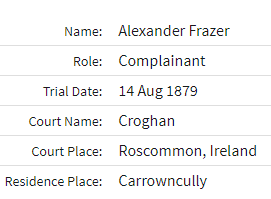
Here is the defendant, withnesses and charge:
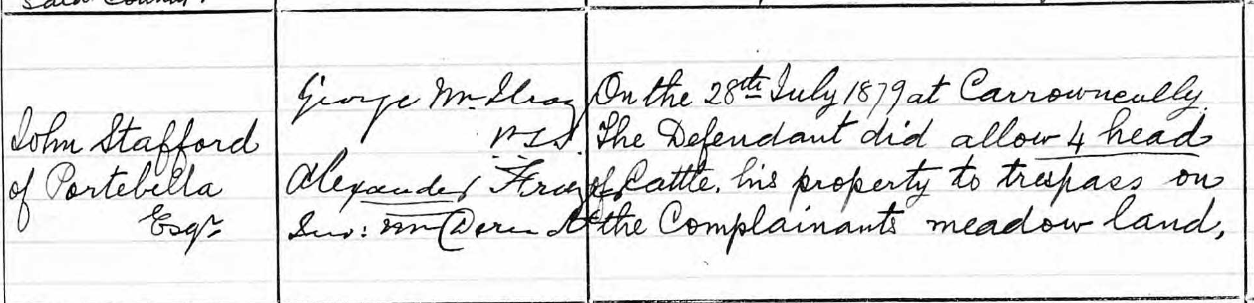
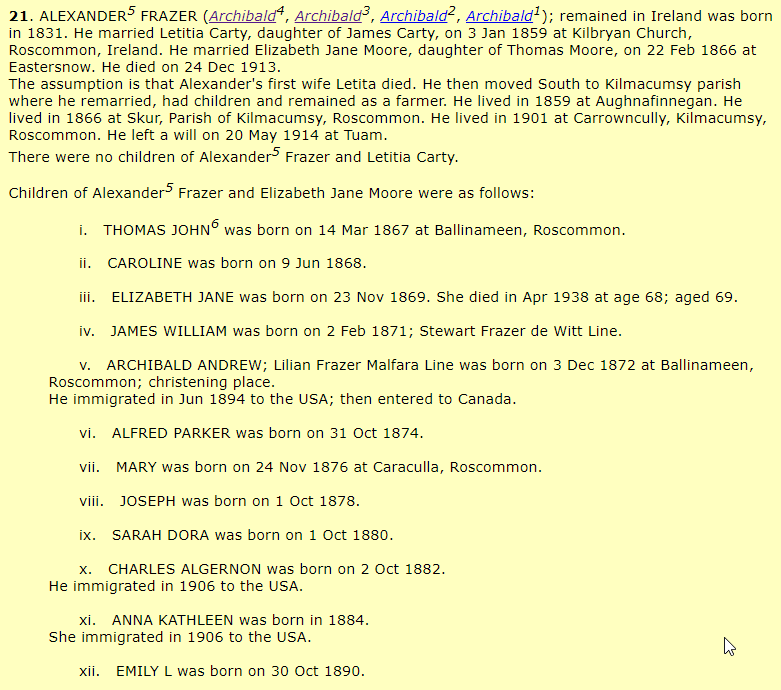
I believe that this is this Alexander Frazer:
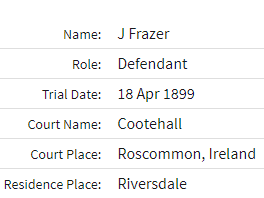
Doctor J Frazer 1899
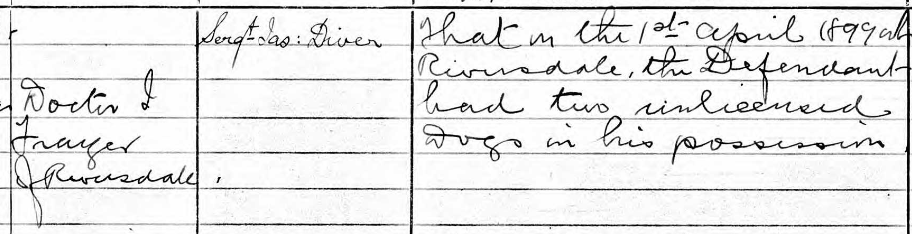
This doctor had the same charge against him that my 3rd great-grandfather had:
This has me a bit stumped, but is most likely:
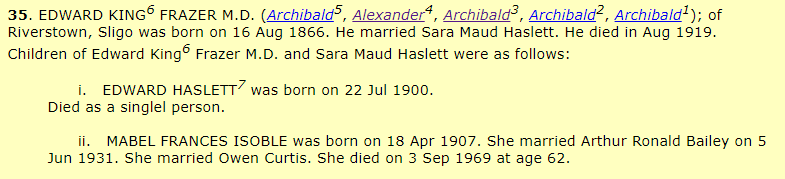
I suppose that Riversdale could have been mistaken for Riverstown. The 1901 Census is not much help as it shows Edward King living in County Meath at the time:

Richard Frazer of Derrycashel

This is of interest to me as my ancestors lived in Derrychashel:

I had my relatives show me the old Derrycashel Frazer House when I visited Ballindoon in 2004:
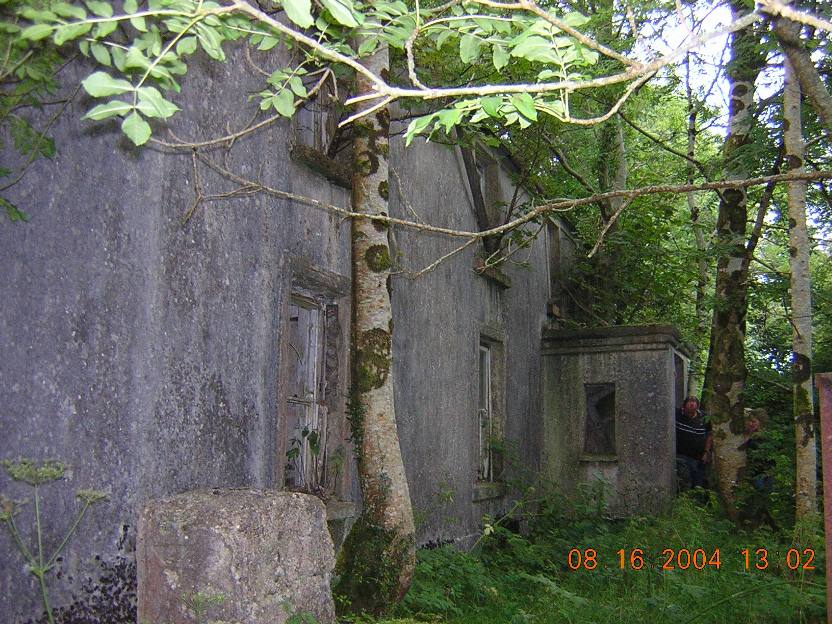
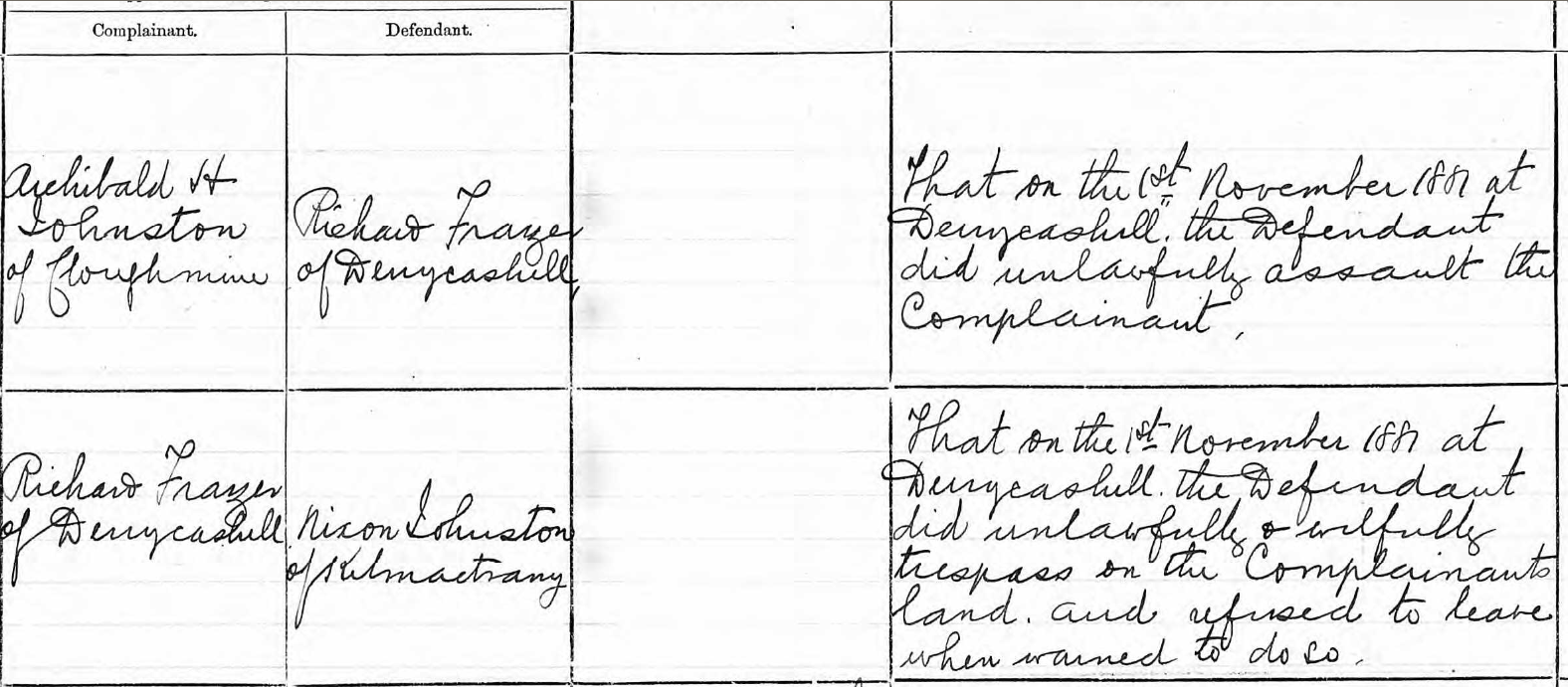
It looks like a few things were happening. Nixon Johnston of Kilmactranny trespasses on Richard Frazer’s land and refuses to leave. I don’t know which happened first but in an apparently related incident, Richard Frazer assaults Archibald H Johnston of Cloughmine (County Sligo).

Here is my guess for Richard Frazer:

This is probably Archibald Johnston in Griffith’s Valuation:

Richard’s father Archibald appears to have lived in Derrycashel at the time of Griffith’s Valuation, but died in 1863:

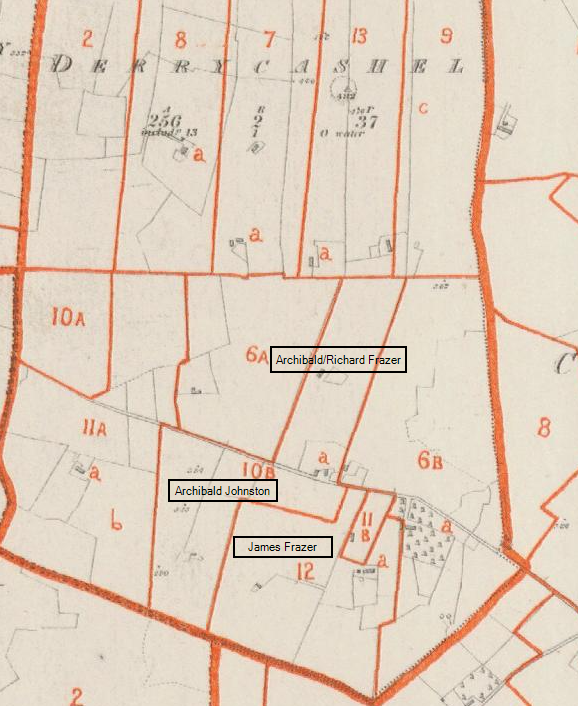
That means that Richard, the son of Archiabald was living in Derrycashel in 1881. Here is where these people likely lived:
Here are two Frazer/Johnston marriages:
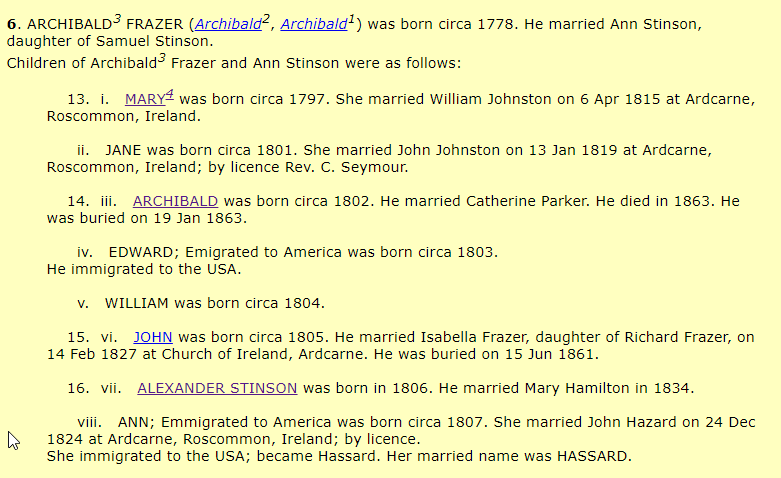
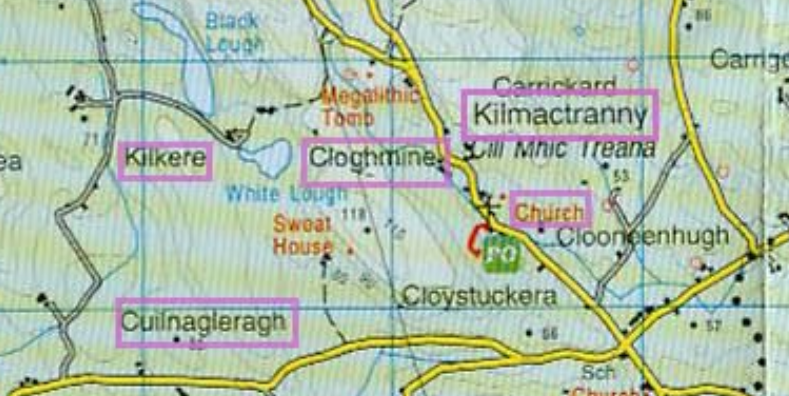
Mary had a son named Archibald Johnston. I’m sure that my 3rd great-grandfather James Frazer knew about what was going on between the Frazers and the Johnstons, but I don’t. Also this Archibald H Johnston was from Cloughmine and not Derrycashel. Here is Cloughmine – next door to Kilmactranny in County Sligo in the heart of McMaster territory:
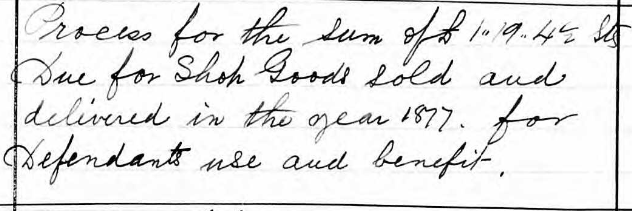
In 1877, Richard Frazer owed Boyle shopkeeper Michael McDonald:
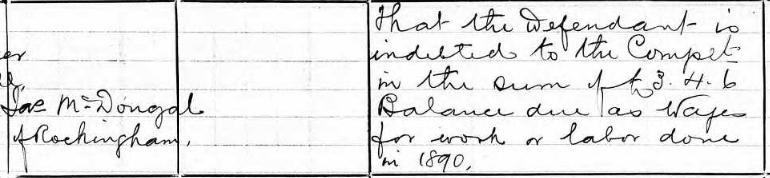
Richard was looking for wages due in 1890:
Mary Frazer Derryvanny
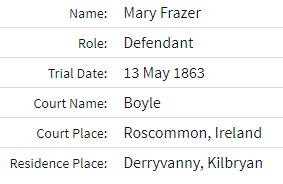
 

This is one of those famous assault cases:
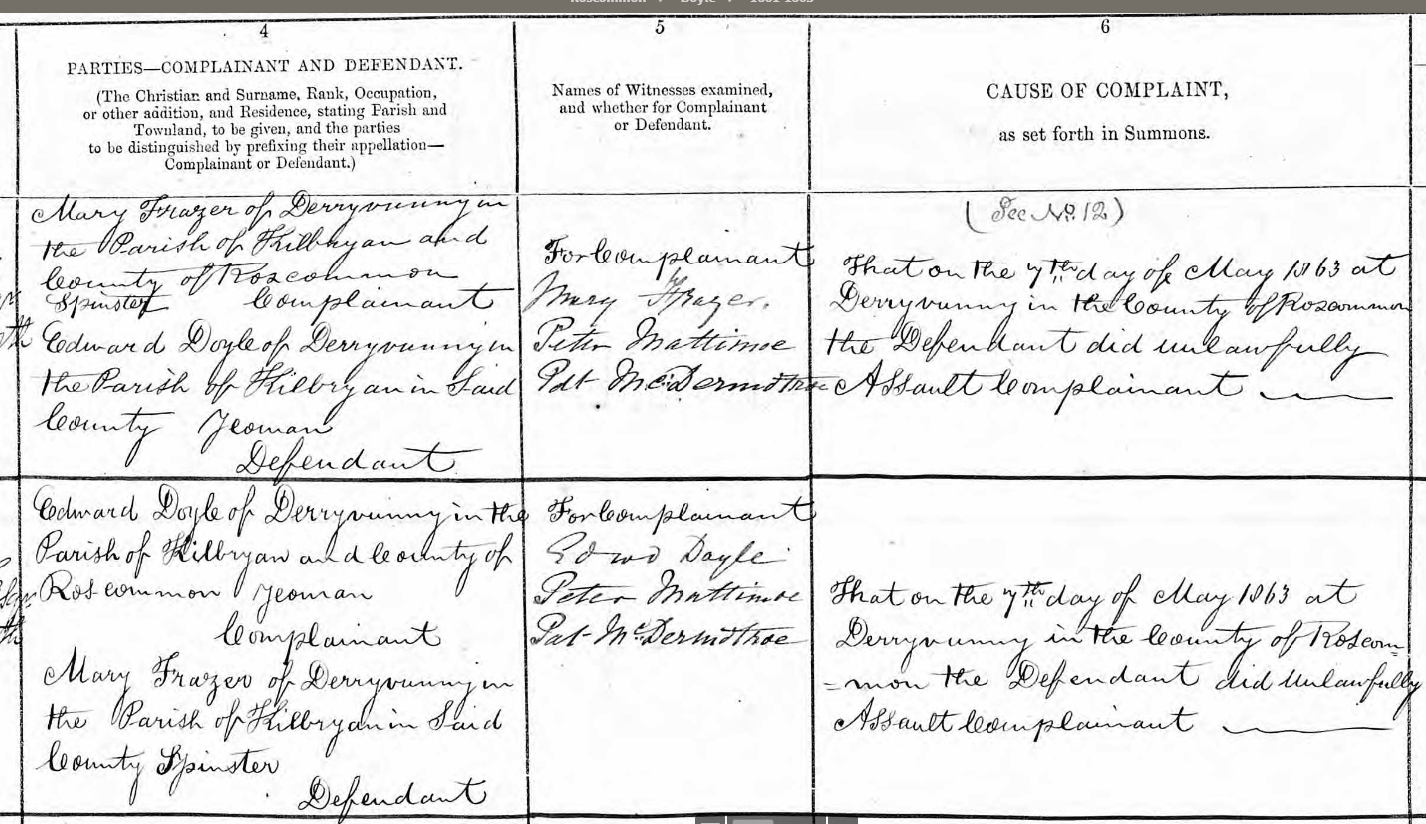
Both sides had the same witnesses. Mary was a spinster. This fact is very important as I assume Frazer is her maiden name. Here she is in Griffith’s Valuation:
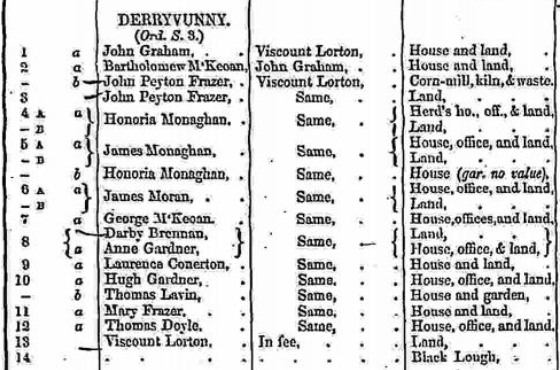
John Peyton Frazer had some property there also. Here is a guess as to who Mary is from the James Line:
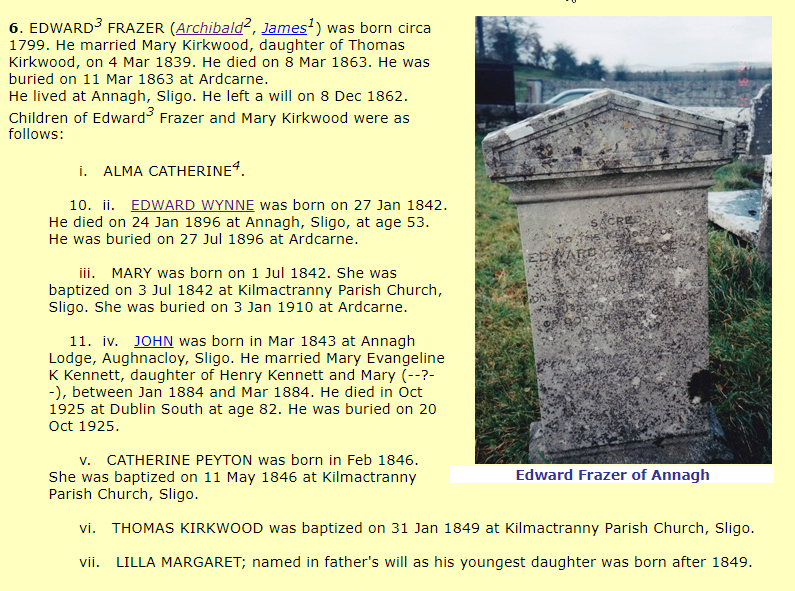
If I have identified Mary correctly, this would be her in County Sligo with her unmarried sisters in 1901:
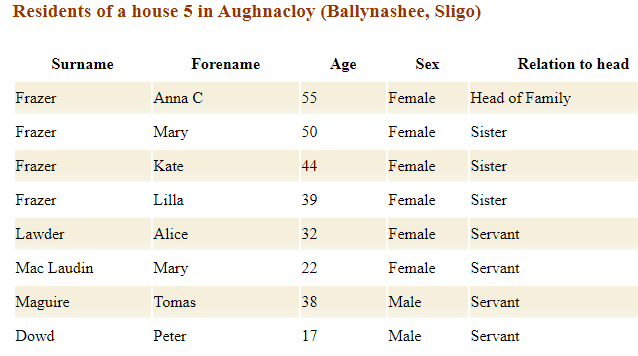
Here her age would have been understated.

The McMaster Family

This family had their epicenter in the Parish of Kilmactranny in County Sligo. This was not very far from where the Frazers of North County Roscommon lived. My ancestor George William Frazer moved to Ballindoon, County Sligo from Derrycashel, County Roscommon. This must have been around the time that he married Margaret McMaster. They married at the Kilmactranny Church in 1866. My great-grandfather was born the next year in 1867 in Ballindoon. I have had some trouble in connecting the different branches of the McMaster Family.

This chart, which I made for DNA matches, starts to get at some of the complexities:
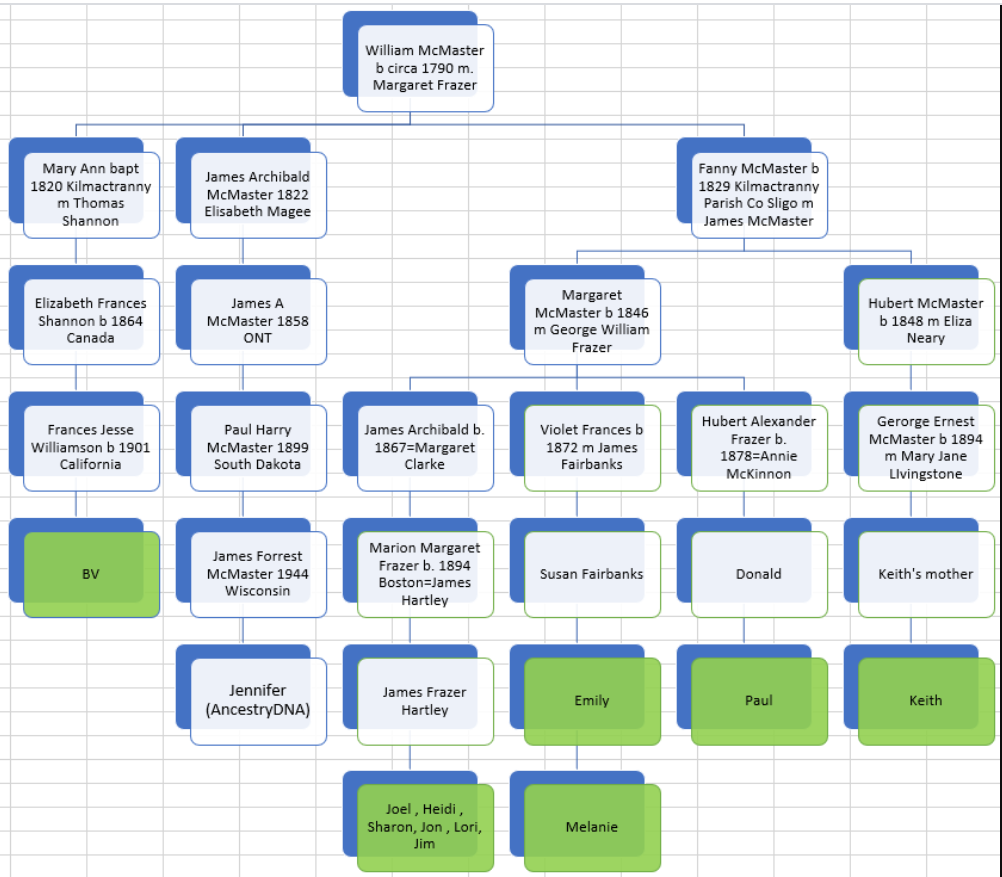
I believe I have the correct tree here. However, William McMaster at the top married a Frazer. My second great-grandmother Margaret McMaster married a Frazer. Her parents were both McMasters. I’ll start by searching for McMasters where the Court was in Roscommon.

Arthur McMaster of Dromore

Here is a map for reference:
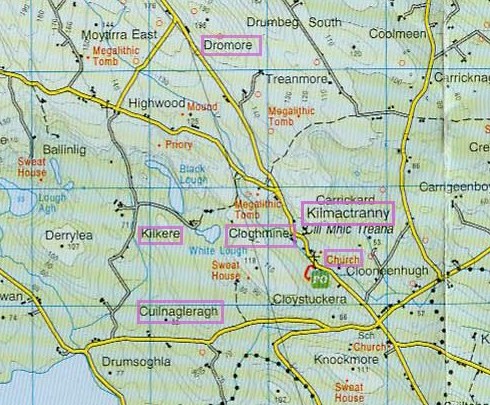
Apparently Arthur was assualted in Deerpark by Thomas McManus:
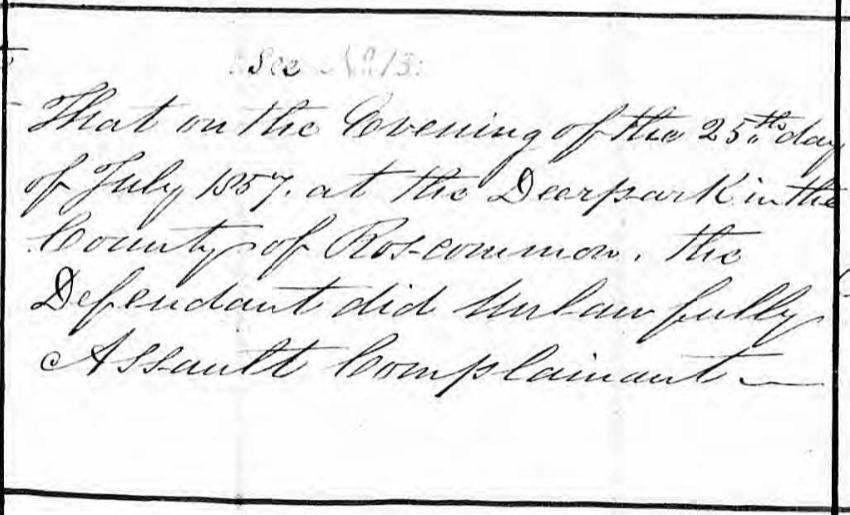
Thomas also assaulted James Boyd of Carrigeenboy the same night. Here is my best guess for Arthur:

Just to make life compicated for genealogists, he married Catherine McMaster.

Hugh McMaster Derintunny, Kilbryan, Roscommon

Here is another early case from 1853. This must be Dereentunny in the heart of Frazer Country:
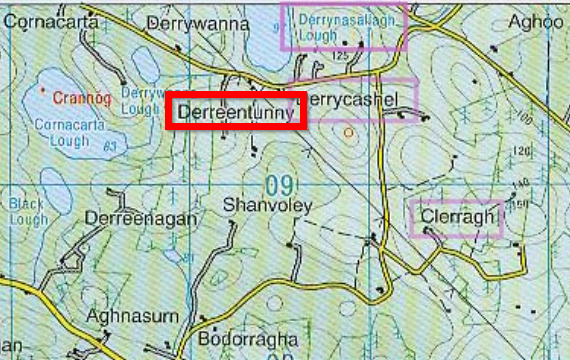
Here is Hugh and family:
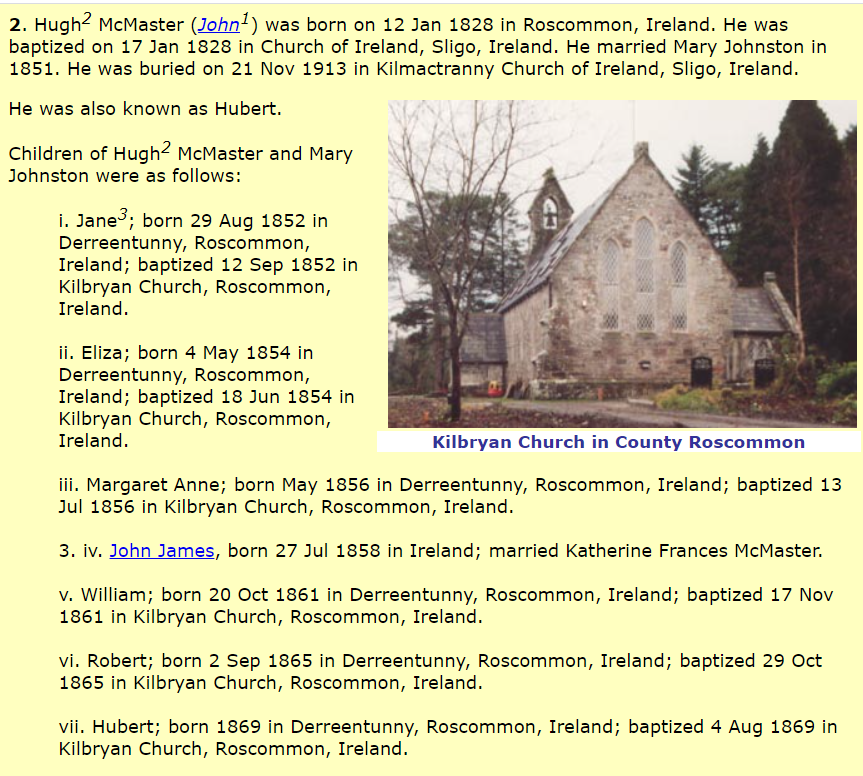
Apparently Hugh had a maid named Margaret Kelly who took off:

So far, this is the earliest case I have found:
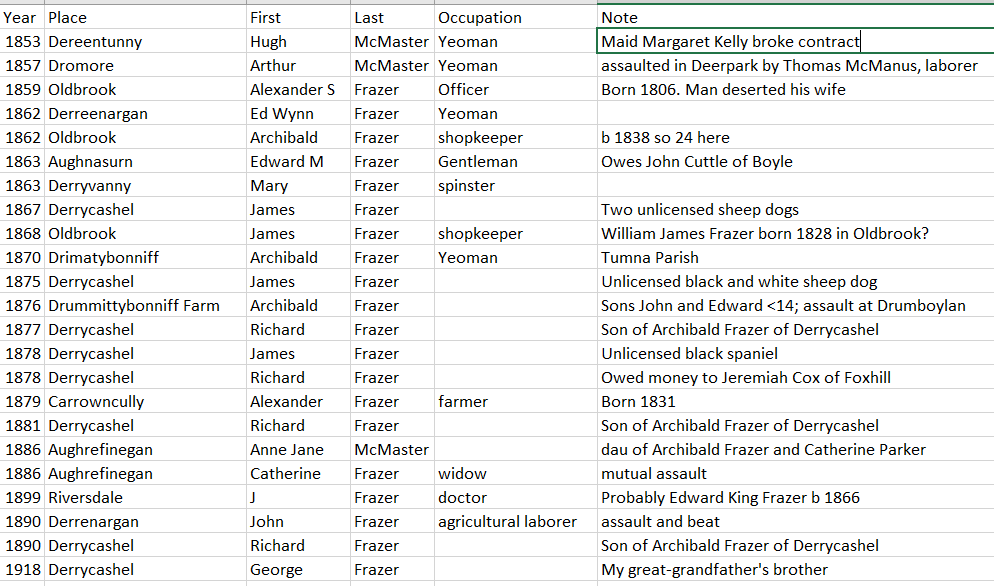
My Ancestor James McMaster

Here is what I have for James:
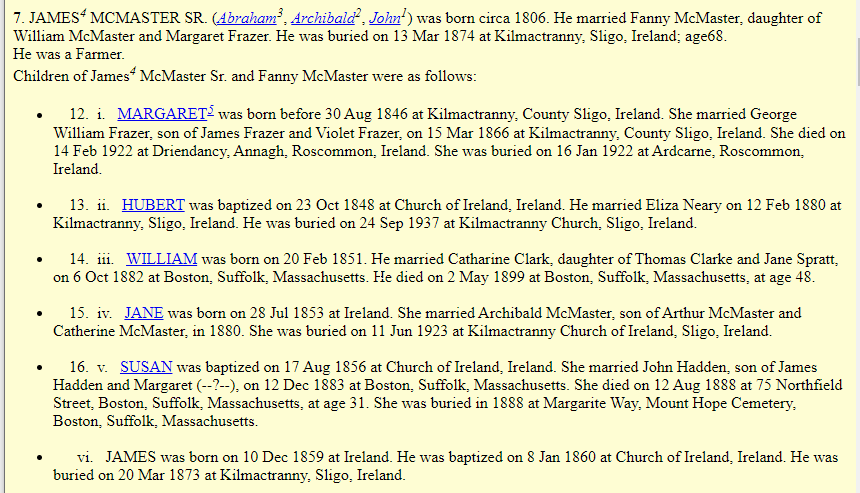
From what I understand, my 2nd great-grandmother was from Cuilnaghleragh. This was also known as Clarkwood. Here is Griffin’s Valuation for Cuilnaghleragh:

There is a James McMaster senior and junior. They both had a house in Cuilnaghlerah. Abraham looks like he had a house there also if I am reading the above corretly. I descend from the senior, I believe.

The first court case has no image:
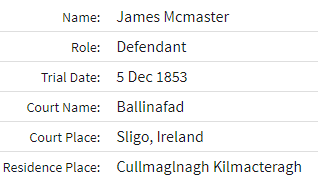
In 1865, James didn’t want gravel on the public road:
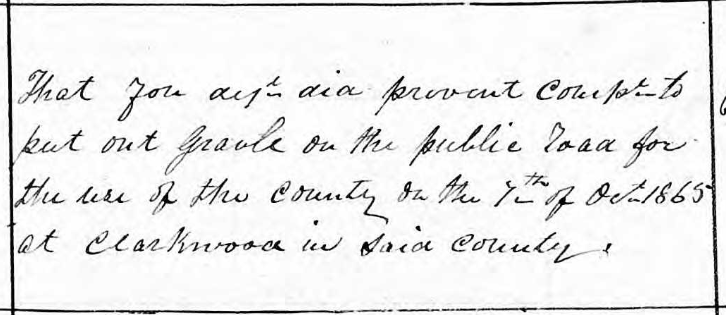
I’m sure my ancestor had his reasons. In 1866, James was in trouble for his wandering pigs:

So pigs like mud, right? Perhaps that is why James didn’t want gravel on the road.

In 1859, James was a witness:

It looks like James was a witness for George Thompson. Apparently Thomas Boyd was putting a fend on George Thompson’s land.

Martha McMaster Cloghmine 1876

The complainant appears to be Thomas Conners:
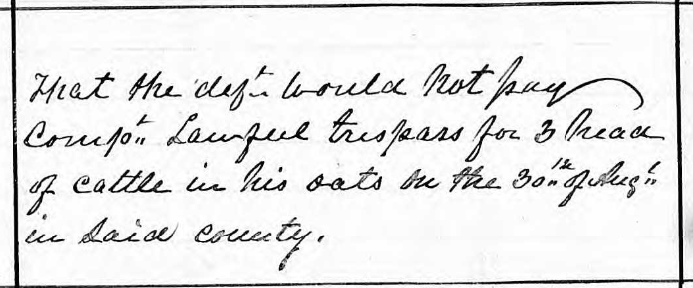
I don’t have many guesses for this Martha, but here is one:

If I have this right, then Martha was a Rockaby and her second wedding had two witnesses named Archibald McMaster.

Here is a McMaster from Cloghmine:
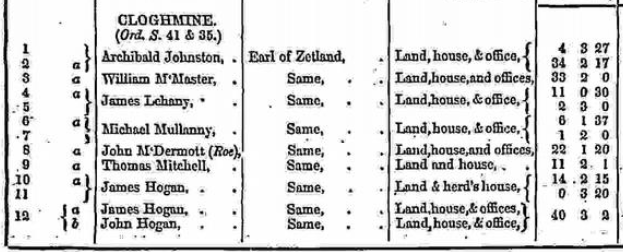
Martha could have been the wife of William McMaster. I don’t see a Conners listed in Cloghmine on Griffith’s Valuation.

The Widow McMaster – Probably Anne Jane McMaster

I wonder if the Widow McMaster also in an 1876 case was Anne J(ane) McMaster:
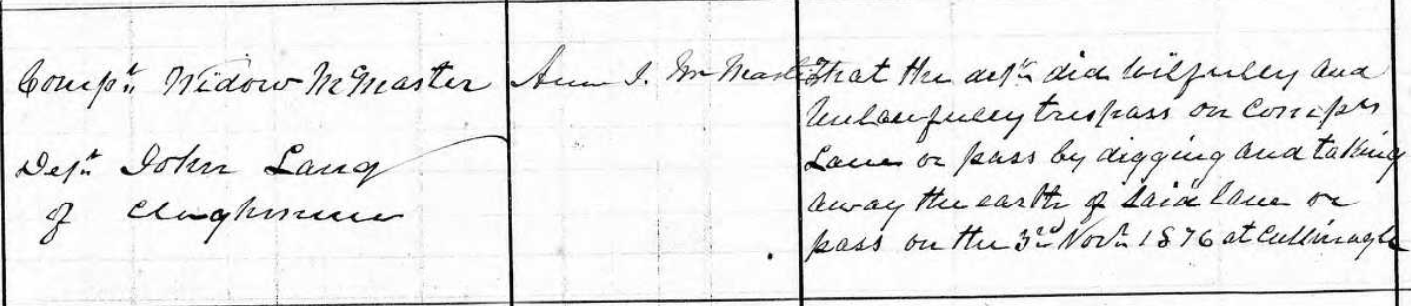
I see that Ann J McMaster was a witness. Was she the widow McMaster? I mentioned Anne Jane McMaster in my previous blog. She was also a widow as of 1874 and was living in Aughrefinegan, Roscommon in 1886. However, in 1883, she was listed as living in Clarkewood aka Cuilnaghleragh:

Anne Jane is linked to Clarkewood and Aughrafinegan here in case there is any doubt.

William McMaster 1876 Cloghmine
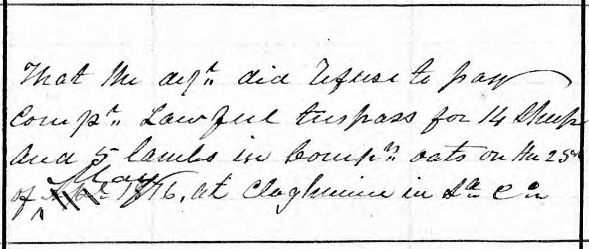
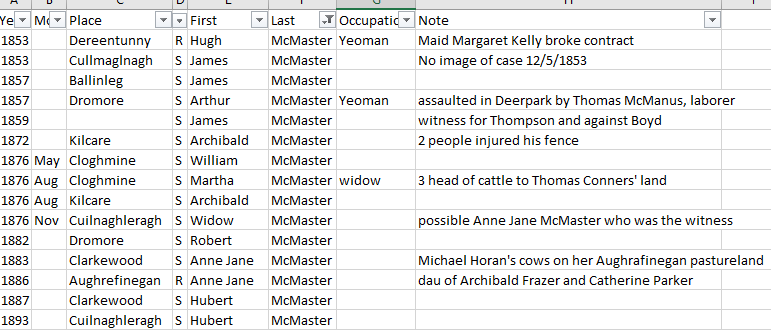
When I filter by McMaster on my spreadsheet, I get this:
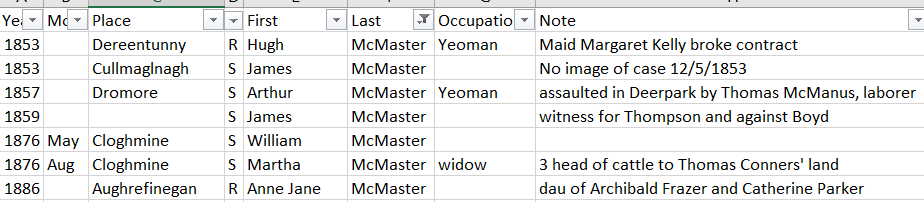
If William was Martha’s wife and she was a widow in the 1876, then William would have had to have died in 1876.

William McMaster 1857

I think that this is the same William McMaster in 1857:

Based on this entry, I would assume that William had land in Cloghmine but was living in Ballinlig:


Ballinlig is to the West of Highwood and Kilkere. So, I don’t know what it means that William lived in Ballinig but had land in Cloghmine. Was the family originally from Ballinig or Cloghmine? I see no McMasters in Ballinlig in the Griffith’s Valuation:

Hubert McMaster of Clarkewood

This name was transcribed as Herbert, but I see Hubert:
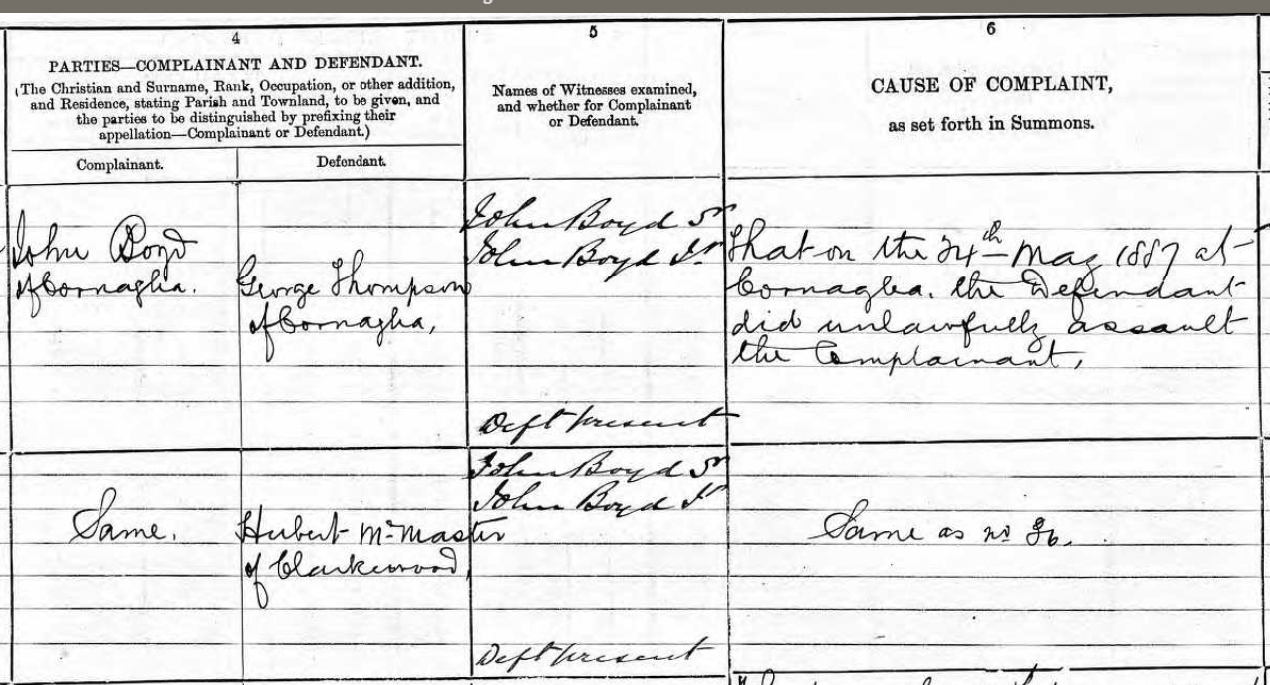
Apparently George Thompson and Hubert McMaster were not happy with John Boyd. I have this for Hubert:
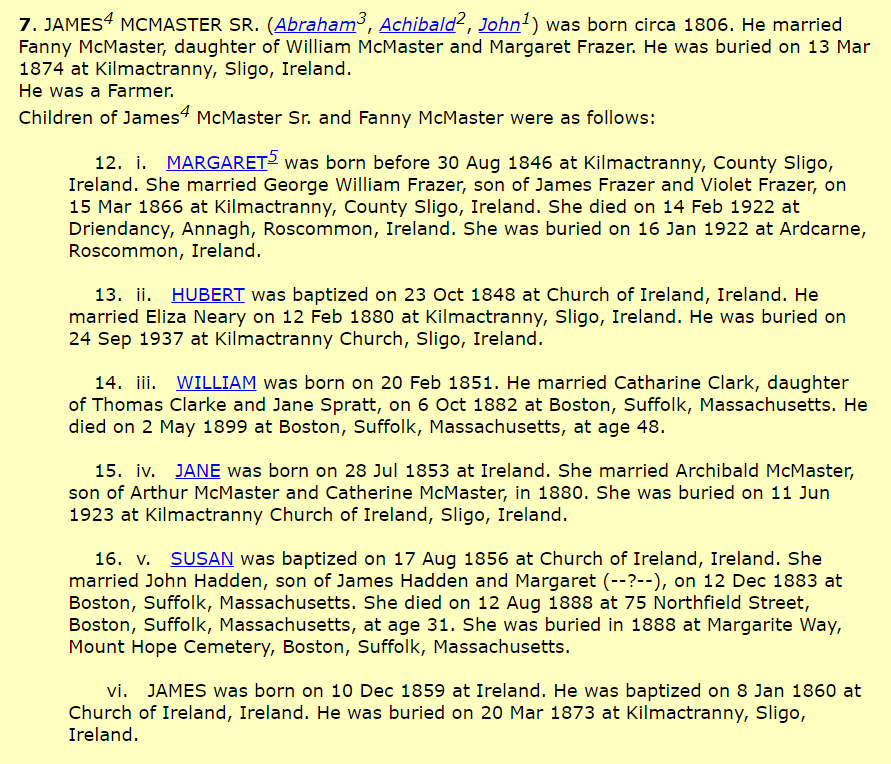
It appears that in the 1901 Census, he was called Hugh:
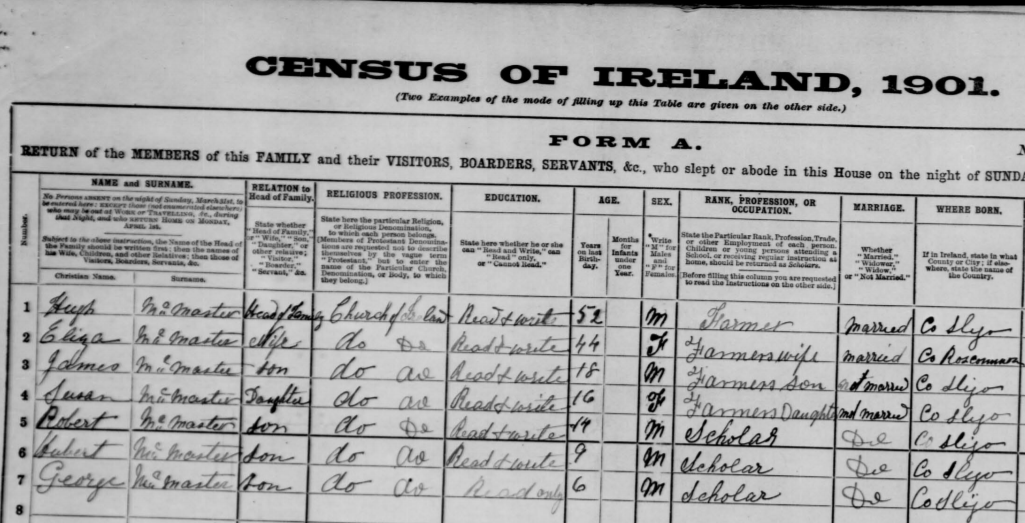
In 1918 Hubert had an unlicensed dog:

Archibald McMaster

Archibald had fence problems in 1872:
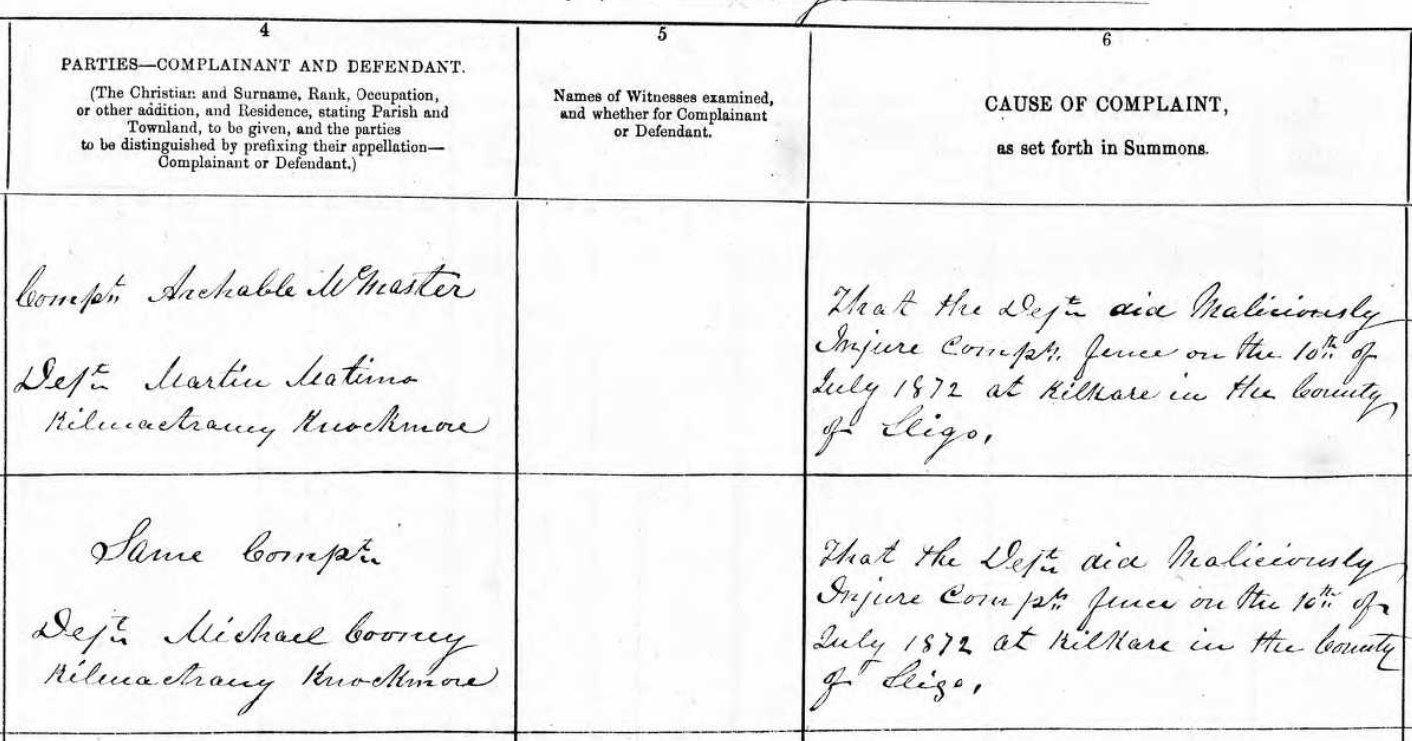
I assume that Archibald (or Archable) lived in Kilkere. This 1876 case has Archibald in Kilkare:

According to Wiliam Johnston, Arhcibald’s man and animals tresspassed on his land, pulled down his fence and took turf. I see that Archibald filed even more charges against William Johnston at the same time.

Robert McMaster Dromore 1882

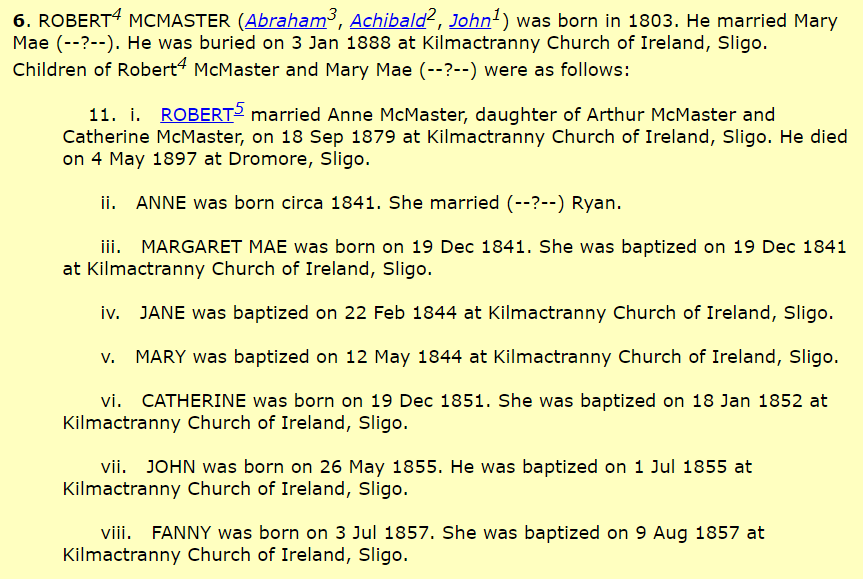
I see I mentioned an Arthur McMaster from Dromore above. Dromore was to the North of Highwood. This Robert is designated as Senior, so there must have been more than one Robert McMaster. This may be Robert McMaster Senior born in 1803:
McMaster Summary
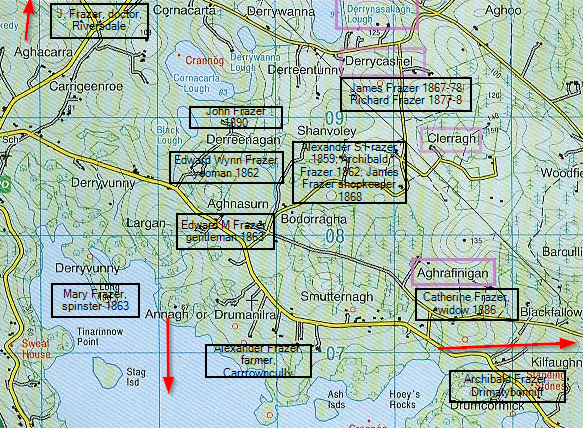
One of the earliest cases involved Dereentunny which is in Roscommon. Here are the names on a map:

The map stops near the Roscommon border to the South, so the red arrow shows where Hugh and Anne were. Anne Jane was in Aughrafinegan, Roscommon.

Frazer and Roscommon Summary

Here is how that looks on a map:
 

From above, Hugh McMaster was in Derreentunny to the West of Derrycashel and Anne Jane (Frazer) McMaster in Augrefinegan. This shows how closely these early Frazers lived to each other. The three with the arrows go off the map. Archibald Frazer moved from Shanvoley aka Oldbrook to Drimatybonniff. Recall, this information is just from the Petty Sessions. I’m sure there were more Frazers not mentioned in these sessions.

Summary and Conclusions

  • The Irish Petty Sessions give some interesting background on the day to day lives of my ancestors and their relatives from the 1850’s to the time of the 1900 Irish Census.
  • It appears that livestock getting into your grains was an important issue as it could result in loss of revenue or even hunger.
  • My main purpose in looking at these Petty Sessions was to see where these people were living at the time. As there was no Census at this time, it puts these people in a particular place.
  • If these people were living in the same place as others of the same name, it could imply that they were from the same family. There were many people with the same names and similar sounding place names. The court cases tried to distinguish these people to make it clear who they were by saying where exactly they lived.
  • I summarized these cases in a spreadsheet and put these people on a map. The map shows the epicenter of where the McMasters lived in Kilmactryanny, County Sligo and where the Frazers lived in North County Roscommon.


Irish Petty Sessions and My Frazer Ancestors and Relatives

I recently came across Irish Petty Sessions at Ancestry. These could be helpful in sorting out relationships and/or adding some interesting information to my family history.

Let’s look at some of these records.

Let Your Light Shine in 1918

Here is the simple case of George Frazer of Derrycashel who was operating a vehicle at night without a light.

This actually happened on March 16th at 8:20 p.m. George was fined one shilling. Here is George (#27):

My great-grandfather’s brother George was born in 1879 and lived in the old family house – the one his father George grew up in in Derrycashel, Roscommon before moving to Ballindoon, Sligo.

Wild Times in Augrafinegan on 12 May 1886

I get the impression that Catherine Frazer and Anne Jane McMaster were not getting along. The first column is the complainant, the second column is the defendant and the third column contains the witnesses. It appears that Anne Jane was charged:

Who are these people? Here is the charged Anne Jane Frazer (wife of James McMaster):

James McMaster died in 1874. Here is Anne Jane’s family:

That means that in 1886, Anne Jane was about 57.  That means she low-balled her age in 1901 when she was probably 72. Under this scenario, Richard could have been her brother.

Who Were the Other Frazers in This Court Case?

We may never know why Anne Jane Frazer McMaster and Catherine Frazer were assaulting each other. But who was Catherine Frazer?  We know that in 1886, she was living in Aughrafinegan:

Also, I would assume that Anne and Richard Frazer could also have been living there. One guess would be that Catherine Frazer was her mother. However, Anne Jane’s mother could have been around 77 years old at that time (if she was even alive then). It does seem from the record above that that Catherine was a widow. Another guess would be that Catherine and Anne the witness would have been daughters of Richard:

For some reason, animosity between mother and daughter seem more likely to me than between Aunt and niece. Perhaps someone else will come up with a different possible scenario.

Who Was James Frazer of Oldbrook?

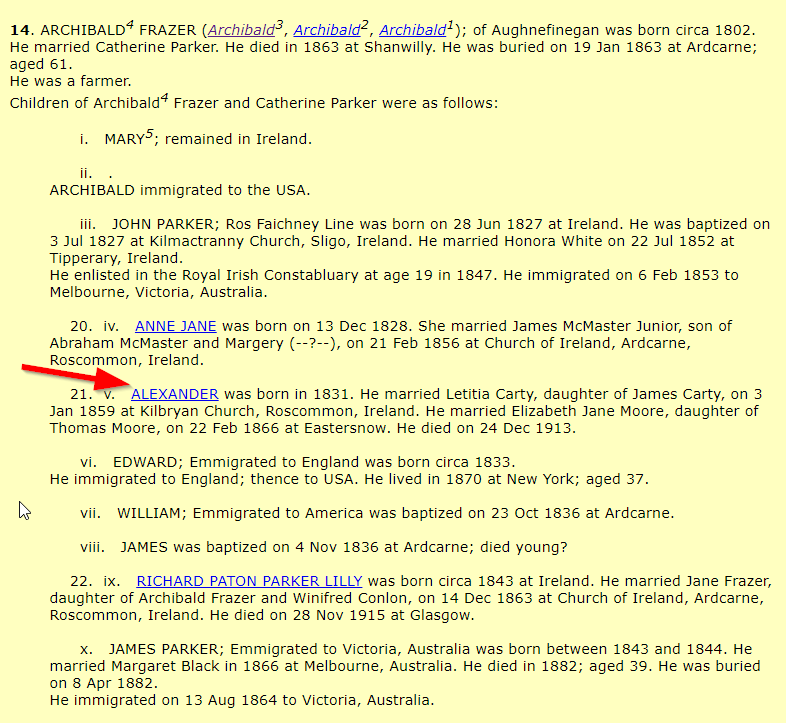
My third great-grandfather was James Frazer of Derrycashel, so this entry interested me:

Acconrding to this research from the mid 20th century,  Oldbrook is another name for Shanvoley (or Shanwilly).

This list has Oldbrook in County Leitrim. However, other references to Leitrim should be County Roscommon. I believe Oldbrook should be in Roscommon here also. Oldbrook or Shanvoley was not from from Derrycashel.

I notice that I have a document of transcriptions – I believe from a fellow Frazer researcher:

James Frazer Complainant April 19, 1867: Defendant [Thaddy Devauny of Fermoyle] allowed his three cows to trespass on the Complainant’s lands at Fermoyle on 14 April 1867. “To pay 1/6 costs to Court”

James Frazer of Derrycashel in 1867 owned one black sheep dog and one black and white sheep dog and paid the due fees for its license.

James Frazer of Oldbrook in the Parish of Kilbryan shopkeeper Complainant June 1868: Civil Bill: An action for the sum of 3..0 for that the defendant [Patrick Rorke from Cornacwita in the Parish of Boyle] is indebted to the said plaintiff in the said sum for shop goods sold and delivered in the year 1867. “decreed payment and 2/6 costs”

James Frazer of Ballymote labourer Complainant; Defendant Mark Connelly 27 July 1871; for following Complainant  into Catherine Dockry’s house and assaulting him there on 17 July 1871 at Ballymote. “No A”.  Same complaint against Margaret Connelly of Barrymote married woman; Mary Morrison of Barrymote married woman. The same day Mary Frazer of Ballymote [widow]; Defendant: Mark Connelly for assaulting Complainant and making use of scandalous and abusive language towards her at Ballymote on 17 July 1871.  “No Ap”.  Same day James Frazer of Ballymote Defendant – assault of Complainant [Mary Morrison] on 17 July 1871.  “No Ap”

James Frazer of Ballymote letter carrier Complainant 22 June 1876; the Defendant John Cawley assaulted and violently threatened the Complainant and challenging him to fight on the night on 15th inst at Ballymote.  “No appearance.”

James Frazer of Ballymote Defendant: Defendant did unlawfully and violently assault the Complainant [his wife Marion Margaret Frazer] at Ballymote, Sligo on 3rd July 1888.  Knocked her down abused and blackened and injured her and did so abuse and beat.  Kick, knock down and injure and did endeavour to take her life within the last two months several times.  Complainant claims protection. “No app”

James Frazer of Derrycashel owned a black & white sheep dog March 1875 and paid the required fee.

In March 1878 he had a black spaniel.

James Frazer Complainant: the defendant [Thomas Coyer] on 22 June 1878 at Athlone Roscommon did leave his horse and cart on the public street without anyone in charge of the same. ‘Fine 5/- costs 1/-“

James Frazer Complainant 14th June 1875; that the defendant [Michael Higgins of Kilmactranny] did refuse to pay the sum of 17/-  for a pig sold and delivered purchased on 3rd January 1875 at the Boyle fair the property of the Complainant. “No appearance”.

Here is Shanvoley. It is to the SE of Derrycashel:

Archibald of Shanwilly (aka Shanvoley) had a son named James Parker but he moved to Australia before this time:

Here is another case from 1875 involving James Frazer of Oldbrook:

When I Google Oldbrook, Roscommon, I see this MyHeritage record:

This George Robert Frazer was said to have a father named William James Frazer from Oldbrook. Was this William James the shopkeeper?

Here is another possibility from the tree of fellow Frazer researcher Joanna:

If this is the right James Frazer, he would have been a shopkeeper at age 21 in 1868. This must be the same family in Edgbaston, Warwickshire in 1811:

John W and Margaret would have been the children of Archibald Frazer. Archibald was the son of Alexander and the Mary Frazer of the above Census (though Alexander had died before this Census). Archibald Frazer is the one who lived in Shanvoley or Oldbrook and moved to Drumatybonniff Farm in the Parish of Tumna, County Roscommon (see below).

While I’m At Old Brook

Here is an early case:

This is no doubt, the same Alexander:

My guess is that this person was renting property from Alexander and deserted his wife. That meant that she had to end up in the work house. Of course, Alexander would have lost the rent of his property by this man deserting his wife. These were very difficult times.

Apparently, there was a different James Frazer from Ballymote:

I hope he was not related as he was a wife beater. His wife had the same name as my grandmother’s maiden name, though my grandmother was born in the US in 1894.

Other Mentions of James Frazer, My Third Great-grandfather

There are two other mentions of James Frazer in Derrycashel. He was supposed to license his sheepdog, but he didn’t until he was caught. This suggests that James was raising sheep. My relative in Ireland said that the Frazers butchered some of their sheep to help feed the neighbors during the potato famine. This also suggests that he didn’t like to pay to license his dogs.

My guess is that James also raised Pigs as there was mention of him selling a pig to Michael Higgins of Kilmactranny at the Boyle Fair and not receiving payment.

When I put these together in a spreadsheet and sort by date, I get this short Frazer history over a period of 59 years:

These people were almost certainly all related and assuredly knew about these events as they also lived in fairly close proximity to each other.

John Frazer of Dereenargan

Here is a John Frazer from Derreenargan in 1890. I have written about a different John Frazer from Derreenargan here. The John Frazer I wrote about was living in Lockport, New York in 1870 and had a son, John Jr., who was born in New York

Here is Derreenargan in the heart of Frazer country, County Roscommon:

Here is the charge:

Here is the Complainant:

Based on other information these two were assaulting each other.

Is this the family in 1901?

The transcriber got the name as Frozier.

However this appears to be a different Derreenargan:

This John was born about 1856 in County Roscommon. I see that Frazer research MFA has a John born at Kilmactranny to Edward and Mary:

This was at Kilmactranny which is technically in Sligo. However, one may have lived in Roscommon and gotten baptized in Kilmactranny. Also, there was an Edward who was the son of John (circumstantial evidence).

Here is another John from nearby Shanvoley, but I don’t have any more information on him:

Edward Wynn Frazer

As I recall, there were two Edward Wynn Frazers. This always confuses me. This one lived in Derreenargan in 1862:

Notice this Edward from Derreenargan of Klbryan. The John above appears to be from Derreenargan of Ballyformoyle. Edward had a case against Michael Partlane for failure to pay rent:

I believe that Partlane was another name for McPartland. I have written quite a few blogs on this family. Who knew that Derreenargan was such a popular place in the day?

This is the Edward Wynn I have:

Here is the other Edward Wynn Frazer:

According to the Frazer tree of my researcher friend Joanna, this Edward Wynn’s daughter Kate Peyton Frazer was born in Derreenagan. That means that this court case would be for the Edward Wynn born in 1838 and he would have been about 24 years old at the time of this court case. The Edward Wynn pictured above is the second great grandfather of fellow Frazer researcher Kathy who lives in Massachusetts.

Here is a simplified tree of the Frazers based on YNDNA testing:

This tree goes back to about 1690. Edward Wynn Frazer from the photo is the brother of Thomas Henry Frazer on the right branch. James Frazer with the unlicensed dogs was born about 1804 and is on the left branch.

More on Edward Wynn Frazer

Here Patrick Gallagher claimed that Edward Wynn assaulted him:

This would have been about a month before his daughter Katherine Peyton Frazer was born. Here is some more background:

I appears that the Gallaghers were damaging and breaking Edward’s door with stones.

Edward Wynn brought Widow Jane Doyle to Court:

This is one tough dude. “Your chickens step on my property and we’re going to court.” I’m not sure how much damage chickens could do to “fattening grass”. Here is another complaint from Edward against Widow Doyle – apparently a neighbor:

In 1861, Edward Wynn was looking for rent from Bartley McKeon of Aughnasurn:

Here a shopkeeper is looking for money owed him from Edward Wynn:

Perhaps Edward couldn’t pay because people owed him money.

Edward M Frazer Aughnasurn

This Edward M Frazer was from Aughnasurn and was a Gentleman. He owed Jones Cuttle some money. This Edward appears not to be the same as Edward Wynn as he is not from Derreenargan.

Edward Frazer of Annagh died 8 March 1863, so that rules him out. This is leaving me stumped, unless this is the same as Edward Wynn Frazer. However, the Gentleman part and living in Aughnasurn seem to distinguish this person from Edward Wynn Frazer.

Archibald Frazer of Drumatybonniff Farm in 1876

There are a lot of Archibald Frazers, so perhaps this record will help sort things out.

However, finding these locations could be difficult. If John and Edward were under 14 years of age, that means that they would have been born 1862 or later. Here is one possibility by name but not by place:

More on Archibald Frazer

Here we see that this Archibald was from Tumna Parish. Here is a more standardized spelling:

From here, I can find them in the 1901 Census:

Archibald was born about 1840. He lived at the same place in 1866:

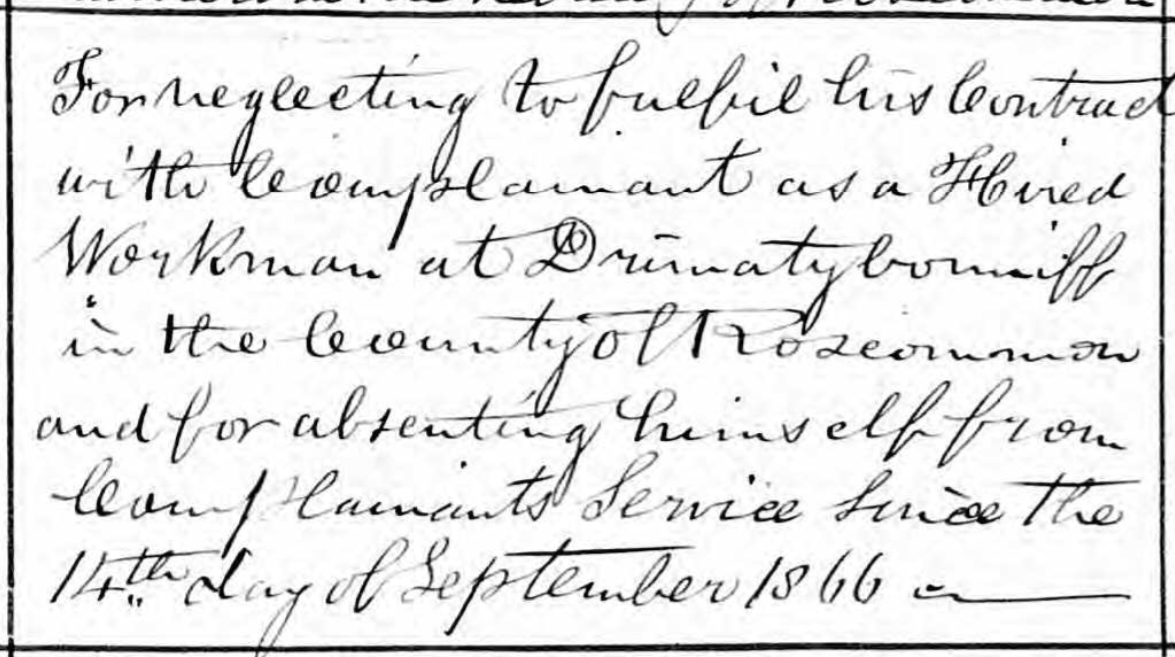
Thomas Malone who lived in the same Townland as Archibald was not doing his contracted work:

More problems in 1870 from Patrick Doran:

Edward Little was also listed as a compainant. I think that this is a hint that Archibald of Shanvoley was the same as this Archibald. Of course Frances would be Frances Little and Edward Little a likely relative of Frances. I assume that Mary Doran listed as the Defendant below was Patrick Doran’s wife:

There was a lot of assaulting going on in County Roscommon 150 years ago. She was not happy with Archibald. Mary Doran, married woman, charged that she was assaulted by Archibald Frazer on the same day.

More Assaulting in 1879

Let’s check Archibald for bruises:

I believe Toomna would be the same as Tumna.

Here is Frances Little Frazer from Doug Vaugh’s Web page:

That means that between at least 1866 and 1901, this couple lived at Drimitybonniff (or some variation of spelling). Here is Tumna:

Here is Drumatybonniff:

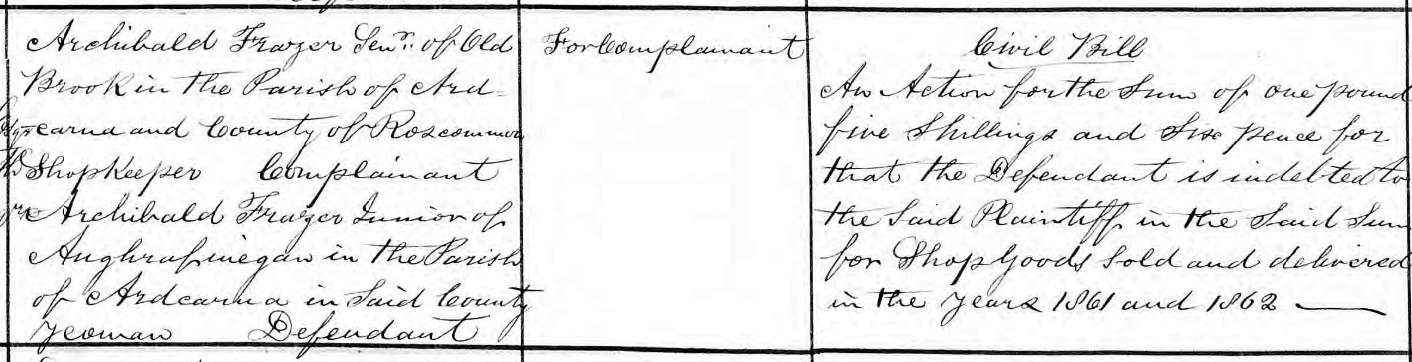
Here is another mention of Archibald Frazer in Oldbrook in 1862:

Said Archiald of Aughrafinegan to Archibald of Oldbrook, “Just put it on my tab”.

Here is my spreadsheet sorted by date:

Alexander, who was Archibald’s father was 53 in 1859. He could have passed away early in the 1860’s. Archibald marries in 1861 and becomes a shopkeeper in Oldbrook. Around 1868, the Archibald Frazer family moves from Oldbrook to Drimatybonniff where Archibald apparently farms the land. He is there for at least 32 years as he is there with his wife in 1901.

Archibald Frazer Junior of Aughrafinegan

This junior Archibald owed Archibald of Oldbrook money. Here junior does not imply that he was the son of Archibald, but just a younger Archibald. As Archibald the shopkeeper was only 24, we are looking for a younger Archibald in Aughrafinegan. Here is a guess for Archibald Junior:

If my guess is right, then this Archibald would have to have been born after 1838 and would have had to have left Ireland after 1862.

Summary and Conclusions

It’s time to bring this Blog to a close as it is becoming unwieldy.

  • It is important in Court cases to properly identify people. As such, detail is given to where these people lived to distinguish them from other people with the same names. This can be helpful in sorting out who belonged to which family.
  • Many of these cases involved assaults. Money was in short supply and neighbors did not always get along well. Other cases involved owing money. My own ancestor James was guilty of not obtaining three dog licenses and went to court when someone didn’t pay him for his pig.
  • I probably learned the most about the Frazers of Shanvoley. Due to the number of Petty Session cases, it was possible to monitor what was going on in the lives of at least some of these families  for about four generations.
  • I found out a little more about Kathy’s ancestor Edward Wynn Frazer. I was able to sort him (I think) from the other Edward Wynn Frazer. He was the only one I looked at from the James Frazer Line. He was in Derreenargan. I also looked at others in Derreenargan.
  • I looked at a John Frazer from Derreenargan. But this Derreenargan appears to be in Ballyformoyle and different from the one in Kibryan Parish. However, bother are in County Roscommon.
  • I started a spreadsheet of some of these cases noting the people and where they lived.
  • Times were difficult in Ireland. Looking at these Frazer lives through the lens of the Petty Sessions helps to keep us from romanticizing these times and lives. It seemed there may be a correlation between the number of Court cases and the families that moved out of Ireland. For example, I didn’t see my second great-granfather George Frazer listed in any case (yet) and part of that family is still in the Ballindoon area of County Sligo today.
  • I will likely be writing more on the Petty Sessions.


More on Mayflower White YDNA

In my previous Blog on Mayflower White YDNA, I was surprised to find out that my friend’s YDNA test supported his direct descent from William White of the Mayflower. My friend always believed that he was descended from William White, but most recent genealogical scholarship seemed to put that into doubt due to an illegitimacy in his White line in early Plymouth Colony hisory. In this Blog I would like to see if I could find out any more about my friend’s Mayflower YDNA. He took the 37 STR test which is what I recommended. I had recommended that as it would have been enough to show that he didn’t match other Mayflower Whites. As it turned out, his test showed that he matched almost all Whites and one White who had a proven ancestry back to William White of the Mayflower.

Predicting the Mayflower White YDNA Haplogroup

The easiest way to predict the Mayflower White YDNA Haplogroup would be to join the R1b – All Subclades FTDNA YDNA Project and have them figure it out. I joined my friend to this group, but it is a large group, so difficult to figure out on my own where he would belong based on his limited test. My friend is R-M269 which is one of the most popular Haplogroups for Northwestern Europeans – sometimes referred to as Northern Atlantic Europeans. I joined my friend to the R1b – All Subclades Group, but it could be a while before his is put in a more specific Haplogroup. Here is the tip of the iceburg view for R1b:

M269 is near the top of this tree in the pink or red area. My own Hartley YDNA is somewhere on the bottom left in the green area under L21. I am also under L513 which has its own group and two page tree. When I say this is a large group, there are over 26,000 members. That means that to download the results takes a long time. The results go out to 111 STRs, so that means about 3 million bits of information.

One cut is whether my friend is L21 or U106, or actually P312 or U106. According to ISOGG:

Here is what my friend has for DYS390:

That looks like R-P312 so far.

Hmm, split decision.

CDYa is 37, so that favors U106. The difference between P312 and U106 is that P312 is believed to be an older YDNA from Great Britain and U102 would be from the Anglo Saxons who were originally from Germany. The name England comes from Anglo. While Britain refects the earlier P312 people. Here is a map showing where the Britons and Saxons were around the year 600:

Here is some more information:

Of the three markers, it appears that DYS390 is the most important and that would more likely put my White friend in R-P312.

YSEQ Predictor

I tried this predictor:

I downloaded the White YDN37 STRs and put them here and got these results:

This seems to be getting somewhere. My Mayflower White desendant friend is pretty sure to be R1b-DF49. The YSEQ site also has this map:

The good news is that there are fewer than 1,000 members in the DF49 FTDNA Haplogroup Project:

I was able to find DF49 on the ‘iceburg’ tree above. Here is a closeup of the L21 section of that tree:

My Hartley YDNA is under L513 in the bottom left. That is a pretty big group which has two pages of trees now. My White friend appears to be under DF49 which is under Z3+589. If this is right, that puts White under the older British people (vs the newer Anglo Saxons).

Dating Mayflower STRs

Dating these STRs is not a precise science. In the YSEQ map above DF49 is shown at 2500 BC. in the green tree above, its predecessor L21 is shown at 2300 BC, but that is in the ball park. The point is that the M269 which is what my Mayflower friend and his proven match show are actually DF49. That brings them from about 4500 BC to around 2500 BC:

That’s an improvement of about 2,000 years.

Here is some further branching for DF49:

Mayflower White is DF49 > M222?

Based on the YSEQ Haplogroup Predictor, Mayflower White is DF49. I found this at mayflowerdna.org:

From this aricle, a different predictor was used (the Nevgen.org R1b clade predictor). This Predictor came up with the M222 which is five SNPs under DF49. I don’t necessarily agree with the stated view above that the White family came from Ireland and Scotland. I don’t think that conclusion is supported by the YDNA testing. That article had this footnote which I could not find:

This article probably refers to the person at the Mayflower YDNA FTDNA Project who is listed as a proven Mayflower descendant.

M222

FTDNA also has an M222 Haplogroup Project:

This group is larger than its parent DF49. I like trees and the one they have at the M222 Project Page:

This brings us into Roman times (100 BC). However, there is some confusion on the dating. This branching is determined by BigY testing which has not been done yet for the Mayflower White families. Not all branches are created equal. There are six branches. The most popular is S658 on the right. This is good news as it brings the Mayflower Whites from 4500 BC to 100 BC, an improvement of about 4500 years. The tree above is also called a tip of the iceburg chart as not all the branches are shown.

M222 and STRs

The “About Us” Page for the FTDNA M222 Project says this:

THE MODAL STR VALUES THAT COLLECTIVELY INDICATE R-M222 STATUS

DYS390 = 25
DYS385b = 13
DYS392 = 14
DYS448 = 18
DYS449 = 30
DYS464 = 15-16-16-17
DYS456 = 17
DYS607 = 16
DYS413 = 21-23
DYS534 = 16
DYS481 = 25
DYS714 = 24

In some to most cases the first three STRs in the list above are adequate to establish possible membership in this group. If you have at least two of those three values and differ by only one at the mismatching marker, you may (though not certainly) a member of the R-M222 Haplogroup. A SNP test for the R-M222 marker could establish firmly.  If you are uncertain about whether you belong to Haplogroup R-M222, please contact a project administrator for advice.

My friend Gary has:

  • DYS390 = 24
  • DYS385b = 13
  • DYS392 = 15

This is interesting because Gary has only one out of three of the STRs that are supposed to define M222. Further:

  • DYS448 = 18
  • DYS449 = 30
  • DYS464 = 16-16-16-17
    DYS456 = 17
    DYS607 = 15

I bolded the values where Gary matches what would be expected of someone with M222. The additional STRs must be in the 67 STR test.

I added this kit to the M222 FTDNA Project:

The administroators think that my friend is M222 but would like him to take the BigY test to be sure and place him in the appropriate subgroup.

The White Family FTDNA YDNA Project

I added Gary to this group:

Gary is on the bottom line. He has no colored results which means he has no variations from the mode. This was discussed also in my previous Blog. The other confirmed Mayflower descendant has not joined the White Family FTDNA Project, so his results do not show there. Here is the caption for this small group of Whites:

It appears that these two other White testers with roots in Vermont may also go back to William White of the Mayflower.

Summary and Conclusions

  • Based on the YSEQ Haplogroup Predictor, my Mayflower White descendant is in the Haplogroup of DF49
  • This group is about 4500 years old and represents the older Britannic inhabitants of the present-day United Kingdom
  • I found one web site which linked the William White Line to M222 which is the largest group under DF49.
  • Based on my friend’s close STR match with a proven William White Mayflower descendant, that proven descendant must also be M222.
  • If these two were to do additional YDNA testing – especially the BigY 700 test, they would likely get their YDNA Haplogroup into the genealogical timeframe.

Cousin Rusty and Our MtDNA Match

I had written a draft of this post in February 2021, but had not posted it. I want to post this now as an update. Here is a link to my previous post on mitochondrial DNA (also posted after a hiatus).

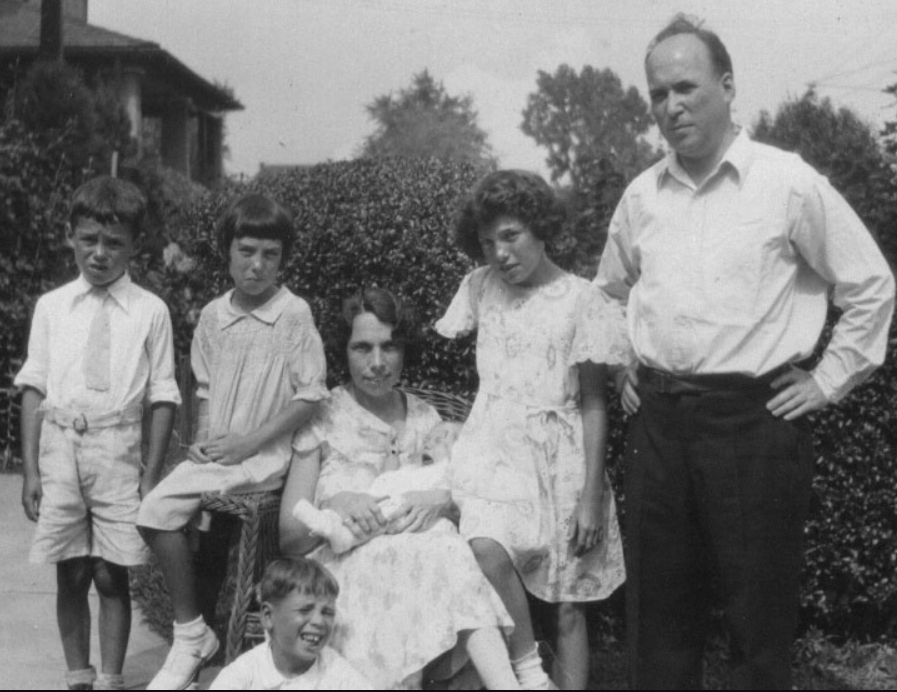
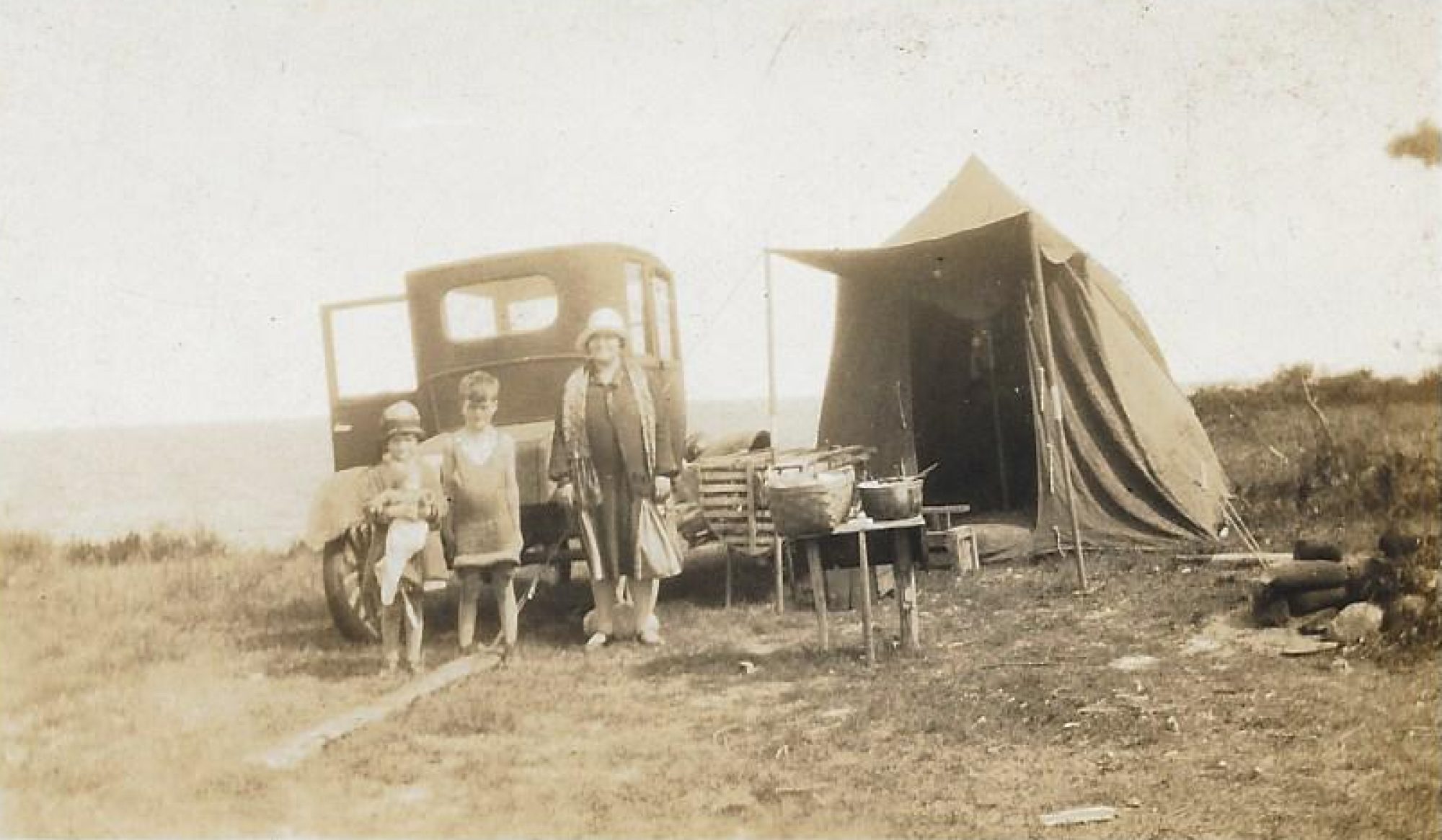
I recently had a nice email from my first cousin Rusty. He told me he tested for MtDNA which is mitochondrial DNA. This is the type of DNA that goes from mother to mother to mother. As we are maternal cousins, we have a perfect match. Our common ancestor is our mother’s mother who was Emma Rathfelder born in 1900. Here is Emma holding her youngest:

Looking at the photo, Rusty’s mom is on the left of Emma and my mom is on Emma’s right. My Uncle Bobby in my grandmotheHere r’s arms was born in April 1933, so the picture must be in the Summer of 1933. My mom was born in December 1921, so she would be 11 years old here. Rusty’s mom, my Aunt Muriel was born in September 1924, so she would be close to 9 years old.

The MtDNA – Haplogroup H5’36

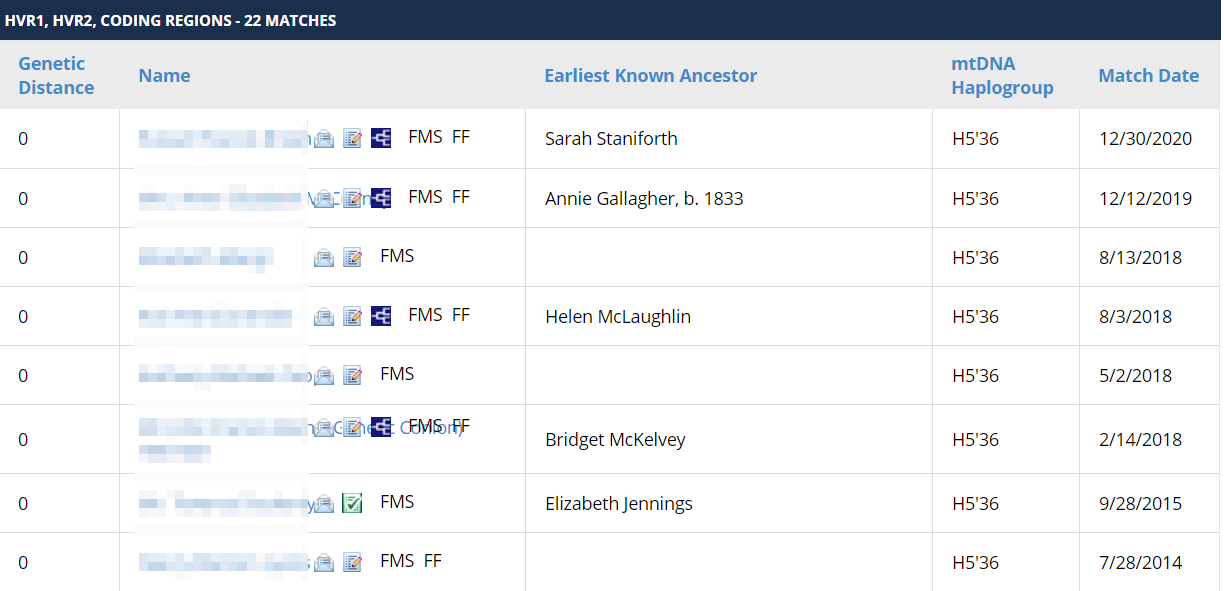
Here are all my MtDNA matches at a genetic distance of zero:

Rusty is the first person with whom I have a MtDNA match and I know our common ancestor. Looking at the last name of my matches are not much help, because with the maternal-only line, the surname generally changes every generation. Even looking at the Earliest Known Ancestors can be misleading. I’ll look at some of thse matches earliest maternal line only ancestors.
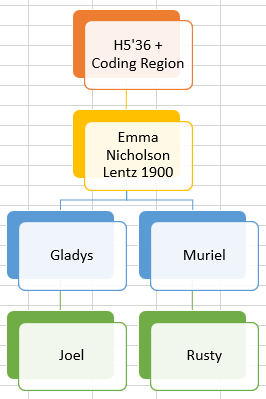
Rusty and Me

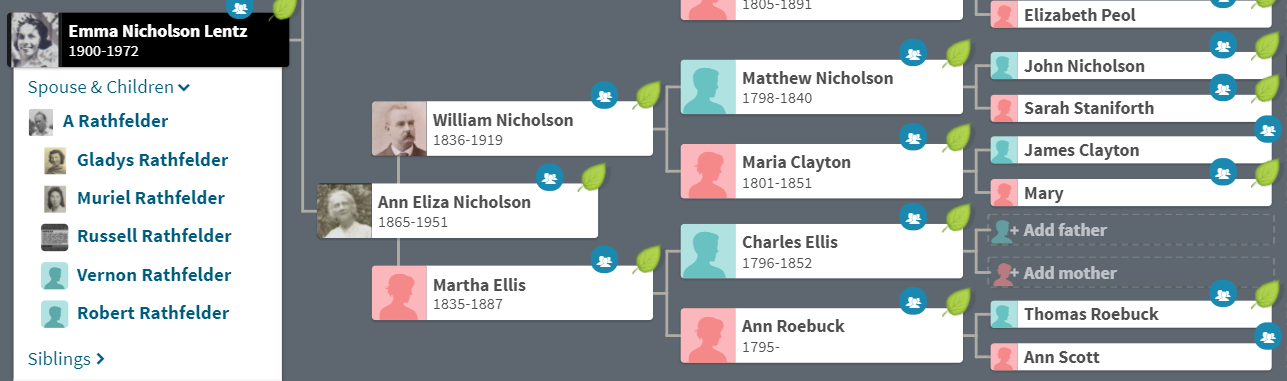
We go back to the Shefield, England area on our maternal side. I have my first known female line ancestor as Ann Scott:

Ann’s mother Ann Roebuck was born in 1795, so we’ll say Ann Scott was born around 1770. That is fairly early. Russ has Sarah Staniforth which cannot be right as she has two male Nicholsons in her line between her and us. Men are not allowed in the MtDNA line. They are only allowed at the end of the line where Rusty and I are.

Other Matches: Gallagher 1833

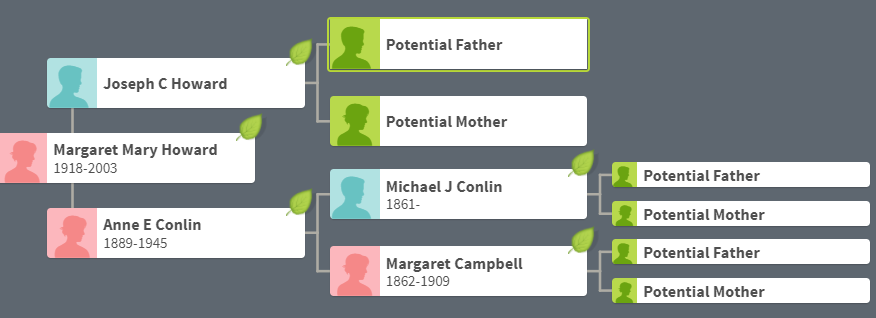
I can’t figure out this tree, so I’ll try to recreate it at Ancestry. I actually started one previously:

In doing these matches, I am intersted in where these maternal ancestors lived, because I am trying to match ancestors and places those ancestors lived. Margaret Campbell lived in Ireland. It appears from a preliminary review that this maternal line came from County Tyrone in Ireland.

McLaughlin

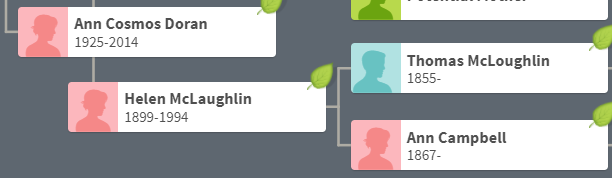
My fourth match has Helen McLaughlin with no date. When I build out this tree, there is also a Campbell from County Tyrone. Coincidence?

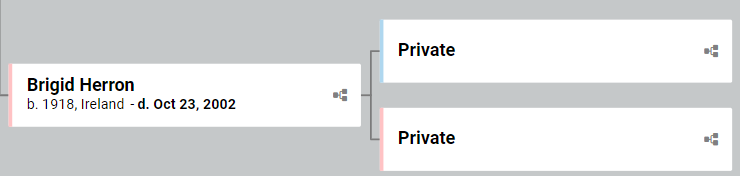
Bridget McKelvey

This is from my sixth 0 GD match. This family was also from Ireland. My MtDNA match’s tree is missing Bridget:

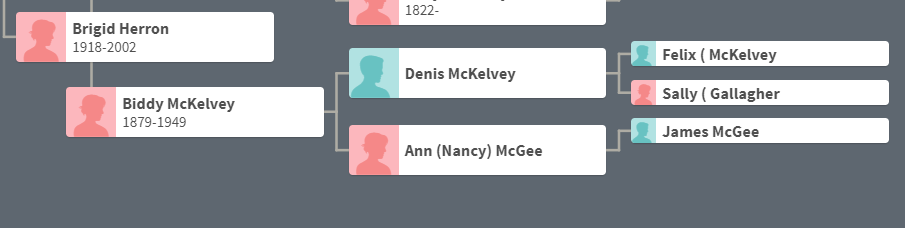
I think that the box marked ‘Private’ is meant to be my match’s grandmother Bridget, but he may have left out her death date, so the program decided to keep this person private. I see another tree at Ancestry which I will borrow:

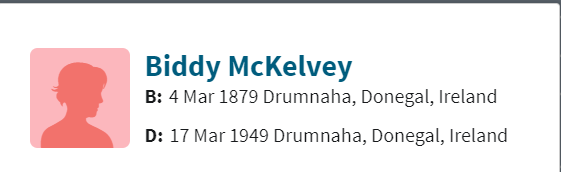
This gets us one generation beyond Bridget or Biddy reto Ann/Nancy McGee.

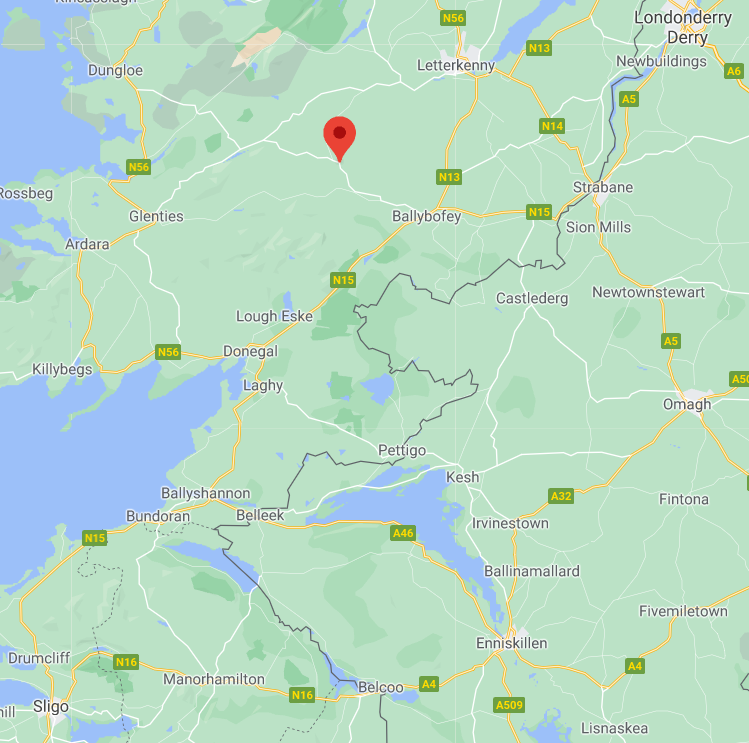
So far, all road lead to Ireland (except for my ancestors). Here is Drumnaha:

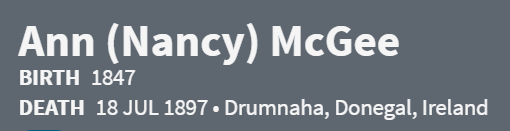
Here is Ann or Nancy:

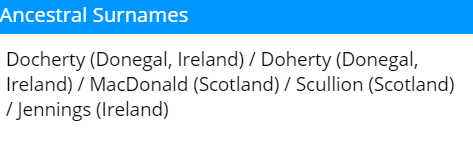
Elizabeth Jennings

My last zero GD MtDNA match has as his most distant female line ancestor Elizabeth Jennings. Unfortunately, he has posted no tree. He does post this information:

I assume that Elizabeth Jennings was his maternal grandmother and that she was from Ireland.

MtDNA Results at FTDNA

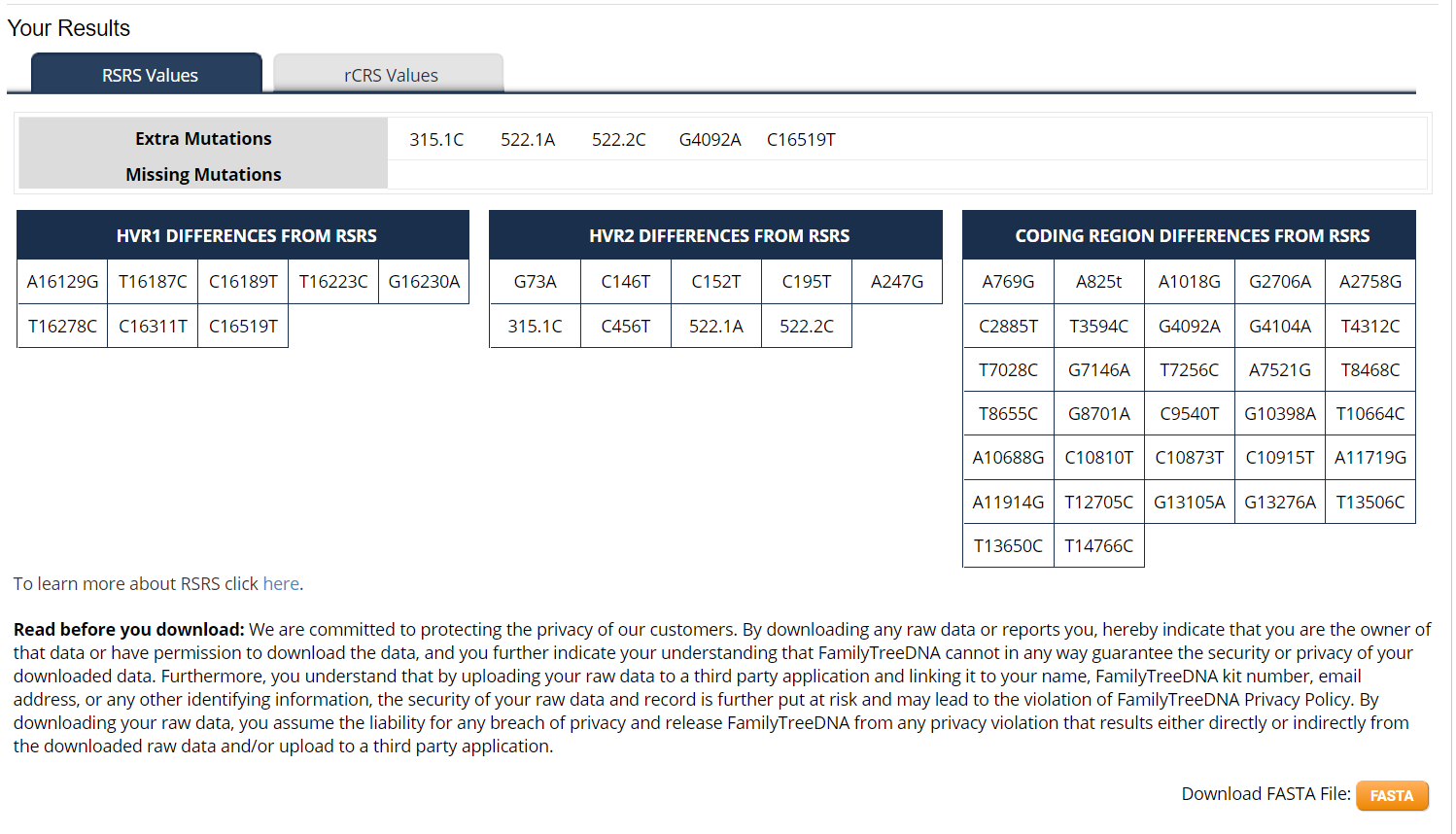
Here is one page of my results:

I am supposed to be able to download my results using the FASTA file buttom in orange. However, I’m having trouble doing that. Apparently FTDNA has an issue with this. Someone on Facebook corrected the error that was on the FTDNA site, so I was able to get the FASTA file. I uploaded this to YFull and to something called James Lick’s web page.

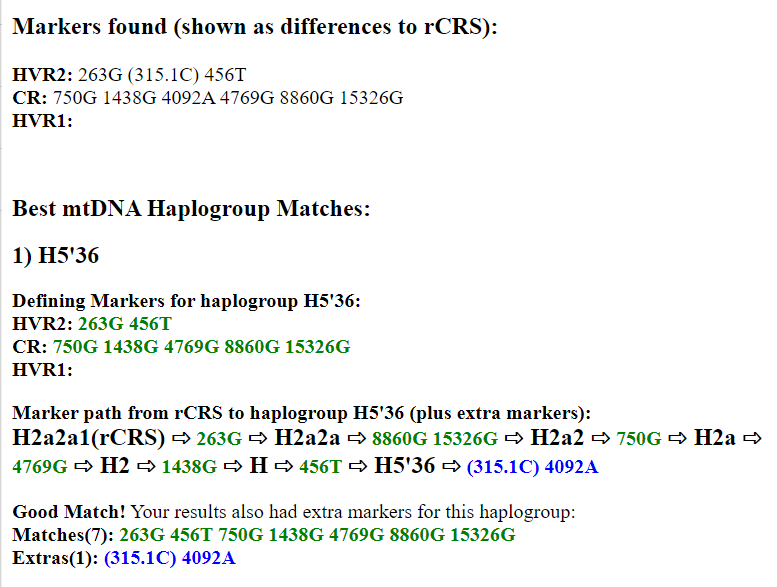
This is what I get at the James Lick MtDNA page after uploading:

Dating mtDNA Results

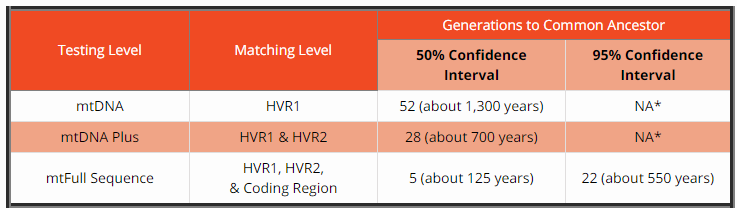
This is a topic that confuses me. I see this graphic at FTDNA:

I can make a few assumptions based on this graphic. One is that this applies to perfect matches only.

I can build a very simple tree that has Rust and me and our grandmother:

Even though this is a simple tree, it useful nonetheless. We have two generations to our common ancestor. I was born in 1956, so I’ll round that off to 60 years. The next most recent perfect match was frorm 2019 and this person has the maternal ancestor of Annie Gallagher born 1833 in Tyrone, Ireland.

Here is what I see at YFull:

The only number that matches FTDNA is the 125. I posted a question at the mtDNA Facebook Page, and got this answer from Rosario:

First, in order for you to have any verifiable and substantive genetic matches with mtDNA, one MUST have results from the FMS. Anything short of that is useless from a practical sense as full haplogroups and mutations can only be defind through FMS.

Second, once FMS results are obtained, a match with a genetic distance of 0, will lead you to a possible shared ancestor within 2200 years. Yes, you have read that correctly.
I have matches with a gd of 0 from all over the place and there is no way that we can all connect within a genealogical time frame, it simply isn’t possible. Why the company would choose to mislead us with this chart boggles the mimd.

Summary and Conclusions

  • I was glad that my first cousin Rusty tested his mitochondrial DNA as that gives me a match that I know
  • I looked at a few other mitochondrial DNA matches.
  • I noted that generally, mitochondrial DNA matches could be very distant – within 2200 years.
  • My mitochondrial roots (maternal only ancestry) appear to be in the Brithish Isles over the past several thousands of years.


An 1887 Trip from Fall River to the Hartley Farm in Rochester

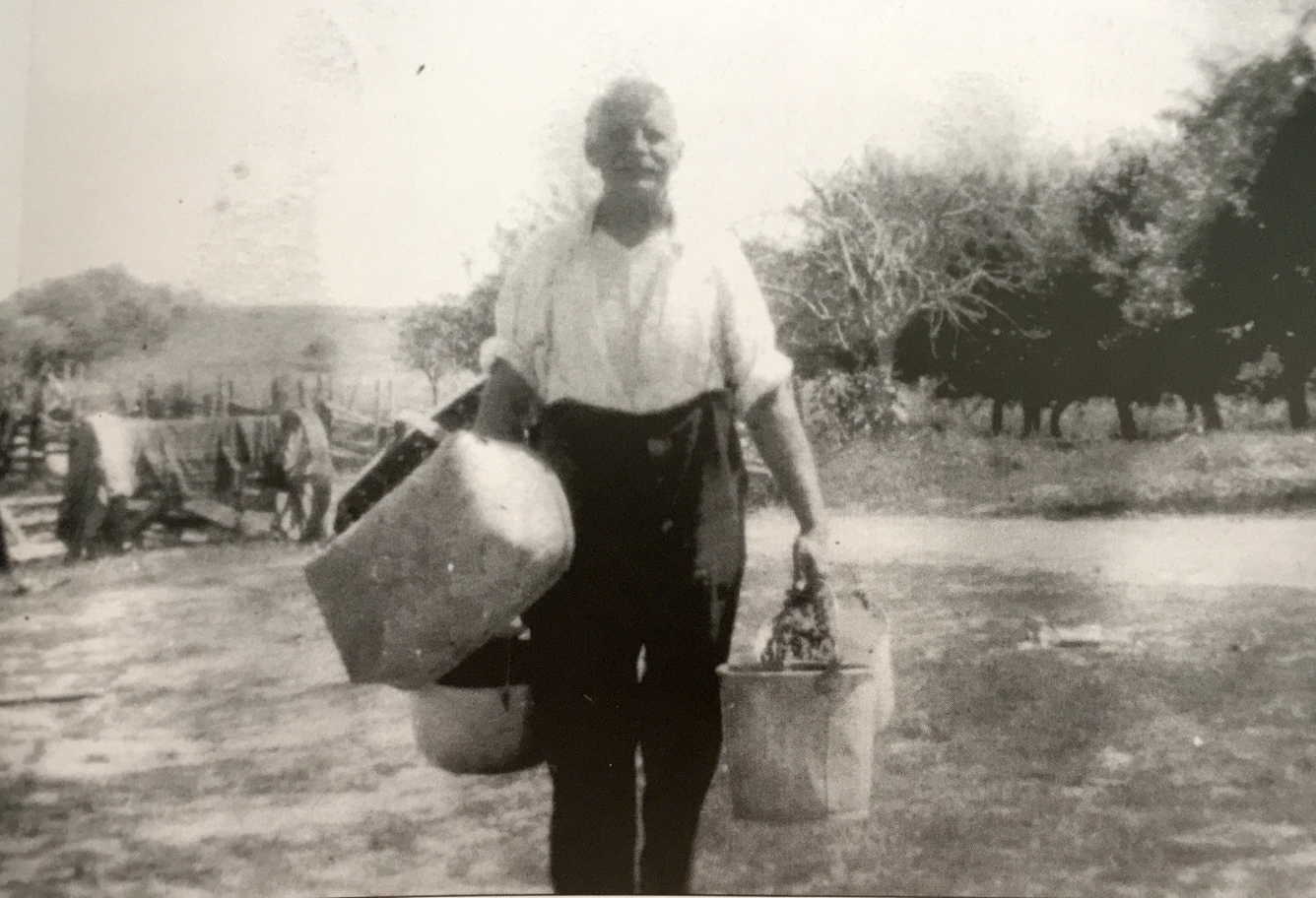
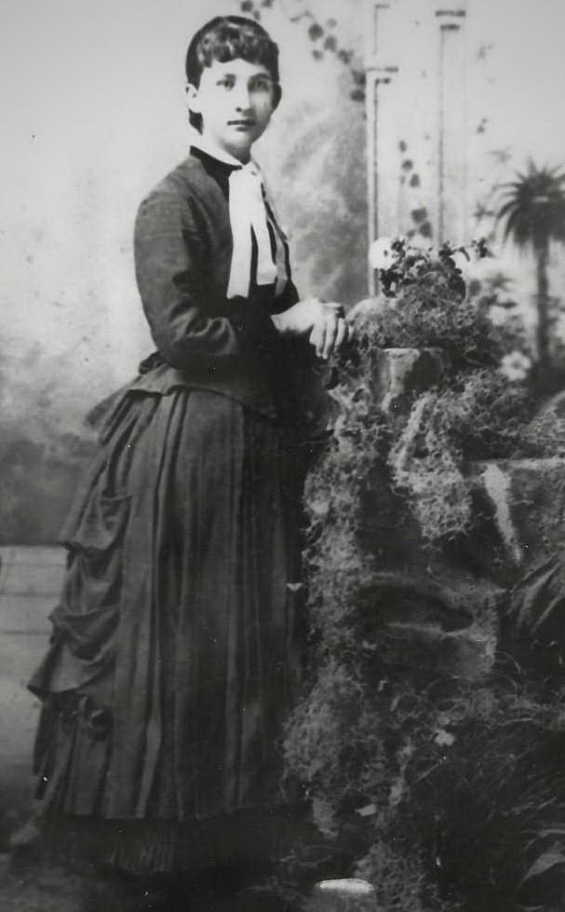
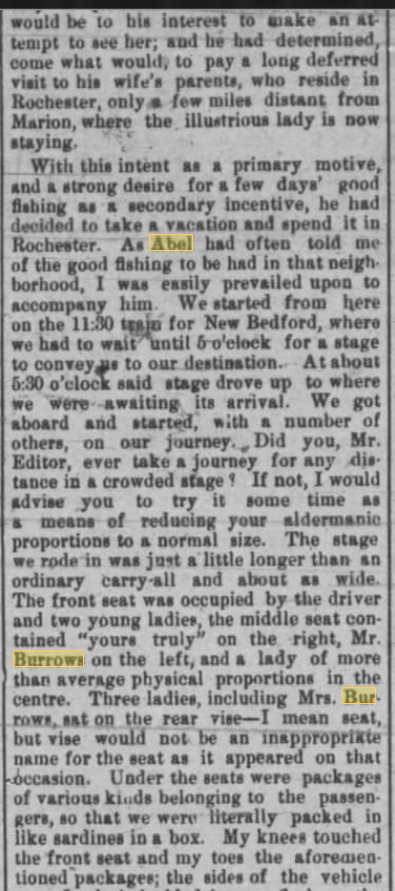
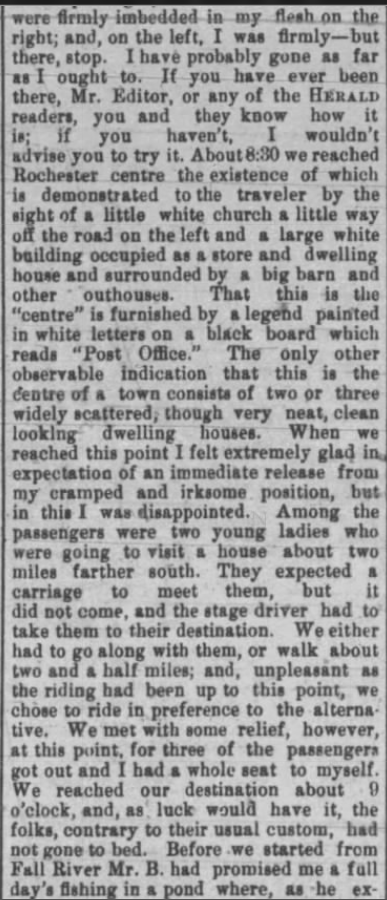
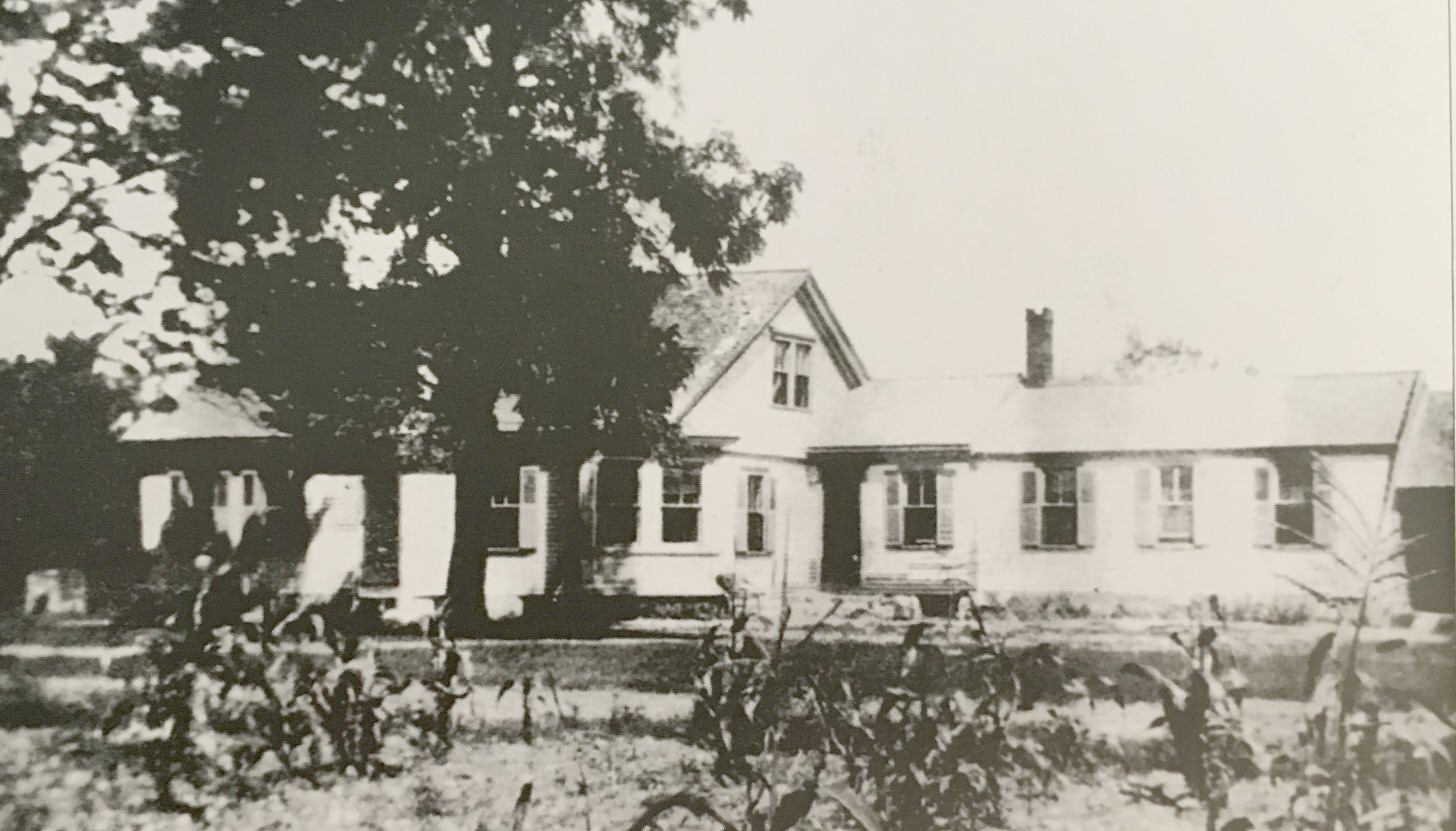
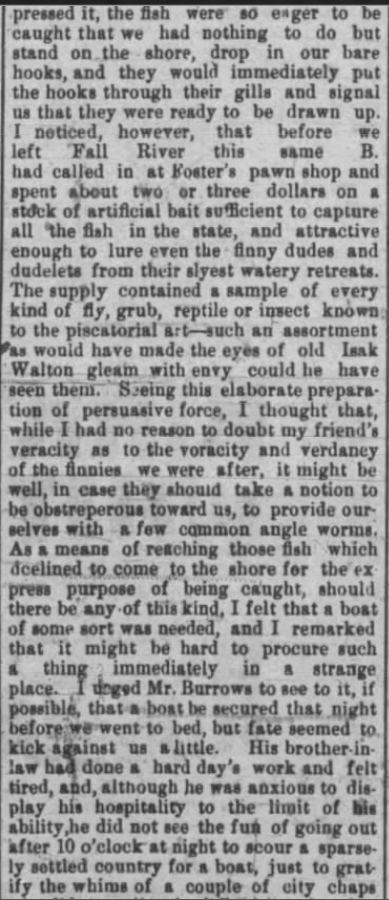
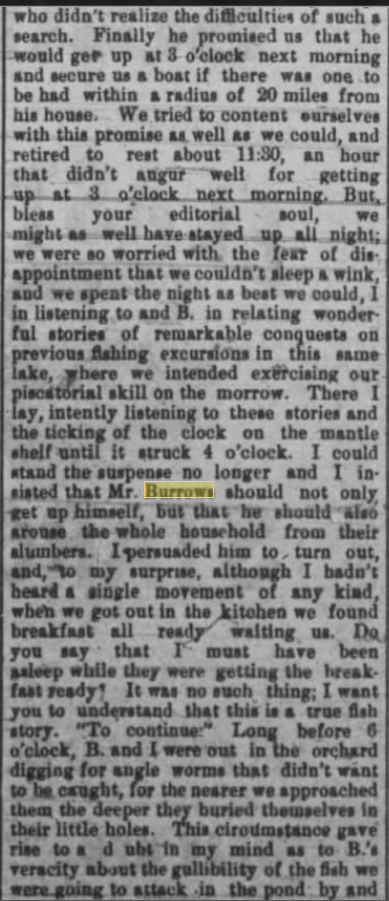
Abel Burrows was the husband of my great-grandfather’s sister. My great-grandfather was the father of many Hartleys, so many descendants may be interested in this Fall River Newpaper article. James’ sister was Mary Ann Hartley. She married Abel Burrows who owned a Jewelry shop in Fall River. At the time of the visit James’ parents Greenwood and Ann were still alive. James had married Annie Snell two years previous to Abel’s visit in the Summer of 1887. At that time Annie was 21. She had her first son Daniel who was one and was 7 or 8 months pregnant with her second son who did not survive infancy.

Here are Greenwood and Ann Hartley:

Here is James Hartley later in life:

Here is his wife Annie, probably close to how she looked in 1887:

Fall River Daily Herald 12 August 1887

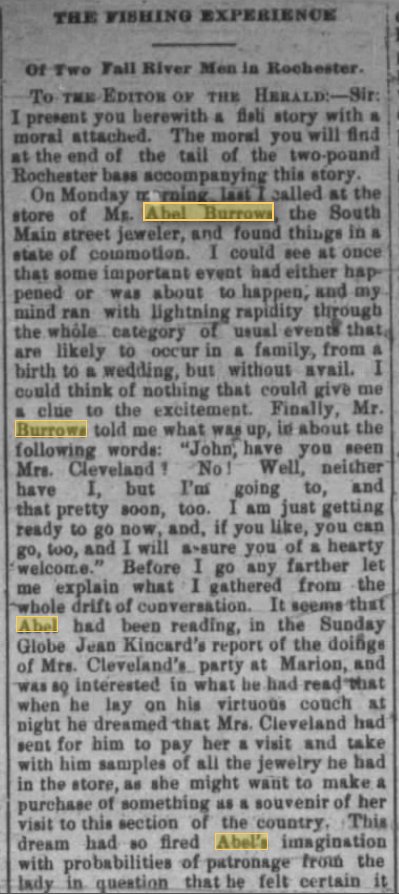
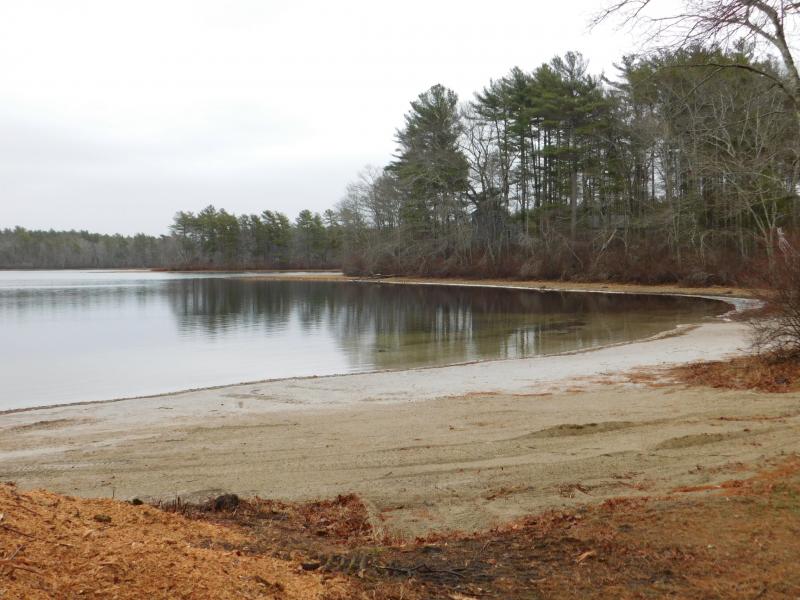
I originally wrote about this article in a Blog about Abel Burrows. The writer of the article was John Slinn, a friend of Abel’s who worked in the insurance business. Abel’s wife is mentioned in passing. I assume that the place where they go fishing is Snow’s Pond. The place they visit is no doubt the Hartley Farm at the beginning of Snipatuit Road near the Mattapoisett River where the Memorial Day Boat Race starts.

Two days prior to the article (10 August 1887), I found this bit of news in the Fall River newpaper:

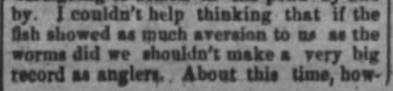
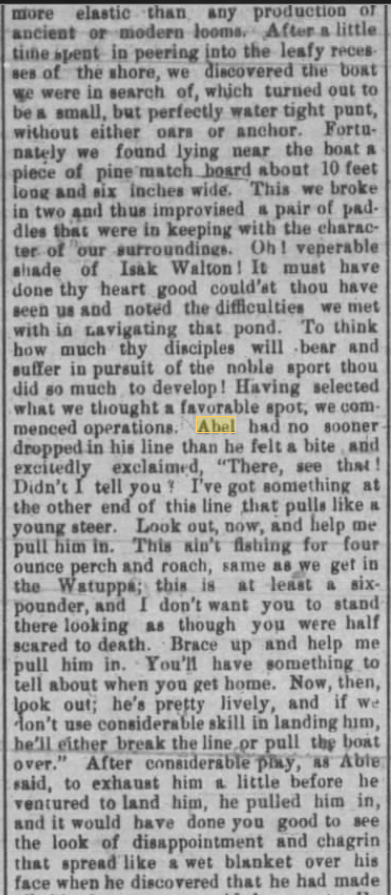
Here is the main article. August 10 was a Wednesday. The article mentions a Monday – two days previous:

This appears to be the only mention of Mary Ann Hartley Burrows. Mary Ann was 32 in 1877. Here is Mary Ann about 34 years after her trip to Rochester in 1887:

9-1/2 hours from Fall River to the Hartley Farm.

As far as I know John Slinn never published the follow-up article. I think that John may have been influenced by Mark Twain based on his writing style.

Big Y “Backbone Tests”

I recently noticed that a Backbone Test had been ordered for my late father-in-law. This surprised me as it was a bit dated.

I mentioned this at the BigY Facebook group and got an interesting answer from Bob:

I think you will find that this Y-HAP-Backbone was ordered as a part of a manual review process triggered by another user’s test results.
Originally, the Y-HAP-Backbone test was performed if FTDNA was unable to unambiguously predict a person’s high-level haplogroup from their STR test results. They would actually perform enough SNP testing to resolve the ambiguity.
In the case of somebody who has actually done a BigY test, there should be no necessity to predict a haplogroup from the STRs.
Normally, the automated caller will consider a result to be a no-call if there are not at least ten reads for that position. If a new kit has a result that might affect the haplogroup definitions, a manual review of the other kits assigned to the haplogroup may occur. The analyst doing the review will look at the raw data and may decide to override the no-call reported by the automated caller. To do this override, the analyst orders the Y-HAP-Backbone procedure. In this case, no actual lab work is involved. It is simply a database operation to report the new result for that SNP.
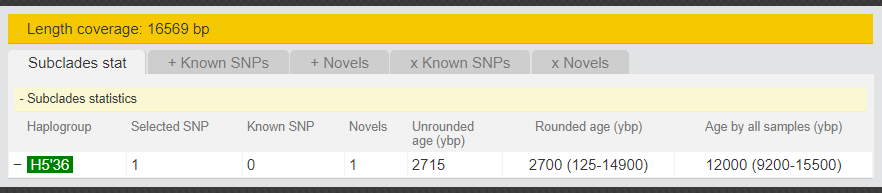
If you display the user’s Private Haplotree, you can scroll to the top of the page and click on the “SNP Results” link, you will see a list of SNPs. If there are any overridden SNP results, they should be sorted to the top of the list. The test type will be shown as Y-HAP-Backbone. The result may be positive or negative.
If you scroll down through the pages of this report, in addition to any BigY test results, if the user has done any other SNP testing, you will see those results listed. In the case of BigY test results only positive results are shown. (After all, you are negative for several hundred thousand SNPs.)
In my own surname project, until recently our haplogroup had one subclade. We had three men assigned to the main haplogroup and six men assigned to the subclade. Even though our BigY test results actually showed the three of us to be negative for the SNP defining the subclade, these negative results were not being shown in the SNP Results list in our Private Haplotree. During an early manual review, the analyst ordered the Y-HAP-Backbone procedure for the three of us. The result is that we now are shown as negative for this SNP. The color coding in the tree now indicates that we are “Tested Negative” instead of being indicated as “Downstream”. Since that time, a new kit was found to share an additional SNP with one of the three. This resulted in a second subclade being defined. The analyst creating the subclade did not bother to override the calls for the two men remaining in the main haplogroup, so we show “Downstream” for the new subclade.
By the way, the order status for the three of us with negative results for the Y-HAP-Backbone procedures for the SNP defining the original subclade still shows that order as pending. Apparently because no lab work was performed, they failed to mark the order as completed. We have other Y-HAP-Backbone procedures (with positive results) that did get reported as completed.
Does the entry in the SNP Results list for your member’s kit show negative results, or are they all positive?
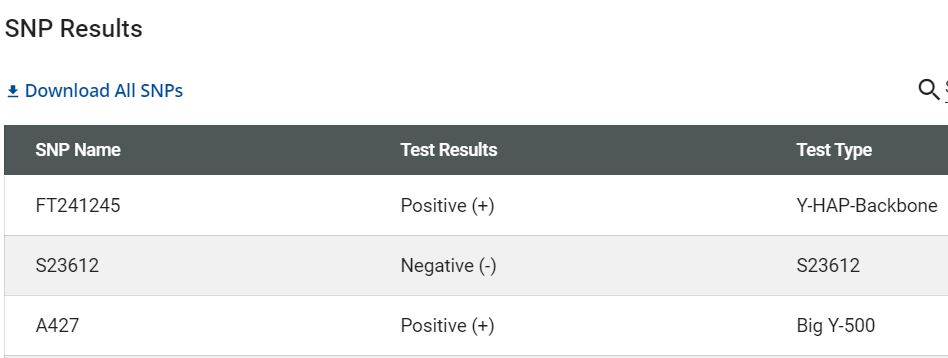
I was happy to get this reply as it answered many questions I had for my Butler father-in-law’s test as well as a Frazer project I am working on. I posted this image of my father-in-law’s SNP results at the BigY Facebook  Page:
I asked Bob this clarifying question:
Sorry, though, still a bit confused. Are you saying an override does not involve SNP testing? So in this case, the Backbone means no test and the tested negative means that a test was done?
Bob’s response:
While it may be a little confusing, the answer to both is yes. FTDNA does not offer a single-SNP test for FT241245, so the backbone procedure did not involve a laboratory test. They just looked at the raw data from the BigY test. You should be able to do something similar using the chromosome browser. When looking at this user’s BigY Results (Named Variants tabs, change the Derived? filter to Show All and enter the SNP name in the SNP Name Search box.
I suspect that it will show a ? In the Derived? And Genotype columns. Click on the SNP name to bring up the chromosome browser. I suspect that you will have fewer than ten reads shown, resulting in a no-call.
By the way, the Y-HAP-Backbone procedure results in the line being added to your SNP Results list. However, it does not actually result in a change to your raw data or what is shown in the Named Variants tab.
In response, I posted this image of my father-in-law’s results for FT241245:
I wanted to memorialize Bob’s comments as they were so helpful. I have been looking at “Backbone Test” results in a Frazer YDNA Project that I am involved in and Bob’s response answered so many of my questions.

Butler and S23612

As alluded to above, S23612 shows on the SNP results as ‘tested negative’. Let’s look for those results:


Just as Bob predicted, this shows up as tested negative. However, I’m not sure why this particular SNP was chosen. I would think that I-S23907 would have made more sense or perhaps BY115420.

Here are my father-in-law Richard’s results for S23612:

He is already clearly negative. Plus this SNP appears to be about 4 or 5,000 years old.

Speaking of S23897

I see that I mentioned S23897 in a previous Blog on Butler YDNA.

This is for a Butler relative with common Irish roots, but we have not yet established a genealogical connection. Now, thanks to Bob, I know where to find this Butler’s secret testing results:

Well, perhaps not secret, but they were to me previously. This Butler has a surprising 7 Negative SNP results. What I am seeing is that this Butler relative must have ordered these SNP separately before he did his BigY:

Frazer Backbone Tests

I have been waiting for Frazer ‘backbone tests’ to complete. However, according to Bob, these could be manual overrides instead of actual tests. Also, confusingly, these tests may not have an end date if the reviewer forgot to put in a date.

Here is a view of the Frazer BigY testers from the view of one of the testers from the James Frazer Line who took the BigY500 test:

My labels didn’t come out too well. The first column represents the James Frazer line and the ‘Your Branch’ represents the BigY500 tester on that line. At the top of his SNP results, we see this:

From the comments from Bob, the Y-HAP-Backbone should represent a manual override for Y151390 which is the defining Haplogroup for the James Frazer Line. Here is the order history for that same tester:

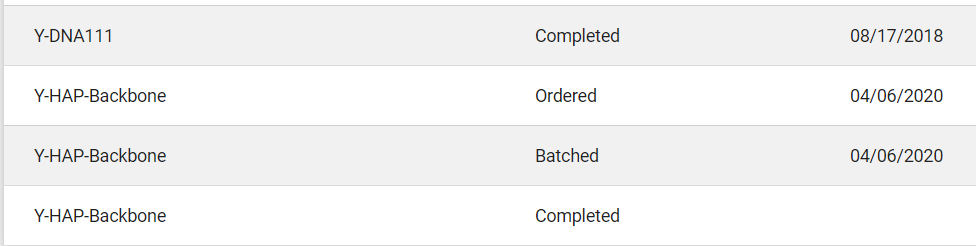
This is confusing because of the batched designation which shows after the ‘completed’ designation. However, I assume that these three entries were for the one override for Y151390. Here are his test results:

Here, he only has 7 positive reads where FTDNA would like to see 10. However, the manual review said they were all positive, so let’s say he is Y151390.

BigY700 on the James Line

The same thing apparently happened for the BigY700 tester.

Here is the James Line BigY700 order history:

This takes some interpretation. I assume that the Backbone got entered twice by mistake and that only the one entry that was actually done shows as completed. Keep in mind here that ‘backbone’ means manual override of inconclusive test results. Here are the BigY700 test results for Y151390:

This is a bit surprising as the results show positive for Y151390, so there were no questionable results to override.

My guess is that the manual review took a look at these results and agreed with them.

Archibald Line Results and Frazier BigY results

The BigY500 tester had no overrides in his SNP results. The same for the BigY700 tester. That must mean that FTDNA had no questions about their results.

That leaves the Frazier BigY results. He also has no unusual results on his list of SNPs. That means that the review was completed for Frazer/Frazier BigY’s some time in early February.

Summary and Conclusions

  • It was a help for Bob from the BigY Facebook Page to show me where to find the SNP Results link at the top of the BigY Haplotree view
  • This gave more clarification to the manual review which FTDNA performed and explained why it looked like a Backbone test was outstanding
  • FTDNA has a confusing array of places where they store information and show the results of the work they have done. They also seem to do things inconsistently. However, with perserverence and help from others who have gone through the process, it is possible to get an idea of how one’s BigY test was reviewed and processed.


Whetstone YDNA

I am the project administrator for the Whitson Project. The overview is that there are many branches of Whitsons who are unrelated to each other by YDNA – or so distantaly related in the range of 10’s of thousands of years to be considered unrelated. My wife’s Butler family is more closely related to one of these branches (or that Whitson branch is related to my wife’s Butlers). The Whetstones did not have their own surname project, so they asked if they could join the Whitson project even though they are not related.

Some Whetstone Genealogy

This is some genealogy that I received as a response to a Blog I wrote on an update on the Whitson project:

Hello. Just wanted to say that you have my4th. great Grandfathers
Y DNA. Absolem Whetstone. Kit # NI 26222. My BIOLOGICAL GRANDFATHER is Uthil Maynard Whetstone. B.1914-D. 2000 I was adopted by Grandfather and Grandmother. Next is his father William David Whetstone B.1893-D.1954.
Next his father William Wesley Whetstone B.1886-D.1934 Next is his Father Samuel Marion Whetstone B.1830-D. 1905. Next is Absolem. Next his father was Adam Whetstone Jr. B.1776-D.1815. Next his Father is Adam Gutler Whetstone Sr. B.1744-D.1782. Killed in the last battle at Eutaw Springs, SOUTH CAROLINA USA

Our Whetstone family located to land in Charleston
SOUTH CAROLINA,USA. in 1737 moved up the Edisto river to join Our Salley family that made the trip from Bern Switzerland two years earlier in 1735. Spelling is Felix Wetzsein B. 1633-D.1710 TO Change to Rev.(JOHN) D. Hans Johannes Wettstein B.1695-D.1754 next we have the start of spelling Adam Gutler Whetstone B.1744-D.1782

The short story is that the family had its roots in Switzerland as Wetzsein and moved to South Carolina. I assume that others in the Whetstone project are related to each other. At least they are in the same very general YDNA Haplogroup.

Whetstone YDNA

Currently there are 5 YDNA testers in the Whetstone YDNA Project:

R-M269 is a very general YDNA Haplogroup in the family of R1b. One Whetstone has taken the BigY test. BigY tests are better off taken in tandem. That means that if another Whetstone takes the BigY test, then that will create a Whetstone YDNA Branch on the tree of mankind. With one BigY test, the results show what other families Whetstone is related to and should give some background as to where those other families were from.

Whetstone BigY Test

The BigY is the best YDNA test available, so I’ll just start with that. The Whetstone with the ancesor Absalom Whetstone has taken the BigY and the result was R-BY56768. One way to get an idea of where this is on the YDNA tree of mankind is to look at the Whetstone BigY tester’s Block Tree. It will take two images to show this:

On the top of this Block Tree, we see how Whetstone descends from R-M269. Of the Haplogroups under M269, there are two major intersections or decision points (or subgroupings). These are P312 and U152. They can be seen at this Tip of the Iceburg Tree from the R1b All Subclades Project Overview:

I added a few arrows to show where Whetstone is. Here is an closeup of the same tree focusing in on U152:

U152 shows up in SE Germany in 2,500 BC. Next, let’s search this map to find the Whetstone path. L2 is another major branch point near the middle of the tree. BY31138 is the third Haplogroup down under L2. That is as far as the Tip of the Iceburg can take us.

Whetstone and U152

Eupedia has an L2 tree:

Unfortunately, I don’t see BY31138 on it.

Whetstone and BY31138

It is possible to build a tree from the FTDNA Haplotree. Here is the Whetstone BigY tester’s Haplotree:

The good news is that there is only one branch under BY31138. I need to go down further to get the whole tree:

Here is a start in Excel:

Whetstone is under L135. Here are two more levels:

Whetstone is still on the left. Here is where we are on the Whetstone BigY Block Tree:

That means that there are only three more levels to get to BY56768. Here is what I get:

The Rest of the Whetstone Block Tree:

The Whetstone tester is on the left. This shows no matches but two countries. There are actually matches, but FTDNA doesn’t show them due to the distance of the matches. One country must be for our tester as he had the United States as the country of origin of his most distant ancestor. Whetstone matches another family, but that match is up at BY56768 which is about 30 SNPs away. If we assume that a SNP forms every 100 years, then this could be about 3,000 years ago or 1,000 BC.

More BigY Testing Needed

If another Whetstone tested, then another branch would form in much more recent time – at the time of the common ancestor of the two Whetstones.

Whitson in the U152 and Subclades Project

I know that the Whetstone BigY tester is in the U152 Project. Are there others?

Here there are four Whetstone/Wetzstein/Wettstein surnames. The first tester with the oldest Wetzstein ancestor is not in the Whitson Project. Then there are two Whetstones in the Whitson Project that are not listed in the U152 Project. However, the first tester in the U152 Group only had 12 STRs tested.

Here are some others under BY31138:

The first group is generally under BY3508 but need further testing. The second group is BY111101. I left this out of my tree:

The common ancestor between Whetstone and B111101 is BY3508 which would be at least 2,000 BC, so we won’t worry about these people. It would be better to look at the closest matches to the Whetstones. They would be under FT292871:

Above, the closest match at the U152 Project is Schaal. I don’t know where this person was from  in the 1500’s- probably Germany or Switzerland. This match is in the right general area, but the common ancestor is still pretty ancient – perhaps around 1,000 BC. The bottom line is that there needs to be another Whetstone BigY tester.

Summary and Conclusions

  • I looked at some of the YDNA results for the Whetstone surname
  • The most important result is from the Whetstone who took the BigY
  • This BigY tester defines the Whetstone Hapalogroup and by implication the rest of the Whetstone family as R-BY56768 for now
  • This BigY defined where the Whetstone family is in general terms on the YDNA Haplotree
  • Right now the closest match to the Whetstone BigY tester is likely not a Whetstone and their common ancestor could be about 1,500 years ago.
  • To get a Whetstone YDNA haplogroup in the genealogical timeframe, it will be necessary to get an additional BigY test.
  • A good place to look for candidates for further BigY testing would be among the Whetstones who have already taken a YDNA STR test


Checking the New Online Mayflower Descendants Database for My Mayflower Ancestors

In at least one of my previous Blogs, I have looked at the Mayflower Database that Familysearch has. These previous Blogs mostly have to do with my Mayflower Descendants Application through William White.

William White

My previous look at William White in the Mayflower database brought me down to my father’s Aunt Annie Louisa Hartley:

That lead me to believe that one of their offspring had applied for the Mayflower Descendants. It also lead me to believe that they had applied under William White, because the Mayflower database lead down to them from William White. I don’t know if I assumed correctly. My thought today was to check on my other Mayflower ancestors and to see where their descencants lead.

Governor William Bradford

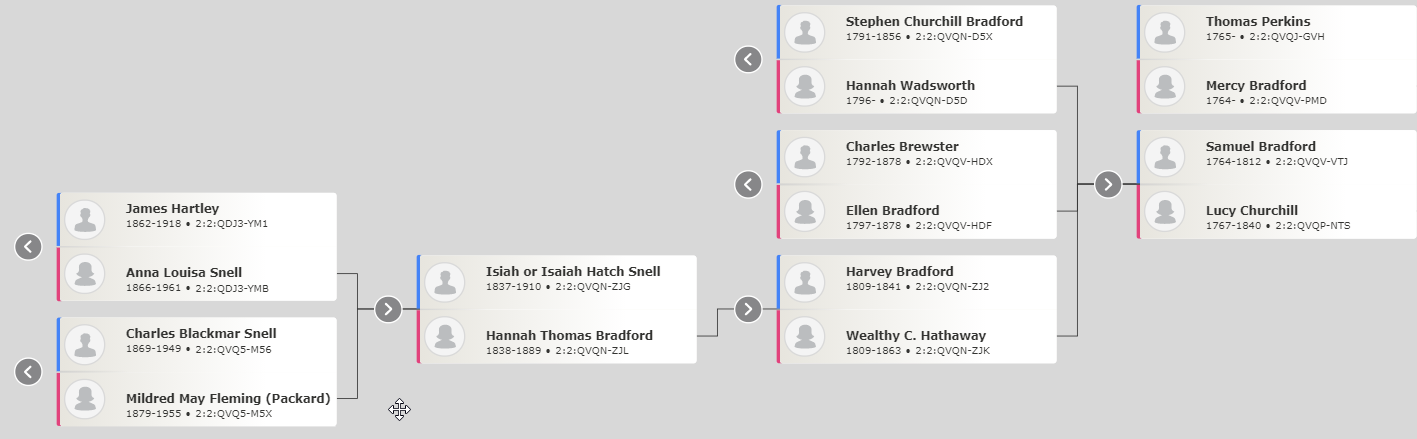
This ancestor is one of great interest to me. He was an ancestor of Hannah Thomas Bradford and Harvey Bradfor above. The reason I didn’t apply for membership under Bradford was that the trail back from Harvey Bradford and records were not as available. Here are Harvey’s Bradford ancestors based on my Ancestry Tree:

Governor Bradford was Harvey’s 4th great-grandfather. Here is the Mayflower database:

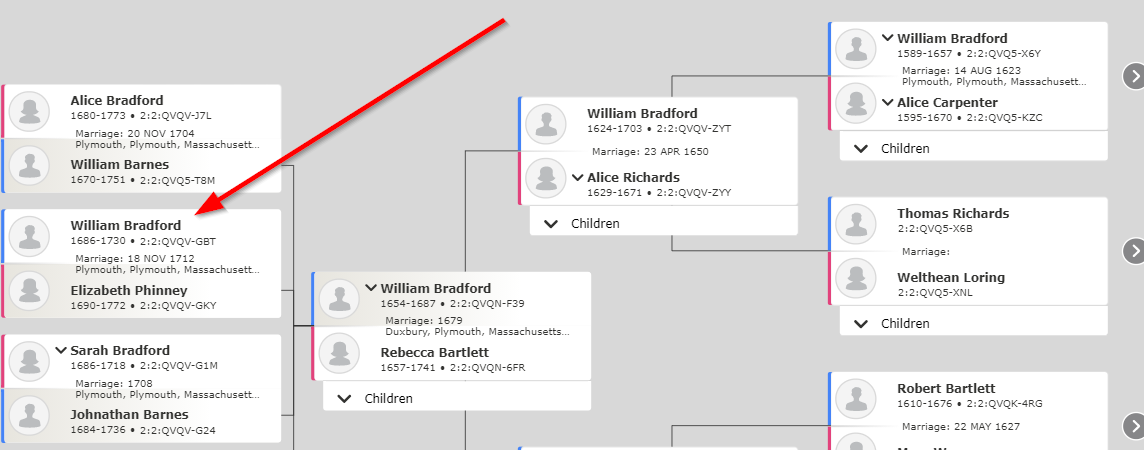
I don’t have all the children of the William Bradford in the arrow showing below:

However, I follow down from Josiah to Samuel Bradford. From there I get back to Hartley and Snell:

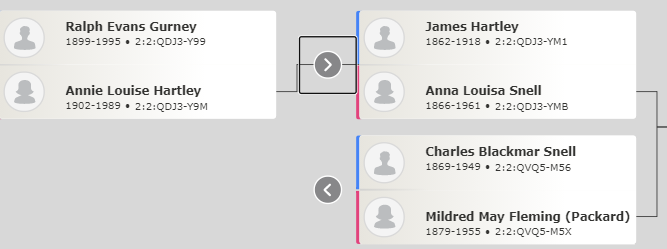
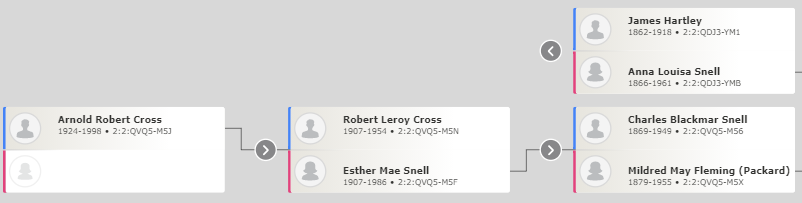
James Hartley and Annie Louisa Snell were my great-grandparents. That gets back to the same couple I had descending from William White:

I don’t know if that means that someone in the Gurney family applied under Bradford as well as White or that the Mayflower Society makes their own connections. I assume that it is the former. Apparently my more distant Snell relative applied for the Mayflower Society under William Bradford:

Actually, when I take the family down from William White through Harvey Bradford, I get the same image as above, so the database is likely showing all those who applied and who descend from Harvey Bradford.

Elder William Brewster

I descend from Brewster two different ways. The first way gets me back to Bradford fairly quickly.  The second takes a longer route:

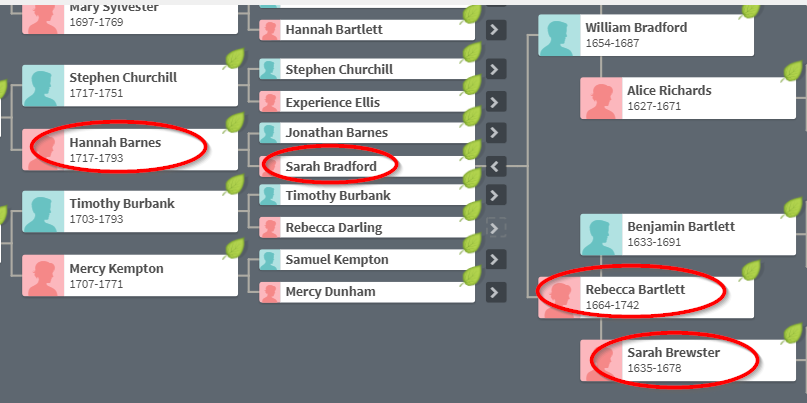
Here I started with Love Brewster, the son of William Brewster on the right side of the image above. That route only goes through one Bradford – Sarah.

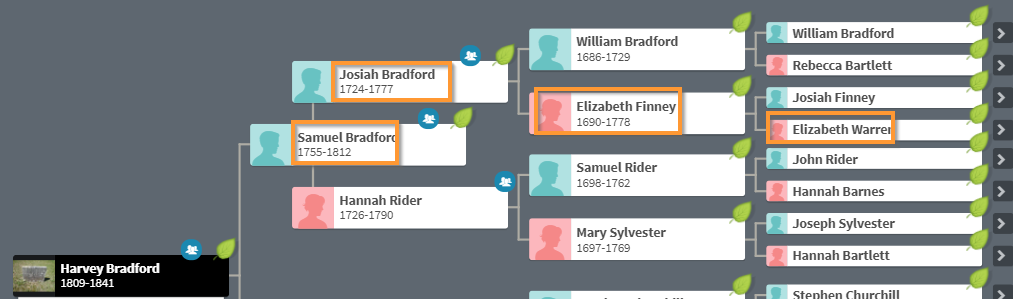
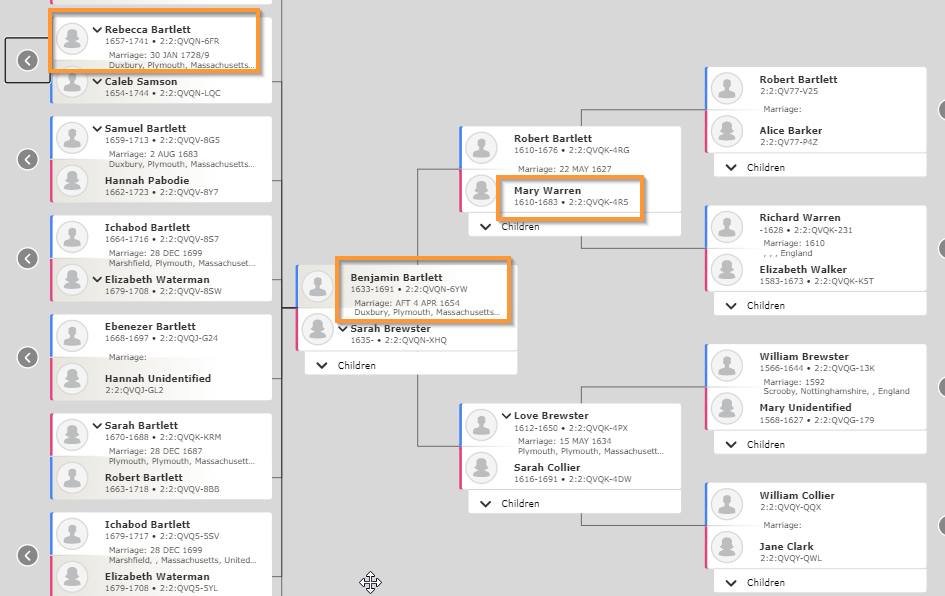
Interestingly, the Mayflower database has a dead end at Rebecca Bartlett:

It also has her born a different date and married to a different person than I have in my tree. So perhaps my tree is wrong.

Checking My Tree

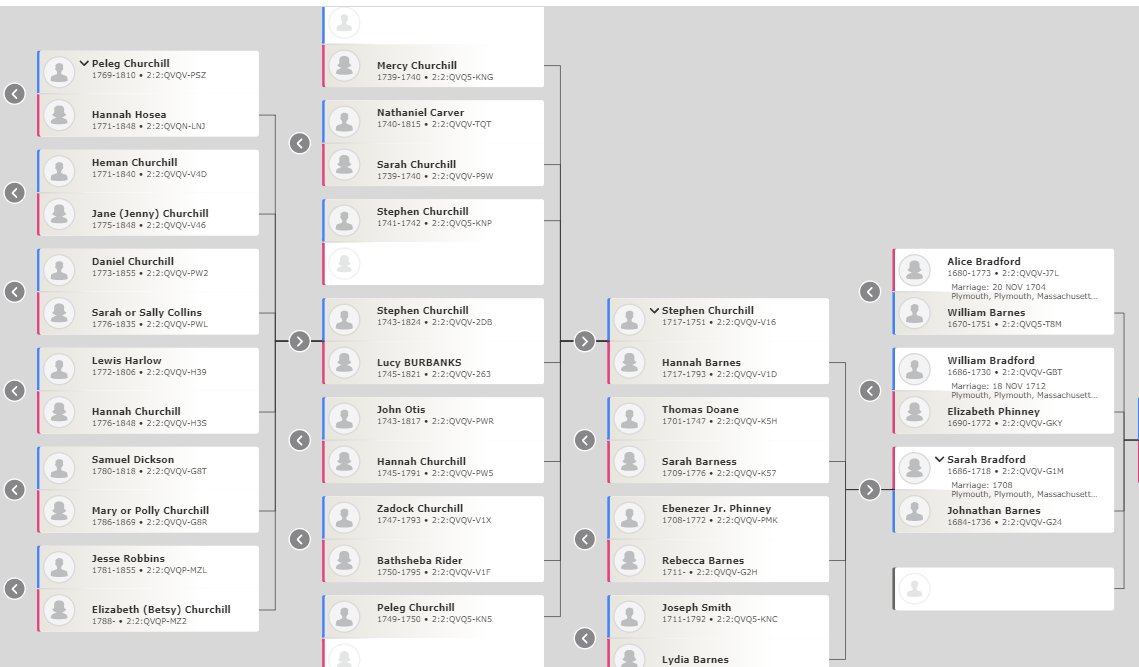
I’ll start with Churchill and Barnes and go back:

Page 182 of the silver Mayflower Families on Bradford has Hannah Barns born 1717 married to Stephen Churchill born also 1717. So far so good. Page 50 of the same book has Sarah Bradford born about 1686 married to Jonathan Barnes born 1684. At this Point it would make sense to switch to the silver Mayflower Book on Brewster. Page 354 has Sarah Bradford born before 18 December 1686 and married to Jonathan Barnes.

Reading up more on Rebecca Barlett on Page 348 of the silver Mayflower Brewster Book, I see that Rebecaa Bartlett married first William Bradford, second Robert Stanford and third Caleb Samson.

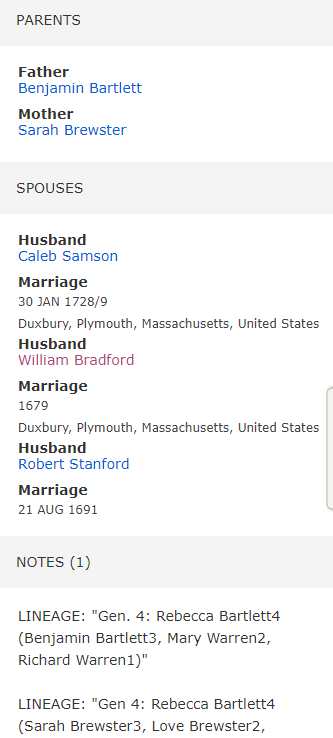
When I click on Rebecca Bartlett in the Mayflower database, I get this:

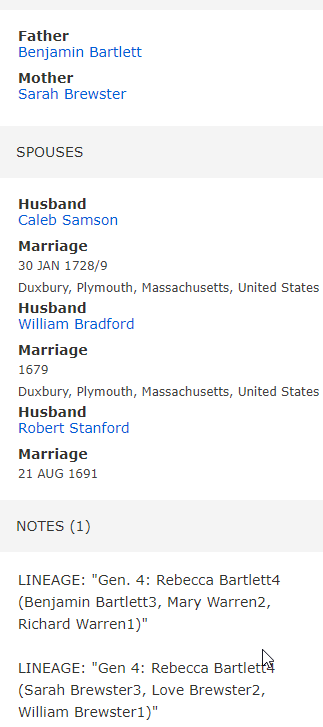
This shows her three marriages, but the database tree shows a dead end at Rebecca Bartlett. I am not sure how to interpret this. I assume that no one has applied for membership to the Mayflower Society based on Brewster through descendants of Rebecca Bartlett. However, I am glad to know that my tree is correct. Or, this may be a glitch in the Mayflower database.

When I click on the hyperlink for Husband William Bradford above, I get this:

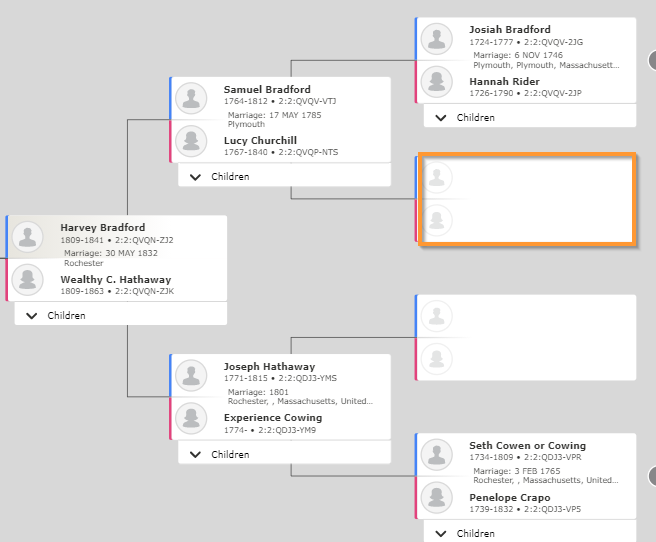
This shows a disconnect from my tree. I have that in the first column, there should be a Lucy Chuchill born 1767. She should be at the top of the list in the first column. Again, I don’t know how to interpret the database. When I choose Harvey Bradford in the Mayflower database, I draw another blank at the point of Lucy Churchill:

This again makes me think that no one has applied to the Mayflower Society by this route of Brewster to Lucy Churchill. That being the case, the Society had no reason to check into the parentage of Lucy Churchill.

Francis Cooke

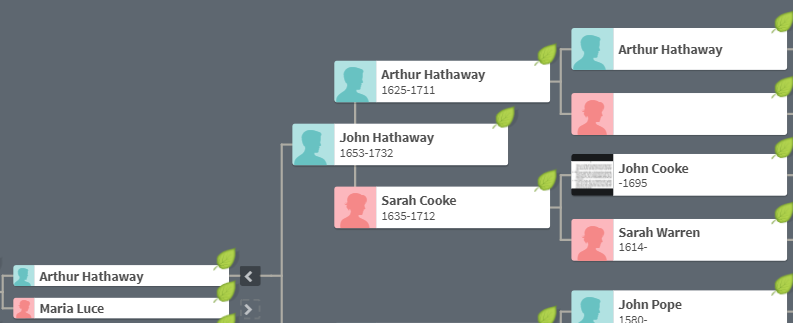
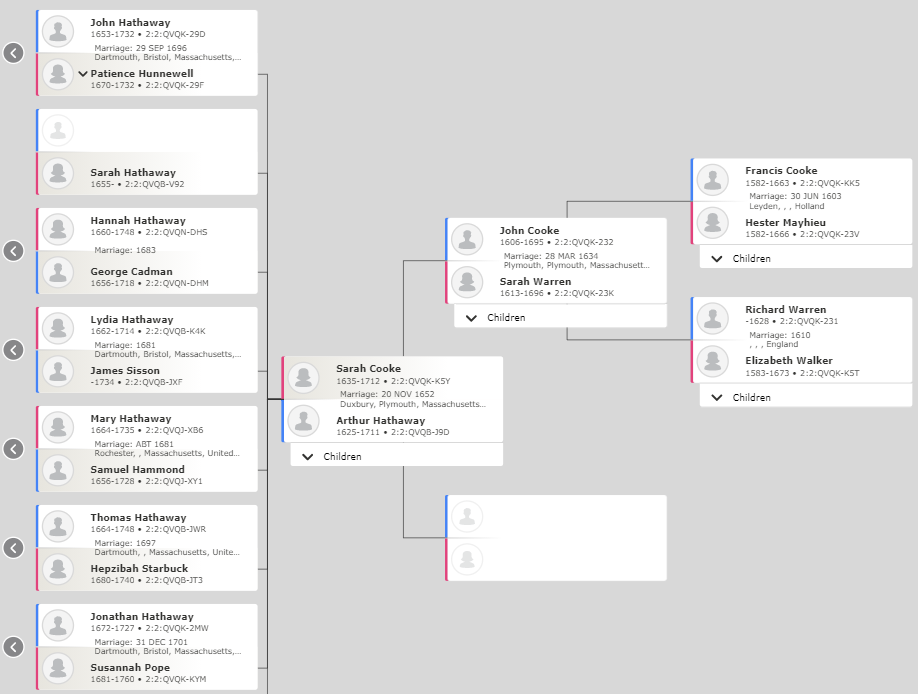
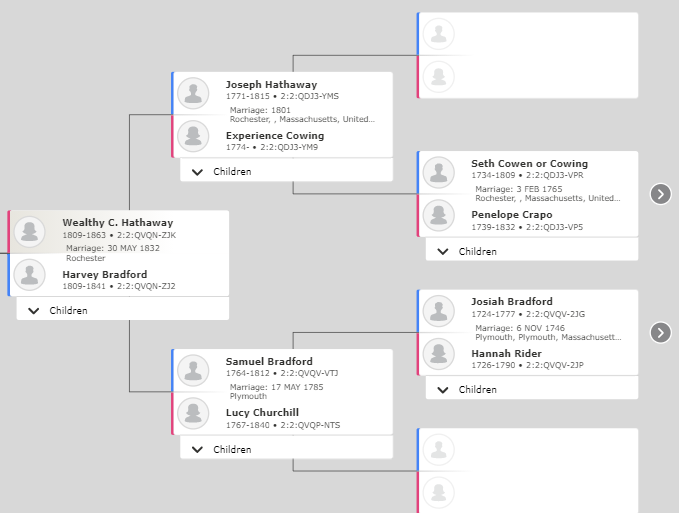
As far as I know, I only descend from Francis Cooke in one way. My Hathaway ancestors have a Cooke as their ancestor. Like my Mayflower White ancestry, my Cooke ancestry is through Harvey Bradford’s wife, Wealthy Hathaway:

Francis is the father of John Cooke. I’ll show this in two parts;

Here is the early part of the Mayflower Database version:

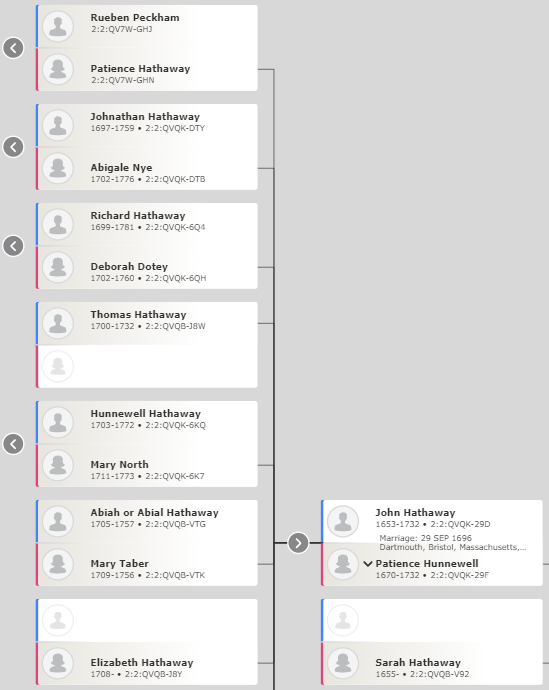
I descend from the John Hathaway at the top left. I have an early dead end on the Cooke Line also. The Mayflower Database appears to stop at my ancestor John Hathaway born 1653:

The Mayflower Database shows 11 of John Hathaway’s children by his first wife (not all shown above). The silver Cooke Mayflower book shows that John had 16 children including Arthur Hathaway born in 1690.

Looking at Hathaway in the Mayflower Database from the Bottom Up

Here I am drawing a blank with Joseph Hathaway. Again, my assumption is that no one below the Wealthy Hathawy level has applied to the Mayflower Descendants on the Cooke Line. This view also shows the missing parents of Lucy Churchill that I mentioned above.

Richard Warren

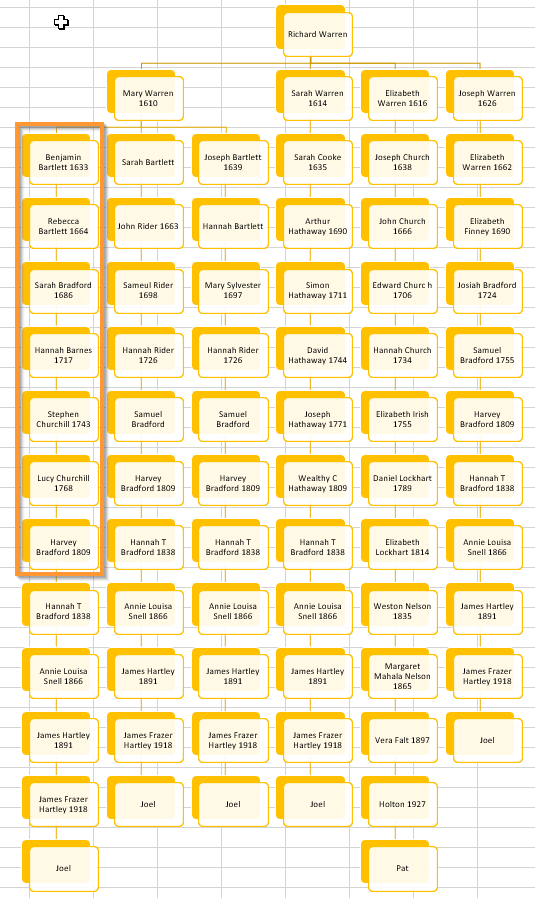
Unlike Francis Cooke, I descend from Richard Warren on about 5 different lines in three different generations. That means that means that depending on the Line, Richard Warren could be 11, 12 or 13 generations away from me.

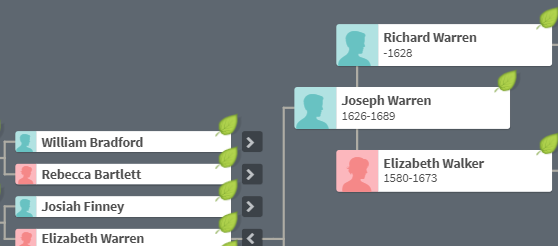
My most unique Warren Line (that is, with the least other Mayflower ancestors) would be through Joseph Warren. That is the Line where I am only 11 generations from Richard Warren. On my Ancestry tree:

Here is the early part of my tree:

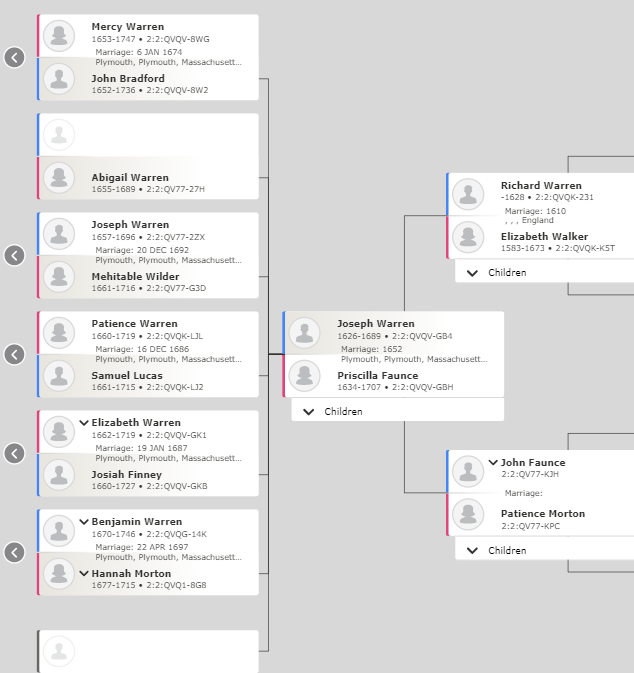
From the Mayflower Database:

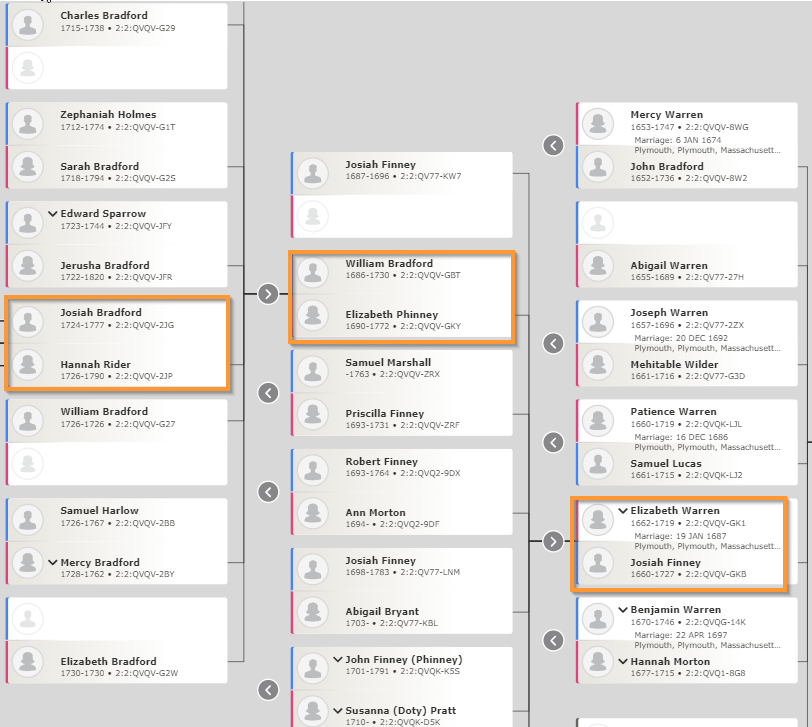
Here are two more generations:


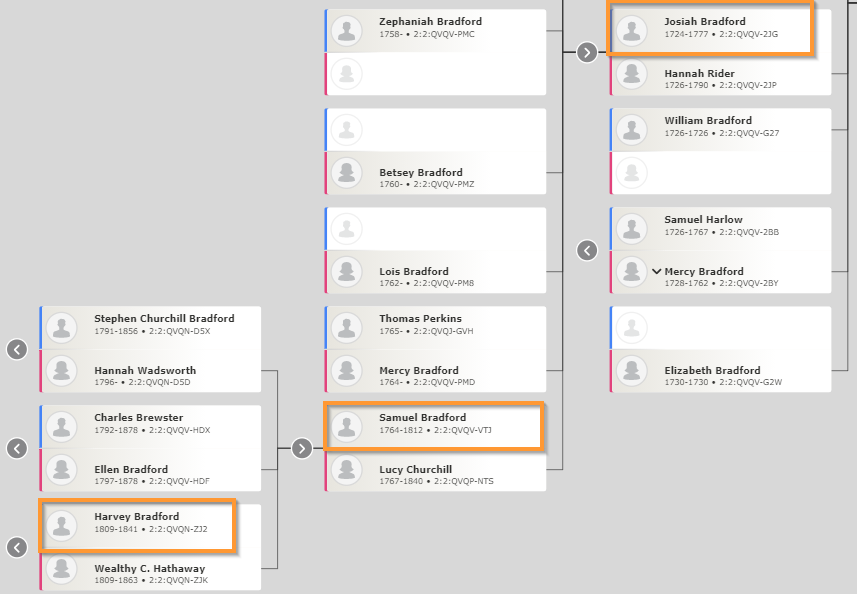
Then from Josiah Bradford, we get down to Harvey Bradford:

One interesting thing here is that there are three Bradford lines that carry down: Stephen Churchill, Ellen and Harvey Bradford. I assume these three lines have members in the Mayflower Society. However, when there are mulitple lines of descent, I’m not sure on which lines the descendants got their approval to join the Mayflower Descendants.

My Wife’s Cousin Pat and the Richard Warren Line

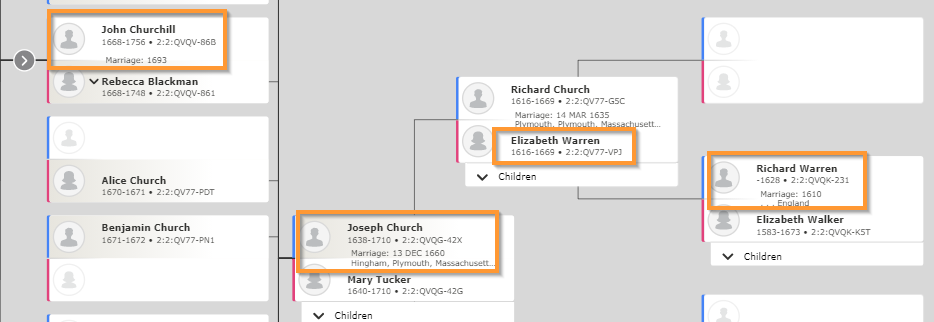
I found out that my wife’s 1st cousin is applying to the Mayflower Society under the Richard Warren Line. This is on her paternal side where she is not related to my wife. I came up with this chart to see how I was related to Pat:

I am a 12th cousin, three times an 11th cousin once removed and a 10th cousin twice removed to Pat. Let’s see where Pat’s line is on the Mayflower Database:

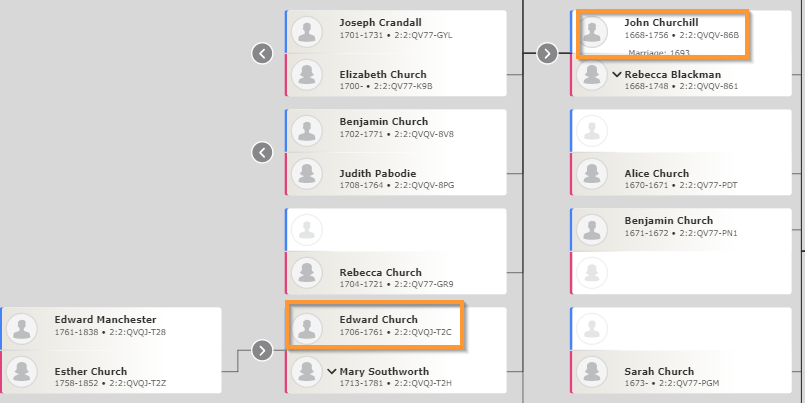
For some reason, the database has John Churchill which is not correct. The silver Mayflower Book has John Church. Apparently, this family moved to Little Compton, Rhode Island. After that, Pat’s line goes to Edward and Hannah Church:

Apparently a descendant of Esther Church is in the Mayflower Society, but not other descendants of Hannah as the line appears to stop here for Pat.

One More of My Richard Warren Lines

Now that I have charted my Warren Lines, I want to also check my first one:

This line does not appear to have other obvious Mayflower descendants in it. Actually, just Sarah Bradford.

Here the Database deviates from my tree. This is for the same reason as above where Rebecca Bartlett has multiple husbands. I can choose Rebecca Bartlett and get more information:

The is the same place I got stuck under Brewster above, and the results are the same. Interesting.

Summary and Conclusions

  • It was fun playing around with the Mayflower Database at FamilySearch
  • Where I ran into dead ends, it made me think that there has been no one from that line who has applied for acceptance to the Mayflower Descendants
  • One exception is where a person has more than one spouse. Then clicking on the correct spouse may continue that line
  • Many Mayflower descendants married other Mayflower descendants, so there are a lot of crossovers in the genealogies. That means if the database shows your line descends from a particular Mayflower passenger, that doesn’t necessarily mean that some applied for membership based on that passenger, it may be from a different passenger in the line.
  • It helped for me to chart out my five Richard Warren Lines. My wife’s cousin was curious as to how we are related.

Taking a Different View of My Hartley Haplogroups: FTDNA’s Colored Dots

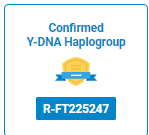
FTDNA has two major ways to view your Haplogroup. The most common is the Block Tree. The other is through one’s badge. Here is the Hartley badge:

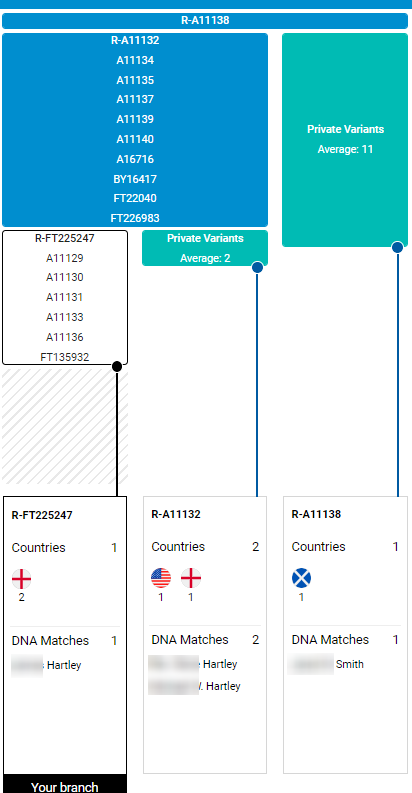
This Haplogroup of R-FT225247 was obtained when I tested my brother’s YDNA using the BigY 700 test. This distinguished our branch from other Hartleys who were A11132. Here is the Block tree from the viewpoint of my test:

By getting my brother tested, that gave me someone closely related to match my Private Variants. Once they are matched, those Private Variants went up on the tree into our old branch. The other Hartleys are to the right of our Branch in A11132 where I previously was. The problem is that FT225247 is still an old Haplogroup. I’m guessing that it could go back about 450 years to 1570.

FTDNA’s Y-DNA-Haplotree

When I click on the badge above, I get this:

Actually, I get more, but this is enough.  Under R-FT225247, it shows the other SNPs that make up the group.  There are a total of 7. To the left of each SNP is a dot. Here is the key:

I don’t find the yellow dot accurate. It is only used when that is the SNP used for the tree. Actually, for every SNP on my tree, I should not have a grey dot. For example, I am part of A11132. BY16417 is part of that group. I should be presumed positive for that SNP, not presumed negative. The same should be true for BY4026 and BY4028 which make up Z16357.

For the SNP below me, I should have Tested Negative for those, but as the results must not have been clear, I was Presumed Positive. The advantage of the Y-DNA Haplotree is that it gives more information on the quality of the SNPs tested.

Looking At My Brother’s Y-DNA Haplotree

Here my brother had better results than me at Z16357. He at least test positive for that SNP.

SNP Testing Quality

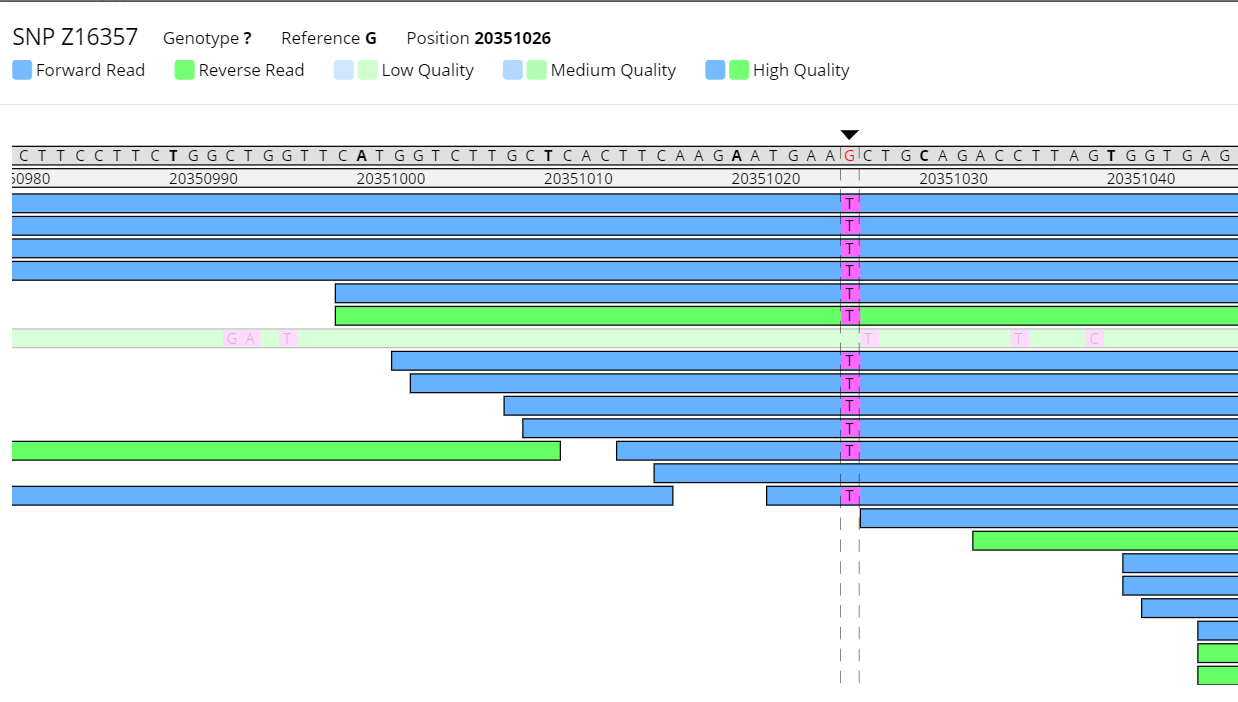
Above, I was presumed positive for Z16357. This is how the test results for that SNP show up for me:

The results look good to me. There are twelve good reads of a mutation and one good read that shows no mutation.

Next, I’ll see my brother’s test:

My brother had 12 good reads, but no read showing no mutation, so FTDNA must have a formula that deals with that.

A11130

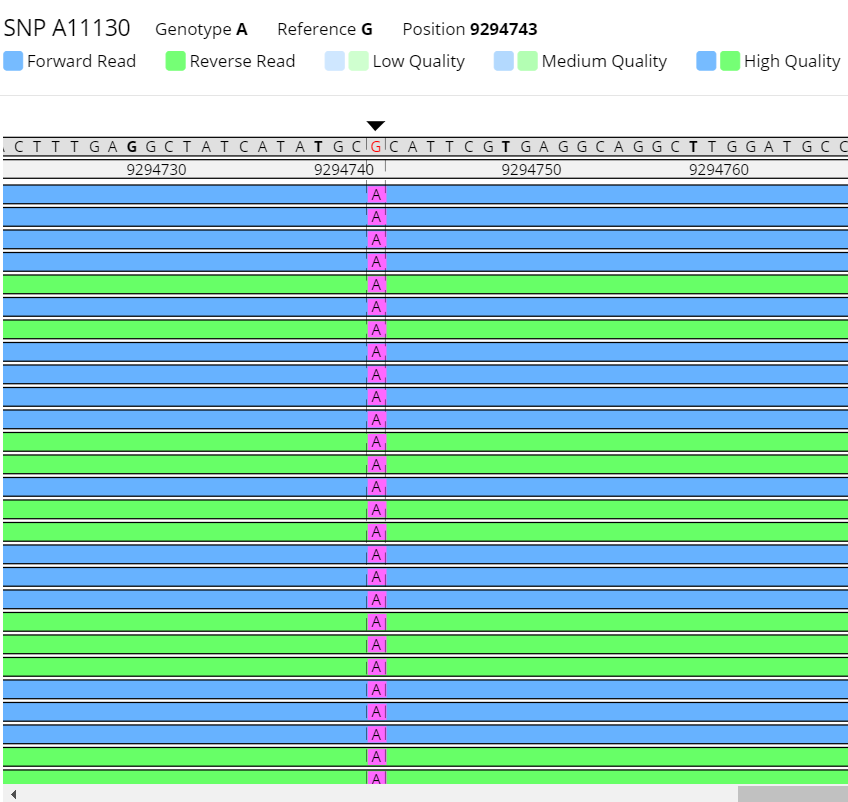
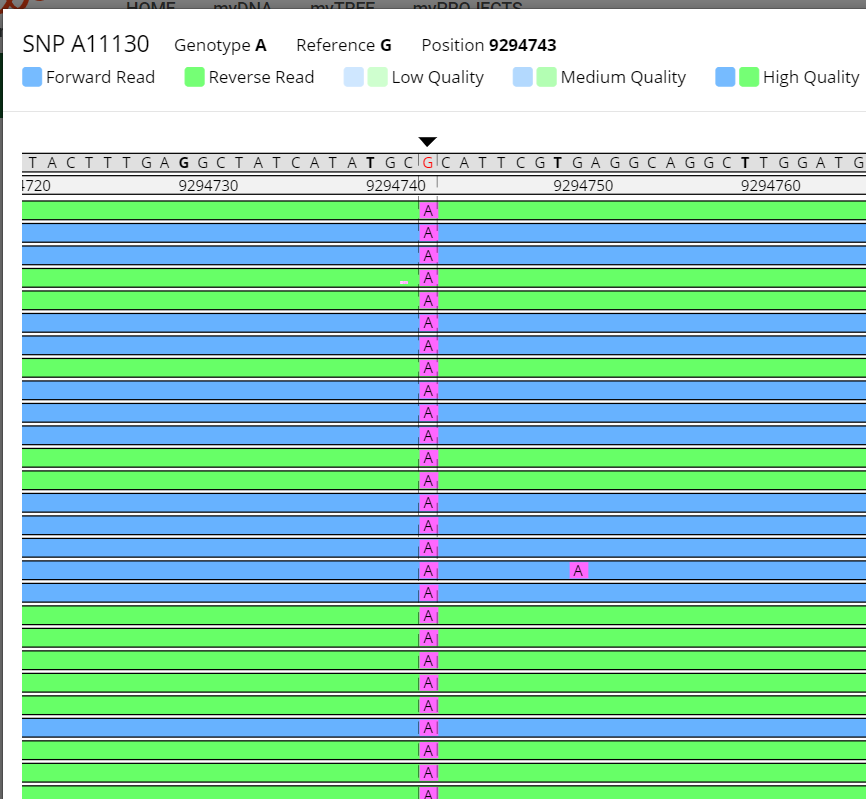
My brother’s Haplotree appears to say that his A11130 test was presumed negative. However, the actual test, shows that he is definitely tested positive:

That makes me wonder about my test results:

My results are even better. The lesson is: don’t trust the little dots by your SNPs. Better to check the test results.

Negative Results

The negative results are important as are the positive ones. Here is my Haplotree:

The places where I have arrows are the gray SNP boxes which I should be negative for. I should have red dots for these SNPs and their equivalents. Here is the key again:

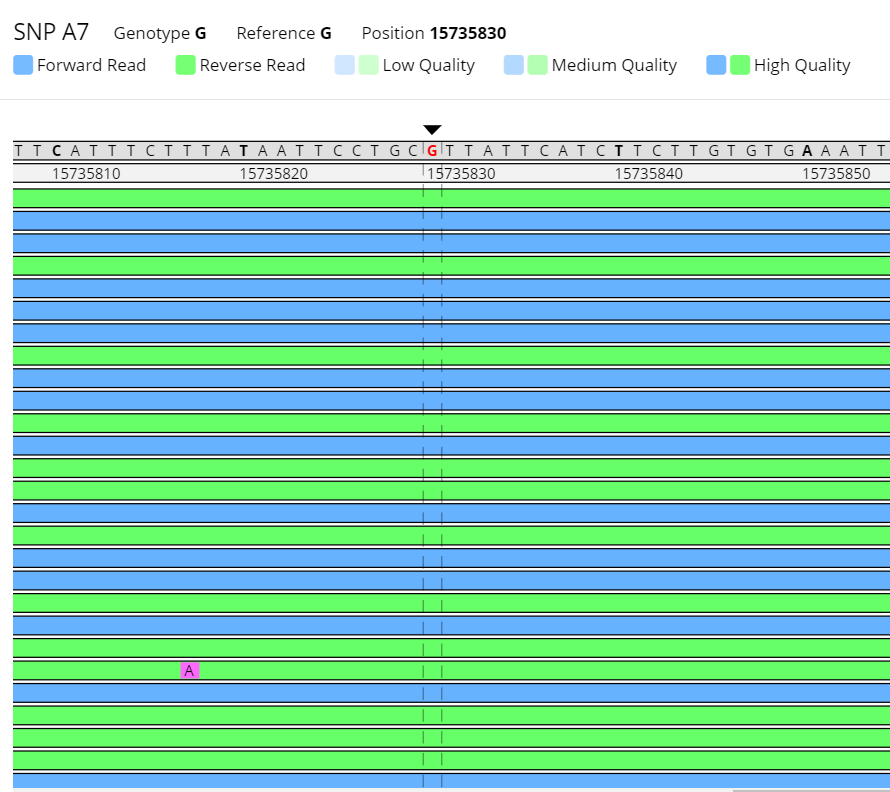
I don’t have any red dots which is suspicioius. I’ll check my A7 which is a higher level SNP. The 232 next to it must mean that there are 232 testers in that Haplogroup. Clearly I have tested negative for A7:

Clearly I am negative for A7. Perhaps FTDNA only shows negative if I take the single SNP test?

Summary and Conclusions

  • I looked at the Haplotree view for my BigY test and my brother’s BigY test
  • The Tested Positive green dots seem accurate.
  • The Presumed Positive is accurate but on in the case where that SNP is the defining SNP for the Block of SNPs. In my case, that was for SNP Z16357
  • The Presumed Negative is also inaccurate. The actual test results need to be checked. If you are positive for a block of SNPs, then you should be positive or Presumed Positive for all the SNPs in that Block.
  • The blue dot would be helpful in showing downstream SNPs. However, as I had my brother and myself tested, there are no downstream SNPs.
  • It seems like the red dot for Tested Negative should appear much more often unless it is reserved for the Single SNP test at FTDNA.
  • My conclusion is that the color coded dots for the SNPs do not work well

New YDNA Results Seem to Conflict with Mayflower White Genealogy

In my previous Blog on the subject, I wrote about my application to the Mayflower Descendants and problems my friend Gary was having with his application. The problem that Gary was having was that the latest genealogical research showed that his ancestor Martha Doty had a child before the couple married. This was assumed to be John White (junior). That brought into question Gary’s unbroken line to William White of the Mayflower.

Gary’s YDNA

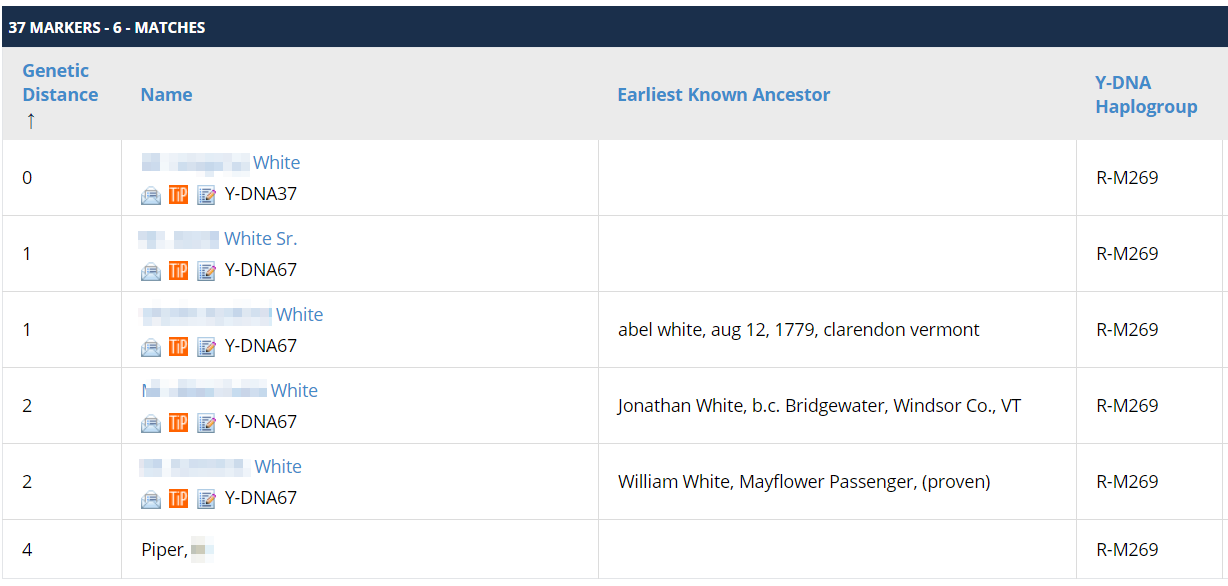
As a result, I suggested that Gary take a YDNA test. He took the 37 STR test, because that would have been enough to confirm the latest genealogical research on the Mayflower White Line. It is much easier for YDNA to confirm that you are not related to someone than it is to tell that you are related. I was surprised by Gary’s results:

Of Gary’s 6 matches, 5 of them had the White surname and one showed proven descent from Wiliam White, Mayflower Passenger. I asked Gary to get in touch with the match with the proven Mayflower descent. Gary did and this is the connection:

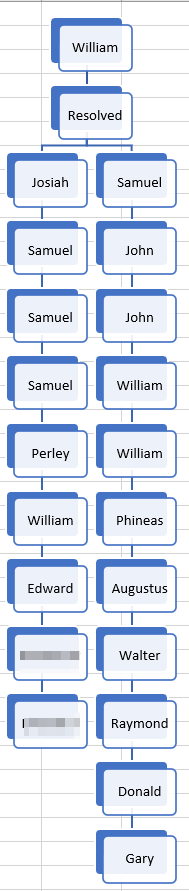
This shows that Gary is an 8th cousin twice removed to his YDNA match with proven descent from William White. This also shows that Gary must descend from Wiliam White. That is because Gary’s weak connection was the second John after Samuel White. If Gary’s YDNA match descended from this second John, then it could be that they were both from an illegitimate John. However, this suggests that John Sr fathered John Jr and perhaps later married Martha Doty.

Gary’s TIP Report with Mayflower White Descendant YDNA Match

This TIP Report at FTDNA takes into account the various results of the STR testing. These STRs can mutate on a relative basis very slowly or quickly. The differences can be off by a factor of about 1,000, so it is very important to take this information into consideration:

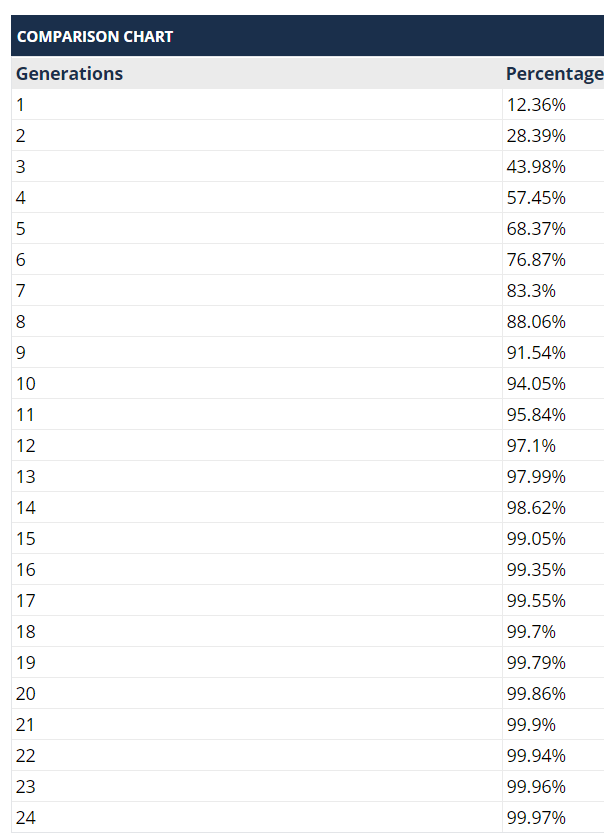
Here are the results. On the proven Mayflower Line, there are 9 generations to Resolved White. Gary has 11 generations going back to Resolved, his YDNA match’s common ancestor with Gary. From the above chart, that should be between about 92% and 96% accurate.

Looking at the Individual STRs

Here are the STR results at the Mayflower FTDNA YDNA Project page:

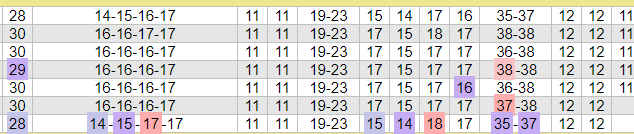
Gary’s results are not yet posted there. The reader will have to click on the image to be able to see the numbers. What are we looking at? There are four testers. The most important one is the first who is Gary’s YDNA match with proven connection to William White. The first two testers did a 67 STR test. The second two took at 37 STR test, so I did not continue further than the 37 STR results. The first three rows after the yellow row give the minimum, maximum and mode of the STR values. The Mode is most important as that is generally assumed to be the oldest result. The thinkng is that the mutations are newer and those shared by the most testers are the ancestral results.

The last line is a bit confusing as this is for a Donovan and the results do not match well at all. The colored numbers on the chart are variations from the Mode. I would have left Donovan off the list.

Here is more of a close-up:

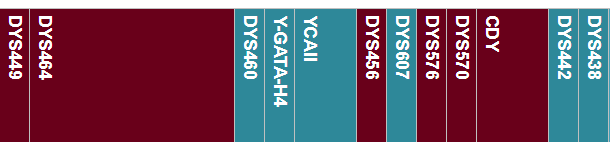
Again, the third row is the Mode and I’d like to ignore the last row for Donovan. The proven William White descendant differs from the mode with his first blue 29. He differs also in the compound result of 38-38. This is a fast moving STR. This is sometimes even not used as it is a bit errratic. I’m not sure how the Mode was determined in this case either. What is missing is the heading for these columns:

The reddish STRs are the faster moving STRs. That is taken into account by the TIP Report discussed above. If Gary was part of this Project, it would be easy to compare his results.

Comparing Gary’s YDNA to the Mayflower YDNA Results

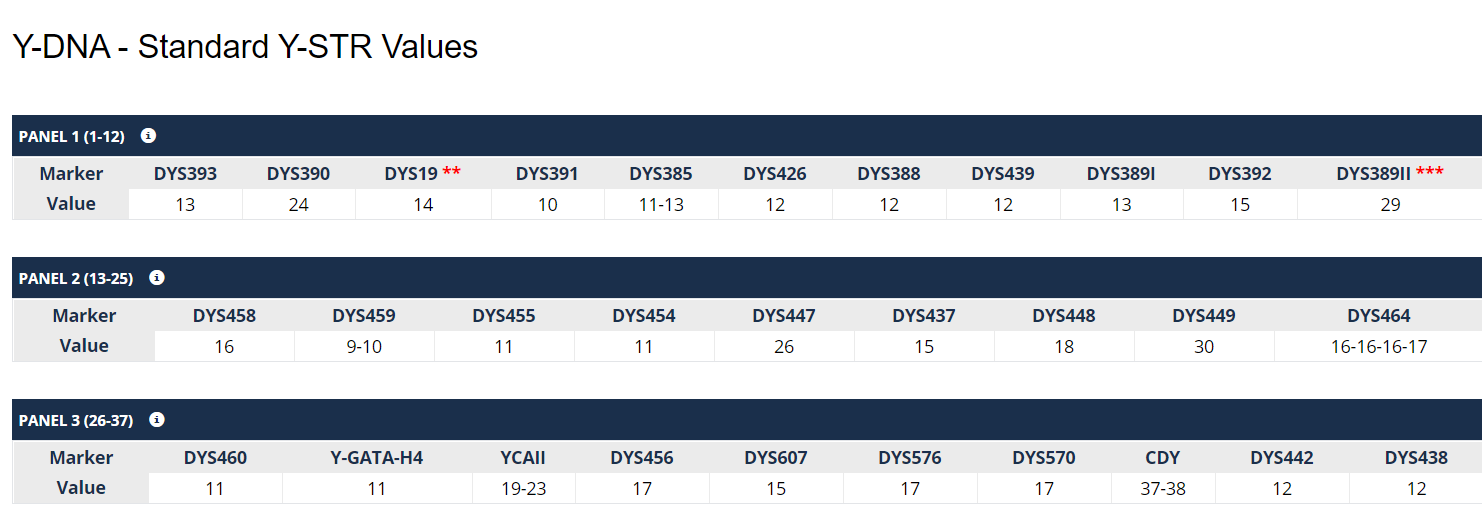
Here are Gary’s YDNA 37 STR Results:

We know that Gary differs from Mayflower Descendant by two STRs, but how does he differ from the White Mode? The White Mode can be thought of as the STR signature that William or Resolved White may have had.

Here is the close-up view again:

Gary had 30 in the first column for the STR named DYS449. Here Gary has the same ancestral STR where the other Resolved White descendant had a mutation to 29. That would account for one of Gary’s differences to the proven Mayflower descendant. At the CDY STR, Gary had a value of 37-38. This likely was the second difference to his Mayflower descendant YDNA match. I would have chosen 37-38 for the mode in this case. That would make Gary ancestral for this STR also.

Comparing Gary’s YDNA Results to the Mayflower White Mode

Here is an interesting and fun fact:

Gary matches the mode at every point. Here are the other STRs:

The only place Gary doesn’t match, which is at CDY. I don’t agree with the Mode. In addition, if Gary’s results were added, 37-38 would become the Mode as Gary would tip the scales. The Mode is the value occuring most and Gary would make the 37-38 the only repeat value for the Mayflower match testers for CDY.

Anything Else? A STR Tree

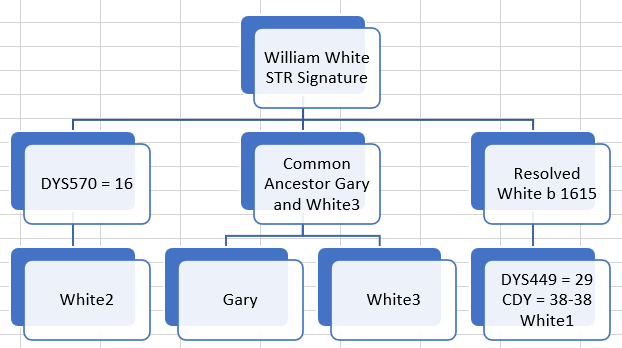
There are three Whites in the Mayflower Project. We can call them White1 (proven), White2 and White3. White3 has the same 37 STR signature as Gary. He is also the other White who only did the 37 STR test. You would think that could mean that White3 is more closely related to Gary than the others. However, STRs are a bit fickle, so it is difficult to know for sure. It would be interesting to know all these White genealogies with YDNA matches to Gary.

If I put the STR results for the four Whites, this is what I get:

The tree is accurate as far as the STR values go, but as we don’t know the genealogy for White2 and White3, it is a bit confusing. This shows that Gary and White3 probably have the ancestral STR signature for William White (and/or Resolved White). White2 has one STR difference from Gary and White3. The proven William White descendant White1 has a 2 STR difference (also called a GD of 2) from what appears to be the Mayflower White signature.

Further Analysis

Gary’s YDNA match brings up an interesting point. There is DNA and there is genealogy. They should be working together, but what happens when they disagree or appear to disagree? Some sort of reconciliation is needed. In Gary’s case, the YDNA match to a known William White Mayflower descendant appears to make Gary a William White descendant also. The reconcilliation could be that John White Senior had child John White Junior with Martha Doty prior to their marriage and that John Senior was the unnamed father. However, that does not explain the fact that John White Jr was left out of his father’s will.

The saying is that DNA does not lie. This is true, but there are different levels of DNA testing and differing interpretations. The best test is the BigY 700 test. If enough people take this test who are related, an accurate YDNA tree can be made. This tree reflects the testers’ genealogy. This test looks for SNPs which are more predictable than STRs. If the proven White descendant and Gary were to take this test, there would be better proof of the common William White descent. However, at the level of testing that has been done, it seems like there is a very good indication that Gary and the proven William White descendant have the common ancestor of Resolved White as shown above.

Gary has submitted his initial application in to the Mayflower Society. Hopefully that will tell him if his genealogy is OK for an application. If they say the genealogy is not good based on more recent research, I would say that we have a case to overturn or modify the recent research with the DNA results.

Summary and Conclusions

  • Gary’s proposed application to the Mayflower Society was fraught with peril due to the Mayflower Silver Book and other sources claiming that his ancestor John White was illegitimate.
  • I proposed a YDNA test for Gary at the 37 STR level to give evidence as to whether or not he really did descend from William White of the Mayflower.
  • The test came back showing that Gary matched 5 out of 6 people with White surnames. The 6th match which was the most distant one was not a match.
  • Gary contacted his YDNA match who had proven ancestry to William White of the Mayflower. The common ancestor between Gary and his match was with William’s son Resolved born in 1615.
  • Gary and I ran TIP Reports which showed that a common ancestor between Gary and his proven William White ancestor was over 90% likely.
  • It is unclear whether or not the Mayflower Society would entertain an application from Gary based on the genealogy alone. Gary has a Mayflower Lineage Match request submitted that hopefully will answer that question.
  • Based on Gary’s YDNA testing, he has an excellent case to show that John White Jr was indeed the son of John White Sr.