My First 1st Cousin DNA Results: Part 3 – The X Chromosome

In my first Blog about Cousin Rusty’s DNA matches, I discussed some maternal matches. I also looked at how first cousin DNA matches worked. In my second Blog about Rusty, I looked at the more complicated matching of nephew to aunt. In this Blog, I would like to look at the X Chromosome.

Here is how Rusty matches my family on the X Chromosome as shown in the Gedmatch Browser:

These are his matches with:

  1. Mom
  2. Sister Heidi
  3. Me (Joel)
  4. Sister Sharon
  5. Brother Jonathan

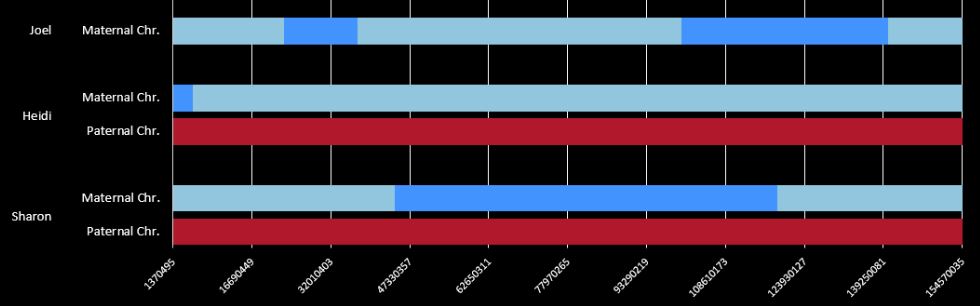
Here is an X Chromosome Map produced by M MacNeill before my brother Jonathan’s DNA results were in. He made this using our raw DNA results.

The blue is the maternal side where there are matches with Rusty. The red is what my sisters inherited on the Hartley side. MacNeill did not designate the blue by grandparent. The choices for maternal grandparents here are Alexander Rathfelder and Emma Lentz. Let’s try to figure out which is which.

Speaking of Emma and Alexander, here they are with their five children:

Rusty’s mom is the girl on the left and my mom is the girl on the right.

The X Path

The X Chromosome follows a particular path from our ancestors. The rule is that the X DNA never travels from male to male. So that means that two males in a path will break the X chain. Here are my top picks for X Chromosome matches:

The matches in the browser were through the green people up to Rathfelder and Lentz. Judy has the potential to match on the Lentz/Nicholson side. Joshua could also have shared X, though he is further down the ladder. Carolyn could match on the Nicholson side.

Carolyn’s Nicholson X DNA

I’ll look at Carolyn’s X DNA matches.

She matches:

  1. My Mom
  2. Sharon from 106672721 to 113198089 (7.056 cM)
  3. Jonathan from 139830607 to 143171128 (11.542 cM)
  4. Judith
  5. Joan

Based on Sharon’s small match, I would initially say that the darker blue is Lentz and the lighter is Rathfelder on the MacNeill Map. However, the problem with that theory is that I should match Carolyn also in that area. If I reduce the match level, I do have a match there with Carolyn:

Mapping Jonathan’s X

In order to be sure, we need to map Jonathan’s X. He has a larger X match with Carolyn than Sharon does – even though it looks smaller on the browser. Here is some previous X Mapping I had done for my sister Sharon (S), me Joel (J) and my sister Heidi (H).

It looks like I had already guessed that orange would be Lentz. Recall that Sharon’s (S) match with Carolyn was 106-113 and mine was 109-113 within the orange segments. When I compare Jon to his siblings, it looks like he has 3 crossovers:

As we are only looking at Jon’s maternal Chromosome, we are looking at the blue areas on the Chromosome Browser where he matches his siblings and the non-blue areas where he does not match his siblings.

This was pretty easy. I started on the right. Jon matches all his siblings, so that has to be green. Going from right to left, the segments alternate between green and orange. The only ambiguous part is on the left hand side where Heidi has a small orange Lentz segment. However, if I lower the thresholds for Jon’s match with Heidi, I get this left side match which clears up the ambiguity:

Gedmatch normally has a SNP cutoff at 500, but apparently they have not lowered that for the X One to One match and must still have a 700 SNP cutoff.

Now back to Jon’s match with Carolyn. I had noted above that it was at position 140 to 143. That just fits in to Jon’s Lentz mapped orange segment as shown by the red arrow below:

This confirms that yellow should indeed be assigned to Lentz. That means that green has to be Rathfelder – the only other maternal grandparent.

Now I’ll bring Rusty back into the picture with his matches to my family:

  • Rusty’s match with my mom is line 1
  • Heidi is line 2. You can see her Lentz indent on the left of her match with Rusty.
  • Joel is line 3. You can see the space left by Lentz in the middle of my large match with Rusty
  • Sharon is 4. Her match with Rusty stops at her Lentz (orange) segment
  • The newly mapped Jonathan is 5. He matches Rusty on his green Rathfelder segments.

So would we be able to guess Rusty’s X Map?

Rusty’s X Chromosome is either mostly or all Rathfelder. The part I’m unsure of is between 120 and 140 cM. The reason that I think that it might be Rathfelder is because Carolyn matches Judith and Joan in that segment and Rusty does not match any of those three by the X Chromosome. However, as Carolyn’s Nicholson matches go back at least another generation, that is not proof.

Looking at the ??????? Gap

I’m curious as to what is happening where Rusty and my mom don’t match. The answer to this goes back a generation. Alexander Rathfelder’s parents were Rathfelder and Gangnus. My mom and Rusty’s mom had two different X Chromosome maps showing how they got their X DNA from their grandparents. However, on their paternal side, their Rathfelder father gave them a full X Chromosome unchanged from his mother Maria Gangnus.

Here is Maria:

So due to the fact that Rusty’s mom and my mom both have the same paternal grandmother DNA on the entire length of their X Chromosome, that means that Rusty cannot have Rathfelder aka Gangnus DNA from 120 to 140. If he did, then he would have to show a match to my mother.

The result of our little thought experiment is that Rusty has to have Lentz DNA. Here is a possible scenario of what could have happened. This shows Rusty with his maternal grandparents. Then we see Rusty’s mom and my mom with their X Chromosome grandparents. Maria Gangnus is Alexander Rathfelder’s mother and Emma Lentz’s parents are George Jacob Lentz and Annie Nicholson.

What we know for sure is that Rusty’s mom and my mom both had a full X Chromosome from their paternal grandmother, Maria Gangnus. The only place for there to be difference is on my mom’s and Rusty’s mom’s maternal X Chromosome. Suppose that Rusty’s mom got her DNA from her maternal Nicholson grandmother and my mom got her DNA from her maternal Lentz grandfather. That would be why Rusty’s Lentz DNA would not match my Lentz DNA or my sibling’s Lentz DNA. We only got the X DNA that we received from our mothers and these mothers got DNA from different maternal grandparents in this location. We now know what Rusty’s X Chromosome map looks like. We don’t know what our mother’s maternal X DNA looks like. We only know they had DNA from different maternal grandparents from 120M to 140M.

First 1st Cousin DNA Results: Part 2 – Trying to Explain Aunt/Nephew Matches

First, Another Look at First Cousins

In my last Blog I took a first look at my 1st cousin, Rusty’s DNA. I went into some detail on how he matched on a few of the lines we have in common. I looked at how Rusty compared to me and my siblings on Chromosome 16. Here is a visual summary of that comparison:

The first image is a chromosome map of the DNA that my 3 siblings and I got from our four grandparents. The red and yellow grandparents are the maternal ones shared with Rusty. The second image shows Rusty’s matches with me and my 3 siblings. Note that the long segments shared are similar to the Lentz segments on the left and the Rathfelder segments on the right. Note that as Rusty and my siblings are of the same generation, we share the same long segments with our grandparents. From this, I was able to create a maternal Chromosome Map for Rusty.

As there were a lot a matches, I would assume that the DNA profiles of my mom and Rusty’s mom were somewhat similar to each other on Chromosome 16.

Rusty Compared to His Aunt – My Mom

In the above example, the common ancestors of Rusty and me are our two maternal grandparents. When I compare Rusty and my mom, I will be looking at two different generations.

Here Rusty and my mom share the same common ancestors as me and my mom. However, do Rusty’s and my mom’s shared segments represent my mom’s parents’ or my mom’s grandparents’ DNA?

Does rusty share DNA with my mom’s grandparents (his maternal great grandparents)?

My thinking is that when I compare Rusty to my mom the DNA compared goes up a generation from when I compare Rusty to myself and my siblings. Here is Rusty again at Chromosome 16 compared to my mom:

My mom has a full Lentz and a full Rathfelder Chromosome from her parents. Yet there is a place in the middle of Chromosome 16 where Rusty and my mom do not match. That makes me think that we are comparing my mom’s grandparents with Rusty’s great grandparents. Let’s assume that to be the case. That means we need to bring in another generation.

With what we know of Chromsome 16, Rusty and my mom must share all of the same Lentz next generation up. That would be either Jacob Lentz or Annie Nicholson. The same must be true for the Rathfelder side from position 56M to 88M. However between about 50M and 56M Rusty and my mother must get their DNA from different paternal grandparents of my mom.

a look at chromosome 10

Here is the way I have mapped my mom’s chromosomes using Kitty Munson’s Chromosome Mapper:

The DNA match in purple is my from my mom’s Nicholson only side. It is mapped to William Nicholson and Martha Ellis who were the parents of my mom’s grandmother Annie Nicholson.

First, let’s look at my mom’s matches on Chromosome 10. I had discussed this Chromosome in my previous blog also.

#1 is mom’s match with Carolyn which maps to the Nicholson side. #2 is mom’s match with Rusty. #3 is a small match with Catherine which I’ll ignore for now.

Here are Rusty’s matches:

#1 is Carolyn. #4 in my mom. 2, 3, 5 and 6 are me and my siblings – not so important for this comparison. #7 is Linda (Nicholson descendant) and #8 is Catherine (Rathfelder descendant).

A possible explanation of a maternal aunt/nephew match

I have to admit that this gets a bit confusing.

When we compare my mother to Rusty, we are looking at my mom’s maternal and paternal chromosome. However, the match to Rusty is all on his maternal chromosome. Conceptually, I think that it would look something like this.

The top showing my mom has her 4 grandparents on her maternal and paternal chromosomes. I don’t know how my mom’s paternal side might look, so I made something up there. My mom’s four grandparents are equivalent to Rusty’s 4 great grandparents, but those 4 great grandparents are all on Rusty’s maternal Chromosome. So they are cramped in to a smaller space.Said another way, Rusty’s maternal DNA is alternating between Rathfelder and Lentz. However, that Rathfelder grandparent may be broken up further to two great grandparents of Rathfelder and Gagnus. Likewise the Lentz grandmother may be broken up to Lentz and Nicholson great grandparents.

In the first segment, my mom has Nicholson DNA due to the match with Carolyn. Rusty has a Rathfelder match in that segment. However, as my mom doesn’t also match Catherine in that segment, it must be from a different Rathfelder. My mom’s grandparents were Rathfelder and Gagnus. So here my mom has either one of those grandparents’ DNA and Rusty has the opposite. That is why I have blue for my mom there and green for Rusty.

A final note is that the last small segment match that Rusty has with Catherine cannot be right. Or it cannot be Rathfelder. That is because Rusty’s DNA is alternating  between Rathfelder and Lentz. The last segment has to be Lentz, so there is no room for Rathfelder DNA there. On the other hand, my mother’s #3 match is with Catherine, which is a Rathfelder match. She has room for that match along with her Nicholson match as she has a maternal and paternal chromosome to match on.

Summary

  • In a 1st cousin match, the DNA from my two grandparents are compared to the same DNA that my first cousin got from those same two grandparents
  • In a nephew/aunt match, the great grandparents of the nephew are compared to the grandparents of the Aunt
  • The aunt, however, has her 4 grandparents’ DNA on 2 chromosomes
  • The nephew has his 4 great grandparents’ DNA On only one chromosome
  • Those 4 great grandparents have to fit within the appropriate alternating grandparents of the newphew

The Segmentology Blog, Segments: Bottom-Up explains it well. Here is an image from that Blog:

In my example above, this Segmentology image would be like Rusty’s maternal DNA. In Rusty’s grandparent look, his maternal DNA alternates between Rathfelder and Lentz. However, in his great grandparent look, the DNA may be split up between the parents of those grandparents within the crossovers of the grandparent look.

For my mom, I am just looking at her grandparents. However, there will be two lines of grandparents: maternal and paternal for her. Also the crossover points will in most cases be different than for Rusty as he got his DNA from his mom – my mom’s sister.


My First 1st Cousin DNA Results

Not too long ago, I was at a car dealer with my wife picking up her new car. I checked my email on my phone and was surprised that I had gotten an email from FTDNA saying that my mom had a new close relative. I checked and it was my first cousin on my mother’s side, Rusty. I have been looking at DNA for quite some time now and have written over 100 Blogs, but this was my first 1st cousin DNA results. As a first cousin Rusty’s DNA matches are comparable to mine on my mother’s side.

Rusty on the Family Tree

Here is the family tree on my mother’s side with those that have had their DNA tested:

Rusty matches on my mother’s side. This includes the Rathfelder (blue), Lentz (yellow) and Nicholson (red) families. As Rusty got different DNA from his mom that my 3 siblings and I got from my mom, he will have some of the same and some different matches with all those that have tested so far.

Rusty’s 1st Cousin Matches

I’ll look at my matches with Rusty first as they are more straightforward than his matches with my mom. At least we are both in the same generation. Rusty matches me at 1,164 cM as reported at Gedmatch which is also on the high side for a first cousin. Here is how my matches with Rusty look like on the FTDNA browser:

By the looks of it, Rusty and I light up about half of the positions of the chromosomes.

Why do Rusty and I match as we do?

I like to look at DNA matches in terms of grandparents. That is because I have tried to map all my ancestral DNA to my four grandparents. For example, here is how I have used a visual method to map to my 4 grandparents on Chromosome 10. I am using Chromosome 10 as it comes up later in this Blog:

I will assume that I did the visual phasing correctly. I have the raw data to check, so it can be corrected later if it isn’t 100% right. My sister Sharon is in the first row, Heidi in the second, I’m in the third row and my brother Jon is in the fourth row. The numbers at the bottom are the rough positions of the crossovers. My siblings and I will match Rusty on the blue and purple segments only (maternal side). Looking back up at the FTDNA browser above for Chromosome 10, it shows that I match Rusty at three segments. It is clear that the third match must be a Rathfelder segment match as a little more than half of my Chromosome 10 is mapped to Rathfelder on the right side.

Let’s see how Rusty matches with me and my siblings on Chromosome 10.

This points out an error in my original visual mapping. Based on these matches with Rusty I should be able to correct my Chromosome Map. First, this shows on the right segment, that Rusty matches me (#4) and not my three siblings. That means that my three siblings will have different DNA than me on the maternal side. Note above that difference is not reflected in my Chromosome Map. I have purple Rathfelder mapped to all my siblings on the maternal side. Previous work that I’ve done has shown that my three siblings have a small Rathfelder match at the right end of this Chromosome and I do not. That match is between 132 and 135M. I take that to mean that my yellow segment match above with Rusty must be on the Lentz side and not the Rathfelder side. So, back to the drawing board.

Checking my laptop, I see that I had done a raw DNA analysis on Chromosome 10 in the past. I went back and checked the raw data and found that I had missed my last maternal crossover. I just added that one in to get this corrected Chromosome 10 Map.  The map format below was developed by M MacNeill [prairielad_genealogy@hotmail.com].

The segment that I had missed was the yellow Lentz portion of DNA to the right of my Chromosome. A few points from comparing the Chromosome Map above to Rusty’s matches with the map:

  • Chromosome 10 was heavy on Lentz DNA for me and my 3 siblings (yellow vs. Rathfelder brown)
  • As a result, Rusty only matches me and my siblngs on Lentz DNA
  • Other Chromosomes would likely yield Rathfelder DNA
  • By comparing Rusty matches to my family to all my family’s Chromosome maps, I could create a spotty Chromosome map for Rusty on some chromosomes and a more complete one on others (see below)
  • Rusty’s match with me was helpful in finding a crossover I had missed on my Chromosome 10 Map on the maternal side.
A simpler Chromosome (16)

Perhaps this example is clearer. I will show my visual phasing map followed by Rusty’s matches to my siblings:


  1. Heidi
  2. Jon
  3. Joel
  4. Sharon

Unfortunately, the order of my siblings is different in the two representations. I am the only one in the same relative position in both representations. A few observations:

  • Rusty’s inherited DNA from his maternal grandparents lined up well with the my family’s inherited DNA on the maternal side.
  • Rusty’s matches with me and my siblings confirms the visual mapping that I have done for me and my siblings on Chromosome 10
  • Rusty appears to have two large segments of DNA on his maternal side. The larger one on the left is from the Lentz side and the slightly smaller DNA segment on the right side of Chromosome 16 is from our shared Rathfelder side.
  • Rusty’s crossover from Lentz to Rathfelder DNA appears to be at the abrupt end of his first bunch of matches to me and my siblings at about 49.7M.

This figure is a likely representation of Rusty’s Chromosome 16 on his mother’s side. That means that any matches he has on Chromosome 16 in the red part before position 49.7M will be on his Lentz side and any matches he has in the yellow part of Chromosome 16 will be on his Rathfelder side.

Rusty’s Aunt Match

According to the ISOGG web page, Rusty should match my mom (his aunt) and my 3 siblings and me as follows:

This is a visual show of how Rusty matches my mom:

He lights up the browser pretty well. At FTDNA he shows a match of 2,085 cM. This is close to what Gedmatch shows at 2,160.6 cM. Both of these matches are over the reported average of 1744 cM for an aunt/nephew relationship.

Rusty and Rathfelder DNA

Rathfelders are difficult to find. So far, I have found one other person that tested at AncestryDNA who I have been able to link up to the Rathfelders. I wrote about that Rathfelder match in two Blogs. Here is a link to the second Blog. As best as I can tell, the person I found has the following link to Rusty and my family:

I find it unusual that a couple would give the same name (Johann Georg) to two of their sons. Also to make life confusing, the father, Hans Jerg, was also known as Johann Georg. The chart above shows the person I found (Astrid) as a 4th cousin to my mom and a 4th cousin, once removed to my second cousin Catherine, my family and 1st cousin Rusty.

A Rathfelder Triangulation Group

Here is how Astrid matches my mom and Rusty on Chromosome 17.

Astrid, my mom and Rusty are in a Triangulation Group as they all match each other at least in the green area above. Assuming I have the genealogy right, this points back to an early Rathfelder ancestor:

This shows that the shared Chromosome 17 DNA came from Hans Jerg Rathfelder and his wife. This couple were among some of the early settlers of Hirschenhof which was a German colony in Latvia.

Rusty’s Lentz and Nicholson DNA

I only have one distant cousin, Al,  that matches only on the Lentz line. This person does not match Rusty at standard thresholds, so I’ll be mostly looking at Rusty’s Nicholson DNA shown in red below.

On the chart above, Judy and Joshua descend from the Lentz and Nicholson sides. Joan, Linda, Carolyn and Nigel descend from Nicholsons. That means that any match Rusty has with those on the red lines should be a Nicholson match.

Rusty’s oldest Nicholson dna

Rusty matches my mom and Nigel on Chromosome 1. This represents the DNA he got from John Nicholson who was baptized 1765 and his wife Sarah Staniforth.

The browser above shows Rusty’s DNA match with my mom (#1) and Nigel (#2). My mom and my family had a large match with Nigel. So large, in fact, that some on the ISOGG Facebook Page questioned whether that large match could be possible. Here is my Blog about Nigel. Rusty has a more moderate level DNA match and forms a Triangulation Group between himself, my mom and Nigel.

William Nicholson dna

Our shared ancestor, William Nicholson moved his family from Sheffield England to Philadelphia around 1869. Rusty matches Carolyn, Joan and Linda on quite a few Chromosomes. So if I was to map Rusty’s Chromosomes, wherever he matches these three I would map that DNA back to William Nicholson and his wife Martha Ellis. Here is a typical match that Rusty has with my mom (#1) and Joan (#2):

The green segment on Line 2 represents Rusty’s match with Joan and DNA that he got from William Nicholson and his wife.

Chromosome 10

Here is an interesting situation where Rusty matches his 2nd cousin once removed Carolyn (#1) for a longer segment (in orange) than his Aunt – my mom (#2):

The green segment is Rusty’s match with Linda (#3). Linda and Carolyn are both cousins on the Nicholson side. What does this mean? Let’s see how Carolyn matches my mom. In the places where she matches my mom, there would be triangulation:

Here, my mom matches Carolyn in the same segments where Rusty matches my mom. That leaves the blank on Line 2 above between the blue and yellow segment. Why doesn’t Rusty match my mom in the blank spot? Note that above and below on Lines 1 and 3 that has to be Nicholson DNA due to those Rusty is matching. Here is how I see it.

My mom got her DNA on her maternal side from her Lentz and Nicholson grandparents. In the area that Rusty doesn’t match her by Nicholson DNA, my mom must have Lentz DNA.

a Closer look at Chromosome 10

Here is a closer look at some of the closer Nicholson and Lentz relationships:

Here is how the DNA tested people above match each other by the numbers on Chromosome 10:

In the above spreadsheet, the three sections in gold are Triangulation Groups.

Summary and Further Study

Well this Blog wore me out a bit, so I’ll stop here. There is quite a bit to a first cousin’s DNA:

  • I found that Rusty had above average matches to me and my siblings. In addition, he had above average matches to my mom.
  • I looked at how Rusty’s match helped correct an omission I had on my Chromosome 10 Map.
  • Based on my maps, it should be easy to tell what maternal grandparent line Rusty’s matches are when they match with those on my family’s Chromosome Maps.
For Further Study
  • I may look more into what makes up an Aunt/nephew match with Rusty and my mom.
  • I’d like to look at Rusty’s X Chromosome matches.
  • Anything else that happens to come up as I’m blogging

A Shared Ancestry Hint of a French Canadian 8th Cousin and Visual Mapping

Recently I have been looking at my wife’s French Canadian Pouliot ancestry and DNA. My thought has been to find a Shared Ancestor Hint (SAH) at AncestryDNA. Then if the person in the Ancestry hint has uploaded their results to Gedmatch, I would be able to analyze those results. In this case, I would like to check using visual phasing to determine whether the match is on the Pouliot line or another line.

Here is the SAH:

Lorraine is my wife’s paternal Aunt. Here is what the DNA looks like at AncestryDNA:

Here is how the match looks like at At Gedmatch,

Actually, based on this person’s email, there are 2 matches. This is the Ancestry one. The other test was at 23andme. They are likely the same person. This AncestryDNA match got higher results perhaps due to the comparison within the same company.

The Goal: Compare Gedmatch, AncestryDNA and Visual Mapping

My goal as stated above is to map one or more of the matching Chromosomes to see if the match along the Pouliot line is likely. I do have two Pouliot 2nd cousins to Aunt Lorraine which will help. It would make sense to map the Chromosomes where they match Aunt Lorraine. Here is how Fred, who is a Pouliot 2nd cousin to Lorraine matches Lorraine on Chromosomes 4:

  1. Richard, my father in law
  2. Richard’s sister Lorraine
  3. Richard’s sister Virginia

Now To Visually Map Richard, Lorraine and Virginia On Chromosome 4

The good news is that there is a lot of Pouliot DNA for mapping this Chromosome. The bad news is that the original Chromosome match between Ann and Lorraine was fairly small.

First I compare the 3 siblings using the Gedmatch Chromosome Browser:

In the image above, I’ve added the crossovers and the approximate locations on the Chromosome where they occur. There are a lot of crossovers bunched up on the right side. Next I assign the crossovers to a particular sibling. Note that I added two crossovers that I missed in the previous image:

  • Virginia has 109 crossovers
  • Richard has 3
  • Lorraine has 4 for a total of 17 crossovers. I have a question mark my Lorraine’s last crossover as I’m not sure if there is one there or not.

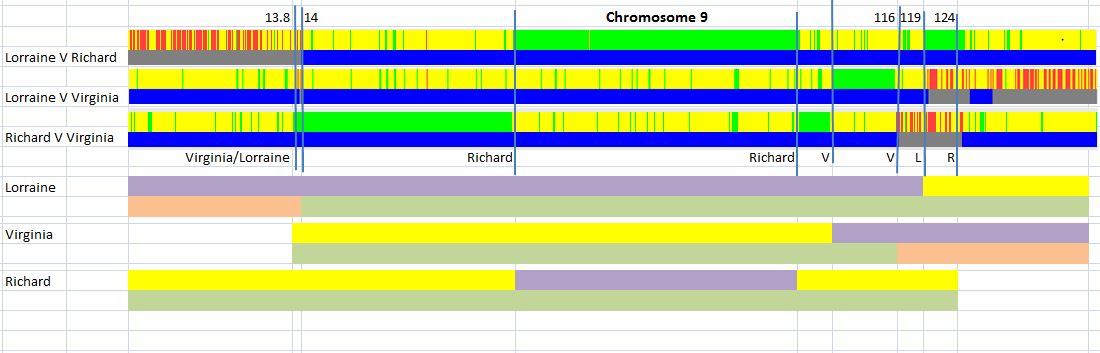
Next I map the 3 siblings based on crossover, Fully Identical Regions (FIRs in green), Half Identical Regions (HIRs in yellow) and the places where the siblings don’t match in red.

I’ll start in the middle of the Chromosome where Lorraine and Virginia have a FIR going over two segments (before positions 120):

This gets us started. The DNA that these 3 siblings inherited from two of their same grandparents are represented by green and purple and extend to each of their crossover lines. Next, I look for other FIRs or places where the siblings don’t match. For example, Richard and Virginia don’t match between 59 and 84, so I’ll add two new colors to Virginia, to show the DNA she got from the other two grandparents.

Here it looks like I’m stuck for now:

Now I add a HIR. Our Gedmatch match between Lorraine and Ann was between 33 and 40, so I’ll add one for Lorraine there.

I did this by arbitrarily extending one of Lorraine’s colors to the left and choosing another color to add so Lorraine and Richard would be HIR between 31 and 84. Then I extended those colors to the left as Lorraine had no crossovers on the left side of the Chromosome. Based on this HIR, I can fill in some more on the left had side:

Now I have a lot of the left side of Chromosome 4 mapped out. I also have Fred who is a second cousin on the Pouliot side. I’ll mush all the information together and then try to figure out what color Pouliot is:

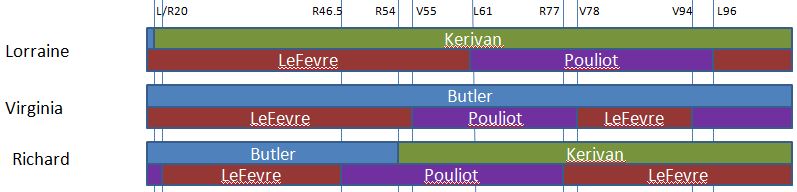
Here I’m leaning toward a purple Pouliot. The reason is that Richard has a purple segment (and Pouliot match) from 4 to 14. Richard, Lorraine and Virginia match Fred from 102-126, but Richard may not be mapped in that area yet. However, Lorraine and Virginia have purple in that segment. In addition, I don’t have positions for the two crossovers between 95 and 120. I can get those from Gedmatch by comparing Richard and Virginia’s FIR at full resolution:

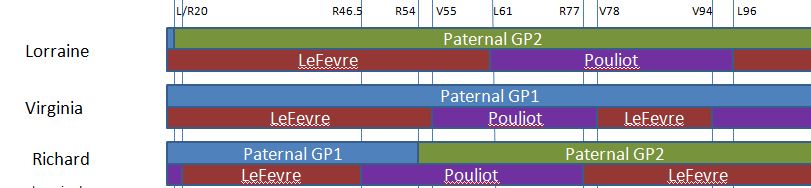
The FIR starts a little after 100M and ends at about 106.5. Those two positions numbers define the two crossovers between 95 and 120. That also confirms that Pouliot is purple. This defines a grandparent and the maternal and paternal sides of the Chromosome as Pouliot is on the maternal side for these three siblings. It also defines the other maternal grandparent (LeFevre) as being the red or maroon color.

Next, I can fill in all the other Pouliot sections provided by these 3 siblings’ Pouliot cousin Fred:

A few notes on the mapping:

  • Virginia didn’t match Pouliot from 4-14 where Richard did so she gets a LeFevre segment there.
  • Virginia also does not match Pouliot from 120 to 135 where her siblings do match Pouliot. So I give her another LeFevre segment there.
  • Virginia starts matching Pouliot again at 172. This points out a crossover location that I mislabeled previously as 177. Corrected above.
  • There is still a few small segments on the right that I haven’t filled in for Virginia and Richard.
Some additional adjustments

A close look shows that between 180 and 185, Lorraine and Richard don’t match. In order to meet the FIRs, HIRs, and no-matches on the right hand side, I came up with this:

I’m not sure if this is totally right on the right hand side, but it seems close. I show Virginia as having nine maternal segments which seems quite unusual. I would like to point out that the match on Chromomse 4 between Lorraine and Ann. Ann did not match Virginia or Richard on Chromosome 4. Those results (and lack of results) are consistent with the mapping above.

Back to the Original Match Between Lorraine and Ann

A big part of this Blog was to determine whether Lorraine’s small Chromosome 4 match with Ann was on a Pouliot segment. After all that mapping, I would say that the match could not have come through Lorraine’s Pouliot side. The largest LeFevre segment between the three siblings belongs to Lorraine between 0 and 95M.

From the above analysis, I made conclude:

  • The 8.6 cM match between Ann and Lorraine is did not come down to Lorraine through the Pouliot side
  • The match is either by chance or on the LeFevre side. There are 15 names in common between Ann and Lorraine. They are all French Canadian names. My assumption would be that I could rule out a DNA match on the paternal (Irish) side.
  • Ann and Lorraine still have matches on 3 other chromosomes.

Summary and Conclusion

  • I was not surprised that this match did not match on the Pouliot side given the inter-relatedness of French Canadian genealogy
  • It was possible that this shared match on Chromosome 4 could have been from the Pouliot side, but it wasn’t.
  • It is best to not assume that a Shared Ancestor Hint and the shared DNA match go back to the same shared ancestor(s)
  • I need to build out these French Canadian lines more at Ancestry
  • The best match between Ann and Lorraine was on Chromosome 19. However, there were no 2nd cousin Pouliot matches on that Chromosome.
  • This Blog satisfied my curiosity on at least one part of the match between Lorraine and Ann and got me to map out Chromosome 4 for these 3 siblings


Using a Triangulated Match With Visual Mapping

This Blog follows up on my recent Blog on Pouliot DNA. My in laws have French Canadian Pouliot ancestry. I was able to find some Triangulation Groups (TGs) using known relatives and a more distant Gedmatch relative, Robert.

Here is the TG in spreadsheet form:

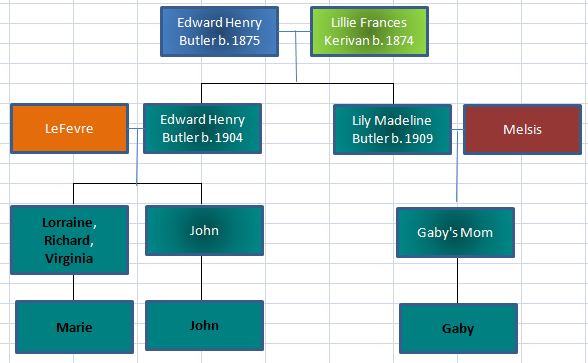
Richard is my father in law. Virginia is his sister. Patricia is their maternal 1st cousin.

Here is the TG in genealogy chart form:

Here is Robert’s match with Richard (1) and Virginia (2) on Chromosome 3:

It looks like I am seeing a crossover for Richard and Virginia already. Can you see them?

My premise in this Blog is that TGs and Visual Mapping should work well together.

Visual Mapping Starts By Comparing At Least Three Siblings

Those siblings are Richard, Lorraine and Virginia:

The crossovers got a little messy at around 151M. There seems to be a lot going on there. I’ll start the mapping by the largest Fully Identical Region (FIR) in green and hope that I can resolve the other mess later.

The blue and green represent the DNA that Lorraine and Virginia received from the same two grandparents in their Fully Identical Region. Lorraine has no crossovers in the first part of the Chromosome, so I expanded her DNA to her first crossover at 155M. Note also above in the match between Lorraine and Richard. I ignored the small match that they had after 70M.

This is what I call the Swiss Cheese part of the Visual Phasing:

adding a HIR to the map

According to Kathy Johnston, I have one shot a creating a HIR. This will set the paternal and maternal sides. I would like to set it between 70 and 133 as I have a known Pouliot match there.

time to look at some cousin matches

At this point I like to look at real world DNA matches with cousins. Here is the visual phasing map with Robert’s matches below. He is a 4th cousin, twice removed to these 3 siblings.

Robert’s longer match (1) is with Richard and the shorter one (2) is with Virginia. That sets the purple as Pouliot. I can imagine Robert’s yellow matches from the Gedamatch Chromosome Browser fitting right into the Visual Phasing Map above the Browser. That means that the large blue stretches can be assigned as LeFevre DNA. I don’t know about the paternal side as there are no reference matches – yet.

Bring in the 1st cousins and nephew

Here John is a nephew, so he may match on the paternal or maternal side. Patricia and Joseph are 1st cousins on the mother’s side. It looks like with all these matches, we should be able to figure out something.

The first thing I notice is that Richard has a maternal crossover at 12M. How do I know this? Because if he didn’t, he would continue to match Patricia and Joseph to 72 as his two sister did.

Here I added in Richards maternal crossover at 12M on the top bar. Then as Richard and Virginia are fully identical from 0-12M, I made their two colors the same in that segment.

Also, as Richard does not match Patricia nor Joseph from 33-60M and Patricia and Joseph match Lorraine and Virginia in that stretch, Richard got his DNA from Pouliot in that region and a green segment can be added below that.

Lorraine matches her 1st cousin Patricia from 157-184M. Assuming the small segment I have before 176M is correct, then the whole maternal Chromosome will be from LeFevre for Lorraine. However, that created an odd result. When I checked my numbers, I see that I had the last crossovers mislabeled. Here are the correct numbers:

This makes sense as I thought that I was seeing more crossovers at higher numbers. Lorraine and Virginia both match Patricia from 190-195. That must be LeFevre if I have it mapped correctly.

This puts Lorraine’s last crossover on the paternal side. Then I put the opposite colors in for Richard as Lorraine and Richard have no match in that area. As Richard has no crossovers in that area, I carried his segments to the left. Lorraine have no match in Lorraine’s last open space. That calls for opposite colors. Then I can fill in Virginia’s teeny tiny blank space as it appears that she doesn’t match Richard there.

Here is the filled in Chromosome 3 with maternal grandparents identified:

Observations

  • The previous Pouliot Triangulation worked well as an aid in mapping this Chromosome and identifying maternal grandparents
  • First cousin maternal matches were a big help in filling in the missing segments and identifying crossovers
  • Lorraine has a long stretch of green which may help in identifying the paternal grandparents.


Visual Mapping of Butler Chromosome 5 Reveals an Identical By Chance (IBC) AKA False Match

I would like to try to map my in law’s Butler DNA on Chromosome 5. This is based on a rare paternal match that was found at AncestryDNA and cross-referenced at Gedmatch based on similar names and matches.

I have already mapped Chromosome 11 here. I would now like to map Chromosome 5 with the help of one match that my father in law Richard has with a Rooney descendant named Jeanette. That Rooney match is on Richard’s paternal grandmother’s side (Kerivan)

Mapping Chromosome 5

Chromosome 5 is one of the larger chromosomes with 1 being the largest. Now I compare the three Butler siblings: Lorraine; Richard; and Virginia and I add in crossover lines.

I have the locations of the proposed crossovers at the top. Note the smallest match between Lorraine and Virginia. I think that I have the resolution too low for that match, so I will take it out as there is no indication of a change from HIR to FIR (Half Identical Region to Fully Identical Region) or match to non match status in the other sibling comparisons. That will simplify things in the area of 35/38.

Just pretend the match between Lorraine and Virginia at 34 is not there. I will now assign the crossovers to the siblings. The first crossover goes to Richard as he is represented in a FIR (green) to HIR (yellow) change in the 1st comparison and in the HIR to FIR in the 3rd comparison.

The crossover tallies are in:

  • Richard (R) – 5
  • Virginia (V) – 4
  • Lorraine (L) – 2

Actually, I would not be surprised if Lorraine had an additional crossover at the very far right end of the Chromosome, but as it is so small, I am ignoring it for now.

Recall that Richard’s Kerivan Line match was 66-75M. That is probably within the segment R-V ending at 75.5M above. When I compare Lorraine and Richard at full resolution at Gedmatch I get this for Chromosome 5:

This defines Richard’s crossover (from HIR to FIR) and is at about 61M as every ^ is 1M. That means that my assumption about the Rooney/Kerivan match was correct. I am curious to see if I will be able to map the Butler paternal side with just one match.

time to map based on no match, HIR’s and Fir’s

I’ll just start with the large FIR between Lorraine and Richard.

The green FIR above translates to the same blue grandparent DNA on one side and the same green grandparent DNA on the other side for Lorraine and Richard. Then we need to expand these regions of DNA to the crossover lines for Lorraine and Richard:

Lorraine had no crossover to the left to keep her 2 grandparents’ DNA from expanding there. Richard goes to the right to his last crossover. Then we can add in other FIRs and put in opposite colors for the areas where siblings don’t match (red on the chromosome browser above).

This is what I call the Swiss Cheese phase of visual mapping.

comparing gedmatch cousin matches

At this point I would like to compare Gedmatch matches. There is one thing already that doesn’t make sense. According to Gedmatch, Richard has a Kerivan match between 66 and 75M. However, the mapping shows that Lorraine and Richard are in a FIR there. That means that if Richard has this match, then Lorraine should also. Let’s check Lorraine again. I still get no match. When I lower Lorraine’s threshold to 5 cM, I only get a small match with Jeanette on Chromosome 20. That could mean that Richard’s match with Jeanette on Chromosome 5 is by chance. That was disappointing, but informative.

That leaves us the maternal side. Are there matches there?

Here are the matches that I show for our 3 Butler siblings on Chromosome 5. Virginia shows a match on the maternal side with her 1st  cousins Patricia and Joseph (in pink). This could be helpful. But in this case, it appears that it isn’t. That is because in this segment, Virginia doesn’t match her two siblings. Should I give up? I have one more idea. As I mentioned above, Virginia has a maternal match from 88 to 118. However, John matches Richard and Lorraine in that same area. That means that John’s match in that area has to be paternal. John is a nephew, so he shares maternal and paternal matches. Unfortunately, as Richard and Lorraine are FIR in this segment, it tells us no more.

update based on reader comment

I had a comment questioning my apparently too hasty assertion that the John match above (from 81-115M) to Richard and Lorraine was paternal. I did put a little thought into that comment. M MacNeill has kindly phased John’s raw DNA on a different chromosome (Chromosome 1) and came up with this result.

This gets to the old adage about a picture being worth 1,000 words. As John is in a different generation (as is Marie, my wife – his cousin) it gets confusing. However, the above image shows the DNA John got from his four great grandparents on his paternal side.

The segment we are looking at above is between 75.5 and 117. In that stretch all 4 grandparents are represented by four different colors. This is part of what makes the analysis difficult. If there was an HIR in that region, the analysis would have been easier as there would have been only 3 grandparents to consider in that segment.

We know that John matches Virginia on a maternal match, but we don’t know which grandparent it represents. That leaves one other maternal grandparent and two paternal grandparents (from the viewpoint of the above map). John’s match with Richard and Lorraine from 88 to 115M could therefor be with one of Richard and Lorraine’s maternal grandparents or with either of the two paternal grandparents. This tells me that there is a bigger chance of the match being on the paternal side, but that the maternal side is not ruled out.

Updates on the Update

Since my update, I had a few important responses on the ISOGG Facebook Page that I would like to preserve in this Blog. Kathy Johnston, from whom I learned the visual mapping technique responded with a possible visual mapping:

I liked how she put in the Patricia and Joseph match suggesting that the purple could be the maternal side. I also received a response from M MacNeill who has been so helpful in working on the raw phasing of the Hartley and Butler families:

Here is a screenshot of comments relating to the image above:

Summary and Conclusions

  • I could map out one further HIR, but I won’t at this point
  • I had high hopes in mapping some paternal segments to specific grandparents on Chromosome 5, but it didn’t work out
  • I did find an apparent Identical by Chance (IBC) or what I call a false match between Richard and Jeanette at Chromosome 5. It appeared to be real before I mapped it out.
  • Future identified cousin matches may resolve the mapping of Chromosome 5
  • I appreciate comments from readers that help me to re-think my conclusions


Looking At French Canadian Pouliot DNA

My wife’s great grandmother was Emma Pouliot b. 1874 in Quebec. The exact location was St.-Étienne-de-Bolton, Brome, Quebec. According to her death record, she was from Eastman, Quebec. Could it be possible that she was born in Brome and later moved to Eastman?

The place with the stick pin is Brome, while Eastman is a few towns to the Northeast. The line below is the U.S boundary. This is what Emma Pouliot looked like:

I’d like to look at Pouliot DNA in this Blog. One reason that I’d like to look at Pouliot DNA is because of my wife’s Aunts. I had them tested at AncestryDNA and most of their Shared Ancestor Hints (SAHs) were from the Pouliot Line.

The Pouliot DNA Project

I’ve been involved in two other DNA projects. Both of them have been in populations that intermarried. On my grandmother’s side the Frazers intermarried as they usually looked to marry someone from the Church of Ireland in an area that had mostly Roman Catholics. On my wife’s mother’s side the Dicks intermarried with other Newfoundlanders. French Canadians have been known to intermarry due to the colonial nature of the area. There were only so many original settlers. Here are some of the Pouliot descendants I have so far:

I have been in touch with Robert in the left column in the past due to good DNA matches. Those on the right are closer relatives to my father in law Richard. They have all had their DNA tested. One group has for a common ancestor Emma Pouliot. Fred and Sleuth who are second cousins of my father in law Richard have the common ancestors of Joseph Pouliot and Josephine Fortin.

Pouliot DNA

Here is how the testers compared. I didn’t include my wife as all her Pouliot DNA is from her dad.

This shows that everyone matches – except for Fred and Robert.

Triangulation Groups

I like to look at Triangulation Groups (TGs) as these indicate common ancestors. Once we find these, we can confirm existing genealogy and suggest new genealogy in some cases. To do this, I can compare the segments of the nine that tested above. I’ll look at Robert as he is most distantly related. He is a 4th cousin, twice removed to those in my father in law’s generation.

In order for Robert to be in a TG, he would have to match two people within the same segment. Those two people would have to match each other. The other rule is that the two people that he is matching don’t count if they are siblings.

Here are my nominees for potential Robert TGs:

In the first highlighted box, Richard and Virginia are siblings, but Patricia as a 1st cousin can be a potential third in the TG. In the Red TG, we see Patricia and Joseph as siblings but their relative John makes the third with Robert. Finally Robert, Joseph and Sleuth may be in a TG.

Chromosome 3

In order for this to be a TG, Virginia and/or Richard must match Patricia in that area. Here is how Patricia matches Virginia, Richard and Robert on Chromosome 3:

Clearly they all match around the area of 130M. Here is how I think the Chromosome 3 TG would look like on the genealogy chart:

Chalk up one TG for Robert, Richard, Virginia and Joseph. Without Robert, we wouldn’t know if the common ancestor for Richard, Virginia and Patricia is Pouliot or LeFevre for this segment of Chromosome 3. Now we know. This will come in handy once I map Chromosome 3 for the Richard, Virginia, and Lorraine.

Chromosome 5

This potential TG is interesting as none of the matches are in my in law’s direct family. Here is how John matches Patricia, Joseph and Robert:

I’d say that is a match. As they say in Star Wars, “The force is strong within you”.

Chromosome 15 TG

If we could find a TG here, that would include Robert in all four of the families above. Actually, it may not be obvious above, but Jake, Richard, Lorraine and Virginia are all siblings. Marie is my wife and Richard is my father in law.

I’ll check to see if Joseph matches Sleuth around 95M.

#1 is Joseph’s match with Robert and the one we are looking for is #2 which is Sleuth’s match with Joseph of 26 cM. This should be of interest to Fred, who is Sleuth’s brother. He has done a lot of work on Pouliot genealogy.

Joseph and Sleuth can know that their Chromosome 15 matches with Robert come by way of Pouliot and not the Fortin side. With just the match between Joseph and Sleuth, we wouldn’t have known that.

I have covered all the families with TGs. That means that all these families have a paper trail and a DNA trail to a common Pouliot ancestor. Actually the common ancestors are Pouliot and Gobeil, but in the next generation down, they have the Pouliot name.

Any Potential Problems in This Analysis?

The only problem that I see would be that if we picked the wrong common ancestor. Perhaps there is another common ancestor that we don’t know about. Then this could mess up the analysis. However, my assumption is that our genealogies are fairly complete. If there were other potential common ancestors between Robert and Virginia in our Ancestry Trees, then AncestryDNA would have picked that up in the Shared Ancestor Hints. Other people in this group may want to check other lines to see if there are any other shared common ancestors that have been missed just to make sure.

Future Plans

As Lorraine and Virginia seemed to have about 80 Pouliot Shared Ancestor Hints, it seems there must be others with Pouliot ancestry that have uploaded their DNA results to Gedmatch. It would be good to find further TGs to validate existing genealogies and perhaps even find some on the Pouliot tree that did not know they were there.


A Toehold On the Paternal Side Butler DNA

In my last Blog, I visually mapped my father in law and his two sisters on their Chromosome 2. I was happy with the results as I got all their segments mapped on the maternal and paternal sides. I mentioned the difficulty in finding matches on the paternal side. The paternal match that I did have was not set in stone. It was somewhat inferred by email correspondence. I think of it as a construction job. The first few pieces of wood put in are a bit shaky until the rest of the structure is built around those first few pieces.

The Problem

The problem can be seen well at AncestryDNA. I have my Butler father in law tested at FTDNA, but his two sisters are tested at AncestryDNA. Here are Lorraine and Virginia’s Shared Ancestor Hints (SAHs):

Lorraine and Virginia Share 38 SAHs. I can tell this on my laptop that has Chrome as there is a icon for the shared Shared Ancestor Hints. All of Lorraine’s SAHs are on the maternal side (or locked). Of those maternal SAHs all but 2 or three matched on the Pouliot grandparent side. The other 2 or 3 were on the LeFevre grandparent side. An additional problem is linking those SAHs to gedmatch.

For Virginia, all her matches but one were maternal or locked. The one that was paternal was on the Kerivan side. No matches were found on the Butler side.

Following Virginia’s AncestryDNA Paternal SAH

Here is Virginia’s lone paternal SAH:

As can be seen above, this match is on Virginia’s Kerivan line.

the gedmatch connection: good and bad news

The good news is that Virginia matches someone at Gedmatch that seems to have a very similar name to the match at Ancestry.com. The bad news is that I have been unable to confirm that the two people are the same. However, I did think of an additional check. Lorraine did not match this AncestryDNA person. I opened up Gedmatch, found Virginia’s match. I ran the ‘One to Many’ utility for the match above who I will call Jeanette. On Jeanette’s ‘One to Many’ match list I saw Virginia and Richard but not Lorraine. That makes me feel 95% confident that I have the right person.

Jeanette’s matches with my butler in-laws

Here is the AncestryDNA match. It must be less than expected as the SAH shows third cousin once removed and the relationship predicted by the DNA is 5th to 8th cousin.

Jeanette and Virginia at Gedmatch:

Finally, Jeanette and Richard at Gedmatch:

Visual Phasing of Butler Chromosome 11

Based on the above results I would like to map Chromosome 11 for the Butlers using a method pioneered by Kathy Johnston. In the first step, I compare the three siblings, add approximate Chromosome locations for the crossovers and assign the crossovers to siblings:

I guessed at the 112 position as this was the border between a Fully Identical Region (FIR) shown in green and a Half Identical Region (HIR) shown in yellow. I can check this using the Full Resolution option at Gedmatch when comparing Lorraine to Virginia:

Each ^ is 1M, so the actual crossover from FIR to HIR is about 113. 4. It is close to the next crossover which is at 114.5M. For the assigned crossovers above, Virginia gets 6, Lorraine gets three and Richard gets one.

phasing strategy

While performing visual phasing, it is good to have a strategy. My strategy will be to include Richard in the first segment as he only has one crossover. By the way, one crossover means that Richard will have a complete unrecombined maternal or paternal Chromosome 11 from one of his grandparents. I could start where Richard and Virginia have their first FIR together, but instead I’ll choose the first place where Lorraine and Richard don’t match as there is more coverage in that lack of match stretch. The other thing to keep in mind is that the Rooney/Kerivan match is from 118 to 124M, so we will need to work our way to that side – likely by choosing a HIR in that area.

  • It looks like I could have chosen the first FIR and gotten the same results. A FIR (green) with two ‘no matches’ (red areas) over it like we have here is a good combination for mapping.
  • The Butlers have good coverage on this Chromosome.
  • I can already see that in the area of 118 to 124M Virginia and Lorraine have opposite grandparent matches. This shows why Virginia matched Jeanette and Lorraine did not.
Maternal matches

Before I continue mapping, I would like to see what this Butler DNA-tested trio have for maternal matches. They have two 1st cousins and two 2nd cousins that have tested. I entered all the cousins into Gedmatch, sorted them and took out everything except for how Richard, Lorraine and Virginia matched the cousins:

John is a nephew, so could match on the maternal or paternal side. Patricia and Joseph are maternal 1st cousins. However, that would not identify a specific maternal grandparent segment. The three siblings did not have appreciable matches with either of their 2nd cousins.

More Mapping

As the paternal Kerivan match is on the right hand side of this Chromosome, I’ll add a HIR between Lorraine and Richard. I did that by moving the blue for Richard to the right for the match with Virginia and for the part that didn’t match I put in green (opposite of red).

Once I set the HIR on the right, that meant that the blue area had to be Kerivan. That is the only place that Virginia and Richard have a matching color in the area of the Jeanette Kerivan/Rooney match (118-124). That leaves the purple to be Butler – the only other paternal grandparent.

This map leaves me with that ‘Swiss Cheese’ feeling. Before I scrap this map, let’s look at the 1st cousin matches to see if they can help fill in anything. They are the pink matches – signifying maternal.

Lorraine and Patricia match from 2 to 91. I take that to be the green match. I also assume that as they are first cousins, that their match length also represents the same grandparent. I’ll go out on a limb and say that I can extend the green to position 92.

This makes sense because Patricia starts matching Virginia at 77M. Before that she doesn’t match Virginia, so the maternal segment must be red for Virginia there. Actually, Lorraine’s green should extend further (to 114M) as she has no crossover until that point.

Here I moved Virginia’s red maternal segment to the right. Because the crossover was not on the maternal side it had to be on the paternal side. That gave her a crossover from Kerivan (blue) to Butler (purple) at 27M. The Chromosome is starting to fill in. Next, in the are from 39 to 77, Lorraine and Virginia don’t match. That means that Lorraine must have a blue Kerivan segment filling in at the top. Once I fill in Lorraine’s blue Kerivan segment, Lorraine and Virginia have a FIR (from 92-112M). That means I can fill in Virginia.

Now I’m almost done. I just have the last ever-difficult HIR to complete. Here my inclination is to check Patricia and Virginia at a lower threshold. If Patricia doesn’t match Virginia at the beginning of the Chromosome, then the red must carry through to the beginning for Virginia.

I was a bit surprised that the two cousins fit a match in the beginning of the Chromosome. I shouldn’t be surprised, because small matches are typically at either end of the Chromosome. That means the half match of the HIR is on the maternal side between Virginia and Lorraine. And the crossover is also on the maternal side.

How do I identify the maternal segments for chromosome 11?

I thought of a few things. One would be ICW which is an “in common with” feature that FTDNA uses. Or I could use the feature at Gedmatch which takes two people and finds people that are in common with them. I would be more satisfied with triangulated matches. The best way I know of to find these would be to start a surname study. Pouliot would be a good choice based on all the AncestryDNA Pouliot Shared Ancestor Hints that I mentioned at the beginning of the Blog.


Visual Phasing Butler DNA on Chromosome 2

The Butlers are my wife’s family. Over a year ago, I wrote a Blog called “Uncle Naffy, DNA and the Butler Brick Wall“. In that Blog, I wrote about how a match with Uncle Naffy who is believed to be a Crowley relative helped in producing a breakthrough in the Butler genealogy. Uncle Naffy is a rare paternal Butler match. Most of the Butler matches have been maternal on the French Canadian side.

Visual Mapping of Chromosomes

Since writing the Uncle Naffy Blog, I have also become aware of a tool to map Chromosomes. This visual mapping procedure was developed by Kathy Johnston. As the Uncle Naffy match was on Chromosome 2, why not map that Chromosome? In order to map my father in law Richard’s four grandparents, I need his results and two siblings. Since my Uncle Naffy Blog, I have tested Richards two sisters: Lorraine and Virginia. When I compare these three siblings at their Chromosomes 2, this is what I get:

  • In the green regions, the paired-up siblings share the DNA from two of their same grandparents.
  • In the yellow regions, the sibling pairs share one grandparent
  • In the red regions, the sibling pairs share no grandparents in common. That means they have their DNA from the opposite grandparent pair.
  • The areas between the green, yellow and red regions with the vertical lines added are the crossovers.
  • The crossovers are assigned to the person who has the most shared crossover regions
  • The numbers added are the approximate positions in millions of the crossovers
assigning the crossovers

Lorraine gets the first crossover because she is the one in common in the first two comparisons where the match goes from green to yellow. The other crossovers are from the same reasoning. Richard is in the top and bottom comparisons.

Mapping three butlers

I start by using two colors where Richard and Virginia match representing their shared Fully Identical Region (FIR) shared in green. These two colors represent the same grandparents that Richard and Virginia inherited their DNA from – one on their maternal side and one on their paternal side.

Richard is stuck between his two crossover points (R) but Virginia can go out in either direction to her two crossover points (V):

By using other green areas or Fully Identical Regions (FIRs) and areas where pairs don’t match using opposite colors, I get this:

This leaves a few holes. At this point we need to select a Half Identical Region (HIR). It would be nice to get Lorraine to the right side as she doesn’t have any more crossovers there. Lorraine and Virginia share a HIR from 128 to 204, so we will pick one color from each on Lorraine’s row and extend those to the right. As I mentioned, she has no crossovers we know about there to stop her.

I can fill in a little more using the FIRs and no-match areas.

Now we have four relative grandparents without names in a lot of these three siblings chromosomes. Using known matches, we can fill some of these in. The paternal grandparents are Butler and Kerivan. The maternal grandparents are LeFevre and Pouliot.

Adding relatives

The best known relative for this purpose is a 2nd cousin. Richard and his sisters have two known second cousins on the Pouliot side:

Here, the Pouliot matches didn’t help, due to a blank space. The Uncle Naffy match, assumed to be a Butler match helped. There was only one place that it could go. That sets the paternal side and also will make the green be Kerivan.

What now?

At this point I have two options. One, I can look for more matches or I can try to re-do the mapping. I tried looking around Ancestry for more matches. There are plenty of Pouliot matches there, but it is difficult to trace them to Gedmatch, or perhaps the Pouliot matches are not uploaded to Gedmatch. Right now, we have a proposed match identifying the paternal side. It would be nice to somehow get both sides.

Second Try at mapping Chromosome 2

In our two reference matches, we have Richard. He matches Pouliot and he matches Uncle Naffy. Also Lorraine matches both those reference matches. So let’s work on our Lorraine/Richard matches, rather than concentrating on Virginia who didn’t have too many crossovers. Between 128 and 149 Lorraine and Richard don’t match. This will be represented by two opposite colors.

Next, expand the segments to the crossovers:

That is good because our segments are now over our reference matches (Richard is over the Pouliot match and Lorraine’s represented DNA is over her Butler match). Next we can use the relationships with Lorraine on the right to create new segments from their relative grandparents (no pun intended).

Now we have another problem, we need both Lorraine and Richard to be expanded to the blue and yellow matches. Perhaps if we extend Lorraine to the left with an HIR, then Virginia will be opposite of Lorraine and Richard oppose of Virginia, it will work out to fill in the segments over our reference relative matches.

There. Now all we have to do is match the Pouliot (blue) and the Butler (yellow). The only colors the same between Lorraine and Richard above the blue is green, so that has to be Pouliot which is maternal. That means that the maternal side Butler is now top bar. The only color on the top bar (or either bar, for that matter) that is the same over the yellow Butler match is purple.

But there is more that I can do. Notice on Virginia’s Chromosome. I haven’t moved her over to her left-most crossover. This should help fill in some more.

Note that two crossovers in a row in a HIR cause a problem such as the L-L on the left side and the V-V on the right. However, I’m happy with the results. I now have the first Chromosome with 4 Butler grandparents. This is based on the presumption that Uncle Naffy is a Crowley relative who is ancestral to the Butler side. Virginia will be a good person to look for Kerivan matches. Lorraine looks like the best shot for checking Butler matches on Chromosome 2.

Finding Crossovers by comparing first cousins

It appears that we can look at these three sibling’s maternal cousins (Pat and Joe) to determine more crossovers. Here are Lorraine’s matches:

The crossover between Lorraine and Patricia is not clear by looking at the first yellow bar. But look above. This bar has a break between 67.4 and 67.9M that is not visible. That tells me that the maternal crossover for Lorraine occurs at that location.

Other crossovers

For Lorraines’ first crossover position, I will need to look at the Gedmatch expanded view. When I compare Lorraine to Virginia, I choose the full resolution box and get this:

Each up arrow (^) is 1M, so Lorraine’s crossover is at 27M. A little further on the same comparison is the change from HIR to FIR:

I would estimate this crossover at about 36.7M. These are the numbers for Lorraine and Virginia’s first crossovers:

Note that Richard’s first crossover is very close to his sister Virginia’s. Here is a closeup view of Richard’s first crossover using his comparison to Virginia:

There is a ^ mark right in the middle of the HIR for Richard and Virginia. Counting back from 40, that mark is 37. The FIR starts up again about 37.5, so that will be Richard’s first crossover.

Richard’s relatives on the chromosome browser

Here is a comparison of Richard to a nephew, two maternal first cousins and two second cousins on the Pouliot side, John as a nephew, may match on the maternal or paternal side. He is the son of another sibling of this trio not tested. Here, he appears to match on Richard’s paternal side

I’ll add in that maternal crossover for Richard:

Then the HIRs are added in for Lorraine and Virginia:

Once Richard’s crossover was found to be on the maternal side, that required his sisters’ first crossovers to be on the maternal side also.

filling in virginia’s blank spot

We just have a little area to fill in past 200M for Virginia. Is her crossover paternal or maternal? Here is how Virginia matches her nephew, and two maternal first cousins. The numbers that we will be looking for will be 224 and 227.

What we see is 224M. That means to me that there is no maternal crossover at 227 as all the matches carry on to what looks to be the end of the Chromosome. Therefore the 227 crossover must be on the paternal (Butler/Kerivan) side. Here is the completed Chromosome 2 map.

One observation is that the trio of siblings comes up short on Butler DNA (purple) for about the first third of the Chromosome.

Here are my wife’s father’s four grandparents all born in the 1870’s:

Bonus Feature: My Wife’s DNA a la Blaine Bettinger

Blaine Bettinger recently wrote a great instructive 5 Part Blog on Visual Phasing. My Blogs are my muddling and meddling with DNA. Blaine’s Blogs on the other hand are instructive. Part Four of Blaine’s Series shows how to take the results of the parent (and Aunts in this case) and apply them to the child (in this case my wife). I’ll look at Blaine’s Part Four and apply it to my wife. Here is Marie’s Dad’s Chromosome 2:

This tells me where Marie may or may not be getting DNA. She will get half of her DNA from her dad, but that will be a full Chromosome. To the extent that she gets her dad’s paternal side what she gets will be only Kerivan in the first two thirds and Butler in the last third.

Marie compared to Aunts Lorraine and virginia

Here I copied Blaine’s format, but was tempted to add some vertical lines. The browser images compare Marie to Aunt Lorraine and her Aunt Virginia.

Marie has one empty bar which we hope to fill with her 4 paternal great grandparents. Comparing Marie to Lorraine, they share a segment and then they don’t. With Marie compared to Virginia, the two keep sharing the same segment apparently. This appears to be Pouliot as Lorraine has a crossover from Pouliot to LeFevre right where she stops matching Marie. One way to check this is by comparing Marie to her dad’s maternal cousin. Marie matches that cousin in this segment which agrees with my reasoning as Pouliot is a maternal match.

For the next segment, it appears I can use the same reasoning. Marie matches Lorraine and Virginia but this time Lorraine’s match drops off right where she has a crossover from Kerivan to Butler. That makes me think that the match there is with Kerivan. Another way to look at it is that it has to be Kerivan there as Lorraine and Virginia don’t share a common grandparent on their maternal side in that location. Marie has to have the maternal Kerivan DNA in that location.

The next segment has to be Kerivan or Pouliot. Marie matches Virginia there who has Kerivan DNA, so that has to be it. That extends Marie’s Kerivan DNA. Next is the largest segment. Marie matches neither of her Aunts in that segment. The only grandparent that her Aunts don’t match in that segment is Pouliot. So far, Marie has no Butler nor LeFevre DNA:

In the next to the last segment, Marie does not match Virginia. That leaves her with Butler or Pouliot DNA. However, that is not helpful as Marie gets Butler or LeFevre from her father. Marie matches Lorraine, but that also could be Butler or LeFevre. It’s a split decision. In the last segment, there is a clue. Virginia matches Marie for Virginia’s entire maternal LeFevre segment. So that has to be LeFevre. If it was a Butler match, it wouldn’t be the entire segment as Virginia has some Kerivan in there that Marie could not have inherited from her father in that location.

Let’s try to reason through the empty space again.

  • Lorraine – matches on either Butler or LeFevre
  • Virginia – doesn’t match on Kerivan nor Pouliot which leaves, again, Butler or LeFevre
  • Richard – has on Butler or LeFevre

I suppose that this segment would more likely be LeFevre than Butler as larger segments are the rule more than smaller ones between father and daughter, however, I have no certaintly with that, so I will leave the segment blank for now.

The maternal cousins to the rescue

It’s time to bring back Pat and Joe. They are Marie’s father’s maternal first cousins. Here is where Marie matches them:

Due to the fact that Marie matches both of her father’s cousins at 222M before Virginia’s crossover at 225M means that Marie has a maternal match in that area. Here is Marie’s Paternal Chromosome 2 filled in:

Marie appears to be Butlerless or Butler free in Chromosome 2. This is a good example showing that Marie got exactly half of her DNA from her father and half from her mother. However, when we consider her Paternal Chromosome 2, she does not get 1/4 from each of her paternal great grandparents. She got 0% from her Butler great grandparent. She also got roughly 1/3 from her paternal grandfather and 2/3 from her paternal grandmother.

Back to Uncle Naffy

This brings the story full circle. I started this Blog based on a few large matches with Uncle Naffy. Uncle Naffy’s family stories lead me to believe that he was related to the Crowleys. A Crowley married the first Irish immigrant Butler in my wife’s line. I identified the Paternal Grandparents in the visual phasing in this Blog based on the assumption that Uncle Naffy was indeed a Crowley descendant. So, ironically, Uncle Naffy’s match results lead to the mapping of my father in law and his sisters’ Butler DNA which lead to the conclusion that my Butler wife Marie had no Butler DNA in her Chromosome 2.

Summary and Observations

  • The maternal side of these Butlers chromosomes are easier to map than the paternal side due to lack of verified paternal matches
  • The paternal side match with Uncle Naffy has not been linked to a tree, so will have to be verified at some point.
  • Having cousin matches made it possible to fill in this map. Otherwise it would still have blanks.
  • While writing this, I may have found a Kerivan ancestor match. I will follow up on that and likely write another blog on what I find.
  • Once some good Kerivan and/or Butler matches are found, they will likely lead to other verified matches on those lines. It is difficult to break through and get those first identifying paternal matches.
  • I had thought that my wife’s DNA results were somewhat obsolete after getting her parents’ results. Now I see that I can map her great grandparents thanks to Blaine Bettinger’s instructive Blog.

Mapping My Chromosome 20 Using My Raw DNA Results

In a past blog, I mentioned My Big Fat Chromosome 20. That blog is also referenced on the ISOGG Chromosome Mapping Page. This particular Chromosome had puzzled me for a while due to the preponderance of matches I was getting there. I used visual phasing and determined that the overload of matches was on my paternal grandmother’s Frazer side rather than the Hartley side. I had previously supposed that the Hartley side held the key to all my matches as that side had colonial Massachusetts roots. Since that time, I had my brother’s DNA tested. He is shown as F in the bottom row below. I thought that his results might add some clarity to Chromosome 20.

chrom204sibs

Rather than clarifying things, I just got a shorter version of what I already had for Jon (F) than I had for myself (J) and my two sisters. The problem is the phenomenon of close crossovers at the beginning and end of each chromosome.  Jon also has quite a few matches in Chromosome 20 (unlike my sister Sharon who had Hartley DNA in most of her paternal Chromosome 20). He has almost 30% of his phased matches there according to his match spreadsheet based on Gedmatch.

Going to the Source – Raw Data Phasing

I have been learning how to phase my raw data based on a Whit Athey article, MS Access and the work that M Macneill has done. The Whit Athey Paper describes how to manipulate the raw DNA data of one parent and four siblings to get Dad Patterns and Mom Patterns. I have found these patterns to be useful.

Dad Patterns

Even though my dad never had his DNA tested, based on the certain principles, I have come up with a spreadsheet that shows for various sections of the chromosomes matching patterns that I have with my other three siblings. I use A’s and B’s to give a generalized pattern. The patterns will be in the order of Joel, Sharon, Heidi and Jon. Here is my Dad Pattern spreadsheet showing Chromosome 20:

dadpatternchr20

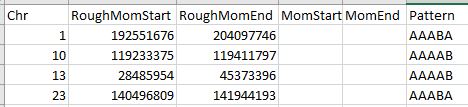
I find my gap to next column handy. The first thing that I notice is that there are not many large gaps. If there were very large gaps, that might indicate an AAAA pattern where all the siblings match (in this case a paternal grandparent). One thing that I added today is a Start and Stop. This is the first and last tested position of the Chromosome. This is good to know in case a pattern is hiding at the beginning or end of the chromosome. Let’s just look at the second line of the spreadsheet. This shows that there is a pattern of ABAB from position 0 to 10M. This means that the first and third people (Joel and Heidi) match the same paternal grandparent and the 2nd and 4th siblings (Sharon and Jon) match the other paternal grandparent.

In the third row of the spreadsheet, a new paternal pattern starts (at 10M). This is ABAA. Now sibling 1, 3, and 4 (Joel, Heidi, and Jon) match each other. The difference between ABAB and ABAA is in the last position where I have Jon. He switched from a B to an A and now no longer matches Sharon, but he does match his other three siblings on the paternal side. As Jon is the one that changed, he gets the paternal crossover at this position.

A few other notes
  • These patterns are gradual. That means that there can be only one change at a time.
  • If it looks like there are two or more changes, then either something was done wrong or you have to invert the A’s and B’s
  • For example, above in row 4, I have an AABA pattern that goes to and ABAB. On face value, it looks like three changes. However, AABA is the same as BBAB. Actually it is the first B changing to an A. This is my position A, so I have a crossover around 54M on the paternal copy of my Chromosome 20.
  • These areas of patterns are also used to fill in bases received from Dad or Mom in the particular areas that the patterns occur in each chromosome.
  • If there are only three siblings tested, these patterns are not as informative.
Mom Pattern spreadsheet

I would not want to leave mom out. Here is the pattern of her 4 children matching on the maternal side:

mompatternchr20

Like the Dad Pattern Spreadsheet, everything looks well behaved as there are no large gaps between patterns. Also there are no gaps at the beginning or end of Chromosome 20. So there you have it. That is the phased DNA for myself and my other three siblings. But it doesn’t jump out at you and I don’t have a map yet. That is where I bring in the MacNeill <prairielad_genealogy@hotmail.com> Spreadsheet.

MacNeill’s Excel Spreadsheet

I adjusted MacNeill’s Chromosome 1 spreadsheet by replacing default numbers for Chromosome 20. Then I added in the locations I had in the spreadsheet above. Those are the Start36 and Stop36 columns. The 36 refers to Build 36 locations which Gedmatch uses. After that I colored in the bars to be consistent with the visual phasing I had done previously.

chr20map1

Actually, I now see that I colored Sharon’s paternal  bar backwards. She should have mostly Hartley (blue). This transposition also carried through to the next image, but I corrected it in the final image. I like having labels, so I copied this into PowerPoint and added some:

chr20map2

Next I add any appropriate cousin matches for Chromosome 20. I also made the sibling names on the left a little bigger. My mistake above on Sharon’s paternal bar is corrected and verified by her large paternal Hartley cousin match with Jim below.

chr20withmatches

I had to bring this back into PowerPoint to re-add the surnames. The places where the cousin matches start or stop may be crossovers for me and my siblings. From comparing the top part of the chart to the bottom, it should be obvious which crossovers are for me and my siblings and which are for the cousins. The good news is that the raw DNA phasing confirms my initial visual phasing done in January, 2016. The raw DNA phasing just filled in what I was unable to. The other good news was that there were significant cousin matches on both the paternal and maternal side of Chromosome 20 to make sure that all the grandparents were identified correctly. Since I did the original visual phasing last January 2016, I have gotten the DNA results of 2 more cousins. Also one additional cousin who previously had her match to only me at 23andme uploaded her results to Gedmatch.

Notes/Summary

  • The hard work in Raw DNA phasing is assigning all the bases of the siblings to the correct parent. Then patterns are discerned and noted.
  • The fun part is mapping out the results.
  • Raw DNA phasing and mapping is more accurate and complete than visual phasing. However, it takes a lot of work and works best when there is at least one tested parent.

  • The comparison of the raw DNA mapping to the actual cousin matches points out the fuzzy boundaries noted by others. This may be seen in Sharon’s short Lentz segment. Her cousin Judy match (who has Lentz ancestry) appears to exceed the length of Sharon’s Lentz segment.
  • Out of the four siblings, Sharon is the one who didn’t get the huge dose of Frazer ancestor matches. That means that she would be the best for looking for smaller matches at Gedmatch.com. Her smallest match is 9.3 cM (5.9 Gen) and my smallest match at Gedmatch is 10.7 cM (5.2 Gen).
  • At a glance, one can see who is the best person for finding matches with each of the four side of the family. For example, I received a full dose of Lentz DNA on Chromosome 20. Here is my Lentz grandmother (b. 1900) in her younger days. Her DNA is represented in yellow in the charts above.

emma