Cousin Rusty and Our MtDNA Match

I had written a draft of this post in February 2021, but had not posted it. I want to post this now as an update. Here is a link to my previous post on mitochondrial DNA (also posted after a hiatus).

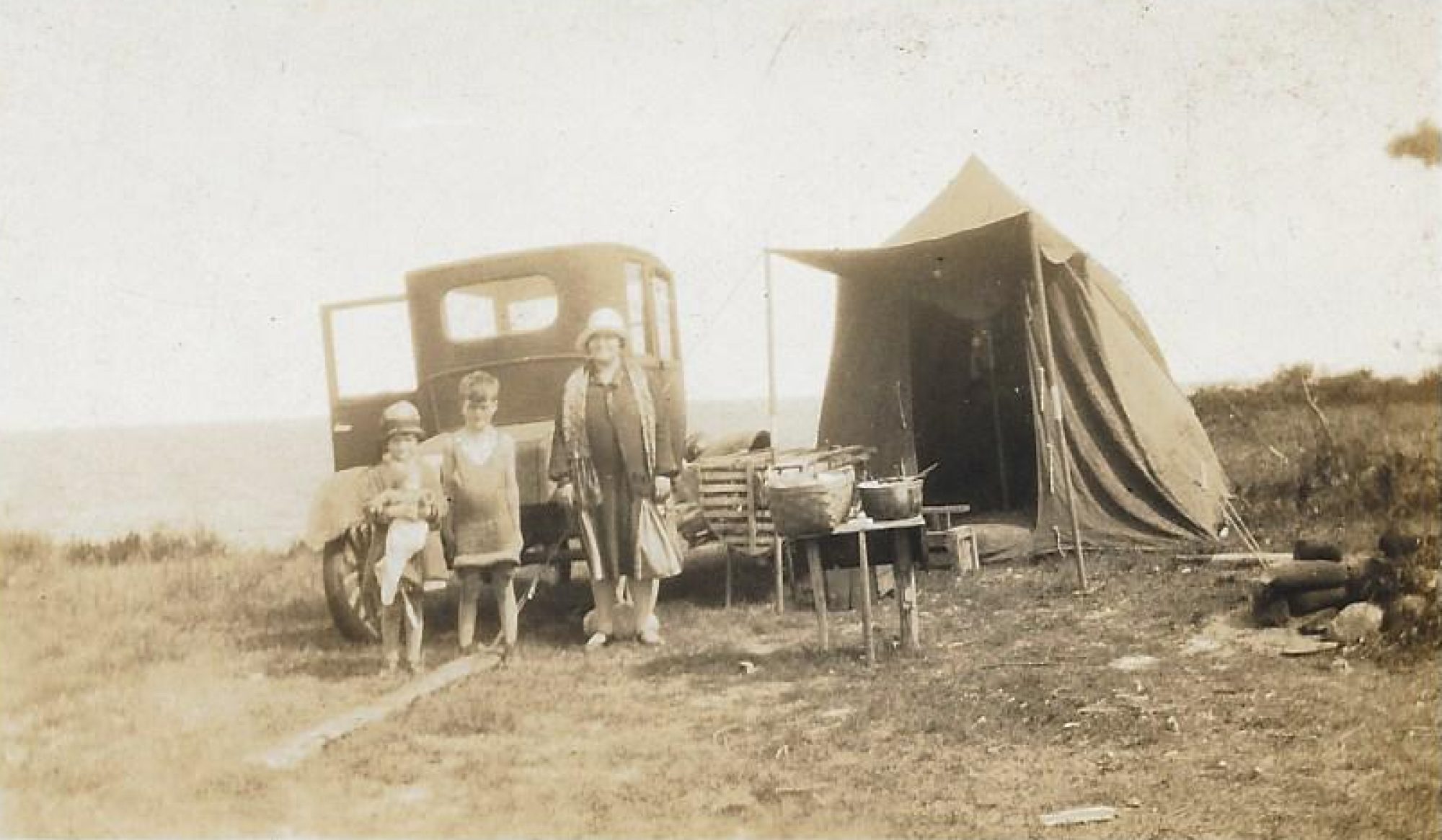
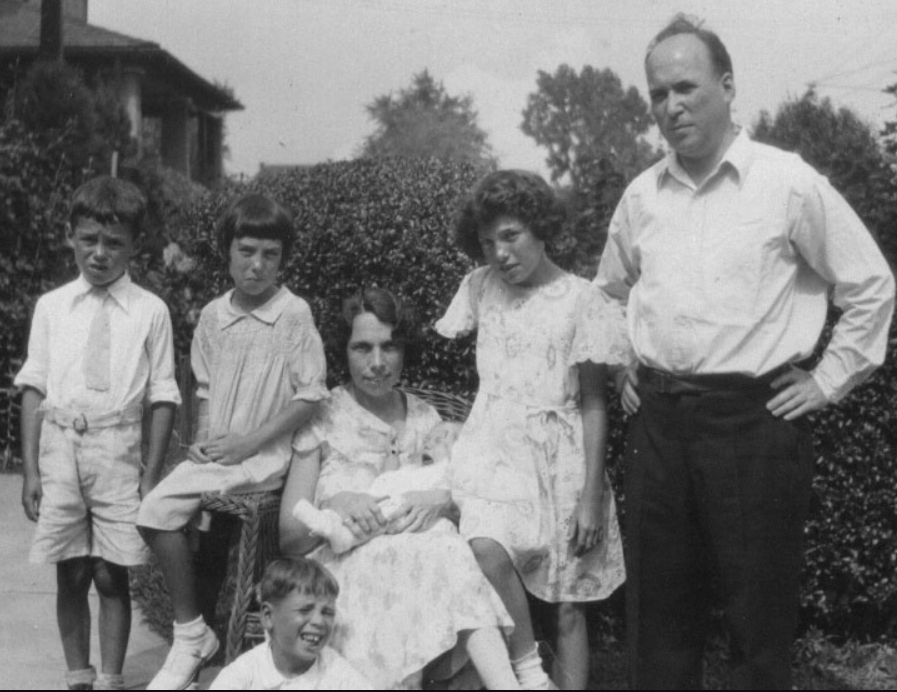
I recently had a nice email from my first cousin Rusty. He told me he tested for MtDNA which is mitochondrial DNA. This is the type of DNA that goes from mother to mother to mother. As we are maternal cousins, we have a perfect match. Our common ancestor is our mother’s mother who was Emma Rathfelder born in 1900. Here is Emma holding her youngest:

Looking at the photo, Rusty’s mom is on the left of Emma and my mom is on Emma’s right. My Uncle Bobby in my grandmotheHere r’s arms was born in April 1933, so the picture must be in the Summer of 1933. My mom was born in December 1921, so she would be 11 years old here. Rusty’s mom, my Aunt Muriel was born in September 1924, so she would be close to 9 years old.

The MtDNA – Haplogroup H5’36

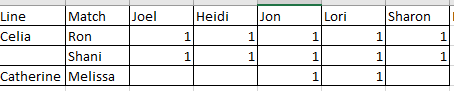
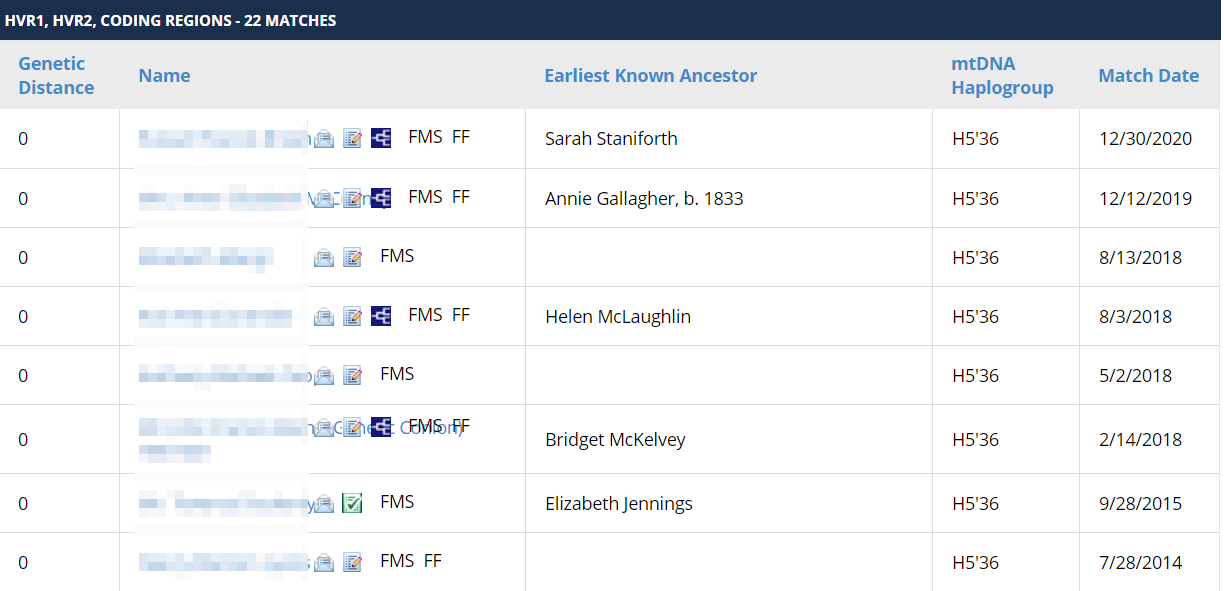
Here are all my MtDNA matches at a genetic distance of zero:

Rusty is the first person with whom I have a MtDNA match and I know our common ancestor. Looking at the last name of my matches are not much help, because with the maternal-only line, the surname generally changes every generation. Even looking at the Earliest Known Ancestors can be misleading. I’ll look at some of thse matches earliest maternal line only ancestors.

Rusty and Me

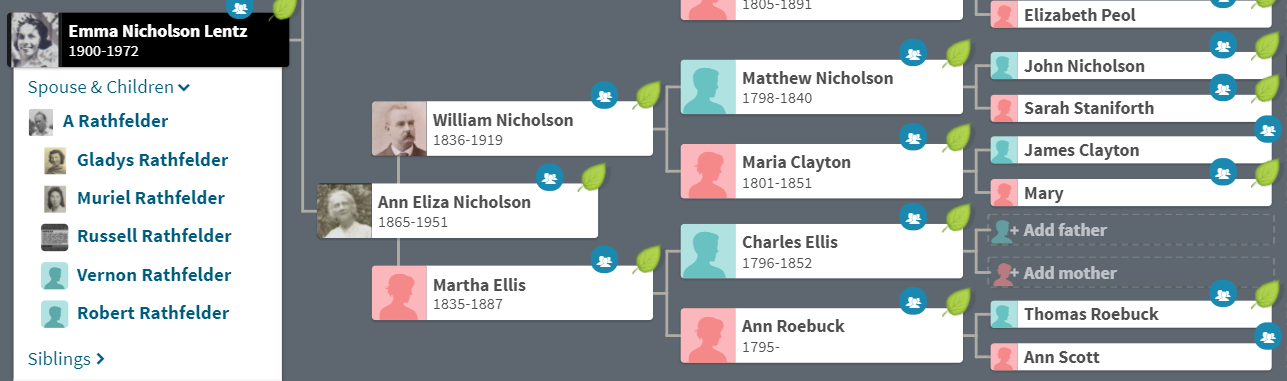
We go back to the Shefield, England area on our maternal side. I have my first known female line ancestor as Ann Scott:

Ann’s mother Ann Roebuck was born in 1795, so we’ll say Ann Scott was born around 1770. That is fairly early. Russ has Sarah Staniforth which cannot be right as she has two male Nicholsons in her line between her and us. Men are not allowed in the MtDNA line. They are only allowed at the end of the line where Rusty and I are.

Other Matches: Gallagher 1833

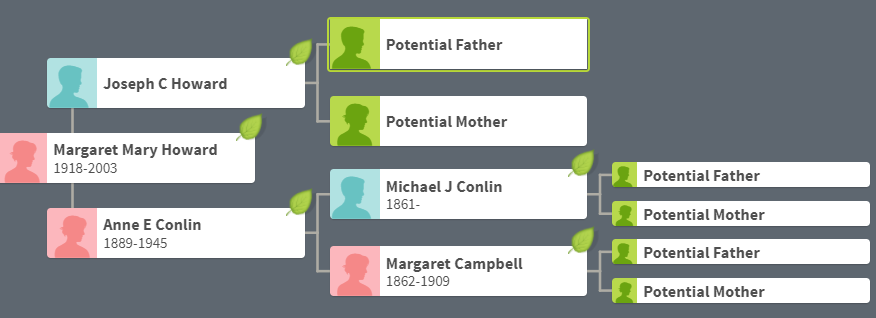
I can’t figure out this tree, so I’ll try to recreate it at Ancestry. I actually started one previously:

In doing these matches, I am intersted in where these maternal ancestors lived, because I am trying to match ancestors and places those ancestors lived. Margaret Campbell lived in Ireland. It appears from a preliminary review that this maternal line came from County Tyrone in Ireland.

McLaughlin

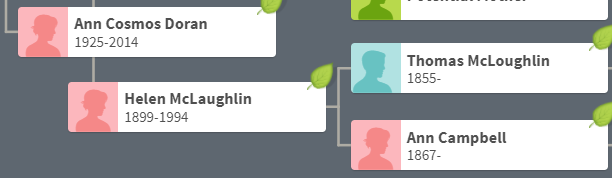
My fourth match has Helen McLaughlin with no date. When I build out this tree, there is also a Campbell from County Tyrone. Coincidence?

Bridget McKelvey

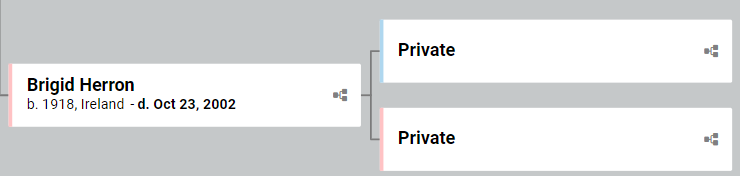
This is from my sixth 0 GD match. This family was also from Ireland. My MtDNA match’s tree is missing Bridget:

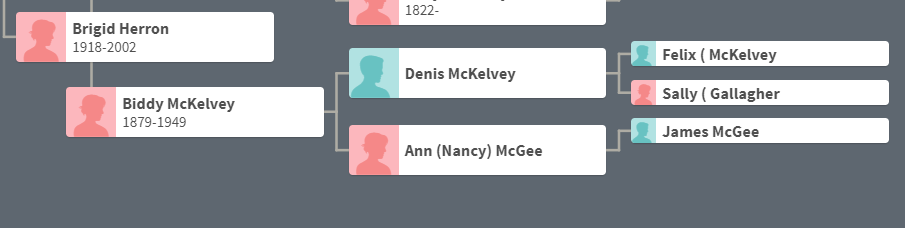
I think that the box marked ‘Private’ is meant to be my match’s grandmother Bridget, but he may have left out her death date, so the program decided to keep this person private. I see another tree at Ancestry which I will borrow:

This gets us one generation beyond Bridget or Biddy reto Ann/Nancy McGee.

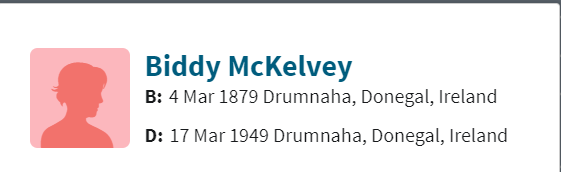
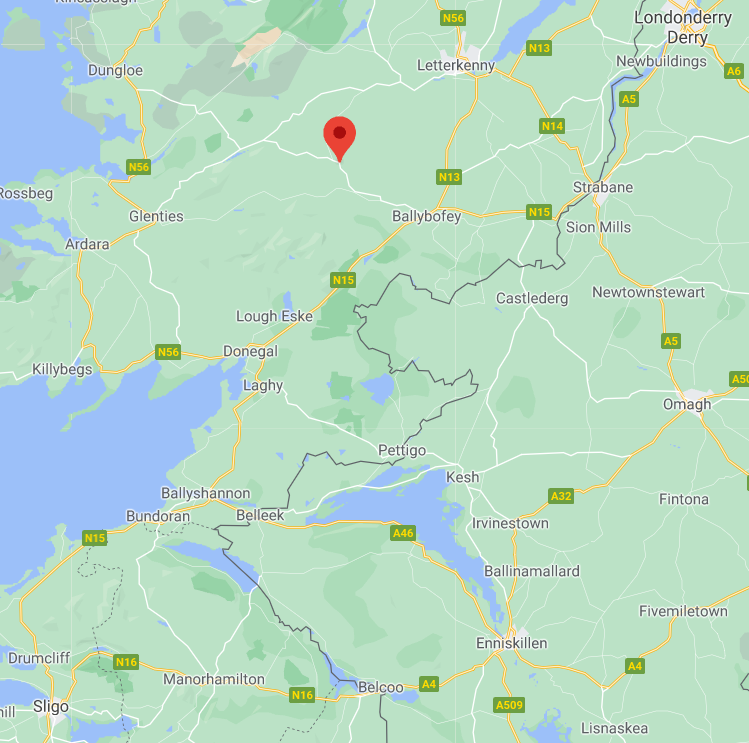
So far, all road lead to Ireland (except for my ancestors). Here is Drumnaha:

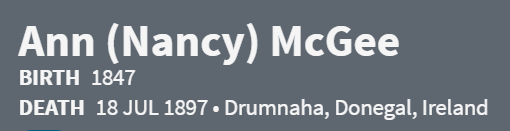
Here is Ann or Nancy:

Elizabeth Jennings

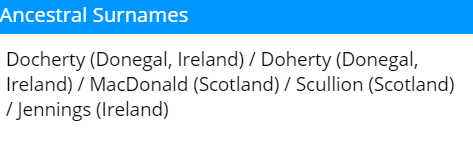
My last zero GD MtDNA match has as his most distant female line ancestor Elizabeth Jennings. Unfortunately, he has posted no tree. He does post this information:

I assume that Elizabeth Jennings was his maternal grandmother and that she was from Ireland.

MtDNA Results at FTDNA

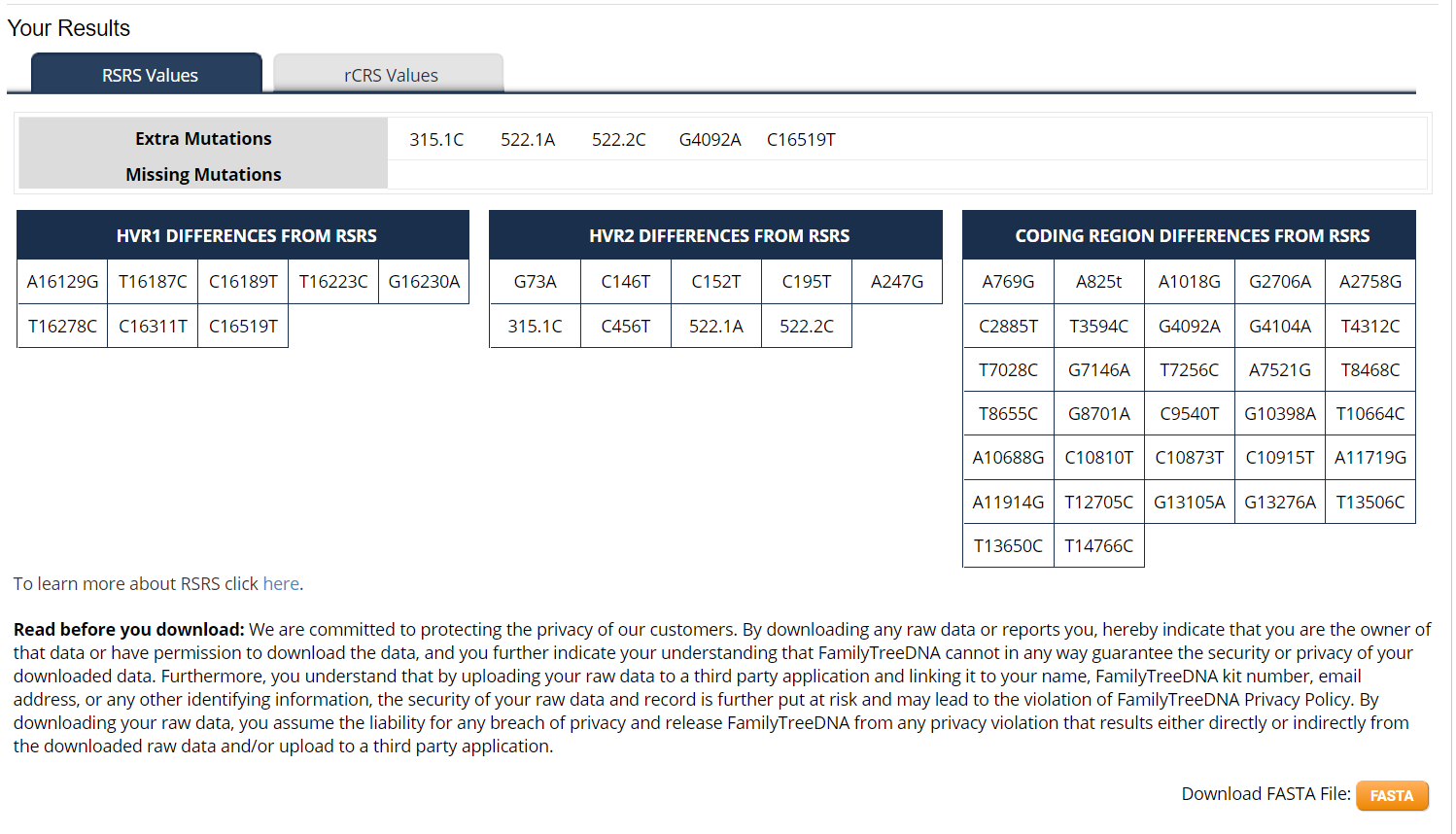
Here is one page of my results:

I am supposed to be able to download my results using the FASTA file buttom in orange. However, I’m having trouble doing that. Apparently FTDNA has an issue with this. Someone on Facebook corrected the error that was on the FTDNA site, so I was able to get the FASTA file. I uploaded this to YFull and to something called James Lick’s web page.

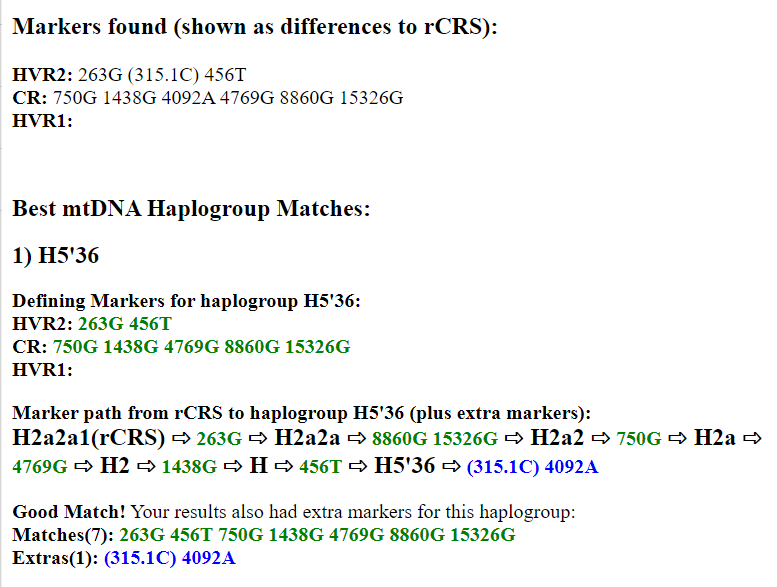
This is what I get at the James Lick MtDNA page after uploading:

Dating mtDNA Results

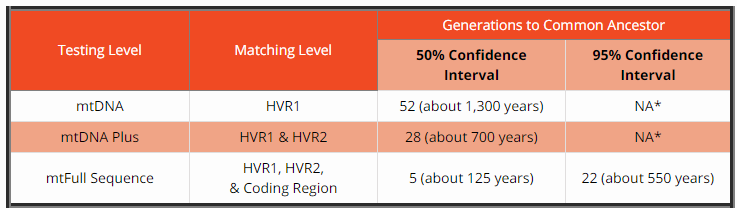
This is a topic that confuses me. I see this graphic at FTDNA:

I can make a few assumptions based on this graphic. One is that this applies to perfect matches only.

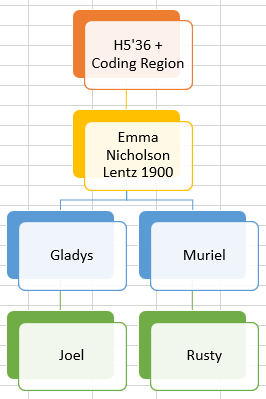
I can build a very simple tree that has Rust and me and our grandmother:

Even though this is a simple tree, it useful nonetheless. We have two generations to our common ancestor. I was born in 1956, so I’ll round that off to 60 years. The next most recent perfect match was frorm 2019 and this person has the maternal ancestor of Annie Gallagher born 1833 in Tyrone, Ireland.

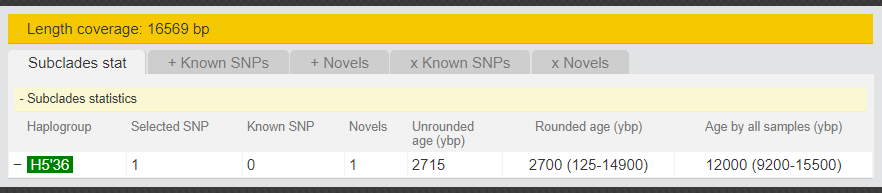
Here is what I see at YFull:

The only number that matches FTDNA is the 125. I posted a question at the mtDNA Facebook Page, and got this answer from Rosario:

First, in order for you to have any verifiable and substantive genetic matches with mtDNA, one MUST have results from the FMS. Anything short of that is useless from a practical sense as full haplogroups and mutations can only be defind through FMS.

Second, once FMS results are obtained, a match with a genetic distance of 0, will lead you to a possible shared ancestor within 2200 years. Yes, you have read that correctly.
I have matches with a gd of 0 from all over the place and there is no way that we can all connect within a genealogical time frame, it simply isn’t possible. Why the company would choose to mislead us with this chart boggles the mimd.

Summary and Conclusions

  • I was glad that my first cousin Rusty tested his mitochondrial DNA as that gives me a match that I know
  • I looked at a few other mitochondrial DNA matches.
  • I noted that generally, mitochondrial DNA matches could be very distant – within 2200 years.
  • My mitochondrial roots (maternal only ancestry) appear to be in the Brithish Isles over the past several thousands of years.


An 1887 Trip from Fall River to the Hartley Farm in Rochester

Abel Burrows was the husband of my great-grandfather’s sister. My great-grandfather was the father of many Hartleys, so many descendants may be interested in this Fall River Newpaper article. James’ sister was Mary Ann Hartley. She married Abel Burrows who owned a Jewelry shop in Fall River. At the time of the visit James’ parents Greenwood and Ann were still alive. James had married Annie Snell two years previous to Abel’s visit in the Summer of 1887. At that time Annie was 21. She had her first son Daniel who was one and was 7 or 8 months pregnant with her second son who did not survive infancy.

Here are Greenwood and Ann Hartley:

Here is James Hartley later in life:

Here is his wife Annie, probably close to how she looked in 1887:

Fall River Daily Herald 12 August 1887

I originally wrote about this article in a Blog about Abel Burrows. The writer of the article was John Slinn, a friend of Abel’s who worked in the insurance business. Abel’s wife is mentioned in passing. I assume that the place where they go fishing is Snow’s Pond. The place they visit is no doubt the Hartley Farm at the beginning of Snipatuit Road near the Mattapoisett River where the Memorial Day Boat Race starts.

Two days prior to the article (10 August 1887), I found this bit of news in the Fall River newpaper:

Here is the main article. August 10 was a Wednesday. The article mentions a Monday – two days previous:

This appears to be the only mention of Mary Ann Hartley Burrows. Mary Ann was 32 in 1877. Here is Mary Ann about 34 years after her trip to Rochester in 1887:

9-1/2 hours from Fall River to the Hartley Farm.

As far as I know John Slinn never published the follow-up article. I think that John may have been influenced by Mark Twain based on his writing style.

Big Y “Backbone Tests”

I recently noticed that a Backbone Test had been ordered for my late father-in-law. This surprised me as it was a bit dated.

I mentioned this at the BigY Facebook group and got an interesting answer from Bob:

I think you will find that this Y-HAP-Backbone was ordered as a part of a manual review process triggered by another user’s test results.
Originally, the Y-HAP-Backbone test was performed if FTDNA was unable to unambiguously predict a person’s high-level haplogroup from their STR test results. They would actually perform enough SNP testing to resolve the ambiguity.
In the case of somebody who has actually done a BigY test, there should be no necessity to predict a haplogroup from the STRs.
Normally, the automated caller will consider a result to be a no-call if there are not at least ten reads for that position. If a new kit has a result that might affect the haplogroup definitions, a manual review of the other kits assigned to the haplogroup may occur. The analyst doing the review will look at the raw data and may decide to override the no-call reported by the automated caller. To do this override, the analyst orders the Y-HAP-Backbone procedure. In this case, no actual lab work is involved. It is simply a database operation to report the new result for that SNP.
If you display the user’s Private Haplotree, you can scroll to the top of the page and click on the “SNP Results” link, you will see a list of SNPs. If there are any overridden SNP results, they should be sorted to the top of the list. The test type will be shown as Y-HAP-Backbone. The result may be positive or negative.
If you scroll down through the pages of this report, in addition to any BigY test results, if the user has done any other SNP testing, you will see those results listed. In the case of BigY test results only positive results are shown. (After all, you are negative for several hundred thousand SNPs.)
In my own surname project, until recently our haplogroup had one subclade. We had three men assigned to the main haplogroup and six men assigned to the subclade. Even though our BigY test results actually showed the three of us to be negative for the SNP defining the subclade, these negative results were not being shown in the SNP Results list in our Private Haplotree. During an early manual review, the analyst ordered the Y-HAP-Backbone procedure for the three of us. The result is that we now are shown as negative for this SNP. The color coding in the tree now indicates that we are “Tested Negative” instead of being indicated as “Downstream”. Since that time, a new kit was found to share an additional SNP with one of the three. This resulted in a second subclade being defined. The analyst creating the subclade did not bother to override the calls for the two men remaining in the main haplogroup, so we show “Downstream” for the new subclade.
By the way, the order status for the three of us with negative results for the Y-HAP-Backbone procedures for the SNP defining the original subclade still shows that order as pending. Apparently because no lab work was performed, they failed to mark the order as completed. We have other Y-HAP-Backbone procedures (with positive results) that did get reported as completed.
Does the entry in the SNP Results list for your member’s kit show negative results, or are they all positive?
I was happy to get this reply as it answered many questions I had for my Butler father-in-law’s test as well as a Frazer project I am working on. I posted this image of my father-in-law’s SNP results at the BigY Facebook  Page:
I asked Bob this clarifying question:
Sorry, though, still a bit confused. Are you saying an override does not involve SNP testing? So in this case, the Backbone means no test and the tested negative means that a test was done?
Bob’s response:
While it may be a little confusing, the answer to both is yes. FTDNA does not offer a single-SNP test for FT241245, so the backbone procedure did not involve a laboratory test. They just looked at the raw data from the BigY test. You should be able to do something similar using the chromosome browser. When looking at this user’s BigY Results (Named Variants tabs, change the Derived? filter to Show All and enter the SNP name in the SNP Name Search box.
I suspect that it will show a ? In the Derived? And Genotype columns. Click on the SNP name to bring up the chromosome browser. I suspect that you will have fewer than ten reads shown, resulting in a no-call.
By the way, the Y-HAP-Backbone procedure results in the line being added to your SNP Results list. However, it does not actually result in a change to your raw data or what is shown in the Named Variants tab.
In response, I posted this image of my father-in-law’s results for FT241245:
I wanted to memorialize Bob’s comments as they were so helpful. I have been looking at “Backbone Test” results in a Frazer YDNA Project that I am involved in and Bob’s response answered so many of my questions.

Butler and S23612

As alluded to above, S23612 shows on the SNP results as ‘tested negative’. Let’s look for those results:


Just as Bob predicted, this shows up as tested negative. However, I’m not sure why this particular SNP was chosen. I would think that I-S23907 would have made more sense or perhaps BY115420.

Here are my father-in-law Richard’s results for S23612:

He is already clearly negative. Plus this SNP appears to be about 4 or 5,000 years old.

Speaking of S23897

I see that I mentioned S23897 in a previous Blog on Butler YDNA.

This is for a Butler relative with common Irish roots, but we have not yet established a genealogical connection. Now, thanks to Bob, I know where to find this Butler’s secret testing results:

Well, perhaps not secret, but they were to me previously. This Butler has a surprising 7 Negative SNP results. What I am seeing is that this Butler relative must have ordered these SNP separately before he did his BigY:

Frazer Backbone Tests

I have been waiting for Frazer ‘backbone tests’ to complete. However, according to Bob, these could be manual overrides instead of actual tests. Also, confusingly, these tests may not have an end date if the reviewer forgot to put in a date.

Here is a view of the Frazer BigY testers from the view of one of the testers from the James Frazer Line who took the BigY500 test:

My labels didn’t come out too well. The first column represents the James Frazer line and the ‘Your Branch’ represents the BigY500 tester on that line. At the top of his SNP results, we see this:

From the comments from Bob, the Y-HAP-Backbone should represent a manual override for Y151390 which is the defining Haplogroup for the James Frazer Line. Here is the order history for that same tester:

This is confusing because of the batched designation which shows after the ‘completed’ designation. However, I assume that these three entries were for the one override for Y151390. Here are his test results:

Here, he only has 7 positive reads where FTDNA would like to see 10. However, the manual review said they were all positive, so let’s say he is Y151390.

BigY700 on the James Line

The same thing apparently happened for the BigY700 tester.

Here is the James Line BigY700 order history:

This takes some interpretation. I assume that the Backbone got entered twice by mistake and that only the one entry that was actually done shows as completed. Keep in mind here that ‘backbone’ means manual override of inconclusive test results. Here are the BigY700 test results for Y151390:

This is a bit surprising as the results show positive for Y151390, so there were no questionable results to override.

My guess is that the manual review took a look at these results and agreed with them.

Archibald Line Results and Frazier BigY results

The BigY500 tester had no overrides in his SNP results. The same for the BigY700 tester. That must mean that FTDNA had no questions about their results.

That leaves the Frazier BigY results. He also has no unusual results on his list of SNPs. That means that the review was completed for Frazer/Frazier BigY’s some time in early February.

Summary and Conclusions

  • It was a help for Bob from the BigY Facebook Page to show me where to find the SNP Results link at the top of the BigY Haplotree view
  • This gave more clarification to the manual review which FTDNA performed and explained why it looked like a Backbone test was outstanding
  • FTDNA has a confusing array of places where they store information and show the results of the work they have done. They also seem to do things inconsistently. However, with perserverence and help from others who have gone through the process, it is possible to get an idea of how one’s BigY test was reviewed and processed.


Whetstone YDNA

I am the project administrator for the Whitson Project. The overview is that there are many branches of Whitsons who are unrelated to each other by YDNA – or so distantaly related in the range of 10’s of thousands of years to be considered unrelated. My wife’s Butler family is more closely related to one of these branches (or that Whitson branch is related to my wife’s Butlers). The Whetstones did not have their own surname project, so they asked if they could join the Whitson project even though they are not related.

Some Whetstone Genealogy

This is some genealogy that I received as a response to a Blog I wrote on an update on the Whitson project:

Hello. Just wanted to say that you have my4th. great Grandfathers
Y DNA. Absolem Whetstone. Kit # NI 26222. My BIOLOGICAL GRANDFATHER is Uthil Maynard Whetstone. B.1914-D. 2000 I was adopted by Grandfather and Grandmother. Next is his father William David Whetstone B.1893-D.1954.
Next his father William Wesley Whetstone B.1886-D.1934 Next is his Father Samuel Marion Whetstone B.1830-D. 1905. Next is Absolem. Next his father was Adam Whetstone Jr. B.1776-D.1815. Next his Father is Adam Gutler Whetstone Sr. B.1744-D.1782. Killed in the last battle at Eutaw Springs, SOUTH CAROLINA USA

Our Whetstone family located to land in Charleston
SOUTH CAROLINA,USA. in 1737 moved up the Edisto river to join Our Salley family that made the trip from Bern Switzerland two years earlier in 1735. Spelling is Felix Wetzsein B. 1633-D.1710 TO Change to Rev.(JOHN) D. Hans Johannes Wettstein B.1695-D.1754 next we have the start of spelling Adam Gutler Whetstone B.1744-D.1782

The short story is that the family had its roots in Switzerland as Wetzsein and moved to South Carolina. I assume that others in the Whetstone project are related to each other. At least they are in the same very general YDNA Haplogroup.

Whetstone YDNA

Currently there are 5 YDNA testers in the Whetstone YDNA Project:

R-M269 is a very general YDNA Haplogroup in the family of R1b. One Whetstone has taken the BigY test. BigY tests are better off taken in tandem. That means that if another Whetstone takes the BigY test, then that will create a Whetstone YDNA Branch on the tree of mankind. With one BigY test, the results show what other families Whetstone is related to and should give some background as to where those other families were from.

Whetstone BigY Test

The BigY is the best YDNA test available, so I’ll just start with that. The Whetstone with the ancesor Absalom Whetstone has taken the BigY and the result was R-BY56768. One way to get an idea of where this is on the YDNA tree of mankind is to look at the Whetstone BigY tester’s Block Tree. It will take two images to show this:

On the top of this Block Tree, we see how Whetstone descends from R-M269. Of the Haplogroups under M269, there are two major intersections or decision points (or subgroupings). These are P312 and U152. They can be seen at this Tip of the Iceburg Tree from the R1b All Subclades Project Overview:

I added a few arrows to show where Whetstone is. Here is an closeup of the same tree focusing in on U152:

U152 shows up in SE Germany in 2,500 BC. Next, let’s search this map to find the Whetstone path. L2 is another major branch point near the middle of the tree. BY31138 is the third Haplogroup down under L2. That is as far as the Tip of the Iceburg can take us.

Whetstone and U152

Eupedia has an L2 tree:

Unfortunately, I don’t see BY31138 on it.

Whetstone and BY31138

It is possible to build a tree from the FTDNA Haplotree. Here is the Whetstone BigY tester’s Haplotree:

The good news is that there is only one branch under BY31138. I need to go down further to get the whole tree:

Here is a start in Excel:

Whetstone is under L135. Here are two more levels:

Whetstone is still on the left. Here is where we are on the Whetstone BigY Block Tree:

That means that there are only three more levels to get to BY56768. Here is what I get:

The Rest of the Whetstone Block Tree:

The Whetstone tester is on the left. This shows no matches but two countries. There are actually matches, but FTDNA doesn’t show them due to the distance of the matches. One country must be for our tester as he had the United States as the country of origin of his most distant ancestor. Whetstone matches another family, but that match is up at BY56768 which is about 30 SNPs away. If we assume that a SNP forms every 100 years, then this could be about 3,000 years ago or 1,000 BC.

More BigY Testing Needed

If another Whetstone tested, then another branch would form in much more recent time – at the time of the common ancestor of the two Whetstones.

Whitson in the U152 and Subclades Project

I know that the Whetstone BigY tester is in the U152 Project. Are there others?

Here there are four Whetstone/Wetzstein/Wettstein surnames. The first tester with the oldest Wetzstein ancestor is not in the Whitson Project. Then there are two Whetstones in the Whitson Project that are not listed in the U152 Project. However, the first tester in the U152 Group only had 12 STRs tested.

Here are some others under BY31138:

The first group is generally under BY3508 but need further testing. The second group is BY111101. I left this out of my tree:

The common ancestor between Whetstone and B111101 is BY3508 which would be at least 2,000 BC, so we won’t worry about these people. It would be better to look at the closest matches to the Whetstones. They would be under FT292871:

Above, the closest match at the U152 Project is Schaal. I don’t know where this person was from  in the 1500’s- probably Germany or Switzerland. This match is in the right general area, but the common ancestor is still pretty ancient – perhaps around 1,000 BC. The bottom line is that there needs to be another Whetstone BigY tester.

Summary and Conclusions

  • I looked at some of the YDNA results for the Whetstone surname
  • The most important result is from the Whetstone who took the BigY
  • This BigY tester defines the Whetstone Hapalogroup and by implication the rest of the Whetstone family as R-BY56768 for now
  • This BigY defined where the Whetstone family is in general terms on the YDNA Haplotree
  • Right now the closest match to the Whetstone BigY tester is likely not a Whetstone and their common ancestor could be about 1,500 years ago.
  • To get a Whetstone YDNA haplogroup in the genealogical timeframe, it will be necessary to get an additional BigY test.
  • A good place to look for candidates for further BigY testing would be among the Whetstones who have already taken a YDNA STR test


Taking a Different View of My Hartley Haplogroups: FTDNA’s Colored Dots

FTDNA has two major ways to view your Haplogroup. The most common is the Block Tree. The other is through one’s badge. Here is the Hartley badge:

This Haplogroup of R-FT225247 was obtained when I tested my brother’s YDNA using the BigY 700 test. This distinguished our branch from other Hartleys who were A11132. Here is the Block tree from the viewpoint of my test:

By getting my brother tested, that gave me someone closely related to match my Private Variants. Once they are matched, those Private Variants went up on the tree into our old branch. The other Hartleys are to the right of our Branch in A11132 where I previously was. The problem is that FT225247 is still an old Haplogroup. I’m guessing that it could go back about 450 years to 1570.

FTDNA’s Y-DNA-Haplotree

When I click on the badge above, I get this:

Actually, I get more, but this is enough.  Under R-FT225247, it shows the other SNPs that make up the group.  There are a total of 7. To the left of each SNP is a dot. Here is the key:

I don’t find the yellow dot accurate. It is only used when that is the SNP used for the tree. Actually, for every SNP on my tree, I should not have a grey dot. For example, I am part of A11132. BY16417 is part of that group. I should be presumed positive for that SNP, not presumed negative. The same should be true for BY4026 and BY4028 which make up Z16357.

For the SNP below me, I should have Tested Negative for those, but as the results must not have been clear, I was Presumed Positive. The advantage of the Y-DNA Haplotree is that it gives more information on the quality of the SNPs tested.

Looking At My Brother’s Y-DNA Haplotree

Here my brother had better results than me at Z16357. He at least test positive for that SNP.

SNP Testing Quality

Above, I was presumed positive for Z16357. This is how the test results for that SNP show up for me:

The results look good to me. There are twelve good reads of a mutation and one good read that shows no mutation.

Next, I’ll see my brother’s test:

My brother had 12 good reads, but no read showing no mutation, so FTDNA must have a formula that deals with that.

A11130

My brother’s Haplotree appears to say that his A11130 test was presumed negative. However, the actual test, shows that he is definitely tested positive:

That makes me wonder about my test results:

My results are even better. The lesson is: don’t trust the little dots by your SNPs. Better to check the test results.

Negative Results

The negative results are important as are the positive ones. Here is my Haplotree:

The places where I have arrows are the gray SNP boxes which I should be negative for. I should have red dots for these SNPs and their equivalents. Here is the key again:

I don’t have any red dots which is suspicioius. I’ll check my A7 which is a higher level SNP. The 232 next to it must mean that there are 232 testers in that Haplogroup. Clearly I have tested negative for A7:

Clearly I am negative for A7. Perhaps FTDNA only shows negative if I take the single SNP test?

Summary and Conclusions

  • I looked at the Haplotree view for my BigY test and my brother’s BigY test
  • The Tested Positive green dots seem accurate.
  • The Presumed Positive is accurate but on in the case where that SNP is the defining SNP for the Block of SNPs. In my case, that was for SNP Z16357
  • The Presumed Negative is also inaccurate. The actual test results need to be checked. If you are positive for a block of SNPs, then you should be positive or Presumed Positive for all the SNPs in that Block.
  • The blue dot would be helpful in showing downstream SNPs. However, as I had my brother and myself tested, there are no downstream SNPs.
  • It seems like the red dot for Tested Negative should appear much more often unless it is reserved for the Single SNP test at FTDNA.
  • My conclusion is that the color coded dots for the SNPs do not work well

A Different Look at the I2 Butler/Whitson BigY Results

In my previous Blog, I set out to look at the finalized results of my brother-in-law’s BigY test. While doing that, I saw that a Whitson in the I2 section of the Whitson/Butler Project had also taken a BigY Test. That test apparently helped to place a lot of my brother-in-law’s previous Private Variants onto the YDNA Tree. Here is a summary of the overall Whitson Project:

The part that I am looking at in this Blog is the green area. This is on the YDNA tree in the general area of I2. Those who have taken the BigY test are in green. My brother-in-law is the next to the last tester on the list and my father-in-law is the last. Batt, Butler tester with James Butler as ancestor and my father-in-law Richard, had the older BigY500 tests. The new Whitson tester who doesn’t show an ancestor and my brother-in-law had the new BigY 700 tests.
The BigY Block Tree for Whitson/Butler at I2

Here is the Block Tree:

The Butlers are under I-Y128364. Batt has Whitson ancestry. that means that I-BY115420 is the Whitson side. Above this is a large Block of SNPs from position 7 to position 45 (not shown) collectively named for one of the SNPs in the Block: I-Y128591. The Block tree is from my brother-in-law Ken’s perspective, so he is not shown but is in the left column under I-FT241245. Because the older tests of BigY 500 did not cover a lot of the SNPs, the two new testers (one Butler and one Whitson) have greatly helped to improve the tree. However, I think that the tree could be better. I will likely discuss that later in the Blog.

The Different Look

Here is the different look from FTDNA. I’ll start with Ken. This just focuses on the individual, where the Block tree represents 5 testers. Here are the headings for the tree:

The detail will be in the five categories of tested SNPs.

There is no need to go too far up this tree. As I mentioned above, I-Y128591 has 39 SNPs in it. This could represent about 3900 years. I-Y128364 represents the Butler with the James Butler ancestor. I-BY115420 is the Whitson group. Ken only has two colors of the dots representing ‘tested positive’ or ‘presumed negative’. I would think that he should have some yellow dots for ‘presumed positive’. For example, Ken should be presumed positive for BY48499 under A427, then he should be presumed positive for FGC70597, etc.

Here are Ken’s results for BY48499:

This shows four out of five runs came up with a mutation at this location.

My Father-In-Law’s Version of the Tree

This view is pretty much the same except that, as he had the older BigY 500 test, he has more gray dots (which I believe should be yellow dots).

Tester with James Butler Ancestor

These results introduce a few more colored dots. FT241245 has a blue dot for downstream. He also has a red dot for S23897. That confirms that he tested negative for this SNP and was not just presumed negative. Again, I believe that all the gray dots above the highlighted row should be yellow dots.

New Whitson Tester

Here I highlighted a SNP with a red shopping basket. It is noted that this SNP is part of a SNP Pack.

Batt

I would expect to see more gray dots for Batt’s BigY 500 test:

Back to Private Variants

I spend a lot of time on Private Variants as they are on the cutting edge of the BigY tests. If these are really private variants, then they should describe a future branch of the tree. If they are not, then they should be describing an upstream branch of the YDNA tree.

Ken and His Dad

Due to the closeness of the relationship, Ken’s dad should not have any SNPs that Ken does not have. Richard has no Private Variants, but he also took a less comprehensive test. As these SNPs form about every 100 years on average, it would be rare also for Ken to have Private Variants. Yet he has three:

I have Ken’s Private Variants (PVs) in yellow above. These positions were not tested for in his father, but if they were, he would most likely test positive for them. The next to test is Eng Butler or the Butler with James as his ancestor. I have that he has a ? by his results for 17140468:

Batt has the same ambiguous results and Whitson has a definite no. That means that we don’t know if Ken’s ‘Private Variants’ should show up under FT241245 or Y128364:

Ken’s PVs probably would not show up under Y128591 as Whitson tested negative for these PVs.

James Butler Ancestor Private Variants

The tester with James Butler as an ancestor has these Private Variants:

If we can trust these are truly Private Variants, then we can say that they define the James Butler Line down to the present day tester.

Here, Ken tested negative for these two positions. So the two Private Variants for the James Butler ancestor are valid. There may be other positions that were not tested for under the BigY 500 test that could be private variants also.

Whitson Private Variants

These are from the newest tester in the group:

Whitson has three Private Variants. I’ll check Whitson’s closest match who is Batt. Batt is actually negative for 12984909:

The other two positions are unclear:

That means that it is possible that the second two positions could actually be SNPs for Batt and Whitson under BY115420.

Batt Private Variants

Batt has two PVs:

My guess is that these two should be valid. Again, I’ll check Batt’s closest match who is Whitson:

Whitson does not have the first position.

Whitson has a clear ‘no’ for 19550845 also. This means that Batt has two unambiguous Private Variants.

Common Ancestor Dating

This is easier to see in the Block Tree view:


The places where the common ancestors are dated are in the ewhite space btween the SNPs. The common ancestor between Butler and Whitson is in the white space where the second arrow is. The common ancestor between the two Butler families is in the white space where the first arrow is.

Common Butler Ancestor

In order to get to the date for the Butler ancestor we need to assume a number of years per SNPs or Private Variant. I will use 100 as a round figure. I know that Ken has three private variants, so I will say that he shares 1.5 private variants with his father. That is assuming that FTDNA is right with the analysis. It is also possible that Ken actually shares his Private Variant with the other Butler Branch. That would put those SNPs in a Block under Y128364.

I’ll add those 1.5 private variants to the the two SNPs under FT241245 to get 3.5 SNPs. Then I’ll average those with the other Butler’s two Private Variants to get 2.75. Based on the assumption of 100 years per SNP, that would results in a common ancestor for the two Butler Lines of 275 years ago or the year 1745. That sounds pretty recent.

Common Butler/Whitson Ancestor

There are many more SNPs on the Whitson side compared to the Butler side. This means that it is possible that the Whitson SNPs came about more often than the Butler SNPs. However, the end point has to be the same for the common ancestor for these two groups. that is where the second red arrow is above. Average 2.75 with 6 to get 4.375 or 438 years. That puts the common ancestor for Butler and Whitson at the year 1582. If I come back down on the Butler side and add 100 years for Y128364, I get 1682 compared to the 1745 I previously had.

I used the 1682 date above because it was based on averaging more SNPs. For the second Butler Line, that means that a SNP was formed about once every 130 years assuming that tester was born around 1940. Also, that tester may actually find more Private Variants if the test was upgraded to BigY 700. If we use the present date, then there would be a SNP every 170 years.

On the Whitson side, there were 6 SNPs in about 440 years to present. That is a new SNP every 73 years.

Summary and Conclusions

  • I took a look at 5 BigY tests from the point of view of their individual Y-DNA Haplotrees. This look gives some extra imformation on the testing results for testers’ individual SNPs.
  • I took another stab at estimating dates to common ancestors based on the way that FTDNA has the SNPs and Private Variants for the five Butler/Whitson BigY testers. These results were very similar to what I came up with in a previous Blog.

A Different Look at the Frazer YDNA Tree


In this Blog, I would like to look at the 5 BigY Frazier/Frazer testers looking at their FTDNA YDNA Trees. In the past, I have looked at the Block Tree. Here is the Block Tree from Rick’s perspective:

Starting from the left I first see Rodney. To find Rodney’s Y Tree (which FTDNA calls the Y-DNA Haplotree), I click on his YDNA Badge:

Here is Rodney’s Y-DNA Haplotree:

The difference between this tree and the Block Tree I showed earlier is that the Block Tree shows the tester and his matches. This Haplotree only shows the one tester’s results at a time. However, there  is more information on the quality of each SNP tested. Above, I show how Rodney descends all the way down from R-YP6483. The actual tree goes much further back. All the groups that he is positive for are in green and the groups that he does not belong in are in gray. Here is the heading for the tree:

The dots by Rodney’s SNPs are also either green for Tested Positive or gray for Presumed Negative. There are some SNPs within the green groups that have gray dots. I think that those should be yellow dots for Presumed Positive. That is because if you are in a group, you need to be positive for each SNP within that group.

Going back from his terminal Haplogroup, BY116270 is the first SNP that Rodney has that shows as presumed negative.

Also in the heading, FTDNA says ‘View by Variants’. These are technically Variants, but in order to not get mixed up with Private Variants, they could have called them SNPs.

Jonathan’s Y-DNA Haplotree

Jonathan’s tree must be the same as Rodney’s except for the gray dots. Jonathan had the older BigY 500, so he should have more gray dots:

Here, Jonathan does get a yellow dot for R-FT421618 and he gets yellow for the whole group which means presumed positive. To find Jonathan’s test results for FT421618, I need to get out of the Y-DNA Haplotree and look at his BigY Matches or Results. I usually look at the Matches and then choose the Named Variants Tab:

At the bottom of the list (not shown), Jonathan has 1051 Named SNPs. I’ll search for FT421618. I have to search under all results, because I won’t find this SNP under Derived. This SNP comes up with a question mark.

Here are Jonathan’s test results for that SNP. He was positive for each of the four reads for a Variant there, but usually 10 reads are needed to prove that he was positive for this SNP. However, as Jonathan is positive for child SNP of R-Y151390, he must also be positive for the parent SNP of FT421618.

While I’m looking at Jonathan’s results, he (like Rodney) has a gray dot for BY116270:

Rodney shows 17 reads where there is a mutation from T to G. However, he also shows 10 cases where there is no mutation. FTDNA must use some formula to determine that this does not make the grade.

Let’s see what Rodney shows:

This shows the same funny pattern. I don’t know what the black means. I guess it may mean that there was no read there. Rodney had fewer good reads compared to Jonathan. However, because this is in a SNP group that is four levels above Rodney’s and Jonathan’s terminal Haplogroup, they shoul both be presumed positive for this SNP.

Bottom line is that Rodney and Jonathan are solildly in R-Y151390. Y151390 represents the James Branch of the Frazer family or more specifically the Thomas Henry Branch from 1836:

All the other SNPs that are upstream of Y151390 based on the testing of the other matches are less closely related.

Rick and Paul in the Archibald Branch of Frazers – R-Y85652

Y85652 has a shorter number. This should be an older SNP, discovered in 2017 – probably when Jonathan had his BigY done. Rick, like Rodney has the newer BigY 700 test. Here is Rick’s private tree:

I went a little higher on the tree this time, just to show tht the tree keeps going back. One interesting thing is that we see that Rick is presumed negative for Y151390 that Rodney and Jonathan had. That may be worth looking into. Looking up at Rodney’s and Jonathan’s trees, we see that they were also presumed negative for Y85652.

When I put the trees of Rodney, Jonathan and Rick together, this is what I get:

There are a lot more question marks than are ideal. However, the positive tests so far, are what are breaking the testers into their two groups.

Do Paul’s BigY Results Help?

Paul had the older BigY 500 test. I am a second cousin once removed to Paul. That makes me a fourth cousin to Rick.

Paul also has no negative for sure results. If he did, these would appear as red dots. Ideally, Paul would show negative for R-Y15130 and FT421607 as he is not in that group. The last verified negative result that I had found was in the Frazier BigY that I had discussed in my previous Blog:

The negative is shown in red above and we will get to that test later in the Blog. Above with Rick and Paul, they are presumed negative because Rodney and Jonathan are positive for Y151390. This is what I see for Paul’s test at Y151390:

I assume that this is the same as not being tested as no position number is given. Next I’ll look at FT421607 for Paul:

Here he had one read but it didn’t make it to that Position. I would say that Paul has not been tested for this SNP:

Rick’s Testing for Y151390

That makes me curious as to how Rick made out on the James Frazer Line SNPs. So far, there are different flavors of SNP testing:

  • Positive
  • Presumed Positive
  • Negative
  • Presumed Negative
  • Not Tested

Here I am a bit surprised:

Rick is definitely negative for this SNP. So I had the wrong information previously:

Here I have a red N for Rick for Y151390.

Next, I’ll look at FT421607. This shows why it is important to check the results and the Y Chromosome Browser.

This means the results are better than I thought previously:

This chart shows a clearer demarcation between the James Line and the Archibald Frazer Line. When defining Haplogroups, it is important not only to show that one group is positive for a SNP, but that the other group is clearly negative for that SNP.

Clearing Up the SNPs

Looking at the above chart, I should check all the question marks. The first is for Jonathan at FT421607:

Here, Jonathan was 100% positive for FT421607, but only had one read.

Here are Jonathan’s results for Y85652:

These results are different from what I had previously. Either I entered them wrong before or FTDNA has clarified by additional testing. I think that the results of the Backbone Tests have come in, because, I am seeing different results now. I checked all of Jonathan’s Archibald Line SNPs and he is now negative for them:

Now we can see a clearer border between what I call the J Line and the A Line.

The next logical step is to re-check Rodney’s results. Starting with Y85652, Rodney is now negative:

He doesn’t have as many reads but quite a few more than 10. The other two SNPs from the Archibald Line followed suit for Rodney:

It appears that the only questionable tests now are Jonathan’s test for FT421607 which only had one read and Paul’s two James Line SNPs which didn’t get tested. These results have me going back to Rodney’s Y-DNA Haplotree. The one that I started out looking at in this Blog:

Rodney should have red dots next to the SNPs to the right of R-Y85652. Red would mean tested negative which is what Rodney’s Y Chromosome Browser now show. However, Rodney’s Haplotree still shows gray dots for presumed negative. Perhaps FTDNA is in flux.

In addition, it appears from Rodney’s order history that his backbone test has not yet been completed:

There is a completed the same day as the order whcih does not make sense. Then there is a later ‘Completed’ with no date.

Frazier Y-Haplotree

So far, I have not looked at Frazier results in this Blog. He will have a shorter Haplotree as he has an older terminal Haplogroup of R-YP6489:

The difference in the Frazier Haplotree is that it has a blue SNP or Haplogroup in it. That is FT421618. Blue indicates downstream. Here is what I already had for Frazier:

This started out being a chart for Private Variants, but now includes more. I’ll change it so, in general, the older SNPs are at the top.

First, I’ll look at the Frazier results for FT421618. Frazier split the previous Frazer/Frazier block in two by his results.

Frazier has no letter within the dashed results which means that he is negative for this SNP. My guess is that that this Haplogroup was chosen to represent the three SNPs in it because Frazier was clearly negative for FT421618. Frazier has a gray dot by YP6491. Gray means presumed negative:

This single T in the G column is why this test did not get a perfect score. However, I question this later in the Blog and presume that this is a negative result.

While we are at it, I will also look at YP6492:

Frazier is clearly negative for this SNP, so I don’t think that FTDNA is reporting these correctly in their Y-DNA Haplotree.

Frazier’s YDNA Haplotree shows that he is positive for the three SNPs in R-YP6489. I checked out the other Frazier results and get this:

The split in the former Frazer/Frazier Block occurs in the Frazier results where the results go from green to red or from yes to no. The last ? could be a no, but I don’t understand FTDNA testing requirements well enough.

Here are the rest of the results from the Frazier test as far as I have tracked them on this spreadsheet:

Next, I should fill in the blanks. That would be 24 tests. But if I add in Paul and Rick, that will show where the changes are between the Haplogroups. Here are Paul’s results:

Above on Paul’s Y-DNA Haplotree, I showed that he was presumed postive for FT421618. Here are his results:

I would put those results in the sketchy category. Paul had two low quality reads neither of which showed positive results. However, based on the other testing he gets to be presumed positive.

Here are Rick’s results:

Rick’s results were straightforward. There was a Frazier result with a question mark, but the more I looked at it, the more I felt is should be a ‘n’.

As Jonathan had a presumed positive for FT421618, I would like to check that.

Jonathan seems clearly positive for this SNP, but didn’t have as many reads as needed for the best results. I added an extra SNP result for Jonathan on my spreadsheet, to make it look better.

Summary and Conclusions

I could write more, but I think that I have enough for one Blog:

  • I wanted to take a look at the four Frazer and one Frazier BigY tester from the perspective of their Y-DNA Haplotrees at FTDNA
  • I found while looking at another project, that the labels on the specific SNPs on these trees are not always accurate. For example, a red dot by a SNP should mean ‘tested negative’. I did not see any red dots on these trees. Yet there are many negative tests shown in my testing summary above shown with a red ‘n’.
  • Because many of the results seemed to have changed for Rodney and Jonathan compared to what I had previously shown on my spreadsheet, I surmised that their backbone tests may now be completed or in the process of being completed. Whatever the source of the results, what I have found make the results of the testing between the James Line and Archibald Frazer Line Haplogroups clearer.


Waiting for the Frazier BigY Manual Review and Frazer Y-HAP-Backbone Test

A lot has been happening with Frazer YDNA recently. In January, Rick’s new BigY 700 came in. Rodney upgraded his BigY 500 to a BigY 700. This came in at about the same time as Rick’s results. At the beginning of February, the new Frazier BigY 700 results started to come in. However, there are still a few loose ends.

  • I assume that there will be a manual review of the Frazier results by FTDNA
  • Rodney and Jonathan from the James Frazer Line both have pending Y-HAP-Backbone tests ordered by FTDNA. These were apparently ordered to fill in gaps from their BigY testing.

What Gaps Do Rodney and Jonathan Have in Their BigY Testing?

This was discussed some in my Blog: Frazer YDNA Loose Ends and Private Variants. In that Blog, I looked at Private Variants. The conclusion of my review was that I thought that FT420438 and FT420010 should be added here:

Let’s see if that still makes sense now that the Frazier results are in. In my last Blog on the Frazier results, I came to the conclusion that these SNPs should be added:

FT420010

The good news is that in both my analyses, I had FT420010 in the R-YP6489 Block. The bad news is that in my first Blog, I had FT20438 in that Block and not FT426078. In my more recent Blog, I had FT426078 in the R-YP6489 Block and not FT20438. Confusing, isn’t it? My assumption is that FT420010 does indeed belong with R-YP6489. I will just check Frazier to make sure:

Position #5987829 is the position for the SNP FT420010:

Here is a chart I just made to compare the testing results between the five testers:

This shows that for FT420010, the three people who had the BigY 700 tested positive. Jonathan and Paul had the BigY 500 and their tests were inconclusive. That means that there were not enough reads or not enough positive reads. All this to say that FT420010 checks out. What I don’t know is if it belongs even further upstream – say to where the Stuarts are on the Block Tree:

FT426078

This is a SNP that I suggested should go in the area of YP6489. Here is the position number:

Did Frazier test positive for this SNP? Here are the six Private Variants for Frazier:

Frazier did have Position number 4056256.

Paul’s results were inconclusive for this position number on his YDNA test:

This is where my comparison chart should come in handy:

Next, I fill in the other boxes:

The unfortunate part about this is that Rick’s BigY 700 which should have had more covereage than the BigY 500 tests, did not test for Position #4056256. However, based on Rodney and the Frazier tester  testing positive, I think that FT426078 will be added to the Frazer/Frazier group of R-YP6489.

FT420438

Prior to the Frazier BigY test results, I had suggested that FT420438 be added to the area of R-YP6489. Let’s see if that still makes sense.

Here is a summary of what I had for my earlier Blog:

At that time Frazier was not yet tested. What are the Frazier results for this position? Again, these are the six Private Frazier Variants:

I see nothing in that list starting with 118… Next, I’ll look at Frazier’s csv file:

It was worthwhile downloading the large Frazier csv file, because the results are interesting. This shows that Frazier has no mutation at this reference. If the Reference and Genotype are the same, that means that there was no mutation –  unlike Rodney and Rick:

In testing YDNA, a negative result is as important as a positive one. That means that FT420438 is a defining SNP for the Roscommon Frazer group along with the three others they already have.

A Predicted Frazer/Frazier Block Tree

Here is what this appears to show:

This view is from the perspective of the new Frazier tester who would be in the right column. Two of his six Frazier Private Variants will go up to R-YP6489 reducing the Frazier Private Variants to four. Rodney will have a reduction of four in his Private Variants. That will likely reduce the average Private Variants of Rodney and Jonathan from 4 to two. Rick will have a reduction of two Private Variants. That should reduce Rick and Paul’s Group from three Private Variants to two.

More on the Frazer/Frazier Block Tree

It seems like this area of the Tree where the red arrow is pointing is important:

This must be the are where the two Frazer/Frazier branches divided from each other. However when was this date? From the Rodney/Jonathan Line there should be 8 SNPs below the point where I show the arrow. On the Rick/Paul Line there should be 9 SNPs. On the Frazier Branch there should be a mere 4 SNPs if my analysis is correct. The average Frazer Line is 8.5 SNPs long. I’ll average that with the Frazier Branch that has 4 Private Variants to get 6-1/4 SNPs. I’ve seen various number of years to apply to these SNPs. I’ll try 84. 84 times 6.25 is 525 years. That brings us back to about the year 1495. That is a little earlier than my previous guess of 1600. If I apply the 84 years to the remaining 5 SNPs that I have in R-YP6489 that is another 420 years. That brings us back to the year 1075 when we are bumping up against the Stuarts and possibly Grant. That would make sense as it would help if this date was around the time (or before) of the adoption of surnames.

So where I have the arrow pointed should be about 1075. The next break in the blocks should be around 1495. The next break in the blocks on the left two Frazer lines should be around 1690 which is the date we are guessing that Archibald Frazer, the father of the James and Archibald Lines was born. The number of 84 per SNP breaks down between 1495 and 1690 as there would be four SNPs during this period. This is a little less than 50 years per SNP. As the 84 years should be an average, it could be that there were a lot of SNPs forming during this period of time on the Frazer Line. It seems like the Frazier Line was helpful here as this line perhaps had fewer SNPs forming between 1495 and the present. At an estimated 4 Private Variants over about 525 years, that is one SNP about every 131 years. The same effect can be seen in the Stuart and Grant Lines, though this could be partly due to the Stuarts taking the BigY 700 and Grant taking the BigY 500 test.

Rodney and Jonathan’s Y-HAP-Backbone Tests

I’m still not sure why FTDNA ordered Y-HAP-Backbone Tests for Rodney and Jonathan.

Jonathan was missing some information on these three positions. However, Jonathan had good result for these three positions. It could be that there were some discrepancies between Frazer/Frazier and Stuart/Grant with other SNPs that I don’t know about that FTDNA wanted to clear up.

Summary and Conclusions

  • In my previous two Blogs, I came to some conclusions as to where some of the Private Variants should end up for the five Frazer/Frazier testers. However, in this Blog I put that information together to give a fuller picture.
  • In order for there to be a new SNP that is unique to the Frazers of Roscommon, it has to be positive for that group, but also negative for the Frazier tester. That was the case for FT420438. That would also be true for the existing three SNPs in the Roscommon Ireland Frazerr Block of FT421618. I didn’t check FTDNA’s work for the existing three SNPs in the Block, but I assume that they were right.
  • I showed where I think that Frazer/Frazier Block Tree will end up once FTDNA has finished its manual review. I also did some guesswork as to the dates at some important junctures in the Block Tree.
  • The Stuarts and Frazers seem to go their separate ways around the year 1075
  • The Frazer and Frazier lines seem to separate around 1495.
  • I’m still curious as to why FTDNA ordered Y-HAP-Backbone tests for Rodney and Jonathan.


More Newspaper Entries for My Wife’s Family

In my previous Blog on my wife’s family in the Newspapers, I looked at some of the members of her Upshall, Butler and Ellis ancestors. In this Blog, I’ll start with Edward Henry Butler (born 1904) and Estelle LeFevre (born 1905):

Estelle LeFevre

14 September 1972

From the Boston Globe:

Here is another entry from the same day:

Not the best condition, but has more information on the LeFevre side.

Edward Henry Butler (born 1904)

This one could be confusing as there was more than one Edward Henry Butler. Here is one mention under the heading of marriages:

6 December 1959

This was from the Boston Globe.

Here is Edward’s Obituary:

17 April 1985

Kerivan

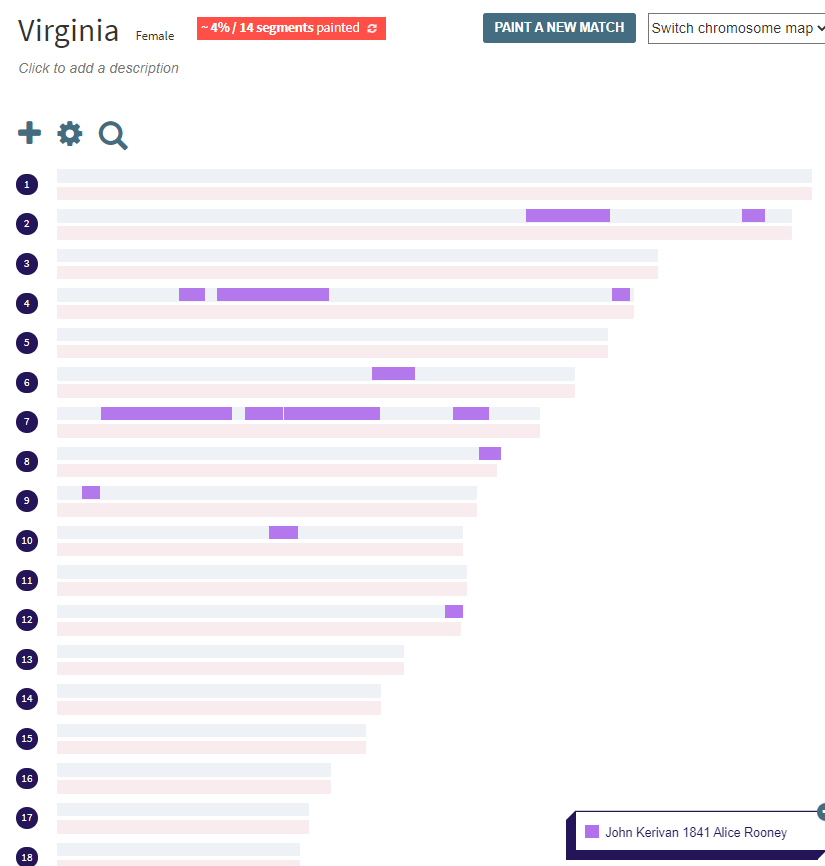
It occurs to me that I have not looked at the Kerivan famiy. One of my wife’s paternal great-granmothers was Lillie Kerivan:

Lillie Kerivan Born 1874 Needham, MA

There was a Lillie Kerivan at the Nantasket Poice Ball reported on 21 August 1896:

I can’t prove this was the same Lillie.

Obituary for Lillian in the 18 January 1932 Boston Globe. The heading will describe why this was difficult to find:

I can see how the program would interpret the L of Lillian as a T.

Here is 19 Derby Road:

I think that is a 19 to the left of the door:


My Daughter-In-Law’s French Canadian Ancestry: Houde Dit Desrochers

I last looked at my daughter-in-law Sarah’s  French Canadian Vezina heritage in this Blog. I was able to trace her family back to La Rochelle, France. However, that was only one line. In this Blog, I’ll take a look at some of her other French Canadian Lines.

Sarah’s Existing Tree

Here is where I am now with Sarah’s four French Canadian great-grandparents:

McGee doesn’t sound French Canadian. I’m assuming that Ethel’s maiden name was not Chapdelaine and that Lydia’s maiden name was not Vezina. Otherwise, Ancestry has some hints for me for potential 2nd great-grandparents.

Beatrice B McGee

I’ll start with Sarah’s non-French Canadian sounding great-grandmother. According to the 1940 Census, Beatrice was born in Massachusetts. That same Census has her in New Bedford in 1940, but in Fall River in 1935.

It appears that Beatrice was a Mary at birth in 1907 in Fall River:

The family lived at 272 William Street. Mary’s father was a weaver born in Canada and Mary aka Beatrice’s mother was Eliza Lafleur born in Massachusetts. Beatrice was part of a large family as seen in the Fall River 1910 Census:

Here is 272 William Street:

Arthur McGee

Here is Arthur’s Marriage record from Fall River from 16 June 1884:

Eliza’s birthplace appears to be the US, but I am not sure. Arthur and his wife were quite young at the time. Arthur’s parents were Edward and Anne or Annie. This puts Arthur’s birth at about 1864. Here is Arthur and family in Fall River in 1900:

Arthur reports that he immigrated in 1865. That means that he should have been with his parents at that time:

Arthur also states that he was a citizen. The Na means naturalized. I’m having trouble finding out more about Arthur, so I’ll go on to another line.

Eliza Lafleur

Eliza was Arthur’s wife. Let’s see what we can find out about her.

According to the death record of Eliza’s son Louis, Eliza was born in Millbury, MA:

The 1930 Census gives a different story:

The couple now state they were a year younger at marriage.

Elizabeth now says she was born in Canada. She arrived in 1880 and her husband in 1882. Also Arthur is no longer naturalized, but has only applied for Naturalization ‘Al’. Both Arthur and Elizabeth are French speaking.

That means that I am getting stuck on Sarah’s Lafleur Line also. There are generally difficulties in traciing one’s ancestors back to another country. Even when that Country is Canada.

Lydia Wife of George Edouard Vezina

Ancestry already thinks that it has parents for Lydia who was born aout 1868. Ancestry has some hints for me as to George E’s marriage:

I’ll try the second one. Unfortunately, that is only an index.

However, in 1914, George and Lydia’s son married. In that record, Hector gives his mother’s name as Lydia Derochers:

Some Desrochers Genealogy

Now we know we have a Desrocher Line to follow. Here is Lydia’s marriage record from 7 January 1890 in Fall River:

Lydia’s parents were Peter and Cedulie. Both George and Lydia were born in Canada. Lydia would have been born about 1868. This appears to be Lydia in 1868:

Pierre and Cedulie were listed as:

A charerretier is a carter. According to one genealogy forum, a carter was a:

Driver of (horse-drawn) vehicles for transporting goods. A Carter typically drove a light two wheeled carriage.

Here is Warwick:

According to Wikipedia:

Warwick is a small town north east of Montreal, located in Arthabaska county, Quebec, Canada. The town was incorporated in 1861 and named after a city of the same name in England. Up until 2014 the town hosted Quebec’s annual summer cheese festival, which showcases many of the locally produced artisanal cheeses.

One researcher posted this:

The relationships are a bit confusing on the stone. Here are Pierre and Cedulie in Fall River in 1900:

Pierre is listed as retired. Cedulie shows that she she had 5 children and 2 are now alive. That does not appear to be correct as Lydia, at least, was still alive along with Josephine and Edmund.

Pierre lived a long life:

Here is Cedulie’s death record:

Her parents were Augustin Garneau and Marguerite Morisette.

This information brings us close to the end of the 1700’s:

Here is the marriage record for Cedulie:

Next page:

Here the names of the parents of Pierre and Cedulie match up with what I have above.

The next step would be to look for a Desrocher/Martel marriage. This source looks hopeful:

This website does not give much more information:

However, I like the fact that the names line up and the date lines up. The next record is from this book:

This place is closer to Quebec City:

Here is the marriage record:

Now the spelling of Desrochers is Derocher.

Dit Names

The marriage record brings up the issue of dit names. Here Augustin is Houde or Houdes dit Derocher. His father has the same name. Dit names are a French thing.

Here is part of an article from thoughtco.com:

dit name is essentially an alias, or alternate name, tacked on to a family name or surname. Dit (pronounced “dee”) is a French form of the word dire, which means “to say,” and in the case of dit names is translated loosely as “that is to say,” or “called.” Therefore, the first name is the family’s original surname, passed down to them by an ancestor, while the “dit” name is the name the person/family is actually “called” or known as.

Dit names are found primarily in New France (French-Canada, Louisiana, etc.), France, and sometimes Scotland. They are used by families, not specific individuals, and are usually passed down to future generations, either in place of the original surname, or in addition to it. After several generations, many families eventually settled on one surname or the other, although it isn’t uncommon to see some siblings within the same family using the original surname, while others carried on the dit name. The use of dit names slowed dramatically during the mid- to late-1800s, although they could still be found used by some families into the early twentieth century.

Why a Dit Name?

Dit names were often adopted by families to distinguish them from another branch of the same family. The specific dit name may also have been chosen for many of the same reasons as the original surname – as a nickname based on trade or physical characteristics, or to identify the ancestral place of origin (e.g. Andre Jarret de Beauregard, where Beauregard refers to the ancestral home in the French province of Dauphine). The mother’s surname, or even the father’s first name, may also have been adopted as a dit name.

Augustine’s mother appears to be Genevieve Baudet. Angelique’s parents appear to be Francois Martel and Angelique Tangrelle:
This is probably a transcription:
Here is what I have so far for Lydia’s paternal side:
I need to fill in some dates here. Augustin father of Pierre must have been born in the 1700’s. I can cheat a little by googling the name. Here is Augustin’s father:

The other Augustin was born in a time where it was a little more difficult to find his birth year. He was before published genealogies. This is probably his baptism:

In the left margin, it appears to say that this is the Baptism of Augustin Houde Desrochers. And it appears that his father’s name is given as Augustin Derochershoude. The date is difficult to decipher. It may be 1777 which would be when his father was only 20. Also the record appears to say tha the mother was Marie Marguerite(?):

I had his mother as Genevieve.

Here is another possibility from 1803:

This record is even more difficult to read. However, according to the Geni record, the father died in 1799. Also I had that this Augustin married in 1813, so he could not have been born in 1803.

The Tanguay Genealogical Dictionary

Fortunately, there is a book with most of the French Canadian families in it up to a certain point. Here is Sarah’s Line:

As I recall, the 1752 would be the marriage. At least that would make sense. The (2) footnote refers to dit Desrochers. This record says that Joseph, son of Joseph was born in 1728 and married Marie-Therese Tousignan. They had three children.

Next I go to page 518 of Volume 4 of Tanguay:

At this point I don’t see the dit Desrochers name, so that can go away. It looks like this marriage took place at St-Nicolas – closer to Quebec City:

The Joseph above was born in 1700 and was the son of Louis.

This Louis was born in 1675 and buried in 1729 at Ste-Croix. Here is a progress update:

This starts on the left with Pierre Desrochers who died in Fall River in 1914 and starts on the right with Louis Houde who was born in 1675.

Louis Houde France to Quebec

That brings us to the first Louis Houde in Quebec:

I was able to find a web page at geni.com on Louis in French. I used the translate feature on the web page:

This tells some more of the history of Louis and how the two branches of the family got their names. Here are some cliffs in Ste-Croix:

Here is some more from geni:

I did notice the difference in age of about 24 years between Louis and Madeleine but I didn’t realize that she was just 13 years old when they married.

Here is Manou:

Summary and Conclusions

  • I started out looking at Sarah’s McGee and Lafleur ancestry.
  • Both these lines were from Quebec, but I had trouble tracking those families back to Quebec
  • I then looked at the wife of George Vezina. Her name was Lydia Desrochers – Sarah’s 2nd great-grandmother
  • Lydia was born 1868. She moved with her family to Fall River some time before 1890 when Lydia married there. I was able to trace her line back to her immigrant ancestor Louis Houde who was born in Manou, France in 1617.
  • Louis had a son also named Louis. The son inherited the father’s land by the cliffs and rocks of Ste-Croix, Quebec. This branch of the family picked up the name Desrochers. Roche means rock.