A Fourth U106 Whitson BigY Test

A new BigY test is in for Pete’s brother Patrick. In my previous Blog on Whitson U106 YDNA, I was hoping that Patrick would answer some of the questions we had on previous testing in this area. Right now I don’t see any differences between the old Block tree and the new one. Here is the old one:

This shows Pete matching Tom and Norton under a block called R-FT137411. This block contains 23 SNPs. Here is the new Block Tree from the viewpoint of Patrick:

The only difference appears to be that there are now four in this group. I also see that the average number of Private Variants for R-BY62217 has gone down by one for some reason.

According to SNP Tracker, BY62217 appears to have stayed in Germany:

The Whitson Group headed over to England at some time during the Medieval Period:

Private Variants and Non-Matching Variants

The question that came up previously in my blogs on the U106 Whitsons was why were there so few Private Variants. The common ancestors between Pete (and his brother Patrick) and Norton is in the 1800’s. The common ancestor between Pete and Tom was in the 1700’s. Between the four of them, there was only one Private Variant with Norton. FTDNA normally pulls from the the Private Variants for new branches. However, new branches also require matching with someone else. With only one Private Variant, there could be no matching.

That is when I started looking at the Non-Matching Variants. My understanding is that these could be there due to testing in non-reliable regions of YDNA or incomplete test resutls. In my previous Blog, I came up with this chart for Non-Matching Variants between the three testers:

However, looking at this now brings up some questions. Norton had a private variant at 5014418. This is an unnamed variant. I think that Private Variants are generally unnamed locations. However, it seemed like Pete should have two named private Variants at BY44298 and BY55572. Further, if Patrick is positive for these two SNPs I would think that Pete and Patrick would be on a new branch for these two SNPs.

Patrick’s Results: BY44298 and BY55572

Here is what Patrick shows for BY55298:

This shows that the results for Patrick were not conclusive:

Patrick had only one read and it didn’t show a mutation. That was unfortunate, as it is likely that Patrick, as Pete’s brother, should have the same mutation for BY44298.

Next, I look at BY55572:

Again, there is a similar situation:

These two SNPs are in close proximity to each other on the Y Chromosome. However, I don’t know which regiosn are troublesome vs. easy to read. Here is Pat on my spreadsheet:

I think that if the test was better, then it should have shown Pat positive for these two SNPs.

In additions, Pat shows very little in the way of non-matching variants:

Patrick’s only Non-Matching Variant was Norton’s Private Variant.

Patrick’s Results for the Previous Non-Matching Variants

Next, I can fill in the rest of my Excel Spreadsheet for Patrick:

Where NT means not tested. That means that these are disapppointing results. Pete and Norton got results for all the SNPs on the list Tom had results for two SNPs.. Patrick had results for none of the SNPs. Most of the ? results only had one read. I was hoping that Patrick would have matches to many of Pete’s non-matching variants. Logic would dictate that Pete and Patrick should have most if not all the same variants as they are brothers.

Summary and Conclusions

  • Previous testing has shown that Pete was positive for 10 SNPs that Norton was negative for
  • Subsequent testing showed that Tom was negative for two of those SNPs and had inconclusive test results for the other eight. However, there has to be two people positive for a SNP for a new branch to form
  • When Pete’s brother Patrick tested, I had thought that he would have matching SNPs with Pete which would form a new YDNA Branch. However, Patrick’s results were inconclusive for 8 of his SNPs that Pete was positive for and for two, that region of YDNA was not covered.
  • With the information I have seen, the Whitson Block tree may remain the same. However, it is possible that the manual review has not been completed and FTDNA may see more detailed information from the test results which could shed some more light and give a new branch for Pete and Patrick. If the manual review is done, I would recommend asking why Tom and Patrick’s results did not cover the important Non-Matching Variants between Pete and Norton. I don’t know if Pete and Norton just had really good results or if Tom and Patrick had unusually bad test results.

Reinhold’s DNA Match and the Hirschenhof Connection

Reinhold matches my Mom by DNA at AncestryDNA. The match is not huge at 38 cM, but Ancestry shows common ancestors. Here is the first common ancestor tree that Ancestry shows:

I see one problem in the tree in that Reinhold’s grandmother shows as being born in 1970. I’m not sure why. Reinhold’s tree has Veronika born in 1903. Here are other likely common ancestors:

Here are those same names highlighted on my mother’s tree:

The closer three connections are on my mother’s paternal grandfather’s side (Rathfelder). The further connection is on my mother’s paternal grandmother’s side (Gangnus).

Let’s see if I can find all these people on Reinhold’s tree. He is two generations removed from my mother for six of the common ancestors and one generation removed for Niclas/Riedel.

The Rathfelder/Bittenbinder Connection

I have Biedenbender rather than Bittenbinder but I am sure they are the same. Here is Reinhold’s tree:

This couple are the 5th great-grandparents of Reinhold. I could check on Reinhold’s tree, but I have no reason to doubt it. According to Reinhold’s tree, his paternal grandmother Veronika Simon was born in Riga in 1903. My grandfather Alexander Rathfelder was born in Riga, Latvia 10 years earlier in 1893. This was a tumutuous time and place to be born. Veronika’s mother was born in Hirschenhof, Latvia in 1880. This was a German Colony in the heart of Latvia. These Germans tended to intermarry with each other within that Colony.

I name both Rathfelder and Biedender as the DNA shared between Reinhold and my family only came from one or the other of the two. It would be difficult to find out from which side the DNA came from or even if the DNA shared is from either as there are so many other possibilities.

Mertz/Muth Connection

Again, from Reinhold’s tree:

Reinhold’s fourth great-grandparents were Gustav Mertz and Anna Maria Rathfelder, but we are connected throught the parents of these two or at Reinhold’s fifth great-grandparent level.

Gangnus/Muller Connection

I’m glad that Reinhold built such a good tree. This is a bit of a who’s who in my mom’s Hirchenhof genealogy. This is on Reinhold’s Spengel line. Interestingly, my mom’s grandmother was a Gangnus, but this Gangnus is on my mom’s paternal grandfather side.

What’s more, if I have my genealogy right, my mother had two Gangnus 3rd great-grandparents named Gangnus. I have that Philipp Julius Gustav Gangnus and Philipp Jacob Gangnus were brothers.  Philip Jacob was on my mother’s Gangnus side.

One Generation Back to Niclas/Riedel

It is less likely that the DNA match is on either of these two people, but it is still possilble:

On Reinhold’s tree, this couple is on his Simon side. In my mother’s tree, this match is on her Gangnus grandmother’s side.

Adding Reinhold to My Rathfelder DNA Tree

This is a tree that combines DNA matches with genealogical matches. This is what I have now:

Reinhold is a 4th cousin twice removed, so he will be two levels below Astrid and Ingrid:

Reinhold’s name did not get centered for some reason.

A Merz/Muth DNA Family Tree

This is a new tree for me:

Turns out I can copy and paste from the previous tree, but the formatting is a bit odd. Reinhold’s tree has a birth date for Johann Peter Mertz at the top, so I borrowed that from there. As far as I know, Reinhold is the first one who I have found that shares these two ancestors of Merz and Muth.

Gangnus/Muller Tree

Unlike the Merz/Muth Tree, I already have an extensive Gangnus tree:

Rienhold should come in on the left side with Philipp Julius Gustavis Gangnus.  He descends from Sophia Gangnus born in 1783:

This gets a bit complicated the way I have it. I don’t think that Ancestry picked up the fact (if I have it right) that Reinhold is a 4th cousin twice removed and 5th cousin twice removed on the Gangnus Line. This tree is quite robust. There are many branches which in my view is desirable.

Niclas/Riedel Tree

This tree is also a first:

This tree also has the good type of branching in three different generations that I like to see.

Summary and Conclusions

  • Reinhold matches my family by DNA and by many common ancestors.
  • From what I can tell, Reinhold shares at least 10 common ancestors with me and my family.
  • I added Reinhold to my Rathfelder/Bittenbinder and Gangnus/Clausing Tree
  • I created a new Merz/Muth and Niclas/Riedel DNA Tree to show the relationship between Reinhold and my family.
  • It is no surprise that Reinhold has DNA matches with my family considering all the common ancestors we share.


A Frazer STR Tree

A new 111 STR match to the Frazer YDNA group has me thinking about Frazer STR trees.  I haven’t seen the specific STR results for the new Frazer match, but we have five testers who have already taken the BigY test. That means that we already have the skeleton of a STR tree which is the SNP tree. Here is the current Block Tree from the perspective of my cousin Paul:

This goes up to the level of R-YP6489. I can portray that like this:

These SNPs tend to set this tree in stone. We know the genealogy of the first four testers. Y151390 is from the James Line. James Frazer was born in the early 1700’s. Y5682 is from James’ older brother Archibald. We are not sure how Frazier fits in by genealogy other than the fact that the connection is further back in time. – probably in the 1400’s in Scotland.

Here is that same group in the Fraser and Septs YDNA Project:

Here I wrote down the Mode which is the third row above. This is generally thought to be the ancestral value:

However, I questioned DYS710. The values were:

Frazier had a 32. The first row is supposed to be the minimum and shows as 33. Hmm. It would make more sense ifthe ancestral was 33. Then Rick and Paul on the Archibald Line would have mutated up and Frazier would have mutated down.

For a similar reason, I would like to use 35-39 for CDY even though it is the value appearing least often:

If I have written down all the deviations from the modified mode correctly, I have this:

Green is the Archibald Line of Frazers. Blue is the James Line and reddish is the older Frazier/Frazer Line.

When I put those STRs onto the SNP or Frazer Haplotree, I get this:

I didn’t have room for all the Frazier/Frasher STR changes over the last 500 years, so I left those out. I do note that Frazier and Rick had what is called a parallel STR mutation at DYS444. That means that Rick and Frazier don’t share the same branch by that mutation but that they both had those mutations independently of each other.

Why Is a STR Tree Important

This tree is mostly important for Frazer relatives who have not taken the BigY test. This should show how they are related to various Frazers. Once I get the new 111 STR results for the latest Frazer relative named Dingman, I will be able to add him to the STR tree. He likely to be aligned on Rick and Paul’s side, but the common ancestor is believed to be here:

Because the connection is so high in the tree and because Jonathan has no known mutations since about 1690, that would explain why Dingman shows a closer STR match to Jonathan:

In the tree above, there is some uncertainty as to which son of Archibald Frazer and Mary Lilley Dingman descends from.

A New Frazer STR Tree

Here is the new Frazer STR Tree with the new Dingman STR results which just came in:

One major contribution of DIngman is with DYS710. He has a value of 34 along with Rick and Paul where the other three testers have 33. That means that a DYS710 of 34 represents the Archibald Line of Frazers (as opposed to the James Line). That means that either Archibald Frazer born about 1715 or his son Archibald born about 1743 had this mutation.

Checking the Numbers

Above, I mention that there should be 5 STR value differences between Jonathan and Dingman, but there appear to be 6. For the shared ancestor of Jonathan and Rodney (Thomas Henry Frazer born 1836), I had an extra STR. If I take that out, it adds up:

I left my mistake in above to show how easy it is to make mistakes in these trees. I also had the wrong STR name for Paul which I corrrected above. Hopefully there are no more mistakes. Now it adds up as there is one mutation between Jonathan and Archibald Frazer of 1690 and four between Dingman and Archibald Frazer of 1690. That adds up to a geneatic distance of 5.

Next there should be a GD of 7 between Jonathan and Frazier. That means I missed a Frazier STR.

DYS710

It turns out I missed DYS710 for Frazier, the STR I made a big deal of above. It turns out that DYS710 is an important defining STR for Frazer Genealogy:

  • DYS710 = 33 – Ancestral to Frazers/Fraziers (probably) and defines the James Line today
  • DYS710 = 34 – The Archibald Frazer Line (as opposed to the James Line)
  • DYS710 = 32 – Defines at least part of the Frazier Line. We don’t know how far back. Unfortunately, this marker is the first STR in the 111 STR test, so it will only tell us about those who have taken the 111 STR test.

DYS710 is a good defining STR because it is slow moving. CDY is in the differrent lines, but it is a fast mover, so not the best STR to define a Line.

This image shows DYS710 in lighter blue as it is the first SNP in the 111 panel (after the 67 Panel of STRs). I have an arrow pointing to CDY. The faster moving STRs are shown in a maroon color.

The tree also shows a consistant amount of STR differences going down the tree from top to bottowm between Dingman, Rick and Paul. They each have four STR changes in the tree. The older Frazier line has 6 changes. Jonathan and Rodney only have one and two STR mutations respectively. My guess is that the James Line has fewer than average STR mutations and that the Archibald Line has more than expected.

Where Should Dingman Fit In As Far As SNPs?

Assuming the chart above is correct, Dingman will be positive for FT421618 as he descends from Archibald Frazer born 1690. He will be negative for Y151390 which is in the James Frazer Line.  We don’t know if  Dingman will be positive for Y58652 even though he is from the Archibald Frazer Line:

Y85652 is representative of a block of three SNPs.  These three SNPs are also representative of James Frazer born about 1804. Dingman descends from Archibald Frazer born around 1743. That means that any SNPs that Dingman would not have any SNPs came about between that Archibald and that James. My guess is that he could be positive for all three or more likely he will be positive for one or two of the SNPs and negative for the other one or two.

Another interesting thing is that the Archibald Branch of Frazers seems to have produced 3 SNPs in 4 generations.  That represents the period between about 1715 and 1804 or about 89 years. That is quite a bit considering that some people use an averege number of one SNP every 84 years. However, having these extra SNP is important for future fine tuning of which SNP goes with which Family under the Archibald Branch of the Frazers of Roscommon Ireland.

Where Did I Go Wrong in My Last Blog?

In my previous Blog, I had predicted that the common ancestor between Dingman  and the Frazers would precede Archibald Frazer by some time. This prediction was wrong. It is difficult to make these predictions based on STRs. Now that I know Dingman’s genealogy, it is easier to place him in the SNP tree and it makes the STR tree fairly easy to build.

Summary and Conclusions

  • There is some guesswork building a STR tree
  • In this case where I now understand the genealogy better and now the SNP tree for five testers, that takes away some of the uncertainty and I was able to build a reasonable STR tree
  • Dingman adds an important piece to the YDNA Frazer tree
  • If Dingman or another Archibald Frazer descendant were to take the BigY test, they would likely further fine tune the YDNA tree for the Archibald Branch of the Frazer tree.


A New Dingman YDNA Match to the Frazer Group

I have been involved with Frazer DNA and specifically Frazer YDNA for quite a while. The best YDNA test at FTDNA is the BigY. The result of that test is to place you in a SNP or SNP group called a Haplogroup. The Frazers from North Roscommon are fortunate to have four BigY testers. This has not only given the Frazers their own Haplogroup, but has also split the two Frazer Lines into two Haplogroups. The best view of this is at FTDNA’s Block Tree View. Here is the view from my cousin Paul’s perspective:

I have added some notes. The first column is the James Line. The second column is the Archibald Line. We think that  the father of James and Archibald Frazer was born sometime around 1690. The SNP R-Y151390 represents the James Line. The SNP R-Y85652 represents the elder brother Archibald Frazer. The white space above these two SNPs should represent Archibald Frazer born around 1690.

Stuart and Grant YDNA

Due to the age of matches the Frazers have with Stuart and Grant, my assumption is that these early relatives were living in the same area of Scotland when people picked their surnames. Some picked Frazer, some Stuart and some Grant or others in the same area of Scotland.

Frazier YDNA

A Frazier YDNA tester came along and split the block of SNPs in half so he is now R-YP6489 where the Frazers used to be. If we take one SNP to be 84 years, then his common ancestor with our Frazers would be 252 years before Archibald born around 1690 or around 1440. I am assuming that it is more than coincidence that this match has a name very similar to Frazer. From that we may assume that the five of us descend from an unbroken line of Frazer/Fraziers going back to the middle ages.

Here is a Clan map showing how some of these Clans lived in fairly close proximity to each other:

This map includes Fraser, Grant, Stewart and Chisolm. Chilsolm has been a STR match.

The New Dingman 111 STR Match

This is how Dingman matches my second cousin Paul:

First note that STR matching is not as accurate as the SNP matching. In the SNP block tree, Frazier was more closely related than the two Stuarts. Based on this matching, one might think that it was the other way around.  The closer the match is, the more accurate the STR matching is. This shows that Rick is Paul’s closest match:

Paul and Rick are 3rd cousins once removed. Paul is a 6th cousin once removed to Rodney and Jonathan.

Where Does Dingman Fit In?

The match between Paul and Dingman does not appear to be an anomaly. I have heard from relatives of Jonathan and Rick and they both match Dingman at about the same level as Paul. FTDNA provides as guestimate as to how far back Paul’s common ancestor is with Dingman:

FTDNA gives a statistical answer in generations and percent likelihood. We see from my tree above that Paul, Rodney and Jonathan share a common ancestor back at 7 or 8 generations. I would not be surprised if Dingman shared a  common ancestor with Paul in this area:

If Dingman were to take the BigY test, we may find out that he and our Frazers have a common ancestor around 10 generations ago or around 100 years before Archibald Frazer born in 1690. This should put the common ancestor in Scotland around 1590. My other guess is that Dingman could have been a Frazer originally. A Dingman BigY test would likely split the FT421618 Block based on how he matches other Frazers with STRs.

Here is some more documentation of TIP Reports from FTDNA:

What We Don’t Know

The YDNA match to Dingman indicates that he has not provided information about his most distant male ancestor. He has not posted a family tree. In addition, I don’t think that Dingman has joined the R1a YDNA Project at FTDNA nor has he joined the Frazers and Septs Project. As he has not appeared to join these projects, we cannot tell his specific STR differences with other Frazer YDNA testers other than knowing his Genetic Distance.

Summary and Conclusions

  • Dingman is a good YDNA match to our Frazer relatives. Our Frazers have the ancestor of Archibald Frazer born around 1690 and who probably lived in North Roscommon County, Ireland.
  • Based on the 111 STR test Dingman’s common ancestor with our Frazer Line could go back to a Frazer born around 1590 in Scotland.
  • If Dingman were to take the BigY test, it would probably result in more refinement of the Frazer YDNA tree.
  • Right now we don’t have information on Dingman genealogy or the specifics of his 111 STR test other than generational distance.


Whitson R-U106 BigY Non-Matching Variants and STRs

The title to this Blog is a bit specialized. There are three Whitson relatives who have taken the BigY test. This group of Whitsons are on the R-U106 general branch of humanity. From there, the Branch has narrowed down to a block of SNPs represented by the name R-FT137411.

In my previous Blog, I started looking at the three Whitson Testers’ Non-Matching Variants. So far:

  • Tom – He didn’t show any private variants. However, his date to common ancestors with Pete and Norton implies that he should have some.
  • Pete – He didn’t show any private variants, but two of his variants which don’t match with Tom and Norton could be Private Variants. The testing for Tom and Norton seemed to show that they didn’t have BY44298 and BY55572. I suggested that these two SNPs may be a new Branch for Pete once Pete’s brother’s BigY test is completed.
  • Norton – He has one Private Variant which he is clearly positive for and Tom and Pete are negative for. This Private Variant is at position 5014418.

Pete and Norton’s Non-Matching Variants

Here is the view from Norton’s perspective:

The non-matching variant between Norton and Tom represents Noton’s Private Variant. The first two named Non-Matching Variants between Norton and Pete were addressed in my previous Blog. That leaves six non-matching variants to look at between Peter and Norton.

BY151409

First, I’ll check Pete’s results:

Pete is showing positive for that SNP. That must mean that Norton is negative for this SNP:

This shows Norton as not derived for BY151409. But it also shows that this SNP is on the Y-Tree. Here are Norton’s test results:

If this SNP is on the Y-Tree, it must not be a private variant. I think that this information is either not helpful or not acurate. I don’t think that BY151409 is on the Y-Tree. Here is what YBrowse shows:

To be complete, I’ll check Tom’s results for this SNP:

FTDNA considers Tom a no-call for this SNP:

Tom only had two good reads:

A third not-so-good read had the mutation as T, when Pete’s mutation was to G, so something is off there. That could mean that this variant could be a Private Variant for Pete also.

BY151410

OK, only 7 variants to go. I will make a summary chart to keep track:

Finishing the Whitson Non-Matching Spreadsheet

It seems that Pete should have as many as 10 Private Variants which seems like a lot. That would be 11 Private Variants divided by three people or about an average of 4. However, it seems like once a variant is named it is not included in the Private Variant category. However, my understanding is that the named Private Variants are not treated the same way as unnamed Private Variants. The SNPs for Pete appear to have been named during Pete’s earlier testing. However, as far as I know, there are no other matches to these SNPs – unless they are in other Haplogroups.

I found this in a R-U106 Forum:

* There is a long, complex, and (mostly) documented description about how the data is extracted from the DNA and ends up in the BAM files, which are then parsed into the VCF+BED files we’ve been requesting for the Warehouse. I won’t go into that here. 
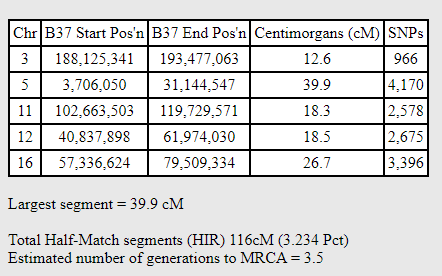
* This data then undergoes some extra processing. Those that match certain quality criteria are extracted and presented as a list of high-quality variants. These high-quality variants are then compared against everyone else in the tree, who is given a positive, negative or null call.
* SNPs where you are positive and others are negative (or vice versa) are used to define your non-matching variants. These are what are listed in your BigY matches.
* Your list of high-quality variants is then subject to a blacklist, removing any SNPs in problematic regions (DYZ19, the centromere and Yq12) and recurrent SNPs found elsewhere in the haplotree. These are listed as your private variants. The blacklist removes regions where complex mutations can lead to mis-mapped regions, missing data or other problems. These complex mutations can then masquerade as one or more SNPs.
Consequently, there may be many reasons why SNPs in your non-matching variants may not appear in either your private variants or your match’s private variants, and vice versa.
So I suppose my question is whether Pete’s non-matching variants include blacklisted SNPs. My sense is that they probably do.

R-U106 Whitson STRs

As suggested by Pete, the private SNPs for the three Whitson testers, do not appear to adequately describe the time to common ancestors. Pete has a common ancestry with Norton at 1835 and with Tom at 1725. Based on that, there should be roughly an average of one private SNP between Norton and Pete and two between Pete and Tom.

It would seem at this point that the STRs show some accuracy in this Whitson Line. Here is the relevant portion of the U106 Whitson STRs:

The third row is the mode of the three testers. The fifth row shows Pete’s results. His results are the same as the mode. In drawing STR trees, the Mode is considered the ancestral value. So that would mean that Pete has had no STR mutations in the 111 series since 1725. I get a tree something like this:

This shows that there are been one STR mutation between Pete and Norton since 1835 and that there have been two STR muations between Pete and Tom since 1725. I suppose that I should have put the 1725 in the red box above.

As this is a combined SNP and STR tree, I can add Norton’s Private Variant:

The confusing part are Pete’s 10 non-matching SNPs. Norton tested negative for these  and Tom had all no-calls. I will wait to see Pete’s brother’s BigY results to see if any of those SNPs come into play.

Summary and Conclusions

  • I think that I’ve taken the U106 Whitson YDNA about as far as it can go with the information I have.
  • I found it somewhat difficult to understand the nuances of non-matching variants and what they are useful for.
  • Previously, I had suggested that two Pete’s non-matching variants may become a new branch. After looking more closely at Pete’s non-matching variants, I am not so sure. I will like to see how Pete’s brother’s BigY test shakes out.
  • I summarized the testing quality for Pete’s non-matching variants in the other two Whitson BigY testers
  • I drew a combined SNP/STR tree for the U106 Whitson branch. Given the time periods Pete gave me to his common ancestors, these STRs seem to fit in better than what we have for Private SNPs right now.
  • I am looking forward to the BigY testing for Peter’s brother.


Daley DNA and Genealogy

I am looking for specific Daley DNA and genealogy on my wife’s side. Here is my mother-in-law’s maternal side:

Elizabeth Daley was born in Canso, Nova Scotia and died in Boston during the Flu Epidemic in 1919. DNA matches have been scarce, but we will take a look.

Ancestry Daley ThruLines

An easy place to look for genealogical connections with DNA matches is with Ancestry’s ThruLines. Here is one of the Daley ThruLines as shown from the perspective of my mother-in-law Joan:

This shows that Joan has a DNA match with Katherine who likely descends from Elizabeth Daley’s sister Mary. Here is what Katherine has about her grandmother:

It looks like Mary stayed in Canso. This appears to be Mary Kelly’s mother Mary in 1911:

Here is the family in 1921:

This was not easy to figure out. Ancestry transcribes her husband’s name as Canet. However, I see something more like Everett. Julia would be Katherine’s grandmother Mary Julia. All this to say is that the ThruLines for Katherine and Joan look right.

More ThruLines Back to Lawrence Daly

This shows Edward (who my mother-in-law Joan descends from) and two siblings: Michael and Ann. I must not have Ann in my tree as she shows as green. However, the fact that there are three DNA matches to Joan tell me that Ann is the real thing.

A Daley DNA Tree

Here is the start of my Daley DNA tree:

Here is Canso, where many Daley’s lived:

Canso is in Nova Scotia below Cape Breton and not too far by water from Prince Edward Island and Newfoundland where my mother-in-law Joan’s other ancestors were from.

The Ann Daily Line

The DNA matches are to Joan. Carol has a reference to Ann Daily’s marriage which makes all this seem legit.

Here is Black Point – not far from Canso:

Here is an enlarged Daly/Daley Tree:


Elaine’s Daly ThruLines

Joan’s sister Elaine has some DNA matches also.

Along with the Edward Daley Line, Elaine has 4 matches in the Michael Daly Line and 4 matches on the Ann Daly LIne.

Elaine’s Michael Daly Line Matches

Elaine shows four matches. However, the ThruLines connection with Lois appears to have an error. It has Michael Daly in the tree twice for some reason. Here they are added to my Daly genealogy/DNA tree:

Elaine and the Ann Daly Line

Elaine’s match with Tara adds an additonal branch:

I had the Ann Daily Line wrong in my tree above. Here I have corrected it:

Here is the whole tree:

The could have been some marriage of cousins in this scenario as some of the surnames in these lines look familiar. I have not been able to find Daley matches where the match has uploaded to Gedmatch or tested at MyHeritage or FTDNA. Because of that, I don’t have detailed information on these Daley DNA matches.

Summary and Conclusions

  • Between Joan and Elaine, they have several DNA matches with the descendants of Lawrence Daley and Elizabeth Snyder
  • It seems like all these matches are at AncestryDNA
  • AncestryDNA does not supply specific DNA information on how those Daley/Snyder match
  • Because this specific DNA information is missing, I was not able to map the Daley/Snyder DNA matches onto Joan and Elaine’s chromosomes


Some Nicholson DNA

My mother’s mother’s mother was a Nicholson. That means that my mother should have about 25% Nicholson DNA. As her son, I would have about half that amount or 12.5%.

Here is my mother’s DNA Painter chart:

My Mom is 35% painted. That means that about one third of her paternal and maternal chromosomes have been identified.

Here is my Mom’s maternal side:

A little less has been identified there – 30%. The last two colors that are purple and brown are the Nicholson side. The blue thath says Lentz and Nicholson may be Nicholson or Lentz. However, for some reason, I am missing Lentz DNA. Here is Chromosome 1 for example:

By the overlap, Judy’s blue Lentz/Nicholson DNA is really Nicholson DNA as shown by the match with Joshua. Others Chromosomes have similar results.  It is possible that there is not much Lentz DNA around or that the Lentz in the family was not really a Lentz for some reason.

My Nicholson DNA Matches at 23andMe

I have some 23andMe DNA matches identified at 23andMe. My mother has not tested at 23andMe, so I am the best one for matches there. I recently identified who John was at 23andMe:

John doesn’t have family information at 23andMe and didn’t answer my message to him. A note at 23andMe shows that he has not been on the site for a while. However, I can look at the relatives John and I have in common:

I recognize JS as Joan from my Nicholson DNA match chart. John is a 2nd cousin to Joan. That means that John probably descends from Nellie Nicholson. By bringing down Nellie’s descendants, I was able to figure out where John probably fits in.

Here is how my DNA matches with John’s DNA:

I’ll add this information to my DNA Painter map, to see if anything new shows up. John added a little DNA to my map here:

Can I Place Nicole?

From Relatives in Common above, I see that Nicole shows up as 1st cousin to John. I sent a message to Nichole. In the meantime, my assumption is that Nichole and I have the common ancestors of William Nicholson and Martha Ellis. As Nicole and I must share Nicholson/Ellis DNA, I will add her match to DNA Painter. It turns out that Nicole’s best contribution is on Chromosome 4:

Previously, I had no mapping on that portion of my maternal Chromosome 4. It appears that the break between Jerome and Nicole could be a break between Lentz and Nicholson. Jerome has Nicholson and Lentz anctestry while Nicole has no Lentz ancestry. To the left of Nicole is Raimonds who matches on my maternal grandfather’s side. Nicole is on my maternal grandmother’s side.

Mapping Molly

Molly is a large match at MyHeritage. Molly is young, so she does not have a lot of records to go on. A search of Facebook showed me that Molly is Dotty’s granddaughter. I know Dotty, but I am interested in how Dotty fits in the tree. Based on some old emails and Facebook, I believe that this is how Dotty and Molly fit in:

This is on my Lentz/Nicholson tree, so Molly and I share both Nicholson and Lentz ancestry. This shows that Molly is a first cousin twice removed to my Mom.

Painting Molly

Right now I’m at 38% painted on my maternal side and 47% painted overall. I expect that Molly’s match will increase at least one of these numbers. After ‘painting’ Molly, I am now at 41% painted maternally and 49% painted overall.

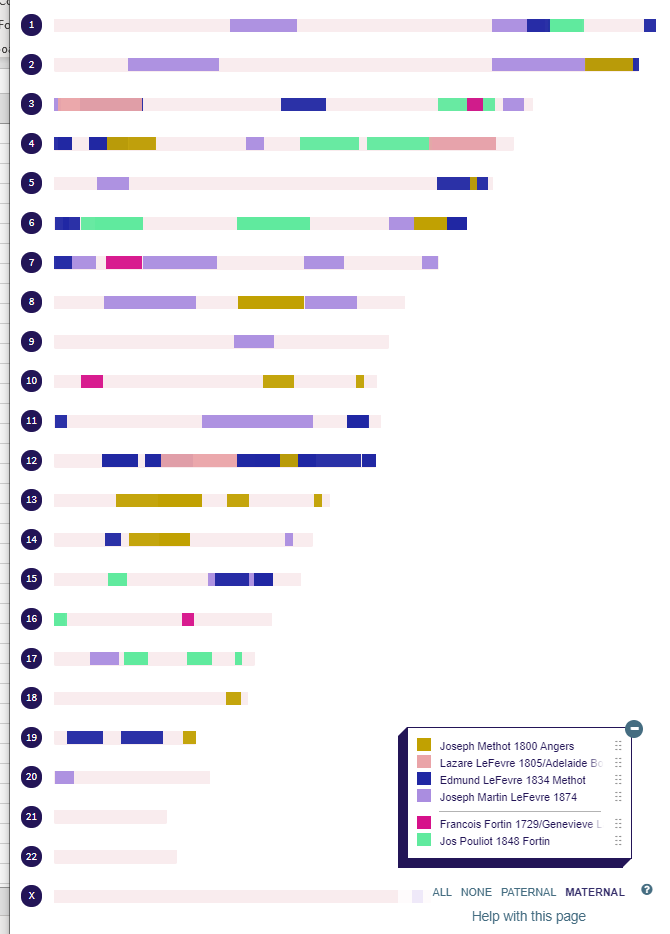
Molly added important information on Chromosomes 3, 8 and 16.

This image shows that the DNA Molly and I share on Chromosome 8 is from the Nicholson side as there are overlaps with purple. On Chromosomes 3 and 16, the DNA shared could be on the Lentz side.

Summary and Conclusions

  • I was able to place the DNA of John, Nicole and Molly
  • John and Nicole share Nicholson DNA with me. Molly shares Nicholson and Lentz DNA and is a closer match.
  • It takes a bit of investigation when the matches’ genealogy is not readily available
  • Molly especially was able to fill in some blanks on the map of my chromosomes


Two New Nicholson DNA Matches

I just noticed that I had a new Nicholson DNA match named Jessica:

Jessica shows to match on my mother’s side. Ancestry has already figured out that Jessica and I have a common ancestor:

Ancestry would like me to evaluate Jessica’s tree. The Docrill threw me off a bit, as I have a Maria Baxter Nicholson in my tree:

I also had that Maria died in 1866. I wonder where I found that. Perhaps I got the wrong person:

In 1861, I have that Maria Baxter Nicholson was living in Liverpool with her grandmother Ann Ellis:

This is why I like Census records so much. They tell quite a story. Here we have three generations of Nicholsons. From a previous Blog, I have that Ann Baxter is Ann Ellis who is the daughter of the elder Ann Roebuck Ellis listed in the Census:

I see this record online:

One reason this marriage to George Dockrill makes sense is that the Dockrill name is carried down in the US in Walter Nicholson’s Line:

This name must have been given in this family to rememer the Nicholson sister Maria who stayed in England. Assuming we have this right, Walter would have been a younger brother of Maria Baxter Nicholson. He named his son George Dockrell or Dockrill Nicholson.

More DNA Matches for Jessica

As it was not easy to find a marriage record between Maria Baxter Nicholson and George Nehemiah Dockrill, let’s look at some more DNA matches. Jessica matches my mother at 128 cM:

That is a substantial match. That means that I need to erase the early death record I had for Maria Nicholson. I’ll also add Jessica to my Nicholson DNA match Tree:

Jessica is in the first column.

Another DNA Match with Michelle

I can look at DNA matches that are shared between Jessica and my Mom. I see an interesting shared DNA match with Michelle and my Mom. They share 59 cM across three segments. Here is Michelle’s tree on her paternal side:

My attention is drawn to Michelle’s ancestor Francis Nicholson. When I search Ancestry for Francis, I find this record in someone’s tree:

My web page on the Nicholsons has a Henry here:

There is also a Matthew Henry on my web page, but this one makes more sense as Henry is the older brother of William who is my 2nd great grandfather. The tree above has this Henry born 1831 and I have him born 1822, so that is a bit of a discrepancy. The tree above has Henry married to Ann Bainbridge. I have Matthew Henry married to Mary Ann Bailey.

Here is Matthew Henry and Mary Ann Bailey in 1861:

Matthew Henry was a boss of some type and his sister-in-law was the housemaid. It looks like he had an adopted daughter Mary. That seems to rule out Matthew Henry as Michelle’s direct ancestor.

More on Henry Nicholson

Here is Henry and family in 1861:

Here we still have the age discrepancy. If Henry was 29 in 1861, then that is where the later birth of 1832 must come from. I believe that this is the same Henry in 1841:

Concerning Henry’s age:

Ages in the 1841 Census

The census takers were instructed to give the exact ages of children but to round the ages of those older than 15 down to a lower multiple of 5. For example, a 59-year-old person would be listed as 55.

That means that Henry would have actually been around 18 in 1841. Henry’s father Matthew had died the year before in 1840. In 1841 Henry was a cutler and in 1861, he was a table knife [hafter?].

Here I have added Michelle and Henry Nicholson into my DNA/Ancestry tree. That means that Michelle is Gladys’ (my mother’s) third cousin once removed. This is where the DNA gives some confidence to the relationship when some of the genealogical records are missing.

Summary and Conclusions

  • I don’t get many new third cousin DNA matches, so Jessica was a good find
  • Jessica descends from Maria Nicholson. I was not aware of this Nicholson Line before I found out about the DNA match with Jessica.
  • Jessica and my mother have a shared match with Michelle. Michelle descends from Henry Nicholson. The DNA connection fills in some of the missing or not yet found yet genealogical records.

Updating My Wife’s Mother’s Ellis DNA

I manage my wife’s mother’s DNA kit and my wife’s mother’s sister’s DNA kit. Their names are Joan and Elaine. I was looking at Elaine’s DNA this morning.

Ellis Line Match with Joseph

The match I found for Elaine this morning was with Joseph. He is a good match because he is on Gedmatch and Ancestry. He also has trees on Ancestry and Gedmatch. Using DNA Painter, I added Joseph’s match to Elaines DNA Map:

Joseph matches Elaine on Chromosomes 7 and 14. The match appears to go back to 1775. Here is how Elaine and Joseph connect:

Elaine and Joseph show as 4th cousins going back to 1775. Ancestry also has this highly unlikely scenario:

Joseph has a smaller match with my mother-in-law Joan. They only match on Chromosome 7. I’ll add that match in:


Here Joseph in orange is bumping into Debbie in green. That could mean that I have some of the genealogy wrong. I can’t find the Debbie’s DNA match anymore, so that doesn’t help.

Elaine’s DNA Map makes more sense:

Here we see the split between Rayner and Hopgood:

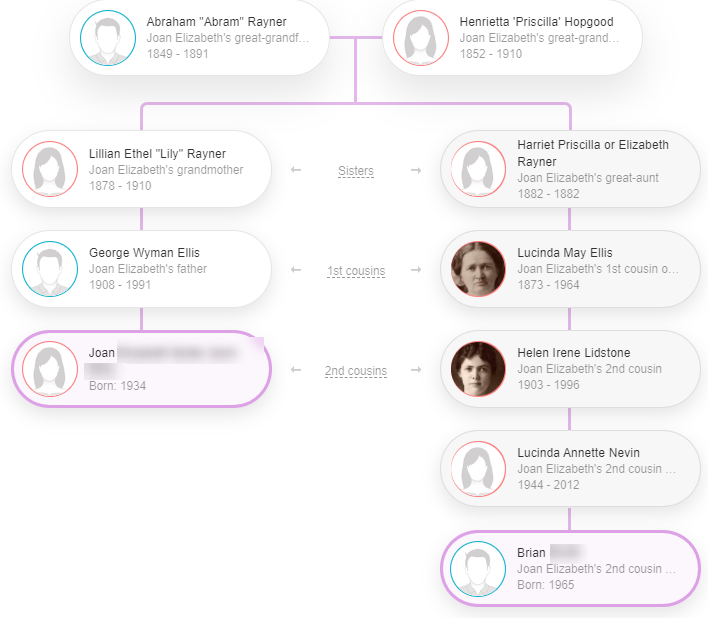
Elaine’s great-grandfather is Abraham Rayner and her great-grandmother is Henrietta Hopgood.

A Rhynold Match with Stuart at MyHeritage

MyHeritage shows this Theory of Relativity between Joan and Stuart:

Rhynold is on Joan’s maternal side. Here is what DNA Painter has to say:

They are finding DNA overlap with other ancestors, so is this really Rhynold DNA? I’m curious, so I’ll try painting him in.

There is no overlap on Chromosomes 7 and 20 and only a minimal overlap on Chromosome 1, so I think that we have the right common ancestors.

I had already painted Stuart onto Elaines Chromosomes 7, 9 and 20. Elaine doesn’t match Stuart on Chromosome 1, because she has larger Upshall matches on that Chromosome:

Rynault is on the Daley side:

James Robert Theory of Relativity: Ellis/MacArthur

Joan and James Robert show as third cousins:

I’ll paint James Robert in to see if that makes sense. Here is how I painted James Robert in to Joan’s map:

James Robert is the orange match on Chromosomes 1, 2, and 5. The reason is that there are two entries for James Ellis born 1801 is that James had two wives. His first wife was Jane Ramsay. However, Joan descends from the second wife who was Marion MacArthur. In some cases, the DNA match is just with James Ellis, in other cases, it is with James and his wife Marion MacArthur.

Next, I’ll paint James Robert onto Elaine’s map. She already has an Ellis/MacArthur entry:

For some reason, there was not any overlap between Elaine’s DNA matches with James Robert and Robert who I show as also descending from James Ellis and Marion MacArthur.

Painting MacArthur/MacDougall

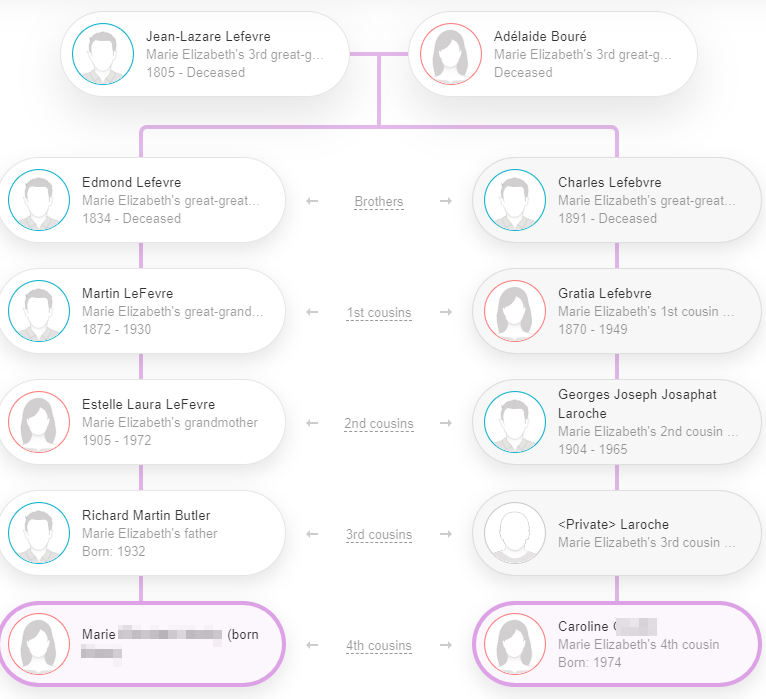
MG has a double Theory of Relativity with Elaine. However, MacArthur/MacDougall is the closer relationship:

The other common ancestor is with James Yeo, but is a half 5th cousin relationship. Let’s paint Elaine’s DNA match with MG to see what happens. When I go to paint MG, I get this message:

That actually makes sense because Marion would be a daughter or Malcolm MacArthur:

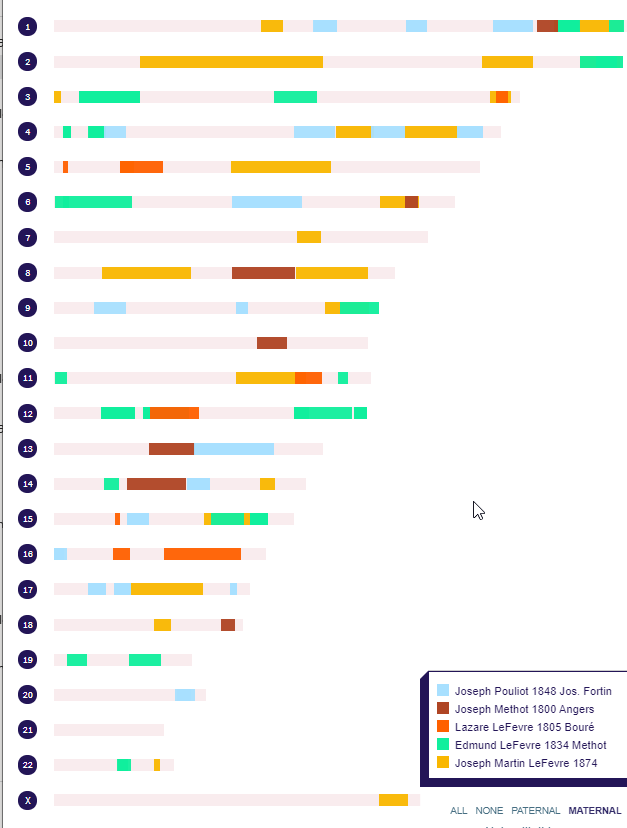
MacArthur/MacDougall is painted in in maroon in Chromosomes 4, 17, 18 and 19. This gets Elaine up to 20% painted on her paternal side. Chromosome 19 is where the small overalp occurs:

I also reorganized the key so it makes more sense.  MacArthur is on the Ellis side.

For Joan, I already had a listing for MacArthur/MacDougall:

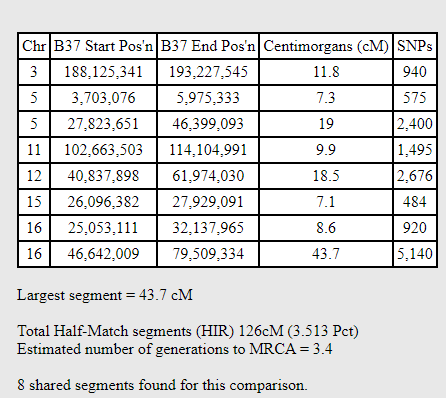
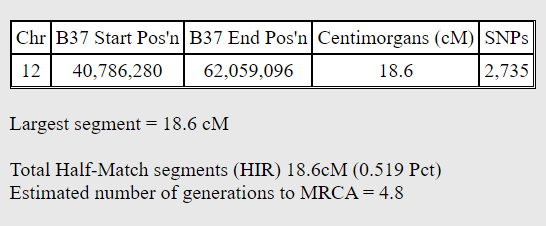
Elaine’s match with Barry and MG overlap on Chromosome 4. I assume that would be considered triangulation:

MyHeritage shows triangulation by circled segments.

Edna on the Dicks Line

Edna fits in well with my Dicks DNA Project:

Edna also has this Theory of Relativity:

I’m not as sure that this is right. Here is the DNA tree I have:

I added Edna in under the left circle. HereI have painted Edna on to Joan’s DNA Map:

Edna has good overlap with other Christopher Dicks descendants. I think that Henry Dicks is from a more distant line. There is also overlap on Chromosome 21:

Edna overaps with Joan’s Aunt Esther. Esther overlaps with a more recent Dicks Line. So while Edna adds no new Dicks DNA to Joan’s map, this exercise places Edna within the DNA framework I have for Christopher Dicks born 1784 and his wife Margaret.

For some reason, I could not find Edna on Elaine’s MyHeritage match list.

Nat’s Theory on the Ellis Side

Nat has three Theories of Relativity with Elaine at MyHeritage. Here is the closest:

Theory two is similar to Theory one but involves a 4th cousin once removed. Theory three is more distant on the MacDougall side.

Here we have a problem on Chromosome 6:

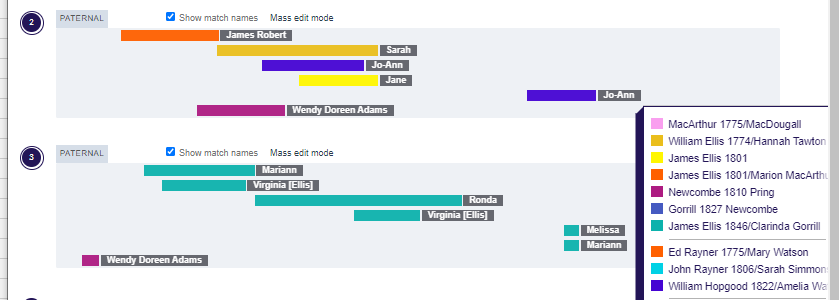
Hopgood (yellow) and Ellis (blue) should not be sharing the same space on the Paternal side of Chromosome 6. That means that there is a problem with the genealogy or some mixing of lines. I see that Jo-Ann has three Theories of Relativity. Here is Theory Three:

Turns out that Jo-Ann’s Chromosome 6 match with Elaine is most likely on the Ellis/Tawton side. I can fix this in DNA Painter:

Unfortunatley, that changed all of Jo-Ann’s matches. Here is the screen I should have used:

This is what I had wanted:

After checking chromosomes, I found another issue:

Jo-ann is bumping into Robert on Chromosome 4. I’m in deep on this one. I’ll assume that Robert has no Hopgood ancestry and change this segment also.

I hope that Jo-ann doesn’t mind me messing around with her DNA!

Next, I paint Nat onto Joan’s map:

Nat and Joan only match on Chromosome 6. Here I need to switch Jo-ann from Hopgood to Ellis like I did above:

That looks better. The three yellow segments now match up.

AutoClusters at Gedmatch

Here are Joan’s AutoClusters at Gedmatch between 35 and 250 cM:

This is how I see Joan’s matches shaking out. What about the clusters inbetween the two connected sets of clusters? Green Cluster 8 has someone with Guysborough, Nova Scotia ancestry. That is likely on Joan’s Daley side, but I was not able to match up the genealogy.

Elaine’s AutoClusters

Elaine, as may be expected has a similar profile to her sister Joan between the levels of 35 and 250 cM.

The configuration is inverted for Elaine. Her Newfoundland cluster group is in the top left and her PEI cluster group is in the bottom right. Elaine has four clusters in the middle compared to Joan’s three. My guess is that all or most of these clusters could be on the Daley side.

Barry is in blue Cluster 9. He appears to have PEI ancestry.

This shows Barry’s connection to Joan but the connection to Elaine would be the same.

Tammy is in brown Cluster 10. She has Rhynold in her tree. Tammy’s tree goes back a bit further than what I have.

Tammy’s maternal side goes back to Johann Rheinhold:

He apparently married Ann Lowry and had Tammy’s ancestor John Gleason Rhynold and Frederick born 1792 who was my wife’s ancestor. Tammy has Johann Capar Rheinhold born in Frankfurt and marrying in Cornwall, then settling in Guysborough, Nova Scotia.

I can add this couple to my wife’s family tree. I’ll add Tammy to DNA Painter:

Tammy is right below Stuart mentioned earlier in the Blog. Actually, the four in  Cluster 10 are probably all closely related.

Cluster 11 has Susan. She has PEI MacArthur ancestry.

Summary and Conclusions

  • I started updating the four grandparents of my mother-in-law. They are Ellis and Rayner from PEI. Also Upshall from Newfoundland and Daley from Nova Scotia.
  • One easy way to update DNA matches is through MyHeritage’s Theories of Relativity. I like to use DNA Painter to map out those DNA matches.
  • I also used Gedmatch AutoClusters. In this case, it was easy to pick out the large amount of Newfoundland matches as well as the PEI matches. There are not many Daley side matches.
  • It was possible to connect many of the Ancestry uploaded Gedmatches to their Ancestry profiles to check on family trees.
  • I found a new connection to Germany through the Rheinhold line connected with the Ellis’ Dale side. Johann Caspar Rheinhold apparently was born in the area of Frankfort, married in England and moved to Guysborough, Nova Scotia. I have not tried to confirm the genealogy, but it is in several trees and the match by DNA supports or confirms those trees. This surname was later changed to Rhynold and Rynault
  • In using DNA Painter, it is possible to sort out the DNA matches where there is more than one possible pair of common ancestors that the DNA may have come from.
  • DNA Painter also points out that the DNA matches are not evenly distributed by the four grandparents. There were very few matches shown on the Daley side at the match levels chosen. Most matches were on the Upshall side.
  • I didn’t break down the clusters between Ellis and Rayner, but I think that there are more Ellis matches than Rayner matches as there were many large Ellis families.

Playing with Phased Grandparent DNA at Gedmatch

Some kind person worked on my DNA to phase it to my four grandparents and uploaded the results to Gedmatch. One of those 4 grandparents was my my maternal grandmother Frazer side. This is exciting territory as this is an area of genetic genealogy that I haven’t looked at before in over 500 Blogs that I have written.

My Top Frazer Match at Gedmatch

I can run this kit which would be equivalent to my siblings’ Frazer matches at Gedmatch. My top match at Gedmatch is Tony. Let’s see if that match pans out. The phasing was not perfect, so there could be some errors.  The largest match with Tony is 193 cM, but when I run the details, it is only a small match:

My guess is that other matches with large largest segments are not correct. My first real match appears to be my second cousin once removed Paul. Here is what the match with my composite Frazer kit looks like:

Matches in Common with Paul

I ran matches in common with Paul and the composite Frazer Kit and then put those matches in a matrix:

I recognize at least half of these matches.

Painting My Frazer Matches

It occurs to me that I can paint my Frazer matches. As this DNA painting represents my grandmother, I’ll say that the person is female:

The first person on the match list under Paul is rosco. This is actually Keith:

Keith is in the last green box on the right next to Paul. I put that Keith is on my grandmother’s paternal side:

DNA Painter has my grandmother <1% painted. The next question is how closely should I ‘paint’ my grandmother’s DNA? In the past I have only gone to grandparent level. I think I’ll change and go to 1st cousin level. A first cousin shares two grandparents.

Adding Paul

Paul would be a first cousin once removed to my Frazer grandmother:

This gets my grandmother up to about 2% painted. I next added Emily. Emily’s common ancestors with mine are the same as Paul’s: George Frazer and Margaret McMaster.

Adding Gladys

Gladys’ common ancestors go back a generation to James Frazer and Violet Frazer:

Here, I changed the dark green to a lighter green, so it wouldn’t blot out the older DNA. So far, I have been only painting the Frazer paternal side. The maternal side is Clarke and I know less about Clarke genealogy than Frazer genealogy.

Painting Michael: Common Ancestor Richard Frazer

Notice Chromosome 1. The blue segment shows as all Richard Frazer. However, this is how it breaks out:

That means that the green segment is really Frazer and not McMaster. The Orange segment under the blue is Violet Frazer as she was the daughter of Richard Frazer.

Clarke DNA

My grandmother’s mother was Margaret Clarke. However, Margaret died when my grandmother was young.  I have a few fairly good DNA matches on the Clarke side, but the best matches are not at Gedmatch. Stephen is probably the closest match. Here is Stephen:

Stephen is also related on the McMaster side which confuses things. However, the closer match is on the Clarke side.

Now my grandmother is about 6% painted. Yellow is her first maternal DNA. I haven’t looked at X Chromosome matches as those are treated separately at Gedmatch.

Next, I looked for matches in common with Stephen and my phased Frazer kit:

The problem is that some of these matches are the same that were in common with my cousin Paul. Paul has no Clarke relatives. That means that this comparison is probably picking up the McMaster connection also. However, it may be possible to tease the two apart.

Grandmother Frazer AutoCluster

I thought that I had done these before, but perhaps not. At standard Gedmatch defaults, I get 19 clusters for my Frazer Grandmother:

There are a narrow range of DNA matches. They range from about 19 to 23 cM. I recognize matches from the last three clusters. Cluster 17 has Jonathan. Our common ancestor goes back to about 1690, but I have a feeling that there is a more recent match – probably on the James Line. James Frazer was born around 1717. Here is where Jonathan matches:

There appears to be a small overlap between Paul and Jonathan.

Pat and Bill are in Cluster 18. Here is how Pat and Bill fit in:

Our common ancestors are James Frazer and Violet Frazer.

In Cluster 19, I recognize Marilee who is related on one of my Frazer lines also.

I changed the limits to between 22 and 250 cM and got this autocluster:

In this AutoCluster reiteration, Clusters 11-14 are the Frazer Clusters. The good news is that I can identify 4 clusters. The bad news is that there are 16 clusters which I cannot identify. Actually, Jonathan is in Cluster 2, so that is one more Frazer cluster that I am aware of. However, the match for this Frazer Cluster ois probably through my McMaster side:

This is the ancestry of my 2nd great-grandmother Margaret Frazer. Turns out that she had a Frazer ancestor that went to a common ancestor with Jonathan. They were James Frazer and Katherine Fitzgerald, born in the first half of the 1700’s.

Barry is in Cluster 11. This is how I think I am related to Barry:

For some reason, I don’t see Barry on my DNA Painter profile. I’ll add him in:

This shows that Barry overlaps with Michael who I match on the Richard Frazer Line. Richard was a brother of Philip. We are showing we match on the common ancestor of Archibald Frazer who was born about 1720. Some of these dates are relative. I have a chart showing Archibald born in 1743. Also many charts have Philip and Richard born earlier than the 1770’s.

Charles in Cluster 12

Charles is in Cluster 12 with Shelly and Martha. Charles has not been on my radar before. His tree is helpful in that he has a shamrock for his Irish ancestors:

The red symbol indicates Scotland. Shelly has a match in common with Gladys. I’m related to Gladys on my Frazer side. Martha from Cluster 12 is here:

One guess is that Charles could be related from this Philip tree or from the wife of Philip.

Cluster 13

I recognize three out of four in Cluster 13. They are Jane, Doreen, and Susan. Here is how they match my family by genealogy:

These families go back to Richard Frazer. The one I don’t recognize if Elizabeth. I can’t figure out how she fits in.

One Last Frazer Cluster Between 23 and 250 cM

By just shifting the lower number up to 23 cM, I go from 20 clusters to 13:

Now my Frazer Clusters are 1 and 2. Cluster 2 is interesting, beause it includes both my Frazer and McMaster Lines. Those are both double lines because two Frazer cousins married in that Cluster and two McMaster cousins married. The 145 cM match has a common ancestor with my family of James McMaster and Fanny McMaster. They had Margaret McMaster who was my 2nd great-grandmother. That match matches my closer matches in the cluster – those who descend from Margaret but not my more distant Frazer relatives. The only one in the green Cluster 2 who I don’t recognize is Nicolas and I have written to him. He appears to be a fairly close relative of Emily who my Frazer kit matches at 125 cM.

In Cluster 1, I know how I am related to all but Gary at 26 cM. However, I have been in touch and he knows my Frazer relatives in Ireland. In the above analysis, I went from further out clusters to more closely related clusters. It probably would have made more sense to start with the more recognizable clusters, but I had to start somewhere.

The last cluster is the false one I mentioned further up in the Blog.

Downloading Frazer Segment Data from Gedmatch

This could help in identifying other match groups or clusters. Roberta Estes has a helpful article on how to do this. Once I get the data from Gedmatch, I like to put it into my own format in an Excel spreadsheet. For example, I should be able to look at the region where I have Clarke matches to identify other potential Clarke Clusters. Unfortunately, when I got to the Download button at Gedmatch, it didn’t work.

I guess I’ll have to explore these matches later.

Grandfather Hartley DNA

This is all exciting and new territory for me. This time, I will start my grandfather Hartley Cluster with the range of 23-250 cM:

Even at this level, I get a lot of unrecognizable clusters. Cluster 11 has Lee in it. He has Hartley ancestry in the area of Colne where my Hartley ancestors were from, but I was unable to make a connection.

Hartley Clusters 25-1,000 cM

This brings in some of my 2nd cousins and 1st cousins once removed. Here Cluster 2 is Lee again with the Hartley ancestry. He has a shared match with my 1st cousin once removed. That shared match has Shackleton ancestry, so that is a possible connection.

For some reason, the AutoCluster at Gedmatch does not work as well on my Hartley side as it did on my Frazer side. This is possibly because I have worked to have a lot of my Frazer relatives out to the level of clustering upload their results to Gedmatch.

My Maternal Grandfather: Rathfelder

My maternal grandfather was German but grew up in Latvia. Here are some of the clusters for that side. The limits I set were between 20 and 1,000 cM:

The purple cluster has some relatives that are still in Latvia. The top match in red Cluster 3, Otis, has Schwechheimer ancestry in common with my mother’s side.

My Maternal Grandmother’s AutoClusters

This should finish off the Blog. My maternal grandmother was a Lentz. However, I get many matches to her Nicholson mother’s side. This run is between 19 and 500 cM:

Many of these names and clusters are identifiable. Cluster 3 is Nicholson. Cluster 4 has my mom’s relative who is both Nicholson and Lentz.

Sadie, Joan, Linda and Carolyn are in the red Cluster 3. The largest match in Cluster 4 is with Judy who is a first cousin once removed to my mother. As such, she is related on the Nicholson and Lentz side.

Father and Daughter in Different Clusters?

Yes it happens:

Robert is in brown Cluster 5 and his daughter Sadie is in red Cluster 3. As these both have the common ancestors with me of Nicholson and Ellis, my guess is that one cluster could favor Nicholson DNA and the other Ellis DNA.

Summary and Conclusions

  • I took one of my first looks at my four synthetic grandparent kits at Gedmatch
  • I had the best luck with my Frazer side. This is probably because I’ve spent a lot of time working on getting Frazer relatives to upload their results to Gedmatch.
  • I started a DNA Painter map for my paternal grandmother’s Frazer side.
  • I tried clustering my four grandparent results. I recognized the fewest clusters on my Hartley side.
  • I found an interesting match with Elaine on my Frazer side using clustering. However, I couldn’t find further information on her family tree and couldn’t find her Ancestry account.
  • I tried downloading segment information for my grandparents, but I couldn’t get that utility to work at Gedmatch
  • There is still a lot of work that could be done with these four Gedmatch kits that represent the DNA for my four grandparents.