In a previous Blog, I looked at what I called a false AncestryDNA hint. What I meant by that was that the DNA match itself was false. Because I did not match the other person’s mother’s or father’s DNA results, I could not match the person. There was much discussion on Facebook as to whether the AncestryDNA Shared Ancestor Hint (SAH) was good, bad, false, unconfirmed, etc. However, whatever the hint should have been called, there was no sense in following up on a DNA match that was false.
In this Blog I want to look at a SAH that is not false, but only bad. I don’t have a generic definition for what a bad SAH is, but in this case it is an AncestryDNA member match that lead to an ancestry tree hint on my father’s father’s side. In this blog, I will show that the actual DNA match as shown at Gedmatch was on my father’s mother’s side.
What AncestryDNA Shows
Here is the shared DNA of my member match Carol:
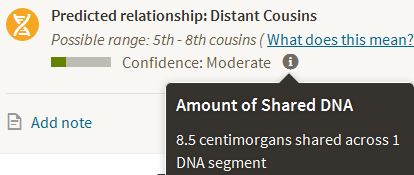
Ancestry has their little DNA symbol and even gives the amount of DNA we share across 1 segment. This DNA matching information is on the very same page with this heading:

Somehow this leads me to believe that the DNA match is leading me to an Ancestry Tree hint right below my DNA member match information:
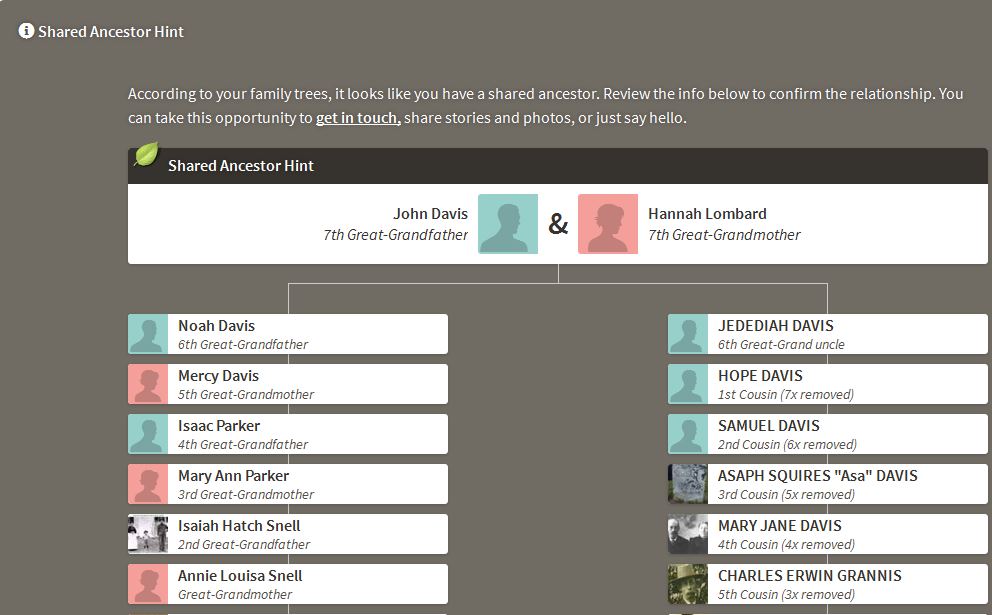
Incredible. AncestryDNA has found a hint of two shared 7th great grandparents nine generations away from my match and me. Except that it is incredibly wrong based on the DNA match. How do I know?
My Ancestry Match at Gedmatch
Fortunately, my match, Carol, was wise enough to upload her results to gedmatch. Here is our match at gedmatch:
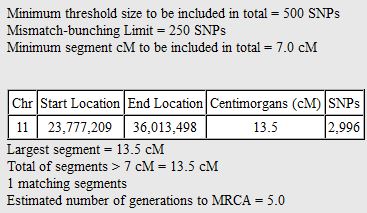
This looks like a decent match. Now I know where we match. I can check on my Visual Phasing map of Chromosome 11. Thanks to Kathy Johnston for the method.
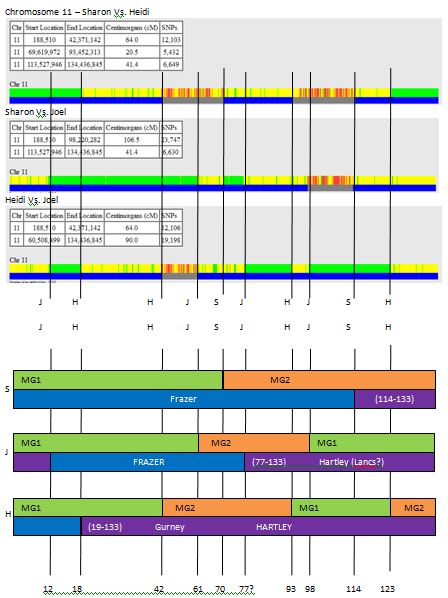
The middle bar is me (J). The paternal half is shown as blue and purple. Oh no, it shows that the area that I match Carol (24-36M) is a Frazer segment for me. This is my father’s mother’s side, not my father’s father’s side that had ancestors going back to colonial Massachusetts (John Davis and Hannah Lombard). All my Frazer ancestors were in Ireland before the 1880’s or so. I must have made a mistake. I’m just sitting here at a 10 year old computer that is about to die and Ancestry with it’s billions of dollars of resources is giving me a hint that they think is right. Ancestry really makes me doubt my work. So I check other Hartley reference matches. I add my brother to the visual phasing. No, it looks like I had it right after all. This is definitely an Irish Frazer match.
Shared Matches?
Perhaps if AncestryDNA had given me some shared matches, it would have tipped me off that this is the wrong DNA. However, at this level of match, apparently they don’t do this.

But that’s OK. I have Gedmatch which will give me shared matches. Gedmatch will even show how the shared matches match Carol on Chromsome 11 on a Chromosome Browser:

#1 and #2 are matches to Carol that I don’t know. #3 is me and #4 is my sister Sharon. It even looks like these matches to Carol could triangulate. However, Ancestry has told us that triangulation has about a one percent chance or less of happening at this level of relationship. That is why they use circles. Should I go against the advice of the mighty Ancestry? Below is Ancesty’s probability that 3 people will match at the same segment (triangulation).
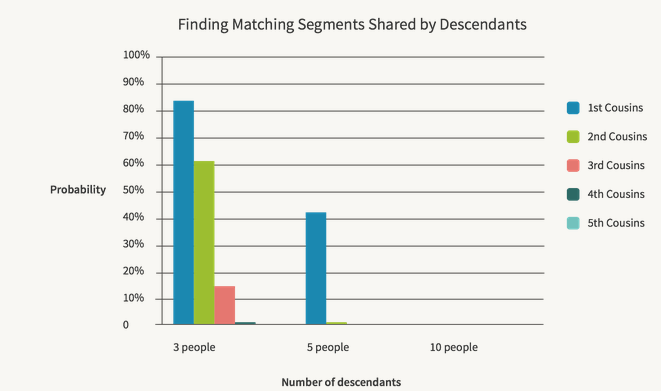
I’ve gone this far, so let’s see what happens. Perhaps I will have beat the Ancestry odds of my finding a Triangulation Group (TG). At Gedmatch, I used the Multiple Kit Analysis for Carol and her first 3 matches as shown above and downloaded the segments for Chromosome 11:
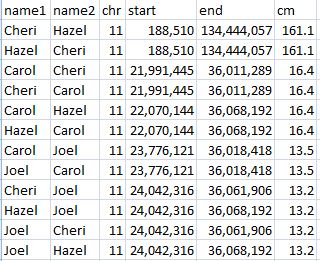
I didn’t bother adding my sister Sharon to the mix. It looks like Cheri and Hazel are closely related, but that’s OK. I see that:
- Hazel matchs Cheri
- Carol matches Cheri
- Carol matches Hazel
- Carol matches Joel
- Joel matches Cheri
- Joel matches Hazel
That meets the definition of a Triangulation Group.
So far with Carol I have:
- Checked her against my paternally phased kit to make sure she matched me on my paternal side.
- Checked her results against my visual phasing map and mapped her to the appropriate grandparent
- Shown that she was in a TG
To me, this confirms that my match with Carol is a real match on my father’s mother’s Frazer side and not my Hartley side.
Can Ancestry Redeem Itself?
After giving me a ‘bad’ hint, no chromosome browser, and telling me that resistance as well as triangulating is futile, can Ancestry redeem itself? Now that I know my match with Carol is not in Colonial Massachusetts, but Ireland, I can go back and check Carol’s Map and Locations button at AncestryDNA. Hmmm…. where should I look? Perhaps Ireland?
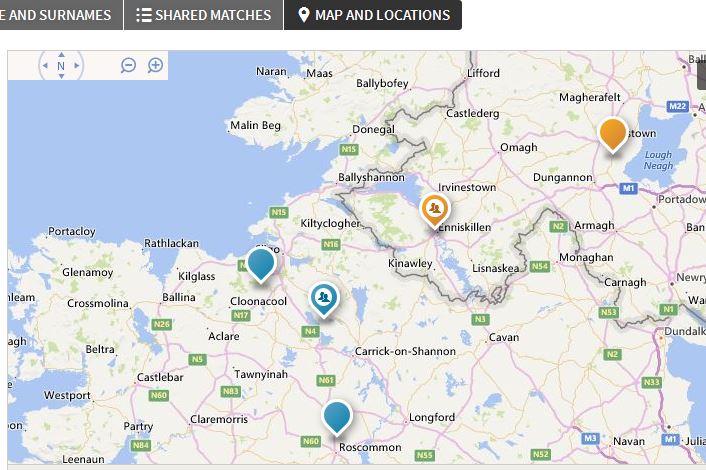
Oh look. Carol has ancestors in Enniskillen, not too far from my blue ancestors. In fact, some of my other DNA relatives along the Frazer line have shown Enniskillen as a home base.
Summary and Conclusion
- Ancestry gave me a ‘bad’ hint in that the DNA they used to point me to Colonial Massachusetts should have pointed me to Ireland
- By implying that their DNA match leads to a specific tree, they also imply where the DNA came from. In this case the implication was the DNA match inferred my Hartley ancestors. In fact, I have shown that the DNA points to my Frazer grandmother whose parents were both born in Ireland.
- Ancestry Shared Ancestor Hints take the easy way out. They point to places with good records and trees that are relatively easily created rather than to the places with more difficult ancestry such as Ireland. That is not helpful in furthering my research.
- The Colonial Massachusetts match between Carol and myself may be correct. However, there is no sense trying to confirm or denying our shared Colonial Massachusetts ancestry with a DNA match that leads to late 1800’s Ireland.
- I seriously doubt Ancestry’s probability of finding triangulation at the 4th cousin level between three people as being 1% or less. The 2 surname groups that I have worked on have large matrices of TGs for each surname.
- Ancestry Hints are not useless without Gedmatch. However, they can be misleading.
- It looks that close to 90% of my SAH’s are in the Distant Cousin range. Be very wary of these Distant Cousin matches that have not been verified by Gedmatch.
I’m still learning, but isn’t the Shared Ancestry Hint based on who / what others have put in their tree – matching individuals in the trees of people that one shares DNA with?
I’ve not seen where Ancestry actually assigns an ancestor to my DNA result.
You are right but the way you get to the Shared Ancestor Hints is through the DNA matching. I don’t think there are any non-DNA Shared Ancestor Hints that I am aware of.