I recently had an email from Edward. He had found my Blogs on Dicks DNA via Google. He had done a lot of Dicks genealogy in the past and now has had his DNA tested. That is great news. Edward is someone with a great knowledge of Dicks genealogy and has tested his Autosomal and YDNA.
First, Dicks YDNA
Seeing as I knew nothing up until now about Dicks YDNA, I’ll start with that. Edward is R-L371. That needs a bit of explanation. In very broad strokes, that shows that the branch of Dicks that we are looking at is R1b > L21 > L371. L21 is an interesting branch. L21 has been called the Celtic branch. This may be inaccurate, but to me it typifies the old inhabitants of the British Isles. As you know, the British Isles have been invaded by many different groups. I suppose you can say the L21’s are the invaded rather than the invaders of the British Isles.
Here is L371 on the L21 Tree:
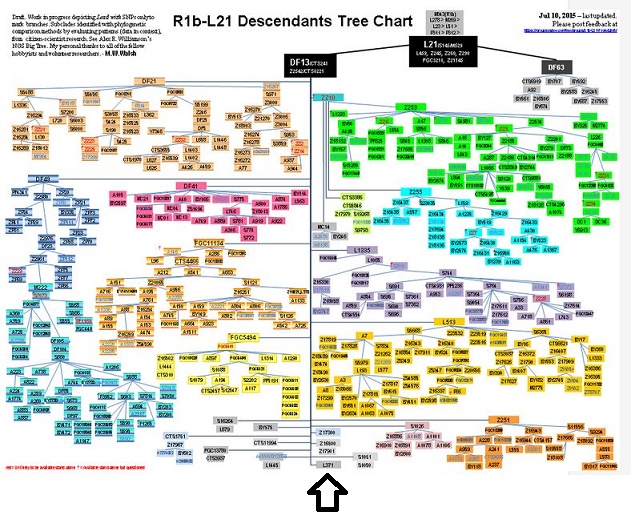
This is from an outmoded tree. The creator of the tree gave up updating it in 2015 as so many L21 branches have been discovered. You will notice that some groups have more branches than others. L371 has very few branches. YFull tracks (for a fee) branches for people that have taken the BigY YDNA test or equivalent.

The interesting thing about the YFull Tree is that it gives dates. It shows that R-L371 was formed 4300 years ago. However, it has R-Y15149 right under it formed only 350 years ago. That is a long time span.
For R1b, Alex Williamson’s Tree is another resource. This tree also analyzes BigY testers.
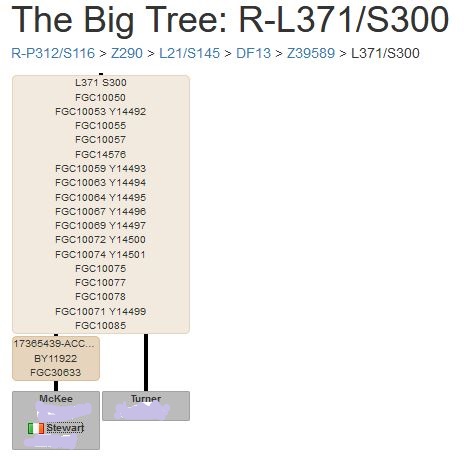
I erased the ID’s for privacy. From the above, it looks like there are three L371 people that have taken the BigY test and uploaded to the Big Tree. This shows that McKee and Stewart share one variant (with a number) and two SNPs. SNPs are the ones starting with letters, like BY11922. If two Dicks descendants were to take the Big Y test, it would be likely that a new SNP would be found that would be unique to the Dicks family.
STRs Vs SNPs
I started out discussing SNPs above as they are more certain than the STRs. SNPs are Single Nucleotide Polymorphisms. The Single is the important word and it means that they are singular or unique. STR stands for Short Tandem Repeat. A repeat is a number of copies of a position at your YDNA that gets repeated more or less due to a mutation. Because the value of the STR can go up or down over time, this makes for some ambiguities.
STRs and SNPs have an interesting interplay. For example, STRs are used to estimate a SNP, then SNPs are further tested for verification. This is unless a BigY or similar test is taken. The BigY finds all your named SNPs and then discovers new or unnamed SNPs which would be named at a future date once someone else tests positive for them. Once one has tested for a SNP or Haplogroup that is as close to the present as can be found, the STRs can be used as a sort of fine tuning within that SNP.
Ed and Harold’s STRs
Ed forwarded me the results of his 111 STR test. 111 STRs are a lot. That is pretty much the maximum number of STRs that people take at FTDNA. Ed also sent me Harold’s 111 STR results. Harold is a Henry Dicks (b. 1774) Line descendant and Ed is a Christopher Dicks (b. 1789) Line descendant.

This came out quite small. Harold is listed first. the value in red is Harold’s Haplogroup. It is in red because this SNP is a very general SNP estimated on his STRs. Ed has the haplogroup or SNP of R-L371 that I mentioned above. This is in green indicating that Ed has tested for that Haplgroup or SNP confirming that he has it. Ed highlighted in yellow the STRs that differed between him and Harold. He noted that there were only 4 out of 111 STRs that were different. That likely means that Harold and Ed share the same Haplogroup of R-L371.
FTDNA L371 YDNA Project
FTDNA has many Projects for surnames and different Haplogroups. I find the Haplogroup Projects to be more helpful. Ed is in the Dicks surname group and the L371 Group. I haven’t seen Harold’s results in either group. Here is the grouping that Ed is in within the FTDNA L371 Group:

Ed is placed with six other YDNA tested people because they have similar STRs. The heading he is under is called Modal 1.3. When I look at the L371 Group description, it says that:
Modal 1, R-L371+ Represents an early Briton (Celtic?) group found heavily today in Wales and scattered across south England.
The modal for this group is important. The modal is basically the number for the STR that occurs most often. This modal is considered to be the representative number for the group or can be considered the older number. The colored numbers are the ones that deviate from the Modal. So in this case, I take the modal to be the modal for the group that consists of Thomas, Monroe, Reese, Phillips and Dicks. As there are five different surnames, I am guessing that this group has been around since before there were surnames in that area. That area probably being Wales according to the information above.
A Dicks YDNA Signature STR
A signature STR would be a set of STRs that would define the Dicks surname. I looked at the places where Ed and Harold were different than the Modal 1.3. It turns out these were the STRs that Ed and Harold were different from each other:
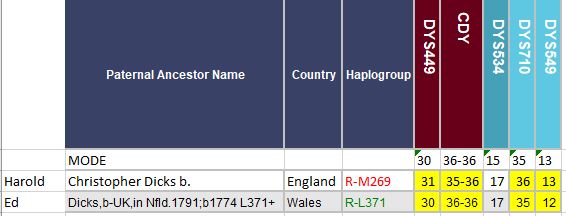
The exception was for DYS534. However, without Harold, the Modal was tied between 15 and 17. With Harold added the modal would have been 17, so I’ll leave that one out. Assuming that the Mode is the older, that means that Ed would have the older STRs for DYS449, CDY and DYS710. Harold would have the older STR for DYS549. Another point is that the STRs in maroon are the faster moving STRs.
A Simple Dicks STR Tree
Here is one guess of how a STR tree could be drawn for the Dicks family including Harold from the Henry Dicks Line and Ed from the Christopher Dicks Line.

Keep in mind that these trees are not an exact science. This is just one possibility of how to draw a tree. More information would refine this tree. You may wonder why Harold had three STR changes and Ed had only one if they were the same distance from a common ancestor. All I can say is this is pretty typical. DNA seems to have a mind of it’s own. Harold’s first two changes were the fast STRs, so that makes sense. Harold and Ed only had one STR change each for non-fast STRs. Some people even tend to disregard some of the fast moving STRs such as CDY as they can be misleading over a long time period. Another interesting fact is that the difference between the mutation rate of the fastest and slowest mutation STRs could be as much as a factor of 1,000 times.
Summary and Conclusions
- I didn’t know anything about Newfoundland Dicks YDNA. Now I do.
- Even though some complicated things happen with YDNA, the changes are confined to one long line going from father to son where all the fathers and sons follow a straight line – in this case Dicks line.
- The Newfoundland Dicks Haplogroup appears to be R-L371
- Harold is almost certainly R-L371 based on STR similarities to Edward
- There is likely at least one haplogroup below R-L371 that would further define the Dicks surname. However, finding new haplogroups requires the BigY or similar testing.
- In a previous Blog I tied together the Henry Dicks and Christopher Dicks Lines together by looking at autosomal DNA matches. The YDNA matches between Edward and Harold do the same thing in a more precise manner.
- I’ll look at Edward’s autosomal DNA in an upcoming Blog.