Now that a DNA sale is on at Family Tree DNA, my mind has turned to Frazer YDNA. I had thought that I had mentioned STR Trees and signature STRs for the Frazer family before. But after looking at my old Blogs, apparently I have not. I have talked about STR signatures, but will go into more detail here.
Present YDNA Testing of North Roscommon Frazer Descendants
At this time two male Frazer descendants have tested for YDNA. They are Paul and Jonathan.

Paul is two generations below on the left side and Jonathan is one generation below on the right side. If I have this chart right, that would mean that Paul and Jonathan are 6th cousins once removed. Their common ancestor was probably another Archibald Frazer born around 1690 who married a Mary. Both Paul and Jonathan have tested their YDNA for 67 STRs. YDNA tests male only lines – in this case if focuses on the Frazer Line .
A Signature STR
It would be interesting to know what the signature STR is for this Frazer ancestor born in 1690. How could we discover that? If we had many Frazer testers, we would like take the most common STR values and assume that those would be the oldest values. However, we only have two testers, so that would be difficult.
The problem with STRs is that they could go up or down. We would like the older STR signature to go to our 1690 Frazer. That means we have to go back in time a step to try to see which way the STRs are moving. The other thing is that we hope that they are moving in one direction only!
Jonathan represents the older Frazer line
In my past Blogs on the subject, I have assumed that Jonathan’s STRs represented the common Frazer ancestor more than Paul’s STRs. My reasoning was that Paul had very few matches at all levels. Usually at a lower STR level one has more matches. That said to me that Paul’s line’s STRs had mutated away from the ancestral signature. Here are the three differences between Jonathan’s and Paul’s STRs:

Jonathan’s results are on the top and Paul on the bottom. None of these STRs are very slow moving STRs. CDYa is a very fast moving STR. So fast, that some genetic genealogists don’t like to use this STR in their analyses.
The L664 Mode
It is my assumption that our Frazers are part of the R1a-L664 Haplogroup. That is based on the fact that usually this group has a value of the 388 STR of 10. That is the case for Paul and Jonathan. The mode is the STR value that is the most common. The mode is also assumed to the be representative of the oldest values. The L664 mode for the 391 STR is 10 and the mode for 576 STR is 18. That confirms my hunch that Jonathan has the oldest STRs. The mode for the CDYa STR is 33-39, which is a little more like Jonathan than Paul. However, as I’ve noted that STR can be unreliable – especially over long time frames.
Here are some of the other SNPs under the L664 Haplogroup:
 This is to give the reader an idea that there are many SNPs under this Haplogroup. It looks like there are 4-7 levels below L664. More SNPs could be discovered by the Big Y test.
How old is L664
It’s quite old. Here is the YFull Tree with dates:
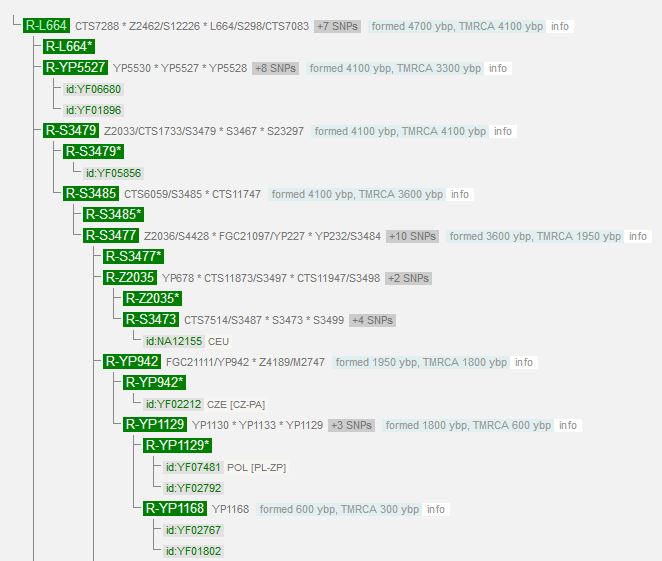
Note that a common ancestor with another L664 person could go back 4100 years. That’s a long time. And our Frazer testers are not even confirmed to be L664. That means that their Frazer SNPs are still in the cave man ages. That is one reason why Big Y tests are needed. This YFull Tree above follows one branch down to where the common ancestors are 300 years ago. That is closer to where I would like to see our Frazer SNPs. Note that the YP1168 is also shown on the pink tree above. So while these SNP trees look quite innocent, it is not always obvious that they could represent close to 4,000 years.
The North Roscommon Frazer mode based on the l664 mode
In order to get our Frazer mode, I would just have to look at the STRs that the Frazer have that are different than the L664 Mode. The L664 is the going back in time Haplogroup that I mentioned above.

Above, I left out those Frazer STRs that were the same as the L664 mode. Of these STRs, the 450 is likely the most significant as it has the lowest likelihood of mutating. That is shown in orange with a value of 0.200.
Putting It All Together In a Simple Frazer Tree
Here is a simple tree:

A few comments:
- There may be some refinements to this Frazer Ancestor Signature STR, but this is the main idea.
- It seems odd that Jonathan would have no STR mutations between 1690 and when he was born. It is likely that he has had mutations – probably with one of the faster mutating STRs
- A new Frazer descendant has ordered a 67 STR test. He is on the Archibald line, so that should clarify things there as far as where the mutations happened.
Keep an Eye on the Grants
By YDNA, the Grants seem related to Frazers. I am assuming the relation goes back in time in Scotland. I don’t know if this break happened before the adoption of surnames or after. Here is a Grant/Frazer Tree I had made some time ago:
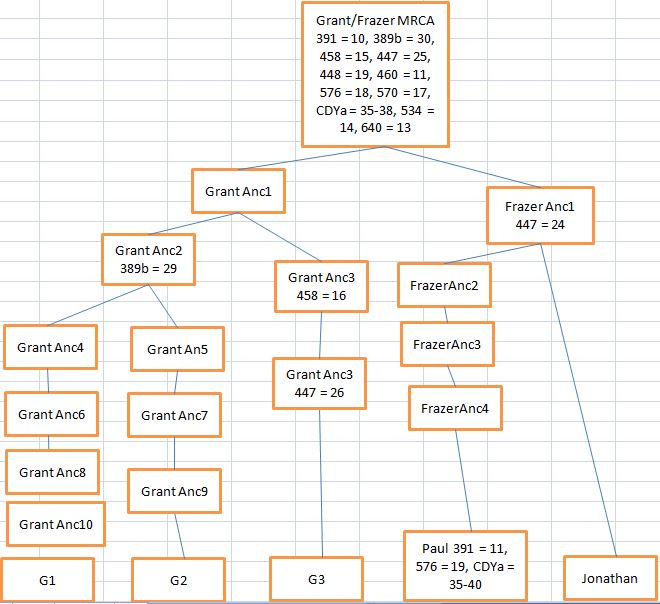
- The Frazers could be related to other Scots Lines. However, this one seemed to stand out.
- I took the STR signature concept I brought up in this blog and applied it further back in time and have a Grant/Frazer Ancestor signature at the top.
- In this scenario, the only genetic difference between a common Grant/Frazer ancestor and a Frazer ancestor is the 447 STR.
Things to Come
- Pat has ordered a 67 STR test for her male cousin and a Family Finder test for his sister
- Joanna and I have ordered BigY tests for Jonathan and Paul.
- With all this YDNA testing we are coming from the distant past into the less distant path. The goal is to confirm our Frazer Lines and connect with some as yet unknown Frazer Lines.
- The three pronged attack is: genealogy, autosomal DNA testing for the last 250 years, and the Big Y to cover from perhaps 2,000 years ago to as recent as we can get. We will wait and see.
- The advantage of having two Big Y tests is that we should discover new SNPs that are unique to our branch of Frazers.
- I plan to use YFull to analyze Paul’s BigY results to get dates for the SNPs.