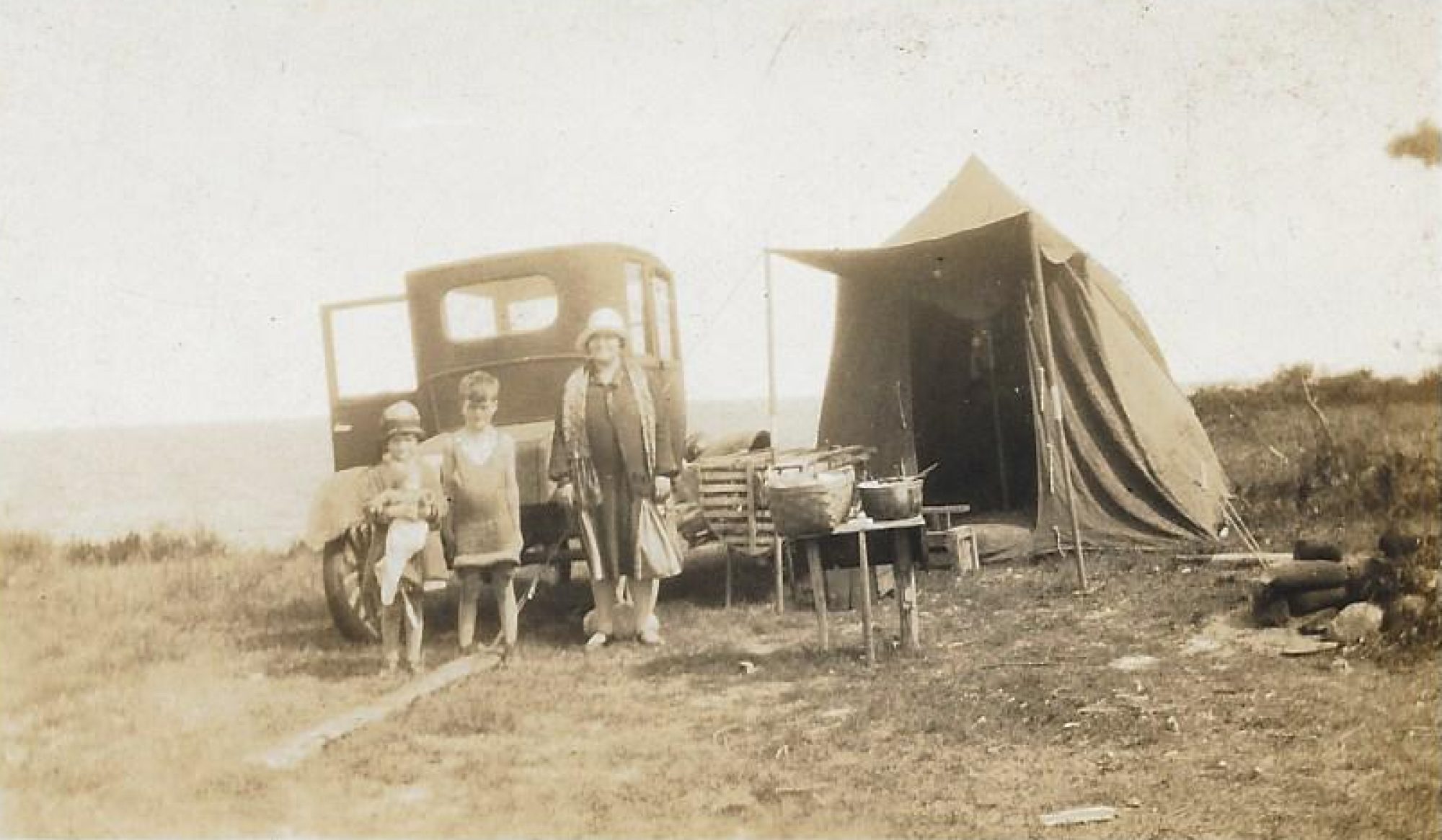
I’ve had a FTDNA kit hanging around for my father’s elderly cousin. I’ve had it since last Summer, but haven’t gotten in touch with my second cousin Lisa to see if I could get her uncle tested. This would be important, because I have test results for Lisa’s dad Jim and her Aunt Joyce. The third sibling Ralph would make it easier to perform Visual Phasing.
Visual Phasing
Visual Phasing is comparing siblings’ DNA results in a Chromosome Browser. By looking at changes and comparisons in the Browser as well as matches to known cousins, it is possible to find out what portions of the siblings’ DNA came from which grandparent. For me, this is important as I am interested in separating out matches between my great grandparents Hartley and Snell. Jim and Joyce’s maternal grandparents were James Hartley and Annie Snell. Annie’s ancestors went back to SE Massachusetts Colonial times. James ancestors were from NE Lancashire. I’m stuck on Hartley genealogy in Trawden, Lancashire around 1800. This is due to the fact that there were too many Hartleys in the area at the time to tell one from another based on vital records. Finding Lancashire Hartley ancestor DNA matches may help me break down my Hartley genealogical brick wall.
Joyce and Jim’s Genealogy

The goal of visual phasing is to figure out what parts of Gurney, Rounesville, Harltey and Snell contributed to Jim and Joyce’s DNA. In doing this, it would help to have matches from fairly close (but not too close) relatives on all four lines.
Comparing Jim to Joyce on Chromosome 11
I’ll just jump in and start with Chromosome 11. This is midway between 1 and 22. Here is the comparison between Jim and Joyce:

- The blue line is where Jim and Joyce match each other
- Within the blue line there are two types of matches
- The yellow area is a single match. This is also called a Half Identical Region (HIR). This means that Joyce and Jim get their DNA from one shared grandparent A, but don’t match on grandparent B, C or D. We don’t know now if granparent A is on the maternal or paternal side.
- The green is a double match. That is called a Fully Identifal Region or FIR. In that area they got the same DNA on their maternal and paternal side of Chromosome 11. That also means that they share the DNA from the same maternal grandparent and the same paternal grandparent
- The grey, non-blue area (below) and the red area above is where Joyce and Jim do not match. That means that Joyce gets DNA from Maternal grandparent A and Paternal grandparent C while Jim gets his DNA in that area from Maternal grandparent B and Paternal grandparent D
- At each vertical line above, there is a crossover where Jim or Joyce’s DNA goes from one grandparent to another.
Let’s Start Two Person Visual Phasing

Here is a start. In about the middle of the Chromosome there is a green FIR. That means that Jim and Joyce got their DNA from the same maternal and paternal grandparents. Those grandparents are represented by blue and orange segments. There are crossovers on the right and left of these segments, but we don’t know if the crossovers are for Jim or Joyce (or one for Joyce and one for Jim).
It would be nice to know where the changes take place, so I go to gedmatch.com for that. At gedmatch I compare Joyce to Jim in the chromosome browser at full resolution.

The pink area is the centromere of Chromosome 11. Every ^ is one million places. The start of the green HIR counting back from 60M is 57M.

Here I added the 57 before ‘Chromosome 11’ above. I also added some other crossover locations.
Cousin Matches
I am stuck already in my analysis, so I need some cousin matches. These would ideally be at the level of second cousin matches. At the level of second cousin, you match on only one grandparent. Most known matches matches share Hartley and Snell grandparents, so that is a problem.
Shared Ancestor Hints (SAHs) at AncestryDNA
Joyce’s results are at AncestryDNA. There, she has Shared Ancestor Hints. Those Hints are where Joyce has a family tree match and a tree match. Here is an SAH that Joyce has with Chuck:

Chuck is at the perfect level as he is a 2nd cousin. However, he has not uploaded his DNA to gedmatch for comparison. Ancestry does not show on what Chromosomes you match, so that is a problem. We need chromosome match information for DNA mapping.
Back to Gedmatch
Because many at AncestryDNA don’t upload to Gedmatch, I’ll go back to Gedmatch and look for matches there.

Here is a very interesting match that Sumner and Heather have with Joyce at Gedmatch. This shows that Joyce has an estimated by DNA common ancestor between 3.7 and 3.9 generations away. They also share autosomal DNA and X Chromosome DNA. These two are also at Ancestry and show up on Joyce’s Shared Ancestor Hints.

Here, Joyce and Sumner are 4th cousins by shared trees. However, note that this is only hint 1 of 3. HInt two also goes back to Joyce’s Rounseville grandparent at firth cousin twice removed. Here is Hint 3:

This Snell connection is at 7th cousin once removed. There has to be a very low chance of a DNA match that far out – especially compared to a 4th cousin match . However, this is interesting as it shows that Joyce has two paternal matches with this person and one more distant maternal match.
Here are the important details of the match between Joyce and Sumner:

This shows that Joyce and Sumner match on four different chromosomes, but not Chromosome 11. OK, back to the drawing board. I’ll start over with Chromosome 7. Sumner and Joyce have a pretty good match there.
Chromosome 7 Visual Phase Two Person Map

Note that Joyce’s Chromosome 7 match is from 149 to 158M. That is at the right side of Chromosome 7. It is possible that the 149M could mark Joyce’s paternal crossover. I am going to start from the right of the Chromosome and give Jim and Joyce four different colors there. This will represent all four of their grandparents. I can do that because Jim and Joyce don’t match each other at all in that segment.
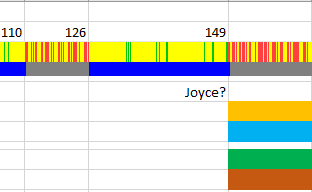
Here I have put Joyce in for a possible to likely crossover at 149. Remember that Joyce and Jim don’t match each other at all after 149M. That means that Jim won’t match Sumner either. I checked gedmatch and he doesn’t as expected. Next, I’ll assign Sumner’s match to Joyce on either her green or brown side. I’ll randomly choose green. That puts the paternal side on the top for Jim and Joyce:

Becuase Joyce’s green paternal segment is Rounesville, that means that Jim’s orange segment must be the paternal husband, Gurney.
Next, I would like to check the paternal crossover for Joyce. The recommendation at the Facebook Visual Phasing side is to look for ‘stranger matches’.
Stranger Matches
If I see that Jim has a match or matches that go across the 149 crossover line, then I can assume that he has no crossover there. The hitch is that the match going over the 149 line needs to be on Jim’s paternal side on the top of his Chromosome 7.
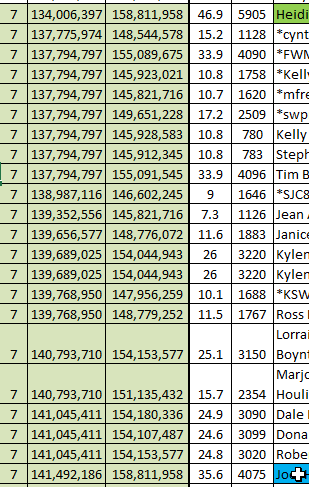
Here is a spreadsheet of Jim’s matches on Chromosome 7. Jim’s match with Tim goes clearly from 138-155M. That meets one requirement. Is this a paternal or maternal match for Jim? My thought was that if this match was maternal, then Tim should match my sister Heidi at the top and me at the bottom of the list in blue. I checked and Tim only matched Jim. That means that the crossover belongs to Joyce and is likely on her paternal side. The only thing I didn’t rule out is that the crossover could possibly be on Joyce’s maternal side.

Here I went with my original guess that Joyce’s crossover was on her paternal Gurney/Rounesville side. Because I gave the crossover to Joyce’s paternal side, that meant that there was no other crossover at 149 and I moved the maternal segments to the left. I still have figured out whether Hartley or Snell is blue or brown. Next note that the segment from 110 to 126M is a no-match segment. That means that there must be a maternal crossover next. The reason for that is that no-match means four different colors. Jim and Joyce already have different colors on the maternal side. If we change one of those colors with a maternal crossover, there will be a match between 110 and 126M.

In order to get a no-match from 110-126M, Jim or Joyce’s DNA must be Rounseville from 110 to 126M.
Stranger Match or More Cousin Matches?
I really should go with both, but I’ll start with the stranger match. Jim has matches between 105 and 134 showing no crossover there. When I look at one of those matches and run those that are in common, I get this:

#1 is Jim’s sister Joyce. 2-6 are the strangers and #7 is actually a 2nd cousi of mine, but it could be from a match on another line. So Jim is matching the strangers in that 105 to 134M area. However, he is matching Joyce starting at 126. That gives me the impression that it is Joyce that has the crossover. On the other hand, I don’t see any of Joyce’s matches on her match list that go through 126M.

i am moving slowly from right to left on Chromosome 7. The segments that I am really interested in, I have no information on – except that one is Snell and one is Hartley and they appear to be relatively large segments, so far.
Phasing by Geography
I had mentioned that Snell’s ancestors were from SE Massachusetts going way back. The Hartleys came to the US from Lancashire in the last half of the 1800’s. As far as I know, the Gurneys and Rounesvilles have been around SE Massachusetts for several hundreds of years also. When I look at Joyce’s matches at Chromosome 7, I see some interesting emails. Between 155M and the end of Chromosome 7, Joyce has three small matches with people three people that have nz, au or uk in their email addresses. That gives me the opinion that at least from 154M to the Joyce could have Hartley DNA. That also brings up the question as to whether Joyce has a maternal or paternal crossover at 149M. If I go with what we had already, I would get this:

Starting to Visually Phase Chromosome 8
I can come back to Chromosome 7 at some time. I’m looking at Chromosome 8 as I wrote a Blog about a Lancashire matcher here. Here is how Anne matched Joyce and two of my second cousins:
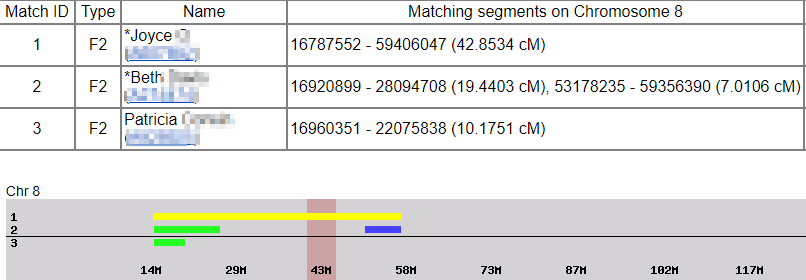
The important part is that Anne matches Joyce from about 17 to 59M. That is a pretty good match. Here is the common ancestor:
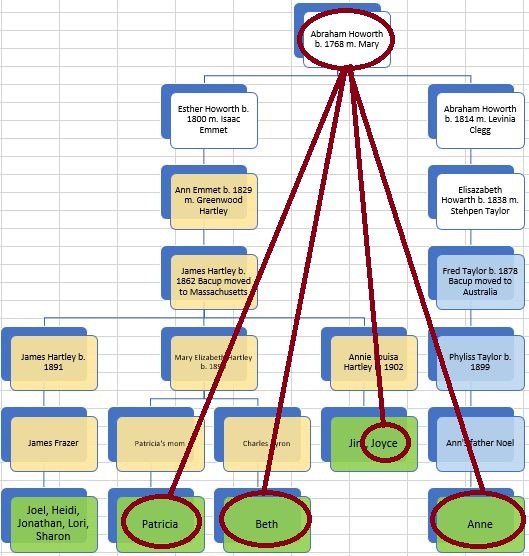
The other important thing is that even though the match points back to Howorth, this is on Joyce and Jim’s Hartley grandparent line.
Here is how Jim and Joyce match each other:

Here I did something different. I started by mapping a HIR or Half Identical Region. That means that one grandparent matched and the other two did not. We know that Joyce matched on the Hartley segment and Jim did not.

That means that the maternal Hartley/Snell side is on the bottom of their Chromosome 8. From here, we can logic a few more segments. Going from HIR to the no-match left, that means the top part will have to change for there to be no match at the beginning of Chromosome 8. Using similar logic, for all to match (in the HIR region), the crossover will have to be on the bottom of Chromosome 8.

Next, on Joyce’s match list, I picked someone who she matched that went through the 70.7M crossover.

I picked the 18 cM match. Then I picked people that matched both Joyce and the stranger’s 18 cM match.
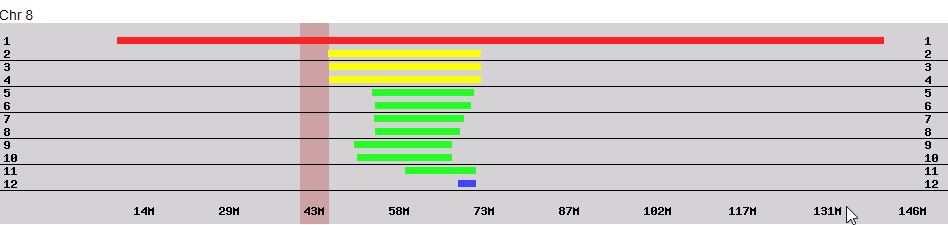
#1 is Jocye’s match to her brother Jim. The next three matches go up to 74, so they go through the crossover. #5 is our stranger, Sheila with the 18 cM match. There is another interesting thing about Match #2. That is Jo who is on Ancestry with a private tree. However, when I click on her name, it says she is from Lancashire, England. Someone with a tree at Ancestry and DNA at gedmatch is good news to me, so I wrote an email to her.
Here is another piece of the puzzle:

I don’t know what the orange represents, but I don’t match Joyce and Jim on that side, so it isn’t as important to me. I was interested in separating the green DNA from the blue – or the Snell from the Harltey DNA. I was able to do that thanks to visual phasing and a match with Anne.
Wrapping It Up
- It is possible to do some visual phasing with only two siblings. However, cousin matches, and stranger matches are needed.
- Geographical phasing is also important. I like the use of email extensions to identify non-US matches.
- Mapping my father’s two cousins is important in separating my Lanchashire ancestors from my colonial Massachusetts ancestors.
- Work is needed to get AncestryDNA testers to upload their results to gedmatch.com
- More matches could be found by checking FTDNA
- More work is needed in tracking down genealogies of gedmatch mathes. This would help identify segmens of visually mapped chromosomes.
- Attention to mapped segments of interest (in this case Hartley) can lead to matches to follow-up with.