Looking through the visual phasing of my father in law’s family, I notice I am missing a map for Chromosome 22. Chromosome 22 is the easiest and hardest Chromosome to visually phase. It should be the easiest because it is the shortest Chromosome and should have the fewest number of crossovers. It should be the most difficult because it should have the fewest cousins matches. I assume that I haven’t visually phased Chromosome 22 because of the hard part.
Gedmatch One to One Comparisons
To do visual phasing, I need to compare my late father in law Richard to his two sisters in the Gedmatch Chromosome browser. Here is how Richard matches one of his sisters, Lorraine:

This shows that Richard matches his sister Lorraine all along the Chromosome except for a little segment between 43.6M and 43.8M. Hopefully this is accurate. Other comparisons should bear this out. By comparing siblings, we are looking at how many grandparents’ DNA they share. Green means that Richard and Lorraine share two grandparents’ DNA. More specifically, they share one maternal grandparent and one paternal grandparent.
Yellow means they share one grandparent on a maternal or paternal Chromosome and don’t share the grandparent on the opposite Chromosome. For example, if they share the DNA from a maternal grandparent, that means that they don’t share DNA from the same grandparent on the paternal Chromosome. This is all important information for visual phasing.
Finally, above the break in the solid blue line above is a red area. That means that in that little segment, Richard and Lorraine share DNA from neither of their grandparents. This is important information. Richard’s paternal grandparents are Butler and Kerivan. His maternal grandparents are LeFevre and Pouliot. So say Richard gets his DNA from Butler and LeFevre in that red area. That means that Lorraine must get her DNA from Kerivan and Pouliot in the red area. Those are the rules for Visual Phasing.
Next I put the three comparisons into Excel.

Then I look for changes in the colors on the Chromosome Browser. These changes should come in pairs. The first two changes are in the first two bars. The colors go from green to yellow. That means that the shared DNA goes from two grandparents to one. Lorraine’s name is associated with both those comparisons, so we say that Lorraine has a crossover there. A crossover is where Lorraine’s DNA changes. Before the crossover, she is getting DNA from one grandparent, and after the crossover, she is getting her DNA from another grandparent.

Again, these crossovers show up in pairs. A top/top pair assigns the crossover to Lorraine. A top/bottom pair goes to Richard. A bottom/bottom pair of changes assigns the crossover to Virginia. Above, Lorraine and Virginia got 2 crossovers each and Richard got three crossovers.
Next, I show the two Chromosomes that everyone has – in this case for Chromosome 22. Unfortunately, I don’t know which side is maternal and which side is paternal at this point.

These two copies of Chromosome 22 are blank for each sibling right now, but I’ll fill them in with four colors representing the DNA they got from each of their 4 grandparents. When the DNA changes from Butler to Kerivan on the paternal copy, for example, that is where the crossover is for a particular sibling.
Visual Phasing
Richard and Lorraine share a large green area. That means that they got the same DNA from one grandparent on the maternal side and the same DNA from one grandparent on the paternal side. The DNA from those two shared grandparents will be represented by two colors.

The blue and orange colors represent the DNA that Richard and Lorraine both share from the same grandparents: the same maternal grandparent and the same paternal grandparent. Unfortunately, I don’t know which side is maternal or paternal at this point and which grandparents they share. I just know they share the same grandparents.
Note also that Richard has a crossover at the beginning and end of this colored-in segment. We don’t know if his crossovers are on his maternal Chromosome 22 or paternal Chromosome 22 – or it could be that one crossover is maternal and one is paternal. That means that we will keep his blue and orange segments where they are – for now. However, Lorraine’s first crossover is to the left of the green shared area. That means her blue and orange DNA segments can move to her first crossover. The same segments can also be moved to the right up to Lorraine’s next crossover. No crossover means no change in the DNA.

This show that Lorraine got two pretty long segments of DNA. Let’s say she got them from Grandparents A and C.
Next we need more grandparents. We only have two out of the four. In the middle of Chromosome 22, notice that Lorraine and Virginia have no match. There is a large break in the dark blue line. That means that in that area, If Lorraine has DNA from Grandparents A and C, Virginia has DNA from grandparents B and D. Now we need two different colors:
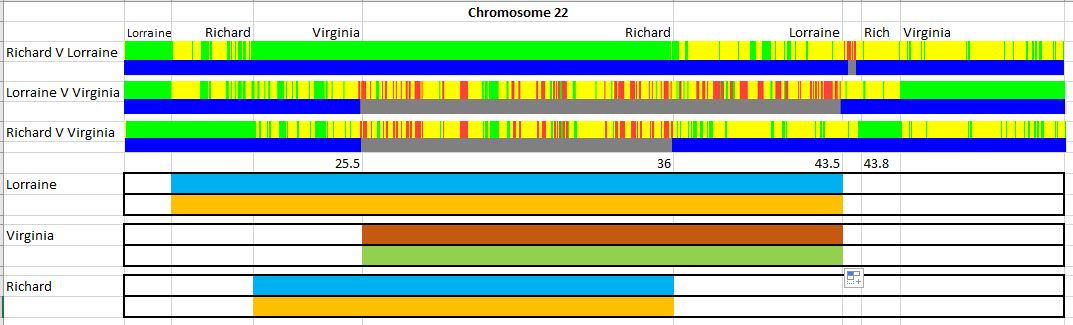
To check notice that Richard and Virginia also have no match in a smaller area, therefor they also show two different colors in that area. Virginia has the last crossover, so I move the brown and green segments to that crossover.

Richard and Virginia have a smaller green area starting at position 43.8.

Richard has no crossover that prevent the brown and green segments from going to the end of Chromosome 22. That is as far as we can go with the bright green areas (which are also called Fully Identical Regions or FIRs) and the red non-matching areas. At this point we could look at the yellow areas which are also called Half Identical Regions or HIRs. Or we could look at cousin matches to see if they give any hints. I’ll look at cousin matches.
Cousin Matches
A first cousin should sort out the maternal or paternal side. I pulled up Virginia’s spreadsheet where I have a lot of her matches. On Chromosome 22, I notice 2 of Virginia’s maternal 1st cousins, Joe and Pat:

In Virginia’s spreadsheet, I have these positions in pink for Virginia’s maternal side. Next, I checked out some of the matches at Gedmatch and got this:

Here, #1 is John, a nephew. Nephews are not as helpful as they can be related on the maternal or paternal side. Note also that something seems to be going on around 25.4 M. This could be Virginia’s maternal crossover. In fact, I think that is more likely than having four other people having their crossovers there. #2 and #3 are Pat and Joe. #4 is a maternal 2nd cousin once removed named Sandra. More about her later. Now that I know where there is a likely maternal crossover at 25-1/2M, I’ll go back to the visual phasing.
Visual Phasing HIRs
So far with the visual phasing, everything is equal on the chromosomes. That is because, we have only dealt with FIRs and no matches. HIRs upset that balance and make us choose sides. Because the HIR creates an imbalance of one copy of the Chromosome vs. the other, we only get one shot at doing that. I don’t know if my reasoning is right, but because I have some information already for the left side of the Chromosome (Sandra), I will choose an HIR on the right side. I will choose the small HIR Lorraine and Virginia have starting at 43.5M.

Here on one copy of Lorraine’s Chromosome 22, the blue goes to brown while the other copy remains orange. Next, I see that Lorraine has no more crossovers, so I can move the DNA colors over to the right.

In addition, Lorraine and Virginia have an FIR on the right, so I can copy Lorraine’s colors onto Virginia’s maternal and paternal side. Now I have a lot of Chromosome 22 mapped out, but I still don’t know which side is maternal and which is paternal. Here is how Pat matches with Virginia, Richard and Lorraine:

Remember that Pat is a maternal cousin. It is important to note that Pat matched Virginia and Richard but not Lorraine. The yellow pattern of Pat matching Virginia and Richard matches the green above that I mapped out. That tells me that green and orange are the maternal side and brown and blue are the paternal side. So thanks to Patricia, my in-law’s have identified maternal and paternal sides. Yay.

Next I bring back some cousin matches:
I had guessed that Virginia had to have a maternal crossover due to cousin matches at about position 24.5M. #4 above is Sandra. She is one of my in-law’s top maternal Gedmatch matches. She also is a match at AncestryDNA. She doesn’t have a public tree but she told me who their common ancestors are:

Sandra is a 2nd cousin once removed to Lorraine, Richard and Virginia. As such, they share only one of my in-law’s grandparents’ lines which is LeFevre.
Here is how Sandra matches Virginia and Richard:

Now I can add in LeFevre in the green segments.

Once I know green is LeFevre, then orange has to be Pouliot.
Next, I was pretty sure that Virginia had a maternal crossover at 25.5. Knowing that, I can fill in the rest of the puzzle:

- Note that on the left had side of Chromosome 22, there are three FIRs in a row going from top to bottom. That means the three siblings have their DNA from the same two grandparents. They all have Pouliot on the maternal side and either Butler or Kerivan on the paternal side.
- The maternal side is French Canadian.
- The paternal side is Irish.
- There aren’t as many paternal cousins matches to fill in the blue and brown as there are maternal matches. I’m looking for cousin matches to fill in the blanks
- Virginia has DNA from only one paternal grandparent shown in reddish brown.
- Lorraine has DNA from only one maternal grandparent – Emma Alphonsine Pouliot
- There will be parts of the Chromosome where there is no DNA representation from one grandparent. For example, no one got green LeFevre DNA at the beginning of the Chromosome. No sibling got blue paternal grandparent DNA at the beginning or at the end of Chromosome 22.
One of the clearest explanations I have seen ! THANK YOU.
What about the red region on the right shown for Richard v Lorraine? I see you put a spreadsheet line there.
It looks to me like one more name should be there for the small segment, giving:
Lorraine, Richard, Virginia, Richard, Lorraine, Richard(small segment), Virginia, Richard, Virginia
– Brett
Hello, I’m sorry to submit my question here as I can’t see any contact options on your home page, or else where.
I am attempting to do parental phasing using MsExcel not MsAccess as you have done, and would like to ask a few particular questions about the algorithm. I have my mother’s kit, my sister and myself, plus my maternal uncle and a paternal third cousin. I have phased at Gedmatch but as far as I know they do not allow down loading of the processed kits, so I would like to create my own copy for my late Father.
Hi, I am at joel@jmhartley.com.There are two types of phasing. The visual phasing is done visually. Then there is phasing by the raw data which is more difficult. You have two siblings which is doable but difficult. I don’t know how to do phasing by raw data for two siblings. I think it is possible. There is also a method of visual phasing that uses a utility at Gedmatch called evil twin. I have not used that, but it may be helpful. A maternal uncle probably won’t get you to specific maternal grandparents, but it should help in figuring out the paternal from maternal chromosomes. Hope this helped some.