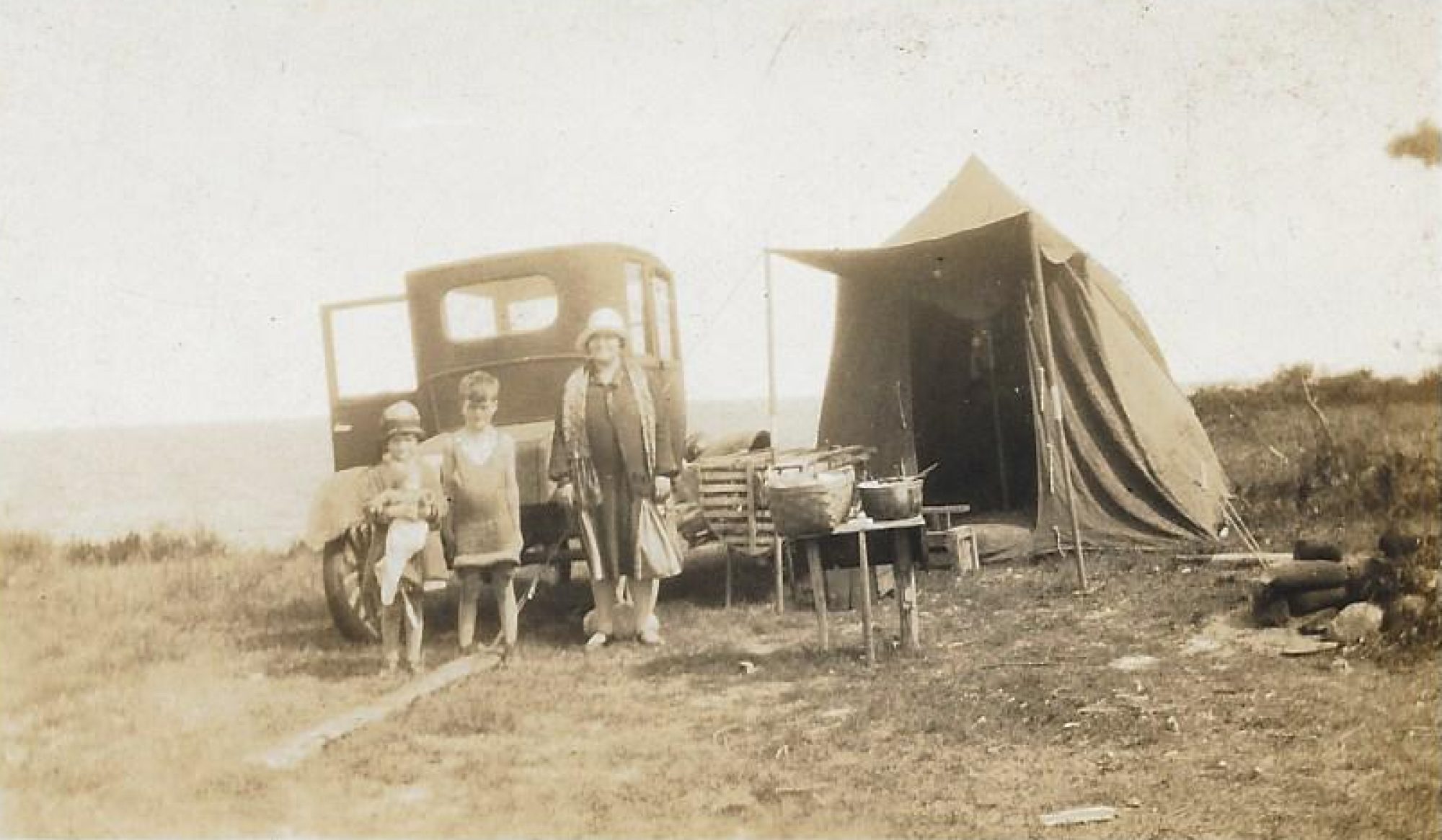
My wife’s mom and 1/2 great Aunt Esther seem to be getting some good Dicks descendant matches at Gedmatch recently. One of the newest ones is Barry. Barry is match #5 on Esther’s ‘One to Many’ list at Gedmatch. Barry is match #8 for my mother in law Joan. #8 out of 2,000 matches is not bad.
The Genealogy
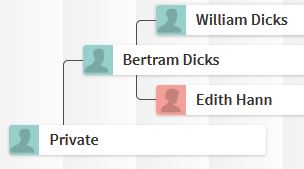
Barry tested at Ancestry. He hasn’t linked his tree to his DNA test, but I have found a little tree that Barry put together:
I quickly started off by recreating the tree. However, I headed in the wrong direction. There was a Harbour Buffett marriage on-line for a William Dicks and Edith Hann which I assumed was the right one. Apparently there were two William Dicks/Edith Hann married couples. One was in Harbour Buffett and the other in Little Harbour East. Here’s a map posted at the Newfoundland Gedmatch Facebook Page that I high-lighted:
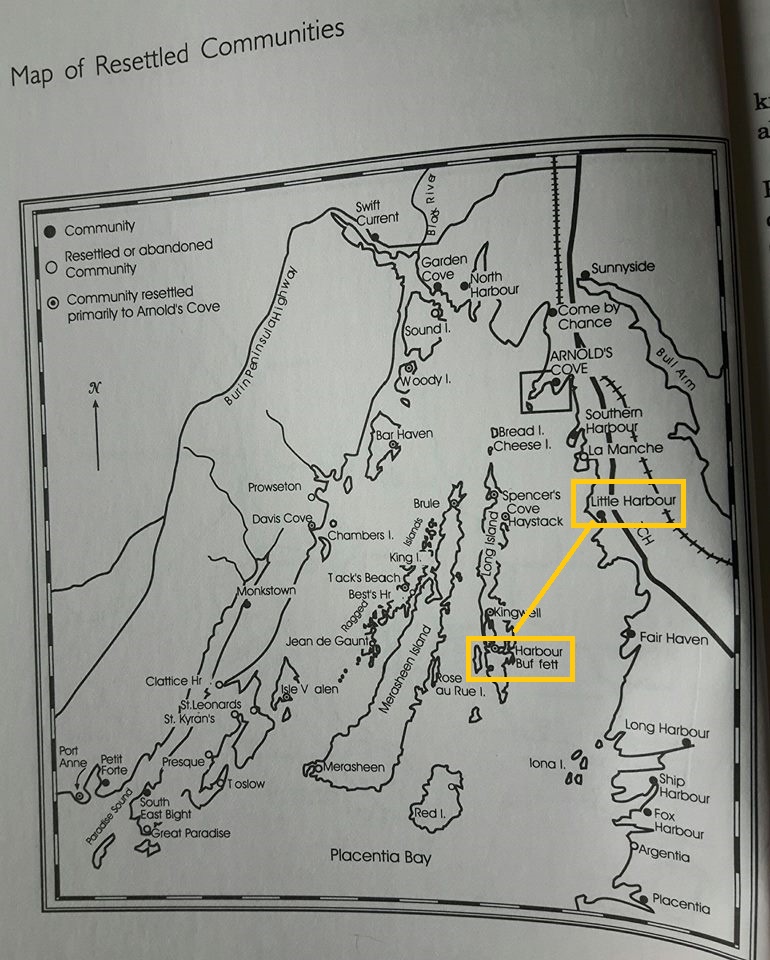
Little Harbour East apparently is adjacent to Little Harbour.
Barry’s tree connects to Hayley’s tree.
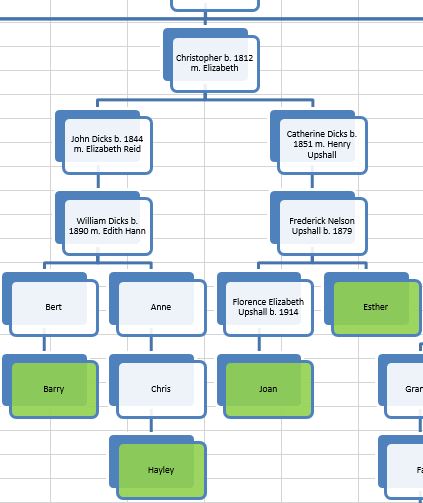
My previous Blog was on Hayley’s DNA. According to Barry, this branch of Dicks moved from Harbour Buffett to Little Harbour East in the 1860’s. Hayley helped me out by sending along the Little Harbour East Censuses for 1921 and 1935:


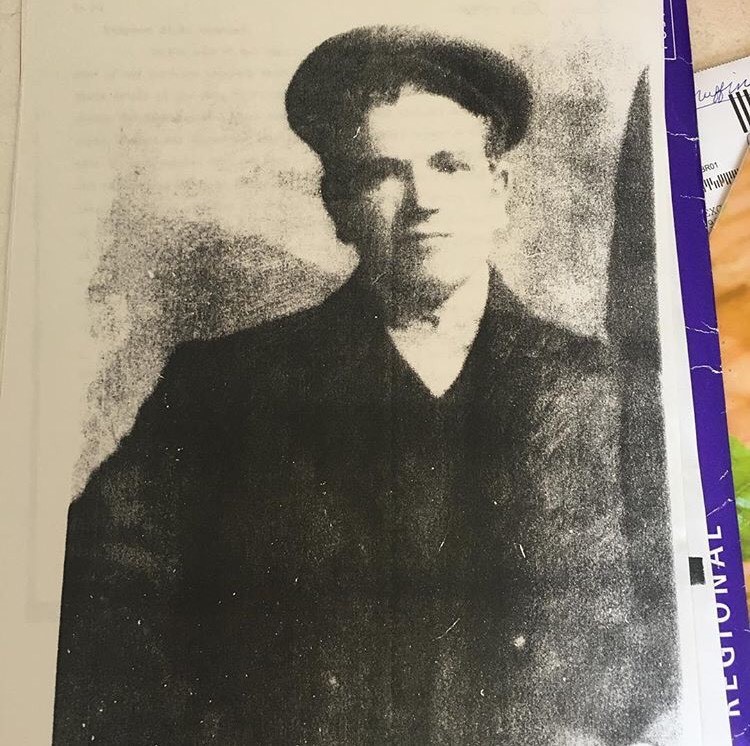
I was unable to find Bertram on my own, probably due to a Census misspelling. Here is a photo of the twice-married William Dicks sent to me by Hayley:
Barry’s DNA
Hayley is Barry’s first match on his ‘One to Many’ list at Gedmatch:
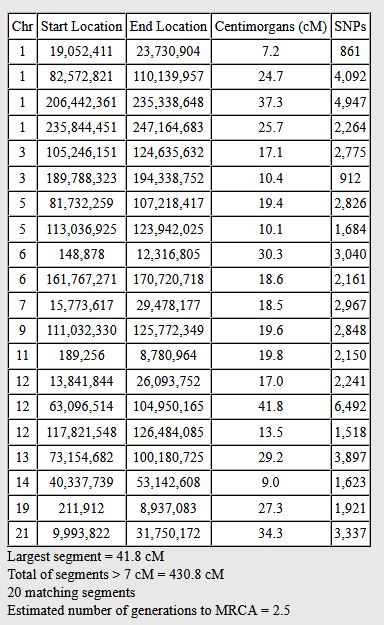
They have all sorts of DNA shared. A common ancestor of 2.5 usually means a 1st cousin, once removed. That is what we have here:
Esther is a 2nd cousin once removed to Barry based on the chart above. By DNA, on average, their common ancestor should be 3.5 generations away. Here is what the DNA match between Esther and Barry shows:
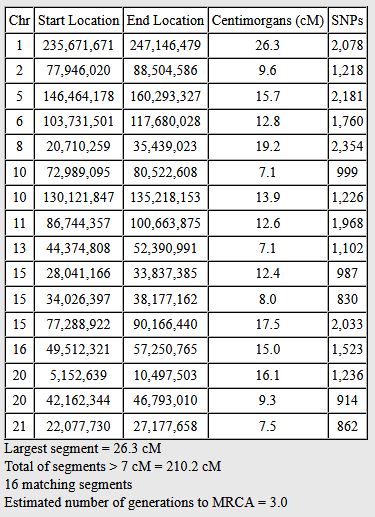
This shows that either Barry and Esther share more than the average DNA for a 2nd cousin once removed or that they have extra ancestors in common. Based on Newfoundland genealogy, I would guess the latter. By DNA, Barry and Esther look to be more like 2nd cousins.
Joan and Barry should be 3rd cousins by their common ancestor, Christopher Dicks. At Gedmatch, that would be on average 4.0 generations to a common ancestor. Here is what Gedmatch shows for the DNA match between Barry and Joan:
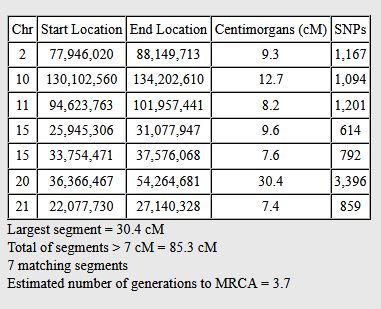
The difference isn’t as pronounced with Joan. Perhaps because her ancestry is one quarter Newfoundland and Esther’s is 100% Newfoundland.
The Autosomal Matrix
I like to look at the matches in Gedmatch’s Autosomal Matrix as the different lines of descent sometimes become apparent.
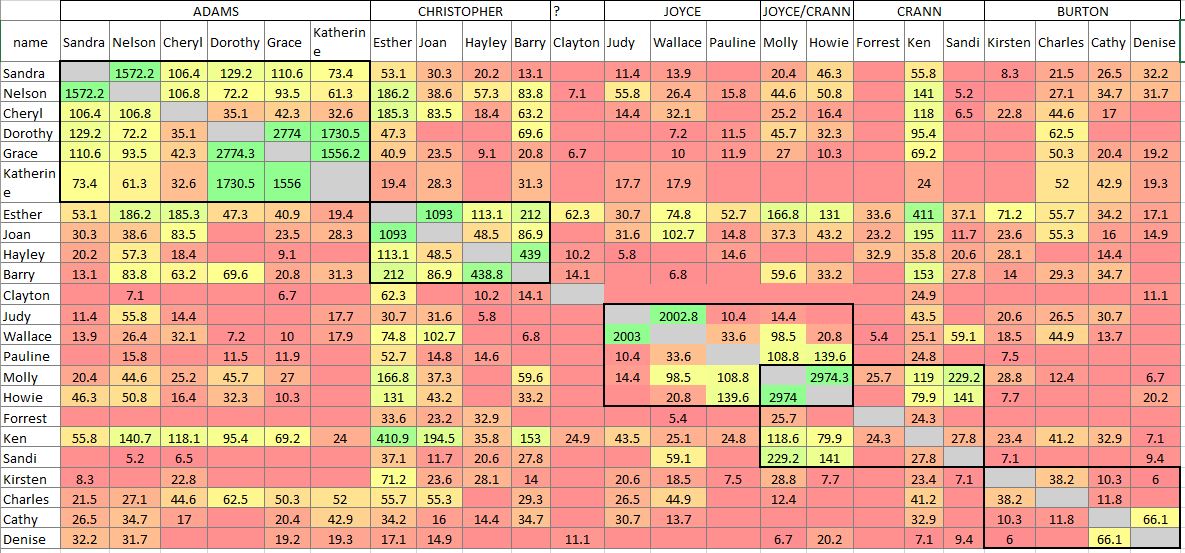
If I look at Barry going across, his largest non-close family match is with Esther. This tells me that compared to all these other Dicks descendants, he fits in the Christopher Dicks group.
- Barry has a good match with Ken in the Crann group, but not with others in that group. This could indicate a non-Dicks match between Barry and Ken.
- Ken has large DNA matches with many of the Dicks descendants on the Matrix.
- I had forgotten that Ken has a Dicks ancestor on the Burton line also. The matrix seems to show he is more closely matched to that line than the Cran Line. I had forgotten about Ken’s Dicks/Burton ancestors, so the Matrix didn’t highlight that.
- Esther and Nelson match others more as they are one generation closer to their common ancestors than others.
- Esther has an additional Dicks line that I haven’t figured out yet.
- Others will have other relationships with families outside the Dicks family which would cause interference.
Triangulation Groups: A Better Way
A Triangulation Group (TG) is a group of three or more people. All their DNA matches each other in every combination. When this happens, the group should have a common ancestor. In a group of all Dicks descendants, the common ancestor is more likely to be a Dicks ancestor (or spouse). The problem with creating a large Dicks TG Matrix is that it takes a while to look at all the possible matches.
The goal when I have done all the Dicks triangulation is to put all the results into another matrix. I had done that before with the Henry line which is a brother line to Christopher Dicks, b. about 1784. I took out the Henry Line for simplicity below:
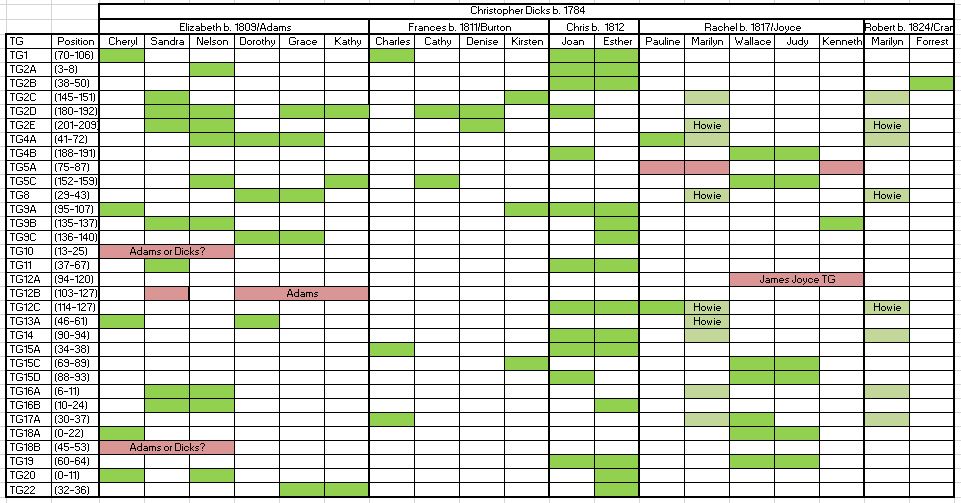
Looks like I am missing at least Ken, Sandi, Hayley and Barry. I should also add in Clayton, as there is some question as to which line he is in. The pink TGs indicate that the DNA could be coming from the spouse of a Dicks. For example, an all Adams line TG, could be DNA coming just from Adams and not Dicks. Marilyn aka Molly and Howie are siblings. If two siblings plus another match, this is not usually considered a TG as the siblings have the same parents. Esther and Joan are in many TGs, but as they were the only two at the time from the Christopher b. about 1813 Line, those TGs go outside that line (or are from the unknown wife of Christopher).
When I do this comparison of Dicks DNA, I get 1620 lines of matches. However, each combination is repeated, so it is only 810 lines really. When I make the new TG Matrix, there is good news and bad news. The good news is that Ken and Barry especially have created a lot of new TGs. The bad news is that it makes the TG Matrix show up very small:
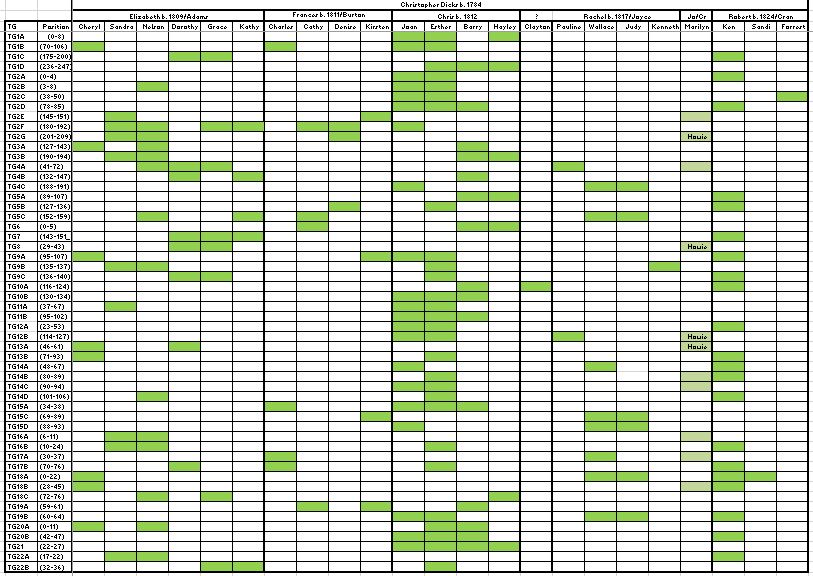
I made a slight adjustment in the TG Matrix. I put Molly and Howie in just one row, but that row is for Joyce and Crann. A few other observations:
- Barry appears to be in TGs 7 times with the Christopher Line. That appears to place him solidly in the Christopher (born about 1813) line
- Barry appears to be in TGs 3 times with Nelson of the Adams line. This could be partially because Nelson is one generation closer to common ancestors.
- Ken’s results are confusing to read. He seems to be in TGs outside the Cran group more than in it.
Ken’s results
Ken’s closest relationship in his Dicks/Cran line is 3rd cousin, once removed. That is with the common ancestor of Robert Dicks and Jane Cran.

However Ken is also 3rd cousin once removed with Esther and Nelson with the common ancestor of Christopher Dicks, the father of Robert Dicks born about 1784. It may also be that Ken is in many non-Dicks TGs with Dicks descendants as he may be more closely related on those lines than the Dicks lines. For example, I know that Ken has an Upshall ancestor. The TG that he has with Esther and Joan could be a Dicks TG, an Upshall TG or some other name where we have a missing ancestor. Compare the Christopher Line to the Cran Line:
Barry is only 2nd cousin once removed to Esther and 3rd cousin to Joan. This makes a big difference in the DNA comparisons compared to Ken’s Cran relative results. Another thing that I forgot was that Ken has ancestors in the Dicks/Burton line also:
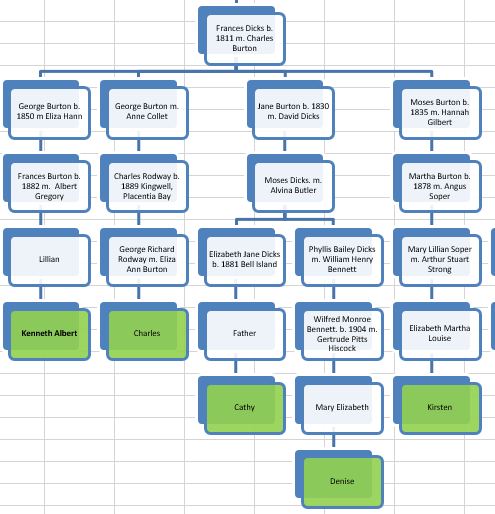
Let’s say that Ken’s case is advanced DNA analysis and I don’t have to figure out all his matches right away.
Summary and Conclusions
- Barry and Hayley appear to be linked closely by DNA to Esther and Joan. The interpretation is that they are linked in the same Christopher Dicks Line.
- Without Barry’s results, it would have been difficult to interpret Hayley’s results by the TGs. However, as we know that Hayley is closely related to Barry, his results apply to Hayley’s
- Ken’s results aren’t easy to interpret just within the context of the Dicks DNA study. I left my previous Blog on Ken thinking there was more to be discovered about all his matches and I still feel that way.