3 Generations of Upshall DNA

My wife Marie is not an Upshall. Nor is her mother Joan. However, her mother’s Aunt Esther is. The Upshalls were from Newfoundland and lived in a fishing village called Harbour Buffet. This is what it looked like in 1907

harbor buffet 1907

Harbour Buffet is in Placentia Bay. Here is a map showing Harbour Buffet on the left side in relation to St. John’s on the right. As you can see, Harbour Buffet is quite an isolated area.

Harbour Buffet Map

The genealogical records are sparse in Newfoundland. In Harbour Buffet, the church burned, so vital records are missing.

Are Your Parents Related?

I have had my wife’s, her mother’s and her mother’s Aunt’s DNA tested. Living in isolated Newfoundland many people have ancestors of the same name more than once. I have uploaded these 3 people’s DNA results to Gedmatch.com. They have a utility there called “Are Your Parents Related?”. I ran this and, sure, enough, as Aunt Esther expected, her parents were related. She shows a relatedness on Chromosome numbers 2, 11, 15 and 20.

Related Parents Esther

My understanding is that this report looks at Esther’s mother’s and father’s side of her DNA and where there are matches between the two, it shows where they had a common ancestor. In fact, this report indicates that Esther had a common ancestor 4 generations ago. At 4 generations ago, we had 16 2nd great grandparents. This means that Esther likely only had 14. This could also mean that Esther is a s 3rd cousin to herself! A scenario could be that Esther’s mother and father could be 2nd cousins to each other. I tried to sketch out some of the relationships here:

Upshall Ellis Chart

I am still working on Esther’s ancestry, so I haven’t gotten too much past the diagram above. My understanding is that Melinda Jane Kirby’s mother was a Dicks. That means that her two grandmothers, Catherine Dicks and Melinda Kirby could have been 1st cousins. This is helpful in tracking the ancestry. Dicks is a name that comes up quite a bit when looking at Esther’s DNA matches also.

What DNA Came From Whom

In the chart above, you can see that Frederick Nelson Upshall had 2 wives. The first wife died in the Flu Epidemic in the Boston area and he remarried. That means my wife and my mother in law are descended from the Daley (non-Newfoundland) side and Esther is descended from the [Newfoundland] Shave side. Gedmatch has another report called “People who match one
or both of 2 kits”.  When I run this for Joan and Esther it shows people that match both of them, or just one or the other. The people that match both should correspond to the purple in the diagram above and below. The people that match only Joan and not Esther would represent the left side of the chart. The people that match Esther and not Joan would represent the upper right had side of the chart. Except that there is one hitch. Thanks to some collaboration with at least one helpful DNA match’s research on Ancestry, I have  been able to expand Aunt Esther’s ancestors further back.

X Chromosome Chart Esther

Now we can see that Esther has Dicks family on her mother’s and father’s side. The dotted lines at the top are inferred from the DNA and a guess on my part. I am assuming that the Dicks ancestors are the reason for Esther’s parent’s relatedness. This means that Joan would also be related to Jane Ann Dicks but not as closely as Esther.  Likewise, Joan would be related to Melinda Kirby but not her father John and is related to Margaret Shave (her step-grandmother) but not George Shave. Further, I may assume that the parents of Jane Ann Dicks may be the same as the grandparents of Catherine (or Kate) Dicks. If  I have it right, that also means that my wife’s step great grandmother nee Shave was also her 2nd cousin 3 times removed.

The Chromosome Browser

Here are the places where Esther matches her (half) niece and grand niece (my mother in law and wife). These matches represent the DNA From Esther’s father as that is the person these 3 women have in common as an ancestor.

Esther Chromosome Browser

Esther and my mother in law match on every chromosome except for #22 which is the shortest Chromosome. I am also interested in the X Chromosome. This is because these matches will be very specific. Let’s look back at the diagram with the purple squares and circles. These are the only places where Esther and Joan can share the X in a normal situation. Then Fred Upshall doesn’t get any X Chromosome from his father so the X matches must be from Kate Dix, born around 1851.

Unfortunately, this is not a normal situation. Here we have Esther who has parents that are related. I think that the relation is through the Dicks family. That means that Joan could also be matching Esther on Esther’s mother’s side. That would be Margaret Shave, up through her mother Melinda Kirby and Melinda’s mother Jane Dicks. Isn’t that confusing. However, as the most recent common ancestor between Esther and Joan is Esther’s father Fred, the matches most likely should be from him.

It actually gets even more complicated. Christopher Dicks didn’t get any X Chromosome from his father. However, Jane Dicks did. The unknown mother of the 2 sent her X Chromosome down to her 2 children. If any of those X Chromosome segments came down to my mother in law, she could have segments in common with both sides of her Aunt Esther’s parents. However, this would not be Dicks’ X Chromosome but the wife of a Dicks. Joan’s X matches on the Dicks’ side can only go back as far as Christopher Dicks.

X Triangulation

Triangulation is trying to figure out a common ancestor between using the matches of 3 people or more. The 3 people have to match on the same segment and match each other. What I did was choose Esther’s top 8 X Chromosome matches.

Esther X Chromosome Browse

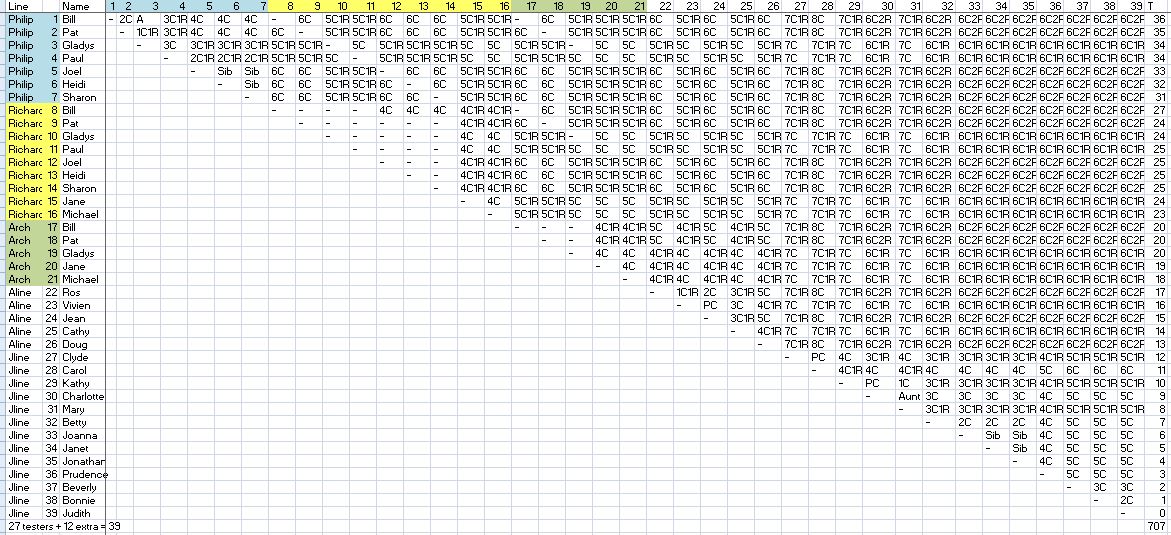
Joan is #1. My wife is #3. My wife isn’t supposed to have a match that her mother doesn’t have, so I’ll disregard the blue match. It looks like the clusters could triangulate, but they don’t. Here is the X Matrix.

X Matrix Esther

This time my wife is last on the list. Note that Marie and her mom Joan only match each other and don’t match Esther’s other 6 top X Chromosome matches. That means there is no sense trying to triangulate these. These segments are likely to be from Esther’s mother’s side. That is, except for match #8 in the previous figure. That is Molly and her match doesn’t overlap with Joan’s or Marie’s, so we can’t tell which side of Esther she is matching (maternal or paternal/Shave or Upshall). It makes sense that Joan and Marie don’t match the other people. As I showed earlier, Joan and Marie’s X Chromosome match on the Dicks’ side ends with Chris Dicks. However, Esther’s X Chromosome match goes back a generation earlier, so she has many more chances for matches.

Autosomal DNA Matches: Not All One Way Or the Other

In looking at autosomal matches or triangulation groups, it is important to make sure that the matches are either on the maternal side or paternal side. However, what if the parents of your match (in this case Esther) had parents that were related to each other? It is not so clean cut.

Here are some of Esther’s top matches compared to Joan and each other:

Esther top matches matrix

Note that Joan has a larger match with Wallace than Esther does. Perhaps Wallace matches Joan on her father’s (non Upshall) side in addition to the Upshall side. Also Joan has no match with Nat. Either Joan didn’t get any of the DNA that Nat did or more likely this match is on one of Esther’s mother’s non-Dicks lines. Also some of these people may be matching Esther on her maternal and paternal sides where Joan only matches her on her Paternal side.

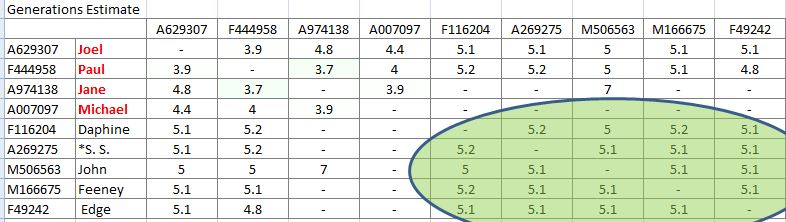
Just for fun, I checked if anyone else on the list had parents that were related. It turns out that Michael did. But not to the extent that Esther was. His common ancestor was about 5.6 generations back.

Effects of Endogamy On DNA Matches

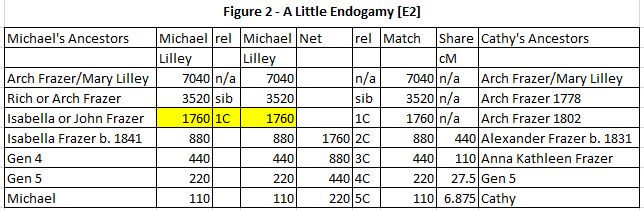
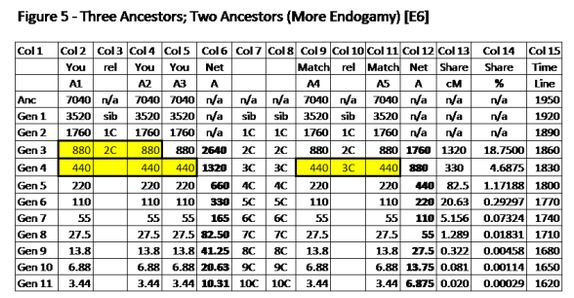
Jim Bartlett explains the effect of relatives that marry in this Blog. When Esther’s parents married as the descendants of the same ancestor, they theoretically doubled their match with Joan. This effect multiplies when other matches also have the same ancestor more than once.  Joan and Esther might expect an average match amount of 850 cM as half aunt/neice. Their actual match total is 1090 cM. Also at the above chart, see how much more Esther matches people than Joan. I believe that this could be due to Esther’s multiple Dicks ancestors. This is true except for the match with Donald. Perhaps Donald is not related to the Dicks. When I check his ancestry, I don’t see any familiar surnames. Also no ancestry is mentioned in Newfoundland. So, maybe something to consider.

In Summary

  • My contact with Esther’s matches have resulted in good leads with people who have Newfoundland ancestry
  • Esther has, as expected, parents that are related
  • This relation appears to be on the Dicks side, based on both genealogy and surname ancestors of DNA matches
  • Further research should lead to linking up both sides of these Dicks family to a common set of ancestors.
  • Due to the irregular inheritance pattern of the X Chromosome, not many common matches were found
  • Endogamy results in more [presumed Dicks descendant] matches for Esther. This is compounded if her matches also have the presumed Dicks ancestor more than once.


Moving the Frazers Down the YDNA Tree

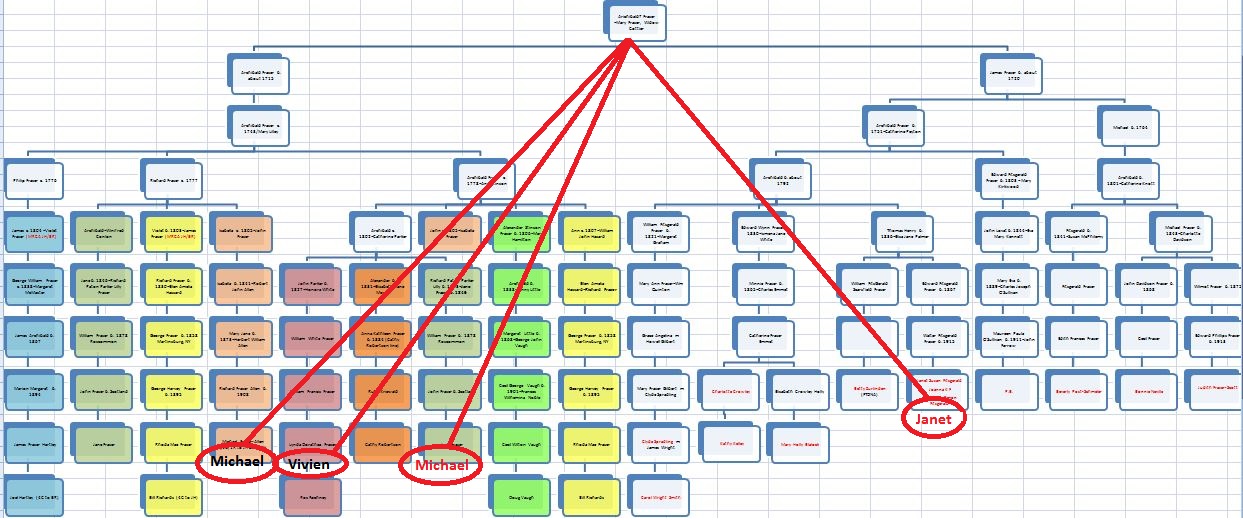
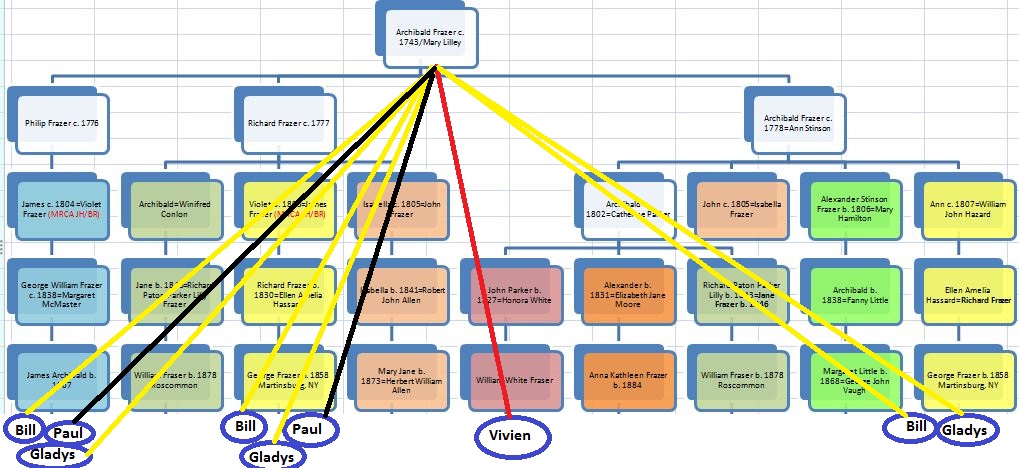
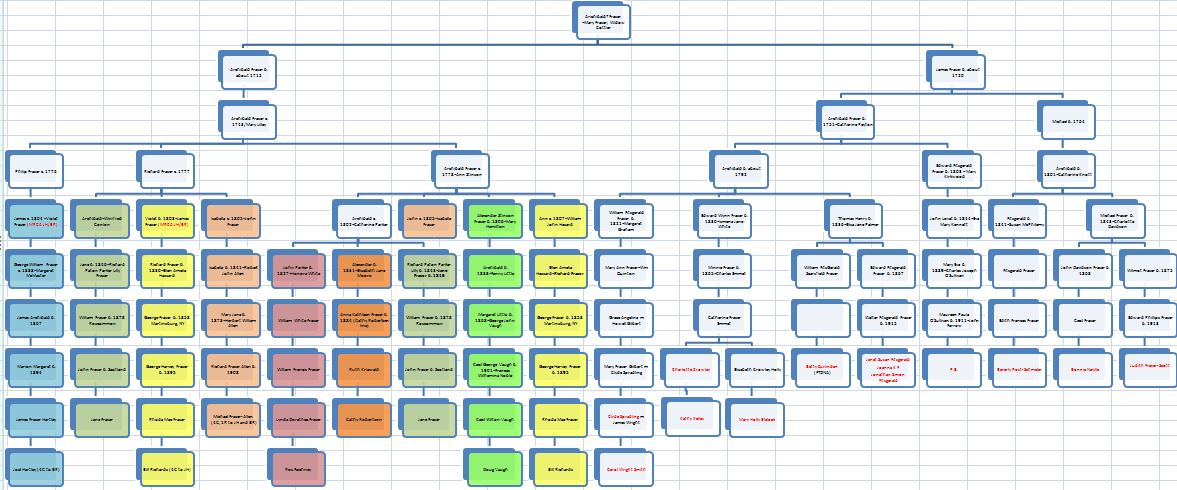
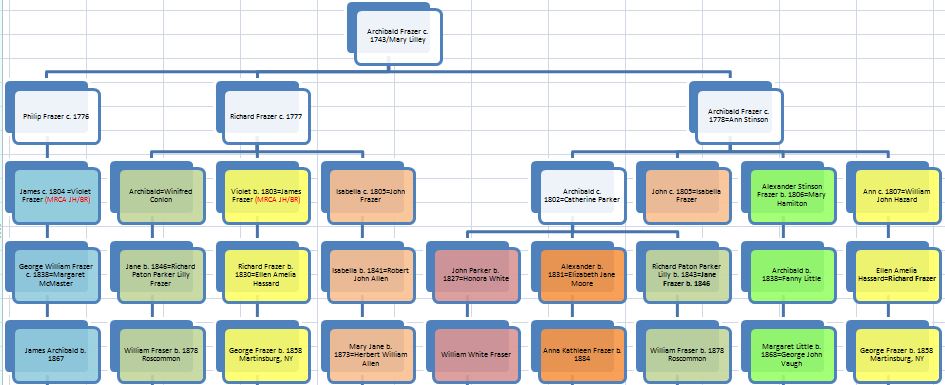
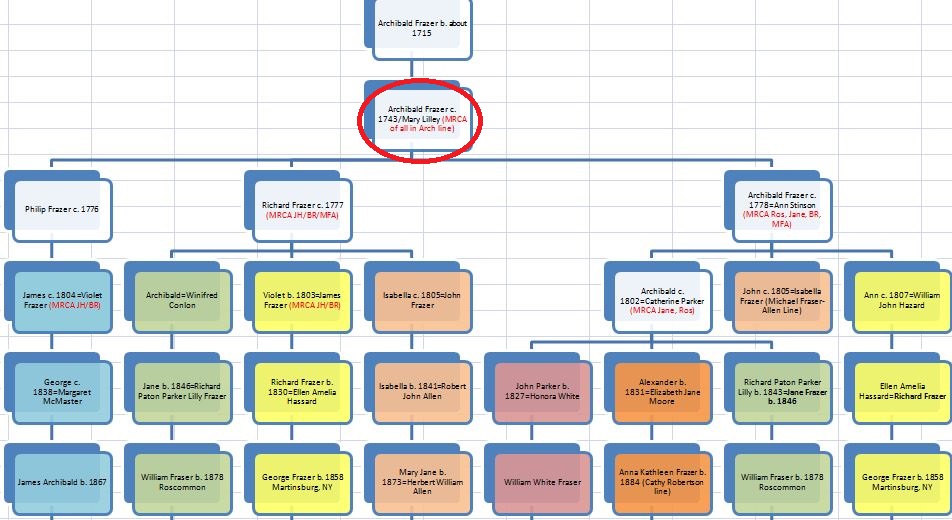
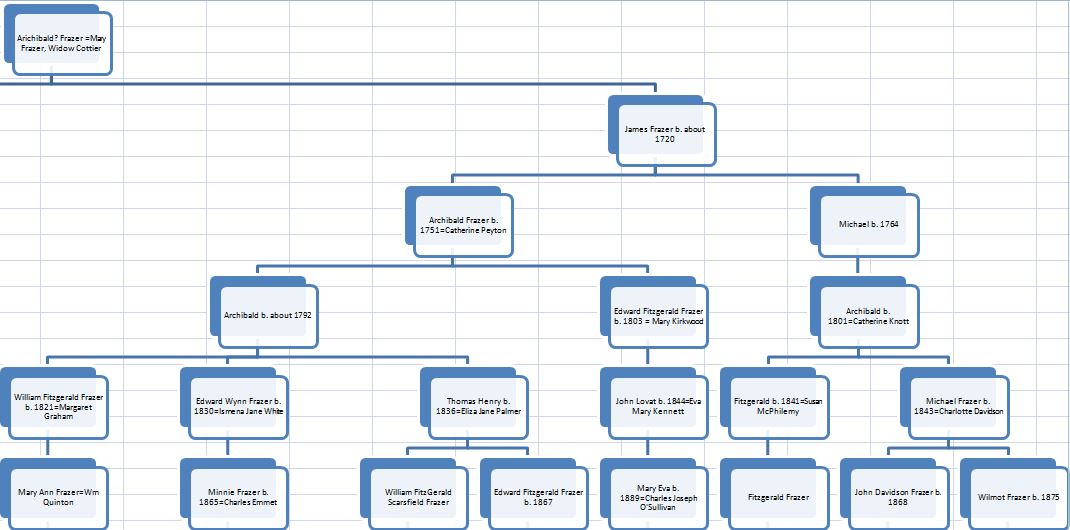
We have new YDNA results in for Jonathan and Paul. That’s good news. As you may recall, Jonathan had his YDNA tested about a year ago. He represents the James Line of Frazers. Then this year, Paul from the Archibald Line of Frazers tested. The tests were for 37 markers. The new tests are for 67 markers. Here is a tree that I sent to my cousin Paul who is not on the internet. Archibald, born around 1690 is believed to be our common ancestor and the husband of Mary Frazer at the top. Paul and Jonathan are 6th cousins, once removed based on our research. Paul is 2 generations below Hubert Frazer on the Archibald Branch and Jonathan is one generation below Walter Frazer.

YDNA Arch James Tree

Some Unexpected Results

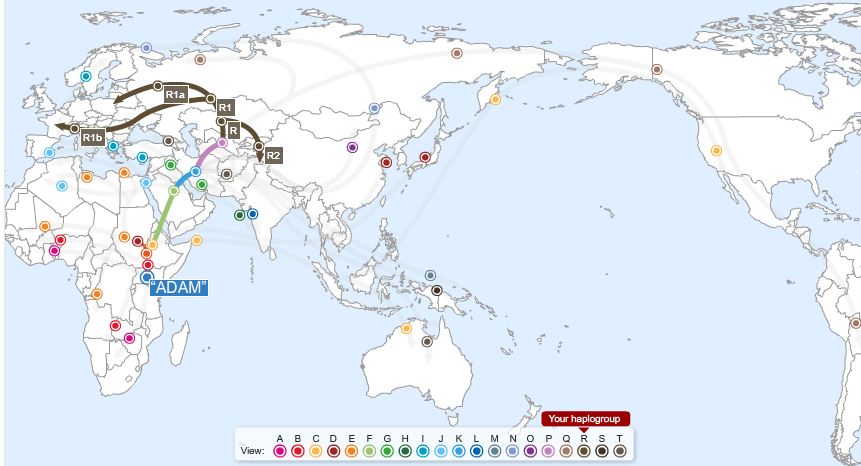
  • Jonathan and Paul both showed a type of YDNA called R1a. I expected they would be R1b which is one of the most common Haplogroups in Europe. R1b is especially prevalent the further Northwest one travels in Europe.
  • Family Tree DNA (FTDNA) showed 3 mutations between Jonathan and Paul. I was expecting about zero to one. It turns out that all their mutations were on relatively fast moving markers.
  • Based on the markers, FTDNA puts people in a rough Haplogroup. Jonathan was put in R-M458 and Paul in R-M198 which is an even more broad or general category. With the new results, FTDNA has apparently backtracked and put Jonathan back into the more broad R198 Haplogroup. Usually, with more STR testing the Haplogroup should be more refined, not less.
  • At the different levels that FTDNA looks at (12, 25, 37 and 67 STRs), Paul matches on 4 people each. Normally there are many matches at the 12 level and the matches drop down to the 67 level. The apparent answer for this is that Paul has had more than the expected mutations in the earlier testing compared to Jonathan.

Genetic Distance

The Genetic Distance (GD) is the measure of how many differences there are in the STRs of 2 people. In the case of Jonathan and Paul, the GD was 3 for the 37 STRs and also 3 for the recent 67 marker test. That means all the differences were in the first 37 markers. Here are Jonathan’s results for the 37 STR test. The results of this test are also called a Haplotype.

Jonathan's 37 STRs

Here is what Paul has for STR results with the differences from Jonathan highlighted.

Paul's 67 STRs

Note that the there were 2 changes in the CDY marker. FTDNA informs me that they count this as one change as the markers represent a relatively fast mutating section of the YDNA. So in the roughly 260 years or 7 or 8 generations, there have been 4 mutations or a GD of 3 between Jonathan and Paul, assuming our genealogy is correct.

Refined TIP Report

FTDNA has a TIP Report that estimates the relationship likelihood of 2 YDNA matching people. For the previous 37 STR marker test, FTDNA thought that there was about a 44% chance that Jonathan and Paul were related at 8 generations apart. Now with the 67 marker test, that has gone up to about 65%. The percentage went up, because the GD was the same for 67 markers as it was for 37 markers. So it is more likely that these 2 are closely related. It is all based on statistics and probability.

Jonathan Paul TIP Report

Haplotypes and Haplogroups

The STR signature for Jonathan and Paul now consists of 67 markers. The combination of these markers is called a Haplotype. A Haplogroup is based on SNPs and is found one of 2 ways. The most accurate is by testing of the SNPs. The other way to estimate a Haplogroup is by the Haplotype. Jonathan and Paul have not had their SNPs tested, but have their STRs tested resulting in a Haplotype. Based on these STRs, people who are experts in looking at results can tell what your Haplogroup likely is. In our case, the L664 administer for the R1a project knew that if a DYS338 was 10, then it was veritably inevitable that if the SNP test for L664 was taken, then the tester would be positive for that SNP.

Climbing Down the YDNA Tree

FTDNA has Jonathan as R-M198 Haplogroup. This was from 6,500 B.C. Not good. Our astute L664 Dutch Administrator Martin got us down to 3,000 B.C. by noting that the Frazers are in the L664 Haplogroup. We appreciate him getting us an extra 3,500 years, but that still leaves us quite a way back in time. In my previous blog, Martin at first thought that the Frazers would not be in a SNP called S3477. Subsequently, Martin reasoned that we may be S3477 based on some similarities that he saw in the location of the Frazers and Prendergasts in Ireland. I made a prediction that the Frazers would be negative for S3477. The proof would be in the 67 STR test. If the Frazers did not have a value of 13 at DYS617, they would not belong to subgroup S3477. Let’s look at those results.

DYS617

It looks like I was right this time. Put another win in my win-loss column. The Frazers are not S3477. Speaking of SNPs, FTDNA recently came out with a new R1a panel for testing.

R1a Panel

All the grey hi-lighted SNPs above would apply to L664 Frazers. FTDNA boasts of over 40 L664 SNPs that they test for just under L664. This is a good introductory deal for $99 as it costs $39 to test a single SNP at FTDNA. To put these SNPs into context, here is how they look below our L664 Frazer Group.

L664 SNPs

The way it works, FTDNA doesn’t have to test 40 SNPs. For example, once they test S3477 and find it to be negative, they would not need to test the 10 SNPs below it. Remember, we were told that if the DYS617 STR marker was not 13, then we would be negative for S3477. In my previous blog, I mentioned that the L664 administrator didn’t think we belonged to the popular YP282 SNP. If that were true, then that would eliminate 13 SNPs. Likewise, Martin didn’t think we were part of the YP358 Haplogroup. It would be nice to know which branch the Frazers are on.

YDNA Matches

I had mentioned in an earlier blog that Paul had 4 matches at all of his levels of testing. This is quite unusual. Usually people have a large number of matches at the lower level of STR testing and fewer at the higher level. Apparently all of Paul’s mutations happened at these lower level of STR testing and wasn’t spread out over the 67 STRs. Here are his matches:

Paul's 67 STR Matches

These 4 matches are different than all the other levels of STR matches. At this level, Mr Frizelle drops out. This is not because he is not a match, but because Mr. Frizelle only tested up to the 37 STR level. Mr Latham was in the same category.  Replacing those 2 are a Stuart and a Grant.  However, the GD for these 2 are quite high and the relationship could go back to before the use of surnames. Jonathan’s matches appear to be with the same people that he matched at the 37 STR minus those who didn’t test at the 67 STR level.

Jonathan's 67 STR Matches

Here we see all of Paul’s YDNA relatives are on Jonathan’s list. So the YDNA relatives are starting to converge at this level – give or take 300 years! The Grants seem to be the most common name. It is possible that all these people came from the same area of Scotland and were related many years ago.

Summary and Future Considerations

  • A Genetic Distance of 3 at 67 STRs is closer than a match of 3 at 37 STRs for Jonathan and Paul. This was expected and supports the assumptions of our Frazer genealogy.
  • We are no further down the YDNA tree than L664 at this point. We know which part of the tree we are not on (S3477). To get further down the tree will take further analysis of the  recent 67 STR test or additional SNP testing.
  • We may want to look into the SNP panel for Jonathan and/or Paul to see where they are further down on the YDNA tree. I would assume that they both would have the same terminal SNP, so only one person would need to test for the panel of SNPs and the second could verify the terminal SNP with a single SNP test.
  • I will check with the L664 Administrator to see if he has any other analysis of the 67 STR results that would fine tune our Frazers’ place in the R1a Project

More On Frazer DNA

In this blog, I’d like to finish a few thoughts on Frazer YDNA and look at some new Frazer autosomal DNA Results.

YDNA Thoughts and Summaries

  1. The 2 Frazer Lines have now successfully tested their YDNA. The YDNA test Jonathan and Paul took is called a 37 STR (Short Tandem Repeat) test. This test has indicated a common SNP Haplogroup for the 2 lines called R1a-L664.
  2. As the 2 Frazer Lines indicate a match, this gives us confidence in our genealogy and in the autosomal DNA matches testers have between the Archibald and James Frazer Lines.
  3. These 2 tests have resulted in a unique STR signature for each line. This STR signature is called a Haplotype.
  4. The difference in the STR values between the 2 Frazer Line YDNA test results is called the Genetic Distance (GD). The GD between the 2 lines is 3 by FTDNA.
  5. When I count the GD by hand, I get a difference of 4, but FTDNA tells me this about the CDY marker: “CDY is counted using the infinite allele method.  Basically this marker is so volatile we can see multiple numeric value jumps in a single mutation.  So even if it is off by five it would still only be counted as a genetic distance of 1.” So that explains the anomaly.
  6. I had expected the GD to be lower between the 2 lines. The 2 testers should have a common ancestor 7 generations from present if our genealogy is correct. This person is believed to be Archibald Frazer b. about 1690.
  7. Some STRs have a rate of change much faster than others. The markers that have changed between the 2 lines are the faster moving markers.
  8. The haplotype for the YDNA test representing the James line appears to me to be more likely to be the haplotype of the Archibald Frazer b. about 1690. This is difficult to determine based on only 2 YDNA tests. However, I base my theory partly on the fact that the haplotype representing the Archibald line has many fewer matches to other testers than the one representing the James Line. My theory is that the Archibald Line YDNA has mutated to a more distinct state from that of the original YDNA and thus has fewer matches.
  9. More STR testing has been ordered to further refine the 2 Frazer Line Haplotypes. These results should be out by the latter part of January 2016.

I hope that makes sense. Please email me if you need further clarification.

You Gotta Lovat

All this YDNA testing has created renewed interest in some of the Project Members concerning family lore of descent from the Lord Lovat Branch of the Frasers. YDNA can certainly reach to that era and beyond.

Part of Jonathan's YDNA Match Map
Part of Jonathan’s YDNA Match Map

These striking results show that 3 out of 4 of Jonathan’s YDNA mapped matches have their most distant ancestors located in NE Scotland. At least one part of the family lore has the earliest Frazers at Keith. Notice on the map above that Keith is located to the East of the middle marker. To me, this supports traditions of the Frazers being in NE Scotland at some time before being located in Stirling and Ayrshire to the SW of Scotland. The leap of faith part is believing that both these families were in that area about 500 years or more before our respective families’ earliest verifiable ancestors.

Back to the Autosomal DNA

While we’ve been pondering our Frazer YDNA results, the autosomal testing has been moving on apace. Patricia (or Pat’s) results have come in. I was interested in her results for the following reasons:

  • Her second cousin Bill had many matches. Some of these were also with the James Line Testers
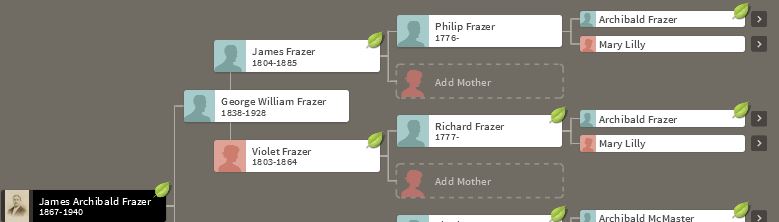
  • Pat, Bill, Paul and I also share a pair of Frazer cousin ancestors who married. These were James Frazer and Violet Frazer. DNA representing Violet’s father has already been found by triangulation. However, James’ DNA and certain genealogy have been more difficult to nail down.

Pat’s Genealogy

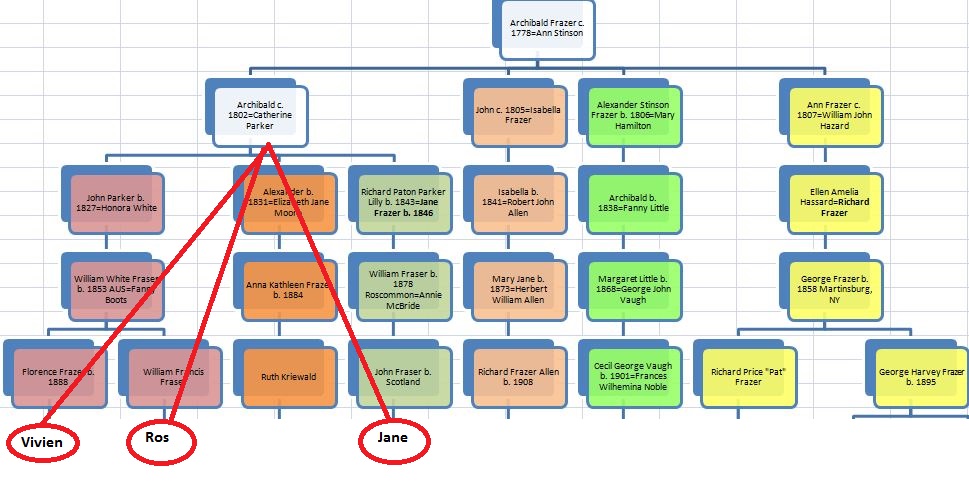
In an earlier Blog, I touched on Pat’s second cousin Bill’s genealogy. I’d like to expand on that here. Bill and Pat have as their common ancestors, George Frazer b. 1858 in Martinsburg, New York and his wife Susan or Susanna Price. According to one Ancestry tree, the handsome family looked like this:

Frazer Price

I mention this, because half of the autosomal DNA that Pat and Bill share would be from Susan Price. Now, again, according to Ancestry, Susan Price’s parents were John Price and Margaret Stinson both born in or around Enniskillen, Ireland. Perhaps this Margaret Stinson was related to this George’s mother’s grandmother Ann Stinson. If so, do you think that will complicate the DNA results?

Here is the DNA that Pat and Bill share in orange (representing George Frazer and Susan Price) as seen on FTDNA’s Chromosome Browser:

Pat and Bill's Shared DNA

Frazers in Martinsburg, New York in the 1850s

Here on the bottom 3 lines of the New York State 1855 Census are George Frazer’s parents: Richard Frazer and Ellen Hassard or Hazard. As mentioned above, Ellen is also the granddaughter of Archibald Frazer and Ann Stinson.

Richard Frazer 1855 Census

I have included the Johnston family above because the father William Johnston was married to Mary Frazer, daughter of Archibald Frazer and Ann Stinson. So you are perhaps seeing a Stinson pattern here as well as a Frazer pattern. In fact, in the 1901 Census for Clanwilliam, Marquette, Manitoba, we see a William Stinson b. in Ireland living near the George Frazer family. Also living in the Frazer house was George’s mother, the (by 1901) widowed Ellen (Hassard) Frazer.

Then on the previous census page of the 1855 New York Census for Martinsburg:

Hazards 1855

Here is yet another Frazer. Ann Frazer is the younger sister of Mary Frazer Johnston. I have that Ann married a John Hazard on 24 Dec 1824 at Ardcarne, Roscommon, Ireland; by licence. John tried to confuse me by going by William in the US, but apparently he is one and the same.

Let’s go back 5 years to the US Federal Census of 1850 in Martinsburg:

Patrick Frazer 1850

and on the next page:

Patrick Frazer 1850a

Here is a James Line Frazer. Patrick Frazer would be a second cousin once removed to Mary Frazer Johnston and Ann Frazer Hazard. We have this Patrick married to a Jane Lacy. However, other Ancestry trees have him married to a Jane Mostown. In the 1855 census, Jane appears to have a middle initial of M. However, the 2 Janes are either the same, or Patrick remarried a second Jane. Or, less likely, there was more than one Patrick Frazer! This sidetrack shouldn’t effect the DNA results, but it is interesting to see how these Irish families stayed together in the US.

Two Side by Side Triangulation Groups

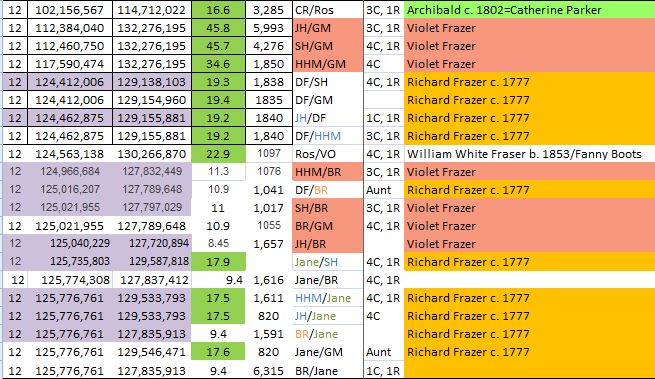
When I started looking at Pat’s results, I noticed a new Triangulation Group (TG) right near an existing one.

2 TGs with Jane

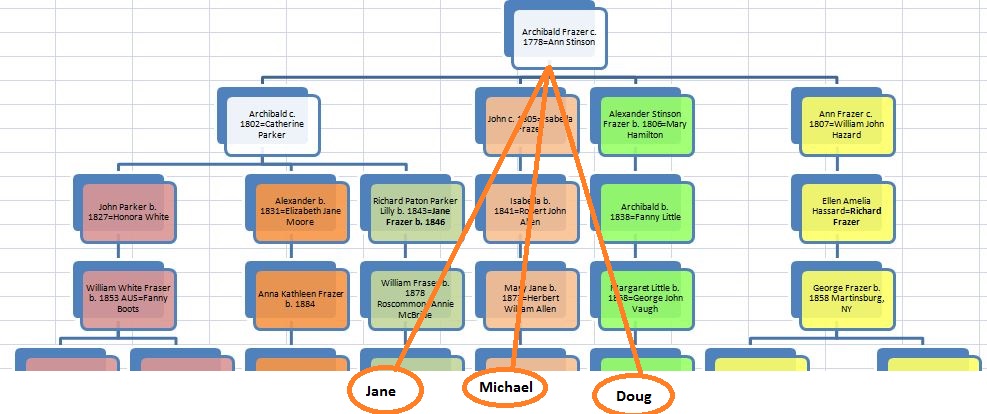
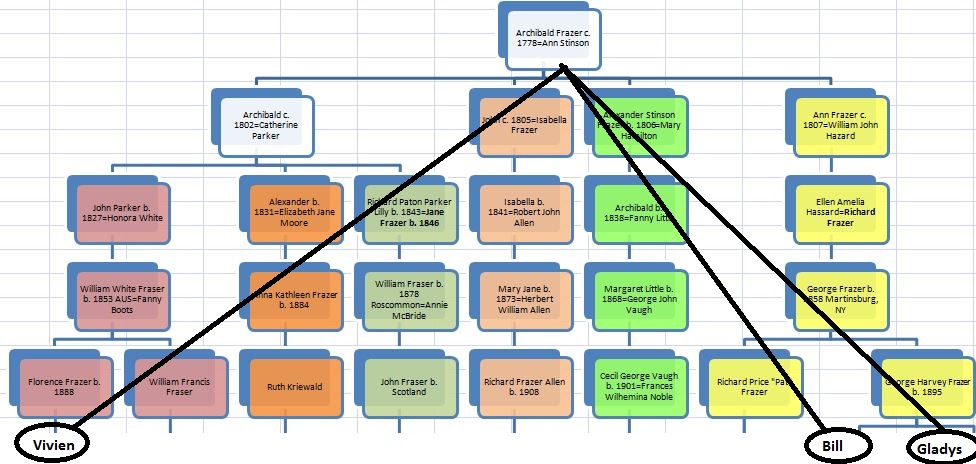
The existing TG has Jane, Doug and Michael and clearly indicates that the DNA represents that of Archibald Frazer and Ann Stinson. We know this because Doug does not to his knowledge have multiple Frazer lines – that is, Frazer ancestors marrying Frazer ancestors.

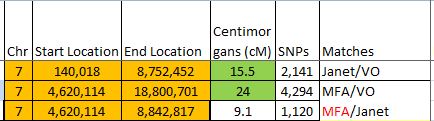
The newer TG is on the top and includes Bill, Pat and Jane. Note that Jane is in both groups. Also note that this could indicate the common ancestor the 3 have in Richard Frazer b. about 1777. Frankly, I’m quite puzzled and stumped as to who this TG represents. I have ordered a book on Endogamy by Israel Pickholtz. Perhaps that will help. Note also that Bill and Pat match each other to location 170,00,000 (say 170) This is the area where Jane, Doug and Michael match each other, but they don’t show a match with those 3 in that area. This will take some thought to decipher.

DNA Going Two Different Ways

In a previous blog, I noted difficulty in finding the DNA from my Frazer ancestor James Frazer. He was married to a Violet Frazer who I could find due to triangulation with her father Richard. Some matches with Pat may indicate additional DNA Pat and my family share that came down from this Frazer couple.

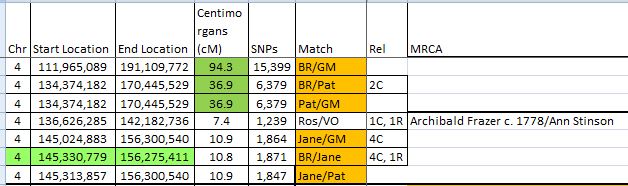
Pat Chr 4

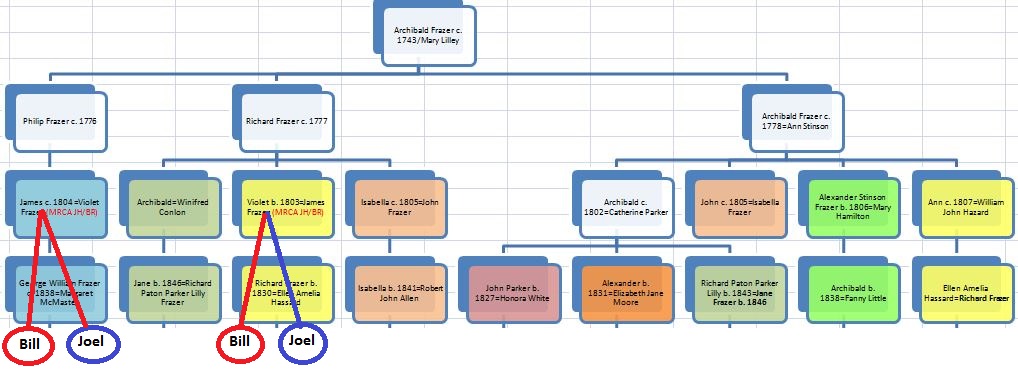
Here, I have Pat’s match with me (JH) on Chromosome 6. I included above that, Pat’s cousin Bill’s match with Cathy. See they are at similar locations. However, these 2 sets of matches indicate different ancestors. The Bill and Cathy match represent DNA from the Archibald Frazer Line. I am not related on that line. So even though this segments overlaps, it could never triangulate. The match I have with Pat is most likely with James Frazer and Violet Frazer. This is what I think the above means. Remember George Frazer who was born in Martinsburg. Also remember, on each Chromosome we get DNA from both our parents or rather 2 sets of Chromosomes (one Paternal set and one maternal set). George had on one Chromosome #6 DNA from his father Richard Frazer and and on the other Chromosome #6, DNA from his mother Ellen Hazard.

George and Pat Frazer Tree

It looks like George passed on his father’s Richard Frazer DNA to Richard Price “Pat” Frazer. This is easy to remember because “Pat” is the ancestor of our Frazer DNA tester Pat. This is the line that would match with me, as Richard is the son of James Frazer and Violet Frazer. The maternal Hassard Line carrying the Archibald Frazer/Ann Stinson DNA went to George Harvey on our tester Bill’s line. This is the line that matches with Cathy. So in these 2 set of matches, we appear to be splitting out the related ancestors. Complicated. But at least I have an explanation for it, unlike the previous triangulation case.

Finally, here’s a match on Chromosome 9 between Pat and Sharon for about 11 cM. I take this to represent the DNA of my kissing cousin ancestors James and Violet Frazer.

Pat Sharon Match

A Triangulation Group with a Genetic Genealogist: But Who Are the Common Ancestors?

The next Triangulation group is with a genetic genealogist named Jennifer (JZ below). I mentioned that she was in a TG with Cathy and Jane in a previous blog about Cathy’s DNA results written August 2015.

Pat Jenn TG

This TG has Pat, Cathy, Jane and Jennifer. But wait. I don’t see a match between Pat and Jane. I lowered the levels a bit at Gedmatch.com and see that all four women match each other on Chromosome 5 and that they do indeed match and triangulate:

Pat and Jane Gedmatch

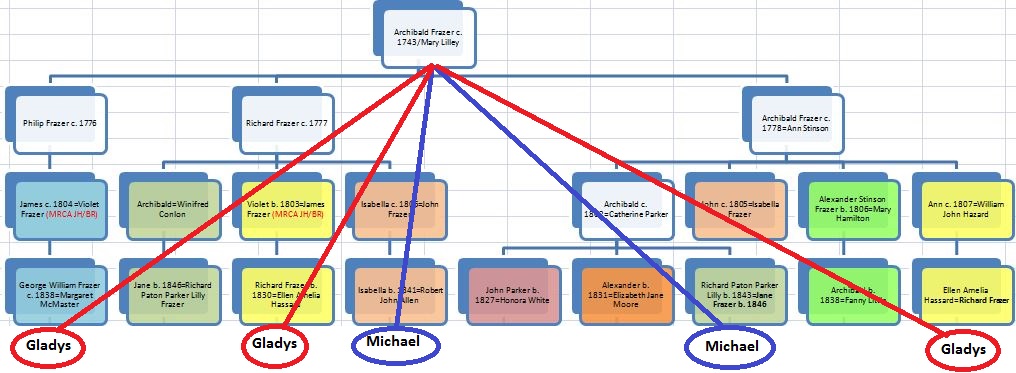
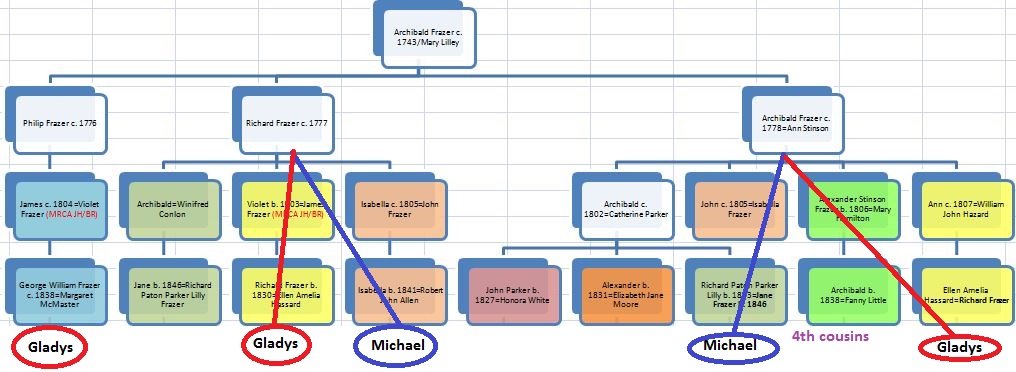
We know that Cathy and Jane have a Frazer ancestor born about 1802. Cathy and Pat share a Frazer ancestor b. about 1778. There is still a mystery as to how Jennifer fits in. She had a J. Frazer ancestor, that I guessed was a Jane Frazer. I further guessed that this Jane was a sister of the Archibald that married Catherine Parker. This theory still makes sense. Jennifer has subsequently found out that her ancestor was indeed named Jane Frazer/Frazier.

Summary on Pat’s Autosomal DNA Results

  • Pat didn’t seem to have as many matches as her second cousin Bill. This means that Bill just seemed to get extra Frazer DNA including from the more distant James Line.
  • Pat did shed some light on the common cousin Frazer ancestors that her family and my family share: James and Violet
  • Pat’s DNA resulted in a new TG. This will need more analysis as to where that TG is pointing to as far as in common Frazer ancestors
  • A comparison of Pat and her 2nd cousin Bill’s matches on Chromosome 6 helped to untangle some endogamy in the family (multiple Frazer lines due to marriages of relatives).
  • Pat’s DNA solidified a TG with a genetic genealogist who didn’t originally test to show any specific Frazer ancestry

Frazer YDNA: Part 4

In the previous post, I wrote of how our Frazer testers Jonathan and Paul matched in their YDNA. This match, based on STRs, was not perfect but was a genetic distance of 3 at a level of STR testing of 37 markers. Perhaps more importantly, Jonathan and Paul both had a DYS388 Marker value of 10. This places them solidly in SNP group called L664. Here is the nice R1a Chart I had shown in Part 2 of the Frazer YDNA series from the R1a Project Page.

719235

The L664 SNP group is on the left side of the Chart in a medium blue color. This gets us to about 3,000 b.c. Now according to the L664 Administrator:

In our FTDNA R1a1-project only 5% belongs to R1a1-CTS4385 and therefor 95% belongs to R1a1-Z645.Probably R1a1-CTS4385 is also over-represented in our FTDNA R1a1-project, because many participants of FTDNA are American emigrants who have their roots mainly in NW-Europe and not so much in eastern Europe and India, where the majority of R1a1 lives. 
Now see the Chart above. CTS4385 is directly above L664. Most of the Haplogroups are to the right of CTS4385. This means that the Frazers are rare birds within their R1a YDNA classification. And, R1a is not the most common Haplogroup to begin with for people of the Northwestern Atlantic area.
More on L664?
Yes. More from our most helpful Dutch Administrator, Martin. This is what he wrote about Jonathan (which applies also to Paul):
We expect you will not belong to the largest subgroup under R-L664, which is subgroup 2.D (classified by SNP YP282) and also not to subgroup 2.A (classified by S3477) and also not to subgroup 2.C (classified by YP358).
So most probably you will belong to subgroup 2.B which is more or less a restgroup under S2857.
For this subgroup S2857 there is on the moment no relevant SNP’s which you can order separately.
So If you want to know more about your exact position in the halpotree of R1a you need to order the BigY test.
Here is a portion of the L664 Tree, which is a portion of a much larger tree.
L664 Structure
This is analogous to the left side of the Chart above (Northwestern Europe/Germanic). Martin says we Frazers are not likely part of the popular YP282 group. He doesn’t say how he knows that. Mysterious. YP282 is third from the right on the bottom row. For the same mysterious reason, Martin casts doubt on the Frazers being YP358 or S3477. So Martin seems to eliminate most of the above tree and places us somewhere under S2857 (Is that YP943?)
L664 Structure


The groups that Martin mentions above (i.e. 2.A, 2.C, 2.D) appear to be different L664 groups that the administrator has put Y Testers into based on the combination of STR values. Lastly, he recommends the Big Y test. This is the ultimate dream test to find out where you are on the Y Tree. This would further Frazer DNA research and help many others who are in this area of L664. However, at over $400, only the hard core YDNA researchers will likely pay for that test.

Are Our Frazers from County Mayo or Arberdeenshire?

Even though we crossed out the S3477 above, Martin had a subsequent theory in a follow-up email. His theory is that the Frazers are indeed S3477 and related to the County Mayo Prendergasts. These Prendergasts supposedly were in the County Mayo area of Ireland since the 1200’s along with the Normans. They also are L664 and apparently have some other STR similarities. I sort of doubt Martin’s theory based on our own Frazer traditions. However, Martin says, “You can also order 67 STR-markers and when your DYS617=13, then you also know you belong to this subgroup S3477.” I’m guessing that DYS617 will not be lucky 13 for Jonathan and Paul, but we’ll see. I’m willing to keep an open mind. Both Joanna and I have ordered additional STR testing for Jonathan and Paul. That will tell whether or not we are in subgroup S3477.

The County Mayo, IRE Norman Frazer connection does not have the right ring to me. Would any Frazer descendants vote for that option? I prefer the Aberdeenshire tradition. According to our Aunt Mabel researcher, the Frazers were in Keith in the late 1100’s. Now that’s a ways back. She thinks that not long after this time, they made their way down to Stirling and over to Ayrshire before they traveled to Ireland. Here is a map for some of Jonathan’s YDNA matches:

Part of Jonathan's YDNA Match Map
Part of Jonathan’s YDNA Match Map

These are 3 of the 4 matches that show up on Jonathan’s YDNA match map. The other match was Chisholm in North Carolina. Without a European location, that match location is unhelpful and inconclusive. I’m not sure why Paul doesn’t show up on the map. At any rate, I was struck by the number of YDNA matches that Jonathan has in this Northeastern part of Scotland at the 37 STR level. It seems more than coincidental. The marker in the middle is a Grant. The other two do not have their names listed. Note that Keith is in the area to the East of the middle marker. This is the place where Aunt Mabel had our first Frazer.

Simon of Keith

I’m not thoroughly endorsing the old research, but it is interesting that there can be some parallel conclusions between it and modern DNA testing. Also note that this would be about as early as there would be surnames. According to Scotlandspeople.gov.uk,

Norman influence filtered into Scotland after their invasion of England, and was actively encouraged by Scottish kings. Anglo-Norman nobles acquired grants of land around Scotland and introduced the feudal system of land tenure. For example, Robert The Bruce was a descendant of Robert de Brus who fought with William the Conqueror at the Battle of Hastings. Bissett, Boyle, Colville, Corbett, Gifford, Hay, Kinnear and Fraser are all originally Norman names, which first appeared in Scotland in the 12th century. Menzies and Graham are recognised Anglo-Norman surnames also first seen in Scotland at this time. 

Paul’s Other YDNA Matches

There are a few odd things about Paul’s matches. First at the level of testing that he did (37 STRs), he only has 4 matches where Jonathan has 13 matches. My unsupported theory on this is that the James Line as seen in Jonathan has more of the original Frazer STR type and the Archibald Line as seen in Paul’s results branched off or mutated away from the original STR type. Here are Jonathan’s 13 matches at the 37 STR level of testing:

Jonathan's YDNA 37 Matches

I don’t show it, but Jonathan has:

  1. One match at GD=1
  2. Two matches at GD=2
  3. Five matches at GD=3, and
  4. Five matches at GD=4

William Frizelle is at the top of both lists. However, Jonathan has a GD of 1 to him, where Paul has a GD of 3. That means that genetically, and without taking into effect the speed of mutation of the individual STRs, Jonathan is more closely related to Frizelle than our Frazer tester Paul. It does not mean that he is actually more closely related. This is due to the fact that DNA can mutate whenever it wants. Apparently it wanted to more between Jonathan and Paul than between Jonathan and Frizelle. Also, there is a phenomenon called back mutation which can confuse the issue. If a line had a specific STR value of say, 10 and it mutated to 11 and then back to 10, there would be 2 mutations, but it wouldn’t be easy to detect and it would look like there was no mutation at all. I’m not saying that is what happened here, or that it is common, but it is possible.

Obviously, Jonathan and Paul match each other. Other than that, Latham and Chisolm are on both lists. In additions, they have a GD of 4 on both lists.

Another interesting thing is that Paul does not show a match at this level with Stuart/Stewart or the many Grants that Jonathan matches.

Matches at the 25 STR Level

FTDNA posts matches at the different levels of YDNA testing. They turn out to have different matches in some cases, due to the specific STRs tested. At the 37 level, above, the cutoff for matches is a GD of 4. At the 25 level, they only allow a GD of 2 or less. Here, the differences between Jonathan’s and Paul’s matches are even greater. Jonathan has 20 matches and Paul has, again, 4. However, Jonathan’s 1st 4 matches match Paul’s 4 matches. At this level, Jonathan has a perfect match with Frizelle, where Paul has a GD of 1 with Frizelle. This tells me that Frizelle must be L664. Remember that a DYS388 Marker value of 10 means one is an L664. DYS388 is the 8th value. A 25 STR test includes the 8th value. A perfect match between Jonathan and Frizelle means that Frizelle must have a DYS388 Marker value of 10.

By the way, I wrote to Frizelle asking if he had a 10 at that marker level. It would be good to hear from him, but even if I don’t we now know he is L664. At this level of matches, Latham drops out (although, he still matches Jonathan). The common match that is replaced does not have a most distant ancestor, but the tester’s last name is listed as Plate.

Way Down to the 12 Marker Level

Here the matches between Jonathan and Paul are even greater than before. Now Jonathan has 2 pages of matches for a total of 38 matches. Paul, again, has only 4 matches. At this level, FTDNA only allows a GD of 1 or less. Here are Paul’s matches at the 12 level:

Paul's YDNA 12 Matches

Some facts and/or observations:

  • Paul has no perfect matches at any level. Again, I take this to indicate that Paul’s line has some unusual mutations in the YDNA compared to Jonathan’s YDNA.
  • If we hadn’t collaborated in this Project I wouldn’t know the STR values for Jonathan. So we wouldn’t know that Jonathan and Paul were both L664’s
  • Jonathan has 10 perfect matches. These all must be L664’s.
  • I wonder if testers #2 and #3 (Riley) in Paul’s match list above were testing to the same distant ancestor. It looks that way.
  • Tester #2 has a terminal SNP of L664, but we know that already as this person is a perfect match with Jonathan who is has the STR of 10 at DYS388.
  • Even at a level of 12 markers, Paul has a GD of greater than 1 with Frizelle.
  • Although the 12 marker and 25 marker results are interesting, the highest level of testing is most accurate and important.

Next up: I believe we have some more Frazer autosomal DNA results.

The Frazer YDNA Reveal: Part 3

In a previous Blog on the YDNA of the Frazers originating in North Roscommon, Ireland, I promised a reveal on the YDNA of my cousin Paul. As you likely recall, Paul is from the Archibald Line originating about 1715. Jonathan, who represented the James Line originating about 1717, had his YDNA tested a while back. This is what we were hoping to find out by having these two people test their YDNA:

  • Are the Archibald and James Lines related to each other?
  • Were the two Frazer Lines unbroken from the early 1700’s (or earlier) to now?
  • Were Archibald and James Frazer brothers?

YDNA, Autosomal DNA, Mitochondrial DNA, X Chromosome?

There are different types of DNA testing. They are well explained at 4 Kinds of DNA for Genetic Genealogy. Basically, with YDNA, we are looking at the father’s father’s father going back tens of thousands of years. The more you test the YDNA, the closer you get to present day. So this starts at the beginning of mankind and work toward the present. This type of testing is critical to one name studies. As we are looking the one name of Frazer, it makes sense to test YDNA. Autosomal DNA (atDNA) is pretty much the opposite of YDNA. This starts at the present and works back along all your lines. However, the further back you go, the more diffused the atDNA becomes. Some ancestors’ atDNA may drop out altogether.

First, the FTDNA Comparison

In my last Blog, I mentioned how Jonathan was R-M512. FTDNA has a computer program that looks at Jonathan’s 37 STR test. The STR test is like a YDNA fingerprint. Except in this example, the fingerprint is not always unique. FTDNA then classifies those STRs and determines what SNP test Jonathan would be positive for if he took the SNP test. The SNP is more of a positive unique ID test where the STRs can sometimes be ambiguous. However, R-M512 was not terribly helpful for Jonathan as it occurs sometime in the Stone Age. Ugh. Joanna put Jonathan’s results into an FTDNA Project called R1a1a Subclades. Based on the expert talents of the administrator there, that administrator was able to place Jonathan further down on the R1a tree at a place called L664.

Now last Sunday, when I was in New Hampshire, I got news that Paul’s YDNA results were in. This is what I was waiting for. This would tell us if the 2 branches were the same family and if the lines were unbroken. If this were to be the case, then the YDNA results would apply to all Frazers in the project and tell them about their deep ancestry.

FTDNA simply said that Paul’s Haplogroup (estimated SNP) was R-M198. This was further back in the Stone Age and less helpful than Jonathan’s results. For some reason, the combination of STRs did not compute well with FTDNA’s algorithms and they gave a very conservative answer. The good news was that both Jonathan and Paul were R1a which is a fairly rare YDNA for Northwestern Europe.

Jonathan and Paul by STRs

The STRs are the markers used to fingerprint the YDNA. According to Paul’s match list, Jonathan and Paul differ by a GD of 3. Now a GD is not a swear, it is something called Genetic Distance. It is simply how far off the markers are from another set of markers. So out of the 37 markers tested, there were 3 differences between the markers of Jonathan and Paul. The R-M512 is Jonathan and the R-M196 below is Paul. Can anyone spot the 3 differences?

Jonathan's STRs

Paul's STRs

I had to look very closely at the screen. The first difference between the 2 Frazer lines is at the fourth STR. Jonathan has a 10 and Paul has an 11. The other differences are on the right. 3 from the right end we see Jonathan with a 35-38 and Paul with a 35-40. The difference between 38 and 40 is 2 accounting for 2 of the 3 GDs. All of these positions have names.

STR Labels

Again a bit of an eye strain, but the differences between Jonathan and Paul are at DYS391 and CDY. Notice that these STRs have different colors. That is because the different STRs mutate at different rates. The red STRs have faster mutation rates. The blue ones change more slowly. The differences in the blues just represent different levels of testing. The higher the number of STRs tested, the lighter, the color of blue. So CDY where there was a GD of 2 is a fast moving STR. One would expect this would be where there would be a difference of 2 if there was to be one. The other marker of DYS391 is a slower mover. However, each STR has a published mutation rate. I have seen published rates for DYS391 that are faster than DYS385 which is shown as a fast mover. So there is more than meets the eye.

FTDNA’s TiP Report

FTDNA has a tool called the TiP Report. This is another mechanized way to estimate how closely you are related to a YDNA match. First, here are Paul’s YDNA matches:

Paul's YDNA Matches

I left out the tester’s names on the left. These are Paul’s 4 YDNA matches. He has fewer matches than Jonathan. Perhaps this is because he has a more unusual combination of STRs. Paul’s first 2 matches have a GD of 3, the last 2 have a GD of 4. That is why they are further down on Paul’s match list. When I run the TiP Report, this is what I get for Jonathan and Paul.

TiP Chart Paul Jonathan

This works out well, as our best guest is that Paul and Jonathan should have a common ancestor 8 generations ago. Given that, FTDNA thinks there is a 44% chance of Archibald, born around 1690 as being the common ancestor of these two. Hey, it could happen. FTDNA takes into account the speed of the mutations mentioned above, but as I mentioned above, there are differing opinions as to which  mutation rates to use.

R1a1a Project Administrator to the Rescue

When I had my own Hartley R1b YDNA a while back, I found the Project Administrator to be dedicated, intelligent and helpful. So I didn’t hesitate to join Paul to the R1a and Subclades Project as soon as I got home from New Hampshire as I had a feeling that the Administrators would have some good advice and information. I was surprised to get an email the next day from Martin from the Netherlands. He had written Joanna and myself and had some recommendations. Part of what he had was generic for the L664 group. Part of what he had to say was specific to Jonathan’s and Paul’s YDNA results.

The Reveal

I had promised a reveal. And the answer is…. [Break for commercial] Yes, they are related. Based on Martin’s expert opinion, he was able to determine that both Jonathan and Paul were from the L664 group. I had mentioned in my last blog that Jonathan appeared to be in the process of being placed in an L664 Group. I counted and there were 61 different L664 groups, so quite a few. Here’s where Martin’s experience came in. He could tell without testing for L664 that Jonathan and Paul were L664. Here is part of the standard L664 introductory email:

Because your haplotype shows DYS388=10 this means you are part of the subclade 2. (North-Western European Branch). For all other members of haplogroup R1a1 the value of DYS388 is nearly always 12, this means DYS388=10 is an unique marker for our subclade 2. This subclade 2. is further identified by the SNP’s CTS4385 and L664.
So back on the STRs above. DYS388 looks like the 7th marker. Actually it is the 8th as one marker before it is a double marker. Your will see that both Jonathan and Paul have a value of 10 there. This is the marker that sets the Frazers apart. Further I responded to Martin’s email and he wrote back:
I think both Frazers must be related because their STR-haplotypes are very rare in Ireland.
This is why I was surprised at the initial results from Jonathan: due to the unusual YDNA type he had. However, I’m glad that Paul matched him. I found this statement also interesting:
It is very remarkable that nearly all members of R1a1-CTS4385 (about 97%) have their origin only in the countries around the North Sea (British Isles, Norway/Sweden, Denmark, NW-Germany, Netherlands). The subclade R1a1-CTS4385 is represented by only 0,2 – 0,9% of the total population in the countries around the North Sea.
For clarification, R1a1-CTS4385 is the branch of the Frazer Tree above L664, so essentially the same thing. So L664 is rare, but rare can be good in identifying relatives. Here’s the North Sea for us geographically-challenged Americans:
northsea
One point of putting this map up is that Ireland does not border on the North Sea. If L664 types are 0.2-0.9% around the North Sea, they must be quite a bit less in Ireland. But how did these ancestors make their way from the circumference of the North Sea to North Roscommon. The answer to that question could lend or take away credence from some family traditions linking the Frazers to the Highland Clan Fraser of Lovat.
More On L664?

Nah, that’s enough for now. There will be more time later.

What Did I Learn?

  • The YDNA testing answer to whether the Archibald and James Lines are related was not as simple as I thought it would be. It took some digging and Project Administrator expertise to find the answer.
  • The 2 Frazer Lines are indeed related. This adds to family lore, older research and the Elphin Census of 1749 which shows the 2 families plus a third widow family living in Aghrafinigan, County Roscommon.
  • The 2 Frazer Lines as seen in the YDNA results have not changed from the time of the common ancestors. That is, other than expected minor mutations that occur in the STRs over time on a regular basis.
  • This strengthens the case for our autosomal matches between the 2 lines being just that (as well as being matches between related families).
  • It looks like we are on the right track with no skeletons in the closet
  • Asking whether 2 early 1700 men were brothers should be too much to ask of DNA results.
  • I am thankful for all those who have tested their YDNA in the past and provided information for YDNA trees which can be used today.
  • I am also appreciative of dedicated and talented Haplogroup Administrators.
  • A lot of other stuff, but I don’t want to be that boring right now. Wait until later.

Frazer Y DNA: Part 2

My first blog on Frazer Y DNA was called Why Test the Y? In that Blog, I introduced the concepts of STRs, SNPs and discussed some of Jonathan’s initial test results. Jonathan is the only male Frazer direct line descendant that has YDNA results so far. As such, we are assuming that his results apply to all Frazers. I’m not putting all my eggs in one basket, so I have had my second cousin, once removed, Paul, take a YDNA test also to confirm Jonathan’s results. A match should show that Jonathan from the James Line of the Frazers and Paul of the Archibald Line are most likely brothers. It would also show an unbroken line from these early 1700’s brothers to these 2 modern day male Frazers.

Joanna posted Jonathan’s results on the Fraser and Septs web page where anyone who has the remotest inkling of being a Fraser has posted their DNA results.

Fraser and Septs

However, as it turns out, there are not many Frasers/Frazers with the brand of YDNA that Jonathan has. Jonathan’s brand is R1a which took a Northern European route to Scotland – perhaps via Vikings. The majority of those in the Fraser group are R1b. These people took the Southern European route out of SW Asia to get to Scotland. As the common ancestor of these 2 is probably in the 10,000 year range, you can see we are not closely related to the R1b. However, there were two other Frazers in the R1a group. They are a Frazer and a Frazier. Interestingly they both have a ‘Z’ in their names, so that  was encouraging.

The R1a Project

The Frazer and Sept Group has about 1879 members. The R1a Project has 4390 members. I asked Joanna, Jonathan’s sister, to make sure that Jonathan was in the R1a Project. She did that as soon as she got back from a visit to France. R1a administrators would be able to further classify Jonathan. Family Tree DNA (FTDNA) had Jonathan as a R-M512. This is what they are sure he would test out if he had done a SNP test. This was based on the 37 STR YDNA test that Jonathan had. 37 STRs is a pretty basic level. 12 STRs and then 25 used to be the basic level. This R-M512 designation gets us up to about 6,000 years ago. It’s better than 10,000 years, but still not very helpful. At that point Jonathan’s ancestors were roaming around Asia according to the map below.

719235

Above is the new R1a Tree which has changed since my last blog on YDNA of less than a month ago.  Notice that M512 is actually 6,500 B.C. and R1a goes all the way back to 16,000 B.C.! Let’s see if we can get Jonathan out of Stone Age Asia.

Каменный_век_(1)

So, What is Jonathan’s New Classification?

People who are skilled at looking at the STRs can determine, based on the results, a better estimate of where Jonathan should be on the SNP tree. Each SNP can have a signature STR which can be determined by spreadsheet or a skilled interpreter. This interpreter would also be able to recommend focused SNP testing to get further down the YDNA R1a Tree. Previously, when I looked at Jonathan’s results, it said something like, “Awaiting Classification”. Now it looks like this:

L664

The note in red now says, “L664 results ready for classification”. My interpretation of this is that the administrators took Jonathan out of the unclassified bin and put him with the L664’s. They will then likely separate him into the group of L664’s where he best fits.

An Unexpected L664 – Is This Right?

First the good news. L664 is about 3,000 B.C. So that moved Jonathan up 3,500 years and got him out of the Stone Age. Not bad. The shocker is that L664 is Germanic. From the R1a Tree above, I would’ve assumed that the Frazers were more in the Z284 Branch. These are the Norsemen on the R1a Chart. Below this branch is seen the Scots. However, the Germanic L664 did migrate North to Scandinavia, so the results apparently are the same. How we got there was different than expected. Note on the map, some of the L664’s made their way to SE Britain. This could have been a less likely path to Scotland.

What’s Next?

We’ll wait to make sure the L664 designation was correct. Then we’ll see on what branch of the L664 Jonathan is. I expect in a month, we will have Paul’s YDNA results. I am eagerly awaiting those results.

I wonder if the other 2 R1a’s in the Fraser and Septs project (Frazer and Frazier) are also L664. If they had uploaded their results to the R1a project, perhaps we would know the answer to that question.


Where’s the DNA from My 3rd Great Grandfather James Frazer?

In the Old Days of Frazer Genealogy

When I started looking into my Frazer genealogy, I had a few breakthroughs. One was when I got in touch with my Frazer relatives in Ballindoon. They were still on the old family farm. I eventually made it out there with my wife and met Eileen Frazer nee McMaster. She was able to fill me in off the top of her head concerning Frazer history in the area.

My second breakthrough was discovering Doug Vaugh and getting to know about his research and that of his relatives in the first half of the 20th century. Seems that they had an interest in Frazer genealogy. Much of their research had to do with their family interest in securing  a Frazer Coat of Arms. However, their research was quite extensive as to the Frazers in the area of North Roscommon and South Sligo which were of interest to me. I tried to piece together what they had with the vital records that I had.

A third great help I had was Arthur Livingston, a researcher in the area. He was related to me on the McMaster side, but was willing to look up Frazer information for me also.

Here’s a photo of many of the Frazers I met on my first trip to Ireland. They were visiting Eileen who was celebrating her 70th birthday. She is the second person in the back row.

Frazfam

Finding James

Figuring out who my 2nd great grandfather, George Frazer,  was was not too difficult. After all, we had photos of him. The family still had his old house. Eileen knew of him as “old George”.  However, his father James was a bit more mysterious. There was no problem finding his wife Violet Frazer. She even had a birth record and was mentioned in Doug’s early genealogical sleuthing relatives’ works. Here she is under Richard.

Early Frazer Research

How Did I Choose Philip As James’ Father?

I checked the land records. It appeared that there was continuity in the lands between Philip and James as seen by the Tithe Applotments and Griffith’s Valuation. My Frazers relatives took me on an outing to view the old house where my 2nd great grandfather lived in North Roscommon before moving to Ballindoon. I believe his parents, James Frazer and Violet Frazer also lived there. Who knows, maybe his grandfather Philip also lived there?

Derrycashel House

I checked the naming of James’ sons. The first I had as being Philip. It would be traditional to name the 1st son after the father. Also my 2nd great grandfather (James’ son) was named George which was the name of one of Philip’s sons also. By the way, James’ and Violet’s second son was Richard. It was a tradition to name the second son after the mother’s father. Violet’s father was Richard.

Now I’m Looking For James’ DNA

I have gone from looking for James’ ancestors, vital records, and land records to looking for his DNA. I suppose that James would be surprised to learn that one of his descendants would be looking for his DNA. Especially since no one had an inkling of what DNA was in the 1800’s.

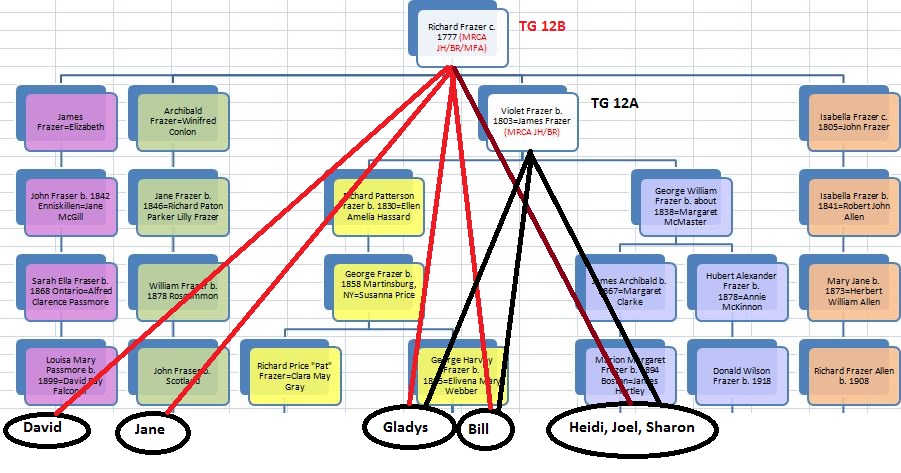
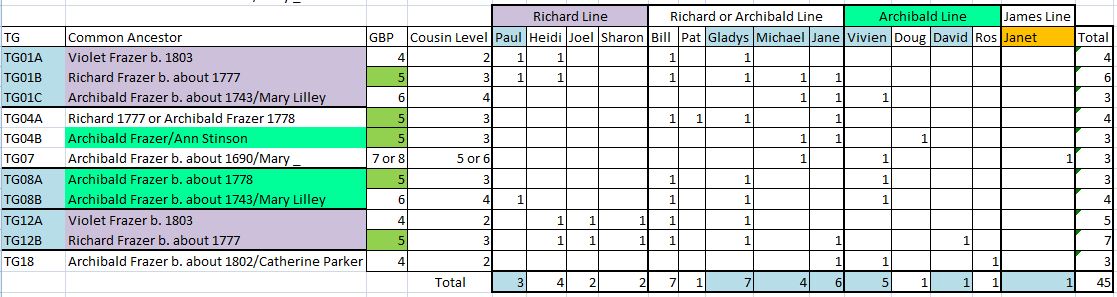
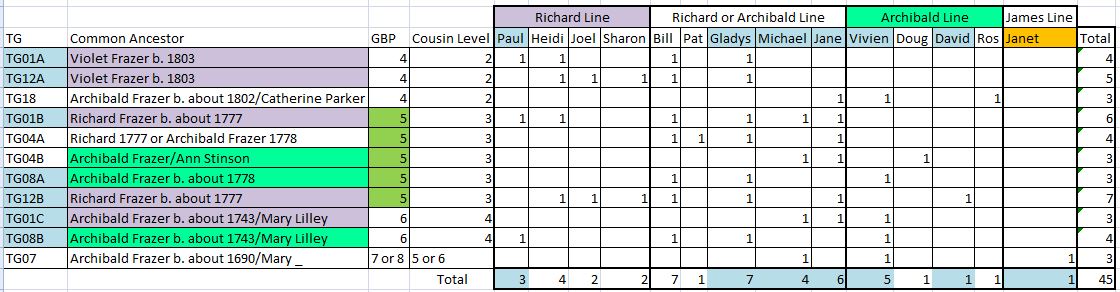
Bill and I share as common ancestors James and Violet Frazer. When Bill first tested his DNA, I thought I’d find tons of matches due to our double Frazer ancestry. It turned out that Bill was in 2 Triangulation Groups (TGs). However, both of those TGs pointed to Richard Frazer b. about 1777. This would indicate that our common ancestor based on this DNA match is with Violet Frazer as Richard’s daughter, but not James.  This was a bit frustrating as I already knew more about Violet than James. I didn’t need to have her genealogy verified by DNA. I needed the DNA to verify James’ genealogy.

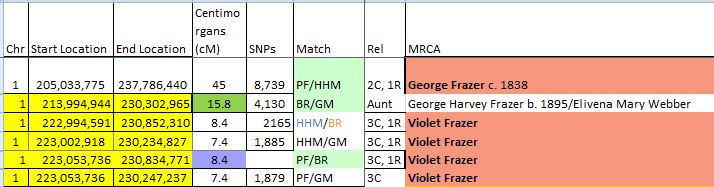
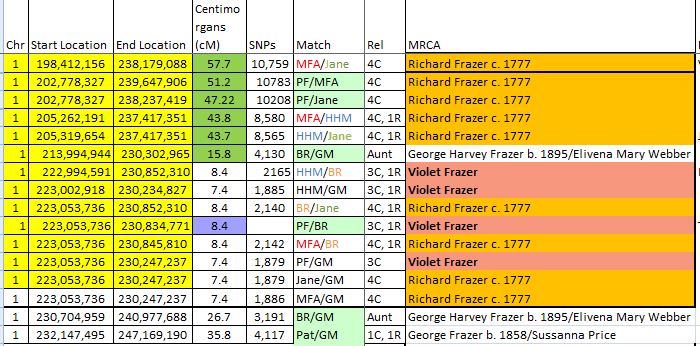
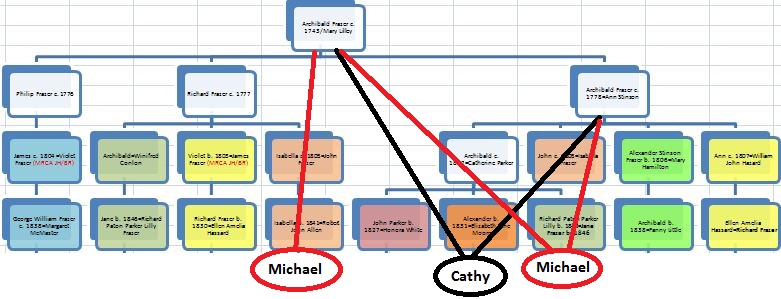
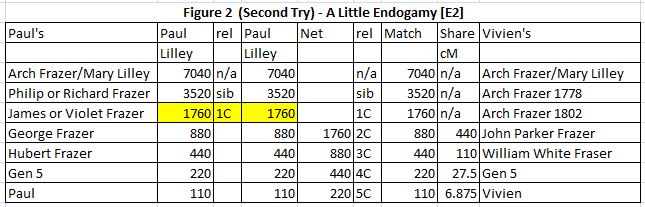
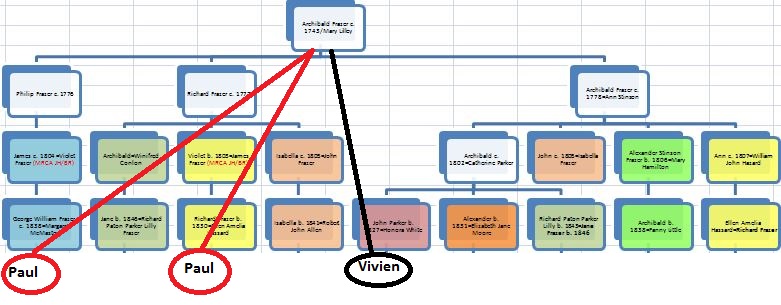
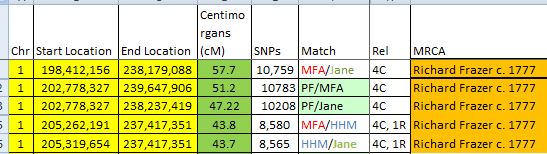
In the first TG, there were Paul (PF), my 2nd cousin, once removed and my sister Heidi (HHM). I had been so focused on the Most Recent Common Ancestor (MRCA) of the Triangulation group (Richard Frazer) that I had forgotten to focus on my own MRCAs – or in this case – Bill’s. So I colored the more recent MRCAs in a different color (pinkish). Then I could see James and Violet. However, in this TG, as Violet descends from Richard, we still don’t see James.

TG01

This was basically the same in the second TG found at Chromosome 12.  Where my sister Sharon and I weren’t in the first TG, now Paul doesn’t show up in the second TG:

TG12

Here again we see Violet Frazer. Note that although technically James is shown as an MRCA, he’s not an MRCA of the TG as this is a Richard Frazer TG. That is one way to narrow down whose DNA is whose. So as I’m mapping my chromosome, that small section of my 12th chromosome is from Violet Frazer and not James (her 1st cousin husband).

Next I looked to see if I could find James’ DNA outside a TG. I did find it here:

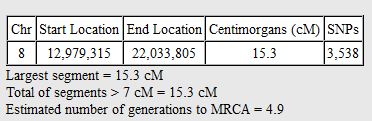
Paul Bill Match

Here at Chromosome #8. It’s a good thing I asked Paul to have his DNA tested or I wouldn’t have found this match. I didn’t match with Bill here and my 2 sisters didn’t. It took 4 tests not counting Bill’s to find this match. I still don’t know if this is James’ DNA or Violet’s. However, we’ve already found Violet’s DNA two times. This may be James’ DNA. Quite elusive. So if you don’t find a specific match that you are looking for, remember how difficult it was to find this match. Part of the reason that this match was found was that Paul is a generation closer to James and Violet Frazer than I am. That gives the DNA more of a fighting chance to show up.

Untangling the Frazers

Due to cousins marriages and other intermarriages back in the day, some of the Frazer genealogy has become enmeshed and tangled. The DNA match results may also seem the same way. Triangulation is helping to see where the various DNA matches came from and untangling things. For example, at Chromosome 1 as shown above, Paul and my sister Heidi have as common ancestors George Frazer and Margaret McMaster. Bill and my sister have as common ancestors James Frazer and Violet Frazer. Due to the fact that these people are in a TG of people that descend from Richard Frazer, born about 1777, we may say that the DNA that Heidi and Bill share was from from Violet Frazer, not James Frazer. Likewise, the DNA that Heidi and Paul share is from George Frazer and not Margaret McMaster.

This clarifies things a bit and should be helpful in future analysis. This is important in my research as Margaret McMaster has another Frazer ancestor. Her name was Margaret Frazer and she married a McMaster in 1813. This would indicate that these 2 DNA matches in Chromosome 1 and 12 were not from that Margaret Frazer. I should be looking for that match elsewhere.

Other Untanglings

As mentioned above, the Chromosome 12, the DNA that my two sisters and I share with Bill represent Violet Frazer and not James.

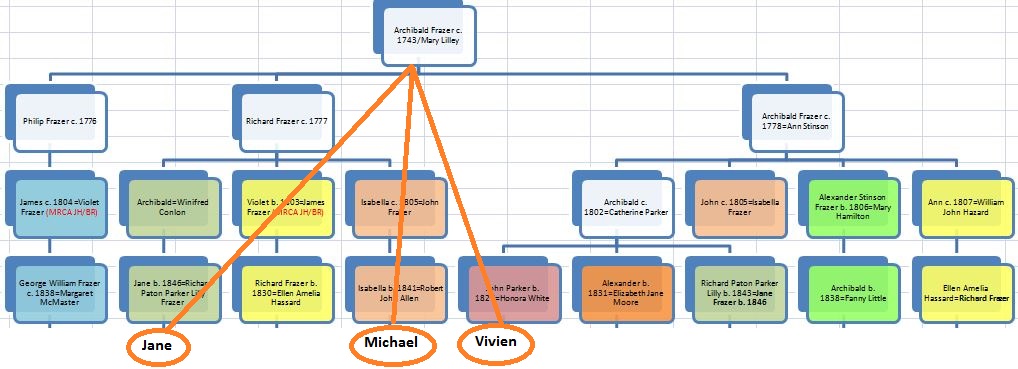
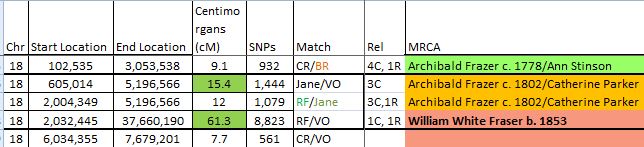
In my blog, News Flash: A Third Frazer Triangulation Group, I mentioned the Chromosome 4 TG that Jane, Michael and Doug were in. Here is the genealogy:

Archibald TG

Testers in the light blue line (Jane), pinkish line (Michael) and green line (Doug) formed a TG. From the TG and the genealogy, we can say:

  • Jane’s Chromosome 4 match represents Archibald Frazer and not her Parker line. From there that Chromosome 4 DNA traveled down through Richard Paton Parker Lilly Frazer rather than Jane Frazer and further down the Frazer line. In this case, this should have been evident anyway from the genealogy, but the DNA confirms it.
  • For all three: Jane, Michael, and Doug, the DNA match cannot differentiate between Archibald Frazer and Ann Stinson. However, after that the descent of their Chromosome 4 match is clear by the genealogy.
  • Again, from the genealogy and the TG, this Chromosome 4 match for Michael is through his ancestor John Frazer and not John’s 1st cousin bride Isabella Frazer.

Next up: awaiting Pat Boggitt’s DNA results. She is also a descendant of James Frazer and Violet Frazer. Her DNA may shed more light on James Frazer.

My Frazer Cousin’s DNA Results Are In

I’m so happy that my cousin Paul’s autosomal DNA results are in. He is my second cousin once removed. He is also a generation closer to my Frazer 2nd great grandparents. That means his DNA results should be better than mine in matching others. Here are my 2nd great grandparents (Paul’s great grandparents) at the farm in Ballindoon, County Sligo. Both Paul and I descend from the first 2 people in the photo: George Frazer b. about 1838 and Margaret McMaster.

Frazers

I like this photo, but I can’t help but think the family looks a bit sad. Perhaps they missed my great grandfather who moved to Boston. There were 9 children and at least one additional child that appeared to have died young. Out of those surviving 9 children, there are only 3 in this photo taken at the family farm in Ballindoon.

Meanwhile, in Boston, here are 5 of the 7 Frazer brothers.

5frazerbrothers

Let me introduce you to my great grandfather who is sitting down on the left. He is the oldest in the family. Hubert is Paul’s grandfather standing on the far right.

Paul’s DNA

So let’s look at some of Paul’s DNA matches. Here is how Paul matches my 2 sisters and myself. Also for reference, I have his 2 other largest Frazer matches at Family Tree DNA (FTDNA)

On the browser below Paul matches the following relatives:

  • Sharon is orange
  • Heidi is blue
  • I am green
  • Michael is pink
  • Jane is yellow

Paul's DNA FTDNA

There are some places where I don’t match other Frazers in the project. These would be good candidates for McMaster matches as Paul and I both share Margaret McMaster as an ancestor. For example, look at Chromosome #9. Paul matches my sister Sharon for a large stretch shown in orange. There is a large match there where neither Paul nor my family match other Frazer testers in the DNA project. My guess is that is where Sharon and Paul share DNA with Margaret McMaster.
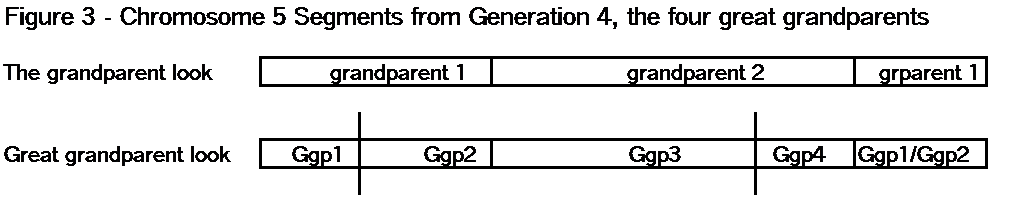
But, there is more going on at Chromosome #9 and it ties into a previous blog I wrote on the X Chromosome called The X Factor – Part 2. I’ll try to explain what Paul and Sharon’s match on Chromosome #9 has to do with the X Chromosome. First a word on triangulation.

A Possible Frazer DNA Triangle?

Paul’s testing resulted in an additional Triangulation Group (or TG). These are good things because they are DNA’s way of telling us that those in the TG come from a common ancestor.  However, is this common ancestor from a Frazer or a McMaster? This new TG looks like this.

TG Paul Sharon Karen

This is the classic 3 person TG where Paul (PF) matches Sharon (SH), Sharon matches Karen (KS) and Paul matches Karen. Now this is where I’ll tie it all together in an amazing or unbelievable way (depending on your point of view). Karen is the karen I mentioned on my X Chromosome blog. She had a huge X match with Sharon. My guess at the time was that karen’s X match went through Margaret McMaster back past her grandmother who was Margaret Frazer. Then back to Margaret’s unknown father as the likely common ancestor. It’s a little easier to see here:

Dad's X Inheritance

So in this scenario, Paul and Sharon’s large match represent Margaret McMaster above b. 1846. But the TG of Paul, Sharon and Karen represents (probably) the father of Margaret Frazer above. I had been thinking that Karen may be related on the McMaster side. That is another option. However, Karen isn’t aware of McMaster ancestors, but she is aware of one Frazer/Frazier ancestor from the area. Actually, if Karen’s TG ancestor is the same as her X Match ancestor, I suppose the match could be anyone in pink or blue to the right of Margaret McMaster on the chart above. I just thought the Frazer scenario fit in with what Karen knew about her ancestry. Another note is that the X match and the Chromosome 9 match don’t have to represent the same ancestor. One could be a Frazer and one could be a McMaster. At any rate, it is a case where genealogy, triangulation group and X Chromosome match appear to work together.

Paul’s Gedmatch Results on the Archibald Line

Paul and I are on the Archibald line which goes back to the early 1700’s. Here is how he matches up with those on that line by gedmatch. In this analysis gedmatch lowers their match results a bit to 5 cM.

Paul cf Archibald Line

Going across the top line, Paul matches the first 6 who have a common ancestor of Richard Frazer b. 1777. The last 3 people have as their ancestor another Archibald who was the brother of Richard. He has either no matches or small ones with them.

And the James Gang

The way the project has been split up we have looked at the Archibald Line and the James Line. These 2 likely brothers have a whole bunch of descendants. Here is how Paul matches James Line descendants.

Paul cf James Line AVG

Interestingly, Paul’s largest match here is with Judith. Judith is related to Bonnie, but Paul has no match with her. Also I did something different here. I deleted all the cM values for the close relations. Those are up to second cousins shown in pink. Then I added a column to the right. This adds up everyone’s matches (minus the close relations). At the bottom I took the average summed cM value for the James relations. What this tells me is that Paul is likely as related to the James Line testers as the James lines testers are related to each other. This report doesn’t seem to be the most accurate as Paul actually does have a match with Janet which doesn’t show here.

More On Archibald Line TGs

Aside from the new TG Paul is in (which may not be a Frazer TG), we had 3 Archibald Line TGs. The third, discovered after Doug tested, was in the Archibald-Ann Stinson Line that Paul is not in. That leaves 2 other TGs. I had previously thought both these TGs went back to Richard Frazer b. 1777 and his unknown wife. Now I’m not as sure.

The first of the 2 TGs is in Chromosome 1. Here is what it looks like.

Chromosome 1 TG

Note that in this TG are Michael (MFA), Jane, Paul (PF) and Heidi (HHM) with huge matches. Then there is Bill (BR) and Mike (MB) with smaller matches. Mike is someone who isn’t in the project but appears to be in the TG. Note that my sister Sharon and I are not in this TG due to the random way we inherited our parent’s DNA.

The second TG is on Chromosome #12

Chromosome 12 TG

In this TG is Dave from Canada. EG and RWT are other people not in the project but appear to triangulate with our group. This means they should share common ancestors. My sisters Heidi and Sharon as well as I are in this TG. Jane is here and Bill.

Why I doubted both these TGs were from Richard b. 1777 and his unknown wife.

  • DF is only in the second group. We’ll call that TG12
  • Paul is only in the first group. That would be TG01
  • Michael is only in TG01

Why I am staying with these 2 TGs both representing Richard Frazer and wife:

  • DF didn’t match Paul by DNA, so that makes sense that Paul wouldn’t be in a TG that DF (David) was in.
  • Paul is unquestionably related to me and my family. The link we have goes back to George Frazer who was born about 1838. That means before that time we share the same ancestry. Paul isn’t in TG 12 with my sisters and me, but he would share the same ancestors we have from that TG by genealogy.
  • I think I can extend the same logic to Michael (MFA). He can’t share a different genealogy with Paul separate from my family. This is because Paul and my genealogy are locked in from 1838 and before.

I think that makes sense. It’s a good brain teaser at any rate.

In Summary

  • Paul’s DNA results appear to solidify rather than question 2 existing TGs leading back to Richard Frazer b. 1777. As a side note, I don’t know if it’s normal to have 2 TGs for one couple – especially that far back. Something to look into, perhaps.
  • Paul’s DNA also netted a new TG. This one involves karen who had a mysterious huge X Chromosome match with my sister. The apparent common ancestor appears to go back on my McMaster line. However, this line had another Frazer in it.
  • Paul is related to the James as well as the Archibald line. This is likely due to the Margaret Frazer who married one of our McMaster ancestors.
  • Places where Paul match my family but not other Frazer DNA Project testers will likely represent our shared McMaster ancestors. These McMaster ancestors lived somewhat parallel lives to the Frazers. They started out farming in South Sligo and the Frazers started out farming in bordering North Roscommon.

Phasing the X Chromosome

This is my 3rd Blog on the X Chromosome. In my first blog, I wrote about a large match my sister Sharon had with a previously unknown woman named Karen and where it likely came from along the lines of my Irish Frazer ancestors. In the next Blog I wrote more about that match and how Charlotte who was already in the Frazer DNA project matched and triangulated with my sister Sharon and Karen. My earlier posts:

The Nexus of X’s

The X Factor – Part 2

What is DNA Phasing?

DNA phasing is determining which side your DNA matches are on. According to ISOGG which is generally my standard reference source:

…it is the process of trying to determine which DNA came from the mother, and which came from the father. The term is usually applied to types of DNA that recombine, such as autosomal DNA or the X-chromosome. The benefit of phasing is being able to identify which ancestor a segment was inherited from.

In this blog I’ll just be writing about the X-chromosome phasing.

My Easy Male X Phasing

For males, the phasing is easy. I got all my only X-chromosome from my mother. That means my X is already phased. That’s the good news. The bad news is that I have hardly any X matches. I have 8 X matches at Gedmatch above 10 cM. This is not counting my mom and 2 sisters. However 4 of those 8 have the same email address. That means that it is likely that they are related to each other. Here are my top 8 non-immediate family X matches from Gedmatch.com:

Joel X Match Gedmatch

As I mentioned they are already phased as they are all from my mom. Here are a few observation on my few X matches (which Gedmatch labels Chr 23):

  • It appears that matches 3-7 match each other. This may be verified by performing a ‘one to one’ analysis at gedmatch. If they match each other, that would mean they triangulate and come from a common set of ancestors. When I checked match 3 against match 4, it appears that they are closely related as I expected. When I checked match 3 against the shorter match 7, I show a match. That means, as expected, I appear to be in a triangulation group with the 4 in the same family plus match #7.
  • From the details which are not shown, 7 of the 8 of these are from Ancestry. I am able to email these people and if they respond I may be able to see their Ancestry Trees and determine where these matches may be.
  • Matches 1, 2, and 8 show little to no overlap with each other and show no overlap with the larger group of matches.
Phasing My Sister’s DNA

In order to see any Paternal X matches, I will have to go to my sisters’ results. Each of my sisters got an X Chromosome from my dad. In fact, what they got from my dad was the same X that he got from his mom unchanged. But before, we get to my sisters’ paternal X, we’ll look at the maternal. My sisters also each received an X Chromosome from our mother.

My Sister’s X Maternally Phased

Wherever I match my sisters, this would also have to represent their maternal matches. So in a sense I am being used to maternally phase my sisters. Here is how I match them using the same gedmatch browser.

Joel's matches with Heidi and Sharon

Here, my #1 and #2 matches are my sisters Heidi and Sharon. Matches 3-10 are the same as my old matches 1-8 above. A few notes:

  • The colored segments in #1 and #2 represent the maternal X matches I share with my 2 sisters.
  • This shows how my sisters match my numbers 8, 9, and 10 matches.
  • Remember my cluster of matches that I thought should triangulate? Heidi (#1) doesn’t clearly match that group, but my sister Sharon (#2) does.
  • On the top right, I match my sisters, but we match none of my other matches below. I suspect that has to do with my mother’s father. He immigrated to the U.S. from Latvia in the early 1900’s and has very few DNA matches that I have found so far. When I search for Rathfelder or Gangnus in my DNA matches, I haven’t found anything so far. Some of the more distant German ancestors names come up, but not these.
  • Just looking at the groupings with my sisters, there are 4 different groupings. These represent segments my mother inherited from some of her ancestors. I say some, because she inherited no X from her father’s father. X is never passed down from father to son.
How Is This Helpful?

It is always helpful to know whether a match is on the maternal or paternal side. This eliminates half of your matches. DNA analysis can be looked at as a narrowing down process. Narrowing down 1/2 of many thousand autosomal matches can save a lot of time. However X Chromosome matches narrow down further. If there is a maternal X match, I know that it has to be in the following blue or pink areas of my mother’s ancestors.

Mom's X Inheritance

These matches are even narrowed down further. That is because in order to have a true X match you have to show that the person you are matching is also matching on the X Inheritance portion (pink or blue) of their own chart.

Finally, here are all my X matches from Gedmatch (except for my mom). There is a reason I’m showing you this.

X Match Joel All

Now I see 5 groupings.

  • In the second grouping under my longest match with #1 (Heidi), there are 2 subgroupings. These likely represent older families beneath the more recent family above them.
  • The 4th group (of one) #25 only matches me and no one else – not even my sisters.
  • Now look at my mother’s pink and blue chart above. At her great grandparent level, there are 5 people she could have gotten her X Chromosomes from. These are Gangnus, Lütke, Baker, Nicholson, and Ellis. It is possible that these 5 segments represent those families.
  • As I mentioned above, I have not come up with the surname Gangnus in any of my DNA searches so far. That tells me that Group 5 or the top right match with only my 2 sisters and no one else could represent the X Chromosome portion that we received from my mother’s great grandfather. He was Johann Philipp Gangnus born on 22 May 1829 at Hirschenhof, Latvia.

One of the reasons that I’m looking at my X results in such detail is that I don’t have many of them. The male X matches can be more significant that the female X matches. This is because the male’s matches are already phased. At a lower cM level, they are more likely to be real matches.

A Second Look: Phasing by Ancestry Composition

In my 5 grouping theory above, I guessed that I may have inherited all 5 of my mother’s possible X match families. Unfortunately, I have reason to doubt that. One reason is, that in my limited reading on the subject, the X Chromosome can be quirky and come down as an all or nothing thing. In other words, it would be unlikely that I would inherit all of these families’ X Chromosomes.

Not many companies look at the ancestry composition of the X Chromosome. I’m not sure why. I’ve tested at 23andme and they do. 23andme shows me as the following, taking into consideration all Chromosomes (1-22) and the X Chromosome:

23andme joel ancestry composition

This information is put on a chromosome browser. Note that there is a maternal and paternal section of the browser. Unfortunately, not having my mom tested at 23andme, I can’t tell which half is maternal and which is paternal. Also note there is just one line for the X Chromosome which for me is the only possible maternally matched X Chromosome.

joel 23andme chromosome browser ancestry

It is difficult to make out the differences in the blues, but when I look at the French and German side, I get the entire X Chromosome as well as some other chromosomes. As far as I know, my Nicholson and Ellis ancestors were from deep within England. If 23andme is right, it seems to indicate that I didn’t get any Nicholson or Ellis X Chromosome or it would show some X Ancestry as being British & Irish. My mother’s other X ancestors were German – either of late or from around colonial Philadelphia.

This means that I would have to go back another generation on the pink and blue chart above. This represents my mother’s 2nd great grandparents. When I take out the Nicholson and Ellis families, that still leaves me with 5 German families: Biedermann, Luetke, Fuhrmann, Baker and Faunce. My suspicions seem to be confirmed by my second cousin. Judy has tested at 23andme.

Judy, Where’s Our X Match?

Judy and I have many matches, but none on the X Chromosome. Based on the X Chromosome inheritance, I’m in line to share an X with her from our Nicholson ancestors. There are 3 possible reasons we may not share an X match: 1) my Nicholson X dropped out; 2) her Nicholson X dropped out; or 3) both of our Nicholson X’s dropped out! Perhaps Judy will upload her results to Gedmatch.com and we will be able to figure out more on how we match or don’t match based on my 2 sisters’ matches with her.

Judy and Me X

Above is the chart showing that Judy and I could share an X, but according to 23andme, we don’t. A few notes on this chart:

  • Judy and I have the potential to share Annie Nicholson’s X chromosome.
  • Jacob Lentz’ X makes it down to me (through Emma), but not down to Judy.
  • Wm Nicholson Lentz got his only X from his Nicholson mother
  • My grandmother Emma had a recombined X from her parents. Likewise my mom had a recombined X from her parents.
  • Likewise Judy’s mother had recombined X from her grandparents, and Judy had recombined X from her parents.
  • That means between Judy and me, Annie Nicholson’s X chromosome could have recombined at total of 4 times (2 on each side).
  • When I say recombined, I mean potentially recombined. The X sometimes ‘decides’ not to combine. Apparently that happened on one or both sides as Judy and I don’t share any or Annie’s red X Chromosome.

On To the Male Phasing of the X Chromosome

This is where I drop out. As a male I’m pretty useless. (I left that one wide open.) I’ll have to switch to my sisters’ matches now. One way to find out my sisters’ male phased X Chromosomes would be to compare their matches to a cousin. Unfortunately, I didn’t get my paternal cousin to test. I emailed, but got no response. Here’s how it would’ve worked out:

X from Paternal Cousin

The red shows that my sister and her paternal 1st cousin would share my father’s mother’s X Chromosome inheritance. But how would we ever find the X for my father’s father? The answer is that we couldn’t for my sisters because they only got my father’s X that he got from his mother which is unrecombined Frazer DNA. However, I have had my father’s 1st male cousin tested. He inherited an X from his mother who was a Hartley (my grandfather’s sister). So his X Chromosome should match with my paternal first cousin’s X Chromosome. This is because my Aunt got her Hartley X Chromosome from her father. And he got his from his mother who was a Snell. So it still doesn’t get at the Hartley Chromosome so much but gets closer to that side.

I think this is what ISOGG means when it simply says:

To phase your X-chromosome, all you need is knowledge of your ancestry.

It seems you need knowledge of your ancestry plus a lot of testing.

Any Other Ideas?

As I look at my spreadsheet for Heidi, her results from gedmatch are phased. How did this happen? Here is a portion of the chart:

Heidi's Phased X

Here the blue would be paternal X and the pink is maternal for Heidi’s matches. The large 56.2 match was discussed in my previous blogs and was believed to be from the Frazer side (which is my family’s paternal side). When I got my sister’s raw DNA results and uploaded them to gedmatch, I had them phased. Gedmatch has a program that takes your results and one of your parents and based on those results puts your results into a paternal file and a maternal file. I took the maternal side and ran all the matches at gedmatch. Then I took the paternal side of Heidi’s matches and ran all the matches. I combined the 2 and voilà got one file showing paternal and maternal matches for Heidi. This worked for Chromosomes 1-22 as well as the X Chromosome.

Sharon’s X Matches

Sharon's X Matchs

Here the matches to my sister Sharon with a Kit # are from Gedmatch. The other matches are from FTDNA. For some reason I didn’t get around to adding Heidi’s FTDNA matches. The 96.4 cM match is between Sharon and our mom. Blue shaded matches are Paternal and pink are Maternal.

Check Your Work

When I was in school, I was told to ‘check your work’. Here under Sharon’s match with A111074, I have a note on my spreadsheet that something doesn’t seem to add up. In this case, there are 2 ways to check if a particular match should be a paternal or maternal match.

  1. If I have the same match, as a male, that would have to be a maternal match for Sharon.
  2. I have Sharon phased. I can check Sharon’s maternal and paternal phased kits and see which one matches A111074.

From my spreadsheet, here is my X match with A111074

Joel's X match with Alice

Oops, A111074 matches me. That means she has to match Sharon on my mom’s side. When I check A111074 against Sharon’s phased kits, she matches Sharon’s maternal phased kit and not the paternal phased kit. So I need to correct this match of Sharon from paternal to maternal.

What If You Don’t Have a Parent to Test?

Having a parent to test can make the phasing part easy. If you don’t have a parent to test there are some other options:

  • Test cousins that would have shared X matches as mentioned above
  • Women may test a brother to find maternal only X matches
  • Triangulate to find groups. These groups will be either maternal or paternal – however your won’t know which. If you determine on maternal or paternal match in the group, the others will be the same.
  • If your parents are from different backgrounds the paternal or maternal aspect may sort out by matching others of those backgrounds. The fact that my X Chromosome seems to be all German as shown above is one example of how to do this. Another example would be my mother in law. Her mother’s side of the family was from Newfoundland. Her father’s side was from Prince Edward Island. She has a lot of matches with people with ancestors from these 2 places. In most cases that sorts out her matches into maternal or paternal – depending from which island they were from.

In summary:

  • All autosomal DNA has a maternal and paternal side. The one exception is the male tester’s X Chromosome. His is all maternal.
  • Knowing if your matches are maternal or paternal takes away a lot of guesswork in your matches.
  • Knowing your own X inheritance pattern as well as your match’s X inheritance pattern will give clues to where that match could be.

Spotlight on Frazer DNA Testers: Bill the Universal Donor

I’d like to spotlight each Frazer descendant that has donated DNA to the Project, but I don’t know if I’ll get around to everyone. I’ll start with Bill from Canada.

My blood type is O positive and I get a lot of calls from the Red Cross to donate blood. However, O negative blood type is called the universal donor. I’m calling Bill the Universal Donor in our Frazer DNA Project because he has so many Frazer ancestors. When I first asked Bill to have his DNA tested, I thought it would work well because I had that we shared 2 Frazer 3rd great grandparents. These were James Frazer and Violet Frazer. I had that they were married first cousins. James Frazer and Violet Frazer are the most recent common ancestors (MRCAs) between Bill and me. Most related people only share one MRCA with the same surname. The MRCA is what we are trying to confirm by DNA.

Bill’s Genealogy

When I first contacted Bill, it was before he knew of the connection to our North Roscommon Frazers. After trying to piece things together, I became convinced that his ancestors fit in with the genealogy that I had put together. Actually, at the time, I wasn’t 100% convinced myself, but I believe if you are 80% sure, that is pretty good. Bill was understandably cautious as I would be if someone contacted me and told me I fit into their family history. After going back and forth a few times, he apparently was convinced. Since then, I’ve found other links between his ancestors and North Roscommon that make everything fit in.

In the Archibald Frazer portion of the Frazer DNA Project, we are looking at 3 brothers of Archibald (b. about 1743). These are Philip, Richard and another Archibald. Actually, there was another son, John, but we haven’t been looking at him as he’s been under the radar.

Archibald Line Chart

This may be difficult to see, but Archibald is at the top. Then there is Philip, Richard and Archibald under him. Bill’s lines are in yellow. However, Bill is also descended from James, son of Philip, who married his first cousin Violet Frazer. That means that Bill descends from 3 Frazer brothers. That means he is also related to everyone in the Archibald portion of the project. Here are those testers and how they are related to Bill:

  • Paul: (awaiting results) 4C (4th cousin) twice (via James and Violet Frazer)
  • Me 4C twice (via James and Violet Frazer) just like Paul
  • David: 4C, 1R via Richard Frazer
  • Jane: 4C, 1R via Richard Frazer and Archibald Frazer
  • Michael: 4C, 1R twice through Richard and Archibald Frazer
  • Ros: 5c via Archibald Frazer/Ann Stinson
  • Cathy: 4C, 1R via Archibald Frazer/Ann Stinson
  • Doug: 5c via Archibald Frazer/Ann Stinson

I hope you see how many connections there are. There are actually more connections, because for each Frazer, there is another spouse (except for James and Violet Frazer who are already counted). Including spouses, here are the numbers of MRCAs:

  • Paul: 2
  • Me: 2 (However, my 2 sisters have been tested also, so this increases the chance of matches)
  • David: 2 (though we don’t know some of the Frazer spouses’ MRCA names)
  • Jane: 4
  • Michael: 4
  • Ros: 2
  • Cathy: 2
  • Doug: 2

This adds up to 22 connections or MRCAs just from Bill if I have it right (not counting Paul or Pat yet)! Now not all of these will result in a good DNA match. Around 50% of 4th cousins should result in a match. We, as Archibald Line DNA Testers, are on average at about the level of 4th cousin once removed, so we should be getting a bit less than half of the matches coming through to Bill. This is offset by all the Frazer ancestors Bill has. Here is a chart that puts it all together and helps it all make sense (at least to me).

Bill's Matches

This explains how everyone is related to Bill on the Archibald side of the Project. When looking at this chart consider also this simple Family Tree DNA Chart:

FTDNA Chances of Finding a Match

For my family, out of at total of 6 possible MRCAs, there were 3 DNA matches. Although, this seemed a little disappointing to me at first, this is about average or  for 4th cousins. The fact that 2 out of 3 of me and my sisters matched Bill at all would meet the >50% criteria. Jane hit the jackpot. She is at the same relationship level as David, but has more possible connections. Still, one would guess about 2 DNA matches. By the way, Jane specializes in statistics, so it figures she should get the best statistics here! She had 5 matches. Everyone else seems to be in line with the statistics with the exception of Cathy. She went 2 for 2 or at least one more match than expected.

You Think This Is Confusing Now?

Just wait. We have more tests about to be revealed. My second cousin Paul should have test results in a few weeks. Bill has a second cousin Pat with results coming out after Paul’s. This should more than double our current DNA matches. When Bill first asked me about Pat, I said ‘sure’ based on the number of matches Bill already had. Now I know why he has so many DNA matches. Bill and Pat’s 3rd great grandparents were Richard Frazer b. 1830 and Ellen Amelia Hassard. They were second cousins as they had the same great grandparents. Ellen’s mother was a Frazer. We’ll worry about that when we see Pat’s DNA test results. Here is a double dose of Frazers: Richard Frazer and Ellen Hassard (daughter of Ann Frazer):

richpatt

The James Line

I don’t like to leave the James Line out. Bill matches Jonathan, Janet, and Joanna. These are 3 siblings from the James Line. In addition, he matches Carol. Carol’s ancestor made his way to Sacramento, CA at some point and had a lumber business there. According to Joanna, she and Carol share Joanna’s 2nd great grandfather. I have that they are 3rd cousins, twice removed. Joanna has been pondering how Bill, Carol, and her family could be related.

These James Line matches do not constitute a triangulation group. If they did, it would show that those in the group had the same ancestors. Here, Bill matches Carol on Chromosome #4. He matches Joanna, Jonathan and Janet on Chromosome #6. Carol matches Jonathan on Chromosome #7 and she matches Jonathan’s 2 sisters on Chromosome #11. This could mean a common set of ancestors, or it could show that Bill matches Carol in a different way (or from a different line) than he matches Joanna and siblings.

Any Questions?

  • Bill is in 2 Triangulation Groups (TGs). These both seem to point to Richard Frazer b. about 1777 and his unknown spouse. If this is the case, then which TG is for which spouse?
  • The 2 TGs as mentioned are for the family of Richard Frazer. His daughter was Violet Frazer, Bill’s and my Most Recent Common Ancestor. I had that she married James Frazer, her 1st cousin. James would also be an MRCA of Bill and myself. If this is the case, where are the DNA matches for these 2? Did this DNA get lost? After all, Bill and I are 4th cousins which means we have a little more than a 50% of having matching DNA. This may be answered once Paul’s and Pat’s DNA results come in. Another possibility is that I was off on my genealogy.
  • Along with the fewer than expected connection between Bill and my family, my family had more than expected with Michael. I’m not sure if this is due to the contrary spirit of DNA or if this is saying something there is something in our genealogical connections that we haven’t yet found.

What did we learn about Bill’s matches?

  • By looking at all the 22 possible relationships (or MRCAs between Bill and the Archibald Line DNA Testers), we see how Bill had 14 DNA matches. This is not counting his James Line DNA matches.
  • Even though Bill and I match a common pair of Frazer ancestors in 2 different ways, it appears that I only have 2 Most Recent Common Ancestors with Bill. Those 2 happen to be married first cousins. I had to look at the colored chart a lot to figure this out.
  • Assuming I did it right, my chart showing MRCAs and relationship levels seems to compare well with the number of DNA matches everyone in the Archibald side of the project has with Bill.

Bill has gone from not knowing he was one or our Frazers to playing a large part in contributing to the DNA evidence of the Frazer Genealogy. I’m looking forward to seeing what the next batch of tests show.