My Hartley Autosomal DNA

I have written many blogs on DNA but I don’t think that I have written about my Hartley autosomal DNA. Autosomal DNA is the kind of DNA test of which Ancestry claims they have tested over 2 million people. Autosomal looks at the DNA we get from both our parents and their parents and so on until the DNA runs out. And it does run out for some ancestors at some point. Due to this effect, very little of my DNA is actually Hartley DNA. If you think of it, I got half of my DNA from my father, but he got half from his father, his father got half his DNA from his father and so on.

Paternal DNA from Maternal DNA

The best way to get your paternal DNA is to test your father. This avenue was not available to me. However, I was able to test my mother. Gedmatch.com has a utility available that will separate out the DNA I got from my mom from that which I got from my dad. That utility does not recreate my dad’s DNA, but it does recreate most of the portion of DNA that I got from him.
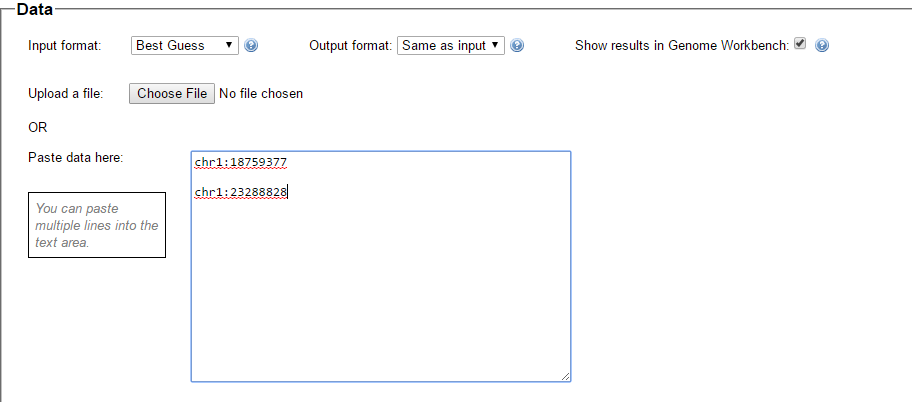
Here is what the utility looks like. It is quite simple to use and works quickly.

Phased Data Generator

Once I have this information, I can run the results against all my matches to find out which of my matches are from my dad and which are from my mom. There are also those that match neither which may be considered false matches. This takes out a lot of the guesswork with our matches. It makes life twice as easy.

Paternal DNA from Testing a Paternal Relative

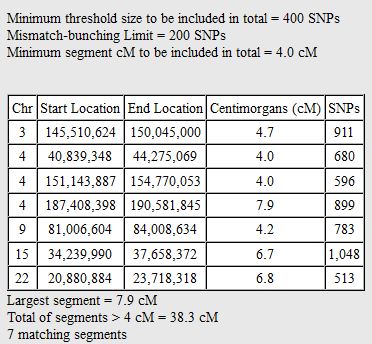
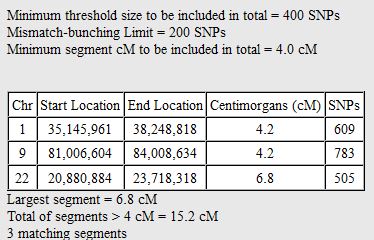
The other way to find paternal (that is Hartley) DNA is to test a paternal or Hartley relative. That is when I went to my father’s cousin Jim and asked him to take a DNA test. He was willing and I have some Hartley matches. I also had tested myself and my two sister’s. Here is what Jim’s DNA results look like compared to me and my 2 sisters on a Chromosome Browser:

Hartley DNA

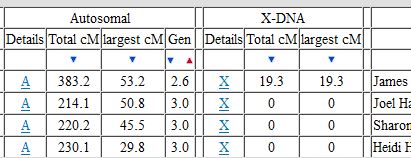
I find this graphic interesting. It shows that Jim matches me and my 2 sisters on almost every chromosome. The last chromosome is the X Chromosome. It was cut off a bit. However, Jim could not match us on the X as my father only got his X Chromosome from his mother who was a Frazer and not a Hartley. On Chromosome 13 my 2 sisters and I have pretty much the same match with Jim. The 3 bars are of equal length. On Chromosome 20, only my sister Sharon matches Jim. On Chromosome 11 we all match but at different amounts. My sister Heidi has the largest match there. The places where we don’t match, my family is busy matching the other 3 grandparents. Or perhaps Jim is busy matching on his father’s non-Hartley line.

What Do All Those Matches Mean?

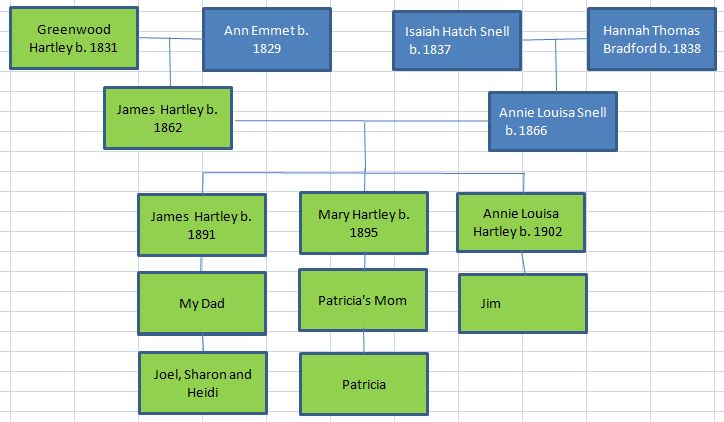
All those matches represent Hartley DNA. But remember that I said that even our Hartley DNA consists of other families. So the answer is a bit more complicated. First I will show the Hartley genealogy relative to the DNA match between Jim and my family. That will help explain all these DNA matches. In the first line below, Greenwood Hartley was from Trawden, England. Ann Emmet was from Bacup, England. Isaiah Snell had non-Pilgrim colonial ancestors. Hannah Bradford had Pilgrim Colonial ancestors.
Greenwood DNA

I have those with Hartley DNA in green. Those that have no Hartley DNA are in blue.

Here is Greenwood Hartley and Ann Emmet:

greenwood

Probably Hannah Bradford and Isaiah Snell at their house in Rochester, Massachusetts:

Hannah Isaiah

Every match between Jim, me and my siblings represents a specific Ancestor from the 1st line above

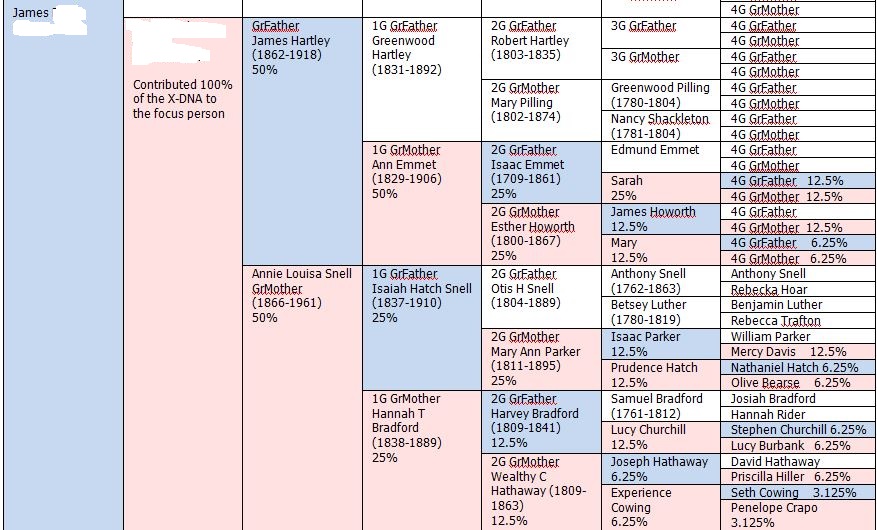
The common ancestors between Jim and me are James Hartley born 1862 and Annie Louisa Snell born 1866, but the DNA represented between Jim and me is actually their parents who were all born around the first third of the 1800’s. This was just made clear to me within the last few days. I know, it gets confusing. That means that out of the 1/4 of my DNA that is Hartley (as I have 4 grandparents), only 1/4 of that quarter is Hartley when we go back to where the DNA came from. That means that every orange, blue or green bar in the first image represents one of the 4 ancestors from the early 1800’s above.

How We Get Our DNA

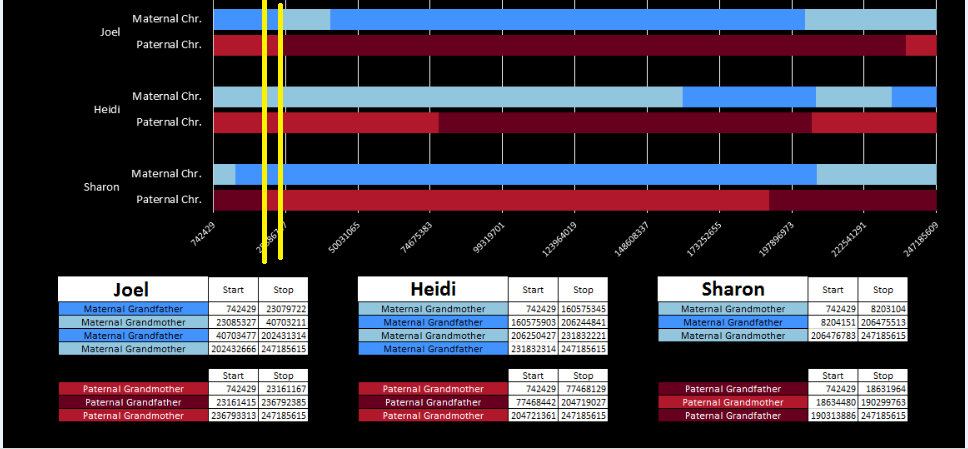
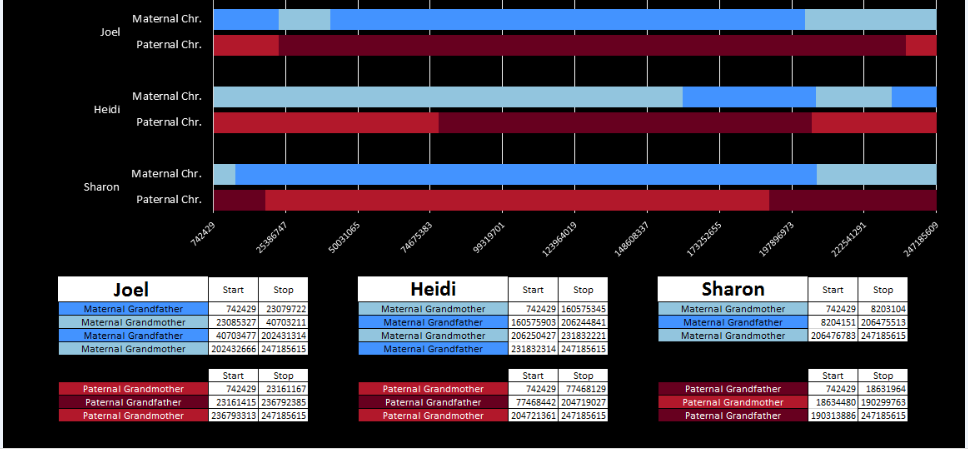
When we were conceived, we got our own blend of DNA. That DNA was really from our 4 grandparents. We got equal amounts from our mom and dad, but the amounts we got from their parents was blended and we may have not gotten an exact 25% from each our grandparents. We all actually have 2 of each chromosome. One is paternal and one is maternal. For example, the siblings James Hartley b. 1891 and Annie Louisa Hartley b. 1902 received on their paternal chromosome alternating segments of Greenwood Hartley and Ann Emmet DNA. Likewise, on their maternal chromosomes, they had alternating DNA from Isaiah Snell and Hannah Bradford. Those mixtures of their 4 grandparents was passed down to Jim, me and my 2 sisters and is represented in the Family Tree DNA Browser that I show above and again below.

How Can We Tell Which Segment Matches Which of the Four Ancestors?

For example, it would be nice to know if Heidi’s Chromosome 11 match with Jim shown in green below represents  Hartley, Emmet, Snell or Bradford.

Hartley DNA

The best way to find out which segment represents which ancestor is to do additional testing.

Test:

  • A Hartley relative not related to Emmet, Snell or Bradford
  • An Emmet relative not related to Hartley, Snell or Bradford
  • Etc.

Well, I think you get the picture. Once one of these people is tested, they would be a reference and any match Jim or my family had with them would be from the Hartley, Emmet, Snell or Bradford lines. The problem is, where are these people? There may be Snells around not related to Hartleys, but I dont’ know of many Hartleys not related to Snells. Sorry for the double negative.

Another way is to wait until one of these Snells not related to a Hartley shows up on a DNA match list. This doesn’t work for Ancestry matches because AncestryDNA doesn’t tell you which chromosome you match on. However, if they were to upload their results to gedmatch.com, then the segments could be identified.

why do we want to identify these segments?

Well, for one, some find it interesting to know where they got their DNA from. Another reason is, that once these are identified, then we know right away where to look for an ancestor match. For example, if we knew a match was on the Bradford side. We would look for a common matching ancestor descending from the Mayflower perhaps.

Summary and Conclusions

  • When I tested my Hartley father’s 1st cousin, I got a lot of DNA matches on most of my chromosomes
  • These matches represent 4 of my 2nd great grandparents
  • These four 2nd great grandparents represent Trawden and Bacup, England and Colonial Pilgrim and non-Pilgrim lines.
  • So far, I have not been able to figure out which colored bar represents which 2nd great grandparent.
  • There may be some advanced techniques that could help me tease those out. Or I may be able to find those out by testing appropriate relatives if found.
  • The older generations are the best for testing as the further you get from your ancestors, the less autosomal DNA you carry. It reduces by a factor of 4 every generation.
  • Those relatives that have tested at Ancestry should upload their results to gedmatch.com for comparison.
  • One of my Hartley 2nd cousins has uploaded her DNA results to gedmatch.com and that will be the subject of my next Blog.
My German DNA Success Story [Continued]

In my last Blog, I wrote about finding a significant DNA match on my mother’s paternal side. This is my rarest grandparent as far as DNA matches. My mom’s dad was a German Rathfelder from Latvia who emigrated to the US in the early 1900’s. As a result, this side of the family appears to have few US relatives. When I left off, I was having trouble finding a common ancestor between the match and my mother due in part to there being more than one Wilhelmine Rathfelder in the mid-1800’s Hirschenhof, Latvia.

The Two Wilhelmine Rathfelders

To recap, my mother’s DNA match had as their ancestor Friedrich Bernhard Spengel. Fried’s birth record in 1859 listed his mother as Wilhelmine Rathfelder. When I looked up the birth record of Wilhelmine Rathfelder, I found that she was born in 1844. This would make her only 15 at the birth of her son. That same record stated that her godmother’s name was also Wilhelmine Rathfelder who was an unmarried woman at the time. For this reason and others, I decided that the 15 year old Wilhelmine Rathfelder was a poor choice to be Friedrich Spengel’s mother.

Since my last blog, I found an 1855 Spengel/Rathfelder marriage that had potential:

Spengel Rathfelder Marriage 1855

The next to the last entry appears to be a Joh. Peter(?) Spengel and Aldene Wilhelmine Rathfelder. One problem here is that Friedrich’s father was Johann George Ludwig Spengel and this groom appears to be Johann Peter Spengel.

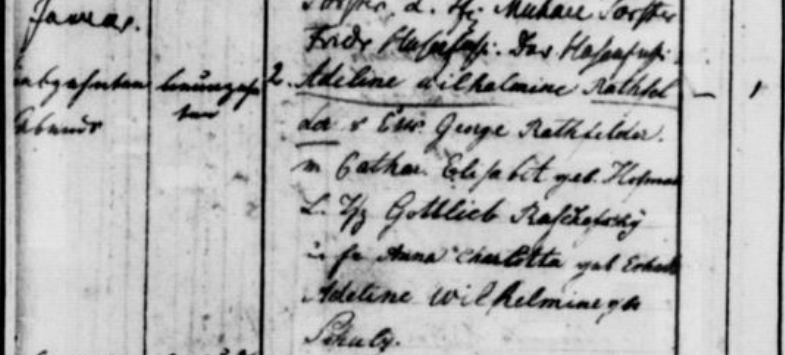
I then found this birth record from 1838:

Adeline Wilhelmine Birth

Here is cousin Inge’s rendering:

born on Januar (January) 17. abends (in the evening)

baptized the 19th of January

No. 2 Adeline Wilhelmine Rathfelder

V (father) CW (which means Colonie Wirt = farmer) George Rathfelder;

M (mother) Cathar(ina) Elisabeth geb. Hofmann

Taufzeugen (godparents): Gottlieb Raschefsky und Frau (wife) Anna Charlotta geborene Erhard,

Adeline Wilhelmine geborene Schulz.

Note again the custom of naming the child for the godmother – in this case Adeline Wilhelmine Schulz.

Two Johann Georg Rathfelders

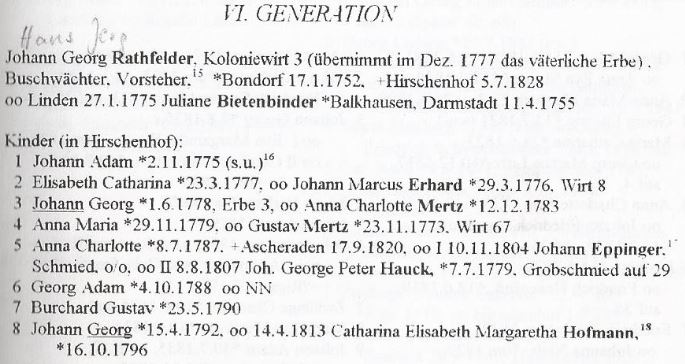
It appears that not only were there 2 Wilhelmine Rathfelders, but also two brothers with the same name of Johann Georg Rathfelder. Just to make it confusing they were both the sons of my ancestor Johann Georg Rathfelder aka Hans Jerg Rathfelder. Here is the genealogical reference with Inge’s note: “Hans Jerg”.

Hans Jerg

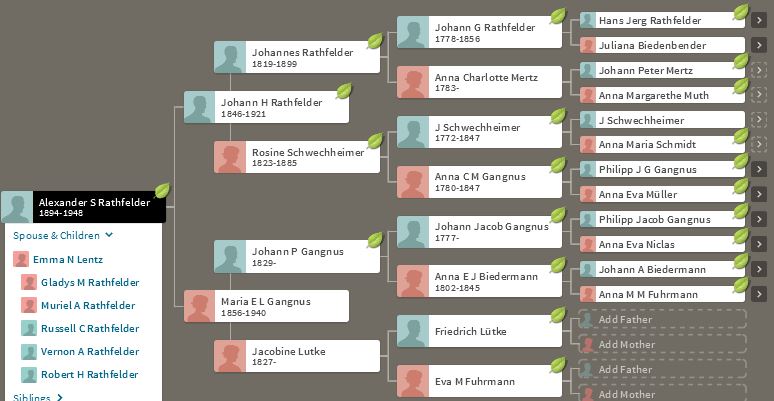
This means that Adeline Wilhelmine Rathfelder was the daughter of Johann Georg (but he apparently went by Georg) born 1792. Her uncle was Johann George (my ancestor) b. 1778 and her grandfather was also Johann Georg (aka Hans Jerg). That puts the common ancestor of my mom and her Spengel descendant DNA match back to Johann George (aka Hans Jerg) Rathfelder b. 1752 and his wife Juliane Bietenbinder. Hans is my mom’s 3rd great grandfather in the upper right box below.

Ancestry Alexander Rathfelder

This means that AncestryDNA was somehow right in assigning my mom’s Spengel/Rathfelder descendant 4th cousin status.

The Spengel/Rathfelder Story

I find that if I am able to put genealogy into a narrative and it makes sense, then there is a likelihood that the story may be true.

Hans Jerg Rathfelder and Juliane Bietenbinder had several children in the German Colony of Hirschenhof in Latvia. Two of their sons had the same name: Johann Georg Rathfelder. The older son went by Johann and the younger went by Georg. The elder son Johann was my ancestor. The younger, Georg, married Catherina Hofmann in 1813. 25 years later in 1838 they had a daughter named Adeline Wilhelmine Rathfelder. In 1838 Wilhelmine’s mother would have been about 42.  This daughter may have been a 6 year old godmother at the birth of another Wilhelmine Rathfelder in 1844. In 1855, as a young 17 old girl, Adeline Wilhelmine Rathfelder married Johann Peter Spengel. At about age 21 in 1859 the elder Wilhelmine had a son named Friedrich Bernhard Spengel. However, at this time, Friedrich’s father is called Johann Georg Ludwig Spengel.

So that’s my story and I’m sticking to it. I’m betting that Johann [somebody] Spengel married a Wilhelmine Rathfelder in 1855 and that they were the same couple that had a Friedrich Bernhard Spengel in 1859. I do note that the Spengels were also related to the Gangnus family in Hirschenhof. Gangnus is the name of my Rathfelder grandfather’s mother. So that may explain my mom’s larger than average match with her 4th cousin.

Let’s Map Mom

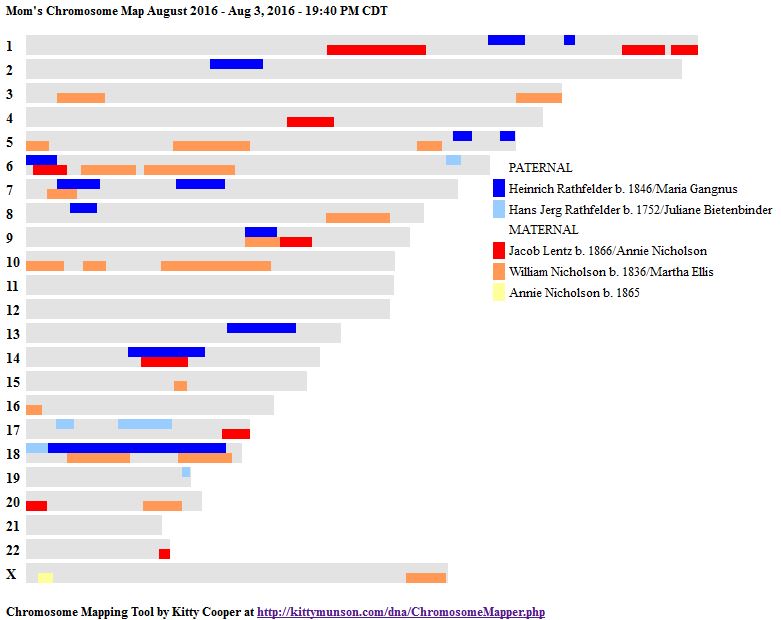
Now that I have a reasonable common ancestor for my mom and her new Spengel/Rathfelder match, I can update my mom’s Chromosome Map using the Kitty Munson tool:

Mom's Chromosome Map Aug 2016

This fills out her paternal side a little more and also gets her first 1700’s chromosome mapping. All the others were “only” in the middle third of the 1800’s! Hans Jerg Rathfelder and his wife Juliane Bietenbinder are now shown in light blue.

My Chromosome Map

It turns out that even though my mom had a large DNA match as well as my 2 sisters, my gedmatch one to one match wasn’t that large. This is one of those rare cases where Ancestry gives me a larger match than Gedmatch. Here is how my match with the same Spengel/Rathfelder descendant show up at AncestryDNA:

Joel Ancestry match

Here is my one to many match at gedmatch:

gedmatch one to many

Gedmatch warns me to do a one to one match which brings my total cM match down from 25.1 to 18.9.

Joel Hilweg one to one

I just found out that the gedmatch SNP threshold went from 700 to 500, so a few days ago, my match would have been only 8.3 cM total. I may have other matches also as my sisters and mother match this same person in areas where I am below this threshold.

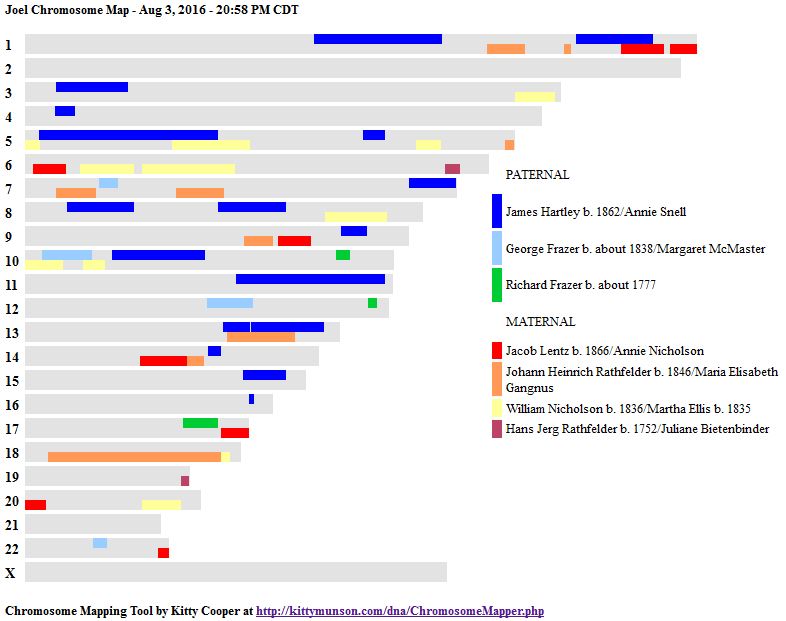
Here is my updated Chromosome Map:

Joel Chromosome Map Aug 2016

It seems like my maternal and paternal mapping is evening out. I didn’t think that this would ever happen.

Comparing my mom’s map and mine, I got most of Hans’ and Juliane’s DNA from my mom on my Chromosome 6 and 9, but I didn’t get any of the large amounts of DNA from my mom’s Chromosomes 17 and 18.

More Mapping

While I’m at it, I’ll see what else I can do.

Chromosome 1

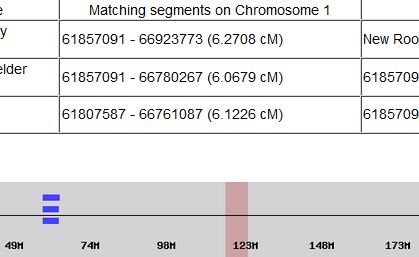
Here is how the Spengel descendant matches with my mother, me and one sister on Chromosome 1:

Chr 1 Rathfelder

This is probably one of those segment matches that AncestryDNA had but was below the gedmatch threshold. The first match is my sister Sharon, then my mom, then me. Here is how I had it mapped out (with Kathy Johnston’s help):

Chr 1

The area of interest is from 62 to 68. Kathy has it correctly mapped out that Sharon and I have Rathfelder in there in blue and my other sister Heidi has the other maternal grandparent (Lentz) from 62 to 68.

Chromosome 6 Revised

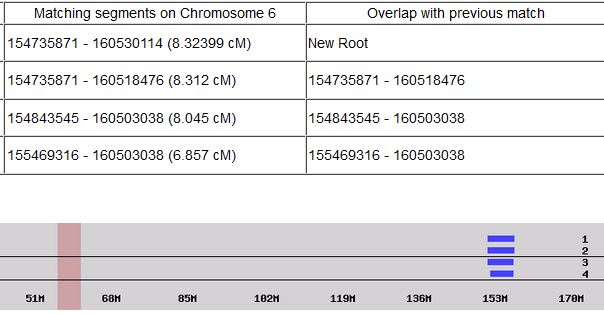
Here is how the Spengel/Rathfelder descendant matches my mom and all three of her DNA tested children on Chromosome 6:

Chr 6

Note all the matches are between 155 and about 161. Here is my Chromosome 6 map:

Chr 6 map

When I was working on this map, I had noted an inconsistency in my paternal side on the right hand side and hadn’t yet resolved that problem. This proves I was wrong on my maternal side also after 155. Instead of 3 blue maternal Lentz segments after 155, there should be three orange ones as proven by the Spengel/Rathfelder match. I’ll just do a quick fix. There appears to be a double crossover for my 2 sisters where I previously had one for me at 155. I’ll add Sharon and Heidi’s crossover at position 155 and take out mine:

Chr 6 map rev

Perhaps this is not a perfect Chromosome 6 map, but it is much better than it was.

Chromosomes 17, 18 and 19

I covered Chromosome 17 in my previous blog.

Spengel/Rathfelder only matches my mom on Chromosome 18:

Chr 18 mom

Perhaps that DNA went to one of my other three siblings that haven’t tested for DNA yet.

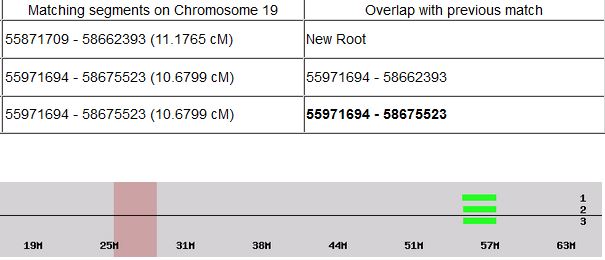
Lastly, here is how mom, sister Heidi and I match Spengel/Rathfelder on Chromosome 19:

Chr 19

The matches are from 56 to 59, so the scale in the image isn’t perfect. Let’s see how my mapping looks.

Chr 19 Map

It looks like I had some trouble on my family’s Chromosome 19. I couldn’t figure out a section and couldn’t map my maternal side to a specific grandparent. Well, now, thanks to our Spengel/Rathfelder descendant match, things will be clearer. Heidi and Joel match a Rathfelder and Sharon doesn’t from location 56 to 59. That means that I can map the orange to my Rathfelder grandfather’s DNA. That leaves my maternal grandmother Lentz who will be in the green areas.

Chr 19 map rev

So here we have identified Maternal grandparents 1 and 2. This information should be useful. For example, if my sister Sharon in the top bar has a Chromosome 19 DNA match on the maternal side, I will know not to look for any Hirschenhof ancestors.

Summary and Conclusions

I believe that this is how it is supposed to work. The DNA helps target the genealogy and the genealogy identifies the DNA. One side leverages the other and back and forth we go between DNA and genealogy. Hence the term genetic genealogy.

Whitson and Butler YDNA and Signature STRs

Two Types of YDNA: SNPs and STRs

As many know, YDNA is the DNA of the male line.

SNPs can be seen as the trunk and branches of the tree and the STRs can be seen as the twigs and leaves. Before we analyze the twigs and leaves, it is good to know if we are in the right tree. However, even when looking at the leaves, it is sometimes possible to guess the type of tree.

maple-leaf

For example, in the Family Tree DNA (FTDNA) Whitson project, there are officially nine people listed. There are more that have tested, but not with FTDNA. In the list below, there are three broad groups represented by the colors orange, teal, and yellow. These are the SNP groups, or the tree types. These three groups are I1, I2 and R1b.  These SNPs break down into finer and finer distinctions. However, there is no connection between I and R in the range of 10,000’s of years. There are also a huge amount of years between the I1 and I2 SNP Haplogroups.

Whitson FTDNA Project Results

Once people are grouped in the SNPs, then it is possible to compare the STRs. These are the numbers to the right. These are what I was referring to as the twigs and leaves. However, these are only compared within the other major groupings of SNPs.

Why Are There Three SNP Types for the Whitsons?

There are various reasons:

  1. When surnames were being developed, this name could have developed independently at different locations.
  2. An adoption could have taken place at some point. This is under the category of Non-Paternal Event (or NPE) as are #3 and #4 below.
  3. An unwed mother could have had a child that had her name. However, as the father has the YDNA, his YDNA would be carried on to the male child in the line.
  4. A relationship outside a marriage would tend to break the YDNA line also.

The SNP Types or Haplogroups

SNP groupings are called Haplogroups. Here are some of the Whitson Haplogroups:

I1>I-M253

The first Haplogroup above are the I1>M253 Whitsons. There are 2 Whitsons in that Haplogroup. FTDNA has a group just for I1’s. There are currently about 6000 people in this group. Not much analysis can be done with these 2 right now as they match by STRs exactly. If these 2 Whitson join the FTDNA I1 Project, it may be possible to find a signature STR for these 2 (see below).

I1 people have sometimes been associated with the Vikings. This group of people did seem to take a Northern route in their distant ancestry, so that is where the association comes from. However, there may be finer distinctions once we learn more about this I1 Whitson Group.

I2>I-M223

FTDNA has an I-M223 YDNA Project. The Whitsons and Butlers in our project are in a section of that projects called:

1.2.1.2.1.1.1.1- M223>…>L701>P78>S25733>A427 (Cont3a1 Group 2)

One of the Butlers in the group has tested positive for the SNP called A427. The other 4 were put in that group due to their similar STRs. This is like saying what tree you are by your leaves. A427 is quite a way down on the SNP tree. Using my tree analogy, this would be a very specific type of tree.  Below are all the people in the A427 SNP Group. I only included up to the 36th STR (small numbers) as the image was all ready small enough. There were actually more STRs tested to the right of this image.

Whtson Butler STRs

Now the A427 SNP is like the specific tree and the STRs which are the numbers listed are like the different branches, twigs and leaves. I would like to point out here a specific fingerprint for our Whitsons and Butlers. Here are our 5 Whitson/Butlers outlined in red:

Whtson Butler STRs Highlight

The first 3 rows of numbers are the minimum, maximum and mode of this A427 Group for each STR. The purple colors are the STRs that are less than the mode and the pink colors are the values that are more than the mode. Our 5 Whitson/Butlers will have a unique STR signature among all those who are in this A427 Group. Here is the same shot, with just the most important numbers outlined in yellow:

STR Heards

Whtson Butler STRs Signature

And the I2 Whitson/Butler signature is:

DYS389II=31 or higher, DYS454=12, DYS448=21 or higher, DYS449=26

Note that for all those in the A427 Group, only our group of Whitson/Butlers has this signature. This signature is just in the 1st 21 markers (or STRs). In this Whitson/Butler Group, 2 have tested 37 STRs, 1 has tested 67 and 2 have tested 111 STRs. Now above the 37 STRs, there are likely more Whitson/Butler signature STRs for those that have tested to that level. The marker (STR) names are listed above. The markers that have a reddish background are those that are faster moving markers. They change more often than the blue background markers.

This Group of YDNA have sometimes been associated with the ancient Goths. So far we have Vikings and Goths with our Whitson or Whitson/Butler Groups.

R1b-R-U106 group

This Group has been associated with the Anglo-Saxons. Although this group is sometimes associated with the modern English, they likely began in an area of current Germany or Belgium and invaded “England” some time after the Romans left the Island.

Right now there are only 2 Whitsons that have tested with FTDNA in this group. There is an additional Whitson who has done the old Ancestry test that is no longer available. The Ancestry test doesn’t match perfectly, but for the STRs that were tested, all the STRs match.

Both these R-U106’s have joined FTDNA’s R-U106 Project. The first person descends from Henry Whitson who lived on Long Island in the 1600’s. He has tested for 67 STRs and has this designation from the U106 Project:

Z381>Z156>Z306>Z304> DF98 ??? Need to order Big Y or R1b-Z156 SNP Pack

These are the SNPs that the U106 Project specialist thinks this person would test positive for if he had tested SNPs. Perhaps the specialist was not so sure about DF98. That is followed by what the U106 specialist recommends for those that are in the group. The Big Y is quite an expensive test but very definitive and actually finds new SNPs. The SNP Pack tests for several SNPs, in this case below Z156. [However, see my own recommendation below.]

The second person in this group matches all STRs at 67 STRs with the previous person. However, he has tested 111 STRs and has tested his SNP to be R-S23139. He is in a different section of the U106 Project:

Z381>Z156>Z306>Z304> DF98>S18823>S22069>S11739>S23139

Note that the U106 Project specialist doesn’t have any more recommendations for this person, because he has done all the testing down to R-S23139. My guess is that if the first person were to test for R-S23139, he would be positive for that SNP also. That would get these 2 Whitsons together for the U106 Project. That would also cost less many than taking the SNP Pack.

Here is a snapshot of the R-S23139 Group:

U106 Peter

Here our lone Whitson is with some others that appear to be from Germany. In looking for a unique STR for our 2 U106’s, first I see a value of 12 in the last column above for DYS531. If I counted this right, it is the 38th marker, so this signature Whitson U106 STR would not have shown up on a 37 STR test. In our previous Whitson/Butler Group there were many signature STRs in the first 37 markers.

Let’s look for some more signature Whitson STRs in the R-S23139 Group:

U106 67 STRs Header

U106 67 STRs

I am starting where I left off at the signature 12 in the first column. Then I see a unique 16, 12 and 11. This means our R-S23139 signature (assuming our 1st Whitson is positive for R-S23139) is:

DYS531=12, DYS594=16, DYS568=12, DYS487=11

After that, there is a 36 and 28 that are unique, but they are in the 111 STR group. The 111 STR group is also indicated in the header where the STR names have a lighter blue background. There are many other STRs after that that are likely unique in the 111 STR test also.

Any Other Whitsons?

Yes. The Whitson Family Group contacted another person and found out that he was R1b, but a different brand of R1b. This R1b was associated with the people who were in the British Isles before the time when the Romans, Vikings, Danes, and Anglo-Saxon entered the area.

Summary and Recommendations

  • So far, for a small group of Whitsons and a few Butlers, there are many types of DNA groups. These represent people that are distantly related to each other genetically.
  • There are some Whitsons that had taken the old Ancestry test. They could benefit by also taking the FTNDA test. I know of one Whitson who has already gone that route and is awaiting results.
  • Some Whitsons may benefit by taking an additional SNP test, to make sure they are in the right tree -so to speak.
  • Those Whitsons in the I1 YDNA group could benefit by joining the FTDNA I1 Project.
  • With the close matches in the I1 Group and the R-U106 Group, it seems like it should be possible to find some common ancestors.


My German DNA Success Story

I recently had a breakthrough on my mother’s side with an autosomal DNA match. It was on her Rathfelder side which is the rarest as far as DNA matches go. Apparently there aren’t many Rathfelders around and very few that have taken DNA tests.

Here is the summary of my success:

  1. My mom’s Rathfelder ancestors lived in Riga, Latvia. Based on this I did a search under my mom’s results at AncestryDNA for matches from Riga, Latvia.
  2. I was fortunate to find someone with a large match.
  3. I got in touch with the match and asked the administrator to put the results on gedmatch.com.
  4. The administrator of the match put the results up on gedmatch.com. This is the step that happens rarely – to me at least.
  5. I checked the results against a Rathfelder 2nd cousin’s DNA I had tested and there was a good match there also.
  6. I did some genealogy and found where the match likely was.

The Ancestry DNA Riga Search

When I put in Riga, Latvia, under the AncestryDNA search criteria for my mom’s kit, I found the match. It was the largest Riga match she had after my my 2 sisters and myself. Here is a screen shot of the match with cM’s shared and my note that the match was in Riga.

Match in Riga

I was a little surprised that AncestryDNA had the relationship at 4th cousin, based on the 6 segments shared. I would think that it would be closer than that.

The Match in Gedmatch

Here is the same match at gedmatch:

Spengel

Note that Gedmatch shows fewer segments (4) but a higher total cMs. Gedmatch estimates 3.8 generations to a common ancestor. That sounds like a 3rd cousin to me.

All Roads Lead to Hirschenhof

My mom’s match had as the most distant Riga ancestor someone by the name of Spengel. I knew that all my mom’s ancestors lived in Hirschenhof, Latvia, prior to moving to Riga. That meant that the match was likely in Hirschenhof. I did a quick Google search for Spengel and Hirschenhof and came up with some results. I tried the match’s other ancestors with Hirchenhof and found no results. Here are my mom’s Hirschenhof 1st and 2nd great grandparents. They would represent 2nd and 3rd cousin matches:

Hirschenhof Ancestors

Time for Some Hirschenhof Genealogy

Here is the Linden Evangelical Lutheran Church outside Hirschenhof where my mom’s ancestors got baptized, confirmed, married and had their funerals.

Linden Church

I like the photo because it appears to show people sledding down the hill by the Church. Also because it looks like this picture could have been taken in New England where I live as well as Hirschenhof, Latvia.

http://www.lvva-raduraksti.lv/

Raduraksti is the website I like to use for Latvian genealogy. That is where I was able to find the Linden Church records. They are listed under Draudzes, Liepkalnes. I had to look up draudzes. It means congregations. Liepkalnes is apparently the Latvian name for Linden. My mom’s match’s grandfather was Friedrich Spengel. I was able to find his birth and baptismal record here:

Friedrich Spengel Birth

I could tell that Friedrich, Bernhard was born in 1859 based on the index and note at the top of the page. I could tell that his dad was Johanne Georg [something] Spengel married to a Rathfelder. However, I had no idea what the first name of Friedrich’s Rathfelder mother. I wrote to a Rathfelder relative in Germany named Inge for help. In the meantime, I discovered that there was a Wilhelmine Rathfelder in the index to the church records. Here is her birth record in 1844.

Wilhelmine birth

Now that I know it says Wilhelmine, I can read it. Before that, the ‘W’ looked like a ‘Dr’ or ‘Lr’ to me! Here I recognized Wilhelmine’s parents as my mother’s great grandparents: Johann Rathfelder and Rosine Schwechheimer. Here from my web page is the family:

Johannes family

This shows that in my research, I was missing Wilhelmine. However, there was plenty of time for her to be born between February 1843 and 1844. It seemed clear that my mom and her match had as their common ancestors Johannes Rathfelder and Rosine Schwechheimer. However there were a few problems.

the problems with WILHELMIne
  1. There were 2 Wilhelmine Rathfelders
  2. With the above scenario, my mom and her match would be 2nd cousins. Ancestry showed them as 4th cousins and gedmatch seemed to indicate that they would be closer to 3rd cousins, but not 2nd cousins.
  3. If Friedrich Spengel’s father married this Wilhemine, then this Wilhelmine would have been 15 when Friedrich was born.
Two Wilhelmine Rathfelders

I’ve heard it said that you learn something new every day. In looking up information on Lutheran Church records, I discovered that it would be normal for a child to be named after the godparent. This was certainly true here. Friedrich Spengel was named for his godfather Friedrich Niclas.

Here is what Inge tells me concerning her reading of Wilhelmine’s baptismal record:

You found out yourself, that no. 58 of the Linden churchbook is an entry like follows

I am sure, you still are knowing:

Wilhelmine Rathfelder,(born July, 2nd, baptized July, third (dritten)

Vater Tischler Joh(ann) Rathfelder, M(utter) Rosina geb. Schwechheimer

Taufzeugen Jungfer Wilhelmine Rathfelder, Tischler Heinr(ich) Lütken und Fr(au) Philippine geborene Rathfelder

A Jungfer is an unmarried female.

So what I get out of this is that Wilhelmine Rathfelder had an unmarried godparent with the same first and last names that she had.

So Who was Friedrich Spengel’s Mother?

Prior to writing this blog, I was leaning toward the younger Wilhelmine as being Friedrich’s mother. Now I am leaning toward the older godmother. This is based partly on the DNA results. I am guessing that the godmother could have been Wilhelmine’s Aunt. Here is what I have for Johannes’ family. I think that he actually had other siblings that I don’t yet know about. Perhaps he had a sister named Wilhemine.

Johannes' Parents

That’s as far as I got on the genealogy. There is more work to do.

The Spengel Match Helps With My Chromosome Mapping

I have mapped most of my chromosomes and my 2 sisters’ chromosomes to my 4 grandparents. This shows for each chromosome the portion of DNA my sisters and I received from each grandparent represented in 4 different colors. I used a method developed by Kathy Johnston. For example, here is how I had mapped out Chromosome 17:

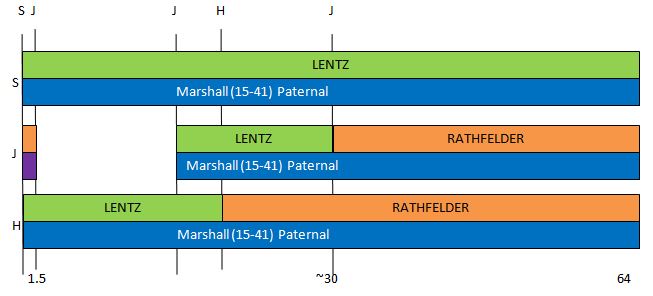
Chromosome 17

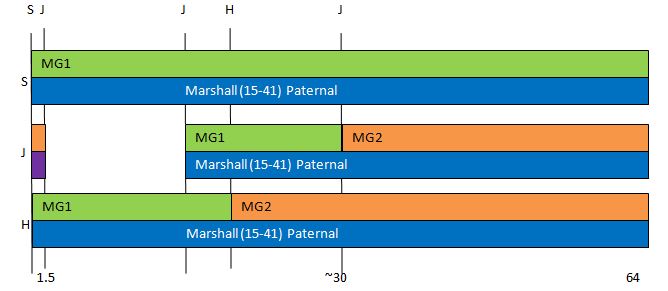
My sisters are S and H. I am J. Note on my mother’s side (on the top of each bar) I have maternal grandparent 1 and 2 because I could not tell who was who. Now with the known Spengel descendant match, I can tell which is Rathfelder (my mother’s father’s line) and which is Lentz (my mother’s mother’s line). Here is how gedmatch shows the Spengel match. Remember that Spengel had a Rathfelder mother, so will indicate the Rathfelder line.

Chr 17 Gedmatch

Above, #1 corresponds to my sister Heidi (H) and #2 corresponds to my sister Sharon (S). My mom is #3. Note that The green matches for daughters #1 and #2 shouldn’t be larger than the mother #3, but they are. I show no match to my mother’s match on this Chromosome. Due to the the location of the Spengel matches above, this tells me that MG2 above has to be Rathfelder. That leaves MG1 as Lentz. Now I can add the real names of the grandparents that my sisters and I got our maternal DNA from on Chromosome 17.

Chr 17 Rev

That means if my 2 sisters have a maternal match with anyone after 9 or 11 on their Chromosome 17, it would be with someone who is a Rathfelder or Rathfelder ancestor. If I have a maternal match with anyone in that area, it would be with a Lentz or Lentz ancestor. This is quite helpful to know.

My mom’s Spengel descendant match will also help in updating my family’s Kitty Munson Chromosome Map. However, before I do that, I will want to confirm which Rathfelder is the common ancestor between my mom and her new match.

Summary and Conclusions

  • I’m grateful that this Rathfelder match showed up as one of AncestryDNA’s 2 million customers
  • I may have been able to find out the same information in the first part of the blog leading up to the Rathfelder common ancestor without using gedmatch.
  • Gedmatch gave me more confidence in where to look. I knew I needed to look for Rathfelder ancestors in Hirschenhof.
  • I wouldn’t be able to map any DNA without gedmatch. AncestryDNA does not tell me on what Chromosomes that I match. For me, this is where a lot of the fun is in genetic genealogy.
  • This genetic match has pointed out a some holes in my genealogy. In order to nail down these DNA matches, one has to also nail down the genealogy and include many siblings.
  • I didn’t have either Wilhelmina Rathfelder in my genealogy, so this helped improve my Rathfelder genealogy.
  • The Spengel descendant didn’t know of any Rathfelder or Hirschenhof ancestry, so that has helped my mom’s match learn more about their genealogy.
  • I am grateful for AncestryDNA in supplying the match; I am grateful for the match in posting to gedmatch; I am grateful for gedmatch; I am grateful for the Raduraksti web site; and lastly I am grateful for my German cousin with Hirschenhof Rathfelder roots for helping me to understand the Church Registers.


Nicholson DNA

Great news. My 3rd cousin, Joan, who is a Nicholson, posted her 1st cousin once removed, Carol’s DNA to Gedmatch.com. Carol is also a Nicholson descendant and my mother’s 2nd cousin.

This does 3 things:

  1. Improves my Chromosome mapping a la Kitty Munson
  2. Identifies my DNA by grandparent that I have mapped as per the Kathy Johnston method
  3. Creates a great link to the Nicholson side of the family that has been lost over the years.

In addition, these matches between Carol and my family are all higher than average. So even though my sisters and I are 2nd cousins once removed to Carol, we have about the amount of shared DNA to make us look like 2nd cousins.

William Nicholson born 1836 Sheffield England and Martha Ellis His Wife: Our Common Ancestors

The common ancestors between Joan, Carol, my mother Gladys, me and my 2 sisters are William Nicholson and Martha Ellis.

Gladys Relative Chart

Judy and Joshua have tested also, but they are from both the Lentz and Nicholson side. Joan and Carol are helpful in that our only connection is Nicholson. That is the advantage of testing 2nd cousins. They usually can limit your matches to one of your 4 grandparents – or in this case, one of my mother’s 4 grandparents.

A Brief Sketch of William Nicholson

William Nicholson

I am happy to have a photo of William. William was born in Sheffield, England in 1836. Working conditions were deplorable in Sheffield at this time. William’s father died in 1840 when William was 4. According to the newspaper, “On Thursday the 30th April, after a severe indisposition, aged 41, Mr. Matthew Nicholson, late of Suffolk road, leaving a numerous family to lament their loss.” The family was numerous with 12 children. William was number ten. William’s mother Martha made some money operating a beerhouse. Beerhouses were promoted at this time in England to counteract the effects of drunkenness due to gin consumption.  This article was written about a year and a half after William’s father Matthew died:

Beerhouse article

William married Martha Ellis in 1854. William didn’t manufacture pen knives like the older generation but manufactured saws. He had 4 children in Sheffield, England between 1860 and 1869. After the Nicholson’s made the big move, he had 3 more children born in Philadelphia between 1871 and 1879. In Philadelphia he continued with his saw making skills. William’s wife Martha died in 1887. William married Emma Gardiner and had 2 more daughters. William died in 1919 in Philadelphia at age 83 – more than twice the age of his father when he died in Sheffield. I think William made a good decision to leave those unhealthy work conditions in Sheffield.

Updating My Chromosome Map

Here is what the DNA of my ancestors looks like mapped out:

Joel Chromosome Map

My mother’s side is on the bottom of each chromosome bar. The DNA I got from the Nicholsons only is in light yellow. The light yellow also represents the DNA matches I have with Joan and her first cousin once removed Carol. Note on Chromosome 18 that the color goes from orange to yellow. There, the DNA I got is switching from my mother’s father’s side (Rathfelder) to my mother’s mother’s side (Nicholson).

Mapping My Chromosomes a la Kathy Johnston

I have also mapped my chromosomes using a method developed by Kathy Johnston. This method compares the matches that I have with my 2 sisters. From this, I can figure out how I inherited each of my 4 grandparents’ DNA. However, to distinguish the 4 grandparents, I need to have reference points. Carol’s DNA matches with me and my sisters provided many of those reference points for my mother’s mother’s side of the family. Where before on many chromosomes, I only knew I had maternal grandparent 1 or 2, now I know that they are Rathfelder or Lentz. [My Lentz grandmother’s mother was a Nicholson.]

For example, here is the same Chromosome 18:

Chr 18

My Chromosome is the bottom one. The other two are for my sisters. I match Carol from 71-74. So that confirms that the orange segment on the bottom right is from my mother’s Lentz side.  And then more specifically through my mother’s mother’s Lentz mother’s Nicholson side. This change at positions 71 from green to orange on my mother’s father’s side to my mother’s mother’s side corresponds to the actual previous Kitty Munson DNA map where the color went from orange to light yellow.

There will be more time to look at Nicholson DNA in the future. For right now, I am glad that DNA has brought back together a family that settled in the Philadelphia area from Sheffield, England in 1870. My mom has only mentioned fond memories of her Nicholson grandmother. Those included Annie Nicholson Lentz’ cooking abilities and bringing my mom to church as a child. I expect other Nicholson branches have similar great memories.

My Hartley Big Y Results: Part One

Back before I got my Big Y results, I wrote an article called My Hartley YDNA. This covered issues relating to Hartley SNPs and STRs. As many know, the Big Y is the ultimate Family Tree DNA product for testing the YDNA that is passed down from father to son since the beginning of such passing down of YDNA. While other YDNA tests identify existing STR and SNP markers, it is the purpose of the Big Y to look at one’s DNA and discover new SNPs.

Hartley Big Y Testees

As far as I know there are a total of 3 Hartley Big Y testees – including me. I am correctly but awkwardly saying testees as the testers are those in the lab testing the DNA. I may slip back to the more comfortable ‘tester’ at some point.

William on the I Line

The first Hartley to have the Big Y is William who is the Hartley DNA administrator. He is in the I Haplogroup. In the old nomenclature, he would be along the line of I1a2a1a2. I1 and I2 are the main I branches and are extremely distantly related to other known Hartleys – at least by YDNA. Other Hartleys so far tested have been R1b.  I agree with what William says about his connection to other Hartleys:

My last common [I1] ancestor was about 1,800 years ago and also likely an Angle [Anglo-Swedish Angle]. So that commonality may be why we both later adopted the Hartley surname and both our ancestries are found around Yorkshire and Lancashire.

I added the I1 in brackets for clarification.

The second Hartley Testee: James Hartley ancestor – R1b-S1051

The second Hartley testee was more closely related than the I1 Haplogroup. We are both in the R1b group.  Further, we are both in the L21 group. This group has sometimes been associated with the Celts. L21 is also associated with the older peoples that lived in the British Isles prior to the arrival of Vikings, Anglo Saxons and Normans. However, our common ancestor was likely 1,000’s of years ago.  The second Hartley testee is in a tiny branch called S1051 which I have pointed out with a red arrow. I am in the gold regions of L513 a few steps up from S1051

L21 Tree S1051

This chart is from July 2015. I believe that it is no longer updated as it has gotten so crowded due to Big Y testing. There are 151 people in the R-S1051 Project. According to the R-S1051 Project web page:

Recently many new SNP’s have been discovered for this unique haplogroup which is located below DF13. 

The majority of this family group have 5 main Patriarch SNP’s (S1051, FGC9655, FGC9661, FGC9658 and FGC9657). The current age estimate for these Patriarch SNP’s is approximately 3,200 to 4,500 years old and likely originated within what is known as the Bell Beaker culture. When examining other haplogroups of a similar age the S1051 people are very few by comparison.

Evidence suggests that the geographic origin of this family group could have been from what is now modern Scotland.

Our fellow Hartley Big Y testee #2 is on the FGC9655 Line. Here is my attempt to spray paint out the IDs below on the Alex Williamson Big Tree:

Alex S1051 tree

It looks like our Hartley has the most Big Y company in the R-S1051 Group. The belief is also that the Hartleys came from the North of England originally. This theory that this S1051 group was from Scotland originally would tend to support the Northern UK origins of the Hartleys. Brewer in the reddish color has not been analyzed yet, so things are still developing in the FGC9655 SNP Group.

That is a good segue into my results. I called this blog Part One because, like Mr. Brewer, my results have not been analyzed yet either. Due to all the Big Y testing recently, there has been a bit of a backlog in analyzing the results.

The Third Testee (Me) – R-L513

I already knew where I was on the L513 Chart. Now, due to the fact that I have taken the Big Y test, I am listed on the top part of the tree. This is like being elevated to YDNA Heaven.

L513 Tree June 2016

Here is a closer up shot:

L513 Blowup

I am hoping that other Hartleys will test and find to be positive for Z17911. Like Hartley Big Y Tester #2, I am in the Big Tree. Unlike Tester #2, my data has not been analyzed by Alex Williamson, so I am still shown in a reddish color. This time I’ll erase the kit numbers for privacy:

Hartley on Big Tree

Way at the top, there is Smith. He is positive for a SNP named Z16357. All the other names share the Z16357 SNP with Smith. Smith does not share Z16343 and the block of other SNPs listed below with Hay(e)s, Pillsbury, Merrick, Thomas and Hartley. The tree portion above shows that Hay(e)s is down from the Pillsbury Line. Merrick, Thomas and Hartley have only 2 named SNPs: Z17911 and Z17912. A few other observations:

  • If one is positive for Z16343, then they are likely positive for most or all of the other SNPs listed in the Z16343 block
  • There is no one currently that is positive for Z16343 that isn’t also either Z17911 or Z16855
  • If we maintain the 150 years per SNP, then the block of about 25 SNPs in the Z16343 block could represent 3,750 years. There are some detailed reasons why that number of years could be less. However, it is still a long amount of time.

Public SNPs, Private SNPs, Terminal SNPs

But wait, there’s more. There are different categories of SNPs with different names. The terminology can get confusing. A terminal SNP means the last SNP on your line that you could be based on current knowledge. For me, that is Z17911. However, what was terminal in the past, what is terminal now and what may be a terminal SNP in the future are different things.

Public SNPs are those SNPs with listed names such as Z17911 or those in the block under Z16343. These are also a moving target. At one time, these SNPs were just position numbers.

Private SNPs are those that are not yet public SNPs or may be family SNPs. Family SNPs are those that just belong to a single family name – probably within a genealogical time frame. So, if your genealogy goes back 350 years, there could be on average 3 SNPs during that time. Those would be considered family SNPs.

Novel Variants and unique SNPs

FTDNA reports Novel Variants. In my Big Y test, I have 30 Novel Variants listed. Those that are not shared by anyone else would be considered my unique or private SNPs. Note that this definition of Private SNPs bumps up against the Private SNP definition that I had above which was a family SNP. This means that either I have it wrong or there are 2 different ways of looking at Private SNPs.

Here is a screen shot from an excellent video called,

Building a Family Tree with SNPs, STRs, & Named People (Maurice Gleeson)

Maurice SNP Types

Hopefully the above diagram simplifies my complicated explanation.

The Mike Walsh L513 Discovery Spreadsheet

I am fortunate to be in the R-L513 Haplogroup with Mike Walsh as an administrator. He is very active in that group looking for new people to further test and for people who aren’t in the group already but perhaps should be due to the signature of their STR tests. He has developed a Discovery spreadsheet based on the Big Y results – specifically from the VCF files. VCF stands for Variant Call Format. Here is part of his file for my little piece of the YDNA world which includes Hay(e)s, Pillsbury, Thomas, Merrick and Hartley.

Walsh Discovery

Here we have the SNP position number. The H is the YDNA group based on STRs. The status looks to be Public consistent, public semi-consistent, multi-family surname or single family surname. These statuses are analogous to the public and private SNPs that I was mentioning above. Grade is how good the SNP is. Frequency is how many times it occurs – in this case out of the 6 people in the test group. Then the results are colored according to the grade and other factors for Hayes, Pillsbury, Hartley, Merrick and Thomas. Note that the SNPs with poor grades were never named. They are just position numbers.

Z17911

Here is the second page of the Discovery Spreadsheet:

Discovery p2

The blanks are no-reads. These would be inconclusive. Red means that there was a read, but the SNP was not present. This shows that for the Z17911 and Z17912 SNPs, Hayes and Pillsbury were negative and Hartley, Merrick and Thomas were positive. That is how these two groups separated ways and are on different branches of the L513 SNP Tree.

Does the Spreadsheet tell us anything new?

When Mike first added me to his spreadsheet, he noted the following:

This isn’t on the Big Tree but Merrick and Thomas have this which you do not have:
19581481-G-A

Here is the unnamed SNP Mike mentioned that I don’t have:

Discovery part3

Note that Hayes, Pillsbury and Hartley are negative for 19581481 and Thomas and Merrick are positive for it. This was a little different than the Z17911 above. It appears that 1951481 at the bottom of my screen capture may become a named SNP for Merrick and Thomas and put  them in a branch below me. So perhaps my Big Y has helped someone else after all. Perhaps the next Big Y tester will in this region will help me out.

The YFull Analysis

While I am waiting for Alex Williamson’s analysis, I am also waiting for a YFull analysis. This is a company in Russia that will look at the BAM file from the Big Y test. They will add my results to their YFull tree. They also give estimated dates to my SNPs. Finally, they will, as a lesser priority, find STRs that they can extract from the Big Y test. The only downside is a small fee and that I will only be compared to others that are in the YFull system.
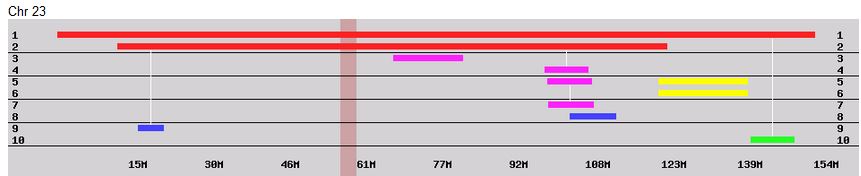
YFull


Looking for Frazer DNA in All the Right Places

In my last Blog on Frazer DNA, I summarized all the Frazer Triangulation Groups (TGs) that I knew about. Since that time, I ordered a Big Y test for myself. I also wrote some blogs on the DNA of my wife’s Dicks family from Newfoundland. I used a more methodical way of looking for TGs with the Dicks family. Also I was able to conclude more about the TGs that I did find. As a result, I thought that I would take a fresh look at the Frazer TGs.

Summary of the Previous Frazer TG Summary

  • There were 11 TGs
  • 14 people were in those 11 TGs
  • Those 11 TGs represented 7 groups. Those 7 groups were 7 different Frazer ancestors – or ancestral couples that were born between about 1690 and 1803. These Frazer ancestors were mostly on the Archibald Line. However, one TG was believed to represent the founding father of the Frazers in Ireland. He was Archibald Frazer born about 1690.

New and Improved Frazer TG Analysis

This time I looked at some of the extra people that have been shown to match our group, but aren’t sure where their Frazer ancestors fit in. I compared all the project Frazer descendants in a Gedmatch utility called Multiple Kit Analysis. I downloaded those results into a spreadsheet. That resulted in 1280 segment matches between all those that tested. I have 27 testees in the current study. I left out daughters as their mothers (Charlotte, Vivien and Clyde) had the better DNA for analysis.

archibald Line testees
  1. Bill
  2. Pat
  3. Gladys
  4. Heidi
  5. Joel
  6. Sharon
  7. Paul
  8. Michael
  9. Jane
  10. Ros
  11. Cathy
  12. Doug
  13. Vivien
  14. David
James Line Testees
  1. Prudence
  2. Charlotte
  3. Mary
  4. Jonathan
  5. Janet
  6. Joanna
  7. Judith
  8. Bonnie
  9. Beverly
  10. Clyde
Testees unsure of their frazer ancestry
  1. Karen
  2. CA
  3. Jenn
  4. Melissa
  5. Stephanie

The Ground Rules For the Frazer Triangulation Groups

  • As I mentioned above, I didn’t include any children where the parent would provide as good or better DNA
  • I didn’t include siblings in a Triangulation Group. I used them individually, but not together. So for example, there are 2 sets of 3 siblings in the project. They would obviously triangulate with their own parents as common ancestors. Or if 2 siblings’ DNA matched another person in the group, I would not count that as a TG. The reasoning is that siblings all get their DNA from their parents and they are treated collectively as one person for the purposes of triangulating.
  • I did use niece/nephew to aunt/uncle relationships in triangulating. The reasoning here is that they are getting their DNA from different sources. I found in the previous study that I did, very often the niece would be in the TG and the aunt wouldn’t, for example.
And the answer is:

Rather than go through every TG individually, I will just give the final answer.

New Frazer TG Summary

  • Now I’m up to 29 TGs from a previous 11 TGs
  • Due to overlapping TGs in different generations of ancestors, there were 2 TGs that I counted in my previous analysis that I didn’t count here.
  • There are 24 People in these TGs
  • The Frazer TGs are indicated in green
  • Blue could be McMaster TGs – which is confusing as my McMaster ancestor had a Frazer grandmother
  • Pink could be Price TGs. The only people in these TGs descend from George Frazer b. 1858 and Susanna Price.
  • There are 5 groups of people.
    • The first descend from Richard Frazer b. 1777 (or from his brother Philip, but for simplicity, I left him out)
    • The second group descend from Richard Frazer b. 1777 or from Archibald Frazer b. 1778. These people have ancestors in both groups.
    • The 3rd group descends from Archibald Frazer b. 1778
    • The 4th group are not sure of their Frazer descent
    • The 5th group descend from the James Line of Frazers.
  • Note that TG01A is probably an Archibald/Stinson TG. This is because Vivien descends from Archibald and not Richard. That brings Michael and Jane (who descend from either Richard or Archibald) into Vivien’s Archibald camp.
  • TG01B is probably a Richard 1777 TG. This uses the same logic. Heidi and Paul descend from Richard and not Archibald, so they pull Michael and Jane into the Richard camp.
  • Other TGs’ ancestors can be guessed at using the same reasoning
  • Where there are people in a Richard 1777 TG there are not people in an Archibald 1778 TG and vice versa. This makes sense as people in those 2 groups descend from either Richard or Archibald.
  • TG12 is popular with 7 people in this group.

Highlighting Some James Line TGs

tg02A & TG02B – Paul, Heidi, Sharon, Jonathan and Stephanie

Jonathan had a small match that put him in the first of these 2 TGs:

TG02 Jonathan

Here there are 2 TGs, but they are difficult to see. The first one I didn’t have before as it required me to lower the thresholds for Jonathan’s match to Paul. So the first TG includes Paul, Heidi, Sharon and Jonathan. The second TG, I didn’t have in my previous TGs, because I didn’t include Stephanie. She is in the second Triangulation Group and Paul is out. On my first chart, I have these 2 TGs in blue as they may go back to my McMaster ancestor (whose grandmother was a Frazer)

McMaster Ancestry

TG15B – Charlotte, Mary, and Paul

TG15B

Here, I noticed that Charlotte and  Mary matched. This was not surprising as they are aunt and niece. Also Charlotte and Paul matched. However, I wasn’t showing a match between Mary and Paul which would make the last link of the TG. I lowered the thresholds between Mary and Paul and found the missing link. In my master chart, I show this TG in blue as this could also be a McMaster match. This is combined with the fact that Charlotte has an X match with my 2 sisters. The X cannot travel from a father to a son, so is not a good indication of a male line (in this case the Frazer Line). However, as shown in the Ancestry tree of my grandmother above, there could be an X connection between my sisters and Charlotte to a Frazer via the McMaster Line. Paul would not have this same X match as he got his X Chromosome from his non-Frazer mother and no X from his Frazer father.

TG17 – Doug, Bonnie and Beverly

TG17

Here, again, I lowered the threshold and found that Beverly and Doug did match, forming a TG. I don’t know if Doug has any ancestors along the Knott line, but there are many other possibilities where these 2 families could match up including Archibald Frazer born about 1690.

Richard 1777 or Archibald 1778?

Here is an interesting TG. It is made up of Bill, Gladys and Jane. As far as we know, these 3 are both descended from both Richard and Archibald. However, look at the details:

Chr15TG

Here it is important to note who isn’t in the TG as well as who is. Cathy and Michael match, but are not in the TG – even though they match on a segment where they could be in the TG. Cathy is the only one out of the 5 above that does not potentially descend from Richard Frazer born 1777. This means that the Michael/Cathy match would be on the Archibald/Stinson Line. This further means that the TG with Bill, Gladys and Jane is more likely to be on the Richard Frazer Line.

In a less likely scenario, perhaps Michael and Cathy only got the Stinson DNA and Bill/Gladys/Jane and Michael got only Frazer DNA. Or vice versa. The last scenario would be difficult to prove unless one group matched a Stinson who wasn’t related to a Frazer. Nothing is easy.

And Finally, the Puzzling TG09A-D

TG09A & B don’t look too complicated:

TG09AB

They look like the standard Bill/Gladys/Pat [Frazer/Price] TGs. However, adding in TG09 C & D:

TG9CD

It looks like there is a blue TG nested inside the gold TG. Then inside them both is a non-TG match between Ros and Vivien which is on a different line –  the John Parker Frazer (born 1827) Line.

A closer look at Chromosome 9: Sharon, Paul, Pat and Gladys

Here is Sharon’s Chromosome 9 map. She is on the first row. I am on the second row and my other sister Heidi is on the third.

Chr9 Map

Sharon’s DNA is represented by the top orange/purple bar. I show her with no crossovers. I also show that she received her paternal (top bar) and maternal (bottom bar) grandmothers’ DNA intact. Now Sharon’s Frazer grandmother got her DNA from her 4 grandparents. These would be: Frazer, McMaster, Clarke, and Spratt. Paul only matches with Frazer and McMaster. Bill, Gladys and Pat only match with Frazer.

Note that Bill and Gladys and Pat and Gladys match from about 1-90. This would indicate a large chunk of DNA that they inherited from George Frazer, born 1858. Then out of that large chunk, George got his DNA from his 4 grandparents. In this case, two of his 4 grandparents were first cousins, Violet and James Frazer.

Let’s follow Sharon’s matches down the list.

  • From 4-9, she matches Paul and is not in the TG with Bill, Gladys and Pat
  • From 38-78, she is in a TG with Paul and Karen. These 2 matches could be a McMaster match as  Sharon, Paul, Karen are not matching Bill, Gladys or Pat in this segment
  • From 18-23, she matches her sister Heidi, but this is a non-Frazer maternal match
  • From 85-90, she is in a TG with Pat and Gladys. Their common ancestors are James Frazer and Violet Frazer.
  • So, even though Sharon could have matched Bill, Gladys and Pat from 0-90 where they had a large match with each other, she didn’t. She only matched them starting at location 85. Something happened there. This is the precise point where I surmise that she went from matching on the McMaster Line to the Frazer Line.

This is how it could look mapped out on Chromosome 9

Chr 9

Notes:

  • Sharon appears to have all her Chromosome 9 from her Frazer grandmother
  • Pat and Gladys match from 12-90. They are also in a TG which would indicate by itself a common ancestor of either George Frazer b. 1858 or his wife Susanna Price. As Bill and Gladys also match between 1-90, I could have shown the purple segment as going further to the left.
  • However, Sharon is in a a TG on a portion of this same DNA segment (see the red above).  That red TG identifies Gladys’ purple segment above as being Frazer and not Price. The common ancestors between Gladys and Sharon in red are James Frazer or Violet Frazer. I drew the red to the 100 mark as Gladys and Sharon match each other from 85 to 100.
  • Sharon matches Paul from 22-86. However, this match does not match with Gladys in the same area of her Chromosome 9 where we have established she has a long Frazer DNA segment. Sharon and Paul have as common ancestors George Frazer b. 1838 and Margaret McMaster. As Sharon and Paul don’t match Gladys in this Frazer region of Gladys’ DNA segment, the match between Paul and Sharon must be through the McMaster side. There aren’t any other options left. [See the chart below.]
  • Violet Frazer descends from Richard Frazer. As there are no other matches of Richard Frazer descendants in this [red] TG, it would be more likely that the common ancestor is James Frazer, Violet’s first cousin.

Here is how the red TG09D looks like on the Frazer Chart:


Violet-James TG

I don’t have any photos of James and Violet Frazer, but here is their house in Derrycastle (or Derrycashel) Roscommon:

Derrycashel House

My cousin, James Frazer and my wife were checking out the front doorway in 2004. Without the help of my Frazer relatives in Ireland, I would not have been able to locate this house.

A brief note on the importance of triangulation groups

In my blogs, I tend to put a lot of emphasis on Triangulation Groups. They are important, but especially so for relationships where we have little to no paper documentation. When I first found Bill as a relative, I had to convince him that we were related. I was only really guessing as I didn’t have definitive proof myself. Now, with DNA, we see that my guesses were accurate.

TGs have less importance where the relationships are known and documented. It is interesting that Bill, Gladys and Pat are in TGs, but whether they are or if they just match singly, they already know how they are related to each other. The same is true of Vivien and Ros in my last example. They are not in a TG with each other on Chromosome 9, but they know that they are related and who their common ancestors are.

Summary and Conclusions

  • My recent work with my wife’s Newfoundland side of the family resulted in many more TGs than I had found in the Frazer DNA Project. Many of those TGs resulted from Aunt and Uncle relationships. Armed with that information and looking at the Frazer Project matches in a more methodical way, I found many more TGs
  • I also found some TGs where there were 2 people in a triangle and a third didn’t match. By lowering the thresholds at gedmatch.com, it became clear whether the third person would match the other 2 or not.
  • By looking at who is and isn’t in the TGs, as well as looking at nested TGs, it is possible to make educated guesses of which ancestors a TG represents. This comes in especially handy when a TG that could be from more than one Frazer Line.
  • Only 4 people in the project did not triangulate. They are Judith, Joanna, Prudence and Clyde – all from the James Line. That may be due to the fact that the relationships tend to be more distant in that Line. Also there are no known Frazer cousin marriages in that line. One other person in the unknown group, Melissa, did not triangulate.


More on the DNA of the Dicks/Burton Line of Newfoundland

The Dicks Family DNA Project has a new person who has uploaded her DNA results to gedmatch. Her name is Kirsten. Kirsten is part of the Dicks/Burton Line. In this Blog, I would like to look at how her DNA compares to the other Dicks descendants that have tested their DNA. I am also interested in her Burton Line as my wife’s great Aunt Esther had a great grandmother named Margaret Burton. Then I would like to sum up the Triangulation Groups (TGs) found so far. These TGs are important as they indicate common ancestors.

Kirsten and Denise

Dicks Burton Line

I looked at Denise’s DNA in a previous Blog: DNA from the Dicks/Burton Line of Newfoundland

The above chart shows that Denise and Kirsten are 4th cousins once removed on the Burton Line. Here is a brother of one of Kirsten’s ancestors. Meet Heber Burton, brother of Martha Burton who was born 1878.

Heber Burton

I am grateful that Martha was willing to share this photo taken 90 years ago by her grandfather at Harbour Buffet, Newfoundland.

Here is what Family Tree DNA uses for the chances that Kirsten and Denise will match each other. It looks like their chances of matching are only a little better than 30% as a 4th cousin once removed would be halfway between 4th and 5th cousin.

FTDNA Chances of Finding a Match

When I compare Denise to Kirsten at Gedmatch at the default settings, I get no match. This is no cause to worry, as they have a two in three chance of not matching.

Comparing Kirsten to All the Descendants of Christopher Dicks b. 1784

Next, I will look at how Kirsten compares to the other 10 Christopher Dicks Descendants in this DNA Project. So far all the project members have been in at least one TG. Will Kirsten be any different?

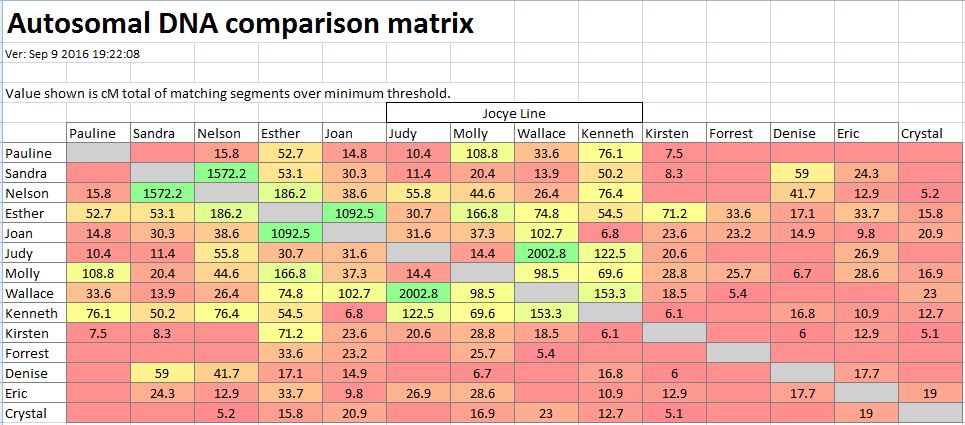
When I put all the names in my favorite DNA utility, Gedmatch, these 11 people match each other 446 times. These are not all Dicks matches, but as we have pre-selected Dicks descendants, a majority of these matches should represent DNA passed down from Christopher Dicks and his wife Margaret to their many descendants.

Matches of Kirsten

Kirsten matches Christopher Dicks descendants 9 times. She matches:

  • Sandra on the Dicks/Thomas Line
  • Molly who is on both the Dicks/Joyce and Dicks/Cran Lines
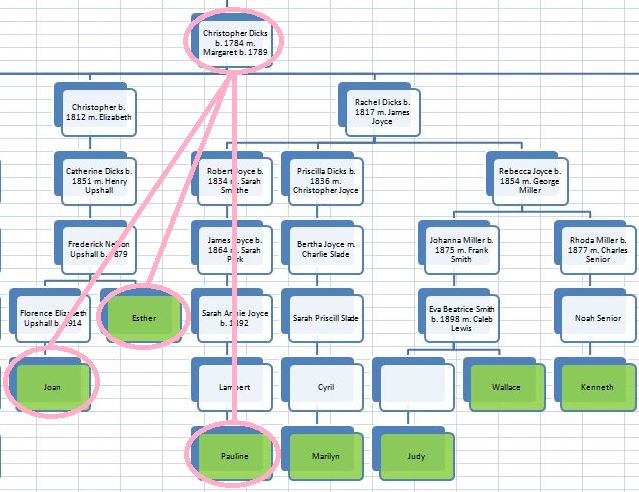
  • Joan and Esther are on the Christopher Dicks b. 1812 Line
  • Judy and Wallace are on the Dicks/Joyce Line

So Kirsten matches on a good number of Dicks Lines.

Next I’ll look at each of the above Chromosomes individually.

Chromosome 2 – A new TG found

Chr 2 Kirsten

This is interesting. See that Kirsten matches Sandra and Molly. If Sandra and Molly matched each other, we would have a TG. I’ll check Gedmatch again using the one to one utility between Molly and Sandra.

TG2 Kirsten

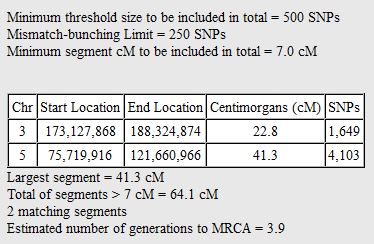
In order to find the match between Molly and Sandra that I was looking for, I had to go way below Gedmatch thresholds – down to 3 cM and 300 SNPs. This is not always advised, but in this situation it worked out. It may be difficult to see in the previous chart, but Sandra and Molly only had a small opening where they could match between 145 and 151 and that is where they matched each other.

TG2 Kirsten Rev

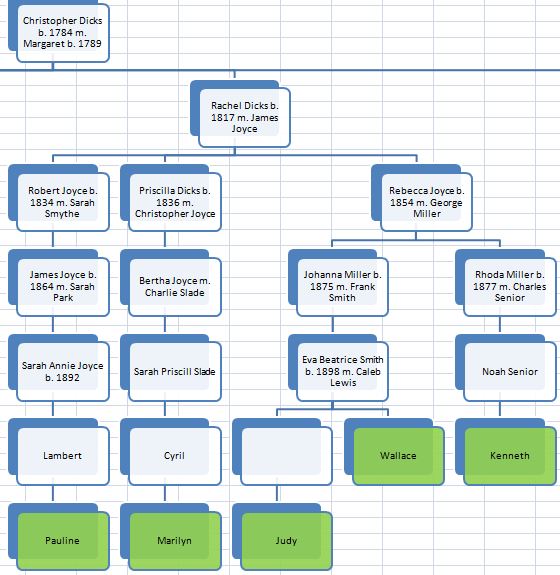
Notice above that Wallace and Kenneth are not in the TG. This means they match on a non-Dicks Line which is their George Miller ancestor. Here is a somewhat complicated view of the matches:

Chr 2 Kirsten TG

Here the TG is shown in circles and lines. Wallace and Kenneth are in the blue circles with their Miller common ancestor. Marilyn doesn’t match Wallace and Kenneth here, but she wouldn’t anyway as she does not descend from the Miller line. That means that her part of the TG could be from the pink line or the red line on the right. If Marilyn had matched Wallace and Kenneth, that would prove that she matched on the Dicks/Joyce Line. The fact that she doesn’t match means that she matches Sandra and Kirsten either on the Dicks/Joyce Line or the Dicks/Cran Line. It gets complicated, so that is why I chart these matches where I can see them.

Chromosome 9 – A new TG found

I’m ready for an easier Chromosome after the previous one.

TG9 Kirsten

Yes, it is simple. Here Kirsten is in a TG with my mother in law Joan and Joan’s 1/2 Aunt Esther. As Joan has no known descent from the Burton Line, this would be the Dicks DNA coming down from Christopher Dicks b. 1784 and his wife Margaret. I went below the TG to show that Joan also matches Kirsten at a higher position [124-133]. This is one of the many cases where Joan has inherited more of the known Dicks DNA than her Aunt has. At position 123 or 124 Esther switches off from matching Joan to matching Nelson. That match is likely on Esther’s maternal side where she doesn’t match Joan but has another Dicks ancestor.

There are 2 Chromosomes to go.

chromosome 15 – Another new tg

TG 15 Kirsten

Here, Kirsten is in a TG with Wallace and Judy from position 69 to 88. Wallace and Judy are in another TG described in a previous Blog with Joan from 88 to 93. There were actually 2 other Chromosome 15 TGs mentioned in that Blog. Here is the third TG with Kirsten at Chromosome 15:

TG 15 Kirsten Chart

chromosome 21 – Using dicks NOn-TGs to find non-dicks matches

Here there are no TGs and probably no Dicks DNA. These are all the matches of people in the Dicks DNA Project at Chromosome 21.

Chr21

I will give my guesses on these matches:

  • Sandra/Nelson – their Adams Line
  • Judy/Wallace – their Lewis Line
  • Kirsten/Esther – this would be Esther’s maternal line which has Dicks and Burton. Esther’s maternal great grandmothers are Margaret Burton and Jane Ann Dicks b. about 1841. As other Dicks descendants aren’t jumping in on this match, my first guess would be that this is a Burton match.
  • Esther/Joan – probably on the Upshall Line
  • Judy/Wallace – more of their Lewis Line

Summary of All the TGs Found So Far

I mentioned that I found 3 new TGs in this Blog alone. I would like to sum up all the TGs to date. The dark green are for Henry Dicks b. 1774. Raspberry is the non-Dicks TG.

Dicks TG Summary


Another Dicks in the Mix

So far, we have 10 people that have genealogies descending from Christopher Dicks b. 1784. They all triangulate in one way or another which is a good indication that their genealogies are correct and that their common ancestors are Christopher Dicks and his wife Margaret. That has gone so well, why not get a little wild and try something more difficult?

Henry or Harold Dicks born around 1774

As I was traipsing around the internet, I came upon another Dicks who was born around the time of Christopher Dicks. His name was entered in genealogies as a Henry and/or Harold Dicks b. around 1774. I took some of these genealogies of people that had tested their DNA and mushed them together and got the 4 lines on the left below:

Henry Dicks Chart

In my chart, I assumed that Henry was Christopher’s older brother and that they both had a father named Christopher. The names in pink I thought might be worth looking into as they looked so similar. There are 4 lines of people that have tested their DNA descending from this Henry Dicks line. One of them appears to be on Gedmatch, though I have not had further contact with this person. Her name is Crystal and she descends from the 2nd Crewe Line above.

Further, I have been in touch with Eric who believes that he descends from this line, but is not sure how. His ancestors were from Lamaline.

Lamaline

Eric said that Henry Dicks moved his family to Burgeo in 1820. I noticed a lot of the Henry Dicks descendants mentioned Burgeo in their ancestry.

Burgeo

Dicks DNA Goals for This Blog

In this blog I’ll try to answer the following questions:

  • Does Eric’s DNA show that he descends from the Dicks family?
  • Does DNA show that Harold and Christopher Dicks were brothers?
eric and crystal

First, I’ll compare Crystal to Eric at Gedmath. Crystal is the one who I think also has a tree on Ancestry showing descent from Henry Dicks. Eric thinks he likely descends from the same person. Here is how Crystal and Eric’s DNA compare:

Eric Crystal Gedmatch

They have a small match out at almost 8 generations which is a long way out.

Crystal and the Christopher Dicks descendants

Next, I’ll compare Crystal to all the people that descend from Christopher Dicks at Gedmatch. These are the people that I have already compared in the Dicks DNA Project. Here is where Crystal matches those people:

Crystal Matches

She has single matches with Molly, Wallace and Kenneth. Perhaps more importantly, she matches both Esther and Joan, forming a Triangulation Group. Here is a diagram of her matches.

Crystal TG on Chart

The single matches are shown as circles without lines. Marilyn had 2 chances of matches as she descends from 2 Dicks Lines. I have her 2 possible matches to Crystal in light purple. The Triangulation Group on Chromosome 5 indicates a common ancestor which appears to be the father of Henry and Christopher Dicks. Out of the 10 Christopher Dicks descendants with DNA results, Crystal matches half. The relationships are pretty far out. They range from 4th cousin, 3 times removed to 6th cousin, once removed.

More on Crystal’s tg

Even though Crystal does not descend from Christopher Dicks, her TG seems to tell us something about 2 Christopher Dicks descendants: Molly and Kenneth.

TG5 Crystal

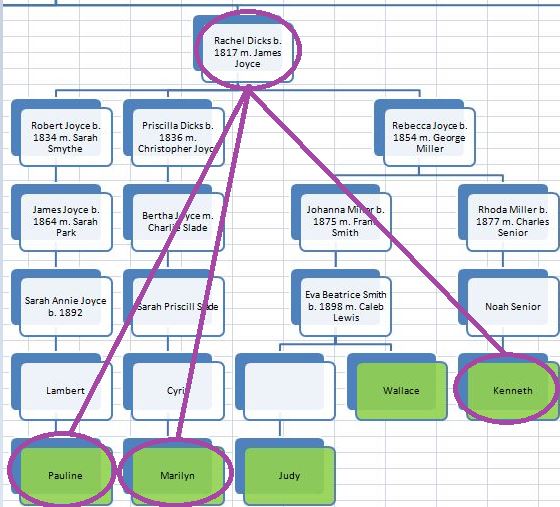
Notice that Molly and Kenneth match each other in the area of Crystal’s TG 5 [at position 76 to 122]. But they aren’t part of TG 5 which indicates a Dicks ancestor. That means that the DNA Molly and Kenneth share is likely from their  common ancestor James Joyce and not his wife Rachel Dicks b. 1817. Conversely, if Molly and Kenneth were in TG 5 that would mean that the DNA that they shared would be Dicks DNA through Rachel Dicks.

eric and the Christopher Dicks descendants

Now to get to Eric’s question. Let’s see how he compares to known Dicks descendants and Crystal. I’ll compare everyone to everyone else that I’ve compared so far. This is analogous to ordering an everything pizza.

Eric cf to all

Again, there are singleton matches with Molly and Esther on Chromosomes 1, 4 and 18. In addition, there are multiple matches at Chromosomes 1 and 4 which could indicate Triangulation Groups. Those are the pots of gold that we are looking for.

eric’s TG 1with joan and esther

Eric TG1

Here the part in gold is the TG. The other matches of Sandra, Nelson, Wallace, Judy and Molly likely represent non-Dicks Line ancestors.

Is there a tg 4?

It would seem like a TG at Chromosome 4 would tie everything together between Eric and Crystal.

Chr 4 Eric

Unfortunately, to have a TG here, Crystal and Sandra would have to match each other and they don’t. However,  this looks close to a TG.

What Did I Just Do? Did I Prove What I Set Out To?

  • Does Eric’s DNA show that he descends from the Dicks family? PROBABLY
  • Does DNA show that Henry and Christopher Dicks were brothers? MORE PROBABLY

Let’s look at Eric. From what I understand, he believes that he may descend from Henry Dicks, due to Henry’s living in Lamaline prior to 1820. This is tied to the fact that Eric’s family was also from Lamaline at the same period. Eric is in a TG with my mother in law Joan and her 1/2 Aunt Esther. Eric also matches others from the Dicks DNA project. In addition, he matches Crystal who has posted that she descends from Henry Dicks. Perhaps I should have rated this “MORE PROBABLY”. The other option is that all the matches are from other unknown relatives, or a mixture of unknown relatives.

I feel like Henry and Christopher Dicks were brothers. We have triangulation with Crystal who descends from Henry Dicks. Again, there is a possibility that the triangulation is with an unknown ancestor. However, I would like to think that the triangulation is with the known Dicks family. I would like to see others that have tested their DNA with paper trails leading to Henry Dicks upload to Gedmatch. That would give me more confidence in proving the connection with the 2 brothers.


DNA from the Dicks/Burton Line of Newfoundland

Dicks DNA Project Background

The purpose of the Dicks DNA Project, so far, has been to find descendants of the Dicks Family of Newfoundland that have tested for DNA and uploaded their results to Gedmatch. These results have been compared to confirm the genealogical research that has been done by the different Dicks families. So far those in the Study Group are:

  • Esther – my wife’s great Aunt from the Christopher Dicks Line b. 1812. She also descends from another Dicks Line but the lineage isn’t known for that line.
  • Joan – my mother in law – same line. [I didn’t include my wife as she got all of her Dicks DNA from her mom.
  • Sandra – from the Elizabeth Dicks/Adams Line. Elizabeth was b. 1809
  • Nelson – Sandra’s Uncle
  • Judy – from the Rachel Dicks/Joyce Line. Rachel was b. 1817
  • Wallace – Judy’s Uncle
  • Kenneth – Wallace’s 2nd cousin also from the Dicks/Joyce Line
  • Marilyn – She descends from the Dicks/Joyce Line and the Robert Dicks/Cran Line. Robert was b. 1824.
  • Forrest – She also descends from the Robert Dicks/Cran Line

All these lines mentioned above are children of Christopher Dicks who married Margaret and was b. about 1784.

The Dicks/Burton Line

To add to the above 9 Dicks descendants that come from  these 4 Lines, we have another descendant named Denise whose ancestor is Frances Dicks b. 1811. Frances married Charles Burton. To complicate things, my wife’s great Aunt Esther descends from a Burton and my mother in law does not. But I may be able to sort all that out. I can almost squeeze everyone in below. I left out the Robert Dicks/Cran Line on the right of the chart.

Dicks Burton Chart

Denise is a bit lower on the totem pole, so her DNA matches with the others may be a bit weaker. However, note that she has an extra Dicks named David that married into the Burton line. I’m not sure what Dicks family David descended from. Kirsten who is also on the Dicks/Burton Line is not yet in the project.

Let’s Compare Everyone’s DNA

Next I take everyone’s DNA and compare it with each other. The goal is to find Triangulation Groups (TGs). These are where 3 people match each other on the same part of the same Chromosome. A TG indicates a common ancestor. Usually, in this case, the common ancestor should be Christopher Dicks b. 1784 and his wife Margaret.

chromosome 2 triangulation group (TG)

Denise fits into an existing TG with Sandra, Joan and Nelson here:

TG 2 with Denise

For whatever reason, a lot of the Dicks DNA came down on Chromosome 2. Denise and Sandra share much more DNA than average considering they are 4th cousins twice removed. Here is what Denise’s TG looks like on the left hand side of the Dicks family Chart:

Denise TG2

This is a great TG as it includes 3 different Dicks Lines: Elizabeth, Frances, and Christopher Dicks Lines.

a new brain teaser from an older tg

In a previous Blog, I had mentioned that there were 2 TGs in this area. The first had Joan, Sandra and Nelson. The second had Molly, Sandra and Nelson.

TG2A-B

But in the TG with Denise above, her match with Nelson and Sandra are in the area where she should be matching with Molly (173-218). So why doesn’t she match with Molly here at 201-209?

The answer found in changing the gedmatch defaults

Usually it is not a good idea to change the defaults at Gedmatch. There are some situations where it is necessary. This is one of those situations. I lowered the thresholds at Gematch, because it didn’t make sense that Molly and Denise were not matching in this specific area of Chromosome 2. I lowered the cMs from 7 to 5 and the SNPs from 700 to 500 and here is what I found – they did match from 201 to 208:

Molly and Denise

This means that we can look at this as either one TG or two. I’ll look at it as one as that makes more sense to me right now. Joan and Molly didn’t inherit enough Dicks DNA to match each other. Joan matched at the beginning of the TG and Molly matched at the higher locations on Chromosome 2 TG. Now to draw this out:

TG2 Rev

Here I gave Joan and Marilyn lighter shades as they are on opposite ends of this larger TG. Sandra, Nelson and Denise have darker orange showing they are in the whole TG. I also have question marks on Marilyn’s lines as she is descended from 2 Dicks lines and we know that she got her Dicks DNA from one of the lines, but we don’t know which. There is an equal chance of her DNA being inherited from the Rachel or Robert Line.

Possible Burton Match

I had mentioned that Esther and Denise share Burton ancestors. I notice also that Esther and Denise have a match on Chromosome 5:

Possible Burton Chr 5

This is likely to be from the Burton family – or at least not the Dicks family – as I don’t see any of the other Dicks descendants matching in this area of Chromosome 5. In addition, even though Joan is a niece of Esther, she is a half niece and not descended from the Burton Family. I note that she also does not match Denise on Chromosome 5.

The X Factor: Dicks or Burton?

Here is a shot of Esther’s DNA match spreadsheet:

X Match Denise

It shows that Esther has a good match with Denise on the X Chromosome. On Denise’s side this could be from the Dicks Line. The X Chromosome does not travel from father to son. Denise is descended from Christopher Dicks and in that descent, the lineage alternates between male and female. However, Esther, descends from two Christopher Dicks. This means that the X chromosome that they share could not be shared with Christopher Dicks as no X Chromosome was transferred from father to son. This leaves a good chance that the X Chromosome match could also represent the Burton line. Esther’s mother’s father’s mother was a Burton. This is the likely way that Esther got the X Chromosome that matches with Denise.

Summary and Conclusions

  • Denise is a great addition to the Dicks DNA Study Group and has fit into a TG like all the others in the Project even though she is further down on the Dicks Family Tree
  • Denise’s Chromosome 2 TG results added some confusion until I lowered the Gedmatch thresholds. Then it was clear that Denise matched Molly as she should have.
  • There are two areas that could have caused problems: 1) two Dicks Lines for Marilyn and; 2) Denise and Esther likely having ancestry in the Dicks and Burton Lines. However, these issues did not cause a problem here.
  • It is likely that the single match on Chromosome 5 that Denise and Esther share apart from the other Dicks descendants is likely from the Burton family.
  • X Chromosome matches give good clues to family inter-contentedness as they are only inherited in specific ways.