111 STR YDNA Results with Nutter-Hartley Connection

I wasn’t sure what to call this Blog. I have been following the YDNA test results of a Nutter descendant with interest. His YDNA results have been showing a connection to my general branch of the Hartley Family. The results of other Hartleys who have taken the BigY test show like this:

All those so far under R-A11134 are Hartleys. One tester who is A11132 is a Mawdsley. The connection between Mawdsley and Hartley could be right around the time that surnames were coming into use.

Nutter’s 111 STR results

While we are awaiting Nutter’s BigY results, I will look at his 111 STR results. STR results are much more difficult to interpret compared to the BigY SNP results. That is because STRs can mutate backwards or forwards. In other words, the mutations can increase or decrease.

Here are the STR results of those Hartleys in my general line who have taken the test and have joined the Hartley YDNA Project at FTDNA:

My brother and I are in the last group. The group above us are Hartleys with a Quaker ancestor who left England to move to Pennsylvania in colonial days. The top person is Mawdsley who is closely associated with the Hartleys at R-A11132. The rest are Hartleys in the R-A11134 category. The first two in the A11134 group have only tested to 12 STRs which is not very helpful. Note that many of the genealogies get stuck in the 1700’s. It is very difficult to do the genealogy in England at that point due to the number of Hartleys in the Colne, Lacnashire area. This is where many of the Hartleys came from.

I have an arrow in the column where the new Nutter results are. The person above Nutter tested to 111 STRs. The person on the list below Nutter tested to 37 STRs. Nutter and the Hartley below him have a match on this STR:

They both have a value of 20 for DYS458. Of the 12 Hartleys who have tested to this level, only these two have a value of 20 for the STR named DYS458.

Here is a comparison between Nutter and the Hartley tester listed above him:

At STR DYS710, both these two have a value of 36. This may be more difficult to interpret as two of the Quaker Hartleys and the more distantly related Mawdsley tester have this value.

Building a STR Tree

These trees are difficult to build and interpret, but I will give it a shot. These trees are easier to build when the BigY SNP results are in, because those results are so much easier to interpret. Previously I have considered two models to intepret the STR results. Here is the first:

This tree only has six people in it, so I think that some are missing. I count 9 Hartleys who at the FTDNA Hartley YDNA Project who have tested to 111 STRs. I see also that other changes will be needed as I don’t see DYS710 listed in the tree. Also I don’t see DYS458 listed.

Here was my second model:

It looks like a major overhaul of this tree is needed. It looks like I only did the tree for those who took the BigY test.

111 STR YDNA Hartley Tree Overhaul

This appears to be the raw data involved:

I had trouble matching the STR names to the columns. Previously, I had used a program called SAPP to try to analyze these STRs. I’ll try that again. I downloaded the information for all testers in my Hartley group except for the two that tested for only 12 markers. This goes into a text file where the first line is /STRDATA.

Here is what pops out:

The program comes up with four main branches. Here is some further identification:

It seems like the results are generally accurate. Nutter is near the middle of the chart. He is with the other Hartley I mentioned earlier with a DYS458 value of 20 (red arrow). My brother and I are on the bottom row. I would say that the depiction is generally correct. Between Nutter and his closest match on the tree, the Time to Most Recent Common Ancestor is 1750. Here is what FTDNA shows for the GD of 2 between Nutter and his closest Hartley 37-tested STR match:

The third line indicates a GD of 2. FTDNA estimates a aTMRCA of 1650 for that GD. However, whether this is more or less accurate than the SAPP tool, I don’t know.

For the Quaker Hartley group, the TMRCA is 1550 according to SAPP. The known common ancestor is from 1666. However, it is within the SAPP Tree range of 1350-1700. There are more than the usual mutations for this line which make the TMRCA seem older.

The TMCRA for this group of Hartleys is shown by SAPP to be 1550. This does not seem unreasonable to me. I did not include the Mawdsley STRs in this analysis as he is from an earlier SNP group of A11132.

One other point is that there are other adjustments that can be made on the SAPP Tree. One would be to add SNP values where known. Another interesting feature is the thickness of the lines on the tree are meant to indicate confidence of relationship. For example, the thickest line is between me and my brother. The program does not know that we are brothers, but it does know that we both tested to 111 STRs and have a close match.

SAPP Tree with SNP Data

For the kits, I have added this insformation:

This reflects the BigY testing. Here is how the SAPP interprets my input:

Here is the tree that it produces:

Notice that many of the lines are now in darker blue showing more certainty. One somewhat surprising result is that it projects that two of the Hartley kits are outside of A11134. Those are the two yellow kits on the second row above. I had assumed that all Hartleys that were in this group were A11134. Based on SAPP these two kits may not be A11134.

Here is some further output from SAPP:

I watched a video explaining the program. The red numbers in the second chart show the adjusted genetic distance due to parallel STR mutations. So for example, it shows me at kit 275990 as being a GD of 12 from Quaker descendant 617805 instead of the GD of 9 that FTDNA shows. That is because the Quaker descendant had some of the same mutations that I had but they happened in a parallel manner on different branches.

Once Nutter’s BigY results are in, the SAPP Tree could change also as we will have more SNP information. The only further modification would be to add Mawdsley to the tree.

SAPP Tree with A11132 Mawdsley Added

  • Now the Quaker Hartleys are on the bottom left. Oddly, the tree now shows the correct sub-branching for the three Quaker Hartley descendants.
  • Now there are four Hartley testers showing outside the A11134 realm on the third row from the top. These four are in groups of two each.
  • I did not add any genealogical information for the chart. I could have added some for the Quaker Branch, but the program sorted that out before I did that.
  • This seems to be as good as I can get the SAPP Tree with the information that I now have.

Actually, I do have a refinement I could make to the chart as the Nutter descendant is A11134. This is from previous testing at another company. Here is the results:

This pulls Nutter with the ‘B’ kit back into the A11134 realm (both circled). This should be now the best SAPP Tree I can come up with given the information I have.

Nutter Genealogy

I have covered Nutter Genealogy in past Blogs. It appears from the STRs, that Nutter’s closest STR match has Hartley genealogy:

The SAPP tree predicts a common ancestor around the year 1750 which is interesting. That means that either the Nutter genealogy or the SAPP Tree prediction for a TMRCA could be wrong. The Hartley tester who has James Hartley as his ancestor has not posted a further Hartley Ancestry Tree at FTDNA.

Summary and Conclusions

  • The Nutter 111 STR results add important information to a part of the YDNA tree of mankind
  • If correct, the STR results link Nutter with a kit who traces his genealogy back to James hartley born 1788.
  • Running the SAPP Tree with different inputs gave interesting results. One result was that it showed a possibility that not all tested Hartleys are neccesarily A11134 as I had previously supposed.
  • I await Mr. Nutter’s further BigY testing results


Some Nutter Genealogy

I have been in touch with Michael who has ordered a BigY test. He has Nutter genealogy, but he appears to have a male YDNA Haplogroup that only Hartleys have held so far. I am interested how closely he is related to the Hartleys.

I see that Michael has this genealogy posted. I hope he doesn’t mind me taking a look at it.

I’ll start a Nutter tree at Anestry, to see if we come to the same conclusions.

Here is Albert or James A in the 1901 Census:

He lived in Hindley but was born in Tyldesley.

James Nutter 1847

Here is a tree from Ancestry:

Here is Abram – a village in Wigan:

James had two wives and James Albert was from the second wife. Here is a young James in the 1851 Census:

John Nutter 1817

James father John was a Boat Builder in Bedford in 1851. While snooping around Ancestry, I found a better Nutter tree from Michael – the one taking the BigY 700 test:

Interestingly for me, there is a Hartley Line there from 1749.

Here is John Nutter and family in 1861:

All these places were close to each other:

This appears to be the transcription for John’s marriage:

He was a ship carpenter which fits in to the Census records. Here is Haigh to the NE of Wigan:

This appears to be John’s baptismal record:

Here is some more local geography:

Richard Nutter

Here are a few choices for Richard Nutter:

Assuming these are the two best choices, let’s see which is the best choice.

Richard number one is a husbandman from Brindle. I think a husbandman is someone who takes care of animals. I looked it up and a quick result said farmer. I’m not sure of the difference between a yeoman and a husbandman. I looked yeoman up also and got:

a man holding and cultivating a small landed estate; a freeholder.

Here is Brindle:

Richard Nutter #2

This Richard was a house carpenter. This would seem more in line with his son John’s occupation of ship carpenter – though at the time of John’s birth, Richard was apparently a weaver.

This appears to be the Parish of Burton in Kendal:

By location, it appears that Richard #1 is better. Let’s see where they married:


This is what I get for Warton (above) though Lancaster seems further north. That makes the decision more difficult. Do we go by occupation or location?

I need to find Richard in the Census if possible. My thinking is that the Richard Nutter who had John Nutter in 1816 in Chanock hung around the area. His Census should have where he was born. Unfortunately, I could not find Richard easily in this area.

Taking a Look at Michael’s Tree

I see that Michael has this information for Richard Nutter:

If this is right, then Richard and Jane should appear in the Rivington Census of 1841 and Richard should appear in the 1851 Rivington Census. I also see that Michael has this Bishop’s Transcript marriage record:

Here Richard is a Servant rather than a husbandman.

This appears to be a record for Richard’s death:

Here is the burial record for Jane:

Here are some other records from Rivington:

Assuming this is the same couple (and they appear to be), this would represent perhaps moving out of the area for a while? Here is Adlington:

Actually Adlington is near Rivington. Here is Oswaldtwistle:

So not too far away if right.

Nutter Baptisms at Rivington Church

I don’t see a corresponding birth record for Jane Nutter who died in 1826. I see one record for ‘Margrit’s’ baptism as Jennett as the mother.

When James was born, Richard was a farmer:

Here is an early baptism at Rivington Church:

Here is another Nutter Burial:

If this Coln is Colne, then here is a connection to the area where my Hartleys came from. Here is a guess for the baptism of Mary:

I couldn’t easily find a marriage record for Henry Nutter around this time.  Here are three marriages with the last being in Colne witnessed by a Hartley:

Also I see this baptismal record with a Henry and a Richard:

Here is a better connection:

Notice that even the abode of Coln is the same spelling as the abode of Coln in the burial record for Mary Nutter in Rivington, daughter of Henry Nutter. It would seem od for there to be two misspellings of Colne in twon different records relating to Nutter.

Here is one more record with that spelling:

If I put the three ‘Colns’ together, it looks like perhaps Henry and Sally Nutter had John Nutter in 1782 in Colne, Richard Nutter in 1787, then moved to Rivington at some point where they buried daughter Mary in 1802.

An Interesting Record for Richard Nutter

Here is the reference for the above document:

To me, it would be a coincidence if this is not the same Richard Nutter. Basically, Margaret Eccles had a male “bastard” child which had to be supported by the government. She calls out Richard Nutter who is required to give some support for the raising of the child.

Here is Yate and Pickup Bank:

So, I am learning a bit about local geography through this exercise.

Here is a baptism for a daughter of Peggy Eccles:

Here is another legal document concerning Richard:

Actually, I am not sure this is the same Richard as here is the location referred to in the 1830 document:

I’m spending a lot of time on Richard because he seems to be a crucial link to going further back in time in Nutter genealogy.

Richard Nutter in the Census

This appears to be the wrong Richard in 1841 Preston:

This appears to be the house carpenter who married Jane Nuttal. Here is the same family in 1851:

This Richard was born in Wennington.

I found this Jane in the 1841 Census, but I don’t know if she is the right person:

This Jane shows that she was not born in Lancashire.

Richard’s Father was Henry, John or Richard?

Ancestry suggests Richard as  the father of Henry as their ‘hint’. Michael has John Nutter as the father of Richard:

As mentioned above, I am leaning toward Henry being the father of Richard. I’ll try putting Henry in the Private Ancestry Tree that I have made.

This appears to put me in the minority. I found three trees for Richard Nutter at Ancestry and they all show Richard for the father. Here is the couple I am going with:

I am guessing that this Henry could have been born around 1760. Here are some Baptisms from around that time:

My best guess for Henry is the last one. He was born in 1754, so would have been 27 when he married. The other two Henrys are from Burnley or Barrowford. Barrowford is outside of current Colne. Here is Colne Edge:

Apparently, I am in the minority with this Henry also. I looked at three trees for Henry and they show him having a son Richard, but the son who was born in Wennington. So, I am going in circles a bit. Even though I am going against other Ancestry trees, I think my logic in my connection between Rivington and Colne is sound.

Why Not Richard as the father of Richard?

I had mentioned above that there was a Richard Nutter in the Rivington Parish who lived in Rivington. He had a daughter Mary baptized there in 1768:

Could he have been the father of the Richard who lived in the Rivington area? It would seem possible, however, under that scenario, this Richard would have had Mary in Rivington and then gone back to Colne to have Richard and then somehow Richard would have made his way back to Rivington Parish. Plus, this birth was in 1768. I believe that Michael’s ancestor Richard was born in 1787 which was 20 years later.

Here is one Richard born to a Richard, but he appears to have died soon after his birth:

Here is the best guess for the Richard son of Richard scenario:

Unfortunately, the Rivington baptismal record for Mary did not mention the name of the mother.

Here are some marriages for Richard Nutter and Mary:

The first marriage would have been too early to have Richard in 1788. The second marriage would probably be too early to have Richard in 1788. Assuming this Mary was 20 at the time of marriage, 29 years later she would be 49 having Richard. I suppose this is a possible scenario, but not likely. Finally, the last Richard Nutter would be a good candidate to have the Richard Nutter born at Lawn in 1788, but not as likely to have Mary baptized in 1768 in Rivington.

Richard Nutter Born 1719

Ancestry has three trees which all look somewhat like this one:

As there were three Richard Nutters baptized in Colne in 1719, I wonder how they knew they had the right one?

The 24 January 1719/20 from Greater Marsden above is probably the one mentioned in the Ancestry Trees – though Ancestry has the birth in Trawden.

Here are a few more Richard Nutters in Lancashire:

If I had to guess I would probably go with the one from ‘Coln’ based on the spelling mentioned earlier. However, that is a guess. The name is spelled differently, but I’m sure there were spelling variations in the early 1700’s. I was hoping that there would be fewer Richard Nutters the further back I went, but there were more. So this would seem to be a good time to end this Blog. This is my best guess based on my limited research:

Summary and Conclusions

  • I am interested in Michael’s ancestry because he has ordered a BigY Test which indentifies the male line. Michael’s past YDNA testing has put him in a branch of the male tree  of mankind that has been reserved for Hartleys up to this point. Michael’s male only line ancestry is Nutter.
  • The Nutter genealogy gets more difficult at the point of Richard Nutter. This is because it is difficult to find this Richard in the Census. According to the Quarter Sessions, this Richard appears to have fathered a boy with Margaret Eccles and was required to come up with support for the boy. There was also a Richard and Margaret Nutter mentioned in the Quarter Sessions. But I don’t know if this is Margaret Eccles above.
  • Based on connections that Henry Nutter and his wife Sally had between Colne and Rivington Parish, it seemed like Henry would be a likely candidate to be the father of Richard. I went on that assumption which lead me to another Richard as Henry’s father. However, there were too many Richard’s born in the early 1700’s to identify which Richard he was.


A Nutter-Hartley Connection by YDNA

In a previous Blog, I wrote about Michael who has Nutter ancestry and tested his YDNA with a non-FTDNA company. Those results were uploaded to YFull which showed that he was A11134 on the male YDNA Tree. I also noted that so far, all the FTDNA BigY testers who are at the A11134 level have been Hartleys.

I have also noticed that there are two other people who have had 37 STRs tests taken at FTDNA. They have matches to some of the Hartleys in the Hartley project. They have that their ancestry goes back to Ireland.

Here is the list of people in the Hartley FTDNA YDNA Project that are grouped together:

The last two on the list are my brother and me.  The first person has Mawdsely ancestry and is in the slightly more distant Haplogroup of A11132. The next two who have Richard and Roger Hartley as ancestors only tested to 12 STRs, so that information is not very useful.

The estermated Yorkshire tester matches the two Nutter testers. When I use the FTDNA TiP Report, there is a 90% chance that this Hartley and the two Nutters are related within 15 generations. If I take a generation to be 30 years for a male, then that would be about 450 years ago. If we take that to be from 1950, then that would be around the year 1500.

It would be interesting if one of these Nutter testers upgraded to the BigY 700 test. Due to the way the Nutter testers match the Hartleys, it appears that they could be close relatives to each other.

Nutter Genealogy

One of the two Nutter 37 STR testers has genealogy going back to Ireland. Here is his tree:

Here I am just interested in the father to father Nutter line. I can try to build a Nutter tree myself, to see if there are other connections to England. The more recent family was from Lowell, Massachusetts, so that is easy to trace as I live in Massachusetts.

I am interested in finding out more about Robert J Nutter as he immigrated to Lowell, MA. The 1910 Census has Robert arriving around 1860:

If my caculations are right, then he would have been about 10 years old when he moved from Ireland to the US. Robert’s wedding record shows that his parents were James and Mary:

I suspect that James P could be James R. I also believe that Robert’s real first name was James:

This also gives a place of birth for James Robert in Ireland:

This place is in County Kildare:

Here is the family in 1870:

It would take a lot of research to try to get this family back to England. The next step would be to try to find a marriage record for James Nutter and Mary.

The Census records give more clues. Here the family in 1880:

The family was living on Water Street in Lowell. Youngest son was Elias. Here is the Baptismal record for Elias from St Peter Roman Catholic Church in Lowell:

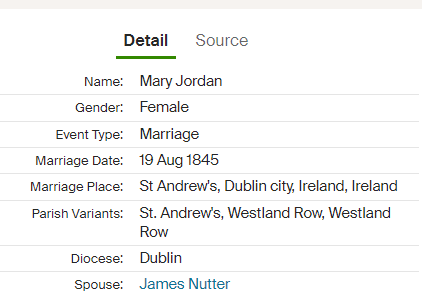
This gives his mother’s name as Mary Jordan. Mary died in a railroad accident. Her parents were John and Mary. The couple appear to have married in Dublin:

Unfortunately, the marriage and death records for for James gives no parents:

That puts this line of Nutter genealogy at a dead end for now.

More Nutter YDNA STR matches to Hartleys

The person who has David Hartley as an ancestor also matches Nutters with a genealogical difference (GD) of 3.

My recollection of this David is that he was from Yorkshire. The TiP Report between the David Hartley descendant and Nutter is also 15 generations at a 90% confidence, so also probably in the early 1500’s.

Descendant of William Shephard Hartley

The descendant of William Shephard Hartley also matches the two Nutter testers but with a GD of 4. Here is the TiP Report between these two:

Interestingly, even though the GD is greater, the number of generations at the 90% confidence level is fewer at 12 generations. Assuming 30 years per generation, this comes out to 360 years. For an easy calculation, I’ll subtract that from 1960 to get around the year 1600.

Comparing STR Matches in a Spreadsheet

Here is what I have so far:

Here is an interesting thing in that the GD of 3 results in a predicted 15 generation commona ancestor. That is compared to a GD of 2 and 4 with 12 generations to a common ancestor. That is no doubt due to the variance in the mutability of the different STRs. Some STRs change very slowly while others change relatively more quickly.

Here is the finished table:

The first tester is a Mawdsley and an earlier Haplogroup than the other Hartleys, so probably the connection to him goes back before the time that surnames were used. #2 and #3 on the list only tested for 12 STRs, so I wouldn’t include them either right now. Out of the other 11 testers, 7 had a GD of 4 or less to the two Nutter testers.

Based just on the 37 STR test (which is difficult to interpret and a low level of STR testing), I would say that there is a connection between Nutter and Hartley. The three possibilities being:

  • There is an early Nutter line that descended from a Hartley line and branched out
  • There is a Nutter line separate from the Hartley line and the connection between Hartley and Nutter is before the time of surnames
  • Our branch of Hartleys descended from an earlier branch of Nutters. Based on the number of Hartleys compared to Nutters, I would find this to be the least likely scenario.

Summary and Conclusions

  • Michael who has Nutter ancestry has recently sent out for a BigY700 test
  • He has an existing Haplogroup from previous testing of A11134. Previously, only Hartleys have tested positive for A11134.
  • There are two Nutters who have taken the 37 STR YDNA test at FTDNA. They appear to be closely related.
  • I have looked at the genealoyg of of one of the 37 STR Nutter testers. I got stuck in Dublin, Ireland for the earliest known ancestor. However, the YDNA strongly suggests ancestry in the Lancashire/Yorkshire area of England.
  • 7 of 11 Hartleys in my group of Hartleys at the FTDNA Hartley YDNA Project match these two Nutter STR testers
  • It would be helpful if one of the Nutter 37 STR testers were to take the BigY700 test to compare with Michael’s upcomng results.


A New A11134 Tester

I recently realized that there was a new A11134 tester. I had been in touch with a person named Michael who had tested. He had tested at Nebula Genomics. I am not familiar with that company as I have had tested with FTDNA. Michael uploaded his results to YFull where he is on the YFull Tree as A11132.

A11132 at YFull

Here is how Michael matches me at YFull:

YFull has Michael and me as A11132, but FTDNA has me as A11134 which is one level below A11132. Why is that?

Here is a what my Block Tree looked like in March 2021:

My brother and I are on the left. Then there were two other Hartley testers. So, at that time all Hartley testers were under A11132. In January 2022, there were two new BigY Testers. One was a Hartley and one was a Mawdsley. Mawdsley tested positive for A11132 as well as the other SNPs under the current A11132, but did not test positive for  A11134 and A11135. That resulted in the breaking up of othe old A11132 block into A11132 and A11134. This resulted in the way the tree is today:

Michael is planning on doing the BigY test at FTDNA. That means that he will be A11134 when he takes that test. Mawdsley did not post at YFull, so their tree structure is more like FTNDA’s tree prior to 2022.

Michael on FTDNA’s Time Tree

FTDNA has a new Time Tree. I was glad that I realized that Michael was actually under A11134:

That makes a difference, because as shown, A11132 would probably before the time when surnames were in general use and A11134 would be more in the time frame when surnames were coming into general use. In fact up until the time of Michael’s testing, all A11134 testers were Hartleys.

Checking Private Variants

The first place to check for possible new branches is with private variants. Michael sent me this information:

The Y designation is for YFull where Michael posted his results.

Here is a comparison I had been working on for Hartley Private Variants:

I hadn’t added John R and John N previously, so I did so now. I don’t have the full list for ‘Nutter’ above. That means that Michael cannot currently access the full list of all the SNPs that he tested for. I was surprised that none of the Hartleys that I looked at had tested for Michael’s Private Variants. That means that there may be a connection between the Hartley lines, but that connection is not known if the same locations are not sampled.

The fact that Michael’s Private Variants are likely newly discovered is shown by the date on the right. According to YBrowse, these are newly found variations as of 2022. I did not check with the Quaker Hartleys as these left Lancashire, England around the year 1700.

When I checked John N’s Private Variants, I found that Jim, Joel and Steve were not tested at those locations. That could mean that John N could have a closer connection to Jim, Joel and/or Steve. It’s a little frustrating to not know the results, because a position was not tested. One exception was with location 20674535. My brother Jim and I were not tested at this location but Steve was and tested negative.

A Different Way of Showing Results at FTDNA

I used to be able to download a ‘csv’ file from FTDNA with all the results. Those Those results have now been split up to these files:

I will cover those changes in an upcoming Blog. Here is the summary of Hartley (and Nutter) Private Variants:

John R’s results are in the new format, so I didn’t check his results agaings the other tests. Also, John R is in the Quaker Hartley group. I don’t think that there is overlap with the other groups, but it is possible. In the above chart, I took out my former Private Variants which are now named under FT225247.

Summary and Conclusions

  • I was pleased to find out by checking YFull, that a non-FTDNA tester with Nutter genealogy tested positive for A11134
  • Previously, all A11134 BigY testers have had Hartley genealogy. That means that this test is a departure or that the tester could have Hartley ancestry at some point.
  • I checked Michael’s test against some of the other Hartleys BigY tests and saw that there was no overlap between his results and Hartley results. In other words, Michael’s Private Variants were not tested in other Hartleys as far as I looked.
  • Hopefully, more will be learned as Michael has agreed to take the BigY test.
  • FTDNA now reports its results in its csv file as four csv files. This is likely because the files were so large. I will look at that in an upcoming Blog.


A New Hartley BigY Test

A New Hartley BigY test results are in:

John R is the 7th BigY Hartley tester in the group of Hartleys that I am related to. There are other Hartley branches in the world, but they are not at all closely related by YDNA. I did an initial analysis of John Roberts STR results last week  here.

The A16717 Branch of Hartleys

So far all the Hartleys that are related to me by YDNA are under the branch A11134. John R is further under the A16717 branch. This is an important branch of Hartleys as the genealogy is well known:

Ross has not taken the BigY test, but John R, Lawrence and Michael have. Michael has taken the older BigY 500 test. Before Lawrence tested for BigY, Michael was designated as A11134. Lawrence further designated the branch as A16717. John Robert and Lawrence could potentially form a new branch separate from Michael.

Comparing BigY Matches

I have compared John R, Lawrence and Michael to my results:

Here are the first two on my list of Non-Matching Variants. This list can be confusing because it could be a non-match because I have the variant and John R does not, for example. Or, it could be that John R has the Variant and I do not. I put those variants that do not match my results into a table:

Here I have color coded the non-matching variants.

The Yellow Variants

These are the variants that are in my brother’s and my Branch (FT225247) . These are the SNPs in my Branch:

There are 7 SNPs in this group. The yellow SNPs above account for 6 of the 7 SNPs. But where is FT135932? When I check John R’s results I see that he is not positive for this SNP:

I’m guessing that my brother had this SNP and I didn’t or didn’t have really good results for this tested SNP. Here is my brother Jim’s comparison with John Robert:


This implies that my brother James tested positive for FT135932.

Blue and Orange Variants

We know about the blue variants. This is the SNP label used to define the Quaker Hartley Line. The orange SNP is BY26739. This SNP is more difficult to explain. For one reason, a comparison between my brother and me show that is also a non-matching Variant.

BY26739

If I have BY26739 and Jim and John R do not, that would explain things. Here are my results for that SNP:

It looks like the reads were not great, but the  best reads they did have showed that I was positive for BY26739 two out of three times. I see from a previous blog that this was Jim’s results:

This was considered to be not derived, probably because there were 6 good reads which were all negative for this SNP. Here are John R’s results:

These results are even worse than my brother Jim’s. I see that the 4 best reads show no mutation at that location for John R.

The Green Non-Matching Variants

These are SNPs that my brother and/or I have. Here is an expanded view:

I don’t have a good explanation why these SNPs are not in my Block tree. One guess is that they may be from regions which are considered unreliable.

Private Variants

The Private Variants for the Quaker Hartleys should be the numbered variants shown in the chart above. These variants formed in the Thomas Line in the generations following Thomas Hartley born 1700. John R has three, Lawrence has 6 and Michael has two. That should mean an average of about 4 under the Quaker Hartley group of A16717. I’m not sure why the current Block Tree shows an average of three Private Variants. I notice that the old Block Tree before John R tested had an average of two Private Variants:

If these private variants matched between John R and Lawrence, then there would be a new Quaker Hartley Branch of SNPs. However, for that to have happened, Thomas Hartley born 1700 would have had to have had a new mutation that his brother Roger did not have:

Summary and Conclusions

  • The recent BigY testing for John Robert put him solidly in the Hartley Quaker Line and confirms common ancestry as shown in the chart above.
  • Differentiation between the two lines: Thomas Hartley and Roger Hartley were difficult as Thomas would have had to have had a SNP mutation to show up between John Robert and Lawerence.
  • Differentiation was made in my previous Blog based on STRs which was useful.
  • The BigY may undergo a manual review, but I don’t see any obvious changes that would be made.
  • The Quaker Hartleys now have the largest group of BigY tested Hartleys in the A11134 Hartley group.


New 111 STR Hartley YDNA Test Results and the SAPP Tree

New results are in for a Hartley YDNA 111 STR test. These STR tests were in included in a BigY test. The BigY test results are not in yet. There are different Hartley YDNA lines, but this is the line that my Hartleys are on (and several other Hartleys). Here are the new results:

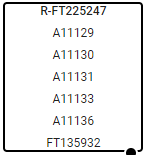
This image is from the Hartley YDNA Project page at FTDNA. The new tester is the one at the top. The tester has ancestry in common with Roger Hartley born 1628 and died 1714. This is an important line as it represents the oldest verifiable Hartley line in this group of Hartleys. This group of Hartleys were originally Quakers. They were persecuted, so they left Lancashire County England for Pennsylvania where Quakers were welcome. That doesn’t mean that the other lines descended from this line, but that this line is closer to a Hartley common ancestor. The two tests on the bottom are for myself and my brother, so R-FT225247 represents a newer YDNA Branch.

Some Hartley Genealogy

Here is a tree I worked out for the Quaker Branch of the Hartley family:

John Robert is the new tester. Assuming I have the tree right, he shows as 6th cousin to Lawrence and Ross and 7th cousin to Michael. At the 111 STR level, John’s two closest matches are with Lawrence and Ross. John shows as a three step difference to these two. Michael does not show up. He took the older BigY 500 test which did not include the 111 STR test at the time. Lawrence took the newer BigY 700 test. Ross took the 111 STR test without the BigY test. The above tree shows Lawrence and Ross to be third cousins to each other.

John’s YDNA STR Matches at the 111 Level

Here are John’s matches of those Hartleys who have tested to the 111 STR Level:

Lawrence and Ross are at the top of the list. Interstingly, I am on the list but my brother Jimmy is not. He must have one more difference which put him over the top of what is reported. All the above have the Hartley surname except for Wolka. This likely means that this Wolka line was at one time a Hartley line.

A 111 STR Tree for Hartleys

Again, these are for the Hartleys in my group. These are the 9 people that are in the Hartley YDNA Project at FTDNA. Ross and Wolka are not in that project, so they are not represented below. When I look at the STRs that have changed within the Hartley group, they are these:

When creating a tree, the easiest way is to assume that the mode is the oldest value of the STR. When I color the outliers, they look like this:

This chart represents 8 Hartleys and one Mawdsley. The bottom two lines are myself and my brother. I moved John Robert next to Lawrence. These two are above my brother and me. They descend from the older Quaker Hartley Line.

Looking at just the Quaker Line of Hartleys, I see this:

These are the three differences between John and Lawrence in that line. John has a DYS390 value of 24 and a DYS549 value of 12. Lawrence has a DYS641 value of 11. As these are unique to the Quaker Line, they are most likely mutations within that line:

This image is meant to show that somewhere along the Anthony Hartley line, these two STRs appeared which are unique to that line. Likewise, sometime along the Joseph Hartley line a unique value for one STR occurred which describes that line. Unfortunately, I don’t have Ross’ results as he is not in the Hartey FTDNA YDNA Project.

STR Structure within SNP Structure

There are two aspects to YDNA testing. One is STRs and the other is SNP testing. The SNP testing is less subject to interpretation. This is because STR values can go up and/or down whereas a SNP mutation is a single mutation. As such, the SNP is more useful for creating trees.

Here is the reliable SNP tree from my perspective:

John Robert’s BigY results have not yet completed, but his results should be within R-A16717 based on genealogy. So far all Hartleys in this Line are under A11134. The connection for Mawdsley goes further back in time – probably before the time when surnames were finalized.

Two Models for Hartley STRs

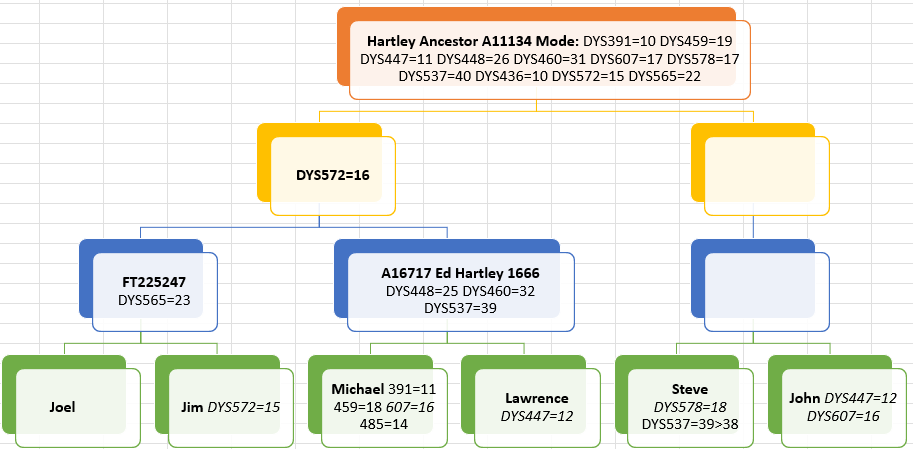
In a Blog I wrote earlier this year, I considered two different models to explain the STRs:

and,

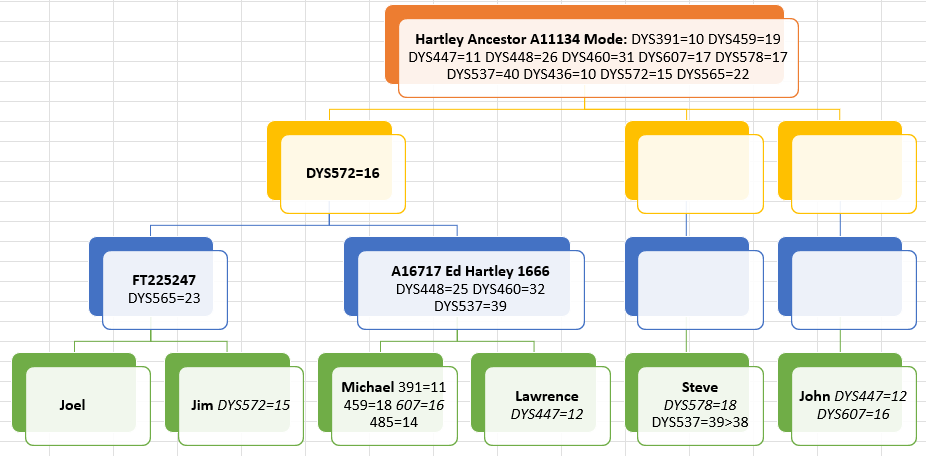
In these depictions, I didn’t mean to show that Steve and John have a more recent common ancestor. They should have their own separate lines from the early Hartley ancestor. The boxes were added place them on an equal footing with the other Hartleys. Here is a better representation:

It also appears that what I had as DYS572 should actually be DYS534:

It is easy to get confused with 111 STRs. Here is a corrected version of the first tree:

FTDNA’s New Time Tree

FTDNA has a new representation for those who have taken the BigY test:

The person at the top right is a Smith. The common ancestor between Smith and our Hartleys was around the year 500. This was certainly before the time of surnames in England. The next person going down the column is Mawdsley. The common ancestor between Mawdsely and the Hartleys was some time around the year 1100, though the dashed line gives a larger range. Assuming the year of 1100 is correct, I would say that common ancestor lived before the age of surnames also.

The next 6 are Hartleys who have taken the BigY test. From the Time Tree above, we see that all Hartleys are R-A11134. These Hartleys had a common ancestor who lived probably in the 1400’s. Actually, it looks like these had a common ancestor, but they really had a common SNP. This SNP could have occurred within, say three generations on average. However, there was a Hartley who originally developed this particular mutation which was carried down all other Hartleys.

The two that are still R-A11134 are John and Steve. They have not had other matches yet which further define their lines. Chronologically, the next group is R-A16717. These are the Quaker Hartleys shown in my genealogical chart above. R-A16717 dates from the Time Tree from around 1550. By genealogy, the common ancestor from the group was born in 1666. That means that either the Time Tree is a bit early, or an ancestor of Edward Hartley born 1666 first had the mutation of R-A16717 (or a combination of both). Finally, I tested my brother and myself, so R-FT225247 represents my father who born in 1918.

Using SAPP to Generate a Hartley Tree

David Vance developed a software to analyze STRs. I’ll use this for the Hartleys in my group who are also in the Hartley YDNA Project at FTDNA:

This is the first time that I have used this tool. It uses STR testing of any length which is interesting. Also I did not put in information about SNPs. That would have been helpful to refine the tool. Here is the top box of the chart:

This is in line with the start of the Hartley surname. Here the year 1350 is given. The Time Tree based on SNPs gave a date about 75 years later. This method is a lot easier than trying to create a tree by hand. Next, I’ll look at my section:

I am on the right side of the tree. My brother and I are in the last two boxes on the bottom of the tree. Our common ancestor (our father) has a date of 1900 which is close to his birth year of 1918. The next one up on our branch is John Nicholas. He took the BigY test. I had thought that he would have formed a new Hartley SNP branch, but that did not happen.

The two other boxes are for Tim and Steve. Steve has also taken the BigY test. My guess is that Tim is Steve’s brother as the common ancestor date given is around 1950.

A Second Run of SAPP

My first run showed that I had 112 STRs for some testers, so I ran the program again using the Notepad software for the results as suggested in the instructional video. This time I came out with 111 STRs:

Above, the number of STRs are shown in bold blue on the diagonal.

Here is the corrected SAPP Tree:

This tree now shows five brances from the top instead of four and now the STR names are correct:

This now shows that the difference between my brother and me is STR 534. The program interprets that it was I that had the mutation to 16 from the ancestral value of 15. This new tree also has my brother and I having a common ancestor with John Nicholas in the year 1700.

The Quaker Hartley STR Testers and One Other Hartley Tester

These four are on the left side of the newer tree:


Here the bottom middle person is John Robert. That means that this is the Quaker Line of Hartleys. An older date of 1450 AD is given for the common ancestor. Michael, John Robert and Lawrence are in the bottom row. Because Michael has so many mutations, I believe that they set the common ancestor date back to 1450.

Confusingly, the person in the top left is another John Robert (not the subject of this Blog). He only tested for 37 STRs and is shown in a branch by himself.

Mawdsley

I cut the first number off of Mawdsley’s ID by mistake. He was grouped with Gary. This probably should not be so as I presume that Gary is A11134 and Mawdsley is A11132

A Hartley SAPP Tree with SNPs Added

Before I go too far with the current SAPP tree, I would like to add some SNP information to the current tree, to see if that refines the tree at all. I added these SNPs:

473291 A11132*
372104 A11134*
293533 A11134*
117349 A16717*
617805 A16717*
757486 FT225247*
275990 FT225247*

The astierix indicates that the named SNP is the current terminal SNP for the tester.

Here is how SAPP interpreted my input:

This looks correct to me. Here is the new SAPP Tree:

Here we are back to four branches. However, the second branch is quite large and includes all those known to be in A11134. The first branch is the John Robert who is not in the Quaker Line. The box at the top represents A11132 which includes Mawdsley. This tree assumes that for the non-BigY tested Hartleys, we don’t know whether or not they are A11134.

The Quaker Line

I like the branching better with the new configuration:

This puts John Robert and Lawrence in one branch and Michael in another which parallels what we have for the genealogy:

This puts Thomas Hartley born 1700 at Node #19 and Edward Hartley born 1666 at Node #20.

My Hartley Group

This SAPP Tree puts me in a new group:

Again, my closest match by the SAPP Tree is with John Nicholas. Based on the Tree, we have a common ancestor born around 1700. If that is correct, then there is a chance we could find a common ancestor using genealogical research. Also on this branch are Steve and Tim. According to this tree, our common ancestor would be further back (around the year 1600). I tend to think that a common ancestor with John Nicholas and myself in 1700 is unlikely.

This is because my SNP which is FT225247 includes a total of 7 SNPs and the beginning of that SNP group should start about the same time as A16717. The SAPP Tree has A16717 starting around the year 1550.

An Unlikely Node #23

Here Node #23 is dated at 1950. However, there are 6 STR changes beneath it for Mervin. Normally one person would only have one STR change. Beneath Node #15 are Joseph and Robert. These two appear to be brothers, but they have only tested to 12 STRs. That means that they could actually be dsitantly related.

The Mawdsley Group

As before, Mawdsley and Gary are grouped together for some reason.

One More SAPP Tree without Mawdsley

I’ll take out Mawdsley as he is from a SNP group which is further back in time:

This gives a slightly different variation.

Comparisons with a 2021 Analysis

At the end of last year, Robert Casey did an analysis of Z16343. This is the parent SNP group of the Hartleys:

I added arrows to where the Hartleys are. Here is a closeup:

Casey uses a designation of A11132>. I assume that means he believes that all Hartleys should be A11132 at the top of their tree. He also has a designation of <FT225247. This is my terminal Haplogroup. I assume that designiation means that these should be upstream of FT225247. Finally, my brother and I are at FT225247 which I assume means our terminal Haplogroup. Note that this analysis was done before the Haplogroup of A16717 came out for the Quaker Hartleys of Lancashire and Pennsylvania.

Michael is in the branch at the top left. That is now A16717. Several Hartleys are missing from the analysis. Under Node #91 is John Nicholas. Under Node #85 are Gary and Lawrence. That is probably not right as I have that Gary is not part of the Quaker Hartley group. Steve is under Node #94. Then my brother Jim and I are bottom right.

Summary and  Conclusions

  • While waiting for the BigY results of John Robert of the Hartley Quaker Line, I looked at his 111 STR results
  • Ross from the Quaker Line and a Wolka are not in the Hartley FTDNA YDNA project, so I didn’t include them in the anlysis
  • On the Quaker Line, it is farily easy to see which STR mutations go with which branch of that Line
  • I looked at the SAPP Program which analyzes STRs
  • When I added SNP information, the program gave a more accurate rendering of the Hartley Quaker Line for some reason
  • There were some parts of the program which didn’t make sense, so even though the SAPP Program is very easy to use, there is still a need for manual construction of STR Trees
  • SNPs are much more accurate than STRs. However, not all Hartleys have taken the BigY test
  • Further BigY testing of Mervyn, Gary, John Robert and Wolka would be helpful in understanding the history of this branch of the Hartley family


FTDNA’s Time Tree for YDNA BigY Testers

FTDNA has a new Time Tree which is interesting. I have three trees that I am interested: Frazer from my father’s mother’s side, Hartley from my side and Butler from my wife’s side

Frazer Time Tree

The Time Tree is under Discover More:

Then there is a menu on the left:

Here is the Frazer Time Tree:

I didn’t take the tree all the way back. I thought that back to the time of Christ was probably far enough.

A Closer View

Here we can related more and focus in on the genealogical timeframe. I assume that between the years 1200 and 1400, the clans were forming as the top 6 BigY testers are five Frazers and on Frazier/Frasher. The Frazier tester has an American Flag as the genealogy is colonial and cannot be traced back – though it likely goes back to Ireland or Scotland. This branch of Frazers is called R-YP6489. Down from Frazier on Time Tree above is Dingman. Then there are Rick and my by cousin Paul. Then there are Rodney and Jonathan.

Here is how I have the North Roscommon Branch of BigY-tested Frazers:

Dingman on the left has the generic North Roscommon Frazer Haplogroup of R-FT421618 because no one else on his branch has tested.

This is how the ‘Block Tree” at FTDNA looks like:

Here I have Frazier also in the image. By comparing the two previous images, there are some interesting things:

  • Jonathan and Rodney share an average of 5 private branches. That would seem to indicate the potential for some branching below R-Y151390 which is the branch for Thomas Henry Frazer born 1836. There is also a spare SNP which is FT421607. This is available for branching between James Frazer born about 1720 and Archibald Frazer born about 1792.
  • Rick and Paul show an average of three Private Variants. These would be for branches below James Frazer born 1804. The Private Variants in this case and for Rodney and Jonathan are not as important as the genealogy is better known in these two lines where these Variants would be applicable.
  • Perhaps what seem unexplainable at this time is why R-Y85652 has two additional equivalents. That would imply that, if my tree is right, that Philip Frazer would have had two mutations. I don’t think that is very likely. As these are equivalent SNPs, the other potential, given the above tree would be that Philip had one mutation and James had two mutations. I posed the question to the BigY Facebook Page as to whether one man could have two variants or SNPs. Some thought that two mutations in one person was possible.
  • Dingman’s line has four Private Variants. They would have ocurred in the seven generations since Archibald Frazer born about 1743.

Hartley Time Tree

This is from my own family.

The man in red represents my father as he is the one my brother and I have as a common ancestor. The man with the blue cross is a Smith. We have a common ancestor around 500. It is not clear as to whether our ancestors were from Scotland or if his branch moved North. Going up a branch, it would seem that most of the people from this line were in the area of England. A few testers in the branch above had ancestors from Wales:

For reference, the blue circle three from the bottom of the above image is Smith.

Hartley and Mawdsley

The top tester above is a Mawdsley. There had been some question as to whether this person should have been a Hartley. If we go with this timing with a common ancestor between Hartley and Mawdsley of around 1100 AD/CE, then there would be no need to group the two as surnames were not common at that time for the average person. I like to quote FamilySearch on this topic:

The custom of applying a man’s by-name to all his children began in the late 12th century and spread slowly, with the manorial classes and the south of England leading the way. The first legal recognition of an hereditary surname is found in 1267; it was de Cantebrigg meaning ‘of Canterbury.’ By 1400 three-quarters of the population are reckoned to have borne hereditary family names, and the process was complete by about 1450 in England. Wales is an exception, in that although they had surnames they were patronymics (derived from the father’s first name) and thus changed each generation.

The Hartleys seem to fit this general statement as the first Hartley common ancestor (if FTDNA’s estimate is correct) is shown to be:

In general terms, the Hartley “Time Tree” shows two major branches of Hartleys. The first group branches off from R-A11134 and the second group branches off from R-A16717:

This branch is about 140 years more recent than R-A11134. The common ancestor of this branch was born, according to the tree in 1572. This date is about 90 years off from the to the actual genealogy. However, it could be that A16717 first ocurred in the grandfather or great-grandfather of Edward Hartley:

I call this the Quaker Branch of Hartleys. Edward Hartley from Little Marsden came to Pennslyvania and started the US branch of this Hartley family. There is another YDNA tester who is considering the BigY test who descends from the Thomas Line above. This is the line from the Hartley researcher I have corresponded with:

>Edward Hartley born 16 May 1666 married? Sarah Midgley
>Thomas Hartley b. 29 Dec. 1700 Solebury, Bucks County Pa. married Elizabeth Paxon
>Anthony Hartley b. 3 Dec. 1730 married Elizabeth Smith
>Jonathan Hartley b. 221 Octoner 1761 married Elizabeth Bunting
>David Bunting Hartley b. 28 Sep. 1786 married Phoebe Park
>Hiram J. Hartley b. 27 March 1824 NJ married Rebecca Church Lee
>Harry Lee Hartley b. 9 June 1864 married Emma Bell Leach
>Robert Hartley b. 17 June 1896 married Grace Maloney Roberts
>John Robert Hartley b. 4 August 1922 married Alice Buren Wrighy

One way to look at it, is if the Quaker Line is about 90 years too old on the tree, then perhaps we could move the other branches ahead 90 years. That wouldn’t work for my father’s branch as the timing on that is so close. Here is my tree with the John Robert line added:

Butler Time Tree

My wife is a Butler and there are a few Butlers who have taken the BigY test:

On this line, it doesn’t take much to get back to over 3,000 years ago. The Frazer lines were R1a, The Hartley lines were R1b. This line is in the I Haplogroup. Let’s start with the red Haplogroup I-FT241245. The two testers are my brother-in-law and father-in-law. In this case, my father-in-law is the common ancestor who has FY241245. The estimated date for that Haplogroup is 1907 or close enough to 1932 when my father-in-law was born.

The next person up on the tree is Butler researcher Peter:

This tree is showing that Peter and my in-law’s have a common ancestor born around 1557. In a Blog I wrote on 1 March 2021, I came up with these dates:

That’s a difference of about 125 years.

Next Branch Up

The next Branch going back in time includes a Whitson and a Batt.

The date that FTDNA gives for the common ancestor at I-BY50783 is 1449. This is interesting as it seems like only one SNP separates these two ancestors. That comes up with 108 years per SNP in this case. That is about what I was using in my guess – 100 years per SNP.  But I came up with a different result somehow.

Comparing the Three Time Trees

I am impressed with the regular branching on the Time Tree that the Frazers are on:

This is true especially starting after 900 CE with some sort of branching in every 200 year period following. This may be a result of the fact that many people with Scottish origins tend to have their YDNA tested. Another explanation would be lines that were successful and prospered.

The Hartley Time Tree does not have the same regularity in its branching:

Here we see no branching between around the years of 500 and 1100 CE. This could be due to fewer testers and/or lines that were not doing as well. Intermediary lines may have died out. This could be due to wars, famine, disease or simply famiilies have no males born.

The Butler Time Tree has even less branching:

There are two main branches that ocurred before 1,000 BCE. After that there was no addition branching until almost 1500 CE. That is about 2,500 years without branching. This line is probably severely undertested and/or went through very tough times. This is picked up somewhat at the SNP Tracker Website:

Notice that whole eras are skipped. Medieval and Iron Ages are missing.

Summary and Conclusions

  • FTDNA has a new helpful representation of a timeline for BigY testers. This is not the final say, but a helpful tool to compare with other estimates and with genealogy where available.
  • I looked at the trees that I have looked into. Those are Frazer, Hartley and Butler
  • I compared the three trees to each other. I noted that the Frazer Time Tree has the most consistent and regular branching going back in time. The Butler Time Tree has the sparsesest branching going back before the time of Christ.
  • As a result, I would ten to have the most faith in the Frazer timelines. There is good branching and somewhat of a check as we believe that common Rocscommon Frazer ancestor represented by R-FT521618 was born around 1690. I feel the Hartley Time Tree is slightly less reliable due to fewer branches but we have the genealogy for the common ancestor for the ‘Quaker Line’ born in 1666. In my opinion, the Butler Time Tree could be the least reliable of the three due to no ancient genealogy to check and the fact that branching in the line is sparse – especially before the genealogical timefrane.
  • FTDNA is continuing to calibrate its age estimates. One good example of how FTDNA’s Time Tree can be calibrated is with Edward Hartley born 1666. If this person is reported to FTDNA, they will be able to use that information to correct their current estimate of a common ancestor of 1572.


A16717 Branch of Hartleys Added to the FTDNA L513 Project Tree

R-A16717 has been part of FTDNA’s YDNA Tree since March 2022. However, this branch did not make it to  the FTDNA L513 Project tree until the end of July 2022. A16717 is a fairly recent branch and is significant as all branches of the YDNA tree are, but this branch is very significant to my particular Branch of Hartleys.

The Big Picture

This is the really big picture. Göran Runström from FTDNA updates these numbers monthly. There should be a new update within a week:

A16717 is only one branch among the 26,742 branches under R and 55,842 branches altogether. R is broken down usually between the larger R1b and smaller R1a group.

Here is the big picture of the R1b group:

At the bottom left of the tree is L513 where my branch of Hartleys are. The larger branch under L513 is S5668. Here is the tip of the iceburg view of L513:

There is an image above representing ‘Celts and other folks’ who were in the British Isles. Hartleys would be under Z16357 which shows as being in England just around or before the time of the Celts.

S5668 Tree

There used to be one L513 Tree when there were fewer branches. Now there are two trees. Here is the S5668 Tree:

This chart is more useful for genealogical purposes as it includes surnames. Hartley is near the bottom left of this tree:

Here I tried to get those under the Z16343 Branch. Under Z17911, Hartley is the only surname with multiple branches. Each branch of Hartley represents two BigY testers.

How This Part of the YDNA Tree Looks Like at FTDNA

FTDNA portrays the results in the form of a ‘block tree’. Here are the results for A11138 and down from my perspective:

This is the more detailed view. I am at FT225247 where I match my brother James. Michael and Lawrence represent a US Colonial Branch of Hartleys who moved to Pennsylvania from being persecuted as Quakers in Lancashire, England. This was the A16717 that was just added to the FTDNA L513 Project Tree above. John and Steve represent an older branch of Hartleys that the other two branches descend from.

More on Dating Haplogroups

FTDNA has come out with some new tools recently. Here is one that is helpful for dating haplogroups:

I put my Haplogroup in and get this:

This is a little small to see. Here is a larger image of the left side:

This says that our common ancestor was born around 100 years ago. My father was born in 1918, so I would say that is pretty accurate. Secondly,
A11134 is said to have branched off 450 years ago. That could also be right as that would be the year 1570. That means that the common ancestor for the six BigY tested Hartleys would be around 1570.

Dating A16717 – An Early American Quaker Hartley Branch

Here we have a date of 1600, so they seem to be subtracting the 400 from the year 2000. I actually have what I think is the actual date for the common ancestor between Michael and Lawrence:


I have that as 1666. This is the better-documented Branch of Hartleys. Surprisingly, the date that FTDNA has for A11134 is only 50 years earlier than A16717 or 450 years ago. If I subtract that from the year 2000 to be consistent, I get the year 1550. To me, that date seems better than subtracting 50 years from 1666 which would be 1616, but who knows?

Dating A11134 – The Hartley Umbrella Branch

But wait, there’s more. I need to add in A11134:

Two Yet Unnamed Hartley Lineages

I just noticed that the explanation for A11134 says that there are 2 yet unnamed lineages. I assume that these are Hartley Lineages for Steve and John.

The Mawdsley Surname

I have already gone over the 1600 date as being representative of the Hartleys. However, this dating goes one step further to the Mawdsley surname and seems to put it at 700 years ago or around the year 1300.

According to familysearch.org:

The custom of applying a man’s by-name to all his children began in the late 12th century and spread slowly, with the manorial classes and the south of England leading the way. The first legal recognition of an hereditary surname is found in 1267; it was de Cantebrigg meaning ‘of Canterbury.’ By 1400 three-quarters of the population are reckoned to have borne hereditary family names, and the process was complete by about 1450 in England. Wales is an exception, in that although they had surnames they were patronymics (derived from the father’s first name) and thus changed each generation.

During this early period a married woman could be known either by her maiden surname or by her husband’s surname with wyf added, as in Mary Walker, wife of Henry Field, or Mary Fieldwyf. The term Mrs. for a married woman was not used until after 1500.

Dating A11132 – Mawdsley and Hartley Ancestors

If I use the new FTDNA tool for A11132, it should include Mawdsley (A11132) and Smith (A111138):

By the way, the grayed out portion will always be grayed out as it represents the female portion of the tree and YDNA represents only the male portion.

That means that I figured out how FTDNA dates from the year 2000. I assume that 1300 was before most had surnames, so perhaps Mawdsley was never Hartley – though they do share the ‘ley’ which I take to mean field. That also means that the Smith tester’s results go back to the year 800 – very old indeed. Mawdsley must have an additional lineage since 700 years ago that is separate from the Hartley group of A11134.

Summary and Conclusions

  • Hartley Branch A16717 was added recently to the FTDNA L513 Project Web Site. I had notified the creator that it was missing and he added it.
  • I look at the bigger picture of the YDNA tree to show where my Hartley Branch fits in.
  • I looked at the new FTDNA Discover Tool. This tool takes out some of the guesswork in trying to date YDNA Haplogroups
  • This tool also gives ranges of dates. This is useful when more information is known about the genealogy.
  • I checked the dates that the tool gave for the overall Hartley Branch of A11134 as well as for its two branches.
  • I also checked the dates for Mawdsley and Smith. Assuming the dating is correct using the FTDNA Discover tool, Mawdsley from the year 1300 was most probably never a Hartley name and the upstream Smith was certainly before the age of surnames as the current Smith Haplogroup goes back to the year 800.
  • Finally, I realized that the FTDNA Discover Tool predicts haplogroups that will have additional lineages.


A New Match to My Hartley Part of the YDNA Tree

Someone mentioned to me recently that there was a new match to the Hartley and Mawdsley part of the YDNA tree. His last name is Wolka.

The Hartley and Mawdsley Part of the YDNA Tree

Wolka didn’t take the BigY test but if he did, this is the part of the tree he would be in. He took the 111 STR test.

Here I backed out the tree to Smith who is at A11138. Mawdsley is at A11132. After that are three flavors of Hartleys. Pulling further out, there is this tree:

This tree is half of the L513 tree. Hartley is in the lower right of this part of the tree. Actually the A16717 Branch of Hartleys is missing from this tree and I have mentioned this on Facebook to the author of this tree, so hopefully this will be corrected. There are other Hartleys in other trees, but they are not closely related by DNA to my Hartleys from the above tree.

STR Matches

Here is how I match Wolka by STRs:

At 111 STRs, Wolka is the only non-Hartley that I match. Based on that information alone, it would seem like Wolka could match me somewhere in the A11132 block and may even break up that block. At any rate, it would be interesting to see where Wolka fits on the YDNA tree.

The Wolka Name

The Wolka surname appears to be Polish. It is the name of a place in Poland, so I assume the name refers to someone from that place. The YDNA, however, points to Great Britain as the true heritage for the person who took this test. The most common way for this to happen would be due to an adoption or single mother situation. I don’t think that any other person with the Wolka surname has taken a YDNA – at least as far as I can tell.

In order to compare the Wolka results in more detail, I would need to know what his specific 111 STR results are. I do see that my brother matches Wolka at a closer level compared to my match with Wolka:

That is because I am a one step difference from my brother. Here is a proposed STR tree I drew a while back:

Here I have myself with DYS572 of 16. I also have the Michael and Lawrence branch with a 16 for the same STR. It appears to me now, that this would also be a valid STR tree:

In this scenario, my brother Jim has a back mutation at location DYS572 from 16 to 15 and what I call the Marsden branch of Michael and Lawrence share a common ancestor with my branch with a man who had a 16 value for DYS572. Either way, the fact that Wolka probably has a value of 15 for DYS572 supports the likelihood that this value is ancestral for our group. I suppose that if I was to test one of my second cousins, then it would be clear which scenario is correct.

Any Other Implications?

My brother Jim matches Wolka at one step less than four other Hartleys. This could mean that ancestors of this Wolka YDNA tester were at one time  Hartleys.

Other Hartley Project Members Matching Wolka

Mawdsley’s closest 111 STR match is with Wolka:

Wolka Match to Michael and Lawrence

These two were on a well-documented Hartley Branch going back to a Hartley from the late 1600’s who was a Quaker. One branch of this family moved to Pennsylvania around the year 1700. Unfortunately, Michael took the BigY test at a time when the 111 STR test was not included, so he does not have those results. Here are the results for Lawrence (with some others):

This shows that by 111 STRs, Wolka so far is closest to the Lawrence (Quaker) branch of Hartleys. This is where Michael’s 111 STR test would have come in handy.

Other Wolka Matches

This seems to imply that Wolka is more somewhat more closely aligned with Steve and then Lawrence and Gary. The 67 STR information is not as important when the 111 STR information is available as the 111 STR information is more accurate.

TiP Report

This report gives a bit more accuracy than the genetic distance, so it is helpful. I’ll just look at the 90% confidence level. Here is the full report between myself and Wolka:

I’ll use 19 generations which is around 90%. That is far out. So if a generation is 30 years, then that would be 570 years ago or around 1452. As 90% is a pretty conservative number, I’ll subtract the generations from today rather than from when I was born which was 1956.

Here is what I come up with for the 111 STR test:

Here Steve is the clear winner at 1662. Mawdsley is back at 1452. If the date of 1662 is correct, that means that we are pretty far into the age of surnames. That also seems to imply that at some time in Wolka’s male line history, he should have some Hartley ancestors.

Here is the full report between Wolka and Steve:

Summary and Conclusions

  • Wolka is an interesting new match and should fit in somewhere in the Hartley/Mawdsley YDNA branch of mankind
  • Wolka took a 111 STR test which gets him into the ballpark of mostly Hartleys and one Mawdsley. SNP testing is more accurate than STR testing. That means that a BigY test would be needed to place Wolka within that YDNA tree
  • The branch that Hartley and Mawdsley are go back to England and likely the Lancashire or perhaps Yorkshire area. As Wolka appears to be a Polish name, that means that there was probably a mis-attributed parentage in the Wolka line somewhere in the last 400 years or so.
  • The more people that test – especially the BigY 700 test – the more defined the Hartley/Mawdsley tree is. Also the dates of each of these branches should become more clear.
  • Based on STRs, Wolka appears to be more closely related to Steve’s branch of Hartleys. However, as mentioned above STRs are not the most accurate measure of relatedness.
  • I did a TiP Report comparison which shows that Wolka’s connection to Steve is around 1662 at the 90% confidence level.

A New Hartley A16717 Branch

There is now a new Branch of Hartleys near my branch called A16717. I had made the case for an A16717 Branch here. Here is the L513 Hartley Branch from my perspective:

Smith is in the oldest Haplogroup above which is A11138. Next is Mawdsley at A11132. A11134 appears to be a Hartley-only Haplogroup. This group currently has John and Steve in it. Next is my group of Hartleys which for now just has my brother Jim and me. The name of this group is FT225247. Finally the last group is A16717 and consists of Michael and Lawrence. There are now 6 Hartleys in this branch of the YDNA tree who have taken the BigY test.

There are other Hartleys which are unrelated genetically to our group of Hartleys. This is the largest group of Hartleys. I have read that there are roughly 80,000 Hartleys worldwide. I would guess that our branch accounts for at least 1/4 of those Hartleys or 20-25,000.

A16717 – The Genealogy

This is the tree I had come up with for Lawrence and Michael:

From this chart Lawrence and Michael are 7th cousins. Assuming that Lawrence and Michael were born around 1950, this shows that their common Hartley ancestor was born about 280 years before their birth. Michael and Lawrence show an average of two private variants between them, so that is about 140 years per variant. That is close to the 144 years that was used for the old BigY500 SNPs. Michael has taken the BigY500 test and Lawrence took the BigY 700. This also indicates that Michael and Lawrence may have fewer than the average Variants over that period of 280 years.

Dating the Smith/Mawdsley/Hartley Block Tree

Michael and Lawrence share a common ancestor who was born in 1666. I would place that date at this point on the YDNA Block Tree:

I would place the common ancestor for the other Hartley lines about 140 years before that for a few reasons:

  1. 140 years was what I used for the SNPs in the Michael/Lawrence Line
  2. Because Michael took the BigY500, he has fewer Private Variants than he would like have if he had taken the more comprehensive BigY700 test. Michael’s two Private Variants are verified in that Lawrence tested negatively for those two Private Variants. However, Lawrence has 6 Private Variants and Michael’s BigY500 did not cover any of the posiitions for Lawrence’s Private Variants. That means that that it is possible that Michael could share some of Lawrence’s Private Variants and that there could be more than one SNP under A16717

Basically, I’m guessing at the 140 years. That would make the common ancestor for the other Hartleys at 1526. Or roughly 1500.

I have the second arrow pointing to the white space above the three Hartley Branches. The white space represents the common ancestor for the three groups of BigY-testing Hartleys. I estimate that the white space could represent a time of 70-80 years. Jared Smith estimated that there were more than the average number of SNPs in our part of the Haplogtree making the frequency of our SNP more like every 70 years. If I use 76 years, that means that the period of our common ancestors could be between 1488 and 1564.

The reason I used 140 years per SNP for Lawrence and Michael was due to the fact that Michael had the older BigY500 test and that Michael’s test didn’t cover any of Lawrence’s Private Variants. The reason that I dropped back to 76 years after that was because then we were outside of Michael and Lawrence’s branch and everyone else had tested to BigY700.

Using 1526 for the above Block tree, I get:

  • 61 years per SNP for my branch of Hartleys (Joel and James)
  • 141 years per SNP for Steve and John’s branch of Hartleys
  • This averages to 101 years per SNP for these two BigY700 Hartley Branches

Interestingly, if I use 1950 as a baseline for the Michael and Lawrence Branch (as I have for the others) I get 142 years for each of the two Private Variants shown in that Branch.

A BigY 67 STR Tree

As all Hartley BigY testers have results for 67 STRs, it should be fairly easy to draw up a fairly accurate STR Tree. Here are the results for the 6 Hartley BigY testers:

The first row is the Mode for the Hartley BigY testers. This appears to tell me that:

  • My branch of Hartleys has a distinguishing value of 23 for DYS565
  • The Roger Hartley Branch of Quaker Hartleys have a distinguising signature of 25, 32, 39 and 16 for DYS448, DYS460, DYS537 and DYS572
  • John and Steve have no distinguishing signature separate from the group as a whole, but their lines have gone their own separate ways since A11134
  • Steve’s line appears to have had a double mutation from 40 to 38 at marker DYS537

Here is the basic tree from BigY testing:

Here A16717 is representative of Edward Hartley born 1666. The blank box above Steve and John is there to put them at the right level with everyone else. Steve and John actually branch separately up from A11134.  When I put it all together, I get this:


The Harltey Ancestor Mode for A11134 is in the top box. From this it is easy to see why these trees are so difficult to build. I put the parallel mutations in italics and there are many of them (7 out of 11 in the bottom row).

  • I (Joel) have a parallel mutation of DYS527=16 with the Ed Hartley A16717 Branch.
  • Michael and John have parallel mutations of DYS607=16
  • Lawrence and John have parallel mutations of DYS447=12
  • Larwence and Steve have parallel mutations of DYS578=18

That means that without the BigY testing, it would have been nearly impossible to come up with the correct STR tree for this branch of Hartleys. This tree may be helpful in creating a larger STR tree for this Branch of Hartleys.

A16717 and SNP Tracker

Here is the new SNP on SNP tracker:

I was confused at first as A16717 was already taken up in the J Haplogroup. I wrote to the creator of SNP Tracker and he said I needed to add the R designation to A16717 to get the right path. Rob Spencer also said:

About 4% of Y SNP mutations have occurred more than once.

Summary and Conclusions

  • My waiting and curiosity got the best of me and I wrote to FTDNA to see what was up with a new branch of A16717 that I had predicted for Michael and Lawrence
  • I had a most satisfying response from FTDNA saying that branch would be added
  • I looked at issues of dating and how A16717 could help the dating of all Hartley Branches. This is because we know that Edward Hartley born 1666 was A16717.
  • The naming of this new Branch of A16717 is of great importance for all American Hartleys who descend from Edward Hartley
  • I looked at the implications of this new branch for creating a more accurate STR tree for Hartleys. More work could be done in this area
  • Finally, I looked at the SNP Tracker visual which has A16717. Due to this SNP being shared the designation of R-A16717 must be used at SNP Tracker to get the proper SNP path. This path shows that our Hartleys have been in Great Britain for a very long time.