Frazer YDNA: Part 4

In the previous post, I wrote of how our Frazer testers Jonathan and Paul matched in their YDNA. This match, based on STRs, was not perfect but was a genetic distance of 3 at a level of STR testing of 37 markers. Perhaps more importantly, Jonathan and Paul both had a DYS388 Marker value of 10. This places them solidly in SNP group called L664. Here is the nice R1a Chart I had shown in Part 2 of the Frazer YDNA series from the R1a Project Page.

719235

The L664 SNP group is on the left side of the Chart in a medium blue color. This gets us to about 3,000 b.c. Now according to the L664 Administrator:

In our FTDNA R1a1-project only 5% belongs to R1a1-CTS4385 and therefor 95% belongs to R1a1-Z645.Probably R1a1-CTS4385 is also over-represented in our FTDNA R1a1-project, because many participants of FTDNA are American emigrants who have their roots mainly in NW-Europe and not so much in eastern Europe and India, where the majority of R1a1 lives. 
Now see the Chart above. CTS4385 is directly above L664. Most of the Haplogroups are to the right of CTS4385. This means that the Frazers are rare birds within their R1a YDNA classification. And, R1a is not the most common Haplogroup to begin with for people of the Northwestern Atlantic area.
More on L664?
Yes. More from our most helpful Dutch Administrator, Martin. This is what he wrote about Jonathan (which applies also to Paul):
We expect you will not belong to the largest subgroup under R-L664, which is subgroup 2.D (classified by SNP YP282) and also not to subgroup 2.A (classified by S3477) and also not to subgroup 2.C (classified by YP358).
So most probably you will belong to subgroup 2.B which is more or less a restgroup under S2857.
For this subgroup S2857 there is on the moment no relevant SNP’s which you can order separately.
So If you want to know more about your exact position in the halpotree of R1a you need to order the BigY test.
Here is a portion of the L664 Tree, which is a portion of a much larger tree.
L664 Structure
This is analogous to the left side of the Chart above (Northwestern Europe/Germanic). Martin says we Frazers are not likely part of the popular YP282 group. He doesn’t say how he knows that. Mysterious. YP282 is third from the right on the bottom row. For the same mysterious reason, Martin casts doubt on the Frazers being YP358 or S3477. So Martin seems to eliminate most of the above tree and places us somewhere under S2857 (Is that YP943?)
L664 Structure


The groups that Martin mentions above (i.e. 2.A, 2.C, 2.D) appear to be different L664 groups that the administrator has put Y Testers into based on the combination of STR values. Lastly, he recommends the Big Y test. This is the ultimate dream test to find out where you are on the Y Tree. This would further Frazer DNA research and help many others who are in this area of L664. However, at over $400, only the hard core YDNA researchers will likely pay for that test.

Are Our Frazers from County Mayo or Arberdeenshire?

Even though we crossed out the S3477 above, Martin had a subsequent theory in a follow-up email. His theory is that the Frazers are indeed S3477 and related to the County Mayo Prendergasts. These Prendergasts supposedly were in the County Mayo area of Ireland since the 1200’s along with the Normans. They also are L664 and apparently have some other STR similarities. I sort of doubt Martin’s theory based on our own Frazer traditions. However, Martin says, “You can also order 67 STR-markers and when your DYS617=13, then you also know you belong to this subgroup S3477.” I’m guessing that DYS617 will not be lucky 13 for Jonathan and Paul, but we’ll see. I’m willing to keep an open mind. Both Joanna and I have ordered additional STR testing for Jonathan and Paul. That will tell whether or not we are in subgroup S3477.

The County Mayo, IRE Norman Frazer connection does not have the right ring to me. Would any Frazer descendants vote for that option? I prefer the Aberdeenshire tradition. According to our Aunt Mabel researcher, the Frazers were in Keith in the late 1100’s. Now that’s a ways back. She thinks that not long after this time, they made their way down to Stirling and over to Ayrshire before they traveled to Ireland. Here is a map for some of Jonathan’s YDNA matches:

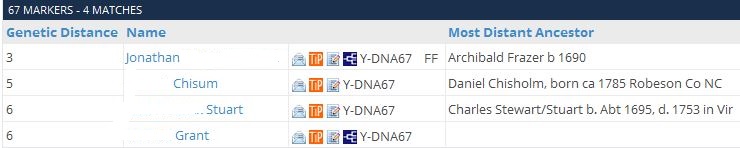
Part of Jonathan's YDNA Match Map
Part of Jonathan’s YDNA Match Map

These are 3 of the 4 matches that show up on Jonathan’s YDNA match map. The other match was Chisholm in North Carolina. Without a European location, that match location is unhelpful and inconclusive. I’m not sure why Paul doesn’t show up on the map. At any rate, I was struck by the number of YDNA matches that Jonathan has in this Northeastern part of Scotland at the 37 STR level. It seems more than coincidental. The marker in the middle is a Grant. The other two do not have their names listed. Note that Keith is in the area to the East of the middle marker. This is the place where Aunt Mabel had our first Frazer.

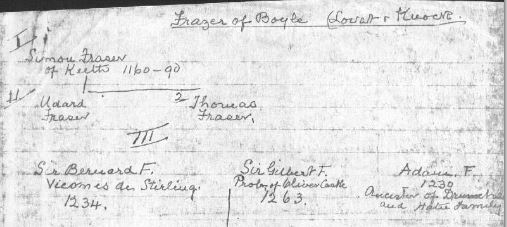
Simon of Keith

I’m not thoroughly endorsing the old research, but it is interesting that there can be some parallel conclusions between it and modern DNA testing. Also note that this would be about as early as there would be surnames. According to Scotlandspeople.gov.uk,

Norman influence filtered into Scotland after their invasion of England, and was actively encouraged by Scottish kings. Anglo-Norman nobles acquired grants of land around Scotland and introduced the feudal system of land tenure. For example, Robert The Bruce was a descendant of Robert de Brus who fought with William the Conqueror at the Battle of Hastings. Bissett, Boyle, Colville, Corbett, Gifford, Hay, Kinnear and Fraser are all originally Norman names, which first appeared in Scotland in the 12th century. Menzies and Graham are recognised Anglo-Norman surnames also first seen in Scotland at this time. 

Paul’s Other YDNA Matches

There are a few odd things about Paul’s matches. First at the level of testing that he did (37 STRs), he only has 4 matches where Jonathan has 13 matches. My unsupported theory on this is that the James Line as seen in Jonathan has more of the original Frazer STR type and the Archibald Line as seen in Paul’s results branched off or mutated away from the original STR type. Here are Jonathan’s 13 matches at the 37 STR level of testing:

Jonathan's YDNA 37 Matches

I don’t show it, but Jonathan has:

  1. One match at GD=1
  2. Two matches at GD=2
  3. Five matches at GD=3, and
  4. Five matches at GD=4

William Frizelle is at the top of both lists. However, Jonathan has a GD of 1 to him, where Paul has a GD of 3. That means that genetically, and without taking into effect the speed of mutation of the individual STRs, Jonathan is more closely related to Frizelle than our Frazer tester Paul. It does not mean that he is actually more closely related. This is due to the fact that DNA can mutate whenever it wants. Apparently it wanted to more between Jonathan and Paul than between Jonathan and Frizelle. Also, there is a phenomenon called back mutation which can confuse the issue. If a line had a specific STR value of say, 10 and it mutated to 11 and then back to 10, there would be 2 mutations, but it wouldn’t be easy to detect and it would look like there was no mutation at all. I’m not saying that is what happened here, or that it is common, but it is possible.

Obviously, Jonathan and Paul match each other. Other than that, Latham and Chisolm are on both lists. In additions, they have a GD of 4 on both lists.

Another interesting thing is that Paul does not show a match at this level with Stuart/Stewart or the many Grants that Jonathan matches.

Matches at the 25 STR Level

FTDNA posts matches at the different levels of YDNA testing. They turn out to have different matches in some cases, due to the specific STRs tested. At the 37 level, above, the cutoff for matches is a GD of 4. At the 25 level, they only allow a GD of 2 or less. Here, the differences between Jonathan’s and Paul’s matches are even greater. Jonathan has 20 matches and Paul has, again, 4. However, Jonathan’s 1st 4 matches match Paul’s 4 matches. At this level, Jonathan has a perfect match with Frizelle, where Paul has a GD of 1 with Frizelle. This tells me that Frizelle must be L664. Remember that a DYS388 Marker value of 10 means one is an L664. DYS388 is the 8th value. A 25 STR test includes the 8th value. A perfect match between Jonathan and Frizelle means that Frizelle must have a DYS388 Marker value of 10.

By the way, I wrote to Frizelle asking if he had a 10 at that marker level. It would be good to hear from him, but even if I don’t we now know he is L664. At this level of matches, Latham drops out (although, he still matches Jonathan). The common match that is replaced does not have a most distant ancestor, but the tester’s last name is listed as Plate.

Way Down to the 12 Marker Level

Here the matches between Jonathan and Paul are even greater than before. Now Jonathan has 2 pages of matches for a total of 38 matches. Paul, again, has only 4 matches. At this level, FTDNA only allows a GD of 1 or less. Here are Paul’s matches at the 12 level:

Paul's YDNA 12 Matches

Some facts and/or observations:

  • Paul has no perfect matches at any level. Again, I take this to indicate that Paul’s line has some unusual mutations in the YDNA compared to Jonathan’s YDNA.
  • If we hadn’t collaborated in this Project I wouldn’t know the STR values for Jonathan. So we wouldn’t know that Jonathan and Paul were both L664’s
  • Jonathan has 10 perfect matches. These all must be L664’s.
  • I wonder if testers #2 and #3 (Riley) in Paul’s match list above were testing to the same distant ancestor. It looks that way.
  • Tester #2 has a terminal SNP of L664, but we know that already as this person is a perfect match with Jonathan who is has the STR of 10 at DYS388.
  • Even at a level of 12 markers, Paul has a GD of greater than 1 with Frizelle.
  • Although the 12 marker and 25 marker results are interesting, the highest level of testing is most accurate and important.

Next up: I believe we have some more Frazer autosomal DNA results.

The Frazer YDNA Reveal: Part 3

In a previous Blog on the YDNA of the Frazers originating in North Roscommon, Ireland, I promised a reveal on the YDNA of my cousin Paul. As you likely recall, Paul is from the Archibald Line originating about 1715. Jonathan, who represented the James Line originating about 1717, had his YDNA tested a while back. This is what we were hoping to find out by having these two people test their YDNA:

  • Are the Archibald and James Lines related to each other?
  • Were the two Frazer Lines unbroken from the early 1700’s (or earlier) to now?
  • Were Archibald and James Frazer brothers?

YDNA, Autosomal DNA, Mitochondrial DNA, X Chromosome?

There are different types of DNA testing. They are well explained at 4 Kinds of DNA for Genetic Genealogy. Basically, with YDNA, we are looking at the father’s father’s father going back tens of thousands of years. The more you test the YDNA, the closer you get to present day. So this starts at the beginning of mankind and work toward the present. This type of testing is critical to one name studies. As we are looking the one name of Frazer, it makes sense to test YDNA. Autosomal DNA (atDNA) is pretty much the opposite of YDNA. This starts at the present and works back along all your lines. However, the further back you go, the more diffused the atDNA becomes. Some ancestors’ atDNA may drop out altogether.

First, the FTDNA Comparison

In my last Blog, I mentioned how Jonathan was R-M512. FTDNA has a computer program that looks at Jonathan’s 37 STR test. The STR test is like a YDNA fingerprint. Except in this example, the fingerprint is not always unique. FTDNA then classifies those STRs and determines what SNP test Jonathan would be positive for if he took the SNP test. The SNP is more of a positive unique ID test where the STRs can sometimes be ambiguous. However, R-M512 was not terribly helpful for Jonathan as it occurs sometime in the Stone Age. Ugh. Joanna put Jonathan’s results into an FTDNA Project called R1a1a Subclades. Based on the expert talents of the administrator there, that administrator was able to place Jonathan further down on the R1a tree at a place called L664.

Now last Sunday, when I was in New Hampshire, I got news that Paul’s YDNA results were in. This is what I was waiting for. This would tell us if the 2 branches were the same family and if the lines were unbroken. If this were to be the case, then the YDNA results would apply to all Frazers in the project and tell them about their deep ancestry.

FTDNA simply said that Paul’s Haplogroup (estimated SNP) was R-M198. This was further back in the Stone Age and less helpful than Jonathan’s results. For some reason, the combination of STRs did not compute well with FTDNA’s algorithms and they gave a very conservative answer. The good news was that both Jonathan and Paul were R1a which is a fairly rare YDNA for Northwestern Europe.

Jonathan and Paul by STRs

The STRs are the markers used to fingerprint the YDNA. According to Paul’s match list, Jonathan and Paul differ by a GD of 3. Now a GD is not a swear, it is something called Genetic Distance. It is simply how far off the markers are from another set of markers. So out of the 37 markers tested, there were 3 differences between the markers of Jonathan and Paul. The R-M512 is Jonathan and the R-M196 below is Paul. Can anyone spot the 3 differences?

Jonathan's STRs

Paul's STRs

I had to look very closely at the screen. The first difference between the 2 Frazer lines is at the fourth STR. Jonathan has a 10 and Paul has an 11. The other differences are on the right. 3 from the right end we see Jonathan with a 35-38 and Paul with a 35-40. The difference between 38 and 40 is 2 accounting for 2 of the 3 GDs. All of these positions have names.

STR Labels

Again a bit of an eye strain, but the differences between Jonathan and Paul are at DYS391 and CDY. Notice that these STRs have different colors. That is because the different STRs mutate at different rates. The red STRs have faster mutation rates. The blue ones change more slowly. The differences in the blues just represent different levels of testing. The higher the number of STRs tested, the lighter, the color of blue. So CDY where there was a GD of 2 is a fast moving STR. One would expect this would be where there would be a difference of 2 if there was to be one. The other marker of DYS391 is a slower mover. However, each STR has a published mutation rate. I have seen published rates for DYS391 that are faster than DYS385 which is shown as a fast mover. So there is more than meets the eye.

FTDNA’s TiP Report

FTDNA has a tool called the TiP Report. This is another mechanized way to estimate how closely you are related to a YDNA match. First, here are Paul’s YDNA matches:

Paul's YDNA Matches

I left out the tester’s names on the left. These are Paul’s 4 YDNA matches. He has fewer matches than Jonathan. Perhaps this is because he has a more unusual combination of STRs. Paul’s first 2 matches have a GD of 3, the last 2 have a GD of 4. That is why they are further down on Paul’s match list. When I run the TiP Report, this is what I get for Jonathan and Paul.

TiP Chart Paul Jonathan

This works out well, as our best guest is that Paul and Jonathan should have a common ancestor 8 generations ago. Given that, FTDNA thinks there is a 44% chance of Archibald, born around 1690 as being the common ancestor of these two. Hey, it could happen. FTDNA takes into account the speed of the mutations mentioned above, but as I mentioned above, there are differing opinions as to which  mutation rates to use.

R1a1a Project Administrator to the Rescue

When I had my own Hartley R1b YDNA a while back, I found the Project Administrator to be dedicated, intelligent and helpful. So I didn’t hesitate to join Paul to the R1a and Subclades Project as soon as I got home from New Hampshire as I had a feeling that the Administrators would have some good advice and information. I was surprised to get an email the next day from Martin from the Netherlands. He had written Joanna and myself and had some recommendations. Part of what he had was generic for the L664 group. Part of what he had to say was specific to Jonathan’s and Paul’s YDNA results.

The Reveal

I had promised a reveal. And the answer is…. [Break for commercial] Yes, they are related. Based on Martin’s expert opinion, he was able to determine that both Jonathan and Paul were from the L664 group. I had mentioned in my last blog that Jonathan appeared to be in the process of being placed in an L664 Group. I counted and there were 61 different L664 groups, so quite a few. Here’s where Martin’s experience came in. He could tell without testing for L664 that Jonathan and Paul were L664. Here is part of the standard L664 introductory email:

Because your haplotype shows DYS388=10 this means you are part of the subclade 2. (North-Western European Branch). For all other members of haplogroup R1a1 the value of DYS388 is nearly always 12, this means DYS388=10 is an unique marker for our subclade 2. This subclade 2. is further identified by the SNP’s CTS4385 and L664.
So back on the STRs above. DYS388 looks like the 7th marker. Actually it is the 8th as one marker before it is a double marker. Your will see that both Jonathan and Paul have a value of 10 there. This is the marker that sets the Frazers apart. Further I responded to Martin’s email and he wrote back:
I think both Frazers must be related because their STR-haplotypes are very rare in Ireland.
This is why I was surprised at the initial results from Jonathan: due to the unusual YDNA type he had. However, I’m glad that Paul matched him. I found this statement also interesting:
It is very remarkable that nearly all members of R1a1-CTS4385 (about 97%) have their origin only in the countries around the North Sea (British Isles, Norway/Sweden, Denmark, NW-Germany, Netherlands). The subclade R1a1-CTS4385 is represented by only 0,2 – 0,9% of the total population in the countries around the North Sea.
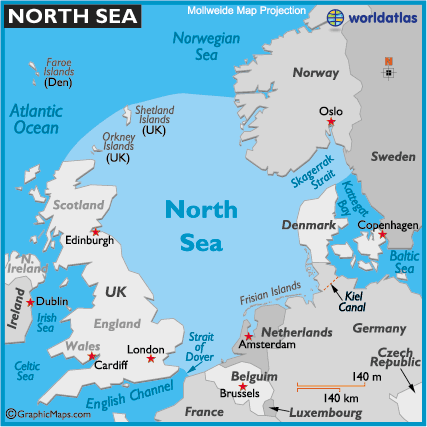
For clarification, R1a1-CTS4385 is the branch of the Frazer Tree above L664, so essentially the same thing. So L664 is rare, but rare can be good in identifying relatives. Here’s the North Sea for us geographically-challenged Americans:
northsea
One point of putting this map up is that Ireland does not border on the North Sea. If L664 types are 0.2-0.9% around the North Sea, they must be quite a bit less in Ireland. But how did these ancestors make their way from the circumference of the North Sea to North Roscommon. The answer to that question could lend or take away credence from some family traditions linking the Frazers to the Highland Clan Fraser of Lovat.
More On L664?

Nah, that’s enough for now. There will be more time later.

What Did I Learn?

  • The YDNA testing answer to whether the Archibald and James Lines are related was not as simple as I thought it would be. It took some digging and Project Administrator expertise to find the answer.
  • The 2 Frazer Lines are indeed related. This adds to family lore, older research and the Elphin Census of 1749 which shows the 2 families plus a third widow family living in Aghrafinigan, County Roscommon.
  • The 2 Frazer Lines as seen in the YDNA results have not changed from the time of the common ancestors. That is, other than expected minor mutations that occur in the STRs over time on a regular basis.
  • This strengthens the case for our autosomal matches between the 2 lines being just that (as well as being matches between related families).
  • It looks like we are on the right track with no skeletons in the closet
  • Asking whether 2 early 1700 men were brothers should be too much to ask of DNA results.
  • I am thankful for all those who have tested their YDNA in the past and provided information for YDNA trees which can be used today.
  • I am also appreciative of dedicated and talented Haplogroup Administrators.
  • A lot of other stuff, but I don’t want to be that boring right now. Wait until later.

Frazer Y DNA: Part 2

My first blog on Frazer Y DNA was called Why Test the Y? In that Blog, I introduced the concepts of STRs, SNPs and discussed some of Jonathan’s initial test results. Jonathan is the only male Frazer direct line descendant that has YDNA results so far. As such, we are assuming that his results apply to all Frazers. I’m not putting all my eggs in one basket, so I have had my second cousin, once removed, Paul, take a YDNA test also to confirm Jonathan’s results. A match should show that Jonathan from the James Line of the Frazers and Paul of the Archibald Line are most likely brothers. It would also show an unbroken line from these early 1700’s brothers to these 2 modern day male Frazers.

Joanna posted Jonathan’s results on the Fraser and Septs web page where anyone who has the remotest inkling of being a Fraser has posted their DNA results.

Fraser and Septs

However, as it turns out, there are not many Frasers/Frazers with the brand of YDNA that Jonathan has. Jonathan’s brand is R1a which took a Northern European route to Scotland – perhaps via Vikings. The majority of those in the Fraser group are R1b. These people took the Southern European route out of SW Asia to get to Scotland. As the common ancestor of these 2 is probably in the 10,000 year range, you can see we are not closely related to the R1b. However, there were two other Frazers in the R1a group. They are a Frazer and a Frazier. Interestingly they both have a ‘Z’ in their names, so that  was encouraging.

The R1a Project

The Frazer and Sept Group has about 1879 members. The R1a Project has 4390 members. I asked Joanna, Jonathan’s sister, to make sure that Jonathan was in the R1a Project. She did that as soon as she got back from a visit to France. R1a administrators would be able to further classify Jonathan. Family Tree DNA (FTDNA) had Jonathan as a R-M512. This is what they are sure he would test out if he had done a SNP test. This was based on the 37 STR YDNA test that Jonathan had. 37 STRs is a pretty basic level. 12 STRs and then 25 used to be the basic level. This R-M512 designation gets us up to about 6,000 years ago. It’s better than 10,000 years, but still not very helpful. At that point Jonathan’s ancestors were roaming around Asia according to the map below.

719235

Above is the new R1a Tree which has changed since my last blog on YDNA of less than a month ago.  Notice that M512 is actually 6,500 B.C. and R1a goes all the way back to 16,000 B.C.! Let’s see if we can get Jonathan out of Stone Age Asia.

Каменный_век_(1)

So, What is Jonathan’s New Classification?

People who are skilled at looking at the STRs can determine, based on the results, a better estimate of where Jonathan should be on the SNP tree. Each SNP can have a signature STR which can be determined by spreadsheet or a skilled interpreter. This interpreter would also be able to recommend focused SNP testing to get further down the YDNA R1a Tree. Previously, when I looked at Jonathan’s results, it said something like, “Awaiting Classification”. Now it looks like this:

L664

The note in red now says, “L664 results ready for classification”. My interpretation of this is that the administrators took Jonathan out of the unclassified bin and put him with the L664’s. They will then likely separate him into the group of L664’s where he best fits.

An Unexpected L664 – Is This Right?

First the good news. L664 is about 3,000 B.C. So that moved Jonathan up 3,500 years and got him out of the Stone Age. Not bad. The shocker is that L664 is Germanic. From the R1a Tree above, I would’ve assumed that the Frazers were more in the Z284 Branch. These are the Norsemen on the R1a Chart. Below this branch is seen the Scots. However, the Germanic L664 did migrate North to Scandinavia, so the results apparently are the same. How we got there was different than expected. Note on the map, some of the L664’s made their way to SE Britain. This could have been a less likely path to Scotland.

What’s Next?

We’ll wait to make sure the L664 designation was correct. Then we’ll see on what branch of the L664 Jonathan is. I expect in a month, we will have Paul’s YDNA results. I am eagerly awaiting those results.

I wonder if the other 2 R1a’s in the Fraser and Septs project (Frazer and Frazier) are also L664. If they had uploaded their results to the R1a project, perhaps we would know the answer to that question.


Where’s the DNA from My 3rd Great Grandfather James Frazer?

In the Old Days of Frazer Genealogy

When I started looking into my Frazer genealogy, I had a few breakthroughs. One was when I got in touch with my Frazer relatives in Ballindoon. They were still on the old family farm. I eventually made it out there with my wife and met Eileen Frazer nee McMaster. She was able to fill me in off the top of her head concerning Frazer history in the area.

My second breakthrough was discovering Doug Vaugh and getting to know about his research and that of his relatives in the first half of the 20th century. Seems that they had an interest in Frazer genealogy. Much of their research had to do with their family interest in securing  a Frazer Coat of Arms. However, their research was quite extensive as to the Frazers in the area of North Roscommon and South Sligo which were of interest to me. I tried to piece together what they had with the vital records that I had.

A third great help I had was Arthur Livingston, a researcher in the area. He was related to me on the McMaster side, but was willing to look up Frazer information for me also.

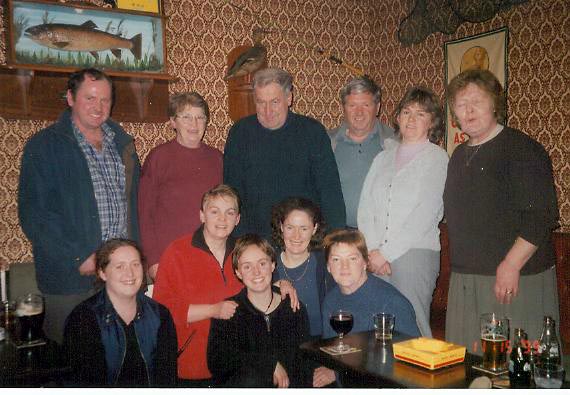
Here’s a photo of many of the Frazers I met on my first trip to Ireland. They were visiting Eileen who was celebrating her 70th birthday. She is the second person in the back row.

Frazfam

Finding James

Figuring out who my 2nd great grandfather, George Frazer,  was was not too difficult. After all, we had photos of him. The family still had his old house. Eileen knew of him as “old George”.  However, his father James was a bit more mysterious. There was no problem finding his wife Violet Frazer. She even had a birth record and was mentioned in Doug’s early genealogical sleuthing relatives’ works. Here she is under Richard.

Early Frazer Research

How Did I Choose Philip As James’ Father?

I checked the land records. It appeared that there was continuity in the lands between Philip and James as seen by the Tithe Applotments and Griffith’s Valuation. My Frazers relatives took me on an outing to view the old house where my 2nd great grandfather lived in North Roscommon before moving to Ballindoon. I believe his parents, James Frazer and Violet Frazer also lived there. Who knows, maybe his grandfather Philip also lived there?

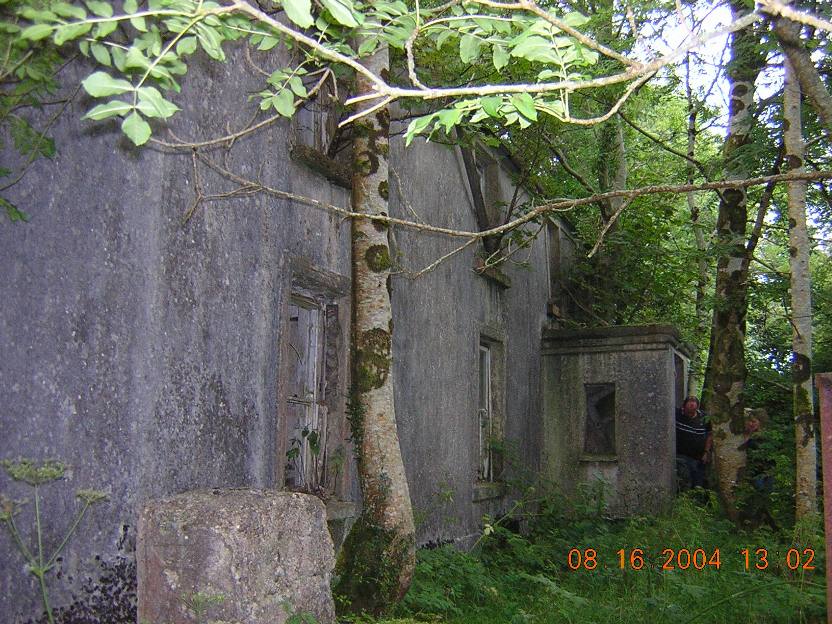
Derrycashel House

I checked the naming of James’ sons. The first I had as being Philip. It would be traditional to name the 1st son after the father. Also my 2nd great grandfather (James’ son) was named George which was the name of one of Philip’s sons also. By the way, James’ and Violet’s second son was Richard. It was a tradition to name the second son after the mother’s father. Violet’s father was Richard.

Now I’m Looking For James’ DNA

I have gone from looking for James’ ancestors, vital records, and land records to looking for his DNA. I suppose that James would be surprised to learn that one of his descendants would be looking for his DNA. Especially since no one had an inkling of what DNA was in the 1800’s.

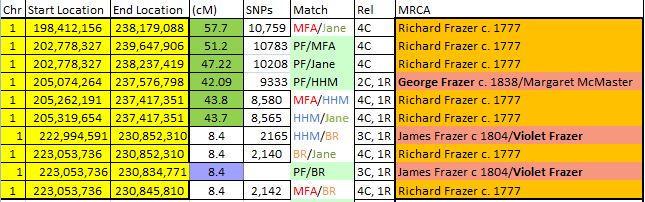
Bill and I share as common ancestors James and Violet Frazer. When Bill first tested his DNA, I thought I’d find tons of matches due to our double Frazer ancestry. It turned out that Bill was in 2 Triangulation Groups (TGs). However, both of those TGs pointed to Richard Frazer b. about 1777. This would indicate that our common ancestor based on this DNA match is with Violet Frazer as Richard’s daughter, but not James.  This was a bit frustrating as I already knew more about Violet than James. I didn’t need to have her genealogy verified by DNA. I needed the DNA to verify James’ genealogy.

In the first TG, there were Paul (PF), my 2nd cousin, once removed and my sister Heidi (HHM). I had been so focused on the Most Recent Common Ancestor (MRCA) of the Triangulation group (Richard Frazer) that I had forgotten to focus on my own MRCAs – or in this case – Bill’s. So I colored the more recent MRCAs in a different color (pinkish). Then I could see James and Violet. However, in this TG, as Violet descends from Richard, we still don’t see James.

TG01

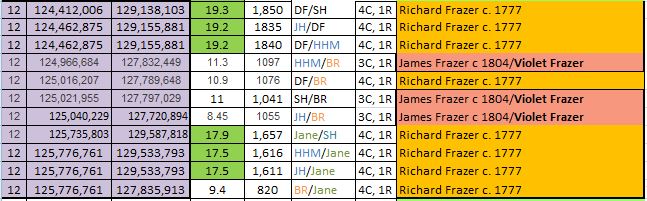
This was basically the same in the second TG found at Chromosome 12.  Where my sister Sharon and I weren’t in the first TG, now Paul doesn’t show up in the second TG:

TG12

Here again we see Violet Frazer. Note that although technically James is shown as an MRCA, he’s not an MRCA of the TG as this is a Richard Frazer TG. That is one way to narrow down whose DNA is whose. So as I’m mapping my chromosome, that small section of my 12th chromosome is from Violet Frazer and not James (her 1st cousin husband).

Next I looked to see if I could find James’ DNA outside a TG. I did find it here:

Paul Bill Match

Here at Chromosome #8. It’s a good thing I asked Paul to have his DNA tested or I wouldn’t have found this match. I didn’t match with Bill here and my 2 sisters didn’t. It took 4 tests not counting Bill’s to find this match. I still don’t know if this is James’ DNA or Violet’s. However, we’ve already found Violet’s DNA two times. This may be James’ DNA. Quite elusive. So if you don’t find a specific match that you are looking for, remember how difficult it was to find this match. Part of the reason that this match was found was that Paul is a generation closer to James and Violet Frazer than I am. That gives the DNA more of a fighting chance to show up.

Untangling the Frazers

Due to cousins marriages and other intermarriages back in the day, some of the Frazer genealogy has become enmeshed and tangled. The DNA match results may also seem the same way. Triangulation is helping to see where the various DNA matches came from and untangling things. For example, at Chromosome 1 as shown above, Paul and my sister Heidi have as common ancestors George Frazer and Margaret McMaster. Bill and my sister have as common ancestors James Frazer and Violet Frazer. Due to the fact that these people are in a TG of people that descend from Richard Frazer, born about 1777, we may say that the DNA that Heidi and Bill share was from from Violet Frazer, not James Frazer. Likewise, the DNA that Heidi and Paul share is from George Frazer and not Margaret McMaster.

This clarifies things a bit and should be helpful in future analysis. This is important in my research as Margaret McMaster has another Frazer ancestor. Her name was Margaret Frazer and she married a McMaster in 1813. This would indicate that these 2 DNA matches in Chromosome 1 and 12 were not from that Margaret Frazer. I should be looking for that match elsewhere.

Other Untanglings

As mentioned above, the Chromosome 12, the DNA that my two sisters and I share with Bill represent Violet Frazer and not James.

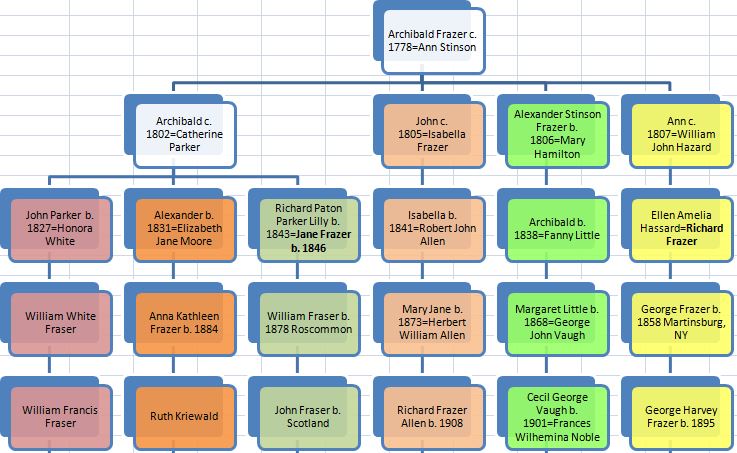
In my blog, News Flash: A Third Frazer Triangulation Group, I mentioned the Chromosome 4 TG that Jane, Michael and Doug were in. Here is the genealogy:

Archibald TG

Testers in the light blue line (Jane), pinkish line (Michael) and green line (Doug) formed a TG. From the TG and the genealogy, we can say:

  • Jane’s Chromosome 4 match represents Archibald Frazer and not her Parker line. From there that Chromosome 4 DNA traveled down through Richard Paton Parker Lilly Frazer rather than Jane Frazer and further down the Frazer line. In this case, this should have been evident anyway from the genealogy, but the DNA confirms it.
  • For all three: Jane, Michael, and Doug, the DNA match cannot differentiate between Archibald Frazer and Ann Stinson. However, after that the descent of their Chromosome 4 match is clear by the genealogy.
  • Again, from the genealogy and the TG, this Chromosome 4 match for Michael is through his ancestor John Frazer and not John’s 1st cousin bride Isabella Frazer.

Next up: awaiting Pat Boggitt’s DNA results. She is also a descendant of James Frazer and Violet Frazer. Her DNA may shed more light on James Frazer.

My Frazer Cousin’s DNA Results Are In

I’m so happy that my cousin Paul’s autosomal DNA results are in. He is my second cousin once removed. He is also a generation closer to my Frazer 2nd great grandparents. That means his DNA results should be better than mine in matching others. Here are my 2nd great grandparents (Paul’s great grandparents) at the farm in Ballindoon, County Sligo. Both Paul and I descend from the first 2 people in the photo: George Frazer b. about 1838 and Margaret McMaster.

Frazers

I like this photo, but I can’t help but think the family looks a bit sad. Perhaps they missed my great grandfather who moved to Boston. There were 9 children and at least one additional child that appeared to have died young. Out of those surviving 9 children, there are only 3 in this photo taken at the family farm in Ballindoon.

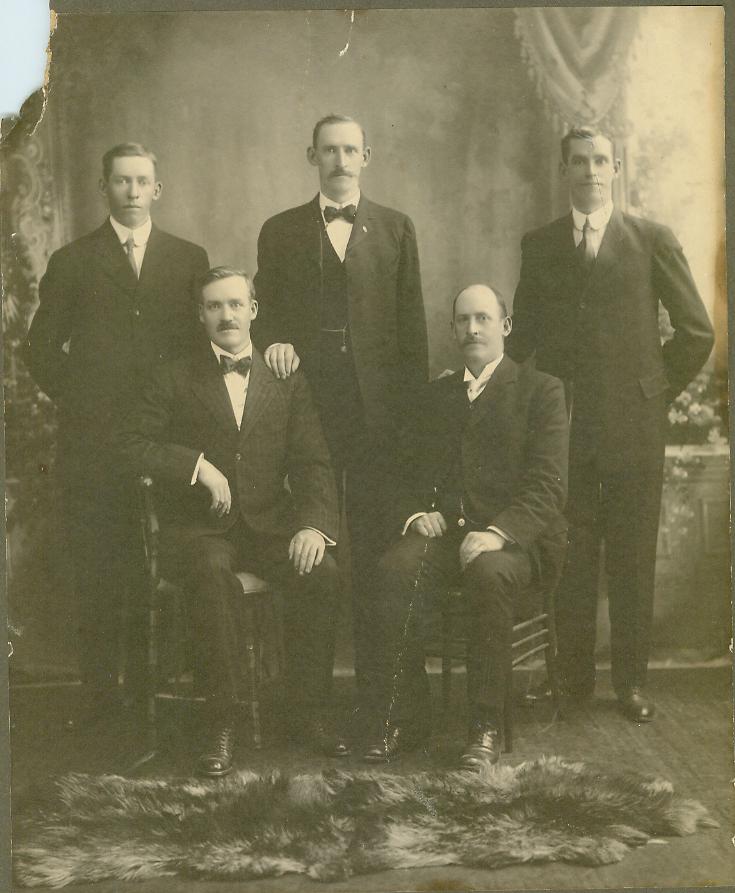
Meanwhile, in Boston, here are 5 of the 7 Frazer brothers.

5frazerbrothers

Let me introduce you to my great grandfather who is sitting down on the left. He is the oldest in the family. Hubert is Paul’s grandfather standing on the far right.

Paul’s DNA

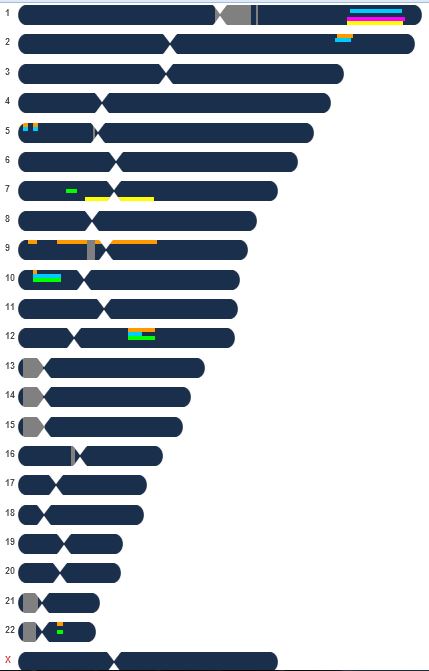
So let’s look at some of Paul’s DNA matches. Here is how Paul matches my 2 sisters and myself. Also for reference, I have his 2 other largest Frazer matches at Family Tree DNA (FTDNA)

On the browser below Paul matches the following relatives:

  • Sharon is orange
  • Heidi is blue
  • I am green
  • Michael is pink
  • Jane is yellow

Paul's DNA FTDNA

There are some places where I don’t match other Frazers in the project. These would be good candidates for McMaster matches as Paul and I both share Margaret McMaster as an ancestor. For example, look at Chromosome #9. Paul matches my sister Sharon for a large stretch shown in orange. There is a large match there where neither Paul nor my family match other Frazer testers in the DNA project. My guess is that is where Sharon and Paul share DNA with Margaret McMaster.

But, there is more going on at Chromosome #9 and it ties into a previous blog I wrote on the X Chromosome called The X Factor – Part 2. I’ll try to explain what Paul and Sharon’s match on Chromosome #9 has to do with the X Chromosome. First a word on triangulation.

A Possible Frazer DNA Triangle?

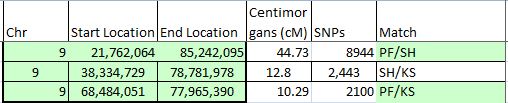
Paul’s testing resulted in an additional Triangulation Group (or TG). These are good things because they are DNA’s way of telling us that those in the TG come from a common ancestor.  However, is this common ancestor from a Frazer or a McMaster? This new TG looks like this.

TG Paul Sharon Karen

This is the classic 3 person TG where Paul (PF) matches Sharon (SH), Sharon matches Karen (KS) and Paul matches Karen. Now this is where I’ll tie it all together in an amazing or unbelievable way (depending on your point of view). Karen is the karen I mentioned on my X Chromosome blog. She had a huge X match with Sharon. My guess at the time was that karen’s X match went through Margaret McMaster back past her grandmother who was Margaret Frazer. Then back to Margaret’s unknown father as the likely common ancestor. It’s a little easier to see here:

Dad's X Inheritance

So in this scenario, Paul and Sharon’s large match represent Margaret McMaster above b. 1846. But the TG of Paul, Sharon and Karen represents (probably) the father of Margaret Frazer above. I had been thinking that Karen may be related on the McMaster side. That is another option. However, Karen isn’t aware of McMaster ancestors, but she is aware of one Frazer/Frazier ancestor from the area. Actually, if Karen’s TG ancestor is the same as her X Match ancestor, I suppose the match could be anyone in pink or blue to the right of Margaret McMaster on the chart above. I just thought the Frazer scenario fit in with what Karen knew about her ancestry. Another note is that the X match and the Chromosome 9 match don’t have to represent the same ancestor. One could be a Frazer and one could be a McMaster. At any rate, it is a case where genealogy, triangulation group and X Chromosome match appear to work together.

Paul’s Gedmatch Results on the Archibald Line

Paul and I are on the Archibald line which goes back to the early 1700’s. Here is how he matches up with those on that line by gedmatch. In this analysis gedmatch lowers their match results a bit to 5 cM.

Paul cf Archibald Line

Going across the top line, Paul matches the first 6 who have a common ancestor of Richard Frazer b. 1777. The last 3 people have as their ancestor another Archibald who was the brother of Richard. He has either no matches or small ones with them.

And the James Gang

The way the project has been split up we have looked at the Archibald Line and the James Line. These 2 likely brothers have a whole bunch of descendants. Here is how Paul matches James Line descendants.

Paul cf James Line AVG

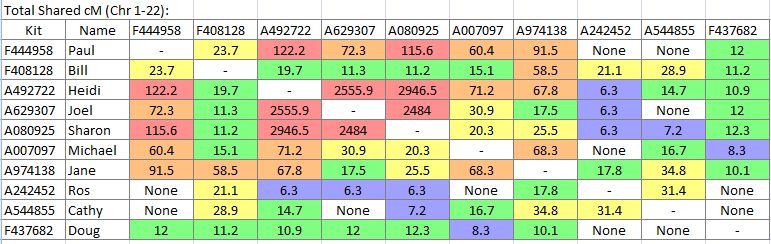
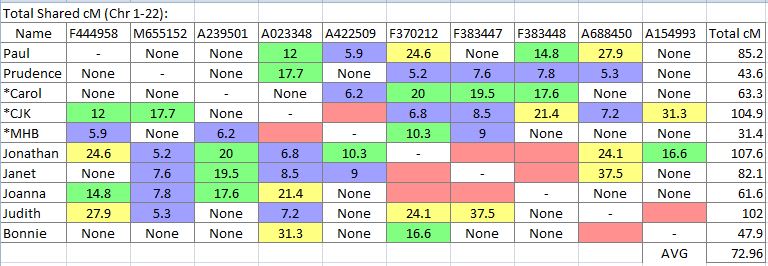
Interestingly, Paul’s largest match here is with Judith. Judith is related to Bonnie, but Paul has no match with her. Also I did something different here. I deleted all the cM values for the close relations. Those are up to second cousins shown in pink. Then I added a column to the right. This adds up everyone’s matches (minus the close relations). At the bottom I took the average summed cM value for the James relations. What this tells me is that Paul is likely as related to the James Line testers as the James lines testers are related to each other. This report doesn’t seem to be the most accurate as Paul actually does have a match with Janet which doesn’t show here.

More On Archibald Line TGs

Aside from the new TG Paul is in (which may not be a Frazer TG), we had 3 Archibald Line TGs. The third, discovered after Doug tested, was in the Archibald-Ann Stinson Line that Paul is not in. That leaves 2 other TGs. I had previously thought both these TGs went back to Richard Frazer b. 1777 and his unknown wife. Now I’m not as sure.

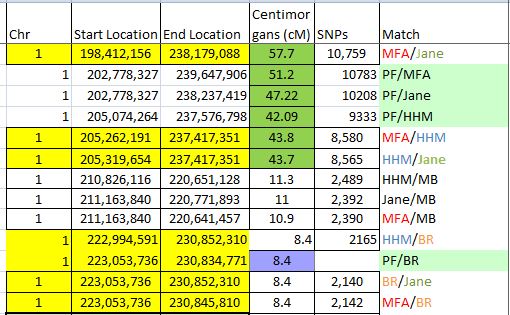
The first of the 2 TGs is in Chromosome 1. Here is what it looks like.

Chromosome 1 TG

Note that in this TG are Michael (MFA), Jane, Paul (PF) and Heidi (HHM) with huge matches. Then there is Bill (BR) and Mike (MB) with smaller matches. Mike is someone who isn’t in the project but appears to be in the TG. Note that my sister Sharon and I are not in this TG due to the random way we inherited our parent’s DNA.

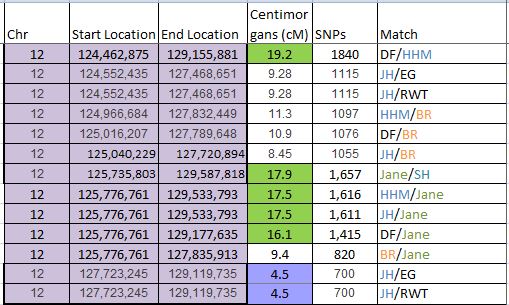
The second TG is on Chromosome #12

Chromosome 12 TG

In this TG is Dave from Canada. EG and RWT are other people not in the project but appear to triangulate with our group. This means they should share common ancestors. My sisters Heidi and Sharon as well as I are in this TG. Jane is here and Bill.

Why I doubted both these TGs were from Richard b. 1777 and his unknown wife.

  • DF is only in the second group. We’ll call that TG12
  • Paul is only in the first group. That would be TG01
  • Michael is only in TG01

Why I am staying with these 2 TGs both representing Richard Frazer and wife:

  • DF didn’t match Paul by DNA, so that makes sense that Paul wouldn’t be in a TG that DF (David) was in.
  • Paul is unquestionably related to me and my family. The link we have goes back to George Frazer who was born about 1838. That means before that time we share the same ancestry. Paul isn’t in TG 12 with my sisters and me, but he would share the same ancestors we have from that TG by genealogy.
  • I think I can extend the same logic to Michael (MFA). He can’t share a different genealogy with Paul separate from my family. This is because Paul and my genealogy are locked in from 1838 and before.

I think that makes sense. It’s a good brain teaser at any rate.

In Summary

  • Paul’s DNA results appear to solidify rather than question 2 existing TGs leading back to Richard Frazer b. 1777. As a side note, I don’t know if it’s normal to have 2 TGs for one couple – especially that far back. Something to look into, perhaps.
  • Paul’s DNA also netted a new TG. This one involves karen who had a mysterious huge X Chromosome match with my sister. The apparent common ancestor appears to go back on my McMaster line. However, this line had another Frazer in it.
  • Paul is related to the James as well as the Archibald line. This is likely due to the Margaret Frazer who married one of our McMaster ancestors.
  • Places where Paul match my family but not other Frazer DNA Project testers will likely represent our shared McMaster ancestors. These McMaster ancestors lived somewhat parallel lives to the Frazers. They started out farming in South Sligo and the Frazers started out farming in bordering North Roscommon.

Spotlight on Frazer DNA Testers: Bill the Universal Donor

I’d like to spotlight each Frazer descendant that has donated DNA to the Project, but I don’t know if I’ll get around to everyone. I’ll start with Bill from Canada.

My blood type is O positive and I get a lot of calls from the Red Cross to donate blood. However, O negative blood type is called the universal donor. I’m calling Bill the Universal Donor in our Frazer DNA Project because he has so many Frazer ancestors. When I first asked Bill to have his DNA tested, I thought it would work well because I had that we shared 2 Frazer 3rd great grandparents. These were James Frazer and Violet Frazer. I had that they were married first cousins. James Frazer and Violet Frazer are the most recent common ancestors (MRCAs) between Bill and me. Most related people only share one MRCA with the same surname. The MRCA is what we are trying to confirm by DNA.

Bill’s Genealogy

When I first contacted Bill, it was before he knew of the connection to our North Roscommon Frazers. After trying to piece things together, I became convinced that his ancestors fit in with the genealogy that I had put together. Actually, at the time, I wasn’t 100% convinced myself, but I believe if you are 80% sure, that is pretty good. Bill was understandably cautious as I would be if someone contacted me and told me I fit into their family history. After going back and forth a few times, he apparently was convinced. Since then, I’ve found other links between his ancestors and North Roscommon that make everything fit in.

In the Archibald Frazer portion of the Frazer DNA Project, we are looking at 3 brothers of Archibald (b. about 1743). These are Philip, Richard and another Archibald. Actually, there was another son, John, but we haven’t been looking at him as he’s been under the radar.

Archibald Line Chart

This may be difficult to see, but Archibald is at the top. Then there is Philip, Richard and Archibald under him. Bill’s lines are in yellow. However, Bill is also descended from James, son of Philip, who married his first cousin Violet Frazer. That means that Bill descends from 3 Frazer brothers. That means he is also related to everyone in the Archibald portion of the project. Here are those testers and how they are related to Bill:

  • Paul: (awaiting results) 4C (4th cousin) twice (via James and Violet Frazer)
  • Me 4C twice (via James and Violet Frazer) just like Paul
  • David: 4C, 1R via Richard Frazer
  • Jane: 4C, 1R via Richard Frazer and Archibald Frazer
  • Michael: 4C, 1R twice through Richard and Archibald Frazer
  • Ros: 5c via Archibald Frazer/Ann Stinson
  • Cathy: 4C, 1R via Archibald Frazer/Ann Stinson
  • Doug: 5c via Archibald Frazer/Ann Stinson

I hope you see how many connections there are. There are actually more connections, because for each Frazer, there is another spouse (except for James and Violet Frazer who are already counted). Including spouses, here are the numbers of MRCAs:

  • Paul: 2
  • Me: 2 (However, my 2 sisters have been tested also, so this increases the chance of matches)
  • David: 2 (though we don’t know some of the Frazer spouses’ MRCA names)
  • Jane: 4
  • Michael: 4
  • Ros: 2
  • Cathy: 2
  • Doug: 2

This adds up to 22 connections or MRCAs just from Bill if I have it right (not counting Paul or Pat yet)! Now not all of these will result in a good DNA match. Around 50% of 4th cousins should result in a match. We, as Archibald Line DNA Testers, are on average at about the level of 4th cousin once removed, so we should be getting a bit less than half of the matches coming through to Bill. This is offset by all the Frazer ancestors Bill has. Here is a chart that puts it all together and helps it all make sense (at least to me).

Bill's Matches

This explains how everyone is related to Bill on the Archibald side of the Project. When looking at this chart consider also this simple Family Tree DNA Chart:

FTDNA Chances of Finding a Match

For my family, out of at total of 6 possible MRCAs, there were 3 DNA matches. Although, this seemed a little disappointing to me at first, this is about average or  for 4th cousins. The fact that 2 out of 3 of me and my sisters matched Bill at all would meet the >50% criteria. Jane hit the jackpot. She is at the same relationship level as David, but has more possible connections. Still, one would guess about 2 DNA matches. By the way, Jane specializes in statistics, so it figures she should get the best statistics here! She had 5 matches. Everyone else seems to be in line with the statistics with the exception of Cathy. She went 2 for 2 or at least one more match than expected.

You Think This Is Confusing Now?

Just wait. We have more tests about to be revealed. My second cousin Paul should have test results in a few weeks. Bill has a second cousin Pat with results coming out after Paul’s. This should more than double our current DNA matches. When Bill first asked me about Pat, I said ‘sure’ based on the number of matches Bill already had. Now I know why he has so many DNA matches. Bill and Pat’s 3rd great grandparents were Richard Frazer b. 1830 and Ellen Amelia Hassard. They were second cousins as they had the same great grandparents. Ellen’s mother was a Frazer. We’ll worry about that when we see Pat’s DNA test results. Here is a double dose of Frazers: Richard Frazer and Ellen Hassard (daughter of Ann Frazer):

richpatt

The James Line

I don’t like to leave the James Line out. Bill matches Jonathan, Janet, and Joanna. These are 3 siblings from the James Line. In addition, he matches Carol. Carol’s ancestor made his way to Sacramento, CA at some point and had a lumber business there. According to Joanna, she and Carol share Joanna’s 2nd great grandfather. I have that they are 3rd cousins, twice removed. Joanna has been pondering how Bill, Carol, and her family could be related.

These James Line matches do not constitute a triangulation group. If they did, it would show that those in the group had the same ancestors. Here, Bill matches Carol on Chromosome #4. He matches Joanna, Jonathan and Janet on Chromosome #6. Carol matches Jonathan on Chromosome #7 and she matches Jonathan’s 2 sisters on Chromosome #11. This could mean a common set of ancestors, or it could show that Bill matches Carol in a different way (or from a different line) than he matches Joanna and siblings.

Any Questions?

  • Bill is in 2 Triangulation Groups (TGs). These both seem to point to Richard Frazer b. about 1777 and his unknown spouse. If this is the case, then which TG is for which spouse?
  • The 2 TGs as mentioned are for the family of Richard Frazer. His daughter was Violet Frazer, Bill’s and my Most Recent Common Ancestor. I had that she married James Frazer, her 1st cousin. James would also be an MRCA of Bill and myself. If this is the case, where are the DNA matches for these 2? Did this DNA get lost? After all, Bill and I are 4th cousins which means we have a little more than a 50% of having matching DNA. This may be answered once Paul’s and Pat’s DNA results come in. Another possibility is that I was off on my genealogy.
  • Along with the fewer than expected connection between Bill and my family, my family had more than expected with Michael. I’m not sure if this is due to the contrary spirit of DNA or if this is saying something there is something in our genealogical connections that we haven’t yet found.

What did we learn about Bill’s matches?

  • By looking at all the 22 possible relationships (or MRCAs between Bill and the Archibald Line DNA Testers), we see how Bill had 14 DNA matches. This is not counting his James Line DNA matches.
  • Even though Bill and I match a common pair of Frazer ancestors in 2 different ways, it appears that I only have 2 Most Recent Common Ancestors with Bill. Those 2 happen to be married first cousins. I had to look at the colored chart a lot to figure this out.
  • Assuming I did it right, my chart showing MRCAs and relationship levels seems to compare well with the number of DNA matches everyone in the Archibald side of the project has with Bill.

Bill has gone from not knowing he was one or our Frazers to playing a large part in contributing to the DNA evidence of the Frazer Genealogy. I’m looking forward to seeing what the next batch of tests show.


Why Test the Y?

In this blog, I want to look at YDNA. This is different from the previous blogs where we were looking at the autosomal DNA or the atDNA. The autosomal DNA is good for going back about 200-250 years. If you are lucky, it may go back some more. Also the atDNA is for both your parents and all of the parents of those parents. When you take the Family Finder test or AncestryDNA test or similar this is what you are taking. And when you get matches, you are getting matches to all of your ancestors. These are matching with everyone else’s ancestors. Not only that, these matches may represent matches with the descendants of those ancestors that not many people even know about. It is like finding a needle in a haystack.

The YDNA is much different. It just follows the father’s father’s father’s line. All the way back. Back to genetic Adam. I look at it like a LASER type of test vs. the scatter gun approach of the atDNA test.

There has been only one tester so far for YDNA in the Frazer DNA project. There is a reason that we only have one tester so far. In order for the YDNA test to be significant for the Frazer DNA project, you have to be a male Frazer. It turns out that there are relatively few of these male line Frazers around that are available and willing to test their DNA. My second cousin once removed, who is a Frazer, has recently agreed to test his DNA. His grandfather followed my great grandfather’s lead in coming to Boston, Massachusetts from Ballindoon, County Sligo, Ireland. So I’m anxious to see how his YDNA matches with our first tester and whether this proves an unbroken line between the 2 branches of our Irish Frazers back to the early 1700’s.

STRs, Genetic Distance, SNPs and Haplotypes

Our first tester tested for 37 STRs. STRs are Short Tandem Repeats. This is now the basic test at Family Tree DNA (FTDNA). However, at one time they were testing down to 12 or 25. These results are listed on the Fraser and Septs web page. According to that page, there are 1875 members. Our Frazer YDNA tester STR results are listed here.

Fraser YDNA Results

As you see, there are a lot of numbers. Everything seems to be reduced to numbers nowadays! These are the results for the R1a1 people in the Frazer group. There are only 3 people out of what I can only assume are 1,000 or more Frazer YDNA testers. The first R1a1 person is our tester. You see he has put down Archibald Frazer b. 1690 as his ancestor. The next tester also tested 37 STRs and the 3rd tested only 25 STRs. Note that all the testers spell their Frazer with a Z.

Each number in the chart stands for a different location on the YDNA. Taken together, these numbers create a YDNA type of fingerprint. The more STRs tested, the more specific the fingerprint. These locations were chosen as areas that are likely to change. The difference between the numbers of any 2 people is called the GD or Genetic Distance. This is a rough estimate of relationship. It is also a bit relative. Say someone has a GD of one when comparing two 111 STR tests vs. two 37 STR test. The GD of one for the 111 STR test comparison represents a much closer match. Here’s a closer look at the first 25 STRs of the R1a1 Frazers:

STR Locations

Frazer YDNA 25

The heading I put in doesn’t quite line up but are the locations of the STRs being tested. The first row below the heading is the maximum number for the STR. The second row is the minimum. The third row is the mode or the typical number. The purple numbers are below the mode and the pink numbers are above the mode. So our Frazer can be said to be a GD of 7 from the mode. This is because in the 7th column there is a difference of 2. All the other differences are one. For a GD of one in a 37 STR test, Family Tree gives the following chances of having a common ancestor:

Tip Chart GD1

Our current YDNA Frazer tester’s closest match is a GD of 1 match with a Frizelle. Perhaps this Frizelle was once a Frazer that changed his name to Frizelle. Or perhaps our Frazer name was once Frizelle. For comparison, his generations to the James of the James line would be 6 or 7 to the parents of the James and Archibald Lines.

Now all these STR numbers are used to estimate the Haplogroup. The estimated haplogroup is R1a1. This is the old name. The new name for R1a1 is R-M512 and  based on the test for that SNP. In the first screen shot there is a red R-M512 next to the 3 YDNA testing Frazers in the group. The SNP is red because it is estimated based on the STRs. If the SNP was tested, the color would be green. However, there is no need to test for R-M512 as the STRs already indicate that the SNP is R-M512. A SNP is a Single Nucleotide Polymorphism. In other words, it is a specific test aimed at finding a haplogroup or haplotype. So one might say that a STR test is a general description of the YDNA based on specific markers. The aggregation of these markers result in a profile that can be used to compare with other profiles. It may also be used to estimate a haplotype. The SNP test is a very specific test looking for a specific crucial spot in the YDNA that proves a specific haplotype.

One of the goals for this Frazer DNA project is to show by YDNA that the James line and the Archibald lines are related. We are pretty sure they are. However, over the years, things can happen, so it’s good to be sure. This YDNA could be used to trace our Frazer back to other Frazers in Scotland.

What is R1a1?

I’m glad I asked. When our first Frazer tested, I was expecting the results to be R1b. This is quite a common haplogroup. This is what my Hartley YDNA came back as. Some people associate the R1b with the old Celtic peoples of the area. My Hartleys were supposed to come from the NW England which is near SW Scotland where our Irish Frazer supposedly came from. So it made sense for me to guess that the Frazers would also be R1b. As I scroll down the Fraser and Septs – YDNA Colorized Chart,  I see that many of the Fraser/Frazer names are under R1b.

The difference between R1a and R1b is quite large. I would guess that these 2 haplogroups split from each other 10,000 years ago or more. The R1a people took the Northern route out of Asia accross Scandinavia perhaps and ended up in the Northern part of the British Isles. The R1b’s took the Southern route, generally, around Spain or possibly shortcutting through France and up into the British Isles.

There are also internet groups just for R1a1a people of any surname. Here is a map from one of those groups showing the migration and peoples descending from R1a.

R1a-ch

Notice that the Scots are near the Vikings. It would be interesting to see if our Frazers are positive for the L448 and L176 tests. That was the 2012 chart. There has been an explosion of testing over the last few years which has been difficult to keep up with and new branches are being discovered on a regular basis. Here is the 2015 chart:

r1a chart 2015

See all the extra branches at the bottom. Many of these are based on the Big Y DNA tests, that basically tests you for anything Y. You can see many more Scots branches near the 3rd little figure on the bottom. Unfortunately, our STR testing only gets us to about 6,000 B.C. This is caveman days, when our ancestors were still in Asia perhaps. However, as R1a is rarer than R1b the test should be good enough to show a male line match. Plus, the STR profile should be very similar.

Why Are So Few of our Irish Frazers R1a1?

There could be many answers to this question.

  • The Frasers/Frazers are apparently a large clan with many branches. Ours could be a separate one.
  • An early adoption of a Frazer could have created a different branch of the Frazers
  • DNA testing predates the adoption of surnames, septs, and clans. More than one group of people could have adopted the same surname, or become part of the same sept or clan. A review or our YDNA testing Frazer shows that his closest matches are with a Frizelle (GD=1) and a Grant and a Stuart (GD=2). This could indicate that the Frizelles, Grants and Stuarts could be related a point that predated surnames.

What Will it Mean if the Two YDNA Tests Do Not Match Each Other?

I am hoping they will match. If they clearly don’t match, then there will need to be additional testing to determine why and where that lack of matching occured. However, based on the autosomal DNA analyses done so far, I think there will be a match. There are many autosomal DNA matches between the Archibald Line descendants and the James Line Descendants. Here are the matches between the 2 lines. There are about twice as many matches since I wrote about this before in Frazer DNA – Celebrity Edition!

Matches Archibald James Lines

However, I can think of 3 ways to interpret these matches:

  1. This could be due to the fact that there were common collateral lines and these  matches are picking up the Frazer spouses common ancestors;
  2. this could be due to the fact that autosomal test is picking up this old Frazer connection that goes back to the early 1700’s or;
  3. the matches could be due to intermarrying between the 2 Archibald and James Frazer Lines subsequent to the early 1700’s.

So for now, we will sit back and wait for the new YDNA testing to come in. Then, as they say on TV, we will have our YDNA reveal.

News Flash: A Third Frazer Triangulation Group

A new Triangulation Group (TG) is big news. Perhaps not on the scale of a discovery on Mars, but on the level of Irish Frazer Genealogy and DNA research it is. Triangles have been studied since antiquity. Pythagoras did a good job of analyzing them. He came up with the Pythagorean theorem. There was also a whole philosophy based on his beliefs. Here is Pythagoras wearing his favorite tablecloth.

Pythagoras-Main

One of the more important things about triangulation, is that it can be used to find things. Given 2 distances and an angle, the 3rd distance can be determined. This may be helpful in determining the height of a tree which is otherwise difficult to measure or to find someone lost at sea.

triangulation

Triangulation with DNA

With DNA, triangulation employs a similar concept. When 3 people all share the same segment of DNA and they all match each other on that same segment, that is what we call a Triangulation Group (TG). This means that there was a couple who lived at one time a long time ago and a portion of their DNA broke off as they had children. That same portion broke off into smaller pieces in different directions through the ages and came down to their descendants today and was still identifiable by the fact that there was a match between these 3 testers. I find it quite amazing that this would even happen.

The Existing Frazer Triangulation Groups

Everyone has Triangulation Groups. These are groups that indicate that, among your DNA matches, there are common ancestors. However, it is difficult to determine which common ancestors those TGs represent without a reference point. What we are trying to do in this Frazer DNA project is identify specific ancestors based on known Frazer genealogy and known DNA matches. The first 2 Frazer TGs consisted of descendants of Richard Frazer who was born around 1777.

Richard Frazer TG

When we first found the 2 TGs, there were only 3 testing families in the yellow, blue, and salmon lines that knew they had Richard Frazer as an ancestor. However, testers in the purple and green lines above also were in the TG. We discovered that based on some of the genealogy we had, that they would fit well  in the Richard line. This is where we used the triangulation. We used the genealogical principal of going from known (the known descendants of Richard Frazer) to discovering what was unknown (placing 2 triangulated families into the Richard line who were unsure of their genealogy).

The fact that I had my 2 sisters tested for DNA helped in finding these TGs. In places where my DNA was missing in a match, it was possible to find matches in one or both of my sisters. I’m in the blue Hartley line above.

The New Frazer TG

The new Frazer TG represents Archibald Frazer, the brother of Richard above.

Archibald TG

Actually, the DNA from the TG could’ve also have been from Archibald’s wife, Ann Stinson. But all the children were Frazers, so we’ll go with that for now. Due to cousin marriages, 2 of the families above were also in the Richard Frazer Triangulation Group. I’d like to thank Doug for testing as it was his recent test that brought out the crucial third match of this new TG. He had low to moderate expectations for his results based on the chart below. However, his testing paid off in what has been called the gold standard of DNA – a new Frazer TG.

Now, out of these 6 DNA testing Frazer families, only 3 made it into a TG. Why is that? One answer is random chance. The other reason is that due to the distance of relationships represented in the chart above, the chance of even having a match goes down.

Chances of Finding a Match

Many of the Frazer descendants that tested for DNA were at the level of 4th cousin or 4th cousin once removed. At that level, the chances of matching could be at 50% or less. So I suppose that it makes sense that only half of the testers made it into the new TG.

Here is what the new TG looks like on my spreadsheet:

Archibald Stinson TG

This tells us that Jane, DV and MFA all match each other. That is the TG. They match on Chromosome 4 for about 8-10 cMs along the position from about 162,000,000 to 174,000,000. These 3 are related at no closer than 4th cousins. In the chart above, Jane is the dull green colored line. DV is in the bright green line and MFA is in the Salmon colored line.

What About the 3 Testers That Are Not in the TG?

Does that prove that they are not descended from Archibald Frazer and Ann Stinson? No. They match each other by DNA singly, but, as mentioned above, due to the way the DNA came down, they didn’t happen to be in the 3 way matching TG.

In Summary

  • This new TG solidifies years of research and gives DNA proof of the work done in this Archibald Frazer/Ann Stinson Line.
  • Others who have already tested may be found to be in the same TG. They would be relatives in this line or perhaps a line that precedes this one. They may or may not have known of their Frazer or Irish ancestry.
  • For others who have not yet tested, it may help prove or disprove the research that they have done once they do test their DNA.

The X Factor – Part 2

In the last Blog, I marveled at the amount of X chromosome my sister Sharon shared with karen. Part of my amazement was that I have not had one X Chromosome match at FTDNA out of over 1,000 matches until recently. One of the reasons for that is that FTDNA doesn’t report your X matches unless you also have an autosomal match. At any rate, women tend to have more of these X Chromosome matches with other people. One obvious reason is that they have twice as many X Chromosomes to start with.

Karen has uploaded her FTDNA results to Gedmatch. Here are my sister’s top matches on the X Chromosome.

Top X Matches for Sharon

To put into perspective the size of Sharon and karen’s match, the entire X Chromosome has a size of 196 cM. 56.2 cM appears to be over 25% of that amount. This is the X Inheritance Chart for my father. My sister got one of her X Chromosomes from him and I suspect this is the source of karen and Sharon’s match. Also note that Sharon shares more of the X Chromosome with karen than she shares with her brother (me). Karen also shares more of her X with Sharon than her own brother. And as we’ll see below, this large X Chromosome segment has stayed intact and traveled down through 2 different families from at least the last part of the 1700’s!

Dad's X Inheritance

My guess was that this X match went through my ancestor Fanny McMaster b. 1829 (in pink above) to Margaret Frazer. Margaret was born around 1800. Margaret is my father’s 3rd great grandmother and my 4th great grandmother.

What I did today was to look at Karen’s tree at FTDNA.

karen's ftdna tree

For some reason, FTDNA trees use a very large font for last names. This doesn’t work out well for longer last names. At any rate, karen’s father is Walter Wanama(ker) I believe. Karen got one of her X Chromosomes from her dad, like my sister got from my dad. Karen’s dad had to get his X from his mom Agnes Higgins. She got one of her X’es from Maryann McPartland. She got one of her X’es from Ann Fraizer of Derreenargan, Boyle, Ireland. Now Boyle is in the heart of my Frazer research area where I have my Frazer DNA project. These 2 graphics above appear to show that a large chunk of X Chromosome has traveled from the late 1700’s from a Frazer family through at least 2 other fairly distantly related families to today.

Karen’s family tree showed that her Ann Fraizer married a McPartland. Our Australian Frazer DNA project member Ros pointed out this entry from the Irish Court of Petty Sessions showing the interaction between one Frazer and one McPartland:

Archibald Frazer of Ballyfarnon Defendant  Feb 1883:  That on 16 Oct 1882 at Aughnafinigan, a nuisance took place on the defendant’s premises occupied by James McPartland to wit the dwelling house so dilapidated and dirty as to be unfit for human habitation and that said nuisance is caused by the act or default of the defendant.  “Nuisance to be abated by the 8th March and house put in proper repair and to pay costs 3/6”.  The Complainants were the Guardians of the Poor of Boyle Union as Sanitary Authority.

Where Did the X Come From?

From correspondence with Karen’s family, I see they have their Ann Fraizer b. about 1823. Here’s where I get into a bit of educated guesswork. 1823 is probably the generation of my ancestor Fanny McMaster, daughter of Margaret Frazer. It is possible that Margaret had a brother who had Ann Fraizer in 1829 or so. Now Margaret’s brother would have only had one X Chromosome from his mother. That means that under my educated guess scenario, the X Chromosome match between karen and Sharon would be from Margaret Frazer’s mother.  This would be the pink box in my father’s X Inheritance Chart to the right of Margaret Frazer. That would be my 5th great grandmother. She would’ve been born in the latter part of the 1700’s.

By the way, Karen is the about the 3rd person that has been found to be related to the Frazers of North Roscommon. They have all been found to be related by DNA. Each of their ancestors has been a single Frazer that is the end of that person’s research line.

Triangulation, Anyone?

Another person in the Frazer DNA Research Project, Kathy, was quick to note that her mom also matched Karen on the X. Here is Sharon’s match with karen (in pink and orange) and Sharon’s match with Kathy’s mom in blue, pink and yellow.

Sharons X match with Karen and CJK

As these three people overlap on their matches and all match each other, this closes the loop on triangulation. So this gives us double proof of a common ancestor between karen, Sharon and Kathy.  One is by the X triangulation and second is through the X Inheritance Pattern. This is another case where the DNA is clearer than our paper research!

Kathy’s X Match Ancestor

So now that we have narrowed down karen’s and Sharon’s X match ancestors, where is Kathy’s? She should have the same ancestor as the same X Chromosome segment was passed down to her mom. Here is Kathy’s mom’s X Inheritance chart but it won’t be pretty. It was supplied by Kathy starting with Kathy’s mother’s mother:

CJK's X Inheritance

Who the X Match Cannot Be

As vague as this chart is, it tells us who the X match cannot be. We may rule out the top half of the chart (not shown). This is Kathy’s mother’s father’s X Chromosome. This is ruled out due lack of Frazer ancestry. For the same reason, we can rule out the top part of the chart that is shown. That is the Emmet family which was not even known to be from Ireland. Then we can rule out any of the people in the white boxes. This includes the male Frazer line and ancestors before Edward Wynn Frazer.

Now look in the right hand column. Under the pink and blue which is the only place where the X match could be I don’t see a lot of entries. Even in the next to the last column there is maybe a Bonis. I’m ending with this example, because this is what most people see in their own genealogy. Karen and Sharon were fortunate to both have good family trees showing where a likely match would be. Even with our better than average paper trail, my educated guess was that the our X Chromosome was coming from the mother of an unknown Frazer. That means we don’t even know the surname of this person. So the X match could be anybody – though likely limited to the North Roscommon area. I suppose this is why many people don’t use the X Chromosome much. It is fascinating and gives clues, but is difficult to use.

The Nexus of X’s

This post is about the X Chromosome. As you likely know, we all have 2 sets of Chromosomes – one from each of our parents. These Chromosomes are numbered 1 though 23. 1 though 22 are the Autosomal Chromosomes. The 23rd is sometimes called the sex chromosome. Women get 2 X chromosomes: one from their mother and one from their father. Men get an X chromosome from their mother and an Y from their father. And it is important to note that the man does not pass down any X chromosome to his son.

There is some good information out there on the X Chromosome. One blog is called That Unruly X by Roberta Estes at DNAExplained.

I have had questions on what the X chromosome matches mean. In one way, the matches are like any other autosomal match. In another way, they are different. The way they are the same is that they should indicate a common ancestor at some point.

A Real Life Situation with My Sister Sharon

Let’s look at a real life situation. My sister Sharon tested recently. If I go to Gedmatch.com, I can run her DNA in a utility called ‘One to many’ matches.

One to Many

I entered Sharon’s kit # and checked the X radio button so I would get her largest X match. This gave me Sharon’s matches at Gedmatch. Unfortunately, these are sorted by ‘Gen’

X DNA Sort

Gen is the number of Generations that Gedmatch thinks your match is from you. I can tell this by the red arrow (triangle) pointing up under Autosomal. This means the smallest number of Generations are sorted first, which are the closest or most important matches. I want to sort by by X-DNA ‘largest cM’. I did that and got this for my sister’s top 4 matches:

Top X Matches for Sharon

Karen and Sharon’s Big X Match

3 of the 4 people I know. Heidi is my other sister and Gladys is my mom. They share all their X Chromosome with Sharon. Joel is me. But who is karen? And why does she share more X Chromosome with my sister than I do? Let’s figure it out together. On discussion groups I have been challenged by the fact that it is impossible to tell where a match comes from by an X Chromosome match and no other autosomal match. Let’s assume that this is true. However, in this case, karen matches Sharon on an autosomal Chromosome also. These 2 matches may represent different ancestors shared by karen and Sharon. However, these 2 matches should both be on Sharon’s maternal side or paternal side.

Which Side are You On?

As with all matches it is important to know if these matches are Maternal or Paternal. All of your autosomal matches will be one of the 2. For example, my father’s mother is a Frazer. That means I should be looking for Frazers on my paternal matches. If I find someone who matches my mother and has a Frazer in their ancestry, that match is likely coincidental and not where the DNA match is. So is karen a paternal match or maternal? If these were my matches, my guess right away would be that karen would be a maternal match. How would I know? I only have the X Chromosome from my mother. Sharon on the other hand has 2 X Chromosomes: one from our mom and one from our dad.

Here is how karen and I look on Sharon’s FTDNA Chromosome browser.

Sharon Karen Joel X

The orange is my match with Sharon. The blue is karen’s 56 cM match with Sharon. There is a chunk of orange overlap above the blue. Does this mean that Sharon, karen and I match on the X Chromosome? No. Remember that I only got my X Chromosome from my mother. Karen is related on my father’s side where I didn’t get any X Chromosome. So while it may look like a match on the browser, it is not, as the orange represents my Maternal match with my sister and the blue represents my sister’s Paternal match with karen.

Where Does Karen Fit In?

In some of my other blogs, I have been able to fit in people into the Frazer Project I have been working on. Let see if karen also fits in. First, I’ll look at her autosomal match with Sharon. To do this, I click on the ‘A’ to get the details of the autosomal match between karen and Sharon. When I do that, I get this:

Karen and Sharon Chr9

Fortunately I have had my mom tested for DNA. With these results, I was able to phase her DNA using a gedmatch utility. This results in Sharon having 2 additional kits: a paternal and a maternal kit. I ran Sharon’s Paternal Phased Kit against karen and got a match slightly smaller than the one above. This proves that the match is on the paternal side.

Then I checked karen against other testers in the Frazer project. She matches Jane and Prudence who are both known Frazer descendants. Interestingly, Jane had been in touch with this person prior to DNA testing concerning karen’s genealogy through more traditional methods. Jane and Prudence represent 2 different old related Frazer lines going back to the early 1700’s. In addition, I noted that karen had an ancestral tree at FTDNA with an Ann ‘Fraizer’ in it. Now there is no triangulation between karen, Jane and Prudence meaning no proof by the DNA that there is a common Frazer. However, the evidence of karen matching 3 Frazer descendants from by DNA and having a Fraizer in the same general area of Ireland is good circumstantial evidence.

Back to the X

All of this is interesting, but what does it tell us about the X match? To me, it says that the X match is in the same general area as the autosomal match. That means in the area of Frazers – so this could be from a Frazer or Frazer spouse. We know that the X Match is from the Sharon’s Paternal Side. I also double checked that by running an X ‘one to one’ match with Sharon’s paternally phased kit and got the same X match with karen. Sharon’s maternally phased kit did not match karen.

Here is what my dad’s X inheritance looks like:

Dad's X Inheritance

Here the pink and blue areas are the only areas Sharon could have an X match through my dad who is James Frazer Hartley. Unfortunately, these pink and blue areas go to places where it is difficult to find ancestors. In general, that would be on the maternal sides of lines where historically not as much information is not always available. Some notes from the above X Inheritance chart:
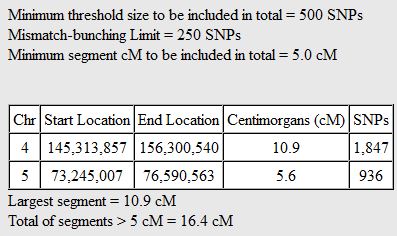
  • Sharon’s X match with karen could not be through our 2nd Great Grandfather George William Frazer.
  • The match could be through George Frazer’s wife who was Margaret McMaster
  • Margaret McMaster had a Frazer grandmother. It is possible that an X match could be through her.
  • The X chromosome does not recombine as much as autosomal DNA. This means a larger intact segment can travel down through the ages. This helps explain the large X match between karen and Sharon.
  • The percentages shown above are theoretical averages. The real amounts could be much larger or much smaller. In our example, Sharon got 25% of her X Chromosome from a part of the chart that shows that the theoretical amount she would’ve gotten would be perhaps 6-12% or less.
  • Also, the X Chromosome that my sisters got from my dad was the same that he got from his mom. It doesn’t even have a chance to recombine.
  • The match could be through the Clarke line as they were in the same general part of Ireland, but I would tend to think that it is more likely that the match would be on the McMaster/Frazer part of the chart.
  • My guess is that the autosomal portion of the match would be in the same general area as the X Chromosome match. Even though the shared ancestors represented by the autosomal match are probably not the same as the shared ancestors represented by the X Chromosome match, it would make sense to me that they would be nearby each other on the chart.