My First Try at Two Sibling Visual Phasing

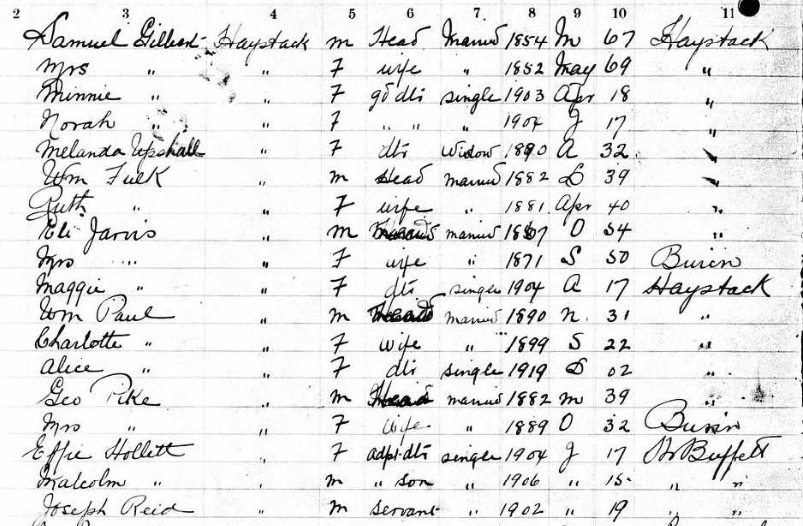
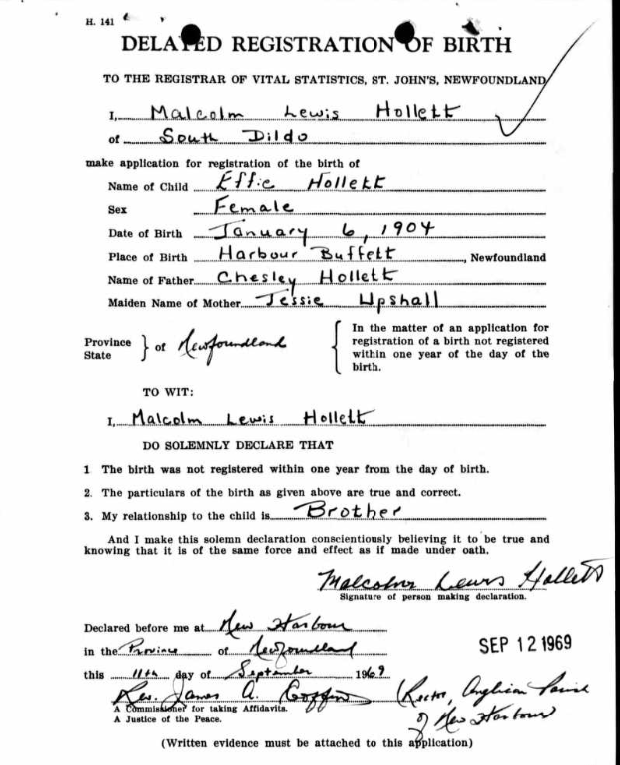
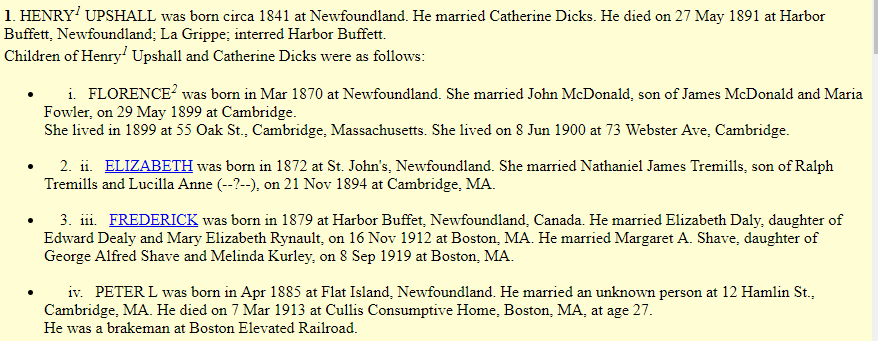
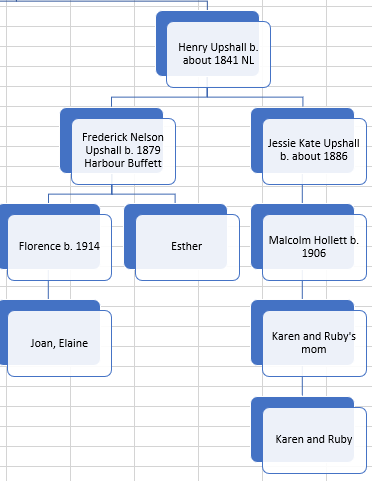
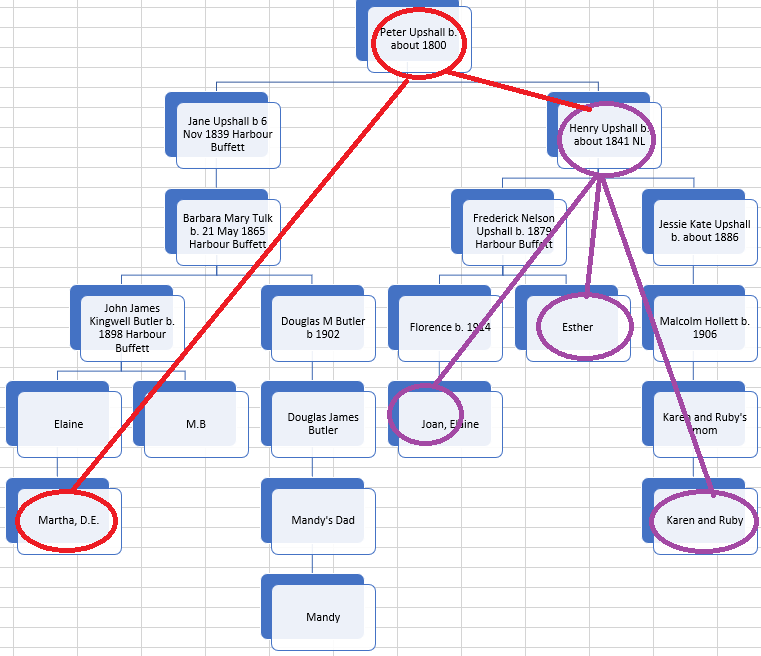
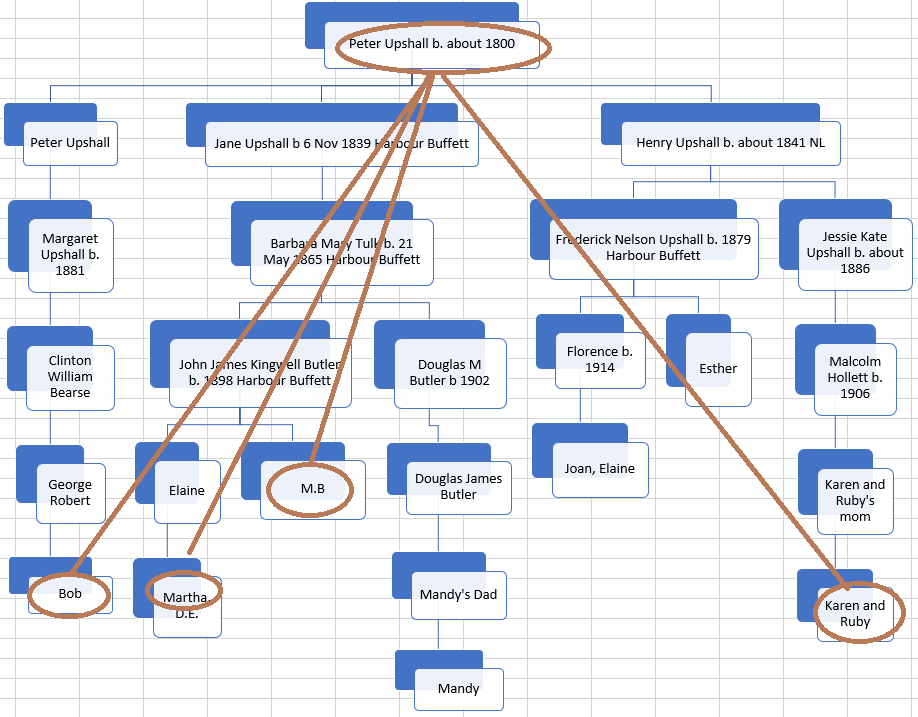
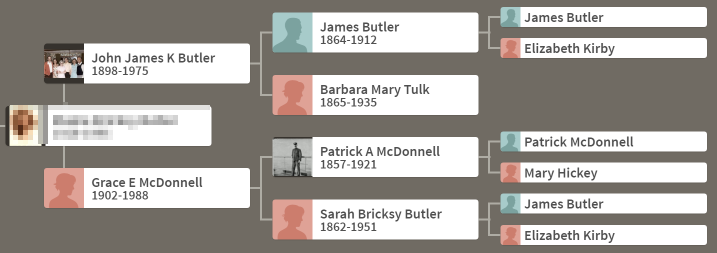
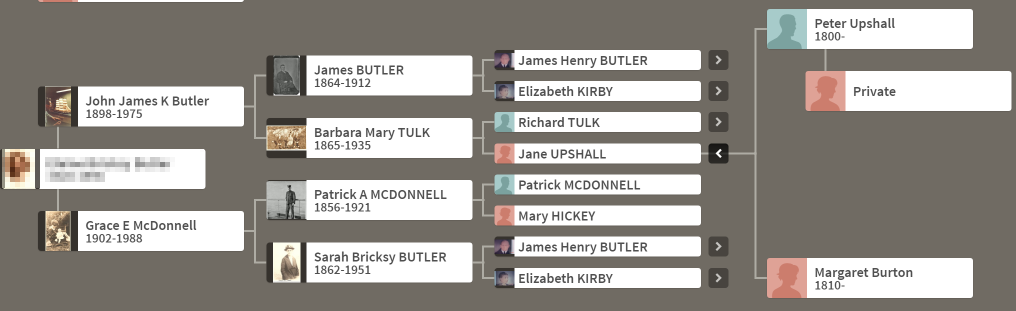
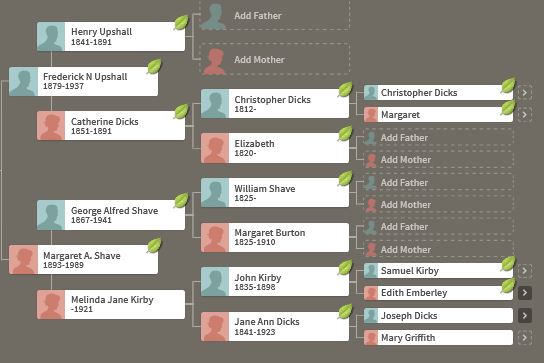
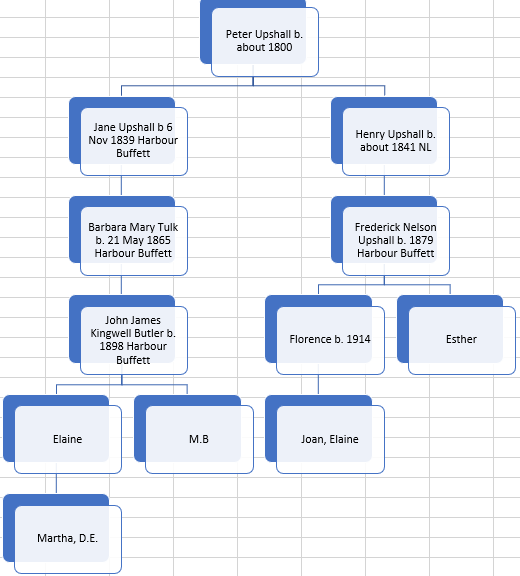
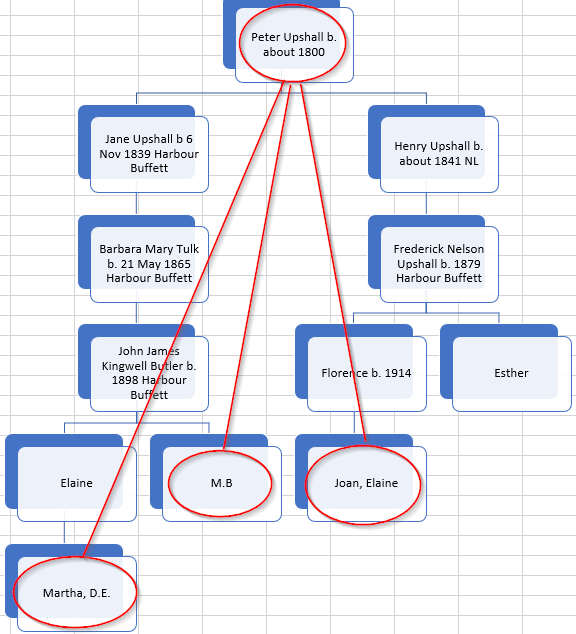
I recently had my wife’s Aunt Elaine’s DNA tested. She is the only sibling of my mother in law Joan. I would like to try to visually phase these two. Fortunately, they have have a half Aunt Esther. She is related on only one of their grandparent’s sides. That side is Upshall from Newfoundland. I am hoping that Esther’s DNA results will be helpful in visually phasing.

Aunt Esther’s Upshall DNA

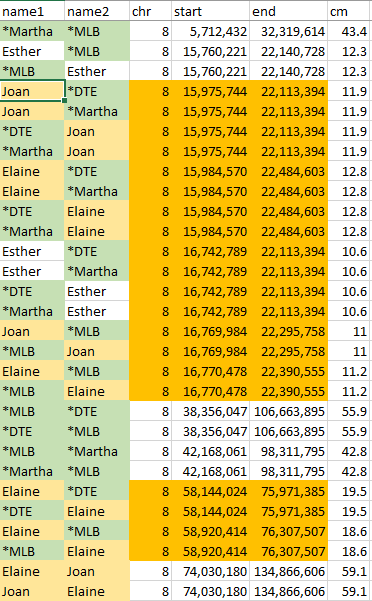
Here is how Elaine matches Aunt Esther:

Here is how my mother in law Joan matches Esther:

It looks like Esther will be a big help in identifying Elaine and Joan’s maternal grandfather side.

Chromosome 1

I’ll just jump in and try Chromosome 1. That is the big one.

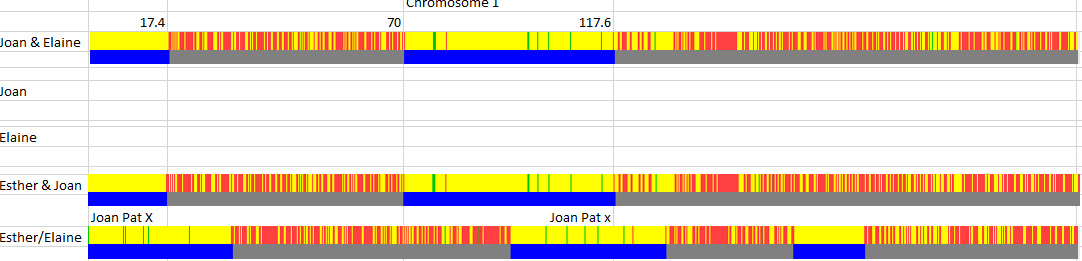
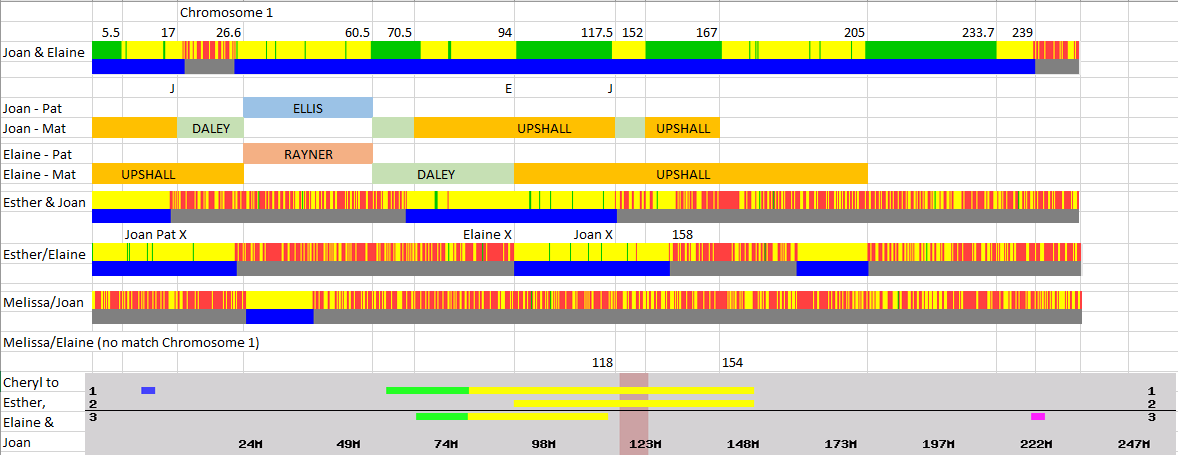
Already I have a bit of a problem. There is some green within the second HIR or Half Idendical Region (yellow area). I am ignoring it for now. This graphic shows that Joan and Elaine have no FIRs on Chromosome 1.

Next I add Esther’s DNA to the mix:

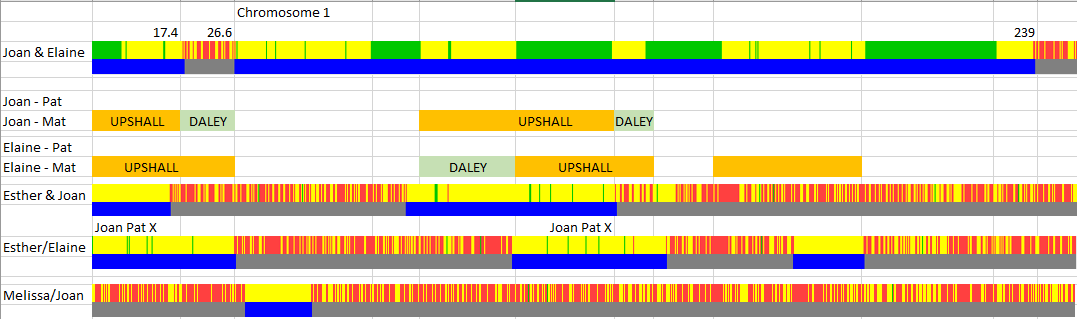
This is interesting. I see two maternal crossovers for Joan. Joan’s maternal grandparents are Upshall and Daley. Esther represents Upshall. So at 17.4M, Joan must go from Upshall to Daley. I say this because Elaine continues to match Esther (Upshall) after 17. 4M. The same thing happens at marker 117.6. Now look at Esther. She must have a maternal crossover between 70 and 117.6M.

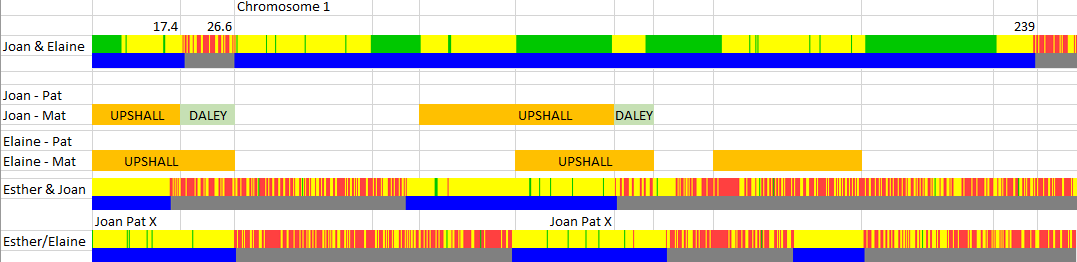
Actually, it looks like I made a mistake. My first comparison of Joan and Elaine is the same as Esther and Joan, so I must have done it wrong. I’ll make sure I have Joan and Elaine this time and lower the levels to 3 cM and 300 SNPs. Now my results look more reasonable.

That looks a lot better. Forget my comment about there being no HIRs. There are at least five green HIRs between Elaine and Joan. Things didn’t line up perfectly, but I tried to fudge them in. Upshall is shown in orange which corresponds to the matches with Aunt Esther. Next, I add in some more Maternal segments for Elaine and Joan:

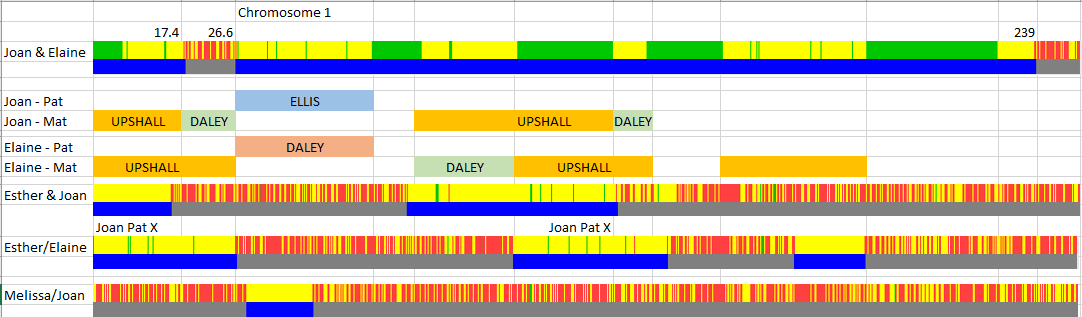
Again, the orange pretty much mimics the matches that Joan and Elaine have with Esther. The difference is with Elaine’s last orange segment. That goes more to the left as I don’t show a crossover there. There should also be a maternal crossover for Elaine to the left of her second orange segment. That means that to the left of that middle orange segment, there should be some green Daley.

The Paternal Part of the Puzzle

It would help to have some paternal matches at this point. Melissa is one match that I have mentioned in at least one previous Blog.

I like Melissa’s matches, because she doesn’t show any obvious Rayner in her ancestry. A Rayner would mess things up as that is Elaine and Joan’s maternal grandmother’s name. Jane would also be a good choice here.

Melissa adds some information. She represents the Ellis side. She matches Joan, but not Elaine. As Melissa does not match Elaine in this location, I have put down the paternal grandmother Daley in Elaine’s segment below Joan’s Ellis segment:

[Edit: the reddish paternal segment on Elaine’s bar should actually be Rayner.]

Now I have a little bit of paternal informatiion, but I appear to be at an impasse. Next, I will look at Joan’s Excel spreadsheet of matches. I see a Hayley there that matches through the Dicks Line. Dicks is a mother of Upshall, so that counts as an Upshall for my purposes.  Here is Joan’s match with Hayley:

This does not help as Esther already matches in this area. However, it does point out that I missed a crossover at the beginning of the Chromosome where the FIR (green) between Elaine and Joan goes to HIR (yellow).

I’ll take a break for now and move on to another Chromosome.

Mapping the X

I mentioned that Chromosome 1 was the largest Chromosome. The X Chromosome is fairly large also. There are some advantages to mapping the X Chromosome. One advantage is that Elaine and Joan’s paternal X is already mapped to their father’s mother (Daley).

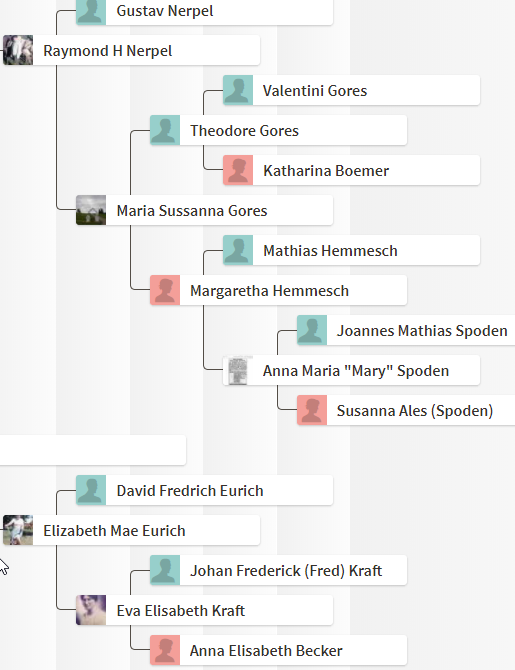
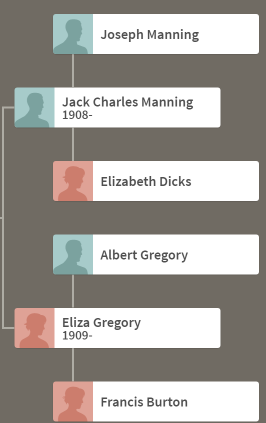
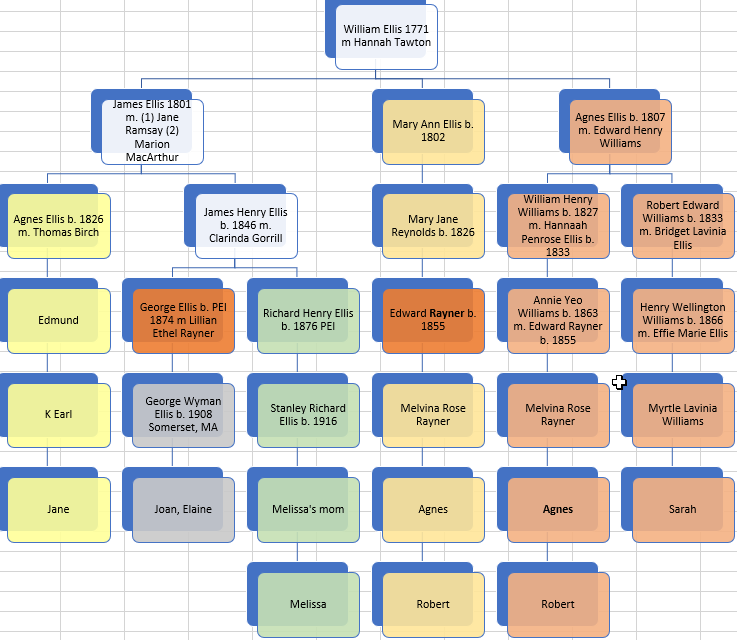
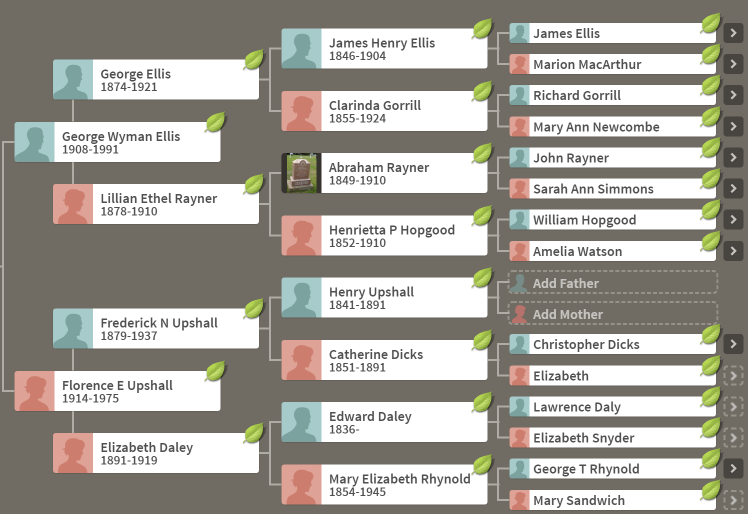
See, I already mapped both of their paternal side X Chromosome. Joan and Elaine both get the same X Chromosome from their dad. This is the same one he got from his mom (Elizabeth Daley). Here is the genealogy:

See, that is why I check. Joan and Elaine’s dad was an Ellis and his mom was a Rayner, so I got that backward.

That leaves Upshall and Daley for the maternal side. I mapped three maternal crossovers, but there may be more that I don’t see.

Again, Esther will represent Upshall and not Daley. That is because Elizabeth died in the flu epidemic. Fred Upshall remarried a Shave and had Esther.

When I check Esther’s X against Elaine’s, I get no match. Joan and Esther, however, do match:

In fact, Joan’s matches with Esther line up with the crossovers I have. That is good news. Here I also changed the color of Rayner to be consistent with Chromosome 1.


I’m pretty sure the end result should look like this:

Back to Chromosome 1

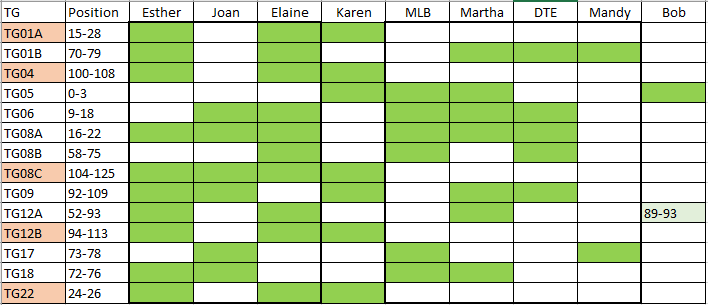
In the Dicks DNA Project I have been working on, I have a Triangulation Group Summary. The mother of Fred Upshall was a Dicks, so Dicks helps to identify Upshall DNA.  Here is a partial shot of that Summary for Chromosome 1:

I have not added Elaine to the Summary yet. This shows that Cheryl, Charles, Joan and Elaine match on Chromosome 1. Here is how Cheryl matches Esther, Elaine and Joan:

Adding Cheryl and Position Numbers

I got the numbers on the top of the Joan/Elaine comparison from Gedmatch’s full resolution option on their chromosome browser. A few observations:

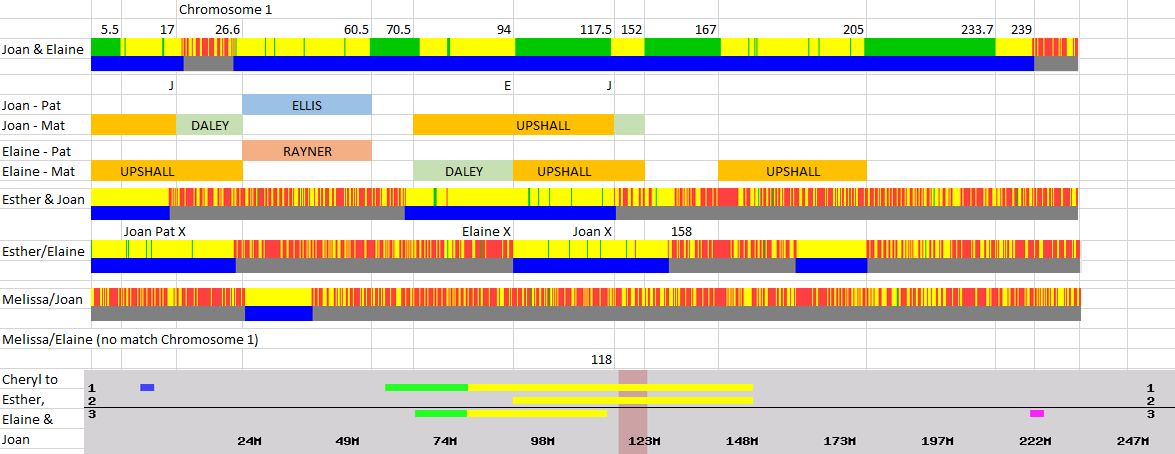
  • Cheryl’s matches confirm Elaine’s crossover at 94 and Joan’s at 118M
  • Cherlys’s match with Joan also indicates a likely Paternal crossover for Joan at 70M
  • Elaine and Esther match to 158M. That means that Elaine likely does not have a crossover at 152
  • Due to the centromere of Chromosome 1, the two browsers align very poorly around 152M. Note on the original comparison between Joan and Elaine how quickly the numbers go from 118 to 152M.
  • As mentioned above, Elaine’s Upshall segment should go past 152, but then there is a FIR. That means that Joan will have an Upshall segment above Elaine’s. That means that her Daley segment will look tiny, but it will actually go from 118 to 152M which is not so small.

Based on my above observations, I have this new map:

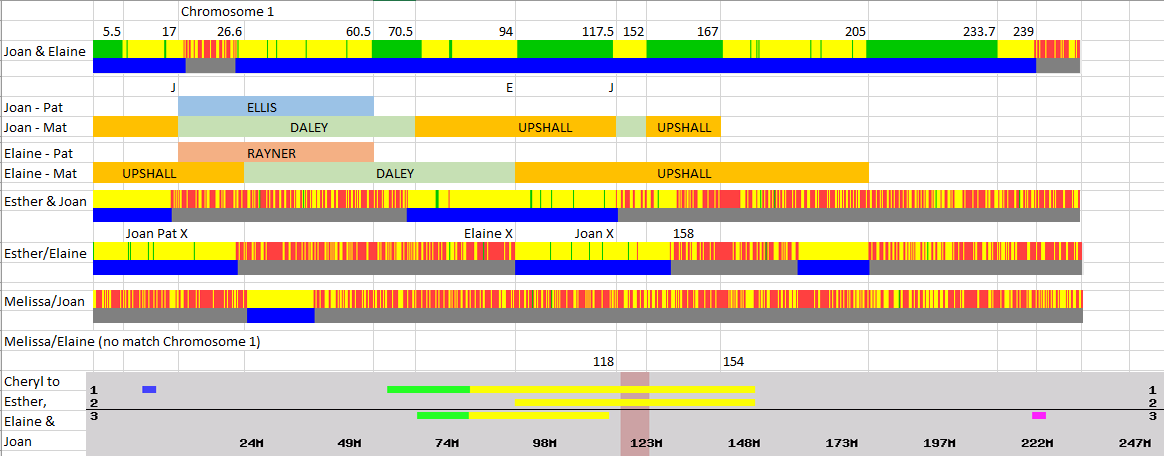
I gave Joan a paternal crossover at 70.5M. I also gave her a paternal crossover at 152M. This leads to another observation. The area between 60.5 and 70.5M is a FIR. That means that for Joan and Elaine, their paternal grandparent and maternal grandparent have to match. That means that at 60.5M, Joan’s Ellis DNA has to turn into Rayner DNA or Elaine’s Rayner DNA has to turn into Ellis DNA. Either way, there will be a Paternal Crossover for either Elaine or Joan at 60.5M. That means that there is not a maternal crossover at 60.5M for Elaine nor Joan. That will expand the maternal Daley to the left for Elaine and Joan:

This leads to more observations:

  • One I could have noted before. Betwen 17 to 26.6M Elaine and Join do not match each other. Elaine has Upshall DNA there, so Joan has to have Daley there.
  • Elaine has a Maternal Crossover at 26.6M. That means that there is no Paternal Crossover there. That means that I can move the two paternal segments to the left.
  • The fact that Elaine has a Maternal Crossover at 26.6M means that Joan has no maternal crossover there, so the Daley segment can be moved to the left also for Joan.

Moving the Daley segment to the left for Joan created a Maternal Crossover for her at 17. That means that there is no Paternal Crossover there and the two Paternal segments can be moved to the left:

So Chery’s matches were a help.

Summary and Conclusion

  • A first shot at two person visual phasing has shown promise.
  • Chromosome 1 is a difficult one, but I got a start on it
  • The X Chromosome was mapped for Elaine and Joan.


A First Look at My Wife’s Aunt Elaine’s DNA

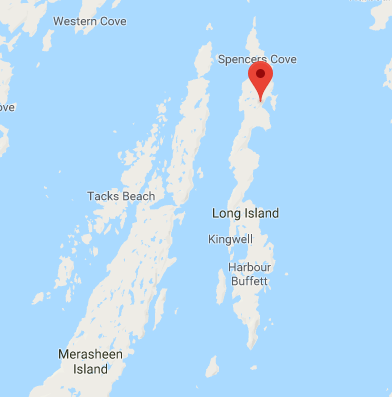
Aunt Elaine has Prince Edward Island and Newfoundland Ancestry. She has some Nova Scotia in there also. Here are her roots in Canada on a map:

The red marker is Canso, Nova Scotia. PEI is to the NW and Newfoundland to the NE of Canso.

Aunt Elaine’s Ancestors


The top half of the Elaine’s ancestor’s are from PEI. The Upshall side is from Newfoundland and the Daley side is from Nova Scotia. That makes Aunt Elaine 1/2 PEI ,and 1/4 each of Nova Scotia and Newfoundland.

Aunt Elaine at AncestryDNA – Shared Ancestor Hints

At Ancestry, Aunt Elaine has 84 Shared Ancestry Hints (SAHs). These are people that match by both DNA and family tree. When I say there is a match by family tree, I mean that Elaine and the match have at least one common ancestor. The first match is between Aunt Elaine and Aunt Elaine’s half Aunt Esther. Aunt Esther has Newfoundland Ancestry. When I look at shared matches between Aunt Elaine and Aunt Esther, there are three with SAH’s. They are all Newfoundland relatives, or rather relatives with shared Nefoundland ancestors.

PEI DNA SAHs

Most of Elaine’s SAH’s are from PEI. There are two reasons for that. One is that Elaine is 1/2 from PEI. The other reason is that I have traced her Ellis ancestry quite a ways back. Also there were some pretty large Ellis familiies. Here are the results of the SAHs:

  • About 81 PEI Ancestors – mostly Ellis
  • About 3 Newfoundland ancestors – mostly Dicks
  • 0 Nova Scotia (Daley) ancestors

Where Have All the Daleys Gone?

Elaine has 2 PEI grandparents: Ellis and Rayner. She has one Newfoundland ancestor: Upshall. Where are the DNA matches for her Nova Scotia maternal grandmother Elizabeth Daley? AncestryDNA has search functions. One is for name and the other is for birthplace. When I put in Canso, NS into the search, I get 7 people that show as 4th cousins to Elaine by DNA.

The 1st two 4th cousin matches have ancestors in PEI. They also match others that are Elaine’s PEI matches. Elaine’s third match with a Canso ancestor is Barbara. Here is Barbara’s tree:


Note the Rhynold and Daley names that match with Elaine’s tree. Barbara’s Catherine Daley is shown as having died in Canso, NS.

Summary and Conclusions

  • Elaine has a ton of PEI Shared Ancestor Hints- mostly Ellis. In the past, when I have looked at Elaine’s sister’s DNA results, I have found it fairly easy to identify Ellis or PEI ancestors by DNA. These results help explain why that has been relatively easy.
  • Elaine has a few Shared Ancestor Hints from Newfoundland
  • Elaine has no Shared Ancestor Hints on her 1/4 Nova Scotia side. I have found a match with Barbara that has the Rhynold/Daley/Canso NS connection to Elaine
  • When I look at Elaine’s matches at Gedmatch.com, I will be able to find out exactly where her PEI matches are (on which parts of which of Elaine’s chromosomes).

Marilyn’s Brother Howie’s YDNA

I had a question recently from Marilyn. Could I look at her brother’s YDNA? Marilyn knew of some family lore that their Brown surname could have originally been Smith. That would be confusing as both Brown and Smith are very common names.

Looking at Howie’s YNDA

Howie had the 37 STR marker test done. That is the entry level test for YDNA. Based on Howie’s DNA results, FTDNA has classified him as R-M239. R-M239 is a very basic and old clade. A clade is a YDNA type or classification. According to the FTDNA Project, “R1b All Subclades”, R-M239 “…is the most common Y chromosome clade of paternal lineages across much of Europe.”

R-M239 Map

Eupedia has a map showing a likely progression of R-M239 and it’s offspring:

Based on this map, R-M239 moved to the NE of Greece where it split off. One branch moved to around the area of current eastern Germany and made more splits. The L21 branch is associated with the early setters of the British Isles. Another branch, U106 went up into Scandinavia or stayed in the NW of Germany. This branch is also associated with the Saxons which later came to England as the Anglo Saxons. Anglo is associated with England. The eariler L21’s were aslo known as the Britons which is where we get Great Britain from. So within Great Britain or England, there are the Britain’s (L21 aslo associated with Celtic culture) and the English (U102 or Anglo Saxons).

Is Howie L21 or U102?

FTDNA does not go out on a limb in predicting clades or subclades. However, the administrators of the FTDNA projects are good at looking at the STRs and making predictions. That is why I suggested that Howie join the R1b and all subclades FTDNA group. R1b is roughly associated with R-M239.  However, I believe that strictly speaking, R1b is even more basic (probably the M343 in the map above).

Here is a R-M239 tree at the R1b and all Subclades Project website:


This graphic shows R-M239 as a Basal (early) branch. My Hartley branch is under L21 which is to the bottom left. Below that I am in L513 and there is a whole large tree just for L513 (not shown above). This shows that L21 and U102 are not the only choice for Howie, but they would be popular choices.

R1b and All Subclades Project

There are over 16,000 people in the R1b Project. They are all in a table that begins like this:

These are the first 3 names of 16,000+ entries. The numbers are the STR valuues. The header above the numbers gives the name of the STRs. The maroon STRs are the faster moving STRs. This is important as these are the STRs that are more likely to change. The change in the color of blue indicates different STR panels. Howie took the 37 panel STR. On the right side of the header, the STR name goes from blue to a lighter blue. The lighter blue on the right is the start of the 67 panel STR test.

The third column is Haplogroup. If the value is green, it means that person has tested for that haplogroup. If the value is red, it means that the haplogroup is assumed from the STR test. Howie hasn’t tested for a haplogroup, so his R-M239 would be red. These 16,000+ names and results are organized into different categories. The first group is for people that are M343+ M269-. That means that they are have a very old type of DNA. The M269- means that they are not R-M269, so they predate that split.

When I look for Howie in the R1b All Subclades, he is in this category:

That is not good news. That means that the administrators don’t want to bother figuring out where Howie is with only 37 STRs.

Making My Own Guess For Howie’s Subclade

That means that I have to make my own guess. I was hoping that I wouldn’t have to do that. I have an old spreadsheet from 2014 which is a bit outdated. However, I can plug in some of Howie’s STRs into that and see what comes out.

This spreadsheet has 67 STRs, but I’ll just use Howie’s 37. The STRs I want to concentrate on first are the ones with the orange numbers. These are the low numbers.  For example, STR 426 is 0.09. That means that there is a 0.09 chance in 1,000 generations that this STR will change. My spreadsheet had already chosen 12, 12, and 11. 11 for the orange STRs. Those were Howie’s numbers also.

However, that doesn’t narrow things down far enough. Next I will choose Howie’s yellow rate STRs. I’ll start with STR 392 which has a rate of 0.52 in 1,000 generations. Howie has a 13 for that, which I had also previously chosen. I continued this process down to the STRs with the gray-rated STRs. I found that Howie had an unusual number for YCAiib. There was only one person on the speadsheet that I had with a combination of 18-18 for YCAiia & b. That was a Weber with roots in Switzerland. And he is not in the current R1b All Subclades list. That puts me at a bit of a stalemate. I don’t know if Howie is in the U152 subclade or if Howie and Weber are outliers in their own respective subclades.

One tact would be to ignore YCAiia & b and move on. Another odd thing that I note on my spreadsheet is that the only values for YCAiib are 18, 22, and 23. What happened to 19, 20 and 21? I followed Howie’s grey STRs while ignoring the YCAii’s and got this group of people. These are people that share Howie’s slower moving STRs that I plugged into the spreadsheet:

Basically, I don’t like the results as I had to ignore YCAii. This shows possible results all over the place. However, at least most of them are in hte British Isles.

At this point, I would say that Howie would have to do the BigY test or a 67 STR test to find out more. In the long run, the BigY is better, but it can be a bit pricey. That should get Howie down to the surname level and likely nail down a location. Note from the list above, I don’t see any Browns or Smiths, but again this is old information. A lot of testing has happened since 2014.


An FTDNA Match and an Ancestry Tree

Tracey is on my first page of matches at FTDNA. She also has a partial tree shown at FTDNA. She lists an ancestor as Finlay and an ancestor in County Sligo, Ireland. This is interesting as one of my brick wall lines married into the Finlay family and was from County Sligo. Perhaps there is a connection. My idea is to use Ancestry to see if I can build out Tracey’s tree to find a match or more of a match.

Tracey’s Genealogy at FTDNA

Tracey shows her father’s line at FTDNA:

Tracey gives some more information on her profile that should help build out her tree.

My Sligo Ancestors

My grandmother’s parents were both from Sligo. However, my guess is that I match Tracey on my grandmother’s mother’s side:

My Grandmother’s mother was Margaret Clarke. Both Margaret and her mother Jane Spratt died young.

Confirming the DNA Match is from County Sligo

Tracey matches me on Chromosome 11:

FTDNA shows that that she has matches in common with my sisters Lori, Heidi and Sharon, but not in common with my brother Jonathan.

Here is how I mapped out Chromosome 11:

I am J on the map. S and H are my sisters Sharon and Heidi. F is for my brother Jonathan. My match with Tracey is at about position 11 to 36M on the map. Jonathan shows Hartley DNA in that area which is why he doesn’t match Tracey there. I didn’t get around to mapping Lori yet. This confirms that the match with Tracey is on our Frazer grandparent line. As I mentioned above, this line leads back to County Sligo.

Building Out Tracey’s Tree

Tracey may have already done this, but if I come up with the same thing as she did, that would be a good thing. Here is my first shot at Tracey’s tree at Ancestry:

Ancestry shows green leaves on Tracey’s paternal side. This means that Ancestry thinks it may know about her paternal side, but doesn’t have any easy clues about her mother’s side. This makes sense as Tracey only showed her paternal side at FTDNA.

It looks like Joseph Parr was living with his parents and a large family in Toronto Gore in 1921:

This Census seems to indicate that Joseph was born much earlier than 1895. So that makes me wonder if this is the right Joseph E, son of Samuel and Sarah.

This death record is more consistent with what Tracey has:


And as a check, I see that Nashville is not far from Brampton where Tracey says Joseph was born. While I was snooping around Ancestry, I even found a photo of Joe and Clara Parr:

Hi Joe. Hi Clara. Are we related? Assuming the match is on Tracey’s paternal side, I’d say that Clara looks more familiar than Joe. That is, if looks count for anything.

Going After the Morrisons

Tracey says at FTDNA that the Morrisons are from Sligo. So it makes sense to look at this line first.

This looks like Clara in Toronto Gore in 1901:

Come to find out Toronto Gore and Gore no longer exist. There is still a Gore Road which I found to the West of Nashville, Ont. This is one of the remnants of the old Township of Gore. The 1901 Census is helpful as it gives birth dates. Here I am diverging from the script a bit. Tracey’s tree had Robert as the father of Clara and the census has William and Alice.

When I add in William, I get many Ancestry ‘Hints’. The Marriage record for William is very vertical:

This says that William was from born in Gore but lived in Toronto Township when they married. Alice was born in Euphrasia, where she also lived at the time of her marriage (the same place that they married).

Here are the witnesses and wedding date:

William was from the Church of England and Alice was a Methodist. Alice’s last name looks like Lougheed, but someone at Ancestry has it as Loughead.

In 1861, the Morrison family had been in Canada at least for 23 years. So they likely were in Upper Canada in 1838

The 1851 Census seems to put the family in Canada as early as 1836:

There is some nominal information on a Robert Morrison in the 1825 Census of Lower Canada. At this point, it is difficult to trace this family back to Ireland.

However, there appeared to be two different Robert Morrison’s around, so care is needed when reviewing the records. Tracey’s Robert was in Canada fairly early, so this may be the one.

The Lougheed/Loughead Line

Time to look at the bottom side of the Parr Tree:

I’ll start with Alice’s death. It is good to start with the end in genealogy.

It took me a little bit to figure out this record as it didn’t line up quite right. The first entry is a baby, so no occupation. The 2nd is a priest. The third is Alice Emeline (Lougheed) Morrison, the farmer’s wife.

Here is Alice in 1871 with a family of 12:

This is more clearly Loughead. I am doubting the birthplace of Ireland for all the children, but will keep an open mind.

Let’s roll back the clock 10 years to 1861:

Here there is a different spelling for the last name. I’m guessing that this was a more phonetic spelling as a ‘gh’ can have a ‘ch’ or ‘ck’ sound as in the Irish lough for lake. This couple was married in 1846. My guess is that E.M is Episcopal Methodist.

It looks like John re-married a relative by marriage in 1882 [Edit: This is actually a different (though related) John Lougheed as shown later in the Blog. The parents of the right John Lougheed are Huge and Alice.]

:

Seems the spelling is back to Lougheed.

The best I can tell, this is Thornbury:

The family was a bit smaller in 1851 [Note, this is back to the right John as seen by his first son named after his father Hugh.]

It looks like this couple made their way to Canada sometime before 1846 when Mary was born.

Lougheed, AncestryDNA and the Sligo Connection

For some reason, I associate Lougheed with Sligo. At Ancestry, I can look for my DNA matches that also have Lougheed ancestors. My top DNA match at AncestryDNA with a Lougheed ancestor appears to be named Lawrence. Lawrence has this ancestor:

This man has quite a unique middle name. He also was born in Sligo and ended up in Bolton, Peel, Ontario. When I look up Bolton, I find it is near Nashville, Ontario:

Remember Nashville is where Joseph and Clara Parr were buried. Clara was a Morrison but her mom was a Lougheed. It seems like these connections are almost but not quite made.

Another Lougheed: Hugh

The same tree above had another Lougheed ancestor named Hugh.

This Hugh seems to be a better fit. I have ancestors in the Boyle area on my Frazer side. Note that Hugh died in Euphrasia where Alice Lougheed lived. Also Hugh had a son John born in 1827. Could this be the same John I found born 1827 in Ireland? I would say they have to be the same person.

My Mistake

It turns out that there were two John Lougheeds. One died in Thornbury and one died in Euphrasia. The death record I had above was apparently for the wrong John. Here is the correct one as reflected in an Ancestry Family Tree:

Here is a corrected Morrison tree:

The Ballymote/Boyle Area of Sligo

The creator of the great Lougheed Tree on Ancestry notes that Hugh was from the Ballymote/Boyle area of Sligo. Is that a help? For me, yes and no.

My Clarke family brick wall lived near Coolaney which is nearer to Ballymote. My McMaster ancestors were from the Kilmactranny area. My Frazer ancestors were in the area to the South of Kilmactranny originally in North Roscommon County – not far from Boyle.

Another of My AncestryDNA Matches with Lougheed Ancestry

Summing up:

  • I found a pretty close DNA match with Tracey at FTDNA
  • Tracey has a tree with a Morrison from Sligo. I built the tree out to find a Lougheed also from Sligo.
  • I went to my AncestryDNA matches and searched for matches that had Lougheed ancestors. My match with Lawrence is a predicted 4th cousin by DNA. This person has two Lougheed ancestors. One is Hugh Lougheed who is also an ancestor of Tracey.

This gets to notes I read recently from a genetic genealogy conference. The speaker mentioned the importance of triangulating on genealogy as well as DNA. I think what was meant by this is that if three people all match by DNA and all three have the same ancestor, there may be something there.

The Third DNA/Lougheed Ancestor Match

The third DNA Lougheed ancestor match is with Jonathan. Jonathan shows on my AncestryDNA as a possible 4th cousin by DNA. His tree looks like this:

This tree goes back a ways. This Hugh Lougheed, born 1750 is likely the same Hugh Lougheed I see in many trees as being born 1754. If I have it right, Jane Margery Lougheed b. 1793 would be the younger sister of Hugh Lougheed born 1789.

That means between Tracey, Lawrence and Jonathan there appears to be a genealogical triangulation on Hugh Lougheed, born 1754.

A Shared AncestryDNA Match between Me and Lawrence

When I look at shared matches at AncestryDNA that Lawrence and I both have, the first person I find with a tree is Donna. She has a short tree, but her father’s name is Loughead. This leads me to try to build her tree back to see if there is an easy connection with the other Sligo Lougheeds.

I’ll start on the paternal side. Donna had Loughead as the spelling of the last name. But I looked at Israel’s marriage record and he clearly signed his name Lougheed. The marriage for William Henry Lougheed is helpful as it gives dates and parents:

All Roads Lead to Euphrasia

Here is the 1861 Census for Euphrasia, Ontario with the William Lougheed family:

The fact that William has a son named Hugh makes me think I’m on the right track. That and Euphrasia.

Lougheeds from the Top Down

What Next?

As far as I know I match all these Lougheed descendants.

  • Lawrence – predicted relationship 4th cousin at AncestryDNA
  • Tracey – relationship range 2nd to 4th cousins at FTDNA
  • Donna – predicted relationship 4th cousin at AncestryDNA
  • Jonathan – predicted relationship 4th cousin at AncestryDNA

And they likely match each other. I could make an argument that I could be descended from Hugh Lougheed b. 1754. He had other children. Perhaps one of his daughters married one of my ancestors. I do have missing wives for some of my ancestors. I also have whole missing lines on my Clarke side.

Perhaps some new information will come to light. Perhaps these testers will upload their results to gedmatch.com where the DNA can be compared to other matches.


Jan: A Descendant of a Newfoundland Dicks and Close Match to Esther at AncestryDNA

Jan is my wife’s Great Aunt Esther’s third closest match at AncestryDNA. The first is from a family we know and shows as a 1st cousin. Esther’s second DNA match shows as a second cousin. I wrote to this person in 2015 and never heard back. This person also last logged in to Ancestry in 2015. The third person was Jan.

I wrote to Jan in October 2016. She says her paternal grandmother was a Jessie Dicks born in Newfoundland and wonders if Jessie is related to Esther’s Dicks? I noticed that Jan’s DNA kit was administered by someone else. There was a tree associated with the administrator, but no Dicks in the tree. Perhaps I can create a tree to answer Jan’s question:

Here is Jan’s tree based on what she has told me so far. I wrote to Jan to try to find out some more and to see if she would be interested in uploading her DNA results to Gedmatch.com. I assume that her ancestor was from Harbour Buffett where Esther’s ancestors lived.

Looking for Jessie Dicks in Newfoundland

First I went to this site:

They have some pretty good information. I then searched for Jessie Dicks, but the results were not specific enough. Then I tried Jessie Dicks, Harbour Buffett. The first person I found was married. I assume that the Jessie Dicks I’m looking for is a Dicks by birth. The second person I found was here:

Jessie Dicks was born in 1913 as shown in the 1921 Census of Harbour Buffett. However, according to the Census, she and all of her family were born outside of Harbour Buffett.

Esther’s Tree

In order to see if Jan is connected to Esther’s ancestry by the Dicks family, I’ll need to look at Esther’s tree:

On Esther’s tree the connection would have to go back to the father of Catherine Dicks, who I have as Christopher Dicks. Another possibility would be the father of Jane Ann Dicks. I’m not positive about either of these Dicks lines at the level of Christopher and Joseph. The Christopher line seems somewhat confirmed by DNA (see below under the Dicks DNA Project).

Back to Jan’s Tree

Assuming, I have Jan’s Jessie in Harbour Buffett in in 1921, I now have this tree:

This tells me that Jan’s possible great grandfather was born around Esther’s dad’s time or Esther’s maternal grandparent’s time. That means that there could be a difference of between 2 or three generations between Esther and Jan.

A search for Henry Dicks at Ancestry leads to a birth record at FamilySearch.org which gives Henry’s parents:

The Dicks Family DNA Project

This is where I pull out the trees of the people that have uploaded their DNA results to gedmatch.com. I have a tree in it with John Dicks and Elizabeth Reid.

I assume that this John Dicks who married Elizabeth Reid is the same as the couple that I have as Jan’s 2nd great grandparents. If my guesses are right, then that would put Jan on a level with Hayley who is a 2nd cousin twice removed to Esther. Now Barry and Hayley both show as shared matches to Esther and Jan at AncestryDNA, so that is further evidence that I am on the right track. Joan is my mother in law. She didn’t test at AncestryDNA. Edward also did not test at AncestryDNA.

Questions Brought Up by the DNA

  • Jan shows up as a predicted 2nd cousin by DNA at Ancestry. She shares 423 cM across 26 segments
  • Barry who on the chart is an actual 2nd cousin once removed shows 196 centimorgans shared across 16 DNA segments with Esther
  • Hayley who on the chart above is an actual 2nd cousin twice removed like Jan shows 93 centimorgans shared across 6 DNA segments.
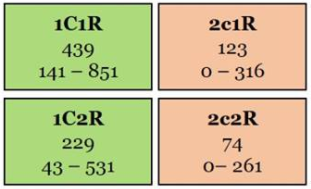
  • Barry and Hayley’s match results with Esther seem to be more in line with the image below.

Here are the ISOGG web page numbers for cousin statistics:

This tells me that 423 cM is off the charts for a 2nd Cousin, twice removed. The previously reported high for this was 261 cM. That means that there is more than meets the eye between Jan and Esther. Assuming I have the genealogy right (which is a big assumption) that means that Jan and Esther likely have at least one other common ancestor.

Perhaps if Jan uploads her DNA results to Gedmatch.com and I find out more about her ancestry, this mystery will be solved.

Visual Phasing: My Father in Law’s Chromosome 22

Looking through the visual phasing of my father in law’s family, I notice I am missing a map for Chromosome 22. Chromosome 22 is the easiest and hardest Chromosome to visually phase. It should be the easiest because it is the shortest Chromosome and should have the fewest number of crossovers. It should be the most difficult because it should have the fewest cousins matches. I assume that I haven’t visually phased Chromosome 22 because of the hard part.

Gedmatch One to One Comparisons

To do visual phasing, I need to compare my late father in law Richard to his two sisters in the Gedmatch Chromosome browser. Here is how Richard matches one of his sisters, Lorraine:

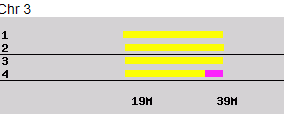
This shows that Richard matches his sister Lorraine all along the Chromosome except for a little segment between 43.6M and 43.8M. Hopefully this is accurate. Other comparisons should bear this out. By comparing siblings, we are looking at how many grandparents’ DNA they share. Green means that Richard and Lorraine share two grandparents’ DNA. More specifically, they share one maternal grandparent and one paternal grandparent.

Yellow means they share one grandparent on a maternal or paternal Chromosome and don’t share the grandparent on the opposite Chromosome. For example, if they share the DNA from a maternal grandparent, that means that they don’t share DNA from the same grandparent on the paternal Chromosome. This is all important information for visual phasing.

Finally, above the break in the solid blue line above is a red area. That means that in that little segment, Richard and Lorraine share DNA from neither of their grandparents. This is important information. Richard’s paternal grandparents are Butler and Kerivan. His maternal grandparents are LeFevre and Pouliot. So say Richard gets his DNA from Butler and LeFevre in that red area. That means that Lorraine must get her DNA from Kerivan and Pouliot in the red area. Those are the rules for Visual Phasing.

Next I put the three comparisons into Excel.

Then I look for changes in the colors on the Chromosome Browser. These changes should come in pairs. The first two changes are in the first two bars. The colors go from green to yellow. That means that the shared DNA goes from two grandparents to one. Lorraine’s name is associated with both those comparisons, so we say that Lorraine has a crossover there. A crossover is where Lorraine’s DNA changes. Before the crossover, she is getting DNA from one grandparent, and after the crossover, she is getting her DNA from another grandparent.

Again, these crossovers show up in pairs. A top/top pair assigns the crossover to Lorraine. A top/bottom pair goes to Richard. A bottom/bottom pair of changes assigns the crossover to Virginia. Above, Lorraine and Virginia got 2 crossovers each and Richard got three crossovers.

Next, I show the two Chromosomes that everyone has – in this case for Chromosome 22. Unfortunately, I don’t know which side is maternal and which side is paternal at this point.

These two copies of Chromosome 22 are blank for each sibling right now, but I’ll fill them in with four colors representing the DNA they got from each of their 4 grandparents. When the DNA changes from Butler to Kerivan on the paternal copy, for example, that is where the crossover is for a particular sibling.

Visual Phasing

Richard and Lorraine share a large green area. That means that they got the same DNA from one grandparent on the maternal side and the same DNA from one grandparent on the paternal side. The DNA from those two shared grandparents will be represented by two colors.

The blue and orange colors represent the DNA that Richard and Lorraine both share from the same grandparents: the same maternal grandparent and the same paternal grandparent. Unfortunately, I don’t know which side is maternal or paternal at this point and which grandparents they share. I just know they share the same grandparents.

Note also that Richard has a crossover at the beginning and end of this colored-in segment. We don’t know if his crossovers are on his maternal Chromosome 22 or paternal Chromosome 22 – or it could be that one crossover is maternal and one is paternal. That means that we will keep his blue and orange segments where they are – for now. However, Lorraine’s first crossover is to the left of the green shared area. That means her blue and orange DNA segments can move to her first crossover. The same segments can also be moved to the right up to Lorraine’s next crossover. No crossover means no change in the DNA.

This show that Lorraine got two pretty long segments of DNA. Let’s say she got them from Grandparents A and C.

Next we need more grandparents. We only have two out of the four. In the middle of Chromosome 22, notice that Lorraine and Virginia have no match. There is a large break in the dark blue line. That means that in that area, If Lorraine has DNA from Grandparents A and C, Virginia has DNA from grandparents B and D. Now we need two different colors:

To check notice that Richard and Virginia also have no match in a smaller area, therefor they also show two different colors in that area. Virginia has the last crossover, so I move the brown and green segments to that crossover.

Richard and Virginia have a smaller green area starting at position 43.8.

Richard has no crossover that prevent the brown and green segments from going to the end of Chromosome 22. That is as far as we can go with the bright green areas (which are also called Fully Identical Regions or FIRs) and the red non-matching areas. At this point we could look at the yellow areas which are also called Half Identical Regions or HIRs. Or we could look at cousin matches to see if they give any hints. I’ll look at cousin matches.

Cousin Matches

A first cousin should sort out the maternal or paternal side. I pulled up Virginia’s spreadsheet where I have a lot of her matches. On Chromosome 22, I notice 2 of Virginia’s maternal 1st cousins, Joe and Pat:


In Virginia’s spreadsheet, I have these positions in pink for Virginia’s maternal side. Next, I checked out some of the matches at Gedmatch and got this:

Here, #1 is John, a nephew. Nephews are not as helpful as they can be related on the maternal or paternal side. Note also that something seems to be going on around 25.4 M. This could be Virginia’s maternal crossover. In fact, I think that is more likely than having four other people having their crossovers there. #2 and #3 are Pat and Joe.  #4 is a maternal 2nd cousin once removed named Sandra. More about her later. Now that I know where there is a likely maternal crossover at 25-1/2M, I’ll go back to the visual phasing.

Visual Phasing HIRs

So far with the visual phasing, everything is equal on the chromosomes. That is because, we have only dealt with FIRs and no matches. HIRs upset that balance and make us choose sides. Because the HIR creates an imbalance of one copy of the Chromosome vs. the other, we only get one shot at doing that. I don’t know if my reasoning is right, but because I have some information already for the left side of the Chromosome (Sandra), I will choose an HIR on the right side. I will choose the small HIR Lorraine and Virginia have starting at 43.5M.

Here on one copy of Lorraine’s Chromosome 22, the blue goes to brown while the other copy remains orange. Next, I see that Lorraine has no more crossovers, so I can move the DNA colors over to the right.

In addition, Lorraine and Virginia have an FIR on the right, so I can copy Lorraine’s colors onto Virginia’s maternal and paternal side. Now I have a lot of Chromosome 22 mapped out, but I still don’t know which side is maternal and which is paternal. Here is how Pat matches with Virginia, Richard and Lorraine:

Remember that Pat is a maternal cousin. It is important to note that Pat matched Virginia and Richard but not Lorraine. The yellow pattern of Pat matching Virginia and Richard matches the green above that I mapped out. That tells me that green and orange are the maternal side and brown and blue are the paternal side.  So thanks to Patricia, my in-law’s have identified maternal and paternal sides. Yay.

Next I bring back some cousin matches:

I had guessed that Virginia had to have a maternal crossover due to cousin matches at about position 24.5M. #4 above is Sandra. She is one of my in-law’s top maternal Gedmatch matches. She also is a match at AncestryDNA. She doesn’t have a public tree but she told me who their common ancestors are:


Sandra is a 2nd cousin once removed to Lorraine, Richard and Virginia. As such, they share only one of my in-law’s grandparents’ lines which is LeFevre.

Here is how Sandra matches Virginia and Richard:

Now I can add in LeFevre in the green segments.

Once I know green is LeFevre, then orange has to be Pouliot.

Next, I was pretty sure that Virginia had a maternal crossover at 25.5. Knowing that, I can fill in the rest of the puzzle:

  • Note that on the left had side of Chromosome 22, there are three FIRs in a row going from top to bottom. That means the three siblings have their DNA from the same two grandparents. They all have Pouliot on the maternal side and either Butler or Kerivan on the paternal side.
  • The maternal side is French Canadian.
  • The paternal side is Irish.
  • There aren’t as many paternal cousins matches to fill in the blue and brown as there are maternal matches. I’m looking for cousin matches to fill in the blanks
  • Virginia has DNA from only one paternal grandparent shown in reddish brown.
  • Lorraine has DNA from only one maternal grandparent – Emma Alphonsine Pouliot
  • There will be parts of the Chromosome where there is no DNA representation from one grandparent. For example, no one got green LeFevre DNA at the beginning of the Chromosome. No sibling got blue paternal grandparent DNA at the beginning or at the end of Chromosome 22.


Tracking Some Howorth/Howarth DNA from Bacup, Lancashire

My Hartley ancestors came from Trawden, Lancashire. They were hand loom weavers. Due to the industrialization of weaving, hand loom weaving became obsolete. At that point, the family moved to Bacup, Lancashire where there were weaving mills. There, my ancestor Greenwood Hartley married a local Bacup girl named Ann Emmet. Ann Emmet was the daughter of Esther Howorth b. 1800 and Isaac Emmet. My web page on the Howorth family mentions that she was born either at Nun Hills, Bacup which I identified on a map or Nothill, Bacup. So there is some confusion with names within Bacup.

Anne from Australia: DNA Match and Howarth Descendant

Anne is about the perfect DNA match. She has a tree at Ancestry. She has uploaded her results to Gedmatch.com and she is from Australia. Being from Australia is important. That is because, as I live in Massachusetts, it is not likely that the match is on one of my colonial Massachusetts lines. She has her ancestor as Howarth rather than my Howorth, but I don’t think that is a big deal as these names are so close.

Anne’s Genealogy

Anne’s Howarth Line is on her paternal grandmother’s side:

Anne’s Howarth line goes out as far as James Howarth, born 1768. That would be Anne’s 4th great grandfather. This matches up well with my tree:

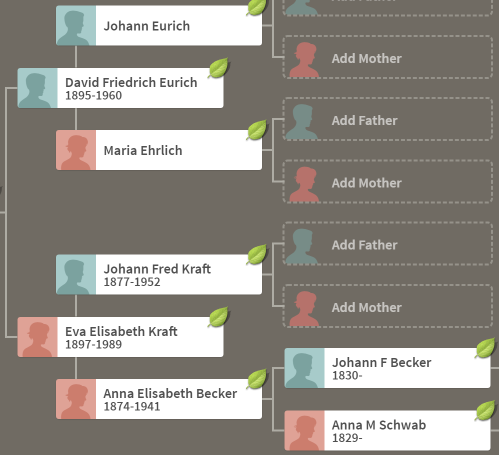
This is my grandfather’s tree and I also have a James Howorth born 1768. If Anne and I have our trees right, that would make us 5th cousins.

There were a bunch of Howorths born around the time that Esther and Abram or Abraham were baptized. Here is what Ebenezer Particular Baptist Church looked like around the time they were baptized:

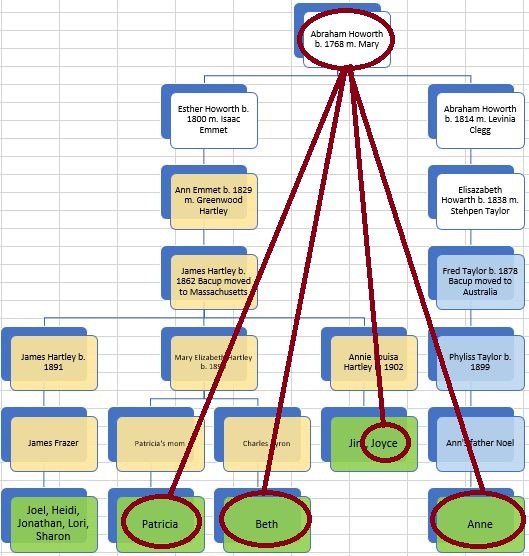
For DNA comparisons, I like to draw top-down trees:

Anne is thinking like me and has had a DNA test for her 1st cousin once removed. Those results should be in in about a month. I have other 2nd cousins that have tested for DNA, but have just put Beth in this tree for now as I believe she has a match to Anne. Let’s assume that the tree is right. That would mean that Esther and Abraham were siblings. Ann Emmet and Elizabeth Howarth were first cousins and should have known each other. James Hartley b. 1862 should not have known Fred Taylor as James moved to Massachusetts with his family in 1869 before Fred was born.

Anne’s DNA

Anne matches me and my three sisters on Chromosome 4:

The first three matches are of 15.8 cM. In my view, any match of 15 cM or more is almost certain to be a genuine match. My brother Jonathan doesn’t match there as he is matching on his paternal grandmother’s side (Frazer) at that location.

Mapping Anne’s DNA Match to My Chromosome Map

That means that I can map that Chromosome 4 segment to either Abraham Howorth or his wife Mary. As I don’t know from which ancestor it came from, I can say one of those parents gave that DNA to their daughter, Esther Howorth b. 1800 for sure. So I will map that Chromosome 4 segment to her:

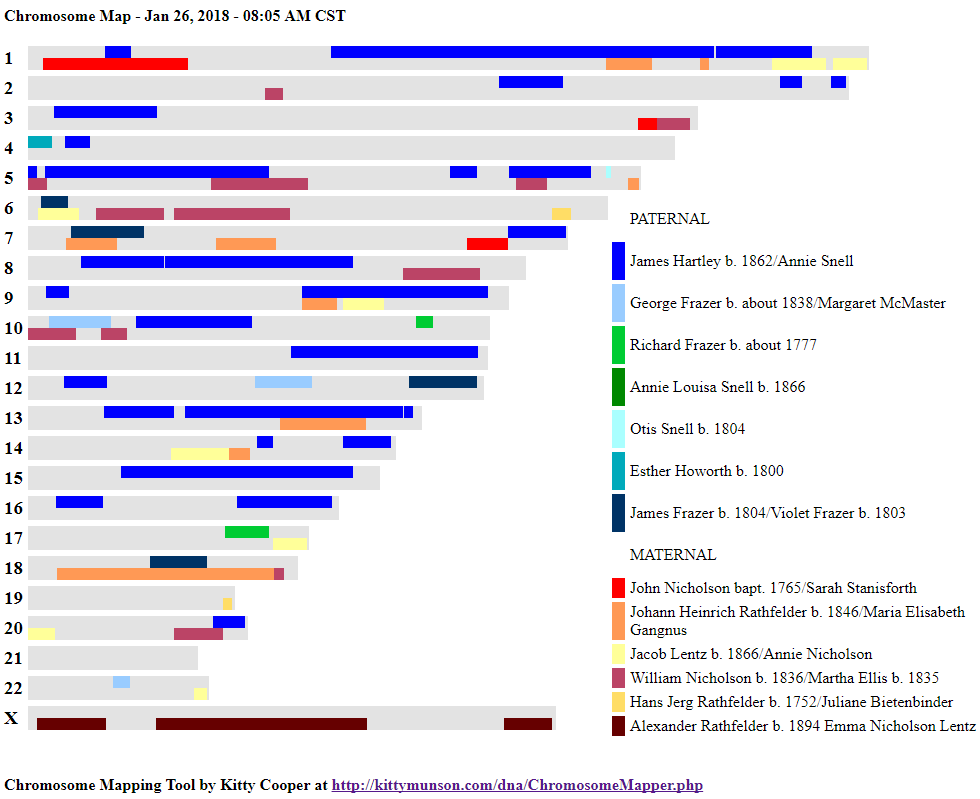
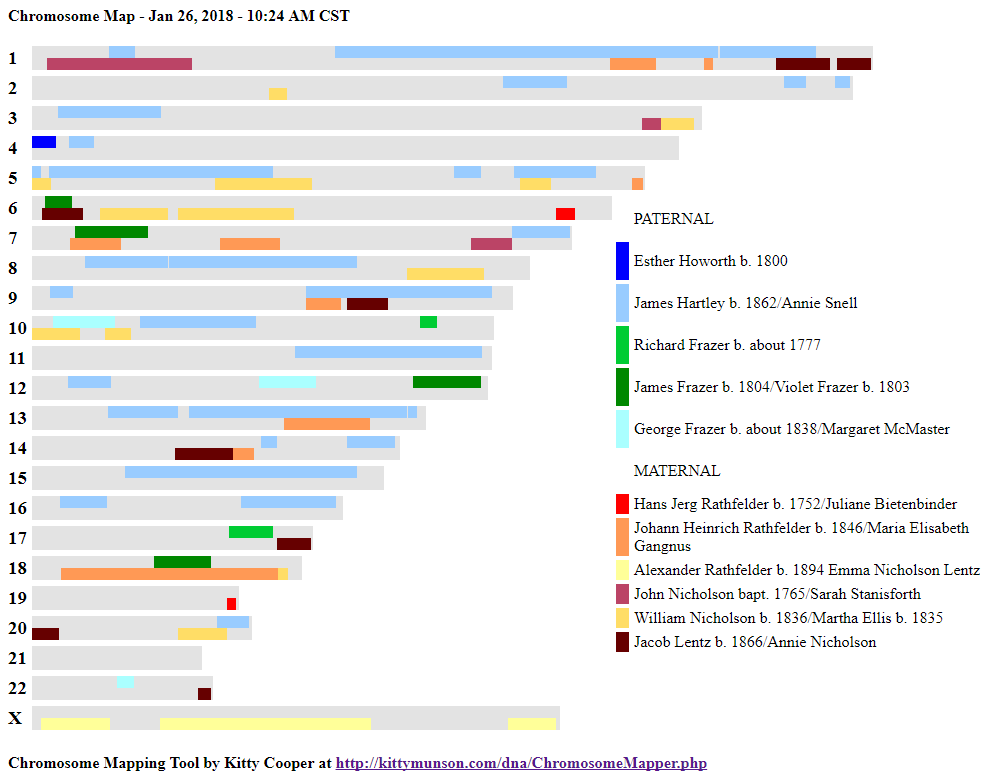
This is not a big segment that is added in lighter blue, but it about doubles what I had already on Chromosome 4. Also it goes back in time three generations from what I had belonging to either James Hartley or Annie Snell shown in darker blue.

Anne’s Chromosome 8 – We Have Triangulation

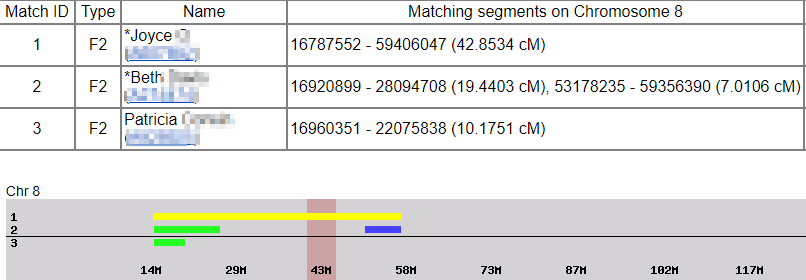
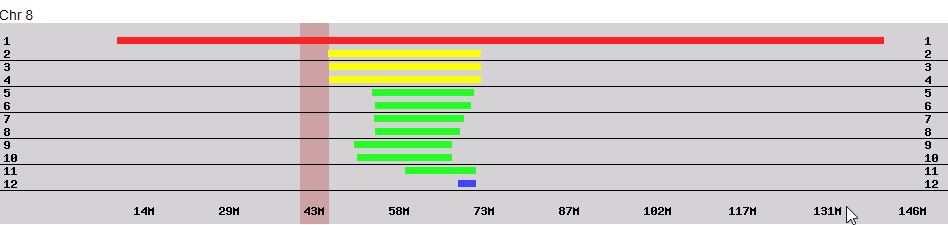
Here is how Anne matches some of my relatives on Chromosome 8:

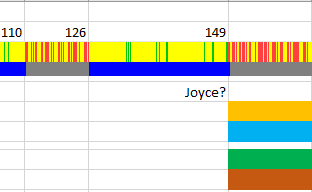
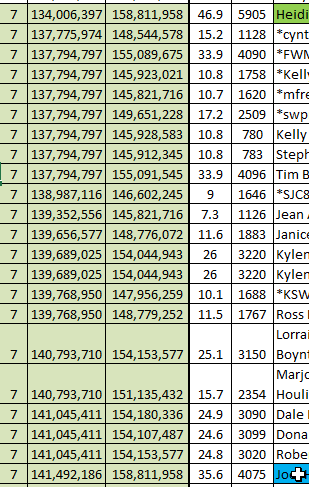
These matches are with Joyce (1), Beth (2) and Patricia (3). I already mentioned Joyce and Beth above. Patricia is Beth’s first cousin and my 2nd cousin. For this to be a Triangulation, Joyce has to match Beth and Patricia and Patricia has to match Beth on this same segment. That is quite likely.  Here is how Joyce matches Beth and Patricia on Chromosome 8:

This is definitely a Triangulation Group. That Group can be visualized this way:

I should note that there a few other of my second cousins that did not match Anne. The point is that it takes a few people testing to get these triangulating results when the common ancestors are born in the 1700’s.

Summary and Conclusions

  • Anne’s combination of where she lived, her DNA matches at Gedmatch.com and Ancestry and her good family tree all helped in this analysis
  • My match with Anne gave me a new mapping area on the paternal side of my Chromosome 4.
  • Anne’s matches would also supply some good mapping for Joyce, Beth, Patricia and my sisters as well as for Anne herself.
  • My conclusion is that the DNA triangulation shown above gives pretty convincing evidence that Esther Howorth b. 1800 and Abraham Howorth b. 1814 were siblings.
  • Now all we have to do is to figure out who Mary is that was married to James Howarth.


Edward and the Dicks Family Autosomal DNA

My last Blog was about Edward and his Newfoundland Dicks YDNA. In this Blog, I’ll look at the autosomal side of Edward’s DNA.

Edward’s Newfoundland Genealogy

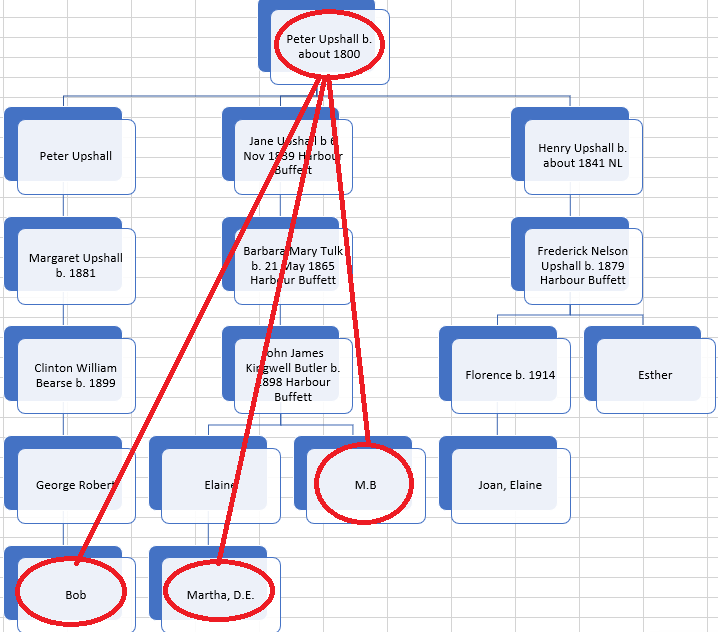
Edward descends from Christopher Dicks who was believed to be from Harbour Buffett, born 1812:

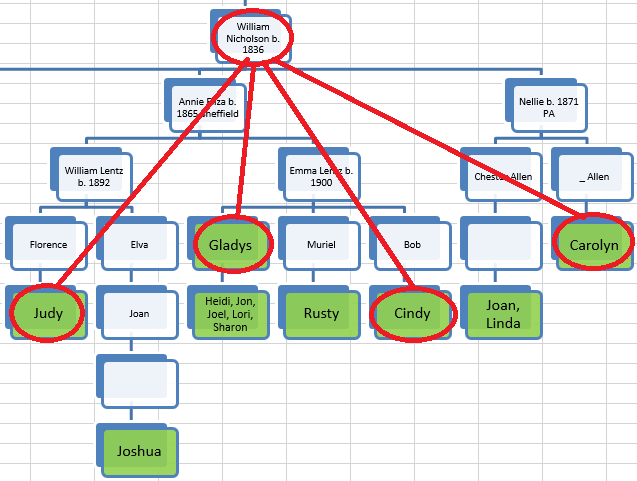
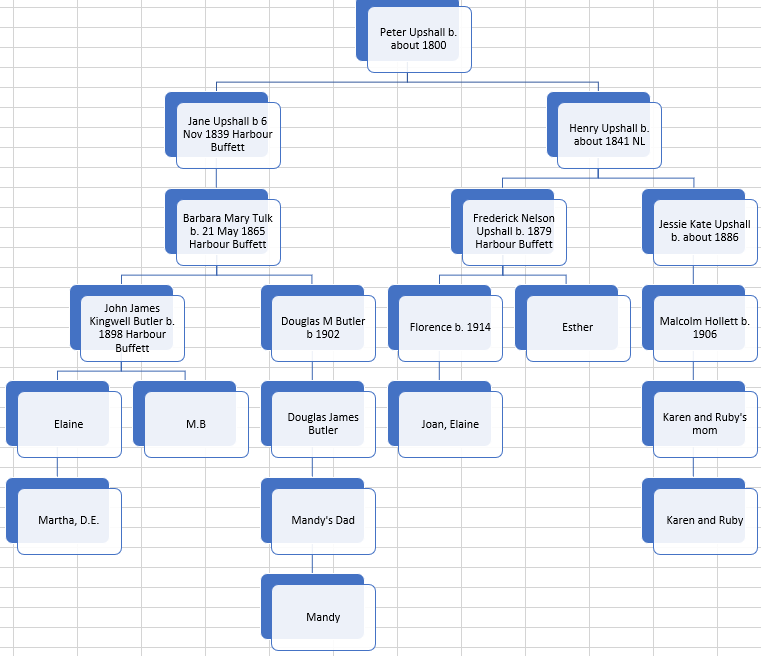
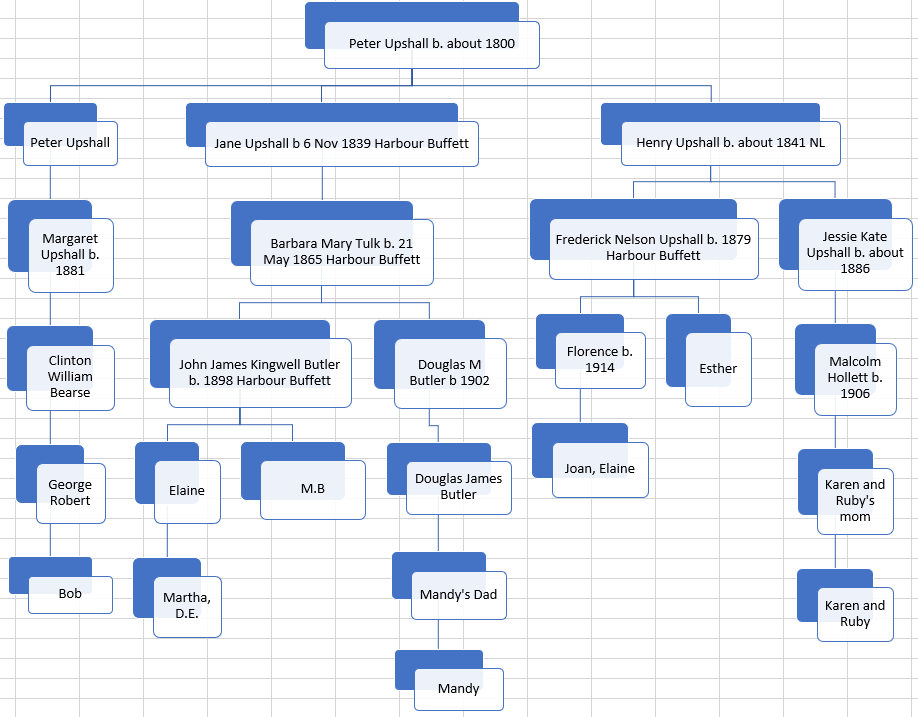
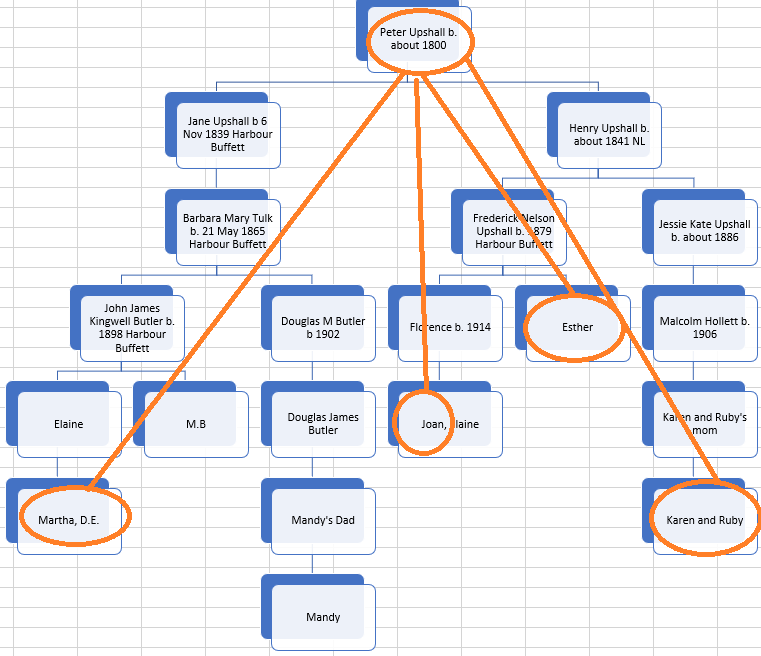
This Christopher was believed to be the son of another Christopher who was born around 1784. The 1784 Christopher had many children and their ancestors have had their DNA tested. I have been trying to tie that DNA as best I can back to Christopher. This is somewhat complicated by intermarriages. My wife has also tested. She is the daughter of Joan. Esther is a half Aunt of Joan and has Dicks on her father and mother’s side. By this chart, Edward is Esther’s 2nd cousin, once removed, Joan’s third cousin and my wife Marie’s third cousin, once removed.

Edward’s Dicks DNA

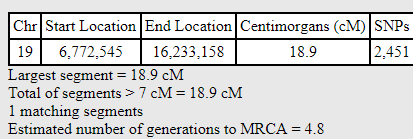
Here is Edward’s match with Esther:

The estimated number of generations to their common ancestor is about what one would expect for a 1st cousin once removed. That could mean that Edward and Esther share ancestors outside of their Dicks ancestors shown above.

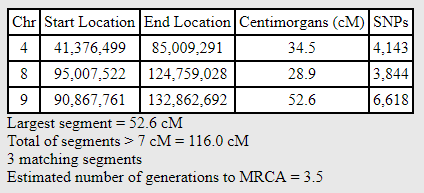
Here is Edward’s match with Joan:

Joan and Edward also share more DNA than expected. The 3.5 generations estimated to a common ancestor would usually indicate a 2nd cousin once removed. However, this is still within normal ranges. Also note that Joan shares some DNA with Edward that Esther does not. See Chromosome 6, for example.

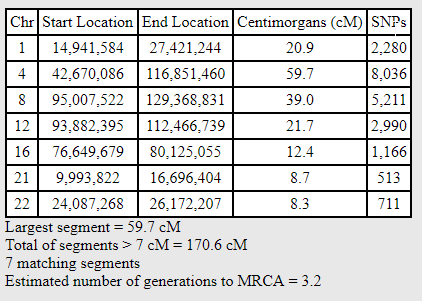
My wife, as expected also got a little more DNA than average for a 3rd cousin once removed:

The DNA that Esther, Joan and Marie share with Edward should represent the DNA shared with Christopher Dicks b. 1812 and his wife Elizabeth. This is especially true for Joan and Marie. Remember I said that Esther has a Dicks ancestor on her maternal side, so this is a complicating factor.

The Autosomal Matrix for Dicks Descendants

I’ll do a multiple kit analysis at Gedmatch with 24 descendants of Christopher Dicks b. 1784. Then I put the results in a matrix:

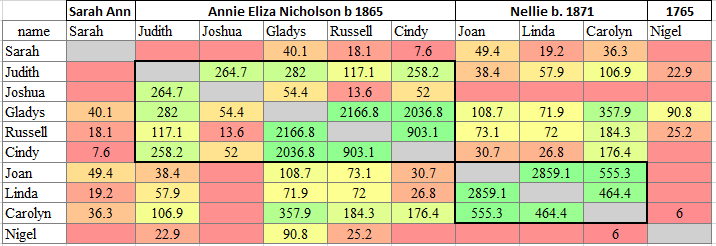
I’m quite happy with the results as all the Christopher Dicks descendants scored well (inside the bold box). Everyone is well behaved. Hayley has slightly lower scores with Joan but that is expected as she is one generation removed from Edward, Barry and Joan. Edward has some notable matches outside the Christopher Line of around 100 cM with Molly and Ken that could be worth pursuing. I’m still a bit puzzled with the large match that Ken has with Esther.

Triangulating

Next I take all the specific segment matches between the 24 Dicks descendants and compare them to each other. Actually, I have done this already for 23 of the Dicks descendants, so I need to look to see what difference Edward makes in all these comparisons. Now we will be unlocking the secrets of Edward’s genetic past. The say something like that on the Finding Your Roots TV show that I watch.

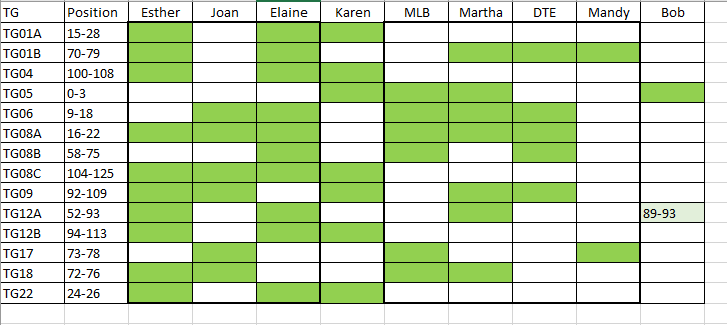
Triangulation Group (TG) Chromosome 5

The first significant TG is see is at Chromosome 5. It looks like this in spreadsheet form:

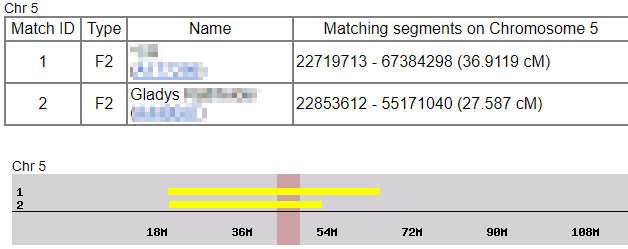
Gedmatch repeats the matches, so each match shows up twice. Here we see that Esther, Edward and Joan all match each other.

It would be logical to assume that the common ancestors for this TG are Chritopher, born about 1812 and his wife Elizabeth. The theory is that the TG points to only one ancestor, so the DNA for this TG is only from Christopher or Elizabeth. So, what about Hayley? She is not in the TG. She shows as matching Pauline who is also not in the TG. That tells me that their match is coming from a different direction. Hayley does have Christopher and Elizabeth as ancestors, but Pauline does not. We would have to look for another common ancestor that these two have. Pauline is on the Dicks/Joyce Line.

Grace, Dorothy and Catherine are all from the Dicks/Adams line, so it could be likely that they are matching on that line only.

A nested TG on Chromosome 5

This next TG on Chromosome is a little more complicated:

In my previous work on Dicks DNA, I had noted the TG with Wallace, Judy, Katherine and Cathy. I also had Nelson in there, so I probably lowered some thresholds for that. This time, there is also a TG with Edward, Esther and Barry above, and Edward is added to the TG below. I interpret this as meaning that the top TG harks back to Christopher and Elizabeth and the second one is for the elder Christopher b. 1784 and his wife Margaret.

This should be an interesting visual:

The black TG is the first TG that is more recent (Christopher of the early 1800’s). The second TG goes back to the elder Christopher (from the late 1700’s) and wife in red. Edward is in both TGs. My strong guess is that the red TG is truly a TG for Christopher and Margaret. This is because the DNA is coming from four of the children. It is possible, but not likely that each of these four lines has a common ancestor with a surname other than Dicks.

Why is Edward in two TGs and Barry and Esther only in one. I can only guess. My guess is that Edward inherited DNA from Christopher b. 1784 and Margaret. Perhaps Esther and Barry inherited DNA from only Christopher or Margaret. Any more guesses would make my brain hurt too much, so I’ll stop there.

TG Chromosome 6

There is a similar situation on Chromosome 6.

At the top, there is Grace, Sandra and Dorothy. They are from the Elizabeth Dicks/Thomas Adams Line. Katherine, also a part of that line, pops in below. Wallace, Judy, Molly and Howie are in the Rachel Dicks/James Joyce Line.  So picture these Dicks line outside of the highlighted TGs.  The highlighted TG could be one TG where Cathy opts out and decides to start matching Cheryl. Edward opts into the TG not far from where Cathy opts out. The other way to look at it would be like the previous TG. Barry, Edward and Hayley all have Christopher b. 1812 and his wife as ancestors.

Well, that’s pretty ugly. In this situation, I’m not sure if Cathy, Barry, and Hayley might not have another common ancestor. My best guess right now is that I have the ancestors right.

another brain twister on chromosome 6


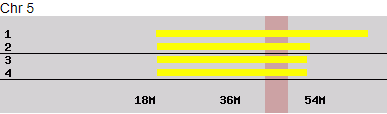
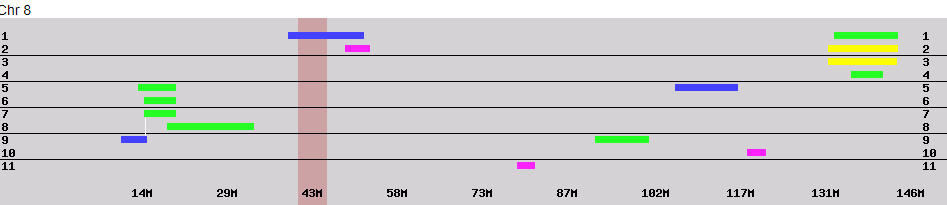
Here Edward is in the middle of two new TGs. Edward matches Esther and Pauline in one TG and Joan and Ken in the other. Here are the two TGs in a Chromosome Browser from Edward’s point of view:

  1. Esther
  2. Pauline
  3. Joan
  4. Ken

We know that neither of these TGs have Christopher b. 1812 and his wife in them. That is because, as far as we know, Pauline and Ken do not have these two as ancestors.

I have shown in the past from DNA that Esther and Joan have Crann in their ancestry. One place where Crann may have come in could be that the Margaret that married the Christopher in the top red circle was a Crann. That would make the red TG a Crann TG and the yellow one a Dicks TG. Again, it is a bit of wild speculation, but it does help explain why Ken has such large matches with other Dicks. He is likely related on many lines.  Note above that he descends from a Dicks/Crann Line.

Cathy and TG7

Cathy was in a TG above with Barry and Haley on Chromosome 6. Here she is in a TG with Edward and Esther:

This makes me wonder what Cathy has in common with Edward, Esther, Barry and Haley. I see by her family tree that she had Harbour Buffett ancestors.

One or two new TGs Chromosome 9

This was a little difficult to see, so I hid some of the duplicate matches:

Aah, the mysteries of DNA. There is one good thing about my mother in law being in TGs. She is a half niece to her Aunt Esther, so that cuts down on some of the possible lines. Below is Esther’s family tree. Joan is only related on Esther’s paternal side which includes those ancestors within the red box.

The bad news is that there are a ton of gaps in the tree. The only two surnames I have for sure are Upshall and Dicks. Plus it is difficult to be sure about the two oldest Dicks families on the tree. The point is that the TGs on Chromosome 9 have to be on the top part of the tree highlighted in red.

TG10

Esther and Edward have at least one ancestor in common with Ken who is from the Dicks/Crann Line:

TG11 Christopher b. 1812


TG13 – Dorothy from the Adams Line


I must be near the end.

TG14 – back to home base and Christopher


This is all solidifying that Joan, Edward and Esther have the same relatively recent common ancestors.

TG18 on the Adams Line with Grace and Nelson

TG19 – With Wallace and Judy on the Joyce Line


Those are all the TGs. Now I just need to summarize them.

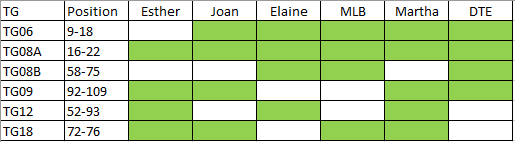
TG Matrix

The matrix is getting big, so I will have to show it in two screen shots. I hid a few of the people. One person, I don’t see in Gedmatch anymore. Sandi was in only one TG and Forrest was in none. I hid Clayton as he is unsure of his Dicks ancestry.

Assuming that all these TGs represent Dicks, we should be amassing quite a bit of information on the various Dicks Lines and for their parents Christopher Dicks and his wife Margaret. In fact, I show at least one triangulated segment for each chromosome.

Filtered TG matrices

Here I filtered just by Edward’s TGs:

Esther:

Joan:

Finally, the Matrix filtered for Ken’s TGs:

This further shows Ken’s affinity to the Christopher Line by TGs.

I’ve gone on way too long, so it’s time to quit.

Summary and Conclusions

  • Edward has contributed a substantial amount of information to the Newfoundland Dicks DNA Project
  • Edward is clearly in the same group as Esther, Joan, Barry and Hayley and has formed many new TGs
  • The arrival of DNA results recently for Edward, Barry and Hayley has more than doubled what was available for the Christopher DIcks b. 1812 descendants.
  • Ken continues to play an interesting part in his matches and TGs
  • Filtering the TG Matrix showed some promise. It appears that Ken is more closely related to Joan than to Edward based on filtering.  However, Ken showed up most in Edward’s TGs other than TGs Edward had within the Christopher Line.

Marie’s Connection to Richard and Newfoundland by DNA

Marie is my wife. Richard is a person on Marie’s Gedmatch match list. In fact,  Richard is, at the time I write this, Marie’s 495th match on her ‘one to many’ match list. Marie and Richard don’t know each other, so how do I know they have a Newfoundland connection?

Marie and Richard’s DNA Match

Marie and Richard’s DNA match looks like this at Gedmatch:

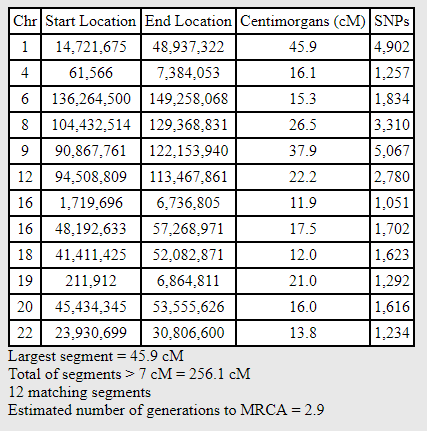
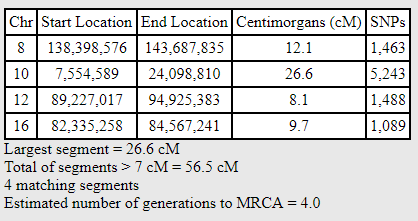
This shows that Richard and Marie share modest amounts of DNA on three of their Chromosomes. By DNA they could have a common ancestor about 5 generations ago. That means that they could be roughly 4th cousins. Marie could have gotten this DNA from her mom or dad, but she got it from her mom, Joan. This is how Richard and Joan match:

Joan shows as 4.3 generations away from Richard. The difference between Joan and Richard and Marie and Richard should be 0.5 generations roughly. This is because Joan is one generation closer to Richard and her common ancestor, but Richard is no closer or further. So it should average out to 0.5 generation difference roughly. Richard and Joan should be about 3rd cousins once removed, or something similar. Now I’ve narrowed down Marie’s match to about half of all her DNA matches.

Marie’s 1/2 Great Aunt Esther

Marie’s Aunt Esther is the key to understanding her match to Richard. Richard and Esther also match by DNA. Both of Aunt Esther’s parents were from Harbour Buffett, Newfoundland. So if Richard matches Esther, Joan and Marie and Esther, Joan and Marie match each other in the same DNA segment, that means they all have a common ancestor. Here is Richard’s match to Esther:

This shows that Esther, Joan, Marie and Richard only share DNA on Chromosome 11 from about position 12-19 M. That shared DNA would likely represent the common ancestor between Richard, Esther, Joan and Marie. Here is Marie’s family tree up to Aunt Esther:

Fred Upshall’s first wife Elizabeth died in the flu epidemic. Marie descends from Elizabeth. Esther descends from Fred’s second wife Margaret who was also from Harbour Buffet, Newfoundland. Any shared DNA with Joan, Marie and Esther must come from Frederick or one of his ancestors and not from the Shave side. That is how I know that Richard and Marie connect through Newfoundland and more specifically through Harbour Buffet, Newfoundland. Even more specifically, the Upshall side of the Harbour Buffett tree. We have narrowed down Marie’s DNA match with Richard to her mother’s side. Then to Marie’s maternal grandmother, Florence. Next, Marie has eight great grandparents, but we have narrowed down the DNA she shares with Richard to one of her eight great grandparents, Fred Upshall. Put another way, Marie has 2,000 matches on her ‘one to many’ match page at Gedmatch. This would narrow those matches down to 250, on average.

Richard’s Genealogy

So far, I haven’t looked at Richard’s genealogy at all. Richard and Esther have both tested at AncestryDNA. Richard shows as a predicted 3rd cousin to Esther at AncestryDNA. Above, Gedmatch estimated 3.5 generations to a common ancestor. This would be equivalent to a 2nd cousin once removed.

Richard’s Newfoundland side is through his father. Here is Richard’s paternal Newfoundland Line:

Two Trees Together: Where Are the Common Ancestors?

This is the difficult part. The genealogy of Newfoundland is missing much information. Here are Richard’s and Esther’s trees side by side:

Ancestry points out that Richard and Esther have the common Kirby surname. It could be that Joseph and John Kirby were brothers.

The Crann Connection

In a previous Blog, I show a triangulation between Esther, Joan and a Crann back to England. I show that Elizabeth and an Upshall spouse could have come from John Crann, but I now see that they could have come from another child of Henry Crann. I’m sure there are other possibilities.

This is where things get interesting. The John Crann in the diagram above is the same as in Richard’s tree. Remember when I said that Richard, Esther, Joan and Marie all matched on only one segment? That is the same segment represented by the Triangulation Group (TG) in the diagram above:

All I have to do is to see if Richard matches Heather from New Zealand. The good news is that he matches Heather. The bad news is that it is not on Chromosome 11:

Sometimes the DNA doesn’t behave like I would like it to. This could be a case where Richard and Heather are matching on the Collins side and Esther, Joan and Heather are matching on the Crann side (or the other way around). A TG only points to one ancestor. Here is Richard added to the Crann Tree:

In this tree, Richard matches Forrest (his third cousin twice removed):

Richard matches Wayne:

And Heather matches Wayne for a triangulation on a specific segment on Chromosome 8:

What I’d like to make clear is that the line is green is from New Zealand. The line in white is from Newfoundland. The ancestors Henry Crann and Elizabeth Collens were from Netherbury, Dorset, England and their children headed off in opposite directions. So this is a long range triangulation. This helps those with intermarried Newfoundland roots as the New Zealand descendants have just the Crann/Collens ancestors. This makes finding common ancestors easier clearer.

Summary and Conclusion

In this Blog I traced a DNA match between my wife, Marie and Richard. This match went up through Marie’s mom and through a common match with Marie’s 1/2 great Aunt up through one of her eight great grandparents. This greatly narrowed down where the match came from.

Then I looked at common ancestors. Richard and Esther have a Kirby surname in their ancestry, but the Kirby isn’t in Joan and Marie’s ancestry. After that, I looked at the Crann connection that Richard has. This was based on previous DNA work I had done. It turns out that Richard triangulates with Crann descendants from New Zealand that have never had ancestors in Newfoundland. This New Zealand triangulation removes some of the complications of intermarriage in Newfoundland. The Crann connection also confirms the previous work I did showing that there must be a Crann somewhere in the ancestry of Esther, Joan and Marie.

My Mother in Law’s Ellis DNA and Genealogy

I’ve been Blogging about Genetic Genealogy for over 2 years and I don’t think that I’ve written on my mother in law’s Ellis DNA and Genealogy. I have Blogged about about her mother’s Newfoundland Upshall and Dicks DNA and genealogy, but not the Ellis side.

Joan’s Ellis Ancestors

I have a web page on Ellis genealogy here. The Ellis family started out around Northam, Devon, England:

In 1818, William Ellis, ship builder and husband of Hannah Tawton moved his family to Prince Edward Island. There they had many descendants. William’s great grandson, George Ellis moved to Massachusetts where he married Lillian Ethel Rayner in 1898. He was the grandfather of my mother in law, Joan.

Joan’s DNA

Joan’s second largest Ellis DNA match at Gedmatch is with Melissa:

Gedmatch shows an estimated 3.6 generations to a common ancestor. That would make Joan and Melissa 2nd cousins once removed. Melissa says that she and Joan share common ancestors James Henry Ellis b. 1846 and Clarinda Gorrill. That was easy:

Melissa tells me her mom was from PEI, so that line stayed there a few more generations than my wife’s Ellis family. That would make Melissa a 3rd cousin to my wife, Marie. Of course, now I’m curious as to how Marie and Melissa match by DNA:

Marie got DNA from half the chromosomes where her mom matched Melissa. However, Marie got the smaller match on Chromosome 3 and only part of the match her mom had on Chromosome 17.

Joan’s DNA Match with David

Joan’s top Ellis match at Gedmatch is with David.

I sent an email to the match. The email went to David’s daughter Betty who was working on her dad’s genealogy. She said her paternal grandmother was “Laura Freda MacArthur  from O’Leary Prince Edward Island.” I was able to find Betty’s tree at Ancestry:

I then found another Ancestry tree that showed that Nathaniel was born 1867. It has Nathaniel’s father as Hugh Malcolm MacArthur 1812-1870. Then his father was Malcolm MacArthur b. in Scotland 1783 and died 1865 PEI. The same Ancestry Tree has Marion MacArthur born between 1812 and 1835. The tree has her dad as the same Malcolm MacArthur. Using this Ancestry Tree, I get this connection:

Under this scenario, David and Joan would be 3rd cousins once removed. I would have expected a closer relationship based on the DNA match. Either that is the way the DNA shook out or perhaps Joan and David match on another line. David and Melissa would be 3rd cousins twice removed. Melissa does match David here:

However, the match is less than expected also and not on the same Chromosome. So my theory is not without its problems, but it is better than what I had before.

Joan’s next dna match: Sarah

I found Sarah’s tree on Ancestry:

Here she has Agnes Ellis, George Russell Ellis and Bridget MacArthur. Fortunately James Monroe Ellis appears to be from a different Ellis line. Sarah’s three ancestors I mentioned above are 4 generations from Sarah. She would likely match Joan at Sarah’s generation 5. Joan and Sarah appear to be 4th cousins three different ways.

Joan and Robert’s DNA and Common ancestor match

On Robert’s maternal side, I see William Ellis and his wife Hannah twice again, as well as a MacArthur. In addition, he has the Rayner name.

That could take a while to sort out. The good news is that this is starting to look like a PEI DNA project.

The Rayner connection

Here are Joan’s Rayner ancestors:

Robert above has both a GED and Wiki Tree at Gedmatch. On the GED, Robert shows his 4th great grandfather:

 Edward Rayner, b. 1775, Whittlesford, CAM, ENG, d. 1847, Tiltons Creek, PEI, CAN

This is the same person as Joan’s 3rd great grandfather. That makes Robert and Joan 4th cousins once removed by that line.

Joan’s PEI Common Ancestors

Next, I put all of Joan’s common ancestors for her top PEI gedmatch matches in an Excel Spreadsheet:

These are for David, Melissa, Sarah and Robert. I didn’t check the last two MacArthur/MacDougall ancestors, but I think that there was only one MacArthur family on the Island at the time. Assuming, I am right above, the DNA should agree.

Continuing Down Joan’s Gedmatch List

Joan’s next match is with Dorises. I can’t figure out how she fits in right now, so I’ll skip her. The common ancestor may even be in England. Betty, Daughter of David is in there also, so I’ll skip her. Agnes is next on Joan’s Gedmatch match list. Agnes appears to be the mother of Robert. Her match to Joan is very similar to Robert’s:

However, I would rather use Agnes in the PEI project as her matches with others should be better than the matches her son Robert has.

Joan at FTDNA

Joan’s DNA was taken at FTDNA. That means, I can only see her Ancestry matches if they have uploaded their results to Gedmatch. At FTDNA, I found John. He has no tree, so I sent him an email. He does have in ‘in common’ match with Melissa, so I suspect that he could have PEI genealogy.

The next paternal match for Joan at FTDNA is Glenda. She is listed above Melissa on Joan’s FTDNA match list. Glenda has Ellis, Rayner and MacDougall ancestors. That would make Joan and Glenda 3rd cousins once removed on the Rayner line. They would be half 3rd cousins on the Ellis line. That is because James Ellis married twice. I suspect if there is a MacDougall common ancestor, that would be further out. I can check that out later if I need to.

Here I have sorted the common ancestors into surnames. I have added Glenda and Joan’s common ancestors on the bottom row. Note that the wife of James Ellis b. 1801 is not a common ancestor as he had two different wives (Ramsay and MacArthur). Joan and Glenda are descended from different wives.

Back to Gedmatch

Joan matches Barry next. Barry does not have a tree listed at Gedmatch and has an AncestryDNA Kit number. Here is how he matches Joan:

I noticed that at Chromosome 11, Barry and Joan matched where David and Joan matched. That means that there could be a common ancestor. To find out I triangulate. All that means is that I check to see if Barry and David match each other at the same segment on Chromosome 11.

This shows that even though I don’t have Barry’s ancestry tree, I can tell that David, Joan and Barry have a common ancestor. Based on what I know now, that common ancestor could be MacArthur or MacDougall.

I wrote to Barry and he tells me he does have a MacArthur ancestor. His great great grandmother was Ellen MacArthur. She was born in 1845 or 1846 I suppose based on the age of her death in 1938.

A search for Ancestry Trees shows that Ellen’s dad was likely Hugh Malcolm MacArthur. His mother was Susanna Dyment or Mae Diamond. Hugh’s dad was Malcolm b. 1775.

Note that Barry and David are 2nd cousins once removed. Joan and Melissa are also 2nd cousins once removed, but in a different generation with respect to the MacArthur Line.

Joan and Lee

I had followed up on this match about a year ago. At the time, Lee’s daughter Elizabeth had decided the match could be on the MacArthur name.

Lee’s MacArthur Line appears to go back one more generation:

Here Lee and David are 4th cousins.

Joan’s MacArthur DNA

Joan’s Ellis tree has quickly turned into a MacArthur DNA tree. This is due to the fact that there appear to be many MacArthur descendants and importantly descendants that have had their DNA tested.

I have another Ellis descendant to try to balance out my DNA tree. That is Jane. I have been in touch before and she descends from James Ellis b. 1801. I put Jane on the Ellis tree so she would be easier to see:

It Takes (At Least) Three to Triangulate

Next I want to compare these people to each other. For this I use the Multiple Kit Analysis at Gedmatch. Then I choose the Segment CSV File. This gives me all the matches of everyone to everyone else, including the detailed information. The goal is to find Triangulation Groups (TGs). These will match each other at least three ways. Here is the beginning of my list of matches:

Note under Chromosome 1 that Melissa matches Agnes and Sarah matches Agnes, but Melissa doesn’t match Sarah. How is this? Actually Melissa and Sarah do match, but below the threshold. Usually, it is not advisable to lower the matching threshold, but in the case of TGs, I sometimes do. Here is how Melissa and Sarah match at a threshold of 5 cMs:

What this is telling me is that the following have common ancestors:

  • Melissa, Agnes and Sarah (Chromosome 1)
  • Joan, Sarah, Jane (Chromosome 2)
  • Melissa, Sarah, Agnes (Chromosome 2)
Finding the common ancestor for joan, Jane and sarah

The triangulation is the easy part. Finding the common ancestor is difficult. Let’s look at Joan’s TG as I have the list of common ancestors based on her ancestry:

I’m not sure if this list is complete. Joan’s TG has Joan, Sarah and Jane. That means that the DNA from that TG represents one common ancestor. The common ancestors between Joan, Jane, and Sarah appears to be William Ellis and Hannah Tawton. In fact, Sarah, has William and Hannah in her ancestry twice. I would think that would up the chances of those two being the common ancestors. We can’t know from this whether the TG represents William or Hannah, but we will say Ellis due to naming considerations. Their children who brought the DNA down to the present generation would have been named Ellis. However, what about MacArthur? Jane’s tree shows a Hugh MacArthur married to Nancy Ramsay. This couple is 6 generations from Jane. If I’m counting right, William Ellis and Hannah Tawton are listed as 7 generations from Jane. Now I’m back to the Ancestry trees. It appears that Hugh’s grandfather was probably Hugh MacArthur that married Flora Gillis. They would be common ancestors, but as Hugh was born before 1750, we will say that common ancestor is much less likely.

This common ancestor thing drives me a little crazy as I have to know everyone’s genealogy. I need to add Sarah to my Ellis DNA tree:

This shows that Jane, Joan and Sarah are all 4th cousins to each other. The DNA that they share on Chromosome 2 was likely from either William Ellis or Hannah Tawton. This does not show that Melissa does not belong to this line. If Melissa were to be in this TG, Melissa would have had to have gotten DNA from her mom’s dad Stanley. However, at this particular location, she may have gotten her DNA from her mom’ mom which would have kicked her out of this DNA match.

Also note on the yellow line that Jane descends from the first wife of James Ellis who was a Ramsay. However, that does not really change the common ancestors for Ellis. It would mean that Jane and Joan would not have a MacArthur common ancestor on this line.

Joan’s MacArthur TG on Chromosome 11?

Joan’s other TG with the group I looked at in this Blog is on Chromosome 11:

This shows that Joan, David and Barry have a common ancestor. David and Barry have MacArthur ancestry but not Ellis as far as I know.

Summary and Conclusions

I have started to take a look at Joan’s paternal side PEI DNA to see how she triangulates with others. The others that she matches also have PEI genealogy. For the two TGs that I looked at, one on Chromosome 2 is most likely Ellis/Tawton DNA. The second TG on Chromosome 11 appears to be MacArthur/MacDougall DNA. Using this I could map Joan’s DNA to these ancestors. In addition, other DNA tested people that are in a larger TG in these areas should have Ellis/Tawton or MacArthur/MacDougall genealogy. This is a good way to confirm existing genealogy and to focus genealogy where researcher are unclear on their genealogy. For example, in this Blog, I started out looking at the Ellis name, but the DNA and common genealogies pushed me in the direction of MacArthur.

There were other TGs that Joan was not in that I didn’t look at closely. This is because I am not sure of the different ways that these people may have common ancestors. I have identified some, but there may be others that I don’t know about. It takes a bit of work to look for common ancestors where there are common DNA matches. Where there are multiple common ancestors, this complicates matters.

As a result of this exercise, I have identified new PEI ancestors for my mother in law. These ancestors appear to be confirmed by Ancestry Trees and DNA, but could use further confirmation.